 Frosts? Yup. Green tomatoes brought in? Check. Furnace? On. It’s that time of year. Darker beers. Browner liquors. Higher natural gas bills. I feel a bit like the unnamed gent in the painting, “A Man with a Pint” from 1932 by Fred Elwell. Layered clothes. Sitting in a lower light. Pointing at things in newspapers and telling the person across the table about it. I feel badly for the lad. He just missed out on the first wave of beer blogging by about seventy years so, given that, all he could do was sit in pubs, pointing at things in newspapers and telling the folk who were with him about it.
Before we get into the newsy news, perhaps speaking of him… and even maybe me, The Guardian shared a story this week on hangovers and aging and what’s going on:
The liver breaks down alcohol with the help of enzymes, but as we get older it produces fewer of them, meaning toxic byproducts such as acetaldehyde – the compound responsible for many hangover symptoms – linger in the body. It’s not just the liver. The body’s water content drops by about 5% after the age of 55, partly because levels of muscle, where a lot of it is stored, decrease. Less water means alcohol is more concentrated in the bloodstream, and dehydration caused by its diuretic qualities – a key culprit behind hangover headaches and grogginess – hits harder. Kidney function also declines with age, slowing the removal of waste products. “You get this buildup of waste products in the body that have a longer circulating time to exert their effects…”
Tell me about it! Scary. Getting back to with the ghosts and ghouls theme, The Beer Nut has put on his STASH KILLER! costume this week and has put together an exploding can special post:
I don’t know why I even had these. It certainly wasn’t with the intention of seeing if they improved with age: the styles involved aren’t really built for that. This summer’s warm weather resulted in some warped cans, and I lost a few which ruptured, so I took that as a signal to try these out before they explode completely… For the most part, these were better than I expected. While of course I don’t recommend that anyone age pale ales or hoppy lagers in the hope of improving them, not least because of the risk of explosion, it seems it takes a lot to properly ruin a beer once it’s in its aluminium jacket.
BREAKING PERRY NEWS!!! A solid rebuttal from Barry Masterson this week in Cider Review on a statement by cidermakers Westons declaring that perry is dead!! and using the term “pear cider” instead:
One would think it is incumbent upon established (and let’s admit, pretty large) producers like Westons to protect and promote the uniqueness of perry, not wash it away for the sake of a quick sales boost. The move is especially troubling coming from a company that touts its family history and traditional production methods. You cannot claim authenticity while simultaneously erasing the very tradition that underpins your reputation. Rather than declare perry “dead,” Westons should lead the way in educating new drinkers about its heritage and distinctiveness. Younger consumers are curious, discerning, and increasingly interested in authenticity and provenance.
Quite right. We can’t even get perry in Ontario – but I wouldn’t be buying anything called “pear cider” if it was for sale here. Strikes me, like “Canadian Sherry” or “California Burgundy”, as a sign… and a sign that says “beware!“* By the way, James Beeson wrote the story in The Grocer about Weston’s decision to change the name and dumbdown the drink – and is now getting grief from a key trade association which seems to be a bit confused about the difference between publishing a story and being the topic of a story:
In response to the article “Perry is ‘dead’ declares cidermaker Westons” published by The Grocer on the 21st October 2025, the Three Counties Cider and Perry Association (TCCPA) launch their Perry is Alive campaign. Westons’ justification for their removal of perry from their labelling is to increase their sales figures. The TCCPA believe this dismissal and removal of language to be damaging and a danger to the relationship drinkers have with the rich history and heritage of perry, pears and the land they come from.
And it’s all about the orchards this week as Pellicle‘s feature is a portrait of Virginia’s Diane Flynt of Foggy Ridge Orchards penned by my fellow Tartan Army follower, Alistair Reece:**
Sitting on the patio overlooking the lush verdant slopes of the orchards, the creek—from which mist rises in the morning, the inspiration for the cidery’s name—in the distance, Diane and I talk about apples, farming, and the making of cider. “It’s not just apple cider varieties—that’s one thing—it’s apples grown for cider,” she tells me. “When I bought Goldrush, I paid in advance for my apples and said ‘I will buy every apple on that tree, but I do not want you to pick them until they are falling off the tree.’ That’s growing apples for cider—they have to be dead ripe on the tree.”
That right there is a nice nugget of knowledge. And, speaking of the sensible, there was a measurably more reasonable response*** to that NYT item was this by Tom Dietrich in Craft Brewing Business on the four steps to “save” craft including one approach to improving the branding:
A big reason “wacky” beer names exist is because the beer trademark landscape is more crazy and crowded than a New Found Glory mosh pit (millennial reference alert!). If you’re applying to register a beer mark, your mark can’t be the same as or similar to any other mark for (a) beers and breweries, (b) wine and wineries, (c) any other spirits or alcoholic beverages or mixers, and (d) bar and restaurant services… In a crowded industry where creative names are increasingly hard to come by, understanding how to lawfully identify, clear, and acquire abandoned trademarks can be a competitive edge.
Another sensible nugget of knowledge. And, continuing the theme, while the periodic column from Pete Brown in The Times can be a bit structured given its tight bit of space some weeks, this time his theme of twelve great London pubs with £5 pints provided for a bit more leeway for neatly balanced comment:
This reinvention of the happy hour is surprisingly widespread. Every pub in the Brewhouse & Kitchen chain has its own on-site brewery. The two currently open in London, at Hoxton and Highbury Corner, fill up in the evenings, when pints cost £6-8. But to get people in during the day, the pubs sell their own cask ales — usually a best bitter and a session IPA — for £3.50 before 6pm… “We have to recognise what session drinkers can afford.” Most pubs aren’t trying to rip you off. They know that cheaper pints mean more customers. It’s far easier to find the £5-ish pint in north, east, and southeast London than in the west… But if you explore, especially via Overground rather than Tube, you’ll find pints in London at prices that make even a Yorkshireman happy.
Good advice. See also Ruvani at Beer Professor and her sensible recommendations for everyday beers. Exercise your right to choose when to drink. And what! Or where!! Like Martin who enjoyed himself at the posh confines of Ye Olde Bell in Nottinghamshire: “You need to walk past several interception points where you feel you might be asked “Can I HELP you Sir…” Or like Katie who was in Koblenz, studying the scenery:
I stare into the shiny window of a cigar cellar for quite a while before turning down a side street to find Spritz Atelier, a brand new bar specialising in fancy cocktails. I order one made with a local quince liquor called Kowelenzer Schängelche and watch from the window as a man finishes his workday with a take-out spritz of his own. He sips from the straw as he pushes his bike down the cobbled street, before disappearing out of sight.
You don’t even have to be there to choose whether you would want to be there. Consider Boak and Bailey‘s thoughts on the Prospect of Whitby as genius loci:
A few weeks ago, Ray visited The Prospect of Whitby with friends and had the usual experience of too many tourists crammed sharing a generally uninspiring chain pub atmosphere. Even in that context, though, there’s something magical about drinking a pint of Old Peculier while looking out over the water while the novelty noose set up for the amusement of visitors swings in your peripheral vision. It gets better again when you detour up the side of the pub, pass through a gate, down some hazardous steps, and onto the beach at low tide. There, the full power of The Prospect really hits you. Not least because you’ve seen this view a thousand times.
Changing themes with wanton abandon, I am enjoying this year’s continuing strained arguments about youth today. Like this in The Morning Adverstiser, taking the “drinking differently” approach:
While younger consumers remain less likely to drink than older age groups Lumina’s data shows more 18- to 24- year olds now describe themselves as drinking ‘often’ or ‘sometimes’ and fewer arre opting out completely. The long term fall in alcohol participation has plateaued.
The article goes on to then describe how younger people are, you know, still less drinking of alcohol. Don’t get me wrong. It’s obvious that turning social settings like pubs and tavs into something other than boozers is healthier and economically beneficial. I am all for skittles. But drinking low to no alcohol beers is not maintaining “alcohol participation.“**** It’s reducing it while maintaining social participation which, as I say, is really good. Anyone who actually believe the clinky-clinky is a fundamental social bond or, you know, builds community as the wise said in 2014 is fantasizing.
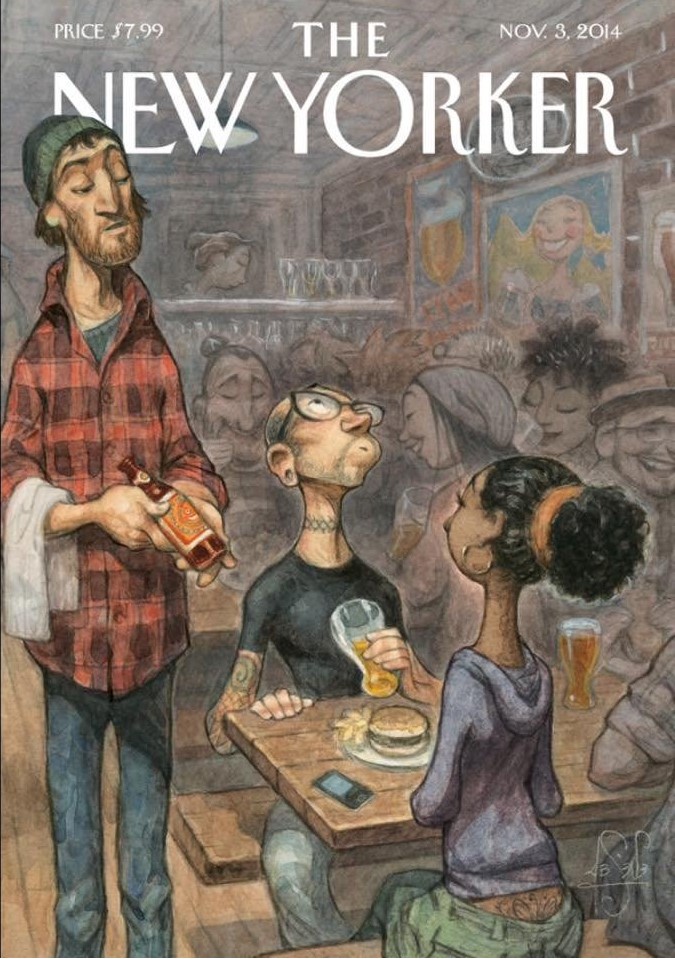
Which reminds me of something else. Over on FB, a memory from twelve whole years popped up in my feed this week and it gave me some perspective on that whole “the young folk ain’t drinking craft no more” story.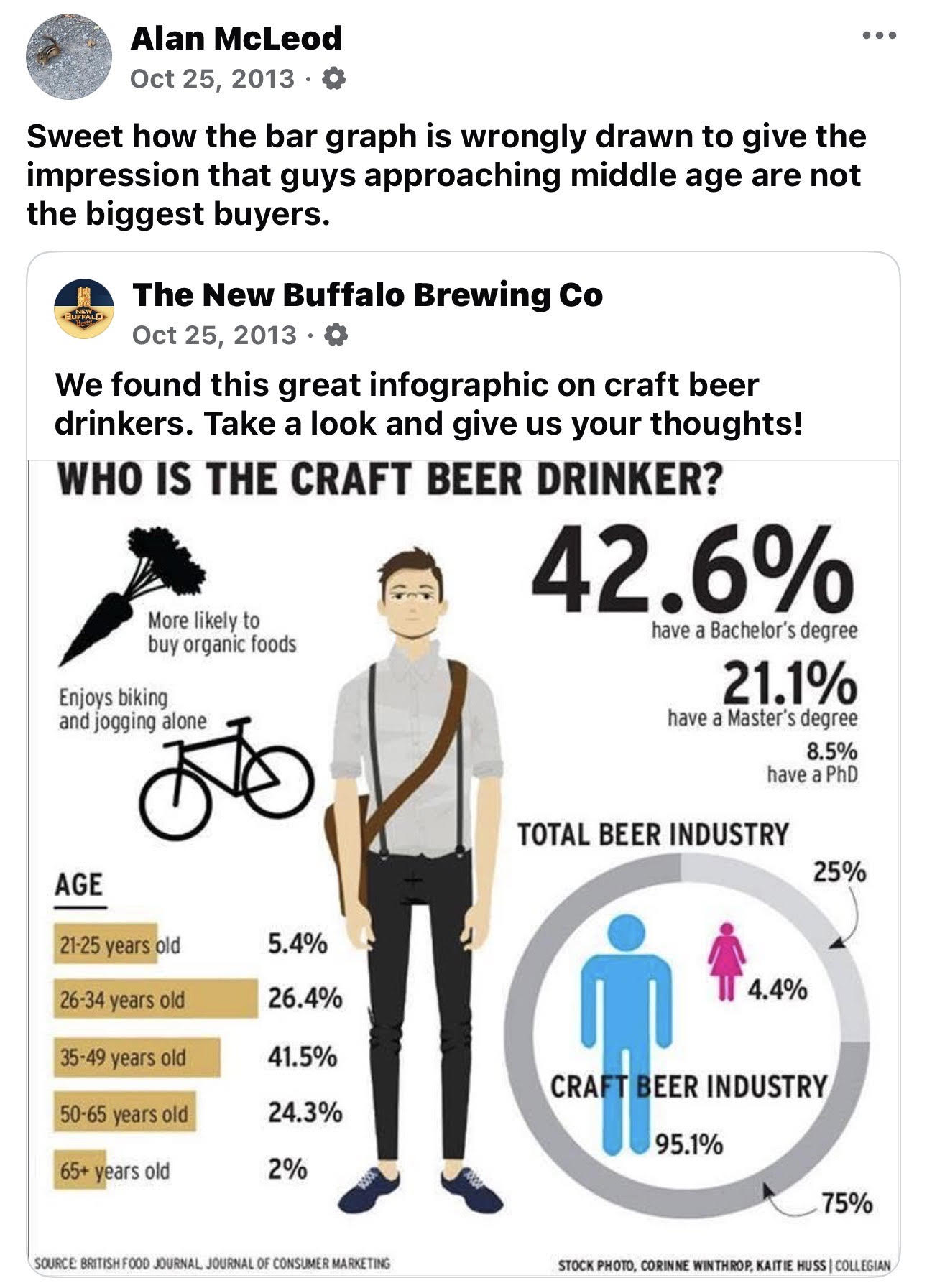 Look at the brown graph in the lower left. It was created with data from the British food and marketing trade associations. In 2013 I was irritated by the incompetent bar lengths in the graph. In 2025, I am more interested in the percentages. Keeping in mind these are UK figures, they indicated that two-thirds of craft beer drinkers at the time were over 35. Those people are all over 47 now. Only just over 5% of people who were 21 to 25 at the time admitted to drinking craft beer. So when was this time when “the young folk drinking craft“?***** (This diagram from 2014 might suggest the same was not the case in the New York of the very next year. Maybe.)****** But whatever it was then, Stan is wondering if a key aspect of what made craft interesting back then has disappeared:
Will Curtin said the brewing landscape has changed significantly over the years, and believes that the traditional “garage brewery” model may be waning. “I think sort of the age of a garage brewery is sort of, if not gone, going,” he said.
I wonder if the cause of the going is not so much the loss as the lack of a compelling replacement. Whatever happened to the shock of the new? Well, unless you are in Spain next year, when drivers may get a shock:
Tourists, be warned: Spain is proposing stricter drink-driving laws, and they could be enforced by the end of the year. The country’s Dirección General de Tráfico (DGT) wants to introduce new alcohol rules for all drivers — including those on bicycles and e-scooters — by the end of the year. The aim is for a universal alcohol limit of 0.2g per litre in the blood or 0.1mg per litre in breath. That would mean almost zero alcohol consumption before getting behind the wheel. Even a small glass of wine or beer could put you over the threshold.
That’d be one-quarter of the limit we face here in Canada. Be prepared. You can practice the pronunciation of these handy phrases for your next trip to Spain: “Propietario! ¿Duermo en tu cobertizo? Hmm ¿Tal vez debajo de tu árbol?”
One last thing before we go. There was a call for papers from the people of Beeronomics:
The 2026 Beeronomics Conference will take place at ESSCA School of Management, Bordeaux, France, 24-27 June. Main panels and sessions will be held at the ESSCA Bordeaux Campus. The Conference Organising Committee, led by Gabriel Weber and Maik Huettinger, welcomes all high-quality research on the economics of beer and brewing. With a strong interest in interdisciplinary research, we are looking for submissions covering topics including…*******
Check it out, people. And with that, we are done. Adios and farewell to October! Next week the World Series will be over, Halloween will be in the past and I probably will have ripped up and rammed all the tomato plants in the compost bin. In the meantime, please also check out, Boak and Bailey on this and every Saturday and then sign up for their entertaining footnotes, too. Look out for Stan when he feels the urge now that he’s retired from Monday slot… maybe … maybe not. Then listen to a few of Lew’s podcasts and get your emailed issue of Episodes of my Pub Life by David Jesudason on certain Fridays. And Phil Mellows is at the BritishBeerBreaks. Once a month, as noted, Will Hawkes issues his London Beer City newsletter and do sign up for Katie’s wonderful self-governing totes autonomous website featuring The Gulp, too. Ben’s Beer and Badword has returned from his break since April so you can embrace the sweary Mary! There is reading at The Glass which is going back to being a blog. Any more? We have Ontario’s own A Quick Beer and All About Beer is still offering a range of podcasts – and there’s also Mike Seay’s The Perfect Pour. Plus follow the venerable Full Pint podcast! And there’s the Craft Beer Channel on Youtube. Check out the archives of the Beer Ladies Podcast. That’s quite good and after a break they may well be are back every month!
*See: Perth Pink.
**Note: not aka Alice DuRiz!
***Just for example, see same publication in 2023 making the pretty much the same point but in 2025: “HOW DARE THEY!!!“
****Customer: “I’d like to participate in some alcohol please” Bartender: “I shall be delighted to perloin you said chemical…” (Mutual winkies) CURTAIN!!!
*****By the way, New Buffalo seems to have stopped brewing a year after they published the diagram before getting caught into a legal dispute.
******You know, sometimes a parenthetical sentence is a good as a footnote. No, it really is.
*******… topics including (i) trends and driving forces in local and global beer production, consumption, and distribution; (ii) management, marketing, market structure and industrial dynamics, individual beer choice, health and well-being; (iii) policy and regulations related to the beer brewing industry; (iv) impact of beer on society and culture (v) environmental issues affecting beer and brewing and (vi) other stuff like food industry and alternatives to beer. You could write something about one of those. Birdeaux is nice in June. Why not? Give it a go.