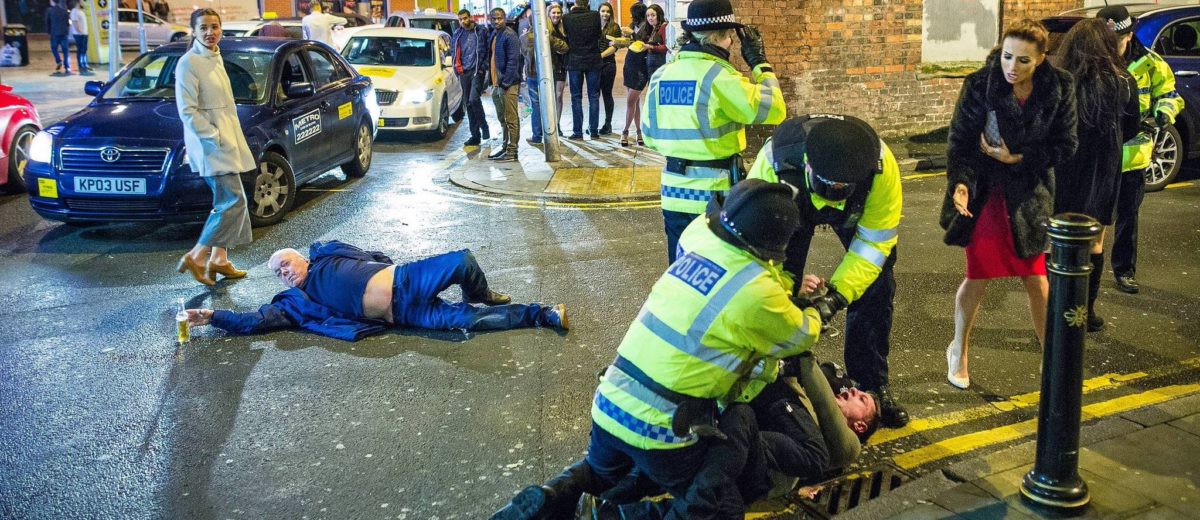

Your Always Accurate Yet Often Questionable Beery News Notes For The Last Lazy Days Of August

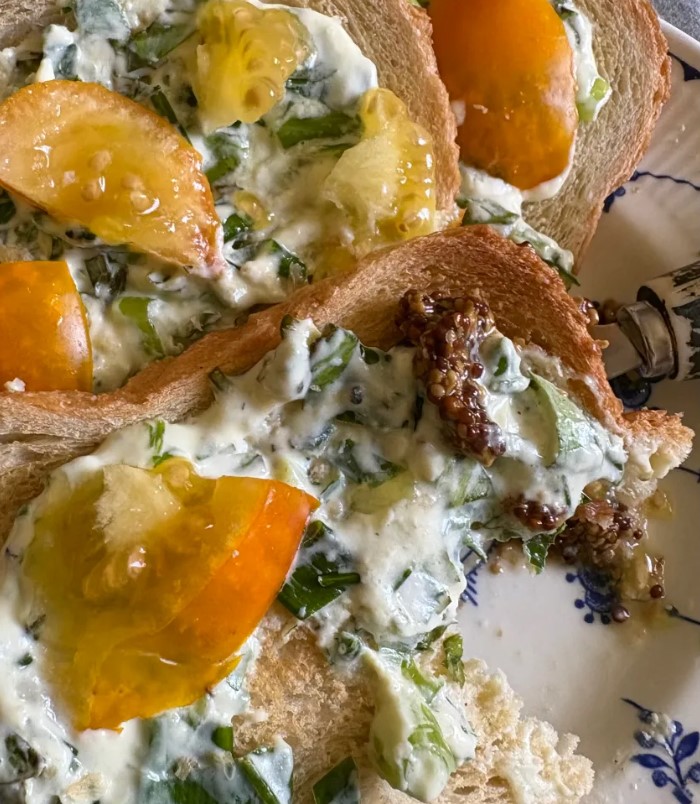
Say what you like. Beer is pretty good but, be honest, toast is the best. See that there? My yellow tomatoes on cream cheese mixed with my green onions, chives and basil. Pennies worth of seeds, just months of waiting. And watering. And weedeing. All for toast. I once even made cream cheese. Bought the equipment on line maybe 25 years ago. It was great. It was a couple of kilos worth, too. Never made it again. You think a beer hobby or home brewing is a hazard to your girlish figure? Cream cheese making laughs at home brewing.

What’s up? For Everyday Drinking, Sarah Sioli wrote about an interesting problem with clinky drinky third spaces:

There’s a paradox anyone who cares about wine, gastronomic culture, and cities will recognize. When I go out to eat and drink in Barcelona, I almost always have to choose between two things I love: the kind of bar that feels like home, and the kind of wine I actually want in my glass. In this city, those two things rarely live under the same roof. It’s happening in many cities where bars are still part of daily life… And here’s where the paradox lands… The wood has become stainless steel. The kitsch portraits are gone, replaced by minimalist reproductions and photo prints. The crowd has become the modernillos—Spanish for the “cool kids.” The waiter speaks English first These places are what the anthropologist Marc Augé called non-places… 

Exactly! Non-places. Sounds a lot like those IKEA-inspired taprooms. For an opposing view, Ron’s thoughts on Canada’s VIA rail service have conveyed valuable information.  His trip into Quebec City even more so:

Alexei has found a pub with a decent beer selection nearby: Café au Temps Perdu. We head there.  There’s a supermarket nearby. But we’ll leave that for on the way back. Au Temps Perdu is a lively neighbourhood bar. We sit on the terrace. As the sun sets behind suburban houses. Dead relaxing, is how I would describe it. The air is still and the light golden. I get a Noctem Catnip IPA, the kids have cider. And some food: beef dumplings, fried calamari and poutine. The poutine is really good: rich and deeply savoury. It really does seem to be better in Quebec. The gravy is almost like brown sauce, in a very good way It’s a lovely summer evening and customers drift in and out, the crowd becoming noticeably younger as time drifts on. I get an espresso martini for my second drink. What the hell, I’m on holiday.

What else? Well, a lot of newspaper columns end up as higher forms of listicle – which is readonable given the general readership – but this column by Pete Brown in the Times of London provided us with a very suscinct history of Italian Pilsners:

In 1996 an Italian brewer called Agostino Arioli set up a new brewery, Birrificio Italiano, just outside Milan. He was a huge fan of the hoppy German Jever Pilsener, and wanted to brew a copy. It didn’t work, so he tried the English practice of “dry-hopping”, where raw hop flowers or pellets are added to the beer after fermentation to intensify the fruity flavour. That didn’t work either. But he had accidentally created a beer that he loved — he named it Tipopils (Italian for “kind of pils”). Exhibiting it at a brewing competition in Munich, he met Matt Brynildson, an American brewer who liked Tipopils so much he went straight back to Firestone Walker in California and made his own version. 

Speaking of lagers, Boak and Bailey shared a bit of a study on the place of cask ale in an English heat wave – but included some thoughts of a nice colder lager:

We think it’s that lager has less going on or, rather, that its complexity is fairly subtle. In hot weather, what you want is water but better, and a good lager can be like that. It won’t make you chew on anything, or overwhelm your nasal apparatus before you’ve even taken a gulp. It has enough bitterness to provide an invigorating bite but not so much that it takes even the slightest effort. This is all perilously close to the language of beers that are ‘drinkable’ and ‘refreshing’ but in hot weather those qualities do become rather more appealing.

I’ve been told my own complexity is pretty subtle. (“Too damn subtle!” read the marginal notes on much of my marked school work.) Speaking of B+B, on their Patreon footnotes last weekend I commented on their thought that once a beer becomes too different it arguably ceases to be beer. My comment was that “scotch taping non-beery things onto the category of “beer” dilutes statistical certainty but it also conveys a lack of, what… authorship.” IE: if you make sometihng new, name it something new. The recent obituary of wine writer Matthew Jukes pointed out an example of this:

Known in the trade as “Jukesy”, he was adored by Australians because he did so much to champion their wines in his books, journalism and broadcasting… He also ventured successfully into business, responding to changing trends in alcohol consumption by creating a range of zero-alcohol drinks that could “replace wine for a wine-savvy palate”. His recipes were inspired by Haymaker’s Punch, a cordial made by farmers in the 17th century using leftover fruit and vegetables steeped in vinegar. Soon his “Jukes Cordialities”, having started in a kitchen under a Battersea railway arch, were winning orders from Michelin-starred restaurants around the world.

I mention this as it affirms a usefulness in taxonomy that the booze world largely ignores – giving each thing its own name. I might be more interested (errr… even slightly interested) in booze replacement fluids (BRFs) if they were called “cordialities” or, you know, anything other than the thing that they are not. For example and by way of illustration, consider this statement in a recent post at BMI:

Notably, non-alc beer accelerated from week to week, up 15.7% for wk thru Aug 2 vs +14.7% in prior wk thru Jul 26, making it one of the only alc bev segments to do so…

One day soon footware and car parts will also be included as “alc bev segments” to further plump the stats.

Almost relatedly, in Pellicle David J wrote about Stirchley Wines & Spirits of Birmingham, which in 1989 became one of those fabulous pre-“craft” beer retailers, a now largely unsung foundation of the beer beer movement:

…Krishan made sure not to overlook British breweries—although he confesses he generally found the era’s offerings quite samey—and stocked outliers like Worthington White Shield and Samuel Smith before supermarkets had extensive beer ranges. He dealt directly with breweries like Shrewsbury’s Salopian, in some cases before they were established, and was especially excited when new ones opened in Birmingham. The key to Stirchley Wines’ enduring success, though, was always offering a range of beers that appealed to all types of drinkers, whether they were interested in the modern, the traditional, or rare imports. Today, the locally brewed Batham’s Best Bitter is the shop’s single bestseller, but Birmingham’s Attic Brew Co. is the most popular brewery.

Update: I forgot to mention how much I enjoy the beer specialist shops, something that the pervasive nature of craft has perhaps stomped upon. Twenty years ago, I had to impose a rule upon myself that I would not could not physically touch any bottle for the first ten minutes of a visit to Finger Lake Beverages. One had to control oneself.

And did you hear about the mid-1900s Belgian brewer who may have been doing better than the taxman was told? The Guardian reports:

The hoard, which includes gold coins, nuggets and numbered bullion bars, was stashed in a bag in a bricked-in cellar wall beneath the grand villa originally built for the brewery’s owner, Theophilus Van Assche, in the late 19th century. Brewing on the site began in 1899 and ceased in 1970, and the listed property – the wrought-iron gates of which still bear the initials “VA” – is being completely renovated by the social welfare organisation CAW Oost-Vlaanderen to create new offices and housing.

Apparently, some of the ingots are marked in a way that indictes that it is no older than the 1960s so it is not like it’s Nazi gold. Less dramatic was another find:

A woman has claimed a free pint of beer after finding a coin and a mysterious message hidden in the wall of her house. The card, discovered by Ellie Mead in Bicester, Oxfordshire, revealed the cache was left there in 1971 by electrician David Judd, who promised “one pint best beer if penny returned”. A Facebook appeal traced his daughter, Helen Russell, who revealed he was now aged 92, living in Devon and happy to honour the offer. She said: “I do know that there are others all over the place but he won’t tell me exactly where.”

Speaking of odd things found at breweries, Will Hawkes on the twentieth annivesary of the end of Young’s brewery in the latest edition of London Beer City:

Well, how many breweries are also menageries? Young’s had not only 20-odd Dray Horses, but goats (cleverer than horses, SJY reasoned, they’d notice a fire in the stables before the drays), donkeys (a pair, called Bonnie and Clyde, found emaciated and nurtured back to life), a Dorset Horn Ram (‘a living mascot’), 17 geese, hens and peacocks. 

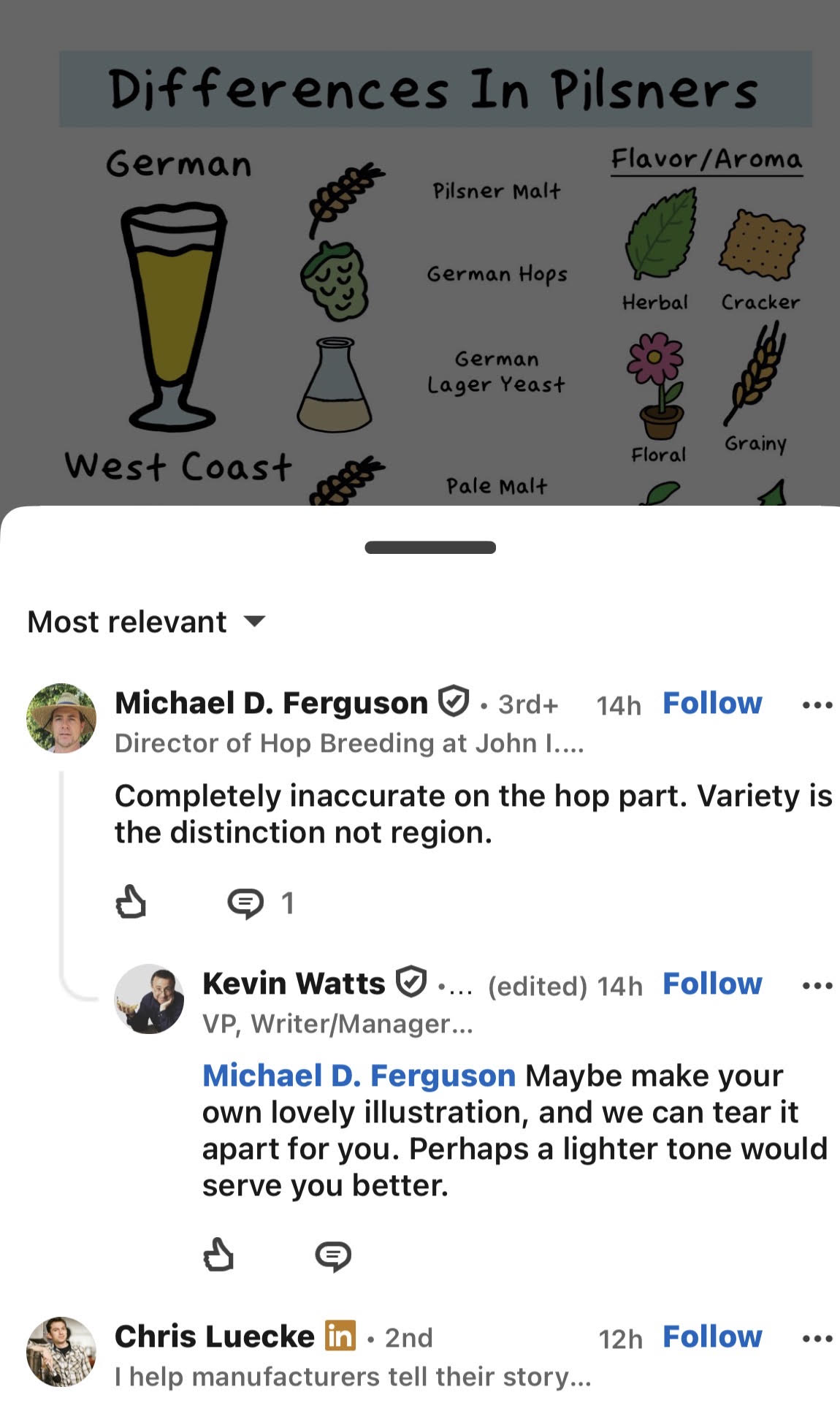
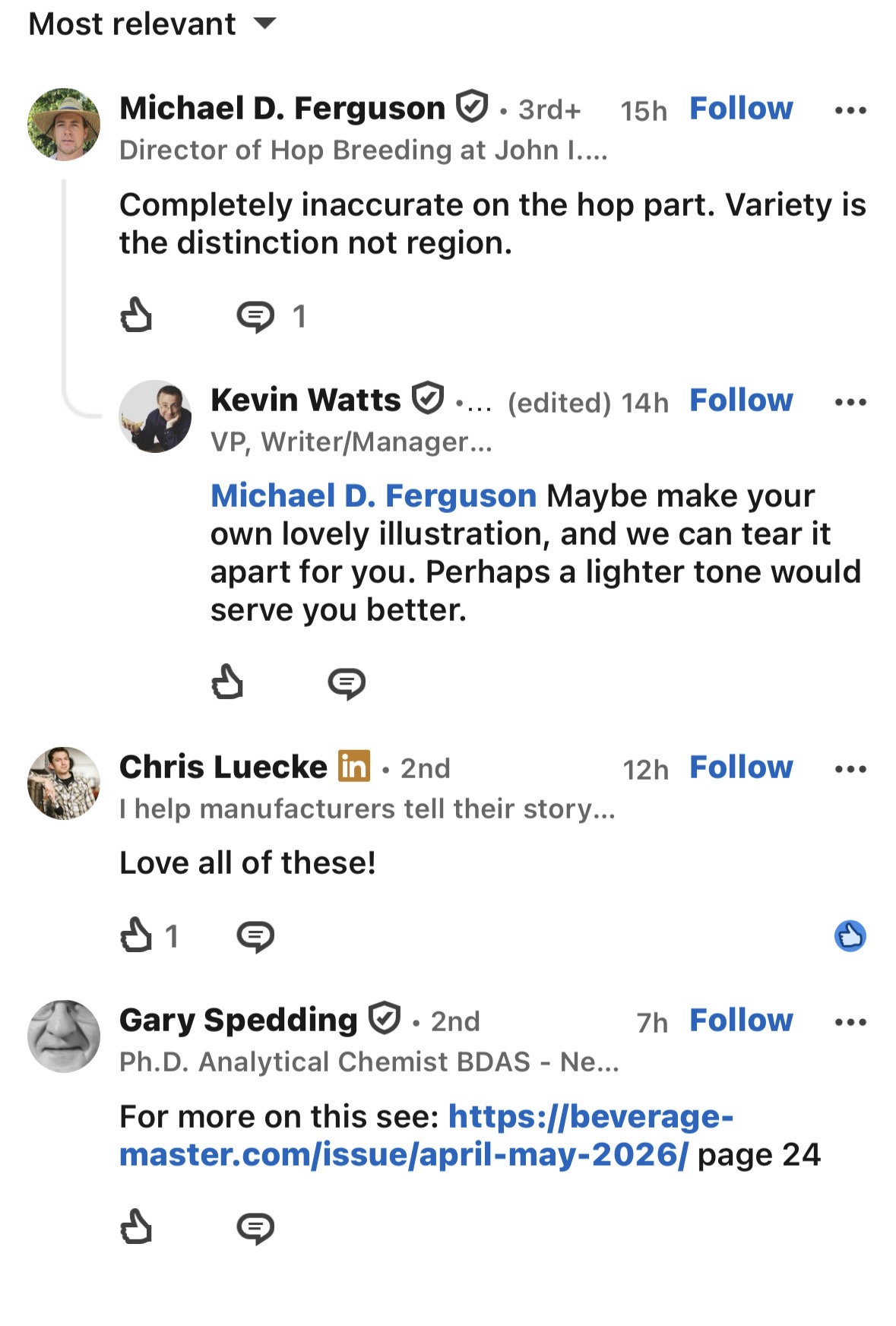
And here’s a thumbnail illustrating an all too common sort of interaction in the beer discourse from over at LinkedIn. I am playing with LinkedIn by posting pictures of my garden and my birdwatching instead of making up shit about my career path. Screw with the construct I say. Anyway, have a look. In response to a pretty light newbie 101 sort of infographic on Pilsners a certain Mr. M.D. Ferguson (apparently of the hops trade) takes the time to write “completely inaccurate on the hop part“… as if one looks to infographics for accuracy. Then someone called Dr. G. Spedding Phd (apparently of a booze lab) took the opportunity to redirect eyes… to an article HE got published in a trade mag a few months back about flavour wheels and not about distinctions among Pilsners. All of which conveys a disinforming disrespectful cocaphanic mess. None of which passed my mind’s eye without hearing the voices of Beavis and Butthead.

Speaking of butting heads, here’s an interesting angle on “Gulf War III, Trump Trips Trap” and the news that the US Navy has been struggling to provide supplies to the ships, especially the USS Lincoln – as reported in the NYT:

By tradition and Navy regulation, the commanding officer of a warship can request a “beer day” for their crews when they have been at sea for 45 straight days or longer. Given the Lincoln’s time at sea, the crew would have been eligible for five beer days already. A spokesman for the U.S. Fifth Fleet, which covers naval operations in region and would authorize beer days, did not immediately respond to a request for comment on Friday about whether any of the ships participating in the Iran war had requested them.

Apparently Wee Donnie didn’t see fit to provide “toilets that work days” so I would expect that beer was not high on the priority list. In the 1980s, my home of Halifax NS had periodic visits from the NATO fleet and you could go on board. I remember on a very large US ship a few crew laughing about how the other navies allowed booze on board. I remember on a very small Canadian ship a few crew laughing about how, during the war games out at see a few days before they sank the very large US ship.

Booze and war have also had an effect in Russia with news laws coming in to deal with smuggling:

Under the new regulations, bringing just two bottles of premium vintage wine or high-end champagne without declaring them can trigger criminal penalties. Illegal transport of high-value wine in personal luggage has remained common practice, with Federal Customs Service data showing attempted illegal alcohol imports reaching 413.5 million rubles ($4.5 million) last year, up from 266.7 million rubles ($2.9 million) the year prior… Former government economist Oleg Vyugin noted that due to complex transport routes and rising tariffs, “European wines in restaurants cost like an airplane wing,” adding that “if you want to drink good wine, you have to spend everything you earned over the last two months, or be an oligarch.”

Pity the poor oligarchs. One last thing. How do you feel about subliminal A.I. text? Has anyone checked for that in beer writing? What am I talking about?!?!  Here is a portion of a discussion of Elliott v. New York Bariatric Group out of New York’s Judicial District of Ansonia/Milford:

The concealed text was a command addressed to machines, set under the caption and repeated at the end of the document… The plaintiff was telling whatever model touched the document to make its output agree with him and to treat the clerk’s prior ruling against him as an error that needed fixing in his favor. A second filing that same day, Docket Entry #178.00, carried an abbreviated version of the same hidden instruction. In the cybersecurity world this is called a prompt injection attack.

This was spotted care of Brendan M. Palfreyman, attorney in Syracuse NY who has a noted focus on brewing law IP but has been sharing how A.I. is being applied in (and is offensive) to the courts. It’s something like self-promoting search engine fodder. Could that tool defeat any integrity in beer rating sites, for example? Couldn’t be worse than LinkedIn.

As I figure out how to add subliminal messaging to this weekly update (buy Al toast!), please check out Boak and Bailey posting on Saturday and adding to their fabulously entertaining footnotes week after week at Patreon. And do look out for more of Stan’s “One Link, One Paragraph” format.  Then hunt out something in someone’s archives! Leave oblique comments on someone’s post from 2009!! Listen to a few of Lew’s podcasts and get your emailed issue of Episodes of my Pub Life by David Jesudason on certain Fridays. And Phil Mellows is at the BritishBeerBreaks. Once a month, Will Hawkes issues his London Beer City newsletter. Do sign up for Katie’s wonderful self-governing totes autonomous website featuring The Gulp, too.  Ben’s Beer and Badword remains on pause but there is reading at The Glass which is going back to being a blog. Any more? We have Ontario’s own A Quick Beer and All About Beer is still offering a range of podcasts – and there’s also Mike Seay’s The Perfect Pour. Plus follow the venerable Full Pint podcast! And there’s the Craft Beer Channel on Youtube as well as the archives of the Beer Ladies Podcast.

The Perhaps Abbreviated “Who’s That In The Kitchen?” Edition Of Your Beery News Notes

You know how it goes. August means guests. So I have not been as idle as it relates to the beer reading and the beer writing. These are pastimes which demand a special type of slacking. One cannot succeed as a dedicated beer scribbler without setting aside the time to be inordinately idle, what in any other pursuit appears to be the disfunctions of a wastetrel.* Plus, when not hosting I have spent much of the week working with the twine and the secaturs. That right there? That was my view Wednesday morning. A deeply woven mess of tomato plants stuck on hands and knees in the patch where I had poured four year old kitchen compost. Lordy, how it grew. Now the tangle has been untanged and all they need to do is produce fruit. Let’s go bees!

There was possibly tougher news in Bigger Ag than my aching back from Stan this week as the forest fires in the Pacific Northwest are threatening the hop crop:

Monday, the Oregon Hop Growers Association issued a press release that began… “’After a few tough years with hop acreages declining as beer sales dipped, Oregon hop growers are especially excited about this year’s hop harvest. The mild spring resulted in ideal growing conditions for the hops, meaning we’re expecting great flavor and aroma,’ said Michelle Palacios, executive director of the Oregon Hop Growers Association.” What could go wrong? Smoke, as growers and brewers learned with the 2020 harvest. Wildfires in Central and Eastern Washington triggered an air quality alert in the Yakima Valley this week. It is also higher today in Oregon’s Willamette Valley, although forecasts are for more favorable conditions soon.

With that difference of focus, I’d say Stan’s concerns might not lead to the hoped for great flavour. Drew, exercising his wag skills, suggested “Celebration might have to be a rauchbier this year.” Speaking of is / not is,  Pellicle‘s feature this week is by Martin Dixon, the story of one of the more venerable NA beers, Maisel’s Weisse Alkoholfrei which has been produced for over twenty-five years:

Instead of choosing between the two commonly used methods to create alcohol-free beer—removing alcohol by an industrial process, which is straightforward but can be harsh; or stopping fermentation early, which gives the beer a fuller flavour but leaves a sweet, worty taste—the brewery used both approaches. Today, two beers are brewed (one a dealcoholised version, and one a lower-strength version) and blended to create Maisel’s Weisse Alkoholfrei. The beer is now roughly a third of Maisel’s business, and its surprise success has given the brewery new financial freedom.

Relatedly perhaps, here’s a new angle on beer and health – beer mats for better mental health:

Man Time’s Flip the Mat campaign is now under way, with the first mats being delivered to pubs, clubs and community venues across Stone and the surrounding area. Volunteer Allan has been visiting local venues with the mats, including The Poste of Stone in Granville Square, where Man Time holds its weekly meetings. One side of each mat displays the Flip the Mat campaign message. Turning it over reveals information encouraging people to talk about the difficulties they may be facing. The reverse also carries a QR code linking directly to the Man Time website, where people can find details about the group and a range of local and national support services.

And on a similar theme, in the weaving back and forth on the question of booze and health, the question of merriment as health pops up as a foundational principle on the pro side. They never seem to interview the hungover** when making these arguments but it has gotten to the point that The New York Times itself has undertaken some investigative journalism on the point sending Ginia Bellafante into the heart of Bourbon country:

“You’d be surprised by how many people around here don’t drink,” our waitress shared with us later. My dinner companion worked for the Louisville mayor’s office. She had given up drinking several years ago in the name of better sleep and general well-being, leaving her vulnerable to the joke that she was part of the problem in a city where the national retreat from alcohol was driving a list of anxieties. I had come to Louisville to gauge the collateral effects of this growing aversion, a reality propelled by science, supported by surveys and punctuated by my own experience as a host who had noticed that a longstanding dictum of entertaining — the allotment of a half bottle of wine per guest — no longer applied. For all the benefits of cutting back, certain rituals were vanishing…

The Beer Nut, of course a ritualist if ever there was one, is having none of it and took the time to examine the offerings from Marks and Sparks this week, with some observations on the claims made on the packaging:

First it’s an extremely straight-up Helles Lager, stating what it is in large capital letters on the 33cl can. It’s brewed by Cornish brewery Harbour, which does a few contractual things of this nature, as I recall. 4.5% ABV seems a little inauthentically low, and it poured without a proper head, which it definitely should not. There isn’t much aroma, but it seems broadly on-style: a snap of cracker with a hint of lemon zest. I was thirsty, so half the glass went in one gulp… In all honesty, how it tastes was not a major concern for me, but out of respect for you, specifically, I will say that it’s very plain stuff. There’s a slightly hot fruitiness, suggesting the same sort of careless brewing flaw that made it headless, but you’d barely notice that. I can’t remember how much it cost, but I’m assuming not much. Drink it cold; lie back and think of anywhere but Germany.

Cold is good. Are we prisoners of the archetype? Is a pub ever modern? To me a pub needs pubbiness or its a taproom, bar or gastro to one degree or another. B+B, however, have been more seriously on the case and reported back on refurbishment and what is considered by the redevelopers as key these days:

… when they do try to lean into the history of their buildings, they do so without much taste or sensitivity. These days, that means whacking “Ye Olde Pube” and “Gin Emporium” on the walls in bad fonts that come preloaded with Microsoft Word. The other key component of a modern old-fashioned pub is, of course, decent beer. The Kings Head, The Crown Inn and The Pembury all have interesting ranges, served in great condition, often in particularly nice glassware. The 10-sided 1930s-style pint glasses with which The Kings Head relaunched seem to have disappeared (stolen, we assume) but there are a couple of authentic 1930s half-pint glasses in the same style.

As you think on that, here’s some notes:

Notes #1:  “…and commissioned by AB InBev…
Notes #2: Half price beer with a Mitch obit.
Note #3: A beer drinking elk?!?!

Ron himself as well as his sons have traveled to my fair neck of the woods – or at least he’s been neck adjacent – recently and has begun to report on holidaying in a forest fire smoke zone, wanders Toronto, finds a diner that also sells gin and goes to a cellar dweller’s ball game where Chicago beats the hometown Blue Jays badly:

It’s another high-scoring game. The White Sox get five runs in one innings. Then three in another. Then four. The Blue Jays hit several home runs. But with no-one on the bases, they only get a single run… A bloke a few seats along does try to get a chant going a few times. “Let’s go Blue Jays.” He shouts. It’s not the most inspiring of calls. A couple of times he does get others to join in. Until the stadium starts blasting music out again. With the Blue Jays way behind, the crowd starts thinning out after the seventh innings. We leave during the last innings. Mostly because I wanted to be sure of getting to the Steam Whistle Brewery over the road before it closes.

Ron and Sons will report on stops further east in the coming days.

The Guardian published a very handy primer on how the UK is going through a shrinkflation related to beer – now dubbed a but clumsily as “drinkflation” even though it does not relate to all drinks – and especially handy as it relates to the economics involved:

I don’t know what that amounts to. For a 4.0% beer it’s about 41p a pint. Whereas a 3.4% beer is subject to a duty of just £9.96 per litre of pure alcohol, or about 19p a pint.
That’s quite a difference, but what if people don’t like Carling’s new weak beer? The company claims the 3.4% version actually ranked “higher for overall taste” in consumer tests. It also laid the groundwork for the reduction by introducing a stronger and more expensive Black Label version in February, at 4.7%, creating a “value-premium price ladder” within the brand.
Do say: “Alcohol duty must strike a difficult balance between raising revenue and improving health.”
Don’t say: “3.4%? My urine is stronger than that.”

But, see, you said it, Ms. G. You can’t really say “don’t say it” and then go ahead and say the exactly that  one thing you say you shouldn’t say. Really. You might say there ought to be a law about these things in Britain but we also learned in that self same publication this week that:

Parliament is “Britain’s last alcohol-soaked workplace” where MPs are offered free drinks as early as midday despite alcohol-related scandals, a report has revealed. Drinking is commonplace and some MPs have had their stomachs pumped after consuming so much alcohol that they ended up in hospital, one disclosed.

Yikes! So… maybe less booze is not such a bad thing in one’s glass. Is there less booze in Maryland? Michael Stein in DC Beer went on an interesting investigation and reported out this week on the unused 100,000 barrels of capavity left behind when Flying Dog was bought by FX Matt who shut down the Maryland brewery and moved production to Beautica… err… Utica, New York***:

So, did those 100,000 barrels of 2017 go to the macros? Some did, some didn’t. The Brewers Association of Maryland’s latest data has just under 7,500 barrels brewed in Frederick County in 2025. That’s less than 10% of what Flying Dog was brewing by themselves when they left the state.  Maryland not only lost 100,000 barrels of Flying Dog, they lost DuClaw, and much of Guinness’ Baltimore Blonde production. In The New Brewer, DuClaw was listed in 2020 as brewing 18,250 barrels. That is a sizable amount for the majority of 9,578 craft brewers today, who annually make significantly less than that.

That’s it for now. Not a big week, I gotta get back out to the yard. As I struggle, please check out Boak and Bailey posting on Saturday and adding to their fabulously entertaining footnotes week after week at Patreon. And do look out for more of Stan’s “One Link, One Paragraph” format.  Then hunt out something in someone’s archives! Leave oblique comments on someone’s post from 2009!! Listen to a few of Lew’s podcasts and get your emailed issue of Episodes of my Pub Life by David Jesudason on certain Fridays. And Phil Mellows is at the BritishBeerBreaks. Once a month, Will Hawkes issues his London Beer City newsletter. Do sign up for Katie’s wonderful self-governing totes autonomous website featuring The Gulp, too.  Ben’s Beer and Badword remains on pause but there is reading at The Glass which is going back to being a blog. Any more? We have Ontario’s own A Quick Beer and All About Beer is still offering a range of podcasts – and there’s also Mike Seay’s The Perfect Pour. Plus follow the venerable Full Pint podcast! And there’s the Craft Beer Channel on Youtube as well as the archives of the Beer Ladies Podcast.

*So you know what that means? Yup, extended quotes. Cut and past. That’s my game. Anything to nudge the weekly work past 2300 words. There, 1322 words to Tuesday at 7:45 am. It’s all on track. 
**As I tell the kids, one borrows joy from the future to have boozy joy in the present. With diminishing effect over time.
***I keep telling them that I have the perfect slogan for the city!

The “Gee, I Wonder What Mbappé Is Up To Now…” Edition Of The Beery News Notes

Well, it’s done. I enjoyed it all. And I am glad it is done. In fact, on reflection, I like how the World Cup becomes a process of a sparcer and sparcer schedule that end in a boring game. You are left without any wish for more. Time to go hang out in the garden and study for my second career as a hand model. You know, the first two rounds of the group stage are the best, when the players aren’t exhausted and the managers are’t scared of losing. Was it worth it all for the US beer trade? BMI reports:

Even with auspicious weekend timing of July 4, big celebrations for America’s 250th and the World Cup tournament taking place on US turf, total beer $$ fell 1.1% and volume dropped 2.4% for 1 week thru July 5 in Circana off-premise channels. 

Soooo…. maybe not so much.* Final numbers yet to come. Next up? It’s wheeeeeeee…. baseball all the way to the first frosts. And hand modeling. [BTW, before we move on, Eoghan has mapped his 48 multi-national stops around Brussels if you want to recreate his World Cup hometown studies.]

And now…. it is official! Beer blogging is back baby – as The Tand has declared:

Ah the good old days. Back then when I used to post a lot – and I’ve been having a look at my old stuff and you should too – it’s great stuff and a lot of it short. A remark about a pub or two, or a beer, or a little industry comment.  Maybe a longer piece about a more complex subject.  Much more enjoyable and frankly a lot easier to do.  It doesn’t take much to see my enthusiasm for blogging has slowly but surely declined and actually I’d like to arrest that. I’ll never get back to the heady days of hundreds of posts, but on the basis of little and often I think I might manage a few more. 

Makes sense. We yearn for the recent past. [In fact, our own youngest has dug out one of the old digital cameras from the dawn of this very blog to take out to the bars when she’s on a crawl with her gang.] And just to prove his point, The Tand posted his thoughts about one scene he encountered him this very week:

Speaking to various landlords and landladies too – even handed me – the picture is again rather mixed with pubs with beer gardens or at least usable outdoor space doing well, though inside has been quieter.  Just as you’d expect I suppose.  My own observation backs this up.  Approaching pubs I’ve noted the busy exteriors and the not so busy interiors.  It is difficult to tell whether those who would normally sit inside have just decanted to the outside, but chatting to the bosses, trade is slightly up with a noted shift to lager, soft drinks and rosé wine.  

Boak and Bailey, leaders of this retro-nuevo, came to a similar conclusion from the different entry point of two particular beers that sat before them –  as they explained in their beers of the weekend post:

They were both very chicken-soupy-looking, and both had that familiar combination of fruitiness and onion. The stronger beer had quite a burn, too, almost as if it had been dosed with raw chilli pepper. But, for all that, we enjoyed them, because they were also (a) cold and (b) bitter – perfect for yet another warm evening.

Time for some money talk. If you have a cellar, there is a very good reason why it makes sense to stock away bottles there to age as opposed to buying them later when you want to drink them, as explained by Sara Danese at Everyday Drinking this week:

A good barrique costs around €1,000 and can be used new or seasoned. Assume it’s used once: after losses you get 200 liters of wine, so the barrel cost is €5 per liter. Labour and electricity add €0.40 per liter. Storage costs €6 per month per barrique — about €0.40 per liter per year. Financing adds another €0.30 per liter if you borrow at 5% on €5.80 (barrel + handling + storage). That’s roughly €6 per liter, or €4.50 per bottle. If you use the barrique three times, the additional cost drops below €2 per bottle. Bottle aging is cheaper but still significant. Storage might cost €6 per month per pallet (600 bottles), or €0.12 per bottle per year. The real cost is the so-called opportunity cost: if a wine could sell now for €10 but doesn’t, the producer must finance that cash flow, adding roughly €0.50 per bottle in interest. The total cost for an extra year in bottle is around €0.62 per bottle.

Speaking of the economics, bottled Old Speckled Hen will be a thing of the past in the not so distanct future and Le Protz explains why with characteristic restraint:

Writing in What’s Brewing, CAMRA’s Roger Protz called the move “a shock decision” resulting from the “rapacious profiteering of giant supermarkets”. He added: “Old Speckled Hen is one of Greene King’s major brands but the income from sales to the off-trade is tiny as a result of the deep discounts demanded by the retailers. “Greene King owns a massive estate of 2,600 pubs, restaurants and hotels. It supplies those outlets with draught and packaged beers.

And in a piece pushing 2,500 words, Laura Hadland has explored in depth the pros and cons of how some smaller British breweries are taking advantage of the tied networks yet still retaining a degree of their independence, all as illustrated by a deal entered into by Jamie Lawson of the SALT Beer Factory :

In 2021, [Molson Coors] approached Jamie, with a view to distributing some independent craft beers through their wholesale network. An agreement was struck to trial the arrangement in bars in the north of England. At first, two beers were used for the pilot – SALT’s flagship session IPA, Jute, and its NEIPA, Huckaback. The experiment went so well that Molson Coors were keen for a national roll out. Jamie jumped at the opportunity and ultimately the partnership was invigorated by the signing of a 3 year deal in 2023. … The macros want the indie brewers to retain that independence. Their authenticity is the thing that makes the relationship profitable for both sides. But it also flags a potential downside. Some drinkers, seeing SALT or Northern Monk beers so widely available, think that the breweries have been taken over and worry that the beer’s quality will change for the worse.

Excellent stuff. Similarly excelling is Lars who wrote about an eastern Latvian farmhouse style from the Latgale district for Craft Beer & Brewing, explaining the locale this way:

Latgale is somewhat different from the rest of Latvia. It had an earlier stint as part of Russia in the 16th century, and the people here speak a variant of Latvian that the rest of Latvia sometimes has a hard time understanding. Latgale also has a larger Russian population than the rest of Latvia—including a group known as the Old Believers, who broke away from the Russian Orthodox Church to escape religious persecution in Russia centuries ago. Today, the Russians in Latgale mainly make moonshine, while the farmhouse brewing is very clearly Latvian.

We also have Old Believers in Canada, a community that first moved here in the 1920s. Not sure about their moonshining. Lars also explained that the local malt drying technique in their saunas:

Their saunas included a small hatch in the ceiling, which they would open when drying the malt; that hatch allowed the smoke and heat to waft upward into the drying box (āznīca) on the floor above.

I mention this as it is necessary to remind folk that not all ale was smoky in the past before a certain point. As shared in 2014, smoky ale – at least in medieval England – was considered a fault and other means of drying the malt were available, like in kilns or cooling bread ovens where the heat and smoke were separated. People in the past were resourceful and could control variables through trusted technologies to suit local taste. So both sauna smoked or pale sweet kilned malt were possibilities. Just don’t dry it over ferns. That’s just gross.**

Note #1: “…would you care for some blouge?
Note #2: Ballast Point’s whimper soon to be whimped.
Note #3: Jeff provides a fine remembrance of the late Alan Sprints.***
Note #4: Gary reported in from Oxford, England.

And Max has reported in from the Czech Republic describing a march of more than 20 kms to put himself in the comforting arms of Pivovar Kladno Kročehlavy,  a walk he undertook on a tender ankle hoping to find a few beers along the way only to find many spots on his path had shut:

I don’t care, most of the way is either along fields or in the shade of trees, far from any roads, and once I set my pace, I soon enter an almost meditative state, with my thoughts running free while I pay close attention to everything that surrounds me, sounds included—birds, trees, the wind, a creek, the rhythm of my footsteps, the flowers, the houses and the few people that cross my path. That idyll lasts until I enter Kladno, under the watchful eyes of the cooling towers of the local heating plant, and the route takes me through the remnants, if not the carcass of what once was one of the hearts of Czechoslovak heavy industry. It is quite disheartening, but it doesn’t affect my spirits, because I’m getting closer to my destination. My legs are beginning to feel heavy, but they quicken the pace regardless, because they reward is near.

And, closer to his home, Retired Martin shared some shocking personal admissions this week:

Back in Sheffield from a cruelly curtailed Cask Camino (CCCC), a man’s thoughts turn to tomato gose. I constantly read how exciting (ugh) the UK beer scene (ugh) is these days, how folk who drink Bass are to be ridiculed etc etc. But can you be a proper country without a brewer of alcoholic gazpacho ? I think not… We don’t drink at home, bar Mrs RM occasional pint of Malbec with Crispy Beef, so I rarely visit the specialist offies. But I was sad to see the closure of longstanding Beer Central mentioned by Chat GPT.

I hadn’t expected that a pub man was practically dry at home but it makes sense. Focus. Makes more sense than any tomato gose did, too. Speaking of odd drinks, The Beer Nut encountered a Triple IPA Quebecois – as if it was 2014 or something – and his conclusions neatly identify a number of issues:

You get a dash of vermouth or madeira in with your hops here, and I’m not convinced that that’s a good thing. The sticky finish coats the palate with marmalade and triple sec: Paddington’s breath on Saturday night. I guess it passes muster as a triple IPA, but it tastes a little elderly and overwrought. Maybe as an end-of-the-night finishing beer, but even then I suspect it’s better in smaller doses than this. I don’t make a habit of buying the double-digit-priced cans, and this is a prime example of why. It’s just not worth the risk. Beer of better quality is available from breweries much closer to home at significantly more reasonable cost.

Conversely to such exactitude – but sadly customary – a certain type of inflationary take plays an unfortunately regular role in drinks reporting. So it was with some suspicion that I met the headline at BrewBound “Gen Z’s Moderate Drinking Reputation ‘Conclusively Debunked,’ per IWSR Survey” this week. The IWSR is/was International Wine and Spirits Record, a London based publisher of trade data and opinion founded in 1972 that is now known as IWSR Drinks Market Analysis Limited. BrewBound led its summary of the report with the statement “The bev-alc industry can no longer blame Gen Z for slowed sales…” but, oddly,  James Bayley (no relatyon) in the Drinks Business quoted IWSR president and managing director Marten Lodewijks who said:

Although Gen Z participation has risen, the generation continues to approach alcohol differently from its predecessors. More Gen Z consumers reported drinking cocktails during the past six months than any other age group, with 84% choosing the category. They were also the most likely to follow government health guidance on alcohol consumption, with 49% saying they paid attention to official advice. The generation was also more inclined to drink in larger social groups, with 18% reporting their most recent drinking occasion involved five or more people…. ****

Which means… they drink less leading… to slower sales. Unless they are still buying but just sticking it in the shed. Is that it? The study seems to  mix participation rate (not much lower) with consumption levels (lower). Leading to the headline… I suppose.*****

That’s all for now… well, not counting the footnotes below. As you chew your way through those over the next few days, please check out Boak and Bailey posting on Saturday and adding to their fabulously entertaining footnotes week after week at Patreon. And do look out for more of Stan’s new “One Link, One Paragraph” format.  Then hunt out something in someone’s archives! Leave oblique comments on someone’s post from 2009!! Listen to a few of Lew’s podcasts and get your emailed issue of Episodes of my Pub Life by David Jesudason on certain Fridays. And Phil Mellows is at the BritishBeerBreaks. Once a month, Will Hawkes issues his London Beer City newsletter – but it may not be pay per view. Do sign up for Katie’s wonderful self-governing totes autonomous website featuring The Gulp, too.  Ben’s Beer and Badword remains on pause but there is reading at The Glass which is going back to being a blog. Any more? We have Ontario’s own A Quick Beer and All About Beer is still offering a range of podcasts – and there’s also Mike Seay’s The Perfect Pour. Plus follow the venerable Full Pint podcast! And there’s the Craft Beer Channel on Youtube as well as the archives of the Beer Ladies Podcast.

*Yet locally… also according to BMI: “…Burke Distributing sold 600 bbls of Tennent’s Lager in Boston, 10x its annual vol, as the Scottish “Tartan Army” descended on the city. Burke saw a 20% vol lift for Jun, with on-prem up 46% and draft up 53%. “The two weeks the Scots were playing were two of the largest weeks we have had in decades,” said chief growth officer Kristen Burke. At the Sam Adams downtown taproom across town, which almost ran out of beer on the first weekend, “we were pouring them a Sam Adams Boston Lager every 12 seconds,” said ceo Jim Koch. In Philadelphia fans drank 290K beers across six games in the stadium alone, FIFA reported.
**See me in 2011: “In an edition of A Way to Get Wealth by Gervase Markham from 1668, a book first published in 1615 or about 200 years before the start date picked by Horst, we have an opinion on the preference for straw… and not just any straw: ‘ …our Maltster by all means must have an especial care with what fewel she dryeth the malt; for commonly, according to that it ever receiveth and keepeth the taste, if by some especial art in the Kiln that annoyance be not taken away. To speak then of fewels in general, there are of divers kinds according to the natures of soyls,and the accommodation of places-in which men live; yet the best and most principal fewel for the Kilns, (both tor sweetness, gentle heat and perfect drying) is either good Wheat-straw, Rye-straw, Barley-straw or Oaten-straw; and of these the Wheat-straw is the best, because it is most substantial, longest lasting, makes the sharpest fire, and yields the least flame…’ ” Note again. the Maltster is presumed to be a “she”!
***My interactions with Hair of the Dog twenty years ago were both entertaining and scientific. Ron Jefferies laughed out loud when I told him how the yeast had saved the day.
****Furthermore: “Lodewijks believes this reflects a long-term shift rather than a temporary response to economic pressures. “The number of people drinking remains consistent, but the frequency with which we drink and the amount we drink per occasion is dropping,” he said. “The moderation trend increasingly appears to be driven by lifestyle choices, resulting in a structural, rather than cyclical, change.” Again, they drink less.
*****All of which allows me to reference my quote of the week from an asrticle in June 29, 2026 issue edition of the The New Yorker, “Something Is Very Wrong with Modern Longevity Science” by Dhruv Khullar describing how data can be extremely skewed yet accepted: “Okinawa was the site of a devastating American bombing campaign during the Second World War; much of its infrastructure and essentially all its civil records were destroyed. U.S. authorities reconstructed the civil registry by asking survivors to report their age, a process complicated by language barriers and a traditional Japanese calendar that differed from the Gregorian. The country’s postwar welfare system distributed some benefits based on age, and many Okinawans requested that their records be updated. There is a strong correlation between the number of requests made in a village and the supposed life span of its residents.” The longevity miracle of Okinawans is a fibber-fibber-onie based on fibby-bibsters.

Your Vibrant And Now Excitingly Neutral Beery News Notes For The World Cup’s Round Of Eight

I took a break from the World Cup on Sunday evening to watch Billy Bragg play in a converted church in our fair city. See, England and Mexico were playing at the same time over 4,000 km to the south. Bragg made it one of the themes of the show, he not being able to watch the game that I passed on for him. He received wanted (“…tell me…“) and unwanted (“…don’t tell me…“) updates on the score from the crowd. It was fun. Pubs are stocking up for the next game against Norway – which is being played at a more civilized start time for the home audiences. People are focused on this stuff. After a 5 pm trip on London Underground during England’s prior game against DR Congo, Hannah Evans in The Times Food newsletter asked where you might go in the UK to avoid the tournament and among her recommendations was the Highland Laddie of Leeds:

This old Leeds boozer got a revamp last year and was named the best pub in Britain by the Good Food Guide less than six months later. Ever since it’s been rammed with customers visiting not just for pints but the pub’s fantastic food — bar snacks such as sausage rolls with homemade brown sauce and bone marrow fat on toast downstairs (walk-ins only) and pub classics with a twist upstairs including the legendary Keema Shepherd’s Pie. The good news? They don’t show the football which means you have a 90 minute window during each game to pop in and try the menu for yourself. 

You will recall the Highland Laddie being being visited by Katie earlier this year. Looking further back, Boak and Bailey are blogging like it’s 2008 this week:

Not every post has to be a 1,000+ word full researched epic. Not everything we write needs to tell a story with a beginning, middle and end. There doesn’t always need to be a thesis or argument. So, this week – and we’ll see how it goes – we’re just going to see what catches our attention, and what we find ourselves discussing between ourselves, and quickly write it up.

So far they have contemplated a beer line-up upgrade as well as a former BrewDog location. I was inspired and wrote a review of a NA beer. TL:DR? It didn’t totally suck! Do something speedy and short yourself. Go-waaaaan! My note was nothing like the efforts of The Beer Nut, however, who reviewed eleven beers the other day… which booze! He was celebrating:

Another Monday, another blog post, another round-up of recent Irish pale ale. This one is the blog’s 3000th entry. It’s best not to think about what that means, and move right along with the reviews.

He was not pleased with the selection in the end. Turns out he shares the experience of many North Koreans feel when buying commercially made beer. You know… you think you know something about totalitarian regimes and then, whammo, this sort of news slaps you in the back of the head:

A source in South Hamgyong province said beer demand has climbed in Hamhung as the weather warms. But state-made brands such as Taedonggang beer and Ponghak beer are losing ground to Chinese beer and beer brewed at home. Restaurants and jangmadang, the informal markets central to North Korea’s economy, sell all three types side by side in Hamhung. Homemade beer is the best seller, the source said. Chinese beer comes second, and domestically produced factory beer trails both. Demand for factory beer is relatively weak because of its taste, the source said. North Korean people have long complained that it carries a strong barley smell and tastes heavy and unrefined.

I never pegged totalitarian absolutists like those of NK to allow not only a free market on home brewed beer but allow it to compete with the state run factory breweries. And I always thought the phrase “North Korean people have long complained” was an oxymoron.

Note #1: Setting up a beer engine.
Note #2: The Beer Store needs a lot of empties returned…now!
Note #3: “Village of 600 holds beerfest” reports Biggleswade press.
Note #4: Beer stained rubber chicken lets team down.

Pellicle‘s feature this week sees Ewen Friers visit Heaney Brewery in Bellaghy, Northern Ireland where he learned this bit of market reality from head brewer Mal McCay:

“Northern Ireland is the most tied and restrictive market in Europe for selling beer,” Mal says. “The market was designed to keep us out of it, basically.” Away from the relatively cosmopolitan Belfast, the vast majority of rural drinkers haven’t ditched bigger beers like Guinness, Coors, and Carlsberg. Whether a total revolution is realistic or not, it’s sobering to hear Mal talk about the pubs in his locale. “We had 108 kegs go to Italy for Paddy’s Day, but none [ordered] here,” he says. “There’s much more support for our beer out there than there is here. Outside of Belfast, people don’t want to know.”

Again with the economics, Jeff posted a string of thoughts on Costco cancelling their Kirkland Lager contract with Deschutes and shared this tidbit:

The beer was revenue positive, but not much. Believe it or not, most of the grist was Weyermann malt, and Kirkland went for $14 a 12-pack. It buoyed production for Deschutes and gave them a ton of good press. I asked a source inside the brewery just a couple weeks ago if they had a plan to do something with the award-winning lager that was already in the lineup before it became Kirkland. He gave me a Cheshire Cat-smile and said they had certainly blocked out a plan if that happened.

It’s all just wrapper on the can after all.  Speaking of the volume market, Ron shared his thoughts on one of the upside of Wetherspoons tht he was reminded on on a recent trip to London:

…we got stuck in ‘Spoons. As you do. Andrew has a very soft spot for ‘Spoons. Probably because I took him and his brother Alexei into them so often when they were younger.  The UK is still a nightmare if you have kids. You’ve no idea from the outside whether they’re allowed in a pub. That’s why Wetherspoon’s pubs are a godsend. They always let children in. I also knew that I can afford to buy all three of us meals and get a pint for me. And a couple of double whiskies. I needed to calm my nerves when out and about with the kids.

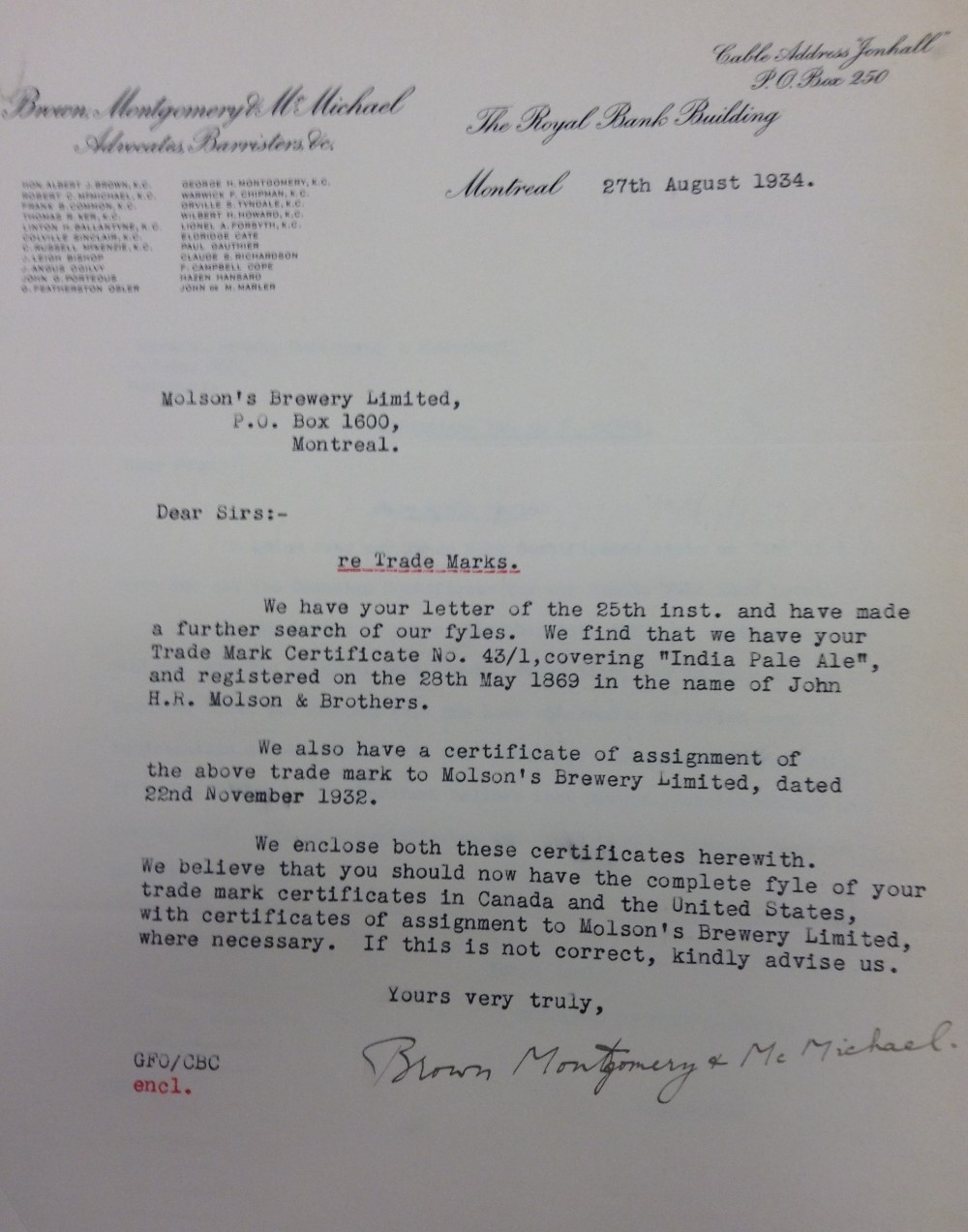
I posted this at BlueSky but, for perpetuity, I will repeat here that I was looking through a few old images that I have save over the years the other day and I came across this image. It’s a legal letter to Molson from 1934 found at Canada’s National Archives in 2013. It confirms that Molson trademarked the term “India Pale Ale” in 1869, seven years before the Bass trademark. My visceral reaction was “….they trademarked frikkin’ “India Pale Ale”!” Turns out Canada’s Trademark Act came into being in 1868 while the UK only introduced one in 1875. Which explains a lot but it is important to note that”….they trademarked frikkin’ “India Pale Ale”!

Sticking with the Great White North, there was an oddly one-sided coverage of a fairly pointless politicial stunt in the US Congress related to Canadian booze buying policy:

Nearly all of Canada’s liquor boards have prohibited or restricted the importation and distribution of US alcoholic drinks, a move that has impacted US producers and limited access to Canada as an export market. The CANADA Act builds on comments from US trade representative ambassador Jamieson Greer, who stated that resolving the Canadian provinces’ discriminatory treatment of American alcohol producers would likely require an enforcement action. During a recent committee hearing, Greer noted that only two countries had retaliated economically against the US over the past year: the People’s Republic of China and Canada… Doubling down on the unfairness of the situation and her reasons for pursuing the legislation, Tenney said: “Canadian provinces cannot be allowed to hold American wineries, breweries, and distilleries hostage and attempt to ransom them.”

No view from Canada presented. No suggestion that these are matters that are handled in treaty negotiations, not by internal legislation. Plus, not only do Canadians not care but the US President does not usually care what individual members of Congress do or says – even though it’s led by his own party. Here’s the CBC’s story on the situation.

Germany v Budweiser? Apparently AB InBev has a need for some odd product placement where there is a history of disinterest, according to The NYT:

Twice, the Americans tried to crack the German market under different branding. Both attempts fizzled. The first was abandoned after several years of disappointing sales. The second was scuttled amid ongoing legal questions over the Budweiser name. Last fall, AB InBev announced another go, now with a product that, for legal reasons, it had to call “Anheuser-Busch Bud.” A company official said the expansion would bring Bud back to its German “roots” — its founders’ country of origin — in time for its 150th anniversary… the beer is hard to find. It’s rare to see in grocery stores… 

One more World Cup related story before we start thinking about heading to the exit this week.  Apparently, the Ambassador for Canada in Ireland held an event for the game  against Morocco (which lead to our team’s exit) and there was a certain cocktail on offer according to the Irish Times:

I was sorry to see Canada exit the World Cup at the weekend, not least because I watched their game against Morocco at an impromptu garden party hosted by their Irish ambassador, Dennis King. But at least they went out with good grace, unlike certain other North American countries we could mention. Their typical modesty was reflected even on the drinks menu. Hence a special brew concocted for the occasion billed as the “We’re Just Glad to have Made it this Far Cocktail”. According to the recipe, also included, this comprised “2 parts Canadian whiskey, 1 part lemon juice, and ¾ part maple syrup”. Suffice to say that, if the Canadian strikers had had as much of a kick as it did, they’d still be in the tournament.

Does that sound good? Hmm… I wonder if it was official government policy available at other embassies or just the Spud Islander’s idea.

Finally, as part of last week’s low hanging tales related to the semiquincentennial of the Declaration of Independence, there was chat about the supposed small beer recipe that George Washington, a militia colonel at the age of just 25, wrote down in 1757. Turns out to likely be the fairly common frontier militia beer similar to Jeffery Amherst’s spruce beer of 1759 that was also based on that ratio of three gallons of molasses to thirty of hot water. I do find one part of the accepted transciption from Washington’s handwriting very odd. At the start it states:

Take a large Sifter full of Bran Hops to your taste – Boil these 3 hours… 

What the heck are “bran hops“? A random blend of bran and hops in a random quantity? At least Amherst measured out the 7 pounds of spruce that had to be boiled until the bark came off. And bran adds nothing. It really adds nothing after three hours of boiling. Plus it’s not like they are separating out the bran from the flour for the bread that frontier militia soldier grunts ate over 100 years before the commercial separation of bran by rollers is invented. Plus bran would just fall though the holes of a “sifter“, a perforated spoon. It all makes no sense. Sensible speculation suggests what was meant was whole dried brown hop cones – older hops. Hops that look like bran maybe. Washington himself was a porter drinker but he’d probably laugh at all the bran brewers of today.*  Hmm… I wonder of he provided something like the crap militia beer for those he enslaved.

That’s it for now. As we winnow out more teams leading to the final game, please take time to check out Boak and Bailey posting on Saturday and adding to their fabulously entertaining footnotes week after week at Patreon. And do look out for more of Stan’s new “One Link, One Paragraph” format.  Then hunt out something in someone’s archives! Leave oblique comments on someone’s post from 2009!! Listen to a few of Lew’s podcasts and get your emailed issue of Episodes of my Pub Life by David Jesudason on certain Fridays. And Phil Mellows is at the BritishBeerBreaks. Once a month, Will Hawkes issues his London Beer City newsletter and do sign up for Katie’s wonderful self-governing totes autonomous website featuring The Gulp, too.  Ben’s Beer and Badword remains on pause but there is reading at The Glass which is going back to being a blog. Any more? We have Ontario’s own A Quick Beer and All About Beer is still offering a range of podcasts – and there’s also Mike Seay’s The Perfect Pour. Plus follow the venerable Full Pint podcast! And there’s the Craft Beer Channel on Youtube as well as the archives of the Beer Ladies Podcast.

*One bit of historical correlation doesn’t mean causation context thanks to Lord Wiki, citing the 2005 text General George Washington by Edward Lengel: “Later in the year, Washington again suffered a serious bout of dysentery; he was bedridden for much of the winter of 1757–58, and even suggested to the Virginia Burgesses that he be replaced since he could not properly do his duty as colonel of the regiment.”

The Charming Disarming And Slightly Alarming Beery News Notes For A Thursday In June

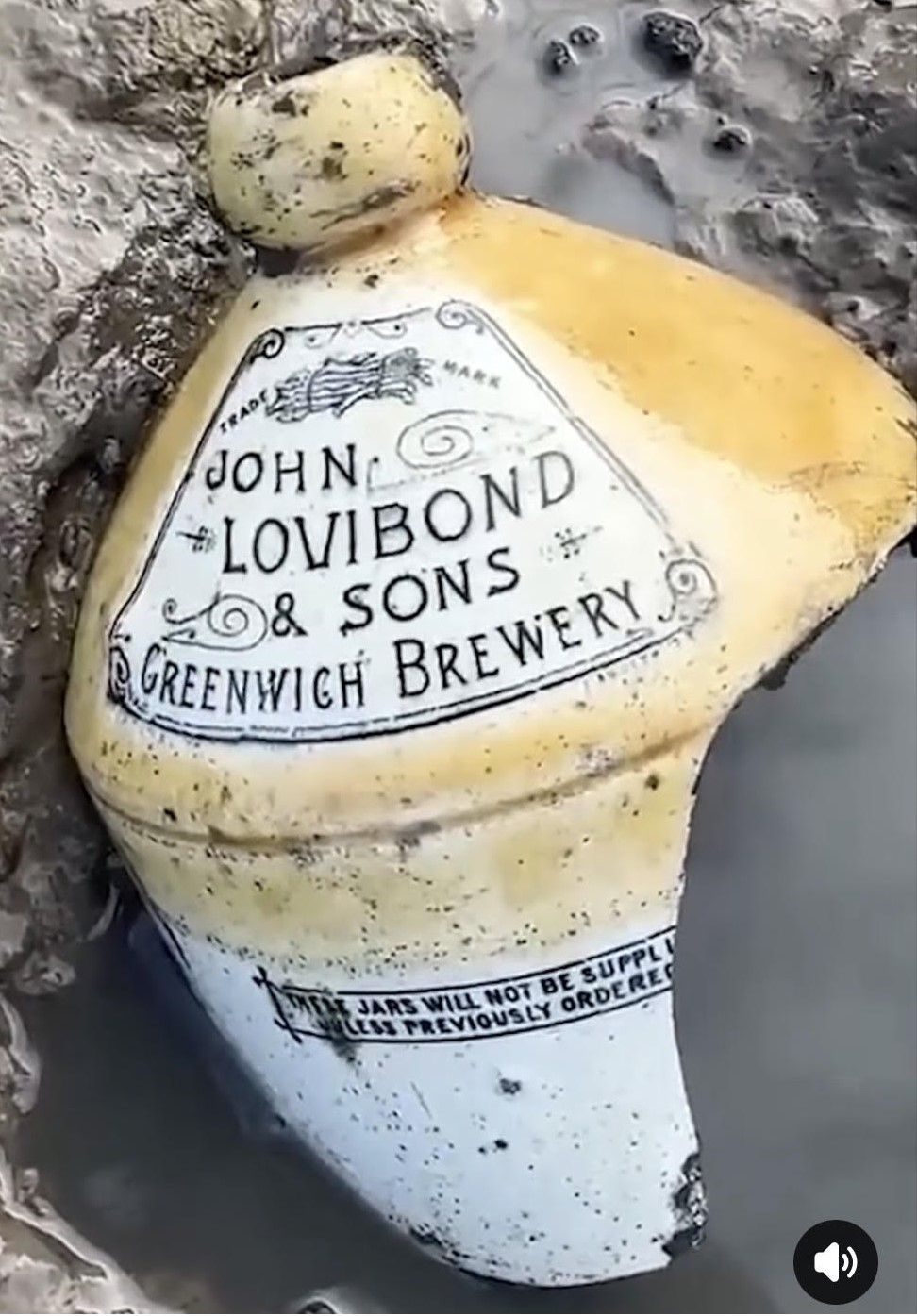
The nice thing about the youngest kid having a job with shifts that end at 11 pm is a fella like me can stay up late for the NBA Finals, listening to 660 AM every second evening when I am waiting out in the parking lot for the kid’s shift to end.*  I am not saying I am some sort of “Mr. Knicks” but this run has been fun. But that’s ending soon and it’s all going to be World Cup naptime late afternoons for the next few weeks. It’s exciting be this idle. And when I am not fixated on bandwagoning basketball or ignoring what FIFA actually stands for, I fill the empty hours with social media where this week I saw that shard up there, a bit of a jug pulled from the mud of the Thames by the ever excellent Nicola White on FB. Obvs I noticed what you notice. Mr Lovibond? Turns out John L. was (maybe*) the father of Joseph L. who was the inventor of the Lovibond scale used to describe the colour of beer. Neato. That jug is no more 150 years old given the trademark registration of 1876. I am but a pup.

What’s else up? Well, for starters, we are coming up is the 150th edition of The Session as Boak and Bailey explained:

On Sunday 28 June 2026 we’re going to post something inspired by the late Martyn Cornell’s final epic work of beer history Porter and Stout. We’d love you to join us. The first problem is that the book is quite expensive. The second is that it is large and intimidating. To make this easy for ourselves – and for everyone else – we’re suggesting that you can join in the Session even if you haven’t read the book. Your post just needs to be in some way a response to it, or to Martyn’s previous work on the subject of porter and stout. If you can read some of the book, though, even if it’s just a few pages or a chapter on some aspect of the history of porter and stout that particularly interests you, that would be great.

Excellent. Perhaps as an aid in your considerations, reflect on what Dr Christina Wade posted an excellent post this week on the need to be aware that choices are made when topics are chosen:

I love beer, in particular, and most especially, I love craft beer. And to add an additional layer to that, I love history. Adore it… So, to be able to combine those interests together into a research topic is a personal favourite of mine. I love both of these elements so much. History and beer. And I have decided, because I love them, that everyone else should as well and I am going to write about them in a way designed to convince you of that. This doesn’t sound particularly sinister, but it can be. Think of all the ways people write to try to convince you of a certain standpoint, or view, or historical ‘fact’. So when you are reading, and indeed, when you are writing yourself, keep this in mind. But even choosing the topic can be this way.

And, perhaps reflecting that, Jeff did just that when he applied a little mathematics to do a fact finding exploration of the obvious this week with his description of the state of big craft breweries since 2021:

Behold this table… The list excludes companies like Tilray, with many brands and breweries. The “Change” column on the right-hand side measures the breweries’ five-year performance. An asterisk indicates a brewery the BA does not designate as “craft.” As you can see, one-third of these larger breweries grew, while two thirds shrank. If you remove Athletic, which actually produces a different product, the overall performance of these big breweries worsens considerably. It’s a collective loss of around 2.2 million barrels, an overall decline of 16%.

You can follow that link to Beervana to check out that table but while Jeff says he didn’t provide any analysis in his post the fact is he didn’t need to. The math is the math. You know, it’s not fun to keep pointing it out but it is necessary given how many trade officials and some trade writers aren’t addressing, aren’t really admitting.  But “chef’s kiss” to that comment about the Athletic… that’s funny… and correct.

And over at the Cleveland Prost, Will Cleveland has provided us an extended explanation of the origin of Genessee Cream Ale, the best old school beer brewed on the south side of my very own lake:

In the late 1950s, Geminn was working with two offerings that each had a ceiling: Dickens Dry Ale, available between 1956 and 1958, which consumers found too spare, and 12 Horse Ale, popular but heavy in a way that limited how much you wanted to drink of it. He needed a middle ground. The influences pulling at him were multiple. Genesee had deep German roots, but brewery owner Louis Wehle had long been drawn to English ales and Burton-style brewing systems. “Clarence was looking for a lighter-drinking traditional ale,” says Tyler Muhs, Genesee’s brewing manager. “We had that German heritage, but Wehle was infatuated with those English ales, Burton systems. So I think that’s what they were looking for when they came up with it.”

And remembrances have been shared for Rob Jones of Dark Star Brewing, that started out at the Pitfield location that I visited back in 1986, hauling back polypins and two of Dave Line’s books on brewing across the ocean in my backpack. Phil Mellows shared his thoughts in the Morning Advertiser:

Rob Jones, the founder of Dark Star Brewery and landlord of the Duke of Wellington pub in Shoreham by Sea, Sussex, has died following illness. A quiet genius of modern brewing, Jones shot to fame when he became the first independent microbrewer to win the Supreme Champion title at Camra’s Champion Beer of Britain contest in 1987 with a hard-to-classify strong ale called Dark Star, created at his Pitfield Brewery in Hoxton, east London.\nHe had started that brewery in 1981 with his schoolfriend and fellow home brew enthusiast Martin Kemp.

Speaking of a classic brewery, Ed visited Sarah Hughes and shared his findings this week:

Having been a fan of Sarah Hughes Dark Ruby Mild since I was a teenager I was determined to visit the brewery when I heard that the Brewery History Society AGM was being hosted by Bathams. Sarah Hughes and Bathams are only six miles apart so it seemed like an ideal opportunity. It took a bit of organising, and I was so looking forward to it I was nervous something would go wrong. But the people at the brewery were very helpful and it all went fine on the day.  Is it’s a small brewery we were taken down in several groups and I wasn’t in the first group. This did make me a bit twitchy as I waited for my turn. But it wasn’t for long. 

Twitchy. Ed has been on a roll recently. I have often wonder what causes a revival of bloggy scribbly but brewing equipment that’s made of wood and copper is one good reason. That and the twitch.

Care of Laura H, we read that the fine municipal curatorial authorities in Wolverhampton have made an excellent decision:

The history of one of the West Midlands most important businesses is being preserved for future generations by Wolverhampton City Archives…  Beer was first brewed in Newbridge in 1874, before the Park Brewery was established in Wolverhampton the following year….  When Park Brewery closed last year, the importance of preserving its history was recognised, and a large and varied archive relating to the brewery and its associated companies has now been donated to Wolverhampton City Archives. The collection spans from the late 19th century through to the early 21st century and… includes a wide range of records, such as brewing and stock books, ledgers, minute books, maps and deeds, annual reports, photographs, packaging and publicity material. There are also employee records including wage books, pension scheme information, and a First World War roll of honour.

Good job. Back to the scene today, Coors Light has rarely been on my radar as a particularly clever culturally sensitive brand but this new use of Québecoise slang in their regional ads is just that:

The campaign, ‘T’en veux une frette?’ (Want a frette one?) leverages a local slang term for ‘colder than cold’ – frette – to remind Québeccers that they don’t just want a cold beer, they want a frette beer, through a series of humorous vignettes showcasing Québeccers’ strong preference of frette. The situations pay off with a twist to the brand’s current tagline, ‘Want a cold one?’ with ‘T’en veux une frette?’

See, me? I would order une frette but never a Coors Light. Sticking with me, once upon a time, I got to negotiate part of a verticle interior leafy greens farming deal. Faces challenges bit it can make a lot of sense in northern Canada where something like a railway container can pump out the stuff of salads when it’s below freezing outside. Interesting, then, to see the idea adapted to hops:

Ekonoke started life as a leafy greens operation, but shifted gears long before that part of indoor agriculture started its brutal and ongoing correction… As with outdoor production, hops inside Ekonoke’s farm grow vertically, wrapping around trellis-like structures that climb eight to 10 meters high. The process is significantly more complex than growing leafy greens indoors, says Sagrario. In addition to longer crop cycles, the process requires constant updates to the nutrient formula pumped to the plants, based on the stage of the crop. Humidification control is also a constant challenge…

All of which is to say that there will be fresh hop beer on Mars in 2063. Again with the me, Knut has written about a Norwegian brewery using Norwegian ingredients and somehow I show up:

There is a side story here. Back in 2007, we were a handful of beer bloggers scattered across the globe. I had the pleasure of having frequent contact with Alan McLeod, who continues his beer writing to this day. I’m thought his blog posts from that golden age were long gone – but look what I found.. He had a bit of advertising on his blog, and decided to spend some of the money to buy a few bottles of Westvleteren 12 from a Dutch web shop to send to a few of his contributors. I was one of them. 

Aaaahh for the days of paying ads on a beer blog. And for customs documents with Belgian ale, shipped from the Netherlands to Norway to pay for the price of an ad on a Canadian beer blog. As you wrap your mind about the way we were, here’s some notes:

Note #1: “Thanks. I hate it.
Note #2: Australian wine prices have collapsed in China.
Note #3: Is beer losing out to wine and spirits?
Note #4: Pellicle’s portrait of Purple Moose Brewery in Porthmadog.

Sausage meat!?!? Mr. Gladman says it is a you thing, not a gin thing:

Sweet summer child, do you know how many shit whiskies there are? Nor is it necessarily any less industrial than buying in and redistilling neutral spirit may sound. I mean good God, some Scotch giants pump the stuff out like so much sausage meat. So no, gin isn’t “just” flavoured vodka. Gin is gin. Like it or don’t like it, that’s up to you, but please don’t kid yourself it’s an inferior category just because it’s not for you. Maybe you just don’t have the palate for juniper.

What’s that? Where’s the World Cup beer news? I can’t find the link to the story that some educator posted “Ten Pastry Stouts to Pair With Haiti v Scotland!” but, yes, Voodoo Rangers is likely the proper order to make on Saturday. “No Scotland No Party” is the song that I have just learned my traveling first cousin (once removed) will be (drunkenly) singing:

 … they live by the motto: No Scotland, No Party. “In Munich (during those Euros two years ago), you saw the impact the fans had. People just seem to love Scotland,” says Duke… People seem to feel at home with us because we don’t take ourselves too seriously”… They thought the estimate of 100,000 travelling Scots was a joke until Munich, the beer capital of the world, was drunk dry before a ball had even been kicked. It was a similar story in Czech capital Prague for a European Championship qualifier in 1999. The Scotland fans had congregated in the old town square, so when the area’s bars ran out of alcohol, the riot police arrived expecting trouble. Instead, when the lorries arrived with more beer, the Scots hopped aboard and helped unload the kegs themselves.

For some of the Home Guard who can’t travel, Imran has shared the best pubs to watch in Edinburgh. Elsewhere, England’s Gus bought beer from every nation. Here in Ontario beer stores’ opening hours have been extended just as have restaurant hours in Boston. Expectations are high for mass consumption:

To reach its 1bn pint estimate, analysts from Jefferies extrapolated beer consumption data from previous World Cups. The extra sales equated to a 3 per cent uplift during the 39-day tournament, which Jefferies annualised to 0.3 per cent, equating to 5.9mn hectolitres, or an extra 1bn pints. Analysts expect the World Cup — which is being hosted across three major beer markets: the US, Canada and Mexico — to boost sales volumes by between 0.2 and 0.3 per cent for 2026. Jefferies analyst Ed Mundy said “match timing is the unsung hero of World Cup beer consumption”, pointing out that games featuring countries in Europe and the Americas had largely been scheduled to coincide with peak local drinking hours of between 5pm and 11pm.

Sadly, as CNN reports, Michelob Ultra will adorn an MVP trophy given to a player after every match. Hopefully that side of the trophy can be turned to the wall. Now, where is my tartan scarf and my copy of that 1978 Scotland World Cup LP?

That is it. A jam packed week of news and cogitations. As you soak it all in, don’t forget to check out Boak and Bailey posting on Saturday and adding to their fabulously entertaining footnotes week after week at Patreon. And do look out for more of Stan’s new “One Link, One Paragraph” format. Then hunt out something in someone’s archives! Leave oblique comments on someone’s post from 2009!! Listen to a few of Lew’s podcasts and get your emailed issue of Episodes of my Pub Life by David Jesudason on certain Fridays. And Phil Mellows is at the BritishBeerBreaks. Once a month, Will Hawkes issues his London Beer City newsletter and do sign up for Katie’s wonderful self-governing totes autonomous website featuring The Gulp, too.  Ben’s Beer and Badword remains on pause but there is reading at The Glass which is going back to being a blog. Any more? We have Ontario’s own A Quick Beer and All About Beer is still offering a range of podcasts – and there’s also Mike Seay’s The Perfect Pour. Plus follow the venerable Full Pint podcast! And there’s the Craft Beer Channel on Youtube as well as the archives of the Beer Ladies Podcast.

*Now, I hear what you are saying: “WTF? New York isn’t part of Canada, Al?!?” But for 23 years I could see the northern edge of the state out my office window. And I’ve listen to WFAN sports radio for decades and, yes, the game is on 880 AM but the freaking fan DJs are on 660 AM. Plus OG Anunoby was my favourite Raptor who went to the Knicks so…
**what about Henry?

A Magnificently Monarchist League-less Mid-May Beery News Note Extravaganza For Victoria Day Weekend

Victoria Day weekend.* A most welcome springtime Canadian holiday about something and someone not a lot of Canadians take much time thinking about but, still, many don’t mind it – as long as we don’t pay the bills. And more birds are back as my new pal, one of a pair of Rose-breasted Grosbeaks proved. Aaaannnnd the weather is looking warmer than earlier in the week, which is good. Those are all good reasons for a long weekend in my books. Me, I shall sing the fabulous song about her by the The Kinks to myself as I go about doing nothing all holiday Monday:

Canada to IndiaAustralia to CornwallSingapore to Hong KongFrom the west to the eastFrom the rich to the poorVictoria loved them all

Speaking of the Victorian, first up we have Chris Dyson of Real Ale, Real Music starts us off this week with a pretty detailed description of the interior architecture at the Agricultural Inn of Penrith:

…one of the finest surviving Victorian shuttered and panelled bar serveries in the country with working sash screens which reach right up to the ceiling. It is two-sided, of three bays length, two bays on the return, and has a curved bay at the corner. The five main bays have lower sliding screens with the corner bay and upper ones having fixed glazed panels. The bar-back fitting is mainly old with some wood and modern colourful stained glass.

My main concern would be whacking my forehead on the screen but he didn’t have good luck with the beer on the day… but at least he got full pints. Does the average beer drinker even care if they get a full serving anymore? Stan guided us to this story which lead to this study out of HaaaVaaad which may indicate little consumer pressure to pour correctly:

The investigation began in November 2025 in Harvard Square, Cambridge—about three miles from home, a short bicycle ride or an easy trip on the bus. The first round of measurements surveyed the pubs of the Square: Charlie’s Kitchen, Grendel’s, Felipe’s, Toscano’s, The Sea Hag, Russell House, and McCarthy’s… The original plan was to survey all the squares of Cambridge, but as the investigation progressed the strategy shifted to breweries. McCarthy’s, in Porter Square, was the one measurement taken outside Harvard Square before that pivot. The realization came quickly. Most bars in Harvard Square used the ubiquitous shaker pint glass, and it was clearly a short pour by design. Charlie’s Kitchen gave me one as full as could be—right to the brim—and it still came up short. 

Hmm… that’s one way to make an extra buck. Relatedly, does the beer drinker care if pub chain profits are somewhat moderated? Not eliminated. Just not earning as great a profit. The alternative would be paying more, right?

Pubco JD Wetherspoon has warned profits could come in slightly below expectations after a fresh surge in costs hit the pub giant, despite continued growth in sales. The group, which operates 794 managed pubs and 21 franchise sites across the UK, said it had experienced “substantial increases in costs” in recent months, putting pressure on margins even as trading remained broadly resilient. Chairman and founder Sir Tim Martin (above) said the rise in employment-related and regulatory costs could result in “profits slightly below market expectations”, marking a cautious tone from one of the UK’s best-known pub operators.

The same story could be shared as a good news piece: “Wethering the Storm!” Speaking of moderation in all things (except for the seating) Retired Martin has also been avoiding the inflationary effects of today’s economy in London reasonably successfully:

… the Pelt Trader under the arches at Cannon Street is possibly the ugliest pub in London, though the Spoons in the station runs it close. It wasn’t heaving today, which presumably is because Thursday is the new Friday but Wednesday is the old Thursday, or something profound. You’ve no doubt read about the £10 pint in London, which is nothing as Sheffield has £27 pints; Sheffield leads in all things. Well, the pint of Southwark Porter here was £5.20, which would have been even more of a bargain if it had that last degree of crispness it patently lacked…

As beer in pubs moves up in price point for those paying less attention, an interesting observation by guest writer Caroline Lamb at Everyday Drinking in response to a piece in Wine Spectator on Gen Z and wine:

…the elitism framing is just lazy—a tired recitation of wine culture’s snobby past. The real barrier is economic. Wine is expensive to experiment with on the average young person’s income in the age of inflation, tariffs, crushing housing costs, and student debt that undermines discretionary spending in ways previous generations simply didn’t face. That is a fundamentally different problem than intimidation, and conflating them leads the industry exactly where it keeps ending up: Apologizing for wine’s depth to people whose real problem isn’t that wine is too elitist—it’s that it’s too expensive to gamble on.

Ten years ago or so, craft beer was doing its best to go in the opposite direction, creating complexities that weren’t really there** to manufacture a boosted price point and all they got in the end was sell outs and years of samey fruit gak IPAs.  See also premium name brand boredom. Will US craft beer learn? Or… happy stories! *** Perhaps as illustration is a piece B+B drew my eye to in their footnotes last weekend, California-based Sayre Piotrkowski arguing folk complain too much without understanding the realities:

If beer is consistently framed as a struggling industry, a re-consolidating market, or a category in search of its next gimmick, then it becomes easier to believe that our best days are behind us. But that is simply not true.  The quality of American beer has never been higher, and it has never been easier for consumers to access beer in brewery-fresh condition. The same is true upstream: hops, malt, yeast, and process have all improved in ways that would have been hard to imagine just two decades ago.

graph showing by 2024 airline travel was up 5% compared to pre-pandemic levelThe problem with that reach for the happy story is that fewer problem actually care. That’s not negativity. It’s reality. By the end of this year US craft production may well be down over 20% from 2019 and it’s far too late to blame the pandemic. There is no analogy to the airline industry’s rebound as illustrated by the graph under the thumbnail to the right. Somethings just go away. There may be a welcome upturn one day soon but that will not be based on replicating the factors that led to the downturn.

One way good beer could boost revenues is to go old school – as in Sammy Pepys old – and reintegrate beer back into the workplace. For Esquire, Eric Fransisco explores the opportunity for NA beer as part of a rebalanced work experience:

Despite NA beer’s explosion in popularity, I never thought about drinking it during work hours, let alone at the office. It seemed harmless on the surface. But something changes when you march past your bosses in the mid-afternoon with a Heineken in hand. Suddenly, I felt 13 again, absconding to my room with a nudie mag in my jacket. Little did I realize that what I was doing wasn’t all that out of the ordinary.

To be fair, I have never assocated porn and being a tween with NA beer. But, unlike the author, I also don’t sweat consuming the 69 calories per can which convinced him to give up the habit. Also considering a balance act, Pete Brown’s column this week was about the ups and downs of the manners of those who bring dogs into a UK pub and shared some clear guidance to why its not always a great idea:

Dog owners are also guilty of forgetting that some people in the pub might be allergic to their little darlings (Captain was and Mildrid is non-shedding and hypoallergenic). If you’re sitting there enjoying a pint and suddenly you’re sneezing and your eyes are streaming, your haven from the world has become a hostile environment. Ditto if you’ve discovered too late in the pub garden that an owner forgot to bring poo bags. Perhaps the most persuasive argument I’ve heard against dogs in pubs comes from a publican I spoke to recently. “I don’t like dogs and I don’t like kids,” he said. “We allow both, but neither are coming to the bar to buy drinks. 

She watched as terriers pissed on handbags left of a pub floor and thought it charmingNot being a fan of dogs, my face having an encounter with a husky forty years ago, I could offer an additional category but I would add one more argument against them which was shared by Clarissa Dickson Wright in her book Spilling the Beans**** at page 130 which you can see under that thumbnail. Oddly it seems to be presented as a jolly positive.

Note #1: A discussion of XPA.
Note #2: Brew a Victorian Mild.
Note #3: Knut in Stockholm.
Note #4: Toronto’s Left Field Brewery makes the New York Times.

There are questions being raised which may lead to pointy fingers, too, about the proposal to stop unlimited 24 hour drinking at UK airports:

This week Michael O’Leary, the boss of Ryanair, made a bold suggestion. What if, he said, we applied the law that exists outside airports, inside airports? “I fail to understand why anybody in airport bars is serving people at five or six o’clock in the morning,” he said. Too often, he said, his flight attendants had to deal with drunk passengers. “Who needs to be drinking beer at that time?” Well, Lindzi Percival, 34, for one. The bride-to-be — who swears that is her real name — has arrived from Oxford, bound for Tenerife. She is wearing a wig with a bald patch, and is using a wheelchair thanks to a drinking-related injury at a recent wedding. The pint, for her, is a signal that the holiday has begun. “You start getting relaxed at the airport,” she says. “Also, it helps you not to feel silly wearing this outfit.”

Or wearing that wheelchair, Lindzi! Note also how the word “needs” is doing a lot of work up there.  The UK opposition shadow transport secretary, called it all “slightly draconian” which is sorta like saying slightly murderous if one knows one’s Draco. Wetherspoons’ profitable cash receipts depositor-in-chief, Timbo, is nearly apoplectic, describing the plan as “an overreaction”!!! Lordy, what language…

Conversely perhaps – and certainly calmer – from Imran Rahman-Jones at Edinburgh Pub Reviews, we have a keen eye on what makes a good pub like the Iona Bar special:

…there’s no real ale here. In fact, I can only really see two drinks wherever I look: It seems we’re all either seeing to a portly, white-haired Guinness, or a rakish tower of Tennents, its loops of bubbles excitedly rising. The lady sitting at the bar gets up to put something on the jukebox and Lola Young starts playing. The music causes everyone to raise their voices a few decibels and the atmosphere livens. It’s nothing too raucous, still being early in the evening before the football’s started on TV. But we’re all in a good mood sharing this living room-style space. The decoration is limited to a dart board, a few tasteful framed beer posters on the white walls and a swirly red and yellow pub carpet.

Ahh, that’s better. Plus, a very deft placement of the word “swirly” if you ask me. And, finally, just a reminder that there will be an edition of The Session next month celebrating Martyn Cornell’s final book Porter and Stout: A Complete History. Boak and Bailey shared the news in an update last month and this is another heads up that you need to get your thoughts organized in preparation.

That is it for another week. What will havoc will the new rules cause for Victoria Day celebrations this year? Will the North American edition of the World Cup wise up and lighten the burden placed on fans in response to low interest? Will I finally stop running the furnace? For these and many other stories ,hceh in next week. In the meantime, please check out Boak and Bailey who are posting every Saturday and adding to their fabulously entertaining footnotes week after week at Patreon. And look out for more of Stan’s new “One Link, One Paragraph” format. Then hunt out something in someone’s archives! Leave oblique comments on someone’s post from 2009!! Listen to a few of Lew’s podcasts and get your emailed issue of Episodes of my Pub Life by David Jesudason on certain Fridays. And Phil Mellows is at the BritishBeerBreaks. Once a month, Will Hawkes issues his London Beer City newsletter and do sign up for Katie’s wonderful self-governing totes autonomous website featuring The Gulp, too.  Ben’s Beer and Badword remains on pause but there is reading at The Glass which is going back to being a blog. Any more? We have Ontario’s own A Quick Beer and All About Beer is still offering a range of podcasts – and there’s also Mike Seay’s The Perfect Pour. Plus follow the venerable Full Pint podcast! And there’s the Craft Beer Channel on Youtube as well as the archives of the Beer Ladies Podcast.

*Previous observations on the observations from 2025, 2024, 2019, 2018, 2011, 2008
**Please sir, may I have some more off-flavour seminars? I’ll pay…
***For all the alt definitions of craft, this is a new one: “…some weirdo somewhere is the only person carefully preserving the memory of a particular technique or flavor profile is the essence of craft…
****She of Two Fat Ladies Fame. A book that will convince you that you may not have an alcohol problem after you read of what gin meant to her from age 25 to 40 or so. Which may lead you to believe terriers pissing on the clientele is a good thing for a pub.

It’s A Thursday In May And Here’s Your Greener Than Green Cheery Beery News Notes

The tide has turned. The seasons have shifted. The dandelions have popped. The penny has dropped. It  is time. So the Beast has been released. I say Beast but it’s really Beast II, Son of the Beast. The Beast is still back there, there at the back of the shed. An over a decade old rotary mower that took five times longer to do the job, was a pain to sharpen and was retired last spring. It’s a terrible thing being cheap and lazy for so many years. Now, my lawn is mowed care of a combination of hydroelecric and nuclear power. Science.

What is going on? Well first up, Alistair is about to travel from Virginia back to the UK and shares a complaint that’s been complained since time itself began – how to narrow down where to go for a pint when the information online is just not there:

My biggest challenge though, and I am sure there are reasons for this, but with so many tied houses in the English part of my trip, it does get really frustrating when there is a shared platform with generic information, and almost universally no list of what is on cask in a given pub – this goes for chains like Wetherspoons as well. Yes, the many Fullers pubs in the city have elegant, beautifully designed websites, but again I can’t find out which beers of the Fullers Brewery range are available, making it pot luck to stumble across less regularly seen beers (at least from what I have been told) such as London Porter. I don’t want to single out Fullers, as I have seen the same with Shepherd Neame, Greene King, and Nicholsons, though several Young’s pubs tend to have at least a list, and occasionally pricing as well.

Is it a realistic expectation after decades of this sort of thing to expect every pub to logging what’s on tap?  I dunno. The failure seems to be the proof. Elsewhere, Pivní Filosof® is back after a few years of quietude. And Max is again on the move with his second post of spring 2026 looking for good beer by tram, with all sorts of obstacles placed in the way… like bad beer scenes:

Here comes the first tram, #5 heading to Vozovna Zižkov. I get on and start counting the stops. Fuck! Hlavní nádraží. All I can remember around there are the two overpriced spots in the station itself, and U Staré Pošty in Opletalova, a hospoda I’ve never liked for some reason. I get off, already resigned to the idea of having a Pilnser Urquell U Staré Pošty, when I tell myself ‘fuck it! I will cheat’, and change direction, towards the the tunnel that now connects the train station with Žižkov and the new building complex that has sprouted there in the last decade or so. Yeah, I’m cheating, in my own challenge, which I play alone – if you disapprove, good luck finding a better beer blog…

[Ed.: I thought he was talking about me. He wasn’t!] Offering a definite upgrade in locales, David Jesudason has the feature in Pellicle this week, a portrait of The Golden Smog of Stockton-on-Tees, County Durham, a pub which started life under the current owners with its own set of more serious challenges:

Their eyes even passed over the anti-fascist football sticker saying “our club, our rules.” When they spoke of how local shops were closing, they didn’t blame globalisation, politicians, or even the internet—the fault was with “immigration”. It was 2014, and owner John Christie sighed after overhearing their chat, wondering if this was the life he had now forged for himself. He had trained as a mechanic and joined the army; after leaving, he opened the pub in a former headstone shop. His goal was building a welcoming, inclusive space founded on his socialist ideals. Was he about to be dragged into their world First, he considered kicking them out. Then he paused. It dawned on him that if they went to another pub, their views would likely be re-enforced, or amplified in an echo chamber. It was at this moment that the unwritten manifesto of the Smog started to take shape in his mind.

On a larger and indoubtably less successful scale of internationalissimmo, we are all now just a few weeks away from World Cup madness. Perhaps not surprisingly, hotel reservations are below expectations. Here in Canada, we have a few of the games – and there’ll no doubt be any number of beer related stories in the coming weeks as there usually are when this rolls around – but this one  about Ermedin Demirovic is one of the best so far:

Back to Demirovic. As everyone will remember, before his country’s World Cup qualification play-off final against Italy at the end of March, Stuttgart’s Bosnia and Herzegovina international forward promised to buy everyone in the city a beer if he and his team-mates made it through. They did, beating the Italians on penalties following a 1-1 draw, and last Monday, Demirovic kept his promise. The event was staged near the Neckarstadion in collaboration with a local brewery, and more than 2,500 people turned up. “I didn’t expect so many of you to come,” Demirovic told the fans who took part. 

Sticking with the people of the grassy pitch, Boak and Bailey unpacked their findings on the disappearance of the retired fitba player as publican:

Historically, you could expect to retire from football before you were, say, 35 years old, with a lot of life left to live. And unlike today, even top flight footballers probably wouldn’t retire rich, even if they did have a little money put away. So, you’d need to find some kind of work. We can well imagine that running a pub was appealing because it’s a job that seems fun adjacent. Back to those headlines above: there’s also a sense that you could parlay your fame as a footballer into publicity for your new venture. Who wouldn’t want to be served pints by a local hero? (And perhaps tut at their fall from grace, and marvel at how fat they were getting, how red faced…)

I guess a key difference between then and now are the far higher wages paid to players in recent decades during their career. As a late teen, my father started out his working life at the firm of Hasties, a marine engineering firm in Greenock. In the lunch room he sat at the same table as local hero and Scottish national team star Billy Campbell whose career was cut short by illness and was given a job. A kindness from the owner, a local supporter.

Something else that is also retired but more often noted is a well priced pint in an London pub. Perhaps a well-trod topic but there was an interestingly specific grip in Tuesday’s daily (free) newsletter from The Telegraph:

We all knew the moment would come, but it was still a shock to read that we had entered the era of the £10 pint. Long gone are the days of venturing out with a tenner, sure of enjoying a few pints of bitter, and perhaps even having enough cash left over for a scallop from the chippy. No, bars in London today are charging as much as £11 for a pint of Moretti and £8 for a half of Heineken. There’s probably no going back – the rising cost of pints is an irreversible trend, like SUVs or smashed avocado – but mercifully you can find relics of the old, pre-£10 world, mostly outside London. Indeed, soon after the news broke, I raised a £3.50 glass of Gunpowder Mild in honour of reasonably priced pints in a pub in Clitheroe, Lancashire.

Hmm… how long ago a scallop and chips was going for the price of the leftovers from a few pints? I also wonder what the price travel to Clitheroe from London is, you know, to save that £6.50. Here are a few notes:

Note #1: Beer skates and sabres.
Note #2: Sue them, Yoko. Sue.
Note #3: Data-less trends are the best trends.

And Ray of B+B has done some solid hypothesizing over at Patreon in a piece entitled “Beer from the Witchwood” about the meaning of Jethro Tull’s album Songs from the Wood:

It’s from an article by Nick Freeman about music inspired by the mythic power of English woods and forests and it feels like a missing link between the Society for the Preservation of Beers from the Wood and Ray’s suggestion from a couple of years ago that real ale and folk horror feel somehow connected: “I don’t think it’s any coincidence that the Campaign for Real Ale, The Wicker Man and the English Morris dancing revival all landed at about the same time.” We think Freeman is right: the title of the album is a definite reference to the concept of ‘beers from the wood’. And on the cover, Ian Anderson looks like an extra from The Blood on Satan’s Claw or Witchfinder General.

Now don’t get me wrong. I think he’s on the right track. But… I am not sure. Not sure of the directness of the relationship* even if an indirect** one could be perfectly admissible. With something of a similar theme, ATJ has been making things up, including his recollections of a perfect beer fest:

I will admit that this summer beer festival is a composite of several I have attended. Some had great lagered beers and well-conditioned cask and an encouragement of children to play and provide a lightness of being, some had excellent food and at one even the Morris made sense to me. Then there was the one which included a beer garden, plus shaded woodland and a cooling river running alongside, plenty of sunshine, a genial intoxication and the amity of friends as well as meeting new people, children and dogs. So if you do know of a beer festival in the summer that has all of this please let me know.

And there is some odd financial news out of Belgian based macro gak producer ABInBev which has been finding sofa nickles and dimes in unexpected places:

Shares in AB InBev gained as much as 6.8% in early trading, adding to a more than 14% rise over the past 12 months. Strong beer demand in Mexico, Colombia and Peru drove volumes in the region up 4.8% in the period, offsetting a 3.1% decline in North America and a 0.4% drop in the region that includes China, amid a broad-based reduction in drinking. Revenue also rose in no-alcohol beer and in the non-beer segment.

Speaking of what is or is not, legal steps are being taken in Montreal to fight against a scourge… or perhaps a few scourges:

A Montreal microbrewery owner says he is being unfairly targeted by Quebec’s Alcohol, Racing, and Gaming Commission (RACJ). Le Saint-Bock, on St-Denis Street, brews specialty beers infused with candy flavours. The commission is accusing him of marketing to minors. “People like this kind of beer,” said Martin Guimond, owner of Le Saint-Bock. “It’s different, but there’s a market for people who don’t like beer and want to have a beer that tastes like candy.” Candy flavoured alcoholic drinks is a trend that other major breweries are hopping on as well. Coors has released a line of slushie flavoured seltzers, and the SAQ now sells a Popsicle vodka soda. “They have never been sued. But me, yes,” Guimond said.

Candy beer. Really? It’s this sort of thing that does make one wonder if there is anything left that can reliabily be called craft. And, speaking of which, Jeff posted about the latest move by the BA to buff up the image of US craft’s prospects, reporting (under a somewhat sheepish portrait of Bart Wilson) on a presentation by his leadership himself:

Two comments struck me. In his opening statement, Bart tried to strike a positive note, saying “This year the vibe is positive. It feels like we’re coming out the other side.” Then, near the end of the breakfast, he encouraged us to consider writing more “happy stories.” For the most part, the session yielded little new information. And, despite these comments, I wasn’t picking up a lot of positive news. Bart is no longer the just-the-facts BA economist who reports the numbers. Now he’s the head of a trade organization in a wobbling industry.

Wobbling indeed. I expect there are still some experts who will be moved by such puff even as production is down 17% over a five year trend to the end of last year.*** But the vibes? They are good. We read “… going to see growth this year – very, very strong growth…” Oh, that was 2021.  And in 2024 it was all about “mood management” and the niche.  Heavens. Stan connects more dots. And Brew York shares another observation:

One of the most positive numbers in the report — that independent breweries’ market share increased by 0.1 percentage points over last year — should be taken with a grain of salt. The Brewers Association’s classification of craft beer means that three breweries owned by MillerCoors for most of 2024 are now considered craft in 2025 after being acquired by the large but independent brewery holding company Tilray. Niche brands that are more likely to market themselves like big beer, like Garage Beer and Outlaw Light, are also defined as craft.

That reference to Tilray is interesting. Fourth biggest US craft brewer in 2025. But we must remember that according to the current version of the shifting sands that are the BA’s definition of “craft brewer” the requirements of actually being, you know, a “brewer” includes the principle that a firm must have “have as its primary business purpose the resale of the brand or brands it controls.” Primary. According to Tilray’s most recent financial statement, its craft beer holdings represent 27% of its activities after its cannabis (31%) and pharmaceutical operations (40%). So… not really that primary. Probably fits squarely in the definition, however, in special BA-nglish. But, you know, happy stories!

That is it for now. Let’s keep an eye out for happy realities instead. With any luck, the tomatoes will start finding their place in the garden and please check out Boak and Bailey who are posting every Saturday and adding to their fabulously entertaining footnotes week after week at Patreon. And look out for more of Stan’s new “One Link, One Paragraph” format. Then hunt out something in someone’s archives! Leave oblique comments on someone’s post from 2009!! Listen to a few of Lew’s podcasts and get your emailed issue of Episodes of my Pub Life by David Jesudason on certain Fridays. And Phil Mellows is at the BritishBeerBreaks. Once a month, as noted, Will Hawkes issues his London Beer City newsletter and do sign up for Katie’s wonderful self-governing totes autonomous website featuring The Gulp, too.  Ben’s Beer and Badword seems to be on pause since November but there is reading at The Glass which is going back to being a blog. Any more? We have Ontario’s own A Quick Beer and All About Beer is still offering a range of podcasts – and there’s also Mike Seay’s The Perfect Pour. Plus follow the venerable Full Pint podcast! And there’s the Craft Beer Channel on Youtube. Check out the archives of the Beer Ladies Podcast.

*Ian Anderson, creative lead of Jethro Tull had a busy 1976. In addition to making (and producing) Songs from the Wood, he got married a rather rich lady and moved into lodgings at Pophleys Estate which sat on 500 acres. The main house was up for sale in 2009 on a lot of 13 acres and was described as being supprounded by “a large belt of woodland” so it could be in addition to the era’s folk-rock theme these songs of his might also be from his wood.
**According to Richard Boston in “Beer and Skittles” at page 95 the Society for the Preservation of Beer from the Wood was founded in 1963. Songs from the Wood came out in 1977. So a bit past the folk-rock revival and four years after The Wicker Man hit the cinemas. During this time – and here is the thing – we move from the era of the First Doctor to Fourth. From Gerry and the Pacemakers to the Sex Pistols. My birth to my teens. Yet if detective shows set in England have taught us anything, it’s always the green man behind the scenes and everyone is down the pub sonner or later.
***And… the numbers are already again down another 2% in 2026, just one third into the year.

Your Scattered Beery News Notes For The Lunar The Low The Looney And Perhaps Even The Ludicrous

Happy lunar loop de loop week. It’s hard to find a glimmer of good in an ugly world but the Artemis II mission into outer space did its best to try.  As has the prospects of the Two-Tailed Dog Party in this weekend’s elections in Hungary. Coming in at a solid 3.27% of the vote last time around, their past platform gives a bit of hope:

The party platform promised eternal life, world peace, a one-day workweek, two sunsets a day (in assorted colours), lower gravity, free beer, and low taxes. Other electoral pledges have included building a mountain on the Great Hungarian Plain.

Will the space craft land? Will greater freedom return to Hungary?  Will the ceasefire hold? These are the questions for the week to come. Until then, some beer news. First up, Lars announced the publication of a study of farmhouse yeasts of northern Europe, the culmination of years of work and a number of challenges:

The paper was done by the Verstrepen lab at the VIB-KU Leuven Center for Microbiology, the same place that did the famous paper giving us the first view of the family tree for brewer’s yeast. Work on the paper started in September 2017, when I mailed off the first batch of yeast cultures to Leuven. It had gotten quite far when covid caused Belgium to shut down so hard that everyone must work from home, and obviously you can’t do lab work at home. By the time restrictions had lifted several people had moved on to other jobs, and the paper sat languishing until Peter Bircham decided to pick it up again. He and I worked on it for a while, until Peter moved to New Zealand. Eventually, once he was settled there, a Gang of Four got it moving once more, and last year we finally submitted it.

This is very important stuff and a worthy outcome for all his years of effort. The study describes seven cultures or zones rather than strains as these “cultures have been reused by farmhouse brewers for at least centuries, quite possibly millennia, so they consist of lots of different strains.” The, as illusrated by the map under that thumbnail, the study describes how each culture relates within its zone. Super neato. Lars has also been out skiiing in shorts, too.

Staying in Scandenavia, Knut has shared a profile of a pub in Sweden. Ruckel Beer Bar, where he spent part of Good Friday productively:

Ruckel means shack or hovel in English, a description or the building they took over when they were starting the brewery. I doubt the premises they have moved into with their new pub fit the ruckel description, but they have certainly put in many hours to make an inviting pub, split into various zones for eating, drinking and hanging out.

Ruckle is a new and quite attractive word, at least for me. Not surprisingly, with an old Scandenavian connection, too. I have, on the other hand, heard of other old things like the Cooper’s Hill cheese roll as well as Royal Shrovetide Football but never before did I hear of the Hallaton Bottle Kicking each Easter:

[a] brutal competition between rivals trying to wrestle barrels over a mile-long stretch of countryside. Hallaton Bottle Kicking is an ancient tradition, held each Easter Monday, in the village of Hallaton and neighbouring Medbourne… One “bottle”, which is a wooden cask much better suited to the rigours of the scrum than any glass item would be, is then decorated in red and white then paraded to the top of the village where the contest between Hallaton and Medbourne begins. The game is a best of three, with two “bottles” containing beer and the third completely wooden decorated bottle – which is referred to as the dummy. The outdoor sport is played across about a mile of open land and the two teams attempt to move the bottles over to the opposing team’s parish at each end of the area.

As noted in the B+B Patreon notes from last weekend, Eoghan alerted us to the closing of De Kulminator in Antwerp, a famous yet quirky beer bar with a vast selection of old bottles that created an odd test question that must be answered to qualify for entry:

Apparently they asked you what you wanted to do there – if you said drink a beer, no entry. If you said “enjoy a beer”, open sesame. But as I said, I never ran the gauntlet

One newspaper declared (testing your Dutch, not mine) “Het beste biercafé ter wereld is niet meer.” I think you can get the drift. Yet one Mr. W. Hawkes askedWhat will they do with all that manky old beer?” Boak and Bailey visited in happier days in 2010, paying the price accordingly, as did The Beer Nut in 2017. Relatedly perhaps, Eric Asimov in The New York Times shared his observations on the shift in the sweet price point for best value in wine:

Good wines can come from anywhere and anybody. The value is in identifying these little-known producers and regions before they are more widely discovered, and prices go up. That requires a fair amount of trial and error and taking chances on the unknown. How long will $15 to $20 remain the sweet spot for these sorts of wine values? It’s a lot harder to find them today. While I will continue to take on this particular challenge, it’s fairer to say $20 to $30 today is what $15 to $20 used to be. But that conversation is restricted to the least expensive value rung… That underscores a key rule of value hunting: The greater the splurge, regardless of the price, the less inclined you are to explore and the more you want a sure thing.

Do we talk of value with good beer in a similar way? Does manky old ale have value? Perhaps a few do but through the arc of the rise and fall craft beer over the last twenty years, the wider market never really established the sort of constructs that provide some confidence in relative value that we see with wine. Too often commentators seem content go back to the same shallows that may have helped set up good beer for its cultural nosedive in the first place. Even as so many beers were presented and consumed as near clones of each other in an oligopolistic manner, little attention was given to advising consumers about which beer could be swapped out for what at, say 50% or 80% of the cost.  Could that change now that the kid (if not boxing) gloves are off? As you think on that, here are some notes:

Note #1: Perhaps don’t cheat on your forensic expert wife.
Note #2: “Broken toilet, no showers and farts“… yet not a pub.
Note #3: “Trends continue to oscillate week-to-week…

And… we are back. Following up on that last note, discussions in investment circles are indicating… or at least suggesting… or maybe only postulating that the price of shares in brewing corporations may have hit bottom and are (…potentially…) ready to rise:

The central question is whether shipments will finally catch up to depletions. Analysts note that consumption trends accelerated throughout the December-February period and continued improving in March, but shipment data through February hasn’t yet reflected this strength. Multiple Wall Street firms cite distributor feedback indicating momentum has returned, particularly in scanner data showing March beer volumes up 6.5%.

At that point in the marketplace, the trends are most relevant for macro brewing. Will you invest? For What’s Brewing, Laura Hadland shared an experience at Heineken where the mega brewery approaches the task at hand from an unexpected angle:

I was baffled as to why the tour guide was giving us the in-depth view on its malt and the hallowed Heineken-A yeast, but nobody was talking about hops. At all. I even asked the question explicitly: what hops do you use? The tour guide didn’t know. Neither did the colleague that she ran off to ask. It was only when I (luckily) found myself in the company of global master brewer Willem Van Waeberghe, that I discovered the answer. The answer was, it doesn’t matter. In the Netherlands, Heineken sources hops from the US, but its licensed brewers around the world can source whatever they want. All the hops are added at the start of the boil for bitterness only. They never have a second hop addition. All of Heineken’s flavour, which is perhaps a little fruity, a touch herbaceous with just the tiniest note of aniseed, comes from the yeast esters.

Conversely perhaps, as reported by Kendall Jones, tiny Big Block Brewing in Washington State has found new flavours in old hops:

​“We got a bunch of ladders and laid them down over the blackberries and used them to get into the hops,” says Julum. “A lot of cuts and scrapes later, we had enough hops to make a batch of beer. The problem was that Sammamish State Park was in the process of removing all of the invasive species from the land, and hops are an invasive species, so we needed to do more than pick the hop flowers. We had to dig up the rhizomes so we could replant them”… Likely, Ezra Meeker was the source of the original rhizomes, as he was for so many farmers in the area at that time. Meeker primarily cultivated English Cluster hops. The Monohon hops are very likely a descendant of that variety. 

Well, likely by the time those hop rhizomes hit the continent’s Pacific side, Cluster-esque might be the better way of putting it. And Colbier Brew Co., a “Bootle-based brewery” is the subject of this week’s feature in Pellicle. “Bootle” is also another old word for a dwelling which may well be a cut above a “ruckle” but none of that is part of the story as told by Rebecca Crowe who first encounters a beer by Colbier named Falsetto:

As a lover of the darkest pint of cask beer available, the ideal of white stout is like a unicorn to me, and I must find it. Eventually, I receive a message from the team at Doctor Duncan’s, a pub on Queen’s Square near Lime Street station, who tell me it’s in their cellar and that it’ll be on soon. When I finally get a pint of Falsetto in front of me, I’m entranced by its bitter, chocolate notes. Close your eyes, and you’d swear you were drinking a dark beer, albeit not as unctuous and creamy-tasting as Colbier’s oatmeal stout, Nocturne. However, the bitterness and innovative nature of a white stout is the perfect signifier of what this Bootle-based brewery likes to do.

White stout, eh? Something like myself, I suppose. Enough of that. Next, a tale of crime at the government liquor store back home in Nova Scotia:

In 21 years of policing, RCMP Sgt. Serge Landry says he’d never seen anything like what was seized from a home in Dartmouth, N.S., just before last Christmas. After a two-month investigation into significant alcohol thefts from NSLC stores in the Halifax region, officers seized more than 450 bottles of hard alcohol worth almost $20,000 from a home on Floral Avenue. Police even seized a ledger detailing the alcohol being delivered to the home and what had been resold. “I’ve never seen it to this scale,” said Landry.

Not just alcohol. Hard alcohol. Always been this way. As a lad, I remember a summer job painting a house next to the one run by the bootlegger. Steady traffic on a Sunday afternoon, back when the government store was shut. And there was the other job at the senior’s house when one resident born before the First World War ratted out another of a similar age for running the ice delivery warehouse which contained a bootlegging operation out of the middle of the warehouse, amongst the walls of neatly stacked ice blocks.

Finally, following up on last week’s story on the effect of Gulf War III on the cost of beer packaging in India, NPR is reporting this week on another pressure that might arise as global aluminum supplies have also been affected:

Aluminum prices recently hit a four-year high, after Iran struck two large smelters of the metal in the Middle East. Both of them were major suppliers to the United States. Aluminum, which is on the list of 60 minerals deemed critical by the U.S. government, is widely used for beer and soda cans, in cars and packaging.

Well, that is it for now. Crisis and crime yet exploration, each in its way human-kind caused. And another possible positive week for the beer trade. Beer likes peace.  As we wait for the results, please check out Boak and Bailey who are posting every Saturday and adding to their fabulously entertaining footnotes week after week at Patreon. And look out for more of Stan’s new “One Link, One Paragraph” format. Then hunt out something in someone’s archives! Leave oblique comments on someone’s post from 2009!! Listen to a few of Lew’s podcasts and get your emailed issue of Episodes of my Pub Life by David Jesudason on certain Fridays. And Phil Mellows is at the BritishBeerBreaks. Once a month, as noted, Will Hawkes issues his London Beer City newsletter and do sign up for Katie’s wonderful self-governing totes autonomous website featuring The Gulp, too.  Ben’s Beer and Badword seems to be on pause since November but there is reading at The Glass which is going back to being a blog. Any more? We have Ontario’s own A Quick Beer and All About Beer is still offering a range of podcasts – and there’s also Mike Seay’s The Perfect Pour. Plus follow the venerable Full Pint podcast! And there’s the Craft Beer Channel on Youtube. Check out the archives of the Beer Ladies Podcast. See you next week!

Welcome To 2026 And To The Exciting New Format Of The Thursday Beery News Notes!!

How’s your skull this New Year’s Day? Are you OK? Are you ready for some questions? Questions like: “is this the optimum alignment of the holidays?” Seem to me that a Wednesday New Year’s Eve pretty much guarantees that this week and last are a total write off work-wise. Unless you are in hospitality, of course. I am sure, by the way, that Sunday Christmas Day is the worst. Gotta put some sort of effort in the week before and you just get Monday off the week after. Glad I won’t have to deal with one of those weeks, when it’ll next shows up in 2033 when I will be long retired. That photo up there? A submission for the 2014 Holiday Beery Photo context received from Aaron Stein of Oregon. Aaron won the “Surprise Twist” award that year.*

First up, as we put 2025 on the shelf, it’s good to carefully consider your “best of” lists. It’s a tricky business finding the best of “best of” with plenty of the dubious. There are great ones like the Golden Pint Awards like this quite expansive one from Lisa Grimm that shares some happy news along with the useful insights:

… half of the family now Irish citizens (delighted!), and the rest midway through the naturalisation process, plus a book manuscript finished and in the production pipeline (finally!), as well as some exciting news on the employment…

Fabulous! And not just because of the heads up to my old hometown’s Garrison Brewing. And it doesn’t have to be all good news. Jeff posted his thoughts on 2025 and declared it “the worst year in my lifetime” with solid evidence supporting that view, before he moved on to the upsides, including:

The blog has been relatively healthy as well. Thanks to AI, online media sites are in real trouble. Google’s new AI summary means people don’t click through to websites, and traffic at some sites has fallen up to 50%. Traffic here, thanks to a strong finish to the year, has been basically flat—which is a lot better than I expected. Moreover, comments on the blog are way up, and it feels a lot more interactive these days. Thanks so much for contributing to the site!

But all lists aren’t all great. And there’s one category of useless which demands a PSA: the list of the unattainable. Not the luxurious as once in a while everyone can get their hands on something rather nice. No, I mean the sort of lists exemplified (but by no means limited to) by the beer writers’ short-run sample gift packs. Someone made 100 gallons of inguana poop stout and then couriered them to the gullible / needy / starving? Who cares. But this next sort of list, this here list of the 35 best pubs in Edinburgh? The best. Accessible. Useful. Helpful, even. And should be prepared by every topic hobbiest out there for their fair city or region.** Just look at the common sense info succinctly provided:

4. The Holyrood 9A – Round the corner at the bottom of St Mary’s Street towards the parliament building, a surprisingly bustling beer and burger den, with impressive selections of both. Food is prepared in the tiniest kitchen somewhere downstairs and served in the packed backroom or bar itself. Huge range of draught beers but also wines by the glass. An all-round good pub. Details: 9a Holyrood Road, theholyrood.co.uk

I know this is correct as I’ve been there, the cousins being just a route 128 bus ride away. One of my great regrets is not getting a photo of that kitchen as I walked out. I know, I let you down. But it is so small that you’d have to have the camera in their face. Little more than a cloakroom by the front door.

Another great format for the best of is the “stashkiller” mode, this week deployed by Barry Masterson in Cider Review:

There’s nothing new about this, we’ve all been there. You get a nice bottle of cider, or maybe it’s a beer or wine, and you think to yourself “yeah, I’ll keep that for a special occasion”. And this happens again and again, ad nauseam, until you’ve got a stash of special bottles built up that you’re almost afraid to dip into it as that special occasion just never came. It’s a funny thing, really, that with some things we think we need an excuse, when the fact is they have been made to be consumed, enjoyed, shared. In my case, when prowling the cellar for a drink at the end of a day’s work, I usually end up just reaching for a bottle of pils from the stack of crates because I feel I should be sharing the large bottles of cider, or if I open one I must be making notes, and that sometimes feels like work. It’s a terrible attitude when you have a cellar full of cider; it’s made to be drunk!

JD TBN has shared his extensive Golden Pint Awards, with characteristically  impressive level of detail in the 25 categories including ten related to specific beers as well as others such as:

Best Beer Blog or Website: The Drunken Destrier – I had this flagged for greatness since the spring, but the flurry of entertaining beer reviews petered out in late May. In the hope of some revived activity — I mean, how hard is it to drink a beer and write down what it tastes like? — I’m slinging a Golden Pint in Kill’s direction.

Simon Johnson Award for Best Beer Twitterer: barmas.bsky.social – Yeah, it’s mostly for the dog pictures, but you knew that.

I think Simon would have accepted the broader application of the otherwise tightly defined term “Twitterer”.  In DC, Jake Berg of DC Beer published his annual top beer and top music of 2025 – in not that order at all:

How this works: I pretty much only use the blog for this yearly post. I’ve got a bunch of music I liked this year with pithy comments that may or may not make sense to outside readers, interspersed with some songs I liked. Then I’ve got beer. You like beer, don’t you? This year there’s a pretty clear top two for me; both of these are excellent. After that I’m less sure, but tried to settle on an order because ranking things is fun. 

On thing we see less of in these annual lists (that itself needs a comeback) is the the in and out list or what is hot and what is not, like the one suggested at Everyday Drinking. But maybe that’s because I know what black currant tastes like. And here’s another sort of handy guide, particularly useful on this New Year’s Day. Lew Bryson on his podcast “Seen Through A Glass” on all your coffee booze options:

So I’m here with a whole bunch of coffee drinks to get going this morning!  I didn’t know what to do for a relaxed post-Christmas episode, and then I remembered this interview with John Mleziva of State Line Distillery. They make a great coffee liqueur, and we talked about that. I knew we’d be just sitting around drinking coffee on that morning after Christmas, so I made that into an episode.  Then I told you more about the press trip to Mexico I took back in 2011 to see how Kahlua is made, with all the feels, and all the delicioso, and the extra-special cocktail we learned how to make. And the donkey herb moonshine we had. Yeah, not a typo. 

For what it’s worth, get a nice winey coffee blend, add 10% cream and a splash of Chambord. Or maybe Cointreau but that’s sorta a regular Saturday thing if you ask me. Black coffee though the week, by the way.

Boak and Bailey helped put things in order in a different sense with their post on what beers for Christmas mean to them now:

There were a couple of factors behind our decision. For a start, there’s the question of what’s easiest for non-beer-geek family members to acquire and look after. We don’t want to be pains in the arse. We also find ourselves thinking about relatives might also actually enjoy drinking with us. Normalish ale and normalish lager are easy sells to almost anyone, and stay out of the way of conversation, board games, or Lethal Weapon II on the telly. Maybe nostalgia and sentiment kicked in a bit, too. Ray’s dad got quite into Cheddar Gorge Best in his final years and it was nice to feel that, in a way, we were still able to share a beer with him. We raised our glasses in the direction of his photo.

I am with them. I saw someone recommend a beer store somewhere where the cheapest offering was two and a half times the price of a very good Belgian ale and, being in the holiday mood, though to myself… WTF!! I think there may be a bit of embarassment about the sucker juice era but rather than knaw at one’s innards about the waste of a decade, do what B+B did and think of what the company you’ll be in. That’s what actual beer as social lubricant means, after all. Now… some quick notes:

Note #1: Ron pointed to a news item on the end of corked Guinness.
Note #2: Liam then explained the news item on the end of corked Guinness.
Note #3: read Bounded by Buns by the noted beerman… as, frankly, you really need to add some solid food to your diet.
Note #4: needing something to do on Jan 11th? Tune into Desi Pubs.

More news out of Britain on the relaxation of concern related to drinking and driving. In The Times this week we read:

A survey of more than 2,000 adults, including 1,300 drivers, found that 37 per cent of Generation Z believed it was more socially acceptable to drive when marginally over the legal limit, compared with 9 per cent of baby boomers. Across the population as a whole, only 21 per cent of people agree… The survey showed that more than a third of young drivers believed driving while slightly over the limit was acceptable, but also that they were twice as likely to think that alcohol did not impair their judgment. [Ed.: thankfully…] The number of young drivers obtaining their licence is at its lowest level for generations, partly because of the cost of lessons and the difficulties in getting a test.

Much is made of the lowering of the blood alcohol limit in England to match the rest of Europe but that last stat up there may indicate a truth – there might also be a general level of ignorance related to the risks of driving itself at play. And now… some more quick notes:

Note #5: a collab on the bit heading to the recycling bin?
Note #6: “RESIGN!!!
Note #7: “…number of pubs in England and Wales… fell to 38,623 from 38,989 a year earlier…”

Not at all related, the business resource The Street has chosen “the craft beer apocalypse” as its descriptor for 2025, illustrating that claim with a couple of non-bankruptcies:

One of the most recent closings was Miamisburg, Ohio, craft brewery Entropy Brewing Company, which revealed on social media that it would close down its business permanently on Dec. 27, 2025, with no plans yet to file for bankruptcy… And now, New Mexico-based Bosque Brewing Company is closing down all of its taproom locations and ending its business after a federal judge dismissed the brewer’s Chapter 11 bankruptcy case on Dec. 22 because it had too much debt to reorganize, KOB-TV 4 in Albuquerque reported. The dismissal of the Chapter 11 case will likely prompt the brewery company to file for Chapter 7 bankruptcy liquidation unless it can settle all of its debts with its creditors out of court.

AKA no hope of resuscitation. It seems to me that there might be a role for a bit of bankruptcy trustee advice for breweries in trouble at an earlier point in the downward cycle than “too much debt” but there seems to be a bit of a theme if we consider how late Rogue played along.  Before perhaps hitting the intersection of economics and ethics. Perhaps related (but only if you glean more from this passage than I do) is this offering from Gunnar Rundgren at countercurrents.org:

…society, human expression and technology develop in tandem. And in order to be strong they need to reinforce each other. And one technology assumes, or dictates, that many other technologies are in place and that society is organised in certain ways. Even something basic as beer assumes agriculture, and agriculture assumes and requires a sedentary culture. Sedentism, in turn, implies a lot of things, even though I don’t subscribe to the idea that agriculture and sedentism is the fall of man, the cradle of tyranny or the broken link between humans and nature. Some claim that beer preceded or even initiated agriculture and sedentism in that case means that it is beer that is the culprit, quite an entertaining thought….

So… if beer created civilization*** then beer is also complicit with the end of civilization. Perhaps. Shifting gears and in sensible rejection of last week’s sharing of bad advice about Dry January, this article in the New York Times may illustrate how dry does not need to mean no customers if there’s an application of a little planning to serve those cutting back:

Given that drinking — on the slopes, at the pool, or at the hotel bar — is for many people a staple while on holiday, forgoing the ritual leaves time for other activities. Here are six hotels that have devised alternatives to drinking, from snowshoeing to aerial stretching; from making mocktails to simply sipping them… The 54 rooms and suites spread across seven lodges are light-filled, with neutral-colored linens, Hästens beds and natural oak wood floors… A sustainable ethos guides the vision for the property, including its three restaurants. The extensive mocktail menu, which features zero-proof counterparts of its signature cocktails, leverages local ingredients and scraps from the kitchen. A mocktail called Too Hot to Handle, for example, is a umami-forward mix of Rebels Botanical Dry, a nonalcoholic gin; lemon; bell peppers; tomato and smoky housemade bitters.

Horsehair beds? Kitchen scraps in the drinks?!? OK… fine… maybe not so much… Speaking of retreats, like you, I read the Luxembourg Times. Where else can I catch up with the regional news of the Trappists fame… republished from Bloomberg… including some interesting technical insights from Westmalle:

The idea is to hold profit and production stable, to provide for the abbey, give to charity, and reinvest where necessary in the business. Westmalle’s bottling plant hums and crashes with life during the day as bottles are washed, labeled, filled and prepared for delivery. At maximum capacity, 45,000 are processed per minute. But the production line lies idle outside its one day shift, and doesn’t operate on weekends, as the monks want the staff to work sociable hours. It’s set to be replaced by 2030 with a new modernized facility through a major, self-funded investment in the brewery.

Mod-ren. That’s what the future will be. Mod-ren. Speaking of which… that is it for this first update of 2025.  Frig. I forgot to use the new format. Oh well. Have a great New Years Eve and Hogmanay, too! Excitement builds as it’s not yest been announced if Boak and Bailey are posting this Saturday but make it your New Year’s resolution to sign up for their fabulously entertaining footnotes at Patreon. And look out for more of Stan’s new “One Link, One Paragraph” format. Then hunt out something in someone’s archives! Leave oblique comments on someone’s post from 2007!! Listen to a few of Lew’s podcasts and get your emailed issue of Episodes of my Pub Life by David Jesudason on certain Fridays. And Phil Mellows is at the BritishBeerBreaks. Once a month, as noted, Will Hawkes issues his London Beer City newsletter and do sign up for Katie’s wonderful self-governing totes autonomous website featuring The Gulp, too.  Ben’s Beer and Badword has returned from his break since April so you can embrace the sweary Mary! There is reading at The Glass which is going back to being a blog. Any more? We have Ontario’s own A Quick Beer and All About Beer is still offering a range of podcasts – and there’s also Mike Seay’s The Perfect Pour. Plus follow the venerable Full Pint podcast! And there’s the Craft Beer Channel on Youtube. Check out the archives of the Beer Ladies Podcast.

*From the Wayback archives, here is the explanation of the Surprise Twist: “I feel a 1980s power ballad coming on. I can’t fight this feeling anymore. Maybe I was just so damn tired. I was checking out all the entries and just like that I heard a voice. It said: “Hello, is it me you’re looking for?” I dunno. This time I wanna be sure. Suddenly, it’s touching the very part of me. It’s making my soul sing. It says the words that I can’t say. Maybe little things I should have said and done. I guess I just never took the time. When it was thinking about prize giving this was always on my mind… always on my mind. I’m never gonna dance again if I don’t make this right. Aaron Stein of Portland, Oregon wins. Not sure what he wins. But he wins the book I need to dig out award for the overlooked image of 2014.” That’s… a lot. Wow. Was I drunk?
**Consider B+B’s Bristol or (for the double!) Lisa’s Dublin.
***Didn’t.

Two Weeks?!? It’s The “TWOOOO WEEEEEEEKSSSS TO GO!!!!” So Excited Dontcha Know Edition Of Your Beery News Notes

As I mentioned last week, I am sharing some past submissions from the Yuletide Christmas Boxing Day Hanukka Kwanza New Years Eve and Hogmanay Beery Photo Contests that have been sitting in my email folders from all those years years gone by. This week a photo from 2012’s bare knuckle brawl sent in by Jeff Wayne of Tampa, FL. Not necessarily the prettiest image but that there is the leaky bung of a fermenting barrel aged chocolate stout, a celebration of a full range of browns. I like it. Just hope someone spooned up that excess chocolate.

Yes, here we are two weeks from the big day. The day I drink sherry at 8 am and have cake for breakfast. Excitement builds. Also building is Eoghan‘s Advent calendar of things seen in about the 19 communes of Brussels, including at the bewilderingly queter edges of the town:

The streets were so big, wide plains of asphalt, fringed by large standalone houses between was too much air. And the air too was different, smoky and rich but not in an oppressive, attack-your-throat sense, more luxurious. The topography too, big dips and vertiginous climbs with houses and apartment blocks ranged on their slopes, not at all like the slow and steady – but just as taxing – hills I’m more used to traversing in downtown Brussels. I didn’t even know if I was in Watermael or Boitsfort… The bar was, when I finally found it, comfortingly familiar. A Brussels that was recognisable to me however far from the centre I might have strayed, with beer in the fridges I knew and breweries on the taps I trusted. I was at last on terra firma…

Also out wandering, ATJ captured something of the essence of being ATJ in this passage from his travel diary this week:

The soundtrack on this late morning in a Bamberg pub is of laughter and calls and joy growls in the main bar, alongside the clatter and bang of cutlery and plates in the kitchen. The aroma of roast meat, intense in its intimacy, flits through the room, an escape from the kitchen, like a spirit from its long locked stronghold. I sense, or perhaps create, a Friday midday feeling, the joviality of the approaching weekend, though for me, having left home the previous Sunday and perambulated through Prague, nuzzled myself into Nuremberg’s hidden corners and currently based for a day in Bamberg, there is no conception of a weekend, time is just drifting by with the conscience of a cloud.

Not unlike Willie W., when one weighs the words. Anthony Gladman has also being weighing the situation, in this case for cask, and finds that something is lacking:

Cask ale’s slow drift away from relevance saddens me. I fear we seem set to lose it altogether, and shall be culturally diminished as a result. And the worst thing about it is this: the younger drinkers who choose not to drink cask ale are doing nothing wrong. It simply isn’t relevant to them. Nor is this their failing; it is the beer’s and the brewers’ and the pub landlords’. And perhaps partly also mine, as a drinks writer, for failing to make its case often enough, loudly enough, or persuasively enough.

Bingo. I have never understood writers complaining how folk don’t understand this thing or that. It is the job of the writer to make it compelling. Has cask suffered solely on that basis? Nope. But it hasn’t helped.

Well, conversely, this news either means it is no longer a fad or the shark has jumped on no-lo beer as, according to The Guardian, AB InBev is created the world’s largest alcohol-free brewing facility in Wales:

A “de-alcoholisation facility” sounds like somewhere to check in after a boozy Christmas, but in the new annexe of a brewery in south Wales they are extracting hangovers from beer. With demand for no-alcohol and low-alcohol (“nolo”) beer taking off in the UK, the hi-tech brewing apparatus enables the plant at Magor, which produces more than 1bn pints of Budweiser, Corona and Stella Artois a year, to make the increasingly popular teetotal versions too… The availability of alcohol-free beers on tap in pubs is expected to further normalise the choice.

We are assured that “the machine treats the beer very sensitively and delivers a fantastic taste”. Normally I would laugh, say things like “….riiiiight…” and move on but… I just had my first four pack of Guinness 0 and will definitely buy another. What happened? Maybe I got normalized. Try it with port. But no-lo’s not quite as socially acceptable everywhere as The Times notes this amongst its list of conversation topics you will be annoyed by at parties this holiday season:

At every party there are now soooo many men with soooo many helpful tips and advice on the great alcohol-free beers they know all about and which they are categorically not drinking tonight. For some reason it’s always the most sloshed blokes who have the most to say about sober alternatives. It’s like getting nutrition advice from the morbidly obese.

Don’t be the beer bore. Ever. Never one to be that, Alistair shared a happy memory of the time he helped brew, :

This Thursday is the 15th anniversary of the day I spent at Devils Backbone Basecamp brewing the first ever batch of Morana, a Czech style dark lager that I designed for them. I had spent the previous months diving into archives, emailing with multiple brewers, and beer experts, in various languages – English, German, Czech, and Slovak – to learn everything I could about a family of beers that at the time only consisted of about 5% of Czech beer production. Obviously, having only fairly recently decamped from Prague to Virginia, I was also relying on my own remembrances of beers that I had got a taste for in the last couple of years there, when I moved beyond the realms of Gambrinus, Staropramen, and Velkopopovivký Kozel.

Alistair says that the beer that was “the first authentic Czech style dark lager brewed in the modern American craft brewing industry” which is a decent claim to fame. Perhaps also decent was the stout presented to The Beer Nut whose analysis went deep into the dark:

Unsurprising given the froth, it’s quite fizzy: a little too much for the style, I think, giving it a thin and sharp quality that doesn’t suit strong stout. The rum element is present in the flavour, but subtle. I tend not to like rum-aged beers, finding the spirit cloyingly sweet, but that isn’t the case here. Instead, the barrels add more of that fruitcake or Christmas pudding quality I found in the aroma, as well as a rawer oaken sappiness. None of this overrules the base beer, which is a no-nonsense, properly bitter, grown-up stout: dark toast, a molasses sweet side and then a finish of punchy spinach and green cabbage leaf. The can says it’s 48 IBUs; it tastes like considerably more. This is quality stuff, and I’m always happy to find a modern stout that goes big without resorting to silliness. The fizz is its one flaw, and I found myself doing a lot of swirling to try and knock that out. It only reached an acceptable level of smoothness around the time I finished it.

I wish I had one flaw. Not quite indecent is the focus of this article on how to win back the disinterested youth of today:

“Because craft beer sales skew towards older consumers, it’s vital to keep nurturing the next generations of buyers. Gen Zers can be hard to reach and their sentiments are shifting but responding to their needs can help brewers grow share”… Gen Z prefers different drinking environments from older groups. Experiential bars and high-energy venues hold much higher appeal and may offer the strongest opportunity to introduce them to craft. While casual dining restaurants, neighbourhood bars and sports bars remain important to the wider craft drinker base, Gen Z is markedly less likely to visit taprooms and brew pubs, which limits the impact of traditional brewery-led spaces.”

That’s not good. Not only are they not interested in your product but it appears they have no interest in your product. Is there an issue with seeing to bring back the relationship? Even though the sins of the father haven’t been visited on the generation that followed? It all sounds like an earlier 1970s slow slow dance classic, perhaps a little Hall and Oates:

She’s gone (she’s gone)Oh I, oh I, I better learn how to face itShe’s gone (she’s gone)Oh I, oh I, I’d pay the devil to replace herShe’s gone (she’s gone), oh IWhat went wrong?

Pay the devil indeed. Or the invoicing consultant offering solutions. Solutions… yup, that’s what they are. Conversely, being straight with what has really gone on is part of the story for Anaïs Lecoq this week in Pellicle who writes about the Franco-fascists fascination with wine:

Tradition is a lie. And it’s the same lie, fuelled by carefully curated storytelling, that the far-right is trying to feed us now. They wear black berets, big mustaches, and suspenders. They hang up French flags, and talk about meat and wine as the epitome of French food, not missing the opportunity to ridicule vegans and mock people who don’t drink alcohol. They’re terroir influencers, born out of the rise of conservatism and general backlash against social progress. What they’re doing has a name: gastronationalism, or culinary nationalism, which refers to the way food—its history, production and consumption—is used to promote nationalism and define national identity.

It does make sense in that wine requires landowners’ estates as much as beer requires peace. And serfs or their facsimile to do the work. A hotter bed for the old goosesteppers that other spots… perhaps. Next up… a palate clenser with some cheater quick notes:

Note #1: The practice of “faire chabrot” can easily be added to your Yuletide feast traditions;
Note #2: A review of Martyn Cornell’s Porter & Stout: A Complete History by The Beer Nut;*
Note #3: “If there’s ever been a bellwether to the state of the crafts beer industry, it’s Mitch freaking Steele job hunting“;
Note #4: Wine drinking as resistence; and
Note #5: Beer drinking as obedience.

Back on the endtimes beat, Dave Infante neatly summarized the evidence he’s uncovered of a wobbly situation at Pabst:

…the company is quietly looking for a subletter to take over its headquarters in San Antonio. A listing I reviewed for the sleek space—into which Pabst just moved in 2023—was last updated just two days before the pink slips started flying this past Thursday. Between the layoffs, the listing, and a whole lot of reshuffling in Pabst’s c-suite (including the replacement of both chief executive and chief financial officers earlier this year, and the exit of a former chief sales officer just last month), former Pabst employees I spoke with fear the legacy firm might be on the brink.

Yikes. Somewhat relatedly, The Mirror in the UK ran an article on the cost of all aspects of the price of a UK pint and came to a curious conclusion:

Citing figures from the British Beer and Pub Association, Michael said this means pubs are making a total gross profit per pint of £3.69. However… “That’s before VAT, which is another 83 pence – and we have to factor in staff wages, which is another £1.17 per pint…” duty paid to the brewer equates to another 56 pence, as well as business rates of 35 pence, and employment tax for all pub staff at 29 pence…. pub overheads and utilities at 36 pence per pint, which leaves just 13 pence of net profit per pint sold – and this why around 30 pubs are closing every month.” As a percentage this profit equates to just 2.5 per cent.

I find these sorts of supposedly accurate breakdowns useless.** What wasn’t made clear is why pubs which make a 2.5% profit are closing. Is that why they close? Or unidentified expenses were left out or that level of income after expenses is not satisfactory. Which may be the case. But it wasn’t what was argued.*** Time for something more compelling? You got it!

Note #6: HOT PICKLED PORTER!!!

Much more seriously, Boak and Bailey‘s footnotes last week pointed me to the newsletter from Jen Blair on influencers in beer and their choice of appearance:

A few months ago, I was at a beer festival talking with some people I had just met. At one point, one of the men in the group stated that he thinks it’s shameful when women post “provocative” beer photos on social media. Provocative is in quotes because it doesn’t take much for a woman who is simply existing to be denigrated based on her appearance. Another woman in the group and I made eye contact after his comment. This is not the first time someone has said something like this to me, but I am still surprised when it happens. I guess I shouldn’t be, but every time I think “…we’re still saying things like this? To women? About women?”

It’s an excellent piece and reminded me that (whether it is a question of presentation… or self-initiated claims to expertise… or offers of special savings for anyone one applying the one-time super secret code at their website) the only thing that matters is whether the writing has substance.

And finally, over the weekend we received the sad news of the passing of Peter Edwardson who wrote about beer as “The Pub Curmugeon” after a short illness. His last post included this characteristic passage, one that summarizes his approach to beer as well as his understanding of what made it a simple pleasure worth appreciating:

Alcohol content is a vital element in the flavour make-up of beer, adding body, warmth, richness and sweetness. Make anything more than a trivial tweak, and it will significantly change the character of the beer. It is one thing to specifically set out to brew a low-strength beer, but something entirely different to reduce the strength of an existing beer that was designed for a higher strength. You may not have thought much of Fosters even when it was 4%. But now it is 3.4%, a 15% strength reduction, it is not the same product and, I would suggest, an inferior one.

I checked my notes and see that in the last five years or so these weekly digests of the news in beer included well over forty references to “Mudgie”. The sad loss of a singular voice.

So a couple of serious notes to end the week. Hopefully happier news next time. It’s Christmas day the week after that on Thursday… whatever shall I do? As you consider that and send in recommendations, please also check out, Boak and Bailey on this and every Saturday and then sign up for their entertaining footnotes, too. Look out for Stan when he feels the urge (now that he’s “retired” from beery news posts) from Budapest or wherever – as he is getting active again. Then listen to a few of Lew’s podcasts and get your emailed issue of Episodes of my Pub Life by David Jesudason on certain Fridays. And Phil Mellows is at the BritishBeerBreaks. Once a month, as noted, Will Hawkes issues his London Beer City newsletter and do sign up for Katie’s wonderful self-governing totes autonomous website featuring The Gulp, too.  Ben’s Beer and Badword has returned from his break since April so you can embrace the sweary Mary! There is reading at The Glass which is going back to being a blog. Any more? We have Ontario’s own A Quick Beer and All About Beer is still offering a range of podcasts – and there’s also Mike Seay’s The Perfect Pour. Plus follow the venerable Full Pint podcast! And there’s the Craft Beer Channel on Youtube. Check out the archives of the Beer Ladies Podcast.

*Update: as noted for the double!
**A variation is the trade writer who still believes sorta circa 2011 that everyone is one off-flavour seminar from connoisseurship, like Mr. B on LinkedIn this week: “…what you’re getting in up-front money or equipment ultimately pales beside the loss in credibility (especially for places which claim culinary, cocktail, or oenological expertise!), disappointed customers, and ultimately, lost sales. Taking placement fees for a percentage of your taps is one thing — although trust me, more than a few people are going to be able to spot them! — but turning over most or all of them speaks to laziness, desperation, or simple disinterest.” Why, then, do these places continue to operate as craft beer bars shut? Serving their customers’ demands? 
***Yet the math is right there – at 13p profit you would have to sell 500 pints an hour to clear £65. If that was your sole source of income. But then the article would be much shorter. Or is it that the ones at the bottom of the Bell curve no where near a 2.5% profit are the ones that close. Which is irrelevant to the analysis. But then, again, the article would be much shorter.