The Dreamy But Sadly Last Beery News Notes For May 2026

I have liked May so much this year that I am already missing it. Forty-eight weeks to May 2027.  I’ve already circled it in my calendar. Just in the last few days it finally feels like spring. I’ve got more twenty tomatoes outside into the spot where they’ll be sitting until November. Isn’t that twine tying action photo there to the right interesting? I really outstripped myself with that one. That is one snugly tucked in beefsteak, if you know what I mean. And there’s been more. I’ve mowed and then mowed again. Got a few semi-sunburns and even listened to a Blackcapped Warbler as it stayed just out of view. Not that it’s been Euro-hot but I will take 23C and sunny any time. Err… give me a sec. That knot. Wow. OK, let’s go.

First up, the residue in 4,500 year old clay pots from the Masovian Lowland in northeastern Poland have been analyzed and certain conclusions have been drawn:

These findings represent the earliest chemical traces of fermented alcohol beverages in this region, dating to the second half of the third millennium BCE,” the researchers wrote in the publication. The study also identified biomarkers linked to grain processing, including azelaic acid and plant sterols, suggesting the use of cereals such as wheat or barley, fruits and possibly resins used to preserve or flavour beverages. Researchers said the apparent use of wheat and barley is significant because the oldest known evidence of cereal cultivation in the region dates to the Late Bronze Age. “This suggests the possibility of importing raw materials for alcohol production from other regions where cereal cultivation was already well-developed…”

See also the 2,300 year old beer bottle from China. Do ancient jam jar findings get such rapt attention from archaeologists? Not a chance. And speaking of the sciences, The Beer Nut made a quality observation this week about one of the adjectives that gets tossed around rather freely – “tropical”:

I’ve voiced my concerns before about the t-word being rarely indicative of actual tropical fruit flavours. So it goes with this one, but that’s not a problem. In lieu of mangoes and pineapples, this 5.7% ABV hazy IPA has a bright pithy bitterness, pushing mandarin zest and lime rind. There’s an almost earthy tang on the finish, where the bittering compounds concentrate together on the palate. Despite the haze and the claim of tropicality, this tastes like an IPA from the classic era of Eight Degrees: big flavoured and technically proficient. I’ve missed that.

I don’t have an issue with degrees of abstration in the game adjectival. As a result “hoppy” is perfectly fine as a high level quantiative descriptor. But “tropical” has that next level general category aspect that TBN unpacks neatly up there through a winnowing to find out what is really going on. Mango? There ain’t no stinkin’ mango!

Speaking of getting to the specifics, Boak and Bailey examined a trade publication from 1960 called 200 Years of Brewing in the West Country, a 40-page booklet produced by West Country Breweries on the subject to West Country Breweries and found a firm in transition – whether they knew it or not:

From the first page, though, it’s clear that something unusual was going on. The obligatory foreword from the chairman is signed by… Colonel W.H. Whitbread. He was also chairman of Whitbread itself and his presence here signals that West Country Breweries was under the larger brewery’s protection as part of the so-called ‘Whitbread Umbrella’. The Whitbread Umbrella was “a novel structural arrangement that incorporated a dual-voting shareholding structure aligned to a controlling interest in the publicly listed Whitbread Investment Company (WIC), an investment trust that housed minority shareholdings in some twenty regional brewers” (Julie Bower, 2016.) Protection is an interesting word, isn’t it? In organised crime it’s a euphemism for extortion and predatory behaviour by criminals. 

This excellently illustrates and avoids the presistent problem of drinkers, trade association and beer writers confusing ownership with control that we have seen play out in the last decade or come of US craft brewery shell game. Show me the shareholders’ agreement!!

For Craft Beer & Brewing, Kate Bernot has a detailed update on Fonio, an small-scale farmed African cereal malted for brewing purposes that has gained acceptance since the 2018 introduction to Garrett Oliver described in this article in The Guardian as noted hereabouts back in 2023. Bernot shares some obervations that give a sense of what Fonio adds to a beer:

Vinnie Cilurzo, owner and brewer at Russian River in Windsor, California, agrees that fonio’s vinous, lychee-like contributions defy what most people—brewers and drinkers alike—expect from malt. A Belgian-style blonde ale brewed with 30 percent fonio has become a semiregular beer at Russian River’s taprooms—particularly during the warmer months, when its lean body and bright fruitiness feel especially appropriate. Cilurzo says it doesn’t take much fonio in the grist for it to have an impact. “My advice: You don’t have to go all the way to 30 percent,” he says. “Fifteen to 20 percent will also leave a thumbprint on the beer.”

What really struck me is how pale the beer in the accompanying image is. Pale as Zima. When my crime novels set in the early 1990s come out you’ll see me using that image: “I could tell he was guilty – he’d turned as pale as Zima.

Never that way at all, we saw Stan’s latest Hop Queries hit the inbox last Friday including this note on production levels in Australia after the harvest there:

Reacting to diminishing worldwide demand for hops, Hop Products Australia continued to reduce acreage for 2026. Farmers strung 8.3% fewer acres and produced 11.7% fewer hops. They harvested almost 2.9 million pounds. For perspective, that’s equal to 3.4% of the US crop or to the amount of Mosaic farmers in the Yakima Valley harvested. 

As you consider the “season of mists and mellow fruitfulness” antipodean, here’s the notes:

Note #1:…craft beer off 8% for latest 4 wks thru May 9…
Note #2: a beer blog becomes, what, a booze blog?
Note #3: a return to beer writing?
Note #4: another return I’m pretty sure I don’t care about.

What is it with otherwise sane folk trying to scratch a living from a niche topic that leads them to speak of praise the niche’s given opp – the necessary “evil empire” to the purity of the niche – with all the eloquence of a six year old with stomach flu talking to Beulah on the big white telephone? I thought of that when I read this grab bag of sneering cliché:

“The Bad Beer That’s an Incredible Beverage” by Tyler Austin Harper is a bad piece that’s an incredible prism for understanding how beer can continue to thrive as a symbol of populist Americana even as it continues to lose market share to flavored malt beverages, canned cocktails, and whatever we’re calling Cayman Jack these days. Much like the New York Times Opinion section’s hackneyed forays into thinking critically about the trade, Harper’s take advances the argument that the craft brewing “movement” (such as it is) has gone too far. It’s a mixture of personal preference and surface-level cultural observation of a piece with the dreck David Chang was pushing in the pages of Esquire literally a dozen years ago.

If you’re going to shit on someone else’s writing it might be good to be interesting yourself as you do. Why is it so hard to understand that very few care about your chosen drinking hobby? With far greater clarity, ATJ has been trying to put his finger on what makes Belgian beer culture unique and, after years of looking beneath the surface, is not quite sure he’s been successful:

… thinking about Belgian beer culture I thought about beer and its associated obsessions — metal, gaming, men’s solitary hobbies, loneliness, the need to be someone else which ends in self-immolation (Brunhild trying to burn down the hall with Hagen and associates still inside perhaps?). Belgian beer culture, like beer culture, whether out in the cities and towns or in traditional bars or specialist beer joints, could be confusing, and I am not sure I found what I was looking for. Or did I?

And sticking with beer joint culture, a great barman has passed away in Chicago, Sam Sianis of the Billy Goat Tavern:

Millions of Americans knew of Mr. Sianis and his bar without ever crossing Chicago city limits, thanks to one of its most famous regulars, the syndicated columnist Mike Royko… Mr. Sianis made it an equal-opportunity establishment: Prolific drinkers, wayward pols, off-duty cabbies and the occasional celebrity all received the same friendly beer and a shot, often from Mr. Sianis himself. “Sam was the perfect host,” Don Rose, a journalist, said in an interview. In Mr. Royko’s columns, the Billy Goat became a font of tales, true and tall. Mr. Sianis once kicked out the same customer six times in one night for fighting while drunk. And Mr. Sianis swore he witnessed another man down 150 drinks in a sitting.

Another sort of fluid based establishment was the topic of Every Pub in Dublin‘s focus last Friday – pubs on islands you can only reach by boat and not via a bridge:

Arranmore’s 6 pubs is quite a lot for one island, and it has made me wonder about what other offshore (before someone comes and lists most of the pubs in Cork City…) island pubs there are. And also if I can actually tick all of those off too. This is not a promise to do that. I might, but I’m not guaranteeing I’ll do it it like I have with Dublin and also The Rosses. I’m going off the 2024-5 full licence file here, so there is a very high chance I’m missing somewhere, but I made a reference back to the 2010-11 file to try find any lost pubs too. I’m going to start North and work my way counter-clockwise here, so places I’ve been mostly work their way to the top…  I am also only counting islands you still need a boat to get to – I may have an Achill great-grandfather, but you’re basically mainlanders now!

It is even an island if there’s a bridge? Which leads to this interesting piece from BBC Worchestershire on the state of small breweries and what may be keeping some open:

Sarah Saleh, owner of The Hop Shed Brewery, in Suckley, Worcester, said: “Without the tap room we wouldn’t still be here. I think the breweries that are closing are the ones without a direct outlet for their beers.” Saleh continued: “I know when we set up here, 10 years ago, I can think of two breweries locally that were set up but didn’t have tap rooms, and they’re now no longer here. “It always amazes me that on a Friday night when the tap room is open, and we stand here in a barn in the middle of nowhere, and before you know it there’s 200 people here. “They’re enjoying food from local providers and enjoying the beer that’s been brewed here on site.

It is even a community brewery if there isn’t a taproom? Maybe. What else can make a brewery part of the community? Reporting from Norway, Knut attended a gathering of five Danish breweries invited by local Haandbryggeriet to show off their stuff… and one of the attendees had a particularly interesting back story:

Together with the Danish employment authorities, Stepping Stone has developed a program aimed at improving the conditions for refugees entering the Danish workforce. It is deliberately flexible — designed around the individual rather than the system. Each participant’s working hours, responsibilities, and workplace are shaped by their skills, needs, and current life situation, creating a more realistic and supportive path into employment. But the program doesn’t stop at work placements. Alongside hands-on experience at the brewery, participants are offered opportunities to build skills that extend beyond the job itself.

And also out and about has been Ed, who continues his reports from his trade mission to Austria, this time with his stop at Trumer of Saltzberg where he witnessed a method:

They have a six roller mill from 1965 and use the Kubessa method when brewing. Named after the brewer from Cologne that patented it in 1903, in the Kubessa method the husk is separated from the endosperm during milling. It is not added to the Mash Conversion Vessel during the early stages of mashing, only being added prior to lautering so it can help with wort separation. It means less husk polyphenols get in the beer. It’s said to make a beer taste more elegant, and certainly the Trumer Pils in Vienna was very smooth. We had John Brauer, EBC grand fromage, explain to us on the coach that in fact little difference can be detected in fresh beer, but the Kubessa method give greater flavour stability so its advantages become more apparent over time. 

That’s a lot of specific technical information. Mr. Gladman has shared some very specific emotional information, facts which he believes form the foundation for his love of Pastis:

On Saturdays I would walk the half-hour round trip there and back to spend my pocket money. I still remember filling the small white paper bag each week. It started off smooth and stiff then slowly softened and rumpled over the rest of the morning as I dipped into it for treats.I remember the aniseed balls best of all. I never bought too many — I didn’t want to spoil my enjoyment. The immediate pleasure of fizzy cola bottles was showy but no match for the deep joy of a well-sucked aniseed ball with its slow reveal, layer after intense layer, leading to that tiny black kernel of anise almost too challenging but all the better for it. I saved them for last because they would perfume the bag itself — you could smell them even after they were gone.

And, speaking of lingering aromas, Jeff gave us a history of the Cascade hops with his thoughts on what have made them so successful:

I’d add that Cascades have, ironically, come to achieve that quality of “nobility.” It’s true they’re more intense and robust than the old landrace varieties from Europe, but they’re also incredibly balanced and elegant. They offer a lovely bitterness, and are versatile as aroma hops (we’re going to get a taste of that in this year’s Oregon Homegrown collab.) When people taste Cascade, they’re tasting the same thing, too, which isn’t always the case with modern hops.

There. We will leave it there for this week and for this month. Soon it will be June with all that entails. Live it up. And again with this one last thing thing. Your weekly reminder that there will be an edition of The Session next month celebrating Martyn Cornell’s final book Porter and Stout: A Complete History. Boak and Bailey will share an update soon on when you need to get your thoughts organized in preparation.

Which means you, please, need to keep an eye on Boak and Bailey postings every Saturday and adding to their fabulously entertaining footnotes week after week at Patreon. And do look out for more of Stan’s new “One Link, One Paragraph” format. Then hunt out something in someone’s archives! Leave oblique comments on someone’s post from 2009!! Listen to a few of Lew’s podcasts and get your emailed issue of Episodes of my Pub Life by David Jesudason on certain Fridays. And Phil Mellows is at the BritishBeerBreaks. Once a month, Will Hawkes issues his London Beer City newsletter and do sign up for Katie’s wonderful self-governing totes autonomous website featuring The Gulp, too.  Ben’s Beer and Badword remains on pause but there is reading at The Glass which is going back to being a blog. Any more? We have Ontario’s own A Quick Beer and All About Beer is still offering a range of podcasts – and there’s also Mike Seay’s The Perfect Pour. Plus follow the venerable Full Pint podcast! And there’s the Craft Beer Channel on Youtube as well as the archives of the Beer Ladies Podcast.*

*No footnotes this week.

The Very Last… Summative Even… Fresh Yet Thoughtful Beery News Notes For Winter 2025-26

Spring!  Tomorrow is spring!! On a Friday even. How swell. The sort of moment that always reminds me of some lyric or another from Old Blue Eyes himself:

Spring is here
Why doesn’t my heart go dancing?
Spring is here
Why isn’t the waltz entrancing?
No desire, no ambition leads me
Maybe it’s because nobody needs me?

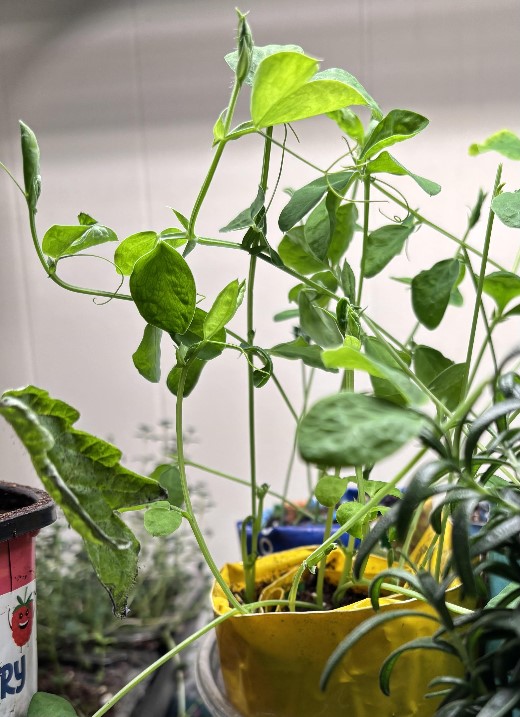
Wow. Not what I was expecting… gee, Frank. Lighten up a bit, wouldja? Me, I am all zippiddy doo dah myself. Look at those sweet peas under the grow lamp! The waltz entrances. Hmm. Why Frank? Why? Could it be it’s the fading night life scene that the man once knew and loved that has him lost and wandering, as the news The New York Times shared this week tells us:

…it’s a complicated prospect for restaurants, which traditionally make their highest profit margins on alcohol sales. Preparing food requires perishable ingredients and a large amount of labor, while alcohol is shelf stable and, except at the most dizzying heights of mixology, requires less work than cooking. As independent restaurants struggle with higher costs of all kinds — rent, labor, ingredients — the hollowing out of the most profitable part of the menu couldn’t come at a worse time. According to David Henkes, a senior principal at the food service research firm Technomic, alcohol sales are slumping in every category of the restaurant industry, from fine dining to casual establishments, with 31 percent of operators reporting “severe declines” in alcohol sales in 2025.

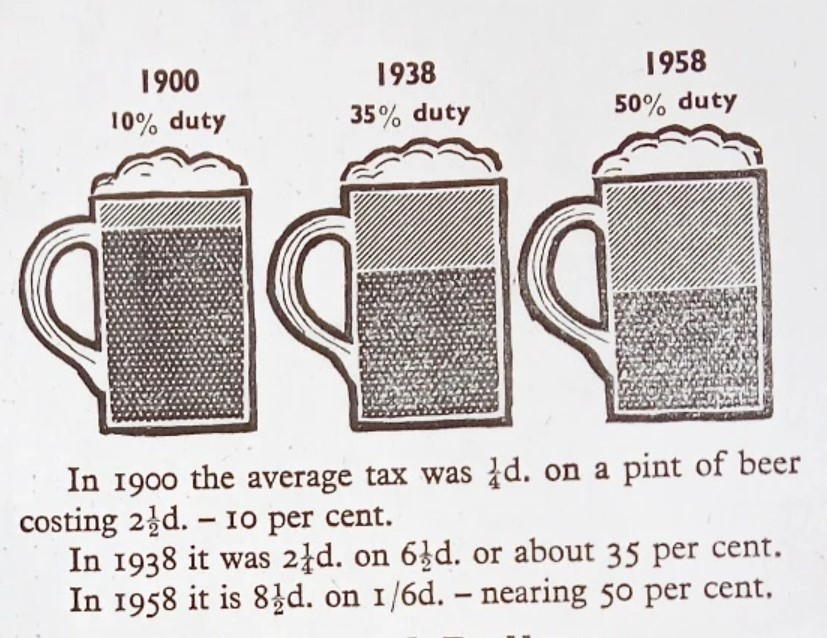
Yikes! We always here about the younger folk laying off the hootch – but even the set that clinks and drinks is clinking a lot less. But when was it ever the way it used to be? 1910 apparently. Nigel Sadler posted some images from The Times ‘Beer in Britain’s Supplement from April 1958, including the fascinating tale of the creation of the Hops Marketing Board as well as this infographic on the increase in duties on beer from 10% in 1910 to 50% in 1958.  Winning two World Wars as your empire collapses will do that for you.

Note#1: Michael Caine before he was famous.

Boak and Bailey unpacked their approach to writing a bit this week as they closed down one of their outlets, a newsletter by Substack where they unpacked their personal impressions perhaps a bit more. They shared that approach on one post this week, describing a scene Ray encountered when he would out and about with pals:

You know how you sometimes know something is going on, even before you see anything yourself, because people around become restless and twitchy? Even before the sword dancers entered the pub people noticed them in a group, standing outside peering in. Then their leaders, white haired with red neckerchiefs, entered and negotiated permission with the bemused young bar staff. Dancers and musicians shuffled in and found space for their display among the drinkers and diners. Then, off they went, stamping and twirling with berzerker energy, accompanied by fiddle and recorder… There were whoops and applause after the final somersault and, after they’d jogged out of the pub in single file, it felt as if the crowd had been injected with fresh energy. Between amusement, disbelief and admiration, it woke everyone up.

Whoops!* I have no idea what and who these sword dancers are. Clearly not, you know, the Highland lassies. Is this some sort of militant branch of the Morris dancer set? Speaking of militant hobbies, Phil Cook has been tracking the use of beer related answers to crossword clues in The New York Times and has released his report on the 2025 season:

The over-reliance on ale and ipa (and their plurals) has increased. They were about a quarter of last year’s references; now it’s 40%. That kind of frequency means there’s an impossible choice between repeating the same clue over and over, or reaching for one that’s only less common because it’s not very good. ale appeared on successive days several times — often with grim setups like ‘Pub drink’ or ‘Pub order’ — and one bleak fortnight3 had five of them, interspersed with two ipas, none with great clues.

I’m a Monday and Mini sort of crossword guy so I don’t see as much of this but Phil’s obsessive dedication to detail is impressive which backs observations like “there weren’t any debuts of new terms that seemed to signal any kind of shift in the zeitgeist.” Perhaps this year we will see a four letter answer for the clue “going out of style” which offers direction in at least two ways.

Speaking of style, Gary Gillman had his research on the founding of the green beer phenomenon in the USA published in Craft Beer & Brewing, reaching back ever so slightly into the 1800s:

In 1899, Milwaukee’s Pabst Brewery already was well known for its Blue Ribbon Beer, its bottles at that time festooned with a real blue ribbon. That year, as a marketing gambit, Pabst replaced the blue ribbon with a green one on a portion of its beer packaged ahead of the holiday. It also put a shamrock on the label in lieu of the usual hop leaf, with marketing that proclaimed, “Hibernians to celebrate St. Patrick’s Day.” (That’s according to Printer’s Ink, an advertising trade journal from that time.) However, the beer itself was the usual pale lager—it wasn’t colored for the special day. 

Which brings us to three more notes on St Paddy’s Day:

Note #2: “…all good-humoured, not messy yet…
Note #3: “…a local bar owner to invite me to meet him for “a chat…
Note #4: “...I’ve seen things you people wouldn’t believe…
Note #5: “…Liverpool is carnage…

Those last two notes are more along the lines of what was experienced the weekend before the day over in Waterloo, Ontario – a university city:

People living at Oakwood Manor, an apartment building near Marshall Street, said large crowds surrounded the building. Residents described partygoers climbing over fences, knocking some down entirely and leaving garbage behind. “They’re destroying private property, but they don’t care,” said Debra Hines, who lives in the area. Residents also said they saw people urinating in the parking lot. “They were [also] coming and stepping on people’s cars,” said Janet Peterson, another resident. Bridget Kocher, who also lives in the building said the repeated street parties leave residents confined to their homes several times a year.

Kids today! On a far more civil note, we don’t write about homebrewers enough. Something the coming recession will cure I am sure. But the Windsor & Eton Homebrewers Club described how the group did some compare and contrast of a few clones and made some… well, to be honest, observations on the state of Pilsner Urquell in the retail marketplace:

 I wish no disrespect or sleight to the founding fathers of Pilsner, but we were scratching our heads a bit. We used Pilsner Urquell as our reference for all our clones.  We found PU to have great bready richness with a great soft rounded mouthfeel.  A slightly sulphur smell and flavour – as is characteristic and a touch of ester, but also we found it with a sticky almost stodgy sweetness, not crisp as we were expecting.  However, it transpires that Ian found some bottled Urquell somewhere up North, which was apparently much better, so maybe the canned Asda variety isn’t a good comparator?

Frankly, I had already bookmarked this piece by Kieran Haslett-Moore from well before the Beer Nut unleashed the stinging taunts urging folk take notice of the death of the themed pub, once a cross-cultural cornerstone:

At the start of this year the Wellington Belgian Beer Café, Leuven, announced it was closing its doors after 25 years. Back in 2000, Lion started to brew Stella Artois under license and all of a sudden Belgian beer culture was in vogue. Leuven in Wellington and De Post in Auckland both opened, offering the full tourist-style Belgian beer experience with mussels, frits, draught Stella, Hoegaarden, Leffe and assorted bottled beers from the lowlands… At the start of this year the Wellington Belgian Beer Café, Leuven, announced it was closing its doors after 25 years….  In 2004 Christchurch got Café Torenhof which limped on after the earthquakes before running out of steam in 2020… Café Torenhof lives on in the way your great aunt does because you inherited her Welsh dresser and it sits in the corner of the living room. When the Christchurch café closed, its interior kit was sold to Craftwork in Oamaru…

While things go out of style, other things arise as Ruvani shared recently when she discussed the “Spaghett”:

For those not already in the know, a Spaghett is a simple two or three ingredient (depending who you ask) beer cocktail involving a light lager, a bright bittersweet amaro and either a slice or splash of fresh lemon (optional). The OG Spaghett consists of a Miller High Life bottle minus an inch or two and topped off with Aperol and lemon… a ‘poor person’s Aperol Spritz’ where the champagne is replaced with the Champagne of Beers. Until recently Spaghett enjoyed under-the-radar industry-insider status but a combination of social media and the cost-of-living-crisis have brought it into the mainstream, as drinkers nationwide are discovering the delicious pop of tangy, herbaceous aperitivo against clean, gently sweet and super-carbonated light lager finished up with a refreshingly sharp citrus twist.

Jeff published a piece on the ABSs of malt this week or, more specifically, the question of whether a base malt’s flavor come from the barley variety or the malting process:

 …it’s better to think of malting and brewing as connected processes. If you recall our previous conversation, the maltster has many choices to make, all related to the “biochemical levers” Matt referenced. It’s very much like the choices a brewer makes on mash pH, mash temperature, the number of rests and so on. It’s not like there’s a “correct” mash temperature; brewers make choices based on what they want out of a beer. The same is true with malting, and it’s why one brewery might choose a malt where one set of choices was made, while another brewery would want a different set. 

Speaking of grain, there was a Kernza sighting this week, about a year and a half since the last time the branding for thinopyrum intermedium passed by my eye. The Guardian reported on its use as Deschutes:

The secret ingredient is a grain called Kernza. It’s a perennial wheatgrass with a slightly nutty flavor and a climate-friendly reputation. Deschutes teamed up with the outdoor clothing brand Patagonia to craft a new beer using the grain. When asked how customers react, brewer Ben Kehs laughs: “They say what’s Kernza?” Kernza has deep roots that pull carbon from the atmosphere and require less water. There is less tilling and fuel use because it doesn’t have to be replanted each year. Kernza can be used as an alternative to barley, which along with hops and water, is one of beer’s three core ingredients. “All of them in one degree or another I would say,” Kehs explains when asked which ingredients face climate threats.

Finally and speaking of the exotic, Ron has been back in Brazil judging at a competition where he seems to have been quite happy with the set up:

I have my usual breakfast. Call me Mr. Boring. I don’t care. It’s what I want to eat. And I’ll fucking eat it. That’s the great thing about being old. Not really having to give a fuck what anyone thinks…  I’m on the same judging table as yesterday, with Suzanne and Alan. I’m happy with that. We rattled through the flights yesterday. Coming to a consensus without much argument. Which saves much time. And annoyance. Especially annoyance. The last thing I need is extra stress… After lunch, there’s a real treat. Non-alcoholic beers. Six samples. All three sour styles are pretty good. With the Catharina Sour the pick of the bunch. The best non-alcoholic beer I’ve ever drunk. Which may be quite a low bar. Or was. It’s been raised considerably now. That was much better than expected. Some flights of alcoholic beers were far worse. Not sure what that tells us. There’s then a long wait for the pre-BOS. Like two fucking hours. Such fun sitting and sweating. Watching Match of the Day helps pass a little time. 

Good to see that while his language hasn’t mellowed, his relationship to booze has. And he’s learned a bit of Portuguese on these trips, too.**

Is that it? That’s it! Another week and another winter moves into the history books. While we see what the spring may offer, please check out Boak and Bailey who are posting every Saturday and adding to their fabulously entertaining footnotes week after week at Patreon. And look out for more of Stan’s new “One Link, One Paragraph” format. Then hunt out something in someone’s archives! Leave oblique comments on someone’s post from 2009!! Listen to a few of Lew’s podcasts and get your emailed issue of Episodes of my Pub Life by David Jesudason on certain Fridays. And Phil Mellows is at the BritishBeerBreaks. Once a month, as noted, Will Hawkes issues his London Beer City newsletter and do sign up for Katie’s wonderful self-governing totes autonomous website featuring The Gulp, too.  Ben’s Beer and Badword seems to be on pause since November but there is reading at The Glass which is going back to being a blog. Any more? We have Ontario’s own A Quick Beer and All About Beer is still offering a range of podcasts – and there’s also Mike Seay’s The Perfect Pour. Plus follow the venerable Full Pint podcast! And there’s the Craft Beer Channel on Youtube. Check out the archives of the Beer Ladies Podcast.

*Remember: you can’t have whoops without an oops!
**Ron’s honesty when on these things is what makes his reports so worthwhile if only as a deterrent: “I’m so fucking knacked. We’ve judged so many beers today. And lots of strong ones. I never want to drink beer again. I’m so done with it. I just want to drink some cachaça and sleep.” 

The Delightful Yet Pensively Penultimate Beery News Notes On A Summer’s Thursday For 2025

It’s been a busy week but not really in the beery sense. Guests and heirs have come and gone – and even bought a $14.99 beer on the way out via an airport bar at Montreal, as illustrated sub-wonderfully perhaps. A last bit of summer visting and the shedding of the last loonies and twoonies. Which means the home is quieter here at this end of the week compated to the other. Which is good. But quieter. At least I have my tomatoes. Did I mention my tomatoes? Definitely illustrated sub-wonderfully, that yellow one in the upper left weighed in a 1.7 pounds. And I did nothing to make it happen. Which is my favourite and most common form of success. Six varieties left to right ish clockwise: Chiltern’s Blue Bayou, Baker Creek’s True Black Brandywine, Chiltern’s Golden Sunshine, Baker Creek’s Kentucky Beefsteak, Chiltern’s Beefsteak and Baker Creek’s Orange Icicle. Picked from the catelog based on the “pin tail on donkey” method. All started from seed last winter and soon getting turned into sauce. That True Black Barleywine is the best tasting tomato ever – like it has built in balsamic vinegar. Thanks for tuning in to Tomato News Today!

First up in the world of beer, the Tand himself has also been out and about on travels and has reported back on the scene in Munich – and found out that certain things were not to be found:

Sadly, you can’t find Pils on draught anywhere, and for reasons best known only to themselves, Spaten insist on offering the dreadful Beck’s as their bottled pils in their most prestigious outlets. It appears Spaten Pils, which I recall was a lovely beer, is no longer brewed. A real shame.  In fact, Spaten it seems, only brew Helles in both normal and alcohol-free forms and, of course, an Oktoberfest. It gets worse. The whole shooting match of Spaten-Franziskaner-Löwenbräu-Gruppe is owned by AB InBev, who presumably have streamlined the brands available, though under the Franziskaner brand you’ll also find weissbier and a kellerbier.  Like Spaten, the rather delightful Löwenbräu  Pils has been dropped. It is a pretty grim picture as the odd hoppy pils provided an alternative to Helles, which in its Munich iteration, can be a little sweet, and dare I say, bland? (The locals call it “süffig”, meaning “easy to drink”. And, in fairness, it is.

And over at Pellicle, Matthew assumed the role of player / manager and reported on his travels to the French & Jupps Maltings in Hertfordshire where he found a hidden truth:

Its long history stretches back to 1689, and for more than a century the maltster has been based in the twin Hertfordshire towns of Stanstead St. Margarets and Stanstead Abbots, bisected by the aforementioned Lea, some 30 miles north of London as the crow flies. There are a few reasons for its relative anonymity—I myself hadn’t heard of them until I was invited for a visit in February 2024. One is due to the fact its malt was (and often still is) bought in bulk and rebagged by various distributors before being shipped out to breweries. And so, it might bear the name of a competitor—although in this context it’s perhaps more accurate to refer to them as partners—in the US, for example, the malt is typically sold under the William Crisp banner.

Sneaky sneaksters! Did you know? (Did I? Never mind that… let’s make this about you.) Did you??? Speaking of hidden truths, Pete Brown had a has retrospective on BrewDog, now well in to the post-Watt era and even into the post-Dickie, published in The Morning Advertiser that he unpacked into something of an obit:

To me, they always felt more like a band than a brand – not least because they wanted to be seen as punks. Bands are different. When none of the original members remain, many former fans insist that it’s simply not the same band any more, and that the newcomers who have taken over, singing songs they never wrote or had hits with, are no better than a covers band. The departure of Martin Dickie feels like the last member of the original line-up has left the building. The entity that remains may own the rights and assets of BrewDog, but it has lost the spirit and soul that once defined it… Dickie remained silent throughout. The initial allegations referred to a “cult of personality” built around both men, but specific personal allegations were focused on Watt’s behaviour. After Dickie’s departure, some former employees took to social media to say that he was “part of the problem.” 

Wonderful. I have never understood how Dickie, co-exec past and board member still, has had the teflon wrapper that he has enjoyed through downturn after downturn on what must be one of the most note worthy financial flops in recent brewing history. But perhaps it’s been a case of not noticing that scratch on your hand due to the nail in your foot.

Speaking of endings, Ed the Beer Father has shared his thoughts on the closing of Banks of Wolverhampton, mapping a fairly complex set of international bobs and weave that led to the end:

Eleven years ago the two companies with rights to San Miguel beer, San Miguel Brewery (Philippines) and Mahou San Miguel (Spain) signed a cooperation agreement to promote their international businesses and position San Miguel as a global brand. To further its growth they had already partnered with Carlsberg to contract brew it in Britain, and it was a large part of the output of the Northampton brewery. But for a brand with global ambitions partnering with the world’s biggest brewery seems like an obvious match… So, as what I believe is part of a global realignment, last year San Miguel moved its contract brewing in the UK from Carlsberg to ABInBev. Losing the San Miguel contract left Carlsberg in the UK, which owned one giant factory and two large regional breweries, with a lot of surplus capacity. The giant factory wasn’t going to go and Marston’s has the small pack facilities, which left Banks’s. So a contract change for a Spain and Philippines based international lager brand closed a 150 year old brewery in Wolverhampton that didn’t even brew it. 

Lordy. Speaking of things making one’s head spin, I totally missed Stan‘s post before the Labour Day weekend on the nature of beer bubbles so I will correct that error now:

There is more to monitoring beer foam than counting bubbles, although they are the foundation. They result from nucleation, and as those bubbles climb to first form or then replenish the foam head, proteins and bitter substances are carried into the bubble wall, forming a matrix that holds the skeleton together. In his doctoral thesis, “Beer Foam Physics,” A. D. Ronteltap calculated that a foam 3 centimeters high (a bit less than 2 fingers) in a glass 6 centimeters wide (a bit less than a Willi Becher) made up of bubbles with an initial radius of .2 mm (twice the width of a human hair) would contain 1.5 million bubbles distributed over about 100 layers.

Over a million bubbles! Not quite millions and millions but more than one million. And, while the numbers aren’t quite confimed yet, Jessica Mason pulled out the stats as she reported on the question “Can Gen Z save cask ale from extinction?” for Drinks Business:

Statistics from YouGov for the Society of Independent Brewers and Associates (SIBA) have shown 25% of 18 – 24-year-old beer drinkers regularly order cask ale. The figures mark an increase of more than 50% on the previous year… Digging deeper into the SIBA figures, there are also statistics that support the opportunity that women present in the future of cask ale’s revival. For instance, the data revealed how 22% of female beer drinkers regularly order cask ale, compared to 43% of men. But, as Corbett-Collins noted: “It would be great to see even higher numbers, but the glass half full fact is that men and women of all ages are enjoying cask beer.

Out and About Update: Max mapped a 29 km(!) pub crawl he took through the Czech countryside to plant himself in front of a beer at Únětický pivovar, Zdibský pivovar and Polepšovna ducha as well as a few other spots. I marched about a tenth of that the other weekend and my left knee let me know about it for more than one day. Good thing Max kept up a good pace because apparently, according to the white coated eggheads in the Netherlands, beer drinkers are a prime target for mosquitos:

To find out why the blood-sucking critters prefer some people over others, a research team led by Felix Hol of Radboud University Nijmegen took thousands of female Anopheles mosquitoes to Lowlands, an annual music festival held in the Netherlands… Participants who drank beer were 1.35 times more attractive to mosquitoes than those who didn’t. The tiny vampires were also more likely to target people who had slept with someone the previous night. The study also revealed that recent showering and sunscreen make people less attractive to the buzzing menace. “We found that mosquitoes are drawn to those who avoid sunscreen, drink beer, and share their bed…”

Speaking of getting bled, I received the alert from Will Hawkes: “Sorry to be right about this. No GBBF next year as it made ‘a substantial loss’, according to CAMRA.” As per usual and FOR THE DOUBLE!!!… Jessica Mason has more detail:

CAMRA chairman Ash Corbett-Collins explained how “at Members’ Weekend earlier this year, the national executive presented finances that painted a stark picture. As your chairman I was open with you; we were facing significant challenges… Corbett-Collins lamented: “Sadly, this means I must tell you that: The Great British Beer Festival and its Winter counterpart did not attract enough visitors to cover the cost of holding them, resulting in a substantial loss.” Added to this, he revealed that CAMRA’s membership figures “are simply not growing” and confessed that “the hard truth is we are unlikely to return to pre-2020 levels”… and noted how “the cost of running a membership organisation and business is also increasing”.

This is a pretty serious situation as it really looks like a broader issue than just the fests. The organization itself seems to be at risk. I expect more information to be flowing in the coming days.

In the “WAR ON SCIENCE” folder, we read the news out of The New York Times that everyone’s favourite slowly exploding head in charge of the Department of Health and Human Services has pulled the US government’s pending report on alcohol as part of a healthy diet:

Mike Marshall, chief executive of the U.S. Alcohol Policy Alliance, a nonprofit that aims to reduce the harms of alcohol, said H.H.S. was “doing the work of the alcohol industry.” “They’re burying the report so the information about the health consequences is not widely known,” Mr. Marshall said. Health Secretary Robert F. Kennedy Jr. has decried a “chronic disease epidemic” sweeping the country. But he has said little about alcohol’s impact on American health since taking office. Consumption of both alcohol and tobacco was absent from the first Make America Healthy Again report released in May. Mr. Kennedy (like his boss, President Trump) has said he does not drink.

It’s important to note that Mr. Kennedy, unlike his boss,  does not wear makeup preferring to gain his particular rusty orange hue through a natural process.

Finally, just before this organ went to press, the dynamic duo B+B posted a piece under the fabulous title “Customers Have Always Been a Problem for Pubs” which illustrates the truth based on a sppech given in 1933 by one Lieutenant Colonel E.N. Buxton, director of the East London brewery Truman, Hanbury & Buxton:

The talk finishes with a few more rebukes for the drinkers. First, the reason pubs often look so ugly, and are so sturdily built, is because “you do not treat them so kindly”. “Walls and furniture are roughly treated”, he says. “As for the outside of public-houses, I agree that some of the houses in London look perfectly ghastly. Hard wear, however, had to be the first consideration.” This was addressed, remember, to a room full of people from Bethnal Green. We’re picturing the crowd when Bertie Wooster sings ‘Sonny Boy’.

Fabulous. There. That’s a lot for a busy week but probably less than all the stuff our there to read so please also check out the afore mentioned Boak and Bailey every Saturday and sign up for their entertaining footnotes, too. Look out for Stan when he feels the urge now that he’s retired from Monday slot… maybe … maybe not. Then listen to a few of that now newly refreshed Lew’s podcasts and get your emailed issue of Episodes of my Pub Life by David Jesudason on certain Fridays. And Phil Mellows is at the BritishBeerBreaks. Once a month, Will Hawkes issues his London Beer City newsletter and do sign up for Katie’s wonderful self-governing totes autonomous website featuring The Gulp, too.  Ben’s Beer and Badword is out there with the all the sweary Mary! And check out the Atlantic Canada Beer Blog‘s weekly roundup. There is new reading at The Glass which is going back to being a blog. Any more? We have Ontario’s own A Quick Beer featuring visits to places like… MichiganAll About Beer offers a range of podcasts and there’s also The Perfect Pour. Plus follow the venerable Full Pint podcast! And there’s the Craft Beer Channel on Youtube. Check out the archives of the Beer Ladies Podcast. That’s quite good and after a break they may well be are back every month! Such is life. Such is beer podcasting and newslettering… which, as Ray says, are blogs! And he’s right.

Your Beery News Notes For The Week That The Session Will Be Resuscitated

It will! Will it? Will it take? Will it last?  Errr… will it even happen? Hmm… as I mentioned, we are going to try to see if there is any interest in having a go at reviving The SessionStan‘s excited as are Matty and Alistair. Maureen is Sessio-curious. We’ll find out tomorrow. More about that later – but it does seem to be a reasonable thing to try as January fades while February looms. Does it loom? At least it’s shorter than January. Thirty days to March, baby. As of today. That’s all that matters to me now.
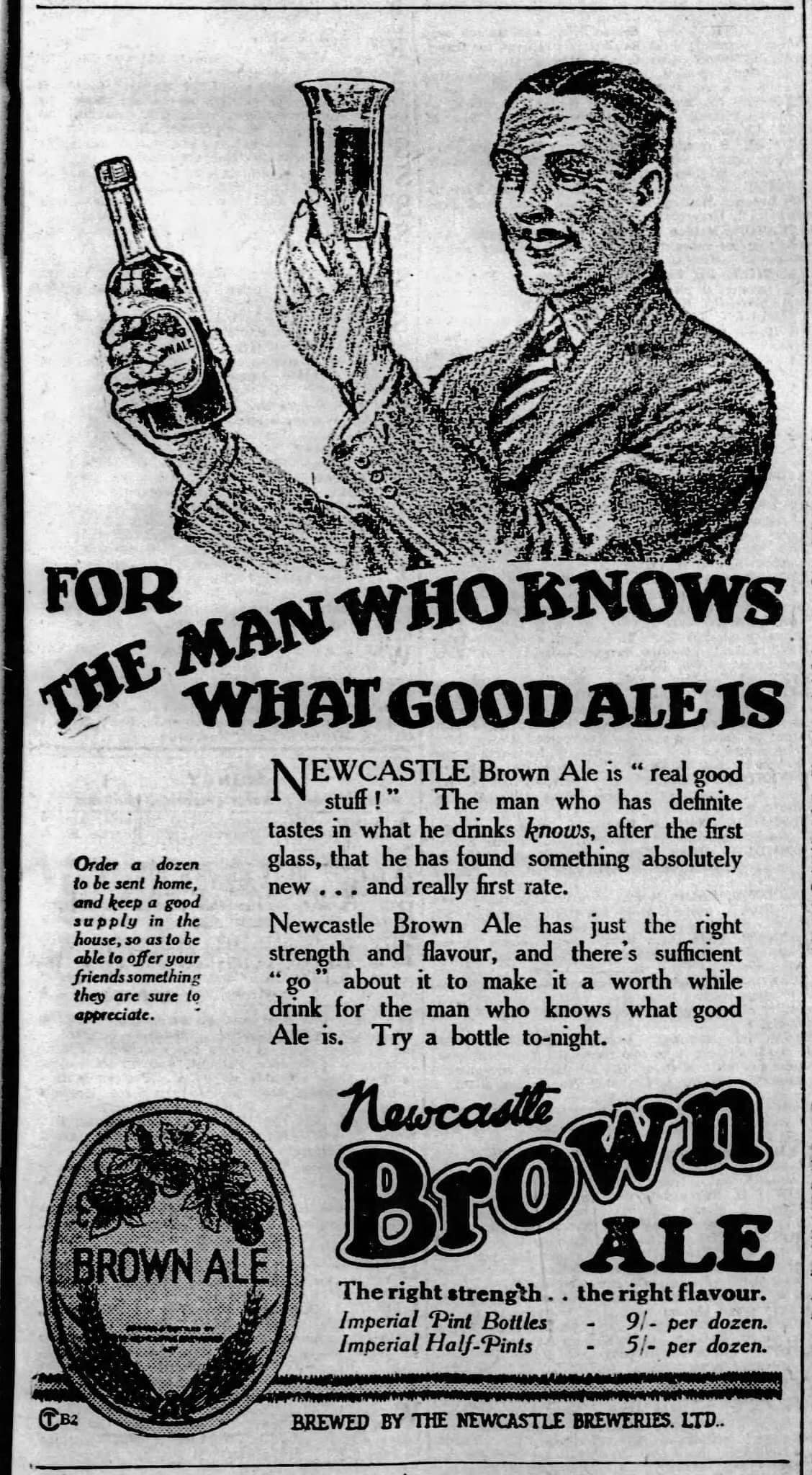
That image to the right (to your right, to the left to me) is from Newcastle’s Evening Chronicle of 24th May 1927, as reposted on FB by the Brewing History Society. That’s apparently about a month after the beer was first sold. Me, I myself too only drink it from a large labratory test tub while waxing my head with Brylcreem. Big news in beer the week was the recall of certain bottlings of the old Newkie Broon due to glass fragment contamination in some 550 ml bottles:

Ale drinkers who have purchased a bottle of Newcastle Brown Ale with the best before date November 30, 2025, as well as the correct batch code, should return their beer for a full refund. The affected batches are: L4321, L4322, L4323, L4324, L4325, L4326, according to the Food Standards Agency.

Further shocking news coming so soon after the UK market collapse of Brylcreem and large home use test tube sales is the story that gin sales are slumping as reported in The Times:

…on the chilly November day that I visit Sipsmith it is remarkably quiet. The distilling hall is empty and I spot about three workers in the large office at the back. Then there is the cold. “If we’re distilling, it’s usually lovely and warm in here,” Fairfax Hall, 50, one of three co-founders says as we sit down with our coats on. For they are not distilling: in fact they have already finished for the year. “Volumes fell more than we anticipated. We stopped distilling a couple of weeks ago [mid-November]. The industry has definitely slowed down. I mean, if you look at the numbers it is way off the peak.”

There are reasons for this, ranging from adherence traditional religious practices to social media’s influence on pop culture. Elsewhere, some continue to see rainbows and maybe even a unicorn or two.

Following up on the story that emerged last week, Stan has the background on the split between the BA and the AHA going all the way back to the tensions which played out in the corporate structuring and restructuring.

Many of the packaging brewers questioned the participation of homebrewers, Hindy wrote. “What role could a bunch of hobbyists play in a brewing industry trade association? Complicating the discussion was that the AHA was losing money. The AOB was subsidizing it. Mosher and (Rogue Ales founder Jack) Joyce argued that the homebrewers were the biggest fans of craft brewers, the first line of defense in any attack on the industry.” In the agreement that eventually followed, the membership would elect seven packaging brewery board members, four brewpub members, and the AHA would choose two board members.

Jeff gave a hopeful forecast: “…homebrewing is a wonderful hobby that satisfies our wholesome human creative urges…

BREAKING: In British Columbia there is no drinking and bowling! Stop it!!

“The inspectors observed the patron do this – carry what appeared to be a glass of beer into the bowling alley area and consume the beer in that area – three times in eight minutes,” reads the decision by Dianne Flood, delegate to the general manager of the regulation branch. Inspectors reported the infraction was in “plain view and sight for any observer” and that a staff member working near the bowling alley should have noticed and spoken to the customer.

Three times! Entirely justifies the tens of thousands of dollars allocated from the public purse to prosecute these dastards.

Speaking of violations, is the Mliko pour an imposter? A new trend posing as tradition!?! Alistair never saw it when he lived in Czechia in the 2000s and Ron argues it was non-existent in the 1980s:

Something which never seems to get mentioned nowadays is the serving method. People go on about crap like “mlíko” pours – something I never came across in the 1980s and which I suspect was just made up recently. But not the reason why Czech beer was so drinkable: air pressure. Rather than CO2, air pressure was used to pump up beer from the celaar. Much like tall fonts in Scotland. The resulting half litre had a wonderful creamy head, but wasn’t overly fizzy. Being more like beer served through a sparkler in texture. Why does no-one lament the loss of this wonderful practice?

Why? Whhhhyyyyyyy??? Because no one cares, I suppose.  Except Ron. And it is to be expected as there is one constant in beer [Greek Chorus (interjecting): “… well, two after money…“] and that is change. Face it. Breweries open and shut. Get build and get sold. Such is life. But apparently one regional, the makers of a gas station shandy and other more ancient if less than universally loved beers is now a focal point of complaint [Greek Chorus (interjecting): “…or perhaps just content creation…“] as owners of 36 years Molson Coors has announced it is shutting its Leinenkugel  brewery in Chippewa Falls, Wisconsin:

Given that the firm would announce its plans to end Leinenkugel’s century-and-a-half-long streak of brewing in Chippewa Falls (interrupted only by Prohibition, which it survived by making soda water and near beer) just three months later, St. Jacques could have been a little more clear. Sure, the Leinie brand will technically live on, even though the brewhouse from whence it came, Chippewa Falls’ longest continuously operated business, has been relieved of its production duties. But MC’s move to shutter what was the seventh-oldest still-operating brewery in America is clearly a change in its commitment to Leinenkugel — and not for the better.

I mean I get it but Molson Coors and its big beer predecessors in title have owned this northern brewery for about a quarter of its existence. That’s a pretty good run for a relationship between a middling regional and its multinational owners. What do you want?

You know what I want? More articles like this from Anaïs Lecoq in Pellicle on Coreff, a real ale… the first real ale from France which has an interesting origin story:

Brewing nothing but real ale at the time, Coreff came to life with the help of a person that will mean nothing to the vast majority of French people, even the beer drinking type. Yet he’s considered a legend on the other side of the English Channel: Peter Austin, founder of Ringwood Brewery in Hampshire. “If some dare to call me the pope of microbreweries, today, I can claim the right to appoint Jean-François Malgorn and Christian Blanchard as my disciples,” Austin wrote in a 1988’s commercial leaflet recalling his partnership with the brewery.

It’s excellent and in a way struck me as a sidebar essay that pairs neatly with Brew Britannia by Boak and Bailey. Brew Bretonia?

Learning once again that there is no topic which can’t be slathered with the dumbness of “woke!!” protesters, one brewery in Australia has learned that protecting nature is now “woke!!” too:

Aussies have voiced their outrage at a popular beer company by running over cans of the liquor, in a boycott of the company’s recent charity campaign which has been slammed as “woke”. The Great Northern Brewing Company came under intense fire following a recent campaign — Outdoors for a Cause — which aimed to raise money to buy and protect land to add to national parks in support of the non-profit organisation Foundation for National Parks and Wildlife, according to Yahoo News. However many moved to boycott the company, which typically uses imagery of people outdoors to market their beer, following the campaign’s announcement. Facebook group 4wd TV lashed out at the move in fear the money raised would be used to turn state parks into national parks.

Because the particular colour of the uniforms of the government park rangers… matters? No, turns out you can’t fish, camp or hunt in an Australian National Park. So they are “helping to stop bush users using the bush.” All sounds pretty unCanadian if you ask me. Don’t they have Crown land?

I missed this info when it came out earlier in the month but this article in GrainNews is an excellent primer on the issues facing a barley farmer dealing with the reality that a $1 million malt barley crop can turn into $600,000 of feed:

“We need to know what that whole field looks like,” he says. “I’m looking at one kilogram to make a million-dollar deal, so that sample you give me better be what you’re actually going to deliver.” Also, if the grain sits for an extended period, it can degrade, so he cautions farmers to re-sample the bin every six to eight weeks. If a sample meets the specifications in late summer but a load’s not delivered until the following spring, a lot can go wrong. “Somewhere along the way, it heated, got bugs in it, or the germ dropped off,” he says. “We want to see that so we know for ourselves that you still have the malt that you said you had for us.”

And on the health beat, there was a helpful interview this week with Otis Brawley, Johns Hopkins Bloomberg Distinguished Professor of oncology and other things, unpacking current findings and recommendations:

An estimated 741,300 cancer cases in 2020 were linked to alcohol consumption. It is ranked the third leading preventable cause of cancer. Research shows that alcohol can cause cancer by breaking down into a metabolite that ultimately damages your DNA, which can lead to the formation of tumors. And the effects of alcohol seem to compound. 

Which sorta does lead to the understanding that there isn’t a net offset by taking on other good behaviours. Jogging isn’t exactly buulding a wall around your DNA. But there was also this intereting nugget: “We have evidence that drinking increases the risk of this cancer. We don’t have as strong evidence that to stop drinking reduces the risk.” So you may be screwed already. And by “you” I mean me.

Finally, something in life where plumpness is a plus! And… want to become an instant hero in the world of good beer? Buy San Fransico’s beer bar Toronado. Buying the building, business and inventory for only $1,750,000 actually sounds like a bit of a deal:

For sale is a 2900 sq ft 2 unit commercial building and business for sale together. A small restaurant space with Type 1 hood, and bathroom in approximately 500 square feet, (delivered vacant). The remainder of the building is occupied by the time honored and award winning Toronado Pub… you can’t design this vibe; you can only nurture it over decades. Yet the main attraction remains the beer: The 50 taps, three cask handpulls, and 90-plus cans and bottles celebrate the best of California and around the world, including hits from Allagash, Alvarado Street, Cellarmaker, Monkish, North Park, and Russian River, and on to Cantillon, Schneider, Tilquin, and more.

Last Friday, David Jesudason handed the keys for his newsletter over to EU citizen and brewer Noora Koskinen-Dini who has recently been dismissed by an English brewery, which may be the sort of story retold in greater numbers soon over here given the new immigration policies in the USA:

They told me on these pre-employment calls they wanted me to manage the bar and then take over the brewing side… When I arrived there was a general manager who worked with me to show me how things were run in the taproom – it didn’t include the brewery because this was Paul’s domain. I worked mainly at the taproom, there was no brewery work, not even shadowing. I was summoned to another meeting where Paul told me ‘because you’re unhappy and you can’t buy the brewery I’m going to let you go’. I felt this was rambling nonsense and not how you do things. After all this time, after all this love and passion, my employment was terminated because someone thought I was unhappy? I tried to explain the consequences of this decision that it would affect my whole family and it meant I would have to ultimately leave the UK.

The brewery in question was given equal time by David. With some startlingly conflicting factual statements. Is this what’s meant by selling experiences?

Finally and once again, a reminder to all you scribblers and wannabe scribblers.  The Session is breaking out the tabbourines and a big tent for a revival of the greatest thing to ever happen in beer writing. From 2007 to 2018, there were 142 editions easily tiggering the writing of one billion words. So tomorrow on Friday January 31, 2025 please post your thoughts – via blog, newsletter, social media… anything – on the topic:

What is the best thing to happen in good beer since 2018?

Then once you have done that, leave a note here in a comment or even email me the link at beerblog@gmail.com! Or let us know some other way. I will aggregate and report back. Try using #TheSession, too, even if there are others in that information superhighway lane.

While we wait for the results, please check out Boak and Bailey every Saturday and Stan going strong again each and every Monday. Then listen to Lew’s podcast and get your emailed issue of Episodes of my Pub Life by David Jesudason on the (sometimes even but never) odd Fridays. And maybe The British Food History Podcast. And Phil Mellows is at the BritishBeerBreaks. Once a month, Will Hawkes issues his London Beer City newsletter and do sign up for Katie’s wonderful newsletterThe Gulp, too. The Share looks to be back with a revival. Ben’s Beer and Badword is out there with the all the sweary Mary! And check out the Atlantic Canada Beer Blog‘s weekly roundup. There is new reading at The Glass which is going back to being a blog. Any more? Check out the Beer Ladies Podcast. That’s quite good and they are revving up for a new year. And the BOAS podcast for the bro-ly. And the long standing Beervana podcast …except they have now stood down.  Plus We Are Beer People. The Boys Are From Märzen podcast appears suspended as does BeerEdge, too. VinePair packed in Taplines as well. All gone. But not Ontario’s own A Quick Beer featuring… Michigan! There is more from the DaftAboutCraft podcast, too.  All About Beer has sponsored trade possy podcasts and there’s also The Perfect Pour. Plus follow the venerable Full Pint podcast. And the Craft Beer Channel on Youtube.  The Moon Under Water is gone which is not surprising as the ask was $10 a month. Pete Brown’s one cost a fifth of that but only had the one post. Such is life.

These Be The Week Before Christmas Mailed In But Merry Beery News Notes

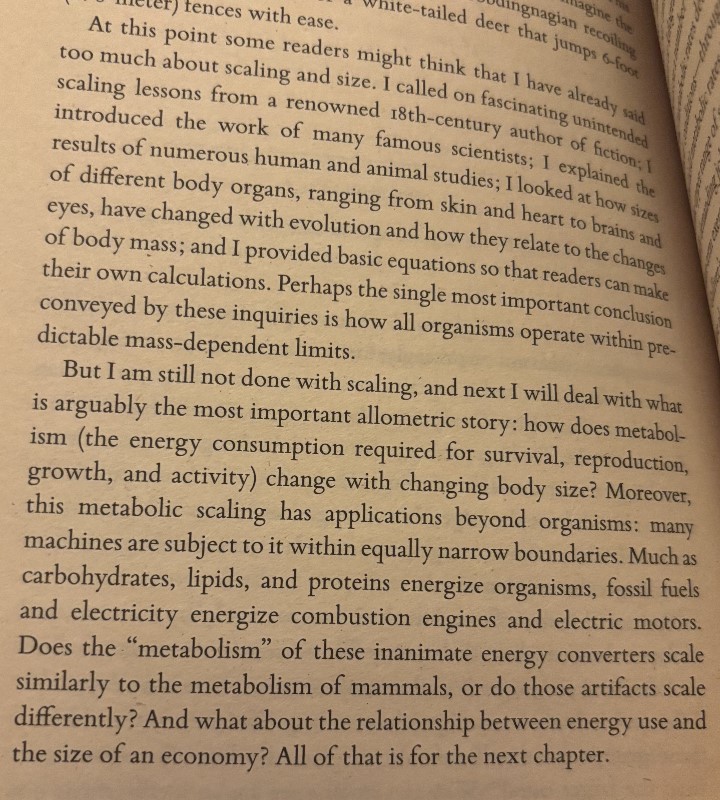
Well, they would be mailed-in if we hadn’t had a postal strike here in Canada. My Christmas cards are in limbo. Parcels replaced with e-cards. How unjolly. So I have had to find other things to fill my days. Like reading. I was up to a book a week during the pandemic. This year? Not even one a month. I was grateful, then, to read the passage to the right from Prof. Smil’s facinating but dense (not to mention tiny fonted) book Size which is something of an apology to the reader. It’s good to know that sometimes the feelings are mutual when it comes to these sorts of things. Which other writers should issue apologies?

What is up? ATJ starts us off whistfully today, daydreaming of the scene in a favourite pub on Christmas Day:

A pub I regularly visit, The Bridge Inn at Topsham, five miles from where I live, opens for a couple of hours and the landlady Caroline recently told me that hundreds of people turn up and that there was a separate bar to dispense Branoc, which is the pub’s popular session ale. Other beers poured from the wood are of a stronger cast, the kind of strength that would make a cat speak. I am sure that the mood is joyous and celebratory, a cacophony of voices and laughter, inside and outside the pub. The parlour to the left of the pub corridor I guess to be warmed by the well-lit fire and full of eager drinkers, as would I suspect to be the back bar, again with a well-warming fire and conversation ebbing and flowing like the tidal river just below the pub. One day I shall get there on Christmas Day.

Boak and Bailey also consider their actual visits to the pubs of Bristol during these holidays – first at (me being Nova Scotian) the most wonderfully named pub that I will likely never enter, The Nova Scotia, then moving on to The Merchant’s Arms:

The Bass was excellent. The Butcombe was excellent. The Christmas tree twinkled and was reflected in the chocolate brown paintwork. There were more lads in Christmas jumpers, more rugby boys… no, actually, the same ones from The Orchard, on the same trail as us. Again, we found it hard to leave, but The Merchants Arms was beckoning from across the water… We squeezed through the door and through the crowd to a spot within shouting distance of the bar. As we peered at the pumps we heard a voice shouting “Ray! Ray!” but ignored it because, frankly, The Merchants is the kind of pub where almost everyone is called Ray.

If I ever meet B+B, I hope I first see them from a distance so I too can shout “Ray! Ray!” but to be clear I will likely shout “Jess! Jess!” so as to be both cheery and nice while also sneaky and clever.

Also striking a holiday pose, in Foodism we see Will Hawkes wrote about Christmas ales as an echo of Victorian times:

Christmas meant stronger beer, often brewed in October and longer aged to soften the edges. In December 1888, for example, the Phillips Brewery advised readers of the Oxford Times not to miss out on their “Christmas Specialities”: a strong ale, a double [i.e. stronger than usual] stout and an ale aged for two years. These were powerfully flavoured beers designed to accompany the rich, fatty, indulgent dishes then central to, and still part of, a British Christmas: plum pudding, stilton and roast meat of various kinds – this was a time when most Britons did not drink wine. Beers were dark and heady, like liquid Christmas Pudding, and often stronger than 10% ABV.

Now… I would note that English strong ale is not a Victorian invention as careful readers will appreciate. But the point of the reformist middle class Victorian – really Albertan – homey Christmas is quite correct. Still, I do think the Georgians were more fun. Disgusting but fun.

Going further back while remaining ecclesiastical, Dr. Christina Wade shared some snazzy facts this week over on BlueSky about the work of a medieval Cellaress:

The pages of this late 13th-century manuscript, La Sainte Abbeye, detail what would make up a perfect abbey. & what would such an institution be without ale, or, perhaps more precisely, the nun in charge of it, the Cellaress… Pictured in this illustration, between the Abbess, singing nuns, and a small handful of deacons is the cellaress, the woman in charge of food and drink… In medieval monastic communities, ale was an important part of diet. It was critical to the running of many of these nunneries. And not only did they drink it, they often also brewed it on site.

Keeping up with this sort of academic wisdom is what makes this here blog what it is – but I have to admit I also love running across new favourite jargonese like “pseudo-targeted flavoromics” which is just fabulous. Whaaaaaaat does it even mean?

…a comprehensive flavoromics integrating untargeted, pseudo-targeted, and targeted analyses was employed to characterize volatile development across RTs with 14 annotated compounds. Notably, non-linear patterns have been observed in malt coloration, precursors consumption, and volatile development for the first time…

Fabulous. Super dooper fabulous. Speaking of which and yet giving me something of my own flashback, David Jesudason wrote about the experience about returning to the pub as a member of staff, something he had not done for 25 years:

…working in a pub gives you a rare gift of seeing the space for what it truly is even if that is amorphous – at first it went from being a slew of self-contained tables and then a communal mass with multiple conversations tied together with the love of beer. And, at times when I wasn’t part of the fun or the work, I had a vision of it being a high-street shop – the marvel of the micropub unwrapped. The most shameful confession is that for a few seconds when facing random customers I felt like I over-explained to somehow overcompensate that I was more than a bartender – maybe James’s intervention was warranted. That I had somehow failed in my career as a writer and become perma-frosted since 1999, which reveals how I may subconsciously view service industry jobs as somehow inferior to other pursuits.

My trick as a bartender?  Give change in dimes and nickels. You get it all back. Speaking of the jolly, did you see the 1975 BBC new item on the Guinness tanker ship posted at the FB page of the Brewery History Society? It’s not the ship itself that’s jolly but that turtleneck blazer combo… though the “draught” and other puns do strain the patience.

Tariff news update!  Did I mention that Ontario’s government booze store (retail and wholesale) is the biggest in the world? Well, apparently our provincial government is considering restricting the Liquor Control Board of Ontario from buying any American-made alcohol:

“We’ll use every tool in our toolbox, as we put a tariff on bourbon last time. The LCBO is the largest purchasers of alcohol in the entire world. But I’d prefer not to do any of this,” Ford said Friday. Earlier in the week, Ontario’s premier threatened to pull the plug on the electricity supply that powers 1.5-million homes in New York, Michigan and Wisconsin.

Looks like I’ll be sipping rye this winter. As Michigan grinds to a halt. And speaking of sipping, The Tand took himself and herself out for a walk recently to spend the day drinking cask ale in London and shared what he found:

I knew trouble was afoot when the server put my glass under the handpump and splashed beer into it while pouring a half of lager. It was the worst pint of Vocation Bread and Butter I’d ever had, but I supped it quietly and left most of it. I hadn’t the heart to pull this hard-working lass up about it. Someone should have trained her better. At our table we started talking with a couple of lads who’d lived locally for a few years, They too had started on cask and abandoned it so we enjoyed Hofmeister instead…

Somewhat speaking of which and before we get into the “craft rot” stories, they of Pellicle posted some thoughts on the year soon past and their plans for 2025:

While these features remain popular, in that they’re well read, we’ve come to realise that readers are often seeking more than simply a narrative piece about a brewery with a friendly owner who makes really tasty beer. There needs to be an angle, a hook, a proper story to dig your teeth into. We will continue to publish stories about beer and breweries in 2025, but with greater scrutiny and tighter angles focusing on what we feel really matters to our readers. Throughout this year we’ve been pausing to check ourselves and ask “who really cares about this, and why does it matter?” Two hugely important questions when you’re publishing content about any given subject.

This is good. Where ever they are published, brewery owner bios (herein “BOBs”) tend to be samey. Cavity inducing even. Where the reader can find investigative work like fact checking brewery owner assertions or interviewing former employees or business partners for alternative takes on official history these piece might have some hang time. But they are nice and have their place so keep them in there as long as they are matched with as many more analytical critical studies. Good move.

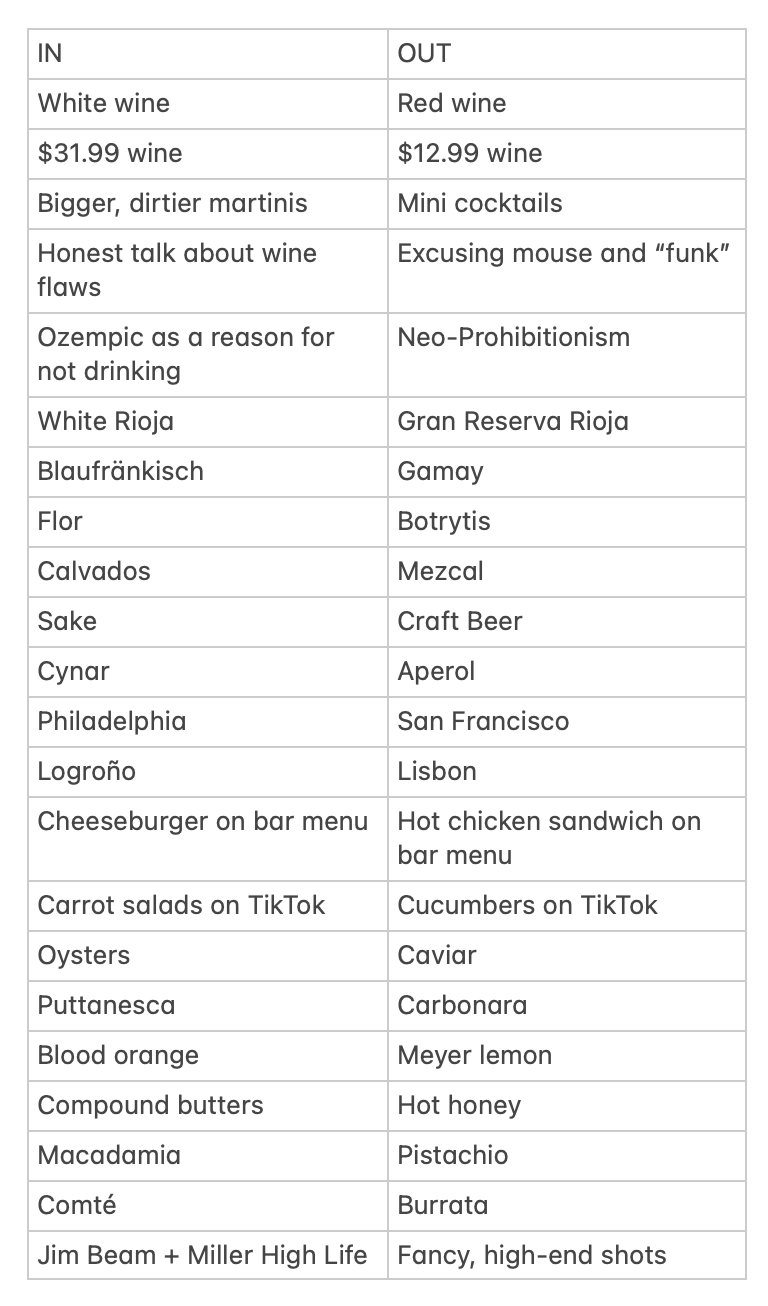
Also looking a bit forward as well, drinks writer Jason Wilson prepared a What’s In and What’s Out chart for the turn of the year. Click to the to the right for a larger version. The bad news that we all know has come to pass is that craft beer* is in the out column but has sake really given it the boot? As is often the case, there is an underlying argument that things that were a bit precious are being left behind so craft beer joins caviar, mini cocktails and Mezcal on the list making room for oysters, dirty martinis and calvados. Now, you can live the life that you think is right for you but I am always going to vote for oysters and calvados.

Note: BA Bart takes the shrinking ship’s helm as the foundering continues. And this is during the week when the frankly “long forgotten to many” RateBeer announced its own demise after five years of big beer ownership – and announced it with some very specific instructions:

Login to the RateBeer website and navigate to the My Profile page… In the right-hand column below “Beer Cellar” is the “My Account” section… In the “My Account” section, click “Compile My Ratings”.. The next page will provide options for downloading your ratings in CSV (comma-separated value) format…

Wow. It’s soon gonna to be gone gone gone goner than Hunter Biden is getting struck from the White House Christmas party list. Just to avoid the link-a-cide, I am connecting to the story at BeerAdvocate, too.

And Jordan noted another passing, of The Growler a beer magazine he edited. Print magazines about beer have never done well in Canada. Ontario had a section in Great Lakes Brewing News from 2009 to 2019 before… the scandal. And we had TAPS that folded its last print edition in 2016, then we had Mash which lasted a few issues the next year, then we had a Canadian edition of Original Gravity for a bit – and now we have The Growler‘s Ontario edition taking its leave in turn, though the BC edition seems to live on. In good times and bad, beer magazines have never seemed to be the thing. Will someone try again?

Speaking of which, interesting zing! from a former blog publisher over Google delisting the “unvetted and often bogus content” of Forbes’ contributor network where a few struggle down the mine axe in hand, hacking against the rock face, convincing others that beer is interesting.

Note: a list of 10 or 25 or 30 people naming their favourite beer or breweries of the year (or anything of the year) isn’t a list of the top 25 or 30. It’s just 25 or 30 lists each with only one listed. End of the year content filling season is here!**

Finally and in far better shape than that second half what was set out above, Drunk Polkaroo is back after 12 weeks off alcohol and counting for health reasons, the details of which he has shared. After a bit of a glum re-entry with a discount brand review, he is one his feet again with a cheery review of a NA beer from one of Canada’s finest brewers. Is this his new thing? It’s certainly a good thing.

That’s it! Happy holidays! Merry Christmas and all that!! Until next time when we will be gathered ’round the Boxing Day Box, please check out Boak and Bailey every Saturday and Stan going strong again each and every Monday. Then listen to Lew’s podcast and get your emailed issue of Episodes of my Pub Life by David Jesudason on the (sometimes even but never) odd Fridays. And Phil Mellows is at the BritishBeerBreaks. Once a month, Will Hawkes issues his London Beer City newsletter and do sign up for Katie’s wonderful newsletterThe Gulp, too. The Share looks to be back with a revival. Ben’s Beer and Badword is out there with the all the sweary Mary! And check out the Atlantic Canada Beer Blog‘s weekly roundup. There is new reading at The Glass which is going back to being a blog. Any more? Check out the Beer Ladies Podcast. That’s quite good and they are revving up for a new year. And the BOAS podcast for the bro-ly. And the long standing Beervana podcast …except they have now stood down.  Plus We Are Beer People. The Boys Are From Märzen podcast appears suspended as does BeerEdge, too. But not Ontario’s own A Quick Beer. There is more from the DaftAboutCraft podcast, too.  All About Beer has podcasts and there’s also The Perfect Pour. Plus follow the venerable Full Pint podcast. And the Craft Beer Channel on Youtube.  The Moon Under Water is gone which is not surprising as the ask was $10 a month. Pete Brown’s one cost a fifth of that but only had the one post. Such is life.

*As per Beer Insights: ‘ Whole Foods beer buyer Mary Guiver reflected on the theme of focus, resisting the urge “to do everything” and “chase everything”… Whole Foods “had to weather the storm of being a craft-centric retailer,” Mary said, and “it sucked.”
**Plus… “beer pros“!

November’s End Brings Me A Fascinating Bout With A Delightful Chest Cold Leading To Some Particularly Phlegmatic Beery News Notes

My top tipple of the last ten days, in case you were wondering, has been Buckley’s Original Mixture. AKA Buck Bucks. It features no actual medicine but does contain pine needle extract, Balsam sap, camphor and smelling salts. A double Makers Mark just about cuts the stuff. So I’ll be the gent in the corner reeking of coniferous forest as you read these notes this week which might not take all that long, given my residency on the sofa.
Good timing as it turns out as down south it’s Thanksgiving, the day that we up here in Canada call “Wrong Thanksgiving” but apparently it serves the social purpose of annually bringing steaming hot deep dishings of political misgivings and animosity directly to the family table just a few weeks after their fixed election date. Today, in honour of all that, we celebrate the 64th anniversary of the best TV ad for one of my favourite old school beers, Utica Club and it’s confirmation that they will need a lot to get through this. Viva Utica Club! Viva!!

What else is happening? Big news out of Britain is the continued demise of tradition. Is it the new old Labour effect? Who knows? But the fact is that Fuller’s is axing Lancer at the same time as Carlsberg Marston’s Brewing Co. is discontinuing every cask ale your great uncles ever loved.  We get Bombardier here. Haven’t had one in over a decade. Mr. Beeson offers stark but reasonable advice:

Lets not mourn for brands that had already sunk into total irrelevance and put our time and energy into protecting cask brewers of the future…

Harsh? Hmm. My problem is that the loss of brands seems distinct from the loss of fluids. Does anyone bother that much anymore with recipes reformulations under and old label? Is it the beer or the branding we miss? And… and… has the combination of health concerns, price and disappearing brands left you in a quandry?  Has it driven you to what The Times describes as  “Zebra-striping“?

…drinking trends are moving away from the raucous, post-pandemic. Younger customers are demanding more low or non-alcoholic drinks. In 2016, 0.5 per cent of beer sales were alcohol-free varieties; this has risen to two per cent. But there is still room for significant growth, with the popularity of low or zero-alcohol beer in Britain well behind countries on the Continent… For those not willing to forgo alcohol altogether, “zebra striping” or “zebra-ing”, is gaining popularity — a trend for alternating between alcoholic and non-alcoholic beverages to mitigate the effects of a hangover the following day.

Make sense… except for, you know, water. Who hasn’t double fisted the pinto of water with the pint of ale? Is this really a new thing needing a new name? Or away to sell thick expensive soda pop called NA beers? Man, I am grumpy this week. I need to nicen up.

To that end, a special report from our special assignments correspondence Maureen Ogle who drew my attention to the breaking news that drinking a lot of alcohol over and over again over many day of one’s life is not at all good. Here’s a clip from the NYTs [Ed.: “roll the clip“]:

The National Alcohol Survey series, which collects data from the general population, defines high-intensity drinking as the consumption of at least 8 drinks in a row by anyone, male or female, over the previous 12 months. The survey’s latest analysis, which does not include data beyond the year 2020, also showed a decline in high-intensity drinking among young adults overall. But its frequency among men ages 30 and older and women ages 18 to 64 has increased, said Camillia Lui, a scientist at the Alcohol Research Group who crunched the data.

While the story also says that heavy drinking is not limited to the holiday season; nor is it mainly the pastime of college students we turned to Maureen for her thoughts on the matter:

Fucking morons. Is drinking a shit load of booze in two hours a dumb idea? Yes. Even dumber? Treating it as a shiny new danger.

[Ed.: “After the break, sports.“]

Next, Gary has been writing up a storm with an interesting focus recently on mid-1900s US Bock Beer. Here is part 1 and here is part 2  with a passing mention in this post about the regional brewery owner, the Atlantic Company.  I like how this last post again confirms the fibbery in the old saw that the birth of US microbrewing was a response to a decades long wasteland of thin macro lagers. There was plenty of variety in US brewing into the 1970s and with personal or inherited memory of the micro pioneers even if, as Tremblay and Tremblay have shown, corporate mergers and leading brand advertising were starting to have great effect by that point.

David J. has news for you. He was the host of the 2024 British Guild of Beer Writers awards gala and general all around shindig held on Wednesday evening. He dressed up and everything. And I hear he had been studying the style of noted beer person Ricky Gervais.  Expect social media to be replete with sorry headed tales of hungover beer writers throughout this Thursday after celebrating Blackout Wednesday in their own way. The big winner for the year was Ruvani de Silva who won “The Michael Jackson Award for Beer Writer of the Year” for 2024. Congratulations.

And Stan has his Hop Queries (edition 8.07 for you numerologists) out and he shared this tidbit about arguments in favour of beer as health fluid based on the presences of hops:

…one thing that does not change is that even hop-forward beers contain only four to five milligrams of xanthohumol. The amount of alcohol a drinker would need to consume to get the benefits would more than offset those benefits. But what about non-alcoholic beer? There is a catch. “The paradox regarding alcohol is a lot of the healthy ingredients in beer are more easily absorbed in the presence of alcohol,” said Zugravu Corina-Aurelia, a physician and researcher at the Carol Davila University of Medicine and Pharmacy in Bucharest.

Zing!!!*  To ensure equal time, I was checking out the malting barley news and found this interesting nugget of news out of Manitoba:

Advances in malt barley genetics tend to move slower than they do with other commodities. Breeding companies have traditionally been cautious with new offerings and maltsters prefer older, proven genetics. One of the 2025-26 list’s recommended varieties, CDC Copeland, was registered before the turn of the millennium. Watts described the dilemma in 2022. “It’s been difficult to get uptake of new varieties over the years by the malting and brewing industry, partly because we’ve had very successful varieties like AC Metcalfe and CDC Copeland,” he said during a field day near Wawanesa. That same field day highlighted a new variety, AAC Prairie, which was also noted by the centre as a developing variety for the brewing market. Industry has noted less maltster reticence around newcomer varieties in recent years.

Please flood the comments with your first hand experinces of maltster reticence – which is my new favourite brewing related term.

In another sign of US craft’s contraction, according to Insights Weekly Digest, the Brewers Association has announced another round of cuts and a reorg with Pres. Bob Pease retiring, longtime senior employee Paul Gatza leaving and Dr.J. Nikol Jackson-Beckham moving away from her position as Director of Social Impact despite these being the times we live in.

John Clark posted some excellent photos of a pub, Manchester’s Locomotive from 1990. I was immediately struck by the minimal advertising tat. Looks like an NHL game from before the sideboards got plastered with offers from banks and doughnut makers.

Pellicle‘s piece this week was on cider and another solution to the question of why people are drinking less of the stuff people need to sell:

“Bottles are great at getting fine cider into the hands of cider and wine drinkers,” Little Pomona’s cidermaker James Forbes tells me. “But in the world of beer, draught dispense is king, and we wanted to have something to offer tap rooms and craft beer bars that would suit them better.” Keg-conditioned cider is the most compelling attempt to date to bring the two faces of cider into one cohesive expression. It offers the same level of care, quality and respect for its ingredient as a bottle that might grace a home dinner table, but served in a format that nestles comfortably into cider’s more familiar British surroundings of the pub.

I am not sure I would ever say “thank you, thank you, Baby Jesus… there’s keg cider here” to myself but at the same time I probably wouldn’t ask if the cider was keg or cask if it was tasty. If the technology allows for a more stable yet little compromised drink, why not? That being said, it was warming to see even Matty C himself, especially pre-hungover, chaffe at the word “aspirational” used as it was.

Mr. Trump has threated all and sundry with tariffs to solve the problem of inflation in the US economy. Helpfully, some clever people have indicated how this will cause inflation in the US economy with a focus on Mexico’s Constellation brands:

The stock STZ dropped 3.3% to close Tuesday at $233.60. It inched upward in premarket trades Wednesday. “We estimate Constellation would need a 12% beer price increase to fully offset a 25% increase in beer [costs of goods sold], i.e. keep gross profit dollars flat,” Kirk wrote in a note to clients. He pointed out, however, that three factor merited consideration. First, the last time Trump proposed tariffs on Mexico in 2019, they never actually happened…

We may not need to review the other factors. Still, it’s worth noting that (i) not all imports in beer are finished products and (ii) a lot of US craft beer is made up on a lot of Canadian malt barley. Count your pennies.

Proof that both craft brewing and Christianity are large raft concepts, Forbes has an article this week on a brewery out of Illinois that brands its beers based on events and individuals in the Catholic faith:

The Cristeros, they learned, were a group of Mexicans who stood up against government tyranny against the Catholic Church in the 1920s. “The government was really suppressing the Catholic Church, shutting down churches, executing priests and exiling bishops,” Trevor says. “The people organically rose up, and they brought the government to a standstill”… and their third release is Dies Irae, which means “day of wrath” in Latin, and it is an imperial stout, which references the final judgment. “Not to be morbid, but that beer gets to what is the purpose of life”… 

Sounds cheery. Finally and finishing perhaps where we began, as we contemplate the some thoughts from Frederick Douglass from 1894 contemplating another reactionary shift in political times, as quoted by Jamelle Bouie in the NYT last weekend:

Strange things have happened of late and are still happening. Some of these tend to dim the luster of the American name and chill the hopes once entertained for the cause of American liberty. He is a wiser man than I am who can tell how low the moral sentiment of this republic may yet fall. When the moral sense of a nation begins to decline and the wheel of progress to roll backward, there is no telling how low the one will fall or where the other may stop.

The pendelum is swinging. I could say just don’t let it hit you but perhaps it would be good if you could give it a good hard nudge as it passes by. Because it would be another 70 years until the US Civil Rights Act and there’s no need to wait that long this time.**

Well, that’s it for now. Looming issues about. Is that the theme? If you are looking for alternatives, please check out Boak and Bailey every Saturday and Stan going strong again each and every Monday. Then listen to Lew’s podcast and get your emailed issue of Episodes of my Pub Life by David Jesudason on the (never ever) odd Fridays. And Phil Mellows is at the BritishBeerBreaks. Once a month, Will Hawkes issues his London Beer City newsletter and do sign up for Katie’s wonderful newsletterThe Gulp, too.  Ben’s Beer and Badword is out there with the all the sweary Mary! And check out the Atlantic Canada Beer Blog‘s weekly roundup. There is new reading at The Glass which is going back to being a blog. Any more? Check out the Beer Ladies Podcast. That’s quite good and they are revving up for a new year. And the BOAS podcast for the bro-ly. And the long standing Beervana podcast …except they have now stood down.  Plus We Are Beer People. The Boys Are From Märzen podcast appears suspended as does BeerEdge, too. But not Ontario’s own A Quick Beer. There is more from the DaftAboutCraft podcast, too.  All About Beer has podcasts and there’s also The Perfect Pour. Plus follow the venerable Full Pint podcast. And the Craft Beer Channel on Youtube.  The Moon Under Water is gone which is not surprising as the ask was $10 a month. Pete Brown’s one cost a fifth of that but only had the one post. Such is life.

*Wasn’t xanthohumol an Olivia Newton John song?
**Tariffs set at 25%? Lordy. Here comes the 61 cent Canadian dollar. But… we’ve been there before. Did you know much of US craft beer uses Canadian malt? I mentioned that already? Fine. Whatever.

The Exciting Entrancing And Almost Festive Beery News Notes For A Merry Month From Yuletide 2024

Fine. Almost festive. Almost. But this is when the slide starts to feel greased. Five weeks to Boxing Day. Whoooo! The Boxing Day carols shall ring out loud around the Boxing Day leftover casserole once again!! The most wonderful time of the year? You bet. Who knows where we’ll all be this time next year so best to Yule it up right this time like these ladies on a tasting tour of Spain, back in 1959.* Which reminds me… I often wonder what beer writers do, you know, to get the happies when they are not up to that sort of no good on junkets, out and about pub crawling or at the front door in their slippers signing off on couriered packages of samples. David J shared a bit of his reality when he posted about a trip to Fowey, Cornwall and a pub called The Lugger:
I feel this same urge to relocate to Fowey whenever I visit and it’s because of the sea. And the Lugger. But first, the sea, the sea. Well, it’s not quite the sea but the mouth of the River Fowey and it’s sheltered, calm and very swimmable.  I braved the tide and swam on Saturday. 15C water; 14C air, according to my swimming diary – I swim at least once a week in an unheated lido… It was choppy enough for me to get the fear, though, which is half the ‘fun’, especially if one of your vices is adrenaline. The river eventually was predictable and a back and forth from beach to buoy was followed by a pint at the Lugger, served by Christian Hanks, custodian of this Cornish pub. Often people think winter swimming is odd, but Christian is different and he takes his eight-year-old son.

Be odd. That’s what I say. With a h/t to Katie, if you think the political news is grim where you are, think of the life of an academic in China turning to pubs as last venues for free expression and folk trying to work on their own odd:

“I was completely stunned when he mentioned violence so bluntly,” said the 32-year-old, who was born and raised in China. “In China, you just can’t talk about the nature of a country so openly.” In recent months, “academic pubs” hosting free lectures by Chinese scholars from universities worldwide have sprung up in China’s major cities – such as Shanghai, Beijing and Guangzhou – offering a rare open space for free-flowing intellectual conversation in a country where the public sphere is shrinking as censorship tightens. These alcohol-with-academics sessions delve into a range of topics in the humanities and social sciences. They include issues deemed politically sensitive and often censored online, such as feminism, but also more innocuous subjects like social anxiety and cats in ancient Chinese paintings.

Excellent. Except for the cats bit. I have issues with cats. Well, one cat. Yah, you! I am having other issues, too. Remember when craft beer culture was fun and was worth making fun of? Having a bit of an issue with that. How to mock something that people are ditching faster than their Twex accounts? Jeff noted this in the context of big beer business cutting their craft losses:

I noticed a startling stat in a recent Beer Business Daily story describing how in one market the craft segment accounts for 41% of SKUs, but just 5% of gross profits. That’s unsustainable for retailers and large breweries. It’s different for small breweries, who make and sell beer in a specialty marketplace of local vendors. But it’s just too complex and expensive for big breweries to compete in such a market unless it represents substantial volume. Craft hasn’t grown as a share of the market in a decade, though, and big breweries now conclude it’s just not with the effort. And reasonably so.

See what’s said in there? While it hit peak almost a decade ago, at least in this unnamed US market craft has not grown as a share in a decade and accounts for 5% of the gross.** So much for 20% by 2020. That was never going to be any reality but is Plan B really stagnation at 5%? Really? Hmm… I suppose getting ditched is better than being a zombie brand like Stone:

The brewery’s stated focus is now on its successful launch of Delicious IPA multipacks and its Mexican salt and lime lager Buenaveza, a long way from the days of Arrogant Bastard IPA, which helped Stone make its mark in the burgeoning craft market in 1997.

Brrr… that’s cold. But, still, there’s a certain justice in that one. And note the interesting note at the end of this story about management at Constellation taking a slice while there’s still a slice to be taken:

The company has also trimmed its annual enterprise net sales growth forecast to between 4% and 6%, compared with 6% to 7% previously estimated, as retailers reduce stocking wine and spirits and consumers pare back spending on pricier alcoholic beverages. A large cloud looming over the company is the threat of import tariffs when Donald Trump becomes US President after 20 January.

Are you finding yourself jockeying for position in the coming tariff-based international reality, too? Not The Beer Nut who posted thoughts international at the end of last week and came up with a description of Allagash White that nails it:

What I liked most was the smoothness: it really slips back silkily in a way that encourages serial quaffing. There are no sharp edges; none of the spikes of coriander spice or citric zest that add character to its Belgian counterparts. There’s a pleasant element of candied lemon in the flavour but I got little complexity beyond that. It’s not a beer for complexity, though, being more about the feels than the taste. I understand the attraction of something which places few demands on your attention and offers no challenges to your palate. Creating that without turning out something bland is an impressive feat.

Boom. The best writing indicates the general through the examination of the particular. Boak and Bailey did just that exactly one moment after last week’s deadline*** with an examination of the life and death of one estate pub in Bristol, The Mayors Arms:

In its most recent guise as Sousta, a “Mediterranean restaurant and bar”, it intrigued us because it never seemed to have any customers. Ever. Its location, at the bottom end of a large council estate, on the river embankment, offers little passing trade. There are no other shops or hospitality outlets nearby. In fact, the only business that could really work here is a neighbourhood pub in a working class area where people drink plenty of beer.

Related news from India on the many many reasons for the failure of BrewDog to take hold there:

The BrewDog bar in Bandra West, a suburb that is home to many Bollywood stars and is known for its liberal nightlife, as well as its bar in the office district of Lower Parel, have been closed since the summer. The company’s logos have also been taken down from the locked-up properties, according to checks by the Financial Times. BrewDog now has only two bars open in India, having first set up there in 2021… The closures are also a setback to BrewDog’s plans for overseas expansion. Only last year, it announced plans to open 100 bars in India over the next decade. Chturvedi said the Mumbai closures were only a blip in BrewDog’s India plans.

Yet, they are opening their first Northern Irish pub. In a train station. To serve the travelling pubilc. Somewhat related are the thoughts in this VinePair emailed quote-fest on what makes a craft brewery’s taproom a crappy experience. This one, however, made me wonder if they’d ever been to Gritty’s:

“If a brewpub is in a touristy spot, chances are that the management knows there are different customers every day. There’s less motivation to make delicious beer if you’re not caring about enticing regular customers.”

I thought the point was attracting a regular clientel, like folk who visit often even if not everyday. Being hospitable and all. Speaking of which, how do you feel about price surges in pubs?

A pub chain has sparked fury over its decision to charge punters 1.80 extra for beers on match days. Greene King has been attacked for the “unacceptable” move with punters shelving out a staggering £8 rather than the usual £6.20 per pint at some of its outlets. The Torch pub in Wembley, London, was hit with the 29% increase after supporters paid big prices for their favourite pint to watch England’s match against Ireland.

How do I feel? How’d they like the idea of me packing a wee flask in me pocket? Why not just charge a modest entry fee for events, like when a “good” band is playing?

Note: I will miss the little red biplane.

And in Pellicle, Pete Brown provides us with a primer on malt barley along with his thoughts on the weather… that is, when he isn’t off wandering:

I love old factories like this. As I left the train just a few yards away, the complex reminded me, as maltings always do, of some fantastical half-imagined vision from a Ridley Scott film. There’s a red-brick monolith several storeys high with no windows in its main wall. White towers dwarf what, in their own right, are tall and sometimes fat corrugated iron cylinders, with gantries running up and down and round their perimeters. Something that looks like a watchtower from a World War II Prisoner of War camp. I imagine that if the day ever comes when it’s no longer needed as a maltings, the complex could be used as the location for a climactic gun battle before exploding in a fireball as the hero makes it out just in time.  

What was that about? Anyway, in health news, some sucks to suck news from the eggheads recently:

According to new research presented at The Liver Meeting, held by the American Association for the Study of Liver Diseases, beer drinkers tend to have lower-quality diets, engage in less physical activity, and are more likely to smoke cigarettes compared to those who consume wine, liquor, or a combination of alcoholic beverages… Beer-only drinkers, who were more likely to be male, younger, smokers, and low income, also reported the highest total daily caloric intake, adjusting for body weight, and the lowest level of physical activity. Previous studies have found that dietary quality declines with increasing alcohol consumption of any type, but little has been reported on the influence of specific alcoholic beverage type.

Feel like taking up baseless objections? Fill your boots. Just don’t blame me. I’m just the guy doing the cutting and pasting. Here’s the study. Read it yourself.

Performing one last 180 degree switcheroo while still speaking of the healthy stuff… do you ever wonder why your olive oil has exploded in price? The Times had a good explanation this week:

The main reason for the price hike, simply, is the weather… Europe produces 67 per cent of the world’s olive oil; the majority comes from Spain, followed by Italy, then Greece. Olive trees thrive under a hot Mediterranean sun, but if the heatwaves come too early, in spring, when the trees are still flowering, crops can be damaged. This, coupled with severe droughts for two years running in Spain, has had a dire effect. Global production of olive oil tanked in 2023, dropping from 3.39 million tonnes in 2021-22 to 2.28 million tonnes in 2023-24… An opposite problem, flooding, also affects harvests, as olive trees don’t like wet feet, and too much water promotes disease…

I don’t like wet feet either. Just sharing. Thought you’d like to know. And one final note as we are rooting for a speedy recovery for Jessica after she posted some tough news about a recent routine procedure.

There. That’s enough for this week. But if you need more, check out Boak and Bailey every Saturday and Stan going strong again each and every Monday. Then listen to Lew’s podcast (he’s queuing one up right now) and get your emailed issue of Episodes of my Pub Life by David Jesudason on the (now hardly at all) odd Fridays. And Phil Mellows is at the BritishBeerBreaks. Once a month, Will Hawkes issues his London Beer City newsletter and do sign up for Katie’s wonderful newsletterThe Gulp, too.  Ben’s Beer and Badword is out there with the all the sweary Mary! And check out the Atlantic Canada Beer Blog‘s weekly roundup. There is new reading at The Glass which is going back to being a blog. Any more? Check out the Beer Ladies Podcast. That’s quite good and they are revving up for a new year. And the BOAS podcast for the bro-ly. And the long standing Beervana podcast …except they have now stood down.  Plus We Are Beer People. The Boys Are From Märzen podcast appears suspended as does BeerEdge, too. But not Ontario’s own A Quick Beer. There is more from DaftAboutCraft‘s podcast, too.  All About Beer has podcasts and there’s also The Perfect Pour. Plus follow the venerable Full Pint podcast. And the Craft Beer Channel on Youtube.  The Moon Under Water is gone which is not surprising as the ask was $10 a month. Pete Brown’s one cost a fifth of that but only had the one post.

*From the excellent Bluesky postings of the American Association of Wine Economists (AAWE): “British tourists tasting Cava on the Costa Brava, Spain, 1959. Photo by Oriol Maspons (Spain 1928—2013).
**Jeff says “gross profits” but as profit is a net concept I understand this to mean gross revenue.
***In their monthly newsletter, for the double, they also shared this wonderful pub scene from a Friday night in Bristol: “The Green Man, a corner pub on a quiet residential street, was a particular highlight this time. There was a raffle underway and just about enough space to get a drink and find a seat. Someone won a jar of pickled onions. The booby prize was a ‘mystery shot’. There was a baby at the bar eating raffle tickets and Nacho Libre was playing silently on the TV.”

The Beery News Notes For That Empty Feeling Between Thanksgiving and Halloween

Let’s be clear. By “empty feeling” I mean not bloated from either last weekend‘s turkey dinners and pumpkin pie or those mini Crispie Crunch bars yet to come. October is a bit of feed fest around these parts. It’s the cold turn, I suppose. Took me a while after we moved to this border city to gather from upstate NY media that in the United States their holiday season lasts from their Thanksgiving in late November through to New Year’s Day. Not us. We have two separate sessions. October is the time of harvest for us, first the family one… then the freaky one. Holiday season is still a couple of months off. It’s still autumn.

Last Sunday, on a walk I saw a Golden-crowned Kinglet hover. I had no idea that these tiny olive coloured birds hovered, pausing just for a moment before perching as it flit here and there through the autumn afternood. Staring up through the turning leaves, it was a enchanting few minutes until a red tail hawk came silently coasting through the stand of trees, scattering and silencing everything in view.  I am not sure that deeply fascination with the sheer wonderfulness of existence was similarly felt by Stan last week when he visited the GABF:

Not many hours later, Daria and I were at the Great American Beer Festival. We walked by the wrestling, but did not stop. We never saw the bull riding. If you were looking for a specific brewery, the layout was at times confusing. But I liked that the “Fright” area was dimly (very dimly) lit, that the National Black Brewers Association area was much more prominently placed than last year, and the proximity of “Meet the Brewer” to Homebrew Headquarters. So I thought, maybe they should rebrand the event as the Great American Beer Experience. 

Oh, that Stan and his dry sense of humo(u)r.  There has been one thing that benefitted from being called a capital “E” experience and that ended fifty-five years ago. Reviews? Jacob Berg pointed out there were 326 medals awarded and “…four states (California, Colorado, Oregon, Washington) won 176 of them, which is probably bad for the beer industry overall.” Probably. Jon A noticed the “beers were brewed by the brewers who were fired by @tilray this year.” They restrict cameras, halt beer service early and there were plenty of tickets left unsold. Some were not impressed but Andy Crouch wrote:

The 2024 iteration of the @GABF is a disorienting, immersive experience where beer is not the central draw but a companion. The layout is a baffling maze, with each turn offering something new or odd, including pitch darkness. Saw lots of smiling and engaged attendees.

There’s that word again. Is BrewDog still an experience? I think they were going for “experience” for a while there. Maybe not so much now. BrewDog’s big botched batch has made news:

Scottish beer powerhouse Brewdog has had to ditch an eye-watering amount of beer, reportedly worth millions of pounds, due to contamination issues. At their renowned brewing facility in Ellon, Aberdeenshire, batches of their celebrated Punk IPA were deemed unsellable following a “major quality incident” that plagued the production line. Chris Fielden, Brewdogs Chief Supply Chain Officer, expressed his exasperation over the mishap involving “sour beer” in a scathing email blasted across the company, indicating that the significant waste came after employees consistently failed to meet standard cleanliness requirements.

Matthew C himself noted: “Find it funny that everyone is having a good lol about the Br*wdog infected beer. Me? I’m having a good lol that they still haven’t filed their accounts, which are now four months overdue.” All very weird. These are strange times. Update: “…pre-tax losses soared to £59m, up from £25m in 2022…” Yikes.

Yet there are still innovations. Like thinopyrum intermedium. Or as it is somehow trademarked in the US, Kernza. It’s another sustainable grain, like Fonio, that is starting to work its way into the brewing lexiscon. Nebraska Public Media has the story:

The Kernza kernel is much smaller than a barley or wheat kernel, he added, kind of elongated and skinny. Almost flat.” Those differences did pose a few challenges. Thompson explained the Kernza slipped right through his mill when he tried to crush the kernels to expose the starch that’s necessary for brewing. In the end, Thompson adjusted to a different brewing technique that used a mix of milled and unmilled Kernza and the experiment worked. That was good news for Thomson but also for Kernza advocates who want the grain to succeed and see in its small seeds potentially huge changes to modern agriculture.

At the other end in the life a beer, the tap end perhaps, is the story told over at London Beer City where Will Hawkes shared the prior qualifications of Mr. Pat Ahern, publican of the Downham Tavern in the 1970s:

Pat and Sheila, an East London girl, came to the Tavern having run the New Gog, a pub in the Royal Docks north of the River. Pat, a barman at the pub, took over when the previous licensee committed suicide. One incident in 1963, when a young man, George Head, was “called out” onto the street and shot in an apparent gangland hit, illustrates what sort of place it was. Pat put a tourniquet on the wounded man’s legs and drove him to hospital. “That was a really rough house,” says Sue. Pat, who came to Britain at the age of 19, hadn’t wanted to work in a pub – the long hours weren’t conducive to family life – so he took a job at Ford’s huge Dagenham plant. A serious injury in which he fell down a pit and fractured his skull left him incapacitated for nine months, though, and the family was soon in desperate need of cash.

Staying in that era, Ron reminds us that these weren’t the only strange times. In his series of beer in the UK of the 1970s, he has been working through his records of the breweries now long gone and shared this:

One of the largest independent brewers, Greenall Whitley wasn’t that far behind Scottish & Newcastle in terms of tied houses. Lancashire, Cheshire, Shropshire, Staffordshire, Derbyshire, Herefordshire and North Wales were lucky enough to be home to their tied pubs. I never cared for their beers, even though they were often available in cask form. It was also annoying the good brewers the bastards took over and closed. The Warrington brewery closed when Greenalls decided to get out of brewing and become a pub chain. Not a brewery I miss.

Note: speaking of autumn,* the Beer Ladies Podcast is back for another session with their “what I did on summer vacation” edition. Don’t miss it. definitely better than Greenalls.

The Morning Advertiser succinctly reports on the effectiveness of the UK’s 2023 Alcohol Duty Review which saw taxes lowered for lower strength beers:

Alcohol Duty Review has seen 100m alcohol units removed from the market and a “boom” in new lower-strength products, the British Beer & Pub Association (BBPA) has said… The BBPA also revealed 1.3 – 3.4% strength drinks have leapt from less than 1% of beer sales in 2022 to now more than 7%, while the no and low alcohol beer category has also seen rapid growth, accelerating to 2% of the overall market in 2024. Moreover, some 90% of pubs now serve at least one no and low alcohol beer…

I like that 100m units stat. You rarely find absolute numbers in these matters, just change percentage. Speaking of change, you can still have fun drinking beer in Prague but not that sort of fun… not that not no more:

Prague council deputy mayor Zdenek Hrib confirmed that from hereon in “it will not be possible to have guided tours between 10pm and 6am”. According to reports via the national press, the city’s councillors have banned night-time pub crawls organised by travel agencies because the city would prefer to target “more cultured” tourists rather than British stag parties. Speaking about the decision to reporters on Monday, another deputy mayor for Prague city hall Jiri Pospisil revealed that the council was “seeking a more cultured, wealthier tourist” and “not one who comes for a short time only to get drunk”.

Cultured. So is it wine time? Is that what it means? Sure. First up, Pellicle published a piece by Anaïs Lecoq that unpacks the relationship between the wines of Champagne and the local working families who get the wine to the shelf:

…a more familiar, popular and approachable way of drinking champagne does exist, and advertisers have yet to realise it. If they truly want to convey something other than luxury, they could start by getting rid of that fancy crystal flute, and replace it with a blida. “Blida is the epitome of working class champagne,” Maxime tells me, and I couldn’t agree more. Originally made in Reims, this small, 70ml glass was sent to the town of Blida, Algeria, for serving mint tea. After Algeria’s war for independence in 1962, the market collapsed and manufacturers found another use for the glass—champagne.

I like that. Ditch the snobbery. Next up, Simon J Woolf of The Morning Claret wrote about Chateau Musar of Lebanon:

Musar remains a great demonstration of how to scale up production without compromising ethics and quality, while managing to stay fairly priced – especially in the UK, where it hovers around the mid-£30s on release. For a wine released on its seventh birthday, that’s value. It has mercifully not been ruined by speculation and cultism. We should be forever thankful that Parker only gave the 1995 82 points.

Musar is a maker I leap to which I have send my money when I have the rare occassion to find a bottle over here. Ever since Tom Cannavan helped me direct my folk to a bottle from the 1990s located in Edinburgh where they were visiting the fam. Quebec’s SAQ had their red Musar Jeune a year ago. Christmas dinners have often had a Musar on the table where I live. Again, less of the snobbery even with the nerditry.

Enough of that. Back to beer for our final thoughts. Joe Stange has writting himself a long piece on American IPA, long enough that you get the sense that it’s properly done. You know, not like the other stuff on a subject like this. Just look:

“I still think that’s a necessary thing in these beers,” says Alexandra Nowell, former head brewer at Three Weavers in Los Angeles, now working toward setting up a new brewery, Mellotone Beer Project, in Cincinnati. “But we’re talking really light—C-15, light-grade crystal that can still provide a little bit more complexity to the beer itself. … I think the concept of American IPA has drifted into a more modern place.” Caramel malt has become uncool among IPA brewers today. Many avoid it altogether, while others have reduced, lightened, and fine-tuned it—essentially, they’ve learned how to use it with finesse.

And only one “passion” in the whole piece. And it’s ahead of “-ate” and in a quote. So that’s good.

That’s it. A short one this week. For more beery news check out Boak and Bailey every Saturday and Stan now again every Monday. Then listen to Lew’s podcast and get your emailed issue of Episodes of my Pub Life by David Jesudason on the odd Fridays. And Phil Mellows is at the BritishBeerBreaks. Once a month, Will Hawkes issues his London Beer City newsletter and do sign up for Katie’s wonderful newsletterThe Gulp, too. Ben’s Beer and Badword is thereback with the sweary Mary! And check out the Atlantic Canada Beer Blog‘s weekly roundup. There is new reading at The Glass which is going back to being a blog. Any more? Check out the Beer Ladies Podcast. That’s quite good. And the BOAS podcast for the bro-ly. And the long standing Beervana podcast …except they have now stood down.  Plus We Are Beer People. The Boys Are From Märzen podcast appears suspended as does BeerEdge, too. But not Ontario’s own A Quick Beer. There is more from DaftAboutCraft‘s podcast, too.  All About Beer has podcasts and there’s also The Perfect Pour. Plus follow the venerable Full Pint podcast. And the Craft Beer Channel on Youtube.  The Moon Under Water is gone which is not surprising as the ask was $10 a month. Pete Brown’s one cost a fifth of that but only had the one post.

*We’re still speaking of autumn, right? I’m only covering the tomatoes just in case. Still weeks of some sorta warm, right?

The “Gotta Mow And Gotta Pay My Taxes” Time Of Year Beery News Notes


Late April reminds you why it is the cruelest month. Taxes and lawns. Taxes and lawns. You know, the neighbourhood’s lawns may look a bit crap because people can’t figure out and if the “No Mow May” thing applies (i) up to and including May or (ii) just during May.  Me, I am just lazy. See, I have one of those whirly manual mowers that doesn’t cut so good so it takes five times longer than it should and leaves me beat. What’s new this year, however, is news that “No Mow May” might actually be bad for bees! Apparently it’s like feeding your children by leaving hard candies around the yard. Not sure how that fits into my lazy plan… but I’m working on it. That’s my Grandfather up there, by the way, out with the lads about a century ago when he was in his twenties. Second from the right. In case it isn’t obvious to one and all, his name was Jimmy.

Speaking of the crop to come, I wondered to myself when I saw this report in the Western Producer on the forecasts for the next Canadian barley harvest:

Canadian barley supplies are likely to be burdensome in 2024-25, according to a market outlook published by the Saskatchewan Barley Development Commission. Supplies are forecast to be in the range of 10.7 to 11.7 million tonnes. “This is well above the 2023-24 supplies at 9.65 million tonnes and the five-year average of 10.3 million,” stated the report authored by LeftField Commodity Research.

Last time I heard the word “burdensome” used like that was when I was eight years old and asked too many questions about the rules of the hockey as Dad was trying to watch an NHL playoff game on a snowy black and white TV.  Seems the language of barley forecasting is all rather ripe. We read “…lower prices combined with poor movement have cast a shadow…” and “…supplies will be bloated…” as well as “…France has got some problems…

While we are on the subject of brewing malts, Matty C has been busy scribbling away and shared his story “How British Heritage Malts Are Making a Comeback” at CB&B starting with the tale of one particular ale:

That grist includes small portions of amber, black, brown, and chocolate malts—each about 5 percent of the bill. The most significant twist, however, is that McKenzie replaces 20 percent of the pale base with malt made from a specialty heritage barley variety known as Chevallier, produced by Crisp Malt of Great Ryburgh, Norfolk, in the east of England. A two-row, narrow-eared variety, Chevallier dominated barley farming in England throughout the 19th and early 20th centuries, beginning to fall out of favor about 1920. By 1940, production of Chevallier had ceased. In 2017, however—after four years of small-batch trials—Crisp commercially released a five-ton batch produced at its traditional floor maltings at its headquarters in the east of England. At RedWillow, McKenzie was one of the first brewers to get to play with it.

Sounds good – but bring me my Battledore Porter and I’ll be right in there.  Speaking of wishes come true,  NHS Martin moved beyond the boundaries of mere beer when he and she explored a rather empty Sophia, the capital of Bulgaria, this week:

Blimey. 9 million in 1985 before Communism crumbled; 6.5 million and falling now. And further Googling revealed plenty of commentary on the ageing and depopulation of Bulgaria, the result of migration, falling birth rates (1.6, same as UK) and the sporadic availability of London Pride on hand pump. It had certainly felt “spacious” on our night out, and though those craft beer bars we’d visited were busy enough I guess there’s your warning about judging a place by its craft beer bars.

Speaking of wandering worldly ways, the Tand has been considering the pubs of Oz and found one away from the tour group that made his day, The Exeter Hotel in Adelaide:*

…we found ourselves in a proper public bar, with a central bar serving the room we were in and another room opposite. It was basic, unspoilt with wooden floors, a few bar stools, a handful of characterful locals and a couple of rather fearsome women serving. We immediately knew we were in safe hands. It was stunningly good. Even on a warm Adelaide night, indoors here was way preferable. This was smashing. It turned out to be a Cooper’s of Adelaide tied house, with a reasonable number of their beers on offer. I settled on Pale Ale – fermented in the keg as are all their beers – and took in the scene. It was amusing to see some people – tourists I assume – entering, looking round and leaving with a look of dismay and concern on their faces. This was a proper pub. 

However fabulous that proper pub on that wonderful evening might have been, it still can’t rank to probably the most fabulous beer related object ever… as witness by Lars:

Just saw this: the Oldenburg horn. A family relic of the Danish royal family, kept in the vault with the Danish crown jewels, so this really is the Danish royal drinking horn. And it has a legend attached to it… According to the legend, Otto, first of the house of Oldenburg, was out hunting back in 989 when he became thirsty and said “How I wish I had something to drink,” whereupon an elf maid appeared out of a hill with the horn…

You will have to read on for more of the elven lore. We of MacLeod are totally here for these sorts of things.

In Pellicle this week we have a good bit of writing from Rachel Hendry on the phenomenon known as Babycham, its cultural meaning, its logo as well as (a bit to my surprise) its content:

Thankfully an alternative name was already being used. Be it short for champion or champagne, Baby Champ—as the legend goes—was the term used by workers in the factory to distinguish the smaller individual bottles of Champagne de la Poire from their larger siblings. This term of endearment was overheard in an early marketing meeting held at the premises and adopted as a result. Baby Champ, then, became Babycham. Ralph Showering, you may recall, had been appointed head of sales and marketing, a position he did not take lightly. The Showerings family had purchased a small herd of Water Deer from Herbrand Arthur Russell, the 11th Duke of Bedford, for their growing property and it was here that Ralph took inspiration for Babycham’s logo.

I say a bit to my surprise as I spent my high school years over forty years ago in Truro, Nova Scotia. “Of course” you say, “the connections slaps one in the face!” But… in that place there was a factory next to the facory where I made carpets on the night shift for only one week one summer** which made such delights as Moody Blue sparking wine made in part from blueberries as well as Baby Duck made of God knows what. You may still be able to buy a magnum of it for $13.95.

Some classic Ron just after last week’s deadline, starting with a photo of a plate of breakfast and summing up like this:

I fiddle around on the internet for a while. While sipping whisky and stuffing my face. Eventually it says my flight is 45-minutes late. Though, by the time it leaves, it’s delayed by more than an hour. Not much to report about the flight. We take off, fly for a bit, land and then spend forever taxiing to the terminal. When I open my front door, there’s a cup of tea ready. Andrew tracked my flight this time.

Good. Cup of tea and a rest. That’s what Ron needed.

I’ve done a few modest sponsorship deals so it was interesting to read that the English Premier League is moving forward with a four year deal with Guinness as sponsor:

English football’s top flight is toasting a £40m sponsorship deal with Guinness after the Diageo-owned brand saw off competition from Heineken. Sky News has learnt that the Premier League has informed its 20 clubs, which include Everton, Manchester City and Sheffield United, that it is backing a £10m-a-year agreement beginning next season. The deal, which has not yet been formally signed, represents a big financial uplift on the Premier League’s existing partnership with Budweiser’s owner, AB InBev.

The match makes more sense than Bud… except it seems a bit, you know, cheap even though it is up from £7,950,000 a year for Bud.**** When you do a deal like this you should get some exclusive access to the fans in all those twenty fitba stands. That’s a lot of thirsty people. Unlike most naming rights sponsorship deals, the sponsor here actually should get a enhanced revenue stream in addition to loads of advertising and name placement. This boils down to £10 million divided by 360 games or £27,777 per league game not counting Cup or other games. Average game attenence so far is 38,486 meaning its 72p per attendee per game. Won’t this deal generate more value to Guinness than that?

Note: one of the reasons I look away whenever I see the word “neo-prohibitionists” is that the arguments from those who use it are so poorly made. Their cause may have a point… maybe… but, face facts, no government is shutting down the alcohol trade – the taxes are too sweet even if the behaviour causes so much harm. Which is the other reason: the dumb calls to liberty. It’s like that call for the liberty to starve under the highway overpass. The only argument that makes sense is that this is all about taking reasonable risks.

Much conversely, Boak and Bailey wrote a review of Dr. Christina Wade‘s The Devil’s in the Draught Lines which immediately saw me reaching for my iPhone so I could buy my own copy online:

Structurally The Devil’s in the Draught Lines resists the simplicity of chronology. Instead, each chapter covers a different angle and whizzes us back and forth through hundreds of years, from the mediaeval world to the 21st century. There’s also room for stories around race, culture, gender identity, with names and faces unfamiliar to us, like Lizzie and Lucy Stevens of Closet Brewing, and Apiwe Nxusani-Mawela of the Tolozaki Beer Company. In fact, there’s the equivalent of about 25 Pellicle articles hidden throughout the book – and we mean that as a compliment to both parties.

Inspired by the clever as I scanned the wide world for more beer reading, I saw that The Journal of The Institute of Brewing had released a few issues for 2024 on its relatively recent site and, while some can thrill to tales such as the “role of temperature in sporulation was investigated at 25, 27 and 30°C by measurement of the rate of sporulation over ten days,” this article drew my eye perhaps a bit more avidly towards the screen as it deals with that old chestnut, the diastatic variant:

Diastatic variants of Saccharomyces cerevisiae are unusual in producing an extracellular glucoamylase which enables the breakdown of starch to fermentable sugars. Diastatic S. cerevisiae has long been viewed negatively as a contaminant of especially beer packaged in cans or bottles. However, this view is being reconsidered due to the opportunities that diastatic strains present for niche fermented products and distillation applications…. This review highlights the utilisation of diastatic S. cerevisiae for its flavour potential, and processing applications in the brewing, distilling, and biofuel industries.

Whachamacsayin’?” I hear you cry out? More in laypersonspeak over here at Escarpment Labs*** but I think we can all agree on need for increased oppportunities for niche fermentated products. Unless that means White Claw.

Treat of the week? Check out “Eating high” the 1966 video of the London Post Office Tower’s rotating restaurant included with this post at A London Inheritance.

Aaaaannnnnd… again we roll the credits… well, the credits, the stats the recommends and the footnotes and the many ways to find good reading about beer and similar stuff via any number of social media and other forms of comms connections.***** Want to keep up with the news before next Thursday? Check out Boak and Bailey every Saturday and Stan the very next Monday upon which he decides to show up at the office. Look at me – I forgot to link to Lew’s podcast. Fixed. Get your emailed issue of Episodes of my Pub Life by this year’s model citizen David Jesudason on the odd Fridays. And Phil Mellows is at the BritishBeerBreaks. Once a month, Will Hawkes issues his London Beer City newsletter and do sign up for Katie’s now revitalised and wonderful newsletterThe Gulp, too. Ben’s Beer and Badword is back with all the sweary Mary he can think of! And check out the Atlantic Canada Beer Blog‘s weekly roundup. There is new reading at The Glass which is going back to being a blog in this weeks best medium as message news. Any more? Yes! Check to see the highly recommended Beer Ladies Podcast. That’s quite good. And the BOAS podcast for the bro-ly. And the long standing Beervana podcast . Plus We Are Beer People. The Boys Are From Märzen podcast appears suspended as does BeerEdge, too. But not Ontario’s own A Quick Beer. There is more from DaftAboutCraft‘s podcast, too.  All About Beer has introduced a few podcasts… but some may be losing steam. And there’s also The Perfect Pour. Plus follow the venerable Full Pint podcast. And the Craft Beer Channel on Youtube.  The Moon Under Water… is gone which is not surprising as the ask was $10 a month. Pete Brown’s costs a fifth of that but is writing for 47 readers over there. There was also the Beer O’clock Show but that was gone after a ten year run but returned renewed and here is the link! Errr… nope, it is gone again.

*The actual scene that very evening as personally witnessed by the Tand.
**See, the shift was from midnight until noon for some unknown reason. Plus I was coated outside and in at the end of every shift with polyester from the spinning machines I was to operate. Good wage but goodbye.
***See, for example: “Saccharomyces cerevisiae var. diastaticus is beer yeast that can break down longer-chained carbohydrates (dextrins and starches) that regular yeast can’t. It doesn’t actually consume them directly, but it secretes an enzyme (glucoamylase) that breaks down dextrins outside the cell into smaller sugars that the yeast can then metabolize.
****All stats via Lord Goog. Math by me. Govern yourselves accordingly.
*****This week’s update on my own emotional rankings? Facebook still in first (given especially as it is focused on my 300 closest friends and family) then we have BlueSky (up one to 128) rising up to maybe… probably… likely pass Mastodon (down one again to 915) in value… then the seemingly doomed trashy Twex (up five to 4,472) hovering somewhere above or around my largely ignored Instagram (161), with sorta unexpectly crap Threads (43) and not at all unexpectedly bad Substack Notes (1) really dragging up the rear – and that deservedly dormant Patreon presence of mine just sitting there. Fear not!

The Slightly More Exciting But Definitely Final Beery News Notes For January 2024

Can you believe this month? What a month, you know, as months go. Last week it was in the -20C range with the wind chill but now it looks like we are preparing for spring. Nutso. Just remembered I planted tulip bulbs out there in the fall. Hope the squirrels enjoy them. What’s that? You don’t care about that and want some beer news? Let’s go!

Perhaps unexpectedly or at least unusually for me, a listicle of sorts right off the top. This week VinePair published a very interesting article which caught me eye. It proposed a list of “The Most Overrated Beer Styles” in which they included the following – hazy IPAs; heavily fruited smoothie beers; New Zealand pilsners; sweet, opaque double IPAs; non-alcoholic beers; lactose-heavy beers; pastry stouts, kettle sours, and sour IPAs. Notice something? I would suggest that these are also the most heavily promoted styles of beer over the last few years. This is not a list of obscure faddy fan favourites. This is sorta basically something like the US Brewers Association’s recommended focus in model business plan 2018-present. It is, isn’t it. “Brew these and you will hit the ground running!” Hmm. Isn’t that a little problematic?

Another interesting but problematico trendo to note – fewer people want malting barley:

Beer sales in the United States declined in 2023, and that, combined with a robust supply of barley on hand has resulted in a decreased demand for malting barley, Mark Black, Malteurop North American procurement and trial manager, told farmers… Younger people are drinking seltzer, mixed drinks and other liquors instead of beer, said Black, who works for Malteurop in Great Falls, Montana. Draught beer sales have decreased by as much as 20% and during the first half of 2023, craft beer sales dropped by 2% and commercial beer sales by 3%, he said. Malteurop had not yet offered farmers 2024 contracts as of Jan. 16, 2024, but that could happen “any day,” Black said on Jan. 16.

Whatever is going on… has gone on… it doesn’t seem to be really about Dry January.  This was made even clearer by a comment made by Richard Hughes, head of the UK’s Office for Budget Responsibility as reported in The Telegraph this week:

Clean-living youngsters threaten to blow a multibillion-pound hole in public finances as alcohol and tobacco tax income declines, the head of the spending watchdog has warned. Richard Hughes, head of the Office for Budget Responsibility (OBR), has questioned whether assumptions about future tax income from what are often dubbed “sin taxes” are realistic. He told the House of Lords Economic Affairs Committee: “There are some bits of the tax system which are themselves not sustainable. In a few decades’ time we won’t collect any fuel duty because every car will be electric, and they don’t pay any fuel duty. “Nowadays, you have to ask whether young people are drinking and smoking enough for us to be collecting alcohol and tobacco duties at the current rate that we are.”

Wow. See also this story in The Guardian which leads one to consider how perhaps those pesky sober kids are further undermining the ecomomics of concert venues.   With that as the background context, in their monthly newsletter Boak and Bailey asked about what they frame as a “healthy beer culture”:

When it comes to beer styles, despite the dominance of c.4% hazy pale ales, we reckon we could go out this afternoon and find decent, locally-brewed versions of almost any beer style we fancy, from best bitter to Rauchbier. If it feels unhealthy, despite all that, perhaps it’s down to how the direction of travel skews our perceptions. A growing scene feels healthier than one that’s consolidating, or shrinking, even if what’s left is objectively better (terms and conditions apply) than at any point in the preceding 70 or so years.

According to those sorts of considerations, I probably have never lived in a healthy beer culture. The selection just isn’t there. Which is fine. The considerations appear to be what you might find in a larger city than the one I live in. Plus brewery closing and consolidations give a bit of a tone to the whole experience. And perhaps the concept really doesn’t translate well as English-speaking Canadians are far more excited by the retro doughnuts at Timmies than any innovations in beer.

Perhaps considering a Dutchie himself, Jordan wrote somewhat relatedly about being an observer also looking for a healthy beer culture while at a no- lo-alc beer fest:

Entering the festival, I noticed something that bothered me: with a small amount of alcohol on board, a crowd undulates. There is a little flux to the crowd, and pathways form as people try to get to the booths. I would attribute this to the slight loosening quality alcohol has and the urgency of people wanting to use up their tickets. Because of that people develop an awareness of their surroundings. In this instance, people stood firmly planted and clear-eyed and generally didn’t get out of each other’s way. For the most part, they talked to the people they showed up with. There was live music, but not much toe tapping. It reminded me of nothing so much as a United Church Tea Social; a genre of social activity that certainly provides fellowship but infrequently gets referred to as a banger. It led me to wonder, “What is the purpose of a beer festival?”

And Ron was also waxing anthorpological but also in a sorta retro doughnut way when he looked back to what people in 1970 thought the futre fifty years out looked like for brewing:

…neither of those predictions turned out to be true. Whitbread’s ill-fated Luton plant probably wasn’t the best example of a new brewery to pick. Bass Charrington genuinely had a plan of serving the whole of the UK from just two breweries. Neither did concentrated wort factories appear. So, 100% miss in the first paragraph. The other extreme – small, local continuous fermentation plants – didn’t happen, either. Mostly because continuous fermentation couldn’t be got to work. At least, it couldn’t be made to produce beer people actually wanted to drink.

One thing happened this week that folk in 1970’s UK brewing industry may well have assumed would have been gone long before 2024. Carlsberg Marstons is mothballing the Burton Union system that had been been used less and less in recent years. As Ed reported:

I used to work with an ex-Marston’s head brewer. Even in his time most Pedigree was brewed in stainless fermenters. They kept the unions for yeast propagation but did use the beer too. Owd Roger was the only beer made entirely in the unions as they’re the smallest fermenters.

Jessica Mason summarized the situation: “The move by CMBC has been cited as a bid to cut costs, along with the decline of the cask ale market meaning that brewing using them no longer makes fiscal sense, is reportedly a way for the brewing giant to move with the times.” Plenty of outcry – but what is to be done with outdated tech? Is there anyone lobbying for the return of the “ponto” system? Nope. “Inevitable” says The Mudge. One of the things small scale brewers can do is replicate mini-systems like the one operating Burton Union left (we are told) that can be found at California’s Firestone Walker. It would be interesting to know if that is effectively subsidized by other forms of production.

On the upside, Jeff published a lovely photo essay of his wanderings around U Fleků in Prague and a bit of the Old Town neighborhood that surrounds it including the clickable one right there to the right. Next door, almost… not really, Will Hawkes wrote about Störtebeker Braumanufaktur for Pellicle this week:

This is a North German brewery, an East Germany brewery, a Hanseatic brewery, a brewery right on the edge of Germany—and yet, in a nation where per capita beer consumption has been falling for years, it is remarkably successful, having tripled production to 350,000 hectolitres (close to 62 million pints) in the past decade. From packaging to non-alcoholic beer, Störtebeker is as confident and innovative as many German breweries are conservative.

Speaking of the new, there’s exciting archaeological news out of the studies from the recently announced findings of a BCE Ecuadorian civilization. Along wih canals and public urban architecture, they found brewing as explained by James Evison in TDB:

…it is believed that jugs discovered were used to consume “chicha”, a type of sweet beer. The beer, which has a full name of Chicha de jora, is a corn beer which is prepared by germinating maize, extracting the malt sugars and boiling the wort, like a traditional barley beer, and then fermenting it in large vessels. These were traditionally large pieces of eathenware, and would be fermented for several days before consumption.

You know and I know that I do mention wine regularly. And not only because the Pope said so.  No, even as a good Scots Presbyterian I regularly look to learn more and more from wine writers including from Jancis Robinson’s books and opinion pieces. And this review posted at her website of an unexpected restaurant experience really struck me as a warm and thoughtful bit of review writing:

Named after a city in the province of Shanxi, north China, the restaurant offers a broad window frontage (one panel of which had been smashed when I lunched there recently), and a sign for Hungry Panda riders (the Chinese delivery service) of which at least a dozen came in to collect their orders while I was there. The interior of the restaurant is long, deep and slightly more modern and comfortable than many in Chinatown. Although it was only 12.30 pm, it was already crowded with many Asians of whom the majority appear to be smartly dressed young women. The waiting staff are also young and, again unlike too many of their counterparts in Chinatown, smiling, extremely charming and willing to communicate.

More positivity in the Reuters report that the Austrian Beer Party is aiming at gaining a seat in upcoming parliamentary elections:

It ran in the last parliamentary election in 2019 and secured just 0.1% of the vote but its leader Dominik Wlazny, a 37-year-old doctor and rock musician with the stage name Marco Pogo, came third in 2022’s presidential election with 8.3%. To enter parliament, a party needs 4% of the vote… The Beer Party’s egalitarian message also appeals to left-wing voters: the leader of the opposition Social Democrats, Andreas Babler, has said he voted for Wlazny in the last presidential election.

Just for Stan: “16th Century Astronomer Tycho Brahe Had a Drunken Pet Moose“!

And some good health news from Polkville aka The Hammer where the Drunk Polkaroo discusses not being quite as drunk:

Somehow, fate intervened again, and I was let go from a toxic, degenerate workplace that had helped me manifest the very worst of who I was each and every day, a path leading me to an early end and a decidedly tarnished one at that. I took a few weeks this summer to just be, to let go of a lot of the internal self hatred that often manifested itself in way too many drinks and seek perhaps a new path forward. I found a job that was exactly what I needed, a place where my most valuable asset was myself and slowly began to climb up and poke my head out of the hole I had created over the last half decade. I felt that it was time to find a way to change my own relationship with this character I had created and when Covid finally came calling on December 9th, 2023, I put down my phone, my glass and stopped the tap for the first time in 8 years.

Good. Really good. We see a fair number of people in beer that are not doing well and the culture… well, the culture isn’t exactly about interventions… is it. Happily, we have watched Norm get healthy after a very close call. My own issues were not related to my innards so much as blowing out my knee and all the carbs. I’ve now lost over 10% of my total weight as I work away at being better to myself. Others haven’t been so lucky. All the best for the Polk as he goes forward. This stuff isn’t just messing around.

Finally and somewhat to the contrary (even if also in the eastern Lake Erie-Niagara-western Lake Ontario zone as Polkalopolis), your moment of zen from last Sunday night’s NFL game between the Bills and the Chiefs. Note: the gentleman featured in this excellent New York Post (…via USA Today via Reuters…) photo is (i) a pro football player himself as a Philadelphia Eagle, (ii) the brother of one of the stars of Kansas City Chiefs, the visiting teams but (iii) he still adopted the natural plumage behaviours of the fan base of the home team, the Buffalo Bills. Already a contender for the best beer photo of 2024.*

There. Sweet product placement, too. That’s it for now. So once again… roll the credits… well, the credits, the stats the recommends and the footnotes. There is a lot going on down here and, remember, ye who read this far down, look to see if I have edited these closing credits and endnotes (as I always do), you can check out the many ways to find good reading about beer and similar stuff via any number of social media and other forms of comms connections. This week’s update on my emotional rankings? Facebook still in first (given especially as it is focused on my 300 closest friends and family) then we have BlueSky (up one to 113 rising up to maybe… probably… likely pass Mastodon (static at 911) in value… then the seemingly doomed trashy Twex (4,438 – another week with a gain!) hovering somewhere above or around my largely ignored Instagram (creeping – literally – down to 164), with sorta unexpectly crap Threads (43) and not at all unexpectedly bad Substack Notes (1) really dragging up the rear – and that deservedly dormant Patreon presence of mine just sitting there. I now have admitted my dispair for Mastodon in terms of beer chat and accept that BlueSky is the leader in “the race to replace” Twex. Even so and all in all, while it is #Gardening Mastodon that still wins, I still include these links to these good folk over there waiting to discuss beer with you:

Alan McLeod | A Good Beer Blog (… me…)
Stan Hieronymus | The Man!
Boak & Bailey | The B² experience
Curmudgeon Ale Works | Jonathon is Brewing
Katie Mather | Shiny Biscuit and Corto
David Jesudason | “Desi Pubs” (2023) author
BeoirFest | They say “Let’s Talk Beer”
Ron Pattinson | The RonAlongAThon Himself
Al Reece AKA Velky Al | Fuggled
Jennifer Jordan | US hops historian
Andreas Krennmair | Vienna beer and lager historian
Beer Ladies Podcast | Lisa Grimm and colleagues
The Bar Towel | Toronto’s chat zone for beer lovers
Chicago Beer Society | Folk in Chicago getting social over beer
Jay Brooks | Brookston Beer Bulletin
Joe Stange | Belgian beer expert, beer magazine editor
Cider Bar | Barry makes Kertelreiter cider
Laura Hadland | CAMRA historian and beer writer
Brian Alberts | US beer historian
Jon Abernathy | The Beer Site
Maureen Ogle | US Beer Historian
Lars Garshol | Norwegian Beer Historian and Kveik Hunter
James Beeson | Beeson on Beer
Carla Jean | MAINER!!!
Thandi Guilherme | Beer Ladies Podcast Co-host
Lisa Grimm | Beer Ladies Podcast Co-host
Roy of Quare Swally | Beery ramblings from Northern Ireland
Rob Talksbeer | Podcaster and Youtuber
Anthony Gladman | UK Drinks Writer
Jeff Alworth | Manna Of Beervana
Northwest Beer Guide | Fairly self explanatory… but not NW Latvia…
Evan Rail | Prague based GBH editor, freelance writer, NYT etc.
Todd Alström | 50% of the Alströms
Jacob Berg | Beer talking librarian

And remember to check the blogs, newsletters and even podcasts (really? barely! This era’s 8-track tapes!) to stay on top of things including the proud and public and certainly more weekly recommendations in the New Year from Boak and Bailey every Saturday and Stan back at his spot for 2024 on Mondays. Look at me – I forgot to link to Lew’s podcast. Fixed. Get your emailed issue of Episodes of my Pub Life by this year’s model citizen David Jesudason on the odd Fridays. And Phil Mellows is at the BritishBeerBreaks. Once a month, Will Hawkes issues his London Beer City newsletter and do sign up for Katie’s now revitalised and wonderful newsletterThe Gulp, too. Ben’s Beer and Badword is back with all the sweary Mary he can think of! And check out the Atlantic Canada Beer Blog‘s weekly roundup. There is new reading at The Glass which is going back to being a blog in this weeks best medium as message news. Any more? Yes! Check to see the highly recommended Beer Ladies Podcast. That’s quite good. And the long standing Beervana podcast . There is the Boys Are From Märzen podcast too and Ontario’s own A Quick Beer. There is more from DaftAboutCraft‘s podcast, too.  All About Beer has introduced a podcast… but also seems to be losing steam. And there’s also The Perfect Pour. Plus follow the venerable Full Pint podcast. And the Craft Beer Channel on Youtube and remember BeerEdge, too, and The Moon Under Water… if you have $10 a month for this sort of thing… I don’t. Pete Brown’s costs a fifth of that. There was also the Beer O’clock Show but that was gone after a ten year run but returned renewed and here is the link!

*You may also play “Where’s Waldo” with Taylor Swift in the same image. She may be in there.