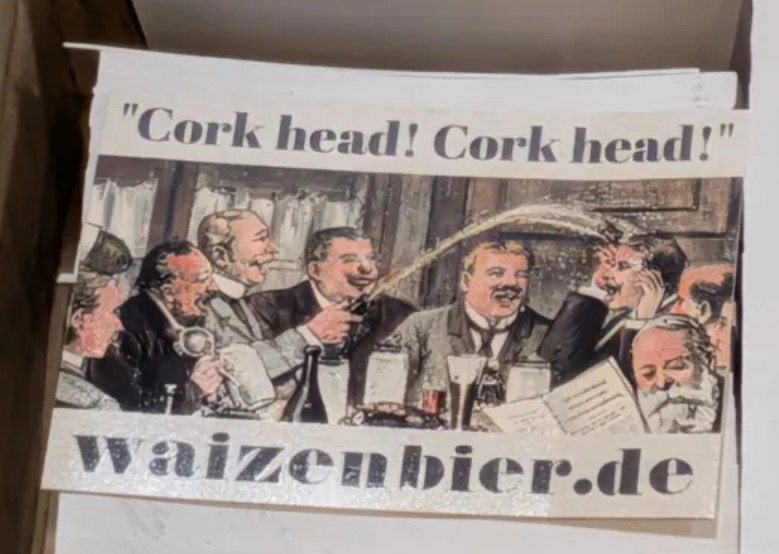
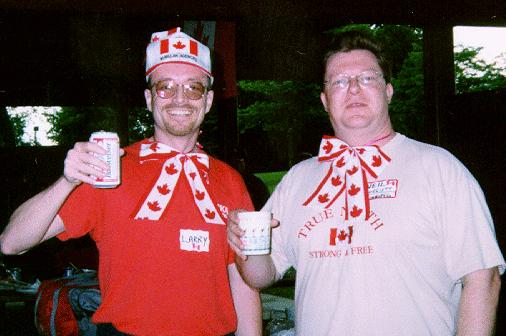
Happy day after Canada Day! I’ve been hiding in the basement near the air conditioner outlet myself. Because Wednesday days off are the worst of the days off in the schedule, aren’t they. But it’s still a day off for so many so we should not begrudge the lack of mail delivery and all that does along with that. We should, in fact, celebrate the fact that our country was built on ale. It’s always worth raising the flag in honour of that. I stole this photo off the internets over twenty one years ago so I have no idea who the heck they are* but the bowties and that Budweiser is too sweet not to repeat.
What else is going on? First up, there was a good response to the latest edition of The Session hosted by Boak and Bailey on the topic of Martyn Cornell’s last book Porter and Stout, all leading to this encouraging summation of the discussion:
Martyn Cornell was not often wrong and enjoyed a scholarly argument. At the same time, our impression is that the truth was more important to him than his ego. With that in mind, we think he might be pleased to see people spotting gaps, arguing points and generally building upon a work that, as Phil Cook points out in his Session post, could never really hope to be a ‘complete history’. Writers like Liam K should take heart: this is not a full stop; there is still research to be done; and Martyn’s book presents many new avenues for investigation. We shouldn’t look at tomes like this and think there’s nothing left to write but, instead, let them inspire us.
I would add to my post that it was nice seeing Martyn identify that once upon a time this very part of the world had its own version of Porter.
And, yes, it is still the time of the World Cup. Canada is through to the round of 16 after a match with the 54th ranked team that was being reported as being very dull and disorganized until a fabulous goal made the team national heroes forever… apparently. Joining the ranks of the performative perhaps. Me, I’d save that label for something past the first came of a five round playoff myself – and I live in hope – but, suffice it to say, the World Cup has fostered some interesting thinking, such as in Boston as Lara Wildenberg for The Times discovered:
Much to the offence of the English, The Dubliner, which had been the epicentre of Scotland’s party in Boston, closed for the day of England v Ghana to recover after nearly a fortnight of the Tartan Army. At least one other bar closed straight after the match “to give staff some rest”. American women, however, have already expressed their grief at having to part with the Tartan Army. Talking to the women in the Boston area, I met one who started a relationship with a Scottish fan, becoming inseparable and sobbing when he left for Miami. They are hoping to continue long distance.
A less attractive sort of experience was described by Jen Blair who published an interesting piece on the approach of males at the table in beer judging this week:
I’ve judged with this specific judge before and enjoyed it. We were both first-year judges at GABF when we met. I was happy to see him at my judging table because I remembered him being warm, funny, knowledgeable, and thoughtful. He still is! Which is why I feel pretty comfortable inferring that, if you asked him, he would loudly and proudly say that he supports women and denounces sexism. You can imagine how shocked he would be to hear that he’s failing at a very basic level. Back at my judging table, while the judge was technically correct in agreeing with me, if I asked him why I thought the beer in question should not advance to the next round, he would not be able to answer truthfully. Why? He never listened to my answer. Actually, I never answered. I was interrupted before I could, and neither of the men with whom I was judging noticed.
Perhaps relatedly, I’ve always liked the formerly regular Sam Smith’s Christmas special box set offered at the LCBO most years years ago so I really can’t personally add anything to the better informed folk who found him a miserable brewery and pub chain owner. But… he has left us as reported in the York Press:
The owner and chairman of the Tadcaster-based Sam Smith’s Brewery was well-known for his ‘traditional’ policies as well as his private nature. Smartphones, children, dogs and swearing were all banned from his pubs across the country, policies which attracted much controversy but also much support. However, this was widely blamed for causing around half of the brewery’s 300-pub estate remaining empty. The role of the 81-year-old at the brewery has also been the subject of much speculation, with reports he has been seriously unwell for some time.
So… something of an anti-capitalist in his own way! The Tand has shared his thoughts on the man’s passing:
New to me yesterday was that he was an old Etonian, which I suppose explains a lot – or doesn’t depending on your point of view. While it has been seen before in smaller measures, there was a fair old outpouring of support from him from some former colleagues and pub managers, mostly along the lines of “If you obeyed the rules, you got on fine with him”. The consensus, such as I could make out is that those who fell foul of him didn’t think highly of him at all, while those who hadn’t did.
And Matt L adds an unexpected angle:
….Sam Smith’s owns the Fitzroy Tavern in Soho and for many years from the early 1990s it was the main meeting place of the capital’s Doctor Who fans. And there in their dozens they would drink cheap lager and plot and plan for the day they would take over the show and make it in their image. And, yes, the last three showrunners of Doctor Who – Russell T. Davies. Steven Moffat and Chris Chibnall – were regulars at the Tav. And sometimes, there may even have been a woman there, but sources vary as always.
Elsewhere, there are other correlations between brewing and… other sorts of bad stuff as illustrated in Mexico:
The problem, Gomez says, originated about a decade ago when Grupo Modelo, a Belgian-owned brewing company, installed a sprawling $328-million complex of hangar-like buildings on the outskirts of town. The third-largest brewery in Mexico, it uses over four times as much water as the entire population of Hunucmá. Soon after it was completed, residents began struggling to draw water from their pumps, and what water did trickle out contained evidence of salinization and agrochemicals, some of which have been linked to cancer.
So it’s not just A.I. data centres that are sucking the lands dry. Are we on the cusp of a larger eco-movement? And does the continuing slump make Mother Earth happy if, you know, we were to believe the big numbers from BMI this week:
Stack population growth on top of beer’s 5% volume decline in 2025 and average beer consumption per 21+ adult fell by a tuffer 5.6% in just one yr. The avg US legal-age adult consumed just below 22 gals of beer last yr, or about 4.5 cans per wk. Back in 2020, it was more like 5.3 beers per wk (tho a solid chunk of that was hard seltzer that yr). And 5 yrs before that, avg consumer per person per yr was up over 27 gals or 5 oz shy of a six pk per wk. So beer’s dismal 2025 capped a 16% drop in avg consumption over 5 yrs and over 20% decline in the last decade.
It will be interesting to see what BMI’s numbers** will look like deeper into the World Cup period – and see if they bear any resemblance to claims seemingly to the contrary. As an aside, it’s always interesting, too, to see “not beer” being categorized as “beer” to prop up actual beer. Do we expect beer trade consulto-experto-amateur MDs to issue responses claiming again that the numbers are rigged? Of course we do.
Speaking of “less than beer”, the continuing trend to make sure beer is less than beer continues as Jeff reports from the front lines of craft’s battle to emulate 1970s macro beers:
We certainly have abundant evidence that Americans love low(ish)-alcohol beer: most of the beer America drinks is light beer. There’s a fair amount of evidence that calories are a big part of drinkers’ motivation. Getting a beer down below ten calories an ounce really helps move product. Breweries post calories as prominently as they do alcohol content right on the package. So again, on paper, all of this suggests a potential new market in 3% beers. And yet, it just doesn’t quite make sense to me. I’ve been pondering this for some days now, trying to figure out where the disconnect lies. It has to do with price. Are Americans really going to pay $12-14 a six-pack to buy a 3% beer so they can drink three or four beers when they could buy a 5% beer at the same price point, drink two or three and save money.
Sounds like the consequence free marketing futurists (a separate but related class compared to consulto-experto-amateur MDs mentioned above) the have been let out again. But, as Jeff said, why pay more for less? Seems like a downward spiral. Do all these brand extensions and small shift variants bolster or weaken the trade? Is it possible that poor decision making has contributed to a consumer confusion that has turned into disinterest?
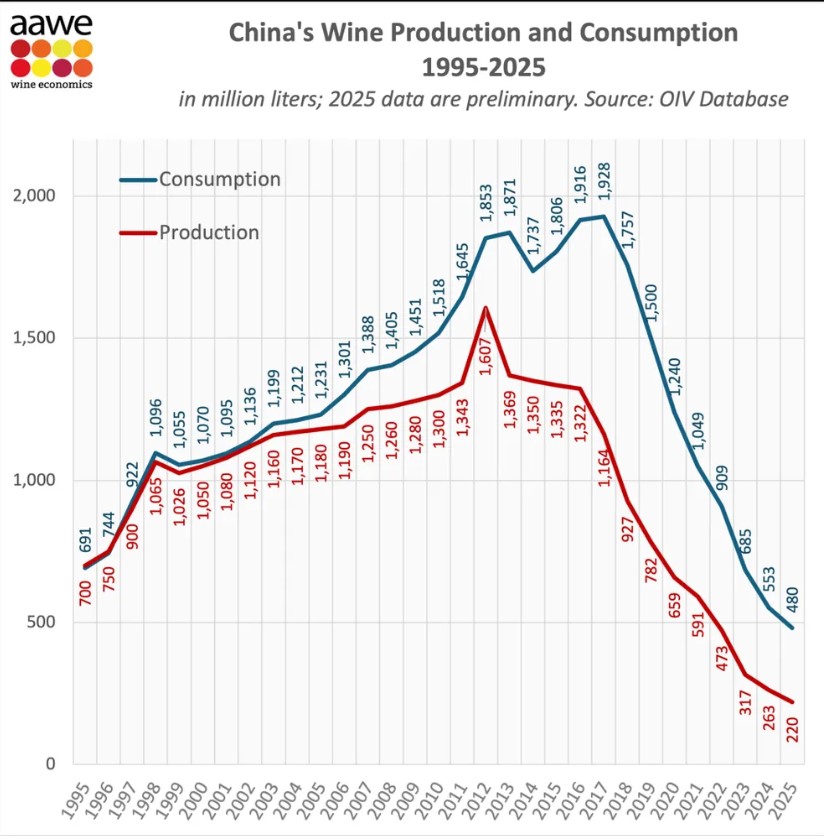 Perhaps relatedly, this is your annual reminder that if you ever hear a member of the consulto-class suggest exported beer has a great future in China as they periodically do, it might be wise to see how the wine trade has done. Consumption is at 70% of the 1995 rate of intake. A weak long term economic forecast could well be the main drivers but nationalism and a shrinking population is at play as well. The good news is that prices have dropped for everyone else. Here’s some notes:
Note #1: Lars explains Satan’s key role in brewing.
Note #2: “…Parisians… restricted from drinking alcohol in public…”
Note #3: Craft beer slump worries craft coffee.
Note #4: Is “drink whatever you like” bad for wine?
Note #5: Gary has expanded upon his cheese spread discussion.
OK, where were we? Cheese spread? Check. Humph dead? Check. Oh, did you know that there are wine danger zones?
Wine’s danger zones include long-haul flights, gallery openings, ethnic restaurants and other miscellaneous cultural events. All situations that could be improved by a glass of the good stuff – and all situations where it will most likely remain a distant dream. The seasoned wine professional knows when they are beat and will swiftly order a beer. But if the pleasures of the grain aren’t for you, is there a way to make things more bearable?
Are there beer danger zones? Around these parts, there’s always rye and ginger when all else fails. And from the law files, we hear of trouble in Thailand for the ownership of Singha:
A multi-billion-dollar beer dynasty is being torn apart by explosive allegations of assault and a century-old law that is designed to protect parents from neglectful children. The Bhirombhakdi family founded the Singha beer company and has an estimated wealth of $US1.75 billion ($2.5 billion). Forbes lists the family as Thailand’s 15th richest. But allegations of sexual assault have prompted a mother to sue her own son in a rare case involving Thailand’s “ungrateful child” law.
Glad we don’t have a law under that name! Apparently it came into force in 1908 and reflects long-standing cultural values of Thailand that place strong emphasis on filial duty.
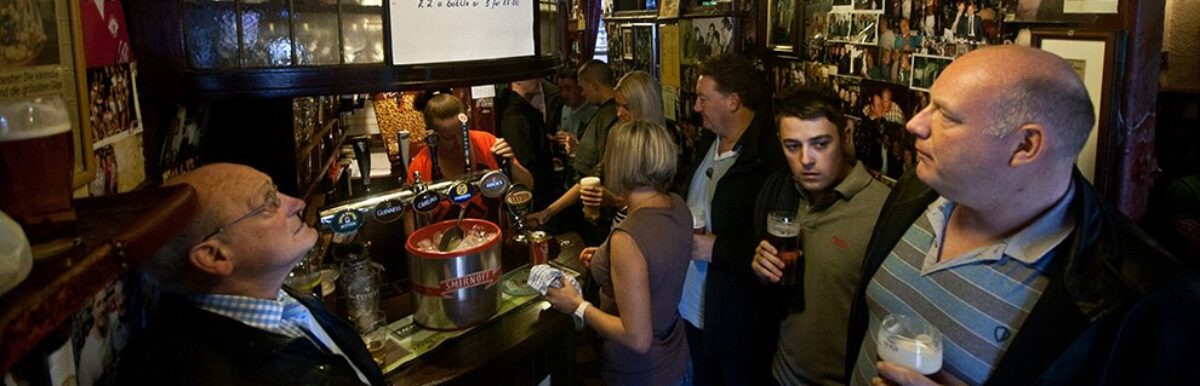
OK, enough. Some happier stories about pubs to round out the week. First, Imran Rahman-Jones has shared his experience getting view of Scotland’s play in a packed pub:
The Finch is buzzing nicely this evening. It’s warm, I can hear Friday after-work chatter from the garden as I enter, and there’s just space for one or two more tables before it’s standing room only. The sun is setting and the candles on each table are already lit, gently flickering and ready to welcome the night. There’s a sense of anticipation – not just for the start of the weekend, but because Scotland are playing in the World Cup. We manage to squeeze into a tiny table inside what must have been a storage cupboard at some point – The Finch is full of reminders of previous pubs in this building – but soon move for a better view of a screen.
And for Pellicle, we’ve been given a portrait by Fred Garratt-Stanley of a small English village enjoying a good beer revival:
There’s a train station, a post office, a tea room, and a stately home. The latter hosts Glynde’s primary claim to fame: the annual Glyndebourne opera festival, held since 1934, which sees scores of out-of-towners wearing black tie descend on the village every summer. Apart from that high-cultural aberration, this is twee English country living personified. On paper, Glynde really shouldn’t have one of the most exciting small rural beer scenes in the country. But it does.
And, finally, Katie on holiday in Spain has found her beer:
In all of our 330ml can adventures so far on this journey, the best by far has been Voll-Damm by Estrella Damm. We’ve been trying to buy local fridge-stockers where we can, but when you’re in Catalunya, that’s actually Estrella. So don’t berate me, this is me being accurate. You may be forgiven for thinking I’m on the payroll over at Damm. It’s true that they sent me to Primavera last year, and showed me around their brewery—just as Guinness did some years ago. I’m not too bothered about any perceived association with them because until I hear otherwise (and I do ask) Damm seem like a big beer company that actually looks after their people. And crucially: I like Estrella. It’s one of my favourite “everyday” beers, and it’s why I’ve chosen to promote them a couple of times. I don’t do that with brands I don’t rate. Whether you believe me or not, Voll-Damm is a delicious beer.
I’m convinced. If you are one of those who rummage in my recycling blue box by the curb in the middle of the night, you will find cans with DAB. A well placed tasty beer on a hot summer afternoon. What’s your version of the guilty pleasure big beer brew?
As you think on that over the week to come, please take time to check out Boak and Bailey posting on Saturday and adding to their fabulously entertaining footnotes week after week at Patreon. And do look out for more of Stan’s new “One Link, One Paragraph” format. Then hunt out something in someone’s archives! Leave oblique comments on someone’s post from 2009!! Listen to a few of Lew’s podcasts and get your emailed issue of Episodes of my Pub Life by David Jesudason on certain Fridays. And Phil Mellows is at the BritishBeerBreaks. Once a month, Will Hawkes issues his London Beer City newsletter and do sign up for Katie’s wonderful self-governing totes autonomous website featuring The Gulp, too. Ben’s Beer and Badword remains on pause but there is reading at The Glass which is going back to being a blog. Any more? We have Ontario’s own A Quick Beer and All About Beer is still offering a range of podcasts – and there’s also Mike Seay’s The Perfect Pour. Plus follow the venerable Full Pint podcast! And there’s the Craft Beer Channel on Youtube as well as the archives of the Beer Ladies Podcast.
*I do know they are Neil and Larry… but which is which. And the image is from a 2005 post on the old alt blog Gen x at 40 where I had a bunch of other k0o-Kee Canada Day photos. Thank God for the Wayback Machine.
**And other data sources.