Your Comforting Yet Still Alarming Beery News Notes For The Week When I Go Back To School

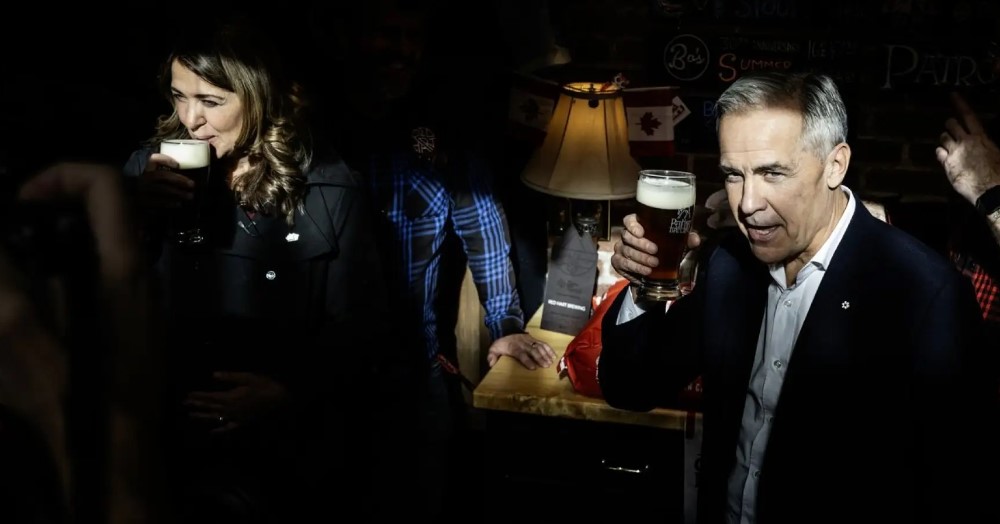
It’s a big week around here. I have that presenation I mentioned. Plus I have my mini-university lecture and turorial on the Stoics. Plus… the third referendum on separation in my time on this earth. Up there? In the moody light and the sweet way both the faces and the foam are highlighted by CP’s Jeff McIntyre, proof that when the political moment looms more than anything else Canadian politicians need to be seen holding a pint of beer:

Albertans are being asked whether the province should remain in Canada or hold a second, binding referendum on separation. Smith has said it’s time for Albertans to decide on the issue and that she prefers a sovereign Alberta in a united Canada. She said earlier this week that she voted at an advance poll for Alberta to stay. At the brewery, she and Carney praised each other as sharp-eyed, flinty negotiators who fight for their positions but want the best for Canada. They said they’re making progress, including with a proposed fast-tracked oil pipeline from Alberta to the B.C. coast.

Polls closed at 10 pm my local time on Tuesday. I went to bed at 1 am, before the first results were announced. The losing cause didn’t hit 25% support even with social media support from the Kremlin.* I had a wee well placed tot of Crown Royal in celebration.

What else is going on? Well, speaking of disinformation campaigns that may have failed, there was an interesting anecdote from the recent and apparently mini-GABF shared in BMI this week:

At annual brunch hosted by Boston Beer, BA prexy/CEO Bart Watson, Boston founder/CEO Jim Koch and Dogfish Head founder Sam Calagione all expressed hope that the afternoon’s first GABF session would be a success after the festival was literally turned inside out, from 3 days inside the city’s convention center to 2 days outdoors. And while there was an extensive menu of food and drink to be had, mincing words wasn’t on it. Last yr, the trio paced the same stage, outwardly confident that craft culture was making a comeback, borne of observations from the previous night’s session. This yr, seated behind a table, the three instead offered cautious optimism about the new format while acknowledging straightaway that “the status quo sucks,” in Sam’s pointed telling.

“A comeback“! That’s a good one. It’d be nice if there was ever a debrief on why even these gents have lost the blind faith. Or the merest analysis. “Craft culture” selling out to every fad that came along perhaps? The repeated ditching of the elements of the definition of “craft” itself? Nevermind. But on that note, The Beer Nut provided perhaps an example of his writing if he was ever retained on such an analytical report:

…the flavour doesn’t taste like any of the advertised fruit. Instead it’s pure candyshop. I’m getting Jelly Babies, with overtones of Fruit Pastilles and the saccharine tang again, here calling to mind some weird off-brand chew sweets from the more disreputable sort of convenience store. Ghastly business. It’s honkingly sweet, messily flavoured and utterly artificial. I defy anyone but the most hardened Kopparberg drinker to get through more than one of these. Ack. I’ve honestly tried to give all of these a fair assessment, and point out their positive sides. This has none. I take back any suggestion that going “all in with the syrup” is a good idea.

Did the Peter Pans lead us all to this and then take off? No, nevermind. Still, it’d be nice if the who thing got back  to the real. You know, like when we lived in Poland in 1991-92 and were offered the opportunity to meet a great boar hunter who only used a lance when stalking in the nation’s dense eastern forests. Really real. Really. Even though it was explained that the man would be the equivalent to a hockey star in Canada, we declined and I’ve sorta regretted it ever since. While I do not hunt myself, I find foody hunting cultures very compelling. Like this tale in Everyday Drinking:

In those days, Olivier often waxed nostalgic for the elemental, primal roots of the cooking he knew back in hardscrabble Picardy — rustic and earthy, based on things like beets, turnips, endives, leeks, foraged mushrooms, stinky Maroilles cheese, so-called “pre-salted” lamb (“they graze on salt marshes”), and lots of game, particularly boar. Olivier was convinced people would love a cookbook about this cuisine, and so one autumn he invited me to go on a wild boar hunt with his uncle. On the morning of the hunt, when Olivier and Uncle Jean showed up at the hotel before dawn, Jean wore his brimmed hat cocked to one side, and with his trimmed mustache looked a little like Ernest Hemingway. “I’ve been up early salting the lamb for lunch!” Olivier said. I was still full of horse and hungover from all the Champagne. “I thought the lamb was pre-salted,” I said.

Yum. Fair bit of real right there, too. And on a role after the announcement of his new book, Lars shares a bit about the itches that drive his curiosity** to figure out what is real:

I started looking into farmhouse ale back in 2010, and one of the first things that struck me was that so many brewers were using juniper branches. By 2014 I had gotten more seriously interested, and had even visited brewers to see their brewdays, and started digging into what little literature there was on spice use. To my surprise, the literature was mostly focused on gale, and gave little attention to juniper, even though by now it was very clear to me that juniper was very important in traditional brewing. Then, also in 2014, I got hold of the answers to the Norwegian ethnographic questionnaire on farmhouse brewing, and again I was struck by how just about everyone seemed to be using juniper in the beer. And by how few of the answers mentioned gale, in contradiction to the existing literature.

Speaking of the wrong flavour, Mike Seay on the truth about the limits of flavour adjuncts:

Urban Roots makes excellent IPAs and then you add a cool label and name, I am all about that. It was as good as I thought it would be. And no, there is no guacamole flavor, just one of those deceptive beer names. Usually I don’t like when a beer uses a food flavor in its name but doesn’t have it in the beer, but this one is an exception. There has got to be an IPA out there that has guacamole in it somehow, yeah? Maybe I’ll check Untappd. 

Guacamole Yukamole. You heard me! So… why is the whiff of misinformation so prevalent? Maybe meaninglessness is just part of the culture! Is it or isn’t it? Apparently it can be both at the same time. To wit, BeerToday has shared a number of statements by Jamie Allsopp on a project to create a beer “brewed to a recipe inspired by the very first viable IPA, a beer devised by us in 1822 in Burton-on-Trent… [w]e did not want to produce a museum piece…” Allsopp also said his team took “the defining characteristics of the original Allsopp’s IPA and brewing them for today’s drinker.” On this, B+B stated “…inspired (yes, we know…)” and Liam observed:

Between the ‘yes, we know’ here and the name-check in the footnotes ye know me too well. And yes, ye are correct, especially after reading some of the comments in your link to the beer! Sheesh… If they said a ‘modern take’ on the IPA I’d say fair enough but they are leaning too hard into their history maybe? Are they guilty of degrading variants of the original beer, or dumbing it down to what they think customers want? If that’s the case hazify it! Also, Golden Promise and Challenger? …

But outside the beery bubble, the BBC sets out the claim made in broader terms with perhaps suprising statements in support:

More than two centuries on, the ledger containing over 100 handwritten recipes, including IPA, Pale Ale, Double Diamond, Stout, Arctic Ale and dozens of forgotten brews, was found in an attic in Leeds. Jamie added: “Without the recipes I wasn’t interested in producing guesswork.” He said he was not looking for “historical interpretations of IPA”. “It had to be the real deal – with the right malts, hops, and style that could make our beer revered once again,” he said.

It’s the “real deal“, is it? Doesn’t producing the “real deal” seems to contradict the “not a museum piece” statement? Can the two claims coexist? Why not? It’s beer! Seriously, this sort of thing, for me, is not helpful. Here’s some notes:

Note #1: interesting local initiative on alcohol misuse in nearby NNY.
Note #2: Braciaca… god or goddess of malt?
Note #3: Police station pubs of the Caribbean.
Note #4: Does ramen have a flavour?

Speaking of “is it or isn’t it?” we see, for The Grocer, that James Beeson has noted one way economic conditions are affecting breweries:

Adnams CEO Jenny Hanlon is understood to have told staff the brewer needed to find a more cost-effective way to produce and package its small-pack beers. Adnams is exploring outsourcing the production and packaging of its bottled and canned beers, as the Ghost Ship brewer seeks to navigate increasingly choppy trading conditions in ale.

That’s quite real isn’t it. But no need for the cutsy maritime pun. And this piece in The Times has a bit of a chin trembly vingette at the window of a closed pub in the Scottish Highlands, parts of which are becoming pub deserts:

Squinting through the glass, his nose almost touching the panes, Reed, a 62-year-old retiree, could see the Victorian bar, its pumps still marked up with brands like Tennent’s, Scotland’s ubiquitous lager; Belgian Heverlee, Irish Guinness and Caledonian Best.  “It was really an old man’s pub, just a nice wee country pub,” the former senior BBC TV journalist said. “It is so sad to see it shut. It feels like the heart has been pulled out of the village.” His partner Anne McLean, 60, joined him at the window. She pointed out a stool at the bar. “There was one guy who always sat there,” she said. “If he came in and anybody else was in his seat, they would move. Because it was his spot. It was that kind of place.”

More optimistic was the tone from Knut who took part in a recent new product tasting at the government store, Vinmonoplet, where an obvious truth or two is observed:

Twice a year we are invited to taste special releases. The room is bright and airy. The view is to one of the most iconic landmarks of boomtown Oslo – the roof of the Opera House. Unbeknown to the tourists taking their selfies on the marble slabs, we are presented with a row of glasses and a sink for spitting and rinsing… A long line of vintages of the Bourbon County Brand Stout, ranging from 2018 to 2023. To top it up, we get Reserve Bourbon from 2018, Vanilla Rye Stout and Night Cap Cuvee. Three samples at a time. Sip. Taste, spit. Rinse glass, rinse mouth. Of course, it is interesting to try such a long list of variations on the same beer. These bottles are well suited for aging; there are no off flavors or other flaws. But it is extremely hard to tell them apart.

Is this a brewing success but a procurement manager’s scheduling failure? There is, however, perhaps another way to tell them apart as the organisers of Gloucester‘s Sheriff’s Assize of Ale very well know:

The Sheriff, Councillor Anne Radley, pours a small amount of ale onto a wooden stool, which the ale conner then sits on while wearing a pair of leather breeches. After three minutes, the ale conner stands up. If their shorts do not stick to the stool, the ale passes the test and is of acceptable quality. If the shorts do stick to the stool, it means that not enough of the sugar has turned into alcohol and the ale is dubbed “inferior”.

And on the topic of government administration of booze, I listened to an interview on CBC’s Ontario Morning*** about the economics of expanded liquor sales in Ontario through an additional 6,700 retailers and how that decision has lost the government hundreds of millions of dollars. The interviewee was Prof Michael J. Armstrong of Brock University who recently reported his findings for The Conversation:

The decline follows the Ontario government’s 2023 decision to expand alcohol sales to grocery stores, convenience stores and other retailers. The LCBO also incurred an estimated $33.4 million in costs associated with holding unsold American alcohol. The provincially owned LCBO consequently generated $1.2 billion less for taxpayers over the past two years than its 2023-2024 results might have suggested. That shortfall is five times larger than the $229 million previously forecast by Ontario’s Financial Accountability Office. Meanwhile, private retailers have added $911 million in annual sales, whereas some LCBO stores may close.

The report also confirmed that pulling US booze off the shelf has led to  that inventory write-downs of $20.4 million due to stuff like coolers going out of date, warehousing costs approaching $10 million to hold on to the remaining US bottles and cans as well as an implied interest cost nearing $3 million to hold the stock but not make money off of it.

Finally, for Pellicle Imran Rahman-Jones tells the story of the other other national drink of my peeps, 80/- ale:

The Athletic Arms—better known as The Diggers, because gravediggers from the two nearby cemeteries would drink there—is a beautiful Victorian corner pub near Edinburgh city centre, with stained-glass windows and a white-marble-topped bar dominating the room. Despite the opulence, it’s a real local’s local, where prices have been kept low. It’s the kind of place where landlord Kev McGhee knows his regulars by name, often pouring their drinks before they’ve even asked. Many of these drinkers are served 80 shilling, commonly written as “80/-”. It’s a rich, slightly sweet and malty pint. Nathan uses words such as “raisin,” “fruit loaf,” and “toffee” to describe it, and notes its “slight smoky roastiness on the edge of the palate.”

There you are! Another busy week with a bit of the positive woven into these troubld times. Until we meet again, please check out Boak and Bailey’s postings on each and every Saturday along with their fabulously entertaining footnotes week after week at Patreon. And do look out for more of Stan’s “One Link, One Paragraph” format. Then it’s your turn. Read and recommend, please. Scour the world for news tips – then let me know. Then hunt out something in someone’s archives! Leave oblique comments on someone’s post from 2009!! Listen to a few of Lew’s podcasts and get your emailed issue of Episodes of my Pub Life by David Jesudason on certain Fridays. And Phil Mellows is at the BritishBeerBreaks. Once a month, Will Hawkes issues his London Beer City newsletter. Do sign up for Katie’s wonderful self-governing totes autonomous website featuring The Gulp, too.  Ben’s Beer and Badword remains on pause but there is reading at The Glass which is going back to being a blog. Any more? We have Ontario’s own A Quick Beer and All About Beer is still offering a range of podcasts – and there’s also Mike Seay’s The Perfect Pour. Plus follow the venerable Full Pint podcast! And there’s the Craft Beer Channel on Youtube as well as the archives of the Beer Ladies Podcast. What else?

*Here are some observations by one of Canada’s more trustworthy observers.
**In refreshing controdiction to the booze bleg phrases of the week: “…wine-media elite…“, “…do more than learn sensory vocabulary…“, “…complex and strong, often like wine…” or a definite favourite “… debunk a beer myth!” when it’s not any sort of myth, just an error, a misunderstanding or sometimes only a different point of view. What would Martyn have said!?! 
***Meaning I was wide awake at 7:40 am even though I am retired!

Your Vibrant And Now Excitingly Neutral Beery News Notes For The World Cup’s Round Of Eight

I took a break from the World Cup on Sunday evening to watch Billy Bragg play in a converted church in our fair city. See, England and Mexico were playing at the same time over 4,000 km to the south. Bragg made it one of the themes of the show, he not being able to watch the game that I passed on for him. He received wanted (“…tell me…“) and unwanted (“…don’t tell me…“) updates on the score from the crowd. It was fun. Pubs are stocking up for the next game against Norway – which is being played at a more civilized start time for the home audiences. People are focused on this stuff. After a 5 pm trip on London Underground during England’s prior game against DR Congo, Hannah Evans in The Times Food newsletter asked where you might go in the UK to avoid the tournament and among her recommendations was the Highland Laddie of Leeds:

This old Leeds boozer got a revamp last year and was named the best pub in Britain by the Good Food Guide less than six months later. Ever since it’s been rammed with customers visiting not just for pints but the pub’s fantastic food — bar snacks such as sausage rolls with homemade brown sauce and bone marrow fat on toast downstairs (walk-ins only) and pub classics with a twist upstairs including the legendary Keema Shepherd’s Pie. The good news? They don’t show the football which means you have a 90 minute window during each game to pop in and try the menu for yourself. 

You will recall the Highland Laddie being being visited by Katie earlier this year. Looking further back, Boak and Bailey are blogging like it’s 2008 this week:

Not every post has to be a 1,000+ word full researched epic. Not everything we write needs to tell a story with a beginning, middle and end. There doesn’t always need to be a thesis or argument. So, this week – and we’ll see how it goes – we’re just going to see what catches our attention, and what we find ourselves discussing between ourselves, and quickly write it up.

So far they have contemplated a beer line-up upgrade as well as a former BrewDog location. I was inspired and wrote a review of a NA beer. TL:DR? It didn’t totally suck! Do something speedy and short yourself. Go-waaaaan! My note was nothing like the efforts of The Beer Nut, however, who reviewed eleven beers the other day… which booze! He was celebrating:

Another Monday, another blog post, another round-up of recent Irish pale ale. This one is the blog’s 3000th entry. It’s best not to think about what that means, and move right along with the reviews.

He was not pleased with the selection in the end. Turns out he shares the experience of many North Koreans feel when buying commercially made beer. You know… you think you know something about totalitarian regimes and then, whammo, this sort of news slaps you in the back of the head:

A source in South Hamgyong province said beer demand has climbed in Hamhung as the weather warms. But state-made brands such as Taedonggang beer and Ponghak beer are losing ground to Chinese beer and beer brewed at home. Restaurants and jangmadang, the informal markets central to North Korea’s economy, sell all three types side by side in Hamhung. Homemade beer is the best seller, the source said. Chinese beer comes second, and domestically produced factory beer trails both. Demand for factory beer is relatively weak because of its taste, the source said. North Korean people have long complained that it carries a strong barley smell and tastes heavy and unrefined.

I never pegged totalitarian absolutists like those of NK to allow not only a free market on home brewed beer but allow it to compete with the state run factory breweries. And I always thought the phrase “North Korean people have long complained” was an oxymoron.

Note #1: Setting up a beer engine.
Note #2: The Beer Store needs a lot of empties returned…now!
Note #3: “Village of 600 holds beerfest” reports Biggleswade press.
Note #4: Beer stained rubber chicken lets team down.

Pellicle‘s feature this week sees Ewen Friers visit Heaney Brewery in Bellaghy, Northern Ireland where he learned this bit of market reality from head brewer Mal McCay:

“Northern Ireland is the most tied and restrictive market in Europe for selling beer,” Mal says. “The market was designed to keep us out of it, basically.” Away from the relatively cosmopolitan Belfast, the vast majority of rural drinkers haven’t ditched bigger beers like Guinness, Coors, and Carlsberg. Whether a total revolution is realistic or not, it’s sobering to hear Mal talk about the pubs in his locale. “We had 108 kegs go to Italy for Paddy’s Day, but none [ordered] here,” he says. “There’s much more support for our beer out there than there is here. Outside of Belfast, people don’t want to know.”

Again with the economics, Jeff posted a string of thoughts on Costco cancelling their Kirkland Lager contract with Deschutes and shared this tidbit:

The beer was revenue positive, but not much. Believe it or not, most of the grist was Weyermann malt, and Kirkland went for $14 a 12-pack. It buoyed production for Deschutes and gave them a ton of good press. I asked a source inside the brewery just a couple weeks ago if they had a plan to do something with the award-winning lager that was already in the lineup before it became Kirkland. He gave me a Cheshire Cat-smile and said they had certainly blocked out a plan if that happened.

It’s all just wrapper on the can after all.  Speaking of the volume market, Ron shared his thoughts on one of the upside of Wetherspoons tht he was reminded on on a recent trip to London:

…we got stuck in ‘Spoons. As you do. Andrew has a very soft spot for ‘Spoons. Probably because I took him and his brother Alexei into them so often when they were younger.  The UK is still a nightmare if you have kids. You’ve no idea from the outside whether they’re allowed in a pub. That’s why Wetherspoon’s pubs are a godsend. They always let children in. I also knew that I can afford to buy all three of us meals and get a pint for me. And a couple of double whiskies. I needed to calm my nerves when out and about with the kids.

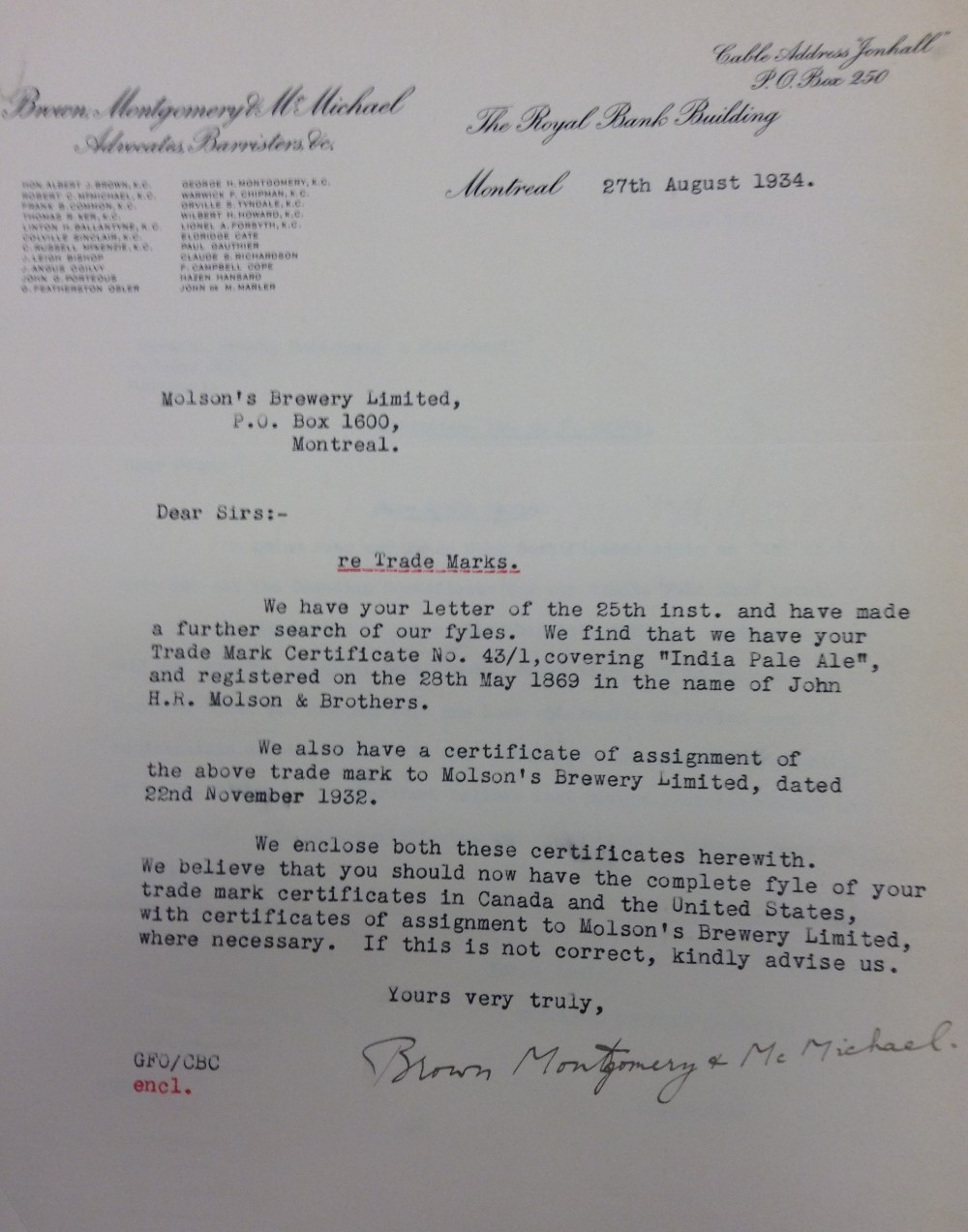
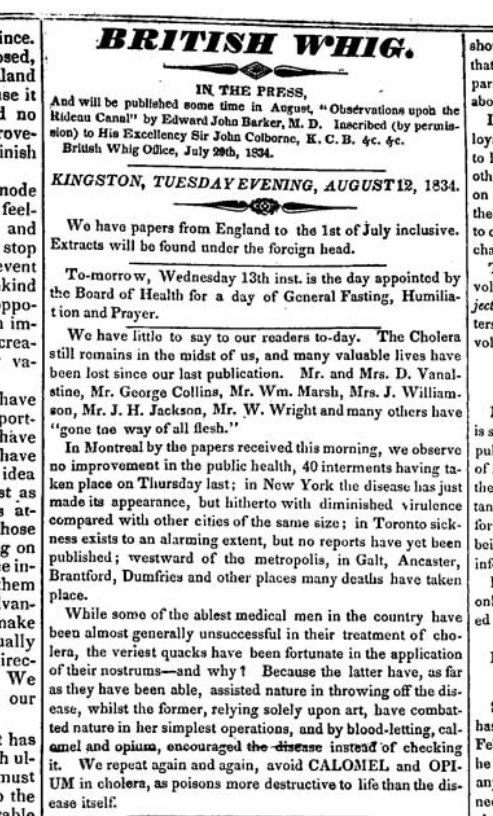
I posted this at BlueSky but, for perpetuity, I will repeat here that I was looking through a few old images that I have save over the years the other day and I came across this image. It’s a legal letter to Molson from 1934 found at Canada’s National Archives in 2013. It confirms that Molson trademarked the term “India Pale Ale” in 1869, seven years before the Bass trademark. My visceral reaction was “….they trademarked frikkin’ “India Pale Ale”!” Turns out Canada’s Trademark Act came into being in 1868 while the UK only introduced one in 1875. Which explains a lot but it is important to note that”….they trademarked frikkin’ “India Pale Ale”!”

Sticking with the Great White North, there was an oddly one-sided coverage of a fairly pointless politicial stunt in the US Congress related to Canadian booze buying policy:

Nearly all of Canada’s liquor boards have prohibited or restricted the importation and distribution of US alcoholic drinks, a move that has impacted US producers and limited access to Canada as an export market. The CANADA Act builds on comments from US trade representative ambassador Jamieson Greer, who stated that resolving the Canadian provinces’ discriminatory treatment of American alcohol producers would likely require an enforcement action. During a recent committee hearing, Greer noted that only two countries had retaliated economically against the US over the past year: the People’s Republic of China and Canada… Doubling down on the unfairness of the situation and her reasons for pursuing the legislation, Tenney said: “Canadian provinces cannot be allowed to hold American wineries, breweries, and distilleries hostage and attempt to ransom them.”

No view from Canada presented. No suggestion that these are matters that are handled in treaty negotiations, not by internal legislation. Plus, not only do Canadians not care but the US President does not usually care what individual members of Congress do or says – even though it’s led by his own party. Here’s the CBC’s story on the situation.

Germany v Budweiser? Apparently AB InBev has a need for some odd product placement where there is a history of disinterest, according to The NYT:

Twice, the Americans tried to crack the German market under different branding. Both attempts fizzled. The first was abandoned after several years of disappointing sales. The second was scuttled amid ongoing legal questions over the Budweiser name. Last fall, AB InBev announced another go, now with a product that, for legal reasons, it had to call “Anheuser-Busch Bud.” A company official said the expansion would bring Bud back to its German “roots” — its founders’ country of origin — in time for its 150th anniversary… the beer is hard to find. It’s rare to see in grocery stores… 

One more World Cup related story before we start thinking about heading to the exit this week.  Apparently, the Ambassador for Canada in Ireland held an event for the game  against Morocco (which lead to our team’s exit) and there was a certain cocktail on offer according to the Irish Times:

I was sorry to see Canada exit the World Cup at the weekend, not least because I watched their game against Morocco at an impromptu garden party hosted by their Irish ambassador, Dennis King. But at least they went out with good grace, unlike certain other North American countries we could mention. Their typical modesty was reflected even on the drinks menu. Hence a special brew concocted for the occasion billed as the “We’re Just Glad to have Made it this Far Cocktail”. According to the recipe, also included, this comprised “2 parts Canadian whiskey, 1 part lemon juice, and ¾ part maple syrup”. Suffice to say that, if the Canadian strikers had had as much of a kick as it did, they’d still be in the tournament.

Does that sound good? Hmm… I wonder if it was official government policy available at other embassies or just the Spud Islander’s idea.

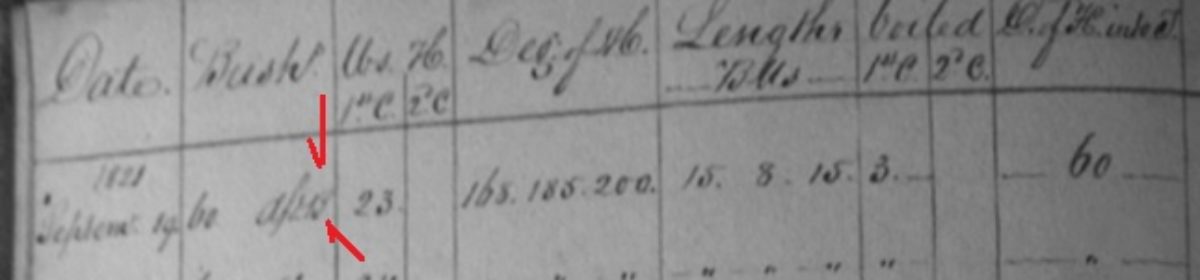
Finally, as part of last week’s low hanging tales related to the semiquincentennial of the Declaration of Independence, there was chat about the supposed small beer recipe that George Washington, a militia colonel at the age of just 25, wrote down in 1757. Turns out to likely be the fairly common frontier militia beer similar to Jeffery Amherst’s spruce beer of 1759 that was also based on that ratio of three gallons of molasses to thirty of hot water. I do find one part of the accepted transciption from Washington’s handwriting very odd. At the start it states:

Take a large Sifter full of Bran Hops to your taste – Boil these 3 hours… 

What the heck are “bran hops“? A random blend of bran and hops in a random quantity? At least Amherst measured out the 7 pounds of spruce that had to be boiled until the bark came off. And bran adds nothing. It really adds nothing after three hours of boiling. Plus it’s not like they are separating out the bran from the flour for the bread that frontier militia soldier grunts ate over 100 years before the commercial separation of bran by rollers is invented. Plus bran would just fall though the holes of a “sifter“, a perforated spoon. It all makes no sense. Sensible speculation suggests what was meant was whole dried brown hop cones – older hops. Hops that look like bran maybe. Washington himself was a porter drinker but he’d probably laugh at all the bran brewers of today.*  Hmm… I wonder of he provided something like the crap militia beer for those he enslaved.

That’s it for now. As we winnow out more teams leading to the final game, please take time to check out Boak and Bailey posting on Saturday and adding to their fabulously entertaining footnotes week after week at Patreon. And do look out for more of Stan’s new “One Link, One Paragraph” format.  Then hunt out something in someone’s archives! Leave oblique comments on someone’s post from 2009!! Listen to a few of Lew’s podcasts and get your emailed issue of Episodes of my Pub Life by David Jesudason on certain Fridays. And Phil Mellows is at the BritishBeerBreaks. Once a month, Will Hawkes issues his London Beer City newsletter and do sign up for Katie’s wonderful self-governing totes autonomous website featuring The Gulp, too.  Ben’s Beer and Badword remains on pause but there is reading at The Glass which is going back to being a blog. Any more? We have Ontario’s own A Quick Beer and All About Beer is still offering a range of podcasts – and there’s also Mike Seay’s The Perfect Pour. Plus follow the venerable Full Pint podcast! And there’s the Craft Beer Channel on Youtube as well as the archives of the Beer Ladies Podcast.

*One bit of historical correlation doesn’t mean causation context thanks to Lord Wiki, citing the 2005 text General George Washington by Edward Lengel: “Later in the year, Washington again suffered a serious bout of dysentery; he was bedridden for much of the winter of 1757–58, and even suggested to the Virginia Burgesses that he be replaced since he could not properly do his duty as colonel of the regiment.”

Your Frankly A Bit Too Humid Post-Canada Day 2026 Doldrums Edition Of The Beery News Notes

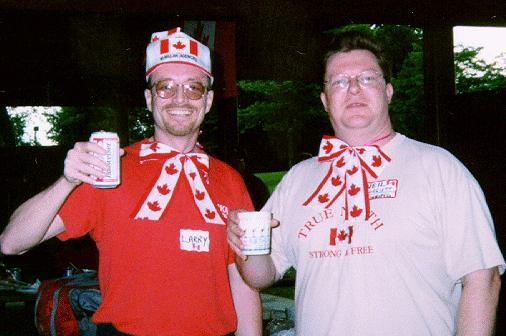
Happy day after Canada Day! I’ve been hiding in the basement near the air conditioner outlet myself. Because Wednesday days off are the worst of the days off in the schedule, aren’t they. But it’s still a day off for so many so we should not begrudge the lack of mail delivery and all that does along with that. We should, in fact, celebrate the fact that our country was built on ale. It’s always worth raising the flag in honour of that. I stole this photo off the internets over twenty one years ago so I have no idea who the heck they are* but the bowties and that Budweiser is too sweet not to repeat.

What else is going on? First up, there was a good response to the latest edition of The Session hosted by Boak and Bailey on the topic of Martyn Cornell’s last book Porter and Stout, all leading to this encouraging summation of the discussion:

Martyn Cornell was not often wrong and enjoyed a scholarly argument. At the same time, our impression is that the truth was more important to him than his ego. With that in mind, we think he might be pleased to see people spotting gaps, arguing points and generally building upon a work that, as Phil Cook points out in his Session post, could never really hope to be a ‘complete history’. Writers like Liam K should take heart: this is not a full stop; there is still research to be done; and Martyn’s book presents many new avenues for investigation. We shouldn’t look at tomes like this and think there’s nothing left to write but, instead, let them inspire us.

I would add to my post that it was nice seeing Martyn identify that once upon a time this very part of the world had its own version of Porter.

And, yes, it is still the time of the World Cup. Canada is through to the round of 16 after a match with the 54th ranked team that was being reported as being very dull and disorganized until a fabulous goal made the team national heroes forever… apparently. Joining the ranks of the performative perhaps. Me, I’d save that label for something past the first came of a five round playoff myself – and I live in hope – but, suffice it to say, the World Cup has fostered some interesting thinking, such as in Boston as Lara Wildenberg for The Times discovered:

Much to the offence of the English, The Dubliner, which had been the epicentre of Scotland’s party in Boston, closed for the day of England v Ghana to recover after nearly a fortnight of the Tartan Army. At least one other bar closed straight after the match “to give staff some rest”. American women, however, have already expressed their grief at having to part with the Tartan Army. Talking to the women in the Boston area, I met one who started a relationship with a Scottish fan, becoming inseparable and sobbing when he left for Miami. They are hoping to continue long distance.

A less attractive sort of experience was described by Jen Blair who published an interesting piece on the approach of males at the table in beer judging this week:

I’ve judged with this specific judge before and enjoyed it. We were both first-year judges at GABF when we met. I was happy to see him at my judging table because I remembered him being warm, funny, knowledgeable, and thoughtful. He still is! Which is why I feel pretty comfortable inferring that, if you asked him, he would loudly and proudly say that he supports women and denounces sexism. You can imagine how shocked he would be to hear that he’s failing at a very basic level. Back at my judging table, while the judge was technically correct in agreeing with me, if I asked him why I thought the beer in question should not advance to the next round, he would not be able to answer truthfully. Why? He never listened to my answer. Actually, I never answered. I was interrupted before I could, and neither of the men with whom I was judging noticed.

Perhaps relatedly, I’ve always liked the formerly regular Sam Smith’s Christmas special box set offered at the LCBO most years years ago so I really can’t personally add anything to the better informed folk who found him a miserable brewery and pub chain owner. But… he has left us as reported in the York Press:

The owner and chairman of the Tadcaster-based Sam Smith’s Brewery was well-known for his ‘traditional’ policies as well as his private nature. Smartphones, children, dogs and swearing were all banned from his pubs across the country, policies which attracted much controversy but also much support. However, this was widely blamed for causing around half of the brewery’s 300-pub estate remaining empty. The role of the 81-year-old at the brewery has also been the subject of much speculation, with reports he has been seriously unwell for some time.

So… something of an anti-capitalist in his own way! The Tand has shared his thoughts on the man’s passing:

New to me yesterday was that he was an old Etonian, which I suppose explains a lot – or doesn’t depending on your point of view. While it has been seen before in smaller measures, there was a fair old outpouring of support from him from some former colleagues and pub managers, mostly along the lines of “If  you obeyed the rules, you got on fine with him”. The consensus, such as I could make out is that those who fell foul of him didn’t think highly of him at all, while those who hadn’t did. 

And Matt L adds an unexpected angle:

….Sam Smith’s owns the Fitzroy Tavern in Soho and for many years from the early 1990s it was the main meeting place of the capital’s Doctor Who fans.  And there in their dozens they would drink cheap lager and plot and plan for the day they would take over the show and make it in their image.  And, yes, the last three showrunners of Doctor Who – Russell T. Davies. Steven Moffat and Chris Chibnall – were regulars at the Tav.  And sometimes, there may even have been a woman there, but sources vary as always.

Elsewhere, there are other correlations between brewing and… other sorts of bad stuff as illustrated in Mexico:

The problem, Gomez says, originated about a decade ago when Grupo Modelo, a Belgian-owned brewing company, installed a sprawling $328-million complex of hangar-like buildings on the outskirts of town. The third-largest brewery in Mexico, it uses over four times as much water as the entire population of Hunucmá. Soon after it was completed, residents began struggling to draw water from their pumps, and what water did trickle out contained evidence of salinization and agrochemicals, some of which have been linked to cancer.

So it’s not just A.I. data centres that are sucking the lands dry. Are we on the cusp of a larger eco-movement? And does the continuing slump make Mother Earth happy if, you know, we were to believe the big numbers from BMI this week:

Stack population growth on top of beer’s 5% volume decline in 2025 and average beer consumption per 21+ adult fell by a tuffer 5.6% in just one yr. The avg US legal-age adult consumed just below 22 gals of beer last yr, or about 4.5 cans per wk. Back in 2020, it was more like 5.3 beers per wk (tho a solid chunk of that was hard seltzer that yr). And 5 yrs before that, avg consumer per person per yr was up over 27 gals or 5 oz shy of a six pk per wk. So beer’s dismal 2025 capped a 16% drop in avg consumption over 5 yrs and over 20% decline in the last decade.

It will be interesting to see what BMI’s numbers** will look like deeper into the World Cup period – and see if they bear any resemblance to claims seemingly to the contrary. As an aside, it’s always interesting, too, to see “not beer” being categorized as “beer” to prop up actual beer. Do we expect beer trade consulto-experto-amateur MDs to issue responses claiming again that the numbers are rigged? Of course we do.

Speaking of “less than beer”, the continuing trend to make sure beer is less than beer continues as Jeff reports from the front lines of craft’s battle to emulate 1970s macro beers:

We certainly have abundant evidence that Americans love low(ish)-alcohol beer: most of the beer America drinks is light beer. There’s a fair amount of evidence that calories are a big part of drinkers’ motivation. Getting a beer down below ten calories an ounce really helps move product. Breweries post calories as prominently as they do alcohol content right on the package. So again, on paper, all of this suggests a potential new market in 3% beers. And yet, it just doesn’t quite make sense to me. I’ve been pondering this for some days now, trying to figure out where the disconnect lies. It has to do with price. Are Americans really going to pay $12-14 a six-pack to buy a 3% beer so they can drink three or four beers when they could buy a 5% beer at the same price point, drink two or three and save money.

Sounds like the consequence free marketing futurists (a separate but related class compared to consulto-experto-amateur MDs mentioned above) the have been let out again. But, as Jeff said, why pay more for less? Seems like a downward spiral. Do all these brand extensions and small shift variants bolster or weaken the trade? Is it possible that poor decision making has contributed to a consumer confusion that has turned into disinterest?

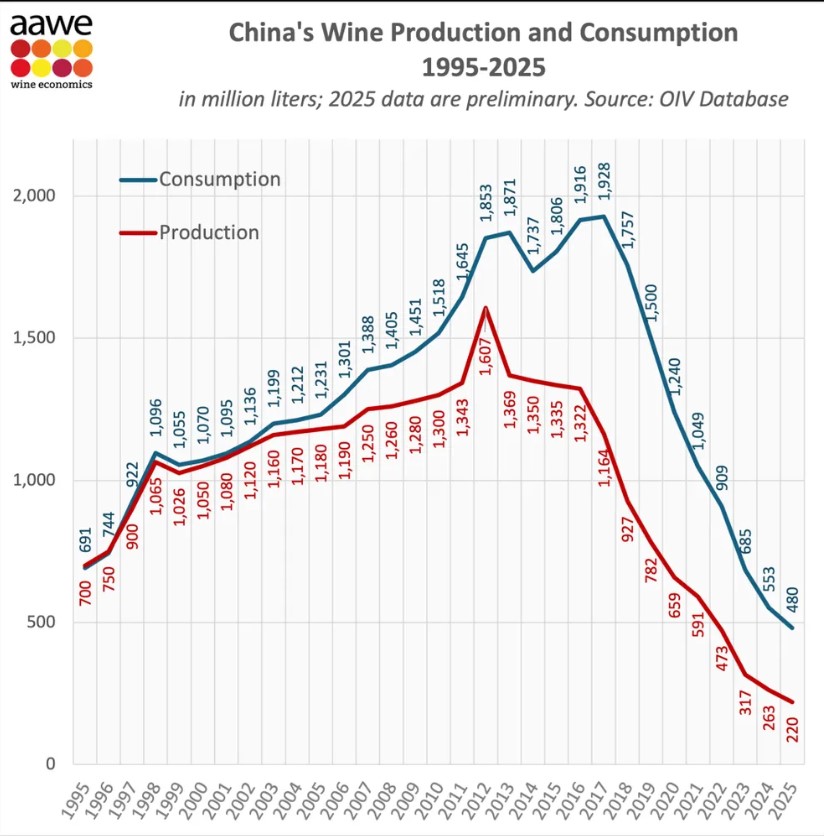
Perhaps relatedly, this is your annual reminder that if you ever hear a member of the consulto-class suggest exported beer has a great future in China as they periodically do, it might be wise to see how the wine trade has done. Consumption is at 70% of the 1995 rate of intake.  A weak long term economic forecast could well be the main drivers but nationalism and a shrinking population is at play as well. The good news is that prices have dropped for everyone else. Here’s some notes:

Note #1: Lars explains Satan’s key role in brewing.
Note #2: “…Parisians… restricted from drinking alcohol in public…”
Note #3: Craft beer slump worries craft coffee.
Note #4: Is “drink whatever you like” bad for wine?
Note #5: Gary has expanded upon his cheese spread discussion.

OK, where were we? Cheese spread? Check. Humph dead? Check. Oh, did you know that there are wine danger zones?

Wine’s danger zones include long-haul flights, gallery openings, ethnic restaurants and other miscellaneous cultural events. All situations that could be improved by a glass of the good stuff – and all situations where it will most likely remain a distant dream. The seasoned wine professional knows when they are beat and will swiftly order a beer. But if the pleasures of the grain aren’t for you, is there a way to make things more bearable?

Are there beer danger zones? Around these parts, there’s always rye and ginger when all else fails. And from the law files, we hear of trouble in Thailand for the ownership of Singha:

A multi-billion-dollar beer dynasty is being torn apart by explosive allegations of assault and a century-old law that is designed to protect parents from neglectful children. The Bhirombhakdi family founded the Singha beer company and has an estimated wealth of $US1.75 billion ($2.5 billion).  Forbes lists the family as Thailand’s 15th richest.  But allegations of sexual assault have prompted a mother to sue her own son in a rare case involving Thailand’s “ungrateful child” law.

Glad we don’t have a law under that name! Apparently it came into force in 1908 and reflects long-standing cultural values of Thailand that place strong emphasis on filial duty.

OK, enough. Some happier stories about pubs to round out the week. First, Imran Rahman-Jones has shared his experience getting view of Scotland’s play in a packed pub:

The Finch is buzzing nicely this evening. It’s warm, I can hear Friday after-work chatter from the garden as I enter, and there’s just space for one or two more tables before it’s standing room only. The sun is setting and the candles on each table are already lit, gently flickering and ready to welcome the night. There’s a sense of anticipation – not just for the start of the weekend, but because Scotland are playing in the World Cup. We manage to squeeze into a tiny table inside what must have been a storage cupboard at some point – The Finch is full of reminders of previous pubs in this building – but soon move for a better view of a screen. 

And for Pellicle, we’ve been given a portrait by Fred Garratt-Stanley of a small English village enjoying a good beer revival:

There’s a train station, a post office, a tea room, and a stately home. The latter hosts Glynde’s primary claim to fame: the annual Glyndebourne opera festival, held since 1934, which sees scores of out-of-towners wearing black tie descend on the village every summer.  Apart from that high-cultural aberration, this is twee English country living personified. On paper, Glynde really shouldn’t have one of the most exciting small rural beer scenes in the country. But it does.

And, finally, Katie on holiday in Spain has found her beer:

In all of our 330ml can adventures so far on this journey, the best by far has been Voll-Damm by Estrella Damm. We’ve been trying to buy local fridge-stockers where we can, but when you’re in Catalunya, that’s actually Estrella. So don’t berate me, this is me being accurate. You may be forgiven for thinking I’m on the payroll over at Damm. It’s true that they sent me to Primavera last year, and showed me around their brewery—just as Guinness did some years ago. I’m not too bothered about any perceived association with them because until I hear otherwise (and I do ask) Damm seem like a big beer company that actually looks after their people. And crucially: I like Estrella. It’s one of my favourite “everyday” beers, and it’s why I’ve chosen to promote them a couple of times. I don’t do that with brands I don’t rate. Whether you believe me or not, Voll-Damm is a delicious beer.

I’m convinced. If you are one of those who rummage in my recycling blue box by the curb in the middle of the night, you will find cans with DAB. A well placed tasty beer on a hot summer afternoon. What’s your version of the guilty pleasure big beer brew?

As you think on that over the week to come, please take time to check out Boak and Bailey posting on Saturday and adding to their fabulously entertaining footnotes week after week at Patreon. And do look out for more of Stan’s new “One Link, One Paragraph” format.  Then hunt out something in someone’s archives! Leave oblique comments on someone’s post from 2009!! Listen to a few of Lew’s podcasts and get your emailed issue of Episodes of my Pub Life by David Jesudason on certain Fridays. And Phil Mellows is at the BritishBeerBreaks. Once a month, Will Hawkes issues his London Beer City newsletter and do sign up for Katie’s wonderful self-governing totes autonomous website featuring The Gulp, too.  Ben’s Beer and Badword remains on pause but there is reading at The Glass which is going back to being a blog. Any more? We have Ontario’s own A Quick Beer and All About Beer is still offering a range of podcasts – and there’s also Mike Seay’s The Perfect Pour. Plus follow the venerable Full Pint podcast! And there’s the Craft Beer Channel on Youtube as well as the archives of the Beer Ladies Podcast.

*I do know they are Neil and Larry… but which is which. And the image is from a 2005 post on the old alt blog Gen x at 40 where I had a bunch of other k0o-Kee Canada Day photos. Thank God for the Wayback Machine.
**And other data sources.

The Thursday Beery News Notes For The Week We Are All Cape Verdean

We need a new anthem:

Let’s root root root for Cape Verde
If they don’t win it’s a shame…

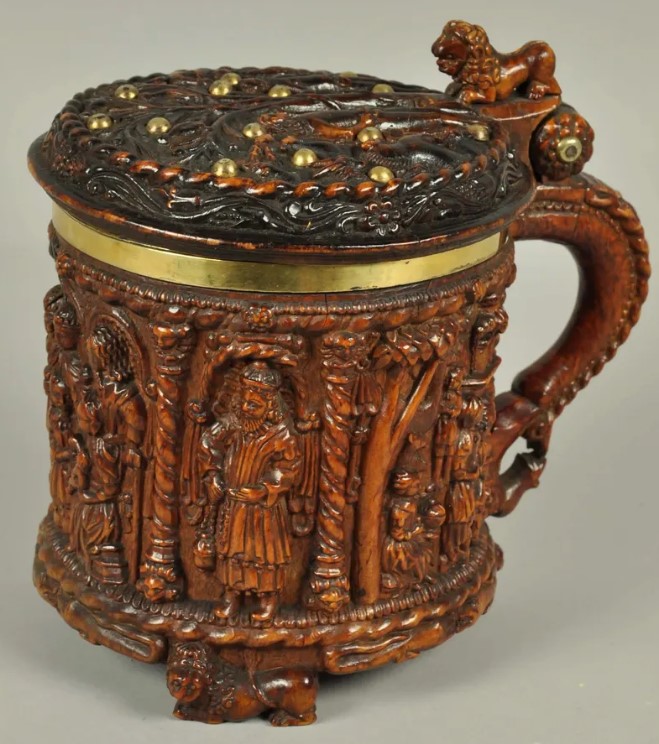
Actually, that tie will do just fine. Just fine. Still, Uruguay has have the best strip. We remember the Graf Spee after all. Isn’t it fun how many old simmering bigotries and grudges come out during international sporting events! Speaking of fabulous cups, Lars shared that image this week: “… carved by a Norwegian farmer… The king bought this mug in 1798 for 60 riksdaler, an absolutely wild amount, equivalent to roughly 10 cows.” The Scandenavian bovine value (SBV) scale to the rescue… again.

How many cows is the World Cup worth? [Ed.: “…crickets...”] Studies have shown that a beer at the stadium might cost you about one-third of a cow. On the other hand, it is pretty clear what inviting the Tartan Army to your town is worth to breweries:

The Tartan Army chartered dozens of school buses from Boston and Providence to get to the game. On the ride with the Scots were many father-son pairs, kilts and even more beer. Organizers brought 10,000 cans of Narragansett Lager for the Foxborough-bound buses from Providence alone. None were left by the end of the night.

Wow. The call has gone out for an extra 100,000 more! My own wee cousin** is out there representing the fam. Seems like the Army is working hard to beat the English in Spain in terms of fluid input, according to one French news source. And Ruvani has also been on the World Cup beat and shared the thoughts of opinions of commentator Roger Bennett what makes for a great fitba focused bars in the US including this good point:

Bennett is keen to emphasize that there are aspects of great American soccer bars that are both unique and essential to the U.S. In other countries, “you commune with fans of your team and everyone else is the enemy, but in the U.S. most fans are young and have come in since the Premier League started being broadcast by NBC in 2013,” he said. “Their discovery and passion have created a unique culture that’s not divided into us-against-you.” This difference means that bars must be ready for and welcoming to multiple fan groups, fostering an inclusive spirit. 

Speaking of welcoming, Ontario’s fading but venerable former retail monopoly The Beer Store is doing something very unusual the days – opening two stores as it closes many more. But its doing so seemingly primarily to receive back more empties as much as to sell beer:

The Beer Store has closed dozens of retail locations across the province over the past two years, citing changing market conditions and the expansion of beer sales to convenience stores, more grocery stores and gas stations. Many of these retailers do not accept empty container returns… As Ontario’s largest beer retailer, The Beer Store recently unveiled a new “Take back what’s yours” campaign aimed to boost awareness of the province’s deposit return system. A recent analysis by the Toronto Star suggested Ontario consumers lost more than $60 million in unredeemed deposit refunds last year by placing empty alcohol containers in their blue box or the trash instead of returning them to The Beer Store.

And Stan has issued his latest Hop Queries and you are all well advised to govern yourselves accordingly. And he’s used a concept that’s been unfamiliar in the brewing world in recent years – stabilized:

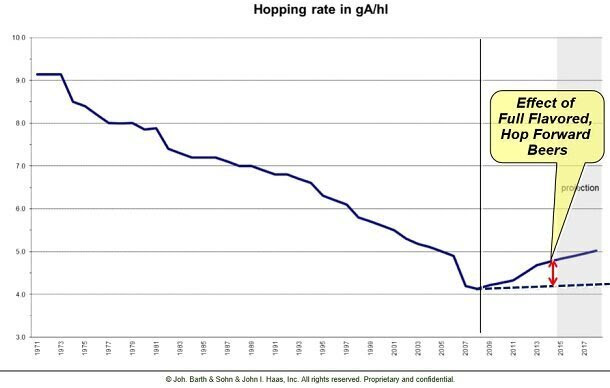
After reducing acreage from 60,872 acres in 2021 to 41,654 in 2025 (that’s 19,218 acres), American farmers indicate that total acreage will remain basically the same in 2026 (at 41,642; 12 fewer acres than in 2025, less than three-tenths of one percent lost). The German Hop Growers Association reports that farmers will harvest 5.8% fewer acres in 2026 after slicing 6.5% in 2025 — leaving 44,117 in 2026, compared to 50,136 in 2024…. It should not be a surprise that a press release from the German hop growers about acreage states, “The mood in the hop market is currently poor” and “the oversupply of aroma hops had made production cuts necessary for several years.” 

In amongst some cheeky chat about NA beer, Andreas Krennmair stood up and sensibly explained with semi-cited research why it is that German NA beers are better than elsewhere in the world:

I’m sure the technology will eventually cross the ocean. From what I’ve been told, all the Bavarian breweries launching new and better NA beers basically comes from one guy’s PhD thesis at the Technical University of Munich at Weihenstephan. I’m not sure the thesis has been published yet, but… here’s one paper from the same guy about the impact of different NA production methods on aroma compounds. 

Here’s Dr. Guy’s paper. I like the acronym they use too, NAB. Suits my feels as a consumer some times. Andreas also shared the best beery gross out of the tournament so far, the drink to accompany an early match:

If you’re looking for the perfect drink for today’s Germany-Curaçao match, here’s a 1970’s beer cocktail for you: Isarwasser. In a 1 litre Maßkrug, combine a bottle of Bavarian wheat beer, half a litre of orange juice or orange soda (e.g. Fanta), and a shot of Blue Curaçao liqueur. Enjoy!

I’m all for fighting the hegemony of homigeneity but… I was sure he was joking. Here, however, is independent evidence of this crime against the clinky and the drinky.

Matty C had a good go at the numbers behind the lack of a GBBF this year, the reasons for which have become clearer with time:

… attendance was way down, with 13,000 people attending over five days – far short of the event’s apparent 23,000 target…  both the main GBBF and its winter equivalent have been cancelled. According to one discussion on its members internal forum, the festival made a staggering £320,000 loss. This feels significant, because you don’t plan the largest beer festival of the year and then move on after losing more than a quarter of a million pounds. A loss of this magnitude isn’t made simply by mismanagement – it’s gross negligence.

Wow. Wowsie-wow-wow even. Knut‘s written about another sort of challenge facing those in the trade – finding yourself brwing quality niche brewing in an isolated location. He noted a few interesting strategies to deal with that reality:

Carl brews beers inspired by Belgian classic styles, usually with malt from the Trøndelag region and with Belgian organic hops. I am lucky to have a designated driver, as we sit down to sample a few of his saisons. It’s a tough market these days, there are some beer bars in Oslo and Trondheim who sell his beers, but not many. He has teamed up with a local company that sells high end salmon fishing in the nearby Gaula river, probably a wise choice with guests paying good money for a quality product. The lower alcohol beers are available directly from the brewery, get in touch with him if you are passing by.

As you consider your route to the Gaula River, here some notes:

Note #1: this vid on UK pub habits also is about Canadianness.**
Note #2: “…BUD stock up 29% yr-to-date…”
Note #3: Ron on Scottish Sweet Stout.
Note #4: “…stuck in 2016 for a moment… Just like DogHouse Edinburgh.“

Question. Horse brasses – history or heritage?*** Boak and Bailey were on the case this week:

Newly built pubs on housing estates and new towns across Britain, desperately in need of instant personality, also often came with horse brasses fitted as standard. For example, when Scottish & Newcastle built The Moorcock at Peterlee, County Durham, in 1973, to provide a “tinge of country atmosphere… in a tasteful blend of ancient and modern” they fitted it out with “beams and timbers and rustic brickwork and horse brasses, sporting prints, and game birds”. (Hartlepool Northern Daily Mail, 15 November 1973.)

So a bit of each. And Alistair has been back home in the UK and has started sharing his thoughts on what he’s missed, starting with a day in Windsor waiting for his flight on to Inverness:

I had been to Windsor all of once previously, but I may have been about 12 years shy of being able to drink legally, and as such I don’t remember much about that visit. There is though a family legend/inside joke that at some point whilst wandering near the castle, I asked my parents why it wasn’t finished yet given the scaffolding that surrounded many of the buildings. I was then somewhat keen to walk by the castle to check up on progress in the intervening 40 odd years – there was still scaffolding to be seen, still not finished then I guess. It was getting pretty bloody warm by this point of the day, even though it was only 9.30 by now, so I took myself off along the river to get to my first planned stop of my tour of the town’s hostelries.

Alistair, being the good saintly lad he is, was well advised to leave out the visit to the city if the latest edition of London Beer City where Will Hawkes explains something I, also being a good saintly lad****, was not aware of… the class of establishment known as the strip pub:

Now – a bit like the Ploughman’s Lunch – strip pubs have almost entirely disappeared. This week the owners of The Nag’s Head in Aldgate submitted plans to Tower Hamlets council which would see this long-established strip pub turned into a “traditional pub” and 24-room hotel…. For younger Londoners – who make up the bulk of my readers, naturally – it must seem incredible that so many pubs once featured women taking off their clothes, but the past was a different country. What was most remarkable, actually, wasn’t the stripping – that still exists, albeit largely in glitzier surroundings – but the low-key, unglamorous, seedy-in-a-specifically-British-way nature of it. No stage, no pole, pounds-in-a-pint-pot for payment… Crucially, these strippers moved whilst naked…

Heavens. Naked people just wandering around the pub among the drinkers? Yik. These places probably reeked of Isarwasser. Speaking of another form of the unfortunately unsavoury, Lesley Chesterman wrote about criticism this week:

When reviewing dishes like that, you can’t lie and say everything was great just to keep things positive. I saw this in my time as a critic as well, this idea of being “mean” when criticizing professionals cooking. People obviously focus on the negative side of criticism, but the truth is, it can be beneficial too. How will any chef improve if you don’t give it to them straight? And how will we uphold a high level of gastronomy here in Quebec if we’re all afraid to call out mediocrity? It is constructive criticism after all, and the goal in cooking should always be excellence. Undercooked frog’s legs and rice are not excellence. 

Agreed. In one of the sillier examples of forecasting yet, the International Wine and Spirits Record (now IWSR) has predicted what the world will be like in 2035… without any reference to the coming global resource wars:

According to the findings, the stabilisation in global volume from 2031 will be driven by two main factors: a “substantial rebalancing” of the global market, and continued growth in the worldwide drinking age population. Over the next decade, the global beverage alcohol market is, according to the analysis, anticipated to be “shifting away from China, North America and Europe to India, South America and Africa”. From a global perspective, this is said to be “most clearly illustrated by looking at consumption by servings” with the research highlighting that “the different serving size volumes of different categories” is a factor to consider.

Serving size? I might have thought fire spewing drones sweeping the landscape into a hell zone might have been a more important factor in the future to come… but I’m like that.

On a similar sort of standard, some attention was drawn to a PR infographic calling itself a summary but being held out as a research study about the NAB drinking habits of the British. Example: “New research from non-alcoholic brewery Athletic Brewing Company and KAM Insight shows that 94% of alcohol-free beer drinkers also consume alcohol.” There seems to be no statement of the research’s definitions, the methodology or the manner in which data was collected. Noce. I’d move to know the criteria for establishing whether one is or is not a “highly active, performance led consumer“! The 94% to 6% split on “alcohol-free drinker” habits is a head scratcher. Is anyone who ever had a NAB included in the 94%? One wag commented that it was akin to this sort of statement:

The Benson & Hedges Wellness Institute reports filtered cigarettes offer a smoother more pleasurable smoking experience.

Oh. That was me! Still, this sort of effort seems to discredit itself from the start. By the way, I’ve been “Zebra Striping” regularly for about four decades. It’s called water.

There you go. That’s enough for now. Another jam packed week in beer and brewing… and the World Cup. As we wade through more and more matches, please take time to check out Boak and Bailey posting on Saturday and adding to their fabulously entertaining footnotes week after week at Patreon. And do look out for more of Stan’s new “One Link, One Paragraph” format including this week’s wisdom: “People need to get out from behind their phones, go to a bar and talk to each other.” Then hunt out something in someone’s archives! Leave oblique comments on someone’s post from 2009!! Listen to a few of Lew’s podcasts and get your emailed issue of Episodes of my Pub Life by David Jesudason on certain Fridays. And Phil Mellows is at the BritishBeerBreaks. Once a month, Will Hawkes issues his London Beer City newsletter (but always never with this week’s NSFW warning) and do sign up for Katie’s wonderful self-governing totes autonomous website featuring The Gulp, too.  Ben’s Beer and Badword remains on pause but there is reading at The Glass which is going back to being a blog. Any more? We have Ontario’s own A Quick Beer and All About Beer is still offering a range of podcasts – and there’s also Mike Seay’s The Perfect Pour. Plus follow the venerable Full Pint podcast! And there’s the Craft Beer Channel on Youtube as well as the archives of the Beer Ladies Podcast.

*The young lad possibly as illustrated on a FB page name of The Boston Calendar. I tihnk that the the City Hall plaza if I remember correctly.
**H/T Gladman. Note the dropping of the terminal consonant at the ends of syllabels.
***Heritage being that approved part of history promoted for present purposes.
****Apparently, according to a key word search, I’ve never told you how at the dinner table one evening when I was about 15 my mother out of the blue advised me “oh, and if you ever think of going to one of those stropper places think of me up there!” She may have pointed her fork at me as she said that. I never have cross the doorstep.

And… Finally… Here’s “The Baseball Is Back!!” Edition Of Your Beery News Notes

I mean, let’s face it. The Winter Olympics are all well and good. And the World Cup will fill that gap in June, sure. But… baseball. Baseball: the sport that demands the best in athletes and then asks them to sit around for half the game. When they aren’t standing around in the field. It’s great, isn’t it!  Though, we should also take this moment to remember one of the great Olympic moments from, what, sixteen years ago now when Canada’s gold medal winners took the opportunity to turn the hockey rink into a tavern. And on that topic, here’s a Winter Olympics fact I hadn’t heard before and one that isn’t apparently winning any medals:

The only beer available for purchase at the 2026 Olympic Games is Corona Extra, a Mexican pale lager. This is due to the Olympics only allowing one company to sell its products at the Games, and this time it was Corona who was able to secure a deal. It’s a controversy that may hit closer to home for a lot of Olympic spectators, more so than a few foul-mouthed curlers ever could. It’s fair to say that Corona may not be the most popular beer for fans in Europe, as a photo of a Czech hockey fan went viral last week for his disappointed look while holding his Corona beer.

What a great choice. For the five athletes at the games representing Mexico, I suppose. What else is going on? Plenty to read out there on the chop-shop job coming for BrewDog but The Guardian had a good angle on the pending effect on those who each gave a bit when a lot was needed (or at least wanted with little or now strings attached) early on:

BrewDog’s army of “punk” shareholders have voiced anger and frustration after the Scottish brewer confirmed plans for a possible sale that could render their investments worthless. So-called “equity punks” who spoke to the Guardian or posted on BrewDog’s shareholder forum expressed disappointment and accused the company, which has traded on its upstart ethos, of treatment “bordering on contempt”. One said the plan showed that the small investors, who helped to kickstart BrewDog’s growth after it was founded in 2007, meant nothing to the company.

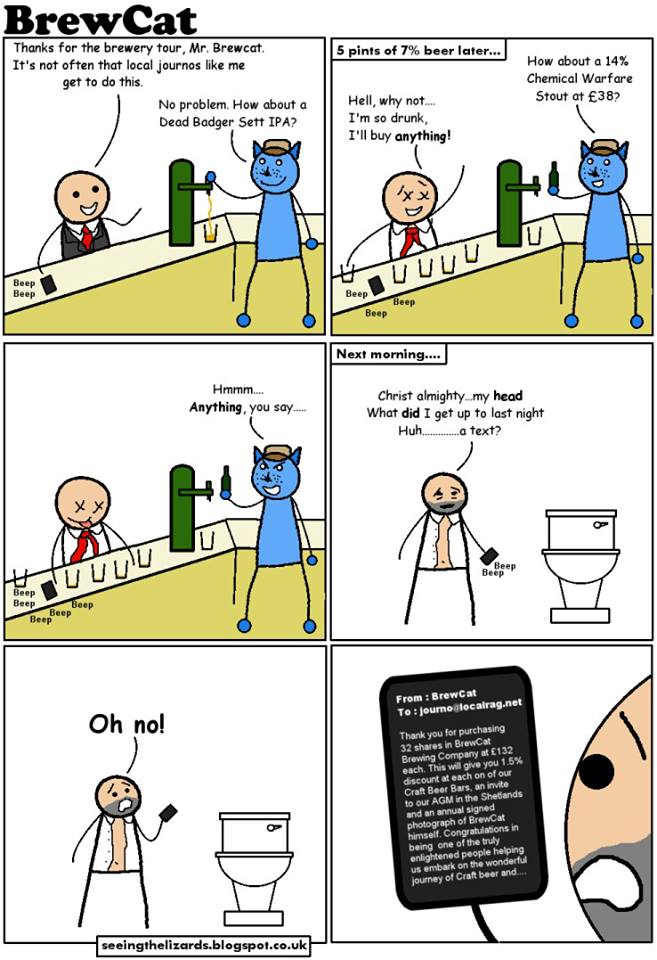
While the effect on individual EP investors can be quite significant, I mention this mainly as a pretext for posting that 2013 parody up there of the plan from one M. Lawrence at Seeing the Lizards.  Speaking of just saying no, The New York Times has run a four-part series by Pete Wells on getting your consumption back to a healthier level and finished off with a back at life with alcohol as well as a look forward:

Sometimes it seemed to me that I had a richer, more rewarding relationship with alcohol than I did with all but a handful of humans. It was an inexhaustible field of study, an incandescent companion during great meals, a reliable consolation on dull ones. And it brought me close to my real friends, at least some of them, some of the time. Over time, though, the rewards had become more equivocal and harder to justify. It wasn’t just the weight I gained, a predictable result of having a cocktail each night followed by about three glasses of wine or beer. They were, by this point, undeniable signs that my liver was overworked. I slept badly with all that alcohol in my system, too, and it got worse as time went on. …

You may be happy to know that he still enjoys his martinis – even if there are fewer of them: “…feeling the hair on the back of my neck stand up as the first sip takes hold, I feel like I’ve been reunited with an old friend…” Another old friend, Liam, reached back just a few decades for his post on the earlier trendy years for NA beer in Ireland, Smithwick’s Alcohol Free Bitter:

The launch was accompanied by newspaper competitions plus promotions, and a strange and repeated focus on how the beer, at 0.5% abv, contained less alcohol than orange juice! Reviews of the product at the time varied a little but it seems to have been generally well received for what it was, with reviewers commenting on how it (ironically) ‘packed a real bite and had good flavour’ and how they could drink it in a pub all night,  although it was also said to be ‘quite gassy and sweet.’ Others said it was ‘pretty good. Smells right and tastes of hops. Quite rich and smooth to drink.’

AKA gak. More positively, Matty C shared his thoughts on some upsides he’s seen in the brewing trade so far in 2026:

A couple of years ago, conversations in beer often centred around the idea that there’s “light at the end of the tunnel”. In reality, I don’t think that chance of daylight is coming anytime soon. Instead, we’ve got to admire the glimmers that are somehow managing to shine through the cracks in the walls around us when we can. Good beer is still being made, and good pubs are still open to sell it in – I’ve seen the proof! 

One of his examples was the tenacity of Jaipur: “… beer, packed with flavour and served at a high strength – seemingly the antithesis of what you would expect to succeed….” Which reminded me of how, in response to recent racist comment from an English oligarch, in The Times Sathnam Sanghera wrote about one of the foundations of the Britain of today:

…the fact that it ran the biggest empire in human history explains lots about Britain beyond its multiculturalism. It explains the popularity of curry. A significant amount of the mahogany furniture, ivory and jewels in our stately homes and royal palaces. Our propensity to travel. A certain amount of our wealth. Our political posturing on the international scene. Our national drink in the form of tea, and our national tipples in the form of pale ale, rum and the gin and tonic. The fact that we don’t feel the need to learn foreign languages because we encouraged/forced large parts of the world to take up English.

Empire of booze! Which, in turn, reminds me of Manitoba’s fabulous Premier Wab Kinew and his cheery fight for my right to Crown Royal after a bit of internal trade tension with Ontario’s Uncle Doug:

Cheers to you Doug Ford for keeping Crown Royal on LCBO shelves . Thanks for doing the right thing. Just like Canadian whiskey, good results take a little bit of time. This is a good day for folks in Gimli, Manitoba and a good day for people in Ontario too. Standing up for workers together is always a big win for Team Canada.

PWK won a lot of support with this bit of good humoured social media savvy. Crown Royal also got about 5,783 times the value of yet another newsletter by email telling breweries about the importance of storytelling.

Note #1: a desperate plea for beer based salad dressings.
Note #2: pairing beer and cussing.
Note #3: democracy in inaction?

Speaking of newsletters by email about storytelling, Will Hawkes was back at the end of last week with his February edition of London Beer City in which he considered the concept of the Irish Pub as illustrated by one new spot, Moylett’s in Clapton:

…I’m confused. What’s Irish about it? According to a report in Broadsheet, the focus is on what owner Moylett calls “the holy trinity of food, music and socialising” – a worthy list, no doubt, although it does seem to be leaving out something quite important (Guinness is £5.50 a pint, btw). As a term, “Irish Pub” is surprisingly hard to define, and particularly in London (and other British cities, arguably, but we’ll put them to one side for now). In much of the rest of the world – indeed, even in London, particularly its once O’Neills-heavy suburbs – the Irish pub is a 1990s phenomenon: flat-packed dark wood decor, pints of Guinness and food options that are often only very vaguely Irish (satay sticks, curry, chicken wings of varying heat levels; Spice Bags are less common, although you can get them at Moylett’s). But Irish pubs in London are, historically at least, quite different, and much less easy to pin down. 

Similarly but further afield, ATJ shared his thoughts on Cologne/Köln, the river there and its crossers:

…leaving Hauptbahnhof I crossed the Rhine, slow-moving, the colour of mud, upon which an elongated, snub-nosed barge was slowly making its way downstream. I stopped and took a photo, a snapshot of slothfulness perhaps and continued along the historic Hohenzollern Bridge. It was crammed with people through which bicycles and the occasional skateboarder cleaved their way, imperious and ‘get out of my way’ seemingly stamped on their features. Some people, were in groups whose colours defined their tribal affiliations — red and white for FC Köln, black and white for Eintracht Frankfurt. Sporting rivals presumably…

And here’s a new insult for craft beer.  If Jeff’s exhaustive listicle is correct, IPA is what it is all about and what it says is “meh, new money..“:

When it comes to beer, the etiquette guru revealed that “new money” consumers “don’t touch the more traditional ales or stouts – it’s all about IPAs that set you back at least £5 a pint. Anything involving the word ‘traditional’ simply doesn’t feature in your vocabulary. “If it doesn’t sound trendy, artisanal, limited-edition, or come with a deliberately obscure name, you simply aren’t interested.”

I actually find it really funny that anyone thinks anything related to beer is about new or old money… other than owning the brewery that great-grandpa built I suppose.  Almost as good as if grandpa owned a country… which is a seque to the next tale of skulduggery – perhaps – in China’s Jilin province:

The marketing materials identify the beer as produced by Rason Ryongson General Processing Factory in the Rason Special Economic Zone, located near North Korea’s borders with China and Russia. …[T]he Chinese distributor is Yanbian Xinyuequan Trading Co., Ltd. The company is based in Yanbian Korean Autonomous Prefecture in Jilin Province, a key gateway for cross-border trade with North Korea. Additional social media posts show boxes bearing the Pado label being unloaded from trucks and delivered to local restaurants in Jilin Province, indicating the beer has entered local distribution channels “…[N]ame changes are largely driven by export considerations, particularly to reduce the risk of sanctions-related flagging when the product circulates in Chinese wholesale or grey market channels…”

Mmmm… grey market North Korean Pado beer…  Quite the opposite in every way are Boak and Bailey who asked about what a drinker wants from a pub’s internet presence.

… we want to know what beer the pub is serving today, right now. Working that out can be surprisingly tricky. Again, Instagram or Facebook can help, but it’s often more reliable to snoop on Untappd and see what’s been logged in the past 24 hours. Pub websites are rarely of any use for this at all, presumably because updating a website feels like a big job, and a job for the Big Computer at that, so it just doesn’t happen.

Great comments followed… but I wonder if the easier solution is a camera aimed at the chalk board at the bar which is already updated daily… all sorta a la last week‘s remote pub experience story. It worked for the Cambridge coffee pot cam. The best way to get a job done is to find a way to make it a not-a-job job.

Finally, the Pellicle feature this week is accompanied by many photos with many many strings of bunting. It’s a story about Steam Machine Brewing of  County Durham – but without saying the word it’s really all about the bunting. Not including reflections in the windows (which would be unethical, of course) I counted thirty-six strings of bunting. That’s a significant contribution.

That’s it! That is all for now. But we are one step closer to spring. Pre-season Grapefruit League baseball on the TV time. Huh. Zah. Until next week, please check out Boak and Bailey who are posting every Saturday and adding to their fabulously entertaining footnotes week after week at Patreon. And look out for more of Stan’s new “One Link, One Paragraph” format. Then hunt out something in someone’s archives! Leave oblique comments on someone’s post from 2009!! Listen to a few of Lew’s podcasts and get your emailed issue of Episodes of my Pub Life by David Jesudason on certain Fridays. And Phil Mellows is at the BritishBeerBreaks. Once a month, as noted, Will Hawkes issues his London Beer City newsletter and do sign up for Katie’s wonderful self-governing totes autonomous website featuring The Gulp, too.  Ben’s Beer and Badword seems to be on pause since November but there is reading at The Glass which is going back to being a blog. Any more? We have Ontario’s own A Quick Beer and All About Beer is still offering a range of podcasts – and there’s also Mike Seay’s The Perfect Pour. Plus follow the venerable Full Pint podcast! And there’s the Craft Beer Channel on Youtube. Check out the archives of the Beer Ladies Podcast.

And Just Like That Here Are The Quite Frosty And Fully Final Beery News Notes For January 2026

It’s been a quiet week in the beer world with distractions aplenty in my real world. Like the Arctic vortex. To be honest, I’ve always preferred the Caribbean vortex whenever it pays a visit.  Thankfully, once upon a time I lived up in the upper Ottawa and have experienced the refreshing zing of -53C so knew enough to break out the heavy tweed and  big boots. Dashing yet completely unable to dash. Elsewhere people are embracing the deep chill as well.  Will Cleveland reporting from Rochester, NY has news of the return a winter beerfest this weekend;

This isn’t a gimmick festival chasing the beer-du-jour; it’s a gathering rooted in the style that got a lot of people into craft beer in the first place—before haze became a default setting and before “imperial” stopped feeling like a warning label… DiCesare remembers the first year clearly, mostly because it was about 10 degrees outside. This year, the ask is similar but the hope is different: dress for the weather, embrace the winter, and lean into the fact that January beer festivals are better when they stop pretending they’re outdoor concerts. Fire pits and outdoor heaters will again be part of the setup, encouraging that specific Rochester ritual of standing outside, beer in hand, nodding knowingly at strangers like, yes, this is happening, and yes, we chose it.

What else has been going on? Well, it was Rrrrrrrabbie Burrrrrns night last Sunday and all around the world folk reacted to the plate of haggis, neeps and tatties set before them. Unless, as Katie M explored in Guts magazine, it perhaps wasn’t really haggis:

Learning how important lungs are to the recipe of a traditional haggis, a vegetarian version seems like sacrilege. The whole point of haggis is that it’s offal, a sausage or boiled pudding made with waste-not, want-not diligence to keep Scots fed throughout the winter and leaner times. The very idea of a vegan haggis is deeply inauthentic—offensive too, if you were to read the comment sections on any clickbait story about the dish. But if you’re appalled, you’re forgetting the accommodating nature of the Scottish people. Do you think my Grandma would have anyone going hungry in her house? The very origins of vegetarian haggis was borne from hospitality…

As the good author noted, the very prayer one prays before we got to the “O what a glorious sight, Warm-reekin, rich!“* includes the line “some hae meat an canna eat…” so there is some authority for this. Is there another dish that so inspires? Speaking of how others live, in the Globe and Mail, Drew Shannon wrote about finding a beer in Kazakhstan:

I broke up with craft beer a long time ago – back when small-brand breweries went from niche and interesting to eye-rollingly ubiquitous. Of all places, I didn’t think I’d run into my beverage-ex in Kazakhstan. I assumed either big conglomerate brands would still dominate the former Soviet state or there’d be no beer at all. Finding a pint in some parts of the Islamic world can lead even the most well-travelled tourist on a fruitless quest. It turns out, I was dead wrong. My impromptu evening of bar-hopping around Almaty, the country’s largest city, started after a long day of trekking the Turgen gorge. On the way back to my hotel, I noticed Privychki Bar. I pushed open the front door to find a gaggle of young Kazakhs perched on vintage armchairs, sipping cloudy pints. 

Mmm… cloudy pints. Never less than clear, Stan, in his concise one paragraph way, directed me to a bit of resurrectionist thinking over the cool corpse that one was Rogue Brewing. How in its haydays it didn’t have managers, it had ambassadors: “That is why Rogue was kicking ass in those days is that felt that they were ambassadors to craft beer.” Yikes. I had a sudden unsettling flashback to the bad old irrational – if not greedy – days of craft and reminded myself of this from 2012:

To hell with that. Passion is that employer of the young who saps their joy for life. Passion offers periodic Google ad cheques in return. It asks you to be the unpaid brand ambassador. On Wednesday night, a intelligent and eager young person suggested to me that my interest in good beer was pure passion with a certain honest excitement. I took the time to gently crush that moment like a mouse under my heel. It was information, I said. Information and interest. Passion? I have children for that. 

The children? They are 14 years older now and each of an age when they might be expected to buy the beer as much as have it bought for them. I trust that now not-so-young person has found another moe successful career – and that’s probably for the best for all.

Note #1: Twenty years of Ron!
Note #2: Maureen asks … in the end… is a brewery just its trademark?
Note #3: Stout-flation strikes.

Heavens! I missed the news when The Beer Nut issued a new beer style alert right around when the update when to the presses last week. He was reporting from the front lines of recent holidaying where and when he encountered:

… the rarely-seen style of imperial sweet potato amber, and I had no idea what that was likely to mean. Beniaka is 7% ABV and a cola brown colour in the glass. Although fizzy, it’s plenty thick and feels luxuriously “imperial”. Can’t say I tasted much potato, but there’s a pleasant woody spice: nutmeg, sassafras and liquorice. It’s fairly sweet with it, showing a little Scotch-ale-style toffee, with the herbs helping balance it. This is interesting, with lots happening, but it’s not a daft novelty, and makes for a very civilised digestif.

Not at all in response, Sophie Arundel was given a fun topic over at the Drinks Business – the dead end trends of 2025:

Several alcohol formats once framed around lighter, functional or lifestyle-led positioning are now in sharp decline. Hard kombucha now holds a 0% share of social discussion, down 29.8% year on year. Hard tea has slipped to a 0.01% share, falling 33.79%, while hard seltzer sits at 0.02% share, down 33.67%. The contraction extends beyond these formats. Craft beer, often seen as culturally resilient, is down 16.52% year on year with a 0.84% share, while generic IPA beer has fallen 17.28% to a 0.38% share. Tastewise’s data suggests the broader “better-for-you drinking” narrative is losing attention. Products that relied heavily on pseudo-functional positioning are struggling to maintain relevance, pointing to a need for clearer occasions, flavour-led propositions and tighter ranges.

(“Pseudo-functional” was the name of my folk-punk band back in ’93.) At least craft beer fans can take comfort that their drug of choice is going better than hard kombucha. There are still some hangers on that are telling craft to repeat its errors… but it is true, isn’t it – when things are going down the proverbial shitter, not one really is working to improve so much as find themselves quite happy to tread water.** Perhaps coversely, BMIs seems to be seeing at least a stall in the slide when it comes to US beer:

NBWA released its Beer Purchaser’s Index reading for Jan early touting a “significant bump” from December. After 5 mos in a row of readings below 30 (including several lowest ever around 25), BPI jumped to 39 in January. Not exactly great shakes, and 9 points below Jan 25, but still 14 points better than Dec 25. (Recall, BPI below 50 suggests beer distrib orders are contracting, while above 50 signals expansion.) 

So less of the lessening perhaps. But in western Canada, there was actually an increase in beer sales through 2025. So who knows! Well, at least we know one thing. I think we have established that not being very profitable at all is actually not a good business plan:

BrewDog has announced that it is closing down its Aberdeenshire distillery and ceasing production on all spirits. The craft beer company said it had decided to abandon its state-of-the-art distillery, which opened in 2016, and axe the brands after “careful consideration”. The move comes after the company posted losses of £37m in 2024 and announced job cuts across the business, including at its head office and brewery in Ellon.

Conversely (at least in San Francisco) not doing well enough to even attract a proper buyer can have its advantages:

During that massive blackout on December 20, every business but one in the Lower Haight had to shut its doors because they had no power. That one would be Toronado, which still uses an old-timey, non-electrical cash register with punch buttons and a hand crank, still takes only cash, and beer taps don’t require electricity. Cheers to ancient technologies. The story was left hanging last summer after a new crypto-bro owner had stepped in looking to take over the bar — and launch a Toronado-themed coin! — and after that deal appeared to be in jeopardy once longtime owner Dave Keene discovered these details and looked to cancel the deal. But SFist can confirm now that the deal was, indeed, canceled, and everything remains as it was at the bar.

That’s nice. Unless the owners really hate the place and want to move on I suppose. Can you own an iconic institution that people flock to and really hate it?  If someone does something well I would hope that there is joy in the doing.

Note #4: The many beards of Polk.
Note #5
: What friends of beer writers think they do…
Note #6: …all day long…

Joy in doing? That’s a bit like this week’s feature in Pellicle by Imran Rahman-Jones about the making of liquor from what’s to be found right there in Edinburgh’s urban orchard:

As Chris continued to tweak his distillations, and source new apples for each batch, he began to reflect on the fruit’s beguiling quality. “[There’s] something quite magic about an apple tree in the street,” he says. Neighbours will leave out boxes of fruit for one another, or swap recipes. “It tends to pull the whole street together at a certain time of year.” What Chris didn’t know when he started the process of developing Pochle was that he was tapping into a lineage going back centuries in Scotland. The enchanting ability of an apple tree to gather and unify in fact has deep roots in the country’s traditions and folklore. 

Lots to like there. And just look at the people working to get that bit of writing onto your screen. The fine folk keeping Pellicle going, the author Imran Rahman-Jones, the semi-sticky handed Chris Miles who gathers and also those who let the foragers be – not to mention those who planted and tended to the apple trees. Doing is a wonderful thing.***

And on that very subject – the doing of things – Boak and Bailey were out there again in their monthly newsletter for January doing a great job encouraging more writing about beer. What to write about:

There are local drinking customs and cultures that probably seem unremarkable to people who know them but which would interest people like us. Flat Bristol Bass is one that fascinates us but there must be others all round the country, and certainly around the world. Alex, our favourite beer blogger of 2025, goes to three pubs and writes about what he sees going on there. Adrian Tierney-Jones (a pro, not a blogger) takes a similar approach. Now, you could write tasting notes of every beer you drink but, honestly, that’s probably the hardest thing to make interesting – unless you are a skilled, creative, and/or amusing writer like The Beer Nut. It can still work if your tasting notes find a theme or tell a story, though.

Do it! I like it – but do note that “blogger” and “pro” are not comparable categories and neither term speaks all that much to the quality of the writing. “Pro” is code for paid writing which can be compromised even just by editorial restrictions**** though, more to the point, too often not all that good. And “blogger” is a reference to a class of medium, not a sign of quality of the writing and not necessarily code for an amateur though some of the best beer writing is actually provided by people who earn their living otherwise. Ray and Jess themselves are proof of that. Better to think of adjectives like interesting, inventive or even valuable when weighing the cred. Then notice where they don’t apply!

I would also add, don’t worry too much… unlike Mikey Seay who has shared what strikes me as quite an odd thought:

I always shy away from reviewing beers for two reasons:
– Lack of skill to do it properly.
– Beers can be too regional to make a review relevant to a global newsletter audience.
That said, I feel a new beer from Sierra Nevada is available enough in most places to make it worthwhile to mention.

Seeing as thinking and writing about your taste perceptions takes about as much skill as running a vacuum cleaner, I don’t think this is a particularly useful standard. But then again you may be crap at vacuuming, too. Do you worry about that? Just type. Be patient and get those keyboards clicking. It’s a lot like planting a seed and also, if nothing else, it’s good for the knuckles.

Where will it take you, all this clickery? Well, as we wrap up this week on the note of the haute in beer writing, this is your final call for a fully self-funded trip to Bordeaux in June:

This is the FINAL REMINDER about the 2026 Beeronomics Conference, which will take place at ESSCA School of Management, Bordeaux, France, 24-27 June. Main panels and sessions will be held at the ESSCA Bordeaux Campus. The Conference Organising Committee, led by Gabriel Weber and Maik Huettinger, welcomes all high-quality research on the economics of beer and brewing. 

The deadline for submissing an abstract is Sunday. Send me a card. Fine. Fin. As I said, a bit of a quiet week. please check out Boak and Bailey who are posting every Saturday and adding to their fabulously entertaining footnotes week after week at Patreon. And look out for more of Stan’s new “One Link, One Paragraph” format. Then hunt out something in someone’s archives! Leave oblique comments on someone’s post from 2009!! Listen to a few of Lew’s podcasts and get your emailed issue of Episodes of my Pub Life by David Jesudason on certain Fridays. And Phil Mellows is at the BritishBeerBreaks. Once a month, as noted, Will Hawkes issues his London Beer City newsletter and do sign up for Katie’s wonderful self-governing totes autonomous website featuring The Gulp, too.  Ben’s Beer and Badword seems to be on pause since November but there is reading at The Glass which is going back to being a blog. Any more? We have Ontario’s own A Quick Beer and All About Beer is still offering a range of podcasts – and there’s also Mike Seay’s The Perfect Pour. Plus follow the venerable Full Pint podcast! And there’s the Craft Beer Channel on Youtube. Check out the archives of the Beer Ladies Podcast.

*Just in case someone out there never had a tea towel.
**No, smoothies will not save brewing.
***This is your reminder that now is the time to start planting those seeds for your own garden. Seeds and soil and time. Have a go. This tomato from last November’s final harvest was from a seed planted in my basement in February. Easy. Almost as easy as typing. 
****“It’s only a trade mag article…” is as often much the case.

Your Merriest Of Merry Christmas Day Beery News Notes For 2025

Stan has been worried. Very worried. Either worried that there would not be any beery news notes this Chrismas Day or worried that there would be beery news notes today and that I really should be doing something else. I am deeply appreciative of the concern but as I usually farm this all out to the team of sleep deprived unpaid interns there is no question whatsoever of the news getting to each of you, my gentle and today hopefully mildly hungover while turkey and stuffing compromised readers. So… the show goes on! Speaking of which, todays photo above from the Yuletide photo contest was submitted by Zak Rotello of the Olympic Tavern of Rockford Illinois, a long time pal of this here beer blog. Click on it for a bigger version. It’s an image of a member of the brewer staff cleaning open fermenters at Anchor Brewing in San Francisco, the brewery that will now never reopen. Like the sleep deprived unpaid interns, we remember those who are working today to keep the holidays jolly.

So what news is actually out there this week? We might have slim pickin’s but there shall be pickin’s. First up, what days are your local party days? As mentioned last year, Tuesday was Tibb’s Eve in Newfoundland last Tuesday. And this is the first year I saw a lot of references to “Black Friday” for the last Friday before Christmas as opposed to the first Friday after U.S. Thanksgiving. Here, for example, is the new coverage from Wales.  Mainly photos of the dressed up and drunk yuff today. It also seems to be referred to as “Mad Friday” in Scotland but maybe it’s a phrase able to be swapped out. I share the thumbnail attached as evidence that such stuff happens in Canada but perhaps with a little more grace as well as perhaps a bit more grit. By the way, one assumes (given the obviously strong ankles) that such natty folk might also be hockey players so… a misplaces comment might receive an brisk elbow right to the Chiclets… if you know what I mean.

What else? The best booze stories of the year according to the Drinks Business included beer news including the high price of a pint in the UK, BrewDog ditching pubs and the suggestion that NA beer should be “a functional drink rather than a compromise…” whatever that means. Pellicle offered up its top tales of their very good year. And Ron has been posting about the best of his personal year including:

I did a bit of judging this year. Mostly in South America, obviously. That’s where I prefer to judge. The Blumenau contest was fun this year. And not in Blumenau. Instead, it was on the coast at Balneario Camboriu. Literally on the coast, as the judging location was on the seafront. Meaning you could have a stroll down the beach at lunchtime. So civilised. And I managed to dodge judging Best of Show. That’s always a win. In Santiago, judging was in the same hotel as we were staying. Which is always good.

Also good was his news that he’s been cutting back.  On a related note, the* Beer Nut on the expansion of NA beers that don’t suck:

Non-alcoholic beer gets the occasional bit of coverage on here, though I tend to find very few which perform the role required of a beer. Pale ales, wheat beers and lagers seem to be the preferred styles, which may be the problem. I’ve often said that dark styles make for better alcohol-free beer, my favourite to date being Švyturys Go Juodas, and the Guinness one is pretty decent too. The latter’s success has provided an opportunity for other breweries to get in on the 0.0 stout racket, and the first I’ve seen locally is Dundalk Bay’s Zero Zero Nitro Stout, available in Aldi.

I’ve recently bought into the “Guinness 0” thing so good news that other smaller operations are able to similarly pass muster. Speaking of news, Stan also had newsy news in his Hop Queries in the state of the US supply of hops:

Farmers in the Northwest reduced acreage 7% in 2025 and harvested 5% percent fewer hops, according to the USDA National Hop Report. Average yield per acre was the highest since 2011, when higher yielding hops appreciated more for their alpha made up a larger percentage of acres planted. The 2025 value of production was $447 million, up slightly from 2024, but significantly less than $662 million in 2021. That shouldn’t be a surprise, given that acreage has shrunk 31% since 2021 and production 28%. Perhaps as important, in September the USDA reported that the inventory of hops held by growers, dealers and brewers was 116 million pounds, down 15 percent from the previous year. That’s the largest contraction in 15 years and suggests the market is getting closer to being in balance. Still, it is a significant amount, and almost 40 percent higher than it was through much of the teens.

Me, I was higher in my teens. That’s the main difference between me and the US hops trade.

Note#1: “Stephen Beaumont once gave me some good advice: don’t.”
Note #2: “Scroll at your leisure…”
Note #3: Women in public bars over fifty years or so ago.
Note #4: Continental had a pub in the sky.
Note #5: Short pours in Milton Keynes!

Speaking of controversy, a debate threatened to break out in the comments at Boak and Bailey but it appeared to just be a slightly paranoid complainer intent on playing one handed ping pong, the prattling lad being handled firmly by the administration. Much more interesting were the comments confirming reality behind the sale of Bristol’s Moors, including:

I now have had a chance to dig into their structure and, in short, they were not employee-owned in the recognised sense of being owned by an employee ownership trust or being a co-op, etc – it was just that all of the owners were also employees (i.e. no external investors). Justin owned 85% of the business. It looks like he has now sold that stake to Albatronic Arcades Ltd, a company registered on 5 August 2025 and owned solely by Bruce Gray. So I feel less unnerved about the boycott! But still hope they can turn Moor around.

Another set of comments were helpful in building upon Jeff‘s thoughts on the shutting down of three of ABInBev’s megabreweries in the U.S. of A.:

At a macro level, overcapacity normally drives prices down, which is always hard on producers. It’s especially bad for breweries right now, which face a host of financial challenges. Craft and big beer function largely in separate realms, though, and it’s seemed like big beer has been able to replace lost beer volumes with flavored-malt beverages and the like. This news suggests otherwise. Further, for anyone who has followed the beer industry over the past fifty years or so, this is a shocking development for a financial and logistical juggernaut.

Not as shocking to one Karl “the Commentron”** Ockert who shared his understanding:

I worked at the Newark brewery, then a 9 million bbl per year plant, in the early 90’s. I (half) jokingly tell people that I earned my Masters at the university of AB, Newark campus. While I learned a lot of the science of brewing at UC Davis with Dr Lewis, at Newark I learned even more about production and process discipline which I was able to use at the BridgePort and Deschutes Breweries. Last year Newark was down to a rate of 500,000 bbls per year and brewing less than a week per month. Along with Fairfield and Merrimack, it fell victim to the changing beer market. I’m sure it was a painful decision to close all 3 breweries at once, and I’m sorry to see it finally happen.

One wonders what it was that kept the facilities hanging on for so long. Wasn’t money. Somewhat similarly was the concern raised by Ron about the loss this year of Martyn Cornell and state of Martyn’s now 404 website:

What did Martyn leave unfinished? I can’t believe that he wasn’t working on another book. (He asked me about self-publishing because he was so pissed off with how long it took to get a book published.) Not to go all fanboy, but (meaning I am doing) how much material is there that hasn’t been published? Including stuff chopped from Porter. I’d buy a book with that in. Niche, made possible by self-publishing.  A compilation of his, often very long, always hugely informative, blogposts would make a great book. And preserve them in print. As Zythophile is no longer there. Fuck. This material really needs to be saved. Maybe I should get in touch with his brother. 

Happy was I then to confirm that the contents of the entirely excellent Zythophile has been preserved at the Wayback Machine, a service which I have been in love with since the great blog server shift of 2016. Think something has been lost on the internet? Check the Wayback Machine first.

There was intrigue in England as we wondered if Mrs RM could walk past  one of the great conversational pubs:

Walking back from the Sun to Faversham Premier Inn on the eve of Mrs RM’s birthday I suddenly realised we’d taken a different route into town that afternoon and missed its most famous pub. Would she be able to resist the lure of the Elephant on first sight. No. “We’re going in there“. I was happy to skip it, honest. A year ago it was packed on Sunday folk afternoon, a bit quieter on Tuesday night but there still weren’t a lot of spare tables.

A pub full of chatters. Not always what one wants but good to see someone get their way.  In other situations, choosing beer can be the wrong move as this personal injury workers compensation claim denial illustrates:

The claimant’s business required them to purchase and transport bulk quantities, and as the pain apparently intensified the claimant was awarded income replacement benefits, the release says. Surveillance by investigators found the claimant was seen regularly transporting beer for seven to 10 hours every day, often loading up to 20 cases of beer into their vehicle without assistance or any evidence of pain. The benefits were terminated…

All this leads to one fact – beer is not always kosher. No, really. Not kosher:

In November, three of America’s largest kosher certifying organizations came together to release new guidance regarding the status of beer, which has long been considered kosher by default. Due to the proliferation of flavorings brought on by craft brewing and other industry changes, however, the rabbis who declare whether food products are in line with Jewish dietary laws now say the label must be checked before drinking. “We’ve discovered that companies use many flavors, different flavors, to enhance even the simple beers that they manufacture. Those flavors need to be kosherly supervised,” said Rabbi Moshe Elefant, the head of kosher operations at the Orthodox Union, who released the guidance along with Star-K and OK Kosher. “We’ve seen more than one situation… that some beers have dairy in them. They add lactose, they add milk, so a beer could be dairy, which has very serious kosher ramifications.”

Knew it. Gak. Yet some of the stuff that can be crammed into beer other than via the “craft” of the fruit sauce hose might actually be useful:

Buck isn’t just a home brewer dabbling in drug-making. He is a virologist at the National Cancer Institute in Bethesda, Md., where he studies polyomaviruses, which have been linked to various cancers and to serious health problems for people with weakened immune systems. He discovered four of the 13 polyomaviruses known to infect humans. The vaccine beer experiment grew out of research Buck and colleagues have been doing to develop a traditional vaccine against polyomavirus.

As I mentioned last week, I am pro-line in the pub. Better, table service. Each to their own, I suppose, but is there any bore are boring as the “don’t queue” bore in a ‘Spoons?

Believing it’s an ‘unwritten rule’ that you don’t queue at a bar, the 24-year-old barman was stunned to spot ten people in an orderly line waiting for their drinks. Jack refused to join the queues, instead ‘standing his ground’, claiming he propped up the bar for 10 minutes until he was served. Baffled Jack, shared a snap of the queue on X, slamming it as a ‘disgusting and uncouth disregard for sacred tradition’… Jack, who lives in Birkenhead, Merseyside, said: “It’s going against British tradition and it’s just wrong. It’s not like they’re doing anything inherently bad but it’s an unwritten rule you don’t queue at a bar.

Finally – and looking forward to New Year’s resolution suggestions – a word on usage if I might. Please stop writing “I don’t understand” as it means… you are admitting you don’t understand. And if you are a professional writer and you use the phrase “trust me” it only shows you can’t clearly explain your views which means your views are likely not trustworthy. And ask yourself before hitting “publish” if it is wise to write “… an unimaginable amount of work goes into…” when not only was it imaginable but it was accomplished as imagined. And if you as a beer business person want to want to display your ignorance of the times and market conditions of your trade as it exists today, feel free to post something like this on LinkedIn:

Given the current state of the industry, I think it’s about time we rally together and finally retire “Dry January.” Honestly, hasn’t it taken up more spotlight than anything that fun-free should? Let’s change the narrative and remind people what beer actually is……. a simple, natural combination of water, malted grains, hops, and yeast. Four ingredients. Zero mystery. This is our heritage. It’s real, it’s straightforward, and frankly, it deserves a comeback tour. Let’s make it happen and get things moving in the right direction!!!

Seeing as the “industry” didn’t start Dry January how exactly the hell does this person propose that it retire the concept. Plus… “a simple natural combination“? Yes, let’s go out in nature and find some beer, shall we? Displaying further ignorance on the brewing processing is another not strong move.

And that’s it! Stan will either be satisfied or concerned. The interns are using all resources to seek further clarifications on the question. No Christmas for them! And as we enter deeper into the holiday week lull, please also remember that Boak and Bailey are not posting this Saturday so we also will do without their fabulously entertaining footnotes, too. Sitll, look out for Stan’s new “One Link, One Paragraph” format. Then hunt out something in someone’s archives! Leave oblique comments on someone’s post from 2007!! Listen to a few of Lew’s podcasts and get your emailed issue of Episodes of my Pub Life by David Jesudason on certain Fridays. And Phil Mellows is at the BritishBeerBreaks. Once a month, as noted, Will Hawkes issues his London Beer City newsletter and do sign up for Katie’s wonderful self-governing totes autonomous website featuring The Gulp, too.  Ben’s Beer and Badword has returned from his break since April so you can embrace the sweary Mary! There is reading at The Glass which is going back to being a blog. Any more? We have Ontario’s own A Quick Beer and All About Beer is still offering a range of podcasts – and there’s also Mike Seay’s The Perfect Pour. Plus follow the venerable Full Pint podcast! And there’s the Craft Beer Channel on Youtube. Check out the archives of the Beer Ladies Podcast.

*I am always torn. Sweat forms on the brow. Does one capitalize the “t”?
**The title reserved only for the most experienced of comment makers.

Your Highly Organic Beery News Notes From The Backyard Raspberry Patch

Raspberries. I’ve let them run a bit wild but for about one week you get a pint or so every second day or so, coming in waves as long as the squirrels stay away… which they seem to be, thanks to the foxes. Speaking of pints, I bought beer last weekend. No, really. I haven’t really had much laying about time but I added to my tariff transition coping mechanism by buying a few cans of Miller High Life. Unlike Maker’s Mark and all the other bourbons*, you can actually buy Ontario-brewed Miller HIgh Life at the LCBO here without any accompanying pangs of disloyalty. An old pal, it was sorta not good on the first drink last Saturday afternoon but then – magically – it was quite quickly sorta not bad. I felt connected to something bigger.** Small pleasures.

Speaking of small pleasures, it’s also been a bit quiet on the beer writing scene. Very quiet. Is this what’s happening out there?

“Why are you banging your head against the wall?” asked Frog. “I hope that if I bang my head against the wall, it will help me to think of a story,” said Toad.

Never fear. It’s the end of the month this weekend so The Session is here. Hosted this month by David Jesudason who enticed and encouraged us all with his tale of an entirely foreign business model around my town:

I want to examine the growth of Yard Sale Pizza in London and what it says about the state of pubs in 2025. For those who have never experienced this recent phenomenon Yard Sale delivers to taprooms, pubs and bars around the capital in spaces that often don’t have a kitchen or can’t make selling food economical… The list of venues where you can use an app to get a pizza handed to your table is huge; I counted that Yard Sale is the only food option at a staggering 128 places. All of these 128 spaces tend to be indie and/or crafty…

Pubs with no kitchens meet a pizza chain with no retail face. Is that it? Me, I haven’t started writing but if I am honest I would likely fall into the equivalent of what looks like a gastropub as Laura discussed this week for What’s Brewing:

Since the term was coined in the mid-nineties, and popularised from the 2010s, I have sought to find the unicorn – a great pub with excellent beer and an uncommonly high level of food quality. There’s nothing wrong with standard pub grub, I enjoy it regularly, but sometimes I like a little bit of fancy. But finding a genuinely excellent example has been next to impossible, because I care about my beer. While there are many venues out there who offer an elevated menu, I have almost universally found their beer lists are distinctly lacking. You can have all of the locally foraged ingredients and nose-to-tail eating you want, but if you can’t choose a quality pint or bottle to pair with it, disappointment ensues. 

That is actually not a problem we face over here as what were once probably called craft beer bars have often had a side of good food to meet the exactly need that Laura has identified.

What else is going on? Sticking with that fair city, Will Hawkes shared the August edition of London Beer City and included the news about another angle on selling good beer that I really hadn’t considered:

Stephen O’Connor, co-owner of the Green Goddess beer cafe and microbrewery in Blackheath, chuckles down the line as he discusses the significant intersection of beer and bus enthusiasm. “There should be a Venn Diagram of people who are into buses, people who are into beer, and people who turn up to events like the one we’re running this Saturday…”  But isn’t it stressful driving a bus in London, anyway? “Well technically driving a bus is no harder than driving a car,” Stephen says, which may be true but I remain to be convinced. “The ones I drive are 30, 40, 50 years old, so they do tend to be a bit more challenging. But because you’re that bit higher, you can see what’s going on.”

I had never considered catering to bus enthusiasts. Mainly because I have never considered bus enthusiasm. We also learn from himself that the Dulwich Woodhouse has “unbelievably grumpy staff” and is expensive while The Alleyn’s Head is “a good-value option with a slightly oppressive atmosphere.”

Possible related complaint driven note from 1898: “… he is not likely to waste his time mixing freak drinks with flashy names…” Zing!!

Esquire magazine published a history of events leading to the collapse of Schlitz, the brewer careful readers will recall, which was still the #1 US brewery with 6.92% of the national market in 1956 before much changed.***

The year is 1965. Thirty-four-year-old Bob Martin relaxes in his high-backed leather chair and exhales with satisfaction. His office, perched within the imposing headquarters of the Joseph Schlitz Brewing Company in downtown Milwaukee, hums with the quiet authority of power. As well it should for the guy who’s running the marketing department for “the Beer That Made Milwaukee Famous.” Schlitz is the second-largest beer empire in the world behind only Anheuser-Busch. And it is Martin’s playground, his kingdom to control. A secretary’s voice crackles through the intercom. “Mr. Martin, there’s an unidentified caller on the line. Won’t give a name. Says it’s urgent.” Martin frowns as he picks up the phone. A voice on the other end—flat, emotionless—says, “The baby has arrived and is doing nicely.”

The tale goes on to explain “It wouldn’t be the last time Martin used a fat stack of cash to cut a deal.” Hmm… in brewing? Whoever saw that coming?

Do you waste years of your life on social media reels watching people wander about Japan and finding cool places to eat? Me neither. But… I was moderately amused by this photo essay of the hunt for a beer garden on the roof of a multi-story car park in Tokyo:

He thought he might be imagining things, but once he got to the garage, there was indeed a giant banner advertising the “Tachikawa in the Sky Beer Garden.” He also spotted a few signs on the ground level doubly confirming the fact that beer and yummy things were just an elevator ride away… Next to the rooftop level button was a small visual for the beer garden. What exactly would be waiting for him when the door opened…? There was a particularly good-looking deal called the “Cheers! All-you-can-eat and all-you-can-drink course.” For 90 minutes, you can have unlimited alcoholic drinks, soft drinks, and five kinds of food, all for only 2,580 yen (US$17) per person.

WIse choice. Probably. Not utterly dissimilar, as part of the response to tariffs, Canada is taking on the task of reorganizing the economy with new vigour, including removing interprovincial obstacles to the beer trade. Careful readers will recall the Supreme Court upholding their legality in 2018 but, now, even if they pass muster they aren’t passing the smell test according to CTV News:

All but one province, Newfoundland and Labrador, as well as the Yukon are on board. Some brewers, however, say the trouble of moving beer across borders outweighs the benefits. “It’s probably not something that we would look to offer in the near future, based on the logistical challenges and the costs of shipping,” said Jared Murphy, co-owner of Lone Oak Brewing Co. in P.E.I. Beer is heavy, shipping in bulk is pricey and ideally it should be kept cold. For small producers, those are bigger problems, Murphy said. However, the plan could create opportunities for transport companies, said Christine Comeau, executive director of the Canadian Craft Brewers Association. She doubts it will move the needle if costs stay high. “I don’t think that it’s going to be a huge kind of market opportunity for us,” she added.

An in their footnotes to their Saturday news update – a feature to which you really need to subscribe – Boak and Bailey admitted a very clear admission:

Oh, good – Pellicle has an article about beer this week, rather than wine or cider or sausages or something. To be clear, we applaud the range of stuff they cover, but we’re really only interested in beer for the purposes of the weekly round up.****

What!!! Sausages or something?!? How focused. I have never been accused of being particularly focused myself. So happy am I to see that Pellicle is well into the something zone care of Anaïs Lecoq with something of an almost eponymous topic:

Daniel Price thought the same the first time he tried Brets in London, and ultimately decided to stock it when he opened Two Sevens Deli in the Suffolk market town of Sudbury. “We have chicken and beef crisps here [in the UK], of course we do,” he says. “But there is something about Brets poulet braisé that tastes just like the crispy chicken skin, and it’s amazing. Even the côte de bœuf has got a slight char to it, a sweetness and a savoury quality. It tastes like it should.” If the chicken flavour actually tastes like chicken, a simple look at the ingredient list will tell you why: potatoes, sunflower oil, flavoring, salt, chicken meat powder. 

Yum. I grew up in Nova Scotia where Roast Chicken chips which are forbidden to all other Canadians for some reason. If you are there and arriving here you will be packing Roast Chicken chips.

And there was some great reporting at the end of last week in the Financial Times on the financial mess that’s BrewDog which illustrates what I have long written about the idea of “independent” needs to dig into the debt obligations of breweries. Just look at the clarity concisely offered by the piece’s author, Dan McCrum, showing how BrewDog doesn’t really own BrewDog like you own that cat over there, given the 2017 deal with private equity outfit TSG Consumer Partners:

TSG ended up with 22.3 per cent of the company at an enterprise value of £895mn or, in dollar terms, a round unicorn billion… The change highlights the effect of the prefs’ entitlement to a compound annual return of 18 per cent at the moment of any sale, initial public offering, or liquidation, ahead of the other shareholders. BrewDog’s equity value had fallen to about £900mn, but TSG could then claim £520mn of that amount. The value of everyone else’s equity had fallen by three quarters. The theoretical value of the £213mn spent by TSG in 2017 has continued to grow at 18 per cent, passing the £800mn ($1.1bn) mark in April.

Eighteen Percent! Who borrows at eighteen percent??? I’ve had credit cards with lower rates of interest. Hmm… but in brewing? Whoever saw that coming? Relatedly perhaps… most likely I mean, Pub & Bar Magazine reports as follows:

Brewery and pub chain BrewDog has announced plans to close 10 of its bars as part of a strategic review of the business.  In a note sent to staff today (22 July), CEO James Taylor says the decision was made to outline a more focused strategy, including the rationalisation of its bar footprint to focus on “destination hubs” (large-format, high-impact immersive venues) and “community bars” to drive long-term, profitable growth.  “As part of this strategic review, we have made the decision to close 10 bars,” adds Taylor. “This includes some venues that are woven into our history, including Aberdeen, which was our first ever bar, and Camden, the first bar we opened in London….

And so it goes… while we wait on others to write more about the brewing trade, please check out Boak and Bailey every Saturday. Look out for Stan when he feels the urge now that he’s retired from Monday slot… maybe. Then listen to a few of the now rarely refreshed Lew’s podcasts and get your emailed issue of Episodes of my Pub Life by David Jesudason on the (sometimes even but never) odd Fridays. And Phil Mellows is at the BritishBeerBreaks. Once a month, Will Hawkes issues his London Beer City newsletter and do sign up for Katie’s wonderful newsletter, The Gulp, too.  Ben’s Beer and Badword is out there with the all the sweary Mary! And check out the Atlantic Canada Beer Blog‘s weekly roundup. There is new reading at The Glass which is going back to being a blog. Any more? We have Ontario’s own A Quick Beer featuring visits to places like… Michigan! All About Beer has given space to some trade possy podcasts and there’s also The Perfect Pour. Plus follow the venerable Full Pint podcast with an episode three weeks ago!. And there’s the Craft Beer Channel on Youtube. Check out the archives of the Beer Ladies Podcast. That’s quite good and after a break they are back every month! Such is life. Such is beer podcasting and newlettering… which, as Ray says, are blogs! And he’s right.

*From time to time I find myself being a little sad about the whole bourbon thing and then ask myself “who the hell gets sad about booze!?!“
**… and got to once again laugh at the idea circa 2011 of “Toronto beer celebrities“!
***Tremblay and Tremblay, page 69, table 4.2.
****What’s that? You think I am stretching for content this week? Me? And adding unnecessary footnotes, too? How dare you!!! At least I did’nt mention this.

The Beery News Notes You Need To Get You Through Victoria Day Weekend

If we are honest, we should celebrate the Georges as much as Queen Victoria.* Sure she invented the fifth version of Canada but it was the Georgians who made us, they being the people (and, yes, their red clad dutiful doers) who kept us from being just another slice of Americana. Timely thoughts, you will agree. Some call this coming long weekend not Victoria Day but May Two Four – my greatest gift to Linguista Canadiana being the alt, May Too Far. When the Georgians were running the place, the birthday of the monarch was one of the greatest spectacles in the year as the account of 12 and, I suppose, 13 August 1827 at Guelph, Ontario on the celebration of the King’s birthday bears witness:

…all sat down and enjoyed a hearty meal. “After the cloth was removed,” toasts were drunk to everybody and every conceivable thing, the liquors, of all imaginable descriptions, being passed round in buckets, from which each man helped himself by means of tin cups, about two hundred of which had been supplied for the occasion… those who remained continued to celebrate the day in an exceedingly hilarious manner, most of them, who had not succumbed to an overpowering somnolency, celebrating the night too, many of them being found next morning reposing on the ground in the market place, in loving proximity to the liquor pails, in which conveniently floated the tin cups…

Always solid advice. By the way, the 200th anniversary of that event on the Guelph frontier is just two years and three months away. We need to recognize that boozy bicentennial! Time to apply for those government grant to celebreate our great heritage for celebration. I just hope the application form has a space for indicating the number of tiny tin cups required for the event. By the way, just seven years later, as explained up there in the Kingston Whig newpaper of 12 August 1834, not so much fun. None at all. But the advice still stands today: lay off the opium, buster.

Enough of then! What of the now? First up, Rebecca Crowe shared some of her love for her local, the The Little Taproom on Aigburth Road in Liverpool in Pellicle this week, a place of cheery activity and welcoming hosts, Si and Aggie:

If you’re in the Tap on a Wednesday night, you’ll be greeted by groups of people staring at their phones. However, this isn’t an unsociable act—it’s the Big Quiz in the Little Taproom. When you look around the regular teams, you see couples, groups, solo players, university-aged friends, alongside seasoned quiz addicts, and people just looking for some time out of the house. Si mentions how quickly the quiz has grown as a regular pub fixture. “At first, it was just a regular event to increase revenue on an otherwise relatively quiet Wednesday night,” he says, with his trademark full-hearted honesty.

Next, and perhaps quite conversely,  a bit of disappointing news for the efforts being undertaken to have cask ale and pubs recognized as Intangible Cultural Heritage by UNESCO as explained in Pellicle by lobbying leader Jonny Garrett:

During brief discussions with the civil servant in charge of the project, I was told there would be a “relatively low bar of entry” to the national list, but that there was no intention to put any submissions to UNESCO for the first few years. The reasoning was that the government was not certain how to select which cultures should be submitted, but it also feels like they are reluctant to do so until they fully comprehend the implications for governance of any that make the grade.

Seems that as the UK is late to ratifying the underlying treaty, the government has to determine how to prioritize the many claims to being awarded the designation. So cask beer is up against things like all of Scotch Whisky (a good bet to beat out cask), Welsh mens’ choirs (obvs ahead of cask) and all those charming English fetes on the village green on lovely summer Saturdays that we see on TV, the ones  where half the upper middle class villagers who live there are murdered – and it was the church choir master, jilted by school teacher all those years ago, who was to blame after all!!

If, however, any evidence of the vibrant Life on Cask is required for  governmental purposes, the entirity of reportage from Martin is right there for the taking. Just this week he visited wrote about his recent trip to The Castle Hotel of Manchester providing us with a lovely photo essay – including this image of the entry way like something from one of those episodes of Time Team where they uncover a Roman mosaic in a farmer’s field. Heritage.

More bad news for the US booze and craft trade. BeerBoard reported that “total alcohol sales declined -7.3% year-over-year across same-store locations during the May 2–5 weekend” as Beer Marketer’s Insights shared:

Craft beer sales continue to soften in tracked retail channels thru first few wks of April. As total beer sales “improved” a bit to $$ down 2.2%, craft beer softened to $$ down 6.3% for latest 4 wks thru Apr 20 in Circana multi-outlet + convenience channels. Keep in mind, that’s excluding non-alc craft brands tracked in separate NA segment by Circana.

It’s interesting how heavily those still wishing on that star rely on non-alcohol beer stats to prop up the decline while also squeezing that Bourcard report** dismissing the demographics hard. If all the energy to ignore the trend was employed in addressing the trend… would the outcome change? Speaking of tinier trends, has anyone actually noticed the rise of Thai beer in America?

According to reports via The Manual, Group B USA has claimed to be the first and only Thai craft beer distributor in America and now it has also started brewing stateside too. Beer lovers and Thai cuisine connoisseurs have previously only been familiar with Singha and Chang beer brands, but in a deep dive interview with Group B CEO Bamee Prapavee Hematat there is now a growing Thai craft beer movement featuring IPAs and beers flavoured with dried bananas.

Despite all those Thai beers coming it, less is still more for the rest of the US beer trade, as Evan Rail reported in VinePair this week:

“That was the height of craft beer—it was easy to keep 28 handles on tap,” says Zak Rotello, the bar’s third-generation owner. “Now, fast-forward 10 years and I have less beer on tap than ever: 21 beers out of a total of 30 handles. The others are wine and spirits.” It’s not just Rockford. Across the country, a number of bar owners are moving away from the massive tap lists of the craft era. Back in the days of what Rotello calls “rotation nation,” enthusiastic beer drinkers were always hoping to find something new on tap—and bars were happy to oblige. Instead, many bars today are offering fewer draft beers, often using those same lines for pre-mixed cocktails, bulk-packaged wine or other beverages.

And Alistair shared some related thoughts over at Fuggled, too, as he bimbled in his dotage:

Maybe I am just entering my curmudgeonly dotage as I creep ever closer to my 50th birthday later this year, but I have found little joy of late browsing the aisles and shelves of the beer retailing world, whether supermarket or specialist. Of course there are beers, usually seasonally available lagers such as Tröeg’s Little Nator, that I happily stock up on when they are available, but usually my little bimbles are more a ritual performed through a misplaced sense of duty, with a hint maybe of self-flagellating hope of something other than yet another “innovation” in the form of an IPA.

Getting a bit legal for a moment, I came across some excellent discussion of  an important topic in the hospitality trade from a team of Australian academics, thoughts about the alleged “perks” in the tavern and grub trade and how they undermine hospitality workers’ rights:

As one chef put it: “Free steak dinners don’t pay my rent or stop my boss docking pay for smoke breaks.” Our data also show that workers with formal agreements were significantly more likely to receive their legal entitlements, including proper rest breaks and overtime pay, compared to those without. Why does this matter? Because protecting rights is not just about fairness. It is about safeguarding the sustainability of an industry we all rely on. Research shows when businesses rely on unpaid labour or ignore basic entitlements, they undercut fair competition, contribute to worker burnout and drive talent out of the sector.

Remember when craft brewing workers were expected to be more interested in passion than pay? What? Still?!?! Boak and Bailey (much to the contrary being unfailingly fair competators in the weekly beer new update scene***) have taken time out from their eastern European sojourns to discuss the source of skull iconography in the craft beer scenic landscape:

David Ensmiger, quoted above, suggests that in the context of punk music and skateboarding, skulls and skeletons represent a certain ‘apartness’ from mainstream culture. To paraphrase his argument, skaters, punks and bikers are monsters created by society, who delight in horrifying and repulsing ‘normies’. There’s also a more obvious sense in which skull imagery is about confronting death, and embracing life. People who fly skull flags see themselves as fearless risk takers, in both physical terms (skateboarding accidents hurt) and in terms of their cultural status. Again, this is exactly the kind of attitude craft beer producers either wanted to tap into (appropriate) or which actually reflected their lifestyles.

Fabulous stuff from they themselves, as is so often the case. I added my two cents that there was an association of the imagery with the Motörhead influenced X-treme beer era which picked up 1980s Mad Max post apocalyptic cool. Rock. On.

Speaking of the 1980s, I had no idea that stubbies were a thing outside of Canada before 40 years ago but here were are… or rather there we are according to Anthony Gladman:

The area around Fressin, known as Les Sept Vallées, is nice enough in a damp kind of way, but it’s not exactly what you picture when you hear ‘holiday house in France’. It soon became clear Dad had chosen it just to be close to the Wine Society’s outpost in nearby Hesdin. Still, when I think back to my visits there — which took me from callow teen to knackered young dad myself — what I remember drinking with Dad was beer. Or stubbies, to be precise: little 250 ml bottles of Kronenbourg, bought dirt cheap by the slab from the local hypermarché.

Are you a curious person? I know I sure am and I also know you probably are because you are here reading this very sentence. This one too. Well, in order to compensate for your undoubtedly regular sense of disappointment founded here week after week, Eoghan Walsh has a plan designed just for you – and for you and especially just for you:

Before the big announcement, a slightly smaller one – Brussels Notes turns 100 next week! That’s 100 newsletters from me to you since I first started sending them out over four years ago, and since I revived the format at the beginning of last year. A huge thank you to every one of you who’ve signed up to get them in your inbox, and to everyone who’s reading this or has read an article in the past. To mark the occasion, I thought I’d do an Ask Me Anything edition for newsletter #100. What’s my favourite bar? My favourite building? Best beer? Worst beer? The worst thing about Brussels? The best thing? Weirdest thing that’s ever happened to me in the city? Oddest thing I’ve ever seen. Best sandwich? How I actually pronounce my name?

My bet it’s pronounced “Ewan”, right? Jason Wilson is actually also possibly pronounced “Ewan” but that is entirely not the point. The point is he made a very interesting observation on US wine buying habits these days as it relates to place:

These days, in the middle of a worldwide wine crisis, it’s never been tougher to sell wine based on place. In fact, over the past couple of years, I’ve observed that a certain type of wine influencer/educator has begun to steer completely clear of talk about terroir. At the low end, the focus is on a certain populism focused on, say, wine in cans or alternative packaging. But much of the higher-end natural wine chatter also avoids a deep discussion of place. While the best natural-wine producers are committed terroirists, a lot of the derivative, middling natty wine talk is way more about winemaking technique and philosophy…

The comments are in the context of the risks inherent in the German legal wine standards adding concepts equivalent premier cru and grand cru to the labels of their bottles. The risks being that the promise better be fulfilled. Does this relate to good beer? “Local” in terms of a beer made of things from this or that “here” (or even a “there” for that matter) has never really taken off even when the best examples ring true. In a trade where popular populisit “IPA” branding has devolved to a euphemism for “maybe better” how could that little old charmer “local” have ever hoped to rise to the top?

Question: is there value in Vittles?

Finally, as you can see to the right, Mr. DJ made all my dreams come true with this post on BlueSky.  And that is it! Until we meet again, please check out Boak and Bailey every Saturday (…as long as all their holiday fun doesn’t get in the way…) and Stan (….not quite…) each and every Monday. Then listen to a few of the now rarely refreshed Lew’s podcasts and get your emailed issue of Episodes of my Pub Life by David Jesudason on the (sometimes even but never) odd Fridays. And maybe The British Food History Podcast. Maybe? And Phil Mellows is at the BritishBeerBreaks. Once a month, Will Hawkes issues his London Beer City newsletter and do sign up for Katie’s wonderful newsletter, The Gulp, too.  Ben’s Beer and Badword is out there with the all the sweary Mary! And check out the Atlantic Canada Beer Blog‘s weekly roundup. There is new reading at The Glass which is going back to being a blog. Any more? We have Ontario’s own A Quick Beer featuring visits to places like… Michigan! All About Beer has given space to some trade possy podcasts and there’s also The Perfect Pour. Plus follow the venerable Full Pint podcast with an episode just last month!. And there’s the Craft Beer Channel on Youtube. Check out the archives of the Beer Ladies Podcast. That’s quite good but, hmm, they’ve also gone quiet this year. The rest of these are largely dead. And the long standing Beervana podcast …except they have now stood down.  As has We Are Beer People. The Share looked to be back with a revival but now its gone quiet. And the Boys Are From Märzen podcast appears suspended as does BeerEdge, too. VinePair packed in Taplines as well. All dead and gone.  There is more from the DaftAboutCraft podcast, too. Nope – that ended a year ago.   The Moon Under Water is gone – which is not surprising as the ask was $10 a month. Pete Brown’s one cost a fifth of that – but only had the one post. Such is life. Such is beer podcasting and newlettering!

*See also 2024, 2019 and 2008 for more Vicky Vicky fun fun fun.
**It’s terrible sweet how, in part, Bourcard relies on a theory that it’s cell phone photos and tracking by parents that has deterred youth drinking – but that they will snap back to act and drink like good boomers as soon as they get their own iPhone accounts.
***According to an unsolicited report authored by something called BB Consulting Associates International that I received by email spam filter in, umm, June 2024.

The Super Secret Thursday Beery News Notes That Even Hegseth Couldn’t Leak

What a week. A Canadian Federal election was called. The US government proved once again it is led by numpties. And the opening day for Major League Baseball is here. And… The Session. Who was the numbskull who decided that the return of The Session would also have a regular dedicated Friday deadline right after his beery news notes deadline? Me. Yup. That’s who. I know how Maureen feels. “What a moron you are Al,” she says. Maureen, by the way, was not only recreating the first moment she ever read my writing. She was out there fighting against the forces of darkness and her feelings were excellently captured by USA Today in her “holy fucking moley” mode at a townhall event with Senator Chuck Grassley.*  Anyway, Matthew is hosting this month’s edition and your are encouraged to get your fingertips a’tappin’** on the question of…

For the March 2025 edition of The Session I’m asking participants to produce a piece of critical writing about beer or pubs… The aim is not to be judgemental, subjective or to showcase any particular bias; this is not some finger-wagging exercise. Whereas criticism involves building an argument about why you think something is simply good or bad, critique involves taking a more holistic approach, using carefully researched and considered analysis to build a reasoned, objective, and possibly even entertaining take that benefits readers by giving them good quality information to consider.

Get at it!! What else is going on? No, not this… that’s got nothing to do with beer. Ah, yes… this! Ed has reported on a long awaited innovation in hoppetry:

…even more exciting than that is the news that a hop breeding mission going back at least 70 years has finally reached a successful conclusion: a wilt-tolerant Fuggle has been developed. Verticillium wilt is a fungal disease that can devastate hop crops and is difficult to treat… The need for a wilt-tolerant Fuggle is mentioned in a paper back in 1955 and in 2013 I heard the long quest might be only three years away from a successful conclusion. It’s taken considerably longer  that that but craft beer geeks everywhere will be delighted to learn that variety 15/10/23 has now completed its trials and it beer made with it no noticeable change of taste was detected compared to true Fuggle. The hop was released in late 2024 as Wye Fuggle.

Nice. Staying with hops, Stan released the new edition of Hop Queries at the end of last week and shared this tidbit:

Alex Barth, then president of John I. Haas, showed this chart at the 2015 American Hop Convention. It tracks hop usage since 1971. One hundred years ago brewers used the equivalent of 12.6 grams of alpha acids per hectoliter (26.4 gallons, or 85% of a 31-gallon barrel). That had fallen to 9.1 grams in 1971 and continued to drop regularly until it was just over 4 grams in 2011. It ticked up to 4.5 grams in 2011, climbed in the years that followed, and will be about 4.7 grams this year.

Which, once again, makes me want a recreated version of something like Dominion White Label to show what big ales from the early 1900s were really like. Similarly perhaps, The Beer Nut offered an explanation of “spice bag” to my eternal gratitude in case I want to undertake a recreation.

Stan also gave me plenty to poach… err… to consider in his weekly update on Monday, including this from Phil Cook on the appearance of beer related clues in The New York Times crossword puzzles:

Since noticing a reference to modern hazy IPA in the New York Times crossword and wondering what that “meant” in terms of beer’s currency in the popular culture, I’ve been keeping a tally of what else comes up. I recently realised I had a full calendar year worth of such records, and the urge to make a spreadsheet and go looking for patterns came on predictably strongly (for me) after that. The result: ninety-nine appearances, clumped around a few themes, with “ale” and “ipa” done to death, a few favoured brand names, some real clangers, and the occasional delight. I think I got all the beer-related clues and answers.

Speaking of games, did you hear Laura Hadland on BBC 4’s You and Yours talking about pub games this week?

Question: am I horrible for hating branded glassware? I mean I like a nice glass and even have a significant degree of sympathy for an anatomically correct drinking vessel for any certain sort of drink. But, as I consider these sensible thoughts from Boak and Bailey…

This brings us to another problem: a glass of Budvar is much less enjoyable when it’s served in a bog standard British pint glass, with no foam, rather than in a branded mug with a good head. We don’t demand perfect Czech-style ‘pours’ and utter reverence – only an acknowledgement that it’s a bit more than a pint of lager. When that rep visited The Old Stillage, and The Swan, they apparently left behind boxes and boxes of pretty convincing Czech-style mugs. Round, ribbed, slightly squat. The beer looked and tasted great.

…I am all “yup… yup… sure… definitely…” as it all makes sense and then a whisper of a “nope” when there’s mention of a glass with a logo on it. No go the logo. See, I don’t like clothes with the manufacutures’ ads on them. I remember picking the embroidered polo player off the chest of a very nice shirt I once found in a vintage place. Too Heathers. Also – and probably more importantly – it buggers up the look of the beer. Does an apple need a wrapper? Nope. It’s an awkward imposition. Plus it’s a bit “oooh, look at me buying the good stuff” frankly. Branded glasses are the Tesla trucks of beer. There. I said it. Speaking of logos, here’s a question: can it ever be OK to have a representation of a young woman in a UK beerfest advertising:

Emily Ryans, sponsorship manager at St Albans Beer & Cider Festival, explained the reasoning behind the design in a statement: “Rather than adopting soulless corporate branding, we instead choose to highlight a different piece of local history each year, and on this occasion are marking the centenary of Ballito Hosiery Mill. In doing so, we’ve been inspired by Ballito’s 1950s advertising, exhibited by St Albans Museum”… “The character in our logo is a confident, empowering woman, designed to both celebrate the important history of a factory that employed hundreds of local women, as well as make the point that beer festivals – which have suffered from a traditionally male image – are open to all,” Ryans continued. 

Of course it is and this seems reasonable. Also being reasonable, here’s an interesting twist on the US tariffs and Canadian provinces’ booze ban response is how it has led to questions like when is a beer is a Canadian beer… even if the brand is American:

In wake of U.S. tariffs, the Saskatchewan Liquor and Gaming Authority (SLGA) said it notified beverage alcohol retailers, distributors and producers that American-branded products wouldn’t be sold or distributed in the province. The SLGA originally released a list of 54 American alcohol brands, including Bud Light, Blue Moon, Busch, Kirkland Wine and others… Labatt Breweries of Canada says it employs about 3,500 people in the country and brews brands like Bud Light, Busch and Budweiser in Canada… On Monday, the government walked back its decision. It said in a statement that the move aligned with other provinces and that it would focus on alcohol produced in the U.S.

Speaking of remote wastelands, if you ever need to get from Luton to Moldova, Martin has led the way – and done so in daring fashion seeing as the place is in the Kremlin‘s crosshairs.

Digging further into that map you’ll see not only how close Iaşi is to the Moldovan border, but how close you are to place names like Kherson and Zernov’s Phyllophora Field. 20 minutes after walking through the Arrivals door at Iaşi, we’re at central Piata Independentei and it’s all looking very Communist era. And a bit eerily quiet. “LOOK ! There’s a place saying BEER !” says Mrs RM, urgently.

Thrilling tales of discount holidays replicating The Third Man or what! Martin: “any chance of a slice of lime for the lager?” Bartender: “lime, sir? Harry Lime?”

ADMISSION: here’s that surprise I mentioned above… I forgot to finished this week’s update. Wednesday got away from me. Work stuff. Home stuff. Dinner out. I woke up at 3:25 am and it was like being in a movie – snapping upright, close up on my horrified face, shouting “NNNNNOOOOoooooo!!!” Not really. So maybe I’ll fill in a few more items over the day in this penultimate space I leave for a few last stories.

Update at my 10:40 am ciggie break:*** I had actually bookmarked this piece from Mudgie-man on one retro pub move he liked:

… hang on a minute, isn’t this “unique concept” simply reverting back to how pubs used to be a couple of generations ago? Back in the 1960s, most pubs had, at the very least , two separate bars, a public bar with plainer furnishings and a more down-to-earth atmosphere, where drinkers in working clothes would be served, and a more comfortable, sedate and genteel lounge. Back in those days, the beer was usually a bit cheaper in the public bar as well. However, over the years, brewers steadily knocked their pubs through into a single room. This was in tune with the spirit of the age, being seen as more modern, inclusive and egalitarian. It also made supervision of the pub easier and, at a time when public bar prices were regulated by law, allowed the pub to charge the higher lounge prices throughout. It’s now relatively uncommon to find a pub with completely separate “sides” and, even where they do, the old price differential has disappeared.

And I had noticed one odd thing about this article in the NYT about rich brats and their spring break trips to the Bahamas – the price:

One student at each school is informally appointed a representative for GradCity, rounding up peers to book the trip and serving as a liaison with the company. At some schools, the position is handed down as an honor. The trips cost about $2,700 a person for five nights with four students sharing a room. An additional $250 “platinum pass” provides access to sunset cruises and other amenities. Longer stays and rooms with fewer students cost more. In exchange for their work, student representatives can qualify for a discounted or free trip. Sometimes, students raise funds or pool money to pay for peers who cannot afford the trips on their own.

That is pretty much the same price as a normal (if not taken by my kids) school grad trips. I understand teen participants from my part of the world go to Japan or Ireland, say, for around $5,000 a pop. Maybe more. Is the NTY concern the access to alcohol in nations where there isn’t a nutso ban on drinking under 21 years of age?

[Update over…]

One last thing. With the Federal election on up here, I need to get photos of the leaders of each party pouring a draft beer. They always have to pour a draft beer in at least one photo op during the campaign. Trudeau Jr. in 2021. Jack Layton in 2011. And, from the same year, even an unlikely backhander from Stephen Harper. It’s the law. I picked that fact up when I used to be a pundit. Send them in if you see ‘em.

Meanwhile, check out The Session and also please check out Boak and Bailey every Saturday (WHILE YOU CAN!!! They are saying they are holidaying in April and May) and Stan going strong again each and every Monday. Then listen to Lew’s podcast and get your emailed issue of Episodes of my Pub Life by David Jesudason on the (sometimes even but never) odd Fridays. And maybe The British Food History Podcast. And Phil Mellows is at the BritishBeerBreaks. Once a month, Will Hawkes issues his London Beer City newsletter and do sign up for Katie’s wonderful newsletter, The Gulp, too. The Share looks to be back with a revival. Ben’s Beer and Badword is out there with the all the sweary Mary! And check out the Atlantic Canada Beer Blog‘s weekly roundup. There is new reading at The Glass which is going back to being a blog. Any more? Check out the Beer Ladies Podcast. That’s quite good and they are revving up for a new year. And the BOAS podcast for the bro-ly. And the long standing Beervana podcast …except they have now stood down.  Plus We Are Beer People. The Boys Are From Märzen podcast appears suspended as does BeerEdge, too. VinePair packed in Taplines as well. All gone. But not Ontario’s own A Quick Beer featuring… Michigan! There is more from the DaftAboutCraft podcast, too.  All About Beer has sponsored trade possy podcasts and there’s also The Perfect Pour. Plus follow the venerable Full Pint podcast. And the Craft Beer Channel on Youtube.  The Moon Under Water is gone which is not surprising as the ask was $10 a month. Pete Brown’s one cost a fifth of that – but only had the one post. Such is life.

*Fight!!!
**Write!!!
***One need not smoke to have a ciggie break.