Your Alluring Beery News Notes For The Magical Week When The Cowbirds Returned…

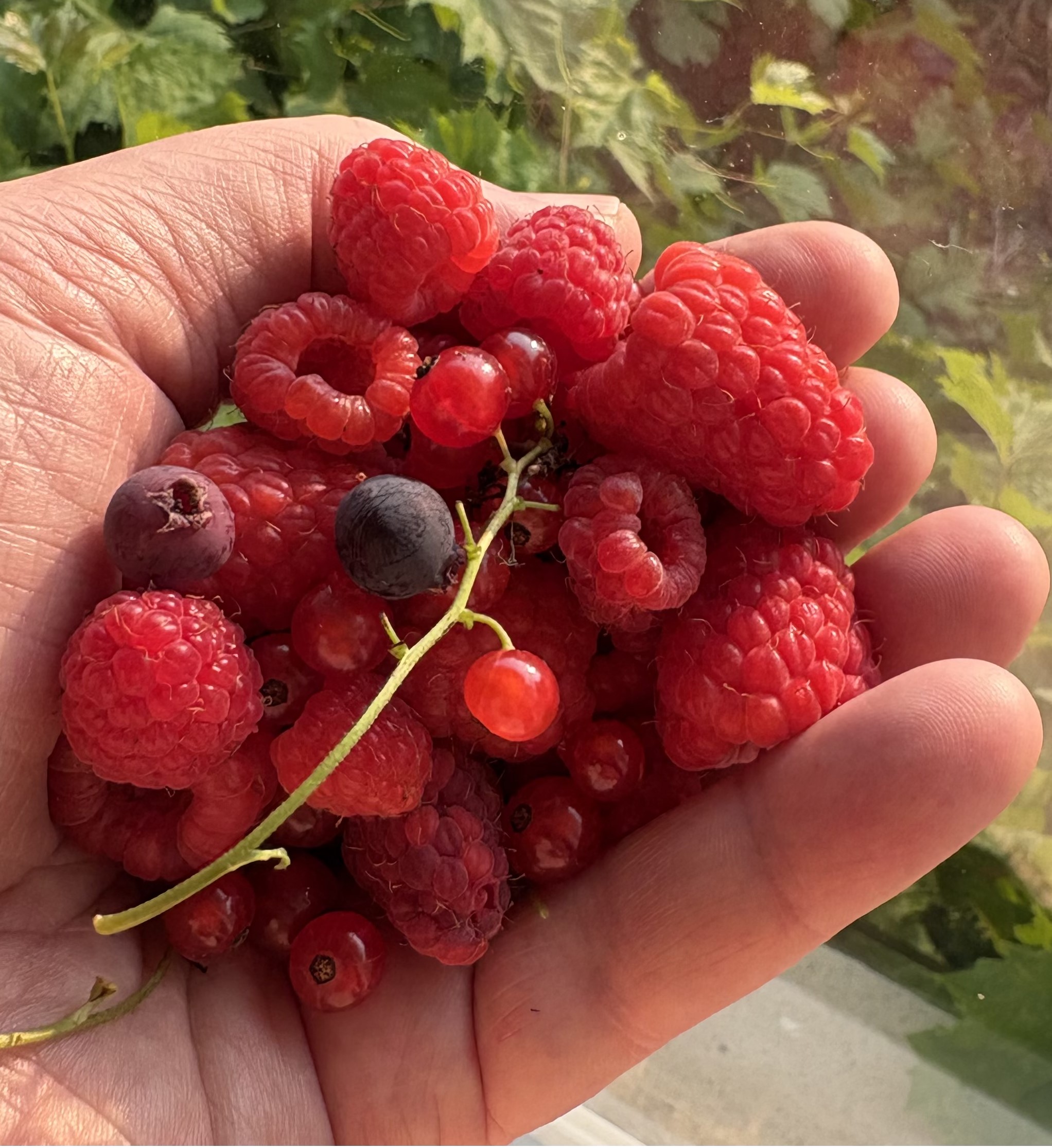
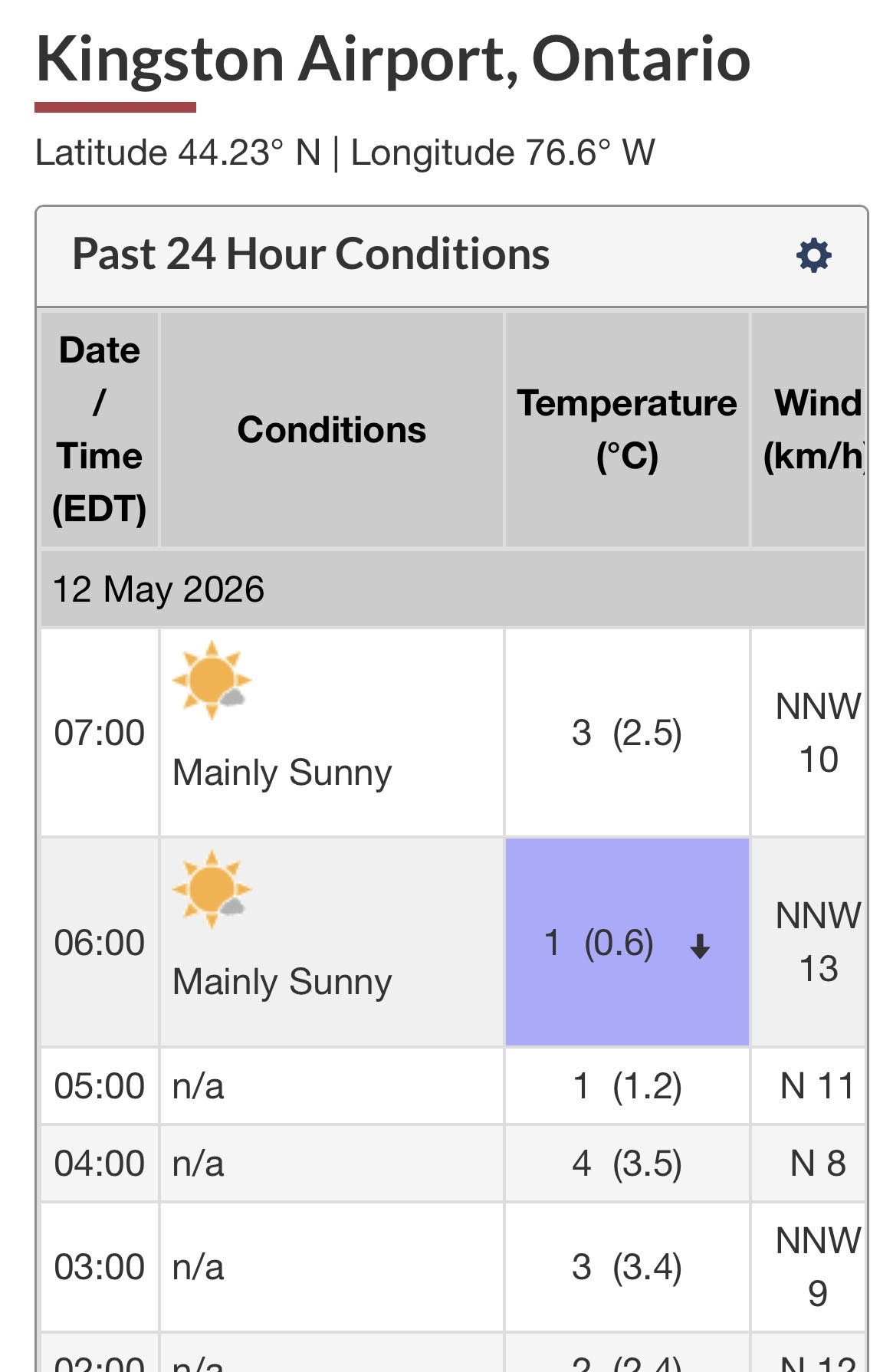
We all know that the swallows Capistrano in California and it’s all yada yada yada, right? But here – the Cowbirds are back. Yes!  See… I have an app on the phone that identifies birdcalls and sitting in the parking lot of a municipal park the other day it clearly picked up the squeek of Brown-headed Cowbirds, the parasitical arseholes of the birding world. Isn’t nature wonderful! Well, it is inside. The cukes and tomatoes still face a few light frosts keeping them indoors. That middle plant? Tumeric. Just stick a chunk of rhizome in a peat pot and keep the soil damp. Easy. Peasy.

What else is going on? First up, hot news out of Iowa this week and Ms. M. Ogle may have let a cat out of a bag over at BlueSky:

This is so sweet! @dsquareddigest.bsky.social defends Budweiser in part by relying on my book. (The essay is from 2007.) PS: I’m currently working on a 20th anniversary edition w new material. Release late summer.

Fine, that does seem a bit intentional. So save up your pennies for that wee treat later this year. The Tand himself likes a similar sort of straight forward discussion as he wrote about this week:

Way back in the past I wrote about how the modern mannerism “You all right there” at the bar had become a kind of of substitute for previous greetings such as “what can I get you?” or “what would you like?” For the record, it was a short blogpost, as this one will be, and it was over fifteen years ago and, inevitably, in the way of things, it has got worse. Fifteen years ago, I was by my measure of the day an old git – and I quote myself there. Nowadays I’m an even older old git and while generally good natured, I am slightly wound up, inwardly at least by how bar staff have become even more slapdash.

Perhaps this is what distinguishes a UK pub from the sort of port town tavern I was raised in.  I would not necessarily want to engage with the guy on the other side of the bar as, when I did, his side of the conversation could be more like “you call that a tip?” or “I got kids, you know…”  Speaking of which, it seems pretty obvious to me, if IKEA can sell discount meatballs to those waiting for the shopping for even more napkins and sidetables to be over, that a discount grocery store should be able to make a little something on the side by selling macro lager in a somewhat unattractive setting to those silently waiting for the groceries to be gathered:

German discount grocery chain Lidl has begun building its first ever pub, which is expected to open this summer. The pub and its associated liquor store, located in Northern Ireland, will offer Lidl’s range of wines, beers, ciders, spirits and liqueurs, according to the retailer. The premises will be located in the eastern Belfast suburb of Dundonald, next to one of Lidl’s existing stores, it said in a statement. The pub will be able to seat 60 people and will have a floor space of 60 squar meters (646 square feet).

As John Milton told us centuries ago, they are also served who would otherwise only stand and wait. Not waiting around at all is Katie M. who has justifiably strong feelings about the quality of news coverage of pub life in the UK, as she unpacked this week:

Pubs and beer will never receive the coverage they deserve in the national press because they are seen as lesser, until they elevate themselves to the point of being better than a mere public house. I agree with Sitwell that the Laddie is superlative, “a quite magnificent thrill” but I also note that he mentions one drink throughout the entire review, a pint of Guinness, despite the location being a pub and not a restaurant. Oh, I am so sick of Guinness getting all the headlines (sorry Padraig, it’s nothing personal.) The whisky selection! The wine list! The cask on offer at this place! It’s all carefully chosen by experts in their field with purpose and delight. It deserves at least a casual reference.  I love pubs. Millions of British and Irish people love pubs. So why are we still being offered so little in terms of pub and beer coverage? 

On perhaps a related note, I realized I had noticed something that I should have noticed before. When describing folk writing about beer and pubs, news media tend to describe them as “our beer expert“* while every other columnist on restaurants, theatre, music etc is the newspaper’s “critic.” Why is that and what does it suggest? Do they lack a certain edge that one sees, for example, in Boak and Bailey‘s honest and detailed weekly reviews? Would a news paper ever publish the words “somewhat muddy in appearance and flavour, like one of our own attempts at home brewing“? And when a paper clearly seems to have at least two, they never acknowledge the other one. Always “our beer expert” in the singular. Hmm…

The Irish Times has raised an issue about non-alcohol beers that is not discussed. We have heard and accept that the cost of production is no less than traditional brewing but what is not discussed is now it is often not taxed in the same way:

…walk up to a bar in Ireland and order an excise-free, non-alcoholic beer and you’ll pay close to the same as you would for the full-strength equivalent. This has been a bugbear for consumers for years. Three years ago, in a written Dáil answer, the then minister for finance, Michael McGrath, said pricing of these drinks was a matter for retailers and publicans. “This should reflect the fact that no excise applies to such products as well as other factors,” he said. A pint of standard beer comes with a 54 cent excise rate attached – its zero-alcohol partner does not… “The challenge with non-alcoholic beers is that there’s not much transparency here. A lot of this is very opaque and the private business of manufacturers.”

I have become a regular purchaser of NA Guinness but, thinking about it, I have no idea what role taxation plays in the final price. Speaking of things I never knew nuttin’ about, this very week Mr. R. Protz has opened my eyes to an even more troubling aspect of the beer related media:

While breweries & publicans struggle in a tough climate, trad beer writers work hard for lean pickings, a most lucrative “career in beer” is viral boozing. Jon May boasts “the best job in the world” earns £100k a year livestreaming drinking 10 pints a day. Downside: his health concerns.

Downside #2: taking advice from a drunk moron.  Upside: won’t last that long.  Lars may well have provided a hint as to the perfect soundtrack for these sorts of things.

Jeff gave us a summary of the Brewers Association stats for 2025 and it appears things ended up worse than expected:

Total craft production fell 5.1%, accelerating the decline last year of 3.9%.Overall beer sales declined slightly more, at 5.7%, allowing the craft segment to tick up to 13.3% of the total beer market. That’s way worse than the overall beer market did last year, when it declined only 1.2%. In terms of dollars, craft constitutes a quarter of the dollars earned on beer, unchanged from last year. The overall number of American breweries fell by 218 in the past year to 9,578 according to the Brewers Association (but please note that that figure is almost certainly overstated.)

Even with some pretty sad number twisting attempts, that’s a combined drop in production of over 9% for 2024-25.  And 2024 was not the beginning as (we recall from a footnote) craft production at that point had already “declined for the 3d year in a row and 4th year outta 5…” Didn’t expect an accelleration in the decline. But, again, has BMI seen the bottom?  Still… if there is a change coming, could it include a division between efficient and hand made beers? I saw a glimmer of this when Knut interviewed Nikklas, the brewer of Sweden’s Hops ‘n Leon who shared a thought that might lean towards a future schism in the making:

…we prefer bottles for our beer. I feel it also sends a message that this is craft. I feel that cans symbolize something more industrial.

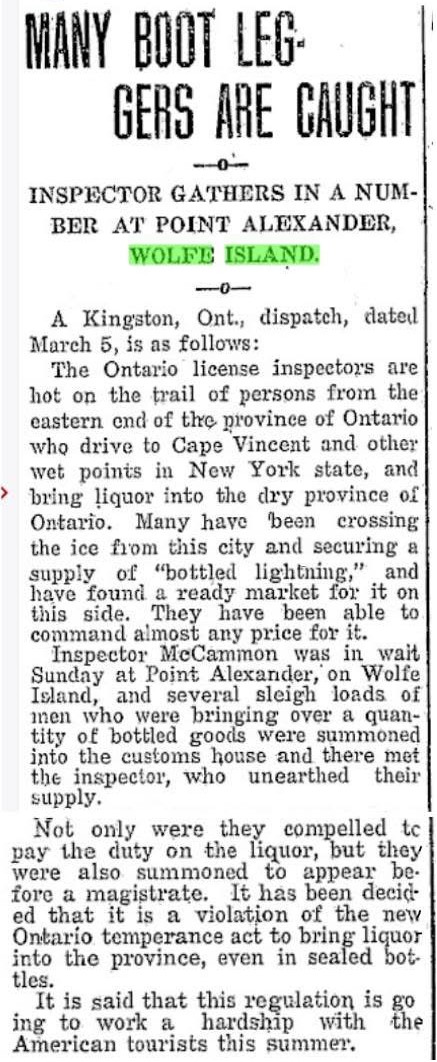
A revival of small scale traditional brewing might be interesting. Remember the good old days, I say. Well, the big news out of the March 8 1917 edititon of the Cape Vincent Eagle was the bootleggers. We discussed bootlegging last week but this bourbon-less era during tariff time has me on the look out for The Ontario Temperance Act of 1916 remained in force until 1927 whereas US Prohibition was the law across the river from 1920 to 1933. The ban on both sides of the border only lasted for seven years. Not that there wasn’t booze moving even during those days. One must always remember the testimony of Mr. Aikens , the man with “a host of friends” according to the Royal Customs Commission of 1927. But it is not all old news. A form of prohibition still exists as Drew in Boston noticed this week. Yup, bars at the Red Sox’s home of Fenway Park came under scruity for serving minors (aka young adults in an unfree state):

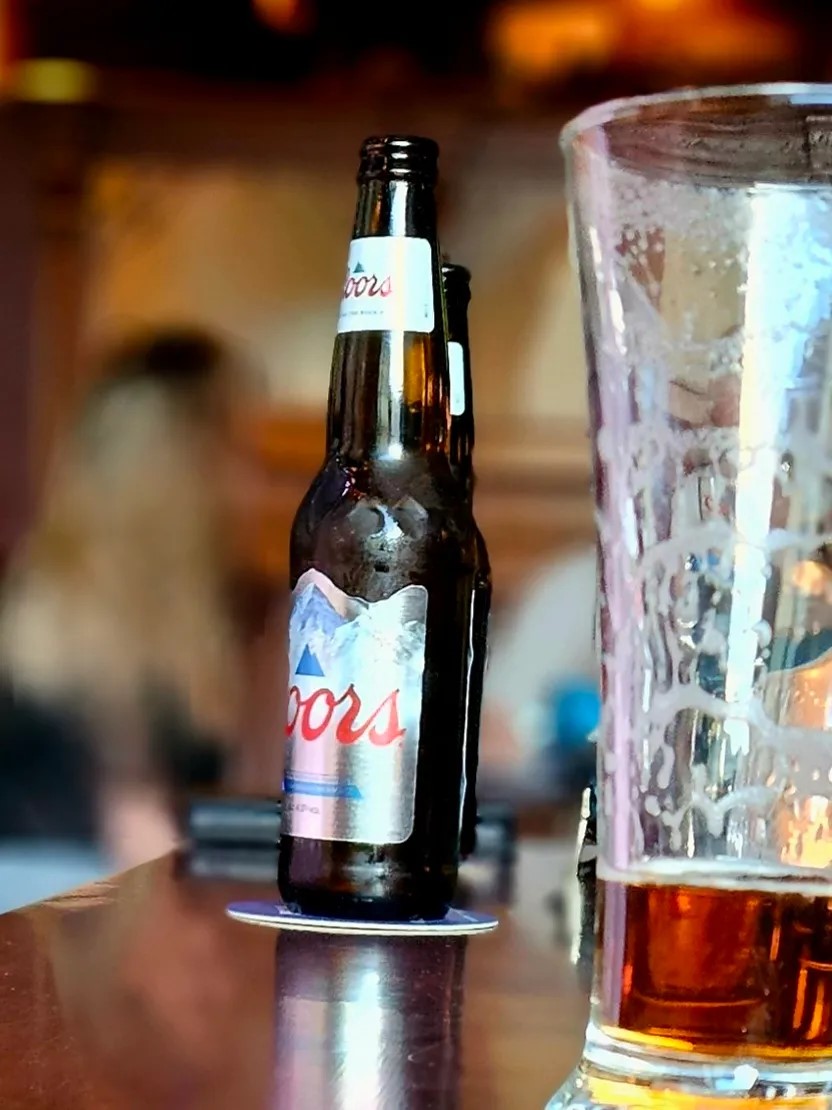
The state Alcoholic Beverages Control Commission has ordered Game On Sports Cafe, 72-82 Lansdowne St., to give up its liquor license for five days starting April 20 and Fenway Johnnie’s, 96-98 Brookline Ave., to give up its license for four days starting April 27, after inspectors found both serving underage drinkers with fake IDs. But Fenway Johnnie’s shut for good earlier this month, so, oh, well. The Game On suspension stems from a visit around 10:30 p.m. on Oct. 4, 2024 by state inspectors –  who found 17 people under 21 with drinks, from Coors Lite and Michelob Ultra to various vodka and whiskey-based concoctions.

Imagine being twenty years old and legally barred from drinking a Michelob Ultra!  Time for notes!

Note #1: Ramble On.
Note #2: “Had any bourbon lately?’
Note #3: Katie M. on the pubs and breweries of Cumbria.
Note #4: ATJ on travel and beer.

I miss Bourbon. Have I ever mentioned that? What else might I be missing? Ruvani’s piece about ranch water was published this week in Austin Monthly. Ranch water? She explains the drink’s background:

Founded by late local restaurateur Kevin Williamson in 1998, his original Ranch Water recipe hit the menu in February 1999, based on a concoction Williamson invented on hunting trips with his father, mixing tequila and lime in his water bottle topped off with crisp chilled Topo Chico. Williamson correctly surmised that his own refreshing treat would slake the thirst of other parched Texans and worked up his original recipe with two parts reposado tequila, one part orange liqueur (Ranch 616 uses Sauza Hornitos and Jalisco 1562, respectively), and one part lime, served over ice with a freshly popped frosty Topo Chico on the side to be poured to taste.

Not to be confused with Topo Gigio, Topo Chico is a mineral water from Mexico.

Finally, in their newletter to subscribers, Pellicle has announced some plans and asked for additional support:

Last month the team gathered in London to begin looking at the bigger picture, and discussed everything from the look and feel of the website (you might have noticed a little update to the homepage), the results of the survey you all kindly completed and how best to implement those findings, and—most importantly of all—to start making serious plans to launch issue one of our print publication….  You may also have seen we’ve recently ramped up our subscription drive, which is an important part of this.  Growing our subscriber numbers remains the most sustainable way to grow the resources we have at our disposal. More subscribers doesn’t just mean a print magazine. It means better rates for our contributors, proper support for our team as their workload increases, and potentially even the chance to invest in some of the kinds of content you indicated you might like to see in our survey: guides, short form writing, op-eds, personal essays, and travel stories. Our aim is to hit 1000 subscribers this year, which would mean growing our current number by around a third.

I cut and paste that much of a snipet out as I am myself a supporter. I root for them. Even as I have yet to figure out if Pellicle is a survivor or the conqueror in the beer publication field. The business model is prudent and realistic. The content is varied and often excellent. There’s good reason it gets so many links in these weekly round ups. And it still aspires to be more. Sign up. While I myself am at a heigher tier, their entry level subscription is just $2.50 a month via Paypal.

And that is it for now. As I adjust to the life of the idle and alive of a certain age, I will keep plugging away at these updates as best I can. For more, please check out Boak and Bailey who are posting every Saturday and adding to their fabulously entertaining footnotes week after week at Patreon. And look out for more of Stan’s new “One Link, One Paragraph” format. Then hunt out something in someone’s archives! Leave oblique comments on someone’s post from 2009!! Listen to a few of Lew’s podcasts and get your emailed issue of Episodes of my Pub Life by David Jesudason on certain Fridays. And Phil Mellows is at the BritishBeerBreaks. Once a month, as noted, Will Hawkes issues his London Beer City newsletter and do sign up for Katie’s wonderful self-governing totes autonomous website featuring The Gulp, too.  Ben’s Beer and Badword seems to be on pause since November but there is reading at The Glass which is going back to being a blog. Any more? We have Ontario’s own A Quick Beer and All About Beer is still offering a range of podcasts – and there’s also Mike Seay’s The Perfect Pour. Plus follow the venerable Full Pint podcast! And there’s the Craft Beer Channel on Youtube. Check out the archives of the Beer Ladies Podcast. See you next week!

*By contrast and fine example, Laura is The Telegraph’s “regular correspondent” which seems much more satisfactory.


And, Just Like That, We Are In Q2 2026… Can August Be Far Behind?

Springtime.  That’s what this is supposed to be right now. Yes, my Red Sox are out there choking as the season begins and, yes, my Leafs are out there choking as the season winds down. So the calendar looks like it’s on the right page for sure. But… where is that first sweater and shorts day I have been looking forward to? When will I be able to rake the lawn. Raking the lawn is an important old guy task. It leads to people leaving you alone, unsure why the lawn needs raking. You tell them “breaks up the thatch!” but they don’t know that’s just code. Code for there’s a couple of beer tucked away in the shed. Ah… the shed. See you soon!

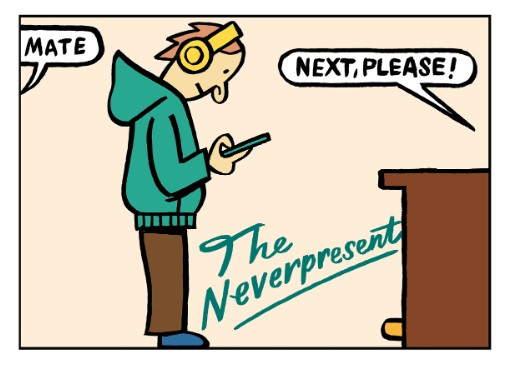
Meanwhile, in Pellicle last Friday, David Bailey‘s* cartoon featured the various postures seen at the pub bar. Is it ageist to say the one that struck me as most accurate was the one to the right? As a newly minted retired guy I can say these sorts of things. Isn’t that how it works? Like raking the lawn. Because you need to break up that thatch, right?

Next up, Katie wrote about one of my favourite cities due as much to the depot for bus route 128 to the villages of the fam as anything. But, Ms. M. does know a good spot when she sees one and this week we read about her thoughts at the sight of Kay’s Bar:

Once a wine and spirits shop in a nefarious part of town where the streets ran toxic with sewage and the tenements were cramped and filthy, Kay’s Bar is now uncommonly beautiful. Like most cobbled and higgledy-piggledy neighbourhoods in the UK, Jamaica Street has a “dirty past” as local pub writer Imran Rahman-Jones puts it, but now it feels pleasantly historic, and the low stone buildings around us are picturesque. When our group comes upon the pub in the early hours of dusk, the side doorway glowing golden in the darkening blue.

As the son of a son of MacKenzie Street by Cappielow in Greenock, I recognize the lineage.

Beer writers talk lots about being judges but not a lot about being amongst the judged, the position which carries a lot more weight to my mind. But this week Alistair wrote about entering and receiving the results of three beers he entered into competition:

There is a large amount of irony, given what I just said about crystal malt, in the fact that this used 5 types of crystal malt, 15, 40, 60, 120, and 260, as well as dose of chocolate wheat. Hence I named this Crystal Conjunction. It’s kind if hilarious then that one judge commented that the “absence of balancing caramels and light roast/chocolate impact the overall character”. Literally all the specialty malts were crystal or chocolate malts. Obviously mild is not something that is wildly common, heck it might as well as an endangered species over here, but I have come across a concept many times in the US that a mild is basically an uber session stout – which is simply not true, the range of possibility within mild makes it a beer you can take in so many directions, as borne out by the BJCP guidelines themselves.

And Jeff was on the otherside of the glass, having judged at the Oregon Beer Awards with this interesting comments on process:

In judging these beers, you do take style into account, along with the brewery’s submitted notes on the beer. If you have a beer that just lists a style, you judge it both as an example of that style and how well it competes against the other beers at the table. If the brewery has added a note, you include that in your calculation. A beer might be dinged for being a poor example of its style but elevated for being just an awesome beer or vice versa. If the brewery says it has hibiscus or rye malt or is “American-style,” we would expect it to taste like rye, hibiscus, or elevated hops. You take all of that into account.

Speaking of the limits of the aphorism “judge not lest ye be judged” we are advised that this is not an April Fool’s Day spoof:

Tilray Brands is partnering with the Magnum Ice Cream Company to launch Popsicle Hard, a ready-to-drink cocktail inspired by the frozen treat brand’s classic flavors. The noncarbonated beverages are beginning to roll out nationwide in 12-can variety packs. Popsicle Hard has a 5% alcohol-by-volume rate and is available in cherry, orange and grape flavors. Tilray is producing the drinks through a licensing agreement with Magnum Ice Cream, which was spun out from Unilever at the end of last year. 

Ah, fads… or was that a spoof! Perhaps with about 97.38% more integrity, this week Boak and Bailey investigated the resurgence of Bass on cask in English pubs this week and found hope in the new enthusiasm:

What makes us think that it might, on balance, be good news is that it’s good to see people – and especially younger drinkers – expressing enthusiasm for cask ale. The Bristol Flyer on Gloucester Road in Bristol is one of those perfectly fine vaguely gastro, vaguely loungey pubs. The quality of the beer has been up and down over the years but recently it’s been serving excellent Bass. Jess often ends up there for one social event or another and on a recent visit was amazed when the hip young barperson said, with full emotion, “Oh, great choice, I love Bass, I drink it all the time! And it’s been flying out since we started selling it.” At The Crown we’ve similarly seen groups of hipsterish young men ordering rounds of Bass, getting their Bass club cards stamped, and generally embracing their identity as Bass Guys.

Bass Masters would be my choice of terms… had others not moved in on the opportunity. And if you asked how big Guinness is in the US these days… would this be the sort of response you’d have expected, as reported by BMI?

Import lagers are nearly 97% of all imported beer in US scans, per NIQ xAOC + Liquor + Conv data for 52 wks thru Mar 7, Bump Williams Consulting’s Dan Wandel found in latest data deep dive, following up on his past analysis of American lagers. Guinness stouts and Belgian ales make up most of the rest, growing nicely these days. 

I wonder if 2026 Guinness regrets the Baltimore closure in 2023.  As you ponder that, here are some notes:

Note #1: do you have a third condiment?
Note #2: is using the word “founder’ just cringy or worse?
Note #3: don’t forget to have fun.
Note #4: are you still hunting the next great beer?

Are you back? Good. Franz D. Hofer has been attracting attention with his wanderings out and about and then his writings all about it at A Tempest in a Tankard – but now he has joined the collective with his first piece at Pellicle, a study of things Zoiglly… Zoiglich?… Zoigl-riffic!

Tucked away in the dense woodland of northeastern Bavaria, the Oberpfalz is the cradle of Zoigl culture. Zoigl is more than a kind of beer. It’s an ethos, a resolute defence of a slower way of life in the face of our contemporary desire for on-demand pleasures.  Zoigl begins life in the communal brewhouse, a holdover from the late Middle Ages. More than seventy towns in the Oberpfalz presided over communal brewhouses in the 19th century. Today, only five remain: Windischeschenbach, Neuhaus, Falkenberg, Mitterteich, and Eslarn. Residents in possession of historical brewing rights take turns from week to week brewing beer that they’ll ferment in their cellars and serve for a few days every month in their Zoiglstuben. You’ll know the beer’s ready when they hang a six-pointed Zoigl star from the façade.

Carry on with the medieval history, according to The Times and some eggheads, turns out that Pinot Noir is effectively a clone of itself going back to the 1400s:

Scientific proof has now been found that pinot noir grapes, used to make red Burgundies in France, have survived unchanged at least since the Middle Ages. A 600-year-old grape seed found in the latrine of a medieval hospital in Valenciennes, northern France, has been identified as genetically identical to modern pinot noir through DNA analysis, according to a study… By taking cuttings rather than growing from seed, winemakers can produce a new plant that is genetically identical to the mother vine. For the study, the researchers sequenced the genomes of 54 grape seeds dating from about 2,000 BC to the Middle Ages. The oldest seeds were from wild vines in southern France. Domesticated vines appeared in the region much later, between 625 and 500 BC, when Greek colonists introduced viticulture in France.

On a more serious and immediate note, if you want an easy measurement of the effect of the third Gulf War in my adulthood, Jessica Mason for DB has surveyed the consequences on India’s beer trade:

In a recent report via Reuters, the Brewers Association of India openly revealed that glass bottle prices have risen by around 20%. Added to this, packaging such as beer cartons have doubled while labels and tape have also become price affected. Gas shortages are now also forcing a raft of glass bottle makers to slow or stop their operations. Plus, aluminium can suppliers are also signalling that there will possibly be imminent reductions in the lead up to summer… “Beer businesses are particularly vulnerable when oil and gas prices rise because the impact is felt at several different points in the chain,” Molly Monks, insolvency expert at Parker Walsh, recently told db. 

Hmm. You know… I have this creeping feeling that we are at March 5, 2020 unaware of the full impact of what is about to hit. With that cheery note, finally, as heavily hinted, I have joined the idle undead. I hope to be not quite as idle long term but these days my pj bottoms are finding new life in the am to pm zone. Can’t rake lawn thatch every day. So…. what to do… while way the hours pressing the fish doorbell? Or instead of that maybe this, drawn from an anecdote about Japanese writer Haruki Murakami:

…long before he became a famous writer, he ran a jazz café in Tokyo, called Peter Cat. People would come in, quietly drink an espresso or sip a single malt and listen to Miles Davis and Charles Mingus LPs on a great sound system. If anyone talked too loudly, or maybe at all, the other customers shot disapproving glares. The point wasn’t to yak or troll for a companion; it was to just sit there and listen attentively without distraction. Bars like that, known as jazz kissa, were popular back in the 1970s when Peter Cat was at the height of its fame. Now, according to National Geographic, they’re spreading to cities around the world…

I like the sound of that sorta place… but what about this place? As part of my inward thoughts, I reached out to B+B on what I might do with this space and these blistered bloody digits of mine.  They shared a number of ideas via email and these two particularly struck me:

We also remembered the work you were doing around pre-1800 beer styles and brewing, which does feel overlooked. All those Derby Ales and Pimlico Ales and Dorchester Ales and the like. There’s such a strong pull towards writing about Victorians and later that this period — with sources that are harder to find an interpret — feels overlooked. We also tend to pounce on any work anyone does with meaningful analysis of data and stats. So much beer writing is about feelings and experience but numbers often reveal deep truths.

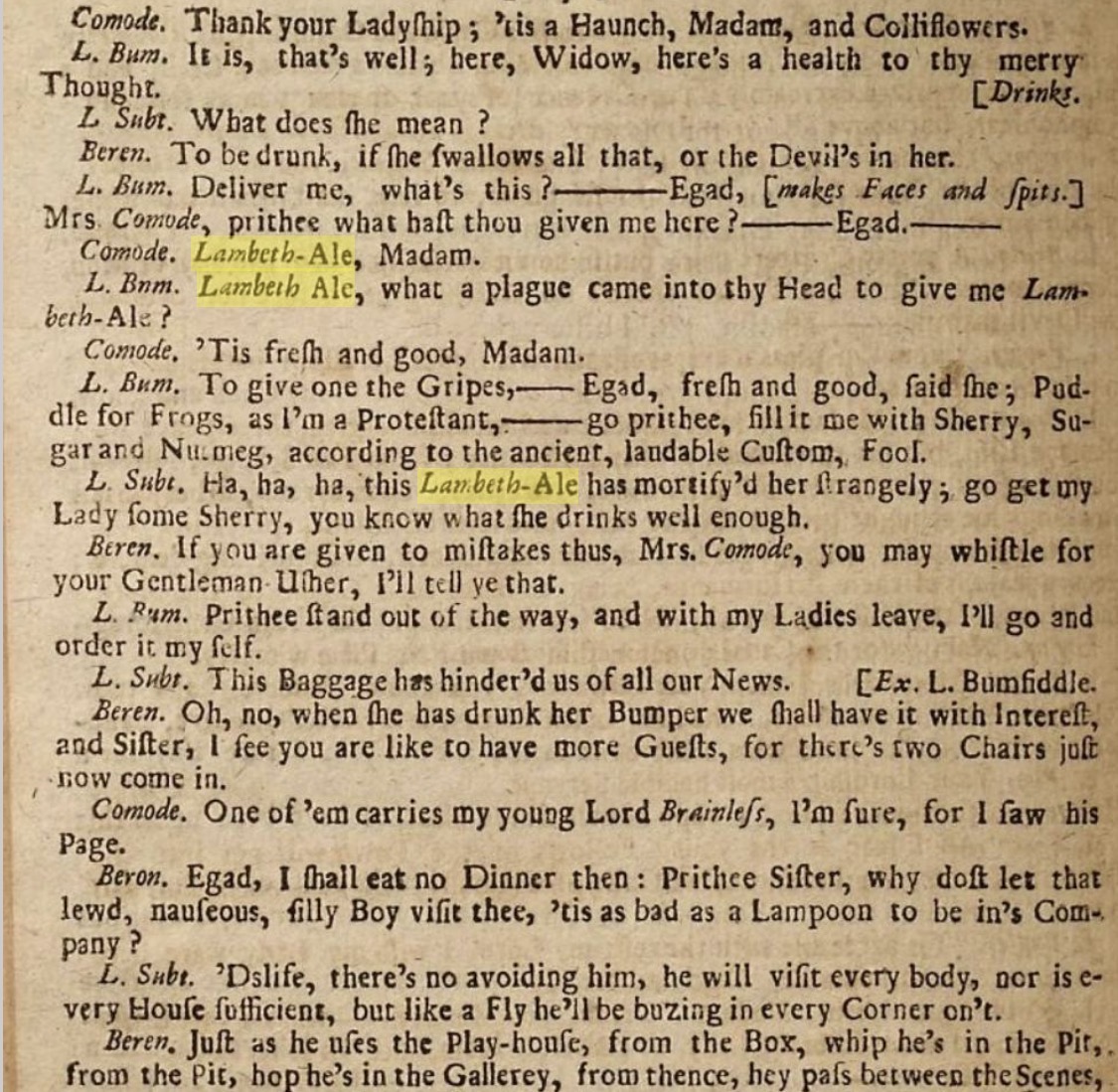
Both have the common theme of avoiding the easier path. My challenge with the first (like the 1600s Lambeth Ale or 1700s Dorchester posts) is it feels like the rise of the internet oligarchs has made easy (and free) access to reasonable organized data bases more difficult than ten years ago. I will have to investigate. The second? It’s the math. I always thought that when I was aggregating any sort of numbers and seeing what I could squeeze out of them, well, my grade 12 math teacher was standing nearby reminding me of my couragous 53 as a final exam mark. So whenever I ran some sort of beery data or another through Excel sheets I usually received “ERROR! ERROR!! ERROR!!!” responses. So… any requests? Perhaps “Shut ‘er down, Al!”? or “Take up knitting, you fool!!!” Who knows. Comments greatly appreciated.

Well, that was that. The week that was. A bit of a hard week on the nerves. Until the day I got to sleep in. That was good. We see how the next week goes. In the meantime,  please check out Boak and Bailey who are posting every Saturday and adding to their fabulously entertaining footnotes week after week at Patreon. And look out for more of Stan’s new “One Link, One Paragraph” format. Then hunt out something in someone’s archives! Leave oblique comments on someone’s post from 2009!! Listen to a few of Lew’s podcasts and get your emailed issue of Episodes of my Pub Life by David Jesudason on certain Fridays. And Phil Mellows is at the BritishBeerBreaks. Once a month, as noted, Will Hawkes issues his London Beer City newsletter and do sign up for Katie’s wonderful self-governing totes autonomous website featuring The Gulp, too.  Ben’s Beer and Badword seems to be on pause since November but there is reading at The Glass which is going back to being a blog. Any more? We have Ontario’s own A Quick Beer and All About Beer is still offering a range of podcasts – and there’s also Mike Seay’s The Perfect Pour. Plus follow the venerable Full Pint podcast! And there’s the Craft Beer Channel on Youtube. Check out the archives of the Beer Ladies Podcast. See you next week!

*No relation.


The Even More Fabulous Yet Slightly Chill Mid-January 2026 Beery News Notes

“CORK HEAD! CORK HEAD!!

There really is no need for any further update this week is there. Andreas Krennmair posted an image of the “old interior of Schneider Weißbierbrauerei, presumably from before the rebuild 1901-1903” and this scene above was one of the tiny vignettes sitting in the back of the overall bar scene.  I can’t figure out if these gents are playing that old favourite, a game of “I’m a doggie, cork my brainpan!” or… the means by which this particular men’s club informed a candidate that they did not pass the initiation process. I find the physics involved problemative but, you know, art.

First off, some excellent reporting out of The Soo on pricing after Ontario’s expansion of beer sales to corner stores compared to grocery stores, the big brewery owned TBS as well as the government’s own booze agency the LCBO;

The editorial team bought two beers, a mass produced lager and a craft beer, as well as two bottles of wine from several locations around the city to find the best – and worst – deals in Sault Ste. Marie… A tall can of Molson Canadian will run you $3 at the LCBO, compared to progressively worse deals of $3.03 at Rome’s Independent, $3.14 at the Beer Store, and $3.81 at Circle K. For a can of Great Lakes Brewery’s Octopus Wants to Fight, the results are tighter – coming in at $3.75 at all locations but Circle K, where the surly octopus comes out to $4.04 per can. All told, a Canadian is 21.2 per cent cheaper at the LCBO than at Circle K, and Octopus Wants to Fight is 7 per cent cheaper everywhere other than Circle K.

I would point out something about that otherwise excellent research. Circle K sometimes has a nutty nutty sale price for a few pretty decent Ontario craft brews. I pop in once in a while when I am picking up a tank of gas just to check in.

And while I have been known to hover in and about the snack aisle of corner stores, I am not a taproom devotee. Too often they strike me as car dealership showrooms – “would you like to see the latest model except (in a fourdoor / with even more Citra)?” – but it was interesting to see Stan consider B+B’s thoughts on the key underlying principle involved;

It appears I may regularly come across taprooms with personalities than Boak & Bailey, but I wouldn’t argue cookie cutter establishments aren’t abundant in the US. Also, B&B tend to write short paragaphs and I try to stick to one. Their following words zero in on what I value in drinking establishments, that they are “run by human beings.” The others, without personality, I tend to forget. I acknowledge they exist, but I don’t have to think about them.

Speaking of places run by human beings, we have a new beer blogger alert. Colston Crawford, the recently retired pub and beer columnist with the Derby Telegraph has decided to continue sharing his thoughts on the topic including how the notion came to him:

It was a lunch at The Crispin in Great Longstone, in the Peak District, a week after I finished which firmed up the idea in my head. The food, the drink, the service, the ambience, was so good. I sat there thinking, if I still wrote a beer column, this one would be easy. I could dash it off right now. I’ve made two more visits to The Crispin since, the first to confirm that the previous one wasn’t a fluke, then the second was unplanned. I was with friends in a party of five, walking on New Year’s Eve morning, but the venue they’d fancied for lunch wasn’t open. The Crispin was five minutes away and a superb lunch followed.

There’s a lot of good advice in there. It is easy to keep a low pressure blog about something you have a general interest in. A striking experience will make for a good story. And it’s good to review the experience a couple of times to get the facts straight, too.

And Boak and Bailey shared an extended thread of thoughts on why people in the UK have cut back their visits to the pub with plenty their own interesting thoughts and those of others who joined in. I agree with their thought #7:

7. Basically, we’re not convinced the pub crisis is especially acute *right now*. In 20 years of blogging, and nearly half a century of being alive, we’ve never really known a time when pubs weren’t doomed and in decline. 

One of the things that concerns me about that form of doomsaying is that it always seems to be decontextualized as if pubs closing is the only difference since 1976.  Fewer are also going to church, too, over that same 50 years of existence. Many more play video games than before that point and I would expect more tofu is sold in the NATO countries. Preserving past practices as opposed to preparing to guide them through change is a bit of a fool’s errand.

Note #1: only available in Alberta, Saskatchewan, and Manitoba.
Note #2: Beer’s “Santa Claus Rally”.

Me, I’ve never developed a taste for collaboration beers but apparently the revenue authorities in Finland have, as The Beer Nut noted.  The EBCU has taken a position on the matter:

Finland is currently considering new excise-tax guidance that would effectively make many collaboration beers impossible for small breweries. Under the draft interpretation, if a beer shows more than one brewery’s name or logo (as collaborations typically do), it could be treated as “licensed production” and the breweries could lose their small-brewery tax relief for the entire year. This would impact not only Finnish breweries, but also imports and international collaborations—ultimately reducing choice for beer consumers.

This is an excellent example of the sorts of issues related to identity that can pop up in law. Obviously, if the non-brewing collaborator (let’s call them “the collaborator”) insists on putting their intellectual property in the form of a logo on a product, they are saying to some degree that the product is their work. Yet, for taxation categorization, that logo placement is argued to not indicate that the work is theirs but, instead, only the work of the brewer (let’s call them the collaboratee”.) I have no stake in the matter and have no idea how Finnish taxation policy plays out in term of brewers compared to cheesemakers or lumber yards – but I do have one raised eyebrow when I see these sorts of statements as part of the EBCU’s argument:

Collaboration beers are one of the joys of modern beer culture…  we believe consumers deserve choice, diversity and fairness. Collaboration beers enrich the beer landscape, strengthen friendships across borders and introduce consumers to new styles and tastes…

Wouldn’t the better argument be that collaboration beers are just a fun reciprocal staff training exercises for brewers that is only, for tax purposes, a businees expense and a burden upon revenue that is of little interest to consumers? After all, if one cannot detect the taste of collaboration beer… does it really actually exist?

Jeff had some interesting thoughts this week on hopeful hints he might be seeing in the US hop market and what it may mean about how breweries are reacting to the retraction, concluding:

…a last comment from me. As we exit the period of craft beer’s novelty era, when breweries made dozens of IPAs every year, it looks like it’s impacting not just the amount of hops brewers are buying, but the diversity. When I talk to brewers about new hop varieties, they are often hazy about them and most are not sampling every new one that comes out. Brewers seem to be more interested in hop products as a way of enhancing their beer. These products focus on the most popular hop varieties, which increases the “stickiness” of the major varieties.

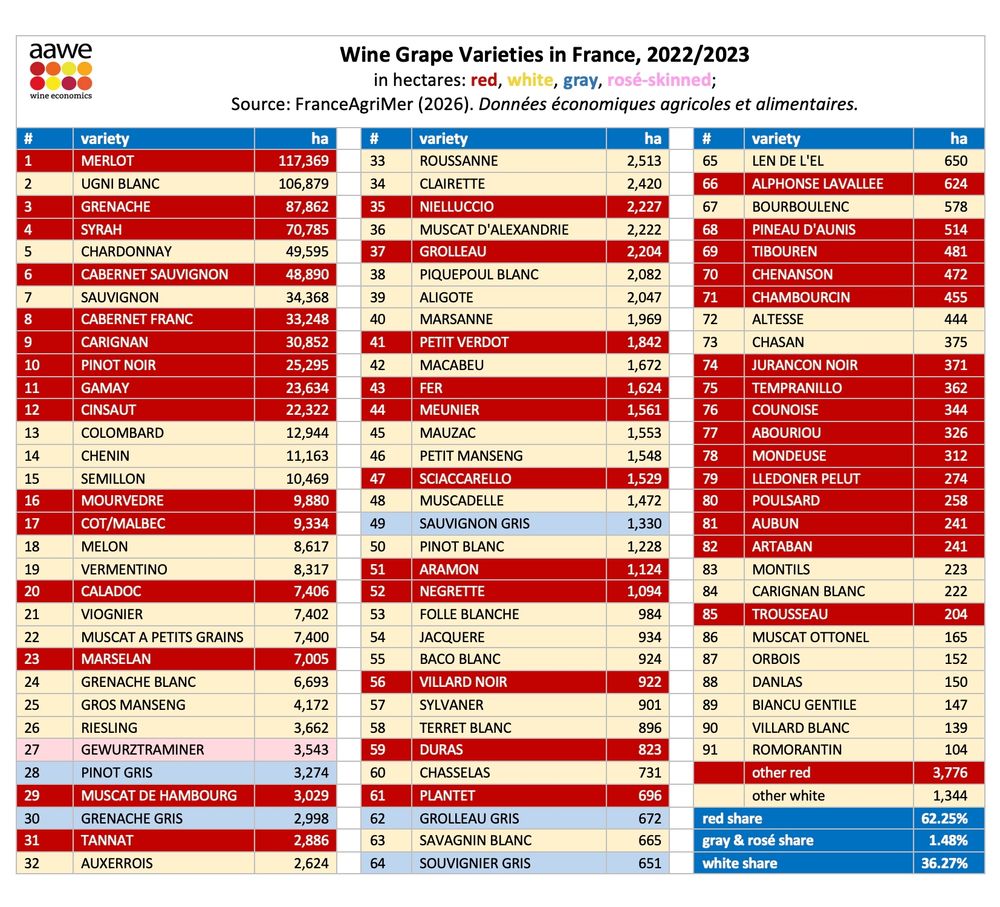
Speaking of varieties, have a click on that image to the right. It’s a list of the top 100 plantings of France grapes posted by the American Association of Wine Economists the other day drawn from an agency of France’s agriculture ministry. I don’t have much comment about it other than to note, despite the pop culture slur, how much good old merlot* is still grown as mentioned by E. Asimov the other day in his discussion of wines you may want to explore.

Good news for cideries and brewers of New York. In this week’s “State of the State” speech, Governor Hochul announced support for local producers, as noted by KK in related to cider makers:

New York is the country’s leading hard cider producer, boasting more active cideries than any other state. Our cider industry has grown substantially over the last ten years, generating over a billion dollars in total economic impact for New York, yet there still remains untapped agri-tourism potential to explore. To support the industry and tap into the robust agri-tourism opportunity that cider presents, Governor Hochul will work with the New York Cider Association to establish New York as the State of Cider, marketing the orchards, tasting rooms, and food experiences that could become anchor destinations for visitors across the country. These actions will strengthen rural economies, uplift the exceptional work of local businesses, and establish New York as the foremost destination for American hard cider.

The Governor also indicated the “need for modernizing licensing across the board, from sports bars and cafes to airport lounges, hotels, and movie theaters.

Conversely perhaps, Pellicle‘s feature this week is a post mortem by William Georgi of the Dutch brewery Nevel Wild Ales which had lofty and noble goals linked with but quite experimental standards:

“We were doing two expensive and time-consuming things at the same time,” he says. “Making a complex product that only a small selection of people actually like, while trying to set up a network of local farmers. A food forest like this is wonderful, but you can’t use it to make beer, as it doesn’t host perennial one-year crops”… Social sustainability was equally important for Nevel. The network of local producers Mattias established for sourcing ingredients—from hops and barley to chestnuts and kiwi fruit—showed him the challenges of farming at a small scale. “It isn’t economically viable at all,” he says. “Even if there’s a living wage being paid, the price doesn’t take into account the fact that most people harvesting the crop are volunteers. 

It’s pretty clear that the plan was not designed to pay its own way. Volunteer labour and crowdfunding plus unbudgeted expenses like organic certification were certainly signed that the business as a business was build on a weak foundation but I like one conclusion that was drawn from the experience: “…I don’t think Nevel failed. I hope I planted a lot of seeds in people’s minds about how things can be made differently.

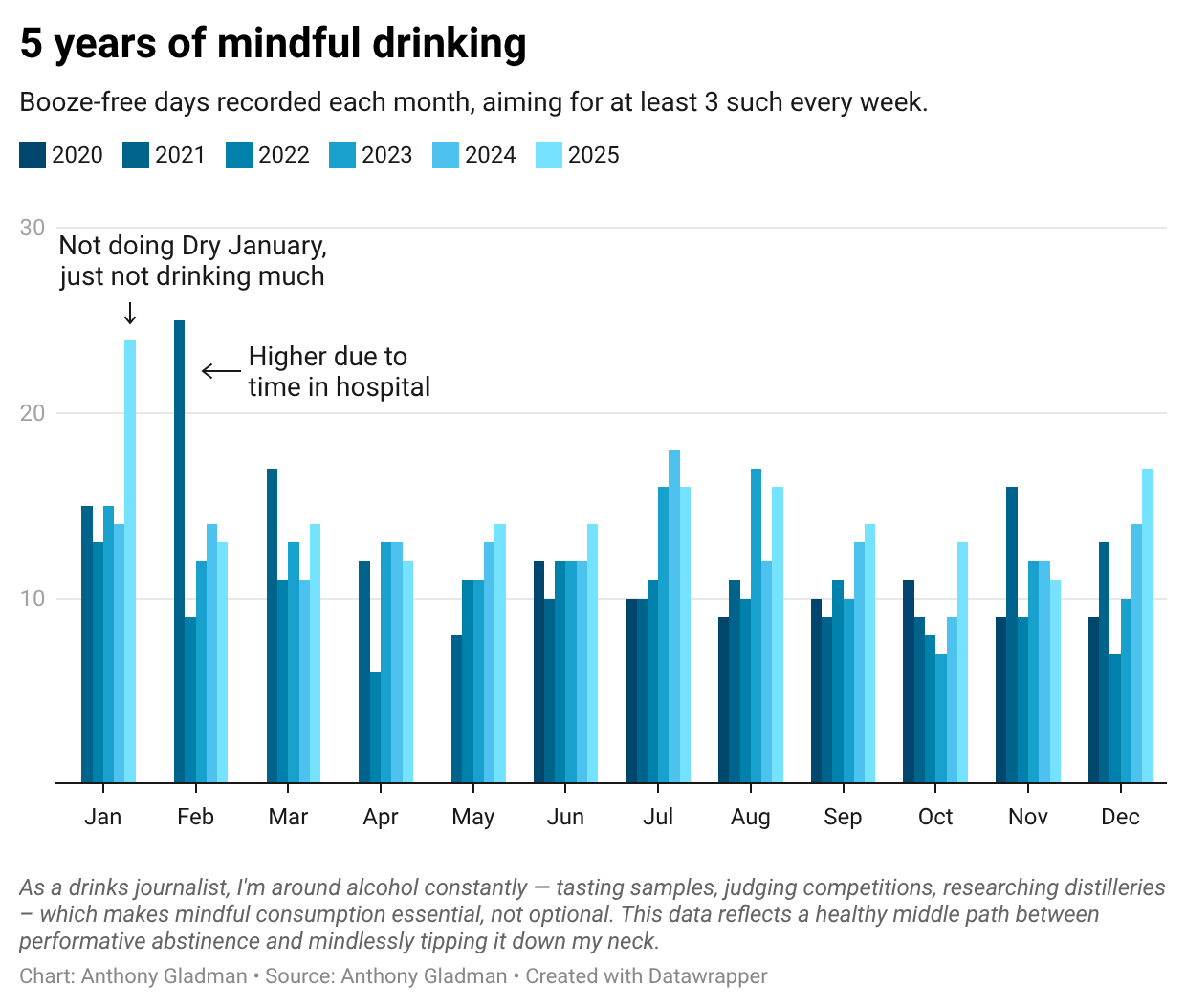
There was an excellent example of the old visual display of quantitative information** in A.G.’s post this week on Dry January. He shares my interest in maintaining data:

I find it helpful to keep a tally of days I drink alcohol and days I don’t. Nothing complicated, just a binary yes or no, and an aim to have at least three days off the booze each week. That’s all it takes for me to stay within healthy limits, despite working in an industry that can normalise and encourage dangerous levels of consumption. (If you recognise yourself here, check out The Drinks Trust.) Anyway… it’s Friday evening. The first one of the year. I’ve not had any booze since New Year’s Eve. Soon I will go downstairs, crack open a bottle of something nice, and have one or two drinks with some pizza while I stream a crappy-but-entertaining film – January be damned.

However sweet that bar graph, I am more a percentages guy, currently at a total of 52% dry days and 63% one or nones over the years since early November 2021 when I started keeping track. My booze budget this year is also set at around 1.33 a day, an average I beat by a few last year. Checking on that number from time to time – as well as your AST blood test numbers – are great ways to manage the hobby.

While we think on that, think on this. In the northern hemisphere, the darkest ten weeks of the year are already behind us. Soon be planting those tomato seeds. While we wait for that, Boak and Bailey are posting every Saturday and adding to their fabulously entertaining footnotes week after week at Patreon. And look out for more of Stan’s new “One Link, One Paragraph” format. Then hunt out something in someone’s archives! Leave oblique comments on someone’s post from 2009!! Listen to a few of Lew’s podcasts and get your emailed issue of Episodes of my Pub Life by David Jesudason on certain Fridays. And Phil Mellows is at the BritishBeerBreaks. Once a month, as noted, Will Hawkes issues his London Beer City newsletter and do sign up for Katie’s wonderful self-governing totes autonomous website featuring The Gulp, too.  Ben’s Beer and Badword seems to be on pause since November but there is reading at The Glass which is going back to being a blog. Any more? We have Ontario’s own A Quick Beer and All About Beer is still offering a range of podcasts – and there’s also Mike Seay’s The Perfect Pour. Plus follow the venerable Full Pint podcast! And there’s the Craft Beer Channel on Youtube. Check out the archives of the Beer Ladies Podcast.

*Once upon a time, the LCBO here in Ontario stocked Millbrook Merlot from a Hudson Valley, NY winery. Then Rufus Wainwright sang about the area. Went to the winery once around a decade ago. This is been this week’s edition of “wandering thoughts with Al”.
**I couldn’t live with anyone missing the reference.

Your Festive Beery News Notes For A Blursday In This Jolly Hollifest

What day is it? I think I can still recall. It’s definitely somewhere between the last parcel being mailed and 2026. I know that much. I also know that in 2009 one Stan Hieronymus, possibly barely out of his teens at the time, submitted this photo above as one of his entries in the Christmas photo context. I will say one thing about a beer photo contest – if you don’t like your range of browns you might as well admit that you should never run one. Like the other contest submissions I have been posting out of the archives the last few weeks, I am pretty sure this one didn’t win a prize – but have you ever seen a better placement of a five gallon white food service bucket? No. Come to think of it, do you ever give a second thought for the glorious role of the five gallon food service bucket in all of brewing? Stan did. For one beautiful moment, he sure did.

Let’s get to the beer news. First up, another controversy related to booze and the ticker:

…the American Heart Association has revived the idea in a scientific review that is drawing intense criticism, setting off a new round of debate about alcohol consumption. The paper, which sought to summarize the latest research and was aimed at practicing cardiologists, concluded that light drinking — one to two drinks a day — posed no risk for coronary disease, stroke, sudden death and possibly heart failure, and may even reduce the risk of developing these conditions.

Before you go off to the Christmas office party with the thought that it’s really not all that far off a visit to a health spa, remember the critics’ warnings about the quality of all these sorts of studies: “Some are clearly horrible, some are good, but a lot are in the gray zone, and people may just cherry-pick and select those that agree more with their narrative.” Hah! So there…

Speaking of the office party at this time of year, the very same authoritative organ shared a bit of advice about conduct at office parties for the supervisory set:

It’s a good idea to stop after two drinks. Sure, you could have three drinks — or six! — and enjoy the social leveling and bonhomie that accompanies lowered inhibition and decreased cognitive capacity. But it’s hard to command respect in the office when people have seen you red-faced and trying to light a cigarette from the filter. 

Is it unfair to compare today to forty or so years ago? The (other) Times did this week when they republished a guide called “How to Survive Christmas” from 1986:

Commuting in the run-up to Christmas is absolute murder. On the way home from a hard day’s work you are liable to find everyone either festively drunk or helping someone else to be sick. Then there’s the office party. People will drink far too much, lunge at one another, tell the managing director he’s a twerp and pour the office vegan’s sprout wine down the word processor to cackles of mirth. How do susceptible males stay out of trouble at the office party? One friend suggests that offices should introduce Tube straps hanging from the ceiling. Thus you could remain vertical however much you knocked back, but with one hand in the strap and the other clutching your glass, both would be kept out of mischief.

Good idea. While it appears that thirty-nine years have passed since that was published, it’s clear ther are still bad behaviours that need to be stamped out at this Holly Jolly time of year, as Pete reports from the pub:

Black Friday has a different meaning in the hospitality industry. It’s not the consumer frenzy of late November, it’s the last Friday before Christmas. This is the night when post-work drinks climax in a frenzy of ill-advised shots and poorly judged flirting. For pubs, it’s one of the busiest nights of the year.

And then he gives ten rules, many of which would be enough to deter me from going to the pub. No line? Never have liked that when visting the fam. How un-Canadian! Give me a good line any day. But “no ordering a round of cocktails“? Perfect sense. No playing your crap music off your phone? Automatic ejection, I say.

Speaking of bad behaviour, I missed this tale of sticky fingers a few weeks ago but I will share it now as this could end up being quite the thing… perhaps quite the thing indeed:

Molson Canada has accused former managers of embezzling millions of dollars in an intricate fraud scheme allegedly involving fake vendors, shell companies, the president of a major pub chain and a pair of married couples. In documents filed Wednesday in Ontario Superior Court, the brewing giant claimed that former Molson Canada sales director Frank Ivankovic oversaw “a complex scheme to defraud the company of many millions of dollars” that later involved two subordinates.

Holy crap! Gotta watch that story. You may scoff at the very thought but I will share a fact that is actually true – I had a personal banking representative many years ago who made a very tidy sums on false mortgage accounts until the scam was uncovered. As this situation at Molson is reportedly both complex and intricate, I am spellbound and await further disclosures from any and all court processes.

Speaking of people who can’t tell their left pocket from their right one, in the land of Vinho Verde the police have had to get involved:

Those arrested from the trade body, which is responsible for quality control and official certification of Vinho Verde wines, belong to its Inspection and Control Division, with the individuals arrested for allegedly warning wineries of upcoming inspections and accepting bribes of meals, wine and event tickets. According to Portuguese newspaper Jornal de Notícias, the officials also allegedly turned a blind eye to wine producers failing to meet the requirements to obtain designation of origin (DO) or geographical indication (IG) certification to be able to label their bottles as Vinho Verde…  Meanwhile, a further four “business owners involved in the distribution and production of Vinho Verde” – have also been arrested, charged with “active and passive corruption, falsification of documents and abuse of power”.

Doce mãe de deus!!!  Fiddling with the Vinho Verde!?! That has been a mainstay in my life for around forty-five years, starting with my mother’s micro-obsession with the plonky version. Not unrelatedly as it turns out, Lars found some dirt about law scoff doing a little farmhouse brewing in Japan, news that he shared on BlueSky:

The Japanese are less law-abiding than I thought: farmhouse sake brewing continued despite the legal ban. In 1941 folklorists surveyed 85 localities, finding home brewing in 44 of them…  In 1895 there were 1 million home brewing licenses in total. So Japan definitely had farmhouse brewing of sake. Then in 1886 the gov’t banned home brewing entirely. Probably killed the farmhouse brewing. Home brewing is still illegal in Japan (gov’t wants its alcohol taxes), but in 2003 one exception was made: farms using their own rice are allowed to brew. This kind of sake is called “doburoku”. There are now 100 designated doburoku districts where this style exists.

That could make for something very interesting, a doburoku tour… doburoku tour… doburoku… WAKE UP!!! Sorry. Now… some notes:

Note #1: “only 37 percent of craft breweries in Canada are profitable”? Really? That’s a lot of subsidization.
Note #2: Who the hell pours Bailey’s down the sink?
Note#3: A.I. designed beer? Nope, couldn’t care less…

Aaaaannnnnd… the BA issued a somewhat delicately drafted “year in review” type press release suited to both address and deflect the industry’s annus horribilis and, I gotta tell ya, I sorta choked on what is stated to be the top trend:

This year, there was a continued democratization and expansion of what it means to be a “brewer.” With acquisitions, mergers, and collaborations, the stainless tanks in the background may not be as important as the brand story.

As one who has never given a shit about the story someone is telling about a brewery, I think if I were an actual brewer I might consider this statement slightly, you know, treachery if not treasonous. But it is nice to know that, finally, years after the BA’s abandoning the need to be small or traditional or independent it’s now not even necessary to be an actual brewer.

Much more reliable was the annual release of the Golden Pints 2025 awards from Boak and Bailey which starts with this introduction to the concept.

What can we say? Hardly anybody else bothers doing this anymore but we’re creatures of habit. We first took part in the Golden Pints back in 2011 and find it a pleasingly reassuring ritual. It’s also good to have in mind throughout the year as we roam from town to town, and from pub to pub. It makes us look at the beer we’re drinking and ask: “Could this be a contender?” Before we get down to business, a bit of encouragement: nobody owns the Golden Pints thing; anyone can join in; you don’t even need a blog to take part. Post your own list on social media as a thread, or even in the comments on this post if you like.

I won’t ruin the announcement of their winners – but what I like about the whole Golden Pints idea is that it celebrates their winners. Was it started by the late great Simon Johnson? He posted his thoughts in 2010, 2011 and 2012 but perhaps it goes back further. Yes, Mark Dredge awarded them in 2009 and even cited his own pre-GP “best of” post of 2008. Who was his best beer Twitterer of 2009? Simon Johnson! Who else? Anyway, you can check out the examples new and old and figure out your own summary of the year according to your own standards.

In another annual year end tradition, Alistair has begun to announce his beers of the year, style by style. His first post celebrates the pale based on three footprints – state, national and imports:

It’s that time of the year, the Winter Solstice is upon us, and what better to do than to review a year’s worth of drinking? As has become my own tradition, I will break this down into multiple posts, one for pale beer, one for BOAB (“between orange and brown”, and dark, and then an overall beer of the year, as well as one for Virginia cider of the year. As I have done for several years now, I will highlight beers from Virginia, the rest of the US, and the rest of the world before crowning each category winner, so on with the show…

I liked this comment: “Spoolboy, the most perfect desítka imaginable, and one that I wish I could sit and drink with Evan, Max, and co back in Prague.” That would be a good table to join.

Over at Pellicle, Robyn Gilmour shared the story of an innovation in Dublin’s beer scene:

…the beer that’s consumed in the majority of Irish pubs isn’t even Irish, with the exception, perhaps, of Guinness, Murphy’s, Beamish, and a handful of other outliers that are brewed locally but owned by foreign multinationals. While treasured in Ireland, these brands do not represent the full spectrum of the country’s beer, which is far more nuanced and varied than most pub offerings would suggest. Speak to anyone working in the independent Irish brewing sector and they’ll soon tell you about the savage competition for taps in Ireland—primarily between Diageo, Heineken, and Molson Coors. As someone who’s worked with many of these smaller breweries, I’ll admit I never had prior reason to question where publicans fitted into this dynamic. That was until 2024, when 16 of Dublin’s most cherished pubs banded together to form a brewery of their own—the aptly named Changing Times.

Finally, David shared his thoughts on language and alcohol promotion, thoughts based on serious personal experience:

…this kind of communication is terrible in the run up to Christmas when more people are tempted into drink driving despite the messaging. Recalling the trauma caused by my dad drink driving was bad enough but only days later I was forced into recollecting my flatmate’s attempted suicide when BrewDog ran an advertising campaign with the slogan “tastes like commercial suicide”. 

As I mentioned a few weeks ago, much of my experience with drunk driving was from an earlier stage in my professional career as a duty criminal defence counsel processing those passing before the court for judgement. But I also lost a client of our office every year to a drunk driver in those years, too. And I probably have to admit that up to a certain point growing up in Nova Scotia in the 1970s and 80s, drunk driving was so common there was an inevitable even blasé attititude to the tragic harms done. There were so many Mondays that someone was not at their locker. So I don’t buy arguments that there is a risk reward sweet spot in these matters. The vast sums that the booze trade offers do not offset the loss.

And that may sound like a bummer of a way to end the news notes for the lead up to Christmas but this is a high danger zone within the calendar for drunk driving and other forms of harmful behaviours. So be thoughtful and be safe as you do about the holiday partying in these next few weeks. Maybe think of what else can be done that is as helpful as a London Underground strap hanging from the ceiling to make sure the season actually remains jolly.

As you contemplate that, please also check out, Boak and Bailey on this and every Saturday and then sign up for their entertaining footnotes, too. Look out for Stan when he feels the urge (now that he’s “retired” from beery news posts) from Budapest or wherever – as he is getting active again. Then listen to a few of Lew’s podcasts and get your emailed issue of Episodes of my Pub Life by David Jesudason on certain Fridays. And Phil Mellows is at the BritishBeerBreaks. Once a month, as noted, Will Hawkes issues his London Beer City newsletter and do sign up for Katie’s wonderful self-governing totes autonomous website featuring The Gulp, too.  Ben’s Beer and Badword has returned from his break since April so you can embrace the sweary Mary! There is reading at The Glass which is going back to being a blog. Any more? We have Ontario’s own A Quick Beer and All About Beer is still offering a range of podcasts – and there’s also Mike Seay’s The Perfect Pour. Plus follow the venerable Full Pint podcast! And there’s the Craft Beer Channel on Youtube. Check out the archives of the Beer Ladies Podcast.


Yes, It’s Here – The Tryptophan Thursday Edition Of The Beery News Notes

Four Weeks to Christmas Day!!! O.M.G.  I have bought nothing. For nobody. Nada. Not Nuttin’. Crap. For some it is too late! Speaking of Christmas, Laura H. has some very interesting art for sale that might be perfect for your favourite beer nerd… err… expert. I invite any one of you to buy me*  this her lovely representation of barley to the right. Far more less fleeting than a newsletter subsciption yet fewer calories than a beer. I should be in marketing.

And Eoghan shared another seasonal idea, a beer advent calendar on his newsletter:

Starting tomorrow – Tuesday 25 November – and running every weekday from now until 19 December, this newsletter will become its own kind of advent calendar of a kind, with me sending a short missive each morning from one of Brussels’ 19 municipal communes. As this newsletter’s tagline goes, these will be short observations on life in Brussels, trying to capture the feel of each of these areas, and/or my relationship with them.

A great discussion erupted on BlueSky when the news broke that heled explained many of the details related to the move of America’s oldest brewing school, the Siebel Institute, from Chicago to Montreal:

The Siebel Institute of Technology, the oldest brewing school in the Americas (established in 1872), is officially relocating its operations from Chicago, Illinois (USA) to Montreal, Québec (Canada) effective January 1, 2026. The new location address will be 3035 rue Sainte-Catherine E, Montréal (Québec), near Molson’s original brewery site (1786), the oldest brewery in North America. Siebel will be co-located with the new Lallemand Baking Academy and Application Technology Training Facility. 

Siebel has been owned by Lallemand Inc. of Montreal for about 25 years so it makes sense.  The press release also explained that “[r]ecent regulatory changes in the U.S. have made it much more challenging for many of our international students, who have become the majority of our student body, to attend classes in person.” Recent grad Drew indicated that about a third of his teachers there were not U.S. citizens. Two administrative staff – the program’s “heart and soul” – may lose their positions.

Speaking of good discussion, Jeff had a talk with himself on the question of Jeff Past and Jeff Future and the question of taste:

If only we could give those pour souls in 1975 a cup of Coava coffee, or in this example a Fresh west to 1995 drinkers, it would change their lives. But that’s not how things work. Beer has evolved partly because we have evolved along with it. All you have to do is look at different beer regions to see that the process of evolution can lead to very different places. It’s quite possible that for 1995 Jeff, the clouds wouldn’t have parted upon drinking a can of Fresh West. I might have found it off-putting in any number of ways. I liked bitterness then, and body, and just a bit of cheese grater that came from the bitterness/hop-matter synergy. It was like being slapped across the face, but with the flavor of caramel malt, and I liked it. I might have thought Fresh West was a cop-out beer, all candy aromas and no punch, not like a proper beer. I’m not sure there will be a 2055 Jeff or that he’ll be drinking beer (I’ll be 87), but I wonder what he’ll be drinking? It might be something I’d find distasteful today. Hmmm…

As we ponder those thoughts here is some straight up filler:

Note #1: David caught some late autumn light at the pub.
Note #2: Another David posted some sweet photos from a recent visit to a  lambic bar, the Grote Dorst, including a Girardin eye view.**
Note #3: The Boot Inn is still there.
Note #4: Is an influencer with only 24,000 followers actually an influencer? Or just a deadbeat?

But not cheap filler*** as there was plenty to quote from under each of those links. Think of it more as “make your own Thursday beery news notes!” Invite your friends to play along!

Back to the deets as Hop Queries version 9.07 came out this week and Stan shared an interesting observation about Nelson Sauvin that sorta parallels the changes you can notice through each spring’s maple syrup production:

The Nelson Sauvin character (in a normal season) goes through a progression from i) somewhat vegetal and dominated by green fruit character (gooseberry, etc.) to ii) brighter citrus-y with grapefruit-like notes to iii) bright, wine-y and complex with passion fruit notes to iv) building tropical complexity with brighter citrus fading to v) super tropical with sweeter citrus notes to vi) tropical with light dank and solvent-y notes to vii) fading tropical with lots of weird, random characters ranging from O/G to berry fruit. Extremely late Nelson Sauvin tends to vary quite a bit from season to season and can express a wide array of characters, including appealing and un-appealing ones.

A wide array of character? Something like myself. Speaking of deets, this week’s feature in Pellicle by Fred Garratt-Stanley goes where too few stories dig into – back of house at The Fat Cat:

Only when you walk through The Fat Cat’s cellars can you truly appreciate the size of the operation. Underneath the bar there’s a well-stocked keg cellar with four cask lines, but it’s out back where the magic happens. There are two gleaming, air-conditioned cellar rooms lined with stillages, each of which holds somewhere between 30 and 40 firkins and pins that are either tapped up or settling down. Beyond the glass washers are multiple store rooms and an additional cellar, where a handful of the pub’s biggest-selling beers are racked up in huge, 18-gallon vessels. The site is vast, responding to a level of turnover established over decades spent serving reliable, perfectly conditioned cask beer. 

I have worked back of house in a playhouse, bars and restaurants, on election nights and, of course, have seen the backs of many things through law. It is all very good interviewing an owner in the front and hearing the stories but digging into the back and underneath of things where the unpretty can be found tells you what is really what. Are the corners clean? Is the staff sullen? That’s great work up there.

And The New York Times ran a story this week on Germany’s waning interest in beer:

Germans are drinking a lot less beer. “In recent years it was always 46 percent, 47 percent, 48 percent who said, ‘Yes, I drink beer,’” said Marc Kerger, president of Einbecker, referring to consumer surveys. “And this year just 41 percent. Forty-one percent is dramatic.” Alcohol consumption in Germany has been sliding for decades. But the sudden, accelerating drop has caught brewers and bar owners by surprise.

Twist in the tale from Jörg Biebernick, the chief executive of Paulaner: “Half of our sales in Germany are actually non-beer…” What are people doing if they aren’t out on the big binge? According to The Guardian, at certain exclusive clubs they may be on the little one:

For all the talk of generation Z eschewing alcohol, drinking shows no sign of dying out. There are indicators of restraint – the Manchester dessert menu features a two-sip, 60ml mini-version of an espresso martini, for £7, if you prefer an alternative to stodge – and there is “a pocket, from 26- to 30-year-olds” who drink less, says Carnie. But the bigger trend is toward “clean” cocktails, with fewer ingredients and less sugar. The multicoloured, juice-laden, bafflingly named cocktail is old hat. “I get it, because if I go to a bar, and I don’t understand the menu, it annoys me,” the barman tells me. “A cocktail isn’t cheap. If I’m spending money on a cocktail, I want to know I’m going to like it.”

And Katie illustrated another aspect of what’s been going on it terms of culture change at a personal level:

…sometimes I don’t drink because of my MH, sometimes I don’t drink because I don’t feel like it, sometimes I don’t drink because I’m training the next day and want to sleep properly. Don’t raise eyebrows, don’t make it seem like I’m pregnant. Don’t be a dick. Just say okay.

Sleep. Sleeeeeeeep. Katie is spot on in many ways. But still, also in the NYT, there are still people experiencing this sort of night:

Through the window of a dark restaurant we saw a man illuminated by a disco ball who was singing from his chest. He waved at us. We waved back. He unlocked the door and invited us in. Over a bucket of cold Singha, we sang “Happy Birthday.” The owner brought out a brownie topped with a blazing flare on the house. I apologized for the intrusion. “Please kick us out any time,” I said. He smiled and handed me Post-its and a pen. “Just make a list of songs,” he said. Another bucket of beer appeared, along with some peanuts. It was a beautiful night, and we had found something dumb to do.

I have made a point of excelling at finding something dumb to do. To the contrary, Jordan visited a tiny brewery in TO that’s won Best New Brewery in Canada in the 2025 Canadian Brewing Awards.:

At Bickford, what you see is what they have. The space, whose colour palette includes a lot of orange, can’t sit more than 30 people at a time and one assumes that on nights when Dungeons and Dragons groups come in, the only place for drinkers must be at the bar. The main space is not quite as large as a midtown one bedroom, but has been retrofitted as one of Toronto’s smallest breweries. Usually I have to guess at the size of brewing equipment, but everything is labeled. Andrew is brewing 250 litres at a time.

And David J. has shared the background story of another desi pub, the The Century Club in the Forest Gate section of East London which was born from 1970s bigotry as owner Peter Patel recalled:

“We went to the Wheatsheaf,” he recalls. “We didn’t know that in the evening it used to get bikers coming in and they chased us out.” Peter faced similar prejudice in those days when he visited a pub with friends in Lewisham, South London, where I now live.  A racist purposely spilt his drink on him, claiming Peter had tripped him up and demanded more than another drink. The atmosphere turned rancorous, the publican sided with the attacker and the Asians were kicked out despite already spending about £40 (the equivalent of £300 today). “It was a lot of money as a pint used to be under a pound then,” he says. “We did nothing at all. That’s when I decided we needed something for Asian people.”

What else? Well, the ISBFX declared an ending**** and Ed noted another sort of end of things, the end of CAMRBG:

…when a heresiarch founded a protestant beer sect called the Campaign for Really Good Beer (CAMRGB) in opposition to our mother church I was not filled with pleasure that I get from say, reading about nestorianism. I must confess that in my arrogance I had come dangerously close to advocating for something similar to the CAMRGB in the early days of beer blogging. Back then whinging about CAMRA was something we all enjoyed…until I realised some of the people were not whinging about the home team but were in fact the opposition. I repented my sins then, and despite my occasional confusion over theological matters and distaste for modernism, my faith has not been shaken.

Fine, one or three more notes:

Note #6: “This is the cheeriest Norfolk pub I’ve ever been in…
Note #7: Rogue left $16.7 million owing to others after earning only $19.7 gross revenue in 2024.
Note #8: Pink Gin in Interwar China.

Lastly, we talk a lot about beer and monks but Kathleen Willcox reminds us in DB that they established much of what we understand about wine classification, too:

After Rome fell and the Early Middle Ages ushered in intellectual decline and infrastructural decay, monastic orders did not just preserve wine culture; they elevated it. Monks across Europe, particularly Benedictines, Cistercians and Cluniacs, planted vineyards, documented practices and sustained international wine trade. Burgundy became ground zero for evolution and innovation. The observant Cistercians, who owned vast vineyard holdings, first noted how separate vineyard blocks produced different results. They were the first to record these observations, linking differences in wine to soil, climate and elevation. Their careful mapping of micro parcels on the Côte d’Or laid the foundation for the cru system and the modern concept of terroir.

There. That’s it for this week. The United States is in a gravy soaked reverie that may well last into early December. As they/you recover, please also check out, Boak and Bailey on this and every Saturday and then sign up for their entertaining footnotes, too. Look out for Stan when he feels the urge now that he’s retired from Monday slot… maybe … maybe not. Then listen to a few of Lew’s podcasts and get your emailed issue of Episodes of my Pub Life by David Jesudason on certain Fridays. And Phil Mellows is at the BritishBeerBreaks. Once a month, as noted, Will Hawkes issues his London Beer City newsletter and do sign up for Katie’s wonderful self-governing totes autonomous website featuring The Gulp, too.  Ben’s Beer and Badword has returned from his break since April so you can embrace the sweary Mary! There is reading at The Glass which is going back to being a blog. Any more? We have Ontario’s own A Quick Beer and All About Beer is still offering a range of podcasts – and there’s also Mike Seay’s The Perfect Pour. Plus follow the venerable Full Pint podcast! And there’s the Craft Beer Channel on Youtube. Check out the archives of the Beer Ladies Podcast. That’s quite good and after a break they may well be are back every month!

*…or, yes, anyone you care for than me… if that’s even possible!
**I got a couple of these well over a decade old, the remnants of the stash. probably should open one to check see.
***Or… actually… I don’t know what to think. Hope it was worth it.
****As in read to the ending…

The Beery News Notes For The November Lull Marking The Five-Sixths Mark of 2025

It’s Canada up here and I gotta tell you we have entered the lull.  Pals who work in the hospitality trade in these parts know that between Halloween last week and Remembrance Day next week there is a bit of a drop as we perhaps contemplate some bigger things. Like tightening up the house before the snow flies. Like those final chores to put the garden to bed. Like finding about 35 pounds of tomatoes under just one frikkin’ tarp. Holy smokes. Any recipe suggestions for green tomato chutney can be left in the comments and will be seriously considered… given the circumstances.

First up, I liked this recent brief New Yorker review of Barcade, a joint video game and craft beer bar:

If you play it right, a visit to the new, FiDi outpost of Barcade—the hybrid arcade and craft-beer bar that originated in Williamsburg twenty-one years ago—leads to a quasi-inter-dimensional portal. Your first move, after entering, is to advance to the stone countertop on your left. Survey the chalkboard menu, rich in I.P.A.s, and choose according to your mettle. If that means the Evil Twin Pink Pineapple, prepare for a goblet of roseate brew whose tartness zaps the mouth like a laser. Explore your surroundings. 

I particularly like how the intergallactic laser theme is the tie between the beer and the games. Ten years ago, the same bar was featured in a Jack Black vignette in the same mag but the only the food was mentioned:

He took a bite of his burger, and his eyebrows soared imperatively: “Dude, this Barcade burger? Awesome!” 

Reaching even further back, Liam shared the results of some recent research on efforts by Guinness in 1896 to exert control over the Irish stout market:

This appears to be a damning (if clunkily written*) indictment of a new policy by the Guinness brewery to force those who choose to use the Guinness label to only bottle their stout porter and no other. These days this might be dismissed by many with a shrug and a comment about Guinness just being Guinness but it appears that at the time the other breweries in the city were rather incensed by this behaviour to the point where they issued what could be seen as a full page proclamation under the title ‘Protest of the Dublin brewing Trade Against the New Guinness Label’ where they called out Guinness on what the claimed to be its attempt to establish a monopoly under the guise of wishing to stop adulteration, plus the mislabelling of others’ product as their own.

And The Beer Nut was also sharing this week, this from BlueSky: “What psychopath thought jackfruit Maibock was a good idea?” Indeed. The perils of judging. Possibly relatedly but quite possibly not, David Jesudason pointed me to another peril related to beer scribbling under UK law that I had not been aware of – the taxman cometh:

In news that will have seen some beer writers crying into their gifted Fuller’s Vintage Ales, HMRC has recently clarified that content creators must declare all donations as income on their self-assessment tax return. That’s right. Those crates of beer, jets to foreign breweries and VIP festival passes will now have to be taxed at their market value. (Disclaimer: this is HMRC so some of the guidelines are as muddy as a drain pour smoothie IPA.) It’s caused a few privileged writers to heroically proclaim that they are now refusing unpaid press trips and goodie bags. These virtuous announcements can only mean that a period of austerity will have to be endured; if you see a downtrodden freelance scribe at the bar, maybe buy them a half.

Yup, tax dodging is a serious thing as the makers of Campari have recently found out:

The Italian authorities allege that the holding company, Lagfin, which is controlled by the Garavoglia family, committed tax fraud. The value of the shares seized equates to the tax in question. They will be held until the case is resolved. Lagfin controls 51.3% of the shares in Campari and 38.8% of the voting rights of Davide Campari Milano NV, which is now registered in the Netherlands. The drinks group moved its formal registration to Amsterdam in 2020 to benefit from advantageous tax laws and to exercise tighter control of the company through Dutch company law.

Oopsies!! I have to admit, this next story has me a bit confused. It appears to be an assertion that the British Beer and Pubs Association (BBPA) that the sum total of Britons’ feelings of loneliness relate to the closure of pubs, relying on numbers which appear to exceed perceptions of societal isolation during the pandemic lockdowns:

Research, gathered from new polling by the British Beer and Pubs Association (BBPA) has shown that two out of three (67%) people see pubs as “vital” in the fight against isolation. According to the results, one in three (33%) revealed that they, or someone they know, have experienced increased loneliness as a direct result of losing their local pub… According to the most recent Office of National Statistics (ONS) figures from October 2025, it was discovered that 26% of Brits report feeling lonely at least some of the time, a figure that has remained consistently high since records began in 2020, during the Covid pandemic.

CAMRA presented the same line. I suppose the pandemic is far enough in the past now that co-opting it for commercial purposes isn’t seen as an appropriation of, you know… death. What an odd way to present the poll. Surely, then, it was just coincidence that the NYT had a story on the dangers of placing trust in single issue poll results:

Policy proposals very often overperform in issue polls, according to a recent study that looked at available polling and ballot measure data across 11 topics from 1958 to 2020. The findings apply to both liberal and conservative causes. The more popular a policy is in polls, data showed, the more likely it is to underperform on Election Day. These polls distort our democracy in important ways. Political parties shape their agendas and priorities based on polls that appear to overestimate support for these ideas in the real world. This can make politicians more extreme; if they believe their causes have public support, they will be less likely to moderate.

[You know, I should quote from “a recent study” more often. They’re great.] Still… loneliness for the pub of youth? Makes sense. Was all this the reason that Matty L came out of cryo-hiberation (literarily speaking) and wrote a portrait of a particular Preston pub in peril? Probably not:

The sole survivor of a Victorian terrace, it’s on the side of of a Y-junction, surrounded by sketchy-to-cross roads and large retail units,  There’s very little chance a bog-standard pub with a bog standard drink selection would survive long there, and indeed the vast majority of pubs in the area have closed down in the last 30 years.  Luckily, at this time the whole “craft beer” thing was taking off.  Rich duly installed microbrewed cask ales on the pump, and probably Preston’s first ever “craft keg” selection on the taps.  It duly opened in May 2014, to so much local publicity that even I went there for the opening… I assume keeping all these balls in the air must get exhausting after a decade or so, and a couple of days ago Rich announced he was moving on from The Moorbrook in January.  As such, the future of the pub is up in the air…  

And Boak and Bailey also had a honest evaluation of – and even a yearning for – one former favourite pub near them in Bristol, the Swan with Two Necks:

The bogs at the Swan aren’t its best feature (soap and water on this visit, but no dryer) and the roast potatoes aren’t exhibition quality. But who cares when (a) the atmosphere and (b) the beer list are so bloody good? We think there was certainly a wobble over the summer when punters were thin on the ground and the management was having to disentangle itself from a reliance on beers from Moor. But, yeah, it’s still a great pub, and it’s definitely going to be in our 2026 Bristol pub guide.

No dryer? Me, I take an old fashioned handkerchief for such moments. Because I am old. On a similar theme in terms of noticing the details, ATJ also wrote of a moment at anthother pub past:

The fluffy cockerpoo wagged its tail as it looked at me, while I noticed a couple sitting at the bar; meanwhile a bulky man in Irish rugby shirt rushed past to the gents, disturbing the dog. The music had changed and it was now an almost electro version of (Don’t Fear) The Reaper. Outside the light continued its fall from grace and it was time for me to go to the Albion.

I could quite easily be lonely for those sorts of things, too, I suppose. Maybe. The cockerpoo. A bulky man?!? Speaking of one’s local, Jeff shared a recollection of running into both Evan and diacetyl in Prague:

Typical for any immigrant who lives in an adopted city long enough, Evan long ago absorbed the preferences of Czech drinkers. One of these was an indifference to diacetyl. Or perhaps more accurately, an agnosticism to it. He explained it to me as we sipped buttery pale lagers at his local. Czechs don’t take a position on diacetyl. Like any drinking public, Czechs have certain considerations about what makes a good beer. It should have some meat on its bones, some hop bite in the finish. It should be crystal clear. Above all, it should encourage another sip, another half-liter, and another after that. Diacetyl is just not one of the things it must have or must exclude.

Exactly. What is accepted is real but real is such a cultural construct. For example, we see that Pellicle published a set of top tips for the English pub goer from the good crew that gathers at the magazine – but a few of these have me scratching the old brain bucket. First, the intro in which the scene is set:

….a certain level of pub decorum must also be preserved. All good pubs have unwritten codes of conduct that, over time, become instilled in the people who use them regularly. It is the responsibility of those who live by these codes to pass them on to others. Pubs are for everyone—but not everyone who visits a pub is aware of the particulars that make it hospitable for patrons and staff alike.

I think it is important that we are talking about “codes” rather than a code as a few of the rules the article suggest seem to be particularly placed – and some even may contradict each other. We see that it is important not to shush (“…what possesses people to enter lively social spaces and insist on monastic silence?“) yet don’t take that lively noise too far (“…put your device on silent…“)  Also, know what you want to drink based on the menu (“…the majority of your questions may be dispensed by the clearly legible and reasonably sized board directly in your line of sight…“) but don’t order a cocktail even if it’s on the menu (“…but some pubs have a cocktail menu,” I hear you whimper. It doesn’t matter…“) . Further, I’ve worked in pubs and, yes, dropped many glasses and even a full case of beer bottles and still clap a little bit when a glass smashes. Sorry David. The article is very helpful in many ways, including a warning that there is a minefield awaiting just past the pub door for those unlucky enough to be unfamiliar with the particular local variant of the code.

See, we each have all our ways, we tribes. For further example of this, I would suggest that “fake wine” is such a dirty phrase for that regulatory cultural wonder that is “Canadian wine“:

Free Trade? California, Washington and Oregon are out of the wine business in Canada. They were taken off the shelves because of President Trump’s trade war.  Yet becuase of a series of past trade agreements, more than fifty million gallons of quote, “Canadian wine” is shipped into the U.S. each year that isn’t made with grapes – it’s made with grain alcohol at a cost of $1.08 a gallon. This so-called ‘Canadian wine’ is shipped into the U.S. and is blended into spirits products. It’s a cheap alcohol base used with vermouth, some port-style wines, wine-based cocktails, wine-based margaritas, and wine-based spirits replacements. It’s blended into distilled spirits products “with natural flavors.”

What is it? Seems to be the base for RTD alcopops and crap like Fireball and Southern Comfort. The stuff my kids snuck and chugged in high school. Also seems to fit right in with “Canadian bacon” and “Canadian tuxedo.” Bulk base booze. Vino del Norte! Viva!!

Speaking of “what is it?” Beer Marketers’ Insights has an interesting observation on the NA* beer market – the price at retail is dropping:

…it’s notable that biggest change is in hottest segment. Avg NA beer prices down 72 cents, almost 2% for 4 weeks, while category $$ sales still up 15% and volume up 17% in this data set. That includes a nearly $1 per case drop for Athletic and almost a $4 per case drop for Heineken 0.0. Athletic is still almost $42 per case and Heineken NA is at almost $39 per case. So they ain’t exactly cheap. Corona NA down a couple bucks per case too. Some of that’s due to mix shifts toward larger pack sizes. Some due to recent promo activity on brands like Heineken 0.0. But could some of these price cuts also be because of pressure created by Michelob Ultra Zero, avg price of $32.36 in last 4 weeks?

Finally, an update on a story I posted in 2010.** A story wherein I included these very quoted words: “Allsopp. That name will live for ages in the recollection of all Polars…” Recollect no more, Polars:

A brewer plans to open up a 150-year-old bottle of beer, made for an Arctic expedition, so a modern version can be created. The original Allsopp’s Arctic Ale was bottled in Burton-upon-Trent for Sir George Nares, when he set out to reach the North Pole in 1875. It was later discovered in a box in a garage in Gobowen, Shropshire, and sold at auction for £3,300 in 2015. The buyer was Dougal Gunn Sharp, founder and master brewer of Edinburgh-based Innis & Gunn, and he now plans to use the ale to seed a new limited-edition beer.

What will it be? Will they also rely on their Sylvester warming apparatus as part of the brewing process? Merryn noted another attempted recreation has already occurred. One may have to wait to find out this time to learn if it is reasonably authentic or “inspired by.” God save us from the beers labled  as “inspired by.

That is it. Next time, the post-lull madness begins. In the meantime, please also check out, Boak and Bailey on this and every Saturday and then sign up for their entertaining footnotes, too. Look out for Stan when he feels the urge now that he’s retired from Monday slot… maybe … maybe not. Then listen to a few of Lew’s podcasts and get your emailed issue of Episodes of my Pub Life by David Jesudason on certain Fridays. And Phil Mellows is at the BritishBeerBreaks. Once a month, as noted, Will Hawkes issues his London Beer City newsletter and do sign up for Katie’s wonderful self-governing totes autonomous website featuring The Gulp, too.  Ben’s Beer and Badword has returned from his break since April so you can embrace the sweary Mary! There is reading at The Glass which is going back to being a blog. Any more? We have Ontario’s own A Quick Beer and All About Beer is still offering a range of podcasts – and there’s also Mike Seay’s The Perfect Pour. Plus follow the venerable Full Pint podcast! And there’s the Craft Beer Channel on Youtube. Check out the archives of the Beer Ladies Podcast. That’s quite good and after a break they may well be are back every month!

*Not Actually?
**Notable also was this recent news item about 1890s brewing in Margate that pairs well with my 2016 story of Margage brewing in the 17th and 18th centuries: “This town much consists of brewers of a certain heady ale, and they deal much in malt…

The Beery News Notes For The Threat Of Frost And The Yanks And Jays In What Might Just Be A Post-Passion World

Well, since we last met… yes, fine… the Red Sox lost last Thursday. But then the Yankees (who beat the Sox… my Sox) got their own butts kicked in the first two games of the next series by the Jays who took it all in game four last night which… sorta made me feel… schadenfreudig? Is that the word? I dunno. Or is it dünno? Anyway, the other word on my mind is frost. I will only know at sunrise this Thursday morning if the sheets and covers that I threw over the tomatoes and basil and beans did the job. (Update: -0.3C at 6 am!) But it is autumn. And it doesn’t matter if there is no frost for the two weeks after today if the frost came today. Most years, with luck, I can coax something or another to keep on growing right up to November. With luck.

Speaking of words, on Tuesday Jeff wrote about the doom and gloom in the beer trade, reviving some thoughts from 2013 as he did – a discussion in one way about perceptions that the choice of words convey as much as the context. The context being if one is on the way up or the way down. This week’s news notes seem to carry a bit of the weight of those sorts of perceptions so I feel like this sort of preamble is needed to remind ourselves that it’s just the point in time we find ourselves in. We need to reflect. To consider our lot. Sorta how I feel when I look at the black leaves of a tomato patch after a killing frost. When I reflect. And swear a little. So I will perhaps a bit intentionally mix the bad news with some things that are lighter and see what happens. Good thing there’s plenty to read.

First, about that cyberattack* in Japan on Asahi that I mentioned last week. It seems that it has been resolved but I hadn’t appreciated how it create quite serious issues for the broader Japanese bevvy and snacking market:

Most of the Asahi Group’s factories in Japan were brought to a standstill after the attack hit its ordering and delivering systems on Monday. Major Japanese retailers, including 7-Eleven and FamilyMart, have now warned customers to expect shortages of Asahi products… Asahi is the biggest brewer in Japan, but it also makes soft drinks and food products, as well as supplying own-brand goods to other retailers… In its latest statement, Asahi said that as a result of containment measures following the attack, ordering and shipment systems in Japan had been affected and it was also unable to receive emails from external sources.

Speaking of containment, consider Mr. Gladman on two types of entryways to basement bars and how their architecture guides the experience:

The street-steps-door type of basement bar usually has windows somewhere on its street-facing wall and so maintains a connection to the city outside (Type A Basement Bar in the Gladman Taxonomy of Bars…)  Bars like this can be hard to find even if you know about them… It’s a tiny adventure that ends with a delicious reward. These bars are often unpretentious and cosy — everyone is hunkered down together, hidden away in a prime spot, unnoticed by the schmoes passing by just a few feet above. The other, street-door-steps type of basement bar (Type B) is even more concealed at street level, often offering just a small sign above a door. Within this lurks a clipboard-wielding, radio-headset-wearing guardian, like Cerberus at the gates to a boozy underworld. Once you’re in, it’s often entirely devoid of natural light. It is its own world, womb-like and all encompassing.

Not so many people walking down these sorts of steps in Brazil – both Type A and B – which is reasonable given the news:

…the market has a new worry: the crisis caused by contamination of distilled beverages with methanol. For now, it’s not possible to determine the impact of this on the beer industry going forward. On the one hand, bars are emptier and parties have been canceled due to the negative repercussions of the contamination. On the other hand, greater consumer concern about cocktails has led to a strong shift toward beer, seen as safer.

My dive bar tourist trip to Rio is now officially cancelled. But more weclome might be a stop at The Dog and Bell in Deptford, London which is the subject of this week’s feature in Pellicle penned… or perhaps rather keyboard clicked by Will Hawkes:

This backstreet boozer in a historically unglamorous part of town has not only survived the pub cull of the past few decades, it has thrived. Indeed, few London pubs are currently more fashionable. How? Well, for all the Dog and Bell’s singularity, its story tracks the evolution of pubs in modern London from the 1970s, when they were ubiquitous, to now, our frantic, distracting era of Instagram Guinness and event culture, when a simple pint in the pub is no longer good enough reason to get off the sofa. It’s been a long journey, but at every key junction over the past 50 years this charismatic pub has taken the right turn. 

A loving portrait of a welcome local and perhaps unexpected gem. Conversely, I don’t expect to be following in the footsteps of  Jason Wilson who brought an extreme level of exactitude to the consideration of an extremely expensive beverage – coffee that costs $30,000 a kilo:

Each sip I tried—and we were served small sips because of the limited amount of this coffee—had its own personality. Each producer and variety had a different flavor profile, mouthfeel, aroma, even color. While some may regard coffee tastings like this one as snobby or ridiculous, I appreciate the intense mindfulness and attention to detail coffee fanatics have. In one sip of coffee, there are flowers, fruits, foods, and even songs. I tried each of them for myself, then read the judge descriptions from the Best of Panama auction to compare thoughts. Some may disagree, but I try to treat it as if there is no right and wrong, just opinions.

And, speaking of opinions, Boak and Bailey posted a bit of a questionaire on the status of Belgian beer culture, asking folk for their thoughts about whether the beers and pubs they encountered on a recent trip were (my words) out of date duds or treasures at risk:

There’s also something about how the beers we tried on this recent trip didn’t seem to have evolved from Belgian brewing tradition so much as they were inspired directly by American-led homebrewing culture. It’s really weird to drink a Belgian-brewed saison and think, huh, this tastes like one of those ‘farmhouse IPAs’ people were making back home in about 2012. When we think of newer Belgian breweries we do like, it’s because they’ve found a way to push the parameters while still producing beer that tastes and feels Belgian.

This generous sort of the asking of the questions is a very useful tool of one is wanting to advance one’s education. Seek the views of others to check your own assumptions. Among the responses, the particularly well-placed Eoghan provided a lot of insight from the local point of view:

I don’t disagree that Belgium has one of the richest and most diverse beer cultures in Europe, and it is a small miracle that so many idiosyncratic beer traditions managed to survive the tumultuous 20th century – more tumultuous here in Belgium than they maybe allow for. But it was their proposition that Belgian beer culture is defined by evolution not revolution that prompted my little piece of anachronistic time travel above. It is true that Belgian brewers – to borrow an idea I first stole from fellow Belgophile Joe Stange – are past masters at co-opting and finetuning wider brewing trends to make them palatable in Belgium. My contention is, however, that the history of Belgian beer is more of a Hegelian dialectic, a process of thesis-antithesis-synthesis evidenced less by evolution that by periods of stability punctuated by significant, discombobulating ruptures.

See, that is great. Fascinating – and I don’t even know what half of that up there means! Another thing I don’t know is whether a Spanish beer brewed in Britian in a British brewery owned by a Spanish brewing firm is Spanish or not:

This week Damm will make its first meaningful manufacturing foray outside Iberia when it opens a brewery in Bedford. The move represents an investment of almost €100 million (£87 million) and will create scores of jobs. The company is going to great lengths to ensure its UK-brewed beers taste the same as those made in Barcelona by sticking to the original recipe and investing in the equipment to ensure the product is identical.

Hmm… I still don’t know. But if we are sticking with the examination of not only how things became what that are but also what are these things in themselves, there is no better assessor than The Beer Nut who wrote about the recent final edition of the annual Borefts beerfest:

Two brewery stands at the 2025 Borefts Beer Festival seemed to have almost continuous queues. One of them I could understand: the New England legend Hill Farmstead. Early on day one I tried the barrel-aged coffee porter they brought, The Birth of Tragedy… This isn’t the sort of beer I associate with Hill Farmstead but it has been created with the same level of expertise. Canadian brewery Badlands was next to them and was, if anything, even more popular with the crowds. I had never heard of them so had no idea what the fuss was about. After they sold out and closed up early on the first day, I made sure to be there early on the second… [After trying two of their beers…] I was none the wiser regarding the Badlands fuss. They didn’t seem to be doing things particularly different to a thousand other microbreweries..

So, there you have both broader analysis of the cultures of beer as well as specific examination of each beer, drip by drip in the common context of the fest. All cheery and interesting exercises in digging around and thinking about beer. David Jesudason dug into another chestnut for the Wine & Spirit Education Trust, unpacking what’s called IPA but what he calls “IPA”:

The first ‘IPAs’ – note quotation marks – were sent out on East India Company boats in the 1760s and were strong, highly hopped ales due to India’s warm climate: the hops’ antimicrobial properties combined with the high alcohol level aimed to prevent spoilage. These were a cross between a bitter and a barleywine and by the time they arrived in India the hop character had vanished into the Bay of Bengal. They were said to taste more like champagne than beer. In reality, they were a world away from a modern IPA. Samuel Allsopp was the first to market them as Indian Pale Ales – and tie them to colonial decadence – after he copied Londoner George Hodgson’s recipe but crucially brewed them in Burton, where the minerals in the water further emphasized the beer’s hop character. These were bitter British ales or similar to heavily hopped autumn stock beers.

And Laura Hadland took on a task that I wish more writers who focus on beer attempt – discussing wine:

The lights were low for a chic soiree organised by Wines of Hungary at Vagabond Wines in Birmingham yesterday. Twenty five producers were showcasing their wines to an enthused audience of trade, media and more. I had an hour to work my way round the hit list that I had prepared in advance – nowhere near enough time. Especially since the winemakers and their sales teams were so enthusiastic about their wares that they all insisted on having us try every single one.

My experience of Hungarian wine started with some pretty hefty even harsh Bulls Blood out by the town’s water resevoir in high school but I now hoard sweet Tokaji which I never seem to get around to opening as fast as I find them. Of course, that means my wake might be worth the trip as my fam gives them away along with my record collection.

ATJ shared more serious thoughts on mortality in his piece “Funeral Pints” where the swirling thoughts at a time of loss were steadied with gratitude by a bracing pint among others in a pub:

The clunk of loose change as it goes into a pitcher, ‘thank you very much William’, ‘not a problem’, a stooped man with a face that reminds me of a thinner version of WC Fields.’ ‘Here he is.’ ‘He ain’t got a jacket.’ ‘What’s it to you,’ comes the reply. ‘He was dressed up as a boy scout yesterday,’ says another voice. The man with the long face who photographed his breakfast is having a talk with himself, while elsewhere pints are piling up on tables. Tattoos, chewing, chomping, swallowing, gulping, laughing, ‘listen mate’, finger pointed without malice. We’d better get to the funeral.

The drink finds a place in so many moments. And does the job. Even now at a time which we are subject to so much that feels like wave upon wave of a grim big picture, like this data* from Beer Marketers’ Insights:

Craft beer trends (ex non-alc) steepened over the summer to volume -8.4% and $$ -6.4%; several pts below total beer volume -5.6% and $$ down 5.1% for 18 wks thru Sep 20 vs yr ago. And when comparing craft’s yr-to-date sales thru Sep 20 vs the same period in 2023, the # of craft vendors (-10%), sub-brands (-13%) and SKUs (-12.5%) are all down double digits.**

From that view of the general, for the double, Jeff also wrote on a specific application in his obit* of Upright, a favourite brewery facing its end:

Craft brewing has spent a huge amount of time navel-gazing over what it means to have a clear vision. This often bled into marketing bromides, as breweries repackaged derivative products as original and creative. That development led to some of the cynicism that marks the mood today. Upright did have a clear vision, however—and Alex seemed almost immune to commercial considerations. Upright always felt more like a sixth-generation Belgian or Franconian brewery than an American craft brewery to me.

A wonderful remembrance of the soon to be no more. Summing up based on all the above, can we draw conclusions? Well we could ask ourselves (yet again*) whether the function of good beer writing to support the industry or to more broadly understand the trade and culture. By way of illustration, consider this:

“…The Guild’s board members are all driven by our shared passion for the beer industry and those who work within it. We’re proud to represent the very best of beer and cider communicators, who are such an important asset to the wider industry…”

A familiar line that’s become cliché and so nothing against the particular speaker. A prominant popular theme voiced for the best part of two decades, perhaps until somewhat recently. I mention that in the context of this article in The New York Times which is, yes, yet another obit* for US craft beer but, perhaps unusually, one that contains some interesting admissions:

This summer, 21st Amendment believed it had found a way to keep at least some of its operations going. It planned to bring in a new partner and start buying smaller craft beer brands that it would brew in San Leandro. But in late August, the lender pulled the plug on that idea. In late September, 21st Amendment closed its flagship brewpub in San Francisco. The San Leandro location is expected to shutter by the end of this month. “We were driven by our passion for craft brewing, and we got so caught up in it that we had blinders around what the reality is for craft brewing right now,” said Shaun O’Sullivan, a co-founder of 21st Amendment. “We’re a cautionary tale right now to anybody who wants to grind down and open up their own place. It’s just not a good time.”

So is / was “passion” an “important asset” or a form of those “blinders“? Whether in business or in writing. Maybe both. What ever happened to well-earned hard-bitten steely-eyed objectivity? Why did we not foresee, just as the rise casinos and later lotto tickets stripped gambling of its vice, how craft beer was infantalizing booze with kiddie friendly fruit flavours in brightly coloured cans – and even converting every tavern into potential seminar spaces.*** I blame the “don’t judge the tastes of others” line. Who writes without hoping to offer incisive opinion? You know, if the beer writers, by error or omission, participated in priming the passion pump with boosterisms during the era of irrational exhuberence… is it not reasonable to consider that the oeuvre itself aided in the downturn to some degree?****  That’s sorta summed up by that old nugget, the one about the rising tide raising all boats that we heard so much about. We also know that the tide falls. Twice a day. Every day. But most folk forgot* to mention that.*****

Doesn’t mean, however, that we can’t learn lessons from the downturn. We might even consider ourselves now “post-passion” in our relation to beer and beer writing. That would be good. Without, you know, sponsored articles or A.I. articles****** or even A.I. sponsored A.I. articles.* That would be better. Based on the above we can see people can and will doubledown and keep digging around, questioning conventions and asking the right questions about what is and what isn’t the good stuff in all this beery culture.******* I’m sure we can. Well, you all can. I just read this stuff.

That’s a lot. And there’s still the footnotes below. While you are chewing on all this, please also check out Boak and Bailey every Saturday and sign up for their entertaining footnotes, too. Look out for Stan when he feels the urge now that he’s retired from Monday slot… maybe … maybe not. Then listen to a few of that now newly refreshed Lew’s podcasts and get your emailed issue of Episodes of my Pub Life by David Jesudason on certain Fridays. And Phil Mellows is at the BritishBeerBreaks. Once a month, as noted, Will Hawkes issues his London Beer City newsletter and do sign up for Katie’s wonderful self-governing totes autonomous website featuring The Gulp, too.  Ben’s Beer and Badword has been on hiatus since April but the archives are out there with the all the sweary Mary! There is new reading at The Glass which is going back to being a blog. Any more? We have Ontario’s own A Quick Beer and All About Beer is still offering a range of podcasts – and there’s also Mike Seay’s The Perfect Pour. Plus follow the venerable Full Pint podcast! And there’s the Craft Beer Channel on Youtube. Check out the archives of the Beer Ladies Podcast. That’s quite good and after a break they may well be are back every month! Such is life. Such is beer podcasting and newslettering… which, as Ray says, are blogs! And he’s right.

*YIKES!!!
**At least it’s not as bad as in Russia: “In the first half of 2025, retail beer sales in Russia fell by 16.3 percent year-on-year… Due to the increase in excise taxes (they increased by 15.4 percent at the beginning of the year), the cost increased accordingly. In 2023, the average price per liter of beer was 120 rubles, in 2024 — 129 rubles, and at the end of July 2025 it reached 151 rubles per liter — prices have increased by more than a quarter (26 percent) since 2023, Nielsen added.
***The signs outside the craft beer bars said “Off-flavour Seminars Every Tuesday!” I thought of that when reading this passage from “The Engines and Empires of New York City Gambling”by Adam Gopnik, The New Yorker, August 4,  2025: “Gambling, too, now divides the world between those who know enough to make it boring and those who—bored—prefer not to know. They play and lose anyway. Thrilling games, like thrilling cities, thrive on enigmatic imperfections: the small market anomalies that quants scour for an edge, the tells and giveaways that reward the observant and elude the rest. Once all is understood, all is dull. Gambling may once have belonged to the Devil, but I assure you it does no longer. The arrival of organized gambling in its casino form has stripped away even the faded glamour of old miscreants like Rothstein and St. Clair. When, at last, detailed renderings of the proposed Caesars Palace emerged, they were hilariously decorous, showing not crowds of modern Harry the Horses and Nathan Detroits but elegantly dressed men and women in dignified black, playing in poker rooms that looked ready to host a seminar.
****And to be sure we can also lay much at the door of the evangelizing homogenizing craft industry conference seminars which took a page from time share symposiums. Imperial Pilsner anyone? Everyone?
*****Did I ever mention I spent school years right into undergrad next to the Bay of Fundy? Nevermind. Perhaps now’s the time for the trade’s comms people to adopt of the “Big Yellow Taxi” message – “drink craft: you don’t know what you’ve got ’til it’s gone.” It could work. Something might.
******Can’t wait for that market sector‘s crash! It’s all relative.
*******BTW there was some great beer writing advice set out in last Saturday’s footnotes from B+B: “Prop Up The Bar is a new blog to us. It’s a proper old-fashioned blog, full of massive photos that haven’t been edited and typos. It’s made us think again that the professionalisation of blogging arguably didn’t do it any favours and has perhaps discouraged people from just having a go, like Nick C, using their blog as a diary. In that context, props are due to Martin Taylor whose blog is well written and well researched, but never feels as if it’s taking itself massively seriously. (Yes, we know, we should watch and learn.) It signals that, actually, you can just have adventures and quickly write them up.

Your Totally Excited And Entirely Distracted Beery News Notes For Wildcard Week

Just in case, you didn’t know the baseball playoffs are brutal. Four rounds of MLB games take place between last Tuesday and end no later than November 1st. By way of comparison, hockey takes months and months and months to figure out who gets their names on the cup. So… I have been distracted and annoyed. Distracted because my Red Sox are playing October baseball for the first time in a while and annoyed by all the instant Toronto fans who think Canadians all have to root for the Jays. If the gods will it so, the Sox will get past the Yankees* and will then see off Toronto around about October 10th. If not… oh well.

Sticking with sports, over at Real Ale, Real Music the story from Chris was about a trip away to a fitba match at Southend and all the beers along the way:

We finished our beers, and set off walking to the football ground. It was about a 20 minute walk as we moved out of the city centre into the suburbs, passing modern blocks and more traditional housing as we approached the ground. We were directed around to the away end by a couple of friendly bobbies, and we got in pretty quickly, and immediately spotted one or two familiar faces. Roots Hall is very much a traditional football ground, with individual stands on each side of the ground with the one behind the goal opposite the away end having an upper level.   The club though would win no awards for their catering, the cheeseburger we sampled having the consistency of a hard rubber disc, and it was presented in a dried-out, crumbling defrosted bun.

I really like the pace of those pieces. On the other hand, the Netflix series “The House of Guinness” has received some disappointed reviews from those well placed like Liam – “ludicrous and pointless” – but perhaps none so well placed as the one provided by Ms. Molly Guinness as reported in The Times:

We hooted with laughter through the first two episodes. As Sean Rafferty, Norton specialises in lines such as “Oi’ve worked for your family for 20 years and I know that inside every one of yous there’s a woild, woild black cat.” Alas, I suspect this characteristic has been bred out of us over the generations. When a corseted lady (great-great-aunt Olivia, since you ask) says, “I can take your money, but I don’t have to take your cock,” unlike all modern Guinnesses, she is not talking about poultry.

Speaking of disputes, another week and another question of law in the world of beer, this time over the right to the word “wor” – if, you know, it is even a word and not a sound… ok, fine… it’s a word:

A dispute has erupted between two breweries over the trademark of the word Wor on beer associated with a group of football fans. Tyneside-based Wylam Brewery re-branded its Wor Flags beer to NCL Flags last week – the sales of which support the Wor Flags fan group best known for creating Newcastle United banner displays. Anarchy Brew Co, also based in Tyneside, said it registered the trademark for beer products in 2022 during its own similar partnership with Wor Flags, which ended before the start of the new season. Wylam Brewery said it was “disappointed” to be put in that position. Anarchy said it could have been avoided if the other company did its due diligence.

Conversely and more about getting it right, I enjoyed this excellent and detailed potrait of Master Sommelier Agnieszka Swiecka in The Buyer which describes the years of work it took for her to earn the designation this year:

I was fortunate to pass the blind tasting and practical parts of the MS exam at my first attempt in 2023, but the theory was my achilles heel. I have created self-limiting beliefs in my head that hindered my chances to pass. For example, I was telling myself that, to pass the exam I don’t need to have a deep knowledge of spirits and cocktails, as this is a sommelier not a bartender certification. It wouldn’t be fair to ask too many spirits questions. Or things along the lines – if last year there were questions about Chile maybe it’s better to focus on Argentina for this year’s exam? Can I skip studying about Bulgaria? It’s likely that I will get one question if any, and I need 75% to pass. You get the idea.

Skip Bulgarian wine? Come to think of it, as a teen I often thought somewhat after the fact that it might have been wise for me had I done just that.

Speaking of unpleasant drinking habits, I found this graph from the AAWE on BlueSky useful in detailing how big wine coolers were in the 1980s. It also got me thinking of where that segment of drinker preference has gone, say, since the early 1990s. People who want sweet trendy gak.  Jordan helpfull reminded us back in 2020 how Mike’s Hard Lemonade arose starting around 1996:

Michelle Shephard, writing in the Toronto Star on April 19, 1998, clutches pearls magnificently: “It looks like lemonade. It tastes like lemonade…” Shephard interviews two female Ryerson students who are quoted as saying “we went to the bar downtown and just decided it was a night to drink Mike’s. We had one then oh, this is gone. Then, oh this one’s gone so let’s get another…” and “They’re just so easy to drink you don’t even know you’re getting drunk.” One feels as though this might have backfired somewhat.

Jordan was comparing Mike’s to the White Claw boom of the early pandemic months of 2020. But haven’t the fruit flavoured craft alcopops called kettle sours also played that same role? Discussed in VinePair in 2018, I know from the archives that I had my first overly fruity IPA in 2014 and maybe the first sweetie pie kettle sour around 2016 at Folly Brewing, both in Toronto.** So were there gaps in the candy coated timeline or has there always been a form of sweet gak that lets kids say “oh this one’s gone so let’s get another” while having fun? Or put it this way… was there ever not a cheap sweet gak of choice and head cracking aches?***

Slightly related, I had never heard of the UK’s Boring Beer Index until this week which I suppose is good. But as it appears to be some sort of PR counter-insurgency I suppose that indicates something about it isn’t all that good, as perhaps clarified in the Morning Advertiser:

Some premium lager brands have seen sharp increases, such as Madri, which has seen the number of respondents claiming to be bored of it almost double since the previous report. John Smith’s topped the survey’s list of so-called boring ales while Guinness was cited as the most unexciting stout brand…

Very unpopular, that Guinness stuff. Out and about the planet, The Beer Nut was in Germany and hunted out some beers in Dusseldorf other than their famous Alt with much success except at…:

…Schumacher. This was my first time in their downtown pub, Im Goldenen Kessel. It was crowded, the service surlier and less responsive than anywhere else in town, and I got stuck at a table where there probably shouldn’t be a table. To top that off, their Alt alternative was… an Alt. Now, 1838er is 5% ABV and claims to be brewed with Cascade hops, but it’s the clear dark brown of an Alt and has the same medium-roast base. Unfortunately, it also has diacetyl in spades, and tastes more like a Danish butter cookie than anything else. This smacks up against a sharp gastric acidity, rendering it a complete mess and somewhere close to undrinkable. The brewery advises us to look out for the hint of lemon in the aroma. Nah mate; that ship has sailed. It’s just as well Schumacher’s proper Alt is pretty decent.

And Ron was on the road again, this time (again) he headed to Singapore to judge (again). His description of his arrival on the otherside of the planet leaves me a bit boggled myselg given, you know, I’d be more inclined to nap for 36 hours:

The arrival gate isn’t quite in Malaysia this time. It’s not so far to immigration and baggage retrieval. My bag comes out pretty quickly. Soon I’m speeding towards my hotel in a taxi. I’ve a couple of hours before the welcome dinner. Which I kill with some internet fiddling and duty-free whisky. It’s a pretty nice hotel with a decent-sized room. At 18:30, we take a bus to the venue. Which is a rooftop restaurant in a small hotel. With stunning views of the city. There’s just the one downside: no bogs. You have to go down to the ground floor for toileting purposes. Which is a bit inconvenient. Especially for oldies like me.

Back here at home, an interesting discussion is going on hereabouts about the retail rules. It’s on the question of whether big grocery chains in Ontario are going to be forced into participating in the return of recyclable empty beer bottles as part of their right to sell beer, cider and wine, as reported on by TVO Today:

…there are, legitimately, some small grocers who face some real hardship from being forced to choose between stocking beer and wine or accepting empties. That’s why the province’s current policy exempts stores under 4,000 square feet — if your local convenience store or small green grocer has added some beer fridges in the past year, they’re almost certainly fine. Nevertheless, maybe that number needs to be modestly increased; I’m certainly not going to vouch for the Ford government’s perfection in rule-making. Ultimately, however, the question of what to do about small stores is a distraction. The actual fight in Ontario this year is over whether big grocers will, once again, get the province to bend and relieve them of any obligation to collect empties.

And ATJ got the nod for Pellicles feature this week and provided a protrait of Proper Job, an early English clone of a hoppy US IPA. I really like this description from the brewer who makes it now:

“If you want an IPA but have never had one, this is the one to get,” Georgina Young, Roger’s successor as St. Austell head brewer, tells me when we meet at one of St Austell’s Exeter pubs, the Mill on the Exe. “It’s a great example of a punchy, hoppy IPA. To me it represents a real ‘god I really want a Proper Job lightning hop tingling on the tongue’ moment, it’s an exciting beer to drink and I think that is the draw of it.” “If I am going out for a ‘watering’ pint I will go for a Tribute,” she adds. “If something is going to excite me then it will be a Proper Job. Roger was very much into his Def Leppard, AC/DC, metal, he loved it. When you sit and drink Proper Job you can feel that. It is quite heavy metal, a bit scratchy.”

Finally, Japanese brewer Asahi has been hit with a pretty dramatic cyber attack which has led to some serious consequences:

Asahi Group Holdings has not been able to resume production at domestic factories a day after a cyberattack and cannot foresee when it can be resumed, a company spokesperson said on Tuesday… The maker of Asahi Super Dry Beer, Nikka Whisky and Mitsuya Cider last night said its group companies in Japan suspended operations, including order processing, shipping and call centre functions, due to a cyberattack-caused system outage, although no personal information leakage has been confirmed.

How odd. Who gains from that? Economic terrorism or just pesky teens messing around on the internets. Gotta keep an eye on that one. But now I need to get back to the baseball. As you root root root for whichever is your home team of choice, please also check out Boak and Bailey every Saturday and sign up for their entertaining footnotes, too. Look out for Stan when he feels the urge now that he’s retired from Monday slot… maybe … maybe not. Then listen to a few of that now newly refreshed Lew’s podcasts and get your emailed issue of Episodes of my Pub Life by David Jesudason on certain Fridays. And Phil Mellows is at the BritishBeerBreaks. Once a month, as noted, Will Hawkes issues his London Beer City newsletter and do sign up for Katie’s wonderful self-governing totes autonomous website featuring The Gulp, too.  Ben’s Beer and Badword has been on hiatus since April but the archives are out there with the all the sweary Mary! There is new reading at The Glass which is going back to being a blog. Any more? We have Ontario’s own A Quick Beer and All About Beer is still offering a range of podcasts – and there’s also Mike Seay’s The Perfect Pour. Plus follow the venerable Full Pint podcast! And there’s the Craft Beer Channel on Youtube. Check out the archives of the Beer Ladies Podcast. That’s quite good and after a break they may well be are back every month! Such is life. Such is beer podcasting and newslettering… which, as Ray says, are blogs! And he’s right.

*Tuesday’s Game 1 result? Sox sorta evicerate the Yanks after seven innings of a pitcher’s duel. UPDATE: Wednesday had a similar plot but the Yanks were the beneficiaries. Great baseball.
**No comment as to the relation to the 2025 Blue Jays… perhaps…
***I am reminded of my late great parents and confirming the nickname for cheap sweet gak in the 1950s just to the west of Glasgow was “electric soup”!

The Very First And Initial And Even Inaugural Beery News Notes For Autumn 2025

Once again, take a moment to consider the words recommended this time every year, the words of Mr. J.Keats first posted to blog twenty-two years ago:

Season of mists and mellow fruitfulness,
Close bosom-friend of the maturing sun;
Conspiring with him how to load and bless
With fruit the vines that round the thatch-eves run…

Load and bless! I like that. People fret about autumn coming. As if, you know, it’s February. But you get both loaded and blessed these days. I have been blessed with a load of produce including the tomatoes discussed a few weeks ago. But there’s also the easiest and laziest crop of green onion to be brought in. All winter we save the bottoms of the onion bunches and keep the roots going in jars of water. Come spring, plunk them in a pot or in the ground and you have a perpetual green onion crop to be saved in the freezer. Free free free. Never abandon your roots.

Speaking of free, Dr Christina Wade is doing a free online talk about her book Filthy Queens and the history of Beer in Ireland for the Dublin Festival of History on Sept 30th from 5pm Irish time. Here is the link to sign up. Unrelated, I give you drinking with Brian Eno, circa 2015:

My best wine experiences have been with French wines, so I think the best French wines are the best wines. But there are also so many bad French wines – there’s such a range. A long time ago I wrote an essay called “Wines Classified According To Their Effects” because I was convinced there was a different type of drunkenness from each kind of wine. That was the reason I got into Burgundy, because I noticed Aloxe-Corton in particular made people laugh. Bordeaux is a bad drunk for me. I think Bordeaux wines are largely responsible for the decline in French philosophy in the last fifty years. I think the problem is that Bordeaux makes you think that everything you are saying is really quite important.

Is there an alcohol that doesn’t? Perhaps we should do a survey of our significant others. Speaking of studies, suddenly the stats on the lower levels of drinking by the kids in America* is to be relied upon after yoinks of denials. I dunno what happened – but Kate B reports on the numbers:

The kids are alright. New federal data shows young people ages 12-18 showed statistically significant decreases in alcohol use, cannabis use, major depressive episodes, and suicidality compared to four years ago. Why? Changes to the way kids socialize… It’s partially a COVID ripple effect: With kids more isolated, teens’ reported use of almost all measured substances decreased dramatically between 2020 and 2021. Notable: Teen drinking and drug use have remained low—or continued to decrease—since the pandemic, even as public spaces have reopened.

It’s all about the damn numbers, isn’t it. [See also Mr. Gladman on the grasphical representation of data as it relates to matcha: “The green bar makes it look like we’re gulping down matcha-flavoured fluids by the bucketful…“] And David J is also on the question of “youth ‘n’ booze” for CAMRA’s What’s Brewing with a focus on cask ale and who is interpreting the numbers:

I’m very sceptical when anyone speaks about Gen Z or any demographic cohort with seeming authority. Usually the characteristics of each generation seem very similar to the previous one and a lot of these supposed behaviour patterns could be just attributed to anyone who is lucky enough to be young… So when I read that Gen Z could save cask beer from extinction, I raised an eyebrow. I then raised the other eyebrow – a unique skill – when I read in the same article an industry grandee being quoted as saying Gen Z want variety when they drink, like they’re one homogeneous person tapping their beer order into the app on their phone to avoid the queue.

It would have been better if Mel in Braveheart had shouted “METHDOLOGY! METHODOLOGY!!!” wouldn’t it.

Changing topics with abandon, we see that Boak and Bailey posted their thoughts on holding Oktoberfests in England and added a few more in a footnote that was in addition to their weekly footnotes. Therein, they offered five observations but I was caught on the fourth:

Fourthly, we recall someone suggesting that Oktoberfest events in the UK were a form of cultural appropriation. This is a fair challenge although we tend to think that countries or cultures which had empires and colonies probably don’t get to complain about that.

I shared that I wondered where the limit of cultural appropriation should sit. Here in Canada, it’s mainly illustrated by people pretending to be Indigenous for advantage. So if Germans are selling a welcome product into Britain as they have been (as your excellent book proved) why not celebrate it? If you have seen 1983’s Strange Brew you will know that Ontario’s twin cities of Kitchener-Waterloo, the former once named Berlin, has the second biggest Oktoberfest in the world. Because we had many German-speaking immigrants in the 1800s. And as the Bs wrote about in their Gambrinus Waltz there was also heavy marketing of German lager into the UK at around the same time along with the rest of the globe. Cultural expansion can’t then be relabled as an appropriation. That’s a bit too colonial for me.

Merryn linked to another archaeological report that seems to be bending backwards to not find evidence of brewing in pre-historic Britain:

An early Neolithic settlement on the small island of Wyre, Orkney, where a huge amount of carbonised grain on a clay floor was discovered. Interpreted by the excavators as a granary. But I reckon it could’ve been a malting floor and a grain barn.

Here is the report on the study referred to. Note the passage: “But why would a drain begin under a hearth? We can find no logical explanation.” Because maybe it had a log gutter sat in the stone channel drawing off the wort? In my work I am aware that as late as the 1970s pipes made of wood were found in the oldest serviced areas of my fair City. So that could be it. Beats the heck out of “no logical explanation.”

Speaking of science and explanation, Lars took the “monkey fruit booze” story mentioned by me last week as a goof and disassembled the story to create some serious observations on the nature of the human beast itself… ourselves:

…about 10 million years ago, a mutation made that gene much more efficient at breaking down ethanol, the ordinary alcohol that makes us intoxicated. This suggests that we started consuming alcohol already then… the story that our relationship with alcohol began before we were human, at the time we came down from the trees, seems to hold up very well. We have other adaptations against alcohol as well, some of which seem to have appeared when agriculture began, but that’s another story.

As a practicing lawyer, one is never surprised by the news about what hasn’t been pulled off by other lawyers:

Cole Palmer rarely tastes defeat on-the-field, but the Chelsea and England star has lost a bizarre battle off-the-pitch with a French vineyard. The tussle in question has been over his attempts to trademark his ‘Cold Palmer’ nickname and using that to launch his own wine company under that moniker. Last year, Palmer made a move to trademark both his ‘ice cold’ celebration and the name ‘Cold Palmer’, in the hope of using it to sell a number of different products. These include clothes, food, toys, toiletries, razor blades, diet drinks and alcohol. However, the latter was opposed by a revered vineyard in the south west of France. Chateau Palmer, which is in the Margaux region in Bordeaux, believed a trademark of the name would be a threat to its own image.

Having distanced myself from Mr. Palmer in the Pellicle-run FPL league I can take issue with the first proposition set out above but, even having distanced myself from Ch. Palmer economically, I can’t disagree with the outcome. Palmer is to Bordeaux as Mcdonalds is to fast food in terms of notariety. What were they thinking?

Evan has suggested what might be the hot new thing is Czech beer service – řezané pivo:

Roughly translated as “cut beer,” řezané pivo includes both dark lager and pale lager, often (though not always) poured in two separate layers, giving each glass plenty of visual appeal, just like mlíko. (Starting with the famously difficult Ř sound, the full name sounds a lot like “rzhez-on-eh pee-voh,” depending on how many of them you’ve ordered.) As with the all-foam pour, řezané fits perfectly into the burgeoning craft lager movement. But unlike mlíko, řezané is more clearly rooted in Czech tradition, feeling less like a parlor trick, at least for some locals.

I no more have a stash of Chateau Palmer than I have what would be called a “parlor” but, really, wouldn’t that be the best place for a good trick? And a somewhat familiar one as I recall seeing – both in Scotland with a cousin as well as in my old hometown of Halifax, NS – bartenders who could float Guinness on a lighter ale. As Even notes, a half and half is a fun thing.

And on the theme of things formerly sipped gingerly, Alistair wrote about and old fabourite beer, Leffe Blonde. I won’t ruin his findings but his remembrance of the ale past starts out very specifically:

Back in the days when I was a college student in Birmingham, I got the train from New Street early one Saturday morning to go to Esher in Surrey. The main purpose for the trip was to spend the day at the Sandown races with my eldest brother, who lived down that way back then. Having spent the day frittering money away on thoroughbreds of varying uselessness, we headed into central London for dinner at a non-descript curry house, non-descript in the sense that I don’t have the foggiest as to what I ate, but weirdly 2 beers are lodged in my memory, the Żywiec I was drinking and the Leffe Blonde that was my brother’s choice that night.

I got a similar heads up about the state of Cantillon sales from Jeff who directed me to an article in VinePair by Aaron Goldfarb in which he speak of the blip in time when lambic was really cool:

…by 2013, everything had changed and the U.S. beer landscape was now ready for such challenging flavors. By then, Beer Advocate’s top 250 beers list included 11 Cantillon beers. highlighted by Fou’ Foune at #11, the brewery’s Lou Pepe – Kriek at #28, Saint Lamvinus at #36, and the European-only release Blåbær Lambik at #39. Today, it seems hard to imagine a time when Belgian lambic was possibly so hot. If you’re in your 20s or early 30s, it’s possible you’ve never even tasted one. And it wasn’t just Cantillon. Among a list then dominated, as it still is today, by IPAs and big, boozy stouts, a shocking number of sours beers — mostly Belgian lambic but also American wild ales — dot the top 250.

I was definitely into sours in the sense that I created a category for sour beer studies in around 2005 but I wasn’t always a big fan. From the archives, I see that I really liked Lindemans Gueuze in 2005, Kriek De Ranke in 2007 and loved Girardin Gueuze in 2008 but, man, I really really didn’t like Bruocsella 1900 Grand Cru by Cantillon in 2006:

Quite plainly watery at the outset then acid and more acid…then one note of poo. Not refreshing to slightly sub-Cromwellian stridency. Annoying. Then at the end a hint of apple cider. Foul. I wonder if this is an example of mass reputation piercing the veil of reality – mob craftism. I cannot hate it. Yet I am sure it hates me.

Check the comments to that post! By 2012, I had coined the phrase “to be Shelted” once my studies had gotten into the economics of what was going on.

Finally, Jeff also announced that he is taking a bit of a  well earned break. He explain a bit about the moment he finds himself as he does so in through this post:

Journalists cover a broad range of topics, and reporting about the actions of their elected leaders and government officials is an important load-bearing wall in any democracy. It’s why, during democratic backsliding, one of the first things the aspiring autocrat does is taking control of the media. I write about beer, and to a small, niche audience, so there’s little worry the government would come after me. (Trump, famously, is not a drinker, so my hot takes about icy beer is unlikely to draw his ire.) Yet as a citizen and as a freelancer, all of this feels very personal. Written speech is not just my livelihood, but it has been a central part of my life. I wasn’t surprised to see these developments, but they did cut me deeply.

Something to think on for all of us. And that’s it for now. A bit shorter this week but I have been hammered with a late winter cold for over a week now and I just want to go to bed. Can I please just go to bed ?!?!?  As you consider Jeff’s decision and my simple request over the next few days, please also check out the below mentioned Boak and Bailey every Saturday and sign up for their entertaining footnotes, too. Look out for Stan when he feels the urge now that he’s retired from Monday slot… maybe … maybe not. Then listen to a few of that now newly refreshed Lew’s podcasts and get your emailed issue of Episodes of my Pub Life by David Jesudason on certain Fridays. And Phil Mellows is at the BritishBeerBreaks. Once a month, as noted, Will Hawkes issues his London Beer City newsletter and do sign up for Katie’s wonderful self-governing totes autonomous website featuring The Gulp, too.  Ben’s Beer and Badword has been on hiatus since April but the archives are out there with the all the sweary Mary! There is new reading at The Glass which is going back to being a blog. Any more? We have Ontario’s own A Quick Beer and All About Beer is still offering a range of podcasts – and there’s also Mike Seay’s The Perfect Pour. Plus follow the venerable Full Pint podcast! And there’s the Craft Beer Channel on Youtube. Check out the archives of the Beer Ladies Podcast. That’s quite good and after a break they may well be are back every month! Such is life. Such is beer podcasting and newslettering… which, as Ray says, are blogs! And he’s right.

*Not these Kids in America… that was me and mine. It probably was suppose to be “We’re the Kids In North America” but, you know, the suits…

The Thursday Beery News Notes For The End Of Summer 2025

There are good views out there. Lots of golden hour sunlight finishing up the days as we face the reality that, yes, winter is coming. Out and about that evening, I saw a frog and a hedge of jewelweed – but you’d expect that, wouldn’t you. I like how the angle of the shadow makes something of a right angle with the tree. I didn’t notice that when I took the photo. But even saying that makes it too artsie, less just see-ie. Similarly, writing about hops, Jeff wrote about a limitation but its really about two limitations. And it’s all a bit like dancing about architecture… but what isn’t:

The thing about adding more is at a certain point you don’t get more. We learned this when breweries were putting eight pounds per barrel of hops in their beers and making them taste like lawn clippings. To get more, you have to add different. And here I give you fresh hop beers. They offer a dimension of flavor that is different from regular kilned hops. Trying to describe them is hard because rather than just reaching for another adjective, we grope toward different realms of experience. Drinking a very good fresh hop beer is to experience synesthesia and encounter the taste of iridescent green.

Conversely yet still on the question of different, not as charming an experience was an airport sandwich sold to Matt Gross under the presumably personally seductive name “the Matthew”, it of the 10 slices of prosciutto:

…laid flat, one on the other, with no space between them, to form a dense, unchewable mound of salty protein. Look, sandwiches are all about architecture, and the meat, especially a powerfully flavored one like prosciutto, needs air. Each slice, thick or thin, should be separated from its brethren, folded gently and laid haphazardly (within reason) upon the bread. You want to feel the texture of the slices, the regular irregularity of the bite as your teeth pass through the layers. That sandwich needs to breathe. If it can’t breathe, it’s dead on the plate, limp and heavy, boring. R.I.P. Matthew. The great thing about this approach is that you can actually use less prosciutto per sandwich and at the same time make the sandwich taste better.

It’s funny. As I go through the week’s saved links I can get interested about someone writing about a crappy sandwich but, for example, can’t be bothered with anything anyone is writing about THC drinks. What could it be? Bad writing? Maybe.* Compare how, for CAMRA’s What’s Brewing, yet another Matthew wrote about beer pubs and heritage in the nearby local layered landscape under development in Manchester’s core, writting in a way which contextualizes more than lobbies:

“We believe regeneration should enhance, not diminish, the city’s heritage. The Marble Arch deserves to be protected as part of Manchester’s future, not pushed aside by it.” On the subject of heritage, one brand looking to capitalise on the city being the national centre of attention this summer is the iconic Boddingtons. Brand owner AB-InBev has decided to return the brand to cask production after it was discontinued in 2012. The news follows hot on the heels of reported investment in another of its heritage beers, Bass…

I like the tone. While one can get numbed by the beating of a drum, an invitation to think about survival and revival in face of modernity is instructive. Speaking of which, maintaining an interest in more than listicles, Laura Hadland‘s** (slightly paywalled) column in The Telegraph takes on a useful discussion for those with a modest to moderate interest in beer – serving temperature:

… some people adore the sharp thrill of bitter flavours. If that’s you, West Coast IPAs should scratch the itch. This US style of beer is hop-led. Citrus and pine flavours are underpinned by intense bitterness, balanced with a light touch of malt… An American brewer may be horrified to see this beer style served any other way but well chilled. However, there is an argument that they could be served fractionally warmer: research shows that as temperature rises, our perceptions of bitterness usually increase. The real connoisseur of bitter flavours should consider ordering a West Coast IPA (such as Elusive Brewing’s Oregon Trail) on cask, served at a cellar temperature of 11-13C, as opposed to the keg-dispensed version that will be around 5-8C.

While there is a reference to the dubious tale of the hyper-efficient expectorating wine judge, this is exactly the sort of writing that there should be more of. An explanation of an idea. An invitation to try something out. Which may be why the comments are not (entirely) focused on slagging the author. Speaking of context and understanding, I like this piece by Jason Wilson about old vines and the disasterous 2025 harvest in Rioja and what keeps the winemakers… making:

I asked Oxer why he thinks people can be so skeptical about the concept of old vines. “In some way,” he said, “we’ve lost our connection with the old world, the spiritual world. We think too much about the scientific world rather than the spiritual world, but we should join both worlds.” He added, cryptically as always: “Soil is darkness, but always in the darkness, there’s light. Soil is a world we don’t really understand. It’s mix of magic and microbiology.” As we finished our meal with a Basque style cheesecake, Oxer told me that 2025 will be a different story than 2024. He’d lost at least 60 percent of this year’s grapes to the summer hailstorms.

Note: if you think you are dedicated to the drink, consider Big Jim. Talk about pacing your drinks. Conversely, The New York Times ran an (somewhat paywalled) article this week that had me shaking my head over the level of alcoholism being decribed and the introduction of a new concept:

Withdrawal from alcohol, though, felt like a direct hit. I looked to my bedside table and saw the glass of “bed wine” from the night before. “Bed wine” is something I promised myself I would quit this year. It’s the last glass of wine I bring with me as I climb into bed to watch TV or do the crossword puzzle. I tell people that my relationship with alcohol is “complicated,” but it’s not. I love drinking wine and a good cocktail, but booze is horrible to me. In my world, there’s always an excuse to drink: celebration, disappointment, stress.

A habit of “bed booze” seems to me to be a pretty alarming cry for help. Which the piece sorta admits it is. But still… Lordy. What’s so wrong with warm milk?  But things could be worse… maybe. Last Friday, Will Hawkes circulated his latest edition of London Beer City and included this gem of remembrance of a shit pub past:

In 1998/99 I lived about two minutes’ walk from the Finn and Firkin, an imposing 19th-century boozer on the Pershore Road in Birmingham. I remember Dogbolter, a beer I avoided because it was too strong. I remember the L-shaped bar, and the smelly loos next to one entrance. I remember the huge dance hall/concert venue attached to the back. And I remember, for reasons I still can’t truly understand, being unnecessarily rude to a Stoke-supporting friend when he entered the pub one Saturday evening having just watched his team lose 3-0 (although, checking Stoke’s results, they didn’t actually lose 3-0 in 1997-98. Maybe it was 4-0? Or 4-1).  (The pub stopped being a Firkin soon after and is fully shut now).

Nice. Exactly what one looks for in every establishment. Or is it? Some Americans go to Italy in search of an English dispense system… well, at least one did:

Today, from my count, there are at least fifteen locations in Rome serving beer via handpump. And while a number of British breweries send their casks here, there are a several Italian breweries like Hilltop Brewery, Shire Brewing, and Linfa Brewery that are regularly cranking out casks for the pubs. Beyond Rome, you can find handpumps in most Italian city at establishments with an interest in selling anything beyond the standard Peroni or Moretti. Even in Sicily. However, I suspect most of these are serving kegged beer hooked up to a handpump (i.e., they’re not serving cask conditioned beer). To my knowledge, I didn’t have any of that on this trip.

Massimo Internazionalismo!! And perhaps being a bit massimo medievalismo, the feature in Pellicle this week by Thomas Soden is on the topic of gale, the herb that hops destroyed. AKA myrica gale scientifically or sweet gale, sweet bayberry, dutch myrtle or sweet willow.  Or even bog myrtle like when I had a beer brewed with it back in 2008 brewed by Beau’s right here in eastern Ontario. Soden shared:

A wild plant, it often featured in the herbal gruit which flavoured beers from low countries before hops became commonplace in brewing. The shrubs require the specific soil acidity of bogland areas, which although once abundant, are increasingly scarce today. Nothing, however, is stopping modern British brewers from utilising gale as a flavouring agent. In an age in which ‘natural’ beers and wines, and fermented drinks like kombucha are gaining popularity, this seems like it has potential. In 2017, the now sadly defunct Treboom brewery in Shipton-by-Beningbrough near York made a wheat beer flavoured with Gale named “Myricale,” and acknowledged it was a homage to the style. So why has it died out?

Hmm… might I suggest the whole “tastes like a bog” thing?

And for Stan because we share the love of such things, a story of how much alcohol chimps consume:

Someone have a word with the chimps? Observations of the apes in the wild show them imbibing the alcoholic equivalent of a half pint of beer a day through the vast amount of fermented fruit in their diet. Researchers arrived at the first estimates of wild chimp daily alcohol intake after measuring ethanol levels in fallen fruit that the apes gather from the forest floor in Kibale national park in Uganda and in Taï national park in Ivory Coast. While individual fruits contained less than 0.5% alcohol, the chimps’ daily intake swelled as they devoured the ripe fruit pulp. The apes were particularly fond of figs, which contained some of the highest levels of alcohol the team recorded.

Speaking of the pre-hop universe of gale and chimps and… stuff… to conclude this week I am going to try a new weekly feature, featuring old stuff every week. I realized the other day that not only had I been writing this… whatever this is… for over two decades but a lot of my history writings are well down the lastest posts lists. So I am going to try to give a nod to a few things that you might find interesting and perhaps new to you if you weren’t reading this sort of beer stuff back then. Let’s start off with a few links to posts under the 1400s tag:

a. from 2016, check out The Steelyard, Stillyard, Stylyard and Spelling about the Hanseatic League’s foothold in central London
b. from 2015, read all about the brewing dynasty of The Hillars Of Golden Lane, Cripplesgate Without and
c. from 2019, a survey of England’s Increasing Concern Over Beer Brewing, 1430s to 1580s.

That is it for now. Enjoy these last days and golden hours of this summer and as you do please also check out the below mentioned Boak and Bailey every Saturday and sign up for their entertaining footnotes, too. Look out for Stan when he feels the urge now that he’s retired from Monday slot… maybe … maybe not. Then listen to a few of that now newly refreshed Lew’s podcasts and get your emailed issue of Episodes of my Pub Life by David Jesudason on certain Fridays. And Phil Mellows is at the BritishBeerBreaks. Once a month, as noted, Will Hawkes issues his London Beer City newsletter and do sign up for Katie’s wonderful self-governing totes autonomous website featuring The Gulp, too.  Ben’s Beer and Badword has been on hiatus since April but the archives are out there with the all the sweary Mary! There is new reading at The Glass which is going back to being a blog. Any more? We have Ontario’s own A Quick Beer and All About Beer is still offering a range of podcasts – and there’s also Mike Seay’s The Perfect Pour. Plus follow the venerable Full Pint podcast! And there’s the Craft Beer Channel on Youtube. Check out the archives of the Beer Ladies Podcast. That’s quite good and after a break they may well be are back every month! Such is life. Such is beer podcasting and newslettering… which, as Ray says, are blogs! And he’s right.

*Yet we do recall the wise words of Boak and Bailey in last weekend’s footnotes: ” “Beer fandom is infested with know-all-ism.” To expand on that briefly, it’s the tendency to respond to any post or article with something like “Old news, already knew this” or “And of course, [supplementary fact]…” Worrying about whether what they’re saying adds anything new to the conversation is one thing that inhibits people from writing and sharing. Yes, there are certain topics that have been hashed out a million times. But when you write about it, it’ll be different because you have a different perspective, and because new evidence has emerged, or things have changed, since it was last written about. Don’t write for the know-alls, because you can’t please them. Write for yourself, and for people who like what you do.” “
**For the double, Laura on pockets at the Beeb.