The Dreamy But Sadly Last Beery News Notes For May 2026

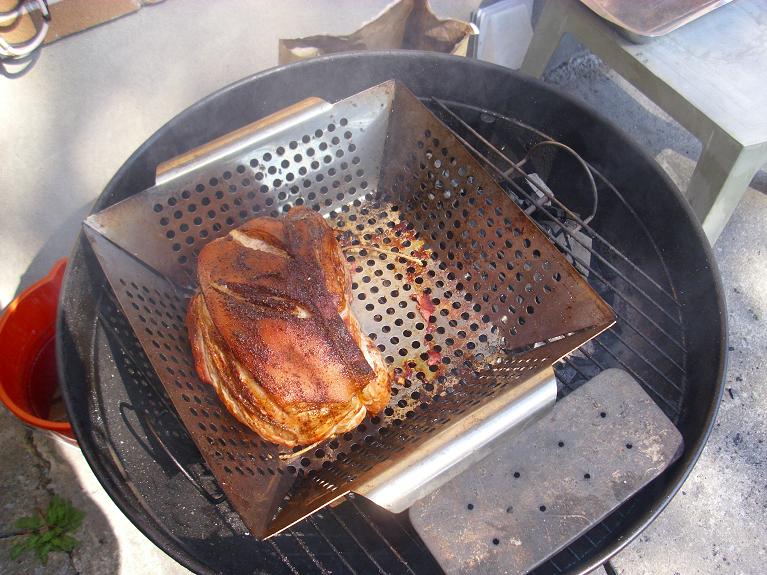
I have liked May so much this year that I am already missing it. Forty-eight weeks to May 2027.  I’ve already circled it in my calendar. Just in the last few days it finally feels like spring. I’ve got more twenty tomatoes outside into the spot where they’ll be sitting until November. Isn’t that twine tying action photo there to the right interesting? I really outstripped myself with that one. That is one snugly tucked in beefsteak, if you know what I mean. And there’s been more. I’ve mowed and then mowed again. Got a few semi-sunburns and even listened to a Blackcapped Warbler as it stayed just out of view. Not that it’s been Euro-hot but I will take 23C and sunny any time. Err… give me a sec. That knot. Wow. OK, let’s go.

First up, the residue in 4,500 year old clay pots from the Masovian Lowland in northeastern Poland have been analyzed and certain conclusions have been drawn:

These findings represent the earliest chemical traces of fermented alcohol beverages in this region, dating to the second half of the third millennium BCE,” the researchers wrote in the publication. The study also identified biomarkers linked to grain processing, including azelaic acid and plant sterols, suggesting the use of cereals such as wheat or barley, fruits and possibly resins used to preserve or flavour beverages. Researchers said the apparent use of wheat and barley is significant because the oldest known evidence of cereal cultivation in the region dates to the Late Bronze Age. “This suggests the possibility of importing raw materials for alcohol production from other regions where cereal cultivation was already well-developed…”

See also the 2,300 year old beer bottle from China. Do ancient jam jar findings get such rapt attention from archaeologists? Not a chance. And speaking of the sciences, The Beer Nut made a quality observation this week about one of the adjectives that gets tossed around rather freely – “tropical”:

I’ve voiced my concerns before about the t-word being rarely indicative of actual tropical fruit flavours. So it goes with this one, but that’s not a problem. In lieu of mangoes and pineapples, this 5.7% ABV hazy IPA has a bright pithy bitterness, pushing mandarin zest and lime rind. There’s an almost earthy tang on the finish, where the bittering compounds concentrate together on the palate. Despite the haze and the claim of tropicality, this tastes like an IPA from the classic era of Eight Degrees: big flavoured and technically proficient. I’ve missed that.

I don’t have an issue with degrees of abstration in the game adjectival. As a result “hoppy” is perfectly fine as a high level quantiative descriptor. But “tropical” has that next level general category aspect that TBN unpacks neatly up there through a winnowing to find out what is really going on. Mango? There ain’t no stinkin’ mango!

Speaking of getting to the specifics, Boak and Bailey examined a trade publication from 1960 called 200 Years of Brewing in the West Country, a 40-page booklet produced by West Country Breweries on the subject to West Country Breweries and found a firm in transition – whether they knew it or not:

From the first page, though, it’s clear that something unusual was going on. The obligatory foreword from the chairman is signed by… Colonel W.H. Whitbread. He was also chairman of Whitbread itself and his presence here signals that West Country Breweries was under the larger brewery’s protection as part of the so-called ‘Whitbread Umbrella’. The Whitbread Umbrella was “a novel structural arrangement that incorporated a dual-voting shareholding structure aligned to a controlling interest in the publicly listed Whitbread Investment Company (WIC), an investment trust that housed minority shareholdings in some twenty regional brewers” (Julie Bower, 2016.) Protection is an interesting word, isn’t it? In organised crime it’s a euphemism for extortion and predatory behaviour by criminals. 

This excellently illustrates and avoids the presistent problem of drinkers, trade association and beer writers confusing ownership with control that we have seen play out in the last decade or come of US craft brewery shell game. Show me the shareholders’ agreement!!

For Craft Beer & Brewing, Kate Bernot has a detailed update on Fonio, an small-scale farmed African cereal malted for brewing purposes that has gained acceptance since the 2018 introduction to Garrett Oliver described in this article in The Guardian as noted hereabouts back in 2023. Bernot shares some obervations that give a sense of what Fonio adds to a beer:

Vinnie Cilurzo, owner and brewer at Russian River in Windsor, California, agrees that fonio’s vinous, lychee-like contributions defy what most people—brewers and drinkers alike—expect from malt. A Belgian-style blonde ale brewed with 30 percent fonio has become a semiregular beer at Russian River’s taprooms—particularly during the warmer months, when its lean body and bright fruitiness feel especially appropriate. Cilurzo says it doesn’t take much fonio in the grist for it to have an impact. “My advice: You don’t have to go all the way to 30 percent,” he says. “Fifteen to 20 percent will also leave a thumbprint on the beer.”

What really struck me is how pale the beer in the accompanying image is. Pale as Zima. When my crime novels set in the early 1990s come out you’ll see me using that image: “I could tell he was guilty – he’d turned as pale as Zima.

Never that way at all, we saw Stan’s latest Hop Queries hit the inbox last Friday including this note on production levels in Australia after the harvest there:

Reacting to diminishing worldwide demand for hops, Hop Products Australia continued to reduce acreage for 2026. Farmers strung 8.3% fewer acres and produced 11.7% fewer hops. They harvested almost 2.9 million pounds. For perspective, that’s equal to 3.4% of the US crop or to the amount of Mosaic farmers in the Yakima Valley harvested. 

As you consider the “season of mists and mellow fruitfulness” antipodean, here’s the notes:

Note #1:…craft beer off 8% for latest 4 wks thru May 9…
Note #2: a beer blog becomes, what, a booze blog?
Note #3: a return to beer writing?
Note #4: another return I’m pretty sure I don’t care about.

What is it with otherwise sane folk trying to scratch a living from a niche topic that leads them to speak of praise the niche’s given opp – the necessary “evil empire” to the purity of the niche – with all the eloquence of a six year old with stomach flu talking to Beulah on the big white telephone? I thought of that when I read this grab bag of sneering cliché:

“The Bad Beer That’s an Incredible Beverage” by Tyler Austin Harper is a bad piece that’s an incredible prism for understanding how beer can continue to thrive as a symbol of populist Americana even as it continues to lose market share to flavored malt beverages, canned cocktails, and whatever we’re calling Cayman Jack these days. Much like the New York Times Opinion section’s hackneyed forays into thinking critically about the trade, Harper’s take advances the argument that the craft brewing “movement” (such as it is) has gone too far. It’s a mixture of personal preference and surface-level cultural observation of a piece with the dreck David Chang was pushing in the pages of Esquire literally a dozen years ago.

If you’re going to shit on someone else’s writing it might be good to be interesting yourself as you do. Why is it so hard to understand that very few care about your chosen drinking hobby? With far greater clarity, ATJ has been trying to put his finger on what makes Belgian beer culture unique and, after years of looking beneath the surface, is not quite sure he’s been successful:

… thinking about Belgian beer culture I thought about beer and its associated obsessions — metal, gaming, men’s solitary hobbies, loneliness, the need to be someone else which ends in self-immolation (Brunhild trying to burn down the hall with Hagen and associates still inside perhaps?). Belgian beer culture, like beer culture, whether out in the cities and towns or in traditional bars or specialist beer joints, could be confusing, and I am not sure I found what I was looking for. Or did I?

And sticking with beer joint culture, a great barman has passed away in Chicago, Sam Sianis of the Billy Goat Tavern:

Millions of Americans knew of Mr. Sianis and his bar without ever crossing Chicago city limits, thanks to one of its most famous regulars, the syndicated columnist Mike Royko… Mr. Sianis made it an equal-opportunity establishment: Prolific drinkers, wayward pols, off-duty cabbies and the occasional celebrity all received the same friendly beer and a shot, often from Mr. Sianis himself. “Sam was the perfect host,” Don Rose, a journalist, said in an interview. In Mr. Royko’s columns, the Billy Goat became a font of tales, true and tall. Mr. Sianis once kicked out the same customer six times in one night for fighting while drunk. And Mr. Sianis swore he witnessed another man down 150 drinks in a sitting.

Another sort of fluid based establishment was the topic of Every Pub in Dublin‘s focus last Friday – pubs on islands you can only reach by boat and not via a bridge:

Arranmore’s 6 pubs is quite a lot for one island, and it has made me wonder about what other offshore (before someone comes and lists most of the pubs in Cork City…) island pubs there are. And also if I can actually tick all of those off too. This is not a promise to do that. I might, but I’m not guaranteeing I’ll do it it like I have with Dublin and also The Rosses. I’m going off the 2024-5 full licence file here, so there is a very high chance I’m missing somewhere, but I made a reference back to the 2010-11 file to try find any lost pubs too. I’m going to start North and work my way counter-clockwise here, so places I’ve been mostly work their way to the top…  I am also only counting islands you still need a boat to get to – I may have an Achill great-grandfather, but you’re basically mainlanders now!

It is even an island if there’s a bridge? Which leads to this interesting piece from BBC Worchestershire on the state of small breweries and what may be keeping some open:

Sarah Saleh, owner of The Hop Shed Brewery, in Suckley, Worcester, said: “Without the tap room we wouldn’t still be here. I think the breweries that are closing are the ones without a direct outlet for their beers.” Saleh continued: “I know when we set up here, 10 years ago, I can think of two breweries locally that were set up but didn’t have tap rooms, and they’re now no longer here. “It always amazes me that on a Friday night when the tap room is open, and we stand here in a barn in the middle of nowhere, and before you know it there’s 200 people here. “They’re enjoying food from local providers and enjoying the beer that’s been brewed here on site.

It is even a community brewery if there isn’t a taproom? Maybe. What else can make a brewery part of the community? Reporting from Norway, Knut attended a gathering of five Danish breweries invited by local Haandbryggeriet to show off their stuff… and one of the attendees had a particularly interesting back story:

Together with the Danish employment authorities, Stepping Stone has developed a program aimed at improving the conditions for refugees entering the Danish workforce. It is deliberately flexible — designed around the individual rather than the system. Each participant’s working hours, responsibilities, and workplace are shaped by their skills, needs, and current life situation, creating a more realistic and supportive path into employment. But the program doesn’t stop at work placements. Alongside hands-on experience at the brewery, participants are offered opportunities to build skills that extend beyond the job itself.

And also out and about has been Ed, who continues his reports from his trade mission to Austria, this time with his stop at Trumer of Saltzberg where he witnessed a method:

They have a six roller mill from 1965 and use the Kubessa method when brewing. Named after the brewer from Cologne that patented it in 1903, in the Kubessa method the husk is separated from the endosperm during milling. It is not added to the Mash Conversion Vessel during the early stages of mashing, only being added prior to lautering so it can help with wort separation. It means less husk polyphenols get in the beer. It’s said to make a beer taste more elegant, and certainly the Trumer Pils in Vienna was very smooth. We had John Brauer, EBC grand fromage, explain to us on the coach that in fact little difference can be detected in fresh beer, but the Kubessa method give greater flavour stability so its advantages become more apparent over time. 

That’s a lot of specific technical information. Mr. Gladman has shared some very specific emotional information, facts which he believes form the foundation for his love of Pastis:

On Saturdays I would walk the half-hour round trip there and back to spend my pocket money. I still remember filling the small white paper bag each week. It started off smooth and stiff then slowly softened and rumpled over the rest of the morning as I dipped into it for treats.I remember the aniseed balls best of all. I never bought too many — I didn’t want to spoil my enjoyment. The immediate pleasure of fizzy cola bottles was showy but no match for the deep joy of a well-sucked aniseed ball with its slow reveal, layer after intense layer, leading to that tiny black kernel of anise almost too challenging but all the better for it. I saved them for last because they would perfume the bag itself — you could smell them even after they were gone.

And, speaking of lingering aromas, Jeff gave us a history of the Cascade hops with his thoughts on what have made them so successful:

I’d add that Cascades have, ironically, come to achieve that quality of “nobility.” It’s true they’re more intense and robust than the old landrace varieties from Europe, but they’re also incredibly balanced and elegant. They offer a lovely bitterness, and are versatile as aroma hops (we’re going to get a taste of that in this year’s Oregon Homegrown collab.) When people taste Cascade, they’re tasting the same thing, too, which isn’t always the case with modern hops.

There. We will leave it there for this week and for this month. Soon it will be June with all that entails. Live it up. And again with this one last thing thing. Your weekly reminder that there will be an edition of The Session next month celebrating Martyn Cornell’s final book Porter and Stout: A Complete History. Boak and Bailey will share an update soon on when you need to get your thoughts organized in preparation.

Which means you, please, need to keep an eye on Boak and Bailey postings every Saturday and adding to their fabulously entertaining footnotes week after week at Patreon. And do look out for more of Stan’s new “One Link, One Paragraph” format. Then hunt out something in someone’s archives! Leave oblique comments on someone’s post from 2009!! Listen to a few of Lew’s podcasts and get your emailed issue of Episodes of my Pub Life by David Jesudason on certain Fridays. And Phil Mellows is at the BritishBeerBreaks. Once a month, Will Hawkes issues his London Beer City newsletter and do sign up for Katie’s wonderful self-governing totes autonomous website featuring The Gulp, too.  Ben’s Beer and Badword remains on pause but there is reading at The Glass which is going back to being a blog. Any more? We have Ontario’s own A Quick Beer and All About Beer is still offering a range of podcasts – and there’s also Mike Seay’s The Perfect Pour. Plus follow the venerable Full Pint podcast! And there’s the Craft Beer Channel on Youtube as well as the archives of the Beer Ladies Podcast.*

*No footnotes this week.

Your Mindblowingly Fabulous Beery News Notes For The Start Of The Best Two-Thirds Of The Year

April showers bring May flowers yet they are at the heart of what makes the most cruel month. I don’t get it. It’s good that we can put the whole thing behind us. Along with the payment of what was dues on the taxes. Done. And stuff like will it be a blizzard warning or one for a tornado? Now it’s time to put the feet up a bit. Check out what’s going on, like seeing who is passing through in the migration. Saw these Red-breasted Mergansers down at the shore this week. Bet they’ve dealt with their tax filings. Yup, best to tra-la for th new month starting tomorrow. Tra-la-ing is not to be dismissed. Shout it out or even sing aloud. Try it as an excuse on your boss in a meeting, for that particularly difficult clerk at a store or even on your in-laws! An all purpose response to any situation. Until, of course – WHAMMO – June shows up. Back to the grindstone in June.

Speaking of the seasons, Knut got a bit poetic in his wanderings around the hopyards of Poperinge in Western Belgium:

It’s springtime, even in northern Europe. I have harvested the first edible plants of the season, aromatic wild garlic. German restaurants are preparing for the Spargelzeit, when fresh asparagus dominate the menus. But beer ingredients also follow the seasons. From a beer perspective, the fields of barley are turning from gray to green. And in a belt from the English Home Counties via Flanders and Bavaria to Bohemia, the hop fields are showing their first shoots.

I had no idea that hops grow 20 centimeters per day. He’s got even more facts and figures on the start of the hop ag year.  Jen Blair was in a different place but, still, also full of the revelations when she considered the airport Cheez-it which led to some interesting thoughts about sensory perception:

You can imagine my delight when I boarded another flight a few months later to discover that Delta now offered Cheez-Its as an in-flight snack. A few years ago, Delta partnered with the then Atlanta-based SweetWater Brewing Company to create an IPA specifically formulated for flight, with reduced bitterness and increased perceived hop aroma. I wondered if they had done the same with Cheez-It. And here we have arrived at the Cheez-It sensory experiment. I had an upcoming flight to Colorado for World Beer Cup judging, and so did another friend flying in from Montana. I texted her to buy a bag of Cheez-Its at the airport, but not to open them because they were for Cheez-It sensory when we met up in Colorado.

She even proposed the identification of a “Cheez-It equilibrium” point in the atmosphere which is, obviously, quite excellent. I am tagging this under the “Science” category.  More science now… but with a political twist… out of the UK with the news… with a sports twists… that the country is running out of carbon dioxide… cause by a global crisis twist:

Fans of the beautiful game shouldn’t panic about the beer running out during this year’s World Cup — yet. Business Secretary Peter Kyle tried to reassure Brits Thursday that they’ll be able to enjoy a pint during this summer’s football tournament. It comes amid reports officials are drawing up contingency plans for a shortage of the carbon dioxide used to make fizzy drinks as the Strait of Hormuz closure bites. Directly questioned about whether Brits will be able to get a beer during the summer World Cup, which starts on June 11, Kyle said: “At this moment, this is not a concern for our economy, okay? I can reassure people of that.”

He “…tried to reassure…” Hmm… Not a concern “…at this moment…” Hmm… Commercial CO2 appears to be a by-product of gas and oil production so we up and over here have a bunch. Still sticking with the serious objective stuff, The Western Producer recently shared an update on the market for Canadian malt barley exports:

… about a year ago, Canadian barley prices started to fall as China resumed purchases from Australia after a lengthy trade spat. That pushed a lot of Canadian barley out of the Chinese market. And then Canada harvested a bumper crop of barley in 2025. Farmers produced 9.73 million tonnes, a 19 per cent improvement over the previous year, putting even more downward pressure on prices. “Prices have been a lot more competitive in the global market,” said Watts. At the same time, French malting barley prices climbed higher due to a short crop in that key exporting nation. Those events, combined with years of continued market development work, encouraged Colombia to reconsider Canadian supplies, and they were happy with that decision.

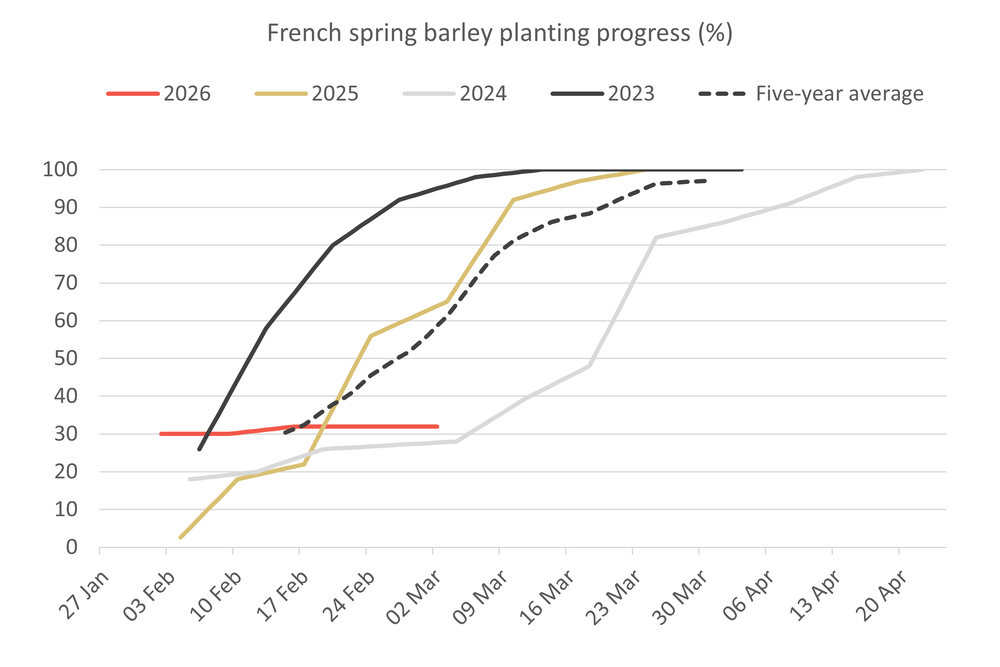
International harvest intrigue reigns. France is looking at another rough spring 2026 as far as barley planting goes, too.  That flat red line on that graph under the thumbnail tells the tale. And the competition is ahead of French farmers. On the other side of the planet, the Austrialian 2025/26 crop is “23 percent higher than last year and 21 percent above the five-year average.” Meanwhile… geopolitics can get one into some very odd places. As you think on that, here are some notes:

Note #1: Bun photography.
Note #2: “Rub my Dad’s bottom….”
Note #3: “…surprising health benefit…”

You know, I think the craft beer recovery needs to be measured in the returned of a staffed up BA because I really don’t get where anyone is going with the “return to 2012” narrative. But Dave Infante reporting from the Craft Brewers Conference for VinePair gives another angle on the boost to mood:

 Survivorship bias dictates that the brewers that made it to CBC 2026 are likely to seem the most bullish; after all, if they weren’t, they may have stayed home to save money and manpower. At the risk of sounding indelicate here, I also suspect that the segment’s years of closures have helped cull the herd of both excess numbers and outsized negativity. A dying brewery can only die once, after all, and with outfits that were never built for this market getting pushed out of it, those that remain stand to benefit from more focus and less vicarious angst.

We are told that history is written by the victors but, I guess, we have to ask in this market what is “victory” when overall US craft production is down 9% over the last two years and down 17%* since hitting a peak in 2019? Speaking of questions… is the use of “lifestyle” as a descriptor ever not a red flag? Consider this PR blurb about a new beer-like substance:

Carlsberg Britvic premium beer marketing controller Rebecca Allen revealed that the 4.5% ABV beer is strategic in answering the trends of the moment and admitted that “the timing reflects a broader shift in drinking culture, where boundaries between categories are increasingly blurred and consumers are more open to hybrid, lifestyle led propositions”. Allen told db: “1664 Rosé takes its name from its distinctive flavour profile, a refreshing berry flavoured beer. The ‘rosé’ cue reflects both its taste and its visual appeal, positioning it as a lighter, fruit-forward beer.”

What style of life is being referenced? And where has that style led the life of the consumer in question? Speaking of style, Ron has given us a few background insider sorta notes on his presentation flow while on the road, working it in Chile:

For my talk, I speak a couple of sentences and then the interpreter translates them into Spanish. It interrupts my flow a bit. But does give me a chance to drink some beer while the interpreter is taking.  My talk is about Irish Porter and Stout. I should probably update it. I wrote it a while ago and have since got hold of a lot more Irish brewing records. In particular, examples of heading, the sort of Kräusen used in Ireland. I get through my beer so quickly, I have to request a refill. That’s a first. Just making sure my throat doesn’t get too dry. Wouldn’t want to get hoarse. Usually, I only get to take a sip or two, as I keep rattling away. When I’m done, I sell a few more books. Which is good. I’m nicely building up dosh in my PayPal account. Dolores will be so happy. Why have I never brought books with me to sell before? Because I’m an idiot. That’s why.

When Dolores is happy, I am happy. Conversely, there’s bad news out of the other end of Lake Ontario as the Toronto Festival of Beer has gone under** and has left creditors and suppliers holding the bag according to CTV News:

Applying to work for the festival was costly, Kowalik noted, as she and her partner spent $1,000 on the entry fee and an additional $200 on liability insurance. She says they both took time off from their day jobs to work since the festival started on Friday. Over the course of the weekend, Kowalik said they went through all 20 cases of beer that they brought up, amounting to a total of just over $2,000. 

The story shares a twist on beer fest tokens. Because the festival sells them and not the breweries, the money paid for the beer tokens does not go to the brewers. Kiss it goodbye. Anyone owed money can call into to the bankruptcy meeting this afternoon at 3 pm. But seeing who else is on that list of creditors, the news may not be good. For $2,000,000 in liabilities there’s only $8,000 in assets.

On the Burton Union question, we have had Laura H in (t)DB on challenges posed to the survival of the Marston brewing kit and also providing CAMRA with a backgrounder on the history of the system. Now, a Mr. M. Curtis has visited the part of the whole which became lodged at Thornbridge and reported back:

Fixed to the head of each oak barrel is a large, cast iron “X”, painted black. If this seems familiar it’s because, for a time, an illustration of three such barrels, stacked in a triangle formation, formed the logo of Marston’s Brewing Company in Burton-upon-Trent, Staffordshire. Still in operation, today Marston’s brewery is owned and operated by British-Danish conglomerate, Carlsberg Britvic. In January 2024 Carlsberg Britvic—then known as the Carlsberg Marston’s Brewing Company—decided to retire the remaining four working union sets at Marston’s. Once used to brew what was once some of the most well-known ale brands in the country, including Marston’s Pedigree and Owd Roger, the brewery’s website famously used to state: “No Burton Unions, No Pedigree. End of.” Now, it seemed certain this storied piece of British brewing history, first invented in 1838, was due to be consigned to the dustbin of time and memory.

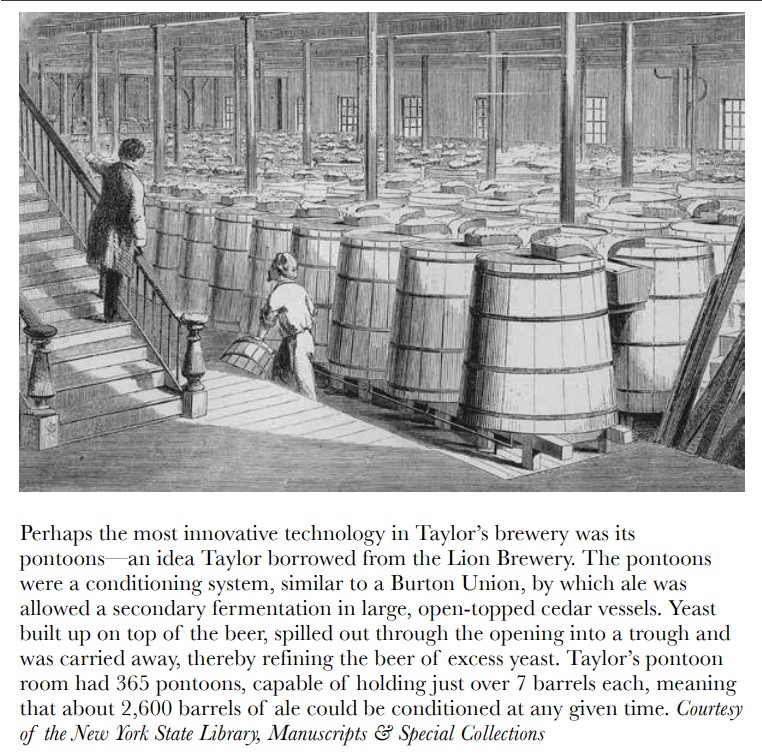
I was going to say that it is too bad that the United States has little similar interest in its brewing history as we could see the mid -1800s pontoon room of Taylor of Albany recreated even if in part but then was saddened to see that the link in my post of 2016 to Martyn’s at Zythophile failed. It’s all there at the Wayback Machine site. But the key word search does not seem to work and Martyn did not use a URL system that included the date. So you can hunt out his post at your leisure. In the alternative, I can only direct you to the work of a couple of rough sorts, Messers Gravina and McLeod, at page 80 of their opus on, in and abouts Albany which you can review under that thumbnail to the right… well, your right my left.

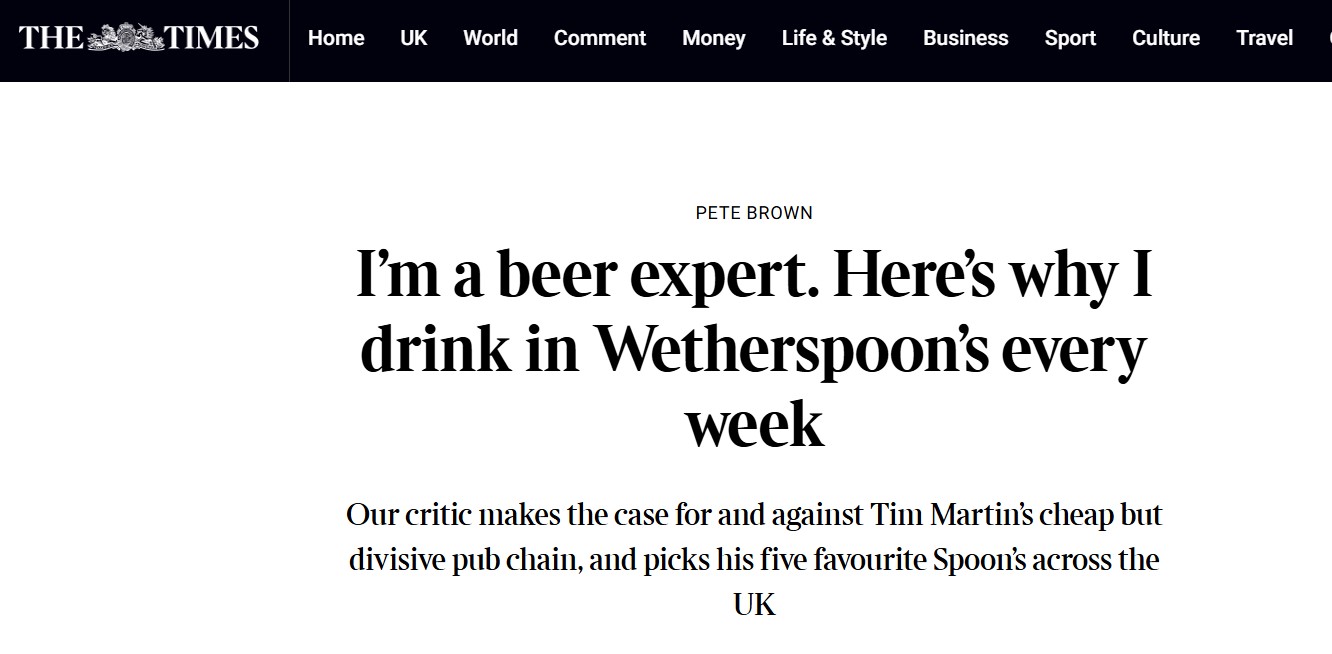
Lastly, following up on observations on the word “critic” in beer writing a couple of weeks ago, The Times also appears to be confused as the sub-header for one story this week describes Pete Brown as “our critic” and then he himself states as follows:

Of all the arguments the beer world loves to have, there can’t be many topics more divisive than JD Wetherspoon pubs.  Critics attack them as a refuge for those too old and/or drunk to mind the harsh lighting. Supporters say this is just snobbery, and what’s wrong with cheap beer? Critics believe the beer is cheap because it’s bought “short-dated”, or about to go off. Supporters ask where else can you get a meal and a pint for under a tenner now?  The thing is, both sides are right. Except that the beer isn’t short-dated and never has been.

“Critic” is not a synonym for detractor.  Pete isn’t the one who created this. But as Stan reminded us, the “…critic’s job, nine-tenths of it, is to make way for the good by demolishing the bad” as it was put by Kenneth Tynan. What is it about general beer culture that is uncomfortable with the common form of two handed discussion and intelligent criticism with a bit of peer review thrown in for good measure? Oh well.

That’s it for now. Report upon your tra-la-ing in the comments if you like. Until we meet again, please check out Boak and Bailey who are posting every Saturday and adding to their fabulously entertaining footnotes week after week at Patreon. And look out for more of Stan’s new “One Link, One Paragraph” format. Then hunt out something in someone’s archives! Leave oblique comments on someone’s post from 2009!! Listen to a few of Lew’s podcasts and get your emailed issue of Episodes of my Pub Life by David Jesudason on certain Fridays. And Phil Mellows is at the BritishBeerBreaks. Once a month, as noted, Will Hawkes issues his London Beer City newsletter and do sign up for Katie’s wonderful self-governing totes autonomous website featuring The Gulp, too.  Ben’s Beer and Badword seems to be on pause since November but there is reading at The Glass which is going back to being a blog. Any more? We have Ontario’s own A Quick Beer and All About Beer is still offering a range of podcasts – and there’s also Mike Seay’s The Perfect Pour. Plus follow the venerable Full Pint podcast! And there’s the Craft Beer Channel on Youtube. Check out the archives of the Beer Ladies Podcast. See you in May!

*26.3 bbls in 2019 compared to 21.9 bbls in 2025. What’s the degree of collapse that will send a message to the PR trade, one wonders. 
**Sixteen years ago, Jordan shared his thoughts on the unappetizing event.


Your Scattered Beery News Notes For The Lunar The Low The Looney And Perhaps Even The Ludicrous

Happy lunar loop de loop week. It’s hard to find a glimmer of good in an ugly world but the Artemis II mission into outer space did its best to try.  As has the prospects of the Two-Tailed Dog Party in this weekend’s elections in Hungary. Coming in at a solid 3.27% of the vote last time around, their past platform gives a bit of hope:

The party platform promised eternal life, world peace, a one-day workweek, two sunsets a day (in assorted colours), lower gravity, free beer, and low taxes. Other electoral pledges have included building a mountain on the Great Hungarian Plain.

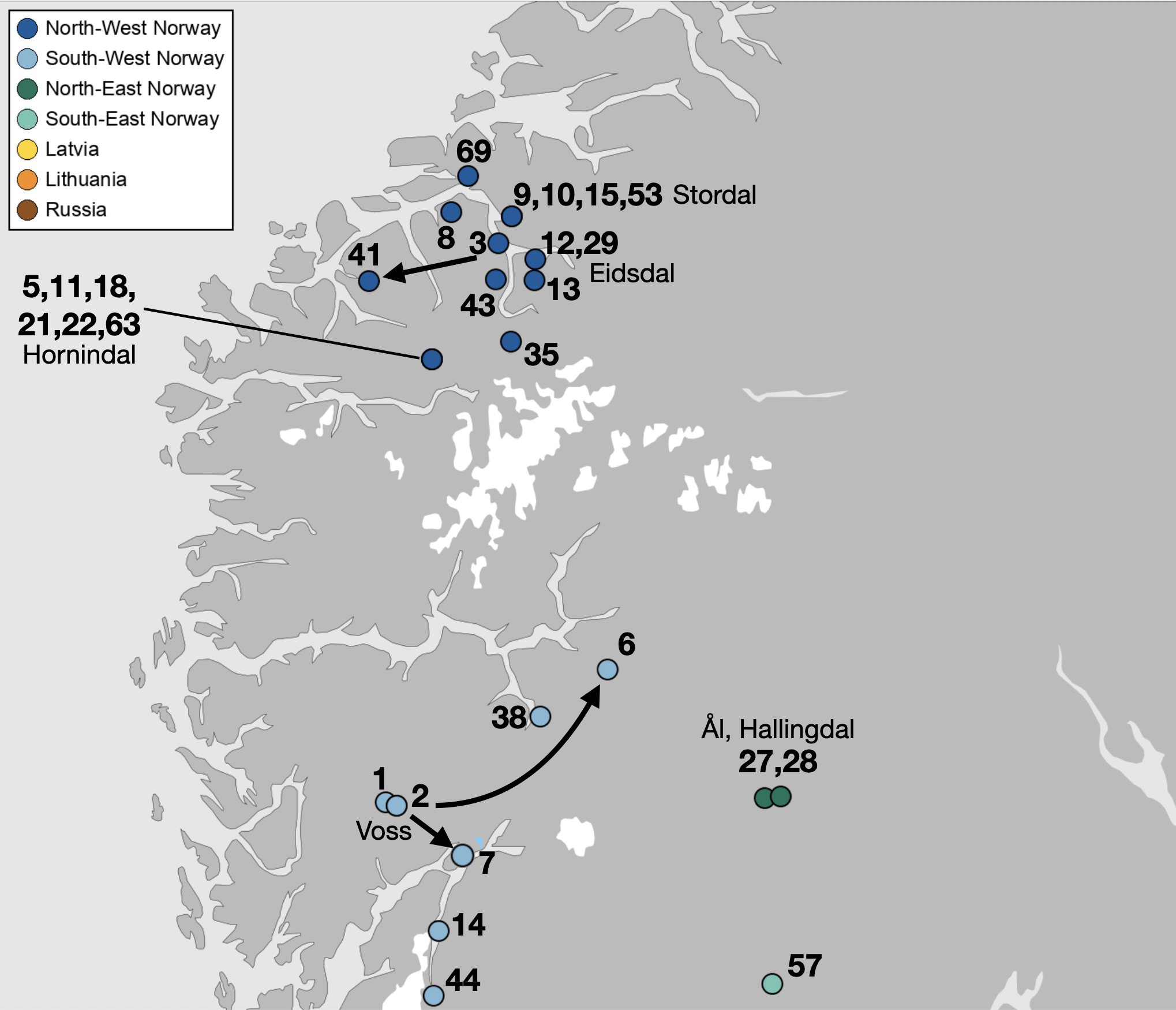
Will the space craft land? Will greater freedom return to Hungary?  Will the ceasefire hold? These are the questions for the week to come. Until then, some beer news. First up, Lars announced the publication of a study of farmhouse yeasts of northern Europe, the culmination of years of work and a number of challenges:

The paper was done by the Verstrepen lab at the VIB-KU Leuven Center for Microbiology, the same place that did the famous paper giving us the first view of the family tree for brewer’s yeast. Work on the paper started in September 2017, when I mailed off the first batch of yeast cultures to Leuven. It had gotten quite far when covid caused Belgium to shut down so hard that everyone must work from home, and obviously you can’t do lab work at home. By the time restrictions had lifted several people had moved on to other jobs, and the paper sat languishing until Peter Bircham decided to pick it up again. He and I worked on it for a while, until Peter moved to New Zealand. Eventually, once he was settled there, a Gang of Four got it moving once more, and last year we finally submitted it.

This is very important stuff and a worthy outcome for all his years of effort. The study describes seven cultures or zones rather than strains as these “cultures have been reused by farmhouse brewers for at least centuries, quite possibly millennia, so they consist of lots of different strains.” The, as illusrated by the map under that thumbnail, the study describes how each culture relates within its zone. Super neato. Lars has also been out skiiing in shorts, too.

Staying in Scandenavia, Knut has shared a profile of a pub in Sweden. Ruckel Beer Bar, where he spent part of Good Friday productively:

Ruckel means shack or hovel in English, a description or the building they took over when they were starting the brewery. I doubt the premises they have moved into with their new pub fit the ruckel description, but they have certainly put in many hours to make an inviting pub, split into various zones for eating, drinking and hanging out.

Ruckle is a new and quite attractive word, at least for me. Not surprisingly, with an old Scandenavian connection, too. I have, on the other hand, heard of other old things like the Cooper’s Hill cheese roll as well as Royal Shrovetide Football but never before did I hear of the Hallaton Bottle Kicking each Easter:

[a] brutal competition between rivals trying to wrestle barrels over a mile-long stretch of countryside. Hallaton Bottle Kicking is an ancient tradition, held each Easter Monday, in the village of Hallaton and neighbouring Medbourne… One “bottle”, which is a wooden cask much better suited to the rigours of the scrum than any glass item would be, is then decorated in red and white then paraded to the top of the village where the contest between Hallaton and Medbourne begins. The game is a best of three, with two “bottles” containing beer and the third completely wooden decorated bottle – which is referred to as the dummy. The outdoor sport is played across about a mile of open land and the two teams attempt to move the bottles over to the opposing team’s parish at each end of the area.

As noted in the B+B Patreon notes from last weekend, Eoghan alerted us to the closing of De Kulminator in Antwerp, a famous yet quirky beer bar with a vast selection of old bottles that created an odd test question that must be answered to qualify for entry:

Apparently they asked you what you wanted to do there – if you said drink a beer, no entry. If you said “enjoy a beer”, open sesame. But as I said, I never ran the gauntlet

One newspaper declared (testing your Dutch, not mine) “Het beste biercafé ter wereld is niet meer.” I think you can get the drift. Yet one Mr. W. Hawkes askedWhat will they do with all that manky old beer?” Boak and Bailey visited in happier days in 2010, paying the price accordingly, as did The Beer Nut in 2017. Relatedly perhaps, Eric Asimov in The New York Times shared his observations on the shift in the sweet price point for best value in wine:

Good wines can come from anywhere and anybody. The value is in identifying these little-known producers and regions before they are more widely discovered, and prices go up. That requires a fair amount of trial and error and taking chances on the unknown. How long will $15 to $20 remain the sweet spot for these sorts of wine values? It’s a lot harder to find them today. While I will continue to take on this particular challenge, it’s fairer to say $20 to $30 today is what $15 to $20 used to be. But that conversation is restricted to the least expensive value rung… That underscores a key rule of value hunting: The greater the splurge, regardless of the price, the less inclined you are to explore and the more you want a sure thing.

Do we talk of value with good beer in a similar way? Does manky old ale have value? Perhaps a few do but through the arc of the rise and fall craft beer over the last twenty years, the wider market never really established the sort of constructs that provide some confidence in relative value that we see with wine. Too often commentators seem content go back to the same shallows that may have helped set up good beer for its cultural nosedive in the first place. Even as so many beers were presented and consumed as near clones of each other in an oligopolistic manner, little attention was given to advising consumers about which beer could be swapped out for what at, say 50% or 80% of the cost.  Could that change now that the kid (if not boxing) gloves are off? As you think on that, here are some notes:

Note #1: Perhaps don’t cheat on your forensic expert wife.
Note #2: “Broken toilet, no showers and farts“… yet not a pub.
Note #3: “Trends continue to oscillate week-to-week…

And… we are back. Following up on that last note, discussions in investment circles are indicating… or at least suggesting… or maybe only postulating that the price of shares in brewing corporations may have hit bottom and are (…potentially…) ready to rise:

The central question is whether shipments will finally catch up to depletions. Analysts note that consumption trends accelerated throughout the December-February period and continued improving in March, but shipment data through February hasn’t yet reflected this strength. Multiple Wall Street firms cite distributor feedback indicating momentum has returned, particularly in scanner data showing March beer volumes up 6.5%.

At that point in the marketplace, the trends are most relevant for macro brewing. Will you invest? For What’s Brewing, Laura Hadland shared an experience at Heineken where the mega brewery approaches the task at hand from an unexpected angle:

I was baffled as to why the tour guide was giving us the in-depth view on its malt and the hallowed Heineken-A yeast, but nobody was talking about hops. At all. I even asked the question explicitly: what hops do you use? The tour guide didn’t know. Neither did the colleague that she ran off to ask. It was only when I (luckily) found myself in the company of global master brewer Willem Van Waeberghe, that I discovered the answer. The answer was, it doesn’t matter. In the Netherlands, Heineken sources hops from the US, but its licensed brewers around the world can source whatever they want. All the hops are added at the start of the boil for bitterness only. They never have a second hop addition. All of Heineken’s flavour, which is perhaps a little fruity, a touch herbaceous with just the tiniest note of aniseed, comes from the yeast esters.

Conversely perhaps, as reported by Kendall Jones, tiny Big Block Brewing in Washington State has found new flavours in old hops:

​“We got a bunch of ladders and laid them down over the blackberries and used them to get into the hops,” says Julum. “A lot of cuts and scrapes later, we had enough hops to make a batch of beer. The problem was that Sammamish State Park was in the process of removing all of the invasive species from the land, and hops are an invasive species, so we needed to do more than pick the hop flowers. We had to dig up the rhizomes so we could replant them”… Likely, Ezra Meeker was the source of the original rhizomes, as he was for so many farmers in the area at that time. Meeker primarily cultivated English Cluster hops. The Monohon hops are very likely a descendant of that variety. 

Well, likely by the time those hop rhizomes hit the continent’s Pacific side, Cluster-esque might be the better way of putting it. And Colbier Brew Co., a “Bootle-based brewery” is the subject of this week’s feature in Pellicle. “Bootle” is also another old word for a dwelling which may well be a cut above a “ruckle” but none of that is part of the story as told by Rebecca Crowe who first encounters a beer by Colbier named Falsetto:

As a lover of the darkest pint of cask beer available, the ideal of white stout is like a unicorn to me, and I must find it. Eventually, I receive a message from the team at Doctor Duncan’s, a pub on Queen’s Square near Lime Street station, who tell me it’s in their cellar and that it’ll be on soon. When I finally get a pint of Falsetto in front of me, I’m entranced by its bitter, chocolate notes. Close your eyes, and you’d swear you were drinking a dark beer, albeit not as unctuous and creamy-tasting as Colbier’s oatmeal stout, Nocturne. However, the bitterness and innovative nature of a white stout is the perfect signifier of what this Bootle-based brewery likes to do.

White stout, eh? Something like myself, I suppose. Enough of that. Next, a tale of crime at the government liquor store back home in Nova Scotia:

In 21 years of policing, RCMP Sgt. Serge Landry says he’d never seen anything like what was seized from a home in Dartmouth, N.S., just before last Christmas. After a two-month investigation into significant alcohol thefts from NSLC stores in the Halifax region, officers seized more than 450 bottles of hard alcohol worth almost $20,000 from a home on Floral Avenue. Police even seized a ledger detailing the alcohol being delivered to the home and what had been resold. “I’ve never seen it to this scale,” said Landry.

Not just alcohol. Hard alcohol. Always been this way. As a lad, I remember a summer job painting a house next to the one run by the bootlegger. Steady traffic on a Sunday afternoon, back when the government store was shut. And there was the other job at the senior’s house when one resident born before the First World War ratted out another of a similar age for running the ice delivery warehouse which contained a bootlegging operation out of the middle of the warehouse, amongst the walls of neatly stacked ice blocks.

Finally, following up on last week’s story on the effect of Gulf War III on the cost of beer packaging in India, NPR is reporting this week on another pressure that might arise as global aluminum supplies have also been affected:

Aluminum prices recently hit a four-year high, after Iran struck two large smelters of the metal in the Middle East. Both of them were major suppliers to the United States. Aluminum, which is on the list of 60 minerals deemed critical by the U.S. government, is widely used for beer and soda cans, in cars and packaging.

Well, that is it for now. Crisis and crime yet exploration, each in its way human-kind caused. And another possible positive week for the beer trade. Beer likes peace.  As we wait for the results, please check out Boak and Bailey who are posting every Saturday and adding to their fabulously entertaining footnotes week after week at Patreon. And look out for more of Stan’s new “One Link, One Paragraph” format. Then hunt out something in someone’s archives! Leave oblique comments on someone’s post from 2009!! Listen to a few of Lew’s podcasts and get your emailed issue of Episodes of my Pub Life by David Jesudason on certain Fridays. And Phil Mellows is at the BritishBeerBreaks. Once a month, as noted, Will Hawkes issues his London Beer City newsletter and do sign up for Katie’s wonderful self-governing totes autonomous website featuring The Gulp, too.  Ben’s Beer and Badword seems to be on pause since November but there is reading at The Glass which is going back to being a blog. Any more? We have Ontario’s own A Quick Beer and All About Beer is still offering a range of podcasts – and there’s also Mike Seay’s The Perfect Pour. Plus follow the venerable Full Pint podcast! And there’s the Craft Beer Channel on Youtube. Check out the archives of the Beer Ladies Podcast. See you next week!

The Very Last… Summative Even… Fresh Yet Thoughtful Beery News Notes For Winter 2025-26

Spring!  Tomorrow is spring!! On a Friday even. How swell. The sort of moment that always reminds me of some lyric or another from Old Blue Eyes himself:

Spring is here
Why doesn’t my heart go dancing?
Spring is here
Why isn’t the waltz entrancing?
No desire, no ambition leads me
Maybe it’s because nobody needs me?

Wow. Not what I was expecting… gee, Frank. Lighten up a bit, wouldja? Me, I am all zippiddy doo dah myself. Look at those sweet peas under the grow lamp! The waltz entrances. Hmm. Why Frank? Why? Could it be it’s the fading night life scene that the man once knew and loved that has him lost and wandering, as the news The New York Times shared this week tells us:

…it’s a complicated prospect for restaurants, which traditionally make their highest profit margins on alcohol sales. Preparing food requires perishable ingredients and a large amount of labor, while alcohol is shelf stable and, except at the most dizzying heights of mixology, requires less work than cooking. As independent restaurants struggle with higher costs of all kinds — rent, labor, ingredients — the hollowing out of the most profitable part of the menu couldn’t come at a worse time. According to David Henkes, a senior principal at the food service research firm Technomic, alcohol sales are slumping in every category of the restaurant industry, from fine dining to casual establishments, with 31 percent of operators reporting “severe declines” in alcohol sales in 2025.

Yikes! We always here about the younger folk laying off the hootch – but even the set that clinks and drinks is clinking a lot less. But when was it ever the way it used to be? 1910 apparently. Nigel Sadler posted some images from The Times ‘Beer in Britain’s Supplement from April 1958, including the fascinating tale of the creation of the Hops Marketing Board as well as this infographic on the increase in duties on beer from 10% in 1910 to 50% in 1958.  Winning two World Wars as your empire collapses will do that for you.

Note#1: Michael Caine before he was famous.

Boak and Bailey unpacked their approach to writing a bit this week as they closed down one of their outlets, a newsletter by Substack where they unpacked their personal impressions perhaps a bit more. They shared that approach on one post this week, describing a scene Ray encountered when he would out and about with pals:

You know how you sometimes know something is going on, even before you see anything yourself, because people around become restless and twitchy? Even before the sword dancers entered the pub people noticed them in a group, standing outside peering in. Then their leaders, white haired with red neckerchiefs, entered and negotiated permission with the bemused young bar staff. Dancers and musicians shuffled in and found space for their display among the drinkers and diners. Then, off they went, stamping and twirling with berzerker energy, accompanied by fiddle and recorder… There were whoops and applause after the final somersault and, after they’d jogged out of the pub in single file, it felt as if the crowd had been injected with fresh energy. Between amusement, disbelief and admiration, it woke everyone up.

Whoops!* I have no idea what and who these sword dancers are. Clearly not, you know, the Highland lassies. Is this some sort of militant branch of the Morris dancer set? Speaking of militant hobbies, Phil Cook has been tracking the use of beer related answers to crossword clues in The New York Times and has released his report on the 2025 season:

The over-reliance on ale and ipa (and their plurals) has increased. They were about a quarter of last year’s references; now it’s 40%. That kind of frequency means there’s an impossible choice between repeating the same clue over and over, or reaching for one that’s only less common because it’s not very good. ale appeared on successive days several times — often with grim setups like ‘Pub drink’ or ‘Pub order’ — and one bleak fortnight3 had five of them, interspersed with two ipas, none with great clues.

I’m a Monday and Mini sort of crossword guy so I don’t see as much of this but Phil’s obsessive dedication to detail is impressive which backs observations like “there weren’t any debuts of new terms that seemed to signal any kind of shift in the zeitgeist.” Perhaps this year we will see a four letter answer for the clue “going out of style” which offers direction in at least two ways.

Speaking of style, Gary Gillman had his research on the founding of the green beer phenomenon in the USA published in Craft Beer & Brewing, reaching back ever so slightly into the 1800s:

In 1899, Milwaukee’s Pabst Brewery already was well known for its Blue Ribbon Beer, its bottles at that time festooned with a real blue ribbon. That year, as a marketing gambit, Pabst replaced the blue ribbon with a green one on a portion of its beer packaged ahead of the holiday. It also put a shamrock on the label in lieu of the usual hop leaf, with marketing that proclaimed, “Hibernians to celebrate St. Patrick’s Day.” (That’s according to Printer’s Ink, an advertising trade journal from that time.) However, the beer itself was the usual pale lager—it wasn’t colored for the special day. 

Which brings us to three more notes on St Paddy’s Day:

Note #2: “…all good-humoured, not messy yet…
Note #3: “…a local bar owner to invite me to meet him for “a chat…
Note #4: “...I’ve seen things you people wouldn’t believe…
Note #5: “…Liverpool is carnage…

Those last two notes are more along the lines of what was experienced the weekend before the day over in Waterloo, Ontario – a university city:

People living at Oakwood Manor, an apartment building near Marshall Street, said large crowds surrounded the building. Residents described partygoers climbing over fences, knocking some down entirely and leaving garbage behind. “They’re destroying private property, but they don’t care,” said Debra Hines, who lives in the area. Residents also said they saw people urinating in the parking lot. “They were [also] coming and stepping on people’s cars,” said Janet Peterson, another resident. Bridget Kocher, who also lives in the building said the repeated street parties leave residents confined to their homes several times a year.

Kids today! On a far more civil note, we don’t write about homebrewers enough. Something the coming recession will cure I am sure. But the Windsor & Eton Homebrewers Club described how the group did some compare and contrast of a few clones and made some… well, to be honest, observations on the state of Pilsner Urquell in the retail marketplace:

 I wish no disrespect or sleight to the founding fathers of Pilsner, but we were scratching our heads a bit. We used Pilsner Urquell as our reference for all our clones.  We found PU to have great bready richness with a great soft rounded mouthfeel.  A slightly sulphur smell and flavour – as is characteristic and a touch of ester, but also we found it with a sticky almost stodgy sweetness, not crisp as we were expecting.  However, it transpires that Ian found some bottled Urquell somewhere up North, which was apparently much better, so maybe the canned Asda variety isn’t a good comparator?

Frankly, I had already bookmarked this piece by Kieran Haslett-Moore from well before the Beer Nut unleashed the stinging taunts urging folk take notice of the death of the themed pub, once a cross-cultural cornerstone:

At the start of this year the Wellington Belgian Beer Café, Leuven, announced it was closing its doors after 25 years. Back in 2000, Lion started to brew Stella Artois under license and all of a sudden Belgian beer culture was in vogue. Leuven in Wellington and De Post in Auckland both opened, offering the full tourist-style Belgian beer experience with mussels, frits, draught Stella, Hoegaarden, Leffe and assorted bottled beers from the lowlands… At the start of this year the Wellington Belgian Beer Café, Leuven, announced it was closing its doors after 25 years….  In 2004 Christchurch got Café Torenhof which limped on after the earthquakes before running out of steam in 2020… Café Torenhof lives on in the way your great aunt does because you inherited her Welsh dresser and it sits in the corner of the living room. When the Christchurch café closed, its interior kit was sold to Craftwork in Oamaru…

While things go out of style, other things arise as Ruvani shared recently when she discussed the “Spaghett”:

For those not already in the know, a Spaghett is a simple two or three ingredient (depending who you ask) beer cocktail involving a light lager, a bright bittersweet amaro and either a slice or splash of fresh lemon (optional). The OG Spaghett consists of a Miller High Life bottle minus an inch or two and topped off with Aperol and lemon… a ‘poor person’s Aperol Spritz’ where the champagne is replaced with the Champagne of Beers. Until recently Spaghett enjoyed under-the-radar industry-insider status but a combination of social media and the cost-of-living-crisis have brought it into the mainstream, as drinkers nationwide are discovering the delicious pop of tangy, herbaceous aperitivo against clean, gently sweet and super-carbonated light lager finished up with a refreshingly sharp citrus twist.

Jeff published a piece on the ABSs of malt this week or, more specifically, the question of whether a base malt’s flavor come from the barley variety or the malting process:

 …it’s better to think of malting and brewing as connected processes. If you recall our previous conversation, the maltster has many choices to make, all related to the “biochemical levers” Matt referenced. It’s very much like the choices a brewer makes on mash pH, mash temperature, the number of rests and so on. It’s not like there’s a “correct” mash temperature; brewers make choices based on what they want out of a beer. The same is true with malting, and it’s why one brewery might choose a malt where one set of choices was made, while another brewery would want a different set. 

Speaking of grain, there was a Kernza sighting this week, about a year and a half since the last time the branding for thinopyrum intermedium passed by my eye. The Guardian reported on its use as Deschutes:

The secret ingredient is a grain called Kernza. It’s a perennial wheatgrass with a slightly nutty flavor and a climate-friendly reputation. Deschutes teamed up with the outdoor clothing brand Patagonia to craft a new beer using the grain. When asked how customers react, brewer Ben Kehs laughs: “They say what’s Kernza?” Kernza has deep roots that pull carbon from the atmosphere and require less water. There is less tilling and fuel use because it doesn’t have to be replanted each year. Kernza can be used as an alternative to barley, which along with hops and water, is one of beer’s three core ingredients. “All of them in one degree or another I would say,” Kehs explains when asked which ingredients face climate threats.

Finally and speaking of the exotic, Ron has been back in Brazil judging at a competition where he seems to have been quite happy with the set up:

I have my usual breakfast. Call me Mr. Boring. I don’t care. It’s what I want to eat. And I’ll fucking eat it. That’s the great thing about being old. Not really having to give a fuck what anyone thinks…  I’m on the same judging table as yesterday, with Suzanne and Alan. I’m happy with that. We rattled through the flights yesterday. Coming to a consensus without much argument. Which saves much time. And annoyance. Especially annoyance. The last thing I need is extra stress… After lunch, there’s a real treat. Non-alcoholic beers. Six samples. All three sour styles are pretty good. With the Catharina Sour the pick of the bunch. The best non-alcoholic beer I’ve ever drunk. Which may be quite a low bar. Or was. It’s been raised considerably now. That was much better than expected. Some flights of alcoholic beers were far worse. Not sure what that tells us. There’s then a long wait for the pre-BOS. Like two fucking hours. Such fun sitting and sweating. Watching Match of the Day helps pass a little time. 

Good to see that while his language hasn’t mellowed, his relationship to booze has. And he’s learned a bit of Portuguese on these trips, too.**

Is that it? That’s it! Another week and another winter moves into the history books. While we see what the spring may offer, please check out Boak and Bailey who are posting every Saturday and adding to their fabulously entertaining footnotes week after week at Patreon. And look out for more of Stan’s new “One Link, One Paragraph” format. Then hunt out something in someone’s archives! Leave oblique comments on someone’s post from 2009!! Listen to a few of Lew’s podcasts and get your emailed issue of Episodes of my Pub Life by David Jesudason on certain Fridays. And Phil Mellows is at the BritishBeerBreaks. Once a month, as noted, Will Hawkes issues his London Beer City newsletter and do sign up for Katie’s wonderful self-governing totes autonomous website featuring The Gulp, too.  Ben’s Beer and Badword seems to be on pause since November but there is reading at The Glass which is going back to being a blog. Any more? We have Ontario’s own A Quick Beer and All About Beer is still offering a range of podcasts – and there’s also Mike Seay’s The Perfect Pour. Plus follow the venerable Full Pint podcast! And there’s the Craft Beer Channel on Youtube. Check out the archives of the Beer Ladies Podcast.

*Remember: you can’t have whoops without an oops!
**Ron’s honesty when on these things is what makes his reports so worthwhile if only as a deterrent: “I’m so fucking knacked. We’ve judged so many beers today. And lots of strong ones. I never want to drink beer again. I’m so done with it. I just want to drink some cachaça and sleep.” 

Your “Don’t Let The Door Hit You On The Way Out, February 2026” Edition Of The Beery News Notes

cat on carpet before a TV screen with hockey players playingFebruary does one decent thing each year. It is short. We were also one goal short the other day. But that is a different thing. Canada is outraged to the point of almost saying something. In our house, the cat spoke for us all. Stunned disbelief twinned with a day dream about what was in the food bowl in the next room. I hope we get over it …soon. Even Trump was oddly gracious. In passing during the State of the Union he said of the gold medal win “…they beat a fantastic Canadian team in overtime, as everybody saw. ” Hardly triumpalist gloating.  The cat’s reaction was the same: “…food bowl… food bowl…

Let’s jump into it, shall we? Katie M has shared thoughts over at The Gulp on her return to a favourite spot, The Highland Laddie, in the perhaps less than loved city of Leeds. Being related to generations of Highland laddies and perhaps being accused of being one on occassion, I am won over by the headline. But there is more, a hidden elder gem amongst a brutalist landscape:

The room smells of the woodburning stove and warming comfort food, and as the rain sets in for the night outside, I get the distinct feeling I could spend the whole evening here. But it is 4.30pm and I have somewhere else to be. My evening plans end earlier than I expected them to, and so instead of heading back to my room at Leeds’ premier drag showbar directly, I pop into The Highland Laddie for another pint. I like to play-act at being a regular in pubs that make the effort to make me wish I was one. I order a pint, poured just as black and white as the last, and watch the pub slowly close down around me with the exercised ease of a team who have hospo work in their bones. The rush is over and the tables are free for all until closing; a small group of students are drinking cider on the table opposite and talking about current affairs in broken soundbites. I get my book out and settle into my corner banquet for a cosy hour before heading back.

Lovely. Bear with me. More on pubs. It’s a bit pub heavy this week. Frankly. Let’s move to a happy sort of seasonal note from Sean of Tom’s Tap in Crewe:

I must say the sun being out and being able to pay suppliers is infinitely preferable to it pissing down and having to ring them to say you can’t because it rained all weekend. Thanks to everyone who came in this weekend, you made a difference.

Sun’s out, sales up. Interestingly, the effects of the poor weather elsewhere in England had another decidedly opposite result:

After a record-breaking start to the year for rainfall, some businesses in Richmond, North Yorkshire, claim that rather than deter customers, the weather has encouraged them to spend time inside and open their wallets. Daniel Williams, landlord of The Town Hall pub said takings at the start of 2026 were up 20% compared to previous years. “The weather being as terrible as it is has really helped us – people are looking to escape the horrible weather, so we certainly can’t complain at the moment,” he said. “We’ll get massive groups in because they’ll have come out for a walk, got sick of the walk and then come into us, so it’s been very positive for business I’d say.”

Pouring rain? Sales… up.  David J wrote excellently for CAMRA’s publication What’s Brewing about the theory of social cohesion and the British pub:

Alcohol has its many downsides as I can attest having a childhood punctuated by my father’s alcoholism, but it lowers people’s inhibitions making them willing to talk. It’s why you’re more likely to spark up a conversation over an interesting cask beer instead of waxing lyrical to the person next to you about the smooth flavour of an Arabica coffee bean… The other argument that “local shops perform similar functions” to pubs may have an element of truth. I do chat a lot with a friend who works in a deli near me and I’m very fortunate to do so. And fortunate is a key word because this is a rare gift that not many areas have: a thriving high street with varied shops.

Got the urge to chat? Go to the pub. But cultures differ. We still have towns with maybe fewer shops but there are some plus active bakers and butchers over here as well as a cultural cornerstone of a coffee chain. One unexplored question that always nags me about the argument is this: what’s with all the inhibition in Britain?  I’ve never been more accosted by conversation sparkers than at a church supper – but maybe that’s because I was a minister’s kid and was an easy target. Outside of session, even court work was always a chatty chummy time when I was a young lawyer… even if the humour leaned towards the grim.  I wonder if there is a causation question at play. Yet… David also recently wrote about the pub in a time of mourning and it may help answer it from a subtler point of view: it is the place, by choice or tradition, where such things happen so that is where they happen. See? I get my learning from my reading.

So… don’t know what to say? The pub helps. Yet, and perhaps again conversely, Pete B. wrote a great piece in The Times on the joy – and value – of cans of beer at home:

“The 4-pack pint can is most popular format for lager buyers in convenience stores, growing at 9.4 per cent over the last year. People in convenience stores are usually on-the-go. The pint can feels like good value, especially as they’re quite often price-marked packs.” This value deal seems important. We are spending less on alcohol, something which applies to our supermarket shopping too — beer sales at the supermarket were down £371 million to £7.37 billion last year. And drinkers know that beer in pubs is more expensive than in supermarkets. If you can see that four pints is costing you £6.95, it brings a pint in a pub — which in the UK costs on average about £5 — into much sharper perspective…

To review. Highland Laddie? Comfy. Sun’s out, sales up. Pouring rain? Sales… up.  Got the urge to chat? Go to the pub. Don’t know what to say? The pub helps. If you have the means. If not? A tin at home. An antidote to funflation.

Note #1: Tune in later today for Jeff’s talk in US beer.
Note #2: Sharps Brewery in Corwall to close.
Note #3: “…disturbing accounts of industrial accidents…”

Terroir in cider? NO! There is clearly an “i” in the sentence. Not terror. Terrior. That’s the theme of the article what Barry himself guided us all to in Cider Review which wonderfully traces the history of the concept in depth, like in this passage which reveals the hidden truth:

Terroir as a term also took a sharp diversion through the 17th and 18th centuries. This is why, despite their veneer of modernity, a gulf of time and meaning separate early references to regionality in cider from the modern cider terroir conversation. To taste terroir – linguistically still a reference to land – was to experience a crude character shaped by natural setting. Even for Le Paulmier, it was often something inelegant or dirty; gôut de terroir, lauded by vintners today,was essentially a mouthful of soil. Provincial vineyards, at the mercy of their rural, unsophisticated settings, could only ever offer ‘terroir wines’ fit for the peasantry, themselves made rude and rough by that same land. By contrast, the carefully cultivated vineyards of the Île-de-France (the area around Paris) were free from terroir, producing elegant ‘cru wines’ reserved for the nobility.

Hah! Terroir meant dirty after all!! And, sticking with the agri, Laura Hadland wote about sustainability in the British vineyard for The Vinyard including this from Gary Smith, CEO of Silverhand Estate, the first UK vineyard to reach carbon-negative status, without the use of any carbon offsetting:

… we wanted to do more to ensure our land was at its absolute optimum. That meant going one step further and educating ourselves on regenerative farming. The sustainability aspect plays a huge part in this because through the work we do across both the vineyard and our arable lands we are acutely conscious of the impact each has upon the other. Learning how to work both business and land harmoniously has seen a huge benefit to our estate’s ecosystem. As a result the quality of all of our produce has improved – not just grapes, but our lamb, beef and estate-grown fruit and vegetables from our kitchen garden.

That’s how I run my 65 x 100 foot estate. Tomato seedlings are doing very well, thanks for asking!

Remember a few weeks ago when booze was back? Apparently, like the steady rains in Richmond mentioned above, things can change – if BMI is correct about the US beer market:

After a strong first 4 weeks of the year, with $$ up 3.5% and even volume up 2%, trends got considerably softer in the last 2 weeks in Circana multi-outlet + convenience data. Volume down 4.5% in latest week thru Feb 8, Super Bowl Sunday, following a 6% drop the week before. By 6 weeks in, sometimes trends for the year are already well established. But with these big early gyrations, that’s not the case so far in 2026.

In the follow up to the unendingly uninteresting story about the garage sale of the bits and pieces of BrewDog, there was a bit of a flitter on the social medias about (i) I told you so in 2011 and (ii) when was it exactly that the brewery defined itself as a den of arseholes? My candidate is this from July 2010:

Am I supposed to cheer along with the giving of the finger to 99.998% of customers for the sake of marketing? Or is this supposed to be Dada beer? Who cares. All I know is I am far less inclined to buy any BrewDog beer. Why? Because of this short sentence:

A response to the haters.

“Haters”? Good Lord. Are you twelve? This has to be the stupidest new usage of a word that has been imposed upon the language and there is far too much use of it in craft beer circles. It denies the right to disagree. It tells us to stop thinking and start following. You call in to question my freedom from being your sycophant, I call into question your business model.

While it is not important as to this moment, it is interesting to see how the co-opting of language was so contrived at the time… so curated. “Haters” as a term was a bit new to the mainstream. The comments in response noted the novelty. And a year and a half later, NPR wrote about how “haters” had become common, an appropriation from hiphop. Not quite a coining but planned. Probably triggering the criticism loop was itself the plan. Which led to the unhappy fanboys which led to the “investing” which led to the fat bank accounts for owners of what was in the end an unprofitable brewery. Quite a business model.

Speaking of my people, over on FB at the Scottish Rugby Family page which I have followed since seeing the tartaned ones thrash Canada in 2024 and meeting the admins in the pub, there was an important question asked of the group ahead of another Six Nations game away:

How’s the principality for getting a hip flask in?

I say important because not enough is written about sneeking booze in where it is not welcome. It’s part of the culture. Comments ranged “give it to your child to carry in” to a discussion on the various characteristics of the sporran. My favourite example is from 1977, I witnessed a gent in wide leg jeans semi-disrobe the there before we his neighbours at the goal end stand at Rugby Park in Kilmarnock. Concern was soon lifted once we realized he was not planning a career as a streaker but had duct taped two 1.5 litre bottles of Mateus to his calves. He soon drained the lot (which much impressed my Rev. Dad) and was arrested on the pitch early on in the second half – but that is beside the point. The point is we need a body of literature around this. An Oxford Companion to Sneaking In Booze.

Pellicle‘s feature this week is bay David Nilsen. It’s a visit to a Chicago landmark and homage to Belgium, Hopleaf Bar:

Michael didn’t want to recreate Cadieux Cafe exactly, but he did take it as proof that a bar cut from a different cloth could succeed if it found its audience. He took a design cue from European bars when laying out the space, a labyrinth of brick and burnished wood that’s adorned with signs from Belgian beer brands, both extant and erstwhile. He decided to install bookshelves rather than televisions. He subscribed the bar to periodicals like the New York Review of Books, Harper’s, the Atlantic, and London Review of Books. Essentially, he decided to create the anti-sports bar.

Finally, for Stan… a drunk chimps story:

There are many reasons why you might not want a wild chimpanzee to be operating heavy machinery. Now scientists have uncovered a new one: the ape may well fail a sobriety test. A study has shown that chimps living in the forests of Uganda regularly ingest enough naturally occurring alcohol to register levels that, in some workplaces, would trigger disciplinary action. The findings offer the strongest physiological evidence yet for the theory about why humans like alcohol, known as the “drunken monkey hypothesis”.

Having lived through two rounds of Planet of the Apes movies, I can confirm that I do not want chimpanzees on heavy machinery for any number or reasons. That it is for now. Until next week, please check out Boak and Bailey who are posting every Saturday and adding to their fabulously entertaining footnotes week after week at Patreon. And look out for more of Stan’s new “One Link, One Paragraph” format. Then hunt out something in someone’s archives! Leave oblique comments on someone’s post from 2009!! Listen to a few of Lew’s podcasts and get your emailed issue of Episodes of my Pub Life by David Jesudason on certain Fridays. And Phil Mellows is at the BritishBeerBreaks. Once a month, as noted, Will Hawkes issues his London Beer City newsletter and do sign up for Katie’s wonderful self-governing totes autonomous website featuring The Gulp, too.  Ben’s Beer and Badword seems to be on pause since November but there is reading at The Glass which is going back to being a blog. Any more? We have Ontario’s own A Quick Beer and All About Beer is still offering a range of podcasts – and there’s also Mike Seay’s The Perfect Pour. Plus follow the venerable Full Pint podcast! And there’s the Craft Beer Channel on Youtube. Check out the archives of the Beer Ladies Podcast.

Welcome To 2026 And To The Exciting New Format Of The Thursday Beery News Notes!!

How’s your skull this New Year’s Day? Are you OK? Are you ready for some questions? Questions like: “is this the optimum alignment of the holidays?” Seem to me that a Wednesday New Year’s Eve pretty much guarantees that this week and last are a total write off work-wise. Unless you are in hospitality, of course. I am sure, by the way, that Sunday Christmas Day is the worst. Gotta put some sort of effort in the week before and you just get Monday off the week after. Glad I won’t have to deal with one of those weeks, when it’ll next shows up in 2033 when I will be long retired. That photo up there? A submission for the 2014 Holiday Beery Photo context received from Aaron Stein of Oregon. Aaron won the “Surprise Twist” award that year.*

First up, as we put 2025 on the shelf, it’s good to carefully consider your “best of” lists. It’s a tricky business finding the best of “best of” with plenty of the dubious. There are great ones like the Golden Pint Awards like this quite expansive one from Lisa Grimm that shares some happy news along with the useful insights:

… half of the family now Irish citizens (delighted!), and the rest midway through the naturalisation process, plus a book manuscript finished and in the production pipeline (finally!), as well as some exciting news on the employment…

Fabulous! And not just because of the heads up to my old hometown’s Garrison Brewing. And it doesn’t have to be all good news. Jeff posted his thoughts on 2025 and declared it “the worst year in my lifetime” with solid evidence supporting that view, before he moved on to the upsides, including:

The blog has been relatively healthy as well. Thanks to AI, online media sites are in real trouble. Google’s new AI summary means people don’t click through to websites, and traffic at some sites has fallen up to 50%. Traffic here, thanks to a strong finish to the year, has been basically flat—which is a lot better than I expected. Moreover, comments on the blog are way up, and it feels a lot more interactive these days. Thanks so much for contributing to the site!

But all lists aren’t all great. And there’s one category of useless which demands a PSA: the list of the unattainable. Not the luxurious as once in a while everyone can get their hands on something rather nice. No, I mean the sort of lists exemplified (but by no means limited to) by the beer writers’ short-run sample gift packs. Someone made 100 gallons of inguana poop stout and then couriered them to the gullible / needy / starving? Who cares. But this next sort of list, this here list of the 35 best pubs in Edinburgh? The best. Accessible. Useful. Helpful, even. And should be prepared by every topic hobbiest out there for their fair city or region.** Just look at the common sense info succinctly provided:

4. The Holyrood 9A – Round the corner at the bottom of St Mary’s Street towards the parliament building, a surprisingly bustling beer and burger den, with impressive selections of both. Food is prepared in the tiniest kitchen somewhere downstairs and served in the packed backroom or bar itself. Huge range of draught beers but also wines by the glass. An all-round good pub. Details: 9a Holyrood Road, theholyrood.co.uk

I know this is correct as I’ve been there, the cousins being just a route 128 bus ride away. One of my great regrets is not getting a photo of that kitchen as I walked out. I know, I let you down. But it is so small that you’d have to have the camera in their face. Little more than a cloakroom by the front door.

Another great format for the best of is the “stashkiller” mode, this week deployed by Barry Masterson in Cider Review:

There’s nothing new about this, we’ve all been there. You get a nice bottle of cider, or maybe it’s a beer or wine, and you think to yourself “yeah, I’ll keep that for a special occasion”. And this happens again and again, ad nauseam, until you’ve got a stash of special bottles built up that you’re almost afraid to dip into it as that special occasion just never came. It’s a funny thing, really, that with some things we think we need an excuse, when the fact is they have been made to be consumed, enjoyed, shared. In my case, when prowling the cellar for a drink at the end of a day’s work, I usually end up just reaching for a bottle of pils from the stack of crates because I feel I should be sharing the large bottles of cider, or if I open one I must be making notes, and that sometimes feels like work. It’s a terrible attitude when you have a cellar full of cider; it’s made to be drunk!

JD TBN has shared his extensive Golden Pint Awards, with characteristically  impressive level of detail in the 25 categories including ten related to specific beers as well as others such as:

Best Beer Blog or Website: The Drunken Destrier – I had this flagged for greatness since the spring, but the flurry of entertaining beer reviews petered out in late May. In the hope of some revived activity — I mean, how hard is it to drink a beer and write down what it tastes like? — I’m slinging a Golden Pint in Kill’s direction.

Simon Johnson Award for Best Beer Twitterer: barmas.bsky.social – Yeah, it’s mostly for the dog pictures, but you knew that.

I think Simon would have accepted the broader application of the otherwise tightly defined term “Twitterer”.  In DC, Jake Berg of DC Beer published his annual top beer and top music of 2025 – in not that order at all:

How this works: I pretty much only use the blog for this yearly post. I’ve got a bunch of music I liked this year with pithy comments that may or may not make sense to outside readers, interspersed with some songs I liked. Then I’ve got beer. You like beer, don’t you? This year there’s a pretty clear top two for me; both of these are excellent. After that I’m less sure, but tried to settle on an order because ranking things is fun. 

On thing we see less of in these annual lists (that itself needs a comeback) is the the in and out list or what is hot and what is not, like the one suggested at Everyday Drinking. But maybe that’s because I know what black currant tastes like. And here’s another sort of handy guide, particularly useful on this New Year’s Day. Lew Bryson on his podcast “Seen Through A Glass” on all your coffee booze options:

So I’m here with a whole bunch of coffee drinks to get going this morning!  I didn’t know what to do for a relaxed post-Christmas episode, and then I remembered this interview with John Mleziva of State Line Distillery. They make a great coffee liqueur, and we talked about that. I knew we’d be just sitting around drinking coffee on that morning after Christmas, so I made that into an episode.  Then I told you more about the press trip to Mexico I took back in 2011 to see how Kahlua is made, with all the feels, and all the delicioso, and the extra-special cocktail we learned how to make. And the donkey herb moonshine we had. Yeah, not a typo. 

For what it’s worth, get a nice winey coffee blend, add 10% cream and a splash of Chambord. Or maybe Cointreau but that’s sorta a regular Saturday thing if you ask me. Black coffee though the week, by the way.

Boak and Bailey helped put things in order in a different sense with their post on what beers for Christmas mean to them now:

There were a couple of factors behind our decision. For a start, there’s the question of what’s easiest for non-beer-geek family members to acquire and look after. We don’t want to be pains in the arse. We also find ourselves thinking about relatives might also actually enjoy drinking with us. Normalish ale and normalish lager are easy sells to almost anyone, and stay out of the way of conversation, board games, or Lethal Weapon II on the telly. Maybe nostalgia and sentiment kicked in a bit, too. Ray’s dad got quite into Cheddar Gorge Best in his final years and it was nice to feel that, in a way, we were still able to share a beer with him. We raised our glasses in the direction of his photo.

I am with them. I saw someone recommend a beer store somewhere where the cheapest offering was two and a half times the price of a very good Belgian ale and, being in the holiday mood, though to myself… WTF!! I think there may be a bit of embarassment about the sucker juice era but rather than knaw at one’s innards about the waste of a decade, do what B+B did and think of what the company you’ll be in. That’s what actual beer as social lubricant means, after all. Now… some quick notes:

Note #1: Ron pointed to a news item on the end of corked Guinness.
Note #2: Liam then explained the news item on the end of corked Guinness.
Note #3: read Bounded by Buns by the noted beerman… as, frankly, you really need to add some solid food to your diet.
Note #4: needing something to do on Jan 11th? Tune into Desi Pubs.

More news out of Britain on the relaxation of concern related to drinking and driving. In The Times this week we read:

A survey of more than 2,000 adults, including 1,300 drivers, found that 37 per cent of Generation Z believed it was more socially acceptable to drive when marginally over the legal limit, compared with 9 per cent of baby boomers. Across the population as a whole, only 21 per cent of people agree… The survey showed that more than a third of young drivers believed driving while slightly over the limit was acceptable, but also that they were twice as likely to think that alcohol did not impair their judgment. [Ed.: thankfully…] The number of young drivers obtaining their licence is at its lowest level for generations, partly because of the cost of lessons and the difficulties in getting a test.

Much is made of the lowering of the blood alcohol limit in England to match the rest of Europe but that last stat up there may indicate a truth – there might also be a general level of ignorance related to the risks of driving itself at play. And now… some more quick notes:

Note #5: a collab on the bit heading to the recycling bin?
Note #6: “RESIGN!!!
Note #7: “…number of pubs in England and Wales… fell to 38,623 from 38,989 a year earlier…”

Not at all related, the business resource The Street has chosen “the craft beer apocalypse” as its descriptor for 2025, illustrating that claim with a couple of non-bankruptcies:

One of the most recent closings was Miamisburg, Ohio, craft brewery Entropy Brewing Company, which revealed on social media that it would close down its business permanently on Dec. 27, 2025, with no plans yet to file for bankruptcy… And now, New Mexico-based Bosque Brewing Company is closing down all of its taproom locations and ending its business after a federal judge dismissed the brewer’s Chapter 11 bankruptcy case on Dec. 22 because it had too much debt to reorganize, KOB-TV 4 in Albuquerque reported. The dismissal of the Chapter 11 case will likely prompt the brewery company to file for Chapter 7 bankruptcy liquidation unless it can settle all of its debts with its creditors out of court.

AKA no hope of resuscitation. It seems to me that there might be a role for a bit of bankruptcy trustee advice for breweries in trouble at an earlier point in the downward cycle than “too much debt” but there seems to be a bit of a theme if we consider how late Rogue played along.  Before perhaps hitting the intersection of economics and ethics. Perhaps related (but only if you glean more from this passage than I do) is this offering from Gunnar Rundgren at countercurrents.org:

…society, human expression and technology develop in tandem. And in order to be strong they need to reinforce each other. And one technology assumes, or dictates, that many other technologies are in place and that society is organised in certain ways. Even something basic as beer assumes agriculture, and agriculture assumes and requires a sedentary culture. Sedentism, in turn, implies a lot of things, even though I don’t subscribe to the idea that agriculture and sedentism is the fall of man, the cradle of tyranny or the broken link between humans and nature. Some claim that beer preceded or even initiated agriculture and sedentism in that case means that it is beer that is the culprit, quite an entertaining thought….

So… if beer created civilization*** then beer is also complicit with the end of civilization. Perhaps. Shifting gears and in sensible rejection of last week’s sharing of bad advice about Dry January, this article in the New York Times may illustrate how dry does not need to mean no customers if there’s an application of a little planning to serve those cutting back:

Given that drinking — on the slopes, at the pool, or at the hotel bar — is for many people a staple while on holiday, forgoing the ritual leaves time for other activities. Here are six hotels that have devised alternatives to drinking, from snowshoeing to aerial stretching; from making mocktails to simply sipping them… The 54 rooms and suites spread across seven lodges are light-filled, with neutral-colored linens, Hästens beds and natural oak wood floors… A sustainable ethos guides the vision for the property, including its three restaurants. The extensive mocktail menu, which features zero-proof counterparts of its signature cocktails, leverages local ingredients and scraps from the kitchen. A mocktail called Too Hot to Handle, for example, is a umami-forward mix of Rebels Botanical Dry, a nonalcoholic gin; lemon; bell peppers; tomato and smoky housemade bitters.

Horsehair beds? Kitchen scraps in the drinks?!? OK… fine… maybe not so much… Speaking of retreats, like you, I read the Luxembourg Times. Where else can I catch up with the regional news of the Trappists fame… republished from Bloomberg… including some interesting technical insights from Westmalle:

The idea is to hold profit and production stable, to provide for the abbey, give to charity, and reinvest where necessary in the business. Westmalle’s bottling plant hums and crashes with life during the day as bottles are washed, labeled, filled and prepared for delivery. At maximum capacity, 45,000 are processed per minute. But the production line lies idle outside its one day shift, and doesn’t operate on weekends, as the monks want the staff to work sociable hours. It’s set to be replaced by 2030 with a new modernized facility through a major, self-funded investment in the brewery.

Mod-ren. That’s what the future will be. Mod-ren. Speaking of which… that is it for this first update of 2025.  Frig. I forgot to use the new format. Oh well. Have a great New Years Eve and Hogmanay, too! Excitement builds as it’s not yest been announced if Boak and Bailey are posting this Saturday but make it your New Year’s resolution to sign up for their fabulously entertaining footnotes at Patreon. And look out for more of Stan’s new “One Link, One Paragraph” format. Then hunt out something in someone’s archives! Leave oblique comments on someone’s post from 2007!! Listen to a few of Lew’s podcasts and get your emailed issue of Episodes of my Pub Life by David Jesudason on certain Fridays. And Phil Mellows is at the BritishBeerBreaks. Once a month, as noted, Will Hawkes issues his London Beer City newsletter and do sign up for Katie’s wonderful self-governing totes autonomous website featuring The Gulp, too.  Ben’s Beer and Badword has returned from his break since April so you can embrace the sweary Mary! There is reading at The Glass which is going back to being a blog. Any more? We have Ontario’s own A Quick Beer and All About Beer is still offering a range of podcasts – and there’s also Mike Seay’s The Perfect Pour. Plus follow the venerable Full Pint podcast! And there’s the Craft Beer Channel on Youtube. Check out the archives of the Beer Ladies Podcast.

*From the Wayback archives, here is the explanation of the Surprise Twist: “I feel a 1980s power ballad coming on. I can’t fight this feeling anymore. Maybe I was just so damn tired. I was checking out all the entries and just like that I heard a voice. It said: “Hello, is it me you’re looking for?” I dunno. This time I wanna be sure. Suddenly, it’s touching the very part of me. It’s making my soul sing. It says the words that I can’t say. Maybe little things I should have said and done. I guess I just never took the time. When it was thinking about prize giving this was always on my mind… always on my mind. I’m never gonna dance again if I don’t make this right. Aaron Stein of Portland, Oregon wins. Not sure what he wins. But he wins the book I need to dig out award for the overlooked image of 2014.” That’s… a lot. Wow. Was I drunk?
**Consider B+B’s Bristol or (for the double!) Lisa’s Dublin.
***Didn’t.

Two Weeks?!? It’s The “TWOOOO WEEEEEEEKSSSS TO GO!!!!” So Excited Dontcha Know Edition Of Your Beery News Notes

As I mentioned last week, I am sharing some past submissions from the Yuletide Christmas Boxing Day Hanukka Kwanza New Years Eve and Hogmanay Beery Photo Contests that have been sitting in my email folders from all those years years gone by. This week a photo from 2012’s bare knuckle brawl sent in by Jeff Wayne of Tampa, FL. Not necessarily the prettiest image but that there is the leaky bung of a fermenting barrel aged chocolate stout, a celebration of a full range of browns. I like it. Just hope someone spooned up that excess chocolate.

Yes, here we are two weeks from the big day. The day I drink sherry at 8 am and have cake for breakfast. Excitement builds. Also building is Eoghan‘s Advent calendar of things seen in about the 19 communes of Brussels, including at the bewilderingly queter edges of the town:

The streets were so big, wide plains of asphalt, fringed by large standalone houses between was too much air. And the air too was different, smoky and rich but not in an oppressive, attack-your-throat sense, more luxurious. The topography too, big dips and vertiginous climbs with houses and apartment blocks ranged on their slopes, not at all like the slow and steady – but just as taxing – hills I’m more used to traversing in downtown Brussels. I didn’t even know if I was in Watermael or Boitsfort… The bar was, when I finally found it, comfortingly familiar. A Brussels that was recognisable to me however far from the centre I might have strayed, with beer in the fridges I knew and breweries on the taps I trusted. I was at last on terra firma…

Also out wandering, ATJ captured something of the essence of being ATJ in this passage from his travel diary this week:

The soundtrack on this late morning in a Bamberg pub is of laughter and calls and joy growls in the main bar, alongside the clatter and bang of cutlery and plates in the kitchen. The aroma of roast meat, intense in its intimacy, flits through the room, an escape from the kitchen, like a spirit from its long locked stronghold. I sense, or perhaps create, a Friday midday feeling, the joviality of the approaching weekend, though for me, having left home the previous Sunday and perambulated through Prague, nuzzled myself into Nuremberg’s hidden corners and currently based for a day in Bamberg, there is no conception of a weekend, time is just drifting by with the conscience of a cloud.

Not unlike Willie W., when one weighs the words. Anthony Gladman has also being weighing the situation, in this case for cask, and finds that something is lacking:

Cask ale’s slow drift away from relevance saddens me. I fear we seem set to lose it altogether, and shall be culturally diminished as a result. And the worst thing about it is this: the younger drinkers who choose not to drink cask ale are doing nothing wrong. It simply isn’t relevant to them. Nor is this their failing; it is the beer’s and the brewers’ and the pub landlords’. And perhaps partly also mine, as a drinks writer, for failing to make its case often enough, loudly enough, or persuasively enough.

Bingo. I have never understood writers complaining how folk don’t understand this thing or that. It is the job of the writer to make it compelling. Has cask suffered solely on that basis? Nope. But it hasn’t helped.

Well, conversely, this news either means it is no longer a fad or the shark has jumped on no-lo beer as, according to The Guardian, AB InBev is created the world’s largest alcohol-free brewing facility in Wales:

A “de-alcoholisation facility” sounds like somewhere to check in after a boozy Christmas, but in the new annexe of a brewery in south Wales they are extracting hangovers from beer. With demand for no-alcohol and low-alcohol (“nolo”) beer taking off in the UK, the hi-tech brewing apparatus enables the plant at Magor, which produces more than 1bn pints of Budweiser, Corona and Stella Artois a year, to make the increasingly popular teetotal versions too… The availability of alcohol-free beers on tap in pubs is expected to further normalise the choice.

We are assured that “the machine treats the beer very sensitively and delivers a fantastic taste”. Normally I would laugh, say things like “….riiiiight…” and move on but… I just had my first four pack of Guinness 0 and will definitely buy another. What happened? Maybe I got normalized. Try it with port. But no-lo’s not quite as socially acceptable everywhere as The Times notes this amongst its list of conversation topics you will be annoyed by at parties this holiday season:

At every party there are now soooo many men with soooo many helpful tips and advice on the great alcohol-free beers they know all about and which they are categorically not drinking tonight. For some reason it’s always the most sloshed blokes who have the most to say about sober alternatives. It’s like getting nutrition advice from the morbidly obese.

Don’t be the beer bore. Ever. Never one to be that, Alistair shared a happy memory of the time he helped brew, :

This Thursday is the 15th anniversary of the day I spent at Devils Backbone Basecamp brewing the first ever batch of Morana, a Czech style dark lager that I designed for them. I had spent the previous months diving into archives, emailing with multiple brewers, and beer experts, in various languages – English, German, Czech, and Slovak – to learn everything I could about a family of beers that at the time only consisted of about 5% of Czech beer production. Obviously, having only fairly recently decamped from Prague to Virginia, I was also relying on my own remembrances of beers that I had got a taste for in the last couple of years there, when I moved beyond the realms of Gambrinus, Staropramen, and Velkopopovivký Kozel.

Alistair says that the beer that was “the first authentic Czech style dark lager brewed in the modern American craft brewing industry” which is a decent claim to fame. Perhaps also decent was the stout presented to The Beer Nut whose analysis went deep into the dark:

Unsurprising given the froth, it’s quite fizzy: a little too much for the style, I think, giving it a thin and sharp quality that doesn’t suit strong stout. The rum element is present in the flavour, but subtle. I tend not to like rum-aged beers, finding the spirit cloyingly sweet, but that isn’t the case here. Instead, the barrels add more of that fruitcake or Christmas pudding quality I found in the aroma, as well as a rawer oaken sappiness. None of this overrules the base beer, which is a no-nonsense, properly bitter, grown-up stout: dark toast, a molasses sweet side and then a finish of punchy spinach and green cabbage leaf. The can says it’s 48 IBUs; it tastes like considerably more. This is quality stuff, and I’m always happy to find a modern stout that goes big without resorting to silliness. The fizz is its one flaw, and I found myself doing a lot of swirling to try and knock that out. It only reached an acceptable level of smoothness around the time I finished it.

I wish I had one flaw. Not quite indecent is the focus of this article on how to win back the disinterested youth of today:

“Because craft beer sales skew towards older consumers, it’s vital to keep nurturing the next generations of buyers. Gen Zers can be hard to reach and their sentiments are shifting but responding to their needs can help brewers grow share”… Gen Z prefers different drinking environments from older groups. Experiential bars and high-energy venues hold much higher appeal and may offer the strongest opportunity to introduce them to craft. While casual dining restaurants, neighbourhood bars and sports bars remain important to the wider craft drinker base, Gen Z is markedly less likely to visit taprooms and brew pubs, which limits the impact of traditional brewery-led spaces.”

That’s not good. Not only are they not interested in your product but it appears they have no interest in your product. Is there an issue with seeing to bring back the relationship? Even though the sins of the father haven’t been visited on the generation that followed? It all sounds like an earlier 1970s slow slow dance classic, perhaps a little Hall and Oates:

She’s gone (she’s gone)Oh I, oh I, I better learn how to face itShe’s gone (she’s gone)Oh I, oh I, I’d pay the devil to replace herShe’s gone (she’s gone), oh IWhat went wrong?

Pay the devil indeed. Or the invoicing consultant offering solutions. Solutions… yup, that’s what they are. Conversely, being straight with what has really gone on is part of the story for Anaïs Lecoq this week in Pellicle who writes about the Franco-fascists fascination with wine:

Tradition is a lie. And it’s the same lie, fuelled by carefully curated storytelling, that the far-right is trying to feed us now. They wear black berets, big mustaches, and suspenders. They hang up French flags, and talk about meat and wine as the epitome of French food, not missing the opportunity to ridicule vegans and mock people who don’t drink alcohol. They’re terroir influencers, born out of the rise of conservatism and general backlash against social progress. What they’re doing has a name: gastronationalism, or culinary nationalism, which refers to the way food—its history, production and consumption—is used to promote nationalism and define national identity.

It does make sense in that wine requires landowners’ estates as much as beer requires peace. And serfs or their facsimile to do the work. A hotter bed for the old goosesteppers that other spots… perhaps. Next up… a palate clenser with some cheater quick notes:

Note #1: The practice of “faire chabrot” can easily be added to your Yuletide feast traditions;
Note #2: A review of Martyn Cornell’s Porter & Stout: A Complete History by The Beer Nut;*
Note #3: “If there’s ever been a bellwether to the state of the crafts beer industry, it’s Mitch freaking Steele job hunting“;
Note #4: Wine drinking as resistence; and
Note #5: Beer drinking as obedience.

Back on the endtimes beat, Dave Infante neatly summarized the evidence he’s uncovered of a wobbly situation at Pabst:

…the company is quietly looking for a subletter to take over its headquarters in San Antonio. A listing I reviewed for the sleek space—into which Pabst just moved in 2023—was last updated just two days before the pink slips started flying this past Thursday. Between the layoffs, the listing, and a whole lot of reshuffling in Pabst’s c-suite (including the replacement of both chief executive and chief financial officers earlier this year, and the exit of a former chief sales officer just last month), former Pabst employees I spoke with fear the legacy firm might be on the brink.

Yikes. Somewhat relatedly, The Mirror in the UK ran an article on the cost of all aspects of the price of a UK pint and came to a curious conclusion:

Citing figures from the British Beer and Pub Association, Michael said this means pubs are making a total gross profit per pint of £3.69. However… “That’s before VAT, which is another 83 pence – and we have to factor in staff wages, which is another £1.17 per pint…” duty paid to the brewer equates to another 56 pence, as well as business rates of 35 pence, and employment tax for all pub staff at 29 pence…. pub overheads and utilities at 36 pence per pint, which leaves just 13 pence of net profit per pint sold – and this why around 30 pubs are closing every month.” As a percentage this profit equates to just 2.5 per cent.

I find these sorts of supposedly accurate breakdowns useless.** What wasn’t made clear is why pubs which make a 2.5% profit are closing. Is that why they close? Or unidentified expenses were left out or that level of income after expenses is not satisfactory. Which may be the case. But it wasn’t what was argued.*** Time for something more compelling? You got it!

Note #6: HOT PICKLED PORTER!!!

Much more seriously, Boak and Bailey‘s footnotes last week pointed me to the newsletter from Jen Blair on influencers in beer and their choice of appearance:

A few months ago, I was at a beer festival talking with some people I had just met. At one point, one of the men in the group stated that he thinks it’s shameful when women post “provocative” beer photos on social media. Provocative is in quotes because it doesn’t take much for a woman who is simply existing to be denigrated based on her appearance. Another woman in the group and I made eye contact after his comment. This is not the first time someone has said something like this to me, but I am still surprised when it happens. I guess I shouldn’t be, but every time I think “…we’re still saying things like this? To women? About women?”

It’s an excellent piece and reminded me that (whether it is a question of presentation… or self-initiated claims to expertise… or offers of special savings for anyone one applying the one-time super secret code at their website) the only thing that matters is whether the writing has substance.

And finally, over the weekend we received the sad news of the passing of Peter Edwardson who wrote about beer as “The Pub Curmugeon” after a short illness. His last post included this characteristic passage, one that summarizes his approach to beer as well as his understanding of what made it a simple pleasure worth appreciating:

Alcohol content is a vital element in the flavour make-up of beer, adding body, warmth, richness and sweetness. Make anything more than a trivial tweak, and it will significantly change the character of the beer. It is one thing to specifically set out to brew a low-strength beer, but something entirely different to reduce the strength of an existing beer that was designed for a higher strength. You may not have thought much of Fosters even when it was 4%. But now it is 3.4%, a 15% strength reduction, it is not the same product and, I would suggest, an inferior one.

I checked my notes and see that in the last five years or so these weekly digests of the news in beer included well over forty references to “Mudgie”. The sad loss of a singular voice.

So a couple of serious notes to end the week. Hopefully happier news next time. It’s Christmas day the week after that on Thursday… whatever shall I do? As you consider that and send in recommendations, please also check out, Boak and Bailey on this and every Saturday and then sign up for their entertaining footnotes, too. Look out for Stan when he feels the urge (now that he’s “retired” from beery news posts) from Budapest or wherever – as he is getting active again. Then listen to a few of Lew’s podcasts and get your emailed issue of Episodes of my Pub Life by David Jesudason on certain Fridays. And Phil Mellows is at the BritishBeerBreaks. Once a month, as noted, Will Hawkes issues his London Beer City newsletter and do sign up for Katie’s wonderful self-governing totes autonomous website featuring The Gulp, too.  Ben’s Beer and Badword has returned from his break since April so you can embrace the sweary Mary! There is reading at The Glass which is going back to being a blog. Any more? We have Ontario’s own A Quick Beer and All About Beer is still offering a range of podcasts – and there’s also Mike Seay’s The Perfect Pour. Plus follow the venerable Full Pint podcast! And there’s the Craft Beer Channel on Youtube. Check out the archives of the Beer Ladies Podcast.

*Update: as noted for the double!
**A variation is the trade writer who still believes sorta circa 2011 that everyone is one off-flavour seminar from connoisseurship, like Mr. B on LinkedIn this week: “…what you’re getting in up-front money or equipment ultimately pales beside the loss in credibility (especially for places which claim culinary, cocktail, or oenological expertise!), disappointed customers, and ultimately, lost sales. Taking placement fees for a percentage of your taps is one thing — although trust me, more than a few people are going to be able to spot them! — but turning over most or all of them speaks to laziness, desperation, or simple disinterest.” Why, then, do these places continue to operate as craft beer bars shut? Serving their customers’ demands? 
***Yet the math is right there – at 13p profit you would have to sell 500 pints an hour to clear £65. If that was your sole source of income. But then the article would be much shorter. Or is it that the ones at the bottom of the Bell curve no where near a 2.5% profit are the ones that close. Which is irrelevant to the analysis. But then, again, the article would be much shorter. 

Your Sum-Sum-Summah-time Beery News Notes For The Last Thursday Of June 2025

Who knew? See, I now do all those NYT puzzles now, along with my 6:37 am big black coffee, as I try to wake up my brain cells first thing in the morning. This was never my thing. Ever. Until I joined the Wordle covid coping crew. Yet there it is – a clever observation in a Connections solution this week. Those who head out and those who stick around are both the left. Leavers v. leavings. I suppose you knew that one. I spot some sneaky things in this life but miss plenty of the obvious. We all do, I suppose. Just not the same things. We are all framed by our own individual gaps. Which I was thinking about this week when I noticed something this week, bits of writing about writing. Not meta blogging. Just a few little observations. Like Phil Cook who wrote this comment on Boak and Bailey’s on them not spilling all the beans:

I’ve been fascinated by that piece. I guess I still don’t understand why you’d keep those concerns as subtext — or cover them at all, if you didn’t feel you could be more plain about them. The rise and fall of Fox Friday in Australia (rapidly expanding, slickly designed, all that) when the law finally caught up with their shady financier haunts me as a comparison. Lots of people got burned in that collapse. In that case, there wasn’t a Wikipedia page full of priors to point to that might encourage people to be more on guard. But when there is, why not highlight it?

My two cents is that their habit of keeping a few things back helps make their writing so good. A polite but informed reticence. It’s part of their tone that, frankly, keeps you connected as a reader. Conversely, have you ever get a PR email like I did this week – and you know they’ve never read your beer related website?  One that says…

We thought a roundup story of Canadian long weekend brew pairings could be of interest to your audiences…

Lordy. I never though I would have multiple audences. Sweet! Identify yourselves!! Their client will go unnamed. It’s not their fault. (See I can do it, too. I can be restrained.) Somewhat similarly and adopting a stream of consciousness fantasy futurist approach, Dave Infante thinks someone somewhere is willing to pay for a generic PR media campaign for draft beer because it worked for milk a few decades back:

…a cold glass of beer? Normal. Better than normal: aspirational. Colorful in the glass; dynamic with an effervescent head. Emphatically not weirdo sh*t. “Got Milk?” was brilliant because the dairy industry — the f*cking dairy industry — was able to harness the power of marketing to convince the American drinking public that milk — f*cking milk — was glamorous. That was a very deep hole to climb out of! And “Got Milk?” did it. With such a built-in advantage, don’t you think a beer-industry analogue boosting draft beer, which people already like, might be able to generate sales in addition to goodwill?

Lordy Lordy. Who’s paying for that? Not quite as unrestrained this week – yet perhaps also a tad wild eyed – was one Mr. Beeson on the beery business story of the splitting of the UK’s Signature Brew, they now putting the debt in one half and the assets in another to see if some part of the overall thing survives. He posted his story in The Grocer with a 23 June dateline, as he announced on BlueSky as an exclusive, which included a quote from co-founder of said division in progress, Tom Bott, that the “restructure allows us to finally put the challenges of the past behind us and focus on building the future we know Signature Brew is capable of…” mentioning the need to address the “legacy debt” – aka debt. But then on the very same day, Jessica Mason had her story on the same subject published in The Drinks Business:

Speaking exclusively to db about the ordeal that the company has faced to stay afloat, Bott explained: “This restructure allows us to finally put the challenges of the past behind us and focus on building the future we know Signature Brew is capable of. We have built a business that is profitable, resilient and unique, blending great beer with incredible live music experiences. By addressing legacy debt in a controlled way, we are…

Much of the quoted wording attributed to the same Mr. Bott in each story is identical to the other.* Now, we can’t find fault that part of the team guiding Bott and Co. through insolvency restructuring includes a PR / comms specialist who handed out very firm speaking points – but why give both Beeson and Mason the expectation that these were exclusive interviews when they simply were not? No need to leave that hanging implication.

But there is more. The beating that truth and good sense get even worse in this brave new world – as Lars found out this week:

I’ve been preparing for our upcoming holiday in Georgia, and was looking for beer places in Kutaisi. Georgia still has farmhouse brewing, but it’s not 100% clear where, so I was really excited to read this on a site about tourism in Georgia. So excited, in fact, I emailed a woman in Kutaisi who… wrote a bar guide. She’d never heard of it, and suggested it might be AI hallucinations. The moment I read that my doubts about this photo (that’s not a traditional Georgian cauldron) came back with full force. Looking at the page again I see that the whole thing is AI garbage… It’s depressing really. It used to be that you could be fooled by people deliberately lying to you, but now you can even be fooled by a bunch of numbers employed by lazy assholes. They’re not even trying to fool you, just randomly bullshitting.

Wow. Yet, if we reflect upon this, it is even less than bullshitting, too, as there is no intention behind the formation of the falsehood. No thinking mind. It’s less than a lie, less than even the PR fluff stuff we choke upon every week. It all reminded me of something Jordan wrote me a few weeks back:

Do you realize how lucky we were to get into the sweet spot of the internet with Ontario Beer? You couldn’t research it now. The AI has gummed up the works.

Truuf. There was a golden era but this ain’t it. Speaking of modernity induced head scratchers, this set of 1967 interviews on the introduction of drunk driving laws in the UK includes a few suprememly nut-so arguments:

The pedestrian could have too much to drink. He could cause an accident. He doesn’t get tested. It’s the driver who gets tested, and I think that’s unfair… For many many years, I’ve drove with far more liquor in me than I have now…

Would one name and shame now? Or just fondly remember: “… and right there – that’s your great aunt Peggy right there, son, after she came back from Africa and before she went to jail.” Personally, I may not have driven in Kenya or Uganda but I remember working with a guy in 1982-ish Nova Scotia who had cut a hole in the floor of his truck’s cab just below his steering wheel that let him drop the beer cans down to the road at the end of the work day. The past is a foreign land. Or is it?

Moving to the same sort of themes today, Reuters reports that it’s going to be yesterday once more for the US when it comes to the government’s recommendations for healthy drinking:

The U.S. government is expected to eliminate from its dietary guidelines the long-standing recommendation that adults limit alcohol consumption to one or two drinks per day, according to three sources familiar with the matter, in what could be a major win for an industry threatened by heightened scrutiny of alcohol’s health effects. The updated Dietary Guidelines for Americans, which could be released as early as this month, are expected to include a brief statement encouraging Americans to drink in moderation or limit alcohol intake due to associated health risks…

Is that so wrong? We may not have to concern ourselves with the counting of fingers and who’s wiser than who if the focus moves to the results rather than how many got you there. After all, no one argued that this or than number of ciggies or cheese burgers shorten your life… it was just confirmed that they did.

Speaking of science, I really liked this post by Jeff and the woodland secrets of yeasty studies by two brewers in Oregon including Ferment Brewing’s Dan Peterson:

…he started tinkering. He started by putting the microbes he collected in an incubator, and then growing up little colonies.

“Then, some of them you could start identifying like, yep, these are bacterial colonies, these are yeast colonies. And then there’s always mold at that point, trying cover everything. So as they’re growing, it’s a a race to get colonies [established] before the mold takes over. But once those are split up and on their own petri plates, they’re free of mold and completely isolated from each other.”

Speaking of yeast coated containers, Chimay is selling cans of the good stuff:

The Chimay Dorée, Rouge and Triple – ranging in alcohol content from 4.8% to 8% – are now available in 33cl cans. The heavier Bleue and Verte varieties will remain bottled for the time being. “You don’t drink those in just a few gulps,” said CEO Pierre-Louis Dhaeyer. The abbey has been developing the canned versions for over three years, and has already conducted initial market trials in the United States and Japan, where canned craft beer is far more common.

Can o’ Triple? Mmmm… refreshing. That’s not going to lead to any problems, no sir-ee!

And speaking of the fine arts, this week’s feature in Pellicle has many good paragraphs but this one by Robin Vliebergen in her piece “The Apples of Limburg”  is among the finest paragraphs on the drink I have read this year:

The older they are, the higher these trees grow, and therefore it becomes more difficult to pick their fruit. As their owners also grow older, this creates a very practical problem: the trees become too difficult for them to harvest. They are left with a glut of high-quality local apples, in need of young fit people to pick them. Reinier mentioned this problem to Bonne and Job, and so the first vintage of Cidre Sauvage was born.

Fabulous. The only tweek I might have added would be somehow weaving in “high quality on high limbs” but, as you know, I am a bit of a wag. And finally remember – speaking of waggery – this very weekend is the exact time to post your thoughts in response to Laura Hadland‘s question for The Session this month:

It doesn’t matter whether you have hosted a pub quiz, or just attended one. Or maybe you’re vaguely aware that pub quizzes exist, but you’ve made it your mission to steer clear. What is the best, most entertaining set of questions or challenges that can be posed to the punter? What single topic has engaged you the most? What is it that makes a great pub quiz stand out head and shoulders above the rest? What might tempt you into attending if trivia night is something you usually swerve?

I know what I’m going to say… but I’m not saying it yet! And it isn’t “name that smell!”  You. You should submit something. Do it? Tell your grandchildren when you are old that you did, too. They will be both flatout amazed and rippling with pride.

That’s it. I am settled in for summer now. Canada’s next week. Brace yourselves. In the meantime, please check out Boak and Bailey every Saturday. Look out for Stan as he is posting irregularly now that he’s retired from Monday slot. Then listen to a few of the now rarely refreshed Lew’s podcasts and get your emailed issue of Episodes of my Pub Life by David Jesudason on the (sometimes even but never) odd Fridays with the new addition of his Desi Food Guide now on Tuesdays. And maybe The British Food History Podcast. Maybe? And Phil Mellows is at the BritishBeerBreaks. Once a month, Will Hawkes issues his London Beer City newsletter and do sign up for Katie’s wonderful newsletter, The Gulp, too, now relocated to her own website, Katie Mather Writes.  Ben’s monthly Beer and Badword is on its summer break but there’s plenty to catch up on! And check out the Atlantic Canada Beer Blog‘s weekly roundup. There is new reading at The Glass which is going back to being a blog. Any more? We have Ontario’s own A Quick Beer featuring visits to places like… MichiganAll About Beer has given space to some trade possy podcasts and there’s also The Perfect Pour. Plus follow the venerable Full Pint podcast with an episode just last month!. And there’s the Craft Beer Channel on Youtube. Check out the archives of the Beer Ladies Podcast. That’s quite good but, hmm, they’ve also gone a bit quiet this year. The rest of these are largely dead. And the long standing Beervana podcast …except they have now stood down.  As has We Are Beer People. The Share looked to be back with a revival but now its gone quiet. And the Boys Are From Märzen podcast appears suspended as does BeerEdge, too. VinePair packed in Taplines as well. All dead and gone.  There is more from the DaftAboutCraft podcast, too. Nope – that ended a year ago.   The Moon Under Water is gone – which is not surprising as the ask was $10 a month. Pete Brown’s one cost a fifth of that – but only had the one post. Such is life. Such is beer podcasting and newlettering!

*Far more obvious than the big news in rice v. the big news in rice, right?

The Beery News Notes You Need To Get You Through Victoria Day Weekend

If we are honest, we should celebrate the Georges as much as Queen Victoria.* Sure she invented the fifth version of Canada but it was the Georgians who made us, they being the people (and, yes, their red clad dutiful doers) who kept us from being just another slice of Americana. Timely thoughts, you will agree. Some call this coming long weekend not Victoria Day but May Two Four – my greatest gift to Linguista Canadiana being the alt, May Too Far. When the Georgians were running the place, the birthday of the monarch was one of the greatest spectacles in the year as the account of 12 and, I suppose, 13 August 1827 at Guelph, Ontario on the celebration of the King’s birthday bears witness:

…all sat down and enjoyed a hearty meal. “After the cloth was removed,” toasts were drunk to everybody and every conceivable thing, the liquors, of all imaginable descriptions, being passed round in buckets, from which each man helped himself by means of tin cups, about two hundred of which had been supplied for the occasion… those who remained continued to celebrate the day in an exceedingly hilarious manner, most of them, who had not succumbed to an overpowering somnolency, celebrating the night too, many of them being found next morning reposing on the ground in the market place, in loving proximity to the liquor pails, in which conveniently floated the tin cups…

Always solid advice. By the way, the 200th anniversary of that event on the Guelph frontier is just two years and three months away. We need to recognize that boozy bicentennial! Time to apply for those government grant to celebreate our great heritage for celebration. I just hope the application form has a space for indicating the number of tiny tin cups required for the event. By the way, just seven years later, as explained up there in the Kingston Whig newpaper of 12 August 1834, not so much fun. None at all. But the advice still stands today: lay off the opium, buster.

Enough of then! What of the now? First up, Rebecca Crowe shared some of her love for her local, the The Little Taproom on Aigburth Road in Liverpool in Pellicle this week, a place of cheery activity and welcoming hosts, Si and Aggie:

If you’re in the Tap on a Wednesday night, you’ll be greeted by groups of people staring at their phones. However, this isn’t an unsociable act—it’s the Big Quiz in the Little Taproom. When you look around the regular teams, you see couples, groups, solo players, university-aged friends, alongside seasoned quiz addicts, and people just looking for some time out of the house. Si mentions how quickly the quiz has grown as a regular pub fixture. “At first, it was just a regular event to increase revenue on an otherwise relatively quiet Wednesday night,” he says, with his trademark full-hearted honesty.

Next, and perhaps quite conversely,  a bit of disappointing news for the efforts being undertaken to have cask ale and pubs recognized as Intangible Cultural Heritage by UNESCO as explained in Pellicle by lobbying leader Jonny Garrett:

During brief discussions with the civil servant in charge of the project, I was told there would be a “relatively low bar of entry” to the national list, but that there was no intention to put any submissions to UNESCO for the first few years. The reasoning was that the government was not certain how to select which cultures should be submitted, but it also feels like they are reluctant to do so until they fully comprehend the implications for governance of any that make the grade.

Seems that as the UK is late to ratifying the underlying treaty, the government has to determine how to prioritize the many claims to being awarded the designation. So cask beer is up against things like all of Scotch Whisky (a good bet to beat out cask), Welsh mens’ choirs (obvs ahead of cask) and all those charming English fetes on the village green on lovely summer Saturdays that we see on TV, the ones  where half the upper middle class villagers who live there are murdered – and it was the church choir master, jilted by school teacher all those years ago, who was to blame after all!!

If, however, any evidence of the vibrant Life on Cask is required for  governmental purposes, the entirity of reportage from Martin is right there for the taking. Just this week he visited wrote about his recent trip to The Castle Hotel of Manchester providing us with a lovely photo essay – including this image of the entry way like something from one of those episodes of Time Team where they uncover a Roman mosaic in a farmer’s field. Heritage.

More bad news for the US booze and craft trade. BeerBoard reported that “total alcohol sales declined -7.3% year-over-year across same-store locations during the May 2–5 weekend” as Beer Marketer’s Insights shared:

Craft beer sales continue to soften in tracked retail channels thru first few wks of April. As total beer sales “improved” a bit to $$ down 2.2%, craft beer softened to $$ down 6.3% for latest 4 wks thru Apr 20 in Circana multi-outlet + convenience channels. Keep in mind, that’s excluding non-alc craft brands tracked in separate NA segment by Circana.

It’s interesting how heavily those still wishing on that star rely on non-alcohol beer stats to prop up the decline while also squeezing that Bourcard report** dismissing the demographics hard. If all the energy to ignore the trend was employed in addressing the trend… would the outcome change? Speaking of tinier trends, has anyone actually noticed the rise of Thai beer in America?

According to reports via The Manual, Group B USA has claimed to be the first and only Thai craft beer distributor in America and now it has also started brewing stateside too. Beer lovers and Thai cuisine connoisseurs have previously only been familiar with Singha and Chang beer brands, but in a deep dive interview with Group B CEO Bamee Prapavee Hematat there is now a growing Thai craft beer movement featuring IPAs and beers flavoured with dried bananas.

Despite all those Thai beers coming it, less is still more for the rest of the US beer trade, as Evan Rail reported in VinePair this week:

“That was the height of craft beer—it was easy to keep 28 handles on tap,” says Zak Rotello, the bar’s third-generation owner. “Now, fast-forward 10 years and I have less beer on tap than ever: 21 beers out of a total of 30 handles. The others are wine and spirits.” It’s not just Rockford. Across the country, a number of bar owners are moving away from the massive tap lists of the craft era. Back in the days of what Rotello calls “rotation nation,” enthusiastic beer drinkers were always hoping to find something new on tap—and bars were happy to oblige. Instead, many bars today are offering fewer draft beers, often using those same lines for pre-mixed cocktails, bulk-packaged wine or other beverages.

And Alistair shared some related thoughts over at Fuggled, too, as he bimbled in his dotage:

Maybe I am just entering my curmudgeonly dotage as I creep ever closer to my 50th birthday later this year, but I have found little joy of late browsing the aisles and shelves of the beer retailing world, whether supermarket or specialist. Of course there are beers, usually seasonally available lagers such as Tröeg’s Little Nator, that I happily stock up on when they are available, but usually my little bimbles are more a ritual performed through a misplaced sense of duty, with a hint maybe of self-flagellating hope of something other than yet another “innovation” in the form of an IPA.

Getting a bit legal for a moment, I came across some excellent discussion of  an important topic in the hospitality trade from a team of Australian academics, thoughts about the alleged “perks” in the tavern and grub trade and how they undermine hospitality workers’ rights:

As one chef put it: “Free steak dinners don’t pay my rent or stop my boss docking pay for smoke breaks.” Our data also show that workers with formal agreements were significantly more likely to receive their legal entitlements, including proper rest breaks and overtime pay, compared to those without. Why does this matter? Because protecting rights is not just about fairness. It is about safeguarding the sustainability of an industry we all rely on. Research shows when businesses rely on unpaid labour or ignore basic entitlements, they undercut fair competition, contribute to worker burnout and drive talent out of the sector.

Remember when craft brewing workers were expected to be more interested in passion than pay? What? Still?!?! Boak and Bailey (much to the contrary being unfailingly fair competators in the weekly beer new update scene***) have taken time out from their eastern European sojourns to discuss the source of skull iconography in the craft beer scenic landscape:

David Ensmiger, quoted above, suggests that in the context of punk music and skateboarding, skulls and skeletons represent a certain ‘apartness’ from mainstream culture. To paraphrase his argument, skaters, punks and bikers are monsters created by society, who delight in horrifying and repulsing ‘normies’. There’s also a more obvious sense in which skull imagery is about confronting death, and embracing life. People who fly skull flags see themselves as fearless risk takers, in both physical terms (skateboarding accidents hurt) and in terms of their cultural status. Again, this is exactly the kind of attitude craft beer producers either wanted to tap into (appropriate) or which actually reflected their lifestyles.

Fabulous stuff from they themselves, as is so often the case. I added my two cents that there was an association of the imagery with the Motörhead influenced X-treme beer era which picked up 1980s Mad Max post apocalyptic cool. Rock. On.

Speaking of the 1980s, I had no idea that stubbies were a thing outside of Canada before 40 years ago but here were are… or rather there we are according to Anthony Gladman:

The area around Fressin, known as Les Sept Vallées, is nice enough in a damp kind of way, but it’s not exactly what you picture when you hear ‘holiday house in France’. It soon became clear Dad had chosen it just to be close to the Wine Society’s outpost in nearby Hesdin. Still, when I think back to my visits there — which took me from callow teen to knackered young dad myself — what I remember drinking with Dad was beer. Or stubbies, to be precise: little 250 ml bottles of Kronenbourg, bought dirt cheap by the slab from the local hypermarché.

Are you a curious person? I know I sure am and I also know you probably are because you are here reading this very sentence. This one too. Well, in order to compensate for your undoubtedly regular sense of disappointment founded here week after week, Eoghan Walsh has a plan designed just for you – and for you and especially just for you:

Before the big announcement, a slightly smaller one – Brussels Notes turns 100 next week! That’s 100 newsletters from me to you since I first started sending them out over four years ago, and since I revived the format at the beginning of last year. A huge thank you to every one of you who’ve signed up to get them in your inbox, and to everyone who’s reading this or has read an article in the past. To mark the occasion, I thought I’d do an Ask Me Anything edition for newsletter #100. What’s my favourite bar? My favourite building? Best beer? Worst beer? The worst thing about Brussels? The best thing? Weirdest thing that’s ever happened to me in the city? Oddest thing I’ve ever seen. Best sandwich? How I actually pronounce my name?

My bet it’s pronounced “Ewan”, right? Jason Wilson is actually also possibly pronounced “Ewan” but that is entirely not the point. The point is he made a very interesting observation on US wine buying habits these days as it relates to place:

These days, in the middle of a worldwide wine crisis, it’s never been tougher to sell wine based on place. In fact, over the past couple of years, I’ve observed that a certain type of wine influencer/educator has begun to steer completely clear of talk about terroir. At the low end, the focus is on a certain populism focused on, say, wine in cans or alternative packaging. But much of the higher-end natural wine chatter also avoids a deep discussion of place. While the best natural-wine producers are committed terroirists, a lot of the derivative, middling natty wine talk is way more about winemaking technique and philosophy…

The comments are in the context of the risks inherent in the German legal wine standards adding concepts equivalent premier cru and grand cru to the labels of their bottles. The risks being that the promise better be fulfilled. Does this relate to good beer? “Local” in terms of a beer made of things from this or that “here” (or even a “there” for that matter) has never really taken off even when the best examples ring true. In a trade where popular populisit “IPA” branding has devolved to a euphemism for “maybe better” how could that little old charmer “local” have ever hoped to rise to the top?

Question: is there value in Vittles?

Finally, as you can see to the right, Mr. DJ made all my dreams come true with this post on BlueSky.  And that is it! Until we meet again, please check out Boak and Bailey every Saturday (…as long as all their holiday fun doesn’t get in the way…) and Stan (….not quite…) each and every Monday. Then listen to a few of the now rarely refreshed Lew’s podcasts and get your emailed issue of Episodes of my Pub Life by David Jesudason on the (sometimes even but never) odd Fridays. And maybe The British Food History Podcast. Maybe? And Phil Mellows is at the BritishBeerBreaks. Once a month, Will Hawkes issues his London Beer City newsletter and do sign up for Katie’s wonderful newsletterThe Gulp, too.  Ben’s Beer and Badword is out there with the all the sweary Mary! And check out the Atlantic Canada Beer Blog‘s weekly roundup. There is new reading at The Glass which is going back to being a blog. Any more? We have Ontario’s own A Quick Beer featuring visits to places like… MichiganAll About Beer has given space to some trade possy podcasts and there’s also The Perfect Pour. Plus follow the venerable Full Pint podcast with an episode just last month!. And there’s the Craft Beer Channel on Youtube. Check out the archives of the Beer Ladies Podcast. That’s quite good but, hmm, they’ve also gone quiet this year. The rest of these are largely dead. And the long standing Beervana podcast …except they have now stood down.  As has We Are Beer People. The Share looked to be back with a revival but now its gone quiet. And the Boys Are From Märzen podcast appears suspended as does BeerEdge, too. VinePair packed in Taplines as well. All dead and gone.  There is more from the DaftAboutCraft podcast, too. Nope – that ended a year ago.   The Moon Under Water is gone – which is not surprising as the ask was $10 a month. Pete Brown’s one cost a fifth of that – but only had the one post. Such is life. Such is beer podcasting and newlettering!

*See also 2024, 2019 and 2008 for more Vicky Vicky fun fun fun.
**It’s terrible sweet how, in part, Bourcard relies on a theory that it’s cell phone photos and tracking by parents that has deterred youth drinking – but that they will snap back to act and drink like good boomers as soon as they get their own iPhone accounts.
***According to an unsolicited report authored by something called BB Consulting Associates International that I received by email spam filter in, umm, June 2024.

Now That We’ve Cleared Up The “St. Paddy’s / St. Patty’s” Day Confusion, Here’s The Beery News Notes

I like a good breakfast sandwich as much as the next guy but I have to say I have never elevated a disk shaped sausage to sainthood. For me, Peanuts sort of established who Patty is before she grew up to be the bassist of The Bangles under an alias. So the whole “Patty v. Paddy” thing flies by me and, anyway, I tend to use the long form.  Which is fine because, you know, we ourselves are Scottish. Which is what we told pals who invited us out to drink on a Monday night when we took a pass. Our new PM probably better knew what to do when celebrating that I did. But I think Liam, however, he of Ireland, has established an alternative answer to the puzzle of how to deal with the day. That’s a hop shoot omlette right there:

I’ve experimented with cooking hop shoots before, but this is my first time to force them in the dark. Blanched and lightly fried, and served on an omelette with pecorino and black pepper. Great texture, like asparagus but more of a delicate mangetout or green bean flavour. I’m impressed …

For a more traditional tribute to Patrick, check out The Loop for a true Americana dive bar version. I wonder what the equivalent elsewhere could be? I know who we could ask. Perhaps Retired Martin who advised on the question of what one can do when there’s a spare 25 minutes to be spent at the train station in Doncaster, all by way of very tightly focused photo essay:

I would buy a book called “What Would Paul Mudge Do ?”. He certainly wouldn’t get his beer in a takeaway milk bottle to drink on the 18:22, oh no. He’d have a pint from one of Sheffield’s cask champions. But a man doesn’t travel from South Yorkshire to South Yorkshire to drink South Yorkshire beers, so I had a pint from Tallinn. And admired the seating in what is a lovely, but slightly too small, station pub.

Admittedly, you need to go back to link each sentence to an image but it’s a nice tidy narrative if you ask me. Speaking of tidy narratives, Pete Brown‘s latest column for The Times has taken a step up, using the space so far dedicated to a newbie guide to share, instead, a vignette on a player in the trade – the beer buyer:

The Waitrose beer buyer Jourdan Gabbini, 31, from Wokingham in Berkshire, genuinely loves beer and obviously enjoys his job. His ambition is to create “a bottle shop within a shop” that doesn’t just stack up the beer but helps people engage with and explore it, in part by highlighting brewers that are local to each store. This can be frustrating when a beer you like isn’t available in your manor. But that means another local brewer is getting the benefit. Gabbini has the freedom to develop real relationships with brewers. Last year he even co-created a new beer with the Lost and Grounded brewery in Bristol and Caravan Coffee Roasters — a coffee pale ale that was exclusive to Waitrose.

Speaking of booze sales, Lew dipped his toe into the tariff dispute and examined the Canadian response when it comes to the policies implimented up here by our government run liquor trade:

The most common reaction has been pure Canada: a non-smiling “Elbows up!”, echoing Mr. Hockey, Saskatchewan-born Gordie Howe, a player who took no shit off anyone. Anyone who tried to slash Howe was getting a fast elbow to the head. Canada’s ready for this, and they’re not kidding. The angry Americans are right about one thing. The Canadian response of taking everything off the shelves, leaving only blank space behind, is disproportionate and goes further than the American tariffs. This doesn’t just affect day-to-day, month-on-month sales. This kind of action also attacks something much more valuable: the brand. Raise the price while leaving the bottles on the shelf, and you paradoxically make people think about the brand more, maybe even realize how much they ARE willing to spend to get it. But take the bottles away, leaving an empty shelf with a “BUY CANADIAN INSTEAD” sign, and the American product becomes invisible.

Lew says, quite reasonably, that this degree of response is because Canada is facing an existential crisis. I don’t actually think that’s the full story. I have loads of pals and more blood family in the USA than here in Canada but, you know, gotta tell you… we’re not going anywhere. And we’re not some sort of jilted pal. Trump just fucking pissed us off. When I played soccer in university, my Scottish father (a much better player in his own youth) would say “don’t wake the sleeping dog.” Well, we’re up now.  And we are drinking our own damn rye. Even the cheap stuff that tastes like gasoline.

Speaking of these the finer things, Nigel Sadler pointed me to an interesting 1991 Belgian beer rating guide posted by the beer importers James Clay and Sons on Bluesky:

This clever guide evaluated beers based on ABV, Sourness, Sweetness, Bitterness, and predominant flavour, which then generated a five digit code that could easily give a picture of the key characteristics.

Here are the five images (1,2,3,4,5) in case your are not part of the Bluesky way of life. I add them not just to scrape the data but to illustrate a couple of points. First, I have long thought the overbearing BJCP system was clumsy and created poorly transferrable information in a simple but meaningful way. This does that. Second, being a real nerd, I immediately recognized that this five digit system mirrors the SINPO code used by long distance radio listener nerds. The SINPO code not only succinctly frames the transient quality of a radio transmission heard well beyond the intended broadcast range but it is also understood across cultural and language gaps. Simple, neutral and still data rich. So it’s gold when you are sending your QSL reception report looking for a postcard, right? What? No! No, it’s really cool. It really is. No, you’re the big fat loser.

Getting back to where we started, Ron has been to Brazil again and, much to my delight, has posted a photo essay – a montage if you will – of many of his breakfasts as well as what it is like to be an Englishman in Rio for Carnaval:

Many not so much lightly-dressed as slightly-dressed partygoers walk by. I’ve never seen so many men in fishnet tights and tutus. It has a bit of a Gay Pride air about it. Some of the party people pause to pick up Pils. Always the Pils. There’s a merry buzz. Everyone is going to a party. I can feel their crackling anticipation as they laugh and drink their way down the road. Anticipation of a good time. A really good time. I’m starting to quite like this Carnaval thing. Everyone is in a really good mood. Even a miserable old git like me.

Over at VinePair, Joshua M. Bernstein told the tale of the rise and fall of Magic Hat #9, a once hudely popular beer out of Vermont:

Johnson built a moderate-strength pale ale infused with apricot essence, and the mysteriously named #9 hit Burlington taps in summer 1995. The beer was designed to disappear come fall, but calls from angry bar owners threatening to stop carrying Magic Hat beers led Newman to turn #9 into a year-round release. “It was never intended to do anything,” Newman says. “We were just trying to find a way to sell beer.” The beer thrived on neglect and even disdain. “Beer geeks at the time f(u)cking hated it, but the more they hated it, the better the sales were,” Newman says, adding that #9 was nobody’s favorite beer at the brewery. Magic Hat initially spent scant dollars to support #9. “I could argue that we spent the first two years doing absolutely nothing to help it grow, almost working to kill it,” Newman says. “And then one day we went, ‘What the f(u)ck are we thinking here?’ And so we got on the bandwagon and it just kept growing.”

There was a time when Magic Hat was way ahead of its time and attracted the dollars of border crossing beer nerds like me over a decade and a half ago, looking for their latest Odd Notion seasonals. I seem to have had some on New Years Eve 2004. In October 2005, I review another mixed case of their and… I mentioned that I didn’t exactly love the #9. I thought it was supposed to be peach but Oskar in the comments said “No. 9 used to be much higher quality, with a REAL apricot taste” so I wasn’t wrong wrong. Just wrong.

Speaking of travel, Katie spent a week on the Isle of Man. She didn’t mention seeing Kelly… but she did write a lovely piece at her space The Glug about solo dining at The Boat Yard in the town of Peel:

The menu is as fishy as I dreamed it would be, and while I’d normally order something picky or snacky or fried for a starter, I couldn’t think of anything nicer on such a cold night than a bowl of chowder. It came hot and creamy, filled with Manx kipper and mussels, and a healthy incorporation of curly parsley. Slurping it felt like warmth and health and happiness. To drink, I had a glass of champagne. And then another. How incredibly off-putting of me, to ignore wine tasting regulations and all common decency, but I wanted some Champagne, so I had some. End of story. If you want to fight me about it, I‘ll meet you outside. Doing champagne by the glass is not ideal for any hospitality venue, and I apologised for being so awkward. Then I apologised for apologising. My lovely host was gregarious: “You deserve to have what you like,” she said. I wondered if had I been with other people she might not have added life coaching to my menu free of charge, but I appreciated it nonetheless. And anyway, I did like it very much, because it was rich and biscuity, with a squeeze of lemon sherbet.

Smoky kipper chowder and glasses of champagne. That’s it right there. Yup.

Note: Martyn captured on the audio talking about the porter. And the book. The book that launches very soon.

And David Jesudason has managed to make me homesick for a place I have never been.  Much of my family lives along the 128 bus route east of Edinburgh and I worked in Poland for a while when I was in my twenties. So this portrait of the The Persevere in Edinburgh’s historic port of Leith has me longing… and (again) hungry:

…it retains those born and bred in Edinburgh’s historically working class Leith district, especially sports lovers who might glance at the horse racing before a match. While it also serves as a home away from home for many of the Polish diaspora who have been linked to the port since 1939. This is seen in the pub’s owners, Lublin-born Dorota Czerniec-Radowska and her husband Konrad Rochowski, and the kitchen they have run since 2015 which pumps out delicacies, such as plate-sized schnitzels and comforting white sausage (Żurek) soup. You can eat these in the pub or the restaurant-style section, known as the Percy (also the affectionate nickname given to the pub by its regulars,) where paintings of Dorota and Konrad’s hometown are displayed.

One of the pleasures of Poland was learning how useful my childhood training in the rolling of an “r” and the roughening of a “ch” were.* And, as with the Korean food, the reassembling of similar ingredients was also a welcome surprise. Next time I am there, I should make of point of being here… there… at this pub.

Note: a reminder for next week. It’s another end of the month edition of The Session… and Gary jumped the gun but gives us a good example as we prepare. Matty C is hosting:

For the March 2025 edition of The Session I’m asking participants to produce a piece of critical writing about beer or pubs. This could be a review of a beer you’ve enjoyed, or perhaps one you haven’t. A pub you’re fond of, or maybe one that has room for improvement. You could write about a beer experience (or lack of) in a setting such as a restaurant, or even produce a critique that focuses on a particular aspect of beer or pub culture. The aim is not to be judgemental, subjective or to showcase any particular bias; this is not some finger-wagging exercise. Whereas criticism involves building an argument about why you think something is simply good or bad, critique involves taking a more holistic approach, using carefully researched and considered analysis to build a reasoned, objective, and possibly even entertaining take that benefits readers by giving them good quality information to consider.

I am still working out how this isn’t a distinction without a difference as building a good argument always requires considered analysis. But I look forward to the submissions.

Did you now that some common foods do not qualify as no-alc? Well you will now thanks to the exceedingly tenuous argument placed into the discourse by the lobbyists of the The British Beer and Pub Association:

Advocates argue that the current limit not only confuses consumers but also restricts the development of innovative alcohol-free products. According to the BBPA, raising the threshold would help the UK’s brewing sector thrive in the rapidly growing no and low alcohol market, while providing consumers with more clarity and choice. The BBPA’s findings highlight that burger rolls can contain up to 1.2% ABV, while malt loaf can reach 0.7%, and ripe bananas can hit 0.5%. These levels are considered negligible and occur naturally due to fermentation, yet remain higher than the current 0.05% threshold for alcohol-free beer. The government’s consultation is set to conclude later this year, with the industry eagerly awaiting the outcome.

Eagerly. Not “patiently” or even simply “awaiting” but eagerly.

That’s it. Lots of interesting stuff to read as it turned out. While you await eagerly for more next week, please check out Boak and Bailey every Saturday (WHILE YOU CAN!!! They are holidaying in April and May) and Stan going strong again each and every Monday. Then listen to Lew’s podcast and get your emailed issue of Episodes of my Pub Life by David Jesudason on the (sometimes even but never) odd Fridays. And maybe The British Food History Podcast. And Phil Mellows is at the BritishBeerBreaks. Once a month, Will Hawkes issues his London Beer City newsletter and do sign up for Katie’s wonderful newsletterThe Gulp, too. The Share looks to be back with a revival. Ben’s Beer and Badword is out there with the all the sweary Mary! And check out the Atlantic Canada Beer Blog‘s weekly roundup. There is new reading at The Glass which is going back to being a blog. Any more? Check out the Beer Ladies Podcast. That’s quite good and they are revving up for a new year. And the BOAS podcast for the bro-ly. And the long standing Beervana podcast …except they have now stood down.  Plus We Are Beer People. The Boys Are From Märzen podcast appears suspended as does BeerEdge, too. VinePair packed in Taplines as well. All gone. But not Ontario’s own A Quick Beer featuring… Michigan! There is more from the DaftAboutCraft podcast, too.  All About Beer has sponsored trade possy podcasts and there’s also The Perfect Pour. Plus follow the venerable Full Pint podcast. And the Craft Beer Channel on Youtube.  The Moon Under Water is gone which is not surprising as the ask was $10 a month. Pete Brown’s one cost a fifth of that – but only had the one post. Such is life.

*My late toddler trauma includes being told “Whales and Wales are not homonyms!!!” as a parent’s hand was placed before my mouth to catch the whisp of an “h” that was so critical to the continuation of the culture.