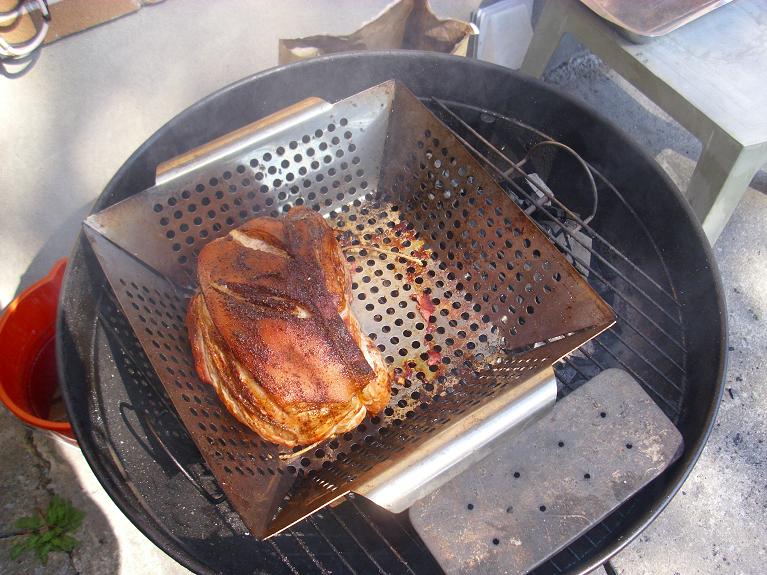
 It’s now full on autumn here. “True” Thanksgiving last weekend* was great, thanks for asking. Had a gravy juice.** We’ve already taken drives to have a look at the multi-coloured leaves in the forests. And the walks down to the shore now need a bit of tweed instead of the linen shorts of a few weeks ago. Chilly. But it’s all going to be OK. Winter is coming. That’s all. by the way, I might be a bit short this week. Been busy, working on a PowerPoint presentation for a community group on the history of brewing and drinking in my fair city from the 1780s to 1860s. There are 55 minutes to fill, 37 slides to show… and (so far) four signed up attendees. Should be very exciting. Me. A former elementary school classroom. And that uncomfortable echo.
At the far more elevated all-pro level of a similar thing, Knut paid a visit to the museum in Oslo to speak with Ingebjørg Kopperud Eidhammer, Senior Curator on her dissertation There Is Great Care Behind a Glass of Beer: The Role of Knowledge in the Establishment of Modern Beer in Christiania, 1840-1890:
The starting point is one of the museum’s real treasures: the Ringnes Brewery Archive. The scale is impressive, around 150 shelf meters… There are brewing logs meticulously filled out by brewmasters. An accounting ledger from Schous Brewery dating from 1838. Collections of labels. Advertising material. Diplomas, drawings and photographs. The oldest book on the table dates from before lager beer made its breakthrough in Norway. The ledger offers small glimpses into a society where breweries maintained connections far beyond their own gates. Among the customers we find Christiania Tukthus, a workhouse which purchased malt and brewed beer for its own use.
Conversely, the race to meaninglessness has found another gear as drinks branders have embraced “clean” according to TDB:
… the market has a strong desire for “clean” food and drinks. More than half (52%) of all US consumers are willing to pay more for beverages that support health and wellness goals, and 58% are paying attention to ingredients, according to the recent Consumer Beverage Survey from EY. Wellness is no longer niche, and it’s not relegated to wheatgrass shots and green juice either. As ingredient awareness increasingly shapes what people want to put in their bodies, even at happy hour, the Clean Alcohol Collective (CAC), a coalition of like-minded wine, spirits, beer and ready-to-drink brands, is offering what it believes is a transparent solution to a complex problem.
Lordy. What else is going on? Well, near the end of last week, news broke about the closing of Marston Brewery in Burton, England with some less than reassuring comment from the owners as reported in The Times by their excellently titled Leisure Industries Correspondent Jessica Newman:
Paul Davies, chief executive of Carlsberg Britvic, said the decision was made to ensure the company’s portfolio caters to today’s customer demand. “The stark reality is that UK cask ale volumes have more than halved in less than a decade and this trend looks set to continue across the UK,” he said. “That said, smaller ale brands are much-loved by select consumers and we will do everything we can to ensure they thrive under more specialist or local ownership in the future.”
Others closer on the ground have shared more. The Tand shared his thoughts on the consequences for the Bass Ale brand:
… it seems that Carlsberg will consider transferring the brands it will no longer brew to others. I suppose these brands will be at a guess, Banks’s, Courage, Brakspear, Ringwood, Eagle (Waggledance etc.), Tetley and I suppose the Marstons brands such as Pedigree. The big questions is who would want them and who has the capacity to brew them? Is there really much appeal when the brands are twice or more removed from their former heartlands? Even if they are sold, handed over, contracted out or whatever, that’s more difficult than you might think. There aren’t many large ale breweries left. And then there is the question of what happens to Draught Bass which accounts for around 40,000 UK barrels of the current output of the estimated 240,000 barrels being currently produced at Shobnall Road.
Speaking of deep and abiding heritage, Jordan gave well deserved praise to the timely and well-placed can of Moosehead Lager brewed by Canada’s oldest independent brewery:
Moosehead became can-dominant in the last five years and the beer is now immeasurably better. I get a room full of people to tell me about Moosehead about once a semester and they use words like, “floral” and “berry-like” and “raspberry-cane” and “moussy” and “flinty” and sometimes even “mossy” to describe Moosehead Lager. I ask them, at the end of this exercise, “Desert Island, gun to your head, you can only drink one of these beers for the rest of your life. By a show of hands, what are you choosing?” The last three to four years, the answer has been Moosehead Lager.
And Lars wrote a blog post about his new book, The Power of Beer, on the unifying theory behind it “explaining why I wrote it, and what I’m trying to do with it” and here it is:
What power am I talking about? Well, archaeology shows us that chieftains and rulers used opulent drinkware and costly drinks to impress subjects, warriors, and rivals. To take just one example, some Danish warlord apparently served drink from two drinking horns made of pure gold, and today the gold alone is valued at about 1 million USD. In the Iron Age even iron was precious, so the gold value back then must have been enough to make people’s heads spin. And this was all done for political purposes, as you’ll see. That is just one example in a very long list from prehistory.
Perhaps less definitive of cultural heritage, thanks to Liam, I saw this article about a new wobbly Japanese beer glass:
A craft beer producer in central Japan is hoping that its U-shaped “wobbly” glass will encourage people to drink water along with their beer, in a bid to prevent excessive alcohol consumption and dehydration. The “Wobbly Beer Glass by Yona Yona Ale,” produced by Yoho Brewing based in Nagano prefecture has been on sale since August amid growing awareness of the need for responsible drinking. The idea is that the glass, divided into two sections, will tilt if a balance between beer and water is not maintained.
Thoughts? First, for an Atlantic Canadian with a certain shanty singing tavern dwelling past, the name Yoho Brewing is simply excellent. Second, this idea makes zebra striping seem very very sensible by comparison. As you think on that, here’s some notes:
Note #1: “Self-Portrait with Beer Glass”, Siegfried Shalom Sebba, 1928.
Note #2: “It’s a green bottle of Stella Unfiltered. I like Stella Unfiltered.”
Note #3: “… nobody outside of Georgia really cares about qvevri wine…”
Note #4: a photographic exhibit on Bank’s Brewery of Wolverhampton.
Business news time. You may not care but I found an actually interesting BrewDog related story over at BMI:
Tilray’s 23% gain to $257 mil in “record first quarter revenue,” as well as huge 82% boost to $101.5 mil in bev revs all driven by BrewDog, execs shared during co’s fiscal 1st qtr last Thur. BrewDog added an incremental $55.9 mil to co’s revs during the qtr, CFO Carl Merton noted. Without it, co’s existing biz dipped about 4%, off around $8.3 mil. But its US-centric craft bev biz fell 18%, by over $10 mil to $45.6 mil.So BrewDog “transformed our beverage business”…
Would I ever buy the stuff? Why would I need to? Still, a good Canadian success story in challenging times. Conversely, me I like a clubby spot. There was a second story pub in St. John’s Newfoundland that had a sofa room. And my undergrad pub was full of sofas. Sofas, however, are not universally loved as B+B argue:
We’re not fans of sofas in pubs. We sink into them, they make us drowsy, and they make us feel as if we’re at home. Not in the sense of homeliness; as in, why did we bother coming out? It’s not even as if they’re usually especially comfortable. You’ll see people perched on the edge of the cushions, leaning forward, as if they’re not stopping for long. Most frequently, people sitting on the sofa in a pub are using it as a sort of waiting area, hoping that a proper table becomes available soon. What we’re wondering is, were they always there, these great lumps of useless soft furniture?
Perhaps it’s because I am a great useless lump myself that I love a sofa. I find many sorts of pub furnative uncomfortable. The unergonomic bar stool. The evil tall legged chair at the wobbly tall table.
Now, perhaps getting all a bit meta on you, this week’s interesting feature on the pubs of Great Yarmouth by Anthony Bennett in Pellicle included a passage that I really appreciate – a simple and even subtle explanation of the point:
Great Yarmouth reportedly has more pubs per capita than any other town in Britain. “We have lost a lot of pubs in the past 25 years, but I’m pleased to say very few in the last 10,” says the Red Herring’s landlord, Darren Grice. “There are still many, and the reason for their survival is they all cater for a different type of customer. There are four categories: pint drinkers, in particular real ale; food pubs; sports pubs; and the vodka-and-coke karaoke bars. All these pubs all sort of get along, and are still here by staying open and being aware of their limitations. Today, my focus is on four of those real ale pubs.”
Semi-keener readers of Hobbes’ Leviathan (when a miserable student in some decade past) will recall that all you need to read is chapter 13 where he summarizes everything else. Jesus did the same sorta thing with the Sermon from the Mount, right? This is not that. This is the most subtle guidance. The smiling host guiding you to your table. The helpful sign upon the path. We are someetimes told that the best do not tell what they are writing, they just write… but who are the best? Really? Just not sure? A little nod in the right direction is appreciated.
Even more expository was Will Hawkes this week on the potential limits of the lyrical:
“When I drink London Black, I can almost hear the chimes of Big Ben,” Adrian Tierney-Jones tells a sizeable crowd at Tottenham’s Big Penny Social. Crikey. This is the Brewers Congress, an annual jamboree of brewery-industry drinking and talks, and Tierney-Jones, as lyrical as ever, is treating a selection of brewers and fellow travellers to his thoughts on the importance of “a sense of place”… It’s an interesting point, and ‘a sense of place’ has long powered wine sales, but one wonders how it applies to modern London. The truth is that locally-produced beer has rarely been less popular here – and certainly not in the past 15 years. Most Londoners, it seems, have increasingly little interest in London-brewed beer.
Lordly Lordy!*** Not quite fingerpointing and handbaggery but a rug may well have been pull. Aaaaannnnnd… that’s it for now. As I said, a shorter list due to distraction but also a bit of a quieter set of offerings too. For for another hit of beer news, please check out Boak and Bailey’s postings on each and every Saturday along with the coincidenal and fabulously entertaining footnotes week after week at Patreon. Such an effort! And do look out for more of Stan’s “One Link, One Paragraph” format. There was a good link to a nano brewery this week. Then it’s your turn. Read and recommend, please. Scour the world for news tips – then let me know. Then hunt out something in someone’s archives! Leave oblique comments on someone’s post from 2009!! Listen to a few of Lew’s podcasts and get your emailed issue of Episodes of my Pub Life by David Jesudason on certain Fridays. And Phil Mellows is at the BritishBeerBreaks. Once a month, Will Hawkes issues his London Beer City newsletter. Do sign up for Katie’s wonderful self-governing totes autonomous website featuring The Gulp, too. Ben’s Beer and Badword remains on pause but there is reading at The Glass which is going back to being a blog. Any more? We have Ontario’s own A Quick Beer and All About Beer is still offering a range of podcasts – and there’s also Mike Seay’s The Perfect Pour. Plus follow the venerable Full Pint podcast! And there’s the Craft Beer Channel on Youtube as well as the archives of the Beer Ladies Podcast. What else?
*Here’s an excellent description of how we do it.
**Slug of Crown Royal, half a can of cider, half a can of ginger beer on ice. You’re welcome. ***Yes, I said it!