
Your Mindblowingly Fabulous Beery News Notes For The Start Of The Best Two-Thirds Of The Year

April showers bring May flowers yet they are at the heart of what makes the most cruel month. I don’t get it. It’s good that we can put the whole thing behind us. Along with the payment of what was dues on the taxes. Done. And stuff like will it be a blizzard warning or one for a tornado? Now it’s time to put the feet up a bit. Check out what’s going on, like seeing who is passing through in the migration. Saw these Red-breasted Mergansers down at the shore this week. Bet they’ve dealt with their tax filings. Yup, best to tra-la for th new month starting tomorrow. Tra-la-ing is not to be dismissed. Shout it out or even sing aloud. Try it as an excuse on your boss in a meeting, for that particularly difficult clerk at a store or even on your in-laws! An all purpose response to any situation. Until, of course – WHAMMO – June shows up. Back to the grindstone in June.

Speaking of the seasons, Knut got a bit poetic in his wanderings around the hopyards of Poperinge in Western Belgium:

It’s springtime, even in northern Europe. I have harvested the first edible plants of the season, aromatic wild garlic. German restaurants are preparing for the Spargelzeit, when fresh asparagus dominate the menus. But beer ingredients also follow the seasons. From a beer perspective, the fields of barley are turning from gray to green. And in a belt from the English Home Counties via Flanders and Bavaria to Bohemia, the hop fields are showing their first shoots.

I had no idea that hops grow 20 centimeters per day. He’s got even more facts and figures on the start of the hop ag year.  Jen Blair was in a different place but, still, also full of the revelations when she considered the airport Cheez-it which led to some interesting thoughts about sensory perception:

You can imagine my delight when I boarded another flight a few months later to discover that Delta now offered Cheez-Its as an in-flight snack. A few years ago, Delta partnered with the then Atlanta-based SweetWater Brewing Company to create an IPA specifically formulated for flight, with reduced bitterness and increased perceived hop aroma. I wondered if they had done the same with Cheez-It. And here we have arrived at the Cheez-It sensory experiment. I had an upcoming flight to Colorado for World Beer Cup judging, and so did another friend flying in from Montana. I texted her to buy a bag of Cheez-Its at the airport, but not to open them because they were for Cheez-It sensory when we met up in Colorado.

She even proposed the identification of a “Cheez-It equilibrium” point in the atmosphere which is, obviously, quite excellent. I am tagging this under the “Science” category.  More science now… but with a political twist… out of the UK with the news… with a sports twists… that the country is running out of carbon dioxide… cause by a global crisis twist:

Fans of the beautiful game shouldn’t panic about the beer running out during this year’s World Cup — yet. Business Secretary Peter Kyle tried to reassure Brits Thursday that they’ll be able to enjoy a pint during this summer’s football tournament. It comes amid reports officials are drawing up contingency plans for a shortage of the carbon dioxide used to make fizzy drinks as the Strait of Hormuz closure bites. Directly questioned about whether Brits will be able to get a beer during the summer World Cup, which starts on June 11, Kyle said: “At this moment, this is not a concern for our economy, okay? I can reassure people of that.”

He “…tried to reassure…” Hmm… Not a concern “…at this moment…” Hmm… Commercial CO2 appears to be a by-product of gas and oil production so we up and over here have a bunch. Still sticking with the serious objective stuff, The Western Producer recently shared an update on the market for Canadian malt barley exports:

… about a year ago, Canadian barley prices started to fall as China resumed purchases from Australia after a lengthy trade spat. That pushed a lot of Canadian barley out of the Chinese market. And then Canada harvested a bumper crop of barley in 2025. Farmers produced 9.73 million tonnes, a 19 per cent improvement over the previous year, putting even more downward pressure on prices. “Prices have been a lot more competitive in the global market,” said Watts. At the same time, French malting barley prices climbed higher due to a short crop in that key exporting nation. Those events, combined with years of continued market development work, encouraged Colombia to reconsider Canadian supplies, and they were happy with that decision.

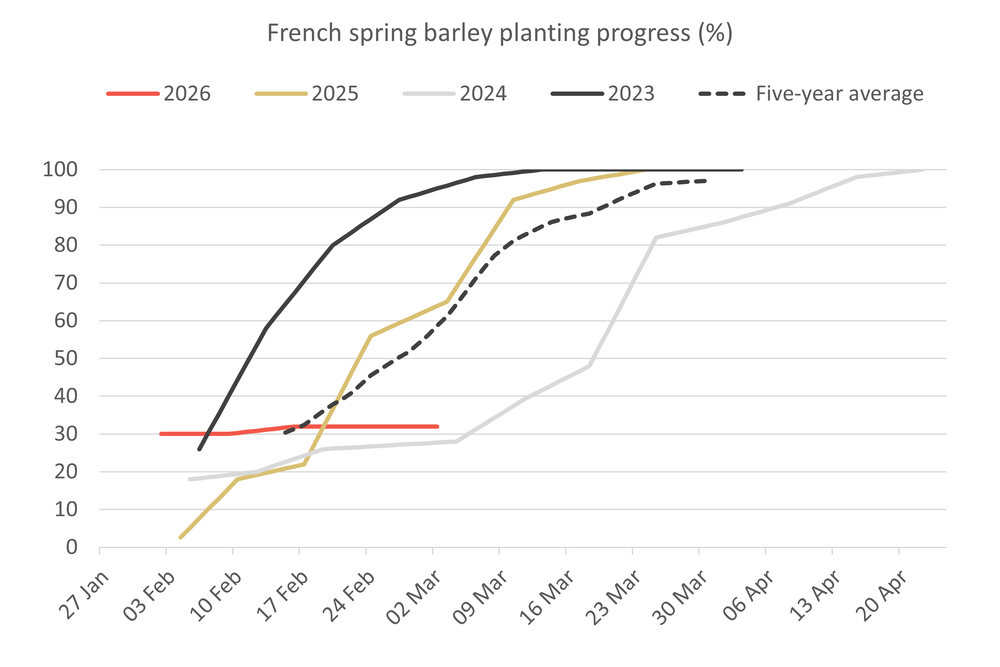
International harvest intrigue reigns. France is looking at another rough spring 2026 as far as barley planting goes, too.  That flat red line on that graph under the thumbnail tells the tale. And the competition is ahead of French farmers. On the other side of the planet, the Austrialian 2025/26 crop is “23 percent higher than last year and 21 percent above the five-year average.” Meanwhile… geopolitics can get one into some very odd places. As you think on that, here are some notes:

Note #1: Bun photography.
Note #2: “Rub my Dad’s bottom….”
Note #3: “…surprising health benefit…”

You know, I think the craft beer recovery needs to be measured in the returned of a staffed up BA because I really don’t get where anyone is going with the “return to 2012” narrative. But Dave Infante reporting from the Craft Brewers Conference for VinePair gives another angle on the boost to mood:

 Survivorship bias dictates that the brewers that made it to CBC 2026 are likely to seem the most bullish; after all, if they weren’t, they may have stayed home to save money and manpower. At the risk of sounding indelicate here, I also suspect that the segment’s years of closures have helped cull the herd of both excess numbers and outsized negativity. A dying brewery can only die once, after all, and with outfits that were never built for this market getting pushed out of it, those that remain stand to benefit from more focus and less vicarious angst.

We are told that history is written by the victors but, I guess, we have to ask in this market what is “victory” when overall US craft production is down 9% over the last two years and down 17%* since hitting a peak in 2019? Speaking of questions… is the use of “lifestyle” as a descriptor ever not a red flag? Consider this PR blurb about a new beer-like substance:

Carlsberg Britvic premium beer marketing controller Rebecca Allen revealed that the 4.5% ABV beer is strategic in answering the trends of the moment and admitted that “the timing reflects a broader shift in drinking culture, where boundaries between categories are increasingly blurred and consumers are more open to hybrid, lifestyle led propositions”. Allen told db: “1664 Rosé takes its name from its distinctive flavour profile, a refreshing berry flavoured beer. The ‘rosé’ cue reflects both its taste and its visual appeal, positioning it as a lighter, fruit-forward beer.”

What style of life is being referenced? And where has that style led the life of the consumer in question? Speaking of style, Ron has given us a few background insider sorta notes on his presentation flow while on the road, working it in Chile:

For my talk, I speak a couple of sentences and then the interpreter translates them into Spanish. It interrupts my flow a bit. But does give me a chance to drink some beer while the interpreter is taking.  My talk is about Irish Porter and Stout. I should probably update it. I wrote it a while ago and have since got hold of a lot more Irish brewing records. In particular, examples of heading, the sort of Kräusen used in Ireland. I get through my beer so quickly, I have to request a refill. That’s a first. Just making sure my throat doesn’t get too dry. Wouldn’t want to get hoarse. Usually, I only get to take a sip or two, as I keep rattling away. When I’m done, I sell a few more books. Which is good. I’m nicely building up dosh in my PayPal account. Dolores will be so happy. Why have I never brought books with me to sell before? Because I’m an idiot. That’s why.

When Dolores is happy, I am happy. Conversely, there’s bad news out of the other end of Lake Ontario as the Toronto Festival of Beer has gone under** and has left creditors and suppliers holding the bag according to CTV News:

Applying to work for the festival was costly, Kowalik noted, as she and her partner spent $1,000 on the entry fee and an additional $200 on liability insurance. She says they both took time off from their day jobs to work since the festival started on Friday. Over the course of the weekend, Kowalik said they went through all 20 cases of beer that they brought up, amounting to a total of just over $2,000. 

The story shares a twist on beer fest tokens. Because the festival sells them and not the breweries, the money paid for the beer tokens does not go to the brewers. Kiss it goodbye. Anyone owed money can call into to the bankruptcy meeting this afternoon at 3 pm. But seeing who else is on that list of creditors, the news may not be good. For $2,000,000 in liabilities there’s only $8,000 in assets.

On the Burton Union question, we have had Laura H in (t)DB on challenges posed to the survival of the Marston brewing kit and also providing CAMRA with a backgrounder on the history of the system. Now, a Mr. M. Curtis has visited the part of the whole which became lodged at Thornbridge and reported back:

Fixed to the head of each oak barrel is a large, cast iron “X”, painted black. If this seems familiar it’s because, for a time, an illustration of three such barrels, stacked in a triangle formation, formed the logo of Marston’s Brewing Company in Burton-upon-Trent, Staffordshire. Still in operation, today Marston’s brewery is owned and operated by British-Danish conglomerate, Carlsberg Britvic. In January 2024 Carlsberg Britvic—then known as the Carlsberg Marston’s Brewing Company—decided to retire the remaining four working union sets at Marston’s. Once used to brew what was once some of the most well-known ale brands in the country, including Marston’s Pedigree and Owd Roger, the brewery’s website famously used to state: “No Burton Unions, No Pedigree. End of.” Now, it seemed certain this storied piece of British brewing history, first invented in 1838, was due to be consigned to the dustbin of time and memory.

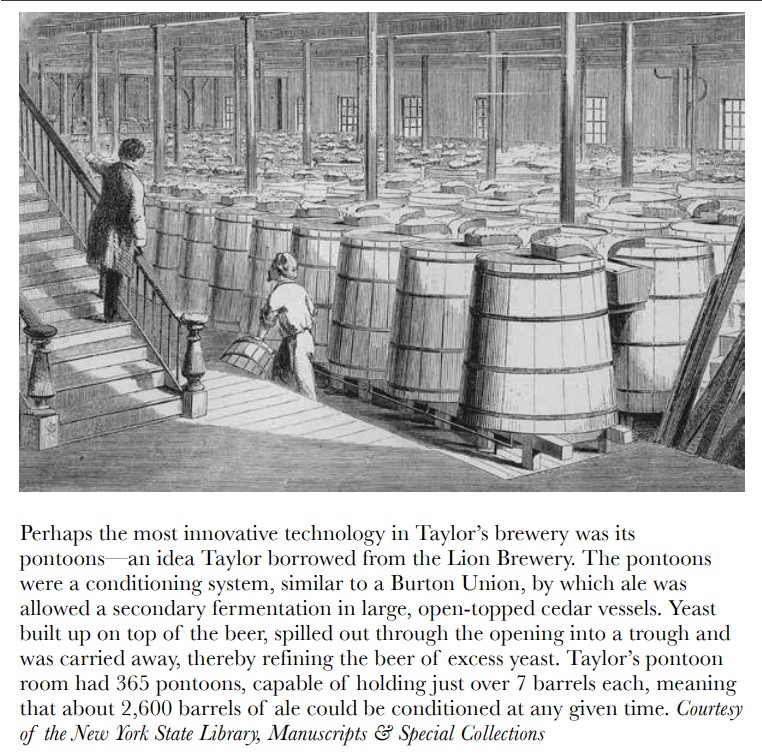
I was going to say that it is too bad that the United States has little similar interest in its brewing history as we could see the mid -1800s pontoon room of Taylor of Albany recreated even if in part but then was saddened to see that the link in my post of 2016 to Martyn’s at Zythophile failed. It’s all there at the Wayback Machine site. But the key word search does not seem to work and Martyn did not use a URL system that included the date. So you can hunt out his post at your leisure. In the alternative, I can only direct you to the work of a couple of rough sorts, Messers Gravina and McLeod, at page 80 of their opus on, in and abouts Albany which you can review under that thumbnail to the right… well, your right my left.

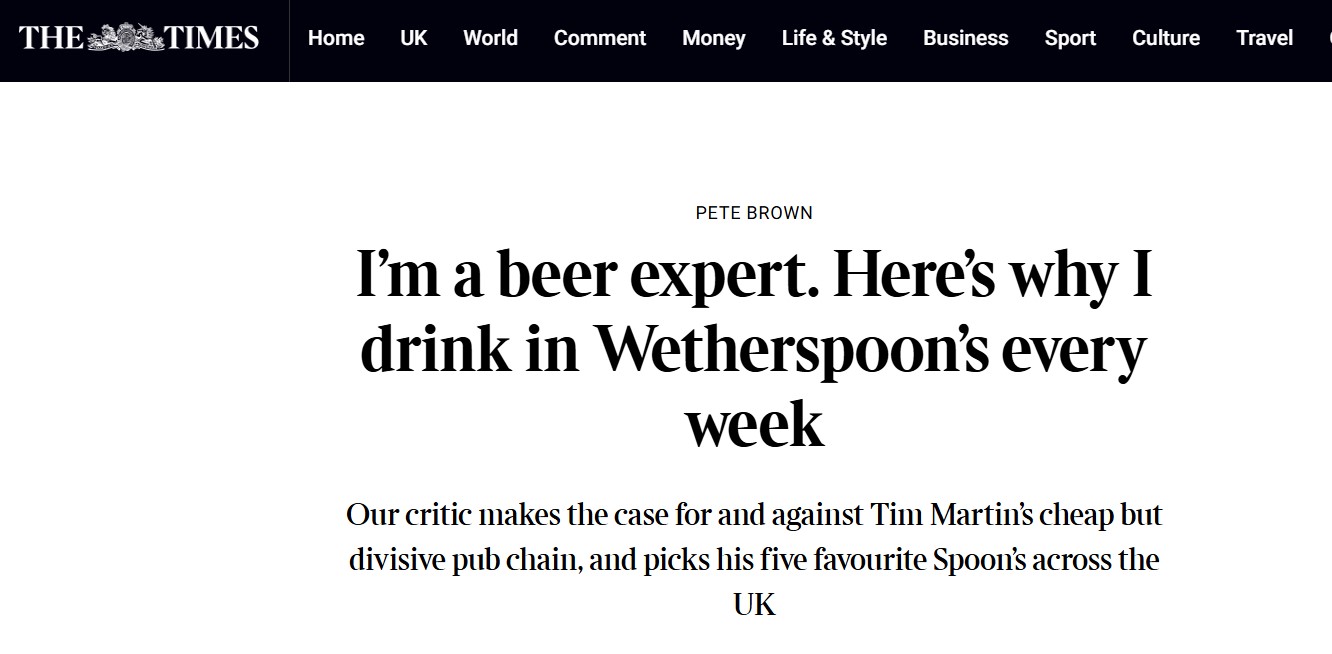
Lastly, following up on observations on the word “critic” in beer writing a couple of weeks ago, The Times also appears to be confused as the sub-header for one story this week describes Pete Brown as “our critic” and then he himself states as follows:

Of all the arguments the beer world loves to have, there can’t be many topics more divisive than JD Wetherspoon pubs.  Critics attack them as a refuge for those too old and/or drunk to mind the harsh lighting. Supporters say this is just snobbery, and what’s wrong with cheap beer? Critics believe the beer is cheap because it’s bought “short-dated”, or about to go off. Supporters ask where else can you get a meal and a pint for under a tenner now?  The thing is, both sides are right. Except that the beer isn’t short-dated and never has been.

“Critic” is not a synonym for detractor.  Pete isn’t the one who created this. But as Stan reminded us, the “…critic’s job, nine-tenths of it, is to make way for the good by demolishing the bad” as it was put by Kenneth Tynan. What is it about general beer culture that is uncomfortable with the common form of two handed discussion and intelligent criticism with a bit of peer review thrown in for good measure? Oh well.

That’s it for now. Report upon your tra-la-ing in the comments if you like. Until we meet again, please check out Boak and Bailey who are posting every Saturday and adding to their fabulously entertaining footnotes week after week at Patreon. And look out for more of Stan’s new “One Link, One Paragraph” format. Then hunt out something in someone’s archives! Leave oblique comments on someone’s post from 2009!! Listen to a few of Lew’s podcasts and get your emailed issue of Episodes of my Pub Life by David Jesudason on certain Fridays. And Phil Mellows is at the BritishBeerBreaks. Once a month, as noted, Will Hawkes issues his London Beer City newsletter and do sign up for Katie’s wonderful self-governing totes autonomous website featuring The Gulp, too.  Ben’s Beer and Badword seems to be on pause since November but there is reading at The Glass which is going back to being a blog. Any more? We have Ontario’s own A Quick Beer and All About Beer is still offering a range of podcasts – and there’s also Mike Seay’s The Perfect Pour. Plus follow the venerable Full Pint podcast! And there’s the Craft Beer Channel on Youtube. Check out the archives of the Beer Ladies Podcast. See you in May!

*26.3 bbls in 2019 compared to 21.9 bbls in 2025. What’s the degree of collapse that will send a message to the PR trade, one wonders. 
**Sixteen years ago, Jordan shared his thoughts on the unappetizing event.


Your Sunny Warm Bountiful Springtime Beery Beer Notes For A Satanically Chilly Late April Week

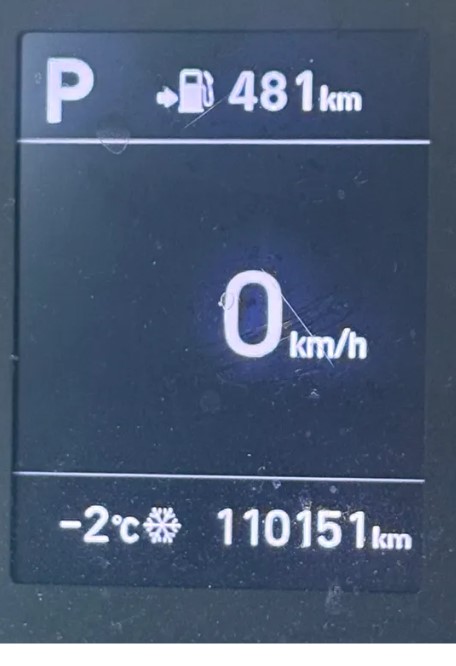
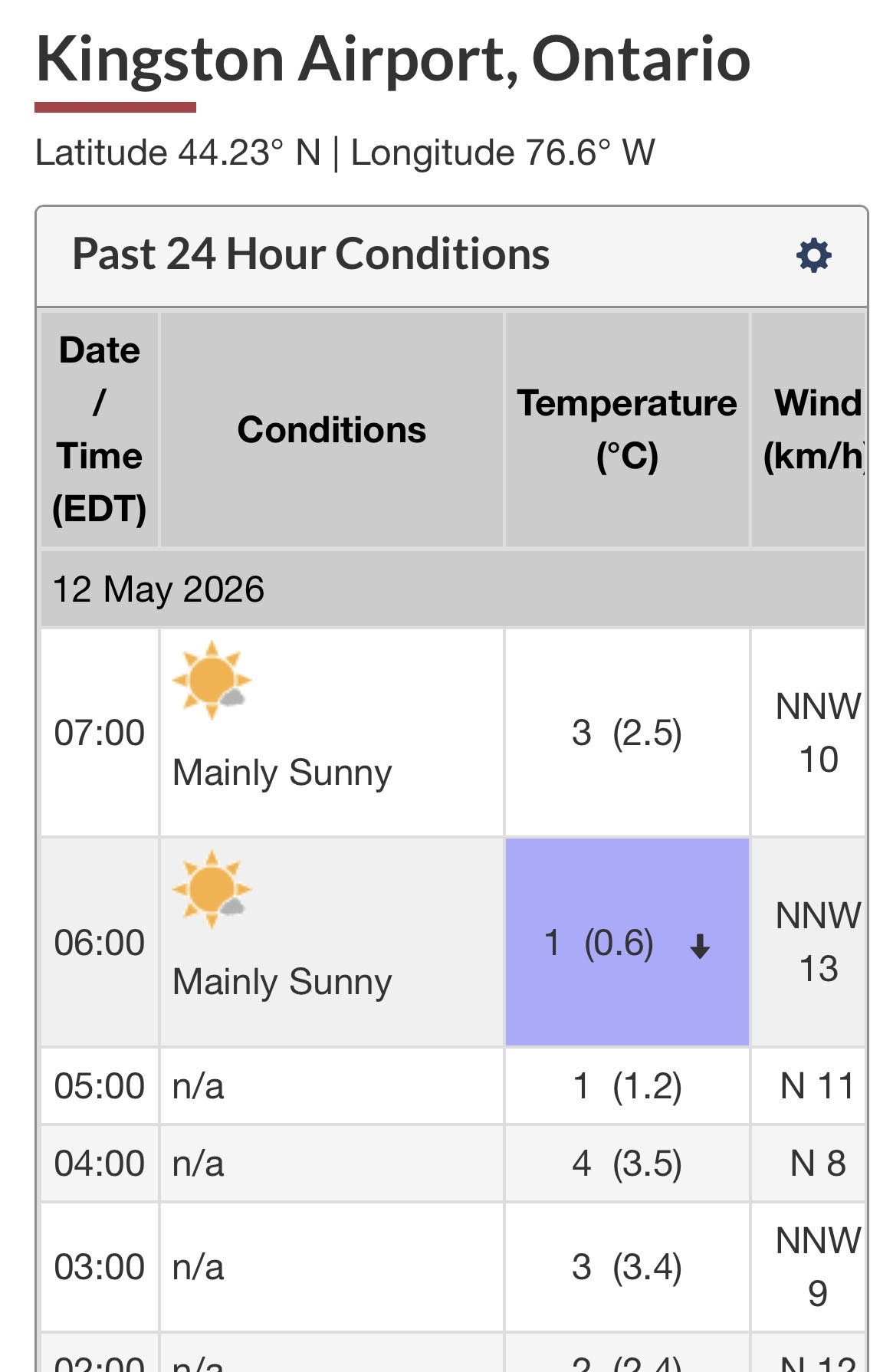
a car dashboard showing a temperature of minus twoOn Monday as the sun came up I thought I might do a little weeding in the garden. But something was strange. Wrong even. The top of the soil was like rock. Solid. The hoe just cracked it intopt large chunks. Then I realized it was under zero. Oh. My. Lord. A month into spring. Of all the feels (uses fingers… denial, anger, bargaining, depression, and acceptance) I only hit the second and the fourth. Lordy. It was up to +4C by the time we got to noon on Tuesday. Can this please be the end of these freezy frozies? Please?*

What is happening… elsewhere where it is warm and cheery? Well for starters, when in Rome, you may want to do what The Beer Nut does as he has some great observations from his recent trip there:

In an age of beery uncertainty — when the consensus of the craft era is, if not completely dismantled, then at least creaking with important bits falling off — it’s nice that some certainties remain. I’ve developed a newfound appreciation of the beers and bars I discovered in the early years of this blog, and before, which are still operating despite the barbarians being inside the gates. So it was especially pleasing to arrive into Rome and find that two of its fondly-remembered institutions are still going, same as ever.

Also warming is the south of England where we have a pair of stories. First, in The Guardian we read of a boom in one corner of the drinks trade:

While Britain remains far down the list of global wine producers – behind countries including Uzbekistan and Tunisia – it is the fastest-growing wine region in the world, according to the property group Knight Frank. It reports the area of planted vineyards in the country has quadrupled since the turn of the century. Langham’s estate is part of this boom, almost tripling in size since 2009 to span about 34 hectares (84 acres) of the 1,000-hectare site. Increased wine production means the company has outgrown the converted farm buildings it was using to store barrels and bottles and it has just invested £2m in a new winery which should be completed by the summer.

Then, Mr. R. Protz shared his thoughts on one aspect of that boom writing for CAMRA’s publication What’s Brewing:

Here’s a fact that will freeze the blood of all beer lovers: there are now more vineyards in Kent than hop farms. Since the 16th century, the county of Kent has been at the heart of hop growing. It has what the French call terroir – the right balance of soil, sunshine and rain to grow the finest hops. The soil in the Garden of England is sandy and loamy. This means it retains rain and moisture and enables the hops to grow fast and develop the piny, spicy and peppery aromas and flavours for which English hops are famous. The decline in hop growing has been calamitous, not only in Kent but in other major cultivation areas such as Hereford and Worcester. In 1962 8,200 hectares were devoted to hop growing. By the end of the century the number had fallen to 1,060 with just 45 hop farms left.

This leads to the question of the relative profitability per acre of hops destined for brewing compared to grapes destined for wine making. In 2019, the ag mag South East Farmer stated:

“The first stage is to talk about the elephant in the room, which is profitability,” said Duncan. “Establishment costs, depending on vine density, is £8,000 to £10,000 per acre and farmers should be looking to establish 20 to 30 acres to justify the investment into viticultural machinery. If you choose the right site and plant the right varietals, clones and rootstocks there is no reason not to be aiming to grow three to four tonnes per acre. Payback, which includes the cost of establishment as well as the annual running costs in the early years, is expected after year nine. Fruit is selling at approximately £2,000 per tonne at the moment and it costs around £3,000 per acre to produce. So if you can turnover £6,000 per acre, the gross margins on an acre is £3,000 and that is well worth waiting for.”

Note that the phrase is “gross margins”. Now, this might be a question I should have put to Stan but what is the gross margin for hop growing in southern England? The UK Department of Enviroment, Food and Rural Affairs has plenty of info on the standards that apply to hop farming but not a lot on economic expectations.  One sees that an acre may produce 1,000 pounds of dried English hops on average (or half a ton) and that recently a ton retailed in 2024 for a little over $9000 USD or £12,000 pounds (or £6000 a half ton acre.) Similar. But what is the gross margin? Also… it might be a error to even compare. In both cases, the acreage is so small that it’s unlikely the vineyards are directly muscling out the hop yards. Yet one is an expanding market while the other isn’t. Thoughts on the resulting… err, actual… numbers much appreciated.

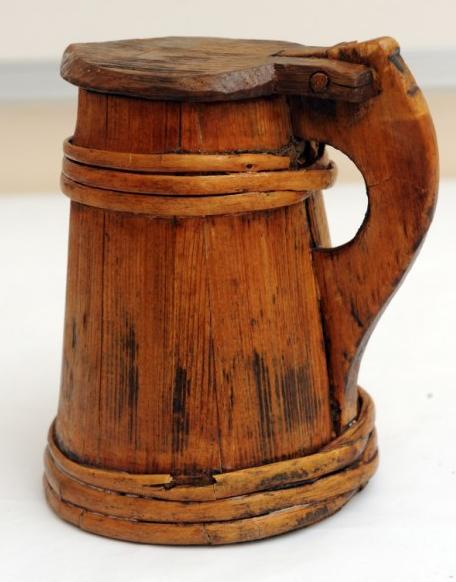
Moving from the question of “what’s in it?” to “what’s it in?”, Tim Holt shared a link this week to an article in the Royal Society’s Notes and Record after he received his hard copy of the publication.  The reason? About a couple of months ago, the Royal Society reported on receiving Sir Isaac Newton’s wooden pint flagon:

In this article, we first tell the story of the wooden pint flagon by considering Newton’s college friendship with John Wickins, the latter’s appointment as rector at Stoke Edith, the relevant histories of the Wickins and Hussey-Freke families who owned the flagon, and public notices and exhibitions of the artefact in the nineteenth century. This evidence allows us to track a circuitous yet plausible itinerary for the drinking vessel from Trinity College to Hannington Hall.

At the time of Newton’s use, a pint flagon filling would be 1d at Trinity College and while about 2d in Glouchester according to a contemporary reliable source* – though that may refer to a quart which would make sense. It is also interesting to compare the vessel to two Tudor examples we looked at, oh, about thirteen years ago. Also wooden but not nearly as fine as Newton’s, having a conical shape rather than new more recent on in the form of a small barrel. Less stable in form for perhaps a less wild context?

Going further back in time, Merryn guided us to an re-examination of a 1927 study of Italian ceramics dated to between 750 and 725 B.C.:

Gas chromatography and mass spectrometry analysis of residues in the gourd detected organic compounds commonly found in fermented fruit juice, perhaps from grape, apple, or pear. No tartaric acid, a component of wine, was found. Tests conducted on the gourd residue also identified heated pine resin and mastic resin, which were believed to have medicinal properties.

Which leads to the interesting idea that alcohol may have been prized early on as a medicinal rather than just the jolly juice.  And going even a bit further back, the Times of India reported on a Danish study of an ancient Sumerian tablet:

A small clay tablet has offered a remarkably human glimpse into life 4,000 years ago. Researchers studying ancient Mesopotamian inscriptions in Denmark have identified what may be the world’s oldest known beer receipt, a written record of beer supplied for workers in the Sumerian city of Umma.Instead of chronicling war, kings or religion, the tablet appears to document an everyday transaction. The discovery was made by scholars from the National Museum of Denmark and the University of Copenhagen during a fresh review of museum collections. Experts say the find highlights how some of the earliest writing systems were created to manage trade, labour and resources.

So while beer probably didn’t caused civilization, it may have advanced the need to record the growth of civilization. Notes time!

Note #1: Speedy cocaine-laced salmon.
Note #2: Authorities in India claim ABInBev part of cartel.
Note #3: What’s a Chester?
Note #4: Scratchings!

Speaking up there of Stan, this month’s edition of Hop Queries is out and he asks this question:

What hop variety shares her name with a hop disease?

Figure it out yourselves. I won’t ruin the fun. Conversely, we have two no fun tales tales of failure today from the big names in craft circa 2016. Turns out that the lingering BrewDog legacy includes a number of forms of debtor deadbeatery:

Brewdog went under with £550m of debts. The administrators have now filed a (long) list of creditors on the Companies House website. Among them is Lords cricket ground which is owed £420,000. Since the debt is unsecured Lords are likely to get less than a penny in the pound back of what they are owed, around £4,000. Another London sporting venue where Brewdog got the beer franchise (and still have it) is West Ham’s London Stadium at Stratford. Here the debt, £12,000, is much smaller….

Innis & Gunn, it turns out, stuck their 200 business partners with less than 4% of that pile of bad paper. And, in the UK, BrewDog’s brother from another culture, Stone continues to see its legacy fade at least in Virginia:

The beer-making operations of Stone Brewing Co. are not long for Richmond as the California-based brand is being sold for the second time in four years.  This week industry giant Duvel Moortgat USA announced it has reached an agreement to acquire Stone Brewing from Sapporo Holdings, the Japanese brewing conglomerate whose US division bought Stone in 2022.  While the Stone brand and beers will continue to exist as a subsidiary of Firestone Walker Brewing Co., a California company owned by Duvel, Stone will no longer have a manufacturing presence in Richmond. Its sizable production facility at 4300 Williamsburg Ave. in the city’s Fulton area will become a full-time Sapporo USA production facility, Sapporo-Stone CEO Zach Keeling said in an interview on Monday. 

Trade friendly insider commentators will no doubt call this retraction an consolidation. Hope springs eternalBAer fans of Stone on the East Coast are now looking forward to… mmmmm… stale older beers.  And Boak and Baily shared another aspect of the retraction in last weekend’s footnotes on Patreon:

We used to take much more of an interest in US craft beer than we do today. When we first started blogging, back in 2007, most ‘craft beer’ was American and we spent a lot of time and money hunting American craft beer around London. As the British craft beer scene grew its primary influence was America and there were times when it felt like Brits cosplaying Americanness… These days, though, there’s less American beer around in the UK and British craft beer feels like its own thing. It doesn’t feel as if what’s happening with craft beer in the US has much bearing on what’s going on here, even if there are echoes of the same trends and cycles between the two scenes. 

We are retracting into our own scenes, deglobalizing. Perhaps as the Great Creator intended. Who benefited from international craft? Perhaps what is more attractive are the local habits. Relatedly, there were some interesting observations from Will Hawkes in London Beer City about the confusion someone from away might experience when entering an English pub:

A French family of four wanders into The Blackfriar and, spotting a table, sits down. The mother begins to peruse the laminated menu. The children chat amiably. The mother puts the menu down and discusses its contents with the father. Time passes. The father looks at the menu. He discusses its contents with the mother. More time passes. Eventually, the father decides to go to the bar. It’s been ten minutes. I wonder what it is about French visitors to our glorious capital that makes them skip the bit about ‘how pubs work’ in their guidebooks? Maybe French guidebooks just don’t have that section; possibly this crucial info is completely absent from l’internet. Perhaps they’ve been left (understandably) confused by the profusion of restaurants masquerading as pubs in London, where table service has become the semi-norm.  

I suppose I have been in a similar situation. After all these decades, table service is a familiar holdover here that carries echoes of the temperance cause and regulartory community control. Well, a minor version of that I suppose, at least compared to Iceland as Will Howard reports:

In 1908, the Icelandic government put the decision to vote, asking the public whether they wanted to outlaw alcohol in their country. After 60% of the voting populace said yes, the prohibition was put into effect in 1915. However, they reassessed in a matter of years. Wine was put back on the menu in 1922. Spirits came along a little later in 1935, but beer remained strictly forbidden for nearly the entire rest of the century. This was partially due to puritanical, classist logic about the effect that cheap beer has on the underclass, but there was also another, more important reason that beer was outlawed for so long – up until 1944, Iceland was an associated territory of Denmark, which was a cute way of saying that Iceland was under Danish rule, and the Danes loved their beer even more than the rest of mainland Europe did, thus, drinking beer was seen as coloniser behaviour.

Well, now you know. A Good Colonizer’s Beer Blog is my new title. Or rather Bjórblogg góðs landnema if you know what I meanAnd I know you know. It’s what brings us all together once a week, right? Right?? As we await your reponses on that point, please check out Boak and Bailey who are posting every Saturday and adding to their fabulously entertaining footnotes week after week at Patreon. And look out for more of Stan’s new “One Link, One Paragraph” format. Then hunt out something in someone’s archives! Leave oblique comments on someone’s post from 2009!! Listen to a few of Lew’s podcasts and get your emailed issue of Episodes of my Pub Life by David Jesudason on certain Fridays. And Phil Mellows is at the BritishBeerBreaks. Once a month, as noted, Will Hawkes issues his London Beer City newsletter and do sign up for Katie’s wonderful self-governing totes autonomous website featuring The Gulp, too.  Ben’s Beer and Badword seems to be on pause since November but there is reading at The Glass which is going back to being a blog. Any more? We have Ontario’s own A Quick Beer and All About Beer is still offering a range of podcasts – and there’s also Mike Seay’s The Perfect Pour. Plus follow the venerable Full Pint podcast! And there’s the Craft Beer Channel on Youtube. Check out the archives of the Beer Ladies Podcast. See you next week!

*Sunny and plus 15C by late afternoon Wednesday. Even put a daub of sunscreen on. Why were you complaining so much? Me? I wasn’t complaining. You were!
**Notice also both records reference Red Streak as a 1600s apple variety for fine cider.

Your Alluring Beery News Notes For The Magical Week When The Cowbirds Returned…

We all know that the swallows Capistrano in California and it’s all yada yada yada, right? But here – the Cowbirds are back. Yes!  See… I have an app on the phone that identifies birdcalls and sitting in the parking lot of a municipal park the other day it clearly picked up the squeek of Brown-headed Cowbirds, the parasitical arseholes of the birding world. Isn’t nature wonderful! Well, it is inside. The cukes and tomatoes still face a few light frosts keeping them indoors. That middle plant? Tumeric. Just stick a chunk of rhizome in a peat pot and keep the soil damp. Easy. Peasy.

What else is going on? First up, hot news out of Iowa this week and Ms. M. Ogle may have let a cat out of a bag over at BlueSky:

This is so sweet! @dsquareddigest.bsky.social defends Budweiser in part by relying on my book. (The essay is from 2007.) PS: I’m currently working on a 20th anniversary edition w new material. Release late summer.

Fine, that does seem a bit intentional. So save up your pennies for that wee treat later this year. The Tand himself likes a similar sort of straight forward discussion as he wrote about this week:

Way back in the past I wrote about how the modern mannerism “You all right there” at the bar had become a kind of of substitute for previous greetings such as “what can I get you?” or “what would you like?” For the record, it was a short blogpost, as this one will be, and it was over fifteen years ago and, inevitably, in the way of things, it has got worse. Fifteen years ago, I was by my measure of the day an old git – and I quote myself there. Nowadays I’m an even older old git and while generally good natured, I am slightly wound up, inwardly at least by how bar staff have become even more slapdash.

Perhaps this is what distinguishes a UK pub from the sort of port town tavern I was raised in.  I would not necessarily want to engage with the guy on the other side of the bar as, when I did, his side of the conversation could be more like “you call that a tip?” or “I got kids, you know…”  Speaking of which, it seems pretty obvious to me, if IKEA can sell discount meatballs to those waiting for the shopping for even more napkins and sidetables to be over, that a discount grocery store should be able to make a little something on the side by selling macro lager in a somewhat unattractive setting to those silently waiting for the groceries to be gathered:

German discount grocery chain Lidl has begun building its first ever pub, which is expected to open this summer. The pub and its associated liquor store, located in Northern Ireland, will offer Lidl’s range of wines, beers, ciders, spirits and liqueurs, according to the retailer. The premises will be located in the eastern Belfast suburb of Dundonald, next to one of Lidl’s existing stores, it said in a statement. The pub will be able to seat 60 people and will have a floor space of 60 squar meters (646 square feet).

As John Milton told us centuries ago, they are also served who would otherwise only stand and wait. Not waiting around at all is Katie M. who has justifiably strong feelings about the quality of news coverage of pub life in the UK, as she unpacked this week:

Pubs and beer will never receive the coverage they deserve in the national press because they are seen as lesser, until they elevate themselves to the point of being better than a mere public house. I agree with Sitwell that the Laddie is superlative, “a quite magnificent thrill” but I also note that he mentions one drink throughout the entire review, a pint of Guinness, despite the location being a pub and not a restaurant. Oh, I am so sick of Guinness getting all the headlines (sorry Padraig, it’s nothing personal.) The whisky selection! The wine list! The cask on offer at this place! It’s all carefully chosen by experts in their field with purpose and delight. It deserves at least a casual reference.  I love pubs. Millions of British and Irish people love pubs. So why are we still being offered so little in terms of pub and beer coverage? 

On perhaps a related note, I realized I had noticed something that I should have noticed before. When describing folk writing about beer and pubs, news media tend to describe them as “our beer expert“* while every other columnist on restaurants, theatre, music etc is the newspaper’s “critic.” Why is that and what does it suggest? Do they lack a certain edge that one sees, for example, in Boak and Bailey‘s honest and detailed weekly reviews? Would a news paper ever publish the words “somewhat muddy in appearance and flavour, like one of our own attempts at home brewing“? And when a paper clearly seems to have at least two, they never acknowledge the other one. Always “our beer expert” in the singular. Hmm…

The Irish Times has raised an issue about non-alcohol beers that is not discussed. We have heard and accept that the cost of production is no less than traditional brewing but what is not discussed is now it is often not taxed in the same way:

…walk up to a bar in Ireland and order an excise-free, non-alcoholic beer and you’ll pay close to the same as you would for the full-strength equivalent. This has been a bugbear for consumers for years. Three years ago, in a written Dáil answer, the then minister for finance, Michael McGrath, said pricing of these drinks was a matter for retailers and publicans. “This should reflect the fact that no excise applies to such products as well as other factors,” he said. A pint of standard beer comes with a 54 cent excise rate attached – its zero-alcohol partner does not… “The challenge with non-alcoholic beers is that there’s not much transparency here. A lot of this is very opaque and the private business of manufacturers.”

I have become a regular purchaser of NA Guinness but, thinking about it, I have no idea what role taxation plays in the final price. Speaking of things I never knew nuttin’ about, this very week Mr. R. Protz has opened my eyes to an even more troubling aspect of the beer related media:

While breweries & publicans struggle in a tough climate, trad beer writers work hard for lean pickings, a most lucrative “career in beer” is viral boozing. Jon May boasts “the best job in the world” earns £100k a year livestreaming drinking 10 pints a day. Downside: his health concerns.

Downside #2: taking advice from a drunk moron.  Upside: won’t last that long.  Lars may well have provided a hint as to the perfect soundtrack for these sorts of things.

Jeff gave us a summary of the Brewers Association stats for 2025 and it appears things ended up worse than expected:

Total craft production fell 5.1%, accelerating the decline last year of 3.9%.Overall beer sales declined slightly more, at 5.7%, allowing the craft segment to tick up to 13.3% of the total beer market. That’s way worse than the overall beer market did last year, when it declined only 1.2%. In terms of dollars, craft constitutes a quarter of the dollars earned on beer, unchanged from last year. The overall number of American breweries fell by 218 in the past year to 9,578 according to the Brewers Association (but please note that that figure is almost certainly overstated.)

Even with some pretty sad number twisting attempts, that’s a combined drop in production of over 9% for 2024-25.  And 2024 was not the beginning as (we recall from a footnote) craft production at that point had already “declined for the 3d year in a row and 4th year outta 5…” Didn’t expect an accelleration in the decline. But, again, has BMI seen the bottom?  Still… if there is a change coming, could it include a division between efficient and hand made beers? I saw a glimmer of this when Knut interviewed Nikklas, the brewer of Sweden’s Hops ‘n Leon who shared a thought that might lean towards a future schism in the making:

…we prefer bottles for our beer. I feel it also sends a message that this is craft. I feel that cans symbolize something more industrial.

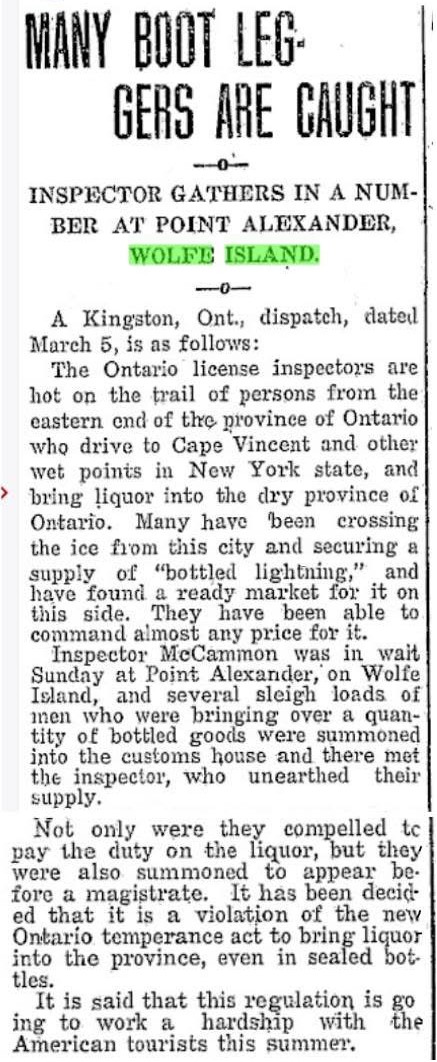
A revival of small scale traditional brewing might be interesting. Remember the good old days, I say. Well, the big news out of the March 8 1917 edititon of the Cape Vincent Eagle was the bootleggers. We discussed bootlegging last week but this bourbon-less era during tariff time has me on the look out for The Ontario Temperance Act of 1916 remained in force until 1927 whereas US Prohibition was the law across the river from 1920 to 1933. The ban on both sides of the border only lasted for seven years. Not that there wasn’t booze moving even during those days. One must always remember the testimony of Mr. Aikens , the man with “a host of friends” according to the Royal Customs Commission of 1927. But it is not all old news. A form of prohibition still exists as Drew in Boston noticed this week. Yup, bars at the Red Sox’s home of Fenway Park came under scruity for serving minors (aka young adults in an unfree state):

The state Alcoholic Beverages Control Commission has ordered Game On Sports Cafe, 72-82 Lansdowne St., to give up its liquor license for five days starting April 20 and Fenway Johnnie’s, 96-98 Brookline Ave., to give up its license for four days starting April 27, after inspectors found both serving underage drinkers with fake IDs. But Fenway Johnnie’s shut for good earlier this month, so, oh, well. The Game On suspension stems from a visit around 10:30 p.m. on Oct. 4, 2024 by state inspectors –  who found 17 people under 21 with drinks, from Coors Lite and Michelob Ultra to various vodka and whiskey-based concoctions.

Imagine being twenty years old and legally barred from drinking a Michelob Ultra!  Time for notes!

Note #1: Ramble On.
Note #2: “Had any bourbon lately?’
Note #3: Katie M. on the pubs and breweries of Cumbria.
Note #4: ATJ on travel and beer.

I miss Bourbon. Have I ever mentioned that? What else might I be missing? Ruvani’s piece about ranch water was published this week in Austin Monthly. Ranch water? She explains the drink’s background:

Founded by late local restaurateur Kevin Williamson in 1998, his original Ranch Water recipe hit the menu in February 1999, based on a concoction Williamson invented on hunting trips with his father, mixing tequila and lime in his water bottle topped off with crisp chilled Topo Chico. Williamson correctly surmised that his own refreshing treat would slake the thirst of other parched Texans and worked up his original recipe with two parts reposado tequila, one part orange liqueur (Ranch 616 uses Sauza Hornitos and Jalisco 1562, respectively), and one part lime, served over ice with a freshly popped frosty Topo Chico on the side to be poured to taste.

Not to be confused with Topo Gigio, Topo Chico is a mineral water from Mexico.

Finally, in their newletter to subscribers, Pellicle has announced some plans and asked for additional support:

Last month the team gathered in London to begin looking at the bigger picture, and discussed everything from the look and feel of the website (you might have noticed a little update to the homepage), the results of the survey you all kindly completed and how best to implement those findings, and—most importantly of all—to start making serious plans to launch issue one of our print publication….  You may also have seen we’ve recently ramped up our subscription drive, which is an important part of this.  Growing our subscriber numbers remains the most sustainable way to grow the resources we have at our disposal. More subscribers doesn’t just mean a print magazine. It means better rates for our contributors, proper support for our team as their workload increases, and potentially even the chance to invest in some of the kinds of content you indicated you might like to see in our survey: guides, short form writing, op-eds, personal essays, and travel stories. Our aim is to hit 1000 subscribers this year, which would mean growing our current number by around a third.

I cut and paste that much of a snipet out as I am myself a supporter. I root for them. Even as I have yet to figure out if Pellicle is a survivor or the conqueror in the beer publication field. The business model is prudent and realistic. The content is varied and often excellent. There’s good reason it gets so many links in these weekly round ups. And it still aspires to be more. Sign up. While I myself am at a heigher tier, their entry level subscription is just $2.50 a month via Paypal.

And that is it for now. As I adjust to the life of the idle and alive of a certain age, I will keep plugging away at these updates as best I can. For more, please check out Boak and Bailey who are posting every Saturday and adding to their fabulously entertaining footnotes week after week at Patreon. And look out for more of Stan’s new “One Link, One Paragraph” format. Then hunt out something in someone’s archives! Leave oblique comments on someone’s post from 2009!! Listen to a few of Lew’s podcasts and get your emailed issue of Episodes of my Pub Life by David Jesudason on certain Fridays. And Phil Mellows is at the BritishBeerBreaks. Once a month, as noted, Will Hawkes issues his London Beer City newsletter and do sign up for Katie’s wonderful self-governing totes autonomous website featuring The Gulp, too.  Ben’s Beer and Badword seems to be on pause since November but there is reading at The Glass which is going back to being a blog. Any more? We have Ontario’s own A Quick Beer and All About Beer is still offering a range of podcasts – and there’s also Mike Seay’s The Perfect Pour. Plus follow the venerable Full Pint podcast! And there’s the Craft Beer Channel on Youtube. Check out the archives of the Beer Ladies Podcast. See you next week!

*By contrast and fine example, Laura is The Telegraph’s “regular correspondent” which seems much more satisfactory.


And, Just Like That, We Are In Q2 2026… Can August Be Far Behind?

Springtime.  That’s what this is supposed to be right now. Yes, my Red Sox are out there choking as the season begins and, yes, my Leafs are out there choking as the season winds down. So the calendar looks like it’s on the right page for sure. But… where is that first sweater and shorts day I have been looking forward to? When will I be able to rake the lawn. Raking the lawn is an important old guy task. It leads to people leaving you alone, unsure why the lawn needs raking. You tell them “breaks up the thatch!” but they don’t know that’s just code. Code for there’s a couple of beer tucked away in the shed. Ah… the shed. See you soon!

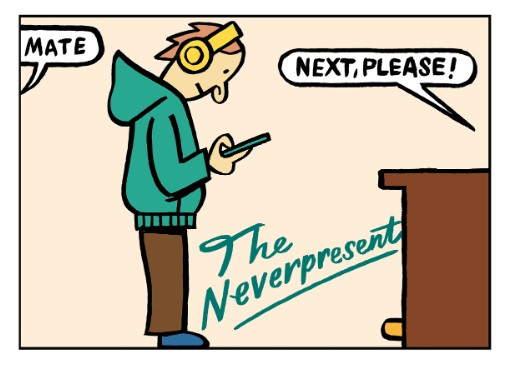
Meanwhile, in Pellicle last Friday, David Bailey‘s* cartoon featured the various postures seen at the pub bar. Is it ageist to say the one that struck me as most accurate was the one to the right? As a newly minted retired guy I can say these sorts of things. Isn’t that how it works? Like raking the lawn. Because you need to break up that thatch, right?

Next up, Katie wrote about one of my favourite cities due as much to the depot for bus route 128 to the villages of the fam as anything. But, Ms. M. does know a good spot when she sees one and this week we read about her thoughts at the sight of Kay’s Bar:

Once a wine and spirits shop in a nefarious part of town where the streets ran toxic with sewage and the tenements were cramped and filthy, Kay’s Bar is now uncommonly beautiful. Like most cobbled and higgledy-piggledy neighbourhoods in the UK, Jamaica Street has a “dirty past” as local pub writer Imran Rahman-Jones puts it, but now it feels pleasantly historic, and the low stone buildings around us are picturesque. When our group comes upon the pub in the early hours of dusk, the side doorway glowing golden in the darkening blue.

As the son of a son of MacKenzie Street by Cappielow in Greenock, I recognize the lineage.

Beer writers talk lots about being judges but not a lot about being amongst the judged, the position which carries a lot more weight to my mind. But this week Alistair wrote about entering and receiving the results of three beers he entered into competition:

There is a large amount of irony, given what I just said about crystal malt, in the fact that this used 5 types of crystal malt, 15, 40, 60, 120, and 260, as well as dose of chocolate wheat. Hence I named this Crystal Conjunction. It’s kind if hilarious then that one judge commented that the “absence of balancing caramels and light roast/chocolate impact the overall character”. Literally all the specialty malts were crystal or chocolate malts. Obviously mild is not something that is wildly common, heck it might as well as an endangered species over here, but I have come across a concept many times in the US that a mild is basically an uber session stout – which is simply not true, the range of possibility within mild makes it a beer you can take in so many directions, as borne out by the BJCP guidelines themselves.

And Jeff was on the otherside of the glass, having judged at the Oregon Beer Awards with this interesting comments on process:

In judging these beers, you do take style into account, along with the brewery’s submitted notes on the beer. If you have a beer that just lists a style, you judge it both as an example of that style and how well it competes against the other beers at the table. If the brewery has added a note, you include that in your calculation. A beer might be dinged for being a poor example of its style but elevated for being just an awesome beer or vice versa. If the brewery says it has hibiscus or rye malt or is “American-style,” we would expect it to taste like rye, hibiscus, or elevated hops. You take all of that into account.

Speaking of the limits of the aphorism “judge not lest ye be judged” we are advised that this is not an April Fool’s Day spoof:

Tilray Brands is partnering with the Magnum Ice Cream Company to launch Popsicle Hard, a ready-to-drink cocktail inspired by the frozen treat brand’s classic flavors. The noncarbonated beverages are beginning to roll out nationwide in 12-can variety packs. Popsicle Hard has a 5% alcohol-by-volume rate and is available in cherry, orange and grape flavors. Tilray is producing the drinks through a licensing agreement with Magnum Ice Cream, which was spun out from Unilever at the end of last year. 

Ah, fads… or was that a spoof! Perhaps with about 97.38% more integrity, this week Boak and Bailey investigated the resurgence of Bass on cask in English pubs this week and found hope in the new enthusiasm:

What makes us think that it might, on balance, be good news is that it’s good to see people – and especially younger drinkers – expressing enthusiasm for cask ale. The Bristol Flyer on Gloucester Road in Bristol is one of those perfectly fine vaguely gastro, vaguely loungey pubs. The quality of the beer has been up and down over the years but recently it’s been serving excellent Bass. Jess often ends up there for one social event or another and on a recent visit was amazed when the hip young barperson said, with full emotion, “Oh, great choice, I love Bass, I drink it all the time! And it’s been flying out since we started selling it.” At The Crown we’ve similarly seen groups of hipsterish young men ordering rounds of Bass, getting their Bass club cards stamped, and generally embracing their identity as Bass Guys.

Bass Masters would be my choice of terms… had others not moved in on the opportunity. And if you asked how big Guinness is in the US these days… would this be the sort of response you’d have expected, as reported by BMI?

Import lagers are nearly 97% of all imported beer in US scans, per NIQ xAOC + Liquor + Conv data for 52 wks thru Mar 7, Bump Williams Consulting’s Dan Wandel found in latest data deep dive, following up on his past analysis of American lagers. Guinness stouts and Belgian ales make up most of the rest, growing nicely these days. 

I wonder if 2026 Guinness regrets the Baltimore closure in 2023.  As you ponder that, here are some notes:

Note #1: do you have a third condiment?
Note #2: is using the word “founder’ just cringy or worse?
Note #3: don’t forget to have fun.
Note #4: are you still hunting the next great beer?

Are you back? Good. Franz D. Hofer has been attracting attention with his wanderings out and about and then his writings all about it at A Tempest in a Tankard – but now he has joined the collective with his first piece at Pellicle, a study of things Zoiglly… Zoiglich?… Zoigl-riffic!

Tucked away in the dense woodland of northeastern Bavaria, the Oberpfalz is the cradle of Zoigl culture. Zoigl is more than a kind of beer. It’s an ethos, a resolute defence of a slower way of life in the face of our contemporary desire for on-demand pleasures.  Zoigl begins life in the communal brewhouse, a holdover from the late Middle Ages. More than seventy towns in the Oberpfalz presided over communal brewhouses in the 19th century. Today, only five remain: Windischeschenbach, Neuhaus, Falkenberg, Mitterteich, and Eslarn. Residents in possession of historical brewing rights take turns from week to week brewing beer that they’ll ferment in their cellars and serve for a few days every month in their Zoiglstuben. You’ll know the beer’s ready when they hang a six-pointed Zoigl star from the façade.

Carry on with the medieval history, according to The Times and some eggheads, turns out that Pinot Noir is effectively a clone of itself going back to the 1400s:

Scientific proof has now been found that pinot noir grapes, used to make red Burgundies in France, have survived unchanged at least since the Middle Ages. A 600-year-old grape seed found in the latrine of a medieval hospital in Valenciennes, northern France, has been identified as genetically identical to modern pinot noir through DNA analysis, according to a study… By taking cuttings rather than growing from seed, winemakers can produce a new plant that is genetically identical to the mother vine. For the study, the researchers sequenced the genomes of 54 grape seeds dating from about 2,000 BC to the Middle Ages. The oldest seeds were from wild vines in southern France. Domesticated vines appeared in the region much later, between 625 and 500 BC, when Greek colonists introduced viticulture in France.

On a more serious and immediate note, if you want an easy measurement of the effect of the third Gulf War in my adulthood, Jessica Mason for DB has surveyed the consequences on India’s beer trade:

In a recent report via Reuters, the Brewers Association of India openly revealed that glass bottle prices have risen by around 20%. Added to this, packaging such as beer cartons have doubled while labels and tape have also become price affected. Gas shortages are now also forcing a raft of glass bottle makers to slow or stop their operations. Plus, aluminium can suppliers are also signalling that there will possibly be imminent reductions in the lead up to summer… “Beer businesses are particularly vulnerable when oil and gas prices rise because the impact is felt at several different points in the chain,” Molly Monks, insolvency expert at Parker Walsh, recently told db. 

Hmm. You know… I have this creeping feeling that we are at March 5, 2020 unaware of the full impact of what is about to hit. With that cheery note, finally, as heavily hinted, I have joined the idle undead. I hope to be not quite as idle long term but these days my pj bottoms are finding new life in the am to pm zone. Can’t rake lawn thatch every day. So…. what to do… while way the hours pressing the fish doorbell? Or instead of that maybe this, drawn from an anecdote about Japanese writer Haruki Murakami:

…long before he became a famous writer, he ran a jazz café in Tokyo, called Peter Cat. People would come in, quietly drink an espresso or sip a single malt and listen to Miles Davis and Charles Mingus LPs on a great sound system. If anyone talked too loudly, or maybe at all, the other customers shot disapproving glares. The point wasn’t to yak or troll for a companion; it was to just sit there and listen attentively without distraction. Bars like that, known as jazz kissa, were popular back in the 1970s when Peter Cat was at the height of its fame. Now, according to National Geographic, they’re spreading to cities around the world…

I like the sound of that sorta place… but what about this place? As part of my inward thoughts, I reached out to B+B on what I might do with this space and these blistered bloody digits of mine.  They shared a number of ideas via email and these two particularly struck me:

We also remembered the work you were doing around pre-1800 beer styles and brewing, which does feel overlooked. All those Derby Ales and Pimlico Ales and Dorchester Ales and the like. There’s such a strong pull towards writing about Victorians and later that this period — with sources that are harder to find an interpret — feels overlooked. We also tend to pounce on any work anyone does with meaningful analysis of data and stats. So much beer writing is about feelings and experience but numbers often reveal deep truths.

Both have the common theme of avoiding the easier path. My challenge with the first (like the 1600s Lambeth Ale or 1700s Dorchester posts) is it feels like the rise of the internet oligarchs has made easy (and free) access to reasonable organized data bases more difficult than ten years ago. I will have to investigate. The second? It’s the math. I always thought that when I was aggregating any sort of numbers and seeing what I could squeeze out of them, well, my grade 12 math teacher was standing nearby reminding me of my couragous 53 as a final exam mark. So whenever I ran some sort of beery data or another through Excel sheets I usually received “ERROR! ERROR!! ERROR!!!” responses. So… any requests? Perhaps “Shut ‘er down, Al!”? or “Take up knitting, you fool!!!” Who knows. Comments greatly appreciated.

Well, that was that. The week that was. A bit of a hard week on the nerves. Until the day I got to sleep in. That was good. We see how the next week goes. In the meantime,  please check out Boak and Bailey who are posting every Saturday and adding to their fabulously entertaining footnotes week after week at Patreon. And look out for more of Stan’s new “One Link, One Paragraph” format. Then hunt out something in someone’s archives! Leave oblique comments on someone’s post from 2009!! Listen to a few of Lew’s podcasts and get your emailed issue of Episodes of my Pub Life by David Jesudason on certain Fridays. And Phil Mellows is at the BritishBeerBreaks. Once a month, as noted, Will Hawkes issues his London Beer City newsletter and do sign up for Katie’s wonderful self-governing totes autonomous website featuring The Gulp, too.  Ben’s Beer and Badword seems to be on pause since November but there is reading at The Glass which is going back to being a blog. Any more? We have Ontario’s own A Quick Beer and All About Beer is still offering a range of podcasts – and there’s also Mike Seay’s The Perfect Pour. Plus follow the venerable Full Pint podcast! And there’s the Craft Beer Channel on Youtube. Check out the archives of the Beer Ladies Podcast. See you next week!

*No relation.


I Declare! These Beery News Notes Are Extra Interesting! Fascinating Even!! Aren’t They… They Are, Right??

Is this fascinating? I think about that at certain quiet moments. I mean I do my best but I can’t answer that question. Only you can. That is the one thing writers don’t talk that much about. The readers. 1.7% of me fully believes that any attention I receive in response to these scratchings is by sociologists asking “why?!?!?” But that is fine. They… like you… are readers. You will weigh the evidence and make your judgement. We just have to remember as our friend Laura H. learned this very week: “it was revelatory to them that beer people exist.” As least I acknowledge you exist. I do. That’s gotta be worth sumthin’.

Where to start? Big news from the seven seas to start with. I love this story about a brewery on a boat, continuing the fine tradition reaching back to the 1660s and again in the 1850s. Except this time it was not Arctic explorers wiliing away the winters when the seas were frozen, as Jessica Mason reports:

…the cruise’s bar manager Giulio Giannini said: “Basically, we desalinate seawater through osmosis. The resulting water is pure H2O, nothing more. From there, the entire brewing process begins.” According to Giannini, all production takes place entirely on the vessel, this encompasses milling and brewing right through to fermentation and maturation. A feat that puts the task into the realms of challenging, but not impossible. Speaking to the drinks business, beer fan Mark Cole admitted that, for him, the move to house a microbrewery onboard “might make me actually consider a cruise,” showing that the positives for the sector are that it will help broaden the audience for cruises in general, attracting beer drinkers.

Would that swing the decision to take a cruise for you?  All a bit too busy for me. Me, I am more attracted by these excellent observations of a moment of quiet from ATJ:

I am not the first person in the bar, there is another drinker to the right of me, sitting on a banquette against the wall, next to the fire burning in the grate, white wispy hair hoping to reach his shoulders, perhaps a memory of his youth as a rocker. His glass is half full, beer, amber and what he has drunk so far has left a playful trace of lacing on the glass. He is not reading, neither looking at his phone; he is just looking ahead, and doesn’t seem to have that eagerness on his face, a pushing forward of the upper part of his body, that might indicated that he wants to talk. He seems happy with the stillness of the bar, and like him I am also contented.

I like the stillness of a bar. It’s like taking a nap but you aren’t even at home. Speaking of things that aren’t like other things, I was lobbied to review what I had already noticed, Ben Gibbs‘ piece (at his newsletter with the excellent URL “soberboozersclub”) on alcohol free beer being offered by Bathams:

Alcohol free beer often arrives with messaging attached to it. Moderation and improvement. It’s framed as a better choice, or at least a more considered one. That language doesn’t land here. These pubs aren’t built around self-improvement, they’re built on ritual. The same pint, the same place, the same faces, the same small actions repeated over time until you don’t have to think about it anymore. For anything new to settle into that environment it has to feel ordinary. That is what Bathams alcohol free does. It sits on the bar without drawing attention to itself. It arrives in the same shape and occupies the same space in your hand. Nothing else in the room shifts to accommodate it.

That fits. Just as being “still” means quiet is can also suggest continuity.  Next, Knut. Knut? Knut! Knut was once a travel correspondent for this here publication, back when we had a few more voices than just me. Recently, Knut has picked up his pen again… or his keyboard I suppose… and has been writing on his newsletter, this time about the difference between what was Norwegian March Beer, then Easter Beer, then Spring Beer and then Export Beer:

The name was later changed to Påskebrygg (“Easter Brew”), and the sales period ran from March 1 to March 31. The name Påskebrygg met strong opposition from Christian groups, particularly the organization Kristenfolkets Edruelighetsråd (the Christian Temperance Council). The brewing industry decided to change the name, stating that it wished to respect the feelings of those who supposedly took offense at it. The motives in the ads and the bottle labels focused on a new activity – domestic ski tourism. We enter a new period with more leasure and, at least for some people, more disposable income. Following a naming competition, the beer was released in 1939 under the name Vårøl (“Spring Beer”). Påskebrygg and Vårøl were sold from 1934 to 1940. In the postwar years, Eksportøl (“Export Beer”) became their successor.

Make sense? Good. Me, I miss my tenuous access to Easter Beer. What else is going on? I need to pick up tips from Retired Martin who has been on the road again, this time wandering around Cologne, Germany – or, rather, standing around:

I knew I had to visit Gaststätte Lommerzheim (“Lommi’s“) at some point, why not now ? “It’s like the Hare and Hounds” I tell Matt. Frankly, you queue for opening, either for lunch (11) or teatime (4.30), or you miss out. James and Matthew weren’t convinced by the appeal of standing outside a suspect looking building on an unpromising street for a quarter of an hour when nicer looking open options called out across the Rhine. But as we chatted to two lads who’d travelled from Chicago (again !) with Lommies top of their list they began to succumb. And then at 16:30 the back door (the one marked “Keller”) opened, leaving those of us staring at the front door to make a dash for a table.

Staying in Germany but waiting much longer in the line up, Andreas Krennmair has been able to clarify a question that has bothered him for sometime about Munich’s Oktoberfest:

…the current restrictions on beer at Oktoberfest, namely that it can only be from one of the “traditional” breweries from Munich whose beer conforms to the Oktoberfestbier PGI regulations, which requires them to have a well going several hundred metres deep down, are not rooted in the festival’s own history. It is essentially a form of regulatory capture to make it exclusive to Munich’s big 6 beer brands that has been successfully defended in court before.

Andreas located documents showing that in 1895 there were 19 breweries with stalls at the festival. It’s a scam! Fight the power!! Leaving Germany with a few last stops, Franz Hofer wrote this week about the breweries in the towns and villages along the trainline crossing the border between Munich and Salzburg – like Privatbrauerei Schnitzlbaumer in Traunstein:

Renovated recently, Schnitzlbaumer boasts vaulted ceilings and large feature windows with views of the valley. The bar is backlit in that early 2000s atmospheric kind of way, and copper kettles glimmer in the subdued light. It’s a nice, airy space perfect for whiling away the early evening with a few beers. As for those beers… the best of the lot is their Weissbier, a richly textured beer that, with its elegant notes of banana custard and sprinkle of allspice, drinks almost like a Vitus. For what it’s worth, Schnitzlbaumer’s beers aren’t my favourite among Traunstein’s three breweries — a few hits, a few misses.

Reading that, I suddenly realize I only picked that passage so I and now you can say Schnitzlbaumer. Schnitzlbaumer. Schnitzlbaumer. As I approach retirement, I am never that surprised what I knucklehead I am. (Was that why the boss gave me that big pat on the back?) Still, probably more likely to see me on a train holiday like that compared to a cruise. But that’s me.

Note #1: A.I. sourced? Or just drifty and even a bit presumptuous?
Note #2: “It’s like K-Pop…
Note #3: OK Zedder.

For me, beer is like sports. Some folk drill down into the OBP, SLG and OPS of baseball players. Me? I just liked the Expos and now just like the Red Sox. They have sucked. They have won it all. So I do find it odd when beer writers call those at a different level of fandom abstraction “mansplainers” when they are clearly just shit talkers. If we accept that people like what they like they will also talk shit about what they like. ‘Twas ever so. In fact, there is so much shit talked about beer one can wonder where the facts may be found. But sometimes a study is revealing in terms of both ends of the research as Pete showed this week in his review of 15 mass market mainly lighter beers:

Many drinkers do unite in insisting that all the big multinational brands taste the same. This is not true. Some taste faintly of beer. Others taste of nothing. A sad few taste so bad, you wonder if you might have run over the brewer’s dog years ago and they’ve been plotting their revenge ever since. Nonetheless, I’ve tried all the most popular beers myself and ranked them from best (or least worst) to worst. Here’s hoping this helps you next time you’re faced with nothing but the usual pub suspects. 

The findings are solid. Asahi is “clean and crisp, designed to cut through fatty fried food“, #3 Guinness “kept well… it is much better than this faint praise suggests” and #4 Heineken is a “little sweet, but it has integrity.” One thing I have always disagreed with is the idea that light beers are distinct from good beers. As homebrewers know, making something subtle is both more difficult and more rewarding than a bombastic brew. I’m quite happy with anything on the upper end of Pete’s list.

Going for something a bit more haute, Alistair checked one tick off his list when he headed to the hills of Virginia and Alpine Goat Brewing:

To get to Alpine Goat there is a little bouncing along a gravel track, but the views from the brewery and its beer garden over to the Shenandoah National Park are more than worth it. Seriously, if there is a more picturesque brewery in Virginia, I haven’t been there yet. Having packed the kids off with a ball, frisbee, and boomerang to snag a table with space for them to play, we went to the bar and naturally I ordered the pilsner…

Frisbee and boomerang? Lordly. Next, why did I think “PelliProtz!!!” when I checked my emails this morning?  Because this week’s feature in Pellicle is by Roger Protz who wrote about Bodger’s, a barley wine from The Chiltern Brewery which has been branded in honour of Roger Protz:

A “bodger” today means someone who does a shoddy job, cuts all available corners, takes the money and runs. But centuries ago, in rural Buckinghamshire, it meant something quite different. It referred to craftsmen who built chain-link fences for farmers to safeguard their crops and animals. Bodger’s, a barley wine from The Chiltern Brewery, celebrates that tradition. As mentioned, the brewery has recently released a special edition of the beer—one with my name and image on the label. It’s Chiltern’s generous way of thanking me for my support towards the brewery, and the wider independent brewing sector, over a writing career that has spanned several decades. The beer is a powerful 8.4% ABV, and has helped to restore a beer style with its roots in the 18th and 19th centuries.

Worthy. And I see that Katie Mather made the news this week, sharing her analysis of the differences with recent brewery closings in the UK with Jo Gilbert:

Speaking to Drinks Retailing, beer expert Katie Mather noted that “each brewery has different issues.” Regarding Molson Coors’ acquisition and subsequent closure of Sharp’s, she said: “This is a common pattern in the beer industry. Small breweries are picked up by bigger ones to extract value and ultimately crash the brand into obscurity.” Conversely, she added: “Brewdog was gutted by its owners’ greed and hubris and, sadly, it’s the workers let go on a 15-minute Teams call and the ordinary people who thought they’d be able to make some money from Equity For Punks who are left with nothing.”

Correct. And there is a great story of another sort death of craft brewing’s irrational and perhaps also manufactured exhuberence in the stock valuation of Boston Beer over the last five years, as reported in Seeking Alpha:

And there’s even another sort of interesting change in the beer market in Korea these days, too, as reported in The Korea Times:

A man in his 20s agreed, noting the appeal. “Japanese beer has a premium feel,” he said. “When I want something different from what I usually drink, Japanese beer is my first choice.” The current boom stands in sharp contrast to recent years. In 2018, Japan exported 12.5 billion yen (about 118.2 billion won) worth of beer to Korea. Exports then plunged to 900 million yen (about 8.5 billion won) in 2020 following the launch of the ‘No Japan’ boycott. The movement began in 2019 after Tokyo restricted exports of vital semiconductor materials, viewed by Korea as an economic retaliation against a Korean Supreme Court ruling that ordered Japanese companies to compensate victims of colonial-era forced labor. 

Finally, speaking of politics and division, the Minocqua Brewing Company in Wisconsin has made an offer that one day is guaranteed to pay off:

“Our notorious offer of free beer when ‘he’ dies is still on the table, and for all those who thought that internationally viral post was a little too dark or ‘classless,’ here’s exhibit ‘A’ on what’s good for the goose is good for the gander,” the statement there read. “For the Fox News and Daily Mail reporters who shamed us cuz he’s ‘still the President,’ will you be shaming ‘Shitler’ as well about his most recent post?”… The brewery added an update, “we meant the Madison Taproom because that’s open all year, if he dies in the summer, then it’s gonna be the Minocqua Taproom.”

That’s a date! I mean it would seem petty and even crass but, jeese, how many other breweries are going to do the same thing? Do you agree? Is going low a no go? As you consider that, please check out Boak and Bailey who are posting every Saturday and adding to their fabulously entertaining footnotes week after week at Patreon. And look out for more of Stan’s new “One Link, One Paragraph” format. Then hunt out something in someone’s archives! Leave oblique comments on someone’s post from 2009!! Listen to a few of Lew’s podcasts and get your emailed issue of Episodes of my Pub Life by David Jesudason on certain Fridays. And Phil Mellows is at the BritishBeerBreaks. Once a month, as noted, Will Hawkes issues his London Beer City newsletter and do sign up for Katie’s wonderful self-governing totes autonomous website featuring The Gulp, too.  Ben’s Beer and Badword seems to be on pause since November but there is reading at The Glass which is going back to being a blog. Any more? We have Ontario’s own A Quick Beer and All About Beer is still offering a range of podcasts – and there’s also Mike Seay’s The Perfect Pour. Plus follow the venerable Full Pint podcast! And there’s the Craft Beer Channel on Youtube. Check out the archives of the Beer Ladies Podcast. See you next week when I will be retired. Hence that photo up there. If you come back next week we’ll play a game called “did Al just screw up his future finances putting him in the poor house by when he hits 76 in 2039?” Oh. Me. Nerves.

Your Thursday Beery News Notes For The Week Of The Green And The Black

It’s that time of year. When being born of Scottish parents means nothing. Nothing!!! I think that is what Governor Kathleen Mary Courtney was actually saying when my FB pal (and fellow garlic grower) Sean took this photo at the Executive Manstion in NYC the other day. The Governor even has a pint of stout. Stout is in. Everybody says so. And see me, I am buying that black can of the 0% stuff quite happily. But what even is a stout? Does the Beer Nut have clarity on the question he might share? Let’s see:

Though a full 7% ABV, it looked a little thin on pouring, and is red-brown in the glass, rather than black, with a fast-fading head. The aroma is sweet, with lots of caramel plus an aniseed-candy herbal side. It’s not thin, I’m happy to say, but it doesn’t quite reach the realm of creaminess, and I wouldn’t have guessed it’s as strong as it is. The flavour is plain. Chocolate forms the centre and then doesn’t go anywhere especially interesting from there. There’s a little buttery toffee and a slightly acrid smoky side. Some coffee roast would have been nice; likewise proper hop bittering to take the edge off all the sugar, but neither materialises. 

That’s helpful. It’s not that. It’s not that. And it’s really not that. But still it sells. One question we saw this week on the question of stout is this: why are the Irish turning to Beamish in their hunt for stout? Well, one reason certainly makes common sense:

Another undeniable draw is that Beamish is often the cheapest stout available in pubs.  A pub in Dublin, a county where pints have become infamously expensive, recently advertised a pint of Beamish for only €5.40. Ciarán said the drink is generally at least 50c cheaper than other stouts, one of the reasons he said students have always been fond of it. Another Beamish fan, Richard, thinks the popularity of the stout solely comes down to its price and availability. “It’s consistently €1 or 50c cheaper than Guinness,” he said, adding that as it is owned by Heineken it is also widely available in bars. “I don’t think they’re doing anything special other than being a small bit cheaper,” he added.

Always looking for value is The Tand who has found renewed blogging energy with five posts so far in March after taking a break since last November. Which post to choose as a classic of the man’s oeovre? Consider these comments on the Hand and Marigold in Bermondsey and how they reflects both his careful observations and his established standards:

The pub itself is handsome, well laid out inside and the staff in my experience are helpful. Glasses are oversized ensuring a full pint and the cask beer is well-chosen, and by and large has been in very good condition when we’ve visited. Perhaps it is the times we’ve chosen, but it hasn’t been very busy when we call in, but us being a bit older (ahem) it tends to be during the day.  They are however extending it by opening a room downstairs, so hopefully it is doing fine. One observation is that twice we’ve called in winter and both times the pub has been pretty cold.  Maybe that’s a money saving exercise, but it doesn’t really do it for me.  I expect to be warm in the pub.

It’s good to know what you want and what you like. Conversely, a check with the archives tells me that as early as 2011 I was somewhat ambivalent when it came to Innis & Gunn beers. After fifteen years, has the rest of the marketplace has caught up? We have learned that the administrators have begun to break up the assets:

The brand and its intellectual property has been included in a £4.5 million sale to Tennent’s lager owner C&C Group. However, the Perth brewery at Inveralmond Place is not included as part of this deal. C&C Group was a minority shareholder of Innis & Gunn and brewed its lager. Administrators said the collapse of the company was due to a combination of factors including a “decline in consumer spending and rising cost pressures”. “It is with deep regret that redundancies will need to be made,” they said in a statement. “The administrators would like to thank all the employees of the companies for their hard work.”

Imran Rahman-Jones had fonder memories from a happier time for I&G:

My introduction to craft beer came from my eldest brother. In the late 2000s, when I was still a teenager, small brown bottles started appearing on the top shelf of the fridge. He’d discovered this Edinburgh brewery called Innis & Gunn and their bourbon barrel-aged beers. I was allowed to try a few sips and was surprised at what hit my tongue. My experience with beer up until then had been the odd warm can of Carlsberg in the park, or a taste of my dad’s bitter, which rarely breached the 4% ABV mark. This stuff was intense and alcoholic, like drinking boozy butterscotch. I could only really get through half a glass.

Maybe it was the moment. Boozy butterscotch was sort of where I was going, too. Was I wrong? Or was it an acquired taste? What even is that?

Is there a more backhanded compliment, a more passive-aggressive judgment, a more of kiss-of-death phrase, than “Well, I guess that’s an acquired taste”? It’s also rather centering of a certain type of American suburban taste mindset. I mean, if you grew up in another culture, black salty licorice, anchovy, sea urchin, espresso, fish sauce, huitlacoche, kimchi, vegemite, lutefisk, curry and scores of other so-called “acquired tastes” would not be acquired tastes at all. They would be innate. I grew up eating Scrapple, for god’s sake—an “acquired taste” for anyone but a person born in the Philadelphia metro area. Anyway, my point is this: Try pastis. Open your mind. Grow up. Make peace with your childhood dislike of black jellybeans.

I had no idea. I thought everyone went through a boring sophmoric late teen phase, reading Hemingway and drinking Pernod in the 1980s. You know, the one that preceded the boring sophmoric late teen phase, reading Waugh and drinking Pimms in the 1980s?  What!!?!! It was only me?!?!? Time for notes as I cope with that realization.

Note #1: “Drinking trash NA beers so you don’t have to…
Note #2: no, not regulations and, no, nothing set.
Note #3: “…it is just a widget.

It may be just a widget but the unexpected upswing in widgettery seems to be continuing according to BMI:

…craft beer remains up 0.3% by $$ with volume down just 1.6% yr-to-date thru Feb 22 in Circana multi-outlet + convenience data. That’s still lagging total beer, which grew 1.6% by $$ with volume off just 0.1%. So craft shed 0.1 share. But trends are much healthier for craft and total beer than they were thruout last yr…

Still… “where’s the Allagash White?” asks Michael Stein in DC:

So what’s replaced Allagash White? Hard to say exactly. What wasn’t there in 2021? Unsure. And what’s there in 2026? Now that question I’ve got answers to. There’s Mickey’s Fine Malt Liquor and there’s Schlitz Bull Ice. There’s Coors Banquet and Coors Light. There’s Pabst Blue Ribbon, and there’s Steel Reserve. And while I just listed six brands, there’s only two breweries that own these / have these brands as subsidiaries: MolsonCoors and Pabst. There’s Modelo, Modelo Michelada, Budweiser, Bud Light, Busch Light, Michelob Ultra, Devils Backbone, and Stella Artois. These are all owned by Anheuser Busch InBev. Then there’s Lagunitas, Tecate, Heineken, and Heineken Silver. Guess who owns all these?

That’s a bit of reality right there. But not everyone wants the real when it comes to drinking, as B+B found out:

We were astonished recently to see someone sitting in the pub wearing a virtual reality (VR) headset waving two controllers around to manipulate objects in a virtual world.It just looked so weird and incongruous. His eyes were covered for one thing which immediately gets you into uncanny territory. Then there was the vigour and weirdness of his movements… At one point, he got up to go for a cigarette while still wearing the headset. We later learned that he could, in fact, see the entire room through the magic of augmented reality – something subtly different to virtual reality. But in the moment, it really looked as if he’d just decided to stroll through a busy pub while effectively blindfolded.

Young people today!  At least this isn’t the sort of thing that’s being seen in Bermondsey according to The Londoner:

If you speak to any of the owners on the mile, they now draw an almost church-and-state style separation between the “beer people” and the “Saturday crowd”. The former are who the Mile first started for: the craft beer nerds who can tell the difference between different subspecies of Sussex hops. The latter come in and ask for eight pints of lager before throwing up in your urinal. The problem is, the latter far outweigh the former — to the tune of thousands a week. The chaos they bring can be extreme: swastikas carved into toilet doors, glasses filled with vomit left on tables, old ladies in dry robes getting into fights. One bar manager tells me they’ve dealt with at least two different punters defecating on the floor, in one case in protest at being denied service. 

It’s enough to take a pass. Speaking of which, has the era of a dry generation youth moved on, leaving their kid brothers and sisters the opportunity to redefine their lifestyle? The Guardian reports from the UK:

Binge drinking rates among gen Z have risen sharply since their teenage years, according to research that challenges their reputation as “generation sensible”. Almost seven in 10 (68%) 23-year-olds reported binge drinking in the past year, while nearly a third (29%) said they did so at least monthly, up from 10% at age 17. While drug use is relatively limited in the teenage years, by their 20s almost half (49%) have used cannabis and a third (32%) have tried harder drugs such as cocaine, ketamine and ecstasy, analysis by University College London (UCL) found.

Assumptions refuted?  It isn’t always that clear. Whenever that old myth is trotted out that before a certain point beer was foul, smoky and dark – despite all evidence – I wonder what people are missing. Well, not dissimilarly,  science has now determined that contrary to previous assumptions, early humans were good cooks:

… at least some people living in Europe between 5,000 and 8,000 years ago were deft chefs. Stone Age cooks skilfully combined meat, fish, fruit and vegetables in cooked meals that followed local recipes, according to new research. Using chemical analysis and sophisticated microscopes, researchers…  examined residues found on 58 pieces of pottery unearthed at 13 sites across northern and eastern Europe dating from the last millennia of the Stone Age, before the dawn of the Bronze Age. The residues survive as charred “foodcrusts” left on pots and bowls. Mixed in with meat, mainly freshwater fish and shellfish, scientists found “wild grasses and legumes, fleshy fruits or berries, green vegetables and roots/tubers from plant species”. These plants included barley, wild oats, types of brome grass and other wild greens such as goosefoot, pigweed and saltbush leaves, as well as viburnum berries such as guelder rose berries.

An interesting perspective. And, from the “too much fucking perspective” file, human trafficking in the fields of Champagne has hit the courts in France with sentences upheld on appeal:

Convicted in the first instance to four years in prison, two of which were suspended, the main defendant, who headed the former wine service company Anavim, had her sentence confirmed for human trafficking, concealed work, and employment of foreigners without authorization. This woman in her forties from Kyrgyzstan was kept in detention. Her lieutenants, two thirty-somethings mainly in charge of recruitment, saw their sentences slightly reduced to one year in prison with a suspended sentence each. The court of appeal ordered the defendants to pay 4,000 euros to each of the 53 victims for their moral damage. However, the company of the winegrower who had called on Anavim for harvesting, the SARL Cerseuillat de la Gravelle, was acquitted on appeal.

While one can acknowledge the acquittal, one would also want to ask whether there has been an unjust enrichment of all those who received the benefit of the trade in these slave-made wines. Especially as inspectors had “found conditions that seriously endangered workers’ health, safety and dignity. The local prefecture later closed the site after finding makeshift bedding, filthy toilets and common areas, and dangerous electrical installations.” Bastards.

Finishing up on a happier note, the feature in Pellicle this week is by Will Hawkes, a portrait of the Sutton Arms in Clerkenwell, London:

The door at the Sutton Arms swings open and six Americans come bounding in like cocker spaniels just off the leash. After securing a table in the corner, they send emissaries to the bar. Lunchtime food options (“I’ll do a minted lamb pie”) and beers, from pints of cask ale to a half of Vault City’s triple-fruited mango sour, are discussed, and promptly purchased. Landlord Jack Duignan, who has stepped behind the bar to help out, takes in the scene. “Where are you from?” he asks, his gaze focused on the pint he’s pouring. “America,” one replies, perhaps a touch cagily. A pause. “Well I didn’t think you were fucking French!” Jack retorts. There’s momentary silence, then a burst of exuberant laughter, then clarification: Missouri, “right in the centre.”

Such language! And me a preacher’s son. I don’t know how people cope. As you consider that, please check out Boak and Bailey who are posting every Saturday and adding to their fabulously entertaining footnotes week after week at Patreon. And look out for more of Stan’s new “One Link, One Paragraph” format. Then hunt out something in someone’s archives! Leave oblique comments on someone’s post from 2009!! Listen to a few of Lew’s podcasts and get your emailed issue of Episodes of my Pub Life by David Jesudason on certain Fridays. And Phil Mellows is at the BritishBeerBreaks. Once a month, as noted, Will Hawkes issues his London Beer City newsletter and do sign up for Katie’s wonderful self-governing totes autonomous website featuring The Gulp, too.  Ben’s Beer and Badword seems to be on pause since November but there is reading at The Glass which is going back to being a blog. Any more? We have Ontario’s own A Quick Beer and All About Beer is still offering a range of podcasts – and there’s also Mike Seay’s The Perfect Pour. Plus follow the venerable Full Pint podcast! And there’s the Craft Beer Channel on Youtube. Check out the archives of the Beer Ladies Podcast.

Your “The Thaw Cometh! The Thaw Cometh!!” Mid-February Edition Of These Beery News Notes

Now that the temperatures have moderated from -30C at dawn way up to -3C, the nation asks itself what the hell was all that? There is no answer to the question. Fortunately, there is a second question: how to still look dapper in a Canadian winter while lugging a lot of beer? Well, this gent can help. First, walk around in one of Toronto’s well loved black and white neighbourhoods where people must wear vintage clothing. Then, bottle your homebrewed beer only in second hand O’Keefe quarts you have nicked from the upper bric-a-brac shelves of old taverns. Finally, invest in an industrial quality paper packaging printing press you keep in the basement solely for the recreation of 1950s brewery boxes. Easy! Speaking of being on one’s feet, Boak and Bailey have written about how they didn’t do a Dry January so much as a very mobile one, a habit that has continued well into February:

We didn’t set out to make a mission of this, but we realised about halfway through January that, as it happened, we hadn’t yet made a repeat visit. That made us wonder if we could keep it up for the remaining few weeks. We were particularly conscious that we’d tended to stick to tried and trusted favourites last year. In fact, in 2025, over a quarter of our logged Bristol pub visits were to just two pubs – The King’s Head and The Swan with Two Necks. You might have noticed the word ‘logged’ and be wondering exactly what that means. Well, Jess, an accountant and spreadsheet nerd, of course keeps track of every pub we visit.

What a good realization! We have nothing like that possiblity here so much replicate 1950s Toronto to amuse ourselves but this comes a very good second. In the US of A, something else appears to be amuse or perhaps console according to BMI :

Beer posted positive $$ growth in 4 of the last 5 wks, and Jan 2026 is on track to be beer’s best monthly trend in years, at least in these channels. Including wine & spirit RTDs in the mix brightens the picture even more; broader beer + RTD category $$ grew more than 5% with wine & spirit RTDs adding close to 2 full pts in scans. 

Booze up! And somewhat similarly Ed stood up for the honour of Guinness this week with a response to what he called a a hatchet job on the Guinness’ Open Gate brewery in London published by The Guardian:

For some reason restaurant critics put the boot in more than any other type of reviewer… I was going to the brewery as part of the CIBD Southern section’s AGM, but first we had to do the business part to do at Diageo’s HQ.  I don’t know what deal the CIBD had done with Diageo or if we were subsidised, but we paid a tenner. This gave us pie and mash, which was nice, and a pint of Guinness (brewed in Dublin). I was keen to have somethng brewed on site though, so I had a hazy IPA next, which was nice enough. I think the ABV was a bit hefty, as on top of the three pints of Guinness I’d had I was defintely feeling pissed by the time I’d fininished it. So there you have it. The Guardian journo’s main complaint seemed to be that you had to take a lift to the toilets.

For others, the trip to the pub and then to the toilet is even easier. They are visiting the pub virtually from home, a remote non-work arrangement of sorts:

The 24-year-old from Yeovil, Somerset, regularly tunes into the feed from Morgan’s Arcade Bar in Carlisle, Cumbria – despite never having been there or anywhere near. What hooks Katie in is seeing different people come and go: the women enjoying a work party, the couple singing along with the musician, the young lad trying to chat up a girl at the bar… On some nights Morgan’s Arcade Bar, which can only fit around 60 people in it, has up to 5,000 viewers on its livestream at any one time. But like other bar streams, it has been subject to bans and restrictions for reasons they don’t quite understand. Bar owner Morgan Taylor has been streaming for nearly nine months. He noticed a huge rise in viewers over Christmas, then a few weeks ago his account was deleted.

Cass Enright got out of the house and on the road in his latest installment of A Quick Beer takes us to Montreal – a favourite destination of mine – and revisits some of the great brewpubs there in a video with this intro:

Join us on a step back in time as we have A Quick Beer at three of Montreal’s original brewpubs! Discover the enduring charms of Dieu du Ciel!, L’amère à boire, and Le Cheval Blanc, three spots that have been serving up delicious beer for decades. Although Montreal offers many modern breweries and taprooms nowadays, some of our fondest beery memories over the years have been here, and they’re all still going strong.

For me, it’s L’Barouf on rue St-Denis. If you are ever looking for me, check there. Also all about winnowing the better and the best, Pete shared some firm thoughts in his column in The Times this week, always welcome sight:

My beef is not with hazy pales — those original examples were pretty good. But if you don’t need to worry about balance or clarity in the beer, and you’re throwing in enough hops to cover up any off-flavours from brewing mistakes, a hazy IPA is very easy for a mediocre brewer to make. From a drinker’s point of view, if you grew up with soft drinks and don’t like the taste of actual beer, it’s perfect. It’s also great for Instagram — everyone can see you’re not drinking a boring, mainstream beer. But instead you’re drinking a boring craft beer. A boring, one-dimensional alcoholic fruit smoothie in a gaudy can with hop monsters or skeletons on it. If I wanted to drink sour grapefruit juice, I’d buy some Tropicana and leave it in the sun for a bit. 

The many botches of “craft” is a venerable topic which even comes with its own primodrial gospel but it is true that for all its eager keener passion craft never seems to fail to find a way to fail.  Nice to see that we have a paper of record confirming what Pete called the “sustained decline.” Viva crystal malt! Viva!! Viva!!! And Phil Mellows guided me to this article in The Caterer on the why to Pete’s what including this suggested impetus:

“…we are beginning to see the movement of some younger adult drinkers towards nostalgia brands, and given our history and heritage, we feel well-placed to meet this trend through some marketing and awareness driving activity.” Brookfield Drinks has launched a trial bringing long-established premium Scottish lager Kestrel back on draught. Brookfield managing director Nigel McNally says: “We’ve shown that a brand that’s nostalgic, like Kestrel, can be repositioned and revitalised. “Most pubs are serving the same products, and the trade’s been guilty of allowing brands which aren’t authentic onto the bar. Alcohol by volume (abv) have also come down, and I think overall customers feel they’ve been short-changed. A return to brands with heritage and nostalgia is offering customers a point of difference.”

Nostalgia and getting short changed? One must be on one’s toes. Which is related to Lars’ new maxim: “if you don’t know how the beer is made then, no matter what the beer is named, you have no idea what kind of beer it is.

Speaking of no knowing, The Beer Nut made a confession this week that I suspect is made on behalf of many of us:

Anyone who pays attention to trends within microbrewing will have noticed in recent years the explosion in variety of proprietary hop products. I don’t think these assorted extracts and powders and boosters were ever meant to have a consumer-facing role, but brewers seem to love them, and love letting us know that they’ve used them. Does that get them a discount from the supplier? I wouldn’t be surprised. For my part, I can’t help wondering if these enhancers actually enhance the beers in any real way. I’ve certainly never identified any pattern among them: which ones to look out for and which ones aren’t worth the paper their patents were filed on.

Note #1: Ludlow prices!!!
Note #2: Laura’s top tap rooms.
Note #3: Jeff doxxed.
Note #4: Burton Union Pr0n!
Note #5: Actually, no you can’t. You’d die.

The British Royal Navy has recently announced it is cutting booze rations in the service, limiting intake to 14 unit per week while on board. The Telegraph in its emailed newsletter presented a few responses to the news from readers:

Jenny Jones, however, recalled an age of largesse: “Many years ago in Malta, my husband and I were invited on board a Royal Navy ship that was giving a party. The atmosphere was convivial and, thanks to attentive stewards, I was able to enjoy several gin and tonics before dinner. “On departing, it seemed to me that the gangway had become a lot steeper. Back on dry land, our host asked how many drinks I’d had. When I said three, he told me that in fact I’d had nine, as naval tots are about triple the size of what one would get in a pub.”

Ah, Jenny Jones… what’s that? Not the same one? Fine. Me, I was once invited with a gang up the plank and onto a Canadian navy ship helpfully docked a walk from the Halifax taverns by a pal’s navy boyfriend. Among the minty green paid we worked our way though a number of 25 cent beers. I expect that sort of service is no longer offered.

The feature this week at Pellicle was written by Newt Albiston who shares his thoughts on drinking in Epping, just north of Greater London the tough town where he grew up which lives with division:

The day I return to Epping, my first trip home in some time, I can feel the tension, and the hesitance. The high street is pretty quiet, and there are lingering looks as I make my way past the various coffee chains and charity shops. Signs of the change in mood are everywhere: Union flags fly at half-mast on lamp posts, as if to declare the death of Britain as she once was, shadowed by the residue of torn-off patriotic stickers. Although I am instantly greeted by familiar faces when I walk into The Duke, the tension is still present in the quietness of the venue.

I like this: “…no fancy ginger beer or small-batch kombuch…” Perhaps related to The Duke, Stan guided us to a question this week – “what’s that smell?” Or rather…

“Olfaction helps shape our cultures, although it often does so unknowingly or without us noticing,” says (Inger) Leemans, who led the Odeuropa project. “When we talk about cultural heritage, we can think about religious rituals, but we can also think about specific scents that we’ve been cherishing and living with for a long time.”

Cherish. Hmm… I spent a good chunk of my teens in Truro, NS where the smell wasn’t always cherished and I am mindful of that reference The Breweries of Kingston & The St. Lawrence Valley by Steve Gates to a brewery a couple hundred years ago near my current place of work at City Hall which doubled as a pig sty. The next brewery to the north itself had a manure pit.  My point is that there were no scents without the full sensory array around it. Did 1890s Mild pair well with coal dust? Did Porter marry well with the pong of streets filled with horses? Perhaps we can never know.

And Charlotte Cook, brewer and scribbler, at took us along to Asturias, Spain for Everyday Drinking and shared her thoughts on the food and the cider:

When you taste the intensely rich stew, you can understand why cider rather than wine prevails in the north—the sour and fizzy is needed to cut through, cleanse the palate, and prepare you to dive in again. Cider is omnipresent in Asturias. As you walk around the town center of Oviedo on a Sunday morning, as families returning from church mix with football fans heading to an entirely different type of cathedra, cider is everywhere. Before 11 am, people will be drinking a bottle of cider for the table. Spaniards are famed for their ability to drink until the wee hours and still make it to work, school, or church as if nothing has happened. And having a little tipple of cider in the morning isn’t seen as such a stain on your character as it is at home.

Finally, some very heartfelt tributes were shared after the news of the death of beer writer Des de Moor like this from David J:

I think a lot about the pints we had one night in South London where he held court, sang songs and was so warm to everyone.

Pete also remembered Des the singer:

Des was a man of many layers. Years after the event, I discover my first interaction with him was buying the 12” remix of Charlton Heston by Stump – that was him, as half of the Irresistible Force. He made the Popbitch newsletter as Secretary of the Ramblers Association (moor, geddit?)… He was a great singer, a walking encylopedia. An absolute stalwart of judging the World Beer Awards. Never once heard him angry, pissed off, or anything other than kind and decent.

There are many more. His Wikipedia bio explains his musical side. Here he is singing Bowie and, here, an earlier solo album. By all accounts a wonderful guy. A sad loss.

Until next time, please check out Boak and Bailey who are posting every Saturday and adding to their fabulously entertaining footnotes week after week at Patreon. And look out for more of Stan’s new “One Link, One Paragraph” format. Then hunt out something in someone’s archives! Leave oblique comments on someone’s post from 2009!! Listen to a few of Lew’s podcasts and get your emailed issue of Episodes of my Pub Life by David Jesudason on certain Fridays. And Phil Mellows is at the BritishBeerBreaks. Once a month, as noted, Will Hawkes issues his London Beer City newsletter and do sign up for Katie’s wonderful self-governing totes autonomous website featuring The Gulp, too.  Ben’s Beer and Badword seems to be on pause since November but there is reading at The Glass which is going back to being a blog. Any more? We have Ontario’s own A Quick Beer and All About Beer is still offering a range of podcasts – and there’s also Mike Seay’s The Perfect Pour. Plus follow the venerable Full Pint podcast! And there’s the Craft Beer Channel on Youtube. Check out the archives of the Beer Ladies Podcast.

Your Sunny Yet Still Cold But Not Standoffish Beery News Notes For Early February

February flies by. That’s just the way it is. Good time to take stock. Good time to eat the little chocolates filled with beer brought by a visitor from Belgium. Early review: the “…chocolate is dry and dark so a lack of sweetness in the kriek left it a bit stark but the Palm was that bit richer.” Not sure I am chowing down on these outside of a winter like this but all quite a bit better than expected. Paid endorsements welcome. Winter was also on the mind and under the feet of Jordan as he wrote about the weather at the end of last month or perhaps just his efforts to get about in it:

Monday, Jan 26th: The deep freeze is well and truly upon us, and looking at the forecast for the next couple of weeks, it looks like we’re in four-layer territory. If your primary mode of transport and exercise is walking, then -25 with the wind chill does you no favours. Besides, the sidewalks are not shovelled in any meaningful way. Dry and cold is a great combination to ensure you’re reminded of the various injuries you’ve had over the years. Sometimes I get the unprompted sense memory of an ankle ligament rolling.

Also looking at the world as it exists below the knee, Stan shared some research he has done on the word Hopfenstopfen and its relation to a certain pair of boots:

The shoes were worn by a worker processing hops. When a bag was filled, a worked would jump into it, stomping down the hops to make sure the bag was full. When I dug this out, I wondered if these could have been called Hopfenstopgen boots. That’s because in Hop Queries Vol. 4, No. 6, I wrote about dry hopping in Germany in the 19th century. That was called Hopfenstopfen, which can be translated at hop plug. Simon Moosleitner, a subscriber in Germany, suggested there is more to think about…

I won’t spoil the fun but speaking of getting the boot in, late last week in VinePair, Dave Infante wrote about the effect of the homicidal ICE intrusion into Minneapolis on the beer trade in the city including this from Drew Hurst of Bauhaus Brew Labs:

You can see it in the firm’s sales figures. Taproom sales are down 40 percent compared to January 2025. “It’s a wildly unsustainable thing,” says Hurst. “None of us signed up to have to live through a federal occupation and figure out how to run a business at the same time.” Not that it was easy before the onslaught: Bauhaus wrapped this month last year down around 30 percent from January 2024. Craft brewers have been struggling to find their way for years in the face of shifting demand, new competition, and rising costs. In Minneapolis and Saint Paul, they’re doing all that with the MAGA jackboot on their necks.

At first I thought it was an odd angle but then realized it illustrates the principle that beer prefers peace as well as how quickly that peace can be lost. Dave also shared in his email updates that he was told to “stick to beer” and that some paying subscribers to his newsletter Fingers canceled their subscriptions. Perhaps if those folk didn’t “stick to” amateur neo-fascism it might be better. Funny how the “stay in your lane” crowd don’t show up for this sort of politicization within the pub:

A beer tap labelled “Rachel Thieves” has appeared on the bar of a Hertfordshire pub protesting Chancellor of the Exchequer Rachel Reeves introducing crippling tax hikes. Anyone ordering the beer will receive only water. The Green Dragon in Flaunden, which is run by publican Chris Ghazarian, has added the spoof cask ale pump badge as a protest – telling customers that pints of this particular beer are “very bitter” and cost more than anything else on the bar and anyone ordering it will receive only water. Speaking to the British national press, Ghazarian said: “They find it hilarious. I obviously don’t make them pay for it.” 

On the other side of the planet, a very difference approach has been taken in Australia:

The Albanese government is seeking to put a hold on increases to the beer excise for the first time in 40 years. The Customs Tariff Amendment (Draught Beer) Bill 2025 seeks to pause the indexation of customs duty rates for draught beer for two years from August 1, 2025. Currently, the beer excise is indexed twice yearly to stay in line with the consumer price index, with Australian beer, wine, and spirit importers and producers saddled with some of the highest rates in the world…  Addressing the House of Representatives, Anthony Albanese said he was “proud” to introduce the Bill, “one of the most popular commitments that we took to the election”.

Boak and Bailey also wrote about another sort of pressure to conform but the context was less confrontational – just writing about their thoughts on a craft brewery:

Maybe that post was a bit too snarky, with hindsight, but it certainly didn’t warrant trolling impersonation accounts on Twitter, general abuse that last for months, or a stalking campaign. That was, as you might imagine, quite traumatising, and probably did make us nervous about being critical of breweries in the supposedly cuddly craft brewing sector. It didn’t stop us, but it had a ‘chilling effect’ on how freely and frequently we felt able to express ourselves. It’s easy to say “Don’t mince your words” but minced words are less likely to lead to sleepless nights. We can totally see why some people might decide it’s not worth the trouble, and certainly wouldn’t judge them.

On reflection, I have probably benefitted from folk starting with the assumption that I am a bit of an arsehole. I lose my sleep over other things.

Note #1: Take a news event and ram it like a square peg in a round hole.
Note #2: Martin at another fabulous pub, this time inordinately bright.

Ron TV continues to impress. This week he’s been presenting an extended interview with Mitch Steele and, like the comment maker Oscar, I am drawn to the brief introductory electro-thrash almost as much as the subjects of these interviews. Part 1 of the interview is over thirty-seven minutes long with Part 2 clocking in at thirty-three. Set aside an hour or so of your time. More if, like me, you keep replaying the first six seconds and that mesmerizing theme music over and over and over.  Good multi-media breakout for Ron – even if it likely doesn’t pay the bills. One a similar note, Ray of B+B on the prospects of a career in writing:

This is excellent. Depressing, but excellent. My response has been to give up, basically, and accept that writing is a thing I do on the side, while something else pays the bills. I also like that thing, so it’s fine, but I get sad thinking what I could have achieved if writing was my full-time job.

Perhaps also on the theme of less is more, Guinness 0 also continues to impress me and Pete‘s brief review does not surprise:

There are many great 0.5 per cent stouts from small indie brewers, but Guinness 0.0, which took years to develop, is indistinguishable from the real thing.

I noticed one thing when writing this. It is branded as “Guinness 0” in Canada but “Guinness 0.0” in the UK. Why? Is it a different formulation here and there? Whatever it is, I am finally seeing a point to NA beers. But things will be going in a slightly different direction in UK neighbourhood if one permit applicant has their way:

The shop also sought an amendment to the condition currently imposed on the licence… to “No super-strength beer, lagers or ciders of 6.5% ABV (alcohol by volume) or above shall be sold at the premises with the exception of Dragon Stout and Guinness Export beers.” The applicant’s agent, Frank Fender, told Bedford Borough Council’s licensing sub-committee (Thursday, January 29), that these “super strength” beers are not usually the “street drinkers’ choice of drink”. “They are they are widely consumed by members of the Afro-Caribbean community, and obviously this shop wants to be inclusive,” he said. This claim was backed up by Chris Hawks, the council’s licensing compliance and enforcement officer. He said: “What Frank says about Dragon Stout and Guinness Export is spot on.

For years, the word authentic was bounced around in the face of glitter and haze. That plan in Bedford sounds like authenticity to me. Similarly perhaps, crossing the Atlantic, Matty C has written some notes on the US beer scene for the supplier Get ‘Er Brewed‘s webpage and found something of a revivial going on:

Nostalgia is one play many breweries seem to be using. During my time in both Portland and in Colorado, (the latter of which I visit regularly to see family,) I noticed that many drinkers seem to be choosing the classics made by more established breweries. Allagash White, the Belgian style witbier from the brewery of the same name wasn’t just on tap everywhere in Portland, but it felt like everyone was drinking it too. The beer carries the kind of hushed reverence that money can’t buy, and demonstrated to me why establishing a core beer as part of your brewery’s identity is essential for longevity.

This is quite a reversal as, you will recall, in 2019 flagships were considered a dead concept: the “concept of a flagship in almost all ways maps to an earlier and obsolete way of thinking.” Futurisms rarely stand up to audit but it’s good to know, in an era too concerned with branding and other misinformations, that identity in the form of what is in the glass has made a come back. One never knows what is really going on otherwise. As with the news about the bills left unpaid and the suppliers left in the lurch by Rogue, James Beeson in The Grocer shared that the level of insolvency at failed Keystone Brewing had hit almost £15 million. Heavens! Remember when we all spoke of community?

Sticking with things in the USA, the feature in Pellicle is a portrait of Eckhart Beer Co. in NYC by Ariana DiValentino with its focus on central Euro lagers and foods that share the same theme:

The menu focuses primarily on Central European dishes that match the beers’ origins. There is a brat plate, and spaetzle gratin, and kartoffelpuffer (German-style potato pancakes), which you can order fried in oil or beef tallow. But there’s also a falafel dog, an Italian cold cuts sandwich, and a Moroccan-spiced ratatouille with vegan lemon yogurt. The variety of cultural influences feels very reflective of the brewery’s New York City context. “I wanted to offer food that supports the beer. It didn’t have to be Central European per se, but that felt like a natural foundation,”

Sounds like a great place for all. Not so in Japan where one establishment has embraced ageism:

The concept of age restrictions and minimum requirements is commonplace around the world. But have you ever heard of an establishment imposing a maximum age limit? Now, a Tokyo chain pub has set a ban on older customers – in order to try to maintain the raucous, fun atmosphere for which it is known. Tori Yaro Dogenzaka is an izakaya (an affordable Japanese pub) situated in Japan’s capital city. This year, the establishment propped up a sign outside the entrance, informing customers of the new rules. The sign said: ‘Entrance limited to customers between the ages of 29 and 39. This is an izakaya for younger generations. Pub for under 40s only.’

I wasn’t wanting to go there anyway. Screw them. That’s it. As as I sulk in a mode Japonais, please check out Boak and Bailey who continue to post every Saturday. adding to their fabulously entertaining footnotes week after week at Patreon. And look out for more of Stan’s new “One Link, One Paragraph” format. Then hunt out something in someone’s archives! Leave oblique comments on someone’s post from 2009!! Listen to a few of Lew’s podcasts and get your emailed issue of Episodes of my Pub Life by David Jesudason on certain Fridays. And Phil Mellows is at the BritishBeerBreaks. Once a month, as noted, Will Hawkes issues his London Beer City newsletter and do sign up for Katie’s wonderful self-governing totes autonomous website featuring The Gulp, too.  Ben’s Beer and Badword seems to be on pause since November but there is reading at The Glass which is going back to being a blog. Any more? We have Ontario’s own A Quick Beer and All About Beer is still offering a range of podcasts – and there’s also Mike Seay’s The Perfect Pour. Plus follow the venerable Full Pint podcast! And there’s the Craft Beer Channel on Youtube. Check out the archives of the Beer Ladies Podcast.

And Just Like That Here Are The Quite Frosty And Fully Final Beery News Notes For January 2026

It’s been a quiet week in the beer world with distractions aplenty in my real world. Like the Arctic vortex. To be honest, I’ve always preferred the Caribbean vortex whenever it pays a visit.  Thankfully, once upon a time I lived up in the upper Ottawa and have experienced the refreshing zing of -53C so knew enough to break out the heavy tweed and  big boots. Dashing yet completely unable to dash. Elsewhere people are embracing the deep chill as well.  Will Cleveland reporting from Rochester, NY has news of the return a winter beerfest this weekend;

This isn’t a gimmick festival chasing the beer-du-jour; it’s a gathering rooted in the style that got a lot of people into craft beer in the first place—before haze became a default setting and before “imperial” stopped feeling like a warning label… DiCesare remembers the first year clearly, mostly because it was about 10 degrees outside. This year, the ask is similar but the hope is different: dress for the weather, embrace the winter, and lean into the fact that January beer festivals are better when they stop pretending they’re outdoor concerts. Fire pits and outdoor heaters will again be part of the setup, encouraging that specific Rochester ritual of standing outside, beer in hand, nodding knowingly at strangers like, yes, this is happening, and yes, we chose it.

What else has been going on? Well, it was Rrrrrrrabbie Burrrrrns night last Sunday and all around the world folk reacted to the plate of haggis, neeps and tatties set before them. Unless, as Katie M explored in Guts magazine, it perhaps wasn’t really haggis:

Learning how important lungs are to the recipe of a traditional haggis, a vegetarian version seems like sacrilege. The whole point of haggis is that it’s offal, a sausage or boiled pudding made with waste-not, want-not diligence to keep Scots fed throughout the winter and leaner times. The very idea of a vegan haggis is deeply inauthentic—offensive too, if you were to read the comment sections on any clickbait story about the dish. But if you’re appalled, you’re forgetting the accommodating nature of the Scottish people. Do you think my Grandma would have anyone going hungry in her house? The very origins of vegetarian haggis was borne from hospitality…

As the good author noted, the very prayer one prays before we got to the “O what a glorious sight, Warm-reekin, rich!“* includes the line “some hae meat an canna eat…” so there is some authority for this. Is there another dish that so inspires? Speaking of how others live, in the Globe and Mail, Drew Shannon wrote about finding a beer in Kazakhstan:

I broke up with craft beer a long time ago – back when small-brand breweries went from niche and interesting to eye-rollingly ubiquitous. Of all places, I didn’t think I’d run into my beverage-ex in Kazakhstan. I assumed either big conglomerate brands would still dominate the former Soviet state or there’d be no beer at all. Finding a pint in some parts of the Islamic world can lead even the most well-travelled tourist on a fruitless quest. It turns out, I was dead wrong. My impromptu evening of bar-hopping around Almaty, the country’s largest city, started after a long day of trekking the Turgen gorge. On the way back to my hotel, I noticed Privychki Bar. I pushed open the front door to find a gaggle of young Kazakhs perched on vintage armchairs, sipping cloudy pints. 

Mmm… cloudy pints. Never less than clear, Stan, in his concise one paragraph way, directed me to a bit of resurrectionist thinking over the cool corpse that one was Rogue Brewing. How in its haydays it didn’t have managers, it had ambassadors: “That is why Rogue was kicking ass in those days is that felt that they were ambassadors to craft beer.” Yikes. I had a sudden unsettling flashback to the bad old irrational – if not greedy – days of craft and reminded myself of this from 2012:

To hell with that. Passion is that employer of the young who saps their joy for life. Passion offers periodic Google ad cheques in return. It asks you to be the unpaid brand ambassador. On Wednesday night, a intelligent and eager young person suggested to me that my interest in good beer was pure passion with a certain honest excitement. I took the time to gently crush that moment like a mouse under my heel. It was information, I said. Information and interest. Passion? I have children for that. 

The children? They are 14 years older now and each of an age when they might be expected to buy the beer as much as have it bought for them. I trust that now not-so-young person has found another moe successful career – and that’s probably for the best for all.

Note #1: Twenty years of Ron!
Note #2: Maureen asks … in the end… is a brewery just its trademark?
Note #3: Stout-flation strikes.

Heavens! I missed the news when The Beer Nut issued a new beer style alert right around when the update when to the presses last week. He was reporting from the front lines of recent holidaying where and when he encountered:

… the rarely-seen style of imperial sweet potato amber, and I had no idea what that was likely to mean. Beniaka is 7% ABV and a cola brown colour in the glass. Although fizzy, it’s plenty thick and feels luxuriously “imperial”. Can’t say I tasted much potato, but there’s a pleasant woody spice: nutmeg, sassafras and liquorice. It’s fairly sweet with it, showing a little Scotch-ale-style toffee, with the herbs helping balance it. This is interesting, with lots happening, but it’s not a daft novelty, and makes for a very civilised digestif.

Not at all in response, Sophie Arundel was given a fun topic over at the Drinks Business – the dead end trends of 2025:

Several alcohol formats once framed around lighter, functional or lifestyle-led positioning are now in sharp decline. Hard kombucha now holds a 0% share of social discussion, down 29.8% year on year. Hard tea has slipped to a 0.01% share, falling 33.79%, while hard seltzer sits at 0.02% share, down 33.67%. The contraction extends beyond these formats. Craft beer, often seen as culturally resilient, is down 16.52% year on year with a 0.84% share, while generic IPA beer has fallen 17.28% to a 0.38% share. Tastewise’s data suggests the broader “better-for-you drinking” narrative is losing attention. Products that relied heavily on pseudo-functional positioning are struggling to maintain relevance, pointing to a need for clearer occasions, flavour-led propositions and tighter ranges.

(“Pseudo-functional” was the name of my folk-punk band back in ’93.) At least craft beer fans can take comfort that their drug of choice is going better than hard kombucha. There are still some hangers on that are telling craft to repeat its errors… but it is true, isn’t it – when things are going down the proverbial shitter, not one really is working to improve so much as find themselves quite happy to tread water.** Perhaps coversely, BMIs seems to be seeing at least a stall in the slide when it comes to US beer:

NBWA released its Beer Purchaser’s Index reading for Jan early touting a “significant bump” from December. After 5 mos in a row of readings below 30 (including several lowest ever around 25), BPI jumped to 39 in January. Not exactly great shakes, and 9 points below Jan 25, but still 14 points better than Dec 25. (Recall, BPI below 50 suggests beer distrib orders are contracting, while above 50 signals expansion.) 

So less of the lessening perhaps. But in western Canada, there was actually an increase in beer sales through 2025. So who knows! Well, at least we know one thing. I think we have established that not being very profitable at all is actually not a good business plan:

BrewDog has announced that it is closing down its Aberdeenshire distillery and ceasing production on all spirits. The craft beer company said it had decided to abandon its state-of-the-art distillery, which opened in 2016, and axe the brands after “careful consideration”. The move comes after the company posted losses of £37m in 2024 and announced job cuts across the business, including at its head office and brewery in Ellon.

Conversely (at least in San Francisco) not doing well enough to even attract a proper buyer can have its advantages:

During that massive blackout on December 20, every business but one in the Lower Haight had to shut its doors because they had no power. That one would be Toronado, which still uses an old-timey, non-electrical cash register with punch buttons and a hand crank, still takes only cash, and beer taps don’t require electricity. Cheers to ancient technologies. The story was left hanging last summer after a new crypto-bro owner had stepped in looking to take over the bar — and launch a Toronado-themed coin! — and after that deal appeared to be in jeopardy once longtime owner Dave Keene discovered these details and looked to cancel the deal. But SFist can confirm now that the deal was, indeed, canceled, and everything remains as it was at the bar.

That’s nice. Unless the owners really hate the place and want to move on I suppose. Can you own an iconic institution that people flock to and really hate it?  If someone does something well I would hope that there is joy in the doing.

Note #4: The many beards of Polk.
Note #5
: What friends of beer writers think they do…
Note #6: …all day long…

Joy in doing? That’s a bit like this week’s feature in Pellicle by Imran Rahman-Jones about the making of liquor from what’s to be found right there in Edinburgh’s urban orchard:

As Chris continued to tweak his distillations, and source new apples for each batch, he began to reflect on the fruit’s beguiling quality. “[There’s] something quite magic about an apple tree in the street,” he says. Neighbours will leave out boxes of fruit for one another, or swap recipes. “It tends to pull the whole street together at a certain time of year.” What Chris didn’t know when he started the process of developing Pochle was that he was tapping into a lineage going back centuries in Scotland. The enchanting ability of an apple tree to gather and unify in fact has deep roots in the country’s traditions and folklore. 

Lots to like there. And just look at the people working to get that bit of writing onto your screen. The fine folk keeping Pellicle going, the author Imran Rahman-Jones, the semi-sticky handed Chris Miles who gathers and also those who let the foragers be – not to mention those who planted and tended to the apple trees. Doing is a wonderful thing.***

And on that very subject – the doing of things – Boak and Bailey were out there again in their monthly newsletter for January doing a great job encouraging more writing about beer. What to write about:

There are local drinking customs and cultures that probably seem unremarkable to people who know them but which would interest people like us. Flat Bristol Bass is one that fascinates us but there must be others all round the country, and certainly around the world. Alex, our favourite beer blogger of 2025, goes to three pubs and writes about what he sees going on there. Adrian Tierney-Jones (a pro, not a blogger) takes a similar approach. Now, you could write tasting notes of every beer you drink but, honestly, that’s probably the hardest thing to make interesting – unless you are a skilled, creative, and/or amusing writer like The Beer Nut. It can still work if your tasting notes find a theme or tell a story, though.

Do it! I like it – but do note that “blogger” and “pro” are not comparable categories and neither term speaks all that much to the quality of the writing. “Pro” is code for paid writing which can be compromised even just by editorial restrictions**** though, more to the point, too often not all that good. And “blogger” is a reference to a class of medium, not a sign of quality of the writing and not necessarily code for an amateur though some of the best beer writing is actually provided by people who earn their living otherwise. Ray and Jess themselves are proof of that. Better to think of adjectives like interesting, inventive or even valuable when weighing the cred. Then notice where they don’t apply!

I would also add, don’t worry too much… unlike Mikey Seay who has shared what strikes me as quite an odd thought:

I always shy away from reviewing beers for two reasons:
– Lack of skill to do it properly.
– Beers can be too regional to make a review relevant to a global newsletter audience.
That said, I feel a new beer from Sierra Nevada is available enough in most places to make it worthwhile to mention.

Seeing as thinking and writing about your taste perceptions takes about as much skill as running a vacuum cleaner, I don’t think this is a particularly useful standard. But then again you may be crap at vacuuming, too. Do you worry about that? Just type. Be patient and get those keyboards clicking. It’s a lot like planting a seed and also, if nothing else, it’s good for the knuckles.

Where will it take you, all this clickery? Well, as we wrap up this week on the note of the haute in beer writing, this is your final call for a fully self-funded trip to Bordeaux in June:

This is the FINAL REMINDER about the 2026 Beeronomics Conference, which will take place at ESSCA School of Management, Bordeaux, France, 24-27 June. Main panels and sessions will be held at the ESSCA Bordeaux Campus. The Conference Organising Committee, led by Gabriel Weber and Maik Huettinger, welcomes all high-quality research on the economics of beer and brewing. 

The deadline for submissing an abstract is Sunday. Send me a card. Fine. Fin. As I said, a bit of a quiet week. please check out Boak and Bailey who are posting every Saturday and adding to their fabulously entertaining footnotes week after week at Patreon. And look out for more of Stan’s new “One Link, One Paragraph” format. Then hunt out something in someone’s archives! Leave oblique comments on someone’s post from 2009!! Listen to a few of Lew’s podcasts and get your emailed issue of Episodes of my Pub Life by David Jesudason on certain Fridays. And Phil Mellows is at the BritishBeerBreaks. Once a month, as noted, Will Hawkes issues his London Beer City newsletter and do sign up for Katie’s wonderful self-governing totes autonomous website featuring The Gulp, too.  Ben’s Beer and Badword seems to be on pause since November but there is reading at The Glass which is going back to being a blog. Any more? We have Ontario’s own A Quick Beer and All About Beer is still offering a range of podcasts – and there’s also Mike Seay’s The Perfect Pour. Plus follow the venerable Full Pint podcast! And there’s the Craft Beer Channel on Youtube. Check out the archives of the Beer Ladies Podcast.

*Just in case someone out there never had a tea towel.
**No, smoothies will not save brewing.
***This is your reminder that now is the time to start planting those seeds for your own garden. Seeds and soil and time. Have a go. This tomato from last November’s final harvest was from a seed planted in my basement in February. Easy. Almost as easy as typing. 
****“It’s only a trade mag article…” is as often much the case.

Your Happy Merry And Even Supportive Beery News Notes For The Week Of Blue Monday

How does it feel? That’s what Blue Monday asks of you. Katie was particularly aggrieved as last Monday was her birthday. So first of all –  happy birthday! Apparently, Blue Monday is perhaps a floater with not 100% agreement on which date it is.* Like Easter but without the medieval calculation to give some assurance as with the death date of Jesus. So you have options and need advice. Fortunately I am full of good advice on this topic. Me, I prefer to celebrate what I call “Bleu Monday” on which I eat a lot of cheese. Also, it seems to also have been originally a term that in Germany was “der blaue Montag.” and then United States when workers told the boss to shove it, as we read in 1838:

Drink till all is blue. Cracking bottles till all is blue.

Blue meant the haze apparently. Or perhaps the slightly wicked as in “blue laws.” I dunno. But I like that it also has it’s own anthem, even if it’s a wee bit Dieter Sprockets.

Beer Marketers’ Insights have a note about a little blip that could be the beginning of a bit of a bump for beer:

Pretty much everything was comin’ up roses in beer and beyond for the first week of the new year in Circana multi-outlet + convenience channels. Beer, wine and spirits all grew for latest week thru Jan 4, 2026 (including Dec 29-31). Can’t glean much from just one week, but interestingly, craft beer’s 4.4% $$ gain outpaced total beer (+2.9%) for period. Multiple top craft fams saw sales pop for the week including New Belgium, Sierra Nevada and Elysian each up low double-digits by $$, Lagunitas up 8.5% and Bell’s (+5%), Shiner (+4%) and Blue Moon (+3%) up low-to-mid singles.

And these US market numbers exclude non-alcoholic beers so it’s more beery than we often seen in the booster stats announcements. But they could also indicate that fine spirit of “fuck it!” that one finds in a time of crisis. Speaking of which, can you write about the crisis in US hard liquor sales without mentioning the tariffs that have effectively cut out a massive share of your customer bases? VinePair seems to think so:

And though distilleries share similarities with other business closures — from layoffs to managing creditors — there’s uniquely challenging inventory to deal with: barrels of aging whiskey. “They’re a little bit of a problematic asset because they can only be sold to someone who has the license to hold them,” says Will Schragis, managing partner at WellSpun Consulting. “Barrels are in-bond, so they’re non-tax paid. There are only certain licensees and other companies that can acquire them.”

No mention of, you know, lobbying for free trade as a recourse makes me wonder if there is a ex-nay on the t-word going on, lest one draw wrathful attention away from Greenland. H/T to Jeff. It’s all about getting the spend in country it seems and Americans are doing their part:

Surveys have shown that consumers feel pessimistic about the economy as they worry about tariffs and the jobs market. More than half of voters believe President Trump is “losing the battle against inflation”, according to a Harvard Caps/Harris poll of 2,204 registered voters released last month. Yet despite the economic gloom, data suggests that spending has risen across all income groups.

Mikey Seay shared a few thoughts that are not unrelated to this moment:

It’s the price. I struggle with the price of NA and low ABV beers. This is my Dry January issue. I can get behind drying out for a month. Or (what I am trying) focusing on drinking lower ABV beers. But there is a hidden suck. Low alcohol/no alcs are priced the same as regular beers, sometimes even double. It’s hard for me to get over that. It’s like, I am getting ripped off, and I have a hard time shaking that. But I must. I know it costs a brewery close to the same to make a NA or low beer, so they gotta charge the same. And that cost trickles down to the stores and bars. So I gotta get over myself there..  Enjoy my low ABV beer, and don’t be a baby about what I am paying for it. I must do this for myself and the business of beer.

One must spend. Do one’s part. Think of England and all that. One of things I appreciate locally is that Guinness 0 is $11.95 at the LCBO and the regular draught is $13.50. Trouble is… no Guinness 0 to be found in the province these days. Guinness is experiencing a height of fame and fortune – and there are good reasons for that, according to Jeff:

The world is unstable, especially for young drinkers who spend half their paychecks on small apartments. Young people are threatened by more dangers than any generation in decades: huge college debt, a machine-learning era that may eliminate entire sectors of jobs, climate change, political instability, the corruption of media and the vitriol that marks society. This is not a time for risk-taking. It’s a moment when people are taking refuge in safe ports and reliable brands. Guinness isn’t alone in this appeal—the popularity of old Mexican brands follows the same script—but it has the advantage of being a 4.2% black ale that comes with a helping of theatricality and a creamy head. It is both safe and also different from other global brands.

I think some of this turns on that 4.2%. And low calories. Theme shift. Did you know you can watch RonTV?  He’s got a YouTube channel going:

You might have noticed that I’ve posted a few videos on YouTube over the last couple of days. There will be more to follow. It’s part of my drive to document and preserve. Initially, it’s mostly material that I acquired for my book on the 1970s, “Keg!”. I conducted several Zoom interviews Which I think are worth making public. Especially as the interviewees are all past retirement age. And won’t be around forever. I’m particularly keen on recording Derek Prentice’s recollections of more than half a century in brewing. Despite my urging, Derek shows no interest in writing his memoirs. But he’s happy to be interviewed and share his memories. I already have around two hours of video. And plan to record several more. Covering his time at Youngs and Fullers.

Next, Stan has published his newest edition of his monthly Hop Queries newsletter and there is much to consider. For one thing, he shared that chart of total US hop acreage which indicates the plantings of 2025 roughly match those of both 1997 and 2008, both years before further drastic drops. He also explained what BLP flash frozen hops are:

The idea began with hop farmer Jim Schlichting, who upon retiring bought 40 acres of land next to his home and began growing hops… Basically, he freezes the hops fresh off the bines and ships them in vacuum sealed packages along with reusable ice packs. The cones should remain frozen until brew day. After thawing them, brewers may use them as they would unkilned hops, replacing each pound of pellets in a recipe with four pounds of cones. Blue Lake markets the hops to both homebrewers and commercial breweries.

Whenever I read that some blog or newsletter on beer won some award or another I always think to myself “looks like Stan didn’t apply again this year.

Note #1: to bar or to not bar ICE.
Note #2: medical thoughts from amateurs.
Note #3: the Magnus Lounge on the ferry to Orkney.
Note #4: are people outside of the beer echo chamber aware that many many others have quite happily active social lives… without beer?**

And Jordan continues to diarize*** his weeks in detail, appointments in pub and breweries plus the scribbling for magazines and books along with the totalling up of spreadsheets. He’s found that the current bottom line in Ontario is not good news:

Among the various hats I wear, I’m historian for the Ontario Craft Brewers and I get to update their timeline on a yearly basis. Since I’m updating the spreadsheet with news throughout the year, this gives me the opportunity to get paid something for the information I’m collating. …the end of the year has been brutal on breweries. Both Goose Island and Blue Moon have decided Toronto has beaten them. If the corporate guys are out, you know things are bad. It looks like 30 physical breweries closed in Ontario in 2025 and something like four contract breweries, but who cares? Some physical breweries switched to contract status and some ownership structures are more or less impossible to parse. Can you really say Indie isn’t a contract brand because of Birroteca at Eataly? 

Can you really? Shifting from the crunch of numbers to the stream of consciousness, it’s a good thing ATJ prepared us with the subtitle of his piece this week – “an amiable ramble” – as this letter of love to beer culture touches on every corner of the pub and glass experience other than the variations on paper towel dispensers one might encounter, such as:

It is about the rattling bus snaking through the countryside with a pub at the end of the journey, the train skirting the wave battered coast with a pub at the next station, or maybe two or three, the walk through the rain, the nature of the game; under the hill all of us go at the final stage of our life but beer can be used to celebrate that passing, reconnect your memory with a swig and another swig, raise a full glass to the memory of dear old matey they all chorused, may he be never forgotten, but as soon as the rain stopped they walked out of the pub never to think of their dead friend ever again, for they were alive and he wasn’t.

Poor old matey! Gone and soon forgotten. Interesting legal news if you are into doing your own thing, a category of which I appreciate many of you fall into according to your own tumble of choice. The news is that the US District Court in Northern Texas assessed submissions in a case and last Saturday (odd date for a ruling to be issued) held:

…these documents reflect a shared First Amendment vision: Free Speech, Press, Petition, and Assembly rights combine to protect and elevate the public discourse necessary to self-government—not self-expression in all forms, and certainly not the libertine “expressive conduct” absolutism envisioned by
Plaintiff Spectrum WT… Spectrum failed to enforce its intended “PG-13” format during a drag show held off campus, as professional and student performers tasked with “breaking” and “destabilizing” sexual norms engaged in sexualized conduct more akin to a striptease…

Libertines! Libertines at a university?!? Now, keep in mind what “WT stands for: West Texas A&M University. The students of which the court determined included minors. Perhaps in Amarillo the age of majority is 35. Who knows. But it did remind me of the 2003 ruling of the Supreme Court of Canada in in the case R. v. Clay:

…the liberty right within s. 7 is thought to touch the core of what it means to be an autonomous human being blessed with dignity and independence in “matters that can properly be characterized as fundamentally or inherently personal”. With respect, there is nothing “inherently personal” or “inherently private” about smoking marihuana for recreation. The appellant says that users almost always smoke in the privacy of their homes, but that is a function of lifestyle preference and is not “inherent” in the activity of smoking itself. 

Lifestyle! Thankfully, the old wack-tabac is now legal in these parts. But these matters, in case you ever wondered, one has to be on top of one’s right to have fun as one wishes. The law of the libertines’ lifestyles may need more research.

Finally, Pellicle has a short survey out about their next steps:

It’s one thing to run a magazine based on the things we like most, but to grow and bloom into something bigger, we need our readers’ insights and support. That’s why we’ve created this survey: We want to hear what you want from Pellicle in 2026, and use your input to plan our next moves. For the next two weeks, we’re opening up the floor to learn what Pellicle means to you, and where you’d like to see it go next. The 2026 Pellicle Reader Survey is just a seven-to-10-minute task, and you can easily complete it on your phone. Plus, you can opt in to win one of three prizes…

As you know, I would pay to take a survey so the whole idea of prizes is just insane!  While you are busy with that, please check out Boak and Bailey who are posting every Saturday and adding to their fabulously entertaining footnotes week after week at Patreon. And look out for more of Stan’s new “One Link, One Paragraph” format. Then hunt out something in someone’s archives! Leave oblique comments on someone’s post from 2009!! Listen to a few of Lew’s podcasts and get your emailed issue of Episodes of my Pub Life by David Jesudason on certain Fridays. And Phil Mellows is at the BritishBeerBreaks. Once a month, as noted, Will Hawkes issues his London Beer City newsletter and do sign up for Katie’s wonderful self-governing totes autonomous website featuring The Gulp, too.  Ben’s Beer and Badword seems to be on pause since November but there is reading at The Glass which is going back to being a blog. Any more? We have Ontario’s own A Quick Beer and All About Beer is still offering a range of podcasts – and there’s also Mike Seay’s The Perfect Pour. Plus follow the venerable Full Pint podcast! And there’s the Craft Beer Channel on Youtube. Check out the archives of the Beer Ladies Podcast.

*It is, however, reliably closer to the start of 2027 than the end of 2025.
**I find this eager rush to shimmy right up next to the nutster RFK Jr somewhere between bizarre and disgusting: “…In explaining that approach, officials pointed to the social context in which alcohol is often consumed – its role in bringing people together to bond and socialize, while creating shared experiences – summed up by the idea that ‘there’s probably nothing healthier than having a good time with friends in a safe way.’ ” That’s two possible bits of bootlickery this week. A better take on the moment.
***Boak and Bailey do something along a similar line with their regular beers of the week posts on Patreon: “Running with Spectres was also on excellent form, much to Jess’s regret the following day.