Your Sunny Warm Bountiful Springtime Beery Beer Notes For A Satanically Chilly Late April Week

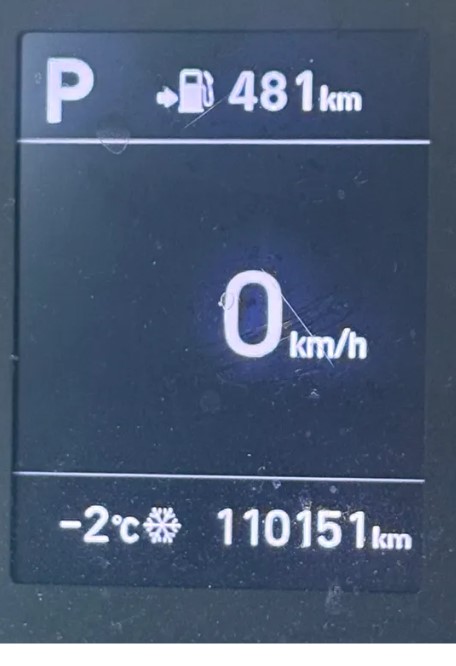
a car dashboard showing a temperature of minus twoOn Monday as the sun came up I thought I might do a little weeding in the garden. But something was strange. Wrong even. The top of the soil was like rock. Solid. The hoe just cracked it intopt large chunks. Then I realized it was under zero. Oh. My. Lord. A month into spring. Of all the feels (uses fingers… denial, anger, bargaining, depression, and acceptance) I only hit the second and the fourth. Lordy. It was up to +4C by the time we got to noon on Tuesday. Can this please be the end of these freezy frozies? Please?*

What is happening… elsewhere where it is warm and cheery? Well for starters, when in Rome, you may want to do what The Beer Nut does as he has some great observations from his recent trip there:

In an age of beery uncertainty — when the consensus of the craft era is, if not completely dismantled, then at least creaking with important bits falling off — it’s nice that some certainties remain. I’ve developed a newfound appreciation of the beers and bars I discovered in the early years of this blog, and before, which are still operating despite the barbarians being inside the gates. So it was especially pleasing to arrive into Rome and find that two of its fondly-remembered institutions are still going, same as ever.

Also warming is the south of England where we have a pair of stories. First, in The Guardian we read of a boom in one corner of the drinks trade:

While Britain remains far down the list of global wine producers – behind countries including Uzbekistan and Tunisia – it is the fastest-growing wine region in the world, according to the property group Knight Frank. It reports the area of planted vineyards in the country has quadrupled since the turn of the century. Langham’s estate is part of this boom, almost tripling in size since 2009 to span about 34 hectares (84 acres) of the 1,000-hectare site. Increased wine production means the company has outgrown the converted farm buildings it was using to store barrels and bottles and it has just invested £2m in a new winery which should be completed by the summer.

Then, Mr. R. Protz shared his thoughts on one aspect of that boom writing for CAMRA’s publication What’s Brewing:

Here’s a fact that will freeze the blood of all beer lovers: there are now more vineyards in Kent than hop farms. Since the 16th century, the county of Kent has been at the heart of hop growing. It has what the French call terroir – the right balance of soil, sunshine and rain to grow the finest hops. The soil in the Garden of England is sandy and loamy. This means it retains rain and moisture and enables the hops to grow fast and develop the piny, spicy and peppery aromas and flavours for which English hops are famous. The decline in hop growing has been calamitous, not only in Kent but in other major cultivation areas such as Hereford and Worcester. In 1962 8,200 hectares were devoted to hop growing. By the end of the century the number had fallen to 1,060 with just 45 hop farms left.

This leads to the question of the relative profitability per acre of hops destined for brewing compared to grapes destined for wine making. In 2019, the ag mag South East Farmer stated:

“The first stage is to talk about the elephant in the room, which is profitability,” said Duncan. “Establishment costs, depending on vine density, is £8,000 to £10,000 per acre and farmers should be looking to establish 20 to 30 acres to justify the investment into viticultural machinery. If you choose the right site and plant the right varietals, clones and rootstocks there is no reason not to be aiming to grow three to four tonnes per acre. Payback, which includes the cost of establishment as well as the annual running costs in the early years, is expected after year nine. Fruit is selling at approximately £2,000 per tonne at the moment and it costs around £3,000 per acre to produce. So if you can turnover £6,000 per acre, the gross margins on an acre is £3,000 and that is well worth waiting for.”

Note that the phrase is “gross margins”. Now, this might be a question I should have put to Stan but what is the gross margin for hop growing in southern England? The UK Department of Enviroment, Food and Rural Affairs has plenty of info on the standards that apply to hop farming but not a lot on economic expectations.  One sees that an acre may produce 1,000 pounds of dried English hops on average (or half a ton) and that recently a ton retailed in 2024 for a little over $9000 USD or £12,000 pounds (or £6000 a half ton acre.) Similar. But what is the gross margin? Also… it might be a error to even compare. In both cases, the acreage is so small that it’s unlikely the vineyards are directly muscling out the hop yards. Yet one is an expanding market while the other isn’t. Thoughts on the resulting… err, actual… numbers much appreciated.

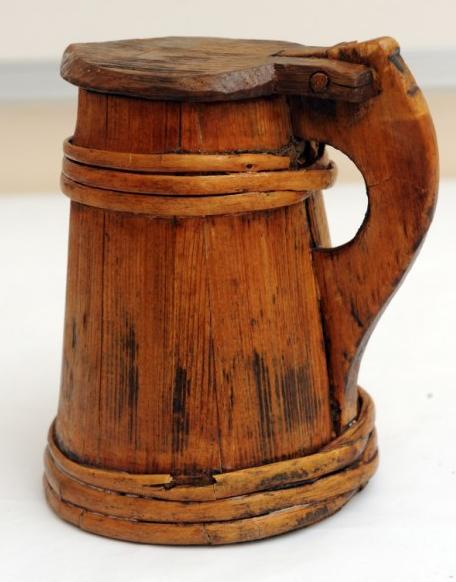
Moving from the question of “what’s in it?” to “what’s it in?”, Tim Holt shared a link this week to an article in the Royal Society’s Notes and Record after he received his hard copy of the publication.  The reason? About a couple of months ago, the Royal Society reported on receiving Sir Isaac Newton’s wooden pint flagon:

In this article, we first tell the story of the wooden pint flagon by considering Newton’s college friendship with John Wickins, the latter’s appointment as rector at Stoke Edith, the relevant histories of the Wickins and Hussey-Freke families who owned the flagon, and public notices and exhibitions of the artefact in the nineteenth century. This evidence allows us to track a circuitous yet plausible itinerary for the drinking vessel from Trinity College to Hannington Hall.

At the time of Newton’s use, a pint flagon filling would be 1d at Trinity College and while about 2d in Glouchester according to a contemporary reliable source* – though that may refer to a quart which would make sense. It is also interesting to compare the vessel to two Tudor examples we looked at, oh, about thirteen years ago. Also wooden but not nearly as fine as Newton’s, having a conical shape rather than new more recent on in the form of a small barrel. Less stable in form for perhaps a less wild context?

Going further back in time, Merryn guided us to an re-examination of a 1927 study of Italian ceramics dated to between 750 and 725 B.C.:

Gas chromatography and mass spectrometry analysis of residues in the gourd detected organic compounds commonly found in fermented fruit juice, perhaps from grape, apple, or pear. No tartaric acid, a component of wine, was found. Tests conducted on the gourd residue also identified heated pine resin and mastic resin, which were believed to have medicinal properties.

Which leads to the interesting idea that alcohol may have been prized early on as a medicinal rather than just the jolly juice.  And going even a bit further back, the Times of India reported on a Danish study of an ancient Sumerian tablet:

A small clay tablet has offered a remarkably human glimpse into life 4,000 years ago. Researchers studying ancient Mesopotamian inscriptions in Denmark have identified what may be the world’s oldest known beer receipt, a written record of beer supplied for workers in the Sumerian city of Umma.Instead of chronicling war, kings or religion, the tablet appears to document an everyday transaction. The discovery was made by scholars from the National Museum of Denmark and the University of Copenhagen during a fresh review of museum collections. Experts say the find highlights how some of the earliest writing systems were created to manage trade, labour and resources.

So while beer probably didn’t caused civilization, it may have advanced the need to record the growth of civilization. Notes time!

Note #1: Speedy cocaine-laced salmon.
Note #2: Authorities in India claim ABInBev part of cartel.
Note #3: What’s a Chester?
Note #4: Scratchings!

Speaking up there of Stan, this month’s edition of Hop Queries is out and he asks this question:

What hop variety shares her name with a hop disease?

Figure it out yourselves. I won’t ruin the fun. Conversely, we have two no fun tales tales of failure today from the big names in craft circa 2016. Turns out that the lingering BrewDog legacy includes a number of forms of debtor deadbeatery:

Brewdog went under with £550m of debts. The administrators have now filed a (long) list of creditors on the Companies House website. Among them is Lords cricket ground which is owed £420,000. Since the debt is unsecured Lords are likely to get less than a penny in the pound back of what they are owed, around £4,000. Another London sporting venue where Brewdog got the beer franchise (and still have it) is West Ham’s London Stadium at Stratford. Here the debt, £12,000, is much smaller….

Innis & Gunn, it turns out, stuck their 200 business partners with less than 4% of that pile of bad paper. And, in the UK, BrewDog’s brother from another culture, Stone continues to see its legacy fade at least in Virginia:

The beer-making operations of Stone Brewing Co. are not long for Richmond as the California-based brand is being sold for the second time in four years.  This week industry giant Duvel Moortgat USA announced it has reached an agreement to acquire Stone Brewing from Sapporo Holdings, the Japanese brewing conglomerate whose US division bought Stone in 2022.  While the Stone brand and beers will continue to exist as a subsidiary of Firestone Walker Brewing Co., a California company owned by Duvel, Stone will no longer have a manufacturing presence in Richmond. Its sizable production facility at 4300 Williamsburg Ave. in the city’s Fulton area will become a full-time Sapporo USA production facility, Sapporo-Stone CEO Zach Keeling said in an interview on Monday. 

Trade friendly insider commentators will no doubt call this retraction an consolidation. Hope springs eternalBAer fans of Stone on the East Coast are now looking forward to… mmmmm… stale older beers.  And Boak and Baily shared another aspect of the retraction in last weekend’s footnotes on Patreon:

We used to take much more of an interest in US craft beer than we do today. When we first started blogging, back in 2007, most ‘craft beer’ was American and we spent a lot of time and money hunting American craft beer around London. As the British craft beer scene grew its primary influence was America and there were times when it felt like Brits cosplaying Americanness… These days, though, there’s less American beer around in the UK and British craft beer feels like its own thing. It doesn’t feel as if what’s happening with craft beer in the US has much bearing on what’s going on here, even if there are echoes of the same trends and cycles between the two scenes. 

We are retracting into our own scenes, deglobalizing. Perhaps as the Great Creator intended. Who benefited from international craft? Perhaps what is more attractive are the local habits. Relatedly, there were some interesting observations from Will Hawkes in London Beer City about the confusion someone from away might experience when entering an English pub:

A French family of four wanders into The Blackfriar and, spotting a table, sits down. The mother begins to peruse the laminated menu. The children chat amiably. The mother puts the menu down and discusses its contents with the father. Time passes. The father looks at the menu. He discusses its contents with the mother. More time passes. Eventually, the father decides to go to the bar. It’s been ten minutes. I wonder what it is about French visitors to our glorious capital that makes them skip the bit about ‘how pubs work’ in their guidebooks? Maybe French guidebooks just don’t have that section; possibly this crucial info is completely absent from l’internet. Perhaps they’ve been left (understandably) confused by the profusion of restaurants masquerading as pubs in London, where table service has become the semi-norm.  

I suppose I have been in a similar situation. After all these decades, table service is a familiar holdover here that carries echoes of the temperance cause and regulartory community control. Well, a minor version of that I suppose, at least compared to Iceland as Will Howard reports:

In 1908, the Icelandic government put the decision to vote, asking the public whether they wanted to outlaw alcohol in their country. After 60% of the voting populace said yes, the prohibition was put into effect in 1915. However, they reassessed in a matter of years. Wine was put back on the menu in 1922. Spirits came along a little later in 1935, but beer remained strictly forbidden for nearly the entire rest of the century. This was partially due to puritanical, classist logic about the effect that cheap beer has on the underclass, but there was also another, more important reason that beer was outlawed for so long – up until 1944, Iceland was an associated territory of Denmark, which was a cute way of saying that Iceland was under Danish rule, and the Danes loved their beer even more than the rest of mainland Europe did, thus, drinking beer was seen as coloniser behaviour.

Well, now you know. A Good Colonizer’s Beer Blog is my new title. Or rather Bjórblogg góðs landnema if you know what I meanAnd I know you know. It’s what brings us all together once a week, right? Right?? As we await your reponses on that point, please check out Boak and Bailey who are posting every Saturday and adding to their fabulously entertaining footnotes week after week at Patreon. And look out for more of Stan’s new “One Link, One Paragraph” format. Then hunt out something in someone’s archives! Leave oblique comments on someone’s post from 2009!! Listen to a few of Lew’s podcasts and get your emailed issue of Episodes of my Pub Life by David Jesudason on certain Fridays. And Phil Mellows is at the BritishBeerBreaks. Once a month, as noted, Will Hawkes issues his London Beer City newsletter and do sign up for Katie’s wonderful self-governing totes autonomous website featuring The Gulp, too.  Ben’s Beer and Badword seems to be on pause since November but there is reading at The Glass which is going back to being a blog. Any more? We have Ontario’s own A Quick Beer and All About Beer is still offering a range of podcasts – and there’s also Mike Seay’s The Perfect Pour. Plus follow the venerable Full Pint podcast! And there’s the Craft Beer Channel on Youtube. Check out the archives of the Beer Ladies Podcast. See you next week!

*Sunny and plus 15C by late afternoon Wednesday. Even put a daub of sunscreen on. Why were you complaining so much? Me? I wasn’t complaining. You were!
**Notice also both records reference Red Streak as a 1600s apple variety for fine cider.
The Thursday Beer News Update For A Week When My Mind Was Elsewhere

On Tuesday, I had a great joke all prepared for my proctologist, analogizing with him or her over the election results. But… well, at least in the end, we seem to have had a good result. In both senses. Not much time for me to focus on the beer industry, however, which makes this week’s beer update as much news to me as to you. Let’s see what’s been going on.

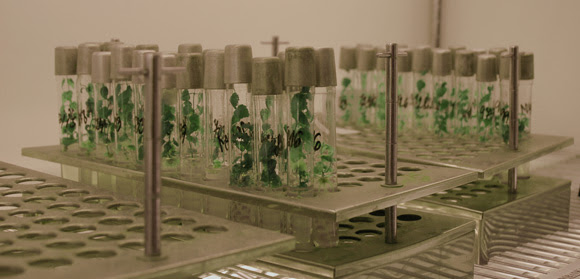
First, speaking of biological science, Stan sent out his regular hops newsletter this week and, as exemplified by the photo up at the top, decided to provide some photos from the Hop Research Center in Hüll, Germany that Evan recently wrote about, as mentioned in last week’s news update. Up there, that’s a picture of some of the Center’s germ plasm collection of long-held varieties. Want more? You will have to pay Stan for back issues of his newsletter now if you want to see the images but haven’t subscribed already.*

The biggest story has to be the member of management at Founders giving testimony in a disposition that he did not know if someone who was… well, let’s see see how the story was covered:

A transcript of the exchange between Founders’ Detroit general manager Dominic Ryan and Evans’ attorney, Jack Schulz, shows Schulz shifting from shocked to incredulous and perhaps a bit angry as Ryan claims he had no idea Evans is Black. Instead of just answering the question and moving on, Ryan digs in deeper and deeper, repeatedly asking for clarification when Schulz asks questions like “Are you aware Tracy is Black?” At one point, Ryan even claims that he doesn’t know if former President Barack Obama, Kwame Kilpatrick, or Michael Jordan are African-American, because he has “never met them.”

The Beer Law Center tweeted: “This is stupid. The “if I didn’t say it, you can’t prove it” strategy – quite simply – sucks. The law, justice, trials, and courts, just don’t work that way. Shame on Founders.” As a practicing lawyer a quarter century into his career, I can’t disagree. The person diving the testimony did themselves no favours. Plenty of rightly offended folk now rejecting the brewery like Beery Ed: “if you still drink founders , you suck.” Which is true.

Boak and Bailey proposed a scoring system this week to determine if a British pub is in fact a pub.

Monty Python’s Terry Jones was on the BBC in 1984 and discussed both dental hygiene in medieval Britain and his brewing. Wogan preferred keg to cask. Jones, having a multi-faceted shirt malfunction announced: “real beer can only be made on a small scale.” Heed ye all!

Lisa Grimm has had a timely article published in Serious Eats about the haunted history of the Lemp family of brewers out of St. Louis:

Today’s beer history installment is something of a micro-level view of my previous column on German-American brewers—but this one has a Halloween twist. The story of the rise and fall of the Lemps, once one of America’s most powerful brewing families, reads like something out of gothic fiction; and, as would be entirely appropriate for that genre, some say that they’ve never left. The story begins familiarly enough…

A great technical article on barley came my way entitled “Characterising resilience and resource-use efficiency traits from Scots Bere and additional landraces for development of stress tolerant barley” I believe from @merryndineley. Now I have to go and look again at the standard for “landrace” when it comes to barley as I’ve seen husbandry in the 1600s but when we are talking bere we are talking about something much older than that as the abstract suggests:

Potential sources of viable resilience and resource-use efficiency traits are landraces local to areas of marginal land, such as the Scots Bere from the Highlands and Islands of Scotland. Bere barley is a deeply historically rooted landrace of barley that has been grown on predominately marginal land for the last half millennia. The landrace yields well in these conditions. The project aim was to assess and genetically characterise traits associated with enhanced resistance/tolerance, and to identify contributing genomic regions.

Speaking of great technical articles, I was blessed with a copy of an article on the history of Fuggles hops by the perennially referenced Martyn which, this time, appeared in Technical Quarterly published by Master Brewers Association:

The Fuggle hop is one of the most important varieties on the planet, not only in its own right as a contributor to the flavor of classic English beers for more than a century but also for the genes it has given to almost three dozen other hops… It is surprising, therefore, that until this year there was considerable mystery over the parentage of the Fuggle—it seemed to be unrelated to any other English hop type, with a hop oil profile much closer to the German landrace variety Tettnanger—and a fair amount of doubt and confusion over exactly who developed the hop and when it was first commercially available. Now, however, research in England and the Czech Republic has convincingly answered all the questions…

Nice article in Pellicle on the realities of the beer scene in Iceland:

We had moved up to the bar at Kaldi, and the low-hanging bulbs made the copper bar top and our bartender’s shaved head shine in the dim light. I had just ordered the Borg Garún Icelandic Stout Nr. 19, an 11.5% behemoth. If you haven’t heard, beer and food are pretty expensive Iceland. Pints of basic craft styles were $12-$15 (£9-£12) everywhere, and the higher in alcohol pours were $20-$30 (£15-£23).

Even at those prices, beats the hell out of an vaguely described essay on (what Canadians properly spell as) bologna.  Sums something up.

Katie tweeting on junkets triggered that a discussion wasn’t the usual monocrop of defensiveness.

There was a discussion on Facebook on the early days of the British Guild of Beer Writers awards dinners with some entertaining recollections. Martyn** recalled a night 22 years ago:

The earliest awards dinner menu I have is from 1997 – ham cured in Newcastle Brown Ale (!), accompanied by figs steeped in Old Peculier, breast of guinea fowl braised in Fraoch heather ale, pears in porter and cheese served with McEwans Champion Beer. Dinner sponsored by Tesco …

Ah, the romance… Related perhaps is this thread about traditional brewing in today’s alcopop world.

That’s it? Yup. For further links, check out the Boak and Bailey news update on Saturday and then bend an ear towards the OCBG Podcast on Tuesdays. And look for mid-week notes from The Fizz as well.

*I don’t make the rules. Stan does.
**Again with the Martyn!!!

Your “What I Did On My Summer Vacation” And Other Beery News Update

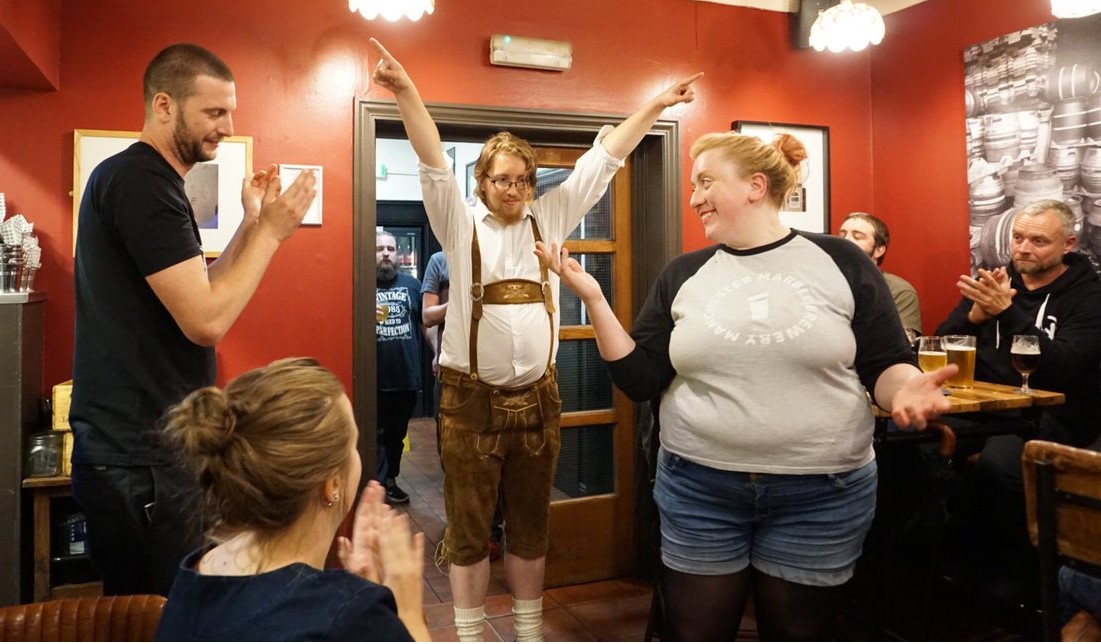
The beery discussion this past week was woven with tales of travel. Don’t get me wrong. I think the whole idea of beer tourism is weird. If I travel, I save maybe 15 minutes every second day for thoughts about a beer. I like museums, beaches, shopping, seeing friends and family, wandering and napping too much to centre a trip around beer. But… that doesn’t mean you need to be like me. Going elsewhere to find new spaces to roughly replicate drinking at home and roughly familiar bars is great. And, as Nate above shows in the tweet of the week, it can be something that opens the door to lederhosen-based public silliness opportunities and “the best photo of me that’s ever been taken!” Which is good.

Jordan St. John went on one last Euro trip before the UK is, what, given the boot… turns its back? And he went to Brussels… which he found rather odd:

When travelling, you want to try to be positive, so putting this thought out of my head, I ambled along through bustling groups of tourists, instagramming along with them. It is in the nature of the tourist focused district to be reductive and sure enough every fourth store sold waffles and every fifth store sold chocolate. It took only a moment to realize that every sixth store sold beer and the dawning realization came upon me: “Oh, I’ve been rooked.” I’m not referring to the quality of the beers on offer, lest you think I’ve come unmoored. It is the depth, complexity, and overwhelming success that the brand of “Belgian Beer” has on a uniform basis.

Me, I was in Brussels for a week staying at a pal’s place in 1986 but stuck to the Jupiler and Guinness. Seemed all a bit heavy handed to me. Was told by a police officer in a long black leather trench coat to move along after the bars shut. Oh, and he had a machine gun. Still, Jordan also bought me a tie which I got in the mail and it was lovely so I thank him publicly. It says “Ind Coope Sales”! So his trip was not all for nuttin’.

Boak and Bailey have shirked their weekly new nugget obligations (again) while roaming around the land of lederhosen. I like this observation particularly:

Despite looking to British eyes like the garden of the nearby pub-restaurant, people were tucking into picnics they’d brought from home, unloading Tupperware and supermarket paper bags from rucksacks and baskets. (With typical German clarity, most of the beer gardens we visited had large signs explaining the rules pinned to trees: sure, bring your own food, but buy the drink from us, or be cast out of your community.) The garden itself also had a barbecue and a pretzel window. The chef tending the former rang a bell every time a rack of ribs was ready and seemed to be selling out, while even those who had brought their own tea were buying giant pretzels to go with it.

Travel writing needs more of this and less of the “my sponsor’s business is the best” stuff. Knowing where it is OK to have a beer in public and where you can eat a sandwich without offending is vital data.

Still on the travel theme, fellow Haligonian Rebecca Pate headed north to Iceland for an Arcade Fire show – and took a mo to report, as an aside to the main feature, on the state of the Reykjavíkjavíkian* bar scene:

The recent emergence of a craft beer culture in Iceland is tied into the country’s drinking history. Prohibition came into force in 1915 and effectively lasted until 1989. The original blanket ban on drinking became entwined with a sanction on beer specifically, as beer was closely associated with Denmark and the Danish way of life – it was therefore seen as unpatriotic for Icelanders to enjoy a pint. The day that the law was changed, the 1st March, is now celebrated annually as Beer Day (Bjordagur).

Perhaps most heroically of all, Lars went deep into rural Russia and undertook what might better be called “beer exploration” as opposed to beer tourism:

The village looked like any other village in Russia, really: a cluster of traditional wooden houses, neatly arranged in rows, with wide, grassy spaces (the streets) in between. The fields were ranged around the cluster of houses. We went down a couple of streets before finally we stopped in front of one of the houses that looked exactly like the others, except Marina was standing in front of it, waiting for us.

You know, every time someone writes a puff piece and calls their work a “deep dive” on social media I think to myself “that ain’t no frikkin’ deep dive – Lars is the deep dive.” Example. Note how Marina malted her own grain: “the malts are dried in a similar trough on top of the oven. So she makes very pale rye malts.” Which should be enough to put the  now well-dismissed “there was no pale malt before coke” fibbery to bed. The process is fabulously described. I want to now try this at home.

One last point on travel. Noticing a lot of people noting they are not traveling to the GABF. Is anyone still going? Why?

Not travel. I had this article about a new brewery in NH shared with me because of the headline but, as I also work in construction for a fair share of my time, this story is refreshing as it has the underlying theme of brewing beer as slowing down as opposed to adolescent manic passion. And the use of “local” rather than “independent” or other such PR claptrap is always good.

Fabulous footage of 1972 hop picking action.

And, finally, this sort of pointless picking apart of alcohol related health advice that is really verging on obsessive compulsive.  If you really prefer to die from a liver disease other than cancer, take comfort and keep pounding back the booze.

There. Another week’s update done. That was all very cheery, other than for the wee fibs o’craft stuff. As per. Want more? If Stan doesn’t pick it up again, if Boak and Bailey never get back from holiday you might want to check out what appears to be a German-sourced English language period update from Bier, Bars & Brauer now in its 23rd edition. Until next week , exeunt!

*No, really… it is… look it up… HA HA MADE YOU LOOK!!!

Paul Goes To Iceland And Drinks Beer

icel1a

She: (In Icelandic) …he appears to be taking a photo of that beer…
He: (In Icelandic) I wish I had the daring to do such things.

Discounting Yorkshire, Iceland is the first Scandinavian country that I’d ever visited. I’m a chilly mortal. Why would I choose to holiday in the frozen north in February rather than jetting off to some tropical paradise? Easy answer. Two words. Northern Lights. Nature’s fireworks. ‘nough said! But it’s not all so obviously attractive. If you holiday outside the UK quaffing invariably means lager. I always find it laughable that you visit a hot country and, in the main, the ‘indigenous’ beer is all too often a bland Euro-fizz style lager chilled to buggery. But Iceland is a cold country and lager is a cold country beer so lager felt like the right and proper thing to be drinking.

icel2To the uninitiated (me) buying beer from a supermarket in Iceland can be a big disappointment. The beer looks like the genuine article with the usual sort of names you might expect to see in Iceland. I didn’t realise, until I got back to the hotel room, that the can of Gull and the can of Viking that I had purchased were only 2.25% in strength. Have you ever tried weak cabbage soup? It’s not pleasant but much more flavoursome than these two, well I hesitate to call them, beers. I managed a can and a half. Anymore and I think I would have lost the will to live. Apparently beer above 2.25% can only be sold in government owned off licences bars and hotels etc. I hadn’t seen the word ‘Light’, ironically printed lightly on the can. Let that be a warning to you!

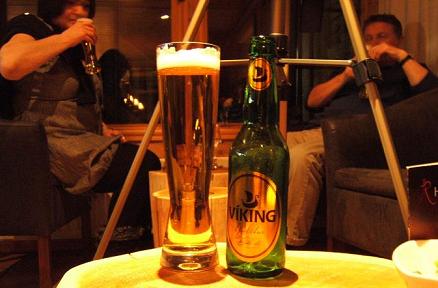
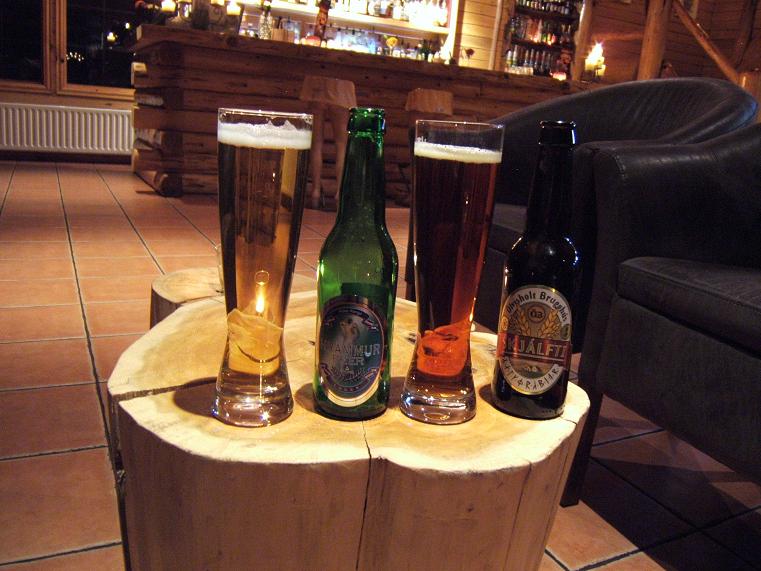
On the night we arrived we’d tried a couple of beers, Viking and Þorra Bjor. We liked what we tasted. Pilsner beers of quality. I will return to these later. Iceland has a near zero tolerance on driving with alcohol in your system so I certainly didn’t drink in the day. A couple of evenings I stuck to vodka, which seemed appropriate for the environment. But we planned to have a sampling session on the last evening. This consisted of us going to the bar and working our way through as many beers as we dared. First up was Hrammur beer from Viking (Vifilfell Hf) 4.6% a light creamy lager that could just about be anything. Bland best describes it but the hint of flavour made it more acceptable than much of the mass-produced fizz we get in the UK.

icel3One beer in and our session was interrupted, “the lights are showing” went up the cry. Drinks in the bar were abandoned; meals in the restaurant were treated with equal nonchalance. We got our coats. This time it was for real. On the last night of our holiday the gods had finally relented and given us the most fantastic experience. I lost count of the amount of times I heard the word ‘wow’, including from myself. If you’ve not seen the Northern Lights then it is very hard to explain how they make you feel. They appeared as white cloud like objects that twisted and undulated changing to a glowing green and then back to white. Afterwards I heard someone describe them as awesome. For once this word was used correctly.

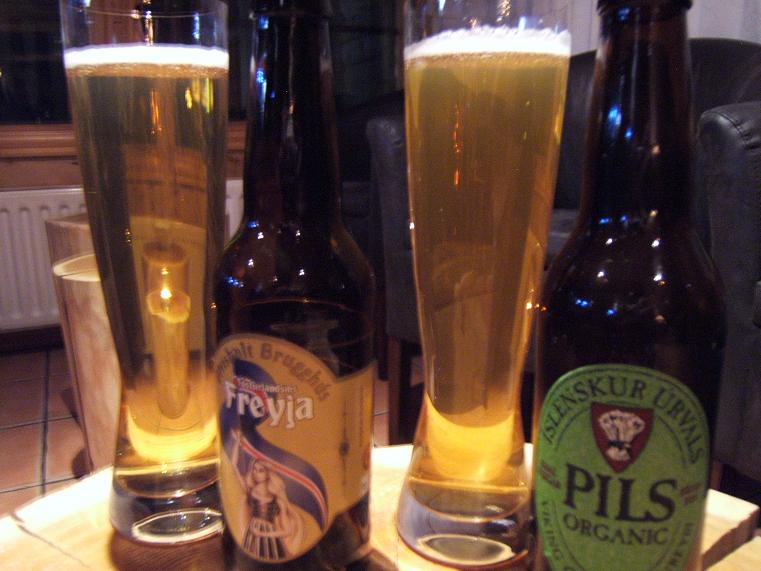
Nature’s fireworks over we returned to the bar to carry on with our beer quest. The next choice was Skjalfti a 5% beer from Brugghus; slightly darker than your typical lager this beer has mouthfuls malt along with a very pleasing beech nut flavour. This is a beer that has been brewed with love. Nestling under the surface is the Smell and taste of oak casks. It’s a beer that reminds one slightly of Innis & Gunn. So, nothing wrong with that then. Whilst I was enjoying Skjalfti ‘the lady’ was trying a wheat beer (one of her loves). Freyja 4.5% also from Brugghus is a wheat beer with pronounced floral notes, elderflower I think, with a vague cream of soda buzz and lemon pith (as opposed to the sharpness of lemon peel). This was not in the gutsy style of German wheat beers but seemed to lean to the Dutch/Belgium wit beer approach. Thankfully it had much more flavour than your typical Flemish blank Blanc.

Onward and upward we went organic with Islenskur Urvals Pils Organic 5%, another brewed by Vifilfell Hf. A pungent aroma of hops invades the nasal passages as you place the glass to your lips enhancing the drinking experience quite dramatically. This well rounded pilsner beer is fruity with a minimal bitterness. This is one class act pilsner. Þorra Bjor 5.1% the Þ is pronounced ‘th’ as in theosophy is a seasonal beer brewed for a recently resurrected winter festival. Its brewed to accompany what Icelanders we encountered referred to as ‘bad food’ By all accounts ‘bad food’ consists of fermented shark meat and sheep’s testicles plus other assorted left-overs. The bad food didn’t appeal to us but this malty, slightly bitter beer was a sure fire winner. Not dissimilar to a barley wine this was a worryingly quaffable beer. It’s probably just as well that the bar ran out of it before anymore could be ordered. Vifilfell also brewed this fine beer. The last offering, again from Vifilfell was the 5.6% Viking their flagship brew. And, yes it is pretty ‘flagship’! Vifilfell do seem to have perfected the act of brewing quality pilsner beer. It is a robust beer with a fabulous balance of hop on the nose and the palate followed up by a malt-rich mouth soothing finish. All in all our sampling was a good session.

I’d have liked to have drunk a lot more Icelandic beer but at around £5 – £6 for a 330 ml glass it is an expensive pastime. On the upside it makes you savour and enjoy the beer even more when you know you can’t really afford to neck it. Our visit to Iceland is the best holiday that we’ve ever had and we’d love to go back. The beer is great but the natural sights make the beer pale into insignificance. We were also impressed with Icelandair who we note also fly to Canada. We could be tempted. Do you need a piece on Canadian beer Alan?