
And Just Like That Here Are The Quite Frosty And Fully Final Beery News Notes For January 2026

It’s been a quiet week in the beer world with distractions aplenty in my real world. Like the Arctic vortex. To be honest, I’ve always preferred the Caribbean vortex whenever it pays a visit.  Thankfully, once upon a time I lived up in the upper Ottawa and have experienced the refreshing zing of -53C so knew enough to break out the heavy tweed and  big boots. Dashing yet completely unable to dash. Elsewhere people are embracing the deep chill as well.  Will Cleveland reporting from Rochester, NY has news of the return a winter beerfest this weekend;

This isn’t a gimmick festival chasing the beer-du-jour; it’s a gathering rooted in the style that got a lot of people into craft beer in the first place—before haze became a default setting and before “imperial” stopped feeling like a warning label… DiCesare remembers the first year clearly, mostly because it was about 10 degrees outside. This year, the ask is similar but the hope is different: dress for the weather, embrace the winter, and lean into the fact that January beer festivals are better when they stop pretending they’re outdoor concerts. Fire pits and outdoor heaters will again be part of the setup, encouraging that specific Rochester ritual of standing outside, beer in hand, nodding knowingly at strangers like, yes, this is happening, and yes, we chose it.

What else has been going on? Well, it was Rrrrrrrabbie Burrrrrns night last Sunday and all around the world folk reacted to the plate of haggis, neeps and tatties set before them. Unless, as Katie M explored in Guts magazine, it perhaps wasn’t really haggis:

Learning how important lungs are to the recipe of a traditional haggis, a vegetarian version seems like sacrilege. The whole point of haggis is that it’s offal, a sausage or boiled pudding made with waste-not, want-not diligence to keep Scots fed throughout the winter and leaner times. The very idea of a vegan haggis is deeply inauthentic—offensive too, if you were to read the comment sections on any clickbait story about the dish. But if you’re appalled, you’re forgetting the accommodating nature of the Scottish people. Do you think my Grandma would have anyone going hungry in her house? The very origins of vegetarian haggis was borne from hospitality…

As the good author noted, the very prayer one prays before we got to the “O what a glorious sight, Warm-reekin, rich!“* includes the line “some hae meat an canna eat…” so there is some authority for this. Is there another dish that so inspires? Speaking of how others live, in the Globe and Mail, Drew Shannon wrote about finding a beer in Kazakhstan:

I broke up with craft beer a long time ago – back when small-brand breweries went from niche and interesting to eye-rollingly ubiquitous. Of all places, I didn’t think I’d run into my beverage-ex in Kazakhstan. I assumed either big conglomerate brands would still dominate the former Soviet state or there’d be no beer at all. Finding a pint in some parts of the Islamic world can lead even the most well-travelled tourist on a fruitless quest. It turns out, I was dead wrong. My impromptu evening of bar-hopping around Almaty, the country’s largest city, started after a long day of trekking the Turgen gorge. On the way back to my hotel, I noticed Privychki Bar. I pushed open the front door to find a gaggle of young Kazakhs perched on vintage armchairs, sipping cloudy pints. 

Mmm… cloudy pints. Never less than clear, Stan, in his concise one paragraph way, directed me to a bit of resurrectionist thinking over the cool corpse that one was Rogue Brewing. How in its haydays it didn’t have managers, it had ambassadors: “That is why Rogue was kicking ass in those days is that felt that they were ambassadors to craft beer.” Yikes. I had a sudden unsettling flashback to the bad old irrational – if not greedy – days of craft and reminded myself of this from 2012:

To hell with that. Passion is that employer of the young who saps their joy for life. Passion offers periodic Google ad cheques in return. It asks you to be the unpaid brand ambassador. On Wednesday night, a intelligent and eager young person suggested to me that my interest in good beer was pure passion with a certain honest excitement. I took the time to gently crush that moment like a mouse under my heel. It was information, I said. Information and interest. Passion? I have children for that. 

The children? They are 14 years older now and each of an age when they might be expected to buy the beer as much as have it bought for them. I trust that now not-so-young person has found another moe successful career – and that’s probably for the best for all.

Note #1: Twenty years of Ron!
Note #2: Maureen asks … in the end… is a brewery just its trademark?
Note #3: Stout-flation strikes.

Heavens! I missed the news when The Beer Nut issued a new beer style alert right around when the update when to the presses last week. He was reporting from the front lines of recent holidaying where and when he encountered:

… the rarely-seen style of imperial sweet potato amber, and I had no idea what that was likely to mean. Beniaka is 7% ABV and a cola brown colour in the glass. Although fizzy, it’s plenty thick and feels luxuriously “imperial”. Can’t say I tasted much potato, but there’s a pleasant woody spice: nutmeg, sassafras and liquorice. It’s fairly sweet with it, showing a little Scotch-ale-style toffee, with the herbs helping balance it. This is interesting, with lots happening, but it’s not a daft novelty, and makes for a very civilised digestif.

Not at all in response, Sophie Arundel was given a fun topic over at the Drinks Business – the dead end trends of 2025:

Several alcohol formats once framed around lighter, functional or lifestyle-led positioning are now in sharp decline. Hard kombucha now holds a 0% share of social discussion, down 29.8% year on year. Hard tea has slipped to a 0.01% share, falling 33.79%, while hard seltzer sits at 0.02% share, down 33.67%. The contraction extends beyond these formats. Craft beer, often seen as culturally resilient, is down 16.52% year on year with a 0.84% share, while generic IPA beer has fallen 17.28% to a 0.38% share. Tastewise’s data suggests the broader “better-for-you drinking” narrative is losing attention. Products that relied heavily on pseudo-functional positioning are struggling to maintain relevance, pointing to a need for clearer occasions, flavour-led propositions and tighter ranges.

(“Pseudo-functional” was the name of my folk-punk band back in ’93.) At least craft beer fans can take comfort that their drug of choice is going better than hard kombucha. There are still some hangers on that are telling craft to repeat its errors… but it is true, isn’t it – when things are going down the proverbial shitter, not one really is working to improve so much as find themselves quite happy to tread water.** Perhaps coversely, BMIs seems to be seeing at least a stall in the slide when it comes to US beer:

NBWA released its Beer Purchaser’s Index reading for Jan early touting a “significant bump” from December. After 5 mos in a row of readings below 30 (including several lowest ever around 25), BPI jumped to 39 in January. Not exactly great shakes, and 9 points below Jan 25, but still 14 points better than Dec 25. (Recall, BPI below 50 suggests beer distrib orders are contracting, while above 50 signals expansion.) 

So less of the lessening perhaps. But in western Canada, there was actually an increase in beer sales through 2025. So who knows! Well, at least we know one thing. I think we have established that not being very profitable at all is actually not a good business plan:

BrewDog has announced that it is closing down its Aberdeenshire distillery and ceasing production on all spirits. The craft beer company said it had decided to abandon its state-of-the-art distillery, which opened in 2016, and axe the brands after “careful consideration”. The move comes after the company posted losses of £37m in 2024 and announced job cuts across the business, including at its head office and brewery in Ellon.

Conversely (at least in San Francisco) not doing well enough to even attract a proper buyer can have its advantages:

During that massive blackout on December 20, every business but one in the Lower Haight had to shut its doors because they had no power. That one would be Toronado, which still uses an old-timey, non-electrical cash register with punch buttons and a hand crank, still takes only cash, and beer taps don’t require electricity. Cheers to ancient technologies. The story was left hanging last summer after a new crypto-bro owner had stepped in looking to take over the bar — and launch a Toronado-themed coin! — and after that deal appeared to be in jeopardy once longtime owner Dave Keene discovered these details and looked to cancel the deal. But SFist can confirm now that the deal was, indeed, canceled, and everything remains as it was at the bar.

That’s nice. Unless the owners really hate the place and want to move on I suppose. Can you own an iconic institution that people flock to and really hate it?  If someone does something well I would hope that there is joy in the doing.

Note #4: The many beards of Polk.
Note #5
: What friends of beer writers think they do…
Note #6: …all day long…

Joy in doing? That’s a bit like this week’s feature in Pellicle by Imran Rahman-Jones about the making of liquor from what’s to be found right there in Edinburgh’s urban orchard:

As Chris continued to tweak his distillations, and source new apples for each batch, he began to reflect on the fruit’s beguiling quality. “[There’s] something quite magic about an apple tree in the street,” he says. Neighbours will leave out boxes of fruit for one another, or swap recipes. “It tends to pull the whole street together at a certain time of year.” What Chris didn’t know when he started the process of developing Pochle was that he was tapping into a lineage going back centuries in Scotland. The enchanting ability of an apple tree to gather and unify in fact has deep roots in the country’s traditions and folklore. 

Lots to like there. And just look at the people working to get that bit of writing onto your screen. The fine folk keeping Pellicle going, the author Imran Rahman-Jones, the semi-sticky handed Chris Miles who gathers and also those who let the foragers be – not to mention those who planted and tended to the apple trees. Doing is a wonderful thing.***

And on that very subject – the doing of things – Boak and Bailey were out there again in their monthly newsletter for January doing a great job encouraging more writing about beer. What to write about:

There are local drinking customs and cultures that probably seem unremarkable to people who know them but which would interest people like us. Flat Bristol Bass is one that fascinates us but there must be others all round the country, and certainly around the world. Alex, our favourite beer blogger of 2025, goes to three pubs and writes about what he sees going on there. Adrian Tierney-Jones (a pro, not a blogger) takes a similar approach. Now, you could write tasting notes of every beer you drink but, honestly, that’s probably the hardest thing to make interesting – unless you are a skilled, creative, and/or amusing writer like The Beer Nut. It can still work if your tasting notes find a theme or tell a story, though.

Do it! I like it – but do note that “blogger” and “pro” are not comparable categories and neither term speaks all that much to the quality of the writing. “Pro” is code for paid writing which can be compromised even just by editorial restrictions**** though, more to the point, too often not all that good. And “blogger” is a reference to a class of medium, not a sign of quality of the writing and not necessarily code for an amateur though some of the best beer writing is actually provided by people who earn their living otherwise. Ray and Jess themselves are proof of that. Better to think of adjectives like interesting, inventive or even valuable when weighing the cred. Then notice where they don’t apply!

I would also add, don’t worry too much… unlike Mikey Seay who has shared what strikes me as quite an odd thought:

I always shy away from reviewing beers for two reasons:
– Lack of skill to do it properly.
– Beers can be too regional to make a review relevant to a global newsletter audience.
That said, I feel a new beer from Sierra Nevada is available enough in most places to make it worthwhile to mention.

Seeing as thinking and writing about your taste perceptions takes about as much skill as running a vacuum cleaner, I don’t think this is a particularly useful standard. But then again you may be crap at vacuuming, too. Do you worry about that? Just type. Be patient and get those keyboards clicking. It’s a lot like planting a seed and also, if nothing else, it’s good for the knuckles.

Where will it take you, all this clickery? Well, as we wrap up this week on the note of the haute in beer writing, this is your final call for a fully self-funded trip to Bordeaux in June:

This is the FINAL REMINDER about the 2026 Beeronomics Conference, which will take place at ESSCA School of Management, Bordeaux, France, 24-27 June. Main panels and sessions will be held at the ESSCA Bordeaux Campus. The Conference Organising Committee, led by Gabriel Weber and Maik Huettinger, welcomes all high-quality research on the economics of beer and brewing. 

The deadline for submissing an abstract is Sunday. Send me a card. Fine. Fin. As I said, a bit of a quiet week. please check out Boak and Bailey who are posting every Saturday and adding to their fabulously entertaining footnotes week after week at Patreon. And look out for more of Stan’s new “One Link, One Paragraph” format. Then hunt out something in someone’s archives! Leave oblique comments on someone’s post from 2009!! Listen to a few of Lew’s podcasts and get your emailed issue of Episodes of my Pub Life by David Jesudason on certain Fridays. And Phil Mellows is at the BritishBeerBreaks. Once a month, as noted, Will Hawkes issues his London Beer City newsletter and do sign up for Katie’s wonderful self-governing totes autonomous website featuring The Gulp, too.  Ben’s Beer and Badword seems to be on pause since November but there is reading at The Glass which is going back to being a blog. Any more? We have Ontario’s own A Quick Beer and All About Beer is still offering a range of podcasts – and there’s also Mike Seay’s The Perfect Pour. Plus follow the venerable Full Pint podcast! And there’s the Craft Beer Channel on Youtube. Check out the archives of the Beer Ladies Podcast.

*Just in case someone out there never had a tea towel.
**No, smoothies will not save brewing.
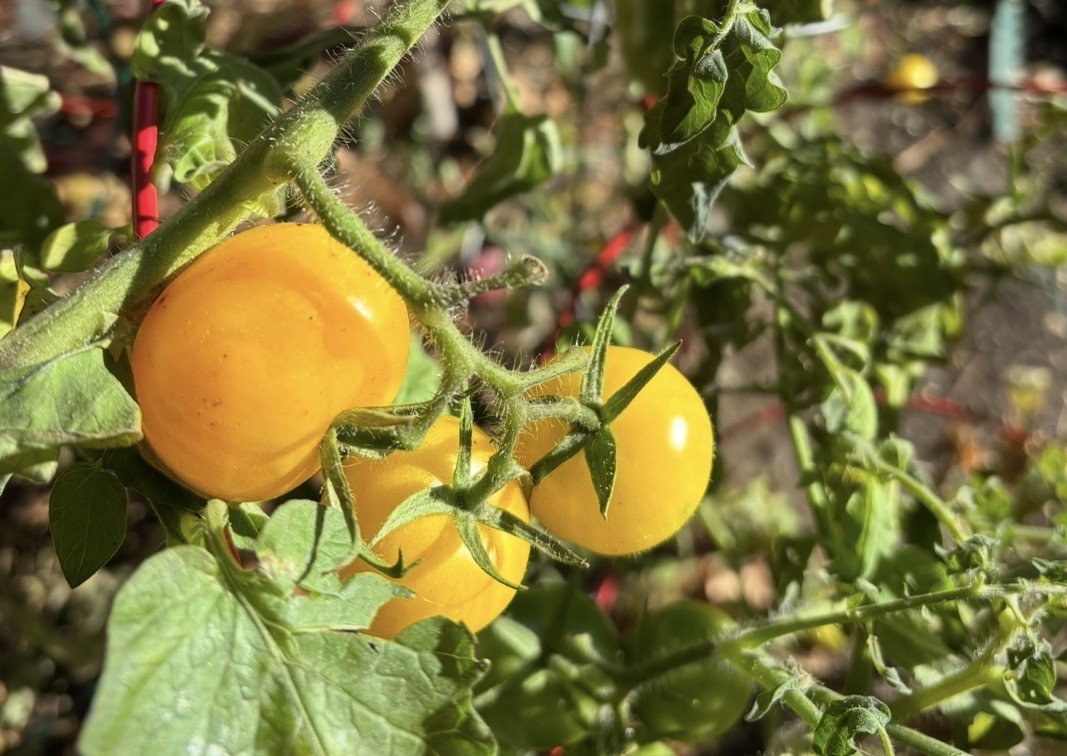
***This is your reminder that now is the time to start planting those seeds for your own garden. Seeds and soil and time. Have a go. This tomato from last November’s final harvest was from a seed planted in my basement in February. Easy. Almost as easy as typing. 
****“It’s only a trade mag article…” is as often much the case.

Your Happy Merry And Even Supportive Beery News Notes For The Week Of Blue Monday

How does it feel? That’s what Blue Monday asks of you. Katie was particularly aggrieved as last Monday was her birthday. So first of all –  happy birthday! Apparently, Blue Monday is perhaps a floater with not 100% agreement on which date it is.* Like Easter but without the medieval calculation to give some assurance as with the death date of Jesus. So you have options and need advice. Fortunately I am full of good advice on this topic. Me, I prefer to celebrate what I call “Bleu Monday” on which I eat a lot of cheese. Also, it seems to also have been originally a term that in Germany was “der blaue Montag.” and then United States when workers told the boss to shove it, as we read in 1838:

Drink till all is blue. Cracking bottles till all is blue.

Blue meant the haze apparently. Or perhaps the slightly wicked as in “blue laws.” I dunno. But I like that it also has it’s own anthem, even if it’s a wee bit Dieter Sprockets.

Beer Marketers’ Insights have a note about a little blip that could be the beginning of a bit of a bump for beer:

Pretty much everything was comin’ up roses in beer and beyond for the first week of the new year in Circana multi-outlet + convenience channels. Beer, wine and spirits all grew for latest week thru Jan 4, 2026 (including Dec 29-31). Can’t glean much from just one week, but interestingly, craft beer’s 4.4% $$ gain outpaced total beer (+2.9%) for period. Multiple top craft fams saw sales pop for the week including New Belgium, Sierra Nevada and Elysian each up low double-digits by $$, Lagunitas up 8.5% and Bell’s (+5%), Shiner (+4%) and Blue Moon (+3%) up low-to-mid singles.

And these US market numbers exclude non-alcoholic beers so it’s more beery than we often seen in the booster stats announcements. But they could also indicate that fine spirit of “fuck it!” that one finds in a time of crisis. Speaking of which, can you write about the crisis in US hard liquor sales without mentioning the tariffs that have effectively cut out a massive share of your customer bases? VinePair seems to think so:

And though distilleries share similarities with other business closures — from layoffs to managing creditors — there’s uniquely challenging inventory to deal with: barrels of aging whiskey. “They’re a little bit of a problematic asset because they can only be sold to someone who has the license to hold them,” says Will Schragis, managing partner at WellSpun Consulting. “Barrels are in-bond, so they’re non-tax paid. There are only certain licensees and other companies that can acquire them.”

No mention of, you know, lobbying for free trade as a recourse makes me wonder if there is a ex-nay on the t-word going on, lest one draw wrathful attention away from Greenland. H/T to Jeff. It’s all about getting the spend in country it seems and Americans are doing their part:

Surveys have shown that consumers feel pessimistic about the economy as they worry about tariffs and the jobs market. More than half of voters believe President Trump is “losing the battle against inflation”, according to a Harvard Caps/Harris poll of 2,204 registered voters released last month. Yet despite the economic gloom, data suggests that spending has risen across all income groups.

Mikey Seay shared a few thoughts that are not unrelated to this moment:

It’s the price. I struggle with the price of NA and low ABV beers. This is my Dry January issue. I can get behind drying out for a month. Or (what I am trying) focusing on drinking lower ABV beers. But there is a hidden suck. Low alcohol/no alcs are priced the same as regular beers, sometimes even double. It’s hard for me to get over that. It’s like, I am getting ripped off, and I have a hard time shaking that. But I must. I know it costs a brewery close to the same to make a NA or low beer, so they gotta charge the same. And that cost trickles down to the stores and bars. So I gotta get over myself there..  Enjoy my low ABV beer, and don’t be a baby about what I am paying for it. I must do this for myself and the business of beer.

One must spend. Do one’s part. Think of England and all that. One of things I appreciate locally is that Guinness 0 is $11.95 at the LCBO and the regular draught is $13.50. Trouble is… no Guinness 0 to be found in the province these days. Guinness is experiencing a height of fame and fortune – and there are good reasons for that, according to Jeff:

The world is unstable, especially for young drinkers who spend half their paychecks on small apartments. Young people are threatened by more dangers than any generation in decades: huge college debt, a machine-learning era that may eliminate entire sectors of jobs, climate change, political instability, the corruption of media and the vitriol that marks society. This is not a time for risk-taking. It’s a moment when people are taking refuge in safe ports and reliable brands. Guinness isn’t alone in this appeal—the popularity of old Mexican brands follows the same script—but it has the advantage of being a 4.2% black ale that comes with a helping of theatricality and a creamy head. It is both safe and also different from other global brands.

I think some of this turns on that 4.2%. And low calories. Theme shift. Did you know you can watch RonTV?  He’s got a YouTube channel going:

You might have noticed that I’ve posted a few videos on YouTube over the last couple of days. There will be more to follow. It’s part of my drive to document and preserve. Initially, it’s mostly material that I acquired for my book on the 1970s, “Keg!”. I conducted several Zoom interviews Which I think are worth making public. Especially as the interviewees are all past retirement age. And won’t be around forever. I’m particularly keen on recording Derek Prentice’s recollections of more than half a century in brewing. Despite my urging, Derek shows no interest in writing his memoirs. But he’s happy to be interviewed and share his memories. I already have around two hours of video. And plan to record several more. Covering his time at Youngs and Fullers.

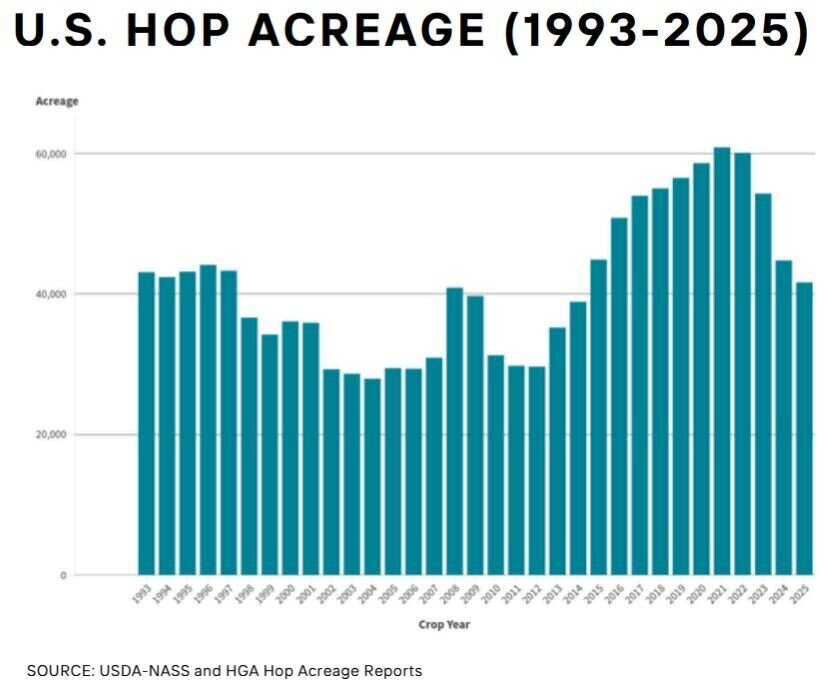
Next, Stan has published his newest edition of his monthly Hop Queries newsletter and there is much to consider. For one thing, he shared that chart of total US hop acreage which indicates the plantings of 2025 roughly match those of both 1997 and 2008, both years before further drastic drops. He also explained what BLP flash frozen hops are:

The idea began with hop farmer Jim Schlichting, who upon retiring bought 40 acres of land next to his home and began growing hops… Basically, he freezes the hops fresh off the bines and ships them in vacuum sealed packages along with reusable ice packs. The cones should remain frozen until brew day. After thawing them, brewers may use them as they would unkilned hops, replacing each pound of pellets in a recipe with four pounds of cones. Blue Lake markets the hops to both homebrewers and commercial breweries.

Whenever I read that some blog or newsletter on beer won some award or another I always think to myself “looks like Stan didn’t apply again this year.

Note #1: to bar or to not bar ICE.
Note #2: medical thoughts from amateurs.
Note #3: the Magnus Lounge on the ferry to Orkney.
Note #4: are people outside of the beer echo chamber aware that many many others have quite happily active social lives… without beer?**

And Jordan continues to diarize*** his weeks in detail, appointments in pub and breweries plus the scribbling for magazines and books along with the totalling up of spreadsheets. He’s found that the current bottom line in Ontario is not good news:

Among the various hats I wear, I’m historian for the Ontario Craft Brewers and I get to update their timeline on a yearly basis. Since I’m updating the spreadsheet with news throughout the year, this gives me the opportunity to get paid something for the information I’m collating. …the end of the year has been brutal on breweries. Both Goose Island and Blue Moon have decided Toronto has beaten them. If the corporate guys are out, you know things are bad. It looks like 30 physical breweries closed in Ontario in 2025 and something like four contract breweries, but who cares? Some physical breweries switched to contract status and some ownership structures are more or less impossible to parse. Can you really say Indie isn’t a contract brand because of Birroteca at Eataly? 

Can you really? Shifting from the crunch of numbers to the stream of consciousness, it’s a good thing ATJ prepared us with the subtitle of his piece this week – “an amiable ramble” – as this letter of love to beer culture touches on every corner of the pub and glass experience other than the variations on paper towel dispensers one might encounter, such as:

It is about the rattling bus snaking through the countryside with a pub at the end of the journey, the train skirting the wave battered coast with a pub at the next station, or maybe two or three, the walk through the rain, the nature of the game; under the hill all of us go at the final stage of our life but beer can be used to celebrate that passing, reconnect your memory with a swig and another swig, raise a full glass to the memory of dear old matey they all chorused, may he be never forgotten, but as soon as the rain stopped they walked out of the pub never to think of their dead friend ever again, for they were alive and he wasn’t.

Poor old matey! Gone and soon forgotten. Interesting legal news if you are into doing your own thing, a category of which I appreciate many of you fall into according to your own tumble of choice. The news is that the US District Court in Northern Texas assessed submissions in a case and last Saturday (odd date for a ruling to be issued) held:

…these documents reflect a shared First Amendment vision: Free Speech, Press, Petition, and Assembly rights combine to protect and elevate the public discourse necessary to self-government—not self-expression in all forms, and certainly not the libertine “expressive conduct” absolutism envisioned by
Plaintiff Spectrum WT… Spectrum failed to enforce its intended “PG-13” format during a drag show held off campus, as professional and student performers tasked with “breaking” and “destabilizing” sexual norms engaged in sexualized conduct more akin to a striptease…

Libertines! Libertines at a university?!? Now, keep in mind what “WT stands for: West Texas A&M University. The students of which the court determined included minors. Perhaps in Amarillo the age of majority is 35. Who knows. But it did remind me of the 2003 ruling of the Supreme Court of Canada in in the case R. v. Clay:

…the liberty right within s. 7 is thought to touch the core of what it means to be an autonomous human being blessed with dignity and independence in “matters that can properly be characterized as fundamentally or inherently personal”. With respect, there is nothing “inherently personal” or “inherently private” about smoking marihuana for recreation. The appellant says that users almost always smoke in the privacy of their homes, but that is a function of lifestyle preference and is not “inherent” in the activity of smoking itself. 

Lifestyle! Thankfully, the old wack-tabac is now legal in these parts. But these matters, in case you ever wondered, one has to be on top of one’s right to have fun as one wishes. The law of the libertines’ lifestyles may need more research.

Finally, Pellicle has a short survey out about their next steps:

It’s one thing to run a magazine based on the things we like most, but to grow and bloom into something bigger, we need our readers’ insights and support. That’s why we’ve created this survey: We want to hear what you want from Pellicle in 2026, and use your input to plan our next moves. For the next two weeks, we’re opening up the floor to learn what Pellicle means to you, and where you’d like to see it go next. The 2026 Pellicle Reader Survey is just a seven-to-10-minute task, and you can easily complete it on your phone. Plus, you can opt in to win one of three prizes…

As you know, I would pay to take a survey so the whole idea of prizes is just insane!  While you are busy with that, please check out Boak and Bailey who are posting every Saturday and adding to their fabulously entertaining footnotes week after week at Patreon. And look out for more of Stan’s new “One Link, One Paragraph” format. Then hunt out something in someone’s archives! Leave oblique comments on someone’s post from 2009!! Listen to a few of Lew’s podcasts and get your emailed issue of Episodes of my Pub Life by David Jesudason on certain Fridays. And Phil Mellows is at the BritishBeerBreaks. Once a month, as noted, Will Hawkes issues his London Beer City newsletter and do sign up for Katie’s wonderful self-governing totes autonomous website featuring The Gulp, too.  Ben’s Beer and Badword seems to be on pause since November but there is reading at The Glass which is going back to being a blog. Any more? We have Ontario’s own A Quick Beer and All About Beer is still offering a range of podcasts – and there’s also Mike Seay’s The Perfect Pour. Plus follow the venerable Full Pint podcast! And there’s the Craft Beer Channel on Youtube. Check out the archives of the Beer Ladies Podcast.

*It is, however, reliably closer to the start of 2027 than the end of 2025.
**I find this eager rush to shimmy right up next to the nutster RFK Jr somewhere between bizarre and disgusting: “…In explaining that approach, officials pointed to the social context in which alcohol is often consumed – its role in bringing people together to bond and socialize, while creating shared experiences – summed up by the idea that ‘there’s probably nothing healthier than having a good time with friends in a safe way.’ ” That’s two possible bits of bootlickery this week. A better take on the moment.
***Boak and Bailey do something along a similar line with their regular beers of the week posts on Patreon: “Running with Spectres was also on excellent form, much to Jess’s regret the following day.

The Even More Fabulous Yet Slightly Chill Mid-January 2026 Beery News Notes

“CORK HEAD! CORK HEAD!!

There really is no need for any further update this week is there. Andreas Krennmair posted an image of the “old interior of Schneider Weißbierbrauerei, presumably from before the rebuild 1901-1903” and this scene above was one of the tiny vignettes sitting in the back of the overall bar scene.  I can’t figure out if these gents are playing that old favourite, a game of “I’m a doggie, cork my brainpan!” or… the means by which this particular men’s club informed a candidate that they did not pass the initiation process. I find the physics involved problemative but, you know, art.

First off, some excellent reporting out of The Soo on pricing after Ontario’s expansion of beer sales to corner stores compared to grocery stores, the big brewery owned TBS as well as the government’s own booze agency the LCBO;

The editorial team bought two beers, a mass produced lager and a craft beer, as well as two bottles of wine from several locations around the city to find the best – and worst – deals in Sault Ste. Marie… A tall can of Molson Canadian will run you $3 at the LCBO, compared to progressively worse deals of $3.03 at Rome’s Independent, $3.14 at the Beer Store, and $3.81 at Circle K. For a can of Great Lakes Brewery’s Octopus Wants to Fight, the results are tighter – coming in at $3.75 at all locations but Circle K, where the surly octopus comes out to $4.04 per can. All told, a Canadian is 21.2 per cent cheaper at the LCBO than at Circle K, and Octopus Wants to Fight is 7 per cent cheaper everywhere other than Circle K.

I would point out something about that otherwise excellent research. Circle K sometimes has a nutty nutty sale price for a few pretty decent Ontario craft brews. I pop in once in a while when I am picking up a tank of gas just to check in.

And while I have been known to hover in and about the snack aisle of corner stores, I am not a taproom devotee. Too often they strike me as car dealership showrooms – “would you like to see the latest model except (in a fourdoor / with even more Citra)?” – but it was interesting to see Stan consider B+B’s thoughts on the key underlying principle involved;

It appears I may regularly come across taprooms with personalities than Boak & Bailey, but I wouldn’t argue cookie cutter establishments aren’t abundant in the US. Also, B&B tend to write short paragaphs and I try to stick to one. Their following words zero in on what I value in drinking establishments, that they are “run by human beings.” The others, without personality, I tend to forget. I acknowledge they exist, but I don’t have to think about them.

Speaking of places run by human beings, we have a new beer blogger alert. Colston Crawford, the recently retired pub and beer columnist with the Derby Telegraph has decided to continue sharing his thoughts on the topic including how the notion came to him:

It was a lunch at The Crispin in Great Longstone, in the Peak District, a week after I finished which firmed up the idea in my head. The food, the drink, the service, the ambience, was so good. I sat there thinking, if I still wrote a beer column, this one would be easy. I could dash it off right now. I’ve made two more visits to The Crispin since, the first to confirm that the previous one wasn’t a fluke, then the second was unplanned. I was with friends in a party of five, walking on New Year’s Eve morning, but the venue they’d fancied for lunch wasn’t open. The Crispin was five minutes away and a superb lunch followed.

There’s a lot of good advice in there. It is easy to keep a low pressure blog about something you have a general interest in. A striking experience will make for a good story. And it’s good to review the experience a couple of times to get the facts straight, too.

And Boak and Bailey shared an extended thread of thoughts on why people in the UK have cut back their visits to the pub with plenty their own interesting thoughts and those of others who joined in. I agree with their thought #7:

7. Basically, we’re not convinced the pub crisis is especially acute *right now*. In 20 years of blogging, and nearly half a century of being alive, we’ve never really known a time when pubs weren’t doomed and in decline. 

One of the things that concerns me about that form of doomsaying is that it always seems to be decontextualized as if pubs closing is the only difference since 1976.  Fewer are also going to church, too, over that same 50 years of existence. Many more play video games than before that point and I would expect more tofu is sold in the NATO countries. Preserving past practices as opposed to preparing to guide them through change is a bit of a fool’s errand.

Note #1: only available in Alberta, Saskatchewan, and Manitoba.
Note #2: Beer’s “Santa Claus Rally”.

Me, I’ve never developed a taste for collaboration beers but apparently the revenue authorities in Finland have, as The Beer Nut noted.  The EBCU has taken a position on the matter:

Finland is currently considering new excise-tax guidance that would effectively make many collaboration beers impossible for small breweries. Under the draft interpretation, if a beer shows more than one brewery’s name or logo (as collaborations typically do), it could be treated as “licensed production” and the breweries could lose their small-brewery tax relief for the entire year. This would impact not only Finnish breweries, but also imports and international collaborations—ultimately reducing choice for beer consumers.

This is an excellent example of the sorts of issues related to identity that can pop up in law. Obviously, if the non-brewing collaborator (let’s call them “the collaborator”) insists on putting their intellectual property in the form of a logo on a product, they are saying to some degree that the product is their work. Yet, for taxation categorization, that logo placement is argued to not indicate that the work is theirs but, instead, only the work of the brewer (let’s call them the collaboratee”.) I have no stake in the matter and have no idea how Finnish taxation policy plays out in term of brewers compared to cheesemakers or lumber yards – but I do have one raised eyebrow when I see these sorts of statements as part of the EBCU’s argument:

Collaboration beers are one of the joys of modern beer culture…  we believe consumers deserve choice, diversity and fairness. Collaboration beers enrich the beer landscape, strengthen friendships across borders and introduce consumers to new styles and tastes…

Wouldn’t the better argument be that collaboration beers are just a fun reciprocal staff training exercises for brewers that is only, for tax purposes, a businees expense and a burden upon revenue that is of little interest to consumers? After all, if one cannot detect the taste of collaboration beer… does it really actually exist?

Jeff had some interesting thoughts this week on hopeful hints he might be seeing in the US hop market and what it may mean about how breweries are reacting to the retraction, concluding:

…a last comment from me. As we exit the period of craft beer’s novelty era, when breweries made dozens of IPAs every year, it looks like it’s impacting not just the amount of hops brewers are buying, but the diversity. When I talk to brewers about new hop varieties, they are often hazy about them and most are not sampling every new one that comes out. Brewers seem to be more interested in hop products as a way of enhancing their beer. These products focus on the most popular hop varieties, which increases the “stickiness” of the major varieties.

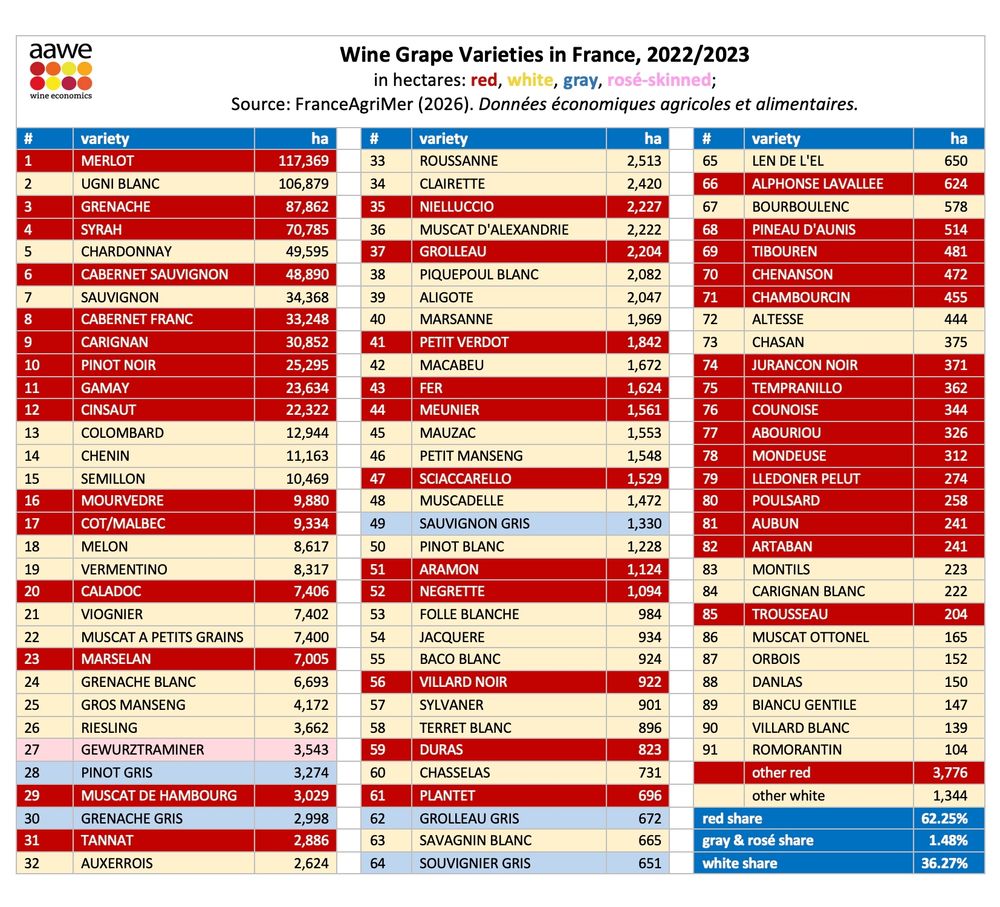
Speaking of varieties, have a click on that image to the right. It’s a list of the top 100 plantings of France grapes posted by the American Association of Wine Economists the other day drawn from an agency of France’s agriculture ministry. I don’t have much comment about it other than to note, despite the pop culture slur, how much good old merlot* is still grown as mentioned by E. Asimov the other day in his discussion of wines you may want to explore.

Good news for cideries and brewers of New York. In this week’s “State of the State” speech, Governor Hochul announced support for local producers, as noted by KK in related to cider makers:

New York is the country’s leading hard cider producer, boasting more active cideries than any other state. Our cider industry has grown substantially over the last ten years, generating over a billion dollars in total economic impact for New York, yet there still remains untapped agri-tourism potential to explore. To support the industry and tap into the robust agri-tourism opportunity that cider presents, Governor Hochul will work with the New York Cider Association to establish New York as the State of Cider, marketing the orchards, tasting rooms, and food experiences that could become anchor destinations for visitors across the country. These actions will strengthen rural economies, uplift the exceptional work of local businesses, and establish New York as the foremost destination for American hard cider.

The Governor also indicated the “need for modernizing licensing across the board, from sports bars and cafes to airport lounges, hotels, and movie theaters.

Conversely perhaps, Pellicle‘s feature this week is a post mortem by William Georgi of the Dutch brewery Nevel Wild Ales which had lofty and noble goals linked with but quite experimental standards:

“We were doing two expensive and time-consuming things at the same time,” he says. “Making a complex product that only a small selection of people actually like, while trying to set up a network of local farmers. A food forest like this is wonderful, but you can’t use it to make beer, as it doesn’t host perennial one-year crops”… Social sustainability was equally important for Nevel. The network of local producers Mattias established for sourcing ingredients—from hops and barley to chestnuts and kiwi fruit—showed him the challenges of farming at a small scale. “It isn’t economically viable at all,” he says. “Even if there’s a living wage being paid, the price doesn’t take into account the fact that most people harvesting the crop are volunteers. 

It’s pretty clear that the plan was not designed to pay its own way. Volunteer labour and crowdfunding plus unbudgeted expenses like organic certification were certainly signed that the business as a business was build on a weak foundation but I like one conclusion that was drawn from the experience: “…I don’t think Nevel failed. I hope I planted a lot of seeds in people’s minds about how things can be made differently.

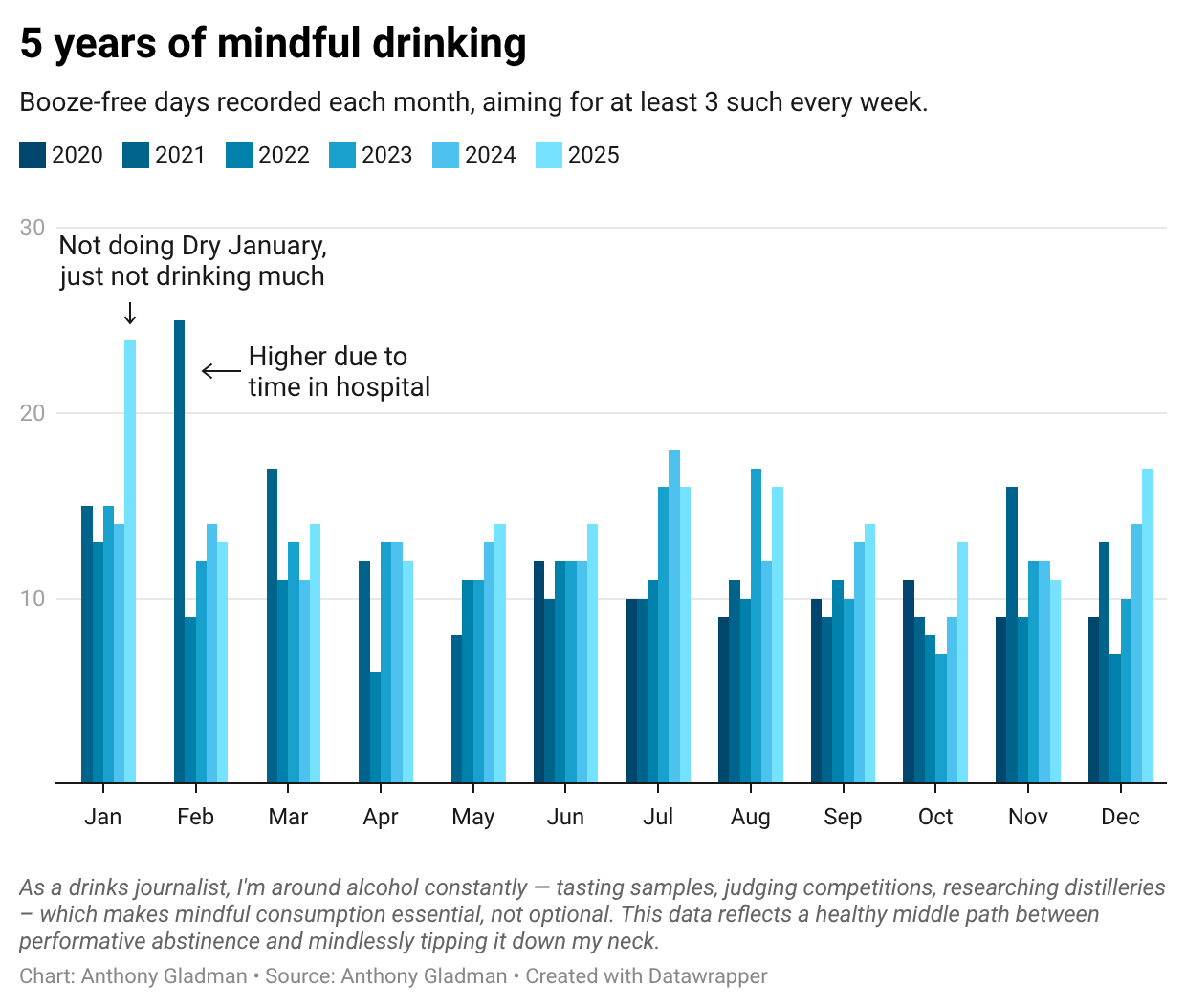
There was an excellent example of the old visual display of quantitative information** in A.G.’s post this week on Dry January. He shares my interest in maintaining data:

I find it helpful to keep a tally of days I drink alcohol and days I don’t. Nothing complicated, just a binary yes or no, and an aim to have at least three days off the booze each week. That’s all it takes for me to stay within healthy limits, despite working in an industry that can normalise and encourage dangerous levels of consumption. (If you recognise yourself here, check out The Drinks Trust.) Anyway… it’s Friday evening. The first one of the year. I’ve not had any booze since New Year’s Eve. Soon I will go downstairs, crack open a bottle of something nice, and have one or two drinks with some pizza while I stream a crappy-but-entertaining film – January be damned.

However sweet that bar graph, I am more a percentages guy, currently at a total of 52% dry days and 63% one or nones over the years since early November 2021 when I started keeping track. My booze budget this year is also set at around 1.33 a day, an average I beat by a few last year. Checking on that number from time to time – as well as your AST blood test numbers – are great ways to manage the hobby.

While we think on that, think on this. In the northern hemisphere, the darkest ten weeks of the year are already behind us. Soon be planting those tomato seeds. While we wait for that, Boak and Bailey are posting every Saturday and adding to their fabulously entertaining footnotes week after week at Patreon. And look out for more of Stan’s new “One Link, One Paragraph” format. Then hunt out something in someone’s archives! Leave oblique comments on someone’s post from 2009!! Listen to a few of Lew’s podcasts and get your emailed issue of Episodes of my Pub Life by David Jesudason on certain Fridays. And Phil Mellows is at the BritishBeerBreaks. Once a month, as noted, Will Hawkes issues his London Beer City newsletter and do sign up for Katie’s wonderful self-governing totes autonomous website featuring The Gulp, too.  Ben’s Beer and Badword seems to be on pause since November but there is reading at The Glass which is going back to being a blog. Any more? We have Ontario’s own A Quick Beer and All About Beer is still offering a range of podcasts – and there’s also Mike Seay’s The Perfect Pour. Plus follow the venerable Full Pint podcast! And there’s the Craft Beer Channel on Youtube. Check out the archives of the Beer Ladies Podcast.

*Once upon a time, the LCBO here in Ontario stocked Millbrook Merlot from a Hudson Valley, NY winery. Then Rufus Wainwright sang about the area. Went to the winery once around a decade ago. This is been this week’s edition of “wandering thoughts with Al”.
**I couldn’t live with anyone missing the reference.

Your Thrilling Thursday Beery News Update For The First 1/48th Of 2026

We are in the lull. Not a lot of beer news out there. Well, there are other things going on, aren’t there. Grim things. In case you didn’t realize it, we are already 1/48th into 2026. It’s practically 2027 already. (Ah, 2027… impeachment proceedings… or Greenland ablaze… err…. best not look too far into the future.) That there photo to the right? A contest submission from 2009 sent in by Jeremy Craigs of North York, Ontar-iar-iar-io. It’s a view from within the Heineken Keg Yard in Cork, Ireland. Click for the full experience.

Yes, despite the lack of beer news we all know that the first week of January has a lot to offer. You can do some looking back, like Barry did. Or looking back to a number of futures like Stan did. Or patching together what really happened on New Year’s Eve like Cookie did. Proclaiming resolutions that are bound to fail by next week… or maybe not. And, ahhhh, Dry January. Dry. January. There are those who are praising it. Others offer alternatives like Jeff who asks us to remember the pub. Alistair finds his own path:

 I am 50 years old and as might be reflected in the paucity of posts on Fuggled over the last several years, my drinking is slowing down… it was as a result of my annual physical that it became clear that certain lifestyle choices needed to be changed. I need to get healthier in order to get certain numbers more on target than they were in October. To that end, I have already lost about 22lbs/10kg, which brings me back to my justification for taking a month off away from alcohol, it being the best way to lose the festive season weight gain…  I was sat pondering the shopping trip to World Market to stock up on the German Christmas treats that transport me back to my childhood in Celle – pfeffernuss, lebkuchen, stollen – when a thought popped into my head. How about just not gaining as much weight over the holidays, and not bothering with Dry January?

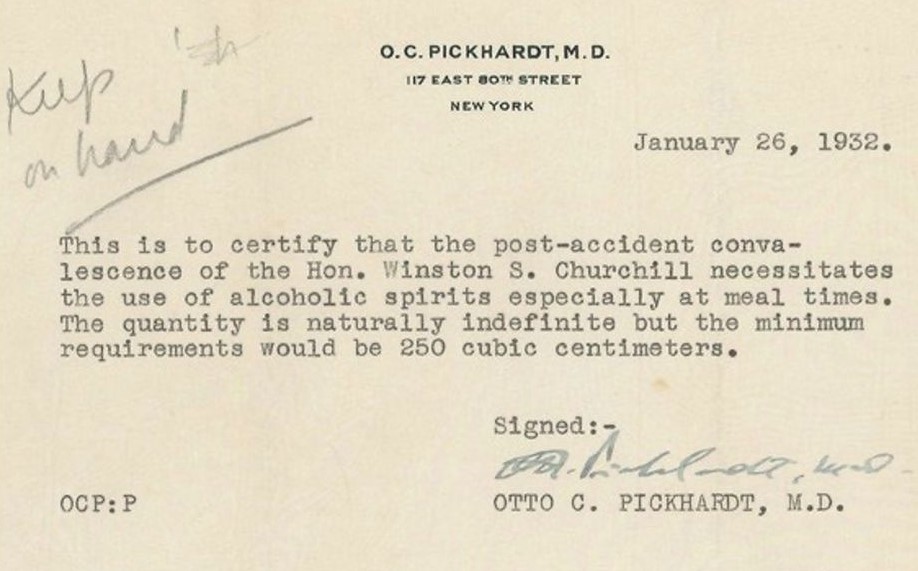
Our little Alistair is growing up!  I am myself over four years into intermittent fasting and a more and more robust approach to my health, too, so I get it. Beer is not so much like cake as like icing. Mmm… a pint of icing please. No wonder it once required a doctor’s note. And it’s not even that old a thing, Dry January:

Dry January started with the group’s former deputy CEO, Emily Robinson in 2011. At the time, she was reading more about the harms of alcohol consumption – at the same time as her half marathon training. Piper says Robinson “wondered what would happen if she had a whole month not drinking” and how it could benefit her running. “Spoiler alert: It really improved her running performance, but she gained other benefits as well,” Piper adds. In 20313 Alcohol Change UK made its Dry January challenge official and trademarked the name. 

What I like about Dry January is just that. When people take a break from anything they come back to it with fresh perspective. Or they never comeback to it, preferring just that fresh new thing. ATJ takes another tack on the whole idea as he looked back on looking back with Bowie and Bing:

I have a vague memory of it and ponder on the weirdness of the Thin White Duke doing a duo with the Old Groaner. I take a brief pause from the beer but then another mouthful is embarked on, followed by more crisp coldness that refreshes the mouth and wakes up the somnambulant parts of the palate, wake up, sound the reveille! The alarm clock shock to the palate continues as I pass down the glass. Mindful drinking? I’m focusing on the beer and how comfortable I am in my chair and how it has just passed 3pm. As the glass reaches the state of emptiness, a slight suggestion of melancholia flits through my mind, Christmas and its thoughts, memories of those no longer with us, grandparents, parents, friends, dogs, health, but the crispness is still there as I come to the end of the glass and decide to head out into the gleaming lights that bring on the emerging city night. Mindful drinking.

Mindful. My mind full. Me, I am a sober daydreamer myself. And I am not doing Dry January. I just haven’t had a drink since 2025. Might have one or two this weekend. Might not. Speaking of one or two, my fellow public service lawyer Teddy Pasketti of Baltimore shared one of the best “I am an idiot” story the other day:

I’ll tell it again. Once in law school I was 23 and really drunk and obnoxious and the owner cut me off and the bouncer told me I needed to go, and I told him, “I’m going to be a lawyer and you’re always going to be a bouncer,” and that bouncer was Mike Tomlin.

Perhaps for those in other continents, this is Mr. Tomlin. Note time!

Note #1: A defiant stand against the slump in Colorado.
Note #2: While one might blame the neo-temperate for the slump one needs to consider the family, too.
Note #3: Is this the greatest example of a lovely interior within a plain pub exterior?
Note #4: A strengthening of the team at Brewery History as Dr Christina Wade joins the editorial board.

We have had a new euphemism appear!  The years’ long decline in the booze trade has been called many things (other than, you know, a decline) so as to distract folk from the fact of, you know, the decline. That old chestnut from years ago – “cyclical” – is still used a lot by boosters and believers.  Then in 2025 we got the mystifying “maturing” market as well as the sometimes even appropriately applied  “consolidation“. And now we have plain old “burnout” and even that new entrant – a “cleansing“:

A well-publicised surplus in the global wine trade is causing a ‘cleansing’ of the sector – but consumers won’t ever mark major celebrations with soft drinks, believes industry veteran and Joseph Phelps CEO David Pearson… Beginning his answer, he admitted that “the market is oversupplied” before commenting that while this is undesirable, it’s not new. “We’ve had oversupply situations before,” he stated, referring particularly to the Californian wine industry, before drawing attention to reasons for their disappearance.

I think I am waiting for “the cull” to come into fashion.* What will save the industry?  Fitba!

“The volume of beer and the increase in revenues from World Cups have consistently driven a strong increase in beer consumption in host cities, far exceeding pre-tournament trends,” Barclays strategists wrote. The tournament’s summer timing in high-consumption months adds to the opportunity. “This is a clear signal of the scale and opportunity this event represents,” they added. North American hosts rank among the Top 15 global beer consumers per capita. Of the 20 leading per capita consumers, 14 have qualified, potentially rising to 16 with Poland and Italy by March 2026. “The combination of large venues, regulatory boosts and greater fan participation creates a perfect context for beer sales growth,” the strategists stated.

You ever feel… forecast to be used? Me, I am looking forward to the actual soccer and, you know, the hairy tartaned folk.

You know how people used to try to explain good beer to wine people they write really insightful things like “lager is like white wine“? It’s a good thing for us all that that dumber era – let’s call it the reign of terroir – is well and truly over. Still, information is power and, well, Eric Asimov of the NYT has some hints for new wines to try in 2026, including this hint that I would suggest should work better for a beer fan:

Stereotypes are not the problem with port and Madeira so much as how and when to drink them. The era of cigars and after-dinner drinks is long gone. The French enjoy white port as an aperitif, but I prefer vermouth or fino sherry. Occasionally, though, it’s worth having a glass with cheese as a reminder of how glorious sweet fortified wines can be. Of the various types, I will recommend aged tawny port and bual Madeira. If you store an open bottle of tawny port in a cool, dark place, it will last a couple of months, while an open bottle of Madeira will last forever.

If you like grapefruit tang in your IPA, try Madiera. Sweet, oaky and white grapefruit pith. I worked my way though a bottle of Blandy’s Duke of Clarence Rich Madeira over the holidays and if I was a cashew I would consider this stuff Enemy #1. But, perhaps for Boak and Bailey, something else is Enemy #1:

On a recent trip to an otherwise peaceful pub we were treated to squawking phones by two separate groups. First, a pair of men in their forties decided to share some ‘funny videos’ they’d found, at full volume. This sent scratchy, distorted noises and bursts of music echoing through the pub, which they further enhanced with their own loud live commentary. Then, a little later, a party of couples in their sixties took the table next to ours. When a friend phoned one of them, he immediately said: “I’ll put you on speaker, mate.” For a full five minutes, the phone shouted at them, and they all shouted at the phone, and we gave up on trying to have a quiet conversation between ourselves.

It’s a cry for help! Is this ever acceptable? Alistair drew his line slightly to the side: “[p]ubs should never become monastic scriptoria.“** Happily, B+B also discovered a possible new form of pub this week, too.In The New Statesman, we have a description of the perfect pub

Most of all, a pub must be what Hemingway described as a “clean, well-lighted place”. It is not a bar. It is not a club. It is not a hotel. It should comfort, relax, lift the spirits and loosen the tongue. A place to settle in. As at home, TV is allowed, and so too music, so long as they do not intrude. The landlord must guide the atmosphere towards homeliness. Think of Mr Banks in Mary Poppins: “A firm but gentle hand, noblesse oblige.” Publicans are to England what head waiters are to France: respected members of the social order.

Hmm: “…so long as they do no intrude…” As you think on that… more notes!

Note #5: Duffman done.
Note #6: Big Sale at ‘Spoons.
Note #7: Soon be time to Wassail.
Note #8: Craig the Elephant and Tusker’s icon passes.

Maybe my problem finding enough to write about is me including all these notes. I could stretch out the beery news notes if I just cut and past every story linked uner a note.*** As I ponder that opportunity, let me ask you thing: how are your telomeres? “My whatsits!?!Telomeres:

“Telomeres are the ends of your chromosomes,” explains Topiwala. “Our DNA is organised into chromosomes, and when our cells divide, these chromosomes are copied. But the copying is incomplete at the ends of the telomeres. “So, over time, these telomeres get progressively shorter. When they reach a critical shortening, the cell dies.” That means scientists can measure the length of someone’s telomeres to work out how many times their cells have divided and thereby estimate how old they might be – biologically speaking. Back in 2022, Topiwala and her team at the University of Oxford researched the link between alcohol and telomere length in more than 245,000 UK adults. “We found that the more people drank, the shorter their telomeres,” says Topiwala. “The drinkers had accelerated their biological ageing.”

Yikes. I don’t think I needed that level of detail, frankly.  As I said, it’s a slow week in beer so… we get to add telemere shortness anxiety to all the other grim anxieties of this age. Fabulous.

STOP THE PRESSES UPDATE 7:48 am Eastern: well worth the wait, Pellicle published Courtney Iseman‘s piece on New Orleans a day later than normal. The story is about taking a break from a drinks conference to explore the city:

It’s my third day at the annual Tales of the Cocktail bar and beverage alcohol industry convention; it’s exhilarating but exhausting, day after day of back-to-back seminars, tastings, and parties where the booze flows can make any introvert like myself feel their battery depleting. My head is spinning with the information and socialisation overload of the day, my bones are tired, my skin is melting into the thick air. I need to cool off, to decompress. I know exactly where I’m going: Brieux Carré.

Good stuff. Another bit of good news is that Boak and Bailey are back posting every Saturday but, still, remember to fulfill make it your New Year’s resolution to sign up for their fabulously entertaining footnotes at Patreon. And look out for more of Stan’s new “One Link, One Paragraph” format. Then hunt out something in someone’s archives! Leave oblique comments on someone’s post from 2007!! Listen to a few of Lew’s podcasts and get your emailed issue of Episodes of my Pub Life by David Jesudason on certain Fridays. And Phil Mellows is at the BritishBeerBreaks. Once a month, as noted, Will Hawkes issues his London Beer City newsletter and do sign up for Katie’s wonderful self-governing totes autonomous website featuring The Gulp, too.  Ben’s Beer and Badword seems to be on pause since November but there is reading at The Glass which is going back to being a blog. Any more? We have Ontario’s own A Quick Beer and All About Beer is still offering a range of podcasts – and there’s also Mike Seay’s The Perfect Pour. Plus follow the venerable Full Pint podcast! And there’s the Craft Beer Channel on Youtube. Check out the archives of the Beer Ladies Podcast.

*To be fair, it’s not only breweries that are suffering, as Dave Infante pointed out: “A quarter-century ago, there were 40 journalists for every 100,000 people in this country, compared to just eight journalists for every 100,000 people today, per a 2025 report by MuckRack and Rebuild Local News. Maybe the reason I’m not overly sentimental about the brewers, winemakers, and distillers struggling against and succumbing to stiffening headwinds in the beverage-alcohol industry is because doom and gloom has been my own professional milieu for virtually my entire career and I’ve grown inured to it. What a cool and normal thought!
**Let me assist you with that.
***Or just add more gratuitous footnotes, I suppose…

Welcome To 2026 And To The Exciting New Format Of The Thursday Beery News Notes!!

How’s your skull this New Year’s Day? Are you OK? Are you ready for some questions? Questions like: “is this the optimum alignment of the holidays?” Seem to me that a Wednesday New Year’s Eve pretty much guarantees that this week and last are a total write off work-wise. Unless you are in hospitality, of course. I am sure, by the way, that Sunday Christmas Day is the worst. Gotta put some sort of effort in the week before and you just get Monday off the week after. Glad I won’t have to deal with one of those weeks, when it’ll next shows up in 2033 when I will be long retired. That photo up there? A submission for the 2014 Holiday Beery Photo context received from Aaron Stein of Oregon. Aaron won the “Surprise Twist” award that year.*

First up, as we put 2025 on the shelf, it’s good to carefully consider your “best of” lists. It’s a tricky business finding the best of “best of” with plenty of the dubious. There are great ones like the Golden Pint Awards like this quite expansive one from Lisa Grimm that shares some happy news along with the useful insights:

… half of the family now Irish citizens (delighted!), and the rest midway through the naturalisation process, plus a book manuscript finished and in the production pipeline (finally!), as well as some exciting news on the employment…

Fabulous! And not just because of the heads up to my old hometown’s Garrison Brewing. And it doesn’t have to be all good news. Jeff posted his thoughts on 2025 and declared it “the worst year in my lifetime” with solid evidence supporting that view, before he moved on to the upsides, including:

The blog has been relatively healthy as well. Thanks to AI, online media sites are in real trouble. Google’s new AI summary means people don’t click through to websites, and traffic at some sites has fallen up to 50%. Traffic here, thanks to a strong finish to the year, has been basically flat—which is a lot better than I expected. Moreover, comments on the blog are way up, and it feels a lot more interactive these days. Thanks so much for contributing to the site!

But all lists aren’t all great. And there’s one category of useless which demands a PSA: the list of the unattainable. Not the luxurious as once in a while everyone can get their hands on something rather nice. No, I mean the sort of lists exemplified (but by no means limited to) by the beer writers’ short-run sample gift packs. Someone made 100 gallons of inguana poop stout and then couriered them to the gullible / needy / starving? Who cares. But this next sort of list, this here list of the 35 best pubs in Edinburgh? The best. Accessible. Useful. Helpful, even. And should be prepared by every topic hobbiest out there for their fair city or region.** Just look at the common sense info succinctly provided:

4. The Holyrood 9A – Round the corner at the bottom of St Mary’s Street towards the parliament building, a surprisingly bustling beer and burger den, with impressive selections of both. Food is prepared in the tiniest kitchen somewhere downstairs and served in the packed backroom or bar itself. Huge range of draught beers but also wines by the glass. An all-round good pub. Details: 9a Holyrood Road, theholyrood.co.uk

I know this is correct as I’ve been there, the cousins being just a route 128 bus ride away. One of my great regrets is not getting a photo of that kitchen as I walked out. I know, I let you down. But it is so small that you’d have to have the camera in their face. Little more than a cloakroom by the front door.

Another great format for the best of is the “stashkiller” mode, this week deployed by Barry Masterson in Cider Review:

There’s nothing new about this, we’ve all been there. You get a nice bottle of cider, or maybe it’s a beer or wine, and you think to yourself “yeah, I’ll keep that for a special occasion”. And this happens again and again, ad nauseam, until you’ve got a stash of special bottles built up that you’re almost afraid to dip into it as that special occasion just never came. It’s a funny thing, really, that with some things we think we need an excuse, when the fact is they have been made to be consumed, enjoyed, shared. In my case, when prowling the cellar for a drink at the end of a day’s work, I usually end up just reaching for a bottle of pils from the stack of crates because I feel I should be sharing the large bottles of cider, or if I open one I must be making notes, and that sometimes feels like work. It’s a terrible attitude when you have a cellar full of cider; it’s made to be drunk!

JD TBN has shared his extensive Golden Pint Awards, with characteristically  impressive level of detail in the 25 categories including ten related to specific beers as well as others such as:

Best Beer Blog or Website: The Drunken Destrier – I had this flagged for greatness since the spring, but the flurry of entertaining beer reviews petered out in late May. In the hope of some revived activity — I mean, how hard is it to drink a beer and write down what it tastes like? — I’m slinging a Golden Pint in Kill’s direction.

Simon Johnson Award for Best Beer Twitterer: barmas.bsky.social – Yeah, it’s mostly for the dog pictures, but you knew that.

I think Simon would have accepted the broader application of the otherwise tightly defined term “Twitterer”.  In DC, Jake Berg of DC Beer published his annual top beer and top music of 2025 – in not that order at all:

How this works: I pretty much only use the blog for this yearly post. I’ve got a bunch of music I liked this year with pithy comments that may or may not make sense to outside readers, interspersed with some songs I liked. Then I’ve got beer. You like beer, don’t you? This year there’s a pretty clear top two for me; both of these are excellent. After that I’m less sure, but tried to settle on an order because ranking things is fun. 

On thing we see less of in these annual lists (that itself needs a comeback) is the the in and out list or what is hot and what is not, like the one suggested at Everyday Drinking. But maybe that’s because I know what black currant tastes like. And here’s another sort of handy guide, particularly useful on this New Year’s Day. Lew Bryson on his podcast “Seen Through A Glass” on all your coffee booze options:

So I’m here with a whole bunch of coffee drinks to get going this morning!  I didn’t know what to do for a relaxed post-Christmas episode, and then I remembered this interview with John Mleziva of State Line Distillery. They make a great coffee liqueur, and we talked about that. I knew we’d be just sitting around drinking coffee on that morning after Christmas, so I made that into an episode.  Then I told you more about the press trip to Mexico I took back in 2011 to see how Kahlua is made, with all the feels, and all the delicioso, and the extra-special cocktail we learned how to make. And the donkey herb moonshine we had. Yeah, not a typo. 

For what it’s worth, get a nice winey coffee blend, add 10% cream and a splash of Chambord. Or maybe Cointreau but that’s sorta a regular Saturday thing if you ask me. Black coffee though the week, by the way.

Boak and Bailey helped put things in order in a different sense with their post on what beers for Christmas mean to them now:

There were a couple of factors behind our decision. For a start, there’s the question of what’s easiest for non-beer-geek family members to acquire and look after. We don’t want to be pains in the arse. We also find ourselves thinking about relatives might also actually enjoy drinking with us. Normalish ale and normalish lager are easy sells to almost anyone, and stay out of the way of conversation, board games, or Lethal Weapon II on the telly. Maybe nostalgia and sentiment kicked in a bit, too. Ray’s dad got quite into Cheddar Gorge Best in his final years and it was nice to feel that, in a way, we were still able to share a beer with him. We raised our glasses in the direction of his photo.

I am with them. I saw someone recommend a beer store somewhere where the cheapest offering was two and a half times the price of a very good Belgian ale and, being in the holiday mood, though to myself… WTF!! I think there may be a bit of embarassment about the sucker juice era but rather than knaw at one’s innards about the waste of a decade, do what B+B did and think of what the company you’ll be in. That’s what actual beer as social lubricant means, after all. Now… some quick notes:

Note #1: Ron pointed to a news item on the end of corked Guinness.
Note #2: Liam then explained the news item on the end of corked Guinness.
Note #3: read Bounded by Buns by the noted beerman… as, frankly, you really need to add some solid food to your diet.
Note #4: needing something to do on Jan 11th? Tune into Desi Pubs.

More news out of Britain on the relaxation of concern related to drinking and driving. In The Times this week we read:

A survey of more than 2,000 adults, including 1,300 drivers, found that 37 per cent of Generation Z believed it was more socially acceptable to drive when marginally over the legal limit, compared with 9 per cent of baby boomers. Across the population as a whole, only 21 per cent of people agree… The survey showed that more than a third of young drivers believed driving while slightly over the limit was acceptable, but also that they were twice as likely to think that alcohol did not impair their judgment. [Ed.: thankfully…] The number of young drivers obtaining their licence is at its lowest level for generations, partly because of the cost of lessons and the difficulties in getting a test.

Much is made of the lowering of the blood alcohol limit in England to match the rest of Europe but that last stat up there may indicate a truth – there might also be a general level of ignorance related to the risks of driving itself at play. And now… some more quick notes:

Note #5: a collab on the bit heading to the recycling bin?
Note #6: “RESIGN!!!
Note #7: “…number of pubs in England and Wales… fell to 38,623 from 38,989 a year earlier…”

Not at all related, the business resource The Street has chosen “the craft beer apocalypse” as its descriptor for 2025, illustrating that claim with a couple of non-bankruptcies:

One of the most recent closings was Miamisburg, Ohio, craft brewery Entropy Brewing Company, which revealed on social media that it would close down its business permanently on Dec. 27, 2025, with no plans yet to file for bankruptcy… And now, New Mexico-based Bosque Brewing Company is closing down all of its taproom locations and ending its business after a federal judge dismissed the brewer’s Chapter 11 bankruptcy case on Dec. 22 because it had too much debt to reorganize, KOB-TV 4 in Albuquerque reported. The dismissal of the Chapter 11 case will likely prompt the brewery company to file for Chapter 7 bankruptcy liquidation unless it can settle all of its debts with its creditors out of court.

AKA no hope of resuscitation. It seems to me that there might be a role for a bit of bankruptcy trustee advice for breweries in trouble at an earlier point in the downward cycle than “too much debt” but there seems to be a bit of a theme if we consider how late Rogue played along.  Before perhaps hitting the intersection of economics and ethics. Perhaps related (but only if you glean more from this passage than I do) is this offering from Gunnar Rundgren at countercurrents.org:

…society, human expression and technology develop in tandem. And in order to be strong they need to reinforce each other. And one technology assumes, or dictates, that many other technologies are in place and that society is organised in certain ways. Even something basic as beer assumes agriculture, and agriculture assumes and requires a sedentary culture. Sedentism, in turn, implies a lot of things, even though I don’t subscribe to the idea that agriculture and sedentism is the fall of man, the cradle of tyranny or the broken link between humans and nature. Some claim that beer preceded or even initiated agriculture and sedentism in that case means that it is beer that is the culprit, quite an entertaining thought….

So… if beer created civilization*** then beer is also complicit with the end of civilization. Perhaps. Shifting gears and in sensible rejection of last week’s sharing of bad advice about Dry January, this article in the New York Times may illustrate how dry does not need to mean no customers if there’s an application of a little planning to serve those cutting back:

Given that drinking — on the slopes, at the pool, or at the hotel bar — is for many people a staple while on holiday, forgoing the ritual leaves time for other activities. Here are six hotels that have devised alternatives to drinking, from snowshoeing to aerial stretching; from making mocktails to simply sipping them… The 54 rooms and suites spread across seven lodges are light-filled, with neutral-colored linens, Hästens beds and natural oak wood floors… A sustainable ethos guides the vision for the property, including its three restaurants. The extensive mocktail menu, which features zero-proof counterparts of its signature cocktails, leverages local ingredients and scraps from the kitchen. A mocktail called Too Hot to Handle, for example, is a umami-forward mix of Rebels Botanical Dry, a nonalcoholic gin; lemon; bell peppers; tomato and smoky housemade bitters.

Horsehair beds? Kitchen scraps in the drinks?!? OK… fine… maybe not so much… Speaking of retreats, like you, I read the Luxembourg Times. Where else can I catch up with the regional news of the Trappists fame… republished from Bloomberg… including some interesting technical insights from Westmalle:

The idea is to hold profit and production stable, to provide for the abbey, give to charity, and reinvest where necessary in the business. Westmalle’s bottling plant hums and crashes with life during the day as bottles are washed, labeled, filled and prepared for delivery. At maximum capacity, 45,000 are processed per minute. But the production line lies idle outside its one day shift, and doesn’t operate on weekends, as the monks want the staff to work sociable hours. It’s set to be replaced by 2030 with a new modernized facility through a major, self-funded investment in the brewery.

Mod-ren. That’s what the future will be. Mod-ren. Speaking of which… that is it for this first update of 2025.  Frig. I forgot to use the new format. Oh well. Have a great New Years Eve and Hogmanay, too! Excitement builds as it’s not yest been announced if Boak and Bailey are posting this Saturday but make it your New Year’s resolution to sign up for their fabulously entertaining footnotes at Patreon. And look out for more of Stan’s new “One Link, One Paragraph” format. Then hunt out something in someone’s archives! Leave oblique comments on someone’s post from 2007!! Listen to a few of Lew’s podcasts and get your emailed issue of Episodes of my Pub Life by David Jesudason on certain Fridays. And Phil Mellows is at the BritishBeerBreaks. Once a month, as noted, Will Hawkes issues his London Beer City newsletter and do sign up for Katie’s wonderful self-governing totes autonomous website featuring The Gulp, too.  Ben’s Beer and Badword has returned from his break since April so you can embrace the sweary Mary! There is reading at The Glass which is going back to being a blog. Any more? We have Ontario’s own A Quick Beer and All About Beer is still offering a range of podcasts – and there’s also Mike Seay’s The Perfect Pour. Plus follow the venerable Full Pint podcast! And there’s the Craft Beer Channel on Youtube. Check out the archives of the Beer Ladies Podcast.

*From the Wayback archives, here is the explanation of the Surprise Twist: “I feel a 1980s power ballad coming on. I can’t fight this feeling anymore. Maybe I was just so damn tired. I was checking out all the entries and just like that I heard a voice. It said: “Hello, is it me you’re looking for?” I dunno. This time I wanna be sure. Suddenly, it’s touching the very part of me. It’s making my soul sing. It says the words that I can’t say. Maybe little things I should have said and done. I guess I just never took the time. When it was thinking about prize giving this was always on my mind… always on my mind. I’m never gonna dance again if I don’t make this right. Aaron Stein of Portland, Oregon wins. Not sure what he wins. But he wins the book I need to dig out award for the overlooked image of 2014.” That’s… a lot. Wow. Was I drunk?
**Consider B+B’s Bristol or (for the double!) Lisa’s Dublin.
***Didn’t.