
 Spring! Tomorrow is spring!! On a Friday even. How swell. The sort of moment that always reminds me of some lyric or another from Old Blue Eyes himself:
Spring is here
Why doesn’t my heart go dancing?
Spring is here
Why isn’t the waltz entrancing?
No desire, no ambition leads me
Maybe it’s because nobody needs me?
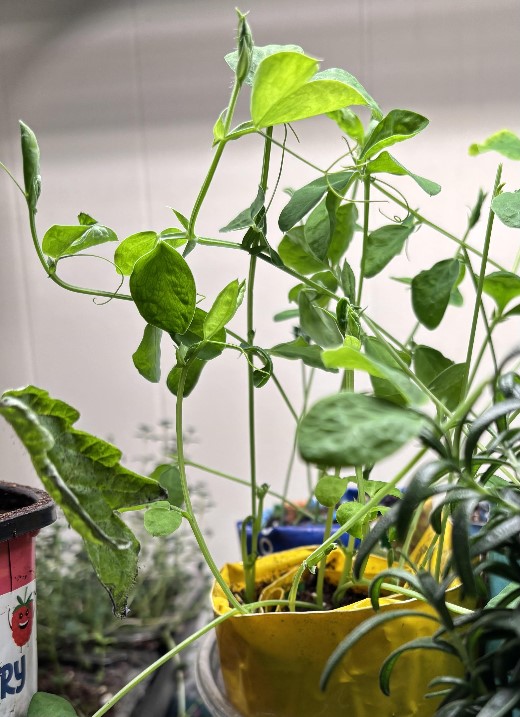
Wow. Not what I was expecting… gee, Frank. Lighten up a bit, wouldja? Me, I am all zippiddy doo dah myself. Look at those sweet peas under the grow lamp! The waltz entrances. Hmm. Why Frank? Why? Could it be it’s the fading night life scene that the man once knew and loved that has him lost and wandering, as the news The New York Times shared this week tells us:
…it’s a complicated prospect for restaurants, which traditionally make their highest profit margins on alcohol sales. Preparing food requires perishable ingredients and a large amount of labor, while alcohol is shelf stable and, except at the most dizzying heights of mixology, requires less work than cooking. As independent restaurants struggle with higher costs of all kinds — rent, labor, ingredients — the hollowing out of the most profitable part of the menu couldn’t come at a worse time. According to David Henkes, a senior principal at the food service research firm Technomic, alcohol sales are slumping in every category of the restaurant industry, from fine dining to casual establishments, with 31 percent of operators reporting “severe declines” in alcohol sales in 2025.
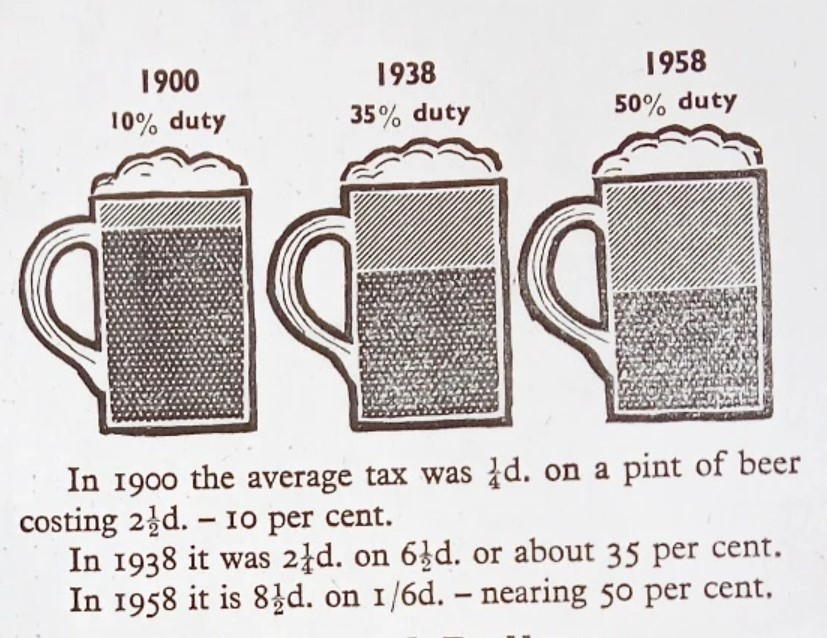 Yikes! We always here about the younger folk laying off the hootch – but even the set that clinks and drinks is clinking a lot less. But when was it ever the way it used to be? 1910 apparently. Nigel Sadler posted some images from The Times ‘Beer in Britain’s Supplement from April 1958, including the fascinating tale of the creation of the Hops Marketing Board as well as this infographic on the increase in duties on beer from 10% in 1910 to 50% in 1958. Winning two World Wars as your empire collapses will do that for you.
Note#1: Michael Caine before he was famous.
Boak and Bailey unpacked their approach to writing a bit this week as they closed down one of their outlets, a newsletter by Substack where they unpacked their personal impressions perhaps a bit more. They shared that approach on one post this week, describing a scene Ray encountered when he would out and about with pals:
You know how you sometimes know something is going on, even before you see anything yourself, because people around become restless and twitchy? Even before the sword dancers entered the pub people noticed them in a group, standing outside peering in. Then their leaders, white haired with red neckerchiefs, entered and negotiated permission with the bemused young bar staff. Dancers and musicians shuffled in and found space for their display among the drinkers and diners. Then, off they went, stamping and twirling with berzerker energy, accompanied by fiddle and recorder… There were whoops and applause after the final somersault and, after they’d jogged out of the pub in single file, it felt as if the crowd had been injected with fresh energy. Between amusement, disbelief and admiration, it woke everyone up.
Whoops!* I have no idea what and who these sword dancers are. Clearly not, you know, the Highland lassies. Is this some sort of militant branch of the Morris dancer set? Speaking of militant hobbies, Phil Cook has been tracking the use of beer related answers to crossword clues in The New York Times and has released his report on the 2025 season:
The over-reliance on ale and ipa (and their plurals) has increased. They were about a quarter of last year’s references; now it’s 40%. That kind of frequency means there’s an impossible choice between repeating the same clue over and over, or reaching for one that’s only less common because it’s not very good. ale appeared on successive days several times — often with grim setups like ‘Pub drink’ or ‘Pub order’ — and one bleak fortnight3 had five of them, interspersed with two ipas, none with great clues.
I’m a Monday and Mini sort of crossword guy so I don’t see as much of this but Phil’s obsessive dedication to detail is impressive which backs observations like “there weren’t any debuts of new terms that seemed to signal any kind of shift in the zeitgeist.” Perhaps this year we will see a four letter answer for the clue “going out of style” which offers direction in at least two ways.
Speaking of style, Gary Gillman had his research on the founding of the green beer phenomenon in the USA published in Craft Beer & Brewing, reaching back ever so slightly into the 1800s:
In 1899, Milwaukee’s Pabst Brewery already was well known for its Blue Ribbon Beer, its bottles at that time festooned with a real blue ribbon. That year, as a marketing gambit, Pabst replaced the blue ribbon with a green one on a portion of its beer packaged ahead of the holiday. It also put a shamrock on the label in lieu of the usual hop leaf, with marketing that proclaimed, “Hibernians to celebrate St. Patrick’s Day.” (That’s according to Printer’s Ink, an advertising trade journal from that time.) However, the beer itself was the usual pale lager—it wasn’t colored for the special day.
Which brings us to three more notes on St Paddy’s Day:
Note #2: “…all good-humoured, not messy yet…”
Note #3: “…a local bar owner to invite me to meet him for “a chat…”
Note #4: “...I’ve seen things you people wouldn’t believe…”
Note #5: “…Liverpool is carnage…“
Those last two notes are more along the lines of what was experienced the weekend before the day over in Waterloo, Ontario – a university city:
People living at Oakwood Manor, an apartment building near Marshall Street, said large crowds surrounded the building. Residents described partygoers climbing over fences, knocking some down entirely and leaving garbage behind. “They’re destroying private property, but they don’t care,” said Debra Hines, who lives in the area. Residents also said they saw people urinating in the parking lot. “They were [also] coming and stepping on people’s cars,” said Janet Peterson, another resident. Bridget Kocher, who also lives in the building said the repeated street parties leave residents confined to their homes several times a year.
Kids today! On a far more civil note, we don’t write about homebrewers enough. Something the coming recession will cure I am sure. But the Windsor & Eton Homebrewers Club described how the group did some compare and contrast of a few clones and made some… well, to be honest, observations on the state of Pilsner Urquell in the retail marketplace:
I wish no disrespect or sleight to the founding fathers of Pilsner, but we were scratching our heads a bit. We used Pilsner Urquell as our reference for all our clones. We found PU to have great bready richness with a great soft rounded mouthfeel. A slightly sulphur smell and flavour – as is characteristic and a touch of ester, but also we found it with a sticky almost stodgy sweetness, not crisp as we were expecting. However, it transpires that Ian found some bottled Urquell somewhere up North, which was apparently much better, so maybe the canned Asda variety isn’t a good comparator?
Frankly, I had already bookmarked this piece by Kieran Haslett-Moore from well before the Beer Nut unleashed the stinging taunts urging folk take notice of the death of the themed pub, once a cross-cultural cornerstone:
At the start of this year the Wellington Belgian Beer Café, Leuven, announced it was closing its doors after 25 years. Back in 2000, Lion started to brew Stella Artois under license and all of a sudden Belgian beer culture was in vogue. Leuven in Wellington and De Post in Auckland both opened, offering the full tourist-style Belgian beer experience with mussels, frits, draught Stella, Hoegaarden, Leffe and assorted bottled beers from the lowlands… At the start of this year the Wellington Belgian Beer Café, Leuven, announced it was closing its doors after 25 years…. In 2004 Christchurch got Café Torenhof which limped on after the earthquakes before running out of steam in 2020… Café Torenhof lives on in the way your great aunt does because you inherited her Welsh dresser and it sits in the corner of the living room. When the Christchurch café closed, its interior kit was sold to Craftwork in Oamaru…
While things go out of style, other things arise as Ruvani shared recently when she discussed the “Spaghett”:
For those not already in the know, a Spaghett is a simple two or three ingredient (depending who you ask) beer cocktail involving a light lager, a bright bittersweet amaro and either a slice or splash of fresh lemon (optional). The OG Spaghett consists of a Miller High Life bottle minus an inch or two and topped off with Aperol and lemon… a ‘poor person’s Aperol Spritz’ where the champagne is replaced with the Champagne of Beers. Until recently Spaghett enjoyed under-the-radar industry-insider status but a combination of social media and the cost-of-living-crisis have brought it into the mainstream, as drinkers nationwide are discovering the delicious pop of tangy, herbaceous aperitivo against clean, gently sweet and super-carbonated light lager finished up with a refreshingly sharp citrus twist.
Jeff published a piece on the ABSs of malt this week or, more specifically, the question of whether a base malt’s flavor come from the barley variety or the malting process:
…it’s better to think of malting and brewing as connected processes. If you recall our previous conversation, the maltster has many choices to make, all related to the “biochemical levers” Matt referenced. It’s very much like the choices a brewer makes on mash pH, mash temperature, the number of rests and so on. It’s not like there’s a “correct” mash temperature; brewers make choices based on what they want out of a beer. The same is true with malting, and it’s why one brewery might choose a malt where one set of choices was made, while another brewery would want a different set.
Speaking of grain, there was a Kernza sighting this week, about a year and a half since the last time the branding for thinopyrum intermedium passed by my eye. The Guardian reported on its use as Deschutes:
The secret ingredient is a grain called Kernza. It’s a perennial wheatgrass with a slightly nutty flavor and a climate-friendly reputation. Deschutes teamed up with the outdoor clothing brand Patagonia to craft a new beer using the grain. When asked how customers react, brewer Ben Kehs laughs: “They say what’s Kernza?” Kernza has deep roots that pull carbon from the atmosphere and require less water. There is less tilling and fuel use because it doesn’t have to be replanted each year. Kernza can be used as an alternative to barley, which along with hops and water, is one of beer’s three core ingredients. “All of them in one degree or another I would say,” Kehs explains when asked which ingredients face climate threats.
Finally and speaking of the exotic, Ron has been back in Brazil judging at a competition where he seems to have been quite happy with the set up:
I have my usual breakfast. Call me Mr. Boring. I don’t care. It’s what I want to eat. And I’ll fucking eat it. That’s the great thing about being old. Not really having to give a fuck what anyone thinks… I’m on the same judging table as yesterday, with Suzanne and Alan. I’m happy with that. We rattled through the flights yesterday. Coming to a consensus without much argument. Which saves much time. And annoyance. Especially annoyance. The last thing I need is extra stress… After lunch, there’s a real treat. Non-alcoholic beers. Six samples. All three sour styles are pretty good. With the Catharina Sour the pick of the bunch. The best non-alcoholic beer I’ve ever drunk. Which may be quite a low bar. Or was. It’s been raised considerably now. That was much better than expected. Some flights of alcoholic beers were far worse. Not sure what that tells us. There’s then a long wait for the pre-BOS. Like two fucking hours. Such fun sitting and sweating. Watching Match of the Day helps pass a little time.
Good to see that while his language hasn’t mellowed, his relationship to booze has. And he’s learned a bit of Portuguese on these trips, too.**
Is that it? That’s it! Another week and another winter moves into the history books. While we see what the spring may offer, please check out Boak and Bailey who are posting every Saturday and adding to their fabulously entertaining footnotes week after week at Patreon. And look out for more of Stan’s new “One Link, One Paragraph” format. Then hunt out something in someone’s archives! Leave oblique comments on someone’s post from 2009!! Listen to a few of Lew’s podcasts and get your emailed issue of Episodes of my Pub Life by David Jesudason on certain Fridays. And Phil Mellows is at the BritishBeerBreaks. Once a month, as noted, Will Hawkes issues his London Beer City newsletter and do sign up for Katie’s wonderful self-governing totes autonomous website featuring The Gulp, too. Ben’s Beer and Badword seems to be on pause since November but there is reading at The Glass which is going back to being a blog. Any more? We have Ontario’s own A Quick Beer and All About Beer is still offering a range of podcasts – and there’s also Mike Seay’s The Perfect Pour. Plus follow the venerable Full Pint podcast! And there’s the Craft Beer Channel on Youtube. Check out the archives of the Beer Ladies Podcast.
*Remember: you can’t have whoops without an oops!
**Ron’s honesty when on these things is what makes his reports so worthwhile if only as a deterrent: “I’m so fucking knacked. We’ve judged so many beers today. And lots of strong ones. I never want to drink beer again. I’m so done with it. I just want to drink some cachaça and sleep.”