
And… Finally… Here’s “The Baseball Is Back!!” Edition Of Your Beery News Notes

I mean, let’s face it. The Winter Olympics are all well and good. And the World Cup will fill that gap in June, sure. But… baseball. Baseball: the sport that demands the best in athletes and then asks them to sit around for half the game. When they aren’t standing around in the field. It’s great, isn’t it!  Though, we should also take this moment to remember one of the great Olympic moments from, what, sixteen years ago now when Canada’s gold medal winners took the opportunity to turn the hockey rink into a tavern. And on that topic, here’s a Winter Olympics fact I hadn’t heard before and one that isn’t apparently winning any medals:

The only beer available for purchase at the 2026 Olympic Games is Corona Extra, a Mexican pale lager. This is due to the Olympics only allowing one company to sell its products at the Games, and this time it was Corona who was able to secure a deal. It’s a controversy that may hit closer to home for a lot of Olympic spectators, more so than a few foul-mouthed curlers ever could. It’s fair to say that Corona may not be the most popular beer for fans in Europe, as a photo of a Czech hockey fan went viral last week for his disappointed look while holding his Corona beer.

What a great choice. For the five athletes at the games representing Mexico, I suppose. What else is going on? Plenty to read out there on the chop-shop job coming for BrewDog but The Guardian had a good angle on the pending effect on those who each gave a bit when a lot was needed (or at least wanted with little or now strings attached) early on:
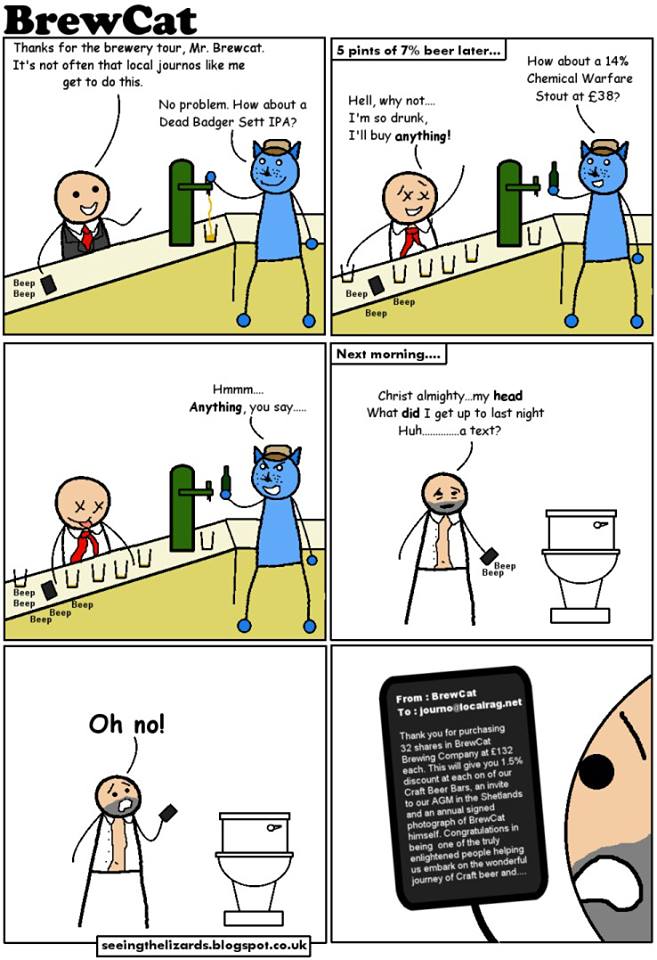
BrewDog’s army of “punk” shareholders have voiced anger and frustration after the Scottish brewer confirmed plans for a possible sale that could render their investments worthless. So-called “equity punks” who spoke to the Guardian or posted on BrewDog’s shareholder forum expressed disappointment and accused the company, which has traded on its upstart ethos, of treatment “bordering on contempt”. One said the plan showed that the small investors, who helped to kickstart BrewDog’s growth after it was founded in 2007, meant nothing to the company.

While the effect on individual EP investors can be quite significant, I mention this mainly as a pretext for posting that 2013 parody up there of the plan from one M. Lawrence at Seeing the Lizards.  Speaking of just saying no, The New York Times has run a four-part series by Pete Wells on getting your consumption back to a healthier level and finished off with a back at life with alcohol as well as a look forward:

Sometimes it seemed to me that I had a richer, more rewarding relationship with alcohol than I did with all but a handful of humans. It was an inexhaustible field of study, an incandescent companion during great meals, a reliable consolation on dull ones. And it brought me close to my real friends, at least some of them, some of the time. Over time, though, the rewards had become more equivocal and harder to justify. It wasn’t just the weight I gained, a predictable result of having a cocktail each night followed by about three glasses of wine or beer. They were, by this point, undeniable signs that my liver was overworked. I slept badly with all that alcohol in my system, too, and it got worse as time went on. …

You may be happy to know that he still enjoys his martinis – even if there are fewer of them: “…feeling the hair on the back of my neck stand up as the first sip takes hold, I feel like I’ve been reunited with an old friend…” Another old friend, Liam, reached back just a few decades for his post on the earlier trendy years for NA beer in Ireland, Smithwick’s Alcohol Free Bitter:

The launch was accompanied by newspaper competitions plus promotions, and a strange and repeated focus on how the beer, at 0.5% abv, contained less alcohol than orange juice! Reviews of the product at the time varied a little but it seems to have been generally well received for what it was, with reviewers commenting on how it (ironically) ‘packed a real bite and had good flavour’ and how they could drink it in a pub all night,  although it was also said to be ‘quite gassy and sweet.’ Others said it was ‘pretty good. Smells right and tastes of hops. Quite rich and smooth to drink.’

AKA gak. More positively, Matty C shared his thoughts on some upsides he’s seen in the brewing trade so far in 2026:

A couple of years ago, conversations in beer often centred around the idea that there’s “light at the end of the tunnel”. In reality, I don’t think that chance of daylight is coming anytime soon. Instead, we’ve got to admire the glimmers that are somehow managing to shine through the cracks in the walls around us when we can. Good beer is still being made, and good pubs are still open to sell it in – I’ve seen the proof! 

One of his examples was the tenacity of Jaipur: “… beer, packed with flavour and served at a high strength – seemingly the antithesis of what you would expect to succeed….” Which reminded me of how, in response to recent racist comment from an English oligarch, in The Times Sathnam Sanghera wrote about one of the foundations of the Britain of today:

…the fact that it ran the biggest empire in human history explains lots about Britain beyond its multiculturalism. It explains the popularity of curry. A significant amount of the mahogany furniture, ivory and jewels in our stately homes and royal palaces. Our propensity to travel. A certain amount of our wealth. Our political posturing on the international scene. Our national drink in the form of tea, and our national tipples in the form of pale ale, rum and the gin and tonic. The fact that we don’t feel the need to learn foreign languages because we encouraged/forced large parts of the world to take up English.

Empire of booze! Which, in turn, reminds me of Manitoba’s fabulous Premier Wab Kinew and his cheery fight for my right to Crown Royal after a bit of internal trade tension with Ontario’s Uncle Doug:

Cheers to you Doug Ford for keeping Crown Royal on LCBO shelves . Thanks for doing the right thing. Just like Canadian whiskey, good results take a little bit of time. This is a good day for folks in Gimli, Manitoba and a good day for people in Ontario too. Standing up for workers together is always a big win for Team Canada.

PWK won a lot of support with this bit of good humoured social media savvy. Crown Royal also got about 5,783 times the value of yet another newsletter by email telling breweries about the importance of storytelling.

Note #1: a desperate plea for beer based salad dressings.
Note #2: pairing beer and cussing.
Note #3: democracy in inaction?

Speaking of newsletters by email about storytelling, Will Hawkes was back at the end of last week with his February edition of London Beer City in which he considered the concept of the Irish Pub as illustrated by one new spot, Moylett’s in Clapton:

…I’m confused. What’s Irish about it? According to a report in Broadsheet, the focus is on what owner Moylett calls “the holy trinity of food, music and socialising” – a worthy list, no doubt, although it does seem to be leaving out something quite important (Guinness is £5.50 a pint, btw). As a term, “Irish Pub” is surprisingly hard to define, and particularly in London (and other British cities, arguably, but we’ll put them to one side for now). In much of the rest of the world – indeed, even in London, particularly its once O’Neills-heavy suburbs – the Irish pub is a 1990s phenomenon: flat-packed dark wood decor, pints of Guinness and food options that are often only very vaguely Irish (satay sticks, curry, chicken wings of varying heat levels; Spice Bags are less common, although you can get them at Moylett’s). But Irish pubs in London are, historically at least, quite different, and much less easy to pin down. 

Similarly but further afield, ATJ shared his thoughts on Cologne/Köln, the river there and its crossers:

…leaving Hauptbahnhof I crossed the Rhine, slow-moving, the colour of mud, upon which an elongated, snub-nosed barge was slowly making its way downstream. I stopped and took a photo, a snapshot of slothfulness perhaps and continued along the historic Hohenzollern Bridge. It was crammed with people through which bicycles and the occasional skateboarder cleaved their way, imperious and ‘get out of my way’ seemingly stamped on their features. Some people, were in groups whose colours defined their tribal affiliations — red and white for FC Köln, black and white for Eintracht Frankfurt. Sporting rivals presumably…

And here’s a new insult for craft beer.  If Jeff’s exhaustive listicle is correct, IPA is what it is all about and what it says is “meh, new money..“:

When it comes to beer, the etiquette guru revealed that “new money” consumers “don’t touch the more traditional ales or stouts – it’s all about IPAs that set you back at least £5 a pint. Anything involving the word ‘traditional’ simply doesn’t feature in your vocabulary. “If it doesn’t sound trendy, artisanal, limited-edition, or come with a deliberately obscure name, you simply aren’t interested.”

I actually find it really funny that anyone thinks anything related to beer is about new or old money… other than owning the brewery that great-grandpa built I suppose.  Almost as good as if grandpa owned a country… which is a seque to the next tale of skulduggery – perhaps – in China’s Jilin province:

The marketing materials identify the beer as produced by Rason Ryongson General Processing Factory in the Rason Special Economic Zone, located near North Korea’s borders with China and Russia. …[T]he Chinese distributor is Yanbian Xinyuequan Trading Co., Ltd. The company is based in Yanbian Korean Autonomous Prefecture in Jilin Province, a key gateway for cross-border trade with North Korea. Additional social media posts show boxes bearing the Pado label being unloaded from trucks and delivered to local restaurants in Jilin Province, indicating the beer has entered local distribution channels “…[N]ame changes are largely driven by export considerations, particularly to reduce the risk of sanctions-related flagging when the product circulates in Chinese wholesale or grey market channels…”

Mmmm… grey market North Korean Pado beer…  Quite the opposite in every way are Boak and Bailey who asked about what a drinker wants from a pub’s internet presence.

… we want to know what beer the pub is serving today, right now. Working that out can be surprisingly tricky. Again, Instagram or Facebook can help, but it’s often more reliable to snoop on Untappd and see what’s been logged in the past 24 hours. Pub websites are rarely of any use for this at all, presumably because updating a website feels like a big job, and a job for the Big Computer at that, so it just doesn’t happen.

Great comments followed… but I wonder if the easier solution is a camera aimed at the chalk board at the bar which is already updated daily… all sorta a la last week‘s remote pub experience story. It worked for the Cambridge coffee pot cam. The best way to get a job done is to find a way to make it a not-a-job job.

Finally, the Pellicle feature this week is accompanied by many photos with many many strings of bunting. It’s a story about Steam Machine Brewing of  County Durham – but without saying the word it’s really all about the bunting. Not including reflections in the windows (which would be unethical, of course) I counted thirty-six strings of bunting. That’s a significant contribution.

That’s it! That is all for now. But we are one step closer to spring. Pre-season Grapefruit League baseball on the TV time. Huh. Zah. Until next week, please check out Boak and Bailey who are posting every Saturday and adding to their fabulously entertaining footnotes week after week at Patreon. And look out for more of Stan’s new “One Link, One Paragraph” format. Then hunt out something in someone’s archives! Leave oblique comments on someone’s post from 2009!! Listen to a few of Lew’s podcasts and get your emailed issue of Episodes of my Pub Life by David Jesudason on certain Fridays. And Phil Mellows is at the BritishBeerBreaks. Once a month, as noted, Will Hawkes issues his London Beer City newsletter and do sign up for Katie’s wonderful self-governing totes autonomous website featuring The Gulp, too.  Ben’s Beer and Badword seems to be on pause since November but there is reading at The Glass which is going back to being a blog. Any more? We have Ontario’s own A Quick Beer and All About Beer is still offering a range of podcasts – and there’s also Mike Seay’s The Perfect Pour. Plus follow the venerable Full Pint podcast! And there’s the Craft Beer Channel on Youtube. Check out the archives of the Beer Ladies Podcast.

Your “The Thaw Cometh! The Thaw Cometh!!” Mid-February Edition Of These Beery News Notes

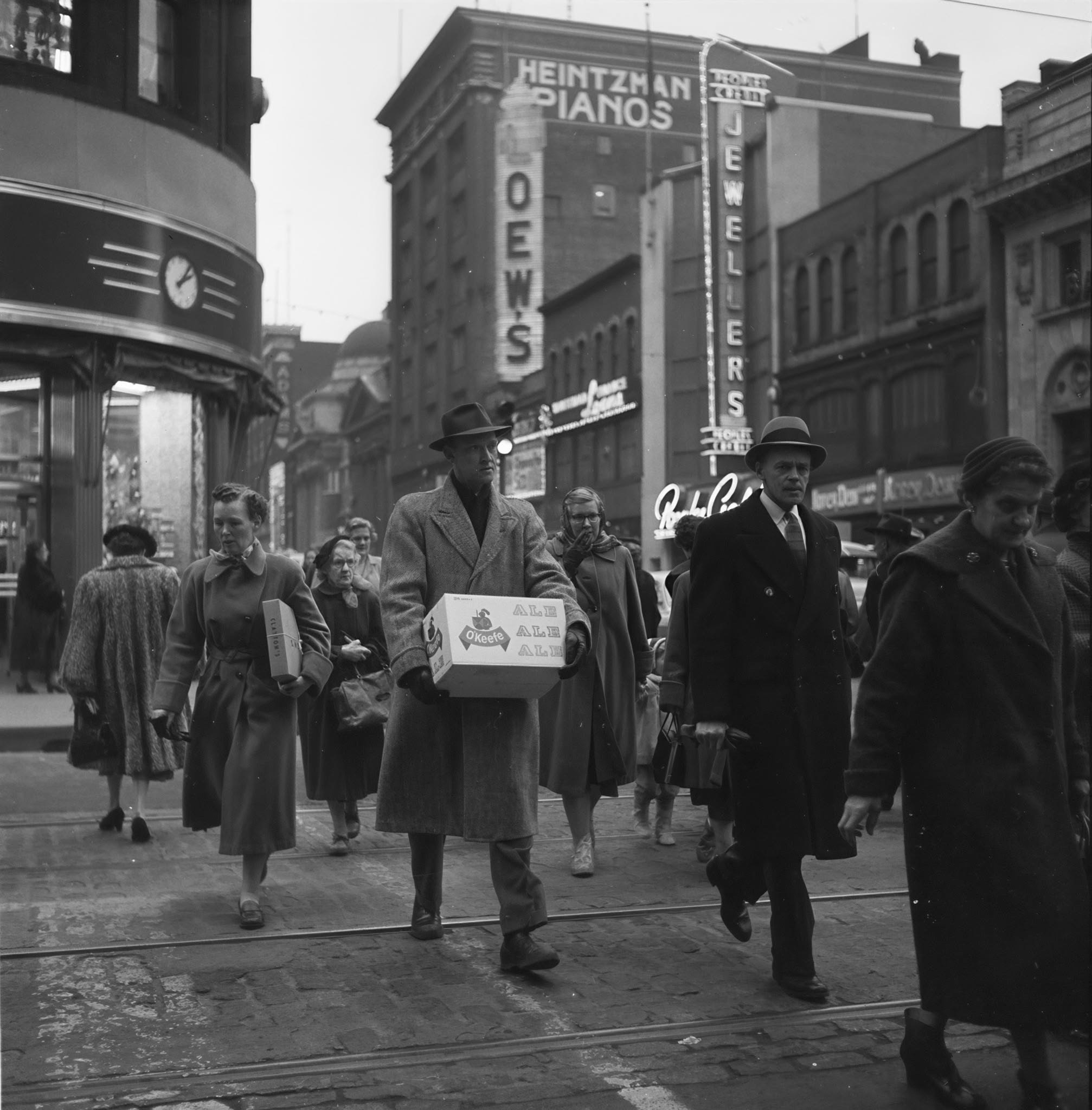
Now that the temperatures have moderated from -30C at dawn way up to -3C, the nation asks itself what the hell was all that? There is no answer to the question. Fortunately, there is a second question: how to still look dapper in a Canadian winter while lugging a lot of beer? Well, this gent can help. First, walk around in one of Toronto’s well loved black and white neighbourhoods where people must wear vintage clothing. Then, bottle your homebrewed beer only in second hand O’Keefe quarts you have nicked from the upper bric-a-brac shelves of old taverns. Finally, invest in an industrial quality paper packaging printing press you keep in the basement solely for the recreation of 1950s brewery boxes. Easy! Speaking of being on one’s feet, Boak and Bailey have written about how they didn’t do a Dry January so much as a very mobile one, a habit that has continued well into February:
We didn’t set out to make a mission of this, but we realised about halfway through January that, as it happened, we hadn’t yet made a repeat visit. That made us wonder if we could keep it up for the remaining few weeks. We were particularly conscious that we’d tended to stick to tried and trusted favourites last year. In fact, in 2025, over a quarter of our logged Bristol pub visits were to just two pubs – The King’s Head and The Swan with Two Necks. You might have noticed the word ‘logged’ and be wondering exactly what that means. Well, Jess, an accountant and spreadsheet nerd, of course keeps track of every pub we visit.

What a good realization! We have nothing like that possiblity here so much replicate 1950s Toronto to amuse ourselves but this comes a very good second. In the US of A, something else appears to be amuse or perhaps console according to BMI :

Beer posted positive $$ growth in 4 of the last 5 wks, and Jan 2026 is on track to be beer’s best monthly trend in years, at least in these channels. Including wine & spirit RTDs in the mix brightens the picture even more; broader beer + RTD category $$ grew more than 5% with wine & spirit RTDs adding close to 2 full pts in scans. 

Booze up! And somewhat similarly Ed stood up for the honour of Guinness this week with a response to what he called a a hatchet job on the Guinness’ Open Gate brewery in London published by The Guardian:

For some reason restaurant critics put the boot in more than any other type of reviewer… I was going to the brewery as part of the CIBD Southern section’s AGM, but first we had to do the business part to do at Diageo’s HQ.  I don’t know what deal the CIBD had done with Diageo or if we were subsidised, but we paid a tenner. This gave us pie and mash, which was nice, and a pint of Guinness (brewed in Dublin). I was keen to have somethng brewed on site though, so I had a hazy IPA next, which was nice enough. I think the ABV was a bit hefty, as on top of the three pints of Guinness I’d had I was defintely feeling pissed by the time I’d fininished it. So there you have it. The Guardian journo’s main complaint seemed to be that you had to take a lift to the toilets.

For others, the trip to the pub and then to the toilet is even easier. They are visiting the pub virtually from home, a remote non-work arrangement of sorts:

The 24-year-old from Yeovil, Somerset, regularly tunes into the feed from Morgan’s Arcade Bar in Carlisle, Cumbria – despite never having been there or anywhere near. What hooks Katie in is seeing different people come and go: the women enjoying a work party, the couple singing along with the musician, the young lad trying to chat up a girl at the bar… On some nights Morgan’s Arcade Bar, which can only fit around 60 people in it, has up to 5,000 viewers on its livestream at any one time. But like other bar streams, it has been subject to bans and restrictions for reasons they don’t quite understand. Bar owner Morgan Taylor has been streaming for nearly nine months. He noticed a huge rise in viewers over Christmas, then a few weeks ago his account was deleted.

Cass Enright got out of the house and on the road in his latest installment of A Quick Beer takes us to Montreal – a favourite destination of mine – and revisits some of the great brewpubs there in a video with this intro:

Join us on a step back in time as we have A Quick Beer at three of Montreal’s original brewpubs! Discover the enduring charms of Dieu du Ciel!, L’amère à boire, and Le Cheval Blanc, three spots that have been serving up delicious beer for decades. Although Montreal offers many modern breweries and taprooms nowadays, some of our fondest beery memories over the years have been here, and they’re all still going strong.

For me, it’s L’Barouf on rue St-Denis. If you are ever looking for me, check there. Also all about winnowing the better and the best, Pete shared some firm thoughts in his column in The Times this week, always welcome sight:

My beef is not with hazy pales — those original examples were pretty good. But if you don’t need to worry about balance or clarity in the beer, and you’re throwing in enough hops to cover up any off-flavours from brewing mistakes, a hazy IPA is very easy for a mediocre brewer to make. From a drinker’s point of view, if you grew up with soft drinks and don’t like the taste of actual beer, it’s perfect. It’s also great for Instagram — everyone can see you’re not drinking a boring, mainstream beer. But instead you’re drinking a boring craft beer. A boring, one-dimensional alcoholic fruit smoothie in a gaudy can with hop monsters or skeletons on it. If I wanted to drink sour grapefruit juice, I’d buy some Tropicana and leave it in the sun for a bit. 

The many botches of “craft” is a venerable topic which even comes with its own primodrial gospel but it is true that for all its eager keener passion craft never seems to fail to find a way to fail.  Nice to see that we have a paper of record confirming what Pete called the “sustained decline.” Viva crystal malt! Viva!! Viva!!! And Phil Mellows guided me to this article in The Caterer on the why to Pete’s what including this suggested impetus:

“…we are beginning to see the movement of some younger adult drinkers towards nostalgia brands, and given our history and heritage, we feel well-placed to meet this trend through some marketing and awareness driving activity.” Brookfield Drinks has launched a trial bringing long-established premium Scottish lager Kestrel back on draught. Brookfield managing director Nigel McNally says: “We’ve shown that a brand that’s nostalgic, like Kestrel, can be repositioned and revitalised. “Most pubs are serving the same products, and the trade’s been guilty of allowing brands which aren’t authentic onto the bar. Alcohol by volume (abv) have also come down, and I think overall customers feel they’ve been short-changed. A return to brands with heritage and nostalgia is offering customers a point of difference.”

Nostalgia and getting short changed? One must be on one’s toes. Which is related to Lars’ new maxim: “if you don’t know how the beer is made then, no matter what the beer is named, you have no idea what kind of beer it is.

Speaking of no knowing, The Beer Nut made a confession this week that I suspect is made on behalf of many of us:

Anyone who pays attention to trends within microbrewing will have noticed in recent years the explosion in variety of proprietary hop products. I don’t think these assorted extracts and powders and boosters were ever meant to have a consumer-facing role, but brewers seem to love them, and love letting us know that they’ve used them. Does that get them a discount from the supplier? I wouldn’t be surprised. For my part, I can’t help wondering if these enhancers actually enhance the beers in any real way. I’ve certainly never identified any pattern among them: which ones to look out for and which ones aren’t worth the paper their patents were filed on.

Note #1: Ludlow prices!!!
Note #2: Laura’s top tap rooms.
Note #3: Jeff doxxed.
Note #4: Burton Union Pr0n!
Note #5: Actually, no you can’t. You’d die.

The British Royal Navy has recently announced it is cutting booze rations in the service, limiting intake to 14 unit per week while on board. The Telegraph in its emailed newsletter presented a few responses to the news from readers:

Jenny Jones, however, recalled an age of largesse: “Many years ago in Malta, my husband and I were invited on board a Royal Navy ship that was giving a party. The atmosphere was convivial and, thanks to attentive stewards, I was able to enjoy several gin and tonics before dinner. “On departing, it seemed to me that the gangway had become a lot steeper. Back on dry land, our host asked how many drinks I’d had. When I said three, he told me that in fact I’d had nine, as naval tots are about triple the size of what one would get in a pub.”

Ah, Jenny Jones… what’s that? Not the same one? Fine. Me, I was once invited with a gang up the plank and onto a Canadian navy ship helpfully docked a walk from the Halifax taverns by a pal’s navy boyfriend. Among the minty green paid we worked our way though a number of 25 cent beers. I expect that sort of service is no longer offered.

The feature this week at Pellicle was written by Newt Albiston who shares his thoughts on drinking in Epping, just north of Greater London the tough town where he grew up which lives with division:

The day I return to Epping, my first trip home in some time, I can feel the tension, and the hesitance. The high street is pretty quiet, and there are lingering looks as I make my way past the various coffee chains and charity shops. Signs of the change in mood are everywhere: Union flags fly at half-mast on lamp posts, as if to declare the death of Britain as she once was, shadowed by the residue of torn-off patriotic stickers. Although I am instantly greeted by familiar faces when I walk into The Duke, the tension is still present in the quietness of the venue.

I like this: “…no fancy ginger beer or small-batch kombuch…” Perhaps related to The Duke, Stan guided us to a question this week – “what’s that smell?” Or rather…

“Olfaction helps shape our cultures, although it often does so unknowingly or without us noticing,” says (Inger) Leemans, who led the Odeuropa project. “When we talk about cultural heritage, we can think about religious rituals, but we can also think about specific scents that we’ve been cherishing and living with for a long time.”

Cherish. Hmm… I spent a good chunk of my teens in Truro, NS where the smell wasn’t always cherished and I am mindful of that reference The Breweries of Kingston & The St. Lawrence Valley by Steve Gates to a brewery a couple hundred years ago near my current place of work at City Hall which doubled as a pig sty. The next brewery to the north itself had a manure pit.  My point is that there were no scents without the full sensory array around it. Did 1890s Mild pair well with coal dust? Did Porter marry well with the pong of streets filled with horses? Perhaps we can never know.

And Charlotte Cook, brewer and scribbler, at took us along to Asturias, Spain for Everyday Drinking and shared her thoughts on the food and the cider:

When you taste the intensely rich stew, you can understand why cider rather than wine prevails in the north—the sour and fizzy is needed to cut through, cleanse the palate, and prepare you to dive in again. Cider is omnipresent in Asturias. As you walk around the town center of Oviedo on a Sunday morning, as families returning from church mix with football fans heading to an entirely different type of cathedra, cider is everywhere. Before 11 am, people will be drinking a bottle of cider for the table. Spaniards are famed for their ability to drink until the wee hours and still make it to work, school, or church as if nothing has happened. And having a little tipple of cider in the morning isn’t seen as such a stain on your character as it is at home.

Finally, some very heartfelt tributes were shared after the news of the death of beer writer Des de Moor like this from David J:

I think a lot about the pints we had one night in South London where he held court, sang songs and was so warm to everyone.

Pete also remembered Des the singer:

Des was a man of many layers. Years after the event, I discover my first interaction with him was buying the 12” remix of Charlton Heston by Stump – that was him, as half of the Irresistible Force. He made the Popbitch newsletter as Secretary of the Ramblers Association (moor, geddit?)… He was a great singer, a walking encylopedia. An absolute stalwart of judging the World Beer Awards. Never once heard him angry, pissed off, or anything other than kind and decent.

There are many more. His Wikipedia bio explains his musical side. Here he is singing Bowie and, here, an earlier solo album. By all accounts a wonderful guy. A sad loss.

Until next time, please check out Boak and Bailey who are posting every Saturday and adding to their fabulously entertaining footnotes week after week at Patreon. And look out for more of Stan’s new “One Link, One Paragraph” format. Then hunt out something in someone’s archives! Leave oblique comments on someone’s post from 2009!! Listen to a few of Lew’s podcasts and get your emailed issue of Episodes of my Pub Life by David Jesudason on certain Fridays. And Phil Mellows is at the BritishBeerBreaks. Once a month, as noted, Will Hawkes issues his London Beer City newsletter and do sign up for Katie’s wonderful self-governing totes autonomous website featuring The Gulp, too.  Ben’s Beer and Badword seems to be on pause since November but there is reading at The Glass which is going back to being a blog. Any more? We have Ontario’s own A Quick Beer and All About Beer is still offering a range of podcasts – and there’s also Mike Seay’s The Perfect Pour. Plus follow the venerable Full Pint podcast! And there’s the Craft Beer Channel on Youtube. Check out the archives of the Beer Ladies Podcast.

Your Festive Beery News Notes For A Blursday In This Jolly Hollifest

What day is it? I think I can still recall. It’s definitely somewhere between the last parcel being mailed and 2026. I know that much. I also know that in 2009 one Stan Hieronymus, possibly barely out of his teens at the time, submitted this photo above as one of his entries in the Christmas photo context. I will say one thing about a beer photo contest – if you don’t like your range of browns you might as well admit that you should never run one. Like the other contest submissions I have been posting out of the archives the last few weeks, I am pretty sure this one didn’t win a prize – but have you ever seen a better placement of a five gallon white food service bucket? No. Come to think of it, do you ever give a second thought for the glorious role of the five gallon food service bucket in all of brewing? Stan did. For one beautiful moment, he sure did.

Let’s get to the beer news. First up, another controversy related to booze and the ticker:

…the American Heart Association has revived the idea in a scientific review that is drawing intense criticism, setting off a new round of debate about alcohol consumption. The paper, which sought to summarize the latest research and was aimed at practicing cardiologists, concluded that light drinking — one to two drinks a day — posed no risk for coronary disease, stroke, sudden death and possibly heart failure, and may even reduce the risk of developing these conditions.

Before you go off to the Christmas office party with the thought that it’s really not all that far off a visit to a health spa, remember the critics’ warnings about the quality of all these sorts of studies: “Some are clearly horrible, some are good, but a lot are in the gray zone, and people may just cherry-pick and select those that agree more with their narrative.” Hah! So there…

Speaking of the office party at this time of year, the very same authoritative organ shared a bit of advice about conduct at office parties for the supervisory set:

It’s a good idea to stop after two drinks. Sure, you could have three drinks — or six! — and enjoy the social leveling and bonhomie that accompanies lowered inhibition and decreased cognitive capacity. But it’s hard to command respect in the office when people have seen you red-faced and trying to light a cigarette from the filter. 

Is it unfair to compare today to forty or so years ago? The (other) Times did this week when they republished a guide called “How to Survive Christmas” from 1986:

Commuting in the run-up to Christmas is absolute murder. On the way home from a hard day’s work you are liable to find everyone either festively drunk or helping someone else to be sick. Then there’s the office party. People will drink far too much, lunge at one another, tell the managing director he’s a twerp and pour the office vegan’s sprout wine down the word processor to cackles of mirth. How do susceptible males stay out of trouble at the office party? One friend suggests that offices should introduce Tube straps hanging from the ceiling. Thus you could remain vertical however much you knocked back, but with one hand in the strap and the other clutching your glass, both would be kept out of mischief.

Good idea. While it appears that thirty-nine years have passed since that was published, it’s clear ther are still bad behaviours that need to be stamped out at this Holly Jolly time of year, as Pete reports from the pub:

Black Friday has a different meaning in the hospitality industry. It’s not the consumer frenzy of late November, it’s the last Friday before Christmas. This is the night when post-work drinks climax in a frenzy of ill-advised shots and poorly judged flirting. For pubs, it’s one of the busiest nights of the year.

And then he gives ten rules, many of which would be enough to deter me from going to the pub. No line? Never have liked that when visting the fam. How un-Canadian! Give me a good line any day. But “no ordering a round of cocktails“? Perfect sense. No playing your crap music off your phone? Automatic ejection, I say.

Speaking of bad behaviour, I missed this tale of sticky fingers a few weeks ago but I will share it now as this could end up being quite the thing… perhaps quite the thing indeed:

Molson Canada has accused former managers of embezzling millions of dollars in an intricate fraud scheme allegedly involving fake vendors, shell companies, the president of a major pub chain and a pair of married couples. In documents filed Wednesday in Ontario Superior Court, the brewing giant claimed that former Molson Canada sales director Frank Ivankovic oversaw “a complex scheme to defraud the company of many millions of dollars” that later involved two subordinates.

Holy crap! Gotta watch that story. You may scoff at the very thought but I will share a fact that is actually true – I had a personal banking representative many years ago who made a very tidy sums on false mortgage accounts until the scam was uncovered. As this situation at Molson is reportedly both complex and intricate, I am spellbound and await further disclosures from any and all court processes.

Speaking of people who can’t tell their left pocket from their right one, in the land of Vinho Verde the police have had to get involved:

Those arrested from the trade body, which is responsible for quality control and official certification of Vinho Verde wines, belong to its Inspection and Control Division, with the individuals arrested for allegedly warning wineries of upcoming inspections and accepting bribes of meals, wine and event tickets. According to Portuguese newspaper Jornal de Notícias, the officials also allegedly turned a blind eye to wine producers failing to meet the requirements to obtain designation of origin (DO) or geographical indication (IG) certification to be able to label their bottles as Vinho Verde…  Meanwhile, a further four “business owners involved in the distribution and production of Vinho Verde” – have also been arrested, charged with “active and passive corruption, falsification of documents and abuse of power”.

Doce mãe de deus!!!  Fiddling with the Vinho Verde!?! That has been a mainstay in my life for around forty-five years, starting with my mother’s micro-obsession with the plonky version. Not unrelatedly as it turns out, Lars found some dirt about law scoff doing a little farmhouse brewing in Japan, news that he shared on BlueSky:

The Japanese are less law-abiding than I thought: farmhouse sake brewing continued despite the legal ban. In 1941 folklorists surveyed 85 localities, finding home brewing in 44 of them…  In 1895 there were 1 million home brewing licenses in total. So Japan definitely had farmhouse brewing of sake. Then in 1886 the gov’t banned home brewing entirely. Probably killed the farmhouse brewing. Home brewing is still illegal in Japan (gov’t wants its alcohol taxes), but in 2003 one exception was made: farms using their own rice are allowed to brew. This kind of sake is called “doburoku”. There are now 100 designated doburoku districts where this style exists.

That could make for something very interesting, a doburoku tour… doburoku tour… doburoku… WAKE UP!!! Sorry. Now… some notes:

Note #1: “only 37 percent of craft breweries in Canada are profitable”? Really? That’s a lot of subsidization.
Note #2: Who the hell pours Bailey’s down the sink?
Note#3: A.I. designed beer? Nope, couldn’t care less…

Aaaaannnnnd… the BA issued a somewhat delicately drafted “year in review” type press release suited to both address and deflect the industry’s annus horribilis and, I gotta tell ya, I sorta choked on what is stated to be the top trend:

This year, there was a continued democratization and expansion of what it means to be a “brewer.” With acquisitions, mergers, and collaborations, the stainless tanks in the background may not be as important as the brand story.

As one who has never given a shit about the story someone is telling about a brewery, I think if I were an actual brewer I might consider this statement slightly, you know, treachery if not treasonous. But it is nice to know that, finally, years after the BA’s abandoning the need to be small or traditional or independent it’s now not even necessary to be an actual brewer.

Much more reliable was the annual release of the Golden Pints 2025 awards from Boak and Bailey which starts with this introduction to the concept.

What can we say? Hardly anybody else bothers doing this anymore but we’re creatures of habit. We first took part in the Golden Pints back in 2011 and find it a pleasingly reassuring ritual. It’s also good to have in mind throughout the year as we roam from town to town, and from pub to pub. It makes us look at the beer we’re drinking and ask: “Could this be a contender?” Before we get down to business, a bit of encouragement: nobody owns the Golden Pints thing; anyone can join in; you don’t even need a blog to take part. Post your own list on social media as a thread, or even in the comments on this post if you like.

I won’t ruin the announcement of their winners – but what I like about the whole Golden Pints idea is that it celebrates their winners. Was it started by the late great Simon Johnson? He posted his thoughts in 2010, 2011 and 2012 but perhaps it goes back further. Yes, Mark Dredge awarded them in 2009 and even cited his own pre-GP “best of” post of 2008. Who was his best beer Twitterer of 2009? Simon Johnson! Who else? Anyway, you can check out the examples new and old and figure out your own summary of the year according to your own standards.

In another annual year end tradition, Alistair has begun to announce his beers of the year, style by style. His first post celebrates the pale based on three footprints – state, national and imports:

It’s that time of the year, the Winter Solstice is upon us, and what better to do than to review a year’s worth of drinking? As has become my own tradition, I will break this down into multiple posts, one for pale beer, one for BOAB (“between orange and brown”, and dark, and then an overall beer of the year, as well as one for Virginia cider of the year. As I have done for several years now, I will highlight beers from Virginia, the rest of the US, and the rest of the world before crowning each category winner, so on with the show…

I liked this comment: “Spoolboy, the most perfect desítka imaginable, and one that I wish I could sit and drink with Evan, Max, and co back in Prague.” That would be a good table to join.

Over at Pellicle, Robyn Gilmour shared the story of an innovation in Dublin’s beer scene:

…the beer that’s consumed in the majority of Irish pubs isn’t even Irish, with the exception, perhaps, of Guinness, Murphy’s, Beamish, and a handful of other outliers that are brewed locally but owned by foreign multinationals. While treasured in Ireland, these brands do not represent the full spectrum of the country’s beer, which is far more nuanced and varied than most pub offerings would suggest. Speak to anyone working in the independent Irish brewing sector and they’ll soon tell you about the savage competition for taps in Ireland—primarily between Diageo, Heineken, and Molson Coors. As someone who’s worked with many of these smaller breweries, I’ll admit I never had prior reason to question where publicans fitted into this dynamic. That was until 2024, when 16 of Dublin’s most cherished pubs banded together to form a brewery of their own—the aptly named Changing Times.

Finally, David shared his thoughts on language and alcohol promotion, thoughts based on serious personal experience:

…this kind of communication is terrible in the run up to Christmas when more people are tempted into drink driving despite the messaging. Recalling the trauma caused by my dad drink driving was bad enough but only days later I was forced into recollecting my flatmate’s attempted suicide when BrewDog ran an advertising campaign with the slogan “tastes like commercial suicide”. 

As I mentioned a few weeks ago, much of my experience with drunk driving was from an earlier stage in my professional career as a duty criminal defence counsel processing those passing before the court for judgement. But I also lost a client of our office every year to a drunk driver in those years, too. And I probably have to admit that up to a certain point growing up in Nova Scotia in the 1970s and 80s, drunk driving was so common there was an inevitable even blasé attititude to the tragic harms done. There were so many Mondays that someone was not at their locker. So I don’t buy arguments that there is a risk reward sweet spot in these matters. The vast sums that the booze trade offers do not offset the loss.

And that may sound like a bummer of a way to end the news notes for the lead up to Christmas but this is a high danger zone within the calendar for drunk driving and other forms of harmful behaviours. So be thoughtful and be safe as you do about the holiday partying in these next few weeks. Maybe think of what else can be done that is as helpful as a London Underground strap hanging from the ceiling to make sure the season actually remains jolly.

As you contemplate that, please also check out, Boak and Bailey on this and every Saturday and then sign up for their entertaining footnotes, too. Look out for Stan when he feels the urge (now that he’s “retired” from beery news posts) from Budapest or wherever – as he is getting active again. Then listen to a few of Lew’s podcasts and get your emailed issue of Episodes of my Pub Life by David Jesudason on certain Fridays. And Phil Mellows is at the BritishBeerBreaks. Once a month, as noted, Will Hawkes issues his London Beer City newsletter and do sign up for Katie’s wonderful self-governing totes autonomous website featuring The Gulp, too.  Ben’s Beer and Badword has returned from his break since April so you can embrace the sweary Mary! There is reading at The Glass which is going back to being a blog. Any more? We have Ontario’s own A Quick Beer and All About Beer is still offering a range of podcasts – and there’s also Mike Seay’s The Perfect Pour. Plus follow the venerable Full Pint podcast! And there’s the Craft Beer Channel on Youtube. Check out the archives of the Beer Ladies Podcast.


The Over 50% Off Super Holiday Sales Saving Edition Of The Beery News Notes

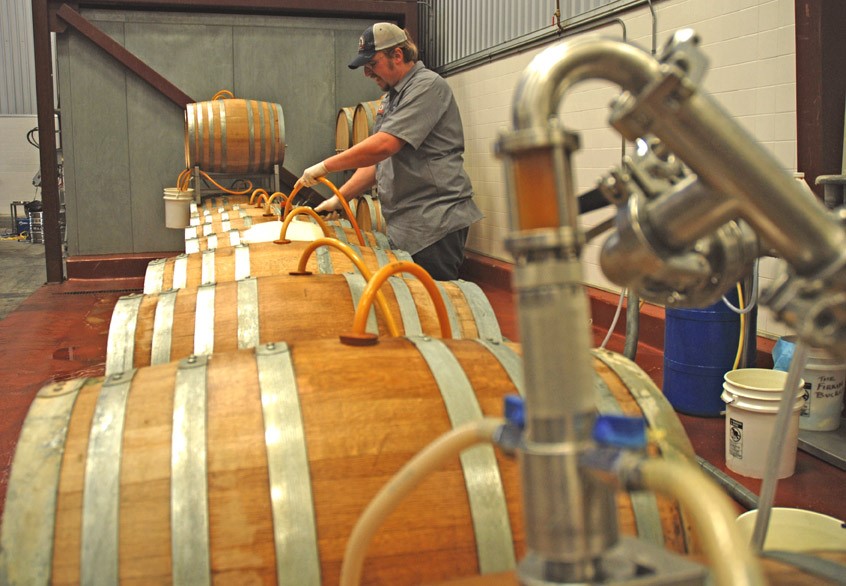
You may need to turn your phone sideways to make this image fit. Or I could just center it. There. That’s better. For a long time, these weeks at the end of the year at the beer blog were a bit crazy. The Christmas photo contest (circa 2006-16) was on and I was sifting through a huge number of emails with multiple entries. Hundreds came in each Yuletide. Thinking back on that this week, I had a look through the 2010 submissions and found this lovely image sent in by Brian Stechschulte of San Francisco.  Here’s his birthday bio on Jay’s site. Another one of his enties won the contest that year. That image is of Rod Widmer among the quipment at the brewery. In what Brian described as Widmer’s cathedral. I like the glow. I’ll dip into the emails and old posts to see what else I can find to adorn these news notes throughout December.

Back to today’s news, first up the question of cash and how the UK budget reaction lead to something of a counter reaction. Sayeth Matty C.:

The worst thing about this week’s budget for me was seeing prominent figures in hospitality bemoaning the minimum wage increase because god forbid your staff should earn enough to actually afford, barely, the cost of living. For me it just demonstrates why all of this lobbying for a VAT cut isn’t so much about supporting a “dying” industry, put propping up profits for the people at the top. But no, it’s paying wages that’s the problem.

And their weekend footnotes to the weekend news, Boak and Bailey shared a similar sentiment:

Every budget goes the same: CAMRA and industry bodies lobby the Chancellor to do something to help pubs; the Chancellor does very little, if anything, to help pubs; CAMRA and industry bodies criticise the Chancellor’s failure to act and foretell doom for the hospitality industry. It’s been this way basically forever and yet, somehow, pubs continue to exist and beer continues to be manufactured and consumed.

As a person who takes home a tax based pay cheque, I have to be somewhat respectful of those lobbying for restraint.* But I am also aware that government can positively participate in economic growth and greater social good. So… and here’s the point for me… after years of ideological restraint hit by a global crisis or two there are times when the bite shared by all is for the longer term good.  As long as there is an identifiable long term good and it is shared by all.

Speaking of the burdens of the state, Drew Starr has shared thoughts on an excellent way of fighting back against authoritarianism – ban the lackies from your bar:

The kid who proudly called ICE on a carwash. Print this shit everywhere. Hell yeah, Sil! For those not from here: this is The Silhouette (nobody calls it that), one of Boston’s last remaining dive bars. For a college kid living in the area, it’s the last place you want to get banned from

We understandThe Sil” has barred a university student who called ICE on a car-wash and men in in balaclava abducted a group of nine workers. Perhaps more establishments might introduce a life-time ban.  Shaming down authoritarianism is a top drawer move.

How to cope? How to deal with the pressures of the day?  “Mulled beer!” sayeth Jessica M. seasonally through an interview with Sam Millard of Bevertown :

“The secret to making a great DIY mulled beer is in choosing the right base. The best results will come from a rich, malty profile or a sweet brown ale,” suggested Millard, who explained that “just like when mulling wine or cider, you need a base that is already really rich, full-flavoured and most importantly, not at all bitter. You ideally want something with a bit of body too, so ensure your beer is not too thin.” According to Millard: “While you may be tempted to use a super-hoppy IPA, keep in mind that its bitterness could overpower your chosen spices and throw everything off balance.

Now, keeping in mind that this is all a bit of an adver-informo piece, I still would recommend you try it. Jessica B herself was curious about this stuff a whole eighteen years ago. Me, I like to use Chimay Première, the red labeled dubbel, as the base. Tasty, strong and relatively cheap as dubbels go these days. And skip the idea of “DYI” and just go traditional with a Lambswool made with strong ale apples, sugar and ginger spice. Or, along with a lot of other options at this link, try to make Caudle if you are even more adventurous. If that is too complex, just go for try a pint of stout and port. It’s Christmas so you can just do that and even say you did.

Speaking of Yuletide, in the news from Newfoundland we read that more folks are going to get stoned for Christmas!

CEO Bruce Keating says net earnings rang in at $56.3M, a decrease of about $3.7M, mainly due to the removal of U.S products and decline in beer commissions.  Alcohol sales totalled $84.2M, down 1.5 percent however, cannabis sales are up 10.6 percent at $28.5M. Keating says those numbers could start to slow since that market is maturing. He says they’re optimistic that the Christmas season will boost sales numbers. 

Baby Jesus would no doubt approve. Speaking of which, Barry M has driven down to a depth I’ve never considered necessary over a controversy I had never heard of – are “cider” and “cyder” the same thing? Or categories of rerlated things? As a lifelong poor speller, I am gratified that the problem arises from puritans who insist every difference in spelling requires a difference in meaning:

Within English literature, early texts seem to use mostly ‘sider’, though it would appear that by the end of the 16th Century literature was generally split between ‘sider’ and ‘cider’. Both with an ‘i’. But there were exceptions of course, an dit has to be said, it was a bit like the Wild West when it came to spelling convention, with cyder, cider, sider, cidar, cicer and pommage featuring in texts of the time (thank you Elizabeth!). But let’s look at some of the cyders…

As we all know, standardization is the best friend of Satan or at least authoritarians. The minute hand, a tool for atronomers, was later added to the clock to steal time from Indistrial Age factory workers. The dictionary of Dr. Sammy J of 1755 helped create the idea of misspelling and therefore a resulting intellectual failure. And now we have this consequence, a finger pointy crisis in taxonomy which apparently turns on the factual regular but uncategorical past practice of adding water to cider now and then** which has led, hundreds of years later, to a backdating by someone deciding that the spelling must follow a practice. Sad. Distinctions can be without a difference. Let us rather embrace our negative capabilities.

Did you see what David J did? He just went and wrote the history of Wychwood for Pellicle:

“BrewDog is a modern interpretation of Hobgoblin,” says James Coyle, who was sales director at its parent brewery, Wychwood. “[The Hobgoblin identity] was built on motorbikes, grunge, and tattoos—this was the escapism of the brand.” Established by Paddy Glenny as The Glenny Brewery Company in Witney, Oxfordshire in 1983, it was renamed the Wychwood Brewery in 1990. Somehow, this small brewery in rural Oxfordshire went from selling to a few freehouses to producing a beer so iconic that it shifted 100,000 barrels a year, changed pub culture, and eventually became a global brand in the Carlsberg portfolio. Thanks to breweries like BrewDog, today we’re used to shock marketing tactics from beer firms. Many of the people I spoke to while researching this article repeated James’ sentiment about Hobgoblin being akin to the often-controversial Scottish brewery, including the fact that its initial success was driven by word of mouth rather than a huge marketing budget.

Over twenty years ago, Wychwood was on the shelves on Ontario and I posted reviews of their Fiddler’s Elbow in 2004 and Duchy Original Pale Ale in 2006. I didn’t love the bad Baggins branding of Wychwood – though not as deeply as the stupid “you’re not worthy” stuff from Stone.  I am please to say, however, that now I added a bit of info which may have assisted David in one paragraph in there – but what a beast of research. And all for you.

Speaking less of you and more of me, I am 62. When I was a teen, I worked with older seniors. People 62 were rye drinking Dads of pals who were vets of the Second World War. They were still up on ladders to fix something on the roof. Some could dress a deer. Me? Fitter than I was at 52.*** So I found this New York Times piece a bit odd. Frankly, if I was 42 around now I’d worry much more about 52 than 62.

On the theme of worry, James Beeson in The Grocer wrote about the financial troubles facing the BKeystone / Breal, a UK consolidator of brewers:

Breal bought a slew of unloved brands and then engaged in a damaging race to the bottom. This was the inevitable conclusion and the only surprise is that it has taken this long. My thoughts are with the blameless employees that will be affected by their failure. 

Breality strikes!**** He followed it up with an investigation over the legal steps being taken and their denial that they are going bust. Jessica M in DB on the same story shares that they have:

… reached out to Keystone for an update on its situation and its prediction of plans and sales for each of its brewery assets as well as asked about the fate of its brewery workers at each of its currently-owned sites. The group has, however, remained silent aside from its statements on social media assuring Black Sheep beer fans that it is “still here”.

And there have been more twists to the news of the suddenly “not here no more” Rogue including this from Doug Veliky:

It also surprised key partners including US Beverage (USB), with whom Rogue had just signed a national sales partnership, and who learned through the news and social media just like the rest of us. As part of their agreement announced on August 1, 2025 to represent the brand in the trade, members of Rogue’s national sales team transitioned their employment to the new partner company in an effort to ensure continuity and relationships. Now, without warning, USB is left with employees who were crucial to the partnership’s formation, but without a brand to sell or an understanding of its future.

Lordy. That’s not good. Clearly on August 1, 2025 the writing was on the wall in the offices of Rogue. Probably on dry erase boards all over their office walls. Did that continuity also include those employees’ accrued termination benefits rights?

Time for notes:

Note #1: “Hoolie” is a word. My late Dad was very entertained by the news that my new boss 28 years ago was so named.

Note #2: “Drunk Racoon in the Hardware Store!” I know this item is just for Stan… as he sent me the link… as if I didn’t already have the link to the story ready… just for Stan.*****

Definitely not on the hoolie, A. Gladman shared thoughts on a private spot at his parents’ home, a place to have a beer on a summer day:

There’s a spot where I like to sit and have a quiet beer when I visit them in the summer. I try to manage it at least once during each trip. It’s on a balcony, or a raised deck I suppose you might call it, that overlooks their small back garden. Wooden steps run down into the garden from one corner, and at the back a door takes you into their kitchen dining room. I like to sit there in a white plastic chair with my back to the wall, and look out to the sea, just a hundred or so yards away. Pale in the distance, the Isle of Wight rises like a cloud bank on the horizon. The wind blows; it’s always windy. The noise of waves breaking on the shingle echoes all around. Gulls and far-off wind chimes punctuate its ceaseless murmur. Somewhere nearby a rope slaps against a metal pole. 

More into this moment, Tyler Maas in the Milwaukee Record shared thoughts on his own sort of idyllic prospect, one that popped into his mind after the first major snowfall of the season:

Days like last Saturday are the closest thing we get to a “Snow Day” as adults. Any plans you made before weather became a factor are probably no more. The idea of driving anywhere seems unwise and borderline dangerous. Once you shovel the snow that’s already accumulated, all that’s left to do is wait to do it again when the flurries are through. So why not embrace the situation, put on some boots, and trudge to the nearest bar?… With driving and other aspects of everyday life temporarily removed from the equation, why not stay a while? You’ll surely burn off the calories from that extra round (or two) on the stroll home. Not to mention the energy you’ll expend during the second/third round of shoveling and when you inevitably dust off your car as the responsibilities of “real life” eventually come back into view.

Nice. Now, finally and with the greatest respect, I have to say that I can’t agree with the position taken by Laura H in The Telegraph last week on the issue of lowering the drink driving standards in England:

A recent survey has found that 58% of adult consider driving after drinking, even if the driver is within legal limits, to be “socially unacceptable.” This has inevitably emboldened the anti-alcohol lobby: already police chiefs and the British Medical Association have called for the rules to be made harsher – their proposals would push drivers who have a single pint over the limit. This is framed as a question of public safety, but in reality it’s yet another example of overzealous campaigners blaming all of society’s ills on the demon drink, without giving cause or justification.

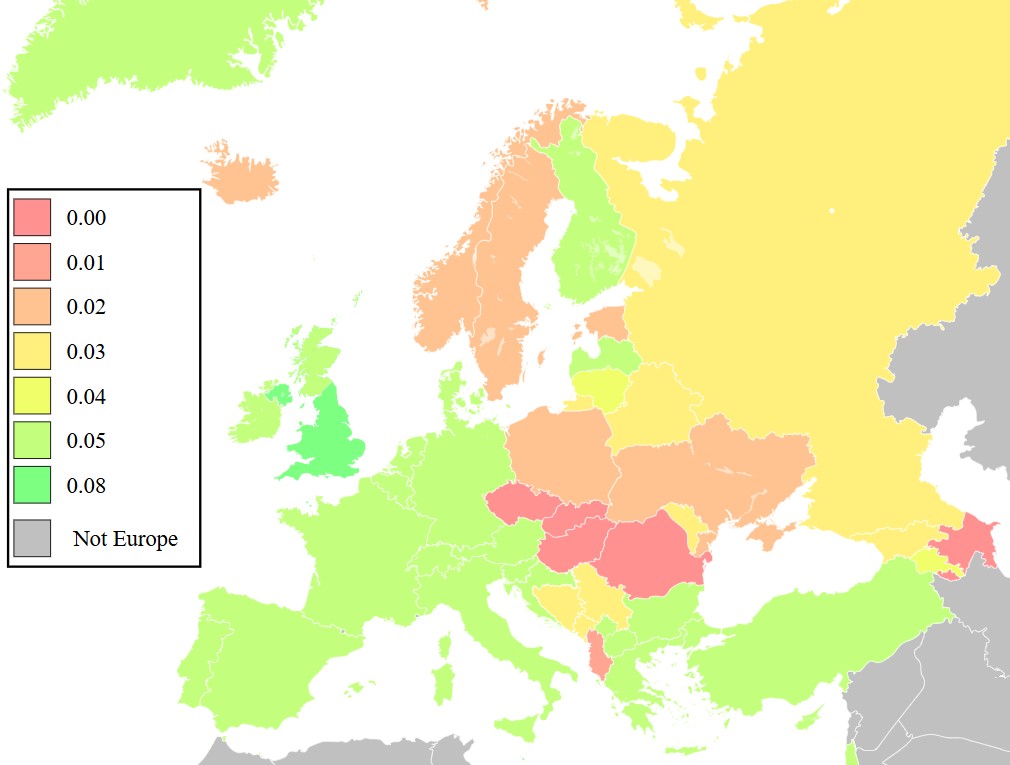
I suppose my first issue is the language. Not sure the embolding was inevitable given those bold beings described have already been on their mission for years and years, according to the anti-anti-alcohol lobby. And not sure the campaigners are necessarily more than zealous. Can one be?****** But the real issue is without justification. This is particularly the case as the first observation is a justification: a majority of Britons are against the current scheme. So, too, the second observation: the police and doctors want stricter rules. We can disagree on the quality of these justifications but that’s what they are.  It’s also worth noting that context poses an obvious issue too. England, Wales and NI have the highest permitted levels of alcohol in all of what was once known as Europe. By over 50%. Check it out. It’s simply a fact that the criminalization of drinking and driving is a reasonable response to the harm it causes. As a lawyer, thirty years ago I spoke to an appeal of a driver who blew 0.082 so these things can be close. But the bottom line is no one is being forced to stop you from drinking. Just stop driving. Maybe try walking. Or get a cab. Or a bus. Or a bike. Or a designated driver. Or another place to drink.

And with that, I am done. It is Yule and I am off to maybe have a beer or maybe shovel or just fret about being late in getting the lights up and having note bought the pressies and what about the tree and … well… as I do that please also check out, Boak and Bailey on this and every Saturday and then sign up for their entertaining footnotes, too. Look out for Stan when he feels the urge (now that he’s “retired” from beery news posts) from Budapest or wherever – as he is getting active again. Then listen to a few of Lew’s podcasts and get your emailed issue of Episodes of my Pub Life by David Jesudason on certain Fridays. And Phil Mellows is at the BritishBeerBreaks. Once a month, as noted, Will Hawkes issues his London Beer City newsletter and do sign up for Katie’s wonderful self-governing totes autonomous website featuring The Gulp, too.  Ben’s Beer and Badword has returned from his break since April so you can embrace the sweary Mary! There is reading at The Glass which is going back to being a blog. Any more? We have Ontario’s own A Quick Beer and All About Beer is still offering a range of podcasts – and there’s also Mike Seay’s The Perfect Pour. Plus follow the venerable Full Pint podcast! And there’s the Craft Beer Channel on Youtube. Check out the archives of the Beer Ladies Podcast. That’s quite good and after a break they may well be are back every month!

*But also as one who has a list of gains and savings for more than two decades that I have influenced to the point that I am effectively appellata free resource…
**But bring back the word “ciderkin” by the way.
***I have just passed the fourth anniversary of slowly getting back from a point which same me using a cane after badly wrenching a knee weeding a zucchini patch. Why? Life stressors resolved, sure. Daily small steps like stretching and exercises, yes. But most of all daily recording the data related to more and more of what I do: intermittent fasting goals (+/-17 hours a day); hours and quality slept (one mid-week sucky sleep does not make for a medical issue); drinks intake (down to 1.27 per day ave) and to do list daily chores achieved (done… next?). But by the way that whole life expectancy shift stuff has little to do with aging and much more to do with infant mortality. So relying on that to discuss the difference between retiring at 60, 65 or 70 means zippo.
****Sorry…
*****Stan also advised he will be reading these new notes from a train between Amsterdam and Budapest so everyone wave in that direction, please.
******Do Zealots look over at the overzealous and think “Jim’s over doing it a wee bit tonight… giving zeal a bad name…”

The Thursday Beery News Notes For The End Of Summer 2025

There are good views out there. Lots of golden hour sunlight finishing up the days as we face the reality that, yes, winter is coming. Out and about that evening, I saw a frog and a hedge of jewelweed – but you’d expect that, wouldn’t you. I like how the angle of the shadow makes something of a right angle with the tree. I didn’t notice that when I took the photo. But even saying that makes it too artsie, less just see-ie. Similarly, writing about hops, Jeff wrote about a limitation but its really about two limitations. And it’s all a bit like dancing about architecture… but what isn’t:

The thing about adding more is at a certain point you don’t get more. We learned this when breweries were putting eight pounds per barrel of hops in their beers and making them taste like lawn clippings. To get more, you have to add different. And here I give you fresh hop beers. They offer a dimension of flavor that is different from regular kilned hops. Trying to describe them is hard because rather than just reaching for another adjective, we grope toward different realms of experience. Drinking a very good fresh hop beer is to experience synesthesia and encounter the taste of iridescent green.

Conversely yet still on the question of different, not as charming an experience was an airport sandwich sold to Matt Gross under the presumably personally seductive name “the Matthew”, it of the 10 slices of prosciutto:

…laid flat, one on the other, with no space between them, to form a dense, unchewable mound of salty protein. Look, sandwiches are all about architecture, and the meat, especially a powerfully flavored one like prosciutto, needs air. Each slice, thick or thin, should be separated from its brethren, folded gently and laid haphazardly (within reason) upon the bread. You want to feel the texture of the slices, the regular irregularity of the bite as your teeth pass through the layers. That sandwich needs to breathe. If it can’t breathe, it’s dead on the plate, limp and heavy, boring. R.I.P. Matthew. The great thing about this approach is that you can actually use less prosciutto per sandwich and at the same time make the sandwich taste better.

It’s funny. As I go through the week’s saved links I can get interested about someone writing about a crappy sandwich but, for example, can’t be bothered with anything anyone is writing about THC drinks. What could it be? Bad writing? Maybe.* Compare how, for CAMRA’s What’s Brewing, yet another Matthew wrote about beer pubs and heritage in the nearby local layered landscape under development in Manchester’s core, writting in a way which contextualizes more than lobbies:

“We believe regeneration should enhance, not diminish, the city’s heritage. The Marble Arch deserves to be protected as part of Manchester’s future, not pushed aside by it.” On the subject of heritage, one brand looking to capitalise on the city being the national centre of attention this summer is the iconic Boddingtons. Brand owner AB-InBev has decided to return the brand to cask production after it was discontinued in 2012. The news follows hot on the heels of reported investment in another of its heritage beers, Bass…

I like the tone. While one can get numbed by the beating of a drum, an invitation to think about survival and revival in face of modernity is instructive. Speaking of which, maintaining an interest in more than listicles, Laura Hadland‘s** (slightly paywalled) column in The Telegraph takes on a useful discussion for those with a modest to moderate interest in beer – serving temperature:

… some people adore the sharp thrill of bitter flavours. If that’s you, West Coast IPAs should scratch the itch. This US style of beer is hop-led. Citrus and pine flavours are underpinned by intense bitterness, balanced with a light touch of malt… An American brewer may be horrified to see this beer style served any other way but well chilled. However, there is an argument that they could be served fractionally warmer: research shows that as temperature rises, our perceptions of bitterness usually increase. The real connoisseur of bitter flavours should consider ordering a West Coast IPA (such as Elusive Brewing’s Oregon Trail) on cask, served at a cellar temperature of 11-13C, as opposed to the keg-dispensed version that will be around 5-8C.

While there is a reference to the dubious tale of the hyper-efficient expectorating wine judge, this is exactly the sort of writing that there should be more of. An explanation of an idea. An invitation to try something out. Which may be why the comments are not (entirely) focused on slagging the author. Speaking of context and understanding, I like this piece by Jason Wilson about old vines and the disasterous 2025 harvest in Rioja and what keeps the winemakers… making:

I asked Oxer why he thinks people can be so skeptical about the concept of old vines. “In some way,” he said, “we’ve lost our connection with the old world, the spiritual world. We think too much about the scientific world rather than the spiritual world, but we should join both worlds.” He added, cryptically as always: “Soil is darkness, but always in the darkness, there’s light. Soil is a world we don’t really understand. It’s mix of magic and microbiology.” As we finished our meal with a Basque style cheesecake, Oxer told me that 2025 will be a different story than 2024. He’d lost at least 60 percent of this year’s grapes to the summer hailstorms.

Note: if you think you are dedicated to the drink, consider Big Jim. Talk about pacing your drinks. Conversely, The New York Times ran an (somewhat paywalled) article this week that had me shaking my head over the level of alcoholism being decribed and the introduction of a new concept:

Withdrawal from alcohol, though, felt like a direct hit. I looked to my bedside table and saw the glass of “bed wine” from the night before. “Bed wine” is something I promised myself I would quit this year. It’s the last glass of wine I bring with me as I climb into bed to watch TV or do the crossword puzzle. I tell people that my relationship with alcohol is “complicated,” but it’s not. I love drinking wine and a good cocktail, but booze is horrible to me. In my world, there’s always an excuse to drink: celebration, disappointment, stress.

A habit of “bed booze” seems to me to be a pretty alarming cry for help. Which the piece sorta admits it is. But still… Lordy. What’s so wrong with warm milk?  But things could be worse… maybe. Last Friday, Will Hawkes circulated his latest edition of London Beer City and included this gem of remembrance of a shit pub past:

In 1998/99 I lived about two minutes’ walk from the Finn and Firkin, an imposing 19th-century boozer on the Pershore Road in Birmingham. I remember Dogbolter, a beer I avoided because it was too strong. I remember the L-shaped bar, and the smelly loos next to one entrance. I remember the huge dance hall/concert venue attached to the back. And I remember, for reasons I still can’t truly understand, being unnecessarily rude to a Stoke-supporting friend when he entered the pub one Saturday evening having just watched his team lose 3-0 (although, checking Stoke’s results, they didn’t actually lose 3-0 in 1997-98. Maybe it was 4-0? Or 4-1).  (The pub stopped being a Firkin soon after and is fully shut now).

Nice. Exactly what one looks for in every establishment. Or is it? Some Americans go to Italy in search of an English dispense system… well, at least one did:

Today, from my count, there are at least fifteen locations in Rome serving beer via handpump. And while a number of British breweries send their casks here, there are a several Italian breweries like Hilltop Brewery, Shire Brewing, and Linfa Brewery that are regularly cranking out casks for the pubs. Beyond Rome, you can find handpumps in most Italian city at establishments with an interest in selling anything beyond the standard Peroni or Moretti. Even in Sicily. However, I suspect most of these are serving kegged beer hooked up to a handpump (i.e., they’re not serving cask conditioned beer). To my knowledge, I didn’t have any of that on this trip.

Massimo Internazionalismo!! And perhaps being a bit massimo medievalismo, the feature in Pellicle this week by Thomas Soden is on the topic of gale, the herb that hops destroyed. AKA myrica gale scientifically or sweet gale, sweet bayberry, dutch myrtle or sweet willow.  Or even bog myrtle like when I had a beer brewed with it back in 2008 brewed by Beau’s right here in eastern Ontario. Soden shared:

A wild plant, it often featured in the herbal gruit which flavoured beers from low countries before hops became commonplace in brewing. The shrubs require the specific soil acidity of bogland areas, which although once abundant, are increasingly scarce today. Nothing, however, is stopping modern British brewers from utilising gale as a flavouring agent. In an age in which ‘natural’ beers and wines, and fermented drinks like kombucha are gaining popularity, this seems like it has potential. In 2017, the now sadly defunct Treboom brewery in Shipton-by-Beningbrough near York made a wheat beer flavoured with Gale named “Myricale,” and acknowledged it was a homage to the style. So why has it died out?

Hmm… might I suggest the whole “tastes like a bog” thing?

And for Stan because we share the love of such things, a story of how much alcohol chimps consume:

Someone have a word with the chimps? Observations of the apes in the wild show them imbibing the alcoholic equivalent of a half pint of beer a day through the vast amount of fermented fruit in their diet. Researchers arrived at the first estimates of wild chimp daily alcohol intake after measuring ethanol levels in fallen fruit that the apes gather from the forest floor in Kibale national park in Uganda and in Taï national park in Ivory Coast. While individual fruits contained less than 0.5% alcohol, the chimps’ daily intake swelled as they devoured the ripe fruit pulp. The apes were particularly fond of figs, which contained some of the highest levels of alcohol the team recorded.

Speaking of the pre-hop universe of gale and chimps and… stuff… to conclude this week I am going to try a new weekly feature, featuring old stuff every week. I realized the other day that not only had I been writing this… whatever this is… for over two decades but a lot of my history writings are well down the lastest posts lists. So I am going to try to give a nod to a few things that you might find interesting and perhaps new to you if you weren’t reading this sort of beer stuff back then. Let’s start off with a few links to posts under the 1400s tag:

a. from 2016, check out The Steelyard, Stillyard, Stylyard and Spelling about the Hanseatic League’s foothold in central London
b. from 2015, read all about the brewing dynasty of The Hillars Of Golden Lane, Cripplesgate Without and
c. from 2019, a survey of England’s Increasing Concern Over Beer Brewing, 1430s to 1580s.

That is it for now. Enjoy these last days and golden hours of this summer and as you do please also check out the below mentioned Boak and Bailey every Saturday and sign up for their entertaining footnotes, too. Look out for Stan when he feels the urge now that he’s retired from Monday slot… maybe … maybe not. Then listen to a few of that now newly refreshed Lew’s podcasts and get your emailed issue of Episodes of my Pub Life by David Jesudason on certain Fridays. And Phil Mellows is at the BritishBeerBreaks. Once a month, as noted, Will Hawkes issues his London Beer City newsletter and do sign up for Katie’s wonderful self-governing totes autonomous website featuring The Gulp, too.  Ben’s Beer and Badword has been on hiatus since April but the archives are out there with the all the sweary Mary! There is new reading at The Glass which is going back to being a blog. Any more? We have Ontario’s own A Quick Beer and All About Beer is still offering a range of podcasts – and there’s also Mike Seay’s The Perfect Pour. Plus follow the venerable Full Pint podcast! And there’s the Craft Beer Channel on Youtube. Check out the archives of the Beer Ladies Podcast. That’s quite good and after a break they may well be are back every month! Such is life. Such is beer podcasting and newslettering… which, as Ray says, are blogs! And he’s right.

*Yet we do recall the wise words of Boak and Bailey in last weekend’s footnotes: ” “Beer fandom is infested with know-all-ism.” To expand on that briefly, it’s the tendency to respond to any post or article with something like “Old news, already knew this” or “And of course, [supplementary fact]…” Worrying about whether what they’re saying adds anything new to the conversation is one thing that inhibits people from writing and sharing. Yes, there are certain topics that have been hashed out a million times. But when you write about it, it’ll be different because you have a different perspective, and because new evidence has emerged, or things have changed, since it was last written about. Don’t write for the know-alls, because you can’t please them. Write for yourself, and for people who like what you do.” “
**For the double, Laura on pockets at the Beeb.

Your Fascinating But Still A Bit Sticky And Humid Mid-July Beery News Notes

Summer. Heat waves. Heat warnings. Smoke warnings. Drought. We got it all. Including sugar snap peas. I’ve adoped the Canadian old fart posture this week, when facing a comment on the blistering sun, as I just reply “at least I ain’t shoveling it!” Which is, of course, hilarious. Roar! Tape me ribs! No wonder all of comedy in Hollywood is run by Canucks! The heat in England heat has even driven Boak and Bailey off the beer, according to themselves in their monthly supplement:

…we had some beer at home, so it wouldn’t be too bad, right? Except however much we chilled it, it never quite seemed to refresh us. After a couple of lagers we gave up and switched to iced water. Apparently our bodies were telling us to hydrate and beer, unfortunately, has very much the opposite effect. When we have made it to the pub during heatwaves, we’ve often found cask ale to be a write off. Partly because not all pub cellars are capable of withstanding extreme heat, and partly because people switch to lager leaving ale to lose its sparkle.

Reporting from a land more used to the stinking heat, Pellicle‘s feature this week is a feature by Ruvani de Silva on the Green Bench Brewery in St. Petersburg, Florida. Which is, of course, another part of American utterly infested with we Canadians including, twenty years ago, by my late parents who would occassionally lunch at the welcoming Don CeSar with other welcomed snowbirds from all over. Wasn’t always like that:

Rewind seventy years or so, however, and our experience of St Pete’s would have been very different. The Sunshine City might have been a holidaymakers’ paradise, but only if you were the right kind of visitor. The city’s unwritten law that people of colour were not permitted to sit on its famous green benches evidenced how St Pete’s did not escape Florida’s vicious segregationist policies of the time. This unofficial ordinance was more than simply a physical imposition—it was a restriction that entrenched systemic racism for generations of Black Floridians. It’s for the memory of this injustice that Khris Johnson, founding brewer and co-owner of Green Bench Brewing and Florida’s first Black brewery owner, chose to name his business.

Speaking of establishments, one of the swellest images that passed before my eyeballs this week was this one to the right. At first I thought it was a fire insurance map but there isn’t enough detail.  It’s was posted at a local history group over on FB, Woodlesford and Oulton History, and seems to be a diagram that accompaned a 1933 planning application to update the New Masons in Oulton:

In October 1933 Fred applied to the Hunslet Rural District Council to make major alterations to the layout of the pub and add a new frontage and windows. The work involved knocking down part of the old front wall and fitting a rolled steel joist to support the upper floor. The new layout was then much the same as it remains today.

And here is the pub, still there. The photos help explain the map including the location of the fireplaces, the scale of the room. But the one thing I don’t understand is why the bar is in the passageway. Did you go there from one of the three rooms, get your pint and go back in to find your chair or was the passageway itself a drinking area? These are the things that haunt me.

In more somber news, we have received the sad news the passing of Jack McAuliffe. In remembrance, John Holl has republished a tribute from All About Beer from 2017 to the founder of the New Albion Brewery Company in California which opened in 1977.  And Maureen‘s comment on BlueSky is a wonderful tribute that tells a lot about the man:

Ah. This saddens me. Not unexpected, but I’m sad i won’t see him again. He was hilarious, among other things. I was humbled by the fact that I was one of the very few people Jack likes and respected. That meant a lot to me. Godspeed, Jack. 

Just two weeks ago, Gary shared an anecdote from the earliest days of Jack’s brewery which is worth revisiting to get a sense of how this brewer helped start the change that led on to micro and craft brewing working with very basic resources.

Stan has shared the latest edition of his Hop Queries and explained the dire situation facing hop growers in the Tasman region of New Zealand, including Brent McGlashen of Mac Hops:

“Statistically and visually, we hit above the 1 in 100-year flood level, with also highest ever recorded river flows in a number of parts in the Motueka river… Both our farms have water everywhere, fences with damage and some debris scattered around, but we are fortunate compared to others who have had significant damage and loss due to the flooding. Was this predicted, well yes it was. Forecasters said over 200mm and we sure got that. We have had a wet winter and the ground can’t absorb more so it has to go somewhere.” One hop farmer died as a result of the storm. Peter Lines was clearing flood damage from his property in Wai-iti, southwest of Nelson, when he was hit by a tree.

Rain came again the next week “leaving fields under water and dumping mud, gravel and sand on facilities that had just been cleaned up…” 

Writing about disasters of the unnatural sort, The Beer Nut brought his lucidity to a review of an unknown Dutch brewery, to which he added a key question on BlueSky: “how long can a brewery keep up a sequence of nautical-themed beers flavoured with fruit syrup?” The answer is apparently “too long“:

My report card for Stadshaven says “must try harder”. A sampler pack of fruit syrup does not make for a vibrant range of modern beers, for one thing. I sense an ability to do plain-spoken beers quite well, testified by the red and blonde in particular. Whether the decision not to steer that course is a creative one or a management one, I cannot say. The low price point is very much in these beers’ favour, though I’m still not sure I got my money’s worth from them. 

Speaking of the low, Matty C wrote for What’s Brewing on the most obnoxious retort around: “stick to…” with the line filled in by the obnoxious. In this case, it was about the position being taken him and by many other drinkers in the UK on the Palestinian-Israel war – and in doing so makes this very lucid argument:

In modern political discourse it’s perhaps the first approach to go out the window when things get a little spicy. But it is because of compassion, not malice or spite, that the volunteers of Trafford and Hulme CAMRA opted to have the donation box in the first place, and it is compassion that motivated attendees to make a donation as they leave. It is compassion that triggered the response from customers when they found out beer from breweries they admired were selling beer into a market they didn’t. And it is because of compassion that you’ll struggle to find Moor Beer on tap in Bristol at this very moment. It would be far easier, surely, to stick to beer, and leave the politics to the politicians. But in fact, sometimes the most compassionate thing you can do is stick your head above the parapet and say, “I don’t think this is okay.”

Politics is for the people. All the people. No matter what the cause or the position, being active and acting on compassion is a good thing.

You know what also gets people losing their composure, their perspective? Beer glassware. Do you have a go to glass for beer? I do… well, one for inside and one for the yard. Kevin at Casket Beer advocated in favour of simplicity and recommended a basic four:

…while the shaker isn’t as bad as many make it out to be, it really shouldn’t be a major player either at a beer bar or your home bar. But having a respectable selection of glassware doesn’t need to break the bank or become unmanageable. There are four widely available glass styles that are affordable, cover a wide array of styles, and will satisfy the most discerning beer drinker. Here they are.

You can go see which four they were. Jeff then picked up the theme and advocated for one fewer: “Give me a mug, a goblet, and either a snifter or tulip—both is overly fussy…  I like a handle, and I find a beer looks great when it’s in a wide vessel—the clarity and color is easier to see. Facets bedazzle and please me (recall, I am one of the few fans of glitter beer).” Wow. I was with him there until those two last words. Just… wow.

And staying with the wow,* Alistair has been staying (practically) true to his promise to bust his writer’s block by writing every day (almost) over at Fuggled. Wednesday’s story this week was about the Austrio-Hungarian schnitt of 1900:

The writer continues to berate their fellow German Austrians that a single “schnitt” fewer every day wouldn’t be so bad and that the savings would build up to a sizeable fund for civic associations tied to the ethnically German population of the Empire. And here we have again an example of the cross pollination of cultures that was Bohemia and Moravia in the 19th century, evidenced today through the use of a transliteration of “schnitt” into Czech, “šnyt” as the name for effectively a half pour of beer and lots of foam. “Schnitt”, if you know your German means “cut”, because it is a cut down pour of beer, that is “better than nothing”, at least according to Bohumil Hrabal, or was it Karel Čapek, when he wasn’t inventing the word “robot”?

And the colonial history of the beer gardens of Bulawayo, Zimbabwe was the subject of research for Prof Maurice Hutton of the Global Development Institute, University of Manchester who shared some findings for The Conversation:

The more picturesque beer gardens began to emerge in the 1950s, reflecting the developmental idealism of Hugh Ashton. The Lesotho-born anthropologist was educated at the Universities of Oxford, London and Cape Town, and took up the new directorship of African administration in Bulawayo in 1949. He was tuned into new anthropological ideas about social change, as well as developmental ideas spreading through postwar colonial administrations – about “stabilising” and “detribalising” African workers to create a more passive and productive urban working class. He saw a reformed municipal beer system as a key tool for achieving these goals. Ashton wanted to make the beer system more legitimate and the venues more community-building. He proposed constructing beer garden complexes with trees, rocks, games facilities, food stalls and events like “traditional dancing”. So the atmosphere would be convivial and respectable, but also controllable, enticing all classes and boosting profits to fund better social services. As we shall see, this strategy was full of contradictions…

Finally, like you, I am a regular reader of the Greenock Telegraph the newspaper of record of my paternal peeps. This week they publised an editorial from by the local member of the Scottish Parliament Stuart McMillan on alcohol in the workplace:

Too often there is a conception that people living with drink dependency can’t hold down a job – but when one in four people in the UK worry about their drinking, it’s clear this is a myth. I’m not suggesting 25 per cent of the adult population in the UK have an alcohol addiction. However, these figures indicate that increasing numbers of people are concerned about the impact alcohol has in their lives… For most of us, though, we don’t need specialist support. But we do need to be more open about how alcohol impacts us, and try to foster healthier habits. The popularity of alcohol-free products shows that many people are looking for alternatives – whether that’s alcohol-free beer, wine, spirits or mocktails. Locally, one idea that has been suggested to me is a ‘sober bar’ – which would give people a place to go that feels like a pub, but without the presence of alcohol.

I decided to include this piece not because I agree or disagree. Not even because health and booze is always a worthwhile conversation. But… I can’t imaging a Canadian politician writing this. Because I can think of many other alternatives to alcohol which include, say, playing a banjo or reading a book or going for a walk or staring at a bird in a tree or making a pot of tea – none of which need to simulate the drink or the pub. Which is one of my things about pricy NA not-booze. Just go for a soda. We even have a song about it.

So there you are. Staring at the little screen in your hand as the A/C hums. Until the weather breaks, please check out Boak and Bailey every Saturday. Look out for Stan when he feels the urge now that he’s retired from Monday slot… maybe. Then listen to a few of the now rarely refreshed Lew’s podcasts and get your emailed issue of Episodes of my Pub Life by David Jesudason on the (sometimes even but never) odd Fridays. And maybe The British Food History Podcast. Maybe? And Phil Mellows is at the BritishBeerBreaks. Once a month, Will Hawkes issues his London Beer City newsletter and do sign up for Katie’s wonderful newsletterThe Gulp, too.  Ben’s Beer and Badword is out there with the all the sweary Mary! And check out the Atlantic Canada Beer Blog‘s weekly roundup. There is new reading at The Glass which is going back to being a blog. Any more? We have Ontario’s own A Quick Beer featuring visits to places like… MichiganAll About Beer has given space to some trade possy podcasts and there’s also The Perfect Pour. Plus follow the venerable Full Pint podcast with an episode just last month!. And there’s the Craft Beer Channel on Youtube. Check out the archives of the Beer Ladies Podcast. That’s quite good and after a break they are back every month! The rest of these are largely dead. And the long standing Beervana podcast …except they have now stood down.  As has We Are Beer People. The Share looked to be back with a revival but now its gone quiet. And the Boys Are From Märzen podcast appears suspended as does BeerEdge, too. VinePair packed in Taplines as well. All dead and gone.  There is more from the DaftAboutCraft podcast, too. Nope – that ended a year ago.   The Moon Under Water is gone – which is not surprising as the ask was $10 a month. Pete Brown’s one cost a fifth of that – but only had the one post. Such is life. Such is beer podcasting and newlettering… which, as Ray says, are blogs!

*Forced, I know. I’ll try to do better. My footnote game isn’t the best either. It’s the heat. Well known fact. Asides suffer in the summer. Researchers are on it.

Are These Beery News Notes About The Here And Now Or The There And Then?

Summer shouldn’t be when peas take off around here but a regular dousing of cold watering plus seed stock bought from further south than usual seems to have done the trick. That’s a purple velvet Magnolia Blossom pea tip just about to burst. I really don’t concern myself whether it’s going to be tasty or not if it all looks that good. Rabbits? You ask about the rabbits? Well, suffice to say the foxes that moved into the neighbourhood have culled the squirrels… but rabbits? Some radical chicken wire applications have been applied. Treatments which offer fewer treats. Rabbits? Hah!!

Speaking of me and mine, I can’t let the week pass without mentioning a visit by ferry to a really great bar restaurant called Spicer’s Dockside Grill on Wolfe Island just off of my fair city. The place even have a cabana style bar on a dock right where the Great Lakes meet the great St. Lawrence River. A fabulous spot. I’m sharing below a few thumbnails circa 2011 style. I hope they render for you as they render for me… which is essentially the Bloggers’ Prayer, innit. Click for bigger and clearer views.


Back in the basement, on Monday Stan got me thinking. It’s not often that I admit to thinking but Stan did it. He went and got me thinking this very week about times gone by.  Because he quoted a piece about the beginning of blogging that diverged from my understanding. It wasn’t gatekeepers and curators. It was hawkers, carnies even shouting “hey look at this… I have no idea what it is but it’s all free!” But these things happen. Time shapes the past. And the beginnings of blogging are events from over thirty years ago, half my life ago. It was 9/11 that really caused the broader introspection on display that fed the hobby I kept up with this here site, now about twenty-two and a half years in operation. That is a bit of a thing.  So as we move forward again through the beery news note trust me on this one point: not curated, just gathered and dumped at your feet.

Next up, I came across this excellent explanation of the role and the value of a sommilier by Michele Garguilo that I am not sure quite entirely translates to beer given the scale of markups – except perhaps at the taproom:

The myth persists that a beverage director is a high-ticket hire, a luxury reserved for Michelin stars and major market darlings. But what if I told you that a skilled somm can turn your backstock into liquid gold? That we can reduce spoilage, increase check average, and train your servers to sell smarter in under a month? That our average salary is less than your linen bill, but our impact reaches every guest, every night? We manage theft, negotiate prices, find off-label steals that taste like first growths. We’re part strategist, part magician. But because we don’t always wear chef coats or burn ourselves on the line, we’re treated as “nice to have.” Meanwhile, we’re making you 10–30% in beverage profit on every ticket. You don’t need to afford a sommelier. You need to afford not having one.

I mention that about taprooms given, as I hope you know, the 1987 article in The Atlantic called “A Glass of Handmade” by William Least Heat Moon. It was, personally speaking, a highly influential take on the contemporary micro brewing scene which can be now found at page 31 in the compilation of his essays Here, There, Everywhere. Therein at page 51, Bill Owens of Buffalo Bill’s Brewpub is quoted as saying:

My cost to make a glass of lager – and that’s all I brew now – that lager cost seven cents. I sell it for a dollar and a half.

Screen shot of a portion of a beer review column by Laura Hadland in The Telegraph with a one star review for Beavertown Cosmic Drop Watermelon Punch Beer Speaking of value, Laura has had another fine set of reviews published in The Telegraph and, once again, provided clear guidance on the value proposition:

The light red beer looks attractive but I found the flavour sickly like melted down gummy bears. It suggests watermelon but is too sweet to be refreshing. No thanks.

Fabulous. If someone never tells you what is bad, you really can’t trust their opinion on what is good.

Still… I do get pushed around.  All the time. I’m used to it so it’s no big whoop but this week the powers that be behind DC Beerrecommended” that I consider share this tale by Andy MacWilliams on the 60 hours he and herself spent in Italy:

Having been to more than 80 countries and having sought out craft beer in all of them, the Italian scene seems dialed in. Sure, I avoided the obvious potholes, like the one or two smoothie sours I saw on menus. As I reflect on everything I sampled, only one item was bad. Everything else was either true to style or uniquely Italian. Most offerings honored tradition, even the new school traditions. Those that didn’t felt like they embraced the unique agricultural ingredients Italy has to offer. I suppose I’m slightly impressed. Very few things are truly worth the wait, but Fortunata is. Deirdre has the classic ragu while I get one of the dishes they are known for, carbonara. Savoring a bite of mine, Deirdre wonders what makes the carbonara so creamy, which I assume is roughly 17 egg yolks.

That is a lotta yolk. A whole lotta yolk. Conversely, somethings are less. I’ve mentioned before how Canada has cut US wine imports as a “thanks but no thanks” to the orange glow to the south  – now looking like a mind boggling 97.2% drop from May 2024 to May 2025 – but what does that looks like in terms of the internal market? Robyn Miller of the CBC reports:

“Ontarians are increasingly committed to buying local and Canadian products,” an LCBO spokesperson said in a statement. “VQA wine (made from 100% Ontario-grown grapes) has seen a sales increase of over 60%, with VQA reds and whites seeing growth of 71% and 67% respectively, and VQA sparkling wine growing by +28%.” From the beginning of March until early June, total wine sales dropped by 13 per cent, the LCBO added.

Which is nice. No jingoism is better than clinky drinky jingoism.

And Matty C cleared himself for takeoff in this week’s feature at Pellicle with a portrait of the White Peak Distillery in Ambergate, Derbyshire – yes, English whiskey makers! Check it out:

As of May 2025, around 2,700 barrels are in-situ at White Peak Distillery. It has since added a second core bottling, a full maturation ex-bourbon barrel English single malt, alongside its Shining Cliff Gin and White Peak Rum. It also regularly releases limited, often more experimental whisky bottlings, from a full port barrel finish, to showcasing heritage barley varieties, and even collaborations with local breweries for which barrels have been swapped and shared. It was on hearing about the latter that I decided to visit White Peak and meet Max and Claire, before leaving with a sense this might be one of the most exciting distilling projects in the country—full stop.

I would note that the “e” should only be dropped for Scotch… and maybe Canadian rye. But I won’t because that wouldn’t be nice. (Maybe even incorrect. But I will not be moved.) I would also note – and actually will note – that Derbyshire should be an excellent spot for this sort of thing as 350 years ago it was the hot spot in England for malt production and strong ale brewing, as careful readers of the archives will recall.

What else? As noted by B+B in their handy dandy footnotes, Mike Seay has shared a bit of slang that is worth remembering:

I ordered a couple of light lagers at Out Of The Barrel the other evening. I didn’t really want to, but they were near 4% and that is what I was after – keeping my wits about me while still enjoying a beer. It’s harder to find low ABV Ales than it is Lagers, which sucks for me. But I will manage. That brings me to this, something I like to call: slow roasting a beer. This is one of the new things I am learning as a single dude sitting at the bar. A guy with nowhere to be and not enough money to keep drinking whatever I want. I have to become better at milking a beer. You get to stay longer without spending more money. It’s camping at the bar.

In my day, that was called rotting. Rotting in a tav. Somewhat connected is the trepedation felt by at the US wholesale beer buying market, even in the lead up to last week’s Fourth of July, as reported by Beer Marketers’ Insights:

…looking ahead to the “last week of pre-holiday” data (thru Jun 29), Circana evp of bev alc Scott Scanlon “would expect to see at a minimum stability across [alc bev] categories with potential build as we head into holiday week data results,” he wrote in latest update. Gotta note, beer’s going up against particularly easy comps in Circana MULC for the last week of Jun due to calendar timing of last yr’s stock-up for July 4 holiday shifting into Jul: beer $$ slipped 11% with volume down 13% for 1 wk thru 06-30-24 vs yr ago. “Given poor Memorial Day performance all eyes will be on the 4th of July to see if we can recapture lost sales,” Scott underscored.

Recapturing lost sales is never going to happen. Doubling up on the second national binge when the first was a dud requires a doubled binge. Perhaps a replication of the “FESTIVAL!!!” on Star Trek’s “Return of the Archons“! A pop culture reference no doubt drilled into each of your minds. Which, given the times, is not outside the realm of the possible now that I think of it.

Speaking of flops, consider this article in VinePair on Enigma a long lost beer produced by Guinness from 1995 to 1998. The TV ads that ran for it for the first few months could well be one of the reasons it was no great success:

To promote the release, Guinness tapped Parisian advertising agency Publicis Groupe, and the resulting campaign featured a dream-like, surrealist TV ad depicting a man walking through a shapeshifting desert before being offered “a glass of the unusual” by a dapper server. The drinker remarks that the beer is “very smooth,” and then the server turns into a Dali-esque piano and vanishes in a burst of flames. Lastly, the words “a lager born of genius” slide onto the screen in the final few frames… Rather than spend more money on advertising or reformulating the product, Guinness simply dropped the price of the beer, making it more affordable, but also damaging its image as a premium offering. 

As an interesting juxtaposition – purely for educational purposes – here is a bit of current writing in the trade pep rally style that really got my head shaking this week:

A couple weeks ago, I laid out how Japanese culture is influencing a wide range of U.S. beverage categories, from beer to canned cocktails, and more than a few things in between. Since then, the pace of new launches and collaborations hasn’t slowed, it’s accelerated. What started as a snapshot is now beginning to feel like a full-blown movement. So here’s a fresh batch of recent releases and observations that continue to borrow from Japan, whether through ingredients or origin stories. Some are subtle nods, while others are straight-up love letters.

Wowsers. I’ve often wondered how this sort of thing and its kin damage the understanding of the actual factors facing brewers in this downturn. Irrational exhuberance.  Isn’t this sort of reporting out of the Adnams Annual General Meeting (AGM) by Jessica Mason ultimately more helpful even if the message is a bit of a tough one?

As confirmed in the Southwold-based pub, beer and spirit company’s statement ahead of its AGM, Adnams was able to reduce its level of debt over the previous 12 months and has lowered its borrowings by a further £7 million compared to June 2024. Despite these accomplishments its current debt, however, still stands at £11.5 million… db has contacted Adnams urging the business to offer more information on its proposed route out of the situation it finds itself in and how it will navigate the debt pile… Hanlon insisted that “the board of Adnams, and those who work throughout our business, are focused on delivering with openness and transparency as we move ahead in the second half of 2025″. Despite these claims, the company has remained silent on questions over how it is reducing costs and also how it will secure funds to avoid either sale or closure.

No exhuberance there, rational or irrational.  Like the discussion of sommeliers as value proposition, the drilling into a brewery’s financial statements is a great way to get past the spin to find out where things actually stand.

And that’s it for now. If I cast my eyes up, I see that there was a lot about veracity and value. I trust my own part in this bears some resemblance to both. Until we meet again, please check out Boak and Bailey every Saturday. Look out for Stan when he feels the urge now that he’s retired from Monday slot… maybe. Then listen to a few of the now rarely refreshed Lew’s podcasts and get your emailed issue of Episodes of my Pub Life by David Jesudason on the (sometimes even but never) odd Fridays. And maybe The British Food History Podcast. Maybe? And Phil Mellows is at the BritishBeerBreaks. Once a month, Will Hawkes issues his London Beer City newsletter and do sign up for Katie’s wonderful newsletterThe Gulp, too.  Ben’s Beer and Badword is out there with the all the sweary Mary! And check out the Atlantic Canada Beer Blog‘s weekly roundup. There is new reading at The Glass which is going back to being a blog. Any more? We have Ontario’s own A Quick Beer featuring visits to places like… MichiganAll About Beer has given space to some trade possy podcasts and there’s also The Perfect Pour. Plus follow the venerable Full Pint podcast with an episode just last month!. And there’s the Craft Beer Channel on Youtube. Check out the archives of the Beer Ladies Podcast. That’s quite good and after a break they are back every month! The rest of these are largely dead. And the long standing Beervana podcast …except they have now stood down.  As has We Are Beer People. The Share looked to be back with a revival but now its gone quiet. And the Boys Are From Märzen podcast appears suspended as does BeerEdge, too. VinePair packed in Taplines as well. All dead and gone.  There is more from the DaftAboutCraft podcast, too. Nope – that ended a year ago.   The Moon Under Water is gone – which is not surprising as the ask was $10 a month. Pete Brown’s one cost a fifth of that – but only had the one post. Such is life. Such is beer podcasting and newlettering!

The Thursday Beery News Notes For That Lull Between Canada Day And The Fourth Of July

1780s Loyalist soldier reenactors at Bath Ontario Canada Day parade

Living on a border makes you aware of the similarities and differences. Even when the border gets more opaque than usual. As illustrated, we saw musketeers but in red and green not the more often seen blue. Most years, especially when the fourth of July falls on a Friday, I’d have gotten my butt down in a seat at the Syracuse Mets AAA stadium, eating a snappy griller white hot, watching the game then sticking around for the fireworks. Not this year. Due to… conditions. So maybe this Canada Day 2025 last Tuesday was a bit more noted and acted upon. We took in a parade even. One with reenactors with muskets. Then we made burgers.

Speaking of… conditions, I really like this bit of thought on meaning of the stubby and its effectiveness as an economic tool:

By 1962, the year after the stubby was introduced, Canada’s Big Three brewers controlled about 95 per cent of the Canadian beer market… When the stubby was made a packaging requirement for all beer sold at its stores in Ontario, Thompson argues, the Big Three effectively locked all foreign brewers out by creating an extra hurdle for entry into the market. “To bottle in the stubby, [American brewers] are going to have to make their own line at their plant to bottle specifically for Ontario,” she said, noting any cost savings for American brewers through the reusable stubby would be eaten up in transportation costs by first shipping the beer to Canada then shipping it back the U.S. for a refill. 

PS: a Caeser is better than a Bloody Mary. Fact.

image of text from Nov-Dec 1979 edition of the Beer Can Collectors New ReportGary shared a great record of the earliest days of US micro at the end of last week that he found in in the “Golden State Newsletter” column in the Nov-Dec 1979 edition of the Beer Can Collectors New Report found at the Internet Archive. That’s a snippet of the text to the right. I like the live action detail of the first encounter at New Albion:

Greg entered the barn and was surprisingly greeted by three bustling employees involved in 20th Century brewing efficiency: After labels were scraped off what appeared to be recycled Schlitz and Bud bottles, they were washed and singularly hand filled at one tap. The bottles were then hand capped and placed in cases. Boxes of Ale, Stout and Porter stood ready to be loaded onto a used Dodge pick-up truck and delivered world wide. Greg spoke to the Brewmaster (bottle filler). This informative fellow mumbled something about being retired from the Navy, liking to drink ale, and not having time to talk. Greg left.

Lovely vignette. And there’s an interesting note on the state of US drinking trends on the next page: “When color TV became a standard fixture in the home, beer drinking moved out of the bar and into the family room. Two-thirds of all beer is consumed at home—that’s 16 million six-packs a day.” This all speaks to the point made last week about the loss of reliable records – but also shows how there is still good stuff to be found.

What else is going on? Well, Laura published a great roundup from the June edition of The Session last weekend. Plenty of good reading there. David Jesudason is covering the editorial duties for July and Joey at Beer In The City is our host for August.

Line graph showing rise of wine consumption in China then a dramatic slumpYou think beer has it bad in terms of slumping sales? Look at this chart from the American Association of Wine Economists describing the rise and slump of wine consumption in China over the years 1994 to 2024. Consumption is now below 1995 levels. Mirrors the slump in new home sales there. Makes sense.  And that slump in beer has been described in a form worth sharing:

…the industry faces threats from ”sheep, parasites and wolves,” a reference to the way former Coca-Cola Co. Chief Executive Doug Ivester once described competition in the soft-drink industry in the early 1990s. “For the beer industry, spirits are wolves, winning share of throat and now pushing more directly into beer occasions with ready to drink,” the analysts said. “Energy drinks are parasites, successfully using beer distribution as a platform to sell to soft drink companies. Beer players are sheep, ceding customers and attention while beer consumption continues to decline.”

Note: lager larks. And another note about a visitor to a pub caught my eye this week, a visit in this case that took place in 1789* that still resonates today in a particular part of the world where my geneologicals place one quarter of my genomics:

When Scotland’s national bard stopped off for a drink in Sanquhar, there was only one place he found acceptable. Robert Burns liked the inn run by Edward Whigham so much that he immortalised it in verse, with At Whigham’s Inn, Sanquhar. The prominent property in the heart of the south of Scotland town has become much less welcoming in recent years and has fallen on hard times. However, the local community has now stepped in with the hope of bringing the building back into use – with a nod to the poet who found it such a pleasant hostelry.

I found this bit of social science interesting but not, to be honest, convincing. If, as we saw above, the new fangled colour TV was another nail on the coffin of the US neighbourhood bar circa 1979, are pub crawls in the UK really going to rescue of the industry today? Here’s a clip from the study’s abstract itself:

Pub crawls are a phenomenon which are part of the hospitality sector and contribute to consumer experiences within the Night Time Economy. We show the current state of knowledge in this immature field via a Systematic Literature Review methodology. Building on this we provide a novel theoretical typology of pub crawl classification based on levels of organisation, supervision/accompaniment and geography. Highlighting the processional nature of pub crawls, where consumers move through multiple individual contexts and as a spatially embedded hospitality experience, we delineate the experience into antecedents, processes and outcomes. Our analyses lay foundations for further fine-grained theorisation. 

So… more of an invitation for further investigations. Less compelling was the survey discussed in Decanter, another effort to explain away the younger set not being the boozers their parents were:

Gen Z is known for turning up its nose at alcohol, but more young adults in this group may now be enjoying a drink, according to an international survey by drinks industry research group IWSR. In March 2025, 73% of Gen Z adults said they had consumed alcohol in the previous six months, found the IWSR Bevtrac survey.  That’s up from 66% when the same question was posed two years ago. IWSR said its Bevtrac survey included legal-drinking-age adults in 15 markets and defined Gen Z as up to 27 years of age. In the 2025 survey, 70% of Gen Z respondents in the US said they had drunk alcohol in the past six months, up from 46% in 2023.

It would be very helpful if the methodology for these sorts of stats wasn’t (i) a self-declaration about (ii) something you did once maybe in the last half year. A generation that has a drink a few times a year is not going to be the savior for anything more than pub crawls could be. Aside from the “rootin’ for booze” bias, isn’t the real story still that this story isn’t really a story?

Speaking of non-story, Alistair is in a rut but he is going to work himself out of it:

…here is my crazy idea, I am just going to write whatever random boozy thoughts pop into my head each and every day for the rest of July, including when I am in Florida on vacation. Maybe I will find something new in the Austrian newspaper archive that I love to trawl, maybe it will be a few lines of total tosh that just needs someone to comment that I am completely wrong, or right, or that you’ve been feeling the same but unable to say it. Maybe I won’t stress myself out…

The story about Justin Hawke semi-formerly from Moor is odd and, I’m going to admit, made up of threads some of which are outside of my regular reading. But nothing was missed about the “intent” that was meant.  Apparently things were known for years but now ties have severed and attendees cancelled and it all reminds me, also oddly, of Rod Stewart… who also was at Glastonbury. UPDATE: see Boak and Bailey’s on the ground reporting.

And over at Pellicle, Katie has published a story on the wines of Tenerife, the largest of the Canary Islands:

I head across town to Vinoteca Con Pasión, which has the largest selection of Canarian wine in the region. Thankfully, most are available by the glass from the shop, or from the restaurant next door. It’s from here that I buy a bottle of Listán Blanco pét-nat, made by La Orotava winemaker Dolores Cabrera… Her wines named La Araucaria are her most expressive—bottles made exclusively with indigenous Listán Negro or Listán Blanco grapes, from vines between 50 and 100 years old. Her vines are also trained in the cordón trenzado method, trailing long, woven tails across the breadth of her personal sections of paradise.

This is interesting for anyone who has spent a part of their life poring over newpaper notices and other documents from the 1600s and 1700s looking for beer references as “Canary wine” is another product you see regularly referenced. The wines of those times could well have borne a strong resemblance to what Katie experienced today. Though there are clear suggestions of the old stuff being heavy and sweet and boozy.

The New York Times in its Wirecutter column presented a set reasonable arguments from reasonably well informed people for the Teku beer glass… with an interestingly blunt conclusion:

All that said—and as we found in our own tests — most people probably won’t be able to detect significantly more flavors and aromas when they drink a beer out of a Teku compared with other glassware. It takes years of experience and training to develop that much nuance in your senses of smell and taste. But you might notice some subtle improvements while appreciating the other benefits of the glass, such as its versatility and good looks.

So my Mason jar habit remains a solid option. Speaking not of which, was it in a biography of Vita Sackville West that I read the comment from some member of the English aristocracy that he didn’t understand the Great War given all the customers from Germany who were being killed. Are the Trump immigration orders causing an analogous effect?

“A lot of Hispanic consumers are apprehensive to leave their house or … deviate from their routine or go out,” Dave Williams of Bump Williams Consulting told Yahoo Finance. “That results in fewer opportunities and occasions where beer would slot into the mix.” “The abruptness of this slowdown … makes me feel like there’s a lot more of it tied to the cyclical aspect of these consumer behaviors due to the recent ICE raids or deportation scares, whether you’re legal or not … that’s on top of the other structural aspects that beer brands in general,” Williams added.

Well, there you go. We started at the northern end of the current… conditions and ended up at the south. These are the times. As you contemplate that… again… please check out Boak and Bailey every Saturday. Look out for Stan when he feels the urge now that he’s retired from Monday slot. Then listen to a few of the now rarely refreshed Lew’s podcasts and get your emailed issue of Episodes of my Pub Life by David Jesudason on the (sometimes even but never) odd Fridays. And maybe The British Food History Podcast. Maybe? And Phil Mellows is at the BritishBeerBreaks. Once a month, Will Hawkes issues his London Beer City newsletter and do sign up for Katie’s wonderful newsletterThe Gulp, too.  Ben’s Beer and Badword is out there with the all the sweary Mary! And check out the Atlantic Canada Beer Blog‘s weekly roundup. There is new reading at The Glass which is going back to being a blog. Any more? We have Ontario’s own A Quick Beer featuring visits to places like… MichiganAll About Beer has given space to some trade possy podcasts and there’s also The Perfect Pour. Plus follow the venerable Full Pint podcast with an episode just last month!. And there’s the Craft Beer Channel on Youtube. Check out the archives of the Beer Ladies Podcast. That’s quite good but, hmm, they’ve also gone quiet this year. The rest of these are largely dead. And the long standing Beervana podcast …except they have now stood down.  As has We Are Beer People. The Share looked to be back with a revival but now its gone quiet. And the Boys Are From Märzen podcast appears suspended as does BeerEdge, too. VinePair packed in Taplines as well. All dead and gone.  There is more from the DaftAboutCraft podcast, too. Nope – that ended a year ago.   The Moon Under Water is gone – which is not surprising as the ask was $10 a month. Pete Brown’s one cost a fifth of that – but only had the one post. Such is life. Such is beer podcasting and newlettering!

*That’s a nice bit of verse: Envy, if thy jaundiced eye / Through this window chance to spy / To thy sorrow thou shalt find / All that’s generous, all that’s kind / Friendship, virtue, every grace / Dwelling in this happy place.

E

Your Beery News Notes For The Start Of The Last Month Of Spring

Here we are. Growing season. Well, it’s been hovering between 11C and 14C in these parts mid-day so perhaps not very much growing but at least there is no frost. That’s my Pinot Noir there. I hacked out most of the Concord this year to let the swankier sibling get more sunlight. That pink edging fades soon enough but it’s a great guide to assist with what lives and dies. Is that why I garden? To judge? To dispense edict? That and salads, sure why not?

First, and sticking with the theme vinous, Katie Mather has been reporting from the front lines of the wine trade and has a discovery to share – well, two after her thoughts on what was once all in black is now very much back:

Ice in wine is becoming a *thing*. Don’t believe me? Do a couple of shifts in your local pub. Over the past year I’ve noticed more and more women (it has been primarily women) ordering white or rose wine and insisting on having ice in their glass. Perhaps it’s because they don’t really like the flavour, and the ice dulls it down. Perhaps pub fridges aren’t cold enough. Perhaps — and this is what I think — it reminds us of being on holiday. Oh god, I am doing everything I can at the moment to pretend I’m not really here. Aren’t you? The world is a nightmare, a giant morality eclipse, and if a little clinky-clinky in my glass helps lift me out of it even for a second, I am going to do it. Black Tower is an ideal icy wine, because it’s heavy in syrupy flavours. And also because you don’t really want to taste it.

Viva cheap sweet wine on ice! Our government is also all about the viva! This week as there was good news for good beer this week was in Ontario’s provincial budget:

The beer, cider, and premixed cocktails you buy at the LCBO could be a lot cheaper as of August 1, with the government cutting the markup rates the LCBO charges for those products. So long as manufacturers don’t increase their prices, the cost of beer, cider and ready-to-drink beverages could drop between 21 per cent to 50 per cent. For example, the government is slashing the markup on Ontario craft beer by 50 per cent. It’s a move that is going to further impact already falling revenues. LCBO revenues are down sharply since the Ford government started allowing the sale of alcohol in convenience stores. 

Really? Booze prices could drop 50%? Really?? Jordan ran the numbers and noticed that is not quite correct:

…for every six pack sold, the LCBO gets $1.836…  That’s not really helpful math since most breweries sell 473 ml cans. Translated, that’s $0.0939 cents per can. Going by the earlier example of 2,000 hL of cans sold, you’re actually doing better by about $39,700. If you were a larger regional like a GLB or Nickel Brook doing 10,000 hL in cans, you’re looking at a couple hundred grand. The government gets a nice win, because they can say they cut a tax by 50%. No one really wants to understand what I just explained, so there won’t be any probing questions about tax vs. retail markup.

Interestingly, the budget also weakened the regulations around what arrangements qualify as craft beer, as changes “would permit microbrewers to enter into a contract with another brewer that is not a microbrewer” while retaining its status.  Don’t know who in particular will benefit from that change…

There was also not so great beer related news from Ontario. Unlike those high hopes I mentioned a couple of weeks ago, on Monday morning I found my Leafs jersey on the basement floor. Inside out. In a bundle. In the corner. You know, it’s reasonable – mathematically speaking – to say that the only team that loses in the seventh game of the quarter finals is the fifth best team in the playoffs. Didn’t feel that way. They certainly did better than I’ve done in the Pellicle FPL pool where me, I sit by myself at 36th out of 55 in the table – but at least I didn’t do what people at the game did:

On Sunday, the Florida Panthers ran the Maple Leafs out of their own building to the tune of a 6-1 blowout. It’s the second 6-1 loss in a row the Maple Leafs have sustained on home ice in this series and Toronto’s 2025 Stanley Cup hopes have officially ended thanks to this defeat… It’s safe to say that Maple Leafs fans have had enough of the disappointment. In the middle of Sunday night’s Game 7, multiple jerseys were thrown onto the ice and beer was reportedly thrown at Toronto’s bench as well.

I’ve seen baseball fans throw beer onto the field in Toronto but never hockey fans. At the prices they charge, it means they have to have been seriously pissed off.*

Could be worse, of course. You could be a US craft beer exporter who had to listen to this sort of weirdly denialist argument from a rep of the US Brewer’s Association as reported in VinePair:

the in-person attendance of Chinese and Canadian buyers in last month’s 2025 Craft Brewers Conference as proof of the “lasting reputation of U.S. craft beer for quality and innovation — even amid ongoing trade uncertainty for markets,” while conceding that importers from those two countries in particular have scaled back or stopped down on ordering in the opening months of Trump’s trade war. This, after craft exports saw a 15 percent decline in 2024, outpacing the category. Still, Parr argues, “for breweries with a long-term, quality-driven approach, global markets continue to offer meaningful opportunities.”

That’s a funny thing to say. Seeing as the largest importer in the world is our very own LCBO and (i) that 15% drop was pre-Trump and (ii) for the last ten weeks with no sign of a pending policy reversal, the LCBO has entirely cut off your all your exports (in coordination with other Canadian booze commissions), well, I am not quite sure where the “meaningful opportunity” is to be found in Canada. But, you know, it’s the BA! Beer Market’s Insights continues to tell a different story for US trade:

For 4 weeks, beer biz looks a little better. Down 2.9% for 4 weeks thru 5/4, -4.6% for 12 weeks. Wine down just 2% for 4 weeks (including Easter this yr), spirits up 5.6%.

By “a little better” read “not as bad” perhaps. Note the reverse is happening in the UK with the news this week of a UK-EU trade deal as noted in TDB:

Miles Beale, chief executive of the Wine and Spirit Trade Association welcomed the reset, noted that anything that improves the relationships and practical arrangements with the EU is “great news”. However he warned that “as ever the devil is in the detail” and he looked forward to seeing the legal texts over the coming weeks. “For the UK wine sector, where imports account for 99% the wine enjoyed by UK consumers, we want to ensure that any new rules and obligations work for the UK market,” he said.

Well, that’s looking like actual opportunity. Viva! Speaking of which in only the most oblique sense which I will let you figure out on your own, this week’s feature in Pellicle is a postcard from local author, Ewen Friers, who introduces us at a pace to the pubs about the town, as illustrated by some lovely photos from MC Himself:

Quite rightly, Kelly’s and The Crown have changed little over the years, but that’s not to say Belfast and its beer is an entirely fixed concept. The place brims with lively modern bars like any small touristic city in Europe, and new takes on age-old traditions have been popping up more and more. This is true for smaller breweries too. The now sadly defunct ABV Festival and the aforementioned more recent Belfast Beer Festival have been crucial in pulling the beer environment forward. Whilst some small breweries have come and gone in recent years, like the much missed Farmageddon, the scene has continued to grow.  

Entirely contrary to that sort of familiar stability and reassuring comfort, Evan Rail followed up on that weird SNPA as ESB story for VinePair this week, sensibly seeking some common sense:

For Chris Williams, competition director at World Beer Cup, SNPA’s win as an ESB shows how well Sierra Nevada Brewing Co. understood the character of its beer, as well as the changes in the pale ale category over the years. For about a decade, the competition’s otherwise English-focused ESB category has included an additional set of style guidelines for an “American-style ESB” subcategory, into which Sierra Nevada Pale Ale fits perfectly. “They looked at the specs, they looked at how their beer stacks up, and they were like, ‘That American-style ESB category is a match for our beer…

I’ll ruin Evan’s punch line: “…fans didn’t seem to notice.” Which is definately fair comment… even maybe when taken out of context. For me the whole thing is a bit of a mini-mummer of a muddle that mainly points out that it’s hard to have 1257 styles (or so) and sub-styles (or whatever) then have them shift around over time and space, then expect a clear outcome… or even a useful one! Once again, it’s good to remember this sort of judging is a nice hobby interest for all the participants. Jeff added his thoughts but, I have to say and with respect, the entire discussion has only convinced me again that the main goal of this sort of approach to style is the perpetuation of this approach to style.  Does that qualify as what the kids these days are calling propaganda? Me, if I have a SNPA in front of me, I am really only concerned with the taste of the thing in front of me, not whether it has hit the bullseye on the shifting dart board of style. Still, it’s quite a nice hobby for all involved. Nothing wrong with that.

Speaking of what is in the glass itself, still on the run… err… on vacation, Boak and Bailey have been drinking a lot of lager and have come to some conclusions as discussed at and within their monthly newsletter:

When we’re drinking these half-arsed efforts we find ourselves thinking: “Why didn’t they just give that tap over to a lager from another craft brewery that knows what it’s doing? Or to the best of the local mainstream products?” This would, at least, demonstrate good taste. It’s an opportunity to ‘curate’ and to guide. And, yes, some of the national brands in Romania and Bulgaria struck us as pretty decent beers – as if they’ve been overlooked for so long that someone forgot to make them bad. We’d be happy to see them in offer in craft beer bars. If your £6-a-pint in-house lager isn’t better than something we can buy at a normal pub for half the price, or pick up from a cornershop in a scuffed brown bottle for a quid or two, what’s the point?

And The Beer Nut has been considering what to have in his glass (though not yet pouring a cheap sweet wine on ice) as he finds himself right here at the very toe tippy verge of another hot summer, and also drew conclusions:

Probably to be expected given the lactose, it tastes mostly like lemon curd, and can only make the woolliest of claims to being sour. It’s barely even bitter. Half way down I decided to add ice, and honestly I think it improved it. The flavour became less blurry, more spritzy, although less beery as well. I suppose that with “limoncello sour” it’s unsurprising that it would taste quite like an alcopop. As such, it’s a nice and undemanding summer drink, but it doesn’t press the beer buttons. And doesn’t even know where the sour buttons are. I’m unimpressed but I see what they were trying to do.

Is that so very far from Black Tower on ice?  Hmm? Well, except for the price I suppose.

Finally, a fond farewell to actor George Wendt who played TV’s favourite guy at the end of the bar, Norm. His obit in The Hollywood Reporter including this explanation of how he managed the role:

The portly, curly-haired Wendt was self-deprecating about his well-honed delivery, contending that the toughest part of his job was drinking the “beer,” a warm, flat, non-alcoholic concoction that was layered with a pinch of salt in every mug to create a TV head. “There I was slamming those down for a whole day. It not only tastes disgusting, I was afraid of keeling over from high blood pressure,” he told The Washington Post in 1985. “Then I got the knack. I didn’t have to put all those brews away. It only mattered when the camera was pointing my way. It took a couple of years, but now I watch the camera. That’s how I make my money. That’s acting.”

Well, there you go. See you, Norm!  And until we (not George and me… you and me!) meet again, please check out Boak and Bailey every Saturday (…as long as all their holiday fun doesn’t get in the way…) and Stan (….not quite every week but yes, he was there this time…) each and every Monday. Then listen to a few of the now rarely refreshed Lew’s podcasts and get your emailed issue of Episodes of my Pub Life by David Jesudason on the (sometimes even but never) odd Fridays. And maybe The British Food History Podcast. Maybe? And Phil Mellows is at the BritishBeerBreaks. Once a month, Will Hawkes issues his London Beer City newsletter and do sign up for Katie’s wonderful newsletterThe Gulp, too.  Ben’s Beer and Badword is out there with the all the sweary Mary! And check out the Atlantic Canada Beer Blog‘s weekly roundup. There is new reading at The Glass which is going back to being a blog. Any more? We have Ontario’s own A Quick Beer featuring visits to places like… MichiganAll About Beer has given space to some trade possy podcasts and there’s also The Perfect Pour. Plus follow the venerable Full Pint podcast with an episode just last month!. And there’s the Craft Beer Channel on Youtube. Check out the archives of the Beer Ladies Podcast. That’s quite good but, hmm, they’ve also gone quiet this year. The rest of these are largely dead. And the long standing Beervana podcast …except they have now stood down.  As has We Are Beer People. The Share looked to be back with a revival but now its gone quiet. And the Boys Are From Märzen podcast appears suspended as does BeerEdge, too. VinePair packed in Taplines as well. All dead and gone.  There is more from the DaftAboutCraft podcast, too. Nope – that ended a year ago.   The Moon Under Water is gone – which is not surprising as the ask was $10 a month. Pete Brown’s one cost a fifth of that – but only had the one post. Such is life. Such is beer podcasting and newlettering!

*Superior reportage from The New York Post: “The Maple Leafs’ alternate captain, Marner, is set to hit free agency this offseason and is expected to depart. After the Maple Leafs allowed three unanswered goals in Game 7, completely taking the air out of their raucous building, Marner yelled at his team on the bench, screaming “wake the f–k up.””

A Brief Yet Utterly Fascinating First Beery News Notes For May 2025

Brief? I am on the road as you read this. At a Holiday Inn out by the airport if you have to know. Just a brief trip but that is going to mean a brief update. Why? Why??? Stop screaming that word into your pillow. It will be OK. Why do we know it will be OK? Because… as The Beer Nut has proven by hitting another milestone as he enters his third decade of beer blogging. Meaning we can never stop. Never. Ever. Another thing that never stops is the cycle of life that marks the work from planting seed to harvest time and, again, to planting again. Just to make you beer. As my near neighbours, the farmers and brewers at MacKinnon Brothers, showed when they shared this photo and these thoughts below on FB:

First planting of the year—no-till malting barley into soybean stubble. We’re testing new aftermarket firming and closing wheels on 6 of the 32 rows to see if they improve seed placement over the factory setup.

Martin, sitting in a pub enjoying a pint of Bass, has no doubt thought of that sort of thing from time to time but this week he raised another excellent question on the tension between the campaign to get UNESCO recognition for cask and the campaign to get CAMRA members to stick to “indie” beer:

I watched as a succession of unapologetic young folk arrived at the bar, went “ooh” and pointed at the red triangle. Yes, a national is finally putting a bit of money behind Bass, though frankly only pints this good will keep the pumps flowing and make sure it stays on the bar. Not everyone is delighted by this enthusiasm for Bass, whether because of ideology… CAMRA’s Conference instructed the NE to “ensure that all relevant CAMRA publications and communications pledge preferential support to beer producers and suppliers that are independent of the influence of the multinational brewers, and to make the case persistently for this stance.”

So, is the UNESCO campaign “Bass Inclusive” (BI) but the CAMRA one is Bass exclusionary” (BE) ?  A report in The Guardian, while setting out what I had thought would be pretty well known information, adds a twist:

In its annual independent beer report, parts of which have been shared with the Guardian, the trade body for British indie brewers said tough conditions were exacerbated by difficulty selling to local pubs… Siba members told a survey that 60% of the pubs within 40 miles were inaccessible to them, choking off potential sources of revenue and reducing choice for consumers thirsty for more interesting options at the bar. They blamed conditions imposed by large breweries and some pub chains, including financial agreements that impose conditions on what beers pubs can sell.

So if Bass is brewed by a large multinational and it is engaging in practices which are detrimental to small brewers who, among other things, brew fine cask ales… is the UNESCO designation application going to be BI or BE? WIll it carve out those fine cask ales which are made by the faceless nasties of international capitalism? Asking for a friend.

Speaking of machines, Boak and Bailey continue on their travels and have considered the role of well choreographed hospitality:

In the past week, we found ourselves in two such machines in Bucharest, the capital of Romania. Both drew us in with beautiful, historic buildings and the promise of decent mainstream beer… We really wanted to see inside the building, though, and also really wanted to drink a decent lager in vaguely trad surroundings, so we made our booking and braced ourselves. On arrival, we were intercepted by a member of staff whose only job was to assign people to free tables and escort them to their seats. She wasn’t exactly cheerful, but she was certainly efficient. She handed us off to a waitress controlling a section of about 10 or 15 tables who was just as friendly as she needed to be to avoid making us feel totally unwelcome. When we took a little too long to decide what to drink she got, perhaps, a touch impatient. But, like in the beer halls of Cologne, or The Dog & Bell in Deptford, once you accept that you’re not there to make friends with the staff, this brusqueness becomes part of the offer.

You know, I have played such a role in this life from time to time. As an usher, a waiter and to be honest a lawyer. I’ve said “right this way” as I led then to their seat, a table or… umm… the dock. Yes, standardized impersonal presentation in hospitality are efficient and reliable yet also impersonal and distant. You are being served but, in turn, so is the operation in a reciprocal sense. And sometimes even mentioning your past experience can open up a bit of conversation – but in other situations, you know, it can be taken as an insult. Govern yourselves accordingly. They don’t really care about the time you too failed to put in that order.

Speaking of touchy situations… would you drink out of a skull… have you?

Of course nobody wants to end up as a wine cup, but it must be a consolation to know that some very distinguished historical figures lived on in the drinks cabinet. One outstanding example was the Byzantine emperor Nicephorus I, who ruled in Constantinople from 802 to 811. After the emperor was ambushed by the Bulgars in a mountain pass and slaughtered alongside his army, his head was delivered to the splendidly named Bulgar khan, Krum the Fearsome. According to a Byzantine chronicler, Krum “hung it on a pole so as to exhibit it to the tribes that came before him and to dishonour us. After that, he laid bare the skull, riveted it on the outside with silver and, in his pride, made the chieftains of the Slavs drink from it.”

The article in question being from The Times and the facts that led to the question being newsworthy cause Dr. Alice Roberts to comment “I can’t believe this isn’t a spoof article. It seems to be supporting a very questionable approach to human remains.” The facts in questions being some Oxford dons doing it based on an ancient tradition going back to … err… 1946.

Glut news:

The Scotch Whisky Association (SWA) shares export figures annually. For several years, Michael Kravitz of the Diving for Pearls blog published an excellent analysis of this data, predicting in 2017: “If volume sales don’t increase [significantly], then we’re going to start seeing A TON of well-aged malt whisky within 5 years. If this continues further, there is going to be an embarrassment of oversupply in 10 years. Even if industry-wide production is cut in half in 2017, it would be too late to stop The Loch.”

Similarly perhaps, good play-by-play from CBC by Dave Infante, highlighting the potentially irrational exuberence in the pep rally:

Matt Gacioch of the Brewers Association notes that U.S. craft brewing’s -4% volume drop in 2024 was the largest since the trade org started tracking that metric. “Consumers feel much worse than they’re acting.” Even as sentiment tanks, people are still spending on-trend for now. Doesn’t explain why they’re spending less on craft beer, but hey, listen, silver linings!

There was a similar theme in the Beer Insider Insights newsletter this week:

… in 2012-2013, households led by folks under 30 spent more like 1.1% of their disposable income on alcohol. That dropped to 0.74% a decade later, about 1/3 less. Households run by younger folks will generally have less income, disposable or otherwise, Bourcard reminds. But the fact that Gen Z is already spending less on alcohol could stick around. Then too, the most cited reasons of “health and vanity” are “greatly overblown,” in his view.

I love how “greatly overblown” gets something of the rimshot treatment after those sorts of stats. Silver linings! More serious in terms of the inquiry, David Jesudason wrote this week about a puzzle:

Dennis Morris took a series of photos of life in Southall in the 1970s after apparently driving past the West London suburb on the way to a Bob Marley gig. This one was sent to me by a friend visiting an exhibition of his in Paris. I’ve asked people if this is the legendary Glassy Junction… but none can confirm. All I know is this is a Sikh pub landlord photographed in Southall in 1976. So if anyone has any idea what pub this is or the name of the man pictured, please get in touch!

I don’t know anything about that. Do you? No? Well, did you know, if you are not sufficiently disappointed in the beer in front of you, that there’s an app for that?

…a new experimental measurement tool, created by scientists assessing the concentration of DMS in beer through “smartphone-based colorimetry” uses a “paper-based analytical device (PAD)” which was made using an “immobilising a chromogenic reagent phase consisting of alkaline nitroprusside in a gelatin hydrogel”. Breweries and beer judges analyse the DMS content of products to ensure consistent flavour quality and consumer satisfaction.

Lordy. I am loving this “off-flavour” studies revival. Remember last week? That was excellent. Feels all 2012. Is that unkind? You know what’ll perk this conversation up? Rice malt, that’s what:

The rice malt can also reduce crop-growing acreage needs by half or more, because the research shows it produces more grain per acre than barley, while having an equivalent or greater sugar extract potential… The study, which is derived from the University of Arkansas, also identified how malting has the potential to decrease time and energy costs and make using rice more feasible for more small-scale craft brewers — especially when creating gluten-free beers. Since rice is cultivated globally, the analysis highlighted how it also has the benefit of serving as a viable malting grain for tropical and subtropical countries that would otherwise need to rely on barley imports for brewing.

You know… I wonder about the arsenic. Any mention of the arsenic? Not sure. Hmm… and that’s it. Not much this week. It’ll get bettter. Next week for sure. Let me check my calendar. No, away briefly again. Until then, please check out Boak and Bailey every Saturday (…as long as all their holiday fun doesn’t get in the way…) and Stan (….who is also going on his own holiday break so may not be there…) each and every Monday. Then listen to a few of the now rarely refreshed Lew’s podcasts and get your emailed issue of Episodes of my Pub Life by David Jesudason on the (sometimes even but never) odd Fridays. And maybe The British Food History Podcast. Maybe? And Phil Mellows is at the BritishBeerBreaks. Once a month, Will Hawkes issues his London Beer City newsletter and do sign up for Katie’s wonderful newsletterThe Gulp, too.  Ben’s Beer and Badword is out there with the all the sweary Mary! And check out the Atlantic Canada Beer Blog‘s weekly roundup. There is new reading at The Glass which is going back to being a blog. Any more? We have Ontario’s own A Quick Beer featuring visits to places like… MichiganAll About Beer has given space to some trade possy podcasts and there’s also The Perfect Pour. Plus follow the venerable Full Pint podcast with an episode just last month!. And there’s the Craft Beer Channel on Youtube. Check out the archives of the Beer Ladies Podcast. That’s quite good but, hmm, they’ve also gone quiet this year. The rest of these are largely dead. And the long standing Beervana podcast …except they have now stood down.  As has We Are Beer People. The Share looked to be back with a revival but now its gone quiet. And the Boys Are From Märzen podcast appears suspended as does BeerEdge, too. VinePair packed in Taplines as well. All dead and gone.  There is more from the DaftAboutCraft podcast, too. Nope – that ended a year ago.   The Moon Under Water is gone – which is not surprising as the ask was $10 a month. Pete Brown’s one cost a fifth of that – but only had the one post. Such is life. Such is beer podcasting and newlettering!