The Over 50% Off Super Holiday Sales Saving Edition Of The Beery News Notes

You may need to turn your phone sideways to make this image fit. Or I could just center it. There. That’s better. For a long time, these weeks at the end of the year at the beer blog were a bit crazy. The Christmas photo contest (circa 2006-16) was on and I was sifting through a huge number of emails with multiple entries. Hundreds came in each Yuletide. Thinking back on that this week, I had a look through the 2010 submissions and found this lovely image sent in by Brian Stechschulte of San Francisco.  Here’s his birthday bio on Jay’s site. Another one of his enties won the contest that year. That image is of Rod Widmer among the quipment at the brewery. In what Brian described as Widmer’s cathedral. I like the glow. I’ll dip into the emails and old posts to see what else I can find to adorn these news notes throughout December.

Back to today’s news, first up the question of cash and how the UK budget reaction lead to something of a counter reaction. Sayeth Matty C.:

The worst thing about this week’s budget for me was seeing prominent figures in hospitality bemoaning the minimum wage increase because god forbid your staff should earn enough to actually afford, barely, the cost of living. For me it just demonstrates why all of this lobbying for a VAT cut isn’t so much about supporting a “dying” industry, put propping up profits for the people at the top. But no, it’s paying wages that’s the problem.

And their weekend footnotes to the weekend news, Boak and Bailey shared a similar sentiment:

Every budget goes the same: CAMRA and industry bodies lobby the Chancellor to do something to help pubs; the Chancellor does very little, if anything, to help pubs; CAMRA and industry bodies criticise the Chancellor’s failure to act and foretell doom for the hospitality industry. It’s been this way basically forever and yet, somehow, pubs continue to exist and beer continues to be manufactured and consumed.

As a person who takes home a tax based pay cheque, I have to be somewhat respectful of those lobbying for restraint.* But I am also aware that government can positively participate in economic growth and greater social good. So… and here’s the point for me… after years of ideological restraint hit by a global crisis or two there are times when the bite shared by all is for the longer term good.  As long as there is an identifiable long term good and it is shared by all.

Speaking of the burdens of the state, Drew Starr has shared thoughts on an excellent way of fighting back against authoritarianism – ban the lackies from your bar:

The kid who proudly called ICE on a carwash. Print this shit everywhere. Hell yeah, Sil! For those not from here: this is The Silhouette (nobody calls it that), one of Boston’s last remaining dive bars. For a college kid living in the area, it’s the last place you want to get banned from

We understandThe Sil” has barred a university student who called ICE on a car-wash and men in in balaclava abducted a group of nine workers. Perhaps more establishments might introduce a life-time ban.  Shaming down authoritarianism is a top drawer move.

How to cope? How to deal with the pressures of the day?  “Mulled beer!” sayeth Jessica M. seasonally through an interview with Sam Millard of Bevertown :

“The secret to making a great DIY mulled beer is in choosing the right base. The best results will come from a rich, malty profile or a sweet brown ale,” suggested Millard, who explained that “just like when mulling wine or cider, you need a base that is already really rich, full-flavoured and most importantly, not at all bitter. You ideally want something with a bit of body too, so ensure your beer is not too thin.” According to Millard: “While you may be tempted to use a super-hoppy IPA, keep in mind that its bitterness could overpower your chosen spices and throw everything off balance.

Now, keeping in mind that this is all a bit of an adver-informo piece, I still would recommend you try it. Jessica B herself was curious about this stuff a whole eighteen years ago. Me, I like to use Chimay Première, the red labeled dubbel, as the base. Tasty, strong and relatively cheap as dubbels go these days. And skip the idea of “DYI” and just go traditional with a Lambswool made with strong ale apples, sugar and ginger spice. Or, along with a lot of other options at this link, try to make Caudle if you are even more adventurous. If that is too complex, just go for try a pint of stout and port. It’s Christmas so you can just do that and even say you did.

Speaking of Yuletide, in the news from Newfoundland we read that more folks are going to get stoned for Christmas!

CEO Bruce Keating says net earnings rang in at $56.3M, a decrease of about $3.7M, mainly due to the removal of U.S products and decline in beer commissions.  Alcohol sales totalled $84.2M, down 1.5 percent however, cannabis sales are up 10.6 percent at $28.5M. Keating says those numbers could start to slow since that market is maturing. He says they’re optimistic that the Christmas season will boost sales numbers. 

Baby Jesus would no doubt approve. Speaking of which, Barry M has driven down to a depth I’ve never considered necessary over a controversy I had never heard of – are “cider” and “cyder” the same thing? Or categories of rerlated things? As a lifelong poor speller, I am gratified that the problem arises from puritans who insist every difference in spelling requires a difference in meaning:

Within English literature, early texts seem to use mostly ‘sider’, though it would appear that by the end of the 16th Century literature was generally split between ‘sider’ and ‘cider’. Both with an ‘i’. But there were exceptions of course, an dit has to be said, it was a bit like the Wild West when it came to spelling convention, with cyder, cider, sider, cidar, cicer and pommage featuring in texts of the time (thank you Elizabeth!). But let’s look at some of the cyders…

As we all know, standardization is the best friend of Satan or at least authoritarians. The minute hand, a tool for atronomers, was later added to the clock to steal time from Indistrial Age factory workers. The dictionary of Dr. Sammy J of 1755 helped create the idea of misspelling and therefore a resulting intellectual failure. And now we have this consequence, a finger pointy crisis in taxonomy which apparently turns on the factual regular but uncategorical past practice of adding water to cider now and then** which has led, hundreds of years later, to a backdating by someone deciding that the spelling must follow a practice. Sad. Distinctions can be without a difference. Let us rather embrace our negative capabilities.

Did you see what David J did? He just went and wrote the history of Wychwood for Pellicle:

“BrewDog is a modern interpretation of Hobgoblin,” says James Coyle, who was sales director at its parent brewery, Wychwood. “[The Hobgoblin identity] was built on motorbikes, grunge, and tattoos—this was the escapism of the brand.” Established by Paddy Glenny as The Glenny Brewery Company in Witney, Oxfordshire in 1983, it was renamed the Wychwood Brewery in 1990. Somehow, this small brewery in rural Oxfordshire went from selling to a few freehouses to producing a beer so iconic that it shifted 100,000 barrels a year, changed pub culture, and eventually became a global brand in the Carlsberg portfolio. Thanks to breweries like BrewDog, today we’re used to shock marketing tactics from beer firms. Many of the people I spoke to while researching this article repeated James’ sentiment about Hobgoblin being akin to the often-controversial Scottish brewery, including the fact that its initial success was driven by word of mouth rather than a huge marketing budget.

Over twenty years ago, Wychwood was on the shelves on Ontario and I posted reviews of their Fiddler’s Elbow in 2004 and Duchy Original Pale Ale in 2006. I didn’t love the bad Baggins branding of Wychwood – though not as deeply as the stupid “you’re not worthy” stuff from Stone.  I am please to say, however, that now I added a bit of info which may have assisted David in one paragraph in there – but what a beast of research. And all for you.

Speaking less of you and more of me, I am 62. When I was a teen, I worked with older seniors. People 62 were rye drinking Dads of pals who were vets of the Second World War. They were still up on ladders to fix something on the roof. Some could dress a deer. Me? Fitter than I was at 52.*** So I found this New York Times piece a bit odd. Frankly, if I was 42 around now I’d worry much more about 52 than 62.

On the theme of worry, James Beeson in The Grocer wrote about the financial troubles facing the BKeystone / Breal, a UK consolidator of brewers:

Breal bought a slew of unloved brands and then engaged in a damaging race to the bottom. This was the inevitable conclusion and the only surprise is that it has taken this long. My thoughts are with the blameless employees that will be affected by their failure. 

Breality strikes!**** He followed it up with an investigation over the legal steps being taken and their denial that they are going bust. Jessica M in DB on the same story shares that they have:

… reached out to Keystone for an update on its situation and its prediction of plans and sales for each of its brewery assets as well as asked about the fate of its brewery workers at each of its currently-owned sites. The group has, however, remained silent aside from its statements on social media assuring Black Sheep beer fans that it is “still here”.

And there have been more twists to the news of the suddenly “not here no more” Rogue including this from Doug Veliky:

It also surprised key partners including US Beverage (USB), with whom Rogue had just signed a national sales partnership, and who learned through the news and social media just like the rest of us. As part of their agreement announced on August 1, 2025 to represent the brand in the trade, members of Rogue’s national sales team transitioned their employment to the new partner company in an effort to ensure continuity and relationships. Now, without warning, USB is left with employees who were crucial to the partnership’s formation, but without a brand to sell or an understanding of its future.

Lordy. That’s not good. Clearly on August 1, 2025 the writing was on the wall in the offices of Rogue. Probably on dry erase boards all over their office walls. Did that continuity also include those employees’ accrued termination benefits rights?

Time for notes:

Note #1: “Hoolie” is a word. My late Dad was very entertained by the news that my new boss 28 years ago was so named.

Note #2: “Drunk Racoon in the Hardware Store!” I know this item is just for Stan… as he sent me the link… as if I didn’t already have the link to the story ready… just for Stan.*****

Definitely not on the hoolie, A. Gladman shared thoughts on a private spot at his parents’ home, a place to have a beer on a summer day:

There’s a spot where I like to sit and have a quiet beer when I visit them in the summer. I try to manage it at least once during each trip. It’s on a balcony, or a raised deck I suppose you might call it, that overlooks their small back garden. Wooden steps run down into the garden from one corner, and at the back a door takes you into their kitchen dining room. I like to sit there in a white plastic chair with my back to the wall, and look out to the sea, just a hundred or so yards away. Pale in the distance, the Isle of Wight rises like a cloud bank on the horizon. The wind blows; it’s always windy. The noise of waves breaking on the shingle echoes all around. Gulls and far-off wind chimes punctuate its ceaseless murmur. Somewhere nearby a rope slaps against a metal pole. 

More into this moment, Tyler Maas in the Milwaukee Record shared thoughts on his own sort of idyllic prospect, one that popped into his mind after the first major snowfall of the season:

Days like last Saturday are the closest thing we get to a “Snow Day” as adults. Any plans you made before weather became a factor are probably no more. The idea of driving anywhere seems unwise and borderline dangerous. Once you shovel the snow that’s already accumulated, all that’s left to do is wait to do it again when the flurries are through. So why not embrace the situation, put on some boots, and trudge to the nearest bar?… With driving and other aspects of everyday life temporarily removed from the equation, why not stay a while? You’ll surely burn off the calories from that extra round (or two) on the stroll home. Not to mention the energy you’ll expend during the second/third round of shoveling and when you inevitably dust off your car as the responsibilities of “real life” eventually come back into view.

Nice. Now, finally and with the greatest respect, I have to say that I can’t agree with the position taken by Laura H in The Telegraph last week on the issue of lowering the drink driving standards in England:

A recent survey has found that 58% of adult consider driving after drinking, even if the driver is within legal limits, to be “socially unacceptable.” This has inevitably emboldened the anti-alcohol lobby: already police chiefs and the British Medical Association have called for the rules to be made harsher – their proposals would push drivers who have a single pint over the limit. This is framed as a question of public safety, but in reality it’s yet another example of overzealous campaigners blaming all of society’s ills on the demon drink, without giving cause or justification.

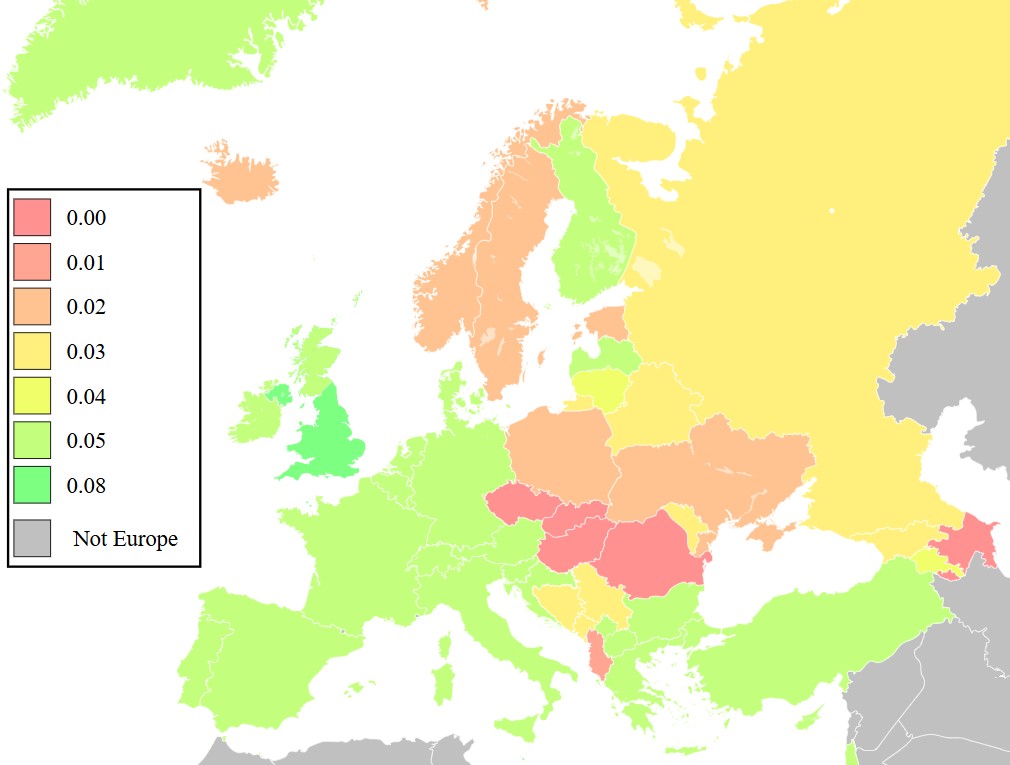
I suppose my first issue is the language. Not sure the embolding was inevitable given those bold beings described have already been on their mission for years and years, according to the anti-anti-alcohol lobby. And not sure the campaigners are necessarily more than zealous. Can one be?****** But the real issue is without justification. This is particularly the case as the first observation is a justification: a majority of Britons are against the current scheme. So, too, the second observation: the police and doctors want stricter rules. We can disagree on the quality of these justifications but that’s what they are.  It’s also worth noting that context poses an obvious issue too. England, Wales and NI have the highest permitted levels of alcohol in all of what was once known as Europe. By over 50%. Check it out. It’s simply a fact that the criminalization of drinking and driving is a reasonable response to the harm it causes. As a lawyer, thirty years ago I spoke to an appeal of a driver who blew 0.082 so these things can be close. But the bottom line is no one is being forced to stop you from drinking. Just stop driving. Maybe try walking. Or get a cab. Or a bus. Or a bike. Or a designated driver. Or another place to drink.
And with that, I am done. It is Yule and I am off to maybe have a beer or maybe shovel or just fret about being late in getting the lights up and having note bought the pressies and what about the tree and … well… as I do that please also check out, Boak and Bailey on this and every Saturday and then sign up for their entertaining footnotes, too. Look out for Stan when he feels the urge (now that he’s “retired” from beery news posts) from Budapest or wherever – as he is getting active again. Then listen to a few of Lew’s podcasts and get your emailed issue of Episodes of my Pub Life by David Jesudason on certain Fridays. And Phil Mellows is at the BritishBeerBreaks. Once a month, as noted, Will Hawkes issues his London Beer City newsletter and do sign up for Katie’s wonderful self-governing totes autonomous website featuring The Gulp, too.  Ben’s Beer and Badword has returned from his break since April so you can embrace the sweary Mary! There is reading at The Glass which is going back to being a blog. Any more? We have Ontario’s own A Quick Beer and All About Beer is still offering a range of podcasts – and there’s also Mike Seay’s The Perfect Pour. Plus follow the venerable Full Pint podcast! And there’s the Craft Beer Channel on Youtube. Check out the archives of the Beer Ladies Podcast. That’s quite good and after a break they may well be are back every month!

*But also as one who has a list of gains and savings for more than two decades that I have influenced to the point that I am effectively appellata free resource…
**But bring back the word “ciderkin” by the way.
***I have just passed the fourth anniversary of slowly getting back from a point which same me using a cane after badly wrenching a knee weeding a zucchini patch. Why? Life stressors resolved, sure. Daily small steps like stretching and exercises, yes. But most of all daily recording the data related to more and more of what I do: intermittent fasting goals (+/-17 hours a day); hours and quality slept (one mid-week sucky sleep does not make for a medical issue); drinks intake (down to 1.27 per day ave) and to do list daily chores achieved (done… next?). But by the way that whole life expectancy shift stuff has little to do with aging and much more to do with infant mortality. So relying on that to discuss the difference between retiring at 60, 65 or 70 means zippo.
****Sorry…
*****Stan also advised he will be reading these new notes from a train between Amsterdam and Budapest so everyone wave in that direction, please.
******Do Zealots look over at the overzealous and think “Jim’s over doing it a wee bit tonight… giving zeal a bad name…”

Yes, It’s Here – The Tryptophan Thursday Edition Of The Beery News Notes

Four Weeks to Christmas Day!!! O.M.G.  I have bought nothing. For nobody. Nada. Not Nuttin’. Crap. For some it is too late! Speaking of Christmas, Laura H. has some very interesting art for sale that might be perfect for your favourite beer nerd… err… expert. I invite any one of you to buy me*  this her lovely representation of barley to the right. Far more less fleeting than a newsletter subsciption yet fewer calories than a beer. I should be in marketing.

And Eoghan shared another seasonal idea, a beer advent calendar on his newsletter:

Starting tomorrow – Tuesday 25 November – and running every weekday from now until 19 December, this newsletter will become its own kind of advent calendar of a kind, with me sending a short missive each morning from one of Brussels’ 19 municipal communes. As this newsletter’s tagline goes, these will be short observations on life in Brussels, trying to capture the feel of each of these areas, and/or my relationship with them.

A great discussion erupted on BlueSky when the news broke that heled explained many of the details related to the move of America’s oldest brewing school, the Siebel Institute, from Chicago to Montreal:

The Siebel Institute of Technology, the oldest brewing school in the Americas (established in 1872), is officially relocating its operations from Chicago, Illinois (USA) to Montreal, Québec (Canada) effective January 1, 2026. The new location address will be 3035 rue Sainte-Catherine E, Montréal (Québec), near Molson’s original brewery site (1786), the oldest brewery in North America. Siebel will be co-located with the new Lallemand Baking Academy and Application Technology Training Facility. 

Siebel has been owned by Lallemand Inc. of Montreal for about 25 years so it makes sense.  The press release also explained that “[r]ecent regulatory changes in the U.S. have made it much more challenging for many of our international students, who have become the majority of our student body, to attend classes in person.” Recent grad Drew indicated that about a third of his teachers there were not U.S. citizens. Two administrative staff – the program’s “heart and soul” – may lose their positions.

Speaking of good discussion, Jeff had a talk with himself on the question of Jeff Past and Jeff Future and the question of taste:

If only we could give those pour souls in 1975 a cup of Coava coffee, or in this example a Fresh west to 1995 drinkers, it would change their lives. But that’s not how things work. Beer has evolved partly because we have evolved along with it. All you have to do is look at different beer regions to see that the process of evolution can lead to very different places. It’s quite possible that for 1995 Jeff, the clouds wouldn’t have parted upon drinking a can of Fresh West. I might have found it off-putting in any number of ways. I liked bitterness then, and body, and just a bit of cheese grater that came from the bitterness/hop-matter synergy. It was like being slapped across the face, but with the flavor of caramel malt, and I liked it. I might have thought Fresh West was a cop-out beer, all candy aromas and no punch, not like a proper beer. I’m not sure there will be a 2055 Jeff or that he’ll be drinking beer (I’ll be 87), but I wonder what he’ll be drinking? It might be something I’d find distasteful today. Hmmm…

As we ponder those thoughts here is some straight up filler:

Note #1: David caught some late autumn light at the pub.
Note #2: Another David posted some sweet photos from a recent visit to a  lambic bar, the Grote Dorst, including a Girardin eye view.**
Note #3: The Boot Inn is still there.
Note #4: Is an influencer with only 24,000 followers actually an influencer? Or just a deadbeat?

But not cheap filler*** as there was plenty to quote from under each of those links. Think of it more as “make your own Thursday beery news notes!” Invite your friends to play along!

Back to the deets as Hop Queries version 9.07 came out this week and Stan shared an interesting observation about Nelson Sauvin that sorta parallels the changes you can notice through each spring’s maple syrup production:

The Nelson Sauvin character (in a normal season) goes through a progression from i) somewhat vegetal and dominated by green fruit character (gooseberry, etc.) to ii) brighter citrus-y with grapefruit-like notes to iii) bright, wine-y and complex with passion fruit notes to iv) building tropical complexity with brighter citrus fading to v) super tropical with sweeter citrus notes to vi) tropical with light dank and solvent-y notes to vii) fading tropical with lots of weird, random characters ranging from O/G to berry fruit. Extremely late Nelson Sauvin tends to vary quite a bit from season to season and can express a wide array of characters, including appealing and un-appealing ones.

A wide array of character? Something like myself. Speaking of deets, this week’s feature in Pellicle by Fred Garratt-Stanley goes where too few stories dig into – back of house at The Fat Cat:

Only when you walk through The Fat Cat’s cellars can you truly appreciate the size of the operation. Underneath the bar there’s a well-stocked keg cellar with four cask lines, but it’s out back where the magic happens. There are two gleaming, air-conditioned cellar rooms lined with stillages, each of which holds somewhere between 30 and 40 firkins and pins that are either tapped up or settling down. Beyond the glass washers are multiple store rooms and an additional cellar, where a handful of the pub’s biggest-selling beers are racked up in huge, 18-gallon vessels. The site is vast, responding to a level of turnover established over decades spent serving reliable, perfectly conditioned cask beer. 

I have worked back of house in a playhouse, bars and restaurants, on election nights and, of course, have seen the backs of many things through law. It is all very good interviewing an owner in the front and hearing the stories but digging into the back and underneath of things where the unpretty can be found tells you what is really what. Are the corners clean? Is the staff sullen? That’s great work up there.

And The New York Times ran a story this week on Germany’s waning interest in beer:

Germans are drinking a lot less beer. “In recent years it was always 46 percent, 47 percent, 48 percent who said, ‘Yes, I drink beer,’” said Marc Kerger, president of Einbecker, referring to consumer surveys. “And this year just 41 percent. Forty-one percent is dramatic.” Alcohol consumption in Germany has been sliding for decades. But the sudden, accelerating drop has caught brewers and bar owners by surprise.

Twist in the tale from Jörg Biebernick, the chief executive of Paulaner: “Half of our sales in Germany are actually non-beer…” What are people doing if they aren’t out on the big binge? According to The Guardian, at certain exclusive clubs they may be on the little one:

For all the talk of generation Z eschewing alcohol, drinking shows no sign of dying out. There are indicators of restraint – the Manchester dessert menu features a two-sip, 60ml mini-version of an espresso martini, for £7, if you prefer an alternative to stodge – and there is “a pocket, from 26- to 30-year-olds” who drink less, says Carnie. But the bigger trend is toward “clean” cocktails, with fewer ingredients and less sugar. The multicoloured, juice-laden, bafflingly named cocktail is old hat. “I get it, because if I go to a bar, and I don’t understand the menu, it annoys me,” the barman tells me. “A cocktail isn’t cheap. If I’m spending money on a cocktail, I want to know I’m going to like it.”

And Katie illustrated another aspect of what’s been going on it terms of culture change at a personal level:

…sometimes I don’t drink because of my MH, sometimes I don’t drink because I don’t feel like it, sometimes I don’t drink because I’m training the next day and want to sleep properly. Don’t raise eyebrows, don’t make it seem like I’m pregnant. Don’t be a dick. Just say okay.

Sleep. Sleeeeeeeep. Katie is spot on in many ways. But still, also in the NYT, there are still people experiencing this sort of night:

Through the window of a dark restaurant we saw a man illuminated by a disco ball who was singing from his chest. He waved at us. We waved back. He unlocked the door and invited us in. Over a bucket of cold Singha, we sang “Happy Birthday.” The owner brought out a brownie topped with a blazing flare on the house. I apologized for the intrusion. “Please kick us out any time,” I said. He smiled and handed me Post-its and a pen. “Just make a list of songs,” he said. Another bucket of beer appeared, along with some peanuts. It was a beautiful night, and we had found something dumb to do.

I have made a point of excelling at finding something dumb to do. To the contrary, Jordan visited a tiny brewery in TO that’s won Best New Brewery in Canada in the 2025 Canadian Brewing Awards.:

At Bickford, what you see is what they have. The space, whose colour palette includes a lot of orange, can’t sit more than 30 people at a time and one assumes that on nights when Dungeons and Dragons groups come in, the only place for drinkers must be at the bar. The main space is not quite as large as a midtown one bedroom, but has been retrofitted as one of Toronto’s smallest breweries. Usually I have to guess at the size of brewing equipment, but everything is labeled. Andrew is brewing 250 litres at a time.

And David J. has shared the background story of another desi pub, the The Century Club in the Forest Gate section of East London which was born from 1970s bigotry as owner Peter Patel recalled:

“We went to the Wheatsheaf,” he recalls. “We didn’t know that in the evening it used to get bikers coming in and they chased us out.” Peter faced similar prejudice in those days when he visited a pub with friends in Lewisham, South London, where I now live.  A racist purposely spilt his drink on him, claiming Peter had tripped him up and demanded more than another drink. The atmosphere turned rancorous, the publican sided with the attacker and the Asians were kicked out despite already spending about £40 (the equivalent of £300 today). “It was a lot of money as a pint used to be under a pound then,” he says. “We did nothing at all. That’s when I decided we needed something for Asian people.”

What else? Well, the ISBFX declared an ending**** and Ed noted another sort of end of things, the end of CAMRBG:

…when a heresiarch founded a protestant beer sect called the Campaign for Really Good Beer (CAMRGB) in opposition to our mother church I was not filled with pleasure that I get from say, reading about nestorianism. I must confess that in my arrogance I had come dangerously close to advocating for something similar to the CAMRGB in the early days of beer blogging. Back then whinging about CAMRA was something we all enjoyed…until I realised some of the people were not whinging about the home team but were in fact the opposition. I repented my sins then, and despite my occasional confusion over theological matters and distaste for modernism, my faith has not been shaken.

Fine, one or three more notes:

Note #6: “This is the cheeriest Norfolk pub I’ve ever been in…
Note #7: Rogue left $16.7 million owing to others after earning only $19.7 gross revenue in 2024.
Note #8: Pink Gin in Interwar China.

Lastly, we talk a lot about beer and monks but Kathleen Willcox reminds us in DB that they established much of what we understand about wine classification, too:

After Rome fell and the Early Middle Ages ushered in intellectual decline and infrastructural decay, monastic orders did not just preserve wine culture; they elevated it. Monks across Europe, particularly Benedictines, Cistercians and Cluniacs, planted vineyards, documented practices and sustained international wine trade. Burgundy became ground zero for evolution and innovation. The observant Cistercians, who owned vast vineyard holdings, first noted how separate vineyard blocks produced different results. They were the first to record these observations, linking differences in wine to soil, climate and elevation. Their careful mapping of micro parcels on the Côte d’Or laid the foundation for the cru system and the modern concept of terroir.

There. That’s it for this week. The United States is in a gravy soaked reverie that may well last into early December. As they/you recover, please also check out, Boak and Bailey on this and every Saturday and then sign up for their entertaining footnotes, too. Look out for Stan when he feels the urge now that he’s retired from Monday slot… maybe … maybe not. Then listen to a few of Lew’s podcasts and get your emailed issue of Episodes of my Pub Life by David Jesudason on certain Fridays. And Phil Mellows is at the BritishBeerBreaks. Once a month, as noted, Will Hawkes issues his London Beer City newsletter and do sign up for Katie’s wonderful self-governing totes autonomous website featuring The Gulp, too.  Ben’s Beer and Badword has returned from his break since April so you can embrace the sweary Mary! There is reading at The Glass which is going back to being a blog. Any more? We have Ontario’s own A Quick Beer and All About Beer is still offering a range of podcasts – and there’s also Mike Seay’s The Perfect Pour. Plus follow the venerable Full Pint podcast! And there’s the Craft Beer Channel on Youtube. Check out the archives of the Beer Ladies Podcast. That’s quite good and after a break they may well be are back every month!

*…or, yes, anyone you care for than me… if that’s even possible!
**I got a couple of these well over a decade old, the remnants of the stash. probably should open one to check see.
***Or… actually… I don’t know what to think. Hope it was worth it.
****As in read to the ending…

Your Super (Not All That Scary) Boo-tastic (But Without Any Fake Blood Splatters) Halloween Week Beery New Notes

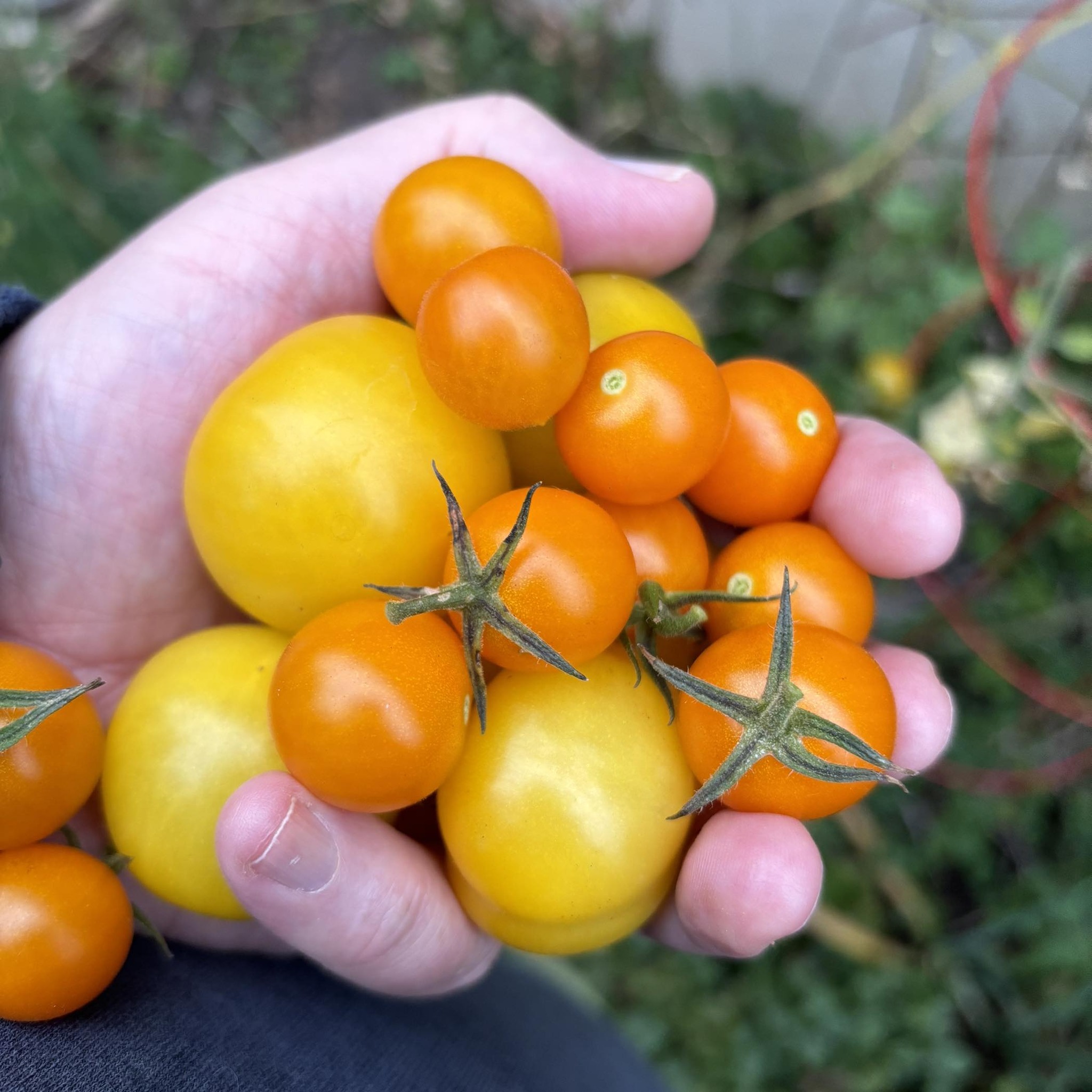
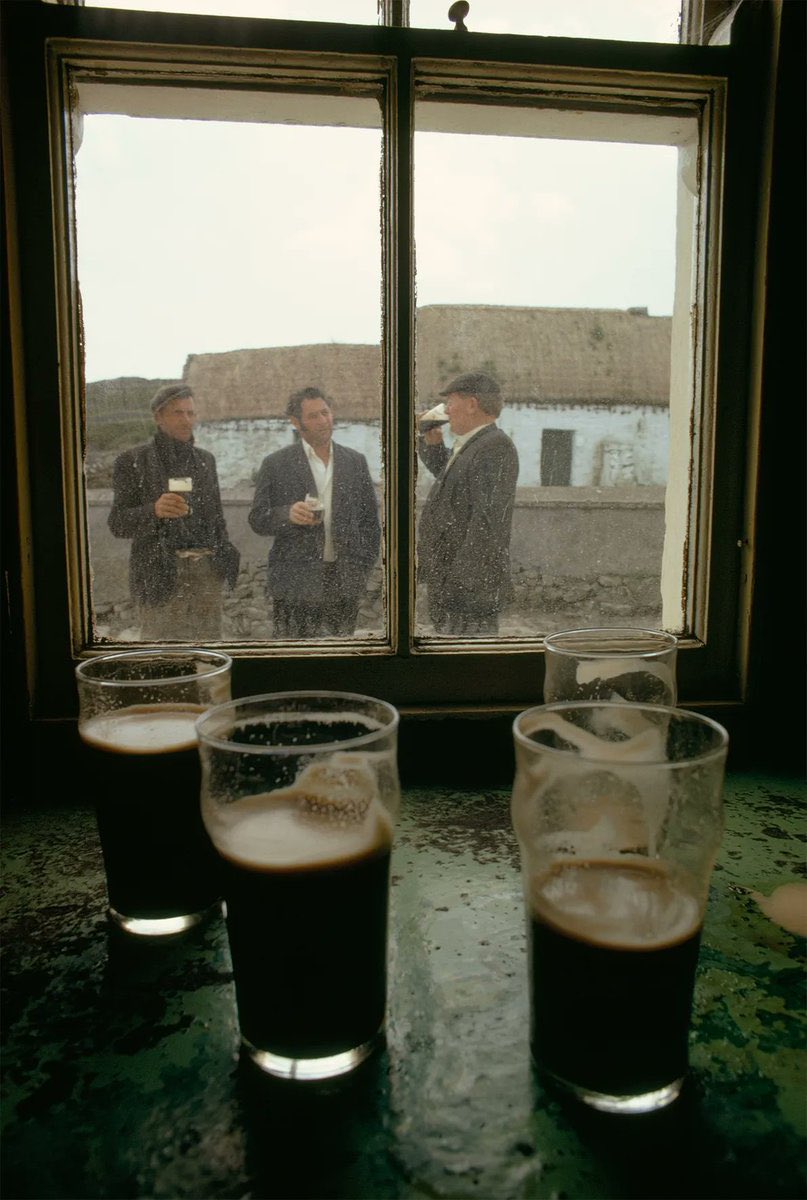
Frosts? Yup. Green tomatoes brought in? Check. Furnace? On. It’s that time of year. Darker beers. Browner liquors. Higher natural gas bills. I feel a bit like the unnamed gent in the painting, “A Man with a Pint” from 1932 by Fred Elwell. Layered clothes. Sitting in a lower light. Pointing at things in newspapers and telling the person across the table about it. I feel badly for the lad. He just missed out on the first wave of beer blogging by about seventy years so, given that, all he could do was sit in pubs, pointing at things in newspapers and telling the folk who were with him about it.

Before we get into the newsy news, perhaps speaking of him… and even maybe me, The Guardian shared a story this week on hangovers and aging and what’s going on:

The liver breaks down alcohol with the help of enzymes, but as we get older it produces fewer of them, meaning toxic byproducts such as acetaldehyde – the compound responsible for many hangover symptoms – linger in the body. It’s not just the liver. The body’s water content drops by about 5% after the age of 55, partly because levels of muscle, where a lot of it is stored, decrease. Less water means alcohol is more concentrated in the bloodstream, and dehydration caused by its diuretic qualities – a key culprit behind hangover headaches and grogginess – hits harder. Kidney function also declines with age, slowing the removal of waste products. “You get this buildup of waste products in the body that have a longer circulating time to exert their effects…”

Tell me about it! Scary. Getting back to with the ghosts and ghouls theme, The Beer Nut has put on his STASH KILLER! costume this week and has put together an exploding can special post:

I don’t know why I even had these. It certainly wasn’t with the intention of seeing if they improved with age: the styles involved aren’t really built for that. This summer’s warm weather resulted in some warped cans, and I lost a few which ruptured, so I took that as a signal to try these out before they explode completely… For the most part, these were better than I expected. While of course I don’t recommend that anyone age pale ales or hoppy lagers in the hope of improving them, not least because of the risk of explosion, it seems it takes a lot to properly ruin a beer once it’s in its aluminium jacket.

BREAKING PERRY NEWS!!! A solid rebuttal from Barry Masterson this week in Cider Review on a statement by cidermakers Westons declaring that perry is dead!! and using the term “pear cider” instead:

One would think it is incumbent upon established (and let’s admit, pretty large) producers like Westons to protect and promote the uniqueness of perry, not wash it away for the sake of a quick sales boost. The move is especially troubling coming from a company that touts its family history and traditional production methods. You cannot claim authenticity while simultaneously erasing the very tradition that underpins your reputation. Rather than declare perry “dead,” Westons should lead the way in educating new drinkers about its heritage and distinctiveness. Younger consumers are curious, discerning, and increasingly interested in authenticity and provenance.

Quite right. We can’t even get perry in Ontario – but I wouldn’t be buying anything called “pear cider” if it was for sale here. Strikes me, like “Canadian Sherry” or “California Burgundy”, as a sign… and a sign that says “beware!“* By the way, James Beeson wrote the story in The Grocer about Weston’s decision to change the name and dumbdown the drink – and is now getting grief from a key trade association which seems to be a bit confused about the difference between publishing a story and being the topic of a story:

In response to the article “Perry is ‘dead’ declares cidermaker Westons” published by The Grocer on the 21st October 2025, the Three Counties Cider and Perry Association (TCCPA) launch their Perry is Alive campaign. Westons’ justification for their removal of perry from their labelling is to increase their sales figures. The TCCPA believe this dismissal and removal of language to be damaging and a danger to the relationship drinkers have with the rich history and heritage of perry, pears and the land they come from.

And it’s all about the orchards this week as Pellicle‘s feature is a portrait of Virginia’s Diane Flynt of Foggy Ridge Orchards penned by my fellow Tartan Army follower, Alistair Reece:**

Sitting on the patio overlooking the lush verdant slopes of the orchards, the creek—from which mist rises in the morning, the inspiration for the cidery’s name—in the distance, Diane and I talk about apples, farming, and the making of cider. “It’s not just apple cider varieties—that’s one thing—it’s apples grown for cider,” she tells me. “When I bought Goldrush, I paid in advance for my apples and said ‘I will buy every apple on that tree, but I do not want you to pick them until they are falling off the tree.’ That’s growing apples for cider—they have to be dead ripe on the tree.”

That right there is a nice nugget of knowledge. And, speaking of the sensible, there was a measurably more reasonable response*** to that NYT item was this by Tom Dietrich in Craft Brewing Business on the four steps to “save” craft including one approach to improving the branding:

A big reason “wacky” beer names exist is because the beer trademark landscape is more crazy and crowded than a New Found Glory mosh pit (millennial reference alert!). If you’re applying to register a beer mark, your mark can’t be the same as or similar to any other mark for (a) beers and breweries, (b) wine and wineries, (c) any other spirits or alcoholic beverages or mixers, and (d) bar and restaurant services… In a crowded industry where creative names are increasingly hard to come by, understanding how to lawfully identify, clear, and acquire abandoned trademarks can be a competitive edge. 

Another sensible nugget of knowledge. And, continuing the theme, while the periodic column from Pete Brown in The Times can be a bit structured given its tight bit of space some weeks, this time his theme of twelve great London pubs with £5 pints provided for a bit more leeway for neatly balanced comment:

This reinvention of the happy hour is surprisingly widespread. Every pub in the Brewhouse & Kitchen chain has its own on-site brewery. The two currently open in London, at Hoxton and Highbury Corner, fill up in the evenings, when pints cost £6-8. But to get people in during the day, the pubs sell their own cask ales — usually a best bitter and a session IPA — for £3.50 before 6pm…  “We have to recognise what session drinkers can afford.” Most pubs aren’t trying to rip you off. They know that cheaper pints mean more customers. It’s far easier to find the £5-ish pint in north, east, and southeast London than in the west… But if you explore, especially via Overground rather than Tube, you’ll find pints in London at prices that make even a Yorkshireman happy.

Good advice. See also Ruvani at Beer Professor and her sensible recommendations for everyday beers. Exercise your right to choose when to drink. And what! Or where!! Like Martin who enjoyed himself at the posh confines of Ye Olde Bell in Nottinghamshire: “You need to walk past several interception points where you feel you might be asked “Can I HELP you Sir…” Or like Katie who was in Koblenz, studying the scenery:

I stare into the shiny window of a cigar cellar for quite a while before turning down a side street to find Spritz Atelier, a brand new bar specialising in fancy cocktails. I order one made with a local quince liquor called Kowelenzer Schängelche and watch from the window as a man finishes his workday with a take-out spritz of his own. He sips from the straw as he pushes his bike down the cobbled street, before disappearing out of sight.

You don’t even have to be there to choose whether you would want to be there. Consider Boak and Bailey‘s thoughts on the Prospect of Whitby as genius loci:

A few weeks ago, Ray visited The Prospect of Whitby with friends and had the usual experience of too many tourists crammed sharing a generally uninspiring chain pub atmosphere. Even in that context, though, there’s something magical about drinking a pint of Old Peculier while looking out over the water while the novelty noose set up for the amusement of visitors swings in your peripheral vision. It gets better again when you detour up the side of the pub, pass through a gate, down some hazardous steps, and onto the beach at low tide. There, the full power of The Prospect really hits you. Not least because you’ve seen this view a thousand times.

Changing themes with wanton abandon, I am enjoying this year’s continuing strained arguments about youth today. Like this in The Morning Adverstiser, taking the “drinking differently” approach:

While younger consumers remain less likely to drink than older age groups Lumina’s data shows more 18- to 24- year olds now describe themselves as drinking ‘often’ or ‘sometimes’ and fewer arre opting out completely. The long term fall in alcohol participation has plateaued.

The article goes on to then describe how younger people are, you know, still less drinking of alcohol. Don’t get me wrong. It’s obvious that turning social settings like pubs and tavs into something other than boozers is healthier and economically beneficial. I am all for skittles. But drinking low to no alcohol beers is not maintaining “alcohol participation.“**** It’s reducing it while maintaining social participation which, as I say, is really good. Anyone who actually believe the clinky-clinky is a fundamental social bond or, you know, builds community as the wise said in 2014 is fantasizing.

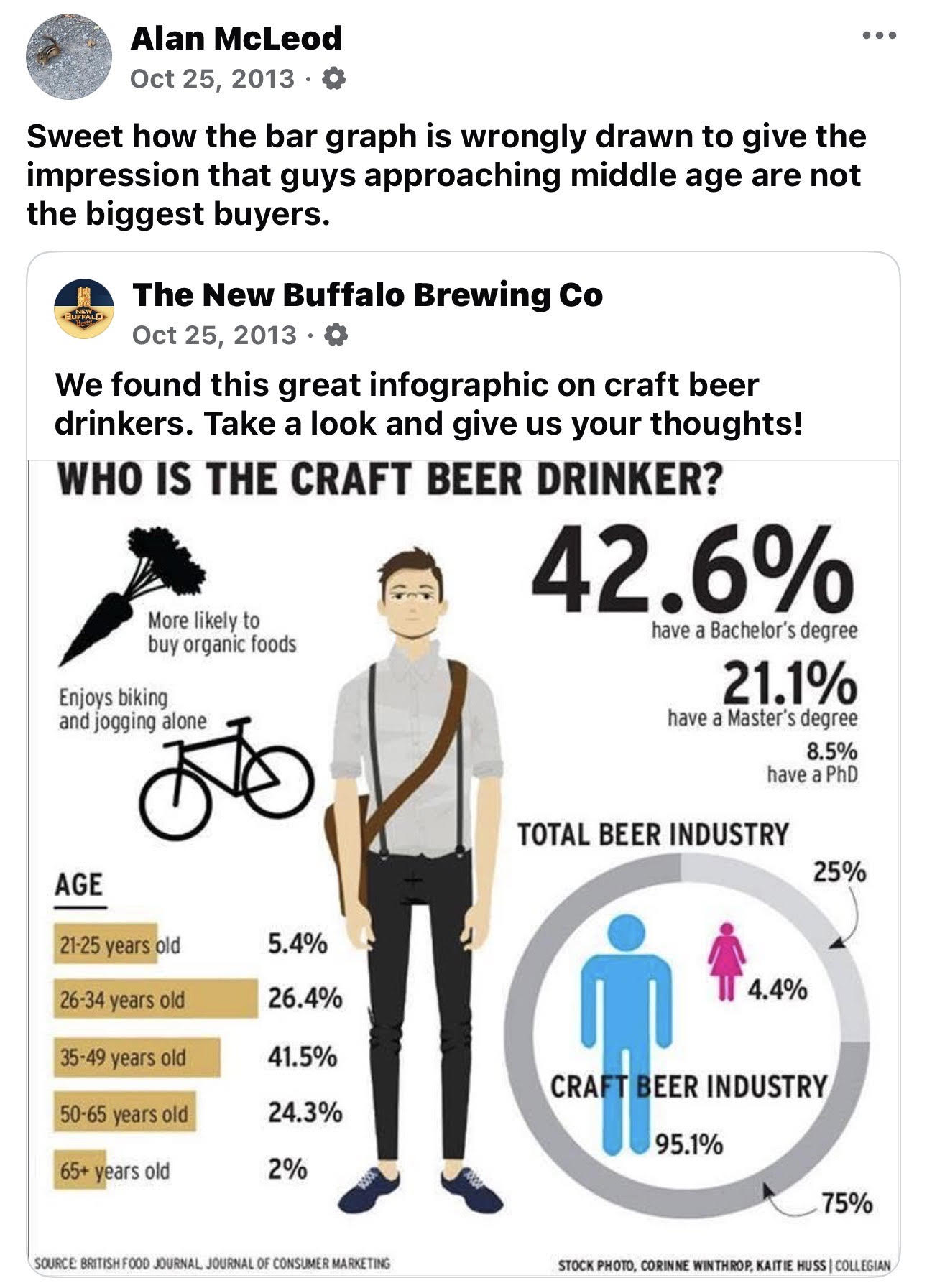
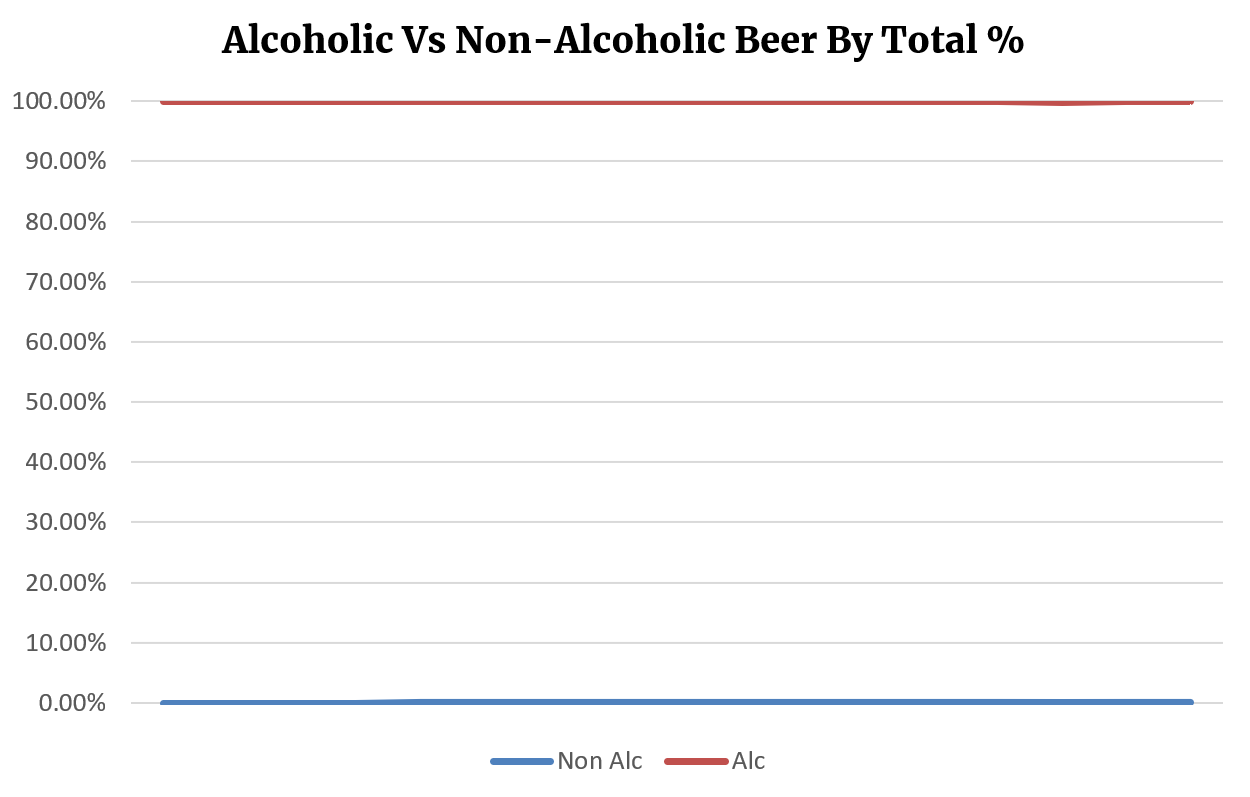
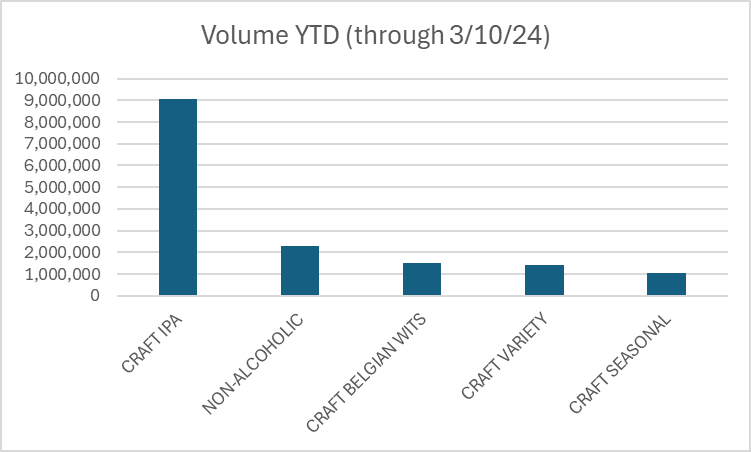
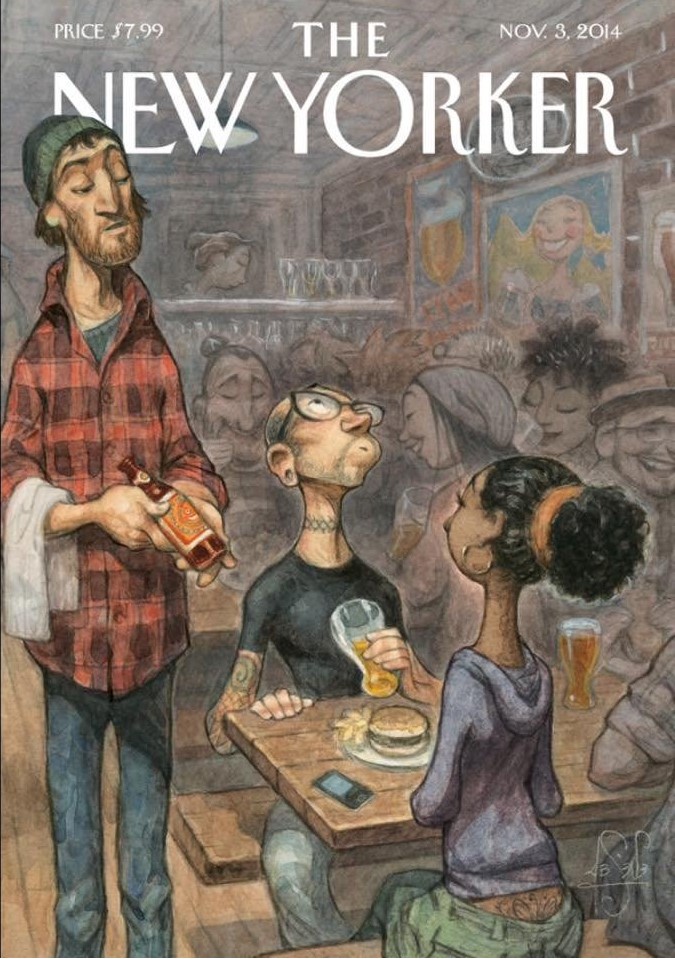
Which reminds me of something else. Over on FB, a memory from twelve whole years popped up in my feed this week and it gave me some perspective on that whole “the young folk ain’t drinking craft no more” story. Look at the brown graph in the lower left. It was created with data from the British food and marketing trade associations. In 2013 I was irritated by the incompetent bar lengths in the graph. In 2025, I am more interested in the percentages.  Keeping in mind these are UK figures, they indicated that two-thirds of craft beer drinkers at the time were over 35. Those people are all over 47 now.  Only just over 5% of people who were 21 to 25 at the time admitted to drinking craft beer. So when was this time when “the young folk drinking craft“?***** (This diagram from 2014 might suggest the same was not the case in the New York of the very next year. Maybe.)****** But whatever it was then, Stan is wondering if a key aspect of what made craft interesting back then has disappeared:

Will Curtin said the brewing landscape has changed significantly over the years, and believes that the traditional “garage brewery” model may be waning. “I think sort of the age of a garage brewery is sort of, if not gone, going,” he said.

I wonder if the cause of the going is not so much the loss as the lack of a compelling replacement. Whatever happened to the shock of the new? Well, unless you are in Spain next year, when drivers may get a shock:

Tourists, be warned:  Spain is proposing stricter drink-driving laws, and they could be enforced by the end of the year. The country’s Dirección General de Tráfico (DGT) wants to introduce new alcohol rules for all drivers — including those on bicycles and e-scooters — by the end of the year. The aim is for a universal alcohol limit of 0.2g per litre in the blood or 0.1mg per litre in breath. That would mean almost zero alcohol consumption before getting behind the wheel. Even a small glass of wine or beer could put you over the threshold.

That’d be one-quarter of the limit we face here in Canada. Be prepared. You can practice the pronunciation of these handy phrases for your next trip to Spain: “Propietario! ¿Duermo en tu cobertizo? Hmm ¿Tal vez debajo de tu árbol?

One last thing before we go. There was a call for papers from the people of Beeronomics:

The 2026 Beeronomics Conference will take place at ESSCA School of Management, Bordeaux, France, 24-27 June. Main panels and sessions will be held at the ESSCA Bordeaux Campus. The Conference Organising Committee, led by Gabriel Weber and Maik Huettinger, welcomes all high-quality research on the economics of beer and brewing. With a strong interest in interdisciplinary research, we are looking for submissions covering topics including…*******

Check it out, people. And with that, we are done. Adios and farewell to October! Next week the World Series will be over, Halloween will be in the past and I probably will have ripped up and rammed all the tomato plants in the compost bin. In the meantime, please also check out, Boak and Bailey on this and every Saturday and then sign up for their entertaining footnotes, too. Look out for Stan when he feels the urge now that he’s retired from Monday slot… maybe … maybe not. Then listen to a few of Lew’s podcasts and get your emailed issue of Episodes of my Pub Life by David Jesudason on certain Fridays. And Phil Mellows is at the BritishBeerBreaks. Once a month, as noted, Will Hawkes issues his London Beer City newsletter and do sign up for Katie’s wonderful self-governing totes autonomous website featuring The Gulp, too.  Ben’s Beer and Badword has returned from his break since April so you can embrace the sweary Mary! There is reading at The Glass which is going back to being a blog. Any more? We have Ontario’s own A Quick Beer and All About Beer is still offering a range of podcasts – and there’s also Mike Seay’s The Perfect Pour. Plus follow the venerable Full Pint podcast! And there’s the Craft Beer Channel on Youtube. Check out the archives of the Beer Ladies Podcast. That’s quite good and after a break they may well be are back every month!

*See: Perth Pink.
**Note: not aka Alice DuRiz!
***Just for example, see same publication in 2023 making the pretty much the same point but in 2025: “HOW DARE THEY!!!
****Customer: “I’d like to participate in some alcohol please” Bartender: “I shall be delighted to perloin you said chemical…” (Mutual winkies) CURTAIN!!!
*****By the way, New Buffalo seems to have stopped brewing a year after they published the diagram before getting caught into a legal dispute.
******You know, sometimes a parenthetical sentence is a good as a footnote. No, it really is.
*******… topics including (i) trends and driving forces in local and global beer production, consumption, and distribution; (ii) management, marketing, market structure and industrial dynamics, individual beer choice, health and well-being; (iii) policy and regulations related to the beer brewing industry; (iv) impact of beer on society and culture (v) environmental issues affecting beer and brewing and (vi) other stuff like food industry and alternatives to beer. You could write something about one of those. Birdeaux is nice in June. Why not? Give it a go.

The Thursday Beery News Notes For That Lull Between Canada Day And The Fourth Of July

1780s Loyalist soldier reenactors at Bath Ontario Canada Day parade

Living on a border makes you aware of the similarities and differences. Even when the border gets more opaque than usual. As illustrated, we saw musketeers but in red and green not the more often seen blue. Most years, especially when the fourth of July falls on a Friday, I’d have gotten my butt down in a seat at the Syracuse Mets AAA stadium, eating a snappy griller white hot, watching the game then sticking around for the fireworks. Not this year. Due to… conditions. So maybe this Canada Day 2025 last Tuesday was a bit more noted and acted upon. We took in a parade even. One with reenactors with muskets. Then we made burgers.

Speaking of… conditions, I really like this bit of thought on meaning of the stubby and its effectiveness as an economic tool:

By 1962, the year after the stubby was introduced, Canada’s Big Three brewers controlled about 95 per cent of the Canadian beer market… When the stubby was made a packaging requirement for all beer sold at its stores in Ontario, Thompson argues, the Big Three effectively locked all foreign brewers out by creating an extra hurdle for entry into the market. “To bottle in the stubby, [American brewers] are going to have to make their own line at their plant to bottle specifically for Ontario,” she said, noting any cost savings for American brewers through the reusable stubby would be eaten up in transportation costs by first shipping the beer to Canada then shipping it back the U.S. for a refill. 

PS: a Caeser is better than a Bloody Mary. Fact.

image of text from Nov-Dec 1979 edition of the Beer Can Collectors New ReportGary shared a great record of the earliest days of US micro at the end of last week that he found in in the “Golden State Newsletter” column in the Nov-Dec 1979 edition of the Beer Can Collectors New Report found at the Internet Archive. That’s a snippet of the text to the right. I like the live action detail of the first encounter at New Albion:

Greg entered the barn and was surprisingly greeted by three bustling employees involved in 20th Century brewing efficiency: After labels were scraped off what appeared to be recycled Schlitz and Bud bottles, they were washed and singularly hand filled at one tap. The bottles were then hand capped and placed in cases. Boxes of Ale, Stout and Porter stood ready to be loaded onto a used Dodge pick-up truck and delivered world wide. Greg spoke to the Brewmaster (bottle filler). This informative fellow mumbled something about being retired from the Navy, liking to drink ale, and not having time to talk. Greg left.

Lovely vignette. And there’s an interesting note on the state of US drinking trends on the next page: “When color TV became a standard fixture in the home, beer drinking moved out of the bar and into the family room. Two-thirds of all beer is consumed at home—that’s 16 million six-packs a day.” This all speaks to the point made last week about the loss of reliable records – but also shows how there is still good stuff to be found.

What else is going on? Well, Laura published a great roundup from the June edition of The Session last weekend. Plenty of good reading there. David Jesudason is covering the editorial duties for July and Joey at Beer In The City is our host for August.

Line graph showing rise of wine consumption in China then a dramatic slumpYou think beer has it bad in terms of slumping sales? Look at this chart from the American Association of Wine Economists describing the rise and slump of wine consumption in China over the years 1994 to 2024. Consumption is now below 1995 levels. Mirrors the slump in new home sales there. Makes sense.  And that slump in beer has been described in a form worth sharing:

…the industry faces threats from ”sheep, parasites and wolves,” a reference to the way former Coca-Cola Co. Chief Executive Doug Ivester once described competition in the soft-drink industry in the early 1990s. “For the beer industry, spirits are wolves, winning share of throat and now pushing more directly into beer occasions with ready to drink,” the analysts said. “Energy drinks are parasites, successfully using beer distribution as a platform to sell to soft drink companies. Beer players are sheep, ceding customers and attention while beer consumption continues to decline.”

Note: lager larks. And another note about a visitor to a pub caught my eye this week, a visit in this case that took place in 1789* that still resonates today in a particular part of the world where my geneologicals place one quarter of my genomics:

When Scotland’s national bard stopped off for a drink in Sanquhar, there was only one place he found acceptable. Robert Burns liked the inn run by Edward Whigham so much that he immortalised it in verse, with At Whigham’s Inn, Sanquhar. The prominent property in the heart of the south of Scotland town has become much less welcoming in recent years and has fallen on hard times. However, the local community has now stepped in with the hope of bringing the building back into use – with a nod to the poet who found it such a pleasant hostelry.

I found this bit of social science interesting but not, to be honest, convincing. If, as we saw above, the new fangled colour TV was another nail on the coffin of the US neighbourhood bar circa 1979, are pub crawls in the UK really going to rescue of the industry today? Here’s a clip from the study’s abstract itself:

Pub crawls are a phenomenon which are part of the hospitality sector and contribute to consumer experiences within the Night Time Economy. We show the current state of knowledge in this immature field via a Systematic Literature Review methodology. Building on this we provide a novel theoretical typology of pub crawl classification based on levels of organisation, supervision/accompaniment and geography. Highlighting the processional nature of pub crawls, where consumers move through multiple individual contexts and as a spatially embedded hospitality experience, we delineate the experience into antecedents, processes and outcomes. Our analyses lay foundations for further fine-grained theorisation. 

So… more of an invitation for further investigations. Less compelling was the survey discussed in Decanter, another effort to explain away the younger set not being the boozers their parents were:

Gen Z is known for turning up its nose at alcohol, but more young adults in this group may now be enjoying a drink, according to an international survey by drinks industry research group IWSR. In March 2025, 73% of Gen Z adults said they had consumed alcohol in the previous six months, found the IWSR Bevtrac survey.  That’s up from 66% when the same question was posed two years ago. IWSR said its Bevtrac survey included legal-drinking-age adults in 15 markets and defined Gen Z as up to 27 years of age. In the 2025 survey, 70% of Gen Z respondents in the US said they had drunk alcohol in the past six months, up from 46% in 2023.

It would be very helpful if the methodology for these sorts of stats wasn’t (i) a self-declaration about (ii) something you did once maybe in the last half year. A generation that has a drink a few times a year is not going to be the savior for anything more than pub crawls could be. Aside from the “rootin’ for booze” bias, isn’t the real story still that this story isn’t really a story?

Speaking of non-story, Alistair is in a rut but he is going to work himself out of it:

…here is my crazy idea, I am just going to write whatever random boozy thoughts pop into my head each and every day for the rest of July, including when I am in Florida on vacation. Maybe I will find something new in the Austrian newspaper archive that I love to trawl, maybe it will be a few lines of total tosh that just needs someone to comment that I am completely wrong, or right, or that you’ve been feeling the same but unable to say it. Maybe I won’t stress myself out…

The story about Justin Hawke semi-formerly from Moor is odd and, I’m going to admit, made up of threads some of which are outside of my regular reading. But nothing was missed about the “intent” that was meant.  Apparently things were known for years but now ties have severed and attendees cancelled and it all reminds me, also oddly, of Rod Stewart… who also was at Glastonbury. UPDATE: see Boak and Bailey’s on the ground reporting.

And over at Pellicle, Katie has published a story on the wines of Tenerife, the largest of the Canary Islands:

I head across town to Vinoteca Con Pasión, which has the largest selection of Canarian wine in the region. Thankfully, most are available by the glass from the shop, or from the restaurant next door. It’s from here that I buy a bottle of Listán Blanco pét-nat, made by La Orotava winemaker Dolores Cabrera… Her wines named La Araucaria are her most expressive—bottles made exclusively with indigenous Listán Negro or Listán Blanco grapes, from vines between 50 and 100 years old. Her vines are also trained in the cordón trenzado method, trailing long, woven tails across the breadth of her personal sections of paradise.

This is interesting for anyone who has spent a part of their life poring over newpaper notices and other documents from the 1600s and 1700s looking for beer references as “Canary wine” is another product you see regularly referenced. The wines of those times could well have borne a strong resemblance to what Katie experienced today. Though there are clear suggestions of the old stuff being heavy and sweet and boozy.

The New York Times in its Wirecutter column presented a set reasonable arguments from reasonably well informed people for the Teku beer glass… with an interestingly blunt conclusion:

All that said—and as we found in our own tests — most people probably won’t be able to detect significantly more flavors and aromas when they drink a beer out of a Teku compared with other glassware. It takes years of experience and training to develop that much nuance in your senses of smell and taste. But you might notice some subtle improvements while appreciating the other benefits of the glass, such as its versatility and good looks.

So my Mason jar habit remains a solid option. Speaking not of which, was it in a biography of Vita Sackville West that I read the comment from some member of the English aristocracy that he didn’t understand the Great War given all the customers from Germany who were being killed. Are the Trump immigration orders causing an analogous effect?

“A lot of Hispanic consumers are apprehensive to leave their house or … deviate from their routine or go out,” Dave Williams of Bump Williams Consulting told Yahoo Finance. “That results in fewer opportunities and occasions where beer would slot into the mix.” “The abruptness of this slowdown … makes me feel like there’s a lot more of it tied to the cyclical aspect of these consumer behaviors due to the recent ICE raids or deportation scares, whether you’re legal or not … that’s on top of the other structural aspects that beer brands in general,” Williams added.

Well, there you go. We started at the northern end of the current… conditions and ended up at the south. These are the times. As you contemplate that… again… please check out Boak and Bailey every Saturday. Look out for Stan when he feels the urge now that he’s retired from Monday slot. Then listen to a few of the now rarely refreshed Lew’s podcasts and get your emailed issue of Episodes of my Pub Life by David Jesudason on the (sometimes even but never) odd Fridays. And maybe The British Food History Podcast. Maybe? And Phil Mellows is at the BritishBeerBreaks. Once a month, Will Hawkes issues his London Beer City newsletter and do sign up for Katie’s wonderful newsletterThe Gulp, too.  Ben’s Beer and Badword is out there with the all the sweary Mary! And check out the Atlantic Canada Beer Blog‘s weekly roundup. There is new reading at The Glass which is going back to being a blog. Any more? We have Ontario’s own A Quick Beer featuring visits to places like… MichiganAll About Beer has given space to some trade possy podcasts and there’s also The Perfect Pour. Plus follow the venerable Full Pint podcast with an episode just last month!. And there’s the Craft Beer Channel on Youtube. Check out the archives of the Beer Ladies Podcast. That’s quite good but, hmm, they’ve also gone quiet this year. The rest of these are largely dead. And the long standing Beervana podcast …except they have now stood down.  As has We Are Beer People. The Share looked to be back with a revival but now its gone quiet. And the Boys Are From Märzen podcast appears suspended as does BeerEdge, too. VinePair packed in Taplines as well. All dead and gone.  There is more from the DaftAboutCraft podcast, too. Nope – that ended a year ago.   The Moon Under Water is gone – which is not surprising as the ask was $10 a month. Pete Brown’s one cost a fifth of that – but only had the one post. Such is life. Such is beer podcasting and newlettering!

*That’s a nice bit of verse: Envy, if thy jaundiced eye / Through this window chance to spy / To thy sorrow thou shalt find / All that’s generous, all that’s kind / Friendship, virtue, every grace / Dwelling in this happy place.

E

Session #147: More Poems Please!

It’s the day for The Session again, the last Friday of the month. Our host this month is Phil Cook, a New Zealander in the beer trade who lives in Australia. He posed his question for this month’s consideration over at his blog and it’s all about art:

Feel free to interpret “art” and “fiction” as broadly as you like. Film, TV, music, games, poetry, prose, painting, a particularly pointed piece of graffiti; whatever. Don’t feel obliged to pick a single favourite. A random grab-bag of examples would be wonderful — though a carefully-selected set that illustrates a trend or theme is of course welcome, too. I’d even be curious to hear about a beer or pub that came to you in a dream, if it felt like it captured something about its subliminal force in culture or on your own specific consciousness.

Phil was good enough in his announcement of the topic to remind me that he was struck by Gord Downie’s rendition of the poem “At the Quinte Hotel” by Al Purdy, something I shared years ago. Here’s Al Purdy’s own rendition.  Around that time, I also received what was unquestionably the highest award a Canadian beer blog writer can receive for their sensitivity as my original post about Purdy’s poem received this comment from none other than the host of CBC TV’s Man Alive Roy Bonisteel back in 2007, offering a bit of background on the poet and the poet:

I like the beer blog….it’s very good. In interesting fact that a lot of people don’t know is that although Bellevillians are very proud of Al Purdy’s poem about the Quinte Hotel…it is not the Belleville Quinte. It is the Trenton Quinte…now called something else…where Purdy drank. At this same time I had a room at the Quinte when I was driving cab and working at the Courier. At that time we didn’t know each other…but year’s later over many a beer, talked about the fact that we had both been there at the same time. Tell your friend I’ll keep up with his blog.

We now understand that the Quinte of Trenton became known as The Sherwood Forest Inn, a peeler bar, before it burned in 2012. Such is the way of the world. There are somethings even poetry can’t save us from.

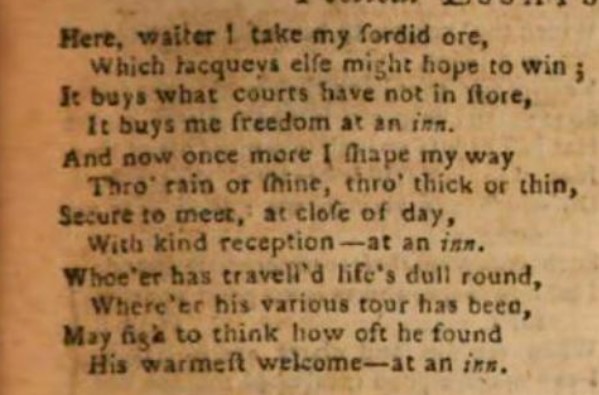
And as further proof (if it was needed… or even possible) of my status as a sensitive man, I posted a number of passages from poems about beer back in 2007.   It included this passage from a poem I have admired since I was in undergrad, William Shenstone‘s “Written At An Inn” from 1758:

Here, waiter! take my sordid ore,
Which lackeys else might hope to win;
It buys what courts have not in store,
It buys me Freedom, at an inn.

Freedom. Wonderful thought right there. Click on that image to see the whole thing as it appeared on page of Volume 27 of The London Magazine, Or, Gentleman’s Monthly Intelligencer at page 255. And you know it wasn’t just poems being read about drinking in inns back then. There were poems written that were meant to be sung in the taverns and inns of the eighteenth century.  I’ve posted a few over the years but I think my favourite, set to a very familiar tune, was “Nottingham Ale” because, as explained in the 2017 post under that link, I was familiar with the tune. But that was not the only one. In the very next year, I wrote about “Dorchester Beer” which includes this rueful geo-political verse offering an alt-history of the lead up to the American Revolution:

E’en our brethren across the Atlantick, could  they
But drink of this liquor, would soon be content:
And quicker by half, I will venture to say,
Our parliament might have fulfilled their intent.
If, instead of commissioners, tedious and dear.
They had sent out a cargo of Dorchester-beer.

I wonder if they’d be open to that trade these days. Hmm. And I would be failing in my sensitivity on this point if I didn’t finish with an acknowledgement to Beer Daily Haiku which ran from 2005 to 2013 during the Golden Age of Beer Writing. That was a great thing to read over the first coffee each morning. The Wordle of its day.

What happened to it all? Why has beer ceased to inspire the pen? Is it because we have traded haze where once was clarity? I don’t know. Have we lost our capacity for sensitivity? I wonder. One last bit of verse before you go about your weekend, this from Keats’s Ode to Autumn which I wrote about in 2003 again thinking back to undergrad days when I was struck by this poet’s thoughts on the plenty of harvest and, in the end, harvest’s rewards:

Who hath not seen thee oft amid thy store?
Sometimes whoever seeks abroad may find
Thee sitting careless on a granary floor,
Thy hair soft-lifted by the winnowing wind;
Or on a half-reap’d furrow sound asleep,
Drows’d with the fume of poppies, while thy hook
Spares the next swath and all its twined flowers:
And sometimes like a gleaner thou dost keep
Steady thy laden head across a brook;
Or by a cyder-press, with patient look,
Thou watchest the last oozings hours by hours.

Good work, Johnny K. Now I am off. Gotta go plant something. And then maybe have a drink.

Your Beery News Notes For The Start Of The Last Month Of Spring

Here we are. Growing season. Well, it’s been hovering between 11C and 14C in these parts mid-day so perhaps not very much growing but at least there is no frost. That’s my Pinot Noir there. I hacked out most of the Concord this year to let the swankier sibling get more sunlight. That pink edging fades soon enough but it’s a great guide to assist with what lives and dies. Is that why I garden? To judge? To dispense edict? That and salads, sure why not?

First, and sticking with the theme vinous, Katie Mather has been reporting from the front lines of the wine trade and has a discovery to share – well, two after her thoughts on what was once all in black is now very much back:

Ice in wine is becoming a *thing*. Don’t believe me? Do a couple of shifts in your local pub. Over the past year I’ve noticed more and more women (it has been primarily women) ordering white or rose wine and insisting on having ice in their glass. Perhaps it’s because they don’t really like the flavour, and the ice dulls it down. Perhaps pub fridges aren’t cold enough. Perhaps — and this is what I think — it reminds us of being on holiday. Oh god, I am doing everything I can at the moment to pretend I’m not really here. Aren’t you? The world is a nightmare, a giant morality eclipse, and if a little clinky-clinky in my glass helps lift me out of it even for a second, I am going to do it. Black Tower is an ideal icy wine, because it’s heavy in syrupy flavours. And also because you don’t really want to taste it.

Viva cheap sweet wine on ice! Our government is also all about the viva! This week as there was good news for good beer this week was in Ontario’s provincial budget:

The beer, cider, and premixed cocktails you buy at the LCBO could be a lot cheaper as of August 1, with the government cutting the markup rates the LCBO charges for those products. So long as manufacturers don’t increase their prices, the cost of beer, cider and ready-to-drink beverages could drop between 21 per cent to 50 per cent. For example, the government is slashing the markup on Ontario craft beer by 50 per cent. It’s a move that is going to further impact already falling revenues. LCBO revenues are down sharply since the Ford government started allowing the sale of alcohol in convenience stores. 

Really? Booze prices could drop 50%? Really?? Jordan ran the numbers and noticed that is not quite correct:

…for every six pack sold, the LCBO gets $1.836…  That’s not really helpful math since most breweries sell 473 ml cans. Translated, that’s $0.0939 cents per can. Going by the earlier example of 2,000 hL of cans sold, you’re actually doing better by about $39,700. If you were a larger regional like a GLB or Nickel Brook doing 10,000 hL in cans, you’re looking at a couple hundred grand. The government gets a nice win, because they can say they cut a tax by 50%. No one really wants to understand what I just explained, so there won’t be any probing questions about tax vs. retail markup.

Interestingly, the budget also weakened the regulations around what arrangements qualify as craft beer, as changes “would permit microbrewers to enter into a contract with another brewer that is not a microbrewer” while retaining its status.  Don’t know who in particular will benefit from that change…

There was also not so great beer related news from Ontario. Unlike those high hopes I mentioned a couple of weeks ago, on Monday morning I found my Leafs jersey on the basement floor. Inside out. In a bundle. In the corner. You know, it’s reasonable – mathematically speaking – to say that the only team that loses in the seventh game of the quarter finals is the fifth best team in the playoffs. Didn’t feel that way. They certainly did better than I’ve done in the Pellicle FPL pool where me, I sit by myself at 36th out of 55 in the table – but at least I didn’t do what people at the game did:

On Sunday, the Florida Panthers ran the Maple Leafs out of their own building to the tune of a 6-1 blowout. It’s the second 6-1 loss in a row the Maple Leafs have sustained on home ice in this series and Toronto’s 2025 Stanley Cup hopes have officially ended thanks to this defeat… It’s safe to say that Maple Leafs fans have had enough of the disappointment. In the middle of Sunday night’s Game 7, multiple jerseys were thrown onto the ice and beer was reportedly thrown at Toronto’s bench as well.

I’ve seen baseball fans throw beer onto the field in Toronto but never hockey fans. At the prices they charge, it means they have to have been seriously pissed off.*

Could be worse, of course. You could be a US craft beer exporter who had to listen to this sort of weirdly denialist argument from a rep of the US Brewer’s Association as reported in VinePair:

the in-person attendance of Chinese and Canadian buyers in last month’s 2025 Craft Brewers Conference as proof of the “lasting reputation of U.S. craft beer for quality and innovation — even amid ongoing trade uncertainty for markets,” while conceding that importers from those two countries in particular have scaled back or stopped down on ordering in the opening months of Trump’s trade war. This, after craft exports saw a 15 percent decline in 2024, outpacing the category. Still, Parr argues, “for breweries with a long-term, quality-driven approach, global markets continue to offer meaningful opportunities.”

That’s a funny thing to say. Seeing as the largest importer in the world is our very own LCBO and (i) that 15% drop was pre-Trump and (ii) for the last ten weeks with no sign of a pending policy reversal, the LCBO has entirely cut off your all your exports (in coordination with other Canadian booze commissions), well, I am not quite sure where the “meaningful opportunity” is to be found in Canada. But, you know, it’s the BA! Beer Market’s Insights continues to tell a different story for US trade:

For 4 weeks, beer biz looks a little better. Down 2.9% for 4 weeks thru 5/4, -4.6% for 12 weeks. Wine down just 2% for 4 weeks (including Easter this yr), spirits up 5.6%.

By “a little better” read “not as bad” perhaps. Note the reverse is happening in the UK with the news this week of a UK-EU trade deal as noted in TDB:

Miles Beale, chief executive of the Wine and Spirit Trade Association welcomed the reset, noted that anything that improves the relationships and practical arrangements with the EU is “great news”. However he warned that “as ever the devil is in the detail” and he looked forward to seeing the legal texts over the coming weeks. “For the UK wine sector, where imports account for 99% the wine enjoyed by UK consumers, we want to ensure that any new rules and obligations work for the UK market,” he said.

Well, that’s looking like actual opportunity. Viva! Speaking of which in only the most oblique sense which I will let you figure out on your own, this week’s feature in Pellicle is a postcard from local author, Ewen Friers, who introduces us at a pace to the pubs about the town, as illustrated by some lovely photos from MC Himself:

Quite rightly, Kelly’s and The Crown have changed little over the years, but that’s not to say Belfast and its beer is an entirely fixed concept. The place brims with lively modern bars like any small touristic city in Europe, and new takes on age-old traditions have been popping up more and more. This is true for smaller breweries too. The now sadly defunct ABV Festival and the aforementioned more recent Belfast Beer Festival have been crucial in pulling the beer environment forward. Whilst some small breweries have come and gone in recent years, like the much missed Farmageddon, the scene has continued to grow.  

Entirely contrary to that sort of familiar stability and reassuring comfort, Evan Rail followed up on that weird SNPA as ESB story for VinePair this week, sensibly seeking some common sense:

For Chris Williams, competition director at World Beer Cup, SNPA’s win as an ESB shows how well Sierra Nevada Brewing Co. understood the character of its beer, as well as the changes in the pale ale category over the years. For about a decade, the competition’s otherwise English-focused ESB category has included an additional set of style guidelines for an “American-style ESB” subcategory, into which Sierra Nevada Pale Ale fits perfectly. “They looked at the specs, they looked at how their beer stacks up, and they were like, ‘That American-style ESB category is a match for our beer…

I’ll ruin Evan’s punch line: “…fans didn’t seem to notice.” Which is definately fair comment… even maybe when taken out of context. For me the whole thing is a bit of a mini-mummer of a muddle that mainly points out that it’s hard to have 1257 styles (or so) and sub-styles (or whatever) then have them shift around over time and space, then expect a clear outcome… or even a useful one! Once again, it’s good to remember this sort of judging is a nice hobby interest for all the participants. Jeff added his thoughts but, I have to say and with respect, the entire discussion has only convinced me again that the main goal of this sort of approach to style is the perpetuation of this approach to style.  Does that qualify as what the kids these days are calling propaganda? Me, if I have a SNPA in front of me, I am really only concerned with the taste of the thing in front of me, not whether it has hit the bullseye on the shifting dart board of style. Still, it’s quite a nice hobby for all involved. Nothing wrong with that.

Speaking of what is in the glass itself, still on the run… err… on vacation, Boak and Bailey have been drinking a lot of lager and have come to some conclusions as discussed at and within their monthly newsletter:

When we’re drinking these half-arsed efforts we find ourselves thinking: “Why didn’t they just give that tap over to a lager from another craft brewery that knows what it’s doing? Or to the best of the local mainstream products?” This would, at least, demonstrate good taste. It’s an opportunity to ‘curate’ and to guide. And, yes, some of the national brands in Romania and Bulgaria struck us as pretty decent beers – as if they’ve been overlooked for so long that someone forgot to make them bad. We’d be happy to see them in offer in craft beer bars. If your £6-a-pint in-house lager isn’t better than something we can buy at a normal pub for half the price, or pick up from a cornershop in a scuffed brown bottle for a quid or two, what’s the point?

And The Beer Nut has been considering what to have in his glass (though not yet pouring a cheap sweet wine on ice) as he finds himself right here at the very toe tippy verge of another hot summer, and also drew conclusions:

Probably to be expected given the lactose, it tastes mostly like lemon curd, and can only make the woolliest of claims to being sour. It’s barely even bitter. Half way down I decided to add ice, and honestly I think it improved it. The flavour became less blurry, more spritzy, although less beery as well. I suppose that with “limoncello sour” it’s unsurprising that it would taste quite like an alcopop. As such, it’s a nice and undemanding summer drink, but it doesn’t press the beer buttons. And doesn’t even know where the sour buttons are. I’m unimpressed but I see what they were trying to do.

Is that so very far from Black Tower on ice?  Hmm? Well, except for the price I suppose.

Finally, a fond farewell to actor George Wendt who played TV’s favourite guy at the end of the bar, Norm. His obit in The Hollywood Reporter including this explanation of how he managed the role:

The portly, curly-haired Wendt was self-deprecating about his well-honed delivery, contending that the toughest part of his job was drinking the “beer,” a warm, flat, non-alcoholic concoction that was layered with a pinch of salt in every mug to create a TV head. “There I was slamming those down for a whole day. It not only tastes disgusting, I was afraid of keeling over from high blood pressure,” he told The Washington Post in 1985. “Then I got the knack. I didn’t have to put all those brews away. It only mattered when the camera was pointing my way. It took a couple of years, but now I watch the camera. That’s how I make my money. That’s acting.”

Well, there you go. See you, Norm!  And until we (not George and me… you and me!) meet again, please check out Boak and Bailey every Saturday (…as long as all their holiday fun doesn’t get in the way…) and Stan (….not quite every week but yes, he was there this time…) each and every Monday. Then listen to a few of the now rarely refreshed Lew’s podcasts and get your emailed issue of Episodes of my Pub Life by David Jesudason on the (sometimes even but never) odd Fridays. And maybe The British Food History Podcast. Maybe? And Phil Mellows is at the BritishBeerBreaks. Once a month, Will Hawkes issues his London Beer City newsletter and do sign up for Katie’s wonderful newsletterThe Gulp, too.  Ben’s Beer and Badword is out there with the all the sweary Mary! And check out the Atlantic Canada Beer Blog‘s weekly roundup. There is new reading at The Glass which is going back to being a blog. Any more? We have Ontario’s own A Quick Beer featuring visits to places like… MichiganAll About Beer has given space to some trade possy podcasts and there’s also The Perfect Pour. Plus follow the venerable Full Pint podcast with an episode just last month!. And there’s the Craft Beer Channel on Youtube. Check out the archives of the Beer Ladies Podcast. That’s quite good but, hmm, they’ve also gone quiet this year. The rest of these are largely dead. And the long standing Beervana podcast …except they have now stood down.  As has We Are Beer People. The Share looked to be back with a revival but now its gone quiet. And the Boys Are From Märzen podcast appears suspended as does BeerEdge, too. VinePair packed in Taplines as well. All dead and gone.  There is more from the DaftAboutCraft podcast, too. Nope – that ended a year ago.   The Moon Under Water is gone – which is not surprising as the ask was $10 a month. Pete Brown’s one cost a fifth of that – but only had the one post. Such is life. Such is beer podcasting and newlettering!

*Superior reportage from The New York Post: “The Maple Leafs’ alternate captain, Marner, is set to hit free agency this offseason and is expected to depart. After the Maple Leafs allowed three unanswered goals in Game 7, completely taking the air out of their raucous building, Marner yelled at his team on the bench, screaming “wake the f–k up.””

The Thursday Beery News Notes Perfectly Fit For Any Aspiring Oligarch

I would have thought Mr. Putin’s habit of defenestration would have made the prospect of being an oligarch less than attractive. I would think the real position to aspire to is the one where you don’t need the job, no one thinks you can do the job, you don’t even necessarily fit the job – but sooner or later the job comes to you. Consider Mr. Churchill above in 1932, as above, during his wilderness years. Yet immune to Prohibition when visiting friends overseas.

Is good beer entering a wilderness as we move into in this new political cycle? You know, the one dubbed by the Finns as the start of WWIII? Is that fair? I do fear that people are grasping for the return of something loved but lost as opposed to bracing for the shock of the new, like with this bit of advice:

Most of the category’s biggest threats have greater scale, but aren’t local, and that advantage must be exploited more. By directly engaging with neighbors through the hosting of events, sponsorships, and collaborating with other local businesses, breweries can build a sense of community that money can’t buy. Customers are more likely to support businesses they feel a connection to, so the more organizations that can be included, the more loyalty will compound.

What’s that? 2017 is calling? Fine. This sort of rehash strikes me as unhelpful, a sort of dreamy tariff-free wish for another time. Is that helpful?  I was thinking about that when I read this on Blues Guy from wine writer Jamie Goode:

If you are a wine writer it’s really good to talk about the wines and how good they are (assuming they are) rather than concentrating on the business difficulties, the challenging market etc.! Your audience doesn’t need to know this, and it might end up putting a dampener on sales

It strikes me as a similar sort of thing. Hedging. Hedgy even. Whatever is coming is not going to benefit from tales half told or Obama-era building communities of buyers, you know, just as the money tighten. Compare that from this sort of starker statement from Beer Board about the state of diversity in US draft beer sales in 2024:

Not all brands contribute equally to volume or revenue: the top four draft brands drive about 2.5 times more sales than the next eleven brands, and 15 times more than the long tail.

Compare… hop water?  As if. Yup, better to be blunter, bolder and perhaps even less pleasant. Like these top beer review panel notes of the week: “Ray quite liked but Jess almost spat out in disgust.” And as we consider Rachel Hendry‘s recent thoughts on her own writing:

Not so sexy, is it, to say things like I spent a lot of time on a project that didn’t go anywhere which now feels kinda embarrassing or I had some ideas that I thought were good but actually maybe they kinda sucked.  The sadness and the strops were short lived because a) in the grand scheme of everything writing about wine really isn’t that important and b) I am a firm believer that failure is a good thing. Experiencing rejection means you were brave enough to put yourself out there in the first place, and that’s a win in itself. I like my weird and uncategorisable approaches to wine, I’ve worked hard on developing my style and ways of thinking and I’m not willing to compromise that, to conform my voice into something more mainstream.  

A big fat double “Viva Viva!!” to that, Rachel. Be you. And congratulations on what every good drinks writer really needs – a job!

Consider, too, Katie who considered her relationship with the champers and thought of her favourite pal shown in thumbnail to the rights:

The lovely woman in The Gulp’s header image is taken from a 19th century German oil painting called “Maid Secretly Drinking Champers” (possibly not its original name). She has cleared away the glasses from her Lady’s table, and in the hallway, hidden from view, she downs the last remaining dregs of the bubbles. Her head is tipped right back to catch every drop, her cheeks flush with excitement, knowing she is tasting something out of her reach — and yet is literally in her grasp regularly. I couldn’t think of a more appropriate image for this newsletter.

(Good news, Katie. Champagne sales are down and prices may follow.) Katie’s piece reminded me that I have an acquaintance who was a sommelier 40 years ago and told of us how he sometimes stopped midway on the back service stairway, sipping the last dribs from a 1948 or 1963 that he had served someone then famous now forgotten at some swanky London restaurant also then famous now forgotten. What he knew is what I think Katie’s hero knew. Look at the tray. There’s more in the other two glasses on the tray. There’s more.

Speaking of good news, Jessica Mason is on the mend and too the time to tell the very odd tale of a burglery in India:

The store, based in Tiruttani in India’s Tamil Nadu’s Tiruvallur district, had been locked by supervisors on Saturday night, but when staff returned on Sunday they found evidence of people having drilled through the wall to enter the premises. According to local reports, the money that was being kept in the shop and housed in stacked iron boxes had been completely left untouched with the thieves choosing to consume the alcohol available instead. Much to the shop owner’s surprise, the money in iron boxes inside the shop had been ignored with the miscreants favouring the beer instead and leaving just a collection of empty bottles behind from their night time escapade.

How civil!  Similarly note: “…this is already the best stop on the A1…”

There are other glimmers of good. Boak and Bailey considered the demise of pub food this week when they were asked to recommend a spot for that purpose. I have to say, if I am in a pub these days it is more likely as not that I am eating a meal. And sometimes, yes, I am disappointed. As they have been – until they gave a heads up:

It’s interesting how often we find ourselves in pubs that no longer serve food and hear people ask at the bar: “Is the kitchen open?” They haven’t updated their mental model from before the pandemic. Trying to answer the question we’d been asked, we debated The Barley Mow a bit – it does have food, but when is it served? We couldn’t find this out online and nobody wanted to phone to ask. In the end, we suggested a 10-minute walk into town where The Old Fish Market, a rather corporate Fuller’s pub, is still selling the 1990s gastropub dream. Our correspondent was very happy with apparently excellent crispy pork belly and roasted vegetables.

Is this reflective of a turnaround for at least the corporate chain pubs of Britain? Spoons has been booming a bit:

The pub chain also posted a 4.6% increase in like-for-like sales for the second quarter, bolstered by a 6.1% rise during the critical three-week Christmas period. But as the tills rang merrily, the company’s future increasingly appears “at the mercy of politicians,” with cost pressures mounting. Chairman Tim Martin, addressing the results, said that sales during the Christmas period were particularly strong, showing customer loyalty to Wetherspoons’ value-oriented proposition. Martin said: “Sales during the Christmas period were robust, highlighting the resilience of our approach in challenging times.”

And even further away, The Beer Nut decided to channel his inner Ron and headed to Brazil, living to tell the tale:

It’s hard to beat a bit of sunshine and warmth in the midst of the winter gloom. Last month’s New Year jaunt certainly provided that, with a week or so in sunny, and rainy, but most of all warm, São Paulo, Brazil’s largest city. It’s a city that sprawls like few others, so I’m definitely not in a position to provide you with a guide to the best beer places. This week’s posts are just about what I drank, and most of that came from the supermarkets. I did get to a handful of bars, however. Just around the corner from where I was staying, and a stone’s throw from Paulista, the city’s grand main boulevard, was a small and bustling open-fronted restaurant and bar called Asterix, specialising in beers from local outfits.

A similar story seems to be taking place in Korea where small local beers are selling well in small local stores thanks to some regulatory reforms:

The market shares of local craft beers were particularly notable in convenience stores and major retail stores. In convenience stores, craft beer cans accounted for 0.18 percent of the market share in 2019. The figure jumped to 5.3 percent in 2022. The number of domestic craft beer brands also increased. At convenience stores, the number of brands increased from 26 in 2019 to 154 in 2023. Their prices also dropped from as high as over 3,700 won ($2.57) per can to 2,765 won.

So things are moving. The now gainfully employed Rachel Hendry provided us with the Pellicle feature this week, the story of “celebrity” wine branding (with pithy* observations that are equally applicable to beer) helpfully using the case** study of Dolly Parton wine so I know what to avoid:

I’d expected her wines to shimmer and sparkle like she does, for the rosé to taste like sugared rose petals and juicy segments of watermelon, the Prosecco to be effervescent with freshly zested limes and the soft perfume of wildflowers catching in the breeze. I was let down. But how do other celebrity wines compare? There’s nothing celebrities love more than making a rosé, so I try a few out of interest. Gary Barlow has one that is proudly “organic,” whatever the fuck that means these days. The wine is made from Tempranillo grapes grown in Spain’s Castile region and tastes astringent and acidic, the fruit is too intense, like softly rotting strawberries and the stringy white pith of a grapefruit.

Not at all like softly rotting strawberries, we see that Hop Queries is out for this month, Stan’s newsletter on the bitter and smelly aspects of brewing. He linked to an IG post from Crosby Hops that shared some stats on the demise of these hops varieties:

Cashmere: Down 60% in 2 years; Comet: Down 64% since 2022; Mt. Hood: 142 acres remain in Oregon; Mt. Rainier: No longer reported in Washington; Sabro®: Down 69% since 2022; Talus®: Down 78% since 2022; Triumph, Zappa™, Ahtanum® No reported acreage for 2 years…

The first is just an unfortunate name choice for any Canadian… but Mt Hood? That was always my hop to hate 20 years ago. Rough gak. Who owns those last 142 acres anyway?

And who doesn’t love a good schism? I know I do. That’s why I was so very pleased to see that the homebrewers of America are walking out on the craft brewers of America when both are facing something of a slump:

Today, the American Homebrewers Association® (AHA) filed for incorporation in Colorado and seated a founding board of directors in steps to become an independent 501(c). Founded in 1978, the AHA has operated as a division under the umbrella of the Brewers Association—the not-for-profit trade association dedicated to small and independent American craft brewers—since 1983. With these actions, the AHA will operate as a nonprofit organization autonomous from the Brewers Association, its parent organization, by the end of 2025.

Why? If we think of divorces, the roots of these sorts of things often go back to alcohol or debt. Well, we can rule out the first given, in this case, the solvent actually is – or at least was – the bond. Hmm… “very much needed“? So… what happened? Were doors slammed? Pointy fingers pointed??? Gossip is greatly apperciated. Comments are open.

Speaking of the end times, some but perhaps not that many noticed the release of this year’s Ontario Brewing Awards – but Jordan did and he made a game of it:

Since the Ontario Brewing Awards were this week, I thought I’d go back and figure out who has actually won the most OBAs over time. I awarded 5 points for Best in Show, 3 for Gold, 2 for Silver, 1 for Bronze or People’s Choice, and 0.5 for honorable mention.

Finally, a reminder. Yes, there are health warnings. But more to the point, there are habits. If you are listening to those who talk of “neo-temperance” you may be missing a mood change that has nothing to do with lobbyists or public health officials.  That handy dandy thumbnail is from a YouGov survey of drinking habits in the USA over the last 12 months.  I am not really the audience as I would appear to be a purple or two and the rest all greys.  But if more people are purples than reds as appears to be the case, then habits are continuing on the decline. Rooting for booze is not a strong strategy. Blame whatever you want recreationally but hedge your business bets accordingly regardless.

There. As the courtier oligarch start to sweat and borders get fuzzier, please check out Boak and Bailey every Saturday and Stan going strong again each and every Monday. Then listen to Lew’s podcast and get your emailed issue of Episodes of my Pub Life by David Jesudason on the (sometimes even but never) odd Fridays. And Phil Mellows is at the BritishBeerBreaks. Once a month, Will Hawkes issues his London Beer City newsletter and do sign up for Katie’s wonderful newsletterThe Gulp, too. The Share looks to be back with a revival. Ben’s Beer and Badword is out there with the all the sweary Mary! And check out the Atlantic Canada Beer Blog‘s weekly roundup. There is new reading at The Glass which is going back to being a blog. Any more? Check out the Beer Ladies Podcast. That’s quite good and they are revving up for a new year. And the BOAS podcast for the bro-ly. And the long standing Beervana podcast …except they have now stood down.  Plus We Are Beer People. The Boys Are From Märzen podcast appears suspended as does BeerEdge, too. VinePair packed in Taplines as well. All gone. But not Ontario’s own A Quick Beer. There is more from the DaftAboutCraft podcast, too.  All About Beer has sponsored trade possy podcasts and there’s also The Perfect Pour. Plus follow the venerable Full Pint podcast. And the Craft Beer Channel on Youtube.  The Moon Under Water is gone which is not surprising as the ask was $10 a month. Pete Brown’s one cost a fifth of that but only had the one post. Such is life.

*Pun!
**Another pun!!

The “Happy Canadian Thanksgiving To You!” “Err… What????” Edition Of These Beery News Notes

Did you know that the entire meal is American. That’s the dirty secret of Canadian Thanksgiving. It’s not even ours. Roast Turkey. Mashed Potatoes. Stuffing and cranberry sauce. Pumpkin pie. Food as seen on cable TV. At least I will have my own damn carrots like those up there. And my own beets. Hmm… if the menu was really Canadian what would it be? I dunno. A big ass butter tart at the end maybe. And a roasted wild goose. Where I lived out east a couple of decades ago there were church hall community suppers serving hunter-shot local wild goose. They even created a special regulation to allow it. But only at church suppers. Fat chance with even that being allowed now. Frigging Ohio. Me, I’d have it with Fin du Monde. Suits the times these days.

What else is going on? I am pretty sure that when I were a lad no one cared about if me and the lads preferred beer or wine. I do find the obsession with Gen Z’s taste in booze a bit odd but let’s let the NYT explain their latest cultural findings as to why wine is doing well with them:

Farah Sheikh-Ogoe, who until August was a bartender at Moonflower, a wine bar in the West Village, said that many of the young customers she encountered were drinking, but drinking less. “It’s a little bit more of like, I’m going to be thoughtful about what I’m consuming,’” Ms. Sheikh said. Drinking wine isn’t like taking a shot of vodka or slamming a margarita, said Carson Bennett, a 24-year-old freelance writer and waiter in Brooklyn. “It’s something to sit and savor.” “I think of watching ‘Ratatouille’ and the way that they drink wine,” she continued. “It is a sort of event.”

Big H/T to the person I forgot to note who mentioned that reliance on a cartoon you saw as a child shaping your adult drinking preferences is all a bit heewhooheehaahaa.

And it is interesting to see some serious format changes coming to both the Great British Beer Festival (GBBF) next year and the Great American Beer Festival (GABF) next week. The first is run by CAMRA, a UK lobby group for the beer buying public, while the second is run by the Brewers Association, the USA trade association for brewers other than the really big brewers. The change coming to the GBBF is its move from London to new venue in the reasonably accessible city of Birmingham. The changes coming to the GABF were summarized this week by Andy Crouch who indicated in All About Beer that they were driven by the realities of “emptier aisles and far fewer attendees” in recent years:

Attendees at the 2024 festival will experience six distinct areas. They include “Prost!,” a German inspired biergarten featuring decor paying homage to Oktoberfest, live polka bands playing traditional Bavarian music, and a stein-holding contest. “Score!” is a sports-themed area that will host Lucha Libre Mexican Wrestling and Mechanical Bull Riding. “Fright” is a Halloween-themed area welcoming costumed festival attendees. “Blast Off” offers “liquid innovations and on-trend flavors from international and domestic breweries,” according to the BA. This includes the United Nations taproom, which hosts classic beers from around the globe. 

The event is held in the BA’s hometown of Denver, which makes for interesting logistical challenges. There would be three main classes of attendee: (i) locals, (ii) people in the trade one way or another using their expense accounts or tax write-offs and (iii) beer fans affluent enough to pay to attend. If you are heading any distance to Denver, you would need to have at least $1,000 to spend on the weekend – $220 for the pass, $250 for the plane, $400-600 for three nights at hotels and the balance for food, taxis and the after parties. By contrast, the GBBF pass to the new location in Birmingham costs £9.50 a day and there are four modestly priced trains an hour arriving from the old HQ in London. But even at that budget, the event still has B+B questioning whether to attend according to last week’s footnotes:

The news of the return of the Great British Beer Festival did somewhat gladden our hearts, even though we don’t really like beer festivals, and haven’t always had a great time at GBBF. It just felt as if something was missing from the calendar this year when it didn’t happen. All the old problems will no doubt still apply, however: how do you make a big, drafty conference centre feel anything like as pleasant as a pub?

Somehow I don’t believe they were thinking of “Lucha Libre Mexican Wrestling and Mechanical Bull Riding” as the solution to that conundrum. Yee. Haw. We shall wait on reports from these events before issuing our final condemnations… err… thoughts.

And, just as Hurricane Milton hits, the tough news continues to come out of the aftermath of Hurricane Helene but I was watching for this story:

As communities across the Southeast respond to the catastrophic damage of Hurricane Helene, Anheuser-Busch is actively supporting relief and recovery efforts across the region. Together with our wholesaler partners, we are working alongside the American Red Cross to provide clean, safe drinking water to communities impacted by the Category 4 hurricane… At the request of the American Red Cross, [for example] Anheuser-Busch and its wholesaler partner KW Associates LLC delivered three truckloads (150,000+ cans) of emergency drinking water to Greenville, South Carolina on Wednesday, October 3. 

Good stuff. Similarly, we read about this as well as this at a smaller scale from one craft brewery:

Workers at Holy City Brewing have temporarily shifted their focus from brewing beer to canning water, aiming to provide clean drinking water to those affected by Hurricane Helene in Western North Carolina. “We haven’t really canned water, so we’ll see how fast we can run it,” said Owner Chris Brown. “Water’s a little bit different from beer. So, we can run the pressures a little lower. We’re not worried about carbonation.” The brewery’s team quickly adapted to the new task, processing between 200 and 250 cases of water… “We kind of had to scrounge some cans together…” 

More will be needed in Florida no doubt.

On a happier topic, in their weekly newletter feature called “WHAHWEDRUNK!!!” (or maybe something else) B+B wrote about one beer that made for a neat and tidy tiny essay:

We spent last weekend in London, and honestly, we keep thinking we should go somewhere other than The Pembury Tavern and drink something other than Five Points Best. But really, when it’s become one of the best beers in the country, why bother? To be fair, both of us tried the Best at a couple of London pubs that weren’t The Pembury, and it was just as good. On the face of it, it’s a really traditional bitter, but there are a few tweaks that make it next level good. There’s a honeyed, biscuityness in the malt; and a slice of orange, Fuller’s style, alongside the hard bitterness. If we were going to make comparisons it would be something like Bathams, or the various Boddington’s clones we’ve had over the years. But like Bathams, it also tastes like its own thing.

(I wish I was known for my honeyed biscuityness.) Moving on briskly, at the end of last week there was this news from the world of art, an incident in the LAM museum in the Netherlands:

An elevator technician, filling in for a regular worker, mistakenly threw away Alexandre Lavet’s All the Good Times We Spent Together (2016), thinking it was trash. The artwork, two hand-painted beer cans meant to evoke memories of friendship, had been intentionally placed inside an elevator shaft to mimic something casually left behind. LAM, known for its food-themed art and unconventional displays, places pieces in unexpected locations to encourage visitors to view ordinary objects differently. “Our goal is to make people see the mundane in a new light,” said museum director Sietske van Zanten in a statement. The technician, unaware of the museum’s approach, discarded the piece in good faith.

Empty Can Performance Art Note: a Nova Scotian tradition continues – though in my day we would leave an empty there any old day of the year.

In the political realm, Kamala Harris had a beer on TV this week:

When they go low, she goes high. Miller High Life to be precise. Kamala Harris, the Democratic presidential nominee, took her election campaign to late night television on Tuesday by cracking open a can of the lager with host Stephen Colbert. The moment set her apart from Joe Biden and Donald Trump – both, famously, teetotallers.

Speaking again of the dry among us, apparently Canada’s game coming to Utah has triggered a Canadian response:

Not only did the Utah Hockey Club begin its tenure in Salt Lake City with a 5–2 win over the Chicago Blackhawks on Tuesday night, but also the NHL’s newest fan base arrived at the season opener with a thirst for hockey. And, well, good times. According to The Salt Lake Tribune, Delta Center sold a record-breaking number of beverages, with beer sales climbing over $120,000—more than any other previous NBA or NHL event in that venue, which has served as the home to the Utah Jazz since 1991. The beer prices weren’t cheap, either. A Michelob Ultra, which was $13 at the Jazz’s preseason tilt the night before, sold for $15 for the arena’s NHL debut.

I once had professional occassion to review the effect of the Belleville Bulls coming to town for a Friday night OHL game and I can assure you that the right crowd can sell a lot of beer.

Interesting that just as Ontario has opened up beer and wine sales in cornerstores the nanny state social engineering Tories posing as pretendy libertarians of Alberta have come out against the very same idea:

…the Smith government now says it’s not happening, in part, because they think most Albertans do not want beer and wine and ready-to-drink cocktails and coolers sold in convenience stores and grocery stores…  The minister for red tape reduction said those opposed felt there were already lots of liquor stores. “They weren’t being teetotallers in any way, suggesting we need less access to liquor. They seemed to feel we had good access”… There is a report on what the UCP politicians heard. It is not going to be made public.

Noooo… not them… not “in any way”… no way… not a chance…

Speaking conversely of “yes, yes, yes” David Jesudason had a great feature in Pellicle this week. I like that Wednesday publication deadling thing by the way. You can imagine why. Anyway, David wrote about the subtitled “Harcourt, Altrincham’s Hong Kong Inspired Pub”:

“Because we’ve got the traditional Chinese character outside [on the sign] the locals didn’t expect us to be a pub,” Priscilla says. “They thought we were a Chinese restaurant.” “Some people thought maybe we’re just a restaurant serving some beers.” When customers who were sceptical about the food smelt the dishes being brought through, however, it turns out they couldn’t resist temptation. Harcourt reminds me of a great desi pub in that it mixes an important aspect of Asian culture in a British bar setting, offering a unique welcome so that the visitor believes they are visiting a home away from home. The best of Britain. The best of Hong Kong. The best of Manchester.

And finally… well, eventually finally… Matty C wrote an opinion piece on the ongoing debate in the UK about the pint and the proper serving size:

Lets say, for argument’s sake, that legislation was introduced where the pint was scrapped and only third, half and two-third measures remained. If, as the study states, beer consumption was reduced by 10%, then so too would sales volumes, and indeed, revenues shrink by the same amount. The trend in pub closures already indicates how fine a line hospitality businesses are walking in terms of operating sustainably. Any reduction in revenue would surely only hasten the demise of those already teetering on the brink, which, as evidence suggests, is a high proportion of operators.

It is an opinion piece so must naturally invite response. So I shall. First, however, a couple of weeks ago, I shared (or at least I hope I shared) my thoughts that the conspiracy theory about the lazy use of the “guy drinks beer from pint glass” is a bit much. It’s like the North American use of a martini glass (olive and all) in the style of a “banned!” sign. Wine bottles are common here, too. I don’t take these as a slight against wine*… or olives for that matter. Stock images are what they are. They offer continuity and a clue to what’s been written. Even if you don’t agree with what’s been written.

The other arguments often trotted out against the rejecting pinting or quarting for that matter are also well known. Unfortunately. Too many of them are simply not winners. If your best argument is “NEO-PROHIBITION!!” you’ve pretty much wasted the readers time. Same about “things should still be like twenty years ago!“… or even like 1824. And sorry to break the news… again… but medical science advances and public health measures are simply a couple of of those undeniably good things modernity has gifted us.

There are, however, some other good arguments to be made. Try the tax burden. Try other regulatory burdens and the supply chain markups. Try discussing the freedom to choose to drink. Matt does that. And maybe add in a (coherent) relative risk argument. Matt approached that* but then veered towards study sample size and a methodology complaint.  The best of these pieces also address the reality that people have so many more options for their entertainment purchasing power than 40 or even 20 years ago. That isn’t changing. Folk are passing on the pub for many reasons but they are choosing to be elsewhere.

And, for me, the “save the pubs!” argument included in the passage quoted above is – frankly – wishery and honestly even slightly corporate if we unpack it a bit. First, my liver is not an cash cow for anyone’s business. See, it’s an argument that big doughnut makers and the ciggie trade can also make. “Save the sugary snack bakeries!!” No one wants those team mates on the bench. And then lastly there’s that tie of these sin trades to Matt’s bias against the working classes. I am not liking this one – even if in classist England it is a reality. Because isn’t that easily reframed as “working class people ought to compromise their health to ensure pub and brewery owners maintain profitability“? Is that the argument? How can’t it not be? Me no like.

But you may see things differently. Get blog and let your yap trap clap. There. That’s my opinion. If Matthew gets to hoist an opinion so can I! Cancel your subscriptions. See if I care. Why you look to see how in fact to cancel your subscription, for more beery news check out Boak and Bailey every Saturday and there is a promise that Stan may be back from his autumnal break starting (not last Monday but surely) this very Monday. Then listen to Lew’s podcast and get your emailed issue of Episodes of my Pub Life by David Jesudason on the odd Fridays. And Phil Mellows is at the BritishBeerBreaks. Once a month, Will Hawkes issues his London Beer City newsletter and do sign up for Katie’s wonderful newsletterThe Gulp, too. Ben’s Beer and Badword is thereback with the sweary Mary! And check out the Atlantic Canada Beer Blog‘s weekly roundup. There is new reading at The Glass which is going back to being a blog. Any more? Check out the Beer Ladies Podcast. That’s quite good. And the BOAS podcast for the bro-ly. And the long standing Beervana podcast …except they have now stood down.  Plus We Are Beer People. The Boys Are From Märzen podcast appears suspended as does BeerEdge, too. But not Ontario’s own A Quick Beer. There is more from DaftAboutCraft‘s podcast, too.  All About Beer has podcasts and there’s also The Perfect Pour. Plus follow the venerable Full Pint podcast. And the Craft Beer Channel on Youtube.  The Moon Under Water is gone which is not surprising as the ask was $10 a month. Pete Brown’s one cost a fifth of that but only had the one post.

*But, let’s all be honest, the 250 ml wine glass is a bit nuts. A third of a bottle. 30 ml of pure alcohol. Gulp. Gulp. Nudder plz. Standard wine bottles have five or six sensible servings.

Your Beery News Notes For Turning The Calendar Page From Zeptember to Rocktober

Happy autumn!  Did you find any September Ale yet? Nope, me neither. But as I probably say this time every year – it was a thing! Whatever it was.  Defo. A certain thing for a certain time:

Season of mists and mellow fruitfulness,
Close bosom-friend of the maturing sun;
Conspiring with him how to load and bless
With fruit the vines that round the thatch-eves run;
To bend with apples the moss’d cottage-trees,
And fill all fruit with ripeness to the core…

Ah, poetry. Autumn wasn’t all about Halloween candies and scaring the kiddies. It was the harvest – as Big Johnny K told us right there. To the core, baby! Just look at my meaty paw loaded with tamayddies. And just look at this bit of harvest Pr0n from Barry. And speaking of the arts poetic, I was listening to NPR’s Mountain Stage on Sunday as I usually do and heard a bit of a band by the name of The Brothers Comatose and these their lyrics:

You look at me like I’m crazy
But that stuff is bitter and gross (So gross)
I just wanna enjoy myself
I don’t wanna be comatose
Well, after a day of working hard
I’ll belly up at the bar
You can keep your hoppy IPA’s
I’ll be sipping on my PBR

The title of the song is “The IPA Song” which has some pretty clear messaging. The concerns are plainly stated: “When I drink a half dozen, I’ll be winking at my cousin…” And the ecomomics is addressed: “…you can keep your bitter brew / That costs you twice as much…” On that last point, Ron found a similar theory on why certain beers are trendy in an article from over fifty years ago:

Mr. Claude Smith, President of the Incorporated Brewers’ Guild, puts it down to cash. “It all down to people having more money,” he says. “At the bottom of the pile you get mild drinkers. When they get paid more, they drink bitter. When they get paid even more, they drink lager, It’s sort of fashionable and up-market. They want to prove they can afford it.”

All reasonable points. So, when people want to be seen they get that IPA.  While still on vacation Stan, however, argued to the contrary and even made the news as reported in Bloomberg praising that “bitter brew” with a focus on what really makes the most popular US hop so… popular:

“The popularity of Citra is directly linked to the popularity of IPA, and the proliferation of IPAs that were brewed with more hops than in the past, notably dry-hopped beers,” says Hieronymus, referencing the process by which even more hops are added late in brewing to boost aroma and flavor without increasing bitterness. “Citra thrived because it works well on its own, but also both compliments and complements the character of other varieties… IPAs are becoming less bitter,” says Hieronymus. “There are three types of hops: aroma hops, high-alpha hops that add bitterness, and now dual-purpose hops that can do both. Citra is the latter. The shift from the qualities of Cascade to those of Citra has led to interest in more expressive hops with higher impact.”

Still… there are so many stories out there about how to avoid beer when having beer. Is an “give me even less than a PBR!” movement? We’ve waded through the zero alcohol stories for a while now but the zero pints stuff is a new twist on how to get less for your beer buying bucks. In The Guardian Eleni Mantzari, a senior research associate from the Behaviour and Health Research Unit at the University of Cambridge, explained the logic behind the study that experimented with smaller portions to capture the reaction:

She explains that there is not a lot of evidence about the impact of serving sizes when it comes to alcohol, but there is lots of research into food portions. “Larger portion sizes are linked to obesity. When portion sizes are smaller, consumption is lower,” she says. Regarding beer, “we just wanted to get the evidence. It’s up to the people in charge what they do with it.” Mantzari spoke to managers and owners from the participating pubs at the end of the study to find out how customers had reacted. “People didn’t tend to order two halves on the spot,” she says. “Some venues got complaints – mostly those outside London and mostly from older men. The complaints subsided over time, whether because people got used to the two-thirds, or because they knew the pints were coming back.”

Yup, there’s a certain sensitivity there. [Was the loss of the Canadian stubby in the 1980s our cultural equivalent? They never really came back. Gary’s been checking for them in Owen Sound. None there. (But there used to be bootleggers.)] And, you know as I get back to the point, it’s not just the ability to have that pint, it’s about where to have one as the number of pubs keeps shrinking, as Jessica Mason summarized:

The analysis showed that number of pubs in England and Wales fell to 39,096 at the end of June with industry experts warning that tax rises in 2025 could result in further closures across the industry. The data additionally highlighted how the total figure also included pubs that currently stood vacant and were being offered to let, which meant that the number of operational pubs was in fact even lower… In the first half of 2023, 383 pubs also closed, the equivalent to 64 pubs closing every month, showing that the situation is dire.

And it is not about how much or where you have one – it’s also about when and how the pint is even pictured. There is a fixation with British beer writers about certain photos being used for certain purposes. David J. picked up the theme for CAMRA’s What’s Brewing but added an insider’s view:

Working as a sub editor at the Guardian around the time web stories started to become very popular – and the newspaper was losing £1m a week as print sales started to fade – was a quick education. The volume of work we had to publish was so punishing that very little attention was given to details that were vital to make a story appeal to a reader. Captions, headlines, and, crucially, photos were slapped on quickly because senior editors would shout and curse for us taking too long… Now 15 years later, I’d like to hope that things have changed, but when I read national health stories about alcohol abuse, I doubt it. This is because nearly every time a sub publishes a story that looks at the harm alcohol causes, or the impact abuse can have on our society… a photo of a pint is used.

He calls it “lazy caricaturing” which is fair enough but is beer really more beautiful to the eye than wine or spirits? Could the average British beer drinking person in an slightly, err, obsessive relationship? I am pretty sure that it is no more healthy or less heathy than other booze. They are just different outfits for the same paper dolls. But, yes, they could get about four more stock images to add to the three that get heavy rotation.*

Not unrelatedly in terms of how and why the beer is presented, The Conversation published an interview with Dr. Jordanna Matlon of American University on what is described as the exploitation of lower income men in Africa by Guinness through leveraged advertising:

Guinness needed to speak to the experiences of real consumers: men who had long abandoned the prospect of a job that would have required a tie and a briefcase… I borrow this idea of the “bottom billion” from the business world, where emerging markets are a final frontier for corporate profits. It is supposed to celebrate the wealth potential of the poorest people on Earth: as the argument goes, the minuscule “wealth” of a billion people is really a fortune. Of course if we pick this apart just a bit it is clear that the wealth belongs not to the poor but to the corporations that sell them things. There is no real “Africa Rising” in this vision, no plan for enlarging an African middle class. Reflecting a longer colonial legacy, wealth here is something to be extracted.

It’s the whole bonding thing. Does beer and other bonding agents get taken advantage of?  For example, I like this analysis, as discussed in TDB, of the cost of being an English football fan which not only compared the price of a pint at a game but added another six factors to come up with a more wholistic sense of how the fan is squeezed:

Ipswich Town came out top, with an average beer costing just £3.50. In second were Wolves and Brentford, where the average cost of a beer was £4 – although the overall second cheapest team including tickets and other goods was Southampton, where the price of a pint was £4.55. At the same time, bitter North London rivals Arsenal and Tottenham were the two most expensive teams to follow. A pint at Arsenal cost £6.30 and pies cost almost a fiver (£4.80). Spurs pint was considerably cheaper, at £5.10, but it performed poorly in other goods and ticket prices, with shirts costing £85.

I always like me a good methodology. Brings out considerations of integrity. In Pellicle, Anna Sulan Masing wrote about another sort of integrity, transparency in spirit making:

Are sustainable changes happening because of consumer demand, or because businesses think it is the right thing to do? I believe it should be a combination of political structure, business desire and consumers wanting to drink better. Wong thinks there is real change happening. “Since lockdown people have had a bit more time to think, consider what they buy, invest (time and money) as well as what they put into their bodies.” She says it is akin to eating organic, sustainable foods. “People are more curious.”  She sees a correlation with the growth in agave spirits—people are coming to the category with an interest and understanding about the growing process, and the farming and the farming community is very much a part of the narrative of understanding the quality of the liquid.

Are these things, as she wrote, “rich, white person’s badge of honour”? Why do we associate so strongly about these things? Speaking of which, Boak’s and Bailey’s emailed monthly newsletter is a goodie this time, with the interesting results of questions they had posed about the effect of change of management in pubs as well as this line which sort of summarizes the arc of their last twenty years of beer writing:

It’s easy to romanticise pubs. This makes clear how crap they can be while still, somehow, being enchanting…

Is that it? You’ve been enchanted?

In the health section this week, we revisit whether there is any aspect of alcohol drinking that legitimately is a boost to your health? Did I ever mention my 2012 kidney stone? What fun. Well, there may have been a reason it was not as bad as it might have been:

In a study that included 29,684 participants in the National Health and Nutrition Examination Survey 2007-2018, mean alcohol intake was significantly higher among non-stone formers compared with stone formers (42.7 vs 37.0 g/day). Beer-only and wine-only drinkers had significant 24% and 25% reduced odds of kidney stones compared with never drinkers or current drinkers who did not report alcohol intake by dietary recall, after adjusting for multiple variables, Jie Tang, MD, MPH, of Alpert Medical School of Brown University in Providence, Rhode Island, and colleagues reported in Nutrients. The investigators found no association with liquor-only intake.

Finally, if kidney stones weren’t uncomfortable enough for you to add to your worries of the week, Jeff posted an excellent and extended consideration of the implications of arguments made by a lobbyist group advocating for increased beer taxation in Oregon – with some interesting candor:

Beer tax proponents should be honest about their goals, which mirror anti-tobacco efforts to marginalize smoking by making it so expensive. That’s a fine goal! I would be completely happy to see cigarettes completely vanish from the earth, and I’ve supported taxes that make it so expensive that people have to be really committed to continue. Not everyone agrees with the position, but that’s the way of politics. Oregon Recovers wants to cripple the beer industry much as I wanted to cripple Philip Morris. I’d be happy to put it out of business and I’m willing to own that.

But if that is the case, if you have a certain understanding that alcohol is detrimental to health and to society… should we be listening or opposing?  Do you associate so deeply with the booze you drink that it is a political platform?

As you think about that… until next week for more beery news, check out Boak and Bailey every Saturday and let’s see if Stan cheats on his declared autumnal break on Mondays. Then listen to Lew’s podcast and get your emailed issue of Episodes of my Pub Life by David Jesudason on the odd Fridays. And Phil Mellows is at the BritishBeerBreaks. Once a month, Will Hawkes issues his London Beer City newsletter and do sign up for Katie’s wonderful newsletterThe Gulp, too. Ben’s Beer and Badword is thereback with the sweary Mary! And check out the Atlantic Canada Beer Blog‘s weekly roundup. There is new reading at The Glass which is going back to being a blog. Any more? Check out the Beer Ladies Podcast. That’s quite good. And the BOAS podcast for the bro-ly. And the long standing Beervana podcast …except they have now stood down.  Plus We Are Beer People. The Boys Are From Märzen podcast appears suspended as does BeerEdge, too. But not Ontario’s own A Quick Beer. There is more from DaftAboutCraft‘s podcast, too.  All About Beer has podcasts and there’s also The Perfect Pour. Plus follow the venerable Full Pint podcast. And the Craft Beer Channel on Youtube.  The Moon Under Water is gone which is not surprising as the ask was $10 a month. Pete Brown’s costs a fifth of that but is writing for 47 readers over there.

*Just click on that zero pints link up there for one of them.
*Just consider this on the two-third portion in their footnotes this week: “But what problem are they solving that half-pint glasses don’t? Well, half-a-pint does feel a bit too small sometimes – especially if the glassware is really nasty, like something you might find in a hotel bathroom. We used to love drinking Brooklyn Lager out of branded glass that was about two-thirds-of-a-pint. It felt nice in the hand, swiggable but not over facing. Again, more choice, by all means. Let’s have options.” I now want a t-shirt that says “swiggable but not over facing”! I don’t really know what it means – but I like it.
***Me, I’m all about the social medias. Facebook still in first (given especially as it is focused on my 300 closest friends and family) then we have BlueSky (185) rising up to maybe… probably… likely pass Mastodon (931) in value… then the seemingly doomed trashy Twex (4,455) hovering somewhere well above my largely ignored Instagram (153), crap Threads (52) with Substack Notes (1) really dragging up the rear.

The Super Fantastic Yet Soon To Be Chocolate Stained Easter 2024 Edition Of Your Beery News Notes

Let’s get right into it. Jeff posted the graph right above us right there this week which deliciously not only sums up the place of non-alcoholic beer in the US market but also, as any good specific graphical representation of data, also invites us to consider any number of the crises in beer or in all of life itself. Is it neo-proto-Dada? Not sure but it really poses the question “what is big?” BA Bart, who actually started the discussion with this graph, responded with a fact as well as perhaps as something that was less than a fact when he countered with another graph:

All depends on your point of view. From one view 0.8% share isn’t that much. But 1 share of the US beer mkt is >$1 billion in consumer spending & NA is now bigger than any craft style except IPA (category vs style within category is admittedly a bit apples to oranges).

I have to admit that I am personally far more interested in the graphical display of information than I am in NA beers – but the question of what is “big” remains. Very much relatedly, Andreas Krennmair wrote about a sort of “wow – this is big!“: a NA beer from Germany’s venerable brewers Augustiner:

Everything I’ve read about the Augustiner Alkoholfrei Hell sounds to me as if Augustiner may have pulled off the same as Guinness, to release a convincing alcohol-free Helles that may be pleasing even to consumers and Augustiner fans that otherwise would not choose an alcohol-free beer. That’s a big deal, and could change the landscape and expected quality of alcohol-free beer in Bavaria and the rest of Germany.

See, as Andreas says, Augustiner was the last of the big Munich brands without an NA beer. And NA beers, in Germany, are big. In other big news, lots of good coverage by James Beeson in The Grocer this week on the purchase of “parts of”* craft beer distributor Eebria by Beer52 and the effect on suppliers to Eebria now holding invoices unlikely to be paid. He’s added a few extra considerations by Twex, too, including this on Wednesday:

Have this AM seen a copy of the SIP16 doc pertaining to the sale of @EeBriaTrade. Was initially marketed as for sale as early as March 2023 (i.e. it had been in financial distress for some time). A buyer pulled out in Dec ’23. Beer52 paid a total of just £30k to acquire. Doc makes reference to the fact the sale process(es) needed to be carried out discretely so as to reduce risk of “supply partners withdrawing their products”, something that “would impact upon the company’s ability to trade and significantly affect the value of the business.”

It is important to note that buying or not buying debt as part of administration is a common choice. If you are not a dealer in debt it is risky to take it on. It’s also important to note that pre-pack administration set ups (if not managed correctly) are not immune from supplier backlash or even allegations of fraud related to the “pre-packing” process. As always, suppliers with concerns related to questions on possession as opposed to ownership of stock in hand should seek qualified independent legal advice. By this I mean, if you did not buy the debt did you really buy the stock associated with that debt? By which I mean… where is the beer and is the possession lawful?** These things are regulated in Canada. There is also a UK police hotline, ActionFraud, which specifically deals with firms “fraudulently trading immediately before being declared insolvent, or phoenix companies.” I make no comment on current situation other than to say suppliers left out of pocket in the UK seem to have sources of professional legal and policing assistance.

Entirely unregulated and certainly well above it all, I so admit that know I have posted about this orchard project a few times. But, as a very minor investor, I have a rather outsized proprietary interest in the experimental forest of rare cider and perry trees of Barry Masterson, the motives behind of which he shared in Cider Review:

What drives a person to do something like that? For me, it began with Flakey Bark. A kind of poster child for rare pears, though believe it or not, there are rarer varieties than that one that was rediscovered by Charles Martell while driving a horse and cart through the Herefordshire countryside. Six known mature trees. Six. Though there are a couple of young trees at the National Perry Pear Centre at Hartpury, Gloucestershire. And now there are two more, planted in a field in Schefflenz, Germany. If it wasn’t for the Ross-on-Wye Cider and Perry Company, we’d likely never have heard of it.

Wow. Really wow. Me? I transplanted my lavender plants this week into ten peat pots as unattractively illustrated to the right. I started each and every one of them from seeds. So… samesies!

Wetherspoons. Love them or hate them, they appear to be either fighting against the tide of bad pub news coming out of the UK or… maybe they are part of the problem. The appropriately named Harry Wallop spent 24 hours in one to investigate for The Times:

It is 12.38am on a Friday night and I have spent nearly 15 hours in the Briar Rose, a Wetherspoons in the centre of Birmingham. Hannah, a law student, is about to head off to Snobs nightclub, but only after she has grabbed my arm to explain to me the appeal of the pub chain. Though she is articulate, she has also had “quite a few” Au Vodkas (£5.29 for a double, including her orange juice mixer). There is something about her enthusiasm that riles her friend Jacob, a politics student. “We don’t want to be here. We’re only here because it’s cheap,” he argues. “That is such bullshit,” says Hannah, rising to her feet.

Also down the ‘Spoons, The Beer Nut has been doing is own investigations of the wares on offer. No word of the volitilitiey of the “doubles Au Vodkas a la Hannah” but plenty of other observations:

It’s funny how branches of pub chain JD Wetherspoon develop personalities for themselves. Of the three in central Dublin, The Silver Penny, in the north inner city, isn’t the biggest, but it always feels like the busiest, the loudest, the endless party on the verge of kicking off. None of that has anything to do with cask beer, and yet it’s the one that does the most to put cask beers on. At festival time, it seems to give everything its turn, where the other two branches don’t seem so committed. That’s a long introduction to say that virtually everything I drank at the Spring 2024 JD Wetherspoon Beer Festival, I drank at the ‘Penny.

Speaking of festivals, the BBC reported on one which went rather wrong:

The first International Brewing and Cider (IBC) Festival was held in Manchester over the weekend. But the not-for-profit event was hit with complaints about rude staff, cold conditions in the Mayfield Depot venue, and a poor atmosphere… Freddy Hardy, co-founder of independent Manchester brewery Courier Brewing Co. said a low turn out in such a large venue meant “the vibe… just wasn’t there”. The 35-year-old added that he had agreed to stay until the end on Friday, but estimated he had only sold beer to around 20 people – 10 of whom he believed to be other people from the industry… Manchester-based beer writer Matthew Curtis told the BBC he estimated crowds to be no bigger than 50 to 100 at any time. He described the atmosphere as “very muted”.

Note that cameo appearance! Sometimes co-conspirator extraordinaire Katie added this:

Can confirm rusty rainwater dripped from the roof into my drink

That’s almost a haiku, right there. Or a bit of a folk song. Staying with the only two real controversies in British pub trade but moving on to the other… everyone’s favourire retired Fullers brewer John Keeling writing in Brewers Journal unpacked the sparkler debate for us who are not really in the know:

I am going to weigh in on this debate with my customary diplomacy. Northern beers use them to produce a massive head which certainly makes the beer look good and appetising but southern beers have a looser fluffy head. If you pour beer from a cask into a glass, you will get a very small head indeed and this was the way beer was dispensed before the invention of the beer engine.  This produced a bigger head, but it needed the invention of the sparkler to produce the tight creamy heads much loved by Northern drinkers. However, it might look good, but does it taste better?

You know what looks good? This scene from Ireland. What a lovely image from 53 years ago. Shared by Dublin By Pub on Twex, no word of the ultimate source but with the caption:

Livestock traders drinking outside a pub on Inis Meáin island, 1971.

Speaking of loverly, Retired Martin has taken us along to see the unexpected splendor of the newly reopened Rochdate Town Hall with a fabuous photo essay that you really need to go check out:

Mrs RM said “Wow”.

Speaking of a bit of another wow but just in time for Easter

A congregation of Catholic nuns has reopened a bar in an ancient sanctuary in northern Spain, pulling pints of beer in the hopes of spreading the word of God to thirsty guests visiting the 11th-century Romanesque site. “I think plenty of people would think it’s unusual, because they’ve never seen it. But you know, it’s not a sin to drink a beer,” said Miami-born Sister Guadalupe, adding that the bar constituted an “open door for us to evangelise”.

Certainly with the same intention, Ron was back in Brazil for the hotel breakfasts and fit in another one before heading to at Marstons and drinking a lot of Bass [Ed.: passage edited for clarity]:

We start with some Bass that’s been open for a few days. It’s dry and finishes satisfyingly bitter. And no trace of sulphur. Quite like the pint in the Smithfield. Moving on to a freshly-tapped Bass, the contrast is striking…  It’s time to go and drink some beer. In town… Guess what we’re drinking? You’ll never get it. Bass!… We need to be moving on. Not far. To another pub… Why not have a Bass?…  “Fancy a pint in the White Horse?” Mike asks. It’s the pub opposite our hotel. “Why not?”… They’ve got Bass.

Now… there’s a lot of reading out there… so some quick takes like “Is craft beer cringe now?” asked Courtney Iseman. As she writes, “now” is a long time:

Even then, though, “craft beer drinker” was an easy shorthand for mocking hipsters. See: this New Yorker cover from 2014.

What does ‘fine wine’ really mean?” asked Simon J Wolfe, sounding familiar:

In other words, this has nothing to do with wine – as in the liquid in the bottle.

Wholesale pricing notes from The Beer Nut:

Your regular reminder here that pubs buy beer from independent breweries for less than the big brewers charge, but sell it dearer, just because.

Boak and Bailey on “Real Ale as Folk Horror“:

The main point is that many of the stories concern secretive cults which are unwelcoming to outsiders and cling to arcane practices and rituals. Which brings us to CAMRA.

And… somewhat similarly but not… can we expect someone or something to brew a “Six Finger Stout“?

…researchers say they have harnessed the power of artificial intelligence to make brews even better.

Heavy lifting the word “say” right there.  And “West Virginia passes bill allowing home distillation” says NPR with a netly hidden note of doom in the word “celebrate”:

West Virginia’s legislature has approved a bill that would allow individuals to distill up to five gallons of moonshine as a way to celebrate Appalachian history and heritage.

I like how “history” (the actual) and “heritage” (the bits of history that conveniently support whatever the hell you want) are used. Good to see the what was apparently the original level of 50 gallons a year per household was reduced.

Hops news? We got the hop news. Indoor hops farms in Spain? Check. Genetic intervention to preserve Kentish strains? Check. And Stan in his monthly Hop Queries clarifies his thoughts on the term “landrace” comfortably in line with my thoughts. First his thoughts:

Hop geneticists refer to the varieties that farmers chose to propagate over the course of centuries as landrace hops. Val Peacock, long-time manager of hop technology at Anheuser-Busch and now a consultant, explained the decision was pretty basic. “We like the hop that grows on this side of the road. We’re not so happy with the hop that grows on that side of the road”… I prefer the word “landrace” to “noble” because it is more encompassing. The more diverse the population of hops that breeders have to draw from, the more diverse the selection of new varieties brewers will be able to choose from, whether they are seeking old world or new world flavors. 

Me? I do not care for when people use “landrace” to mean wild. Centuries before the 1800s when the concept of nobel hops shows up, farming husbandry was selecting preferred stock.  You see it in hops history and malting barley history. People in the past used the resources around them in clever ways. They were not waiting for our own short stage of their future hoping we would be cleverer.  Speaking of cleverer, Hollie Stephens in Pellicle describes some hybridizing hopsters:

Indie Hops formed a partnership focused on hop research and breeding with Oregon State University (OSU), breathing new life into the university’s well-established hop research, which has been evolving since scientists planted hops on the campus in 1893. The business provides 100 per cent of the program’s funding and sets direction for what they want to achieve. But it’s truly a team effort to bring a new hop into the world. 

Finally, a wonderful photo from brewer Paul Spencer of his team as they start the process of making a new beer with a special ingredient:

And again we roll the credits… well, the credits, the stats the recommends and the footnotes and the many ways to find good reading about beer and similar stuff via any number of social media and other forms of comms connections. This week’s update on my own emotional rankings? Facebook still in first (given especially as it is focused on my 300 closest friends and family) then we have BlueSky (126) rising up to maybe… probably… likely pass Mastodon (up one at 914) in value… then the seemingly doomed trashy Twex (4,465) hovering somewhere above or around my largely ignored Instagram (163), with sorta unexpectly crap Threads (43) and not at all unexpectedly bad Substack Notes (1) really dragging up the rear – and that deservedly dormant Patreon presence of mine just sitting there. Fear not!

Want to keep up with the news before next Thursday? Check out Boak and Bailey every Saturday and Stan the next Monday. Look at me – I forgot to link to Lew’s podcast. Fixed. Get your emailed issue of Episodes of my Pub Life by this year’s model citizen David Jesudason on the odd Fridays. And Phil Mellows is at the BritishBeerBreaks. Once a month, Will Hawkes issues his London Beer City newsletter and do sign up for Katie’s now revitalised and wonderful newsletterThe Gulp, too. Ben’s Beer and Badword is back with all the sweary Mary he can think of! And check out the Atlantic Canada Beer Blog‘s weekly roundup. There is new reading at The Glass which is going back to being a blog in this weeks best medium as message news. Any more? Yes! Check to see the highly recommended Beer Ladies Podcast. That’s quite good. And the long standing Beervana podcast . Plus We Are Beer People. There is the Boys Are From Märzen podcast too and Ontario’s own A Quick Beer. There is more from DaftAboutCraft‘s podcast, too.  All About Beer has introduced a few podcasts… but some may be losing steam. And there’s also The Perfect Pour. Plus follow the venerable Full Pint podcast. And the Craft Beer Channel on Youtube and remember BeerEdge, too, and The Moon Under Water… if you have $10 a month for this sort of thing… I don’t. Pete Brown’s costs a fifth of that. There was also the Beer O’clock Show but that was gone after a ten year run but returned renewed and here is the link! Errr… nope, it is gone again.

*As succinctly quoted by Boak and Bailey last Saturday.
**See the fabulously named civil cause of action “replevin” (as discussed in the reasonably recent case Gignac v. Move Me Again Transportation Inc, 2021 ONSC 3374) which is a request for the return of someone’s personal property where it is alleged that the property is unlawfully detained by another someone.