Your Sunny Yet Still Cold But Not Standoffish Beery News Notes For Early February

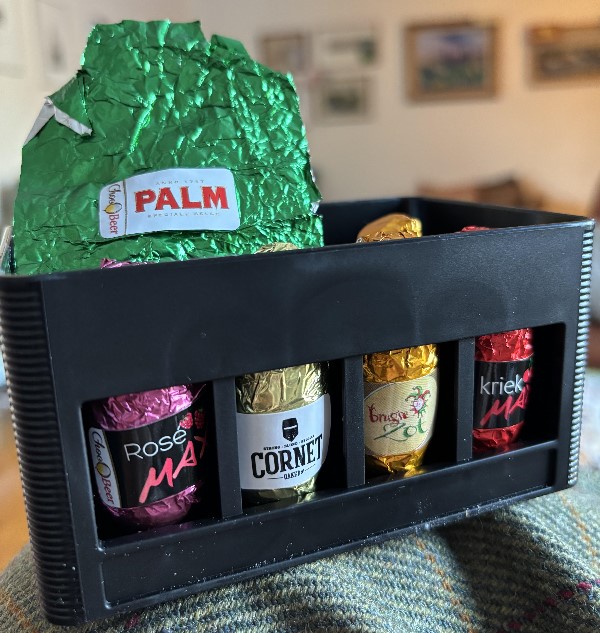
February flies by. That’s just the way it is. Good time to take stock. Good time to eat the little chocolates filled with beer brought by a visitor from Belgium. Early review: the “…chocolate is dry and dark so a lack of sweetness in the kriek left it a bit stark but the Palm was that bit richer.” Not sure I am chowing down on these outside of a winter like this but all quite a bit better than expected. Paid endorsements welcome. Winter was also on the mind and under the feet of Jordan as he wrote about the weather at the end of last month or perhaps just his efforts to get about in it:

Monday, Jan 26th: The deep freeze is well and truly upon us, and looking at the forecast for the next couple of weeks, it looks like we’re in four-layer territory. If your primary mode of transport and exercise is walking, then -25 with the wind chill does you no favours. Besides, the sidewalks are not shovelled in any meaningful way. Dry and cold is a great combination to ensure you’re reminded of the various injuries you’ve had over the years. Sometimes I get the unprompted sense memory of an ankle ligament rolling.

Also looking at the world as it exists below the knee, Stan shared some research he has done on the word Hopfenstopfen and its relation to a certain pair of boots:

The shoes were worn by a worker processing hops. When a bag was filled, a worked would jump into it, stomping down the hops to make sure the bag was full. When I dug this out, I wondered if these could have been called Hopfenstopgen boots. That’s because in Hop Queries Vol. 4, No. 6, I wrote about dry hopping in Germany in the 19th century. That was called Hopfenstopfen, which can be translated at hop plug. Simon Moosleitner, a subscriber in Germany, suggested there is more to think about…

I won’t spoil the fun but speaking of getting the boot in, late last week in VinePair, Dave Infante wrote about the effect of the homicidal ICE intrusion into Minneapolis on the beer trade in the city including this from Drew Hurst of Bauhaus Brew Labs:

You can see it in the firm’s sales figures. Taproom sales are down 40 percent compared to January 2025. “It’s a wildly unsustainable thing,” says Hurst. “None of us signed up to have to live through a federal occupation and figure out how to run a business at the same time.” Not that it was easy before the onslaught: Bauhaus wrapped this month last year down around 30 percent from January 2024. Craft brewers have been struggling to find their way for years in the face of shifting demand, new competition, and rising costs. In Minneapolis and Saint Paul, they’re doing all that with the MAGA jackboot on their necks.

At first I thought it was an odd angle but then realized it illustrates the principle that beer prefers peace as well as how quickly that peace can be lost. Dave also shared in his email updates that he was told to “stick to beer” and that some paying subscribers to his newsletter Fingers canceled their subscriptions. Perhaps if those folk didn’t “stick to” amateur neo-fascism it might be better. Funny how the “stay in your lane” crowd don’t show up for this sort of politicization within the pub:

A beer tap labelled “Rachel Thieves” has appeared on the bar of a Hertfordshire pub protesting Chancellor of the Exchequer Rachel Reeves introducing crippling tax hikes. Anyone ordering the beer will receive only water. The Green Dragon in Flaunden, which is run by publican Chris Ghazarian, has added the spoof cask ale pump badge as a protest – telling customers that pints of this particular beer are “very bitter” and cost more than anything else on the bar and anyone ordering it will receive only water. Speaking to the British national press, Ghazarian said: “They find it hilarious. I obviously don’t make them pay for it.” 

On the other side of the planet, a very difference approach has been taken in Australia:

The Albanese government is seeking to put a hold on increases to the beer excise for the first time in 40 years. The Customs Tariff Amendment (Draught Beer) Bill 2025 seeks to pause the indexation of customs duty rates for draught beer for two years from August 1, 2025. Currently, the beer excise is indexed twice yearly to stay in line with the consumer price index, with Australian beer, wine, and spirit importers and producers saddled with some of the highest rates in the world…  Addressing the House of Representatives, Anthony Albanese said he was “proud” to introduce the Bill, “one of the most popular commitments that we took to the election”.

Boak and Bailey also wrote about another sort of pressure to conform but the context was less confrontational – just writing about their thoughts on a craft brewery:

Maybe that post was a bit too snarky, with hindsight, but it certainly didn’t warrant trolling impersonation accounts on Twitter, general abuse that last for months, or a stalking campaign. That was, as you might imagine, quite traumatising, and probably did make us nervous about being critical of breweries in the supposedly cuddly craft brewing sector. It didn’t stop us, but it had a ‘chilling effect’ on how freely and frequently we felt able to express ourselves. It’s easy to say “Don’t mince your words” but minced words are less likely to lead to sleepless nights. We can totally see why some people might decide it’s not worth the trouble, and certainly wouldn’t judge them.

On reflection, I have probably benefitted from folk starting with the assumption that I am a bit of an arsehole. I lose my sleep over other things.

Note #1: Take a news event and ram it like a square peg in a round hole.
Note #2: Martin at another fabulous pub, this time inordinately bright.

Ron TV continues to impress. This week he’s been presenting an extended interview with Mitch Steele and, like the comment maker Oscar, I am drawn to the brief introductory electro-thrash almost as much as the subjects of these interviews. Part 1 of the interview is over thirty-seven minutes long with Part 2 clocking in at thirty-three. Set aside an hour or so of your time. More if, like me, you keep replaying the first six seconds and that mesmerizing theme music over and over and over.  Good multi-media breakout for Ron – even if it likely doesn’t pay the bills. One a similar note, Ray of B+B on the prospects of a career in writing:

This is excellent. Depressing, but excellent. My response has been to give up, basically, and accept that writing is a thing I do on the side, while something else pays the bills. I also like that thing, so it’s fine, but I get sad thinking what I could have achieved if writing was my full-time job.

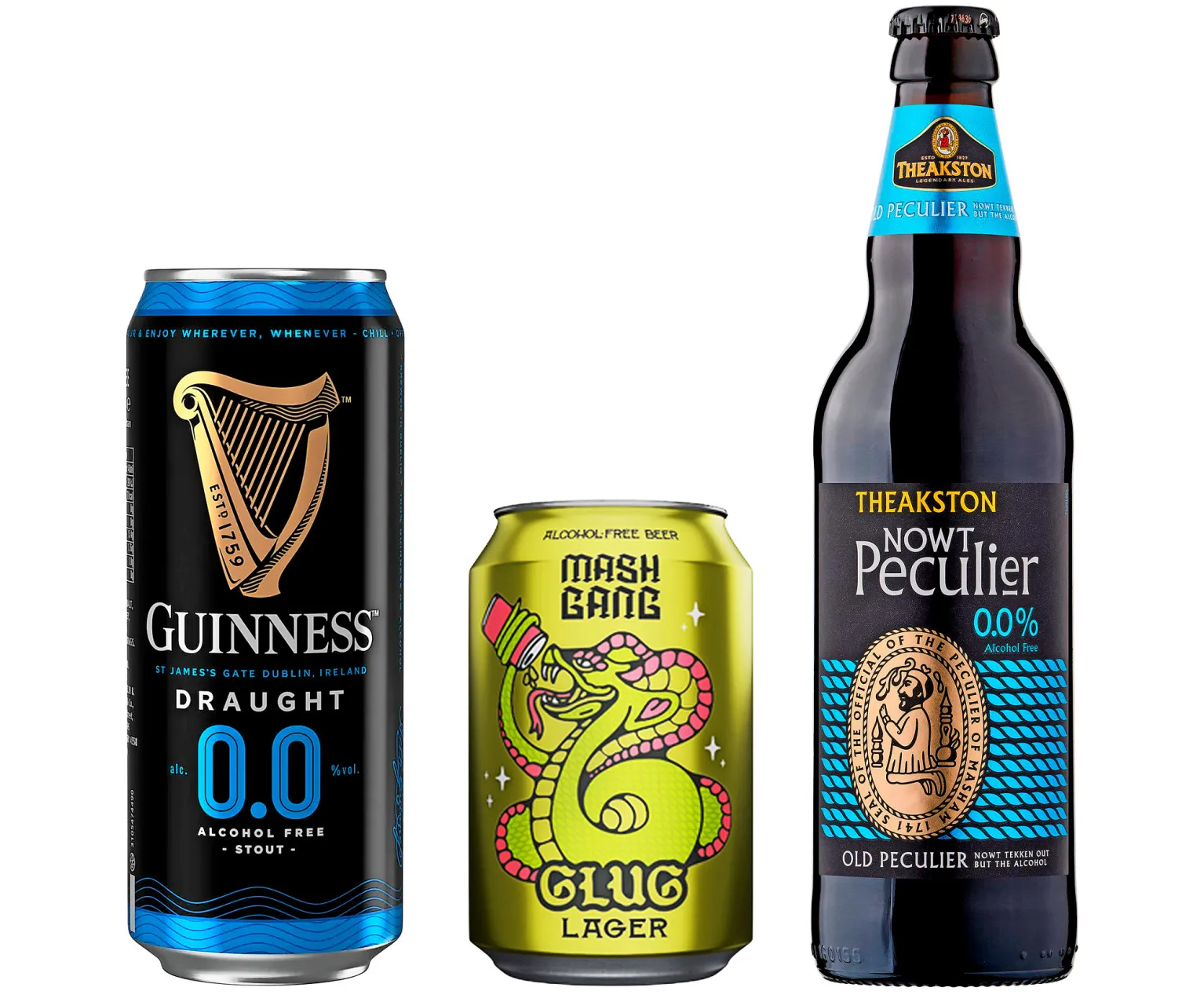
Perhaps also on the theme of less is more, Guinness 0 also continues to impress me and Pete‘s brief review does not surprise:

There are many great 0.5 per cent stouts from small indie brewers, but Guinness 0.0, which took years to develop, is indistinguishable from the real thing.

I noticed one thing when writing this. It is branded as “Guinness 0” in Canada but “Guinness 0.0” in the UK. Why? Is it a different formulation here and there? Whatever it is, I am finally seeing a point to NA beers. But things will be going in a slightly different direction in UK neighbourhood if one permit applicant has their way:

The shop also sought an amendment to the condition currently imposed on the licence… to “No super-strength beer, lagers or ciders of 6.5% ABV (alcohol by volume) or above shall be sold at the premises with the exception of Dragon Stout and Guinness Export beers.” The applicant’s agent, Frank Fender, told Bedford Borough Council’s licensing sub-committee (Thursday, January 29), that these “super strength” beers are not usually the “street drinkers’ choice of drink”. “They are they are widely consumed by members of the Afro-Caribbean community, and obviously this shop wants to be inclusive,” he said. This claim was backed up by Chris Hawks, the council’s licensing compliance and enforcement officer. He said: “What Frank says about Dragon Stout and Guinness Export is spot on.

For years, the word authentic was bounced around in the face of glitter and haze. That plan in Bedford sounds like authenticity to me. Similarly perhaps, crossing the Atlantic, Matty C has written some notes on the US beer scene for the supplier Get ‘Er Brewed‘s webpage and found something of a revivial going on:

Nostalgia is one play many breweries seem to be using. During my time in both Portland and in Colorado, (the latter of which I visit regularly to see family,) I noticed that many drinkers seem to be choosing the classics made by more established breweries. Allagash White, the Belgian style witbier from the brewery of the same name wasn’t just on tap everywhere in Portland, but it felt like everyone was drinking it too. The beer carries the kind of hushed reverence that money can’t buy, and demonstrated to me why establishing a core beer as part of your brewery’s identity is essential for longevity.

This is quite a reversal as, you will recall, in 2019 flagships were considered a dead concept: the “concept of a flagship in almost all ways maps to an earlier and obsolete way of thinking.” Futurisms rarely stand up to audit but it’s good to know, in an era too concerned with branding and other misinformations, that identity in the form of what is in the glass has made a come back. One never knows what is really going on otherwise. As with the news about the bills left unpaid and the suppliers left in the lurch by Rogue, James Beeson in The Grocer shared that the level of insolvency at failed Keystone Brewing had hit almost £15 million. Heavens! Remember when we all spoke of community?

Sticking with things in the USA, the feature in Pellicle is a portrait of Eckhart Beer Co. in NYC by Ariana DiValentino with its focus on central Euro lagers and foods that share the same theme:

The menu focuses primarily on Central European dishes that match the beers’ origins. There is a brat plate, and spaetzle gratin, and kartoffelpuffer (German-style potato pancakes), which you can order fried in oil or beef tallow. But there’s also a falafel dog, an Italian cold cuts sandwich, and a Moroccan-spiced ratatouille with vegan lemon yogurt. The variety of cultural influences feels very reflective of the brewery’s New York City context. “I wanted to offer food that supports the beer. It didn’t have to be Central European per se, but that felt like a natural foundation,”

Sounds like a great place for all. Not so in Japan where one establishment has embraced ageism:

The concept of age restrictions and minimum requirements is commonplace around the world. But have you ever heard of an establishment imposing a maximum age limit? Now, a Tokyo chain pub has set a ban on older customers – in order to try to maintain the raucous, fun atmosphere for which it is known. Tori Yaro Dogenzaka is an izakaya (an affordable Japanese pub) situated in Japan’s capital city. This year, the establishment propped up a sign outside the entrance, informing customers of the new rules. The sign said: ‘Entrance limited to customers between the ages of 29 and 39. This is an izakaya for younger generations. Pub for under 40s only.’

I wasn’t wanting to go there anyway. Screw them. That’s it. As as I sulk in a mode Japonais, please check out Boak and Bailey who continue to post every Saturday. adding to their fabulously entertaining footnotes week after week at Patreon. And look out for more of Stan’s new “One Link, One Paragraph” format. Then hunt out something in someone’s archives! Leave oblique comments on someone’s post from 2009!! Listen to a few of Lew’s podcasts and get your emailed issue of Episodes of my Pub Life by David Jesudason on certain Fridays. And Phil Mellows is at the BritishBeerBreaks. Once a month, as noted, Will Hawkes issues his London Beer City newsletter and do sign up for Katie’s wonderful self-governing totes autonomous website featuring The Gulp, too.  Ben’s Beer and Badword seems to be on pause since November but there is reading at The Glass which is going back to being a blog. Any more? We have Ontario’s own A Quick Beer and All About Beer is still offering a range of podcasts – and there’s also Mike Seay’s The Perfect Pour. Plus follow the venerable Full Pint podcast! And there’s the Craft Beer Channel on Youtube. Check out the archives of the Beer Ladies Podcast.

And Just Like That Here Are The Quite Frosty And Fully Final Beery News Notes For January 2026

It’s been a quiet week in the beer world with distractions aplenty in my real world. Like the Arctic vortex. To be honest, I’ve always preferred the Caribbean vortex whenever it pays a visit.  Thankfully, once upon a time I lived up in the upper Ottawa and have experienced the refreshing zing of -53C so knew enough to break out the heavy tweed and  big boots. Dashing yet completely unable to dash. Elsewhere people are embracing the deep chill as well.  Will Cleveland reporting from Rochester, NY has news of the return a winter beerfest this weekend;

This isn’t a gimmick festival chasing the beer-du-jour; it’s a gathering rooted in the style that got a lot of people into craft beer in the first place—before haze became a default setting and before “imperial” stopped feeling like a warning label… DiCesare remembers the first year clearly, mostly because it was about 10 degrees outside. This year, the ask is similar but the hope is different: dress for the weather, embrace the winter, and lean into the fact that January beer festivals are better when they stop pretending they’re outdoor concerts. Fire pits and outdoor heaters will again be part of the setup, encouraging that specific Rochester ritual of standing outside, beer in hand, nodding knowingly at strangers like, yes, this is happening, and yes, we chose it.

What else has been going on? Well, it was Rrrrrrrabbie Burrrrrns night last Sunday and all around the world folk reacted to the plate of haggis, neeps and tatties set before them. Unless, as Katie M explored in Guts magazine, it perhaps wasn’t really haggis:

Learning how important lungs are to the recipe of a traditional haggis, a vegetarian version seems like sacrilege. The whole point of haggis is that it’s offal, a sausage or boiled pudding made with waste-not, want-not diligence to keep Scots fed throughout the winter and leaner times. The very idea of a vegan haggis is deeply inauthentic—offensive too, if you were to read the comment sections on any clickbait story about the dish. But if you’re appalled, you’re forgetting the accommodating nature of the Scottish people. Do you think my Grandma would have anyone going hungry in her house? The very origins of vegetarian haggis was borne from hospitality…

As the good author noted, the very prayer one prays before we got to the “O what a glorious sight, Warm-reekin, rich!“* includes the line “some hae meat an canna eat…” so there is some authority for this. Is there another dish that so inspires? Speaking of how others live, in the Globe and Mail, Drew Shannon wrote about finding a beer in Kazakhstan:

I broke up with craft beer a long time ago – back when small-brand breweries went from niche and interesting to eye-rollingly ubiquitous. Of all places, I didn’t think I’d run into my beverage-ex in Kazakhstan. I assumed either big conglomerate brands would still dominate the former Soviet state or there’d be no beer at all. Finding a pint in some parts of the Islamic world can lead even the most well-travelled tourist on a fruitless quest. It turns out, I was dead wrong. My impromptu evening of bar-hopping around Almaty, the country’s largest city, started after a long day of trekking the Turgen gorge. On the way back to my hotel, I noticed Privychki Bar. I pushed open the front door to find a gaggle of young Kazakhs perched on vintage armchairs, sipping cloudy pints. 

Mmm… cloudy pints. Never less than clear, Stan, in his concise one paragraph way, directed me to a bit of resurrectionist thinking over the cool corpse that one was Rogue Brewing. How in its haydays it didn’t have managers, it had ambassadors: “That is why Rogue was kicking ass in those days is that felt that they were ambassadors to craft beer.” Yikes. I had a sudden unsettling flashback to the bad old irrational – if not greedy – days of craft and reminded myself of this from 2012:

To hell with that. Passion is that employer of the young who saps their joy for life. Passion offers periodic Google ad cheques in return. It asks you to be the unpaid brand ambassador. On Wednesday night, a intelligent and eager young person suggested to me that my interest in good beer was pure passion with a certain honest excitement. I took the time to gently crush that moment like a mouse under my heel. It was information, I said. Information and interest. Passion? I have children for that. 

The children? They are 14 years older now and each of an age when they might be expected to buy the beer as much as have it bought for them. I trust that now not-so-young person has found another moe successful career – and that’s probably for the best for all.

Note #1: Twenty years of Ron!
Note #2: Maureen asks … in the end… is a brewery just its trademark?
Note #3: Stout-flation strikes.

Heavens! I missed the news when The Beer Nut issued a new beer style alert right around when the update when to the presses last week. He was reporting from the front lines of recent holidaying where and when he encountered:

… the rarely-seen style of imperial sweet potato amber, and I had no idea what that was likely to mean. Beniaka is 7% ABV and a cola brown colour in the glass. Although fizzy, it’s plenty thick and feels luxuriously “imperial”. Can’t say I tasted much potato, but there’s a pleasant woody spice: nutmeg, sassafras and liquorice. It’s fairly sweet with it, showing a little Scotch-ale-style toffee, with the herbs helping balance it. This is interesting, with lots happening, but it’s not a daft novelty, and makes for a very civilised digestif.

Not at all in response, Sophie Arundel was given a fun topic over at the Drinks Business – the dead end trends of 2025:

Several alcohol formats once framed around lighter, functional or lifestyle-led positioning are now in sharp decline. Hard kombucha now holds a 0% share of social discussion, down 29.8% year on year. Hard tea has slipped to a 0.01% share, falling 33.79%, while hard seltzer sits at 0.02% share, down 33.67%. The contraction extends beyond these formats. Craft beer, often seen as culturally resilient, is down 16.52% year on year with a 0.84% share, while generic IPA beer has fallen 17.28% to a 0.38% share. Tastewise’s data suggests the broader “better-for-you drinking” narrative is losing attention. Products that relied heavily on pseudo-functional positioning are struggling to maintain relevance, pointing to a need for clearer occasions, flavour-led propositions and tighter ranges.

(“Pseudo-functional” was the name of my folk-punk band back in ’93.) At least craft beer fans can take comfort that their drug of choice is going better than hard kombucha. There are still some hangers on that are telling craft to repeat its errors… but it is true, isn’t it – when things are going down the proverbial shitter, not one really is working to improve so much as find themselves quite happy to tread water.** Perhaps coversely, BMIs seems to be seeing at least a stall in the slide when it comes to US beer:

NBWA released its Beer Purchaser’s Index reading for Jan early touting a “significant bump” from December. After 5 mos in a row of readings below 30 (including several lowest ever around 25), BPI jumped to 39 in January. Not exactly great shakes, and 9 points below Jan 25, but still 14 points better than Dec 25. (Recall, BPI below 50 suggests beer distrib orders are contracting, while above 50 signals expansion.) 

So less of the lessening perhaps. But in western Canada, there was actually an increase in beer sales through 2025. So who knows! Well, at least we know one thing. I think we have established that not being very profitable at all is actually not a good business plan:

BrewDog has announced that it is closing down its Aberdeenshire distillery and ceasing production on all spirits. The craft beer company said it had decided to abandon its state-of-the-art distillery, which opened in 2016, and axe the brands after “careful consideration”. The move comes after the company posted losses of £37m in 2024 and announced job cuts across the business, including at its head office and brewery in Ellon.

Conversely (at least in San Francisco) not doing well enough to even attract a proper buyer can have its advantages:

During that massive blackout on December 20, every business but one in the Lower Haight had to shut its doors because they had no power. That one would be Toronado, which still uses an old-timey, non-electrical cash register with punch buttons and a hand crank, still takes only cash, and beer taps don’t require electricity. Cheers to ancient technologies. The story was left hanging last summer after a new crypto-bro owner had stepped in looking to take over the bar — and launch a Toronado-themed coin! — and after that deal appeared to be in jeopardy once longtime owner Dave Keene discovered these details and looked to cancel the deal. But SFist can confirm now that the deal was, indeed, canceled, and everything remains as it was at the bar.

That’s nice. Unless the owners really hate the place and want to move on I suppose. Can you own an iconic institution that people flock to and really hate it?  If someone does something well I would hope that there is joy in the doing.

Note #4: The many beards of Polk.
Note #5
: What friends of beer writers think they do…
Note #6: …all day long…

Joy in doing? That’s a bit like this week’s feature in Pellicle by Imran Rahman-Jones about the making of liquor from what’s to be found right there in Edinburgh’s urban orchard:

As Chris continued to tweak his distillations, and source new apples for each batch, he began to reflect on the fruit’s beguiling quality. “[There’s] something quite magic about an apple tree in the street,” he says. Neighbours will leave out boxes of fruit for one another, or swap recipes. “It tends to pull the whole street together at a certain time of year.” What Chris didn’t know when he started the process of developing Pochle was that he was tapping into a lineage going back centuries in Scotland. The enchanting ability of an apple tree to gather and unify in fact has deep roots in the country’s traditions and folklore. 

Lots to like there. And just look at the people working to get that bit of writing onto your screen. The fine folk keeping Pellicle going, the author Imran Rahman-Jones, the semi-sticky handed Chris Miles who gathers and also those who let the foragers be – not to mention those who planted and tended to the apple trees. Doing is a wonderful thing.***

And on that very subject – the doing of things – Boak and Bailey were out there again in their monthly newsletter for January doing a great job encouraging more writing about beer. What to write about:

There are local drinking customs and cultures that probably seem unremarkable to people who know them but which would interest people like us. Flat Bristol Bass is one that fascinates us but there must be others all round the country, and certainly around the world. Alex, our favourite beer blogger of 2025, goes to three pubs and writes about what he sees going on there. Adrian Tierney-Jones (a pro, not a blogger) takes a similar approach. Now, you could write tasting notes of every beer you drink but, honestly, that’s probably the hardest thing to make interesting – unless you are a skilled, creative, and/or amusing writer like The Beer Nut. It can still work if your tasting notes find a theme or tell a story, though.

Do it! I like it – but do note that “blogger” and “pro” are not comparable categories and neither term speaks all that much to the quality of the writing. “Pro” is code for paid writing which can be compromised even just by editorial restrictions**** though, more to the point, too often not all that good. And “blogger” is a reference to a class of medium, not a sign of quality of the writing and not necessarily code for an amateur though some of the best beer writing is actually provided by people who earn their living otherwise. Ray and Jess themselves are proof of that. Better to think of adjectives like interesting, inventive or even valuable when weighing the cred. Then notice where they don’t apply!

I would also add, don’t worry too much… unlike Mikey Seay who has shared what strikes me as quite an odd thought:

I always shy away from reviewing beers for two reasons:
– Lack of skill to do it properly.
– Beers can be too regional to make a review relevant to a global newsletter audience.
That said, I feel a new beer from Sierra Nevada is available enough in most places to make it worthwhile to mention.

Seeing as thinking and writing about your taste perceptions takes about as much skill as running a vacuum cleaner, I don’t think this is a particularly useful standard. But then again you may be crap at vacuuming, too. Do you worry about that? Just type. Be patient and get those keyboards clicking. It’s a lot like planting a seed and also, if nothing else, it’s good for the knuckles.

Where will it take you, all this clickery? Well, as we wrap up this week on the note of the haute in beer writing, this is your final call for a fully self-funded trip to Bordeaux in June:

This is the FINAL REMINDER about the 2026 Beeronomics Conference, which will take place at ESSCA School of Management, Bordeaux, France, 24-27 June. Main panels and sessions will be held at the ESSCA Bordeaux Campus. The Conference Organising Committee, led by Gabriel Weber and Maik Huettinger, welcomes all high-quality research on the economics of beer and brewing. 

The deadline for submissing an abstract is Sunday. Send me a card. Fine. Fin. As I said, a bit of a quiet week. please check out Boak and Bailey who are posting every Saturday and adding to their fabulously entertaining footnotes week after week at Patreon. And look out for more of Stan’s new “One Link, One Paragraph” format. Then hunt out something in someone’s archives! Leave oblique comments on someone’s post from 2009!! Listen to a few of Lew’s podcasts and get your emailed issue of Episodes of my Pub Life by David Jesudason on certain Fridays. And Phil Mellows is at the BritishBeerBreaks. Once a month, as noted, Will Hawkes issues his London Beer City newsletter and do sign up for Katie’s wonderful self-governing totes autonomous website featuring The Gulp, too.  Ben’s Beer and Badword seems to be on pause since November but there is reading at The Glass which is going back to being a blog. Any more? We have Ontario’s own A Quick Beer and All About Beer is still offering a range of podcasts – and there’s also Mike Seay’s The Perfect Pour. Plus follow the venerable Full Pint podcast! And there’s the Craft Beer Channel on Youtube. Check out the archives of the Beer Ladies Podcast.

*Just in case someone out there never had a tea towel.
**No, smoothies will not save brewing.
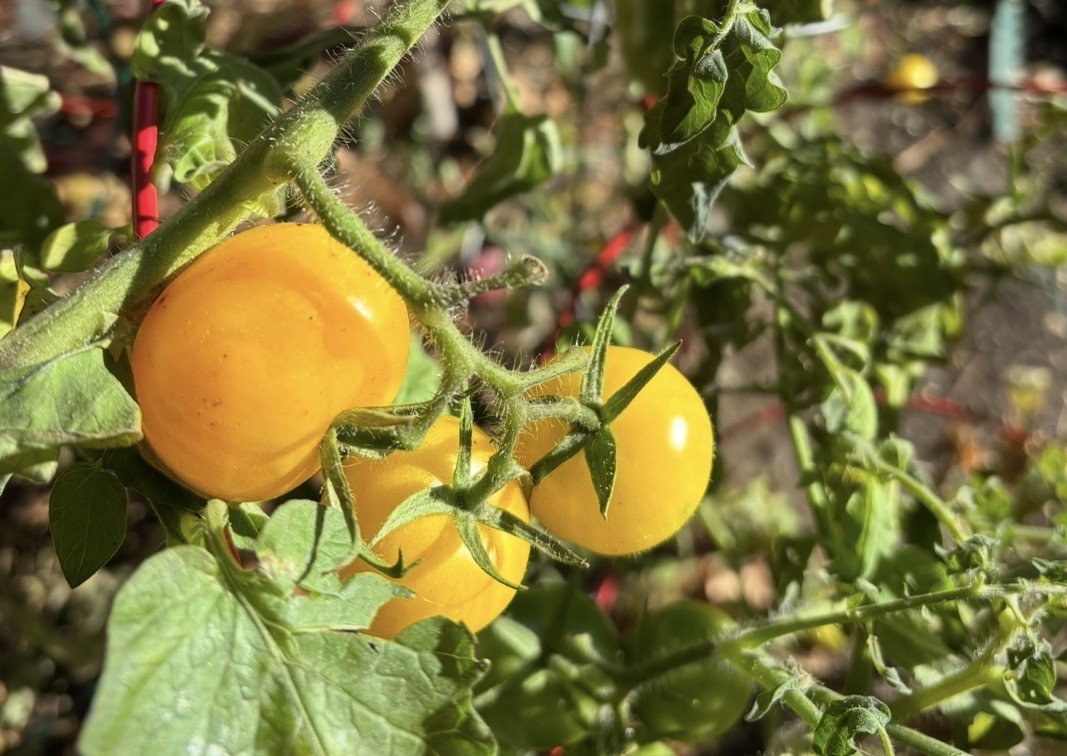
***This is your reminder that now is the time to start planting those seeds for your own garden. Seeds and soil and time. Have a go. This tomato from last November’s final harvest was from a seed planted in my basement in February. Easy. Almost as easy as typing. 
****“It’s only a trade mag article…” is as often much the case.

The Even More Fabulous Yet Slightly Chill Mid-January 2026 Beery News Notes

“CORK HEAD! CORK HEAD!!

There really is no need for any further update this week is there. Andreas Krennmair posted an image of the “old interior of Schneider Weißbierbrauerei, presumably from before the rebuild 1901-1903” and this scene above was one of the tiny vignettes sitting in the back of the overall bar scene.  I can’t figure out if these gents are playing that old favourite, a game of “I’m a doggie, cork my brainpan!” or… the means by which this particular men’s club informed a candidate that they did not pass the initiation process. I find the physics involved problemative but, you know, art.

First off, some excellent reporting out of The Soo on pricing after Ontario’s expansion of beer sales to corner stores compared to grocery stores, the big brewery owned TBS as well as the government’s own booze agency the LCBO;

The editorial team bought two beers, a mass produced lager and a craft beer, as well as two bottles of wine from several locations around the city to find the best – and worst – deals in Sault Ste. Marie… A tall can of Molson Canadian will run you $3 at the LCBO, compared to progressively worse deals of $3.03 at Rome’s Independent, $3.14 at the Beer Store, and $3.81 at Circle K. For a can of Great Lakes Brewery’s Octopus Wants to Fight, the results are tighter – coming in at $3.75 at all locations but Circle K, where the surly octopus comes out to $4.04 per can. All told, a Canadian is 21.2 per cent cheaper at the LCBO than at Circle K, and Octopus Wants to Fight is 7 per cent cheaper everywhere other than Circle K.

I would point out something about that otherwise excellent research. Circle K sometimes has a nutty nutty sale price for a few pretty decent Ontario craft brews. I pop in once in a while when I am picking up a tank of gas just to check in.

And while I have been known to hover in and about the snack aisle of corner stores, I am not a taproom devotee. Too often they strike me as car dealership showrooms – “would you like to see the latest model except (in a fourdoor / with even more Citra)?” – but it was interesting to see Stan consider B+B’s thoughts on the key underlying principle involved;

It appears I may regularly come across taprooms with personalities than Boak & Bailey, but I wouldn’t argue cookie cutter establishments aren’t abundant in the US. Also, B&B tend to write short paragaphs and I try to stick to one. Their following words zero in on what I value in drinking establishments, that they are “run by human beings.” The others, without personality, I tend to forget. I acknowledge they exist, but I don’t have to think about them.

Speaking of places run by human beings, we have a new beer blogger alert. Colston Crawford, the recently retired pub and beer columnist with the Derby Telegraph has decided to continue sharing his thoughts on the topic including how the notion came to him:

It was a lunch at The Crispin in Great Longstone, in the Peak District, a week after I finished which firmed up the idea in my head. The food, the drink, the service, the ambience, was so good. I sat there thinking, if I still wrote a beer column, this one would be easy. I could dash it off right now. I’ve made two more visits to The Crispin since, the first to confirm that the previous one wasn’t a fluke, then the second was unplanned. I was with friends in a party of five, walking on New Year’s Eve morning, but the venue they’d fancied for lunch wasn’t open. The Crispin was five minutes away and a superb lunch followed.

There’s a lot of good advice in there. It is easy to keep a low pressure blog about something you have a general interest in. A striking experience will make for a good story. And it’s good to review the experience a couple of times to get the facts straight, too.

And Boak and Bailey shared an extended thread of thoughts on why people in the UK have cut back their visits to the pub with plenty their own interesting thoughts and those of others who joined in. I agree with their thought #7:

7. Basically, we’re not convinced the pub crisis is especially acute *right now*. In 20 years of blogging, and nearly half a century of being alive, we’ve never really known a time when pubs weren’t doomed and in decline. 

One of the things that concerns me about that form of doomsaying is that it always seems to be decontextualized as if pubs closing is the only difference since 1976.  Fewer are also going to church, too, over that same 50 years of existence. Many more play video games than before that point and I would expect more tofu is sold in the NATO countries. Preserving past practices as opposed to preparing to guide them through change is a bit of a fool’s errand.

Note #1: only available in Alberta, Saskatchewan, and Manitoba.
Note #2: Beer’s “Santa Claus Rally”.

Me, I’ve never developed a taste for collaboration beers but apparently the revenue authorities in Finland have, as The Beer Nut noted.  The EBCU has taken a position on the matter:

Finland is currently considering new excise-tax guidance that would effectively make many collaboration beers impossible for small breweries. Under the draft interpretation, if a beer shows more than one brewery’s name or logo (as collaborations typically do), it could be treated as “licensed production” and the breweries could lose their small-brewery tax relief for the entire year. This would impact not only Finnish breweries, but also imports and international collaborations—ultimately reducing choice for beer consumers.

This is an excellent example of the sorts of issues related to identity that can pop up in law. Obviously, if the non-brewing collaborator (let’s call them “the collaborator”) insists on putting their intellectual property in the form of a logo on a product, they are saying to some degree that the product is their work. Yet, for taxation categorization, that logo placement is argued to not indicate that the work is theirs but, instead, only the work of the brewer (let’s call them the collaboratee”.) I have no stake in the matter and have no idea how Finnish taxation policy plays out in term of brewers compared to cheesemakers or lumber yards – but I do have one raised eyebrow when I see these sorts of statements as part of the EBCU’s argument:

Collaboration beers are one of the joys of modern beer culture…  we believe consumers deserve choice, diversity and fairness. Collaboration beers enrich the beer landscape, strengthen friendships across borders and introduce consumers to new styles and tastes…

Wouldn’t the better argument be that collaboration beers are just a fun reciprocal staff training exercises for brewers that is only, for tax purposes, a businees expense and a burden upon revenue that is of little interest to consumers? After all, if one cannot detect the taste of collaboration beer… does it really actually exist?

Jeff had some interesting thoughts this week on hopeful hints he might be seeing in the US hop market and what it may mean about how breweries are reacting to the retraction, concluding:

…a last comment from me. As we exit the period of craft beer’s novelty era, when breweries made dozens of IPAs every year, it looks like it’s impacting not just the amount of hops brewers are buying, but the diversity. When I talk to brewers about new hop varieties, they are often hazy about them and most are not sampling every new one that comes out. Brewers seem to be more interested in hop products as a way of enhancing their beer. These products focus on the most popular hop varieties, which increases the “stickiness” of the major varieties.

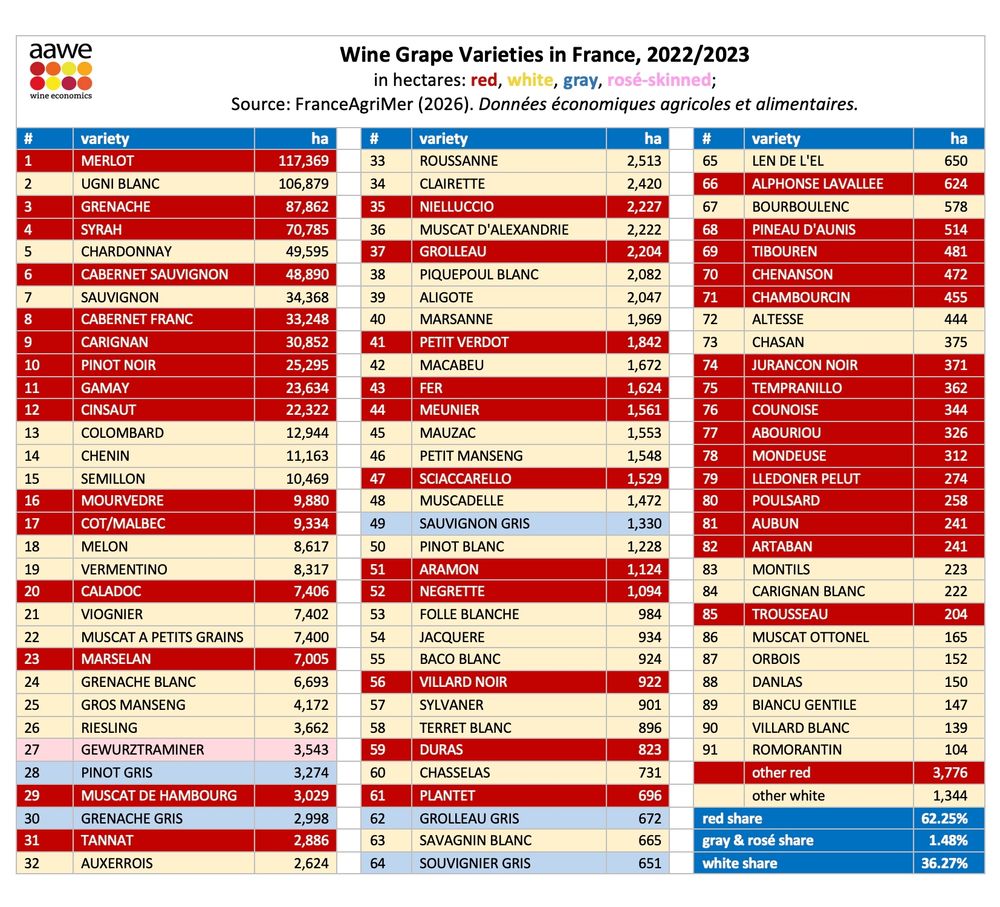
Speaking of varieties, have a click on that image to the right. It’s a list of the top 100 plantings of France grapes posted by the American Association of Wine Economists the other day drawn from an agency of France’s agriculture ministry. I don’t have much comment about it other than to note, despite the pop culture slur, how much good old merlot* is still grown as mentioned by E. Asimov the other day in his discussion of wines you may want to explore.

Good news for cideries and brewers of New York. In this week’s “State of the State” speech, Governor Hochul announced support for local producers, as noted by KK in related to cider makers:

New York is the country’s leading hard cider producer, boasting more active cideries than any other state. Our cider industry has grown substantially over the last ten years, generating over a billion dollars in total economic impact for New York, yet there still remains untapped agri-tourism potential to explore. To support the industry and tap into the robust agri-tourism opportunity that cider presents, Governor Hochul will work with the New York Cider Association to establish New York as the State of Cider, marketing the orchards, tasting rooms, and food experiences that could become anchor destinations for visitors across the country. These actions will strengthen rural economies, uplift the exceptional work of local businesses, and establish New York as the foremost destination for American hard cider.

The Governor also indicated the “need for modernizing licensing across the board, from sports bars and cafes to airport lounges, hotels, and movie theaters.

Conversely perhaps, Pellicle‘s feature this week is a post mortem by William Georgi of the Dutch brewery Nevel Wild Ales which had lofty and noble goals linked with but quite experimental standards:

“We were doing two expensive and time-consuming things at the same time,” he says. “Making a complex product that only a small selection of people actually like, while trying to set up a network of local farmers. A food forest like this is wonderful, but you can’t use it to make beer, as it doesn’t host perennial one-year crops”… Social sustainability was equally important for Nevel. The network of local producers Mattias established for sourcing ingredients—from hops and barley to chestnuts and kiwi fruit—showed him the challenges of farming at a small scale. “It isn’t economically viable at all,” he says. “Even if there’s a living wage being paid, the price doesn’t take into account the fact that most people harvesting the crop are volunteers. 

It’s pretty clear that the plan was not designed to pay its own way. Volunteer labour and crowdfunding plus unbudgeted expenses like organic certification were certainly signed that the business as a business was build on a weak foundation but I like one conclusion that was drawn from the experience: “…I don’t think Nevel failed. I hope I planted a lot of seeds in people’s minds about how things can be made differently.

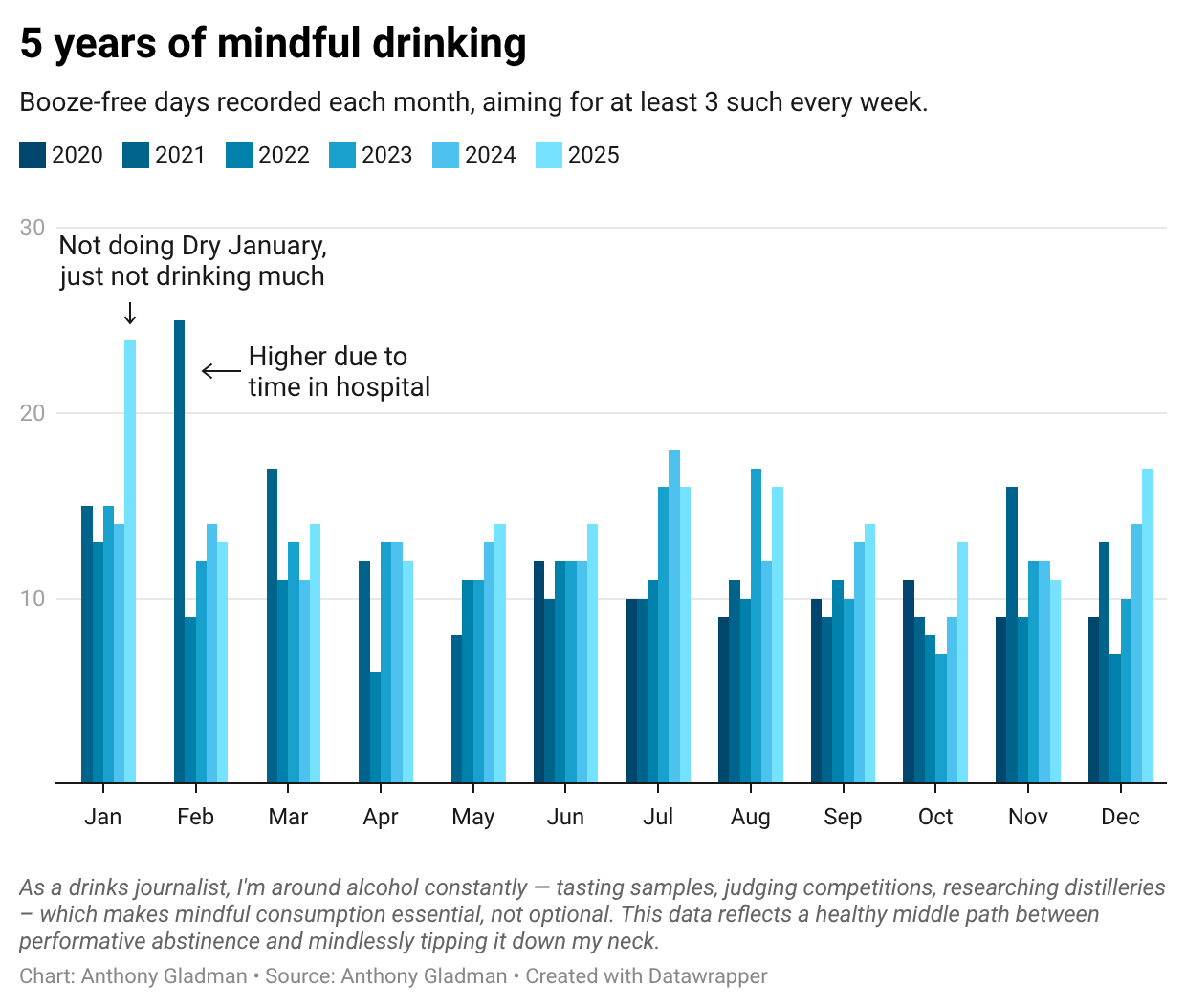
There was an excellent example of the old visual display of quantitative information** in A.G.’s post this week on Dry January. He shares my interest in maintaining data:

I find it helpful to keep a tally of days I drink alcohol and days I don’t. Nothing complicated, just a binary yes or no, and an aim to have at least three days off the booze each week. That’s all it takes for me to stay within healthy limits, despite working in an industry that can normalise and encourage dangerous levels of consumption. (If you recognise yourself here, check out The Drinks Trust.) Anyway… it’s Friday evening. The first one of the year. I’ve not had any booze since New Year’s Eve. Soon I will go downstairs, crack open a bottle of something nice, and have one or two drinks with some pizza while I stream a crappy-but-entertaining film – January be damned.

However sweet that bar graph, I am more a percentages guy, currently at a total of 52% dry days and 63% one or nones over the years since early November 2021 when I started keeping track. My booze budget this year is also set at around 1.33 a day, an average I beat by a few last year. Checking on that number from time to time – as well as your AST blood test numbers – are great ways to manage the hobby.

While we think on that, think on this. In the northern hemisphere, the darkest ten weeks of the year are already behind us. Soon be planting those tomato seeds. While we wait for that, Boak and Bailey are posting every Saturday and adding to their fabulously entertaining footnotes week after week at Patreon. And look out for more of Stan’s new “One Link, One Paragraph” format. Then hunt out something in someone’s archives! Leave oblique comments on someone’s post from 2009!! Listen to a few of Lew’s podcasts and get your emailed issue of Episodes of my Pub Life by David Jesudason on certain Fridays. And Phil Mellows is at the BritishBeerBreaks. Once a month, as noted, Will Hawkes issues his London Beer City newsletter and do sign up for Katie’s wonderful self-governing totes autonomous website featuring The Gulp, too.  Ben’s Beer and Badword seems to be on pause since November but there is reading at The Glass which is going back to being a blog. Any more? We have Ontario’s own A Quick Beer and All About Beer is still offering a range of podcasts – and there’s also Mike Seay’s The Perfect Pour. Plus follow the venerable Full Pint podcast! And there’s the Craft Beer Channel on Youtube. Check out the archives of the Beer Ladies Podcast.
*Once upon a time, the LCBO here in Ontario stocked Millbrook Merlot from a Hudson Valley, NY winery. Then Rufus Wainwright sang about the area. Went to the winery once around a decade ago. This is been this week’s edition of “wandering thoughts with Al”.
**I couldn’t live with anyone missing the reference.

Your Festive Beery News Notes For A Blursday In This Jolly Hollifest

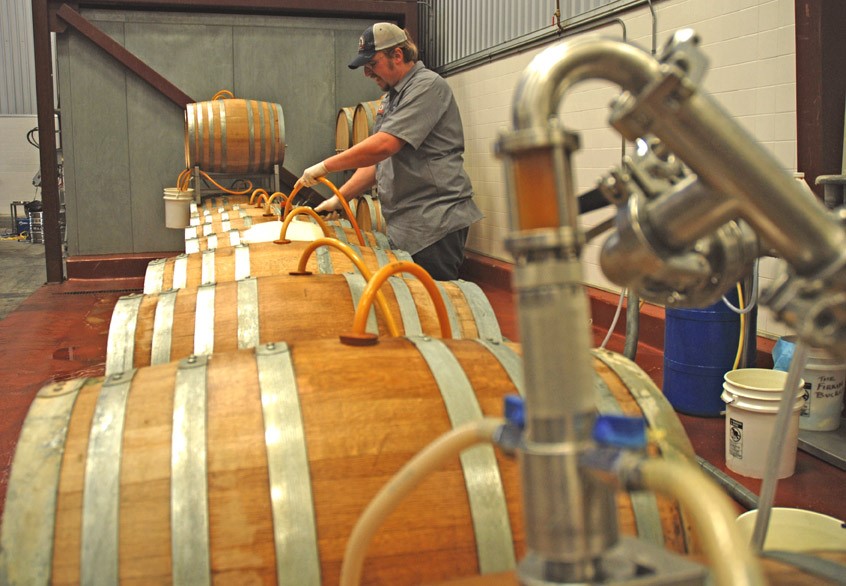
What day is it? I think I can still recall. It’s definitely somewhere between the last parcel being mailed and 2026. I know that much. I also know that in 2009 one Stan Hieronymus, possibly barely out of his teens at the time, submitted this photo above as one of his entries in the Christmas photo context. I will say one thing about a beer photo contest – if you don’t like your range of browns you might as well admit that you should never run one. Like the other contest submissions I have been posting out of the archives the last few weeks, I am pretty sure this one didn’t win a prize – but have you ever seen a better placement of a five gallon white food service bucket? No. Come to think of it, do you ever give a second thought for the glorious role of the five gallon food service bucket in all of brewing? Stan did. For one beautiful moment, he sure did.

Let’s get to the beer news. First up, another controversy related to booze and the ticker:

…the American Heart Association has revived the idea in a scientific review that is drawing intense criticism, setting off a new round of debate about alcohol consumption. The paper, which sought to summarize the latest research and was aimed at practicing cardiologists, concluded that light drinking — one to two drinks a day — posed no risk for coronary disease, stroke, sudden death and possibly heart failure, and may even reduce the risk of developing these conditions.

Before you go off to the Christmas office party with the thought that it’s really not all that far off a visit to a health spa, remember the critics’ warnings about the quality of all these sorts of studies: “Some are clearly horrible, some are good, but a lot are in the gray zone, and people may just cherry-pick and select those that agree more with their narrative.” Hah! So there…

Speaking of the office party at this time of year, the very same authoritative organ shared a bit of advice about conduct at office parties for the supervisory set:

It’s a good idea to stop after two drinks. Sure, you could have three drinks — or six! — and enjoy the social leveling and bonhomie that accompanies lowered inhibition and decreased cognitive capacity. But it’s hard to command respect in the office when people have seen you red-faced and trying to light a cigarette from the filter. 

Is it unfair to compare today to forty or so years ago? The (other) Times did this week when they republished a guide called “How to Survive Christmas” from 1986:

Commuting in the run-up to Christmas is absolute murder. On the way home from a hard day’s work you are liable to find everyone either festively drunk or helping someone else to be sick. Then there’s the office party. People will drink far too much, lunge at one another, tell the managing director he’s a twerp and pour the office vegan’s sprout wine down the word processor to cackles of mirth. How do susceptible males stay out of trouble at the office party? One friend suggests that offices should introduce Tube straps hanging from the ceiling. Thus you could remain vertical however much you knocked back, but with one hand in the strap and the other clutching your glass, both would be kept out of mischief.

Good idea. While it appears that thirty-nine years have passed since that was published, it’s clear ther are still bad behaviours that need to be stamped out at this Holly Jolly time of year, as Pete reports from the pub:

Black Friday has a different meaning in the hospitality industry. It’s not the consumer frenzy of late November, it’s the last Friday before Christmas. This is the night when post-work drinks climax in a frenzy of ill-advised shots and poorly judged flirting. For pubs, it’s one of the busiest nights of the year.

And then he gives ten rules, many of which would be enough to deter me from going to the pub. No line? Never have liked that when visting the fam. How un-Canadian! Give me a good line any day. But “no ordering a round of cocktails“? Perfect sense. No playing your crap music off your phone? Automatic ejection, I say.

Speaking of bad behaviour, I missed this tale of sticky fingers a few weeks ago but I will share it now as this could end up being quite the thing… perhaps quite the thing indeed:

Molson Canada has accused former managers of embezzling millions of dollars in an intricate fraud scheme allegedly involving fake vendors, shell companies, the president of a major pub chain and a pair of married couples. In documents filed Wednesday in Ontario Superior Court, the brewing giant claimed that former Molson Canada sales director Frank Ivankovic oversaw “a complex scheme to defraud the company of many millions of dollars” that later involved two subordinates.

Holy crap! Gotta watch that story. You may scoff at the very thought but I will share a fact that is actually true – I had a personal banking representative many years ago who made a very tidy sums on false mortgage accounts until the scam was uncovered. As this situation at Molson is reportedly both complex and intricate, I am spellbound and await further disclosures from any and all court processes.

Speaking of people who can’t tell their left pocket from their right one, in the land of Vinho Verde the police have had to get involved:

Those arrested from the trade body, which is responsible for quality control and official certification of Vinho Verde wines, belong to its Inspection and Control Division, with the individuals arrested for allegedly warning wineries of upcoming inspections and accepting bribes of meals, wine and event tickets. According to Portuguese newspaper Jornal de Notícias, the officials also allegedly turned a blind eye to wine producers failing to meet the requirements to obtain designation of origin (DO) or geographical indication (IG) certification to be able to label their bottles as Vinho Verde…  Meanwhile, a further four “business owners involved in the distribution and production of Vinho Verde” – have also been arrested, charged with “active and passive corruption, falsification of documents and abuse of power”.

Doce mãe de deus!!!  Fiddling with the Vinho Verde!?! That has been a mainstay in my life for around forty-five years, starting with my mother’s micro-obsession with the plonky version. Not unrelatedly as it turns out, Lars found some dirt about law scoff doing a little farmhouse brewing in Japan, news that he shared on BlueSky:

The Japanese are less law-abiding than I thought: farmhouse sake brewing continued despite the legal ban. In 1941 folklorists surveyed 85 localities, finding home brewing in 44 of them…  In 1895 there were 1 million home brewing licenses in total. So Japan definitely had farmhouse brewing of sake. Then in 1886 the gov’t banned home brewing entirely. Probably killed the farmhouse brewing. Home brewing is still illegal in Japan (gov’t wants its alcohol taxes), but in 2003 one exception was made: farms using their own rice are allowed to brew. This kind of sake is called “doburoku”. There are now 100 designated doburoku districts where this style exists.

That could make for something very interesting, a doburoku tour… doburoku tour… doburoku… WAKE UP!!! Sorry. Now… some notes:

Note #1: “only 37 percent of craft breweries in Canada are profitable”? Really? That’s a lot of subsidization.
Note #2: Who the hell pours Bailey’s down the sink?
Note#3: A.I. designed beer? Nope, couldn’t care less…

Aaaaannnnnd… the BA issued a somewhat delicately drafted “year in review” type press release suited to both address and deflect the industry’s annus horribilis and, I gotta tell ya, I sorta choked on what is stated to be the top trend:

This year, there was a continued democratization and expansion of what it means to be a “brewer.” With acquisitions, mergers, and collaborations, the stainless tanks in the background may not be as important as the brand story.

As one who has never given a shit about the story someone is telling about a brewery, I think if I were an actual brewer I might consider this statement slightly, you know, treachery if not treasonous. But it is nice to know that, finally, years after the BA’s abandoning the need to be small or traditional or independent it’s now not even necessary to be an actual brewer.

Much more reliable was the annual release of the Golden Pints 2025 awards from Boak and Bailey which starts with this introduction to the concept.

What can we say? Hardly anybody else bothers doing this anymore but we’re creatures of habit. We first took part in the Golden Pints back in 2011 and find it a pleasingly reassuring ritual. It’s also good to have in mind throughout the year as we roam from town to town, and from pub to pub. It makes us look at the beer we’re drinking and ask: “Could this be a contender?” Before we get down to business, a bit of encouragement: nobody owns the Golden Pints thing; anyone can join in; you don’t even need a blog to take part. Post your own list on social media as a thread, or even in the comments on this post if you like.

I won’t ruin the announcement of their winners – but what I like about the whole Golden Pints idea is that it celebrates their winners. Was it started by the late great Simon Johnson? He posted his thoughts in 2010, 2011 and 2012 but perhaps it goes back further. Yes, Mark Dredge awarded them in 2009 and even cited his own pre-GP “best of” post of 2008. Who was his best beer Twitterer of 2009? Simon Johnson! Who else? Anyway, you can check out the examples new and old and figure out your own summary of the year according to your own standards.

In another annual year end tradition, Alistair has begun to announce his beers of the year, style by style. His first post celebrates the pale based on three footprints – state, national and imports:

It’s that time of the year, the Winter Solstice is upon us, and what better to do than to review a year’s worth of drinking? As has become my own tradition, I will break this down into multiple posts, one for pale beer, one for BOAB (“between orange and brown”, and dark, and then an overall beer of the year, as well as one for Virginia cider of the year. As I have done for several years now, I will highlight beers from Virginia, the rest of the US, and the rest of the world before crowning each category winner, so on with the show…

I liked this comment: “Spoolboy, the most perfect desítka imaginable, and one that I wish I could sit and drink with Evan, Max, and co back in Prague.” That would be a good table to join.

Over at Pellicle, Robyn Gilmour shared the story of an innovation in Dublin’s beer scene:

…the beer that’s consumed in the majority of Irish pubs isn’t even Irish, with the exception, perhaps, of Guinness, Murphy’s, Beamish, and a handful of other outliers that are brewed locally but owned by foreign multinationals. While treasured in Ireland, these brands do not represent the full spectrum of the country’s beer, which is far more nuanced and varied than most pub offerings would suggest. Speak to anyone working in the independent Irish brewing sector and they’ll soon tell you about the savage competition for taps in Ireland—primarily between Diageo, Heineken, and Molson Coors. As someone who’s worked with many of these smaller breweries, I’ll admit I never had prior reason to question where publicans fitted into this dynamic. That was until 2024, when 16 of Dublin’s most cherished pubs banded together to form a brewery of their own—the aptly named Changing Times.

Finally, David shared his thoughts on language and alcohol promotion, thoughts based on serious personal experience:

…this kind of communication is terrible in the run up to Christmas when more people are tempted into drink driving despite the messaging. Recalling the trauma caused by my dad drink driving was bad enough but only days later I was forced into recollecting my flatmate’s attempted suicide when BrewDog ran an advertising campaign with the slogan “tastes like commercial suicide”. 

As I mentioned a few weeks ago, much of my experience with drunk driving was from an earlier stage in my professional career as a duty criminal defence counsel processing those passing before the court for judgement. But I also lost a client of our office every year to a drunk driver in those years, too. And I probably have to admit that up to a certain point growing up in Nova Scotia in the 1970s and 80s, drunk driving was so common there was an inevitable even blasé attititude to the tragic harms done. There were so many Mondays that someone was not at their locker. So I don’t buy arguments that there is a risk reward sweet spot in these matters. The vast sums that the booze trade offers do not offset the loss.

And that may sound like a bummer of a way to end the news notes for the lead up to Christmas but this is a high danger zone within the calendar for drunk driving and other forms of harmful behaviours. So be thoughtful and be safe as you do about the holiday partying in these next few weeks. Maybe think of what else can be done that is as helpful as a London Underground strap hanging from the ceiling to make sure the season actually remains jolly.

As you contemplate that, please also check out, Boak and Bailey on this and every Saturday and then sign up for their entertaining footnotes, too. Look out for Stan when he feels the urge (now that he’s “retired” from beery news posts) from Budapest or wherever – as he is getting active again. Then listen to a few of Lew’s podcasts and get your emailed issue of Episodes of my Pub Life by David Jesudason on certain Fridays. And Phil Mellows is at the BritishBeerBreaks. Once a month, as noted, Will Hawkes issues his London Beer City newsletter and do sign up for Katie’s wonderful self-governing totes autonomous website featuring The Gulp, too.  Ben’s Beer and Badword has returned from his break since April so you can embrace the sweary Mary! There is reading at The Glass which is going back to being a blog. Any more? We have Ontario’s own A Quick Beer and All About Beer is still offering a range of podcasts – and there’s also Mike Seay’s The Perfect Pour. Plus follow the venerable Full Pint podcast! And there’s the Craft Beer Channel on Youtube. Check out the archives of the Beer Ladies Podcast.
 

Two Weeks?!? It’s The “TWOOOO WEEEEEEEKSSSS TO GO!!!!” So Excited Dontcha Know Edition Of Your Beery News Notes

As I mentioned last week, I am sharing some past submissions from the Yuletide Christmas Boxing Day Hanukka Kwanza New Years Eve and Hogmanay Beery Photo Contests that have been sitting in my email folders from all those years years gone by. This week a photo from 2012’s bare knuckle brawl sent in by Jeff Wayne of Tampa, FL. Not necessarily the prettiest image but that there is the leaky bung of a fermenting barrel aged chocolate stout, a celebration of a full range of browns. I like it. Just hope someone spooned up that excess chocolate.

Yes, here we are two weeks from the big day. The day I drink sherry at 8 am and have cake for breakfast. Excitement builds. Also building is Eoghan‘s Advent calendar of things seen in about the 19 communes of Brussels, including at the bewilderingly queter edges of the town:

The streets were so big, wide plains of asphalt, fringed by large standalone houses between was too much air. And the air too was different, smoky and rich but not in an oppressive, attack-your-throat sense, more luxurious. The topography too, big dips and vertiginous climbs with houses and apartment blocks ranged on their slopes, not at all like the slow and steady – but just as taxing – hills I’m more used to traversing in downtown Brussels. I didn’t even know if I was in Watermael or Boitsfort… The bar was, when I finally found it, comfortingly familiar. A Brussels that was recognisable to me however far from the centre I might have strayed, with beer in the fridges I knew and breweries on the taps I trusted. I was at last on terra firma…

Also out wandering, ATJ captured something of the essence of being ATJ in this passage from his travel diary this week:

The soundtrack on this late morning in a Bamberg pub is of laughter and calls and joy growls in the main bar, alongside the clatter and bang of cutlery and plates in the kitchen. The aroma of roast meat, intense in its intimacy, flits through the room, an escape from the kitchen, like a spirit from its long locked stronghold. I sense, or perhaps create, a Friday midday feeling, the joviality of the approaching weekend, though for me, having left home the previous Sunday and perambulated through Prague, nuzzled myself into Nuremberg’s hidden corners and currently based for a day in Bamberg, there is no conception of a weekend, time is just drifting by with the conscience of a cloud.

Not unlike Willie W., when one weighs the words. Anthony Gladman has also being weighing the situation, in this case for cask, and finds that something is lacking:

Cask ale’s slow drift away from relevance saddens me. I fear we seem set to lose it altogether, and shall be culturally diminished as a result. And the worst thing about it is this: the younger drinkers who choose not to drink cask ale are doing nothing wrong. It simply isn’t relevant to them. Nor is this their failing; it is the beer’s and the brewers’ and the pub landlords’. And perhaps partly also mine, as a drinks writer, for failing to make its case often enough, loudly enough, or persuasively enough.

Bingo. I have never understood writers complaining how folk don’t understand this thing or that. It is the job of the writer to make it compelling. Has cask suffered solely on that basis? Nope. But it hasn’t helped.

Well, conversely, this news either means it is no longer a fad or the shark has jumped on no-lo beer as, according to The Guardian, AB InBev is created the world’s largest alcohol-free brewing facility in Wales:

A “de-alcoholisation facility” sounds like somewhere to check in after a boozy Christmas, but in the new annexe of a brewery in south Wales they are extracting hangovers from beer. With demand for no-alcohol and low-alcohol (“nolo”) beer taking off in the UK, the hi-tech brewing apparatus enables the plant at Magor, which produces more than 1bn pints of Budweiser, Corona and Stella Artois a year, to make the increasingly popular teetotal versions too… The availability of alcohol-free beers on tap in pubs is expected to further normalise the choice.

We are assured that “the machine treats the beer very sensitively and delivers a fantastic taste”. Normally I would laugh, say things like “….riiiiight…” and move on but… I just had my first four pack of Guinness 0 and will definitely buy another. What happened? Maybe I got normalized. Try it with port. But no-lo’s not quite as socially acceptable everywhere as The Times notes this amongst its list of conversation topics you will be annoyed by at parties this holiday season:

At every party there are now soooo many men with soooo many helpful tips and advice on the great alcohol-free beers they know all about and which they are categorically not drinking tonight. For some reason it’s always the most sloshed blokes who have the most to say about sober alternatives. It’s like getting nutrition advice from the morbidly obese.

Don’t be the beer bore. Ever. Never one to be that, Alistair shared a happy memory of the time he helped brew, :

This Thursday is the 15th anniversary of the day I spent at Devils Backbone Basecamp brewing the first ever batch of Morana, a Czech style dark lager that I designed for them. I had spent the previous months diving into archives, emailing with multiple brewers, and beer experts, in various languages – English, German, Czech, and Slovak – to learn everything I could about a family of beers that at the time only consisted of about 5% of Czech beer production. Obviously, having only fairly recently decamped from Prague to Virginia, I was also relying on my own remembrances of beers that I had got a taste for in the last couple of years there, when I moved beyond the realms of Gambrinus, Staropramen, and Velkopopovivký Kozel.

Alistair says that the beer that was “the first authentic Czech style dark lager brewed in the modern American craft brewing industry” which is a decent claim to fame. Perhaps also decent was the stout presented to The Beer Nut whose analysis went deep into the dark:

Unsurprising given the froth, it’s quite fizzy: a little too much for the style, I think, giving it a thin and sharp quality that doesn’t suit strong stout. The rum element is present in the flavour, but subtle. I tend not to like rum-aged beers, finding the spirit cloyingly sweet, but that isn’t the case here. Instead, the barrels add more of that fruitcake or Christmas pudding quality I found in the aroma, as well as a rawer oaken sappiness. None of this overrules the base beer, which is a no-nonsense, properly bitter, grown-up stout: dark toast, a molasses sweet side and then a finish of punchy spinach and green cabbage leaf. The can says it’s 48 IBUs; it tastes like considerably more. This is quality stuff, and I’m always happy to find a modern stout that goes big without resorting to silliness. The fizz is its one flaw, and I found myself doing a lot of swirling to try and knock that out. It only reached an acceptable level of smoothness around the time I finished it.

I wish I had one flaw. Not quite indecent is the focus of this article on how to win back the disinterested youth of today:

“Because craft beer sales skew towards older consumers, it’s vital to keep nurturing the next generations of buyers. Gen Zers can be hard to reach and their sentiments are shifting but responding to their needs can help brewers grow share”… Gen Z prefers different drinking environments from older groups. Experiential bars and high-energy venues hold much higher appeal and may offer the strongest opportunity to introduce them to craft. While casual dining restaurants, neighbourhood bars and sports bars remain important to the wider craft drinker base, Gen Z is markedly less likely to visit taprooms and brew pubs, which limits the impact of traditional brewery-led spaces.”

That’s not good. Not only are they not interested in your product but it appears they have no interest in your product. Is there an issue with seeing to bring back the relationship? Even though the sins of the father haven’t been visited on the generation that followed? It all sounds like an earlier 1970s slow slow dance classic, perhaps a little Hall and Oates:

She’s gone (she’s gone)Oh I, oh I, I better learn how to face itShe’s gone (she’s gone)Oh I, oh I, I’d pay the devil to replace herShe’s gone (she’s gone), oh IWhat went wrong?

Pay the devil indeed. Or the invoicing consultant offering solutions. Solutions… yup, that’s what they are. Conversely, being straight with what has really gone on is part of the story for Anaïs Lecoq this week in Pellicle who writes about the Franco-fascists fascination with wine:

Tradition is a lie. And it’s the same lie, fuelled by carefully curated storytelling, that the far-right is trying to feed us now. They wear black berets, big mustaches, and suspenders. They hang up French flags, and talk about meat and wine as the epitome of French food, not missing the opportunity to ridicule vegans and mock people who don’t drink alcohol. They’re terroir influencers, born out of the rise of conservatism and general backlash against social progress. What they’re doing has a name: gastronationalism, or culinary nationalism, which refers to the way food—its history, production and consumption—is used to promote nationalism and define national identity.

It does make sense in that wine requires landowners’ estates as much as beer requires peace. And serfs or their facsimile to do the work. A hotter bed for the old goosesteppers that other spots… perhaps. Next up… a palate clenser with some cheater quick notes:

Note #1: The practice of “faire chabrot” can easily be added to your Yuletide feast traditions;
Note #2: A review of Martyn Cornell’s Porter & Stout: A Complete History by The Beer Nut;*
Note #3: “If there’s ever been a bellwether to the state of the crafts beer industry, it’s Mitch freaking Steele job hunting“;
Note #4: Wine drinking as resistence; and
Note #5: Beer drinking as obedience.

Back on the endtimes beat, Dave Infante neatly summarized the evidence he’s uncovered of a wobbly situation at Pabst:

…the company is quietly looking for a subletter to take over its headquarters in San Antonio. A listing I reviewed for the sleek space—into which Pabst just moved in 2023—was last updated just two days before the pink slips started flying this past Thursday. Between the layoffs, the listing, and a whole lot of reshuffling in Pabst’s c-suite (including the replacement of both chief executive and chief financial officers earlier this year, and the exit of a former chief sales officer just last month), former Pabst employees I spoke with fear the legacy firm might be on the brink.

Yikes. Somewhat relatedly, The Mirror in the UK ran an article on the cost of all aspects of the price of a UK pint and came to a curious conclusion:

Citing figures from the British Beer and Pub Association, Michael said this means pubs are making a total gross profit per pint of £3.69. However… “That’s before VAT, which is another 83 pence – and we have to factor in staff wages, which is another £1.17 per pint…” duty paid to the brewer equates to another 56 pence, as well as business rates of 35 pence, and employment tax for all pub staff at 29 pence…. pub overheads and utilities at 36 pence per pint, which leaves just 13 pence of net profit per pint sold – and this why around 30 pubs are closing every month.” As a percentage this profit equates to just 2.5 per cent.

I find these sorts of supposedly accurate breakdowns useless.** What wasn’t made clear is why pubs which make a 2.5% profit are closing. Is that why they close? Or unidentified expenses were left out or that level of income after expenses is not satisfactory. Which may be the case. But it wasn’t what was argued.*** Time for something more compelling? You got it!

Note #6: HOT PICKLED PORTER!!!

Much more seriously, Boak and Bailey‘s footnotes last week pointed me to the newsletter from Jen Blair on influencers in beer and their choice of appearance:

A few months ago, I was at a beer festival talking with some people I had just met. At one point, one of the men in the group stated that he thinks it’s shameful when women post “provocative” beer photos on social media. Provocative is in quotes because it doesn’t take much for a woman who is simply existing to be denigrated based on her appearance. Another woman in the group and I made eye contact after his comment. This is not the first time someone has said something like this to me, but I am still surprised when it happens. I guess I shouldn’t be, but every time I think “…we’re still saying things like this? To women? About women?”

It’s an excellent piece and reminded me that (whether it is a question of presentation… or self-initiated claims to expertise… or offers of special savings for anyone one applying the one-time super secret code at their website) the only thing that matters is whether the writing has substance.

And finally, over the weekend we received the sad news of the passing of Peter Edwardson who wrote about beer as “The Pub Curmugeon” after a short illness. His last post included this characteristic passage, one that summarizes his approach to beer as well as his understanding of what made it a simple pleasure worth appreciating:

Alcohol content is a vital element in the flavour make-up of beer, adding body, warmth, richness and sweetness. Make anything more than a trivial tweak, and it will significantly change the character of the beer. It is one thing to specifically set out to brew a low-strength beer, but something entirely different to reduce the strength of an existing beer that was designed for a higher strength. You may not have thought much of Fosters even when it was 4%. But now it is 3.4%, a 15% strength reduction, it is not the same product and, I would suggest, an inferior one.

I checked my notes and see that in the last five years or so these weekly digests of the news in beer included well over forty references to “Mudgie”. The sad loss of a singular voice.

So a couple of serious notes to end the week. Hopefully happier news next time. It’s Christmas day the week after that on Thursday… whatever shall I do? As you consider that and send in recommendations, please also check out, Boak and Bailey on this and every Saturday and then sign up for their entertaining footnotes, too. Look out for Stan when he feels the urge (now that he’s “retired” from beery news posts) from Budapest or wherever – as he is getting active again. Then listen to a few of Lew’s podcasts and get your emailed issue of Episodes of my Pub Life by David Jesudason on certain Fridays. And Phil Mellows is at the BritishBeerBreaks. Once a month, as noted, Will Hawkes issues his London Beer City newsletter and do sign up for Katie’s wonderful self-governing totes autonomous website featuring The Gulp, too.  Ben’s Beer and Badword has returned from his break since April so you can embrace the sweary Mary! There is reading at The Glass which is going back to being a blog. Any more? We have Ontario’s own A Quick Beer and All About Beer is still offering a range of podcasts – and there’s also Mike Seay’s The Perfect Pour. Plus follow the venerable Full Pint podcast! And there’s the Craft Beer Channel on Youtube. Check out the archives of the Beer Ladies Podcast.
*Update: as noted for the double!
**A variation is the trade writer who still believes sorta circa 2011 that everyone is one off-flavour seminar from connoisseurship, like Mr. B on LinkedIn this week: “…what you’re getting in up-front money or equipment ultimately pales beside the loss in credibility (especially for places which claim culinary, cocktail, or oenological expertise!), disappointed customers, and ultimately, lost sales. Taking placement fees for a percentage of your taps is one thing — although trust me, more than a few people are going to be able to spot them! — but turning over most or all of them speaks to laziness, desperation, or simple disinterest.” Why, then, do these places continue to operate as craft beer bars shut? Serving their customers’ demands? 
***Yet the math is right there – at 13p profit you would have to sell 500 pints an hour to clear £65. If that was your sole source of income. But then the article would be much shorter. Or is it that the ones at the bottom of the Bell curve no where near a 2.5% profit are the ones that close. Which is irrelevant to the analysis. But then, again, the article would be much shorter. 

This Week’s Fantastically Even Dramatically Encouraging Beery News Notes For W3Oct25

Usually I have something to share at the outset. Something cheery. But as the garden is on its last legs, as the month slips toward Halloween and then we deal with the changing of the clocks, it seems that any pretense that the year isn’t beginning the final act is fading fast. But… but… before all that, there is one more bit of baseball. One of the most exciting ALCS runs ever now turns into the World Series between a startlingly strong Blue Jays against the defending Dodgers led by the semi-deity known as Mr. Ohtani.  Look at him!  He’s the perfect player. Kyusung Gong of the AP took it and it sums up Ohtani neatly. He barely looks like he’s putting in any effort. His batting is the same. Yet… the Jays look good. So, even though neither of the two are my team, I will be feet up this Friday evening for game one. If you have never watched baseball you may want to watch this. One more thing. The Jays celebrate with US beer brewed under license in Canada. Lordy:

The Toronto Blue Jays are sponsored by Labatt Brewing Company, the Canadian-headquartered brewery that represents big-name booze brands like Corona, Stella Artois, Palm Bay and, yes, Budweiser. That’s why, upon the win, you could see an icy barrel stocked to the brim with bottles and cans of Budweiser within an arm’s reach of every Blue Jays player at any given time.

As I say, not my team. Next, some beery news from the world of British fitba. First up, we have Jessica Mason’s report on the new brewery being build at second tier Wrexham, Wales care of those struggling team owners Reynolds and McElhenney:

Since the duo bought Wrexham AFC five years ago, the club has risen up the ranks from the non-league to England’s second tier. Added to this, the brand has also found fame via a Disney+ documentary Welcome to Wrexham, which followed the club’s story and focused global attention on the area, also boosting tourist numbers. Then, last year, Reynolds and McElhenney acquired a majority stake in local brewery Wrexham Lager…. now there are plans afoot for other drinks brands, including Wrexham Lager to have a boosted presence with the proximity of the new brewery being developed nearby. The application reads: ‘The Wrexham Lager proposals, consisting a brewery and associated taproom and museum, will utilise existing buildings on the site.’

But then we read of the news out of England’s seventh tier as reported by Phil Hay of the newsletter, The Athletic FC:

The club were Bracknell Town, based 35 miles to the west of London. Their video drew attention because in it, their coach — the recently-appointed Matt Saunders — hammered a number of his senior players, criticising their conditioning, their attitude and their tendency towards alcohol. “I’m not going to let this football club be dragged down by people that can’t run, can’t look after their body, want to go and drink after games,” he said. “It ain’t happening.” Bracknell are having a time of it. They’re bottom of the Southern League Premier South with six points from 11 matches, and Saunders’ arrival hasn’t picked them up. 

Difference? Maybe five tiers? Boak and Bailey have also made a call via an alert on Patreon, asking for a boost to the next level:*

It’s been a while since we tackled a big question like where did lager louts come from, what’s the deal with nitrokeg beers or when did video games in pubs become a thing? We’ve got an idea to write something about The Prospect of Whitby but beyond that, what are some other questions we might tackle? We like to add the sum of collective knowledge – to pull facts together into one place where they can be found. Suggestions welcome.

In a time when some other voices have gone a bit silent or seem a little discouraged, this reminder of the need to add to the sum of collective knowledge is encouraging. Solidarity friends! Send then your ideas or even scribble your own somewhere and let us know. Similarly, The Pellicle feature this week is by Lily Waite-Marsden, a portrait of Macintosh Ales of London which, at the outset, does not offer an initial encouraging prospect:

There’s a small yard a moment away from Stoke Newington Church Street in North East London. At its entrance an entirely perfunctory and heavily battered railing protects the square of overgrown cobbles from the pavement beyond. On the first floor of the old stable buildings on three sides, four green doors lead to nothing but a 10-foot drop; the yard is hemmed with various shades of green paint—faded and flaking patchwork grass, darker, glossier army-surplus vehicle paint. But for a hand-painted sign and a number of planters giving the game away, passing on a quiet morning or late at night it might look a little tired, unloved.

But then… it was encouraging. And, turning to brewing history, Andreas Krennmair wrote about a favourite topic of mine, Schenkbier. Except when I looked at the stuff it was from the perspective of what was brewed by German speaking immigrants to the USA. Schenk was referenced regularly descriptions of the brewing trade in the third quarter of the 1800s and was described as one of three species of German beer which had crossed the ocean: lager, bock and schenk.  Andreas found some information from a few decadeds earlier that helped him unpack what was in the glass:

What’s surprising is how different the beers were in terms of original gravity and attenuation. OGs between 11 and 12.6 °P are absolutely solid, and while some of these beers didn’t have nearly as much alcohol as modern lager beers, they’d still be alright to drink, although probably on sweeter side for modern tastes. Especially the beer from Heller stands out, with a respectable 11.5 °P but only 2.9% ABV and a very high residual extract. Doing the calculation, the real attenuation was less than 40%, so this beer must have been a sweet mess. Compare this with modern lager beer, with real attenuation around 65%.

Perhaps syrupy low kick gak is the next big thing. It could be already. There is going to be a next big thing, right? Maybe not. North America’s oldest brewer, Molson, is laying off staff. And not just any staff – the white collar staff of MCBC:

Beer maker Molson Coors Beverage Company said on Monday it would cut about 400 jobs, or nine per cent of its salaried workforce in the Americas by year end as part of a corporate restructuring plan. The company’s Americas workforce consists of employees in the U.S., Canada and certain countries in Latin America. A spokesperson for the company told CBC News in an email that the restructuring “only applies to salaried non-union employees across the Americas.” The company is not providing a breakdown by country or province at this stage, and no offices or breweries will shut down as part of the restructuring, the spokesperson added.

It’s always the suits who suffer. The trends in beer are not comforting. Last week’s noting that craft might need saving** not only got some chatter going but I played Mr Smil and dipped my toe into the math that we are living with seeking to compare those apples to apples:

Interesting to note that 2024, Athletic NA beer alone was 400,000 bbl. Is NA beer a comparable to other booze? Is it booze? We should probably compare alcohol sector to alcohol sector. Take just that one brewery’s production out, the drop is more like 14%…  Worse news if we believe Beer Marketers Insights (Oct 1): “Craft beer trends (ex non-alc) steepened over the summer to volume -8.4% and $$ -6.4%; several pts below total beer volume -5.6% and $$ down 5.1% for 18 wks thru Sep 20 vs yr ago.” So 2019-24 at -14% (non-NA) could be down -20% for 2019-25.

Or more *** The Guardian wrote about another aspect of the retraction from alcohol – the loss of a cornerstone element of overall profitability for restaurants:

The industry standard markup on alcohol in a high-end restaurant is anywhere from 150% upwards, making it one of, perhaps the only, high-margin products on the menu. As people drink less, it could leave restaurants in a precarious position. For every restaurateur willing to go on the record to discuss the shifting tide, there were an equal number who refused to be interviewed for this story. Some because they say they’ve witnessed no change in customer behaviour, and others because the subject matter is at odds with promoting a hospitality business. While it doesn’t necessarily do wonders for the bottom line, diners drinking less at the table does create a more harmonious environment for restaurant workers. Fewer drunk bodies means less risk overall.

Me, I usually just have water but still try to tip like I’ve had a bit of booze. Where will this all lead?  What can be relied upon to get the attention of the public. Innovation? The Beer Nut himself spent last weekend in Warsaw and spotted one of the more innovative cultural expressions of beer culture – a sausage randall as illustrated in thumbnail format… in consideration of some of your delicate constitutions. Much consternation was found in the comments which followed his Bluesky post – but I really can’t see the difference between a lager washed through sausages and sausages washed down with lager. Much depending of course on the quality of the sausage.

Speaking of quality, Matty C. has written about the return of Boddingtons for CAMRA’s What’s Brewing and has placed it in the moment:

Being honest for a second, this beer is not reinventing the wheel – there are far more interesting and flavourful pints available, even from JW Lees itself. But I consider the resurgence of Boddingtons is about more than flavour. Reports are already coming in from Manchester venues that are not able to keep up with demand, turning away disappointed drinkers who want to be seen with a pint of it in hand. This is significant, because those who are drinking it are young, fashionable, and about as far away from the cask beer stereotype as you can possibly get. This can only be considered a positive. For many drinkers, especially younger ones, a row of handpulls featuring a range of products they’ve never heard of can be incredibly intimidating. In Boddingtons, a brand has been revived that people can easily trust.

Heritage as maybe heritage? Maybe. Speaking of maybe, there is always the potential for maybe not – as one liquor dome in Northern Ireland found out recently:

Planners order the business to remove shipping containers used as a bar and storage, as well as a takeaway food cabin with a serving hatch on a Skipper Street – a side road that runs past the beer garden. Also to go are steel boundaries with wood covering that include an access gate and windows, an enclosed walkway entrance, a “tent structure”, boundary fencing in excess of two metres in height not adjacent to a road, and storage areas for bins and beer kegs. City planners say they’ve reached their verdict as “it appears there has been a breach of planning control” on the site.

Finally and probably relatedly, here is an interesting snippet of an unlocked article from the Financial Times written by Charles Spencer (Princess Di’s brother) on the question of authenticity which includes this:

When, in 1992, I inherited Althorp, my family’s ancestral home, I felt a responsibility to return it to how it had been for much of its 500-year history. For, over the previous decade and a half, the interior had been lavishly redecorated by my stepmother, Raine, whose taste and palette were inherited from her flamboyant mother, romantic novelist Barbara Cartland… I turned to John Cornforth, perhaps the leading British architectural historian of the time, to help me return things to how they should be. We toured Althorp’s principal rooms, assessing them for Raine damage. Cornforth’s kind reassurances dwindled as we went. Finally, on entering the South Drawing Room — a cacophony of clashing pinks (on the walls, on the floor, in the curtains) — Cornforth rocked back in his tightly drawn lace-ups. “Goodness,” he mused. “I really can’t help you here .  As he departed Althorp that afternoon, he lobbed me a catch-all mantra that he hoped might help: “Good taste is authenticity — and authenticity is good taste.”

The point is excellently made. But what does this have to do with beer? Only on the idea of how his hunt for authenticity based on that saying became for Spencer a no-doubt very expensive exercise in conformity. Realizing that, he argues for a balance between respect for what has come before with a realization that you need to live in the present, too. Can we compare the return of Boddingtons or the sweet mess that was historic schenk or that sausage randall with the clashing pinks of a devotee Barbara Cartland’s fashion sense?  Obviously even the “don’t yuk their yum” level of junior beer expert might balk at the more garish, the most lurid of these pleasures. But where to draw the line?

While we consider that over the week ahead, please also check out, Boak and Bailey on this and every Saturday and then sign up for their entertaining footnotes, too. Look out for Stan when he feels the urge now that he’s retired from Monday slot… maybe … maybe not. Then listen to a few of that now newly refreshed Lew’s podcasts and get your emailed issue of Episodes of my Pub Life by David Jesudason on certain Fridays. And Phil Mellows is at the BritishBeerBreaks. Once a month, as noted, Will Hawkes issues his London Beer City newsletter and do sign up for Katie’s wonderful self-governing totes autonomous website featuring The Gulp, too.  Ben’s Beer and Badword has been on hiatus since April but the archives are out there with the all the sweary Mary! There is new reading at The Glass which is going back to being a blog. Any more? We have Ontario’s own A Quick Beer and All About Beer is still offering a range of podcasts – and there’s also Mike Seay’s The Perfect Pour. Plus follow the venerable Full Pint podcast! And there’s the Craft Beer Channel on Youtube. Check out the archives of the Beer Ladies Podcast. That’s quite good and after a break they may well be are back every month!
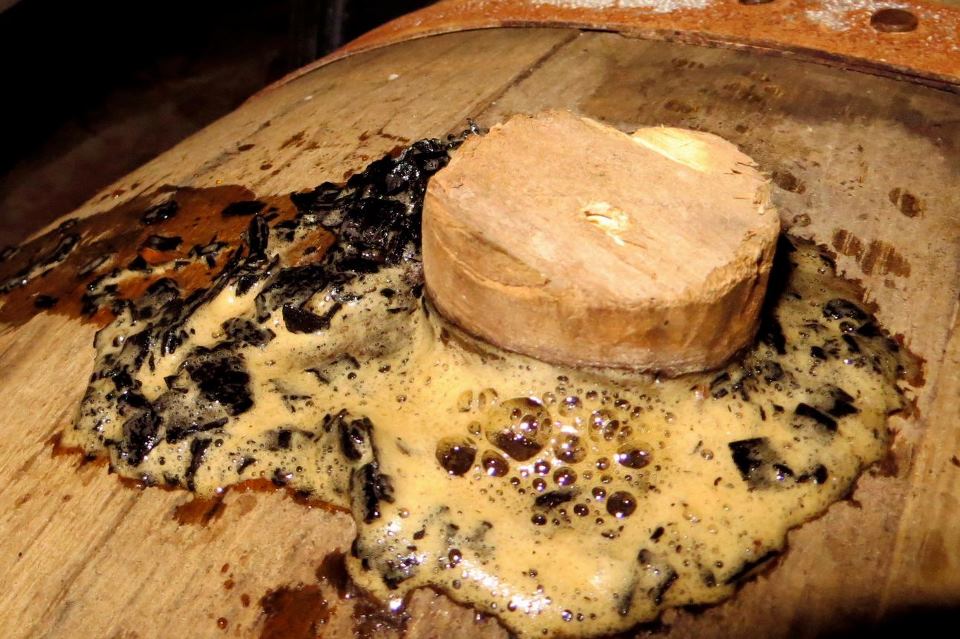
*Formatted to fit, to protect the innocent perhaps but mainly to fit.
**Jeff updated his thoughts, by the way, but it did make me wonder why what one wants should be limited to what some producers feel they can provide. Perhaps the former suits of Molson now share that feeling.
***A bear of beer! 

The Beery News Notes For That Post Canadian Thanksgiving Emotional Letdown

Actually, it’s been a good week this week. Forget that headline. While not at the level of “I’m a traffic cop in Spain under Franco and it’s Christmas so give me gifts of boozegood (as illustrated to the right) it’s been good.  Week off for yard work. And Monday’s Thanksgiving turkey came out of the oven in fine shape. We even had a last minute guest which meant we had to be on best behaviour and, get this, I couldn’t even each over the table for seconds of stuffing bare handed. Sheesh. And my vote for the Cardinal* even tied my preferred runner up the Crow** so that worked out well. Annnnd it was heartening to see the fans of the Blue Jays not repeat past bad behaviour when the Mariners took the first two games on the road care of, in part, a great Canadian.

Where to begin? The past! Last Thursday after that week’s edition went to… well, after I clicked on “post”, Liam shared an interesting piece on the joys of finding an excellent set of observations from the past:

While trawling through newspaper mentions for old pubs for yet another historical project, I came across a smattering of repeats in numerous papers in 1908 of a piece of pubcentric prose under the title, ‘The Delights of an Old Alehouse.’ It really gripped me as I read it and brought out some of the emotions mentioned above, but it wasn’t in any way familiar to me which seemed odd, as it was extremely well written and clearly done by someone with a lot of talent. Luckily, at the end of the piece the author – Charles Hugh Davies – was credited as well as the source of the original publication, which was The Pall Mall Magazine. Some sleuthing and searching finally led me to the piece, which is actually just a small part of an article titled ‘An Essaie in Prayse of Beer’ which is a much broader love letter to beer, and especially old ale, as was hinted at in the excerpt I had read. I can’t find it in any other source (apologies if it has been covered by others and I’ve just missed it.)

Good work. Sadly, the hunt for information on line has become harder as sources are removed from public access. It’ll only become harder as A.I. search narrows what you need to know. Which really was the underlying point about brewing history that Pope Leo was trying to make the other day.

And Gary has been digging into the old records this week, too, focusing most recently on Old Vienna beer – both Ontarian and Ohioan – and some almost eerie machinations on the part of my personal hero E.P Taylor:

Since Ohio was ground zero to market Red Cap Ale and Carling Black Label beer made in Clevelend, it makes sense that Canadian Breweries wanted to add Old Vienna to the American portfolio, at least initially as an export. If Canadian Breweries bought the rights to Koch’s Old Vienna from the receiver, a potential obsacle to such marking would be removed. Presumably O’Keefe Old Vienna did reach Ohio, as it did other states in the north. in the 1950s…

While E.P. clearly had a thing for Ohio, there are still questions questions questions and he’s on the hunt. Fortunately there are also answers at least etymologically speaking! On “steaming“…

The word ‘steaming’ for being drunk stems from when people in Scotland used to circumvent Sunday licensing laws by taking to the water. Public houses were closed, but steamships weren’t. To be ‘steaming drunk’ made its way into public parlance.

Also on another aspect of the question of “what is history,Chalonda White of Afro.Beer.Chick posted about the meaning of National Black Brewers Day and how it is still not properly appreciated:

National Black Brewers Day isn’t just about history. It’s about continuity. It’s about connecting ancient African fermentation to modern Black ownership. It’s about giving credit where it’s long overdue. When I pour a pint on this day, I’m not just thinking about the beer. I’m thinking about the people. I think about the enslaved brewers whose hands shaped the recipes. I think about Theodore Mack Sr., who bet on himself when no one else would. I think about Celeste Beatty of Harlem Brewing Company, who became the first Black woman to own a craft brewery in the U.S. and did it with unapologetic Harlem pride. She turned her love for the culture into liquid storytelling.

In another context of the search for authenticity, Ron shared his experience of attending the Norsk Kornølfestival in Ålesund, Norway over a series of posts including breakfast photos as well as observations on framhouse brewing:

The house is a log cabin with one of those turfed roofs which are pretty common around here. Next to it is a roofed fire pit, where a cauldron of water and juniper twigs are bubbling away over a wood fire. They never brew with pure water. It’s always juniper infused. The farmer, his brother and a mate are doing the brewing. Occasionally, giving the water a stir with a long wooden stick. Mashing takes place in a stainless-steel tub. Though they have some wooden tubs to show us how they used to do things. Water is transferred in buckets to the mash tub. To which the malt is later added. No measurements, either of the temperature of the water or the weight of malt, are made. It’s all very casual. Done by eye and experience. While the mash is standing, we go off for lunch. Which is more potatoes and cold cuts. It fills a hole.

As a bonus, there was also some sensible maritial fest-going advice from Ron like when he made: “…some cheese and salami sandwiches to eat at the festival. I saw the price of the food they’re selling there. I’d never be able to look Dolores in the eye again if I paid that much for nosh.” As always, I am with Dolores in these matters. Less realistic is the news out of the GABF last week… if BMI is to be believed:

At Boston Beer’s annual GABF brunch Oct 10, it felt like a throwback to the heady days of early craft, an optimism that might’ve seemed defiant if it hadn’t had receipts from the night before. BA prexy Bart Watson opened the event by noting that despite the “gloom and doom” in craft, Thurs night’s crowd had produced a “lively festival” with “not a phone in sight.” Bart said “that’s the spirit we need to find – people connecting over great beer.” Boston Beer prexy Jim Koch echoed Bart, saying GABF’s opening “was an illustration of the creativity and vibrancy of the craft beer movement and our ability to evolve, change, add more layers to what we do.” 

You will remember Boston Beer, the firm that one is advised now makes 30% of its revenue from beer making. Clearly not part of the post-passion universe. More connected to the reality-based reality is Mike Seay who visited an old friend – a brew pub:

In this era of Craft Beer, with more places closing than opening, my area got a nice boost with the return of a local brewpub chain that is tied to the original microbrew wave in the 90s. That place is Sequoia Brewing in Fresno. It closed for a while, lost owners, and felt like it would not return. But it did return, with new owners. Thankfully. Brewpubs fill a gap for most of us beer geeks. The gap of having kids. Or a partner that isn’t into going to taprooms. With a brewpub, both can be happy. Food for the ones not really into beer, and craft-style beer for us beer geeks. Usually, brewpub beer rises up to a respectable level of beer, but not a “I want to buy this in a store” level. That there is the rub for us.

And (also) out and about but farther afield was Retired Martyn as well as Mrs RM who’ve (also) been looking for happiness care of a beer and a bite in Romania and found it at the Grand Café Van Gogh:

We’re in a modern apartment near the University, Romana a mix of youth and decay… Appropriately, the city is full of umbrellas, in Umbrella Street and the Grand Café Van Gogh which is one of Mrs RM’s ticks. Obviously those paintings aren’t all original Van Goghs, that would be silly, but they are high quality prints and this is the classiest place in Old Town by a distance. Big brewery beer, CAMRA would be appalled, but a black lager is matched expertly with…. Papanasi, your Romanian mix of doughnuts, cream and fruit.

I hope the service was up to scratch. I’ve done service – missed putting in the order, dropped the beer, invented “diming” to maximize the tips, took shit from the kitchen staff – but I never had to work it like a waitress. For Pellicle, Rachel Hendry discussed the role in pop culture and her own life:

What is it that you want from your waitress? Efficiency, charm, a smile, care, attention to detail, an attractive physique, a winning personality, a sense of humour, wisdom, empathy, experience—the list goes on! All of that flair! No wonder she’s so popular! But how much of a person are you really entitled to? The Waitress moves among her audience members, weaving her way past tables and into their lives. She works within her community—there’s that animation, there’s that exposure—performing for them as is the requirement of her work. How much should The Waitress give and how much should she restrain? How much are you paying for?

Excellent stuff. And from India, we learned there was much surprise on what people found out their drinks tab was paying for:

A liquor bill of a restaurant in Rajasthan has been going viral on social media. But why? Well, it levies cow cess among other taxes, including CGST and SGST. The tax, which was introduced in 2018 to support cows and cow shelters in Rajasthan, has triggered a debate online.  One user said, “As much as I want the welfare of cows (or all animals for the matter), I don’t understand the concept of cow cess.” Another said, “The irony is the Jaipur-Jodhpur highway, which is littered with cattle loitering on the road, making it extremely dangerous for commuters. Rajasthan govt is barely doing anything for the rehabilitation of cattle/cows.”

Sticking with news from India, there is a shortage of aluminum cans for the domestic brewing market that strict regulations are making worse, according to Jessica Mason:

Domestically, aluminium can suppliers such as Ball Beverage Packaging India and Can-Pack India, have revealed that they have already reached maximum capacity at their sites and will not be able to increase supplies for at least 6-12 months unless production lines are added or expanded in some way… At present, due to the QCO, the beer industry cannot import cans from foreign vendors as BIS certification can take many months to process. To avoid a shortage in beer supply, local reports have outlined that the BAI has lobbied the government for a “short-term regulatory relaxation” of its QCOs to ensure uninterrupted supplies from other countries.

Interesting then that Canada is courting India as a market for the supply of our metals. We make a lot of aluminum that could suppliment local production. If, you know, Mr. Trump lets us…

And then… there was much response to that nice light piece in the NYT by Mark Robichaux originally titled “Opinion – How to Save the Craft Beer Industry“*** on what US craft beer can do to save itself. Some sensible… (…maybe…) Others not so much**** or worse. Me, I wonder if  it can be saved as the taint of “your uncle’s drink” is now so well upon it. Not to mention the whole general slump of interest in booze thing.***** But what I liked most in the piece is how it makes an attempt too rarely seen with the general topic – an attempt to set out a reasonable argument. Four arguments in fact… of varing decrees of validity. The best one is the third of the four:

Craft beers also need smarter labels. The industry built its identity on personality, with quirky mascots, puns and inside jokes as logos. It was fun — until it became clutter and noise. My beer aisle now looks like a vertical Comic Con merch table. Today’s overwhelmed consumer doesn’t have time to decode a beer called Sour Me Unicorn Farts (a glittered sour from DuClaw), Purple Monkey Dishwasher (a chocolate peanut butter porter from Evil Genius), or Hopportunity Knocks (a perfumed, piney I.P.A. from Caldera Brewing Company). They want to know: What does it taste like? Will I like it? Design matters, yes, but clarity matters more. Make labels that tell drinkers what’s inside, not just what’s funny at 2 a.m. in the brew house.

Certainly a point we’ve heard, agreed with or disagreed with****** over the last few years. Consumers (not nerds, not trade staff, not beer writers) are not aided by in joke branding design. AKA the exploding bubble gum machine effect. But he misses the mark for me on issue #1 on the IPA problem, complaining that “…most taste like pine resin…” and not that anything that tastes like anything can be called an IPA now and that it loops into issue #3 above. Issue #2 is an observation on strong beer that is both true and also a bit dated by, you know, fifteen years. While it’s sorta true there’s plenty of beers being made which are not like that so, you know, buy those. Issue #4 is just a sensible observation that good beers should come in smaller cans… but plenty do.  One take away for me is this: if a reasonable writer and a reasonable publication like this is suffering from as serious a misunderstanding of the whole topic as a number of beer writers allege… have the last twenty years of public writing about good beer been an utter and too insular failure?

That’s it for now. Not as long as last week but that was nuts. While you beg for more more more, please also check out the below mentioned Boak and Bailey every Saturday and sign up for their entertaining footnotes, too. Look out for Stan when he feels the urge now that he’s retired from Monday slot… maybe … maybe not. Then listen to a few of that now newly refreshed Lew’s podcasts and get your emailed issue of Episodes of my Pub Life by David Jesudason on certain Fridays. And Phil Mellows is at the BritishBeerBreaks. Once a month, as noted, Will Hawkes issues his London Beer City newsletter and do sign up for Katie’s wonderful self-governing totes autonomous website featuring The Gulp, too.  Ben’s Beer and Badword has been on hiatus since April but the archives are out there with the all the sweary Mary! There is new reading at The Glass which is going back to being a blog. Any more? We have Ontario’s own A Quick Beer and All About Beer is still offering a range of podcasts – and there’s also Mike Seay’s The Perfect Pour. Plus follow the venerable Full Pint podcast! And there’s the Craft Beer Channel on Youtube. Check out the archives of the Beer Ladies Podcast. That’s quite good and after a break they may well be are back every month!

*The bird so nice they named it twice, cardinalis cardinalis!
**HARBINGER OF DEATH!!!!
***But then on Tuesday the title was altered to the less serious “Wacky Labels and Silly Names Are Killing Craft Beer” after an intense intimidation campaign by about 13 craft beer nerds that would have left even a Trump bootlicker impressed. Please don’t tell them about SNL’s non-non-alcoholic beer ad. Don’t make fun of poh widdle cwaft.
****Leaving out words like ““… as many have…” which undermine your point is not a strong move.
*****An interesting description of the loss of interest in booze can be found at UnHerd where “Is it last orders for German beer? Disaster is brewing in Bavaria” by Ian Birrell was published this week with this odd scene from Oktoberfest: “Not that everyone is into wellness. In one tent, I come across a lively group snorting what I presume was cocaine from the top of a bald man’s shiny head. One gives me a big grin as he sniffs deeply, then wipes his nose. Two tables down, another ebullient gang of pals pass around a mirror with chunky white lines laid out on it. Minutes later, I pass yet another high-spirited gaggle tapping small piles of powder onto their clenched fists.
******It’s good to have a good civil disagreement. Stan misses them.   I once recommended a client sign a document in addition to a contract called a “Letter of Disagreement” to clarify what was and wasn’t acceptable. They didn’t.

The Beery News Notes For The Threat Of Frost And The Yanks And Jays In What Might Just Be A Post-Passion World

Well, since we last met… yes, fine… the Red Sox lost last Thursday. But then the Yankees (who beat the Sox… my Sox) got their own butts kicked in the first two games of the next series by the Jays who took it all in game four last night which… sorta made me feel… schadenfreudig? Is that the word? I dunno. Or is it dünno? Anyway, the other word on my mind is frost. I will only know at sunrise this Thursday morning if the sheets and covers that I threw over the tomatoes and basil and beans did the job. (Update: -0.3C at 6 am!) But it is autumn. And it doesn’t matter if there is no frost for the two weeks after today if the frost came today. Most years, with luck, I can coax something or another to keep on growing right up to November. With luck.

Speaking of words, on Tuesday Jeff wrote about the doom and gloom in the beer trade, reviving some thoughts from 2013 as he did – a discussion in one way about perceptions that the choice of words convey as much as the context. The context being if one is on the way up or the way down. This week’s news notes seem to carry a bit of the weight of those sorts of perceptions so I feel like this sort of preamble is needed to remind ourselves that it’s just the point in time we find ourselves in. We need to reflect. To consider our lot. Sorta how I feel when I look at the black leaves of a tomato patch after a killing frost. When I reflect. And swear a little. So I will perhaps a bit intentionally mix the bad news with some things that are lighter and see what happens. Good thing there’s plenty to read.

First, about that cyberattack* in Japan on Asahi that I mentioned last week. It seems that it has been resolved but I hadn’t appreciated how it create quite serious issues for the broader Japanese bevvy and snacking market:

Most of the Asahi Group’s factories in Japan were brought to a standstill after the attack hit its ordering and delivering systems on Monday. Major Japanese retailers, including 7-Eleven and FamilyMart, have now warned customers to expect shortages of Asahi products… Asahi is the biggest brewer in Japan, but it also makes soft drinks and food products, as well as supplying own-brand goods to other retailers… In its latest statement, Asahi said that as a result of containment measures following the attack, ordering and shipment systems in Japan had been affected and it was also unable to receive emails from external sources.

Speaking of containment, consider Mr. Gladman on two types of entryways to basement bars and how their architecture guides the experience:

The street-steps-door type of basement bar usually has windows somewhere on its street-facing wall and so maintains a connection to the city outside (Type A Basement Bar in the Gladman Taxonomy of Bars…)  Bars like this can be hard to find even if you know about them… It’s a tiny adventure that ends with a delicious reward. These bars are often unpretentious and cosy — everyone is hunkered down together, hidden away in a prime spot, unnoticed by the schmoes passing by just a few feet above. The other, street-door-steps type of basement bar (Type B) is even more concealed at street level, often offering just a small sign above a door. Within this lurks a clipboard-wielding, radio-headset-wearing guardian, like Cerberus at the gates to a boozy underworld. Once you’re in, it’s often entirely devoid of natural light. It is its own world, womb-like and all encompassing.

Not so many people walking down these sorts of steps in Brazil – both Type A and B – which is reasonable given the news:

…the market has a new worry: the crisis caused by contamination of distilled beverages with methanol. For now, it’s not possible to determine the impact of this on the beer industry going forward. On the one hand, bars are emptier and parties have been canceled due to the negative repercussions of the contamination. On the other hand, greater consumer concern about cocktails has led to a strong shift toward beer, seen as safer.

My dive bar tourist trip to Rio is now officially cancelled. But more weclome might be a stop at The Dog and Bell in Deptford, London which is the subject of this week’s feature in Pellicle penned… or perhaps rather keyboard clicked by Will Hawkes:

This backstreet boozer in a historically unglamorous part of town has not only survived the pub cull of the past few decades, it has thrived. Indeed, few London pubs are currently more fashionable. How? Well, for all the Dog and Bell’s singularity, its story tracks the evolution of pubs in modern London from the 1970s, when they were ubiquitous, to now, our frantic, distracting era of Instagram Guinness and event culture, when a simple pint in the pub is no longer good enough reason to get off the sofa. It’s been a long journey, but at every key junction over the past 50 years this charismatic pub has taken the right turn. 

A loving portrait of a welcome local and perhaps unexpected gem. Conversely, I don’t expect to be following in the footsteps of  Jason Wilson who brought an extreme level of exactitude to the consideration of an extremely expensive beverage – coffee that costs $30,000 a kilo:

Each sip I tried—and we were served small sips because of the limited amount of this coffee—had its own personality. Each producer and variety had a different flavor profile, mouthfeel, aroma, even color. While some may regard coffee tastings like this one as snobby or ridiculous, I appreciate the intense mindfulness and attention to detail coffee fanatics have. In one sip of coffee, there are flowers, fruits, foods, and even songs. I tried each of them for myself, then read the judge descriptions from the Best of Panama auction to compare thoughts. Some may disagree, but I try to treat it as if there is no right and wrong, just opinions.

And, speaking of opinions, Boak and Bailey posted a bit of a questionaire on the status of Belgian beer culture, asking folk for their thoughts about whether the beers and pubs they encountered on a recent trip were (my words) out of date duds or treasures at risk:

There’s also something about how the beers we tried on this recent trip didn’t seem to have evolved from Belgian brewing tradition so much as they were inspired directly by American-led homebrewing culture. It’s really weird to drink a Belgian-brewed saison and think, huh, this tastes like one of those ‘farmhouse IPAs’ people were making back home in about 2012. When we think of newer Belgian breweries we do like, it’s because they’ve found a way to push the parameters while still producing beer that tastes and feels Belgian.

This generous sort of the asking of the questions is a very useful tool of one is wanting to advance one’s education. Seek the views of others to check your own assumptions. Among the responses, the particularly well-placed Eoghan provided a lot of insight from the local point of view:

I don’t disagree that Belgium has one of the richest and most diverse beer cultures in Europe, and it is a small miracle that so many idiosyncratic beer traditions managed to survive the tumultuous 20th century – more tumultuous here in Belgium than they maybe allow for. But it was their proposition that Belgian beer culture is defined by evolution not revolution that prompted my little piece of anachronistic time travel above. It is true that Belgian brewers – to borrow an idea I first stole from fellow Belgophile Joe Stange – are past masters at co-opting and finetuning wider brewing trends to make them palatable in Belgium. My contention is, however, that the history of Belgian beer is more of a Hegelian dialectic, a process of thesis-antithesis-synthesis evidenced less by evolution that by periods of stability punctuated by significant, discombobulating ruptures.

See, that is great. Fascinating – and I don’t even know what half of that up there means! Another thing I don’t know is whether a Spanish beer brewed in Britian in a British brewery owned by a Spanish brewing firm is Spanish or not:

This week Damm will make its first meaningful manufacturing foray outside Iberia when it opens a brewery in Bedford. The move represents an investment of almost €100 million (£87 million) and will create scores of jobs. The company is going to great lengths to ensure its UK-brewed beers taste the same as those made in Barcelona by sticking to the original recipe and investing in the equipment to ensure the product is identical.

Hmm… I still don’t know. But if we are sticking with the examination of not only how things became what that are but also what are these things in themselves, there is no better assessor than The Beer Nut who wrote about the recent final edition of the annual Borefts beerfest:

Two brewery stands at the 2025 Borefts Beer Festival seemed to have almost continuous queues. One of them I could understand: the New England legend Hill Farmstead. Early on day one I tried the barrel-aged coffee porter they brought, The Birth of Tragedy… This isn’t the sort of beer I associate with Hill Farmstead but it has been created with the same level of expertise. Canadian brewery Badlands was next to them and was, if anything, even more popular with the crowds. I had never heard of them so had no idea what the fuss was about. After they sold out and closed up early on the first day, I made sure to be there early on the second… [After trying two of their beers…] I was none the wiser regarding the Badlands fuss. They didn’t seem to be doing things particularly different to a thousand other microbreweries..

So, there you have both broader analysis of the cultures of beer as well as specific examination of each beer, drip by drip in the common context of the fest. All cheery and interesting exercises in digging around and thinking about beer. David Jesudason dug into another chestnut for the Wine & Spirit Education Trust, unpacking what’s called IPA but what he calls “IPA”:

The first ‘IPAs’ – note quotation marks – were sent out on East India Company boats in the 1760s and were strong, highly hopped ales due to India’s warm climate: the hops’ antimicrobial properties combined with the high alcohol level aimed to prevent spoilage. These were a cross between a bitter and a barleywine and by the time they arrived in India the hop character had vanished into the Bay of Bengal. They were said to taste more like champagne than beer. In reality, they were a world away from a modern IPA. Samuel Allsopp was the first to market them as Indian Pale Ales – and tie them to colonial decadence – after he copied Londoner George Hodgson’s recipe but crucially brewed them in Burton, where the minerals in the water further emphasized the beer’s hop character. These were bitter British ales or similar to heavily hopped autumn stock beers.

And Laura Hadland took on a task that I wish more writers who focus on beer attempt – discussing wine:

The lights were low for a chic soiree organised by Wines of Hungary at Vagabond Wines in Birmingham yesterday. Twenty five producers were showcasing their wines to an enthused audience of trade, media and more. I had an hour to work my way round the hit list that I had prepared in advance – nowhere near enough time. Especially since the winemakers and their sales teams were so enthusiastic about their wares that they all insisted on having us try every single one.

My experience of Hungarian wine started with some pretty hefty even harsh Bulls Blood out by the town’s water resevoir in high school but I now hoard sweet Tokaji which I never seem to get around to opening as fast as I find them. Of course, that means my wake might be worth the trip as my fam gives them away along with my record collection.

ATJ shared more serious thoughts on mortality in his piece “Funeral Pints” where the swirling thoughts at a time of loss were steadied with gratitude by a bracing pint among others in a pub:

The clunk of loose change as it goes into a pitcher, ‘thank you very much William’, ‘not a problem’, a stooped man with a face that reminds me of a thinner version of WC Fields.’ ‘Here he is.’ ‘He ain’t got a jacket.’ ‘What’s it to you,’ comes the reply. ‘He was dressed up as a boy scout yesterday,’ says another voice. The man with the long face who photographed his breakfast is having a talk with himself, while elsewhere pints are piling up on tables. Tattoos, chewing, chomping, swallowing, gulping, laughing, ‘listen mate’, finger pointed without malice. We’d better get to the funeral.

The drink finds a place in so many moments. And does the job. Even now at a time which we are subject to so much that feels like wave upon wave of a grim big picture, like this data* from Beer Marketers’ Insights:

Craft beer trends (ex non-alc) steepened over the summer to volume -8.4% and $$ -6.4%; several pts below total beer volume -5.6% and $$ down 5.1% for 18 wks thru Sep 20 vs yr ago. And when comparing craft’s yr-to-date sales thru Sep 20 vs the same period in 2023, the # of craft vendors (-10%), sub-brands (-13%) and SKUs (-12.5%) are all down double digits.**

From that view of the general, for the double, Jeff also wrote on a specific application in his obit* of Upright, a favourite brewery facing its end:

Craft brewing has spent a huge amount of time navel-gazing over what it means to have a clear vision. This often bled into marketing bromides, as breweries repackaged derivative products as original and creative. That development led to some of the cynicism that marks the mood today. Upright did have a clear vision, however—and Alex seemed almost immune to commercial considerations. Upright always felt more like a sixth-generation Belgian or Franconian brewery than an American craft brewery to me.

A wonderful remembrance of the soon to be no more. Summing up based on all the above, can we draw conclusions? Well we could ask ourselves (yet again*) whether the function of good beer writing to support the industry or to more broadly understand the trade and culture. By way of illustration, consider this:

“…The Guild’s board members are all driven by our shared passion for the beer industry and those who work within it. We’re proud to represent the very best of beer and cider communicators, who are such an important asset to the wider industry…”

A familiar line that’s become cliché and so nothing against the particular speaker. A prominant popular theme voiced for the best part of two decades, perhaps until somewhat recently. I mention that in the context of this article in The New York Times which is, yes, yet another obit* for US craft beer but, perhaps unusually, one that contains some interesting admissions:

This summer, 21st Amendment believed it had found a way to keep at least some of its operations going. It planned to bring in a new partner and start buying smaller craft beer brands that it would brew in San Leandro. But in late August, the lender pulled the plug on that idea. In late September, 21st Amendment closed its flagship brewpub in San Francisco. The San Leandro location is expected to shutter by the end of this month. “We were driven by our passion for craft brewing, and we got so caught up in it that we had blinders around what the reality is for craft brewing right now,” said Shaun O’Sullivan, a co-founder of 21st Amendment. “We’re a cautionary tale right now to anybody who wants to grind down and open up their own place. It’s just not a good time.”

So is / was “passion” an “important asset” or a form of those “blinders“? Whether in business or in writing. Maybe both. What ever happened to well-earned hard-bitten steely-eyed objectivity? Why did we not foresee, just as the rise casinos and later lotto tickets stripped gambling of its vice, how craft beer was infantalizing booze with kiddie friendly fruit flavours in brightly coloured cans – and even converting every tavern into potential seminar spaces.*** I blame the “don’t judge the tastes of others” line. Who writes without hoping to offer incisive opinion? You know, if the beer writers, by error or omission, participated in priming the passion pump with boosterisms during the era of irrational exhuberence… is it not reasonable to consider that the oeuvre itself aided in the downturn to some degree?****  That’s sorta summed up by that old nugget, the one about the rising tide raising all boats that we heard so much about. We also know that the tide falls. Twice a day. Every day. But most folk forgot* to mention that.*****

Doesn’t mean, however, that we can’t learn lessons from the downturn. We might even consider ourselves now “post-passion” in our relation to beer and beer writing. That would be good. Without, you know, sponsored articles or A.I. articles****** or even A.I. sponsored A.I. articles.* That would be better. Based on the above we can see people can and will doubledown and keep digging around, questioning conventions and asking the right questions about what is and what isn’t the good stuff in all this beery culture.******* I’m sure we can. Well, you all can. I just read this stuff.

That’s a lot. And there’s still the footnotes below. While you are chewing on all this, please also check out Boak and Bailey every Saturday and sign up for their entertaining footnotes, too. Look out for Stan when he feels the urge now that he’s retired from Monday slot… maybe … maybe not. Then listen to a few of that now newly refreshed Lew’s podcasts and get your emailed issue of Episodes of my Pub Life by David Jesudason on certain Fridays. And Phil Mellows is at the BritishBeerBreaks. Once a month, as noted, Will Hawkes issues his London Beer City newsletter and do sign up for Katie’s wonderful self-governing totes autonomous website featuring The Gulp, too.  Ben’s Beer and Badword has been on hiatus since April but the archives are out there with the all the sweary Mary! There is new reading at The Glass which is going back to being a blog. Any more? We have Ontario’s own A Quick Beer and All About Beer is still offering a range of podcasts – and there’s also Mike Seay’s The Perfect Pour. Plus follow the venerable Full Pint podcast! And there’s the Craft Beer Channel on Youtube. Check out the archives of the Beer Ladies Podcast. That’s quite good and after a break they may well be are back every month! Such is life. Such is beer podcasting and newslettering… which, as Ray says, are blogs! And he’s right.
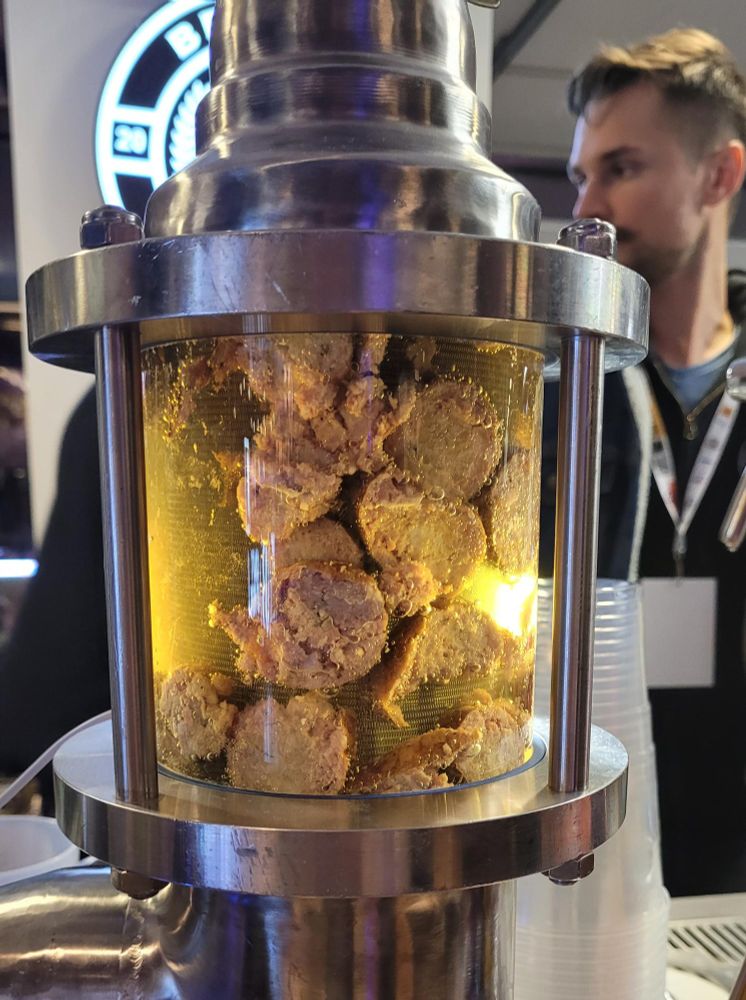
*YIKES!!!
**At least it’s not as bad as in Russia: “In the first half of 2025, retail beer sales in Russia fell by 16.3 percent year-on-year… Due to the increase in excise taxes (they increased by 15.4 percent at the beginning of the year), the cost increased accordingly. In 2023, the average price per liter of beer was 120 rubles, in 2024 — 129 rubles, and at the end of July 2025 it reached 151 rubles per liter — prices have increased by more than a quarter (26 percent) since 2023, Nielsen added.
***The signs outside the craft beer bars said “Off-flavour Seminars Every Tuesday!” I thought of that when reading this passage from “The Engines and Empires of New York City Gambling”by Adam Gopnik, The New Yorker, August 4,  2025: “Gambling, too, now divides the world between those who know enough to make it boring and those who—bored—prefer not to know. They play and lose anyway. Thrilling games, like thrilling cities, thrive on enigmatic imperfections: the small market anomalies that quants scour for an edge, the tells and giveaways that reward the observant and elude the rest. Once all is understood, all is dull. Gambling may once have belonged to the Devil, but I assure you it does no longer. The arrival of organized gambling in its casino form has stripped away even the faded glamour of old miscreants like Rothstein and St. Clair. When, at last, detailed renderings of the proposed Caesars Palace emerged, they were hilariously decorous, showing not crowds of modern Harry the Horses and Nathan Detroits but elegantly dressed men and women in dignified black, playing in poker rooms that looked ready to host a seminar.
****And to be sure we can also lay much at the door of the evangelizing homogenizing craft industry conference seminars which took a page from time share symposiums. Imperial Pilsner anyone? Everyone?
*****Did I ever mention I spent school years right into undergrad next to the Bay of Fundy? Nevermind. Perhaps now’s the time for the trade’s comms people to adopt of the “Big Yellow Taxi” message – “drink craft: you don’t know what you’ve got ’til it’s gone.” It could work. Something might.
******Can’t wait for that market sector‘s crash! It’s all relative.
*******BTW there was some great beer writing advice set out in last Saturday’s footnotes from B+B: “Prop Up The Bar is a new blog to us. It’s a proper old-fashioned blog, full of massive photos that haven’t been edited and typos. It’s made us think again that the professionalisation of blogging arguably didn’t do it any favours and has perhaps discouraged people from just having a go, like Nick C, using their blog as a diary. In that context, props are due to Martin Taylor whose blog is well written and well researched, but never feels as if it’s taking itself massively seriously. (Yes, we know, we should watch and learn.) It signals that, actually, you can just have adventures and quickly write them up.

The Thursday Beery News Notes For The End Of Summer 2025

There are good views out there. Lots of golden hour sunlight finishing up the days as we face the reality that, yes, winter is coming. Out and about that evening, I saw a frog and a hedge of jewelweed – but you’d expect that, wouldn’t you. I like how the angle of the shadow makes something of a right angle with the tree. I didn’t notice that when I took the photo. But even saying that makes it too artsie, less just see-ie. Similarly, writing about hops, Jeff wrote about a limitation but its really about two limitations. And it’s all a bit like dancing about architecture… but what isn’t:

The thing about adding more is at a certain point you don’t get more. We learned this when breweries were putting eight pounds per barrel of hops in their beers and making them taste like lawn clippings. To get more, you have to add different. And here I give you fresh hop beers. They offer a dimension of flavor that is different from regular kilned hops. Trying to describe them is hard because rather than just reaching for another adjective, we grope toward different realms of experience. Drinking a very good fresh hop beer is to experience synesthesia and encounter the taste of iridescent green.

Conversely yet still on the question of different, not as charming an experience was an airport sandwich sold to Matt Gross under the presumably personally seductive name “the Matthew”, it of the 10 slices of prosciutto:

…laid flat, one on the other, with no space between them, to form a dense, unchewable mound of salty protein. Look, sandwiches are all about architecture, and the meat, especially a powerfully flavored one like prosciutto, needs air. Each slice, thick or thin, should be separated from its brethren, folded gently and laid haphazardly (within reason) upon the bread. You want to feel the texture of the slices, the regular irregularity of the bite as your teeth pass through the layers. That sandwich needs to breathe. If it can’t breathe, it’s dead on the plate, limp and heavy, boring. R.I.P. Matthew. The great thing about this approach is that you can actually use less prosciutto per sandwich and at the same time make the sandwich taste better.

It’s funny. As I go through the week’s saved links I can get interested about someone writing about a crappy sandwich but, for example, can’t be bothered with anything anyone is writing about THC drinks. What could it be? Bad writing? Maybe.* Compare how, for CAMRA’s What’s Brewing, yet another Matthew wrote about beer pubs and heritage in the nearby local layered landscape under development in Manchester’s core, writting in a way which contextualizes more than lobbies:

“We believe regeneration should enhance, not diminish, the city’s heritage. The Marble Arch deserves to be protected as part of Manchester’s future, not pushed aside by it.” On the subject of heritage, one brand looking to capitalise on the city being the national centre of attention this summer is the iconic Boddingtons. Brand owner AB-InBev has decided to return the brand to cask production after it was discontinued in 2012. The news follows hot on the heels of reported investment in another of its heritage beers, Bass…

I like the tone. While one can get numbed by the beating of a drum, an invitation to think about survival and revival in face of modernity is instructive. Speaking of which, maintaining an interest in more than listicles, Laura Hadland‘s** (slightly paywalled) column in The Telegraph takes on a useful discussion for those with a modest to moderate interest in beer – serving temperature:

… some people adore the sharp thrill of bitter flavours. If that’s you, West Coast IPAs should scratch the itch. This US style of beer is hop-led. Citrus and pine flavours are underpinned by intense bitterness, balanced with a light touch of malt… An American brewer may be horrified to see this beer style served any other way but well chilled. However, there is an argument that they could be served fractionally warmer: research shows that as temperature rises, our perceptions of bitterness usually increase. The real connoisseur of bitter flavours should consider ordering a West Coast IPA (such as Elusive Brewing’s Oregon Trail) on cask, served at a cellar temperature of 11-13C, as opposed to the keg-dispensed version that will be around 5-8C.

While there is a reference to the dubious tale of the hyper-efficient expectorating wine judge, this is exactly the sort of writing that there should be more of. An explanation of an idea. An invitation to try something out. Which may be why the comments are not (entirely) focused on slagging the author. Speaking of context and understanding, I like this piece by Jason Wilson about old vines and the disasterous 2025 harvest in Rioja and what keeps the winemakers… making:

I asked Oxer why he thinks people can be so skeptical about the concept of old vines. “In some way,” he said, “we’ve lost our connection with the old world, the spiritual world. We think too much about the scientific world rather than the spiritual world, but we should join both worlds.” He added, cryptically as always: “Soil is darkness, but always in the darkness, there’s light. Soil is a world we don’t really understand. It’s mix of magic and microbiology.” As we finished our meal with a Basque style cheesecake, Oxer told me that 2025 will be a different story than 2024. He’d lost at least 60 percent of this year’s grapes to the summer hailstorms.

Note: if you think you are dedicated to the drink, consider Big Jim. Talk about pacing your drinks. Conversely, The New York Times ran an (somewhat paywalled) article this week that had me shaking my head over the level of alcoholism being decribed and the introduction of a new concept:

Withdrawal from alcohol, though, felt like a direct hit. I looked to my bedside table and saw the glass of “bed wine” from the night before. “Bed wine” is something I promised myself I would quit this year. It’s the last glass of wine I bring with me as I climb into bed to watch TV or do the crossword puzzle. I tell people that my relationship with alcohol is “complicated,” but it’s not. I love drinking wine and a good cocktail, but booze is horrible to me. In my world, there’s always an excuse to drink: celebration, disappointment, stress.

A habit of “bed booze” seems to me to be a pretty alarming cry for help. Which the piece sorta admits it is. But still… Lordy. What’s so wrong with warm milk?  But things could be worse… maybe. Last Friday, Will Hawkes circulated his latest edition of London Beer City and included this gem of remembrance of a shit pub past:

In 1998/99 I lived about two minutes’ walk from the Finn and Firkin, an imposing 19th-century boozer on the Pershore Road in Birmingham. I remember Dogbolter, a beer I avoided because it was too strong. I remember the L-shaped bar, and the smelly loos next to one entrance. I remember the huge dance hall/concert venue attached to the back. And I remember, for reasons I still can’t truly understand, being unnecessarily rude to a Stoke-supporting friend when he entered the pub one Saturday evening having just watched his team lose 3-0 (although, checking Stoke’s results, they didn’t actually lose 3-0 in 1997-98. Maybe it was 4-0? Or 4-1).  (The pub stopped being a Firkin soon after and is fully shut now).

Nice. Exactly what one looks for in every establishment. Or is it? Some Americans go to Italy in search of an English dispense system… well, at least one did:

Today, from my count, there are at least fifteen locations in Rome serving beer via handpump. And while a number of British breweries send their casks here, there are a several Italian breweries like Hilltop Brewery, Shire Brewing, and Linfa Brewery that are regularly cranking out casks for the pubs. Beyond Rome, you can find handpumps in most Italian city at establishments with an interest in selling anything beyond the standard Peroni or Moretti. Even in Sicily. However, I suspect most of these are serving kegged beer hooked up to a handpump (i.e., they’re not serving cask conditioned beer). To my knowledge, I didn’t have any of that on this trip.

Massimo Internazionalismo!! And perhaps being a bit massimo medievalismo, the feature in Pellicle this week by Thomas Soden is on the topic of gale, the herb that hops destroyed. AKA myrica gale scientifically or sweet gale, sweet bayberry, dutch myrtle or sweet willow.  Or even bog myrtle like when I had a beer brewed with it back in 2008 brewed by Beau’s right here in eastern Ontario. Soden shared:

A wild plant, it often featured in the herbal gruit which flavoured beers from low countries before hops became commonplace in brewing. The shrubs require the specific soil acidity of bogland areas, which although once abundant, are increasingly scarce today. Nothing, however, is stopping modern British brewers from utilising gale as a flavouring agent. In an age in which ‘natural’ beers and wines, and fermented drinks like kombucha are gaining popularity, this seems like it has potential. In 2017, the now sadly defunct Treboom brewery in Shipton-by-Beningbrough near York made a wheat beer flavoured with Gale named “Myricale,” and acknowledged it was a homage to the style. So why has it died out?

Hmm… might I suggest the whole “tastes like a bog” thing?

And for Stan because we share the love of such things, a story of how much alcohol chimps consume:

Someone have a word with the chimps? Observations of the apes in the wild show them imbibing the alcoholic equivalent of a half pint of beer a day through the vast amount of fermented fruit in their diet. Researchers arrived at the first estimates of wild chimp daily alcohol intake after measuring ethanol levels in fallen fruit that the apes gather from the forest floor in Kibale national park in Uganda and in Taï national park in Ivory Coast. While individual fruits contained less than 0.5% alcohol, the chimps’ daily intake swelled as they devoured the ripe fruit pulp. The apes were particularly fond of figs, which contained some of the highest levels of alcohol the team recorded.

Speaking of the pre-hop universe of gale and chimps and… stuff… to conclude this week I am going to try a new weekly feature, featuring old stuff every week. I realized the other day that not only had I been writing this… whatever this is… for over two decades but a lot of my history writings are well down the lastest posts lists. So I am going to try to give a nod to a few things that you might find interesting and perhaps new to you if you weren’t reading this sort of beer stuff back then. Let’s start off with a few links to posts under the 1400s tag:

a. from 2016, check out The Steelyard, Stillyard, Stylyard and Spelling about the Hanseatic League’s foothold in central London
b. from 2015, read all about the brewing dynasty of The Hillars Of Golden Lane, Cripplesgate Without and
c. from 2019, a survey of England’s Increasing Concern Over Beer Brewing, 1430s to 1580s.

That is it for now. Enjoy these last days and golden hours of this summer and as you do please also check out the below mentioned Boak and Bailey every Saturday and sign up for their entertaining footnotes, too. Look out for Stan when he feels the urge now that he’s retired from Monday slot… maybe … maybe not. Then listen to a few of that now newly refreshed Lew’s podcasts and get your emailed issue of Episodes of my Pub Life by David Jesudason on certain Fridays. And Phil Mellows is at the BritishBeerBreaks. Once a month, as noted, Will Hawkes issues his London Beer City newsletter and do sign up for Katie’s wonderful self-governing totes autonomous website featuring The Gulp, too.  Ben’s Beer and Badword has been on hiatus since April but the archives are out there with the all the sweary Mary! There is new reading at The Glass which is going back to being a blog. Any more? We have Ontario’s own A Quick Beer and All About Beer is still offering a range of podcasts – and there’s also Mike Seay’s The Perfect Pour. Plus follow the venerable Full Pint podcast! And there’s the Craft Beer Channel on Youtube. Check out the archives of the Beer Ladies Podcast. That’s quite good and after a break they may well be are back every month! Such is life. Such is beer podcasting and newslettering… which, as Ray says, are blogs! And he’s right.

*Yet we do recall the wise words of Boak and Bailey in last weekend’s footnotes: ” “Beer fandom is infested with know-all-ism.” To expand on that briefly, it’s the tendency to respond to any post or article with something like “Old news, already knew this” or “And of course, [supplementary fact]…” Worrying about whether what they’re saying adds anything new to the conversation is one thing that inhibits people from writing and sharing. Yes, there are certain topics that have been hashed out a million times. But when you write about it, it’ll be different because you have a different perspective, and because new evidence has emerged, or things have changed, since it was last written about. Don’t write for the know-alls, because you can’t please them. Write for yourself, and for people who like what you do.” “
**For the double, Laura on pockets at the Beeb.

Are These Beery News Notes About The Here And Now Or The There And Then?

Summer shouldn’t be when peas take off around here but a regular dousing of cold watering plus seed stock bought from further south than usual seems to have done the trick. That’s a purple velvet Magnolia Blossom pea tip just about to burst. I really don’t concern myself whether it’s going to be tasty or not if it all looks that good. Rabbits? You ask about the rabbits? Well, suffice to say the foxes that moved into the neighbourhood have culled the squirrels… but rabbits? Some radical chicken wire applications have been applied. Treatments which offer fewer treats. Rabbits? Hah!!

Speaking of me and mine, I can’t let the week pass without mentioning a visit by ferry to a really great bar restaurant called Spicer’s Dockside Grill on Wolfe Island just off of my fair city. The place even have a cabana style bar on a dock right where the Great Lakes meet the great St. Lawrence River. A fabulous spot. I’m sharing below a few thumbnails circa 2011 style. I hope they render for you as they render for me… which is essentially the Bloggers’ Prayer, innit. Click for bigger and clearer views.


Back in the basement, on Monday Stan got me thinking. It’s not often that I admit to thinking but Stan did it. He went and got me thinking this very week about times gone by.  Because he quoted a piece about the beginning of blogging that diverged from my understanding. It wasn’t gatekeepers and curators. It was hawkers, carnies even shouting “hey look at this… I have no idea what it is but it’s all free!” But these things happen. Time shapes the past. And the beginnings of blogging are events from over thirty years ago, half my life ago. It was 9/11 that really caused the broader introspection on display that fed the hobby I kept up with this here site, now about twenty-two and a half years in operation. That is a bit of a thing.  So as we move forward again through the beery news note trust me on this one point: not curated, just gathered and dumped at your feet.

Next up, I came across this excellent explanation of the role and the value of a sommilier by Michele Garguilo that I am not sure quite entirely translates to beer given the scale of markups – except perhaps at the taproom:

The myth persists that a beverage director is a high-ticket hire, a luxury reserved for Michelin stars and major market darlings. But what if I told you that a skilled somm can turn your backstock into liquid gold? That we can reduce spoilage, increase check average, and train your servers to sell smarter in under a month? That our average salary is less than your linen bill, but our impact reaches every guest, every night? We manage theft, negotiate prices, find off-label steals that taste like first growths. We’re part strategist, part magician. But because we don’t always wear chef coats or burn ourselves on the line, we’re treated as “nice to have.” Meanwhile, we’re making you 10–30% in beverage profit on every ticket. You don’t need to afford a sommelier. You need to afford not having one.

I mention that about taprooms given, as I hope you know, the 1987 article in The Atlantic called “A Glass of Handmade” by William Least Heat Moon. It was, personally speaking, a highly influential take on the contemporary micro brewing scene which can be now found at page 31 in the compilation of his essays Here, There, Everywhere. Therein at page 51, Bill Owens of Buffalo Bill’s Brewpub is quoted as saying:

My cost to make a glass of lager – and that’s all I brew now – that lager cost seven cents. I sell it for a dollar and a half.

Screen shot of a portion of a beer review column by Laura Hadland in The Telegraph with a one star review for Beavertown Cosmic Drop Watermelon Punch Beer Speaking of value, Laura has had another fine set of reviews published in The Telegraph and, once again, provided clear guidance on the value proposition:

The light red beer looks attractive but I found the flavour sickly like melted down gummy bears. It suggests watermelon but is too sweet to be refreshing. No thanks.

Fabulous. If someone never tells you what is bad, you really can’t trust their opinion on what is good.

Still… I do get pushed around.  All the time. I’m used to it so it’s no big whoop but this week the powers that be behind DC Beerrecommended” that I consider share this tale by Andy MacWilliams on the 60 hours he and herself spent in Italy:

Having been to more than 80 countries and having sought out craft beer in all of them, the Italian scene seems dialed in. Sure, I avoided the obvious potholes, like the one or two smoothie sours I saw on menus. As I reflect on everything I sampled, only one item was bad. Everything else was either true to style or uniquely Italian. Most offerings honored tradition, even the new school traditions. Those that didn’t felt like they embraced the unique agricultural ingredients Italy has to offer. I suppose I’m slightly impressed. Very few things are truly worth the wait, but Fortunata is. Deirdre has the classic ragu while I get one of the dishes they are known for, carbonara. Savoring a bite of mine, Deirdre wonders what makes the carbonara so creamy, which I assume is roughly 17 egg yolks.

That is a lotta yolk. A whole lotta yolk. Conversely, somethings are less. I’ve mentioned before how Canada has cut US wine imports as a “thanks but no thanks” to the orange glow to the south  – now looking like a mind boggling 97.2% drop from May 2024 to May 2025 – but what does that looks like in terms of the internal market? Robyn Miller of the CBC reports:

“Ontarians are increasingly committed to buying local and Canadian products,” an LCBO spokesperson said in a statement. “VQA wine (made from 100% Ontario-grown grapes) has seen a sales increase of over 60%, with VQA reds and whites seeing growth of 71% and 67% respectively, and VQA sparkling wine growing by +28%.” From the beginning of March until early June, total wine sales dropped by 13 per cent, the LCBO added.

Which is nice. No jingoism is better than clinky drinky jingoism.

And Matty C cleared himself for takeoff in this week’s feature at Pellicle with a portrait of the White Peak Distillery in Ambergate, Derbyshire – yes, English whiskey makers! Check it out:

As of May 2025, around 2,700 barrels are in-situ at White Peak Distillery. It has since added a second core bottling, a full maturation ex-bourbon barrel English single malt, alongside its Shining Cliff Gin and White Peak Rum. It also regularly releases limited, often more experimental whisky bottlings, from a full port barrel finish, to showcasing heritage barley varieties, and even collaborations with local breweries for which barrels have been swapped and shared. It was on hearing about the latter that I decided to visit White Peak and meet Max and Claire, before leaving with a sense this might be one of the most exciting distilling projects in the country—full stop.

I would note that the “e” should only be dropped for Scotch… and maybe Canadian rye. But I won’t because that wouldn’t be nice. (Maybe even incorrect. But I will not be moved.) I would also note – and actually will note – that Derbyshire should be an excellent spot for this sort of thing as 350 years ago it was the hot spot in England for malt production and strong ale brewing, as careful readers of the archives will recall.

What else? As noted by B+B in their handy dandy footnotes, Mike Seay has shared a bit of slang that is worth remembering:

I ordered a couple of light lagers at Out Of The Barrel the other evening. I didn’t really want to, but they were near 4% and that is what I was after – keeping my wits about me while still enjoying a beer. It’s harder to find low ABV Ales than it is Lagers, which sucks for me. But I will manage. That brings me to this, something I like to call: slow roasting a beer. This is one of the new things I am learning as a single dude sitting at the bar. A guy with nowhere to be and not enough money to keep drinking whatever I want. I have to become better at milking a beer. You get to stay longer without spending more money. It’s camping at the bar.

In my day, that was called rotting. Rotting in a tav. Somewhat connected is the trepedation felt by at the US wholesale beer buying market, even in the lead up to last week’s Fourth of July, as reported by Beer Marketers’ Insights:

…looking ahead to the “last week of pre-holiday” data (thru Jun 29), Circana evp of bev alc Scott Scanlon “would expect to see at a minimum stability across [alc bev] categories with potential build as we head into holiday week data results,” he wrote in latest update. Gotta note, beer’s going up against particularly easy comps in Circana MULC for the last week of Jun due to calendar timing of last yr’s stock-up for July 4 holiday shifting into Jul: beer $$ slipped 11% with volume down 13% for 1 wk thru 06-30-24 vs yr ago. “Given poor Memorial Day performance all eyes will be on the 4th of July to see if we can recapture lost sales,” Scott underscored.

Recapturing lost sales is never going to happen. Doubling up on the second national binge when the first was a dud requires a doubled binge. Perhaps a replication of the “FESTIVAL!!!” on Star Trek’s “Return of the Archons“! A pop culture reference no doubt drilled into each of your minds. Which, given the times, is not outside the realm of the possible now that I think of it.

Speaking of flops, consider this article in VinePair on Enigma a long lost beer produced by Guinness from 1995 to 1998. The TV ads that ran for it for the first few months could well be one of the reasons it was no great success:

To promote the release, Guinness tapped Parisian advertising agency Publicis Groupe, and the resulting campaign featured a dream-like, surrealist TV ad depicting a man walking through a shapeshifting desert before being offered “a glass of the unusual” by a dapper server. The drinker remarks that the beer is “very smooth,” and then the server turns into a Dali-esque piano and vanishes in a burst of flames. Lastly, the words “a lager born of genius” slide onto the screen in the final few frames… Rather than spend more money on advertising or reformulating the product, Guinness simply dropped the price of the beer, making it more affordable, but also damaging its image as a premium offering. 

As an interesting juxtaposition – purely for educational purposes – here is a bit of current writing in the trade pep rally style that really got my head shaking this week:

A couple weeks ago, I laid out how Japanese culture is influencing a wide range of U.S. beverage categories, from beer to canned cocktails, and more than a few things in between. Since then, the pace of new launches and collaborations hasn’t slowed, it’s accelerated. What started as a snapshot is now beginning to feel like a full-blown movement. So here’s a fresh batch of recent releases and observations that continue to borrow from Japan, whether through ingredients or origin stories. Some are subtle nods, while others are straight-up love letters.

Wowsers. I’ve often wondered how this sort of thing and its kin damage the understanding of the actual factors facing brewers in this downturn. Irrational exhuberance.  Isn’t this sort of reporting out of the Adnams Annual General Meeting (AGM) by Jessica Mason ultimately more helpful even if the message is a bit of a tough one?

As confirmed in the Southwold-based pub, beer and spirit company’s statement ahead of its AGM, Adnams was able to reduce its level of debt over the previous 12 months and has lowered its borrowings by a further £7 million compared to June 2024. Despite these accomplishments its current debt, however, still stands at £11.5 million… db has contacted Adnams urging the business to offer more information on its proposed route out of the situation it finds itself in and how it will navigate the debt pile… Hanlon insisted that “the board of Adnams, and those who work throughout our business, are focused on delivering with openness and transparency as we move ahead in the second half of 2025″. Despite these claims, the company has remained silent on questions over how it is reducing costs and also how it will secure funds to avoid either sale or closure.

No exhuberance there, rational or irrational.  Like the discussion of sommeliers as value proposition, the drilling into a brewery’s financial statements is a great way to get past the spin to find out where things actually stand.

And that’s it for now. If I cast my eyes up, I see that there was a lot about veracity and value. I trust my own part in this bears some resemblance to both. Until we meet again, please check out Boak and Bailey every Saturday. Look out for Stan when he feels the urge now that he’s retired from Monday slot… maybe. Then listen to a few of the now rarely refreshed Lew’s podcasts and get your emailed issue of Episodes of my Pub Life by David Jesudason on the (sometimes even but never) odd Fridays. And maybe The British Food History Podcast. Maybe? And Phil Mellows is at the BritishBeerBreaks. Once a month, Will Hawkes issues his London Beer City newsletter and do sign up for Katie’s wonderful newsletterThe Gulp, too.  Ben’s Beer and Badword is out there with the all the sweary Mary! And check out the Atlantic Canada Beer Blog‘s weekly roundup. There is new reading at The Glass which is going back to being a blog. Any more? We have Ontario’s own A Quick Beer featuring visits to places like… MichiganAll About Beer has given space to some trade possy podcasts and there’s also The Perfect Pour. Plus follow the venerable Full Pint podcast with an episode just last month!. And there’s the Craft Beer Channel on Youtube. Check out the archives of the Beer Ladies Podcast. That’s quite good and after a break they are back every month! The rest of these are largely dead. And the long standing Beervana podcast …except they have now stood down.  As has We Are Beer People. The Share looked to be back with a revival but now its gone quiet. And the Boys Are From Märzen podcast appears suspended as does BeerEdge, too. VinePair packed in Taplines as well. All dead and gone.  There is more from the DaftAboutCraft podcast, too. Nope – that ended a year ago.   The Moon Under Water is gone – which is not surprising as the ask was $10 a month. Pete Brown’s one cost a fifth of that – but only had the one post. Such is life. Such is beer podcasting and newlettering!