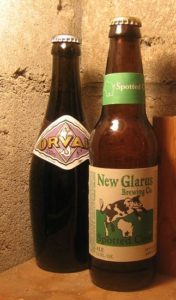
Sour Studies: Timmermans Oude Gueuze 2013, Belgium

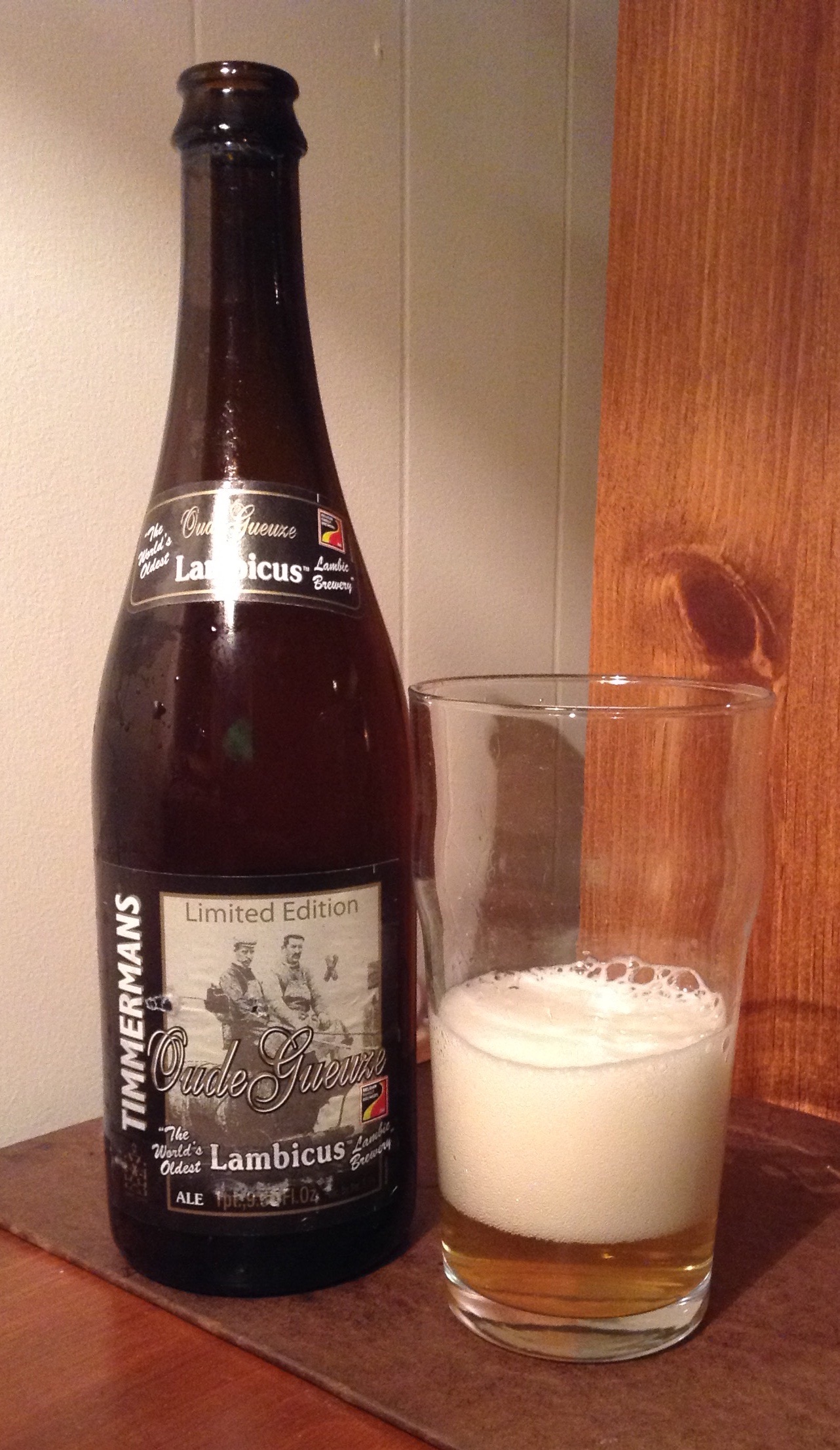
image232Session beer. 5.5% and sufficiently sour that a personal sized 750 ml gives at least two hours – or four laundry loads – worth of sips. It pours a slightly clouded golden straw. Plenty of must and funky tang when the nose is rammed into the nonic. Still, a bit of fruit in there. Maybe lingonberry. Just a hint. Much more going on in the swally. Sour, yes, certainly sour with a light summer apple, lemon, creamy wheat, nutmeg heart. “Rotten lemon, more like it!” says the lad after he sticks a finger in the glass. Which pretty much sums it up.

What is my relationship to this sort of brutal beer after all these years of study? I certainly have an appetite for any I get a chance to lay my hands on but they come along so few and far between for Ontarians given out mediocre retail options that I wonder if the scarcity makes them more interesting. I bought this in Albany a few months ago and do like to have a few bottles of panic gueuze… but wonder if I would be quite so excited if I could buy one of these any old day down the street? Or should I just be happy that one of these every three or four months is just what keeps me happy. You really can’t measure the relative value of the exotic.

BAers give it solid respect.

Illinois: Sofie 2012, Goose Island Beer, Chicago

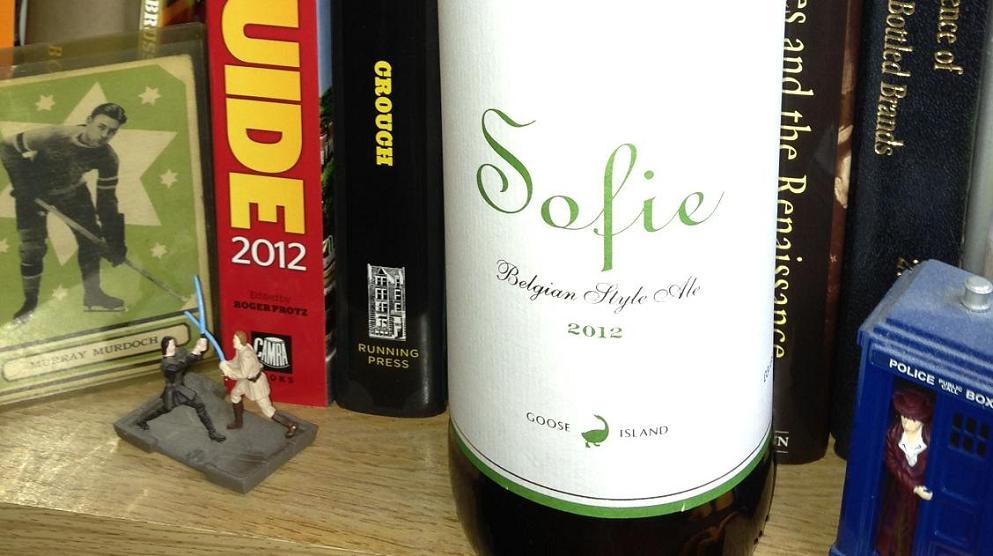
The beer that proves craft v. crafty is a big sloppy fib – and well within the range of possible futures for brewing generally. $8.99 last weekend just across the border. I look for it and its siblings whenever I cross over as it is one of the best values in good beer.

Lemon, pears and fine herb aromas. In the mouth, bright mid-weight beer with a creamy texture up front followed by slightly astringent green apple and lemon acidity. Overarching bready huskiness, light spice, a bit of sulfurous funk and a slightly yoghurty yeast. White pepper note in finish. Loverly and reasonable. Rare combination.

An absolutely swell beer made by a brewery owned by an international faceless monolith. Deal with it. BAers have the love.

Mmm… What I Need Is A Big Bowl Of Thick Beer!

flemish1I knew this. I think I knew this anyway:

“This process is much like how you would do in a fourth-grade germination science project, where the grains would be soaked in water for about 24 hours, drained and then laid between sheets of cloth until they sprouted,” said Amanda Mummert, an anthropology graduate student helping Armelagos with his research. After germination, the grains were dried and then milled into a flour used to make bread. Streptomyces bacteria most likely entered the beer-making process either during the storage or drying of the grain or when the bread dough was left to rise. Nubian brewers would take the dough and bake it until it developed a tough crust, but retained an almost raw center. The bread was broken into a vat containing tea made from the unmilled grains. The mixture was then fermented, turning it into beer. The final product didn’t look much like the pint of amber you sip at your local watering hole. “When we talk about this ancient Egyptian beer, we’re not talking about Pabst Blue Ribbon,” Armelagos said. “What we’re talking about is a kind of cereal gruel.”

I knew that. Not that bacteria stuff. No, not that. Forget all that medical properties stuff. Look at that word “gruel”! I think there was reference to the thickness of 1500s gruel beer back in Martyn’s Beer: The Story of The Pint which I am surprised to now read that I blogged about seven and a half years ago. There is stuff in Hornsey about beer as gruel as well. Boozy porridge. So, how is it when we are presented with these supposedly authentic ancient beers, well, they pours like water or least an IPA?

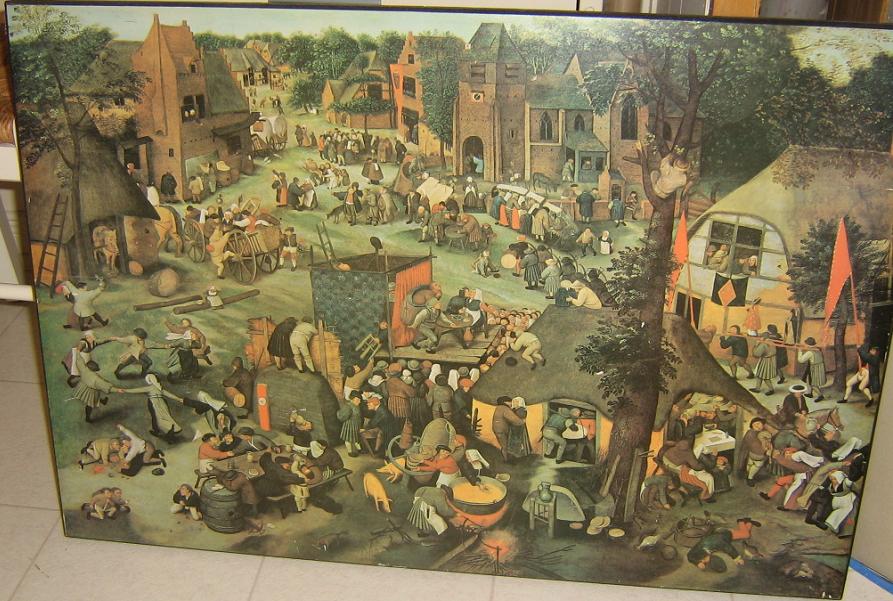
More to the point, don’t you want to try some breakfast gruel beer? Couldn’t we make it like it was enjoyed back then? Not the contemporary southern African version for 12 to 20 but the big vat whole dang community serving sized pot o’ Quaker Oats meets Budweiser. If we look again at “Village Kermis With Theater and Procession” by Pieter Bruegel the Younger (discussed in in 2007 in terms of the pub game in the lower left) we see in the lower center the making of a big mess of something being sucked back by the crowd, right across the street from the joint I’d guess was the tavern. Have a look at the painting Bruegel maybe ripped off and the detail is even better. I am not suggesting we need to get all deep about this stuff but does anyone do a village kermis with gruel booze anymore – other than, say, in rural Romanian where I am pretty sure I will never find myself? Would people folk to such a legitimate recreation as much as for another thinly veiled faux stab at brand buffing? Apparently the children’s games scholars are already at it.

Beau’s Thursday Night Tasting In the Backyard

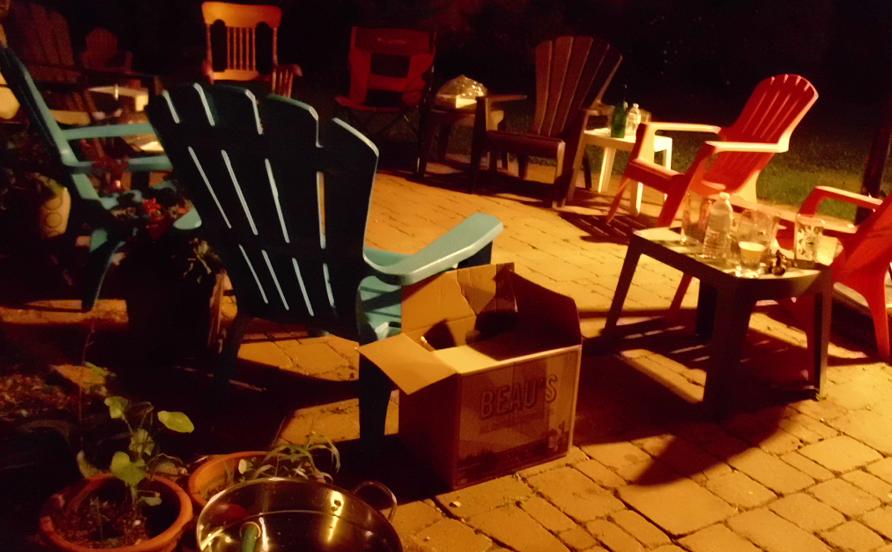
A fun way to spend the evening. Beau’s had their quarterly business meetings in town and they all came over for a few hours of opening bottles – including the father, son and a sizable host. We nine started well with two saisons and biere de garde: Hennepin, Jack D’or and 3 Monts. Batch 10 from Pretty Things was much better than the more recent bacth 13. Lesson: let it sit.

Things got a little wobbly with three Quebec takes on Belgian white beer. We thought RJ’s Coup de Grisou was fine and a good value beer. And Barbier from L’Ilse D’Orleans was not well understood given its level of rich maltiness. But Blanche from Charlevoix was a revelation in nasal interaction with beer. Freesia. Fabulous.

Three more bottles were opened. Trade Winds Tripel from the Bruery was a bit muddled with a nice aroma. Too much of the malt ball for the style or maybe just our level of interest given the other choices. Next, the Poperings Hommel Ale, as always, was amazing. The greatest pale ale in the history of the planet? Could be.

Then the taxi was called for the eight to be off. It was time. The mosquitoes had begun to bite. Just time to open a quart of Drie Fontienen’s Oude Gueze, one of the few beer that could follow a Poperings. Like any divider of people, some were not with it. They got the first taxi. The rest of use stood on the driveway, waiting on the warm quiet summer night sipping. Then the taxi and then they were off and away.

Do Olde Geuze And Oysters Go Together?

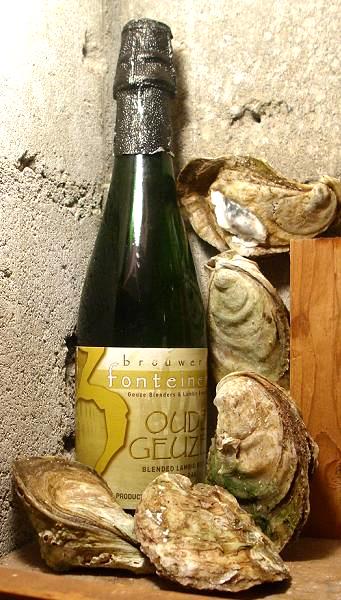
oysgeu1-1I was out hunting for some Caribbean stout to go with the PEI oysters I picked up at the incredibly jambi Mike Mundell’s shop this afternoon. Without success. What to do?

I love oysters. I used to live in view of the Gulf of St. Lawrence on PEI’s north shore and heading over to Carr’s at Stanley Bridge for a half dozen Malpeques to suck back with my home brew. Despite the trade’s odd view of what makes for a benefit, the oysters know not what is done in their name. Quietly in their rocky shells they ignore such things, preferring to be pretty damn tasty and – at a buck and change – a great value.

So, instead of a strong sweet stout, I thought I would try them with a geuze, in the case a half bottle of Drie Fontienen’s Oude Geuze, the beer I had last New Year’s Eve. This one was bottled back on Friday, February 1, 2008 when I was having an Old Guardian for the twelfth edition of The Session. Let’s see what happens in mid-summer two and a half years later..

Wow. That is quite a combination. The barnyard funk of the geuze hits the oyster’s wharfy skank head on in your mouth. One of my more intense taste experiences when I think of it – which is all I can do given it is happening in my mouth right now. All that is missing is an overly aged chunk of blue cheese to make this as overwhelming an experience as it could be. But the aftertaste is creamy, like two waves counteracting each other leading to calm. The oyster brings out the apple notes and places the acidity in context. I am happily reaching for the next meaty oyster.

Success. Each assisted through the difficulties the other can pose. A vital combination.

Session #39: Collaboration? Call O’ Bore-a-tion?

That’s not very clever. Or polite. But one must pun as one can. And one has to be always on watch for indulgence – especially when it comes to marketing… or is it marketability. That is what Stan mentioned: “Collaborations are good business, good marketing, good fun and often result in interesting beer.” Or a bit of what he said… or implied. Sorta. But can they also result in bad business, poor marketing, tedium and dull beer? Of course they might. If not, what point would there be to this month’s edition of The Session?

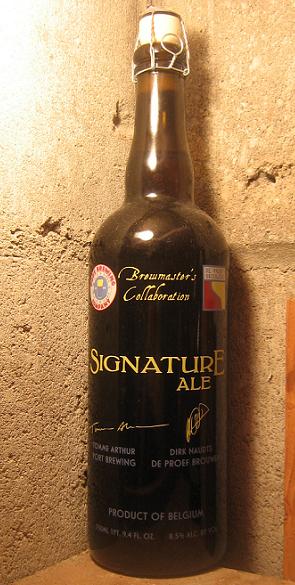
This brew is a good illustration of the quandary, Brewmaster’s (sic) Collaboration Signature Ale #1 which resulted from a brewing get together 3 years ago and two months ago between Tomme Arthur of Port Brewing and Dirk Naudis of De Proef. It pours a deep rich varnished pine under thick rocky clinging off white head. The aroma includes pine sap and nutmeg, bubblegum and marigold. The mouthfeel is very soft and compelling but turns on you with the twin bite of hops and alcohol. There is pear and honey in the malt. All very attractive yet it’s a bit of a muddle. It’s overly hot from just 8.5% alcohol, the hops also burn and the malt’s a wee bit flabby. There is a bit of brett or some other sour tang a bit down there as well as a little of spice. But the furniture polish hops overwhelm it all. As they usually do. Like using the fuzz or the waa-waa pedal or a car with an intentionally bad muffler. The label claims that “these notes could be out of balance were it not for the generous maltiness that holds the beer in check.” I am not sure I agree.

Could be that time or the shelves of the middleman have taken a toll? I think not. This beer is like a decent Belgian golden strong ale got mixed up with a good California double IPA which stumbled into little dubbel. Plenty of BAer love but hasn’t this been done? A hundred times? Could be by now – but had it “been done” back in March of 2007? Three years and two months is a lifetime in craft beer marketability trends. It took until 2009 before folks got a bit jaded on the idea. Maybe this was one of the first inquiries into the collaboration idea that branched into or at least was working with into that early late mid-decade Belgian double IPA idea. When collaboration was new and interesting.

Collaboration might be a great idea but it also might be an idea with less universal applicability or longevity than one might have hoped a few years ago. Let’s be honest. All craft beer is collaboration. Brewers work with other brewers, were trained by brewers and were inspired by brewers. Does it really matter that one craft brewer held the basket of hops as they were shaken into the other’s brewing kettle? After taking a jet?

Wisconsin: Stone Soup, New Glarus, New Glarus

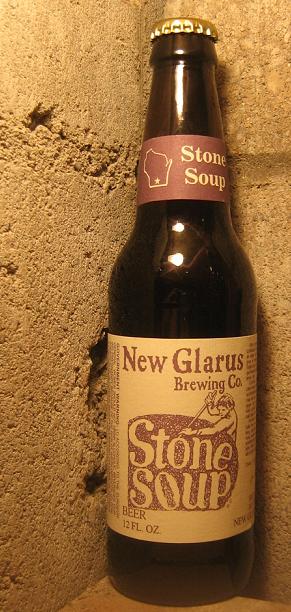
A Belgian pale ale from the USA’s Upper Midwest. This one smells good. Either that or I smell really bad. I’ve just finished two 16 hour days so it is not beyond the realm of possibility. But I’ve been in a jacket and tie the whole time. So it’s likely the beer or the guy next to me was inordinately polite.

Medium pale golden ale under a thin rim of white. Apple and pear on the nose with a little nutmeg. More in the mouth framed in a sweetish effervescent rich ale. Plenty of bready yeastiness. Dryish ending with black tea and twiggy hops and that lingering spice. A reasonable session beer at 5.3%. Part of a New Glarus mixed 12 pack that made the trip from near Lake Superior to the east end of Lake Ontario. A respectable level of BAer respect but probably not enough.

Joints: Collaboration Not Litigation, Avery / Russian River

cnl1What to call these beers? For the last few years, brewers have been getting together to make something new together. This one has a deeperback story than most but the point is the same. In the end they are joint projects, opportunities to get together, to share and learn. And no doubt to have a lot of fun. But what do they offer us, the consumer? They are the specials of the specials. The seasonals with only one season. Yet surely they have to stand up for themselves as beer and not be the wall hanging commemorative china plate of the beer world. What can I learn from just this bottle?

Blended three years ago, it pours a lovely light cola colour with a frothy deep cream head. The aroma (aka smell) is dandy – date and sharp apple.with a floral thing that is almost rose. On the sip and swish, there is plenty of rich pumpernickel malt but with that Avery drying hard water. Dark chocolate, dark plum and a nod to cinnamon with an interesting juiciness that nods to pear or white grape. It is styled as a Belgian strong dark ale and that makes sense. Yet there is an the underlying tone. The hard water for me is not working but that is a personal thing for me that I have noticed since I tried a line up from Colorado’s Great Divide. I am a soft water man. Yet there is a rich plum dark sugar finish. Solid if, for me, slightly sub-moreish.

Plenty o’ BAer respect. Take their advice.

Grill, Shed, Steak, Rain, Bieres de Garde And Saisons

The trouble with charcoal grilling is that when the rain comes you can’t turn it off. Propane, on the other hand, has a nice dial that has a “0” setting. But there is the garden shed and, when it rains and you have visitors, it can turn out to be a delightful place to while away a late afternoon hour reading last week’s newspapers in the recycling bin, listening to AM radio and comparing a few examples of bieres de garde and saisons.

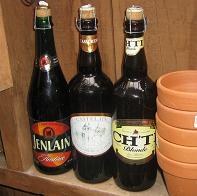
We opened the Ch’ti Blonde from Brasserie Castelain à Bénifontaine first, a gold ale called a saison (though French not Belgian) by the BAers but a biere de garde by Phil Markowski in his book Farmhouse Ales under a white mouse head that resolved to a froth and rim. It was the favorite of the set with cream malted milk, pear juice and nutty grain. Very soft water. I actually wrote “limpid cream of what graininess” but I am a little embarrassed by that pencil scribble. It gets a fairly poor rating from the BAers but maybe that is because they were not in a shed when they tried it. Castelain’s Blond (no “e”) Biere de Garde was drier but still creamy fruity, not far off the greatest example of a Canadian export ale. Light sultana rather than pear. Also dry in the sense of bread crusty rather than astringency. Lighter gold than the Ch’ti but, again, the rich firm egg white mousse head and far more BAers approve. By this time the shed dwellers had decided that steak could in fact be finger food and also that these ales were an excellent pairing with chunks of rib and New York strip. The Jenlain Ambree by Brasserie Duyck was another level of richness altogether, the colour of a chunk of deep smoked Baltic amber, the richest lacing I have ever seen left on a glass. Hazelnut and raisin, brown sugar and black current with a hint of tobacco. Lately I have been thinking that amber ales are the one style that could quietly slip away and never be missed. Placing this in the glass in the hand in the shed as the rain thumped on the roof and steak was eaten was an instructive treat as to what ambers can be, though 6% of BAers hesitate to be so enthusiastic.
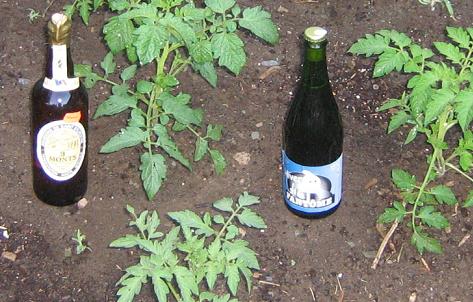
I think this is the worst photo I have ever posted so I will keep it tiny unless you choose to click on it for the full effect. Apparently there is a limit to the beery photographic arts and I have made it my own. The 3 Monts to the left was picked up at Marche Jovi in nearby Quebec for a stunningly low price of under six bucks. Plenty of malteser and pale malt graininess with yellow plum and apple fruitiness, straw gold with more of the thick rich head, cream in the yeast. The water was not as soft was either beer from Castelain but all BAers love it. By Brasserie De Saint-Sylvestre who also made this biere nouvelle. To the right, the Fantome Winter was one of the stranger beers I have ever had and, frankly, a disappointment. All I could taste was radish, sharp and vegetative, over and all around the insufficient malt. In my ignorance, I didn’t realize that was likely quite an aged beer as the happy BAers explain. Neither the cork or even label, with its unmarked best before portion, give a hint as to the year but that is all right as I suspect I will consider this just a lesson learned even though I generally love Fantome.

By this time there were stars and a breeze as the cold front finished moving through.
Is It A Mooing Monk Or A Cornval?

This is the second in my triptych of posts about blending New Glarus Spotted Cow with Belgian ales of note. In the first its blending partner was Duval and I came to like the 66.7% Spotted Cow 33.3% Duval ratio the best. Tonight? Who knows?

50% Spotted Cow – 50% Orval: On the nose, this brew is eerily like Oro De Calabaza from Jolly Pumpkin: musty brett, sweet malt and a touch of light plummy fruit. In the mouth, not so much with the ODC but not bad. The corniness of the Spotted Cow does not stand out so much as you might have thought as brett masks it well. But the sweetness is there and is well cut by the must and antiqued hops. Well worth doing to stretch out the quality.

33.3% Spotted Cow – 66.7% Orval: No. Not enough corn to assert itself above the brett making just for a weirdly diluted Orval with some off flavours. Don’t try this at home.

66.7% Spotted Cow – 33.3% Orval: Here the sweetness has more corniness standing out and the ODC effect is gone. Yet, it is still a brew with brett. The Spotted Cow stands out as a quality brew with none of the off flavours of the Orval heavy version.

Results? I am really surprised by the 50%-50% blend as it was what I had in mind but was way better than I could have imagined. It bodes very well for mixing Orval with other slightly sweetish beer as sort of a brett concentrate. Is that disrespect? No more than calling this blend a Cornval. Beer blendings that say bugger off to the barley bullies.