Welcome To 2026 And To The Exciting New Format Of The Thursday Beery News Notes!!

How’s your skull this New Year’s Day? Are you OK? Are you ready for some questions? Questions like: “is this the optimum alignment of the holidays?” Seem to me that a Wednesday New Year’s Eve pretty much guarantees that this week and last are a total write off work-wise. Unless you are in hospitality, of course. I am sure, by the way, that Sunday Christmas Day is the worst. Gotta put some sort of effort in the week before and you just get Monday off the week after. Glad I won’t have to deal with one of those weeks, when it’ll next shows up in 2033 when I will be long retired. That photo up there? A submission for the 2014 Holiday Beery Photo context received from Aaron Stein of Oregon. Aaron won the “Surprise Twist” award that year.*

First up, as we put 2025 on the shelf, it’s good to carefully consider your “best of” lists. It’s a tricky business finding the best of “best of” with plenty of the dubious. There are great ones like the Golden Pint Awards like this quite expansive one from Lisa Grimm that shares some happy news along with the useful insights:

… half of the family now Irish citizens (delighted!), and the rest midway through the naturalisation process, plus a book manuscript finished and in the production pipeline (finally!), as well as some exciting news on the employment…

Fabulous! And not just because of the heads up to my old hometown’s Garrison Brewing. And it doesn’t have to be all good news. Jeff posted his thoughts on 2025 and declared it “the worst year in my lifetime” with solid evidence supporting that view, before he moved on to the upsides, including:

The blog has been relatively healthy as well. Thanks to AI, online media sites are in real trouble. Google’s new AI summary means people don’t click through to websites, and traffic at some sites has fallen up to 50%. Traffic here, thanks to a strong finish to the year, has been basically flat—which is a lot better than I expected. Moreover, comments on the blog are way up, and it feels a lot more interactive these days. Thanks so much for contributing to the site!

But all lists aren’t all great. And there’s one category of useless which demands a PSA: the list of the unattainable. Not the luxurious as once in a while everyone can get their hands on something rather nice. No, I mean the sort of lists exemplified (but by no means limited to) by the beer writers’ short-run sample gift packs. Someone made 100 gallons of inguana poop stout and then couriered them to the gullible / needy / starving? Who cares. But this next sort of list, this here list of the 35 best pubs in Edinburgh? The best. Accessible. Useful. Helpful, even. And should be prepared by every topic hobbiest out there for their fair city or region.** Just look at the common sense info succinctly provided:

4. The Holyrood 9A – Round the corner at the bottom of St Mary’s Street towards the parliament building, a surprisingly bustling beer and burger den, with impressive selections of both. Food is prepared in the tiniest kitchen somewhere downstairs and served in the packed backroom or bar itself. Huge range of draught beers but also wines by the glass. An all-round good pub. Details: 9a Holyrood Road, theholyrood.co.uk

I know this is correct as I’ve been there, the cousins being just a route 128 bus ride away. One of my great regrets is not getting a photo of that kitchen as I walked out. I know, I let you down. But it is so small that you’d have to have the camera in their face. Little more than a cloakroom by the front door.

Another great format for the best of is the “stashkiller” mode, this week deployed by Barry Masterson in Cider Review:

There’s nothing new about this, we’ve all been there. You get a nice bottle of cider, or maybe it’s a beer or wine, and you think to yourself “yeah, I’ll keep that for a special occasion”. And this happens again and again, ad nauseam, until you’ve got a stash of special bottles built up that you’re almost afraid to dip into it as that special occasion just never came. It’s a funny thing, really, that with some things we think we need an excuse, when the fact is they have been made to be consumed, enjoyed, shared. In my case, when prowling the cellar for a drink at the end of a day’s work, I usually end up just reaching for a bottle of pils from the stack of crates because I feel I should be sharing the large bottles of cider, or if I open one I must be making notes, and that sometimes feels like work. It’s a terrible attitude when you have a cellar full of cider; it’s made to be drunk!

JD TBN has shared his extensive Golden Pint Awards, with characteristically  impressive level of detail in the 25 categories including ten related to specific beers as well as others such as:

Best Beer Blog or Website: The Drunken Destrier – I had this flagged for greatness since the spring, but the flurry of entertaining beer reviews petered out in late May. In the hope of some revived activity — I mean, how hard is it to drink a beer and write down what it tastes like? — I’m slinging a Golden Pint in Kill’s direction.

Simon Johnson Award for Best Beer Twitterer: barmas.bsky.social – Yeah, it’s mostly for the dog pictures, but you knew that.

I think Simon would have accepted the broader application of the otherwise tightly defined term “Twitterer”.  In DC, Jake Berg of DC Beer published his annual top beer and top music of 2025 – in not that order at all:

How this works: I pretty much only use the blog for this yearly post. I’ve got a bunch of music I liked this year with pithy comments that may or may not make sense to outside readers, interspersed with some songs I liked. Then I’ve got beer. You like beer, don’t you? This year there’s a pretty clear top two for me; both of these are excellent. After that I’m less sure, but tried to settle on an order because ranking things is fun. 

On thing we see less of in these annual lists (that itself needs a comeback) is the the in and out list or what is hot and what is not, like the one suggested at Everyday Drinking. But maybe that’s because I know what black currant tastes like. And here’s another sort of handy guide, particularly useful on this New Year’s Day. Lew Bryson on his podcast “Seen Through A Glass” on all your coffee booze options:

So I’m here with a whole bunch of coffee drinks to get going this morning!  I didn’t know what to do for a relaxed post-Christmas episode, and then I remembered this interview with John Mleziva of State Line Distillery. They make a great coffee liqueur, and we talked about that. I knew we’d be just sitting around drinking coffee on that morning after Christmas, so I made that into an episode.  Then I told you more about the press trip to Mexico I took back in 2011 to see how Kahlua is made, with all the feels, and all the delicioso, and the extra-special cocktail we learned how to make. And the donkey herb moonshine we had. Yeah, not a typo. 

For what it’s worth, get a nice winey coffee blend, add 10% cream and a splash of Chambord. Or maybe Cointreau but that’s sorta a regular Saturday thing if you ask me. Black coffee though the week, by the way.

Boak and Bailey helped put things in order in a different sense with their post on what beers for Christmas mean to them now:

There were a couple of factors behind our decision. For a start, there’s the question of what’s easiest for non-beer-geek family members to acquire and look after. We don’t want to be pains in the arse. We also find ourselves thinking about relatives might also actually enjoy drinking with us. Normalish ale and normalish lager are easy sells to almost anyone, and stay out of the way of conversation, board games, or Lethal Weapon II on the telly. Maybe nostalgia and sentiment kicked in a bit, too. Ray’s dad got quite into Cheddar Gorge Best in his final years and it was nice to feel that, in a way, we were still able to share a beer with him. We raised our glasses in the direction of his photo.

I am with them. I saw someone recommend a beer store somewhere where the cheapest offering was two and a half times the price of a very good Belgian ale and, being in the holiday mood, though to myself… WTF!! I think there may be a bit of embarassment about the sucker juice era but rather than knaw at one’s innards about the waste of a decade, do what B+B did and think of what the company you’ll be in. That’s what actual beer as social lubricant means, after all. Now… some quick notes:

Note #1: Ron pointed to a news item on the end of corked Guinness.
Note #2: Liam then explained the news item on the end of corked Guinness.
Note #3: read Bounded by Buns by the noted beerman… as, frankly, you really need to add some solid food to your diet.
Note #4: needing something to do on Jan 11th? Tune into Desi Pubs.

More news out of Britain on the relaxation of concern related to drinking and driving. In The Times this week we read:

A survey of more than 2,000 adults, including 1,300 drivers, found that 37 per cent of Generation Z believed it was more socially acceptable to drive when marginally over the legal limit, compared with 9 per cent of baby boomers. Across the population as a whole, only 21 per cent of people agree… The survey showed that more than a third of young drivers believed driving while slightly over the limit was acceptable, but also that they were twice as likely to think that alcohol did not impair their judgment. [Ed.: thankfully…] The number of young drivers obtaining their licence is at its lowest level for generations, partly because of the cost of lessons and the difficulties in getting a test.

Much is made of the lowering of the blood alcohol limit in England to match the rest of Europe but that last stat up there may indicate a truth – there might also be a general level of ignorance related to the risks of driving itself at play. And now… some more quick notes:

Note #5: a collab on the bit heading to the recycling bin?
Note #6: “RESIGN!!!
Note #7: “…number of pubs in England and Wales… fell to 38,623 from 38,989 a year earlier…”

Not at all related, the business resource The Street has chosen “the craft beer apocalypse” as its descriptor for 2025, illustrating that claim with a couple of non-bankruptcies:

One of the most recent closings was Miamisburg, Ohio, craft brewery Entropy Brewing Company, which revealed on social media that it would close down its business permanently on Dec. 27, 2025, with no plans yet to file for bankruptcy… And now, New Mexico-based Bosque Brewing Company is closing down all of its taproom locations and ending its business after a federal judge dismissed the brewer’s Chapter 11 bankruptcy case on Dec. 22 because it had too much debt to reorganize, KOB-TV 4 in Albuquerque reported. The dismissal of the Chapter 11 case will likely prompt the brewery company to file for Chapter 7 bankruptcy liquidation unless it can settle all of its debts with its creditors out of court.

AKA no hope of resuscitation. It seems to me that there might be a role for a bit of bankruptcy trustee advice for breweries in trouble at an earlier point in the downward cycle than “too much debt” but there seems to be a bit of a theme if we consider how late Rogue played along.  Before perhaps hitting the intersection of economics and ethics. Perhaps related (but only if you glean more from this passage than I do) is this offering from Gunnar Rundgren at countercurrents.org:

…society, human expression and technology develop in tandem. And in order to be strong they need to reinforce each other. And one technology assumes, or dictates, that many other technologies are in place and that society is organised in certain ways. Even something basic as beer assumes agriculture, and agriculture assumes and requires a sedentary culture. Sedentism, in turn, implies a lot of things, even though I don’t subscribe to the idea that agriculture and sedentism is the fall of man, the cradle of tyranny or the broken link between humans and nature. Some claim that beer preceded or even initiated agriculture and sedentism in that case means that it is beer that is the culprit, quite an entertaining thought….

So… if beer created civilization*** then beer is also complicit with the end of civilization. Perhaps. Shifting gears and in sensible rejection of last week’s sharing of bad advice about Dry January, this article in the New York Times may illustrate how dry does not need to mean no customers if there’s an application of a little planning to serve those cutting back:

Given that drinking — on the slopes, at the pool, or at the hotel bar — is for many people a staple while on holiday, forgoing the ritual leaves time for other activities. Here are six hotels that have devised alternatives to drinking, from snowshoeing to aerial stretching; from making mocktails to simply sipping them… The 54 rooms and suites spread across seven lodges are light-filled, with neutral-colored linens, Hästens beds and natural oak wood floors… A sustainable ethos guides the vision for the property, including its three restaurants. The extensive mocktail menu, which features zero-proof counterparts of its signature cocktails, leverages local ingredients and scraps from the kitchen. A mocktail called Too Hot to Handle, for example, is a umami-forward mix of Rebels Botanical Dry, a nonalcoholic gin; lemon; bell peppers; tomato and smoky housemade bitters.

Horsehair beds? Kitchen scraps in the drinks?!? OK… fine… maybe not so much… Speaking of retreats, like you, I read the Luxembourg Times. Where else can I catch up with the regional news of the Trappists fame… republished from Bloomberg… including some interesting technical insights from Westmalle:

The idea is to hold profit and production stable, to provide for the abbey, give to charity, and reinvest where necessary in the business. Westmalle’s bottling plant hums and crashes with life during the day as bottles are washed, labeled, filled and prepared for delivery. At maximum capacity, 45,000 are processed per minute. But the production line lies idle outside its one day shift, and doesn’t operate on weekends, as the monks want the staff to work sociable hours. It’s set to be replaced by 2030 with a new modernized facility through a major, self-funded investment in the brewery.

Mod-ren. That’s what the future will be. Mod-ren. Speaking of which… that is it for this first update of 2025.  Frig. I forgot to use the new format. Oh well. Have a great New Years Eve and Hogmanay, too! Excitement builds as it’s not yest been announced if Boak and Bailey are posting this Saturday but make it your New Year’s resolution to sign up for their fabulously entertaining footnotes at Patreon. And look out for more of Stan’s new “One Link, One Paragraph” format. Then hunt out something in someone’s archives! Leave oblique comments on someone’s post from 2007!! Listen to a few of Lew’s podcasts and get your emailed issue of Episodes of my Pub Life by David Jesudason on certain Fridays. And Phil Mellows is at the BritishBeerBreaks. Once a month, as noted, Will Hawkes issues his London Beer City newsletter and do sign up for Katie’s wonderful self-governing totes autonomous website featuring The Gulp, too.  Ben’s Beer and Badword has returned from his break since April so you can embrace the sweary Mary! There is reading at The Glass which is going back to being a blog. Any more? We have Ontario’s own A Quick Beer and All About Beer is still offering a range of podcasts – and there’s also Mike Seay’s The Perfect Pour. Plus follow the venerable Full Pint podcast! And there’s the Craft Beer Channel on Youtube. Check out the archives of the Beer Ladies Podcast.

*From the Wayback archives, here is the explanation of the Surprise Twist: “I feel a 1980s power ballad coming on. I can’t fight this feeling anymore. Maybe I was just so damn tired. I was checking out all the entries and just like that I heard a voice. It said: “Hello, is it me you’re looking for?” I dunno. This time I wanna be sure. Suddenly, it’s touching the very part of me. It’s making my soul sing. It says the words that I can’t say. Maybe little things I should have said and done. I guess I just never took the time. When it was thinking about prize giving this was always on my mind… always on my mind. I’m never gonna dance again if I don’t make this right. Aaron Stein of Portland, Oregon wins. Not sure what he wins. But he wins the book I need to dig out award for the overlooked image of 2014.” That’s… a lot. Wow. Was I drunk?
**Consider B+B’s Bristol or (for the double!) Lisa’s Dublin.
***Didn’t.
Two Weeks?!? It’s The “TWOOOO WEEEEEEEKSSSS TO GO!!!!” So Excited Dontcha Know Edition Of Your Beery News Notes

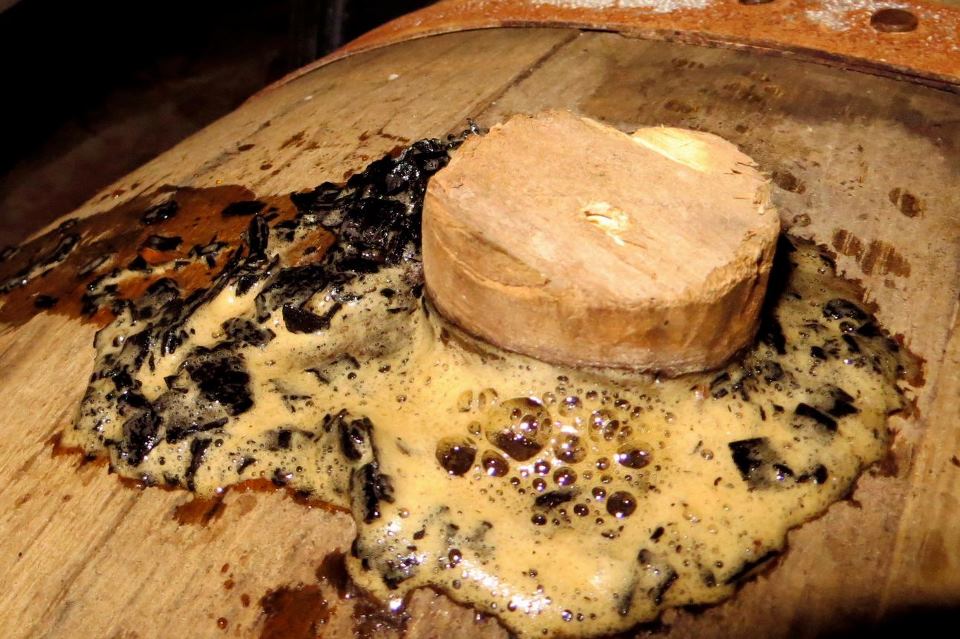
As I mentioned last week, I am sharing some past submissions from the Yuletide Christmas Boxing Day Hanukka Kwanza New Years Eve and Hogmanay Beery Photo Contests that have been sitting in my email folders from all those years years gone by. This week a photo from 2012’s bare knuckle brawl sent in by Jeff Wayne of Tampa, FL. Not necessarily the prettiest image but that there is the leaky bung of a fermenting barrel aged chocolate stout, a celebration of a full range of browns. I like it. Just hope someone spooned up that excess chocolate.

Yes, here we are two weeks from the big day. The day I drink sherry at 8 am and have cake for breakfast. Excitement builds. Also building is Eoghan‘s Advent calendar of things seen in about the 19 communes of Brussels, including at the bewilderingly queter edges of the town:

The streets were so big, wide plains of asphalt, fringed by large standalone houses between was too much air. And the air too was different, smoky and rich but not in an oppressive, attack-your-throat sense, more luxurious. The topography too, big dips and vertiginous climbs with houses and apartment blocks ranged on their slopes, not at all like the slow and steady – but just as taxing – hills I’m more used to traversing in downtown Brussels. I didn’t even know if I was in Watermael or Boitsfort… The bar was, when I finally found it, comfortingly familiar. A Brussels that was recognisable to me however far from the centre I might have strayed, with beer in the fridges I knew and breweries on the taps I trusted. I was at last on terra firma…

Also out wandering, ATJ captured something of the essence of being ATJ in this passage from his travel diary this week:

The soundtrack on this late morning in a Bamberg pub is of laughter and calls and joy growls in the main bar, alongside the clatter and bang of cutlery and plates in the kitchen. The aroma of roast meat, intense in its intimacy, flits through the room, an escape from the kitchen, like a spirit from its long locked stronghold. I sense, or perhaps create, a Friday midday feeling, the joviality of the approaching weekend, though for me, having left home the previous Sunday and perambulated through Prague, nuzzled myself into Nuremberg’s hidden corners and currently based for a day in Bamberg, there is no conception of a weekend, time is just drifting by with the conscience of a cloud.

Not unlike Willie W., when one weighs the words. Anthony Gladman has also being weighing the situation, in this case for cask, and finds that something is lacking:

Cask ale’s slow drift away from relevance saddens me. I fear we seem set to lose it altogether, and shall be culturally diminished as a result. And the worst thing about it is this: the younger drinkers who choose not to drink cask ale are doing nothing wrong. It simply isn’t relevant to them. Nor is this their failing; it is the beer’s and the brewers’ and the pub landlords’. And perhaps partly also mine, as a drinks writer, for failing to make its case often enough, loudly enough, or persuasively enough.

Bingo. I have never understood writers complaining how folk don’t understand this thing or that. It is the job of the writer to make it compelling. Has cask suffered solely on that basis? Nope. But it hasn’t helped.

Well, conversely, this news either means it is no longer a fad or the shark has jumped on no-lo beer as, according to The Guardian, AB InBev is created the world’s largest alcohol-free brewing facility in Wales:

A “de-alcoholisation facility” sounds like somewhere to check in after a boozy Christmas, but in the new annexe of a brewery in south Wales they are extracting hangovers from beer. With demand for no-alcohol and low-alcohol (“nolo”) beer taking off in the UK, the hi-tech brewing apparatus enables the plant at Magor, which produces more than 1bn pints of Budweiser, Corona and Stella Artois a year, to make the increasingly popular teetotal versions too… The availability of alcohol-free beers on tap in pubs is expected to further normalise the choice.

We are assured that “the machine treats the beer very sensitively and delivers a fantastic taste”. Normally I would laugh, say things like “….riiiiight…” and move on but… I just had my first four pack of Guinness 0 and will definitely buy another. What happened? Maybe I got normalized. Try it with port. But no-lo’s not quite as socially acceptable everywhere as The Times notes this amongst its list of conversation topics you will be annoyed by at parties this holiday season:

At every party there are now soooo many men with soooo many helpful tips and advice on the great alcohol-free beers they know all about and which they are categorically not drinking tonight. For some reason it’s always the most sloshed blokes who have the most to say about sober alternatives. It’s like getting nutrition advice from the morbidly obese.

Don’t be the beer bore. Ever. Never one to be that, Alistair shared a happy memory of the time he helped brew, :

This Thursday is the 15th anniversary of the day I spent at Devils Backbone Basecamp brewing the first ever batch of Morana, a Czech style dark lager that I designed for them. I had spent the previous months diving into archives, emailing with multiple brewers, and beer experts, in various languages – English, German, Czech, and Slovak – to learn everything I could about a family of beers that at the time only consisted of about 5% of Czech beer production. Obviously, having only fairly recently decamped from Prague to Virginia, I was also relying on my own remembrances of beers that I had got a taste for in the last couple of years there, when I moved beyond the realms of Gambrinus, Staropramen, and Velkopopovivký Kozel.

Alistair says that the beer that was “the first authentic Czech style dark lager brewed in the modern American craft brewing industry” which is a decent claim to fame. Perhaps also decent was the stout presented to The Beer Nut whose analysis went deep into the dark:

Unsurprising given the froth, it’s quite fizzy: a little too much for the style, I think, giving it a thin and sharp quality that doesn’t suit strong stout. The rum element is present in the flavour, but subtle. I tend not to like rum-aged beers, finding the spirit cloyingly sweet, but that isn’t the case here. Instead, the barrels add more of that fruitcake or Christmas pudding quality I found in the aroma, as well as a rawer oaken sappiness. None of this overrules the base beer, which is a no-nonsense, properly bitter, grown-up stout: dark toast, a molasses sweet side and then a finish of punchy spinach and green cabbage leaf. The can says it’s 48 IBUs; it tastes like considerably more. This is quality stuff, and I’m always happy to find a modern stout that goes big without resorting to silliness. The fizz is its one flaw, and I found myself doing a lot of swirling to try and knock that out. It only reached an acceptable level of smoothness around the time I finished it.

I wish I had one flaw. Not quite indecent is the focus of this article on how to win back the disinterested youth of today:

“Because craft beer sales skew towards older consumers, it’s vital to keep nurturing the next generations of buyers. Gen Zers can be hard to reach and their sentiments are shifting but responding to their needs can help brewers grow share”… Gen Z prefers different drinking environments from older groups. Experiential bars and high-energy venues hold much higher appeal and may offer the strongest opportunity to introduce them to craft. While casual dining restaurants, neighbourhood bars and sports bars remain important to the wider craft drinker base, Gen Z is markedly less likely to visit taprooms and brew pubs, which limits the impact of traditional brewery-led spaces.”

That’s not good. Not only are they not interested in your product but it appears they have no interest in your product. Is there an issue with seeing to bring back the relationship? Even though the sins of the father haven’t been visited on the generation that followed? It all sounds like an earlier 1970s slow slow dance classic, perhaps a little Hall and Oates:

She’s gone (she’s gone)Oh I, oh I, I better learn how to face itShe’s gone (she’s gone)Oh I, oh I, I’d pay the devil to replace herShe’s gone (she’s gone), oh IWhat went wrong?

Pay the devil indeed. Or the invoicing consultant offering solutions. Solutions… yup, that’s what they are. Conversely, being straight with what has really gone on is part of the story for Anaïs Lecoq this week in Pellicle who writes about the Franco-fascists fascination with wine:

Tradition is a lie. And it’s the same lie, fuelled by carefully curated storytelling, that the far-right is trying to feed us now. They wear black berets, big mustaches, and suspenders. They hang up French flags, and talk about meat and wine as the epitome of French food, not missing the opportunity to ridicule vegans and mock people who don’t drink alcohol. They’re terroir influencers, born out of the rise of conservatism and general backlash against social progress. What they’re doing has a name: gastronationalism, or culinary nationalism, which refers to the way food—its history, production and consumption—is used to promote nationalism and define national identity.

It does make sense in that wine requires landowners’ estates as much as beer requires peace. And serfs or their facsimile to do the work. A hotter bed for the old goosesteppers that other spots… perhaps. Next up… a palate clenser with some cheater quick notes:

Note #1: The practice of “faire chabrot” can easily be added to your Yuletide feast traditions;
Note #2: A review of Martyn Cornell’s Porter & Stout: A Complete History by The Beer Nut;*
Note #3: “If there’s ever been a bellwether to the state of the crafts beer industry, it’s Mitch freaking Steele job hunting“;
Note #4: Wine drinking as resistence; and
Note #5: Beer drinking as obedience.

Back on the endtimes beat, Dave Infante neatly summarized the evidence he’s uncovered of a wobbly situation at Pabst:

…the company is quietly looking for a subletter to take over its headquarters in San Antonio. A listing I reviewed for the sleek space—into which Pabst just moved in 2023—was last updated just two days before the pink slips started flying this past Thursday. Between the layoffs, the listing, and a whole lot of reshuffling in Pabst’s c-suite (including the replacement of both chief executive and chief financial officers earlier this year, and the exit of a former chief sales officer just last month), former Pabst employees I spoke with fear the legacy firm might be on the brink.

Yikes. Somewhat relatedly, The Mirror in the UK ran an article on the cost of all aspects of the price of a UK pint and came to a curious conclusion:

Citing figures from the British Beer and Pub Association, Michael said this means pubs are making a total gross profit per pint of £3.69. However… “That’s before VAT, which is another 83 pence – and we have to factor in staff wages, which is another £1.17 per pint…” duty paid to the brewer equates to another 56 pence, as well as business rates of 35 pence, and employment tax for all pub staff at 29 pence…. pub overheads and utilities at 36 pence per pint, which leaves just 13 pence of net profit per pint sold – and this why around 30 pubs are closing every month.” As a percentage this profit equates to just 2.5 per cent.

I find these sorts of supposedly accurate breakdowns useless.** What wasn’t made clear is why pubs which make a 2.5% profit are closing. Is that why they close? Or unidentified expenses were left out or that level of income after expenses is not satisfactory. Which may be the case. But it wasn’t what was argued.*** Time for something more compelling? You got it!

Note #6: HOT PICKLED PORTER!!!

Much more seriously, Boak and Bailey‘s footnotes last week pointed me to the newsletter from Jen Blair on influencers in beer and their choice of appearance:

A few months ago, I was at a beer festival talking with some people I had just met. At one point, one of the men in the group stated that he thinks it’s shameful when women post “provocative” beer photos on social media. Provocative is in quotes because it doesn’t take much for a woman who is simply existing to be denigrated based on her appearance. Another woman in the group and I made eye contact after his comment. This is not the first time someone has said something like this to me, but I am still surprised when it happens. I guess I shouldn’t be, but every time I think “…we’re still saying things like this? To women? About women?”

It’s an excellent piece and reminded me that (whether it is a question of presentation… or self-initiated claims to expertise… or offers of special savings for anyone one applying the one-time super secret code at their website) the only thing that matters is whether the writing has substance.

And finally, over the weekend we received the sad news of the passing of Peter Edwardson who wrote about beer as “The Pub Curmugeon” after a short illness. His last post included this characteristic passage, one that summarizes his approach to beer as well as his understanding of what made it a simple pleasure worth appreciating:

Alcohol content is a vital element in the flavour make-up of beer, adding body, warmth, richness and sweetness. Make anything more than a trivial tweak, and it will significantly change the character of the beer. It is one thing to specifically set out to brew a low-strength beer, but something entirely different to reduce the strength of an existing beer that was designed for a higher strength. You may not have thought much of Fosters even when it was 4%. But now it is 3.4%, a 15% strength reduction, it is not the same product and, I would suggest, an inferior one.

I checked my notes and see that in the last five years or so these weekly digests of the news in beer included well over forty references to “Mudgie”. The sad loss of a singular voice.

So a couple of serious notes to end the week. Hopefully happier news next time. It’s Christmas day the week after that on Thursday… whatever shall I do? As you consider that and send in recommendations, please also check out, Boak and Bailey on this and every Saturday and then sign up for their entertaining footnotes, too. Look out for Stan when he feels the urge (now that he’s “retired” from beery news posts) from Budapest or wherever – as he is getting active again. Then listen to a few of Lew’s podcasts and get your emailed issue of Episodes of my Pub Life by David Jesudason on certain Fridays. And Phil Mellows is at the BritishBeerBreaks. Once a month, as noted, Will Hawkes issues his London Beer City newsletter and do sign up for Katie’s wonderful self-governing totes autonomous website featuring The Gulp, too.  Ben’s Beer and Badword has returned from his break since April so you can embrace the sweary Mary! There is reading at The Glass which is going back to being a blog. Any more? We have Ontario’s own A Quick Beer and All About Beer is still offering a range of podcasts – and there’s also Mike Seay’s The Perfect Pour. Plus follow the venerable Full Pint podcast! And there’s the Craft Beer Channel on Youtube. Check out the archives of the Beer Ladies Podcast.

*Update: as noted for the double!
**A variation is the trade writer who still believes sorta circa 2011 that everyone is one off-flavour seminar from connoisseurship, like Mr. B on LinkedIn this week: “…what you’re getting in up-front money or equipment ultimately pales beside the loss in credibility (especially for places which claim culinary, cocktail, or oenological expertise!), disappointed customers, and ultimately, lost sales. Taking placement fees for a percentage of your taps is one thing — although trust me, more than a few people are going to be able to spot them! — but turning over most or all of them speaks to laziness, desperation, or simple disinterest.” Why, then, do these places continue to operate as craft beer bars shut? Serving their customers’ demands? 
***Yet the math is right there – at 13p profit you would have to sell 500 pints an hour to clear £65. If that was your sole source of income. But then the article would be much shorter. Or is it that the ones at the bottom of the Bell curve no where near a 2.5% profit are the ones that close. Which is irrelevant to the analysis. But then, again, the article would be much shorter. 

This Week’s Fantastically Even Dramatically Encouraging Beery News Notes For W3Oct25

Usually I have something to share at the outset. Something cheery. But as the garden is on its last legs, as the month slips toward Halloween and then we deal with the changing of the clocks, it seems that any pretense that the year isn’t beginning the final act is fading fast. But… but… before all that, there is one more bit of baseball. One of the most exciting ALCS runs ever now turns into the World Series between a startlingly strong Blue Jays against the defending Dodgers led by the semi-deity known as Mr. Ohtani.  Look at him!  He’s the perfect player. Kyusung Gong of the AP took it and it sums up Ohtani neatly. He barely looks like he’s putting in any effort. His batting is the same. Yet… the Jays look good. So, even though neither of the two are my team, I will be feet up this Friday evening for game one. If you have never watched baseball you may want to watch this. One more thing. The Jays celebrate with US beer brewed under license in Canada. Lordy:

The Toronto Blue Jays are sponsored by Labatt Brewing Company, the Canadian-headquartered brewery that represents big-name booze brands like Corona, Stella Artois, Palm Bay and, yes, Budweiser. That’s why, upon the win, you could see an icy barrel stocked to the brim with bottles and cans of Budweiser within an arm’s reach of every Blue Jays player at any given time.

As I say, not my team. Next, some beery news from the world of British fitba. First up, we have Jessica Mason’s report on the new brewery being build at second tier Wrexham, Wales care of those struggling team owners Reynolds and McElhenney:

Since the duo bought Wrexham AFC five years ago, the club has risen up the ranks from the non-league to England’s second tier. Added to this, the brand has also found fame via a Disney+ documentary Welcome to Wrexham, which followed the club’s story and focused global attention on the area, also boosting tourist numbers. Then, last year, Reynolds and McElhenney acquired a majority stake in local brewery Wrexham Lager…. now there are plans afoot for other drinks brands, including Wrexham Lager to have a boosted presence with the proximity of the new brewery being developed nearby. The application reads: ‘The Wrexham Lager proposals, consisting a brewery and associated taproom and museum, will utilise existing buildings on the site.’

But then we read of the news out of England’s seventh tier as reported by Phil Hay of the newsletter, The Athletic FC:

The club were Bracknell Town, based 35 miles to the west of London. Their video drew attention because in it, their coach — the recently-appointed Matt Saunders — hammered a number of his senior players, criticising their conditioning, their attitude and their tendency towards alcohol. “I’m not going to let this football club be dragged down by people that can’t run, can’t look after their body, want to go and drink after games,” he said. “It ain’t happening.” Bracknell are having a time of it. They’re bottom of the Southern League Premier South with six points from 11 matches, and Saunders’ arrival hasn’t picked them up. 

Difference? Maybe five tiers? Boak and Bailey have also made a call via an alert on Patreon, asking for a boost to the next level:*

It’s been a while since we tackled a big question like where did lager louts come from, what’s the deal with nitrokeg beers or when did video games in pubs become a thing? We’ve got an idea to write something about The Prospect of Whitby but beyond that, what are some other questions we might tackle? We like to add the sum of collective knowledge – to pull facts together into one place where they can be found. Suggestions welcome.

In a time when some other voices have gone a bit silent or seem a little discouraged, this reminder of the need to add to the sum of collective knowledge is encouraging. Solidarity friends! Send then your ideas or even scribble your own somewhere and let us know. Similarly, The Pellicle feature this week is by Lily Waite-Marsden, a portrait of Macintosh Ales of London which, at the outset, does not offer an initial encouraging prospect:

There’s a small yard a moment away from Stoke Newington Church Street in North East London. At its entrance an entirely perfunctory and heavily battered railing protects the square of overgrown cobbles from the pavement beyond. On the first floor of the old stable buildings on three sides, four green doors lead to nothing but a 10-foot drop; the yard is hemmed with various shades of green paint—faded and flaking patchwork grass, darker, glossier army-surplus vehicle paint. But for a hand-painted sign and a number of planters giving the game away, passing on a quiet morning or late at night it might look a little tired, unloved.

But then… it was encouraging. And, turning to brewing history, Andreas Krennmair wrote about a favourite topic of mine, Schenkbier. Except when I looked at the stuff it was from the perspective of what was brewed by German speaking immigrants to the USA. Schenk was referenced regularly descriptions of the brewing trade in the third quarter of the 1800s and was described as one of three species of German beer which had crossed the ocean: lager, bock and schenk.  Andreas found some information from a few decadeds earlier that helped him unpack what was in the glass:

What’s surprising is how different the beers were in terms of original gravity and attenuation. OGs between 11 and 12.6 °P are absolutely solid, and while some of these beers didn’t have nearly as much alcohol as modern lager beers, they’d still be alright to drink, although probably on sweeter side for modern tastes. Especially the beer from Heller stands out, with a respectable 11.5 °P but only 2.9% ABV and a very high residual extract. Doing the calculation, the real attenuation was less than 40%, so this beer must have been a sweet mess. Compare this with modern lager beer, with real attenuation around 65%.

Perhaps syrupy low kick gak is the next big thing. It could be already. There is going to be a next big thing, right? Maybe not. North America’s oldest brewer, Molson, is laying off staff. And not just any staff – the white collar staff of MCBC:

Beer maker Molson Coors Beverage Company said on Monday it would cut about 400 jobs, or nine per cent of its salaried workforce in the Americas by year end as part of a corporate restructuring plan. The company’s Americas workforce consists of employees in the U.S., Canada and certain countries in Latin America. A spokesperson for the company told CBC News in an email that the restructuring “only applies to salaried non-union employees across the Americas.” The company is not providing a breakdown by country or province at this stage, and no offices or breweries will shut down as part of the restructuring, the spokesperson added.

It’s always the suits who suffer. The trends in beer are not comforting. Last week’s noting that craft might need saving** not only got some chatter going but I played Mr Smil and dipped my toe into the math that we are living with seeking to compare those apples to apples:

Interesting to note that 2024, Athletic NA beer alone was 400,000 bbl. Is NA beer a comparable to other booze? Is it booze? We should probably compare alcohol sector to alcohol sector. Take just that one brewery’s production out, the drop is more like 14%…  Worse news if we believe Beer Marketers Insights (Oct 1): “Craft beer trends (ex non-alc) steepened over the summer to volume -8.4% and $$ -6.4%; several pts below total beer volume -5.6% and $$ down 5.1% for 18 wks thru Sep 20 vs yr ago.” So 2019-24 at -14% (non-NA) could be down -20% for 2019-25.

Or more *** The Guardian wrote about another aspect of the retraction from alcohol – the loss of a cornerstone element of overall profitability for restaurants:

The industry standard markup on alcohol in a high-end restaurant is anywhere from 150% upwards, making it one of, perhaps the only, high-margin products on the menu. As people drink less, it could leave restaurants in a precarious position. For every restaurateur willing to go on the record to discuss the shifting tide, there were an equal number who refused to be interviewed for this story. Some because they say they’ve witnessed no change in customer behaviour, and others because the subject matter is at odds with promoting a hospitality business. While it doesn’t necessarily do wonders for the bottom line, diners drinking less at the table does create a more harmonious environment for restaurant workers. Fewer drunk bodies means less risk overall.

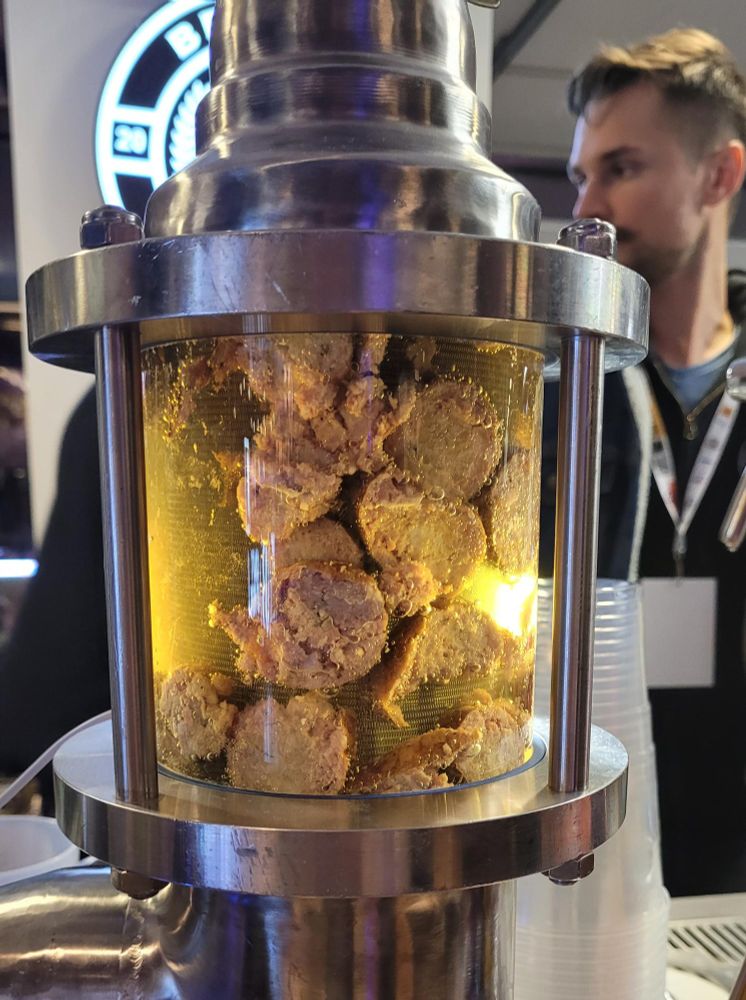
Me, I usually just have water but still try to tip like I’ve had a bit of booze. Where will this all lead?  What can be relied upon to get the attention of the public. Innovation? The Beer Nut himself spent last weekend in Warsaw and spotted one of the more innovative cultural expressions of beer culture – a sausage randall as illustrated in thumbnail format… in consideration of some of your delicate constitutions. Much consternation was found in the comments which followed his Bluesky post – but I really can’t see the difference between a lager washed through sausages and sausages washed down with lager. Much depending of course on the quality of the sausage.

Speaking of quality, Matty C. has written about the return of Boddingtons for CAMRA’s What’s Brewing and has placed it in the moment:

Being honest for a second, this beer is not reinventing the wheel – there are far more interesting and flavourful pints available, even from JW Lees itself. But I consider the resurgence of Boddingtons is about more than flavour. Reports are already coming in from Manchester venues that are not able to keep up with demand, turning away disappointed drinkers who want to be seen with a pint of it in hand. This is significant, because those who are drinking it are young, fashionable, and about as far away from the cask beer stereotype as you can possibly get. This can only be considered a positive. For many drinkers, especially younger ones, a row of handpulls featuring a range of products they’ve never heard of can be incredibly intimidating. In Boddingtons, a brand has been revived that people can easily trust.

Heritage as maybe heritage? Maybe. Speaking of maybe, there is always the potential for maybe not – as one liquor dome in Northern Ireland found out recently:

Planners order the business to remove shipping containers used as a bar and storage, as well as a takeaway food cabin with a serving hatch on a Skipper Street – a side road that runs past the beer garden. Also to go are steel boundaries with wood covering that include an access gate and windows, an enclosed walkway entrance, a “tent structure”, boundary fencing in excess of two metres in height not adjacent to a road, and storage areas for bins and beer kegs. City planners say they’ve reached their verdict as “it appears there has been a breach of planning control” on the site.

Finally and probably relatedly, here is an interesting snippet of an unlocked article from the Financial Times written by Charles Spencer (Princess Di’s brother) on the question of authenticity which includes this:

When, in 1992, I inherited Althorp, my family’s ancestral home, I felt a responsibility to return it to how it had been for much of its 500-year history. For, over the previous decade and a half, the interior had been lavishly redecorated by my stepmother, Raine, whose taste and palette were inherited from her flamboyant mother, romantic novelist Barbara Cartland… I turned to John Cornforth, perhaps the leading British architectural historian of the time, to help me return things to how they should be. We toured Althorp’s principal rooms, assessing them for Raine damage. Cornforth’s kind reassurances dwindled as we went. Finally, on entering the South Drawing Room — a cacophony of clashing pinks (on the walls, on the floor, in the curtains) — Cornforth rocked back in his tightly drawn lace-ups. “Goodness,” he mused. “I really can’t help you here .  As he departed Althorp that afternoon, he lobbed me a catch-all mantra that he hoped might help: “Good taste is authenticity — and authenticity is good taste.”

The point is excellently made. But what does this have to do with beer? Only on the idea of how his hunt for authenticity based on that saying became for Spencer a no-doubt very expensive exercise in conformity. Realizing that, he argues for a balance between respect for what has come before with a realization that you need to live in the present, too. Can we compare the return of Boddingtons or the sweet mess that was historic schenk or that sausage randall with the clashing pinks of a devotee Barbara Cartland’s fashion sense?  Obviously even the “don’t yuk their yum” level of junior beer expert might balk at the more garish, the most lurid of these pleasures. But where to draw the line?

While we consider that over the week ahead, please also check out, Boak and Bailey on this and every Saturday and then sign up for their entertaining footnotes, too. Look out for Stan when he feels the urge now that he’s retired from Monday slot… maybe … maybe not. Then listen to a few of that now newly refreshed Lew’s podcasts and get your emailed issue of Episodes of my Pub Life by David Jesudason on certain Fridays. And Phil Mellows is at the BritishBeerBreaks. Once a month, as noted, Will Hawkes issues his London Beer City newsletter and do sign up for Katie’s wonderful self-governing totes autonomous website featuring The Gulp, too.  Ben’s Beer and Badword has been on hiatus since April but the archives are out there with the all the sweary Mary! There is new reading at The Glass which is going back to being a blog. Any more? We have Ontario’s own A Quick Beer and All About Beer is still offering a range of podcasts – and there’s also Mike Seay’s The Perfect Pour. Plus follow the venerable Full Pint podcast! And there’s the Craft Beer Channel on Youtube. Check out the archives of the Beer Ladies Podcast. That’s quite good and after a break they may well be are back every month!

*Formatted to fit, to protect the innocent perhaps but mainly to fit.
**Jeff updated his thoughts, by the way, but it did make me wonder why what one wants should be limited to what some producers feel they can provide. Perhaps the former suits of Molson now share that feeling.
***A bear of beer! 

Now That I Have My Back To School Corduroys Here’s The Thursday Beery News Notes

With the onset of September comes the offset of the the garden. I am still planting things that have a hope to give us a bit of return before the frosts – basil, peas, leaf lettuces – but the fact is it’s now about starting the long process of taking down the pole beans, filling up the composters and putting away pots for next year. I saw this image on the Brewery History Society’s FB page and immediately liked the scene. The sweater vest and long trousers in particlar are a good and fashionable reminder that there’s still lots needing done as autumn advances.

Speaking of the change of seasons, The Beer Nut is looking forward to summer being behind him if his reviews of warm weather drinks including something called Fruit Sundae Gelato Sour is anything to go by:

It’s lactose rather than Lactobacillus that drives the flavour, and indeed the smooth and heavy texture. Vanilla forms the base of the profile, to which is added a mish-mash of fruit concentrates (four are named on the ingredients) with strawberry and blackberry being the most apparent. And that’s it. While the mouthfeel reflects the high ABV, the flavour complexity doesn’t. The weight also means it doesn’t work as a summer refresher, and is more of a pudding substitute. This is simple and inoffensive stuff, so long as oodles of lactose and rivers of fruit gunk don’t bother you.

And Boak and Bailey were also feeling the last of the summer and looking forward to the coming change if we can judge by their last “beers of the week” note at Patreon:

This piece would be a lot longer if we listed all the duds we had. Hot weather and a quiet city make for some rough pints: cloudy, warm, chewy, as exhausted as the sweaty August insomniacs drinking them. But we always wanted this little write up to be more positive in tone. We don’t chicken out of giving negative reviews on the main blog – we’d have a lot more friends in the industry if we did! – but we don’t want this other thing to consist of us bitching behind closed doors. Anyway, it’s cooling now. The Swan With Two Necks will be resuming its usual opening hours and cask ale across the city will be dropping down from its rolling boil.

Perhaps they needed to add a little something to their ales? Should you? Would you? Could you? The Guardian has many questions along these lines:

The true number of icy beer fanatics is probably much higher. Why is that? Because another 10% said embarrassment was holding them back from requesting ice in their beer, and another 20% said that they had previously been told off by friends, family and bar staff for requesting it. Seriously, though, why is putting ice cubes in beer a bad thing? Because beer is already delicately flavoured enough as it is, so diluting it with melted ice risks rendering it tasteless. Plus, a lot of work went into crafting that flavour profile. Don’t just mess it all up because you like your glass to clink when you swirl it.*

Why not!?! As Gary pointed out this week, some have jumped through hoops to cool their beer. Back to question of the heat, reaching west we have one last “what I did on summer vacation” report from Glenn Hendry on a trip to grasslands of the Canadian Prairies where he found himself on a brewery tour:

The scenery was outstanding – if you’re into grasslands and rolling hills, which I am – but eventually I made the long drive in the rental car back to Regina for the rest of the Tuesday-to-Saturday trip. With my beer consumption in Toronto reduced to the odd social outing back in Oshawa and maybe a beer a week at home, a pub crawl in Regina, Saskatchewan was an unexpected addition to the itinerary, but when my server at Pile O’ Bones Brewery told me if I visited all six breweries on the city’s ‘Hop Circuit’ and had a pint at each I would score a beer glass, well, despite the ‘self-guided’ disclaimer/warning, the challenge is on, innit? To be entirely truthful, I hadn’t planned on hitting up all six – maybe three or four – on this steaming hot Thursday in the prairie city, but when the old legs get moving and the old mind stops making sound decisions, challenges are simply met.

Speaking of the Prairies, I am a bit more swayed by this comment from Suzanne Sexton on the closure of an Ontario Crown Royal whisky bottling plant than I am by Premier Ford pouring a bottle out over the loss of 200 jobs:

This is the Crown Royal production facility in Gimli, Manitoba. This is where Crown Royal is actually made on the shore of Lake Winnipeg. It runs 24 hrs a day, 365 days a year. It houses millions of barrels of Canadian Crown Royal, made and moved by Canadians. There are more barrels of Crown on-site than there are people in this province. The high quality barley, corn, and rye are grown by Canadian farmers. Please don’t follow people who don’t know these facts when they ask you to boycott Crown Royal because they moved one Ontario bottling plant to US to survive US tariffs. Buying Crown Royal still puts dinner on the table in hardworking Canadian households across the country.

It is the reality we live in that bulk booze is trafficked across the border. I seem to recall that Canadian good beers have been shipped south to the US for bottling and labeling there as grocery house brands in a way that avoids certain tax treatments in both countries. Nothing wrong with that.

Speaking of booze as business, Pellicle‘s feature this week is Phil Mellows’ portrait of David Bruce, owner of the Frikin pub chaing from 1979 to 1988, who explained the 1988 sale when he was bored, tired and facing debt:

The numbers were stacking up against him, too. “We still owned 90% of the business but that meant we had a massive level of debt, £3 million. I could see the Monopolies & Mergers report that led to the Beer Orders would mean more freehouses on the market and more competition. The banks were getting nervous. It was a matter of flog it or float it. We couldn’t carry on.” Finally free of money worries once the Firkins were sold, Bruce launched the charity providing barge holidays for disabled people that earned him his OBE, but it wasn’t long before he was back in beer and making an impact, this time on a global scale.

It’s interesting to see how Bruce also rolled his profits into the churn of further beer business projects including many US micro breweries which themselves were sold off in the great buyout era of a decade ago.

And studies were among things discussed these last seven days. Last Friday, Ed himself expressed himself on the topic of beer foam based on a study written by non-brewers:

The authors of the beer foam paper appear to be competent scientists, even if they are ignorant when it comes to brewing. They certainly seem to know a lot about the science of bubbles (Marangoni stresses is a new one to me!). And they correctly discuss Lipid Transfer Protein 1 as playing a key role in stabilising foam, though this nothing new to brewers. In fact last year I went to a talk by “The pope of foam” Charlie Bamforth where he discussed the role of Lipid Transfer Protein and Protein Z (40 kDa) in foam stability. He said research had shown this was not due to any particular property of the proteins, but rather that the partial denaturing of them during the boil (not during secondary fermentation!) exposed their hydrophobic interior which helps stabilise bubbles.

Didn’t know about Marangoni stresses?!? Reeeeallly? Hmm. Lordy. Err… umm… where were we… oh yes – and Lars commented on another study that sought to link the development of beer brewing with the onset of organzied societies:

Many researchers have suggested that alcohol may have been an important factor in developing early states. Basically, it’s supposed to have helped social cohesion, improved cooperation, and reduced friction among people living cramped together…. What they found was that in all models there was a positive correlation between alcohol and political complexity. It was 0.77 when the only factor was alcohol, and 0.19 in the weakest (model 4). Average 0.27 across all five models. In other words, the result appears pretty robust.

“Au contraire dit…” Jeff who pointed out that some of the assumptions were not well founded:

I’m not an archaeologist (though neither are the authors), but the data here seems abundant and clear. On the first highlighted quote, people made beer *millennia* before agriculture. On the second one, man, what a sweeping judgment. Let’s take the NW Coastal natives, where I live… They had incredibly complex societies. They had social stratification, organization, and hierarchy. Some of the peoples managed harvests, but whether you could call it agriculture is a very sticky question. They had such abundance they didn’t need agriculture. Cultures are very hard to characterize.

My thoughts are these: (i) the general “cradle of civilization” concept seems pretty middle eastern focused as there are many models of society, many without alcohol, (ii) the studies also rarely seem to compare the multiple other factors like seed storage techniques that would run parallel to booze production** and (iii) there often seems to be an inordinate wish to make booze the winner when, as in this case, it is also reasonable to assume that these early societies were slave based coercive hell holes.

Stan issued his latest edition of his Hop Queries newsletter (v.9.04) and shared how poor the crop was looking in England (“…shrunk to a level that this news won’t affect the world hop market…“) as well as in Germany:

Farmers are expected to produce 41,235 metric tons (about 90.7 million pounds and likely more than the U.S. crop), 11 percent fewer than 2024. Growers cut acreage by 6.5 percent and yields were adversely affected by a lack of rain until mid-July and further reduced by disease and pest pressure. A press release indicates that 44 farms ceased operations, meaning the number of growers has slipped below 1,000. It concludes: “Hop growers are reacting to poor prices and limited marketing opportunities by reducing acreage. The short-term outlook is not rosy: Given declining beer consumption, a further decline in hop demand is to be expected. The result will be continued pressure on prices and a further reduction in hop acreage until supply and demand are restored.”

Until demand is restored? Does anyone think that is happening? Not the stock market if this report in Beer Marketers’ Insights is to be trusted:

Bank of America analyst Peter Galbo downgraded Constellation [NYSE: STZ] to “Underperform” last Tue, reducing his price target from $182 to $150. “We see further downside potential as beer industry consumption remains soft creating risk to sales, margin and multiple,” Peter wrote. And there are “added risks” such as “core Hispanic demographic remains pressured” and “longer term alcohol consumption trends” remain soft. He now expects a -1.8% decline for Constellation in fiscal 26 (thru next Feb) compared to his previous estimate of -0.5%. CITI also put out tuff report noting “continued softness in both STZ’s beer trends and the broader beer category.”

The company itself seems to agree in their own disclosures issued Tuesday. To be fair, there are still believers and even at least one corner of Canada running out of beer:

“We saw it right from the beginning of June — it hit hard and fast,” Clark said. “Every day we talked to different tourists. It was a wide demographic this year … American, Canadians, from all over, young and old.”  Some days, he said the brewery was so busy it had to turn people away. “We have not been great at keeping up with demand this summer,” he said. “You always assume you might grow with a good summer, but we would have never expected this.”  Evermoore Brewing Co. was not the only local producer scrambling to meet a higher-than-normal demand. According to Jared Murphy, president of the P.E.I. Craft Brewers’ Alliance, some craft breweries had sales show a double-digit increase this summer.

There. We can end on an upbeat note this week.*** Somewhere there was an increased demand for beer. While you consider that before we meet next time, please also check out Boak and Bailey every Saturday and sign up for their entertaining footnotes, too. Look out for Stan when he feels the urge now that he’s retired from Monday slot… maybe … maybe not. Then listen to a few of that now newly refreshed Lew’s podcasts and get your emailed issue of Episodes of my Pub Life by David Jesudason on certain Fridays. And Phil Mellows is at the BritishBeerBreaks. Once a month, Will Hawkes issues his London Beer City newsletter and do sign up for Katie’s wonderful self-governing totes autonomous website featuring The Gulp, too.  Ben’s Beer and Badword is out there with the all the sweary Mary! And check out the Atlantic Canada Beer Blog‘s weekly roundup. There is new reading at The Glass which is going back to being a blog. Any more? We have Ontario’s own A Quick Beer featuring visits to places like… MichiganAll About Beer offers a range of podcasts and there’s also The Perfect Pour. Plus follow the venerable Full Pint podcast! And there’s the Craft Beer Channel on Youtube. Check out the archives of the Beer Ladies Podcast. That’s quite good and after a break they may well be are back every month! Such is life. Such is beer podcasting and newslettering… which, as Ray says, are blogs! And he’s right.

*That comment about “delicately flavoured” sound like it was provided by the wizard who told you that you can’t spit beer at a tasting!
**Consider how the introduction of the Swede Turnip in 1700s England led to year round beef production which in turn arguably led to the second British Empire. Just consider that, wouldja?
***[Ed.: “Really? Are you sure we can’t add just one more collapsing beer market story? No? Fine. Whatever.”]

Your Beery News Notes For A Thursday When The Deep Dark Recesses Get Examined

What does that headline mean? More BrewDog financial disclosures? Another exposé of some distasteful behavious be a well known brewer. Nope. Not this week. No, the real news is it’s my regular quinquennial colonoscopy day! Today!! When I got the call I laughed “YES!” into the phone much to the clinics receptionist’s surprise. This’ll be my fifth. Or maybe sixth. Lost count. It’s good to have your innards examined, folks. And trimmed by the little clippers that show up on screen once in a while. Like a good dental cleaning… just at the other end. I wish you all your own happy colonoscopy days.

Note: up there in other health news, in 1936, tonic wines work for smokers too! I’ll take the c-scope, thanks.

Not at all related, Barry filed an article for Cider Review with himself on the Kemker Kultuur ciders of Münsterland:

Rather than emulating mass-produced, filtered and sweetened ciders that would probably sell more easily in northern Germany, the Kemkers draw inspiration from the rustic ciders of northern and central Europe: dry, unfiltered, with a sense of place in every bottle. Each batch is a reflection of that year’s harvest, the varieties of apples available, and the unpredictable beauty of wild yeast. And it is this that is perhaps the most defining aspect of Brauerei Kemker’s cider, their commitment to spontaneous fermentation. This wild process takes time, and the results are never entirely predictable, which is exactly as intended. Wild fermentation can yield ciders that are complex, dry, sometimes funky, with layers of flavour that reveal themselves gradually, though it is not without risk.

This is no puff piece. Barry’s ensuing notes include “…luscious yet arrestingly bitter…” and “…Like engine oil, so, so dark, like undiluted Ribena…” and “…an astringent, tannic grip hits the throat on the swallow, and does not release easily…” not to mention “…ciders that are reminders of what is possible when nature is allowed to lead…” And ATJ also shared a nice bit of honest observation this week:

On another table I spotted a man in a suit who still had his bicycle clips on. He was humming and then stopped to talk to a woman sitting on a stool at the bar. A man at the fruit machine next to the bar joined in. By the time I left, the man at the fruit machine was standing at the bar next to the woman on the stool and had swapped his half-pint for a pint. Walking back up the hill I wonder how their evening progressed. I never saw them again. A pub is nothing without people

In other international news, Auntie Beeb has reported on the collapse of the bourbon market which warmed my heart – almost as neatly as a glass of Makers Mark:

…most provinces in Canada have stopped importing American alcoholic beverages in retaliation. The country accounts for about 10% of Kentucky’s $9bn (£6.7bn) whiskey and bourbon business. “That’s worse than a tariff, because it’s literally taking your sales away, completely removing our products from the shelves … that’s a very disproportionate response,” Lawson Whiting, the CEO of Brown-Forman… said back in March when Canadian provinces announced their plan to stop buying US booze… In Canada, where bourbon imports have slowed to a trickle, local distilleries have started experimenting with bourbon-making methods to give Canadian whiskey a similar taste. “The tariff war has really done a positive for the Canadian spirits business…”

And, perhaps relatedly, from the ever reliable Beer Marketer’s Insight weekly newsletter, there was this interesting info during the time of tariffs:

Leading aluminum packaging supplier Ball Corp posted one of its strongest qtrs in yrs with high rev growth and solid volume growth vs yr ago across all regions in Q2 2025. Global net revs jumped nearly 13% to $3.3 bil for the qtr off of 4.1% volume increase in aluminum packaging shipments, benefitting from a sizable price increase. North & Central America region revs rose 9.5% to $1.61 bil in Q2 and volume up “mid-single digit percent” vs yr ago. Tho oper margin in the region slipped 140 bps as oper profit dipped to $208 mil vs $210 mil yr ago, “primarily” due to price/mix and higher costs.

One thing we have learned in 2025 is that Canada supplies most of North America’s aluminum much of which is shipped south to be turned in to cans to be sent back to Canada to be filled with beer. Which makes me wonder if the unexpected bump in revenue described above which was twinned with a drop in operating margin is a sign of the two sides of an increased tariff regime. We are now buiding the tin can factories of liberty.

Speaking of freedom, over at Pellicle, Eoghan Walsh has given us a bit of treat just as the European fitba seasons take off with a story of good local beer at good local matches in Ireland:

Dublin’s breweries and its football clubs would have been successful without their respective collaborations, but that they’ve experienced their twin revivals in parallel but interconnected journeys like a double helix speaks to a more fundamental change in Irish attitudes, a renewed self-confidence and a reaction to the flattening impulses of globalisation, that encompassed not just sport but also the creative arts and the wider culture.  “I wouldn’t call it a cultural reawakening,” says Barry Crossan, friend of Donnchadh, fellow ‘Riversider,’ and editor of club fanzine Red Inc. “But there is a bit of a feeling of, ‘These are our bands, these are our clubs.’ It’s phenomenal.”

Sports can define identity. Which sorta reminds me of Big Pappy.  And along the lines of language usage, Mikey Seay asks us all the question “Are you a Private Brewer?” and in doing so coins a handy phrase:

Home Brewer sounds too much like just a hobby – a goof in a garage. PRIVATE Brewer sounds more legit. It puts you, the home brewer, and the person who drinks beer from home brewers, in a more sophisticated space. Same as Private Chefs. Home Chef doesn’t sound all that cool. But PRIVATE Chef does. I want to commission a Private Brewer. A Home Brewer? Not so much. Do Home Brewers sell their beer under the table? I am sure they must, I have just never heard of it. Home Brewers are always too eager to have you try their beer and end up giving it to you.

And, speaking of laying down the law, Phil Mellows brought a recent ruling by the shadowy Portman Group on, of all things, Radler can branding:

The Panel assessed the front label of the drink which included the word ‘Radler’ in a prominent large font. The Panel discussed that while the term ‘Radler’ may be recognised by some consumers as a citrus-based beer, this was not a universally recognised term to denote alcohol in the UK.  The Panel acknowledged that the term was better known with a younger drinking demographic but noted that it had not been understood by the underage person who had accidentally consumed the drink. Therefore, the Panel considered that ‘Radler’ on its own did not sufficiently communicate the product’s alcoholic nature.

As usual, the ruling is weird. The complainant is identified as “underaged” but no actual age is provided. It is a very diferent thing if the person was nine years old and drank a radler as opposed to someone who is seventeen. The label clearly indicated the alcoholic strenth of 3.4% and also had the words “beer” as well as “brewing” – but the shadowy panel found the label “was predominantly focused on fruit-flavours and bore resemblance to a soft drink.” Most oddly, the panel did not consider the absence of indicia that the drink was a soft drink as they claimed. The ruling lacks obvious evidentiary foundations. The British Soft Drinks Association, for example, has a code related to labeling of their products. Food Standards Scotland also offers guidance. The SPG’s failure to consider these obvious sorts of rules for what they consider the packaging looked like leaves one scratching the old hockey helmet holder. But, you know, I’m just a lawyer so…

And, finally, there was a lot of response to a greasy pervy tone found at the Great British Beer Festival this year, including from Kimberley in her piece “It’s a nice day for a beer festival (if you’re a man)“:

As soon as I got my festival glass I made a beeline for a bar that didn’t look crowded, so I could get my back against a nearby table/bar so I didn’t feel so vulnerable. The vast open space and the weird “welcome” got me off to a ropey start. I didn’t even feel comfortable making the long walk to the bathroom in that wide open space.  I knew I needed a gameplan to get through the trade session and because I was late, I wanted to stay a few more hours after because there were breweries I wanted to connect with and support. I’ll provide more context on why I was late to GBBF later – it’s relevant to give a whole picture of the day.  In the first hour of being there I had several interactions that made me feel uncomfortable. I nearly left after just one hour – a friend reassured me I’d be ok staying.

Fests. David J. also says he avoids them for similar reasons. I do not go to beer fests. I’ve hit a few where the transportation failed the amount of drinking by shitfaced strangers. Rachel H. is really ticked that there was no outreach to people who actually know how to plan for bad behaviours and role out anti-sexist strategies. Hopefully more useful than the admittedly successful “designated boyfriend” role I sometimes happily played in bars in the 1980s. Boak and Bailey asked “what can be done?” given “the easy fixes have been tried.” Lillput at What’ll You Have might be on to something as explained in her piece “Don’t Be A Dick” at :

I work with young people – mostly young men, most of whom are socially somewhat awkward and at risk of missing social cues.  We have an extensive “Code of Conduct” which everyone has to read and understand.  “So what you’re saying is – don’t be a dick – in essence”?  Said one lad.  Yeah, that’s it – and everyone knows really what it means – they don’t really need a list.  I don’t believe any poor behaviour is because they don’t understand the rules.  They understand, but they choose – for whatever reason – to ignore or flout them.

Lordy. Which is one reason why I avoid fests. The arseholes.

Well, I am going to leave it there this week. Alpha-ed and Omega-ed, I did. Being Wednesday as this is writ, I now need a drink. No, not that sort of drink, this sort of drink.  Friday? Friday I may drink. As you ponder these inevitables, please also check out Boak and Bailey every Saturday and sign up for their entertaining footnotes, too. Look out for Stan when he feels the urge now that he’s retired from Monday slot… maybe … maybe not. Then listen to a few of the now rarely refreshed Lew’s podcasts and get your emailed issue of Episodes of my Pub Life by David Jesudason on the (sometimes even but never) odd Fridays. And Phil Mellows is at the BritishBeerBreaks. Once a month, Will Hawkes issues his London Beer City newsletter and do sign up for Katie’s wonderful self-governing totes autonomous website featuring The Gulp, too.  Ben’s Beer and Badword is out there with the all the sweary Mary! And check out the Atlantic Canada Beer Blog‘s weekly roundup. There is new reading at The Glass which is going back to being a blog. Any more? We have Ontario’s own A Quick Beer featuring visits to places like… MichiganAll About Beer has given space to some trade possy podcasts and there’s also The Perfect Pour. Plus follow the venerable Full Pint podcast with an episode three weeks ago!. And there’s the Craft Beer Channel on Youtube. Check out the archives of the Beer Ladies Podcast. That’s quite good and after a break they are back every month! Such is life. Such is beer podcasting and newlettering… which, as Ray says, are blogs! And he’s right.

Your Highly Organic Beery News Notes From The Backyard Raspberry Patch

Raspberries. I’ve let them run a bit wild but for about one week you get a pint or so every second day or so, coming in waves as long as the squirrels stay away… which they seem to be, thanks to the foxes. Speaking of pints, I bought beer last weekend. No, really. I haven’t really had much laying about time but I added to my tariff transition coping mechanism by buying a few cans of Miller High Life. Unlike Maker’s Mark and all the other bourbons*, you can actually buy Ontario-brewed Miller HIgh Life at the LCBO here without any accompanying pangs of disloyalty. An old pal, it was sorta not good on the first drink last Saturday afternoon but then – magically – it was quite quickly sorta not bad. I felt connected to something bigger.** Small pleasures.

Speaking of small pleasures, it’s also been a bit quiet on the beer writing scene. Very quiet. Is this what’s happening out there?

“Why are you banging your head against the wall?” asked Frog. “I hope that if I bang my head against the wall, it will help me to think of a story,” said Toad.

Never fear. It’s the end of the month this weekend so The Session is here. Hosted this month by David Jesudason who enticed and encouraged us all with his tale of an entirely foreign business model around my town:

I want to examine the growth of Yard Sale Pizza in London and what it says about the state of pubs in 2025. For those who have never experienced this recent phenomenon Yard Sale delivers to taprooms, pubs and bars around the capital in spaces that often don’t have a kitchen or can’t make selling food economical… The list of venues where you can use an app to get a pizza handed to your table is huge; I counted that Yard Sale is the only food option at a staggering 128 places. All of these 128 spaces tend to be indie and/or crafty…

Pubs with no kitchens meet a pizza chain with no retail face. Is that it? Me, I haven’t started writing but if I am honest I would likely fall into the equivalent of what looks like a gastropub as Laura discussed this week for What’s Brewing:

Since the term was coined in the mid-nineties, and popularised from the 2010s, I have sought to find the unicorn – a great pub with excellent beer and an uncommonly high level of food quality. There’s nothing wrong with standard pub grub, I enjoy it regularly, but sometimes I like a little bit of fancy. But finding a genuinely excellent example has been next to impossible, because I care about my beer. While there are many venues out there who offer an elevated menu, I have almost universally found their beer lists are distinctly lacking. You can have all of the locally foraged ingredients and nose-to-tail eating you want, but if you can’t choose a quality pint or bottle to pair with it, disappointment ensues. 

That is actually not a problem we face over here as what were once probably called craft beer bars have often had a side of good food to meet the exactly need that Laura has identified.

What else is going on? Sticking with that fair city, Will Hawkes shared the August edition of London Beer City and included the news about another angle on selling good beer that I really hadn’t considered:

Stephen O’Connor, co-owner of the Green Goddess beer cafe and microbrewery in Blackheath, chuckles down the line as he discusses the significant intersection of beer and bus enthusiasm. “There should be a Venn Diagram of people who are into buses, people who are into beer, and people who turn up to events like the one we’re running this Saturday…”  But isn’t it stressful driving a bus in London, anyway? “Well technically driving a bus is no harder than driving a car,” Stephen says, which may be true but I remain to be convinced. “The ones I drive are 30, 40, 50 years old, so they do tend to be a bit more challenging. But because you’re that bit higher, you can see what’s going on.”

I had never considered catering to bus enthusiasts. Mainly because I have never considered bus enthusiasm. We also learn from himself that the Dulwich Woodhouse has “unbelievably grumpy staff” and is expensive while The Alleyn’s Head is “a good-value option with a slightly oppressive atmosphere.

Possible related complaint driven note from 1898: “… he is not likely to waste his time mixing freak drinks with flashy names…” Zing!!

Esquire magazine published a history of events leading to the collapse of Schlitz, the brewer careful readers will recall, which was still the #1 US brewery with 6.92% of the national market in 1956 before much changed.***

The year is 1965. Thirty-four-year-old Bob Martin relaxes in his high-backed leather chair and exhales with satisfaction. His office, perched within the imposing headquarters of the Joseph Schlitz Brewing Company in downtown Milwaukee, hums with the quiet authority of power. As well it should for the guy who’s running the marketing department for “the Beer That Made Milwaukee Famous.” Schlitz is the second-largest beer empire in the world behind only Anheuser-Busch. And it is Martin’s playground, his kingdom to control. A secretary’s voice crackles through the intercom. “Mr. Martin, there’s an unidentified caller on the line. Won’t give a name. Says it’s urgent.” Martin frowns as he picks up the phone. A voice on the other end—flat, emotionless—says, “The baby has arrived and is doing nicely.”

The tale goes on to explain “It wouldn’t be the last time Martin used a fat stack of cash to cut a deal.” Hmm… in brewing? Whoever saw that coming?

Do you waste years of your life on social media reels watching people wander about Japan and finding cool places to eat? Me neither. But… I was moderately amused by this photo essay of the hunt for a beer garden on the roof of a multi-story car park in Tokyo:

He thought he might be imagining things, but once he got to the garage, there was indeed a giant banner advertising the “Tachikawa in the Sky Beer Garden.” He also spotted a few signs on the ground level doubly confirming the fact that beer and yummy things were just an elevator ride away… Next to the rooftop level button was a small visual for the beer garden. What exactly would be waiting for him when the door opened…? There was a particularly good-looking deal called the “Cheers! All-you-can-eat and all-you-can-drink course.” For 90 minutes, you can have unlimited alcoholic drinks, soft drinks, and five kinds of food, all for only 2,580 yen (US$17) per person.

WIse choice. Probably. Not utterly dissimilar, as part of the response to tariffs, Canada is taking on the task of reorganizing the economy with new vigour, including removing interprovincial obstacles to the beer trade. Careful readers will recall the Supreme Court upholding their legality in 2018 but, now, even if they pass muster they aren’t passing the smell test according to CTV News:

All but one province, Newfoundland and Labrador, as well as the Yukon are on board. Some brewers, however, say the trouble of moving beer across borders outweighs the benefits. “It’s probably not something that we would look to offer in the near future, based on the logistical challenges and the costs of shipping,” said Jared Murphy, co-owner of Lone Oak Brewing Co. in P.E.I. Beer is heavy, shipping in bulk is pricey and ideally it should be kept cold. For small producers, those are bigger problems, Murphy said. However, the plan could create opportunities for transport companies, said Christine Comeau, executive director of the Canadian Craft Brewers Association. She doubts it will move the needle if costs stay high. “I don’t think that it’s going to be a huge kind of market opportunity for us,” she added.

An in their footnotes to their Saturday news update – a feature to which you really need to subscribe – Boak and Bailey admitted a very clear admission:

Oh, good – Pellicle has an article about beer this week, rather than wine or cider or sausages or something. To be clear, we applaud the range of stuff they cover, but we’re really only interested in beer for the purposes of the weekly round up.****

What!!! Sausages or something?!? How focused. I have never been accused of being particularly focused myself. So happy am I to see that Pellicle is well into the something zone care of Anaïs Lecoq with something of an almost eponymous topic:

Daniel Price thought the same the first time he tried Brets in London, and ultimately decided to stock it when he opened Two Sevens Deli in the Suffolk market town of Sudbury. “We have chicken and beef crisps here [in the UK], of course we do,” he says. “But there is something about Brets poulet braisé that tastes just like the crispy chicken skin, and it’s amazing. Even the côte de bœuf has got a slight char to it, a sweetness and a savoury quality. It tastes like it should.” If the chicken flavour actually tastes like chicken, a simple look at the ingredient list will tell you why: potatoes, sunflower oil, flavoring, salt, chicken meat powder. 

Yum. I grew up in Nova Scotia where Roast Chicken chips which are forbidden to all other Canadians for some reason. If you are there and arriving here you will be packing Roast Chicken chips.

And there was some great reporting at the end of last week in the Financial Times on the financial mess that’s BrewDog which illustrates what I have long written about the idea of “independent” needs to dig into the debt obligations of breweries. Just look at the clarity concisely offered by the piece’s author, Dan McCrum, showing how BrewDog doesn’t really own BrewDog like you own that cat over there, given the 2017 deal with private equity outfit TSG Consumer Partners:

TSG ended up with 22.3 per cent of the company at an enterprise value of £895mn or, in dollar terms, a round unicorn billion… The change highlights the effect of the prefs’ entitlement to a compound annual return of 18 per cent at the moment of any sale, initial public offering, or liquidation, ahead of the other shareholders. BrewDog’s equity value had fallen to about £900mn, but TSG could then claim £520mn of that amount. The value of everyone else’s equity had fallen by three quarters. The theoretical value of the £213mn spent by TSG in 2017 has continued to grow at 18 per cent, passing the £800mn ($1.1bn) mark in April.

Eighteen Percent! Who borrows at eighteen percent??? I’ve had credit cards with lower rates of interest. Hmm… but in brewing? Whoever saw that coming? Relatedly perhaps… most likely I mean, Pub & Bar Magazine reports as follows:

Brewery and pub chain BrewDog has announced plans to close 10 of its bars as part of a strategic review of the business.  In a note sent to staff today (22 July), CEO James Taylor says the decision was made to outline a more focused strategy, including the rationalisation of its bar footprint to focus on “destination hubs” (large-format, high-impact immersive venues) and “community bars” to drive long-term, profitable growth.  “As part of this strategic review, we have made the decision to close 10 bars,” adds Taylor. “This includes some venues that are woven into our history, including Aberdeen, which was our first ever bar, and Camden, the first bar we opened in London….

And so it goes… while we wait on others to write more about the brewing trade, please check out Boak and Bailey every Saturday. Look out for Stan when he feels the urge now that he’s retired from Monday slot… maybe. Then listen to a few of the now rarely refreshed Lew’s podcasts and get your emailed issue of Episodes of my Pub Life by David Jesudason on the (sometimes even but never) odd Fridays. And Phil Mellows is at the BritishBeerBreaks. Once a month, Will Hawkes issues his London Beer City newsletter and do sign up for Katie’s wonderful newsletterThe Gulp, too.  Ben’s Beer and Badword is out there with the all the sweary Mary! And check out the Atlantic Canada Beer Blog‘s weekly roundup. There is new reading at The Glass which is going back to being a blog. Any more? We have Ontario’s own A Quick Beer featuring visits to places like… MichiganAll About Beer has given space to some trade possy podcasts and there’s also The Perfect Pour. Plus follow the venerable Full Pint podcast with an episode three weeks ago!. And there’s the Craft Beer Channel on Youtube. Check out the archives of the Beer Ladies Podcast. That’s quite good and after a break they are back every month! Such is life. Such is beer podcasting and newlettering… which, as Ray says, are blogs! And he’s right.

*From time to time I find myself being a little sad about the whole bourbon thing and then ask myself “who the hell gets sad about booze!?!
**… and got to once again laugh at the idea circa 2011 of “Toronto beer celebrities“!
***Tremblay and Tremblay, page 69, table 4.2.
****What’s that? You think I am stretching for content this week? Me? And adding unnecessary footnotes, too? How dare you!!! At least I did’nt mention this.

Are These Beery News Notes About The Here And Now Or The There And Then?

Summer shouldn’t be when peas take off around here but a regular dousing of cold watering plus seed stock bought from further south than usual seems to have done the trick. That’s a purple velvet Magnolia Blossom pea tip just about to burst. I really don’t concern myself whether it’s going to be tasty or not if it all looks that good. Rabbits? You ask about the rabbits? Well, suffice to say the foxes that moved into the neighbourhood have culled the squirrels… but rabbits? Some radical chicken wire applications have been applied. Treatments which offer fewer treats. Rabbits? Hah!!

Speaking of me and mine, I can’t let the week pass without mentioning a visit by ferry to a really great bar restaurant called Spicer’s Dockside Grill on Wolfe Island just off of my fair city. The place even have a cabana style bar on a dock right where the Great Lakes meet the great St. Lawrence River. A fabulous spot. I’m sharing below a few thumbnails circa 2011 style. I hope they render for you as they render for me… which is essentially the Bloggers’ Prayer, innit. Click for bigger and clearer views.


Back in the basement, on Monday Stan got me thinking. It’s not often that I admit to thinking but Stan did it. He went and got me thinking this very week about times gone by.  Because he quoted a piece about the beginning of blogging that diverged from my understanding. It wasn’t gatekeepers and curators. It was hawkers, carnies even shouting “hey look at this… I have no idea what it is but it’s all free!” But these things happen. Time shapes the past. And the beginnings of blogging are events from over thirty years ago, half my life ago. It was 9/11 that really caused the broader introspection on display that fed the hobby I kept up with this here site, now about twenty-two and a half years in operation. That is a bit of a thing.  So as we move forward again through the beery news note trust me on this one point: not curated, just gathered and dumped at your feet.

Next up, I came across this excellent explanation of the role and the value of a sommilier by Michele Garguilo that I am not sure quite entirely translates to beer given the scale of markups – except perhaps at the taproom:

The myth persists that a beverage director is a high-ticket hire, a luxury reserved for Michelin stars and major market darlings. But what if I told you that a skilled somm can turn your backstock into liquid gold? That we can reduce spoilage, increase check average, and train your servers to sell smarter in under a month? That our average salary is less than your linen bill, but our impact reaches every guest, every night? We manage theft, negotiate prices, find off-label steals that taste like first growths. We’re part strategist, part magician. But because we don’t always wear chef coats or burn ourselves on the line, we’re treated as “nice to have.” Meanwhile, we’re making you 10–30% in beverage profit on every ticket. You don’t need to afford a sommelier. You need to afford not having one.

I mention that about taprooms given, as I hope you know, the 1987 article in The Atlantic called “A Glass of Handmade” by William Least Heat Moon. It was, personally speaking, a highly influential take on the contemporary micro brewing scene which can be now found at page 31 in the compilation of his essays Here, There, Everywhere. Therein at page 51, Bill Owens of Buffalo Bill’s Brewpub is quoted as saying:

My cost to make a glass of lager – and that’s all I brew now – that lager cost seven cents. I sell it for a dollar and a half.

Screen shot of a portion of a beer review column by Laura Hadland in The Telegraph with a one star review for Beavertown Cosmic Drop Watermelon Punch Beer Speaking of value, Laura has had another fine set of reviews published in The Telegraph and, once again, provided clear guidance on the value proposition:

The light red beer looks attractive but I found the flavour sickly like melted down gummy bears. It suggests watermelon but is too sweet to be refreshing. No thanks.

Fabulous. If someone never tells you what is bad, you really can’t trust their opinion on what is good.

Still… I do get pushed around.  All the time. I’m used to it so it’s no big whoop but this week the powers that be behind DC Beerrecommended” that I consider share this tale by Andy MacWilliams on the 60 hours he and herself spent in Italy:

Having been to more than 80 countries and having sought out craft beer in all of them, the Italian scene seems dialed in. Sure, I avoided the obvious potholes, like the one or two smoothie sours I saw on menus. As I reflect on everything I sampled, only one item was bad. Everything else was either true to style or uniquely Italian. Most offerings honored tradition, even the new school traditions. Those that didn’t felt like they embraced the unique agricultural ingredients Italy has to offer. I suppose I’m slightly impressed. Very few things are truly worth the wait, but Fortunata is. Deirdre has the classic ragu while I get one of the dishes they are known for, carbonara. Savoring a bite of mine, Deirdre wonders what makes the carbonara so creamy, which I assume is roughly 17 egg yolks.

That is a lotta yolk. A whole lotta yolk. Conversely, somethings are less. I’ve mentioned before how Canada has cut US wine imports as a “thanks but no thanks” to the orange glow to the south  – now looking like a mind boggling 97.2% drop from May 2024 to May 2025 – but what does that looks like in terms of the internal market? Robyn Miller of the CBC reports:

“Ontarians are increasingly committed to buying local and Canadian products,” an LCBO spokesperson said in a statement. “VQA wine (made from 100% Ontario-grown grapes) has seen a sales increase of over 60%, with VQA reds and whites seeing growth of 71% and 67% respectively, and VQA sparkling wine growing by +28%.” From the beginning of March until early June, total wine sales dropped by 13 per cent, the LCBO added.

Which is nice. No jingoism is better than clinky drinky jingoism.

And Matty C cleared himself for takeoff in this week’s feature at Pellicle with a portrait of the White Peak Distillery in Ambergate, Derbyshire – yes, English whiskey makers! Check it out:

As of May 2025, around 2,700 barrels are in-situ at White Peak Distillery. It has since added a second core bottling, a full maturation ex-bourbon barrel English single malt, alongside its Shining Cliff Gin and White Peak Rum. It also regularly releases limited, often more experimental whisky bottlings, from a full port barrel finish, to showcasing heritage barley varieties, and even collaborations with local breweries for which barrels have been swapped and shared. It was on hearing about the latter that I decided to visit White Peak and meet Max and Claire, before leaving with a sense this might be one of the most exciting distilling projects in the country—full stop.

I would note that the “e” should only be dropped for Scotch… and maybe Canadian rye. But I won’t because that wouldn’t be nice. (Maybe even incorrect. But I will not be moved.) I would also note – and actually will note – that Derbyshire should be an excellent spot for this sort of thing as 350 years ago it was the hot spot in England for malt production and strong ale brewing, as careful readers of the archives will recall.

What else? As noted by B+B in their handy dandy footnotes, Mike Seay has shared a bit of slang that is worth remembering:

I ordered a couple of light lagers at Out Of The Barrel the other evening. I didn’t really want to, but they were near 4% and that is what I was after – keeping my wits about me while still enjoying a beer. It’s harder to find low ABV Ales than it is Lagers, which sucks for me. But I will manage. That brings me to this, something I like to call: slow roasting a beer. This is one of the new things I am learning as a single dude sitting at the bar. A guy with nowhere to be and not enough money to keep drinking whatever I want. I have to become better at milking a beer. You get to stay longer without spending more money. It’s camping at the bar.

In my day, that was called rotting. Rotting in a tav. Somewhat connected is the trepedation felt by at the US wholesale beer buying market, even in the lead up to last week’s Fourth of July, as reported by Beer Marketers’ Insights:

…looking ahead to the “last week of pre-holiday” data (thru Jun 29), Circana evp of bev alc Scott Scanlon “would expect to see at a minimum stability across [alc bev] categories with potential build as we head into holiday week data results,” he wrote in latest update. Gotta note, beer’s going up against particularly easy comps in Circana MULC for the last week of Jun due to calendar timing of last yr’s stock-up for July 4 holiday shifting into Jul: beer $$ slipped 11% with volume down 13% for 1 wk thru 06-30-24 vs yr ago. “Given poor Memorial Day performance all eyes will be on the 4th of July to see if we can recapture lost sales,” Scott underscored.

Recapturing lost sales is never going to happen. Doubling up on the second national binge when the first was a dud requires a doubled binge. Perhaps a replication of the “FESTIVAL!!!” on Star Trek’s “Return of the Archons“! A pop culture reference no doubt drilled into each of your minds. Which, given the times, is not outside the realm of the possible now that I think of it.

Speaking of flops, consider this article in VinePair on Enigma a long lost beer produced by Guinness from 1995 to 1998. The TV ads that ran for it for the first few months could well be one of the reasons it was no great success:

To promote the release, Guinness tapped Parisian advertising agency Publicis Groupe, and the resulting campaign featured a dream-like, surrealist TV ad depicting a man walking through a shapeshifting desert before being offered “a glass of the unusual” by a dapper server. The drinker remarks that the beer is “very smooth,” and then the server turns into a Dali-esque piano and vanishes in a burst of flames. Lastly, the words “a lager born of genius” slide onto the screen in the final few frames… Rather than spend more money on advertising or reformulating the product, Guinness simply dropped the price of the beer, making it more affordable, but also damaging its image as a premium offering. 

As an interesting juxtaposition – purely for educational purposes – here is a bit of current writing in the trade pep rally style that really got my head shaking this week:

A couple weeks ago, I laid out how Japanese culture is influencing a wide range of U.S. beverage categories, from beer to canned cocktails, and more than a few things in between. Since then, the pace of new launches and collaborations hasn’t slowed, it’s accelerated. What started as a snapshot is now beginning to feel like a full-blown movement. So here’s a fresh batch of recent releases and observations that continue to borrow from Japan, whether through ingredients or origin stories. Some are subtle nods, while others are straight-up love letters.

Wowsers. I’ve often wondered how this sort of thing and its kin damage the understanding of the actual factors facing brewers in this downturn. Irrational exhuberance.  Isn’t this sort of reporting out of the Adnams Annual General Meeting (AGM) by Jessica Mason ultimately more helpful even if the message is a bit of a tough one?

As confirmed in the Southwold-based pub, beer and spirit company’s statement ahead of its AGM, Adnams was able to reduce its level of debt over the previous 12 months and has lowered its borrowings by a further £7 million compared to June 2024. Despite these accomplishments its current debt, however, still stands at £11.5 million… db has contacted Adnams urging the business to offer more information on its proposed route out of the situation it finds itself in and how it will navigate the debt pile… Hanlon insisted that “the board of Adnams, and those who work throughout our business, are focused on delivering with openness and transparency as we move ahead in the second half of 2025″. Despite these claims, the company has remained silent on questions over how it is reducing costs and also how it will secure funds to avoid either sale or closure.

No exhuberance there, rational or irrational.  Like the discussion of sommeliers as value proposition, the drilling into a brewery’s financial statements is a great way to get past the spin to find out where things actually stand.

And that’s it for now. If I cast my eyes up, I see that there was a lot about veracity and value. I trust my own part in this bears some resemblance to both. Until we meet again, please check out Boak and Bailey every Saturday. Look out for Stan when he feels the urge now that he’s retired from Monday slot… maybe. Then listen to a few of the now rarely refreshed Lew’s podcasts and get your emailed issue of Episodes of my Pub Life by David Jesudason on the (sometimes even but never) odd Fridays. And maybe The British Food History Podcast. Maybe? And Phil Mellows is at the BritishBeerBreaks. Once a month, Will Hawkes issues his London Beer City newsletter and do sign up for Katie’s wonderful newsletterThe Gulp, too.  Ben’s Beer and Badword is out there with the all the sweary Mary! And check out the Atlantic Canada Beer Blog‘s weekly roundup. There is new reading at The Glass which is going back to being a blog. Any more? We have Ontario’s own A Quick Beer featuring visits to places like… MichiganAll About Beer has given space to some trade possy podcasts and there’s also The Perfect Pour. Plus follow the venerable Full Pint podcast with an episode just last month!. And there’s the Craft Beer Channel on Youtube. Check out the archives of the Beer Ladies Podcast. That’s quite good and after a break they are back every month! The rest of these are largely dead. And the long standing Beervana podcast …except they have now stood down.  As has We Are Beer People. The Share looked to be back with a revival but now its gone quiet. And the Boys Are From Märzen podcast appears suspended as does BeerEdge, too. VinePair packed in Taplines as well. All dead and gone.  There is more from the DaftAboutCraft podcast, too. Nope – that ended a year ago.   The Moon Under Water is gone – which is not surprising as the ask was $10 a month. Pete Brown’s one cost a fifth of that – but only had the one post. Such is life. Such is beer podcasting and newlettering!

Your Sum-Sum-Summah-time Beery News Notes For The Last Thursday Of June 2025

Who knew? See, I now do all those NYT puzzles now, along with my 6:37 am big black coffee, as I try to wake up my brain cells first thing in the morning. This was never my thing. Ever. Until I joined the Wordle covid coping crew. Yet there it is – a clever observation in a Connections solution this week. Those who head out and those who stick around are both the left. Leavers v. leavings. I suppose you knew that one. I spot some sneaky things in this life but miss plenty of the obvious. We all do, I suppose. Just not the same things. We are all framed by our own individual gaps. Which I was thinking about this week when I noticed something this week, bits of writing about writing. Not meta blogging. Just a few little observations. Like Phil Cook who wrote this comment on Boak and Bailey’s on them not spilling all the beans:

I’ve been fascinated by that piece. I guess I still don’t understand why you’d keep those concerns as subtext — or cover them at all, if you didn’t feel you could be more plain about them. The rise and fall of Fox Friday in Australia (rapidly expanding, slickly designed, all that) when the law finally caught up with their shady financier haunts me as a comparison. Lots of people got burned in that collapse. In that case, there wasn’t a Wikipedia page full of priors to point to that might encourage people to be more on guard. But when there is, why not highlight it?

My two cents is that their habit of keeping a few things back helps make their writing so good. A polite but informed reticence. It’s part of their tone that, frankly, keeps you connected as a reader. Conversely, have you ever get a PR email like I did this week – and you know they’ve never read your beer related website?  One that says…

We thought a roundup story of Canadian long weekend brew pairings could be of interest to your audiences…

Lordy. I never though I would have multiple audences. Sweet! Identify yourselves!! Their client will go unnamed. It’s not their fault. (See I can do it, too. I can be restrained.) Somewhat similarly and adopting a stream of consciousness fantasy futurist approach, Dave Infante thinks someone somewhere is willing to pay for a generic PR media campaign for draft beer because it worked for milk a few decades back:

…a cold glass of beer? Normal. Better than normal: aspirational. Colorful in the glass; dynamic with an effervescent head. Emphatically not weirdo sh*t. “Got Milk?” was brilliant because the dairy industry — the f*cking dairy industry — was able to harness the power of marketing to convince the American drinking public that milk — f*cking milk — was glamorous. That was a very deep hole to climb out of! And “Got Milk?” did it. With such a built-in advantage, don’t you think a beer-industry analogue boosting draft beer, which people already like, might be able to generate sales in addition to goodwill?

Lordy Lordy. Who’s paying for that? Not quite as unrestrained this week – yet perhaps also a tad wild eyed – was one Mr. Beeson on the beery business story of the splitting of the UK’s Signature Brew, they now putting the debt in one half and the assets in another to see if some part of the overall thing survives. He posted his story in The Grocer with a 23 June dateline, as he announced on BlueSky as an exclusive, which included a quote from co-founder of said division in progress, Tom Bott, that the “restructure allows us to finally put the challenges of the past behind us and focus on building the future we know Signature Brew is capable of…” mentioning the need to address the “legacy debt” – aka debt. But then on the very same day, Jessica Mason had her story on the same subject published in The Drinks Business:

Speaking exclusively to db about the ordeal that the company has faced to stay afloat, Bott explained: “This restructure allows us to finally put the challenges of the past behind us and focus on building the future we know Signature Brew is capable of. We have built a business that is profitable, resilient and unique, blending great beer with incredible live music experiences. By addressing legacy debt in a controlled way, we are…

Much of the quoted wording attributed to the same Mr. Bott in each story is identical to the other.* Now, we can’t find fault that part of the team guiding Bott and Co. through insolvency restructuring includes a PR / comms specialist who handed out very firm speaking points – but why give both Beeson and Mason the expectation that these were exclusive interviews when they simply were not? No need to leave that hanging implication.

But there is more. The beating that truth and good sense get even worse in this brave new world – as Lars found out this week:

I’ve been preparing for our upcoming holiday in Georgia, and was looking for beer places in Kutaisi. Georgia still has farmhouse brewing, but it’s not 100% clear where, so I was really excited to read this on a site about tourism in Georgia. So excited, in fact, I emailed a woman in Kutaisi who… wrote a bar guide. She’d never heard of it, and suggested it might be AI hallucinations. The moment I read that my doubts about this photo (that’s not a traditional Georgian cauldron) came back with full force. Looking at the page again I see that the whole thing is AI garbage… It’s depressing really. It used to be that you could be fooled by people deliberately lying to you, but now you can even be fooled by a bunch of numbers employed by lazy assholes. They’re not even trying to fool you, just randomly bullshitting.

Wow. Yet, if we reflect upon this, it is even less than bullshitting, too, as there is no intention behind the formation of the falsehood. No thinking mind. It’s less than a lie, less than even the PR fluff stuff we choke upon every week. It all reminded me of something Jordan wrote me a few weeks back:

Do you realize how lucky we were to get into the sweet spot of the internet with Ontario Beer? You couldn’t research it now. The AI has gummed up the works.

Truuf. There was a golden era but this ain’t it. Speaking of modernity induced head scratchers, this set of 1967 interviews on the introduction of drunk driving laws in the UK includes a few suprememly nut-so arguments:

The pedestrian could have too much to drink. He could cause an accident. He doesn’t get tested. It’s the driver who gets tested, and I think that’s unfair… For many many years, I’ve drove with far more liquor in me than I have now…

Would one name and shame now? Or just fondly remember: “… and right there – that’s your great aunt Peggy right there, son, after she came back from Africa and before she went to jail.” Personally, I may not have driven in Kenya or Uganda but I remember working with a guy in 1982-ish Nova Scotia who had cut a hole in the floor of his truck’s cab just below his steering wheel that let him drop the beer cans down to the road at the end of the work day. The past is a foreign land. Or is it?

Moving to the same sort of themes today, Reuters reports that it’s going to be yesterday once more for the US when it comes to the government’s recommendations for healthy drinking:

The U.S. government is expected to eliminate from its dietary guidelines the long-standing recommendation that adults limit alcohol consumption to one or two drinks per day, according to three sources familiar with the matter, in what could be a major win for an industry threatened by heightened scrutiny of alcohol’s health effects. The updated Dietary Guidelines for Americans, which could be released as early as this month, are expected to include a brief statement encouraging Americans to drink in moderation or limit alcohol intake due to associated health risks…

Is that so wrong? We may not have to concern ourselves with the counting of fingers and who’s wiser than who if the focus moves to the results rather than how many got you there. After all, no one argued that this or than number of ciggies or cheese burgers shorten your life… it was just confirmed that they did.

Speaking of science, I really liked this post by Jeff and the woodland secrets of yeasty studies by two brewers in Oregon including Ferment Brewing’s Dan Peterson:

…he started tinkering. He started by putting the microbes he collected in an incubator, and then growing up little colonies.

“Then, some of them you could start identifying like, yep, these are bacterial colonies, these are yeast colonies. And then there’s always mold at that point, trying cover everything. So as they’re growing, it’s a a race to get colonies [established] before the mold takes over. But once those are split up and on their own petri plates, they’re free of mold and completely isolated from each other.”

Speaking of yeast coated containers, Chimay is selling cans of the good stuff:

The Chimay Dorée, Rouge and Triple – ranging in alcohol content from 4.8% to 8% – are now available in 33cl cans. The heavier Bleue and Verte varieties will remain bottled for the time being. “You don’t drink those in just a few gulps,” said CEO Pierre-Louis Dhaeyer. The abbey has been developing the canned versions for over three years, and has already conducted initial market trials in the United States and Japan, where canned craft beer is far more common.

Can o’ Triple? Mmmm… refreshing. That’s not going to lead to any problems, no sir-ee!

And speaking of the fine arts, this week’s feature in Pellicle has many good paragraphs but this one by Robin Vliebergen in her piece “The Apples of Limburg”  is among the finest paragraphs on the drink I have read this year:

The older they are, the higher these trees grow, and therefore it becomes more difficult to pick their fruit. As their owners also grow older, this creates a very practical problem: the trees become too difficult for them to harvest. They are left with a glut of high-quality local apples, in need of young fit people to pick them. Reinier mentioned this problem to Bonne and Job, and so the first vintage of Cidre Sauvage was born.

Fabulous. The only tweek I might have added would be somehow weaving in “high quality on high limbs” but, as you know, I am a bit of a wag. And finally remember – speaking of waggery – this very weekend is the exact time to post your thoughts in response to Laura Hadland‘s question for The Session this month:

It doesn’t matter whether you have hosted a pub quiz, or just attended one. Or maybe you’re vaguely aware that pub quizzes exist, but you’ve made it your mission to steer clear. What is the best, most entertaining set of questions or challenges that can be posed to the punter? What single topic has engaged you the most? What is it that makes a great pub quiz stand out head and shoulders above the rest? What might tempt you into attending if trivia night is something you usually swerve?

I know what I’m going to say… but I’m not saying it yet! And it isn’t “name that smell!”  You. You should submit something. Do it? Tell your grandchildren when you are old that you did, too. They will be both flatout amazed and rippling with pride.

That’s it. I am settled in for summer now. Canada’s next week. Brace yourselves. In the meantime, please check out Boak and Bailey every Saturday. Look out for Stan as he is posting irregularly now that he’s retired from Monday slot. Then listen to a few of the now rarely refreshed Lew’s podcasts and get your emailed issue of Episodes of my Pub Life by David Jesudason on the (sometimes even but never) odd Fridays with the new addition of his Desi Food Guide now on Tuesdays. And maybe The British Food History Podcast. Maybe? And Phil Mellows is at the BritishBeerBreaks. Once a month, Will Hawkes issues his London Beer City newsletter and do sign up for Katie’s wonderful newsletter, The Gulp, too, now relocated to her own website, Katie Mather Writes.  Ben’s monthly Beer and Badword is on its summer break but there’s plenty to catch up on! And check out the Atlantic Canada Beer Blog‘s weekly roundup. There is new reading at The Glass which is going back to being a blog. Any more? We have Ontario’s own A Quick Beer featuring visits to places like… MichiganAll About Beer has given space to some trade possy podcasts and there’s also The Perfect Pour. Plus follow the venerable Full Pint podcast with an episode just last month!. And there’s the Craft Beer Channel on Youtube. Check out the archives of the Beer Ladies Podcast. That’s quite good but, hmm, they’ve also gone a bit quiet this year. The rest of these are largely dead. And the long standing Beervana podcast …except they have now stood down.  As has We Are Beer People. The Share looked to be back with a revival but now its gone quiet. And the Boys Are From Märzen podcast appears suspended as does BeerEdge, too. VinePair packed in Taplines as well. All dead and gone.  There is more from the DaftAboutCraft podcast, too. Nope – that ended a year ago.   The Moon Under Water is gone – which is not surprising as the ask was $10 a month. Pete Brown’s one cost a fifth of that – but only had the one post. Such is life. Such is beer podcasting and newlettering!

*Far more obvious than the big news in rice v. the big news in rice, right?

Some Brief Beery News Notes For A Thursday From The Road

As you know, in Canada we like a politician who drinks a beer. It’s practically mandatory of you are going to win an election to show that you know how to pour, how to drink and how to sit in a tavern as time trips along. So it was good this week to see recently elected Canadian PM Carney put less recently elected British PM Starmer to the test in an Ottawa tavern:

Keir Starmer has delivered a veiled swipe at Donald Trump by hailing ‘independent, sovereign’ Canada. The PM gave his strongest response yet to the president’s push to turn Canada into a US state as he met counterpart Mark Carney in Ottawa. Sir Keir and the former Bank of England governor enjoyed a beer in a bar and also talked up the prospect of reviving a stalled trade deal. 

Good to see. A little less rarified but, still, exceedingly pleasant by all account was the weekend enjoyed by Chris at Real Ale, Real Music who took us along on a trip to Manchester where he went to undergrad and later worked, a city that serves as the exotic elsewhere of his youth. It’s an extended piece of memory work with a gentle pace:

…my Grandad would take me there sometimes as a young lad in the 1960’s. He was the head of the local Co-op and sometimes he had to visit the head office in the city for important business, the details of which we were never to know, but it never took him long. We would catch the train from Sowerby Bridge station on a Wednesday afternoon which was early-closing day for the Co-op and most of the shops in town back when that was a part of the weekly routine. In those days, the station had the presence of somewhere important, a grand facade with a booking office within, waiting rooms, and the like, now long gone of course. When we arrived in this distant land at the other side of the Pennines, it was a short walk from Victoria Station, across Corporation Street with its huge and daunting buildings and we were there, then left abandoned for a short time in an imposing wood-panelled reception with a noisily ticking clock and a sharp-featured, unsmiling receptionist keeping a stern watch over me and my younger brother as Grandad disappeared into the mysterious world beyond the door.

As a person who walks through many doors into mysterious worlds, Martin on his never ending travels has shared his thoughts on what I would take to be a pretty noxious brew:

2 weeks ago, in Derby, I’d been dissuaded from the Caramel Custard Doughnut Milk Stout by a rascal from Worcester, and regretted my hesitancy ever since. I’d offered Stafford Paul a pint if he could correctly guess what I had in the Alex, but sadly (?) for him he got it wrong, so I’m having to drink the Pentrich Soul Doughnut myself. The Broadfield is a decent bet for your non-threatening craft picks, a Brunning and Price for the under-50s (though the soundtrack is relentlessly late ’70s AOR). The dregs of the Sunday lunch trade are yet to clear, sticky tables a bit of a downer though the Soul Doughnut itself is rather gorgeous, a cool and rich NBSS 3.5. Not as weird as feared, and scarily drinkable…

And ATJ shared an experience that is common in a pub – overhearing. Not prying. In fact, trying not to overhear even though what you hear is worth remembering… and sharing:

The couple’s voices were not foghorn-like in their loudness, but they still carried over to me whether I liked it or not. I switched off, but it was hard not to continue hearing their conversation. ‘I have been happy at times in my life,’ said the man, who I also learned lived locally but that the two of them would be moving back to Essex the following year. ‘The day of my marriage for instance,’ though given the lack of a remark from his companion, I guessed it wasn’t to her. ‘The births of my three kids, and I tell you that you can buy anything you want in the world — cars, houses, travel — but you cannot buy back the times you lost being with your kids when they were growing up.’

Boak and Bailey were also in the pub in their monthly newsletter opened up the question of what beer is the beer you see on offer that makes you want to stick around:

We recently turned up at The King’s Head in Bristol intending to have one last beer on the way home but the range of breweries on the bar made us say, “Ooh!” and stay a bit longer than planned. We have experiences like this from time to time – not as often as we’d like! – and it struck us as an interesting way of gauging the reputation of breweries. It’s not that they’re necessarily ‘the best’, whatever that means. Only that we’ve had enough good beer from them over the years, and especially in recent years, that we’re excited to drink whatever happens to be on offer.

They provided their ten suggestions. For me… here in Canada? Has to be St-Ambroise Oatmeal Stout from Montreal. Seeing as I am there… err, here… maybe I will find me some.

From the “things ain’t what they used to be” file, Henry Jeffreys at Drinking Culture wrote about the now frowned upon mid-1900s English taste in wines and how those tastes were achieved:

The Victorian wine expert Cyrus Redding wrote: “it has been thought necessary to give pure Bordeaux growths a resemblance to the wines of Portugal… Bordeaux wine in England and in Bordeaux scarcely resemble each other.” If you were lucky, your Château Palmer might contain a good dose of Hermitage from the Rhône and if not, brandy and elderberries. You can actually buy a wine today from Château Palmer called “Historical XIXth Century” which contains 10% Hermitage. It turns out that Australian cabernet-shiraz has a noble parentage. When we laugh at how Australians or Americans used to call their robust grenache and other Southern grape-dominated wines Burgundy, we are missing the point—this is the sort of Burgundy they were used to.

And The Beer Nut decided to find out more directly what things tasted like in the past… as long as you wait long enough he leared when he popped the cork of a bottle of HORAL Megablend 2015:

It’s old enough to still bear the name of 3 Fonteinen on the label’s list of nine producers who created it, a lambic house which left the HORAL group not long after. It finished up at 7% ABV and was a deep amber colour in the glass, suggesting that oxidation may have taken place. The aroma has a mineral sharpness mixed with a heavier, richer, cereal side. To taste, it’s not very sour but does have acres of gunpowder and Szechuan pepper spice, which I adore. Usually, you get your spice with a sterner sour acidity and sometimes a rub of waxy green bitterness (if you’re lucky), but here that seems to have mellowed away, leaving a smooth and friendly fellow. Oxidation? Yes, a touch, but it’s more pale sherry than wet cardboard, and confines itself to the finish, so that’s OK.

Speaking of hints from the past, Lars shared this saying this week:

One Norwegian way of saying “he’s a bit slow in the head” used to be “he comes after, like the oat malts.” Back then, everyone knew that oats take longer to germinate when malting than barley does, so at the time it was an apt expression.

Will Hawkes circulated this month’s edition of his newsletter London Beer City and I particularly like this passage about possible trend he may have spotted in pub naming:

The Craft Beer Co, one of the key drivers of London’s craft beer culture a decade back, had decided to rename its E14 pub the Clement Attlee, celebrating the Labour Prime Minister who was Limehouse MP between 1922 and 1950 (when the constituency was abolished)… If you, like me, detect a subtle shift towards a more traditional pub naming model, you might be right, although Hayes rejects the notion that his pubs are following a trend towards “geezer-core” (“I am not sure I buy into all that jazz”). The group’s last opening, The Bear in Paddington, was also more traditionally named – but Craft Beer Co pubs have always looked fairly traditional, with brewery mirrors, handpumps, and comfortable bench seating.

Note #1: not really.

Note #2: could have told you.

Once again, the news from Beer Marketer’s Insights is not great but at least they had the decency to blame the weather:

It’s still cool and rainy in the Northeast and many other parts of US. Natl beer sales reflect that and several other persistent challenges. Volume continued down 5.3% for 4 weeks thru 5/31 in NIQ data, including Memorial Day and the week just after (slightly worse than 4 week trend thru 5/24). So peak selling season began with a whimper. Premium lights (-10%) and beer-centric seltzers (-12.7%) down double digits for 4 weeks. Craft down 8.8%.

There should be a beer consumption forecast opportunity if it’s that tied to the climatic conditions! A great pal who’s long gone would call out on a sunny summer day “it’s a drinker!” And so it was. Things, however, have reached a higher level of weather induced concern, at least in one part of India:

Liquor warehouse owners in Kaushambi, Uttar Pradesh, are requesting police protection due to retailers causing disturbances. Retailers are aggressively demanding specific beer brands amidst rising summer consumption, exacerbating existing supply chain issues. Warehouse owners like Jagjeet Singh report licensees creating undue pressure and refusing to acknowledge distribution challenges, leading to potential shortages.

Far less argumentative is the piece in Pellicle this week, one that warms the heart of any solution oriented lawyer, as Gavin Cleaver tells the story of the Peticolas Brewing Company of Dallas Texas:

…I had to educate them about what it was that we were doing, what we were manufacturing. Took a bit of time ’cause they didn’t fully grasp it. In fact, they had initially said ‘Yeah, you need to do it in this zone’. Every area around town is zoned different, in a different manner. So I found a place in a light industrial zone. And then just before I signed a lease,” he continues, “I found a provision in the Dallas Property Code that made it clear to me I couldn’t manufacture alcohol in that kind of zone.” City Hall were unaware of any of these laws. Eventually, Michael’s work resulted in the statute book being updated—just for him—and a deluge of breweries sprung up in Dallas in his wake.

And finally, another sad loss for the beer world with the passing of Sir Geoff Palmer, Professor Emeritus and OBE. His career was sumarized in the Jamaican Gleaner:

Palmer was born in the parish of St Elizabeth, but raised in Kingston. At 14 years old, he moved to London with his mother. Scotland would become the stomping ground for the Jamaican during much of his adult life. He initially moved to Edinburgh in 1964, to complete a Doctor of Philosophy (PhD) in grain science and technology. By 1969 Palmer had developed the barley abrasion process, an innovation that enhanced the efficiency, sustainability, and cost-effectiveness of malting across the global industry. In 1989 the Jamaican became Scotland’s first black professor, as he began a teaching role at Heriot-Watt University, which continued until 2005. The academic returned to the institution as a professor emeritus and later as chancellor in 2021.

He was also a dedicated advocate who, as reported in The Scotsman:

…articulately, eloquently, and inspiringly reminded us over and over again that we must remember the lived experience of individuals whose courage and perseverance have greatly contributed to our society…

We chatted a little over the years but more about the legacy of slavery in Scotland than the brewing trade. His work on Dundas got me thinking about more local place names – like Picton. Yikes!

A shorter grouping this week. I am on the road …please check out Boak and Bailey every Saturday. Look out for Stan as he is posting more now that he’s retired from Monday slot. Then listen to a few of the now rarely refreshed Lew’s podcasts and get your emailed issue of Episodes of my Pub Life by David Jesudason on the (sometimes even but never) odd Fridays with the new addition of his Desi Food Guide now on Tuesdays. And maybe The British Food History Podcast. Maybe? And Phil Mellows is at the BritishBeerBreaks. Once a month, Will Hawkes issues his London Beer City newsletter and do sign up for Katie’s wonderful newsletter, The Gulp, too, now relocated to her own website, Katie Mather Writes.  Ben’s monthly Beer and Badword is on its summer break but there’s plenty to catch up on! And check out the Atlantic Canada Beer Blog‘s weekly roundup. There is new reading at The Glass which is going back to being a blog. Any more? We have Ontario’s own A Quick Beer featuring visits to places like… MichiganAll About Beer has given space to some trade possy podcasts and there’s also The Perfect Pour. Plus follow the venerable Full Pint podcast with an episode just last month!. And there’s the Craft Beer Channel on Youtube. Check out the archives of the Beer Ladies Podcast. That’s quite good but, hmm, they’ve also gone a bit quiet this year. The rest of these are largely dead. And the long standing Beervana podcast …except they have now stood down.  As has We Are Beer People. The Share looked to be back with a revival but now its gone quiet. And the Boys Are From Märzen podcast appears suspended as does BeerEdge, too. VinePair packed in Taplines as well. All dead and gone.  There is more from the DaftAboutCraft podcast, too. Nope – that ended a year ago.   The Moon Under Water is gone – which is not surprising as the ask was $10 a month. Pete Brown’s one cost a fifth of that – but only had the one post. Such is life. Such is beer podcasting and newlettering!

Your Thursday Beery News Notes For The Best Week Of The Year

Yup. The weather this spring has been good so far, thanks for asking.  The air has stayed cool. And a wobbly fence has been replaced and a basement corner refit turned into the revelation that we owned a cast iron heritage sink needing keeping after all. The bugs have yet to hit and I bought that new lawn mower. One that isn’t powered by me. It still feels very twentieth century if I am honest. Power tools always do. This week, Barry has taken us in another direction, pulling some lovely old examples of scythes out of his barn:

I’ve been thinking about scythes again. I think it’s about time I got one, though we have a collection of old handles in the barn, and a fancy metal snath (that’s what the shaft is called, and I only know that because I just searched it). The stems (the bit that sticks out of the snath that the grip is attached to) on two of these are quite wobbly and worm-eaten. Actually, I guess these broke fairly often, as I found a little stack of them on top of a beam in the barn years ago. The third one is rather fancy looking.

I start with this for a few reasons. It illustrates that sort of curiosity about the knowledge that imbues the best sort of worthwhile yet somewhat idle writing. In troubled times access to good idle writing is vital. And focused knowledge drawn from idleness is usually more interesting that personal experience. Not unlike your photos of your meal or child, a lot of the personal is most often best kept personal as, believe it or not, we are all already persons. By contrast, the knowledge gained that leads to a “who knew?” needs sharing.

As a helpful illustration, David’s latest Desi Food Guide piece on Indian food in Britain as exemplifed by the beginnings of Jay Patel’s shop Budgens describes a key moment in any meeting of cultures:

…it’s this food that makes the shop so special in 2025. It’s cooked by Meghana, the wife of Jay’s eldest son, Pratik… “People were wondering ‘how do you eat Indian food?’,” says Pratik. The answer was to show them at a few tastings and this blossomed into holding stalls at local fetes. The clamour was huge but so was the generosity with the family (and its loyal workers) even dropping off free samosas at parents’ evenings and school quizzes. “It snowballed and because the public wanted it we did it more,” says Pratik. “Now people will go for a walk and have a samosa.”

Yes. Samosas came into my life at a very clear point in 1988 when I went back to university to study law. The Grad House at Dalhousie, a side benefit pub near the law school, got a fresh delivery every morning from a home kitchen. Even though my family had a particular connection to a sort of curry going back to the late 1800s, these samosas were the first things I had which were so laced with that much cumin. Who knew peas and potatoes with cumin were that good? There are lots of things I want to learn, a lot of them about what to eat and drink. But that’s about me, isn’t it. Or is that the knowledge. Hmm.

But did I really need to know that Rick Astley was in business with Mikkeller, now seemingly fully excused? Not sure. Did I need an impenetrably indulgent fog of words? Pretty sure on that one. Nope. Let’s face it: much of beer has lost that bit of thrill that can’t compare to a samosa in 1988 or a barn full of antique scythes today. Stan provided a particularly helpful if really sad example this week of how bad it’s gotten:

I did not receive the press release about how Sam Calagione (Dogfish Head), Bill Covaleski (Victory Brewing), and Greg Koch (Stone Brewing, now retired) are “bringing their legendary friendship, their boundary-busting brews, and a rock-and-roll spirit that can’t be tamed” to Manhattan later this month. But… I’m sorry, but although these are founders of breweries that make really good beer who have spent decades in the trenches (and, full disclosure, Sam Calagione wrote the foreword for “Brewing Local”) I won’t be booking a flight to be there June 26. For one thing, that poster is, well, I have no words …

That there’s a bit of a pathetic display – especially given that sort of “rock star” shit was, you know, shit back in the day, too. Fortunately, Stan also gave us a hopeful glimpse of the opposite that may soon be found at the Carnivale Brettanomyces fest coming up at Utrech in the Netherlands:

“Take a sip of beer and you will notice aromas and flavors that remind you of the world around you. Some of these play crucial roles in our physical environment by interacting with the atmosphere, oceans, and geology. We will explore some of the ways common compounds in beer reflect natural processes in our environment and climate, and how life could have evolved to use those compounds to regulate the environment to its benefit in Gaian ways.”

A bit freaky and maybe not entirely my thing but at least it’s actually promising to be about something interesting. Something you and/or I didn’t know much about yet. What else is there to learn about? BrewDog (ie “who cares”) is claiming its changing its brand and vision – as if Martin Dickie hasn’t been there all along:

“2025 marks a new era for BrewDog,” the site states. “A fresh look for our beers. Fresh faces at the heart of the company.” The erstwhile Caledonian revolutionaries are now the official beer suppliers to Lord’s, the home of English cricket, where blazers rather than baseball caps are de rigueur. Lauren Carrol, the newly-installed chief operating officer, confirmed that the UK’s most unruly company has been tamed. “When people hear the name BrewDog they expect us to shock, disrupt and, let’s be honest, probably offend,” she said. “But we wanted to do something even more radical.

Yawn. Didn’t need to know that. Much more interesting was watching the family of a contestant for Britain’s best pub pianist of over four decades ago, one Peggy Fullerton:

It was absolutely mind blowing. The family of Peggy Fullerton spoke to #BBCBreakfast after watching footage found by BBC Archive of her playing the piano and being interviewed by BBC Look North in 1981…

Watch the video under that link: “There’s Grannie Peg!” Fabulous. Speaking of fabulous, there has been actual jostling to get a place as the host for the June edititon The Session, thanks to the whipping up of frenzy by Boak and Bailey:

@morrighani.bsky.social has bagged this month but you should definitely get lined up for next month, or the month after. @beerinthecity.bsky.social is also interested in hosting a future session.

And I liked Jeff’s complaint about the cacophony of styles being pushed by the Brewers Association for the 2025 Great American Beer Festival:

No one needs 108 categories! No one needs 108 categories that balloons to around 200 styles with sub categories! The ever-finer slicing and dicing does not result in clarity, it results in six (!) types of smoked beers… Style fragmentation also leads to an inevitable auroboros exemplified by a category like “international amber lagers” in which Mexican amber lagers will be judged with polotmavý and Franconian rotbier. What?

Remember, as Stan recently reminded us, when folk said styles were important to help consumers understand what they were buying? Not so much now. Elsewhere, someone wrap Jessica Mason in asbestos* as she has been on fire this week asking all sorts of clear questions. Like “why have Belgians stopped drinking as much beer?” and “why have the Irish stopped drinking as much beer?” and “why are UK drinks makers enjoying a rise in profits?“:

“Anecdotally, what we’re hearing from some of our customers is that Q1 brought welcome windfalls. Some tariff-affected international customers have turned to UK firms to do business, while others raced to order more before tariff pauses came off. That’s delivered a shot in the arm for some firms, but more importantly we’re hearing that steadily falling bank rates are starting to stimulate the economy, which obviously is very welcome to UK manufacturers who’ve posted a really strong start to the year.” The data has also highlighted how profitability is improving as manufacturers have held off from buying new stock, instead preferring to use up inventory reserves where possible.

That’s interesting. And David, also in TDB, has added his own question – “what’s wrong with cheap beer?“:

… with my honest hat on, most beer drinkers under retirement age know there’s better options at the bar. And I really wished that those who write about problematic drinking in the media showed the same discernment. Because it isn’t sessionable pints that are the issue here but how pub chains profit from alcoholism. That substance abuse might be from excess beer drinking but it’s also more likely from much higher ABV drinks. Especially because I see morning drinkers drinking their Bells but I rarely see them ‘enjoying’ it.

That’s also a bit of clear observation right there. I like how TDB has been exploring all angles of the trade – the good news and the not so good news – without necessarily making a lot of noise about how that they doing just that. What else is going on? I really liked this observation by Steve of Beer Nouveau in reponse to Katie on gastropubs:

It’s fair to say I don’t like them. But my 81 year old dad does. And his new 82 year old wife (yeah, they got married last year!) does… They know when they go in that there’ll be a menu with favourites like cod and chips, beef wellington, steak, roast chicken and maybe a sticky toffee pudding to follow. They know they won’t be confronted and bamboozled by “dirty fries” whatever the frag they are. They know they won’t need a spoon to help them eat a burger. And they know that they can order a pint of “bitter” and not be interrogated as to which variety of yeast they want that fermented with. Oh, and they’ll also sell Chardonnay as a standard. These are not places for us. These are places for them.

Yup. It’s OK that people don’t like the same things. I like how “it’s not for me” can mean a quick judgement or, more usefully, a realization. Knowing that makes life easier. For example, I had a bit of a moment realizing I wasn’t warming to the tale told by Will Hawkes this week in Pellicle about the brewery German Kraft at London’s  Elephant and Castle food hall called Mercato Metropolitano. Was it phrases like “a no-holds-barred business” and “this is our USP” that reminded me a bit of something I didn’t like? I really don’t think so. I think it’s just a good description of a place that’s probably just not for me. Which is fine.

Speaking of fine, there was some plain speaking over in one corner of the wine world that could equally apply to good beer:

There is no question that wine faces significant issues. I was talking to a leading port producer, who is in a state of near panic (not without good reason, I’d be panicking if I made port!). He was convinced that the anti-alcohol lobby would put him out of business. I suppose that’s easier than admitting you make something that nobody seems to wants to drink any more, but there is no question that the health lobby is reducing wine sales, especially with young professionals, where, if they don’t stay alcohol free they are often turning to cocktails.

And, finally, the details of memorial services for the late Martyn Cornell were posted at his website by his brother David:

For those that wish to attend his funeral it will be held at: Hanworth Crematorium (TW13 5JH) Monday 30th June 2025 @ 12.20 with a small wake at a local pub afterwards to celebrate Martyn’s life. For those that can’t make it we will be having a small wake at Poppyland Brewery, Cromer on Sunday 06 July between 13.30 – 16.30. The family request no flowers.

Still… being that I was raised by a florist and worked in the shop myself perhaps I will still plant something good looking out in the yard in remembrance, something nearby when I need to have a shady sitting spot to sip a beer this summer.

Next week I am on the road so who knows what will be please check out Boak and Bailey every Saturday. Look out for Stan when he feels the urge now that he’s retired from Monday slot. Then listen to a few of the now rarely refreshed Lew’s podcasts and get your emailed issue of Episodes of my Pub Life by David Jesudason on the (sometimes even but never) odd Fridays. And maybe The British Food History Podcast. Maybe? And Phil Mellows is at the BritishBeerBreaks. Once a month, Will Hawkes issues his London Beer City newsletter and do sign up for Katie’s wonderful newsletterThe Gulp, too.  Ben’s Beer and Badword is out there with the all the sweary Mary! And check out the Atlantic Canada Beer Blog‘s weekly roundup. There is new reading at The Glass which is going back to being a blog. Any more? We have Ontario’s own A Quick Beer featuring visits to places like… MichiganAll About Beer has given space to some trade possy podcasts and there’s also The Perfect Pour. Plus follow the venerable Full Pint podcast with an episode just last month!. And there’s the Craft Beer Channel on Youtube. Check out the archives of the Beer Ladies Podcast. That’s quite good but, hmm, they’ve also gone quiet this year. The rest of these are largely dead. And the long standing Beervana podcast …except they have now stood down.  As has We Are Beer People. The Share looked to be back with a revival but now its gone quiet. And the Boys Are From Märzen podcast appears suspended as does BeerEdge, too. VinePair packed in Taplines as well. All dead and gone.  There is more from the DaftAboutCraft podcast, too. Nope – that ended a year ago.   The Moon Under Water is gone – which is not surprising as the ask was $10 a month. Pete Brown’s one cost a fifth of that – but only had the one post. Such is life. Such is beer podcasting and newlettering!

*Please don’t. It’s actually not very good for you. Though, to be fair, neither is actually being on fire. So perhaps we can agree that you will deal with the situation as necessary should the occassion arise.