This Week’s Fantastically Even Dramatically Encouraging Beery News Notes For W3Oct25

Usually I have something to share at the outset. Something cheery. But as the garden is on its last legs, as the month slips toward Halloween and then we deal with the changing of the clocks, it seems that any pretense that the year isn’t beginning the final act is fading fast. But… but… before all that, there is one more bit of baseball. One of the most exciting ALCS runs ever now turns into the World Series between a startlingly strong Blue Jays against the defending Dodgers led by the semi-deity known as Mr. Ohtani.  Look at him!  He’s the perfect player. Kyusung Gong of the AP took it and it sums up Ohtani neatly. He barely looks like he’s putting in any effort. His batting is the same. Yet… the Jays look good. So, even though neither of the two are my team, I will be feet up this Friday evening for game one. If you have never watched baseball you may want to watch this. One more thing. The Jays celebrate with US beer brewed under license in Canada. Lordy:

The Toronto Blue Jays are sponsored by Labatt Brewing Company, the Canadian-headquartered brewery that represents big-name booze brands like Corona, Stella Artois, Palm Bay and, yes, Budweiser. That’s why, upon the win, you could see an icy barrel stocked to the brim with bottles and cans of Budweiser within an arm’s reach of every Blue Jays player at any given time.

As I say, not my team. Next, some beery news from the world of British fitba. First up, we have Jessica Mason’s report on the new brewery being build at second tier Wrexham, Wales care of those struggling team owners Reynolds and McElhenney:

Since the duo bought Wrexham AFC five years ago, the club has risen up the ranks from the non-league to England’s second tier. Added to this, the brand has also found fame via a Disney+ documentary Welcome to Wrexham, which followed the club’s story and focused global attention on the area, also boosting tourist numbers. Then, last year, Reynolds and McElhenney acquired a majority stake in local brewery Wrexham Lager…. now there are plans afoot for other drinks brands, including Wrexham Lager to have a boosted presence with the proximity of the new brewery being developed nearby. The application reads: ‘The Wrexham Lager proposals, consisting a brewery and associated taproom and museum, will utilise existing buildings on the site.’

But then we read of the news out of England’s seventh tier as reported by Phil Hay of the newsletter, The Athletic FC:

The club were Bracknell Town, based 35 miles to the west of London. Their video drew attention because in it, their coach — the recently-appointed Matt Saunders — hammered a number of his senior players, criticising their conditioning, their attitude and their tendency towards alcohol. “I’m not going to let this football club be dragged down by people that can’t run, can’t look after their body, want to go and drink after games,” he said. “It ain’t happening.” Bracknell are having a time of it. They’re bottom of the Southern League Premier South with six points from 11 matches, and Saunders’ arrival hasn’t picked them up. 

Difference? Maybe five tiers? Boak and Bailey have also made a call via an alert on Patreon, asking for a boost to the next level:*

It’s been a while since we tackled a big question like where did lager louts come from, what’s the deal with nitrokeg beers or when did video games in pubs become a thing? We’ve got an idea to write something about The Prospect of Whitby but beyond that, what are some other questions we might tackle? We like to add the sum of collective knowledge – to pull facts together into one place where they can be found. Suggestions welcome.

In a time when some other voices have gone a bit silent or seem a little discouraged, this reminder of the need to add to the sum of collective knowledge is encouraging. Solidarity friends! Send then your ideas or even scribble your own somewhere and let us know. Similarly, The Pellicle feature this week is by Lily Waite-Marsden, a portrait of Macintosh Ales of London which, at the outset, does not offer an initial encouraging prospect:

There’s a small yard a moment away from Stoke Newington Church Street in North East London. At its entrance an entirely perfunctory and heavily battered railing protects the square of overgrown cobbles from the pavement beyond. On the first floor of the old stable buildings on three sides, four green doors lead to nothing but a 10-foot drop; the yard is hemmed with various shades of green paint—faded and flaking patchwork grass, darker, glossier army-surplus vehicle paint. But for a hand-painted sign and a number of planters giving the game away, passing on a quiet morning or late at night it might look a little tired, unloved.

But then… it was encouraging. And, turning to brewing history, Andreas Krennmair wrote about a favourite topic of mine, Schenkbier. Except when I looked at the stuff it was from the perspective of what was brewed by German speaking immigrants to the USA. Schenk was referenced regularly descriptions of the brewing trade in the third quarter of the 1800s and was described as one of three species of German beer which had crossed the ocean: lager, bock and schenk.  Andreas found some information from a few decadeds earlier that helped him unpack what was in the glass:

What’s surprising is how different the beers were in terms of original gravity and attenuation. OGs between 11 and 12.6 °P are absolutely solid, and while some of these beers didn’t have nearly as much alcohol as modern lager beers, they’d still be alright to drink, although probably on sweeter side for modern tastes. Especially the beer from Heller stands out, with a respectable 11.5 °P but only 2.9% ABV and a very high residual extract. Doing the calculation, the real attenuation was less than 40%, so this beer must have been a sweet mess. Compare this with modern lager beer, with real attenuation around 65%.

Perhaps syrupy low kick gak is the next big thing. It could be already. There is going to be a next big thing, right? Maybe not. North America’s oldest brewer, Molson, is laying off staff. And not just any staff – the white collar staff of MCBC:

Beer maker Molson Coors Beverage Company said on Monday it would cut about 400 jobs, or nine per cent of its salaried workforce in the Americas by year end as part of a corporate restructuring plan. The company’s Americas workforce consists of employees in the U.S., Canada and certain countries in Latin America. A spokesperson for the company told CBC News in an email that the restructuring “only applies to salaried non-union employees across the Americas.” The company is not providing a breakdown by country or province at this stage, and no offices or breweries will shut down as part of the restructuring, the spokesperson added.

It’s always the suits who suffer. The trends in beer are not comforting. Last week’s noting that craft might need saving** not only got some chatter going but I played Mr Smil and dipped my toe into the math that we are living with seeking to compare those apples to apples:

Interesting to note that 2024, Athletic NA beer alone was 400,000 bbl. Is NA beer a comparable to other booze? Is it booze? We should probably compare alcohol sector to alcohol sector. Take just that one brewery’s production out, the drop is more like 14%…  Worse news if we believe Beer Marketers Insights (Oct 1): “Craft beer trends (ex non-alc) steepened over the summer to volume -8.4% and $$ -6.4%; several pts below total beer volume -5.6% and $$ down 5.1% for 18 wks thru Sep 20 vs yr ago.” So 2019-24 at -14% (non-NA) could be down -20% for 2019-25.

Or more *** The Guardian wrote about another aspect of the retraction from alcohol – the loss of a cornerstone element of overall profitability for restaurants:

The industry standard markup on alcohol in a high-end restaurant is anywhere from 150% upwards, making it one of, perhaps the only, high-margin products on the menu. As people drink less, it could leave restaurants in a precarious position. For every restaurateur willing to go on the record to discuss the shifting tide, there were an equal number who refused to be interviewed for this story. Some because they say they’ve witnessed no change in customer behaviour, and others because the subject matter is at odds with promoting a hospitality business. While it doesn’t necessarily do wonders for the bottom line, diners drinking less at the table does create a more harmonious environment for restaurant workers. Fewer drunk bodies means less risk overall.
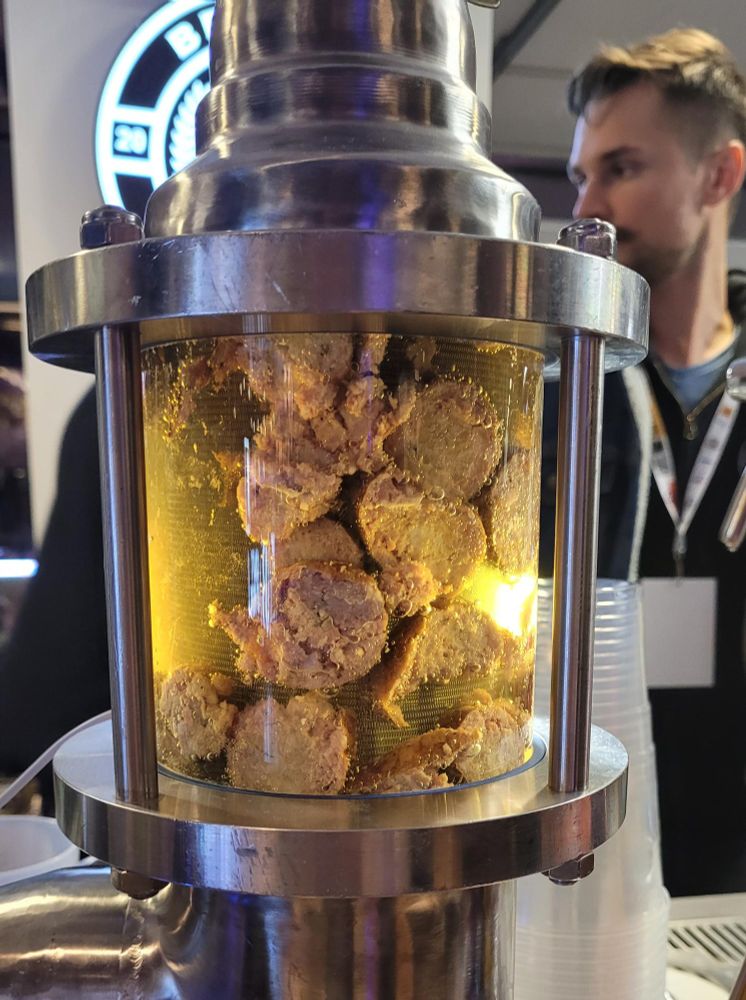
Me, I usually just have water but still try to tip like I’ve had a bit of booze. Where will this all lead?  What can be relied upon to get the attention of the public. Innovation? The Beer Nut himself spent last weekend in Warsaw and spotted one of the more innovative cultural expressions of beer culture – a sausage randall as illustrated in thumbnail format… in consideration of some of your delicate constitutions. Much consternation was found in the comments which followed his Bluesky post – but I really can’t see the difference between a lager washed through sausages and sausages washed down with lager. Much depending of course on the quality of the sausage.

Speaking of quality, Matty C. has written about the return of Boddingtons for CAMRA’s What’s Brewing and has placed it in the moment:

Being honest for a second, this beer is not reinventing the wheel – there are far more interesting and flavourful pints available, even from JW Lees itself. But I consider the resurgence of Boddingtons is about more than flavour. Reports are already coming in from Manchester venues that are not able to keep up with demand, turning away disappointed drinkers who want to be seen with a pint of it in hand. This is significant, because those who are drinking it are young, fashionable, and about as far away from the cask beer stereotype as you can possibly get. This can only be considered a positive. For many drinkers, especially younger ones, a row of handpulls featuring a range of products they’ve never heard of can be incredibly intimidating. In Boddingtons, a brand has been revived that people can easily trust.

Heritage as maybe heritage? Maybe. Speaking of maybe, there is always the potential for maybe not – as one liquor dome in Northern Ireland found out recently:

Planners order the business to remove shipping containers used as a bar and storage, as well as a takeaway food cabin with a serving hatch on a Skipper Street – a side road that runs past the beer garden. Also to go are steel boundaries with wood covering that include an access gate and windows, an enclosed walkway entrance, a “tent structure”, boundary fencing in excess of two metres in height not adjacent to a road, and storage areas for bins and beer kegs. City planners say they’ve reached their verdict as “it appears there has been a breach of planning control” on the site.

Finally and probably relatedly, here is an interesting snippet of an unlocked article from the Financial Times written by Charles Spencer (Princess Di’s brother) on the question of authenticity which includes this:

When, in 1992, I inherited Althorp, my family’s ancestral home, I felt a responsibility to return it to how it had been for much of its 500-year history. For, over the previous decade and a half, the interior had been lavishly redecorated by my stepmother, Raine, whose taste and palette were inherited from her flamboyant mother, romantic novelist Barbara Cartland… I turned to John Cornforth, perhaps the leading British architectural historian of the time, to help me return things to how they should be. We toured Althorp’s principal rooms, assessing them for Raine damage. Cornforth’s kind reassurances dwindled as we went. Finally, on entering the South Drawing Room — a cacophony of clashing pinks (on the walls, on the floor, in the curtains) — Cornforth rocked back in his tightly drawn lace-ups. “Goodness,” he mused. “I really can’t help you here .  As he departed Althorp that afternoon, he lobbed me a catch-all mantra that he hoped might help: “Good taste is authenticity — and authenticity is good taste.”

The point is excellently made. But what does this have to do with beer? Only on the idea of how his hunt for authenticity based on that saying became for Spencer a no-doubt very expensive exercise in conformity. Realizing that, he argues for a balance between respect for what has come before with a realization that you need to live in the present, too. Can we compare the return of Boddingtons or the sweet mess that was historic schenk or that sausage randall with the clashing pinks of a devotee Barbara Cartland’s fashion sense?  Obviously even the “don’t yuk their yum” level of junior beer expert might balk at the more garish, the most lurid of these pleasures. But where to draw the line?

While we consider that over the week ahead, please also check out, Boak and Bailey on this and every Saturday and then sign up for their entertaining footnotes, too. Look out for Stan when he feels the urge now that he’s retired from Monday slot… maybe … maybe not. Then listen to a few of that now newly refreshed Lew’s podcasts and get your emailed issue of Episodes of my Pub Life by David Jesudason on certain Fridays. And Phil Mellows is at the BritishBeerBreaks. Once a month, as noted, Will Hawkes issues his London Beer City newsletter and do sign up for Katie’s wonderful self-governing totes autonomous website featuring The Gulp, too.  Ben’s Beer and Badword has been on hiatus since April but the archives are out there with the all the sweary Mary! There is new reading at The Glass which is going back to being a blog. Any more? We have Ontario’s own A Quick Beer and All About Beer is still offering a range of podcasts – and there’s also Mike Seay’s The Perfect Pour. Plus follow the venerable Full Pint podcast! And there’s the Craft Beer Channel on Youtube. Check out the archives of the Beer Ladies Podcast. That’s quite good and after a break they may well be are back every month!

*Formatted to fit, to protect the innocent perhaps but mainly to fit.
**Jeff updated his thoughts, by the way, but it did make me wonder why what one wants should be limited to what some producers feel they can provide. Perhaps the former suits of Molson now share that feeling.
***A bear of beer! 

The Thursday Beery News Notes For The End Of Summer 2025

There are good views out there. Lots of golden hour sunlight finishing up the days as we face the reality that, yes, winter is coming. Out and about that evening, I saw a frog and a hedge of jewelweed – but you’d expect that, wouldn’t you. I like how the angle of the shadow makes something of a right angle with the tree. I didn’t notice that when I took the photo. But even saying that makes it too artsie, less just see-ie. Similarly, writing about hops, Jeff wrote about a limitation but its really about two limitations. And it’s all a bit like dancing about architecture… but what isn’t:

The thing about adding more is at a certain point you don’t get more. We learned this when breweries were putting eight pounds per barrel of hops in their beers and making them taste like lawn clippings. To get more, you have to add different. And here I give you fresh hop beers. They offer a dimension of flavor that is different from regular kilned hops. Trying to describe them is hard because rather than just reaching for another adjective, we grope toward different realms of experience. Drinking a very good fresh hop beer is to experience synesthesia and encounter the taste of iridescent green.

Conversely yet still on the question of different, not as charming an experience was an airport sandwich sold to Matt Gross under the presumably personally seductive name “the Matthew”, it of the 10 slices of prosciutto:

…laid flat, one on the other, with no space between them, to form a dense, unchewable mound of salty protein. Look, sandwiches are all about architecture, and the meat, especially a powerfully flavored one like prosciutto, needs air. Each slice, thick or thin, should be separated from its brethren, folded gently and laid haphazardly (within reason) upon the bread. You want to feel the texture of the slices, the regular irregularity of the bite as your teeth pass through the layers. That sandwich needs to breathe. If it can’t breathe, it’s dead on the plate, limp and heavy, boring. R.I.P. Matthew. The great thing about this approach is that you can actually use less prosciutto per sandwich and at the same time make the sandwich taste better.

It’s funny. As I go through the week’s saved links I can get interested about someone writing about a crappy sandwich but, for example, can’t be bothered with anything anyone is writing about THC drinks. What could it be? Bad writing? Maybe.* Compare how, for CAMRA’s What’s Brewing, yet another Matthew wrote about beer pubs and heritage in the nearby local layered landscape under development in Manchester’s core, writting in a way which contextualizes more than lobbies:

“We believe regeneration should enhance, not diminish, the city’s heritage. The Marble Arch deserves to be protected as part of Manchester’s future, not pushed aside by it.” On the subject of heritage, one brand looking to capitalise on the city being the national centre of attention this summer is the iconic Boddingtons. Brand owner AB-InBev has decided to return the brand to cask production after it was discontinued in 2012. The news follows hot on the heels of reported investment in another of its heritage beers, Bass…

I like the tone. While one can get numbed by the beating of a drum, an invitation to think about survival and revival in face of modernity is instructive. Speaking of which, maintaining an interest in more than listicles, Laura Hadland‘s** (slightly paywalled) column in The Telegraph takes on a useful discussion for those with a modest to moderate interest in beer – serving temperature:

… some people adore the sharp thrill of bitter flavours. If that’s you, West Coast IPAs should scratch the itch. This US style of beer is hop-led. Citrus and pine flavours are underpinned by intense bitterness, balanced with a light touch of malt… An American brewer may be horrified to see this beer style served any other way but well chilled. However, there is an argument that they could be served fractionally warmer: research shows that as temperature rises, our perceptions of bitterness usually increase. The real connoisseur of bitter flavours should consider ordering a West Coast IPA (such as Elusive Brewing’s Oregon Trail) on cask, served at a cellar temperature of 11-13C, as opposed to the keg-dispensed version that will be around 5-8C.

While there is a reference to the dubious tale of the hyper-efficient expectorating wine judge, this is exactly the sort of writing that there should be more of. An explanation of an idea. An invitation to try something out. Which may be why the comments are not (entirely) focused on slagging the author. Speaking of context and understanding, I like this piece by Jason Wilson about old vines and the disasterous 2025 harvest in Rioja and what keeps the winemakers… making:

I asked Oxer why he thinks people can be so skeptical about the concept of old vines. “In some way,” he said, “we’ve lost our connection with the old world, the spiritual world. We think too much about the scientific world rather than the spiritual world, but we should join both worlds.” He added, cryptically as always: “Soil is darkness, but always in the darkness, there’s light. Soil is a world we don’t really understand. It’s mix of magic and microbiology.” As we finished our meal with a Basque style cheesecake, Oxer told me that 2025 will be a different story than 2024. He’d lost at least 60 percent of this year’s grapes to the summer hailstorms.

Note: if you think you are dedicated to the drink, consider Big Jim. Talk about pacing your drinks. Conversely, The New York Times ran an (somewhat paywalled) article this week that had me shaking my head over the level of alcoholism being decribed and the introduction of a new concept:

Withdrawal from alcohol, though, felt like a direct hit. I looked to my bedside table and saw the glass of “bed wine” from the night before. “Bed wine” is something I promised myself I would quit this year. It’s the last glass of wine I bring with me as I climb into bed to watch TV or do the crossword puzzle. I tell people that my relationship with alcohol is “complicated,” but it’s not. I love drinking wine and a good cocktail, but booze is horrible to me. In my world, there’s always an excuse to drink: celebration, disappointment, stress.

A habit of “bed booze” seems to me to be a pretty alarming cry for help. Which the piece sorta admits it is. But still… Lordy. What’s so wrong with warm milk?  But things could be worse… maybe. Last Friday, Will Hawkes circulated his latest edition of London Beer City and included this gem of remembrance of a shit pub past:

In 1998/99 I lived about two minutes’ walk from the Finn and Firkin, an imposing 19th-century boozer on the Pershore Road in Birmingham. I remember Dogbolter, a beer I avoided because it was too strong. I remember the L-shaped bar, and the smelly loos next to one entrance. I remember the huge dance hall/concert venue attached to the back. And I remember, for reasons I still can’t truly understand, being unnecessarily rude to a Stoke-supporting friend when he entered the pub one Saturday evening having just watched his team lose 3-0 (although, checking Stoke’s results, they didn’t actually lose 3-0 in 1997-98. Maybe it was 4-0? Or 4-1).  (The pub stopped being a Firkin soon after and is fully shut now).

Nice. Exactly what one looks for in every establishment. Or is it? Some Americans go to Italy in search of an English dispense system… well, at least one did:

Today, from my count, there are at least fifteen locations in Rome serving beer via handpump. And while a number of British breweries send their casks here, there are a several Italian breweries like Hilltop Brewery, Shire Brewing, and Linfa Brewery that are regularly cranking out casks for the pubs. Beyond Rome, you can find handpumps in most Italian city at establishments with an interest in selling anything beyond the standard Peroni or Moretti. Even in Sicily. However, I suspect most of these are serving kegged beer hooked up to a handpump (i.e., they’re not serving cask conditioned beer). To my knowledge, I didn’t have any of that on this trip.

Massimo Internazionalismo!! And perhaps being a bit massimo medievalismo, the feature in Pellicle this week by Thomas Soden is on the topic of gale, the herb that hops destroyed. AKA myrica gale scientifically or sweet gale, sweet bayberry, dutch myrtle or sweet willow.  Or even bog myrtle like when I had a beer brewed with it back in 2008 brewed by Beau’s right here in eastern Ontario. Soden shared:

A wild plant, it often featured in the herbal gruit which flavoured beers from low countries before hops became commonplace in brewing. The shrubs require the specific soil acidity of bogland areas, which although once abundant, are increasingly scarce today. Nothing, however, is stopping modern British brewers from utilising gale as a flavouring agent. In an age in which ‘natural’ beers and wines, and fermented drinks like kombucha are gaining popularity, this seems like it has potential. In 2017, the now sadly defunct Treboom brewery in Shipton-by-Beningbrough near York made a wheat beer flavoured with Gale named “Myricale,” and acknowledged it was a homage to the style. So why has it died out?

Hmm… might I suggest the whole “tastes like a bog” thing?

And for Stan because we share the love of such things, a story of how much alcohol chimps consume:

Someone have a word with the chimps? Observations of the apes in the wild show them imbibing the alcoholic equivalent of a half pint of beer a day through the vast amount of fermented fruit in their diet. Researchers arrived at the first estimates of wild chimp daily alcohol intake after measuring ethanol levels in fallen fruit that the apes gather from the forest floor in Kibale national park in Uganda and in Taï national park in Ivory Coast. While individual fruits contained less than 0.5% alcohol, the chimps’ daily intake swelled as they devoured the ripe fruit pulp. The apes were particularly fond of figs, which contained some of the highest levels of alcohol the team recorded.

Speaking of the pre-hop universe of gale and chimps and… stuff… to conclude this week I am going to try a new weekly feature, featuring old stuff every week. I realized the other day that not only had I been writing this… whatever this is… for over two decades but a lot of my history writings are well down the lastest posts lists. So I am going to try to give a nod to a few things that you might find interesting and perhaps new to you if you weren’t reading this sort of beer stuff back then. Let’s start off with a few links to posts under the 1400s tag:

a. from 2016, check out The Steelyard, Stillyard, Stylyard and Spelling about the Hanseatic League’s foothold in central London
b. from 2015, read all about the brewing dynasty of The Hillars Of Golden Lane, Cripplesgate Without and
c. from 2019, a survey of England’s Increasing Concern Over Beer Brewing, 1430s to 1580s.

That is it for now. Enjoy these last days and golden hours of this summer and as you do please also check out the below mentioned Boak and Bailey every Saturday and sign up for their entertaining footnotes, too. Look out for Stan when he feels the urge now that he’s retired from Monday slot… maybe … maybe not. Then listen to a few of that now newly refreshed Lew’s podcasts and get your emailed issue of Episodes of my Pub Life by David Jesudason on certain Fridays. And Phil Mellows is at the BritishBeerBreaks. Once a month, as noted, Will Hawkes issues his London Beer City newsletter and do sign up for Katie’s wonderful self-governing totes autonomous website featuring The Gulp, too.  Ben’s Beer and Badword has been on hiatus since April but the archives are out there with the all the sweary Mary! There is new reading at The Glass which is going back to being a blog. Any more? We have Ontario’s own A Quick Beer and All About Beer is still offering a range of podcasts – and there’s also Mike Seay’s The Perfect Pour. Plus follow the venerable Full Pint podcast! And there’s the Craft Beer Channel on Youtube. Check out the archives of the Beer Ladies Podcast. That’s quite good and after a break they may well be are back every month! Such is life. Such is beer podcasting and newslettering… which, as Ray says, are blogs! And he’s right.

*Yet we do recall the wise words of Boak and Bailey in last weekend’s footnotes: ” “Beer fandom is infested with know-all-ism.” To expand on that briefly, it’s the tendency to respond to any post or article with something like “Old news, already knew this” or “And of course, [supplementary fact]…” Worrying about whether what they’re saying adds anything new to the conversation is one thing that inhibits people from writing and sharing. Yes, there are certain topics that have been hashed out a million times. But when you write about it, it’ll be different because you have a different perspective, and because new evidence has emerged, or things have changed, since it was last written about. Don’t write for the know-alls, because you can’t please them. Write for yourself, and for people who like what you do.” “
**For the double, Laura on pockets at the Beeb.

The Delightful Yet Pensively Penultimate Beery News Notes On A Summer’s Thursday For 2025

It’s been a busy week but not really in the beery sense. Guests and heirs have come and gone – and even bought a $14.99 beer on the way out via an airport bar at Montreal, as illustrated sub-wonderfully perhaps. A last bit of summer visting and the shedding of the last loonies and twoonies. Which means the home is quieter here at this end of the week compated to the other. Which is good. But quieter. At least I have my tomatoes. Did I mention my tomatoes? Definitely illustrated sub-wonderfully, that yellow one in the upper left weighed in a 1.7 pounds. And I did nothing to make it happen. Which is my favourite and most common form of success. Six varieties left to right ish clockwise: Chiltern’s Blue Bayou, Baker Creek’s True Black Brandywine, Chiltern’s Golden Sunshine, Baker Creek’s Kentucky Beefsteak, Chiltern’s Beefsteak and Baker Creek’s Orange Icicle. Picked from the catelog based on the “pin tail on donkey” method. All started from seed last winter and soon getting turned into sauce. That True Black Barleywine is the best tasting tomato ever – like it has built in balsamic vinegar. Thanks for tuning in to Tomato News Today!

First up in the world of beer, the Tand himself has also been out and about on travels and has reported back on the scene in Munich – and found out that certain things were not to be found:

Sadly, you can’t find Pils on draught anywhere, and for reasons best known only to themselves, Spaten insist on offering the dreadful Beck’s as their bottled pils in their most prestigious outlets. It appears Spaten Pils, which I recall was a lovely beer, is no longer brewed. A real shame.  In fact, Spaten it seems, only brew Helles in both normal and alcohol-free forms and, of course, an Oktoberfest. It gets worse. The whole shooting match of Spaten-Franziskaner-Löwenbräu-Gruppe is owned by AB InBev, who presumably have streamlined the brands available, though under the Franziskaner brand you’ll also find weissbier and a kellerbier.  Like Spaten, the rather delightful Löwenbräu  Pils has been dropped. It is a pretty grim picture as the odd hoppy pils provided an alternative to Helles, which in its Munich iteration, can be a little sweet, and dare I say, bland? (The locals call it “süffig”, meaning “easy to drink”. And, in fairness, it is.

And over at Pellicle, Matthew assumed the role of player / manager and reported on his travels to the French & Jupps Maltings in Hertfordshire where he found a hidden truth:

Its long history stretches back to 1689, and for more than a century the maltster has been based in the twin Hertfordshire towns of Stanstead St. Margarets and Stanstead Abbots, bisected by the aforementioned Lea, some 30 miles north of London as the crow flies. There are a few reasons for its relative anonymity—I myself hadn’t heard of them until I was invited for a visit in February 2024. One is due to the fact its malt was (and often still is) bought in bulk and rebagged by various distributors before being shipped out to breweries. And so, it might bear the name of a competitor—although in this context it’s perhaps more accurate to refer to them as partners—in the US, for example, the malt is typically sold under the William Crisp banner.

Sneaky sneaksters! Did you know? (Did I? Never mind that… let’s make this about you.) Did you??? Speaking of hidden truths, Pete Brown had a has retrospective on BrewDog, now well in to the post-Watt era and even into the post-Dickie, published in The Morning Advertiser that he unpacked into something of an obit:

To me, they always felt more like a band than a brand – not least because they wanted to be seen as punks. Bands are different. When none of the original members remain, many former fans insist that it’s simply not the same band any more, and that the newcomers who have taken over, singing songs they never wrote or had hits with, are no better than a covers band. The departure of Martin Dickie feels like the last member of the original line-up has left the building. The entity that remains may own the rights and assets of BrewDog, but it has lost the spirit and soul that once defined it… Dickie remained silent throughout. The initial allegations referred to a “cult of personality” built around both men, but specific personal allegations were focused on Watt’s behaviour. After Dickie’s departure, some former employees took to social media to say that he was “part of the problem.” 

Wonderful. I have never understood how Dickie, co-exec past and board member still, has had the teflon wrapper that he has enjoyed through downturn after downturn on what must be one of the most note worthy financial flops in recent brewing history. But perhaps it’s been a case of not noticing that scratch on your hand due to the nail in your foot.

Speaking of endings, Ed the Beer Father has shared his thoughts on the closing of Banks of Wolverhampton, mapping a fairly complex set of international bobs and weave that led to the end:

Eleven years ago the two companies with rights to San Miguel beer, San Miguel Brewery (Philippines) and Mahou San Miguel (Spain) signed a cooperation agreement to promote their international businesses and position San Miguel as a global brand. To further its growth they had already partnered with Carlsberg to contract brew it in Britain, and it was a large part of the output of the Northampton brewery. But for a brand with global ambitions partnering with the world’s biggest brewery seems like an obvious match… So, as what I believe is part of a global realignment, last year San Miguel moved its contract brewing in the UK from Carlsberg to ABInBev. Losing the San Miguel contract left Carlsberg in the UK, which owned one giant factory and two large regional breweries, with a lot of surplus capacity. The giant factory wasn’t going to go and Marston’s has the small pack facilities, which left Banks’s. So a contract change for a Spain and Philippines based international lager brand closed a 150 year old brewery in Wolverhampton that didn’t even brew it. 

Lordy. Speaking of things making one’s head spin, I totally missed Stan‘s post before the Labour Day weekend on the nature of beer bubbles so I will correct that error now:

There is more to monitoring beer foam than counting bubbles, although they are the foundation. They result from nucleation, and as those bubbles climb to first form or then replenish the foam head, proteins and bitter substances are carried into the bubble wall, forming a matrix that holds the skeleton together. In his doctoral thesis, “Beer Foam Physics,” A. D. Ronteltap calculated that a foam 3 centimeters high (a bit less than 2 fingers) in a glass 6 centimeters wide (a bit less than a Willi Becher) made up of bubbles with an initial radius of .2 mm (twice the width of a human hair) would contain 1.5 million bubbles distributed over about 100 layers.

Over a million bubbles! Not quite millions and millions but more than one million. And, while the numbers aren’t quite confimed yet, Jessica Mason pulled out the stats as she reported on the question “Can Gen Z save cask ale from extinction?” for Drinks Business:

Statistics from YouGov for the Society of Independent Brewers and Associates (SIBA) have shown 25% of 18 – 24-year-old beer drinkers regularly order cask ale. The figures mark an increase of more than 50% on the previous year… Digging deeper into the SIBA figures, there are also statistics that support the opportunity that women present in the future of cask ale’s revival. For instance, the data revealed how 22% of female beer drinkers regularly order cask ale, compared to 43% of men. But, as Corbett-Collins noted: “It would be great to see even higher numbers, but the glass half full fact is that men and women of all ages are enjoying cask beer.

Out and About Update: Max mapped a 29 km(!) pub crawl he took through the Czech countryside to plant himself in front of a beer at Únětický pivovar, Zdibský pivovar and Polepšovna ducha as well as a few other spots. I marched about a tenth of that the other weekend and my left knee let me know about it for more than one day. Good thing Max kept up a good pace because apparently, according to the white coated eggheads in the Netherlands, beer drinkers are a prime target for mosquitos:

To find out why the blood-sucking critters prefer some people over others, a research team led by Felix Hol of Radboud University Nijmegen took thousands of female Anopheles mosquitoes to Lowlands, an annual music festival held in the Netherlands… Participants who drank beer were 1.35 times more attractive to mosquitoes than those who didn’t. The tiny vampires were also more likely to target people who had slept with someone the previous night. The study also revealed that recent showering and sunscreen make people less attractive to the buzzing menace. “We found that mosquitoes are drawn to those who avoid sunscreen, drink beer, and share their bed…”

Speaking of getting bled, I received the alert from Will Hawkes: “Sorry to be right about this. No GBBF next year as it made ‘a substantial loss’, according to CAMRA.” As per usual and FOR THE DOUBLE!!!… Jessica Mason has more detail:

CAMRA chairman Ash Corbett-Collins explained how “at Members’ Weekend earlier this year, the national executive presented finances that painted a stark picture. As your chairman I was open with you; we were facing significant challenges… Corbett-Collins lamented: “Sadly, this means I must tell you that: The Great British Beer Festival and its Winter counterpart did not attract enough visitors to cover the cost of holding them, resulting in a substantial loss.” Added to this, he revealed that CAMRA’s membership figures “are simply not growing” and confessed that “the hard truth is we are unlikely to return to pre-2020 levels”… and noted how “the cost of running a membership organisation and business is also increasing”.

This is a pretty serious situation as it really looks like a broader issue than just the fests. The organization itself seems to be at risk. I expect more information to be flowing in the coming days.

In the “WAR ON SCIENCE” folder, we read the news out of The New York Times that everyone’s favourite slowly exploding head in charge of the Department of Health and Human Services has pulled the US government’s pending report on alcohol as part of a healthy diet:

Mike Marshall, chief executive of the U.S. Alcohol Policy Alliance, a nonprofit that aims to reduce the harms of alcohol, said H.H.S. was “doing the work of the alcohol industry.” “They’re burying the report so the information about the health consequences is not widely known,” Mr. Marshall said. Health Secretary Robert F. Kennedy Jr. has decried a “chronic disease epidemic” sweeping the country. But he has said little about alcohol’s impact on American health since taking office. Consumption of both alcohol and tobacco was absent from the first Make America Healthy Again report released in May. Mr. Kennedy (like his boss, President Trump) has said he does not drink.

It’s important to note that Mr. Kennedy, unlike his boss,  does not wear makeup preferring to gain his particular rusty orange hue through a natural process.

Finally, just before this organ went to press, the dynamic duo B+B posted a piece under the fabulous title “Customers Have Always Been a Problem for Pubs” which illustrates the truth based on a sppech given in 1933 by one Lieutenant Colonel E.N. Buxton, director of the East London brewery Truman, Hanbury & Buxton:

The talk finishes with a few more rebukes for the drinkers. First, the reason pubs often look so ugly, and are so sturdily built, is because “you do not treat them so kindly”. “Walls and furniture are roughly treated”, he says. “As for the outside of public-houses, I agree that some of the houses in London look perfectly ghastly. Hard wear, however, had to be the first consideration.” This was addressed, remember, to a room full of people from Bethnal Green. We’re picturing the crowd when Bertie Wooster sings ‘Sonny Boy’.

Fabulous. There. That’s a lot for a busy week but probably less than all the stuff our there to read so please also check out the afore mentioned Boak and Bailey every Saturday and sign up for their entertaining footnotes, too. Look out for Stan when he feels the urge now that he’s retired from Monday slot… maybe … maybe not. Then listen to a few of that now newly refreshed Lew’s podcasts and get your emailed issue of Episodes of my Pub Life by David Jesudason on certain Fridays. And Phil Mellows is at the BritishBeerBreaks. Once a month, Will Hawkes issues his London Beer City newsletter and do sign up for Katie’s wonderful self-governing totes autonomous website featuring The Gulp, too.  Ben’s Beer and Badword is out there with the all the sweary Mary! And check out the Atlantic Canada Beer Blog‘s weekly roundup. There is new reading at The Glass which is going back to being a blog. Any more? We have Ontario’s own A Quick Beer featuring visits to places like… MichiganAll About Beer offers a range of podcasts and there’s also The Perfect Pour. Plus follow the venerable Full Pint podcast! And there’s the Craft Beer Channel on Youtube. Check out the archives of the Beer Ladies Podcast. That’s quite good and after a break they may well be are back every month! Such is life. Such is beer podcasting and newslettering… which, as Ray says, are blogs! And he’s right.

The Much Abbreviated But Apparently Almost Drought Resistant Beery News Notes For A Thursday

Welcome to August. No rain to speak of. Not for weeks. Lawns look like Nabisco Shredded Wheat testing plots. I’ve spent days and days schlepping the garden hose and watering can all over the estate. Which has reminded me  of how wise it was to buy 6,500 square feet of land back in 2006. Once upon a time I had four acres to take care. Now? No mow no mo… practically speaking. As a result, I have barely looked at the beer news which is good as there is barely any beer news these days. That up there? A very nice ferry last Saturday night, a side trip I took on 87 seconds notice after a desperate call from across the waters. A very pleasant inconvenience.

First up… is there history in North America?  I ask this as a writer, if lapsed, of history. So first, consider this unexpectly deep and oddly twisty history of the word “dude“:

“They were young. They were vacuous. They were effeminate — and they were drawing a bit of attention from the humorists and the cartoonists,” Cohen told NPR. He says this crowd had a certain way of dressing — usually over-the-top and fancy — and leaned into an Anglophile lifestyle that was often perceived by many as fake or trying-too-hard. Eventually, these men became known as “dudes,” likely in reference to Yankee Doodle, who, as the old war song goes, was an unsophisticated American who “stuck a feather in his cap” in an attempt to parade as a kind of European “dandy” in high society.

The very next paragraph or two takes you through cowboy dude ranches and then on to slacker dudes of today, each phase of the word’s meaning being largely unrelated to the last. None of which is retained culturally knowledge. Which makes one wonder about one’s awareness of such things. I raise this in relation to beer by way of intro to Jeff’s lamentations on the state of US brewing history:

“Craft breweries” were a peculiarly American kind of thing. If you don’t have a past, you’re not bound by it. Lacking a native beer tradition—domestic lagers were functionally German beers—Americans were freed up to do what they do. We made beer styles from elsewhere, borrowing and almost immediately riffing on them. This improvisational style would become hugely influential, and it was never going to start the way it did in a traditional brewing country like Germany or Britain. Much like Americans were never going to found a club that merely venerated an old brand of beer.

What is weird is that the land mass that is now the United States has over 400 years of brewing history but, as Jeff says, has no sense of brewing tradition. So it is possible to speak of IPAs being new even though they have been brewed for coming up on a couple of hundred years, winning awards overseas in the early 1900s and at least as good a continuity as Belgian strong ales. Why does no one care? Because no one cares. It’s that deep. A tradition of amnesia.

Speaking of forgetting, someone in Dalton, England has been breaking the law and the neighbours aren’t having it:

People living near a pub have claimed that their privacy is “under threat” after the business began expanding its beer garden without permission. Residents of Dalton, near Huddersfield, have complained to Kirklees Council after the Brooks Arms began extending its garden towards the pavement, including erecting fencing and 10ft poles with fairy lights. Stonegate Group, which owns the pub, said it was in contact with the council and contractors had paused work while they “reviewed the next steps”. Kirklees Council confirmed there was no planning permission in place for the works.

Interestingly, the property owners have claimed the “works undertaken relate to fencing and posts to hang festoon lighting” which leads to that important legal question – are they fairy or festoon lights?

Do you stand up against bigots in pubs or elsewhere? I am lucky because I am such an ox that I’ve always been able to grunt some version of fuck off and people generally, you know, fuck off. But I am older now so paid attention when noted thoughtful folk who may well be less ox-like than me considered this the other day. I admired this exchange:

DJ: “The idea of challenging someone being anti-inclusionary is really interesting. A friend was in a Kent pub and a landlord used a racist slur about an East Asian in conversation. He said you ‘can’t say that’ and left it at that. That’s all that’s needed tbh to make sure it’s not ever unchallenged”

B+B: “We would certainly be quicker to do it if we were actually in conversation with the person. We’ve had some practice at that. When it’s happening on the other side of the pub, getting up and going over to have a word with a stranger takes some nerve.”

Speaking of standing up, Anaïs Lecoq wrote on the poor conditions brewery workers in France can find themselves working under. There is a paywall on this one but, especially as I am working on my French, I thougt it worth noting in case any of you lot have a work around:*

Quand je dis que je suis brasseur, tout le monde trouve ça stylé, mais quand je rentre dans le détail, beaucoup ne se rendent pas compte de ce qu’implique le métier », déplore Sam*. En 2022, le trentenaire a quitté un travail de bureau dans lequel il ne trouvait plus de sens pour une brasserie située en Île-de-France.

Update!! Paywall begone! Here is the full story care of the author herself.

Question #1: did craft try to be champagne? Above a beer?

Question #2: Ron’s been in Australia… did he try the beer?

Question #3: was the GBBF really as dead on trade day as Will Hawkes felt it was? (Another Update: correction on my assumption from Will received vai Bluesky!)  Some were doing their part, according to Bluesky after the trade day events…

Forget the adults… what is up with teens today? Apparently not levels of drinking of Beer Marketer’s Insights is to be believed:

The largest federal survey on alcohol consumption confirmed continued declines in underage drinking alongside relatively consistent levels of adult use. The National Survey on Drug Use and Health, fielded to tens of thousands of Americans aged 12 and up, once again found a substantial decline in the prevalence of past month alcohol consumption by 12-20 year olds. Reports of any past month alcohol consumption by 12-20 year olds steadily declined from 15.6% in 2021 to 13.3% in 2024.

That’s crazy. I mean it’s not a crisis and it’s probably good but, speaking as one who drive the kids to Quebec to drink legally at 18, it’s still a bit crazy.

Who will take our empties? That’s the question in Ontario these days as the expansion of the retail market to grocery stores has left the good old Brewers Retail aka The Beer Store rapidly shutting down locations. Will charities benefit?

With more and more Beer Stores closing across Ontario, charities and non-profits that rely on bottle collection are hoping to cash in on your empties. The Beer Store currently processes about 1.6 billion empty alcohol containers per year. But it has closed dozens of locations across the province since the arrival of beer in convenience stores, and plans to shutter still more this September. At least five of the actual or planned closures are in Ottawa, including one in the Glebe, where Operation Come Home runs a bottle drive as part of its BottleWorks social enterprise. Executive director John Heckbert hasn’t noticed any impact yet — but he’s hoping more residents will call on BottleWorks to collect their empties.

Hockey? Who the hell talks about NHL hockey in August?  The Athletic, that’s who. And the talk is about beer:

Charlie Coyle had yet to be drafted when Tony Amonte, his cousin, concluded his NHL career in 2007. But what the veteran of 1,174 NHL games shared years ago with Chuck Coyle, the center’s father, left an impression. “You go out, you drink, you have a good time, you won’t be the same for a month. That’s what I always remember him saying when I was younger,” the Columbus Blue Jackets forward recalled his dad’s telling of Amonte’s belief. “Maybe that’s an exaggeration. Maybe not. But I have that in my head.” Amonte’s formula may not be scientific. But part of the reason the 33-year-old Coyle rarely drinks during the season is that he wants to avoid, whenever possible, any disruption to a key part of his life as an athlete: sleep.

Bad sleep for a month?!? Who do they think they are? Gordie Howe?

Martin came across an odd scene in Stannington, a district of Sheffield when he was hunting out new spots:

Of the 3 Stannington pubs, this looks the smartest, like an M & B all day diner, and perhaps at 3:30pm the lunch trade has gone home, as it’s empty. Completely empty, bar me. Two bars, no-one behind them, or any sound at all. If I was still ticking the GBG I’d have been panicking, but “finishing a Sheffield suburb” isn’t that important, and after five minutes I consider starting the 40 minute walk home. But then I notice the bell. And ring it, instinctively deadening the noise almost immediately like I do in my Waterbeach local. Nothing. I walked out, stared into the distance, then returned, unwilling to be beaten. Oooh, they’re out of Guinness. And Moretti. That’s worrying. And at that moment, a young man emerged from the kitchen, replete with tales of minor injuries I probably shouldn’t trouble you with. He puts on Aerosmith “Love In An Elevator“, then turns it down. Good lad.

Speaking of finding oneself in a pub, Jess aka the B in B+B returned to their former home of Cornwall to report on the role that popular new brewers Verdant have changed the scene and in doing so made a confession:

Now close observers of our blog and social media, or subscribers to our Patreon, will know that I have a particular aversion to beers with mosaic hops and similar. At best, I find they taste of onions and, at worst, something I can only describe as rank armpit. And that’s all I can taste, with none of the juicy tropical fruit flavours that people talk about. I get that this is a me problem, that other people don’t taste these hops this way, and that Verdant are an extremely popular and rated brewery. However, they do tend to like using these hops and as a result I’ve never really got on with them. And the first evening, I’m afraid, did little to convince me otherwise. That the beers looked like water that had been used to clean paintbrushes didn’t help.

And Pellicle‘s feature this week is an interesting story by Mike Clarke of a pub that was lost and reborn, demoished and rebuilt – the Vulcan of Cardiff in Wales:

Until 2012, this building housed a pub in Cardiff City centre—a very ordinary pub that had stood for over 150 years serving an eclectic urban community. Its interior, crammed full with fruit machines, a jukebox and an outsize ship’s wheel on the wall, was a sanctuary from the relentless redevelopment and expansion of the capital city—development that eventually forced its demolition… The Vulcan Hotel reopened in May 2024, having been demolished, transported, and rebuilt brick-by-brick in the museum, restored to its appearance a century ago within the curated historic village. Even though rebuilding it took just over a decade, the Vulcan still holds fresh memories. Many visitors around me point out familiar architectural features, like the two front doors or the two-room layout, and remark that it feels like “only yesterday” since they last visited.

It’s an interesting approach to pub preservation but has led to questions about whether the urinals are correctly glazed (yes) and what beer should be sold (Ron sticks his toe in… not in the beer, in the topic) and whether it is still a pub or has that changed.

Well that is it. Not as short as I feared and there was plenty of reading once I had a look. While there is a lot up there, please also check out Boak and Bailey every Saturday and sign up for their entertaining footnotes, too. Look out for Stan when he feels the urge now that he’s retired from Monday slot… maybemaybe not. Then listen to a few of the now rarely refreshed Lew’s podcasts and get your emailed issue of Episodes of my Pub Life by David Jesudason on the (sometimes even but never) odd Fridays. And Phil Mellows is at the BritishBeerBreaks. Once a month, Will Hawkes issues his London Beer City newsletter and do sign up for Katie’s wonderful self-governing totes autonomous website featuring The Gulp, too.  Ben’s Beer and Badword is out there with the all the sweary Mary! And check out the Atlantic Canada Beer Blog‘s weekly roundup. There is new reading at The Glass which is going back to being a blog. Any more? We have Ontario’s own A Quick Beer featuring visits to places like… MichiganAll About Beer has given space to some trade possy podcasts and there’s also The Perfect Pour. Plus follow the venerable Full Pint podcast with an episode three weeks ago!. And there’s the Craft Beer Channel on Youtube. Check out the archives of the Beer Ladies Podcast. That’s quite good and after a break they are back every month! Such is life. Such is beer podcasting and newlettering… which, as Ray says, are blogs! And he’s right.

*Here’s the blurb in English: “Precarious and dangerous working conditions, unpaid overtime and exploitation: the daily lives of employees producing artisanal beer are sometimes at odds with the values conveyed by the sector and the positive image it enjoys.”

Your Beery News Notes For The End Of July And The Beginning Of The Back To School Ads

The last day of July. It’s one of the first endings of the year. Well, there is the end of winter but no one regrets that. And the switch from late spring to early summer never really leaves a ripple. But… July. Spent the other evening watching dusk arrive at a nearby conservation area, listening for bobolinks and kingbirds as they snabbed a few last bugs out over the field. Saw a raven. Heard it croak.  Mr. Nature. That’s me. Five Saturdays to Labour Day. But even that date’s lost its sting as it’s the first September that not one kid is in the public school system for twenty-three years. What milestone is left? Last day of July.

First up, David J. announced the roundup for the July edition of The Session with a pretty interesting set of submissions this month, interruping his reguarly scheduled broadcasting:

Today’s Substack is ‘free to air’ – like Test cricket and Premier League football should be – so that the people who have contributed can gain the widest readership possible. (Also a desi publican I was going to interview suffered a bad injury and had to postpone. He’s fine, though, and I’ll be bringing his story soon.) On July 11, I asked various participants to write a blog, web post, newsletter (like this one) or even a SM thread on the subject of food in pubs. I’ve rounded up their work and at the bottom have written about the dangers of being a go-to voice on pub food.

Go have a look. Plenty of good reading. Also well worth a read, Ruvani de Silva has announced the launch of her course hosted by CAMRA on American Heirloom Cider Apples and it is good to see the historical context at the forefront:

Settlers, noticing the tribes’ bountiful orchards and the quality of the land they were cultivating on, were keen to claim it for themselves, unafraid to use violent displacement to do so. In one particularly horrific example, future President George Washington took a break from fighting the British in 1779 to send Generals Clinton and Sullivan to implement a scorched-earth policy across the Six Nations of the Iroquois’ beautiful, fertile Fingers Lake land in upstate New York, burning their flourishing orchards to the ground.

This lines up from some of what I found when researching upstate New York history over a decade ago including Lord Selkirk’s 1803 description of apple orchards around Geneva NY from before the Sullivan raids as well as this description from 1797:

…a person from Scotland has established, at Geneva, a very respectable brewery, which promises to destroy in the neighbourhood, the baneful use of spirituous liquors. The apple and peach orchards, left by the Indians, yield every year abundance of fruit, for the use of the inhabitants, besides making considerable cyder; so much so, that one farmer near Geneva sold cyder, this year, to the amount of one thousand two hundred dollars.*

Speaking of solid research, after last Saturday’s news update was posted by Boak and Bailey, I rushed to their footnotes at Patreon which included this tidbit:

…we’re entering the era of ‘normalism’. People want to drink normal beer, in normal pubs or bars, while eating normal food, and wearing normal clothes… Perhaps because they don’t have the headspace to cultivate less mainstream tastes, or maybe because standing out as an individual feels like a dangerous business in 2025. Or just pointless. We keep seeing young couples dressed head to toe in formless matching beige. 

I thought of that Monday evening when I saw a young man waiting for the lights to change, standing at an intersection in beige Sperry Top Sider clones. They had to be clones, right? I also thought of this when I read Jessica Mason‘s news about the recent rise  in Heineken’s fortunes:

Speaking about the results, Heineken CEO and chairman Dolf van den Brink said: “In the first half, we delivered solid results as organic operating profit grew 7.4% as the operating margin expanded by 26 bps and net revenue increased 2.1%…” Highlighting the strides the business has made, van den Brink pointed out how Heineken’s “volume performance improved across all regions in the second quarter and continued to be of high quality…  Describing how the company has achieved this, van den Brink explained: “Our advantaged geographical footprint helped us to adapt to ongoing macro-economic challenges which impacted consumer sentiment and expenditures.**

Is that so bad? Perhaps green is as much the new beige as beige is. Normal. Makes more sense than spinning in your sheets over and over thinking of all the coulda woulda shouldas. The trend is evident in the US craft scene as summarized by Keith Gribbins at Craft Brewing Business the other day:

The Brewers Association’s 2025 Midyear Report shows an industry still facing strong headwinds. Yet, pockets of growth remain — especially for the smallest on-site brewers. As of June 2025, 9,269 craft breweries were operating in the U.S. — down 1% from a year ago. Closures continue to outpace openings, led by a 3% decline in microbreweries. Taprooms dipped 1%, while brewpub and regional brewery counts remained flat. Craft beer volume also shrank. The BA estimates a 5% year-over-year decline in production. 

Five percent cut in production in the last 12 months is not a “maturing” or any sort of “sideways” something. As one would say in my youth, the arse is out of it. Doug Veliky shared some thoughts about where those buyer might be heading and why the trip isn’t that difficult:

Low-dose THC beverages offer the same qualities that have made light beers, spritzes, and canned cocktails so popular. They are social, easy to enjoy, and deliver a consistent experience every time. Because these drinks are made to be consumed more than once in a sitting, they help establish rituals that lead to frequent, repeat purchases. Instead of being one-and-done, the format allows consumers to stack their way toward their preferred level of buzz.

So, craft may have lost its hook. By which I mean that idea of the ritual habitual. People are still doing things, sure. They’re just not doing those things because they now have the option to do these other things. Or is that the new habit? Being what B+B call normal. It might actually just mean not needlessly complex. Manufactured difficulty. Life’s hard enough without made up difficulties.

Note: not only do the top 40 breweries in the world not include much that can be called craft, onely one and a half seem to be American.

By way of comparison but really only as juxtaposition, Jeff continued his explorations into what makes a saison a saison, following up on his article on the style in Craft Beer & Brewing, illustrating once again that blogging about beer is always superior to the store bought stuff. I particularly liked how he moved the discussion from the romantic (ie lazy / fibby) explanation that saison is “something you feel” to getting to the elements of they stuff including the importance of a coarseness of character to the grains, as decoratively mentioned by Alex Ganum of Upright Brewing of Portland, Oregon:

Not sure if I ever shared this story, but back when we were running Old Salt, our hog rancher kept bugging me about using his triticale, which was the animal feed. He grew it himself and was proud of the quality, but I dismissed it early on thinking, ‘How good can animal feed be? ‘Well, that was dumb, because he eventually just dropped off a bag and it turned out to be incredible (which probably explained part of why his pork was delicious). So we asked him for a pallet and worked it into the Five for about a year or so.

Sixteen years ago, when I had the time to do so, when the kids were little enough that they couldn’t get too far, I grappled with the idea of these sorts of beers and their cousins, back when I could take a Saturday to contemplate such things in the shed. But that right there is as good an explanation as ever I’ve seen: beer made from bits fit for the livestock. Farm yard as much as farm house. Normal may not have time for farm yard.

Speaking of simple pleasures, Katie shared a lovely bit of recollection, a remembrance of Wetherspoons past involving herself and her staff access to discount chips:

When I worked at Wetherspoons many thousands of years ago, the one redeeming feature of the job other than the wage was access to a staff menu, off which we could also take a 50% staff discount. My favourite shift tea from this reduced selection of kitchen scraps was sausage and chips. It was not served with vegetables of any kind. A person can talk shit about Wetherspoons all day, and I will join in, but their chips have always been godly, the best of all the frozen chips. I am certain they are coated in semolina for extra crunch, leaving the centres fluffy and light. With mayonnaise, this dish, which cost me around £1.30 in 2008, was my favourite food. It didn’t make the pub I worked in any better, however. You can’t judge a pub by its chips—sometimes they are simply angels sent to soften the blow.

Normal likes chips and especially good discount chips. Quite right, too. Also alarmingly normal is Martin who has admitted to falling behind in his pub reporting and is trying to catch up which some of the highlights (*ahem*) of his continued touring:

Admit it, you’ve never heard of Cockerton, have you? Neither had I, even though this small Durham village is virtually contiguous (great word) with Darlington and only a few minutes from Piercebridge and my best-read blog post. And it’s got a free space for my campervan from which I can finish Durham’s Guide entries for another year. What Cockerton doesn’t appear to have is much actual character. though it does have excellent podiatry.

Note: at the Vytopna in Prague a little train set delivers your beer…

Finally and for the double, David Jesudason wrote the feature in Pellicle this week, the story of a thriving community pub at the edge of London that makes room for many and much:

Artist Neal Vaughan believes my snap judgment about Carshalton being a bit of a sleepy backwater is wrong. He explains how it’s a hub of creativity, which the Hope is at the centre of. Citing a memory from 2016, Neal recalls when Rodger encouraged him to set up Carshalton Artists’ Open Studios with all meetings and post-event drinks held in the pub. Tuesdays are described as a sacred weekday at the pub by Neal. It’s when folk musicians play an open session, board-game enthusiasts battle against each other at Scrabble, chess and Magic: The Gathering, and on occasion a leather maker taps away while seated on a chair. The pub even has a sailing crew that charters yachts, and when I visit they’re off for 10 days in the Adriatic.

There we are.  The end of trends, the end of a week’s news and the end of the month. It’s sorta normal. And as the sands trickle on down in your personal hourglasses, please check out Boak and Bailey every Saturday. Look out for Stan when he feels the urge now that he’s retired from Monday slot… maybe. Then listen to a few of the now rarely refreshed Lew’s podcasts and get your emailed issue of Episodes of my Pub Life by David Jesudason on the (sometimes even but never) odd Fridays. And Phil Mellows is at the BritishBeerBreaks. Once a month, Will Hawkes issues his London Beer City newsletter and do sign up for Katie’s wonderful newsletterThe Gulp, too.  Ben’s Beer and Badword is out there with the all the sweary Mary! And check out the Atlantic Canada Beer Blog‘s weekly roundup. There is new reading at The Glass which is going back to being a blog. Any more? We have Ontario’s own A Quick Beer featuring visits to places like… MichiganAll About Beer has given space to some trade possy podcasts and there’s also The Perfect Pour. Plus follow the venerable Full Pint podcast with an episode three weeks ago!. And there’s the Craft Beer Channel on Youtube. Check out the archives of the Beer Ladies Podcast. That’s quite good and after a break they are back every month! Such is life. Such is beer podcasting and newlettering… which, as Ray says, are blogs! And he’s right.

*See also History of Tioga, Chemung, Tompkins and Schuyler counties, New York. With illustrations and biographical sketches of some of its prominent men and pioneers at page 13: “The army was to march from their winter quarters on the Hudson to Wyoming; thence up the Susquehanna to Tioga, where another division, under General James Clinton, marching via Otsego Lake, after a diversion into the Onondagas country was to effect a junction, when the combined army, consisting of four brigades of infantry and riflemen, and a park of artillery, was to proceed through the valley of the Chemung; thence northward to Genesee River, destroying crops and houses and everything of value to the Indian as far as could be reached on either side of the trail of the army. The success of the expedition was most complete. Forty towns and more than 200,000 bushels of corn were destroyed, besides vast quantities of pumpkins, beans, melons, and other vegetables, and peach and apple orchards, and a most desolating march executed through the richest portion of the enemy’s country, with small loss to the invaders. Washington was afterwards called by the Indians Hano- dogarear, ” the town destroyer.”
**Oddly, The Independent reports Heineken has suffered losses in the first half of 2025. Who can you trust these days? Other than, you know, me.

Your Highly Organic Beery News Notes From The Backyard Raspberry Patch

Raspberries. I’ve let them run a bit wild but for about one week you get a pint or so every second day or so, coming in waves as long as the squirrels stay away… which they seem to be, thanks to the foxes. Speaking of pints, I bought beer last weekend. No, really. I haven’t really had much laying about time but I added to my tariff transition coping mechanism by buying a few cans of Miller High Life. Unlike Maker’s Mark and all the other bourbons*, you can actually buy Ontario-brewed Miller HIgh Life at the LCBO here without any accompanying pangs of disloyalty. An old pal, it was sorta not good on the first drink last Saturday afternoon but then – magically – it was quite quickly sorta not bad. I felt connected to something bigger.** Small pleasures.

Speaking of small pleasures, it’s also been a bit quiet on the beer writing scene. Very quiet. Is this what’s happening out there?

“Why are you banging your head against the wall?” asked Frog. “I hope that if I bang my head against the wall, it will help me to think of a story,” said Toad.

Never fear. It’s the end of the month this weekend so The Session is here. Hosted this month by David Jesudason who enticed and encouraged us all with his tale of an entirely foreign business model around my town:

I want to examine the growth of Yard Sale Pizza in London and what it says about the state of pubs in 2025. For those who have never experienced this recent phenomenon Yard Sale delivers to taprooms, pubs and bars around the capital in spaces that often don’t have a kitchen or can’t make selling food economical… The list of venues where you can use an app to get a pizza handed to your table is huge; I counted that Yard Sale is the only food option at a staggering 128 places. All of these 128 spaces tend to be indie and/or crafty…

Pubs with no kitchens meet a pizza chain with no retail face. Is that it? Me, I haven’t started writing but if I am honest I would likely fall into the equivalent of what looks like a gastropub as Laura discussed this week for What’s Brewing:

Since the term was coined in the mid-nineties, and popularised from the 2010s, I have sought to find the unicorn – a great pub with excellent beer and an uncommonly high level of food quality. There’s nothing wrong with standard pub grub, I enjoy it regularly, but sometimes I like a little bit of fancy. But finding a genuinely excellent example has been next to impossible, because I care about my beer. While there are many venues out there who offer an elevated menu, I have almost universally found their beer lists are distinctly lacking. You can have all of the locally foraged ingredients and nose-to-tail eating you want, but if you can’t choose a quality pint or bottle to pair with it, disappointment ensues. 

That is actually not a problem we face over here as what were once probably called craft beer bars have often had a side of good food to meet the exactly need that Laura has identified.

What else is going on? Sticking with that fair city, Will Hawkes shared the August edition of London Beer City and included the news about another angle on selling good beer that I really hadn’t considered:

Stephen O’Connor, co-owner of the Green Goddess beer cafe and microbrewery in Blackheath, chuckles down the line as he discusses the significant intersection of beer and bus enthusiasm. “There should be a Venn Diagram of people who are into buses, people who are into beer, and people who turn up to events like the one we’re running this Saturday…”  But isn’t it stressful driving a bus in London, anyway? “Well technically driving a bus is no harder than driving a car,” Stephen says, which may be true but I remain to be convinced. “The ones I drive are 30, 40, 50 years old, so they do tend to be a bit more challenging. But because you’re that bit higher, you can see what’s going on.”

I had never considered catering to bus enthusiasts. Mainly because I have never considered bus enthusiasm. We also learn from himself that the Dulwich Woodhouse has “unbelievably grumpy staff” and is expensive while The Alleyn’s Head is “a good-value option with a slightly oppressive atmosphere.

Possible related complaint driven note from 1898: “… he is not likely to waste his time mixing freak drinks with flashy names…” Zing!!

Esquire magazine published a history of events leading to the collapse of Schlitz, the brewer careful readers will recall, which was still the #1 US brewery with 6.92% of the national market in 1956 before much changed.***

The year is 1965. Thirty-four-year-old Bob Martin relaxes in his high-backed leather chair and exhales with satisfaction. His office, perched within the imposing headquarters of the Joseph Schlitz Brewing Company in downtown Milwaukee, hums with the quiet authority of power. As well it should for the guy who’s running the marketing department for “the Beer That Made Milwaukee Famous.” Schlitz is the second-largest beer empire in the world behind only Anheuser-Busch. And it is Martin’s playground, his kingdom to control. A secretary’s voice crackles through the intercom. “Mr. Martin, there’s an unidentified caller on the line. Won’t give a name. Says it’s urgent.” Martin frowns as he picks up the phone. A voice on the other end—flat, emotionless—says, “The baby has arrived and is doing nicely.”

The tale goes on to explain “It wouldn’t be the last time Martin used a fat stack of cash to cut a deal.” Hmm… in brewing? Whoever saw that coming?

Do you waste years of your life on social media reels watching people wander about Japan and finding cool places to eat? Me neither. But… I was moderately amused by this photo essay of the hunt for a beer garden on the roof of a multi-story car park in Tokyo:

He thought he might be imagining things, but once he got to the garage, there was indeed a giant banner advertising the “Tachikawa in the Sky Beer Garden.” He also spotted a few signs on the ground level doubly confirming the fact that beer and yummy things were just an elevator ride away… Next to the rooftop level button was a small visual for the beer garden. What exactly would be waiting for him when the door opened…? There was a particularly good-looking deal called the “Cheers! All-you-can-eat and all-you-can-drink course.” For 90 minutes, you can have unlimited alcoholic drinks, soft drinks, and five kinds of food, all for only 2,580 yen (US$17) per person.

WIse choice. Probably. Not utterly dissimilar, as part of the response to tariffs, Canada is taking on the task of reorganizing the economy with new vigour, including removing interprovincial obstacles to the beer trade. Careful readers will recall the Supreme Court upholding their legality in 2018 but, now, even if they pass muster they aren’t passing the smell test according to CTV News:

All but one province, Newfoundland and Labrador, as well as the Yukon are on board. Some brewers, however, say the trouble of moving beer across borders outweighs the benefits. “It’s probably not something that we would look to offer in the near future, based on the logistical challenges and the costs of shipping,” said Jared Murphy, co-owner of Lone Oak Brewing Co. in P.E.I. Beer is heavy, shipping in bulk is pricey and ideally it should be kept cold. For small producers, those are bigger problems, Murphy said. However, the plan could create opportunities for transport companies, said Christine Comeau, executive director of the Canadian Craft Brewers Association. She doubts it will move the needle if costs stay high. “I don’t think that it’s going to be a huge kind of market opportunity for us,” she added.

An in their footnotes to their Saturday news update – a feature to which you really need to subscribe – Boak and Bailey admitted a very clear admission:

Oh, good – Pellicle has an article about beer this week, rather than wine or cider or sausages or something. To be clear, we applaud the range of stuff they cover, but we’re really only interested in beer for the purposes of the weekly round up.****

What!!! Sausages or something?!? How focused. I have never been accused of being particularly focused myself. So happy am I to see that Pellicle is well into the something zone care of Anaïs Lecoq with something of an almost eponymous topic:

Daniel Price thought the same the first time he tried Brets in London, and ultimately decided to stock it when he opened Two Sevens Deli in the Suffolk market town of Sudbury. “We have chicken and beef crisps here [in the UK], of course we do,” he says. “But there is something about Brets poulet braisé that tastes just like the crispy chicken skin, and it’s amazing. Even the côte de bœuf has got a slight char to it, a sweetness and a savoury quality. It tastes like it should.” If the chicken flavour actually tastes like chicken, a simple look at the ingredient list will tell you why: potatoes, sunflower oil, flavoring, salt, chicken meat powder. 

Yum. I grew up in Nova Scotia where Roast Chicken chips which are forbidden to all other Canadians for some reason. If you are there and arriving here you will be packing Roast Chicken chips.

And there was some great reporting at the end of last week in the Financial Times on the financial mess that’s BrewDog which illustrates what I have long written about the idea of “independent” needs to dig into the debt obligations of breweries. Just look at the clarity concisely offered by the piece’s author, Dan McCrum, showing how BrewDog doesn’t really own BrewDog like you own that cat over there, given the 2017 deal with private equity outfit TSG Consumer Partners:

TSG ended up with 22.3 per cent of the company at an enterprise value of £895mn or, in dollar terms, a round unicorn billion… The change highlights the effect of the prefs’ entitlement to a compound annual return of 18 per cent at the moment of any sale, initial public offering, or liquidation, ahead of the other shareholders. BrewDog’s equity value had fallen to about £900mn, but TSG could then claim £520mn of that amount. The value of everyone else’s equity had fallen by three quarters. The theoretical value of the £213mn spent by TSG in 2017 has continued to grow at 18 per cent, passing the £800mn ($1.1bn) mark in April.

Eighteen Percent! Who borrows at eighteen percent??? I’ve had credit cards with lower rates of interest. Hmm… but in brewing? Whoever saw that coming? Relatedly perhaps… most likely I mean, Pub & Bar Magazine reports as follows:

Brewery and pub chain BrewDog has announced plans to close 10 of its bars as part of a strategic review of the business.  In a note sent to staff today (22 July), CEO James Taylor says the decision was made to outline a more focused strategy, including the rationalisation of its bar footprint to focus on “destination hubs” (large-format, high-impact immersive venues) and “community bars” to drive long-term, profitable growth.  “As part of this strategic review, we have made the decision to close 10 bars,” adds Taylor. “This includes some venues that are woven into our history, including Aberdeen, which was our first ever bar, and Camden, the first bar we opened in London….

And so it goes… while we wait on others to write more about the brewing trade, please check out Boak and Bailey every Saturday. Look out for Stan when he feels the urge now that he’s retired from Monday slot… maybe. Then listen to a few of the now rarely refreshed Lew’s podcasts and get your emailed issue of Episodes of my Pub Life by David Jesudason on the (sometimes even but never) odd Fridays. And Phil Mellows is at the BritishBeerBreaks. Once a month, Will Hawkes issues his London Beer City newsletter and do sign up for Katie’s wonderful newsletterThe Gulp, too.  Ben’s Beer and Badword is out there with the all the sweary Mary! And check out the Atlantic Canada Beer Blog‘s weekly roundup. There is new reading at The Glass which is going back to being a blog. Any more? We have Ontario’s own A Quick Beer featuring visits to places like… MichiganAll About Beer has given space to some trade possy podcasts and there’s also The Perfect Pour. Plus follow the venerable Full Pint podcast with an episode three weeks ago!. And there’s the Craft Beer Channel on Youtube. Check out the archives of the Beer Ladies Podcast. That’s quite good and after a break they are back every month! Such is life. Such is beer podcasting and newlettering… which, as Ray says, are blogs! And he’s right.

*From time to time I find myself being a little sad about the whole bourbon thing and then ask myself “who the hell gets sad about booze!?!
**… and got to once again laugh at the idea circa 2011 of “Toronto beer celebrities“!
***Tremblay and Tremblay, page 69, table 4.2.
****What’s that? You think I am stretching for content this week? Me? And adding unnecessary footnotes, too? How dare you!!! At least I did’nt mention this.

The Thursday Beery News Notes For That Lull Between Canada Day And The Fourth Of July

1780s Loyalist soldier reenactors at Bath Ontario Canada Day parade

Living on a border makes you aware of the similarities and differences. Even when the border gets more opaque than usual. As illustrated, we saw musketeers but in red and green not the more often seen blue. Most years, especially when the fourth of July falls on a Friday, I’d have gotten my butt down in a seat at the Syracuse Mets AAA stadium, eating a snappy griller white hot, watching the game then sticking around for the fireworks. Not this year. Due to… conditions. So maybe this Canada Day 2025 last Tuesday was a bit more noted and acted upon. We took in a parade even. One with reenactors with muskets. Then we made burgers.

Speaking of… conditions, I really like this bit of thought on meaning of the stubby and its effectiveness as an economic tool:

By 1962, the year after the stubby was introduced, Canada’s Big Three brewers controlled about 95 per cent of the Canadian beer market… When the stubby was made a packaging requirement for all beer sold at its stores in Ontario, Thompson argues, the Big Three effectively locked all foreign brewers out by creating an extra hurdle for entry into the market. “To bottle in the stubby, [American brewers] are going to have to make their own line at their plant to bottle specifically for Ontario,” she said, noting any cost savings for American brewers through the reusable stubby would be eaten up in transportation costs by first shipping the beer to Canada then shipping it back the U.S. for a refill. 

PS: a Caeser is better than a Bloody Mary. Fact.

image of text from Nov-Dec 1979 edition of the Beer Can Collectors New ReportGary shared a great record of the earliest days of US micro at the end of last week that he found in in the “Golden State Newsletter” column in the Nov-Dec 1979 edition of the Beer Can Collectors New Report found at the Internet Archive. That’s a snippet of the text to the right. I like the live action detail of the first encounter at New Albion:

Greg entered the barn and was surprisingly greeted by three bustling employees involved in 20th Century brewing efficiency: After labels were scraped off what appeared to be recycled Schlitz and Bud bottles, they were washed and singularly hand filled at one tap. The bottles were then hand capped and placed in cases. Boxes of Ale, Stout and Porter stood ready to be loaded onto a used Dodge pick-up truck and delivered world wide. Greg spoke to the Brewmaster (bottle filler). This informative fellow mumbled something about being retired from the Navy, liking to drink ale, and not having time to talk. Greg left.

Lovely vignette. And there’s an interesting note on the state of US drinking trends on the next page: “When color TV became a standard fixture in the home, beer drinking moved out of the bar and into the family room. Two-thirds of all beer is consumed at home—that’s 16 million six-packs a day.” This all speaks to the point made last week about the loss of reliable records – but also shows how there is still good stuff to be found.

What else is going on? Well, Laura published a great roundup from the June edition of The Session last weekend. Plenty of good reading there. David Jesudason is covering the editorial duties for July and Joey at Beer In The City is our host for August.

Line graph showing rise of wine consumption in China then a dramatic slumpYou think beer has it bad in terms of slumping sales? Look at this chart from the American Association of Wine Economists describing the rise and slump of wine consumption in China over the years 1994 to 2024. Consumption is now below 1995 levels. Mirrors the slump in new home sales there. Makes sense.  And that slump in beer has been described in a form worth sharing:

…the industry faces threats from ”sheep, parasites and wolves,” a reference to the way former Coca-Cola Co. Chief Executive Doug Ivester once described competition in the soft-drink industry in the early 1990s. “For the beer industry, spirits are wolves, winning share of throat and now pushing more directly into beer occasions with ready to drink,” the analysts said. “Energy drinks are parasites, successfully using beer distribution as a platform to sell to soft drink companies. Beer players are sheep, ceding customers and attention while beer consumption continues to decline.”

Note: lager larks. And another note about a visitor to a pub caught my eye this week, a visit in this case that took place in 1789* that still resonates today in a particular part of the world where my geneologicals place one quarter of my genomics:

When Scotland’s national bard stopped off for a drink in Sanquhar, there was only one place he found acceptable. Robert Burns liked the inn run by Edward Whigham so much that he immortalised it in verse, with At Whigham’s Inn, Sanquhar. The prominent property in the heart of the south of Scotland town has become much less welcoming in recent years and has fallen on hard times. However, the local community has now stepped in with the hope of bringing the building back into use – with a nod to the poet who found it such a pleasant hostelry.

I found this bit of social science interesting but not, to be honest, convincing. If, as we saw above, the new fangled colour TV was another nail on the coffin of the US neighbourhood bar circa 1979, are pub crawls in the UK really going to rescue of the industry today? Here’s a clip from the study’s abstract itself:

Pub crawls are a phenomenon which are part of the hospitality sector and contribute to consumer experiences within the Night Time Economy. We show the current state of knowledge in this immature field via a Systematic Literature Review methodology. Building on this we provide a novel theoretical typology of pub crawl classification based on levels of organisation, supervision/accompaniment and geography. Highlighting the processional nature of pub crawls, where consumers move through multiple individual contexts and as a spatially embedded hospitality experience, we delineate the experience into antecedents, processes and outcomes. Our analyses lay foundations for further fine-grained theorisation. 

So… more of an invitation for further investigations. Less compelling was the survey discussed in Decanter, another effort to explain away the younger set not being the boozers their parents were:

Gen Z is known for turning up its nose at alcohol, but more young adults in this group may now be enjoying a drink, according to an international survey by drinks industry research group IWSR. In March 2025, 73% of Gen Z adults said they had consumed alcohol in the previous six months, found the IWSR Bevtrac survey.  That’s up from 66% when the same question was posed two years ago. IWSR said its Bevtrac survey included legal-drinking-age adults in 15 markets and defined Gen Z as up to 27 years of age. In the 2025 survey, 70% of Gen Z respondents in the US said they had drunk alcohol in the past six months, up from 46% in 2023.

It would be very helpful if the methodology for these sorts of stats wasn’t (i) a self-declaration about (ii) something you did once maybe in the last half year. A generation that has a drink a few times a year is not going to be the savior for anything more than pub crawls could be. Aside from the “rootin’ for booze” bias, isn’t the real story still that this story isn’t really a story?

Speaking of non-story, Alistair is in a rut but he is going to work himself out of it:

…here is my crazy idea, I am just going to write whatever random boozy thoughts pop into my head each and every day for the rest of July, including when I am in Florida on vacation. Maybe I will find something new in the Austrian newspaper archive that I love to trawl, maybe it will be a few lines of total tosh that just needs someone to comment that I am completely wrong, or right, or that you’ve been feeling the same but unable to say it. Maybe I won’t stress myself out…

The story about Justin Hawke semi-formerly from Moor is odd and, I’m going to admit, made up of threads some of which are outside of my regular reading. But nothing was missed about the “intent” that was meant.  Apparently things were known for years but now ties have severed and attendees cancelled and it all reminds me, also oddly, of Rod Stewart… who also was at Glastonbury. UPDATE: see Boak and Bailey’s on the ground reporting.

And over at Pellicle, Katie has published a story on the wines of Tenerife, the largest of the Canary Islands:

I head across town to Vinoteca Con Pasión, which has the largest selection of Canarian wine in the region. Thankfully, most are available by the glass from the shop, or from the restaurant next door. It’s from here that I buy a bottle of Listán Blanco pét-nat, made by La Orotava winemaker Dolores Cabrera… Her wines named La Araucaria are her most expressive—bottles made exclusively with indigenous Listán Negro or Listán Blanco grapes, from vines between 50 and 100 years old. Her vines are also trained in the cordón trenzado method, trailing long, woven tails across the breadth of her personal sections of paradise.

This is interesting for anyone who has spent a part of their life poring over newpaper notices and other documents from the 1600s and 1700s looking for beer references as “Canary wine” is another product you see regularly referenced. The wines of those times could well have borne a strong resemblance to what Katie experienced today. Though there are clear suggestions of the old stuff being heavy and sweet and boozy.

The New York Times in its Wirecutter column presented a set reasonable arguments from reasonably well informed people for the Teku beer glass… with an interestingly blunt conclusion:

All that said—and as we found in our own tests — most people probably won’t be able to detect significantly more flavors and aromas when they drink a beer out of a Teku compared with other glassware. It takes years of experience and training to develop that much nuance in your senses of smell and taste. But you might notice some subtle improvements while appreciating the other benefits of the glass, such as its versatility and good looks.

So my Mason jar habit remains a solid option. Speaking not of which, was it in a biography of Vita Sackville West that I read the comment from some member of the English aristocracy that he didn’t understand the Great War given all the customers from Germany who were being killed. Are the Trump immigration orders causing an analogous effect?

“A lot of Hispanic consumers are apprehensive to leave their house or … deviate from their routine or go out,” Dave Williams of Bump Williams Consulting told Yahoo Finance. “That results in fewer opportunities and occasions where beer would slot into the mix.” “The abruptness of this slowdown … makes me feel like there’s a lot more of it tied to the cyclical aspect of these consumer behaviors due to the recent ICE raids or deportation scares, whether you’re legal or not … that’s on top of the other structural aspects that beer brands in general,” Williams added.

Well, there you go. We started at the northern end of the current… conditions and ended up at the south. These are the times. As you contemplate that… again… please check out Boak and Bailey every Saturday. Look out for Stan when he feels the urge now that he’s retired from Monday slot. Then listen to a few of the now rarely refreshed Lew’s podcasts and get your emailed issue of Episodes of my Pub Life by David Jesudason on the (sometimes even but never) odd Fridays. And maybe The British Food History Podcast. Maybe? And Phil Mellows is at the BritishBeerBreaks. Once a month, Will Hawkes issues his London Beer City newsletter and do sign up for Katie’s wonderful newsletterThe Gulp, too.  Ben’s Beer and Badword is out there with the all the sweary Mary! And check out the Atlantic Canada Beer Blog‘s weekly roundup. There is new reading at The Glass which is going back to being a blog. Any more? We have Ontario’s own A Quick Beer featuring visits to places like… MichiganAll About Beer has given space to some trade possy podcasts and there’s also The Perfect Pour. Plus follow the venerable Full Pint podcast with an episode just last month!. And there’s the Craft Beer Channel on Youtube. Check out the archives of the Beer Ladies Podcast. That’s quite good but, hmm, they’ve also gone quiet this year. The rest of these are largely dead. And the long standing Beervana podcast …except they have now stood down.  As has We Are Beer People. The Share looked to be back with a revival but now its gone quiet. And the Boys Are From Märzen podcast appears suspended as does BeerEdge, too. VinePair packed in Taplines as well. All dead and gone.  There is more from the DaftAboutCraft podcast, too. Nope – that ended a year ago.   The Moon Under Water is gone – which is not surprising as the ask was $10 a month. Pete Brown’s one cost a fifth of that – but only had the one post. Such is life. Such is beer podcasting and newlettering!

*That’s a nice bit of verse: Envy, if thy jaundiced eye / Through this window chance to spy / To thy sorrow thou shalt find / All that’s generous, all that’s kind / Friendship, virtue, every grace / Dwelling in this happy place.

E

A Brief Yet Utterly Fascinating First Beery News Notes For May 2025

Brief? I am on the road as you read this. At a Holiday Inn out by the airport if you have to know. Just a brief trip but that is going to mean a brief update. Why? Why??? Stop screaming that word into your pillow. It will be OK. Why do we know it will be OK? Because… as The Beer Nut has proven by hitting another milestone as he enters his third decade of beer blogging. Meaning we can never stop. Never. Ever. Another thing that never stops is the cycle of life that marks the work from planting seed to harvest time and, again, to planting again. Just to make you beer. As my near neighbours, the farmers and brewers at MacKinnon Brothers, showed when they shared this photo and these thoughts below on FB:

First planting of the year—no-till malting barley into soybean stubble. We’re testing new aftermarket firming and closing wheels on 6 of the 32 rows to see if they improve seed placement over the factory setup.

Martin, sitting in a pub enjoying a pint of Bass, has no doubt thought of that sort of thing from time to time but this week he raised another excellent question on the tension between the campaign to get UNESCO recognition for cask and the campaign to get CAMRA members to stick to “indie” beer:

I watched as a succession of unapologetic young folk arrived at the bar, went “ooh” and pointed at the red triangle. Yes, a national is finally putting a bit of money behind Bass, though frankly only pints this good will keep the pumps flowing and make sure it stays on the bar. Not everyone is delighted by this enthusiasm for Bass, whether because of ideology… CAMRA’s Conference instructed the NE to “ensure that all relevant CAMRA publications and communications pledge preferential support to beer producers and suppliers that are independent of the influence of the multinational brewers, and to make the case persistently for this stance.”

So, is the UNESCO campaign “Bass Inclusive” (BI) but the CAMRA one is Bass exclusionary” (BE) ?  A report in The Guardian, while setting out what I had thought would be pretty well known information, adds a twist:

In its annual independent beer report, parts of which have been shared with the Guardian, the trade body for British indie brewers said tough conditions were exacerbated by difficulty selling to local pubs… Siba members told a survey that 60% of the pubs within 40 miles were inaccessible to them, choking off potential sources of revenue and reducing choice for consumers thirsty for more interesting options at the bar. They blamed conditions imposed by large breweries and some pub chains, including financial agreements that impose conditions on what beers pubs can sell.

So if Bass is brewed by a large multinational and it is engaging in practices which are detrimental to small brewers who, among other things, brew fine cask ales… is the UNESCO designation application going to be BI or BE? WIll it carve out those fine cask ales which are made by the faceless nasties of international capitalism? Asking for a friend.

Speaking of machines, Boak and Bailey continue on their travels and have considered the role of well choreographed hospitality:

In the past week, we found ourselves in two such machines in Bucharest, the capital of Romania. Both drew us in with beautiful, historic buildings and the promise of decent mainstream beer… We really wanted to see inside the building, though, and also really wanted to drink a decent lager in vaguely trad surroundings, so we made our booking and braced ourselves. On arrival, we were intercepted by a member of staff whose only job was to assign people to free tables and escort them to their seats. She wasn’t exactly cheerful, but she was certainly efficient. She handed us off to a waitress controlling a section of about 10 or 15 tables who was just as friendly as she needed to be to avoid making us feel totally unwelcome. When we took a little too long to decide what to drink she got, perhaps, a touch impatient. But, like in the beer halls of Cologne, or The Dog & Bell in Deptford, once you accept that you’re not there to make friends with the staff, this brusqueness becomes part of the offer.

You know, I have played such a role in this life from time to time. As an usher, a waiter and to be honest a lawyer. I’ve said “right this way” as I led then to their seat, a table or… umm… the dock. Yes, standardized impersonal presentation in hospitality are efficient and reliable yet also impersonal and distant. You are being served but, in turn, so is the operation in a reciprocal sense. And sometimes even mentioning your past experience can open up a bit of conversation – but in other situations, you know, it can be taken as an insult. Govern yourselves accordingly. They don’t really care about the time you too failed to put in that order.

Speaking of touchy situations… would you drink out of a skull… have you?

Of course nobody wants to end up as a wine cup, but it must be a consolation to know that some very distinguished historical figures lived on in the drinks cabinet. One outstanding example was the Byzantine emperor Nicephorus I, who ruled in Constantinople from 802 to 811. After the emperor was ambushed by the Bulgars in a mountain pass and slaughtered alongside his army, his head was delivered to the splendidly named Bulgar khan, Krum the Fearsome. According to a Byzantine chronicler, Krum “hung it on a pole so as to exhibit it to the tribes that came before him and to dishonour us. After that, he laid bare the skull, riveted it on the outside with silver and, in his pride, made the chieftains of the Slavs drink from it.”

The article in question being from The Times and the facts that led to the question being newsworthy cause Dr. Alice Roberts to comment “I can’t believe this isn’t a spoof article. It seems to be supporting a very questionable approach to human remains.” The facts in questions being some Oxford dons doing it based on an ancient tradition going back to … err… 1946.

Glut news:

The Scotch Whisky Association (SWA) shares export figures annually. For several years, Michael Kravitz of the Diving for Pearls blog published an excellent analysis of this data, predicting in 2017: “If volume sales don’t increase [significantly], then we’re going to start seeing A TON of well-aged malt whisky within 5 years. If this continues further, there is going to be an embarrassment of oversupply in 10 years. Even if industry-wide production is cut in half in 2017, it would be too late to stop The Loch.”

Similarly perhaps, good play-by-play from CBC by Dave Infante, highlighting the potentially irrational exuberence in the pep rally:

Matt Gacioch of the Brewers Association notes that U.S. craft brewing’s -4% volume drop in 2024 was the largest since the trade org started tracking that metric. “Consumers feel much worse than they’re acting.” Even as sentiment tanks, people are still spending on-trend for now. Doesn’t explain why they’re spending less on craft beer, but hey, listen, silver linings!

There was a similar theme in the Beer Insider Insights newsletter this week:

… in 2012-2013, households led by folks under 30 spent more like 1.1% of their disposable income on alcohol. That dropped to 0.74% a decade later, about 1/3 less. Households run by younger folks will generally have less income, disposable or otherwise, Bourcard reminds. But the fact that Gen Z is already spending less on alcohol could stick around. Then too, the most cited reasons of “health and vanity” are “greatly overblown,” in his view.

I love how “greatly overblown” gets something of the rimshot treatment after those sorts of stats. Silver linings! More serious in terms of the inquiry, David Jesudason wrote this week about a puzzle:

Dennis Morris took a series of photos of life in Southall in the 1970s after apparently driving past the West London suburb on the way to a Bob Marley gig. This one was sent to me by a friend visiting an exhibition of his in Paris. I’ve asked people if this is the legendary Glassy Junction… but none can confirm. All I know is this is a Sikh pub landlord photographed in Southall in 1976. So if anyone has any idea what pub this is or the name of the man pictured, please get in touch!

I don’t know anything about that. Do you? No? Well, did you know, if you are not sufficiently disappointed in the beer in front of you, that there’s an app for that?

…a new experimental measurement tool, created by scientists assessing the concentration of DMS in beer through “smartphone-based colorimetry” uses a “paper-based analytical device (PAD)” which was made using an “immobilising a chromogenic reagent phase consisting of alkaline nitroprusside in a gelatin hydrogel”. Breweries and beer judges analyse the DMS content of products to ensure consistent flavour quality and consumer satisfaction.

Lordy. I am loving this “off-flavour” studies revival. Remember last week? That was excellent. Feels all 2012. Is that unkind? You know what’ll perk this conversation up? Rice malt, that’s what:

The rice malt can also reduce crop-growing acreage needs by half or more, because the research shows it produces more grain per acre than barley, while having an equivalent or greater sugar extract potential… The study, which is derived from the University of Arkansas, also identified how malting has the potential to decrease time and energy costs and make using rice more feasible for more small-scale craft brewers — especially when creating gluten-free beers. Since rice is cultivated globally, the analysis highlighted how it also has the benefit of serving as a viable malting grain for tropical and subtropical countries that would otherwise need to rely on barley imports for brewing.

You know… I wonder about the arsenic. Any mention of the arsenic? Not sure. Hmm… and that’s it. Not much this week. It’ll get bettter. Next week for sure. Let me check my calendar. No, away briefly again. Until then, please check out Boak and Bailey every Saturday (…as long as all their holiday fun doesn’t get in the way…) and Stan (….who is also going on his own holiday break so may not be there…) each and every Monday. Then listen to a few of the now rarely refreshed Lew’s podcasts and get your emailed issue of Episodes of my Pub Life by David Jesudason on the (sometimes even but never) odd Fridays. And maybe The British Food History Podcast. Maybe? And Phil Mellows is at the BritishBeerBreaks. Once a month, Will Hawkes issues his London Beer City newsletter and do sign up for Katie’s wonderful newsletterThe Gulp, too.  Ben’s Beer and Badword is out there with the all the sweary Mary! And check out the Atlantic Canada Beer Blog‘s weekly roundup. There is new reading at The Glass which is going back to being a blog. Any more? We have Ontario’s own A Quick Beer featuring visits to places like… MichiganAll About Beer has given space to some trade possy podcasts and there’s also The Perfect Pour. Plus follow the venerable Full Pint podcast with an episode just last month!. And there’s the Craft Beer Channel on Youtube. Check out the archives of the Beer Ladies Podcast. That’s quite good but, hmm, they’ve also gone quiet this year. The rest of these are largely dead. And the long standing Beervana podcast …except they have now stood down.  As has We Are Beer People. The Share looked to be back with a revival but now its gone quiet. And the Boys Are From Märzen podcast appears suspended as does BeerEdge, too. VinePair packed in Taplines as well. All dead and gone.  There is more from the DaftAboutCraft podcast, too. Nope – that ended a year ago.   The Moon Under Water is gone – which is not surprising as the ask was $10 a month. Pete Brown’s one cost a fifth of that – but only had the one post. Such is life. Such is beer podcasting and newlettering!

The Last Thoughtful Yet Wistful Beery News Notes For The Election 2025

Well, it has been fun. Most of the polls remain to lean towards the non-politician globally recognized economist as opposed to the guy who’s been mostly a grievence mongering backbench MP since he was 24. I make no comment otherwise. As you can understand in my position, I must remain strictly neutral in these matters as a member of the media. And how could I not be, given the vital vegemite v. plastic straw level of fundamental policy divide we are faced with as a nation.

No, we need to set that aside. Let’s start off with something pleasant. Travel is always nice. Getting away. We all like to get away. Yet traveling can be difficult. You may want to find something new but the new has to be sufficiently familiar to fit into if not expectations at least your range of capacity to enjoy it. I’ve been following Boak and Bailey’s travels east with interest and have some sympathy for their experience in two pubs in Sibiu, a Romanian city I had never heard of, the first being…

…an odd place called Butoiul de aur, which had a bit of a middle class suburban lounge-bar feel. Then the karaoke started and it began to feel more like a party pub. Local beer Nembeer is either not very good or was not well cared for there. It all tasted rather like our first forays into home brewing. The best of the options was Amarilla (5.2%) which had a promising aroma and some good flavours among the off ones. We were initially excited to discover Kombinat, which appeared to be a Czech inspired Brewpub. But it turned out to be mostly a Staropramen outlet. Their eponymous house beer was fine – vaguely Czech in its maltiness, but not particularly distinguished.

Not particularly distinguished. Something like myself, I am told. You know, I am not sure I could write “some good flavours among the off ones” let alone be patient enough to unravel the threads to discern the difference. Me, I’d be the last one to sign up for anything called an “off-taste seminar” given that it’s basically the beery equivalent of a college course on shitty paintings. No, once I encounter the gak, all thoughts stop.

Also on the road but just a bit to the northwest of B+B, ATJ shared thoughts on things Bambergian… Bambergese… Bamberger:**

Beer to me is an open book about travel, people, friendships, memories, family, history, architecture, bars and pubs, breweries and the harmonic nature of the liquid in your glass. It is about how a landscape can shape the beers that people drink and about how it can be something more than refreshment, and even provide a guide to life and living as thorough as literature, poetry, music or meditation. This was why returning to Bamberg once more unleashed a surge of joy within, a feeling that I also experience when I go to the lagerlands of Bohemia and Bavaria, or drink beer in a brown cafe in Flanders, walk into a rural pub in England or spend time searching for soul-shaking beer in somewhere like Bologna or Barcelona.

Ripe words yet they capture a mood I very much recognize. Twenty years ago, I would have such a surge of joy walking into Finger Lake Beverages in Ithaca, New York that I made myself walk the aisles for five minutes before I could stop and touch any of the offerings.

And furtherer wester still, two feature writers with The Daily Star took themselves on a trip to four east end London’s dubbed roughest pub crawl:

The Manor Arms was empty, with a smell of must and TCP hanging in the air. One bloke sat down at the end of the bar chatting away to a gruff man in a cap pulling the pints. ‘“F*** this, f*** that. It’s the f****** credit union,” said the bartender. “Oh that thing you said would never happen?” “Yeah that f****** thing, hahahahah.” Spurs were on the telly, we both loved that, watching our beloved, beleaguered club fight against Hoffenheim to the soundtrack of Danny Dyre-esque ‘awwwiiiittte’s… The barman, it turns out, was a Spurs fan too. “Typical Germans, if that’s a penalty, my d***s a goldfish,” he said as a Hoffenheim player fell in the box. Men kept walking in with bags of vodka and salmon. “Not for me mate,” our new companion, Graham, behind the bar would say. “Know wot mean?” We didn’t really, but we loved him. Out the blokes would walk with their bags of salmon, deflated, venturing back into the inky blackness to find a more willing buyer. It couldn’t have been more relaxed, more comfortable. Neither of us had had a chat with a barman this good in months.

I know that feeling, too, having once been offered tantalizing beef steaks, discretely offered by a long  coated gent who pulled them from the front of his trousers, all wrapped and labeled and clearly freshly stolen from the grocery store near to the formerly named Ladies Beverage Room in my Halifax of the 1980s.

But forget all that. If one is to believe Reuters, the next big beer tourism destination is going to be Sweden – certainly once news of these changes to the drinking laws get better known:

Under current rules, shops in the Nordic country can only sell drinks with up to 3.5 percent alcohol. For stronger drinks, consumers must head to Systembolaget, the state-run alcohol chain which operates 450 outlets across Sweden. The stores have limited opening hours, don’t advertise alcohol or discount drinks. The government’s so-called “farm sale” law for alcoholic beverages of all strengths takes effect in June and runs for six years before a mandatory evaluation. The law states visitors must have paid, can buy only small “souvenir-style” amounts and have to listen to “a lecture” with an educational element.

Party Party!! Ja! Ja!! Jaaaa!!! What else is going on? Did you hear about these tariff things? No really, they’re a thing now and apparently the wine makers of Bordeaux have had to face some facts this year with the threats and realities:

Trump’s threat of 200 percent tariffs caused dismay in Bordeaux. “Châteaux will close,” said one proprietor. “Négociants will close.” And of course it would cause chaos in the US wine market as well, with many casualties. That was why few believed that he would do it: the damage to US commerce would be too great. And there was a lot of lobbying against tariffs, too: restaurants, sommeliers and retailers had got together to explain the problem. In the end, the tariff on the EU was set at 20 percent – for now. On a practical level, Bordeaux has also been shipping a lot of wine to the US recently. Most leading châteaux have ensured that they have somewhere between six months and a year’s stock already there.

Speaking of managing traditions in times of the new, The Mudge posted a good piece on Thornbridge’s use of one of the Union sets to create some premium and tradititonal ales:

…in a world of heavily-hopped New World IPAs, the question must be asked whether these relatively understated beers in a classic English style will make a mark. Ordering online, these beers came to almost £4 a bottle, so they are probably something better regarded as an occasional treat rather than a regular drink, especially when Jaipur can be obtained from Morrisons at 4 for £7.

Can an occasional treat sustain itself? Even the new has been losing its sheen more and more it seems. Beer Business Insider sends out a cryptically condensed email every week with some pretty frank comment including a ticker tape style summary of fairly recent movements in the US booze trade, in this case to mid-April:

Wine volume down double digits, 9.6% for 4 weeks, several points worse than 26 weeks (-6%) or 52 weeks (-5%). Craft volume down 9% for 4 weeks, $$ down 8%. Craft down 5% for 26 weeks. And volume of spirits-centric seltzers suddenly dropped 6.8% last 4 weeks. Down 3% for 12 weeks. Recall, High Noon is two-thirds of spirits-centric seltzers. It fell 6.6% and 12.8% last 2 weeks. What’s going on?

Yikes… I think. That many numbers makes me all woozy and giggly. Perhaps relatedly, The New York Times had an interesting story about how, for a city that claims to never sleep, it is getting harder to get a license to sell booze late at night:

…some bar owners say closing times have trended earlier in recent years, with lively venues like Carousel, which opened in 2023, shutting down at 2 a.m. Most operators agree that today’s customers are drinking less than previous generations, and that they’re going out earlier… Late-night liquor licenses, once an expectation in nightlife-heavy neighborhoods, have become increasingly difficult to obtain, especially in areas where bars bump up against brownstones. Early birds and night owls have already clashed over outdoor dining programs and summer concerts. “The 4 a.m., seven-days-a-week license is becoming ararer commodity,” said Terrence Flynn, a liquor licensing attorney who has represented hundreds of bar owners in New York City since 1985.

Next up, Jeff posted a post called “Convergence” but I might have called it “Overlap” given, you know, how I see these things: there are no neat and tidy boxes of styles. Yet the drive to be the first to label something as a thing is a real thing but it is not a good thing. But that’s just me. Let’s see what Jeff had to say:

Until I poured out a can of Pure Project’s Neon Bloom, however, it hadn’t occurred to me that pilsners and pales were converging. We’ve had a nice run of warm, sunny weather in Portland, and midway through the first can I enjoyed—thanks to a four-pack sent from San Diego—I realized I was having an experience shift. The beer smelled and tasted like a hoppy ale, but I was slugging it down like a lager. I paused to give it some attention and realize, purely from the sensory experience, that it drank very much like a WC pilsner.

OK, that makes sense. But, and this gets a little ranty and a little tedious, this is not a new issue or even one about pale v. lager so much as continuation of, how should I put it, hmm…  the downward spiral. See, if style means anything, pale ale should lead with grainy texture framed or even cut by the hopping. Lagers should speak one way or another to roundness of malt, again framed to various degrees by hops and even other malts. IPAs are supposed to be where the hops shine but, instead, they suck all the oxygen out of the room.** But, given IPA sells, well here we are. I would also note Stan’s comment:

Bob Kunz and Tim McDonnell of Highland Park Brewery may or may not have invented West Coast Pilsner, but it appears that Kunz was the first to give it a name. Their Timbo Pils pretty much embodies the style. Last October, Timbo won a gold medal at the Great American Beer Festival . . . in the American-style Pale Ale competition.

Clearly an evil roams upon the land and it’s name is style. Interestingly, this had coincided with the collapse of actual independence in US craft.

Finally, I really liked this article in Pellicle if only for the early inclusion seven lines in of the word Coreff, a word I encountered last January when the same author, Anaïs Lecoq, wrote about that beer of Breton.  Rather than a straight up Part II, this week we have a next chapter on the guide to the beer culture of that part of France:

Strolling effortlessly behind the massive wooden bar, Élise is the first thing you’ll notice when pushing the door of Tavarn Ty Élise—Élise’s house if you translate it into English—in Plouyé, a small village in Central Brittany, France.  Her pub has been a staple for the community since 1978. That’s when Élise’s mum, Anna, bought the place for her daughter after the owner retired. “I was 21 and had no intention of tending a bar,” Élise says. “I was a seasonal worker and I liked my freedom, but I still said yes.” Watching her doing her thing, you would think she’s been there her whole life. She hasn’t.

WIll there be further chapters, a three and even a four? I hope so. One last thing – tomorrow is the next edition of The Session, hosted by Ding and on the question of value. Value?

Value most certainly does not necessarily correlate with cheap either (although it could), rather it means when I part with the cash, no matter how large or small the amount, does what I receive in return meet or exceed the value of said cash? Subjective? Sure, but we all have our own sense of value.

Value! Oh, I am digging into the archives for that one. That’s all for this week. Until we meet in May after all the votes are counted net Monday and after all the taxes are submitted next Wednesday, please check out Boak and Bailey every Saturday (…as long as all their holiday fun doesn’t get in the way…) and Stan (….who is also going on his own holiday break so may not be there…) each and every Monday.*** Then listen to a few of the now rarely refreshed Lew’s podcasts and get your emailed issue of Episodes of my Pub Life by David Jesudason on the (sometimes even but never) odd Fridays. And maybe The British Food History Podcast. Maybe? And Phil Mellows is at the BritishBeerBreaks. Once a month, Will Hawkes issues his London Beer City newsletter and do sign up for Katie’s wonderful newsletterThe Gulp, too.  Ben’s Beer and Badword is out there with the all the sweary Mary! And check out the Atlantic Canada Beer Blog‘s weekly roundup. There is new reading at The Glass which is going back to being a blog. Any more? We have Ontario’s own A Quick Beer featuring visits to places like… MichiganAll About Beer has given space to some trade possy podcasts and there’s also The Perfect Pour. Plus follow the venerable Full Pint podcast with an episode just last month!. And there’s the Craft Beer Channel on Youtube. Check out the archives of the Beer Ladies Podcast. That’s quite good but, hmm, they’ve also gone quiet this year. The rest of these are largely dead. And the long standing Beervana podcast …except they have now stood down.  As has We Are Beer People. The Share looked to be back with a revival but now its gone quiet. And the Boys Are From Märzen podcast appears suspended as does BeerEdge, too. VinePair packed in Taplines as well. All dead and gone.  There is more from the DaftAboutCraft podcast, too. Nope – that ended a year ago.   The Moon Under Water is gone – which is not surprising as the ask was $10 a month. Pete Brown’s one cost a fifth of that – but only had the one post. Such is life. Such is beer podcasting and newlettering!

*Bamberger would be a good name for a smash burger place.
**That is why the label “IPA” is both meaningless and helpful as it gets slapped on anything that wants to hide yet still sell. From candy coated Willy Wonka nightmares to innocence of light lagers and simple pales ales it’s all IPA.
***I heard Stan as well as Boak and Bailey held a vote in secret and decided I could hold the fort, that I really didn’t need a holiday. O. M. G.

The Uplifting And Inspiring Candidate For First Beery News Notes For Q2 of 2025

It’s April. Finally. Did you realize that today we are exactly the same length of time from this time last year as we are to this time next year? No? I was really hoping to start out with something profound this week… but that’s all I could come up with.* It’s got to be the election. I’m all a buzz about the election. And, as predicted last week, there has been an election beer pouring sighting this week as PM Carney took his Liberal party campaign bus to a bar in Georgetown, Ontario. He seems to have a pretty steady hand. Here’s a bit of a vid. More beer pouring please, candidates…

First up, Matthew shared the round up from the March edition of The Session with lots of good stuff. My submission was not as interesting as those of other folk* so go check out all the other entries – but also read Matthews own thoughts on why writing in this “sketching not sketchy” manner is important:

I’ve returned to blogging this year because I think getting the multitude of ideas I’ve been sitting on for months out in a way that is not bound to this process, or to the whims of a particular editor is really valuable. Writing is important, and it doesn’t matter if you’re an experienced journalist or you’re writing your first ever piece, the most important thing is that you get it done, and then move on to the next one. As I enter my 10th year as a full-time professional writer, I consider this blog to be the best place to try out ideas, and figure out what does and doesn’t work.

Next time, the host is Ding and the question is about value. Yes, there are plenty of venues and levels for we scribblers. For example, Rachel Hendry wrote a inner voice piece for the first issue of a new web mag – a wag? – called chlorophyll about a night out with the Gamay:

Tasting Beaujolais is where I learnt the term confected, a harsh word rhyming with infected and inferring the pick-and-mix stalls of the cinema complex and theatre foyer. Parma violets and foam bananas and sweet jellied cherries all manifesting in a glass that people infantilise and dismiss. Yet here, in my glass, a dismissal of an assumption takes place. A Gamay peppery and perfumed and proud. Spicy. Intoxicating. The presence of this spice allows the Gamay to take on a new meaning. A hierarchy rejected.

I like it. You can too. Just remember the scale: Beaujolais Nouveau, Beaujolais, Beaujolais Village and then the best stuff from any of the individual ten villages like Fleurie or St-Amore. From pretty silly fruit juice to age worthy complexity. Yet relatively cheap and cheery at each point up the ladder. Gamay is also pretty commonly grown for wine here in Ontario, too.

Also cheap and cheery seems to be traveling in eastern Europe but, with concerns for their safety, does one really go to Transnistra given it’s largely occupied by the post-Soviet / not-so-post-Soviets. Well, Mr. and Mrs. Retired Martin did:

…our guide Lily wasn’t much interested in facts and figures either. She showed us supermarkets, sturgeon, fridge magnet stores and the Sheriff Tiraspol ground, while changing the tour to squeeze in an unscheduled wine tasting that meant she wouldn’t get back in Chisinau in time to see Haaland and Ødegaard dismantle the Moldovan national team. What a trooper. It’s just as well Transnistrian is so quiet, hardly any traffic in the towns or on the highway, and we were able to stop at Bender’s Tighina Fortress on a promise that we “wouldn’t dawdle or attempt to read the descriptions in the torture museum” or something.

Another town with another fort is Rye in England where Pellicle took us this week where Fred Garratt-Stanley traced the history of some of the oldest pubs if you know where to look – including the chimney at The Mermaid :

Dr. Chris Moore’s research often centres around uncovering these stories by digging into architectural quirks. For example, when he learned that The Mermaid’s central chimney is made from Caen stone (a type of limestone quarried in northern France and usually shipped to England to construct religiously symbolic buildings like Canterbury Cathedral,) he was immediately intrigued. “Caen stone is basically a religious stone used to construct most of our big cathedrals, it would not have been used on a pub,” he explains. “So that’s probably Reformation stone from a dissolved monastery close to Rye that’s been reused. There’s symbolism to that; did the landlord make a conscious decision to go ‘It’s a shame that monastery’s been destroyed, let’s keep a bit of it in the pub’?”

Also keeping up with the past, Liam provided us with another slice of Irish beer history, an inquiry by the magistrates into the problem of the overpour:

…the publicans were summoned to appear in front of the local magistrates and as examples, a pair of half-gallon measures were produced belonging to two publicans, a Mr. McDonnell and a Mrs. Wafer. Both measures had been found to be correct six months previous but now held a naggin more than they previously did according to the inspector. This would equate to over 4% extra liquid per measure, which would amount to a moderate but notable loss to the publican over time. The magistrates were at a loss as to how this could happen, but the puzzle was solved when a tinman called Mr. Waters took to the stand and gave the following explanation…

There… you’re hooked! Go read the rest for yourself under that link. Not dissimilarly, Eoghan Walsh wrote a list of everything he ate outside of the home last month including but not limited to:

Half a packet of Yolloh strawberry marshmallow sweets I found hidden behind my phone at my desk. Four fruit Mentos I found in my dressing gown. A full pack of Yolloh strawberry marshmallow sweets I bought in a moment of weakness. A basket of fries at Brasserie de la Senne, shared. A portion of Boon Mariage Parfait cheese squares, with mustard, shared. Duyvis Crac-A-Nut Paprika nuts, three or four packets, the small ones from the vending machine.

And Laura Hadland wrote an excellent extended post script to a recent What’s Brewing article on sexism at British beerfests to explain the why calling out such bigotries  matter:

Why do something that you know might upset a few people when you can take a different route and try not to actively offend anyone? We all know that you can’t please all the people all of the time and no doubt whatever theme or image the St Albans committee chose, they would end up with detractors saying they didn’t like the decision. But not liking something for reasons of personal taste or preference is different from choosing to use an illustration that has sexist overtones. 

Gary has announced that he is done with X. (Me, I linger there still only for the inflamatory entertainment of the national election here, making any manner of political obsessive lose their marbles.) Speaking of smartening up, The Polk from The Hammer has been near dry for months now and is finding the loss of venue a continuing challenge:

I love a solid beer run and this last weekend was perhaps the worst, most depressing one I’ve ever taken and it illustrates a real problem the sober or non-alcoholic beer world has when it comes to helping folks crossover or drink a little less if that’s what they’re after… I must admit to longing for that jump in the car and head off down the road moment we used to have when it came to grabbing some new beers… There aren’t many options for a sober third space and while some breweries have NA offerings, good ones that aren’t more than a cheap knock-off of something they toss on the menu for the DD are not as easy to find. The culture of raising a glass with your friends is missing, the fluid conversation and excitement of new and returning beers, old favourites and solid stand-bys doesn’t exist…

Also over is April Fools Day. The best beer related prank was this announcement from Bill of It’s Pub Night:

I was surprised to see a local brewery — you can figure out which one — announce on Facebook that they will no longer be brewing their love-it-or-hate-it Donnie the Elder double gose flavored with muskmelon. Muskmelon — another word for cantaloupe — gave the beer its distinctive orange color, but the taste wasn’t for everyone.  The double gose (sometimes abbreviated “doge” on the blackboard) had a small but vocal minority who liked it, but wasn’t popular enough to keep in the rotation.  The brewers had briefly experimented with a lighter-bodied version that wasn’t as sharp, and not as pungent or orange-colored, that was called Donnie the Younger.  But it turned out no one liked that one, not even fans of Donnie the Elder.

Quote to the contrary, Jordan is seeking the real truthy truth and continuing his list of new beer rules and got so excited about #6 that he skipped past #4 and #5 to get at it – it being the lack of succession as he considers the end** of Mill Street:

We’ve had a lot of breweries open and close within a couple of years in Ontario. Sometimes their annual production wouldn’t fill a large Jacuzzi. Discounting those, let’s say you have shelf SKUs and you’re up around 2,000 hl a year. What’s your plan? Are you going to get big enough to sell to a large corporation? In this economy? Is your brand important enough to be consolidated? Will anyone miss it when it’s gone? According to my spreadsheet, which requires some updating, 119 physical brewing locations have closed in Ontario since 2017, just after Mill Street was purchased. Not many of them were purchased by larger companies.

Sticking with the Canadian scene, Mélissa Gélinas in the Aylmer Bulletin out of Quebec considers what the tariffs we face in Canada will mean for her local breweries:

Sébastien Gandy, head of sales, communications, and cultural affairs at La Dérive Brasserie Artisanale in Gatineau [notes, a]ccording to reports, the cost of a can could potentially increase by 10 to 30 cents. “If it were as simple as raising the price of a can and passing it on to customers, it wouldn’t be so complicated,” said Sébastien. “The real issue is that we’re already in a price war since there’s competition between microbreweries and macrobreweries, which always have the upper hand… Ultimately, we’re caught in a political war that makes no sense, where we don’t have the tools to achieve our goals,” he said. “I think we still feel a desire among the population to encourage smaller local players.

And elsewhere in the land, we see that desire play out with perhaps surprisingly patriotic themes:

In response to repeated threats to Canada’s sovereignty and a trade war, Newfoundland and Labrador breweries want you to grab a cold one in solidarity. On Wednesday Landwash Brewery in Mount Pearl unveiled On Guard, a Canadian pale ale made with only Canadian ingredients, like Quebec hops… In downtown St. John’s, Yellowbelly Brewery co-owner and publican Craig Flynn is individually rolling each label on to individual cans for a new brew called Elbows Up. “Sovereignty is a very big belief in Canada,” said Flynn. “If you want to come after us and try to bring us into the corner, we’re going to come back with our elbows up.”

We’re apparently so proud that we just might fight a bit dirty. Blame Gordie. We’re also just a bit weird. Well, it is a global economic crisis and election time so why not be weird? Speaking of the crisis, on Wednesday the US Department issued an addendum to the Trump Administration’s aluminum tariff that will cause some concern in the world of beer:

BIS in this notice revises Annex 1 to add the following two additional aluminum derivative products in Annex 1:

(1) beer; and
(2) empty aluminum cans.

There you have it. As of 12:01 am Eastern Time on Friday 4 April 2025 all canned beer imports will cost 25% more wholesale in the USA. So… that is it for this week. A reasonable set of reads. Nothing too exotic. But some looming panic. Still, remember that there wil be a special prize for pictures of politicians at the taproom. Was Poilievre pouring in Freddie’s Beach on Monday? I need to check that out.

Until next week, please check out Boak and Bailey every Saturday (WHILE YOU CAN!!! They are saying they are holidaying in April and May) and Stan going strong again each and every Monday. Then listen to Lew’s podcast and get your emailed issue of Episodes of my Pub Life by David Jesudason on the (sometimes even but never) odd Fridays. And maybe The British Food History Podcast. And Phil Mellows is at the BritishBeerBreaks. Once a month, Will Hawkes issues his London Beer City newsletter and do sign up for Katie’s wonderful newsletterThe Gulp, too. The Share looks to be back with a revival. Ben’s Beer and Badword is out there with the all the sweary Mary! And check out the Atlantic Canada Beer Blog‘s weekly roundup. There is new reading at The Glass which is going back to being a blog. Any more? Check out the Beer Ladies Podcast. That’s quite good and they are revving up for a new year. And the BOAS podcast for the bro-ly. And the long standing Beervana podcast …except they have now stood down.  Plus We Are Beer People. The Boys Are From Märzen podcast appears suspended as does BeerEdge, too. VinePair packed in Taplines as well. All gone. But not Ontario’s own A Quick Beer featuring… Michigan! There is more from the DaftAboutCraft podcast, too.  All About Beer has sponsored trade possy podcasts and there’s also The Perfect Pour. Plus follow the venerable Full Pint podcast. And the Craft Beer Channel on Youtube.  The Moon Under Water is gone which is not surprising as the ask was $10 a month. Pete Brown’s one cost a fifth of that – but only had the one post. Such is life.

*I like to place the blame on someone other than myself for things like this but, if I am honest, it’s been a bit of a blur recently with two of us covering the work of eight for a few days, three for a bit more than that and four for longer. We hope to be up to five in a few weeks so, with any luck, I can get back to really goofing off now and then.
**Under that link, there’s an interesting comment from an officer of a megabrewer: “…but it’s not an insubstantial amount of liquid…