
Well… Welcome To Your “It Is March And The Good Times Are Here Again!!!” Beery News Notes

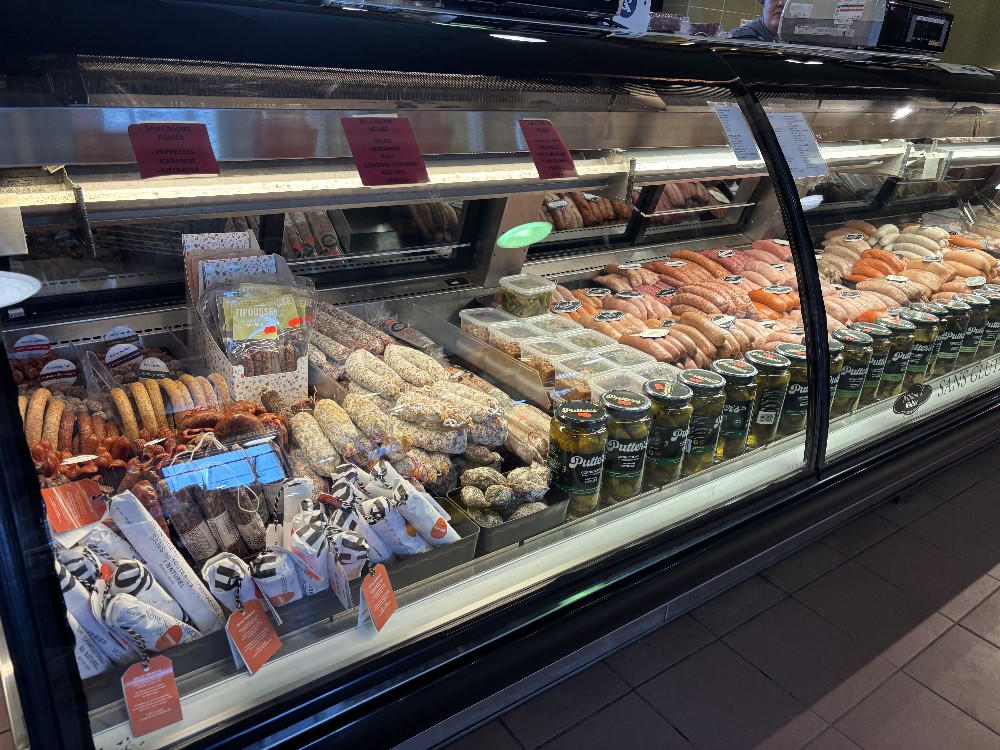
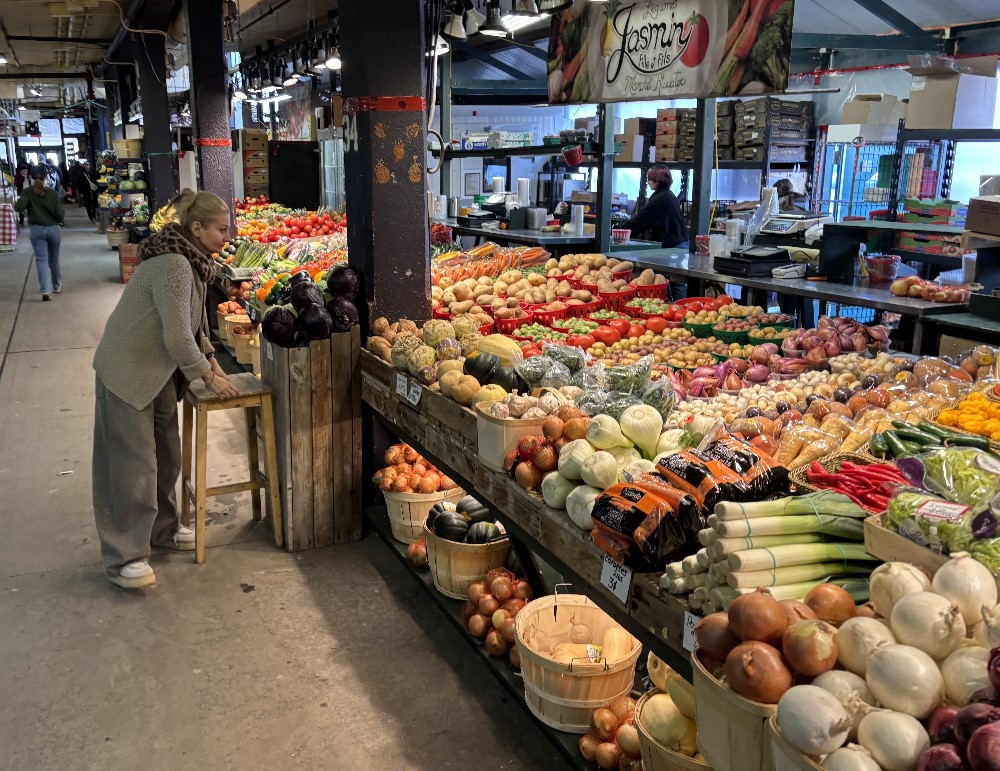
For well over 20 years, I have lost my marbles over March arriving as it did again last Sunday.   I may have created that image to the right in 2004. Such a clever boy! So well centered. Why do I love March, you ask? Not the green beer. Maybe not the green grass which might pop out soon. It’s the first seeds in the soil. The green green peas in loam. Soon, my precious. Soon. Otherwise, this is a bit of a scattered mix this week as I rush. See, I played taxi driver for folk going to a concert, spending about 21 hours in Montreal Tuesday to Wednesday. On the way out, hit Atwater Market as usual. Got my chicken cretons. Got my duck rillettes. The toast won’t know what hit it. And when toast wins, the beery news update suffers. Such is the way of the world.

Enough about me! First up, Jeff* has shared a retrospective on his writing career and how important blogging was to getting to the next step. Twenty years ago he started on a path (like Matty C a decade ago) towards  a number of leaps of faith. Leaps I avoided. I have my name on four modest books but didn’t see a future in that direction. Me, I can show you instead the bridge I had a large part in building. But they can show you publishing sales figures that put food on the table. It’s good to see that we were all right in our different choices.

Speaking of Matty C, for “Get ‘Er Brewed” he looked around his particular environment through the last holiday season and asked where the future may lie for a trade facing tough times:

I can face the hard facts and admit pubs are dealing with some of the worst trading conditions they’ve ever known. But I also believe that they will continue to persist, whether that’s through innovation and listening to what their customers want from them, or by sheer bloody-mindedness. Despite all the doomsaying I consider that there are still positives for pub owners. However, in order to extract these an equally optimistic outlook is required from publicans. Yes, prices are going to have to go up. Customers are going to have to get used to them and measure their spending accordingly. But I don’t think this will mean that people will stop using pubs, and that they’ll simply vanish off the face of the earth.

I tihnk that is a good baseline position to take. Beer does not go out of style even during an inflationary period… or even in a very localized deflationary one. The BBC had a story about another sort of good value care of one pub in Leeds:

A pub which was told selling a pint of beer for 25p during a promotion was “irresponsible” and a breach of its licence has instead begun giving them away. Leeds city centre pub Whitelocks offered customers their first pint of revived 1970s pale ale brand Double Diamond at the retro price as part of the four-day scheme, which began on Thursday. However publican Edward Mason said the council pulled the plug on the offer later the same day, saying it was in breach of mandatory licence conditions on minimum alcohol pricing. After seeking legal advice and discussing it with the local authority on Friday, the pub then commenced offering the initial pint for nothing. Unlike Scotland or Wales, England does not have a defined minimum price for alcohol.

A bit more scientifically we see that Kendall Jones at the Washington Beer Blog ran a very detailed survey on the place of IPA in his readership’s current mindset and had a significant response:

A few weeks ago, I posted a survey about IPA to gauge how people feel about craft beer’s most popular style. I was wondering if breweries are hitting the mark. Do the beers align with what people want? Have people’s preferences changed? Stuff like that. If you haven’t taken the survey, it’s still up there gathering data. I encourage you to participate! When the survey received 1,000 responses, I gathered the data. I will continue to do so as time moves on, but this report covers that first round of responses. Likely, this round of data comes from a pretty enthusiastic craft beer crowd, not the general beer-drinking public. Take that for what it is. In addition to the results, we also collected a large number of comments, which we rounded up at the end.

One of the particular results that surprised others is the result that Kendall noted: “Really? Nearly 80% of respondents say they understand the differences among IPA styles. I am not sure 80% of professional brewers understand the differences between IPA styles.”  This can certainly reflect the Washington marketplace as well as his readership but I do wonder if there is a difference between detecting the difference between styles and understanding them. I mean I can tell a Black IPA from a White IPA but I still left with questions like “why?” as well as “WHY????”  Go have a look and even add your responses as the survey is still open.  This is an excellent example of how a blog excels at some many sorts of beery writing that other formats can’t touch.

Speaking of excellence, Boak and Bailey placed another sort of question out into the ether – “Do you really want to visit the best pub in town?“:

Before Christmas we found ourselves in a pub surrounded by a group of people grumbling about the seating, the atmosphere, the beer, and everything else. It became apparent that a couple of members of the group had put together an itinerary for a crawl based on their preference for craft beer. We felt quite sorry for them as they tried to enjoy their pints while surrounded by moaning pals – but then what did they expect? What’s funny, we suppose, is that much of the discomfort and discontentment described in the various anecdotes above could be avoided if people just went to normal pubs, of which most towns and cities have plenty.

There is a lot to unpack in the phrase “the excellent is the enemy of the good” and this might be a very instructive context. I mean, I have sat myself in the Cafe Royal and it is utterly wonderful. But could it ever be as “mine” as many other pubs and tavs and dives have been over the years?
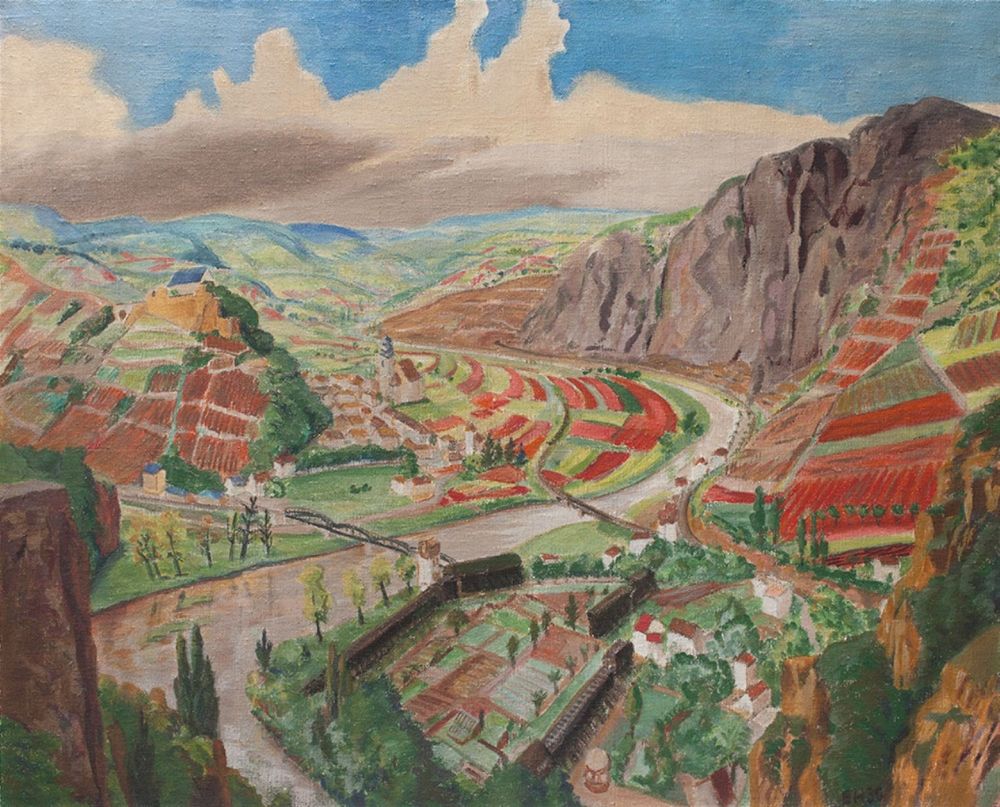
Also excellent and perhaps for Katie in particular, I saved this image of the Nahe Valley that pass by my eye this week. Shared by the AAWE, the no doubt authentic colours are surreal:

Erich Heckel (German 1883-1970), Landscape in the Nahe Valley, 1930. Many vineyards. Heckel was a painter and printmaker, and a founding member of the group “Die Brücke.”

According to the wikiborg, in 1937 the Nazi Party declared his work “degenerate” and confiscated his work, destroying much of it. Good to see one that was saved. Time for notes!

Note #1: Ottawa’s Kippisippi to close.
Note #2: BrewDog sale confused yet swift.
Note #3: 1690 brewing text restored.
Note #4: 1978 Joe Piscopo sighting.
Note #5: “Beer with Pals” is the best one.
Note #6: the A.I. bot that wrote this clearly has no idea what “craft beer” is or is it the guy interviewed who doesn’t.

What’s next? Well, I suppose the big news is the surprise takeover of a deadend business location:

A brewery has been allowed to open a new beer café in a former funeral directors site. West Suffolk councillors have given Charles O’Reilly planning permission to turn the former funeral directors at The Shutters, in St John’s Street, Bury St Edmunds, into a beer café and tap room, during a development control committee meeting earlier today… Jane Marjoram, a resident, recognised the importance of such establishments but told councillors the area was a ‘quiet, friendly community’.

 “Very quiet…” said Jane as they leaned forward winking at the committee members. What else? Oh. Yet another, yawn, tale of a forgotten wine cellar under a golf course (h/tKM):

“So we’re thinking it’s just a drain that needs digging out and clearing and repairing but as we dug deeper the chasm underneath just opened up.” Steve said he and his colleagues then noticed a brick structure. He was able to climb inside and look around with a torch and found dozens of empty glass wine bottles. “They’re all odd shapes and stuff so they’re obviously extremely old bottles,” he said.

Speaking of being under, similarly attractive are the summaries of the US beer market in 2025, as this from BMI:

US beer shipments were down more than 5% to ~183 mil bbls for full year 2025 vs 2024, Beer Inst, TTB and US Dept of Commerce data suggests. That amounts to a 10-mil-bbl drop in one year, the 2d tuffest decline in US beer history (post-prohibition) only behind brutal yr in 2023 when shipments sank 5.2%, 10.8 mil bbls. But unlike 2023, beer price increases didn’t come close to offsetting volume loss with CPI for beer at home up just 1.1% for the year, suggesting brewers’ collective revenue likely posted the largest drop ever in a single year post-prohibition.

And Stan raised shared an interesting observation that I suspect might well be connected to those stats:

“If it is beer flavored beer it comes from the brewing side. If it is not, it comes from the marketing side. (FW’s) Michelada did not come from the brewing side,” answered Firestone Walker brewmaster Matt Brynildson.

More grim news. Yet… here was have another trip to France care of Anaïs Lecoq in this week’s Pellicle which unpacks another cultural touchstone, the bar Pari Mutuel Urbain or PMU:

A rade was originally slang for a bar counter, though it’s come to define a popular neighbourhood bar with a somewhat dated look, but a warm and lively atmosphere. Do not imagine the brown-wood aesthetics of a British pub: Think mosaic tiles on the floor, flashy paint on the walls, a Formica bar dented by years of glasses sliding across it, and worn-out faux-leather booths. … The bar PMU is the epitome of the rade. These spaces will never be advertised as places worth visiting if you’re a tourist. You won’t find them listed as hotspots on the internet, because they don’t look good enough for an aesthetically pleasing Instagram feed. Their history, deeply rooted in the working class, labour struggles, and immigrant communities, is not designed for glossy consumption. 

And also yet yet… in this comparison of health effects in The Harvard Gazette at least beer does not find itself at the bottom of the beverage ladder:

The mixed picture for alcohol consumption was in contrast to what panelists agreed is a much clearer one for soda, energy drinks, and other sugar-sweetened beverages, including sugary fruit juices. A 12-ounce can of a popular soda brand has 10 teaspoons of sugar, an amount almost nobody would add to a cup of coffee or tea, Rimm said. Sugar-sweetened beverage consumption is linked to rising obesity, which itself raises cancer risk, and diabetes, which increases risk of heart attack and stroke. “When you compare a soda to water, or soda to coffee, or soda to tea, whatever you’re comparing it to always wins,” Rimm said.

Finally and… finally especially for me, one more inter-provincial trade barrier has fallen and, for me at least, an important one. Soon I will be able to directly buy Nova Scotian beer from the homeland of my youth and have it shipped to me here in Ontario the homeland of my… umm… post-youth:

Ontario and Nova Scotia have agreed to let their residents buy alcohol directly from the other’s province, part of the premiers’ ongoing work to bolster interprovincial trade. Producers of beer, wine and spirits can start applying Tuesday to the province’s liquor corporation for authorizations to do the direct-to-consumer sales, a process the premiers say will only take a matter of days. Ontario Premier Doug Ford says strengthening interprovincial trade is a way to counter the effects of U.S. President Donald Trump’s economic attacks on Canada. Nova Scotia Premier Tim Houston says… knocking down interprovincial trade barriers is “a bit like whack-a-mole,” but that direct alcohol sales is a great one to tackle because it is so visible for consumers and producers.

Please sign up every single Nova Scotian producer, please. Then I will be able to hover the fickle finger of fate over your webstores.

There. I achieved my second goal this week. After buying sausages at Atwater Market, that is. I largely avoided mentioning the new assets added to the Tilray portfolio, the second strangest story involved those assets after… you know.  From this point on, it is all now officially just a boring story at least in my office. So with that until next week, please check out Boak and Bailey who are posting every Saturday and adding to their fabulously entertaining footnotes week after week at Patreon. And look out for more of Stan’s new “One Link, One Paragraph” format. Then hunt out something in someone’s archives! Leave oblique comments on someone’s post from 2009!! Listen to a few of Lew’s podcasts and get your emailed issue of Episodes of my Pub Life by David Jesudason on certain Fridays. And Phil Mellows is at the BritishBeerBreaks. Once a month, as noted, Will Hawkes issues his London Beer City newsletter and do sign up for Katie’s wonderful self-governing totes autonomous website featuring The Gulp, too.  Ben’s Beer and Badword seems to be on pause since November but there is reading at The Glass which is going back to being a blog. Any more? We have Ontario’s own A Quick Beer and All About Beer is still offering a range of podcasts – and there’s also Mike Seay’s The Perfect Pour. Plus follow the venerable Full Pint podcast! And there’s the Craft Beer Channel on Youtube. Check out the archives of the Beer Ladies Podcast.

*He also shared his thoguhts on the weird we have witnessed over the last two decades.

And… Finally… Here’s “The Baseball Is Back!!” Edition Of Your Beery News Notes

I mean, let’s face it. The Winter Olympics are all well and good. And the World Cup will fill that gap in June, sure. But… baseball. Baseball: the sport that demands the best in athletes and then asks them to sit around for half the game. When they aren’t standing around in the field. It’s great, isn’t it!  Though, we should also take this moment to remember one of the great Olympic moments from, what, sixteen years ago now when Canada’s gold medal winners took the opportunity to turn the hockey rink into a tavern. And on that topic, here’s a Winter Olympics fact I hadn’t heard before and one that isn’t apparently winning any medals:

The only beer available for purchase at the 2026 Olympic Games is Corona Extra, a Mexican pale lager. This is due to the Olympics only allowing one company to sell its products at the Games, and this time it was Corona who was able to secure a deal. It’s a controversy that may hit closer to home for a lot of Olympic spectators, more so than a few foul-mouthed curlers ever could. It’s fair to say that Corona may not be the most popular beer for fans in Europe, as a photo of a Czech hockey fan went viral last week for his disappointed look while holding his Corona beer.

What a great choice. For the five athletes at the games representing Mexico, I suppose. What else is going on? Plenty to read out there on the chop-shop job coming for BrewDog but The Guardian had a good angle on the pending effect on those who each gave a bit when a lot was needed (or at least wanted with little or now strings attached) early on:

BrewDog’s army of “punk” shareholders have voiced anger and frustration after the Scottish brewer confirmed plans for a possible sale that could render their investments worthless. So-called “equity punks” who spoke to the Guardian or posted on BrewDog’s shareholder forum expressed disappointment and accused the company, which has traded on its upstart ethos, of treatment “bordering on contempt”. One said the plan showed that the small investors, who helped to kickstart BrewDog’s growth after it was founded in 2007, meant nothing to the company.

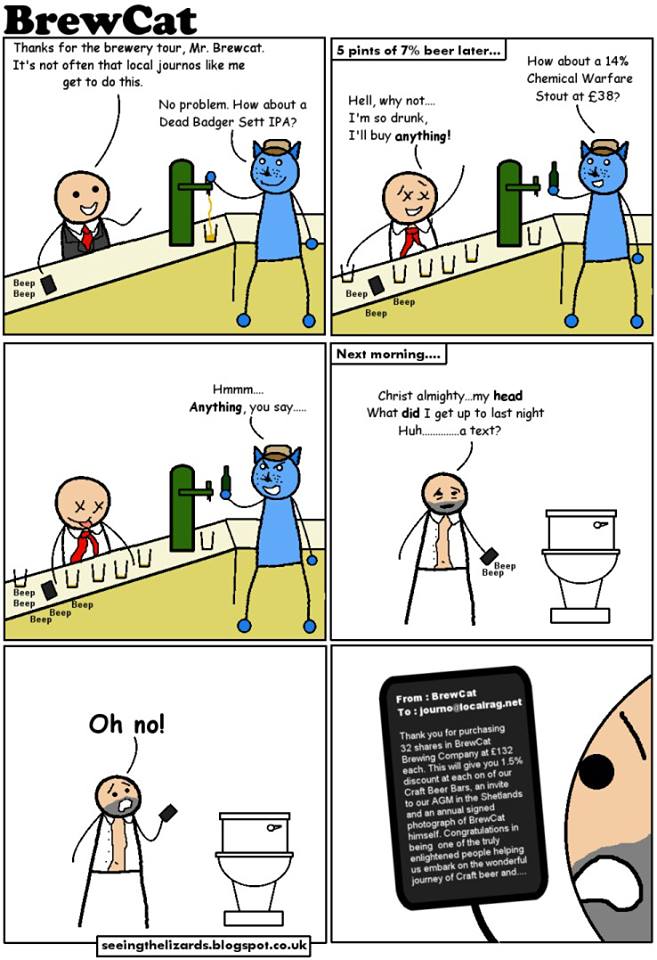
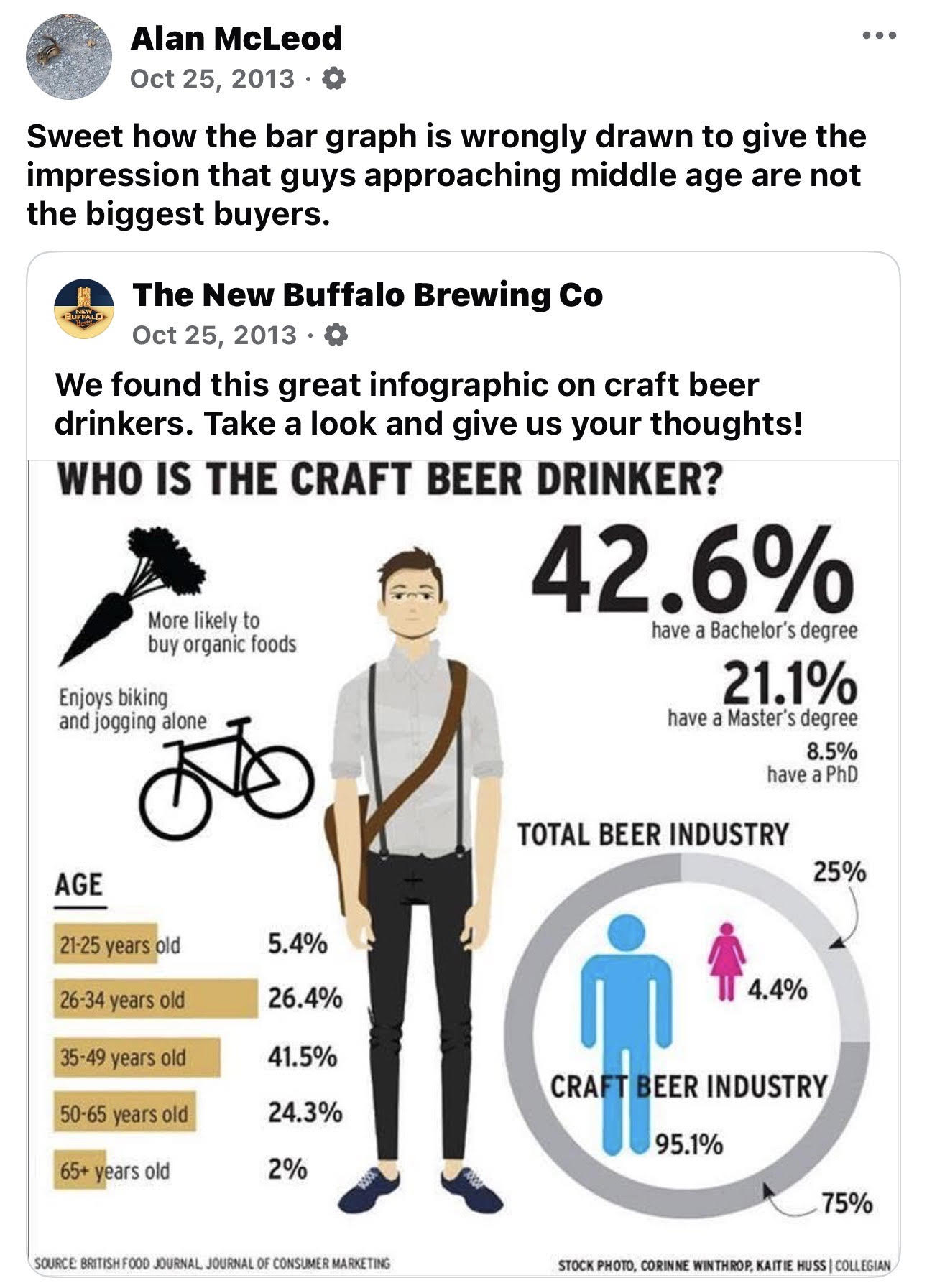
While the effect on individual EP investors can be quite significant, I mention this mainly as a pretext for posting that 2013 parody up there of the plan from one M. Lawrence at Seeing the Lizards.  Speaking of just saying no, The New York Times has run a four-part series by Pete Wells on getting your consumption back to a healthier level and finished off with a back at life with alcohol as well as a look forward:

Sometimes it seemed to me that I had a richer, more rewarding relationship with alcohol than I did with all but a handful of humans. It was an inexhaustible field of study, an incandescent companion during great meals, a reliable consolation on dull ones. And it brought me close to my real friends, at least some of them, some of the time. Over time, though, the rewards had become more equivocal and harder to justify. It wasn’t just the weight I gained, a predictable result of having a cocktail each night followed by about three glasses of wine or beer. They were, by this point, undeniable signs that my liver was overworked. I slept badly with all that alcohol in my system, too, and it got worse as time went on. …

You may be happy to know that he still enjoys his martinis – even if there are fewer of them: “…feeling the hair on the back of my neck stand up as the first sip takes hold, I feel like I’ve been reunited with an old friend…” Another old friend, Liam, reached back just a few decades for his post on the earlier trendy years for NA beer in Ireland, Smithwick’s Alcohol Free Bitter:

The launch was accompanied by newspaper competitions plus promotions, and a strange and repeated focus on how the beer, at 0.5% abv, contained less alcohol than orange juice! Reviews of the product at the time varied a little but it seems to have been generally well received for what it was, with reviewers commenting on how it (ironically) ‘packed a real bite and had good flavour’ and how they could drink it in a pub all night,  although it was also said to be ‘quite gassy and sweet.’ Others said it was ‘pretty good. Smells right and tastes of hops. Quite rich and smooth to drink.’

AKA gak. More positively, Matty C shared his thoughts on some upsides he’s seen in the brewing trade so far in 2026:

A couple of years ago, conversations in beer often centred around the idea that there’s “light at the end of the tunnel”. In reality, I don’t think that chance of daylight is coming anytime soon. Instead, we’ve got to admire the glimmers that are somehow managing to shine through the cracks in the walls around us when we can. Good beer is still being made, and good pubs are still open to sell it in – I’ve seen the proof! 

One of his examples was the tenacity of Jaipur: “… beer, packed with flavour and served at a high strength – seemingly the antithesis of what you would expect to succeed….” Which reminded me of how, in response to recent racist comment from an English oligarch, in The Times Sathnam Sanghera wrote about one of the foundations of the Britain of today:

…the fact that it ran the biggest empire in human history explains lots about Britain beyond its multiculturalism. It explains the popularity of curry. A significant amount of the mahogany furniture, ivory and jewels in our stately homes and royal palaces. Our propensity to travel. A certain amount of our wealth. Our political posturing on the international scene. Our national drink in the form of tea, and our national tipples in the form of pale ale, rum and the gin and tonic. The fact that we don’t feel the need to learn foreign languages because we encouraged/forced large parts of the world to take up English.

Empire of booze! Which, in turn, reminds me of Manitoba’s fabulous Premier Wab Kinew and his cheery fight for my right to Crown Royal after a bit of internal trade tension with Ontario’s Uncle Doug:

Cheers to you Doug Ford for keeping Crown Royal on LCBO shelves . Thanks for doing the right thing. Just like Canadian whiskey, good results take a little bit of time. This is a good day for folks in Gimli, Manitoba and a good day for people in Ontario too. Standing up for workers together is always a big win for Team Canada.

PWK won a lot of support with this bit of good humoured social media savvy. Crown Royal also got about 5,783 times the value of yet another newsletter by email telling breweries about the importance of storytelling.

Note #1: a desperate plea for beer based salad dressings.
Note #2: pairing beer and cussing.
Note #3: democracy in inaction?

Speaking of newsletters by email about storytelling, Will Hawkes was back at the end of last week with his February edition of London Beer City in which he considered the concept of the Irish Pub as illustrated by one new spot, Moylett’s in Clapton:

…I’m confused. What’s Irish about it? According to a report in Broadsheet, the focus is on what owner Moylett calls “the holy trinity of food, music and socialising” – a worthy list, no doubt, although it does seem to be leaving out something quite important (Guinness is £5.50 a pint, btw). As a term, “Irish Pub” is surprisingly hard to define, and particularly in London (and other British cities, arguably, but we’ll put them to one side for now). In much of the rest of the world – indeed, even in London, particularly its once O’Neills-heavy suburbs – the Irish pub is a 1990s phenomenon: flat-packed dark wood decor, pints of Guinness and food options that are often only very vaguely Irish (satay sticks, curry, chicken wings of varying heat levels; Spice Bags are less common, although you can get them at Moylett’s). But Irish pubs in London are, historically at least, quite different, and much less easy to pin down. 

Similarly but further afield, ATJ shared his thoughts on Cologne/Köln, the river there and its crossers:

…leaving Hauptbahnhof I crossed the Rhine, slow-moving, the colour of mud, upon which an elongated, snub-nosed barge was slowly making its way downstream. I stopped and took a photo, a snapshot of slothfulness perhaps and continued along the historic Hohenzollern Bridge. It was crammed with people through which bicycles and the occasional skateboarder cleaved their way, imperious and ‘get out of my way’ seemingly stamped on their features. Some people, were in groups whose colours defined their tribal affiliations — red and white for FC Köln, black and white for Eintracht Frankfurt. Sporting rivals presumably…

And here’s a new insult for craft beer.  If Jeff’s exhaustive listicle is correct, IPA is what it is all about and what it says is “meh, new money..“:

When it comes to beer, the etiquette guru revealed that “new money” consumers “don’t touch the more traditional ales or stouts – it’s all about IPAs that set you back at least £5 a pint. Anything involving the word ‘traditional’ simply doesn’t feature in your vocabulary. “If it doesn’t sound trendy, artisanal, limited-edition, or come with a deliberately obscure name, you simply aren’t interested.”

I actually find it really funny that anyone thinks anything related to beer is about new or old money… other than owning the brewery that great-grandpa built I suppose.  Almost as good as if grandpa owned a country… which is a seque to the next tale of skulduggery – perhaps – in China’s Jilin province:

The marketing materials identify the beer as produced by Rason Ryongson General Processing Factory in the Rason Special Economic Zone, located near North Korea’s borders with China and Russia. …[T]he Chinese distributor is Yanbian Xinyuequan Trading Co., Ltd. The company is based in Yanbian Korean Autonomous Prefecture in Jilin Province, a key gateway for cross-border trade with North Korea. Additional social media posts show boxes bearing the Pado label being unloaded from trucks and delivered to local restaurants in Jilin Province, indicating the beer has entered local distribution channels “…[N]ame changes are largely driven by export considerations, particularly to reduce the risk of sanctions-related flagging when the product circulates in Chinese wholesale or grey market channels…”

Mmmm… grey market North Korean Pado beer…  Quite the opposite in every way are Boak and Bailey who asked about what a drinker wants from a pub’s internet presence.

… we want to know what beer the pub is serving today, right now. Working that out can be surprisingly tricky. Again, Instagram or Facebook can help, but it’s often more reliable to snoop on Untappd and see what’s been logged in the past 24 hours. Pub websites are rarely of any use for this at all, presumably because updating a website feels like a big job, and a job for the Big Computer at that, so it just doesn’t happen.

Great comments followed… but I wonder if the easier solution is a camera aimed at the chalk board at the bar which is already updated daily… all sorta a la last week‘s remote pub experience story. It worked for the Cambridge coffee pot cam. The best way to get a job done is to find a way to make it a not-a-job job.

Finally, the Pellicle feature this week is accompanied by many photos with many many strings of bunting. It’s a story about Steam Machine Brewing of  County Durham – but without saying the word it’s really all about the bunting. Not including reflections in the windows (which would be unethical, of course) I counted thirty-six strings of bunting. That’s a significant contribution.

That’s it! That is all for now. But we are one step closer to spring. Pre-season Grapefruit League baseball on the TV time. Huh. Zah. Until next week, please check out Boak and Bailey who are posting every Saturday and adding to their fabulously entertaining footnotes week after week at Patreon. And look out for more of Stan’s new “One Link, One Paragraph” format. Then hunt out something in someone’s archives! Leave oblique comments on someone’s post from 2009!! Listen to a few of Lew’s podcasts and get your emailed issue of Episodes of my Pub Life by David Jesudason on certain Fridays. And Phil Mellows is at the BritishBeerBreaks. Once a month, as noted, Will Hawkes issues his London Beer City newsletter and do sign up for Katie’s wonderful self-governing totes autonomous website featuring The Gulp, too.  Ben’s Beer and Badword seems to be on pause since November but there is reading at The Glass which is going back to being a blog. Any more? We have Ontario’s own A Quick Beer and All About Beer is still offering a range of podcasts – and there’s also Mike Seay’s The Perfect Pour. Plus follow the venerable Full Pint podcast! And there’s the Craft Beer Channel on Youtube. Check out the archives of the Beer Ladies Podcast.

Your Happy Merry And Even Supportive Beery News Notes For The Week Of Blue Monday

How does it feel? That’s what Blue Monday asks of you. Katie was particularly aggrieved as last Monday was her birthday. So first of all –  happy birthday! Apparently, Blue Monday is perhaps a floater with not 100% agreement on which date it is.* Like Easter but without the medieval calculation to give some assurance as with the death date of Jesus. So you have options and need advice. Fortunately I am full of good advice on this topic. Me, I prefer to celebrate what I call “Bleu Monday” on which I eat a lot of cheese. Also, it seems to also have been originally a term that in Germany was “der blaue Montag.” and then United States when workers told the boss to shove it, as we read in 1838:

Drink till all is blue. Cracking bottles till all is blue.

Blue meant the haze apparently. Or perhaps the slightly wicked as in “blue laws.” I dunno. But I like that it also has it’s own anthem, even if it’s a wee bit Dieter Sprockets.

Beer Marketers’ Insights have a note about a little blip that could be the beginning of a bit of a bump for beer:

Pretty much everything was comin’ up roses in beer and beyond for the first week of the new year in Circana multi-outlet + convenience channels. Beer, wine and spirits all grew for latest week thru Jan 4, 2026 (including Dec 29-31). Can’t glean much from just one week, but interestingly, craft beer’s 4.4% $$ gain outpaced total beer (+2.9%) for period. Multiple top craft fams saw sales pop for the week including New Belgium, Sierra Nevada and Elysian each up low double-digits by $$, Lagunitas up 8.5% and Bell’s (+5%), Shiner (+4%) and Blue Moon (+3%) up low-to-mid singles.

And these US market numbers exclude non-alcoholic beers so it’s more beery than we often seen in the booster stats announcements. But they could also indicate that fine spirit of “fuck it!” that one finds in a time of crisis. Speaking of which, can you write about the crisis in US hard liquor sales without mentioning the tariffs that have effectively cut out a massive share of your customer bases? VinePair seems to think so:

And though distilleries share similarities with other business closures — from layoffs to managing creditors — there’s uniquely challenging inventory to deal with: barrels of aging whiskey. “They’re a little bit of a problematic asset because they can only be sold to someone who has the license to hold them,” says Will Schragis, managing partner at WellSpun Consulting. “Barrels are in-bond, so they’re non-tax paid. There are only certain licensees and other companies that can acquire them.”

No mention of, you know, lobbying for free trade as a recourse makes me wonder if there is a ex-nay on the t-word going on, lest one draw wrathful attention away from Greenland. H/T to Jeff. It’s all about getting the spend in country it seems and Americans are doing their part:

Surveys have shown that consumers feel pessimistic about the economy as they worry about tariffs and the jobs market. More than half of voters believe President Trump is “losing the battle against inflation”, according to a Harvard Caps/Harris poll of 2,204 registered voters released last month. Yet despite the economic gloom, data suggests that spending has risen across all income groups.

Mikey Seay shared a few thoughts that are not unrelated to this moment:

It’s the price. I struggle with the price of NA and low ABV beers. This is my Dry January issue. I can get behind drying out for a month. Or (what I am trying) focusing on drinking lower ABV beers. But there is a hidden suck. Low alcohol/no alcs are priced the same as regular beers, sometimes even double. It’s hard for me to get over that. It’s like, I am getting ripped off, and I have a hard time shaking that. But I must. I know it costs a brewery close to the same to make a NA or low beer, so they gotta charge the same. And that cost trickles down to the stores and bars. So I gotta get over myself there..  Enjoy my low ABV beer, and don’t be a baby about what I am paying for it. I must do this for myself and the business of beer.

One must spend. Do one’s part. Think of England and all that. One of things I appreciate locally is that Guinness 0 is $11.95 at the LCBO and the regular draught is $13.50. Trouble is… no Guinness 0 to be found in the province these days. Guinness is experiencing a height of fame and fortune – and there are good reasons for that, according to Jeff:

The world is unstable, especially for young drinkers who spend half their paychecks on small apartments. Young people are threatened by more dangers than any generation in decades: huge college debt, a machine-learning era that may eliminate entire sectors of jobs, climate change, political instability, the corruption of media and the vitriol that marks society. This is not a time for risk-taking. It’s a moment when people are taking refuge in safe ports and reliable brands. Guinness isn’t alone in this appeal—the popularity of old Mexican brands follows the same script—but it has the advantage of being a 4.2% black ale that comes with a helping of theatricality and a creamy head. It is both safe and also different from other global brands.

I think some of this turns on that 4.2%. And low calories. Theme shift. Did you know you can watch RonTV?  He’s got a YouTube channel going:

You might have noticed that I’ve posted a few videos on YouTube over the last couple of days. There will be more to follow. It’s part of my drive to document and preserve. Initially, it’s mostly material that I acquired for my book on the 1970s, “Keg!”. I conducted several Zoom interviews Which I think are worth making public. Especially as the interviewees are all past retirement age. And won’t be around forever. I’m particularly keen on recording Derek Prentice’s recollections of more than half a century in brewing. Despite my urging, Derek shows no interest in writing his memoirs. But he’s happy to be interviewed and share his memories. I already have around two hours of video. And plan to record several more. Covering his time at Youngs and Fullers.

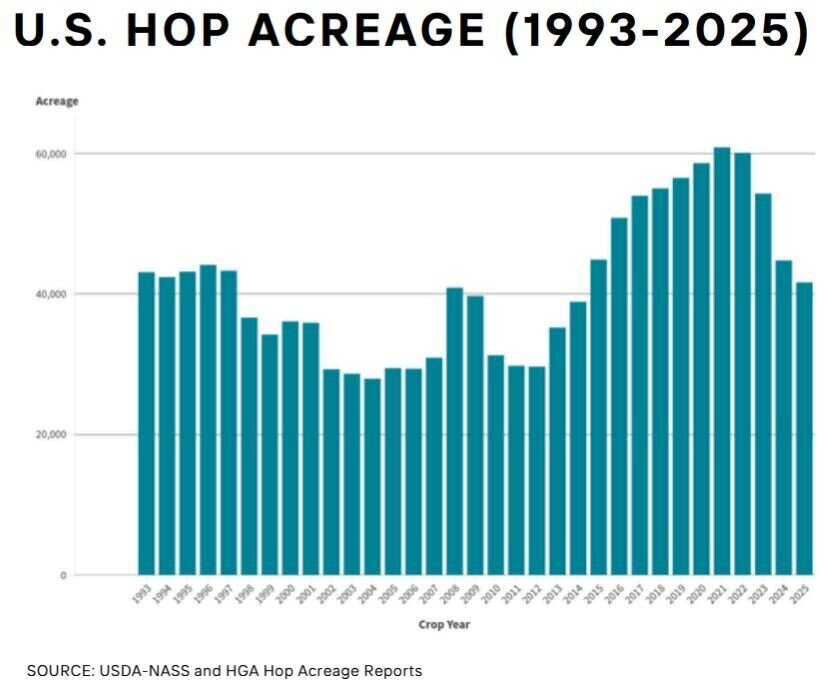
Next, Stan has published his newest edition of his monthly Hop Queries newsletter and there is much to consider. For one thing, he shared that chart of total US hop acreage which indicates the plantings of 2025 roughly match those of both 1997 and 2008, both years before further drastic drops. He also explained what BLP flash frozen hops are:

The idea began with hop farmer Jim Schlichting, who upon retiring bought 40 acres of land next to his home and began growing hops… Basically, he freezes the hops fresh off the bines and ships them in vacuum sealed packages along with reusable ice packs. The cones should remain frozen until brew day. After thawing them, brewers may use them as they would unkilned hops, replacing each pound of pellets in a recipe with four pounds of cones. Blue Lake markets the hops to both homebrewers and commercial breweries.

Whenever I read that some blog or newsletter on beer won some award or another I always think to myself “looks like Stan didn’t apply again this year.

Note #1: to bar or to not bar ICE.
Note #2: medical thoughts from amateurs.
Note #3: the Magnus Lounge on the ferry to Orkney.
Note #4: are people outside of the beer echo chamber aware that many many others have quite happily active social lives… without beer?**

And Jordan continues to diarize*** his weeks in detail, appointments in pub and breweries plus the scribbling for magazines and books along with the totalling up of spreadsheets. He’s found that the current bottom line in Ontario is not good news:

Among the various hats I wear, I’m historian for the Ontario Craft Brewers and I get to update their timeline on a yearly basis. Since I’m updating the spreadsheet with news throughout the year, this gives me the opportunity to get paid something for the information I’m collating. …the end of the year has been brutal on breweries. Both Goose Island and Blue Moon have decided Toronto has beaten them. If the corporate guys are out, you know things are bad. It looks like 30 physical breweries closed in Ontario in 2025 and something like four contract breweries, but who cares? Some physical breweries switched to contract status and some ownership structures are more or less impossible to parse. Can you really say Indie isn’t a contract brand because of Birroteca at Eataly? 

Can you really? Shifting from the crunch of numbers to the stream of consciousness, it’s a good thing ATJ prepared us with the subtitle of his piece this week – “an amiable ramble” – as this letter of love to beer culture touches on every corner of the pub and glass experience other than the variations on paper towel dispensers one might encounter, such as:

It is about the rattling bus snaking through the countryside with a pub at the end of the journey, the train skirting the wave battered coast with a pub at the next station, or maybe two or three, the walk through the rain, the nature of the game; under the hill all of us go at the final stage of our life but beer can be used to celebrate that passing, reconnect your memory with a swig and another swig, raise a full glass to the memory of dear old matey they all chorused, may he be never forgotten, but as soon as the rain stopped they walked out of the pub never to think of their dead friend ever again, for they were alive and he wasn’t.

Poor old matey! Gone and soon forgotten. Interesting legal news if you are into doing your own thing, a category of which I appreciate many of you fall into according to your own tumble of choice. The news is that the US District Court in Northern Texas assessed submissions in a case and last Saturday (odd date for a ruling to be issued) held:

…these documents reflect a shared First Amendment vision: Free Speech, Press, Petition, and Assembly rights combine to protect and elevate the public discourse necessary to self-government—not self-expression in all forms, and certainly not the libertine “expressive conduct” absolutism envisioned by
Plaintiff Spectrum WT… Spectrum failed to enforce its intended “PG-13” format during a drag show held off campus, as professional and student performers tasked with “breaking” and “destabilizing” sexual norms engaged in sexualized conduct more akin to a striptease…

Libertines! Libertines at a university?!? Now, keep in mind what “WT stands for: West Texas A&M University. The students of which the court determined included minors. Perhaps in Amarillo the age of majority is 35. Who knows. But it did remind me of the 2003 ruling of the Supreme Court of Canada in in the case R. v. Clay:

…the liberty right within s. 7 is thought to touch the core of what it means to be an autonomous human being blessed with dignity and independence in “matters that can properly be characterized as fundamentally or inherently personal”. With respect, there is nothing “inherently personal” or “inherently private” about smoking marihuana for recreation. The appellant says that users almost always smoke in the privacy of their homes, but that is a function of lifestyle preference and is not “inherent” in the activity of smoking itself. 

Lifestyle! Thankfully, the old wack-tabac is now legal in these parts. But these matters, in case you ever wondered, one has to be on top of one’s right to have fun as one wishes. The law of the libertines’ lifestyles may need more research.

Finally, Pellicle has a short survey out about their next steps:

It’s one thing to run a magazine based on the things we like most, but to grow and bloom into something bigger, we need our readers’ insights and support. That’s why we’ve created this survey: We want to hear what you want from Pellicle in 2026, and use your input to plan our next moves. For the next two weeks, we’re opening up the floor to learn what Pellicle means to you, and where you’d like to see it go next. The 2026 Pellicle Reader Survey is just a seven-to-10-minute task, and you can easily complete it on your phone. Plus, you can opt in to win one of three prizes…

As you know, I would pay to take a survey so the whole idea of prizes is just insane!  While you are busy with that, please check out Boak and Bailey who are posting every Saturday and adding to their fabulously entertaining footnotes week after week at Patreon. And look out for more of Stan’s new “One Link, One Paragraph” format. Then hunt out something in someone’s archives! Leave oblique comments on someone’s post from 2009!! Listen to a few of Lew’s podcasts and get your emailed issue of Episodes of my Pub Life by David Jesudason on certain Fridays. And Phil Mellows is at the BritishBeerBreaks. Once a month, as noted, Will Hawkes issues his London Beer City newsletter and do sign up for Katie’s wonderful self-governing totes autonomous website featuring The Gulp, too.  Ben’s Beer and Badword seems to be on pause since November but there is reading at The Glass which is going back to being a blog. Any more? We have Ontario’s own A Quick Beer and All About Beer is still offering a range of podcasts – and there’s also Mike Seay’s The Perfect Pour. Plus follow the venerable Full Pint podcast! And there’s the Craft Beer Channel on Youtube. Check out the archives of the Beer Ladies Podcast.

*It is, however, reliably closer to the start of 2027 than the end of 2025.
**I find this eager rush to shimmy right up next to the nutster RFK Jr somewhere between bizarre and disgusting: “…In explaining that approach, officials pointed to the social context in which alcohol is often consumed – its role in bringing people together to bond and socialize, while creating shared experiences – summed up by the idea that ‘there’s probably nothing healthier than having a good time with friends in a safe way.’ ” That’s two possible bits of bootlickery this week. A better take on the moment.
***Boak and Bailey do something along a similar line with their regular beers of the week posts on Patreon: “Running with Spectres was also on excellent form, much to Jess’s regret the following day.

The Even More Fabulous Yet Slightly Chill Mid-January 2026 Beery News Notes

“CORK HEAD! CORK HEAD!!

There really is no need for any further update this week is there. Andreas Krennmair posted an image of the “old interior of Schneider Weißbierbrauerei, presumably from before the rebuild 1901-1903” and this scene above was one of the tiny vignettes sitting in the back of the overall bar scene.  I can’t figure out if these gents are playing that old favourite, a game of “I’m a doggie, cork my brainpan!” or… the means by which this particular men’s club informed a candidate that they did not pass the initiation process. I find the physics involved problemative but, you know, art.

First off, some excellent reporting out of The Soo on pricing after Ontario’s expansion of beer sales to corner stores compared to grocery stores, the big brewery owned TBS as well as the government’s own booze agency the LCBO;

The editorial team bought two beers, a mass produced lager and a craft beer, as well as two bottles of wine from several locations around the city to find the best – and worst – deals in Sault Ste. Marie… A tall can of Molson Canadian will run you $3 at the LCBO, compared to progressively worse deals of $3.03 at Rome’s Independent, $3.14 at the Beer Store, and $3.81 at Circle K. For a can of Great Lakes Brewery’s Octopus Wants to Fight, the results are tighter – coming in at $3.75 at all locations but Circle K, where the surly octopus comes out to $4.04 per can. All told, a Canadian is 21.2 per cent cheaper at the LCBO than at Circle K, and Octopus Wants to Fight is 7 per cent cheaper everywhere other than Circle K.

I would point out something about that otherwise excellent research. Circle K sometimes has a nutty nutty sale price for a few pretty decent Ontario craft brews. I pop in once in a while when I am picking up a tank of gas just to check in.

And while I have been known to hover in and about the snack aisle of corner stores, I am not a taproom devotee. Too often they strike me as car dealership showrooms – “would you like to see the latest model except (in a fourdoor / with even more Citra)?” – but it was interesting to see Stan consider B+B’s thoughts on the key underlying principle involved;

It appears I may regularly come across taprooms with personalities than Boak & Bailey, but I wouldn’t argue cookie cutter establishments aren’t abundant in the US. Also, B&B tend to write short paragaphs and I try to stick to one. Their following words zero in on what I value in drinking establishments, that they are “run by human beings.” The others, without personality, I tend to forget. I acknowledge they exist, but I don’t have to think about them.

Speaking of places run by human beings, we have a new beer blogger alert. Colston Crawford, the recently retired pub and beer columnist with the Derby Telegraph has decided to continue sharing his thoughts on the topic including how the notion came to him:

It was a lunch at The Crispin in Great Longstone, in the Peak District, a week after I finished which firmed up the idea in my head. The food, the drink, the service, the ambience, was so good. I sat there thinking, if I still wrote a beer column, this one would be easy. I could dash it off right now. I’ve made two more visits to The Crispin since, the first to confirm that the previous one wasn’t a fluke, then the second was unplanned. I was with friends in a party of five, walking on New Year’s Eve morning, but the venue they’d fancied for lunch wasn’t open. The Crispin was five minutes away and a superb lunch followed.

There’s a lot of good advice in there. It is easy to keep a low pressure blog about something you have a general interest in. A striking experience will make for a good story. And it’s good to review the experience a couple of times to get the facts straight, too.

And Boak and Bailey shared an extended thread of thoughts on why people in the UK have cut back their visits to the pub with plenty their own interesting thoughts and those of others who joined in. I agree with their thought #7:

7. Basically, we’re not convinced the pub crisis is especially acute *right now*. In 20 years of blogging, and nearly half a century of being alive, we’ve never really known a time when pubs weren’t doomed and in decline. 

One of the things that concerns me about that form of doomsaying is that it always seems to be decontextualized as if pubs closing is the only difference since 1976.  Fewer are also going to church, too, over that same 50 years of existence. Many more play video games than before that point and I would expect more tofu is sold in the NATO countries. Preserving past practices as opposed to preparing to guide them through change is a bit of a fool’s errand.

Note #1: only available in Alberta, Saskatchewan, and Manitoba.
Note #2: Beer’s “Santa Claus Rally”.

Me, I’ve never developed a taste for collaboration beers but apparently the revenue authorities in Finland have, as The Beer Nut noted.  The EBCU has taken a position on the matter:

Finland is currently considering new excise-tax guidance that would effectively make many collaboration beers impossible for small breweries. Under the draft interpretation, if a beer shows more than one brewery’s name or logo (as collaborations typically do), it could be treated as “licensed production” and the breweries could lose their small-brewery tax relief for the entire year. This would impact not only Finnish breweries, but also imports and international collaborations—ultimately reducing choice for beer consumers.

This is an excellent example of the sorts of issues related to identity that can pop up in law. Obviously, if the non-brewing collaborator (let’s call them “the collaborator”) insists on putting their intellectual property in the form of a logo on a product, they are saying to some degree that the product is their work. Yet, for taxation categorization, that logo placement is argued to not indicate that the work is theirs but, instead, only the work of the brewer (let’s call them the collaboratee”.) I have no stake in the matter and have no idea how Finnish taxation policy plays out in term of brewers compared to cheesemakers or lumber yards – but I do have one raised eyebrow when I see these sorts of statements as part of the EBCU’s argument:

Collaboration beers are one of the joys of modern beer culture…  we believe consumers deserve choice, diversity and fairness. Collaboration beers enrich the beer landscape, strengthen friendships across borders and introduce consumers to new styles and tastes…

Wouldn’t the better argument be that collaboration beers are just a fun reciprocal staff training exercises for brewers that is only, for tax purposes, a businees expense and a burden upon revenue that is of little interest to consumers? After all, if one cannot detect the taste of collaboration beer… does it really actually exist?

Jeff had some interesting thoughts this week on hopeful hints he might be seeing in the US hop market and what it may mean about how breweries are reacting to the retraction, concluding:

…a last comment from me. As we exit the period of craft beer’s novelty era, when breweries made dozens of IPAs every year, it looks like it’s impacting not just the amount of hops brewers are buying, but the diversity. When I talk to brewers about new hop varieties, they are often hazy about them and most are not sampling every new one that comes out. Brewers seem to be more interested in hop products as a way of enhancing their beer. These products focus on the most popular hop varieties, which increases the “stickiness” of the major varieties.

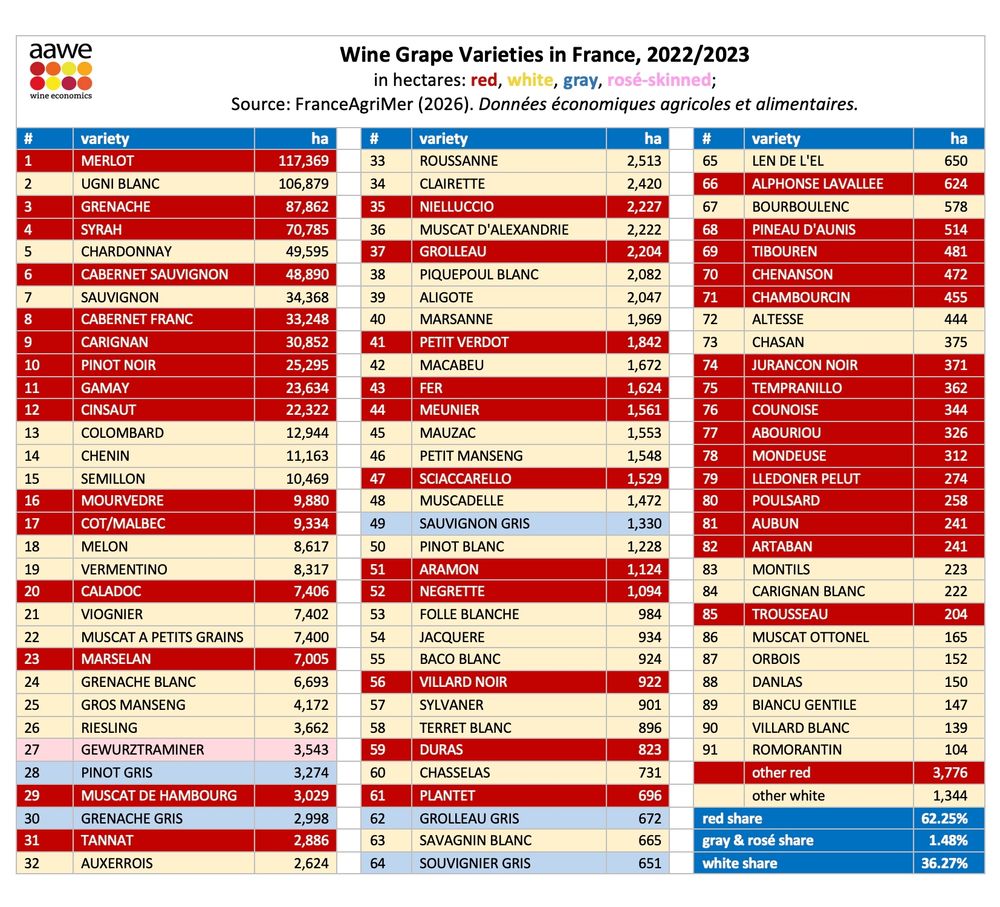
Speaking of varieties, have a click on that image to the right. It’s a list of the top 100 plantings of France grapes posted by the American Association of Wine Economists the other day drawn from an agency of France’s agriculture ministry. I don’t have much comment about it other than to note, despite the pop culture slur, how much good old merlot* is still grown as mentioned by E. Asimov the other day in his discussion of wines you may want to explore.

Good news for cideries and brewers of New York. In this week’s “State of the State” speech, Governor Hochul announced support for local producers, as noted by KK in related to cider makers:

New York is the country’s leading hard cider producer, boasting more active cideries than any other state. Our cider industry has grown substantially over the last ten years, generating over a billion dollars in total economic impact for New York, yet there still remains untapped agri-tourism potential to explore. To support the industry and tap into the robust agri-tourism opportunity that cider presents, Governor Hochul will work with the New York Cider Association to establish New York as the State of Cider, marketing the orchards, tasting rooms, and food experiences that could become anchor destinations for visitors across the country. These actions will strengthen rural economies, uplift the exceptional work of local businesses, and establish New York as the foremost destination for American hard cider.

The Governor also indicated the “need for modernizing licensing across the board, from sports bars and cafes to airport lounges, hotels, and movie theaters.

Conversely perhaps, Pellicle‘s feature this week is a post mortem by William Georgi of the Dutch brewery Nevel Wild Ales which had lofty and noble goals linked with but quite experimental standards:

“We were doing two expensive and time-consuming things at the same time,” he says. “Making a complex product that only a small selection of people actually like, while trying to set up a network of local farmers. A food forest like this is wonderful, but you can’t use it to make beer, as it doesn’t host perennial one-year crops”… Social sustainability was equally important for Nevel. The network of local producers Mattias established for sourcing ingredients—from hops and barley to chestnuts and kiwi fruit—showed him the challenges of farming at a small scale. “It isn’t economically viable at all,” he says. “Even if there’s a living wage being paid, the price doesn’t take into account the fact that most people harvesting the crop are volunteers. 

It’s pretty clear that the plan was not designed to pay its own way. Volunteer labour and crowdfunding plus unbudgeted expenses like organic certification were certainly signed that the business as a business was build on a weak foundation but I like one conclusion that was drawn from the experience: “…I don’t think Nevel failed. I hope I planted a lot of seeds in people’s minds about how things can be made differently.

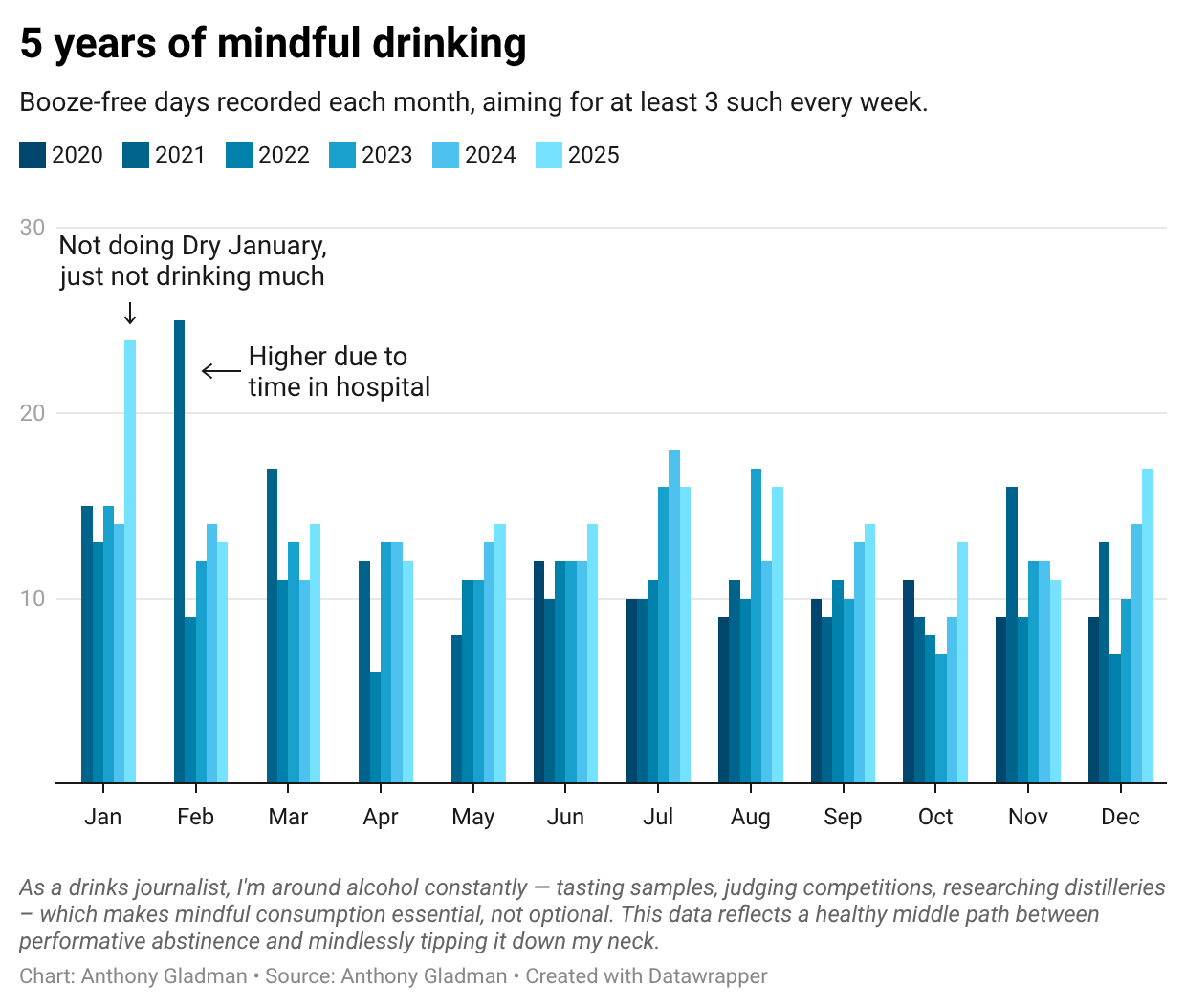
There was an excellent example of the old visual display of quantitative information** in A.G.’s post this week on Dry January. He shares my interest in maintaining data:

I find it helpful to keep a tally of days I drink alcohol and days I don’t. Nothing complicated, just a binary yes or no, and an aim to have at least three days off the booze each week. That’s all it takes for me to stay within healthy limits, despite working in an industry that can normalise and encourage dangerous levels of consumption. (If you recognise yourself here, check out The Drinks Trust.) Anyway… it’s Friday evening. The first one of the year. I’ve not had any booze since New Year’s Eve. Soon I will go downstairs, crack open a bottle of something nice, and have one or two drinks with some pizza while I stream a crappy-but-entertaining film – January be damned.

However sweet that bar graph, I am more a percentages guy, currently at a total of 52% dry days and 63% one or nones over the years since early November 2021 when I started keeping track. My booze budget this year is also set at around 1.33 a day, an average I beat by a few last year. Checking on that number from time to time – as well as your AST blood test numbers – are great ways to manage the hobby.

While we think on that, think on this. In the northern hemisphere, the darkest ten weeks of the year are already behind us. Soon be planting those tomato seeds. While we wait for that, Boak and Bailey are posting every Saturday and adding to their fabulously entertaining footnotes week after week at Patreon. And look out for more of Stan’s new “One Link, One Paragraph” format. Then hunt out something in someone’s archives! Leave oblique comments on someone’s post from 2009!! Listen to a few of Lew’s podcasts and get your emailed issue of Episodes of my Pub Life by David Jesudason on certain Fridays. And Phil Mellows is at the BritishBeerBreaks. Once a month, as noted, Will Hawkes issues his London Beer City newsletter and do sign up for Katie’s wonderful self-governing totes autonomous website featuring The Gulp, too.  Ben’s Beer and Badword seems to be on pause since November but there is reading at The Glass which is going back to being a blog. Any more? We have Ontario’s own A Quick Beer and All About Beer is still offering a range of podcasts – and there’s also Mike Seay’s The Perfect Pour. Plus follow the venerable Full Pint podcast! And there’s the Craft Beer Channel on Youtube. Check out the archives of the Beer Ladies Podcast.

*Once upon a time, the LCBO here in Ontario stocked Millbrook Merlot from a Hudson Valley, NY winery. Then Rufus Wainwright sang about the area. Went to the winery once around a decade ago. This is been this week’s edition of “wandering thoughts with Al”.
**I couldn’t live with anyone missing the reference.

Your Thrilling Thursday Beery News Update For The First 1/48th Of 2026

We are in the lull. Not a lot of beer news out there. Well, there are other things going on, aren’t there. Grim things. In case you didn’t realize it, we are already 1/48th into 2026. It’s practically 2027 already. (Ah, 2027… impeachment proceedings… or Greenland ablaze… err…. best not look too far into the future.) That there photo to the right? A contest submission from 2009 sent in by Jeremy Craigs of North York, Ontar-iar-iar-io. It’s a view from within the Heineken Keg Yard in Cork, Ireland. Click for the full experience.

Yes, despite the lack of beer news we all know that the first week of January has a lot to offer. You can do some looking back, like Barry did. Or looking back to a number of futures like Stan did. Or patching together what really happened on New Year’s Eve like Cookie did. Proclaiming resolutions that are bound to fail by next week… or maybe not. And, ahhhh, Dry January. Dry. January. There are those who are praising it. Others offer alternatives like Jeff who asks us to remember the pub. Alistair finds his own path:

 I am 50 years old and as might be reflected in the paucity of posts on Fuggled over the last several years, my drinking is slowing down… it was as a result of my annual physical that it became clear that certain lifestyle choices needed to be changed. I need to get healthier in order to get certain numbers more on target than they were in October. To that end, I have already lost about 22lbs/10kg, which brings me back to my justification for taking a month off away from alcohol, it being the best way to lose the festive season weight gain…  I was sat pondering the shopping trip to World Market to stock up on the German Christmas treats that transport me back to my childhood in Celle – pfeffernuss, lebkuchen, stollen – when a thought popped into my head. How about just not gaining as much weight over the holidays, and not bothering with Dry January?

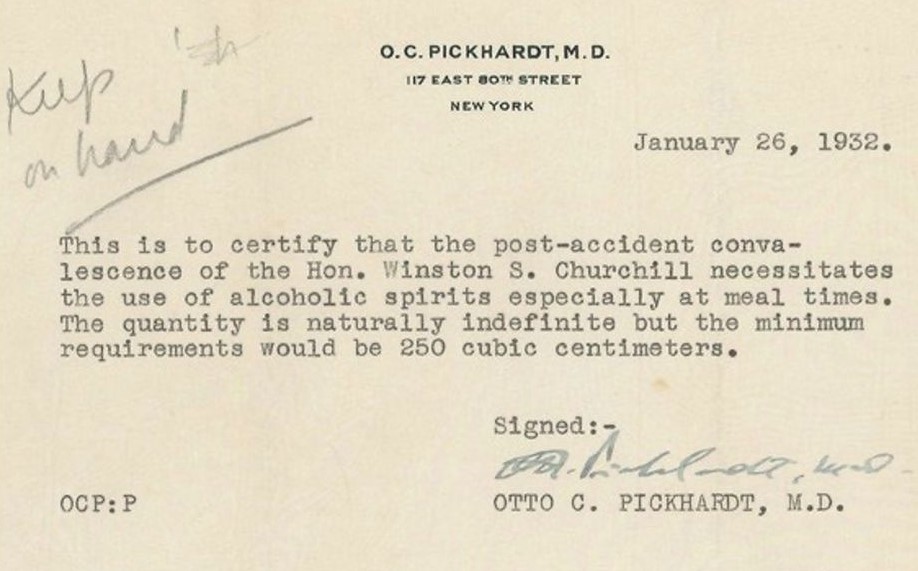
Our little Alistair is growing up!  I am myself over four years into intermittent fasting and a more and more robust approach to my health, too, so I get it. Beer is not so much like cake as like icing. Mmm… a pint of icing please. No wonder it once required a doctor’s note. And it’s not even that old a thing, Dry January:

Dry January started with the group’s former deputy CEO, Emily Robinson in 2011. At the time, she was reading more about the harms of alcohol consumption – at the same time as her half marathon training. Piper says Robinson “wondered what would happen if she had a whole month not drinking” and how it could benefit her running. “Spoiler alert: It really improved her running performance, but she gained other benefits as well,” Piper adds. In 20313 Alcohol Change UK made its Dry January challenge official and trademarked the name. 

What I like about Dry January is just that. When people take a break from anything they come back to it with fresh perspective. Or they never comeback to it, preferring just that fresh new thing. ATJ takes another tack on the whole idea as he looked back on looking back with Bowie and Bing:

I have a vague memory of it and ponder on the weirdness of the Thin White Duke doing a duo with the Old Groaner. I take a brief pause from the beer but then another mouthful is embarked on, followed by more crisp coldness that refreshes the mouth and wakes up the somnambulant parts of the palate, wake up, sound the reveille! The alarm clock shock to the palate continues as I pass down the glass. Mindful drinking? I’m focusing on the beer and how comfortable I am in my chair and how it has just passed 3pm. As the glass reaches the state of emptiness, a slight suggestion of melancholia flits through my mind, Christmas and its thoughts, memories of those no longer with us, grandparents, parents, friends, dogs, health, but the crispness is still there as I come to the end of the glass and decide to head out into the gleaming lights that bring on the emerging city night. Mindful drinking.

Mindful. My mind full. Me, I am a sober daydreamer myself. And I am not doing Dry January. I just haven’t had a drink since 2025. Might have one or two this weekend. Might not. Speaking of one or two, my fellow public service lawyer Teddy Pasketti of Baltimore shared one of the best “I am an idiot” story the other day:

I’ll tell it again. Once in law school I was 23 and really drunk and obnoxious and the owner cut me off and the bouncer told me I needed to go, and I told him, “I’m going to be a lawyer and you’re always going to be a bouncer,” and that bouncer was Mike Tomlin.

Perhaps for those in other continents, this is Mr. Tomlin. Note time!

Note #1: A defiant stand against the slump in Colorado.
Note #2: While one might blame the neo-temperate for the slump one needs to consider the family, too.
Note #3: Is this the greatest example of a lovely interior within a plain pub exterior?
Note #4: A strengthening of the team at Brewery History as Dr Christina Wade joins the editorial board.

We have had a new euphemism appear!  The years’ long decline in the booze trade has been called many things (other than, you know, a decline) so as to distract folk from the fact of, you know, the decline. That old chestnut from years ago – “cyclical” – is still used a lot by boosters and believers.  Then in 2025 we got the mystifying “maturing” market as well as the sometimes even appropriately applied  “consolidation“. And now we have plain old “burnout” and even that new entrant – a “cleansing“:

A well-publicised surplus in the global wine trade is causing a ‘cleansing’ of the sector – but consumers won’t ever mark major celebrations with soft drinks, believes industry veteran and Joseph Phelps CEO David Pearson… Beginning his answer, he admitted that “the market is oversupplied” before commenting that while this is undesirable, it’s not new. “We’ve had oversupply situations before,” he stated, referring particularly to the Californian wine industry, before drawing attention to reasons for their disappearance.

I think I am waiting for “the cull” to come into fashion.* What will save the industry?  Fitba!

“The volume of beer and the increase in revenues from World Cups have consistently driven a strong increase in beer consumption in host cities, far exceeding pre-tournament trends,” Barclays strategists wrote. The tournament’s summer timing in high-consumption months adds to the opportunity. “This is a clear signal of the scale and opportunity this event represents,” they added. North American hosts rank among the Top 15 global beer consumers per capita. Of the 20 leading per capita consumers, 14 have qualified, potentially rising to 16 with Poland and Italy by March 2026. “The combination of large venues, regulatory boosts and greater fan participation creates a perfect context for beer sales growth,” the strategists stated.

You ever feel… forecast to be used? Me, I am looking forward to the actual soccer and, you know, the hairy tartaned folk.

You know how people used to try to explain good beer to wine people they write really insightful things like “lager is like white wine“? It’s a good thing for us all that that dumber era – let’s call it the reign of terroir – is well and truly over. Still, information is power and, well, Eric Asimov of the NYT has some hints for new wines to try in 2026, including this hint that I would suggest should work better for a beer fan:

Stereotypes are not the problem with port and Madeira so much as how and when to drink them. The era of cigars and after-dinner drinks is long gone. The French enjoy white port as an aperitif, but I prefer vermouth or fino sherry. Occasionally, though, it’s worth having a glass with cheese as a reminder of how glorious sweet fortified wines can be. Of the various types, I will recommend aged tawny port and bual Madeira. If you store an open bottle of tawny port in a cool, dark place, it will last a couple of months, while an open bottle of Madeira will last forever.

If you like grapefruit tang in your IPA, try Madiera. Sweet, oaky and white grapefruit pith. I worked my way though a bottle of Blandy’s Duke of Clarence Rich Madeira over the holidays and if I was a cashew I would consider this stuff Enemy #1. But, perhaps for Boak and Bailey, something else is Enemy #1:

On a recent trip to an otherwise peaceful pub we were treated to squawking phones by two separate groups. First, a pair of men in their forties decided to share some ‘funny videos’ they’d found, at full volume. This sent scratchy, distorted noises and bursts of music echoing through the pub, which they further enhanced with their own loud live commentary. Then, a little later, a party of couples in their sixties took the table next to ours. When a friend phoned one of them, he immediately said: “I’ll put you on speaker, mate.” For a full five minutes, the phone shouted at them, and they all shouted at the phone, and we gave up on trying to have a quiet conversation between ourselves.

It’s a cry for help! Is this ever acceptable? Alistair drew his line slightly to the side: “[p]ubs should never become monastic scriptoria.“** Happily, B+B also discovered a possible new form of pub this week, too.In The New Statesman, we have a description of the perfect pub

Most of all, a pub must be what Hemingway described as a “clean, well-lighted place”. It is not a bar. It is not a club. It is not a hotel. It should comfort, relax, lift the spirits and loosen the tongue. A place to settle in. As at home, TV is allowed, and so too music, so long as they do not intrude. The landlord must guide the atmosphere towards homeliness. Think of Mr Banks in Mary Poppins: “A firm but gentle hand, noblesse oblige.” Publicans are to England what head waiters are to France: respected members of the social order.

Hmm: “…so long as they do no intrude…” As you think on that… more notes!

Note #5: Duffman done.
Note #6: Big Sale at ‘Spoons.
Note #7: Soon be time to Wassail.
Note #8: Craig the Elephant and Tusker’s icon passes.

Maybe my problem finding enough to write about is me including all these notes. I could stretch out the beery news notes if I just cut and past every story linked uner a note.*** As I ponder that opportunity, let me ask you thing: how are your telomeres? “My whatsits!?!Telomeres:

“Telomeres are the ends of your chromosomes,” explains Topiwala. “Our DNA is organised into chromosomes, and when our cells divide, these chromosomes are copied. But the copying is incomplete at the ends of the telomeres. “So, over time, these telomeres get progressively shorter. When they reach a critical shortening, the cell dies.” That means scientists can measure the length of someone’s telomeres to work out how many times their cells have divided and thereby estimate how old they might be – biologically speaking. Back in 2022, Topiwala and her team at the University of Oxford researched the link between alcohol and telomere length in more than 245,000 UK adults. “We found that the more people drank, the shorter their telomeres,” says Topiwala. “The drinkers had accelerated their biological ageing.”

Yikes. I don’t think I needed that level of detail, frankly.  As I said, it’s a slow week in beer so… we get to add telemere shortness anxiety to all the other grim anxieties of this age. Fabulous.

STOP THE PRESSES UPDATE 7:48 am Eastern: well worth the wait, Pellicle published Courtney Iseman‘s piece on New Orleans a day later than normal. The story is about taking a break from a drinks conference to explore the city:

It’s my third day at the annual Tales of the Cocktail bar and beverage alcohol industry convention; it’s exhilarating but exhausting, day after day of back-to-back seminars, tastings, and parties where the booze flows can make any introvert like myself feel their battery depleting. My head is spinning with the information and socialisation overload of the day, my bones are tired, my skin is melting into the thick air. I need to cool off, to decompress. I know exactly where I’m going: Brieux Carré.

Good stuff. Another bit of good news is that Boak and Bailey are back posting every Saturday but, still, remember to fulfill make it your New Year’s resolution to sign up for their fabulously entertaining footnotes at Patreon. And look out for more of Stan’s new “One Link, One Paragraph” format. Then hunt out something in someone’s archives! Leave oblique comments on someone’s post from 2007!! Listen to a few of Lew’s podcasts and get your emailed issue of Episodes of my Pub Life by David Jesudason on certain Fridays. And Phil Mellows is at the BritishBeerBreaks. Once a month, as noted, Will Hawkes issues his London Beer City newsletter and do sign up for Katie’s wonderful self-governing totes autonomous website featuring The Gulp, too.  Ben’s Beer and Badword seems to be on pause since November but there is reading at The Glass which is going back to being a blog. Any more? We have Ontario’s own A Quick Beer and All About Beer is still offering a range of podcasts – and there’s also Mike Seay’s The Perfect Pour. Plus follow the venerable Full Pint podcast! And there’s the Craft Beer Channel on Youtube. Check out the archives of the Beer Ladies Podcast.

*To be fair, it’s not only breweries that are suffering, as Dave Infante pointed out: “A quarter-century ago, there were 40 journalists for every 100,000 people in this country, compared to just eight journalists for every 100,000 people today, per a 2025 report by MuckRack and Rebuild Local News. Maybe the reason I’m not overly sentimental about the brewers, winemakers, and distillers struggling against and succumbing to stiffening headwinds in the beverage-alcohol industry is because doom and gloom has been my own professional milieu for virtually my entire career and I’ve grown inured to it. What a cool and normal thought!
**Let me assist you with that.
***Or just add more gratuitous footnotes, I suppose…

Your Merriest Of Merry Christmas Day Beery News Notes For 2025

Stan has been worried. Very worried. Either worried that there would not be any beery news notes this Chrismas Day or worried that there would be beery news notes today and that I really should be doing something else. I am deeply appreciative of the concern but as I usually farm this all out to the team of sleep deprived unpaid interns there is no question whatsoever of the news getting to each of you, my gentle and today hopefully mildly hungover while turkey and stuffing compromised readers. So… the show goes on! Speaking of which, todays photo above from the Yuletide photo contest was submitted by Zak Rotello of the Olympic Tavern of Rockford Illinois, a long time pal of this here beer blog. Click on it for a bigger version. It’s an image of a member of the brewer staff cleaning open fermenters at Anchor Brewing in San Francisco, the brewery that will now never reopen. Like the sleep deprived unpaid interns, we remember those who are working today to keep the holidays jolly.

So what news is actually out there this week? We might have slim pickin’s but there shall be pickin’s. First up, what days are your local party days? As mentioned last year, Tuesday was Tibb’s Eve in Newfoundland last Tuesday. And this is the first year I saw a lot of references to “Black Friday” for the last Friday before Christmas as opposed to the first Friday after U.S. Thanksgiving. Here, for example, is the new coverage from Wales.  Mainly photos of the dressed up and drunk yuff today. It also seems to be referred to as “Mad Friday” in Scotland but maybe it’s a phrase able to be swapped out. I share the thumbnail attached as evidence that such stuff happens in Canada but perhaps with a little more grace as well as perhaps a bit more grit. By the way, one assumes (given the obviously strong ankles) that such natty folk might also be hockey players so… a misplaces comment might receive an brisk elbow right to the Chiclets… if you know what I mean.

What else? The best booze stories of the year according to the Drinks Business included beer news including the high price of a pint in the UK, BrewDog ditching pubs and the suggestion that NA beer should be “a functional drink rather than a compromise…” whatever that means. Pellicle offered up its top tales of their very good year. And Ron has been posting about the best of his personal year including:

I did a bit of judging this year. Mostly in South America, obviously. That’s where I prefer to judge. The Blumenau contest was fun this year. And not in Blumenau. Instead, it was on the coast at Balneario Camboriu. Literally on the coast, as the judging location was on the seafront. Meaning you could have a stroll down the beach at lunchtime. So civilised. And I managed to dodge judging Best of Show. That’s always a win. In Santiago, judging was in the same hotel as we were staying. Which is always good.

Also good was his news that he’s been cutting back.  On a related note, the* Beer Nut on the expansion of NA beers that don’t suck:

Non-alcoholic beer gets the occasional bit of coverage on here, though I tend to find very few which perform the role required of a beer. Pale ales, wheat beers and lagers seem to be the preferred styles, which may be the problem. I’ve often said that dark styles make for better alcohol-free beer, my favourite to date being Švyturys Go Juodas, and the Guinness one is pretty decent too. The latter’s success has provided an opportunity for other breweries to get in on the 0.0 stout racket, and the first I’ve seen locally is Dundalk Bay’s Zero Zero Nitro Stout, available in Aldi.

I’ve recently bought into the “Guinness 0” thing so good news that other smaller operations are able to similarly pass muster. Speaking of news, Stan also had newsy news in his Hop Queries in the state of the US supply of hops:

Farmers in the Northwest reduced acreage 7% in 2025 and harvested 5% percent fewer hops, according to the USDA National Hop Report. Average yield per acre was the highest since 2011, when higher yielding hops appreciated more for their alpha made up a larger percentage of acres planted. The 2025 value of production was $447 million, up slightly from 2024, but significantly less than $662 million in 2021. That shouldn’t be a surprise, given that acreage has shrunk 31% since 2021 and production 28%. Perhaps as important, in September the USDA reported that the inventory of hops held by growers, dealers and brewers was 116 million pounds, down 15 percent from the previous year. That’s the largest contraction in 15 years and suggests the market is getting closer to being in balance. Still, it is a significant amount, and almost 40 percent higher than it was through much of the teens.

Me, I was higher in my teens. That’s the main difference between me and the US hops trade.

Note#1: “Stephen Beaumont once gave me some good advice: don’t.
Note #2: “Scroll at your leisure…
Note #3: Women in public bars over fifty years or so ago.
Note #4: Continental had a pub in the sky.
Note #5: Short pours in Milton Keynes!

Speaking of controversy, a debate threatened to break out in the comments at Boak and Bailey but it appeared to just be a slightly paranoid complainer intent on playing one handed ping pong, the prattling lad being handled firmly by the administration. Much more interesting were the comments confirming reality behind the sale of Bristol’s Moors, including:

I now have had a chance to dig into their structure and, in short, they were not employee-owned in the recognised sense of being owned by an employee ownership trust or being a co-op, etc – it was just that all of the owners were also employees (i.e. no external investors). Justin owned 85% of the business. It looks like he has now sold that stake to Albatronic Arcades Ltd, a company registered on 5 August 2025 and owned solely by Bruce Gray. So I feel less unnerved about the boycott! But still hope they can turn Moor around.

Another set of comments were helpful in building upon Jeff‘s thoughts on the shutting down of three of ABInBev’s megabreweries in the U.S. of A.:

At a macro level, overcapacity normally drives prices down, which is always hard on producers. It’s especially bad for breweries right now, which face a host of financial challenges. Craft and big beer function largely in separate realms, though, and it’s seemed like big beer has been able to replace lost beer volumes with flavored-malt beverages and the like. This news suggests otherwise. Further, for anyone who has followed the beer industry over the past fifty years or so, this is a shocking development for a financial and logistical juggernaut.

Not as shocking to one Karl “the Commentron”** Ockert who shared his understanding:

I worked at the Newark brewery, then a 9 million bbl per year plant, in the early 90’s. I (half) jokingly tell people that I earned my Masters at the university of AB, Newark campus. While I learned a lot of the science of brewing at UC Davis with Dr Lewis, at Newark I learned even more about production and process discipline which I was able to use at the BridgePort and Deschutes Breweries. Last year Newark was down to a rate of 500,000 bbls per year and brewing less than a week per month. Along with Fairfield and Merrimack, it fell victim to the changing beer market. I’m sure it was a painful decision to close all 3 breweries at once, and I’m sorry to see it finally happen.

One wonders what it was that kept the facilities hanging on for so long. Wasn’t money. Somewhat similarly was the concern raised by Ron about the loss this year of Martyn Cornell and state of Martyn’s now 404 website:

What did Martyn leave unfinished? I can’t believe that he wasn’t working on another book. (He asked me about self-publishing because he was so pissed off with how long it took to get a book published.) Not to go all fanboy, but (meaning I am doing) how much material is there that hasn’t been published? Including stuff chopped from Porter. I’d buy a book with that in. Niche, made possible by self-publishing.  A compilation of his, often very long, always hugely informative, blogposts would make a great book. And preserve them in print. As Zythophile is no longer there. Fuck. This material really needs to be saved. Maybe I should get in touch with his brother. 

Happy was I then to confirm that the contents of the entirely excellent Zythophile has been preserved at the Wayback Machine, a service which I have been in love with since the great blog server shift of 2016. Think something has been lost on the internet? Check the Wayback Machine first.

There was intrigue in England as we wondered if Mrs RM could walk past  one of the great conversational pubs:

Walking back from the Sun to Faversham Premier Inn on the eve of Mrs RM’s birthday I suddenly realised we’d taken a different route into town that afternoon and missed its most famous pub. Would she be able to resist the lure of the Elephant on first sight. No. “We’re going in there“. I was happy to skip it, honest. A year ago it was packed on Sunday folk afternoon, a bit quieter on Tuesday night but there still weren’t a lot of spare tables.

A pub full of chatters. Not always what one wants but good to see someone get their way.  In other situations, choosing beer can be the wrong move as this personal injury workers compensation claim denial illustrates:

The claimant’s business required them to purchase and transport bulk quantities, and as the pain apparently intensified the claimant was awarded income replacement benefits, the release says. Surveillance by investigators found the claimant was seen regularly transporting beer for seven to 10 hours every day, often loading up to 20 cases of beer into their vehicle without assistance or any evidence of pain. The benefits were terminated…

All this leads to one fact – beer is not always kosher. No, really. Not kosher:

In November, three of America’s largest kosher certifying organizations came together to release new guidance regarding the status of beer, which has long been considered kosher by default. Due to the proliferation of flavorings brought on by craft brewing and other industry changes, however, the rabbis who declare whether food products are in line with Jewish dietary laws now say the label must be checked before drinking. “We’ve discovered that companies use many flavors, different flavors, to enhance even the simple beers that they manufacture. Those flavors need to be kosherly supervised,” said Rabbi Moshe Elefant, the head of kosher operations at the Orthodox Union, who released the guidance along with Star-K and OK Kosher. “We’ve seen more than one situation… that some beers have dairy in them. They add lactose, they add milk, so a beer could be dairy, which has very serious kosher ramifications.”

Knew it. Gak. Yet some of the stuff that can be crammed into beer other than via the “craft” of the fruit sauce hose might actually be useful:

Buck isn’t just a home brewer dabbling in drug-making. He is a virologist at the National Cancer Institute in Bethesda, Md., where he studies polyomaviruses, which have been linked to various cancers and to serious health problems for people with weakened immune systems. He discovered four of the 13 polyomaviruses known to infect humans. The vaccine beer experiment grew out of research Buck and colleagues have been doing to develop a traditional vaccine against polyomavirus.

As I mentioned last week, I am pro-line in the pub. Better, table service. Each to their own, I suppose, but is there any bore are boring as the “don’t queue” bore in a ‘Spoons?

Believing it’s an ‘unwritten rule’ that you don’t queue at a bar, the 24-year-old barman was stunned to spot ten people in an orderly line waiting for their drinks. Jack refused to join the queues, instead ‘standing his ground’, claiming he propped up the bar for 10 minutes until he was served. Baffled Jack, shared a snap of the queue on X, slamming it as a ‘disgusting and uncouth disregard for sacred tradition’… Jack, who lives in Birkenhead, Merseyside, said: “It’s going against British tradition and it’s just wrong. It’s not like they’re doing anything inherently bad but it’s an unwritten rule you don’t queue at a bar.

Finally – and looking forward to New Year’s resolution suggestions – a word on usage if I might. Please stop writing “I don’t understand” as it means… you are admitting you don’t understand. And if you are a professional writer and you use the phrase “trust me” it only shows you can’t clearly explain your views which means your views are likely not trustworthy. And ask yourself before hitting “publish” if it is wise to write “… an unimaginable amount of work goes into…” when not only was it imaginable but it was accomplished as imagined. And if you as a beer business person want to want to display your ignorance of the times and market conditions of your trade as it exists today, feel free to post something like this on LinkedIn:

Given the current state of the industry, I think it’s about time we rally together and finally retire “Dry January.” Honestly, hasn’t it taken up more spotlight than anything that fun-free should? Let’s change the narrative and remind people what beer actually is……. a simple, natural combination of water, malted grains, hops, and yeast. Four ingredients. Zero mystery. This is our heritage. It’s real, it’s straightforward, and frankly, it deserves a comeback tour. Let’s make it happen and get things moving in the right direction!!!

Seeing as the “industry” didn’t start Dry January how exactly the hell does this person propose that it retire the concept. Plus… “a simple natural combination“? Yes, let’s go out in nature and find some beer, shall we? Displaying further ignorance on the brewing processing is another not strong move.

And that’s it! Stan will either be satisfied or concerned. The interns are using all resources to seek further clarifications on the question. No Christmas for them! And as we enter deeper into the holiday week lull, please also remember that Boak and Bailey are not posting this Saturday so we also will do without their fabulously entertaining footnotes, too. Sitll, look out for Stan’s new “One Link, One Paragraph” format. Then hunt out something in someone’s archives! Leave oblique comments on someone’s post from 2007!! Listen to a few of Lew’s podcasts and get your emailed issue of Episodes of my Pub Life by David Jesudason on certain Fridays. And Phil Mellows is at the BritishBeerBreaks. Once a month, as noted, Will Hawkes issues his London Beer City newsletter and do sign up for Katie’s wonderful self-governing totes autonomous website featuring The Gulp, too.  Ben’s Beer and Badword has returned from his break since April so you can embrace the sweary Mary! There is reading at The Glass which is going back to being a blog. Any more? We have Ontario’s own A Quick Beer and All About Beer is still offering a range of podcasts – and there’s also Mike Seay’s The Perfect Pour. Plus follow the venerable Full Pint podcast! And there’s the Craft Beer Channel on Youtube. Check out the archives of the Beer Ladies Podcast.

*I am always torn. Sweat forms on the brow. Does one capitalize the “t”?
**The title reserved only for the most experienced of comment makers.

The Over 50% Off Super Holiday Sales Saving Edition Of The Beery News Notes

You may need to turn your phone sideways to make this image fit. Or I could just center it. There. That’s better. For a long time, these weeks at the end of the year at the beer blog were a bit crazy. The Christmas photo contest (circa 2006-16) was on and I was sifting through a huge number of emails with multiple entries. Hundreds came in each Yuletide. Thinking back on that this week, I had a look through the 2010 submissions and found this lovely image sent in by Brian Stechschulte of San Francisco.  Here’s his birthday bio on Jay’s site. Another one of his enties won the contest that year. That image is of Rod Widmer among the quipment at the brewery. In what Brian described as Widmer’s cathedral. I like the glow. I’ll dip into the emails and old posts to see what else I can find to adorn these news notes throughout December.

Back to today’s news, first up the question of cash and how the UK budget reaction lead to something of a counter reaction. Sayeth Matty C.:

The worst thing about this week’s budget for me was seeing prominent figures in hospitality bemoaning the minimum wage increase because god forbid your staff should earn enough to actually afford, barely, the cost of living. For me it just demonstrates why all of this lobbying for a VAT cut isn’t so much about supporting a “dying” industry, put propping up profits for the people at the top. But no, it’s paying wages that’s the problem.

And their weekend footnotes to the weekend news, Boak and Bailey shared a similar sentiment:

Every budget goes the same: CAMRA and industry bodies lobby the Chancellor to do something to help pubs; the Chancellor does very little, if anything, to help pubs; CAMRA and industry bodies criticise the Chancellor’s failure to act and foretell doom for the hospitality industry. It’s been this way basically forever and yet, somehow, pubs continue to exist and beer continues to be manufactured and consumed.

As a person who takes home a tax based pay cheque, I have to be somewhat respectful of those lobbying for restraint.* But I am also aware that government can positively participate in economic growth and greater social good. So… and here’s the point for me… after years of ideological restraint hit by a global crisis or two there are times when the bite shared by all is for the longer term good.  As long as there is an identifiable long term good and it is shared by all.

Speaking of the burdens of the state, Drew Starr has shared thoughts on an excellent way of fighting back against authoritarianism – ban the lackies from your bar:

The kid who proudly called ICE on a carwash. Print this shit everywhere. Hell yeah, Sil! For those not from here: this is The Silhouette (nobody calls it that), one of Boston’s last remaining dive bars. For a college kid living in the area, it’s the last place you want to get banned from

We understandThe Sil” has barred a university student who called ICE on a car-wash and men in in balaclava abducted a group of nine workers. Perhaps more establishments might introduce a life-time ban.  Shaming down authoritarianism is a top drawer move.

How to cope? How to deal with the pressures of the day?  “Mulled beer!” sayeth Jessica M. seasonally through an interview with Sam Millard of Bevertown :

“The secret to making a great DIY mulled beer is in choosing the right base. The best results will come from a rich, malty profile or a sweet brown ale,” suggested Millard, who explained that “just like when mulling wine or cider, you need a base that is already really rich, full-flavoured and most importantly, not at all bitter. You ideally want something with a bit of body too, so ensure your beer is not too thin.” According to Millard: “While you may be tempted to use a super-hoppy IPA, keep in mind that its bitterness could overpower your chosen spices and throw everything off balance.

Now, keeping in mind that this is all a bit of an adver-informo piece, I still would recommend you try it. Jessica B herself was curious about this stuff a whole eighteen years ago. Me, I like to use Chimay Première, the red labeled dubbel, as the base. Tasty, strong and relatively cheap as dubbels go these days. And skip the idea of “DYI” and just go traditional with a Lambswool made with strong ale apples, sugar and ginger spice. Or, along with a lot of other options at this link, try to make Caudle if you are even more adventurous. If that is too complex, just go for try a pint of stout and port. It’s Christmas so you can just do that and even say you did.

Speaking of Yuletide, in the news from Newfoundland we read that more folks are going to get stoned for Christmas!

CEO Bruce Keating says net earnings rang in at $56.3M, a decrease of about $3.7M, mainly due to the removal of U.S products and decline in beer commissions.  Alcohol sales totalled $84.2M, down 1.5 percent however, cannabis sales are up 10.6 percent at $28.5M. Keating says those numbers could start to slow since that market is maturing. He says they’re optimistic that the Christmas season will boost sales numbers. 

Baby Jesus would no doubt approve. Speaking of which, Barry M has driven down to a depth I’ve never considered necessary over a controversy I had never heard of – are “cider” and “cyder” the same thing? Or categories of rerlated things? As a lifelong poor speller, I am gratified that the problem arises from puritans who insist every difference in spelling requires a difference in meaning:

Within English literature, early texts seem to use mostly ‘sider’, though it would appear that by the end of the 16th Century literature was generally split between ‘sider’ and ‘cider’. Both with an ‘i’. But there were exceptions of course, an dit has to be said, it was a bit like the Wild West when it came to spelling convention, with cyder, cider, sider, cidar, cicer and pommage featuring in texts of the time (thank you Elizabeth!). But let’s look at some of the cyders…

As we all know, standardization is the best friend of Satan or at least authoritarians. The minute hand, a tool for atronomers, was later added to the clock to steal time from Indistrial Age factory workers. The dictionary of Dr. Sammy J of 1755 helped create the idea of misspelling and therefore a resulting intellectual failure. And now we have this consequence, a finger pointy crisis in taxonomy which apparently turns on the factual regular but uncategorical past practice of adding water to cider now and then** which has led, hundreds of years later, to a backdating by someone deciding that the spelling must follow a practice. Sad. Distinctions can be without a difference. Let us rather embrace our negative capabilities.

Did you see what David J did? He just went and wrote the history of Wychwood for Pellicle:

“BrewDog is a modern interpretation of Hobgoblin,” says James Coyle, who was sales director at its parent brewery, Wychwood. “[The Hobgoblin identity] was built on motorbikes, grunge, and tattoos—this was the escapism of the brand.” Established by Paddy Glenny as The Glenny Brewery Company in Witney, Oxfordshire in 1983, it was renamed the Wychwood Brewery in 1990. Somehow, this small brewery in rural Oxfordshire went from selling to a few freehouses to producing a beer so iconic that it shifted 100,000 barrels a year, changed pub culture, and eventually became a global brand in the Carlsberg portfolio. Thanks to breweries like BrewDog, today we’re used to shock marketing tactics from beer firms. Many of the people I spoke to while researching this article repeated James’ sentiment about Hobgoblin being akin to the often-controversial Scottish brewery, including the fact that its initial success was driven by word of mouth rather than a huge marketing budget.

Over twenty years ago, Wychwood was on the shelves on Ontario and I posted reviews of their Fiddler’s Elbow in 2004 and Duchy Original Pale Ale in 2006. I didn’t love the bad Baggins branding of Wychwood – though not as deeply as the stupid “you’re not worthy” stuff from Stone.  I am please to say, however, that now I added a bit of info which may have assisted David in one paragraph in there – but what a beast of research. And all for you.

Speaking less of you and more of me, I am 62. When I was a teen, I worked with older seniors. People 62 were rye drinking Dads of pals who were vets of the Second World War. They were still up on ladders to fix something on the roof. Some could dress a deer. Me? Fitter than I was at 52.*** So I found this New York Times piece a bit odd. Frankly, if I was 42 around now I’d worry much more about 52 than 62.

On the theme of worry, James Beeson in The Grocer wrote about the financial troubles facing the BKeystone / Breal, a UK consolidator of brewers:

Breal bought a slew of unloved brands and then engaged in a damaging race to the bottom. This was the inevitable conclusion and the only surprise is that it has taken this long. My thoughts are with the blameless employees that will be affected by their failure. 

Breality strikes!**** He followed it up with an investigation over the legal steps being taken and their denial that they are going bust. Jessica M in DB on the same story shares that they have:

… reached out to Keystone for an update on its situation and its prediction of plans and sales for each of its brewery assets as well as asked about the fate of its brewery workers at each of its currently-owned sites. The group has, however, remained silent aside from its statements on social media assuring Black Sheep beer fans that it is “still here”.

And there have been more twists to the news of the suddenly “not here no more” Rogue including this from Doug Veliky:

It also surprised key partners including US Beverage (USB), with whom Rogue had just signed a national sales partnership, and who learned through the news and social media just like the rest of us. As part of their agreement announced on August 1, 2025 to represent the brand in the trade, members of Rogue’s national sales team transitioned their employment to the new partner company in an effort to ensure continuity and relationships. Now, without warning, USB is left with employees who were crucial to the partnership’s formation, but without a brand to sell or an understanding of its future.

Lordy. That’s not good. Clearly on August 1, 2025 the writing was on the wall in the offices of Rogue. Probably on dry erase boards all over their office walls. Did that continuity also include those employees’ accrued termination benefits rights?

Time for notes:

Note #1: “Hoolie” is a word. My late Dad was very entertained by the news that my new boss 28 years ago was so named.

Note #2: “Drunk Racoon in the Hardware Store!” I know this item is just for Stan… as he sent me the link… as if I didn’t already have the link to the story ready… just for Stan.*****

Definitely not on the hoolie, A. Gladman shared thoughts on a private spot at his parents’ home, a place to have a beer on a summer day:

There’s a spot where I like to sit and have a quiet beer when I visit them in the summer. I try to manage it at least once during each trip. It’s on a balcony, or a raised deck I suppose you might call it, that overlooks their small back garden. Wooden steps run down into the garden from one corner, and at the back a door takes you into their kitchen dining room. I like to sit there in a white plastic chair with my back to the wall, and look out to the sea, just a hundred or so yards away. Pale in the distance, the Isle of Wight rises like a cloud bank on the horizon. The wind blows; it’s always windy. The noise of waves breaking on the shingle echoes all around. Gulls and far-off wind chimes punctuate its ceaseless murmur. Somewhere nearby a rope slaps against a metal pole. 

More into this moment, Tyler Maas in the Milwaukee Record shared thoughts on his own sort of idyllic prospect, one that popped into his mind after the first major snowfall of the season:

Days like last Saturday are the closest thing we get to a “Snow Day” as adults. Any plans you made before weather became a factor are probably no more. The idea of driving anywhere seems unwise and borderline dangerous. Once you shovel the snow that’s already accumulated, all that’s left to do is wait to do it again when the flurries are through. So why not embrace the situation, put on some boots, and trudge to the nearest bar?… With driving and other aspects of everyday life temporarily removed from the equation, why not stay a while? You’ll surely burn off the calories from that extra round (or two) on the stroll home. Not to mention the energy you’ll expend during the second/third round of shoveling and when you inevitably dust off your car as the responsibilities of “real life” eventually come back into view.

Nice. Now, finally and with the greatest respect, I have to say that I can’t agree with the position taken by Laura H in The Telegraph last week on the issue of lowering the drink driving standards in England:

A recent survey has found that 58% of adult consider driving after drinking, even if the driver is within legal limits, to be “socially unacceptable.” This has inevitably emboldened the anti-alcohol lobby: already police chiefs and the British Medical Association have called for the rules to be made harsher – their proposals would push drivers who have a single pint over the limit. This is framed as a question of public safety, but in reality it’s yet another example of overzealous campaigners blaming all of society’s ills on the demon drink, without giving cause or justification.

I suppose my first issue is the language. Not sure the embolding was inevitable given those bold beings described have already been on their mission for years and years, according to the anti-anti-alcohol lobby. And not sure the campaigners are necessarily more than zealous. Can one be?****** But the real issue is without justification. This is particularly the case as the first observation is a justification: a majority of Britons are against the current scheme. So, too, the second observation: the police and doctors want stricter rules. We can disagree on the quality of these justifications but that’s what they are.  It’s also worth noting that context poses an obvious issue too. England, Wales and NI have the highest permitted levels of alcohol in all of what was once known as Europe. By over 50%. Check it out. It’s simply a fact that the criminalization of drinking and driving is a reasonable response to the harm it causes. As a lawyer, thirty years ago I spoke to an appeal of a driver who blew 0.082 so these things can be close. But the bottom line is no one is being forced to stop you from drinking. Just stop driving. Maybe try walking. Or get a cab. Or a bus. Or a bike. Or a designated driver. Or another place to drink.

And with that, I am done. It is Yule and I am off to maybe have a beer or maybe shovel or just fret about being late in getting the lights up and having note bought the pressies and what about the tree and … well… as I do that please also check out, Boak and Bailey on this and every Saturday and then sign up for their entertaining footnotes, too. Look out for Stan when he feels the urge (now that he’s “retired” from beery news posts) from Budapest or wherever – as he is getting active again. Then listen to a few of Lew’s podcasts and get your emailed issue of Episodes of my Pub Life by David Jesudason on certain Fridays. And Phil Mellows is at the BritishBeerBreaks. Once a month, as noted, Will Hawkes issues his London Beer City newsletter and do sign up for Katie’s wonderful self-governing totes autonomous website featuring The Gulp, too.  Ben’s Beer and Badword has returned from his break since April so you can embrace the sweary Mary! There is reading at The Glass which is going back to being a blog. Any more? We have Ontario’s own A Quick Beer and All About Beer is still offering a range of podcasts – and there’s also Mike Seay’s The Perfect Pour. Plus follow the venerable Full Pint podcast! And there’s the Craft Beer Channel on Youtube. Check out the archives of the Beer Ladies Podcast. That’s quite good and after a break they may well be are back every month!

*But also as one who has a list of gains and savings for more than two decades that I have influenced to the point that I am effectively appellata free resource…
**But bring back the word “ciderkin” by the way.
***I have just passed the fourth anniversary of slowly getting back from a point which same me using a cane after badly wrenching a knee weeding a zucchini patch. Why? Life stressors resolved, sure. Daily small steps like stretching and exercises, yes. But most of all daily recording the data related to more and more of what I do: intermittent fasting goals (+/-17 hours a day); hours and quality slept (one mid-week sucky sleep does not make for a medical issue); drinks intake (down to 1.27 per day ave) and to do list daily chores achieved (done… next?). But by the way that whole life expectancy shift stuff has little to do with aging and much more to do with infant mortality. So relying on that to discuss the difference between retiring at 60, 65 or 70 means zippo.
****Sorry…
*****Stan also advised he will be reading these new notes from a train between Amsterdam and Budapest so everyone wave in that direction, please.
******Do Zealots look over at the overzealous and think “Jim’s over doing it a wee bit tonight… giving zeal a bad name…”

Your Super (Not All That Scary) Boo-tastic (But Without Any Fake Blood Splatters) Halloween Week Beery New Notes

Frosts? Yup. Green tomatoes brought in? Check. Furnace? On. It’s that time of year. Darker beers. Browner liquors. Higher natural gas bills. I feel a bit like the unnamed gent in the painting, “A Man with a Pint” from 1932 by Fred Elwell. Layered clothes. Sitting in a lower light. Pointing at things in newspapers and telling the person across the table about it. I feel badly for the lad. He just missed out on the first wave of beer blogging by about seventy years so, given that, all he could do was sit in pubs, pointing at things in newspapers and telling the folk who were with him about it.

Before we get into the newsy news, perhaps speaking of him… and even maybe me, The Guardian shared a story this week on hangovers and aging and what’s going on:

The liver breaks down alcohol with the help of enzymes, but as we get older it produces fewer of them, meaning toxic byproducts such as acetaldehyde – the compound responsible for many hangover symptoms – linger in the body. It’s not just the liver. The body’s water content drops by about 5% after the age of 55, partly because levels of muscle, where a lot of it is stored, decrease. Less water means alcohol is more concentrated in the bloodstream, and dehydration caused by its diuretic qualities – a key culprit behind hangover headaches and grogginess – hits harder. Kidney function also declines with age, slowing the removal of waste products. “You get this buildup of waste products in the body that have a longer circulating time to exert their effects…”

Tell me about it! Scary. Getting back to with the ghosts and ghouls theme, The Beer Nut has put on his STASH KILLER! costume this week and has put together an exploding can special post:

I don’t know why I even had these. It certainly wasn’t with the intention of seeing if they improved with age: the styles involved aren’t really built for that. This summer’s warm weather resulted in some warped cans, and I lost a few which ruptured, so I took that as a signal to try these out before they explode completely… For the most part, these were better than I expected. While of course I don’t recommend that anyone age pale ales or hoppy lagers in the hope of improving them, not least because of the risk of explosion, it seems it takes a lot to properly ruin a beer once it’s in its aluminium jacket.

BREAKING PERRY NEWS!!! A solid rebuttal from Barry Masterson this week in Cider Review on a statement by cidermakers Westons declaring that perry is dead!! and using the term “pear cider” instead:

One would think it is incumbent upon established (and let’s admit, pretty large) producers like Westons to protect and promote the uniqueness of perry, not wash it away for the sake of a quick sales boost. The move is especially troubling coming from a company that touts its family history and traditional production methods. You cannot claim authenticity while simultaneously erasing the very tradition that underpins your reputation. Rather than declare perry “dead,” Westons should lead the way in educating new drinkers about its heritage and distinctiveness. Younger consumers are curious, discerning, and increasingly interested in authenticity and provenance.

Quite right. We can’t even get perry in Ontario – but I wouldn’t be buying anything called “pear cider” if it was for sale here. Strikes me, like “Canadian Sherry” or “California Burgundy”, as a sign… and a sign that says “beware!“* By the way, James Beeson wrote the story in The Grocer about Weston’s decision to change the name and dumbdown the drink – and is now getting grief from a key trade association which seems to be a bit confused about the difference between publishing a story and being the topic of a story:

In response to the article “Perry is ‘dead’ declares cidermaker Westons” published by The Grocer on the 21st October 2025, the Three Counties Cider and Perry Association (TCCPA) launch their Perry is Alive campaign. Westons’ justification for their removal of perry from their labelling is to increase their sales figures. The TCCPA believe this dismissal and removal of language to be damaging and a danger to the relationship drinkers have with the rich history and heritage of perry, pears and the land they come from.

And it’s all about the orchards this week as Pellicle‘s feature is a portrait of Virginia’s Diane Flynt of Foggy Ridge Orchards penned by my fellow Tartan Army follower, Alistair Reece:**

Sitting on the patio overlooking the lush verdant slopes of the orchards, the creek—from which mist rises in the morning, the inspiration for the cidery’s name—in the distance, Diane and I talk about apples, farming, and the making of cider. “It’s not just apple cider varieties—that’s one thing—it’s apples grown for cider,” she tells me. “When I bought Goldrush, I paid in advance for my apples and said ‘I will buy every apple on that tree, but I do not want you to pick them until they are falling off the tree.’ That’s growing apples for cider—they have to be dead ripe on the tree.”

That right there is a nice nugget of knowledge. And, speaking of the sensible, there was a measurably more reasonable response*** to that NYT item was this by Tom Dietrich in Craft Brewing Business on the four steps to “save” craft including one approach to improving the branding:

A big reason “wacky” beer names exist is because the beer trademark landscape is more crazy and crowded than a New Found Glory mosh pit (millennial reference alert!). If you’re applying to register a beer mark, your mark can’t be the same as or similar to any other mark for (a) beers and breweries, (b) wine and wineries, (c) any other spirits or alcoholic beverages or mixers, and (d) bar and restaurant services… In a crowded industry where creative names are increasingly hard to come by, understanding how to lawfully identify, clear, and acquire abandoned trademarks can be a competitive edge. 

Another sensible nugget of knowledge. And, continuing the theme, while the periodic column from Pete Brown in The Times can be a bit structured given its tight bit of space some weeks, this time his theme of twelve great London pubs with £5 pints provided for a bit more leeway for neatly balanced comment:

This reinvention of the happy hour is surprisingly widespread. Every pub in the Brewhouse & Kitchen chain has its own on-site brewery. The two currently open in London, at Hoxton and Highbury Corner, fill up in the evenings, when pints cost £6-8. But to get people in during the day, the pubs sell their own cask ales — usually a best bitter and a session IPA — for £3.50 before 6pm…  “We have to recognise what session drinkers can afford.” Most pubs aren’t trying to rip you off. They know that cheaper pints mean more customers. It’s far easier to find the £5-ish pint in north, east, and southeast London than in the west… But if you explore, especially via Overground rather than Tube, you’ll find pints in London at prices that make even a Yorkshireman happy.

Good advice. See also Ruvani at Beer Professor and her sensible recommendations for everyday beers. Exercise your right to choose when to drink. And what! Or where!! Like Martin who enjoyed himself at the posh confines of Ye Olde Bell in Nottinghamshire: “You need to walk past several interception points where you feel you might be asked “Can I HELP you Sir…” Or like Katie who was in Koblenz, studying the scenery:

I stare into the shiny window of a cigar cellar for quite a while before turning down a side street to find Spritz Atelier, a brand new bar specialising in fancy cocktails. I order one made with a local quince liquor called Kowelenzer Schängelche and watch from the window as a man finishes his workday with a take-out spritz of his own. He sips from the straw as he pushes his bike down the cobbled street, before disappearing out of sight.

You don’t even have to be there to choose whether you would want to be there. Consider Boak and Bailey‘s thoughts on the Prospect of Whitby as genius loci:

A few weeks ago, Ray visited The Prospect of Whitby with friends and had the usual experience of too many tourists crammed sharing a generally uninspiring chain pub atmosphere. Even in that context, though, there’s something magical about drinking a pint of Old Peculier while looking out over the water while the novelty noose set up for the amusement of visitors swings in your peripheral vision. It gets better again when you detour up the side of the pub, pass through a gate, down some hazardous steps, and onto the beach at low tide. There, the full power of The Prospect really hits you. Not least because you’ve seen this view a thousand times.

Changing themes with wanton abandon, I am enjoying this year’s continuing strained arguments about youth today. Like this in The Morning Adverstiser, taking the “drinking differently” approach:

While younger consumers remain less likely to drink than older age groups Lumina’s data shows more 18- to 24- year olds now describe themselves as drinking ‘often’ or ‘sometimes’ and fewer arre opting out completely. The long term fall in alcohol participation has plateaued.

The article goes on to then describe how younger people are, you know, still less drinking of alcohol. Don’t get me wrong. It’s obvious that turning social settings like pubs and tavs into something other than boozers is healthier and economically beneficial. I am all for skittles. But drinking low to no alcohol beers is not maintaining “alcohol participation.“**** It’s reducing it while maintaining social participation which, as I say, is really good. Anyone who actually believe the clinky-clinky is a fundamental social bond or, you know, builds community as the wise said in 2014 is fantasizing.

Which reminds me of something else. Over on FB, a memory from twelve whole years popped up in my feed this week and it gave me some perspective on that whole “the young folk ain’t drinking craft no more” story. Look at the brown graph in the lower left. It was created with data from the British food and marketing trade associations. In 2013 I was irritated by the incompetent bar lengths in the graph. In 2025, I am more interested in the percentages.  Keeping in mind these are UK figures, they indicated that two-thirds of craft beer drinkers at the time were over 35. Those people are all over 47 now.  Only just over 5% of people who were 21 to 25 at the time admitted to drinking craft beer. So when was this time when “the young folk drinking craft“?***** (This diagram from 2014 might suggest the same was not the case in the New York of the very next year. Maybe.)****** But whatever it was then, Stan is wondering if a key aspect of what made craft interesting back then has disappeared:

Will Curtin said the brewing landscape has changed significantly over the years, and believes that the traditional “garage brewery” model may be waning. “I think sort of the age of a garage brewery is sort of, if not gone, going,” he said.

I wonder if the cause of the going is not so much the loss as the lack of a compelling replacement. Whatever happened to the shock of the new? Well, unless you are in Spain next year, when drivers may get a shock:

Tourists, be warned:  Spain is proposing stricter drink-driving laws, and they could be enforced by the end of the year. The country’s Dirección General de Tráfico (DGT) wants to introduce new alcohol rules for all drivers — including those on bicycles and e-scooters — by the end of the year. The aim is for a universal alcohol limit of 0.2g per litre in the blood or 0.1mg per litre in breath. That would mean almost zero alcohol consumption before getting behind the wheel. Even a small glass of wine or beer could put you over the threshold.

That’d be one-quarter of the limit we face here in Canada. Be prepared. You can practice the pronunciation of these handy phrases for your next trip to Spain: “Propietario! ¿Duermo en tu cobertizo? Hmm ¿Tal vez debajo de tu árbol?

One last thing before we go. There was a call for papers from the people of Beeronomics:

The 2026 Beeronomics Conference will take place at ESSCA School of Management, Bordeaux, France, 24-27 June. Main panels and sessions will be held at the ESSCA Bordeaux Campus. The Conference Organising Committee, led by Gabriel Weber and Maik Huettinger, welcomes all high-quality research on the economics of beer and brewing. With a strong interest in interdisciplinary research, we are looking for submissions covering topics including…*******

Check it out, people. And with that, we are done. Adios and farewell to October! Next week the World Series will be over, Halloween will be in the past and I probably will have ripped up and rammed all the tomato plants in the compost bin. In the meantime, please also check out, Boak and Bailey on this and every Saturday and then sign up for their entertaining footnotes, too. Look out for Stan when he feels the urge now that he’s retired from Monday slot… maybe … maybe not. Then listen to a few of Lew’s podcasts and get your emailed issue of Episodes of my Pub Life by David Jesudason on certain Fridays. And Phil Mellows is at the BritishBeerBreaks. Once a month, as noted, Will Hawkes issues his London Beer City newsletter and do sign up for Katie’s wonderful self-governing totes autonomous website featuring The Gulp, too.  Ben’s Beer and Badword has returned from his break since April so you can embrace the sweary Mary! There is reading at The Glass which is going back to being a blog. Any more? We have Ontario’s own A Quick Beer and All About Beer is still offering a range of podcasts – and there’s also Mike Seay’s The Perfect Pour. Plus follow the venerable Full Pint podcast! And there’s the Craft Beer Channel on Youtube. Check out the archives of the Beer Ladies Podcast. That’s quite good and after a break they may well be are back every month!

*See: Perth Pink.
**Note: not aka Alice DuRiz!
***Just for example, see same publication in 2023 making the pretty much the same point but in 2025: “HOW DARE THEY!!!
****Customer: “I’d like to participate in some alcohol please” Bartender: “I shall be delighted to perloin you said chemical…” (Mutual winkies) CURTAIN!!!
*****By the way, New Buffalo seems to have stopped brewing a year after they published the diagram before getting caught into a legal dispute.
******You know, sometimes a parenthetical sentence is a good as a footnote. No, it really is.
*******… topics including (i) trends and driving forces in local and global beer production, consumption, and distribution; (ii) management, marketing, market structure and industrial dynamics, individual beer choice, health and well-being; (iii) policy and regulations related to the beer brewing industry; (iv) impact of beer on society and culture (v) environmental issues affecting beer and brewing and (vi) other stuff like food industry and alternatives to beer. You could write something about one of those. Birdeaux is nice in June. Why not? Give it a go.

The Thursday Beery News Notes For The End Of Summer 2025

There are good views out there. Lots of golden hour sunlight finishing up the days as we face the reality that, yes, winter is coming. Out and about that evening, I saw a frog and a hedge of jewelweed – but you’d expect that, wouldn’t you. I like how the angle of the shadow makes something of a right angle with the tree. I didn’t notice that when I took the photo. But even saying that makes it too artsie, less just see-ie. Similarly, writing about hops, Jeff wrote about a limitation but its really about two limitations. And it’s all a bit like dancing about architecture… but what isn’t:

The thing about adding more is at a certain point you don’t get more. We learned this when breweries were putting eight pounds per barrel of hops in their beers and making them taste like lawn clippings. To get more, you have to add different. And here I give you fresh hop beers. They offer a dimension of flavor that is different from regular kilned hops. Trying to describe them is hard because rather than just reaching for another adjective, we grope toward different realms of experience. Drinking a very good fresh hop beer is to experience synesthesia and encounter the taste of iridescent green.

Conversely yet still on the question of different, not as charming an experience was an airport sandwich sold to Matt Gross under the presumably personally seductive name “the Matthew”, it of the 10 slices of prosciutto:

…laid flat, one on the other, with no space between them, to form a dense, unchewable mound of salty protein. Look, sandwiches are all about architecture, and the meat, especially a powerfully flavored one like prosciutto, needs air. Each slice, thick or thin, should be separated from its brethren, folded gently and laid haphazardly (within reason) upon the bread. You want to feel the texture of the slices, the regular irregularity of the bite as your teeth pass through the layers. That sandwich needs to breathe. If it can’t breathe, it’s dead on the plate, limp and heavy, boring. R.I.P. Matthew. The great thing about this approach is that you can actually use less prosciutto per sandwich and at the same time make the sandwich taste better.

It’s funny. As I go through the week’s saved links I can get interested about someone writing about a crappy sandwich but, for example, can’t be bothered with anything anyone is writing about THC drinks. What could it be? Bad writing? Maybe.* Compare how, for CAMRA’s What’s Brewing, yet another Matthew wrote about beer pubs and heritage in the nearby local layered landscape under development in Manchester’s core, writting in a way which contextualizes more than lobbies:

“We believe regeneration should enhance, not diminish, the city’s heritage. The Marble Arch deserves to be protected as part of Manchester’s future, not pushed aside by it.” On the subject of heritage, one brand looking to capitalise on the city being the national centre of attention this summer is the iconic Boddingtons. Brand owner AB-InBev has decided to return the brand to cask production after it was discontinued in 2012. The news follows hot on the heels of reported investment in another of its heritage beers, Bass…

I like the tone. While one can get numbed by the beating of a drum, an invitation to think about survival and revival in face of modernity is instructive. Speaking of which, maintaining an interest in more than listicles, Laura Hadland‘s** (slightly paywalled) column in The Telegraph takes on a useful discussion for those with a modest to moderate interest in beer – serving temperature:

… some people adore the sharp thrill of bitter flavours. If that’s you, West Coast IPAs should scratch the itch. This US style of beer is hop-led. Citrus and pine flavours are underpinned by intense bitterness, balanced with a light touch of malt… An American brewer may be horrified to see this beer style served any other way but well chilled. However, there is an argument that they could be served fractionally warmer: research shows that as temperature rises, our perceptions of bitterness usually increase. The real connoisseur of bitter flavours should consider ordering a West Coast IPA (such as Elusive Brewing’s Oregon Trail) on cask, served at a cellar temperature of 11-13C, as opposed to the keg-dispensed version that will be around 5-8C.

While there is a reference to the dubious tale of the hyper-efficient expectorating wine judge, this is exactly the sort of writing that there should be more of. An explanation of an idea. An invitation to try something out. Which may be why the comments are not (entirely) focused on slagging the author. Speaking of context and understanding, I like this piece by Jason Wilson about old vines and the disasterous 2025 harvest in Rioja and what keeps the winemakers… making:

I asked Oxer why he thinks people can be so skeptical about the concept of old vines. “In some way,” he said, “we’ve lost our connection with the old world, the spiritual world. We think too much about the scientific world rather than the spiritual world, but we should join both worlds.” He added, cryptically as always: “Soil is darkness, but always in the darkness, there’s light. Soil is a world we don’t really understand. It’s mix of magic and microbiology.” As we finished our meal with a Basque style cheesecake, Oxer told me that 2025 will be a different story than 2024. He’d lost at least 60 percent of this year’s grapes to the summer hailstorms.

Note: if you think you are dedicated to the drink, consider Big Jim. Talk about pacing your drinks. Conversely, The New York Times ran an (somewhat paywalled) article this week that had me shaking my head over the level of alcoholism being decribed and the introduction of a new concept:

Withdrawal from alcohol, though, felt like a direct hit. I looked to my bedside table and saw the glass of “bed wine” from the night before. “Bed wine” is something I promised myself I would quit this year. It’s the last glass of wine I bring with me as I climb into bed to watch TV or do the crossword puzzle. I tell people that my relationship with alcohol is “complicated,” but it’s not. I love drinking wine and a good cocktail, but booze is horrible to me. In my world, there’s always an excuse to drink: celebration, disappointment, stress.

A habit of “bed booze” seems to me to be a pretty alarming cry for help. Which the piece sorta admits it is. But still… Lordy. What’s so wrong with warm milk?  But things could be worse… maybe. Last Friday, Will Hawkes circulated his latest edition of London Beer City and included this gem of remembrance of a shit pub past:

In 1998/99 I lived about two minutes’ walk from the Finn and Firkin, an imposing 19th-century boozer on the Pershore Road in Birmingham. I remember Dogbolter, a beer I avoided because it was too strong. I remember the L-shaped bar, and the smelly loos next to one entrance. I remember the huge dance hall/concert venue attached to the back. And I remember, for reasons I still can’t truly understand, being unnecessarily rude to a Stoke-supporting friend when he entered the pub one Saturday evening having just watched his team lose 3-0 (although, checking Stoke’s results, they didn’t actually lose 3-0 in 1997-98. Maybe it was 4-0? Or 4-1).  (The pub stopped being a Firkin soon after and is fully shut now).

Nice. Exactly what one looks for in every establishment. Or is it? Some Americans go to Italy in search of an English dispense system… well, at least one did:

Today, from my count, there are at least fifteen locations in Rome serving beer via handpump. And while a number of British breweries send their casks here, there are a several Italian breweries like Hilltop Brewery, Shire Brewing, and Linfa Brewery that are regularly cranking out casks for the pubs. Beyond Rome, you can find handpumps in most Italian city at establishments with an interest in selling anything beyond the standard Peroni or Moretti. Even in Sicily. However, I suspect most of these are serving kegged beer hooked up to a handpump (i.e., they’re not serving cask conditioned beer). To my knowledge, I didn’t have any of that on this trip.

Massimo Internazionalismo!! And perhaps being a bit massimo medievalismo, the feature in Pellicle this week by Thomas Soden is on the topic of gale, the herb that hops destroyed. AKA myrica gale scientifically or sweet gale, sweet bayberry, dutch myrtle or sweet willow.  Or even bog myrtle like when I had a beer brewed with it back in 2008 brewed by Beau’s right here in eastern Ontario. Soden shared:

A wild plant, it often featured in the herbal gruit which flavoured beers from low countries before hops became commonplace in brewing. The shrubs require the specific soil acidity of bogland areas, which although once abundant, are increasingly scarce today. Nothing, however, is stopping modern British brewers from utilising gale as a flavouring agent. In an age in which ‘natural’ beers and wines, and fermented drinks like kombucha are gaining popularity, this seems like it has potential. In 2017, the now sadly defunct Treboom brewery in Shipton-by-Beningbrough near York made a wheat beer flavoured with Gale named “Myricale,” and acknowledged it was a homage to the style. So why has it died out?

Hmm… might I suggest the whole “tastes like a bog” thing?

And for Stan because we share the love of such things, a story of how much alcohol chimps consume:

Someone have a word with the chimps? Observations of the apes in the wild show them imbibing the alcoholic equivalent of a half pint of beer a day through the vast amount of fermented fruit in their diet. Researchers arrived at the first estimates of wild chimp daily alcohol intake after measuring ethanol levels in fallen fruit that the apes gather from the forest floor in Kibale national park in Uganda and in Taï national park in Ivory Coast. While individual fruits contained less than 0.5% alcohol, the chimps’ daily intake swelled as they devoured the ripe fruit pulp. The apes were particularly fond of figs, which contained some of the highest levels of alcohol the team recorded.

Speaking of the pre-hop universe of gale and chimps and… stuff… to conclude this week I am going to try a new weekly feature, featuring old stuff every week. I realized the other day that not only had I been writing this… whatever this is… for over two decades but a lot of my history writings are well down the lastest posts lists. So I am going to try to give a nod to a few things that you might find interesting and perhaps new to you if you weren’t reading this sort of beer stuff back then. Let’s start off with a few links to posts under the 1400s tag:

a. from 2016, check out The Steelyard, Stillyard, Stylyard and Spelling about the Hanseatic League’s foothold in central London
b. from 2015, read all about the brewing dynasty of The Hillars Of Golden Lane, Cripplesgate Without and
c. from 2019, a survey of England’s Increasing Concern Over Beer Brewing, 1430s to 1580s.

That is it for now. Enjoy these last days and golden hours of this summer and as you do please also check out the below mentioned Boak and Bailey every Saturday and sign up for their entertaining footnotes, too. Look out for Stan when he feels the urge now that he’s retired from Monday slot… maybe … maybe not. Then listen to a few of that now newly refreshed Lew’s podcasts and get your emailed issue of Episodes of my Pub Life by David Jesudason on certain Fridays. And Phil Mellows is at the BritishBeerBreaks. Once a month, as noted, Will Hawkes issues his London Beer City newsletter and do sign up for Katie’s wonderful self-governing totes autonomous website featuring The Gulp, too.  Ben’s Beer and Badword has been on hiatus since April but the archives are out there with the all the sweary Mary! There is new reading at The Glass which is going back to being a blog. Any more? We have Ontario’s own A Quick Beer and All About Beer is still offering a range of podcasts – and there’s also Mike Seay’s The Perfect Pour. Plus follow the venerable Full Pint podcast! And there’s the Craft Beer Channel on Youtube. Check out the archives of the Beer Ladies Podcast. That’s quite good and after a break they may well be are back every month! Such is life. Such is beer podcasting and newslettering… which, as Ray says, are blogs! And he’s right.

*Yet we do recall the wise words of Boak and Bailey in last weekend’s footnotes: ” “Beer fandom is infested with know-all-ism.” To expand on that briefly, it’s the tendency to respond to any post or article with something like “Old news, already knew this” or “And of course, [supplementary fact]…” Worrying about whether what they’re saying adds anything new to the conversation is one thing that inhibits people from writing and sharing. Yes, there are certain topics that have been hashed out a million times. But when you write about it, it’ll be different because you have a different perspective, and because new evidence has emerged, or things have changed, since it was last written about. Don’t write for the know-alls, because you can’t please them. Write for yourself, and for people who like what you do.” “
**For the double, Laura on pockets at the Beeb.

The Delightful Yet Pensively Penultimate Beery News Notes On A Summer’s Thursday For 2025

It’s been a busy week but not really in the beery sense. Guests and heirs have come and gone – and even bought a $14.99 beer on the way out via an airport bar at Montreal, as illustrated sub-wonderfully perhaps. A last bit of summer visting and the shedding of the last loonies and twoonies. Which means the home is quieter here at this end of the week compated to the other. Which is good. But quieter. At least I have my tomatoes. Did I mention my tomatoes? Definitely illustrated sub-wonderfully, that yellow one in the upper left weighed in a 1.7 pounds. And I did nothing to make it happen. Which is my favourite and most common form of success. Six varieties left to right ish clockwise: Chiltern’s Blue Bayou, Baker Creek’s True Black Brandywine, Chiltern’s Golden Sunshine, Baker Creek’s Kentucky Beefsteak, Chiltern’s Beefsteak and Baker Creek’s Orange Icicle. Picked from the catelog based on the “pin tail on donkey” method. All started from seed last winter and soon getting turned into sauce. That True Black Barleywine is the best tasting tomato ever – like it has built in balsamic vinegar. Thanks for tuning in to Tomato News Today!

First up in the world of beer, the Tand himself has also been out and about on travels and has reported back on the scene in Munich – and found out that certain things were not to be found:

Sadly, you can’t find Pils on draught anywhere, and for reasons best known only to themselves, Spaten insist on offering the dreadful Beck’s as their bottled pils in their most prestigious outlets. It appears Spaten Pils, which I recall was a lovely beer, is no longer brewed. A real shame.  In fact, Spaten it seems, only brew Helles in both normal and alcohol-free forms and, of course, an Oktoberfest. It gets worse. The whole shooting match of Spaten-Franziskaner-Löwenbräu-Gruppe is owned by AB InBev, who presumably have streamlined the brands available, though under the Franziskaner brand you’ll also find weissbier and a kellerbier.  Like Spaten, the rather delightful Löwenbräu  Pils has been dropped. It is a pretty grim picture as the odd hoppy pils provided an alternative to Helles, which in its Munich iteration, can be a little sweet, and dare I say, bland? (The locals call it “süffig”, meaning “easy to drink”. And, in fairness, it is.

And over at Pellicle, Matthew assumed the role of player / manager and reported on his travels to the French & Jupps Maltings in Hertfordshire where he found a hidden truth:

Its long history stretches back to 1689, and for more than a century the maltster has been based in the twin Hertfordshire towns of Stanstead St. Margarets and Stanstead Abbots, bisected by the aforementioned Lea, some 30 miles north of London as the crow flies. There are a few reasons for its relative anonymity—I myself hadn’t heard of them until I was invited for a visit in February 2024. One is due to the fact its malt was (and often still is) bought in bulk and rebagged by various distributors before being shipped out to breweries. And so, it might bear the name of a competitor—although in this context it’s perhaps more accurate to refer to them as partners—in the US, for example, the malt is typically sold under the William Crisp banner.

Sneaky sneaksters! Did you know? (Did I? Never mind that… let’s make this about you.) Did you??? Speaking of hidden truths, Pete Brown had a has retrospective on BrewDog, now well in to the post-Watt era and even into the post-Dickie, published in The Morning Advertiser that he unpacked into something of an obit:

To me, they always felt more like a band than a brand – not least because they wanted to be seen as punks. Bands are different. When none of the original members remain, many former fans insist that it’s simply not the same band any more, and that the newcomers who have taken over, singing songs they never wrote or had hits with, are no better than a covers band. The departure of Martin Dickie feels like the last member of the original line-up has left the building. The entity that remains may own the rights and assets of BrewDog, but it has lost the spirit and soul that once defined it… Dickie remained silent throughout. The initial allegations referred to a “cult of personality” built around both men, but specific personal allegations were focused on Watt’s behaviour. After Dickie’s departure, some former employees took to social media to say that he was “part of the problem.” 

Wonderful. I have never understood how Dickie, co-exec past and board member still, has had the teflon wrapper that he has enjoyed through downturn after downturn on what must be one of the most note worthy financial flops in recent brewing history. But perhaps it’s been a case of not noticing that scratch on your hand due to the nail in your foot.

Speaking of endings, Ed the Beer Father has shared his thoughts on the closing of Banks of Wolverhampton, mapping a fairly complex set of international bobs and weave that led to the end:

Eleven years ago the two companies with rights to San Miguel beer, San Miguel Brewery (Philippines) and Mahou San Miguel (Spain) signed a cooperation agreement to promote their international businesses and position San Miguel as a global brand. To further its growth they had already partnered with Carlsberg to contract brew it in Britain, and it was a large part of the output of the Northampton brewery. But for a brand with global ambitions partnering with the world’s biggest brewery seems like an obvious match… So, as what I believe is part of a global realignment, last year San Miguel moved its contract brewing in the UK from Carlsberg to ABInBev. Losing the San Miguel contract left Carlsberg in the UK, which owned one giant factory and two large regional breweries, with a lot of surplus capacity. The giant factory wasn’t going to go and Marston’s has the small pack facilities, which left Banks’s. So a contract change for a Spain and Philippines based international lager brand closed a 150 year old brewery in Wolverhampton that didn’t even brew it. 

Lordy. Speaking of things making one’s head spin, I totally missed Stan‘s post before the Labour Day weekend on the nature of beer bubbles so I will correct that error now:

There is more to monitoring beer foam than counting bubbles, although they are the foundation. They result from nucleation, and as those bubbles climb to first form or then replenish the foam head, proteins and bitter substances are carried into the bubble wall, forming a matrix that holds the skeleton together. In his doctoral thesis, “Beer Foam Physics,” A. D. Ronteltap calculated that a foam 3 centimeters high (a bit less than 2 fingers) in a glass 6 centimeters wide (a bit less than a Willi Becher) made up of bubbles with an initial radius of .2 mm (twice the width of a human hair) would contain 1.5 million bubbles distributed over about 100 layers.

Over a million bubbles! Not quite millions and millions but more than one million. And, while the numbers aren’t quite confimed yet, Jessica Mason pulled out the stats as she reported on the question “Can Gen Z save cask ale from extinction?” for Drinks Business:

Statistics from YouGov for the Society of Independent Brewers and Associates (SIBA) have shown 25% of 18 – 24-year-old beer drinkers regularly order cask ale. The figures mark an increase of more than 50% on the previous year… Digging deeper into the SIBA figures, there are also statistics that support the opportunity that women present in the future of cask ale’s revival. For instance, the data revealed how 22% of female beer drinkers regularly order cask ale, compared to 43% of men. But, as Corbett-Collins noted: “It would be great to see even higher numbers, but the glass half full fact is that men and women of all ages are enjoying cask beer.

Out and About Update: Max mapped a 29 km(!) pub crawl he took through the Czech countryside to plant himself in front of a beer at Únětický pivovar, Zdibský pivovar and Polepšovna ducha as well as a few other spots. I marched about a tenth of that the other weekend and my left knee let me know about it for more than one day. Good thing Max kept up a good pace because apparently, according to the white coated eggheads in the Netherlands, beer drinkers are a prime target for mosquitos:

To find out why the blood-sucking critters prefer some people over others, a research team led by Felix Hol of Radboud University Nijmegen took thousands of female Anopheles mosquitoes to Lowlands, an annual music festival held in the Netherlands… Participants who drank beer were 1.35 times more attractive to mosquitoes than those who didn’t. The tiny vampires were also more likely to target people who had slept with someone the previous night. The study also revealed that recent showering and sunscreen make people less attractive to the buzzing menace. “We found that mosquitoes are drawn to those who avoid sunscreen, drink beer, and share their bed…”

Speaking of getting bled, I received the alert from Will Hawkes: “Sorry to be right about this. No GBBF next year as it made ‘a substantial loss’, according to CAMRA.” As per usual and FOR THE DOUBLE!!!… Jessica Mason has more detail:

CAMRA chairman Ash Corbett-Collins explained how “at Members’ Weekend earlier this year, the national executive presented finances that painted a stark picture. As your chairman I was open with you; we were facing significant challenges… Corbett-Collins lamented: “Sadly, this means I must tell you that: The Great British Beer Festival and its Winter counterpart did not attract enough visitors to cover the cost of holding them, resulting in a substantial loss.” Added to this, he revealed that CAMRA’s membership figures “are simply not growing” and confessed that “the hard truth is we are unlikely to return to pre-2020 levels”… and noted how “the cost of running a membership organisation and business is also increasing”.

This is a pretty serious situation as it really looks like a broader issue than just the fests. The organization itself seems to be at risk. I expect more information to be flowing in the coming days.

In the “WAR ON SCIENCE” folder, we read the news out of The New York Times that everyone’s favourite slowly exploding head in charge of the Department of Health and Human Services has pulled the US government’s pending report on alcohol as part of a healthy diet:

Mike Marshall, chief executive of the U.S. Alcohol Policy Alliance, a nonprofit that aims to reduce the harms of alcohol, said H.H.S. was “doing the work of the alcohol industry.” “They’re burying the report so the information about the health consequences is not widely known,” Mr. Marshall said. Health Secretary Robert F. Kennedy Jr. has decried a “chronic disease epidemic” sweeping the country. But he has said little about alcohol’s impact on American health since taking office. Consumption of both alcohol and tobacco was absent from the first Make America Healthy Again report released in May. Mr. Kennedy (like his boss, President Trump) has said he does not drink.

It’s important to note that Mr. Kennedy, unlike his boss,  does not wear makeup preferring to gain his particular rusty orange hue through a natural process.

Finally, just before this organ went to press, the dynamic duo B+B posted a piece under the fabulous title “Customers Have Always Been a Problem for Pubs” which illustrates the truth based on a sppech given in 1933 by one Lieutenant Colonel E.N. Buxton, director of the East London brewery Truman, Hanbury & Buxton:

The talk finishes with a few more rebukes for the drinkers. First, the reason pubs often look so ugly, and are so sturdily built, is because “you do not treat them so kindly”. “Walls and furniture are roughly treated”, he says. “As for the outside of public-houses, I agree that some of the houses in London look perfectly ghastly. Hard wear, however, had to be the first consideration.” This was addressed, remember, to a room full of people from Bethnal Green. We’re picturing the crowd when Bertie Wooster sings ‘Sonny Boy’.

Fabulous. There. That’s a lot for a busy week but probably less than all the stuff our there to read so please also check out the afore mentioned Boak and Bailey every Saturday and sign up for their entertaining footnotes, too. Look out for Stan when he feels the urge now that he’s retired from Monday slot… maybe … maybe not. Then listen to a few of that now newly refreshed Lew’s podcasts and get your emailed issue of Episodes of my Pub Life by David Jesudason on certain Fridays. And Phil Mellows is at the BritishBeerBreaks. Once a month, Will Hawkes issues his London Beer City newsletter and do sign up for Katie’s wonderful self-governing totes autonomous website featuring The Gulp, too.  Ben’s Beer and Badword is out there with the all the sweary Mary! And check out the Atlantic Canada Beer Blog‘s weekly roundup. There is new reading at The Glass which is going back to being a blog. Any more? We have Ontario’s own A Quick Beer featuring visits to places like… MichiganAll About Beer offers a range of podcasts and there’s also The Perfect Pour. Plus follow the venerable Full Pint podcast! And there’s the Craft Beer Channel on Youtube. Check out the archives of the Beer Ladies Podcast. That’s quite good and after a break they may well be are back every month! Such is life. Such is beer podcasting and newslettering… which, as Ray says, are blogs! And he’s right.