
Your “Don’t Let The Door Hit You On The Way Out, February 2026” Edition Of The Beery News Notes

cat on carpet before a TV screen with hockey players playingFebruary does one decent thing each year. It is short. We were also one goal short the other day. But that is a different thing. Canada is outraged to the point of almost saying something. In our house, the cat spoke for us all. Stunned disbelief twinned with a day dream about what was in the food bowl in the next room. I hope we get over it …soon. Even Trump was oddly gracious. In passing during the State of the Union he said of the gold medal win “…they beat a fantastic Canadian team in overtime, as everybody saw. ” Hardly triumpalist gloating.  The cat’s reaction was the same: “…food bowl… food bowl…

Let’s jump into it, shall we? Katie M has shared thoughts over at The Gulp on her return to a favourite spot, The Highland Laddie, in the perhaps less than loved city of Leeds. Being related to generations of Highland laddies and perhaps being accused of being one on occassion, I am won over by the headline. But there is more, a hidden elder gem amongst a brutalist landscape:

The room smells of the woodburning stove and warming comfort food, and as the rain sets in for the night outside, I get the distinct feeling I could spend the whole evening here. But it is 4.30pm and I have somewhere else to be. My evening plans end earlier than I expected them to, and so instead of heading back to my room at Leeds’ premier drag showbar directly, I pop into The Highland Laddie for another pint. I like to play-act at being a regular in pubs that make the effort to make me wish I was one. I order a pint, poured just as black and white as the last, and watch the pub slowly close down around me with the exercised ease of a team who have hospo work in their bones. The rush is over and the tables are free for all until closing; a small group of students are drinking cider on the table opposite and talking about current affairs in broken soundbites. I get my book out and settle into my corner banquet for a cosy hour before heading back.

Lovely. Bear with me. More on pubs. It’s a bit pub heavy this week. Frankly. Let’s move to a happy sort of seasonal note from Sean of Tom’s Tap in Crewe:

I must say the sun being out and being able to pay suppliers is infinitely preferable to it pissing down and having to ring them to say you can’t because it rained all weekend. Thanks to everyone who came in this weekend, you made a difference.

Sun’s out, sales up. Interestingly, the effects of the poor weather elsewhere in England had another decidedly opposite result:

After a record-breaking start to the year for rainfall, some businesses in Richmond, North Yorkshire, claim that rather than deter customers, the weather has encouraged them to spend time inside and open their wallets. Daniel Williams, landlord of The Town Hall pub said takings at the start of 2026 were up 20% compared to previous years. “The weather being as terrible as it is has really helped us – people are looking to escape the horrible weather, so we certainly can’t complain at the moment,” he said. “We’ll get massive groups in because they’ll have come out for a walk, got sick of the walk and then come into us, so it’s been very positive for business I’d say.”

Pouring rain? Sales… up.  David J wrote excellently for CAMRA’s publication What’s Brewing about the theory of social cohesion and the British pub:

Alcohol has its many downsides as I can attest having a childhood punctuated by my father’s alcoholism, but it lowers people’s inhibitions making them willing to talk. It’s why you’re more likely to spark up a conversation over an interesting cask beer instead of waxing lyrical to the person next to you about the smooth flavour of an Arabica coffee bean… The other argument that “local shops perform similar functions” to pubs may have an element of truth. I do chat a lot with a friend who works in a deli near me and I’m very fortunate to do so. And fortunate is a key word because this is a rare gift that not many areas have: a thriving high street with varied shops.

Got the urge to chat? Go to the pub. But cultures differ. We still have towns with maybe fewer shops but there are some plus active bakers and butchers over here as well as a cultural cornerstone of a coffee chain. One unexplored question that always nags me about the argument is this: what’s with all the inhibition in Britain?  I’ve never been more accosted by conversation sparkers than at a church supper – but maybe that’s because I was a minister’s kid and was an easy target. Outside of session, even court work was always a chatty chummy time when I was a young lawyer… even if the humour leaned towards the grim.  I wonder if there is a causation question at play. Yet… David also recently wrote about the pub in a time of mourning and it may help answer it from a subtler point of view: it is the place, by choice or tradition, where such things happen so that is where they happen. See? I get my learning from my reading.

So… don’t know what to say? The pub helps. Yet, and perhaps again conversely, Pete B. wrote a great piece in The Times on the joy – and value – of cans of beer at home:

“The 4-pack pint can is most popular format for lager buyers in convenience stores, growing at 9.4 per cent over the last year. People in convenience stores are usually on-the-go. The pint can feels like good value, especially as they’re quite often price-marked packs.” This value deal seems important. We are spending less on alcohol, something which applies to our supermarket shopping too — beer sales at the supermarket were down £371 million to £7.37 billion last year. And drinkers know that beer in pubs is more expensive than in supermarkets. If you can see that four pints is costing you £6.95, it brings a pint in a pub — which in the UK costs on average about £5 — into much sharper perspective…

To review. Highland Laddie? Comfy. Sun’s out, sales up. Pouring rain? Sales… up.  Got the urge to chat? Go to the pub. Don’t know what to say? The pub helps. If you have the means. If not? A tin at home. An antidote to funflation.

Note #1: Tune in later today for Jeff’s talk in US beer.
Note #2: Sharps Brewery in Corwall to close.
Note #3: “…disturbing accounts of industrial accidents…”

Terroir in cider? NO! There is clearly an “i” in the sentence. Not terror. Terrior. That’s the theme of the article what Barry himself guided us all to in Cider Review which wonderfully traces the history of the concept in depth, like in this passage which reveals the hidden truth:

Terroir as a term also took a sharp diversion through the 17th and 18th centuries. This is why, despite their veneer of modernity, a gulf of time and meaning separate early references to regionality in cider from the modern cider terroir conversation. To taste terroir – linguistically still a reference to land – was to experience a crude character shaped by natural setting. Even for Le Paulmier, it was often something inelegant or dirty; gôut de terroir, lauded by vintners today,was essentially a mouthful of soil. Provincial vineyards, at the mercy of their rural, unsophisticated settings, could only ever offer ‘terroir wines’ fit for the peasantry, themselves made rude and rough by that same land. By contrast, the carefully cultivated vineyards of the Île-de-France (the area around Paris) were free from terroir, producing elegant ‘cru wines’ reserved for the nobility.

Hah! Terroir meant dirty after all!! And, sticking with the agri, Laura Hadland wote about sustainability in the British vineyard for The Vinyard including this from Gary Smith, CEO of Silverhand Estate, the first UK vineyard to reach carbon-negative status, without the use of any carbon offsetting:

… we wanted to do more to ensure our land was at its absolute optimum. That meant going one step further and educating ourselves on regenerative farming. The sustainability aspect plays a huge part in this because through the work we do across both the vineyard and our arable lands we are acutely conscious of the impact each has upon the other. Learning how to work both business and land harmoniously has seen a huge benefit to our estate’s ecosystem. As a result the quality of all of our produce has improved – not just grapes, but our lamb, beef and estate-grown fruit and vegetables from our kitchen garden.

That’s how I run my 65 x 100 foot estate. Tomato seedlings are doing very well, thanks for asking!

Remember a few weeks ago when booze was back? Apparently, like the steady rains in Richmond mentioned above, things can change – if BMI is correct about the US beer market:

After a strong first 4 weeks of the year, with $$ up 3.5% and even volume up 2%, trends got considerably softer in the last 2 weeks in Circana multi-outlet + convenience data. Volume down 4.5% in latest week thru Feb 8, Super Bowl Sunday, following a 6% drop the week before. By 6 weeks in, sometimes trends for the year are already well established. But with these big early gyrations, that’s not the case so far in 2026.

In the follow up to the unendingly uninteresting story about the garage sale of the bits and pieces of BrewDog, there was a bit of a flitter on the social medias about (i) I told you so in 2011 and (ii) when was it exactly that the brewery defined itself as a den of arseholes? My candidate is this from July 2010:

Am I supposed to cheer along with the giving of the finger to 99.998% of customers for the sake of marketing? Or is this supposed to be Dada beer? Who cares. All I know is I am far less inclined to buy any BrewDog beer. Why? Because of this short sentence:

A response to the haters.

“Haters”? Good Lord. Are you twelve? This has to be the stupidest new usage of a word that has been imposed upon the language and there is far too much use of it in craft beer circles. It denies the right to disagree. It tells us to stop thinking and start following. You call in to question my freedom from being your sycophant, I call into question your business model.

While it is not important as to this moment, it is interesting to see how the co-opting of language was so contrived at the time… so curated. “Haters” as a term was a bit new to the mainstream. The comments in response noted the novelty. And a year and a half later, NPR wrote about how “haters” had become common, an appropriation from hiphop. Not quite a coining but planned. Probably triggering the criticism loop was itself the plan. Which led to the unhappy fanboys which led to the “investing” which led to the fat bank accounts for owners of what was in the end an unprofitable brewery. Quite a business model.

Speaking of my people, over on FB at the Scottish Rugby Family page which I have followed since seeing the tartaned ones thrash Canada in 2024 and meeting the admins in the pub, there was an important question asked of the group ahead of another Six Nations game away:

How’s the principality for getting a hip flask in?

I say important because not enough is written about sneeking booze in where it is not welcome. It’s part of the culture. Comments ranged “give it to your child to carry in” to a discussion on the various characteristics of the sporran. My favourite example is from 1977, I witnessed a gent in wide leg jeans semi-disrobe the there before we his neighbours at the goal end stand at Rugby Park in Kilmarnock. Concern was soon lifted once we realized he was not planning a career as a streaker but had duct taped two 1.5 litre bottles of Mateus to his calves. He soon drained the lot (which much impressed my Rev. Dad) and was arrested on the pitch early on in the second half – but that is beside the point. The point is we need a body of literature around this. An Oxford Companion to Sneaking In Booze.

Pellicle‘s feature this week is bay David Nilsen. It’s a visit to a Chicago landmark and homage to Belgium, Hopleaf Bar:

Michael didn’t want to recreate Cadieux Cafe exactly, but he did take it as proof that a bar cut from a different cloth could succeed if it found its audience. He took a design cue from European bars when laying out the space, a labyrinth of brick and burnished wood that’s adorned with signs from Belgian beer brands, both extant and erstwhile. He decided to install bookshelves rather than televisions. He subscribed the bar to periodicals like the New York Review of Books, Harper’s, the Atlantic, and London Review of Books. Essentially, he decided to create the anti-sports bar.

Finally, for Stan… a drunk chimps story:

There are many reasons why you might not want a wild chimpanzee to be operating heavy machinery. Now scientists have uncovered a new one: the ape may well fail a sobriety test. A study has shown that chimps living in the forests of Uganda regularly ingest enough naturally occurring alcohol to register levels that, in some workplaces, would trigger disciplinary action. The findings offer the strongest physiological evidence yet for the theory about why humans like alcohol, known as the “drunken monkey hypothesis”.

Having lived through two rounds of Planet of the Apes movies, I can confirm that I do not want chimpanzees on heavy machinery for any number or reasons. That it is for now. Until next week, please check out Boak and Bailey who are posting every Saturday and adding to their fabulously entertaining footnotes week after week at Patreon. And look out for more of Stan’s new “One Link, One Paragraph” format. Then hunt out something in someone’s archives! Leave oblique comments on someone’s post from 2009!! Listen to a few of Lew’s podcasts and get your emailed issue of Episodes of my Pub Life by David Jesudason on certain Fridays. And Phil Mellows is at the BritishBeerBreaks. Once a month, as noted, Will Hawkes issues his London Beer City newsletter and do sign up for Katie’s wonderful self-governing totes autonomous website featuring The Gulp, too.  Ben’s Beer and Badword seems to be on pause since November but there is reading at The Glass which is going back to being a blog. Any more? We have Ontario’s own A Quick Beer and All About Beer is still offering a range of podcasts – and there’s also Mike Seay’s The Perfect Pour. Plus follow the venerable Full Pint podcast! And there’s the Craft Beer Channel on Youtube. Check out the archives of the Beer Ladies Podcast.

Your “The Thaw Cometh! The Thaw Cometh!!” Mid-February Edition Of These Beery News Notes

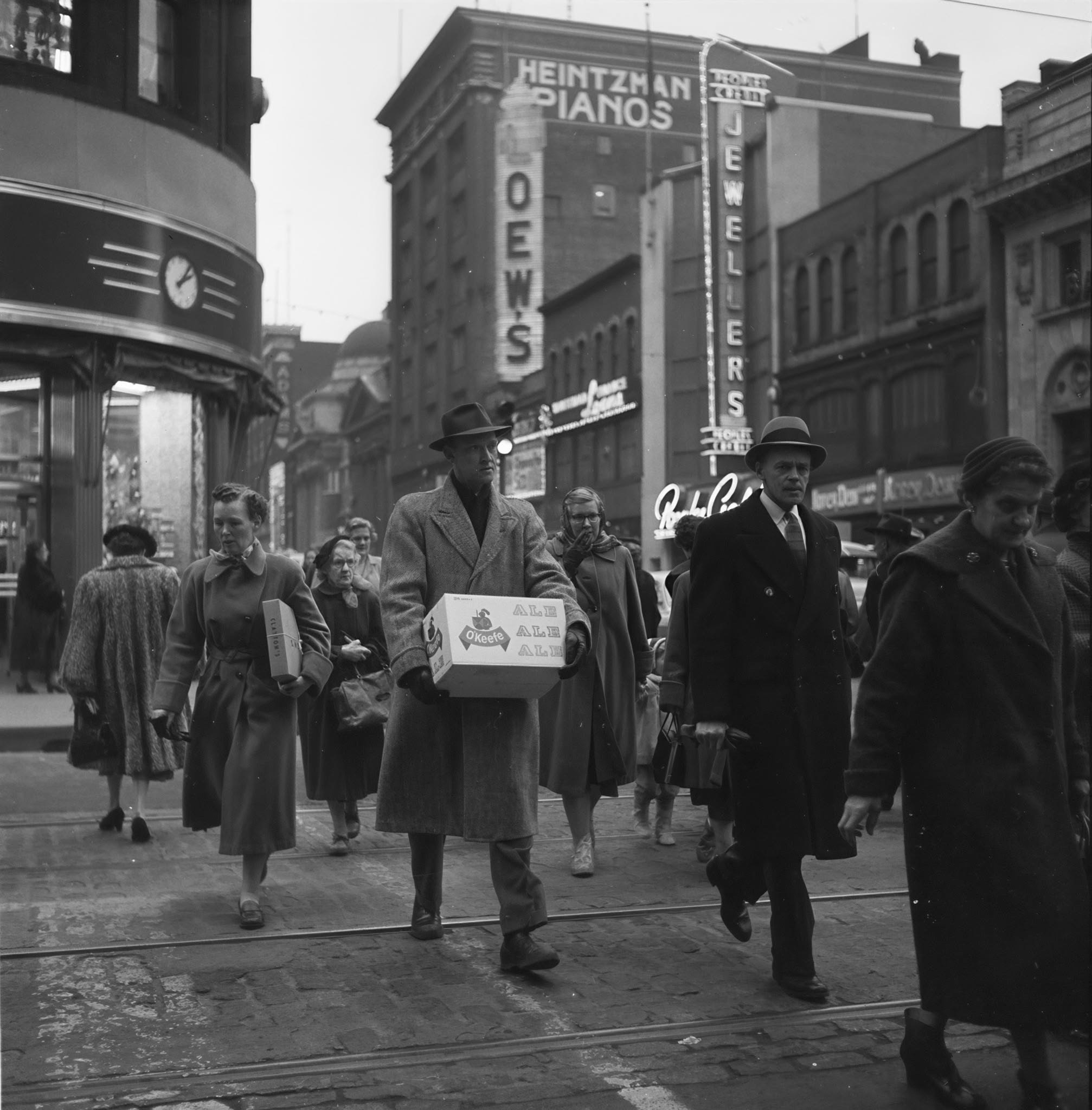
Now that the temperatures have moderated from -30C at dawn way up to -3C, the nation asks itself what the hell was all that? There is no answer to the question. Fortunately, there is a second question: how to still look dapper in a Canadian winter while lugging a lot of beer? Well, this gent can help. First, walk around in one of Toronto’s well loved black and white neighbourhoods where people must wear vintage clothing. Then, bottle your homebrewed beer only in second hand O’Keefe quarts you have nicked from the upper bric-a-brac shelves of old taverns. Finally, invest in an industrial quality paper packaging printing press you keep in the basement solely for the recreation of 1950s brewery boxes. Easy! Speaking of being on one’s feet, Boak and Bailey have written about how they didn’t do a Dry January so much as a very mobile one, a habit that has continued well into February:
We didn’t set out to make a mission of this, but we realised about halfway through January that, as it happened, we hadn’t yet made a repeat visit. That made us wonder if we could keep it up for the remaining few weeks. We were particularly conscious that we’d tended to stick to tried and trusted favourites last year. In fact, in 2025, over a quarter of our logged Bristol pub visits were to just two pubs – The King’s Head and The Swan with Two Necks. You might have noticed the word ‘logged’ and be wondering exactly what that means. Well, Jess, an accountant and spreadsheet nerd, of course keeps track of every pub we visit.

What a good realization! We have nothing like that possiblity here so much replicate 1950s Toronto to amuse ourselves but this comes a very good second. In the US of A, something else appears to be amuse or perhaps console according to BMI :

Beer posted positive $$ growth in 4 of the last 5 wks, and Jan 2026 is on track to be beer’s best monthly trend in years, at least in these channels. Including wine & spirit RTDs in the mix brightens the picture even more; broader beer + RTD category $$ grew more than 5% with wine & spirit RTDs adding close to 2 full pts in scans. 

Booze up! And somewhat similarly Ed stood up for the honour of Guinness this week with a response to what he called a a hatchet job on the Guinness’ Open Gate brewery in London published by The Guardian:

For some reason restaurant critics put the boot in more than any other type of reviewer… I was going to the brewery as part of the CIBD Southern section’s AGM, but first we had to do the business part to do at Diageo’s HQ.  I don’t know what deal the CIBD had done with Diageo or if we were subsidised, but we paid a tenner. This gave us pie and mash, which was nice, and a pint of Guinness (brewed in Dublin). I was keen to have somethng brewed on site though, so I had a hazy IPA next, which was nice enough. I think the ABV was a bit hefty, as on top of the three pints of Guinness I’d had I was defintely feeling pissed by the time I’d fininished it. So there you have it. The Guardian journo’s main complaint seemed to be that you had to take a lift to the toilets.

For others, the trip to the pub and then to the toilet is even easier. They are visiting the pub virtually from home, a remote non-work arrangement of sorts:

The 24-year-old from Yeovil, Somerset, regularly tunes into the feed from Morgan’s Arcade Bar in Carlisle, Cumbria – despite never having been there or anywhere near. What hooks Katie in is seeing different people come and go: the women enjoying a work party, the couple singing along with the musician, the young lad trying to chat up a girl at the bar… On some nights Morgan’s Arcade Bar, which can only fit around 60 people in it, has up to 5,000 viewers on its livestream at any one time. But like other bar streams, it has been subject to bans and restrictions for reasons they don’t quite understand. Bar owner Morgan Taylor has been streaming for nearly nine months. He noticed a huge rise in viewers over Christmas, then a few weeks ago his account was deleted.

Cass Enright got out of the house and on the road in his latest installment of A Quick Beer takes us to Montreal – a favourite destination of mine – and revisits some of the great brewpubs there in a video with this intro:

Join us on a step back in time as we have A Quick Beer at three of Montreal’s original brewpubs! Discover the enduring charms of Dieu du Ciel!, L’amère à boire, and Le Cheval Blanc, three spots that have been serving up delicious beer for decades. Although Montreal offers many modern breweries and taprooms nowadays, some of our fondest beery memories over the years have been here, and they’re all still going strong.

For me, it’s L’Barouf on rue St-Denis. If you are ever looking for me, check there. Also all about winnowing the better and the best, Pete shared some firm thoughts in his column in The Times this week, always welcome sight:

My beef is not with hazy pales — those original examples were pretty good. But if you don’t need to worry about balance or clarity in the beer, and you’re throwing in enough hops to cover up any off-flavours from brewing mistakes, a hazy IPA is very easy for a mediocre brewer to make. From a drinker’s point of view, if you grew up with soft drinks and don’t like the taste of actual beer, it’s perfect. It’s also great for Instagram — everyone can see you’re not drinking a boring, mainstream beer. But instead you’re drinking a boring craft beer. A boring, one-dimensional alcoholic fruit smoothie in a gaudy can with hop monsters or skeletons on it. If I wanted to drink sour grapefruit juice, I’d buy some Tropicana and leave it in the sun for a bit. 

The many botches of “craft” is a venerable topic which even comes with its own primodrial gospel but it is true that for all its eager keener passion craft never seems to fail to find a way to fail.  Nice to see that we have a paper of record confirming what Pete called the “sustained decline.” Viva crystal malt! Viva!! Viva!!! And Phil Mellows guided me to this article in The Caterer on the why to Pete’s what including this suggested impetus:

“…we are beginning to see the movement of some younger adult drinkers towards nostalgia brands, and given our history and heritage, we feel well-placed to meet this trend through some marketing and awareness driving activity.” Brookfield Drinks has launched a trial bringing long-established premium Scottish lager Kestrel back on draught. Brookfield managing director Nigel McNally says: “We’ve shown that a brand that’s nostalgic, like Kestrel, can be repositioned and revitalised. “Most pubs are serving the same products, and the trade’s been guilty of allowing brands which aren’t authentic onto the bar. Alcohol by volume (abv) have also come down, and I think overall customers feel they’ve been short-changed. A return to brands with heritage and nostalgia is offering customers a point of difference.”

Nostalgia and getting short changed? One must be on one’s toes. Which is related to Lars’ new maxim: “if you don’t know how the beer is made then, no matter what the beer is named, you have no idea what kind of beer it is.

Speaking of no knowing, The Beer Nut made a confession this week that I suspect is made on behalf of many of us:

Anyone who pays attention to trends within microbrewing will have noticed in recent years the explosion in variety of proprietary hop products. I don’t think these assorted extracts and powders and boosters were ever meant to have a consumer-facing role, but brewers seem to love them, and love letting us know that they’ve used them. Does that get them a discount from the supplier? I wouldn’t be surprised. For my part, I can’t help wondering if these enhancers actually enhance the beers in any real way. I’ve certainly never identified any pattern among them: which ones to look out for and which ones aren’t worth the paper their patents were filed on.

Note #1: Ludlow prices!!!
Note #2: Laura’s top tap rooms.
Note #3: Jeff doxxed.
Note #4: Burton Union Pr0n!
Note #5: Actually, no you can’t. You’d die.

The British Royal Navy has recently announced it is cutting booze rations in the service, limiting intake to 14 unit per week while on board. The Telegraph in its emailed newsletter presented a few responses to the news from readers:

Jenny Jones, however, recalled an age of largesse: “Many years ago in Malta, my husband and I were invited on board a Royal Navy ship that was giving a party. The atmosphere was convivial and, thanks to attentive stewards, I was able to enjoy several gin and tonics before dinner. “On departing, it seemed to me that the gangway had become a lot steeper. Back on dry land, our host asked how many drinks I’d had. When I said three, he told me that in fact I’d had nine, as naval tots are about triple the size of what one would get in a pub.”

Ah, Jenny Jones… what’s that? Not the same one? Fine. Me, I was once invited with a gang up the plank and onto a Canadian navy ship helpfully docked a walk from the Halifax taverns by a pal’s navy boyfriend. Among the minty green paid we worked our way though a number of 25 cent beers. I expect that sort of service is no longer offered.

The feature this week at Pellicle was written by Newt Albiston who shares his thoughts on drinking in Epping, just north of Greater London the tough town where he grew up which lives with division:

The day I return to Epping, my first trip home in some time, I can feel the tension, and the hesitance. The high street is pretty quiet, and there are lingering looks as I make my way past the various coffee chains and charity shops. Signs of the change in mood are everywhere: Union flags fly at half-mast on lamp posts, as if to declare the death of Britain as she once was, shadowed by the residue of torn-off patriotic stickers. Although I am instantly greeted by familiar faces when I walk into The Duke, the tension is still present in the quietness of the venue.

I like this: “…no fancy ginger beer or small-batch kombuch…” Perhaps related to The Duke, Stan guided us to a question this week – “what’s that smell?” Or rather…

“Olfaction helps shape our cultures, although it often does so unknowingly or without us noticing,” says (Inger) Leemans, who led the Odeuropa project. “When we talk about cultural heritage, we can think about religious rituals, but we can also think about specific scents that we’ve been cherishing and living with for a long time.”

Cherish. Hmm… I spent a good chunk of my teens in Truro, NS where the smell wasn’t always cherished and I am mindful of that reference The Breweries of Kingston & The St. Lawrence Valley by Steve Gates to a brewery a couple hundred years ago near my current place of work at City Hall which doubled as a pig sty. The next brewery to the north itself had a manure pit.  My point is that there were no scents without the full sensory array around it. Did 1890s Mild pair well with coal dust? Did Porter marry well with the pong of streets filled with horses? Perhaps we can never know.

And Charlotte Cook, brewer and scribbler, at took us along to Asturias, Spain for Everyday Drinking and shared her thoughts on the food and the cider:

When you taste the intensely rich stew, you can understand why cider rather than wine prevails in the north—the sour and fizzy is needed to cut through, cleanse the palate, and prepare you to dive in again. Cider is omnipresent in Asturias. As you walk around the town center of Oviedo on a Sunday morning, as families returning from church mix with football fans heading to an entirely different type of cathedra, cider is everywhere. Before 11 am, people will be drinking a bottle of cider for the table. Spaniards are famed for their ability to drink until the wee hours and still make it to work, school, or church as if nothing has happened. And having a little tipple of cider in the morning isn’t seen as such a stain on your character as it is at home.

Finally, some very heartfelt tributes were shared after the news of the death of beer writer Des de Moor like this from David J:

I think a lot about the pints we had one night in South London where he held court, sang songs and was so warm to everyone.

Pete also remembered Des the singer:

Des was a man of many layers. Years after the event, I discover my first interaction with him was buying the 12” remix of Charlton Heston by Stump – that was him, as half of the Irresistible Force. He made the Popbitch newsletter as Secretary of the Ramblers Association (moor, geddit?)… He was a great singer, a walking encylopedia. An absolute stalwart of judging the World Beer Awards. Never once heard him angry, pissed off, or anything other than kind and decent.

There are many more. His Wikipedia bio explains his musical side. Here he is singing Bowie and, here, an earlier solo album. By all accounts a wonderful guy. A sad loss.

Until next time, please check out Boak and Bailey who are posting every Saturday and adding to their fabulously entertaining footnotes week after week at Patreon. And look out for more of Stan’s new “One Link, One Paragraph” format. Then hunt out something in someone’s archives! Leave oblique comments on someone’s post from 2009!! Listen to a few of Lew’s podcasts and get your emailed issue of Episodes of my Pub Life by David Jesudason on certain Fridays. And Phil Mellows is at the BritishBeerBreaks. Once a month, as noted, Will Hawkes issues his London Beer City newsletter and do sign up for Katie’s wonderful self-governing totes autonomous website featuring The Gulp, too.  Ben’s Beer and Badword seems to be on pause since November but there is reading at The Glass which is going back to being a blog. Any more? We have Ontario’s own A Quick Beer and All About Beer is still offering a range of podcasts – and there’s also Mike Seay’s The Perfect Pour. Plus follow the venerable Full Pint podcast! And there’s the Craft Beer Channel on Youtube. Check out the archives of the Beer Ladies Podcast.

Your Sunny Yet Still Cold But Not Standoffish Beery News Notes For Early February

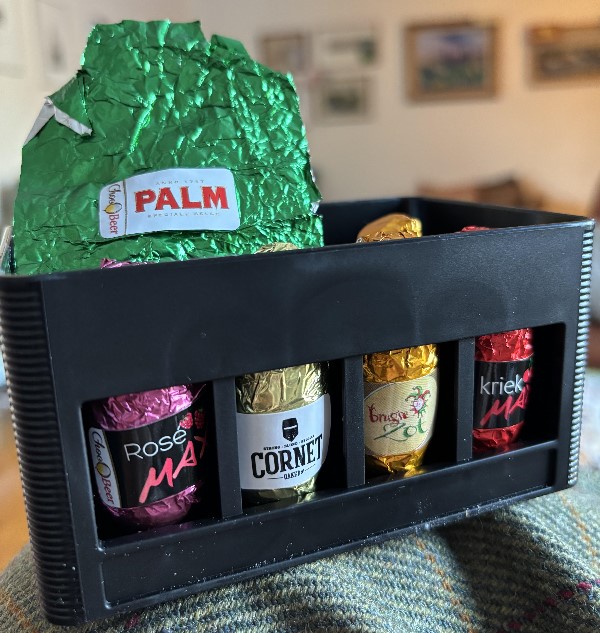
February flies by. That’s just the way it is. Good time to take stock. Good time to eat the little chocolates filled with beer brought by a visitor from Belgium. Early review: the “…chocolate is dry and dark so a lack of sweetness in the kriek left it a bit stark but the Palm was that bit richer.” Not sure I am chowing down on these outside of a winter like this but all quite a bit better than expected. Paid endorsements welcome. Winter was also on the mind and under the feet of Jordan as he wrote about the weather at the end of last month or perhaps just his efforts to get about in it:

Monday, Jan 26th: The deep freeze is well and truly upon us, and looking at the forecast for the next couple of weeks, it looks like we’re in four-layer territory. If your primary mode of transport and exercise is walking, then -25 with the wind chill does you no favours. Besides, the sidewalks are not shovelled in any meaningful way. Dry and cold is a great combination to ensure you’re reminded of the various injuries you’ve had over the years. Sometimes I get the unprompted sense memory of an ankle ligament rolling.

Also looking at the world as it exists below the knee, Stan shared some research he has done on the word Hopfenstopfen and its relation to a certain pair of boots:

The shoes were worn by a worker processing hops. When a bag was filled, a worked would jump into it, stomping down the hops to make sure the bag was full. When I dug this out, I wondered if these could have been called Hopfenstopgen boots. That’s because in Hop Queries Vol. 4, No. 6, I wrote about dry hopping in Germany in the 19th century. That was called Hopfenstopfen, which can be translated at hop plug. Simon Moosleitner, a subscriber in Germany, suggested there is more to think about…

I won’t spoil the fun but speaking of getting the boot in, late last week in VinePair, Dave Infante wrote about the effect of the homicidal ICE intrusion into Minneapolis on the beer trade in the city including this from Drew Hurst of Bauhaus Brew Labs:

You can see it in the firm’s sales figures. Taproom sales are down 40 percent compared to January 2025. “It’s a wildly unsustainable thing,” says Hurst. “None of us signed up to have to live through a federal occupation and figure out how to run a business at the same time.” Not that it was easy before the onslaught: Bauhaus wrapped this month last year down around 30 percent from January 2024. Craft brewers have been struggling to find their way for years in the face of shifting demand, new competition, and rising costs. In Minneapolis and Saint Paul, they’re doing all that with the MAGA jackboot on their necks.

At first I thought it was an odd angle but then realized it illustrates the principle that beer prefers peace as well as how quickly that peace can be lost. Dave also shared in his email updates that he was told to “stick to beer” and that some paying subscribers to his newsletter Fingers canceled their subscriptions. Perhaps if those folk didn’t “stick to” amateur neo-fascism it might be better. Funny how the “stay in your lane” crowd don’t show up for this sort of politicization within the pub:

A beer tap labelled “Rachel Thieves” has appeared on the bar of a Hertfordshire pub protesting Chancellor of the Exchequer Rachel Reeves introducing crippling tax hikes. Anyone ordering the beer will receive only water. The Green Dragon in Flaunden, which is run by publican Chris Ghazarian, has added the spoof cask ale pump badge as a protest – telling customers that pints of this particular beer are “very bitter” and cost more than anything else on the bar and anyone ordering it will receive only water. Speaking to the British national press, Ghazarian said: “They find it hilarious. I obviously don’t make them pay for it.” 

On the other side of the planet, a very difference approach has been taken in Australia:

The Albanese government is seeking to put a hold on increases to the beer excise for the first time in 40 years. The Customs Tariff Amendment (Draught Beer) Bill 2025 seeks to pause the indexation of customs duty rates for draught beer for two years from August 1, 2025. Currently, the beer excise is indexed twice yearly to stay in line with the consumer price index, with Australian beer, wine, and spirit importers and producers saddled with some of the highest rates in the world…  Addressing the House of Representatives, Anthony Albanese said he was “proud” to introduce the Bill, “one of the most popular commitments that we took to the election”.

Boak and Bailey also wrote about another sort of pressure to conform but the context was less confrontational – just writing about their thoughts on a craft brewery:

Maybe that post was a bit too snarky, with hindsight, but it certainly didn’t warrant trolling impersonation accounts on Twitter, general abuse that last for months, or a stalking campaign. That was, as you might imagine, quite traumatising, and probably did make us nervous about being critical of breweries in the supposedly cuddly craft brewing sector. It didn’t stop us, but it had a ‘chilling effect’ on how freely and frequently we felt able to express ourselves. It’s easy to say “Don’t mince your words” but minced words are less likely to lead to sleepless nights. We can totally see why some people might decide it’s not worth the trouble, and certainly wouldn’t judge them.

On reflection, I have probably benefitted from folk starting with the assumption that I am a bit of an arsehole. I lose my sleep over other things.

Note #1: Take a news event and ram it like a square peg in a round hole.
Note #2: Martin at another fabulous pub, this time inordinately bright.

Ron TV continues to impress. This week he’s been presenting an extended interview with Mitch Steele and, like the comment maker Oscar, I am drawn to the brief introductory electro-thrash almost as much as the subjects of these interviews. Part 1 of the interview is over thirty-seven minutes long with Part 2 clocking in at thirty-three. Set aside an hour or so of your time. More if, like me, you keep replaying the first six seconds and that mesmerizing theme music over and over and over.  Good multi-media breakout for Ron – even if it likely doesn’t pay the bills. One a similar note, Ray of B+B on the prospects of a career in writing:

This is excellent. Depressing, but excellent. My response has been to give up, basically, and accept that writing is a thing I do on the side, while something else pays the bills. I also like that thing, so it’s fine, but I get sad thinking what I could have achieved if writing was my full-time job.

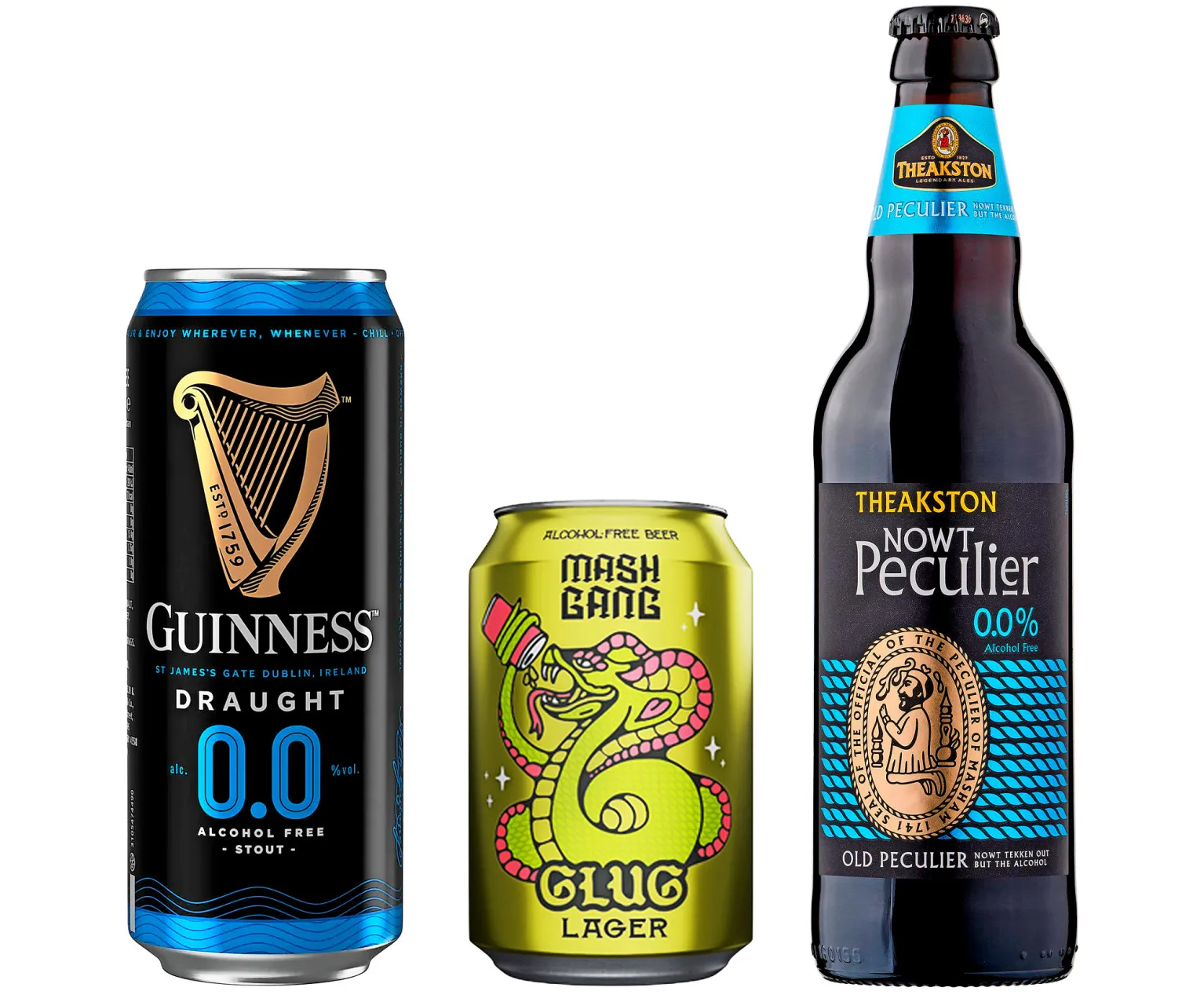
Perhaps also on the theme of less is more, Guinness 0 also continues to impress me and Pete‘s brief review does not surprise:

There are many great 0.5 per cent stouts from small indie brewers, but Guinness 0.0, which took years to develop, is indistinguishable from the real thing.

I noticed one thing when writing this. It is branded as “Guinness 0” in Canada but “Guinness 0.0” in the UK. Why? Is it a different formulation here and there? Whatever it is, I am finally seeing a point to NA beers. But things will be going in a slightly different direction in UK neighbourhood if one permit applicant has their way:

The shop also sought an amendment to the condition currently imposed on the licence… to “No super-strength beer, lagers or ciders of 6.5% ABV (alcohol by volume) or above shall be sold at the premises with the exception of Dragon Stout and Guinness Export beers.” The applicant’s agent, Frank Fender, told Bedford Borough Council’s licensing sub-committee (Thursday, January 29), that these “super strength” beers are not usually the “street drinkers’ choice of drink”. “They are they are widely consumed by members of the Afro-Caribbean community, and obviously this shop wants to be inclusive,” he said. This claim was backed up by Chris Hawks, the council’s licensing compliance and enforcement officer. He said: “What Frank says about Dragon Stout and Guinness Export is spot on.

For years, the word authentic was bounced around in the face of glitter and haze. That plan in Bedford sounds like authenticity to me. Similarly perhaps, crossing the Atlantic, Matty C has written some notes on the US beer scene for the supplier Get ‘Er Brewed‘s webpage and found something of a revivial going on:

Nostalgia is one play many breweries seem to be using. During my time in both Portland and in Colorado, (the latter of which I visit regularly to see family,) I noticed that many drinkers seem to be choosing the classics made by more established breweries. Allagash White, the Belgian style witbier from the brewery of the same name wasn’t just on tap everywhere in Portland, but it felt like everyone was drinking it too. The beer carries the kind of hushed reverence that money can’t buy, and demonstrated to me why establishing a core beer as part of your brewery’s identity is essential for longevity.

This is quite a reversal as, you will recall, in 2019 flagships were considered a dead concept: the “concept of a flagship in almost all ways maps to an earlier and obsolete way of thinking.” Futurisms rarely stand up to audit but it’s good to know, in an era too concerned with branding and other misinformations, that identity in the form of what is in the glass has made a come back. One never knows what is really going on otherwise. As with the news about the bills left unpaid and the suppliers left in the lurch by Rogue, James Beeson in The Grocer shared that the level of insolvency at failed Keystone Brewing had hit almost £15 million. Heavens! Remember when we all spoke of community?

Sticking with things in the USA, the feature in Pellicle is a portrait of Eckhart Beer Co. in NYC by Ariana DiValentino with its focus on central Euro lagers and foods that share the same theme:

The menu focuses primarily on Central European dishes that match the beers’ origins. There is a brat plate, and spaetzle gratin, and kartoffelpuffer (German-style potato pancakes), which you can order fried in oil or beef tallow. But there’s also a falafel dog, an Italian cold cuts sandwich, and a Moroccan-spiced ratatouille with vegan lemon yogurt. The variety of cultural influences feels very reflective of the brewery’s New York City context. “I wanted to offer food that supports the beer. It didn’t have to be Central European per se, but that felt like a natural foundation,”

Sounds like a great place for all. Not so in Japan where one establishment has embraced ageism:

The concept of age restrictions and minimum requirements is commonplace around the world. But have you ever heard of an establishment imposing a maximum age limit? Now, a Tokyo chain pub has set a ban on older customers – in order to try to maintain the raucous, fun atmosphere for which it is known. Tori Yaro Dogenzaka is an izakaya (an affordable Japanese pub) situated in Japan’s capital city. This year, the establishment propped up a sign outside the entrance, informing customers of the new rules. The sign said: ‘Entrance limited to customers between the ages of 29 and 39. This is an izakaya for younger generations. Pub for under 40s only.’

I wasn’t wanting to go there anyway. Screw them. That’s it. As as I sulk in a mode Japonais, please check out Boak and Bailey who continue to post every Saturday. adding to their fabulously entertaining footnotes week after week at Patreon. And look out for more of Stan’s new “One Link, One Paragraph” format. Then hunt out something in someone’s archives! Leave oblique comments on someone’s post from 2009!! Listen to a few of Lew’s podcasts and get your emailed issue of Episodes of my Pub Life by David Jesudason on certain Fridays. And Phil Mellows is at the BritishBeerBreaks. Once a month, as noted, Will Hawkes issues his London Beer City newsletter and do sign up for Katie’s wonderful self-governing totes autonomous website featuring The Gulp, too.  Ben’s Beer and Badword seems to be on pause since November but there is reading at The Glass which is going back to being a blog. Any more? We have Ontario’s own A Quick Beer and All About Beer is still offering a range of podcasts – and there’s also Mike Seay’s The Perfect Pour. Plus follow the venerable Full Pint podcast! And there’s the Craft Beer Channel on Youtube. Check out the archives of the Beer Ladies Podcast.

Yes, It’s Here – The Tryptophan Thursday Edition Of The Beery News Notes

Four Weeks to Christmas Day!!! O.M.G.  I have bought nothing. For nobody. Nada. Not Nuttin’. Crap. For some it is too late! Speaking of Christmas, Laura H. has some very interesting art for sale that might be perfect for your favourite beer nerd… err… expert. I invite any one of you to buy me*  this her lovely representation of barley to the right. Far more less fleeting than a newsletter subsciption yet fewer calories than a beer. I should be in marketing.

And Eoghan shared another seasonal idea, a beer advent calendar on his newsletter:

Starting tomorrow – Tuesday 25 November – and running every weekday from now until 19 December, this newsletter will become its own kind of advent calendar of a kind, with me sending a short missive each morning from one of Brussels’ 19 municipal communes. As this newsletter’s tagline goes, these will be short observations on life in Brussels, trying to capture the feel of each of these areas, and/or my relationship with them.

A great discussion erupted on BlueSky when the news broke that heled explained many of the details related to the move of America’s oldest brewing school, the Siebel Institute, from Chicago to Montreal:

The Siebel Institute of Technology, the oldest brewing school in the Americas (established in 1872), is officially relocating its operations from Chicago, Illinois (USA) to Montreal, Québec (Canada) effective January 1, 2026. The new location address will be 3035 rue Sainte-Catherine E, Montréal (Québec), near Molson’s original brewery site (1786), the oldest brewery in North America. Siebel will be co-located with the new Lallemand Baking Academy and Application Technology Training Facility. 

Siebel has been owned by Lallemand Inc. of Montreal for about 25 years so it makes sense.  The press release also explained that “[r]ecent regulatory changes in the U.S. have made it much more challenging for many of our international students, who have become the majority of our student body, to attend classes in person.” Recent grad Drew indicated that about a third of his teachers there were not U.S. citizens. Two administrative staff – the program’s “heart and soul” – may lose their positions.

Speaking of good discussion, Jeff had a talk with himself on the question of Jeff Past and Jeff Future and the question of taste:

If only we could give those pour souls in 1975 a cup of Coava coffee, or in this example a Fresh west to 1995 drinkers, it would change their lives. But that’s not how things work. Beer has evolved partly because we have evolved along with it. All you have to do is look at different beer regions to see that the process of evolution can lead to very different places. It’s quite possible that for 1995 Jeff, the clouds wouldn’t have parted upon drinking a can of Fresh West. I might have found it off-putting in any number of ways. I liked bitterness then, and body, and just a bit of cheese grater that came from the bitterness/hop-matter synergy. It was like being slapped across the face, but with the flavor of caramel malt, and I liked it. I might have thought Fresh West was a cop-out beer, all candy aromas and no punch, not like a proper beer. I’m not sure there will be a 2055 Jeff or that he’ll be drinking beer (I’ll be 87), but I wonder what he’ll be drinking? It might be something I’d find distasteful today. Hmmm…

As we ponder those thoughts here is some straight up filler:

Note #1: David caught some late autumn light at the pub.
Note #2: Another David posted some sweet photos from a recent visit to a  lambic bar, the Grote Dorst, including a Girardin eye view.**
Note #3: The Boot Inn is still there.
Note #4: Is an influencer with only 24,000 followers actually an influencer? Or just a deadbeat?

But not cheap filler*** as there was plenty to quote from under each of those links. Think of it more as “make your own Thursday beery news notes!” Invite your friends to play along!

Back to the deets as Hop Queries version 9.07 came out this week and Stan shared an interesting observation about Nelson Sauvin that sorta parallels the changes you can notice through each spring’s maple syrup production:

The Nelson Sauvin character (in a normal season) goes through a progression from i) somewhat vegetal and dominated by green fruit character (gooseberry, etc.) to ii) brighter citrus-y with grapefruit-like notes to iii) bright, wine-y and complex with passion fruit notes to iv) building tropical complexity with brighter citrus fading to v) super tropical with sweeter citrus notes to vi) tropical with light dank and solvent-y notes to vii) fading tropical with lots of weird, random characters ranging from O/G to berry fruit. Extremely late Nelson Sauvin tends to vary quite a bit from season to season and can express a wide array of characters, including appealing and un-appealing ones.

A wide array of character? Something like myself. Speaking of deets, this week’s feature in Pellicle by Fred Garratt-Stanley goes where too few stories dig into – back of house at The Fat Cat:

Only when you walk through The Fat Cat’s cellars can you truly appreciate the size of the operation. Underneath the bar there’s a well-stocked keg cellar with four cask lines, but it’s out back where the magic happens. There are two gleaming, air-conditioned cellar rooms lined with stillages, each of which holds somewhere between 30 and 40 firkins and pins that are either tapped up or settling down. Beyond the glass washers are multiple store rooms and an additional cellar, where a handful of the pub’s biggest-selling beers are racked up in huge, 18-gallon vessels. The site is vast, responding to a level of turnover established over decades spent serving reliable, perfectly conditioned cask beer. 

I have worked back of house in a playhouse, bars and restaurants, on election nights and, of course, have seen the backs of many things through law. It is all very good interviewing an owner in the front and hearing the stories but digging into the back and underneath of things where the unpretty can be found tells you what is really what. Are the corners clean? Is the staff sullen? That’s great work up there.

And The New York Times ran a story this week on Germany’s waning interest in beer:

Germans are drinking a lot less beer. “In recent years it was always 46 percent, 47 percent, 48 percent who said, ‘Yes, I drink beer,’” said Marc Kerger, president of Einbecker, referring to consumer surveys. “And this year just 41 percent. Forty-one percent is dramatic.” Alcohol consumption in Germany has been sliding for decades. But the sudden, accelerating drop has caught brewers and bar owners by surprise.

Twist in the tale from Jörg Biebernick, the chief executive of Paulaner: “Half of our sales in Germany are actually non-beer…” What are people doing if they aren’t out on the big binge? According to The Guardian, at certain exclusive clubs they may be on the little one:

For all the talk of generation Z eschewing alcohol, drinking shows no sign of dying out. There are indicators of restraint – the Manchester dessert menu features a two-sip, 60ml mini-version of an espresso martini, for £7, if you prefer an alternative to stodge – and there is “a pocket, from 26- to 30-year-olds” who drink less, says Carnie. But the bigger trend is toward “clean” cocktails, with fewer ingredients and less sugar. The multicoloured, juice-laden, bafflingly named cocktail is old hat. “I get it, because if I go to a bar, and I don’t understand the menu, it annoys me,” the barman tells me. “A cocktail isn’t cheap. If I’m spending money on a cocktail, I want to know I’m going to like it.”

And Katie illustrated another aspect of what’s been going on it terms of culture change at a personal level:

…sometimes I don’t drink because of my MH, sometimes I don’t drink because I don’t feel like it, sometimes I don’t drink because I’m training the next day and want to sleep properly. Don’t raise eyebrows, don’t make it seem like I’m pregnant. Don’t be a dick. Just say okay.

Sleep. Sleeeeeeeep. Katie is spot on in many ways. But still, also in the NYT, there are still people experiencing this sort of night:

Through the window of a dark restaurant we saw a man illuminated by a disco ball who was singing from his chest. He waved at us. We waved back. He unlocked the door and invited us in. Over a bucket of cold Singha, we sang “Happy Birthday.” The owner brought out a brownie topped with a blazing flare on the house. I apologized for the intrusion. “Please kick us out any time,” I said. He smiled and handed me Post-its and a pen. “Just make a list of songs,” he said. Another bucket of beer appeared, along with some peanuts. It was a beautiful night, and we had found something dumb to do.

I have made a point of excelling at finding something dumb to do. To the contrary, Jordan visited a tiny brewery in TO that’s won Best New Brewery in Canada in the 2025 Canadian Brewing Awards.:

At Bickford, what you see is what they have. The space, whose colour palette includes a lot of orange, can’t sit more than 30 people at a time and one assumes that on nights when Dungeons and Dragons groups come in, the only place for drinkers must be at the bar. The main space is not quite as large as a midtown one bedroom, but has been retrofitted as one of Toronto’s smallest breweries. Usually I have to guess at the size of brewing equipment, but everything is labeled. Andrew is brewing 250 litres at a time.

And David J. has shared the background story of another desi pub, the The Century Club in the Forest Gate section of East London which was born from 1970s bigotry as owner Peter Patel recalled:

“We went to the Wheatsheaf,” he recalls. “We didn’t know that in the evening it used to get bikers coming in and they chased us out.” Peter faced similar prejudice in those days when he visited a pub with friends in Lewisham, South London, where I now live.  A racist purposely spilt his drink on him, claiming Peter had tripped him up and demanded more than another drink. The atmosphere turned rancorous, the publican sided with the attacker and the Asians were kicked out despite already spending about £40 (the equivalent of £300 today). “It was a lot of money as a pint used to be under a pound then,” he says. “We did nothing at all. That’s when I decided we needed something for Asian people.”

What else? Well, the ISBFX declared an ending**** and Ed noted another sort of end of things, the end of CAMRBG:

…when a heresiarch founded a protestant beer sect called the Campaign for Really Good Beer (CAMRGB) in opposition to our mother church I was not filled with pleasure that I get from say, reading about nestorianism. I must confess that in my arrogance I had come dangerously close to advocating for something similar to the CAMRGB in the early days of beer blogging. Back then whinging about CAMRA was something we all enjoyed…until I realised some of the people were not whinging about the home team but were in fact the opposition. I repented my sins then, and despite my occasional confusion over theological matters and distaste for modernism, my faith has not been shaken.

Fine, one or three more notes:

Note #6: “This is the cheeriest Norfolk pub I’ve ever been in…
Note #7: Rogue left $16.7 million owing to others after earning only $19.7 gross revenue in 2024.
Note #8: Pink Gin in Interwar China.

Lastly, we talk a lot about beer and monks but Kathleen Willcox reminds us in DB that they established much of what we understand about wine classification, too:

After Rome fell and the Early Middle Ages ushered in intellectual decline and infrastructural decay, monastic orders did not just preserve wine culture; they elevated it. Monks across Europe, particularly Benedictines, Cistercians and Cluniacs, planted vineyards, documented practices and sustained international wine trade. Burgundy became ground zero for evolution and innovation. The observant Cistercians, who owned vast vineyard holdings, first noted how separate vineyard blocks produced different results. They were the first to record these observations, linking differences in wine to soil, climate and elevation. Their careful mapping of micro parcels on the Côte d’Or laid the foundation for the cru system and the modern concept of terroir.

There. That’s it for this week. The United States is in a gravy soaked reverie that may well last into early December. As they/you recover, please also check out, Boak and Bailey on this and every Saturday and then sign up for their entertaining footnotes, too. Look out for Stan when he feels the urge now that he’s retired from Monday slot… maybe … maybe not. Then listen to a few of Lew’s podcasts and get your emailed issue of Episodes of my Pub Life by David Jesudason on certain Fridays. And Phil Mellows is at the BritishBeerBreaks. Once a month, as noted, Will Hawkes issues his London Beer City newsletter and do sign up for Katie’s wonderful self-governing totes autonomous website featuring The Gulp, too.  Ben’s Beer and Badword has returned from his break since April so you can embrace the sweary Mary! There is reading at The Glass which is going back to being a blog. Any more? We have Ontario’s own A Quick Beer and All About Beer is still offering a range of podcasts – and there’s also Mike Seay’s The Perfect Pour. Plus follow the venerable Full Pint podcast! And there’s the Craft Beer Channel on Youtube. Check out the archives of the Beer Ladies Podcast. That’s quite good and after a break they may well be are back every month!

*…or, yes, anyone you care for than me… if that’s even possible!
**I got a couple of these well over a decade old, the remnants of the stash. probably should open one to check see.
***Or… actually… I don’t know what to think. Hope it was worth it.
****As in read to the ending…

The “Happy False Thanksgiving Week !” Edition Of The Thursday Beery News Notes

We started watching the Ken Burns documentary on The American Revolution – which is a bit of a weird experience for someone living in a city settled by Loyalists. To be fair, regular mention is made of the experience of people enslaved in the third quarter of the 1700s as well as the fact that Indigenous nations were facing further dislocation. But the usual balance of one-third Revolutionary/Patriot, one-third Loyalist/Tory and one third just wanting the whole thing to go away doesn’t yet seem to be the guiding principle.* We’ll wait for further review after the next few episodes but seeing as we are (i) seven weeks after True Thanksgiving and (ii) a week out from “The Day before Black Friday” – aka the true start of the holiday madness – we’ll still raise a glass and wish you readers to the south a happy turkey day next week. The results of my own micro-colonial style dried bean harvest picked this very week is offered in solidarity.

Plenty of good reading this week. Let’s start a bit further back in history. Merryn gave the heads up that there was report published on the making of malt in the Paleolithic including at archaeological sites in Greece and Iraq:

The authors concluded that there was diversity and complexity of plant preparation at both sites, based upon the condition of the plant macrofossils that they found. People were processing wild pulses, nuts, grasses and cereals using several techniques, including crushing, pounding and grinding as well as soaking, steeping and mashing. Although many were made from pulses and nuts, some of the carbonised food fragments resembled charred bread-like foods or finely ground cereal meals, similar to those found at Neolithic and later prehistoric sites.

More recently – though personally it feels about as long ago – once upon a time about twenty years ago, Rogue had good representation on the shelves of Ontario’s LCBO with their reviews** being a regular topic around here. From 2004 to 2012 or so it was personal favourite, then a nation and then it was, for folk like me and Ed, a bit of a disappointment that lost my patonage. And now it is gone, as Jeff records in yet another brewery obit.

The news that Rogue had suddenly slammed shut the doors on all their pubs and breweries is growing more shocking the longer we have to consider it. As recently as last year, Rogue was still one of the largest breweries in the US—50th, according to the Brewers Association’s most recent report. It had been declining a bit in relative numbers on that list, but apparently still selling quite a bit of beer. It wasn’t a new start-up managing risky gambles, either. Rogue has been around 37 years, over three decades of them in their large brewery in Newport… These kinds of breweries don’t just close up in the dark of night. And the way the announcement was handled, with nary a word to the press and crudely-scrawled “closed” signs on the doors of their properties made it all the more surreal.

Interesting. “Crudely Scrawled” was the name of my punk ban in high school back in ’79. Little known fact.*** Chronologically speaking, Ben wrotes about the next stage in Ontario’s beer retailing history tightly following the entry of Rogue into the market – the era of the chosen of Toronto:

We – and by we I mean the brewers, the sales reps, the owners and the collective, foaming-at-the-mouth weirdos on the fringes — we beer writers and nerdy zealots with ink-stained tasting note Moleskins and Untappd obsessions — were a tribe of rabid gatekeepers. We knew what craft beer meant and, brother, if you were trying to fake it, you’d get fucked six ways to the weekend.  Pretenders were roughly shown the door — given a tongue-lashing by a frothy-mouthed and petulant Jordan St John at a beer festival, thoroughly trounced in posts on that esteemed journal of record, blogTO, or – worse – eviscerated in the merciless hellscape that was bartowel. Authenticity was the only currency worth a damn, and it was guarded and fawned over like a dusty six-pack of Westvleteren purchased from Brock Shepherd when he closed Burger Bar. Many a contract brewer was sent packing, red ink on their balance sheet, a case of Hogtown Brewery glassware rattling under their arms and their tail between their legs. But every revolution devours its children. And the fever broke. 

Then came fruit flavouring, then kettle sours and then it all went to fruity IPA Hell. And then… we’re here! The end. And where is here now – and what level of Hell is this now? According to Mudge, it’s Malebolge Level 3.4:

…the latest domino to fall is Fosters Lager, whose makers Heineken have announced that its strength will be reduced from 3.7% ABV to 3.4% with effect from February next year. It’s perhaps surprising to remember that it was 4.0% as recently as early 2023. Heineken claim that this is due to the drinking public demanding lower-strength beers, but in reality that is totally disingenuous, and the underlying reason is obviously the immense saving in beer duty. The British beer market was once dominated by what were regarded as “ordinary strength” session beers in the 3.6-4.0% strength range. But, over the past couple of years, since the duty cut-off at 3.4% was introduced, this entire sector has been pretty much wiped out, at least as far as keg beers are concerned. Carlsberg, Fosters, John Smith’s, Worthington, Boddingtons and Tetley have all been cut, leaving Carling as the last mass-market beer standing at 4.0%.

And in addition to the increasing weakness of the stuff, Pete asked us to consider the increasing price:

By March 2020 the average price of a pint of lager in the UK, according to the Office for National Statistics, had hit £3.75. In January 2025 it reached £4.83 and soon breached £5. Maybe those men in Stockport aren’t going to the pub any more. But what about everyone else? How much is too much for a pint? “I think we’re already through the barrier,” says Kate Nicholls, who chairs the trade organisation UKHospitality. “The £5 pint was a watershed for a lot of people. It’s different around the country, of course — it’s already more than £10 a pint at some London venues — but people everywhere are staying at home and pubs are closing. Our main competition is the sofa.”

And he shared a follow up cartoon in The Guardian on the same theme. Being a great indoorsman myself, the sofa has been a big part of my life so, yes, a night it the pub has been a rarer sort of event even for me. Drinks on top of meals while looking across the table at kids who all are card carrying drinking adults does put a chill on the thrill of a night out. Special occasions only. Miself out and about, reporting from the entertainments, Ed says “Quarts are Back!”:

I have been delighted to see the return of beer served in quart measures, albeit in plastic skiffs at concert venues. But sadly the word quart has become archaic in British English, and there was some confusion when I asked for two pints at the bar. Did I want two separate pints or two pints in one container? If we bring back the work quart this wouldn’t be a problem.  The quarts were advertised by a sign behind the bar encouraging people to “Upgrade to a two pint cup”. My humble suggestion is that they could start the re-education by simply adding “(quart)” to the sign after “two pint”. I’m sure people would soon catch on, after all we’ve managed to get by a random mix of metric and imperial measurements for decades.

That’s the whole post! As he is named, so he writes. Briefly. And as with sofas, so too I am with quarts. Though it has been a few years since I pulled my 1850s pewter pot down from the shelf. In the upper Ottawa Valley of the 1990s, one could refer a night out in the pub (before there ever were any kids!) as “going pinting” which led to uproarious laughter one day when I said I was “going quarting” as a lot of plain old beers like 50 or Laurentide could be bought just over the river in Quebec at a dep by the box of six… or was it by twelves?

So quarts are back… but you know who isn’t coming back? “Billy No Mates” sure ain’t – if it’s later than 9 pm and he’s trying to get into the Alibi in the suburbs of Manchester:

In an Instagram post founder and owner Carl Peter said the policy is in place ‘for the safety of guests’ and to prevent groups being ‘mithered’ by solo drinkers and to protect them from a ‘nightmare’ should ‘something happen to them’. After then citing an example where a hopeful customer described the policy as ‘discrimination’ and a disagreement about ‘being woke’, Carl said: “Sorry mate, you’re very easily offended. Are you single? Do you mean it’s because you’re single? Is that what you think this is saying?” The clip also shows an image of the bar’s entrance policy sign, which reads: “No single entry. After 9pm, Alibi does not permit single entry. If you are with guests already inside the venue, please contact them in advance of entry. This is for the safety of all guests.”

Seems like a nice spot, a cocktails bar featuring karaoke. Sounds like a simple “no arseholes” policy to me. Conversely but also in Greater Manchester, look who they did let in… pub quiz cheats!!!

Huddled around their tables, locals poured into The Barking Dog each week to take on a pub quiz – but one thing was amiss. The same team kept winning the prize of a £30 bar tab, leaving regulars scratching their heads and some stopped turning up in protest. Then, a twist. Bosses at the pub in Urmston, Greater Manchester, said they received an anonymous tip-off and caught the team “cheating red-handed” when players were spotted whispering into their smartwatches to get answers.

Along with the barred cheats, the union sets of Marston are now wandering around and may have even gone into hiding, as Laura Hadland illustrates in her report from Glasgow:

The business experienced significant financial distress, despite its recent injection of crowdsourced funds. Gareth Young, the brewery’s founder, has confirmed that Epochal has ceased trading, as efforts over the last six months to find a brewery partner to help revive the brand, have been unsuccessful. The company from which Epochal rented their Payne Street location, Cairn Business Solutions, reclaimed the unit in April 2025, taking back the keys and claiming ownership of the goods and equipment inside – including the historic union – due to a significant accrual of unpaid rent. The union itself remains safe inside the warehouse. 

Safe inside. That’s me. Man of the sofa. Which reminds me – the bumper crop this week now means I have to offer a few quick notes:

Note #1: pro-level whisky tasting.
Note #2: pro-level tariff fighting.
Note #3: “The Generosity of Beer People at the Bar“.
Note #4: “Eating and drinking in South Tyrol“.

Pellicle‘s feature this week is also about one sort of pub, the much mentioned often at the receiving end of comment – but perhaps not so fully unpacked thing, the micropub… specifically The Dodo in London operated by Lucy Do all as portrayed by Joey Leskin:

What makes a micropub? Lucy defines it clearly: “Micropubs are fiercely independent, supporting not only breweries but producers from graphic designers to crisp makers.” They have limited capacity and typically reject TVs and loud music, prizing conversation as the main form of entertainment. The forming of community is inherent and inevitable, with patrons unlikely to sit in isolated silence because—simply put—everyone is physically close. Over time, a community of ambassadors for The Dodo has emerged, calling themselves (with some irony) The Hanwell Massive. They’re easy to spot: Donning Dodo T-shirts at every beer festival, they span age, race and gender, and represent an almost cult-like following. Lucy laughs at the cult comparison, but knows it’s not that inaccurate.

A pretty attractive concept. Totally foreign to these parts. As foreign as those backstreet Tokyo ramen dives on TikTok. As foreign… as a very foreign thing.

While I am a fully signed up member of the Flag Institute,**** Boak and Bailey’s observations at Patreon about the English flag as poltical symbol in pubs was a good reminder that some foreign things are not as charming but it may be something that is undergoing change:

One of our local establishments has been flying several such flags as long as we’ve known it. Then, in around September, the management chose to take them down. Whatever was going on nationally they wanted no part of. The George on the Isle of Dogs wasn’t flying its own flag either, and The Alex in Canning Town was also unadorned. In reality, we’ve seen very little flag flying anywhere, except in the occasional outlying Bristol suburb. Even on the Isle of Dogs it seemed to be emanating from a single house with the concentration of flags reaching a bizarre intensity in and around its back yard. Presumbaly just one slightly odd person who really ought to get out more.

You want to get out? You should – and when you do you should take the advice that was a starling revelation within seven seconds of me reading the following words of Courtney Iseman at Hugging the Bar after two seconds of an intial mindless “yeah right… pfft!” reaction:

Just this past month or so, I’ve been upstate New York; in New Hope, Pennsylvania and nearby areas in New Jersey; and around New England—western to eastern Massachusetts, New Hampshire, and Portland, Maine. At 90 percent of those bars, you’re much more likely to find vanilla appearing in more than one cocktail, and an overall menu so loaded with fruit that it’s clear the alcohol is supposed to be all but hidden. As a drinks writer, it’s an important reminder of how small our scopes can get when they should be sprawling—sure, savory cocktails are absolutely a trend, but it’s important to remember it’s not what the average Joe is sipping on. As a savory cocktail lover who involuntarily gags at the mere thought of a sweet drink, I wish this trend were indeed to grow further.

Why my strong reaction? My dream of a global savory porridge industry.**** Cheddar cheese with rosemary tips mixed in a steaming bowl of Quaker Oats. Bacony Red River cereal with brie and basil. Why not? Why is this not a thing? Something to have with a savory cocktail. Something… to pair…

That’s it. Another week goes by. As you contemplate my unfortunate sharing of thoughts on the Loyalists, sofa dwellers, flag collecting and savory oats,**** please also check out, Boak and Bailey on this and every Saturday and then sign up for their entertaining footnotes, too. Look out for Stan when he feels the urge now that he’s retired from Monday slot… maybe … maybe not. Then listen to a few of Lew’s podcasts and get your emailed issue of Episodes of my Pub Life by David Jesudason on certain Fridays. And Phil Mellows is at the BritishBeerBreaks. Once a month, as noted, Will Hawkes issues his London Beer City newsletter and do sign up for Katie’s wonderful self-governing totes autonomous website featuring The Gulp, too.  Ben’s Beer and Badword has returned from his break since April so you can embrace the sweary Mary! There is reading at The Glass which is going back to being a blog. Any more? We have Ontario’s own A Quick Beer and All About Beer is still offering a range of podcasts – and there’s also Mike Seay’s The Perfect Pour. Plus follow the venerable Full Pint podcast! And there’s the Craft Beer Channel on Youtube. Check out the archives of the Beer Ladies Podcast. That’s quite good and after a break they may well be are back every month!

*One of my American cousins is making fun of me for this position.
**Remember reviews?  Like “the ten imperial stouts I had this weekend“? Lordy!
***Because the logo was so hard to read! Total lie. Totes fibafibironies.
****Neeeeeeeeeeeeeeeeeeeeeeeeeeeeeerd!!!

The Beery News Notes For The November Lull Marking The Five-Sixths Mark of 2025

It’s Canada up here and I gotta tell you we have entered the lull.  Pals who work in the hospitality trade in these parts know that between Halloween last week and Remembrance Day next week there is a bit of a drop as we perhaps contemplate some bigger things. Like tightening up the house before the snow flies. Like those final chores to put the garden to bed. Like finding about 35 pounds of tomatoes under just one frikkin’ tarp. Holy smokes. Any recipe suggestions for green tomato chutney can be left in the comments and will be seriously considered… given the circumstances.

First up, I liked this recent brief New Yorker review of Barcade, a joint video game and craft beer bar:

If you play it right, a visit to the new, FiDi outpost of Barcade—the hybrid arcade and craft-beer bar that originated in Williamsburg twenty-one years ago—leads to a quasi-inter-dimensional portal. Your first move, after entering, is to advance to the stone countertop on your left. Survey the chalkboard menu, rich in I.P.A.s, and choose according to your mettle. If that means the Evil Twin Pink Pineapple, prepare for a goblet of roseate brew whose tartness zaps the mouth like a laser. Explore your surroundings. 

I particularly like how the intergallactic laser theme is the tie between the beer and the games. Ten years ago, the same bar was featured in a Jack Black vignette in the same mag but the only the food was mentioned:

He took a bite of his burger, and his eyebrows soared imperatively: “Dude, this Barcade burger? Awesome!” 

Reaching even further back, Liam shared the results of some recent research on efforts by Guinness in 1896 to exert control over the Irish stout market:

This appears to be a damning (if clunkily written*) indictment of a new policy by the Guinness brewery to force those who choose to use the Guinness label to only bottle their stout porter and no other. These days this might be dismissed by many with a shrug and a comment about Guinness just being Guinness but it appears that at the time the other breweries in the city were rather incensed by this behaviour to the point where they issued what could be seen as a full page proclamation under the title ‘Protest of the Dublin brewing Trade Against the New Guinness Label’ where they called out Guinness on what the claimed to be its attempt to establish a monopoly under the guise of wishing to stop adulteration, plus the mislabelling of others’ product as their own.

And The Beer Nut was also sharing this week, this from BlueSky: “What psychopath thought jackfruit Maibock was a good idea?” Indeed. The perils of judging. Possibly relatedly but quite possibly not, David Jesudason pointed me to another peril related to beer scribbling under UK law that I had not been aware of – the taxman cometh:

In news that will have seen some beer writers crying into their gifted Fuller’s Vintage Ales, HMRC has recently clarified that content creators must declare all donations as income on their self-assessment tax return. That’s right. Those crates of beer, jets to foreign breweries and VIP festival passes will now have to be taxed at their market value. (Disclaimer: this is HMRC so some of the guidelines are as muddy as a drain pour smoothie IPA.) It’s caused a few privileged writers to heroically proclaim that they are now refusing unpaid press trips and goodie bags. These virtuous announcements can only mean that a period of austerity will have to be endured; if you see a downtrodden freelance scribe at the bar, maybe buy them a half.

Yup, tax dodging is a serious thing as the makers of Campari have recently found out:

The Italian authorities allege that the holding company, Lagfin, which is controlled by the Garavoglia family, committed tax fraud. The value of the shares seized equates to the tax in question. They will be held until the case is resolved. Lagfin controls 51.3% of the shares in Campari and 38.8% of the voting rights of Davide Campari Milano NV, which is now registered in the Netherlands. The drinks group moved its formal registration to Amsterdam in 2020 to benefit from advantageous tax laws and to exercise tighter control of the company through Dutch company law.

Oopsies!! I have to admit, this next story has me a bit confused. It appears to be an assertion that the British Beer and Pubs Association (BBPA) that the sum total of Britons’ feelings of loneliness relate to the closure of pubs, relying on numbers which appear to exceed perceptions of societal isolation during the pandemic lockdowns:

Research, gathered from new polling by the British Beer and Pubs Association (BBPA) has shown that two out of three (67%) people see pubs as “vital” in the fight against isolation. According to the results, one in three (33%) revealed that they, or someone they know, have experienced increased loneliness as a direct result of losing their local pub… According to the most recent Office of National Statistics (ONS) figures from October 2025, it was discovered that 26% of Brits report feeling lonely at least some of the time, a figure that has remained consistently high since records began in 2020, during the Covid pandemic.

CAMRA presented the same line. I suppose the pandemic is far enough in the past now that co-opting it for commercial purposes isn’t seen as an appropriation of, you know… death. What an odd way to present the poll. Surely, then, it was just coincidence that the NYT had a story on the dangers of placing trust in single issue poll results:

Policy proposals very often overperform in issue polls, according to a recent study that looked at available polling and ballot measure data across 11 topics from 1958 to 2020. The findings apply to both liberal and conservative causes. The more popular a policy is in polls, data showed, the more likely it is to underperform on Election Day. These polls distort our democracy in important ways. Political parties shape their agendas and priorities based on polls that appear to overestimate support for these ideas in the real world. This can make politicians more extreme; if they believe their causes have public support, they will be less likely to moderate.

[You know, I should quote from “a recent study” more often. They’re great.] Still… loneliness for the pub of youth? Makes sense. Was all this the reason that Matty L came out of cryo-hiberation (literarily speaking) and wrote a portrait of a particular Preston pub in peril? Probably not:

The sole survivor of a Victorian terrace, it’s on the side of of a Y-junction, surrounded by sketchy-to-cross roads and large retail units,  There’s very little chance a bog-standard pub with a bog standard drink selection would survive long there, and indeed the vast majority of pubs in the area have closed down in the last 30 years.  Luckily, at this time the whole “craft beer” thing was taking off.  Rich duly installed microbrewed cask ales on the pump, and probably Preston’s first ever “craft keg” selection on the taps.  It duly opened in May 2014, to so much local publicity that even I went there for the opening… I assume keeping all these balls in the air must get exhausting after a decade or so, and a couple of days ago Rich announced he was moving on from The Moorbrook in January.  As such, the future of the pub is up in the air…  

And Boak and Bailey also had a honest evaluation of – and even a yearning for – one former favourite pub near them in Bristol, the Swan with Two Necks:

The bogs at the Swan aren’t its best feature (soap and water on this visit, but no dryer) and the roast potatoes aren’t exhibition quality. But who cares when (a) the atmosphere and (b) the beer list are so bloody good? We think there was certainly a wobble over the summer when punters were thin on the ground and the management was having to disentangle itself from a reliance on beers from Moor. But, yeah, it’s still a great pub, and it’s definitely going to be in our 2026 Bristol pub guide.

No dryer? Me, I take an old fashioned handkerchief for such moments. Because I am old. On a similar theme in terms of noticing the details, ATJ also wrote of a moment at anthother pub past:

The fluffy cockerpoo wagged its tail as it looked at me, while I noticed a couple sitting at the bar; meanwhile a bulky man in Irish rugby shirt rushed past to the gents, disturbing the dog. The music had changed and it was now an almost electro version of (Don’t Fear) The Reaper. Outside the light continued its fall from grace and it was time for me to go to the Albion.

I could quite easily be lonely for those sorts of things, too, I suppose. Maybe. The cockerpoo. A bulky man?!? Speaking of one’s local, Jeff shared a recollection of running into both Evan and diacetyl in Prague:

Typical for any immigrant who lives in an adopted city long enough, Evan long ago absorbed the preferences of Czech drinkers. One of these was an indifference to diacetyl. Or perhaps more accurately, an agnosticism to it. He explained it to me as we sipped buttery pale lagers at his local. Czechs don’t take a position on diacetyl. Like any drinking public, Czechs have certain considerations about what makes a good beer. It should have some meat on its bones, some hop bite in the finish. It should be crystal clear. Above all, it should encourage another sip, another half-liter, and another after that. Diacetyl is just not one of the things it must have or must exclude.

Exactly. What is accepted is real but real is such a cultural construct. For example, we see that Pellicle published a set of top tips for the English pub goer from the good crew that gathers at the magazine – but a few of these have me scratching the old brain bucket. First, the intro in which the scene is set:

….a certain level of pub decorum must also be preserved. All good pubs have unwritten codes of conduct that, over time, become instilled in the people who use them regularly. It is the responsibility of those who live by these codes to pass them on to others. Pubs are for everyone—but not everyone who visits a pub is aware of the particulars that make it hospitable for patrons and staff alike.

I think it is important that we are talking about “codes” rather than a code as a few of the rules the article suggest seem to be particularly placed – and some even may contradict each other. We see that it is important not to shush (“…what possesses people to enter lively social spaces and insist on monastic silence?“) yet don’t take that lively noise too far (“…put your device on silent…“)  Also, know what you want to drink based on the menu (“…the majority of your questions may be dispensed by the clearly legible and reasonably sized board directly in your line of sight…“) but don’t order a cocktail even if it’s on the menu (“…but some pubs have a cocktail menu,” I hear you whimper. It doesn’t matter…“) . Further, I’ve worked in pubs and, yes, dropped many glasses and even a full case of beer bottles and still clap a little bit when a glass smashes. Sorry David. The article is very helpful in many ways, including a warning that there is a minefield awaiting just past the pub door for those unlucky enough to be unfamiliar with the particular local variant of the code.

See, we each have all our ways, we tribes. For further example of this, I would suggest that “fake wine” is such a dirty phrase for that regulatory cultural wonder that is “Canadian wine“:

Free Trade? California, Washington and Oregon are out of the wine business in Canada. They were taken off the shelves because of President Trump’s trade war.  Yet becuase of a series of past trade agreements, more than fifty million gallons of quote, “Canadian wine” is shipped into the U.S. each year that isn’t made with grapes – it’s made with grain alcohol at a cost of $1.08 a gallon. This so-called ‘Canadian wine’ is shipped into the U.S. and is blended into spirits products. It’s a cheap alcohol base used with vermouth, some port-style wines, wine-based cocktails, wine-based margaritas, and wine-based spirits replacements. It’s blended into distilled spirits products “with natural flavors.”

What is it? Seems to be the base for RTD alcopops and crap like Fireball and Southern Comfort. The stuff my kids snuck and chugged in high school. Also seems to fit right in with “Canadian bacon” and “Canadian tuxedo.” Bulk base booze. Vino del Norte! Viva!!

Speaking of “what is it?” Beer Marketers’ Insights has an interesting observation on the NA* beer market – the price at retail is dropping:

…it’s notable that biggest change is in hottest segment. Avg NA beer prices down 72 cents, almost 2% for 4 weeks, while category $$ sales still up 15% and volume up 17% in this data set. That includes a nearly $1 per case drop for Athletic and almost a $4 per case drop for Heineken 0.0. Athletic is still almost $42 per case and Heineken NA is at almost $39 per case. So they ain’t exactly cheap. Corona NA down a couple bucks per case too. Some of that’s due to mix shifts toward larger pack sizes. Some due to recent promo activity on brands like Heineken 0.0. But could some of these price cuts also be because of pressure created by Michelob Ultra Zero, avg price of $32.36 in last 4 weeks?

Finally, an update on a story I posted in 2010.** A story wherein I included these very quoted words: “Allsopp. That name will live for ages in the recollection of all Polars…” Recollect no more, Polars:

A brewer plans to open up a 150-year-old bottle of beer, made for an Arctic expedition, so a modern version can be created. The original Allsopp’s Arctic Ale was bottled in Burton-upon-Trent for Sir George Nares, when he set out to reach the North Pole in 1875. It was later discovered in a box in a garage in Gobowen, Shropshire, and sold at auction for £3,300 in 2015. The buyer was Dougal Gunn Sharp, founder and master brewer of Edinburgh-based Innis & Gunn, and he now plans to use the ale to seed a new limited-edition beer.

What will it be? Will they also rely on their Sylvester warming apparatus as part of the brewing process? Merryn noted another attempted recreation has already occurred. One may have to wait to find out this time to learn if it is reasonably authentic or “inspired by.” God save us from the beers labled  as “inspired by.

That is it. Next time, the post-lull madness begins. In the meantime, please also check out, Boak and Bailey on this and every Saturday and then sign up for their entertaining footnotes, too. Look out for Stan when he feels the urge now that he’s retired from Monday slot… maybe … maybe not. Then listen to a few of Lew’s podcasts and get your emailed issue of Episodes of my Pub Life by David Jesudason on certain Fridays. And Phil Mellows is at the BritishBeerBreaks. Once a month, as noted, Will Hawkes issues his London Beer City newsletter and do sign up for Katie’s wonderful self-governing totes autonomous website featuring The Gulp, too.  Ben’s Beer and Badword has returned from his break since April so you can embrace the sweary Mary! There is reading at The Glass which is going back to being a blog. Any more? We have Ontario’s own A Quick Beer and All About Beer is still offering a range of podcasts – and there’s also Mike Seay’s The Perfect Pour. Plus follow the venerable Full Pint podcast! And there’s the Craft Beer Channel on Youtube. Check out the archives of the Beer Ladies Podcast. That’s quite good and after a break they may well be are back every month!

*Not Actually?
**Notable also was this recent news item about 1890s brewing in Margate that pairs well with my 2016 story of Margage brewing in the 17th and 18th centuries: “This town much consists of brewers of a certain heady ale, and they deal much in malt…

This Week’s Fantastically Even Dramatically Encouraging Beery News Notes For W3Oct25

Usually I have something to share at the outset. Something cheery. But as the garden is on its last legs, as the month slips toward Halloween and then we deal with the changing of the clocks, it seems that any pretense that the year isn’t beginning the final act is fading fast. But… but… before all that, there is one more bit of baseball. One of the most exciting ALCS runs ever now turns into the World Series between a startlingly strong Blue Jays against the defending Dodgers led by the semi-deity known as Mr. Ohtani.  Look at him!  He’s the perfect player. Kyusung Gong of the AP took it and it sums up Ohtani neatly. He barely looks like he’s putting in any effort. His batting is the same. Yet… the Jays look good. So, even though neither of the two are my team, I will be feet up this Friday evening for game one. If you have never watched baseball you may want to watch this. One more thing. The Jays celebrate with US beer brewed under license in Canada. Lordy:

The Toronto Blue Jays are sponsored by Labatt Brewing Company, the Canadian-headquartered brewery that represents big-name booze brands like Corona, Stella Artois, Palm Bay and, yes, Budweiser. That’s why, upon the win, you could see an icy barrel stocked to the brim with bottles and cans of Budweiser within an arm’s reach of every Blue Jays player at any given time.

As I say, not my team. Next, some beery news from the world of British fitba. First up, we have Jessica Mason’s report on the new brewery being build at second tier Wrexham, Wales care of those struggling team owners Reynolds and McElhenney:

Since the duo bought Wrexham AFC five years ago, the club has risen up the ranks from the non-league to England’s second tier. Added to this, the brand has also found fame via a Disney+ documentary Welcome to Wrexham, which followed the club’s story and focused global attention on the area, also boosting tourist numbers. Then, last year, Reynolds and McElhenney acquired a majority stake in local brewery Wrexham Lager…. now there are plans afoot for other drinks brands, including Wrexham Lager to have a boosted presence with the proximity of the new brewery being developed nearby. The application reads: ‘The Wrexham Lager proposals, consisting a brewery and associated taproom and museum, will utilise existing buildings on the site.’

But then we read of the news out of England’s seventh tier as reported by Phil Hay of the newsletter, The Athletic FC:

The club were Bracknell Town, based 35 miles to the west of London. Their video drew attention because in it, their coach — the recently-appointed Matt Saunders — hammered a number of his senior players, criticising their conditioning, their attitude and their tendency towards alcohol. “I’m not going to let this football club be dragged down by people that can’t run, can’t look after their body, want to go and drink after games,” he said. “It ain’t happening.” Bracknell are having a time of it. They’re bottom of the Southern League Premier South with six points from 11 matches, and Saunders’ arrival hasn’t picked them up. 

Difference? Maybe five tiers? Boak and Bailey have also made a call via an alert on Patreon, asking for a boost to the next level:*

It’s been a while since we tackled a big question like where did lager louts come from, what’s the deal with nitrokeg beers or when did video games in pubs become a thing? We’ve got an idea to write something about The Prospect of Whitby but beyond that, what are some other questions we might tackle? We like to add the sum of collective knowledge – to pull facts together into one place where they can be found. Suggestions welcome.

In a time when some other voices have gone a bit silent or seem a little discouraged, this reminder of the need to add to the sum of collective knowledge is encouraging. Solidarity friends! Send then your ideas or even scribble your own somewhere and let us know. Similarly, The Pellicle feature this week is by Lily Waite-Marsden, a portrait of Macintosh Ales of London which, at the outset, does not offer an initial encouraging prospect:

There’s a small yard a moment away from Stoke Newington Church Street in North East London. At its entrance an entirely perfunctory and heavily battered railing protects the square of overgrown cobbles from the pavement beyond. On the first floor of the old stable buildings on three sides, four green doors lead to nothing but a 10-foot drop; the yard is hemmed with various shades of green paint—faded and flaking patchwork grass, darker, glossier army-surplus vehicle paint. But for a hand-painted sign and a number of planters giving the game away, passing on a quiet morning or late at night it might look a little tired, unloved.

But then… it was encouraging. And, turning to brewing history, Andreas Krennmair wrote about a favourite topic of mine, Schenkbier. Except when I looked at the stuff it was from the perspective of what was brewed by German speaking immigrants to the USA. Schenk was referenced regularly descriptions of the brewing trade in the third quarter of the 1800s and was described as one of three species of German beer which had crossed the ocean: lager, bock and schenk.  Andreas found some information from a few decadeds earlier that helped him unpack what was in the glass:

What’s surprising is how different the beers were in terms of original gravity and attenuation. OGs between 11 and 12.6 °P are absolutely solid, and while some of these beers didn’t have nearly as much alcohol as modern lager beers, they’d still be alright to drink, although probably on sweeter side for modern tastes. Especially the beer from Heller stands out, with a respectable 11.5 °P but only 2.9% ABV and a very high residual extract. Doing the calculation, the real attenuation was less than 40%, so this beer must have been a sweet mess. Compare this with modern lager beer, with real attenuation around 65%.

Perhaps syrupy low kick gak is the next big thing. It could be already. There is going to be a next big thing, right? Maybe not. North America’s oldest brewer, Molson, is laying off staff. And not just any staff – the white collar staff of MCBC:

Beer maker Molson Coors Beverage Company said on Monday it would cut about 400 jobs, or nine per cent of its salaried workforce in the Americas by year end as part of a corporate restructuring plan. The company’s Americas workforce consists of employees in the U.S., Canada and certain countries in Latin America. A spokesperson for the company told CBC News in an email that the restructuring “only applies to salaried non-union employees across the Americas.” The company is not providing a breakdown by country or province at this stage, and no offices or breweries will shut down as part of the restructuring, the spokesperson added.

It’s always the suits who suffer. The trends in beer are not comforting. Last week’s noting that craft might need saving** not only got some chatter going but I played Mr Smil and dipped my toe into the math that we are living with seeking to compare those apples to apples:

Interesting to note that 2024, Athletic NA beer alone was 400,000 bbl. Is NA beer a comparable to other booze? Is it booze? We should probably compare alcohol sector to alcohol sector. Take just that one brewery’s production out, the drop is more like 14%…  Worse news if we believe Beer Marketers Insights (Oct 1): “Craft beer trends (ex non-alc) steepened over the summer to volume -8.4% and $$ -6.4%; several pts below total beer volume -5.6% and $$ down 5.1% for 18 wks thru Sep 20 vs yr ago.” So 2019-24 at -14% (non-NA) could be down -20% for 2019-25.

Or more *** The Guardian wrote about another aspect of the retraction from alcohol – the loss of a cornerstone element of overall profitability for restaurants:

The industry standard markup on alcohol in a high-end restaurant is anywhere from 150% upwards, making it one of, perhaps the only, high-margin products on the menu. As people drink less, it could leave restaurants in a precarious position. For every restaurateur willing to go on the record to discuss the shifting tide, there were an equal number who refused to be interviewed for this story. Some because they say they’ve witnessed no change in customer behaviour, and others because the subject matter is at odds with promoting a hospitality business. While it doesn’t necessarily do wonders for the bottom line, diners drinking less at the table does create a more harmonious environment for restaurant workers. Fewer drunk bodies means less risk overall.

Me, I usually just have water but still try to tip like I’ve had a bit of booze. Where will this all lead?  What can be relied upon to get the attention of the public. Innovation? The Beer Nut himself spent last weekend in Warsaw and spotted one of the more innovative cultural expressions of beer culture – a sausage randall as illustrated in thumbnail format… in consideration of some of your delicate constitutions. Much consternation was found in the comments which followed his Bluesky post – but I really can’t see the difference between a lager washed through sausages and sausages washed down with lager. Much depending of course on the quality of the sausage.

Speaking of quality, Matty C. has written about the return of Boddingtons for CAMRA’s What’s Brewing and has placed it in the moment:

Being honest for a second, this beer is not reinventing the wheel – there are far more interesting and flavourful pints available, even from JW Lees itself. But I consider the resurgence of Boddingtons is about more than flavour. Reports are already coming in from Manchester venues that are not able to keep up with demand, turning away disappointed drinkers who want to be seen with a pint of it in hand. This is significant, because those who are drinking it are young, fashionable, and about as far away from the cask beer stereotype as you can possibly get. This can only be considered a positive. For many drinkers, especially younger ones, a row of handpulls featuring a range of products they’ve never heard of can be incredibly intimidating. In Boddingtons, a brand has been revived that people can easily trust.

Heritage as maybe heritage? Maybe. Speaking of maybe, there is always the potential for maybe not – as one liquor dome in Northern Ireland found out recently:

Planners order the business to remove shipping containers used as a bar and storage, as well as a takeaway food cabin with a serving hatch on a Skipper Street – a side road that runs past the beer garden. Also to go are steel boundaries with wood covering that include an access gate and windows, an enclosed walkway entrance, a “tent structure”, boundary fencing in excess of two metres in height not adjacent to a road, and storage areas for bins and beer kegs. City planners say they’ve reached their verdict as “it appears there has been a breach of planning control” on the site.

Finally and probably relatedly, here is an interesting snippet of an unlocked article from the Financial Times written by Charles Spencer (Princess Di’s brother) on the question of authenticity which includes this:

When, in 1992, I inherited Althorp, my family’s ancestral home, I felt a responsibility to return it to how it had been for much of its 500-year history. For, over the previous decade and a half, the interior had been lavishly redecorated by my stepmother, Raine, whose taste and palette were inherited from her flamboyant mother, romantic novelist Barbara Cartland… I turned to John Cornforth, perhaps the leading British architectural historian of the time, to help me return things to how they should be. We toured Althorp’s principal rooms, assessing them for Raine damage. Cornforth’s kind reassurances dwindled as we went. Finally, on entering the South Drawing Room — a cacophony of clashing pinks (on the walls, on the floor, in the curtains) — Cornforth rocked back in his tightly drawn lace-ups. “Goodness,” he mused. “I really can’t help you here .  As he departed Althorp that afternoon, he lobbed me a catch-all mantra that he hoped might help: “Good taste is authenticity — and authenticity is good taste.”

The point is excellently made. But what does this have to do with beer? Only on the idea of how his hunt for authenticity based on that saying became for Spencer a no-doubt very expensive exercise in conformity. Realizing that, he argues for a balance between respect for what has come before with a realization that you need to live in the present, too. Can we compare the return of Boddingtons or the sweet mess that was historic schenk or that sausage randall with the clashing pinks of a devotee Barbara Cartland’s fashion sense?  Obviously even the “don’t yuk their yum” level of junior beer expert might balk at the more garish, the most lurid of these pleasures. But where to draw the line?

While we consider that over the week ahead, please also check out, Boak and Bailey on this and every Saturday and then sign up for their entertaining footnotes, too. Look out for Stan when he feels the urge now that he’s retired from Monday slot… maybe … maybe not. Then listen to a few of that now newly refreshed Lew’s podcasts and get your emailed issue of Episodes of my Pub Life by David Jesudason on certain Fridays. And Phil Mellows is at the BritishBeerBreaks. Once a month, as noted, Will Hawkes issues his London Beer City newsletter and do sign up for Katie’s wonderful self-governing totes autonomous website featuring The Gulp, too.  Ben’s Beer and Badword has been on hiatus since April but the archives are out there with the all the sweary Mary! There is new reading at The Glass which is going back to being a blog. Any more? We have Ontario’s own A Quick Beer and All About Beer is still offering a range of podcasts – and there’s also Mike Seay’s The Perfect Pour. Plus follow the venerable Full Pint podcast! And there’s the Craft Beer Channel on Youtube. Check out the archives of the Beer Ladies Podcast. That’s quite good and after a break they may well be are back every month!

*Formatted to fit, to protect the innocent perhaps but mainly to fit.
**Jeff updated his thoughts, by the way, but it did make me wonder why what one wants should be limited to what some producers feel they can provide. Perhaps the former suits of Molson now share that feeling.
***A bear of beer! 

Your Totally Excited And Entirely Distracted Beery News Notes For Wildcard Week

Just in case, you didn’t know the baseball playoffs are brutal. Four rounds of MLB games take place between last Tuesday and end no later than November 1st. By way of comparison, hockey takes months and months and months to figure out who gets their names on the cup. So… I have been distracted and annoyed. Distracted because my Red Sox are playing October baseball for the first time in a while and annoyed by all the instant Toronto fans who think Canadians all have to root for the Jays. If the gods will it so, the Sox will get past the Yankees* and will then see off Toronto around about October 10th. If not… oh well.

Sticking with sports, over at Real Ale, Real Music the story from Chris was about a trip away to a fitba match at Southend and all the beers along the way:

We finished our beers, and set off walking to the football ground. It was about a 20 minute walk as we moved out of the city centre into the suburbs, passing modern blocks and more traditional housing as we approached the ground. We were directed around to the away end by a couple of friendly bobbies, and we got in pretty quickly, and immediately spotted one or two familiar faces. Roots Hall is very much a traditional football ground, with individual stands on each side of the ground with the one behind the goal opposite the away end having an upper level.   The club though would win no awards for their catering, the cheeseburger we sampled having the consistency of a hard rubber disc, and it was presented in a dried-out, crumbling defrosted bun.

I really like the pace of those pieces. On the other hand, the Netflix series “The House of Guinness” has received some disappointed reviews from those well placed like Liam – “ludicrous and pointless” – but perhaps none so well placed as the one provided by Ms. Molly Guinness as reported in The Times:

We hooted with laughter through the first two episodes. As Sean Rafferty, Norton specialises in lines such as “Oi’ve worked for your family for 20 years and I know that inside every one of yous there’s a woild, woild black cat.” Alas, I suspect this characteristic has been bred out of us over the generations. When a corseted lady (great-great-aunt Olivia, since you ask) says, “I can take your money, but I don’t have to take your cock,” unlike all modern Guinnesses, she is not talking about poultry.

Speaking of disputes, another week and another question of law in the world of beer, this time over the right to the word “wor” – if, you know, it is even a word and not a sound… ok, fine… it’s a word:

A dispute has erupted between two breweries over the trademark of the word Wor on beer associated with a group of football fans. Tyneside-based Wylam Brewery re-branded its Wor Flags beer to NCL Flags last week – the sales of which support the Wor Flags fan group best known for creating Newcastle United banner displays. Anarchy Brew Co, also based in Tyneside, said it registered the trademark for beer products in 2022 during its own similar partnership with Wor Flags, which ended before the start of the new season. Wylam Brewery said it was “disappointed” to be put in that position. Anarchy said it could have been avoided if the other company did its due diligence.

Conversely and more about getting it right, I enjoyed this excellent and detailed potrait of Master Sommelier Agnieszka Swiecka in The Buyer which describes the years of work it took for her to earn the designation this year:

I was fortunate to pass the blind tasting and practical parts of the MS exam at my first attempt in 2023, but the theory was my achilles heel. I have created self-limiting beliefs in my head that hindered my chances to pass. For example, I was telling myself that, to pass the exam I don’t need to have a deep knowledge of spirits and cocktails, as this is a sommelier not a bartender certification. It wouldn’t be fair to ask too many spirits questions. Or things along the lines – if last year there were questions about Chile maybe it’s better to focus on Argentina for this year’s exam? Can I skip studying about Bulgaria? It’s likely that I will get one question if any, and I need 75% to pass. You get the idea.

Skip Bulgarian wine? Come to think of it, as a teen I often thought somewhat after the fact that it might have been wise for me had I done just that.

Speaking of unpleasant drinking habits, I found this graph from the AAWE on BlueSky useful in detailing how big wine coolers were in the 1980s. It also got me thinking of where that segment of drinker preference has gone, say, since the early 1990s. People who want sweet trendy gak.  Jordan helpfull reminded us back in 2020 how Mike’s Hard Lemonade arose starting around 1996:

Michelle Shephard, writing in the Toronto Star on April 19, 1998, clutches pearls magnificently: “It looks like lemonade. It tastes like lemonade…” Shephard interviews two female Ryerson students who are quoted as saying “we went to the bar downtown and just decided it was a night to drink Mike’s. We had one then oh, this is gone. Then, oh this one’s gone so let’s get another…” and “They’re just so easy to drink you don’t even know you’re getting drunk.” One feels as though this might have backfired somewhat.

Jordan was comparing Mike’s to the White Claw boom of the early pandemic months of 2020. But haven’t the fruit flavoured craft alcopops called kettle sours also played that same role? Discussed in VinePair in 2018, I know from the archives that I had my first overly fruity IPA in 2014 and maybe the first sweetie pie kettle sour around 2016 at Folly Brewing, both in Toronto.** So were there gaps in the candy coated timeline or has there always been a form of sweet gak that lets kids say “oh this one’s gone so let’s get another” while having fun? Or put it this way… was there ever not a cheap sweet gak of choice and head cracking aches?***

Slightly related, I had never heard of the UK’s Boring Beer Index until this week which I suppose is good. But as it appears to be some sort of PR counter-insurgency I suppose that indicates something about it isn’t all that good, as perhaps clarified in the Morning Advertiser:

Some premium lager brands have seen sharp increases, such as Madri, which has seen the number of respondents claiming to be bored of it almost double since the previous report. John Smith’s topped the survey’s list of so-called boring ales while Guinness was cited as the most unexciting stout brand…

Very unpopular, that Guinness stuff. Out and about the planet, The Beer Nut was in Germany and hunted out some beers in Dusseldorf other than their famous Alt with much success except at…:

…Schumacher. This was my first time in their downtown pub, Im Goldenen Kessel. It was crowded, the service surlier and less responsive than anywhere else in town, and I got stuck at a table where there probably shouldn’t be a table. To top that off, their Alt alternative was… an Alt. Now, 1838er is 5% ABV and claims to be brewed with Cascade hops, but it’s the clear dark brown of an Alt and has the same medium-roast base. Unfortunately, it also has diacetyl in spades, and tastes more like a Danish butter cookie than anything else. This smacks up against a sharp gastric acidity, rendering it a complete mess and somewhere close to undrinkable. The brewery advises us to look out for the hint of lemon in the aroma. Nah mate; that ship has sailed. It’s just as well Schumacher’s proper Alt is pretty decent.

And Ron was on the road again, this time (again) he headed to Singapore to judge (again). His description of his arrival on the otherside of the planet leaves me a bit boggled myselg given, you know, I’d be more inclined to nap for 36 hours:

The arrival gate isn’t quite in Malaysia this time. It’s not so far to immigration and baggage retrieval. My bag comes out pretty quickly. Soon I’m speeding towards my hotel in a taxi. I’ve a couple of hours before the welcome dinner. Which I kill with some internet fiddling and duty-free whisky. It’s a pretty nice hotel with a decent-sized room. At 18:30, we take a bus to the venue. Which is a rooftop restaurant in a small hotel. With stunning views of the city. There’s just the one downside: no bogs. You have to go down to the ground floor for toileting purposes. Which is a bit inconvenient. Especially for oldies like me.

Back here at home, an interesting discussion is going on hereabouts about the retail rules. It’s on the question of whether big grocery chains in Ontario are going to be forced into participating in the return of recyclable empty beer bottles as part of their right to sell beer, cider and wine, as reported on by TVO Today:

…there are, legitimately, some small grocers who face some real hardship from being forced to choose between stocking beer and wine or accepting empties. That’s why the province’s current policy exempts stores under 4,000 square feet — if your local convenience store or small green grocer has added some beer fridges in the past year, they’re almost certainly fine. Nevertheless, maybe that number needs to be modestly increased; I’m certainly not going to vouch for the Ford government’s perfection in rule-making. Ultimately, however, the question of what to do about small stores is a distraction. The actual fight in Ontario this year is over whether big grocers will, once again, get the province to bend and relieve them of any obligation to collect empties.

And ATJ got the nod for Pellicles feature this week and provided a protrait of Proper Job, an early English clone of a hoppy US IPA. I really like this description from the brewer who makes it now:

“If you want an IPA but have never had one, this is the one to get,” Georgina Young, Roger’s successor as St. Austell head brewer, tells me when we meet at one of St Austell’s Exeter pubs, the Mill on the Exe. “It’s a great example of a punchy, hoppy IPA. To me it represents a real ‘god I really want a Proper Job lightning hop tingling on the tongue’ moment, it’s an exciting beer to drink and I think that is the draw of it.” “If I am going out for a ‘watering’ pint I will go for a Tribute,” she adds. “If something is going to excite me then it will be a Proper Job. Roger was very much into his Def Leppard, AC/DC, metal, he loved it. When you sit and drink Proper Job you can feel that. It is quite heavy metal, a bit scratchy.”

Finally, Japanese brewer Asahi has been hit with a pretty dramatic cyber attack which has led to some serious consequences:

Asahi Group Holdings has not been able to resume production at domestic factories a day after a cyberattack and cannot foresee when it can be resumed, a company spokesperson said on Tuesday… The maker of Asahi Super Dry Beer, Nikka Whisky and Mitsuya Cider last night said its group companies in Japan suspended operations, including order processing, shipping and call centre functions, due to a cyberattack-caused system outage, although no personal information leakage has been confirmed.

How odd. Who gains from that? Economic terrorism or just pesky teens messing around on the internets. Gotta keep an eye on that one. But now I need to get back to the baseball. As you root root root for whichever is your home team of choice, please also check out Boak and Bailey every Saturday and sign up for their entertaining footnotes, too. Look out for Stan when he feels the urge now that he’s retired from Monday slot… maybe … maybe not. Then listen to a few of that now newly refreshed Lew’s podcasts and get your emailed issue of Episodes of my Pub Life by David Jesudason on certain Fridays. And Phil Mellows is at the BritishBeerBreaks. Once a month, as noted, Will Hawkes issues his London Beer City newsletter and do sign up for Katie’s wonderful self-governing totes autonomous website featuring The Gulp, too.  Ben’s Beer and Badword has been on hiatus since April but the archives are out there with the all the sweary Mary! There is new reading at The Glass which is going back to being a blog. Any more? We have Ontario’s own A Quick Beer and All About Beer is still offering a range of podcasts – and there’s also Mike Seay’s The Perfect Pour. Plus follow the venerable Full Pint podcast! And there’s the Craft Beer Channel on Youtube. Check out the archives of the Beer Ladies Podcast. That’s quite good and after a break they may well be are back every month! Such is life. Such is beer podcasting and newslettering… which, as Ray says, are blogs! And he’s right.

*Tuesday’s Game 1 result? Sox sorta evicerate the Yanks after seven innings of a pitcher’s duel. UPDATE: Wednesday had a similar plot but the Yanks were the beneficiaries. Great baseball.
**No comment as to the relation to the 2025 Blue Jays… perhaps…
***I am reminded of my late great parents and confirming the nickname for cheap sweet gak in the 1950s just to the west of Glasgow was “electric soup”!

The Very First And Initial And Even Inaugural Beery News Notes For Autumn 2025

Once again, take a moment to consider the words recommended this time every year, the words of Mr. J.Keats first posted to blog twenty-two years ago:

Season of mists and mellow fruitfulness,
Close bosom-friend of the maturing sun;
Conspiring with him how to load and bless
With fruit the vines that round the thatch-eves run…

Load and bless! I like that. People fret about autumn coming. As if, you know, it’s February. But you get both loaded and blessed these days. I have been blessed with a load of produce including the tomatoes discussed a few weeks ago. But there’s also the easiest and laziest crop of green onion to be brought in. All winter we save the bottoms of the onion bunches and keep the roots going in jars of water. Come spring, plunk them in a pot or in the ground and you have a perpetual green onion crop to be saved in the freezer. Free free free. Never abandon your roots.

Speaking of free, Dr Christina Wade is doing a free online talk about her book Filthy Queens and the history of Beer in Ireland for the Dublin Festival of History on Sept 30th from 5pm Irish time. Here is the link to sign up. Unrelated, I give you drinking with Brian Eno, circa 2015:

My best wine experiences have been with French wines, so I think the best French wines are the best wines. But there are also so many bad French wines – there’s such a range. A long time ago I wrote an essay called “Wines Classified According To Their Effects” because I was convinced there was a different type of drunkenness from each kind of wine. That was the reason I got into Burgundy, because I noticed Aloxe-Corton in particular made people laugh. Bordeaux is a bad drunk for me. I think Bordeaux wines are largely responsible for the decline in French philosophy in the last fifty years. I think the problem is that Bordeaux makes you think that everything you are saying is really quite important.

Is there an alcohol that doesn’t? Perhaps we should do a survey of our significant others. Speaking of studies, suddenly the stats on the lower levels of drinking by the kids in America* is to be relied upon after yoinks of denials. I dunno what happened – but Kate B reports on the numbers:

The kids are alright. New federal data shows young people ages 12-18 showed statistically significant decreases in alcohol use, cannabis use, major depressive episodes, and suicidality compared to four years ago. Why? Changes to the way kids socialize… It’s partially a COVID ripple effect: With kids more isolated, teens’ reported use of almost all measured substances decreased dramatically between 2020 and 2021. Notable: Teen drinking and drug use have remained low—or continued to decrease—since the pandemic, even as public spaces have reopened.

It’s all about the damn numbers, isn’t it. [See also Mr. Gladman on the grasphical representation of data as it relates to matcha: “The green bar makes it look like we’re gulping down matcha-flavoured fluids by the bucketful…“] And David J is also on the question of “youth ‘n’ booze” for CAMRA’s What’s Brewing with a focus on cask ale and who is interpreting the numbers:

I’m very sceptical when anyone speaks about Gen Z or any demographic cohort with seeming authority. Usually the characteristics of each generation seem very similar to the previous one and a lot of these supposed behaviour patterns could be just attributed to anyone who is lucky enough to be young… So when I read that Gen Z could save cask beer from extinction, I raised an eyebrow. I then raised the other eyebrow – a unique skill – when I read in the same article an industry grandee being quoted as saying Gen Z want variety when they drink, like they’re one homogeneous person tapping their beer order into the app on their phone to avoid the queue.

It would have been better if Mel in Braveheart had shouted “METHDOLOGY! METHODOLOGY!!!” wouldn’t it.

Changing topics with abandon, we see that Boak and Bailey posted their thoughts on holding Oktoberfests in England and added a few more in a footnote that was in addition to their weekly footnotes. Therein, they offered five observations but I was caught on the fourth:

Fourthly, we recall someone suggesting that Oktoberfest events in the UK were a form of cultural appropriation. This is a fair challenge although we tend to think that countries or cultures which had empires and colonies probably don’t get to complain about that.

I shared that I wondered where the limit of cultural appropriation should sit. Here in Canada, it’s mainly illustrated by people pretending to be Indigenous for advantage. So if Germans are selling a welcome product into Britain as they have been (as your excellent book proved) why not celebrate it? If you have seen 1983’s Strange Brew you will know that Ontario’s twin cities of Kitchener-Waterloo, the former once named Berlin, has the second biggest Oktoberfest in the world. Because we had many German-speaking immigrants in the 1800s. And as the Bs wrote about in their Gambrinus Waltz there was also heavy marketing of German lager into the UK at around the same time along with the rest of the globe. Cultural expansion can’t then be relabled as an appropriation. That’s a bit too colonial for me.

Merryn linked to another archaeological report that seems to be bending backwards to not find evidence of brewing in pre-historic Britain:

An early Neolithic settlement on the small island of Wyre, Orkney, where a huge amount of carbonised grain on a clay floor was discovered. Interpreted by the excavators as a granary. But I reckon it could’ve been a malting floor and a grain barn.

Here is the report on the study referred to. Note the passage: “But why would a drain begin under a hearth? We can find no logical explanation.” Because maybe it had a log gutter sat in the stone channel drawing off the wort? In my work I am aware that as late as the 1970s pipes made of wood were found in the oldest serviced areas of my fair City. So that could be it. Beats the heck out of “no logical explanation.”

Speaking of science and explanation, Lars took the “monkey fruit booze” story mentioned by me last week as a goof and disassembled the story to create some serious observations on the nature of the human beast itself… ourselves:

…about 10 million years ago, a mutation made that gene much more efficient at breaking down ethanol, the ordinary alcohol that makes us intoxicated. This suggests that we started consuming alcohol already then… the story that our relationship with alcohol began before we were human, at the time we came down from the trees, seems to hold up very well. We have other adaptations against alcohol as well, some of which seem to have appeared when agriculture began, but that’s another story.

As a practicing lawyer, one is never surprised by the news about what hasn’t been pulled off by other lawyers:

Cole Palmer rarely tastes defeat on-the-field, but the Chelsea and England star has lost a bizarre battle off-the-pitch with a French vineyard. The tussle in question has been over his attempts to trademark his ‘Cold Palmer’ nickname and using that to launch his own wine company under that moniker. Last year, Palmer made a move to trademark both his ‘ice cold’ celebration and the name ‘Cold Palmer’, in the hope of using it to sell a number of different products. These include clothes, food, toys, toiletries, razor blades, diet drinks and alcohol. However, the latter was opposed by a revered vineyard in the south west of France. Chateau Palmer, which is in the Margaux region in Bordeaux, believed a trademark of the name would be a threat to its own image.

Having distanced myself from Mr. Palmer in the Pellicle-run FPL league I can take issue with the first proposition set out above but, even having distanced myself from Ch. Palmer economically, I can’t disagree with the outcome. Palmer is to Bordeaux as Mcdonalds is to fast food in terms of notariety. What were they thinking?

Evan has suggested what might be the hot new thing is Czech beer service – řezané pivo:

Roughly translated as “cut beer,” řezané pivo includes both dark lager and pale lager, often (though not always) poured in two separate layers, giving each glass plenty of visual appeal, just like mlíko. (Starting with the famously difficult Ř sound, the full name sounds a lot like “rzhez-on-eh pee-voh,” depending on how many of them you’ve ordered.) As with the all-foam pour, řezané fits perfectly into the burgeoning craft lager movement. But unlike mlíko, řezané is more clearly rooted in Czech tradition, feeling less like a parlor trick, at least for some locals.

I no more have a stash of Chateau Palmer than I have what would be called a “parlor” but, really, wouldn’t that be the best place for a good trick? And a somewhat familiar one as I recall seeing – both in Scotland with a cousin as well as in my old hometown of Halifax, NS – bartenders who could float Guinness on a lighter ale. As Even notes, a half and half is a fun thing.

And on the theme of things formerly sipped gingerly, Alistair wrote about and old fabourite beer, Leffe Blonde. I won’t ruin his findings but his remembrance of the ale past starts out very specifically:

Back in the days when I was a college student in Birmingham, I got the train from New Street early one Saturday morning to go to Esher in Surrey. The main purpose for the trip was to spend the day at the Sandown races with my eldest brother, who lived down that way back then. Having spent the day frittering money away on thoroughbreds of varying uselessness, we headed into central London for dinner at a non-descript curry house, non-descript in the sense that I don’t have the foggiest as to what I ate, but weirdly 2 beers are lodged in my memory, the Żywiec I was drinking and the Leffe Blonde that was my brother’s choice that night.

I got a similar heads up about the state of Cantillon sales from Jeff who directed me to an article in VinePair by Aaron Goldfarb in which he speak of the blip in time when lambic was really cool:

…by 2013, everything had changed and the U.S. beer landscape was now ready for such challenging flavors. By then, Beer Advocate’s top 250 beers list included 11 Cantillon beers. highlighted by Fou’ Foune at #11, the brewery’s Lou Pepe – Kriek at #28, Saint Lamvinus at #36, and the European-only release Blåbær Lambik at #39. Today, it seems hard to imagine a time when Belgian lambic was possibly so hot. If you’re in your 20s or early 30s, it’s possible you’ve never even tasted one. And it wasn’t just Cantillon. Among a list then dominated, as it still is today, by IPAs and big, boozy stouts, a shocking number of sours beers — mostly Belgian lambic but also American wild ales — dot the top 250.

I was definitely into sours in the sense that I created a category for sour beer studies in around 2005 but I wasn’t always a big fan. From the archives, I see that I really liked Lindemans Gueuze in 2005, Kriek De Ranke in 2007 and loved Girardin Gueuze in 2008 but, man, I really really didn’t like Bruocsella 1900 Grand Cru by Cantillon in 2006:

Quite plainly watery at the outset then acid and more acid…then one note of poo. Not refreshing to slightly sub-Cromwellian stridency. Annoying. Then at the end a hint of apple cider. Foul. I wonder if this is an example of mass reputation piercing the veil of reality – mob craftism. I cannot hate it. Yet I am sure it hates me.

Check the comments to that post! By 2012, I had coined the phrase “to be Shelted” once my studies had gotten into the economics of what was going on.

Finally, Jeff also announced that he is taking a bit of a  well earned break. He explain a bit about the moment he finds himself as he does so in through this post:

Journalists cover a broad range of topics, and reporting about the actions of their elected leaders and government officials is an important load-bearing wall in any democracy. It’s why, during democratic backsliding, one of the first things the aspiring autocrat does is taking control of the media. I write about beer, and to a small, niche audience, so there’s little worry the government would come after me. (Trump, famously, is not a drinker, so my hot takes about icy beer is unlikely to draw his ire.) Yet as a citizen and as a freelancer, all of this feels very personal. Written speech is not just my livelihood, but it has been a central part of my life. I wasn’t surprised to see these developments, but they did cut me deeply.

Something to think on for all of us. And that’s it for now. A bit shorter this week but I have been hammered with a late winter cold for over a week now and I just want to go to bed. Can I please just go to bed ?!?!?  As you consider Jeff’s decision and my simple request over the next few days, please also check out the below mentioned Boak and Bailey every Saturday and sign up for their entertaining footnotes, too. Look out for Stan when he feels the urge now that he’s retired from Monday slot… maybe … maybe not. Then listen to a few of that now newly refreshed Lew’s podcasts and get your emailed issue of Episodes of my Pub Life by David Jesudason on certain Fridays. And Phil Mellows is at the BritishBeerBreaks. Once a month, as noted, Will Hawkes issues his London Beer City newsletter and do sign up for Katie’s wonderful self-governing totes autonomous website featuring The Gulp, too.  Ben’s Beer and Badword has been on hiatus since April but the archives are out there with the all the sweary Mary! There is new reading at The Glass which is going back to being a blog. Any more? We have Ontario’s own A Quick Beer and All About Beer is still offering a range of podcasts – and there’s also Mike Seay’s The Perfect Pour. Plus follow the venerable Full Pint podcast! And there’s the Craft Beer Channel on Youtube. Check out the archives of the Beer Ladies Podcast. That’s quite good and after a break they may well be are back every month! Such is life. Such is beer podcasting and newslettering… which, as Ray says, are blogs! And he’s right.

*Not these Kids in America… that was me and mine. It probably was suppose to be “We’re the Kids In North America” but, you know, the suits…

The Thursday Beery News Notes For The End Of Summer 2025

There are good views out there. Lots of golden hour sunlight finishing up the days as we face the reality that, yes, winter is coming. Out and about that evening, I saw a frog and a hedge of jewelweed – but you’d expect that, wouldn’t you. I like how the angle of the shadow makes something of a right angle with the tree. I didn’t notice that when I took the photo. But even saying that makes it too artsie, less just see-ie. Similarly, writing about hops, Jeff wrote about a limitation but its really about two limitations. And it’s all a bit like dancing about architecture… but what isn’t:

The thing about adding more is at a certain point you don’t get more. We learned this when breweries were putting eight pounds per barrel of hops in their beers and making them taste like lawn clippings. To get more, you have to add different. And here I give you fresh hop beers. They offer a dimension of flavor that is different from regular kilned hops. Trying to describe them is hard because rather than just reaching for another adjective, we grope toward different realms of experience. Drinking a very good fresh hop beer is to experience synesthesia and encounter the taste of iridescent green.

Conversely yet still on the question of different, not as charming an experience was an airport sandwich sold to Matt Gross under the presumably personally seductive name “the Matthew”, it of the 10 slices of prosciutto:

…laid flat, one on the other, with no space between them, to form a dense, unchewable mound of salty protein. Look, sandwiches are all about architecture, and the meat, especially a powerfully flavored one like prosciutto, needs air. Each slice, thick or thin, should be separated from its brethren, folded gently and laid haphazardly (within reason) upon the bread. You want to feel the texture of the slices, the regular irregularity of the bite as your teeth pass through the layers. That sandwich needs to breathe. If it can’t breathe, it’s dead on the plate, limp and heavy, boring. R.I.P. Matthew. The great thing about this approach is that you can actually use less prosciutto per sandwich and at the same time make the sandwich taste better.

It’s funny. As I go through the week’s saved links I can get interested about someone writing about a crappy sandwich but, for example, can’t be bothered with anything anyone is writing about THC drinks. What could it be? Bad writing? Maybe.* Compare how, for CAMRA’s What’s Brewing, yet another Matthew wrote about beer pubs and heritage in the nearby local layered landscape under development in Manchester’s core, writting in a way which contextualizes more than lobbies:

“We believe regeneration should enhance, not diminish, the city’s heritage. The Marble Arch deserves to be protected as part of Manchester’s future, not pushed aside by it.” On the subject of heritage, one brand looking to capitalise on the city being the national centre of attention this summer is the iconic Boddingtons. Brand owner AB-InBev has decided to return the brand to cask production after it was discontinued in 2012. The news follows hot on the heels of reported investment in another of its heritage beers, Bass…

I like the tone. While one can get numbed by the beating of a drum, an invitation to think about survival and revival in face of modernity is instructive. Speaking of which, maintaining an interest in more than listicles, Laura Hadland‘s** (slightly paywalled) column in The Telegraph takes on a useful discussion for those with a modest to moderate interest in beer – serving temperature:

… some people adore the sharp thrill of bitter flavours. If that’s you, West Coast IPAs should scratch the itch. This US style of beer is hop-led. Citrus and pine flavours are underpinned by intense bitterness, balanced with a light touch of malt… An American brewer may be horrified to see this beer style served any other way but well chilled. However, there is an argument that they could be served fractionally warmer: research shows that as temperature rises, our perceptions of bitterness usually increase. The real connoisseur of bitter flavours should consider ordering a West Coast IPA (such as Elusive Brewing’s Oregon Trail) on cask, served at a cellar temperature of 11-13C, as opposed to the keg-dispensed version that will be around 5-8C.

While there is a reference to the dubious tale of the hyper-efficient expectorating wine judge, this is exactly the sort of writing that there should be more of. An explanation of an idea. An invitation to try something out. Which may be why the comments are not (entirely) focused on slagging the author. Speaking of context and understanding, I like this piece by Jason Wilson about old vines and the disasterous 2025 harvest in Rioja and what keeps the winemakers… making:

I asked Oxer why he thinks people can be so skeptical about the concept of old vines. “In some way,” he said, “we’ve lost our connection with the old world, the spiritual world. We think too much about the scientific world rather than the spiritual world, but we should join both worlds.” He added, cryptically as always: “Soil is darkness, but always in the darkness, there’s light. Soil is a world we don’t really understand. It’s mix of magic and microbiology.” As we finished our meal with a Basque style cheesecake, Oxer told me that 2025 will be a different story than 2024. He’d lost at least 60 percent of this year’s grapes to the summer hailstorms.

Note: if you think you are dedicated to the drink, consider Big Jim. Talk about pacing your drinks. Conversely, The New York Times ran an (somewhat paywalled) article this week that had me shaking my head over the level of alcoholism being decribed and the introduction of a new concept:

Withdrawal from alcohol, though, felt like a direct hit. I looked to my bedside table and saw the glass of “bed wine” from the night before. “Bed wine” is something I promised myself I would quit this year. It’s the last glass of wine I bring with me as I climb into bed to watch TV or do the crossword puzzle. I tell people that my relationship with alcohol is “complicated,” but it’s not. I love drinking wine and a good cocktail, but booze is horrible to me. In my world, there’s always an excuse to drink: celebration, disappointment, stress.

A habit of “bed booze” seems to me to be a pretty alarming cry for help. Which the piece sorta admits it is. But still… Lordy. What’s so wrong with warm milk?  But things could be worse… maybe. Last Friday, Will Hawkes circulated his latest edition of London Beer City and included this gem of remembrance of a shit pub past:

In 1998/99 I lived about two minutes’ walk from the Finn and Firkin, an imposing 19th-century boozer on the Pershore Road in Birmingham. I remember Dogbolter, a beer I avoided because it was too strong. I remember the L-shaped bar, and the smelly loos next to one entrance. I remember the huge dance hall/concert venue attached to the back. And I remember, for reasons I still can’t truly understand, being unnecessarily rude to a Stoke-supporting friend when he entered the pub one Saturday evening having just watched his team lose 3-0 (although, checking Stoke’s results, they didn’t actually lose 3-0 in 1997-98. Maybe it was 4-0? Or 4-1).  (The pub stopped being a Firkin soon after and is fully shut now).

Nice. Exactly what one looks for in every establishment. Or is it? Some Americans go to Italy in search of an English dispense system… well, at least one did:

Today, from my count, there are at least fifteen locations in Rome serving beer via handpump. And while a number of British breweries send their casks here, there are a several Italian breweries like Hilltop Brewery, Shire Brewing, and Linfa Brewery that are regularly cranking out casks for the pubs. Beyond Rome, you can find handpumps in most Italian city at establishments with an interest in selling anything beyond the standard Peroni or Moretti. Even in Sicily. However, I suspect most of these are serving kegged beer hooked up to a handpump (i.e., they’re not serving cask conditioned beer). To my knowledge, I didn’t have any of that on this trip.

Massimo Internazionalismo!! And perhaps being a bit massimo medievalismo, the feature in Pellicle this week by Thomas Soden is on the topic of gale, the herb that hops destroyed. AKA myrica gale scientifically or sweet gale, sweet bayberry, dutch myrtle or sweet willow.  Or even bog myrtle like when I had a beer brewed with it back in 2008 brewed by Beau’s right here in eastern Ontario. Soden shared:

A wild plant, it often featured in the herbal gruit which flavoured beers from low countries before hops became commonplace in brewing. The shrubs require the specific soil acidity of bogland areas, which although once abundant, are increasingly scarce today. Nothing, however, is stopping modern British brewers from utilising gale as a flavouring agent. In an age in which ‘natural’ beers and wines, and fermented drinks like kombucha are gaining popularity, this seems like it has potential. In 2017, the now sadly defunct Treboom brewery in Shipton-by-Beningbrough near York made a wheat beer flavoured with Gale named “Myricale,” and acknowledged it was a homage to the style. So why has it died out?

Hmm… might I suggest the whole “tastes like a bog” thing?

And for Stan because we share the love of such things, a story of how much alcohol chimps consume:

Someone have a word with the chimps? Observations of the apes in the wild show them imbibing the alcoholic equivalent of a half pint of beer a day through the vast amount of fermented fruit in their diet. Researchers arrived at the first estimates of wild chimp daily alcohol intake after measuring ethanol levels in fallen fruit that the apes gather from the forest floor in Kibale national park in Uganda and in Taï national park in Ivory Coast. While individual fruits contained less than 0.5% alcohol, the chimps’ daily intake swelled as they devoured the ripe fruit pulp. The apes were particularly fond of figs, which contained some of the highest levels of alcohol the team recorded.

Speaking of the pre-hop universe of gale and chimps and… stuff… to conclude this week I am going to try a new weekly feature, featuring old stuff every week. I realized the other day that not only had I been writing this… whatever this is… for over two decades but a lot of my history writings are well down the lastest posts lists. So I am going to try to give a nod to a few things that you might find interesting and perhaps new to you if you weren’t reading this sort of beer stuff back then. Let’s start off with a few links to posts under the 1400s tag:

a. from 2016, check out The Steelyard, Stillyard, Stylyard and Spelling about the Hanseatic League’s foothold in central London
b. from 2015, read all about the brewing dynasty of The Hillars Of Golden Lane, Cripplesgate Without and
c. from 2019, a survey of England’s Increasing Concern Over Beer Brewing, 1430s to 1580s.

That is it for now. Enjoy these last days and golden hours of this summer and as you do please also check out the below mentioned Boak and Bailey every Saturday and sign up for their entertaining footnotes, too. Look out for Stan when he feels the urge now that he’s retired from Monday slot… maybe … maybe not. Then listen to a few of that now newly refreshed Lew’s podcasts and get your emailed issue of Episodes of my Pub Life by David Jesudason on certain Fridays. And Phil Mellows is at the BritishBeerBreaks. Once a month, as noted, Will Hawkes issues his London Beer City newsletter and do sign up for Katie’s wonderful self-governing totes autonomous website featuring The Gulp, too.  Ben’s Beer and Badword has been on hiatus since April but the archives are out there with the all the sweary Mary! There is new reading at The Glass which is going back to being a blog. Any more? We have Ontario’s own A Quick Beer and All About Beer is still offering a range of podcasts – and there’s also Mike Seay’s The Perfect Pour. Plus follow the venerable Full Pint podcast! And there’s the Craft Beer Channel on Youtube. Check out the archives of the Beer Ladies Podcast. That’s quite good and after a break they may well be are back every month! Such is life. Such is beer podcasting and newslettering… which, as Ray says, are blogs! And he’s right.

*Yet we do recall the wise words of Boak and Bailey in last weekend’s footnotes: ” “Beer fandom is infested with know-all-ism.” To expand on that briefly, it’s the tendency to respond to any post or article with something like “Old news, already knew this” or “And of course, [supplementary fact]…” Worrying about whether what they’re saying adds anything new to the conversation is one thing that inhibits people from writing and sharing. Yes, there are certain topics that have been hashed out a million times. But when you write about it, it’ll be different because you have a different perspective, and because new evidence has emerged, or things have changed, since it was last written about. Don’t write for the know-alls, because you can’t please them. Write for yourself, and for people who like what you do.” “
**For the double, Laura on pockets at the Beeb.