Are The Oddest Things In Ontario The Solutions?


Update, Thursday: A rousing 17% of Ontarians want beer in grocery stores. Because we can’t handle what Quebeckers, New Yorkers and those of Michigan can. We must suck.

++++++++++
That’s a video posted in the Toronto Star the other day summarizing where this Province sits in its own internal debate about the retailing of beer in Ontario.Its attached to a story titled “Time to take ownership of the Beer Store: Cohn” The Star is taking a lead in the discourse and doing an excellent job but as the video displays there are some weird aspects to this issue that might seem odd to those from beyond the borders. When we were writing Ontario Beer the tasks got chopped up and I was assigned primary attention to the years 1900 to 1980 which, as you might guess, were not expected to be the most exciting for the development of good beer in the culture. What I found, however, through the review of law and brewer’s public appearance as much as the family trees of families who owned the brewery was that the community, culture and marketplace in Ontario has a number of abiding characteristics which continue to pop up through the decades and centuries of its relationship with beer:

-> Ontario is very comfortable with state ownership. You will notice in the story as retold an unhappiness that The Beer Store, the sole retailer of about 90% of all sales, is not government owned. Many assume it is. Many would say it should be. Many want more beer variety in the existing government LCBO which sells primarily macro six-packs as well as single bottles of craft brews and imports.

-> Ontario is very comfortable with a controlled market. Amongst those who reject the model of the Beer Store a prominent response being heard is that the small brewers of Ontario ought to be able to replicate the model to create boutique craft beer shops. It appears the idea would be sell Ontario made craft beer to Ontario through shops run by Ontario craft brewers. This appears to be adding a small oligopoly to a tiny oligopoly to defeat the evil forces of oligopoly.

-> Ontario is very comfortable with fairly dull macro beer. Nowhere in this discourse is there a great public outrage at the quality of most of the beer consumed in Ontario. The vast bulk of beer consumed in Ontario is frankly bulk beer. Most people I know who buy beer buy slabs of 24 bottles of lighter fairly flavourless stuff that gives them a mild buzz and cuts the crap out of your mouth when you’ve been physically active. It reminds me a lot of ship’s beer in fact, one of the functional classes of everyday beer that fell out of flavour somewhere between the Georgian and Victorian colonial eras. For many, talking about more interesting beer is like talking about more interesting ketchup.

-> Ontario is very comfortable with fairly not inexpensive beer. For a while there was a trend of “buck a beer” discount products but that’s been gone for the best part of a decade now. No one moved forward to fill the market and Ontario’s beer buyers have found themselves buying beers for $1.50 to over $2.00 a bottle at the shops without much quibbling. No one is looking for a better retail experience and no one really is looking for a price cut. Bulk beer in Ontario is comparable or even a bit higher than craft in nearby northern NY.

These are just themes I see. I didn’t want initially to drill into news articles, blog posts or the details of history to create a mess of links mainly for one reason. Even having studied 400 years of beer culture, law and politics in the place it still surprises me and sometimes leaves me shaking my head. But there are reasons it is like this. Ontario was set up as something of a conservative utopia that reaches back to the 1780s with the resettlement of the Loyalists running from the newly created USA. This lasted until the reforms of the 1840s when we were then introduced to the new trend in temperance. After the flop of Ontario’s version of prohibition ended in 1927, we have had the control system of alcohol retail that we have today. Three forms of restraint. Three eras of doing what one is told. Three eras of being concurrently happy and prosperous, too. It might, given all that, be more reasonable to ask why wouldn’t things be as they are in today’s discussions about retailing beer here. Me? I just want beer in grocery stores and gas stations like people in all the nearby provinces and states enjoy. Not likely going to happen.

I may layer more into this but for now this is the best I have to explain the culture I live in to myself. It’s a bit weird, isn’t it. But in a weird way it also works for most people.

Origins Of Ontario’s Beer Wholesaling Cooperative

Jordan has posted an excellent article this evening on the current state of the sale of beer in Canada’s biggest province, Ontario. Thirteen and half million Ontarians are served their beer through two large entities: (i) The Beer Store which is owned by the big brewers and (ii) the Liquor Control Board of Ontario, a provincial Crown corporation. Sure, you can buy your beer at a microbrewery, you can home brew and you can even still go to a brew-your-own place. But you really buy beer from the big two outlets. Brew-your-own or “U-brew” businesses are good to keep in mind as we think of how to move forward. In our book Ontario Beer, we pointed out that in the mid-1990s, “brew your own beer” businesses held a position comparable to small breweries today until they caught the attention of big beer. At a 1996 Federal hearing on taxation of major Canadian industries, Sandy Morrison, President of the Brewers Association of Canada complained about the lack of any imposition of taxation or regulation on these businesses:

These brew-on-premises outlets now have an 8% share of the British Columbia market and a 3% share in Ontario, which is the largest beer market in Canada. In total, they account for about 10 million dozen-cases of beer a year. The production from these unlicensed, unregulated mini-breweries exceeds that of the micro-breweries across Canada, and certainly in the two provinces concerned.

Brew-on-premises business were full-scale commercial operations that focused on government alcohol tax avoidance. Lost tax revenues in Ontario and BC totaled $69 million according to Morrison. Soon thereafter the law was changed. Regulations as well as taxes were applied. As can be expected, market share collapsed. The interests of the government and big brewing aligned to pressure the young upstarts.

There are echoes of more than the mid-90s in the situation today. The immediate origins of both the LCBO and The Beer Store date to the mid-1920s. After a series of elections and referendums, in 1927 Ontario’s experiment with prohibition ended with the repeal of the Ontario Temperance Act and its replacement with the Liquor Control Act. Along with the new law, the Liquor Control Board was founded. The province was once again drinking full strength booze in their homes – albeit after purchasing their drink at a government controlled store and transporting it in a sealed package. In the same year, Brewers Warehousing Co. Ltd. was founded as a brewers’ distribution collective. The provincial government retained control of the sale of wine and spirits through the LCBO, but beer was retailed by hundreds of mom-and-pop stores. Initially, the brewers were involved only in wholesale operations, jointly warehousing and distributing their product to stores operated by private contractors. In 1940, the brewers bought out the retailers and took over the stores, changing their name to Brewers Retail Inc and, more recently, changing again to The Beer Store.

Another thing was happening at the end of the 1920s. A corporate giant was starting out his career. Starting with next to nothing other than a few years in the financing business, E.P. Taylor had a plan to acquire and merge a large number of regional and local brewers with the goal of controlling half the brewing capacity in the province. Virtually all Ontario’s firms but Labatt and the breweries controlled by the Doran family in the north were his targets. His goals made perfect sense for the times. Breweries were operating at under 25% capacity. They were technological dinosaurs. By 1931, Taylor already controlled 27.5% of all Ontario beer sales. By 1950, he controlled 50% of the provincial beer market compared to 20% for Labatt. His deal making reached beyond Ontario. He shared a correspondence with H. William Molson, president of Quebec’s most famous brewery which dated back to 1932 and, in 1942, Taylor suggested quite an arrangement:

Don’t you think for the duration of the war we should arrange to divide the business in the two provinces in a fixed proportion and cut out most of the waste? I fully realize that your Company is not as extravagant in Ontario as some of the rest of us and you are certainly in an enviable position in that regard. At the same time I think that if you gave leadership to a proposal for pooling the business until after the war, everyone would feel inclined to work something out.

“Waste” was a theme for E.P.Taylor. In September 1939, he spoke to a meeting of the Brewers Warehousing Company. As war had just been declared, the tone was certainly patriotic but it was also entrepreneurial. Taylor argued that the lowest price possible for beer should be established to decrease “wasteful selling expenses” while increasing sales, volume and taxes for the war effort. Profits would also rise. While not the start of the concept of commodity beer and radically controlled distribution, this statement certainly places it at the centre of Ontario’s way forward. When you think of The Beer Store today you need to hear E.P. Taylor’s words from 1939 – “wasteful selling expenses” – ring in your ears. As Jordan put it today:

The Beer Store’s organization is such that it works in your favour if you are a very large company. The fact that your beer can only be sold in predetermined locations and that the organization that runs those locations stocks those stores from centralized warehouses means that you don’t have to pay for delivery, storage or a sales force. It’s a gigantic savings. The large breweries don’t generate profit from owning and running The Beer Store and this is something critics frequently fail to understand. The monopoly is not profitable for the owners because it extracts profit on sales. It is profitable for the owners because it saves a frankly ridiculous amount of money on outlay.

By the late 1950s, E.P. Taylor was arguably the most famous Canadian before Pierre Trudeau came on the scene a few years later. His positive effect on the economy of Ontario and Canada cannot be underestimated. But he stepped away from his role as corporate leader before 1970. In another ten years, loyalty to ale and even Ontario’s beer brands was fading fast. We now live in a marketplace where the best selling beer is Coors Light and The Beer Store is owned by foreign brewing corporations. That all being the case, why retain a distribution model set up in the late 1920s to balance the needs of local brewers with the majority of the population which still had strong preference for temperance principles? None really. None at all. Unless, like in the mid-1990s, the interests of big beer and government revenue are all that matter.

How I Feel Now That I Have Nickelbrook’s Wet Hop Ale

hfxriot1a

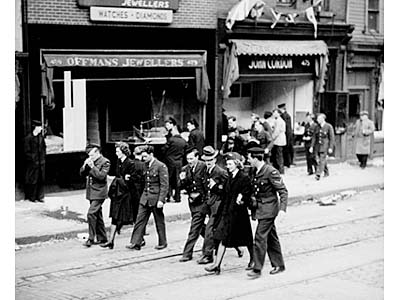
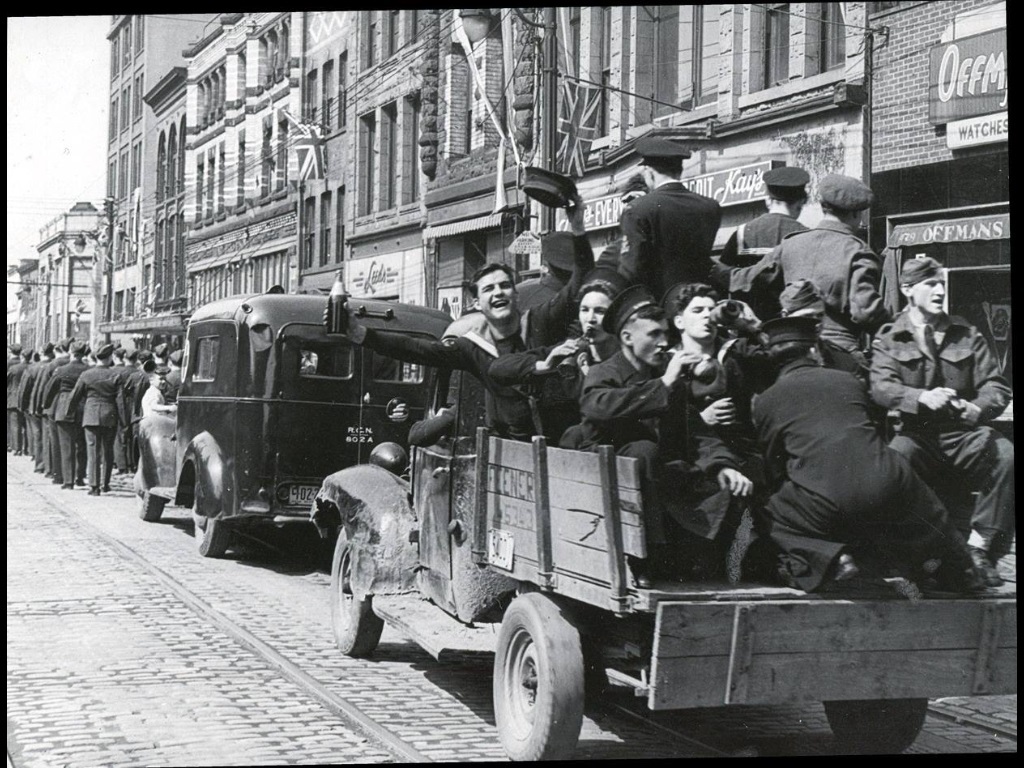
That’s a new photo for me. It is from Halifax’s Victory in Europe Day parade in 1945 apparently before it became the VE Day Riot. Click for more of the photo. I have mentioned the Halifax riot of 1945 somewhere around here but can’t find the link. [Later: here it is.] If you don’t believe things got bad, here is an image of the spot later in the day when the jeweler had been hit by looters.

Why do I mention this? Because above is about 10,000 times how I felt when I saw Nickebrook’s Ontario Wet Hop Ale finally on my local LCBO shelves this morning. I say 10,000 times in the best sense as the guy is clearly ecstatic from the destruction of fascism, the coming years of peace along with the successful defense of freedom. I just found a beer in a store. It is, however, a very good beer. It pours a light greenish-gold. On the nose, a very attractive mix of spicy, bitter and sweet greens. Romaine lettuce, arugula and honey. In the mouth, a light crisp body. More honey with a nip of hoppy heat. Bitterness both on the roof of the mouth and under the tongue. A little lighter finish. Reminds me of one of those confident light white wines in the sense that it makes its case calmly.

Local in the sense of 100% Ontario grown ingredients. Ontario is rather big, however, so you will have to judge what local might mean accordingly. $7.95 for 750ml of 5.3% ale. Unduly tepid praise from the BAers. RBers have a little more sense. PS: a post I wrote in 2006 about wet hop beers.

Some Words For Beer In The NY Times Over Time

image223

Interesting to see that “craft beer” is such a post-2007 term – and one that has never quote achieved the heights that “microbrewery” did in the late 90s. “Gourmet beer” never did nuttin’ for no one. Thank God. Glad to see “good beer” has the staying power that simplicity and accuracy assures. Play this game yourself.

Why Does The NYT Perpetuate A US Craft Fiction?

Stan linked to a NYT opinion piece by Steve Hindy who is correctly identified as “a founder and the president of Brooklyn Brewery and a member of the Brewers Association board of directors.” I think it struck me a little differently from Stan. Consider this:

…state laws continue to empower distributors to select brands and manage them however they want — selling those they choose to sell, while letting other brands sit in their warehouses. The only recourse is to sue, and many small breweries lack even a fraction of the resources needed to take on a big distributor in court. As a result, they’re stuck with the bad distributor, which severely hampers their ability to perform and grow as a business. Buy a small brewer a beer, and pretty soon he or she will be regaling you with war stories about fights with distributors…

See what’s going on? Small brewers. No discussion about the different effect regulations have on actual small brewers compared to big national craft brewers like Brooklyn and the other oft cited Dogfish Head. As the owner of Notch Brewing, Chris Loring, recently shared with Max, the interests of big national craft are very much at odds with the interests of actual small and local breweries. The opinion piece, as would be expected from its source, references nothing of that. Gripes about regulations from state to state are only a burden to those business folk whose aims include 18 wheel transportation and national advertising campaigns.

So, while the title of the bit is “Free Craft Beer!” it really could better be “Unleash The Opportunity For Brewers With Scale!” We know what would happen were this sort of shift to occur. We’ve seen it before. It happened in North America in the 1860s to 1890s. It wasn’t that laws were change so much as the railway established itself. All over Ontario many many small brewers making good beer were crushed when previously local brewers like Labatt and Carling out of the southwestern town of London got their casks out of their towns and into the province, the nation and then the world. Yes, that Labatt and that Carling. Prohibition did not close the breweries. Advantages of scale did. The wiping away of borders and other obstacles did. As you can read in the article “The Canadian Brewing Industry’s Reponse to Prohibition 1874-1916” by Matthew J Bellemy in Brewing History, there were 61 breweries in Ontario at the turn of the twentieth century. There were 49 in 1915 and 23 two years later. The strictest form of temperance law imposed locally came into force in 1916. Historically, it is clear that beer and brewing likes a few things like peace and a good growing season. It also likes oligopoly. Beer responds well to aggregation. We know that because all big beer was once small.

Actual small, local and well made beer is antagonistic to oligopolistic economic forces. Actual small batch beer made by actual small brewers is easily crushed. By perpetuating the idea that there is that one homogenous thing called “craft beer” and “small brewers” we ignore that big commercial brewing enterprises are different. We cover over the fact that intra-national importing brewers moving beer coast to coast in the US like Brooklyn, Dogfish Head, Stone or Sierra Nevada pose as much or a greater danger to actual small brewers than Bud or – what ever is like Bud but not Bud – does. It is not wicked that this is the case… but it is a natural economic force. If you want to live in a world with brewers making good beer in every second town you may want to take what national and now exporting international craft argues with a healthy dose of skepticism. A healthy dose of skepticism actually pairs extremely well with actual small scale, local and good brewing.

Your Sunday Morning 1940s Ontario Beer Update

4501

As Jordan and I wrap up the writing and rewriting of our book on the history of beer in Ontario, it is interesting to go back and revisit stretches I wrote a couple of months ago. Of all the bits in the book from 1610 to today, I had not expected the mid-1900s to be all that thrilling when we signed the publishing contract. Not the case. The pace of social change in the second quarter of the century alone occurring along with the advance of modernity could give you whiplash. Certainly at the heart of that time is the massive fact of World War II but the flow of cultural change was only accelerated by the war. This was reflected in both commercial restructuring of the beer market and shifts in public perception of the role of beer in the community.

Boak and Bailey invited us all to post some long writing this weekend so, in support of an increase in new long writing related to beer and brewing – including new forms of writing – I give you excerpts from a late draft of Ontario Beer: A Heady History of Brewing from the Great Lakes to the Hudson Bay. Final tweeks continue…

**************
In 1927, at the close of the Province’s dalliance with prohibition, Brewers Warehousing Co. Ltd. was founded as a brewers’ distribution co-operative. The provincial government retained control of the sale of wine and spirits through the LCBO, but beer, with its lower alcohol content, could be distributed by the hundreds of mom-and-pop stores. Initially, the brewers were involved only in wholesale operations, jointly warehousing and distributing their product to stores operated by private contractors. But in 1940, the brewers bought out the contractors and took over the stores, changing their name to Brewers Retail Inc. The stores were later renamed, creatively, The Beer Store…

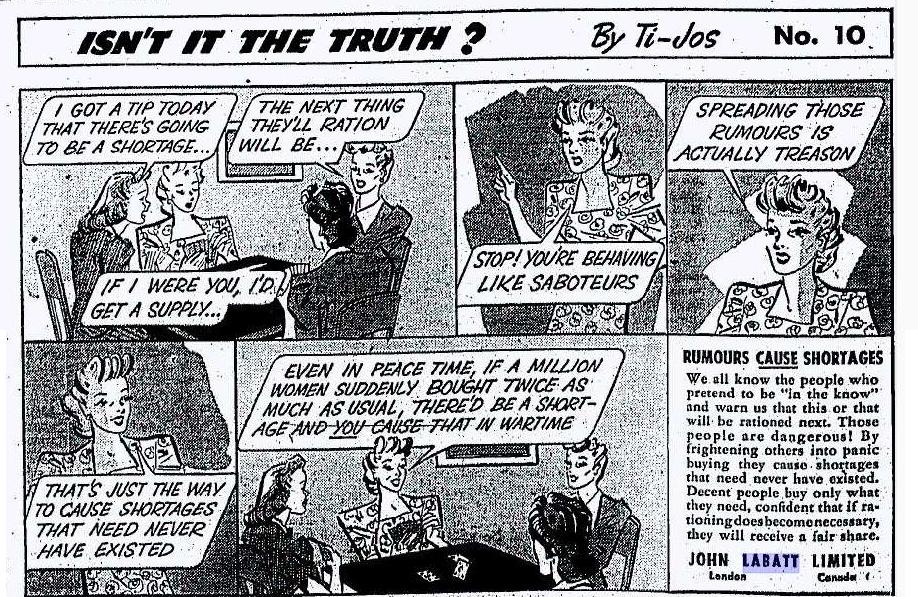
Labatt also took its place in the war effort. In 1943, it was reported that not only were patriotic efforts such as war bond drives undertaken but trucked shipments were moved back to railroads while a trade school for army motor mechanics was operated out of the brewery’s garage. The brewery also ran a series of weekly panel cartoons on good citizenship standards under the title “Isn’t It The Truth by TI-Jos”. Topics included household prudence, supporting price controls, rumour mongering as treason as well as the evils of the black market. In doing so, the brewery clearly was associating itself with middle class as well as patriotic values…

Wartime on the home front changed social attitudes to public beer drinking. Higher employment and earning levels increased disposable income. Hotels serving beer to men and women no longer carried a dangerous air so much as a patriotic one. Increased accommodation for beer sales also served the financial interests of business and governments during the war. Beer sales more than doubled during the war years and the Federal excise tax on each gallon of beer brewed increased by 36%. Further, a difference in the relative level of taxation in Ontario caused a significant shift in drinking patterns to beer from spirits.

Two forces combined to impose upon the expansion of beer sales in the second half of the war: a renewed temperance movement and resource scarcity. Under direction of the Prime Minister Mackenzie King, temperance as a countervailing patriotic theme was promoted causing a public clash between King and EP Taylor. At the same time, the national Wartime Prices and Trade Board imposed a quota system to distribute beer as it would other commodities which created shortages. In March 1943, when Kingston received an increased allocation to reflect troops being stationed there, other communities received a reduction in their share. Overall, a 90% reduction was imposed on beer distribution, beverage room hours were restricted and, as a result, the beer casks were dry when the night shift at the factory ended. Some took to wearing “No Beer – No Bonds” buttons.

After victory was won, the topic in one of the last editions of Labatt’s “Isn’t It The Truth” series was the return of the young soldier to the family home. When mother tells him there’s no rush to get a job, he replies “I’ve been doing a man’s job for four years. Now I am all ready to get going here at home.” Now, Labatt was associating itself with the sort of moral productivity that continued into the post war boom. Life in Ontario was a worth working hard for as well as fighting for. The brewery continued that theme in 1946 in a series of ads asking Ontarians to do all try can to make tourists from the United States feel welcome with hints from “a well-known Ontario hotelman” including that in business dealings, Canada’s reputation for courtesy and fairness “depends on you!”

The new economic opportunities led to changes in Ontario’s brewing industry addressing the need for consolidation and succession in light of financial success. In 1945, Canadian Breweries falls under Argus, E.P. Taylor’s larger holding company. After spending the first years of the war at the top levels of the British effort to maximize production, Taylor had returned home in 1942 exhausted to focus on Canada’s war efforts a member of National boards as well as to prepare for the future of his brewing empire. Well before the war had ended, he had given instructions to have modernization and expansion plans in place for facilities to be ready for brewing in Waterloo, Toronto and Ottawa as soon as the fighting ended. He also moved to secure assets in the malting industry as well as in an American brewery to reduce his exposure to Canadian government policies as he took steps to meet what he believed was a post war boom market for beer.

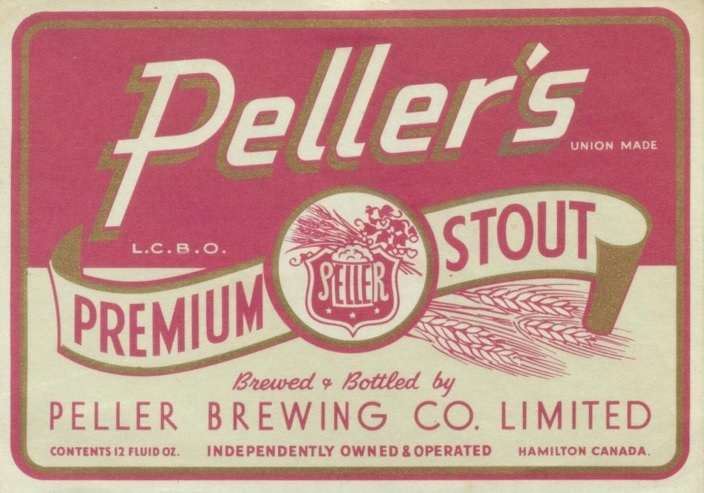
In December 1945, something happened in Ontario that had not occurred for over 30 years. A new brewery opened. The Peller Brewing Company in Hamilton. It was founded by Andrew Peller, a former brewer with the Cosgrove brewery who was backed by Hamilton businessmen. Although it operated independently for only eight years, the bricks and mortar brewing facility he built shows up a few more times in the province’s brewing history. Peller went on to open a daily newspaper in Hamilton that soon failed but moved on to create one of Canada’s first large scale wineries, makers of Baby Duck and Peller Estates brands. In brewing, he is perhaps best remembered for getting around the restriction on advertising by opening an ice company and plastering the brewery’s trucks and ads “Don’t Forget The Peller’s Ice” with the emphasis on the Peller.

The new Liquor Control laws of 1944 and 1947 divided the administrative functions of retailing alcohol from licensing. These changes created the fourth legal regime beer drinking Ontarians had to live with since the beginning of 1927. They represented a further unraveling of the temperance web of control but not an elimination. The LCBO was still able to announce in a publication in that year that there was no reason Ontarians should not be able to buy what they wished if they were law abiding and financially able. It was still the role of authorities to sift who was who. Changes to the law were brought in by another change in provincial government with the Liberals being replaced by the Conservatives of George Drew in 1943. The new laws brought in by Premier Drew sought to distance it from allegations of political patronage in the distribution of licenses and also to respond to public attitudes. In April 1944, a Gallup poll indicated that 73% of Ontarians now rejected any steps toward prohibition.

The brewing industry was interested in public opinion as well. In a private polling undertaken in 1946 and 1947, attitudes of Ontarians were measured related to beer ads in the media as well as the management of breweries and retail outlets for beer. The polling, conducted on behalf of Quebec brewers Molson, captured post war perceptions at a time of further changes to the province’s Liquor Control Act. A drop was noted from 90% to 80% on the question of whether beer was an intoxicating beverage. The shift was even bigger drop for those under 30. A great one-year jump of 40% to 88% was recorded for support for Brewers’ Retail stores with far higher marks for their management compared to hotel beverage rooms.

These opinion polls capture not only post war changes in public attitudes but also changes to the system of selling beer in Ontario which came into force on 1 January 1947. Announced the new further relaxed regulations, Attorney General Leslie Blackwell confirmed that throughout the war years beer consumption more than doubled from 24,000,000 gallons in 1939 to 51,000,000 in 1946. The old rules were described as restrictions which amounted to partial prohibition which were being “disobeyed by increasingly large numbers of otherwise law-abiding citizens.” Apparently the generation that wanted to get to work after fighting the war wanted a beer as well.

The changes in attitudes behind the polling reflects the social leveling that occurred through the years of economic depression followed by years of war. The hand of political influence was no longer an accepted norm. Nor was the moral superiority of your dry betters. Brewers were involved. Labatt was staking a claim for beer as a normal part of life by placing ads in newspapers asking for public support of the St. John’s Ambulance Society, sponsoring events like a UK food drive and organizing safe driving demonstrations at small town Legions…

At the end of the first half of the 20th century, Ontario was undergoing social transition. It was just a few years from the first human rights legislation protecting against discrimination in employment and accommodation. The Progressive Conservative party was still in the early years of a forty-two year run of uninterrupted power. The population of the province expanded over 20% in the 1940s and the economy was booming. E.P. Taylor controlled 50% of the provincial beer market compared to 20% for Labatt. At the century half way point, Ontario’s brewing industry and beer itself was changing to keep up with the race forward.

Quebec Beer-Drinkers Cardiomyopathy?

This article at the CBC.ca website answers a question about a major event in Quebec’s brewing history:

One of the first published reports on cobalt intoxication was in 1967. Called “Quebec beer drinkers’ cardiomyopathy,” doctors described 44 men in their 40s to 60s who were heavy drinkers who died unexpectedly. “There was a suspense element to the story,” recalled cardiologist Dr. Yves Morin of Quebec City. “It took a lot of time and effort to find a cause of the disease.” It turned out the men all drank beer made at the Dow brewery in Quebec City. The brewery had added cobalt to stabilize the beer’s foam.

Here is the actual medical journal from the 1960s on the outbreak. I had heard more about that the brewery had denied responsibility and dumped its inventory in the river than they were putting cobalt in the beer. Cobalt. Yum.

The Many Friends Of John D. Aikens

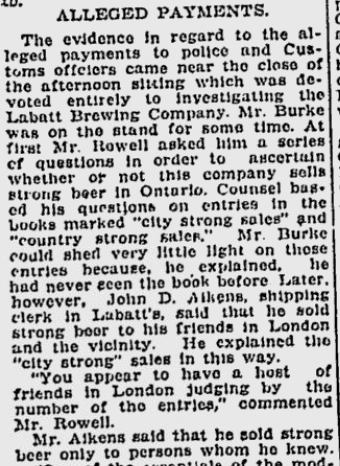
image195Coming to the end of the first draft of the Ontario beer history Jordan and I are writing, I find myself in the spring of 1927 at the Toronto hearings of the Federal Royal Commission on Customs and Excise. Officials from every major brewery in the province are being grilled under cross examination on their business smuggling beer into the United States. The glimpses of honesty through the lies are just good clean fun. When the manager of Carling was asked if they couldn’t make a profit at $1.75 a case, he replied “well, you can’t make a large profit.”

But of all the people in the witness box, I like John D. Aikens best. A shipping clerk, he appeared in the middle of row upon row of owners and business managers. While he cannot claim to be like Washington who never told a lie… he couldn’t tell a good lie. See, while all the others were crafting their tales to place all sales beyond the border and therefore beyond excise taxation, young Aikens tried to make everything better by letting the Royal Commission know he only sold illegal beer to his friends. That’d be OK, right? By the time the legal inquiries and hearings were done, the Supreme Court of Canada found it likely that O’Keefe bootlegged 17% of its production for cash within Ontario. That’s a heck of a lot of friends. And over $420,000 in back taxes.

The Love Song Of J. Alfred Sixpack

A rather swell personal essay about one man’s love of a beer in today’s Globe and Mail:

Then one weekend last spring I was told they were out of Export in six-packs. I tried again the next week. Same story. The third time, the guy they call Red shook his head and said, “Sorry, they are not making it in six-packs anymore. I guess the six-packs aren’t selling very well.” I ordered two six-packs of something else and made my way home. I think I left the store paraphrasing T.S. Eliot’s The Love Song of J. Alfred Prufrock in my mind, “I grow old, I grow old, I still like my beer cold.” I was brooding over whether to switch brands or throw away my aversion to drinks packaged in aluminum. Neither option appealed to a man set in his ways.

I think I am developing a soft spot for big industrial brewing. Maybe not like the guy in the essay but not so far off. See, I am hitting the mid-1900s in the Ontario brewing history that I am writing with Jordan. And I am writing today about how, as might be expected, EP Taylor looked out into the world at the outset of the 1950s and saw nothing but markets and opportunities. In 1952, he buys Quebec’s National Breweries, the company born of consolidations which had first inspired Taylor’s initial plans in 1928. In the same year, Carling Black Label was first brewed under contract in the United Kingdom. In the years that followed he expands operations in the US and buys breweries in Canada’s western provinces. Taking on the challenge, competitor Labatt bought breweries in Manitoba and British Columbia while building a new brewery in Montreal. Their original location in London Ontario also underwent large scale expansion. With the move by Molson into the Ontario market in 1955 with the building of new 300,000 barrel a year brewery on Totonto’s waterfront, the province’s big three brewers which would dominate the next thirty years were established. Whammo.

It’s all so positive and happy. Ontario’s population expands by 20% over the 1940s and the 1950s are pure economic boom. I may not want to drink the stuff that they are brewing but it’s all quite the rush.

Ti-Jos: Something That Won’t Make The Beer Book

itta1

Somethings just won’t make the book on Ontario’s beery history that I am writing with Jordan. I am working my way these days through the period after our version of prohibition ends in 1927 until, roughly, the beginning of microbrews in 1985. Jordan is back there somewhere untangling the Victorians.

This image is one from a regular series of serial cartoons placed in Ontario newspapers by Labatt during WWII under the pen name Ti-Jos. They are obviously patriotic but there is a theme of moral economics that flows through the set. They are set largely in the home or shops but the message is about what citizens need to do on the home front to aid the war effort. In this edition, you better damn well not be spreading rumours if you don’t want shortages.

Which is my message for each of you today, too.