
And Just Like That Here Are The Quite Frosty And Fully Final Beery News Notes For January 2026

It’s been a quiet week in the beer world with distractions aplenty in my real world. Like the Arctic vortex. To be honest, I’ve always preferred the Caribbean vortex whenever it pays a visit.  Thankfully, once upon a time I lived up in the upper Ottawa and have experienced the refreshing zing of -53C so knew enough to break out the heavy tweed and  big boots. Dashing yet completely unable to dash. Elsewhere people are embracing the deep chill as well.  Will Cleveland reporting from Rochester, NY has news of the return a winter beerfest this weekend;

This isn’t a gimmick festival chasing the beer-du-jour; it’s a gathering rooted in the style that got a lot of people into craft beer in the first place—before haze became a default setting and before “imperial” stopped feeling like a warning label… DiCesare remembers the first year clearly, mostly because it was about 10 degrees outside. This year, the ask is similar but the hope is different: dress for the weather, embrace the winter, and lean into the fact that January beer festivals are better when they stop pretending they’re outdoor concerts. Fire pits and outdoor heaters will again be part of the setup, encouraging that specific Rochester ritual of standing outside, beer in hand, nodding knowingly at strangers like, yes, this is happening, and yes, we chose it.

What else has been going on? Well, it was Rrrrrrrabbie Burrrrrns night last Sunday and all around the world folk reacted to the plate of haggis, neeps and tatties set before them. Unless, as Katie M explored in Guts magazine, it perhaps wasn’t really haggis:

Learning how important lungs are to the recipe of a traditional haggis, a vegetarian version seems like sacrilege. The whole point of haggis is that it’s offal, a sausage or boiled pudding made with waste-not, want-not diligence to keep Scots fed throughout the winter and leaner times. The very idea of a vegan haggis is deeply inauthentic—offensive too, if you were to read the comment sections on any clickbait story about the dish. But if you’re appalled, you’re forgetting the accommodating nature of the Scottish people. Do you think my Grandma would have anyone going hungry in her house? The very origins of vegetarian haggis was borne from hospitality…

As the good author noted, the very prayer one prays before we got to the “O what a glorious sight, Warm-reekin, rich!“* includes the line “some hae meat an canna eat…” so there is some authority for this. Is there another dish that so inspires? Speaking of how others live, in the Globe and Mail, Drew Shannon wrote about finding a beer in Kazakhstan:

I broke up with craft beer a long time ago – back when small-brand breweries went from niche and interesting to eye-rollingly ubiquitous. Of all places, I didn’t think I’d run into my beverage-ex in Kazakhstan. I assumed either big conglomerate brands would still dominate the former Soviet state or there’d be no beer at all. Finding a pint in some parts of the Islamic world can lead even the most well-travelled tourist on a fruitless quest. It turns out, I was dead wrong. My impromptu evening of bar-hopping around Almaty, the country’s largest city, started after a long day of trekking the Turgen gorge. On the way back to my hotel, I noticed Privychki Bar. I pushed open the front door to find a gaggle of young Kazakhs perched on vintage armchairs, sipping cloudy pints. 

Mmm… cloudy pints. Never less than clear, Stan, in his concise one paragraph way, directed me to a bit of resurrectionist thinking over the cool corpse that one was Rogue Brewing. How in its haydays it didn’t have managers, it had ambassadors: “That is why Rogue was kicking ass in those days is that felt that they were ambassadors to craft beer.” Yikes. I had a sudden unsettling flashback to the bad old irrational – if not greedy – days of craft and reminded myself of this from 2012:

To hell with that. Passion is that employer of the young who saps their joy for life. Passion offers periodic Google ad cheques in return. It asks you to be the unpaid brand ambassador. On Wednesday night, a intelligent and eager young person suggested to me that my interest in good beer was pure passion with a certain honest excitement. I took the time to gently crush that moment like a mouse under my heel. It was information, I said. Information and interest. Passion? I have children for that. 

The children? They are 14 years older now and each of an age when they might be expected to buy the beer as much as have it bought for them. I trust that now not-so-young person has found another moe successful career – and that’s probably for the best for all.

Note #1: Twenty years of Ron!
Note #2: Maureen asks … in the end… is a brewery just its trademark?
Note #3: Stout-flation strikes.

Heavens! I missed the news when The Beer Nut issued a new beer style alert right around when the update when to the presses last week. He was reporting from the front lines of recent holidaying where and when he encountered:

… the rarely-seen style of imperial sweet potato amber, and I had no idea what that was likely to mean. Beniaka is 7% ABV and a cola brown colour in the glass. Although fizzy, it’s plenty thick and feels luxuriously “imperial”. Can’t say I tasted much potato, but there’s a pleasant woody spice: nutmeg, sassafras and liquorice. It’s fairly sweet with it, showing a little Scotch-ale-style toffee, with the herbs helping balance it. This is interesting, with lots happening, but it’s not a daft novelty, and makes for a very civilised digestif.

Not at all in response, Sophie Arundel was given a fun topic over at the Drinks Business – the dead end trends of 2025:

Several alcohol formats once framed around lighter, functional or lifestyle-led positioning are now in sharp decline. Hard kombucha now holds a 0% share of social discussion, down 29.8% year on year. Hard tea has slipped to a 0.01% share, falling 33.79%, while hard seltzer sits at 0.02% share, down 33.67%. The contraction extends beyond these formats. Craft beer, often seen as culturally resilient, is down 16.52% year on year with a 0.84% share, while generic IPA beer has fallen 17.28% to a 0.38% share. Tastewise’s data suggests the broader “better-for-you drinking” narrative is losing attention. Products that relied heavily on pseudo-functional positioning are struggling to maintain relevance, pointing to a need for clearer occasions, flavour-led propositions and tighter ranges.

(“Pseudo-functional” was the name of my folk-punk band back in ’93.) At least craft beer fans can take comfort that their drug of choice is going better than hard kombucha. There are still some hangers on that are telling craft to repeat its errors… but it is true, isn’t it – when things are going down the proverbial shitter, not one really is working to improve so much as find themselves quite happy to tread water.** Perhaps coversely, BMIs seems to be seeing at least a stall in the slide when it comes to US beer:

NBWA released its Beer Purchaser’s Index reading for Jan early touting a “significant bump” from December. After 5 mos in a row of readings below 30 (including several lowest ever around 25), BPI jumped to 39 in January. Not exactly great shakes, and 9 points below Jan 25, but still 14 points better than Dec 25. (Recall, BPI below 50 suggests beer distrib orders are contracting, while above 50 signals expansion.) 

So less of the lessening perhaps. But in western Canada, there was actually an increase in beer sales through 2025. So who knows! Well, at least we know one thing. I think we have established that not being very profitable at all is actually not a good business plan:

BrewDog has announced that it is closing down its Aberdeenshire distillery and ceasing production on all spirits. The craft beer company said it had decided to abandon its state-of-the-art distillery, which opened in 2016, and axe the brands after “careful consideration”. The move comes after the company posted losses of £37m in 2024 and announced job cuts across the business, including at its head office and brewery in Ellon.

Conversely (at least in San Francisco) not doing well enough to even attract a proper buyer can have its advantages:

During that massive blackout on December 20, every business but one in the Lower Haight had to shut its doors because they had no power. That one would be Toronado, which still uses an old-timey, non-electrical cash register with punch buttons and a hand crank, still takes only cash, and beer taps don’t require electricity. Cheers to ancient technologies. The story was left hanging last summer after a new crypto-bro owner had stepped in looking to take over the bar — and launch a Toronado-themed coin! — and after that deal appeared to be in jeopardy once longtime owner Dave Keene discovered these details and looked to cancel the deal. But SFist can confirm now that the deal was, indeed, canceled, and everything remains as it was at the bar.

That’s nice. Unless the owners really hate the place and want to move on I suppose. Can you own an iconic institution that people flock to and really hate it?  If someone does something well I would hope that there is joy in the doing.

Note #4: The many beards of Polk.
Note #5
: What friends of beer writers think they do…
Note #6: …all day long…

Joy in doing? That’s a bit like this week’s feature in Pellicle by Imran Rahman-Jones about the making of liquor from what’s to be found right there in Edinburgh’s urban orchard:

As Chris continued to tweak his distillations, and source new apples for each batch, he began to reflect on the fruit’s beguiling quality. “[There’s] something quite magic about an apple tree in the street,” he says. Neighbours will leave out boxes of fruit for one another, or swap recipes. “It tends to pull the whole street together at a certain time of year.” What Chris didn’t know when he started the process of developing Pochle was that he was tapping into a lineage going back centuries in Scotland. The enchanting ability of an apple tree to gather and unify in fact has deep roots in the country’s traditions and folklore. 

Lots to like there. And just look at the people working to get that bit of writing onto your screen. The fine folk keeping Pellicle going, the author Imran Rahman-Jones, the semi-sticky handed Chris Miles who gathers and also those who let the foragers be – not to mention those who planted and tended to the apple trees. Doing is a wonderful thing.***

And on that very subject – the doing of things – Boak and Bailey were out there again in their monthly newsletter for January doing a great job encouraging more writing about beer. What to write about:

There are local drinking customs and cultures that probably seem unremarkable to people who know them but which would interest people like us. Flat Bristol Bass is one that fascinates us but there must be others all round the country, and certainly around the world. Alex, our favourite beer blogger of 2025, goes to three pubs and writes about what he sees going on there. Adrian Tierney-Jones (a pro, not a blogger) takes a similar approach. Now, you could write tasting notes of every beer you drink but, honestly, that’s probably the hardest thing to make interesting – unless you are a skilled, creative, and/or amusing writer like The Beer Nut. It can still work if your tasting notes find a theme or tell a story, though.

Do it! I like it – but do note that “blogger” and “pro” are not comparable categories and neither term speaks all that much to the quality of the writing. “Pro” is code for paid writing which can be compromised even just by editorial restrictions**** though, more to the point, too often not all that good. And “blogger” is a reference to a class of medium, not a sign of quality of the writing and not necessarily code for an amateur though some of the best beer writing is actually provided by people who earn their living otherwise. Ray and Jess themselves are proof of that. Better to think of adjectives like interesting, inventive or even valuable when weighing the cred. Then notice where they don’t apply!

I would also add, don’t worry too much… unlike Mikey Seay who has shared what strikes me as quite an odd thought:

I always shy away from reviewing beers for two reasons:
– Lack of skill to do it properly.
– Beers can be too regional to make a review relevant to a global newsletter audience.
That said, I feel a new beer from Sierra Nevada is available enough in most places to make it worthwhile to mention.

Seeing as thinking and writing about your taste perceptions takes about as much skill as running a vacuum cleaner, I don’t think this is a particularly useful standard. But then again you may be crap at vacuuming, too. Do you worry about that? Just type. Be patient and get those keyboards clicking. It’s a lot like planting a seed and also, if nothing else, it’s good for the knuckles.

Where will it take you, all this clickery? Well, as we wrap up this week on the note of the haute in beer writing, this is your final call for a fully self-funded trip to Bordeaux in June:

This is the FINAL REMINDER about the 2026 Beeronomics Conference, which will take place at ESSCA School of Management, Bordeaux, France, 24-27 June. Main panels and sessions will be held at the ESSCA Bordeaux Campus. The Conference Organising Committee, led by Gabriel Weber and Maik Huettinger, welcomes all high-quality research on the economics of beer and brewing. 

The deadline for submissing an abstract is Sunday. Send me a card. Fine. Fin. As I said, a bit of a quiet week. please check out Boak and Bailey who are posting every Saturday and adding to their fabulously entertaining footnotes week after week at Patreon. And look out for more of Stan’s new “One Link, One Paragraph” format. Then hunt out something in someone’s archives! Leave oblique comments on someone’s post from 2009!! Listen to a few of Lew’s podcasts and get your emailed issue of Episodes of my Pub Life by David Jesudason on certain Fridays. And Phil Mellows is at the BritishBeerBreaks. Once a month, as noted, Will Hawkes issues his London Beer City newsletter and do sign up for Katie’s wonderful self-governing totes autonomous website featuring The Gulp, too.  Ben’s Beer and Badword seems to be on pause since November but there is reading at The Glass which is going back to being a blog. Any more? We have Ontario’s own A Quick Beer and All About Beer is still offering a range of podcasts – and there’s also Mike Seay’s The Perfect Pour. Plus follow the venerable Full Pint podcast! And there’s the Craft Beer Channel on Youtube. Check out the archives of the Beer Ladies Podcast.

*Just in case someone out there never had a tea towel.
**No, smoothies will not save brewing.
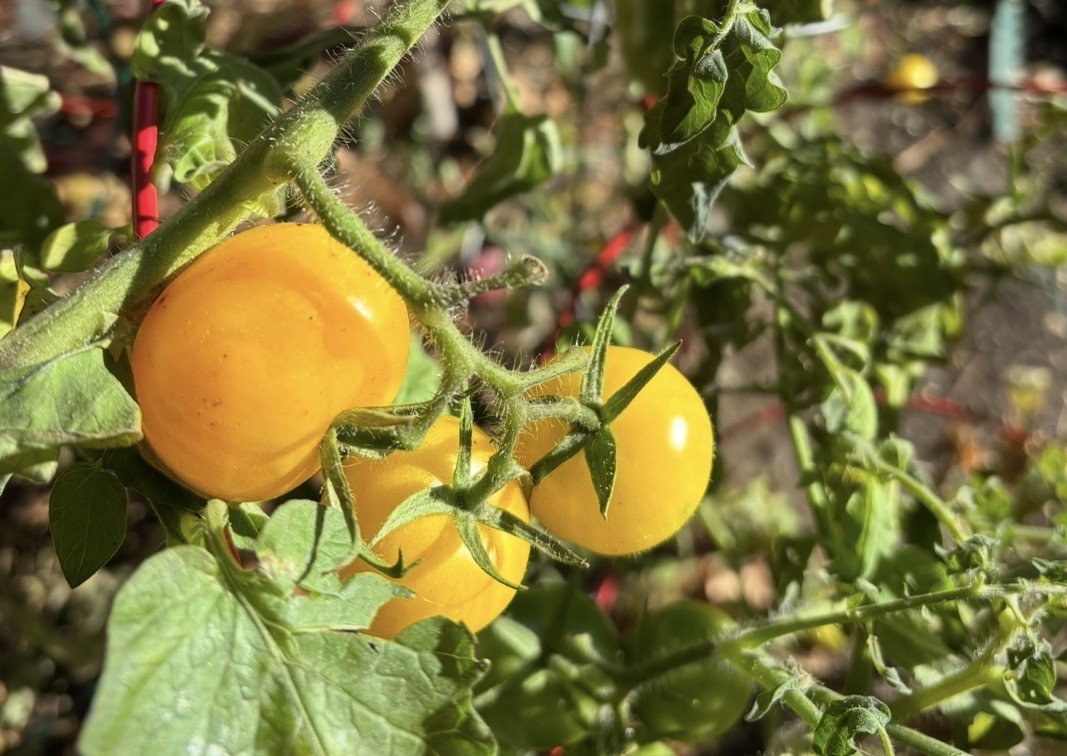
***This is your reminder that now is the time to start planting those seeds for your own garden. Seeds and soil and time. Have a go. This tomato from last November’s final harvest was from a seed planted in my basement in February. Easy. Almost as easy as typing. 
****“It’s only a trade mag article…” is as often much the case.
Your Festive Beery News Notes For A Blursday In This Jolly Hollifest

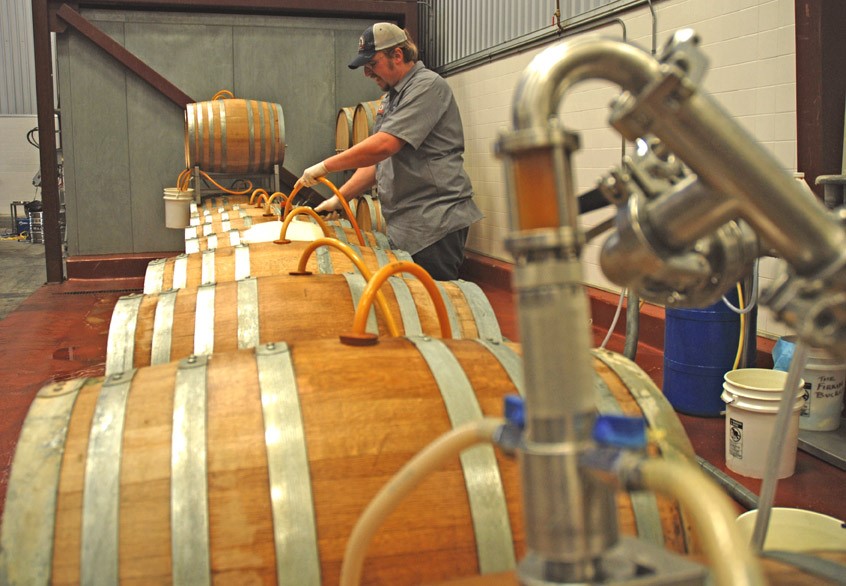
What day is it? I think I can still recall. It’s definitely somewhere between the last parcel being mailed and 2026. I know that much. I also know that in 2009 one Stan Hieronymus, possibly barely out of his teens at the time, submitted this photo above as one of his entries in the Christmas photo context. I will say one thing about a beer photo contest – if you don’t like your range of browns you might as well admit that you should never run one. Like the other contest submissions I have been posting out of the archives the last few weeks, I am pretty sure this one didn’t win a prize – but have you ever seen a better placement of a five gallon white food service bucket? No. Come to think of it, do you ever give a second thought for the glorious role of the five gallon food service bucket in all of brewing? Stan did. For one beautiful moment, he sure did.

Let’s get to the beer news. First up, another controversy related to booze and the ticker:

…the American Heart Association has revived the idea in a scientific review that is drawing intense criticism, setting off a new round of debate about alcohol consumption. The paper, which sought to summarize the latest research and was aimed at practicing cardiologists, concluded that light drinking — one to two drinks a day — posed no risk for coronary disease, stroke, sudden death and possibly heart failure, and may even reduce the risk of developing these conditions.

Before you go off to the Christmas office party with the thought that it’s really not all that far off a visit to a health spa, remember the critics’ warnings about the quality of all these sorts of studies: “Some are clearly horrible, some are good, but a lot are in the gray zone, and people may just cherry-pick and select those that agree more with their narrative.” Hah! So there…

Speaking of the office party at this time of year, the very same authoritative organ shared a bit of advice about conduct at office parties for the supervisory set:

It’s a good idea to stop after two drinks. Sure, you could have three drinks — or six! — and enjoy the social leveling and bonhomie that accompanies lowered inhibition and decreased cognitive capacity. But it’s hard to command respect in the office when people have seen you red-faced and trying to light a cigarette from the filter. 

Is it unfair to compare today to forty or so years ago? The (other) Times did this week when they republished a guide called “How to Survive Christmas” from 1986:

Commuting in the run-up to Christmas is absolute murder. On the way home from a hard day’s work you are liable to find everyone either festively drunk or helping someone else to be sick. Then there’s the office party. People will drink far too much, lunge at one another, tell the managing director he’s a twerp and pour the office vegan’s sprout wine down the word processor to cackles of mirth. How do susceptible males stay out of trouble at the office party? One friend suggests that offices should introduce Tube straps hanging from the ceiling. Thus you could remain vertical however much you knocked back, but with one hand in the strap and the other clutching your glass, both would be kept out of mischief.

Good idea. While it appears that thirty-nine years have passed since that was published, it’s clear ther are still bad behaviours that need to be stamped out at this Holly Jolly time of year, as Pete reports from the pub:

Black Friday has a different meaning in the hospitality industry. It’s not the consumer frenzy of late November, it’s the last Friday before Christmas. This is the night when post-work drinks climax in a frenzy of ill-advised shots and poorly judged flirting. For pubs, it’s one of the busiest nights of the year.

And then he gives ten rules, many of which would be enough to deter me from going to the pub. No line? Never have liked that when visting the fam. How un-Canadian! Give me a good line any day. But “no ordering a round of cocktails“? Perfect sense. No playing your crap music off your phone? Automatic ejection, I say.

Speaking of bad behaviour, I missed this tale of sticky fingers a few weeks ago but I will share it now as this could end up being quite the thing… perhaps quite the thing indeed:

Molson Canada has accused former managers of embezzling millions of dollars in an intricate fraud scheme allegedly involving fake vendors, shell companies, the president of a major pub chain and a pair of married couples. In documents filed Wednesday in Ontario Superior Court, the brewing giant claimed that former Molson Canada sales director Frank Ivankovic oversaw “a complex scheme to defraud the company of many millions of dollars” that later involved two subordinates.

Holy crap! Gotta watch that story. You may scoff at the very thought but I will share a fact that is actually true – I had a personal banking representative many years ago who made a very tidy sums on false mortgage accounts until the scam was uncovered. As this situation at Molson is reportedly both complex and intricate, I am spellbound and await further disclosures from any and all court processes.

Speaking of people who can’t tell their left pocket from their right one, in the land of Vinho Verde the police have had to get involved:

Those arrested from the trade body, which is responsible for quality control and official certification of Vinho Verde wines, belong to its Inspection and Control Division, with the individuals arrested for allegedly warning wineries of upcoming inspections and accepting bribes of meals, wine and event tickets. According to Portuguese newspaper Jornal de Notícias, the officials also allegedly turned a blind eye to wine producers failing to meet the requirements to obtain designation of origin (DO) or geographical indication (IG) certification to be able to label their bottles as Vinho Verde…  Meanwhile, a further four “business owners involved in the distribution and production of Vinho Verde” – have also been arrested, charged with “active and passive corruption, falsification of documents and abuse of power”.

Doce mãe de deus!!!  Fiddling with the Vinho Verde!?! That has been a mainstay in my life for around forty-five years, starting with my mother’s micro-obsession with the plonky version. Not unrelatedly as it turns out, Lars found some dirt about law scoff doing a little farmhouse brewing in Japan, news that he shared on BlueSky:

The Japanese are less law-abiding than I thought: farmhouse sake brewing continued despite the legal ban. In 1941 folklorists surveyed 85 localities, finding home brewing in 44 of them…  In 1895 there were 1 million home brewing licenses in total. So Japan definitely had farmhouse brewing of sake. Then in 1886 the gov’t banned home brewing entirely. Probably killed the farmhouse brewing. Home brewing is still illegal in Japan (gov’t wants its alcohol taxes), but in 2003 one exception was made: farms using their own rice are allowed to brew. This kind of sake is called “doburoku”. There are now 100 designated doburoku districts where this style exists.

That could make for something very interesting, a doburoku tour… doburoku tour… doburoku… WAKE UP!!! Sorry. Now… some notes:

Note #1: “only 37 percent of craft breweries in Canada are profitable”? Really? That’s a lot of subsidization.
Note #2: Who the hell pours Bailey’s down the sink?
Note#3: A.I. designed beer? Nope, couldn’t care less…

Aaaaannnnnd… the BA issued a somewhat delicately drafted “year in review” type press release suited to both address and deflect the industry’s annus horribilis and, I gotta tell ya, I sorta choked on what is stated to be the top trend:

This year, there was a continued democratization and expansion of what it means to be a “brewer.” With acquisitions, mergers, and collaborations, the stainless tanks in the background may not be as important as the brand story.

As one who has never given a shit about the story someone is telling about a brewery, I think if I were an actual brewer I might consider this statement slightly, you know, treachery if not treasonous. But it is nice to know that, finally, years after the BA’s abandoning the need to be small or traditional or independent it’s now not even necessary to be an actual brewer.

Much more reliable was the annual release of the Golden Pints 2025 awards from Boak and Bailey which starts with this introduction to the concept.

What can we say? Hardly anybody else bothers doing this anymore but we’re creatures of habit. We first took part in the Golden Pints back in 2011 and find it a pleasingly reassuring ritual. It’s also good to have in mind throughout the year as we roam from town to town, and from pub to pub. It makes us look at the beer we’re drinking and ask: “Could this be a contender?” Before we get down to business, a bit of encouragement: nobody owns the Golden Pints thing; anyone can join in; you don’t even need a blog to take part. Post your own list on social media as a thread, or even in the comments on this post if you like.

I won’t ruin the announcement of their winners – but what I like about the whole Golden Pints idea is that it celebrates their winners. Was it started by the late great Simon Johnson? He posted his thoughts in 2010, 2011 and 2012 but perhaps it goes back further. Yes, Mark Dredge awarded them in 2009 and even cited his own pre-GP “best of” post of 2008. Who was his best beer Twitterer of 2009? Simon Johnson! Who else? Anyway, you can check out the examples new and old and figure out your own summary of the year according to your own standards.

In another annual year end tradition, Alistair has begun to announce his beers of the year, style by style. His first post celebrates the pale based on three footprints – state, national and imports:

It’s that time of the year, the Winter Solstice is upon us, and what better to do than to review a year’s worth of drinking? As has become my own tradition, I will break this down into multiple posts, one for pale beer, one for BOAB (“between orange and brown”, and dark, and then an overall beer of the year, as well as one for Virginia cider of the year. As I have done for several years now, I will highlight beers from Virginia, the rest of the US, and the rest of the world before crowning each category winner, so on with the show…

I liked this comment: “Spoolboy, the most perfect desítka imaginable, and one that I wish I could sit and drink with Evan, Max, and co back in Prague.” That would be a good table to join.

Over at Pellicle, Robyn Gilmour shared the story of an innovation in Dublin’s beer scene:

…the beer that’s consumed in the majority of Irish pubs isn’t even Irish, with the exception, perhaps, of Guinness, Murphy’s, Beamish, and a handful of other outliers that are brewed locally but owned by foreign multinationals. While treasured in Ireland, these brands do not represent the full spectrum of the country’s beer, which is far more nuanced and varied than most pub offerings would suggest. Speak to anyone working in the independent Irish brewing sector and they’ll soon tell you about the savage competition for taps in Ireland—primarily between Diageo, Heineken, and Molson Coors. As someone who’s worked with many of these smaller breweries, I’ll admit I never had prior reason to question where publicans fitted into this dynamic. That was until 2024, when 16 of Dublin’s most cherished pubs banded together to form a brewery of their own—the aptly named Changing Times.

Finally, David shared his thoughts on language and alcohol promotion, thoughts based on serious personal experience:

…this kind of communication is terrible in the run up to Christmas when more people are tempted into drink driving despite the messaging. Recalling the trauma caused by my dad drink driving was bad enough but only days later I was forced into recollecting my flatmate’s attempted suicide when BrewDog ran an advertising campaign with the slogan “tastes like commercial suicide”. 

As I mentioned a few weeks ago, much of my experience with drunk driving was from an earlier stage in my professional career as a duty criminal defence counsel processing those passing before the court for judgement. But I also lost a client of our office every year to a drunk driver in those years, too. And I probably have to admit that up to a certain point growing up in Nova Scotia in the 1970s and 80s, drunk driving was so common there was an inevitable even blasé attititude to the tragic harms done. There were so many Mondays that someone was not at their locker. So I don’t buy arguments that there is a risk reward sweet spot in these matters. The vast sums that the booze trade offers do not offset the loss.

And that may sound like a bummer of a way to end the news notes for the lead up to Christmas but this is a high danger zone within the calendar for drunk driving and other forms of harmful behaviours. So be thoughtful and be safe as you do about the holiday partying in these next few weeks. Maybe think of what else can be done that is as helpful as a London Underground strap hanging from the ceiling to make sure the season actually remains jolly.

As you contemplate that, please also check out, Boak and Bailey on this and every Saturday and then sign up for their entertaining footnotes, too. Look out for Stan when he feels the urge (now that he’s “retired” from beery news posts) from Budapest or wherever – as he is getting active again. Then listen to a few of Lew’s podcasts and get your emailed issue of Episodes of my Pub Life by David Jesudason on certain Fridays. And Phil Mellows is at the BritishBeerBreaks. Once a month, as noted, Will Hawkes issues his London Beer City newsletter and do sign up for Katie’s wonderful self-governing totes autonomous website featuring The Gulp, too.  Ben’s Beer and Badword has returned from his break since April so you can embrace the sweary Mary! There is reading at The Glass which is going back to being a blog. Any more? We have Ontario’s own A Quick Beer and All About Beer is still offering a range of podcasts – and there’s also Mike Seay’s The Perfect Pour. Plus follow the venerable Full Pint podcast! And there’s the Craft Beer Channel on Youtube. Check out the archives of the Beer Ladies Podcast.


The Beery News Notes For The Threat Of Frost And The Yanks And Jays In What Might Just Be A Post-Passion World

Well, since we last met… yes, fine… the Red Sox lost last Thursday. But then the Yankees (who beat the Sox… my Sox) got their own butts kicked in the first two games of the next series by the Jays who took it all in game four last night which… sorta made me feel… schadenfreudig? Is that the word? I dunno. Or is it dünno? Anyway, the other word on my mind is frost. I will only know at sunrise this Thursday morning if the sheets and covers that I threw over the tomatoes and basil and beans did the job. (Update: -0.3C at 6 am!) But it is autumn. And it doesn’t matter if there is no frost for the two weeks after today if the frost came today. Most years, with luck, I can coax something or another to keep on growing right up to November. With luck.

Speaking of words, on Tuesday Jeff wrote about the doom and gloom in the beer trade, reviving some thoughts from 2013 as he did – a discussion in one way about perceptions that the choice of words convey as much as the context. The context being if one is on the way up or the way down. This week’s news notes seem to carry a bit of the weight of those sorts of perceptions so I feel like this sort of preamble is needed to remind ourselves that it’s just the point in time we find ourselves in. We need to reflect. To consider our lot. Sorta how I feel when I look at the black leaves of a tomato patch after a killing frost. When I reflect. And swear a little. So I will perhaps a bit intentionally mix the bad news with some things that are lighter and see what happens. Good thing there’s plenty to read.

First, about that cyberattack* in Japan on Asahi that I mentioned last week. It seems that it has been resolved but I hadn’t appreciated how it create quite serious issues for the broader Japanese bevvy and snacking market:

Most of the Asahi Group’s factories in Japan were brought to a standstill after the attack hit its ordering and delivering systems on Monday. Major Japanese retailers, including 7-Eleven and FamilyMart, have now warned customers to expect shortages of Asahi products… Asahi is the biggest brewer in Japan, but it also makes soft drinks and food products, as well as supplying own-brand goods to other retailers… In its latest statement, Asahi said that as a result of containment measures following the attack, ordering and shipment systems in Japan had been affected and it was also unable to receive emails from external sources.

Speaking of containment, consider Mr. Gladman on two types of entryways to basement bars and how their architecture guides the experience:

The street-steps-door type of basement bar usually has windows somewhere on its street-facing wall and so maintains a connection to the city outside (Type A Basement Bar in the Gladman Taxonomy of Bars…)  Bars like this can be hard to find even if you know about them… It’s a tiny adventure that ends with a delicious reward. These bars are often unpretentious and cosy — everyone is hunkered down together, hidden away in a prime spot, unnoticed by the schmoes passing by just a few feet above. The other, street-door-steps type of basement bar (Type B) is even more concealed at street level, often offering just a small sign above a door. Within this lurks a clipboard-wielding, radio-headset-wearing guardian, like Cerberus at the gates to a boozy underworld. Once you’re in, it’s often entirely devoid of natural light. It is its own world, womb-like and all encompassing.

Not so many people walking down these sorts of steps in Brazil – both Type A and B – which is reasonable given the news:

…the market has a new worry: the crisis caused by contamination of distilled beverages with methanol. For now, it’s not possible to determine the impact of this on the beer industry going forward. On the one hand, bars are emptier and parties have been canceled due to the negative repercussions of the contamination. On the other hand, greater consumer concern about cocktails has led to a strong shift toward beer, seen as safer.

My dive bar tourist trip to Rio is now officially cancelled. But more weclome might be a stop at The Dog and Bell in Deptford, London which is the subject of this week’s feature in Pellicle penned… or perhaps rather keyboard clicked by Will Hawkes:

This backstreet boozer in a historically unglamorous part of town has not only survived the pub cull of the past few decades, it has thrived. Indeed, few London pubs are currently more fashionable. How? Well, for all the Dog and Bell’s singularity, its story tracks the evolution of pubs in modern London from the 1970s, when they were ubiquitous, to now, our frantic, distracting era of Instagram Guinness and event culture, when a simple pint in the pub is no longer good enough reason to get off the sofa. It’s been a long journey, but at every key junction over the past 50 years this charismatic pub has taken the right turn. 

A loving portrait of a welcome local and perhaps unexpected gem. Conversely, I don’t expect to be following in the footsteps of  Jason Wilson who brought an extreme level of exactitude to the consideration of an extremely expensive beverage – coffee that costs $30,000 a kilo:

Each sip I tried—and we were served small sips because of the limited amount of this coffee—had its own personality. Each producer and variety had a different flavor profile, mouthfeel, aroma, even color. While some may regard coffee tastings like this one as snobby or ridiculous, I appreciate the intense mindfulness and attention to detail coffee fanatics have. In one sip of coffee, there are flowers, fruits, foods, and even songs. I tried each of them for myself, then read the judge descriptions from the Best of Panama auction to compare thoughts. Some may disagree, but I try to treat it as if there is no right and wrong, just opinions.

And, speaking of opinions, Boak and Bailey posted a bit of a questionaire on the status of Belgian beer culture, asking folk for their thoughts about whether the beers and pubs they encountered on a recent trip were (my words) out of date duds or treasures at risk:

There’s also something about how the beers we tried on this recent trip didn’t seem to have evolved from Belgian brewing tradition so much as they were inspired directly by American-led homebrewing culture. It’s really weird to drink a Belgian-brewed saison and think, huh, this tastes like one of those ‘farmhouse IPAs’ people were making back home in about 2012. When we think of newer Belgian breweries we do like, it’s because they’ve found a way to push the parameters while still producing beer that tastes and feels Belgian.

This generous sort of the asking of the questions is a very useful tool of one is wanting to advance one’s education. Seek the views of others to check your own assumptions. Among the responses, the particularly well-placed Eoghan provided a lot of insight from the local point of view:

I don’t disagree that Belgium has one of the richest and most diverse beer cultures in Europe, and it is a small miracle that so many idiosyncratic beer traditions managed to survive the tumultuous 20th century – more tumultuous here in Belgium than they maybe allow for. But it was their proposition that Belgian beer culture is defined by evolution not revolution that prompted my little piece of anachronistic time travel above. It is true that Belgian brewers – to borrow an idea I first stole from fellow Belgophile Joe Stange – are past masters at co-opting and finetuning wider brewing trends to make them palatable in Belgium. My contention is, however, that the history of Belgian beer is more of a Hegelian dialectic, a process of thesis-antithesis-synthesis evidenced less by evolution that by periods of stability punctuated by significant, discombobulating ruptures.

See, that is great. Fascinating – and I don’t even know what half of that up there means! Another thing I don’t know is whether a Spanish beer brewed in Britian in a British brewery owned by a Spanish brewing firm is Spanish or not:

This week Damm will make its first meaningful manufacturing foray outside Iberia when it opens a brewery in Bedford. The move represents an investment of almost €100 million (£87 million) and will create scores of jobs. The company is going to great lengths to ensure its UK-brewed beers taste the same as those made in Barcelona by sticking to the original recipe and investing in the equipment to ensure the product is identical.

Hmm… I still don’t know. But if we are sticking with the examination of not only how things became what that are but also what are these things in themselves, there is no better assessor than The Beer Nut who wrote about the recent final edition of the annual Borefts beerfest:

Two brewery stands at the 2025 Borefts Beer Festival seemed to have almost continuous queues. One of them I could understand: the New England legend Hill Farmstead. Early on day one I tried the barrel-aged coffee porter they brought, The Birth of Tragedy… This isn’t the sort of beer I associate with Hill Farmstead but it has been created with the same level of expertise. Canadian brewery Badlands was next to them and was, if anything, even more popular with the crowds. I had never heard of them so had no idea what the fuss was about. After they sold out and closed up early on the first day, I made sure to be there early on the second… [After trying two of their beers…] I was none the wiser regarding the Badlands fuss. They didn’t seem to be doing things particularly different to a thousand other microbreweries..

So, there you have both broader analysis of the cultures of beer as well as specific examination of each beer, drip by drip in the common context of the fest. All cheery and interesting exercises in digging around and thinking about beer. David Jesudason dug into another chestnut for the Wine & Spirit Education Trust, unpacking what’s called IPA but what he calls “IPA”:

The first ‘IPAs’ – note quotation marks – were sent out on East India Company boats in the 1760s and were strong, highly hopped ales due to India’s warm climate: the hops’ antimicrobial properties combined with the high alcohol level aimed to prevent spoilage. These were a cross between a bitter and a barleywine and by the time they arrived in India the hop character had vanished into the Bay of Bengal. They were said to taste more like champagne than beer. In reality, they were a world away from a modern IPA. Samuel Allsopp was the first to market them as Indian Pale Ales – and tie them to colonial decadence – after he copied Londoner George Hodgson’s recipe but crucially brewed them in Burton, where the minerals in the water further emphasized the beer’s hop character. These were bitter British ales or similar to heavily hopped autumn stock beers.

And Laura Hadland took on a task that I wish more writers who focus on beer attempt – discussing wine:

The lights were low for a chic soiree organised by Wines of Hungary at Vagabond Wines in Birmingham yesterday. Twenty five producers were showcasing their wines to an enthused audience of trade, media and more. I had an hour to work my way round the hit list that I had prepared in advance – nowhere near enough time. Especially since the winemakers and their sales teams were so enthusiastic about their wares that they all insisted on having us try every single one.

My experience of Hungarian wine started with some pretty hefty even harsh Bulls Blood out by the town’s water resevoir in high school but I now hoard sweet Tokaji which I never seem to get around to opening as fast as I find them. Of course, that means my wake might be worth the trip as my fam gives them away along with my record collection.

ATJ shared more serious thoughts on mortality in his piece “Funeral Pints” where the swirling thoughts at a time of loss were steadied with gratitude by a bracing pint among others in a pub:

The clunk of loose change as it goes into a pitcher, ‘thank you very much William’, ‘not a problem’, a stooped man with a face that reminds me of a thinner version of WC Fields.’ ‘Here he is.’ ‘He ain’t got a jacket.’ ‘What’s it to you,’ comes the reply. ‘He was dressed up as a boy scout yesterday,’ says another voice. The man with the long face who photographed his breakfast is having a talk with himself, while elsewhere pints are piling up on tables. Tattoos, chewing, chomping, swallowing, gulping, laughing, ‘listen mate’, finger pointed without malice. We’d better get to the funeral.

The drink finds a place in so many moments. And does the job. Even now at a time which we are subject to so much that feels like wave upon wave of a grim big picture, like this data* from Beer Marketers’ Insights:

Craft beer trends (ex non-alc) steepened over the summer to volume -8.4% and $$ -6.4%; several pts below total beer volume -5.6% and $$ down 5.1% for 18 wks thru Sep 20 vs yr ago. And when comparing craft’s yr-to-date sales thru Sep 20 vs the same period in 2023, the # of craft vendors (-10%), sub-brands (-13%) and SKUs (-12.5%) are all down double digits.**

From that view of the general, for the double, Jeff also wrote on a specific application in his obit* of Upright, a favourite brewery facing its end:

Craft brewing has spent a huge amount of time navel-gazing over what it means to have a clear vision. This often bled into marketing bromides, as breweries repackaged derivative products as original and creative. That development led to some of the cynicism that marks the mood today. Upright did have a clear vision, however—and Alex seemed almost immune to commercial considerations. Upright always felt more like a sixth-generation Belgian or Franconian brewery than an American craft brewery to me.

A wonderful remembrance of the soon to be no more. Summing up based on all the above, can we draw conclusions? Well we could ask ourselves (yet again*) whether the function of good beer writing to support the industry or to more broadly understand the trade and culture. By way of illustration, consider this:

“…The Guild’s board members are all driven by our shared passion for the beer industry and those who work within it. We’re proud to represent the very best of beer and cider communicators, who are such an important asset to the wider industry…”

A familiar line that’s become cliché and so nothing against the particular speaker. A prominant popular theme voiced for the best part of two decades, perhaps until somewhat recently. I mention that in the context of this article in The New York Times which is, yes, yet another obit* for US craft beer but, perhaps unusually, one that contains some interesting admissions:

This summer, 21st Amendment believed it had found a way to keep at least some of its operations going. It planned to bring in a new partner and start buying smaller craft beer brands that it would brew in San Leandro. But in late August, the lender pulled the plug on that idea. In late September, 21st Amendment closed its flagship brewpub in San Francisco. The San Leandro location is expected to shutter by the end of this month. “We were driven by our passion for craft brewing, and we got so caught up in it that we had blinders around what the reality is for craft brewing right now,” said Shaun O’Sullivan, a co-founder of 21st Amendment. “We’re a cautionary tale right now to anybody who wants to grind down and open up their own place. It’s just not a good time.”

So is / was “passion” an “important asset” or a form of those “blinders“? Whether in business or in writing. Maybe both. What ever happened to well-earned hard-bitten steely-eyed objectivity? Why did we not foresee, just as the rise casinos and later lotto tickets stripped gambling of its vice, how craft beer was infantalizing booze with kiddie friendly fruit flavours in brightly coloured cans – and even converting every tavern into potential seminar spaces.*** I blame the “don’t judge the tastes of others” line. Who writes without hoping to offer incisive opinion? You know, if the beer writers, by error or omission, participated in priming the passion pump with boosterisms during the era of irrational exhuberence… is it not reasonable to consider that the oeuvre itself aided in the downturn to some degree?****  That’s sorta summed up by that old nugget, the one about the rising tide raising all boats that we heard so much about. We also know that the tide falls. Twice a day. Every day. But most folk forgot* to mention that.*****

Doesn’t mean, however, that we can’t learn lessons from the downturn. We might even consider ourselves now “post-passion” in our relation to beer and beer writing. That would be good. Without, you know, sponsored articles or A.I. articles****** or even A.I. sponsored A.I. articles.* That would be better. Based on the above we can see people can and will doubledown and keep digging around, questioning conventions and asking the right questions about what is and what isn’t the good stuff in all this beery culture.******* I’m sure we can. Well, you all can. I just read this stuff.

That’s a lot. And there’s still the footnotes below. While you are chewing on all this, please also check out Boak and Bailey every Saturday and sign up for their entertaining footnotes, too. Look out for Stan when he feels the urge now that he’s retired from Monday slot… maybe … maybe not. Then listen to a few of that now newly refreshed Lew’s podcasts and get your emailed issue of Episodes of my Pub Life by David Jesudason on certain Fridays. And Phil Mellows is at the BritishBeerBreaks. Once a month, as noted, Will Hawkes issues his London Beer City newsletter and do sign up for Katie’s wonderful self-governing totes autonomous website featuring The Gulp, too.  Ben’s Beer and Badword has been on hiatus since April but the archives are out there with the all the sweary Mary! There is new reading at The Glass which is going back to being a blog. Any more? We have Ontario’s own A Quick Beer and All About Beer is still offering a range of podcasts – and there’s also Mike Seay’s The Perfect Pour. Plus follow the venerable Full Pint podcast! And there’s the Craft Beer Channel on Youtube. Check out the archives of the Beer Ladies Podcast. That’s quite good and after a break they may well be are back every month! Such is life. Such is beer podcasting and newslettering… which, as Ray says, are blogs! And he’s right.

*YIKES!!!
**At least it’s not as bad as in Russia: “In the first half of 2025, retail beer sales in Russia fell by 16.3 percent year-on-year… Due to the increase in excise taxes (they increased by 15.4 percent at the beginning of the year), the cost increased accordingly. In 2023, the average price per liter of beer was 120 rubles, in 2024 — 129 rubles, and at the end of July 2025 it reached 151 rubles per liter — prices have increased by more than a quarter (26 percent) since 2023, Nielsen added.
***The signs outside the craft beer bars said “Off-flavour Seminars Every Tuesday!” I thought of that when reading this passage from “The Engines and Empires of New York City Gambling”by Adam Gopnik, The New Yorker, August 4,  2025: “Gambling, too, now divides the world between those who know enough to make it boring and those who—bored—prefer not to know. They play and lose anyway. Thrilling games, like thrilling cities, thrive on enigmatic imperfections: the small market anomalies that quants scour for an edge, the tells and giveaways that reward the observant and elude the rest. Once all is understood, all is dull. Gambling may once have belonged to the Devil, but I assure you it does no longer. The arrival of organized gambling in its casino form has stripped away even the faded glamour of old miscreants like Rothstein and St. Clair. When, at last, detailed renderings of the proposed Caesars Palace emerged, they were hilariously decorous, showing not crowds of modern Harry the Horses and Nathan Detroits but elegantly dressed men and women in dignified black, playing in poker rooms that looked ready to host a seminar.
****And to be sure we can also lay much at the door of the evangelizing homogenizing craft industry conference seminars which took a page from time share symposiums. Imperial Pilsner anyone? Everyone?
*****Did I ever mention I spent school years right into undergrad next to the Bay of Fundy? Nevermind. Perhaps now’s the time for the trade’s comms people to adopt of the “Big Yellow Taxi” message – “drink craft: you don’t know what you’ve got ’til it’s gone.” It could work. Something might.
******Can’t wait for that market sector‘s crash! It’s all relative.
*******BTW there was some great beer writing advice set out in last Saturday’s footnotes from B+B: “Prop Up The Bar is a new blog to us. It’s a proper old-fashioned blog, full of massive photos that haven’t been edited and typos. It’s made us think again that the professionalisation of blogging arguably didn’t do it any favours and has perhaps discouraged people from just having a go, like Nick C, using their blog as a diary. In that context, props are due to Martin Taylor whose blog is well written and well researched, but never feels as if it’s taking itself massively seriously. (Yes, we know, we should watch and learn.) It signals that, actually, you can just have adventures and quickly write them up.

Your Highly Organic Beery News Notes From The Backyard Raspberry Patch

Raspberries. I’ve let them run a bit wild but for about one week you get a pint or so every second day or so, coming in waves as long as the squirrels stay away… which they seem to be, thanks to the foxes. Speaking of pints, I bought beer last weekend. No, really. I haven’t really had much laying about time but I added to my tariff transition coping mechanism by buying a few cans of Miller High Life. Unlike Maker’s Mark and all the other bourbons*, you can actually buy Ontario-brewed Miller HIgh Life at the LCBO here without any accompanying pangs of disloyalty. An old pal, it was sorta not good on the first drink last Saturday afternoon but then – magically – it was quite quickly sorta not bad. I felt connected to something bigger.** Small pleasures.

Speaking of small pleasures, it’s also been a bit quiet on the beer writing scene. Very quiet. Is this what’s happening out there?

“Why are you banging your head against the wall?” asked Frog. “I hope that if I bang my head against the wall, it will help me to think of a story,” said Toad.

Never fear. It’s the end of the month this weekend so The Session is here. Hosted this month by David Jesudason who enticed and encouraged us all with his tale of an entirely foreign business model around my town:

I want to examine the growth of Yard Sale Pizza in London and what it says about the state of pubs in 2025. For those who have never experienced this recent phenomenon Yard Sale delivers to taprooms, pubs and bars around the capital in spaces that often don’t have a kitchen or can’t make selling food economical… The list of venues where you can use an app to get a pizza handed to your table is huge; I counted that Yard Sale is the only food option at a staggering 128 places. All of these 128 spaces tend to be indie and/or crafty…

Pubs with no kitchens meet a pizza chain with no retail face. Is that it? Me, I haven’t started writing but if I am honest I would likely fall into the equivalent of what looks like a gastropub as Laura discussed this week for What’s Brewing:

Since the term was coined in the mid-nineties, and popularised from the 2010s, I have sought to find the unicorn – a great pub with excellent beer and an uncommonly high level of food quality. There’s nothing wrong with standard pub grub, I enjoy it regularly, but sometimes I like a little bit of fancy. But finding a genuinely excellent example has been next to impossible, because I care about my beer. While there are many venues out there who offer an elevated menu, I have almost universally found their beer lists are distinctly lacking. You can have all of the locally foraged ingredients and nose-to-tail eating you want, but if you can’t choose a quality pint or bottle to pair with it, disappointment ensues. 

That is actually not a problem we face over here as what were once probably called craft beer bars have often had a side of good food to meet the exactly need that Laura has identified.

What else is going on? Sticking with that fair city, Will Hawkes shared the August edition of London Beer City and included the news about another angle on selling good beer that I really hadn’t considered:

Stephen O’Connor, co-owner of the Green Goddess beer cafe and microbrewery in Blackheath, chuckles down the line as he discusses the significant intersection of beer and bus enthusiasm. “There should be a Venn Diagram of people who are into buses, people who are into beer, and people who turn up to events like the one we’re running this Saturday…”  But isn’t it stressful driving a bus in London, anyway? “Well technically driving a bus is no harder than driving a car,” Stephen says, which may be true but I remain to be convinced. “The ones I drive are 30, 40, 50 years old, so they do tend to be a bit more challenging. But because you’re that bit higher, you can see what’s going on.”

I had never considered catering to bus enthusiasts. Mainly because I have never considered bus enthusiasm. We also learn from himself that the Dulwich Woodhouse has “unbelievably grumpy staff” and is expensive while The Alleyn’s Head is “a good-value option with a slightly oppressive atmosphere.

Possible related complaint driven note from 1898: “… he is not likely to waste his time mixing freak drinks with flashy names…” Zing!!

Esquire magazine published a history of events leading to the collapse of Schlitz, the brewer careful readers will recall, which was still the #1 US brewery with 6.92% of the national market in 1956 before much changed.***

The year is 1965. Thirty-four-year-old Bob Martin relaxes in his high-backed leather chair and exhales with satisfaction. His office, perched within the imposing headquarters of the Joseph Schlitz Brewing Company in downtown Milwaukee, hums with the quiet authority of power. As well it should for the guy who’s running the marketing department for “the Beer That Made Milwaukee Famous.” Schlitz is the second-largest beer empire in the world behind only Anheuser-Busch. And it is Martin’s playground, his kingdom to control. A secretary’s voice crackles through the intercom. “Mr. Martin, there’s an unidentified caller on the line. Won’t give a name. Says it’s urgent.” Martin frowns as he picks up the phone. A voice on the other end—flat, emotionless—says, “The baby has arrived and is doing nicely.”

The tale goes on to explain “It wouldn’t be the last time Martin used a fat stack of cash to cut a deal.” Hmm… in brewing? Whoever saw that coming?

Do you waste years of your life on social media reels watching people wander about Japan and finding cool places to eat? Me neither. But… I was moderately amused by this photo essay of the hunt for a beer garden on the roof of a multi-story car park in Tokyo:

He thought he might be imagining things, but once he got to the garage, there was indeed a giant banner advertising the “Tachikawa in the Sky Beer Garden.” He also spotted a few signs on the ground level doubly confirming the fact that beer and yummy things were just an elevator ride away… Next to the rooftop level button was a small visual for the beer garden. What exactly would be waiting for him when the door opened…? There was a particularly good-looking deal called the “Cheers! All-you-can-eat and all-you-can-drink course.” For 90 minutes, you can have unlimited alcoholic drinks, soft drinks, and five kinds of food, all for only 2,580 yen (US$17) per person.

WIse choice. Probably. Not utterly dissimilar, as part of the response to tariffs, Canada is taking on the task of reorganizing the economy with new vigour, including removing interprovincial obstacles to the beer trade. Careful readers will recall the Supreme Court upholding their legality in 2018 but, now, even if they pass muster they aren’t passing the smell test according to CTV News:

All but one province, Newfoundland and Labrador, as well as the Yukon are on board. Some brewers, however, say the trouble of moving beer across borders outweighs the benefits. “It’s probably not something that we would look to offer in the near future, based on the logistical challenges and the costs of shipping,” said Jared Murphy, co-owner of Lone Oak Brewing Co. in P.E.I. Beer is heavy, shipping in bulk is pricey and ideally it should be kept cold. For small producers, those are bigger problems, Murphy said. However, the plan could create opportunities for transport companies, said Christine Comeau, executive director of the Canadian Craft Brewers Association. She doubts it will move the needle if costs stay high. “I don’t think that it’s going to be a huge kind of market opportunity for us,” she added.

An in their footnotes to their Saturday news update – a feature to which you really need to subscribe – Boak and Bailey admitted a very clear admission:

Oh, good – Pellicle has an article about beer this week, rather than wine or cider or sausages or something. To be clear, we applaud the range of stuff they cover, but we’re really only interested in beer for the purposes of the weekly round up.****

What!!! Sausages or something?!? How focused. I have never been accused of being particularly focused myself. So happy am I to see that Pellicle is well into the something zone care of Anaïs Lecoq with something of an almost eponymous topic:

Daniel Price thought the same the first time he tried Brets in London, and ultimately decided to stock it when he opened Two Sevens Deli in the Suffolk market town of Sudbury. “We have chicken and beef crisps here [in the UK], of course we do,” he says. “But there is something about Brets poulet braisé that tastes just like the crispy chicken skin, and it’s amazing. Even the côte de bœuf has got a slight char to it, a sweetness and a savoury quality. It tastes like it should.” If the chicken flavour actually tastes like chicken, a simple look at the ingredient list will tell you why: potatoes, sunflower oil, flavoring, salt, chicken meat powder. 

Yum. I grew up in Nova Scotia where Roast Chicken chips which are forbidden to all other Canadians for some reason. If you are there and arriving here you will be packing Roast Chicken chips.

And there was some great reporting at the end of last week in the Financial Times on the financial mess that’s BrewDog which illustrates what I have long written about the idea of “independent” needs to dig into the debt obligations of breweries. Just look at the clarity concisely offered by the piece’s author, Dan McCrum, showing how BrewDog doesn’t really own BrewDog like you own that cat over there, given the 2017 deal with private equity outfit TSG Consumer Partners:

TSG ended up with 22.3 per cent of the company at an enterprise value of £895mn or, in dollar terms, a round unicorn billion… The change highlights the effect of the prefs’ entitlement to a compound annual return of 18 per cent at the moment of any sale, initial public offering, or liquidation, ahead of the other shareholders. BrewDog’s equity value had fallen to about £900mn, but TSG could then claim £520mn of that amount. The value of everyone else’s equity had fallen by three quarters. The theoretical value of the £213mn spent by TSG in 2017 has continued to grow at 18 per cent, passing the £800mn ($1.1bn) mark in April.

Eighteen Percent! Who borrows at eighteen percent??? I’ve had credit cards with lower rates of interest. Hmm… but in brewing? Whoever saw that coming? Relatedly perhaps… most likely I mean, Pub & Bar Magazine reports as follows:

Brewery and pub chain BrewDog has announced plans to close 10 of its bars as part of a strategic review of the business.  In a note sent to staff today (22 July), CEO James Taylor says the decision was made to outline a more focused strategy, including the rationalisation of its bar footprint to focus on “destination hubs” (large-format, high-impact immersive venues) and “community bars” to drive long-term, profitable growth.  “As part of this strategic review, we have made the decision to close 10 bars,” adds Taylor. “This includes some venues that are woven into our history, including Aberdeen, which was our first ever bar, and Camden, the first bar we opened in London….

And so it goes… while we wait on others to write more about the brewing trade, please check out Boak and Bailey every Saturday. Look out for Stan when he feels the urge now that he’s retired from Monday slot… maybe. Then listen to a few of the now rarely refreshed Lew’s podcasts and get your emailed issue of Episodes of my Pub Life by David Jesudason on the (sometimes even but never) odd Fridays. And Phil Mellows is at the BritishBeerBreaks. Once a month, Will Hawkes issues his London Beer City newsletter and do sign up for Katie’s wonderful newsletterThe Gulp, too.  Ben’s Beer and Badword is out there with the all the sweary Mary! And check out the Atlantic Canada Beer Blog‘s weekly roundup. There is new reading at The Glass which is going back to being a blog. Any more? We have Ontario’s own A Quick Beer featuring visits to places like… MichiganAll About Beer has given space to some trade possy podcasts and there’s also The Perfect Pour. Plus follow the venerable Full Pint podcast with an episode three weeks ago!. And there’s the Craft Beer Channel on Youtube. Check out the archives of the Beer Ladies Podcast. That’s quite good and after a break they are back every month! Such is life. Such is beer podcasting and newlettering… which, as Ray says, are blogs! And he’s right.

*From time to time I find myself being a little sad about the whole bourbon thing and then ask myself “who the hell gets sad about booze!?!
**… and got to once again laugh at the idea circa 2011 of “Toronto beer celebrities“!
***Tremblay and Tremblay, page 69, table 4.2.
****What’s that? You think I am stretching for content this week? Me? And adding unnecessary footnotes, too? How dare you!!! At least I did’nt mention this.

The Goodbye May And Hello Temperatures Over 68F Edition Of The Beery News Notes

It’s always good to find a new extension to a hobby. I have kept a birding life list for decades but, you know, I’m am pretty lazy about adding to it in any organized way. Because you have to go out there and look. Out into the world. Into the woods and fields. Just look that that chaos! What a pain in the ass. So happy was I that I was advised by eldest to add the free Merlin app from Cornell University to my phone. Not only does it identify the birds you can hear around you but it records and archives the sounds with a handy graph that looks like a seismic chart. Did you know I had a Swainson’s Thrush in the tree by my house or Magnolia Warblers down the street? I didn’t. But now I do. All very exciting – especially as all that is required of me is to find a spot and stand still. The Kingbirds come to you. I can even doze off as the device gathers the data. Excellent. I bet it pairs well with the backyard and a beer.

Speaking of the high sciences, I always like to report on the Beeronomics Society news when I get an email update on their doings. Rather than the usual sort of beer experts, they are a group of global academics with (get this) credentials from peer reviewed institutions!  They don’t get together all that often but they have announced a meeting in Bordeaux, France tentatively set for June 24 to 27, 2026. Please support my funding drive to send me to that event – with, yes, a two week lead up climatization prep there ahead of time and, yes a two week cool down afterwards… also there. Ahhhh… Bordeaux. Their website may be tremendously out of date in terms of form and content, but their newsletter I got by email this week did mention a new book to find out there on your travels, The Brew Deal: How Beer Helped Battle the Great Depression by Jason Taylor of Cntreal Michgan University who discussed it on YouTube:

During the final stages of Prohibition, the US government allowed the consumption and sale of “non-intoxicating” beer, which was at or below 3.2% alcohol-by-weight. Beer’s return—permitted with an eye toward job creation during the Great Depression—was one of President Franklin D. Roosevelt’s earliest New Deal policies. In this book, economic historian Jason E. Taylor takes readers through the rapid resurgence of American breweries and shows how beer helped spark a sharp recovery in the spring of 1933.

And continuing with their sociological studies, Boak and Bailey wrote this week about finding themselves in a culture over twenty years behind in terms of the interior public smoking scene:

We’d assumed that smoking bans had come into place in most countries in the orbit of the EU, or that are tentatively working their way towards membership. In Serbia, though, it turns out that the smoking ban introduced in 2010 exempted bars, cafes and restaurants. Small establishments can choose to ban smoking if they want to. But based on our observations in the past week, very few opt for anything but ashtrays on every table… If you’re someone who spends a bit too much time hanging around outside taprooms and craft beer bars, puffing away in the cold and the drizzle, you might want to consider Belgrade for your next holiday.

I grew up with smoking in bars until my early 40s but have absolutely no interest in going back. Elsewhere, Katie has been in Spain and I am, you know, really frikkin’ jealous:

I love Spain. Every region is so different but so familiar, the same searing hot sun shining down in golden waves, touching everything with a little magic. I particularly love Spanish ham, and last night at a bar in a tiny alleyway I was served some of the most delicious acorn-fed lomo I’ve ever had in my life. Salty, melting, rich, served on paper.

Ahhh… Spain. Very very jealous. OK, back to the eggheads in lab coats, in this week’s “Hey That Sucks” news in the medical sciences, the New York Post has reported on a study published in “Environmental Science & Technology” found that 95% of 23 tested beers across the US contain cancer causing forever chemicals – and there are more in someplaces than others:

The study found a strong correlation between PFAS concentrations in municipal drinking water and levels in locally brewed beer — a phenomenon that has not previously been researched. While the study did not disclose specific beer brands, it identified that beers brewed near the Cape Fear River Basin in North Carolina exhibited the highest levels and most diverse mix of PFAS. Beers from St. Louis County, Missouri, also showed significant PFAS presence. The findings suggest that standard water filtration systems used in breweries may not effectively remove forever chemicals, highlighting the need for improved water treatment strategies at both brewing facilities and municipal treatment plants.

And it was the week for Stan’s monthly Hop Queries report and of note this time was the agri-science horticultural news of great crops from Australia and New Zealand. He also shared a secret about the frankly anti-terrioristic efforts behind one old pal of mine, Bell’s Two Hearted Ale:

…for Bell’s, the quality of the Centennial is quite important. But a few years ago, I learned that when you drink a Two Hearted you can’t say, “Yes, that’s Centennial from Crosby Hops.” Or from Segal Ranch, or CLS Farms. Or other farms that supply Centennial to Bell’s. The team at Creature Comforts Brewing in Georgia was excited in 2022 when they were brewing a collaboration beer with Bell’s, because that beer was to include “Centennial from Bell’s selected hops” along with five other varieties. Bell’s vice president in charge of operations John Mallett, since retired, explained what that means. After carefully selecting 500,000 pounds of Centennial each year from multiple farms, Bell’s creates a master blend that does not smell or taste of a single farm.

There. Now… let’s take a pause here so we don’t forget to consider the arts, too. And don’t forget that at the end of the month for now and forever, we have The Session. Phil Cook is hosting this week who explains the topic:

I’d like to take us out of the ‘real world’ for a moment to share the beers and pubs in art and fiction that have grabbed our attention, whether they were sublime, surprising, moving, amusing, somehow significant, or symbolic of something — or awkward and out of place, if you like. Gather your thoughts, or keep an eye out over the next few weeks, and let’s enjoy them together at the end of the month.

Fine. Art. Got it? Done with that? Now… back to the grim reality of today. Remember those tariffs? We’ve heard about their effect on aluminum cans and glass bottles, but Utah’s KUER radio reported on the effect of tariffs on brewers who rely on rare ingredients like Kiitos Brewing which relies on fonio*:

“It’s the most expensive grain we’ve ever purchased, because it is coming from West Africa,” Dasenbrock said. “They’ve already kind of signaled that the price that we had been quoted will not likely be the price when it arrives.” That price swing is because of the Trump administration’s tariffs. In April, the president slapped tariffs on about 90 countries. Since then, some products have been exempted while other tariffs have been postponed…  For Dasenbrock, the rapidly changing landscape makes it difficult to pinpoint what his expenses will be. “Day by day, it’s 10%, it’s 50%, it’s 1,000%. Oh, no, wait, just kidding, it’s 10%,” he said. “It’s virtually impossible to predict what your costs are going to be in an environment like that.”

Ahhh… Utah. [Nope. That just doesn’t work in the same way.] And where the tariffs aren’t hitting hard, breweries continue to close and, in Germany, brewers are even – sounds a bit exotic in these times – going on strike as Jessica Mason reports:

…the growing concern among beer fans is that, without resolution, beer production at Krombacher could also be cut during the summer months… Isabell Mura, deputy NRW regional chair of the NGG and managing director of the NGG South Westphalia explained that the strike falls just before the beer-hungry holidays of Ascension Day and Pentecost and warned that summer thirst could also suffer since reduced beer production would then also make barbecues and summer festivals drier.

And speaking of both the moo as well as the lah, Jeff wrote about how one economic development agency – a concept rife with chin rubbing questions – in his home state of Oregon helps and perhaps fails to help industries, like brewing, there:

It’s possible Travel Oregon is killing it with other industries; the state is also famous for its wine, coffee, cuisine, and agricultural and natural resource plenty, not to mention its non-industrial and amazing outdoor activities. Neff quoted folks who said it was great, and I have no reason to argue with them. In terms of making the case that Oregon is a unique and special place for beer in the US, with a deeper culture and history than you’ll find anywhere else, not so much. Travel Oregon’s brewery information is out of date and sparse, and the map is even more out of date and inaccurate. Those deficits are a big part of the reason I wanted to create Celebrate Oregon Beer. Since I was really the main critic, I just wanted to heavily caveat my comments to say they only applied to beer.

And David J himself has a new project on the go, the Desi Food Guide that builds upon his work to date inclusing hs book Desi Pubs and his newsletter Episodes of My Pub Life:

Although the question of where serves the best mixed grill is very important, explaining the reasons why desi pubs were set up in the face of racism, segregation and hostility seemed far more pressing. The book resonated with readers because it wasn’t a shallow interaction with desi culture but a deep dive into modern British-Asian history. Desi Food Guide will continue where the book left off and delve into the stories behind dishes made by those often overlooked or superficially covered by online influencers. I will use my many decades as a journalist to tell their stories and interview those who may be shy but have a special tale to tell. I will visit restaurants, cafes, food trucks and, of course, pubs to detail one dish a week that you have to experience.

That sounds very interesting. You can sign up here. Finally, Pellicle took us to Pigalle Beer Bar in Tokyo where the selection is the owners’ personal collection more than the result of curation. The work this week is provided care of author Reece Hugill, where he found an old friend on offer :

I, too, was a bit taken aback by this. Memories of warm bottles drunk in my youth, often a misguided Christmas present, are not positive. Forced-down, tepid pints in suburban chain pubs with dirty lines are even worse. It took me two visits to Pigalle before I overcame this, and plucked up the courage to join the locals in their favourite beverage… the Old Speckled Hen is their “toriaezu biru” which means that it’s the initial beer you order to start yourself off, without thinking, or looking at the menu, before diving into whatever you fancy next. Something to shrug off the world with. 

What a great idea. Baselining as opposed to mainlining. Well, that is it for now. A bit of a quiet week. The King visited. I didn’t drive to Ottawa to see him. Next time maybe. And until you and I meet again, please check out Boak and Bailey every Saturday (…as long as all their holiday fun doesn’t get in the way…) and Stan (….back again this  Monday and very nice of him to notice what I wrote). Then listen to a few of the now rarely refreshed Lew’s podcasts and get your emailed issue of Episodes of my Pub Life by David Jesudason on the (sometimes even but never) odd Fridays. And maybe The British Food History Podcast. Maybe? And Phil Mellows is at the BritishBeerBreaks. Once a month, Will Hawkes issues his London Beer City newsletter and do sign up for Katie’s wonderful newsletterThe Gulp, too.  Ben’s Beer and Badword is out there with the all the sweary Mary! And check out the Atlantic Canada Beer Blog‘s weekly roundup. There is new reading at The Glass which is going back to being a blog. Any more? We have Ontario’s own A Quick Beer featuring visits to places like… MichiganAll About Beer has given space to some trade possy podcasts and there’s also The Perfect Pour. Plus follow the venerable Full Pint podcast with an episode just last month!. And there’s the Craft Beer Channel on Youtube. Check out the archives of the Beer Ladies Podcast. That’s quite good but, hmm, they’ve also gone quiet this year. The rest of these are largely dead. And the long standing Beervana podcast …except they have now stood down.  As has We Are Beer People. The Share looked to be back with a revival but now its gone quiet. And the Boys Are From Märzen podcast appears suspended as does BeerEdge, too. VinePair packed in Taplines as well. All dead and gone.  There is more from the DaftAboutCraft podcast, too. Nope – that ended a year ago.   The Moon Under Water is gone – which is not surprising as the ask was $10 a month. Pete Brown’s one cost a fifth of that – but only had the one post. Such is life. Such is beer podcasting and newlettering!

*Fonio.

Your First Beery News Notes For That Dull Gap Between The NFL And MLB

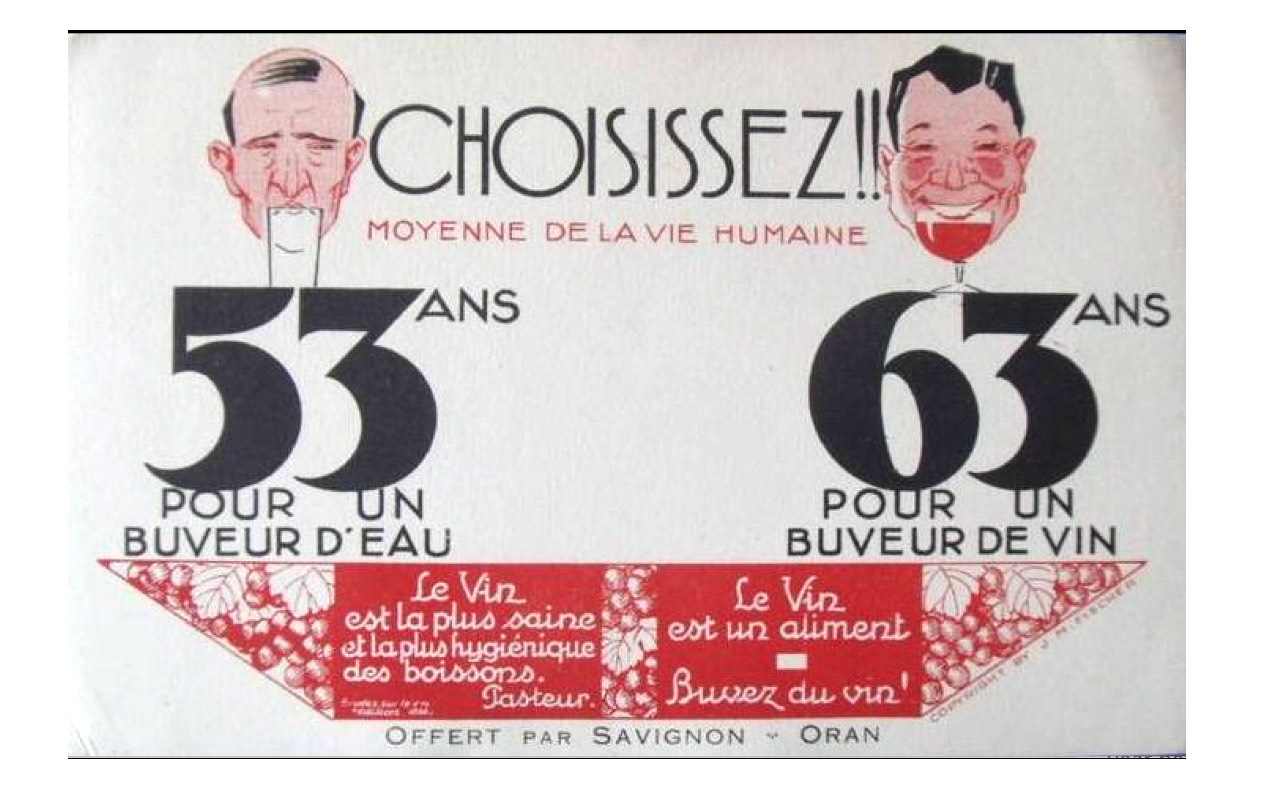
The gap. It’s not going to be too bad this year with a boooorrrinnnnng Superbowl* coming a bit later in the shortened month. At least there was a nice ad for Bud. But, even with that, this gap between the end of the last football game and the start of baseball’s spring training games is a thing. A dull thing. As is the realization that I am looking past sports fandom at a trade war. Aluminum and steel this week. Am I looking like the guy to the left in the image above pushing from French-Algerian wine from the 1930s. Why does the water drinker look so worried? Why is his hair less stylish?

Yet… what does colonization teach us? Is the dodgy promise of that wine a century ago so unlike what we are like today? I was out buying a magazine last Friday evening in an actual bookstore (because, you know, I had a hankering for buy a magazine like it was 1999) and I looked at all their titles… mainly American… then looked at all the biographies of Americans intersperced with a few semi-royals at the other end of the bookstore… boy oh boy… have we up here taken on a lot of the culture developed down there. Look, I’m not part of the not a real country set but I need something to fill the hours other than lingering angst. Something will level out somewhere. Spring training may do the trick. Maybe that’s it. Down in, you know, Florida.

Speaking of gaps, have you any interest in NA wine or spirits?  Me, I can’t imagine paying non-proxy payment for these sorts of proxies for booze. But if you are interested in NA beer, keep keeping an eye on Polk. He is back with some very interesting observations on one Canadian discount dark ale. And he wrote about where is at** this week, too:

I am incredibly lucky that I still can maintain an online community, despite my switch to mostly non alcoholic options, people in craft beer can be very kind when the road gets bumpy for one of our own and this helps a whole lot. But if I was one who went out and was deeply involved, I wonder how I’d be feeling every weekend when my new normal didn’t include those aforementioned activities. It would be a little overwhelming and would only add to an already stressful time I would imagine. It’s part of why it’s so difficult to go sober, to separate yourself from the good times that feel warm and boozy because you can’t be that person anymore. Change isn’t easy, but letting go of alcohol seems particularly difficult, addiction or not.

I will allow myself more bit of one tariff news item this week from one of my regular reading outlets, mining.com, on the uselessness of tariffs but the benefits of something else:

While US steel imports account for 23% of the country’s consumption, the ratio is much higher at 47% for aluminum, according to the US Geological Survey. The US is particularly reliant on imports of primary aluminum from Canada, which supplies more than two million tonnes each year… Just under half of all cans are thrown away to be land-filled or trashed. More metal is lost through improper sorting at recycling facilities, with losses assessed at roughly one third… Roll out more deposit return schemes and some of that one million tonnes of landfill could be returned to the supply chain.

On our side of the wiggly then very straight line, somewhat similarly, the inter-provincial restrictions are being rethought. New Brunswick’s Premier Susan Holt is revisting the province’s trade barriers on booze from other parts of Canada and Ontario‘s smaller breweries are looking forward to market opportunities across the country if we ditch the current rules:

Ontario breweries, distilleries and wineries can’t sell their product directly to customers in other provinces, something David Reed, owner of Forked River Brewing Company, says limits their sales opportunities… Because laws around alcohol are up to each province, rules about transporting vary nationwide. In Ontario, the province lifted interprovincial personal exemption limits in 2019 when it comes to alcohol for personal use, the LCBO says. In comparison, SAQ, Quebec’s alcohol board, says any alcohol coming into Quebec, including donations, gifts, and souvenirs, must be reported.

Note: Following up on last week’s news, one Beer Store outlet in my fair city is closing. But… but… me being able to buy my longed for Oland Ex in a corner store? Where do the loyalties lie?

How to pass the time? Cards. Katie plays cards and wrote a bit about it:

We play Rummy. I have no memory for any of the other rules, despite my father in law trying to teach me Stop The Cab every few months. At high school, I used to play a game called shithead in the common room, we doubled the pack so the games would last forever, dragging on into lessons we should have gone to. These are some of my favourite school memories.

Japan has an issue hiring people and then coaxing people back to work in the office but one firm has a solution that perhaps might suit you:

…for new graduates in Japan, one small IT company is offering Gen-Z staff the option to take special ‘hangover leave’ in a fierce recruitment drive being dubbed ‘golden eggs for graduates’. Trust Ring Co Ltd is a tech company in Osaka with roughly 60 employees and is one of many companies combatting Japan’s declining birthrate with quirky incentives as a way to attract new employees…. employees at Trust Ring Co are even encouraged to help themselves to the draught beer machine or a selection of spirits to drink on the job in their Midoribashi offices.

Lordy. And next? What next?!? Beer sludge? Beer sludge!!! Seems “beer sludge” is now a proper term according to the headline to this BBC story:

…nutrition isn’t the only area where spent grain could make an impact. Brett Cotten concedes that early efforts by his young London-based company, Arda Biomaterials, to create leather-alternatives from brewers’ spent grain resulted in something more akin to a flapjack.  But the start-up has since successfully used supramolecular chemistry to make several proteins from brewers’ spent grain that mimic the animal proteins in leather, resulting in a strong and supple alternative. The colour reflects the spent grain used, he says. “Guinness and stouts make for a naturally black material, IPAs and lagers more mid-browns.” 

I shall recommend that to my tailor. If I had one. And I like this understanding in Jeff’s piece on NEIPAs which is one way of explaining the phenomenon:

I would argue an IPA wave was never going to wash over New England before it came along. The region’s preference toward fuller beers with sweet malts and fruity English yeasts, and they have never really embraced the bitterness and spikiness of Centennial or Chinook IPAs. The development of New England IPAs was not unusual: breweries adjusted their process to draw out those incredible flavors and aromas Citra (and successor hops) had.

Careful readers will recall my habit of going to Maine back when the Canadian dollar was worth 95 cents US or more. In 2013, the good beers on offer at Fenway were Long Trail pale ale, Harpoon IPA and Wachusett Green Monster.  New England had plenty of IPA love before NEIPAs… they just weren’t those IPAs.

Speaking of good explanations, in the emailed announcement on Pellicle‘s piece on independent brewing in Thailand, the editorial board of that there publication made an excellent statement on these sorts of things:

About a year ago I received and subsequently rejected a pitch from a writer called Joey Leskin, who writes a great newsletter about beer in London called Beer in the City. I turned it down because I am overtly aware that stories written by British writers about beer culture in other countries can come across as voyeuristic, and often don’t let the voices of the people involved in that scene shine through as they should. Fast forward six months and I was invited to become a mentor by the British Guild of Beer Writers. I agreed, and by coincidence was subsequently assigned Joey as my mentee.

This is a much nicer way of explaining and dealing with what I call “drive-by expertise.” It’s nice that you got to visit. Very nice. But I’ll usually  turn to the local for understanding, thanks.

People who are very much on the scene if not in the scene are Boak and Bailey and this week the scene is very much where they are or at least were – at the Central Library in their own fair city of Bristol, England. There, they came upon what is definitely a scene:

A few weeks ago a special exhibition was laid on at the library on the subject of beer and pubs. Items from the reference collection were put on display in an ornate wood-panelled room and visitors were invited to shuffle round and have a nose about. We visited and were drawn at once to a hefty hardback volume collecting together editions of The Golden Cockerel, the house magazine of Courage, Barclay & Simonds, formed in 1960 when Courage acquired Simonds of Reading. These particular issues of the magazine were from 1962 to 1964 and seemed to include a remarkable number of pub openings.

What follows can only be decribed as remarkable, too. An unpacking of the story of many of those pubs while guiding one to an explanation of the name for “a youth paid to collect dry sand from coastal caves to spread on saloon bar floors.” Fabulous. And a welcome break from the news about those running pubs dealing with the rising costs of running a pub.

And Laura Hadland has updated the story of the Crooked House and the legal battle which has ensued since its demolition:

11th February – And the appeal hearing has been delayed. ATE Farms lodged a High Court challenge against “the Planning Inspectorate’s refusal to postpone the Planning Enforcement Public Inquiry” according to a statement from South Staffordshire Council This means that the public enquiry will now not go ahead as scheduled on 11th March and is unlikely to occur before the criminal investigation is concluded. You can read updates from the Council on their website. According to the Times & Star, the police work continues – “Staffordshire Police said in July last year that six people arrested in connection with the fire have been released from their bail, but remain under investigation.”

N’oubliez pas!!!

There. It’s been a bit of a busy week outside of these readings again. I worry that I am not entertaining enough. I actually don’t but I wonder. That’s a better way of putting it. Enough to worry about out there in the real world, isn’t there. Until when we meet next, please check out Boak and Bailey every Saturday and Stan going strong again each and every Monday. Then listen to Lew’s podcast and get your emailed issue of Episodes of my Pub Life by David Jesudason on the (sometimes even but never) odd Fridays. And maybe The British Food History Podcast. And Phil Mellows is at the BritishBeerBreaks. Once a month, Will Hawkes issues his London Beer City newsletter and do sign up for Katie’s wonderful newsletterThe Gulp, too. The Share looks to be back with a revival. Ben’s Beer and Badword is out there with the all the sweary Mary! And check out the Atlantic Canada Beer Blog‘s weekly roundup. There is new reading at The Glass which is going back to being a blog. Any more? Check out the Beer Ladies Podcast. That’s quite good and they are revving up for a new year. And the BOAS podcast for the bro-ly. And the long standing Beervana podcast …except they have now stood down.  Plus We Are Beer People. The Boys Are From Märzen podcast appears suspended as does BeerEdge, too. VinePair packed in Taplines as well. All gone. But not Ontario’s own A Quick Beer featuring… Michigan! There is more from the DaftAboutCraft podcast, too.  All About Beer has sponsored trade possy podcasts and there’s also The Perfect Pour. Plus follow the venerable Full Pint podcast. And the Craft Beer Channel on Youtube.  The Moon Under Water is gone which is not surprising as the ask was $10 a month. Pete Brown’s one cost a fifth of that but only had the one post. Such is life.

*What wasn’t boring was the after game celebrations in Philadelphia according to the police scanner: “we lost all the barricades!!!” and especially ““i now have seven or eight people on horses, the fireworks are spooking them and they’re rearing up….they’re civilian horses”!!! And there were some other ads. BeerBoard added some very particularly fine detail on who was drinking what before, you know, the barricades were lost: “Coming off two years of decline for the Big Game, Light Lager saw an increase of +5.6% on the day. Lagers, the #2 style, saw a noted decline of -6.5% in share. IPAs, the third-ranked style, decreased for the second straight year, down -7.9% over 2024. Michelob Ultra was again the top-poured brand nationally on the day, and was up a noted +11.9%. Bud Light, the #2 brand on the day, was -3.0% versus 2024. Miller Lite (+5.4%), Modelo Especiál (+9.6%) and Coors Light (+3.4%) rounded out the Top 5 for draft.” That is very spedific stuff for two days later…
**Or as translated for Maritimers: “where he’s to, too.

The First Beery News Notes For December 2024

The countdown is on! I already feel like Ed Grimley and it’s only the fifth of the month. I am too excited. That rotten cold I had is finally in the past and now I am seeing holiday things everywhere, like in the red and green scene at one pub’s outdoor washroom posted by Beer Nouveau. How cheery. Retired Martin* also included an exposé on the outside gents in one post this week:

No, I don’t know what “To the huts” means, either.

Speaking of cheer, are you having an office party?  The Times says they are in mortal danger from, frankly, sensible updates to the law. I say that as a lawyer given I have never been to such madly lavish and deeply souced Christmas parties as those put on by private law firms. But that was decades ago. Here is what is going on now:

Employers that are found to have failed to do so could face claims for unlimited compensation at tribunals. Lawyers are advising that financial services businesses in the City of London — renowned for alcohol-fuelled Christmas parties — “should be particularly mindful of the new rules”… Updated guidance published in September by the Equality and Human Rights Commission emphasised that workplaces must take an active approach to assessing risk. That translates to an obligation to identify any action to clamp down on possible sexual harassment and the requirement for regular reviews of systems.

This lines up with what is… or rather isn’t… happening in New Jersey whether because of cell phones and social media, workplace harassment, remote working arrangements or lower interest in excessive drinking. Did you know some offices bizarrely arrange for staff to buy holiday party gifts for ownership? And perhaps not oddly, given Russia’s foolishly and murderously self-inflicted economic collapse, but holiday office parties are being cancelled there too. Apparently, there are after effects of this sort of thing well beyond the office:

A new low-alcohol beer has been launched by a train operator in a bid to tackle the number of passengers having drunk accidents during the festive period. The Safety Thirst beer, at 0.5% alcohol, will be stocked onboard Avanti West Coast services, which run on the West Coast Main Line between London Euston and Scotland. The company said the pale ale will create a “more enjoyable travel experience” and help passengers “drink responsibly”. 

The Tand doesn’t need no stinkin’ office parties for his jolly holidays. Because he found his perfect beer:

…I probably don’t score beers as much as I ought to, but I regularly do. I am probably quite a strict scorer, given that I judge beer in competitions and also that over the years, I know what its what.  So, that’s a long winded way of saying, until now, I have never given a five. So let’s get to the point. It had to happen and last Friday, in an infrequent visit to our local Wetherspoons, I gave a beer a five. What was it I hear you scream? Well, perhaps not surprisingly given the quality of the brewer and the beer, it was Thornbridge Jaipur. Why a five? Well, this was perfectly brewed, clear and untainted with no off flavours, at a perfect temperature and was bursting with condition. The body and mouthfeel were perfect. The glass was spotless. In my mind I went over everything. Could it be improved in a normal pub environment? Not as far as I could tell. It was, simply, faultless.

Boom! What’s the news from the ag markets? Oh… as we have heard out of Oregon, the hops news coming out of Germany is not good:

Declining beer consumption worldwide is hurting German hops growers, who face lower prices and possible farm closures amid a dip in demand for the bitter crop. A strong hops harvest in 2024 means that Germany has regained the crown as the world’s top producer of hops, but prices have slid. According to the German Hop Industry Association, 2024 is the 11th year in a row in which more hops were produced than required.

And, speaking of not boom,  Canada’s barley supplies appear to be very close to a 25 year low:

With the 700,000-metric-ton (mt) projection being only slightly higher than 542,800 mt remaining after the devastating drought of 2021, there is little room for error…. Given the drought stress experienced and the lowering of yield estimates by provincial counterparts, it is widely anticipated that final production estimates from Statistics Canada will be lower on Dec. 5. The problem is, even a 3% cut in production would take 228,000 mt off the ending stocks (all else equal), leaving them below the 2021-22 level.

In addition to drought, prices and planted acreage of barley were both down in 2024, too. If you want to obsess over this on a regular basis, check out the tables and charts of the Canadian Grain Commission’s weekly stats.  And that’s all the malt news this week… NO IT ISN’T!! The Maltsters Association of Great Britain also issued an update on the 2024 numbers:

The UK malting barley harvest is now complete and the overall picture is one of reasonable quality and good supply. Winter malting barley can be summarised as variable with predominantly low nitrogen crops and grain retention levels similar to 2023. Winter barley yields are recorded at 10-15% less than the 5-year average. Conversely, the spring barley harvest in the UK has seen low nitrogen crops throughout all regions with good retention levels and yields described as better than average.

I’ve been described as better than average, too.  A step up from that but facing similar climate and market pressures, traditional sake makers in Japan are heartened by UNESCO intangible cultural heritage designation for their brewing techniques:

“It’s still quite warm, even though it’s almost December. The price of rice is high and the harvest is poor, which has made sake-brewing (this year) very challenging”… The centuries-old method of making sake is unique for its three-step preparation, or “San-Dan-Jikomi”, of allowing multiple fermentation processes to progress simultaneously in a single container… While sake has lost ground as a regular drink, Maesako said it remains impossible to separate from Japanese culture. “We have sake at celebrations, at New Year’s, and also on sad occasions, like funerals,” he said. “The culture of Japanese sake is the culture of Japan itself.” The brewing technique is expected to be formally endorsed at a UNESCO committee session in Paraguay this week.

More on San-Dan-Jikomi AKA Sandan Jikomi here. Reuters posted a photo essay on the process in addition to the story quoted from above.

Panic!! PANIC!!! They are running out of Guinness:

The BBC understands that Diageo is allocating supplies on a weekly basis to make sure it has enough stock to meet demand over Christmas. A Diageo spokesperson said: “Over the past month we have seen exceptional consumer demand for Guinness in Great Britain. “We have maximised supply and we are working proactively with our customers to manage the distribution to trade as efficiently as possible.”

You know things are going to hell when folk use “proactively” in a press release. Always the actively pro, I think it’s fair to say that The Beer Nut has not always enjoyed the Canadian craft beers that have passed his way. It was good, then, to read how a couple of brewers from my old home in Nova Scotia didn’t disappoint even if one offering didn’t necessarily thrill either:

This is solidly made and workmanlike, but don’t expect fireworks. While I’m not saying that breweries running since 1997 have a particular safe-and-steady way of making their beer, this IPA suggests that there might be something to the theory. It’s not an exciting beer, but I’d say it’s a dependable one.

Boak and Bailey followed up on the recent news of a number of cask brands being discontinued with a consideration of how many brands had existed. Turns out not all that long given a number of constantly moving factors:

When we think of cask ale brands that have been around longer than that a few contenders spring to mind. Hook Norton Old Hooky dates back only to 1977. Adnams Broadside was launched in 1972. Fuller’s London Pride came to the market in 1959. And Marston’s Pedigree was introduced in 1952. You might make an argument for Bass which is not only still available but also having something of a resurgence in popularity. But it’s also, really, just the name of a defunct brewery. And that famous ‘first trademark’ was actually for ‘Bass & Co’s Pale Ale’, which is not what’s on the pump clips today.

Years ago, I noodled around looking up when the first branding attached itself to brewing, when the dissassociation of what is on the label from what is in the glass began. I can’t find the links but if you spend a little time over at Ron’s, you pick up quickly that beers up to a certain point in the middle 1800s were identified as gradations of a brewery’s output like this, not the individually animated distinct personalities in themselves we know as brands. Walk back through time. Trademarks get legislative protection in the UK starting in the 1860s. In the US, we see in the 1820s that beer being shipped out of the local market gets named with adjectives like “cream” added to impress buyers with the superior qualities of the product. A generation before in New York City of the 1790s you see beers sold by style and city of origin much like you would have seen in Britain 120 years before that.  That all being the case, if you think you’ll miss the brand now maybe buy the t-shirt. You’ll probably be able to find a similar drink all the same. As the same B+B wrote in their footnotes:

Perhaps it’s studying beer history that does it – you get used to the idea that beers and brands come and go as tastes change. And if we ran a smaller brewery such as Butcombe or Cheddar Ales, we’d be rubbing our hands in glee, because this would seem to leave a gap in the market for beers which are trad, but not boring. Perhaps we’re being naive, though.

BREAKING!  I had no idea that you had to “stamp” a beer sold in a bar in Quebec. Soon it will be over:

According to the microbreweries, the obligation to affix stamps to their cans and glass bottles is both unnecessary and time-consuming… Since 1971, the law has required a duty stamp to be affixed to all beer sold in restaurants and bars. The original aim was to prevent smuggling and tax evasion. Some microbreweries have recently been visited by police officers who have come to check that the labelling on the stamps complies with the law. Microbreweries that contravene the current law face fines of between $500 and $7,500. The minister was at pains to reassure, saying that a fined business could be forgiven.

BREAKING! I have no idea who these people are:

But how did a ‘celebrity’ couple come to take over this regionally-renowned boutique bar? For that, you’d have to go right back to when it first opened, in 2016. “Katy kept saying she wanted to move somewhere in the countryside but where you can also get a gin and tonic,” Adam says. “So I said: ‘That’s Knutsford.’ I spent so long persuading her to move here. Eventually she agreed and the day we moved in was the day this place opened.”

For VinePair and without any reference to Knutsford, Kate Bernot has unpacked the potential damage Trump’s proposed tariffs will do to the clinky drinky markets in a welcome greater level of detail than we too often see:

The global supply chain means that U.S. companies are heavily reliant on imported materials. For the beverage industry, aluminum is the most significant. Canada exports 75 percent of its aluminum production to the U.S., and domestic production here simply can’t replace that volume. It would take years, Uhrich says, to even begin construction on new aluminum plants, let alone to supply what U.S. alcohol companies need. Beer is obviously the most vulnerable to rising aluminum costs: Two-thirds of U.S. beer is packaged in cans. There’s simply no way, Uhrich says, that further tariffs wouldn’t drive up the cost of domestic beer as a result of costlier materials.

Canadian malt in Canadian cans – US craft! Finally, for the double in The Times, Pete Brown gave a primer on some of the newbie questions that folk who don’t know much about beer are going to ask. It’s an interesting use of the space but the paper must be concerned that there are reader lacking superficial understandings of beer such as this:

Every single menu and every single recipe in the history of humanity is based on one simple truth: some flavours go together better on the palate than others. It would be absurd to think that beer is somehow an exception to this. Beer actually has a broader range of flavour than wine. The caramelisation in a pint of bitter goes perfectly with roast beef. A Belgian-style wheat beer works well with anything you might squeeze some lemon juice over. And stout with a gooey chocolate dessert is so good, so simple, that it’s almost cheating. Just remember to pair light with light and strong with strong, that there’s no right or wrong and that it’s supposed to be fun.

Well, I suppose Christmas is the time for merry chestnuts. At least it’s better than sucking up to your commissioning editor!

That’s it! It’s been a busy week in the real world and that is where I live. Until next Thursday, please check out Boak and Bailey every Saturday and Stan going strong again each and every Monday. Then listen to Lew’s podcast and get your emailed issue of Episodes of my Pub Life by David Jesudason on the (never ever) odd Fridays. And Phil Mellows is at the BritishBeerBreaks. Once a month, Will Hawkes issues his London Beer City newsletter and do sign up for Katie’s wonderful newsletterThe Gulp, too. Ben’s Beer and Badword is out there with the all the sweary Mary! And check out the Atlantic Canada Beer Blog‘s weekly roundup. There is new reading at The Glass which is going back to being a blog. Any more? Check out the Beer Ladies Podcast. That’s quite good and they are revving up for a new year. And the BOAS podcast for the bro-ly. And the long standing Beervana podcast …except they have now stood down.  Plus We Are Beer People. The Boys Are From Märzen podcast appears suspended as does BeerEdge, too. But not Ontario’s own A Quick Beer. There is more from the DaftAboutCraft podcast, too.  All About Beer has podcasts and there’s also The Perfect Pour. Plus follow the venerable Full Pint podcast. And the Craft Beer Channel on Youtube.  The Moon Under Water is gone which is not surprising as the ask was $10 a month. Pete Brown’s one cost a fifth of that but only had the one post. Such is life.

*Check out his walk aroung Rye too.

Your Bootastic Hell’s Gates Open Up Today Halloweeny Edition Of The Beery News Notes

Today is the second scariest day in the next week or so. Number two. Today, the undead walk the earth! But by next Wednesday, Americans may have elected the Nazis. I sure hope some of that polling data is wrong. Anyway, there is a time and place for everything and this day and this week’s focus is all about the lesser of those two evils – the celebration of Lords Satan’s reach into your verrrry soul and the tenuous grasp of all existence, of all of reality itself. Let next week take care of next week.

Still, good to see one of the candidates has some normal habits, some of which like drinkin’ and swearin’ were on display over beers at a stop with the Governor of Michigan at a bar on the campaign trail:

‘We need to move ground among men,’ she can be heard saying in a low voice to Whitmer, clearly not thinking that anyone was privy to their conversation.  She then looked up abruptly and cut off the private chat. ‘Oh, we have microphones and listening to everything,’ a surprised Harris says. ‘I didn’t realize that.’ ‘Okay… you’ll bleep my F words hopefully,’ Whitmer joked. ‘We just told all the family secrets, s***,’ Harris replies before her busting out into a loud laugh.

Giving equal time, did you hear about the Respublican running for office in Wisconsin?  Traveling GOP U.S. Senate candidate Eric Hovde (AKA the “California banker”) wants to ban beer sales and it has been picked up in his opponent’s political ads. Rolling Stone covered the story a few months ago:

…if we just decriminalize [marijuana]? Fine. Nobody’s going to go to jail. No one’s going to get arrested for it. That’s your self-determination, but you’re not going to turn it into an enterprise. Frankly, it should have happened with alcohol,” Hovde says in the audio. “I mean look at — alcohol has a lot of negative byproducts. If somebody wanted to distill it, drink it. Fine, go ahead…

He also apparently bought a tavern to tear it down. Booo…. Now… getting serious, Jessica Mason has reported on concerns that the language related to the pricing of beer is posing challenges:

One of the issues this kind of research presents is that if the nation is constantly sold beer on “lowest prices” translating as “best” then it will not consider beers as different or with some deserving of higher price points than others. Describing how crucial pricing is, Sussex-based Burning Sky founder and head brewer Mark Tranter told db: “All overheads continue to rise but it’s impossible to put our prices up in line with these, without running the risk of pricing ourselves out of the market and or alienating people.” 

That sounds a bit like being clear about value is a bit of a problem – unless there was a way to factually explain the value to be found in an more expensive drink. Well explained value is always good. Consider how Tennent’s is holding its own in its home market due to its accepted inherent value:

Changes in UK alcohol duties have led to some lager brands, including Carlsberg and Grolsch, being reformulated to a lower 3.4 per cent ABV, but Findlay said that would not be happening with the core Tennent’s product, which has an ABV of 4 per cent and accounts for more than half of the lager segment in Scotland. “Tennent’s is such a strong brand that to reformulate it or reduce the ABV would be a no,” he stressed. “We have lower ABV variants of Tennent’s available, so there are no plans and no need to change what is an astonishingly successful brand.”

Hmm… somewhat relatedly Matty C. shared on the absense of critical writing in beer, something that that is has been one of my interests for, well, decades now given it is only through critical thought that value is established:

This week I’ve been thinking about the lack of criticism in beer writing. It’s something I’ve thought about a lot over the years, because beer and pub reviewing doesn’t really exist in any meaningful way compared to how it does in wine or food writing. I consider that there are many reasons why this is the case, the main one being a general lack of consideration from mainstream (or, indeed, niche) media outlets for beer and pubs. But also it’s because beer drinkers are a different beast to most wine drinkers. There’s a certain level of—dare I say—zealotism, that means if anyone decides to log on and pan a beer, they can almost certainly expect some flack.

This is great. He has pushed this out into a great open conversation and I have to say that it has caused me a lot of thinking – something I like to avoid most weeks. I’ve actually written this week’s notes twice to cope with my inner termoil. Why?  In part, that word – zealotism. Zeal seems to sit one step down the stairs from enthusiasm and you know what we think of the enthused. Why?  Because zeal places countervaling pressure on value. It distracts one from reality. So how to respond?

First, I will try to be brief but I see three distinct factors as the prime drivers of this gaping chasm between reality and zeal in beer writing: (i) objectivity denial; (i) unreliable claims to expertise; and (iii) real marketplace consequences. Starting with objectivity denial, have a look at this passage in one of Boak and Bailey’s recent (and always fabulous) Patreon footnotes to their Saturday roundups:

…the two Grodziskies we drank this week were more interesting than enjoyable. Both were also adulterated with things like fruit and tea, making it hard to get a sense of the base flavour…  We’ve tended to avoid the phrase ‘beer-flavoured beer’ and similar for the reasons Jeff sets out: the idea of what ‘beer flavoured’ is totally subjective.

It appears they and I are struggling with similar thoughts* as after I started sketching this out on Monday, I realized they themselves had posted their own cogitations on this whole thing – though I cannot agree with their interim assessment that it is just a pint and “we do not need that intel” – especially given the annual investment a beer fan may make. It’s not about the pint but all the pints one buys. In a year. In a life. As a result, I believe it is not correct to say that good beer can be, should be lost in an ocean of subjectivity. One cannot determine value if everything is subjective. No, there are and should be measuring sticks which can be relied upon. There must be the intel.

That being said, who would set these standards. Who measures the sticks? Beer experts? Problem: there are no beer experts in that blanket general sense. Sure, there are real experts in specific areas of beer and brewing with the greater expertise existing in narrower areas. Like any study. And a number people certainly know much more than many others. No question. But claims of expertise in that general sense that we see eminating from some of the merely eager is a common problem with beer writing.  Can we place our trust with zealots? One shouldn’t. The resulting status scrambling** to be identified as that authoritative person may be vigourous, vicious and even entertaining but all in all it’s hardly an academic process. And it creates a fog around the question of value.

Perhaps the saddest reality is that the rejection of standards and the weakening claims of expertise have left an imbalance of power. Perhaps ironically, beer writers lack sufficient security to stand up against pressures from the trade.  In the very comments under MC’s post, Gary raised this very point:

The difficulty is few want to risk offending people in the industry, as future access to the brewery may be limited and awkwardness can arise when you meet them at events.

And in addition to event attendence, in order to get ahead some beer writers are also expected to show up time after time as supportive boosters – as compliant judges or even consultants. We even sometimes see the trade described as a “we”*** – which can leave one left with the impression that one gets the inside view of the trade by being effectively a branch of the trade. None of which is wrong if, well, you don’t want to be warned off the bad beer, don’t want to learn about relative value but are only looking for something to read as light entertainment. Which it often all that you get. Which is fine. Consequence free and affirming pleasure writing for a happy sometimes tipsy crowd. All fine.

But we have to be honest – that is the opposite of a critical discourse. It can deter journalistic inquiry and even triggers  stronger response: “…you can’t write that, those are real people with real jobs!” or “you shouldn’t be writing about beer” or that stumblefuck of a non-thought “you are just a old curmugeon!” It even justifies the recently received assessment I’ve heard from one writer about being told in a formal setting that DEI isn’t a business imperative for breweries, just part of culture wars. And of course this is all in addition to that old chestnut of total alcohol harm denialism from the anti-science set.**** As a direct result of those factors, not only has the opportunity to argue in favour of value been lost, I would also argue that it is one key reason there is no reliable concept of “fine beer” – like we have in wine or spirits. A critical discourse is fundamental to anything deemed fine. But this trade? Won’t have it. Would you want it? I do.

Thankfully, there is a actual critical discourse out there even if the jockeying beer writers of a certain scrabbling sort don’t engage with it. Think of The Beer Nut reviewing can after can, glass after glass excellently so you don’t have to… unless you want to. He has no problem being honest about value:

My recent complaint that the Teeling Distillery giftshop was overcharging for the small cans of DOT collaboration beers at €5.50 has been heeded. The latest addition to the series was €6: For Wheats Sake! 

Think also of Retired Martin, Ron and others travelling to pub after pub taking photos and making observations with his exceptionally keen eye so you don’t have to.  This week Boak and Bailey wrote in generous terms on the wonders of this sort of blogging… over, you know, on their Substack:

One thing blogging is better at than social media is linking. Old skool blogging thrived on the practice of generous linking. Sometimes, it was about search engine optimisation (SEO) – which is no bad thing when it helps good stuff rise to the top of search results. But mostly it gave readers a chain to follow. We used to spend ages following links from one blog post to another when we were first learning about beer. A sort of Choose Your Own Adventure approach to study. Blogs are also more stable and more independent. They’re less likely to suffer from an egotistical investor buying up, damaging, or shutting down a platform. With a blog, you have your own space to do your own thing.

Viva blogs! Viva Viva!!!  And there are a few dogged shapers of public opinion working their way into the general media who rise above as well as other sorts of independent voices with critical views are out there. Consider the David Bailey cartoons in Pellicle which have a cheery habit of undermining supposed established principles.***** Similarly, in beer history writing, we also find people digging and digging into the past pulling out the correcting facts and illuminating stories which both add depth and redirection to good beer culture. This week Liam wrote a post about the 1913 theft of pewter tankards from Dublin’s pubs for melting down and sale:

… this was a relatively common practice but it is interesting to see the ‘modus operandi’ here in print. So, it appears that the theft of drinkware from pubs isn’t a new phenomena – not that we really thought it was – although the reasons for said theft appears to have changed through the years to one of collecting.  Although there is no mention of where the ladies mentioned in the report hid their soon-to-be-swapped tumblers and stolen tankards, it is possible they were tucked neatly into the folds of a dress but it is probably more likely a bag of some description was used.

See also Gary’s extensive posts on tavern culture in Quebec or Canadian brewing during the Second World War. No one will pay for that sort or writing. But no editor will also smooth or dilute it either.

These things lead to other helpful insertions and inveiglings .Last week we saw Katie Mather have a deftly written argument published in The Guardian. She wrote in support of the decision by the UK’s small brewers’ organization SIBA to ditch “craft” in favour of “independent” to help buyer understand what is in their glass:

Beer fans are starting to realise that their favourite breweries might not be the paragons of independence and system-subversion they once thought they were, and it’s leaving an unpleasant taste. Now that many of these breweries have become part of large corporate entities, the idea of standing against the man, colourful can in hand, is a ridiculous one. It’s sowing seeds of doubt across the whole industry, too – the word “craft” never meant anything specific, and so it can be used to market beers that aren’t “craft” in any understanding of the term.

And she expanded on this in The Gulp, her newsletter: “We all got bored of defining craft a decade ago. But just because something is boring, doesn’t mean it isn’t important.” I don’t really agree with any of that – but really I do like to have the well-argued ideas bouncing around in my brain. And speaking of a knowledgable grasp of specifics versus what is in my brain, Stan’s Hop Queries hit the inbox just after last week’s press deadline and it is full of detailed goodness around the king of all adjuncts, including this about how Kiren invested “dip hopping”:

Basically, they made a slurry by steeping hops for about an hour at temperatures (150-170° F) lower than found in conventional whirlpooling, then added the slurry into wort before pitching yeast. Kirin learned that the resulting beers contained as much linalool as dry hopped beers but less myrcene (which itself may mask fruity aromas associated with linalool and other oxygenated compounds). This also reduced production of 2M3MB (an onion-like off flavor)… For brewers, the appeal is pretty simply: less isomerization than with whirlpooling and greater retention of some essential oil for biotransformation. In addition, drinkers have said they perceive a difference, a positive difference, in dip-hopped beer aroma and flavor. 

Me? No, not really. But sorta. You know… but how else are you going to learn? Exactly. And expertise is not just about having a deep understanding one one topic but also a view on the intersections of a number of areas. For example, The Sunday Times had an interesting story on the disappearance of Britain’s pubs called “The Black Bull” based on some excellent investigative reporting of the role of Big App:

Another Black Bull is the historic community-owned pub in Gartmore in the Stirlingshire Trossachs. Its name makes sense: this is an old drovers’ inn. There has been a pub on the site since at least 1740. It too has lost its Facebook, and the thousands of connections the social media giant brings. Wilson believes Facebook removed the page because of a row involving a New Zealand company called Black Bull Group Limited. And this, The Sunday Times can reveal, is certainly the reason why at least one Black Bull pub in England was told its Facebook page was being shut down. This New Zealand company two years ago won a trademark case against another business which launched a website called Blackbull Markets similar to its own. The firm’s complaint, heard by the World Intellectual Property Organisation, did not feature British pubs.

Look at that density of ideas. Global law versus the wee pub, private international social media control versus local community heritage – all coming into conflict. Fabulous.  And speaking of fabulous, here’s one last story this week. It’s from Chris Drosner in Milwaukee Magazine, his love letter to dive bars:

I love settling onto the stool, hanging my jacket on the hook under the bar. The sound of pool balls dropping after the quarters go in. The shake of the day. The neon glow. Overhearing bad takes about the packers. Seeing ice in a beer down the bar – not my thing, but you do you. Someone hitting a pull tab big enough to pocket the cash. Being the tiebreaker in strangers’ friendly argument. 

I particularly liked his list of the key signs you’re in a dive bar including: (i) “someone lives upstairs”; (ii) “unclear if it’s open, or how to get in” and (iii) “sink outside the bathroom.” Beautiful.

All of which is to say there is actual critical writing out there but it is not often found in that certain circle of trade friendly and, dare I say, commodity writing that has gotten a lot of attention. Thankfully, it role may be fading as part of the bubble burst of zealot culture. At least in beer even if not in rest of the world, like the geo-political world. Maybe. Well, let’s see how that pans out next Tuesday evening.

That’s it. That’s a lot. And there’s a lot of footnotery still to come down there below. Neatened and nicened any number of times over the more than 45 edits of this week’s post. For more beery news check out Boak and Bailey every Saturday and Stan going strong again each and every Monday. Then listen to Lew’s podcast (if he ever does one) and get your emailed issue of Episodes of my Pub Life by David Jesudason on the (now very) odd Fridays. And Phil Mellows is at the BritishBeerBreaks. Once a month, Will Hawkes issues his London Beer City newsletter and do sign up for Katie’s wonderful newsletterThe Gulp, too. Ben’s Beer and Badword is out there with the sweary Mary! And check out the Atlantic Canada Beer Blog‘s weekly roundup. There is new reading at The Glass which is going back to being a blog. Any more? Check out the Beer Ladies Podcast. That’s quite good and they are revving up for a new year. And the BOAS podcast for the bro-ly. And the long standing Beervana podcast …except they have now stood down.  Plus We Are Beer People. The Boys Are From Märzen podcast appears suspended as does BeerEdge, too. But not Ontario’s own A Quick Beer. There is more from DaftAboutCraft‘s podcast, too.  All About Beer has podcasts and there’s also The Perfect Pour. Plus follow the venerable Full Pint podcast. And the Craft Beer Channel on Youtube.  The Moon Under Water is gone which is not surprising as the ask was $10 a month. Pete Brown’s one cost a fifth of that but only had the one post.

*And that to me is a contradictory set of statements even if understandably so. In the first, there is a desire for the standard base beer to then, one assumes, compare with the ideal standard of an unadulterated Grodziskie, a presumably identifiable fact. In the second, the existence of standards is rejected. There can’t be a dependable body of knowledge that spawns experts at the same time as you have a totally subjective subject matter. Thankfully, I am reading a bit of Smil these days which may explain where we are. He describes how the quality of information received though individual perception is not in the control of those doing the perceiving but also that it does follow reliable patterns. Understanding those patterns can draw us back to a greater sense of objectivity by removing our natural tendencies to clarify the equation.  As a result, as I understand it, reasonably objective assessment of beer is possible even if it is surpressed. But just a minute.  Isn’t that itself a smarty pants faux expertise claim? Am I the zealot? Well, I have always enjoyed the sort of long long essays that argue that personal persception is deeply flawed ever since I took courses from Canada’s conservative Anglican philosopher George Grant (a chummy sports sideline watcher, Ten Penny drinking, ebullient ciggie smoking presence of my college days.) Around the same time I was reading liberal Catholic Ivan Ilych as well as atheist mathematician Bertrand Russell before I moved through my work then family into eastern North American Indigenous writings as well as other perspectives. They all teach that personal subjectivity and even institutuional authority are deeply unreliable. They also proposed various competing objective constructs that we can rely upon as footholds in any subject matter. Testing and contesting the application of those constructs is what critical analysis is all about. 
**How did we get here? How did the blandification of beery expertise arise? In the beginning, you had the established authoritative few who wandered in a primordial shallow end unaware. Then, new voices arouse who started asking questions, on blogs in zines, much to the irritation of those who will never be bettered. And, about a decade ago, the dead end was entered as good bloggy writing was pushed a bit aside in favour of the hunt for paid writing. (We were all going to be published authors!!) And then, rather than fostering a peer reviewed discussion of relative merits of contrasting views, we have the unending awards circuit populated by oddly familiar judges handing out statuettes for BOBs like Halloween candy to bolster CVs and bios. (We’re all going to be award winning published authors!!) Circles of backpatting by the accepted then boost each other to take up all the available chairs and even oxygen in the room. (We merry few are all going to be well paid award winning published authors!!) But now… now with the retracting good beer marketplace those less endowed chairs have become more musical as the opportunities and the payouts shrink. Breaking: closed access newsletter subsciptions did not save the day. This is good and healthy. Be loud and proud.
***Like this comment on BlueSky in response to MC’s post: “Perhaps there is something like: all attention for beer in writing should be mostly positive, or we will lose even more fans. With the beer market on a general recline, we want to make more people enthusiastic, rather than pinpointing flaws.” Who is this “we”? And, really, who wants to be involved with any interest that is just a glob of semi-smug uninformed fans? Apparently not the new satistied than you very much lager lovers. Yet… “We Are Beer“? Really ?!? FFS.
****In addition to all the flawed, gratuitous and possibly even actionably negligent opinions on alcohol and health we are subject to from the unknowing on a regular basis, I always come back to the emailed dingbattery shared via email by one prominent beer writer about 15 years ago on the topic of drunk driving: “As much as I am against careless driving caused by drinking, smoking, the application of eye make-up, over-tiredness, cell phone conversations or the accidental spilling of tomato sauce off the veal parmigiana sandwich being scarfered whilst at the wheel, I have no wish to be associated with anything ending in “…ADD,” Alan. Bad enough that the loonies at MADD have co-opted the anti-drunk driving position to the degree that they are a force behind such things as the lowering of the legal limit — you can now have your car taken from you at .05…. which I think is quite extreme — and interlocks for all, worse still to be associated with them in any way, shape or form.” 
*****Thanksfully without hallucinogenic recourse to cats.

BREAKING: These Are The Gentlest Most Supportive Beery News Notes Of All Time!

So… me here, you there. Again. It’s hit the lazy months. Or is it exhausted? As the dawn seems to start at about 4:07 am, so too do the times of laze. Good thing it’s warm enough to stick one’s toes in the big lake, as long as you don’t mind half the pee in America trickling by. I wonder if my attitude has affected the beery news notes this week? Let’s see.

First up, there was plenty written this week on the purchase of San Francisco’s Anchor Brewing. It actually led me to wonder how many days of hangtime the word “Breaking!” possibly can have on social media given how folk were still using it as a prefix to tweets maybe two days after the fact. Anchor is one of those foundational breweries of the fibby revisionist history of craft* so I am not particularly moved by the tales being told – except (a) I loved Liberty Ale when I could find it and (b) I do believe if anyone other than Christ can pull off a resurrection which does form a true twist in the narrative it is going to be Hamdi Ulukaya, upstate New York yogurt magnate.

Speaking of magnates and brewing and fire sales, there was some interesting information from Ron Elmer in The Drinks Business this week, this time about the current value of Boston Beer Co., the business that makes less and less of its revenue from, you know, beer:

Boston’s shares look attractive to a potential suitor, having plummeted more than 25% in the past 12 months. But the stock has jumped almost 31% on the recent rumours which started only two days after the shares closed at their lowest price since February 2019. At today’s price, Boston’s market capitalisation is about US$3.95 billion, far below its record valuation of US$15.98 billion in April 2021. The likely price put on a potential deal is unclear, although it would unusual if it did not include a significant premium, especially as no sale could proceed without the consent of Jim Kock, who founded Boston in 1984 and remains its chairman.

Aside from the Freudian slip, that is quite an eye popping collapse in value – under a quarter of previous corporate worth over just three years.  On May 17th, 2024 the stock was worth $260.75 compared to $1,294.93 on April 16th, 2021. That is closer to a drop down to 20% of peak value. Why? Well, if you click on that thumbnail you will see that the five year value really tracked in parallel with the pandemic. Compare it to the shape of the valuation for Moderna over the same period. Then to Constellation Brands. See? Boston Beer may also be the poster child for the general drop in interest in craft beer, too – even though they make more and more drinks that are less and less like beer. Still, hope springs eternal that an investor might be buying something more than a dead cat bounce.

Somewhat related, the Beer Ladies Podcast asked a question this week that was both exactly on point and a bit sad:

In this week’s episode, Lisa, Thandi and Christina debate an ever-popular topic in beer (and other things!) – ethos. Does the ethos of a brewery influence you to buy, or not buy, their beer? What happens when breweries make good beer, but treat their staff badly, or are divisive in their politics? We chat about a few stories that have been in the news over the last few years, and debate our own feelings on separating art from artist.  

Just run those thoughts that over in your mind as you consider: (a) it’s only beer (b) there are now exactly one bazillion breweries now, and (c) a huge amount of the beers being made these days are copycats of what everyone else is brewing. So… how can you not believe in ditching the assholes? For me, it is entirely on the beer buyer. Know your stuff. I would point out one comment made elsewhere, in relation to the well deserved dislike of Hazy IPAs recently from Sam Tierney of Firestone Walker:

I know some great brewers who playfully hate on the style and don’t make it, but they tend to be obsessive traditionalists. As long as you aren’t an asshole about it you’re allowed to not like any style. 

Which would guide me to recommend a point of consistency. If anyone doesn’t want the beer buying public to act like assholes when they mock the money-making gak, then as a mimimum don’t turn a blind eye to the assholes within the supply side of the equation. Me? My money walks and talks. But, let’s be honest, the big money about the talking about the walking is on Boak and Bailey as they displayed when they ripped out some opinionating this week about a pub crawl they undertook and the beings they encountered thereupon:

…Our fellow customers included a big party of beefy middle-aged blokes in quietly expensive casual clothes…  we found ourselves surrounded by classic 00s hipsters who are now in their forties, with kids. These days, the quiffs and waxed moustaches have gone grey, and the vintage workwear has baby sick on it… We found it fairly quiet inside except for a party of stags who kept bursting into song and breaking out in competitive banter… Instead of craft beer dads it was all black T-shirted youths and the background throb of heavy guitar music.

People! I was thinking about all this peopled populating of places when I read another rightly depressing comments from Jessica Mason on the experience of women in beer and the reasons why women like drinking beer with other women:

Personally, I find this side of the research the most galling. Damned if we do & damned if we don’t. Why gender stigma around beer leads to most women’s drinks order falling back onto a glass of fizz or a G&T. Because nobody would judge us making those drinks choices.

Let’s be honest. We all know that (both chemically and culturally) beer attracts, induces, comforts and/or reveals the asshole. Plus women are underrepresented in important positions in the industry so we quite possibly are losing a natural counterbalance. And, even when not taken to that degree, we also know that as mentioned by Rob Sterowski:

I wonder if the “craft beer” movement has been damaging by suggesting you have to rote learn a load of bullshit about styles before you can enjoy beer.

This led me to reach back to the greatest statement on the genesis of point as stated in the film Gregory’s Girl: “Why are boys obsessed with numbers?

Generally conversely but still speaking of being obsessed with any number of things while also being clearly blessed with natural ability, The Beer Nut left the house and checked out yet another reno at the Guinness World HQ:

A few hours after the doors opened I wasn’t expecting many customers nor much on the menu, so was surprised to find the place packed with tourists and off-duty staff, and a full set of new beers to try. Better get the flights in, so. One definite retrograde step is the loss of the big screen menu, which provided useful information on the beers. Now there’s a sparse retro split-flap display board and a printed menu, which weren’t in agreement on details like what the beers were called and how strong they were. It’s all very well to dream in beer but occasionally you need to wake up and do your proofreading.

Spinning the globe again, from Japan we read an update of a story first shared here last October about a ban on public drinking within the autonomous Shibuya district within Tokyo:

Mayor Ken Hasebe recently told journalists: “We have been stepping up patrols and other efforts over the last year, but we have had people say, ‘Well, the rules say you can drink, don’t they?’ By establishing the rule, we would like to convey the district’s intentions, including during patrols — we would prefer people to enjoy their drinks inside restaurants.” This news may not come as a surprise to local residents… Mayor Hasebe says that local businesses supported the regulations in October 2023 and were behind the push to make them permanent.

Circumnavigating now via the northern pole, being out and about was also on the mind of Lisa Grimm this week who told the tale of her beery trip on the Eurovision trail to Malmo Sweden:

…the trip was a perfect excuse to explore the beery options on offer in the region, and we began with an initial visit to Malmö Brewing Company, located in an old brewery building, appropriately enough. These days, they brew a wide array of the usual hazy IPAs and fruited sours you find in most craft brewery taprooms, but they also have a few more meads, ciders and cocktails than you tend to find in Ireland or the UK.

And speaking of folk out there enjoying themselves, the Times o’London had a bit of a shocking yet not surprising story from the world of professional darts:

concerns have been raised about the portrayal of a now predominantly sober sport, while alarming alcohol consumption allegedly occurs behind the scenes. The Sunday Times has learnt of an incident where one player had to be placed in the recovery position outside a PDC Pro Tour venue in Wigan. A player was also seen passed out in his chair in the practice room, where photography is prohibited, at a different event after, it is claimed, drinking about ten pints. A large number of professionals are still believed to fear that they cannot play well without alcohol, owing to performance anxiety; very few are widely known to play sober…

Yikes!! Speaking of anxiety and shock, Paste magazine has posted an ode from Jim Vorel to a long lost love – American Amber Ale… with an interesting intro:

As far as consumer selling points go, the allure of “subtlety” is not exactly an easy one to conceptualize and market. Take a look at the snack foods aisle of a grocery store, and you’ll see what I mean. The “crunchiest” potato chips on the shelf? The selling point there is easily grasped. The “tangiest” or “fruitiest” yogurt or ice cream? Ditto. It’s human nature for the consumer to think in terms of superlatives, because in exchange for our hard-earned money, we by and large believe that we deserve the best version of a product. And it’s an understandable fallacy to naturally believe that “best” is largely going to correlate with “most,” because we humans also want bang for our buck. It’s hard-coded into our behavior in a capitalist economy.

Now, you have read my recent thoughts on the individuality and subtly of Hazy IPA Clonefest (or, to quote a yawning Lisa Grimm up there, “…the usual…“) we are living in so to go to that sort of nutty extreme in the other direction to justify a place in the heart for Amber Ale is a bit much. Perhaps it’s just what Robin said: we still have lots of them in Canada. Or maybe it’s just obvious given how there is a whole load of badly thought out beers being sold today fighting it out for the attention of fruity seltzers and RTD drinkers. Maybe you need to think of them as the American version of a Mild. Whatever. But… but if you have ever held a small pile of amber malt in your hand, sniffed it and chewed a few grains. And then realize they can make a beer that tastes like that and can get you buzzed? It’s obvs to anyone who is paying any attention. Drink them for an evening and remember how good they are. And perhaps what a fool you’ve been.

Finally – and for the double! – I like what Robin wrote after reading the piece in Pellicle by Rob MacKay about A.I. and cartoony can lables:

I’ll say this, if you are a brewery that believes in the power of small, independent, local options, you are a hypocrite if you use AI to create your label art and framing it as a small business trying to keep the brand cohesive is intellectually dishonest and downright shitty.

Yup. That being said I pass on any can that has a cartoony label unless I have some other info on what’s in the can that helps me overcome my suspicions about the contents. Cartoon labelled cheese? Bland gak for pre-schoolers. Cartoon labelled bread? It’s going to have candy imbedded in the loaf. I presume I am looking at a sugar bomb. Plus, you know, how A.I. “still constitutes copyright theft—a civil wrong, and under certain circumstances, a criminal offence” as MacKay notes. So… no thanks.

And we roll the credits… well, the credits, the stats the recommends and the footnotes and the many ways to find good reading about beer and similar stuff via any number of social media and other forms of comms connections.** Want to keep up with the news before next Thursday? Check out Boak and Bailey every Saturday and Stan back each Monday. Elsewhere go look at then listen to Lew’s podcast. And get your emailed issue of Episodes of my Pub Life by this year’s model citizen David Jesudason on the odd Fridays. And Phil Mellows is at the BritishBeerBreaks. Once a month, Will Hawkes issues his London Beer City newsletter and do sign up for Katie’s now revitalised and wonderful newsletterThe Gulp, too. Ben’s Beer and Badword is back with all the sweary Mary he can think of! And check out the Atlantic Canada Beer Blog‘s weekly roundup. There is new reading at The Glass which is going back to being a blog in this weeks best medium as message news. Any more? Yes! Check to see the highly recommended Beer Ladies Podcast. That’s quite good. And the BOAS podcast for the bro-ly. And the long standing Beervana podcast …except they have now stood down.  Plus We Are Beer People. The Boys Are From Märzen podcast appears suspended as does BeerEdge, too. But not Ontario’s own A Quick Beer. There is more from DaftAboutCraft‘s podcast, too.  All About Beer has introduced a few podcasts… but some may be losing steam. And there’s also The Perfect Pour. Plus follow the venerable Full Pint podcast. And the Craft Beer Channel on Youtube.  The Moon Under Water… is gone which is not surprising as the ask was $10 a month. Pete Brown’s costs a fifth of that but is writing for 47 readers over there. There was also the Beer O’clock Show but that was gone after a ten year run but returned renewed and here is the link! Errr… nope, it is gone again.

*[MY 2023 COMMENTS REPEATED IN FULL FOR POSTERIRY] The endtimsey big news in US craft this week I suppose is the press release issued by Sapporo on Wednesday, as described by Dave Infante in his newsletter Fingers: “This morning at about 1:45am local time, Anchor Brewing Company issued a brief press release announcing its imminent liquidation, citing “a combination of challenging economic factors and declining sales since 2016.” The brewery has been operating in one form or another since 1896; its current owner, Japan’s Sapporo conglomerate, acquired the firm and its iconic Potrero Hill facility in 2017 for a reported $85 million.” Quite a blow given the narrative of craft’s whole genesis story. I am not convinced (at all) that the hagiography necessarily matches reality (at all) but I sure did like Liberty Ale back when Ontario was part of the sales footprint a few decades back. There has been much by way of erroneous speculation, questioning, cherry tree chopping, wailing and rending of garments along with some common sense and respectbut… the bottom line is this from The Olympian: “I ran a cheap “pizza and pint” feature. It helped for a while, but then hazy IPA became a thing. Beer geeks turned their laser focus on to that style and unfortunately, a lot of other brands/styles just slowed down or stopped selling altogether. Anchor was one. I think there’s only so much life a publican or retailer can do to breathe life into a cherished heritage brand before they finally give up and switch to something new and shiny. But when I see 3 cleaning dates marked on the top of a keg, it’s a slow mover and time to move.” AKA: no one bought the Cro-Magnon of beers anymore. Be honest. You may have loved it, but you didn’t actually like it all that much.
**This week’s update on my own emotional rankings? Facebook still in first (given especially as it is focused on my 300 closest friends and family) then we have BlueSky (128) rising up to maybe… probably… likely pass Mastodon (915) in value… then the seemingly doomed trashy Twex (4,474) hovering somewhere above or around my largely ignored Instagram (162), with sorta unexpectly crap Threads (43) and not at all unexpectedly bad Substack Notes (1) really dragging up the rear – and that deservedly dormant Patreon presence of mine just sitting there. 


The “What’s Beer Got To Do With The Solar Eclipse” Edition Of The Beery News Notes

I couldn’t stop myself from reusing this image…***

A couple of weeks ago, I flagged the upcoming solar eclipse that is passing over our region, as illustrated again above. All other topics have stopped, it seems. We are calm and composed but at the other end of the lake, the Ontario version fo Niagara Falls has even declared an emergency due to, according to their Mayor, the million people estimated that might show up. So… what is beer to me when the sun is about to be eaten by the moon… or is the moon eaten by the sun? Bear with me if the perspective of these notes this week veers a bit towards the centre of the solar system… but not directly. No way. We and our pets do not look at the sun… except when we can… and only with proper filtering glasses except when they aren’t needed.  Easy.

First up, David Jesudason has continued his investigations of the story of Brewdog Waterloo and has noted a few very strange things. First, he has screen captured the story in the UK edition of Metro magazine which disappeared under mystereous circumstances. And he wrote a follow up piece in his newsletter Episodes of My Pub Life or rather from a duty manager from another BrewDog location did:

There are times when we stay open when I believe we 100% should not be open. We had no water on a Saturday night, it was rammed, we couldn’t wash glasses or dishes, couldn’t wash hands. The operation team was called, the situation was explained and they flippantly asked if people could use the loos in the bar next door. We just ignored them and closed. In my experience the operation managers can’t handle their workload. I feel there’s too many bars for them to manage and this leads to urgent emails regularly unanswered…

There is more but for me it is hilarious that there is a “OPERATIONS CONTROL ROOM HQ” that has to be called for permission to cope with local circumstances. Best fact: “There’s no training materials…” Speaking of power hungry beer chains, The Beer Nut himself has been investigating the phenomenon of the UK pub chain:

They sure love a chain restaurant in England. They have loads of them, and there’s something about a town like Bournemouth — lots of visitors looking for something familiar, perhaps — which seems to concentrate them. I did not go there with the intention of exploring exotic English chain restaurants. It just kind of turned out that way. There is, for example, a Brewhouse & Kitchen, a chain of brewpub-restaurants that felt to me like a modern successor to the Firkins of old, and memorably described by Boak & Bailey as “a bit like business class Wetherspoons.” Now there’s a demographic to aspire to. I wasn’t there to soak up the ambiance, however. I was there to try the beers, brewed on-site on the smart brewkit out front.

More to actual beery side of beer, Lars¹ has unleashed his powers of research and share two fact: (i) there is actually an east-west axis to Norway in addition to north-south and (ii) there is also a place called Atrå where their yeast is not kveik but berm. The story reads like the narration by John Walsh on America’s Most Wanted:

Then I stumbled across a guy on Facebook who had gotten hold of farmhouse yeast from a neighbour. In Atrå, as it turned out. He told me that several people locally had their own yeast. It was usually pitched at 30 degrees C, and everyone thought it was “old”, whatever they meant by that. Then came the surprise: nobody in the village brews in the traditional way any more. Those who brew use malt extract, but they still keep the yeast. This was very unexpected: a village with no brewing tradition, but they did have their own farmhouse yeast? Could this yeast really be genuine?

And looking back in time, Martyn has shared his clearly non-eclipse effected view of a very focused topic – the truth as to the identity of one pub in London, the Tipperary of Fleet Street:

…what of the claim that the Tipperary stands on the site of the Boar’s Head, and therefore has a history going back at least 580-plus years? Here I put myself in the hands of a man called Bren Calver, who aggregated many hours of research on the stretch of Fleet Street between Water Lane/Whitefriars Street and Bouverie Street, in particular studying contemporary illustrations, and who is convinced that the Tipperary occupies what was originally 67 Fleet Street, not the post-Great Fire 66 Fleet Street that was home to the Boar’s Head, which Calver believes was demolished around 180 years ago. This is about to get complicated, so hang on to your hat.

Laura Hadland shared some thoughts on the naming of those spaces where the brewery that brews the beer also sells you a glass of their beer:

Recently I visited the delightful Little Martha Brewing in Bristol, where I got embroiled in a fascinating discussion about the nature of pubs with co-founder and brewer Ed Morgan. Little Martha, for Ed, is assuredly a brewpub, not a taproom: “Rather than being a drinking space that is an add-on to a brewery, we’re a pub with a brewery at the back. When we started the business, the thing driving it was that we always wanted to have our own venue. We wanted to make it a cosy, warmer space certainly than some of the very large taprooms you see now. We wanted it to feel like a local pub, rather than trying to build a beer brand that would attract people here.”

For me, brewpub and taprooms that serve food are much the same thing. I was in Edinburgh’s Rose Street Brewery, drinking with the owner/brewer back in 1986. Pretty much the same set up as Middle Ages in Syracuse, NY back in 2006. When I was there, was I in a pub, a taproom, a microbrewery or a brewpub? All and none of the above… maybe.

BREAKING!!!… “Saskatchewan announces changes to homemade liquor rules”:

On Tuesday Saskatoon Churchill-Wildwood MLA Lisa Lambert announced that the province has amended liquor regulations to allow people who have applied for and received a special occasion liquor permit to serve those two types of homemade alcoholic beverages to their guests. “Previously, these products could only be served among family and friends in their own home,” she said. The new regulations officially came into effect on Tuesday. “This change is yet another example of our government’s ongoing efforts to reduce unnecessary regulation and red tape where possible,” Lambert said.****

Because… that is the one thing that is filling the jails of Saskatchewan… Uncle Fred’s homemade wine at the community Thanksgiving Supper down at the arena without a permit. Speaking of law, Beth Demmon is back with another edition of Prohibitchin’ and features Davon D. E. Hatchett, wine lawyer and The Bubbleista:

“While I was in law school, I took a class in intellectual property. I did not expect this to happen, but I LOVED the content in this class,” she says, adding that she ended up getting the highest grade in the class… But rather than set aside her passions, she decided to merge them, despite some skeptics…  “I actually went and talked to one of my professors at law school when I moved back, and he essentially told me you can’t have a viable practice in trademark law,” she recalls, disappointed. While she figured out what direction she wanted to go, she started working in corporate consulting and taking continuing legal education classes that Texas required. It was there that she first realized the potential for working in beverage and hospitality law.

Jealous. I mean I never knew what sort of law I would want to do but ended up being an owner’s side bridge building lawyer. Concrete. Rebar. Geotech studies. Fun stuff. But wine law sounds really good.

Note: Gary sums up his beers of France.

We flinch about a few things… pairing… IPA… branding… but there were some interesting thoughts from the exporter perspective in The Japan Times about a category of beer that is not necessarily well framed – Japanese beer:

For Japanese beer companies, there is work to do on more clearly defining their image. Mike Kallenberger, a senior adviser at brewing and beverage industry consultancy First Key, said aside from big mainstream imports such as Corona and Heineken, the majority of beers imported into the U.S. are typically associated with a specific occasion — in the case of Japanese beers, as a pairing to Japanese cuisine. “Japanese beers are typically seen as lighter and more refreshing, which makes them very good for pairing with food. Beyond that, the current image may not be very distinct,” Kallenberger said, but noted that given the focus of Japanese brewers on the U.S. market, that perception will likely evolve.

Never lacking in focus, The Tand displayed his full powers this week, as illutrated to the right where he took down Marks & Spencers and their farce of a mezza gigantes. this may have been deleted by some shadowy power or another. The powers behind mezza gigantes should not be underestimated in these matters. But, as we have learned from David Jesudason above, there’s more than one way to skin a cat whe we are dealing with the dark forces of the interwebs… or something like that…

Speaking of full powers, if you sign up for Boak and Bailey‘s Patreon account, you will learn the secret behind this statement:

It was the fastest Ray has drunk a single pint for a very long time and we both stayed on it for the rest of the session.

And still in Britain, The Daily Star has identfied a good marketing tool for these troubled times – one that even the Tand himself has not trotted out – ale is cheap!

With the cost of living crisis ongoing, many of us are dodging the pub in favour of boozing at home or cutting back on alcohol altogether. But for those of us who still enjoy an evening at the local watering hole, we can keep costs lower by opting for a drink other than lager – which, on average, set consumers back £4.24 in 2022… In contrast, ales – including stouts – cost just £3.60 in 2022, about 15% less than lager… Ales tend to be the more budget-friendly option in general…

Stan has declared “MayDay!!” for April and won’t be back for four whole weeks* but left us some good beery links including some considerations on the pretendy world of A.I. as it relates to beer:

I remain skeptical about AI beer recipes, but the information that Kevin Verstrepen’s laboratory at the University of Leuven shares could also be put to good use by humans. Consider this:

“Both approaches identified ethyl acetate as the most predictive parameter for beer appreciation. Ethyl acetate is the most abundant ester in beer with a typical ‘fruity’, ‘solvent’ and ‘alcoholic’ flavor, but is often considered less important than other esters like isoamyl acetate. The second most important parameter identified by SHAP is ethanol, the most abundant beer compound after water.”

Ah, yes. alcohol. So plenty to read in the Nature Communications article, and a lot of sexy charts.

Alcohol?!?!? Speaking of alcohol,** Pellicle published a piece by Alistair of Fuggled fame on Big Fish Cider of Monterey, Virginia:

Each autumn, Kirk’s father would harvest his trees—amongst them a Northern Spy, a Grimes Golden, and a Winesap—pressing the fruit to make sweet cider, which they stored in a barrel. It was here that Kirk’s lifelong obsession with apples and cider began. “I can still remember the scent hitting my nose, and the flavour just exploding in my mouth, and I still think fresh cider off the press is the best thing going,” says Kirk in his soft Virginian drawl. “I love the taste of apples, I love the smell of the bloom. My mom reminded me that I would come in and say if I could make a perfume with the smell of an apple bloom, I could be a millionaire. I never did make it mind.”

Finally, Pete Brown was in The Guardian this week giving advice to the beer drinking fitba fans has part of a bit of a paranoid series of stories about strong lagers in the lead up to Euro 2024 in Germany based on a bit of a confessional:

Years ago, at the start of my career as a drinks writer, I visited Oktoberfest for the first time. The beer at the festival is served in litre tankards… You swing them as much as you drink them, the beer disappears quickly as you sway along to the band and you have quite a few, but it’s OK because the beer is Helles, a light lager style at about 4% ABV. So when we visited a biergarten the following day and saw Oktoberfest Bier being sold by the Maẞ, I naturally assumed it was the same thing we had been drinking at Oktoberfest… It’s typically between 6% and 7% ABV. I didn’t know this. I had seven steins over the course of the afternoon, and then I tried to stand up. We’ll draw a veil over what happened next.

Me? Been there. Syracuse, NY. Blue Tusk circa 2007 or so. Being served a stout whch was actually my first 10% imperial stout. Then four more pints. Samesies.

Enough!! We roll our eyes at misspent yuff as, again, we roll the credits… well, the credits, the stats the recommends and the footnotes and the many ways to find good reading about beer and similar stuff via any number of social media and other forms of comms connections. This week’s update on my own emotional rankings? Facebook still in first (given especially as it is focused on my 300 closest friends and family) then we have BlueSky (126) rising up to maybe… probably… likely pass Mastodon (914) in value… then the seemingly doomed trashy Twex (4,468) hovering somewhere above or around my largely ignored Instagram (163), with sorta unexpectly crap Threads (43) and not at all unexpectedly bad Substack Notes (1) really dragging up the rear – and that deservedly dormant Patreon presence of mine just sitting there. Fear not!

Want to keep up with the news before next Thursday? Check out Boak and Bailey every Saturday and Stan the very next Monday he decides to show up at the office. Look at me – I forgot to link to Lew’s podcast. Fixed. Get your emailed issue of Episodes of my Pub Life by this year’s model citizen David Jesudason on the odd Fridays. And Phil Mellows is at the BritishBeerBreaks. Once a month, Will Hawkes issues his London Beer City newsletter and do sign up for Katie’s now revitalised and wonderful newsletterThe Gulp, too. Ben’s Beer and Badword is back with all the sweary Mary he can think of! And check out the Atlantic Canada Beer Blog‘s weekly roundup. There is new reading at The Glass which is going back to being a blog in this weeks best medium as message news. Any more? Yes! Check to see the highly recommended Beer Ladies Podcast. That’s quite good. And I listened to the BOAS podcast bro-ly interview of Justin from Matron. And the long standing Beervana podcast . Plus We Are Beer People. There is the Boys Are From Märzen podcast too and Ontario’s own A Quick Beer. There is more from DaftAboutCraft‘s podcast, too.  All About Beer has introduced a few podcasts… but some may be losing steam. And there’s also The Perfect Pour. Plus follow the venerable Full Pint podcast. And the Craft Beer Channel on Youtube and remember BeerEdge, too, and The Moon Under Water… if you have $10 a month for this sort of thing… I don’t. Pete Brown’s costs a fifth of that. There was also the Beer O’clock Show but that was gone after a ten year run but returned renewed and here is the link! Errr… nope, it is gone again.

*Yes, that is how months generally work.
**Which reminds me to note again how it was not good beer hunting again this week.
***Cry for help or what… hey, what do you mean it’s a crappy headline image… and what do you mean this footnote is out of chronological order? YOU’RE OUT OF ORDER!!!
****Note: the government claims to have reduced red tape by adding a new class of permit… think about that for a moment…
¹Beer history’s Tommy Hunter.