Some of our US cousins are all happy happy over celebrating the 7th of April as some sort of anniversary of the repeal of prohibition despite strong evidence otherwise reviewed last year. While it is hard to pin point the actual date that celebrating should begin down south – and who really cares – imagine the situation in Canada where prohibition was, other than during WWI, a matter regulated by the provinces:
Québec rejected it as early as 1919 and became known as the “sinkhole” of North America, but tourists flocked to “historic old Québec” and the provincial government reaped huge profits from the sale of booze. In 1920 BC voted “wet” and by the following year some alcoholic beverages were legally sold there and in the Yukon through government stores. Manitoba inaugurated a system of government sale and control in 1923, followed by Alberta and Saskatchewan in 1924, Newfoundland in 1925, Ontario and New Brunswick in 1927, and Nova Scotia in 1930. The last bastion, Prince Edward Island, finally gave up “the noble experiment” in 1948, though pockets of dryness under local option still exist throughout the land.
Just a couple of decades ago it was illegal in PEI to stand up in a bar while holding a beer so these things do hang on.
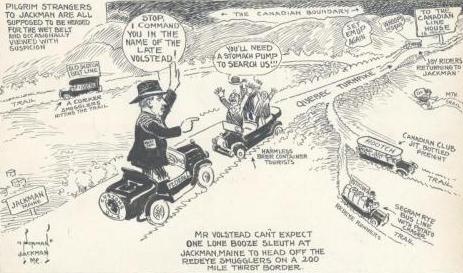
The real point, however, for we Canadians is that the end of prohibition in the US led to a economic crisis in Canada due to the end of our monopoly on legal brewing in North America. In Craig Heron’s excellent book Booze: A Distilled History, it is shown that one St.John, New Brunswick taxi driver could make $1,600 bucks per bootlegging run into Maine in 1923. That is a real economic benefit to a hard-pressed part of this land. And, at pages 249-250, he quotes the following statement of proud Canadian brewing autonomy:
We have no knowledge or interest in the prohibitory laws of the United States,” the vice-president of Windsor’s British-American Brewery Company told a writer for Ladies Home Journal in 1923. “We believe we are privileged to fill orders for shipments of beer to the United States, even if it is illegal for citizens of the United States to have beer.
Huzzah, says I. So, I think it is fair to say, that any celebration on 7 April is also a rejection of good Canadian monopolistic illegal moonshine and beery goodness…and I think, frankly, that is a pity that our feelings are being treated so thoughtlessly in all this southerly happy making.
 On the outskirts of Europe there lives a peculiar tribe of people. Like most other nations, they feel that they have the solution to every problem on the planet. Other small nations have had to bow to the necessity of adjusting to their surroundings, but Norway had the curse to find oil and gas in the 1970s, giving them the possibility of constructing their own reality.
 I am greatly saddened by the whole soccer head scarf debate surrounding one girl who wants to play. Playing is good and as we learn over and over FIFA is bad. It is not a difficult or even controversial statement. It is simply so. Feel good about thinking FIFA bad. Does anyone shed a tear for the Olympic Committee or any other private unelected mens’ clubs that organize sport to rake in personal privilege and benefit? It is only right and good to lump FIFA in and, frankly, place them up at the top of the lump.
 Big news from a little place