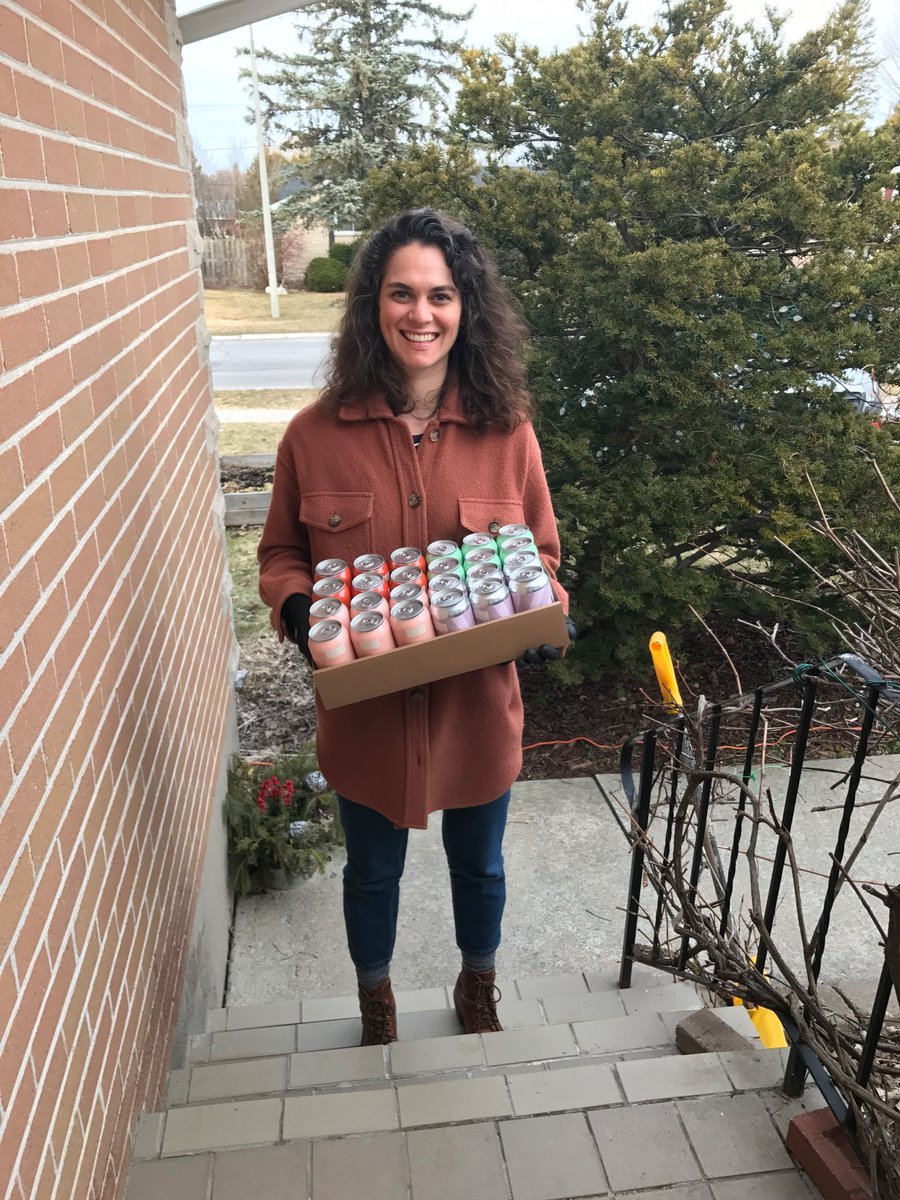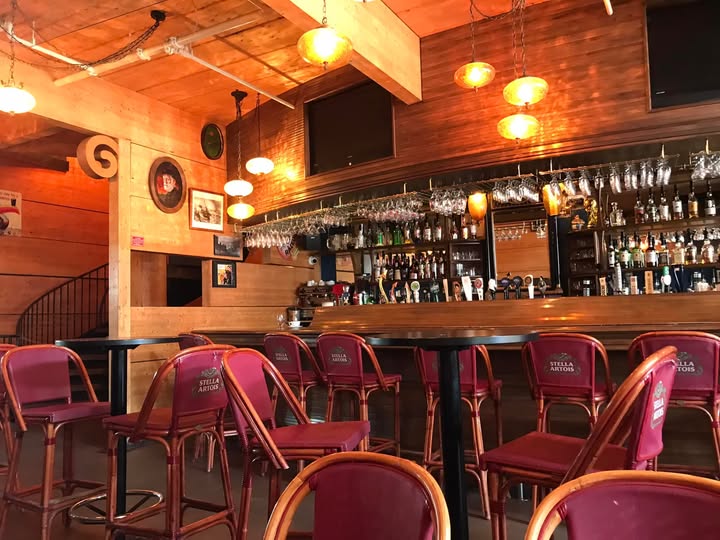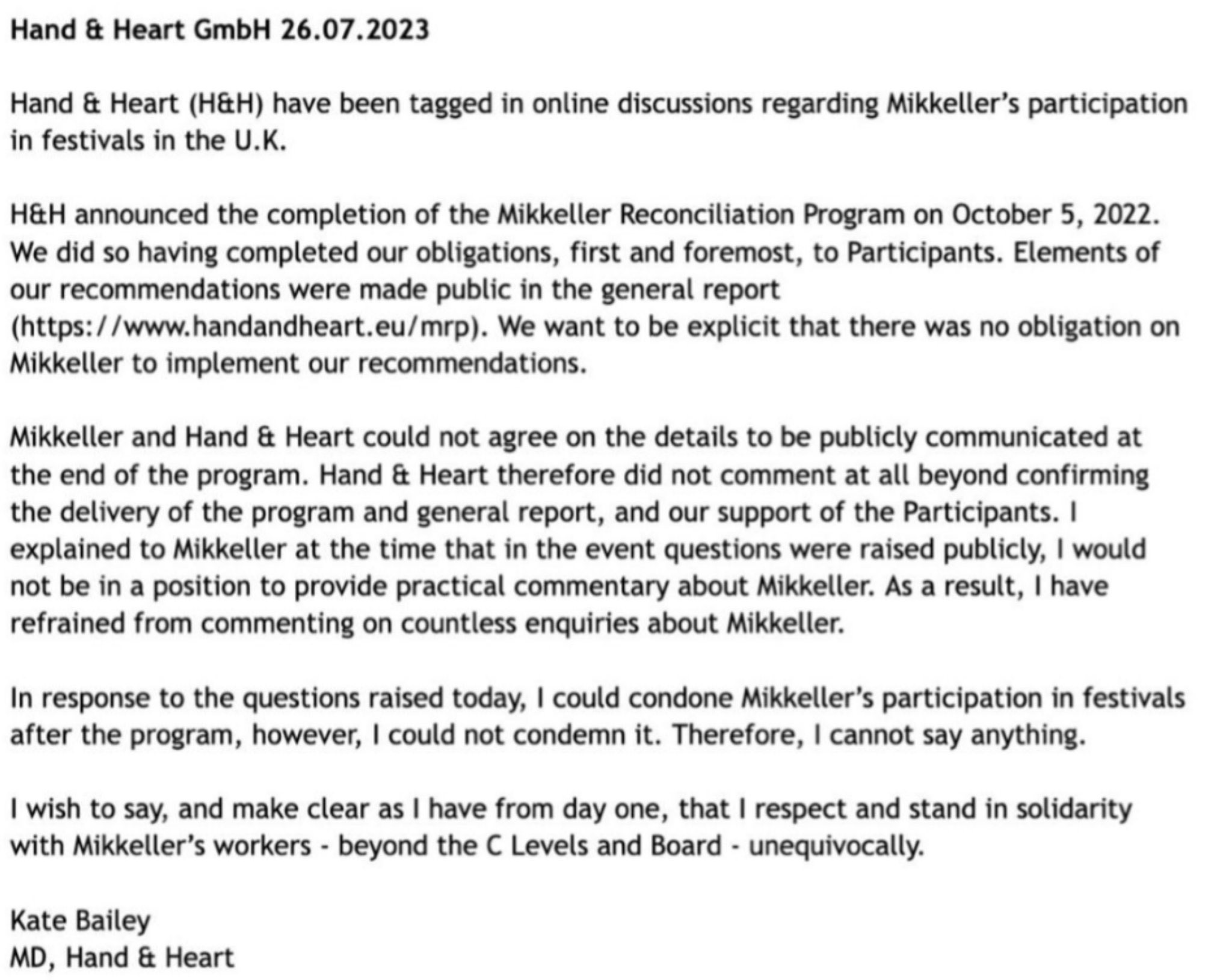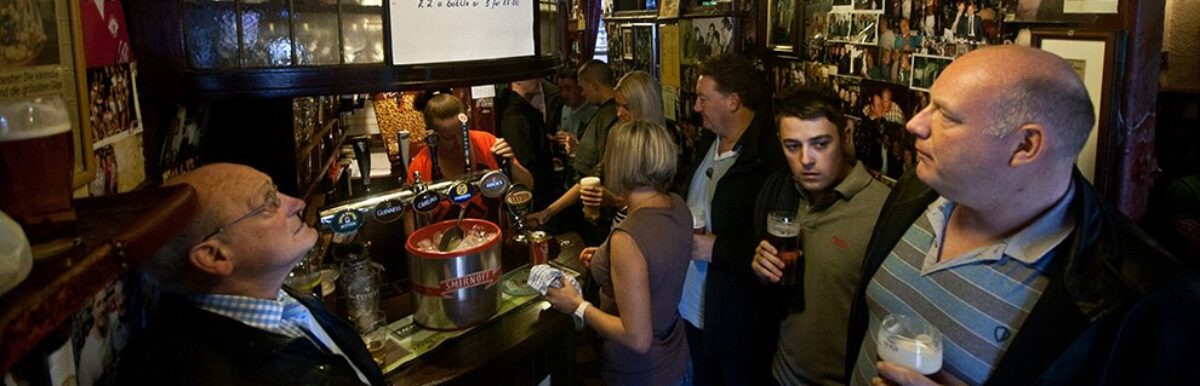

Your “The Thaw Cometh! The Thaw Cometh!!” Mid-February Edition Of These Beery News Notes

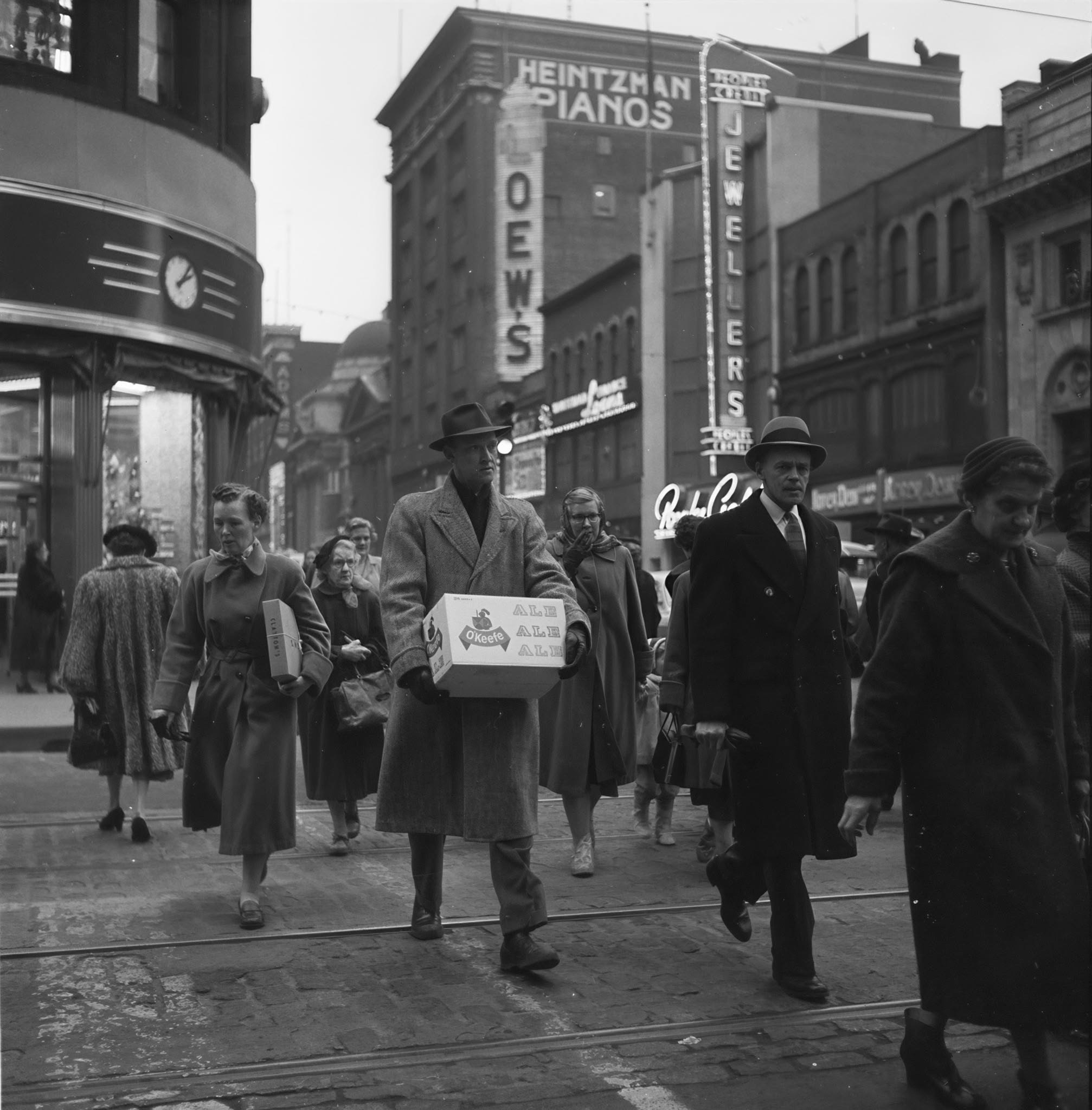
Now that the temperatures have moderated from -30C at dawn way up to -3C, the nation asks itself what the hell was all that? There is no answer to the question. Fortunately, there is a second question: how to still look dapper in a Canadian winter while lugging a lot of beer? Well, this gent can help. First, walk around in one of Toronto’s well loved black and white neighbourhoods where people must wear vintage clothing. Then, bottle your homebrewed beer only in second hand O’Keefe quarts you have nicked from the upper bric-a-brac shelves of old taverns. Finally, invest in an industrial quality paper packaging printing press you keep in the basement solely for the recreation of 1950s brewery boxes. Easy! Speaking of being on one’s feet, Boak and Bailey have written about how they didn’t do a Dry January so much as a very mobile one, a habit that has continued well into February:

We didn’t set out to make a mission of this, but we realised about halfway through January that, as it happened, we hadn’t yet made a repeat visit. That made us wonder if we could keep it up for the remaining few weeks. We were particularly conscious that we’d tended to stick to tried and trusted favourites last year. In fact, in 2025, over a quarter of our logged Bristol pub visits were to just two pubs – The King’s Head and The Swan with Two Necks. You might have noticed the word ‘logged’ and be wondering exactly what that means. Well, Jess, an accountant and spreadsheet nerd, of course keeps track of every pub we visit.

What a good realization! We have nothing like that possiblity here so much replicate 1950s Toronto to amuse ourselves but this comes a very good second. In the US of A, something else appears to be amuse or perhaps console according to BMI :

Beer posted positive $$ growth in 4 of the last 5 wks, and Jan 2026 is on track to be beer’s best monthly trend in years, at least in these channels. Including wine & spirit RTDs in the mix brightens the picture even more; broader beer + RTD category $$ grew more than 5% with wine & spirit RTDs adding close to 2 full pts in scans. 

Booze up! And somewhat similarly Ed stood up for the honour of Guinness this week with a response to what he called a a hatchet job on the Guinness’ Open Gate brewery in London published by The Guardian:

For some reason restaurant critics put the boot in more than any other type of reviewer… I was going to the brewery as part of the CIBD Southern section’s AGM, but first we had to do the business part to do at Diageo’s HQ.  I don’t know what deal the CIBD had done with Diageo or if we were subsidised, but we paid a tenner. This gave us pie and mash, which was nice, and a pint of Guinness (brewed in Dublin). I was keen to have somethng brewed on site though, so I had a hazy IPA next, which was nice enough. I think the ABV was a bit hefty, as on top of the three pints of Guinness I’d had I was defintely feeling pissed by the time I’d fininished it. So there you have it. The Guardian journo’s main complaint seemed to be that you had to take a lift to the toilets.

For others, the trip to the pub and then to the toilet is even easier. They are visiting the pub virtually from home, a remote non-work arrangement of sorts:

The 24-year-old from Yeovil, Somerset, regularly tunes into the feed from Morgan’s Arcade Bar in Carlisle, Cumbria – despite never having been there or anywhere near. What hooks Katie in is seeing different people come and go: the women enjoying a work party, the couple singing along with the musician, the young lad trying to chat up a girl at the bar… On some nights Morgan’s Arcade Bar, which can only fit around 60 people in it, has up to 5,000 viewers on its livestream at any one time. But like other bar streams, it has been subject to bans and restrictions for reasons they don’t quite understand. Bar owner Morgan Taylor has been streaming for nearly nine months. He noticed a huge rise in viewers over Christmas, then a few weeks ago his account was deleted.

Cass Enright got out of the house and on the road in his latest installment of A Quick Beer takes us to Montreal – a favourite destination of mine – and revisits some of the great brewpubs there in a video with this intro:

Join us on a step back in time as we have A Quick Beer at three of Montreal’s original brewpubs! Discover the enduring charms of Dieu du Ciel!, L’amère à boire, and Le Cheval Blanc, three spots that have been serving up delicious beer for decades. Although Montreal offers many modern breweries and taprooms nowadays, some of our fondest beery memories over the years have been here, and they’re all still going strong.

For me, it’s L’Barouf on rue St-Denis. If you are ever looking for me, check there. Also all about winnowing the better and the best, Pete shared some firm thoughts in his column in The Times this week, always welcome sight:

My beef is not with hazy pales — those original examples were pretty good. But if you don’t need to worry about balance or clarity in the beer, and you’re throwing in enough hops to cover up any off-flavours from brewing mistakes, a hazy IPA is very easy for a mediocre brewer to make. From a drinker’s point of view, if you grew up with soft drinks and don’t like the taste of actual beer, it’s perfect. It’s also great for Instagram — everyone can see you’re not drinking a boring, mainstream beer. But instead you’re drinking a boring craft beer. A boring, one-dimensional alcoholic fruit smoothie in a gaudy can with hop monsters or skeletons on it. If I wanted to drink sour grapefruit juice, I’d buy some Tropicana and leave it in the sun for a bit. 

The many botches of “craft” is a venerable topic which even comes with its own primodrial gospel but it is true that for all its eager keener passion craft never seems to fail to find a way to fail.  Nice to see that we have a paper of record confirming what Pete called the “sustained decline.” Viva crystal malt! Viva!! Viva!!! And Phil Mellows guided me to this article in The Caterer on the why to Pete’s what including this suggested impetus:

“…we are beginning to see the movement of some younger adult drinkers towards nostalgia brands, and given our history and heritage, we feel well-placed to meet this trend through some marketing and awareness driving activity.” Brookfield Drinks has launched a trial bringing long-established premium Scottish lager Kestrel back on draught. Brookfield managing director Nigel McNally says: “We’ve shown that a brand that’s nostalgic, like Kestrel, can be repositioned and revitalised. “Most pubs are serving the same products, and the trade’s been guilty of allowing brands which aren’t authentic onto the bar. Alcohol by volume (abv) have also come down, and I think overall customers feel they’ve been short-changed. A return to brands with heritage and nostalgia is offering customers a point of difference.”

Nostalgia and getting short changed? One must be on one’s toes. Which is related to Lars’ new maxim: “if you don’t know how the beer is made then, no matter what the beer is named, you have no idea what kind of beer it is.

Speaking of no knowing, The Beer Nut made a confession this week that I suspect is made on behalf of many of us:

Anyone who pays attention to trends within microbrewing will have noticed in recent years the explosion in variety of proprietary hop products. I don’t think these assorted extracts and powders and boosters were ever meant to have a consumer-facing role, but brewers seem to love them, and love letting us know that they’ve used them. Does that get them a discount from the supplier? I wouldn’t be surprised. For my part, I can’t help wondering if these enhancers actually enhance the beers in any real way. I’ve certainly never identified any pattern among them: which ones to look out for and which ones aren’t worth the paper their patents were filed on.

Note #1: Ludlow prices!!!
Note #2: Laura’s top tap rooms.
Note #3: Jeff doxxed.
Note #4: Burton Union Pr0n!
Note #5: Actually, no you can’t. You’d die.

The British Royal Navy has recently announced it is cutting booze rations in the service, limiting intake to 14 unit per week while on board. The Telegraph in its emailed newsletter presented a few responses to the news from readers:

Jenny Jones, however, recalled an age of largesse: “Many years ago in Malta, my husband and I were invited on board a Royal Navy ship that was giving a party. The atmosphere was convivial and, thanks to attentive stewards, I was able to enjoy several gin and tonics before dinner. “On departing, it seemed to me that the gangway had become a lot steeper. Back on dry land, our host asked how many drinks I’d had. When I said three, he told me that in fact I’d had nine, as naval tots are about triple the size of what one would get in a pub.”

Ah, Jenny Jones… what’s that? Not the same one? Fine. Me, I was once invited with a gang up the plank and onto a Canadian navy ship helpfully docked a walk from the Halifax taverns by a pal’s navy boyfriend. Among the minty green paid we worked our way though a number of 25 cent beers. I expect that sort of service is no longer offered.

The feature this week at Pellicle was written by Newt Albiston who shares his thoughts on drinking in Epping, just north of Greater London the tough town where he grew up which lives with division:

The day I return to Epping, my first trip home in some time, I can feel the tension, and the hesitance. The high street is pretty quiet, and there are lingering looks as I make my way past the various coffee chains and charity shops. Signs of the change in mood are everywhere: Union flags fly at half-mast on lamp posts, as if to declare the death of Britain as she once was, shadowed by the residue of torn-off patriotic stickers. Although I am instantly greeted by familiar faces when I walk into The Duke, the tension is still present in the quietness of the venue.

I like this: “…no fancy ginger beer or small-batch kombuch…” Perhaps related to The Duke, Stan guided us to a question this week – “what’s that smell?” Or rather…

“Olfaction helps shape our cultures, although it often does so unknowingly or without us noticing,” says (Inger) Leemans, who led the Odeuropa project. “When we talk about cultural heritage, we can think about religious rituals, but we can also think about specific scents that we’ve been cherishing and living with for a long time.”

Cherish. Hmm… I spent a good chunk of my teens in Truro, NS where the smell wasn’t always cherished and I am mindful of that reference The Breweries of Kingston & The St. Lawrence Valley by Steve Gates to a brewery a couple hundred years ago near my current place of work at City Hall which doubled as a pig sty. The next brewery to the north itself had a manure pit.  My point is that there were no scents without the full sensory array around it. Did 1890s Mild pair well with coal dust? Did Porter marry well with the pong of streets filled with horses? Perhaps we can never know.

And Charlotte Cook, brewer and scribbler, at took us along to Asturias, Spain for Everyday Drinking and shared her thoughts on the food and the cider:

When you taste the intensely rich stew, you can understand why cider rather than wine prevails in the north—the sour and fizzy is needed to cut through, cleanse the palate, and prepare you to dive in again. Cider is omnipresent in Asturias. As you walk around the town center of Oviedo on a Sunday morning, as families returning from church mix with football fans heading to an entirely different type of cathedra, cider is everywhere. Before 11 am, people will be drinking a bottle of cider for the table. Spaniards are famed for their ability to drink until the wee hours and still make it to work, school, or church as if nothing has happened. And having a little tipple of cider in the morning isn’t seen as such a stain on your character as it is at home.

Finally, some very heartfelt tributes were shared after the news of the death of beer writer Des de Moor like this from David J:

I think a lot about the pints we had one night in South London where he held court, sang songs and was so warm to everyone.

Pete also remembered Des the singer:

Des was a man of many layers. Years after the event, I discover my first interaction with him was buying the 12” remix of Charlton Heston by Stump – that was him, as half of the Irresistible Force. He made the Popbitch newsletter as Secretary of the Ramblers Association (moor, geddit?)… He was a great singer, a walking encylopedia. An absolute stalwart of judging the World Beer Awards. Never once heard him angry, pissed off, or anything other than kind and decent.

There are many more. His Wikipedia bio explains his musical side. Here he is singing Bowie and, here, an earlier solo album. By all accounts a wonderful guy. A sad loss.

Until next time, please check out Boak and Bailey who are posting every Saturday and adding to their fabulously entertaining footnotes week after week at Patreon. And look out for more of Stan’s new “One Link, One Paragraph” format. Then hunt out something in someone’s archives! Leave oblique comments on someone’s post from 2009!! Listen to a few of Lew’s podcasts and get your emailed issue of Episodes of my Pub Life by David Jesudason on certain Fridays. And Phil Mellows is at the BritishBeerBreaks. Once a month, as noted, Will Hawkes issues his London Beer City newsletter and do sign up for Katie’s wonderful self-governing totes autonomous website featuring The Gulp, too.  Ben’s Beer and Badword seems to be on pause since November but there is reading at The Glass which is going back to being a blog. Any more? We have Ontario’s own A Quick Beer and All About Beer is still offering a range of podcasts – and there’s also Mike Seay’s The Perfect Pour. Plus follow the venerable Full Pint podcast! And there’s the Craft Beer Channel on Youtube. Check out the archives of the Beer Ladies Podcast.

The Delightful Yet Pensively Penultimate Beery News Notes On A Summer’s Thursday For 2025

It’s been a busy week but not really in the beery sense. Guests and heirs have come and gone – and even bought a $14.99 beer on the way out via an airport bar at Montreal, as illustrated sub-wonderfully perhaps. A last bit of summer visting and the shedding of the last loonies and twoonies. Which means the home is quieter here at this end of the week compated to the other. Which is good. But quieter. At least I have my tomatoes. Did I mention my tomatoes? Definitely illustrated sub-wonderfully, that yellow one in the upper left weighed in a 1.7 pounds. And I did nothing to make it happen. Which is my favourite and most common form of success. Six varieties left to right ish clockwise: Chiltern’s Blue Bayou, Baker Creek’s True Black Brandywine, Chiltern’s Golden Sunshine, Baker Creek’s Kentucky Beefsteak, Chiltern’s Beefsteak and Baker Creek’s Orange Icicle. Picked from the catelog based on the “pin tail on donkey” method. All started from seed last winter and soon getting turned into sauce. That True Black Barleywine is the best tasting tomato ever – like it has built in balsamic vinegar. Thanks for tuning in to Tomato News Today!

First up in the world of beer, the Tand himself has also been out and about on travels and has reported back on the scene in Munich – and found out that certain things were not to be found:

Sadly, you can’t find Pils on draught anywhere, and for reasons best known only to themselves, Spaten insist on offering the dreadful Beck’s as their bottled pils in their most prestigious outlets. It appears Spaten Pils, which I recall was a lovely beer, is no longer brewed. A real shame.  In fact, Spaten it seems, only brew Helles in both normal and alcohol-free forms and, of course, an Oktoberfest. It gets worse. The whole shooting match of Spaten-Franziskaner-Löwenbräu-Gruppe is owned by AB InBev, who presumably have streamlined the brands available, though under the Franziskaner brand you’ll also find weissbier and a kellerbier.  Like Spaten, the rather delightful Löwenbräu  Pils has been dropped. It is a pretty grim picture as the odd hoppy pils provided an alternative to Helles, which in its Munich iteration, can be a little sweet, and dare I say, bland? (The locals call it “süffig”, meaning “easy to drink”. And, in fairness, it is.

And over at Pellicle, Matthew assumed the role of player / manager and reported on his travels to the French & Jupps Maltings in Hertfordshire where he found a hidden truth:

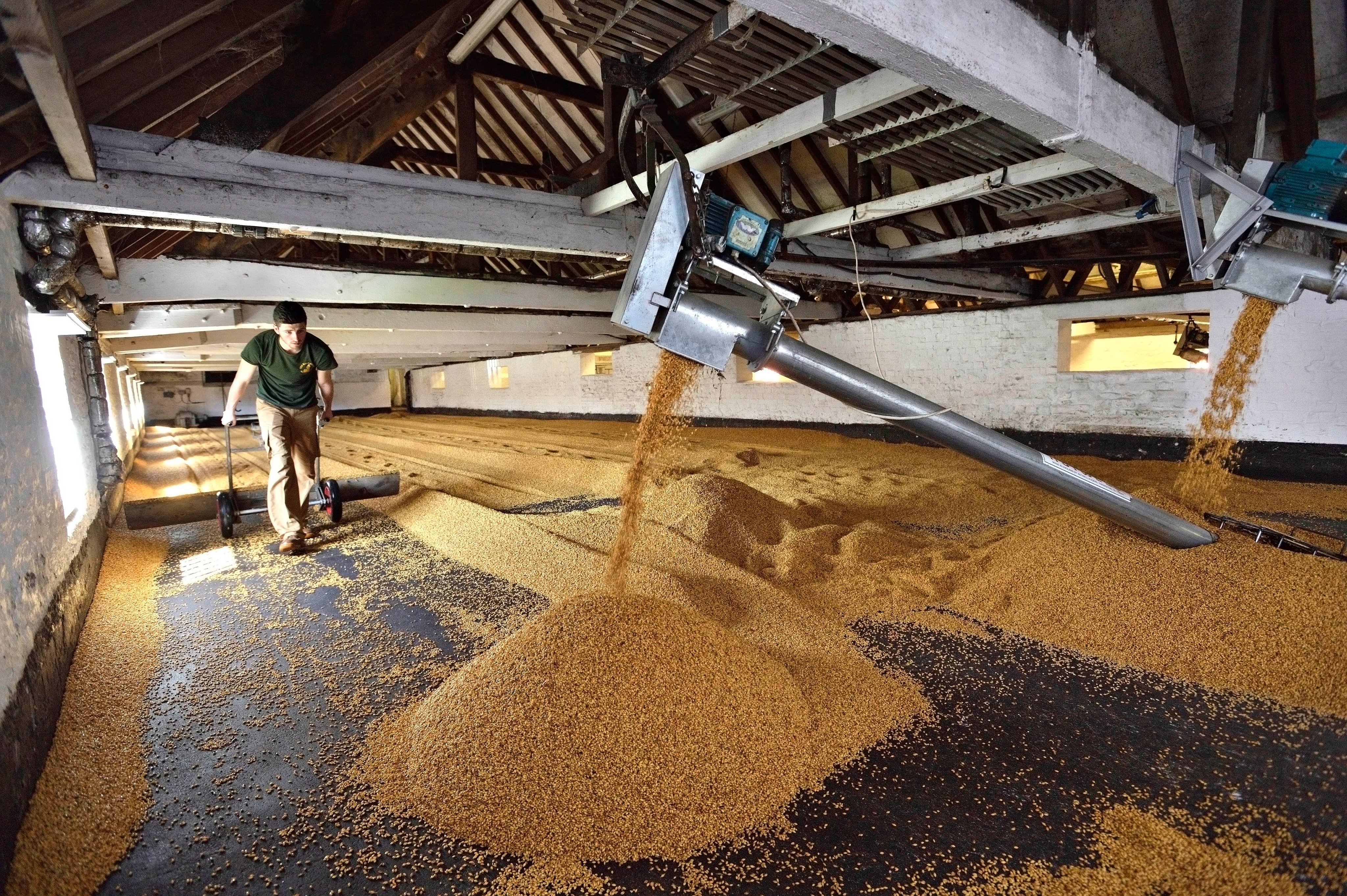
Its long history stretches back to 1689, and for more than a century the maltster has been based in the twin Hertfordshire towns of Stanstead St. Margarets and Stanstead Abbots, bisected by the aforementioned Lea, some 30 miles north of London as the crow flies. There are a few reasons for its relative anonymity—I myself hadn’t heard of them until I was invited for a visit in February 2024. One is due to the fact its malt was (and often still is) bought in bulk and rebagged by various distributors before being shipped out to breweries. And so, it might bear the name of a competitor—although in this context it’s perhaps more accurate to refer to them as partners—in the US, for example, the malt is typically sold under the William Crisp banner.

Sneaky sneaksters! Did you know? (Did I? Never mind that… let’s make this about you.) Did you??? Speaking of hidden truths, Pete Brown had a has retrospective on BrewDog, now well in to the post-Watt era and even into the post-Dickie, published in The Morning Advertiser that he unpacked into something of an obit:

To me, they always felt more like a band than a brand – not least because they wanted to be seen as punks. Bands are different. When none of the original members remain, many former fans insist that it’s simply not the same band any more, and that the newcomers who have taken over, singing songs they never wrote or had hits with, are no better than a covers band. The departure of Martin Dickie feels like the last member of the original line-up has left the building. The entity that remains may own the rights and assets of BrewDog, but it has lost the spirit and soul that once defined it… Dickie remained silent throughout. The initial allegations referred to a “cult of personality” built around both men, but specific personal allegations were focused on Watt’s behaviour. After Dickie’s departure, some former employees took to social media to say that he was “part of the problem.” 

Wonderful. I have never understood how Dickie, co-exec past and board member still, has had the teflon wrapper that he has enjoyed through downturn after downturn on what must be one of the most note worthy financial flops in recent brewing history. But perhaps it’s been a case of not noticing that scratch on your hand due to the nail in your foot.

Speaking of endings, Ed the Beer Father has shared his thoughts on the closing of Banks of Wolverhampton, mapping a fairly complex set of international bobs and weave that led to the end:

Eleven years ago the two companies with rights to San Miguel beer, San Miguel Brewery (Philippines) and Mahou San Miguel (Spain) signed a cooperation agreement to promote their international businesses and position San Miguel as a global brand. To further its growth they had already partnered with Carlsberg to contract brew it in Britain, and it was a large part of the output of the Northampton brewery. But for a brand with global ambitions partnering with the world’s biggest brewery seems like an obvious match… So, as what I believe is part of a global realignment, last year San Miguel moved its contract brewing in the UK from Carlsberg to ABInBev. Losing the San Miguel contract left Carlsberg in the UK, which owned one giant factory and two large regional breweries, with a lot of surplus capacity. The giant factory wasn’t going to go and Marston’s has the small pack facilities, which left Banks’s. So a contract change for a Spain and Philippines based international lager brand closed a 150 year old brewery in Wolverhampton that didn’t even brew it. 

Lordy. Speaking of things making one’s head spin, I totally missed Stan‘s post before the Labour Day weekend on the nature of beer bubbles so I will correct that error now:

There is more to monitoring beer foam than counting bubbles, although they are the foundation. They result from nucleation, and as those bubbles climb to first form or then replenish the foam head, proteins and bitter substances are carried into the bubble wall, forming a matrix that holds the skeleton together. In his doctoral thesis, “Beer Foam Physics,” A. D. Ronteltap calculated that a foam 3 centimeters high (a bit less than 2 fingers) in a glass 6 centimeters wide (a bit less than a Willi Becher) made up of bubbles with an initial radius of .2 mm (twice the width of a human hair) would contain 1.5 million bubbles distributed over about 100 layers.

Over a million bubbles! Not quite millions and millions but more than one million. And, while the numbers aren’t quite confimed yet, Jessica Mason pulled out the stats as she reported on the question “Can Gen Z save cask ale from extinction?” for Drinks Business:

Statistics from YouGov for the Society of Independent Brewers and Associates (SIBA) have shown 25% of 18 – 24-year-old beer drinkers regularly order cask ale. The figures mark an increase of more than 50% on the previous year… Digging deeper into the SIBA figures, there are also statistics that support the opportunity that women present in the future of cask ale’s revival. For instance, the data revealed how 22% of female beer drinkers regularly order cask ale, compared to 43% of men. But, as Corbett-Collins noted: “It would be great to see even higher numbers, but the glass half full fact is that men and women of all ages are enjoying cask beer.

Out and About Update: Max mapped a 29 km(!) pub crawl he took through the Czech countryside to plant himself in front of a beer at Únětický pivovar, Zdibský pivovar and Polepšovna ducha as well as a few other spots. I marched about a tenth of that the other weekend and my left knee let me know about it for more than one day. Good thing Max kept up a good pace because apparently, according to the white coated eggheads in the Netherlands, beer drinkers are a prime target for mosquitos:

To find out why the blood-sucking critters prefer some people over others, a research team led by Felix Hol of Radboud University Nijmegen took thousands of female Anopheles mosquitoes to Lowlands, an annual music festival held in the Netherlands… Participants who drank beer were 1.35 times more attractive to mosquitoes than those who didn’t. The tiny vampires were also more likely to target people who had slept with someone the previous night. The study also revealed that recent showering and sunscreen make people less attractive to the buzzing menace. “We found that mosquitoes are drawn to those who avoid sunscreen, drink beer, and share their bed…”

Speaking of getting bled, I received the alert from Will Hawkes: “Sorry to be right about this. No GBBF next year as it made ‘a substantial loss’, according to CAMRA.” As per usual and FOR THE DOUBLE!!!… Jessica Mason has more detail:

CAMRA chairman Ash Corbett-Collins explained how “at Members’ Weekend earlier this year, the national executive presented finances that painted a stark picture. As your chairman I was open with you; we were facing significant challenges… Corbett-Collins lamented: “Sadly, this means I must tell you that: The Great British Beer Festival and its Winter counterpart did not attract enough visitors to cover the cost of holding them, resulting in a substantial loss.” Added to this, he revealed that CAMRA’s membership figures “are simply not growing” and confessed that “the hard truth is we are unlikely to return to pre-2020 levels”… and noted how “the cost of running a membership organisation and business is also increasing”.

This is a pretty serious situation as it really looks like a broader issue than just the fests. The organization itself seems to be at risk. I expect more information to be flowing in the coming days.

In the “WAR ON SCIENCE” folder, we read the news out of The New York Times that everyone’s favourite slowly exploding head in charge of the Department of Health and Human Services has pulled the US government’s pending report on alcohol as part of a healthy diet:

Mike Marshall, chief executive of the U.S. Alcohol Policy Alliance, a nonprofit that aims to reduce the harms of alcohol, said H.H.S. was “doing the work of the alcohol industry.” “They’re burying the report so the information about the health consequences is not widely known,” Mr. Marshall said. Health Secretary Robert F. Kennedy Jr. has decried a “chronic disease epidemic” sweeping the country. But he has said little about alcohol’s impact on American health since taking office. Consumption of both alcohol and tobacco was absent from the first Make America Healthy Again report released in May. Mr. Kennedy (like his boss, President Trump) has said he does not drink.

It’s important to note that Mr. Kennedy, unlike his boss,  does not wear makeup preferring to gain his particular rusty orange hue through a natural process.

Finally, just before this organ went to press, the dynamic duo B+B posted a piece under the fabulous title “Customers Have Always Been a Problem for Pubs” which illustrates the truth based on a sppech given in 1933 by one Lieutenant Colonel E.N. Buxton, director of the East London brewery Truman, Hanbury & Buxton:

The talk finishes with a few more rebukes for the drinkers. First, the reason pubs often look so ugly, and are so sturdily built, is because “you do not treat them so kindly”. “Walls and furniture are roughly treated”, he says. “As for the outside of public-houses, I agree that some of the houses in London look perfectly ghastly. Hard wear, however, had to be the first consideration.” This was addressed, remember, to a room full of people from Bethnal Green. We’re picturing the crowd when Bertie Wooster sings ‘Sonny Boy’.

Fabulous. There. That’s a lot for a busy week but probably less than all the stuff our there to read so please also check out the afore mentioned Boak and Bailey every Saturday and sign up for their entertaining footnotes, too. Look out for Stan when he feels the urge now that he’s retired from Monday slot… maybe … maybe not. Then listen to a few of that now newly refreshed Lew’s podcasts and get your emailed issue of Episodes of my Pub Life by David Jesudason on certain Fridays. And Phil Mellows is at the BritishBeerBreaks. Once a month, Will Hawkes issues his London Beer City newsletter and do sign up for Katie’s wonderful self-governing totes autonomous website featuring The Gulp, too.  Ben’s Beer and Badword is out there with the all the sweary Mary! And check out the Atlantic Canada Beer Blog‘s weekly roundup. There is new reading at The Glass which is going back to being a blog. Any more? We have Ontario’s own A Quick Beer featuring visits to places like… MichiganAll About Beer offers a range of podcasts and there’s also The Perfect Pour. Plus follow the venerable Full Pint podcast! And there’s the Craft Beer Channel on Youtube. Check out the archives of the Beer Ladies Podcast. That’s quite good and after a break they may well be are back every month! Such is life. Such is beer podcasting and newslettering… which, as Ray says, are blogs! And he’s right.

Your Beery News Notes For The End Of July And The Beginning Of The Back To School Ads

The last day of July. It’s one of the first endings of the year. Well, there is the end of winter but no one regrets that. And the switch from late spring to early summer never really leaves a ripple. But… July. Spent the other evening watching dusk arrive at a nearby conservation area, listening for bobolinks and kingbirds as they snabbed a few last bugs out over the field. Saw a raven. Heard it croak.  Mr. Nature. That’s me. Five Saturdays to Labour Day. But even that date’s lost its sting as it’s the first September that not one kid is in the public school system for twenty-three years. What milestone is left? Last day of July.

First up, David J. announced the roundup for the July edition of The Session with a pretty interesting set of submissions this month, interruping his reguarly scheduled broadcasting:

Today’s Substack is ‘free to air’ – like Test cricket and Premier League football should be – so that the people who have contributed can gain the widest readership possible. (Also a desi publican I was going to interview suffered a bad injury and had to postpone. He’s fine, though, and I’ll be bringing his story soon.) On July 11, I asked various participants to write a blog, web post, newsletter (like this one) or even a SM thread on the subject of food in pubs. I’ve rounded up their work and at the bottom have written about the dangers of being a go-to voice on pub food.

Go have a look. Plenty of good reading. Also well worth a read, Ruvani de Silva has announced the launch of her course hosted by CAMRA on American Heirloom Cider Apples and it is good to see the historical context at the forefront:

Settlers, noticing the tribes’ bountiful orchards and the quality of the land they were cultivating on, were keen to claim it for themselves, unafraid to use violent displacement to do so. In one particularly horrific example, future President George Washington took a break from fighting the British in 1779 to send Generals Clinton and Sullivan to implement a scorched-earth policy across the Six Nations of the Iroquois’ beautiful, fertile Fingers Lake land in upstate New York, burning their flourishing orchards to the ground.

This lines up from some of what I found when researching upstate New York history over a decade ago including Lord Selkirk’s 1803 description of apple orchards around Geneva NY from before the Sullivan raids as well as this description from 1797:

…a person from Scotland has established, at Geneva, a very respectable brewery, which promises to destroy in the neighbourhood, the baneful use of spirituous liquors. The apple and peach orchards, left by the Indians, yield every year abundance of fruit, for the use of the inhabitants, besides making considerable cyder; so much so, that one farmer near Geneva sold cyder, this year, to the amount of one thousand two hundred dollars.*

Speaking of solid research, after last Saturday’s news update was posted by Boak and Bailey, I rushed to their footnotes at Patreon which included this tidbit:

…we’re entering the era of ‘normalism’. People want to drink normal beer, in normal pubs or bars, while eating normal food, and wearing normal clothes… Perhaps because they don’t have the headspace to cultivate less mainstream tastes, or maybe because standing out as an individual feels like a dangerous business in 2025. Or just pointless. We keep seeing young couples dressed head to toe in formless matching beige. 

I thought of that Monday evening when I saw a young man waiting for the lights to change, standing at an intersection in beige Sperry Top Sider clones. They had to be clones, right? I also thought of this when I read Jessica Mason‘s news about the recent rise  in Heineken’s fortunes:

Speaking about the results, Heineken CEO and chairman Dolf van den Brink said: “In the first half, we delivered solid results as organic operating profit grew 7.4% as the operating margin expanded by 26 bps and net revenue increased 2.1%…” Highlighting the strides the business has made, van den Brink pointed out how Heineken’s “volume performance improved across all regions in the second quarter and continued to be of high quality…  Describing how the company has achieved this, van den Brink explained: “Our advantaged geographical footprint helped us to adapt to ongoing macro-economic challenges which impacted consumer sentiment and expenditures.**

Is that so bad? Perhaps green is as much the new beige as beige is. Normal. Makes more sense than spinning in your sheets over and over thinking of all the coulda woulda shouldas. The trend is evident in the US craft scene as summarized by Keith Gribbins at Craft Brewing Business the other day:

The Brewers Association’s 2025 Midyear Report shows an industry still facing strong headwinds. Yet, pockets of growth remain — especially for the smallest on-site brewers. As of June 2025, 9,269 craft breweries were operating in the U.S. — down 1% from a year ago. Closures continue to outpace openings, led by a 3% decline in microbreweries. Taprooms dipped 1%, while brewpub and regional brewery counts remained flat. Craft beer volume also shrank. The BA estimates a 5% year-over-year decline in production. 

Five percent cut in production in the last 12 months is not a “maturing” or any sort of “sideways” something. As one would say in my youth, the arse is out of it. Doug Veliky shared some thoughts about where those buyer might be heading and why the trip isn’t that difficult:

Low-dose THC beverages offer the same qualities that have made light beers, spritzes, and canned cocktails so popular. They are social, easy to enjoy, and deliver a consistent experience every time. Because these drinks are made to be consumed more than once in a sitting, they help establish rituals that lead to frequent, repeat purchases. Instead of being one-and-done, the format allows consumers to stack their way toward their preferred level of buzz.

So, craft may have lost its hook. By which I mean that idea of the ritual habitual. People are still doing things, sure. They’re just not doing those things because they now have the option to do these other things. Or is that the new habit? Being what B+B call normal. It might actually just mean not needlessly complex. Manufactured difficulty. Life’s hard enough without made up difficulties.

Note: not only do the top 40 breweries in the world not include much that can be called craft, onely one and a half seem to be American.

By way of comparison but really only as juxtaposition, Jeff continued his explorations into what makes a saison a saison, following up on his article on the style in Craft Beer & Brewing, illustrating once again that blogging about beer is always superior to the store bought stuff. I particularly liked how he moved the discussion from the romantic (ie lazy / fibby) explanation that saison is “something you feel” to getting to the elements of they stuff including the importance of a coarseness of character to the grains, as decoratively mentioned by Alex Ganum of Upright Brewing of Portland, Oregon:

Not sure if I ever shared this story, but back when we were running Old Salt, our hog rancher kept bugging me about using his triticale, which was the animal feed. He grew it himself and was proud of the quality, but I dismissed it early on thinking, ‘How good can animal feed be? ‘Well, that was dumb, because he eventually just dropped off a bag and it turned out to be incredible (which probably explained part of why his pork was delicious). So we asked him for a pallet and worked it into the Five for about a year or so.

Sixteen years ago, when I had the time to do so, when the kids were little enough that they couldn’t get too far, I grappled with the idea of these sorts of beers and their cousins, back when I could take a Saturday to contemplate such things in the shed. But that right there is as good an explanation as ever I’ve seen: beer made from bits fit for the livestock. Farm yard as much as farm house. Normal may not have time for farm yard.

Speaking of simple pleasures, Katie shared a lovely bit of recollection, a remembrance of Wetherspoons past involving herself and her staff access to discount chips:

When I worked at Wetherspoons many thousands of years ago, the one redeeming feature of the job other than the wage was access to a staff menu, off which we could also take a 50% staff discount. My favourite shift tea from this reduced selection of kitchen scraps was sausage and chips. It was not served with vegetables of any kind. A person can talk shit about Wetherspoons all day, and I will join in, but their chips have always been godly, the best of all the frozen chips. I am certain they are coated in semolina for extra crunch, leaving the centres fluffy and light. With mayonnaise, this dish, which cost me around £1.30 in 2008, was my favourite food. It didn’t make the pub I worked in any better, however. You can’t judge a pub by its chips—sometimes they are simply angels sent to soften the blow.

Normal likes chips and especially good discount chips. Quite right, too. Also alarmingly normal is Martin who has admitted to falling behind in his pub reporting and is trying to catch up which some of the highlights (*ahem*) of his continued touring:

Admit it, you’ve never heard of Cockerton, have you? Neither had I, even though this small Durham village is virtually contiguous (great word) with Darlington and only a few minutes from Piercebridge and my best-read blog post. And it’s got a free space for my campervan from which I can finish Durham’s Guide entries for another year. What Cockerton doesn’t appear to have is much actual character. though it does have excellent podiatry.

Note: at the Vytopna in Prague a little train set delivers your beer…

Finally and for the double, David Jesudason wrote the feature in Pellicle this week, the story of a thriving community pub at the edge of London that makes room for many and much:

Artist Neal Vaughan believes my snap judgment about Carshalton being a bit of a sleepy backwater is wrong. He explains how it’s a hub of creativity, which the Hope is at the centre of. Citing a memory from 2016, Neal recalls when Rodger encouraged him to set up Carshalton Artists’ Open Studios with all meetings and post-event drinks held in the pub. Tuesdays are described as a sacred weekday at the pub by Neal. It’s when folk musicians play an open session, board-game enthusiasts battle against each other at Scrabble, chess and Magic: The Gathering, and on occasion a leather maker taps away while seated on a chair. The pub even has a sailing crew that charters yachts, and when I visit they’re off for 10 days in the Adriatic.

There we are.  The end of trends, the end of a week’s news and the end of the month. It’s sorta normal. And as the sands trickle on down in your personal hourglasses, please check out Boak and Bailey every Saturday. Look out for Stan when he feels the urge now that he’s retired from Monday slot… maybe. Then listen to a few of the now rarely refreshed Lew’s podcasts and get your emailed issue of Episodes of my Pub Life by David Jesudason on the (sometimes even but never) odd Fridays. And Phil Mellows is at the BritishBeerBreaks. Once a month, Will Hawkes issues his London Beer City newsletter and do sign up for Katie’s wonderful newsletterThe Gulp, too.  Ben’s Beer and Badword is out there with the all the sweary Mary! And check out the Atlantic Canada Beer Blog‘s weekly roundup. There is new reading at The Glass which is going back to being a blog. Any more? We have Ontario’s own A Quick Beer featuring visits to places like… MichiganAll About Beer has given space to some trade possy podcasts and there’s also The Perfect Pour. Plus follow the venerable Full Pint podcast with an episode three weeks ago!. And there’s the Craft Beer Channel on Youtube. Check out the archives of the Beer Ladies Podcast. That’s quite good and after a break they are back every month! Such is life. Such is beer podcasting and newlettering… which, as Ray says, are blogs! And he’s right.

*See also History of Tioga, Chemung, Tompkins and Schuyler counties, New York. With illustrations and biographical sketches of some of its prominent men and pioneers at page 13: “The army was to march from their winter quarters on the Hudson to Wyoming; thence up the Susquehanna to Tioga, where another division, under General James Clinton, marching via Otsego Lake, after a diversion into the Onondagas country was to effect a junction, when the combined army, consisting of four brigades of infantry and riflemen, and a park of artillery, was to proceed through the valley of the Chemung; thence northward to Genesee River, destroying crops and houses and everything of value to the Indian as far as could be reached on either side of the trail of the army. The success of the expedition was most complete. Forty towns and more than 200,000 bushels of corn were destroyed, besides vast quantities of pumpkins, beans, melons, and other vegetables, and peach and apple orchards, and a most desolating march executed through the richest portion of the enemy’s country, with small loss to the invaders. Washington was afterwards called by the Indians Hano- dogarear, ” the town destroyer.”
**Oddly, The Independent reports Heineken has suffered losses in the first half of 2025. Who can you trust these days? Other than, you know, me.

The Mid-August 2024 “No, You’re The One Dreaming Of Sweater Weather” Beery News Notes

Great. Stan took this week off. And probably next week too. He may hover in my mind like the absentee desk editor like I mentioned a few weeks ago. But he also has a nickname, too: cheat sheet. Stan “The Cheat Sheet” Hieronymus. Yup. See, come Monday when I can’t think of anything to go look for in the world of beer to think about, I can go see what Stan has been thinking about first. He’s a bit like that nice smart left handed kid in grade 11 math class with really good posture that I sat one row back of and one seat over to the right. Gave me a good view. Made tests just a bit easier.

By the way, there is little beer related in that photo up there. Took the image Monday evening looking due south, down over central New York State. A pinhole sunset catching the anvil cloud from below. Right about in the middle of that horizon is Oswego, NY.  On still days in winter, you can see the plume rising from Nine Mile Point Nuclear. Also, home of Rudy’s. Where you can skip stones and drink Genny Cream Ale.

Did someone mention beer?  Starting hereabout, as we face almost 4,000 new beer retailers in these parts in a few weeks, Ontario’s public broadcaster TVO published a great piece by Matt Gurney about the shock of the new he has experienced in the last few years of deregulation of the provincial booze market, with a particular focus on that one odd rule that allows 7-Eleven to qualify as a restaurant:

Seeing someone drinking in a 7-Eleven or walking out of my local variety store with a bottle of wine will probably feel exactly the way seeing people openly smoking cannabis felt like for the first few years after legalization. I have a specific memory of standing at an intersection, waiting for a light so I could cross, and noticing two young men standing on the corner passing a joint back and forth. I thought to myself, huh, that’s unusually brazen. And then, seconds later, my brain caught up with reality: it would have been brazen a few years earlier, but that day, it was simply two law-abiding citizens engaging in a legal activity in public. 

On undoubtedly similar sorts of offerings, Doug Velky of Revolution Brewing in his newsletter Beer Crunchers, unpacks how craft has turned full circle with craft’s adoption of “cold” in the race to make light generic lagers:

…we also recognized that Cold Time, whose model focuses more on volume than margins, would require broader adoption than just our loyal Revolution customers to ever be considered a success. To achieve this greater scale, early investments would be crucial to get Cold Time into new places to find audiences who don’t currently think of themselves as craft beer fans, but are very open to a great, locally made lager.

Volume. Hmm. Disclosure. I’ve been buying Ice Cold Beer from Toronto’s Left Field Brewing for at least three years so there is no news here. But that branding had at least a level of self-parody in the mix along with the tasty within. Is that self-effacing sort of joke now all so… what… 2021? They may not be dipping as low as the macro-lags but aren’t they fighting for the Centro-Euro buyer‘s attention? Given how well “beer from anywhere you like” can sell, can we blame them?

Interesting bit of history over from Katy Prickett at Auntie Beeb this week on industrialization of England during the Roman Era, including brewing at scale:

“At Berryfields, we found evidence of malting and brewing and the tanks used to steep the grain before processing,” he said. “We tend to think of the Roman world as being very much a wine-loving place. “But actually a lot of the population in Roman Britain were drinking beer and we see that in the pottery they were using, large beakers in the same sort of sizes as modern pint glasses.”

Being someone who never gives a second thought for the Roman Empire, this was all news to me. I am told that Barryfield was located “at an intersection along a major routeway” and was “the location of multiple roadside industries, such as brewing, woodworking, and metalworking, aimed at supplying the travellers passing through.” Here, too, is an archaeological report on a neighbouring site complete with maltings and even malted spelt deposits along with some barley and even some apples and beets.*

In an exploration of more recent history and in light of far more recent racist events in the UK, David Jesudason published the story of a hopeful scene in late 1940s Wales as recoujnted by historian Kieran Connell, the story of an event that showed how working class people rejecting racist hostility are always as he says the vanguard of multiculturalism:

In 1948, the CIAC organised a black-tie event to celebrate Douglas’s success after he made 39 first-team appearances for the team, with the CIAC inviting white members of Cardiff Rugby Club. Announcements were placed in Tiger Bay shop windows and St Clair attended the night which was held ‘not at a dingy clubhouse’ but in the convention room of a city-centre hotel rented for the occasion. “He [St Clair] entered the hotel,” writes Kieran, “without any of the stares or comments that might ordinarily greet someone from an ethnic minority in central Cardiff. In the hotel lobby, he spotted five white girls and two black girls chatting with a group of four white boys. Further on, four or five boys of mixed ethnicity were trying to set up a large keg of beer.”

Table tennis? Bun fight? A bit of both? That’s the theme in an article by Ted Simmons in The Spirits Business about the dispute between the  American Craft Spirits Association (ACSA) on the one hand and, on the other, the Wine and Spirits Wholesalers of America (WSWA) over what is causing the great retraction. We join the debate half way in progress:

WSWA released a second statement [:]… “Blaming wholesalers for the industry’s challenges is shortsighted. The focus should instead be on how the entire supply chain, including wholesalers, can adapt to changing market conditions and support each other in navigating economic pressures,” it read…  ACSA cites a study that found that 87% of craft spirits drinkers want to legally purchase via DTC, and 82% of craft spirits drinkers support laws changing in order to expand DTC… The WSWA calls for an end to any finger pointing… 

Speaking of handbaggery, Ed had a posted about the redistribution of CAMRA branches which so far has not yet popped up into the general finger pointery zone but might be heading that way:

CAMRA currently has a plan to change its branch structure so no branch straddles CAMRA region or county boundaries. From what I can gather it’s a top down proposal from the National Executive… I’m a bottom up man so am dubious about the proposal. Though a devout member of our Mother Church I’m not very active in the branch, but it is the branch I’ve been in since I was a teenager so I would be sad to see it end. Our branch chairman has written a long reply detailing how the branch came to be and why its current structure works.

BREAKING: Ron + Uruguay: one, two, three, four plus one alarming admission: “I want a rest from being Mr. Beer“!!! Heavens. Jings even.

And Jessica Mason shared details on the losses left in the wake of the failure of one brewery, the unfortunately** named Anarchy Brew Co of Newcastle:

Following the pandemic, the business also reportedly fell into financial difficulties after being unable to pay back loans and financial obligations on top of rising supplier costs. Reports have outlined that the trouble began when directors of the company took out Covid support loans and used tax deferrals to manage finances. FRP Advisory has since put together estimates with a breakdown, showing the shortfall owed to creditors stands at approximately £492,413 and an additional £158,016 still being owed to HMRC. Many in the sector with debts currently unpaid by Anarchy are set to lose out with 22 businesses in the industry, including malt and hop suppliers, still being owed thousands of pounds. 

In the referenced reports, it is stated that unsecured creditors such as trade creditors, the landlord and loans and finance agreements are owed £261,468. Assets came in at about one-third of that fugure. What to take away from all that? Certainly the interconnectedness what with so many others dependent on the success of the brewery. Plus… would it have been a kindness had the pulg been pulled earlier?

Perhaps speaking of which but definitely for the double, makring the Molson Coors cutting of losses Doug Velky posted a neat and tidy summation of the recent string of ditchings of unwanted craft brands which has seen one firm… consortium (… collector… aggregator…) named Tilray picking up the pieces to perhaps slide up to fourth place in the contracting US craft brewer market:

For Molson Coors’ there’s no growth potential looking forward for these brands as each posted negative trends in 2023. The brands aren’t dead as nearly 200,000 BBLs across four regional breweries is nothing to sneeze at, but in order to reverse these trends it would take focus, vision, energy, and dollars. As a public company focused on growing shareholder value, cutting these brands and focusing on positive trending formulas is where they’ll head instead. We saw the same of Anheuser Busch who dumped more than half of their crafty brands to Tilray in 2023 and Constellation Brands who quickest to take their “L” in craft and move on when they cleaned house and sold off Ballast Point, Funky Buddah, and Four Corners.

Jeff asks some good questions and triggers good thoughts – but there seems to be an assumption that “local” and “regional” are similar constructs. I don’t think they are. By the way… does one now cheer in 2024 as much as one booed in 2016? Such a long time ago, isn’t it? Wasn’t it? My thought it that it all such a case of corporate deck chair shifting that it really no longer matters. Macro abandoning craft at the same time craft is seeking to mimic macro. Whoda thunk it? What an odd scene this is for so late in the play.

Headline for these times: “World Of Beer Has Filed For Bankruptcy, Here Are The Details.

Interestingly and conversely, the government of Western Australia has created a ten-year economic development plan to boost the state’s craft beer industry:

The plan was put together by the state’s Department of Primary Industries and Regional Development, the Independent Brewers Association (IBA), West Australia Brewers Association (WABA) and South West Brewers Association (SWBA). As part of the strategy, the four parties’ two main goals are increasing the volume and value of locally produced beer threefold by 2034 from a 2023 baseline and creating “greater vertical integration of the craft beer value chain” in the region. Over 120 craft breweries exist in Western Australia, representing 20% of total craft beer production in the country.

A ray of hope? A futile effort given the bigger picture? Who knows. Finally – and as a welcome night cap if you get my analogy – ever the optimist or at least open to the possibility, The Beer Nut gave credit where credit was due in his piece this week on a brewery that has turned its luck around:

There’s hope for us all, I like to think. Today’s beers aren’t the first to come from a brewery premises whose earliest wares I didn’t care for and thought poorly made, but under new management seem to have been turned around. Investment in better equipment? Less corner-cutting? Or just a more highly skilled brewer? I don’t know. I do know that the beers from the Hillstown brewery in Co. Antrim were usually a raft of off-flavours, of the homebrew rookie sort. It seems that there’s a new broom about the place now, going by the friendly and approachable name of Modest Beer.

PS: I like shameless. I can work with shameless.

Here are the credits, the stats the recommends and the footnotes and the many ways to find good reading about beer and similar stuff via any number of social media and other forms of comms connections.*** Want to keep up with the news before next Thursday? Check out Boak and Bailey every Saturday and Stan back each Monday… with a top drawer effort this week. Elsewhere go look at then listen to Lew’s podcast. And get your emailed issue of Episodes of my Pub Life by this year’s model citizen David Jesudason on the odd Fridays. And Phil Mellows is at the BritishBeerBreaks. Once a month, Will Hawkes issues his London Beer City newsletter and do sign up for Katie’s now revitalised and wonderful newsletterThe Gulp, too. Ben’s Beer and Badword is back with all the sweary Mary he can think of! And check out the Atlantic Canada Beer Blog‘s weekly roundup. There is new reading at The Glass which is going back to being a blog in this weeks best medium as message news. Any more? Yes! Check to see the highly recommended Beer Ladies Podcast. That’s quite good. And the BOAS podcast for the bro-ly. And the long standing Beervana podcast …except they have now stood down.  Plus We Are Beer People. The Boys Are From Märzen podcast appears suspended as does BeerEdge, too. But not Ontario’s own A Quick Beer. There is more from DaftAboutCraft‘s podcast, too.  All About Beer has introduced a few podcasts… but some may be losing steam… until… Lew’s interview! And there’s also The Perfect Pour. Plus follow the venerable Full Pint podcast. And the Craft Beer Channel on Youtube.  The Moon Under Water… is gone which is not surprising as the ask was $10 a month. Pete Brown’s costs a fifth of that but is writing for 47 readers over there. There was also the Beer O’clock Show but that was gone after a ten year run but returned renewed and here is the link! Errr… nope, it is gone again.
*How do you say “ooh, look, my pee’s gone all pink” in Latin?
**Although perhaps not as unfortunate as Jolly this week.
***This week’s update on my own emotional rankings? Facebook still in first (given especially as it is focused on my 300 closest friends and family) then we have BlueSky (+1=133) rising up to maybe… probably… likely pass Mastodon (-1=929) in value… then the seemingly doomed trashy Twex (plummeting a bunch to 4,466) hovering somewhere well above my largely ignored Instagram (160), crap Threads (52) with Substack Notes (1) really dragging up the rear.

Fine… The Dog Days Of Summer Beery News Notes Have Begun

Is it me? It’s not you… is it? No, it’s beer. When beer sales peak, the news gets a bit sleepy or at least played out as expected. LCBO strike got settled. Beer in Canada is still expensive. Biden stepped aside. The French fascists were humilated… again. Sure, the back channel comments about the winding up of GBH continue to flow in – but nothing I would share to you lot. Some write for pay. Me, I write for gossip. I think Martin captured the zeitgeist of the week perfectly with this image above from his trip to take in the delights of the Church of St Mary Magdalene in Yarm.

Which leads to the question of the week, as posed by Stan on Monday when he responded to my comment last week that I think of him as my ever absent desk editor:

I am embarrassed, flattered, and a little surprised (perhaps skeptical) by the idea he does the sifting for me. The takeaway, to his credit, is a reminder of something all writers should remember: who the heck they think they are writing for.

Who or what do you write for? The reader? The commissioning editor? The next commissioning editor? The bills? The long dead relative who told you that you’d never amount to anything? I joke about things but I really have only been writing for myself for years. The beer trade is a benign sideshow that lets me explore ideas in an innocuous way. Ideas about life, business, quality, ethics… the whole shebang. It’s all right there. By the way, did you know a shebang was a rough hut of the Civil War era or a frontier settler? Me neither. One has to be careful about certain words.

Speaking of words, Jordan was out there recently wandering lonely as a cloud, not hunting out daffodils so much as dandelions to do some unpacking, dissecting and extractions to ‘splain a thing or two:

Dandelion has GLVs (hexenol), but that is to be expected since it has green leaves. It’s complex in that the different parts of the plant have their own properties. Harold McGee refers to the component smells as “light, fresh, and watery,” but we’re thinking about the entirety of the palate and not just the aroma. In terms of aroma, we have some of the same makeup as clover. Phenylethanol and benzaldehyde. There’s also Nerolidol, which is slightly woody and barky, which makes sense when you think of the rigidity of the stem. When the stem breaks, the dandelion’s defense method is to secrete latex, which is found mostly in the root system of the plant. The latex is not only bitter, but alkaloid, and polyphenolic. If you pick a dandelion to hold under someone’s chin, you’re going to get aroma from both the flower and the stem.

Yes, yes… outside of the Greater Toronto Area kids used buttercups to hold to a chins. But the point is made. There is science right there. Smelly tasty  science. Yes, there. And there as well…. ‘s’tru’. Even if “…phenylethanol and benzaldehyde… There’s also Nerolidol… “ sounds like a particularly challenging point in a Gilbert and Sullivan libretto.

Before the doors close, GBH published an interesting story by  Yolanda Evans on the practice of giving “libation” globally and also particularly in Black American culture:

“I think hip-hop just popularized [libations] in a way where we were given the language to talk about the celebrations of life that maybe we didn’t have before,” says Gates. “It’s not specific to a particular generation—hip-hop only happened 50 years ago, while we’ve been in this country for centuries,” she adds. In some ways, the genre transformed the ritual from a private and personal thing to an act so popular it eventually became removed from its roots—eventually, people everywhere, and especially in the African-American community, would pour one out for their homies without knowing they’re performing an old boozy ritual with roots that go back several thousands of years.

The piece expands much on the 2015 article in VinePair and, for me, it’s an interesting exploration a familiar thing because we Highland Scots do it, too. But it’s part of what my Reverend father would call the greater  “heedrum hodrum” aka the pre-Christian rituals that hang on. But in that context it’s not so much about remembrance as thinning the ether between here and there, now and then. Want to have a moment with Grannie to share a thought? Pour a little of the good stuff on the ground.

Tasting note of the week: “…distressingly grey…

Speaking of VinePair, David Jesudason wrote an interesting piece for that fine journal in which his powers are on full display. I love how he places himself in stories, rejecting that more formulaic approach that we suffer along with too often. Consider this passage:

He’s all for mixing Guinness when done well but prefers to use bottled Guinness over widget beer cans or draft kegs in pubs for logistic reasons, such as lower carbonation. “Bottled Guinness has a different bite, of course,” he adds. When I press-gang Gaurav Khanna, the publican at the desi pub Gladstone in south London, into mixing numerous Guinness with soft drinks, he at first struggles with wastage caused by the stout’s carbonation. After a few pints mixed with Irn-Bru and some Gonsters, though, he nailed it. (At the end of the session we had to negotiate hard over my tab because we lost count of the amount of Guinness that was “tasted,” drunk or discarded.)

But no mention of stout and port, 2012’s sensation. Why?

News out of the UK related to the affirmation of the new government’s intention to impliment its predecessor’s public venue protection standards in Martyn’s law. Sarah Neish in The Drinks Business shared the likely implications for pubs and other parts of the UK hospitality industry:

… premises are unlikely to be expected to undertake physical alterations or fork out for additional equipment… measures are expected to include: Evacuation – how to get people out of the building; Invacuation – how to bring people into the premises to keep them safe or how to move them to safe parts of the building; Lockdown – how to secure the premises against attackers, e.g. locking doors, closing shutters and using barriers to prevent access; and Communication – how to alert staff and customers, and move people away from danger. “Additionally staff will need to understand these measures sufficiently to carry them out if needed,” Grimsey tells db, which suggests there will need to be an element of staff training for front-of-house employees of Standard Tier venues.

Sensible stuff. These are different times. Speak of these times, Katie wrote an explanation of “underconsumption core” this week in her newsletter The Gulp, a concept which may explain my dedicate use of a dull manual rotary lawnmower:

Underconsumption core exists because even the most exuberant of haulfluencers are starting to feel the constrictions of what is basically a national money shortage. When Broccoli is £1.20 a head in Lidl (one pound twenty pence!! for broccoli!!), there are many other things that have to get cut from our monthly budgets. Nights out become more infrequent. Takeaways become frozen pizzas. Beer turns into slabs of whatever tinnies are on offer at Tesco. We do what we can to keep ourselves afloat when the weekly shop increases by more than 20% over a year.

Reality. It may be a variation on another thing – the return to basic beer. Don’t tell Forbes, by the way, which published a piece by one of the 198,349 beer columnists (no, not AI generated at all, no way) they seem to have on the payroll that offered this astounding statement:

Researchers highlighted the increasing popularity of craft beer and the emergence of more independent breweries, reflecting evolving consumer preferences, especially among younger consumers of legal drinking age in local markets. These breweries are often at the forefront of innovation, offering more flavors and styles that appeal particularly to millennials and Generation Z.

Right. Back on planet Earth, when someone not really at the core of a scene like the former style director of Esquire, Charlie Teasdale, takes the time to give craft beer a mocking kick it is starting to feel like the proper response is, what… pity?*

… like supporting a football team through a massive, slightly grubby commercial takeover, I stayed the course. I never wavered in my dedication to stupidly named pale ales and unorthodox beers. Even a jug of pseudo-craft – a beer brewed by a corporate outfit but marketed as a local endeavour – was better than, say, a Moretti or a Heineken. They were for drinkers, and I was a gourmand.

VinePair may well have gone next level… again, joining this latest pile-on according to Maggie Hennessy. And whereas Mr. Teasdale has moved back to popular lagers, Ms. H is touting something called “lifestyle” beer but mainly to beat the word “hipster” wtith a very big stick… over and over.** Strike me as all a bit of excessively early liminal labeling syndrome. Perhaps best to leave this phenomenon alone until it all settles down a bit and clarifies. By contrast, Courtney Iseman slides a more deftly phased zing in the larger context of her very comprehnensive survey of the use of rice by better brewers:

That industry maturation, and the decreased pressures of toxic fandom—no one’s boycotting your brewery anymore if you sell shares to a corporate overlord, nor if you put rice in your beer—has allowed craft brewers more freedom to find a place for the grain.

Toxic fandom! We are now a long way from the “beer community” fibbery. [Note: as stated in the story, it was the craft brewers were the ones who shit on rice but now it’s us beer buyers who were being toxic for taking up the brewers’s PR (touted by beer writers) as the great cause.] Ron don’t care. Ron is spending much of the month with family in South America. He is sending in posts from the field that look like he’s tied up the radio operator and highjacked a distant railway station deep inland, relying on only direct current and Morse Code to send out terse missives like this one entitled “Loving Santiago“:

The kids, too. We get to ride the metro everywhere. They drink beer, I drink pisco sour. We get to shiver together in the unheated pubs. It’s like being back in the 1970s. But in a good way. Montevideo tomorrow.

That’s the whole post? So unRon, Ron is being. Where the hell are the breakfast buffet photos, Ron?!?!?!

Speaking of a buffet, Rachel Hendry has studied the world of (call them what you will) thin bits of potato fried in oil and shared the extensive results in Pellicle this week. I particularly like the polite “don’t be an arsehole” notice to readers:

I have then chosen ten styles and flavours to explore within each section, with more precise pairings given as examples for each. I have defined crisps as a potato or potato adjacent snack that tends to be found behind the bar or in the crisp aisles of a shop, and I have defined beer styles as you might see indicated on the list displayed in a pub or taproom. There is only so much one woman can cover and I have forgiven myself for the detail and genres missed. I trust you to have the grace to forgive me, too.

And… when did PBR become hipster cool? I was interested for what I consider pre-hipster reasons in 2006. This 2014 HuffPost article traces the story… with graphs!

…something changed, and PBR was suddenly the hipster’s choice at bars and barbecues everywhere. Sales jumped by 20.3 percent in 2009 and continued to rise steadily over the next few years, according to Beer Marketer’s Insights. By 2013, Americans drank more than 90 million gallons of PBR, according to data from Euromonitor, which is nearly 200 percent more than they did in 2004.

“Rise Steadily” is one of those hints that the tipping point people can just remain seated.

Fine. That is it. And with that this and those other thats too … now we roll the credits… well, the credits, the stats the recommends and the footnotes and the many ways to find good reading about beer and similar stuff via any number of social media and other forms of comms connections.** Want to keep up with the news before next Thursday? Check out Boak and Bailey every Saturday and Stan on the job each and every Monday. Elsewhere go look at then listen to Lew’s podcast. And get your emailed issue of Episodes of my Pub Life by this year’s model citizen David Jesudason on the odd Fridays. And Phil Mellows is at the BritishBeerBreaks. Once a month, Will Hawkes issues his London Beer City newsletter and do sign up for Katie’s now revitalised and wonderful newsletterThe Gulp, too. Ben’s Beer and Badword is back with all the sweary Mary he can think of! And check out the Atlantic Canada Beer Blog‘s weekly roundup. There is new reading at The Glass which is going back to being a blog in this weeks best medium as message news. Any more? Yes! Check to see the highly recommended Beer Ladies Podcast. That’s quite good. And the BOAS podcast for the bro-ly soon celebrating a 10th anniversary… or really a 9 1/2th given the timeline . And the long standing Beervana podcast …except they have now stood down.  Plus We Are Beer People. The Boys Are From Märzen podcast appears suspended as does BeerEdge, too. But not Ontario’s own A Quick Beer. There is more from DaftAboutCraft‘s podcast, too.  All About Beer has introduced a few podcasts… but some may be losing steam… until… Lew’s interview! And there’s also The Perfect Pour. Plus follow the venerable Full Pint podcast. And the Craft Beer Channel on Youtube.  The Moon Under Water… is gone which is not surprising as the ask was $10 a month. Pete Brown’s costs a fifth of that but is writing for 47 readers over there. There was also the Beer O’clock Show but that was gone after a ten year run but returned renewed and here is the link! Errr… nope, it is gone again.
*h/t The Tand.
**Stan gave sound advice (see what I did there?): “I think the relationship, if there is one, between hip and hipster has me confused. Were the bike messengers who drank PBR hip, hipsters, or something else? What PBR itself ever hip?
***This week’s update on my own emotional rankings? Facebook still in first (given especially as it is focused on my 300 closest friends and family) then we have BlueSky (132) rising up to maybe… probably… pass Mastodon (932) in value… then the seemingly doomed trashy Twex (4,485) hovering somewhere well above my largely ignored Instagram (160), crap Threads (52) with Substack Notes (1) really dragging up the rear. 

The Week Baseball Starts Taking Over The TV Schedule Edition Of The Beery News Notes

Did you know that there are five Thursdays this February? FIVE!! I thought I was done for the month today – but I am not. It’s leapday Thursday next week. This will be only the third one in my lifetime, now in my 61st year having lived through this experience in 1968 and 1996. The fifth since the 1800s. The responsibilities for next week’s update have suddenly loomed ominously. Am I up to this rich and rare Thursdayness? The very first leap day Thursday since beer blogging began? Better put an effort in. A big effort. So… I can slack off this week and no one will notice. Excellent.

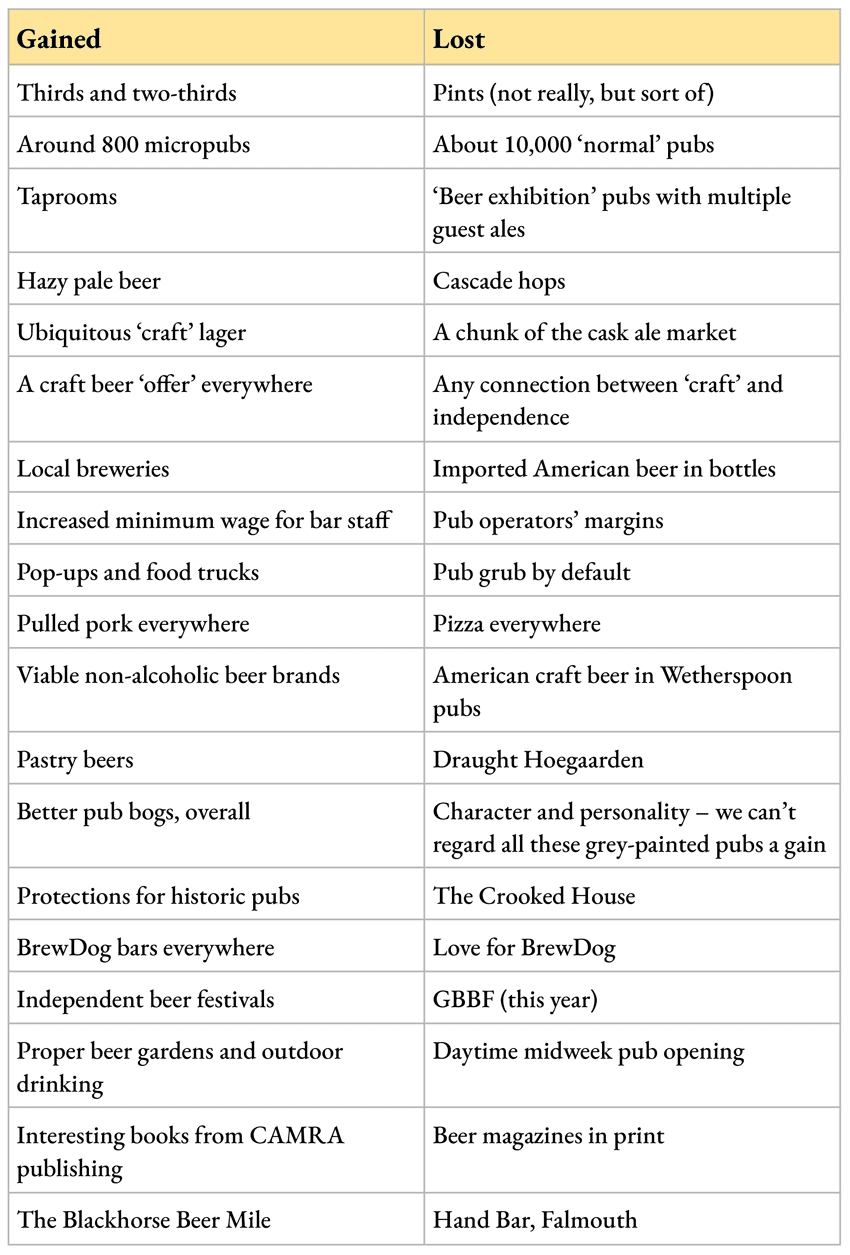
First up, Boak and Bailey are doing some clever things with their multi-media channels. For one thing, they are posting footnotes to their weekly beery news roundups on Patreon. As you can always see below, I like footnotes but rather than merely wallowing in snark like I do BB2 actually add a bit of context and discussion.* And, as you can see to the right, they play with the graphical display of information like with this table explaining their thought on what has been gained and lost over the last ten years of good beer in the UK. They published that in their monthly newsletter after gathering some thoughts from readers over at Bluesky. Which I received by email. Where do they find the time?

And I wrote something last week that caught even me by surprise: “could it be that beer might actually… be going out of style?” For years that was the quip – it’s not like its gonna go out of style. Did I mean it? I mean sure we all know that democracy and simple human decency are well on their way out… but beer?!?! It seems something it up… or, rather, quite a bit down. Stan posted another graph building on the graphs discussed seven days ago. I can’t just put the same graph at the top of my roundup this week (because that would break the weekly updaters Code of Conduct that B+B control with a ruthless efficency) but his point is worth repeating:

The pink on the right represents barrels of beer that would have been sold had sales simply gone flat in 2020, rather than declining, not completely recovering, then declining again. Obviously, that matters a lot to hop growers. When barrels aren’t brewed then hops aren’t used. In this case, about 20 million pounds of them. Two thoughts. First, indeed, little difference between production in 2015 and 2023. Second, if you draw an arrow from the top of the bar at 2015 to 2019 it looks much different than an arrow drawn from the top of 2019 to 2023. Production might be the same, but something different is going on.

One thing I do not believe is causing all this is the lack of detailed description of the offerings at taproom. Jim Vorel would beg to differ and does so at length:

Case in point: Not long ago, my wife was ordering at a large, well-funded and popular local brewery taproom. Looking at the electronic menu above the bar, she landed on a new beer labeled simply as “coffee stout.” She loves stout, and lightly adjuncted classic stouts such as coffee stouts, so she ordered one. The reality? The beer was actually a stout with “vanilla, caramel flavoring and cardamom” in addition to the coffee, which was the only thing mentioned by the sole source of information available to the consumer. Is that a valid concept for a “Turkish coffee stout,” or whatever? Absolutely it is, but the customer needs to know they’re ordering a stout with that kind of theming when they place the order. You can’t just surprise someone with “caramel, vanilla, cardamom” when they think they’re ordering a relatively dry beer. What if that person doesn’t really care for pastry stout concepts? Are they supposed to grill the bartender whenever they see “coffee stout,” to ask if there are any other adjuncts involved? Just how many questions are we expecting these busy taproom employees to answer?

Theming? I had no idea. Me? I just taste the stuff and make my own mind up. Now, let’s be clear. That graph showing US craft beer (including formerly recognized craft brewers kicked out of the BA) have slumped back to 2015 production levels** does not mean all beer is going out of favour, as Jessica Mason explained:

Molson Coors delivered six years of profit growth, six years of growth in just one year. That focus is a new baseline. We are ready for this moment”. To illustrate the size of the achievement, Hattersley explained: “In 2023, our top five brands around the world drove over two million more hectolitres than they did the prior year. This is like adding the entirety of Blue Moon’s global volume to our portfolio.” Looking at America, Molson Coors has seen a boost in both its distribution as well as its presence in supermarkets with more retailers listing its beers. In fact, this momentum and knock-on revenue spike is what has boosted the business to such great heights and reinforced distributor confidence in listing Molson Coors’ beers.

And Kirin is experiencing a bounce as well according to Eloise Feilden:

Kirin Holdings posted revenue of ¥2.1bn (£11.1m) in the year to 31 December 2023, representing a 7.3% rise year-on-year. Profit was up 4.6% on 2022, and operating profit rose 29.5% to ¥150.3bn (£79.4m). Revenue from the Kirin Brewery division was up 3.2% on 2022 to ¥685m. Kirin Brewery’s total beer sales increased 5.9% to 1.4bn litres. CEO Yoshinori Isozaki told analysts that price changes in October helped to boost beer sales “more than expected”, after the company dropped the price of beer brands including Kirin Ichiban. Kirin raised prices for its no-malt Honkirin and Kirin Nodogoshi Nama beers.

Interesting. So are people really just getting fed up with the craft beer nonsense? Remarkably, it’s been a decade since the cult classic The Unbearable Nonsense of Craft Beer by Max and Myself was published – and this remarkably visionary review (given the interveining rise and fall of craft) by Alistair popped up in my Facebook feed this week:

I’ve been slowly reading my way through The Unbearable Nonsense of Craft Beer by Alan and Max, and finding myself agreeing with most things, especially when it comes to tasting vs drinking.  I’ve been saying it for a while now, beer is for drinking, not standing around pontificating about the supposed terroir of the hops, the provenance of your peat-smoked 80/- (as in it has none), or worst of all thinking that Pilsners are just American Light Lager without the rice or corn (have heard that more than once). I guess that’s one reason why I love breweries that make classic styles, and make them well, rather than brewing every gimmick going – you know they can make good beer, worth drinking, instead of random shit to taste a thimbleful of and never want to touch again.

Point. And Alistair (as well as someone in the comments) made the analysis that is often made in tighter times – is home brew really cheaper? Why yes, yes it is:

Thankfully, I don’t have to pay myself to make beer, neither do I pay myself to serve the beer, and so the real cost for a half litre of my own beer at home is about $2. One thing though that is really clear to me from this little exercise is that ingredients are not the bulk of the cost of making the beer, it is a the people, equipment, and place to do so. Obviously I am also not able to take advantage of the economies of scale that a commercial brewer (sorry idealogues, if your favourite beer is made by a company that does so for a living it IS a commercial brewery), especially when it comes to non-linear increases such as the ingredients, and don’t forget to factor in that a single decoction brewday in my garage takes about as long as a single decoction brewday at a professional brewery with the appropriate kit. 

But… and I am a long lapsed home brewer… you don’t need the equipment and you don’t need the decoction. A nice pale ale or porter from scratch? Do it. Conversely, care of the BBC, here’s another reason I’ll steer clear of NA beer for the foreseeable future – unlisted ingredients:

UK-based brewer, Impossibrew, which specialises in non-alcoholic beers, uses a different means of arrested fermentation. “We brew it in such a way that we can cryogenically stop the fermentation process,” says founder, Mark Wong… Impossibrew also adds its “proprietary social blend”, a mix of nootropic herbs designed to imitate the feeling of relaxation induced by traditional beer. It is a precise blend developed in collaboration with Professor Paul Chazot at Durham University’s Biophysical Sciences Institute. Nootropics are natural compounds – billed as “smart drugs” – which improve cognitive functions.

Sweet. Playing with the psychological therapies. Here is a 2023 paper on nootropic herbs. Including a discussion of the allergies and side effects*** that one might encounter… if you knew what you had consumed.

Pellicle‘s offering this week is a portrait of Bristol, England’s Wiper and True taproom by Anthony Gladman.**** Spoiler – they have a dealcoholiser:

The second tool is a reverse osmosis dealcoholiser, which the brewery uses to remove the alcohol from beers like Tomorrow, and the low alcohol version of Kaleidoscope, which launched in January 2024. “That’s going to be a big push for us for the next… well, for a long time actually,” Michael says. “That’s what the whole business is galvanising around at the moment.” Installing a dealcoholiser is not something a brewery does lightly: the equipment is a huge expense, but so too is the floor space it requires, as well as the staff training, and the effort in recipe research and development to make owning one worthwhile.

Note: The Beer Ladies Podcast interviewed Lars this week. Have a listen.

Merryn has shifted to Bluesky and is still tracking the research on ancient grain residues. We learn that “interest in bread like, porridge like, lumps of charred cereal residues certainly has increased over the past decade.And quite a lot have been found” like in Ancient bread recipes: Archaeometric data on charred findings from the February 2024 issue of the Journal of Cultural Heritage:

This study examines charred bread-like samples found in several archaeological sites across northern Italy and dating from the Early Bronze Age to the Early Middle Ages, some of which are included amongst the UNESCO World Heritage Sites. The aim is to investigate differences and homogeneities in bread production processes in different eras and cultures. Bread was a staple food in many ancient societies, but has rarely been found amongst the materials that survive in archaeological sites. When it is found, it is usually because the bread was charred by accidental combustion (falling into the oven during baking) or deliberate combustion (for ritual purposes). The literature on the issue is not abundant, but has been growing over the past decade

It’s beer, isn’t it. Err… wasn’t it. Speaking of was, some bad news for beer drinkers in Nigeria:

The Chief Executive Officer of Nigerian Breweries Plc, Hans Essaadi, has said that the economic situation in Nigeria has deteriorated to the extent citizens can no longer afford to buy beer. Essaadi said this on Monday at the company’s investor call following the release of its 2023 results. “It has been unprecedented year for our business in Nigeria. We saw a significant decline in the mainstream lager market as a result of Nigerian consumers no longer able to afford a Goldberg after a hard day’s work,” Bloomberg quoted Essaadi as saying.

Note: no GBH Sightlines for five weeks. Done?

Like clockwork, Stan has posted his February edition of Hop Queries – which is not a quote from Shakespeare, by the way. He built upon that glut of hops mentioned above, twisting the knife just a bit:

My story about why farmers in the Northwest are ready to remove 10,000 acres (about 18 percent of what was harvested last year) from production in 2024 has posted at Brewing Industry Guide (subscription required). Short term, this means there are plenty of hops out there, often at bargain prices.  
Long term, think about how many times you have seen the term “soft landing” used when discussing the American economy. How does that usually work out? The market for hops has always been cyclical and landings have not often been soft. It will be a year or more before it is clear if this year is different. 

Finally and speaking of honesty, consider this exchange in the comments at Beervana and ponder whether

Reader: Jeff, big fan of your blog and content. That being said, I would hope that we don’t start bashing beers here. The battle for beer should not be within the community but outside of it against wine and spirits. If we bash our own, regardless of how “eye-rolling” the content is we will lose the long game.”

Jeff: “Mason, it’s not my job to promote the brewing industry here. I try to write honestly and entertainingly about beer, and that means I criticize things from time to time. My “clients” are my readers, not breweries. Beyond that, I would argue that anyone who did want to promote the brewing industry would not whitewash negative stories, bad beers, or disappointing news. Concealing faults doesn’t help in the long run.”

Very well said, Jeff. One wonders how much this sort of call to disengagement from reality based reality that craft beer too often promotes has contributred to the slide that we discussed up top. That we see all around us. Maybe that’s what “theming” is. By the way, has anyone brewed a samey Doubly Hazy NEIPA and called it “Self Inflicted Wound”?  As things change and interest in craft declines, it’s still good to watch how it falls if only to identify what stands the best chance of coming through the downturn.

OK. Mailed that one in. Didn’t even have to mention BrewDog. Or baseball now that I think of it. Fine… just roll the credits… well, the credits, the stats the recommends and the footnotes. There is a lot going on down here and, remember, ye who read this far down, look to see if I have edited these closing credits and endnotes (as I always do), you can check out the many ways to find good reading about beer and similar stuff via any number of social media and other forms of comms connections. This week’s update on my emotional rankings? Facebook still in first (given especially as it is focused on my 300 closest friends and family) then we have BlueSky (up again to 123) rising up to maybe… probably… likely pass Mastodon (913) in value… then the seemingly doomed trashy Twex (4,450) hovering somewhere above or around my largely ignored Instagram (up to 165), with sorta unexpectly crap Threads (43) and not at all unexpectedly bad Substack Notes (1) really dragging up the rear – and that deservedly dormant Patreon presence of mine just sitting there. I now have admitted my dispair for Mastodon in terms of beer chat, relocated the links and finally accept that BlueSky is the leader in “the race to replace” Twex even while way behind.

Fear not! While some apps perform better than other we can always check the blogs, newsletters and even podcasts to stay on top of things including the proud and public and certainly more weekly recommendations in the New Year from Boak and Bailey every Saturday and Stan really doing what needs to be done Mondays. Look at me – I forgot to link to Lew’s podcast. Fixed. Get your emailed issue of Episodes of my Pub Life by this year’s model citizen David Jesudason on the odd Fridays. And Phil Mellows is at the BritishBeerBreaks. Once a month, Will Hawkes issues his London Beer City newsletter and do sign up for Katie’s now revitalised and wonderful newsletterThe Gulp, too. Ben’s Beer and Badword is back with all the sweary Mary he can think of! And check out the Atlantic Canada Beer Blog‘s weekly roundup. There is new reading at The Glass which is going back to being a blog in this weeks best medium as message news. Any more? Yes! Check to see the highly recommended Beer Ladies Podcast. That’s quite good. And the long standing Beervana podcast . There is the Boys Are From Märzen podcast too and Ontario’s own A Quick Beer. There is more from DaftAboutCraft‘s podcast, too.  All About Beer has introduced a podcast… but also seems to be losing steam. And there’s also The Perfect Pour. Plus follow the venerable Full Pint podcast. And the Craft Beer Channel on Youtube and remember BeerEdge, too, and The Moon Under Water… if you have $10 a month for this sort of thing… I don’t. Pete Brown’s costs a fifth of that. There was also the Beer O’clock Show but that was gone after a ten year run but returned renewed and here is the link! Errr… nope, it is gone again according to Matty C.

*I mean consider this: “We have taken note of, and pre-ordered, Dr Christina Wade’s upcoming book The Devil’s in the Draught Lines about the history of women in British brewing. We nearly gave it a shout out (free advertisement) in this week’s round-up but decided to save that for next week. But, blimey, eh? CAMRA’s publishing strategy is interesting these days. You might call it public service publishing, doing what’s right for the good of the beer culture rather than what’s commercial (101 beers to drink before you die… again!). Except Desi Pubs seems to have been a substantial success.” That’s a proper bunch thoughts right there.
**IE: not actually “flat” at all.
***Note: “Plant nootropics are generally very well tolerated, but potential users should consider their overall health condition and consult a doctor about possible contraindications and drug interactions before trying a particular plant formulation.
****This piece serves as an interesting counterpoint to Boak and Bailey’s thoughts from last July whose words from them bear repeating: “It used to be a ‘beer garden’ – a bare yard full of tables. It felt like having a pint in the car park of ASDA. But now it is a Beer Garden, or at least heading well in that direction. Around the perimeter are tall plants providing a green shield. In the garden between tables, there are loaded beds and planters. Grasses, shrubs and young trees soften edges, dampen sound and create depth. This is now a pleasant place to be, like a park or botanical exhibition.

The Mere Days Before Vacation Edition Of The Beery News Notes

Mid-August. What to do? What to do? Soon I should have that annual dream about having to go back to school, never finding my courses, finding it all too late to catch up and… why am I even here anyways… seeing as I have more fingers on one hand than I have years to retirement. It’s coming. Thoughts of autumn come in shades of brown, whether new corduroys or old leaves. Like these lovely  images from Warminster Maltings, a clickable one of which is nipped and tucked to the right. But I rush ahead. Too far ahead. Plenty of green days still to come, right? Right? Better be. I have plans. Plans a plenty for the next couple of weeks away from the coal mine. Well, the office. The home office, half the time. But my shoes are generally black so you get the idea.

First – and as much as for equal time requirements as anything – one very interesting bit of the old vid I came across this week is a wonderful PR piece for a maker in the old coopering trade:

The special delivery of a 9000L wine foudre by Taransaud at Château de la Chaize near Brouilly. Very proud of our coopers! (sound on).

Sound on indeed for quite a display of how staves and hoops come together to hold over 11,000 sleeping bottles worth of the old Chat de Chaz, one of which sits nearby, sleeping with others in the cold and dark, waiting for my own Christmas dinner in a few years.

Neither sleeping or in the dark is Mudgie who has some shareable thoughts on why of all the pubs that are lost the Crooked Pub, apparently of little interest when opened other than for being off plumb, is now a national cause:

Over the past forty years, the pub trade as a whole has been in a long-term decline that has led to tens of thousands closing down. The reasons for this are down to a variety of changes in social trends and attitudes, although certain government actions such as the Beer Orders and the smoking ban have exacerbated matters. There is undoubtedly a profound sense of loss about this, even from people who never used pubs much… At times this can turn into a kind of vaguely-directed anger, as we are seeing here, and people are keen to look for scapegoats such as pubcos, developers, supermarkets and government. But the reality is that pubs have mainly been undone by social change, not by some malign conspiracy, and there is no remotely credible alternative course of action that would have made it permanently 1978.

And Stan had some good thoughts on the benefits of not chasing the tail that craft’s been diving after for all these years now:

I am left considering what it means for a brewer to be creative, or what it takes for a beer to be considered new, even novel. New Image Brewing, located in an adjoining town, currently has a terrific helles called Do Less on tap and in cans. It is brewed with malts from Troubador Malting here in Colorado, and thus probably tastes more familiar to me than to you. The malt flavor in Do Less is different than the malt flavor in Bierstadt Lagerhaus Helles, brewed less than 10 miles from New Image. Bierstadt Helles, to me, is pretty much a perfect beer. I’m not going to quit drinking it because I’ve found something new (and practically speaking, Do Less is probably a one-off). But new, interesting and good, to me, that is creative. It would be greedy to ask for more.

Indeed. And greed may get one more – or less – than one counted on. Which is why context – the big picture and the long view – is so important. And Andreas Krennmair has added to that total sum by publishing his new book, Bavarian Brewing in the 19th Century: A Reference Guide. He advises that it is available on Amazon worldwide, both as paperback and Kindle e-book and gives the friendly caveat:

Please note that this is properly nerdy beer stuff….

Which is a healthy approach to such things. One can embrace the lighter topic – the hobby interest – too firmly and squeeze much of the joy out if it. Turn it into a belief. Fortunately for a scribbler, the downsides of things can be as interesting as the up and gives opportunity for humanity to expose its gentle foibles. We have as the current example this summer’s continuing flow of opinion about craft’s collapse yea or nay as with this article “Is the craft beer tide turning?“:

“Distributors and retailers have been reducing their focus on distributed craft and searching for growth in other pockets, but there are signs that the worst reductions may be in the past”, the association said. Overall, craft brewers “continue to face economic headwinds on both business and consumer fronts”, it said. From a business perspective, borrowing costs continue to rise, and while input cost increases have stabilised, they remain elevated over previous levels. Meanwhile, mounting evidence shows inflation eroding consumers’ buying capacity.”

Not to mention mega-brewers selling off craft assets.* The news has reached as far as India. Heck, even those boosters for booze at GBH have been having their swings at poor old craft:

“To me, that experience of drinking in your garage with your friends is universal whereas Braxton maybe isn’t,” Sauer says. “When a craft brewery is presenting to a retailer, [the buyer] asks, ‘Can this brand travel?’ I wanted to remove some of those assumptions.” He also hopes Garage Beer can shake off some of the flavor expectations with which drinkers associate the term “craft beer.” Research Sauer conducted in partnership with the marketing department at Miami University in Ohio found that the top characteristics respondents linked to craft beer were “hoppy” and “heavy.”

“Heavy” – oooof! Is that the new curse word? The Beer Nut shared his thoughts on craft meets US macro:

I can safely say it’s true to type for this inexplicably craft-credentialed American industrial style, being dry, crisp and very dull. There’s a tiny hint of fruity lemon fun hovering in the background, but otherwise it’s a straight-up fizzy lager of the nondescript sort. I couldn’t leave things there.

Endtimsey. But, you know, for many of those who have invested deeply in the fading trade on way or another there is still talk of turn around. Could be. As with maybe fringy party politics perhaps, there is that sort of normal human desire for plucky redeption when the hero is cornered, the hope against hope that fuels the observations of alien sci-fi characters like Spock or Doctor Who. Which is what makes reading about the beer trade and beer culture so perhaps unhealthily yet tantilizingly compelling.  Especially when it isn’t as firmly footed in fact as I fully expect Krennmair is in his new book.

Note: CB&B has published a handy newbie guide to all mash home brewing – a clear sign of a downturn as ever I saw:

Mashing grain is what makes beer beer. Yes, hops, yeast, and water certainly play important roles, but it is only through the mash, whether performed in your house or in the process of manufacturing malt extract, that the soul of beer is liberated from its starchy origins. Mashing grain is to beer as crushing grapes is to wine, as pressing apples is to cider, and as collecting honey is to mead. 

Also note: twenty years ago this very week, I invented the “Molrona” during the 2003 black out. You. Are. Welcome.

Martin noted a sad ending with a photo essay from his recent visit to Corto, Katie and Tom Mather’s establishment, which I never saw myself but supported as I could:

It’s incredibly cosy, and welcoming, and tiny. One spare table upstairs, where the cheery chap brought our Wishbone and Thornbridge… Sorry it was a flying visit, Corto folk, you were lovely. Best wishes for whatever you do next.

Say hello to Tom Grogan, 92, now in his eigthth decade in the pub trade:

Mr Grogan, who is believed to be the UK’s oldest landlord, said he was not that keen on alcohol himself. He said despite pouring thousands of pints, he drank “very little” and had been only drunk “half a dozen times”. His career began 71 years ago, when started helping out in a pub in Rusholme after arriving in England. Seven years later, he got the chance to become a landlord, but said it meant he and his girlfriend had to make a quick decision.

You’ll have to read on to figure out what that decision was… unless you guess… because it’s not much of a guess…

Ron’s Remebrances take us this week back to Scotland in the mid-1970s when a radical change in licensing laws were brought in:

I was dead jealous when my school friend Henry, who studied in Aberdeen, told me of pubs not only staying open all afternoon, but until 1 AM. All totally legal. And totally due to the interpretation of a new Licensing Act for Scotland. Which, I’m pretty sure, wasn’t intended to liberalise opening hours to the extent that it did… I can remember visiting Edinburgh in the late 1970s and wondering at the continental-style opening hours. And wondering why the same liberal treatment couldn’t have been given to the rules in England. 

GBH has run an interesting if ripe study of Coopers Sparkling Ale this week:

It can be tempting to dismiss Sparkling Ale as an early offshoot of Pale Ale, without any notable idiosyncrasies to help define the liminal space separating the two. Most contemporary stylistic guidelines highlight a focus on Australian ingredients, but beyond this and some more proscribed production techniques, the difference is minimal. Though delineation between styles has never been an immutable barrier, for those of us who grew up on it, Sparkling Ale has a highly distinctive character. 

I had no idea that there were service disruptions in out next province to the left, Manitoba… keeping in mind as my excuse that the border is almost 2000 km and a timezone away. Seems like the government store is on strike with unequal consequences:

When Shrugging Doctor, a local winery and vineyard, said in July it would expand and move operations, its owners had no idea it was about to head into a devastating strike-induced limbo thanks to a labour dispute at the Crown-owned liquor corporation. While Manitoba beer producers have the option of distributing their own products — by hiring delivery companies to drop off merchandise to private vendors, bars and other sellers — by law, wine and spirit manufacturers aren’t allowed to do the same, said Shrugging Doctor co-owner Willows Christopher, who founded the business in 2017.

Matt is doing a good job keeping an eye on Mikkeller’s deek around the ethical implications of claims made against it:

I see Mikkeller are pouring at another U.K. festival this weekend, which is honestly absolutely wild to me. I feel like there was a real opportunity to create real, progressive change in U.K. beer a couple of years ago. But this is being moved on from in favour of the ££££.

No doubt part of their long term plan which seems to have been successfully pulled off if this admission from late July is understood. Easy to enough to foresee back in February 2022.

A poem by Justin Quinn was noted by the ever lyrical M.Noix this week that is worth saving and sharing… and thereby trodding all over intellectual property rights but for this bit of review… lovely… I have dreams also like that… and it even rhymes here and there. Solid second stanza letter “u”use.

Four weeks ago, I forwarded the news that Russia had moved to grab Carlsberg’s assets, you know, those assets that really should have been shut down when the invasion of Ukraine began but, you know, money. Well, now the brewery has spoken out:

The chief executive of brewing giant Carlsberg has said he was “shocked” when Russian President Vladimir Putin seized its business there. Cees ’t Hart said the company had agreed a deal to sell its Russian operations in late June, but just weeks later a presidential decree transferred the business to the Russian Federal Agency for State Property Management. “In June, we were pleased to announce the sale of the Russian business. However, shortly afterwards, we were shocked that a presidential decree had temporarily transferred management of the business to a Russian federal agency,” he said.

Well, lookie lookie. Why buy when you can take? Beware with whom you think you are doing business with, I suppose.

Note: the ever increasing subdivisions of beer expertise never ceases to amaze.

And finally what week would be a proper week without a story like this:

A “plague” of racoons have stormed a number of houses across Germany to steal beer and kill family pets. Households have been billed up to €10,000 after returning home from their holidays to discover their kitchens destroyed. According to Germany’s National Hunting Association (DJV), a total of 200,000 raccoons were killed last year in a bid to control the population.

Furry bastards! And – that is it for another week. Not a record breaker for length this week  and, frankly, a few familiar sites may have been mailing it in from the beach. Plus all those awards! Which claim to pick global champions …while also reminding you that judging is nothing more than what a few folk thought on the day. Ah, August! And as per ever and always, you can check out the many ways to find good reading about beer and similar stuff via social media and other forms of comms to connect – even including at my new cool Threads presence @agoodbeerblog. Have you checked out Threads as Twitter ex’s itself? (Ex-it? Exeter? No that makes no sense…) They appear to achieved to make social media offer less and less. Brilliant… but I never got IG either. I still prefer the voices on Mastodon, any newer ones noted in bold:

Alan McLeod | A Good Beer Blog (… me…)
Stan Hieronymus | The Man!
Boak & Bailey | The B² experience
Curmudgeon Ale Works | Jonathon is Brewing
Katie Mather | Shiny Biscuit and Corto
David Jesudason | “Desi Pubs” (2023) author
BeoirFest | They say “Let’s Talk Beer”
Ron Pattinson | The RonAlongAThon Himself
Al Reece AKA Velky Al | Fuggled
Jennifer Jordan | US hops historian
Andreas Krennmair | Vienna beer and lager historian
Beer Ladies Podcast | Lisa Grimm and colleagues
The Bar Towel | Toronto’s chat zone for beer lovers
Chicago Beer Society | Folk in Chicago getting social over beer
Jay Brooks | Brookston Beer Bulletin
Joe Stange | Belgian beer expert, beer magazine editor
Cider Bar | Barry makes Kertelreiter cider
Laura Hadland | CAMRA historian and beer writer
Brian Alberts | US beer historian
Jon Abernathy | The Beer Site
Maureen Ogle | US Beer Historian
Lars Garshol | Norwegian Beer Historian and Kveik Hunter
James Beeson | Beeson on Beer
Carla Jean | MAINER!!!
Thandi Guilherme | Beer Ladies Podcast Co-host
Lisa Grimm | Beer Ladies Podcast Co-host
Roy of Quare Swally | Beery ramblings from Northern Ireland
Rob Talksbeer | Podcaster and Youtuber
Anthony Gladman | UK Drinks Writer
Jeff Alworth | Manna Of Beervana
Northwest Beer Guide | Fairly self explanatory… but not NW Latvia…
Evan Rail | Prague based GBH editor, freelance writer, NYT etc.
Todd Alström | 50% of the Alströms
Jacob Berg | Beer talking librarian

Anyone else? And, yes, we also check the blogs, podcasts and newsletters to stay on top of things – including more weekly recommendations from Boak and Bailey every Saturday and Stan at his spot on those  Mondays! Get your emailed issue of Episodes of my Pub Life by David Jesudason on many Fridays. And Phil Mellows is at the BritishBeerBreaks. Once a month, Will Hawkes issues his London Beer City newsletter and do sign up for Katie’s now much more occassional but always wonderful newsletterThe Gulp, too. Ben’s Beer and Badword is back! And check out the Atlantic Canada Beer Blog‘s weekly roundup. There is new reading at The Glass. Any more? Yes! Check to see the highly recommended Beer Ladies Podcast. And the long standing Beervana podcast . There is the Boys Are From Märzen podcast too and check out the travel vids at Ontario’s own A Quick Beer. There is more from DaftAboutCraft‘s podcast, too.  All About Beer has introduced a podcast.  There’s also The Perfect Pour. Plus follow the venerable Full Pint podcast. And the Craft Beer Channel on Youtube soon celebrating a decade of vids.   And remember BeerEdge, too, and The Moon Under Water… if you have $10 a month for this sort of thing… I don’t. Pete Brown’s costs a fifth of that. There was also the Beer O’clock Show but that was gone after a ten year run but returned renewed and here is the link!

*Revisiting a thought, we discussed two weeks ago how that portion of Ontario’s smaller brewers who are members of the trade association OCB have launched a new lobbying effort that has a bit of an odd goal: “Keep Craft Beer Local.” I say “odd” as the argument that seems to be being made is taxes are too hight therefore small brewers will have to sell out to… dum dum duuuuuummmm…  strange folk from away. As previously noted: “If no changes are made to the tax structure, he and the Ontario Craft Brewers Association, say they fear more and more of Ontario’s craft breweries will be bought up and merged with foreign buyers. The association says it represents over 100 breweries.” This is an odd argument, as I say, seeing as international mega brewers are divesting themselves of their craft assets. I wonder if this is just an example of bad timing, the power points keeping up with the news. Perhaps Ben can help explain.

Your Thursday Beery Beer Notes For When He Hardly Makes Any Real Effort

It’s been a week. Four out of seven days on the road, driving in a car for about 21 hours. No time for blogging much. The upside? Rhubarb ginger ice cream at the fabulous Slickers of Bloomfield in Prince Edward County, our nearby wine growing region of Ontario. Downside? Highway 401 from Halton to Kitchener upon which I had to drive coming home, telling my son to be quiet as we had 50 km of 130 km/hr traffic packed tight with what felt like a foot or two between cars. Evil. Fortunately, the ice cream came second. On the way there Saturday, as noted on Le Twit, we also ate at the highly recommended Northern Dumpling Kitchen which blew our minds. That image there? That’s the Chinese broccoli with garlic. Very simple. Nutty nutty good. And lamb and leek dumplings. Imagine! The restaurant looks like this. It’s located here along with 25 other small food spots. Go. But don’t go when I go. KDK only has about 30 seats. Wednesday’s dash to Syracuse, NY for a work meeting with some of my favourite business clients was a treat. And I hit the Watertown Hannaford grocery for, you know, Dinosaur BBQ sauces and oyster crackers. Things denied to Canadians.

Enought about me! In the world of beer, Jessica Mason guided us to consideration of a new thing in the UK’s pub trade – the label “fresh ale” as seen in the wild or at least in pubs asking if the new beer category will help lager drinkers migrate to cask or if it actually cannibalises real cask ale for good:

A new beer category, named ‘fresh ale’ has been created by Otter Brewery to bridge the gap between craft beer, cask ale and lager. ‘Fresh ales’ are beers that are initially brewed as cask ales, but instead of being filled into casks they are gently carbonated before being put into kegs. The Devonshire-based brewery’s first beer being launched as a ‘fresh ale’ is named Amber Fresh and paves the way for “a new form of ale for pubs, designed to be fresh in name and fresh by nature”.

We are told that the beer will stay in great condition for longer, remaining fresh to drink for weeks, rather than days. Which is interesting.

Pellicle posted an interesting tale, the story of state of American Porter which paired last evening with a Godspeed Kemuri Porter at this very minute as my fingers do their dance. And what’s that state look like?

In 2023, only a few legacy porter brands remain. Fitz is still ubiquitous here in Ohio and the Midwest in general. Deschutes Black Butte from Oregon is still around, though it’s getting harder to find here on the opposite side of the country. Bell’s Porter can occasionally be spotted, though who knows for how much longer. Anchor’s and Sierra Nevada’s porters have not been seen in the wild in years and are presumed extinct in these parts. Sales figures from Bart Watson, Chief Economist at the Brewers Association (the trade body representing small, independent breweries in the United States) show porter’s share of total craft has dropped by 60% by sales volume since 2007, the earliest year for which numbers are available.

Fitz is good code. And, not really relatedly, Katie Mather is back with another edition of her newsletter, The Glup, this time sharing thoughts on the role of music in one’s thoughts:

Where the void (a term used in BPD circles and treatment to reference the absence of or inability to define emotion—the void can last moments or days depending on the episode) can be a black hole taking in and vaporising thoughts of comfort, in these playlists I can find ways to play with its distortion of reality. Daydreaming has always been my preferred state of being, and learning to find and clarify these powerful places in my mind has been empowering. Liminal spaces have always fascinated and terrified me…

I am a big time daydreamer, me. Katie also advises that she has upcoming articles in Pellicle as well as Hwaet! and Glug and Ferment, too – and that her book(!) will by published by Wine52 later this year.

Gary continues to speed though the archives and provides us a take of mid-century drink, Tenpenny ale:

In comments to my recent post “Walker’s S.B. Sherry Bright Ale”, Ron Pattinson pointed out that the name Tenpenny, shown proximate to the Sherry Bright name in adverts I considered, denoted a separate beer. He indicated it was 5.4% and quite dark in 1951. Edd Mather added that this Tenpenny was a brand originally made by George Shaw & Co. Ltd. of Leigh, Lancashire, a brewery bought up by Peter Walker’s parent company, Walker-Cain.

I shared that this brought back memories of a dear departed but distinct Ten Penny ale. Your uncle’s beer… well, maybe your great-uncle’s.

As noted in B+B’s Saturday round up, Mark Johnson has shared some thoughts about his relationship with alcohol under the grim but honest title of “Chasing Oblivion“:

It would have potentially been helpful for me to find something else as a lifestyle or as a hobby. As it was, my genuine love for tasting beer and visiting different types of pubs pulled me away from oblivion. As much as social media aspects of beer and self-proclaimed bloggers are routinely mocked, that energy made me approach beer differently . It made me focus on the positives without the need for pushing it that extra few drinks. I’ve made no secret that writing about my struggles with depressionmy suicidal thoughts and some of my issues from the past have probably kept me alive. Before I had no such outlet. It has never truly occurred to me that my previous release was alcohol. It wasn’t every day. It wasn’t inhibiting my day-to-day life. But I was using it as both therapy and medication. Seeing alcohol purely through the beer lens helped me recalibrate.

An interesting story in the continuing saga of craft buy outs and closings this week sees a CNY veteran brewery buying out one of the top micros of days gone by. As my co-author Don Cazentre* reports from the scene:

Utica’s F.X. Matt (Saranac) Brewing, makers of the Saranac line of craft beers and the traditional lager Utica Club, has agreed to purchase Flying Dog Brewing, a large craft brewer based in Maryland. News of the deal was broken by Brewbound, a site that covers the national brewing industry. The deal announced today will likely make combined Matt / Flying Dog one of the ten largest craft brewers in the country, according to statistics compiled by the national Brewers Association, based in Colorado.

Mike Stein added that this may be a relief to those transitioning to the new leadership given the seemingly poor record of the former.

There is nothing good to report on the Bud Light market these days. Transphobic customers walk, good union jobs perhaps at risk and a welcome inclusive marketing plan gutlessly abandoned as fast as possible:

Bud Light is offering generous rebates for Memorial Day that in some cases amount to free beer as Anheuser-Busch continues its scramble to recover from the Dylan Mulvaney controversy… The rebate offer comes as Bud Light sales have worsened for the sixth consecutive week since April 1, when trans influencer Mulvaney shared an Instagram post of a custom Bud Light can the Anheuser-Busch brand sent her to celebrate “365 Days of Girlhood.” Rebates have already been offered on Bud Light by individual vendors looking to rid themselves of the embattled company.

Question: if your kid was in a local sports organization which, by Jeff’s reckoning, had only 80% committment to being the sort of place that “welcomes all, that straight up supports human dignity with action“… would you stick around? Not me. I am not picking on Jeff at all by saying this as I think he has the numbers shockingly right when it comes to craft beer. He also added another bit of math this week, a verbal description of the graphical representation of data this time which, again, is quite correct:

Nevertheless, the situation arises, at least partly, from a fault line that has always bedeviled the organization. From the very start, the Brewers Association saw itself as not just a trade association, but the central champion of a new culture of beer and brewing. This put them in the position of speaking for an industry far larger than their member breweries, and necessarily created compromises when the interests of their members deviated from the industry’s in general.

So, that entity with 80% top drawer actors is also just one side of a fault line – “fault” being an excellent double entendre – with people who are not produces on the other side of the line. Fans, hangers on, most beer writers, consumers, the public I suppose. People, as Jeff correctly says, who are not makers but are, according to the BA, still seemingly supposed to line up in lock step with them under the banner of the unified champion. Which we already consider to be 20% dodgy to one degree or another. Gotta tell you: if this is that rec league situation me and my kids would out of there in a spray of gravel as fast as I can get the car our of the ball field’s parking lot.  In particular, I share the opinions expressed by a reader identifying as “gingersnap” in the comments at Jeff’s post on the underlying situation and how the mechanism actually works:

The problem with the language is that privilege is not a superpower to be used as an instrument of leverage. Privilege, in this case for white brewery owners, is a result of systemic oppression of non-white folks, it is not something that was earned. To talk about leveraging this power of privilege is part of the “white savior trope” and suggests that those without privilege should be grateful for whatever efforts are made on their behalf. That kind of thinking is hurtful, elitist and white-centric.

That cause is pretty all purpose for the effect of bigotries, if history is any sort of teacher. And I have also long thought and even said that this sort of thing (along with all the BA’s upward pricing encouragement and flaky faddish brewing technique promotions) is exactly why North America needs its own verion of CAMRA which sits apart from and even faces the BA. A consumers’ group for and led by beer drinkers, that’s whats needed. Why? Because it would appear that currently, the people in charge of the construct, the culture, the dialogue are not the consumers who actually control the cash with their spending decisions.

Such a plan would be reasonable, given the BA was formed twenty years ago in part to address some late micro era rogue weirdness while protecting the trade and perhaps cushioning the still prominent actor dabbling in some outrageous sexist marketing… as John Noel has confirmed. The yikky pattern continued, for example, two years before #MeToo in the sexist choices of certain prominent trade members at the CBC in 2015 as well as the 2018 Zwanze Day mess again involving a prominent man in beer. Still, all is presented as A-OK in the big craft picture. And still all associated with what gingersnap above called the “white savior trope” or what I have called “Great White Male Hero Theory Problem” in craft beer.

And while the Brewers Association is this keystone in the craft culture it is yet not, as Jeff says, able to respond in any effective manner to these issues. It “wants to be politically neutral in terms of state politics” and, when facing toxisity, found it “impossible to relocate this event.” That all being the case… is your kid still playing in this sports league? Why are you showing up to sit in the stands knowing or even experiencing the bigotries within ear shot form the stands or the benches? Why support the BA? Because it’s all we have?* And why do you think it’s all we have? Probably because we have forgotten what we should have.

Oh… and one last thing. Jeff also wrote that:

…the BA itself bringing smart people who think like these folks (and there are a lot of them!) into BA’s upper management would be a good first step in transforming the way the organization thinks.

Sadly, and as I noted two weeks ago, the BA does have at least one such excellent leader already in their organization and has for a number of years: Dr. J Jackson-Beckham, the Brewers Association’s Equity & Inclusion Partner. Seems there’s been plenty of stumbling at that first step. More on this from Stan, Robin and Stephanie Grant.

That’s it! That’s enough from me.  I’m having a glass of wine this evening and relaxing. Let the others now scan the beer news for you! As per, you can check out the many ways to connect including these voices on Mastodon:

Stan Hieronymus | The Man!
Boak & Bailey | The B² experience
Katie Mather | Shiny Biscuit and Corto
David Jesudason | “Desi Pubs” (2023) author
Ron Pattinson | The RonAlongAThon Himself
Al Reece AKA Velky Al | Fuggled
Jennifer Jordan | US hops historian
Alan McLeod | A Good Beer Blog (… me…)
Andreas Krennmair | Vienna beer and lager historian
Beer Ladies Podcast | Lisa Grimm and colleagues
The Bar Towel | Toronto’s chat zone for beer lovers
Chicago Beer Society | Folk in Chicago getting social over beer
Jay Brooks | Brookston Beer Bulletin
Joe Stange | Belgian beer expert, beer magazine editor
Cider Bar | Barry makes Kertelreiter cider
Laura Hadland | CAMRA historian and beer writer
Brian Alberts | US beer historian
Jon Abernathy | The Beer Site
Maureen Ogle | US Beer Historian
Lars Garshol | Norwegian Beer Historian and Kveik Hunter
James Beeson | Beeson on Beer
Carla Jean | MAINER!!!
Thandi Guilherme | Beer Ladies Podcast Co-host
Lisa Grimm | Beer Ladies Podcast Co-host
Rob Talksbeer | Podcaster and Youtuber
Anthony Gladman | UK Drinks Writer
Jeff Alworth | Manna Of Beervana
Northwest Beer Guide | Fairly self explanatory… but not NW Latvia…
Evan Rail | Prague based GBH editor, freelance writer, NYT etc.
Todd Alström | 50% of the Alströms
Jacob Berg | Beer talking librarian

Anyone else? And, yes, we also check the blogs, podcasts and newsletters to stay on top of things – including more weekly recommendations from Boak and Bailey every Saturday and Stan at his spot on those  Mondays! Get your emailed issue of Episodes of my Pub Life by David Jesudason on many Fridays. Once a month, Will Hawkes issues his London Beer City newsletter and do sign up for Katie’s now more occassional but always wonderful newsletterThe Gulp, too. Ben’s Beer and Badword is back! And check out the Atlantic Canada Beer Blog‘s weekly roundup. There is new reading at The Glass. Any more? Yes! Check to see the highly recommended Beer Ladies Podcast. And the long standing Beervana podcast . There is the Boys Are From Märzen podcast too and check out the travel vids at Ontario’s own A Quick Beer. There is more from DaftAboutCraft‘s podcast, too.  All About Beer has introduced a podcast.  There’s also The Perfect Pour. Plus follow the venerable Full Pint podcast. And the Craft Beer Channel on Youtube soon celebrating a decade of vids.   And remember BeerEdge, too, and The Moon Under Water… if you have $10 a month for this sort of thing… I don’t. Pete Brown’s costs a fifth of that. There was also the Beer O’clock Show but that was gone after a ten year run but returned renewed and here is the link!***

*I just note that he and I are on the team writing the hitory of New York State brewing for SUNY Publishing. He knows everything one needs to know about the CNY brewing business and more.
**Update: well after my press time, Courtney Iseman went so far in her newsletter to carefully suggest and also plainly express a few things about the power dynamic that the BA imposes on craft beer culture when she wrote: “There are good things about CBC, and there are good people at the Brewers Association. I’m not comfortable telling people they should never go to CBC again. I’m not optimistic the BA will really take the note and meaningfully improve CBC, but I’m hopeful, so while I have no plans to attend again for the foreseeable future, I think it’s too soon to make any certain, sweeping statements… I think it’s important for us to remember that there are many people in the industry who don’t have as much of a choice. Their jobs might essentially require them to regularly attend CBC.” Which is absolutely nuts when you think about it for three seconds: get in line or get another job. Thanks BA.
***And finally the list of the departed newsletters and podcasts or those in purgatory. Looks like  both Brewsround and Cabin Fever died in 2020, . We appreciate that the OCBG Podcast is on a very quiet schedule these days – but it’s been there now and again.  The Fizz died in 2019.  Plus Fermentation Radio with Emma Inch seems done and the AfroBeerChick podcast is gone as well! The Fingers Podcast packed it in citing, umm, lack of success… as might have been anticipated, honestly. Did they suffer a common fate? Who knows?

Your Thursday Beery News Notes For The End and Beginning

Here we are. The end of March and the beginning of spring. Baseball is on the TV. Shorts and sweater weather. Excellent. I even planted lettuce seed and radish seed last weekend under row cover. Just a bit. I’m no idiot. Well, not that sort of idiot. Like many this year, it’s been a quiet week for good beer writing. Hopefully everyone else has been planting their first radishes, too. It’s also the end and beginning of the year of the plague and the second… year of the plague. Things are weird. Free beer for the vaccinated? Jab-based pub passports… why not? Me, I’m not doing too much soul searching or looking back but this by Martin serves as a milestone of sorts:

A year ago I walked into tourist Cambridge on the hottest day of the year so far. The tourists (typically two-thirds Japanese and Chinese) were completely absent. The Universities looked forlorn. Pubs were advertising their loo rolls, and the staff at Fopp treated me like their first visitor of the week. Perhaps I was.

Enough of that. In good news of 2021, The Guardian reported on an outcome which gives joy to any staff lawyer working for a municipality:

…after a dogged six-year campaign by locals, the Carlton Tavern will reopen next month – lockdown permitting – after the developers were ordered to rebuild the pub “brick by brick”, a ruling that pub campaigners say has set an extraordinary precedent. “People said it was impossible,” said Polly Robertson, a leading member of the Rebuild the Carlton Tavern campaign… “I just thought, no – I’m not going to let it lie.” 

Speaking of the pubs of England, Mudgy wrote about Cask v. Covid and picks a winner:

Nowadays, the pubs that don’t offer cask tend to fall into the categories of places that are effectively restaurants, down-at-heel boozers that only appeal to a local clientele, high-end trendy bars and some beer-focused places that think not selling cask puts across a modern image. Any pub seeking a wide appeal rather than just a captive market of locals will offer cask in some form. There is a huge amount of loyalty to the category that isn’t going to disappear any day soon. The day Wetherspoon’s start dropping cask from some of their pubs in England and Wales is the day you really need to start worrying about its future. It’s not just changing a brand on the bar, it’s making a statement about what kind of pub you aim to be.

To the northwest, a tale of high tech beer packaging tech in Iceland:

The equipment in the line comes from numerous parts of the world, including the U.S.-made end-of-line Econocorp E-2000 cartoning machine.  “We were led to Econocorp during conversations we had with other machine suppliers who are familiar with the kind of machinery that’s suitable for craft brewers,” says Ólafsson. “It’s just the right size machine for our production, and it’s very simple in design and, subsequently, in operation.”*

Me? I love everything from Econocorp. Elsewhere, Stan was good enough to send out his Hop Queries newsletter on Wednesday. Topics this month include “Up the downstream,” “Query of the month,” “UK hop exchange,” “Look & listen,” “At the Hop,” and “Hop profile: Nelson Sauvin” which confirm that, yes, this is a newsletter and, yes, even Stan can’t resist the hop pun. It’s also edition 4.11 which tells me he’s throwing a fifth anniversary party for the next one!  I won’t spoil the Danny and the Juniors reference but Stan does provide this:

In a Wall Street Journal review of “The Food Explorer: The True Adventures of the Globe-Trotting Botanist Who Transformed What America Eats” a writer gushes: “Beer lovers, too, might want to raise a mug to (David) Fairchild. A boozy night in a village inn buying rounds for Bohemian farmers resulted in Fairchild procuring the finest German hops, which he smuggled out of the country, allowing American brewers to vastly improve their sour, inferior beers.” That’s simply not true. Full stop. No farmers in the United States at the beginning of the 20th  century successfully managed to grow continental landrace hops, although English Fuggles did find a home in Oregon.

That is interesting. Formerly, I had a client in PEI who owned a former tavern which was formerly owned by a local brewer who, in his formative years, travelled to England and back, returning with hop rhizomes in pockets that he nurtured and kept damp that whole sailing voyage. The yard of the house was still rotten with them. Google maps shows it still there. Wonder what they are.

Jeff on government. As they saying goes, no one likes to see sausages made.

Also semi-officially, I like the idea of this notification from a bar as referenced on Reddit and Twitter and a bunch of other places. It would be useful for future reference in discussions with one’s children. I, for example, know some one which is or could be a grandmother who was also barred for life from a certain establishment two Saturdays in a row. Having better documentation and records retention principles may have helped.

Gary wrote a very interesting piece on an issue of Brewing Trade Review from 1962 including info on the iconic Toronto brewery set up by my hero E.P.Taylor in the early 1960s and still pumping out macro gak today!

The plant still exists, as Molson-Coors Beverage Co.’s main Canadian brewery. The tower-like, oblong-shape central building of dark brick with contrasting light frame atop, shown in the article, is still a leitmotif at the plant, on Carlingview Rd. in Etobicoke, Toronto, despite much expansion…

Ryuuhyou Draft. Japanese sea ice beer. Low in malt. Blue in colour. Speaking of weird Japanese beers

“We will pitch the product as the standard beer for the new era.”

Ban-zoink! Elsewhere and much to the opposite, my personal hat supplier Katie M has written about her new business, Corto, with a deft dramatic touch:

“Did you know you can get down under the flooring?” our always-happy landlady beamed, on a final visit to sort the fire alarms. No. We did not know that. We’d agreed not to mention the storage issues for our sanity’s sake, clueless about how we were going to overcome the challenge of managing inventory in such a small space. Tom had only just stopped having nightmares about having to fill the entire ground floor with bathrooms. “The hatch is under the stairs, in the cupboard.”

DON’T GO IN THE BASEMENT!!! You’ll never believe what happens next.

By contrast, I found this portrait of startup Belgian brewers Antidoot a bit bizarre and even a bit disturbing, especially this bit:

A few months after the unpleasant Spring Release, Tom Jacobs read an article in Belgian newspaper De Standaard about a French winery in Bordeaux called Château Pétrus. Pétrus wines were highly coveted, partly for their quality (they are produced on an exceptional slope with blue clay soil) and partly for their scarcity (the vineyard covers only 11 hectares). A limited amount of Pétrus wine is released each year (the whole of Australia, for example, receives only 36 bottles). As a result, bottles of Pétrus were being purchased by speculators who resold them on the black market at huge markups, used as investments which which would grow in value with each passing year the wines aged. 

Weird. I think they invented pre-speculation. Just to be clear, Château Pétrus is one of the great wines of the world, producing vintages since the 1700s. It does not attract high prices on the secondary market. It attracts high prices on the primary market as this LCBO screen shot shows. Antidoot, on the other hand, is one startup brewery among thousands. One of the least reflective articles on a brewery I’ve ever read. The passage where the rocket scientists also invent compost is amazing. Spinal Tap meets beer. Sucker juice.

One final note: beer bottles prove that recycling is bullshit. Never knew that.

There. Spring. Hmm… why doesn’t my heart go dancing? And that waltz isn’t particularly… you know… entrancing? No desire… no ambition leads me… WTF!?! Oh yes – the second spring of a pandemic but, screw it, still spring. Get a beer, turn that soil and plant some seed! While performing your ag-art, check out the weekly updates from Boak and Bailey mostly every Saturday, plus more with the weekly Beer Ladies Podcast, at the weekly OCBG Podcast on Tuesday and sometimes on a Friday posts at The Fizz as well.  There is more from the DaftAboutCraft  podcast, too. And the Beervana podcast. And sign up for Katie’s weekly newsletterThe Gulp, too. Plus the venerable Full Pint podcast. And Fermentation Radio with Emma Inch. There’s the AfroBeerChick  podcast as well! And also look at Brewsround and Cabin Fever. And Ben has his own podcast, Beer and Badword – when he isn’t in hiatus as at the mo, more like timeout for rudeness. And remember BeerEdge, too.

*ZZZZzzzz….

The Hogmanay Beery News Notes Special For Last Blursday 2020

Good riddance to 2020.  That’s it. No hum. No haw. It sucked and soon it’ll be over. Next year hopefully will suck less. But, still, at least three good beery things happened to me in this year of the plague which are worth noting:

i. In October, Boak and Bailey invited me to a Zoom chat that lasted a couple of hours.  We had a great old chat, from gossip to interesting thoughts on researching and writing brewing history.

ii. Since mid-March, we’ve been enjoying home delivery of beer mainly from Matron of nearby Bloomfield Ontario. We’ve likely had six or eight different beers from them and have gained a great sense of their liquid aesthetic through exercising a bit of focus. Forthright and Bobo are two standouts for me but Yeasayer has not left the house in ten months.

iii. Lars Marius Garshol published Historical Brewing Techniques, by far the best beer book of 2020. One of the few, sure, but the years of dedication to the pursuit of farmhouse brewing in Scandinavia and eastern Europe is one of the greatest bits of effort in the cause of good beer over the last decade.

There. That’s good. A bit slim. But pretty good. Well, for me. Where shall we start for you, the rest of human existence?  The pandemic? Sure. Fine. OK. In Maine, CJL herself has shone a light on some very poor behavior by one brewery while also illustrating how useful Twitter can be if you know how to use it:

Sunday River Brewing Company has been operating without masks and safety in the name of “freedom” and picking fights with the state to become martyrs for the industry, and raising funds alongside for “legal defense”… The restaurant/brewery has been cited MANY times now for non-compliance with mask orders. Undercover people from the state have documented lack of mask wearing over months, so the state recently said, “hey, your license is set to renew in December… and we’re not renewing it.”

Elsewhere? Summaries. First, across the Atlantic, I Might Have A Glass of Beer posted his Golden Pint 2020 awards from Glasgow, Scotland and shared many thoughts about how the great pivot sometimes made life with beer more interesting in 2020. And found a few more good things about the last year. Example:

A fascinating phenomenon was the redefinition of “beer garden” in 2020. As a partisan of Bavarian beer culture, I am often disappointed by what is offered under this name in the UK, with not a chestnut tree, a stoneware mug or a radish in sight. Yet this year the label became even looser, and over the summer it seemed that merely a row of white plastic chairs on the pavement outside a pub was enough to be a “beer garden”. Nonetheless even this was a definite improvement for some pubs and it’s to be hoped that this trend will continue after all this is over.

And The Beer Nut started on the pandemic fatigue fatigue with his own Golden Pints 2020 from non-northern Ireland which included this welcome remembrance in one category’s name:

Simon Johnson Award for Best Beer Twitterer: @RuariOToole
It was very much the year for weird and grim humour, and Ruari’s Twitter provided plenty of it. Much appreciated, my man. Dudes rock!

See also Ben Viveur.  See also Quare Swally. See also New School Beer. See also Craft Beer Scribe. Et ceterah… et ceterah but not Anthony Hopkins. He’s been dry since 1975. Who knew?

Another positive sign was reported by the Protz – with a keen eyed lawyer as key to the action:

….she hoped for a better life in 2016 when it sold the Roscoe to Hawthorn Leisure, the pub-owning division of New River Retail. It wasn’t to be. Hawthorn refused her MRO – Market Rent Only – in order to buy her own beers, on the grounds the company owned fewer than 500 pubs and was outside the terms of the Pubs Code. Carol’s lawyer found that Hawthorn, after buying a package of pubs from Marstons, owned more than 700 pubs and was covered by the code. Hawthorn responded by saying they would take the pub into management in 2021 when Carol’s lease expired. 

Hah! Contrarily, here in Ontario, Drunk Polkaroo* wrote about his five greatest disappointments in 2020… other than, you know, 2020 as a whole:

Drink tap water. Warm tap water. And you might get more out of it than shame and sadness. I drink ’em so you don’t have to…Molson Ultra is a 3.0% Light Lager and well, it is light on everything a beer should be. I’ve had light lagers, a lot of them in fact recently and this is not that. Not even that bubbly, leaves a dry, salt like chemical finish after hinting of hops and barley. Blah, but I had to know, didn’t I.

Writing from Washington, DC, the Beerbrarian summed up his year enjoying both music and beer. He noted:

In 2019 I kind of gave up on IPAs. I don’t really know why, it just shook out that way. Well, they’re back, including two stellar double IPAs, normally the bane of my existence. Go figure. Which style declined at IPAs’ expense? Saison. I saw significantly fewer cans of that style around, which is a bummer. From March 13th to the end of the year I had three draft beers. Three! On the plus side, everyone put everything in cans, because they had to. 

Three.  That’s more that none as one would find now in South Africa – and not supported by the SA Beer Association:

President Cyril Ramaphosa said in a televised address that cabinet had decided to move the country to level 3 restrictions from level 1. This would include the total banning of alcohol sales, widespread cancelling of events, and making the wearing of masks in public a legal requirement.

And Boak and Bailey gifted us an end of the year post on Toby Jugs:

What is a Toby jug? It’s a colourful pottery vessel, usually depicting a seated man in embroidered coat and tricorn hat holding a mug of beer and a pipe – decorative rather than useful. More than that, though – Toby jugs are a symbol, a marker, of a Proper Pub. Like other forms of greebling, they add depth, detail and hint at antiquity. They’re also a sort of summoning totem: this jovial, hollow-legged fellow is exactly the kind of customer we want.

Fabulous. We have a Winston Churchill Toby Jug somewhere, circa 1945.

Also ending the year, a couple of navel gazing conversations here and here. First, triggered by the death of that odd thing called October, there was plenty of points of view but this from Matt is the best of the lot:

It’s owners, Condé Naste, will, like all mainstream publishers no doubt avoid further investment in beer coverage in the same vein in the future. This is devastating. As a publisher of an independent beer-focused magazine, things are fucking tough. Readerships are small.

Well, a web-zine. Magazines are found in corner smoke shops and news stands. I know because I buy one at a place like that. It’s about telescopes. Readership definitely is small for beer writing and so being a web-zine is clever. As are patronage subscriptions with little but no return but the continuation of the ‘zine. Second and perhaps in awareness of the endy times for the unsupported beer periodical, this was posed:

Been thinking of @Ben_T_Johnson tweet encouraging peeps to blog more…. anyone interested in a blog about Indigenous home brewer trying to go pro lessons on the way comments about equity diversity and inclusion along the way…. Thoughts?

Many thoughts followed but the key to me was if you want substance, write it yourself. If you don’t want substance, just go all influencer and play with photos on Instagram. If you want money and audience, find another topic. Seriously. Few readers are into thinking about good beer. I could send you dozens of email addresses, addresses of those who had a dream of beer writing that failed. But if you want to enjoy writing about beer, just write about beer  – and yes an Indigenous home brewer could well be interesting new voice. With more new content. Not a lot of actual new content out there. Just write. Don’t let anyone tell you otherwise. But just to saw that same log one more time – remember (as I shared in thread #1):

Beer writing is primarily for (1) fellow beer writers, then (2) industry folk then (3) a section of the beer drinking public with not only an interest in beer but interest in someone else’s thoughts. An oddly shaped marketplace of ideas without much symbiotic adjacency

Finally (and least of all) but not unrelated, an example (even if an ugly one), a bit of a non-story got tiny new legs when Harry Schuhmacher perhaps unwisely responded a week after the fact to that odd story in GBH** that looked much more like a hatchet job, a whack to the knees of a fellow struggling competitor than anything approaching actual news. What percentage pf America shares Harry’s (mainly incorrect) view? 30%? 40%? Yet – an interesting accusation that GBH played selective with the quotes. Never saw that coming. Ultimately, sad for all concerned. Unsavory. Reputation is all you have. Don’t waste it.***

Update!:**** Just as the publication October spirals into the black hole somewhat of its own making, Robin had her excellent defense of Twitter published:

Gripes aside, it’s important to remember that Beer Twitter has its uses. In Waite’s case, and in the case of many online subcultures, it can help elevate the voices of someone from a marginalized community even making them a role model within a typically homogenized culture dominated by straight white cis men. Or it could be a place where you can see the professionals of the beer industry shed their two-dimensional enthusiast veneer, bonding over non-beer things and finding comfort, kinship, and solidarity during a time when we need it most.  

The thoughts shared mirror much of my own even if I am not a professional of the beer industry. The value of throwing a half baked idea on the table to be beaten up or just being silly is not to be ignored. Great read.

There. Tonight 2020 will be gone. Viva 2021. Viva! Viva!!! And remember throughout 2021 that for more good reading check out the weekly updates from Boak and Bailey mostly every Saturday, plus more at the OCBG Podcast on Tuesday and sometimes on a Friday posts at The Fizz as well.  And sign up for Katie’s weekly newsletterThe Gulp, too. Plus the venerable Full Pint podcast. And Fermentation Radio with Emma Inch. There’s the AfroBeerChick  podcast as well! And have a look at Brewsround and Cabin Fever. And Ben has his own podcast, Beer and Badword.  And remember BeerEdge, too. Go! Merry Christmas all you all. See you on New Year’s Eve.

*Sober Polkaroo.
**To go along with their odd story on Hong Kong with the strange effort to find a pro-aspect and the other one with the slightly cringy treatment of a business associate accused of racist behavior.
***The legal meaning of “waste” is meant – not just misspend but destroy.
****A mess punctuationally speaking, I admit.