Your Sunny Yet Still Cold But Not Standoffish Beery News Notes For Early February

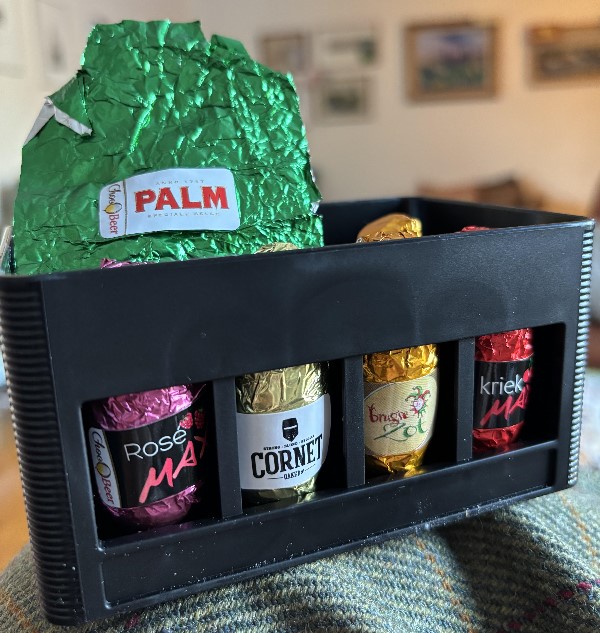
February flies by. That’s just the way it is. Good time to take stock. Good time to eat the little chocolates filled with beer brought by a visitor from Belgium. Early review: the “…chocolate is dry and dark so a lack of sweetness in the kriek left it a bit stark but the Palm was that bit richer.” Not sure I am chowing down on these outside of a winter like this but all quite a bit better than expected. Paid endorsements welcome. Winter was also on the mind and under the feet of Jordan as he wrote about the weather at the end of last month or perhaps just his efforts to get about in it:

Monday, Jan 26th: The deep freeze is well and truly upon us, and looking at the forecast for the next couple of weeks, it looks like we’re in four-layer territory. If your primary mode of transport and exercise is walking, then -25 with the wind chill does you no favours. Besides, the sidewalks are not shovelled in any meaningful way. Dry and cold is a great combination to ensure you’re reminded of the various injuries you’ve had over the years. Sometimes I get the unprompted sense memory of an ankle ligament rolling.

Also looking at the world as it exists below the knee, Stan shared some research he has done on the word Hopfenstopfen and its relation to a certain pair of boots:

The shoes were worn by a worker processing hops. When a bag was filled, a worked would jump into it, stomping down the hops to make sure the bag was full. When I dug this out, I wondered if these could have been called Hopfenstopgen boots. That’s because in Hop Queries Vol. 4, No. 6, I wrote about dry hopping in Germany in the 19th century. That was called Hopfenstopfen, which can be translated at hop plug. Simon Moosleitner, a subscriber in Germany, suggested there is more to think about…

I won’t spoil the fun but speaking of getting the boot in, late last week in VinePair, Dave Infante wrote about the effect of the homicidal ICE intrusion into Minneapolis on the beer trade in the city including this from Drew Hurst of Bauhaus Brew Labs:

You can see it in the firm’s sales figures. Taproom sales are down 40 percent compared to January 2025. “It’s a wildly unsustainable thing,” says Hurst. “None of us signed up to have to live through a federal occupation and figure out how to run a business at the same time.” Not that it was easy before the onslaught: Bauhaus wrapped this month last year down around 30 percent from January 2024. Craft brewers have been struggling to find their way for years in the face of shifting demand, new competition, and rising costs. In Minneapolis and Saint Paul, they’re doing all that with the MAGA jackboot on their necks.

At first I thought it was an odd angle but then realized it illustrates the principle that beer prefers peace as well as how quickly that peace can be lost. Dave also shared in his email updates that he was told to “stick to beer” and that some paying subscribers to his newsletter Fingers canceled their subscriptions. Perhaps if those folk didn’t “stick to” amateur neo-fascism it might be better. Funny how the “stay in your lane” crowd don’t show up for this sort of politicization within the pub:

A beer tap labelled “Rachel Thieves” has appeared on the bar of a Hertfordshire pub protesting Chancellor of the Exchequer Rachel Reeves introducing crippling tax hikes. Anyone ordering the beer will receive only water. The Green Dragon in Flaunden, which is run by publican Chris Ghazarian, has added the spoof cask ale pump badge as a protest – telling customers that pints of this particular beer are “very bitter” and cost more than anything else on the bar and anyone ordering it will receive only water. Speaking to the British national press, Ghazarian said: “They find it hilarious. I obviously don’t make them pay for it.” 

On the other side of the planet, a very difference approach has been taken in Australia:

The Albanese government is seeking to put a hold on increases to the beer excise for the first time in 40 years. The Customs Tariff Amendment (Draught Beer) Bill 2025 seeks to pause the indexation of customs duty rates for draught beer for two years from August 1, 2025. Currently, the beer excise is indexed twice yearly to stay in line with the consumer price index, with Australian beer, wine, and spirit importers and producers saddled with some of the highest rates in the world…  Addressing the House of Representatives, Anthony Albanese said he was “proud” to introduce the Bill, “one of the most popular commitments that we took to the election”.

Boak and Bailey also wrote about another sort of pressure to conform but the context was less confrontational – just writing about their thoughts on a craft brewery:

Maybe that post was a bit too snarky, with hindsight, but it certainly didn’t warrant trolling impersonation accounts on Twitter, general abuse that last for months, or a stalking campaign. That was, as you might imagine, quite traumatising, and probably did make us nervous about being critical of breweries in the supposedly cuddly craft brewing sector. It didn’t stop us, but it had a ‘chilling effect’ on how freely and frequently we felt able to express ourselves. It’s easy to say “Don’t mince your words” but minced words are less likely to lead to sleepless nights. We can totally see why some people might decide it’s not worth the trouble, and certainly wouldn’t judge them.

On reflection, I have probably benefitted from folk starting with the assumption that I am a bit of an arsehole. I lose my sleep over other things.

Note #1: Take a news event and ram it like a square peg in a round hole.
Note #2: Martin at another fabulous pub, this time inordinately bright.

Ron TV continues to impress. This week he’s been presenting an extended interview with Mitch Steele and, like the comment maker Oscar, I am drawn to the brief introductory electro-thrash almost as much as the subjects of these interviews. Part 1 of the interview is over thirty-seven minutes long with Part 2 clocking in at thirty-three. Set aside an hour or so of your time. More if, like me, you keep replaying the first six seconds and that mesmerizing theme music over and over and over.  Good multi-media breakout for Ron – even if it likely doesn’t pay the bills. One a similar note, Ray of B+B on the prospects of a career in writing:

This is excellent. Depressing, but excellent. My response has been to give up, basically, and accept that writing is a thing I do on the side, while something else pays the bills. I also like that thing, so it’s fine, but I get sad thinking what I could have achieved if writing was my full-time job.

Perhaps also on the theme of less is more, Guinness 0 also continues to impress me and Pete‘s brief review does not surprise:

There are many great 0.5 per cent stouts from small indie brewers, but Guinness 0.0, which took years to develop, is indistinguishable from the real thing.

I noticed one thing when writing this. It is branded as “Guinness 0” in Canada but “Guinness 0.0” in the UK. Why? Is it a different formulation here and there? Whatever it is, I am finally seeing a point to NA beers. But things will be going in a slightly different direction in UK neighbourhood if one permit applicant has their way:

The shop also sought an amendment to the condition currently imposed on the licence… to “No super-strength beer, lagers or ciders of 6.5% ABV (alcohol by volume) or above shall be sold at the premises with the exception of Dragon Stout and Guinness Export beers.” The applicant’s agent, Frank Fender, told Bedford Borough Council’s licensing sub-committee (Thursday, January 29), that these “super strength” beers are not usually the “street drinkers’ choice of drink”. “They are they are widely consumed by members of the Afro-Caribbean community, and obviously this shop wants to be inclusive,” he said. This claim was backed up by Chris Hawks, the council’s licensing compliance and enforcement officer. He said: “What Frank says about Dragon Stout and Guinness Export is spot on.

For years, the word authentic was bounced around in the face of glitter and haze. That plan in Bedford sounds like authenticity to me. Similarly perhaps, crossing the Atlantic, Matty C has written some notes on the US beer scene for the supplier Get ‘Er Brewed‘s webpage and found something of a revivial going on:

Nostalgia is one play many breweries seem to be using. During my time in both Portland and in Colorado, (the latter of which I visit regularly to see family,) I noticed that many drinkers seem to be choosing the classics made by more established breweries. Allagash White, the Belgian style witbier from the brewery of the same name wasn’t just on tap everywhere in Portland, but it felt like everyone was drinking it too. The beer carries the kind of hushed reverence that money can’t buy, and demonstrated to me why establishing a core beer as part of your brewery’s identity is essential for longevity.

This is quite a reversal as, you will recall, in 2019 flagships were considered a dead concept: the “concept of a flagship in almost all ways maps to an earlier and obsolete way of thinking.” Futurisms rarely stand up to audit but it’s good to know, in an era too concerned with branding and other misinformations, that identity in the form of what is in the glass has made a come back. One never knows what is really going on otherwise. As with the news about the bills left unpaid and the suppliers left in the lurch by Rogue, James Beeson in The Grocer shared that the level of insolvency at failed Keystone Brewing had hit almost £15 million. Heavens! Remember when we all spoke of community?

Sticking with things in the USA, the feature in Pellicle is a portrait of Eckhart Beer Co. in NYC by Ariana DiValentino with its focus on central Euro lagers and foods that share the same theme:

The menu focuses primarily on Central European dishes that match the beers’ origins. There is a brat plate, and spaetzle gratin, and kartoffelpuffer (German-style potato pancakes), which you can order fried in oil or beef tallow. But there’s also a falafel dog, an Italian cold cuts sandwich, and a Moroccan-spiced ratatouille with vegan lemon yogurt. The variety of cultural influences feels very reflective of the brewery’s New York City context. “I wanted to offer food that supports the beer. It didn’t have to be Central European per se, but that felt like a natural foundation,”

Sounds like a great place for all. Not so in Japan where one establishment has embraced ageism:

The concept of age restrictions and minimum requirements is commonplace around the world. But have you ever heard of an establishment imposing a maximum age limit? Now, a Tokyo chain pub has set a ban on older customers – in order to try to maintain the raucous, fun atmosphere for which it is known. Tori Yaro Dogenzaka is an izakaya (an affordable Japanese pub) situated in Japan’s capital city. This year, the establishment propped up a sign outside the entrance, informing customers of the new rules. The sign said: ‘Entrance limited to customers between the ages of 29 and 39. This is an izakaya for younger generations. Pub for under 40s only.’

I wasn’t wanting to go there anyway. Screw them. That’s it. As as I sulk in a mode Japonais, please check out Boak and Bailey who continue to post every Saturday. adding to their fabulously entertaining footnotes week after week at Patreon. And look out for more of Stan’s new “One Link, One Paragraph” format. Then hunt out something in someone’s archives! Leave oblique comments on someone’s post from 2009!! Listen to a few of Lew’s podcasts and get your emailed issue of Episodes of my Pub Life by David Jesudason on certain Fridays. And Phil Mellows is at the BritishBeerBreaks. Once a month, as noted, Will Hawkes issues his London Beer City newsletter and do sign up for Katie’s wonderful self-governing totes autonomous website featuring The Gulp, too.  Ben’s Beer and Badword seems to be on pause since November but there is reading at The Glass which is going back to being a blog. Any more? We have Ontario’s own A Quick Beer and All About Beer is still offering a range of podcasts – and there’s also Mike Seay’s The Perfect Pour. Plus follow the venerable Full Pint podcast! And there’s the Craft Beer Channel on Youtube. Check out the archives of the Beer Ladies Podcast.

And Just Like That Here Are The Quite Frosty And Fully Final Beery News Notes For January 2026

It’s been a quiet week in the beer world with distractions aplenty in my real world. Like the Arctic vortex. To be honest, I’ve always preferred the Caribbean vortex whenever it pays a visit.  Thankfully, once upon a time I lived up in the upper Ottawa and have experienced the refreshing zing of -53C so knew enough to break out the heavy tweed and  big boots. Dashing yet completely unable to dash. Elsewhere people are embracing the deep chill as well.  Will Cleveland reporting from Rochester, NY has news of the return a winter beerfest this weekend;

This isn’t a gimmick festival chasing the beer-du-jour; it’s a gathering rooted in the style that got a lot of people into craft beer in the first place—before haze became a default setting and before “imperial” stopped feeling like a warning label… DiCesare remembers the first year clearly, mostly because it was about 10 degrees outside. This year, the ask is similar but the hope is different: dress for the weather, embrace the winter, and lean into the fact that January beer festivals are better when they stop pretending they’re outdoor concerts. Fire pits and outdoor heaters will again be part of the setup, encouraging that specific Rochester ritual of standing outside, beer in hand, nodding knowingly at strangers like, yes, this is happening, and yes, we chose it.

What else has been going on? Well, it was Rrrrrrrabbie Burrrrrns night last Sunday and all around the world folk reacted to the plate of haggis, neeps and tatties set before them. Unless, as Katie M explored in Guts magazine, it perhaps wasn’t really haggis:

Learning how important lungs are to the recipe of a traditional haggis, a vegetarian version seems like sacrilege. The whole point of haggis is that it’s offal, a sausage or boiled pudding made with waste-not, want-not diligence to keep Scots fed throughout the winter and leaner times. The very idea of a vegan haggis is deeply inauthentic—offensive too, if you were to read the comment sections on any clickbait story about the dish. But if you’re appalled, you’re forgetting the accommodating nature of the Scottish people. Do you think my Grandma would have anyone going hungry in her house? The very origins of vegetarian haggis was borne from hospitality…

As the good author noted, the very prayer one prays before we got to the “O what a glorious sight, Warm-reekin, rich!“* includes the line “some hae meat an canna eat…” so there is some authority for this. Is there another dish that so inspires? Speaking of how others live, in the Globe and Mail, Drew Shannon wrote about finding a beer in Kazakhstan:

I broke up with craft beer a long time ago – back when small-brand breweries went from niche and interesting to eye-rollingly ubiquitous. Of all places, I didn’t think I’d run into my beverage-ex in Kazakhstan. I assumed either big conglomerate brands would still dominate the former Soviet state or there’d be no beer at all. Finding a pint in some parts of the Islamic world can lead even the most well-travelled tourist on a fruitless quest. It turns out, I was dead wrong. My impromptu evening of bar-hopping around Almaty, the country’s largest city, started after a long day of trekking the Turgen gorge. On the way back to my hotel, I noticed Privychki Bar. I pushed open the front door to find a gaggle of young Kazakhs perched on vintage armchairs, sipping cloudy pints. 

Mmm… cloudy pints. Never less than clear, Stan, in his concise one paragraph way, directed me to a bit of resurrectionist thinking over the cool corpse that one was Rogue Brewing. How in its haydays it didn’t have managers, it had ambassadors: “That is why Rogue was kicking ass in those days is that felt that they were ambassadors to craft beer.” Yikes. I had a sudden unsettling flashback to the bad old irrational – if not greedy – days of craft and reminded myself of this from 2012:

To hell with that. Passion is that employer of the young who saps their joy for life. Passion offers periodic Google ad cheques in return. It asks you to be the unpaid brand ambassador. On Wednesday night, a intelligent and eager young person suggested to me that my interest in good beer was pure passion with a certain honest excitement. I took the time to gently crush that moment like a mouse under my heel. It was information, I said. Information and interest. Passion? I have children for that. 

The children? They are 14 years older now and each of an age when they might be expected to buy the beer as much as have it bought for them. I trust that now not-so-young person has found another moe successful career – and that’s probably for the best for all.

Note #1: Twenty years of Ron!
Note #2: Maureen asks … in the end… is a brewery just its trademark?
Note #3: Stout-flation strikes.

Heavens! I missed the news when The Beer Nut issued a new beer style alert right around when the update when to the presses last week. He was reporting from the front lines of recent holidaying where and when he encountered:

… the rarely-seen style of imperial sweet potato amber, and I had no idea what that was likely to mean. Beniaka is 7% ABV and a cola brown colour in the glass. Although fizzy, it’s plenty thick and feels luxuriously “imperial”. Can’t say I tasted much potato, but there’s a pleasant woody spice: nutmeg, sassafras and liquorice. It’s fairly sweet with it, showing a little Scotch-ale-style toffee, with the herbs helping balance it. This is interesting, with lots happening, but it’s not a daft novelty, and makes for a very civilised digestif.

Not at all in response, Sophie Arundel was given a fun topic over at the Drinks Business – the dead end trends of 2025:

Several alcohol formats once framed around lighter, functional or lifestyle-led positioning are now in sharp decline. Hard kombucha now holds a 0% share of social discussion, down 29.8% year on year. Hard tea has slipped to a 0.01% share, falling 33.79%, while hard seltzer sits at 0.02% share, down 33.67%. The contraction extends beyond these formats. Craft beer, often seen as culturally resilient, is down 16.52% year on year with a 0.84% share, while generic IPA beer has fallen 17.28% to a 0.38% share. Tastewise’s data suggests the broader “better-for-you drinking” narrative is losing attention. Products that relied heavily on pseudo-functional positioning are struggling to maintain relevance, pointing to a need for clearer occasions, flavour-led propositions and tighter ranges.

(“Pseudo-functional” was the name of my folk-punk band back in ’93.) At least craft beer fans can take comfort that their drug of choice is going better than hard kombucha. There are still some hangers on that are telling craft to repeat its errors… but it is true, isn’t it – when things are going down the proverbial shitter, not one really is working to improve so much as find themselves quite happy to tread water.** Perhaps coversely, BMIs seems to be seeing at least a stall in the slide when it comes to US beer:

NBWA released its Beer Purchaser’s Index reading for Jan early touting a “significant bump” from December. After 5 mos in a row of readings below 30 (including several lowest ever around 25), BPI jumped to 39 in January. Not exactly great shakes, and 9 points below Jan 25, but still 14 points better than Dec 25. (Recall, BPI below 50 suggests beer distrib orders are contracting, while above 50 signals expansion.) 

So less of the lessening perhaps. But in western Canada, there was actually an increase in beer sales through 2025. So who knows! Well, at least we know one thing. I think we have established that not being very profitable at all is actually not a good business plan:

BrewDog has announced that it is closing down its Aberdeenshire distillery and ceasing production on all spirits. The craft beer company said it had decided to abandon its state-of-the-art distillery, which opened in 2016, and axe the brands after “careful consideration”. The move comes after the company posted losses of £37m in 2024 and announced job cuts across the business, including at its head office and brewery in Ellon.

Conversely (at least in San Francisco) not doing well enough to even attract a proper buyer can have its advantages:

During that massive blackout on December 20, every business but one in the Lower Haight had to shut its doors because they had no power. That one would be Toronado, which still uses an old-timey, non-electrical cash register with punch buttons and a hand crank, still takes only cash, and beer taps don’t require electricity. Cheers to ancient technologies. The story was left hanging last summer after a new crypto-bro owner had stepped in looking to take over the bar — and launch a Toronado-themed coin! — and after that deal appeared to be in jeopardy once longtime owner Dave Keene discovered these details and looked to cancel the deal. But SFist can confirm now that the deal was, indeed, canceled, and everything remains as it was at the bar.

That’s nice. Unless the owners really hate the place and want to move on I suppose. Can you own an iconic institution that people flock to and really hate it?  If someone does something well I would hope that there is joy in the doing.

Note #4: The many beards of Polk.
Note #5
: What friends of beer writers think they do…
Note #6: …all day long…

Joy in doing? That’s a bit like this week’s feature in Pellicle by Imran Rahman-Jones about the making of liquor from what’s to be found right there in Edinburgh’s urban orchard:

As Chris continued to tweak his distillations, and source new apples for each batch, he began to reflect on the fruit’s beguiling quality. “[There’s] something quite magic about an apple tree in the street,” he says. Neighbours will leave out boxes of fruit for one another, or swap recipes. “It tends to pull the whole street together at a certain time of year.” What Chris didn’t know when he started the process of developing Pochle was that he was tapping into a lineage going back centuries in Scotland. The enchanting ability of an apple tree to gather and unify in fact has deep roots in the country’s traditions and folklore. 

Lots to like there. And just look at the people working to get that bit of writing onto your screen. The fine folk keeping Pellicle going, the author Imran Rahman-Jones, the semi-sticky handed Chris Miles who gathers and also those who let the foragers be – not to mention those who planted and tended to the apple trees. Doing is a wonderful thing.***

And on that very subject – the doing of things – Boak and Bailey were out there again in their monthly newsletter for January doing a great job encouraging more writing about beer. What to write about:

There are local drinking customs and cultures that probably seem unremarkable to people who know them but which would interest people like us. Flat Bristol Bass is one that fascinates us but there must be others all round the country, and certainly around the world. Alex, our favourite beer blogger of 2025, goes to three pubs and writes about what he sees going on there. Adrian Tierney-Jones (a pro, not a blogger) takes a similar approach. Now, you could write tasting notes of every beer you drink but, honestly, that’s probably the hardest thing to make interesting – unless you are a skilled, creative, and/or amusing writer like The Beer Nut. It can still work if your tasting notes find a theme or tell a story, though.

Do it! I like it – but do note that “blogger” and “pro” are not comparable categories and neither term speaks all that much to the quality of the writing. “Pro” is code for paid writing which can be compromised even just by editorial restrictions**** though, more to the point, too often not all that good. And “blogger” is a reference to a class of medium, not a sign of quality of the writing and not necessarily code for an amateur though some of the best beer writing is actually provided by people who earn their living otherwise. Ray and Jess themselves are proof of that. Better to think of adjectives like interesting, inventive or even valuable when weighing the cred. Then notice where they don’t apply!

I would also add, don’t worry too much… unlike Mikey Seay who has shared what strikes me as quite an odd thought:

I always shy away from reviewing beers for two reasons:
– Lack of skill to do it properly.
– Beers can be too regional to make a review relevant to a global newsletter audience.
That said, I feel a new beer from Sierra Nevada is available enough in most places to make it worthwhile to mention.

Seeing as thinking and writing about your taste perceptions takes about as much skill as running a vacuum cleaner, I don’t think this is a particularly useful standard. But then again you may be crap at vacuuming, too. Do you worry about that? Just type. Be patient and get those keyboards clicking. It’s a lot like planting a seed and also, if nothing else, it’s good for the knuckles.

Where will it take you, all this clickery? Well, as we wrap up this week on the note of the haute in beer writing, this is your final call for a fully self-funded trip to Bordeaux in June:

This is the FINAL REMINDER about the 2026 Beeronomics Conference, which will take place at ESSCA School of Management, Bordeaux, France, 24-27 June. Main panels and sessions will be held at the ESSCA Bordeaux Campus. The Conference Organising Committee, led by Gabriel Weber and Maik Huettinger, welcomes all high-quality research on the economics of beer and brewing. 

The deadline for submissing an abstract is Sunday. Send me a card. Fine. Fin. As I said, a bit of a quiet week. please check out Boak and Bailey who are posting every Saturday and adding to their fabulously entertaining footnotes week after week at Patreon. And look out for more of Stan’s new “One Link, One Paragraph” format. Then hunt out something in someone’s archives! Leave oblique comments on someone’s post from 2009!! Listen to a few of Lew’s podcasts and get your emailed issue of Episodes of my Pub Life by David Jesudason on certain Fridays. And Phil Mellows is at the BritishBeerBreaks. Once a month, as noted, Will Hawkes issues his London Beer City newsletter and do sign up for Katie’s wonderful self-governing totes autonomous website featuring The Gulp, too.  Ben’s Beer and Badword seems to be on pause since November but there is reading at The Glass which is going back to being a blog. Any more? We have Ontario’s own A Quick Beer and All About Beer is still offering a range of podcasts – and there’s also Mike Seay’s The Perfect Pour. Plus follow the venerable Full Pint podcast! And there’s the Craft Beer Channel on Youtube. Check out the archives of the Beer Ladies Podcast.

*Just in case someone out there never had a tea towel.
**No, smoothies will not save brewing.
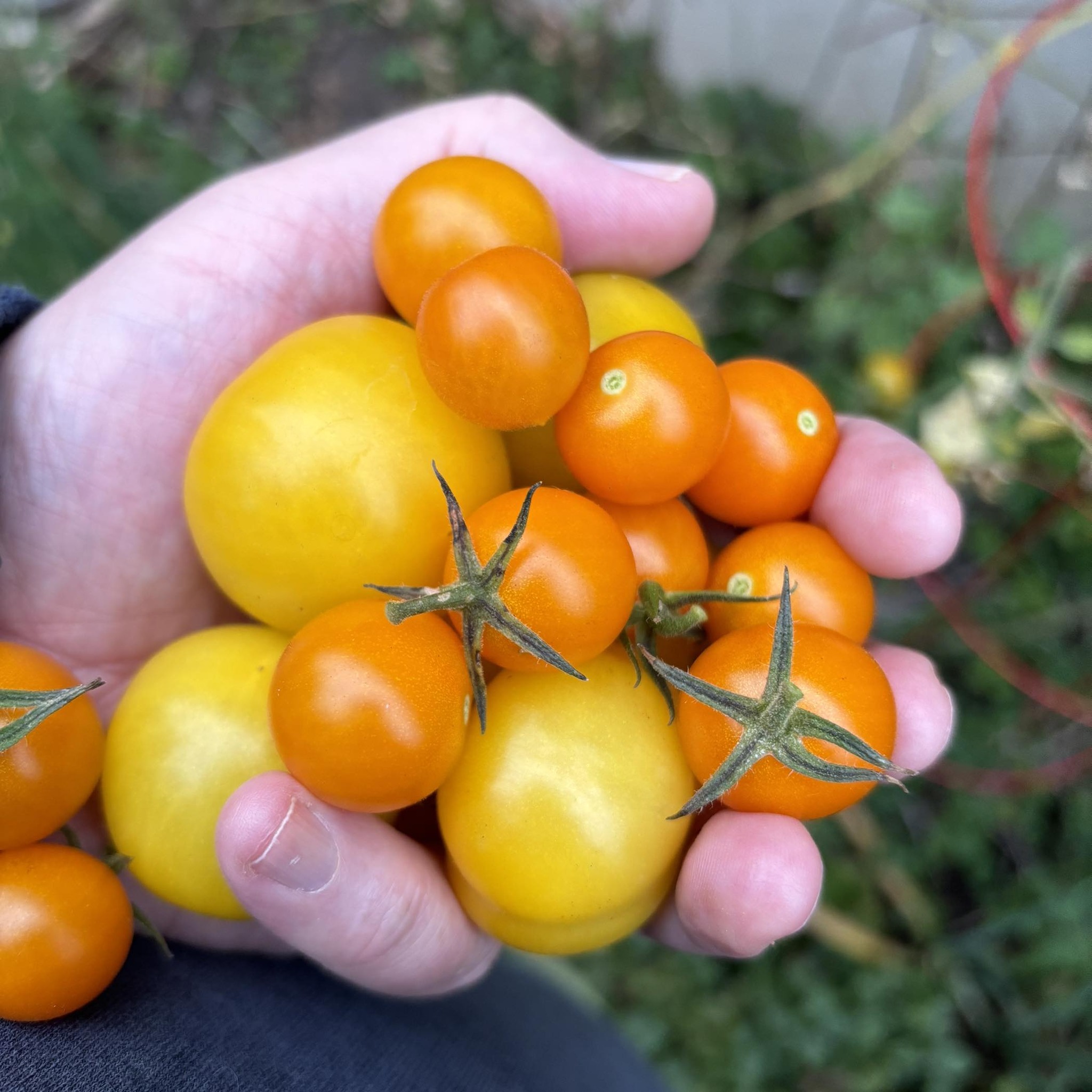
***This is your reminder that now is the time to start planting those seeds for your own garden. Seeds and soil and time. Have a go. This tomato from last November’s final harvest was from a seed planted in my basement in February. Easy. Almost as easy as typing. 
****“It’s only a trade mag article…” is as often much the case.

Your Happy Merry And Even Supportive Beery News Notes For The Week Of Blue Monday

How does it feel? That’s what Blue Monday asks of you. Katie was particularly aggrieved as last Monday was her birthday. So first of all –  happy birthday! Apparently, Blue Monday is perhaps a floater with not 100% agreement on which date it is.* Like Easter but without the medieval calculation to give some assurance as with the death date of Jesus. So you have options and need advice. Fortunately I am full of good advice on this topic. Me, I prefer to celebrate what I call “Bleu Monday” on which I eat a lot of cheese. Also, it seems to also have been originally a term that in Germany was “der blaue Montag.” and then United States when workers told the boss to shove it, as we read in 1838:

Drink till all is blue. Cracking bottles till all is blue.

Blue meant the haze apparently. Or perhaps the slightly wicked as in “blue laws.” I dunno. But I like that it also has it’s own anthem, even if it’s a wee bit Dieter Sprockets.

Beer Marketers’ Insights have a note about a little blip that could be the beginning of a bit of a bump for beer:

Pretty much everything was comin’ up roses in beer and beyond for the first week of the new year in Circana multi-outlet + convenience channels. Beer, wine and spirits all grew for latest week thru Jan 4, 2026 (including Dec 29-31). Can’t glean much from just one week, but interestingly, craft beer’s 4.4% $$ gain outpaced total beer (+2.9%) for period. Multiple top craft fams saw sales pop for the week including New Belgium, Sierra Nevada and Elysian each up low double-digits by $$, Lagunitas up 8.5% and Bell’s (+5%), Shiner (+4%) and Blue Moon (+3%) up low-to-mid singles.

And these US market numbers exclude non-alcoholic beers so it’s more beery than we often seen in the booster stats announcements. But they could also indicate that fine spirit of “fuck it!” that one finds in a time of crisis. Speaking of which, can you write about the crisis in US hard liquor sales without mentioning the tariffs that have effectively cut out a massive share of your customer bases? VinePair seems to think so:

And though distilleries share similarities with other business closures — from layoffs to managing creditors — there’s uniquely challenging inventory to deal with: barrels of aging whiskey. “They’re a little bit of a problematic asset because they can only be sold to someone who has the license to hold them,” says Will Schragis, managing partner at WellSpun Consulting. “Barrels are in-bond, so they’re non-tax paid. There are only certain licensees and other companies that can acquire them.”

No mention of, you know, lobbying for free trade as a recourse makes me wonder if there is a ex-nay on the t-word going on, lest one draw wrathful attention away from Greenland. H/T to Jeff. It’s all about getting the spend in country it seems and Americans are doing their part:

Surveys have shown that consumers feel pessimistic about the economy as they worry about tariffs and the jobs market. More than half of voters believe President Trump is “losing the battle against inflation”, according to a Harvard Caps/Harris poll of 2,204 registered voters released last month. Yet despite the economic gloom, data suggests that spending has risen across all income groups.

Mikey Seay shared a few thoughts that are not unrelated to this moment:

It’s the price. I struggle with the price of NA and low ABV beers. This is my Dry January issue. I can get behind drying out for a month. Or (what I am trying) focusing on drinking lower ABV beers. But there is a hidden suck. Low alcohol/no alcs are priced the same as regular beers, sometimes even double. It’s hard for me to get over that. It’s like, I am getting ripped off, and I have a hard time shaking that. But I must. I know it costs a brewery close to the same to make a NA or low beer, so they gotta charge the same. And that cost trickles down to the stores and bars. So I gotta get over myself there..  Enjoy my low ABV beer, and don’t be a baby about what I am paying for it. I must do this for myself and the business of beer.

One must spend. Do one’s part. Think of England and all that. One of things I appreciate locally is that Guinness 0 is $11.95 at the LCBO and the regular draught is $13.50. Trouble is… no Guinness 0 to be found in the province these days. Guinness is experiencing a height of fame and fortune – and there are good reasons for that, according to Jeff:

The world is unstable, especially for young drinkers who spend half their paychecks on small apartments. Young people are threatened by more dangers than any generation in decades: huge college debt, a machine-learning era that may eliminate entire sectors of jobs, climate change, political instability, the corruption of media and the vitriol that marks society. This is not a time for risk-taking. It’s a moment when people are taking refuge in safe ports and reliable brands. Guinness isn’t alone in this appeal—the popularity of old Mexican brands follows the same script—but it has the advantage of being a 4.2% black ale that comes with a helping of theatricality and a creamy head. It is both safe and also different from other global brands.

I think some of this turns on that 4.2%. And low calories. Theme shift. Did you know you can watch RonTV?  He’s got a YouTube channel going:

You might have noticed that I’ve posted a few videos on YouTube over the last couple of days. There will be more to follow. It’s part of my drive to document and preserve. Initially, it’s mostly material that I acquired for my book on the 1970s, “Keg!”. I conducted several Zoom interviews Which I think are worth making public. Especially as the interviewees are all past retirement age. And won’t be around forever. I’m particularly keen on recording Derek Prentice’s recollections of more than half a century in brewing. Despite my urging, Derek shows no interest in writing his memoirs. But he’s happy to be interviewed and share his memories. I already have around two hours of video. And plan to record several more. Covering his time at Youngs and Fullers.

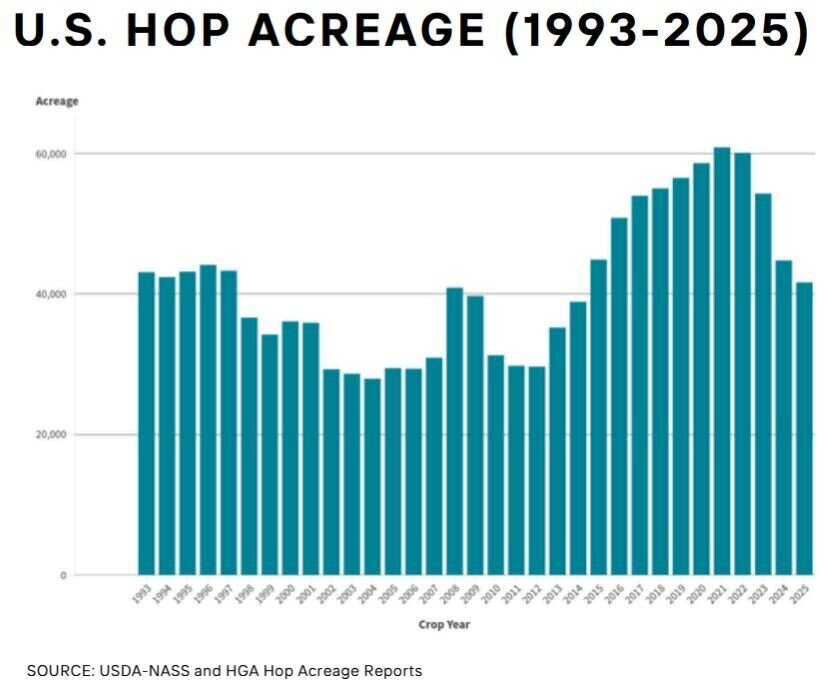
Next, Stan has published his newest edition of his monthly Hop Queries newsletter and there is much to consider. For one thing, he shared that chart of total US hop acreage which indicates the plantings of 2025 roughly match those of both 1997 and 2008, both years before further drastic drops. He also explained what BLP flash frozen hops are:

The idea began with hop farmer Jim Schlichting, who upon retiring bought 40 acres of land next to his home and began growing hops… Basically, he freezes the hops fresh off the bines and ships them in vacuum sealed packages along with reusable ice packs. The cones should remain frozen until brew day. After thawing them, brewers may use them as they would unkilned hops, replacing each pound of pellets in a recipe with four pounds of cones. Blue Lake markets the hops to both homebrewers and commercial breweries.

Whenever I read that some blog or newsletter on beer won some award or another I always think to myself “looks like Stan didn’t apply again this year.

Note #1: to bar or to not bar ICE.
Note #2: medical thoughts from amateurs.
Note #3: the Magnus Lounge on the ferry to Orkney.
Note #4: are people outside of the beer echo chamber aware that many many others have quite happily active social lives… without beer?**

And Jordan continues to diarize*** his weeks in detail, appointments in pub and breweries plus the scribbling for magazines and books along with the totalling up of spreadsheets. He’s found that the current bottom line in Ontario is not good news:

Among the various hats I wear, I’m historian for the Ontario Craft Brewers and I get to update their timeline on a yearly basis. Since I’m updating the spreadsheet with news throughout the year, this gives me the opportunity to get paid something for the information I’m collating. …the end of the year has been brutal on breweries. Both Goose Island and Blue Moon have decided Toronto has beaten them. If the corporate guys are out, you know things are bad. It looks like 30 physical breweries closed in Ontario in 2025 and something like four contract breweries, but who cares? Some physical breweries switched to contract status and some ownership structures are more or less impossible to parse. Can you really say Indie isn’t a contract brand because of Birroteca at Eataly? 

Can you really? Shifting from the crunch of numbers to the stream of consciousness, it’s a good thing ATJ prepared us with the subtitle of his piece this week – “an amiable ramble” – as this letter of love to beer culture touches on every corner of the pub and glass experience other than the variations on paper towel dispensers one might encounter, such as:

It is about the rattling bus snaking through the countryside with a pub at the end of the journey, the train skirting the wave battered coast with a pub at the next station, or maybe two or three, the walk through the rain, the nature of the game; under the hill all of us go at the final stage of our life but beer can be used to celebrate that passing, reconnect your memory with a swig and another swig, raise a full glass to the memory of dear old matey they all chorused, may he be never forgotten, but as soon as the rain stopped they walked out of the pub never to think of their dead friend ever again, for they were alive and he wasn’t.

Poor old matey! Gone and soon forgotten. Interesting legal news if you are into doing your own thing, a category of which I appreciate many of you fall into according to your own tumble of choice. The news is that the US District Court in Northern Texas assessed submissions in a case and last Saturday (odd date for a ruling to be issued) held:

…these documents reflect a shared First Amendment vision: Free Speech, Press, Petition, and Assembly rights combine to protect and elevate the public discourse necessary to self-government—not self-expression in all forms, and certainly not the libertine “expressive conduct” absolutism envisioned by
Plaintiff Spectrum WT… Spectrum failed to enforce its intended “PG-13” format during a drag show held off campus, as professional and student performers tasked with “breaking” and “destabilizing” sexual norms engaged in sexualized conduct more akin to a striptease…

Libertines! Libertines at a university?!? Now, keep in mind what “WT stands for: West Texas A&M University. The students of which the court determined included minors. Perhaps in Amarillo the age of majority is 35. Who knows. But it did remind me of the 2003 ruling of the Supreme Court of Canada in in the case R. v. Clay:

…the liberty right within s. 7 is thought to touch the core of what it means to be an autonomous human being blessed with dignity and independence in “matters that can properly be characterized as fundamentally or inherently personal”. With respect, there is nothing “inherently personal” or “inherently private” about smoking marihuana for recreation. The appellant says that users almost always smoke in the privacy of their homes, but that is a function of lifestyle preference and is not “inherent” in the activity of smoking itself. 

Lifestyle! Thankfully, the old wack-tabac is now legal in these parts. But these matters, in case you ever wondered, one has to be on top of one’s right to have fun as one wishes. The law of the libertines’ lifestyles may need more research.

Finally, Pellicle has a short survey out about their next steps:

It’s one thing to run a magazine based on the things we like most, but to grow and bloom into something bigger, we need our readers’ insights and support. That’s why we’ve created this survey: We want to hear what you want from Pellicle in 2026, and use your input to plan our next moves. For the next two weeks, we’re opening up the floor to learn what Pellicle means to you, and where you’d like to see it go next. The 2026 Pellicle Reader Survey is just a seven-to-10-minute task, and you can easily complete it on your phone. Plus, you can opt in to win one of three prizes…

As you know, I would pay to take a survey so the whole idea of prizes is just insane!  While you are busy with that, please check out Boak and Bailey who are posting every Saturday and adding to their fabulously entertaining footnotes week after week at Patreon. And look out for more of Stan’s new “One Link, One Paragraph” format. Then hunt out something in someone’s archives! Leave oblique comments on someone’s post from 2009!! Listen to a few of Lew’s podcasts and get your emailed issue of Episodes of my Pub Life by David Jesudason on certain Fridays. And Phil Mellows is at the BritishBeerBreaks. Once a month, as noted, Will Hawkes issues his London Beer City newsletter and do sign up for Katie’s wonderful self-governing totes autonomous website featuring The Gulp, too.  Ben’s Beer and Badword seems to be on pause since November but there is reading at The Glass which is going back to being a blog. Any more? We have Ontario’s own A Quick Beer and All About Beer is still offering a range of podcasts – and there’s also Mike Seay’s The Perfect Pour. Plus follow the venerable Full Pint podcast! And there’s the Craft Beer Channel on Youtube. Check out the archives of the Beer Ladies Podcast.
*It is, however, reliably closer to the start of 2027 than the end of 2025.
**I find this eager rush to shimmy right up next to the nutster RFK Jr somewhere between bizarre and disgusting: “…In explaining that approach, officials pointed to the social context in which alcohol is often consumed – its role in bringing people together to bond and socialize, while creating shared experiences – summed up by the idea that ‘there’s probably nothing healthier than having a good time with friends in a safe way.’ ” That’s two possible bits of bootlickery this week. A better take on the moment.
***Boak and Bailey do something along a similar line with their regular beers of the week posts on Patreon: “Running with Spectres was also on excellent form, much to Jess’s regret the following day.

The Over 50% Off Super Holiday Sales Saving Edition Of The Beery News Notes

You may need to turn your phone sideways to make this image fit. Or I could just center it. There. That’s better. For a long time, these weeks at the end of the year at the beer blog were a bit crazy. The Christmas photo contest (circa 2006-16) was on and I was sifting through a huge number of emails with multiple entries. Hundreds came in each Yuletide. Thinking back on that this week, I had a look through the 2010 submissions and found this lovely image sent in by Brian Stechschulte of San Francisco.  Here’s his birthday bio on Jay’s site. Another one of his enties won the contest that year. That image is of Rod Widmer among the quipment at the brewery. In what Brian described as Widmer’s cathedral. I like the glow. I’ll dip into the emails and old posts to see what else I can find to adorn these news notes throughout December.

Back to today’s news, first up the question of cash and how the UK budget reaction lead to something of a counter reaction. Sayeth Matty C.:

The worst thing about this week’s budget for me was seeing prominent figures in hospitality bemoaning the minimum wage increase because god forbid your staff should earn enough to actually afford, barely, the cost of living. For me it just demonstrates why all of this lobbying for a VAT cut isn’t so much about supporting a “dying” industry, put propping up profits for the people at the top. But no, it’s paying wages that’s the problem.

And their weekend footnotes to the weekend news, Boak and Bailey shared a similar sentiment:

Every budget goes the same: CAMRA and industry bodies lobby the Chancellor to do something to help pubs; the Chancellor does very little, if anything, to help pubs; CAMRA and industry bodies criticise the Chancellor’s failure to act and foretell doom for the hospitality industry. It’s been this way basically forever and yet, somehow, pubs continue to exist and beer continues to be manufactured and consumed.

As a person who takes home a tax based pay cheque, I have to be somewhat respectful of those lobbying for restraint.* But I am also aware that government can positively participate in economic growth and greater social good. So… and here’s the point for me… after years of ideological restraint hit by a global crisis or two there are times when the bite shared by all is for the longer term good.  As long as there is an identifiable long term good and it is shared by all.

Speaking of the burdens of the state, Drew Starr has shared thoughts on an excellent way of fighting back against authoritarianism – ban the lackies from your bar:

The kid who proudly called ICE on a carwash. Print this shit everywhere. Hell yeah, Sil! For those not from here: this is The Silhouette (nobody calls it that), one of Boston’s last remaining dive bars. For a college kid living in the area, it’s the last place you want to get banned from

We understandThe Sil” has barred a university student who called ICE on a car-wash and men in in balaclava abducted a group of nine workers. Perhaps more establishments might introduce a life-time ban.  Shaming down authoritarianism is a top drawer move.

How to cope? How to deal with the pressures of the day?  “Mulled beer!” sayeth Jessica M. seasonally through an interview with Sam Millard of Bevertown :

“The secret to making a great DIY mulled beer is in choosing the right base. The best results will come from a rich, malty profile or a sweet brown ale,” suggested Millard, who explained that “just like when mulling wine or cider, you need a base that is already really rich, full-flavoured and most importantly, not at all bitter. You ideally want something with a bit of body too, so ensure your beer is not too thin.” According to Millard: “While you may be tempted to use a super-hoppy IPA, keep in mind that its bitterness could overpower your chosen spices and throw everything off balance.

Now, keeping in mind that this is all a bit of an adver-informo piece, I still would recommend you try it. Jessica B herself was curious about this stuff a whole eighteen years ago. Me, I like to use Chimay Première, the red labeled dubbel, as the base. Tasty, strong and relatively cheap as dubbels go these days. And skip the idea of “DYI” and just go traditional with a Lambswool made with strong ale apples, sugar and ginger spice. Or, along with a lot of other options at this link, try to make Caudle if you are even more adventurous. If that is too complex, just go for try a pint of stout and port. It’s Christmas so you can just do that and even say you did.

Speaking of Yuletide, in the news from Newfoundland we read that more folks are going to get stoned for Christmas!

CEO Bruce Keating says net earnings rang in at $56.3M, a decrease of about $3.7M, mainly due to the removal of U.S products and decline in beer commissions.  Alcohol sales totalled $84.2M, down 1.5 percent however, cannabis sales are up 10.6 percent at $28.5M. Keating says those numbers could start to slow since that market is maturing. He says they’re optimistic that the Christmas season will boost sales numbers. 

Baby Jesus would no doubt approve. Speaking of which, Barry M has driven down to a depth I’ve never considered necessary over a controversy I had never heard of – are “cider” and “cyder” the same thing? Or categories of rerlated things? As a lifelong poor speller, I am gratified that the problem arises from puritans who insist every difference in spelling requires a difference in meaning:

Within English literature, early texts seem to use mostly ‘sider’, though it would appear that by the end of the 16th Century literature was generally split between ‘sider’ and ‘cider’. Both with an ‘i’. But there were exceptions of course, an dit has to be said, it was a bit like the Wild West when it came to spelling convention, with cyder, cider, sider, cidar, cicer and pommage featuring in texts of the time (thank you Elizabeth!). But let’s look at some of the cyders…

As we all know, standardization is the best friend of Satan or at least authoritarians. The minute hand, a tool for atronomers, was later added to the clock to steal time from Indistrial Age factory workers. The dictionary of Dr. Sammy J of 1755 helped create the idea of misspelling and therefore a resulting intellectual failure. And now we have this consequence, a finger pointy crisis in taxonomy which apparently turns on the factual regular but uncategorical past practice of adding water to cider now and then** which has led, hundreds of years later, to a backdating by someone deciding that the spelling must follow a practice. Sad. Distinctions can be without a difference. Let us rather embrace our negative capabilities.

Did you see what David J did? He just went and wrote the history of Wychwood for Pellicle:

“BrewDog is a modern interpretation of Hobgoblin,” says James Coyle, who was sales director at its parent brewery, Wychwood. “[The Hobgoblin identity] was built on motorbikes, grunge, and tattoos—this was the escapism of the brand.” Established by Paddy Glenny as The Glenny Brewery Company in Witney, Oxfordshire in 1983, it was renamed the Wychwood Brewery in 1990. Somehow, this small brewery in rural Oxfordshire went from selling to a few freehouses to producing a beer so iconic that it shifted 100,000 barrels a year, changed pub culture, and eventually became a global brand in the Carlsberg portfolio. Thanks to breweries like BrewDog, today we’re used to shock marketing tactics from beer firms. Many of the people I spoke to while researching this article repeated James’ sentiment about Hobgoblin being akin to the often-controversial Scottish brewery, including the fact that its initial success was driven by word of mouth rather than a huge marketing budget.

Over twenty years ago, Wychwood was on the shelves on Ontario and I posted reviews of their Fiddler’s Elbow in 2004 and Duchy Original Pale Ale in 2006. I didn’t love the bad Baggins branding of Wychwood – though not as deeply as the stupid “you’re not worthy” stuff from Stone.  I am please to say, however, that now I added a bit of info which may have assisted David in one paragraph in there – but what a beast of research. And all for you.

Speaking less of you and more of me, I am 62. When I was a teen, I worked with older seniors. People 62 were rye drinking Dads of pals who were vets of the Second World War. They were still up on ladders to fix something on the roof. Some could dress a deer. Me? Fitter than I was at 52.*** So I found this New York Times piece a bit odd. Frankly, if I was 42 around now I’d worry much more about 52 than 62.

On the theme of worry, James Beeson in The Grocer wrote about the financial troubles facing the BKeystone / Breal, a UK consolidator of brewers:

Breal bought a slew of unloved brands and then engaged in a damaging race to the bottom. This was the inevitable conclusion and the only surprise is that it has taken this long. My thoughts are with the blameless employees that will be affected by their failure. 

Breality strikes!**** He followed it up with an investigation over the legal steps being taken and their denial that they are going bust. Jessica M in DB on the same story shares that they have:

… reached out to Keystone for an update on its situation and its prediction of plans and sales for each of its brewery assets as well as asked about the fate of its brewery workers at each of its currently-owned sites. The group has, however, remained silent aside from its statements on social media assuring Black Sheep beer fans that it is “still here”.

And there have been more twists to the news of the suddenly “not here no more” Rogue including this from Doug Veliky:

It also surprised key partners including US Beverage (USB), with whom Rogue had just signed a national sales partnership, and who learned through the news and social media just like the rest of us. As part of their agreement announced on August 1, 2025 to represent the brand in the trade, members of Rogue’s national sales team transitioned their employment to the new partner company in an effort to ensure continuity and relationships. Now, without warning, USB is left with employees who were crucial to the partnership’s formation, but without a brand to sell or an understanding of its future.

Lordy. That’s not good. Clearly on August 1, 2025 the writing was on the wall in the offices of Rogue. Probably on dry erase boards all over their office walls. Did that continuity also include those employees’ accrued termination benefits rights?

Time for notes:

Note #1: “Hoolie” is a word. My late Dad was very entertained by the news that my new boss 28 years ago was so named.

Note #2: “Drunk Racoon in the Hardware Store!” I know this item is just for Stan… as he sent me the link… as if I didn’t already have the link to the story ready… just for Stan.*****

Definitely not on the hoolie, A. Gladman shared thoughts on a private spot at his parents’ home, a place to have a beer on a summer day:

There’s a spot where I like to sit and have a quiet beer when I visit them in the summer. I try to manage it at least once during each trip. It’s on a balcony, or a raised deck I suppose you might call it, that overlooks their small back garden. Wooden steps run down into the garden from one corner, and at the back a door takes you into their kitchen dining room. I like to sit there in a white plastic chair with my back to the wall, and look out to the sea, just a hundred or so yards away. Pale in the distance, the Isle of Wight rises like a cloud bank on the horizon. The wind blows; it’s always windy. The noise of waves breaking on the shingle echoes all around. Gulls and far-off wind chimes punctuate its ceaseless murmur. Somewhere nearby a rope slaps against a metal pole. 

More into this moment, Tyler Maas in the Milwaukee Record shared thoughts on his own sort of idyllic prospect, one that popped into his mind after the first major snowfall of the season:

Days like last Saturday are the closest thing we get to a “Snow Day” as adults. Any plans you made before weather became a factor are probably no more. The idea of driving anywhere seems unwise and borderline dangerous. Once you shovel the snow that’s already accumulated, all that’s left to do is wait to do it again when the flurries are through. So why not embrace the situation, put on some boots, and trudge to the nearest bar?… With driving and other aspects of everyday life temporarily removed from the equation, why not stay a while? You’ll surely burn off the calories from that extra round (or two) on the stroll home. Not to mention the energy you’ll expend during the second/third round of shoveling and when you inevitably dust off your car as the responsibilities of “real life” eventually come back into view.

Nice. Now, finally and with the greatest respect, I have to say that I can’t agree with the position taken by Laura H in The Telegraph last week on the issue of lowering the drink driving standards in England:

A recent survey has found that 58% of adult consider driving after drinking, even if the driver is within legal limits, to be “socially unacceptable.” This has inevitably emboldened the anti-alcohol lobby: already police chiefs and the British Medical Association have called for the rules to be made harsher – their proposals would push drivers who have a single pint over the limit. This is framed as a question of public safety, but in reality it’s yet another example of overzealous campaigners blaming all of society’s ills on the demon drink, without giving cause or justification.

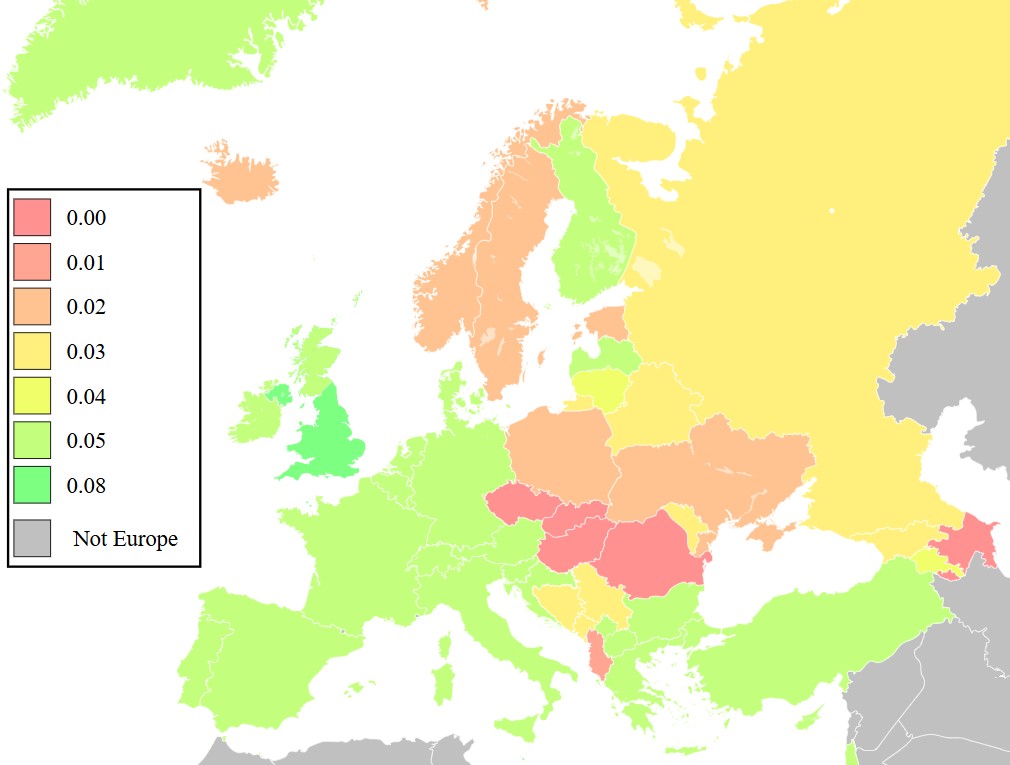
I suppose my first issue is the language. Not sure the embolding was inevitable given those bold beings described have already been on their mission for years and years, according to the anti-anti-alcohol lobby. And not sure the campaigners are necessarily more than zealous. Can one be?****** But the real issue is without justification. This is particularly the case as the first observation is a justification: a majority of Britons are against the current scheme. So, too, the second observation: the police and doctors want stricter rules. We can disagree on the quality of these justifications but that’s what they are.  It’s also worth noting that context poses an obvious issue too. England, Wales and NI have the highest permitted levels of alcohol in all of what was once known as Europe. By over 50%. Check it out. It’s simply a fact that the criminalization of drinking and driving is a reasonable response to the harm it causes. As a lawyer, thirty years ago I spoke to an appeal of a driver who blew 0.082 so these things can be close. But the bottom line is no one is being forced to stop you from drinking. Just stop driving. Maybe try walking. Or get a cab. Or a bus. Or a bike. Or a designated driver. Or another place to drink.

And with that, I am done. It is Yule and I am off to maybe have a beer or maybe shovel or just fret about being late in getting the lights up and having note bought the pressies and what about the tree and … well… as I do that please also check out, Boak and Bailey on this and every Saturday and then sign up for their entertaining footnotes, too. Look out for Stan when he feels the urge (now that he’s “retired” from beery news posts) from Budapest or wherever – as he is getting active again. Then listen to a few of Lew’s podcasts and get your emailed issue of Episodes of my Pub Life by David Jesudason on certain Fridays. And Phil Mellows is at the BritishBeerBreaks. Once a month, as noted, Will Hawkes issues his London Beer City newsletter and do sign up for Katie’s wonderful self-governing totes autonomous website featuring The Gulp, too.  Ben’s Beer and Badword has returned from his break since April so you can embrace the sweary Mary! There is reading at The Glass which is going back to being a blog. Any more? We have Ontario’s own A Quick Beer and All About Beer is still offering a range of podcasts – and there’s also Mike Seay’s The Perfect Pour. Plus follow the venerable Full Pint podcast! And there’s the Craft Beer Channel on Youtube. Check out the archives of the Beer Ladies Podcast. That’s quite good and after a break they may well be are back every month!

*But also as one who has a list of gains and savings for more than two decades that I have influenced to the point that I am effectively appellata free resource…
**But bring back the word “ciderkin” by the way.
***I have just passed the fourth anniversary of slowly getting back from a point which same me using a cane after badly wrenching a knee weeding a zucchini patch. Why? Life stressors resolved, sure. Daily small steps like stretching and exercises, yes. But most of all daily recording the data related to more and more of what I do: intermittent fasting goals (+/-17 hours a day); hours and quality slept (one mid-week sucky sleep does not make for a medical issue); drinks intake (down to 1.27 per day ave) and to do list daily chores achieved (done… next?). But by the way that whole life expectancy shift stuff has little to do with aging and much more to do with infant mortality. So relying on that to discuss the difference between retiring at 60, 65 or 70 means zippo.
****Sorry…
*****Stan also advised he will be reading these new notes from a train between Amsterdam and Budapest so everyone wave in that direction, please.
******Do Zealots look over at the overzealous and think “Jim’s over doing it a wee bit tonight… giving zeal a bad name…”

Now That I Have My Back To School Corduroys Here’s The Thursday Beery News Notes

With the onset of September comes the offset of the the garden. I am still planting things that have a hope to give us a bit of return before the frosts – basil, peas, leaf lettuces – but the fact is it’s now about starting the long process of taking down the pole beans, filling up the composters and putting away pots for next year. I saw this image on the Brewery History Society’s FB page and immediately liked the scene. The sweater vest and long trousers in particlar are a good and fashionable reminder that there’s still lots needing done as autumn advances.

Speaking of the change of seasons, The Beer Nut is looking forward to summer being behind him if his reviews of warm weather drinks including something called Fruit Sundae Gelato Sour is anything to go by:

It’s lactose rather than Lactobacillus that drives the flavour, and indeed the smooth and heavy texture. Vanilla forms the base of the profile, to which is added a mish-mash of fruit concentrates (four are named on the ingredients) with strawberry and blackberry being the most apparent. And that’s it. While the mouthfeel reflects the high ABV, the flavour complexity doesn’t. The weight also means it doesn’t work as a summer refresher, and is more of a pudding substitute. This is simple and inoffensive stuff, so long as oodles of lactose and rivers of fruit gunk don’t bother you.

And Boak and Bailey were also feeling the last of the summer and looking forward to the coming change if we can judge by their last “beers of the week” note at Patreon:

This piece would be a lot longer if we listed all the duds we had. Hot weather and a quiet city make for some rough pints: cloudy, warm, chewy, as exhausted as the sweaty August insomniacs drinking them. But we always wanted this little write up to be more positive in tone. We don’t chicken out of giving negative reviews on the main blog – we’d have a lot more friends in the industry if we did! – but we don’t want this other thing to consist of us bitching behind closed doors. Anyway, it’s cooling now. The Swan With Two Necks will be resuming its usual opening hours and cask ale across the city will be dropping down from its rolling boil.

Perhaps they needed to add a little something to their ales? Should you? Would you? Could you? The Guardian has many questions along these lines:

The true number of icy beer fanatics is probably much higher. Why is that? Because another 10% said embarrassment was holding them back from requesting ice in their beer, and another 20% said that they had previously been told off by friends, family and bar staff for requesting it. Seriously, though, why is putting ice cubes in beer a bad thing? Because beer is already delicately flavoured enough as it is, so diluting it with melted ice risks rendering it tasteless. Plus, a lot of work went into crafting that flavour profile. Don’t just mess it all up because you like your glass to clink when you swirl it.*

Why not!?! As Gary pointed out this week, some have jumped through hoops to cool their beer. Back to question of the heat, reaching west we have one last “what I did on summer vacation” report from Glenn Hendry on a trip to grasslands of the Canadian Prairies where he found himself on a brewery tour:

The scenery was outstanding – if you’re into grasslands and rolling hills, which I am – but eventually I made the long drive in the rental car back to Regina for the rest of the Tuesday-to-Saturday trip. With my beer consumption in Toronto reduced to the odd social outing back in Oshawa and maybe a beer a week at home, a pub crawl in Regina, Saskatchewan was an unexpected addition to the itinerary, but when my server at Pile O’ Bones Brewery told me if I visited all six breweries on the city’s ‘Hop Circuit’ and had a pint at each I would score a beer glass, well, despite the ‘self-guided’ disclaimer/warning, the challenge is on, innit? To be entirely truthful, I hadn’t planned on hitting up all six – maybe three or four – on this steaming hot Thursday in the prairie city, but when the old legs get moving and the old mind stops making sound decisions, challenges are simply met.

Speaking of the Prairies, I am a bit more swayed by this comment from Suzanne Sexton on the closure of an Ontario Crown Royal whisky bottling plant than I am by Premier Ford pouring a bottle out over the loss of 200 jobs:

This is the Crown Royal production facility in Gimli, Manitoba. This is where Crown Royal is actually made on the shore of Lake Winnipeg. It runs 24 hrs a day, 365 days a year. It houses millions of barrels of Canadian Crown Royal, made and moved by Canadians. There are more barrels of Crown on-site than there are people in this province. The high quality barley, corn, and rye are grown by Canadian farmers. Please don’t follow people who don’t know these facts when they ask you to boycott Crown Royal because they moved one Ontario bottling plant to US to survive US tariffs. Buying Crown Royal still puts dinner on the table in hardworking Canadian households across the country.

It is the reality we live in that bulk booze is trafficked across the border. I seem to recall that Canadian good beers have been shipped south to the US for bottling and labeling there as grocery house brands in a way that avoids certain tax treatments in both countries. Nothing wrong with that.

Speaking of booze as business, Pellicle‘s feature this week is Phil Mellows’ portrait of David Bruce, owner of the Frikin pub chaing from 1979 to 1988, who explained the 1988 sale when he was bored, tired and facing debt:

The numbers were stacking up against him, too. “We still owned 90% of the business but that meant we had a massive level of debt, £3 million. I could see the Monopolies & Mergers report that led to the Beer Orders would mean more freehouses on the market and more competition. The banks were getting nervous. It was a matter of flog it or float it. We couldn’t carry on.” Finally free of money worries once the Firkins were sold, Bruce launched the charity providing barge holidays for disabled people that earned him his OBE, but it wasn’t long before he was back in beer and making an impact, this time on a global scale.

It’s interesting to see how Bruce also rolled his profits into the churn of further beer business projects including many US micro breweries which themselves were sold off in the great buyout era of a decade ago.

And studies were among things discussed these last seven days. Last Friday, Ed himself expressed himself on the topic of beer foam based on a study written by non-brewers:

The authors of the beer foam paper appear to be competent scientists, even if they are ignorant when it comes to brewing. They certainly seem to know a lot about the science of bubbles (Marangoni stresses is a new one to me!). And they correctly discuss Lipid Transfer Protein 1 as playing a key role in stabilising foam, though this nothing new to brewers. In fact last year I went to a talk by “The pope of foam” Charlie Bamforth where he discussed the role of Lipid Transfer Protein and Protein Z (40 kDa) in foam stability. He said research had shown this was not due to any particular property of the proteins, but rather that the partial denaturing of them during the boil (not during secondary fermentation!) exposed their hydrophobic interior which helps stabilise bubbles.

Didn’t know about Marangoni stresses?!? Reeeeallly? Hmm. Lordy. Err… umm… where were we… oh yes – and Lars commented on another study that sought to link the development of beer brewing with the onset of organzied societies:

Many researchers have suggested that alcohol may have been an important factor in developing early states. Basically, it’s supposed to have helped social cohesion, improved cooperation, and reduced friction among people living cramped together…. What they found was that in all models there was a positive correlation between alcohol and political complexity. It was 0.77 when the only factor was alcohol, and 0.19 in the weakest (model 4). Average 0.27 across all five models. In other words, the result appears pretty robust.

“Au contraire dit…” Jeff who pointed out that some of the assumptions were not well founded:

I’m not an archaeologist (though neither are the authors), but the data here seems abundant and clear. On the first highlighted quote, people made beer *millennia* before agriculture. On the second one, man, what a sweeping judgment. Let’s take the NW Coastal natives, where I live… They had incredibly complex societies. They had social stratification, organization, and hierarchy. Some of the peoples managed harvests, but whether you could call it agriculture is a very sticky question. They had such abundance they didn’t need agriculture. Cultures are very hard to characterize.

My thoughts are these: (i) the general “cradle of civilization” concept seems pretty middle eastern focused as there are many models of society, many without alcohol, (ii) the studies also rarely seem to compare the multiple other factors like seed storage techniques that would run parallel to booze production** and (iii) there often seems to be an inordinate wish to make booze the winner when, as in this case, it is also reasonable to assume that these early societies were slave based coercive hell holes.

Stan issued his latest edition of his Hop Queries newsletter (v.9.04) and shared how poor the crop was looking in England (“…shrunk to a level that this news won’t affect the world hop market…“) as well as in Germany:

Farmers are expected to produce 41,235 metric tons (about 90.7 million pounds and likely more than the U.S. crop), 11 percent fewer than 2024. Growers cut acreage by 6.5 percent and yields were adversely affected by a lack of rain until mid-July and further reduced by disease and pest pressure. A press release indicates that 44 farms ceased operations, meaning the number of growers has slipped below 1,000. It concludes: “Hop growers are reacting to poor prices and limited marketing opportunities by reducing acreage. The short-term outlook is not rosy: Given declining beer consumption, a further decline in hop demand is to be expected. The result will be continued pressure on prices and a further reduction in hop acreage until supply and demand are restored.”

Until demand is restored? Does anyone think that is happening? Not the stock market if this report in Beer Marketers’ Insights is to be trusted:

Bank of America analyst Peter Galbo downgraded Constellation [NYSE: STZ] to “Underperform” last Tue, reducing his price target from $182 to $150. “We see further downside potential as beer industry consumption remains soft creating risk to sales, margin and multiple,” Peter wrote. And there are “added risks” such as “core Hispanic demographic remains pressured” and “longer term alcohol consumption trends” remain soft. He now expects a -1.8% decline for Constellation in fiscal 26 (thru next Feb) compared to his previous estimate of -0.5%. CITI also put out tuff report noting “continued softness in both STZ’s beer trends and the broader beer category.”

The company itself seems to agree in their own disclosures issued Tuesday. To be fair, there are still believers and even at least one corner of Canada running out of beer:

“We saw it right from the beginning of June — it hit hard and fast,” Clark said. “Every day we talked to different tourists. It was a wide demographic this year … American, Canadians, from all over, young and old.”  Some days, he said the brewery was so busy it had to turn people away. “We have not been great at keeping up with demand this summer,” he said. “You always assume you might grow with a good summer, but we would have never expected this.”  Evermoore Brewing Co. was not the only local producer scrambling to meet a higher-than-normal demand. According to Jared Murphy, president of the P.E.I. Craft Brewers’ Alliance, some craft breweries had sales show a double-digit increase this summer.

There. We can end on an upbeat note this week.*** Somewhere there was an increased demand for beer. While you consider that before we meet next time, please also check out Boak and Bailey every Saturday and sign up for their entertaining footnotes, too. Look out for Stan when he feels the urge now that he’s retired from Monday slot… maybe … maybe not. Then listen to a few of that now newly refreshed Lew’s podcasts and get your emailed issue of Episodes of my Pub Life by David Jesudason on certain Fridays. And Phil Mellows is at the BritishBeerBreaks. Once a month, Will Hawkes issues his London Beer City newsletter and do sign up for Katie’s wonderful self-governing totes autonomous website featuring The Gulp, too.  Ben’s Beer and Badword is out there with the all the sweary Mary! And check out the Atlantic Canada Beer Blog‘s weekly roundup. There is new reading at The Glass which is going back to being a blog. Any more? We have Ontario’s own A Quick Beer featuring visits to places like… MichiganAll About Beer offers a range of podcasts and there’s also The Perfect Pour. Plus follow the venerable Full Pint podcast! And there’s the Craft Beer Channel on Youtube. Check out the archives of the Beer Ladies Podcast. That’s quite good and after a break they may well be are back every month! Such is life. Such is beer podcasting and newslettering… which, as Ray says, are blogs! And he’s right.
*That comment about “delicately flavoured” sound like it was provided by the wizard who told you that you can’t spit beer at a tasting!
**Consider how the introduction of the Swede Turnip in 1700s England led to year round beef production which in turn arguably led to the second British Empire. Just consider that, wouldja?
***[Ed.: “Really? Are you sure we can’t add just one more collapsing beer market story? No? Fine. Whatever.”]

Your Fascinating But Still A Bit Sticky And Humid Mid-July Beery News Notes

Summer. Heat waves. Heat warnings. Smoke warnings. Drought. We got it all. Including sugar snap peas. I’ve adoped the Canadian old fart posture this week, when facing a comment on the blistering sun, as I just reply “at least I ain’t shoveling it!” Which is, of course, hilarious. Roar! Tape me ribs! No wonder all of comedy in Hollywood is run by Canucks! The heat in England heat has even driven Boak and Bailey off the beer, according to themselves in their monthly supplement:

…we had some beer at home, so it wouldn’t be too bad, right? Except however much we chilled it, it never quite seemed to refresh us. After a couple of lagers we gave up and switched to iced water. Apparently our bodies were telling us to hydrate and beer, unfortunately, has very much the opposite effect. When we have made it to the pub during heatwaves, we’ve often found cask ale to be a write off. Partly because not all pub cellars are capable of withstanding extreme heat, and partly because people switch to lager leaving ale to lose its sparkle.

Reporting from a land more used to the stinking heat, Pellicle‘s feature this week is a feature by Ruvani de Silva on the Green Bench Brewery in St. Petersburg, Florida. Which is, of course, another part of American utterly infested with we Canadians including, twenty years ago, by my late parents who would occassionally lunch at the welcoming Don CeSar with other welcomed snowbirds from all over. Wasn’t always like that:

Rewind seventy years or so, however, and our experience of St Pete’s would have been very different. The Sunshine City might have been a holidaymakers’ paradise, but only if you were the right kind of visitor. The city’s unwritten law that people of colour were not permitted to sit on its famous green benches evidenced how St Pete’s did not escape Florida’s vicious segregationist policies of the time. This unofficial ordinance was more than simply a physical imposition—it was a restriction that entrenched systemic racism for generations of Black Floridians. It’s for the memory of this injustice that Khris Johnson, founding brewer and co-owner of Green Bench Brewing and Florida’s first Black brewery owner, chose to name his business.

Speaking of establishments, one of the swellest images that passed before my eyeballs this week was this one to the right. At first I thought it was a fire insurance map but there isn’t enough detail.  It’s was posted at a local history group over on FB, Woodlesford and Oulton History, and seems to be a diagram that accompaned a 1933 planning application to update the New Masons in Oulton:

In October 1933 Fred applied to the Hunslet Rural District Council to make major alterations to the layout of the pub and add a new frontage and windows. The work involved knocking down part of the old front wall and fitting a rolled steel joist to support the upper floor. The new layout was then much the same as it remains today.

And here is the pub, still there. The photos help explain the map including the location of the fireplaces, the scale of the room. But the one thing I don’t understand is why the bar is in the passageway. Did you go there from one of the three rooms, get your pint and go back in to find your chair or was the passageway itself a drinking area? These are the things that haunt me.

In more somber news, we have received the sad news the passing of Jack McAuliffe. In remembrance, John Holl has republished a tribute from All About Beer from 2017 to the founder of the New Albion Brewery Company in California which opened in 1977.  And Maureen‘s comment on BlueSky is a wonderful tribute that tells a lot about the man:

Ah. This saddens me. Not unexpected, but I’m sad i won’t see him again. He was hilarious, among other things. I was humbled by the fact that I was one of the very few people Jack likes and respected. That meant a lot to me. Godspeed, Jack. 

Just two weeks ago, Gary shared an anecdote from the earliest days of Jack’s brewery which is worth revisiting to get a sense of how this brewer helped start the change that led on to micro and craft brewing working with very basic resources.

Stan has shared the latest edition of his Hop Queries and explained the dire situation facing hop growers in the Tasman region of New Zealand, including Brent McGlashen of Mac Hops:

“Statistically and visually, we hit above the 1 in 100-year flood level, with also highest ever recorded river flows in a number of parts in the Motueka river… Both our farms have water everywhere, fences with damage and some debris scattered around, but we are fortunate compared to others who have had significant damage and loss due to the flooding. Was this predicted, well yes it was. Forecasters said over 200mm and we sure got that. We have had a wet winter and the ground can’t absorb more so it has to go somewhere.” One hop farmer died as a result of the storm. Peter Lines was clearing flood damage from his property in Wai-iti, southwest of Nelson, when he was hit by a tree.

Rain came again the next week “leaving fields under water and dumping mud, gravel and sand on facilities that had just been cleaned up…” 

Writing about disasters of the unnatural sort, The Beer Nut brought his lucidity to a review of an unknown Dutch brewery, to which he added a key question on BlueSky: “how long can a brewery keep up a sequence of nautical-themed beers flavoured with fruit syrup?” The answer is apparently “too long“:

My report card for Stadshaven says “must try harder”. A sampler pack of fruit syrup does not make for a vibrant range of modern beers, for one thing. I sense an ability to do plain-spoken beers quite well, testified by the red and blonde in particular. Whether the decision not to steer that course is a creative one or a management one, I cannot say. The low price point is very much in these beers’ favour, though I’m still not sure I got my money’s worth from them. 

Speaking of the low, Matty C wrote for What’s Brewing on the most obnoxious retort around: “stick to…” with the line filled in by the obnoxious. In this case, it was about the position being taken him and by many other drinkers in the UK on the Palestinian-Israel war – and in doing so makes this very lucid argument:

In modern political discourse it’s perhaps the first approach to go out the window when things get a little spicy. But it is because of compassion, not malice or spite, that the volunteers of Trafford and Hulme CAMRA opted to have the donation box in the first place, and it is compassion that motivated attendees to make a donation as they leave. It is compassion that triggered the response from customers when they found out beer from breweries they admired were selling beer into a market they didn’t. And it is because of compassion that you’ll struggle to find Moor Beer on tap in Bristol at this very moment. It would be far easier, surely, to stick to beer, and leave the politics to the politicians. But in fact, sometimes the most compassionate thing you can do is stick your head above the parapet and say, “I don’t think this is okay.”

Politics is for the people. All the people. No matter what the cause or the position, being active and acting on compassion is a good thing.

You know what also gets people losing their composure, their perspective? Beer glassware. Do you have a go to glass for beer? I do… well, one for inside and one for the yard. Kevin at Casket Beer advocated in favour of simplicity and recommended a basic four:

…while the shaker isn’t as bad as many make it out to be, it really shouldn’t be a major player either at a beer bar or your home bar. But having a respectable selection of glassware doesn’t need to break the bank or become unmanageable. There are four widely available glass styles that are affordable, cover a wide array of styles, and will satisfy the most discerning beer drinker. Here they are.

You can go see which four they were. Jeff then picked up the theme and advocated for one fewer: “Give me a mug, a goblet, and either a snifter or tulip—both is overly fussy…  I like a handle, and I find a beer looks great when it’s in a wide vessel—the clarity and color is easier to see. Facets bedazzle and please me (recall, I am one of the few fans of glitter beer).” Wow. I was with him there until those two last words. Just… wow.

And staying with the wow,* Alistair has been staying (practically) true to his promise to bust his writer’s block by writing every day (almost) over at Fuggled. Wednesday’s story this week was about the Austrio-Hungarian schnitt of 1900:

The writer continues to berate their fellow German Austrians that a single “schnitt” fewer every day wouldn’t be so bad and that the savings would build up to a sizeable fund for civic associations tied to the ethnically German population of the Empire. And here we have again an example of the cross pollination of cultures that was Bohemia and Moravia in the 19th century, evidenced today through the use of a transliteration of “schnitt” into Czech, “šnyt” as the name for effectively a half pour of beer and lots of foam. “Schnitt”, if you know your German means “cut”, because it is a cut down pour of beer, that is “better than nothing”, at least according to Bohumil Hrabal, or was it Karel Čapek, when he wasn’t inventing the word “robot”?

And the colonial history of the beer gardens of Bulawayo, Zimbabwe was the subject of research for Prof Maurice Hutton of the Global Development Institute, University of Manchester who shared some findings for The Conversation:

The more picturesque beer gardens began to emerge in the 1950s, reflecting the developmental idealism of Hugh Ashton. The Lesotho-born anthropologist was educated at the Universities of Oxford, London and Cape Town, and took up the new directorship of African administration in Bulawayo in 1949. He was tuned into new anthropological ideas about social change, as well as developmental ideas spreading through postwar colonial administrations – about “stabilising” and “detribalising” African workers to create a more passive and productive urban working class. He saw a reformed municipal beer system as a key tool for achieving these goals. Ashton wanted to make the beer system more legitimate and the venues more community-building. He proposed constructing beer garden complexes with trees, rocks, games facilities, food stalls and events like “traditional dancing”. So the atmosphere would be convivial and respectable, but also controllable, enticing all classes and boosting profits to fund better social services. As we shall see, this strategy was full of contradictions…

Finally, like you, I am a regular reader of the Greenock Telegraph the newspaper of record of my paternal peeps. This week they publised an editorial from by the local member of the Scottish Parliament Stuart McMillan on alcohol in the workplace:

Too often there is a conception that people living with drink dependency can’t hold down a job – but when one in four people in the UK worry about their drinking, it’s clear this is a myth. I’m not suggesting 25 per cent of the adult population in the UK have an alcohol addiction. However, these figures indicate that increasing numbers of people are concerned about the impact alcohol has in their lives… For most of us, though, we don’t need specialist support. But we do need to be more open about how alcohol impacts us, and try to foster healthier habits. The popularity of alcohol-free products shows that many people are looking for alternatives – whether that’s alcohol-free beer, wine, spirits or mocktails. Locally, one idea that has been suggested to me is a ‘sober bar’ – which would give people a place to go that feels like a pub, but without the presence of alcohol.

I decided to include this piece not because I agree or disagree. Not even because health and booze is always a worthwhile conversation. But… I can’t imaging a Canadian politician writing this. Because I can think of many other alternatives to alcohol which include, say, playing a banjo or reading a book or going for a walk or staring at a bird in a tree or making a pot of tea – none of which need to simulate the drink or the pub. Which is one of my things about pricy NA not-booze. Just go for a soda. We even have a song about it.

So there you are. Staring at the little screen in your hand as the A/C hums. Until the weather breaks, please check out Boak and Bailey every Saturday. Look out for Stan when he feels the urge now that he’s retired from Monday slot… maybe. Then listen to a few of the now rarely refreshed Lew’s podcasts and get your emailed issue of Episodes of my Pub Life by David Jesudason on the (sometimes even but never) odd Fridays. And maybe The British Food History Podcast. Maybe? And Phil Mellows is at the BritishBeerBreaks. Once a month, Will Hawkes issues his London Beer City newsletter and do sign up for Katie’s wonderful newsletterThe Gulp, too.  Ben’s Beer and Badword is out there with the all the sweary Mary! And check out the Atlantic Canada Beer Blog‘s weekly roundup. There is new reading at The Glass which is going back to being a blog. Any more? We have Ontario’s own A Quick Beer featuring visits to places like… MichiganAll About Beer has given space to some trade possy podcasts and there’s also The Perfect Pour. Plus follow the venerable Full Pint podcast with an episode just last month!. And there’s the Craft Beer Channel on Youtube. Check out the archives of the Beer Ladies Podcast. That’s quite good and after a break they are back every month! The rest of these are largely dead. And the long standing Beervana podcast …except they have now stood down.  As has We Are Beer People. The Share looked to be back with a revival but now its gone quiet. And the Boys Are From Märzen podcast appears suspended as does BeerEdge, too. VinePair packed in Taplines as well. All dead and gone.  There is more from the DaftAboutCraft podcast, too. Nope – that ended a year ago.   The Moon Under Water is gone – which is not surprising as the ask was $10 a month. Pete Brown’s one cost a fifth of that – but only had the one post. Such is life. Such is beer podcasting and newlettering… which, as Ray says, are blogs!

*Forced, I know. I’ll try to do better. My footnote game isn’t the best either. It’s the heat. Well known fact. Asides suffer in the summer. Researchers are on it.

Lordy! Heck – I’m Late. But it’s still MARCH!!!

Sort of continuing a tradition respected last year, mentioned in 2023, sorta on hold in 2022, mentioned again in 2021, not mentioned days before the pandemic really hit in 2020, swapped out for a dud of a theme in 2019… but right there back in 2018 – in fact almost ever since 2004 it has been my pleasure – even if I am a day late in telling you – it is my great pleasure to confirm that it is March!

The Beery News Notes For That Empty Feeling Between Thanksgiving and Halloween

Let’s be clear. By “empty feeling” I mean not bloated from either last weekend‘s turkey dinners and pumpkin pie or those mini Crispie Crunch bars yet to come. October is a bit of feed fest around these parts. It’s the cold turn, I suppose. Took me a while after we moved to this border city to gather from upstate NY media that in the United States their holiday season lasts from their Thanksgiving in late November through to New Year’s Day. Not us. We have two separate sessions. October is the time of harvest for us, first the family one… then the freaky one. Holiday season is still a couple of months off. It’s still autumn.

Last Sunday, on a walk I saw a Golden-crowned Kinglet hover. I had no idea that these tiny olive coloured birds hovered, pausing just for a moment before perching as it flit here and there through the autumn afternood. Staring up through the turning leaves, it was a enchanting few minutes until a red tail hawk came silently coasting through the stand of trees, scattering and silencing everything in view.  I am not sure that deeply fascination with the sheer wonderfulness of existence was similarly felt by Stan last week when he visited the GABF:

Not many hours later, Daria and I were at the Great American Beer Festival. We walked by the wrestling, but did not stop. We never saw the bull riding. If you were looking for a specific brewery, the layout was at times confusing. But I liked that the “Fright” area was dimly (very dimly) lit, that the National Black Brewers Association area was much more prominently placed than last year, and the proximity of “Meet the Brewer” to Homebrew Headquarters. So I thought, maybe they should rebrand the event as the Great American Beer Experience. 

Oh, that Stan and his dry sense of humo(u)r.  There has been one thing that benefitted from being called a capital “E” experience and that ended fifty-five years ago. Reviews? Jacob Berg pointed out there were 326 medals awarded and “…four states (California, Colorado, Oregon, Washington) won 176 of them, which is probably bad for the beer industry overall.” Probably. Jon A noticed the “beers were brewed by the brewers who were fired by @tilray this year.” They restrict cameras, halt beer service early and there were plenty of tickets left unsold. Some were not impressed but Andy Crouch wrote:

The 2024 iteration of the @GABF is a disorienting, immersive experience where beer is not the central draw but a companion. The layout is a baffling maze, with each turn offering something new or odd, including pitch darkness. Saw lots of smiling and engaged attendees.

There’s that word again. Is BrewDog still an experience? I think they were going for “experience” for a while there. Maybe not so much now. BrewDog’s big botched batch has made news:

Scottish beer powerhouse Brewdog has had to ditch an eye-watering amount of beer, reportedly worth millions of pounds, due to contamination issues. At their renowned brewing facility in Ellon, Aberdeenshire, batches of their celebrated Punk IPA were deemed unsellable following a “major quality incident” that plagued the production line. Chris Fielden, Brewdogs Chief Supply Chain Officer, expressed his exasperation over the mishap involving “sour beer” in a scathing email blasted across the company, indicating that the significant waste came after employees consistently failed to meet standard cleanliness requirements.

Matthew C himself noted: “Find it funny that everyone is having a good lol about the Br*wdog infected beer. Me? I’m having a good lol that they still haven’t filed their accounts, which are now four months overdue.” All very weird. These are strange times. Update: “…pre-tax losses soared to £59m, up from £25m in 2022…” Yikes.

Yet there are still innovations. Like thinopyrum intermedium. Or as it is somehow trademarked in the US, Kernza. It’s another sustainable grain, like Fonio, that is starting to work its way into the brewing lexiscon. Nebraska Public Media has the story:

The Kernza kernel is much smaller than a barley or wheat kernel, he added, kind of elongated and skinny. Almost flat.” Those differences did pose a few challenges. Thompson explained the Kernza slipped right through his mill when he tried to crush the kernels to expose the starch that’s necessary for brewing. In the end, Thompson adjusted to a different brewing technique that used a mix of milled and unmilled Kernza and the experiment worked. That was good news for Thomson but also for Kernza advocates who want the grain to succeed and see in its small seeds potentially huge changes to modern agriculture.

At the other end in the life a beer, the tap end perhaps, is the story told over at London Beer City where Will Hawkes shared the prior qualifications of Mr. Pat Ahern, publican of the Downham Tavern in the 1970s:

Pat and Sheila, an East London girl, came to the Tavern having run the New Gog, a pub in the Royal Docks north of the River. Pat, a barman at the pub, took over when the previous licensee committed suicide. One incident in 1963, when a young man, George Head, was “called out” onto the street and shot in an apparent gangland hit, illustrates what sort of place it was. Pat put a tourniquet on the wounded man’s legs and drove him to hospital. “That was a really rough house,” says Sue. Pat, who came to Britain at the age of 19, hadn’t wanted to work in a pub – the long hours weren’t conducive to family life – so he took a job at Ford’s huge Dagenham plant. A serious injury in which he fell down a pit and fractured his skull left him incapacitated for nine months, though, and the family was soon in desperate need of cash.

Staying in that era, Ron reminds us that these weren’t the only strange times. In his series of beer in the UK of the 1970s, he has been working through his records of the breweries now long gone and shared this:

One of the largest independent brewers, Greenall Whitley wasn’t that far behind Scottish & Newcastle in terms of tied houses. Lancashire, Cheshire, Shropshire, Staffordshire, Derbyshire, Herefordshire and North Wales were lucky enough to be home to their tied pubs. I never cared for their beers, even though they were often available in cask form. It was also annoying the good brewers the bastards took over and closed. The Warrington brewery closed when Greenalls decided to get out of brewing and become a pub chain. Not a brewery I miss.

Note: speaking of autumn,* the Beer Ladies Podcast is back for another session with their “what I did on summer vacation” edition. Don’t miss it. definitely better than Greenalls.

The Morning Advertiser succinctly reports on the effectiveness of the UK’s 2023 Alcohol Duty Review which saw taxes lowered for lower strength beers:

Alcohol Duty Review has seen 100m alcohol units removed from the market and a “boom” in new lower-strength products, the British Beer & Pub Association (BBPA) has said… The BBPA also revealed 1.3 – 3.4% strength drinks have leapt from less than 1% of beer sales in 2022 to now more than 7%, while the no and low alcohol beer category has also seen rapid growth, accelerating to 2% of the overall market in 2024. Moreover, some 90% of pubs now serve at least one no and low alcohol beer…

I like that 100m units stat. You rarely find absolute numbers in these matters, just change percentage. Speaking of change, you can still have fun drinking beer in Prague but not that sort of fun… not that not no more:

Prague council deputy mayor Zdenek Hrib confirmed that from hereon in “it will not be possible to have guided tours between 10pm and 6am”. According to reports via the national press, the city’s councillors have banned night-time pub crawls organised by travel agencies because the city would prefer to target “more cultured” tourists rather than British stag parties. Speaking about the decision to reporters on Monday, another deputy mayor for Prague city hall Jiri Pospisil revealed that the council was “seeking a more cultured, wealthier tourist” and “not one who comes for a short time only to get drunk”.

Cultured. So is it wine time? Is that what it means? Sure. First up, Pellicle published a piece by Anaïs Lecoq that unpacks the relationship between the wines of Champagne and the local working families who get the wine to the shelf:

…a more familiar, popular and approachable way of drinking champagne does exist, and advertisers have yet to realise it. If they truly want to convey something other than luxury, they could start by getting rid of that fancy crystal flute, and replace it with a blida. “Blida is the epitome of working class champagne,” Maxime tells me, and I couldn’t agree more. Originally made in Reims, this small, 70ml glass was sent to the town of Blida, Algeria, for serving mint tea. After Algeria’s war for independence in 1962, the market collapsed and manufacturers found another use for the glass—champagne.

I like that. Ditch the snobbery. Next up, Simon J Woolf of The Morning Claret wrote about Chateau Musar of Lebanon:

Musar remains a great demonstration of how to scale up production without compromising ethics and quality, while managing to stay fairly priced – especially in the UK, where it hovers around the mid-£30s on release. For a wine released on its seventh birthday, that’s value. It has mercifully not been ruined by speculation and cultism. We should be forever thankful that Parker only gave the 1995 82 points.

Musar is a maker I leap to which I have send my money when I have the rare occassion to find a bottle over here. Ever since Tom Cannavan helped me direct my folk to a bottle from the 1990s located in Edinburgh where they were visiting the fam. Quebec’s SAQ had their red Musar Jeune a year ago. Christmas dinners have often had a Musar on the table where I live. Again, less of the snobbery even with the nerditry.

Enough of that. Back to beer for our final thoughts. Joe Stange has writting himself a long piece on American IPA, long enough that you get the sense that it’s properly done. You know, not like the other stuff on a subject like this. Just look:

“I still think that’s a necessary thing in these beers,” says Alexandra Nowell, former head brewer at Three Weavers in Los Angeles, now working toward setting up a new brewery, Mellotone Beer Project, in Cincinnati. “But we’re talking really light—C-15, light-grade crystal that can still provide a little bit more complexity to the beer itself. … I think the concept of American IPA has drifted into a more modern place.” Caramel malt has become uncool among IPA brewers today. Many avoid it altogether, while others have reduced, lightened, and fine-tuned it—essentially, they’ve learned how to use it with finesse.

And only one “passion” in the whole piece. And it’s ahead of “-ate” and in a quote. So that’s good.

That’s it. A short one this week. For more beery news check out Boak and Bailey every Saturday and Stan now again every Monday. Then listen to Lew’s podcast and get your emailed issue of Episodes of my Pub Life by David Jesudason on the odd Fridays. And Phil Mellows is at the BritishBeerBreaks. Once a month, Will Hawkes issues his London Beer City newsletter and do sign up for Katie’s wonderful newsletterThe Gulp, too. Ben’s Beer and Badword is thereback with the sweary Mary! And check out the Atlantic Canada Beer Blog‘s weekly roundup. There is new reading at The Glass which is going back to being a blog. Any more? Check out the Beer Ladies Podcast. That’s quite good. And the BOAS podcast for the bro-ly. And the long standing Beervana podcast …except they have now stood down.  Plus We Are Beer People. The Boys Are From Märzen podcast appears suspended as does BeerEdge, too. But not Ontario’s own A Quick Beer. There is more from DaftAboutCraft‘s podcast, too.  All About Beer has podcasts and there’s also The Perfect Pour. Plus follow the venerable Full Pint podcast. And the Craft Beer Channel on Youtube.  The Moon Under Water is gone which is not surprising as the ask was $10 a month. Pete Brown’s one cost a fifth of that but only had the one post.
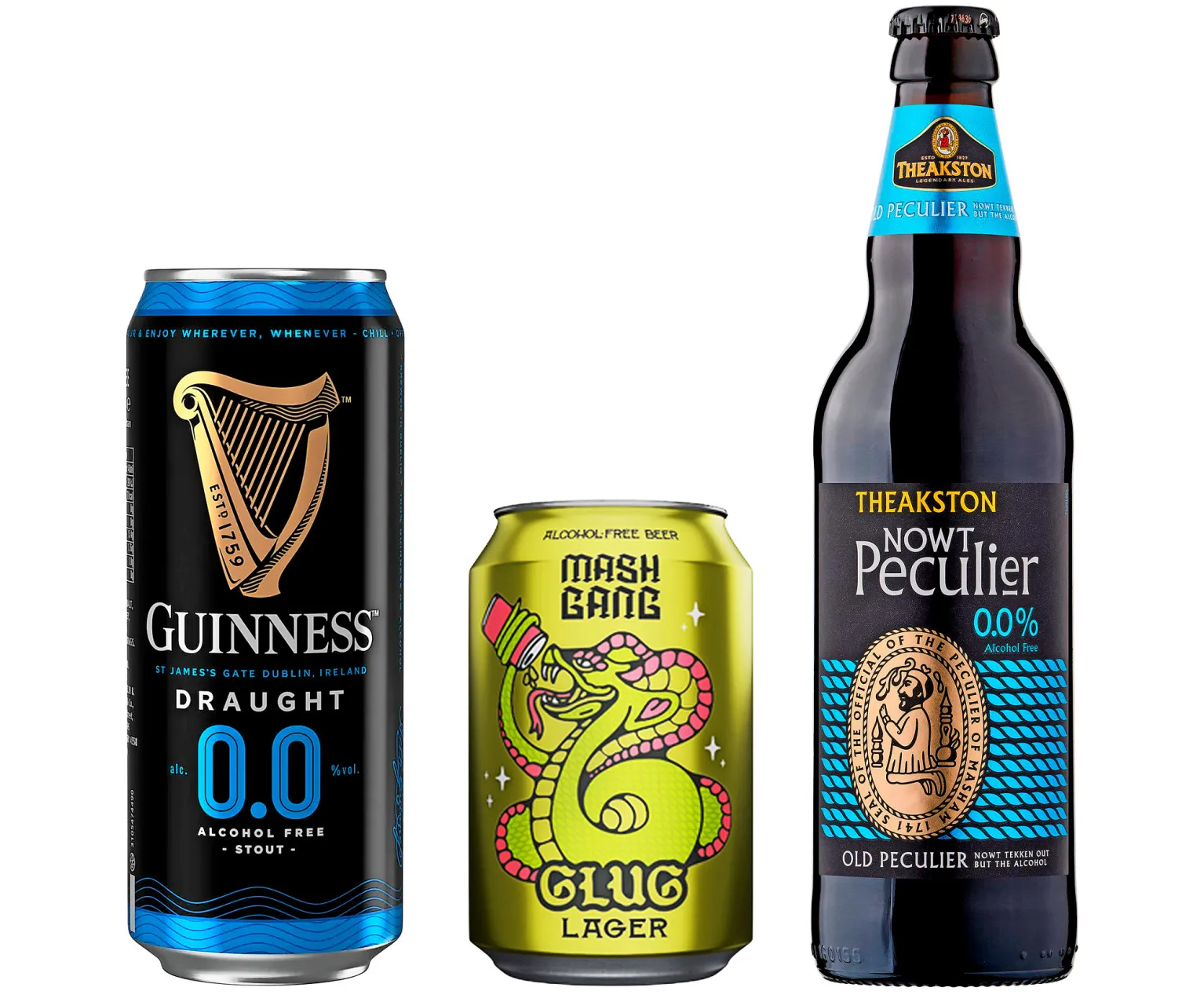
*We’re still speaking of autumn, right? I’m only covering the tomatoes just in case. Still weeks of some sorta warm, right?

The “Happy Canadian Thanksgiving To You!” “Err… What????” Edition Of These Beery News Notes

Did you know that the entire meal is American. That’s the dirty secret of Canadian Thanksgiving. It’s not even ours. Roast Turkey. Mashed Potatoes. Stuffing and cranberry sauce. Pumpkin pie. Food as seen on cable TV. At least I will have my own damn carrots like those up there. And my own beets. Hmm… if the menu was really Canadian what would it be? I dunno. A big ass butter tart at the end maybe. And a roasted wild goose. Where I lived out east a couple of decades ago there were church hall community suppers serving hunter-shot local wild goose. They even created a special regulation to allow it. But only at church suppers. Fat chance with even that being allowed now. Frigging Ohio. Me, I’d have it with Fin du Monde. Suits the times these days.

What else is going on? I am pretty sure that when I were a lad no one cared about if me and the lads preferred beer or wine. I do find the obsession with Gen Z’s taste in booze a bit odd but let’s let the NYT explain their latest cultural findings as to why wine is doing well with them:

Farah Sheikh-Ogoe, who until August was a bartender at Moonflower, a wine bar in the West Village, said that many of the young customers she encountered were drinking, but drinking less. “It’s a little bit more of like, I’m going to be thoughtful about what I’m consuming,’” Ms. Sheikh said. Drinking wine isn’t like taking a shot of vodka or slamming a margarita, said Carson Bennett, a 24-year-old freelance writer and waiter in Brooklyn. “It’s something to sit and savor.” “I think of watching ‘Ratatouille’ and the way that they drink wine,” she continued. “It is a sort of event.”

Big H/T to the person I forgot to note who mentioned that reliance on a cartoon you saw as a child shaping your adult drinking preferences is all a bit heewhooheehaahaa.

And it is interesting to see some serious format changes coming to both the Great British Beer Festival (GBBF) next year and the Great American Beer Festival (GABF) next week. The first is run by CAMRA, a UK lobby group for the beer buying public, while the second is run by the Brewers Association, the USA trade association for brewers other than the really big brewers. The change coming to the GBBF is its move from London to new venue in the reasonably accessible city of Birmingham. The changes coming to the GABF were summarized this week by Andy Crouch who indicated in All About Beer that they were driven by the realities of “emptier aisles and far fewer attendees” in recent years:

Attendees at the 2024 festival will experience six distinct areas. They include “Prost!,” a German inspired biergarten featuring decor paying homage to Oktoberfest, live polka bands playing traditional Bavarian music, and a stein-holding contest. “Score!” is a sports-themed area that will host Lucha Libre Mexican Wrestling and Mechanical Bull Riding. “Fright” is a Halloween-themed area welcoming costumed festival attendees. “Blast Off” offers “liquid innovations and on-trend flavors from international and domestic breweries,” according to the BA. This includes the United Nations taproom, which hosts classic beers from around the globe. 

The event is held in the BA’s hometown of Denver, which makes for interesting logistical challenges. There would be three main classes of attendee: (i) locals, (ii) people in the trade one way or another using their expense accounts or tax write-offs and (iii) beer fans affluent enough to pay to attend. If you are heading any distance to Denver, you would need to have at least $1,000 to spend on the weekend – $220 for the pass, $250 for the plane, $400-600 for three nights at hotels and the balance for food, taxis and the after parties. By contrast, the GBBF pass to the new location in Birmingham costs £9.50 a day and there are four modestly priced trains an hour arriving from the old HQ in London. But even at that budget, the event still has B+B questioning whether to attend according to last week’s footnotes:

The news of the return of the Great British Beer Festival did somewhat gladden our hearts, even though we don’t really like beer festivals, and haven’t always had a great time at GBBF. It just felt as if something was missing from the calendar this year when it didn’t happen. All the old problems will no doubt still apply, however: how do you make a big, drafty conference centre feel anything like as pleasant as a pub?

Somehow I don’t believe they were thinking of “Lucha Libre Mexican Wrestling and Mechanical Bull Riding” as the solution to that conundrum. Yee. Haw. We shall wait on reports from these events before issuing our final condemnations… err… thoughts.

And, just as Hurricane Milton hits, the tough news continues to come out of the aftermath of Hurricane Helene but I was watching for this story:

As communities across the Southeast respond to the catastrophic damage of Hurricane Helene, Anheuser-Busch is actively supporting relief and recovery efforts across the region. Together with our wholesaler partners, we are working alongside the American Red Cross to provide clean, safe drinking water to communities impacted by the Category 4 hurricane… At the request of the American Red Cross, [for example] Anheuser-Busch and its wholesaler partner KW Associates LLC delivered three truckloads (150,000+ cans) of emergency drinking water to Greenville, South Carolina on Wednesday, October 3. 

Good stuff. Similarly, we read about this as well as this at a smaller scale from one craft brewery:

Workers at Holy City Brewing have temporarily shifted their focus from brewing beer to canning water, aiming to provide clean drinking water to those affected by Hurricane Helene in Western North Carolina. “We haven’t really canned water, so we’ll see how fast we can run it,” said Owner Chris Brown. “Water’s a little bit different from beer. So, we can run the pressures a little lower. We’re not worried about carbonation.” The brewery’s team quickly adapted to the new task, processing between 200 and 250 cases of water… “We kind of had to scrounge some cans together…” 

More will be needed in Florida no doubt.

On a happier topic, in their weekly newletter feature called “WHAHWEDRUNK!!!” (or maybe something else) B+B wrote about one beer that made for a neat and tidy tiny essay:

We spent last weekend in London, and honestly, we keep thinking we should go somewhere other than The Pembury Tavern and drink something other than Five Points Best. But really, when it’s become one of the best beers in the country, why bother? To be fair, both of us tried the Best at a couple of London pubs that weren’t The Pembury, and it was just as good. On the face of it, it’s a really traditional bitter, but there are a few tweaks that make it next level good. There’s a honeyed, biscuityness in the malt; and a slice of orange, Fuller’s style, alongside the hard bitterness. If we were going to make comparisons it would be something like Bathams, or the various Boddington’s clones we’ve had over the years. But like Bathams, it also tastes like its own thing.

(I wish I was known for my honeyed biscuityness.) Moving on briskly, at the end of last week there was this news from the world of art, an incident in the LAM museum in the Netherlands:

An elevator technician, filling in for a regular worker, mistakenly threw away Alexandre Lavet’s All the Good Times We Spent Together (2016), thinking it was trash. The artwork, two hand-painted beer cans meant to evoke memories of friendship, had been intentionally placed inside an elevator shaft to mimic something casually left behind. LAM, known for its food-themed art and unconventional displays, places pieces in unexpected locations to encourage visitors to view ordinary objects differently. “Our goal is to make people see the mundane in a new light,” said museum director Sietske van Zanten in a statement. The technician, unaware of the museum’s approach, discarded the piece in good faith.

Empty Can Performance Art Note: a Nova Scotian tradition continues – though in my day we would leave an empty there any old day of the year.

In the political realm, Kamala Harris had a beer on TV this week:

When they go low, she goes high. Miller High Life to be precise. Kamala Harris, the Democratic presidential nominee, took her election campaign to late night television on Tuesday by cracking open a can of the lager with host Stephen Colbert. The moment set her apart from Joe Biden and Donald Trump – both, famously, teetotallers.

Speaking again of the dry among us, apparently Canada’s game coming to Utah has triggered a Canadian response:

Not only did the Utah Hockey Club begin its tenure in Salt Lake City with a 5–2 win over the Chicago Blackhawks on Tuesday night, but also the NHL’s newest fan base arrived at the season opener with a thirst for hockey. And, well, good times. According to The Salt Lake Tribune, Delta Center sold a record-breaking number of beverages, with beer sales climbing over $120,000—more than any other previous NBA or NHL event in that venue, which has served as the home to the Utah Jazz since 1991. The beer prices weren’t cheap, either. A Michelob Ultra, which was $13 at the Jazz’s preseason tilt the night before, sold for $15 for the arena’s NHL debut.

I once had professional occassion to review the effect of the Belleville Bulls coming to town for a Friday night OHL game and I can assure you that the right crowd can sell a lot of beer.

Interesting that just as Ontario has opened up beer and wine sales in cornerstores the nanny state social engineering Tories posing as pretendy libertarians of Alberta have come out against the very same idea:

…the Smith government now says it’s not happening, in part, because they think most Albertans do not want beer and wine and ready-to-drink cocktails and coolers sold in convenience stores and grocery stores…  The minister for red tape reduction said those opposed felt there were already lots of liquor stores. “They weren’t being teetotallers in any way, suggesting we need less access to liquor. They seemed to feel we had good access”… There is a report on what the UCP politicians heard. It is not going to be made public.

Noooo… not them… not “in any way”… no way… not a chance…

Speaking conversely of “yes, yes, yes” David Jesudason had a great feature in Pellicle this week. I like that Wednesday publication deadling thing by the way. You can imagine why. Anyway, David wrote about the subtitled “Harcourt, Altrincham’s Hong Kong Inspired Pub”:

“Because we’ve got the traditional Chinese character outside [on the sign] the locals didn’t expect us to be a pub,” Priscilla says. “They thought we were a Chinese restaurant.” “Some people thought maybe we’re just a restaurant serving some beers.” When customers who were sceptical about the food smelt the dishes being brought through, however, it turns out they couldn’t resist temptation. Harcourt reminds me of a great desi pub in that it mixes an important aspect of Asian culture in a British bar setting, offering a unique welcome so that the visitor believes they are visiting a home away from home. The best of Britain. The best of Hong Kong. The best of Manchester.

And finally… well, eventually finally… Matty C wrote an opinion piece on the ongoing debate in the UK about the pint and the proper serving size:

Lets say, for argument’s sake, that legislation was introduced where the pint was scrapped and only third, half and two-third measures remained. If, as the study states, beer consumption was reduced by 10%, then so too would sales volumes, and indeed, revenues shrink by the same amount. The trend in pub closures already indicates how fine a line hospitality businesses are walking in terms of operating sustainably. Any reduction in revenue would surely only hasten the demise of those already teetering on the brink, which, as evidence suggests, is a high proportion of operators.

It is an opinion piece so must naturally invite response. So I shall. First, however, a couple of weeks ago, I shared (or at least I hope I shared) my thoughts that the conspiracy theory about the lazy use of the “guy drinks beer from pint glass” is a bit much. It’s like the North American use of a martini glass (olive and all) in the style of a “banned!” sign. Wine bottles are common here, too. I don’t take these as a slight against wine*… or olives for that matter. Stock images are what they are. They offer continuity and a clue to what’s been written. Even if you don’t agree with what’s been written.

The other arguments often trotted out against the rejecting pinting or quarting for that matter are also well known. Unfortunately. Too many of them are simply not winners. If your best argument is “NEO-PROHIBITION!!” you’ve pretty much wasted the readers time. Same about “things should still be like twenty years ago!“… or even like 1824. And sorry to break the news… again… but medical science advances and public health measures are simply a couple of of those undeniably good things modernity has gifted us.

There are, however, some other good arguments to be made. Try the tax burden. Try other regulatory burdens and the supply chain markups. Try discussing the freedom to choose to drink. Matt does that. And maybe add in a (coherent) relative risk argument. Matt approached that* but then veered towards study sample size and a methodology complaint.  The best of these pieces also address the reality that people have so many more options for their entertainment purchasing power than 40 or even 20 years ago. That isn’t changing. Folk are passing on the pub for many reasons but they are choosing to be elsewhere.

And, for me, the “save the pubs!” argument included in the passage quoted above is – frankly – wishery and honestly even slightly corporate if we unpack it a bit. First, my liver is not an cash cow for anyone’s business. See, it’s an argument that big doughnut makers and the ciggie trade can also make. “Save the sugary snack bakeries!!” No one wants those team mates on the bench. And then lastly there’s that tie of these sin trades to Matt’s bias against the working classes. I am not liking this one – even if in classist England it is a reality. Because isn’t that easily reframed as “working class people ought to compromise their health to ensure pub and brewery owners maintain profitability“? Is that the argument? How can’t it not be? Me no like.

But you may see things differently. Get blog and let your yap trap clap. There. That’s my opinion. If Matthew gets to hoist an opinion so can I! Cancel your subscriptions. See if I care. Why you look to see how in fact to cancel your subscription, for more beery news check out Boak and Bailey every Saturday and there is a promise that Stan may be back from his autumnal break starting (not last Monday but surely) this very Monday. Then listen to Lew’s podcast and get your emailed issue of Episodes of my Pub Life by David Jesudason on the odd Fridays. And Phil Mellows is at the BritishBeerBreaks. Once a month, Will Hawkes issues his London Beer City newsletter and do sign up for Katie’s wonderful newsletterThe Gulp, too. Ben’s Beer and Badword is thereback with the sweary Mary! And check out the Atlantic Canada Beer Blog‘s weekly roundup. There is new reading at The Glass which is going back to being a blog. Any more? Check out the Beer Ladies Podcast. That’s quite good. And the BOAS podcast for the bro-ly. And the long standing Beervana podcast …except they have now stood down.  Plus We Are Beer People. The Boys Are From Märzen podcast appears suspended as does BeerEdge, too. But not Ontario’s own A Quick Beer. There is more from DaftAboutCraft‘s podcast, too.  All About Beer has podcasts and there’s also The Perfect Pour. Plus follow the venerable Full Pint podcast. And the Craft Beer Channel on Youtube.  The Moon Under Water is gone which is not surprising as the ask was $10 a month. Pete Brown’s one cost a fifth of that but only had the one post.

*But, let’s all be honest, the 250 ml wine glass is a bit nuts. A third of a bottle. 30 ml of pure alcohol. Gulp. Gulp. Nudder plz. Standard wine bottles have five or six sensible servings.

Your Beery News Notes For Turning The Calendar Page From Zeptember to Rocktober

Happy autumn!  Did you find any September Ale yet? Nope, me neither. But as I probably say this time every year – it was a thing! Whatever it was.  Defo. A certain thing for a certain time:

Season of mists and mellow fruitfulness,
Close bosom-friend of the maturing sun;
Conspiring with him how to load and bless
With fruit the vines that round the thatch-eves run;
To bend with apples the moss’d cottage-trees,
And fill all fruit with ripeness to the core…

Ah, poetry. Autumn wasn’t all about Halloween candies and scaring the kiddies. It was the harvest – as Big Johnny K told us right there. To the core, baby! Just look at my meaty paw loaded with tamayddies. And just look at this bit of harvest Pr0n from Barry. And speaking of the arts poetic, I was listening to NPR’s Mountain Stage on Sunday as I usually do and heard a bit of a band by the name of The Brothers Comatose and these their lyrics:

You look at me like I’m crazy
But that stuff is bitter and gross (So gross)
I just wanna enjoy myself
I don’t wanna be comatose
Well, after a day of working hard
I’ll belly up at the bar
You can keep your hoppy IPA’s
I’ll be sipping on my PBR

The title of the song is “The IPA Song” which has some pretty clear messaging. The concerns are plainly stated: “When I drink a half dozen, I’ll be winking at my cousin…” And the ecomomics is addressed: “…you can keep your bitter brew / That costs you twice as much…” On that last point, Ron found a similar theory on why certain beers are trendy in an article from over fifty years ago:

Mr. Claude Smith, President of the Incorporated Brewers’ Guild, puts it down to cash. “It all down to people having more money,” he says. “At the bottom of the pile you get mild drinkers. When they get paid more, they drink bitter. When they get paid even more, they drink lager, It’s sort of fashionable and up-market. They want to prove they can afford it.”

All reasonable points. So, when people want to be seen they get that IPA.  While still on vacation Stan, however, argued to the contrary and even made the news as reported in Bloomberg praising that “bitter brew” with a focus on what really makes the most popular US hop so… popular:

“The popularity of Citra is directly linked to the popularity of IPA, and the proliferation of IPAs that were brewed with more hops than in the past, notably dry-hopped beers,” says Hieronymus, referencing the process by which even more hops are added late in brewing to boost aroma and flavor without increasing bitterness. “Citra thrived because it works well on its own, but also both compliments and complements the character of other varieties… IPAs are becoming less bitter,” says Hieronymus. “There are three types of hops: aroma hops, high-alpha hops that add bitterness, and now dual-purpose hops that can do both. Citra is the latter. The shift from the qualities of Cascade to those of Citra has led to interest in more expressive hops with higher impact.”

Still… there are so many stories out there about how to avoid beer when having beer. Is an “give me even less than a PBR!” movement? We’ve waded through the zero alcohol stories for a while now but the zero pints stuff is a new twist on how to get less for your beer buying bucks. In The Guardian Eleni Mantzari, a senior research associate from the Behaviour and Health Research Unit at the University of Cambridge, explained the logic behind the study that experimented with smaller portions to capture the reaction:

She explains that there is not a lot of evidence about the impact of serving sizes when it comes to alcohol, but there is lots of research into food portions. “Larger portion sizes are linked to obesity. When portion sizes are smaller, consumption is lower,” she says. Regarding beer, “we just wanted to get the evidence. It’s up to the people in charge what they do with it.” Mantzari spoke to managers and owners from the participating pubs at the end of the study to find out how customers had reacted. “People didn’t tend to order two halves on the spot,” she says. “Some venues got complaints – mostly those outside London and mostly from older men. The complaints subsided over time, whether because people got used to the two-thirds, or because they knew the pints were coming back.”

Yup, there’s a certain sensitivity there. [Was the loss of the Canadian stubby in the 1980s our cultural equivalent? They never really came back. Gary’s been checking for them in Owen Sound. None there. (But there used to be bootleggers.)] And, you know as I get back to the point, it’s not just the ability to have that pint, it’s about where to have one as the number of pubs keeps shrinking, as Jessica Mason summarized:

The analysis showed that number of pubs in England and Wales fell to 39,096 at the end of June with industry experts warning that tax rises in 2025 could result in further closures across the industry. The data additionally highlighted how the total figure also included pubs that currently stood vacant and were being offered to let, which meant that the number of operational pubs was in fact even lower… In the first half of 2023, 383 pubs also closed, the equivalent to 64 pubs closing every month, showing that the situation is dire.

And it is not about how much or where you have one – it’s also about when and how the pint is even pictured. There is a fixation with British beer writers about certain photos being used for certain purposes. David J. picked up the theme for CAMRA’s What’s Brewing but added an insider’s view:

Working as a sub editor at the Guardian around the time web stories started to become very popular – and the newspaper was losing £1m a week as print sales started to fade – was a quick education. The volume of work we had to publish was so punishing that very little attention was given to details that were vital to make a story appeal to a reader. Captions, headlines, and, crucially, photos were slapped on quickly because senior editors would shout and curse for us taking too long… Now 15 years later, I’d like to hope that things have changed, but when I read national health stories about alcohol abuse, I doubt it. This is because nearly every time a sub publishes a story that looks at the harm alcohol causes, or the impact abuse can have on our society… a photo of a pint is used.

He calls it “lazy caricaturing” which is fair enough but is beer really more beautiful to the eye than wine or spirits? Could the average British beer drinking person in an slightly, err, obsessive relationship? I am pretty sure that it is no more healthy or less heathy than other booze. They are just different outfits for the same paper dolls. But, yes, they could get about four more stock images to add to the three that get heavy rotation.*

Not unrelatedly in terms of how and why the beer is presented, The Conversation published an interview with Dr. Jordanna Matlon of American University on what is described as the exploitation of lower income men in Africa by Guinness through leveraged advertising:

Guinness needed to speak to the experiences of real consumers: men who had long abandoned the prospect of a job that would have required a tie and a briefcase… I borrow this idea of the “bottom billion” from the business world, where emerging markets are a final frontier for corporate profits. It is supposed to celebrate the wealth potential of the poorest people on Earth: as the argument goes, the minuscule “wealth” of a billion people is really a fortune. Of course if we pick this apart just a bit it is clear that the wealth belongs not to the poor but to the corporations that sell them things. There is no real “Africa Rising” in this vision, no plan for enlarging an African middle class. Reflecting a longer colonial legacy, wealth here is something to be extracted.

It’s the whole bonding thing. Does beer and other bonding agents get taken advantage of?  For example, I like this analysis, as discussed in TDB, of the cost of being an English football fan which not only compared the price of a pint at a game but added another six factors to come up with a more wholistic sense of how the fan is squeezed:

Ipswich Town came out top, with an average beer costing just £3.50. In second were Wolves and Brentford, where the average cost of a beer was £4 – although the overall second cheapest team including tickets and other goods was Southampton, where the price of a pint was £4.55. At the same time, bitter North London rivals Arsenal and Tottenham were the two most expensive teams to follow. A pint at Arsenal cost £6.30 and pies cost almost a fiver (£4.80). Spurs pint was considerably cheaper, at £5.10, but it performed poorly in other goods and ticket prices, with shirts costing £85.

I always like me a good methodology. Brings out considerations of integrity. In Pellicle, Anna Sulan Masing wrote about another sort of integrity, transparency in spirit making:

Are sustainable changes happening because of consumer demand, or because businesses think it is the right thing to do? I believe it should be a combination of political structure, business desire and consumers wanting to drink better. Wong thinks there is real change happening. “Since lockdown people have had a bit more time to think, consider what they buy, invest (time and money) as well as what they put into their bodies.” She says it is akin to eating organic, sustainable foods. “People are more curious.”  She sees a correlation with the growth in agave spirits—people are coming to the category with an interest and understanding about the growing process, and the farming and the farming community is very much a part of the narrative of understanding the quality of the liquid.

Are these things, as she wrote, “rich, white person’s badge of honour”? Why do we associate so strongly about these things? Speaking of which, Boak’s and Bailey’s emailed monthly newsletter is a goodie this time, with the interesting results of questions they had posed about the effect of change of management in pubs as well as this line which sort of summarizes the arc of their last twenty years of beer writing:

It’s easy to romanticise pubs. This makes clear how crap they can be while still, somehow, being enchanting…

Is that it? You’ve been enchanted?

In the health section this week, we revisit whether there is any aspect of alcohol drinking that legitimately is a boost to your health? Did I ever mention my 2012 kidney stone? What fun. Well, there may have been a reason it was not as bad as it might have been:

In a study that included 29,684 participants in the National Health and Nutrition Examination Survey 2007-2018, mean alcohol intake was significantly higher among non-stone formers compared with stone formers (42.7 vs 37.0 g/day). Beer-only and wine-only drinkers had significant 24% and 25% reduced odds of kidney stones compared with never drinkers or current drinkers who did not report alcohol intake by dietary recall, after adjusting for multiple variables, Jie Tang, MD, MPH, of Alpert Medical School of Brown University in Providence, Rhode Island, and colleagues reported in Nutrients. The investigators found no association with liquor-only intake.

Finally, if kidney stones weren’t uncomfortable enough for you to add to your worries of the week, Jeff posted an excellent and extended consideration of the implications of arguments made by a lobbyist group advocating for increased beer taxation in Oregon – with some interesting candor:

Beer tax proponents should be honest about their goals, which mirror anti-tobacco efforts to marginalize smoking by making it so expensive. That’s a fine goal! I would be completely happy to see cigarettes completely vanish from the earth, and I’ve supported taxes that make it so expensive that people have to be really committed to continue. Not everyone agrees with the position, but that’s the way of politics. Oregon Recovers wants to cripple the beer industry much as I wanted to cripple Philip Morris. I’d be happy to put it out of business and I’m willing to own that.

But if that is the case, if you have a certain understanding that alcohol is detrimental to health and to society… should we be listening or opposing?  Do you associate so deeply with the booze you drink that it is a political platform?

As you think about that… until next week for more beery news, check out Boak and Bailey every Saturday and let’s see if Stan cheats on his declared autumnal break on Mondays. Then listen to Lew’s podcast and get your emailed issue of Episodes of my Pub Life by David Jesudason on the odd Fridays. And Phil Mellows is at the BritishBeerBreaks. Once a month, Will Hawkes issues his London Beer City newsletter and do sign up for Katie’s wonderful newsletterThe Gulp, too. Ben’s Beer and Badword is thereback with the sweary Mary! And check out the Atlantic Canada Beer Blog‘s weekly roundup. There is new reading at The Glass which is going back to being a blog. Any more? Check out the Beer Ladies Podcast. That’s quite good. And the BOAS podcast for the bro-ly. And the long standing Beervana podcast …except they have now stood down.  Plus We Are Beer People. The Boys Are From Märzen podcast appears suspended as does BeerEdge, too. But not Ontario’s own A Quick Beer. There is more from DaftAboutCraft‘s podcast, too.  All About Beer has podcasts and there’s also The Perfect Pour. Plus follow the venerable Full Pint podcast. And the Craft Beer Channel on Youtube.  The Moon Under Water is gone which is not surprising as the ask was $10 a month. Pete Brown’s costs a fifth of that but is writing for 47 readers over there.

*Just click on that zero pints link up there for one of them.
*Just consider this on the two-third portion in their footnotes this week: “But what problem are they solving that half-pint glasses don’t? Well, half-a-pint does feel a bit too small sometimes – especially if the glassware is really nasty, like something you might find in a hotel bathroom. We used to love drinking Brooklyn Lager out of branded glass that was about two-thirds-of-a-pint. It felt nice in the hand, swiggable but not over facing. Again, more choice, by all means. Let’s have options.” I now want a t-shirt that says “swiggable but not over facing”! I don’t really know what it means – but I like it.
***Me, I’m all about the social medias. Facebook still in first (given especially as it is focused on my 300 closest friends and family) then we have BlueSky (185) rising up to maybe… probably… likely pass Mastodon (931) in value… then the seemingly doomed trashy Twex (4,455) hovering somewhere well above my largely ignored Instagram (153), crap Threads (52) with Substack Notes (1) really dragging up the rear.