The Very First And Initial And Even Inaugural Beery News Notes For Autumn 2025

Once again, take a moment to consider the words recommended this time every year, the words of Mr. J.Keats first posted to blog twenty-two years ago:

Season of mists and mellow fruitfulness,
Close bosom-friend of the maturing sun;
Conspiring with him how to load and bless
With fruit the vines that round the thatch-eves run…

Load and bless! I like that. People fret about autumn coming. As if, you know, it’s February. But you get both loaded and blessed these days. I have been blessed with a load of produce including the tomatoes discussed a few weeks ago. But there’s also the easiest and laziest crop of green onion to be brought in. All winter we save the bottoms of the onion bunches and keep the roots going in jars of water. Come spring, plunk them in a pot or in the ground and you have a perpetual green onion crop to be saved in the freezer. Free free free. Never abandon your roots.

Speaking of free, Dr Christina Wade is doing a free online talk about her book Filthy Queens and the history of Beer in Ireland for the Dublin Festival of History on Sept 30th from 5pm Irish time. Here is the link to sign up. Unrelated, I give you drinking with Brian Eno, circa 2015:

My best wine experiences have been with French wines, so I think the best French wines are the best wines. But there are also so many bad French wines – there’s such a range. A long time ago I wrote an essay called “Wines Classified According To Their Effects” because I was convinced there was a different type of drunkenness from each kind of wine. That was the reason I got into Burgundy, because I noticed Aloxe-Corton in particular made people laugh. Bordeaux is a bad drunk for me. I think Bordeaux wines are largely responsible for the decline in French philosophy in the last fifty years. I think the problem is that Bordeaux makes you think that everything you are saying is really quite important.

Is there an alcohol that doesn’t? Perhaps we should do a survey of our significant others. Speaking of studies, suddenly the stats on the lower levels of drinking by the kids in America* is to be relied upon after yoinks of denials. I dunno what happened – but Kate B reports on the numbers:

The kids are alright. New federal data shows young people ages 12-18 showed statistically significant decreases in alcohol use, cannabis use, major depressive episodes, and suicidality compared to four years ago. Why? Changes to the way kids socialize… It’s partially a COVID ripple effect: With kids more isolated, teens’ reported use of almost all measured substances decreased dramatically between 2020 and 2021. Notable: Teen drinking and drug use have remained low—or continued to decrease—since the pandemic, even as public spaces have reopened.

It’s all about the damn numbers, isn’t it. [See also Mr. Gladman on the grasphical representation of data as it relates to matcha: “The green bar makes it look like we’re gulping down matcha-flavoured fluids by the bucketful…“] And David J is also on the question of “youth ‘n’ booze” for CAMRA’s What’s Brewing with a focus on cask ale and who is interpreting the numbers:

I’m very sceptical when anyone speaks about Gen Z or any demographic cohort with seeming authority. Usually the characteristics of each generation seem very similar to the previous one and a lot of these supposed behaviour patterns could be just attributed to anyone who is lucky enough to be young… So when I read that Gen Z could save cask beer from extinction, I raised an eyebrow. I then raised the other eyebrow – a unique skill – when I read in the same article an industry grandee being quoted as saying Gen Z want variety when they drink, like they’re one homogeneous person tapping their beer order into the app on their phone to avoid the queue.

It would have been better if Mel in Braveheart had shouted “METHDOLOGY! METHODOLOGY!!!” wouldn’t it.

Changing topics with abandon, we see that Boak and Bailey posted their thoughts on holding Oktoberfests in England and added a few more in a footnote that was in addition to their weekly footnotes. Therein, they offered five observations but I was caught on the fourth:

Fourthly, we recall someone suggesting that Oktoberfest events in the UK were a form of cultural appropriation. This is a fair challenge although we tend to think that countries or cultures which had empires and colonies probably don’t get to complain about that.

I shared that I wondered where the limit of cultural appropriation should sit. Here in Canada, it’s mainly illustrated by people pretending to be Indigenous for advantage. So if Germans are selling a welcome product into Britain as they have been (as your excellent book proved) why not celebrate it? If you have seen 1983’s Strange Brew you will know that Ontario’s twin cities of Kitchener-Waterloo, the former once named Berlin, has the second biggest Oktoberfest in the world. Because we had many German-speaking immigrants in the 1800s. And as the Bs wrote about in their Gambrinus Waltz there was also heavy marketing of German lager into the UK at around the same time along with the rest of the globe. Cultural expansion can’t then be relabled as an appropriation. That’s a bit too colonial for me.

Merryn linked to another archaeological report that seems to be bending backwards to not find evidence of brewing in pre-historic Britain:

An early Neolithic settlement on the small island of Wyre, Orkney, where a huge amount of carbonised grain on a clay floor was discovered. Interpreted by the excavators as a granary. But I reckon it could’ve been a malting floor and a grain barn.

Here is the report on the study referred to. Note the passage: “But why would a drain begin under a hearth? We can find no logical explanation.” Because maybe it had a log gutter sat in the stone channel drawing off the wort? In my work I am aware that as late as the 1970s pipes made of wood were found in the oldest serviced areas of my fair City. So that could be it. Beats the heck out of “no logical explanation.”

Speaking of science and explanation, Lars took the “monkey fruit booze” story mentioned by me last week as a goof and disassembled the story to create some serious observations on the nature of the human beast itself… ourselves:

…about 10 million years ago, a mutation made that gene much more efficient at breaking down ethanol, the ordinary alcohol that makes us intoxicated. This suggests that we started consuming alcohol already then… the story that our relationship with alcohol began before we were human, at the time we came down from the trees, seems to hold up very well. We have other adaptations against alcohol as well, some of which seem to have appeared when agriculture began, but that’s another story.

As a practicing lawyer, one is never surprised by the news about what hasn’t been pulled off by other lawyers:

Cole Palmer rarely tastes defeat on-the-field, but the Chelsea and England star has lost a bizarre battle off-the-pitch with a French vineyard. The tussle in question has been over his attempts to trademark his ‘Cold Palmer’ nickname and using that to launch his own wine company under that moniker. Last year, Palmer made a move to trademark both his ‘ice cold’ celebration and the name ‘Cold Palmer’, in the hope of using it to sell a number of different products. These include clothes, food, toys, toiletries, razor blades, diet drinks and alcohol. However, the latter was opposed by a revered vineyard in the south west of France. Chateau Palmer, which is in the Margaux region in Bordeaux, believed a trademark of the name would be a threat to its own image.

Having distanced myself from Mr. Palmer in the Pellicle-run FPL league I can take issue with the first proposition set out above but, even having distanced myself from Ch. Palmer economically, I can’t disagree with the outcome. Palmer is to Bordeaux as Mcdonalds is to fast food in terms of notariety. What were they thinking?

Evan has suggested what might be the hot new thing is Czech beer service – řezané pivo:

Roughly translated as “cut beer,” řezané pivo includes both dark lager and pale lager, often (though not always) poured in two separate layers, giving each glass plenty of visual appeal, just like mlíko. (Starting with the famously difficult Ř sound, the full name sounds a lot like “rzhez-on-eh pee-voh,” depending on how many of them you’ve ordered.) As with the all-foam pour, řezané fits perfectly into the burgeoning craft lager movement. But unlike mlíko, řezané is more clearly rooted in Czech tradition, feeling less like a parlor trick, at least for some locals.

I no more have a stash of Chateau Palmer than I have what would be called a “parlor” but, really, wouldn’t that be the best place for a good trick? And a somewhat familiar one as I recall seeing – both in Scotland with a cousin as well as in my old hometown of Halifax, NS – bartenders who could float Guinness on a lighter ale. As Even notes, a half and half is a fun thing.

And on the theme of things formerly sipped gingerly, Alistair wrote about and old fabourite beer, Leffe Blonde. I won’t ruin his findings but his remembrance of the ale past starts out very specifically:

Back in the days when I was a college student in Birmingham, I got the train from New Street early one Saturday morning to go to Esher in Surrey. The main purpose for the trip was to spend the day at the Sandown races with my eldest brother, who lived down that way back then. Having spent the day frittering money away on thoroughbreds of varying uselessness, we headed into central London for dinner at a non-descript curry house, non-descript in the sense that I don’t have the foggiest as to what I ate, but weirdly 2 beers are lodged in my memory, the Żywiec I was drinking and the Leffe Blonde that was my brother’s choice that night.

I got a similar heads up about the state of Cantillon sales from Jeff who directed me to an article in VinePair by Aaron Goldfarb in which he speak of the blip in time when lambic was really cool:

…by 2013, everything had changed and the U.S. beer landscape was now ready for such challenging flavors. By then, Beer Advocate’s top 250 beers list included 11 Cantillon beers. highlighted by Fou’ Foune at #11, the brewery’s Lou Pepe – Kriek at #28, Saint Lamvinus at #36, and the European-only release Blåbær Lambik at #39. Today, it seems hard to imagine a time when Belgian lambic was possibly so hot. If you’re in your 20s or early 30s, it’s possible you’ve never even tasted one. And it wasn’t just Cantillon. Among a list then dominated, as it still is today, by IPAs and big, boozy stouts, a shocking number of sours beers — mostly Belgian lambic but also American wild ales — dot the top 250.

I was definitely into sours in the sense that I created a category for sour beer studies in around 2005 but I wasn’t always a big fan. From the archives, I see that I really liked Lindemans Gueuze in 2005, Kriek De Ranke in 2007 and loved Girardin Gueuze in 2008 but, man, I really really didn’t like Bruocsella 1900 Grand Cru by Cantillon in 2006:

Quite plainly watery at the outset then acid and more acid…then one note of poo. Not refreshing to slightly sub-Cromwellian stridency. Annoying. Then at the end a hint of apple cider. Foul. I wonder if this is an example of mass reputation piercing the veil of reality – mob craftism. I cannot hate it. Yet I am sure it hates me.

Check the comments to that post! By 2012, I had coined the phrase “to be Shelted” once my studies had gotten into the economics of what was going on.

Finally, Jeff also announced that he is taking a bit of a  well earned break. He explain a bit about the moment he finds himself as he does so in through this post:

Journalists cover a broad range of topics, and reporting about the actions of their elected leaders and government officials is an important load-bearing wall in any democracy. It’s why, during democratic backsliding, one of the first things the aspiring autocrat does is taking control of the media. I write about beer, and to a small, niche audience, so there’s little worry the government would come after me. (Trump, famously, is not a drinker, so my hot takes about icy beer is unlikely to draw his ire.) Yet as a citizen and as a freelancer, all of this feels very personal. Written speech is not just my livelihood, but it has been a central part of my life. I wasn’t surprised to see these developments, but they did cut me deeply.

Something to think on for all of us. And that’s it for now. A bit shorter this week but I have been hammered with a late winter cold for over a week now and I just want to go to bed. Can I please just go to bed ?!?!?  As you consider Jeff’s decision and my simple request over the next few days, please also check out the below mentioned Boak and Bailey every Saturday and sign up for their entertaining footnotes, too. Look out for Stan when he feels the urge now that he’s retired from Monday slot… maybe … maybe not. Then listen to a few of that now newly refreshed Lew’s podcasts and get your emailed issue of Episodes of my Pub Life by David Jesudason on certain Fridays. And Phil Mellows is at the BritishBeerBreaks. Once a month, as noted, Will Hawkes issues his London Beer City newsletter and do sign up for Katie’s wonderful self-governing totes autonomous website featuring The Gulp, too.  Ben’s Beer and Badword has been on hiatus since April but the archives are out there with the all the sweary Mary! There is new reading at The Glass which is going back to being a blog. Any more? We have Ontario’s own A Quick Beer and All About Beer is still offering a range of podcasts – and there’s also Mike Seay’s The Perfect Pour. Plus follow the venerable Full Pint podcast! And there’s the Craft Beer Channel on Youtube. Check out the archives of the Beer Ladies Podcast. That’s quite good and after a break they may well be are back every month! Such is life. Such is beer podcasting and newslettering… which, as Ray says, are blogs! And he’s right.

*Not these Kids in America… that was me and mine. It probably was suppose to be “We’re the Kids In North America” but, you know, the suits…

Now That I Have My Back To School Corduroys Here’s The Thursday Beery News Notes

With the onset of September comes the offset of the the garden. I am still planting things that have a hope to give us a bit of return before the frosts – basil, peas, leaf lettuces – but the fact is it’s now about starting the long process of taking down the pole beans, filling up the composters and putting away pots for next year. I saw this image on the Brewery History Society’s FB page and immediately liked the scene. The sweater vest and long trousers in particlar are a good and fashionable reminder that there’s still lots needing done as autumn advances.

Speaking of the change of seasons, The Beer Nut is looking forward to summer being behind him if his reviews of warm weather drinks including something called Fruit Sundae Gelato Sour is anything to go by:

It’s lactose rather than Lactobacillus that drives the flavour, and indeed the smooth and heavy texture. Vanilla forms the base of the profile, to which is added a mish-mash of fruit concentrates (four are named on the ingredients) with strawberry and blackberry being the most apparent. And that’s it. While the mouthfeel reflects the high ABV, the flavour complexity doesn’t. The weight also means it doesn’t work as a summer refresher, and is more of a pudding substitute. This is simple and inoffensive stuff, so long as oodles of lactose and rivers of fruit gunk don’t bother you.

And Boak and Bailey were also feeling the last of the summer and looking forward to the coming change if we can judge by their last “beers of the week” note at Patreon:

This piece would be a lot longer if we listed all the duds we had. Hot weather and a quiet city make for some rough pints: cloudy, warm, chewy, as exhausted as the sweaty August insomniacs drinking them. But we always wanted this little write up to be more positive in tone. We don’t chicken out of giving negative reviews on the main blog – we’d have a lot more friends in the industry if we did! – but we don’t want this other thing to consist of us bitching behind closed doors. Anyway, it’s cooling now. The Swan With Two Necks will be resuming its usual opening hours and cask ale across the city will be dropping down from its rolling boil.

Perhaps they needed to add a little something to their ales? Should you? Would you? Could you? The Guardian has many questions along these lines:

The true number of icy beer fanatics is probably much higher. Why is that? Because another 10% said embarrassment was holding them back from requesting ice in their beer, and another 20% said that they had previously been told off by friends, family and bar staff for requesting it. Seriously, though, why is putting ice cubes in beer a bad thing? Because beer is already delicately flavoured enough as it is, so diluting it with melted ice risks rendering it tasteless. Plus, a lot of work went into crafting that flavour profile. Don’t just mess it all up because you like your glass to clink when you swirl it.*

Why not!?! As Gary pointed out this week, some have jumped through hoops to cool their beer. Back to question of the heat, reaching west we have one last “what I did on summer vacation” report from Glenn Hendry on a trip to grasslands of the Canadian Prairies where he found himself on a brewery tour:

The scenery was outstanding – if you’re into grasslands and rolling hills, which I am – but eventually I made the long drive in the rental car back to Regina for the rest of the Tuesday-to-Saturday trip. With my beer consumption in Toronto reduced to the odd social outing back in Oshawa and maybe a beer a week at home, a pub crawl in Regina, Saskatchewan was an unexpected addition to the itinerary, but when my server at Pile O’ Bones Brewery told me if I visited all six breweries on the city’s ‘Hop Circuit’ and had a pint at each I would score a beer glass, well, despite the ‘self-guided’ disclaimer/warning, the challenge is on, innit? To be entirely truthful, I hadn’t planned on hitting up all six – maybe three or four – on this steaming hot Thursday in the prairie city, but when the old legs get moving and the old mind stops making sound decisions, challenges are simply met.

Speaking of the Prairies, I am a bit more swayed by this comment from Suzanne Sexton on the closure of an Ontario Crown Royal whisky bottling plant than I am by Premier Ford pouring a bottle out over the loss of 200 jobs:

This is the Crown Royal production facility in Gimli, Manitoba. This is where Crown Royal is actually made on the shore of Lake Winnipeg. It runs 24 hrs a day, 365 days a year. It houses millions of barrels of Canadian Crown Royal, made and moved by Canadians. There are more barrels of Crown on-site than there are people in this province. The high quality barley, corn, and rye are grown by Canadian farmers. Please don’t follow people who don’t know these facts when they ask you to boycott Crown Royal because they moved one Ontario bottling plant to US to survive US tariffs. Buying Crown Royal still puts dinner on the table in hardworking Canadian households across the country.

It is the reality we live in that bulk booze is trafficked across the border. I seem to recall that Canadian good beers have been shipped south to the US for bottling and labeling there as grocery house brands in a way that avoids certain tax treatments in both countries. Nothing wrong with that.

Speaking of booze as business, Pellicle‘s feature this week is Phil Mellows’ portrait of David Bruce, owner of the Frikin pub chaing from 1979 to 1988, who explained the 1988 sale when he was bored, tired and facing debt:

The numbers were stacking up against him, too. “We still owned 90% of the business but that meant we had a massive level of debt, £3 million. I could see the Monopolies & Mergers report that led to the Beer Orders would mean more freehouses on the market and more competition. The banks were getting nervous. It was a matter of flog it or float it. We couldn’t carry on.” Finally free of money worries once the Firkins were sold, Bruce launched the charity providing barge holidays for disabled people that earned him his OBE, but it wasn’t long before he was back in beer and making an impact, this time on a global scale.

It’s interesting to see how Bruce also rolled his profits into the churn of further beer business projects including many US micro breweries which themselves were sold off in the great buyout era of a decade ago.

And studies were among things discussed these last seven days. Last Friday, Ed himself expressed himself on the topic of beer foam based on a study written by non-brewers:

The authors of the beer foam paper appear to be competent scientists, even if they are ignorant when it comes to brewing. They certainly seem to know a lot about the science of bubbles (Marangoni stresses is a new one to me!). And they correctly discuss Lipid Transfer Protein 1 as playing a key role in stabilising foam, though this nothing new to brewers. In fact last year I went to a talk by “The pope of foam” Charlie Bamforth where he discussed the role of Lipid Transfer Protein and Protein Z (40 kDa) in foam stability. He said research had shown this was not due to any particular property of the proteins, but rather that the partial denaturing of them during the boil (not during secondary fermentation!) exposed their hydrophobic interior which helps stabilise bubbles.

Didn’t know about Marangoni stresses?!? Reeeeallly? Hmm. Lordy. Err… umm… where were we… oh yes – and Lars commented on another study that sought to link the development of beer brewing with the onset of organzied societies:

Many researchers have suggested that alcohol may have been an important factor in developing early states. Basically, it’s supposed to have helped social cohesion, improved cooperation, and reduced friction among people living cramped together…. What they found was that in all models there was a positive correlation between alcohol and political complexity. It was 0.77 when the only factor was alcohol, and 0.19 in the weakest (model 4). Average 0.27 across all five models. In other words, the result appears pretty robust.

“Au contraire dit…” Jeff who pointed out that some of the assumptions were not well founded:

I’m not an archaeologist (though neither are the authors), but the data here seems abundant and clear. On the first highlighted quote, people made beer *millennia* before agriculture. On the second one, man, what a sweeping judgment. Let’s take the NW Coastal natives, where I live… They had incredibly complex societies. They had social stratification, organization, and hierarchy. Some of the peoples managed harvests, but whether you could call it agriculture is a very sticky question. They had such abundance they didn’t need agriculture. Cultures are very hard to characterize.

My thoughts are these: (i) the general “cradle of civilization” concept seems pretty middle eastern focused as there are many models of society, many without alcohol, (ii) the studies also rarely seem to compare the multiple other factors like seed storage techniques that would run parallel to booze production** and (iii) there often seems to be an inordinate wish to make booze the winner when, as in this case, it is also reasonable to assume that these early societies were slave based coercive hell holes.

Stan issued his latest edition of his Hop Queries newsletter (v.9.04) and shared how poor the crop was looking in England (“…shrunk to a level that this news won’t affect the world hop market…“) as well as in Germany:

Farmers are expected to produce 41,235 metric tons (about 90.7 million pounds and likely more than the U.S. crop), 11 percent fewer than 2024. Growers cut acreage by 6.5 percent and yields were adversely affected by a lack of rain until mid-July and further reduced by disease and pest pressure. A press release indicates that 44 farms ceased operations, meaning the number of growers has slipped below 1,000. It concludes: “Hop growers are reacting to poor prices and limited marketing opportunities by reducing acreage. The short-term outlook is not rosy: Given declining beer consumption, a further decline in hop demand is to be expected. The result will be continued pressure on prices and a further reduction in hop acreage until supply and demand are restored.”

Until demand is restored? Does anyone think that is happening? Not the stock market if this report in Beer Marketers’ Insights is to be trusted:

Bank of America analyst Peter Galbo downgraded Constellation [NYSE: STZ] to “Underperform” last Tue, reducing his price target from $182 to $150. “We see further downside potential as beer industry consumption remains soft creating risk to sales, margin and multiple,” Peter wrote. And there are “added risks” such as “core Hispanic demographic remains pressured” and “longer term alcohol consumption trends” remain soft. He now expects a -1.8% decline for Constellation in fiscal 26 (thru next Feb) compared to his previous estimate of -0.5%. CITI also put out tuff report noting “continued softness in both STZ’s beer trends and the broader beer category.”

The company itself seems to agree in their own disclosures issued Tuesday. To be fair, there are still believers and even at least one corner of Canada running out of beer:

“We saw it right from the beginning of June — it hit hard and fast,” Clark said. “Every day we talked to different tourists. It was a wide demographic this year … American, Canadians, from all over, young and old.”  Some days, he said the brewery was so busy it had to turn people away. “We have not been great at keeping up with demand this summer,” he said. “You always assume you might grow with a good summer, but we would have never expected this.”  Evermoore Brewing Co. was not the only local producer scrambling to meet a higher-than-normal demand. According to Jared Murphy, president of the P.E.I. Craft Brewers’ Alliance, some craft breweries had sales show a double-digit increase this summer.

There. We can end on an upbeat note this week.*** Somewhere there was an increased demand for beer. While you consider that before we meet next time, please also check out Boak and Bailey every Saturday and sign up for their entertaining footnotes, too. Look out for Stan when he feels the urge now that he’s retired from Monday slot… maybe … maybe not. Then listen to a few of that now newly refreshed Lew’s podcasts and get your emailed issue of Episodes of my Pub Life by David Jesudason on certain Fridays. And Phil Mellows is at the BritishBeerBreaks. Once a month, Will Hawkes issues his London Beer City newsletter and do sign up for Katie’s wonderful self-governing totes autonomous website featuring The Gulp, too.  Ben’s Beer and Badword is out there with the all the sweary Mary! And check out the Atlantic Canada Beer Blog‘s weekly roundup. There is new reading at The Glass which is going back to being a blog. Any more? We have Ontario’s own A Quick Beer featuring visits to places like… MichiganAll About Beer offers a range of podcasts and there’s also The Perfect Pour. Plus follow the venerable Full Pint podcast! And there’s the Craft Beer Channel on Youtube. Check out the archives of the Beer Ladies Podcast. That’s quite good and after a break they may well be are back every month! Such is life. Such is beer podcasting and newslettering… which, as Ray says, are blogs! And he’s right.

*That comment about “delicately flavoured” sound like it was provided by the wizard who told you that you can’t spit beer at a tasting!
**Consider how the introduction of the Swede Turnip in 1700s England led to year round beef production which in turn arguably led to the second British Empire. Just consider that, wouldja?
***[Ed.: “Really? Are you sure we can’t add just one more collapsing beer market story? No? Fine. Whatever.”]

The “But… He’s Just Mailing It In From Vacation!!!” Edition Of The Thursday Beery News Notes

Yup. Big news this week? I am trying to nap in as many spots in the house or out in the yard as I can. I’ve yet to try that awkward chair in the back rec room but I still have my eye on it. It’s all so pleasant. The evening air is now cool enough that you can hear the crickets across the backyard fences over because no one is running an air conditioner anymore. Fact is I haven’t had a week off with nothing to do for quite a while and, I gotta say, I am liking it. Regular readers may tell you that I am good at doing nothing but I just don’t get to do it… or, rather, not do it… enough. So far I’ve dozed to baseball on half the waking hours, “worked” on cleaning up the garden and exhausting myself planting a few more seeds in a few more pots with something to eat before the frosts close in, gawked at a double rainbow – and even put on a belt to hit a BBQ place on a Monday night where I found a shot of Makers Mark to sit next to my pint.

Speaking of bourbon in Canada, Jeff did some solid inquiring into the effects of the chill in Canadian-US relations as it applies to booze. As I have mentioned a few times, up here our provincially run booze systems (other than the Randians in charge of Failberta and Assbackchawan) have taken all US booze off the shelves. Jeff shared what that looks likes from the south:

California Cabernets, Oregon IPAs, and Kentucky bourbons are all world-class beverages, but they’re not irreplaceable. Companies spend years or decades building the reputation for these categories and promoting their own brands. Trump’s tariffs have interrupted the work of these industries, and now Canadians are playing the field and experimenting with other products—ones they may enjoy as much or more than the American ones they’re replacing. That’s the first dynamic at play. The second is that now that those shelves are being filled by products elsewhere (whether domestic or imported), the U.S. companies will be forced to win them back should Canadians allow that, which as of this week they have agreed to do.

I am not sure that last comment is correct. This week our Prime Minister agreed to drop reciprocal tariffs on most goods covered by the existing pre-Orange free trade deal. But it’s the provincial premiers (other than those in Alber’duh and Sassblotchawhere) like Uncle Dougie who have taken all US booze off the shelves. And it matters. Ontario’s LCBO alone is the biggest booze buyer in the world. It’s also important to note that bourbon drinking up here is far behind our local rye – while much of the US wine (down 97.5% year over year) is bulk gak that’s been easily replaced by our own damn bulk gak sub-sector thanks very much. But the big point, as Jeff puts more nicely, is the Canadian “fuck ’em” factor. We don’t care to buy their booze (… or fresh veg… or BBQ sauce… or… anything) if we can find better friendlier sources. My Manhattan had Crown Royal in it. But, yes, I did have a Makers Mark on Monday after the staff checked that there still was some to be had. So there is that.

Next up… hey – did Stan just lay down another rule?

In my mind, more pounds of hops trumps more acres.

Because I am watching baseball all week, I am immersed in the stats and have to agree that units of production always is superior to quantity of resources. The Mets, for example, are up nere the top in terms of payroll in MLB but are fighting the Phillies this week just to make the playoffs. By contrast the Brewers – every one of youse’s favourite team, natch – have the most wins (as of last Sunday) but are #23 in the spending. This is why the stats over the last 20 years about brewery openings or other measurements* have never made much sense given they equate tiny taproom spots with production facilities. Not to mention how they were fueled by a certain level of fantasy.** Is more beer by volume being brewed and consumed? That’s the stat that matters.

And, putting together the right data as well, Merryn is “putting together papers for a bibliography on evidence for malt and ale” from early civilization – which is a great idea. But apparently an uphill battle:

I suppose, once you accept that spent grain aka draff aka brewer’s grains could have been fed to animals (eg cattle and pigs) in the Neolithic then it follows that you must accept that they were making malt and ale. And that is something that quite a few archaeologists do not want to accept

Merryn also gets the h/t to a story in The Scotsman about archaeological finds at a housing development in Fife which has revealed how far back housing developed at the site and perhaps what they were up to:

Co-author Thomas Muir added: “The archaeological evidence gathered at Guardbridge demonstrates that the site was occupied for almost all of the Bronze Age period, between 2200 and 800 BC. ‘The occupants crafted intricate metalwork and processed wool into yarn. From the porch of one of the roundhouses was found evidence that one of its occupants had once sat there knapping flint for tools.’ Earlier, Neolithic farmers of Fife left many pits across this site which contained burnt cereal grains, saddle querns and pottery sherds. No traces of their homes were found.

Burnt cereal grains in pits?!?! Par-tay over here… well, way back then. Also into the sciences, Ray performed an experiment on Jess and they published the results over at B+B, measuring the almost subjective “Punk IPA: piss not piss” consideration, utilising a methodology approximating objectivity based upon the excitement scale*** as applied upon locally available examples. Their thesis entering into their study was this:

“I never liked the beer anyway” or “It tastes like piss” are standard responses to stories about BrewDog, as if the company’s ethics or culture can be tasted in the product. We suppose that is a logical extension of the idea that the products of virtuous breweries – those that are small, independent, craft, or whatever words you choose to use – taste better. We’re not sure it’s very helpful to dismiss specific beers because of politics, though, even if you might decide for other reasons not to buy or drink them. The idea of objectivity in beer tasting is pretty much a myth unless you go to extreme lengths but we should at least try to be honest and get close to the truth.

Punk IPA showed up in my Ontario marketplace back in 2009 at a moderately modest $2.60 – but they were advertisers back then so I really can’t say how I felt about it then, looking back from so many years later.*****  I am pretty sure that I liked the early strong stouts that they sent, back when their location still had “unit” in the address. But one thing I know I can depend on is Jess’s scientific findings. Punk IPA does not taste like piss.

Note: Katie has found a way to consolidate her archives.

Climate change driven news from Bordeaux as reported by Decanter:

The seismic decision, communicated in a letter from the Guinaudeau family on 24 August, was described as a necessary response to accelerating climate change and the increasing restrictions posed by the appellation system. ‘The vintages 2015, 2019, and above all 2022, were all strong evidence of [climate change]. 2025 goes a step further. We must think, readapt, act,’ the family wrote… Lafleur is the first of Bordeaux’s top tier, with six highly sought-after wines, to break with the AOC system – a move that underscores both the estate’s singular vision and the mounting pressures of climate change on traditional models.

My notes tell me I had a bottle of their accessible Chateau Grand Village 2020 in November 2022 and am pretty sure I was pretty pleased. As with “style” in beer these things ultimately get you only so far.

Not speaking German very much at all and not being an amateur statistician methodology protester with aspirations of being the voice of the brewing… err… hard drinks… err… fluid beverage marketplace,***** I was struck by this bit of Cento-Euro news as reported in The Times worthy of an extended quotation :

…a generation of unprecedentedly abstemious young Germans is causing serious trouble for the nation’s breweries. The market has been shrinking for some time at a relatively sedate pace of between 2 and 3 per cent a year, dragging even venerable brands such as Erdinger and Paulaner into a cut-throat price war that has brought retail prices as low as €0.80 for a half-litre. This year, however, the decline has accelerated. In the first six months, the German beer industry’s sales slumped by 6.3 per cent compared with the same period last year, excluding non-alcoholic products. It was the first time brewers had sold less than four billion litres in any six-month period since 1993… Today only 38 per cent of men under the age of 25 drink at least once a week, compared with 55 per cent a generation earlier and 85 per cent of young men in the mid-1970s. 

That last bit is a bit of a stunner. 62% of German young men not having a drink at least once a week. I poured myself another double Manhattan to take in these and other broader implications.* Will the great-grandkids hear stories about how Grandpa drank stuff with this weird chemical solvent in it and then wrote about it publicly? As if it made me happy? Will it be like when our kids heard about how my father as a 1930s kid was sent to the pharmacist to fill the glass box with acid to bring home to make the radio run? Could be. Maybe. You know, it could be a bit comforting to be an evolutionary dead ender clinky-clink-wise.

Speaking of end times, the nueuws in gueuze is not going to ameuese:

AB InBev has announced that it will no longer brew Belle-Vue Gueuze because demand for the beer has dwindled. A company spokesperson confirmed the news on Monday following a report by De Tijd, adding that production of Belle-Vue Kriek at the Sint-Pieters-Leeuw brewery will continue. Belle-Vue Gueuze was originally created by Constant Vanden Stock, a brewer who later became chairman of football club RSC Anderlecht. After taking over his family’s brewery post-World War II, he introduced a sweeter gueuze to the market. Traditionally, gueuze beer was known for its sour taste and often served with sugar cubes. 

Me, I checked the archives and I don’t think I ever wrote about this beer – but the obit is not really the points. It’s that line “…often served with sugar cubes…” Does anyone ever do that? I mean in the drive for authenticity that has, you know, ushered good beer to an early retirement, has / does anyone drink traditional dry gueuzes and lambics like they were consumed… traditionally?

And, finally, the Pellicle feature comes from the Auld Country and is all about what was so well stated by author and fellow Strathclyde alumni Rob MacKay***** “…one of several national drinks…” Tennent’s:

“There’s an omnipresence to Tennent’s,” says David Freer, managing director of O Street, a Glasgow-based design agency. “People like it because it’s an institution; Tennent’s is always there,” David tells me. “I remember—and we’ve all done this in Scotland—driving into a weird town or village you’ve not been before, not knowing where to go, and seeing the glowing red T.” These illuminated signs can be found from the farthest reaches of the Highlands and Islands, all the way down to the borders, poking out above the door of hundreds of pubs along the way. They provide a comforting reassurance that even in an unfamiliar drinking spot, you’re going to know at least one thing on the menu.

You can get that at the LCBO, you know. Might have to find me some. And… that’s it for now. I am, after all, on vacation this last week of August. While you practice your Labour Day carols, please also check out Boak and Bailey every Saturday and sign up for their entertaining footnotes, too. Look out for Stan when he feels the urge now that he’s retired from Monday slot… maybe … maybe not. Then listen to a few of that now newly refreshed Lew’s podcasts and get your emailed issue of Episodes of my Pub Life by David Jesudason on certain Fridays. And Phil Mellows is at the BritishBeerBreaks. Once a month, Will Hawkes issues his London Beer City newsletter and do sign up for Katie’s wonderful self-governing totes autonomous website featuring The Gulp, too.  Ben’s Beer and Badword is out there with the all the sweary Mary! And check out the Atlantic Canada Beer Blog‘s weekly roundup. There is new reading at The Glass which is going back to being a blog. Any more? We have Ontario’s own A Quick Beer featuring visits to places like… MichiganAll About Beer offers a range of podcasts and there’s also The Perfect Pour. Plus follow the venerable Full Pint podcast! And there’s the Craft Beer Channel on Youtube. Check out the archives of the Beer Ladies Podcast. That’s quite good and after a break they may well be are back every month! Such is life. Such is beer podcasting and newslettering… which, as Ray says, are blogs! And he’s right.

*See BMI this week, for example: “…Craft $$ (excluding non-alc) declined 3.4% with volume down 5.8% for 4 wks compared to total beer $$ down just 1.6%, volume down 3.3%. So craft shed 0.17 share of beer $$ and 0.13 share of volume. But both FMBs and hard seltzer $$ sales were down at a steeper rate following FMB’s more recent twist of fate. FMB $$ dipped 3.6%, -0.21 share, while hard seltzer was down 3.7%, -0.15 pts. Craft continues to lose far less share at retail than (combined) FMB/seltzer category lately. Especially when factoring in craft NAs. Premium segment still lost biggest chunk of beer share, -0.8 pts, as $$ sales slipped 5% for 4 wks…” Share… jeesh. 
**Looking for reference to the late Dr Patrick McGovern, whose work I found a bit sus but classic for the times, I came across this glorius bit of 2012 era bullshit about not towing the line from a now long sold out brewery owner: “…The more often the Beer Advocate community becomes a soap box for outing breweries for daring to grow beyond its insider ranks the more it will be marginalized in the movement to support, promote, and protect independent American craft breweries…
***Utilizing an excite-o-meter… or is it an excitometer… the result was “quite pleasant without being earth-shattering” or a 63 out of 87 or, for those of you working with the old scale, a 1.43. 
****I also really can’t figure out, after all this time, why the heck people paid me to run ads on this blog!
*****Too many to mention – but extra points for shoehorning in phrases like “among other shortcomings” and “preposterous”. See also the “BREAKING!” news that the MAGA right includes a significant segment of tea totaler social engineers, not to mention is led by one. I recall a decade and a half ago suggesting to the nearby NPR station that I am involved with that we might sponsor a craft beer and bluegrass event. Blank stares and shaking heads were followed by “you really are from Canada, aren’t you!”
******Question: does that rhyme with “ye bastard, yev gone a pit yer thumb in ma eye!“?

Some Brief Beery News Notes For A Thursday From The Road

As you know, in Canada we like a politician who drinks a beer. It’s practically mandatory of you are going to win an election to show that you know how to pour, how to drink and how to sit in a tavern as time trips along. So it was good this week to see recently elected Canadian PM Carney put less recently elected British PM Starmer to the test in an Ottawa tavern:

Keir Starmer has delivered a veiled swipe at Donald Trump by hailing ‘independent, sovereign’ Canada. The PM gave his strongest response yet to the president’s push to turn Canada into a US state as he met counterpart Mark Carney in Ottawa. Sir Keir and the former Bank of England governor enjoyed a beer in a bar and also talked up the prospect of reviving a stalled trade deal. 

Good to see. A little less rarified but, still, exceedingly pleasant by all account was the weekend enjoyed by Chris at Real Ale, Real Music who took us along on a trip to Manchester where he went to undergrad and later worked, a city that serves as the exotic elsewhere of his youth. It’s an extended piece of memory work with a gentle pace:

…my Grandad would take me there sometimes as a young lad in the 1960’s. He was the head of the local Co-op and sometimes he had to visit the head office in the city for important business, the details of which we were never to know, but it never took him long. We would catch the train from Sowerby Bridge station on a Wednesday afternoon which was early-closing day for the Co-op and most of the shops in town back when that was a part of the weekly routine. In those days, the station had the presence of somewhere important, a grand facade with a booking office within, waiting rooms, and the like, now long gone of course. When we arrived in this distant land at the other side of the Pennines, it was a short walk from Victoria Station, across Corporation Street with its huge and daunting buildings and we were there, then left abandoned for a short time in an imposing wood-panelled reception with a noisily ticking clock and a sharp-featured, unsmiling receptionist keeping a stern watch over me and my younger brother as Grandad disappeared into the mysterious world beyond the door.

As a person who walks through many doors into mysterious worlds, Martin on his never ending travels has shared his thoughts on what I would take to be a pretty noxious brew:

2 weeks ago, in Derby, I’d been dissuaded from the Caramel Custard Doughnut Milk Stout by a rascal from Worcester, and regretted my hesitancy ever since. I’d offered Stafford Paul a pint if he could correctly guess what I had in the Alex, but sadly (?) for him he got it wrong, so I’m having to drink the Pentrich Soul Doughnut myself. The Broadfield is a decent bet for your non-threatening craft picks, a Brunning and Price for the under-50s (though the soundtrack is relentlessly late ’70s AOR). The dregs of the Sunday lunch trade are yet to clear, sticky tables a bit of a downer though the Soul Doughnut itself is rather gorgeous, a cool and rich NBSS 3.5. Not as weird as feared, and scarily drinkable…

And ATJ shared an experience that is common in a pub – overhearing. Not prying. In fact, trying not to overhear even though what you hear is worth remembering… and sharing:

The couple’s voices were not foghorn-like in their loudness, but they still carried over to me whether I liked it or not. I switched off, but it was hard not to continue hearing their conversation. ‘I have been happy at times in my life,’ said the man, who I also learned lived locally but that the two of them would be moving back to Essex the following year. ‘The day of my marriage for instance,’ though given the lack of a remark from his companion, I guessed it wasn’t to her. ‘The births of my three kids, and I tell you that you can buy anything you want in the world — cars, houses, travel — but you cannot buy back the times you lost being with your kids when they were growing up.’

Boak and Bailey were also in the pub in their monthly newsletter opened up the question of what beer is the beer you see on offer that makes you want to stick around:

We recently turned up at The King’s Head in Bristol intending to have one last beer on the way home but the range of breweries on the bar made us say, “Ooh!” and stay a bit longer than planned. We have experiences like this from time to time – not as often as we’d like! – and it struck us as an interesting way of gauging the reputation of breweries. It’s not that they’re necessarily ‘the best’, whatever that means. Only that we’ve had enough good beer from them over the years, and especially in recent years, that we’re excited to drink whatever happens to be on offer.

They provided their ten suggestions. For me… here in Canada? Has to be St-Ambroise Oatmeal Stout from Montreal. Seeing as I am there… err, here… maybe I will find me some.

From the “things ain’t what they used to be” file, Henry Jeffreys at Drinking Culture wrote about the now frowned upon mid-1900s English taste in wines and how those tastes were achieved:

The Victorian wine expert Cyrus Redding wrote: “it has been thought necessary to give pure Bordeaux growths a resemblance to the wines of Portugal… Bordeaux wine in England and in Bordeaux scarcely resemble each other.” If you were lucky, your Château Palmer might contain a good dose of Hermitage from the Rhône and if not, brandy and elderberries. You can actually buy a wine today from Château Palmer called “Historical XIXth Century” which contains 10% Hermitage. It turns out that Australian cabernet-shiraz has a noble parentage. When we laugh at how Australians or Americans used to call their robust grenache and other Southern grape-dominated wines Burgundy, we are missing the point—this is the sort of Burgundy they were used to.

And The Beer Nut decided to find out more directly what things tasted like in the past… as long as you wait long enough he leared when he popped the cork of a bottle of HORAL Megablend 2015:

It’s old enough to still bear the name of 3 Fonteinen on the label’s list of nine producers who created it, a lambic house which left the HORAL group not long after. It finished up at 7% ABV and was a deep amber colour in the glass, suggesting that oxidation may have taken place. The aroma has a mineral sharpness mixed with a heavier, richer, cereal side. To taste, it’s not very sour but does have acres of gunpowder and Szechuan pepper spice, which I adore. Usually, you get your spice with a sterner sour acidity and sometimes a rub of waxy green bitterness (if you’re lucky), but here that seems to have mellowed away, leaving a smooth and friendly fellow. Oxidation? Yes, a touch, but it’s more pale sherry than wet cardboard, and confines itself to the finish, so that’s OK.

Speaking of hints from the past, Lars shared this saying this week:

One Norwegian way of saying “he’s a bit slow in the head” used to be “he comes after, like the oat malts.” Back then, everyone knew that oats take longer to germinate when malting than barley does, so at the time it was an apt expression.

Will Hawkes circulated this month’s edition of his newsletter London Beer City and I particularly like this passage about possible trend he may have spotted in pub naming:

The Craft Beer Co, one of the key drivers of London’s craft beer culture a decade back, had decided to rename its E14 pub the Clement Attlee, celebrating the Labour Prime Minister who was Limehouse MP between 1922 and 1950 (when the constituency was abolished)… If you, like me, detect a subtle shift towards a more traditional pub naming model, you might be right, although Hayes rejects the notion that his pubs are following a trend towards “geezer-core” (“I am not sure I buy into all that jazz”). The group’s last opening, The Bear in Paddington, was also more traditionally named – but Craft Beer Co pubs have always looked fairly traditional, with brewery mirrors, handpumps, and comfortable bench seating.

Note #1: not really.

Note #2: could have told you.

Once again, the news from Beer Marketer’s Insights is not great but at least they had the decency to blame the weather:

It’s still cool and rainy in the Northeast and many other parts of US. Natl beer sales reflect that and several other persistent challenges. Volume continued down 5.3% for 4 weeks thru 5/31 in NIQ data, including Memorial Day and the week just after (slightly worse than 4 week trend thru 5/24). So peak selling season began with a whimper. Premium lights (-10%) and beer-centric seltzers (-12.7%) down double digits for 4 weeks. Craft down 8.8%.

There should be a beer consumption forecast opportunity if it’s that tied to the climatic conditions! A great pal who’s long gone would call out on a sunny summer day “it’s a drinker!” And so it was. Things, however, have reached a higher level of weather induced concern, at least in one part of India:

Liquor warehouse owners in Kaushambi, Uttar Pradesh, are requesting police protection due to retailers causing disturbances. Retailers are aggressively demanding specific beer brands amidst rising summer consumption, exacerbating existing supply chain issues. Warehouse owners like Jagjeet Singh report licensees creating undue pressure and refusing to acknowledge distribution challenges, leading to potential shortages.

Far less argumentative is the piece in Pellicle this week, one that warms the heart of any solution oriented lawyer, as Gavin Cleaver tells the story of the Peticolas Brewing Company of Dallas Texas:

…I had to educate them about what it was that we were doing, what we were manufacturing. Took a bit of time ’cause they didn’t fully grasp it. In fact, they had initially said ‘Yeah, you need to do it in this zone’. Every area around town is zoned different, in a different manner. So I found a place in a light industrial zone. And then just before I signed a lease,” he continues, “I found a provision in the Dallas Property Code that made it clear to me I couldn’t manufacture alcohol in that kind of zone.” City Hall were unaware of any of these laws. Eventually, Michael’s work resulted in the statute book being updated—just for him—and a deluge of breweries sprung up in Dallas in his wake.

And finally, another sad loss for the beer world with the passing of Sir Geoff Palmer, Professor Emeritus and OBE. His career was sumarized in the Jamaican Gleaner:

Palmer was born in the parish of St Elizabeth, but raised in Kingston. At 14 years old, he moved to London with his mother. Scotland would become the stomping ground for the Jamaican during much of his adult life. He initially moved to Edinburgh in 1964, to complete a Doctor of Philosophy (PhD) in grain science and technology. By 1969 Palmer had developed the barley abrasion process, an innovation that enhanced the efficiency, sustainability, and cost-effectiveness of malting across the global industry. In 1989 the Jamaican became Scotland’s first black professor, as he began a teaching role at Heriot-Watt University, which continued until 2005. The academic returned to the institution as a professor emeritus and later as chancellor in 2021.

He was also a dedicated advocate who, as reported in The Scotsman:

…articulately, eloquently, and inspiringly reminded us over and over again that we must remember the lived experience of individuals whose courage and perseverance have greatly contributed to our society…

We chatted a little over the years but more about the legacy of slavery in Scotland than the brewing trade. His work on Dundas got me thinking about more local place names – like Picton. Yikes!

A shorter grouping this week. I am on the road …please check out Boak and Bailey every Saturday. Look out for Stan as he is posting more now that he’s retired from Monday slot. Then listen to a few of the now rarely refreshed Lew’s podcasts and get your emailed issue of Episodes of my Pub Life by David Jesudason on the (sometimes even but never) odd Fridays with the new addition of his Desi Food Guide now on Tuesdays. And maybe The British Food History Podcast. Maybe? And Phil Mellows is at the BritishBeerBreaks. Once a month, Will Hawkes issues his London Beer City newsletter and do sign up for Katie’s wonderful newsletter, The Gulp, too, now relocated to her own website, Katie Mather Writes.  Ben’s monthly Beer and Badword is on its summer break but there’s plenty to catch up on! And check out the Atlantic Canada Beer Blog‘s weekly roundup. There is new reading at The Glass which is going back to being a blog. Any more? We have Ontario’s own A Quick Beer featuring visits to places like… MichiganAll About Beer has given space to some trade possy podcasts and there’s also The Perfect Pour. Plus follow the venerable Full Pint podcast with an episode just last month!. And there’s the Craft Beer Channel on Youtube. Check out the archives of the Beer Ladies Podcast. That’s quite good but, hmm, they’ve also gone a bit quiet this year. The rest of these are largely dead. And the long standing Beervana podcast …except they have now stood down.  As has We Are Beer People. The Share looked to be back with a revival but now its gone quiet. And the Boys Are From Märzen podcast appears suspended as does BeerEdge, too. VinePair packed in Taplines as well. All dead and gone.  There is more from the DaftAboutCraft podcast, too. Nope – that ended a year ago.   The Moon Under Water is gone – which is not surprising as the ask was $10 a month. Pete Brown’s one cost a fifth of that – but only had the one post. Such is life. Such is beer podcasting and newlettering!

These Be The Reflective Yet Exhuberant And Cardigan Considering First Beery News Notes For Q424

Barrel Room Jolly Pumpkin 2007

I was thinking about these weekly things I write and whether there are themes are not. Mainly because I thought last week’s was pretty theme-y. Thematic perhaps. All about ones relationship with the ancillaries surrounding beer. Sorta. I tell myself that by writing these summaries I am tracing, following patterns. But I rarely go back and look. Behind the scenes, there are no graphs being added to every seven days. Then Jeff posted about an AI widget that Google has posted and I plunked a document I worked on years ago, trying to combine my research on English strong ales of the 1600s, the ones named after cities like Hull or Margate. Whammo. Summary and key points in about 3 seconds. Weird. Yet not uncompelling.

Back to the present, we have lost one of the great experimental US brewers with the passing of Ron Jeffries of Michigan and Hawaii:

A true embodiment of ohana, Ron was not only a loving family man but also a creative genius and lifelong learner. He dedicated his life to sharing his knowledge, serving as a mentor in the brewing industry. As a legacy brewer and the founder of Jolly Pumpkin Artisan Ales, his contributions to the craft are immeasurable. In his final year, Ron fulfilled the lifelong dream of moving to Hawaii where he eagerly worked on his family brewery. He was excited about what the future was bringing and what he would be bringing to the world with Hilo Brewing CompanyHoloholo Brewing. He cherished moments spent on his lanai, soaking in the Hilo rain with a pint in hand.

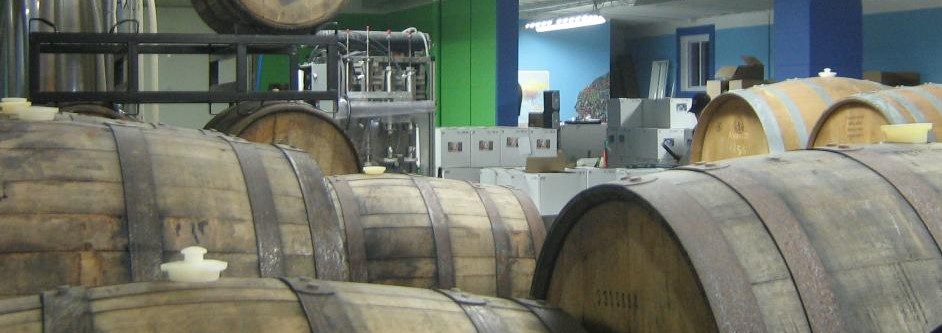
In 2007, I found myself at Jolly Pumpkin in Dexter and Ron Jefferies gave me a hour of his time at the end of a long day. That’s his barrel room from that visit up there. Frankly I don’t meet a lot of people I write about so I was it was a real treat.  My favourite part of the talk was his curiosity in what exactly beer blogging was and might be. He also doubled over with a big laugh at my story about the December 2006 Hair of the Dog shipment with the incompetent capping and how the yeast saved the beer. I visited again a few years later and he was just as swell. Very sorry to hear that he passed.

On a cheerier topic and adding to the discussion about the need for the pint from last week, Liam wrote a very interesting bit about what he calls the “meejum”:

…how much beer was actually in a meejum? The simple answer seems to be a little less than a pint as per the comments from our annoyed Londoner above, but I have come across a couple of others mentions of the volume too. In a court case in Dundalk in 1904 the judge has the same question and was told it was ‘a glass and a half’ (426ml) and another mention in 1901 that says it was ‘two-thirds of a pint’ (379ml). A more recent comment from a letter to the Irish Independent in 2003 looking for the medium to be reinstated, it is said that it was ‘approximately 500ml’.  With a pint being 568ml we can see some wildly fluctuating volumes here, but I think we are missing the original point of the medium, which was to give the consumer a drink based on price and not volume, so therefore it is very possible that a medium was a different size in different counties – and even different pubs. It was a portion of beer that equalled a value that was acceptable to the working man.

And we note the announcement of the coming retirement of Humphrey Smith, the controversial Chairman of Samuel Smith’s Brewery and perhaps good beer’s Epimetheus, taking particular guidance from Old Mudgie:

Despite all these problems, it has to be said that Sam’s pubs, when they are open, have a very distinctive appeal that is not matched by any of their competitors. They offer comfortable seating, traditional décor with plenty of dark wood, an absence of TV sport and piped music, and only admit children if dining, making their wet-led pubs adults-only. They are oases of calm. They may not offer the widest choice of beer, or the absolute best beer, but in many locations they are the most congenial pubs around.

A new source to me, Literary Hub published a passage or perhaps a chapter on the history of Pilsner drawn from Hopped Up: How Travel, Trade, and Taste Made Beer a Global Commodity by Jeffrey M. Pilcher published by Oxford Univ Press:

Few visitors in the early nineteenth century might have guessed that the market town of Pilsen, on the road from Prague to Bavaria, would become world renowned for its clear, sparkling beers. Having grown rich from the business of anthracite mining, residents imported Bavarian lagers. In 1840, the town fathers decided to invest some of their mining profits in the construction of a municipal brewery. The first tasting, held on St. Martin’s Day, November 11, 1842, brought their home-grown beverage local acclaim. But apart from the basic recipe of Saaz hops, Moravian malt, soft water, and lager yeast, little is known about how Pilsner acquired its legendary status. It was prized, at first, as an exotic “Bavarian” beer, and the malting process relied on British advances in indirect heating, like Sedlmayr’s Munich malt, but without the final burst of caramelization. The brewery’s capacity of just thirty-six hectoliters, about twenty barrels, meant that the beer was sold primarily in local markets. 

My problem with these things is, of course, whether is it, you know, true – keeping in mind, of course, the degree of abstraction at play. It speaks nothing of Prof. Pilcher for me to point out that Pilsner’s history has been stated, restated and revised and refused and refined and (… you get my point…) so often in the last wee while that it gets one in a big of a fog. But there is a certain compelling style to the passage provided in LitHub that I would invite comment from those closer to the topic.

Speaking of style, I missed this post by B+B last week just at the deadline on spinning LP records in pubs and why it works for them:

The magic that people perceive in cask ale is similar to the magic they perceive in pub buildings which is similar to the magic they perceive in the sound of vinyl. A sense of connecting with something authentic. They’re also essentially nostalgic. Most pubs are embassies of the past. Victorian buildings with plastic Watneys clocks, Bass on the bar, and packets of pork scratchings whose packets haven’t been redesigned since 1981. It’s not unusual to find a pub with a stack of records in the corner or behind the bar. Albums that, if they were sold on Discogs, would not warrant a ‘Mint’ or ‘VG+’ rating. Split sleeves, yellowing inner sleeves, with a whiff of stale beer and cigarette smoke about them.

Writing on FB, Alistair brought my attention to a surprisingly startling and poignant video about the loss of working class neighbourhood and working class neighbourhood pubs as part of the modernization of in Salford, England in the 1960s. Here’s the video from the BBC from the time. It appears the modernization did not fully take. Then I thought… Salford… I know that place.  Pellicle posted a podcast about Marble Brewing of Salford back in 2023.  And Martin (with an “i”) has been there, too. The juxtaposition of each stage of Hanky Park over the sixty years is remarkable.

And, over on BlueSky, I came across an interesting thread on why hip-hop culture connects with Hennessey cognac and why Lebron is tying his brand to the drink:

During the war, African Americans stationed in France began consuming Hennessy. Afterwards, Hennessy, being French & having a different relationship with Black people than American companies, trail blazed by simply marketing to & employing Black people, carving out an extremely loyal consumer base. WWII saw Black soldiers abroad enduring antagonism from USA, like leaflets being dropped over France claiming they had tails in order to discourage sexual intermingling. Many were dismayed to find that their service in the effort of helping stop genocide abroad had not granted them humanity at home. During that time Hennessy was continuing to cater to African Americans & before we were sensationalizing terms like DEI, they had hired Black Olympian Herb Douglass as their VP of Urban Market Development, a role he served in for over 30 years. This history is why you hear about Hennessy in hip hop.

So it is not too far off the “I Am A Man” protests and declarations in the Civil Rights movement. Very interesting. Staying with history but reaching back further, last Sunday Martyn (with the “y”) disassembled the notion that the “Hymn to Ninkasi” is any sort of Sumerian beer brewing guide and did so with both verve and detail… like this:

Paulette has invented the word “šikarologist” to describe students of Mesopotamian beer, from the Akkadian word šikaru, meaning beer, the cuneiform for which looked like one of those pointy brewing jars laid on its side: 𒁉. I will definitely be stealing that. Strangely, a cognate of šikar in another Semitic language, Hebrew, the word shekhár, meaning “intoxicating drink”, is the root of the English word “cider”, via Greek, Latin and French. Shekhár is also the root of the Yiddish word for “drunk”: I remember my Jewish ex-father-in-law, who came from Vienna, staggering around at his 70th birthday party, surrounded by his extensive family in his large garden in rural Surrey, saying: “Ich bin so shicker!”

An interesting chit chat ensued in TwexLand led by Lars which touched on (i) the title is made up, (ii) it’s a hymn and maybe a drinking song but not a brewing guide (iii) why was the grain covered in dirt? (iv) woundn’t the malt get suffocated? and (v) why are the translations so different?

And Martin (still with the “i”) has been out and about in Filey on the North Sea coast seeking out GBG25 entries:

…the thing that hits you about Guide newbie the Station is the friendliness of the welcome, the Guvnor checking we know that food service has stopped before we waste 10 steps to the bar… I ask for mild and a Pride, and get mild and Blonde in Pride glasses. Four simple and unfussy rooms, a good mix of bench seating and squidgy chairs, we take a table with a reservation for “Bingo” in 3 hours time. “Bingo” was a popular boys name in the ’50s, along with Bunty and Bungo.

Top tip time. You want to make the weekly roundup? Include an accurate use of the word “squidgy” – can’t resist!  Speaking of good words, Gary wrote an excellent post on the appearance of “suffigkeit” in mid-1900s US beer advertising:

You want Bavarian beer? Here it is, new and improved – tastier, clearer and more sparkle than your original – that’s suffigkeit, or it is now.

Speaking of clearer and more sparkle, Matt made something of a declaration, the return to voluntary non-paying scribbling:

Yes, I still write. For lots of publications in fact. Not as many as I would like, but a writer is never satisfied. What I crave is that unpolished, flow-state writing, the kind that feels like stretching a limb, or the freedom of trying something new that might be absolutely terrible but you’ve done it anyway and calmed that twitchy section of your brain. Writing like this, which I’ve written in 10 minutes, proofed once, and hit the publish button. I just have a need for a space, a scratchpad, to try a few things out once in a while. I want to write basically, so that’s all I’m going to do. No newsletter, no subscription, just a place to take things out of my head and put them on a page.

Very good. Excellent even. Unfettered scribbling is the best. Compare that to the advice own newletter writing beer marketeer offered this week:

Content that takes you wide has to be relevant to millions of people. It can’t be about the impact of thiolized yeasts on lagers. Wide aiming posts tend to be less about you and your brand, and more about the industry, interest, or setting you’re a part of. They can still find parallels to your brand, voice, ethos, or sense of humor. The point of these posts are to appeal to what most people come to social media for these days whether that’s to shut off their brain, have a laugh, or learn something new. Nobody opens Instagram hoping to be sold a new 4-pack of Hazy IPA, so that shouldn’t be the goal when trying to go wide.

Please don’t go wide. Wide is a euphemism for dull, undifferentiating and disposable. It pandering to other goals outside of what’s written. Jeff (for the double) went very narrow and shared something quite personal which lead me to cheer “Yay, Poop Tests!“:

The rest of the trip went fine, but my body was experiencing a kind of systemic failure. I got back to the U.S. and the rash became permanent. I gave up beer and then coffee and eventually even food. In the past, fasting calmed the itchy nerve endings. Nothing helped until a friend recommended a gut naturopath. She gave me a stool sample and we discovered I had an overproduction of some kind of intestinal yeast. She gave me an antifungal and within days the rash left. Today I am back to my old self, happily eating and drinking whatever is placed before me.

Finally and keeping with the personal, Rachel Hendry‘s piece in Pellicle this week is a rich contemplation of loss through the lens of taste:

I want to know what her wine tastes like.

I can’t think about what is going to happen to her. Instead, I find myself obsessed with whether her perception of taste has changed. I think of whether memory can still come to her each evening when she pours herself a glass of wine. I want to ask someone this but it seems so silly in the grand scheme of things—can she still taste if she can’t remember? Can she feel flavour anymore? Is this why she drinks more now?

What if one day I no longer know what my wine tastes like?

I become selfish in these moments. Thoughts of her quickly turn into thoughts of myself. What if one day this happens to me, too?

Some tests, we all learn as we age, do not lead to a good outcome. Rachel has captured that moment with brave clarity.

That ended up unexpectely bookended. Not really themed. Maybe. Still, until next week, as we consider this shared mortal coil, for more beery news check out Boak and Bailey every Saturday and there is a promise that Stan may be back from his autumnal break starting this very Monday. Then listen to Lew’s podcast and get your emailed issue of Episodes of my Pub Life by David Jesudason on the odd Fridays. And Phil Mellows is at the BritishBeerBreaks. Once a month, Will Hawkes issues his London Beer City newsletter and do sign up for Katie’s wonderful newsletterThe Gulp, too. Ben’s Beer and Badword is thereback with the sweary Mary! And check out the Atlantic Canada Beer Blog‘s weekly roundup. There is new reading at The Glass which is going back to being a blog. Any more? Check out the Beer Ladies Podcast. That’s quite good. And the BOAS podcast for the bro-ly. And the long standing Beervana podcast …except they have now stood down.  Plus We Are Beer People. The Boys Are From Märzen podcast appears suspended as does BeerEdge, too. But not Ontario’s own A Quick Beer. There is more from DaftAboutCraft‘s podcast, too.  All About Beer has podcasts and there’s also The Perfect Pour. Plus follow the venerable Full Pint podcast. And the Craft Beer Channel on Youtube.  The Moon Under Water is gone which is not surprising as the ask was $10 a month. Pete Brown’s one cost a fifth of that but only had the one post.

*Me, I’m all about the social medias. Facebook still in first (given especially as it is focused on my 300 closest friends and family) then we have BlueSky (189) rising up to maybe… probably… likely pass Mastodon (931) in value… then the seemingly doomed trashy Twex (4,454) hovering somewhere well above my largely ignored Instagram (151), crap Threads (52) with Substack Notes (1) really dragging up the rear.

The Last And Perhaps Best Yet Perhaps Slightly Timid Beery News Notes For May 2024

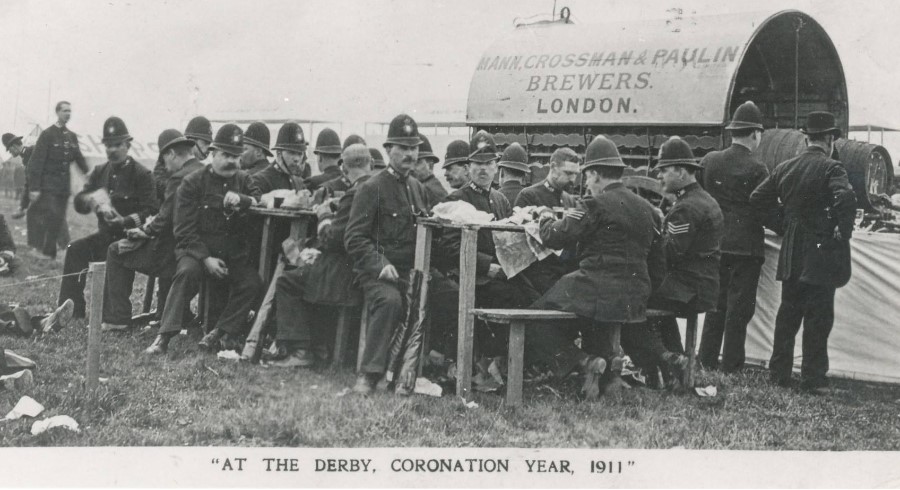
Well, that went fast. May. See ya. June backons. That image up there? It’s from the Facebook group for the Brewery History Society, a grand display of policing the Epsom Darby on May 31, 1911. Each having Mann London Ale. They would need it as thunderstorms later that day killed 17 people and 4 horses. Hopefully more peaceful, this year’s race will be on again this Saturday. And the French Open, the UEFA Euros, the NBA Finals, the Stanley Cup and World Cup of Cricket will be all on the go in June, too. Brought to you by Stella Atrois, Bitburger, Michelob ULTRA, Molson and Bira91 respectively.

First up, I have to say I really liked this portrait by Boak and Bailey of Dorset’s Square & Compass, a pub that took them back through a forest, even back through time in terms of the layout and service, a pub where they found themselves looking at a menu with three food items and maybe twice that many drink offerings before they went outside to sit next to a slab of rock:

Looking out from the garden is as magical as looking up at it from the lane. We had a view of the hills sloping down to the sea, fading into haziness beneath a big white sky. At one point an ancient blue Landini tractor passed by, its upright driver puffing on a pipe, like something from a 1950s British Transport documentary. In the hedgerows, on the telephone wires, and on freestanding stones, birds gathered and chattered.… Then, unbelievably, they came to visit.

Fabulous. And check out Martin’s review of The Harlequin in Sheffield for another sort of fabulous in an urban setting.

Back into the now, the big news here in Ontario is the debate over the costs of the Province’s move to finally get beer, wine and all the coolers into corner stores. Let me say from the outset that while I don’t plan to vote Tory, I can’t imagine a download of services (either to the private sector or another level of government) that does not include a transfer of revenues associated with those services. That being said…

“It’s a billion-dollar booze boondoggle,” Liberal Leader Bonnie Crombie said Monday during a news conference at Queen’s Park. Crombie and the Liberals base their $1 billion figure on these additional costs: (i) $74 million per year to the large grocery chains by giving the 10 per cent wholesale discount, (ii) $375 million to the Beer Store by rebating the LCBO’s cost-of-service fees and (iii) 300 million in foregone revenue by not charging retailers a licensing fee. Those amounts would be on top of the LCBO’s lost revenue from selling less alcohol through its own stores and on top of the $225 million payment to The Beer Store. *

See, if the gross revenues of the LCBO (wholesale and retail) were $7.41 billion generating a whopping $2.58 billion in dividends to the Province, according to the most recent annual report, then shifting significant services, fees and expenses away from the LCBO to the new players probably should be expected to cost more than the 3% of gross revenue. But, if the annual report in 2026 says that the gross has dipped to $6.41 billion with the dividend dropping to $1.58 billion, well, then there should be some questions asked. The main problem is the concept that the greater number of outlets will cause an expansion of sales covering those costs. Ain’t happening. Booze is retracting. Even pre-pandemic, there was no change in sales caused by partial deregulation. And we’ve already seen the retraction of sales in those 450 grocery store which were first permitted to sell beer wine and cider in 2015. This is all a great leap sideways.

I missed Jordan‘s post last week on the pleasures and pitfalls of brewing a collaboration including this unexpected turn towards what can only be called pronounced zippiness:

A funny thing happened on the way to the brewery. Adrianna, who had very kindly put aside some Agnus for our 20 hL batch, got in touch one day to say that it had accidentally shipped with someone else’s order. She offered to throw in some Saaz for the trouble, and I asked if there was anything else Czech in the warehouse. This is how we ended up with Vital hops. Vital isn’t a brewing hop. It’s pharmaceutical grade. They were originally grown for their antioxidant properties (xanthohumol and DMX), although I didn’t know that when I leapt at the opportunity to use them. What I saw, looking at materials online, was that it contained everything including Farnesene and Linalool in pretty high proportion. Farnesene is usually Saaz exclusive (gingery, snappy, peppery). Linalool is the monoterpenoid associated with lavender, lilac, and rose. In fact, the description of it said lavender, spice, plum, licorice.

Oddly, “Linalool” has been my private nickname for Jordan for years! Not apparently encountering any Linalool whatsoever, Stephanie Grant has still been on the move and reported from Belgium where she visited some auspicious breweries and perhaps experienced that other sort of hangover that lambics can offer:

Our last day in Belgium, we continued the Tour de Gueze, this time joining the bigger group of participants on one of the many buses taking drinkers around the region. We visited De Troch, Mort Subite, Eylenbosch, and Timmermans. I’ll be honest, after gorging myself on lambics the day before, I wasn’t as thrilled to do it all again the next day. Instead, I spent most of the day seeking out bottles to bring home and share with friends once I returned home…

Ah yes: that good old “I am sure it hates me” feeling. Also out and about, Katie has reported from the ferry to the Isle of Man… in fact from the ferry’s busy bar:

The bar on board the Manxman is just as bizarre and pleasant as I remember it, and I’m sat with a Guinness at a little round cabaret table surrounded by TT hats, jackets, and fleeces and the people they belong to. Almost everyone on board is travelling for the races, and we’ve already run out of Norseman lager, the local lager brewed by Bushy’s on the island. By the time we get to Douglas I’m sure we’ll be out of crisps too.

What else is going on? You know, I wasn’t going to go on about the Hazy Eeepah thing that took too much time in May BUT (i) Stan shared a great summary of where we have gotten so far** and (ii) ATJ shared a recollection of IPA studies past by sharing the agenda of a British Guild of Beer Writers from 1994. Click on the image. Notice something? Apparently three PhD recipients. Plus Jackson, Oliver and Protz. No mention of fruit sauce. And no cartoon infographics or can wrapper designers. When people backdate the term “craft” beer to anything before around 2007 when it passed microbrewing in popular usage, I think this primary sort of document is a helpful reminder that the terms of reference were quite different. Not, by the way, “dudes grumbling about the good old days” so much as a discussion before the adulteration of both the beer itself and the overall concept of IPA. We need more of that again. Because it is possible to discuss things being worse that other things. Not that it seems many “in craft” would understand.

Similar in the sense of things not appears to be what they are or rather appearing to be exactly what that are even if that is not admitted – and for the double… wheew… ahem, Martin came upon a scene at a beer festival in Cambridge, England that (in amongst the photos of dilapidated properties and sodden grounds) has got to be the aggreation of all the reasons I share his dislike of beer fests including: (i) “the students and groups of mates who make up the core attendance“; (ii) “Nice weather for newts” and (iii) that disappointing beer that “has a touch of sharpness about it that I can’t explain.” Let me spoil his conclusion for you:

I didn’t see anyone I knew, and (unlike in pubs) it’s on your own hard to strike up conversations with random strangers who have largely come with mates. In and out in 24 minutes. Time for a pub.

Also missed: the Historic Brewing Conference planned for August has been cancelled.

Pete Brown shared some refreshing comments on the old trope that craft brewers need to tell their story in his industry insights newsletter this week:

Firstly, every single one of them insisted on telling him their foundation story – where the founders met, what inspired their “dream”, and the modest circumstances in which they began dragging it into reality. Secondly, when they finally got to the shiny parcel of vats, every single one beamed, “And here’s where the magic happens.” Now, on the surface, this is far more interesting – there’s an actual story there for a start. But on the other, I get the sense that when he visited these businesses, Thom was given this spiel whether he wanted it or not. Once again, the pitch wasn’t tailored towards its audience. 

Short take: if it’s everyone’s story it’s no one’s story.

Elsewhere, The New York Times had a great article on the unique story of Eritrean and Ethiopian diaspora home brewing – and home barley malting – in Texas:

The thick brown liquid had been fermenting in the jug for three days, which meant it was time for Fatean Gojela to get it ready to serve for Orthodox Easter. With her granddaughter, Ava, at her side, she poured it little by little through a thin mesh sack. “Patience, Mama,” she said to Ava, showing her how to squeeze out the liquid from a doughy mix of grains and herbs. Ms. Gojela, 65, learned to make suwe, as the beerlike drink is called in the Tigrinya language, from her mother while growing up in Asmara, the capital of Eritrea. (Today, she lives in Fort Worth, where she works as a housekeeper for hospitals.) The beverage is primarily brewed for special occasions in Eritrea and Ethiopia, where Amharic-speakers call it tella.

In a far less celebratory frame of mind, Jessica Mason shared a depressing thought that really makes one wonder what all the efforts towards inclusion were really about:

If you’re wondering why fewer women think beer is for them, maybe just look at the comments I get on a daily basis when I share, write or question anything on the topic of beer. See how women are treated when they do take an interest in beer. It is no wonder we are where we are.

She shared that on Twex the day after having her piece on the suprisingly negative findings related to women and the UK beer market in the report “The Gender Pint Gap: Revisited” authored by Annabel Smith:

Speaking exclusively to the drinks business about the data, gathered by YouGov, report author and beer sommelier Annabel Smith said: “When we set out to conduct a further piece of research into women’s attitudes and behaviours towards beer in Great Britain, we were fairly optimistic that the dial would have moved in a positive direction since the first Gender Pint Gap”… Smith lamented that “there has been very little academic research done in this field, but we uncovered a wealth of anecdotal evidence perpetuating the ideology that beer is for men. And when this is in your face every single day, you start to believe it.”

Here is the full report by Smith.  There’s more at Beer Today too. Oddly, the Morning Advertiser chose to highlight the phrase “the dial doesn’t appear to have moved very much since” 2018 despite the report saying that the report indicates that female participation slipped from 17% to 14%. This is a 17.6% drop. Which is sorta huge given the efforts taken during the time to counteract disinterest in this group of consumers. But beer is bad at math, isn’t it. (Like when we read that a large facility closure is a sign of industry maturity. Subtraction. It’s tough to explain. Who knew?) Conversely, Rachel Auty also added her thoughts which were more comprehensive, including these comments related to beer advertising the in UK:

I believe we also need to address the connection between beer and sport, and move away from sport being treated like it’s something that only men like to do. The rise of the Lionesses – as one high-profile example – has given beer an opportunity to unlock a whole new type of customer, and it’s only going to continue in the same direction. Why would any brewery or venue turn that opportunity away? Ultimately, if more women work in breweries, bars and other beer industry roles, the advertising will shift. The problem is at the core – truly – and we have to get women into roles where they have leadership responsibilities and the autonomy to make key decisions and become role models that create and inspire positive change. This is still not happening anywhere near enough to shift the needle.

Preach. Why isn’t that as easy for everyone to see as seeing a mud filled beer fest in Cambridge and, you know, leaving?

And, just before deadline, we note the long form writing of Claire Bullen in BelgianSmack on Frank Boon and his beers:

From the park, the Zenne flows around the village, under bridges, and approaches Brouwerij Boon, where it meets the gaze of Frank Boon. He has paused for a moment on a small concrete bridge to regard it, to watch as ducks and moorhens paddle against the current. In its progression, the river bisects the brewery, one bank home to the brewhouse, coolship room, visitor centre, taproom, woodshop for foeder repairs, and an enormous warehouse of foeders and barrels; the other a rented warehouse space where additional foeders are stored.

The piece is Augustan***, displaying the arguably Tory nature of this part of brewing – a perfected stasis point where craft and nature sit in ordered balance. And, once achieve, will remain so. I was immediately taken back to my university class forty years ago where we studied the Olivers Goldsmith, the Irish one of the middle 1770s as well as his less successful great-nephew of early 1800s Nova Scotia and their two villages. Or that Boak and Bailey pub way up there, come to think of it.

Finally, Mudgie shared the sad news of the passing of one of his long time readers, Janet Hood a Scottish solicitor who was a member of the licensing bar. Her colleague Stephen McGowan shared his thoughts:

…as a new solicitor I was a recipient of her enthusiasm, passion, and I know she gave great encouragement to new solicitors and those on the journey into the profession. That was Janet. I first met her at a licensing conference when she was the deputy clerk to the Aberdeenshire Licensing Board and she made an immediate impression. What a character! Although I confess I can’t remember her precise topic I do recall no one was left unsinged – everyone got it in the neck! Other clerks, agents, the Government. She really rattled some cages and forced the conference to face the difficult questions. But that was Janet.

An inspiring life. I am adding her email sign off to my own: “niti pro regula legis – fight for the rule of law.”

That’s a lot of good reading and good thinking for one week. Next – the credits, the stats, the recommends and the footnotes and the many ways to find good reading about beer and similar stuff via any number of social media and other forms of comms connections.**** Want to keep up with the news before next Thursday? Check out Boak and Bailey every Saturday and Stan back each Monday. Elsewhere go look at then listen to Lew’s podcast. And get your emailed issue of Episodes of my Pub Life by this year’s model citizen David Jesudason on the odd Fridays. And Phil Mellows is at the BritishBeerBreaks. Once a month, Will Hawkes issues his London Beer City newsletter and do sign up for Katie’s now revitalised and wonderful newsletterThe Gulp, too. Ben’s Beer and Badword is back with all the sweary Mary he can think of! And check out the Atlantic Canada Beer Blog‘s weekly roundup. There is new reading at The Glass which is going back to being a blog in this weeks best medium as message news. Any more? Yes! Check to see the highly recommended Beer Ladies Podcast. That’s quite good. And the BOAS podcast for the bro-ly. And the long standing Beervana podcast …except they have now stood down.  Plus We Are Beer People. The Boys Are From Märzen podcast appears suspended as does BeerEdge, too. But not Ontario’s own A Quick Beer. There is more from DaftAboutCraft‘s podcast, too.  All About Beer has introduced a few podcasts… but some may be losing steam. And there’s also The Perfect Pour. Plus follow the venerable Full Pint podcast. And the Craft Beer Channel on Youtube.  The Moon Under Water… is gone which is not surprising as the ask was $10 a month. Pete Brown’s costs a fifth of that but is writing for 47 readers over there. There was also the Beer O’clock Show but that was gone after a ten year run but returned renewed and here is the link! Errr… nope, it is gone again.

*Edited to get rid of the stupid bullet points that the CBC seems to inordinately love.
**Notice in particular his coy statement “I do not agree every word in the paragraph” when referring to something, frankly, extremely insightful that I wrote last week… which made me realize something – there was a typo in the text he  quoted  that I needed to fix. Now he must agreed with every word, right? That’s what you meant, Stan, right?
***Ripely ornamented: “Our steps clang madly as we walk into the empty coolship. Outside, the wind makes the yellow wildflowers dance, a feast for pollinators. The river reveals nothing.”
****This week’s update on my own emotional rankings? Facebook still in first (given especially as it is focused on my 300 closest friends and family) then we have BlueSky (128) rising up to maybe… probably… likely pass Mastodon (913) in value… then the seemingly doomed trashy Twex (4,478) hovering somewhere high above or around my largely ignored Instagram (163), with sorta unexpectly crap Threads (43) and not at all unexpectedly bad Substack Notes (1) really dragging up the rear – and that deservedly dormant Patreon presence of mine just sitting there. 

The First Beery News Notes For The Good Part Of The Year

This is great. Up there is an image posted this week on Bluesky by Liam of IrishBeerHistory, a quote from the book As I Was Going Down Sackville Street by Oliver St. John Gogarty which is just excellent. I will refer to it as such from now on. Govern yourselves accordingly. You know what else is great? Now is great. March 1st to January 1st inclusive – totally great.* Napping with the windows open even if bundled up because it is only +5C. The same thing occurred to Katie apparently:

I managed to have a lovely half hour nap in my garden today without freezing solid. I’m doing the Scandi baby version of whatever that ice water guy does. Wrapped in blankies, having a lil sleepy outside.

These are the actual joys. So what’s out there for our beery naptime reading? First up, if you are looking for that rarest of things in these times – some good happy positive brewing news – look no further than David Jesudason’s almost alarmingly optimistic study in Pellicle of an almost alarmingly optimitic brewer, Andy Parker, the founder of Elusive Brewing in Wokingham, Berkshire:

The word ‘nice’ has often been banned by editors I’ve worked with. The attributive adjective is seen as a nothing word, used to describe anything from Rich Tea biscuits, to mild weather, or a stranger’s demeanour. It’s an archetypal British word, and one Andy is forever linked to. Worst of all, it’s a term that does him and his incredible brewery a disservice. Firstly, yes he is the nicest guy in beer, but there’s nothing superficial about why he’s ‘nice.’ Many people I speak to describe him as one of the most thoughtful, kind and—above all—considerate humans they’ve come across. I found him to be a great listener in the numerous times we’ve met.

In their Patreon footnotes to last Satuday’s post, B+B indicated** that they were having an issue finding note worthy writings, a problem I can empathize with – but that bears no connention to my mentioning this post by The Beer Nut who highlights some very proper quality control measures being taken in the face of an issue popping up:

The prologue to today’s beers is that they were both recalled from the market. A problem with the can seamer meant that not all of them were properly sealed, running the risk of oxidation. Craft Central were kind enough to refund me the cost of the beers and I checked with the brewery, Lineman, if it was OK to review them, since I couldn’t detect any flaws. Mark showed me how to spot the defective cans and I’m confident that neither of these were affected by the issue.

Bonus quality control about quality control right there, that’s what that is. Conversely, thinking about things getting out of control, some interesting news out of Britian as cuts to taxes imposed on beer have not had any particular positive effect on trade:

The relief reduced the tax on them by 9.2%. Mr Hunt said: “we’re protecting the price of a pint”. But beer prices have continued rising. The Office for National Statistics (ONS) said they were up 7.5% in January 2024 compared with the same month last year, with prices increasing every month of the year, despite draught relief…  figures show that almost exactly the same number of pubs closed in the UK in the second half of 2023 (266) as had closed in the first half (265).

The Cookie and the Mudge shared thoughts on this matter:

C: Does anyone really believe that if all the beer, pub, and Camra groups got everything they wanted in the budget, then pubs would enter a golden era of prosperity and success? They’d continue to die on their arse but just pay less tax in the process.
M: Yes, the long-term decline of pubs is primarily caused by social change, not by price.

I have to agree with that. It’s all bad news on both sides of the cash box and in other areas of life.  What’s a good sign that beer in the UK is priced at a pretty penny? Crime:

A haul of suspected illegal beer equivalent to 132,000 pints has been seized at a ferry terminal in south Scotland. Police worked with the Serious Organised Crime Taskforce and HMRC as part of the clampdown at Cairnryan Port, near Stranraer. … An HMRC spokesman added: “Disrupting criminal trade is at the heart of HMRC’s strategy to clamp down on the illicit alcohol market which costs the UK around £1bn per year.” 

Speaking of taxation of the pleasures of the nation, something of a milestone was passed here in Canada which bodes ill in another way.

Canada’s federal government collected more excise tax revenue from cannabis than it did from beer and wine last year. That comes as a parliamentary committee is recommending the government ease up on the cannabis tax. In the 2022-23 fiscal year ended March 31, the federal government received 610.1 million Canadian dollars ($450 million) from excise duties applied to beer. Beer and wine excise revenue combined was CA$887.7 million. Federal excise duties from cannabis that year, meanwhile, amounted to approximately CA$894.6 million, of which CA$667.6 million was transferred to provincial and territorial coffers.

See here, folk aren’t turning to crime so much as the now decriminalized. Yet… the national spliffy trade still complaining about facing headwinds… get it? But that is not really what has gone on:

Beer sales fell by 96 hectoliters per 100,000 people immediately after adult-use legalization, and by a further 4 hectoliters per 100,000 people in each following month, equalling an average monthly reduction of 136 hectoliters per 100,000 person.

So why they complaining when they are facing being the beneficiries of inevitable cultural change? Same as it ever was. And just to pile on the reasons for the miserable forecasts for beer’s future, Jeff explores another bummer of a story – did Covid make hangovers worse?

A recent paper suggests that hangovers are worse for people with longs Covid… The study only looked at four people and it’s just a review of their cases. Statistically, not much there… [but] – what portion of the dip in alcohol consumption and the rise in N/A may be due to people just feeling super crappy when they drink? We’ve had four years of young people coming into their drinking years. If their experiences were mostly negative—especially because drinking’s social component was dulled or absent—might they just have abandoned alcohol before developing the usual youthful infatuation with it?

Youth! What the hell do they know? Speedy if tenuous advice to youth segue! I came across a social media reference to The Instructions of Shuruppag, a Sumerian document from around 4500 years ago reciting older sayings predating the Flood. What I first noticed was one of those decontextualized “hey cool!” quotes people share just because it mentions beer a couple of times. But if you look at the text itself, you realize that the sayings are warnings of the wise aimed at a youth – as well as a window to a very alien, even very tenuous culture:

You should not boast in beer halls like a deceitful man… You should not pass judgment when you drink beer… You should not buy a free man: he will always lean against the wall. You should not buy a palace slave girl: she will always be the bottom of the barrel… Fate is a wet bank; it can make one slip… To have authority, to have possessions and to be steadfast are princely divine powers. You should submit to the respected; you should be humble before the powerful… You should not choose a wife during a festival… A drunkard will drown the harvest.

Grim life that, living in the shadow of the clay walls and those slippy dirt embankments that save you from the mountain people. Even with the beer. Somewhat related to the bottom of the barrel, VinePair has illustrated the lack of facinating beer writing by publishing the story you’ve perhaps not been waiting for:

Yes, it’s fine to drink the stuff hanging out on the bottom of the bottle. “It doesn’t give you the sh*ts. That’s preposterous,” Grimm says of brewing byproduct. “That’s where a bunch of the good B complex vitamins live.” And it’s true: Most brewer’s yeast is rich in vitamins. This doesn’t apply to hop particulates like one would find floating around in an unfiltered IPA like Heady Topper — we’re talking about the yeast, which tends to pile up at the bottom of saisons, mixed culture beer, and spontaneously fermented brews.

And here I thought the 2016ish “off-flavour seminar” fad was the dullest form of beer fan education that could be fashioned by humankind.*** Sludgy gak studies. Speaking of echoes of craft’s peaks past, at the end of last week and at the website of a homebrewing supply service, Matt discussed an interesting phenomenon of the lingering trade in sour and wild beers that once were craft fans’ darling but are now brewed perhaps as a bit of nod to nostagia:

The existence of each of these breweries is a statement. A financial analyst would probably describe them as being commercially unviable. But a romantic? They would call them bold, boisterous, and even necessary. Beer would be a hopelessly boring place if we just had a handful of similar beers to choose from, after all.  Considering their existence, it still leaves me with the question: who’s buying these beers? Or perhaps more pertinently, who’s going to be buying them in the future?

The future. It’s all about the future this week, it seems. It’s like no one took the advice of old Shuruppag. Makes me wonder if craft beer is like cable TV facing the onset of the information super highway… what did we call it 25 years ago? Convergence! We are now converged. How big is your cable TV bill or your landline for that matter? So many other things to do, so many means to an early death to avoid, so many other things to spend money on, so many other states of mind to achieve – including good old sobriety. Note:

Athletic Brewing is now the number one beer of any kind at Whole Foods. More than all of beer brands with alcoholic contents.

Not good. Or maybe real good. And things appear to be getting worse in China (if you can wade through the AI generated shit text) and Will Hawkes alerted me to the plug being pulled on Meantime in London:

BREAKING: Asahi is closing the Meantime Brewery and moving all production to Fuller’s… Staff were only told today. Asahi says ‘intention is for Meantime to retain a footprint in Greenwich … Plans are underway for the creation of a new standalone consumer retail experience, including a continuation of brewing’

Meantime was a pretty Wowie Kazowie! brewery in its day. My first encounter was on an August 2007 shopping spree in glorious Rochester NY,  with reviews of their Coffee Porter and the IPA the next couple of years. They got in to the LCBO here in Ontario in late 2009 or 2010 and were a regular for a while, perhaps last seen in 2019.  There you go. The past is a foreign land. Ron confirmed that truth to perhaps the contrary when he shared this week news of a revolution in 1970s pub gub in the UK:

There are three recipe booklets, one gives 50 meals using Batchelors savoury mince or farmhouse stew, the next giving 50 recipes for sweets from Batchelors and the third with 50 recipes for entrées from Batchelors ready dishes. All the products, from soup to coffee, and including quick-dried vegetables, are convenience foods. They offer no shelf-life problems, all being guaranteed for at least 12 months under normal conditions. Reconstitution is by the addition of water, bringing to the boiling point and simmering for varying periods up to about 30 minutes…  They may be made to suit the custom and, in particular, the evening out — when it is a natural thing to go to a pub for a few drinks and a meal not encountered in everyday household catering.

Holy Hanna! Sounds disgusting. You know why food like this is only sold to insane backwoods hikers and astronauts, don’t you!?!

That’s it! I can’t take it no more. Done. There we are… and again … we roll the credits… well, the credits, the stats the recommends and the footnotes. There is a lot going on down here and, remember, ye who read this far down, look to see if I have edited these closing credits and endnotes (as I always do), you can check out the many ways to find good reading about beer and similar stuff via any number of social media and other forms of comms connections. This week’s update on my emotional rankings? Facebook still in first (given especially as it is focused on my 300 closest friends and family) then we have BlueSky (124) rising up to maybe… probably… likely pass Mastodon (914) in value… then the seemingly doomed trashy Twex (up again to 4,463) hovering somewhere above or around my largely ignored Instagram (165), with sorta unexpectly crap Threads (43) and not at all unexpectedly bad Substack Notes (1) really dragging up the rear – and that deservedly dormant Patreon presence of mine just sitting there. I now have admitted my dispair for Mastodon in terms of beer chat, relocated the links and finally accept that BlueSky is the leader in “the race to replace” Twex even while way behind.

Fear not! While some apps perform better than other we can always check the blogs, newsletters and even podcasts to stay on top of things including the proud and public and certainly more weekly recommendations in the New Year from Boak and Bailey every Saturday and Stan promises to be back next Monday. Look at me – I forgot to link to Lew’s podcast. Fixed. Get your emailed issue of Episodes of my Pub Life by this year’s model citizen David Jesudason on the odd Fridays. And Phil Mellows is at the BritishBeerBreaks. Once a month, Will Hawkes issues his London Beer City newsletter and do sign up for Katie’s now revitalised and wonderful newsletterThe Gulp, too. Ben’s Beer and Badword is back with all the sweary Mary he can think of! And check out the Atlantic Canada Beer Blog‘s weekly roundup. There is new reading at The Glass which is going back to being a blog in this weeks best medium as message news. Any more? Yes! Check to see the highly recommended Beer Ladies Podcast. That’s quite good. And the long standing Beervana podcast . Plus We Are Beer People. There is the Boys Are From Märzen podcast too and Ontario’s own A Quick Beer. There is more from DaftAboutCraft‘s podcast, too.  All About Beer has introduced a few podcasts… but some may be losing steam. And there’s also The Perfect Pour. Plus follow the venerable Full Pint podcast. And the Craft Beer Channel on Youtube and remember BeerEdge, too, and The Moon Under Water… if you have $10 a month for this sort of thing… I don’t. Pete Brown’s costs a fifth of that. There was also the Beer O’clock Show but that was gone after a ten year run but returned renewed and here is the link! Errr… nope, it is gone again according to Matty C.

*Minus of course half of November. That’s it. Otherwise, best part of the year. The other ten weeks suck. The Leap Year thing made it worse, too. But the rest is great. Except… when the clocks change. That’s another bit of totally sucks coming up this weekend. Going to be totally baked next week, sun coming up at like 11:53 pm the night before. That really sucks. What’s the best beer for clock change Sunday? Coffee?
**“…we didn’t bookmark anything during the week, which is unusual. Then, when we checked our usual sources, we didn’t find tons of fresh writing that grabbed us. So, we dug deeper, and found some websites and blogs that were completely new to us… Heroes!
***Up there with branding consultants proclaiming the brand of their local business development clients is the best! The university’s press release is hilarious: commission a study to affirm a claim then reframe it as the awarding of a title.

The 43 Days To March Edition Of The Beery News Notes

­Can we call these the dog days of winter? The evil cousin of August’s dullest days?  Storms and snows came this week with a keen intent this week putting the end of a rather warm and grey winter. Six weeks to March. Just about. Just six. I can do that. I hope I can. But how? Where to start? Well, Will Hawkes published the January edition of his newsletter London Beer City and reflected on a slightly surprising positive effect of the pandemic that he thinks he is seeing:

…amid this gloom something interesting has happened: I think London’s best pubs are as good as I’ve ever seen them. Covid-19 has done a lot of funny things to London hospitality – not least Heineken’s increasingly iron free-trade grip, a grip currently manifesting itself in a mini-Murphy’s revival – but one is the impact it’s had on our attitude to pubs. We missed them, and, as a recent Evening Standard list demonstrates, we’re keener than ever to celebrate the best ones – where hospitality, warmth, a sense of historical continuity and an unfussy approach to good drinks are the norm. After Covid, drinkers understand better this is what makes a good pub. Even service, that persistent bane of the London pub-goer, appears to have improved in our best pubs. Martin Taylor, pub-goer extraordinaire, wrote in December that “Pubbing in London is brilliant, and I can honestly say both the beer quality and the friendliness have got better since Covid.”

The Tand, no stranger to pubs, wrote about another sort of surprise he’s learned about:

Hot on the heels of me writing about the difficulties some pubs are facing, causing them to operate on reduced hours, I read with a degree of astonishment that the number of applicants to run pubs is running rather high at the turn of the year.  It seems January is the peak time for this optimistic attitude, with, according to the good old Morning Advertiser, numbers up by over 50%.  As the MA puts it,“New year, new me.

Martin found another critical factor in the sucess of a pub in these troubled times – brownness – as exemplified by the Royal Oak in Royal Tunbridge Wells:

I’d rather pay a premium for a top pint, and the symphony in brown that is the public bar is worth a quid of your money. That table of six was generating some proper banter. “Jane was standing there with her rolling pin“ “She should get off her ass and get down that catwalk“. Sorry, no context for Jane’s theatrics. In the back bar, billiards ruled.

Oh and one last thing as Jeff described found in a pub – others like you:

Mid-session, two of us found ourselves waiting in that orderly line. As you do, we struck up a collegial conversation with two women in front of us that lasted until they reached the front of the line. In an inversion of typical cultural norms, in drinking establishments it’s almost considered rude to ignore a stranger you’re standing next to. Bars encourage people to forge momentary social bonds, which make them quite special in a country where mistrust is increasingly the default position. In bars, you look for common ground, usually finding it through a joke or two.

So warmth, a convivial crowd with welcoming staff and keener management wanting their jobs and lots and lots of brown? Is that all it takes? What ever form it takes, it sure sounds good to me here stuck inside in the land of slush.

But apparently things are not good for everyone as the bad news for good beer (and allegedly good beer) has continued into the new year. Closings, sell offs and temporary renovations that just never quite end are all around us. We hear those damn kids are too damn sober, no doubt further turned off by drunk uncle’s bad language. Heck, even Uber is eating a $1,000,000,000 investment in an alcohol e-commerce delivery platform. But, if you think about it, those who spun on the way up are now just spinning in the other direction as we face the unravelling. Consider the situation at the makers of that 2007‘s special bottle in the stash, 3 Fonteinen:  “It is with deep sadness that we announce that we are saying good bye to part of our team…” Sounds like a retirement party invite. Bummer. More so if it was 15 years ago. But is this the critical point:

Not to kick a brewery when they’re down, but I never warmed to 3 Fonteinen. Sky-high prices for product that I often didn’t think warranted it. They seemed happy to pursue a cult following, which is another way of saying small and of dubious economic viability.*

Me, I’ve been recommending less expensive gueuze for (soon enough) coming on twenty years.  With 3 Fonteinen up to $15 bucks for a half bottle around these parts – when you can find it – I am quite content to pick up Timmermans when I am out and about for as little as half that price.

Speaking of the ghosts of hype past, here’s a name from the past – Mikkeller! Remember them? Been years, right? Bear with me as this takes unpacking. Well, just like they asked beer buyers to run through all their spare cash back then, it appears – background care of Kate Bernot in GBH back on New Years Eve 2021 – that they had taken the business model to heart and had found themselves short on dough. So they sold off some of the family silver – maybe:

What this multimillion-dollar infusion from Orkila means for Mikkeller—a global beer company with dozens of locations worldwide—is made less clear by the company’s ownership structure. In a 2018 analysis, Good Beer Hunting found dozens of different companies had been formed over the years, each with varying degrees of ownership in different bars or businesses under the Mikkeller banner. This expansive network is presumably necessary given the company’s different owners, partnership structures, and the many countries in which it does business. At the time, Bjergsø described the number of companies he owns around the world as “more than 25.”

I say “maybe” (having stirred the corporate law pot a bit in private and public practice) because with a nutso corporate model like that who know what was bought for what – and who know who’s left in charge! As far as the “presumably” goes, sounds to me like someone along the way met a clever corporate lawyer who knew a clever corporate accountant.  And then they went to work on Mikkeller. It is all a lovely opportunity for holiday second homes for consulting business professionals. And perhaps it is happening again. Anyway, now over two years later Jessica Mason for The Drinks Business seems to now have had more luck finding folk to speak on the record** as well as off the record, too, to explain what’s really been gone on behind the scenes since then:

Speaking to the drinks business, Mikkeller CEO and founder Mikkel Bjergsø, said: “We can confirm that Carlsberg has acquired a 20% stake in Mikkeller. Carlsberg has bought the primary stake from our current co-owners, Orkila.” The sale, which was made for an undisclosed sum, has been rumoured by insiders close to the scene as a significant amount, but nothing compared to the amount that Carlsberg offered for the entire Mikkeller business. According to industry sources: ““Carlsberg offered DKK1 billion (£115 million) for the lot [but] the US company which owns 49% weren’t prepared to sell their shares just yet…  the insider hinted that “regardless, Mikkeller becomes a Carlsberg brand” and “Mikkel walks away with a big wedge and still owns shares”.

Carlsberg! So… a frankly tired brand with a confused corporate structure, likely fleets of professional consultants and a lot of baggage is being taken over effectively by a big brewery no doubt care of a carefully crafted shareholders’ agreement. See, shares aren’t equal if the shareholders’ agreement makes some more powerful than others.

Note: before there was Boak and Bailey there was…

And I was a bit surprised by comments related to the UK government not offering beer in diplomatic settings as I am pretty sure that was not the point about this story on the government’s wine cellar:

The report in The Guardian on the UK government’s wine cellar was published on Thursday after repeated delays. It showed that 130 bottles were consumed during the year to March 2021, while a further 1,300 were drunk during the year to March 2022. The consumption was a drastic drop compared with the 3,000 to 5,000 bottles of wine and spirits usually consumed in a year as the government scaled back its activity during lockdown and the lack of international travel. The cellar is meant to “provide guests of the government, from home and overseas, with wines of appropriate quality at reasonable cost”. But a large amount was still spent during the Covid crisis on topping up reserves. From March 2020 to 2021, £14,621 was splashed out on 516 bottles of red bordeaux wines, costing about £28 each. 

What the report in The Guardian misses is that for 12 or 13 years, the government wine cellar has largely paid its own way. How they do that? Mine doesn’t! But by selling of some of the old stock that’s been selected and stored since 1908 of course – as the government report itself explains:

The first sales from the cellar stock took place in March 2012, delivering a £44,000 return to off-set the 2011 to 2012 purchases of new stock, which totalled £48,955. The difference was covered by additional funds paid back to Government Hospitality by other government departments for work under-taken on their behalf.  Between 2011 to 2012 and 2018 to 2019, the cellar was self-financed through sales and additional funds paid to Government Hospitality for work under-taken on behalf of other government departments. Sales were not possible in 2020 to 2021 due to the outbreak of the coronavirus pandemic in February to March 2020. Sales resumed in 2022 to 2023 and we anticipate further sales during 2024

What an excellent government program! Self-supporting, generous as well as prudent. And, as was pointed out, Bordeaux averaging £28 a bottle is pretty savvy buying. Oh – and no one wants ancient cellared beer at the diplomatic reception. Except if it’s a beer trade association lobbying effort. Speaking of Bordeaux, The Beer Nut went a visiting and tried the beer:

Bordeaux was not as I expected. My assumption was that a city so closely associated with one particular product, one which has an arcane and highly-specified quality control procedure, would be a bit of a monoculture as regards food and drink. Far from it. There is a vibrant, varied, multiethnic food scene, although of course high quality French food is very easily come by. And the wave of microbreweries that began to sweep the country a decade ago is very much in evidence here too. Though the city is easy to get around, beer places tend not to open until later afternoon, and several were taking an extended January vacation, so what follows is a very far from comprehensive guide to the Bordeaux beer scene.

Far less tempting but even way more surprising for the fact that it is extremely odd to be asked to read about the drinking habits of Russian and Belarussians without any real mention of, you know, the frikkin’ genocidal war to explain why the story was published …  aren’t tomato beers a pretty clear signal we have entered another sadder phase of post-craft?

The tomato mix includes both puree and ketchup, and it goes into the tank post-fermentation. “We found that using tomato puree solely [gives] us too bitter and sour a taste,” Vasin says. “Adding ketchup to the mix [smooths] things out. We source it in bulk, so it’s easier to use with our volumes.”

Mmm… ketchup. Bulk Belarussian ketchup beer. Newsworthy for sure. I remember when I worked in Poland back in 1991 there was Albanian carrot jam still being sold at the state run grocery store.  For more appealing was the news that The New Scientist reported on the make up of Guinness yeast strains this week:

The Guinness strains were also found to produce a specific balance of flavour compounds, such as 4-vinyl guaiacol, which produces a subtle clove-like aroma, and diacetyl, which imparts a buttery taste. The team also found that the two strains currently used by Guinness are descendants of a strain used to brew the stout in 1903… “What is particularly unique and exciting in this work is that the company has quite detailed records on the historical handling of the strains,” says Brian Gibson at the Technical University of Berlin, Germany. “This information could potentially be used to further develop these yeasts or other yeasts used in industrial applications.”

Great point, Brian. Lars took the time to get into a little (…well, a lot…) more detail than that, unpacking and unpacking like… like Lars. And then Martyn jumped in too:

Between 1810 and 1812 alone, the St James’s Gate brewery pitched with yeast from seven different breweries (David Hughes, ‘A Bottle of Guinness Please’: The Colourful History of Guinness, Phimboy, Wokingham, Berkshire, UK, 2006, p69)…  according to a writer in 1884: “Mr Edward Purser [one of Guinness’s senior brewers] informs me that yeast from Bass’s brewery at Burton on Trent is extraordinarily active when transferred to Guinness’s fermenting vats in Dublin, but in time its action becomes tranquil, being…  modified by the surrounding circumstances and probably by some difference in nutrition.” (Journal of the Society of Arts, London, England, vol XXXII, no 1,659, Friday September 5 1884, p998)

And as we near the end this week, speaking of Guinness, and perhaps nearing his own end if he keeps this sort of behavious up, the tale of “man drinks 81 pints of Guinness“:

A Guinness-mad bloke who went viral for bragging that he downed 81 PINTS in one weekend has shrugged off those who branded him “moronic” for risking his life – claiming he didn’t even have a hangover… The 33-year-old says he began drinking at 1pm on Friday December 29th at his local boozer and continued over the next two days finishing his 81st pint at 9pm on New Year’s Eve – before heading to bed before midnight. Sean said he spent a whopping €400 on beer across the three days and says Guinness is his favourite alcoholic beverage.

Pfft! Try that on thick Belarussian ketchup beer. Finally, Pellicle utterly refutes the notion of the phrase “not a sausage” this week with a story of the links, a personal portrait by Isabelle O’Carroll:

Although pork is an ideal candidate for a sausage (because of its flavourful fat which cures well,) the earliest kinds of sausages tended to be a blood sausage, a plentiful byproduct from the slaughter of animals. The infinite types of sausage that exist attest to the creativity of humans. There are dried types, like the French saucisson or Chinese lap cheong, fermented, such as Italian mortadella or German Bierwurst, and smoked, such as Corsican figatelli, a sausage made from pork liver which is smoked for four to five days. “Chopped or ground up, mixed with other ingredients, and pressed together, meat scraps can provide one of the heartiest parts of a meal—and even one of the most luxurious…”

And so say all of us!!!  And now, once again – roll the credits… well, the credits, the stats the recommends and the footnotes. There is a lot going on down here and, remember, ye who read this far down, look to see if I have edited these closing credits and endnotes (as I always do), you can check out the many ways to find good reading about beer and similar stuff via any number of social media and other forms of comms connections. This week’s update on my emotional rankings? Facebook still in first (given especially as it is focused on my 300 closest friends and family) then we have BlueSky (up a nudge to 113) rising up to maybe… probably… likely pass Mastodon (holding at 911) in value… then the seemingly doomed trashy Twex (still at 4,434) hovering somewhere above or around my largely ignored Instagram (hovering at 164), with sorta unexpectly crap Threads (43) and not at all unexpectedly bad Substack Notes (1) really dragging up the rear – and that deservedly dormant Patreon presence of mine just sitting there. All in all I now have to admit my dispair for Mastodon in terms of beer chat and accept that BlueSky is the place in “the race to replace.” Even so and all in all, it is #Gardening Mastodon that still wins but here are a few of the folk there perhaps only waiting to discuss beer:

Alan McLeod | A Good Beer Blog (… me…)
Stan Hieronymus | The Man!
Boak & Bailey | The B² experience
Curmudgeon Ale Works | Jonathon is Brewing
Katie Mather | Shiny Biscuit and Corto
David Jesudason | “Desi Pubs” (2023) author
BeoirFest | They say “Let’s Talk Beer”
Ron Pattinson | The RonAlongAThon Himself
Al Reece AKA Velky Al | Fuggled
Jennifer Jordan | US hops historian
Andreas Krennmair | Vienna beer and lager historian
Beer Ladies Podcast | Lisa Grimm and colleagues
The Bar Towel | Toronto’s chat zone for beer lovers
Chicago Beer Society | Folk in Chicago getting social over beer
Jay Brooks | Brookston Beer Bulletin
Joe Stange | Belgian beer expert, beer magazine editor
Cider Bar | Barry makes Kertelreiter cider
Laura Hadland | CAMRA historian and beer writer
Brian Alberts | US beer historian
Jon Abernathy | The Beer Site
Maureen Ogle | US Beer Historian
Lars Garshol | Norwegian Beer Historian and Kveik Hunter
James Beeson | Beeson on Beer
Carla Jean | MAINER!!!
Thandi Guilherme | Beer Ladies Podcast Co-host
Lisa Grimm | Beer Ladies Podcast Co-host
Roy of Quare Swally | Beery ramblings from Northern Ireland
Rob Talksbeer | Podcaster and Youtuber
Anthony Gladman | UK Drinks Writer
Jeff Alworth | Manna Of Beervana
Northwest Beer Guide | Fairly self explanatory… but not NW Latvia…
Evan Rail | Prague based GBH editor, freelance writer, NYT etc.
Todd Alström | 50% of the Alströms
Jacob Berg | Beer talking librarian

And remember to check the blogs, newsletters and even podcasts (really? barely! This era’s 8-track tapes!) to stay on top of things including the proud and public and certainly more weekly recommendations in the New Year from Boak and Bailey every Saturday and Stan back at his spot for 2024 on Mondays. Look at me – I forgot to link to Lew’s podcast. Fixed. Get your emailed issue of Episodes of my Pub Life by this year’s model citizen David Jesudason on the odd Fridays. And Phil Mellows is at the BritishBeerBreaks. Once a month, Will Hawkes issues his London Beer City newsletter and do sign up for Katie’s now revitalised and wonderful newsletterThe Gulp, too. Ben’s Beer and Badword is back with all the sweary Mary he can think of! And check out the Atlantic Canada Beer Blog‘s weekly roundup. There is new reading at The Glass which is going back to being a blog in this weeks best medium as message news. Any more? Yes! Check to see the highly recommended Beer Ladies Podcast. That’s quite good. And the long standing Beervana podcast . There is the Boys Are From Märzen podcast too and Ontario’s own A Quick Beer. There is more from DaftAboutCraft‘s podcast, too.  All About Beer has introduced a podcast… but also seems to be losing steam. And there’s also The Perfect Pour. Plus follow the venerable Full Pint podcast. And the Craft Beer Channel on Youtube and remember BeerEdge, too, and The Moon Under Water… if you have $10 a month for this sort of thing… I don’t. Pete Brown’s costs a fifth of that. There was also the Beer O’clock Show but that was gone after a ten year run but returned renewed and here is the link!

*And… is there really “a big difference between having a private conversation and publishing a statement on a public microblogging website” these days? Gotta think a bit about that.
**See in GBH: “…Madsen declined Good Beer Hunting’s request for a phone interview, and did not address specific questions about the transaction posed to him by email. Orkila Capital also did not respond to a request for an interview…” Gotta love that J. Jonah Jameson tone but the transparency is most welcome.

A Brief But Paradigm Busting Edition Of These Beery News Notes For Mid-November

I’ve been mentioning that beer writing seems to have gone a bit quiet this autumn and – horrors – it’s gotten into such a state of the doldrums that Stan’s booked off until the first Monday in December. Lordy. What to do, what to do? Scour the globe? Look near and far. That’s what we always do. When we are not sifting clues we scour the globe. Beer helps. Had this one on Saturday, bought in Quebec as a standard shelf item with a reasonable price tag. Not sure why we can’t have the nice things they get at the SAQ…

UPDATE: Lew posted a new podcast. Normally I would not encourage podcasting… because… you know… but look at all of what he’s done on one short trip!

Hanover may have thought it was a frontier town, a market town, a transportation hub. But the peckish German-Americans who populated it in the late 1800s and early 1900s knew better. Their ovens and kettles, and a vague hunger between meals, were destined to make Hanover known as Snack Town!  My friend Dave Dreese and I hit town on our way to Baltimore, and wow. We visited two of the biggest snack food companies in America, two very old school hot dog joints, and a great butcher shop with their own smoked sausage and cheese. And of course, all those snacky eats need beer, so we hit the town’s six breweries. I interviewed the man who makes the last hand-rolled pretzels in Snack Town, Kevin Bidelspach of Revonah Pretzels.

Two hot dog joints… “two very old school hot dog joints”… Lordy…

Resuming normal service: I am starting off this week with a news item from Jessica Mason published at The Drinks Business at the end of last week. I like this because it acknowledges that values can clash in the world of craft – and not the ones you might think at first:

… even though the regulations and consumer pressures have led to sustainability fast-becoming a “licence to operate”, rather than a “nice-to-have” novelty, beer trends for variety were contrary to the guidance… Stronger consumer appetite for variety over volume has undoubtedly created commercial opportunities for breweries, but producing up to 100 different varieties of beer in a large-scale plant means that short production runs will require more energy and water.

I like that – push back on all thing to all paradigms. The bulk of beer brands are not only fleeting but gotten a bit lazy. Add a sauce or swap the hop so you can change the label.  Even the best brewers who attempt to make all things for all people are putting out too many clangers. Focus.

Factoid: One beer in Iceland costs the same as nine beers in Hungary.

In science news, a yeast strain has also pushed back… or perhaps been pushed back by the lab coat wearers at the University of Wisconsin:

A key trait of yeasts used in beer production is the ability to break down maltose, the most abundant sugar in the material used to brew beer. The team chose a yeast strain that had evolutionarily lost this ability despite possessing many of the genes required for maltose metabolism. After running evolution experiments growing the yeast on maltose and selecting decedents that thrived, the lab’s S. eubayanus yeast reacquired the ability to eat maltose. 

Hmm… I know that these things are important but wouldn’t starting with the strain that could do the thing you wanted it to do in the first place have been a faster way to get to your goal? Are they just jerking the poor things around?!?! [ED.: …Just a minute… let me check my high school science grades again… hmm… yes, you’re right. I don’t have a clue.] Perhaps similarly in terms of getting somewhere, Mudgie pitched something that, to be honest, I had never considered, probably because it has not yet come from the oracle Elon’s mouth:

…surely one of the main potential benefits of driverless cars is that they will extend mobility to people who are unable to drive themselves either through old age or medical conditions. It is also impossible to have driverless taxis – often suggested as one of the main applications – if there always needs to be a competent driver on board…  If an automated taxi can travel without a driver to its pick-up point, then surely it can carry a passenger who is incapable of driving, whether through age, infirmity or intoxication. And if a taxi can do it, why not your own driverless car?

I’m not sure I want to live in that world… but if you give it a quarter century that’s not likely going to be an issue. Question: who cleans up the vom? Conversely, certainly in quesions of personal control, my favourite character is all of beer writing is Delores, Ron’s wife, and this week we learned a bit more about her and her ways when travelling:

Luckily I have Dolores with me. Who, from years of travelling on overcrowded Deutsche Reichsbahn, is an expert in elbowing her way to grab seats. It’s not too difficult as the train isn’t totally packed… “Andrew would have loved it here as a kid. We could have just left him looking out of the window all day.” Dolores isn’t wrong. I’m tempted to do that myself…. Weighed down both by shopping and the kilo of pork in my belly. I sip on whiskey while Dolores flicks through the German channels. We only get five on the Amsterdam cable.

The next day, we read “Dolores has the morning all planned out” which is great news given I have been out and about with Ron and know what the possibilities really are and what needs to be done about it. I was not at all reminded of Ron when I saw this interesting comment on the reasons behind all the Bud Lite $105 million-a-year sponsorship deal with the UFC:

He said: ‘It’s like this whole Bud Light deal. People are talking s*** now. “Sell out” and all this s*** they f***ing say. Believe me, I’m the furthest f***ing thing from a sell out…’I look deeper than just f***ing “oh you know, they did this can with whoever”. I don’t give a s***. You guys think you’re all looking for an apology, they ain’t going to f***ing apologise to you.

My. A couple of bits of experimental hop news came out this week. Stan (because he was not totally slacking) issued another edition of Hop Queries including a few invitations to help with leading edge research like this:

Do not feel left out. The Hop Research Council currently has more than 2,500 pounds each of three varieties that have advanced to elite status available for brewers to use. They expect feedback. That will help determine which ones, if any, get named and become available to farmers. The hops cost $9.25 a pound in 11-pound and 44-pound packages and $10 a pound in one-pound packages. Each has two names: HRC-002 (2000010-008), HRC-003 (W1108-333) and HRC-004 (201008-008). HRC-003 has been top rated in early brewing trials, with intense ripe peach, mango and other tropical aromas. 

Here is the form to send in your request to participate in this program. The other hops story appeared in Pellicle where Adam Pierce wrote about a hop called Strangs #7:

The taste of Strang’s #7 is like no other British hop I have experienced before. It has a kaleidoscope of flavours from pithy orange marmalade, tangerine, a touch herbal; dill, lemongrass, a hint of pear drops, sweet bubblegum and finally the “controversial” coconut note, similar to the one found in the Japanese Sorachi Ace and North American American Sabro varieties.

Note: the role of beer league hockey’s most important team member explained.

And the latest edition of London Beer City was released by Will Hawkes last Friday and includes a short study of Eko Brewery at Unit 2A-2, Copeland Park, Peckham:

Eko bucks the trend by drawing on African drinking culture and brewing techniques and recipes, plus ingredients such as palm sugar, cassava, yam and hops grown in South Africa. “The main focus is to incorporate African ingredients in the beer,” says Anthony, “but the first beer we made [in 2018] didn’t have any African ingredients – but it was low bitterness, low carbonation, to ensure it went well with food, which is the way beer is enjoyed in Africa.” Anthony grew up in Peckham and his family comes from Nigeria (Eko is the Yoruba name for Lagos), while Helena’s are from Congo. That’s had a big impact on her approach to beer. “In Congo, women drink a lot of beer,” she says. “My mum, my aunties drank beer when I was growing up. A lot of the women in my family drank beer more than the men.”

I love auntie culture. I had aunties. And aunts too. Two separate categories.

Speaking of assigning categories, a court ruling about beer from Canada’s top court was published in the Ontario Gazette this week, months after its actual release by the Supremes. Facts are always fascinating:

A constable of the Ontario Provincial Police (“OPP”) formed the intention on a highway to randomly stop the respondent to ascertain his sobriety, and followed him onto a private driveway to do so. Once the constable approached the respondent, he observed obvious signs of intoxication and the respondent indicated that he might have had 10 beers. Two subsequent breathalyzer tests revealed that the respondent’s blood alcohol concentration was above the legal limit.

Why did this get to the highest court in the land? The random stop… tsk-tsk… nope… naughty naughty:

…the police officers did not have statutory authority under s. 48(1) of the HTA to follow the respondent onto the private driveway to conduct the random sobriety stop. Accordingly, the police officers breached the respondent’s rights under s. 9 of the Canadian Charter of Rights and Freedoms…

Also here in Ontario, @starbeer of the Toronto Star is speculating and rumour mongering again (based largely on things like “investigative journalism” and “fact gathering”!!!). As we’ve been monitoring for the best part of the decade, we the agreement governing our semi-monopolistic big brewery owned sales outlet is coming up and it appears that the government is not going to renew the deal with the imaginatively named The Beer Store (TBS). This effectively places all beer retailing policies on the table. I don’t have the text of the Star article (as it’s behind a pay wall and I save my pennies for other things like cheese) but BlogTO is providing a helpful summary of the issues including:

The agreement as it stands now expires in 2025, and this year is the cutoff for when the government must notify affected parties if it is not being renewed. And experts are noting that the Beer Store has been downsizing and selling off multiple properties in recent years, cutting four per cent of its footprint… While talk of the vendor potentially closing is nothing more than a rumour at this point, many citizens appear to feel strongly about the subject, with the vast majority celebrating the end of what they see as one of many problematic monopolies or oligopolies in the province. Then there are the thousands of jobs that will be lost if the Beer Store goes under, and the fears that beer prices could actually end up going up.  

Concidentally… as most things I report in a week are… big brewer Labatt is expanding its London Ontario plant with a 27 million investment:

The new machines will see beer packaged using paperboard — which is one layer of paper compared to recycled cardboard which is three layers of heavy paper. It will also use  less glue than older machines… “It allows us to get our products to market for consumers in the most sustainable way possible…” the new tanks will also expand the capability to ferment beer by over 59 million litres — the equivalent of 24 Olympic sized swimming pools… “Our London brewery is the largest in Labatt’s network, brewing over 40 per cent of the beer we brew for Canadians, and this significant investment boosts the facility’s production capacity and sustainability performance…”

Someone is optimistic. And look – there it is again: sustainablility. Greenwashing? Cost cutting? Or real?  Going back to the question of the TBS agreement, who will take on the bottle recycling the TBS does now if a deal doesn’t continue? Who knows. But the province is moving to a general scheme of producer paid recycling generally so maybe that’s at play. Another question: can price rises be stopped in at least one respect? See, the currents scheme has for almost a century levelled prices throughout the province. Meaning a beer bottled next to one TBS retail outlet costs the same as when sold that beer is sold at a remote TBS outlet. Effectively, southerners and urban folk subsidize transportation costs for more remote Ontarians. The roads are still poor and beer is heavy. Back in 2012, the CBC reported that as an odd consequence booze is relatively far cheaper in northern Ontario.

Relatedly, Victim of Maths has shown a similar phenomenon affecting “Today’s Britain Today”*:

Arguments about the affordability of alcohol during the cost-of-living crisis also don’t seem to hold much water. The fact that alcohol prices rose at lower than inflation levels means that even a stagnation in disposable incomes didn’t stop alcohol becoming *more* affordable.

As per usual, he provided a handy graph which I have included for your clicky pleasure. Note how beer in the UK becomes notably even more affordable compeared to wine and the hard stuff right around in the mid-2000s and becomes slowly more and more so. And concurrently climate change may be playing a role too – at least in terms of pure alcohol levels according to Jancis:

As the planet warms up and dries out, it is going to be increasingly difficult to make wines below 14% anyway. I recently attended a tasting of 32 red bordeaux from vintages 2011 to 2019 from the stocks of Justerini & Brooks, a traditional wine merchant not known for favouring flashy wines. Seven of these clarets had 14.5% on the label and two 15%. This would have been unimaginable in the last century.

And finally, just as the previous discussion was triggered by thoughts on the meaning of “full-bodied” in today’s market, Matthew Lawrence of Seeing the Lizards was posting at Twex and responded to the challenge to create a top ten list of beer euphemisms: 1. lively = overcarbonated; 2. easy drinking = flat; 3. juicy = sludge; 4. aged = musty; 5. light = tasteless; 6. fruity = syrup; 7. dank = weed soup; 8. imperial = loopy juice; 9. blonde = bland; 10. challenging = undrinkable. Like. Your list? You could even do one forensically in five year increments for craft beer. Talk among yourselves. I might add overly ripe exclamations as seen in reaction to beer news from “…utter joy to read…” to “…totally gutted by…” or even the “brewery is one of the most successful in the country…” Please.

Done. Remember, ye who read this far down to see if I have edited these closing credits and endnotes (as I always do), you can check out the many ways to find good reading about beer and similar stuff via any number of social media and other forms of comms connections. But beware! Mr. Protz lost his Twex account five weeks ago and still hasn’t recovered his 27,000 followers. Update on my emotional rankings? Now, for me Facebook remains clearly first (given especially as it is focused on my 300 closest friends and family) then we have BlueSky (80) rising up to maybe pass Mastodon (903) then the seemingly doomed trashy Twex (4,429) hovering somewhere above or around Instagram (161), with unexpectly crap Threads (42) and not at all unexpectedly bad Substack Notes (1) really dragging – and that deservedly dormant Patreon presence of mine just sitting there. Seven apps plus this my blog! That makes sense. I may be multi and legion and all that but I do have priorities and seem to be keeping them in a proper row. All in all I still am rooting for the voices on the elephantine Mastodon. And even though it is #Gardening Mastodon that still wins over there, here are a few of the folk there discussing beer:

Alan McLeod | A Good Beer Blog (… me…)
Stan Hieronymus | The Man!
Boak & Bailey | The B² experience
Curmudgeon Ale Works | Jonathon is Brewing
Katie Mather | Shiny Biscuit and Corto
David Jesudason | “Desi Pubs” (2023) author
BeoirFest | They say “Let’s Talk Beer”
Ron Pattinson | The RonAlongAThon Himself
Al Reece AKA Velky Al | Fuggled
Jennifer Jordan | US hops historian
Andreas Krennmair | Vienna beer and lager historian
Beer Ladies Podcast | Lisa Grimm and colleagues
The Bar Towel | Toronto’s chat zone for beer lovers
Chicago Beer Society | Folk in Chicago getting social over beer
Jay Brooks | Brookston Beer Bulletin
Joe Stange | Belgian beer expert, beer magazine editor
Cider Bar | Barry makes Kertelreiter cider
Laura Hadland | CAMRA historian and beer writer
Brian Alberts | US beer historian
Jon Abernathy | The Beer Site
Maureen Ogle | US Beer Historian
Lars Garshol | Norwegian Beer Historian and Kveik Hunter
James Beeson | Beeson on Beer
Carla Jean | MAINER!!!
Thandi Guilherme | Beer Ladies Podcast Co-host
Lisa Grimm | Beer Ladies Podcast Co-host
Roy of Quare Swally | Beery ramblings from Northern Ireland
Rob Talksbeer | Podcaster and Youtuber
Anthony Gladman | UK Drinks Writer
Jeff Alworth | Manna Of Beervana
Northwest Beer Guide | Fairly self explanatory… but not NW Latvia…
Evan Rail | Prague based GBH editor, freelance writer, NYT etc.
Todd Alström | 50% of the Alströms
Jacob Berg | Beer talking librarian

Anyone else? Anywhere else? Yes, you also gotta check the blogs, podcasts (barely!) and even newsletters to stay on top of things including the proud and public and certainly more weekly recommendations from Boak and Bailey every Saturday and Stan at his spot on those Mondays when he is not SLACKING OFF! Look – I forgot to link to Lew’s podcast. Fixed. Here’s a new newsletter recommendation: BeerCrunchers. And  get your emailed issue of Episodes of my Pub Life by David Jesudason on many Fridays. And Phil Mellows is at the BritishBeerBreaks. Once a month, Will Hawkes issues his London Beer City newsletter and do sign up for Katie’s now much more occassional but always wonderful newsletterThe Gulp, too. Ben’s Beer and Badword is back with all the sweary Mary he can think of! And check out the Atlantic Canada Beer Blog‘s weekly roundup. There is new reading at The Glass. Any more? Yes! Check to see the highly recommended Beer Ladies Podcast. That’s quite good. And the long standing Beervana podcast . There is the Boys Are From Märzen podcast too and Ontario’s own A Quick Beer. There is more from DaftAboutCraft‘s podcast, too.  All About Beer has introduced a podcast… but also seems to be losing steam. And there’s also The Perfect Pour. Plus follow the venerable Full Pint podcast. And the Craft Beer Channel on Youtube and remember BeerEdge, too, and The Moon Under Water… if you have $10 a month for this sort of thing… I don’t. Pete Brown’s costs a fifth of that. There was also the Beer O’clock Show but that was gone after a ten year run but returned renewed and here is the link!

*My dream of a name for a current affairs show.

The Woooooooooo Scariest Hellbound Beery News Notes Ever Unleashed From The Bowels Of Hell!!!

Ha-ha!  I wrote bowels.  If you’re not born of Scots, that might not be daily dinner table language so I apologize as I refer you in the alternative to the basso loco of Dante’s Inferno for a clearer sense of the reason for the season. But if you are Canadian of a certain age, however, there is only one true representation of the hellscape of pure evil – SCTV’s Monster Chiller Horror Theatre from around forty years ago. Wooooohooo. Scary.  Lots of beer content on SCTV: Biller Hi-Lite, Moose Beer and twist off beer caps on American beer bottles. Not at all horrible is my new plan for Halloween… which I can’t believe I have not come up with before… a plan to buying candy I like, keep it to myself  and eating it as I hand out the crap candy I don’t like so much to the kids. Except I don’t like candy all that much. More extreme measures will not be necessary… unlike apparently in Japan:

In other news, Tokyo’s Shibuya district has banned public drinking, hiring 300 private security guards and urging local stores to stop selling alcohol to ward off revelers this Halloween.

What? That’s some sort of crazy. Are nutty Halloween pub crawls a thing where you live? They seem to be a thing in Buffalo, NY, Milwaukee, Wisconsin and Lexington, Kentucky. I like it. Pack the streets. We did a similar thing in the Halifax of my 1980s youth at Halloween – but we called it Mardi Gras for some reason. Tens of thousands of us. Once I went as junk mail (my best costume ever if I am going to be honest with you) with a buddy who went as a breakfast nook – that could actually toast toast. Out there. On the street. Street toast. Class.

Anyway, have you ever seen a lede buried as deep as this one was in GBH? In a neat and tidy piece on a rebranding at the Chicago Brewseum this little bomb is dropped in the middle of paragraph ten:

Theresa McCulla, curator of the American Brewing History Initiative at the Smithsonian’s National Museum of American History, will leave that post in early November, and the role will no longer exist after her exit.

The Smithsonian program, largely funded and framed in terms of narrative  by the Brewers Association’s involvement, started up in 2016. While I was disappointed in the periodic press releases highlighting things like Papazian’s paddle from the great white male hero era of craft, I trust that records and objects from throughout the over 435 years of brewing in the what are now the United States have been protected.  Wonder why the Brewers Association gave up on their affiliation? A special thanks to all those beer journalists getting on that story even as I type these very words.

Speaking of endings, Stan discussed the piece in VinePair on the declining influence of US craft beer in Europe, asking if “the story totally supports an assertion that beers from America aren’t influencing change” which I get but, still, I like the arguments set out in this well thought out piece by Will Hawkes:

California-founded Stone’s failure in Europe is symbolic of a wider issue. Craft beer has made a huge splash across the Atlantic, but American breweries, for the most part, have not prospered as they might have expected — and things don’t appear to be getting better. Extrapolating from Brewers Association (BA) figures published by the organization and in Forbes, the overall craft beer volume exported to Europe declined from 78,994 barrels in 2021 to 63,755 in 2022. The reasons for this are complex, but they get to the heart of Europe’s beer market and the limitations of American craft breweries in a place where their economic power has rarely matched their cultural cachet.

TL;DR? Reasons not so much complex as just numerous… BrewDog being everywhere, other Euro brewers holding branding rights,  uncompetative pricing and the botch by Stone diluting the value. Brutal line: “[at] this year’s Berlin Beer Week, Stone beers featured in a tap takeover at a pizzeria.” Perhaps relatedly, things are also not going well for brewers in New Zealand:

“I was talking to a brewer recently and he said: ‘It’s all just beer now.’ The problem with craft is it’s always been ill-defined. Does it mean small scale? Does it mean independent? Does it mean flavoursome?” Without that clear definition, the territory was ripe for major beer companies to step into – and all the big breweries have done exactly that. “You now have Lion with their Mac’s brand, DB with Monteith’s and Asahi with Boundary Road. Those are the three main ones in that area, and what they’re doing is just pumping up the flavour in those brands. They’re making great beer at a more affordable price.”

I know that this is all a bit of a downer – even though this is the “scary” season – but at least things are not as bad as they are in Rioja according to the newsletterist Jason Wilson of Everyday Drinking who includes this summary of recent findings:

I was shocked to read Tim Atkin’s piece about serious problems in Rioja — “Rioja on the Rocks” — a couple of weeks ago. I knew that Rioja had issues, but Atkin (the foremost English-language expert on Rioja) paints a dire picture of a region in crisis. As Atkin reports, the regional governments of La Rioja and the Basque Country plan to detroy 30 million liters of surplus wine to try to balance supply and demand. Another 150 million liters, unwanted by the market, is sitting in cellars. The 2023 harvest has been terrible, and grape prices are at unsustainable lows—in fact, many growers cannot sell their grapes. Reportedly, one major co-operative is on the verge of bankruptcy, two large bodegas are in administration, and Campo Viejo, Rioja’s largest winery, is allegedly up for sale. There are threats by large groups of growers and producers to leave the consortium altogether as they argue over whether to focus on quantity or quality.

Yikes! Just last year things were looking up.

Better news? How about the best big brewery marketing of the moment? Heineken making fun of its own name and using Plastic Bertrand for the soundtrack. That good. And The Brewnut has proven once again how he is the best commentator on what’s actually in the glass, illsustrated by this review of the offerings by Wicklow Wolf:

This year’s twist on the all-local ingredients spec is the inclusion of Kilmacanogue raspberries in a sour ale. Shame they didn’t have a go at spontaneously fermenting it, for extreme local character. Regardless, it’s very nice. The raspberries taste fresher and realer than they do in most raspberry beers, almost bursting on the tongue the way the fruit does. There’s no sugary, syrupy jam here, just a cleanly medium-pitched tartness, again similar to what you’d get from actual raspberries, building to a slightly puckering finish. While it’s only 4.2% ABV, I can’t see this working well as a refreshing summer beer — it’s too intense, with lots going on it. While I definitely liked it, I’m glad I waited until a dull day in October to drink it.

See that: not fawning, explains how it stands out, explains what might be done to improve. I’d buy that beer. Speaking of buying beer, David Nilsen wrote an homage to “Brouwerij Van Steenberge’s Tripel Van De Garre” in Pellicle this week and how it illustrates a few trends:

“In today’s market, imports are struggling against the locavore movement,” says Michael, noting the plethora of local options. “We have 97 breweries in the city limits [of Chicago].” Sara Levin, the package beer buyer for The Barrel House, a beloved beer bar and bottle shop in Dayton, Ohio, has been a professional beer buyer for close to a decade and says the current attitude toward Belgian beer among many American craft devotees had already begun to take shape when she started in the industry in 2014. “Before me it was a little different, but in my time I feel like Belgian beer has always been the old money craft beer,” Sara says. “It’s been the OG beer geeks who really respect the old school styles.”

That right there is one of the sadder things about the craft beer movement’s rush to chase the tale of novelty, the loss of interest in hounouring Belgian styles. Got an opinion on that? You can explain how you feel about such things if you take part in this week’s study on the habits of craft beer and real ale drinkers? Do you have habits?  They want to study you. In a similar note, Gary came across a study of real ale drinking in England from 1866… with some very and sadly familiar themes:

Less than one-half of it is drunk in perfection, or at its best condition, the larger percentage becoming more or less flat, hard [tart], and unpalatable, or even sour before it is consumed. From the day of the tapping of the cask, with the gradual entrance of atmospheric air, the liqour undergoes progressive deterioration, first becoming flat and unpalatable, from the loss of its carbonic acid, and then sour from having its spirit converted in acetic acid by the absorption of oxygen. In fact, day by day, as the palate unplesantly detects, it may be said to advance one step further on the road to vinegar.

Yik. Too much OG old school right there. And sorta samesies [h/t] at the blog run by Triskele Heritage, an archaeological consultancy, there was a sweet disassembling of the claim made by an Irish pub as to its status as the world’s oldest tavern:

The problem here is that the fabric of the building is claimed to date to the ninth century, and this is repeated from one website to another, but no archival or archaeological evidence is ever offered as the root source of the information. Instead, the listed entry for Sean’s Bar on the National Inventory of Architectural Heritage… notes that the current standing building was constructed c 1725 as a coaching inn which was known as The Three Blackamoors Heads by 1738. The record goes onto confirm that renovations were indeed carried out c 1970 but, instead of finding ““wattle and wicker” dating back to the ninth century”, the walls in question were dated to the seventeenth century. That is a potential exaggeration of at least seven centuries.

Speaking of even more not quite right, perhaps that green bottle of Tsingtao isn’t just skunky:

In the clip which appeared online on Thursday, a worker, dressed in uniform with a helmet on, can be seen climbing over a high wall and into the container before urinating inside it. The location tag of the clip reads “Tsingtao beer No.3 factory”, local news outlet The Paper reported on Friday. Business outlet “National Business Daily” later cited an internal source as saying both the person who took the video and the person appearing in it were not direct employees of the company… Shares in Tsingtao Brewery fell sharply when the Shanghai Stock Exchange opened on Monday morning but were trading broadly flat by the afternoon.

Boo-tastic. Now we have pee in the stuff. In other scary health news, the Time of Londinium shared a story on the problems with a certain sort of stress drinking and had this very interesting fact:

A recent study… found that women with high levels of cardiorespiratory fitness are between 1.5 to 2 times as likely to drink moderately or heavily as those who are sedentary. Charlotte considered herself to be healthy. “I’d go running on Saturday at 8am with my friends after drinking two bottles of wine on Friday. Parker tried all the right things to manage stress. “I went to a meditation teacher, I was looking at my diet, I ran a lot” — everything except quit drinking.”

That is interesting. Fact filled and interesting. And scary.

Enough!!! I leave you there for this week. As per always and forever, you can check out the many ways to find good reading about beer and similar stuff via any number of social media and other forms of comms connections. I have yet another update on the rankings. TweX is now really starting to drop in the standings. I am deleting follows there more and more in favour of mirroring accounts set up by favourite voices elsewhere. Now, for me Facebook is clearly first (given especially as it is focused on my 300 closest friends and family) then we have BlueSky (74) rising up to sit in a tie with Mastodon (899) then the seemingly doomed trashy Twex (4,344) hovering somewhere above or around Instagram (167) with Threads (41) and Substack Notes (1) really dragging – and that deservedly dormant Patreon presence of mine just sitting there. Seven apps plus this my blog! That makes sense. I may be multi and legion and all that but I do have priorities and seem to be keeping them in a proper row. All in all, I still am rooting for the voices on the elephant-like Mastodon, like these ones just below discussing beer, even though it is #Gardening Mastodon that really wins:

Alan McLeod | A Good Beer Blog (… me…)
Stan Hieronymus | The Man!
Boak & Bailey | The B² experience
Curmudgeon Ale Works | Jonathon is Brewing
Katie Mather | Shiny Biscuit and Corto
David Jesudason | “Desi Pubs” (2023) author
BeoirFest | They say “Let’s Talk Beer”
Ron Pattinson | The RonAlongAThon Himself
Al Reece AKA Velky Al | Fuggled
Jennifer Jordan | US hops historian
Andreas Krennmair | Vienna beer and lager historian
Beer Ladies Podcast | Lisa Grimm and colleagues
The Bar Towel | Toronto’s chat zone for beer lovers
Chicago Beer Society | Folk in Chicago getting social over beer
Jay Brooks | Brookston Beer Bulletin
Joe Stange | Belgian beer expert, beer magazine editor
Cider Bar | Barry makes Kertelreiter cider
Laura Hadland | CAMRA historian and beer writer
Brian Alberts | US beer historian
Jon Abernathy | The Beer Site
Maureen Ogle | US Beer Historian
Lars Garshol | Norwegian Beer Historian and Kveik Hunter
James Beeson | Beeson on Beer
Carla Jean | MAINER!!!
Thandi Guilherme | Beer Ladies Podcast Co-host
Lisa Grimm | Beer Ladies Podcast Co-host
Roy of Quare Swally | Beery ramblings from Northern Ireland
Rob Talksbeer | Podcaster and Youtuber
Anthony Gladman | UK Drinks Writer
Jeff Alworth | Manna Of Beervana
Northwest Beer Guide | Fairly self explanatory… but not NW Latvia…
Evan Rail | Prague based GBH editor, freelance writer, NYT etc.
Todd Alström | 50% of the Alströms
Jacob Berg | Beer talking librarian

Anyone else? And, yes, we also check the blogs, podcasts (barely!) and even newsletters to stay on top of things including the proud and public and certainly more weekly recommendations from Boak and Bailey every Saturday and Stan at his spot on those Mondays! Here’s a new newsletter recommendation: BeerCrunchers. And  get your emailed issue of Episodes of my Pub Life by David Jesudason on many Fridays. And Phil Mellows is at the BritishBeerBreaks. Once a month, Will Hawkes issues his London Beer City newsletter and do sign up for Katie’s now much more occassional but always wonderful newsletterThe Gulp, too. Ben’s Beer and Badword is back with all the sweary Mary he can think of! And check out the Atlantic Canada Beer Blog‘s weekly roundup. There is new reading at The Glass. Any more? Yes! Check to see the highly recommended Beer Ladies Podcast. That’s quite good. And the long standing Beervana podcast . There is the Boys Are From Märzen podcast too and Ontario’s own A Quick Beer. There is more from DaftAboutCraft‘s podcast, too.  All About Beer has introduced a podcast… but also seems to be losing steam. And there’s also The Perfect Pour. Plus follow the venerable Full Pint podcast. And the Craft Beer Channel on Youtube and remember BeerEdge, too, and The Moon Under Water… if you have $10 a month for this sort of thing… I don’t. Pete Brown’s costs a fifth of that. There was also the Beer O’clock Show but that was gone after a ten year run but returned renewed and here is the link!