Group Project: Commuting Not Pardoning

Interesting discussion in the NYT this morning about sentencing triggered by the commuting of Libby’s sentence. It appears that people are treating it not like a one-off for a political hack but an act of governance which actually has some substantive value in a broader context:

The Libby clemency will be the basis for many legal arguments, said Susan James, an Alabama lawyer representing Don E. Siegelman, the state’s former governor, who is appealing a sentence he received last week of 88 months for obstruction of justice and other offenses. “It’s far more important than if he’d just pardoned Libby,” Ms. James said, as forgiving a given offense as an act of executive grace would have had only political repercussions. “What you’re going to see is people like me quoting President Bush in every pleading that comes across every federal judge’s desk.”

While there are those who saw the entire prosecution as a political event (aka tin hat conspiracy theorists…and Jay…whose server is down at the moment…) (Ed:…coincidence? I think not…), it is a proper think to prosecute high government officials who lie and obstruct justice in that it is a corruption of justice itself even if the liar is so foolish as to be lying about something ultimately of less consequence than he thought at the time. Crime control and other forms of strict interpretation of these sorts of things are traditionally hallmarks of conservatism. These values are more often expressed in the sentence than the conviction so it is something of surprise to have a conservative President justify the giving of a free-pass to a friend on the basis of sentencing theory.

This speaks to the theory of justice, something that is oddly personal. I say oddly in that there are few movements based around the principles of how we punish each other as a community as there are political parties around economic and social principles. Yet it is through punishment more than any other element of the law that we establish what is right.

So, using the illustration of Libby but perhaps leaving out the glorification of celebrity double standards (unless that is key to your theory of social good), what does this commuting of the sentence say to you? Are judges actually excessive or insufficiently harsh in what they do? And what does that opinion connect to for you as you go about your life?

Colonial Dutch Beer

Last week, a reader named Bob posed a very good question in the comments about: “Did the Dutch traders ship beer as a commodity in trade for Asian goods? If yes, what years, what style? Were hops used in any manner then?“. I thought it was such a good question that I posed it to Richard Unger, Professor at UBC and author of a number of books on beer history as well as the shipping trade. It may well be that there is no better person to answer Bob. And he did:

After some lengthy travelling I am now back home and can try to answer your or rather Bob’s question.

Amsterdam brewers in the first half of the 19th century produced some called East India beer which was not much different, so it was said, from beer brewed in the Bavarian style. Up to the 1860s Bavarian beer was extremely rare in the Kingdom of the Netherlands and only with the setting up of new breweries in the 1860s was the novel technology adopted, and then with enthusiasm. So such East India beer was special and different from the normal output.

It probably had a higher alcohol content though – that was the usual way to try to protect beers going to the tropics from spoilage. Dutch brewers, principally in Amsterdam, did brew beer for export to the East Indies even in the first half of the seventeenth century but it appears to have been the typical premium hopped beer, a bit better and somewhat stronger, than the beer made for consumption at home. There were many different names used for different beers in the sixteenth and seventeenth centuries but I have never come across one that identified the beer made for export to the Indies, either East or West.

It is possible that none of that export beer was ever sold on the domestic market, the opposite with what happened with IPA which not long after it was established in the East became a popular drink at home. Incidentally the date of the first production of IPA is uncertain, or at least I am not certain. My best guess is a rather late one, that is around 1830 but I would be happy to be corrected. I am sorry to offer so little but I hope it is of some help.

Regards, Richard Unger

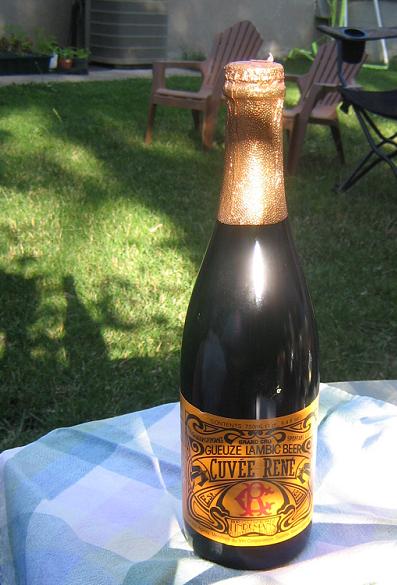
Very interesting and has triggered the posing of another question that I have already put to Lew Bryson about one meaning of the word “gueuze” which may be a red herring – which might in itself be a pun.

Transcendent Beer Blogging

My favorite blog these days is one from London about beer. Stonch has only been writing for a few months but his style is cheery and knowledgeable. Like me, he brews and hunts out new styles but unlike me he is much more in the centre of things beery. He also has a great eye for the photographic beery moment, including the one shown illustrating that you can take a cask of your own home brew on a train in the UK. Today he posted about the end of smoking in the pubs of England that came into effect yesterday and caught a celebrity moment:

Although the selection was restricted to bitters and summer ales – the curse of the English pub – everything was in perfect condition. The massive pork pies and cheese plates, served in lieu of dinner, win plaudits also. The Falkland even has celebrity endorsement: Patrick Stewart of Star Trek fame was sat at the next table to us. You can spot him in the background on one of the photos above. He wasn’t alone. Despite sporting a dodgy tache and white socks, he seems to have bagged a stunna. Well done, grandad.

Bagged a stunna. Excellent.

Chat For The Last Friday Closer To 2006 Than 2008

Yes, your life is flying by. The end of June is the end of the first half of the year, the year you still think of in the back of your mind as new. Time to get another hobby or make a greater change.

  • Update: freaky:

    Authorities said Thursday they are trying to determine who altered the entry on the collaborative reference site 14 hours before authorities discovered the bodies of the couple and their son. Benoit’s Wikipedia entry was altered early Monday to say the wrestler had missed a match two days earlier because of his wife’s death. A Wikipedia official, Cary Bass, said the entry was made by someone using an Internet protocol address registered in Stamford, Conn., where World Wrestling Entertainment is based.

  • I received a copy of a 1975 game called Pub Games of England and what a treat. Who know that skittles was created as an illustration of mass conversion of pagan Germans to the faith? Who knew that darts was likely created as a response to legal bans on all games but archery for military (and not moral) purposes – it’s just a small archery game with the target being a cask of beer? And who knew lawn billiards (or pell mell) was the game of the future?
  • Speaking of early games, please lend your support to Project Protoball.
  • Interesting to note the passing of the NPR show Radio Open Source. NCPR observed the passing of another attempt at substantive convergence in this way:

    So it is with very real regret that I report the end, for now at least, of his innovative and lively evening program Open Source. The producers were unable to put together secure funding to continue national distribution, and made the difficult decision to suspend production this week. Chris has been a great exploiter of both the countertrend —and unabashed intellectual in the age of dumbing down–and of the coming trend–building a radio program upon the swiftly shifting sands of a community of bloggers.

    The other posts this week were a bit telling – the lack of a MSM partner and the “old school” actual revenue stream as well as an odd choice for a celebration of the sort of substantive social community (SSC…as opposed to vacuous linking or LSC) that has never been triggered but has been much promised and, like the emperor’s clothes, observed. Maybe they’ll do a Lessig and declare they are going to reinvent cooking or home repair DYI.

  • In not unrelated news, the CBC has been shocked to discover that when you ask people to express what they believe in they will express what they believe in.
  • I don’t even like the NBA but am happy to see that Demetris Nichols is a Knick.
  • This is a good court ruling by the US Supreme Court in the Panetti case: do not execute crazy people. But it does make you wonder about the death penalty in terms of the idea of purpose – other than general deterrence – which is sort of captured in the description “a defendant who is to be executed be able to recognize the relationship between his crime and his sentence.” But if I am dead…I can’t recognize that relationship. But nuttier is the objection by Clarence Thomas who called the ruling “a half-baked holding that leaves the details of the insanity standard for the district court to work out.” Well, seeing as there concern that the door is open to false claims of incompetency, shouldn’t the lower trial courts assess each case? Or is there a suggestion in the dissent that mental illness isn’t real? Interesting to note that Anthony M. Kennedy has decided to become Mr. Swing Vote instead of Mr. Fourth Conservative Near The Back.

That’s it for now. I have to go Xmas shopping.

Sour Beer Studies: Duchesse De Bourgogne, Verhaeghe, BE

Why did I pick another Flemish Red so early on in these Sour Beer Studies? I think I am still wary of those dry lambics in the stash and Stonch has spoken so highly of the style that I thought what the heck.

First thing to note is that is this a beer that was kept on the wood as well so could be a cross over post to the About Oaked Beer series, too…so I will. Then, interesting to note that Michael Jackson claims the Verhaege family (no latter “h” in my 2000 edition of his Great Beer Guide) has been brewing in Vichte since the 1500s and that this beer is brewed in oak vessels dating from the 1880s. The brewery’s website is in Flemish but I once worked in Holland and like to pretend I can hack my way though. Well, I can’t really (though I know Smaak: zoet-zurig, fruitig means “Taste: sweet-sour, fruity”) but there are plenty of photos on their history page including those big oak vessels. 4% of BAers do not like it but they really do not like the style which makes it difficult even if it is honest.

The beer pours deep chestnut with a quickly resolving tan head. On the pop of the 750 ml cork top there was a whiff of candy floss that dissipated leaving the aroma of sweet cherry candy and balsamic vinegar. A soft and still sourish ale in the mouth but by far the most approachable I can remember trying. Plenty of fruit and sweetness like a Polish cherry wine but under layers of soft water and a hardwood veneer of a more dignified sort than your average rec room panelling. Somewhat like sweet Cinzano, too, with herbal notes of rosemary and thyme. Far less sour than the Panil Barriquée that I tried a few weeks ago. A slight dryness right at the end in the middle of the tongue. I want to braise fennel root and lamb chops in it.

Funny to find myself thinking it but this beer could do with a wee boost of sourness. Maybe I am getting the hang of this stuff after all.

Is Clemens A Bust?

Watching the Yankees die a thousand deaths this year has all the delicious splendor of that day and year and decade when the Montreal Canadians watched Patrick Roy let in nine goals, tell the owner, GM and coach behind the bench that he was never playing for the loser club again and get traded to Colorado where he went on to confirm himself as the greatest goalie of all time. Of Roger’s outing last night against the lowly Orioles, the NYT’s story this morning begins:

It feels like falling off a cliff, Joe Torre said Wednesday night after another loss, and the metaphor is appropriate. The Yankees had reached a high point before this trip, but suddenly they are plunging to depths never experienced in Torre’s 12 years as manager.

Nice to see that it was eastern Ontarian Erik Bedard for Baltimore who shut down the opposition. Clemens, on the other hand, is now 1-3 with a 5.42 E.R.A. in his four starts.

Why do I care? Is it always good to relish the failures of the great? Wouldn’t the world be a better place of Clemens wages originally estimated at around a million bucks a win (now estimated at five) had gone to a worthy cause…like minor league player development? Is there any hope for my prayers to be answered and the final AL East standings ending up Boston, Baltimore, Tampa, Toronto, New York?