Author: Alan
Boycott!!!
The exceptionally well-named Yates on the States, the tale of a family man from Manchester, England living in Minnesota, has raised this banner. It leads to an interesting consideration of the global brewing industry.
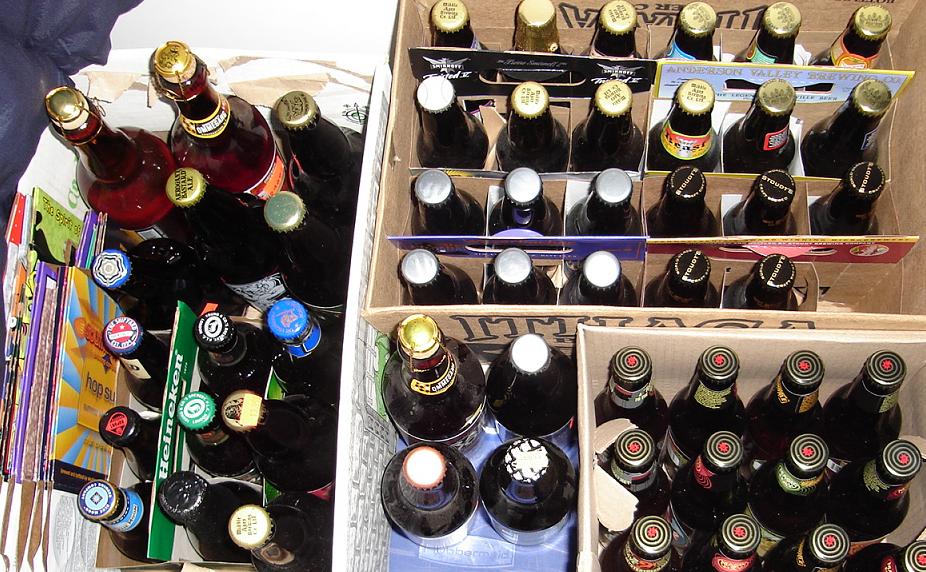
Yates’s complaint is that cask conditioned Boddington’s ale will no longer be made as the Manchester, England factory – the Strangeways Brewery – that makes it is being shut by its Belgium based parent, Interbrew. For 200 years, Boddingtons has only been made at Strangeways. From what I read, I understand what is at risk is the cask conditioned version of the brew, the real ale with live yeast in it, as opposed to the industrial kegged or canned versions with forced C02 carbonization we see on our shelves around the world. As a general rule, real ales take time to make, do not travel well and, if they do travel, they are expensive, like the six bucks Canadian I pay for a quart of Rogue. Kegged and canned beer is built for the tractor trailer ride.
If my reading on the brewing industry has taught me anything it is that mergers and consolidations have been the stock in trade for brewers for ever. I noted this as a complaint in my review of Martyn Cornell’s excellent Beer: The Story of the Pint but now I see it as simple reality, the nature of the flux in one end, the industrial end, of the industry. Consider this. I go to check the Interbrew website and the company itself has consolidated and is now called InBev, which is about as imaginative as LiqCo or HoochInc. It brews 13% of the world’s beer. It owns the Keiths I drank as a kid but which now gives me the willies when I smell it, the Rolling Rock in portland’s fridge, and the Hoegaarden and Leffe which have both been praised here. On the one hand, if it were not for the efforts of Interbrew, I would never have tried brews like Boddingtons or Leffe. In fact, the LCBO shelves are stocked with many InBev products, making the purchaser’s job an easy one. On the other hand, I would have had a chance to try other smaller brands since killed off in the churning mill that is the merger game – but only if I travelled to where those products are made. So, when brewery mergers kill off your local favorite, either an entire brand or a real ale version of it, it is an actual but local crisis; when it adds a great new style to your shop, it is a blessing but, really, only as a start to new hunting when travelling.
The conundrum of standardization and globalization. I will leave it to you to consider Yate’s call when deciding what you reach for when you reach for a beer.ill leave it to you to consider Yate’s call when deciding what you reach for when you reach for a beer.
You Need Corn Bread
It is as simple as that. If you are to make ribs and coat them and soak them and let them come into their glory over six hours at 250º F., you should also make one of those thick savory batter corn breads that you pour in a greased pan and pull out just before setting the table. Mine includes green onions, sour cream and cheddar. Send a sase for the recipe.
Can’t Wait For Tomorrow?
CNN has some interesting but, upon reflection, oddly voyeuristic animations of streets and streets of the houses of others being flooded by Hurricane Rita.
And, yes, they are SFW. Who do you think I am? Master Flea?
CBC Lockout Update II…XIV…XXXVIII
I read John Gushue in St. John’s every morning on the CBC lockout situation just as I read him every morning before. He certainly puts a human face on the situation as well as a fairly neutral presentation on events. But, underneath all that neutrality, what strikes me from all this is there is absolutely no plan from management to improve anything with the CBC services that do, as some more fiscally conservative than me point out, draw a fairly significant amount from the public purse – though pennies a day to each of us.
As we are not locally serviced by CBC radio – not by even a bureau – the St. Lawrence Valley of Ontario is perhaps not as shocked as places like the North where my undergrad pal and fellow crow Dave White (now only a Google cache) hosts in Yukon or in the Maritimes where the economy or interests practically bar the development of robust independent news services. But still, for all this disruption nationally, it would be nice to have the slightest clue that there is a basis in service rather than labour relations justifying the lockout. It is odd as a Canadian to watch from time to time when the BBC explains itself and its future plans to the British public or listen to NPR do phone-ins on what the audience would like to have presented. Sometimes I think that CBC management treats the audience like a sector of its labour force, needing only to be told what’s good for it.
Polish Deli
When we worked in Poland in 1991, Ellen and I lived on the Baltic coast. Yesterday I went to the “Baltic Deli” on Days Road here in Kingston and it was a bit of a trip back. At the time I was preparing to go east 12 years ago this month, people were concerned I would starve, that the myths of the pervasive Soviet foodlines were true. While it would have been prudent to carry your own stock of peanut butter into Russia, life in a Polish resort town was pretty sweet in the culinary sense.
Once, at the farmers market – where Siberians who had travelled for days by train sold white fox pelts you could buy for Polish zloty – my fellow teacher Kay Batory [of the Kracow Batorys, who opened for the Bay City Rollers, who drove to Poland from England including over an East German cobblestone highway] and I found a little granny, a babka, with a couple of jars of pickled mushrooms and one softball sized smoked ham sitting in front of her. We did not care if it had hung in her old stockings over a candle for months – it was like eating butter. Yesterday, I found a very good approximation at the “Baltic Deli”, smoked pork tenderloin sliced paper thin as paper. They also have chleb, Polish rye bread, and the little foil packs of spreadable cheese which come in different flavours but are all pretty much labelled ser zloty. These may come out of large industrial plants in gloomy suburban backwaters – but they are still tasty. Oddly they often have the whole address of the manufacturer on the front of the label in case I want to mail them thanks for their tastiness to
LACPOL
PHZ SM sp. z o.o. Warsawa
ZAKLAD W TORUNIU
ul. Podgorska 6/10 Polska
I am also assured by the wrapper that it is lagodny. Surely there is some room even in Naomi Klein’s world for a wee bit of branding here. Best of all they have a supply of a smoked paprika sausage which is the key ingredient in bigos, a hunters stew of their version of saurkraut calledkapusta, wild mushrooms and various meats. Not to be consumed on a first date. My first big breakthrough in Polish was reading a sign at a diner in Koszalin which said their bigos wasdomovy – homestyle! Pass the chleb, babka.