Maine: Interlude 2007, Allagash, Portland

Twenty-four bucks? What was I doing last decade? I have only a few of these aged big bottles left. I gave up a long time ago on trying to keep the cellar up. One of the few beers left from the days of glory, the era of beer blog ad revenue. I was throwing around the cash like a madman. Pretending that I mattered like some current era communicator. Stan actually mocked me about this beer in particular. But that was back in the day when folk weren’t questioning the fleece. Or at least when 2000 brewers weren’t making something good and sour for half the price. You know, the 75 comments under that post from some pretty interesting names are all… pretty interesting – but it’s as if they thought we would all be drinking $60 beers by now. Really? How did that turn out? Market forces thought otherwise. Bulk fine craft FTW!

It’s 40º C out there. Seven week drought might end tomorrow. Worst summer for rain since 1888. Nutty. I just need a reasonably interesting beer. I just need it not to suck. I pulled it out of the cellar, stuck it in the fridge by the orange juice and the milk bags. [Canada. Go figure.] Hey… it doesn’t. It’s good. Still and a bit thick but in no sense off. Fresh with a lighter lingering finish than expected. The colour of aged varnished pine. An orange hue at the edge. On the nose, warm whisky sweet with autumn fruit, brown sugar and grain as well as a fresh Worchestershired yogurty hum. Pear and fig. The baked fruit crisp you dream of. The second half pint pour generates a lovely subdued tang when rinsed about the gums. Like 90% barley wine with maybe 10% old gueuze. Or less. Just a hint. And all those whispers of rich deep malty grain huskiness still there. Lovely.

Am I glad I spent $24 for this nine years ago? I’m sure I don’t care. Do you know how much I have spent on diapers and winter tires since then? It makes me want. And I just want a thick bacon sandwich. I have asked a child younger than this beer to bring me a chunk of the slab of Vermont cheddar we are working on. Fabulous. Rewarding. The espresso of a grain field. Big BAer love and deservedly so.

Session #114: I Know Nothing About Pilsner

This month’s edition of The Session sees Allistair Reece asking us about pilsners.

I know zippo about pilsners. I never went on one of those five-day long weekend holidays to Prague that made me a drive-by insta-expert. I never lived there spreading the cultural imperialism of English as a Second Language either. When I was teaching overseas after university standing before a group of sweaty ignorant teens in 1991-92, I went to northern Poland and drank Gdanski. So I can tell you all you might want to know about tripe soup and how to say bad words in another Slavic language. When I worked in Aalsmeer in the Netherlands in 1986 I drank a lot of the local big named stuff – Grolsch, Amstel and Heinekin – and even learned how to pronounce the first one “[hork]-rols-[hork]”… but I am not sure that is what Alistair is thinking about. It’s not like I pretended. When I needed Czech-based pilsner content, Evan wrote a post. Why pretend? It’s not that I haven’t experienced beers branded as pilsner. But I’ve never heard the mermaids sing about it. Is it maybe that pilsner gets lost in the shuffle of the more generic “lager” thing now and in the past? It has suffered indignities at the hands of craft even when others make honest efforts.

You know, in 2006 I made something of an admission when I wrote “I just can’t imagine when I am supposed to crave steely stoney dry grassiness.” Is that it? It’s just not my thing?

Session 114: I Know Nothing About Pilsner

sessionlogosmThis month’s edition of The Session sees Allistair Reece asking us about pilsners.

I know zippo about pilsners. I never went on one of those five-day long weekend holidays to Prague that made me a drive-by insta-expert. I never lived there spreading the cultural imperialism of English as a Second Language either. When I was teaching overseas after university standing before a group of sweaty ignorant teens in 1991-92, I went to northern Poland and drank Gdanski. So I can tell you all you might want to know about tripe soup and how to say bad words in another Slavic language. When I worked in Aalsmeer in the Netherlands in 1986 I drank a lot of the local big named stuff – Grolsch, Amstel and Heinekin – and even learned how to pronounce the first one “[hork]-rols-[hork]”… but I am not sure that is what Alistair is thinking about. It’s not like I pretended. When I needed Czech-based pilsner content, Evan wrote a post. Why pretend? It’s not that I haven’t experienced beers branded as pilsner. But I’ve never heard the mermaids sing about it. Is it maybe that pilsner gets lost in the shuffle of the more generic “lager” thing now and in the past? It has suffered indignities at the hands of craft even when others make honest efforts.

You know, in 2006 I made something of an admission when I wrote “I just can’t imagine when I am supposed to crave steely stoney dry grassiness.” Is that it? It’s just not my thing?

Could Cream Beer Actually Be Cream Beer’s Ancestor?


…by “handsome” I presume you mean the “other” one…

Here’s the thing. There is only so much I can lay out to support this idea so I might as well do it and admit that it is something of a reasonable hypothesis. To be fair, I rarely take a position that I can’t later extract myself from. I am squidly like that. But today I am almost extracting myself at the same time I make the assertion. Which assertion? That cream beer in 1820 may well be the forefather of cream beer today and that neither has anything to do directly with cream ale. Three people worldwide just fell off their chairs. How did I get there? First, I submit two biographical statements for two people – John and Mary – who were each children of German-American immigrant brewers, Philip German and Christian Frederick Haas:

…GERMAN, John W., was born in Harrisburg, October 27, 1851. He is the son of Emanuel S. German, who was born in Harrisburg in 1821, whose father, Philip German, a native of Germany, came to Harrisburg in 1800, and established a brewery, celebrated for its “Cream Beer,” and conducted it for many years…

…Mrs. Maltzberger was born in Zanesville, Ohio, where her father had removed in 1833. He was a native of Germany and emigrated to America early in the nineteenth century, being a brewmaster by trade, brewing what was known in the early days as cream beer. While in Zanesville he purchased much valuable real estate, and owned a brewery, and hotel. He was a very prominent man, and was highly esteemed by all who knew him…

If you go to page 1219 of this text you will see that Mrs. Maltzberger was named Mary and her father was Christian Frederick Haas. Both Haas Sr. and German Sr. come to the young United States early in the 1800s, establish a cream beer brewery and do very well. Convinced of anything yet? Me neither. So, let’s look at this passage from the April 1900 issue of The Pennsylvania-German a magazine “devoted to the history, biography, genealogy, poetry, folk-lore and general interests of the Pennsylvania Germans and their descendants.” At page 42 in a travelogue piece, we read the following:

In Nantucket it is safe to address every man as captain, and his return salutation, if he wishes you to enter his home, is “Come aboard.” So we say. “get aboard,” and let us resume our journey westward toward Middletown, so named because it was midway between Carlisle, then an outpost, and Lancaster. Leaving the centre square, we cross the Conoy Creek, which empties into the river at Bainbridge, and gives its name to one of the townships. That old brick house, just across the bridge, used to be Pfaff’s brewery, where cream beer, or Lauderschaum, was brewed more than half a century ago. It was a pure malt, wholesome and non-intoxicating. The art of making is lost, for you see none on the market.

OK, so again cream beer is placed in the early 1800s in a German immigrant context. It also now has a German name, Lauderschaum. I am advised that schaum is German for foam. Based in part on this incredibly detailed essay on the word lauter I am going to suggest that the lauder- in lauderschaum in fact lauter- and means “pure” or “honest” or even “only” which makes cream beer pure honest foamy beer. Buying anything yet? OK, how about this. It is a memoir of a gent, George Farquhar Jones, who lived from 1811-1887 in both Providence, Rhode Island, and Philadelphia and contains this recollection at page 231:

Rich, cool, in Pennsylvania and no longer in existence when the book was published in 1887. Hmm… Another? OK, look at this:

It’s another passage from a second memoir – this one about one Colonel James Worrall, Civil Engineer. He lived from 1812 to 1885 and in that passage above was recalling his youth in Philadelphia. Cream beer was “cool, creamy, not bitter, plenty of malt.” Sounds familiar?

All five sources use the term “cream beer” in relation to Pennsylvania in the early 1800s. Two reference that it’s malty and not bitter. It’s lower in strength. If we go back and look at the notes on Perot’s brewing logs for 1821-22 we see that the draught beer they are brewing is lower in hops and likely lower in strength. Both these records and 1820s notices from New York City indicate that it was considered rich. I am going to declare that it was a thing based on the above. Here’s another thing. Kevin Gibson in his 2014 book Louisville Beer: Derby City History on Draft states that the City had cream beer which became known as Kentucky Common later in the century after it evolves locally to be made with corn and caramel for colouring. It was associated with German breweries, was light in alcohol and lacked bitterness. Remember Mrs. Maltzberger up there? Her father immigrated internally too, bringing his brewing and maybe his cream beer to Zanesville, Ohio, too, where he established the American House Brewery. Like the German brewer in Harrisburg, Pennsylvania around 1800 and the ones in Louisville, Kentucky, a bit later in the 1830s Christian Frederick Haas struck out for the interior to set up shop.

Which is interesting and, if correct, sets cream ale a bit adrift on its own course. If we recall, cream ale shows up in newspaper notices in the Hudson Valley in the 1830s. John Taylor of Albany takes it on and, by 1839, is selling an imperial cream ale. Taylor is a hugely successful ale brewer which is no way dependent on the German tradition. The sign proclaiming “Taylor’s Cream Ale” scars Albany’s waterfront skyline as early as 1841. His beers, like most others in the city, appear to be a different thing – big Anglo-American ale bombs – certainly when compared to lighter Teutonic cream beer awaiting its co-national lager to show up care of George Gillig in the early 1840s. Each goes on and traces its own route west – and even north as we see above – as part of the American story, evolving and lasting well into the ensuing decades and centuries.

Could it be that each happily just latch on to the adjective oblivious of the existence of the other? Could be. Could be.

Francis Perot Brewed 116 Times In 1821 to 1822

perotlog1821dftbBrewing was seasonal in the early 1800s east coast towns. You see it in the Vassar logs from Poughkeepsie NY and again with the brewing logs of Francis and William Perot of Philadelphia of 1821-22. Ed Carson was good enough to scan them last fall and I am drawn back to them by
this question about what “cream beer” might be at that moment. That “B” up there is potentially very important. “Cream” is a word that gets used in a number of ways in brewing over the years so being fairly tight on what is being described is a good approach. In this exercise, I am trying to think about what it meant attached to “beer” in Philadelphia and also NYC in 1820 to 1925 or so. It is clear from the newspaper notices discussed last time it was (i) a novelty, (ii) desirable and (iii) local to Philadelphia. But what else can this year’s worth of notations tell us even though “cream” is never mentioned?

First, who is Perot? Highlighted above is the first log entry for the 1821 to 1822 season from the brewery of Francis and William Perot. Francis becomes quite accomplished. He was known for his cream beer.. His summary biography states:

Francis Perot (1796-1885) was apprenticed in 1812 to the 5th and 6th generations of Morrises (Thomas and Joseph). In 1818, Perot started his own brewery and malt house on Vine Street between 3rd and 4th Streets, bringing other family members into the business and marrying Elizabeth Morris. The Morrises turned their business over to Francis Perot. T. Morris Perot and Elliston Perot represent the 7th and 8th generations in the business — an unbroken line of descent in the business.*

More needs to be written and researched about Perot. For today’s purposes, we can stick to this one brewing year’s worth of log entries. I will post the log pages is a bit for purposes of your rebuttals and accusations but for now I see the following:

=> In 1821-22, all but one of the 87 brews of draft beer are noted as “home consumption.” But his ale is either mild (1/3) or “long keeping” (2/3). One batch of draft beer is shipped to Virginia;

=> As Ed pointed out, “the “Dft B” is less hoppy with 1 lb of hops to 3-5 bushels of malt, while the ale is .5 to 1+ lbs per bushel. And the Porter is the strongest with a hop rate of 1 to 1″;

=> In addition to the 87 batches of “Dft B” they brew twenty-one of Ale and eight of Porter. Like the Ale, their Porter has notes as to whether the batches are mild or for long keeping. They also each have, for certain batches, the notation “hops boiled twice”.

=> They brew doubles and singles off a single batch and in some cases three separate runnings. They appear to be kept at least initially separate as they are accounted for by number of barrels of each.

=>The log records that 57% of the bushels of barley went into the “Dft B” but it accounted for 75% of the batches produced. I have to count up the barrels for each batch as Perot does not total them but they do not appear to skew to the same ratio. It may well be that it is beer is lighter in strength than the Ale and Porter. Gotta do a bit more looking at that…

What to make of it? In the summary page, Perot uses the full term “Draught Beer” as opposed to “Porter” and “Ale” but what is odd is that low hopped brewing results in the “beer” which is the opposite of the normal usage of the word, isn’t it? By fifteen years later, we see regular ads for “cream ale” but at this point whatever is coming out of this Philadelphia brewery is called beer, looks like what gets called “cream” beer – and it has half the hops of their ale.

Later: The 1821-22 Perot Logs

Page 1 and 2 – 19 Sep 1821:

perotlogpage1a

perotlogpage1b


Page 3 and 4 – 1 Nov 1821:

perotlogpage2a

perotlogpage2b


Page 5 and 6 – 18 Dec 1821:

perotlogpage3a

perotlogpage3b


Page 7 and 8 – 24 Jan 1822:

perotlogpage4a

perotlogpage4b\


Page 9 and 10 – 23 Mar 1822:

perotlogpage5aperotlogpage5b


Neato. There is plenty more to write about. As far as I can tell there may be five “creams” in US NE brewing history: pre-1825 Philly cream beer; 1835-1860s Taylor-style cream ale; 1860s-1910 cream ale; post prohibition cream light lager like Genny Cream; and craft cream… whatever that is. Much more work to do to see if that is right or if something else is going on.

*Cited this way in the family papers: “Information from: “A Condensed History of the Oldest Business House in America – The Francis Perot’s Sons Malting Co. of Philadelphia.” 1890.”

Cream Beer Before Cream Ale In 1820s New York City

nygaz30oct1821Look at that. Just look at that. It is a notice in the New York Gazette from 30 October 1821. James H. De Lamater had brought in a supply of Larer’s Superior Cream Beer. Imported by the sloop David. Shipping is not any sort of surprise. Beer and ale was shipped all over the place by the Georgians. This beer, however, is likely being brought in to NYC at this time as this is the era when the good water started to disappear. The 1820s were the decade when “the remaining wealthy residents fled.”

Last fall, I wrote about how “cream ale” began to show up in some ads in the 1830s in New York City and Albany. But here is that word cream again from the outset of the previous decade – and this time describing a beer, not an ale. There appears to be four breweries by the name “Larer” that operated out of Philadelphia from 1805 to 1843. This beer comes from the second, the Melchior Larer & Son John Brewery. Lamater’s address, 9 William Street, is still there. Down in the southern tip of Manhattan amongst the towers in what was the original Dutch settlement. Now have a look at these notices from a few years later.

nyevenpost10dec1823

nyevenpost30oct1824

nydailyadv30dec1826


To the left, there is an ad from New York’s Evening Post of 10 December 1823. G.W. and W. Smith, brewers at 131 Chatham Square, promise that their “Fine Cream Beer” is similar to that of Philadelphia. In the middle we see a year later in the 30 October 1824 edition of the Evening Post that G.W. has lost his partner “W.” and relocated to the corner of Anthony and Broadway but he assures that his “rich Cream Beer” is still similar to that of Philadelphia. In the right hand notice, one Thomas Smith brewing out of James Street placed a notice in the 30 December 1826 New York Daily Advertiser offering his Double Ale and Cream Beer.

So, in the first bit of the 1820s, “cream beer” is a thing in both Philadelphia and New York. There are a few things to note other than the Smith-centric nature of the stuff.* Notice how, as far as I can tell, “cream” in this use is the first time I see a quality of beer – as opposed to a technical aspect as in double ale – being used in the classification of the beer. In 1798, NYC notices for porter could describe it as “ripe and brisk” but it is not “Brisk Porter” in the way the drink in these notices are consistently offering “Cream Beer” along with other known styles like. Notice also how it is “rich” and “fine” in the descriptions. The three adjectives would be conveying meaning to the buying public. Just as “ripe” and “brisk” would have to those earlier Federalist porter drinkers of the 1790s clinging on to the British style, if not her Crown. It’s also likely not the later cream ale, either. Folk could tell a beer from an ale in these days. Nothing to do with Genny Cream either. It was a new thing – a nativist beer for the post-recession era, the promise of the Era of Good Feelings fulfilled in a glass. Was it the first truly American beer?

*Another Philadelphia brewery that ran from 1832 to 1888 was started by a Robert Smith, a Londoner who trained at Bass – according to Rich Wagner in his excellent Philadelphia Beer. Francis Perot born of brewers who himself began brewing in 1818 was known for his cream beer, too – “far and wide.”

“…In The West Indies And In The Southern States…”

albgaz03april1820albanyaleformerfame

That is from the 3 April 1820 edition of the Albany Gazette. Harkening back to an earlier era when Albany ale had a reputation – “a great and high character” – in the West Indies and the southern states. I think this both confuses and confirms a number of things. Not sure. It’s located in the schedules to a report of the Commissioners appointed to devise a plan for improving navigation on the Hudson river. It’s in a list of products that could be shipped were the river just improved. So, yes, it’s about a bit of the brag up – but it’s still a curious thing:

1. Who was brewing the better beer before 1820 that was called Albany ale? Le Breton only posted his first ad in 1803 and it’s two years later when “Albany ale” was used for the first time as far as we knew when the book was written. Is 17 years enough to justify such a harkening back to an earlier era?

2. Who was shipping it to the West Indies way back in that golden era? We know that NY City brewed porter was shipped to the West Indies in the first years of the 1800s but did we know that about Albany ale?

3. What’s the dip in reputation? In an article in the Albany Argus about LeBreton passing through town in 1822, we are told “the repuation of the Albany brewers has long been established in New York.” Does the report writer mean that the West Indies markets were lost as opposed to the beer went off?

This is obviously a plea fro Craig and Gerry to pipe up and have a think. Is this just the same old 1820s river navigation improvement consultant talk? Does it just relate to the general post-war economic decline? Or does it actually mean something specific?

The Dreary Reality Of Those Disclosures

Even starting to type this post initially weighs upon me in my pre-coffee haze.* Really? Has it come to this? Thinking about beer writing again? I suppose I am somewhat insulated from the quandary by being well past it. Few people consider the comfy role of the post-popular writer. Sure, it is as much a self-imposed circumstance as one caused by market forces but I am decidedly not as interested or interesting as I once thought. Yet… does this not also free me up? I mean, I actually like to think about ethics, having written codes of conduct and advised regularly on how to keep on the right side of many lines. Actually, you know, working with the stuff. Still, I’ve liked to keep away of such things around here… at least since around 2008. Haven’t I? But, then, Jessica and Ray today sent out a newsletter this morning which contains this:

A couple of newsletters ago we wrote about disclosure, advertorials and so on, suggesting among other things that beer writers and bloggers ought to make a statement of ethics on their websites so that readers know where they stand. We’re pleased to say (though we take no credit for it) that a few such pieces have shown up since… You might not personally agree with the positions those writers or organisations take in each case but setting out a position is in itself an ethical act. Good stuff.

First ethical question. I am under the simmering impression that what happens in a newsletter is supposed to stay in a newsletter. While publicly shared with subscribers, it’s not pasted on the front page of a blog. But their newsletter isn’t like.. those other newsletters. It’s actually interesting. And anyway I take comfort in Canadian law that lets me post the content of others for matter of review and, especially, given I am citing and quoting for purposes of exploring an idea I am also comfortable that I could not be giving offense. But I did not ask permission. Out of a principle founded on the marketplace of ideas.

Which is an interesting turn of phrase. The marketplace of ideas. There has always been a sort of an Edwardian Olympics aspect to writing about beer – particularly since the advent of blogging over a decade ago. It has gurgled beneath this topic without the manhole covers ever being lifted. Because good beer is an accessible joy juice topic it invites amateur hobby writing interest. Because it is pleasant and compelling it drives the dreams of frustrated careerists. And because beer generates great gobs of money, it’s as ripe for allegation that the left pocket has been as directly sewn up next to the right pocket as any topic this side of knitting blogs – those hellholes of graft and corruption. Which is the core of the second ethical challenge: great opportunity lays all about us. And – given great names in beer writing have accepted exclusive sponsorship and content creation contacts from large breweries – not a hypothetical.

So, they often write disclosure statements as Ray and J’ rightly encourage. Great. If you had subscribed to the B+B newsletter you’d even know which great examples of these statements they linked to. I pass on spilling the beans on that. Not because they are not good examples but because they are just the start of your job as reader. What is great about these disclosures is they are big red flags with the words “Start a’Judging NOW!!!” pasted upon them. See, once you know who took the Carlsberg money or the flight to an personal attendance with Jim Koch then you know why the articles that follow are so often plump, dull and somewhat smarmy. Honestly, nothing is as bad as the post-disclosure post. As enthused as the plagiarist who lifted his text from Peter just back from Damascus. Laced with horrible conceits like “the colors in the morning were orange and magenta like a sherbet” – all combined with an earnest hope that somehow transparency creates nobility. It doesn’t really, does it. Just a bit more honesty. Like that honest dot of marmalade on the tie of the man who was just at the hotel’s breakfast buffet. The mark is upon it.

Me? I think of reading this sort of writing like I think of drinking a brewer’s beer. I don’t need to know the samey opinions and self-reverences of the brewery owner. Some see it as wizardry to cut and paste what’s offered but the fact is their either beer sucks or it doesn’t. It speaks for itself. Same with writing. I’ve seen economic development webinars which include Asheville consulto panelists so, having heard them, I now assume every story pitch on that town’s beer scene comes with a flight and a hotel booking. Similarly, once these disclosures are made – once the ever thin argument that “journalism has changed” is trotted out – from there on out the presumption that each post offers invention gets replaced with the expectation that somewhere a PR strategist munching on his morning’s toast is pleased. Another job well done.

Remember: there is nothing wrong with this. These days dabbling in boosterism for one sort of benefit or another is pretty much within the range called norm. Until this era too has passed** I say “Viva the Freelance PR Apprentice!” Welcome to the marketplace of ideas. Somebody has to do it, its a reasonable step to something else and not everyone can actually be original. Has my understanding of good beer ever been increased by a post-junket essay? Can’t think of when or how. But thanks to the disclosure statement I can place my expectations in the appropriate context as I start my reading. And it is all about me – we the readers get to judge, not the writer. Gotta be careful. Think of this, too. Will the opposite lift its head one day soon, a bit of benefit flowing to slag a competitor? Does it happen now? Bet the knitting bloggers do it.*** Now, that would be interesting. And to much the same effect. Just directed messaging.

*I picked this up, half written up after work. Edited it for niceness.

**Please let it pass so that the promised silver age of beer writing may begin.

***Knitting bastards.

Nigerian Government Questions Silly Beer Health Claims

Is it fair to say good luck seeing this sort of puffery questioned in North America?

The Council, in a letter signed by its Director General, Mrs. Dupe Atoki, listed some of the claims, which include that beer is not an alcoholic beverage and that if taken regularly and in moderation has many defined nutritional and health benefits and can indeed be part of a healthy life style. Other claims by the company also include that “beer consumption has therapeutic qualities such as prevention of kidney stones, increase in anti-oxidant activity in the body, reduction in the risk of heart disease and blood pressure management”. The government agency expressed its reservation that the claims “in effect suggest that beer is a health drink and have the potential to lure unsuspecting consumers into unwholesome consumption of the product”…

I kick myself often and especially when I don’t note down good sources of information – especially those that I will only realize later I need. A few weeks or months ago, Maureen Ogle tweeted a link to a very sensible medical article which described how the entire problem with health claims related to beer is that they were not holistic, that they did not seek to explain the entire set of effects on the arc of a drinker’s life. I saved it not. What was the point? I just end up shaking my head when beer consultant types make these sorts of claims. But it looks like the Nigerian Consumer Protection Council is taking it seriously and is on the track, investigating claims by Nigerian Breweries Plc on the nutritional, health and therapeutic benefits of beer consumption.

Signs Of The Panic Of 1819 In 1820s NY Brewing

Not the cleanest image but obviously something was up in New York in the spring of 1820 if we are to believe the New York Mercantile Advertiser of 13 May 1820. What was up was the after effects of the Panic of 1819, the high point of a depression that hit the US after the end of the War of 1812 in 1815 leaving Britain even less interested in helping its former colony as well as the end of the Napoleonic Wars which saw Europe less interested in American wheat. While the Whig and Federalist brewers are in or past their last days, some still seem to be relying on status to soak the marketplace. After all, this is old New York and not some Jeffersonian frontier. The reign of the patroons just a little up the Hudson still has decades to play out.

schencab31may1820pricedrop

nydailyadv15may1820ininglass

schencab16jan1820beercandles


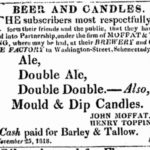
It goes both ways. Some elsewhere in the state did drop their prices as you can see in the ad to the left placed starting in December 1819, continuing deep into 1820. And people tried to barter with brewers like the guy placing the ad in the middle from the Daily Advertiser the same day as the meeting of the tavern keepers. [How much ale does 300 lbs of isinglass clear? And, come to think of it, I had no idea brewers in that era was worrying all that much about isinglass. Seems to put the whole “lager creating clarity mania” theory in perspective.] Hmm… and how about the brewer who placed the ad to the right, in Schenectady’s Cabinet, to advise he’s gone into business with a candle maker… although in a heroic effort to preserve the very elusive now extinct double double – clearly an ale quite distinct from the mere double ale. Trouble since Shakespeare’s day.

schencab02aug1820duanesburghYet, the future was now. Science was coming to agriculture in upstate New York. Ben Franklin’s dream of advanced husbandry which took a foothold in Philadelphia after the Revolution finally found fertile ground in the race west – even before the Erie Canal. See? The 1820 Duanesburgh fall fair was giving out prizes for the best acre of spring wheat. Twice the prize for the best acre of barley. Then as now – Duanesburgh looked to the future.