The Beery News Notes For That Post Canadian Thanksgiving Emotional Letdown

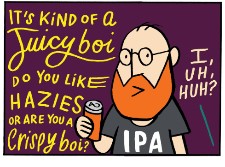
Actually, it’s been a good week this week. Forget that headline. While not at the level of “I’m a traffic cop in Spain under Franco and it’s Christmas so give me gifts of boozegood (as illustrated to the right) it’s been good.  Week off for yard work. And Monday’s Thanksgiving turkey came out of the oven in fine shape. We even had a last minute guest which meant we had to be on best behaviour and, get this, I couldn’t even each over the table for seconds of stuffing bare handed. Sheesh. And my vote for the Cardinal* even tied my preferred runner up the Crow** so that worked out well. Annnnd it was heartening to see the fans of the Blue Jays not repeat past bad behaviour when the Mariners took the first two games on the road care of, in part, a great Canadian.

Where to begin? The past! Last Thursday after that week’s edition went to… well, after I clicked on “post”, Liam shared an interesting piece on the joys of finding an excellent set of observations from the past:

While trawling through newspaper mentions for old pubs for yet another historical project, I came across a smattering of repeats in numerous papers in 1908 of a piece of pubcentric prose under the title, ‘The Delights of an Old Alehouse.’ It really gripped me as I read it and brought out some of the emotions mentioned above, but it wasn’t in any way familiar to me which seemed odd, as it was extremely well written and clearly done by someone with a lot of talent. Luckily, at the end of the piece the author – Charles Hugh Davies – was credited as well as the source of the original publication, which was The Pall Mall Magazine. Some sleuthing and searching finally led me to the piece, which is actually just a small part of an article titled ‘An Essaie in Prayse of Beer’ which is a much broader love letter to beer, and especially old ale, as was hinted at in the excerpt I had read. I can’t find it in any other source (apologies if it has been covered by others and I’ve just missed it.)

Good work. Sadly, the hunt for information on line has become harder as sources are removed from public access. It’ll only become harder as A.I. search narrows what you need to know. Which really was the underlying point about brewing history that Pope Leo was trying to make the other day.

And Gary has been digging into the old records this week, too, focusing most recently on Old Vienna beer – both Ontarian and Ohioan – and some almost eerie machinations on the part of my personal hero E.P Taylor:

Since Ohio was ground zero to market Red Cap Ale and Carling Black Label beer made in Clevelend, it makes sense that Canadian Breweries wanted to add Old Vienna to the American portfolio, at least initially as an export. If Canadian Breweries bought the rights to Koch’s Old Vienna from the receiver, a potential obsacle to such marking would be removed. Presumably O’Keefe Old Vienna did reach Ohio, as it did other states in the north. in the 1950s…

While E.P. clearly had a thing for Ohio, there are still questions questions questions and he’s on the hunt. Fortunately there are also answers at least etymologically speaking! On “steaming“…

The word ‘steaming’ for being drunk stems from when people in Scotland used to circumvent Sunday licensing laws by taking to the water. Public houses were closed, but steamships weren’t. To be ‘steaming drunk’ made its way into public parlance.

Also on another aspect of the question of “what is history,Chalonda White of Afro.Beer.Chick posted about the meaning of National Black Brewers Day and how it is still not properly appreciated:

National Black Brewers Day isn’t just about history. It’s about continuity. It’s about connecting ancient African fermentation to modern Black ownership. It’s about giving credit where it’s long overdue. When I pour a pint on this day, I’m not just thinking about the beer. I’m thinking about the people. I think about the enslaved brewers whose hands shaped the recipes. I think about Theodore Mack Sr., who bet on himself when no one else would. I think about Celeste Beatty of Harlem Brewing Company, who became the first Black woman to own a craft brewery in the U.S. and did it with unapologetic Harlem pride. She turned her love for the culture into liquid storytelling.

In another context of the search for authenticity, Ron shared his experience of attending the Norsk Kornølfestival in Ålesund, Norway over a series of posts including breakfast photos as well as observations on framhouse brewing:

The house is a log cabin with one of those turfed roofs which are pretty common around here. Next to it is a roofed fire pit, where a cauldron of water and juniper twigs are bubbling away over a wood fire. They never brew with pure water. It’s always juniper infused. The farmer, his brother and a mate are doing the brewing. Occasionally, giving the water a stir with a long wooden stick. Mashing takes place in a stainless-steel tub. Though they have some wooden tubs to show us how they used to do things. Water is transferred in buckets to the mash tub. To which the malt is later added. No measurements, either of the temperature of the water or the weight of malt, are made. It’s all very casual. Done by eye and experience. While the mash is standing, we go off for lunch. Which is more potatoes and cold cuts. It fills a hole.

As a bonus, there was also some sensible maritial fest-going advice from Ron like when he made: “…some cheese and salami sandwiches to eat at the festival. I saw the price of the food they’re selling there. I’d never be able to look Dolores in the eye again if I paid that much for nosh.” As always, I am with Dolores in these matters. Less realistic is the news out of the GABF last week… if BMI is to be believed:

At Boston Beer’s annual GABF brunch Oct 10, it felt like a throwback to the heady days of early craft, an optimism that might’ve seemed defiant if it hadn’t had receipts from the night before. BA prexy Bart Watson opened the event by noting that despite the “gloom and doom” in craft, Thurs night’s crowd had produced a “lively festival” with “not a phone in sight.” Bart said “that’s the spirit we need to find – people connecting over great beer.” Boston Beer prexy Jim Koch echoed Bart, saying GABF’s opening “was an illustration of the creativity and vibrancy of the craft beer movement and our ability to evolve, change, add more layers to what we do.” 

You will remember Boston Beer, the firm that one is advised now makes 30% of its revenue from beer making. Clearly not part of the post-passion universe. More connected to the reality-based reality is Mike Seay who visited an old friend – a brew pub:

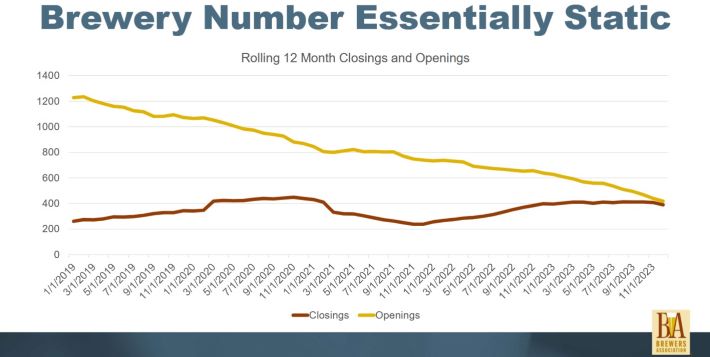
In this era of Craft Beer, with more places closing than opening, my area got a nice boost with the return of a local brewpub chain that is tied to the original microbrew wave in the 90s. That place is Sequoia Brewing in Fresno. It closed for a while, lost owners, and felt like it would not return. But it did return, with new owners. Thankfully. Brewpubs fill a gap for most of us beer geeks. The gap of having kids. Or a partner that isn’t into going to taprooms. With a brewpub, both can be happy. Food for the ones not really into beer, and craft-style beer for us beer geeks. Usually, brewpub beer rises up to a respectable level of beer, but not a “I want to buy this in a store” level. That there is the rub for us.

And (also) out and about but farther afield was Retired Martyn as well as Mrs RM who’ve (also) been looking for happiness care of a beer and a bite in Romania and found it at the Grand Café Van Gogh:

We’re in a modern apartment near the University, Romana a mix of youth and decay… Appropriately, the city is full of umbrellas, in Umbrella Street and the Grand Café Van Gogh which is one of Mrs RM’s ticks. Obviously those paintings aren’t all original Van Goghs, that would be silly, but they are high quality prints and this is the classiest place in Old Town by a distance. Big brewery beer, CAMRA would be appalled, but a black lager is matched expertly with…. Papanasi, your Romanian mix of doughnuts, cream and fruit.

I hope the service was up to scratch. I’ve done service – missed putting in the order, dropped the beer, invented “diming” to maximize the tips, took shit from the kitchen staff – but I never had to work it like a waitress. For Pellicle, Rachel Hendry discussed the role in pop culture and her own life:

What is it that you want from your waitress? Efficiency, charm, a smile, care, attention to detail, an attractive physique, a winning personality, a sense of humour, wisdom, empathy, experience—the list goes on! All of that flair! No wonder she’s so popular! But how much of a person are you really entitled to? The Waitress moves among her audience members, weaving her way past tables and into their lives. She works within her community—there’s that animation, there’s that exposure—performing for them as is the requirement of her work. How much should The Waitress give and how much should she restrain? How much are you paying for?

Excellent stuff. And from India, we learned there was much surprise on what people found out their drinks tab was paying for:

A liquor bill of a restaurant in Rajasthan has been going viral on social media. But why? Well, it levies cow cess among other taxes, including CGST and SGST. The tax, which was introduced in 2018 to support cows and cow shelters in Rajasthan, has triggered a debate online.  One user said, “As much as I want the welfare of cows (or all animals for the matter), I don’t understand the concept of cow cess.” Another said, “The irony is the Jaipur-Jodhpur highway, which is littered with cattle loitering on the road, making it extremely dangerous for commuters. Rajasthan govt is barely doing anything for the rehabilitation of cattle/cows.”

Sticking with news from India, there is a shortage of aluminum cans for the domestic brewing market that strict regulations are making worse, according to Jessica Mason:

Domestically, aluminium can suppliers such as Ball Beverage Packaging India and Can-Pack India, have revealed that they have already reached maximum capacity at their sites and will not be able to increase supplies for at least 6-12 months unless production lines are added or expanded in some way… At present, due to the QCO, the beer industry cannot import cans from foreign vendors as BIS certification can take many months to process. To avoid a shortage in beer supply, local reports have outlined that the BAI has lobbied the government for a “short-term regulatory relaxation” of its QCOs to ensure uninterrupted supplies from other countries.

Interesting then that Canada is courting India as a market for the supply of our metals. We make a lot of aluminum that could suppliment local production. If, you know, Mr. Trump lets us…

And then… there was much response to that nice light piece in the NYT by Mark Robichaux originally titled “Opinion – How to Save the Craft Beer Industry“*** on what US craft beer can do to save itself. Some sensible… (…maybe…) Others not so much**** or worse. Me, I wonder if  it can be saved as the taint of “your uncle’s drink” is now so well upon it. Not to mention the whole general slump of interest in booze thing.***** But what I liked most in the piece is how it makes an attempt too rarely seen with the general topic – an attempt to set out a reasonable argument. Four arguments in fact… of varing decrees of validity. The best one is the third of the four:

Craft beers also need smarter labels. The industry built its identity on personality, with quirky mascots, puns and inside jokes as logos. It was fun — until it became clutter and noise. My beer aisle now looks like a vertical Comic Con merch table. Today’s overwhelmed consumer doesn’t have time to decode a beer called Sour Me Unicorn Farts (a glittered sour from DuClaw), Purple Monkey Dishwasher (a chocolate peanut butter porter from Evil Genius), or Hopportunity Knocks (a perfumed, piney I.P.A. from Caldera Brewing Company). They want to know: What does it taste like? Will I like it? Design matters, yes, but clarity matters more. Make labels that tell drinkers what’s inside, not just what’s funny at 2 a.m. in the brew house.

Certainly a point we’ve heard, agreed with or disagreed with****** over the last few years. Consumers (not nerds, not trade staff, not beer writers) are not aided by in joke branding design. AKA the exploding bubble gum machine effect. But he misses the mark for me on issue #1 on the IPA problem, complaining that “…most taste like pine resin…” and not that anything that tastes like anything can be called an IPA now and that it loops into issue #3 above. Issue #2 is an observation on strong beer that is both true and also a bit dated by, you know, fifteen years. While it’s sorta true there’s plenty of beers being made which are not like that so, you know, buy those. Issue #4 is just a sensible observation that good beers should come in smaller cans… but plenty do.  One take away for me is this: if a reasonable writer and a reasonable publication like this is suffering from as serious a misunderstanding of the whole topic as a number of beer writers allege… have the last twenty years of public writing about good beer been an utter and too insular failure?

That’s it for now. Not as long as last week but that was nuts. While you beg for more more more, please also check out the below mentioned Boak and Bailey every Saturday and sign up for their entertaining footnotes, too. Look out for Stan when he feels the urge now that he’s retired from Monday slot… maybe … maybe not. Then listen to a few of that now newly refreshed Lew’s podcasts and get your emailed issue of Episodes of my Pub Life by David Jesudason on certain Fridays. And Phil Mellows is at the BritishBeerBreaks. Once a month, as noted, Will Hawkes issues his London Beer City newsletter and do sign up for Katie’s wonderful self-governing totes autonomous website featuring The Gulp, too.  Ben’s Beer and Badword has been on hiatus since April but the archives are out there with the all the sweary Mary! There is new reading at The Glass which is going back to being a blog. Any more? We have Ontario’s own A Quick Beer and All About Beer is still offering a range of podcasts – and there’s also Mike Seay’s The Perfect Pour. Plus follow the venerable Full Pint podcast! And there’s the Craft Beer Channel on Youtube. Check out the archives of the Beer Ladies Podcast. That’s quite good and after a break they may well be are back every month!

*The bird so nice they named it twice, cardinalis cardinalis!
**HARBINGER OF DEATH!!!!
***But then on Tuesday the title was altered to the less serious “Wacky Labels and Silly Names Are Killing Craft Beer” after an intense intimidation campaign by about 13 craft beer nerds that would have left even a Trump bootlicker impressed. Please don’t tell them about SNL’s non-non-alcoholic beer ad. Don’t make fun of poh widdle cwaft.
****Leaving out words like ““… as many have…” which undermine your point is not a strong move.
*****An interesting description of the loss of interest in booze can be found at UnHerd where “Is it last orders for German beer? Disaster is brewing in Bavaria” by Ian Birrell was published this week with this odd scene from Oktoberfest: “Not that everyone is into wellness. In one tent, I come across a lively group snorting what I presume was cocaine from the top of a bald man’s shiny head. One gives me a big grin as he sniffs deeply, then wipes his nose. Two tables down, another ebullient gang of pals pass around a mirror with chunky white lines laid out on it. Minutes later, I pass yet another high-spirited gaggle tapping small piles of powder onto their clenched fists.
******It’s good to have a good civil disagreement. Stan misses them.   I once recommended a client sign a document in addition to a contract called a “Letter of Disagreement” to clarify what was and wasn’t acceptable. They didn’t.

The Delightful Yet Pensively Penultimate Beery News Notes On A Summer’s Thursday For 2025

It’s been a busy week but not really in the beery sense. Guests and heirs have come and gone – and even bought a $14.99 beer on the way out via an airport bar at Montreal, as illustrated sub-wonderfully perhaps. A last bit of summer visting and the shedding of the last loonies and twoonies. Which means the home is quieter here at this end of the week compated to the other. Which is good. But quieter. At least I have my tomatoes. Did I mention my tomatoes? Definitely illustrated sub-wonderfully, that yellow one in the upper left weighed in a 1.7 pounds. And I did nothing to make it happen. Which is my favourite and most common form of success. Six varieties left to right ish clockwise: Chiltern’s Blue Bayou, Baker Creek’s True Black Brandywine, Chiltern’s Golden Sunshine, Baker Creek’s Kentucky Beefsteak, Chiltern’s Beefsteak and Baker Creek’s Orange Icicle. Picked from the catelog based on the “pin tail on donkey” method. All started from seed last winter and soon getting turned into sauce. That True Black Barleywine is the best tasting tomato ever – like it has built in balsamic vinegar. Thanks for tuning in to Tomato News Today!

First up in the world of beer, the Tand himself has also been out and about on travels and has reported back on the scene in Munich – and found out that certain things were not to be found:

Sadly, you can’t find Pils on draught anywhere, and for reasons best known only to themselves, Spaten insist on offering the dreadful Beck’s as their bottled pils in their most prestigious outlets. It appears Spaten Pils, which I recall was a lovely beer, is no longer brewed. A real shame.  In fact, Spaten it seems, only brew Helles in both normal and alcohol-free forms and, of course, an Oktoberfest. It gets worse. The whole shooting match of Spaten-Franziskaner-Löwenbräu-Gruppe is owned by AB InBev, who presumably have streamlined the brands available, though under the Franziskaner brand you’ll also find weissbier and a kellerbier.  Like Spaten, the rather delightful Löwenbräu  Pils has been dropped. It is a pretty grim picture as the odd hoppy pils provided an alternative to Helles, which in its Munich iteration, can be a little sweet, and dare I say, bland? (The locals call it “süffig”, meaning “easy to drink”. And, in fairness, it is.

And over at Pellicle, Matthew assumed the role of player / manager and reported on his travels to the French & Jupps Maltings in Hertfordshire where he found a hidden truth:

Its long history stretches back to 1689, and for more than a century the maltster has been based in the twin Hertfordshire towns of Stanstead St. Margarets and Stanstead Abbots, bisected by the aforementioned Lea, some 30 miles north of London as the crow flies. There are a few reasons for its relative anonymity—I myself hadn’t heard of them until I was invited for a visit in February 2024. One is due to the fact its malt was (and often still is) bought in bulk and rebagged by various distributors before being shipped out to breweries. And so, it might bear the name of a competitor—although in this context it’s perhaps more accurate to refer to them as partners—in the US, for example, the malt is typically sold under the William Crisp banner.

Sneaky sneaksters! Did you know? (Did I? Never mind that… let’s make this about you.) Did you??? Speaking of hidden truths, Pete Brown had a has retrospective on BrewDog, now well in to the post-Watt era and even into the post-Dickie, published in The Morning Advertiser that he unpacked into something of an obit:

To me, they always felt more like a band than a brand – not least because they wanted to be seen as punks. Bands are different. When none of the original members remain, many former fans insist that it’s simply not the same band any more, and that the newcomers who have taken over, singing songs they never wrote or had hits with, are no better than a covers band. The departure of Martin Dickie feels like the last member of the original line-up has left the building. The entity that remains may own the rights and assets of BrewDog, but it has lost the spirit and soul that once defined it… Dickie remained silent throughout. The initial allegations referred to a “cult of personality” built around both men, but specific personal allegations were focused on Watt’s behaviour. After Dickie’s departure, some former employees took to social media to say that he was “part of the problem.” 

Wonderful. I have never understood how Dickie, co-exec past and board member still, has had the teflon wrapper that he has enjoyed through downturn after downturn on what must be one of the most note worthy financial flops in recent brewing history. But perhaps it’s been a case of not noticing that scratch on your hand due to the nail in your foot.

Speaking of endings, Ed the Beer Father has shared his thoughts on the closing of Banks of Wolverhampton, mapping a fairly complex set of international bobs and weave that led to the end:

Eleven years ago the two companies with rights to San Miguel beer, San Miguel Brewery (Philippines) and Mahou San Miguel (Spain) signed a cooperation agreement to promote their international businesses and position San Miguel as a global brand. To further its growth they had already partnered with Carlsberg to contract brew it in Britain, and it was a large part of the output of the Northampton brewery. But for a brand with global ambitions partnering with the world’s biggest brewery seems like an obvious match… So, as what I believe is part of a global realignment, last year San Miguel moved its contract brewing in the UK from Carlsberg to ABInBev. Losing the San Miguel contract left Carlsberg in the UK, which owned one giant factory and two large regional breweries, with a lot of surplus capacity. The giant factory wasn’t going to go and Marston’s has the small pack facilities, which left Banks’s. So a contract change for a Spain and Philippines based international lager brand closed a 150 year old brewery in Wolverhampton that didn’t even brew it. 

Lordy. Speaking of things making one’s head spin, I totally missed Stan‘s post before the Labour Day weekend on the nature of beer bubbles so I will correct that error now:

There is more to monitoring beer foam than counting bubbles, although they are the foundation. They result from nucleation, and as those bubbles climb to first form or then replenish the foam head, proteins and bitter substances are carried into the bubble wall, forming a matrix that holds the skeleton together. In his doctoral thesis, “Beer Foam Physics,” A. D. Ronteltap calculated that a foam 3 centimeters high (a bit less than 2 fingers) in a glass 6 centimeters wide (a bit less than a Willi Becher) made up of bubbles with an initial radius of .2 mm (twice the width of a human hair) would contain 1.5 million bubbles distributed over about 100 layers.

Over a million bubbles! Not quite millions and millions but more than one million. And, while the numbers aren’t quite confimed yet, Jessica Mason pulled out the stats as she reported on the question “Can Gen Z save cask ale from extinction?” for Drinks Business:

Statistics from YouGov for the Society of Independent Brewers and Associates (SIBA) have shown 25% of 18 – 24-year-old beer drinkers regularly order cask ale. The figures mark an increase of more than 50% on the previous year… Digging deeper into the SIBA figures, there are also statistics that support the opportunity that women present in the future of cask ale’s revival. For instance, the data revealed how 22% of female beer drinkers regularly order cask ale, compared to 43% of men. But, as Corbett-Collins noted: “It would be great to see even higher numbers, but the glass half full fact is that men and women of all ages are enjoying cask beer.

Out and About Update: Max mapped a 29 km(!) pub crawl he took through the Czech countryside to plant himself in front of a beer at Únětický pivovar, Zdibský pivovar and Polepšovna ducha as well as a few other spots. I marched about a tenth of that the other weekend and my left knee let me know about it for more than one day. Good thing Max kept up a good pace because apparently, according to the white coated eggheads in the Netherlands, beer drinkers are a prime target for mosquitos:

To find out why the blood-sucking critters prefer some people over others, a research team led by Felix Hol of Radboud University Nijmegen took thousands of female Anopheles mosquitoes to Lowlands, an annual music festival held in the Netherlands… Participants who drank beer were 1.35 times more attractive to mosquitoes than those who didn’t. The tiny vampires were also more likely to target people who had slept with someone the previous night. The study also revealed that recent showering and sunscreen make people less attractive to the buzzing menace. “We found that mosquitoes are drawn to those who avoid sunscreen, drink beer, and share their bed…”

Speaking of getting bled, I received the alert from Will Hawkes: “Sorry to be right about this. No GBBF next year as it made ‘a substantial loss’, according to CAMRA.” As per usual and FOR THE DOUBLE!!!… Jessica Mason has more detail:

CAMRA chairman Ash Corbett-Collins explained how “at Members’ Weekend earlier this year, the national executive presented finances that painted a stark picture. As your chairman I was open with you; we were facing significant challenges… Corbett-Collins lamented: “Sadly, this means I must tell you that: The Great British Beer Festival and its Winter counterpart did not attract enough visitors to cover the cost of holding them, resulting in a substantial loss.” Added to this, he revealed that CAMRA’s membership figures “are simply not growing” and confessed that “the hard truth is we are unlikely to return to pre-2020 levels”… and noted how “the cost of running a membership organisation and business is also increasing”.

This is a pretty serious situation as it really looks like a broader issue than just the fests. The organization itself seems to be at risk. I expect more information to be flowing in the coming days.

In the “WAR ON SCIENCE” folder, we read the news out of The New York Times that everyone’s favourite slowly exploding head in charge of the Department of Health and Human Services has pulled the US government’s pending report on alcohol as part of a healthy diet:

Mike Marshall, chief executive of the U.S. Alcohol Policy Alliance, a nonprofit that aims to reduce the harms of alcohol, said H.H.S. was “doing the work of the alcohol industry.” “They’re burying the report so the information about the health consequences is not widely known,” Mr. Marshall said. Health Secretary Robert F. Kennedy Jr. has decried a “chronic disease epidemic” sweeping the country. But he has said little about alcohol’s impact on American health since taking office. Consumption of both alcohol and tobacco was absent from the first Make America Healthy Again report released in May. Mr. Kennedy (like his boss, President Trump) has said he does not drink.

It’s important to note that Mr. Kennedy, unlike his boss,  does not wear makeup preferring to gain his particular rusty orange hue through a natural process.

Finally, just before this organ went to press, the dynamic duo B+B posted a piece under the fabulous title “Customers Have Always Been a Problem for Pubs” which illustrates the truth based on a sppech given in 1933 by one Lieutenant Colonel E.N. Buxton, director of the East London brewery Truman, Hanbury & Buxton:

The talk finishes with a few more rebukes for the drinkers. First, the reason pubs often look so ugly, and are so sturdily built, is because “you do not treat them so kindly”. “Walls and furniture are roughly treated”, he says. “As for the outside of public-houses, I agree that some of the houses in London look perfectly ghastly. Hard wear, however, had to be the first consideration.” This was addressed, remember, to a room full of people from Bethnal Green. We’re picturing the crowd when Bertie Wooster sings ‘Sonny Boy’.

Fabulous. There. That’s a lot for a busy week but probably less than all the stuff our there to read so please also check out the afore mentioned Boak and Bailey every Saturday and sign up for their entertaining footnotes, too. Look out for Stan when he feels the urge now that he’s retired from Monday slot… maybe … maybe not. Then listen to a few of that now newly refreshed Lew’s podcasts and get your emailed issue of Episodes of my Pub Life by David Jesudason on certain Fridays. And Phil Mellows is at the BritishBeerBreaks. Once a month, Will Hawkes issues his London Beer City newsletter and do sign up for Katie’s wonderful self-governing totes autonomous website featuring The Gulp, too.  Ben’s Beer and Badword is out there with the all the sweary Mary! And check out the Atlantic Canada Beer Blog‘s weekly roundup. There is new reading at The Glass which is going back to being a blog. Any more? We have Ontario’s own A Quick Beer featuring visits to places like… MichiganAll About Beer offers a range of podcasts and there’s also The Perfect Pour. Plus follow the venerable Full Pint podcast! And there’s the Craft Beer Channel on Youtube. Check out the archives of the Beer Ladies Podcast. That’s quite good and after a break they may well be are back every month! Such is life. Such is beer podcasting and newslettering… which, as Ray says, are blogs! And he’s right.

Your Highly Organic Beery News Notes From The Backyard Raspberry Patch

Raspberries. I’ve let them run a bit wild but for about one week you get a pint or so every second day or so, coming in waves as long as the squirrels stay away… which they seem to be, thanks to the foxes. Speaking of pints, I bought beer last weekend. No, really. I haven’t really had much laying about time but I added to my tariff transition coping mechanism by buying a few cans of Miller High Life. Unlike Maker’s Mark and all the other bourbons*, you can actually buy Ontario-brewed Miller HIgh Life at the LCBO here without any accompanying pangs of disloyalty. An old pal, it was sorta not good on the first drink last Saturday afternoon but then – magically – it was quite quickly sorta not bad. I felt connected to something bigger.** Small pleasures.

Speaking of small pleasures, it’s also been a bit quiet on the beer writing scene. Very quiet. Is this what’s happening out there?

“Why are you banging your head against the wall?” asked Frog. “I hope that if I bang my head against the wall, it will help me to think of a story,” said Toad.

Never fear. It’s the end of the month this weekend so The Session is here. Hosted this month by David Jesudason who enticed and encouraged us all with his tale of an entirely foreign business model around my town:

I want to examine the growth of Yard Sale Pizza in London and what it says about the state of pubs in 2025. For those who have never experienced this recent phenomenon Yard Sale delivers to taprooms, pubs and bars around the capital in spaces that often don’t have a kitchen or can’t make selling food economical… The list of venues where you can use an app to get a pizza handed to your table is huge; I counted that Yard Sale is the only food option at a staggering 128 places. All of these 128 spaces tend to be indie and/or crafty…

Pubs with no kitchens meet a pizza chain with no retail face. Is that it? Me, I haven’t started writing but if I am honest I would likely fall into the equivalent of what looks like a gastropub as Laura discussed this week for What’s Brewing:

Since the term was coined in the mid-nineties, and popularised from the 2010s, I have sought to find the unicorn – a great pub with excellent beer and an uncommonly high level of food quality. There’s nothing wrong with standard pub grub, I enjoy it regularly, but sometimes I like a little bit of fancy. But finding a genuinely excellent example has been next to impossible, because I care about my beer. While there are many venues out there who offer an elevated menu, I have almost universally found their beer lists are distinctly lacking. You can have all of the locally foraged ingredients and nose-to-tail eating you want, but if you can’t choose a quality pint or bottle to pair with it, disappointment ensues. 

That is actually not a problem we face over here as what were once probably called craft beer bars have often had a side of good food to meet the exactly need that Laura has identified.

What else is going on? Sticking with that fair city, Will Hawkes shared the August edition of London Beer City and included the news about another angle on selling good beer that I really hadn’t considered:

Stephen O’Connor, co-owner of the Green Goddess beer cafe and microbrewery in Blackheath, chuckles down the line as he discusses the significant intersection of beer and bus enthusiasm. “There should be a Venn Diagram of people who are into buses, people who are into beer, and people who turn up to events like the one we’re running this Saturday…”  But isn’t it stressful driving a bus in London, anyway? “Well technically driving a bus is no harder than driving a car,” Stephen says, which may be true but I remain to be convinced. “The ones I drive are 30, 40, 50 years old, so they do tend to be a bit more challenging. But because you’re that bit higher, you can see what’s going on.”

I had never considered catering to bus enthusiasts. Mainly because I have never considered bus enthusiasm. We also learn from himself that the Dulwich Woodhouse has “unbelievably grumpy staff” and is expensive while The Alleyn’s Head is “a good-value option with a slightly oppressive atmosphere.

Possible related complaint driven note from 1898: “… he is not likely to waste his time mixing freak drinks with flashy names…” Zing!!

Esquire magazine published a history of events leading to the collapse of Schlitz, the brewer careful readers will recall, which was still the #1 US brewery with 6.92% of the national market in 1956 before much changed.***

The year is 1965. Thirty-four-year-old Bob Martin relaxes in his high-backed leather chair and exhales with satisfaction. His office, perched within the imposing headquarters of the Joseph Schlitz Brewing Company in downtown Milwaukee, hums with the quiet authority of power. As well it should for the guy who’s running the marketing department for “the Beer That Made Milwaukee Famous.” Schlitz is the second-largest beer empire in the world behind only Anheuser-Busch. And it is Martin’s playground, his kingdom to control. A secretary’s voice crackles through the intercom. “Mr. Martin, there’s an unidentified caller on the line. Won’t give a name. Says it’s urgent.” Martin frowns as he picks up the phone. A voice on the other end—flat, emotionless—says, “The baby has arrived and is doing nicely.”

The tale goes on to explain “It wouldn’t be the last time Martin used a fat stack of cash to cut a deal.” Hmm… in brewing? Whoever saw that coming?

Do you waste years of your life on social media reels watching people wander about Japan and finding cool places to eat? Me neither. But… I was moderately amused by this photo essay of the hunt for a beer garden on the roof of a multi-story car park in Tokyo:

He thought he might be imagining things, but once he got to the garage, there was indeed a giant banner advertising the “Tachikawa in the Sky Beer Garden.” He also spotted a few signs on the ground level doubly confirming the fact that beer and yummy things were just an elevator ride away… Next to the rooftop level button was a small visual for the beer garden. What exactly would be waiting for him when the door opened…? There was a particularly good-looking deal called the “Cheers! All-you-can-eat and all-you-can-drink course.” For 90 minutes, you can have unlimited alcoholic drinks, soft drinks, and five kinds of food, all for only 2,580 yen (US$17) per person.

WIse choice. Probably. Not utterly dissimilar, as part of the response to tariffs, Canada is taking on the task of reorganizing the economy with new vigour, including removing interprovincial obstacles to the beer trade. Careful readers will recall the Supreme Court upholding their legality in 2018 but, now, even if they pass muster they aren’t passing the smell test according to CTV News:

All but one province, Newfoundland and Labrador, as well as the Yukon are on board. Some brewers, however, say the trouble of moving beer across borders outweighs the benefits. “It’s probably not something that we would look to offer in the near future, based on the logistical challenges and the costs of shipping,” said Jared Murphy, co-owner of Lone Oak Brewing Co. in P.E.I. Beer is heavy, shipping in bulk is pricey and ideally it should be kept cold. For small producers, those are bigger problems, Murphy said. However, the plan could create opportunities for transport companies, said Christine Comeau, executive director of the Canadian Craft Brewers Association. She doubts it will move the needle if costs stay high. “I don’t think that it’s going to be a huge kind of market opportunity for us,” she added.

An in their footnotes to their Saturday news update – a feature to which you really need to subscribe – Boak and Bailey admitted a very clear admission:

Oh, good – Pellicle has an article about beer this week, rather than wine or cider or sausages or something. To be clear, we applaud the range of stuff they cover, but we’re really only interested in beer for the purposes of the weekly round up.****

What!!! Sausages or something?!? How focused. I have never been accused of being particularly focused myself. So happy am I to see that Pellicle is well into the something zone care of Anaïs Lecoq with something of an almost eponymous topic:

Daniel Price thought the same the first time he tried Brets in London, and ultimately decided to stock it when he opened Two Sevens Deli in the Suffolk market town of Sudbury. “We have chicken and beef crisps here [in the UK], of course we do,” he says. “But there is something about Brets poulet braisé that tastes just like the crispy chicken skin, and it’s amazing. Even the côte de bœuf has got a slight char to it, a sweetness and a savoury quality. It tastes like it should.” If the chicken flavour actually tastes like chicken, a simple look at the ingredient list will tell you why: potatoes, sunflower oil, flavoring, salt, chicken meat powder. 

Yum. I grew up in Nova Scotia where Roast Chicken chips which are forbidden to all other Canadians for some reason. If you are there and arriving here you will be packing Roast Chicken chips.

And there was some great reporting at the end of last week in the Financial Times on the financial mess that’s BrewDog which illustrates what I have long written about the idea of “independent” needs to dig into the debt obligations of breweries. Just look at the clarity concisely offered by the piece’s author, Dan McCrum, showing how BrewDog doesn’t really own BrewDog like you own that cat over there, given the 2017 deal with private equity outfit TSG Consumer Partners:

TSG ended up with 22.3 per cent of the company at an enterprise value of £895mn or, in dollar terms, a round unicorn billion… The change highlights the effect of the prefs’ entitlement to a compound annual return of 18 per cent at the moment of any sale, initial public offering, or liquidation, ahead of the other shareholders. BrewDog’s equity value had fallen to about £900mn, but TSG could then claim £520mn of that amount. The value of everyone else’s equity had fallen by three quarters. The theoretical value of the £213mn spent by TSG in 2017 has continued to grow at 18 per cent, passing the £800mn ($1.1bn) mark in April.

Eighteen Percent! Who borrows at eighteen percent??? I’ve had credit cards with lower rates of interest. Hmm… but in brewing? Whoever saw that coming? Relatedly perhaps… most likely I mean, Pub & Bar Magazine reports as follows:

Brewery and pub chain BrewDog has announced plans to close 10 of its bars as part of a strategic review of the business.  In a note sent to staff today (22 July), CEO James Taylor says the decision was made to outline a more focused strategy, including the rationalisation of its bar footprint to focus on “destination hubs” (large-format, high-impact immersive venues) and “community bars” to drive long-term, profitable growth.  “As part of this strategic review, we have made the decision to close 10 bars,” adds Taylor. “This includes some venues that are woven into our history, including Aberdeen, which was our first ever bar, and Camden, the first bar we opened in London….

And so it goes… while we wait on others to write more about the brewing trade, please check out Boak and Bailey every Saturday. Look out for Stan when he feels the urge now that he’s retired from Monday slot… maybe. Then listen to a few of the now rarely refreshed Lew’s podcasts and get your emailed issue of Episodes of my Pub Life by David Jesudason on the (sometimes even but never) odd Fridays. And Phil Mellows is at the BritishBeerBreaks. Once a month, Will Hawkes issues his London Beer City newsletter and do sign up for Katie’s wonderful newsletterThe Gulp, too.  Ben’s Beer and Badword is out there with the all the sweary Mary! And check out the Atlantic Canada Beer Blog‘s weekly roundup. There is new reading at The Glass which is going back to being a blog. Any more? We have Ontario’s own A Quick Beer featuring visits to places like… MichiganAll About Beer has given space to some trade possy podcasts and there’s also The Perfect Pour. Plus follow the venerable Full Pint podcast with an episode three weeks ago!. And there’s the Craft Beer Channel on Youtube. Check out the archives of the Beer Ladies Podcast. That’s quite good and after a break they are back every month! Such is life. Such is beer podcasting and newlettering… which, as Ray says, are blogs! And he’s right.

*From time to time I find myself being a little sad about the whole bourbon thing and then ask myself “who the hell gets sad about booze!?!
**… and got to once again laugh at the idea circa 2011 of “Toronto beer celebrities“!
***Tremblay and Tremblay, page 69, table 4.2.
****What’s that? You think I am stretching for content this week? Me? And adding unnecessary footnotes, too? How dare you!!! At least I did’nt mention this.

Your First Beery News Notes For That Dull Gap Between The NFL And MLB

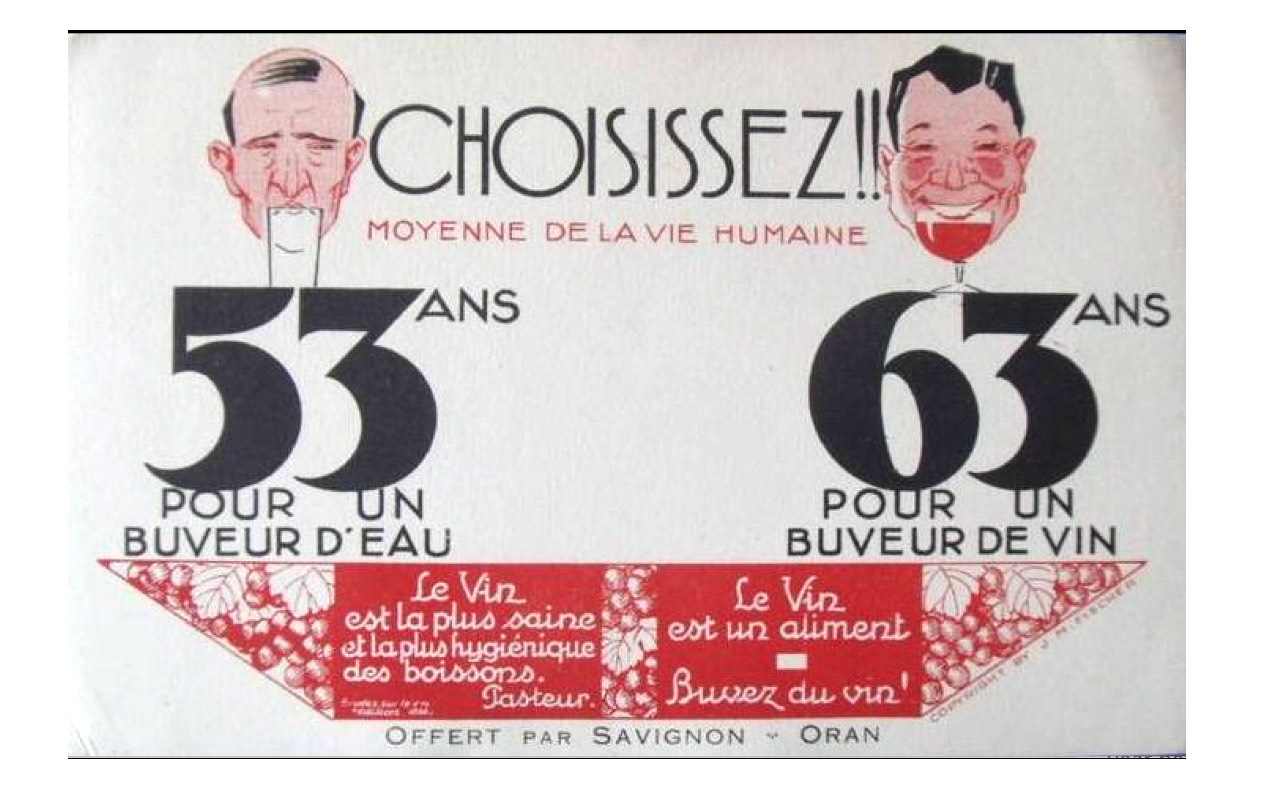
The gap. It’s not going to be too bad this year with a boooorrrinnnnng Superbowl* coming a bit later in the shortened month. At least there was a nice ad for Bud. But, even with that, this gap between the end of the last football game and the start of baseball’s spring training games is a thing. A dull thing. As is the realization that I am looking past sports fandom at a trade war. Aluminum and steel this week. Am I looking like the guy to the left in the image above pushing from French-Algerian wine from the 1930s. Why does the water drinker look so worried? Why is his hair less stylish?

Yet… what does colonization teach us? Is the dodgy promise of that wine a century ago so unlike what we are like today? I was out buying a magazine last Friday evening in an actual bookstore (because, you know, I had a hankering for buy a magazine like it was 1999) and I looked at all their titles… mainly American… then looked at all the biographies of Americans intersperced with a few semi-royals at the other end of the bookstore… boy oh boy… have we up here taken on a lot of the culture developed down there. Look, I’m not part of the not a real country set but I need something to fill the hours other than lingering angst. Something will level out somewhere. Spring training may do the trick. Maybe that’s it. Down in, you know, Florida.

Speaking of gaps, have you any interest in NA wine or spirits?  Me, I can’t imagine paying non-proxy payment for these sorts of proxies for booze. But if you are interested in NA beer, keep keeping an eye on Polk. He is back with some very interesting observations on one Canadian discount dark ale. And he wrote about where is at** this week, too:

I am incredibly lucky that I still can maintain an online community, despite my switch to mostly non alcoholic options, people in craft beer can be very kind when the road gets bumpy for one of our own and this helps a whole lot. But if I was one who went out and was deeply involved, I wonder how I’d be feeling every weekend when my new normal didn’t include those aforementioned activities. It would be a little overwhelming and would only add to an already stressful time I would imagine. It’s part of why it’s so difficult to go sober, to separate yourself from the good times that feel warm and boozy because you can’t be that person anymore. Change isn’t easy, but letting go of alcohol seems particularly difficult, addiction or not.

I will allow myself more bit of one tariff news item this week from one of my regular reading outlets, mining.com, on the uselessness of tariffs but the benefits of something else:

While US steel imports account for 23% of the country’s consumption, the ratio is much higher at 47% for aluminum, according to the US Geological Survey. The US is particularly reliant on imports of primary aluminum from Canada, which supplies more than two million tonnes each year… Just under half of all cans are thrown away to be land-filled or trashed. More metal is lost through improper sorting at recycling facilities, with losses assessed at roughly one third… Roll out more deposit return schemes and some of that one million tonnes of landfill could be returned to the supply chain.

On our side of the wiggly then very straight line, somewhat similarly, the inter-provincial restrictions are being rethought. New Brunswick’s Premier Susan Holt is revisting the province’s trade barriers on booze from other parts of Canada and Ontario‘s smaller breweries are looking forward to market opportunities across the country if we ditch the current rules:

Ontario breweries, distilleries and wineries can’t sell their product directly to customers in other provinces, something David Reed, owner of Forked River Brewing Company, says limits their sales opportunities… Because laws around alcohol are up to each province, rules about transporting vary nationwide. In Ontario, the province lifted interprovincial personal exemption limits in 2019 when it comes to alcohol for personal use, the LCBO says. In comparison, SAQ, Quebec’s alcohol board, says any alcohol coming into Quebec, including donations, gifts, and souvenirs, must be reported.

Note: Following up on last week’s news, one Beer Store outlet in my fair city is closing. But… but… me being able to buy my longed for Oland Ex in a corner store? Where do the loyalties lie?

How to pass the time? Cards. Katie plays cards and wrote a bit about it:

We play Rummy. I have no memory for any of the other rules, despite my father in law trying to teach me Stop The Cab every few months. At high school, I used to play a game called shithead in the common room, we doubled the pack so the games would last forever, dragging on into lessons we should have gone to. These are some of my favourite school memories.

Japan has an issue hiring people and then coaxing people back to work in the office but one firm has a solution that perhaps might suit you:

…for new graduates in Japan, one small IT company is offering Gen-Z staff the option to take special ‘hangover leave’ in a fierce recruitment drive being dubbed ‘golden eggs for graduates’. Trust Ring Co Ltd is a tech company in Osaka with roughly 60 employees and is one of many companies combatting Japan’s declining birthrate with quirky incentives as a way to attract new employees…. employees at Trust Ring Co are even encouraged to help themselves to the draught beer machine or a selection of spirits to drink on the job in their Midoribashi offices.

Lordy. And next? What next?!? Beer sludge? Beer sludge!!! Seems “beer sludge” is now a proper term according to the headline to this BBC story:

…nutrition isn’t the only area where spent grain could make an impact. Brett Cotten concedes that early efforts by his young London-based company, Arda Biomaterials, to create leather-alternatives from brewers’ spent grain resulted in something more akin to a flapjack.  But the start-up has since successfully used supramolecular chemistry to make several proteins from brewers’ spent grain that mimic the animal proteins in leather, resulting in a strong and supple alternative. The colour reflects the spent grain used, he says. “Guinness and stouts make for a naturally black material, IPAs and lagers more mid-browns.” 

I shall recommend that to my tailor. If I had one. And I like this understanding in Jeff’s piece on NEIPAs which is one way of explaining the phenomenon:

I would argue an IPA wave was never going to wash over New England before it came along. The region’s preference toward fuller beers with sweet malts and fruity English yeasts, and they have never really embraced the bitterness and spikiness of Centennial or Chinook IPAs. The development of New England IPAs was not unusual: breweries adjusted their process to draw out those incredible flavors and aromas Citra (and successor hops) had.

Careful readers will recall my habit of going to Maine back when the Canadian dollar was worth 95 cents US or more. In 2013, the good beers on offer at Fenway were Long Trail pale ale, Harpoon IPA and Wachusett Green Monster.  New England had plenty of IPA love before NEIPAs… they just weren’t those IPAs.

Speaking of good explanations, in the emailed announcement on Pellicle‘s piece on independent brewing in Thailand, the editorial board of that there publication made an excellent statement on these sorts of things:

About a year ago I received and subsequently rejected a pitch from a writer called Joey Leskin, who writes a great newsletter about beer in London called Beer in the City. I turned it down because I am overtly aware that stories written by British writers about beer culture in other countries can come across as voyeuristic, and often don’t let the voices of the people involved in that scene shine through as they should. Fast forward six months and I was invited to become a mentor by the British Guild of Beer Writers. I agreed, and by coincidence was subsequently assigned Joey as my mentee.

This is a much nicer way of explaining and dealing with what I call “drive-by expertise.” It’s nice that you got to visit. Very nice. But I’ll usually  turn to the local for understanding, thanks.

People who are very much on the scene if not in the scene are Boak and Bailey and this week the scene is very much where they are or at least were – at the Central Library in their own fair city of Bristol, England. There, they came upon what is definitely a scene:

A few weeks ago a special exhibition was laid on at the library on the subject of beer and pubs. Items from the reference collection were put on display in an ornate wood-panelled room and visitors were invited to shuffle round and have a nose about. We visited and were drawn at once to a hefty hardback volume collecting together editions of The Golden Cockerel, the house magazine of Courage, Barclay & Simonds, formed in 1960 when Courage acquired Simonds of Reading. These particular issues of the magazine were from 1962 to 1964 and seemed to include a remarkable number of pub openings.

What follows can only be decribed as remarkable, too. An unpacking of the story of many of those pubs while guiding one to an explanation of the name for “a youth paid to collect dry sand from coastal caves to spread on saloon bar floors.” Fabulous. And a welcome break from the news about those running pubs dealing with the rising costs of running a pub.

And Laura Hadland has updated the story of the Crooked House and the legal battle which has ensued since its demolition:

11th February – And the appeal hearing has been delayed. ATE Farms lodged a High Court challenge against “the Planning Inspectorate’s refusal to postpone the Planning Enforcement Public Inquiry” according to a statement from South Staffordshire Council This means that the public enquiry will now not go ahead as scheduled on 11th March and is unlikely to occur before the criminal investigation is concluded. You can read updates from the Council on their website. According to the Times & Star, the police work continues – “Staffordshire Police said in July last year that six people arrested in connection with the fire have been released from their bail, but remain under investigation.”

N’oubliez pas!!!

There. It’s been a bit of a busy week outside of these readings again. I worry that I am not entertaining enough. I actually don’t but I wonder. That’s a better way of putting it. Enough to worry about out there in the real world, isn’t there. Until when we meet next, please check out Boak and Bailey every Saturday and Stan going strong again each and every Monday. Then listen to Lew’s podcast and get your emailed issue of Episodes of my Pub Life by David Jesudason on the (sometimes even but never) odd Fridays. And maybe The British Food History Podcast. And Phil Mellows is at the BritishBeerBreaks. Once a month, Will Hawkes issues his London Beer City newsletter and do sign up for Katie’s wonderful newsletterThe Gulp, too. The Share looks to be back with a revival. Ben’s Beer and Badword is out there with the all the sweary Mary! And check out the Atlantic Canada Beer Blog‘s weekly roundup. There is new reading at The Glass which is going back to being a blog. Any more? Check out the Beer Ladies Podcast. That’s quite good and they are revving up for a new year. And the BOAS podcast for the bro-ly. And the long standing Beervana podcast …except they have now stood down.  Plus We Are Beer People. The Boys Are From Märzen podcast appears suspended as does BeerEdge, too. VinePair packed in Taplines as well. All gone. But not Ontario’s own A Quick Beer featuring… Michigan! There is more from the DaftAboutCraft podcast, too.  All About Beer has sponsored trade possy podcasts and there’s also The Perfect Pour. Plus follow the venerable Full Pint podcast. And the Craft Beer Channel on Youtube.  The Moon Under Water is gone which is not surprising as the ask was $10 a month. Pete Brown’s one cost a fifth of that but only had the one post. Such is life.

*What wasn’t boring was the after game celebrations in Philadelphia according to the police scanner: “we lost all the barricades!!!” and especially ““i now have seven or eight people on horses, the fireworks are spooking them and they’re rearing up….they’re civilian horses”!!! And there were some other ads. BeerBoard added some very particularly fine detail on who was drinking what before, you know, the barricades were lost: “Coming off two years of decline for the Big Game, Light Lager saw an increase of +5.6% on the day. Lagers, the #2 style, saw a noted decline of -6.5% in share. IPAs, the third-ranked style, decreased for the second straight year, down -7.9% over 2024. Michelob Ultra was again the top-poured brand nationally on the day, and was up a noted +11.9%. Bud Light, the #2 brand on the day, was -3.0% versus 2024. Miller Lite (+5.4%), Modelo Especiál (+9.6%) and Coors Light (+3.4%) rounded out the Top 5 for draft.” That is very spedific stuff for two days later…
**Or as translated for Maritimers: “where he’s to, too.

The Beery News Notes For – What – Another “Red Sox Suck” Season?

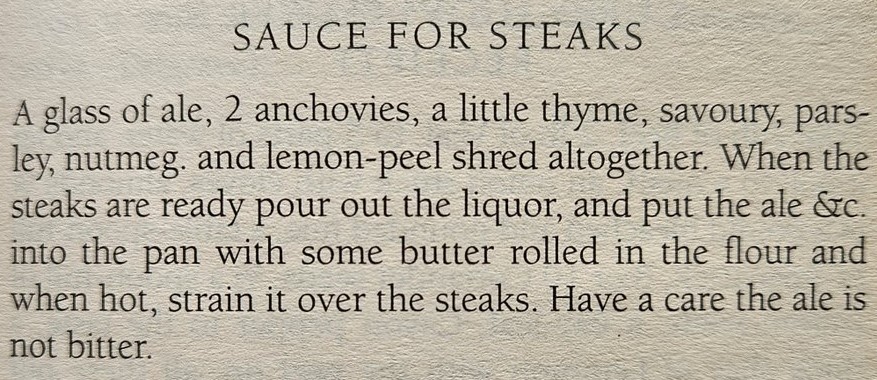
It’s hard being a fan. One of the reasons I am not a big booster for this or that drinks category is I have already invested heavily in terms of emotes in other areas of life. The Pellicle-run Fantasy Premier League surprised me with its grip last season. Plus, as you know, there’s all that gardening stuff that I tend to tend to. But those Red Sox. My team. Mine. They have won 4 World Series in the first quarter of this century but now are mid-pack grinders this decade. There’s little chance they get to the playoffs but they are irritatingly near the chance to… maybe to… couple possibly…  Oh well. But even before all of those obsessions, all those fanboy obsessions… there is good food. Making. Eating. So happy was I to read Liam‘s tweet about the sauce above:

An ale and anchovy sauce recipe for steak written by Thomas Gray in a copy of William Verrall’s Complete System of Cookery – via Penguin’s Recipes from the White Hart Inn.

That’s a book from 1759 as I understand it. Imagine living in a time when membership in a fan base of mid-pack grinders was not even possible. Except, you know maybe if you lived in one of the smaller player in the Seven Years War. Perhaps under the rule of Augustus III of Poland. Anyway, anchovies and ale… anchovies and ale.

Back to a semblance of a plot, there was a good story in Blog TO checking out the prices in Ontario’s newly licensed corner stores. It is a little spoken of aspect of the retail booze trade in Ontario that not only are prices stable because of the massive monolithic twins, the LCBO and TBS – but those prices are standard in every store province-wide,  no matter how distant and expensive the shipping costs. Not so in the 7 am to 11 pm new world order. Not that I would buy one – but a 12 pack of White Claw is 30% higher in corner stores compared to TBS retail. Sounds like that one mistake can easily turn into two for the unwary.

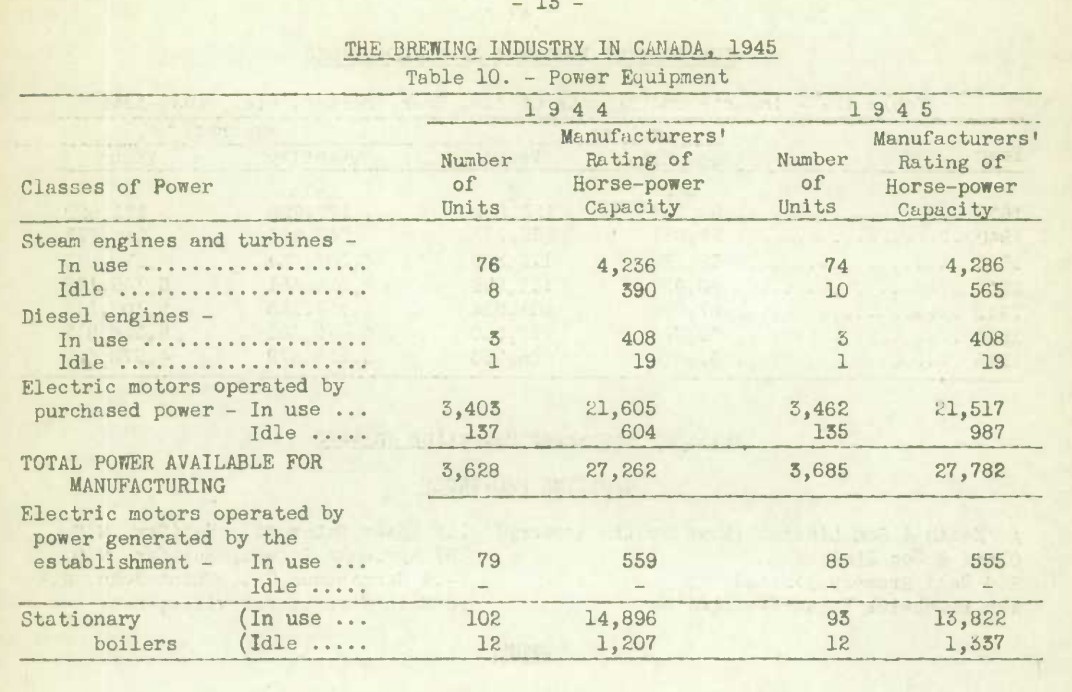
Speaking of prices and price inputs, Gary has a great series going on the Canadian brewing trade in WW2 and this week posted this great bit of tabular information detailing all materials used in brewing production in 1944 and 1945. By reverse engineering his Google image search, I found the same record at a Government of Canada site and saved it for perusal. Just look at page 13!

“Grandpa? What was the ratio of steam, diesel and electric power used in Canada’s wartime brewing as part of the war effort against the Nazis?” “Well, little Jimmy, let’s see…”

Excellent stuff. Speaking of which, Katie Mather has been out and about – especially on the Isle of Man – and has sent out a portrait of a favourite pub there, the The Woodbourne Hotel:

This snug in the centre of the building feels like an Edwardian train carriage, everyone packed in together amicably, its little booth seats overlooked by cartoons and paintings that know the secrets of this town, and well-used hand pulls that serve Woodbourne Street’s locals the beer they need to do some much-needed gossiping. We weren’t staying in the Gent’s Room though. It’s too small, and we were too noisy. I was led further down the corridor to the back bar, where somehow we’d multiplied into a rowdy bunch of 12. Basic white walls and a well-stocked bar on first glance became signed photographs of TT racers and etched glass windows. It took my eyes a little time to adjust from the burnished glory of the Gent’s Room, but once I could see it for the perfect little boozer that it was, I was at home.

By the way, Katie is offering self-editing lessons.  Yes, yes. I know. I know. I KNOW!!!

In a year where much of the beer trade news is not necessarily positive, we have also heard that a lot of men spend a lot of time thinking about the Roman Empire. Curiosity is good. Not my thing given all those other things – except, you know, all that Christ on the cross stuff – but Ray of B+B has admitted he has joined the legions and asked some questions this week:

After visiting Roman ruins in Colchester and the City of London in early August I found myself frustrated at my lack of solid knowledge about Rome. So, I decided to do my homework. Fortunately, Mary Beard’s 2015 book SPQR offers a relatively concise, extremely clearly-expressed history of Ancient Rome that even I could follow. The Kingdom, the Republic and the Empire made sense, and I understood for the first time which emperor followed which. With my beer blogging hat on, though, the section that really grabbed me was about the decor of a bar in the port of Ostia in the 2nd century CE (formerly AD)…

Back to the now, Eoghan shared some shocking news on the state of Belgian beer this week:

“…outside Europe the export [of Belgian beer] declined by as much as 22.2%” IN ONE YEAR A stat (from the Belgian Brewers Federation) to really set the alarm bells going about the future of Belgian beer. A fairly telling quote, in the same report: “In the past, Belgian brewers were able to compensate this decline largely through export, but last year, for the first time in history, export declined by nearly 7.5%.” Belgian beer’s safety net has some pretty large holes in it…”

Long suffering readers would recall that 15 to 20 years ago, driving distances to find Belgian beers in the northeastern part of the United States was a bit part of one’s stash maintenance. Seems like a third of a lifetime ago… oh… it was. To quote the lads back in Rome sic transit gloria cervisiārum… as Jeff discussed last week:

“Craft beer” is a conceptual cul de sac. We started using it with good intentions, but with a naïveté about how brewing works and how markets function. It now causes more trouble than it’s worth.

In VinePair, David Infante took it a step further and argued that just as craft it no longer relevant as a concept, it isn’t really relevant as a substance:

With the segment struggling to shore up slipping sales figures in the face of increased competition from other categories and shifting preferences from American drinkers, craft breweries have been uncoupling brands from the brewhouses with which they were once synonymous, shedding overhead costs and further muddying what makes a craft beer craft.

Jon Chesto of The Boston Globe wrote a fresh take on the craft shake out that is a bit more visceral in tone, sharing the excellent term “slusheteria” for the craft brewers who chase the tail of other targets. The quitters one might say reading between the lines. Or are they just practical realists racing away from the crushing alternative?  The Chesto story’s punchline, however, is saved for Sam Hendler of Jack’s Abby in Framingham who takes an optimistic approach to the reality of short term shakeouts:

Hendler said many brewers built larger operations than they needed with the anticipation that double-digit sales growth would continue well into the future. Now the industry has far more production capacity than it needs. “We are investing very heavily in craft beer and believe in its long-term future. This isn’t a ‘sky falling’ scenario,” Hendler said. “There might be a challenging period that we’re going to have to navigate through but we see a really bright future for those who figure out how to navigate that successfully.”

Stan also had his own thoughts about the idea that the small and local brewer is going to way of the dodo. But he was heading out the door and just said he’s “…not prepared to abandon the thought embracing efficiency means abandoning inefficiency altogether.” Just strikes me that this sort of trend is an economic reality – but one borne of the pretense that there was something once upon a time called craft that stood there separate and distinct, between microbrewing and today. I dunno. It’s been slipping away for a long long time for this to be news. The glitter. The kettle sours. The identi-haze. But does that necessarily lead inevitably to the horrors of the slusheteria? I am encouraged by Hendler that it does not.

Speaking of slipping further into the sub-standard, MolsonCoors is ditching inclusion in preference for old school capitalist exclusion according to TDB:

…the business would be ending its DEI-based training for its staff members, claiming that it has been “completed”. According to reports, future training initiatives at Molson Coors will now undergo an audit to ensure that they are all focused on the company’s “key business objectives.” In addition to this, Molson Coors is renaming its “employee resource groups” to call them “business resource groups” in a bid to illustrate how the company is focused on “business objectives, consumer dynamics and career development”. Molson Coors also highlighted how its future charitable endeavours will now solely support “hometown communities” aligning to its “core business goals”.

Interesting, too, is how a story can be written about celebrity sports guys building a beer brand by leveraging the excess capacity of Founders Brewing without mentioning the whole bigotty discriminatory scandals thing:

Garage Beer is a fun example of small brand, going big, and making moves quickly. Their connections to two of the NFL’s biggest personalities and even an indirect connection to Taylor Swift make it an extra fascinating story to follow. But beer isn’t sold on podcasts or YouTube, it’s sold in stores and needs to flow through the complex three tier system to reach a national audience. Aligning with Founders Brewing for production and potentially distribution alignment has the ability to execute the hurry-up offense that Garage Beer will need to march across the country.

What’s that? Is it white-white-washing? Dunno but apparently, the inclusion blip has blopped and some want to go back to the old ways. Remember the old ways? Last Friday, David Jesudason published another story of racism in the UK pub trade, this  that 1980s club entertainer Alex Samos faced and pushed back against:

…the club wanted Alex to leave the premises when he arrived and his agent George Fisher was told Alex needed to be replaced because of his colour. This time the club “won” and Alex was barred for not being white. He took legal action against the club and, in a case backed by the Commission for Racial Equality and Equity, won £500 (£1,500 in 2024) compensation for injured feelings and loss of earnings in August 1985.  I hope this would stamp out discrimination by clubs against coloured performers,” Alex told the press at the time. “I thought it was an affront to my dignity. I was outraged.” Club secretary Michael Riordan confirmed none of the 500 members were non-white but feebly retorted that “no coloured people had applied to join”.

Finally and to end on a happier note, Pellicle‘s feature this week was by Martin Flynn on the  Donzoko Brewing Company, a name which I think Augustus III himself might approve if only for having had also to deal with the Austrians but in a slightly different context:

Following calls in pidgin German and some online bids, not long after the search began Reece found himself in Vienna, where gleaming copper brewing vessels and 13 fermentation tanks awaited him. As things transpired, the whole ensemble would spend two days outside on a city centre street, but, somehow, it miraculously remained unharmed and still in one piece. Unfortunately, Reece’s finances were similarly static. A hurried call from the auction house revealed that, for reasons unknown, his funds had been blocked by the UK’s Financial Crimes Authority. “I put the phone down and had a panic attack,” he says. “The head of the auction house was literally walking after me in Vienna, shouting at me.

Heavens! Steer clear of Vienna, that’s what I say. Every. Time. (Did I mention I know a man in Vienna?) Well, we will leave it at that for now. Busy week. Had to retrieve a cat from Springfield… as one does. Until next week for more beery news, check out Boak and Bailey every Saturday and see if Stan cheats on his declared autumnal break on Mondays. Then listen to Lew’s podcast and get your emailed issue of Episodes of my Pub Life by David Jesudason on the odd Fridays. And Phil Mellows is at the BritishBeerBreaks. Once a month, Will Hawkes issues his London Beer City newsletter and do sign up for Katie’s wonderful newsletterThe Gulp, too. Ben’s Beer and Badword is thereback with the sweary Mary! And check out the Atlantic Canada Beer Blog‘s weekly roundup. There is new reading at The Glass which is going back to being a blog. Any more? Check out the Beer Ladies Podcast. That’s quite good. And the BOAS podcast for the bro-ly. And the long standing Beervana podcast …except they have now stood down.  Plus We Are Beer People. The Boys Are From Märzen podcast appears suspended as does BeerEdge, too. But not Ontario’s own A Quick Beer. There is more from DaftAboutCraft‘s podcast, too.  All About Beer has podcasts and there’s also The Perfect Pour. Plus follow the venerable Full Pint podcast. And the Craft Beer Channel on Youtube.  The Moon Under Water is gone which is not surprising as the ask was $10 a month. Pete Brown’s costs a fifth of that but is writing for 47 readers over there.

*Me, I’m all about the social medias. Facebook still in first (given especially as it is focused on my 300 closest friends and family) then we have BlueSky (174) rising up to maybe… probably… likely pass Mastodon (933) in value… then the seemingly doomed trashy Twex (4,460) hovering somewhere well above my largely ignored Instagram (160), crap Threads (52) with Substack Notes (1) really dragging up the rear.

Your Beery News Notes For The Return Of Sweater Weather For 2024

September. The grapes are ripening. And evenings are cooler. And those nightmares about having to go back to grade 11 math class even though that was 45 years ago are back. The rest of the day, you daydream about college days when you were two months away from having to pass in any classwork. And thoughts turn to sweater vests. Over a white t-shirt… if one’s yuff was from that WHAM / Ferris Bueller era forty years ago.* Labour Day Monday was the end of the humidity around these parts. Evenings are cooler. Sweater weather.

First up, in the unending ping-pong game of whether alcohol is good for you or bad for you, Drinks Business summaried the powerful and damning critique of Prof. David Spiegelhalter of Cambridge University appeaing of the BBC’s World Service The Food Chain programme:

He said that statistically the overall risk of one beer or wine per day on your life expectancy — which is within current UK government guidelines — has no higher impact than driving a car or eating bacon. Spiegelhalter said that research showed the health benefits of drinking in small amounts, as previously highlighted by the drinks business. He added: “Frankly, I get irritated when the harms of low levels are exaggerated, particularly with claims such as ‘no level of alcohol is safe’. For a start I don’t think the evidence supports that, but also there’s no safe level of driving, there’s no safe level of living, but no one recommends abstention.”

Much, of course, turns on the fuzzy concept of “safe” given that these sorts of statements do not characterize the degree of safety that is, you know… safe. It’s a form of argument that would make the evangelical at the door proud. Fortunately, at least one solid opinion is shared. Spiegelhalter “described the current NHS guidance on levels as ‘ideal’ .” That being…  David Morrison, data-driven wine blogger at The Wine Gourd makes a detailed and well footnoted argument against WHO guidance which unfortunately starts with that sad car driving safety analogy (yes, there is a warning… it is called the licensing process) but then making a good recovery:

…as Robert Joseph has noted: ‘we need to promote the unique, historic qualities of wine that make it such a great convivial product and such a delicious partner to food.’ That is, in the words of Erik Skovenborg, we need to note: Wine as part of a healthy lifestyle; and Drinking with friends: wine’s role as a social lubricant. If the wine label has to list the risks (as is being suggested for the new USA guidelines), should it also list the benefits?

And there was much talk in the UK is about the new government’s plan to enforce a ban on smoking in beer gardens and on pub patios. The Independent discusses the implications:

If implemented, the outdoor smoking ban would make it an offence for people to smoke in certain spaces such as pub gardens or outside sports venues. Should it be enforced in the same way as the 2007 indoor smoking ban, smoking in certain outdoor spaces would carry a Fixed Penalty Notice of up to £150. If you refuse to pay this, you are liable to be prosecuted. According to Action on Smoking Health (ASH), the 2007 ban led to a 2.4 percent reduction in hospital admissions for heart attacks, and a 12.3 percent reduction in admissions for childhood asthma.

This is something we have had this sort of ban in Ontario for quite a number of years now – and we’ve expanded it over time – with the result that no one misses breathing in the neighbouring table’s ciggie gak. But these things are local. Apparently elsewhere, not so gak. The Guardian covers some of the frustrations with the proposal:

…Sean Short, 54, was smoking on the pavement outside a Wetherspoon’s pub – there is some suggestion that pavements outside venues could also fall under a new ban. “I think it’s ridiculous. As if there’s not enough pubs being closed anyway at the minute,” he said. “I can understand them banning it outside hospitals, that makes sense, but not outside pubs.” He said an outdoor ban would not stop him from coming to the pub, but he could see that it would for other people, especially when alcohol is cheaper to buy in supermarkets.

Still, will any of this matter if, as The Guardian also asks, the kids ain’t even drinking the stuff:

A seemingly endless stream of recent reports have warned that baby boomers, who have fueled the industry, are retiring and spending less, and millennials aren’t picking up the slack. “You’re looking at a cliff,” the industry analyst Rob McMillan told the San Francisco Chronicle in 2022, following a key report that showed wine consumption in the US hadn’t grown in 2021 – despite bars and restaurants reopening. McMillan foresaw wine consumption by volume declining 20% in the next decade, with millennial habits key to the shift. Last year, Nielsen data showed 45% of gen Zers over 21 said they had never drunk alcohol.

Not all that relatedly, Jordan has been doing his annual stint at the Canadian National Exhibition – aka the CNE – selling beer tokens in a booth, acting as huckster to both carnies and marks alike. Observations include: (i) “Big Boi didn’t draw the crowds”; (ii) a pickle shot is “a pickle, cored out, filled with tequila”; and (iii) someone asked “What is tokens?”

Note: Gary is not linking over at Twex anymore so keep and eye on hiblog for updates. This week he explains why some Canadian troops in WW2 fighting in Italy drank British beer while some of the British fighting there drank Canadian beer.

Boak and Bailey in their footnotes posed a question about the cartoon in Pellicle last Friday:

…cartoonist David Bailey seems to be arguing that confusion, jargon, and being pushed around by expert staff, is part of the fun of artisanal drinks. But maybe he’s also asking: really? Is that how you want it?

Me, I took the cartoon as pure mockery. I felt badly for the poor beer buyer, there in her tiny version of Pilgrim’s Progress facing the craft carny. Could it be that the craft carney stuff is also off putting… or mid… from the perspective of Gen Zers?

Never mid, Ron introduced me to a new word this week… no, not that sort of word, a brewing related word:

… what’s odd, is that there isn’t a full fermentation record for the “Double Stout”. Just one or two entrie. While there is a full record for Single Stout, right up to racking. Why would that be? Eventually I twigged. There’s a reason there isn’t a full fermentation record. Because that wort wasn’t fully fermented. At least not on its own. I’m pretty sure that this is “heading”. One of the elements of Irish Stout. It’s a strong wort in a high degree of fermentation which was blended in at racking or packaging time. It’s effectively a sort of Kräusen.

Now, I had understand that certain Irish stout had a lesser portion of stale for tang as well as fresher for the body in a blend so, if Ron is listening, does this mean that three different agings including a heading as part of finishing were used? Or am I, as per, wrong?

Laura Hanland posts an interesting set of questions which popped to mind after a certain sort of restaurant experience:

In essence then, my food was deeply “not too bad” – usually enough for me to decide not to return for a repeat visit – but I loved the restaurant so much that I really think I am going to go back and give their pasta a go! And this is my conundrum. If you’re reviewing food, then the food must be good. Surely? But the lovely team, the genial surroundings… these were charming elements that I couldn’t ignore. Also I was a little bit taken by the scowling Italian elder who peered out at me from the kitchen. He gave the whole thing a very authentic feel of a family business. This review makes no sense. I don’t know if it will help you decide whether to visit or not. But I’ll be sure to tell you if I do get back for the pasta.

I think it makes perfect sense. One of the problems in the social media age with its instantly curated expertise (just add water… or, as with the craft carney, booze) is the expectation of mind blowing experiences. They rarely actually happen. For example, my chicken burger was actually a bit bland when we were out this week. Could have done with some chopped green onion in there. Or something. But the server was great as was the sharable carrot cake dessert. Look for the good in things. And put a little black pepper on the burger yourself. Don’t be lazy.

Pellicle‘s feature this week is by Jacob Smith – a discussion with and of the definitely not lazy Judith Gillies, co-founder of Cairn o’ Mohr, a Scottish producer of fruit wines and ciders:

There was little money to spare—Judith fondly recalls a cupboard acting as their only shop—yet, the couple enjoyed something far more valuable than excess cash: access to some of the country’s best fruit. Thanks to its loamy soils, moderate temperatures and—for Scotland—dryish weather, Perthshire is home to an array of world class berries, apples and flowers. As head of production at Cairn o’ Mohr, Judith puts this bounty to good work, producing around 18 different wines, three alcohol-free beverages and five ciders. While popular fruits like strawberries, brambles and raspberries are central figures in several of Cairn o’ Mohr’s wines, less appreciated ingredients like elderberries, oak leaf and gorse are just as commonly used.

I like this line, too: “We tend to take knobbly fruit,” Judith says. “The ones that are too big, too small, too ripe for the supermarkets, things like that.” And speaking of seeking out new tipples, Jancis R reported from a tasting of independent wineries from 15 central and eastern European nations:

Of the other countries whose wines I tasted, Croatia was the most stimulating. The wines, especially those from Istria in the far north of the country, seemed to have an extra layer of sophistication. The region’s special white-wine grape Malvazija Istarska (nothing to do with most other Malvasias) produces full-bodied wines with an apple-skin character, real grip and ageing potential. My favourite examples at the tasting were made, respectively, by the well-established Kozlović winery and the much younger enterprise owned by the unfortunately named Fakin family.

Beating us to EuroEast for drinks, The Beer Nut has been reporting live from Bulgaria this week. It sounds so good:

80% of being on holiday is a random bottle of something that’s €8 in a supermarket and has a picture of a fruit on the label. To my veins, please. Directly…  The next song will be performed by a man who looks like he should be on the sex offenders’ register but has sufficient connections to have avoided it… This open-air bar is opposite my hotel. On beautiful sunny days I’ve been looking across and thinking it would be nice for a drink. Here I am and my beer tastes like it was triple-filtered through a skunk’s anal gland… 

And for Labo(u)r Day, Dave Infante in VinePair was fairly free with the finger pointery over craft beer’s record in labo(u)r relations:

Substandard products, dangerous equipment failures, hell, even terrible rebrands — workers can help owners solve these problems with union training programs, higher self-enforced safety standards, and honest feedback from outside the boardroom bubble. But they need a voice on the job, and protection to use it even when it’s going to piss the boss off. This industry is getting left behind by drinkers. It cannot afford to be left behind by its workers at the same time. Like the Teamsters organizer at Stone this past Monday, I have a message to deliver this Labor Day weekend. This one is for brewery bosses and workers alike. The country is changing, and so is this industry. Which side are you on?

I know what side I am on when it comes to beer cocktails (because port and stout is not a beer cocktail… even though I called it just that in 2012) but the National Post shared a very extended article on beer cocktails that lingered over something from the 1990s built around a recollection of youth as part of creating the argument that one should not overthink… or even, really, think about these matters:

…Dad mentioned that I’d left some beer in the basement fridge that I might want to take home to drink. Investigation revealed that the bottles in question were the remainders of a six-pack of Tequiza. Some of you may recall this late-’90s-era beer brand, juiced with “the natural flavour of lime” and sweetened with agave nectar, a brand that lots of people in flannel shirts and Doc Martens used to consume while listening to Pearl Jam and waiting for our dial-up modems to connect to the internet. The portmanteau name was supposed to suggest a marriage of tequila and cerveza…

Never thought Tequiza would get that much media footprint but there you go.  Finally and definitely in the Tequiza zone, today is the day here in Ontario when I can walk to the corner store and get beer… probably a macro brand I don’t want and at a higher price than elsewhere. But I can get it at 7 am. So that is excellent. Does this mean death to the near century old macro brewers’s run retail monopoly aka “The Beer Store”? Can you say supply chain?

“Bring it on — we’re ready,” Roy Benin, president of The Beer Store, said in a statement. “We see this as a new chapter for The Beer Store and we’re excited to compete. All of our channels – from distribution to retail to deposit return will continue to deliver for Ontario.” The beer conglomerate said it has also expanded its distribution fleet, helping to bring close to 4,000 convenience stores online to sell beer. The retail giant is involved behind the scenes in stocking many of those locations, and grocery stores, as well as its own storefronts.

That being the case – is The Polk right? Is it all politics and money?

It’s not about access. It’s about Dougie needing more bread & circuses distractions for the low information voter to drive more votes his way when he calls the election. He wants to get into another majority before the RCMP gets deeper into the Greenbelt. He’s gonna win, too…

Maybe. Maaaaaybe. Hmm. In the meantime, if you want to keep up with the news before next Thursday? Check out Boak and Bailey every Saturday and Stan back each Monday. Elsewhere go look at then listen to Lew’s podcast. And get your emailed issue of Episodes of my Pub Life by this year’s model citizen David Jesudason on the odd Fridays. And Phil Mellows is at the BritishBeerBreaks. Once a month, Will Hawkes issues his London Beer City newsletter and do sign up for Katie’s now revitalised and wonderful newsletterThe Gulp, too. Ben’s Beer and Badword is back with all the sweary Mary he can think of! And check out the Atlantic Canada Beer Blog‘s weekly roundup. There is new reading at The Glass which is going back to being a blog in this weeks best medium as message news. Any more? Yes! Check to see the highly recommended Beer Ladies Podcast. That’s quite good. And the BOAS podcast for the bro-ly. And the long standing Beervana podcast …except they have now stood down.  Plus We Are Beer People. The Boys Are From Märzen podcast appears suspended as does BeerEdge, too. But not Ontario’s own A Quick Beer. There is more from DaftAboutCraft‘s podcast, too.  All About Beer has introduced a few podcasts… but some may be losing steam… until… Lew’s interview! And there’s also The Perfect Pour. Plus follow the venerable Full Pint podcast. And the Craft Beer Channel on Youtube.  The Moon Under Water… is gone which is not surprising as the ask was $10 a month. Pete Brown’s costs a fifth of that but is writing for 47 readers over there. There was also the Beer O’clock Show but that was gone after a ten year run but returned renewed and here is the link! Errr… nope, it is gone again.

*Ahh… we the drifty, Gen Xers in the era of the X: “What are you interested in?” “Nothing.” “Me neither.
**Me, I’m all avout the social medias. Facebook still in first (given especially as it is focused on my 300 closest friends and family) then we have BlueSky (166) rising up to maybe… probably… likely pass Mastodon (931) in value… then the seemingly doomed trashy Twex (4,466) hovering somewhere well above my largely ignored Instagram (160), crap Threads (52) with Substack Notes (1) really dragging up the rear.

The Chores… More Chores… It’s The Weeks Of Chores Along With Some Beery News Notes

When last we met, I was happy as anything, wandering around Montreal on a few days away. That’s so last week. The first week of vacation. Then I came home to folk building the new fence and the related 24 foot tall tree removal on my side of the line. The fencing guys did a couple of the main branches with their power saws but I’m doing the rest by hand, sorting* and hauling most of the stuff away. Which is why this week’s beery news notes are brought to you by my Japanese pruning saw. It is the only thing I have ever bought which has each and every promised attribute. Forget that claim that beer makes you feel exactly like you wanted to feel like just before you had that beer. This beauty sits neatly in the cut, eats into the wood in both directions, stays sharp, creates minimal blisters. Japanese pruning saws. Get yours today.

First off, I am really grateful for Stephanie Grant‘s piece on her changing relationship with alcohol. She puts things so clearly, things that I have thought about myself and others over the years – especially this bit:

I haven’t dived into non-alcohol beers or mocktails, and I’m not sure that I will. I’m not someone who necessarily needs to replace beer with a non-alcoholic version. I know that there are some great options out there today, but when I am abstaining from alcohol, I don’t really feel the need to replace it with something that is similar to alcohol. I also feel the same way about meat substitutes. If I want to eat meat, I will eat meat, but if I want something vegetarian, I don’t necessarily need a meat-like substitute… if I really want a beer during the week, I have no problem drinking a beer and have no trouble sticking to one. That level of flexibility feels good to me and has made this new adventure feel even more doable…. It helps that I know other people who work in beer and the beverage industry as a whole that have also cut back on their drinking. I look to them for inspiration. Because of them, I know it’s possible.

For as long as I have been writing about beer my interest in drinking a lot of beer has slowly slipped away… well, maybe let’s say it has reduced. (Apparently, not unlike Ireland.) For a while now, I’ve been a none or maybe one with meals or maybe after mowing sorta person now.  I know, sounds like Old Man Day Napper. But that’s now due, you know, to hauling the boughs and branches to the yard waste depot.

Yet… when I do have a drink, I like to drink the swell stuff. So what are you drinking when in Lisbon? Not what you expect you might be, if Jason Wilson is right:

My choice for the first stop of the evening would be Quattro Teste, one of the best cocktail bars I’ve visited in any city. Run by Alf del Portillo, from Spain’s Basque Country, and Marta Premoli, from Lombardia, Italy, at Quattro Teste you can start with a shot of cider straight from the barrel, Basque style. Then move on to Alf’s take on the low-brow classic kalimotxo. It’s usually just a mix of red wine and Coke, but his version has a healthy pour of Amaro Lucano and a splash of Branca Menta to make it a kalimotxo revelation.

I am not sure my meagre daily ration would go in the direction of a kalimotxo but, go ahead, make the case for it. Jeff made the case, unpacking his thoughts on our conversation about the economics of local v regional noted last week as Question #7:

The regional breweries can’t compete with the giants on price, and lose the advantage of “local” affection the further they try to send beer. I recently got to see the barrelage of those regional breweries, and it is mostly sinking as this dynamic squeezes them more. And yet if you zoom in a bit, something interesting is going on as well. If you surveyed the beer cooler at the local grocery store in different regions (not just the U.S., but anywhere), you’d see different retail space given to local, regional, and national brands. Some places I visit have mostly national brands and a sad little pocket of local brands. In other places, the reverse is true.

There was also follow up over at their Patreon-based footnotes this week, when Boak and Bailey (Hello Jess and Ray!) looked for just the right word:

The idea of national-regional-local that Jeff Alworth writes about, after a discussion with Alan McLeod (hello, Alan!) feels like an important one. We look here at breweries like Butcombe, which are definitely tied to the West Country, but which don’t feel especially… loyal? Is that the word? They’re not national, exactly, but they’re too big, too remote, and too slick, to feel quite part of the scene. In Bristol, local means from the city. And ideally from the neighbourhood. Somerset and Gloucestershire too, at a push. We need to think about this some more.

I like that reference to “the scene.” A scene is something to which you can have personal affinity. My scene, for example, for a long time pre-pandemic extended much more to the south into central New York than to Toronto to my west.  It is about identity as much as anything but there is a clear tension between the economics and the identification with regionality. Put it this way. I support local breweries as much as I do because I can drive to them all. That is a distinct relationship where the economics and identity of local might look like loyal but perhaps it is only practical. At the regional level one needs to make more of an effort, both the brewer and buyer. I probably put a premium on spotting a Great Lakes zone beer. National craft? Might as well be ketchup. I’ll buy it but mainly on based on the price with hard eye on the best before date.

On the subject of scene, it has many facets. We see that in the piece Laura Hadland had published in What’s Brewing which explored the history of beer serving measurements below the pint. It illustrated the hazards to be encountered in place to plane and time to time – as illustrated by the “schooner”:

The two-third pint measure was not legally recognised as a specified measure until October 2011. Despite this late introduction, the measure was not new. A publican in Greenock, Scotland, is recorded as testing the market for the schooner – a glass of American invention – in the 1870s. His tuppeny drink was described by locals as the Wee Pint and seems to have met with relative success, spreading to other venues in the area. The two-third schooner for beer is not to be confused with the sherry glass of the same name – a tall, waisted 3.5oz glass that was popularised in the UK in the 1960s, alongside its smaller cousin, the clipper. To add another layer of bemusement, a Canadian beer schooner is a 32oz super-sized affair!

I like that, the “wee pint” – basically the size you get in the US now when you ask for a pint. What else is going on? Pete Brown posted his take on George Orwell’s perfect urban pub “Moon Under Water” but with the perfect English country pub in mind:

There’s a big open fire at one end of the room. In winter, you have to be here at opening time to claim the table next to it. There’s also a large, shiny-seated wooden chair opposite. It’s the kind of chair you don’t sit in unless you’ve been drinking here since the pub was built. The walls and ceilings are decorated with random stuff – nothing as obvious as horse brasses or old black-and-white photos of the pub. A lot of the décor relates to the name of the pub (which isn’t really the Old Stone House.) But on top of that (sometimes literally) there’s a collection of old scythes. A bowsaw. A 1930s policeman’s helmet. A case full of arrows.

And… wait for it. There is a twist. By the way, R+J of B+B may have found their own new perfect pub even though the first dealt with some well-founded doubts:

…people who are much more clued into Bristol pub gossip than us told us they’d heard Sam Gregory, landlord of The Bank Tavern, was interested in taking it on. You might have heard of The Bank, even if you don’t know Bristol: it’s the one with the four-year waiting list for reservations for Sunday lunch. We filed this news under “We’ll believe it when we see it”. So much can go wrong with plans to revive pubs, as we’ve seen with successive attempts to take on The Rhubarb.

Also extolling the ideal pub this week was ATJ whose A Pub For All Seasons comes out soon. He summarized the goal of the book:

Deep breath, then: A Pub For All Seasons is a narrative non-fiction travel book about my journey through the UK over the four seasons in search of how pubs change organically, unconsciously, without fanfare, almost with nobody noticing. It is about how pubs echo the seasonal drinks and dishes we fancy throughout the year — as they change a pub also changes.

Speaking of which, I received my copy of Martyn’s new book, Around the World in 80 Beers: A Global History of Brewing, a study of brewing history through 80 beers from around the world. Very oddly, exactly 2.5% of the beers discussed were from my homeland, the Canadian Maritimes. The entry on Keith’s IPA is (shall we say) kind but does highlight, as do a number of others, the imperial reach of British brewing.  My first skim though did raise one question. Has anyone actually seen that receipe for great-grandpaw’s beer that was the foundation for Sam Adams Boston Lager?

Other than witnessing the praising of glitter beer well after it “glit-ted” its last “-ter“**, I was interested in the thoughts Doug Veliky shared on the effect of Hazy with about a decade’s reflection – and expectually its effects on other style as well as style itself:

The term “American IPA” appears to mean little that can be trusted anymore, at least consistently and nationally for someone traveling, and might as well be shelved completely by the US brewing scene. It’s turned into a filler word to show more intention to the style, but that intention is now be muddy and misleading. The reason I used to like the descriptor is because it could serve as a way to communicate clear and bitter, while letting West Coast IPAs be their more specific versions, still leaving a wide range of variables to incorporate and differentiate with.

In Pellicle, Will Hawkes explored other sorts of fundamental changes in his excellent biography of an important figure in mid-1900s British brewing, Dr. Dora Kulka, and her escape from the Nazi we well as how her work in yeast biochemistry supported the early adoption of lager brewing:

Dora produced a stout (“Your vitamin stout is good,” Erna Hollitscher, to whom she sent a bottle, told her; “In spite of the protest of some English people I still don’t think it is so very different from beer!”), a pale ale and, most significantly, a lager. She probably thought little of it, but for the powers-that-be at The Hope Brewery it was like a lightbulb flickering on. Just a few years later, Claywheels Lane became the first British home of Carling Black Label, the beer that started the British lager revolution, and that has been the nation’s favourite since the early 1980s…. Hope & Anchor began making their own lager—Anchor Lager—very soon after the War ended. “Dr Kulka got us brewing a lager. She noticed Sheffield water was similar to that of Pilsen in Czechoslovakia, where her family came from, and suggested we make one. That’s what set us going.”

It will be harder to find a lager in some communities in northern Ontario now that the implications of the new beer sales in private stores are playing out:

The Beer Store has confirmed that the 8 James Bay Rd. location in Cochrane is permanently closing on Sept. 9… In Cochrane, the Alcohol and Gaming Commission of Ontario (AGCO) has approved two licences for convenience stores that will be able to sell alcohol — the Cochrane Truck Stop at 99 Hwy. 11 S., and COSTCAN Liquor at 143 Fourth St. W. Unit B. The Beer Store locations in Geraldton and Nipigon are also set to close next month.  Gordon Mackenzie, a former Nipigon councillor wrote to The Beer Store president, highlighting the impacts of the closure on the community, noting his concerns that the closure will add to the long-standing issues of vacant buildings populating the downtown core and the loss of job opportunities. The community has also noted that The Beer Store is the only location to return empties to.

Note: “My bet is the price of beer will go up, especially in northern Ontario.” In suburban southern Ontario, the issues are different, as over licensing as 350 new retailers will open up in one municipality on the same day. Plus: “stores will be allowed to sell starting at 7 a.m. and up to 11 p.m., two hours earlier in the morning and later at night than the current operating hours.” Really? Pre-school beers? How long until we read the “drunk guys in grade 12 first class home room” story?

And, relatedly perhaps in terms of change, in his Hop Queries, Stan shared some news about the German hop harvest that ended up with a bit of an odd conclusion:

Each of Germany’s five hop growing regions (Hallertau is by far the largest) provided estimates as harvest began. Production in the Hallertau increased 21 percent over 2023, to 42,350 metric tons, while overall German production grew 18.8 percent to 48,964 metric tons (98.1 million pounds). Why? Yields in Germany were up 20.5 percent. Although yields in 2023 had improved on 2022’s particularly disappointing harvest, they were still below average… The overall harvest yielded about nine percent more hops than an average crop the last 10 years, which a press releases notes will be sold into a market that is “. . . oversupplied.”

“Oversupply” does no lead to cheering as it turns out. A bumper crop causes concerns in a retracting marketplace for beer.

I am sure there is a bit of a punning opportunity related to the exhuberent abundance of my week’s chores there but I am a bit too tired to try. Timber depot, yard waste yard, worn out fabric drop off, vee vee boutique and, most excitingly, the hazardous waste receiving area. Touched all the bases. So… that being the case… here are the credits, the stats the recommends and the footnotes and the many ways to find good reading about beer and similar stuff via any number of social media and other forms of comms connections.*** Want to keep up with the news before next Thursday? Check out Boak and Bailey every Saturday and Stan back each Monday… with a top drawer effort this week. Elsewhere go look at then listen to Lew’s podcast. And get your emailed issue of Episodes of my Pub Life by this year’s model citizen David Jesudason on the odd Fridays. And Phil Mellows is at the BritishBeerBreaks. Once a month, Will Hawkes issues his London Beer City newsletter and do sign up for Katie’s now revitalised and wonderful newsletterThe Gulp, too. Ben’s Beer and Badword is back with all the sweary Mary he can think of! And check out the Atlantic Canada Beer Blog‘s weekly roundup. There is new reading at The Glass which is going back to being a blog in this weeks best medium as message news. Any more? Yes! Check to see the highly recommended Beer Ladies Podcast. That’s quite good. And the BOAS podcast for the bro-ly. And the long standing Beervana podcast …except they have now stood down.  Plus We Are Beer People. The Boys Are From Märzen podcast appears suspended as does BeerEdge, too. But not Ontario’s own A Quick Beer. There is more from DaftAboutCraft‘s podcast, too.  All About Beer has introduced a few podcasts… but some may be losing steam… until… Lew’s interview! And there’s also The Perfect Pour. Plus follow the venerable Full Pint podcast. And the Craft Beer Channel on Youtube.  The Moon Under Water… is gone which is not surprising as the ask was $10 a month. Pete Brown’s costs a fifth of that but is writing for 47 readers over there. There was also the Beer O’clock Show but that was gone after a ten year run but returned renewed and here is the link! Errr… nope, it is gone again.

*Those straight branches to the right are all around ten feet long and will be next year’s tomato poles.
**Not sure if or even how my disinterest in glitter beer translates into sexism but there you have it. Adulterations and adjuncts are simply gak.
***This week’s update on my own emotional rankings? Facebook still in first (given especially as it is focused on my 300 closest friends and family) then we have BlueSky (151) rising up to maybe… probably… likely pass Mastodon (930) in value… then the seemingly doomed trashy Twex (4,469) hovering somewhere well above my largely ignored Instagram (160), crap Threads (52) with Substack Notes (1) really dragging up the rear.

The Mid-August 2024 “No, You’re The One Dreaming Of Sweater Weather” Beery News Notes

Great. Stan took this week off. And probably next week too. He may hover in my mind like the absentee desk editor like I mentioned a few weeks ago. But he also has a nickname, too: cheat sheet. Stan “The Cheat Sheet” Hieronymus. Yup. See, come Monday when I can’t think of anything to go look for in the world of beer to think about, I can go see what Stan has been thinking about first. He’s a bit like that nice smart left handed kid in grade 11 math class with really good posture that I sat one row back of and one seat over to the right. Gave me a good view. Made tests just a bit easier.

By the way, there is little beer related in that photo up there. Took the image Monday evening looking due south, down over central New York State. A pinhole sunset catching the anvil cloud from below. Right about in the middle of that horizon is Oswego, NY.  On still days in winter, you can see the plume rising from Nine Mile Point Nuclear. Also, home of Rudy’s. Where you can skip stones and drink Genny Cream Ale.

Did someone mention beer?  Starting hereabout, as we face almost 4,000 new beer retailers in these parts in a few weeks, Ontario’s public broadcaster TVO published a great piece by Matt Gurney about the shock of the new he has experienced in the last few years of deregulation of the provincial booze market, with a particular focus on that one odd rule that allows 7-Eleven to qualify as a restaurant:

Seeing someone drinking in a 7-Eleven or walking out of my local variety store with a bottle of wine will probably feel exactly the way seeing people openly smoking cannabis felt like for the first few years after legalization. I have a specific memory of standing at an intersection, waiting for a light so I could cross, and noticing two young men standing on the corner passing a joint back and forth. I thought to myself, huh, that’s unusually brazen. And then, seconds later, my brain caught up with reality: it would have been brazen a few years earlier, but that day, it was simply two law-abiding citizens engaging in a legal activity in public. 

On undoubtedly similar sorts of offerings, Doug Velky of Revolution Brewing in his newsletter Beer Crunchers, unpacks how craft has turned full circle with craft’s adoption of “cold” in the race to make light generic lagers:

…we also recognized that Cold Time, whose model focuses more on volume than margins, would require broader adoption than just our loyal Revolution customers to ever be considered a success. To achieve this greater scale, early investments would be crucial to get Cold Time into new places to find audiences who don’t currently think of themselves as craft beer fans, but are very open to a great, locally made lager.

Volume. Hmm. Disclosure. I’ve been buying Ice Cold Beer from Toronto’s Left Field Brewing for at least three years so there is no news here. But that branding had at least a level of self-parody in the mix along with the tasty within. Is that self-effacing sort of joke now all so… what… 2021? They may not be dipping as low as the macro-lags but aren’t they fighting for the Centro-Euro buyer‘s attention? Given how well “beer from anywhere you like” can sell, can we blame them?

Interesting bit of history over from Katy Prickett at Auntie Beeb this week on industrialization of England during the Roman Era, including brewing at scale:

“At Berryfields, we found evidence of malting and brewing and the tanks used to steep the grain before processing,” he said. “We tend to think of the Roman world as being very much a wine-loving place. “But actually a lot of the population in Roman Britain were drinking beer and we see that in the pottery they were using, large beakers in the same sort of sizes as modern pint glasses.”

Being someone who never gives a second thought for the Roman Empire, this was all news to me. I am told that Barryfield was located “at an intersection along a major routeway” and was “the location of multiple roadside industries, such as brewing, woodworking, and metalworking, aimed at supplying the travellers passing through.” Here, too, is an archaeological report on a neighbouring site complete with maltings and even malted spelt deposits along with some barley and even some apples and beets.*

In an exploration of more recent history and in light of far more recent racist events in the UK, David Jesudason published the story of a hopeful scene in late 1940s Wales as recoujnted by historian Kieran Connell, the story of an event that showed how working class people rejecting racist hostility are always as he says the vanguard of multiculturalism:

In 1948, the CIAC organised a black-tie event to celebrate Douglas’s success after he made 39 first-team appearances for the team, with the CIAC inviting white members of Cardiff Rugby Club. Announcements were placed in Tiger Bay shop windows and St Clair attended the night which was held ‘not at a dingy clubhouse’ but in the convention room of a city-centre hotel rented for the occasion. “He [St Clair] entered the hotel,” writes Kieran, “without any of the stares or comments that might ordinarily greet someone from an ethnic minority in central Cardiff. In the hotel lobby, he spotted five white girls and two black girls chatting with a group of four white boys. Further on, four or five boys of mixed ethnicity were trying to set up a large keg of beer.”

Table tennis? Bun fight? A bit of both? That’s the theme in an article by Ted Simmons in The Spirits Business about the dispute between the  American Craft Spirits Association (ACSA) on the one hand and, on the other, the Wine and Spirits Wholesalers of America (WSWA) over what is causing the great retraction. We join the debate half way in progress:

WSWA released a second statement [:]… “Blaming wholesalers for the industry’s challenges is shortsighted. The focus should instead be on how the entire supply chain, including wholesalers, can adapt to changing market conditions and support each other in navigating economic pressures,” it read…  ACSA cites a study that found that 87% of craft spirits drinkers want to legally purchase via DTC, and 82% of craft spirits drinkers support laws changing in order to expand DTC… The WSWA calls for an end to any finger pointing… 

Speaking of handbaggery, Ed had a posted about the redistribution of CAMRA branches which so far has not yet popped up into the general finger pointery zone but might be heading that way:

CAMRA currently has a plan to change its branch structure so no branch straddles CAMRA region or county boundaries. From what I can gather it’s a top down proposal from the National Executive… I’m a bottom up man so am dubious about the proposal. Though a devout member of our Mother Church I’m not very active in the branch, but it is the branch I’ve been in since I was a teenager so I would be sad to see it end. Our branch chairman has written a long reply detailing how the branch came to be and why its current structure works.

BREAKING: Ron + Uruguay: one, two, three, four plus one alarming admission: “I want a rest from being Mr. Beer“!!! Heavens. Jings even.

And Jessica Mason shared details on the losses left in the wake of the failure of one brewery, the unfortunately** named Anarchy Brew Co of Newcastle:

Following the pandemic, the business also reportedly fell into financial difficulties after being unable to pay back loans and financial obligations on top of rising supplier costs. Reports have outlined that the trouble began when directors of the company took out Covid support loans and used tax deferrals to manage finances. FRP Advisory has since put together estimates with a breakdown, showing the shortfall owed to creditors stands at approximately £492,413 and an additional £158,016 still being owed to HMRC. Many in the sector with debts currently unpaid by Anarchy are set to lose out with 22 businesses in the industry, including malt and hop suppliers, still being owed thousands of pounds. 

In the referenced reports, it is stated that unsecured creditors such as trade creditors, the landlord and loans and finance agreements are owed £261,468. Assets came in at about one-third of that fugure. What to take away from all that? Certainly the interconnectedness what with so many others dependent on the success of the brewery. Plus… would it have been a kindness had the pulg been pulled earlier?

Perhaps speaking of which but definitely for the double, makring the Molson Coors cutting of losses Doug Velky posted a neat and tidy summation of the recent string of ditchings of unwanted craft brands which has seen one firm… consortium (… collector… aggregator…) named Tilray picking up the pieces to perhaps slide up to fourth place in the contracting US craft brewer market:

For Molson Coors’ there’s no growth potential looking forward for these brands as each posted negative trends in 2023. The brands aren’t dead as nearly 200,000 BBLs across four regional breweries is nothing to sneeze at, but in order to reverse these trends it would take focus, vision, energy, and dollars. As a public company focused on growing shareholder value, cutting these brands and focusing on positive trending formulas is where they’ll head instead. We saw the same of Anheuser Busch who dumped more than half of their crafty brands to Tilray in 2023 and Constellation Brands who quickest to take their “L” in craft and move on when they cleaned house and sold off Ballast Point, Funky Buddah, and Four Corners.

Jeff asks some good questions and triggers good thoughts – but there seems to be an assumption that “local” and “regional” are similar constructs. I don’t think they are. By the way… does one now cheer in 2024 as much as one booed in 2016? Such a long time ago, isn’t it? Wasn’t it? My thought it that it all such a case of corporate deck chair shifting that it really no longer matters. Macro abandoning craft at the same time craft is seeking to mimic macro. Whoda thunk it? What an odd scene this is for so late in the play.

Headline for these times: “World Of Beer Has Filed For Bankruptcy, Here Are The Details.

Interestingly and conversely, the government of Western Australia has created a ten-year economic development plan to boost the state’s craft beer industry:

The plan was put together by the state’s Department of Primary Industries and Regional Development, the Independent Brewers Association (IBA), West Australia Brewers Association (WABA) and South West Brewers Association (SWBA). As part of the strategy, the four parties’ two main goals are increasing the volume and value of locally produced beer threefold by 2034 from a 2023 baseline and creating “greater vertical integration of the craft beer value chain” in the region. Over 120 craft breweries exist in Western Australia, representing 20% of total craft beer production in the country.

A ray of hope? A futile effort given the bigger picture? Who knows. Finally – and as a welcome night cap if you get my analogy – ever the optimist or at least open to the possibility, The Beer Nut gave credit where credit was due in his piece this week on a brewery that has turned its luck around:

There’s hope for us all, I like to think. Today’s beers aren’t the first to come from a brewery premises whose earliest wares I didn’t care for and thought poorly made, but under new management seem to have been turned around. Investment in better equipment? Less corner-cutting? Or just a more highly skilled brewer? I don’t know. I do know that the beers from the Hillstown brewery in Co. Antrim were usually a raft of off-flavours, of the homebrew rookie sort. It seems that there’s a new broom about the place now, going by the friendly and approachable name of Modest Beer.

PS: I like shameless. I can work with shameless.

Here are the credits, the stats the recommends and the footnotes and the many ways to find good reading about beer and similar stuff via any number of social media and other forms of comms connections.*** Want to keep up with the news before next Thursday? Check out Boak and Bailey every Saturday and Stan back each Monday… with a top drawer effort this week. Elsewhere go look at then listen to Lew’s podcast. And get your emailed issue of Episodes of my Pub Life by this year’s model citizen David Jesudason on the odd Fridays. And Phil Mellows is at the BritishBeerBreaks. Once a month, Will Hawkes issues his London Beer City newsletter and do sign up for Katie’s now revitalised and wonderful newsletterThe Gulp, too. Ben’s Beer and Badword is back with all the sweary Mary he can think of! And check out the Atlantic Canada Beer Blog‘s weekly roundup. There is new reading at The Glass which is going back to being a blog in this weeks best medium as message news. Any more? Yes! Check to see the highly recommended Beer Ladies Podcast. That’s quite good. And the BOAS podcast for the bro-ly. And the long standing Beervana podcast …except they have now stood down.  Plus We Are Beer People. The Boys Are From Märzen podcast appears suspended as does BeerEdge, too. But not Ontario’s own A Quick Beer. There is more from DaftAboutCraft‘s podcast, too.  All About Beer has introduced a few podcasts… but some may be losing steam… until… Lew’s interview! And there’s also The Perfect Pour. Plus follow the venerable Full Pint podcast. And the Craft Beer Channel on Youtube.  The Moon Under Water… is gone which is not surprising as the ask was $10 a month. Pete Brown’s costs a fifth of that but is writing for 47 readers over there. There was also the Beer O’clock Show but that was gone after a ten year run but returned renewed and here is the link! Errr… nope, it is gone again.

*How do you say “ooh, look, my pee’s gone all pink” in Latin?
**Although perhaps not as unfortunate as Jolly this week.
***This week’s update on my own emotional rankings? Facebook still in first (given especially as it is focused on my 300 closest friends and family) then we have BlueSky (+1=133) rising up to maybe… probably… likely pass Mastodon (-1=929) in value… then the seemingly doomed trashy Twex (plummeting a bunch to 4,466) hovering somewhere well above my largely ignored Instagram (160), crap Threads (52) with Substack Notes (1) really dragging up the rear.

The Post Superb Owl Mid-February Thursday Beery News Notes That You Demand Are Here

Well that was exciting. Trick plays and roller skates. And there was a football game too. I heard the overtime on the radio. Sports on the radio is an excellent way to fall asleep. Far less exciting. Someone had a word with Ms. Swift’s potential Bro-I-L to keep the hairy nudie fat lad stuff to a minimum as was on display a few (playoff) rounds ago … but did you see this above? Apparently, on Sunday afternoon the Cleveland Guardians baseball team for some reason decided to edit out the original Bud Lite can on the right and replace it with a Miller Lite one when posting on Twex. As one reply noted: “Wait. What? This is the official account admitting photoshopping a photo for political reasons? WOW.” Not so much – it seems to be the baseball team’s beer sponsor… so…

So, here we are. It is the gap between NFL and MLB. The dullest time of the year. So we need to dig around a bit to see what is going on. First, here’s a bit of good news to start off with. Norm Miller, everyone’s favourite recovering beer writer and crime newsdesk guy in the Boston area, posted this on Bluesky:

Officially signed my contract for my new book today. The publisher asked me if I had a problem writing about beer even though I don’t drink anymore. I said “No, I write about murders for work and I don’t murder anymore.”

Nice. But what will it be about? And Boak and Bailey wrote about the 1930s Labour politician Luke Hogan and his efforts to unionize pub workers:

Hogan angered members of the local Brewers’ Society by surveying NUDAW members employed in their pubs. There’s more on this incident in the newspapers, too: they took Hogan to court. The questionnaire asked pub managers for details of wages, living conditions, weekly sales, and the number of staff. As far as the brewers were concerned, this was commercially sensitive information, and confidential.

And Stephanie Grant shared some thoughts about the history her home state’s regulation of alcohol:

Historically, Georgia isn’t an alcohol-friendly state. It wasn’t until 2011 that we could buy alcohol on Sunday, which infuriated my mom who didn’t understand why the state deemed it OK to go to a bar on Sunday to drink, but not buy a six-pack to enjoy at home. And even though you can now purchase your six pack on Sunday, you have to wait until around noon to do so. In 1907, Georgia became the first state in the south to ban alcohol, 13 years before the nation’s prohibition laws went into effect. And while prohibition ended in 1933, Georgia said, “nah, we’re gonna keep this thing going for another two years.”  Even in our colony days, Georgia had a strong intolerance for alcohol, with people calling for alcohol restrictions as early as 1735. At least we’re consistent.

Interesting. I once had to look up the constitution of Georgia as it was the one that the colony of Prince Edward Island’s was most poached from around 1760. Hmm… what else is gone on? Trends? Trends! That’s what is going on. In his excellent roundup this week, Stan posted an excellent graphical representation of data which I have plunked just there. Have a look. It was produced by the US Brewers Association. Notice a few helpful things. The lower brown line shows brewery closing. The rate is now back up towards pandemic levels after a period of grace. But more importantly notice that the chart starts at the beginning of 2019. Over a year before the pandemic. Even then closing up, openings down. They two lines have now come together but the trend was there for years. And Jeff also wrote about the fabulousness of graphs this week:

Unlike regular domestic beer, craft took a big hit during Covid. Particularly when combined with the domestic lager numbers, that illustrates the large shift from draft to package that happened during the pandemic. Beyond Covid, however, what the following chart really illustrates is that the Great Flattening didn’t start at or just before 2020—it dates back to 2015. In that year, the US sold 24,523,015 barrels of craft beer—nearly identical to 2022 (the last year for which we have numbers): 24,273,285.

Laura Hadland might as well have taken that big picture, moved it across an ocean, squeezed it down and applied it in the particular to describe what it all means in one pub when she wrote for the CAMRA publication What’s Brewing on (as discussed last week) what the end of the union sets that produced Pedigree for Marston:

A Pedigree drinker himself, down-to-earth Brad, a tied tenant, cares deeply about his pub and the quality of the beer. It looks like the decision to abandon Pedigree has pained him. I asked how he felt about the loss of the Burton union system. He is a man of few words. “You can tell how I feel by the fact we aren’t going to buy Pedigree again.” I wondered if the move was a bit premature, perhaps he might wait and see how the flavour might change in future casks. He sets his jaw and gives me a simple but firm “no”. No Burton union. No Pedigree. End of.

After reading about that glum chap, Cookie raised a question in response about the quality of the beer as brewed in the new equipment. But then we are not sure if there has been a side by side. Not sure, for that matter, there’s any left to be put to that test.

Is it all about the scramble to find a price point that will save us all?  The Tand reignited (as per) the continuing tale of are we paying too little for good beer that looks a lot like the story in 2007 when US craft beer complained that people were not paying enough for their product. In this case, the question relates to cask as the Tand reported:

People will pay more for the certainty, especially if quality is poor elsewhere.  The other point that should not be forgotten, is that cask beer is a live product. Usually in premium situations, you price an object higher, but sell less at a greater margin. But pesky old cask doesn’t lend itself to this arrangement. It goes off if you keep it hanging around. So, is premiumisation dead in the water? Will cask continue to be the cheapest beer on the bar? It kind of depends doesn’t it. In theory, quality always sells, but implying that premium pricing can apply to the whole market is misleading. Nobody really wants to spend top dollar on a gamble.

These are undeniably difficult times in the UK brewing scene with prominent Elland and Adnams as well as Brick and Brew By Numbers too all at risk of disappearing. And it’s happening everywhere as you know. In Minnisota with Fair State Co-op and also with Melbourne, Australia’s Hawker’s Beer. I understand but can’t fully agree with Jessica Mason‘s assessment of this moment:

A few observations on the news I’ve posted this morning: No brewery is safe right now. (However good or historic). Rising costs & spiralling post-pandemic debts are showing the sector needs help & quickly. The government needs to save British brewing ASAP.

That may certainly be a part of it but any nation that imposes Brexit and Non-Dom taxation exemptions on itself is not exactly helping keep the tax base diversified. Plus, don’t we have to factor in dropping customer interest which is not entirely due to household wallet tightening? Could it be that beer might actually… be going out of style? One critical factor putting UK pubs in peril might be that the young folk today are incredibly dull hermits, according to The Guardian:

To be young and staying in on the weekend would once have spelled social death. But for gen Z increasingly “it’s the norm”, says E1’s senior operations manager Jack Henry resignedly, when we meet one December afternoon in his office…  Its stellar lineups of techno, house, electro and drum’n’bass DJs have made it a London success story, but getting younger clubbers through the door, Henry says, is becoming harder. They’ll come out for something special – like the 30-hour marathon party he organised for New Year’s Eve – but maybe only once a month. E1 employs a videographer to film its events, producing promotional clips for TikTok and Instagram to whet clubbers’ appetites. But lately, Henry says, some seem to be watching these as a substitute for actually going out…

Hmm… make sense. Going out itself is going out of style. Pre-gaming became just… the game. Yet the old golf game is apparently not so associated with hermits:

I guess I have a different definition of civic pride, and it isn’t people urinating in their pants, jumping into bunkers during play or falling dead drunk all over the course. And those were just a few of the non-civic moments during last week’s Phoenix Open. Dubbed “The People’s Open,” the annual trip to Scottsdale is a party like no other on Tour—with clearly little to no supervision. Many who entered the gates as adults were magically transformed into adolescents, with a beer or something harder in their hands to enjoy themselves since golf is clearly secondary to getting blotto.

So we have some good, a lot of bad and even a bit of ugly going on. Want more of that but illustrated in a semi-scientific context perhaps? Err… this ain’t great:

She descended more than 6.7 miles in a two-seat submarine to the bottom of the Pacific Ocean where she found something peculiar. “Sitting in sediment at the bottom of the ocean at the Earth’s deepest point: a beer bottle. It had traveled more than 6.7 miles to the darkest depths of the Pacific, label still intact,” Dr Wright explained. “This discarded trash had managed to reach an unsullied part of our world before we actually did – a symbol of how deeply and irrevocably humans are affecting the natural world.”

Erg. Changing the subject, Daniel Croxall aka @GoodBeerLawProf announced that his paper “Legislative Gifts” is no on line and will soom be availble in an issue of the Michigan State Law Review:

This article examines the current state of distribution in the beer market and how distributors have been able to manipulate legislators into providing them with legislative gifts that serve only protectionist purposes. Such laws are premised on the notion that distributors lack market power and are thus subject to unfair treatment from large manufacturers. That justification stems from a time when there were few breweries in the U.S. and an abundance of distributors; thus, the few had power over the many. This article argues that the modern market structure is completely flipped due to extreme distributor consolidation and numerical brewery growth. 

Speaking of law… 18 shots!?!? Probably the 60 day suspension is not the end of this situation. Note that s.220 states:

Every person who by criminal negligence causes death to another person is guilty of an indictable offence

And Zak Rotello paid his respects to the passing of a neighbouring bar owner, Mike Leifheit, owner of the Irish Rose, and he shared some anecdotes:

He ran an 100% from-scratch kitchen, drove in to pick his own produce & meats from Chicago’s markets every week himself, and tolerated no BS… You want a well-done filet? Mike will personally walk you out the door before cooking one… Mike would host a free dinner every Thanksgiving for anyone who didn’t have a home or family. The Sad Bastards Dinner. That’s real hospitality… The city installed new art downtown. The one in front of the Rose, although named “The Elephant” looked like a huge silver sperm. So Mike made a FB contest to name the sperm, a lady told him he was unprofessional, and he responded “Please never come into my bar…”

One last question and not about beer. We admit we presumed “Hun” was a slur – but isn’t the slur based on German influence and the Protestant crown (my father was a Scots Protestant man of the cloth, by the way) what with the imposition of Hanoverian rule and faith along with the troops leading up to the whole Bonnie Prince Charlie thing?

OK, not a lot of joy this week. Some weeks there seems to be a balance that one can latch on to. But not so much this week. The time between NFL and MLB. Is that it? Who knows? Pitchers and catchers reported yesterday. Thank God.

Just roll the credits… well, the credits, the stats the recommends and the footnotes. There is a lot going on down here and, remember, ye who read this far down, look to see if I have edited these closing credits and endnotes (as I always do), you can check out the many ways to find good reading about beer and similar stuff via any number of social media and other forms of comms connections. This week’s update on my emotional rankings? Facebook still in first (given especially as it is focused on my 300 closest friends and family) then we have BlueSky (up again to 120) rising up to maybe… probably… likely pass Mastodon (up at 912) in value… then the seemingly doomed trashy Twex (4,438 – down four) hovering somewhere above or around my largely ignored Instagram (down to 163), with sorta unexpectly crap Threads (43) and not at all unexpectedly bad Substack Notes (1) really dragging up the rear – and that deservedly dormant Patreon presence of mine just sitting there. I now have admitted my dispair for Mastodon in terms of beer chat, relocated the links and finally accept that BlueSky is the leader in “the race to replace” Twex even while way behind. That being said, check out the race between the rival coders that is going on.

Fear not! While some apps perform better than other we can always check the blogs, newsletters and even podcasts to stay on top of things including the proud and public and certainly more weekly recommendations in the New Year from Boak and Bailey every Saturday and Stan really doing what needs to be done Mondays. Look at me – I forgot to link to Lew’s podcast. Fixed. Get your emailed issue of Episodes of my Pub Life by this year’s model citizen David Jesudason on the odd Fridays. And Phil Mellows is at the BritishBeerBreaks. Once a month, Will Hawkes issues his London Beer City newsletter and do sign up for Katie’s now revitalised and wonderful newsletterThe Gulp, too. Ben’s Beer and Badword is back with all the sweary Mary he can think of! And check out the Atlantic Canada Beer Blog‘s weekly roundup. There is new reading at The Glass which is going back to being a blog in this weeks best medium as message news. Any more? Yes! Check to see the highly recommended Beer Ladies Podcast. That’s quite good. And the long standing Beervana podcast . There is the Boys Are From Märzen podcast too and Ontario’s own A Quick Beer. There is more from DaftAboutCraft‘s podcast, too.  All About Beer has introduced a podcast… but also seems to be losing steam. And there’s also The Perfect Pour. Plus follow the venerable Full Pint podcast. And the Craft Beer Channel on Youtube and remember BeerEdge, too, and The Moon Under Water… if you have $10 a month for this sort of thing… I don’t. Pete Brown’s costs a fifth of that. There was also the Beer O’clock Show but that was gone after a ten year run but returned renewed and here is the link!

The Fabulously Miraculously Perhaps Even Mailed-In Final Beery News Notes Of 2023

What can I say? It’s been quiet. Not sure there’s even going to be enough in the news for a proper update. Me, I didn’t even have one drink on Christmas Day… but only because the celebration falling on a Monday means we have Christmas Eve, Tibb’s Eve and a Friday night after the end of work to get through first. Don’t worry. I was sensible. Not like you lot, I suppose. Or perhaps just like you. I can never tell anymore. I’m a bit tired at this point, bracing for the final two or three events before I can get into the seed catelogues properly. I feel a bit like the inadvertantly hilarious AI generated Santa right there. See, someone did a Santa from every province and the original Nova Scotia Santa was clearly a screw up as instead of being cheery like the rest it looks like the guy hired by Mr. Lahey from Trailer Park Boys for a drunk Xmas party. It was quickly swapped out for something more downtown trade association… aka boring… because… Canada…

Speaking of surprises, Boak and Bailey pulled a surprise – after saying they were taking the rest of the year off but then sending out beer links by newsletter. They even sent me a hello in the fine print.* Cheery them!

Apparently it’s hard to break this habit, especially when this is a quiet time of year for many people, prompting interesting blog posts to emerge. So, just for you – and thank you once again for Patrooning us – here are a few links worth checking out.

They also posted their Golden Pints Awards, which was sort of a bigger thing a few years ago back when – and an excellent thing it was too – when people shared their favourites in any number of categories which fitted their personal experiences for the year. I last did them in 2018 and 2021 which means back when was not so so far back, I suppose. Here’s one for this year by an Australian podcast, too. It’s early as yet so you have until Monday to post your thoughts. Anyway, I did like this observation of theirs which captures the mood one aspires to in such things:

On one occasion we arrived shortly after someone had vomited everywhere leading to an immediate clear out of the premises. The Blitz spirit overtook those who remained. Then a mouse appeared and, high on floor cleaner, began to run in circles around the middle of the pub. On another occasion snooker player and DJ Steve Davis was sitting at the bar. Well, fair enough. And then there was the time someone asked the barman for a saw, hammer and nails and, between pints, made a wheelchair ramp out of a sheet of MDF.

And Alistair announced his beer of the year and it was perhaps less of a surprise given he had worked out three finalists but I do admire his standard for selection:

Choosing a single winner from these three beers is, as it seems to be every year, difficult, as were any one of them a permanent feature of drinking central VA, I would likely drink it an awful lot. However, only one of them could actually claim to have been drunk fairly regularly this year, and so the Fuggled Beer of the Year is…Tabolcloth Vollbier from both Selvedge Brewing and Tabol Brewing. It was simply wonderful, and I hope it makes a comeback when Selvedge open up in their new venue in the new year.

Good. Given all of the beers of the year you read about in most periodicals are frankly just rookie of the year awards, I am rooting for Alistair’s wish that it becomes a regular feature. I wonder how the whole “rookie of the year” as champion thing has led to the novelty obsession which has, you know, let to the superficiality and amnesia.

There’s more! Pellicle posted its top ten stories of 2023 and DC Beer had an extended year end feature on the US Capital scene with many of those involved sharing their thoughts – including this comment from the Brandings of Wheatfield that caught attention:

Moving beyond style guidelines written for another time and place continues its positive momentum. The best is yet to come for truly local beer, wherever your local is. We’re seeing progress experimenting with ingredients from here and methods responsive to them. Local beers will be different than predecessors from afar – even if they share a similar style name – and that’s something to celebrate. 

Is that a call for chaos or a call for honesty? Speaking of which, The Beer Nut has wrapped up his series on the 12 top Irish brewers of 2023 with a post on those he ranked 13th to 24th including one making a coffee blonde pale ale that illustrates his excellence in matters reportage:

I’ve never seen the like. It is more or less blonde, with a polished-copper pink tint. The pour seemed a little flat, only reluctantly forming a head and offering no more than a gentle sparkle. There’s an aroma of coffee of a certain kind; a cold pouch of ground beans, with nothing warm or inviting about it. In the flavour it’s predominantly a pale ale: they didn’t go too far away with those hops and there’s quite an old-school American, or even English, tang of earthiness, which tastes like Cascade to me, even though there’s Strata and Amarillo in here as well. I couldn’t taste any of their fruitiness. The coffee is surprisingly complementary to this, again not heavy on the roast, or concentrated or oily; little more than a seasoning, in fact, adding a different sort of dryness to an already quite dry base beer. At only 5.1% ABV there’s not a lot of complexity on offer, and while it’s no revelatory taste experience, the experiment does work, giving you something interesting and worthwhile for your trouble.

And The Mudge himself shared his set of year end thoughts in a two parter including these considerations on one beneficial regulatory change affecting the UK brewing trade:

While one might object to the absolute level of duties, the general principle must be correct. It’s rare to see government carrying out a root-and-branch reform of anything nowadays, rather than merely tinkering around the edges… A significant aspect of these changes was to raise the threshold for a lower rate of beer duty from 2.8% ABV to 3.4%, a level at which it is much easier to brew palatable beers. As I reported earlier this month, there has been significant movement to reduce the strength of beers a little above this level, although it remains distinctly patchy, and the jury is still out on to what extent drinkers will be happy to accept lower-strength beers. The duty savings are so significant, though – over 50% – that the 3.4% category is only going to grow in future.

That’s new analysis right there. Jeff came out with a surprisingly hopeful year ender on the state of beer writing but two cheers for the optimism after this summary at the outset which I share at some length:

Here at the end of the year, a number of folks have been taking stock of their various writing ventures. Three I noted were Boak and Bailey, Courtney Iseman, and the duo behind the recently-launched Taster Tray (Kendall Jones and Adam Robbings), who summed up the mood of the three this way:

“In other ways, the kind of stuff we reported (over and over again) told us that maybe it was a bit irrelevant in today’s craft beer world, where more people than ever drink craft beer but fewer people harbor a deep, hobby-like passion for it. More consumers, less enthusiasts.”

These sentiments get at a reality deeper than just the fortunes of individual writers (or writing teams). It has been hard to make a living as a journalist/writer for—well, forever, but certainly in the cheap-content internet age. But something else is happening as well. As beer goes through the transition I described on Wednesday, everything it touches is transitioning, too. In the case of journalism, two trends in particular made things hard in 2023: people are less curious and engaged about beer (and that means everything from homebrewing to tasting to history and travel to business) at the same time that there is so much already available out there for the interested reader.

I think that last bit is key. For while it is truly amazing how many beer writers (especially those scrambling doing it for meagre pay) do not have a good look at what has already been written about a topic before jumping in (so therefore make some glowing gaffs) the sheer wonder that are these internets is that it is auto-archiving and auto-indexing. Yes, there is still a huge amount of researching and writing to be done but it is being done on the collective shoulders of others whether those standing up there admit it or not! It’s all a collective tree of knowledge. So be a twig! And have aspirations to be a bit of a branch even. I mean, look at Gary. Four posts on the “beer jacket” trend of the first half of the 1900s. Who’s not interested in that sort of digging? Well, paying periodicals for sure… but are you interested in writing or interested in eating? Hmm???

And it’s good to acknowledge that all this re-examination of what we beer scribblers are to do with our brief alloted span on this planet as we stare at our keyboards** is all happening in a contraction rather than a transition, during an overall drop in interest in beer. Business Insider has dubbed this the worst year in beer in a quarter century. With good cause as the always reliable New York Post explains:

Sales declined by more than 5% in the first nine months of the year, dragged down not only by the backlash and boycotts against Anheuser-Busch-owned Bud Light but the changing habits of younger drinkers, according to Beer Marketer’s Insights. Overall beer sales have also been hit as millennials and Gen-Zers ditch the brews for other alcohol-infused products like canned cocktails or simply drink less than previous generations. Sales of craft beer, which emerged as a huge growth engine in the late ’90s, have also been down for three of the past four years, according to Steinmann. “This is an industry-wide, five-alarm fire,” Craig Purser, president of the National Beer Wholesalers Association, said in a speech to wholesalers at a convention in October, according to the Wall Street Journal report.

AKA: “fewer consumers, less enthusiasts.“Yikes! Is it too late to start collecting stamps? I could be a stamp expert. Maybe… One thing I can admit is that I like about Cider Review is how it is much more focused on the beverage as agriculture than you see in the beer press – with good reason. I grew up in a world of ag commodity prices and the weather on the zones of the Grand Banks being regularly reported on the radio and TV. So happy was I to see their year end review was as much about the crop than anything:

As we conclude our collective summary of Harvest 2023 here on Cider Review, Hogmanay is fast approaching; the weeks of Wassail just around the corner, followed by the pruning cycle for slumbering fruit trees bathing in their Winter chill hours. It’s as beautiful a time of year in the orchard as any – if you can, do go for an explore in one mid-morning, with a strong hoar frost settled over the skeletal branches of Dabinett and Stoke Red, Porter’s Perfection and Ellis Bitter. You won’t be disappointed. Onto then, the final batch of producers who have very generously taken the time out of their harvest schedule (now mostly finished I do hope) to answer our questions here on Cider Review.

Speaking of ag, The Greenock Telegraph, the newspaper of record in the family’s seat in the old country, has certainly been paying attention and shared some odd Scots law including one related to a coo:

Based on the Licencing Act of 1872, it is an offence to be drunk while in charge of a cow, horse, carriage or steam engine or while possessing a loaded firearm. Those found guilty of this weird ‘Victorian DUI’ law could be jailed for up to 51 weeks.

Govern yourselves accordingly! And with even more ag, Jamie Goode, wine writer, shared some thoughts via Twex on the oddities he has noticed in the marketplace for the grape including this observation:

At the bottom end wine is unsustainably cheap and prices need to rise so everyone can make a living and farmers can do what we ask of them when we insist on sustainability for example I don’t like glyphosate but you are naive if you call for a ban because it costs more to farm without it, so we need to make cheap wine more profitable…

That makes sense. And sort of the opposite of craft beer. Additive and adjunct free should come at a premium. But what really shouldn’t come at a great premium is Belgian beer glass collecting as The Brussels Times reports.

The Duvel glass collecting hobby, once pursued for enjoyment, has evolved into a potentially dangerous realm, with Vanhoeck expressing his concerns about the escalating intensity and financial toll it takes on some enthusiasts. While some collectors are driven by passion and nostalgia, others see it as an opportunity to fund major life events, such as buying a home. Even the designers, like Hedof, grapple with ethical dilemmas as the value of their creations skyrockets, balancing principles with financial realities.

Turning to a starker reality and in a follow up of sorts to an article from a few years back in GBH on Taybeh Brewing located in one of the West Bank’s few remaining Christian villages, The Guardian examines the situation the brewery now finds itself in during a time of war:

The brewery has not been able to obtain export permits needed for international shipping through Israeli ports, and several of Khoury’s employees have been injured in attacks by Israeli settlers in the occupied West Bank. “We’re also just filled with grief – and even fear,” says Khoury, who has family in Gaza. She is determined to keep going, however, hoping for a more peaceful future. “To build our state and economy, we have to invest our knowledge and money,” she says. “And that’s exactly what my family and I are doing. Our brewery is not just about great beer, but about the image of Palestine – one of the most liberal Arab countries. That’s one of the messages I’d like to share with the world.”

Now and finally for 2023… looking forward… The New York Times got the jump on Dryanuary… or is it JanDulluary?… with a exeedingly sensible article on how to go about it.

There is no data suggesting that those folks won’t be able to abstain from drinking, said Dr. David Wolinsky, an assistant professor of psychiatry and behavioral sciences with Johns Hopkins Medicine, who specializes in addiction. But starting the month with a few strategies in your back pocket — and with a clear sense of your goals — may help you get the most out of the challenge. “Most of the benefits of Dry January are probably going to be related to the intention with which you go into Dry January,” Dr. Wolinsky said. The challenge isn’t a stand-in for treatment for people with alcohol use disorder, he stressed, but those who are looking to get a fresh start to the year may benefit from the mental and physical reset it can offer, and the opportunity to adopt new habits.

I’m all for that. I track everything every day now and have for a few years – fasting hours, drink downed, exercise done, books read, chores chored. Pandemic habit I suppose but it works. So I don’t necessarily think I am going to do a dry month. For the curious, here’s where I was after 2021 and 2022 and here is a summary of 2023 as we near the end of the final month. I’m quite pleased with it all. I have moved roughly speaking from around 1.95 drinks a day to around 1.8 without any sort of inconvenience. That adds up to maybe 50 less over the whole year. Who misses one a week? No one. I’ll probably aim for a similar drop in 2024 but it is all in the sensible range. Remember: however you do you – make sure you pay a bit of attention.

There. There was enough out there worth getting all linky over. Things are looking up. And you should, too! The darkest two weeks of the year are now past us. Yes, the days are already getting longer. And remember, ye who read this far down to see if I have edited these closing credits and endnotes (as I always do), you can check out the many ways to find good reading about beer and similar stuff via any number of social media and other forms of comms connections. This week’s update on my emotional rankings? Facebook still in first (given especially as it is focused on my 300 closest friends and family) then we have BlueSky (up three to 101) rising up to maybe… probably… likely pass Mastodon (911 – down one) in value… then the seemingly doomed trashy Twex (4,429 – another week with a gain!) hovering somewhere above or around my largely ignored Instagram (creeping – literally – up to 164), with unexpectly crap Threads (43) and not at all unexpectedly bad Substack Notes (1) really dragging up the rear – and that deservedly dormant Patreon presence of mine just sitting there. All in all I now have to admit my dispair for Mastodon in terms of beer chat and accept that BlueSky is the place in “the race to replace.” Even so and all in all, it is #Gardening Mastodon that still wins but here are a few of the folk there perhaps only waiting to discuss beer:

Alan McLeod | A Good Beer Blog (… me…)
Stan Hieronymus | The Man!
Boak & Bailey | The B² experience
Curmudgeon Ale Works | Jonathon is Brewing
Katie Mather | Shiny Biscuit and Corto
David Jesudason | “Desi Pubs” (2023) author
BeoirFest | They say “Let’s Talk Beer”
Ron Pattinson | The RonAlongAThon Himself
Al Reece AKA Velky Al | Fuggled
Jennifer Jordan | US hops historian
Andreas Krennmair | Vienna beer and lager historian
Beer Ladies Podcast | Lisa Grimm and colleagues
The Bar Towel | Toronto’s chat zone for beer lovers
Chicago Beer Society | Folk in Chicago getting social over beer
Jay Brooks | Brookston Beer Bulletin
Joe Stange | Belgian beer expert, beer magazine editor
Cider Bar | Barry makes Kertelreiter cider
Laura Hadland | CAMRA historian and beer writer
Brian Alberts | US beer historian
Jon Abernathy | The Beer Site
Maureen Ogle | US Beer Historian
Lars Garshol | Norwegian Beer Historian and Kveik Hunter
James Beeson | Beeson on Beer
Carla Jean | MAINER!!!
Thandi Guilherme | Beer Ladies Podcast Co-host
Lisa Grimm | Beer Ladies Podcast Co-host
Roy of Quare Swally | Beery ramblings from Northern Ireland
Rob Talksbeer | Podcaster and Youtuber
Anthony Gladman | UK Drinks Writer
Jeff Alworth | Manna Of Beervana
Northwest Beer Guide | Fairly self explanatory… but not NW Latvia…
Evan Rail | Prague based GBH editor, freelance writer, NYT etc.
Todd Alström | 50% of the Alströms
Jacob Berg | Beer talking librarian

And remember to check the blogs, newsletters and even podcasts (really? barely! This era’s 8-track tapes!) to stay on top of things including the proud and public and certainly more weekly recommendations in the New Year from Boak and Bailey every Saturday and Stan at his spot on those Mondays when he is not SLACKING OFF! Look at me – I forgot to link to Lew’s podcast. Fixed. Get your emailed issue of Episodes of my Pub Life by this year’s model citizen David Jesudason on the odd Fridays. And Phil Mellows is at the BritishBeerBreaks. Once a month, Will Hawkes issues his London Beer City newsletter and do sign up for Katie’s now much less occassional but always wonderful newsletterThe Gulp, too. Ben’s Beer and Badword is back with all the sweary Mary he can think of! And check out the Atlantic Canada Beer Blog‘s weekly roundup. There is new reading at The Glass. Any more? Yes! Check to see the highly recommended Beer Ladies Podcast. That’s quite good. And the long standing Beervana podcast . There is the Boys Are From Märzen podcast too and Ontario’s own A Quick Beer. There is more from DaftAboutCraft‘s podcast, too.  All About Beer has introduced a podcast… but also seems to be losing steam. And there’s also The Perfect Pour. Plus follow the venerable Full Pint podcast. And the Craft Beer Channel on Youtube and remember BeerEdge, too, and The Moon Under Water… if you have $10 a month for this sort of thing… I don’t. Pete Brown’s costs a fifth of that. There was also the Beer O’clock Show but that was gone after a ten year run but returned renewed and here is the link!

*And a Happy New Year to you!
**OK, that’s a bit too close even for me!