Why Does The NYT Perpetuate A US Craft Fiction?

Stan linked to a NYT opinion piece by Steve Hindy who is correctly identified as “a founder and the president of Brooklyn Brewery and a member of the Brewers Association board of directors.” I think it struck me a little differently from Stan. Consider this:

…state laws continue to empower distributors to select brands and manage them however they want — selling those they choose to sell, while letting other brands sit in their warehouses. The only recourse is to sue, and many small breweries lack even a fraction of the resources needed to take on a big distributor in court. As a result, they’re stuck with the bad distributor, which severely hampers their ability to perform and grow as a business. Buy a small brewer a beer, and pretty soon he or she will be regaling you with war stories about fights with distributors…

See what’s going on? Small brewers. No discussion about the different effect regulations have on actual small brewers compared to big national craft brewers like Brooklyn and the other oft cited Dogfish Head. As the owner of Notch Brewing, Chris Loring, recently shared with Max, the interests of big national craft are very much at odds with the interests of actual small and local breweries. The opinion piece, as would be expected from its source, references nothing of that. Gripes about regulations from state to state are only a burden to those business folk whose aims include 18 wheel transportation and national advertising campaigns.

So, while the title of the bit is “Free Craft Beer!” it really could better be “Unleash The Opportunity For Brewers With Scale!” We know what would happen were this sort of shift to occur. We’ve seen it before. It happened in North America in the 1860s to 1890s. It wasn’t that laws were change so much as the railway established itself. All over Ontario many many small brewers making good beer were crushed when previously local brewers like Labatt and Carling out of the southwestern town of London got their casks out of their towns and into the province, the nation and then the world. Yes, that Labatt and that Carling. Prohibition did not close the breweries. Advantages of scale did. The wiping away of borders and other obstacles did. As you can read in the article “The Canadian Brewing Industry’s Reponse to Prohibition 1874-1916” by Matthew J Bellemy in Brewing History, there were 61 breweries in Ontario at the turn of the twentieth century. There were 49 in 1915 and 23 two years later. The strictest form of temperance law imposed locally came into force in 1916. Historically, it is clear that beer and brewing likes a few things like peace and a good growing season. It also likes oligopoly. Beer responds well to aggregation. We know that because all big beer was once small.

Actual small, local and well made beer is antagonistic to oligopolistic economic forces. Actual small batch beer made by actual small brewers is easily crushed. By perpetuating the idea that there is that one homogenous thing called “craft beer” and “small brewers” we ignore that big commercial brewing enterprises are different. We cover over the fact that intra-national importing brewers moving beer coast to coast in the US like Brooklyn, Dogfish Head, Stone or Sierra Nevada pose as much or a greater danger to actual small brewers than Bud or – what ever is like Bud but not Bud – does. It is not wicked that this is the case… but it is a natural economic force. If you want to live in a world with brewers making good beer in every second town you may want to take what national and now exporting international craft argues with a healthy dose of skepticism. A healthy dose of skepticism actually pairs extremely well with actual small scale, local and good brewing.

Albany Ale: Horatio Spafford’s Gazetteer Of 1813

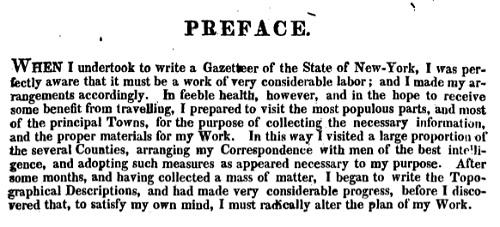
It is not often you get to see such ripping drama in the very first paragraph of a gazetteer of two hundred years ago but there it is. He had to radically alter the plan of his work. Wow. What did he mean by this? Well, he wrote letter to people. See, he had planned to travel around and then got tired of it. So he used letters to gather information instead. Amazing!

Anyway, the really neat stuff in the Spafford Gazetteer are the stats that feed the narrative of that point in Albany ale story and also line up with later Gazetteers to sketch a greater picture of change over time. But then you find these great passages which illuminate the author’s own observations and perhaps prejudices. Like this on page 36:

The increasing use of ardent spirits, calls for consideration of these matters but to examine the characteristic diet of our varied population, would be deemed invidious. If breweries of malt-liquors were multiplied over the country with the rapidity of small distilleries of grain and fruit-spirits, the increase might prove a national blessing instead of a curse. I do not know that intemperance is more prevalent in this, than in the other American states ; but I know that social meetings depend too much on the bottle for their convivial pleasures; and that hilarity is dearly purchased, when obtained from this source.

You know, if someone had said that I ought to consider how dearly I was purchasing hilarity back in my twenties maybe things would have turned out differently. Here embarking on my sixth decade, however, it is more obvious and especially obvious now given all this history, research and writing. There is one thing pretty clear that jumps out when one considers eastern North America circa 1620 to 1820 and that is that temperance was not only inevitable but a pretty good thing. Temperance won and we are it. Just as we have to put up with people who say beer is greater than wine we all know the wag who will use phrases like neo-prohibition, folks talking down temperance. Don’t believe it. All that hilarity was in fact dearly purchased and sure needed someone to turn on the lights, lift the needle off the LP and let them know the party was over. Or at least that sort of party was.

Just have a look at what Horatio found out about Jefferson Co., NY. That is the county nearest me as I sit across on the royalist side of the river. At pages 80 to 81 he says it was divided off the neighbouring county in just 1805 and has a population of 15,136. There are two breweries there already as well as a whopping sixteen distilleries. Large ashery operations are selling large qualities of pot and pearl ash likely into the Montreal market, bringing “much money into the country.” Boom times even with the War of 1812 begun.

At pages 50 and 51 there is a handy table that has masses of data. It states that the price of beer was 17 cents a gallon while the local whiskey was 80 cents a gallon. The two breweries produced a total of 25600 gallons or 31 gallon barrels or around 826 barrels. The sixteen distillers made 32000 gallons of the hard stuff. “Fruit spirits”? Maybe apple cider hootch? Maybe it was too soon for that many apple trees to be in place. There are cloth mills about which Spafford says quite extraordinarily:

The automaton habits, and the immoral tendencies of these establishments, will be better understood in this country 50 years hence.

The grim satanic mills of Watertown, NY? Carding machines and fulling mills. We learn at page 323 that the city was first settled in 1798 and that five of the 16 distilleries are there along with both breweries. For 1849 souls with almost 14 gallons of beer each between them. Plus the rot gut. Ah, the pre-temperance world of Watertown. Spafford what all very Old Testament prophet raging in the storm about these things… except without the religiosity in his concerns as we see again at pages 36 and 37:

The vast number of inns, taverns, and groceries, licensed to retail strong drink, is a growing evil, felt most in cities, but extends in some degree to every borough, village, town, and settlement in the state. By an actual enumeration in 1811, of those in the city of New-York, there were 1303 groceries, and 160 taverns. A small revenue, is collected from licenses, but it is the moral duty of the Legislature to attempt a remedy for the growing evils of intemperance, the source of numerous ills. It is presumed that Albany has as large a proportion of these houses as New-York ; and there is hardly a street, alley, or lane, where a lad may not get drunk for a few cents, and be thanked for his custom, without any questions how he came by his money, or perhaps any care. Parents and guardians face the evils of this system most sensibly, and first perceive the deep wounds thus inflicted on the public morals. The inn, is the traveller’s home, and groceries are also convenient, if duly restricted in number, and well regulated. But the multitudes of mere grog-shops serve only to encourage idleness, dissipation, intemperance, and as the prolific nurseries of vice.

OK, maybe a little moralizing but he likely had a very good point. Frontier hellholes and urban booze shacks abounding. That’s New York State a couple of hundred years ago. You know, unlike a lot of Gazetteers, this one hardly comes off as being commissioned by any chambers of commerce. Which makes it – as well as the inevitable reflections on the two hundred years of progress since – quite pleasant reading even if the implications are grim.

Albany Ale: Not Served In Only The Best Places

Well, at least not in 1865, that is, according to this travel tale in the Sydney Morning Herald on 5 June 1865 by name of “America in the Midst of War: Low Life in New York”:

The first “full-blooded” establishment we entered was many degrees noisier than the lager beer saloons. There was an atmosphere of roughness and rowdyism not to be mistaken. The same respectable and blue spectacled Germans were sawing away at the double bass or blowing lustily into brazen instruments in the orchestra; but little attention was paid to the music. There was much beer about, but it was not all lager. Philadelphia and Albany ale, and an especially nasty compound retailed in ginger beer bottles, and libellously called “Edinburgh ale” were plentiful; nor was a dreadful combination of turpentine and white rye whisky, falsely called “London Dock gin,” wanting. This colourless poison is brewed from I know not what, unless from the most inferior rye, but it forms the basis of much hell-broth, sold indifferently as gin and whisky. It tastes like camphine which has been racked through a cask full of Seven Dials “all sorts.” It is not unlike the Russian vodka; but it must be less pure, and consequently more unwholesome. In Canada it goes by the name of “fixed bayonets,” and is much affected by the military stationed there – in fact, overdoses of “fixed bayonets” have brought many a gallant, foolish British soldier to the halberts.

You know, one of the plainest effects of the writing the Ontario beer book with Jordan and diving back into the Albany’s beer history for that book with Craig is the sneaking suspicion that the temperance crowd of the second half of the 1800s not only had it exactly right but… we is them. No matter what your drinking habits are, I suspect none of you are drinking a hell-broth called fixed bayonets on your way to the halberts.

Halberts? No, me neither until now. Viva not drinking fixed bayonets on way to the halberts! Viva!! Viva!!! Errr… funny that I was no struck by this so much on the book with Max. By the way, a second installment of our excellent adventures through time and space is in the works. Short stories. Like the Hardy Boys series but with more… colourless poison.

The Lower Left Of My Favorite Ontario Beer Picture

prescottdetail1

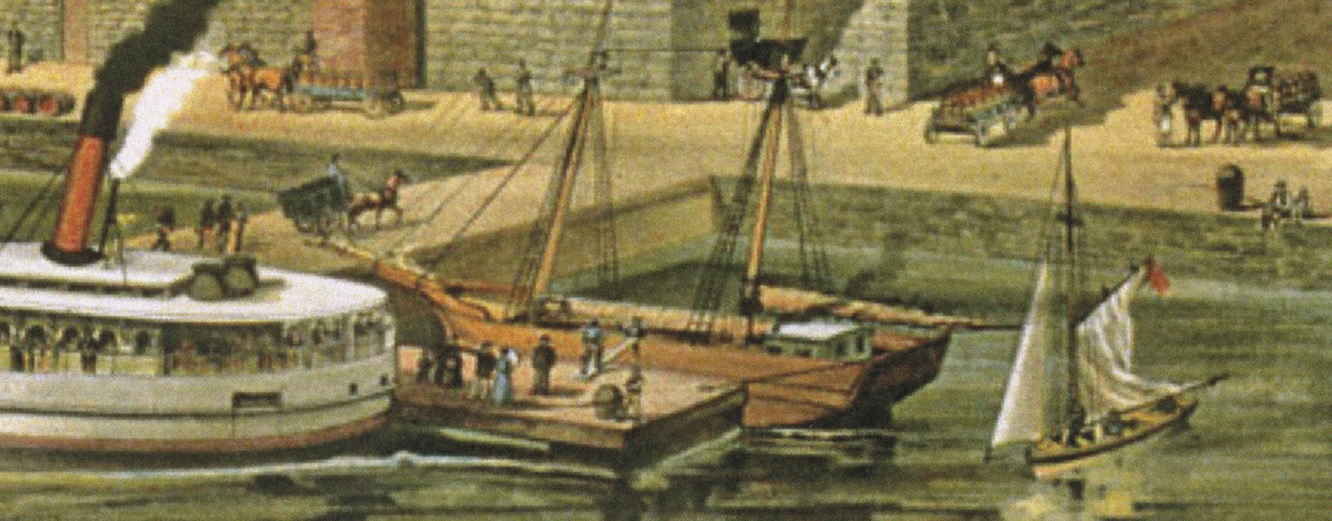
As we now move from writing to editing and proofing the Ontario book, the question of my understanding of things related to publishing has come to the forefront of my brain. But, just when one’s brain is melting, you see a lovely thing like the lower left corner of a Victoria image of the Grenville Brewery in Prescott. Click on the picture above for a wildly large version of this corner of the image. It’s from the Library and Archives of Canada, part of the Molson Collection.

1825 Saw Many Forms Of Upper Canadian Beer

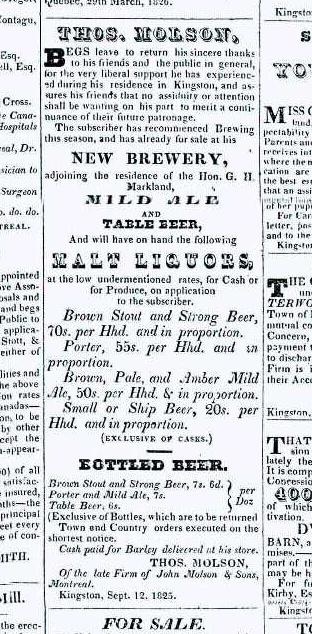
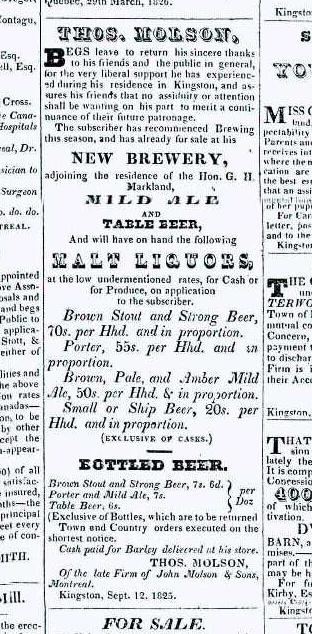
tmols1825aClick on that image to the right to revel in its full glory. That is an ad for the new brewery opened in my town in 1825 by Thomas Molson seeking to break out of the decades old family business down the river in Montreal. A neat if short lived enterprise. But I speak not so much of Tom or his ambitions today as the evidence in that ad of the marketplace of ideas into which he was speaking. It ran in the Kingston Chronically for for many months so it was speaking to somebody.

Notice all the sorts of beer. As this is 30 years after the earliest reference to porter being downed in Upper Canada, I am not surprised to see it on offer. On my reading of the ad, however, I see the brewery knocking out eight sorts of beer. There are five price ranges. There are wholesale and retail sales. At the bottom you can see they are buying barley which means they are, as would be expected for the times, malting their own malt. So it is likely the amber beer is made of amber malt and the brown stout is a whopping big beer made of brown malt. Now, that’s a beer to recreate.

Notice also that he will take produce or cash. Somewhere I came across an article from a few years earlier about another Kingston brewer agitating for the buying of local beer over the New York stuff. I need to dig that out. Albany made beer showed up not long after the War of 1812 ended. But by 1825, Upper Canada is well into its anti-American most conservative phase under the grip of what was known as the Family Compact. The first wave of leadership from the American Loyalist refugee group that showed up in the 1780’s after the American Revolution was lost is dying off and is passing control to British born Tories who came of age in the glory of the defeat of Napoleon. They are seeking to make Upper Canada a model colonial example to the Georgian Empire under, of course, their guiding hand.

What is really most interesting to me, that all being said, is that there were other brewers in town. With their own brands of beer. Could it be that the beer fan of 188 years ago had his or her choice of over twenty beers? Did they buy based on preferences within a wide selection? That for me would be quite, as they say, a something.

Ontario: Toronto’s 1877 Temperance Debate

4303Working away last night on the history of Ontario beer and brewing while Jordan was dilly-dallying over beer in the 1980‘s, I was looking at issues related to the beginnings of temperance and specifically references to the “Dunkin Act” of the Province of Canada, named after politician Christopher Dunkin and repealed in 1878. See, before Canada became a country – sorta – in 1867, there was this other country called… Canada which existed under a constitution that lasted from 1841 to 1867. It was named after the upper end of New France, conquered in 1760 by the British which was named, you guessed it, Canada.

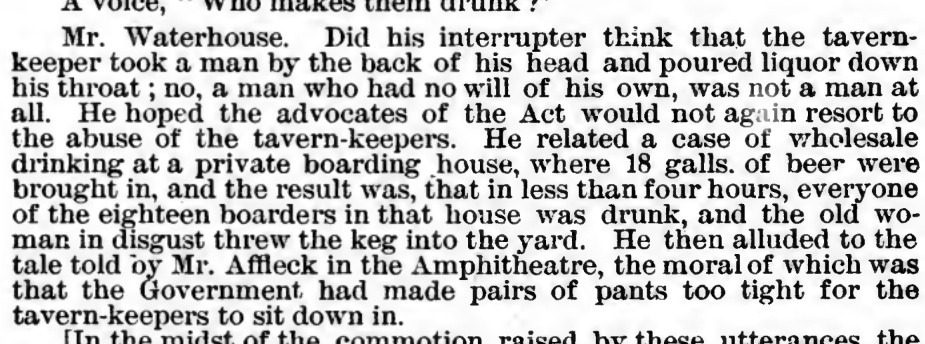
Anyway, the Dunkin Act was the short name for The Canada Temperance Act of 1864 under which municipalities could vote to declare themselves “dry” – meaning free from alcohol sales. When Toronto ran its vote in 1877, a committee of those working for the “no” side kept notes of the debates and, after they won the day, published them. The accounts are full of spicy Victorian rhetoric like the passage above spoken on 23 July 1877 at the Coliseum on Alice Street. Apparently the Sally Anne held meetings there, too. I shall endeavour to work the making of pants too tight to sit down in part of my daily patter from herein out.

And, as the rest of that passage illustrates, the temperance movement may have had quite a valid point in those times. Not only was there a mass of drinking going on but there were other things triggering the movement. The rise of mechanical workplaces needing greater sobriety, the development of a greater sense of individual responsibility compared to more carefree status-ridden Georgians of the first third of the century and, not least of all, the development of a mass middle class of skilled tradesmen and less affluent professionals. Concurrent with this was a pretty sharp u-turn in medical thought which shifted daily alcohol consumption from a principled part of a robust diet to a poison to the body and society. It is interesting to watch this shift happen in less than half a generation just as southern Ontario gets fully mapped out if not yet populated.

We are prone to associate ourselves with history’s winning sides but few of us would not side with the goals of the reformers at this stage of the debate. The are, after all, dreaming and fighting only for the lives we live today. In the story of Ontario beer takes something of a side seat in the debate at this point, the real enemy being whisky. In fact, just a few days before on the 10th of July one speaker, surely coincidentally named O’Keefe, got a big cheer from the crowd when he said he was pro-Temperance, though not in a legal imposed form, and also in favour of light wine and beer. Poorly made cheap rot gut? Who sides with that now?

Maureen, Trains, Meat And Beer

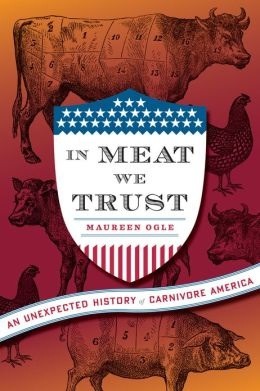
4302I do this every time, don’t I. I start reading a book and then start writing the review before I am a third of the way in. Why can’t I be a good little reviewer – especially when Maureen Ogle was good enough to make sure by email that I would be interested in a review copy of her new book In Meat We Trust. Once I got into the second chapter this morning at the YMCA as six year olds played, I knew I had made the right call even thought the book was about the history of the US meat industry.

See, in the history of brewing in Ontario that Jordan and I are working on, the second half of the 1800s was the only period throughout the 400 years of beer in the colony then Province that was without a pre-existing myth set out for us. You have your explorers and you have your New France. After 1783, you have your Loyalists, then pioneers and the expansion of settlement. Then in the early 1900s you have temperance, then prohibition followed by industrial macro gak with craft following up in the rear. That’s it, right?

Nope. As it turns out the good stuff we know as modernity pretty much occurs between the US Civil War and WW1. Mass communication and transportation. The shift from local to national markets. The vision to view the private marketplace in an imperial way just as Britain and her competitors had as nations for centuries. It’s when things scaled up. From our research, Jordan and I have identified a similar thing. And just as the names Swift and Armour have continued in the US food trade due to decisions made in the 1870s and 1880s, brewing names from Ontario at the time like Labatt and Carling are still known for the same reason.

Maureen shows that the train lines stretching westward across America brought, first, live cattle then chilled carcasses and finally butchered cuts of meat from Chicago to the cities of the US eastern seaboard. The new transportation technology allowed for the best quality finished product to be shipped for the least cost. So, too, with beer. While no one in their right mind loads cart for the pioneer edge of settlement with barrels of beer when whiskey is available, train cars of beer barrels sent by brewers with vision can crush a lot of local old school brewer hundreds of miles away. It’s so… modern.

No wonder the peak number of breweries was in the 1880s and not just before prohibition. Incorporations and collusions were just the thing for late Victorian brewing magnates with facilities located on railway spurs to ensure the beer and money flowed. And as with big brewing so too big butchery in the last years of the 1900s. I will keep reading In Meat We Trust to find out what happens next. You should be, too.

What’s With The Boxes For Cutting Straw?

Again with Lord Selkirk’s diary of 1803-04, I noticed one thing on page 114 that sorta suck out. In his description of the set up of the kiln, there is a particular notation: “…small portable boxes for cutting straw are made for $9…” What the heck is that about? What is the function of the box? Why do you need a number of them? And what is the function of the straw?

Here is a very detailed discussion of the straw or chaff cutter. In that discussion, the tool is shown as going back centuries. The function of the cutter was to make the straw digestible by cutting it into small enough lengths to be mixed with the feed of a horse. And in this case, Selkirk’s note follows a reference to a horse run mill to grind the malt. So it could be just that.

But there are two other uses for straw in this brewery. One was expressly mentioned the other day. Mr Grieve the brewer mixed straw into his mash to keep the wheat from gumming things up. Torrified or popped wheat can be used for that today. Cutting the straw would make sense to ensure it was evenly distributed through out the mash. Straw can be a multi-purpose resource in what I am starting to call if only to myself “vernacular” brewing. Brewing with the locally available resources. If, out of that, you make a unique beer maybe that is an “indigenous” form of beer.

But there is another possibility. Or is it an additional one? Maybe he was kilning with the straw. Attentive readers will recall the fern ale post of the fall of 2011. In that discussion, we see that in the 1600s and 1700s, while coke was growing as a kilning fuel for large operations, straw was still a reliable fuel to make the palest and least smokey malt. Good wheat straw, when used with skill, made the sweetest pale malt. Notice, too, that Grieve is kilning his malt in a place and at a scale where other desirable fuels are unlikely to be as readily and cheaply available. Wheat was the monoculture crop, the gold standard for sale and even export. There may have been plenty of wheat straw sitting around as the district filled with settling farmers. If so and as the beer had a high proportion of wheat, these strong ales of his my well have been quite pale despite their frontier origin.

Just a thought. Could be tasty stuff.

Albany Ale: An Actual Log Brew House In 1803

1803breweryOK, sure this is actually a brewer in Geneva, New York and not one on Albany… but it is an actual brewhouse from 210 years ago even if it was 190 miles or so to the west. And it is one described in quite a bit of detail in the 1803-04 travel diary of Lord Selkirk as he travelled through the lower Great Lakes preparing his settlement at Baldoon, Upper Canada. Having come from Boston, on November 9, 1803 Selkirk was moving west through the Finger Lakes heading towards the Niagara frontier and at Geneva met with a Mr Grieve who owned a distillery and a brewery. He took careful notes and even drew sketches like this diagram of the brew house. There is a fair amount of material here so let’s take it a bit at a time.

=> I am I think finally full redeemed! Well… redeemed ish. See, it is a wheat ale operation:

…half barley half wheat he uses about 500 Bushels of barley vis all that he can find to buy & pays the price of wheat – being very little cultivated… Wheat alone makes thick stuff & the liquor will not run of from the grain – sometimes by the assistance of a mixture of Chopt straw it can be done, but the wheat at any rate does not improve the quality of the beer…

See, I have been writing about indigenous strong wheat ale brewing in New York for over three years now but have never seen it described. Now I have an eyewitness account.

=> And it is strong ale. Grieve speaks of making stronger ale for storage through a summer but is brewing for present us an ale with 3.5 to 4 bushels of malt per barrel. Now check my math but when I tried to work out the strength of an 1835 Albany ale a few years ago I came up with a figure north of 8%. What would the strength of his proposed 5 bushel keeping beer be?

=> The brewing process is both described and illustrated. Click on the picture above and you will see a bigger image. The upper image is a top view of the brewery while the lower one sees that from the side. Why this detail? Selkirk is recording the scene just in case he wants to replicate it at his new settlement. The phases of brewing through the system are: (1) heat water in boiler; (2) mash malt with hot water dropped down from boiler; (3) draw wort off mash by gravity down into a jack tub; (4) pump or “jack” wort back up to boiler where it is boiled; (5) drop the hot wort into the first 10′ x 14′ cooler or coolship and, after some time, drop it again into the second coolship; (6) drop the cooled wort into the working tub where primary fermentation takes place; and (7) rack into barrels.

Perhaps as interesting as the idea that this might be that missing link between the Dutch wheat brewing in CNY before the Revolution and the more formal scientific brewing starting in the 1820s and ’30s is the last observation made by Selkirk. There is plenty of cider being made from trees which have re-sprouted from the roots of the orchards destroyed by the Sullivan Expedition in 1779, a very ugly campaign to eradicate the Iroquois allies of the British Crown. Their resilience then makes me wonder how long they had been growing and also if there are any descendants today.

Ontario: Women And Beer Before Temperance

sessionlogosmThis month’s edition of The Session is about women and beer which, if you think about it, represents 50% of everything in our beery culture. Sure it does – as long as you have your methodology correctly aligned. So, there should be a wide range of topics. For me, I noticed a few things along the way as Jordan and I have been researching and writing the history of brewing in Ontario and especially things prior to 1860 that are well worth sharing. Why 1860? Temperance and trains, of course. The whole society changes when trains and temperance get a major foothold.

The thing is that – before temperance and trains – beer seems to be a townie drink, a drink that you get when you are within reach of a brewery or a transit point. Consider this as you consider that, as set out in the Oxford Symposium on Food and Cookery 1991: Public Eating Proceedings, in the chapter “Temperance Hotels and those ‘Damned Cold Water Drinking Societies’” Powers and Duncan describe at page 238 how Catherine Parr Trail:

… gave advice to immigrants in 1852 and included recipes for making beer, noting the absence of the ‘sweet well flavoured home brewed beer of the English farmhouses. Unfortunately, she said, “the taste for beer has often unhappily been superceded by that of whiskey.’ She provided recipes for treacle beer, beet beer and maple beer as an alternative to whiskey.

See, once you get anywhere away from town and a cartloads of hooch is heading your way, it is going to have the most concentrated form of the stuff on it unless there is a compelling reason not to do that. And until trains and temperance push to the forefront, there just isn’t a reason. And see Parr Trail missed the “sweet well-flavoured home brewed beer of the English farmhouse”? This backs another thing we suspect: that there was not a lot of surplus barley floating around Upper Canada even well into the middle third of the 1800s. One farmer interviewed in his old age recollected that he didn’t even see barley until he was in this twenties in the early 1840s. Which leads to beet beer on the frontier. You do what you can.

So, what was the place of women in such a culture. Fortunately, I have my copy of In Mixed Company by Julia Roberts reviewed back here in 2010. Roberts has a chapter in her book entitled “Public Life for Women in the Era of Separate Spheres” which discusses the experience of women in Upper Canadian taverns. And I have a handy copy of Wives and Mothers, School Mistresses and Scullery Maids: Working Women in Upper Canada 1790-1840 by Elizabeth Jane Errington, a historian who I have had the pleasure of meeting. Errington’s books has quite a number of observations of the intersection of women and alcohol in the colony during that period.

And what do we learn? One thing is that women were present in taverns as daughters, wives and widows working under or as licensee but also as travelers stopping at the inn and even local drinkers. Roberts indicates that as early as the 1830s inns were advertising special separate provisions for female customers. These provisions were further divided by class and included separate entrances, parlors and waiting rooms as well as balconies. And in some cases they are recorded as drinking alcohol including beer:

At Robinson’s tavern in Prescott, “Sarah” charged half a pint of beer in 1844… Widow Wilson lodged at Robinson’s for two and ah half weeks starting 31 October 1847. On her first day, she charged a glass of whisky, a glass of brandy and several pints of beer. She then stuck to beer and her tally on the last day of her stay was fifty-six pints, an average of three pints a day. Treating others accounted for part of the total.

As the title indicates, Errington’s book focuses on the working life of women. She notes that even when a couple ran a tavern together, as noted by one traveler in 1797, the husband ran the farm while the wife ran the tavern. As the post-Revolution economy evolved, wives were less involved in maid’s work and more often acted as hostesses especially in more established hotels. On the frontier, however, things were not as genteel. Errington quotes from Susanna Moodie on the preparations for a work bee when neighbours came to achieve some collective goal:

…our men worked well until dinner time, when, after washing in the lake they all sat down to the rude board which I had prepared for them, loaded up with the best fare that could be procured in the bush. Pea soup, legs of pork, venison, eel, and raspberry pie, garnished with plenty of potatoes and whisky to wash them down, besides a large iron kettle of tea.

Women and beer? Before the rise of temperance as a political force to be heeded and before the train when barrels of beer could be gotten in as far as the rail line went, it was a townie thing in Upper Canada. And women were there as they were everywhere.