Ontario: The Red Lion Inn, Yonge Street, Toronto

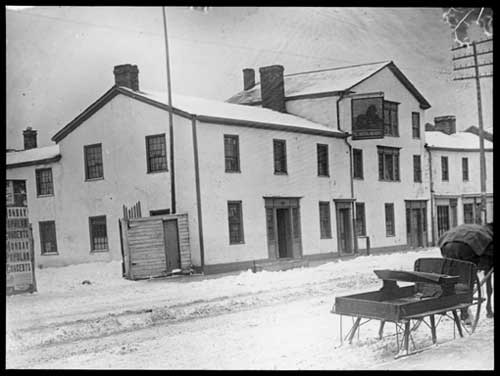
redlionto1886Came across this image of the Red Lion Inn in Toronto at the Archives of Ontario. The photo is from 1886 and shows a building well into its eighth decade according to this blog post of just a few months ago. Built in what was then the country, it was the first stage coach destination on the western route out of the capital, then named York, located around what is now Yonge and Bloor. It would have been about 2 miles to the NNW of the slightly older Playter’s Tavern.

What I like about the photo is how it likely displays three or four additions to what Roberts describes as the original Upper Canadian government approved standard layout Georgian wooden frame structure with the front door centered between two main floor windows and beneath the center window on the second floor. There would have been a chimney at each end of the building, though in the photo the one farther from the photographer could have been rebuilt when the next taller extension was built. The announcement of its opening was set out in a notice in the Gazette of June 13, 1808:

Beefsteak and Beer House. — The subscriber informs his friends and the public that he has opened a house of entertainment next door to Mr. Hunt’s, where his friends will be served with victualing in good order, on the shortest notice, and at a cheap rate. He will furnish the best strong beer at 8d. New York currency per gallon if drank in his house, and 2 s. 6d. New York currency taken out. As he intends to keep a constant supply of racked beer, with a view not to injure the health of his customers, and for which he will have to pay cash, the very small profits at which he offers to sell, will put it out of his power to give credit, and he hopes none will be asked. N.B. He will immediately have entertainment for man and horse. Daniel Tiers. York, 12th January, 1808.

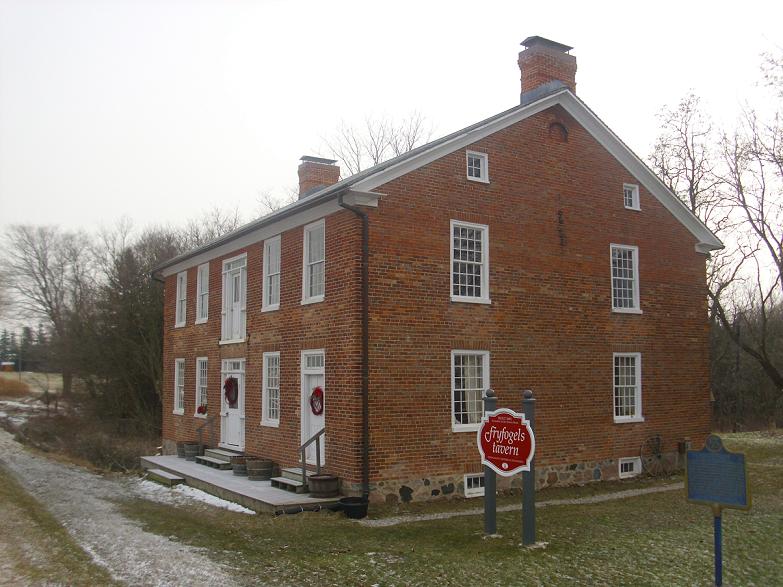
Not sure what entertainment for the horse suggested. I expect the original tavern would have looked a lot like the brick-built Fryfogel’s Tavern near New Hamburg in Perth County, under 100 miles but a couple of decades of settlement to the west. Like Fryfogel’s, the Red Lion had a ballroom and also served government administrative purposes as a district polling location in elections.
Howe’s Public Houses Of Entertainment In Nova Scotia

I picked up my copy of Western and Eastern Rambles: Travel Sketches of Nova Scotia by Joseph Howe this morning. The sketches are a series of essay’s the later famous politician published in his newspaper, the Novascotian, from 1828 to 1831. His travels were largely not about the writing but required to get his subscription money from rural readers but in deciding to record his trips out of the capital of Halifax he also was able to capture the times and scenes around him.

I originally thought I would find lots of beer references but, as we learned about Ontario from the 2010 book In Mixed Company: Taverns and Public Life in Upper Canada, it all seems to be either about wines or, especially with Howe, a good cup of tea. Not that he is an early prohibitionist as he suggests in this passage describing the night life offered to a stage traveler landing in what is now Kentville:

…hardly do you get into the village before some long-legged Merchant pops you into a gig and gallops you away to church – or some other sinner of the same stamp gets you into his house, from which it is no easy matter to escape. You may run about, like Blair‘s soul, knocking at every outlet but in vain – Port stands sentry in one place – Madeira in another, while Claret, at the head of Bacchus’s light infantry, fairly cuts you off from every retreat; while the graceful restraint of a reiterated welcome from a youthful matron, and the childish prattle of sweet little Bess, make you almost forget your home, and swear that the village should have been called Hospitality instead of Horton Corner.

He recommends, if you have to be on your way, to stay instead with Mrs. Fuller of the Kentville Inn for quieter company where you can “get to bed by times” and make the stage coach when it leaves at 5 am. So, Howe’s record is one of a businessman doing business, describing his trip back to his customers and readership, seeking respectable company as well as good nights worth of sleep. While he does admit to having “a glass or two of strawberry wine” at the hospitable cottage of Mrs. Miller in Truro, for the most part the inns Howe describes offer quiet.

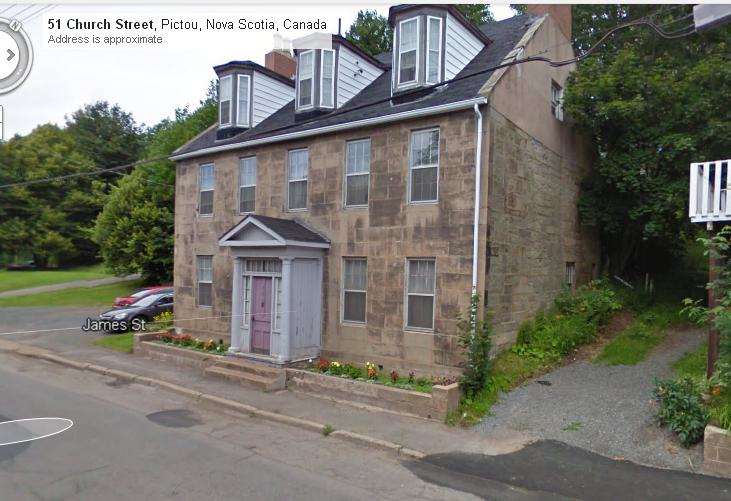
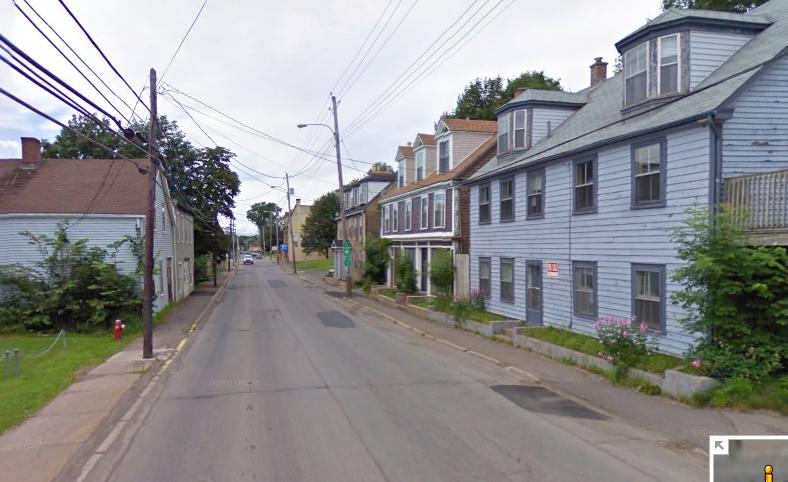
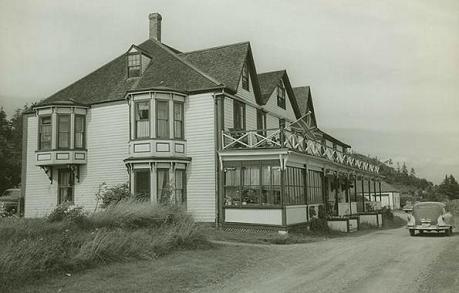
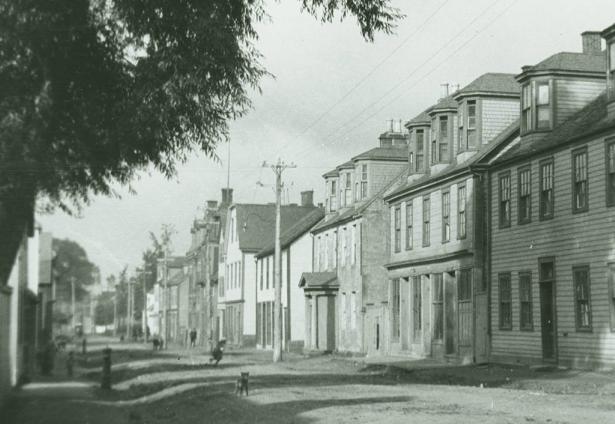
Up top is a picture from the 1950s of the still standing Ottawa House in Parrsboro built in 1773 or 1765. The thumbnail to the right is a 1908 photo of Pictou’s Church Street including a stone building, third from right, known as Lorrain’s Hotel, built as an inn and tavern in about 1820. Howe does not record visiting either of these specifically but they are likely examples of the finer sort of establishment he might have encountered on his way. Not all were so well kept as this description of one from 1817 shows. And unlike as Roberts describes as the Upper Canadian government approved architecture, the Nova Scotian versions of these establishments appear to be up to the owner.

Update: By the way, “public house of entertainment” was what they were called on the license and interestingly, not only does Google maps show Lorrain’s Hotel of Pictou was still there in 2009 but so were its two neighbours shown in the 1908 photograph. See below…

More Linky Weekend Goodness For Late Fall

Where were we? Ah, yes. The great explosion of 1840:

Another huge fire erupted on 18 April 1840, this time on Counter’s wharf and, aided by the explosion of gunpowder stored in one of the warehouses, spread across much of the waterfront area. Strong winds helped it extend to the whole of the north block of the Market Square, and to most of the next block up to Store Street (now Princess Street)

Never heard of it until a month or so ago. You would think that the destruction of much of the town would be a folk tale, collective memory. Never understood why Ontario is not interested in its own past like other parts of Canada, the English speaking world.

Saturday night update: The Flea, mon cher, teaches how to KooDon’t.
Best thing ever on the internet: what is brown and sticky?
♦ I had no idea that, besides interest on debt, Italy was actually in the black. Canadian Conservatives everywhere must be hailing it as solvency as they do with Mulroney’s terms.
♦ Really? Do you think? Do you think a cabinet member gets attention from “foreign lady reporters” from nations run by totalitarian regimes because they find Tories hot?
♦ I had no idea that Harper has expanded the Federal public service by 13%. No wonder they think that Mulroney got us to solvency.
♦ What is it with all these odd Tory stories? I mean if they are going to be doing all the social engineering I really hope they know how to plug in the toaster first.
♦ Finally – a break from Ottawa’s amateur hour. A great story from Humblebub.

That’s enough of that. Check out the great series at NCPR on the state of the nations on the two sides of the Great Lakes.

Toronto’s York Brewery And Playter’s Tavern 1801-05


playtertor1857a

I have been playing around with some passages on Toronto in the first years of the 19th century. Here is what I started with:

⇒ “A recent Fact will corroborate what I have said; A Brewer from Kingston removed to York lately and, on application to the Governor, obtained one of the King’s vessels to transport wheat and other Grain from Kingston and the Bay of Quintie, before beer coud be made – and almost all the Pork, Beer, Butter, Flour, Hams, Mutton, which are used at York are brought by water, from Kingston, Niagara, the Genesee Counttry, &c &c. – In short the Town is supported by the money which the Gentlemen who have Salaries from Government expend in Buildings & other Improvements; and that source begins to fail.“: Letter, Rev John Stuart to the Bishop of Nova Scotia, Kingston, September 14, 1801.

⇒ “Even in 1815, after the establishment of two neighbourhood breweries, Commissariat General Robinson was obliged to buy 8,347 gallons of beer and liquors from Kingston for the men at the cost of L8,800“: Bowering, page 9.

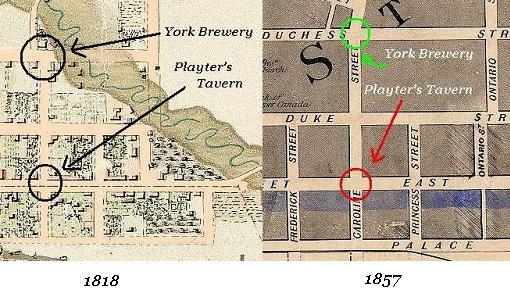
⇒ “York Brewery, southeast corner of Duchess and Sherbourne (Caroline) Streets, 1800-1805. Just when the first commercial brewery in York, and who the brewmaster was may never be known… This brewery may have been operated by Robert Henderson in a notice of sale dated 1809, Henderson advertised a milling plant, brewhouse, working tubs, coolers, two kilns for drying malt, two good wells or water, a stable,” two stills, a townhouse, slaughterhouse and three acres of land“: Bowering, page 91.

⇒ “1805 – Upper Canada – Robert Henderson establishes York’s (Toronto’s) first brewery. It closed 12 years later and the facility was leased by different brewers until 1853“: Sneath, page 329.

So you see there is some question as to when a brewery was first built in Toronto – or what was then York… but then I also remembered In Mixed Company by Roberts and how there was a chapter about an early tavern keeper who kept a diary. Turns out it was written in 1802-02 and turns out she gives the address for the tavern – the corner of King and Caroline Streets. Which made me look up above again and see that Bowering gave an address as well.

playtertor2011Over time Duchess is now Richmond and Caroline did become Sherbourne but that is enough to dip into the City of Toronto’s historical maps and atlases online collection and – voila. We have the information above. Which also means we can figure out where these spots are today which you will see if you click on that little thumbnail.
Roberts explains that the Toronto of Playter’s diary and the founding of its first brewery had 75 to 100 homes and about 320 inhabitants in town, about 420 in the surrounding country as well as about 240 in the military garrison to the west. Both establishments sit in what is even then called Old Town. It’s the administrative capital of the new colony of Upper Canada. Roberts also indicates that drinking in Playter’s included rum, “sling” and punch as well as whiskey, brandy and wine. No beer is mentioned that I see.

I would love to have a read of the diary but, if we think of that letter from Rev. Stuart above, we might quess that early York is something of a Brasilia, a constructed government town. The kind of place that you had wine over beer. Not Stuart’s sort of place. No, he was a beer man. One of the founders of my town, his beer tankard is now owned by the people of Canada. He may well have had many an ale from Albany in it. He was a personal pal of Sir William Johnson, both backwoods leaders in central New York before the Revolution, home of our loyalists, beer drinkers there and in what becomes Ontario a decade before the colonial softie government officials show up in York.

Why Did A Brewer In Kingston In 1815 Want Rye?

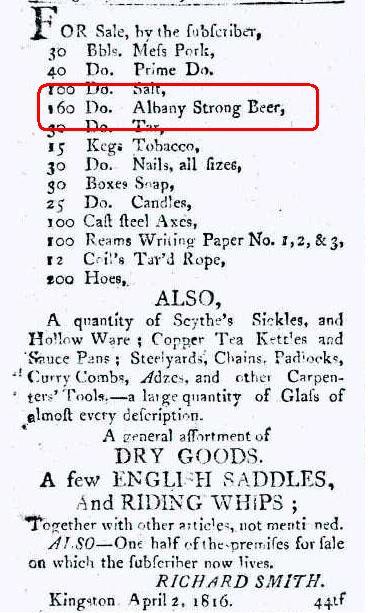
kgazkbrh1The ad is from page 4 of the Kingston Gazette, 6 January 1816. You can see at the bottom that it was placed on 15 December 1815. So many questions. What were Messrs Robinson and Gillespie up to? Why is rye placed between barley and hops in the large font while oats sit down there with the peas? Also, is “strong beer” something separate, something identifiable to the Kingstonian a year after the war with America? You will recall that a few months later in April, Albany strong beer is for sale. It also comes just a month after Richard Smith’s notice for plain “beer” – so was “strong beer” something they had the taste for still, almost 40 years after having to flee from their central NY homes at the beginning of the American Revolution? And why is it not “ale” when described in the Kingston papers?

I just finished The Lion, the Eagle and Upper Canada by Jane Errington, a historian over at Royal Military College – they of the old school base ball. The book is well reviewed here but, short form, it’s an interesting view of early Upper Canada (1790s to 1820s) based in large part by review of early newspapers. In it, Errington suggests something of a window between the end of the War of 1812 in 1815 and, a few years later, a clampdown in trade and other contacts with the US towards the end of the decade. But even with her level of detail about the community, trade and industry, there is not much about beer itself. Meaning I am left unsure if beer was being traded within months of the end of a war, perhaps as a stop gap until local product restarted… if it was interrupted by the war… which is another question.

So, I was very happy to read in the comments that Steve Gates has published his history of brewing in the city and in the region. I couldn’t get out of the door to go get a copy but will tomorrow. Hopefully it will shed some light on what Robinson and Gillespie were up to.

In Kingston In November 1815 There Was Beer!

asb2

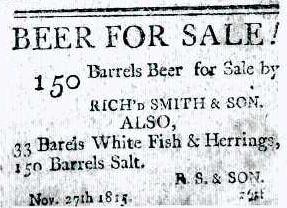
Beer for sale! Hallallujah!! BEER FOR SALE!!!

Remember what I suggested before? That where there is peace there is
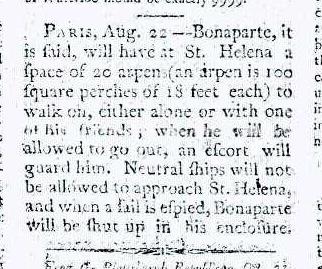
beer? Well, on 27 November 1815, my town of Kingston was just nine months past the ratification of the Treaty of Ghent and five past the Battle of Waterloo. The proposed terms of Napoleon’s incarceration at St. Helena are announced in the same edition of the Kingston Gazette as was the reprimand of Major-General Proctor – the news oddly received care of an American paper… care of one from Montreal. Funny information and trade routes in those early post war days.

Where did the malt come from? Sure, Kingston was a key outpost bastion in the Empire, the guardian of the Great Lakes, St. Lawrence and Rideau but, still, who grew the grain that made the malt that made the beer? Was it a local 1815 crop or was it shipped from Britain or America? Where was it brewed? Notice that Richard Smith only calls it “beer” where a few months later he calls what he is selling Albany strong beer. Also, I don’t see another ad in the paper for beer. There are many fine things – fancy goods even. The front page of the 2 December 1815 issue includes notices offering Turkish opium, spices and sugars, China teas and and Port wine. The town had its need and apparently some issues for which it had supplies. But there was no other beer for sale.

It makes one consider that this may have been the first or at least an early shipment to make it to the town after the war. There very likely were beers in taverns but not necessarily. More drinks can be made from spirits and if you are transporting them up a river filled with rapids between here and Montreal, there is more bucks in batteaux that way. We learn from Roberts that punches and cocktails was the fashion, too. Taverns were posh. Not sure. But what ever it was about, beer was for sale. And it was worth letting people know.

Your 1816 Albany Ale Update From My Home Town


kingstonasb1816kWe have not found more Albany ale information for a while but this is your moment of zen. Just consider what it means. There is no Erie Canal. There are rapids on the St. Lawrence all the way to Montreal. There are about 4,000 people in this town. The War of 1812 ended one shipping season before… unless it was brought by sleigh. Oh, and “Do.” does not mean dozen. It means “ditto” so those are barrels. Amazing. From the Kingston Gazette on April 27th 1816.

All That Base Ball Was Really About That Pitcher

vbbk20114

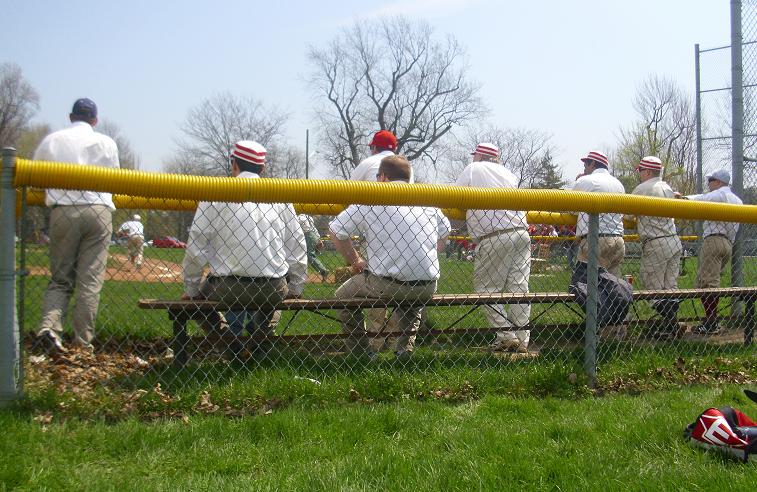
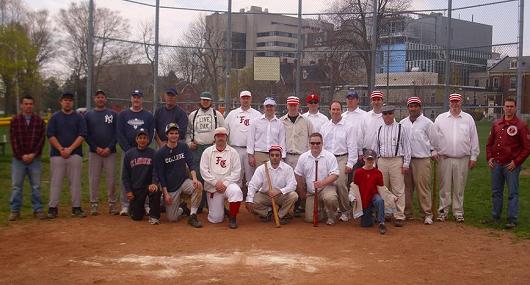
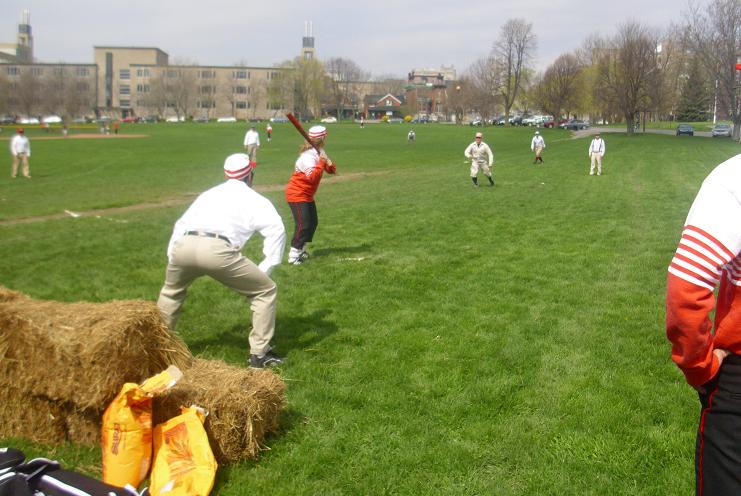
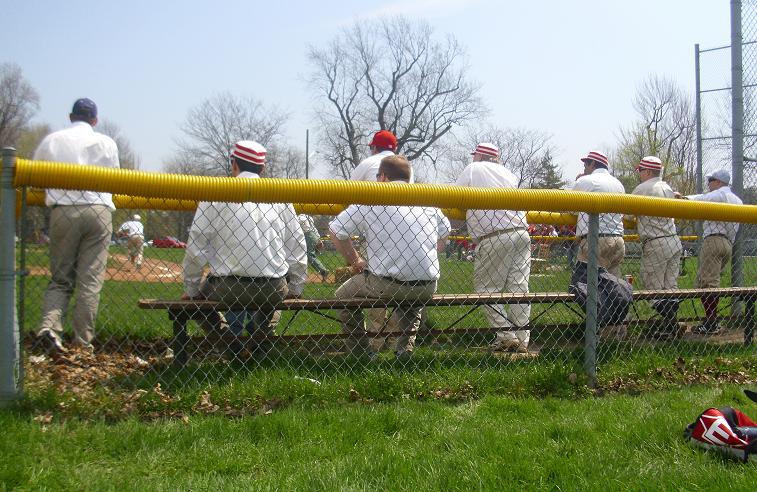
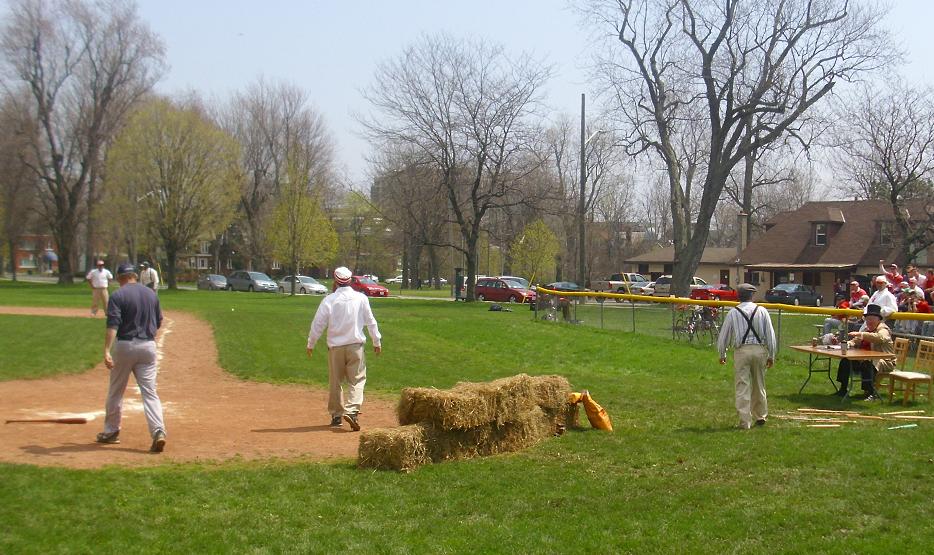
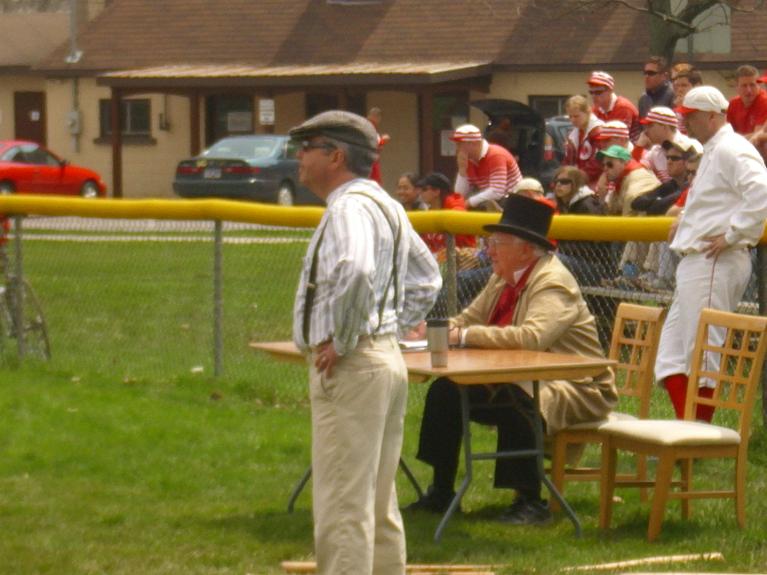
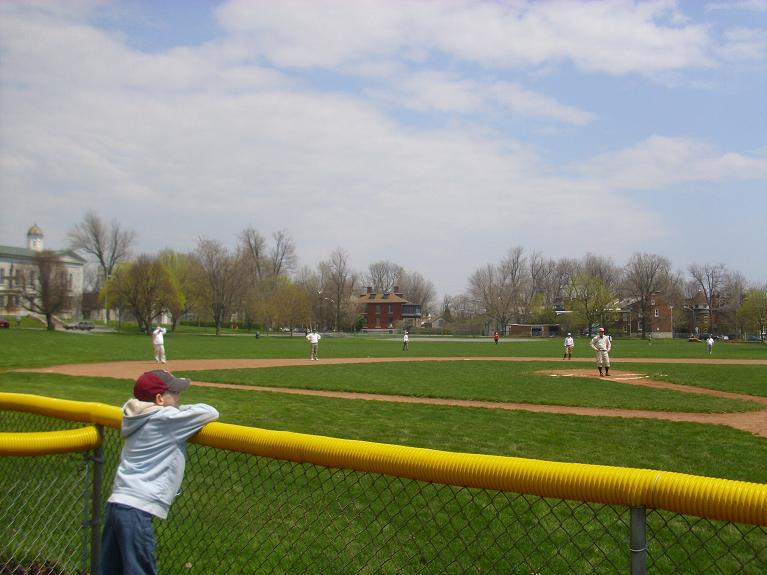
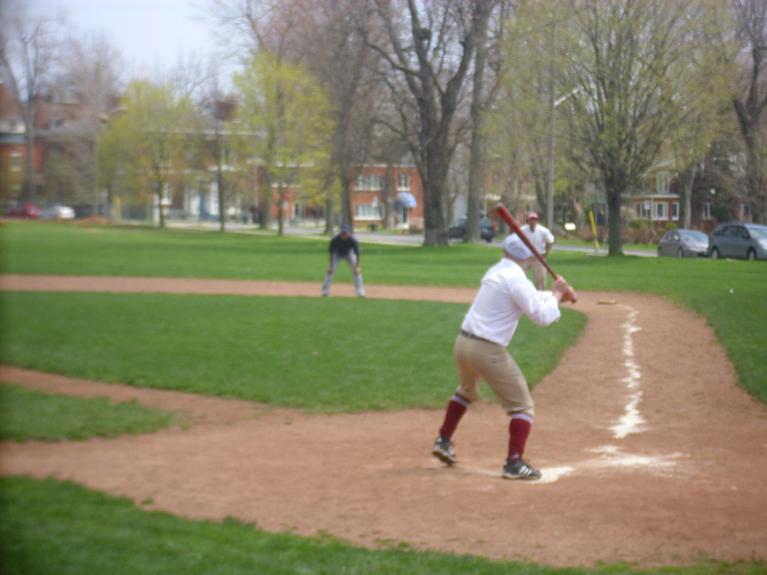
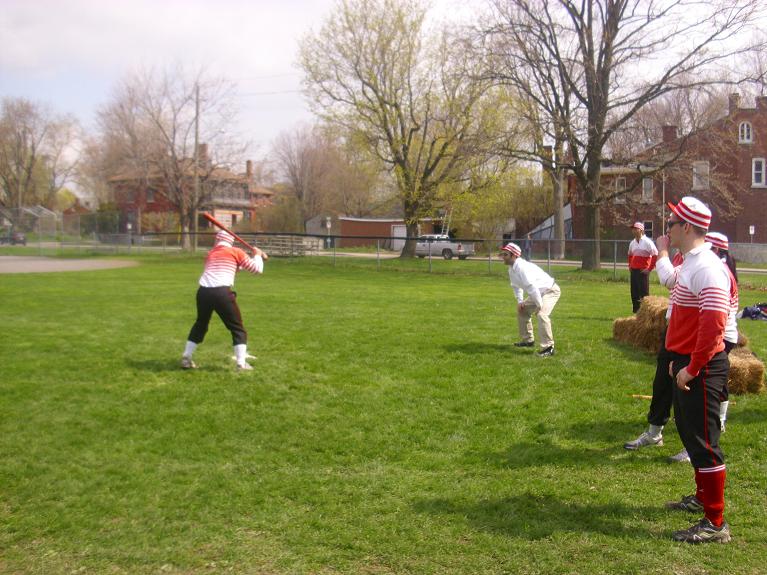
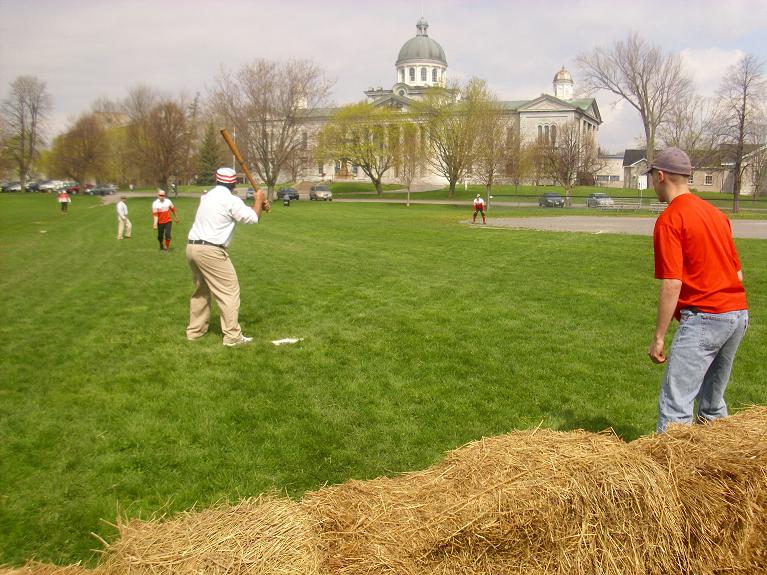
I indulged in my other odd hobby yesterday. 1860s – 70s base ball. Two words. No gloves. No sliding. The ball springs off the bat with about as much zip as an Edam cheese would. Underhand pitching and bats that are like swinging a 2 x 4 fresh from the lumber yard. I put the thing together with friends. We took on graduating cadets from our Royal Military College as well as a mixed team of upstate New Yorkers from Canton and Rochester NY. The final was a 3-2 victory for the Americans. The team that became the Atlanta Braves beat Kingston on the same field 138 years ago… by a slightly larger margin.

And after it all, we retired to the brew pub. There is only one in the City so that’s what we call it. Over twenty folk wanting to relax over a few beer and get to know each other. Lively talk about the sad state of regional teams like the Bills and the Leafs, discussions about the different gun law ending with the trump card of a cadet explaining the fire power he’s been trained to use. And the beer. I hadn’t realized that oatmeal stout was not available in pitchers so I had a pint and bought a pitcher to share of the pale ale, both brewed by Montreal’s McAuslan Brewing. I couldn’t remember the last time I had a pitcher. Sounds sad, doesn’t it but life with the many rug rats does have its realities. What did I like about having one? The conviviality. The vessel was meant for sharing. Slopping pours topped up this glass and that. As talk ebbed and flowed from the Bills to bazookas.

Easlakian Vintage Base Ball Madness Strikes!

A lovely day was had by all. Kingston St. Lawrence Vintage Base Ball Club loses 3-2 to a NY Selects team from Canton and Rochester NY in the final of the RMC tournament. RMC 1 lost to the Selects 7-6 in the first round while the KSL took RMC 2 by 17-3. I got a single.

Ontario: Fryfogel’s Tavern, Near New Hamburg, Perth Co.

fry1

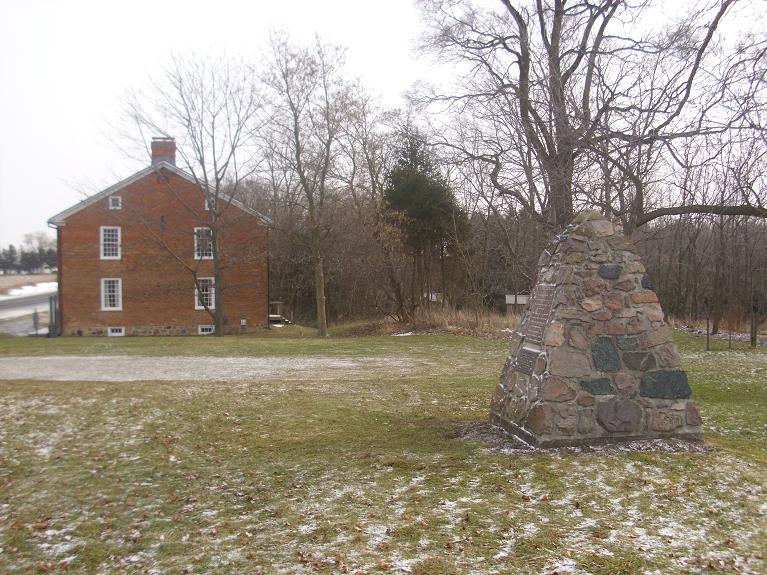
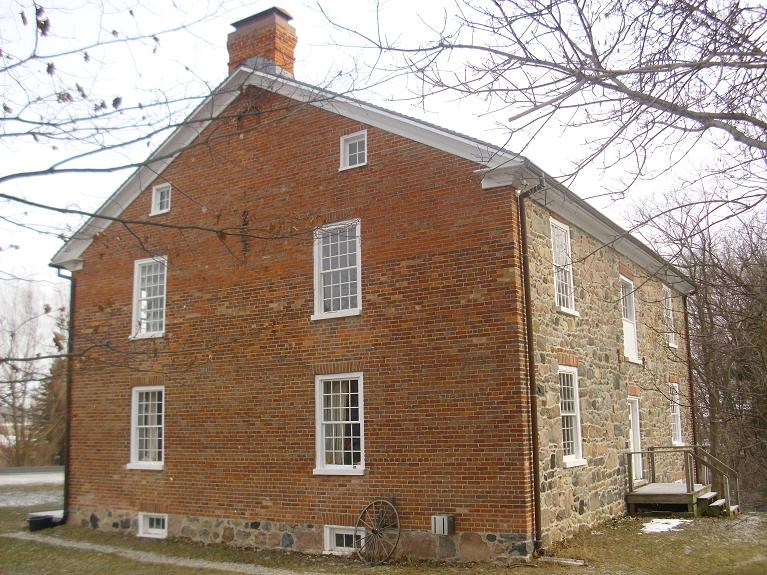
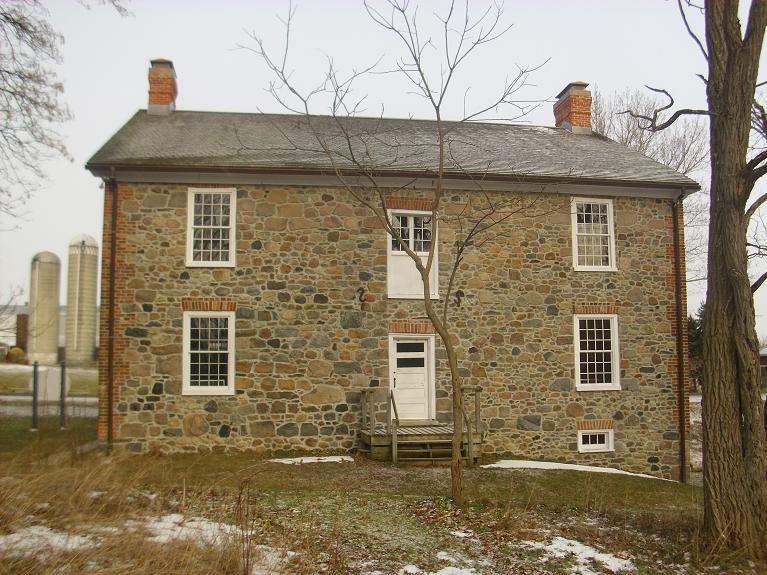
Ever since I opened my copy of Julia Robert’s In Mixed Company, a history of the taverns of Upper Canada from the 1780s to the 1850s, I have wondered how many of our Upper Canadian pioneer taverns there might be left out there. Well, I passed one today – the Fryfogel Tavern – and thought I would get out of the car and have a look around.

fry2fry3fry4
fry5fry6


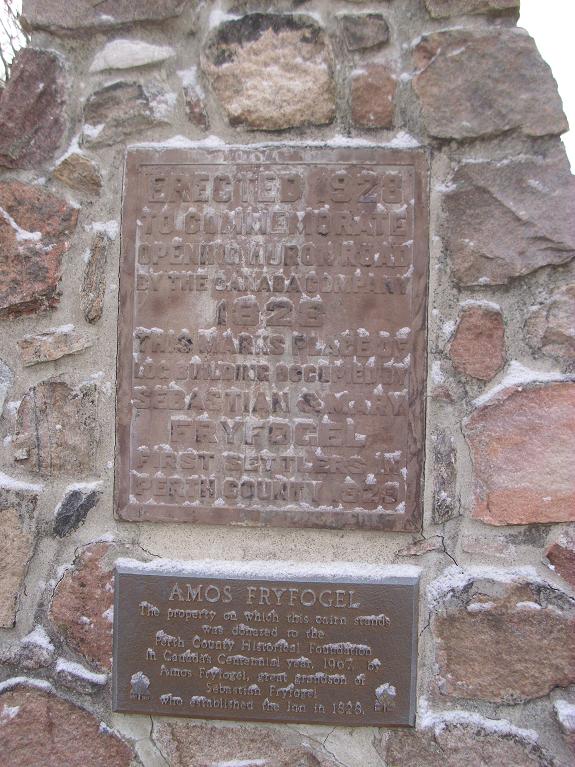
Fryfogel’s Tavern, more graciously called an inn on the official road side sign, has sat by the road between Kitchener and Goderich for 166 years, though it has not apparently acted as a tavern for most of that time. You will recall from last summer’s posts on Ontario’s history that the land to the west of Lake Ontario starts opening up and breweries start opening up in the 1820s and 30s. The Canada Company’s plan of settlement of the area is discussed here and the way of life at the time of 1830s settlement of the district can be found in this letter from an original settler, John Stewart. Each source mentions Mr Fryfogle or Fryfogel when his tavern was a log cabin. Roberts indicates that the later 1840s form of the tavern is in the Georgian style and that this was the template for taverns for much of the pre-Confederation period:

The Georgian style worked well to project an image of prosperity and comfort, particularly in the practical sense that it enabled different activities to go on in the house at the same time.

Owned by the county’s historical foundation, it well kept but something of a shame that it is not in use though that seems to be in the plans. Next to it to the west sits the site of the 1828 cabin that preceded it as the home of the family. To the east runs Tavern Brook. The original owners are buried across the road.