
Well… Welcome To Your “It Is March And The Good Times Are Here Again!!!” Beery News Notes

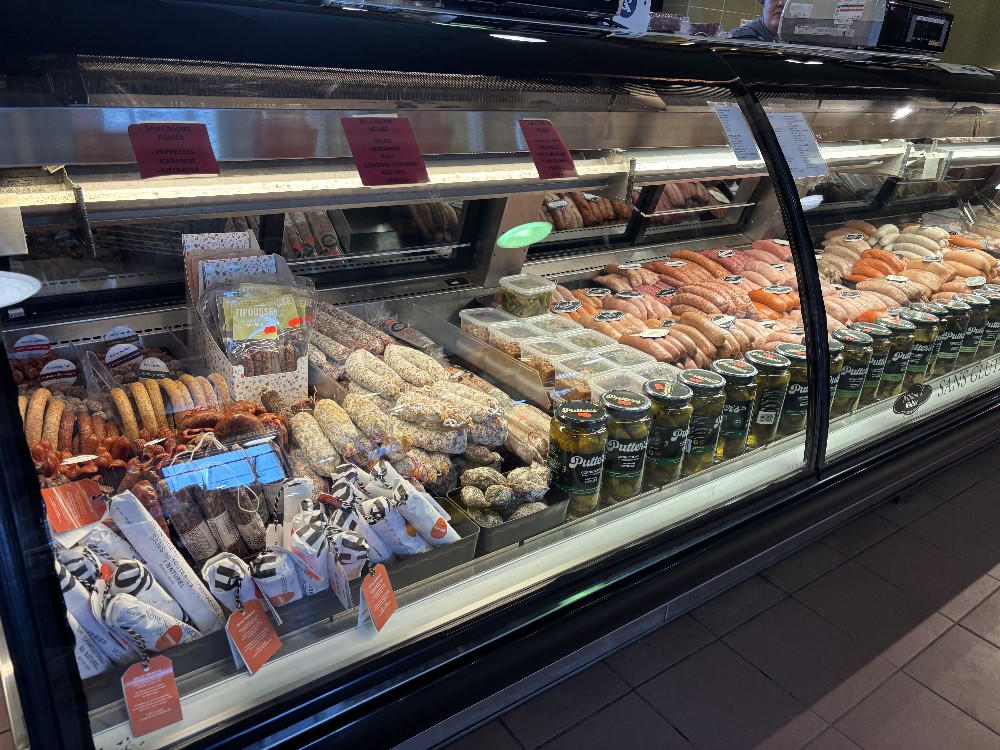
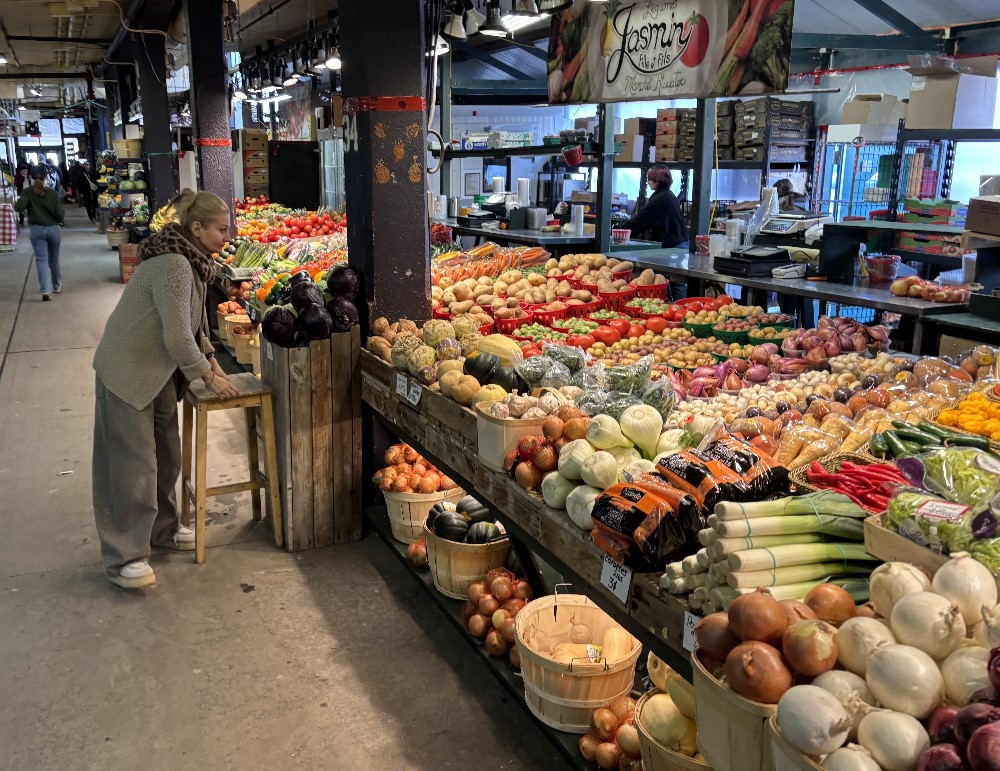
For well over 20 years, I have lost my marbles over March arriving as it did again last Sunday.   I may have created that image to the right in 2004. Such a clever boy! So well centered. Why do I love March, you ask? Not the green beer. Maybe not the green grass which might pop out soon. It’s the first seeds in the soil. The green green peas in loam. Soon, my precious. Soon. Otherwise, this is a bit of a scattered mix this week as I rush. See, I played taxi driver for folk going to a concert, spending about 21 hours in Montreal Tuesday to Wednesday. On the way out, hit Atwater Market as usual. Got my chicken cretons. Got my duck rillettes. The toast won’t know what hit it. And when toast wins, the beery news update suffers. Such is the way of the world.

Enough about me! First up, Jeff* has shared a retrospective on his writing career and how important blogging was to getting to the next step. Twenty years ago he started on a path (like Matty C a decade ago) towards  a number of leaps of faith. Leaps I avoided. I have my name on four modest books but didn’t see a future in that direction. Me, I can show you instead the bridge I had a large part in building. But they can show you publishing sales figures that put food on the table. It’s good to see that we were all right in our different choices.

Speaking of Matty C, for “Get ‘Er Brewed” he looked around his particular environment through the last holiday season and asked where the future may lie for a trade facing tough times:

I can face the hard facts and admit pubs are dealing with some of the worst trading conditions they’ve ever known. But I also believe that they will continue to persist, whether that’s through innovation and listening to what their customers want from them, or by sheer bloody-mindedness. Despite all the doomsaying I consider that there are still positives for pub owners. However, in order to extract these an equally optimistic outlook is required from publicans. Yes, prices are going to have to go up. Customers are going to have to get used to them and measure their spending accordingly. But I don’t think this will mean that people will stop using pubs, and that they’ll simply vanish off the face of the earth.

I tihnk that is a good baseline position to take. Beer does not go out of style even during an inflationary period… or even in a very localized deflationary one. The BBC had a story about another sort of good value care of one pub in Leeds:

A pub which was told selling a pint of beer for 25p during a promotion was “irresponsible” and a breach of its licence has instead begun giving them away. Leeds city centre pub Whitelocks offered customers their first pint of revived 1970s pale ale brand Double Diamond at the retro price as part of the four-day scheme, which began on Thursday. However publican Edward Mason said the council pulled the plug on the offer later the same day, saying it was in breach of mandatory licence conditions on minimum alcohol pricing. After seeking legal advice and discussing it with the local authority on Friday, the pub then commenced offering the initial pint for nothing. Unlike Scotland or Wales, England does not have a defined minimum price for alcohol.

A bit more scientifically we see that Kendall Jones at the Washington Beer Blog ran a very detailed survey on the place of IPA in his readership’s current mindset and had a significant response:

A few weeks ago, I posted a survey about IPA to gauge how people feel about craft beer’s most popular style. I was wondering if breweries are hitting the mark. Do the beers align with what people want? Have people’s preferences changed? Stuff like that. If you haven’t taken the survey, it’s still up there gathering data. I encourage you to participate! When the survey received 1,000 responses, I gathered the data. I will continue to do so as time moves on, but this report covers that first round of responses. Likely, this round of data comes from a pretty enthusiastic craft beer crowd, not the general beer-drinking public. Take that for what it is. In addition to the results, we also collected a large number of comments, which we rounded up at the end.

One of the particular results that surprised others is the result that Kendall noted: “Really? Nearly 80% of respondents say they understand the differences among IPA styles. I am not sure 80% of professional brewers understand the differences between IPA styles.”  This can certainly reflect the Washington marketplace as well as his readership but I do wonder if there is a difference between detecting the difference between styles and understanding them. I mean I can tell a Black IPA from a White IPA but I still left with questions like “why?” as well as “WHY????”  Go have a look and even add your responses as the survey is still open.  This is an excellent example of how a blog excels at some many sorts of beery writing that other formats can’t touch.

Speaking of excellence, Boak and Bailey placed another sort of question out into the ether – “Do you really want to visit the best pub in town?“:

Before Christmas we found ourselves in a pub surrounded by a group of people grumbling about the seating, the atmosphere, the beer, and everything else. It became apparent that a couple of members of the group had put together an itinerary for a crawl based on their preference for craft beer. We felt quite sorry for them as they tried to enjoy their pints while surrounded by moaning pals – but then what did they expect? What’s funny, we suppose, is that much of the discomfort and discontentment described in the various anecdotes above could be avoided if people just went to normal pubs, of which most towns and cities have plenty.

There is a lot to unpack in the phrase “the excellent is the enemy of the good” and this might be a very instructive context. I mean, I have sat myself in the Cafe Royal and it is utterly wonderful. But could it ever be as “mine” as many other pubs and tavs and dives have been over the years?
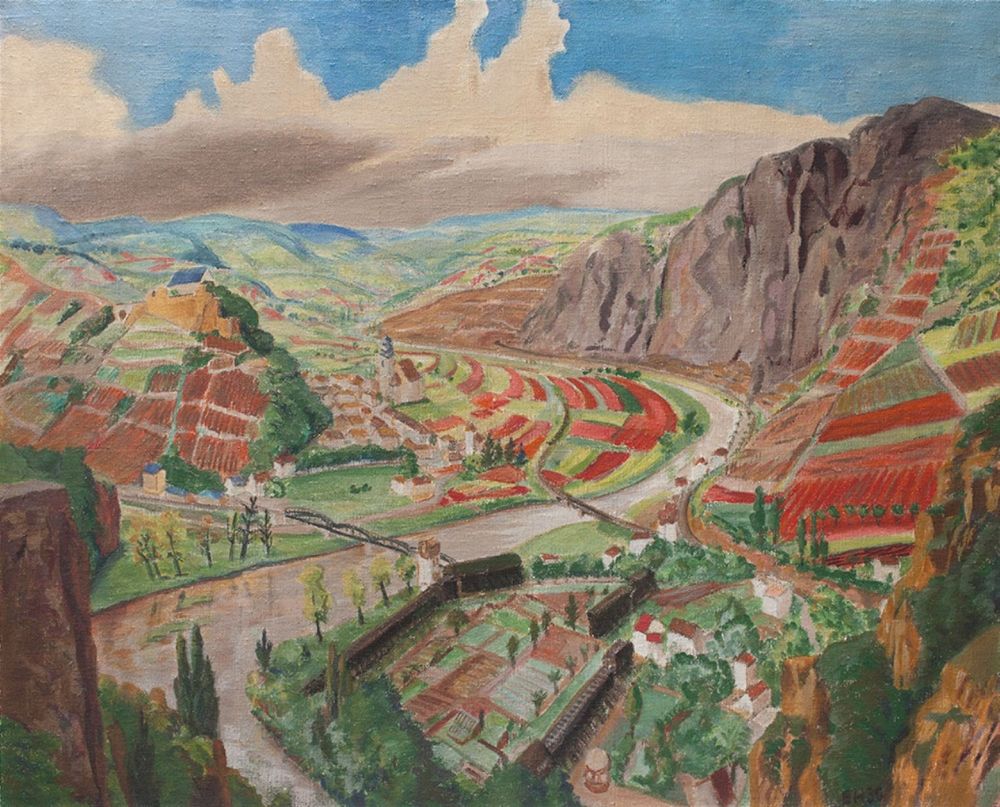
Also excellent and perhaps for Katie in particular, I saved this image of the Nahe Valley that pass by my eye this week. Shared by the AAWE, the no doubt authentic colours are surreal:

Erich Heckel (German 1883-1970), Landscape in the Nahe Valley, 1930. Many vineyards. Heckel was a painter and printmaker, and a founding member of the group “Die Brücke.”

According to the wikiborg, in 1937 the Nazi Party declared his work “degenerate” and confiscated his work, destroying much of it. Good to see one that was saved. Time for notes!

Note #1: Ottawa’s Kippisippi to close.
Note #2: BrewDog sale confused yet swift.
Note #3: 1690 brewing text restored.
Note #4: 1978 Joe Piscopo sighting.
Note #5: “Beer with Pals” is the best one.
Note #6: the A.I. bot that wrote this clearly has no idea what “craft beer” is or is it the guy interviewed who doesn’t.

What’s next? Well, I suppose the big news is the surprise takeover of a deadend business location:

A brewery has been allowed to open a new beer café in a former funeral directors site. West Suffolk councillors have given Charles O’Reilly planning permission to turn the former funeral directors at The Shutters, in St John’s Street, Bury St Edmunds, into a beer café and tap room, during a development control committee meeting earlier today… Jane Marjoram, a resident, recognised the importance of such establishments but told councillors the area was a ‘quiet, friendly community’.

 “Very quiet…” said Jane as they leaned forward winking at the committee members. What else? Oh. Yet another, yawn, tale of a forgotten wine cellar under a golf course (h/tKM):

“So we’re thinking it’s just a drain that needs digging out and clearing and repairing but as we dug deeper the chasm underneath just opened up.” Steve said he and his colleagues then noticed a brick structure. He was able to climb inside and look around with a torch and found dozens of empty glass wine bottles. “They’re all odd shapes and stuff so they’re obviously extremely old bottles,” he said.

Speaking of being under, similarly attractive are the summaries of the US beer market in 2025, as this from BMI:

US beer shipments were down more than 5% to ~183 mil bbls for full year 2025 vs 2024, Beer Inst, TTB and US Dept of Commerce data suggests. That amounts to a 10-mil-bbl drop in one year, the 2d tuffest decline in US beer history (post-prohibition) only behind brutal yr in 2023 when shipments sank 5.2%, 10.8 mil bbls. But unlike 2023, beer price increases didn’t come close to offsetting volume loss with CPI for beer at home up just 1.1% for the year, suggesting brewers’ collective revenue likely posted the largest drop ever in a single year post-prohibition.

And Stan raised shared an interesting observation that I suspect might well be connected to those stats:

“If it is beer flavored beer it comes from the brewing side. If it is not, it comes from the marketing side. (FW’s) Michelada did not come from the brewing side,” answered Firestone Walker brewmaster Matt Brynildson.

More grim news. Yet… here was have another trip to France care of Anaïs Lecoq in this week’s Pellicle which unpacks another cultural touchstone, the bar Pari Mutuel Urbain or PMU:

A rade was originally slang for a bar counter, though it’s come to define a popular neighbourhood bar with a somewhat dated look, but a warm and lively atmosphere. Do not imagine the brown-wood aesthetics of a British pub: Think mosaic tiles on the floor, flashy paint on the walls, a Formica bar dented by years of glasses sliding across it, and worn-out faux-leather booths. … The bar PMU is the epitome of the rade. These spaces will never be advertised as places worth visiting if you’re a tourist. You won’t find them listed as hotspots on the internet, because they don’t look good enough for an aesthetically pleasing Instagram feed. Their history, deeply rooted in the working class, labour struggles, and immigrant communities, is not designed for glossy consumption. 

And also yet yet… in this comparison of health effects in The Harvard Gazette at least beer does not find itself at the bottom of the beverage ladder:

The mixed picture for alcohol consumption was in contrast to what panelists agreed is a much clearer one for soda, energy drinks, and other sugar-sweetened beverages, including sugary fruit juices. A 12-ounce can of a popular soda brand has 10 teaspoons of sugar, an amount almost nobody would add to a cup of coffee or tea, Rimm said. Sugar-sweetened beverage consumption is linked to rising obesity, which itself raises cancer risk, and diabetes, which increases risk of heart attack and stroke. “When you compare a soda to water, or soda to coffee, or soda to tea, whatever you’re comparing it to always wins,” Rimm said.

Finally and… finally especially for me, one more inter-provincial trade barrier has fallen and, for me at least, an important one. Soon I will be able to directly buy Nova Scotian beer from the homeland of my youth and have it shipped to me here in Ontario the homeland of my… umm… post-youth:

Ontario and Nova Scotia have agreed to let their residents buy alcohol directly from the other’s province, part of the premiers’ ongoing work to bolster interprovincial trade. Producers of beer, wine and spirits can start applying Tuesday to the province’s liquor corporation for authorizations to do the direct-to-consumer sales, a process the premiers say will only take a matter of days. Ontario Premier Doug Ford says strengthening interprovincial trade is a way to counter the effects of U.S. President Donald Trump’s economic attacks on Canada. Nova Scotia Premier Tim Houston says… knocking down interprovincial trade barriers is “a bit like whack-a-mole,” but that direct alcohol sales is a great one to tackle because it is so visible for consumers and producers.

Please sign up every single Nova Scotian producer, please. Then I will be able to hover the fickle finger of fate over your webstores.

There. I achieved my second goal this week. After buying sausages at Atwater Market, that is. I largely avoided mentioning the new assets added to the Tilray portfolio, the second strangest story involved those assets after… you know.  From this point on, it is all now officially just a boring story at least in my office. So with that until next week, please check out Boak and Bailey who are posting every Saturday and adding to their fabulously entertaining footnotes week after week at Patreon. And look out for more of Stan’s new “One Link, One Paragraph” format. Then hunt out something in someone’s archives! Leave oblique comments on someone’s post from 2009!! Listen to a few of Lew’s podcasts and get your emailed issue of Episodes of my Pub Life by David Jesudason on certain Fridays. And Phil Mellows is at the BritishBeerBreaks. Once a month, as noted, Will Hawkes issues his London Beer City newsletter and do sign up for Katie’s wonderful self-governing totes autonomous website featuring The Gulp, too.  Ben’s Beer and Badword seems to be on pause since November but there is reading at The Glass which is going back to being a blog. Any more? We have Ontario’s own A Quick Beer and All About Beer is still offering a range of podcasts – and there’s also Mike Seay’s The Perfect Pour. Plus follow the venerable Full Pint podcast! And there’s the Craft Beer Channel on Youtube. Check out the archives of the Beer Ladies Podcast.

*He also shared his thoguhts on the weird we have witnessed over the last two decades.

And… Finally… Here’s “The Baseball Is Back!!” Edition Of Your Beery News Notes

I mean, let’s face it. The Winter Olympics are all well and good. And the World Cup will fill that gap in June, sure. But… baseball. Baseball: the sport that demands the best in athletes and then asks them to sit around for half the game. When they aren’t standing around in the field. It’s great, isn’t it!  Though, we should also take this moment to remember one of the great Olympic moments from, what, sixteen years ago now when Canada’s gold medal winners took the opportunity to turn the hockey rink into a tavern. And on that topic, here’s a Winter Olympics fact I hadn’t heard before and one that isn’t apparently winning any medals:

The only beer available for purchase at the 2026 Olympic Games is Corona Extra, a Mexican pale lager. This is due to the Olympics only allowing one company to sell its products at the Games, and this time it was Corona who was able to secure a deal. It’s a controversy that may hit closer to home for a lot of Olympic spectators, more so than a few foul-mouthed curlers ever could. It’s fair to say that Corona may not be the most popular beer for fans in Europe, as a photo of a Czech hockey fan went viral last week for his disappointed look while holding his Corona beer.

What a great choice. For the five athletes at the games representing Mexico, I suppose. What else is going on? Plenty to read out there on the chop-shop job coming for BrewDog but The Guardian had a good angle on the pending effect on those who each gave a bit when a lot was needed (or at least wanted with little or now strings attached) early on:

BrewDog’s army of “punk” shareholders have voiced anger and frustration after the Scottish brewer confirmed plans for a possible sale that could render their investments worthless. So-called “equity punks” who spoke to the Guardian or posted on BrewDog’s shareholder forum expressed disappointment and accused the company, which has traded on its upstart ethos, of treatment “bordering on contempt”. One said the plan showed that the small investors, who helped to kickstart BrewDog’s growth after it was founded in 2007, meant nothing to the company.

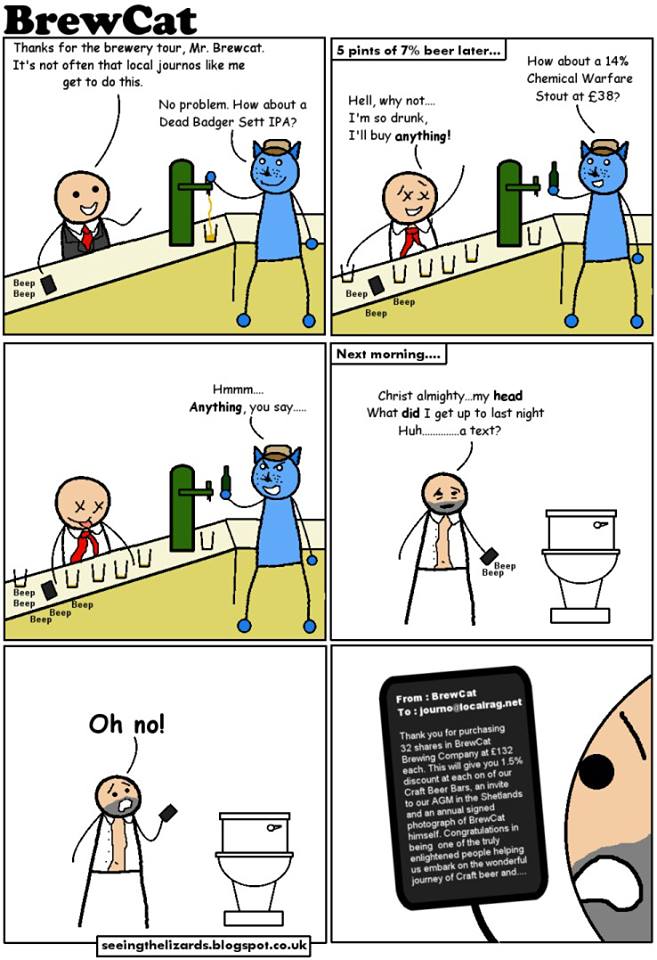
While the effect on individual EP investors can be quite significant, I mention this mainly as a pretext for posting that 2013 parody up there of the plan from one M. Lawrence at Seeing the Lizards.  Speaking of just saying no, The New York Times has run a four-part series by Pete Wells on getting your consumption back to a healthier level and finished off with a back at life with alcohol as well as a look forward:

Sometimes it seemed to me that I had a richer, more rewarding relationship with alcohol than I did with all but a handful of humans. It was an inexhaustible field of study, an incandescent companion during great meals, a reliable consolation on dull ones. And it brought me close to my real friends, at least some of them, some of the time. Over time, though, the rewards had become more equivocal and harder to justify. It wasn’t just the weight I gained, a predictable result of having a cocktail each night followed by about three glasses of wine or beer. They were, by this point, undeniable signs that my liver was overworked. I slept badly with all that alcohol in my system, too, and it got worse as time went on. …

You may be happy to know that he still enjoys his martinis – even if there are fewer of them: “…feeling the hair on the back of my neck stand up as the first sip takes hold, I feel like I’ve been reunited with an old friend…” Another old friend, Liam, reached back just a few decades for his post on the earlier trendy years for NA beer in Ireland, Smithwick’s Alcohol Free Bitter:

The launch was accompanied by newspaper competitions plus promotions, and a strange and repeated focus on how the beer, at 0.5% abv, contained less alcohol than orange juice! Reviews of the product at the time varied a little but it seems to have been generally well received for what it was, with reviewers commenting on how it (ironically) ‘packed a real bite and had good flavour’ and how they could drink it in a pub all night,  although it was also said to be ‘quite gassy and sweet.’ Others said it was ‘pretty good. Smells right and tastes of hops. Quite rich and smooth to drink.’

AKA gak. More positively, Matty C shared his thoughts on some upsides he’s seen in the brewing trade so far in 2026:

A couple of years ago, conversations in beer often centred around the idea that there’s “light at the end of the tunnel”. In reality, I don’t think that chance of daylight is coming anytime soon. Instead, we’ve got to admire the glimmers that are somehow managing to shine through the cracks in the walls around us when we can. Good beer is still being made, and good pubs are still open to sell it in – I’ve seen the proof! 

One of his examples was the tenacity of Jaipur: “… beer, packed with flavour and served at a high strength – seemingly the antithesis of what you would expect to succeed….” Which reminded me of how, in response to recent racist comment from an English oligarch, in The Times Sathnam Sanghera wrote about one of the foundations of the Britain of today:

…the fact that it ran the biggest empire in human history explains lots about Britain beyond its multiculturalism. It explains the popularity of curry. A significant amount of the mahogany furniture, ivory and jewels in our stately homes and royal palaces. Our propensity to travel. A certain amount of our wealth. Our political posturing on the international scene. Our national drink in the form of tea, and our national tipples in the form of pale ale, rum and the gin and tonic. The fact that we don’t feel the need to learn foreign languages because we encouraged/forced large parts of the world to take up English.

Empire of booze! Which, in turn, reminds me of Manitoba’s fabulous Premier Wab Kinew and his cheery fight for my right to Crown Royal after a bit of internal trade tension with Ontario’s Uncle Doug:

Cheers to you Doug Ford for keeping Crown Royal on LCBO shelves . Thanks for doing the right thing. Just like Canadian whiskey, good results take a little bit of time. This is a good day for folks in Gimli, Manitoba and a good day for people in Ontario too. Standing up for workers together is always a big win for Team Canada.

PWK won a lot of support with this bit of good humoured social media savvy. Crown Royal also got about 5,783 times the value of yet another newsletter by email telling breweries about the importance of storytelling.

Note #1: a desperate plea for beer based salad dressings.
Note #2: pairing beer and cussing.
Note #3: democracy in inaction?

Speaking of newsletters by email about storytelling, Will Hawkes was back at the end of last week with his February edition of London Beer City in which he considered the concept of the Irish Pub as illustrated by one new spot, Moylett’s in Clapton:

…I’m confused. What’s Irish about it? According to a report in Broadsheet, the focus is on what owner Moylett calls “the holy trinity of food, music and socialising” – a worthy list, no doubt, although it does seem to be leaving out something quite important (Guinness is £5.50 a pint, btw). As a term, “Irish Pub” is surprisingly hard to define, and particularly in London (and other British cities, arguably, but we’ll put them to one side for now). In much of the rest of the world – indeed, even in London, particularly its once O’Neills-heavy suburbs – the Irish pub is a 1990s phenomenon: flat-packed dark wood decor, pints of Guinness and food options that are often only very vaguely Irish (satay sticks, curry, chicken wings of varying heat levels; Spice Bags are less common, although you can get them at Moylett’s). But Irish pubs in London are, historically at least, quite different, and much less easy to pin down. 

Similarly but further afield, ATJ shared his thoughts on Cologne/Köln, the river there and its crossers:

…leaving Hauptbahnhof I crossed the Rhine, slow-moving, the colour of mud, upon which an elongated, snub-nosed barge was slowly making its way downstream. I stopped and took a photo, a snapshot of slothfulness perhaps and continued along the historic Hohenzollern Bridge. It was crammed with people through which bicycles and the occasional skateboarder cleaved their way, imperious and ‘get out of my way’ seemingly stamped on their features. Some people, were in groups whose colours defined their tribal affiliations — red and white for FC Köln, black and white for Eintracht Frankfurt. Sporting rivals presumably…

And here’s a new insult for craft beer.  If Jeff’s exhaustive listicle is correct, IPA is what it is all about and what it says is “meh, new money..“:

When it comes to beer, the etiquette guru revealed that “new money” consumers “don’t touch the more traditional ales or stouts – it’s all about IPAs that set you back at least £5 a pint. Anything involving the word ‘traditional’ simply doesn’t feature in your vocabulary. “If it doesn’t sound trendy, artisanal, limited-edition, or come with a deliberately obscure name, you simply aren’t interested.”

I actually find it really funny that anyone thinks anything related to beer is about new or old money… other than owning the brewery that great-grandpa built I suppose.  Almost as good as if grandpa owned a country… which is a seque to the next tale of skulduggery – perhaps – in China’s Jilin province:

The marketing materials identify the beer as produced by Rason Ryongson General Processing Factory in the Rason Special Economic Zone, located near North Korea’s borders with China and Russia. …[T]he Chinese distributor is Yanbian Xinyuequan Trading Co., Ltd. The company is based in Yanbian Korean Autonomous Prefecture in Jilin Province, a key gateway for cross-border trade with North Korea. Additional social media posts show boxes bearing the Pado label being unloaded from trucks and delivered to local restaurants in Jilin Province, indicating the beer has entered local distribution channels “…[N]ame changes are largely driven by export considerations, particularly to reduce the risk of sanctions-related flagging when the product circulates in Chinese wholesale or grey market channels…”

Mmmm… grey market North Korean Pado beer…  Quite the opposite in every way are Boak and Bailey who asked about what a drinker wants from a pub’s internet presence.

… we want to know what beer the pub is serving today, right now. Working that out can be surprisingly tricky. Again, Instagram or Facebook can help, but it’s often more reliable to snoop on Untappd and see what’s been logged in the past 24 hours. Pub websites are rarely of any use for this at all, presumably because updating a website feels like a big job, and a job for the Big Computer at that, so it just doesn’t happen.

Great comments followed… but I wonder if the easier solution is a camera aimed at the chalk board at the bar which is already updated daily… all sorta a la last week‘s remote pub experience story. It worked for the Cambridge coffee pot cam. The best way to get a job done is to find a way to make it a not-a-job job.

Finally, the Pellicle feature this week is accompanied by many photos with many many strings of bunting. It’s a story about Steam Machine Brewing of  County Durham – but without saying the word it’s really all about the bunting. Not including reflections in the windows (which would be unethical, of course) I counted thirty-six strings of bunting. That’s a significant contribution.

That’s it! That is all for now. But we are one step closer to spring. Pre-season Grapefruit League baseball on the TV time. Huh. Zah. Until next week, please check out Boak and Bailey who are posting every Saturday and adding to their fabulously entertaining footnotes week after week at Patreon. And look out for more of Stan’s new “One Link, One Paragraph” format. Then hunt out something in someone’s archives! Leave oblique comments on someone’s post from 2009!! Listen to a few of Lew’s podcasts and get your emailed issue of Episodes of my Pub Life by David Jesudason on certain Fridays. And Phil Mellows is at the BritishBeerBreaks. Once a month, as noted, Will Hawkes issues his London Beer City newsletter and do sign up for Katie’s wonderful self-governing totes autonomous website featuring The Gulp, too.  Ben’s Beer and Badword seems to be on pause since November but there is reading at The Glass which is going back to being a blog. Any more? We have Ontario’s own A Quick Beer and All About Beer is still offering a range of podcasts – and there’s also Mike Seay’s The Perfect Pour. Plus follow the venerable Full Pint podcast! And there’s the Craft Beer Channel on Youtube. Check out the archives of the Beer Ladies Podcast.

Your “The Thaw Cometh! The Thaw Cometh!!” Mid-February Edition Of These Beery News Notes

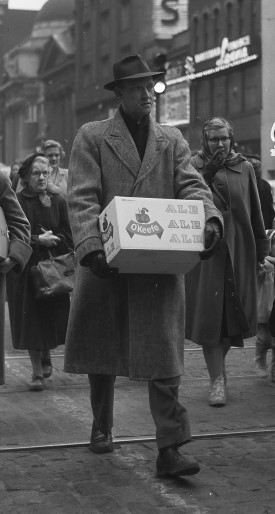
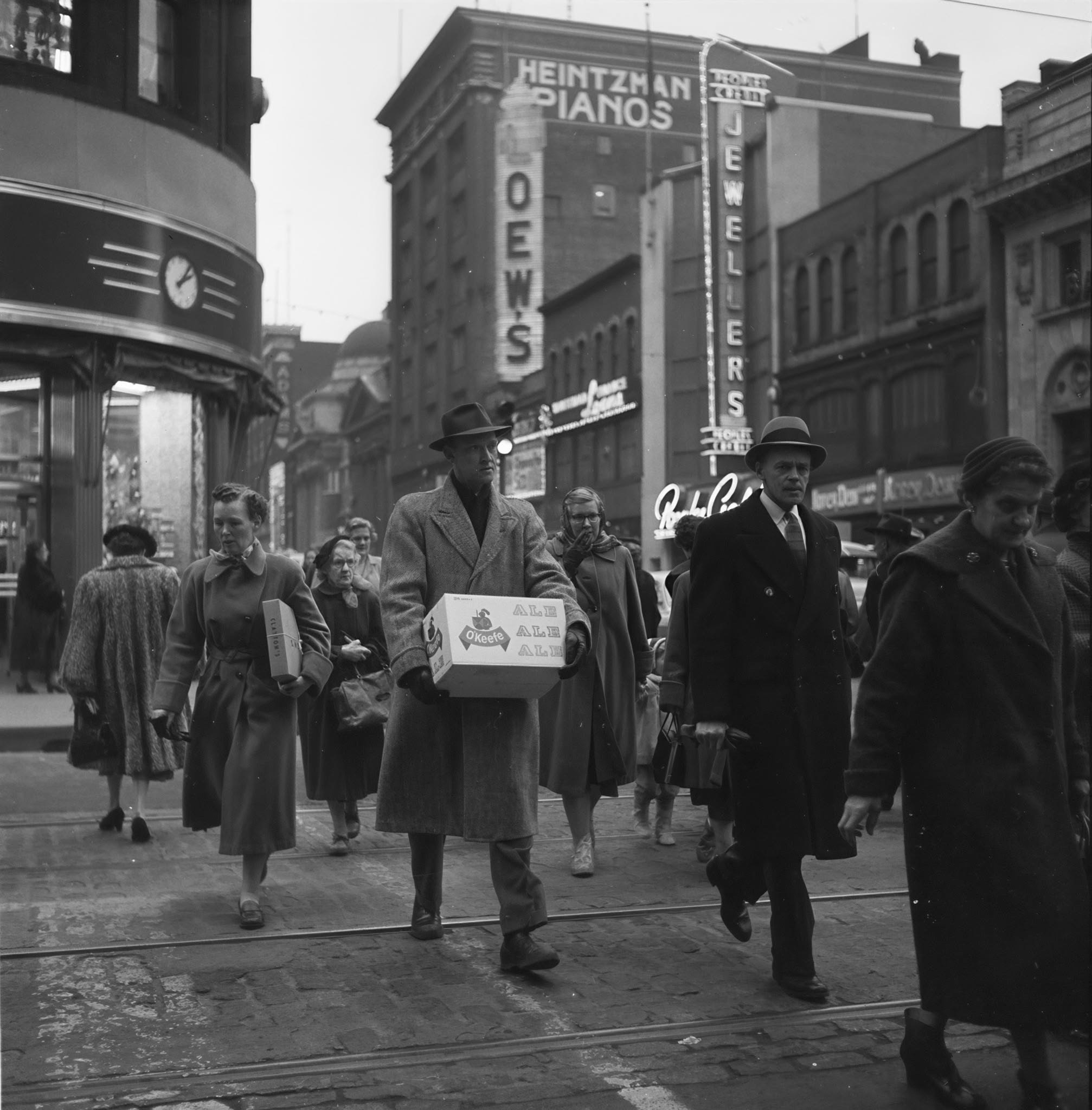
Now that the temperatures have moderated from -30C at dawn way up to -3C, the nation asks itself what the hell was all that? There is no answer to the question. Fortunately, there is a second question: how to still look dapper in a Canadian winter while lugging a lot of beer? Well, this gent can help. First, walk around in one of Toronto’s well loved black and white neighbourhoods where people must wear vintage clothing. Then, bottle your homebrewed beer only in second hand O’Keefe quarts you have nicked from the upper bric-a-brac shelves of old taverns. Finally, invest in an industrial quality paper packaging printing press you keep in the basement solely for the recreation of 1950s brewery boxes. Easy! Speaking of being on one’s feet, Boak and Bailey have written about how they didn’t do a Dry January so much as a very mobile one, a habit that has continued well into February:

We didn’t set out to make a mission of this, but we realised about halfway through January that, as it happened, we hadn’t yet made a repeat visit. That made us wonder if we could keep it up for the remaining few weeks. We were particularly conscious that we’d tended to stick to tried and trusted favourites last year. In fact, in 2025, over a quarter of our logged Bristol pub visits were to just two pubs – The King’s Head and The Swan with Two Necks. You might have noticed the word ‘logged’ and be wondering exactly what that means. Well, Jess, an accountant and spreadsheet nerd, of course keeps track of every pub we visit.

What a good realization! We have nothing like that possiblity here so much replicate 1950s Toronto to amuse ourselves but this comes a very good second. In the US of A, something else appears to be amuse or perhaps console according to BMI :

Beer posted positive $$ growth in 4 of the last 5 wks, and Jan 2026 is on track to be beer’s best monthly trend in years, at least in these channels. Including wine & spirit RTDs in the mix brightens the picture even more; broader beer + RTD category $$ grew more than 5% with wine & spirit RTDs adding close to 2 full pts in scans. 

Booze up! And somewhat similarly Ed stood up for the honour of Guinness this week with a response to what he called a a hatchet job on the Guinness’ Open Gate brewery in London published by The Guardian:

For some reason restaurant critics put the boot in more than any other type of reviewer… I was going to the brewery as part of the CIBD Southern section’s AGM, but first we had to do the business part to do at Diageo’s HQ.  I don’t know what deal the CIBD had done with Diageo or if we were subsidised, but we paid a tenner. This gave us pie and mash, which was nice, and a pint of Guinness (brewed in Dublin). I was keen to have somethng brewed on site though, so I had a hazy IPA next, which was nice enough. I think the ABV was a bit hefty, as on top of the three pints of Guinness I’d had I was defintely feeling pissed by the time I’d fininished it. So there you have it. The Guardian journo’s main complaint seemed to be that you had to take a lift to the toilets.

For others, the trip to the pub and then to the toilet is even easier. They are visiting the pub virtually from home, a remote non-work arrangement of sorts:

The 24-year-old from Yeovil, Somerset, regularly tunes into the feed from Morgan’s Arcade Bar in Carlisle, Cumbria – despite never having been there or anywhere near. What hooks Katie in is seeing different people come and go: the women enjoying a work party, the couple singing along with the musician, the young lad trying to chat up a girl at the bar… On some nights Morgan’s Arcade Bar, which can only fit around 60 people in it, has up to 5,000 viewers on its livestream at any one time. But like other bar streams, it has been subject to bans and restrictions for reasons they don’t quite understand. Bar owner Morgan Taylor has been streaming for nearly nine months. He noticed a huge rise in viewers over Christmas, then a few weeks ago his account was deleted.

Cass Enright got out of the house and on the road in his latest installment of A Quick Beer takes us to Montreal – a favourite destination of mine – and revisits some of the great brewpubs there in a video with this intro:

Join us on a step back in time as we have A Quick Beer at three of Montreal’s original brewpubs! Discover the enduring charms of Dieu du Ciel!, L’amère à boire, and Le Cheval Blanc, three spots that have been serving up delicious beer for decades. Although Montreal offers many modern breweries and taprooms nowadays, some of our fondest beery memories over the years have been here, and they’re all still going strong.

For me, it’s L’Barouf on rue St-Denis. If you are ever looking for me, check there. Also all about winnowing the better and the best, Pete shared some firm thoughts in his column in The Times this week, always welcome sight:

My beef is not with hazy pales — those original examples were pretty good. But if you don’t need to worry about balance or clarity in the beer, and you’re throwing in enough hops to cover up any off-flavours from brewing mistakes, a hazy IPA is very easy for a mediocre brewer to make. From a drinker’s point of view, if you grew up with soft drinks and don’t like the taste of actual beer, it’s perfect. It’s also great for Instagram — everyone can see you’re not drinking a boring, mainstream beer. But instead you’re drinking a boring craft beer. A boring, one-dimensional alcoholic fruit smoothie in a gaudy can with hop monsters or skeletons on it. If I wanted to drink sour grapefruit juice, I’d buy some Tropicana and leave it in the sun for a bit. 

The many botches of “craft” is a venerable topic which even comes with its own primodrial gospel but it is true that for all its eager keener passion craft never seems to fail to find a way to fail.  Nice to see that we have a paper of record confirming what Pete called the “sustained decline.” Viva crystal malt! Viva!! Viva!!! And Phil Mellows guided me to this article in The Caterer on the why to Pete’s what including this suggested impetus:

“…we are beginning to see the movement of some younger adult drinkers towards nostalgia brands, and given our history and heritage, we feel well-placed to meet this trend through some marketing and awareness driving activity.” Brookfield Drinks has launched a trial bringing long-established premium Scottish lager Kestrel back on draught. Brookfield managing director Nigel McNally says: “We’ve shown that a brand that’s nostalgic, like Kestrel, can be repositioned and revitalised. “Most pubs are serving the same products, and the trade’s been guilty of allowing brands which aren’t authentic onto the bar. Alcohol by volume (abv) have also come down, and I think overall customers feel they’ve been short-changed. A return to brands with heritage and nostalgia is offering customers a point of difference.”

Nostalgia and getting short changed? One must be on one’s toes. Which is related to Lars’ new maxim: “if you don’t know how the beer is made then, no matter what the beer is named, you have no idea what kind of beer it is.

Speaking of no knowing, The Beer Nut made a confession this week that I suspect is made on behalf of many of us:

Anyone who pays attention to trends within microbrewing will have noticed in recent years the explosion in variety of proprietary hop products. I don’t think these assorted extracts and powders and boosters were ever meant to have a consumer-facing role, but brewers seem to love them, and love letting us know that they’ve used them. Does that get them a discount from the supplier? I wouldn’t be surprised. For my part, I can’t help wondering if these enhancers actually enhance the beers in any real way. I’ve certainly never identified any pattern among them: which ones to look out for and which ones aren’t worth the paper their patents were filed on.

Note #1: Ludlow prices!!!
Note #2: Laura’s top tap rooms.
Note #3: Jeff doxxed.
Note #4: Burton Union Pr0n!
Note #5: Actually, no you can’t. You’d die.

The British Royal Navy has recently announced it is cutting booze rations in the service, limiting intake to 14 unit per week while on board. The Telegraph in its emailed newsletter presented a few responses to the news from readers:

Jenny Jones, however, recalled an age of largesse: “Many years ago in Malta, my husband and I were invited on board a Royal Navy ship that was giving a party. The atmosphere was convivial and, thanks to attentive stewards, I was able to enjoy several gin and tonics before dinner. “On departing, it seemed to me that the gangway had become a lot steeper. Back on dry land, our host asked how many drinks I’d had. When I said three, he told me that in fact I’d had nine, as naval tots are about triple the size of what one would get in a pub.”

Ah, Jenny Jones… what’s that? Not the same one? Fine. Me, I was once invited with a gang up the plank and onto a Canadian navy ship helpfully docked a walk from the Halifax taverns by a pal’s navy boyfriend. Among the minty green paid we worked our way though a number of 25 cent beers. I expect that sort of service is no longer offered.

The feature this week at Pellicle was written by Newt Albiston who shares his thoughts on drinking in Epping, just north of Greater London the tough town where he grew up which lives with division:

The day I return to Epping, my first trip home in some time, I can feel the tension, and the hesitance. The high street is pretty quiet, and there are lingering looks as I make my way past the various coffee chains and charity shops. Signs of the change in mood are everywhere: Union flags fly at half-mast on lamp posts, as if to declare the death of Britain as she once was, shadowed by the residue of torn-off patriotic stickers. Although I am instantly greeted by familiar faces when I walk into The Duke, the tension is still present in the quietness of the venue.

I like this: “…no fancy ginger beer or small-batch kombuch…” Perhaps related to The Duke, Stan guided us to a question this week – “what’s that smell?” Or rather…

“Olfaction helps shape our cultures, although it often does so unknowingly or without us noticing,” says (Inger) Leemans, who led the Odeuropa project. “When we talk about cultural heritage, we can think about religious rituals, but we can also think about specific scents that we’ve been cherishing and living with for a long time.”

Cherish. Hmm… I spent a good chunk of my teens in Truro, NS where the smell wasn’t always cherished and I am mindful of that reference The Breweries of Kingston & The St. Lawrence Valley by Steve Gates to a brewery a couple hundred years ago near my current place of work at City Hall which doubled as a pig sty. The next brewery to the north itself had a manure pit.  My point is that there were no scents without the full sensory array around it. Did 1890s Mild pair well with coal dust? Did Porter marry well with the pong of streets filled with horses? Perhaps we can never know.

And Charlotte Cook, brewer and scribbler, at took us along to Asturias, Spain for Everyday Drinking and shared her thoughts on the food and the cider:

When you taste the intensely rich stew, you can understand why cider rather than wine prevails in the north—the sour and fizzy is needed to cut through, cleanse the palate, and prepare you to dive in again. Cider is omnipresent in Asturias. As you walk around the town center of Oviedo on a Sunday morning, as families returning from church mix with football fans heading to an entirely different type of cathedra, cider is everywhere. Before 11 am, people will be drinking a bottle of cider for the table. Spaniards are famed for their ability to drink until the wee hours and still make it to work, school, or church as if nothing has happened. And having a little tipple of cider in the morning isn’t seen as such a stain on your character as it is at home.

Finally, some very heartfelt tributes were shared after the news of the death of beer writer Des de Moor like this from David J:

I think a lot about the pints we had one night in South London where he held court, sang songs and was so warm to everyone.

Pete also remembered Des the singer:

Des was a man of many layers. Years after the event, I discover my first interaction with him was buying the 12” remix of Charlton Heston by Stump – that was him, as half of the Irresistible Force. He made the Popbitch newsletter as Secretary of the Ramblers Association (moor, geddit?)… He was a great singer, a walking encylopedia. An absolute stalwart of judging the World Beer Awards. Never once heard him angry, pissed off, or anything other than kind and decent.

There are many more. His Wikipedia bio explains his musical side. Here he is singing Bowie and, here, an earlier solo album. By all accounts a wonderful guy. A sad loss.

Until next time, please check out Boak and Bailey who are posting every Saturday and adding to their fabulously entertaining footnotes week after week at Patreon. And look out for more of Stan’s new “One Link, One Paragraph” format. Then hunt out something in someone’s archives! Leave oblique comments on someone’s post from 2009!! Listen to a few of Lew’s podcasts and get your emailed issue of Episodes of my Pub Life by David Jesudason on certain Fridays. And Phil Mellows is at the BritishBeerBreaks. Once a month, as noted, Will Hawkes issues his London Beer City newsletter and do sign up for Katie’s wonderful self-governing totes autonomous website featuring The Gulp, too.  Ben’s Beer and Badword seems to be on pause since November but there is reading at The Glass which is going back to being a blog. Any more? We have Ontario’s own A Quick Beer and All About Beer is still offering a range of podcasts – and there’s also Mike Seay’s The Perfect Pour. Plus follow the venerable Full Pint podcast! And there’s the Craft Beer Channel on Youtube. Check out the archives of the Beer Ladies Podcast.

The Beery News Notes For The Threat Of Frost And The Yanks And Jays In What Might Just Be A Post-Passion World

Well, since we last met… yes, fine… the Red Sox lost last Thursday. But then the Yankees (who beat the Sox… my Sox) got their own butts kicked in the first two games of the next series by the Jays who took it all in game four last night which… sorta made me feel… schadenfreudig? Is that the word? I dunno. Or is it dünno? Anyway, the other word on my mind is frost. I will only know at sunrise this Thursday morning if the sheets and covers that I threw over the tomatoes and basil and beans did the job. (Update: -0.3C at 6 am!) But it is autumn. And it doesn’t matter if there is no frost for the two weeks after today if the frost came today. Most years, with luck, I can coax something or another to keep on growing right up to November. With luck.

Speaking of words, on Tuesday Jeff wrote about the doom and gloom in the beer trade, reviving some thoughts from 2013 as he did – a discussion in one way about perceptions that the choice of words convey as much as the context. The context being if one is on the way up or the way down. This week’s news notes seem to carry a bit of the weight of those sorts of perceptions so I feel like this sort of preamble is needed to remind ourselves that it’s just the point in time we find ourselves in. We need to reflect. To consider our lot. Sorta how I feel when I look at the black leaves of a tomato patch after a killing frost. When I reflect. And swear a little. So I will perhaps a bit intentionally mix the bad news with some things that are lighter and see what happens. Good thing there’s plenty to read.

First, about that cyberattack* in Japan on Asahi that I mentioned last week. It seems that it has been resolved but I hadn’t appreciated how it create quite serious issues for the broader Japanese bevvy and snacking market:

Most of the Asahi Group’s factories in Japan were brought to a standstill after the attack hit its ordering and delivering systems on Monday. Major Japanese retailers, including 7-Eleven and FamilyMart, have now warned customers to expect shortages of Asahi products… Asahi is the biggest brewer in Japan, but it also makes soft drinks and food products, as well as supplying own-brand goods to other retailers… In its latest statement, Asahi said that as a result of containment measures following the attack, ordering and shipment systems in Japan had been affected and it was also unable to receive emails from external sources.

Speaking of containment, consider Mr. Gladman on two types of entryways to basement bars and how their architecture guides the experience:

The street-steps-door type of basement bar usually has windows somewhere on its street-facing wall and so maintains a connection to the city outside (Type A Basement Bar in the Gladman Taxonomy of Bars…)  Bars like this can be hard to find even if you know about them… It’s a tiny adventure that ends with a delicious reward. These bars are often unpretentious and cosy — everyone is hunkered down together, hidden away in a prime spot, unnoticed by the schmoes passing by just a few feet above. The other, street-door-steps type of basement bar (Type B) is even more concealed at street level, often offering just a small sign above a door. Within this lurks a clipboard-wielding, radio-headset-wearing guardian, like Cerberus at the gates to a boozy underworld. Once you’re in, it’s often entirely devoid of natural light. It is its own world, womb-like and all encompassing.

Not so many people walking down these sorts of steps in Brazil – both Type A and B – which is reasonable given the news:

…the market has a new worry: the crisis caused by contamination of distilled beverages with methanol. For now, it’s not possible to determine the impact of this on the beer industry going forward. On the one hand, bars are emptier and parties have been canceled due to the negative repercussions of the contamination. On the other hand, greater consumer concern about cocktails has led to a strong shift toward beer, seen as safer.

My dive bar tourist trip to Rio is now officially cancelled. But more weclome might be a stop at The Dog and Bell in Deptford, London which is the subject of this week’s feature in Pellicle penned… or perhaps rather keyboard clicked by Will Hawkes:

This backstreet boozer in a historically unglamorous part of town has not only survived the pub cull of the past few decades, it has thrived. Indeed, few London pubs are currently more fashionable. How? Well, for all the Dog and Bell’s singularity, its story tracks the evolution of pubs in modern London from the 1970s, when they were ubiquitous, to now, our frantic, distracting era of Instagram Guinness and event culture, when a simple pint in the pub is no longer good enough reason to get off the sofa. It’s been a long journey, but at every key junction over the past 50 years this charismatic pub has taken the right turn. 

A loving portrait of a welcome local and perhaps unexpected gem. Conversely, I don’t expect to be following in the footsteps of  Jason Wilson who brought an extreme level of exactitude to the consideration of an extremely expensive beverage – coffee that costs $30,000 a kilo:

Each sip I tried—and we were served small sips because of the limited amount of this coffee—had its own personality. Each producer and variety had a different flavor profile, mouthfeel, aroma, even color. While some may regard coffee tastings like this one as snobby or ridiculous, I appreciate the intense mindfulness and attention to detail coffee fanatics have. In one sip of coffee, there are flowers, fruits, foods, and even songs. I tried each of them for myself, then read the judge descriptions from the Best of Panama auction to compare thoughts. Some may disagree, but I try to treat it as if there is no right and wrong, just opinions.

And, speaking of opinions, Boak and Bailey posted a bit of a questionaire on the status of Belgian beer culture, asking folk for their thoughts about whether the beers and pubs they encountered on a recent trip were (my words) out of date duds or treasures at risk:

There’s also something about how the beers we tried on this recent trip didn’t seem to have evolved from Belgian brewing tradition so much as they were inspired directly by American-led homebrewing culture. It’s really weird to drink a Belgian-brewed saison and think, huh, this tastes like one of those ‘farmhouse IPAs’ people were making back home in about 2012. When we think of newer Belgian breweries we do like, it’s because they’ve found a way to push the parameters while still producing beer that tastes and feels Belgian.

This generous sort of the asking of the questions is a very useful tool of one is wanting to advance one’s education. Seek the views of others to check your own assumptions. Among the responses, the particularly well-placed Eoghan provided a lot of insight from the local point of view:

I don’t disagree that Belgium has one of the richest and most diverse beer cultures in Europe, and it is a small miracle that so many idiosyncratic beer traditions managed to survive the tumultuous 20th century – more tumultuous here in Belgium than they maybe allow for. But it was their proposition that Belgian beer culture is defined by evolution not revolution that prompted my little piece of anachronistic time travel above. It is true that Belgian brewers – to borrow an idea I first stole from fellow Belgophile Joe Stange – are past masters at co-opting and finetuning wider brewing trends to make them palatable in Belgium. My contention is, however, that the history of Belgian beer is more of a Hegelian dialectic, a process of thesis-antithesis-synthesis evidenced less by evolution that by periods of stability punctuated by significant, discombobulating ruptures.

See, that is great. Fascinating – and I don’t even know what half of that up there means! Another thing I don’t know is whether a Spanish beer brewed in Britian in a British brewery owned by a Spanish brewing firm is Spanish or not:

This week Damm will make its first meaningful manufacturing foray outside Iberia when it opens a brewery in Bedford. The move represents an investment of almost €100 million (£87 million) and will create scores of jobs. The company is going to great lengths to ensure its UK-brewed beers taste the same as those made in Barcelona by sticking to the original recipe and investing in the equipment to ensure the product is identical.

Hmm… I still don’t know. But if we are sticking with the examination of not only how things became what that are but also what are these things in themselves, there is no better assessor than The Beer Nut who wrote about the recent final edition of the annual Borefts beerfest:

Two brewery stands at the 2025 Borefts Beer Festival seemed to have almost continuous queues. One of them I could understand: the New England legend Hill Farmstead. Early on day one I tried the barrel-aged coffee porter they brought, The Birth of Tragedy… This isn’t the sort of beer I associate with Hill Farmstead but it has been created with the same level of expertise. Canadian brewery Badlands was next to them and was, if anything, even more popular with the crowds. I had never heard of them so had no idea what the fuss was about. After they sold out and closed up early on the first day, I made sure to be there early on the second… [After trying two of their beers…] I was none the wiser regarding the Badlands fuss. They didn’t seem to be doing things particularly different to a thousand other microbreweries..

So, there you have both broader analysis of the cultures of beer as well as specific examination of each beer, drip by drip in the common context of the fest. All cheery and interesting exercises in digging around and thinking about beer. David Jesudason dug into another chestnut for the Wine & Spirit Education Trust, unpacking what’s called IPA but what he calls “IPA”:

The first ‘IPAs’ – note quotation marks – were sent out on East India Company boats in the 1760s and were strong, highly hopped ales due to India’s warm climate: the hops’ antimicrobial properties combined with the high alcohol level aimed to prevent spoilage. These were a cross between a bitter and a barleywine and by the time they arrived in India the hop character had vanished into the Bay of Bengal. They were said to taste more like champagne than beer. In reality, they were a world away from a modern IPA. Samuel Allsopp was the first to market them as Indian Pale Ales – and tie them to colonial decadence – after he copied Londoner George Hodgson’s recipe but crucially brewed them in Burton, where the minerals in the water further emphasized the beer’s hop character. These were bitter British ales or similar to heavily hopped autumn stock beers.

And Laura Hadland took on a task that I wish more writers who focus on beer attempt – discussing wine:

The lights were low for a chic soiree organised by Wines of Hungary at Vagabond Wines in Birmingham yesterday. Twenty five producers were showcasing their wines to an enthused audience of trade, media and more. I had an hour to work my way round the hit list that I had prepared in advance – nowhere near enough time. Especially since the winemakers and their sales teams were so enthusiastic about their wares that they all insisted on having us try every single one.

My experience of Hungarian wine started with some pretty hefty even harsh Bulls Blood out by the town’s water resevoir in high school but I now hoard sweet Tokaji which I never seem to get around to opening as fast as I find them. Of course, that means my wake might be worth the trip as my fam gives them away along with my record collection.

ATJ shared more serious thoughts on mortality in his piece “Funeral Pints” where the swirling thoughts at a time of loss were steadied with gratitude by a bracing pint among others in a pub:

The clunk of loose change as it goes into a pitcher, ‘thank you very much William’, ‘not a problem’, a stooped man with a face that reminds me of a thinner version of WC Fields.’ ‘Here he is.’ ‘He ain’t got a jacket.’ ‘What’s it to you,’ comes the reply. ‘He was dressed up as a boy scout yesterday,’ says another voice. The man with the long face who photographed his breakfast is having a talk with himself, while elsewhere pints are piling up on tables. Tattoos, chewing, chomping, swallowing, gulping, laughing, ‘listen mate’, finger pointed without malice. We’d better get to the funeral.

The drink finds a place in so many moments. And does the job. Even now at a time which we are subject to so much that feels like wave upon wave of a grim big picture, like this data* from Beer Marketers’ Insights:

Craft beer trends (ex non-alc) steepened over the summer to volume -8.4% and $$ -6.4%; several pts below total beer volume -5.6% and $$ down 5.1% for 18 wks thru Sep 20 vs yr ago. And when comparing craft’s yr-to-date sales thru Sep 20 vs the same period in 2023, the # of craft vendors (-10%), sub-brands (-13%) and SKUs (-12.5%) are all down double digits.**

From that view of the general, for the double, Jeff also wrote on a specific application in his obit* of Upright, a favourite brewery facing its end:

Craft brewing has spent a huge amount of time navel-gazing over what it means to have a clear vision. This often bled into marketing bromides, as breweries repackaged derivative products as original and creative. That development led to some of the cynicism that marks the mood today. Upright did have a clear vision, however—and Alex seemed almost immune to commercial considerations. Upright always felt more like a sixth-generation Belgian or Franconian brewery than an American craft brewery to me.

A wonderful remembrance of the soon to be no more. Summing up based on all the above, can we draw conclusions? Well we could ask ourselves (yet again*) whether the function of good beer writing to support the industry or to more broadly understand the trade and culture. By way of illustration, consider this:

“…The Guild’s board members are all driven by our shared passion for the beer industry and those who work within it. We’re proud to represent the very best of beer and cider communicators, who are such an important asset to the wider industry…”

A familiar line that’s become cliché and so nothing against the particular speaker. A prominant popular theme voiced for the best part of two decades, perhaps until somewhat recently. I mention that in the context of this article in The New York Times which is, yes, yet another obit* for US craft beer but, perhaps unusually, one that contains some interesting admissions:

This summer, 21st Amendment believed it had found a way to keep at least some of its operations going. It planned to bring in a new partner and start buying smaller craft beer brands that it would brew in San Leandro. But in late August, the lender pulled the plug on that idea. In late September, 21st Amendment closed its flagship brewpub in San Francisco. The San Leandro location is expected to shutter by the end of this month. “We were driven by our passion for craft brewing, and we got so caught up in it that we had blinders around what the reality is for craft brewing right now,” said Shaun O’Sullivan, a co-founder of 21st Amendment. “We’re a cautionary tale right now to anybody who wants to grind down and open up their own place. It’s just not a good time.”

So is / was “passion” an “important asset” or a form of those “blinders“? Whether in business or in writing. Maybe both. What ever happened to well-earned hard-bitten steely-eyed objectivity? Why did we not foresee, just as the rise casinos and later lotto tickets stripped gambling of its vice, how craft beer was infantalizing booze with kiddie friendly fruit flavours in brightly coloured cans – and even converting every tavern into potential seminar spaces.*** I blame the “don’t judge the tastes of others” line. Who writes without hoping to offer incisive opinion? You know, if the beer writers, by error or omission, participated in priming the passion pump with boosterisms during the era of irrational exhuberence… is it not reasonable to consider that the oeuvre itself aided in the downturn to some degree?****  That’s sorta summed up by that old nugget, the one about the rising tide raising all boats that we heard so much about. We also know that the tide falls. Twice a day. Every day. But most folk forgot* to mention that.*****

Doesn’t mean, however, that we can’t learn lessons from the downturn. We might even consider ourselves now “post-passion” in our relation to beer and beer writing. That would be good. Without, you know, sponsored articles or A.I. articles****** or even A.I. sponsored A.I. articles.* That would be better. Based on the above we can see people can and will doubledown and keep digging around, questioning conventions and asking the right questions about what is and what isn’t the good stuff in all this beery culture.******* I’m sure we can. Well, you all can. I just read this stuff.

That’s a lot. And there’s still the footnotes below. While you are chewing on all this, please also check out Boak and Bailey every Saturday and sign up for their entertaining footnotes, too. Look out for Stan when he feels the urge now that he’s retired from Monday slot… maybe … maybe not. Then listen to a few of that now newly refreshed Lew’s podcasts and get your emailed issue of Episodes of my Pub Life by David Jesudason on certain Fridays. And Phil Mellows is at the BritishBeerBreaks. Once a month, as noted, Will Hawkes issues his London Beer City newsletter and do sign up for Katie’s wonderful self-governing totes autonomous website featuring The Gulp, too.  Ben’s Beer and Badword has been on hiatus since April but the archives are out there with the all the sweary Mary! There is new reading at The Glass which is going back to being a blog. Any more? We have Ontario’s own A Quick Beer and All About Beer is still offering a range of podcasts – and there’s also Mike Seay’s The Perfect Pour. Plus follow the venerable Full Pint podcast! And there’s the Craft Beer Channel on Youtube. Check out the archives of the Beer Ladies Podcast. That’s quite good and after a break they may well be are back every month! Such is life. Such is beer podcasting and newslettering… which, as Ray says, are blogs! And he’s right.

*YIKES!!!
**At least it’s not as bad as in Russia: “In the first half of 2025, retail beer sales in Russia fell by 16.3 percent year-on-year… Due to the increase in excise taxes (they increased by 15.4 percent at the beginning of the year), the cost increased accordingly. In 2023, the average price per liter of beer was 120 rubles, in 2024 — 129 rubles, and at the end of July 2025 it reached 151 rubles per liter — prices have increased by more than a quarter (26 percent) since 2023, Nielsen added.
***The signs outside the craft beer bars said “Off-flavour Seminars Every Tuesday!” I thought of that when reading this passage from “The Engines and Empires of New York City Gambling”by Adam Gopnik, The New Yorker, August 4,  2025: “Gambling, too, now divides the world between those who know enough to make it boring and those who—bored—prefer not to know. They play and lose anyway. Thrilling games, like thrilling cities, thrive on enigmatic imperfections: the small market anomalies that quants scour for an edge, the tells and giveaways that reward the observant and elude the rest. Once all is understood, all is dull. Gambling may once have belonged to the Devil, but I assure you it does no longer. The arrival of organized gambling in its casino form has stripped away even the faded glamour of old miscreants like Rothstein and St. Clair. When, at last, detailed renderings of the proposed Caesars Palace emerged, they were hilariously decorous, showing not crowds of modern Harry the Horses and Nathan Detroits but elegantly dressed men and women in dignified black, playing in poker rooms that looked ready to host a seminar.
****And to be sure we can also lay much at the door of the evangelizing homogenizing craft industry conference seminars which took a page from time share symposiums. Imperial Pilsner anyone? Everyone?
*****Did I ever mention I spent school years right into undergrad next to the Bay of Fundy? Nevermind. Perhaps now’s the time for the trade’s comms people to adopt of the “Big Yellow Taxi” message – “drink craft: you don’t know what you’ve got ’til it’s gone.” It could work. Something might.
******Can’t wait for that market sector‘s crash! It’s all relative.
*******BTW there was some great beer writing advice set out in last Saturday’s footnotes from B+B: “Prop Up The Bar is a new blog to us. It’s a proper old-fashioned blog, full of massive photos that haven’t been edited and typos. It’s made us think again that the professionalisation of blogging arguably didn’t do it any favours and has perhaps discouraged people from just having a go, like Nick C, using their blog as a diary. In that context, props are due to Martin Taylor whose blog is well written and well researched, but never feels as if it’s taking itself massively seriously. (Yes, we know, we should watch and learn.) It signals that, actually, you can just have adventures and quickly write them up.

Your Totally Excited And Entirely Distracted Beery News Notes For Wildcard Week

Just in case, you didn’t know the baseball playoffs are brutal. Four rounds of MLB games take place between last Tuesday and end no later than November 1st. By way of comparison, hockey takes months and months and months to figure out who gets their names on the cup. So… I have been distracted and annoyed. Distracted because my Red Sox are playing October baseball for the first time in a while and annoyed by all the instant Toronto fans who think Canadians all have to root for the Jays. If the gods will it so, the Sox will get past the Yankees* and will then see off Toronto around about October 10th. If not… oh well.

Sticking with sports, over at Real Ale, Real Music the story from Chris was about a trip away to a fitba match at Southend and all the beers along the way:

We finished our beers, and set off walking to the football ground. It was about a 20 minute walk as we moved out of the city centre into the suburbs, passing modern blocks and more traditional housing as we approached the ground. We were directed around to the away end by a couple of friendly bobbies, and we got in pretty quickly, and immediately spotted one or two familiar faces. Roots Hall is very much a traditional football ground, with individual stands on each side of the ground with the one behind the goal opposite the away end having an upper level.   The club though would win no awards for their catering, the cheeseburger we sampled having the consistency of a hard rubber disc, and it was presented in a dried-out, crumbling defrosted bun.

I really like the pace of those pieces. On the other hand, the Netflix series “The House of Guinness” has received some disappointed reviews from those well placed like Liam – “ludicrous and pointless” – but perhaps none so well placed as the one provided by Ms. Molly Guinness as reported in The Times:

We hooted with laughter through the first two episodes. As Sean Rafferty, Norton specialises in lines such as “Oi’ve worked for your family for 20 years and I know that inside every one of yous there’s a woild, woild black cat.” Alas, I suspect this characteristic has been bred out of us over the generations. When a corseted lady (great-great-aunt Olivia, since you ask) says, “I can take your money, but I don’t have to take your cock,” unlike all modern Guinnesses, she is not talking about poultry.

Speaking of disputes, another week and another question of law in the world of beer, this time over the right to the word “wor” – if, you know, it is even a word and not a sound… ok, fine… it’s a word:

A dispute has erupted between two breweries over the trademark of the word Wor on beer associated with a group of football fans. Tyneside-based Wylam Brewery re-branded its Wor Flags beer to NCL Flags last week – the sales of which support the Wor Flags fan group best known for creating Newcastle United banner displays. Anarchy Brew Co, also based in Tyneside, said it registered the trademark for beer products in 2022 during its own similar partnership with Wor Flags, which ended before the start of the new season. Wylam Brewery said it was “disappointed” to be put in that position. Anarchy said it could have been avoided if the other company did its due diligence.

Conversely and more about getting it right, I enjoyed this excellent and detailed potrait of Master Sommelier Agnieszka Swiecka in The Buyer which describes the years of work it took for her to earn the designation this year:

I was fortunate to pass the blind tasting and practical parts of the MS exam at my first attempt in 2023, but the theory was my achilles heel. I have created self-limiting beliefs in my head that hindered my chances to pass. For example, I was telling myself that, to pass the exam I don’t need to have a deep knowledge of spirits and cocktails, as this is a sommelier not a bartender certification. It wouldn’t be fair to ask too many spirits questions. Or things along the lines – if last year there were questions about Chile maybe it’s better to focus on Argentina for this year’s exam? Can I skip studying about Bulgaria? It’s likely that I will get one question if any, and I need 75% to pass. You get the idea.

Skip Bulgarian wine? Come to think of it, as a teen I often thought somewhat after the fact that it might have been wise for me had I done just that.

Speaking of unpleasant drinking habits, I found this graph from the AAWE on BlueSky useful in detailing how big wine coolers were in the 1980s. It also got me thinking of where that segment of drinker preference has gone, say, since the early 1990s. People who want sweet trendy gak.  Jordan helpfull reminded us back in 2020 how Mike’s Hard Lemonade arose starting around 1996:

Michelle Shephard, writing in the Toronto Star on April 19, 1998, clutches pearls magnificently: “It looks like lemonade. It tastes like lemonade…” Shephard interviews two female Ryerson students who are quoted as saying “we went to the bar downtown and just decided it was a night to drink Mike’s. We had one then oh, this is gone. Then, oh this one’s gone so let’s get another…” and “They’re just so easy to drink you don’t even know you’re getting drunk.” One feels as though this might have backfired somewhat.

Jordan was comparing Mike’s to the White Claw boom of the early pandemic months of 2020. But haven’t the fruit flavoured craft alcopops called kettle sours also played that same role? Discussed in VinePair in 2018, I know from the archives that I had my first overly fruity IPA in 2014 and maybe the first sweetie pie kettle sour around 2016 at Folly Brewing, both in Toronto.** So were there gaps in the candy coated timeline or has there always been a form of sweet gak that lets kids say “oh this one’s gone so let’s get another” while having fun? Or put it this way… was there ever not a cheap sweet gak of choice and head cracking aches?***

Slightly related, I had never heard of the UK’s Boring Beer Index until this week which I suppose is good. But as it appears to be some sort of PR counter-insurgency I suppose that indicates something about it isn’t all that good, as perhaps clarified in the Morning Advertiser:

Some premium lager brands have seen sharp increases, such as Madri, which has seen the number of respondents claiming to be bored of it almost double since the previous report. John Smith’s topped the survey’s list of so-called boring ales while Guinness was cited as the most unexciting stout brand…

Very unpopular, that Guinness stuff. Out and about the planet, The Beer Nut was in Germany and hunted out some beers in Dusseldorf other than their famous Alt with much success except at…:

…Schumacher. This was my first time in their downtown pub, Im Goldenen Kessel. It was crowded, the service surlier and less responsive than anywhere else in town, and I got stuck at a table where there probably shouldn’t be a table. To top that off, their Alt alternative was… an Alt. Now, 1838er is 5% ABV and claims to be brewed with Cascade hops, but it’s the clear dark brown of an Alt and has the same medium-roast base. Unfortunately, it also has diacetyl in spades, and tastes more like a Danish butter cookie than anything else. This smacks up against a sharp gastric acidity, rendering it a complete mess and somewhere close to undrinkable. The brewery advises us to look out for the hint of lemon in the aroma. Nah mate; that ship has sailed. It’s just as well Schumacher’s proper Alt is pretty decent.

And Ron was on the road again, this time (again) he headed to Singapore to judge (again). His description of his arrival on the otherside of the planet leaves me a bit boggled myselg given, you know, I’d be more inclined to nap for 36 hours:

The arrival gate isn’t quite in Malaysia this time. It’s not so far to immigration and baggage retrieval. My bag comes out pretty quickly. Soon I’m speeding towards my hotel in a taxi. I’ve a couple of hours before the welcome dinner. Which I kill with some internet fiddling and duty-free whisky. It’s a pretty nice hotel with a decent-sized room. At 18:30, we take a bus to the venue. Which is a rooftop restaurant in a small hotel. With stunning views of the city. There’s just the one downside: no bogs. You have to go down to the ground floor for toileting purposes. Which is a bit inconvenient. Especially for oldies like me.

Back here at home, an interesting discussion is going on hereabouts about the retail rules. It’s on the question of whether big grocery chains in Ontario are going to be forced into participating in the return of recyclable empty beer bottles as part of their right to sell beer, cider and wine, as reported on by TVO Today:

…there are, legitimately, some small grocers who face some real hardship from being forced to choose between stocking beer and wine or accepting empties. That’s why the province’s current policy exempts stores under 4,000 square feet — if your local convenience store or small green grocer has added some beer fridges in the past year, they’re almost certainly fine. Nevertheless, maybe that number needs to be modestly increased; I’m certainly not going to vouch for the Ford government’s perfection in rule-making. Ultimately, however, the question of what to do about small stores is a distraction. The actual fight in Ontario this year is over whether big grocers will, once again, get the province to bend and relieve them of any obligation to collect empties.

And ATJ got the nod for Pellicles feature this week and provided a protrait of Proper Job, an early English clone of a hoppy US IPA. I really like this description from the brewer who makes it now:

“If you want an IPA but have never had one, this is the one to get,” Georgina Young, Roger’s successor as St. Austell head brewer, tells me when we meet at one of St Austell’s Exeter pubs, the Mill on the Exe. “It’s a great example of a punchy, hoppy IPA. To me it represents a real ‘god I really want a Proper Job lightning hop tingling on the tongue’ moment, it’s an exciting beer to drink and I think that is the draw of it.” “If I am going out for a ‘watering’ pint I will go for a Tribute,” she adds. “If something is going to excite me then it will be a Proper Job. Roger was very much into his Def Leppard, AC/DC, metal, he loved it. When you sit and drink Proper Job you can feel that. It is quite heavy metal, a bit scratchy.”

Finally, Japanese brewer Asahi has been hit with a pretty dramatic cyber attack which has led to some serious consequences:

Asahi Group Holdings has not been able to resume production at domestic factories a day after a cyberattack and cannot foresee when it can be resumed, a company spokesperson said on Tuesday… The maker of Asahi Super Dry Beer, Nikka Whisky and Mitsuya Cider last night said its group companies in Japan suspended operations, including order processing, shipping and call centre functions, due to a cyberattack-caused system outage, although no personal information leakage has been confirmed.

How odd. Who gains from that? Economic terrorism or just pesky teens messing around on the internets. Gotta keep an eye on that one. But now I need to get back to the baseball. As you root root root for whichever is your home team of choice, please also check out Boak and Bailey every Saturday and sign up for their entertaining footnotes, too. Look out for Stan when he feels the urge now that he’s retired from Monday slot… maybe … maybe not. Then listen to a few of that now newly refreshed Lew’s podcasts and get your emailed issue of Episodes of my Pub Life by David Jesudason on certain Fridays. And Phil Mellows is at the BritishBeerBreaks. Once a month, as noted, Will Hawkes issues his London Beer City newsletter and do sign up for Katie’s wonderful self-governing totes autonomous website featuring The Gulp, too.  Ben’s Beer and Badword has been on hiatus since April but the archives are out there with the all the sweary Mary! There is new reading at The Glass which is going back to being a blog. Any more? We have Ontario’s own A Quick Beer and All About Beer is still offering a range of podcasts – and there’s also Mike Seay’s The Perfect Pour. Plus follow the venerable Full Pint podcast! And there’s the Craft Beer Channel on Youtube. Check out the archives of the Beer Ladies Podcast. That’s quite good and after a break they may well be are back every month! Such is life. Such is beer podcasting and newslettering… which, as Ray says, are blogs! And he’s right.

*Tuesday’s Game 1 result? Sox sorta evicerate the Yanks after seven innings of a pitcher’s duel. UPDATE: Wednesday had a similar plot but the Yanks were the beneficiaries. Great baseball.
**No comment as to the relation to the 2025 Blue Jays… perhaps…
***I am reminded of my late great parents and confirming the nickname for cheap sweet gak in the 1950s just to the west of Glasgow was “electric soup”!

The “But… He’s Just Mailing It In From Vacation!!!” Edition Of The Thursday Beery News Notes

Yup. Big news this week? I am trying to nap in as many spots in the house or out in the yard as I can. I’ve yet to try that awkward chair in the back rec room but I still have my eye on it. It’s all so pleasant. The evening air is now cool enough that you can hear the crickets across the backyard fences over because no one is running an air conditioner anymore. Fact is I haven’t had a week off with nothing to do for quite a while and, I gotta say, I am liking it. Regular readers may tell you that I am good at doing nothing but I just don’t get to do it… or, rather, not do it… enough. So far I’ve dozed to baseball on half the waking hours, “worked” on cleaning up the garden and exhausting myself planting a few more seeds in a few more pots with something to eat before the frosts close in, gawked at a double rainbow – and even put on a belt to hit a BBQ place on a Monday night where I found a shot of Makers Mark to sit next to my pint.

Speaking of bourbon in Canada, Jeff did some solid inquiring into the effects of the chill in Canadian-US relations as it applies to booze. As I have mentioned a few times, up here our provincially run booze systems (other than the Randians in charge of Failberta and Assbackchawan) have taken all US booze off the shelves. Jeff shared what that looks likes from the south:

California Cabernets, Oregon IPAs, and Kentucky bourbons are all world-class beverages, but they’re not irreplaceable. Companies spend years or decades building the reputation for these categories and promoting their own brands. Trump’s tariffs have interrupted the work of these industries, and now Canadians are playing the field and experimenting with other products—ones they may enjoy as much or more than the American ones they’re replacing. That’s the first dynamic at play. The second is that now that those shelves are being filled by products elsewhere (whether domestic or imported), the U.S. companies will be forced to win them back should Canadians allow that, which as of this week they have agreed to do.

I am not sure that last comment is correct. This week our Prime Minister agreed to drop reciprocal tariffs on most goods covered by the existing pre-Orange free trade deal. But it’s the provincial premiers (other than those in Alber’duh and Sassblotchawhere) like Uncle Dougie who have taken all US booze off the shelves. And it matters. Ontario’s LCBO alone is the biggest booze buyer in the world. It’s also important to note that bourbon drinking up here is far behind our local rye – while much of the US wine (down 97.5% year over year) is bulk gak that’s been easily replaced by our own damn bulk gak sub-sector thanks very much. But the big point, as Jeff puts more nicely, is the Canadian “fuck ’em” factor. We don’t care to buy their booze (… or fresh veg… or BBQ sauce… or… anything) if we can find better friendlier sources. My Manhattan had Crown Royal in it. But, yes, I did have a Makers Mark on Monday after the staff checked that there still was some to be had. So there is that.

Next up… hey – did Stan just lay down another rule?

In my mind, more pounds of hops trumps more acres.

Because I am watching baseball all week, I am immersed in the stats and have to agree that units of production always is superior to quantity of resources. The Mets, for example, are up nere the top in terms of payroll in MLB but are fighting the Phillies this week just to make the playoffs. By contrast the Brewers – every one of youse’s favourite team, natch – have the most wins (as of last Sunday) but are #23 in the spending. This is why the stats over the last 20 years about brewery openings or other measurements* have never made much sense given they equate tiny taproom spots with production facilities. Not to mention how they were fueled by a certain level of fantasy.** Is more beer by volume being brewed and consumed? That’s the stat that matters.

And, putting together the right data as well, Merryn is “putting together papers for a bibliography on evidence for malt and ale” from early civilization – which is a great idea. But apparently an uphill battle:

I suppose, once you accept that spent grain aka draff aka brewer’s grains could have been fed to animals (eg cattle and pigs) in the Neolithic then it follows that you must accept that they were making malt and ale. And that is something that quite a few archaeologists do not want to accept

Merryn also gets the h/t to a story in The Scotsman about archaeological finds at a housing development in Fife which has revealed how far back housing developed at the site and perhaps what they were up to:

Co-author Thomas Muir added: “The archaeological evidence gathered at Guardbridge demonstrates that the site was occupied for almost all of the Bronze Age period, between 2200 and 800 BC. ‘The occupants crafted intricate metalwork and processed wool into yarn. From the porch of one of the roundhouses was found evidence that one of its occupants had once sat there knapping flint for tools.’ Earlier, Neolithic farmers of Fife left many pits across this site which contained burnt cereal grains, saddle querns and pottery sherds. No traces of their homes were found.

Burnt cereal grains in pits?!?! Par-tay over here… well, way back then. Also into the sciences, Ray performed an experiment on Jess and they published the results over at B+B, measuring the almost subjective “Punk IPA: piss not piss” consideration, utilising a methodology approximating objectivity based upon the excitement scale*** as applied upon locally available examples. Their thesis entering into their study was this:

“I never liked the beer anyway” or “It tastes like piss” are standard responses to stories about BrewDog, as if the company’s ethics or culture can be tasted in the product. We suppose that is a logical extension of the idea that the products of virtuous breweries – those that are small, independent, craft, or whatever words you choose to use – taste better. We’re not sure it’s very helpful to dismiss specific beers because of politics, though, even if you might decide for other reasons not to buy or drink them. The idea of objectivity in beer tasting is pretty much a myth unless you go to extreme lengths but we should at least try to be honest and get close to the truth.

Punk IPA showed up in my Ontario marketplace back in 2009 at a moderately modest $2.60 – but they were advertisers back then so I really can’t say how I felt about it then, looking back from so many years later.*****  I am pretty sure that I liked the early strong stouts that they sent, back when their location still had “unit” in the address. But one thing I know I can depend on is Jess’s scientific findings. Punk IPA does not taste like piss.

Note: Katie has found a way to consolidate her archives.

Climate change driven news from Bordeaux as reported by Decanter:

The seismic decision, communicated in a letter from the Guinaudeau family on 24 August, was described as a necessary response to accelerating climate change and the increasing restrictions posed by the appellation system. ‘The vintages 2015, 2019, and above all 2022, were all strong evidence of [climate change]. 2025 goes a step further. We must think, readapt, act,’ the family wrote… Lafleur is the first of Bordeaux’s top tier, with six highly sought-after wines, to break with the AOC system – a move that underscores both the estate’s singular vision and the mounting pressures of climate change on traditional models.

My notes tell me I had a bottle of their accessible Chateau Grand Village 2020 in November 2022 and am pretty sure I was pretty pleased. As with “style” in beer these things ultimately get you only so far.

Not speaking German very much at all and not being an amateur statistician methodology protester with aspirations of being the voice of the brewing… err… hard drinks… err… fluid beverage marketplace,***** I was struck by this bit of Cento-Euro news as reported in The Times worthy of an extended quotation :

…a generation of unprecedentedly abstemious young Germans is causing serious trouble for the nation’s breweries. The market has been shrinking for some time at a relatively sedate pace of between 2 and 3 per cent a year, dragging even venerable brands such as Erdinger and Paulaner into a cut-throat price war that has brought retail prices as low as €0.80 for a half-litre. This year, however, the decline has accelerated. In the first six months, the German beer industry’s sales slumped by 6.3 per cent compared with the same period last year, excluding non-alcoholic products. It was the first time brewers had sold less than four billion litres in any six-month period since 1993… Today only 38 per cent of men under the age of 25 drink at least once a week, compared with 55 per cent a generation earlier and 85 per cent of young men in the mid-1970s. 

That last bit is a bit of a stunner. 62% of German young men not having a drink at least once a week. I poured myself another double Manhattan to take in these and other broader implications.* Will the great-grandkids hear stories about how Grandpa drank stuff with this weird chemical solvent in it and then wrote about it publicly? As if it made me happy? Will it be like when our kids heard about how my father as a 1930s kid was sent to the pharmacist to fill the glass box with acid to bring home to make the radio run? Could be. Maybe. You know, it could be a bit comforting to be an evolutionary dead ender clinky-clink-wise.

Speaking of end times, the nueuws in gueuze is not going to ameuese:

AB InBev has announced that it will no longer brew Belle-Vue Gueuze because demand for the beer has dwindled. A company spokesperson confirmed the news on Monday following a report by De Tijd, adding that production of Belle-Vue Kriek at the Sint-Pieters-Leeuw brewery will continue. Belle-Vue Gueuze was originally created by Constant Vanden Stock, a brewer who later became chairman of football club RSC Anderlecht. After taking over his family’s brewery post-World War II, he introduced a sweeter gueuze to the market. Traditionally, gueuze beer was known for its sour taste and often served with sugar cubes. 

Me, I checked the archives and I don’t think I ever wrote about this beer – but the obit is not really the points. It’s that line “…often served with sugar cubes…” Does anyone ever do that? I mean in the drive for authenticity that has, you know, ushered good beer to an early retirement, has / does anyone drink traditional dry gueuzes and lambics like they were consumed… traditionally?

And, finally, the Pellicle feature comes from the Auld Country and is all about what was so well stated by author and fellow Strathclyde alumni Rob MacKay***** “…one of several national drinks…” Tennent’s:

“There’s an omnipresence to Tennent’s,” says David Freer, managing director of O Street, a Glasgow-based design agency. “People like it because it’s an institution; Tennent’s is always there,” David tells me. “I remember—and we’ve all done this in Scotland—driving into a weird town or village you’ve not been before, not knowing where to go, and seeing the glowing red T.” These illuminated signs can be found from the farthest reaches of the Highlands and Islands, all the way down to the borders, poking out above the door of hundreds of pubs along the way. They provide a comforting reassurance that even in an unfamiliar drinking spot, you’re going to know at least one thing on the menu.

You can get that at the LCBO, you know. Might have to find me some. And… that’s it for now. I am, after all, on vacation this last week of August. While you practice your Labour Day carols, please also check out Boak and Bailey every Saturday and sign up for their entertaining footnotes, too. Look out for Stan when he feels the urge now that he’s retired from Monday slot… maybe … maybe not. Then listen to a few of that now newly refreshed Lew’s podcasts and get your emailed issue of Episodes of my Pub Life by David Jesudason on certain Fridays. And Phil Mellows is at the BritishBeerBreaks. Once a month, Will Hawkes issues his London Beer City newsletter and do sign up for Katie’s wonderful self-governing totes autonomous website featuring The Gulp, too.  Ben’s Beer and Badword is out there with the all the sweary Mary! And check out the Atlantic Canada Beer Blog‘s weekly roundup. There is new reading at The Glass which is going back to being a blog. Any more? We have Ontario’s own A Quick Beer featuring visits to places like… MichiganAll About Beer offers a range of podcasts and there’s also The Perfect Pour. Plus follow the venerable Full Pint podcast! And there’s the Craft Beer Channel on Youtube. Check out the archives of the Beer Ladies Podcast. That’s quite good and after a break they may well be are back every month! Such is life. Such is beer podcasting and newslettering… which, as Ray says, are blogs! And he’s right.

*See BMI this week, for example: “…Craft $$ (excluding non-alc) declined 3.4% with volume down 5.8% for 4 wks compared to total beer $$ down just 1.6%, volume down 3.3%. So craft shed 0.17 share of beer $$ and 0.13 share of volume. But both FMBs and hard seltzer $$ sales were down at a steeper rate following FMB’s more recent twist of fate. FMB $$ dipped 3.6%, -0.21 share, while hard seltzer was down 3.7%, -0.15 pts. Craft continues to lose far less share at retail than (combined) FMB/seltzer category lately. Especially when factoring in craft NAs. Premium segment still lost biggest chunk of beer share, -0.8 pts, as $$ sales slipped 5% for 4 wks…” Share… jeesh. 
**Looking for reference to the late Dr Patrick McGovern, whose work I found a bit sus but classic for the times, I came across this glorius bit of 2012 era bullshit about not towing the line from a now long sold out brewery owner: “…The more often the Beer Advocate community becomes a soap box for outing breweries for daring to grow beyond its insider ranks the more it will be marginalized in the movement to support, promote, and protect independent American craft breweries…
***Utilizing an excite-o-meter… or is it an excitometer… the result was “quite pleasant without being earth-shattering” or a 63 out of 87 or, for those of you working with the old scale, a 1.43. 
****I also really can’t figure out, after all this time, why the heck people paid me to run ads on this blog!
*****Too many to mention – but extra points for shoehorning in phrases like “among other shortcomings” and “preposterous”. See also the “BREAKING!” news that the MAGA right includes a significant segment of tea totaler social engineers, not to mention is led by one. I recall a decade and a half ago suggesting to the nearby NPR station that I am involved with that we might sponsor a craft beer and bluegrass event. Blank stares and shaking heads were followed by “you really are from Canada, aren’t you!”
******Question: does that rhyme with “ye bastard, yev gone a pit yer thumb in ma eye!“?

The Much Abbreviated But Apparently Almost Drought Resistant Beery News Notes For A Thursday

Welcome to August. No rain to speak of. Not for weeks. Lawns look like Nabisco Shredded Wheat testing plots. I’ve spent days and days schlepping the garden hose and watering can all over the estate. Which has reminded me  of how wise it was to buy 6,500 square feet of land back in 2006. Once upon a time I had four acres to take care. Now? No mow no mo… practically speaking. As a result, I have barely looked at the beer news which is good as there is barely any beer news these days. That up there? A very nice ferry last Saturday night, a side trip I took on 87 seconds notice after a desperate call from across the waters. A very pleasant inconvenience.

First up… is there history in North America?  I ask this as a writer, if lapsed, of history. So first, consider this unexpectly deep and oddly twisty history of the word “dude“:

“They were young. They were vacuous. They were effeminate — and they were drawing a bit of attention from the humorists and the cartoonists,” Cohen told NPR. He says this crowd had a certain way of dressing — usually over-the-top and fancy — and leaned into an Anglophile lifestyle that was often perceived by many as fake or trying-too-hard. Eventually, these men became known as “dudes,” likely in reference to Yankee Doodle, who, as the old war song goes, was an unsophisticated American who “stuck a feather in his cap” in an attempt to parade as a kind of European “dandy” in high society.

The very next paragraph or two takes you through cowboy dude ranches and then on to slacker dudes of today, each phase of the word’s meaning being largely unrelated to the last. None of which is retained culturally knowledge. Which makes one wonder about one’s awareness of such things. I raise this in relation to beer by way of intro to Jeff’s lamentations on the state of US brewing history:

“Craft breweries” were a peculiarly American kind of thing. If you don’t have a past, you’re not bound by it. Lacking a native beer tradition—domestic lagers were functionally German beers—Americans were freed up to do what they do. We made beer styles from elsewhere, borrowing and almost immediately riffing on them. This improvisational style would become hugely influential, and it was never going to start the way it did in a traditional brewing country like Germany or Britain. Much like Americans were never going to found a club that merely venerated an old brand of beer.

What is weird is that the land mass that is now the United States has over 400 years of brewing history but, as Jeff says, has no sense of brewing tradition. So it is possible to speak of IPAs being new even though they have been brewed for coming up on a couple of hundred years, winning awards overseas in the early 1900s and at least as good a continuity as Belgian strong ales. Why does no one care? Because no one cares. It’s that deep. A tradition of amnesia.

Speaking of forgetting, someone in Dalton, England has been breaking the law and the neighbours aren’t having it:

People living near a pub have claimed that their privacy is “under threat” after the business began expanding its beer garden without permission. Residents of Dalton, near Huddersfield, have complained to Kirklees Council after the Brooks Arms began extending its garden towards the pavement, including erecting fencing and 10ft poles with fairy lights. Stonegate Group, which owns the pub, said it was in contact with the council and contractors had paused work while they “reviewed the next steps”. Kirklees Council confirmed there was no planning permission in place for the works.

Interestingly, the property owners have claimed the “works undertaken relate to fencing and posts to hang festoon lighting” which leads to that important legal question – are they fairy or festoon lights?

Do you stand up against bigots in pubs or elsewhere? I am lucky because I am such an ox that I’ve always been able to grunt some version of fuck off and people generally, you know, fuck off. But I am older now so paid attention when noted thoughtful folk who may well be less ox-like than me considered this the other day. I admired this exchange:

DJ: “The idea of challenging someone being anti-inclusionary is really interesting. A friend was in a Kent pub and a landlord used a racist slur about an East Asian in conversation. He said you ‘can’t say that’ and left it at that. That’s all that’s needed tbh to make sure it’s not ever unchallenged”

B+B: “We would certainly be quicker to do it if we were actually in conversation with the person. We’ve had some practice at that. When it’s happening on the other side of the pub, getting up and going over to have a word with a stranger takes some nerve.”

Speaking of standing up, Anaïs Lecoq wrote on the poor conditions brewery workers in France can find themselves working under. There is a paywall on this one but, especially as I am working on my French, I thougt it worth noting in case any of you lot have a work around:*

Quand je dis que je suis brasseur, tout le monde trouve ça stylé, mais quand je rentre dans le détail, beaucoup ne se rendent pas compte de ce qu’implique le métier », déplore Sam*. En 2022, le trentenaire a quitté un travail de bureau dans lequel il ne trouvait plus de sens pour une brasserie située en Île-de-France.

Update!! Paywall begone! Here is the full story care of the author herself.

Question #1: did craft try to be champagne? Above a beer?

Question #2: Ron’s been in Australia… did he try the beer?

Question #3: was the GBBF really as dead on trade day as Will Hawkes felt it was? (Another Update: correction on my assumption from Will received vai Bluesky!)  Some were doing their part, according to Bluesky after the trade day events…

Forget the adults… what is up with teens today? Apparently not levels of drinking of Beer Marketer’s Insights is to be believed:

The largest federal survey on alcohol consumption confirmed continued declines in underage drinking alongside relatively consistent levels of adult use. The National Survey on Drug Use and Health, fielded to tens of thousands of Americans aged 12 and up, once again found a substantial decline in the prevalence of past month alcohol consumption by 12-20 year olds. Reports of any past month alcohol consumption by 12-20 year olds steadily declined from 15.6% in 2021 to 13.3% in 2024.

That’s crazy. I mean it’s not a crisis and it’s probably good but, speaking as one who drive the kids to Quebec to drink legally at 18, it’s still a bit crazy.

Who will take our empties? That’s the question in Ontario these days as the expansion of the retail market to grocery stores has left the good old Brewers Retail aka The Beer Store rapidly shutting down locations. Will charities benefit?

With more and more Beer Stores closing across Ontario, charities and non-profits that rely on bottle collection are hoping to cash in on your empties. The Beer Store currently processes about 1.6 billion empty alcohol containers per year. But it has closed dozens of locations across the province since the arrival of beer in convenience stores, and plans to shutter still more this September. At least five of the actual or planned closures are in Ottawa, including one in the Glebe, where Operation Come Home runs a bottle drive as part of its BottleWorks social enterprise. Executive director John Heckbert hasn’t noticed any impact yet — but he’s hoping more residents will call on BottleWorks to collect their empties.

Hockey? Who the hell talks about NHL hockey in August?  The Athletic, that’s who. And the talk is about beer:

Charlie Coyle had yet to be drafted when Tony Amonte, his cousin, concluded his NHL career in 2007. But what the veteran of 1,174 NHL games shared years ago with Chuck Coyle, the center’s father, left an impression. “You go out, you drink, you have a good time, you won’t be the same for a month. That’s what I always remember him saying when I was younger,” the Columbus Blue Jackets forward recalled his dad’s telling of Amonte’s belief. “Maybe that’s an exaggeration. Maybe not. But I have that in my head.” Amonte’s formula may not be scientific. But part of the reason the 33-year-old Coyle rarely drinks during the season is that he wants to avoid, whenever possible, any disruption to a key part of his life as an athlete: sleep.

Bad sleep for a month?!? Who do they think they are? Gordie Howe?

Martin came across an odd scene in Stannington, a district of Sheffield when he was hunting out new spots:

Of the 3 Stannington pubs, this looks the smartest, like an M & B all day diner, and perhaps at 3:30pm the lunch trade has gone home, as it’s empty. Completely empty, bar me. Two bars, no-one behind them, or any sound at all. If I was still ticking the GBG I’d have been panicking, but “finishing a Sheffield suburb” isn’t that important, and after five minutes I consider starting the 40 minute walk home. But then I notice the bell. And ring it, instinctively deadening the noise almost immediately like I do in my Waterbeach local. Nothing. I walked out, stared into the distance, then returned, unwilling to be beaten. Oooh, they’re out of Guinness. And Moretti. That’s worrying. And at that moment, a young man emerged from the kitchen, replete with tales of minor injuries I probably shouldn’t trouble you with. He puts on Aerosmith “Love In An Elevator“, then turns it down. Good lad.

Speaking of finding oneself in a pub, Jess aka the B in B+B returned to their former home of Cornwall to report on the role that popular new brewers Verdant have changed the scene and in doing so made a confession:

Now close observers of our blog and social media, or subscribers to our Patreon, will know that I have a particular aversion to beers with mosaic hops and similar. At best, I find they taste of onions and, at worst, something I can only describe as rank armpit. And that’s all I can taste, with none of the juicy tropical fruit flavours that people talk about. I get that this is a me problem, that other people don’t taste these hops this way, and that Verdant are an extremely popular and rated brewery. However, they do tend to like using these hops and as a result I’ve never really got on with them. And the first evening, I’m afraid, did little to convince me otherwise. That the beers looked like water that had been used to clean paintbrushes didn’t help.

And Pellicle‘s feature this week is an interesting story by Mike Clarke of a pub that was lost and reborn, demoished and rebuilt – the Vulcan of Cardiff in Wales:

Until 2012, this building housed a pub in Cardiff City centre—a very ordinary pub that had stood for over 150 years serving an eclectic urban community. Its interior, crammed full with fruit machines, a jukebox and an outsize ship’s wheel on the wall, was a sanctuary from the relentless redevelopment and expansion of the capital city—development that eventually forced its demolition… The Vulcan Hotel reopened in May 2024, having been demolished, transported, and rebuilt brick-by-brick in the museum, restored to its appearance a century ago within the curated historic village. Even though rebuilding it took just over a decade, the Vulcan still holds fresh memories. Many visitors around me point out familiar architectural features, like the two front doors or the two-room layout, and remark that it feels like “only yesterday” since they last visited.

It’s an interesting approach to pub preservation but has led to questions about whether the urinals are correctly glazed (yes) and what beer should be sold (Ron sticks his toe in… not in the beer, in the topic) and whether it is still a pub or has that changed.

Well that is it. Not as short as I feared and there was plenty of reading once I had a look. While there is a lot up there, please also check out Boak and Bailey every Saturday and sign up for their entertaining footnotes, too. Look out for Stan when he feels the urge now that he’s retired from Monday slot… maybemaybe not. Then listen to a few of the now rarely refreshed Lew’s podcasts and get your emailed issue of Episodes of my Pub Life by David Jesudason on the (sometimes even but never) odd Fridays. And Phil Mellows is at the BritishBeerBreaks. Once a month, Will Hawkes issues his London Beer City newsletter and do sign up for Katie’s wonderful self-governing totes autonomous website featuring The Gulp, too.  Ben’s Beer and Badword is out there with the all the sweary Mary! And check out the Atlantic Canada Beer Blog‘s weekly roundup. There is new reading at The Glass which is going back to being a blog. Any more? We have Ontario’s own A Quick Beer featuring visits to places like… MichiganAll About Beer has given space to some trade possy podcasts and there’s also The Perfect Pour. Plus follow the venerable Full Pint podcast with an episode three weeks ago!. And there’s the Craft Beer Channel on Youtube. Check out the archives of the Beer Ladies Podcast. That’s quite good and after a break they are back every month! Such is life. Such is beer podcasting and newlettering… which, as Ray says, are blogs! And he’s right.

*Here’s the blurb in English: “Precarious and dangerous working conditions, unpaid overtime and exploitation: the daily lives of employees producing artisanal beer are sometimes at odds with the values conveyed by the sector and the positive image it enjoys.”

The Last Thoughtful Yet Wistful Beery News Notes For The Election 2025

Well, it has been fun. Most of the polls remain to lean towards the non-politician globally recognized economist as opposed to the guy who’s been mostly a grievence mongering backbench MP since he was 24. I make no comment otherwise. As you can understand in my position, I must remain strictly neutral in these matters as a member of the media. And how could I not be, given the vital vegemite v. plastic straw level of fundamental policy divide we are faced with as a nation.

No, we need to set that aside. Let’s start off with something pleasant. Travel is always nice. Getting away. We all like to get away. Yet traveling can be difficult. You may want to find something new but the new has to be sufficiently familiar to fit into if not expectations at least your range of capacity to enjoy it. I’ve been following Boak and Bailey’s travels east with interest and have some sympathy for their experience in two pubs in Sibiu, a Romanian city I had never heard of, the first being…

…an odd place called Butoiul de aur, which had a bit of a middle class suburban lounge-bar feel. Then the karaoke started and it began to feel more like a party pub. Local beer Nembeer is either not very good or was not well cared for there. It all tasted rather like our first forays into home brewing. The best of the options was Amarilla (5.2%) which had a promising aroma and some good flavours among the off ones. We were initially excited to discover Kombinat, which appeared to be a Czech inspired Brewpub. But it turned out to be mostly a Staropramen outlet. Their eponymous house beer was fine – vaguely Czech in its maltiness, but not particularly distinguished.

Not particularly distinguished. Something like myself, I am told. You know, I am not sure I could write “some good flavours among the off ones” let alone be patient enough to unravel the threads to discern the difference. Me, I’d be the last one to sign up for anything called an “off-taste seminar” given that it’s basically the beery equivalent of a college course on shitty paintings. No, once I encounter the gak, all thoughts stop.

Also on the road but just a bit to the northwest of B+B, ATJ shared thoughts on things Bambergian… Bambergese… Bamberger:**

Beer to me is an open book about travel, people, friendships, memories, family, history, architecture, bars and pubs, breweries and the harmonic nature of the liquid in your glass. It is about how a landscape can shape the beers that people drink and about how it can be something more than refreshment, and even provide a guide to life and living as thorough as literature, poetry, music or meditation. This was why returning to Bamberg once more unleashed a surge of joy within, a feeling that I also experience when I go to the lagerlands of Bohemia and Bavaria, or drink beer in a brown cafe in Flanders, walk into a rural pub in England or spend time searching for soul-shaking beer in somewhere like Bologna or Barcelona.

Ripe words yet they capture a mood I very much recognize. Twenty years ago, I would have such a surge of joy walking into Finger Lake Beverages in Ithaca, New York that I made myself walk the aisles for five minutes before I could stop and touch any of the offerings.

And furtherer wester still, two feature writers with The Daily Star took themselves on a trip to four east end London’s dubbed roughest pub crawl:

The Manor Arms was empty, with a smell of must and TCP hanging in the air. One bloke sat down at the end of the bar chatting away to a gruff man in a cap pulling the pints. ‘“F*** this, f*** that. It’s the f****** credit union,” said the bartender. “Oh that thing you said would never happen?” “Yeah that f****** thing, hahahahah.” Spurs were on the telly, we both loved that, watching our beloved, beleaguered club fight against Hoffenheim to the soundtrack of Danny Dyre-esque ‘awwwiiiittte’s… The barman, it turns out, was a Spurs fan too. “Typical Germans, if that’s a penalty, my d***s a goldfish,” he said as a Hoffenheim player fell in the box. Men kept walking in with bags of vodka and salmon. “Not for me mate,” our new companion, Graham, behind the bar would say. “Know wot mean?” We didn’t really, but we loved him. Out the blokes would walk with their bags of salmon, deflated, venturing back into the inky blackness to find a more willing buyer. It couldn’t have been more relaxed, more comfortable. Neither of us had had a chat with a barman this good in months.

I know that feeling, too, having once been offered tantalizing beef steaks, discretely offered by a long  coated gent who pulled them from the front of his trousers, all wrapped and labeled and clearly freshly stolen from the grocery store near to the formerly named Ladies Beverage Room in my Halifax of the 1980s.

But forget all that. If one is to believe Reuters, the next big beer tourism destination is going to be Sweden – certainly once news of these changes to the drinking laws get better known:

Under current rules, shops in the Nordic country can only sell drinks with up to 3.5 percent alcohol. For stronger drinks, consumers must head to Systembolaget, the state-run alcohol chain which operates 450 outlets across Sweden. The stores have limited opening hours, don’t advertise alcohol or discount drinks. The government’s so-called “farm sale” law for alcoholic beverages of all strengths takes effect in June and runs for six years before a mandatory evaluation. The law states visitors must have paid, can buy only small “souvenir-style” amounts and have to listen to “a lecture” with an educational element.

Party Party!! Ja! Ja!! Jaaaa!!! What else is going on? Did you hear about these tariff things? No really, they’re a thing now and apparently the wine makers of Bordeaux have had to face some facts this year with the threats and realities:

Trump’s threat of 200 percent tariffs caused dismay in Bordeaux. “Châteaux will close,” said one proprietor. “Négociants will close.” And of course it would cause chaos in the US wine market as well, with many casualties. That was why few believed that he would do it: the damage to US commerce would be too great. And there was a lot of lobbying against tariffs, too: restaurants, sommeliers and retailers had got together to explain the problem. In the end, the tariff on the EU was set at 20 percent – for now. On a practical level, Bordeaux has also been shipping a lot of wine to the US recently. Most leading châteaux have ensured that they have somewhere between six months and a year’s stock already there.

Speaking of managing traditions in times of the new, The Mudge posted a good piece on Thornbridge’s use of one of the Union sets to create some premium and tradititonal ales:

…in a world of heavily-hopped New World IPAs, the question must be asked whether these relatively understated beers in a classic English style will make a mark. Ordering online, these beers came to almost £4 a bottle, so they are probably something better regarded as an occasional treat rather than a regular drink, especially when Jaipur can be obtained from Morrisons at 4 for £7.

Can an occasional treat sustain itself? Even the new has been losing its sheen more and more it seems. Beer Business Insider sends out a cryptically condensed email every week with some pretty frank comment including a ticker tape style summary of fairly recent movements in the US booze trade, in this case to mid-April:

Wine volume down double digits, 9.6% for 4 weeks, several points worse than 26 weeks (-6%) or 52 weeks (-5%). Craft volume down 9% for 4 weeks, $$ down 8%. Craft down 5% for 26 weeks. And volume of spirits-centric seltzers suddenly dropped 6.8% last 4 weeks. Down 3% for 12 weeks. Recall, High Noon is two-thirds of spirits-centric seltzers. It fell 6.6% and 12.8% last 2 weeks. What’s going on?

Yikes… I think. That many numbers makes me all woozy and giggly. Perhaps relatedly, The New York Times had an interesting story about how, for a city that claims to never sleep, it is getting harder to get a license to sell booze late at night:

…some bar owners say closing times have trended earlier in recent years, with lively venues like Carousel, which opened in 2023, shutting down at 2 a.m. Most operators agree that today’s customers are drinking less than previous generations, and that they’re going out earlier… Late-night liquor licenses, once an expectation in nightlife-heavy neighborhoods, have become increasingly difficult to obtain, especially in areas where bars bump up against brownstones. Early birds and night owls have already clashed over outdoor dining programs and summer concerts. “The 4 a.m., seven-days-a-week license is becoming ararer commodity,” said Terrence Flynn, a liquor licensing attorney who has represented hundreds of bar owners in New York City since 1985.

Next up, Jeff posted a post called “Convergence” but I might have called it “Overlap” given, you know, how I see these things: there are no neat and tidy boxes of styles. Yet the drive to be the first to label something as a thing is a real thing but it is not a good thing. But that’s just me. Let’s see what Jeff had to say:

Until I poured out a can of Pure Project’s Neon Bloom, however, it hadn’t occurred to me that pilsners and pales were converging. We’ve had a nice run of warm, sunny weather in Portland, and midway through the first can I enjoyed—thanks to a four-pack sent from San Diego—I realized I was having an experience shift. The beer smelled and tasted like a hoppy ale, but I was slugging it down like a lager. I paused to give it some attention and realize, purely from the sensory experience, that it drank very much like a WC pilsner.

OK, that makes sense. But, and this gets a little ranty and a little tedious, this is not a new issue or even one about pale v. lager so much as continuation of, how should I put it, hmm…  the downward spiral. See, if style means anything, pale ale should lead with grainy texture framed or even cut by the hopping. Lagers should speak one way or another to roundness of malt, again framed to various degrees by hops and even other malts. IPAs are supposed to be where the hops shine but, instead, they suck all the oxygen out of the room.** But, given IPA sells, well here we are. I would also note Stan’s comment:

Bob Kunz and Tim McDonnell of Highland Park Brewery may or may not have invented West Coast Pilsner, but it appears that Kunz was the first to give it a name. Their Timbo Pils pretty much embodies the style. Last October, Timbo won a gold medal at the Great American Beer Festival . . . in the American-style Pale Ale competition.

Clearly an evil roams upon the land and it’s name is style. Interestingly, this had coincided with the collapse of actual independence in US craft.

Finally, I really liked this article in Pellicle if only for the early inclusion seven lines in of the word Coreff, a word I encountered last January when the same author, Anaïs Lecoq, wrote about that beer of Breton.  Rather than a straight up Part II, this week we have a next chapter on the guide to the beer culture of that part of France:

Strolling effortlessly behind the massive wooden bar, Élise is the first thing you’ll notice when pushing the door of Tavarn Ty Élise—Élise’s house if you translate it into English—in Plouyé, a small village in Central Brittany, France.  Her pub has been a staple for the community since 1978. That’s when Élise’s mum, Anna, bought the place for her daughter after the owner retired. “I was 21 and had no intention of tending a bar,” Élise says. “I was a seasonal worker and I liked my freedom, but I still said yes.” Watching her doing her thing, you would think she’s been there her whole life. She hasn’t.

WIll there be further chapters, a three and even a four? I hope so. One last thing – tomorrow is the next edition of The Session, hosted by Ding and on the question of value. Value?

Value most certainly does not necessarily correlate with cheap either (although it could), rather it means when I part with the cash, no matter how large or small the amount, does what I receive in return meet or exceed the value of said cash? Subjective? Sure, but we all have our own sense of value.

Value! Oh, I am digging into the archives for that one. That’s all for this week. Until we meet in May after all the votes are counted net Monday and after all the taxes are submitted next Wednesday, please check out Boak and Bailey every Saturday (…as long as all their holiday fun doesn’t get in the way…) and Stan (….who is also going on his own holiday break so may not be there…) each and every Monday.*** Then listen to a few of the now rarely refreshed Lew’s podcasts and get your emailed issue of Episodes of my Pub Life by David Jesudason on the (sometimes even but never) odd Fridays. And maybe The British Food History Podcast. Maybe? And Phil Mellows is at the BritishBeerBreaks. Once a month, Will Hawkes issues his London Beer City newsletter and do sign up for Katie’s wonderful newsletterThe Gulp, too.  Ben’s Beer and Badword is out there with the all the sweary Mary! And check out the Atlantic Canada Beer Blog‘s weekly roundup. There is new reading at The Glass which is going back to being a blog. Any more? We have Ontario’s own A Quick Beer featuring visits to places like… MichiganAll About Beer has given space to some trade possy podcasts and there’s also The Perfect Pour. Plus follow the venerable Full Pint podcast with an episode just last month!. And there’s the Craft Beer Channel on Youtube. Check out the archives of the Beer Ladies Podcast. That’s quite good but, hmm, they’ve also gone quiet this year. The rest of these are largely dead. And the long standing Beervana podcast …except they have now stood down.  As has We Are Beer People. The Share looked to be back with a revival but now its gone quiet. And the Boys Are From Märzen podcast appears suspended as does BeerEdge, too. VinePair packed in Taplines as well. All dead and gone.  There is more from the DaftAboutCraft podcast, too. Nope – that ended a year ago.   The Moon Under Water is gone – which is not surprising as the ask was $10 a month. Pete Brown’s one cost a fifth of that – but only had the one post. Such is life. Such is beer podcasting and newlettering!

*Bamberger would be a good name for a smash burger place.
**That is why the label “IPA” is both meaningless and helpful as it gets slapped on anything that wants to hide yet still sell. From candy coated Willy Wonka nightmares to innocence of light lagers and simple pales ales it’s all IPA.
***I heard Stan as well as Boak and Bailey held a vote in secret and decided I could hold the fort, that I really didn’t need a holiday. O. M. G.

Your First Beery News Notes For That Dull Gap Between The NFL And MLB

The gap. It’s not going to be too bad this year with a boooorrrinnnnng Superbowl* coming a bit later in the shortened month. At least there was a nice ad for Bud. But, even with that, this gap between the end of the last football game and the start of baseball’s spring training games is a thing. A dull thing. As is the realization that I am looking past sports fandom at a trade war. Aluminum and steel this week. Am I looking like the guy to the left in the image above pushing from French-Algerian wine from the 1930s. Why does the water drinker look so worried? Why is his hair less stylish?

Yet… what does colonization teach us? Is the dodgy promise of that wine a century ago so unlike what we are like today? I was out buying a magazine last Friday evening in an actual bookstore (because, you know, I had a hankering for buy a magazine like it was 1999) and I looked at all their titles… mainly American… then looked at all the biographies of Americans intersperced with a few semi-royals at the other end of the bookstore… boy oh boy… have we up here taken on a lot of the culture developed down there. Look, I’m not part of the not a real country set but I need something to fill the hours other than lingering angst. Something will level out somewhere. Spring training may do the trick. Maybe that’s it. Down in, you know, Florida.

Speaking of gaps, have you any interest in NA wine or spirits?  Me, I can’t imagine paying non-proxy payment for these sorts of proxies for booze. But if you are interested in NA beer, keep keeping an eye on Polk. He is back with some very interesting observations on one Canadian discount dark ale. And he wrote about where is at** this week, too:

I am incredibly lucky that I still can maintain an online community, despite my switch to mostly non alcoholic options, people in craft beer can be very kind when the road gets bumpy for one of our own and this helps a whole lot. But if I was one who went out and was deeply involved, I wonder how I’d be feeling every weekend when my new normal didn’t include those aforementioned activities. It would be a little overwhelming and would only add to an already stressful time I would imagine. It’s part of why it’s so difficult to go sober, to separate yourself from the good times that feel warm and boozy because you can’t be that person anymore. Change isn’t easy, but letting go of alcohol seems particularly difficult, addiction or not.

I will allow myself more bit of one tariff news item this week from one of my regular reading outlets, mining.com, on the uselessness of tariffs but the benefits of something else:

While US steel imports account for 23% of the country’s consumption, the ratio is much higher at 47% for aluminum, according to the US Geological Survey. The US is particularly reliant on imports of primary aluminum from Canada, which supplies more than two million tonnes each year… Just under half of all cans are thrown away to be land-filled or trashed. More metal is lost through improper sorting at recycling facilities, with losses assessed at roughly one third… Roll out more deposit return schemes and some of that one million tonnes of landfill could be returned to the supply chain.

On our side of the wiggly then very straight line, somewhat similarly, the inter-provincial restrictions are being rethought. New Brunswick’s Premier Susan Holt is revisting the province’s trade barriers on booze from other parts of Canada and Ontario‘s smaller breweries are looking forward to market opportunities across the country if we ditch the current rules:

Ontario breweries, distilleries and wineries can’t sell their product directly to customers in other provinces, something David Reed, owner of Forked River Brewing Company, says limits their sales opportunities… Because laws around alcohol are up to each province, rules about transporting vary nationwide. In Ontario, the province lifted interprovincial personal exemption limits in 2019 when it comes to alcohol for personal use, the LCBO says. In comparison, SAQ, Quebec’s alcohol board, says any alcohol coming into Quebec, including donations, gifts, and souvenirs, must be reported.

Note: Following up on last week’s news, one Beer Store outlet in my fair city is closing. But… but… me being able to buy my longed for Oland Ex in a corner store? Where do the loyalties lie?

How to pass the time? Cards. Katie plays cards and wrote a bit about it:

We play Rummy. I have no memory for any of the other rules, despite my father in law trying to teach me Stop The Cab every few months. At high school, I used to play a game called shithead in the common room, we doubled the pack so the games would last forever, dragging on into lessons we should have gone to. These are some of my favourite school memories.

Japan has an issue hiring people and then coaxing people back to work in the office but one firm has a solution that perhaps might suit you:

…for new graduates in Japan, one small IT company is offering Gen-Z staff the option to take special ‘hangover leave’ in a fierce recruitment drive being dubbed ‘golden eggs for graduates’. Trust Ring Co Ltd is a tech company in Osaka with roughly 60 employees and is one of many companies combatting Japan’s declining birthrate with quirky incentives as a way to attract new employees…. employees at Trust Ring Co are even encouraged to help themselves to the draught beer machine or a selection of spirits to drink on the job in their Midoribashi offices.

Lordy. And next? What next?!? Beer sludge? Beer sludge!!! Seems “beer sludge” is now a proper term according to the headline to this BBC story:

…nutrition isn’t the only area where spent grain could make an impact. Brett Cotten concedes that early efforts by his young London-based company, Arda Biomaterials, to create leather-alternatives from brewers’ spent grain resulted in something more akin to a flapjack.  But the start-up has since successfully used supramolecular chemistry to make several proteins from brewers’ spent grain that mimic the animal proteins in leather, resulting in a strong and supple alternative. The colour reflects the spent grain used, he says. “Guinness and stouts make for a naturally black material, IPAs and lagers more mid-browns.” 

I shall recommend that to my tailor. If I had one. And I like this understanding in Jeff’s piece on NEIPAs which is one way of explaining the phenomenon:

I would argue an IPA wave was never going to wash over New England before it came along. The region’s preference toward fuller beers with sweet malts and fruity English yeasts, and they have never really embraced the bitterness and spikiness of Centennial or Chinook IPAs. The development of New England IPAs was not unusual: breweries adjusted their process to draw out those incredible flavors and aromas Citra (and successor hops) had.

Careful readers will recall my habit of going to Maine back when the Canadian dollar was worth 95 cents US or more. In 2013, the good beers on offer at Fenway were Long Trail pale ale, Harpoon IPA and Wachusett Green Monster.  New England had plenty of IPA love before NEIPAs… they just weren’t those IPAs.

Speaking of good explanations, in the emailed announcement on Pellicle‘s piece on independent brewing in Thailand, the editorial board of that there publication made an excellent statement on these sorts of things:

About a year ago I received and subsequently rejected a pitch from a writer called Joey Leskin, who writes a great newsletter about beer in London called Beer in the City. I turned it down because I am overtly aware that stories written by British writers about beer culture in other countries can come across as voyeuristic, and often don’t let the voices of the people involved in that scene shine through as they should. Fast forward six months and I was invited to become a mentor by the British Guild of Beer Writers. I agreed, and by coincidence was subsequently assigned Joey as my mentee.

This is a much nicer way of explaining and dealing with what I call “drive-by expertise.” It’s nice that you got to visit. Very nice. But I’ll usually  turn to the local for understanding, thanks.

People who are very much on the scene if not in the scene are Boak and Bailey and this week the scene is very much where they are or at least were – at the Central Library in their own fair city of Bristol, England. There, they came upon what is definitely a scene:

A few weeks ago a special exhibition was laid on at the library on the subject of beer and pubs. Items from the reference collection were put on display in an ornate wood-panelled room and visitors were invited to shuffle round and have a nose about. We visited and were drawn at once to a hefty hardback volume collecting together editions of The Golden Cockerel, the house magazine of Courage, Barclay & Simonds, formed in 1960 when Courage acquired Simonds of Reading. These particular issues of the magazine were from 1962 to 1964 and seemed to include a remarkable number of pub openings.

What follows can only be decribed as remarkable, too. An unpacking of the story of many of those pubs while guiding one to an explanation of the name for “a youth paid to collect dry sand from coastal caves to spread on saloon bar floors.” Fabulous. And a welcome break from the news about those running pubs dealing with the rising costs of running a pub.

And Laura Hadland has updated the story of the Crooked House and the legal battle which has ensued since its demolition:

11th February – And the appeal hearing has been delayed. ATE Farms lodged a High Court challenge against “the Planning Inspectorate’s refusal to postpone the Planning Enforcement Public Inquiry” according to a statement from South Staffordshire Council This means that the public enquiry will now not go ahead as scheduled on 11th March and is unlikely to occur before the criminal investigation is concluded. You can read updates from the Council on their website. According to the Times & Star, the police work continues – “Staffordshire Police said in July last year that six people arrested in connection with the fire have been released from their bail, but remain under investigation.”

N’oubliez pas!!!

There. It’s been a bit of a busy week outside of these readings again. I worry that I am not entertaining enough. I actually don’t but I wonder. That’s a better way of putting it. Enough to worry about out there in the real world, isn’t there. Until when we meet next, please check out Boak and Bailey every Saturday and Stan going strong again each and every Monday. Then listen to Lew’s podcast and get your emailed issue of Episodes of my Pub Life by David Jesudason on the (sometimes even but never) odd Fridays. And maybe The British Food History Podcast. And Phil Mellows is at the BritishBeerBreaks. Once a month, Will Hawkes issues his London Beer City newsletter and do sign up for Katie’s wonderful newsletterThe Gulp, too. The Share looks to be back with a revival. Ben’s Beer and Badword is out there with the all the sweary Mary! And check out the Atlantic Canada Beer Blog‘s weekly roundup. There is new reading at The Glass which is going back to being a blog. Any more? Check out the Beer Ladies Podcast. That’s quite good and they are revving up for a new year. And the BOAS podcast for the bro-ly. And the long standing Beervana podcast …except they have now stood down.  Plus We Are Beer People. The Boys Are From Märzen podcast appears suspended as does BeerEdge, too. VinePair packed in Taplines as well. All gone. But not Ontario’s own A Quick Beer featuring… Michigan! There is more from the DaftAboutCraft podcast, too.  All About Beer has sponsored trade possy podcasts and there’s also The Perfect Pour. Plus follow the venerable Full Pint podcast. And the Craft Beer Channel on Youtube.  The Moon Under Water is gone which is not surprising as the ask was $10 a month. Pete Brown’s one cost a fifth of that but only had the one post. Such is life.

*What wasn’t boring was the after game celebrations in Philadelphia according to the police scanner: “we lost all the barricades!!!” and especially ““i now have seven or eight people on horses, the fireworks are spooking them and they’re rearing up….they’re civilian horses”!!! And there were some other ads. BeerBoard added some very particularly fine detail on who was drinking what before, you know, the barricades were lost: “Coming off two years of decline for the Big Game, Light Lager saw an increase of +5.6% on the day. Lagers, the #2 style, saw a noted decline of -6.5% in share. IPAs, the third-ranked style, decreased for the second straight year, down -7.9% over 2024. Michelob Ultra was again the top-poured brand nationally on the day, and was up a noted +11.9%. Bud Light, the #2 brand on the day, was -3.0% versus 2024. Miller Lite (+5.4%), Modelo Especiál (+9.6%) and Coors Light (+3.4%) rounded out the Top 5 for draft.” That is very spedific stuff for two days later…
**Or as translated for Maritimers: “where he’s to, too.

Festive But Still Pensive Are These Beery News Notes Now Two Weeks Out From Boxing Day

Well, there’s nothing like the fall of a murderous dictator to make the season bright. Sadly, no Nicky Ceaușescu moment but, still, it’s all good news. For now. Almost as cheery was this ad for Younger’s shared at the FB page of the Brewery History Society, It isn’t dated but I am thinking it’s 1920s if we are going by the plus fours of the gent leaning at the bar. They might even be plus eights!

Speaking of the happy jollies, Kate has posted some holiday gifting suggestions over at her site The Gulp with a note of sympathy for anyone needing the advice:

It sounds like an impossible job, buying presents for ungrateful bastard beer people, and honestly, it’d be understandable if you didn’t bother. However, if you’re still dead-set on making your favourite beer lover happy, here are some bolt-from-the-blue ideas you’ve still got time to work on before Christmas comes.

I like the reasonably budget conscious Guinness toque idea. Speaking of getting in the holiday mood, Lars has a tale of ales of yore in Craft Beer & Brewing that starts with a timely reminder for you and you and especially you:

One Christmas Eve in the late 19th century, the family on the Hovland farm in Hardanger, Norway, was sitting down for a festive dinner. The food was on the table, the candles were lit, and the big wooden mug was full of beer. Then, suddenly, enormous hands appeared between the logs from which their house was built, tilting one side of the house into the air. In the gap between the logs, they could see giant eyes staring at them, glittering in the candlelight. The farmer didn’t panic. He immediately knew what the problem was. He grabbed the mug of beer from the table and ran out the door to the burial mound, just beyond the farmyard, and he poured the beer on the roots of the tree growing on top.

Feed the frikkin’ tree, wouldja?

Note #1: I could write this every week as opposed to every third week but Martin has another wonderful photo essay of a corner of Britain. This week he adds another twist as he’s in Rye daydreaming in a wonderful pub without really explaining how he is daydreaming in a wonderful pub:

And as you’ll know, has one of the UK’s top pubs on its doorstep. But even more than that, it has working WiFi.

Speaking of pub life, two more good discussions of the effect the cancellation of a number of British cask brands by megabrewers and ultimate licence holders Carlsberg UK and Marston’s PLC will have. First, Phil Mellows in British Beer Breaks shares how one of the beers being cut is a vital part of pub life at The Royal Oak, Chapel Ash:

“It’s tradition. It’s like waking up and seeing the time on a clock. Walking into the pub and not seeing Banks’s Mild in the bar will be very weird. It has been the milk of Wolverhampton for decades and so many people are upset about it going. I am a very proud Wulfrunian and Banks’s Mild has been here all my life. It feels like CMBC has ripped out our hearts.”

And David Jesudason found a similar loss at The Pelton Arms, Greenwich where Bombardier set the tone:

I served the bitter at the first pub I worked in – three cask pumps, always Pride, always Bombardier, the other rotated – and it wasn’t seen as fashionable even then in the late 90s. Which is perhaps to do with its branding – St George’s Cross etc – but the drink is actually quite subtle with a soft finish with hints of toffee, fudge and fruity tones of raisin and sultana. And this is the pint the locals go for here. Or went for, because of a decision made in a far off office they’re having it taken away just at a time when a pub needs to keep its drinkers – its regulars – who may think it’s not worth it after all and not make the trip to the pub.

I’ve seen a bit of a blip in the craft beer code recently, like this from Doug Velky:

Craft beer is currently in a cycle where nostalgia is playing the role that innovation was driving for so long. The pendulum will eventually swing back the other way, but it’s a great time to revisit and remind fans of their favorites that got us here. Despite the added stress we’re all under, here is still an awesome place, so let’s not forget that.

Nostalgia. That’s this week’s word. For what? What was he talking about? Black IPA. Yup, the only beer trend so disappointing it made us forget that the candle wax goodness of White IPA was even worse. Thankfully, it isn’t coming back. We just live in time times when manufactured positivity needs to grasp at straws. See also.

Speaking of what is in the bottle as opposed to what is pasted on the outsides… did I?… was I?… one scribbler I follow but don’t often mention is Mikey Seay of The Perfect Pour. This week he shared his thoughts about the process of bying Kirkland beer, Costco’s house brand:

We have been talking regularly on the Perfect Pour about Costco’s store brand beer Kirkland. Joking about it mostly, but it’s also making me want to try it. Especially since I am told that the fine Oregon brewer, Deschutes, makes it I am not a member of Costco, and it’s a member-only kind of place. But there is an alcohol loophole. Costco can’t put alcohol exclusively behind the membership-only wall. So I/you as a non-member can go in and buy some Kirkland beer and whatever else ones they have.

I don’t think that applies in Canada… yet… but it terms of quality it reminds me of the Bon Appetit episode on the Kirkland range of wines. And by range I do mean range.

Looking over at perhaps the other side of the season too often not acknowledged, Ray posted some thoughts about loss at B+B this week which were both personally heartfelt but also an exploration of what many go through as we demand happiness and joy this time of year:

I’d always got the impression Dad didn’t like the pub much but Mum told me that wasn’t the case at all. In fact, after their first visit, he said he was worried that, in retirement, it might be a bit too easy to end up there every lunchtime spending money they didn’t have on booze that wouldn’t do them any good. So he avoided it altogether. Mum and I had been there a while, one round in, before we noticed that both of us were bopping along to the jukebox. It was non-stop blues music – not exactly the kind of songs Dad would have chosen himself, but not far off. We shivered. It felt spooky.

Far less seriously, in Australia where it is summer a beer snake interrupted an international cricket match:

The beer-snake-wielding cricket fan who ran through a roped-off area of the Adelaide Oval on Friday night has revealed what was going through his head when he interrupted play in the second Test.  Lachie Burtt, now better known as “beer snake man”, hoisted his pile of beer cups above the sight screen just as India’s Mohammed Siraj was about to bowl to Marnus Labuschagne late on day one. “In my head at that time, I just wanted to get away from the guard, so I saw the space and hopped over the tiny white rope,” he told 9News.

The Times of India was less amused. And also not fully amused, Stan had a great round up this week – many new thoughts on the state of things here and there – including this on some of the questionable writing we have to put up with:

If you somehow didn’t see one of the gazillion stories about the role social media stars played in the recent election, one of them was Joe Rogan. Before I grew weary of reading the same story over and over, and wondered to myself who the Joe Rogan of beer might be.

Spill!  The comments are open.

Speaking of something even more dubious, the story of Carlsberg’s somewhat reluctant exit from its Baltika brand and the Russian beer market appears to be coming to its conclusion:

The management buy-out, announced today (3 December), sees a company established by two Baltika employees become controlling shareholder of the subsidiary, which reportedly has eight breweries in Russia, including one in St. Petersburg, and produces more than 50 brands… According to documents seen by Reuters, the deal, which has been approved by both the Russian and Danish states, is worth a reported 30.4 billion rubles (£226.4 million at the time of writing)… A press release from Carlsberg Group also revealed that, as part of the deal, Baltika Breweries will transfer all of its shareholdings in Carlsberg Azerbaijan and Carlsberg Kazakhstan to the Carlsberg Group.

“At the time of writing” is doing a lot of heavy lifting in that passage, although the load is lightening by the hour.

Note #2: samples are not gifts.

In Pellicle, Claire Bullen takes us along to Mikulov, Moravia in the Czech Republic where we meet Jitka Ilčíková, the founder of Wild Creatures brewery:

The brewery now occupies an expansive industrial unit just north of Mikulov, in the village of Dolní Dunajovice. The space itself is nondescript and utilitarian, all concrete surfaces that echo with the zap of electric fly killers. Outside, its riches are more apparent. The land here is almost laughably lush, with its orchards and vineyards and fields of nodding sunflowers. At one point, we pass a plum tree whose fruits are still green and hard. But when they are ripe, Jitka says, they taste like honey… Wild Creatures today owns several vineyards, which contain multiple varieties of wine grapes, as well as two apricot orchards and part of a sour cherry orchard. The rest of the fruit comes from friends or partner suppliers.

Last week, we discussed (you and I… we did!) Christmas office parties and how they were dying off. This week we read in The Times of how some are fighting for being included in the inviting:

The Public and Commercial Services Union, the largest civil service union, told its members that if they were not invited to festive dos — and they suspected it may be because of their age, gender, religion or ethnicity — they could have an employment tribunal claim. The union told civil servants that sexual harassment and inappropriate behaviour are “just as unacceptable at social events as they are in the workplace”…  They also warned: “Excluding someone from a work social event due to a protected characteristic such as gender, age, religion, or ethnicity, could also constitute discrimination.”

It is an excellent point. Which is another good reason to not have this sort of horrible event and do something else instead. And finally, also following up on the final news item of last week and proving one again that if you have to explain that something was a joke then it wasn’t a joke or at least it wasn’t a good joke, we have this retort care of one K M Flett:

The beer writer Pete Brown had a lengthy Q&A about all matters beer in the Sunday Times magazine on 1st December. It was of course well informed and entertaining. He posed, to give one example, the question ‘does anyone drink mild anymore’ to which he answered simply ‘no’. I’m not sure whether this was a joke (fair enough) or a personal view but either way it is of course not true. Mild has long been characterised as an old man’s drink, and I am an old man (well 68 anyway) so I would say that. Except I’ve been drinking mild for decades even when I was younger, so much younger than today etc.

Zing Not Zing? Oh well. Still, an opportunity to use the rather dusty “Mild” category tag. PS: Matty C also drinks mild.

Note #3: can an introduction really also be a masterclass?

Whew. That is it!  Counting down the days rather than the weeks from here on out. Work will be busy up to the bell for me but hopefully you will start seeing things lighten up soon. Until next Thursday, please check out Boak and Bailey every Saturday and Stan going strong again each and every Monday. Then listen to Lew’s podcast and get your emailed issue of Episodes of my Pub Life by David Jesudason on the (never ever) odd Fridays. And Phil Mellows is at the BritishBeerBreaks. Once a month, Will Hawkes issues his London Beer City newsletter and do sign up for Katie’s wonderful newsletterThe Gulp, too. The Share looks to be back with a revival. Ben’s Beer and Badword is out there with the all the sweary Mary! And check out the Atlantic Canada Beer Blog‘s weekly roundup. There is new reading at The Glass which is going back to being a blog. Any more? Check out the Beer Ladies Podcast. That’s quite good and they are revving up for a new year. And the BOAS podcast for the bro-ly. And the long standing Beervana podcast …except they have now stood down.  Plus We Are Beer People. The Boys Are From Märzen podcast appears suspended as does BeerEdge, too. But not Ontario’s own A Quick Beer. There is more from the DaftAboutCraft podcast, too.  All About Beer has podcasts and there’s also The Perfect Pour. Plus follow the venerable Full Pint podcast. And the Craft Beer Channel on Youtube.  The Moon Under Water is gone which is not surprising as the ask was $10 a month. Pete Brown’s one cost a fifth of that but only had the one post. Such is life.