Oh, Look – Peter Gansevoort Needed Barley In 1798

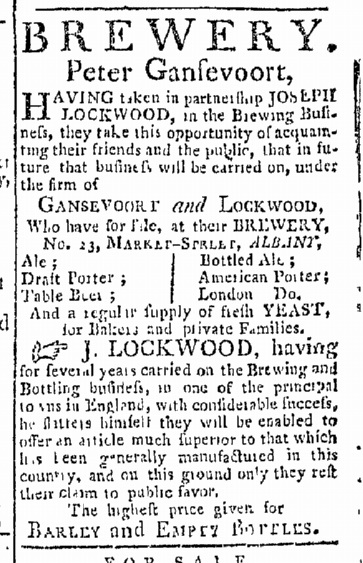
gansevoortalbgaz_07-28-1798After an intense amount of effort researching only the very finest digital archives, Craig (and not I) came across this sweet ad from 28 July 1798 from the Albany Gazette. He explains himself over at his blog how he was hot on the train of Edward A. Le Breton, Albany brewer in the first decade of the 1800s. This ad? Just something for me, for Al… Mr. 1600s and 1700s.

It’s interesting how we have separated our interests generally around the time of the fall of the Federalists. The time of the Federalists’ height of power in central New York frontier is set out in Alan Taylor’s excellent William Cooper’s Town. A failed dream of an American aristocracy to replace the Loyalist aristocracy that founded my town after the American Revolution, the Federalists are about to start on their decline soon after this advertisement appears in 1798. As we learn in 1969’s breakout best seller The Gansevoorts of Albany: Dutch Patricians in the Upper Hudson Valley, Peter Gansevoort would soon demolish the brewery in 1807 after a string of partners he had hoped would take over the operation run by his family for 150 years. He was a man with a new mansion. A Revolutionary war hero who now wanted income from rents, not the troubles of actually doing things.

But what does his ad tell us. He wants barley and not wheat. Only 45 years before, touring Swedish professor noted the local – and one might speculate – traditional Dutch use of wheat malt. Through the aftermath of the Revolution, central New York is flooded with first New Englanders and then other immigrants and suffers lose of its cultural isolation. The ad also asks for empties. Which quite the thing. Bottles indicate, you know, the use of bottles. Which indicates something other than bulk communal drinking from casks, doesn’t it. For me, it is an implication of that old theme of the strength of Albany’s brew.

But most interestingly are those six sorts of drinks on offer – three porters, table beer, ale and bottled ale. Clearly predates the ad man, the marketing guru. What is it that would distinguish an American porter from a London porter in the marketplace of Albany in July 1798? Were there the great great great great great great great great great grandfathers and similarly situated great uncles of beer tickers and style nerds arguing over the difference? We know so little about the tastes of those, in the big picture, so recently alive.

Book Review: But Are These Really Beer Books?


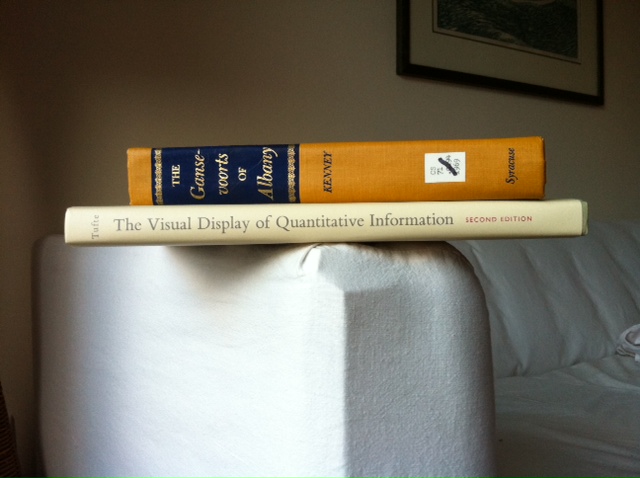
ganse1Beer books. I have read enough of them but they are not the whole extent of the books I read related to my interest in beer. One of the most interesting things for me about my interest in beer is how is it woven though the community and through time. On top up there is my recently acquired copy of 1969’s breakout best seller The Gansevoorts of Albany: Dutch Patricians in the Upper Hudson Valley. It does appear on Google books but not much of the text is available. Below that book us the second edition of The Visual Display of Quantitative Information by Edward Tufte. I am hoping each will be, in its way, a book about beer or at least a book that explains how we can think about beer.

First, the Gansevoorts. The most amazing thing about this family for our present purposes is that they gave up brewing in the early 1800s after the best part of two centuries of brewing… in North America. There is a lot to learn about the context of how brewing began and has continued for around 380 years in the capital city of New York state but the main thing to understand is that when the British finally took over the Dutch colony in 1674, it did not remove the population. In a way, it is like a mini-Quebec in that, through the Dongan Charterof 1686, the people of Albany were allowed a level of self-government that continued its Dutch political culture. In roads into that were only made after the French and Indian War of the later 1750s which led to the fall of New France. Interestingly, the indications I have seen of a indigenous strong Dutch wheat beer seem to fade along with that political culture replaced in the first decade of the 1800s with the ranges of small to XXXX ales more in line with the Yankees of neighbouring and expanding New England culture that lived on until swamped in turn by later German immigrants and the advent of large scale lager production. Earlier, under that cultural protection, the Gansevoorts can be traced back to the 1650s when a brewer had a daughter whose husband took up the brewing trade himself, passing the business on to their son, whose beer based position and wealth allowed his sons to prosper and lead the Revolution… and to run the brewery until it was demolished in 1807.

We have data. So much data. But it is out there in jangled family trees, in newspaper ads and in boxes on archive shelves which have remained unopened for years. How to find it all and how to put it into some order? I have an idea for an interactive timeline that effectively displays what otherwise could sit on a wiki like this. But I need help. Hence Tufte. I am thinking of his commentary on the 1869 graphically illustrated map of Napoleon’s doomed march into and out of Russia. Except it would be the Hudson River Valley and it would be about almost four centuries of of beer rather that one really poor military campaign. Something of a cross between that and the schematic diagram of the London Undergroundmight work. Maybe.

Beer books? Two wonderful books and each can tell me plenty about beer or about thinking about beer at least.

Your 1816 Albany Ale Update From My Home Town


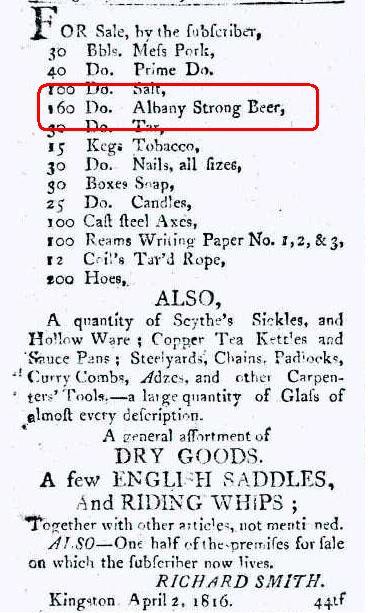
kingstonasb1816kWe have not found more Albany ale information for a while but this is your moment of zen. Just consider what it means. There is no Erie Canal. There are rapids on the St. Lawrence all the way to Montreal. There are about 4,000 people in this town. The War of 1812 ended one shipping season before… unless it was brought by sleigh. Oh, and “Do.” does not mean dozen. It means “ditto” so those are barrels. Amazing. From the Kingston Gazette on April 27th 1816.

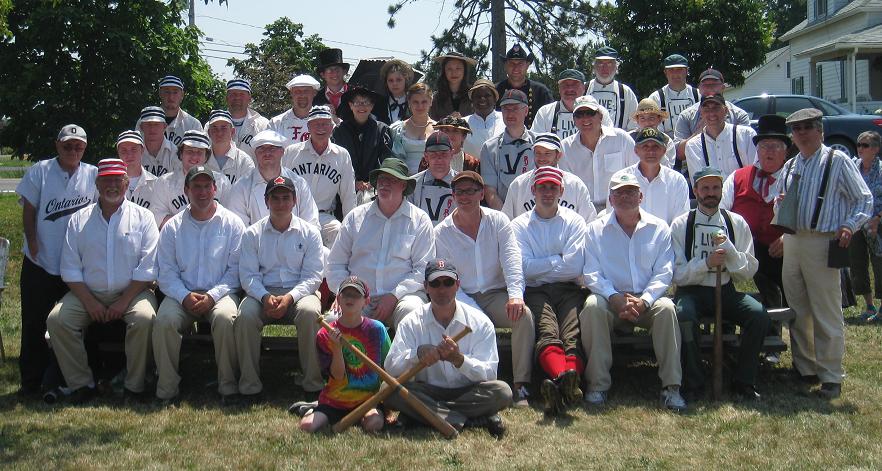
Sackets Harbor NY Vintage Base Ball Tournament 2011

sack2011

This year’s vintage base ball game was remarkable. The weather was so hot I thought that I was going to faint when I slowed into second on a couple of doubles. The team had a few new faces but was as keen as ever and took both games after never winning a single game in the USA in the four previous seasons. Well, there was 2008 when the game was rained out. We declared that we had not lost by default.

All That Base Ball Was Really About That Pitcher

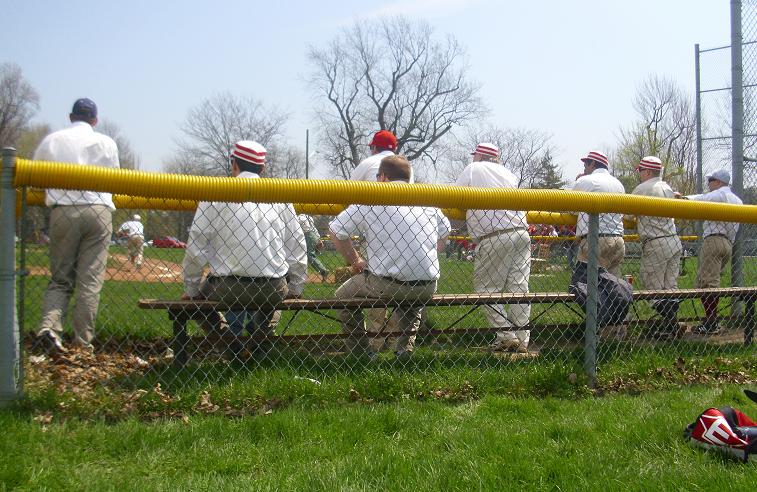
vbbk20114

I indulged in my other odd hobby yesterday. 1860s – 70s base ball. Two words. No gloves. No sliding. The ball springs off the bat with about as much zip as an Edam cheese would. Underhand pitching and bats that are like swinging a 2 x 4 fresh from the lumber yard. I put the thing together with friends. We took on graduating cadets from our Royal Military College as well as a mixed team of upstate New Yorkers from Canton and Rochester NY. The final was a 3-2 victory for the Americans. The team that became the Atlanta Braves beat Kingston on the same field 138 years ago… by a slightly larger margin.

And after it all, we retired to the brew pub. There is only one in the City so that’s what we call it. Over twenty folk wanting to relax over a few beer and get to know each other. Lively talk about the sad state of regional teams like the Bills and the Leafs, discussions about the different gun law ending with the trump card of a cadet explaining the fire power he’s been trained to use. And the beer. I hadn’t realized that oatmeal stout was not available in pitchers so I had a pint and bought a pitcher to share of the pale ale, both brewed by Montreal’s McAuslan Brewing. I couldn’t remember the last time I had a pitcher. Sounds sad, doesn’t it but life with the many rug rats does have its realities. What did I like about having one? The conviviality. The vessel was meant for sharing. Slopping pours topped up this glass and that. As talk ebbed and flowed from the Bills to bazookas.

So, How Was That Beer George Made Anyway?

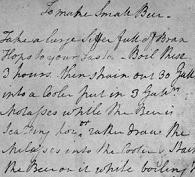
coneywashSome buzz around the beer news that the Coney Island / Shmaltz Brewing Company is brewing up a recipe of George Washington’s beer for a charity gig… and a cheater version with roasted malts for those who might want to pretend. Here is the recipe entitled “To Make Small Beer” as set out by the Gothamist:

Take a large Siffer [Sifter] full of Bran Hops to your Taste. Boil these 3 hours then strain out 30 Gall[ons] into a cooler put in 3 Gall[ons] Molasses while the Beer is Scalding hot or rather draw the Melasses (sic) into the cooler & St[r]ain the Beer on it while boiling Hot. let this stand till it is little more than Blood warm then put in a quart of Yea[s]t if the Weather is very Cold cover it over with a Blank[et] & let it Work in the Cooler 24 hours then put it into the Cask—leave the bung open till it is almost don[e] Working—Bottle it that day Week it was Brewed.

The recipe is in the New York Public Library‘s collection and dates from 1757 – when George was still a Loyalist and a couple of years before Jeffery Amherst’s spruce beer from a couple of colonies to the north. Interestingly, each uses 3 gallons of molasses to thirty gallons of brew. The real difference is that George says hop to taste while Jeff boils seven pounds of spruce until the bark comes off. Neither look all that appealing. And I am not sure what George meant by the “Bran Hops.” Is the sentence supposed to be “Take a large Siffer [Sifter] full of Bran Hops to your Taste” or is there a missing punctuation mark so that it would read “full of Bran – Hops to taste”? Or were “bran hops” something that meant something to someone somewhere?

This report suggested that the Washington beer would work out at 11%… hardly small beer. And Amherst states that his beer can be bottled to keep “a great while.” I dunno. Were these desperate beers for desperate times? In a way, maybe they were the predecessors of commodity beer – a means to an end.

Galeville Grocery Shuts After 84… or 156 Years

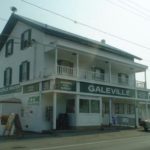
galevilleMy math is pretty bad but not as bad as the news out of Liverpool in central New York near Syracuse that the Galeville Grocery has shut after being a grocery store since 1926 and a building since 1854. Reader Jack forwarded me last Friday’s news in an email earlier this week:

Even into this week, this storehouse turned store was a draw for customers prowling tightly drawn aisles, seeking canned goods, lottery tickets, plastic containers of bread crumbs, foreign and domestic beers, pool supplies, Italian bread, meats, sandwiches. You name it. But life moves ever forward and sometimes, there’s no time for nostalgia. Galeville Grocery becomes a part of the local Byrne Dairy family. It gets a new building in 2011, one designed to look like the current, but with 21st century touches to reach a 21st century shopper. The floors won’t creak and the cramped checkout counter will likely be larger. The aisles will be wider and the selection, some of it already with the Byrne Dairy name on it, may not be as wide and deep, but convenient, fast and easy. We’ll likely see some of the same, familiar faces.

Gee, I’m a 21st century shopper and I kind of liked the old place. I’ve been stopping there since at least 2004 soon after we moved to Ontario. I always seemed to find a well priced beery surprise I hadn’t seen elsewhere. And there was the service beyond even the counter guy loading your trunk for you. I really appreciated that time that I drove back 30 miles after realizing I didn’t have my receipt for the border declaration to Customs Canada – only to watch the staff dive into the trash to find it. But then there was the sad news of the passing of owner Bernie Rivers this past summer and one can imagine the prime location and all the good will lead to a great offer for the property. Don’t know if good beer sales will continue especially with the move Wegman’s has made over the last few years to fill central New York demand. I’ll keep an eye on it but it’s probably the end of an era.

Albany Ale: When Did They Stop Using Wheat Malt?

I came across this reference to the malting of wheat in a 1869 series of essays and reports called The Annals of Albany. Apparently one Peter Kalm, a professor from a Swedish university, visited North America from 1748 to 1750 making some sort of economic and natural resources survey. He made these notes on 15 June 1749:

They sow wheat in the neighborhood of Albany, with great advantage. From one bushel they get twelve sometimes : if the soil be good, they get twenty bushels. If their crop amounts only to ten bushels from one, they think it very trifling. The inhabitants of the country round Albany are Dutch and Germans. The Germans live in several great villages, and sow great quantities of wheat, which is brought to Albany : and from thence they send many yachts laden with flour to New York. The wheat flour from Albany is reckoned the best in all North America, except that from Sopus or Kingston, a place between Albany and New York. All the bread in Albany is made of wheat. At New York they pay the Albany flour with several shillings more per hundred weight, than that from other places. Rye is likewise sown here, but not so generally as wheat. They do not sow much barley here, because they do not reckon the profits very great. Wheat is so plentiful that they make malt of it. In the neighborhood of New York, I saw great fields sown with barley. They do not sow more oats than are necessary for their horses.

This passage was referenced in an earlier quotation I included in an Albany ale post back in April and cropped in June but it has me thinking. If they aren’t even growing barley and are malting wheat in 1749, then it is likely the strong ale that Sir William Johnson of the Mohawk Valley, west of Albany, was drinking from 1750 maybe to his death in 1774 was a wheat beer. But by 1835, the brewers of the area responding to a set of questions posed by the New York State Senate all respond by saying that they use pure ingredients including barley malt. I don’t catch any reference to wheat malt. The use of barley by this point is corroborated by this quotation from 1827.

So – am I slowly, clumsily chasing two Albany Ales? A strong wheat ale made by the Dutch up to the latter 1700s and then a strong barley ale in the early 1800s?

Albany Ale: What Hops Would They Have Used?

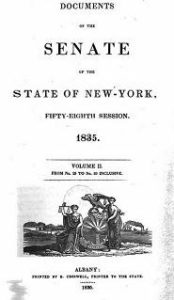
sen1835Remember Albany ale? Last spring, I found a number of references to beer being shipped around the eastern seaboard from Newfoundland to New Orleans as well as references to it being sold in Texas and even California. Not sure what it was but there was plenty of evidence that it was something.

The other day I found something particularly helpful. In 1835, the Senate of the State of New York received the Report of the Select Committee… on the Memorial of Sundry Inhabitants of the City of Albany, in Regard to the Manufacture of Beer. Forty pages long, the Report consists of answers by brewers given in response to six questions posed by Senators intended to discover whether the brewers of Albany were brewing impure beer. Question 3 gets to the point:

3. Have coculus indicus, nux vomica, opium, laurel leaves, copperas, alum, sulphuric acid, salt of steel, aloes, capsicum, sulphate of iron, or copperas, or any other deleterious or poisonous drug or compound, or any or either of them, or any extract or essential property thereof, been, at any time, or in any quantity, directly or indirectly infused, mixed, put or used in beer, ale or porter, either when being manufactured or when preparing for market? If aye, at what time, in what quantities, and by whom?

Yikes. Yiks, too. Happy to report, however, the answers were a complete and fairly convincing denial of all charges, charges no doubt trumped up by some downstate faction. But in giving that answer, the brewers, brewery owners and staff give a lot of information about what was going on with brewing in and around the Hudson Valley at that time. I will return to this text on other topics but today, I want to look at what they say about hops and where that can lead us. Here are some of the comments:

– James D. Gardner of Vassar and Co., Poughkeepsie stated: “I do not know the cause of that flavor, which gives to some beer the taste of aloes, unless it is owing to the use of strong hops which may have become damaged by packing, before sufficiently cured, or to unskilfulness in the operator, or to both combined.”

– James Wallace of the firm of J+U Wallace, Troy, NY reported: “There is a great variety in the flavor of hops: some have a strong, others a more delicate flavor, which readily accounts for the different flavors perceptible in the ales of the same establishment.”

– Thomas Read of Thom. Read and Co., Troy NY confirms he used 2.5 to 5 pounds of hops to a barrel and that they looked for the palest bales of hops to use in their pale ale.

What does that tell us? Well, no one describes varieties of hops even if they come in different colours, different degrees of curing and damage as well as different degrees of delicacy. We can fall into a trap thinking people in the past were not as perceptive as we are. Well, it is clear the brewers are looking for differences in hop characteristics with a professional eye but do not see varieties or breeds of hops as something available to them.
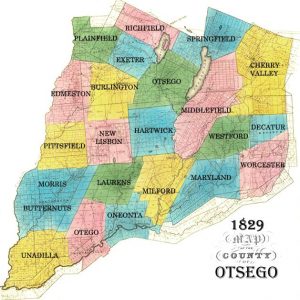
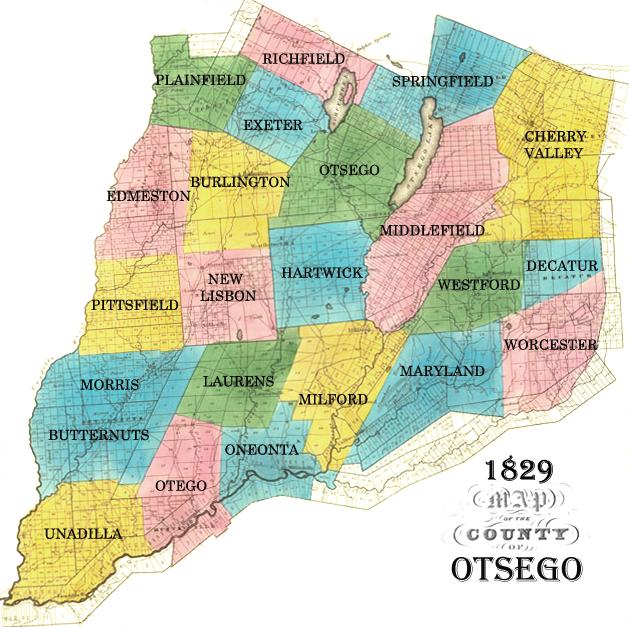
What were these hops? It is reasonable to suggest they were New York state hops. In Volume 50 of the American Journal of Pharmacy from 1877, there is an useful article setting out the importance of hop industry in central NY in the mid-1800s. In 1860, it states, each of four countries of central NY including Otsego produced more hops than all hops produced in the USA outside of New York state. Two varieties are mentioned by the pharmacists: “large and small cluster.” In another report, this time the 1860 Report of New York State Cheese Manufacturers’ Association, a trip to Otsego County is describe in which the hop plantings in every village are estimated. We are told at page 150 that at Richfield, about 75 miles west of Albany two varieties were grown:

Messrs. Allen & Hinds, the leading hop merchants of’ the town, informed us that the past winter had been unfavorable to hop plantations in this section, and many yards had been badly winter-killed, more especially the older yards. There had been greater losses from this cause than in any previous year, but a considerable number of new plantations had been set, and it was believed the new yards would more than supply the place of those winter-killed. Two varieties of the hop are generally cultivated in town, the Pompey and Cluster. The Golding hop of England had been tried but did not succeed well, being liable to rust . The Pompey is a large coarse variety, a vigorous grower, but inferior to the Cluster in strength and flavor, and does not keep its color so well as the latter variety.

While there is still a village of Pompey and even a modern day effort in the re-establishment of the central NY of the hop industry there, we are unfamiliar with that strain. We do know about Cluster, however. Cluster is still with us, often described as an old American cultivar which is, notably, a hybrid of Dutch strains and wild indigenous ones. Hmm… where did the Dutch meet the wild in the US? The Albany area, of course.

There is more to know about Cluster and the need to more closely locate it in the early 1800s in an Albany brewer’s log book but for now suffice it to say that when the brewers of Albany ale were talking about hops they were likely talking about the finest hops available locally, Cluster.
The 2010 Sackets Harbor NY Vintage Base Ball Tournament

Another great time was had by all even if we had to play 18 innings of 1864 rules baseball in a row on a 85 F day under the beating sun. The Kingston St. Lawrence VBBC tied the Sackets Harbor Ontarios 12-12 in the first game and lost 7-1 to the Genesee Nine of Rochester. Highlight was the nine run second inning in the first game. Low light was being on base and realizing I was not actually aware of the rules one needed to know when being on base. Got tagged out at home in the fourth inning of the second game. You know, one truly ought to give ‘er when one has the opportunity.