
Your “The Thaw Cometh! The Thaw Cometh!!” Mid-February Edition Of These Beery News Notes

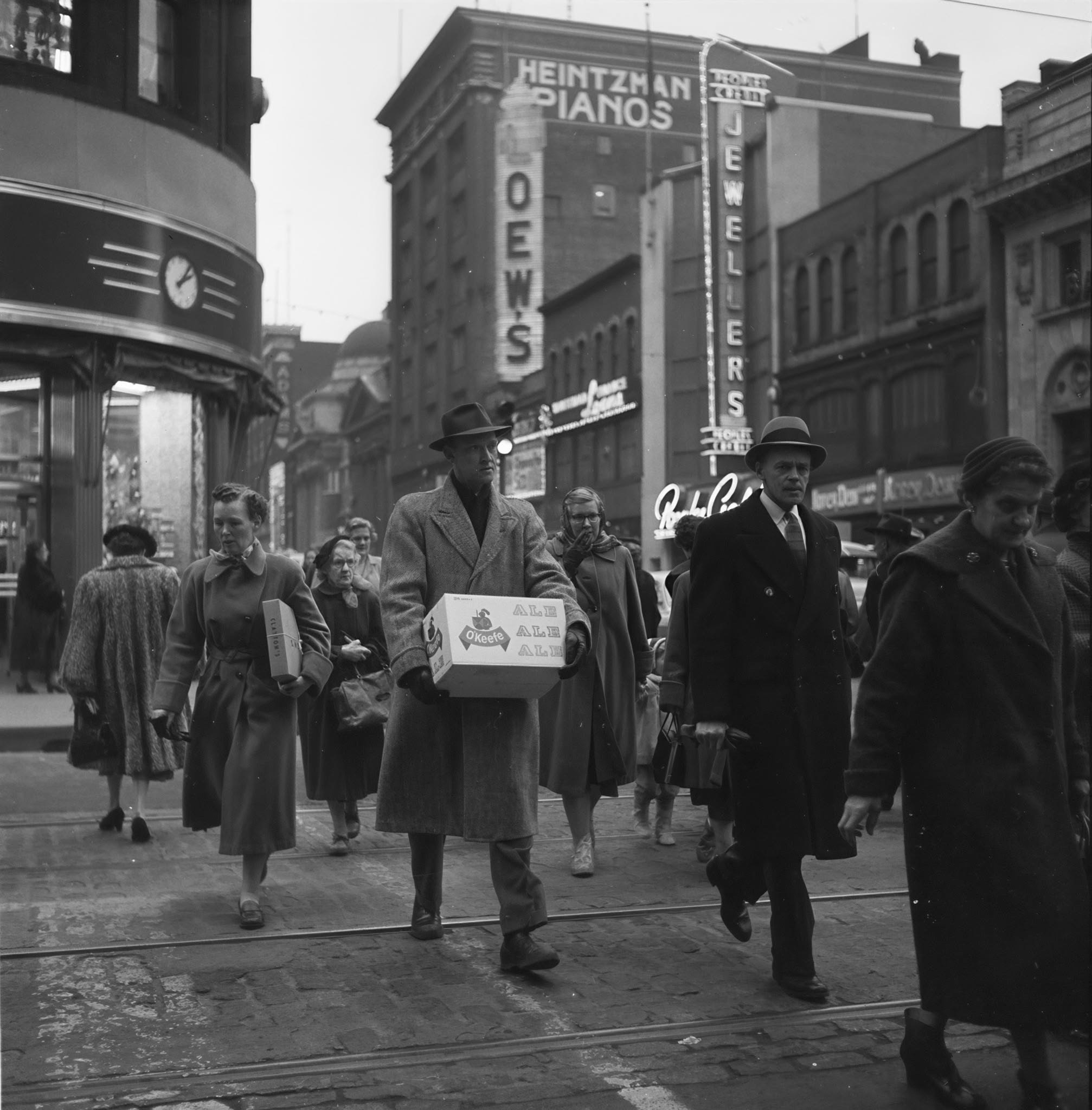
Now that the temperatures have moderated from -30C at dawn way up to -3C, the nation asks itself what the hell was all that? There is no answer to the question. Fortunately, there is a second question: how to still look dapper in a Canadian winter while lugging a lot of beer? Well, this gent can help. First, walk around in one of Toronto’s well loved black and white neighbourhoods where people must wear vintage clothing. Then, bottle your homebrewed beer only in second hand O’Keefe quarts you have nicked from the upper bric-a-brac shelves of old taverns. Finally, invest in an industrial quality paper packaging printing press you keep in the basement solely for the recreation of 1950s brewery boxes. Easy! Speaking of being on one’s feet, Boak and Bailey have written about how they didn’t do a Dry January so much as a very mobile one, a habit that has continued well into February:

We didn’t set out to make a mission of this, but we realised about halfway through January that, as it happened, we hadn’t yet made a repeat visit. That made us wonder if we could keep it up for the remaining few weeks. We were particularly conscious that we’d tended to stick to tried and trusted favourites last year. In fact, in 2025, over a quarter of our logged Bristol pub visits were to just two pubs – The King’s Head and The Swan with Two Necks. You might have noticed the word ‘logged’ and be wondering exactly what that means. Well, Jess, an accountant and spreadsheet nerd, of course keeps track of every pub we visit.

What a good realization! We have nothing like that possiblity here so much replicate 1950s Toronto to amuse ourselves but this comes a very good second. In the US of A, something else appears to be amuse or perhaps console according to BMI :

Beer posted positive $$ growth in 4 of the last 5 wks, and Jan 2026 is on track to be beer’s best monthly trend in years, at least in these channels. Including wine & spirit RTDs in the mix brightens the picture even more; broader beer + RTD category $$ grew more than 5% with wine & spirit RTDs adding close to 2 full pts in scans. 

Booze up! And somewhat similarly Ed stood up for the honour of Guinness this week with a response to what he called a a hatchet job on the Guinness’ Open Gate brewery in London published by The Guardian:

For some reason restaurant critics put the boot in more than any other type of reviewer… I was going to the brewery as part of the CIBD Southern section’s AGM, but first we had to do the business part to do at Diageo’s HQ.  I don’t know what deal the CIBD had done with Diageo or if we were subsidised, but we paid a tenner. This gave us pie and mash, which was nice, and a pint of Guinness (brewed in Dublin). I was keen to have somethng brewed on site though, so I had a hazy IPA next, which was nice enough. I think the ABV was a bit hefty, as on top of the three pints of Guinness I’d had I was defintely feeling pissed by the time I’d fininished it. So there you have it. The Guardian journo’s main complaint seemed to be that you had to take a lift to the toilets.

For others, the trip to the pub and then to the toilet is even easier. They are visiting the pub virtually from home, a remote non-work arrangement of sorts:

The 24-year-old from Yeovil, Somerset, regularly tunes into the feed from Morgan’s Arcade Bar in Carlisle, Cumbria – despite never having been there or anywhere near. What hooks Katie in is seeing different people come and go: the women enjoying a work party, the couple singing along with the musician, the young lad trying to chat up a girl at the bar… On some nights Morgan’s Arcade Bar, which can only fit around 60 people in it, has up to 5,000 viewers on its livestream at any one time. But like other bar streams, it has been subject to bans and restrictions for reasons they don’t quite understand. Bar owner Morgan Taylor has been streaming for nearly nine months. He noticed a huge rise in viewers over Christmas, then a few weeks ago his account was deleted.

Cass Enright got out of the house and on the road in his latest installment of A Quick Beer takes us to Montreal – a favourite destination of mine – and revisits some of the great brewpubs there in a video with this intro:

Join us on a step back in time as we have A Quick Beer at three of Montreal’s original brewpubs! Discover the enduring charms of Dieu du Ciel!, L’amère à boire, and Le Cheval Blanc, three spots that have been serving up delicious beer for decades. Although Montreal offers many modern breweries and taprooms nowadays, some of our fondest beery memories over the years have been here, and they’re all still going strong.

For me, it’s L’Barouf on rue St-Denis. If you are ever looking for me, check there. Also all about winnowing the better and the best, Pete shared some firm thoughts in his column in The Times this week, always welcome sight:

My beef is not with hazy pales — those original examples were pretty good. But if you don’t need to worry about balance or clarity in the beer, and you’re throwing in enough hops to cover up any off-flavours from brewing mistakes, a hazy IPA is very easy for a mediocre brewer to make. From a drinker’s point of view, if you grew up with soft drinks and don’t like the taste of actual beer, it’s perfect. It’s also great for Instagram — everyone can see you’re not drinking a boring, mainstream beer. But instead you’re drinking a boring craft beer. A boring, one-dimensional alcoholic fruit smoothie in a gaudy can with hop monsters or skeletons on it. If I wanted to drink sour grapefruit juice, I’d buy some Tropicana and leave it in the sun for a bit. 

The many botches of “craft” is a venerable topic which even comes with its own primodrial gospel but it is true that for all its eager keener passion craft never seems to fail to find a way to fail.  Nice to see that we have a paper of record confirming what Pete called the “sustained decline.” Viva crystal malt! Viva!! Viva!!! And Phil Mellows guided me to this article in The Caterer on the why to Pete’s what including this suggested impetus:

“…we are beginning to see the movement of some younger adult drinkers towards nostalgia brands, and given our history and heritage, we feel well-placed to meet this trend through some marketing and awareness driving activity.” Brookfield Drinks has launched a trial bringing long-established premium Scottish lager Kestrel back on draught. Brookfield managing director Nigel McNally says: “We’ve shown that a brand that’s nostalgic, like Kestrel, can be repositioned and revitalised. “Most pubs are serving the same products, and the trade’s been guilty of allowing brands which aren’t authentic onto the bar. Alcohol by volume (abv) have also come down, and I think overall customers feel they’ve been short-changed. A return to brands with heritage and nostalgia is offering customers a point of difference.”

Nostalgia and getting short changed? One must be on one’s toes. Which is related to Lars’ new maxim: “if you don’t know how the beer is made then, no matter what the beer is named, you have no idea what kind of beer it is.

Speaking of no knowing, The Beer Nut made a confession this week that I suspect is made on behalf of many of us:

Anyone who pays attention to trends within microbrewing will have noticed in recent years the explosion in variety of proprietary hop products. I don’t think these assorted extracts and powders and boosters were ever meant to have a consumer-facing role, but brewers seem to love them, and love letting us know that they’ve used them. Does that get them a discount from the supplier? I wouldn’t be surprised. For my part, I can’t help wondering if these enhancers actually enhance the beers in any real way. I’ve certainly never identified any pattern among them: which ones to look out for and which ones aren’t worth the paper their patents were filed on.

Note #1: Ludlow prices!!!
Note #2: Laura’s top tap rooms.
Note #3: Jeff doxxed.
Note #4: Burton Union Pr0n!
Note #5: Actually, no you can’t. You’d die.

The British Royal Navy has recently announced it is cutting booze rations in the service, limiting intake to 14 unit per week while on board. The Telegraph in its emailed newsletter presented a few responses to the news from readers:

Jenny Jones, however, recalled an age of largesse: “Many years ago in Malta, my husband and I were invited on board a Royal Navy ship that was giving a party. The atmosphere was convivial and, thanks to attentive stewards, I was able to enjoy several gin and tonics before dinner. “On departing, it seemed to me that the gangway had become a lot steeper. Back on dry land, our host asked how many drinks I’d had. When I said three, he told me that in fact I’d had nine, as naval tots are about triple the size of what one would get in a pub.”

Ah, Jenny Jones… what’s that? Not the same one? Fine. Me, I was once invited with a gang up the plank and onto a Canadian navy ship helpfully docked a walk from the Halifax taverns by a pal’s navy boyfriend. Among the minty green paid we worked our way though a number of 25 cent beers. I expect that sort of service is no longer offered.

The feature this week at Pellicle was written by Newt Albiston who shares his thoughts on drinking in Epping, just north of Greater London the tough town where he grew up which lives with division:

The day I return to Epping, my first trip home in some time, I can feel the tension, and the hesitance. The high street is pretty quiet, and there are lingering looks as I make my way past the various coffee chains and charity shops. Signs of the change in mood are everywhere: Union flags fly at half-mast on lamp posts, as if to declare the death of Britain as she once was, shadowed by the residue of torn-off patriotic stickers. Although I am instantly greeted by familiar faces when I walk into The Duke, the tension is still present in the quietness of the venue.

I like this: “…no fancy ginger beer or small-batch kombuch…” Perhaps related to The Duke, Stan guided us to a question this week – “what’s that smell?” Or rather…

“Olfaction helps shape our cultures, although it often does so unknowingly or without us noticing,” says (Inger) Leemans, who led the Odeuropa project. “When we talk about cultural heritage, we can think about religious rituals, but we can also think about specific scents that we’ve been cherishing and living with for a long time.”

Cherish. Hmm… I spent a good chunk of my teens in Truro, NS where the smell wasn’t always cherished and I am mindful of that reference The Breweries of Kingston & The St. Lawrence Valley by Steve Gates to a brewery a couple hundred years ago near my current place of work at City Hall which doubled as a pig sty. The next brewery to the north itself had a manure pit.  My point is that there were no scents without the full sensory array around it. Did 1890s Mild pair well with coal dust? Did Porter marry well with the pong of streets filled with horses? Perhaps we can never know.

And Charlotte Cook, brewer and scribbler, at took us along to Asturias, Spain for Everyday Drinking and shared her thoughts on the food and the cider:

When you taste the intensely rich stew, you can understand why cider rather than wine prevails in the north—the sour and fizzy is needed to cut through, cleanse the palate, and prepare you to dive in again. Cider is omnipresent in Asturias. As you walk around the town center of Oviedo on a Sunday morning, as families returning from church mix with football fans heading to an entirely different type of cathedra, cider is everywhere. Before 11 am, people will be drinking a bottle of cider for the table. Spaniards are famed for their ability to drink until the wee hours and still make it to work, school, or church as if nothing has happened. And having a little tipple of cider in the morning isn’t seen as such a stain on your character as it is at home.

Finally, some very heartfelt tributes were shared after the news of the death of beer writer Des de Moor like this from David J:

I think a lot about the pints we had one night in South London where he held court, sang songs and was so warm to everyone.

Pete also remembered Des the singer:

Des was a man of many layers. Years after the event, I discover my first interaction with him was buying the 12” remix of Charlton Heston by Stump – that was him, as half of the Irresistible Force. He made the Popbitch newsletter as Secretary of the Ramblers Association (moor, geddit?)… He was a great singer, a walking encylopedia. An absolute stalwart of judging the World Beer Awards. Never once heard him angry, pissed off, or anything other than kind and decent.

There are many more. His Wikipedia bio explains his musical side. Here he is singing Bowie and, here, an earlier solo album. By all accounts a wonderful guy. A sad loss.

Until next time, please check out Boak and Bailey who are posting every Saturday and adding to their fabulously entertaining footnotes week after week at Patreon. And look out for more of Stan’s new “One Link, One Paragraph” format. Then hunt out something in someone’s archives! Leave oblique comments on someone’s post from 2009!! Listen to a few of Lew’s podcasts and get your emailed issue of Episodes of my Pub Life by David Jesudason on certain Fridays. And Phil Mellows is at the BritishBeerBreaks. Once a month, as noted, Will Hawkes issues his London Beer City newsletter and do sign up for Katie’s wonderful self-governing totes autonomous website featuring The Gulp, too.  Ben’s Beer and Badword seems to be on pause since November but there is reading at The Glass which is going back to being a blog. Any more? We have Ontario’s own A Quick Beer and All About Beer is still offering a range of podcasts – and there’s also Mike Seay’s The Perfect Pour. Plus follow the venerable Full Pint podcast! And there’s the Craft Beer Channel on Youtube. Check out the archives of the Beer Ladies Podcast.

Your Super (Not All That Scary) Boo-tastic (But Without Any Fake Blood Splatters) Halloween Week Beery New Notes

Frosts? Yup. Green tomatoes brought in? Check. Furnace? On. It’s that time of year. Darker beers. Browner liquors. Higher natural gas bills. I feel a bit like the unnamed gent in the painting, “A Man with a Pint” from 1932 by Fred Elwell. Layered clothes. Sitting in a lower light. Pointing at things in newspapers and telling the person across the table about it. I feel badly for the lad. He just missed out on the first wave of beer blogging by about seventy years so, given that, all he could do was sit in pubs, pointing at things in newspapers and telling the folk who were with him about it.

Before we get into the newsy news, perhaps speaking of him… and even maybe me, The Guardian shared a story this week on hangovers and aging and what’s going on:

The liver breaks down alcohol with the help of enzymes, but as we get older it produces fewer of them, meaning toxic byproducts such as acetaldehyde – the compound responsible for many hangover symptoms – linger in the body. It’s not just the liver. The body’s water content drops by about 5% after the age of 55, partly because levels of muscle, where a lot of it is stored, decrease. Less water means alcohol is more concentrated in the bloodstream, and dehydration caused by its diuretic qualities – a key culprit behind hangover headaches and grogginess – hits harder. Kidney function also declines with age, slowing the removal of waste products. “You get this buildup of waste products in the body that have a longer circulating time to exert their effects…”

Tell me about it! Scary. Getting back to with the ghosts and ghouls theme, The Beer Nut has put on his STASH KILLER! costume this week and has put together an exploding can special post:

I don’t know why I even had these. It certainly wasn’t with the intention of seeing if they improved with age: the styles involved aren’t really built for that. This summer’s warm weather resulted in some warped cans, and I lost a few which ruptured, so I took that as a signal to try these out before they explode completely… For the most part, these were better than I expected. While of course I don’t recommend that anyone age pale ales or hoppy lagers in the hope of improving them, not least because of the risk of explosion, it seems it takes a lot to properly ruin a beer once it’s in its aluminium jacket.

BREAKING PERRY NEWS!!! A solid rebuttal from Barry Masterson this week in Cider Review on a statement by cidermakers Westons declaring that perry is dead!! and using the term “pear cider” instead:

One would think it is incumbent upon established (and let’s admit, pretty large) producers like Westons to protect and promote the uniqueness of perry, not wash it away for the sake of a quick sales boost. The move is especially troubling coming from a company that touts its family history and traditional production methods. You cannot claim authenticity while simultaneously erasing the very tradition that underpins your reputation. Rather than declare perry “dead,” Westons should lead the way in educating new drinkers about its heritage and distinctiveness. Younger consumers are curious, discerning, and increasingly interested in authenticity and provenance.

Quite right. We can’t even get perry in Ontario – but I wouldn’t be buying anything called “pear cider” if it was for sale here. Strikes me, like “Canadian Sherry” or “California Burgundy”, as a sign… and a sign that says “beware!“* By the way, James Beeson wrote the story in The Grocer about Weston’s decision to change the name and dumbdown the drink – and is now getting grief from a key trade association which seems to be a bit confused about the difference between publishing a story and being the topic of a story:

In response to the article “Perry is ‘dead’ declares cidermaker Westons” published by The Grocer on the 21st October 2025, the Three Counties Cider and Perry Association (TCCPA) launch their Perry is Alive campaign. Westons’ justification for their removal of perry from their labelling is to increase their sales figures. The TCCPA believe this dismissal and removal of language to be damaging and a danger to the relationship drinkers have with the rich history and heritage of perry, pears and the land they come from.

And it’s all about the orchards this week as Pellicle‘s feature is a portrait of Virginia’s Diane Flynt of Foggy Ridge Orchards penned by my fellow Tartan Army follower, Alistair Reece:**

Sitting on the patio overlooking the lush verdant slopes of the orchards, the creek—from which mist rises in the morning, the inspiration for the cidery’s name—in the distance, Diane and I talk about apples, farming, and the making of cider. “It’s not just apple cider varieties—that’s one thing—it’s apples grown for cider,” she tells me. “When I bought Goldrush, I paid in advance for my apples and said ‘I will buy every apple on that tree, but I do not want you to pick them until they are falling off the tree.’ That’s growing apples for cider—they have to be dead ripe on the tree.”

That right there is a nice nugget of knowledge. And, speaking of the sensible, there was a measurably more reasonable response*** to that NYT item was this by Tom Dietrich in Craft Brewing Business on the four steps to “save” craft including one approach to improving the branding:

A big reason “wacky” beer names exist is because the beer trademark landscape is more crazy and crowded than a New Found Glory mosh pit (millennial reference alert!). If you’re applying to register a beer mark, your mark can’t be the same as or similar to any other mark for (a) beers and breweries, (b) wine and wineries, (c) any other spirits or alcoholic beverages or mixers, and (d) bar and restaurant services… In a crowded industry where creative names are increasingly hard to come by, understanding how to lawfully identify, clear, and acquire abandoned trademarks can be a competitive edge. 

Another sensible nugget of knowledge. And, continuing the theme, while the periodic column from Pete Brown in The Times can be a bit structured given its tight bit of space some weeks, this time his theme of twelve great London pubs with £5 pints provided for a bit more leeway for neatly balanced comment:

This reinvention of the happy hour is surprisingly widespread. Every pub in the Brewhouse & Kitchen chain has its own on-site brewery. The two currently open in London, at Hoxton and Highbury Corner, fill up in the evenings, when pints cost £6-8. But to get people in during the day, the pubs sell their own cask ales — usually a best bitter and a session IPA — for £3.50 before 6pm…  “We have to recognise what session drinkers can afford.” Most pubs aren’t trying to rip you off. They know that cheaper pints mean more customers. It’s far easier to find the £5-ish pint in north, east, and southeast London than in the west… But if you explore, especially via Overground rather than Tube, you’ll find pints in London at prices that make even a Yorkshireman happy.

Good advice. See also Ruvani at Beer Professor and her sensible recommendations for everyday beers. Exercise your right to choose when to drink. And what! Or where!! Like Martin who enjoyed himself at the posh confines of Ye Olde Bell in Nottinghamshire: “You need to walk past several interception points where you feel you might be asked “Can I HELP you Sir…” Or like Katie who was in Koblenz, studying the scenery:

I stare into the shiny window of a cigar cellar for quite a while before turning down a side street to find Spritz Atelier, a brand new bar specialising in fancy cocktails. I order one made with a local quince liquor called Kowelenzer Schängelche and watch from the window as a man finishes his workday with a take-out spritz of his own. He sips from the straw as he pushes his bike down the cobbled street, before disappearing out of sight.

You don’t even have to be there to choose whether you would want to be there. Consider Boak and Bailey‘s thoughts on the Prospect of Whitby as genius loci:

A few weeks ago, Ray visited The Prospect of Whitby with friends and had the usual experience of too many tourists crammed sharing a generally uninspiring chain pub atmosphere. Even in that context, though, there’s something magical about drinking a pint of Old Peculier while looking out over the water while the novelty noose set up for the amusement of visitors swings in your peripheral vision. It gets better again when you detour up the side of the pub, pass through a gate, down some hazardous steps, and onto the beach at low tide. There, the full power of The Prospect really hits you. Not least because you’ve seen this view a thousand times.

Changing themes with wanton abandon, I am enjoying this year’s continuing strained arguments about youth today. Like this in The Morning Adverstiser, taking the “drinking differently” approach:

While younger consumers remain less likely to drink than older age groups Lumina’s data shows more 18- to 24- year olds now describe themselves as drinking ‘often’ or ‘sometimes’ and fewer arre opting out completely. The long term fall in alcohol participation has plateaued.

The article goes on to then describe how younger people are, you know, still less drinking of alcohol. Don’t get me wrong. It’s obvious that turning social settings like pubs and tavs into something other than boozers is healthier and economically beneficial. I am all for skittles. But drinking low to no alcohol beers is not maintaining “alcohol participation.“**** It’s reducing it while maintaining social participation which, as I say, is really good. Anyone who actually believe the clinky-clinky is a fundamental social bond or, you know, builds community as the wise said in 2014 is fantasizing.

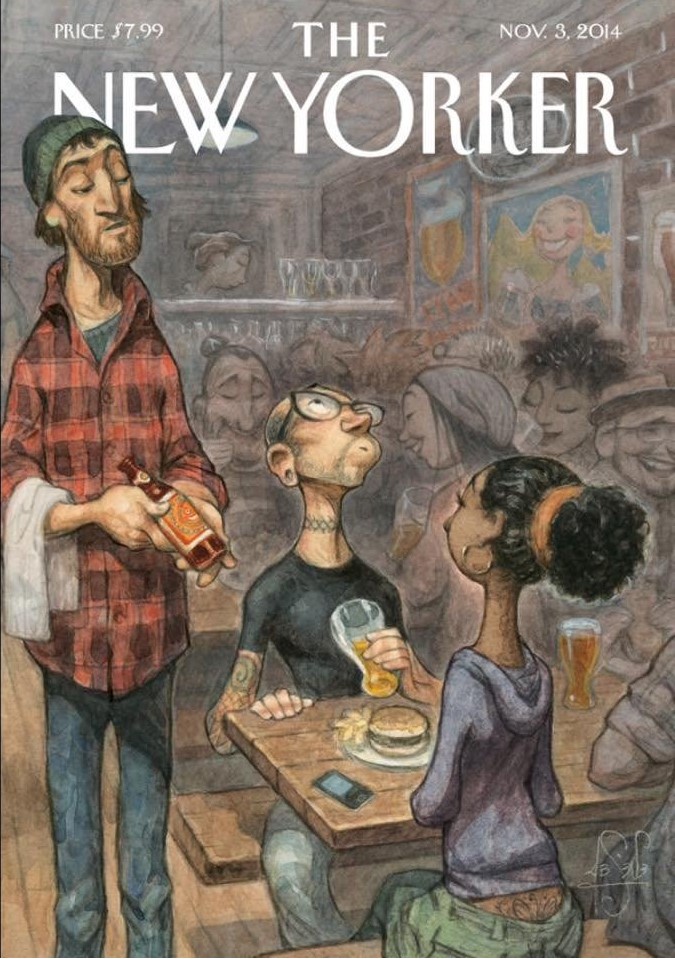
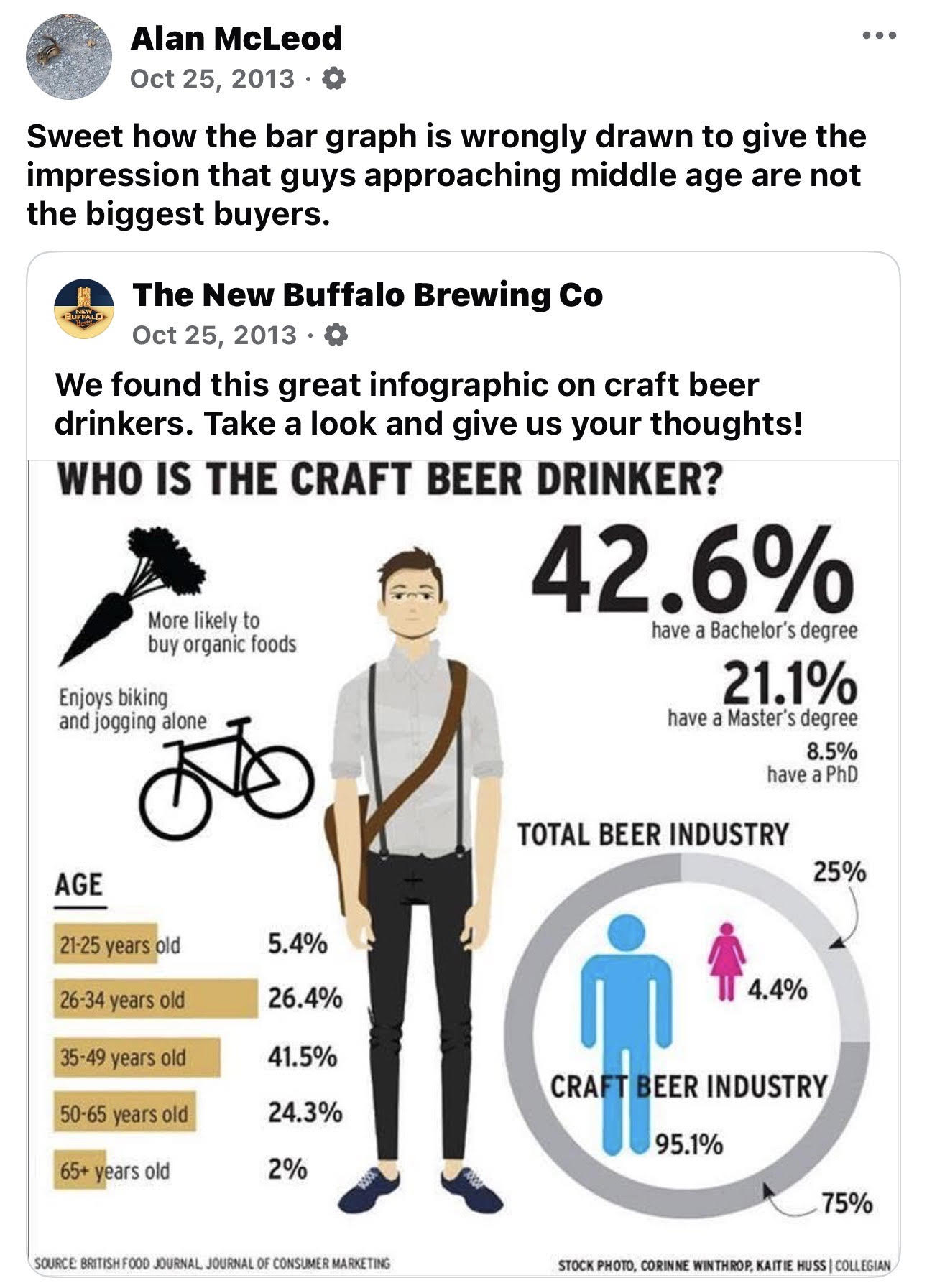
Which reminds me of something else. Over on FB, a memory from twelve whole years popped up in my feed this week and it gave me some perspective on that whole “the young folk ain’t drinking craft no more” story. Look at the brown graph in the lower left. It was created with data from the British food and marketing trade associations. In 2013 I was irritated by the incompetent bar lengths in the graph. In 2025, I am more interested in the percentages.  Keeping in mind these are UK figures, they indicated that two-thirds of craft beer drinkers at the time were over 35. Those people are all over 47 now.  Only just over 5% of people who were 21 to 25 at the time admitted to drinking craft beer. So when was this time when “the young folk drinking craft“?***** (This diagram from 2014 might suggest the same was not the case in the New York of the very next year. Maybe.)****** But whatever it was then, Stan is wondering if a key aspect of what made craft interesting back then has disappeared:

Will Curtin said the brewing landscape has changed significantly over the years, and believes that the traditional “garage brewery” model may be waning. “I think sort of the age of a garage brewery is sort of, if not gone, going,” he said.

I wonder if the cause of the going is not so much the loss as the lack of a compelling replacement. Whatever happened to the shock of the new? Well, unless you are in Spain next year, when drivers may get a shock:

Tourists, be warned:  Spain is proposing stricter drink-driving laws, and they could be enforced by the end of the year. The country’s Dirección General de Tráfico (DGT) wants to introduce new alcohol rules for all drivers — including those on bicycles and e-scooters — by the end of the year. The aim is for a universal alcohol limit of 0.2g per litre in the blood or 0.1mg per litre in breath. That would mean almost zero alcohol consumption before getting behind the wheel. Even a small glass of wine or beer could put you over the threshold.

That’d be one-quarter of the limit we face here in Canada. Be prepared. You can practice the pronunciation of these handy phrases for your next trip to Spain: “Propietario! ¿Duermo en tu cobertizo? Hmm ¿Tal vez debajo de tu árbol?

One last thing before we go. There was a call for papers from the people of Beeronomics:

The 2026 Beeronomics Conference will take place at ESSCA School of Management, Bordeaux, France, 24-27 June. Main panels and sessions will be held at the ESSCA Bordeaux Campus. The Conference Organising Committee, led by Gabriel Weber and Maik Huettinger, welcomes all high-quality research on the economics of beer and brewing. With a strong interest in interdisciplinary research, we are looking for submissions covering topics including…*******

Check it out, people. And with that, we are done. Adios and farewell to October! Next week the World Series will be over, Halloween will be in the past and I probably will have ripped up and rammed all the tomato plants in the compost bin. In the meantime, please also check out, Boak and Bailey on this and every Saturday and then sign up for their entertaining footnotes, too. Look out for Stan when he feels the urge now that he’s retired from Monday slot… maybe … maybe not. Then listen to a few of Lew’s podcasts and get your emailed issue of Episodes of my Pub Life by David Jesudason on certain Fridays. And Phil Mellows is at the BritishBeerBreaks. Once a month, as noted, Will Hawkes issues his London Beer City newsletter and do sign up for Katie’s wonderful self-governing totes autonomous website featuring The Gulp, too.  Ben’s Beer and Badword has returned from his break since April so you can embrace the sweary Mary! There is reading at The Glass which is going back to being a blog. Any more? We have Ontario’s own A Quick Beer and All About Beer is still offering a range of podcasts – and there’s also Mike Seay’s The Perfect Pour. Plus follow the venerable Full Pint podcast! And there’s the Craft Beer Channel on Youtube. Check out the archives of the Beer Ladies Podcast. That’s quite good and after a break they may well be are back every month!
*See: Perth Pink.
**Note: not aka Alice DuRiz!
***Just for example, see same publication in 2023 making the pretty much the same point but in 2025: “HOW DARE THEY!!!
****Customer: “I’d like to participate in some alcohol please” Bartender: “I shall be delighted to perloin you said chemical…” (Mutual winkies) CURTAIN!!!
*****By the way, New Buffalo seems to have stopped brewing a year after they published the diagram before getting caught into a legal dispute.
******You know, sometimes a parenthetical sentence is a good as a footnote. No, it really is.
*******… topics including (i) trends and driving forces in local and global beer production, consumption, and distribution; (ii) management, marketing, market structure and industrial dynamics, individual beer choice, health and well-being; (iii) policy and regulations related to the beer brewing industry; (iv) impact of beer on society and culture (v) environmental issues affecting beer and brewing and (vi) other stuff like food industry and alternatives to beer. You could write something about one of those. Birdeaux is nice in June. Why not? Give it a go.

The Beery News Notes For That Post Canadian Thanksgiving Emotional Letdown

Actually, it’s been a good week this week. Forget that headline. While not at the level of “I’m a traffic cop in Spain under Franco and it’s Christmas so give me gifts of boozegood (as illustrated to the right) it’s been good.  Week off for yard work. And Monday’s Thanksgiving turkey came out of the oven in fine shape. We even had a last minute guest which meant we had to be on best behaviour and, get this, I couldn’t even each over the table for seconds of stuffing bare handed. Sheesh. And my vote for the Cardinal* even tied my preferred runner up the Crow** so that worked out well. Annnnd it was heartening to see the fans of the Blue Jays not repeat past bad behaviour when the Mariners took the first two games on the road care of, in part, a great Canadian.

Where to begin? The past! Last Thursday after that week’s edition went to… well, after I clicked on “post”, Liam shared an interesting piece on the joys of finding an excellent set of observations from the past:

While trawling through newspaper mentions for old pubs for yet another historical project, I came across a smattering of repeats in numerous papers in 1908 of a piece of pubcentric prose under the title, ‘The Delights of an Old Alehouse.’ It really gripped me as I read it and brought out some of the emotions mentioned above, but it wasn’t in any way familiar to me which seemed odd, as it was extremely well written and clearly done by someone with a lot of talent. Luckily, at the end of the piece the author – Charles Hugh Davies – was credited as well as the source of the original publication, which was The Pall Mall Magazine. Some sleuthing and searching finally led me to the piece, which is actually just a small part of an article titled ‘An Essaie in Prayse of Beer’ which is a much broader love letter to beer, and especially old ale, as was hinted at in the excerpt I had read. I can’t find it in any other source (apologies if it has been covered by others and I’ve just missed it.)

Good work. Sadly, the hunt for information on line has become harder as sources are removed from public access. It’ll only become harder as A.I. search narrows what you need to know. Which really was the underlying point about brewing history that Pope Leo was trying to make the other day.

And Gary has been digging into the old records this week, too, focusing most recently on Old Vienna beer – both Ontarian and Ohioan – and some almost eerie machinations on the part of my personal hero E.P Taylor:

Since Ohio was ground zero to market Red Cap Ale and Carling Black Label beer made in Clevelend, it makes sense that Canadian Breweries wanted to add Old Vienna to the American portfolio, at least initially as an export. If Canadian Breweries bought the rights to Koch’s Old Vienna from the receiver, a potential obsacle to such marking would be removed. Presumably O’Keefe Old Vienna did reach Ohio, as it did other states in the north. in the 1950s…

While E.P. clearly had a thing for Ohio, there are still questions questions questions and he’s on the hunt. Fortunately there are also answers at least etymologically speaking! On “steaming“…

The word ‘steaming’ for being drunk stems from when people in Scotland used to circumvent Sunday licensing laws by taking to the water. Public houses were closed, but steamships weren’t. To be ‘steaming drunk’ made its way into public parlance.

Also on another aspect of the question of “what is history,Chalonda White of Afro.Beer.Chick posted about the meaning of National Black Brewers Day and how it is still not properly appreciated:

National Black Brewers Day isn’t just about history. It’s about continuity. It’s about connecting ancient African fermentation to modern Black ownership. It’s about giving credit where it’s long overdue. When I pour a pint on this day, I’m not just thinking about the beer. I’m thinking about the people. I think about the enslaved brewers whose hands shaped the recipes. I think about Theodore Mack Sr., who bet on himself when no one else would. I think about Celeste Beatty of Harlem Brewing Company, who became the first Black woman to own a craft brewery in the U.S. and did it with unapologetic Harlem pride. She turned her love for the culture into liquid storytelling.

In another context of the search for authenticity, Ron shared his experience of attending the Norsk Kornølfestival in Ålesund, Norway over a series of posts including breakfast photos as well as observations on framhouse brewing:

The house is a log cabin with one of those turfed roofs which are pretty common around here. Next to it is a roofed fire pit, where a cauldron of water and juniper twigs are bubbling away over a wood fire. They never brew with pure water. It’s always juniper infused. The farmer, his brother and a mate are doing the brewing. Occasionally, giving the water a stir with a long wooden stick. Mashing takes place in a stainless-steel tub. Though they have some wooden tubs to show us how they used to do things. Water is transferred in buckets to the mash tub. To which the malt is later added. No measurements, either of the temperature of the water or the weight of malt, are made. It’s all very casual. Done by eye and experience. While the mash is standing, we go off for lunch. Which is more potatoes and cold cuts. It fills a hole.

As a bonus, there was also some sensible maritial fest-going advice from Ron like when he made: “…some cheese and salami sandwiches to eat at the festival. I saw the price of the food they’re selling there. I’d never be able to look Dolores in the eye again if I paid that much for nosh.” As always, I am with Dolores in these matters. Less realistic is the news out of the GABF last week… if BMI is to be believed:

At Boston Beer’s annual GABF brunch Oct 10, it felt like a throwback to the heady days of early craft, an optimism that might’ve seemed defiant if it hadn’t had receipts from the night before. BA prexy Bart Watson opened the event by noting that despite the “gloom and doom” in craft, Thurs night’s crowd had produced a “lively festival” with “not a phone in sight.” Bart said “that’s the spirit we need to find – people connecting over great beer.” Boston Beer prexy Jim Koch echoed Bart, saying GABF’s opening “was an illustration of the creativity and vibrancy of the craft beer movement and our ability to evolve, change, add more layers to what we do.” 

You will remember Boston Beer, the firm that one is advised now makes 30% of its revenue from beer making. Clearly not part of the post-passion universe. More connected to the reality-based reality is Mike Seay who visited an old friend – a brew pub:

In this era of Craft Beer, with more places closing than opening, my area got a nice boost with the return of a local brewpub chain that is tied to the original microbrew wave in the 90s. That place is Sequoia Brewing in Fresno. It closed for a while, lost owners, and felt like it would not return. But it did return, with new owners. Thankfully. Brewpubs fill a gap for most of us beer geeks. The gap of having kids. Or a partner that isn’t into going to taprooms. With a brewpub, both can be happy. Food for the ones not really into beer, and craft-style beer for us beer geeks. Usually, brewpub beer rises up to a respectable level of beer, but not a “I want to buy this in a store” level. That there is the rub for us.

And (also) out and about but farther afield was Retired Martyn as well as Mrs RM who’ve (also) been looking for happiness care of a beer and a bite in Romania and found it at the Grand Café Van Gogh:

We’re in a modern apartment near the University, Romana a mix of youth and decay… Appropriately, the city is full of umbrellas, in Umbrella Street and the Grand Café Van Gogh which is one of Mrs RM’s ticks. Obviously those paintings aren’t all original Van Goghs, that would be silly, but they are high quality prints and this is the classiest place in Old Town by a distance. Big brewery beer, CAMRA would be appalled, but a black lager is matched expertly with…. Papanasi, your Romanian mix of doughnuts, cream and fruit.

I hope the service was up to scratch. I’ve done service – missed putting in the order, dropped the beer, invented “diming” to maximize the tips, took shit from the kitchen staff – but I never had to work it like a waitress. For Pellicle, Rachel Hendry discussed the role in pop culture and her own life:

What is it that you want from your waitress? Efficiency, charm, a smile, care, attention to detail, an attractive physique, a winning personality, a sense of humour, wisdom, empathy, experience—the list goes on! All of that flair! No wonder she’s so popular! But how much of a person are you really entitled to? The Waitress moves among her audience members, weaving her way past tables and into their lives. She works within her community—there’s that animation, there’s that exposure—performing for them as is the requirement of her work. How much should The Waitress give and how much should she restrain? How much are you paying for?

Excellent stuff. And from India, we learned there was much surprise on what people found out their drinks tab was paying for:

A liquor bill of a restaurant in Rajasthan has been going viral on social media. But why? Well, it levies cow cess among other taxes, including CGST and SGST. The tax, which was introduced in 2018 to support cows and cow shelters in Rajasthan, has triggered a debate online.  One user said, “As much as I want the welfare of cows (or all animals for the matter), I don’t understand the concept of cow cess.” Another said, “The irony is the Jaipur-Jodhpur highway, which is littered with cattle loitering on the road, making it extremely dangerous for commuters. Rajasthan govt is barely doing anything for the rehabilitation of cattle/cows.”

Sticking with news from India, there is a shortage of aluminum cans for the domestic brewing market that strict regulations are making worse, according to Jessica Mason:

Domestically, aluminium can suppliers such as Ball Beverage Packaging India and Can-Pack India, have revealed that they have already reached maximum capacity at their sites and will not be able to increase supplies for at least 6-12 months unless production lines are added or expanded in some way… At present, due to the QCO, the beer industry cannot import cans from foreign vendors as BIS certification can take many months to process. To avoid a shortage in beer supply, local reports have outlined that the BAI has lobbied the government for a “short-term regulatory relaxation” of its QCOs to ensure uninterrupted supplies from other countries.

Interesting then that Canada is courting India as a market for the supply of our metals. We make a lot of aluminum that could suppliment local production. If, you know, Mr. Trump lets us…

And then… there was much response to that nice light piece in the NYT by Mark Robichaux originally titled “Opinion – How to Save the Craft Beer Industry“*** on what US craft beer can do to save itself. Some sensible… (…maybe…) Others not so much**** or worse. Me, I wonder if  it can be saved as the taint of “your uncle’s drink” is now so well upon it. Not to mention the whole general slump of interest in booze thing.***** But what I liked most in the piece is how it makes an attempt too rarely seen with the general topic – an attempt to set out a reasonable argument. Four arguments in fact… of varing decrees of validity. The best one is the third of the four:

Craft beers also need smarter labels. The industry built its identity on personality, with quirky mascots, puns and inside jokes as logos. It was fun — until it became clutter and noise. My beer aisle now looks like a vertical Comic Con merch table. Today’s overwhelmed consumer doesn’t have time to decode a beer called Sour Me Unicorn Farts (a glittered sour from DuClaw), Purple Monkey Dishwasher (a chocolate peanut butter porter from Evil Genius), or Hopportunity Knocks (a perfumed, piney I.P.A. from Caldera Brewing Company). They want to know: What does it taste like? Will I like it? Design matters, yes, but clarity matters more. Make labels that tell drinkers what’s inside, not just what’s funny at 2 a.m. in the brew house.

Certainly a point we’ve heard, agreed with or disagreed with****** over the last few years. Consumers (not nerds, not trade staff, not beer writers) are not aided by in joke branding design. AKA the exploding bubble gum machine effect. But he misses the mark for me on issue #1 on the IPA problem, complaining that “…most taste like pine resin…” and not that anything that tastes like anything can be called an IPA now and that it loops into issue #3 above. Issue #2 is an observation on strong beer that is both true and also a bit dated by, you know, fifteen years. While it’s sorta true there’s plenty of beers being made which are not like that so, you know, buy those. Issue #4 is just a sensible observation that good beers should come in smaller cans… but plenty do.  One take away for me is this: if a reasonable writer and a reasonable publication like this is suffering from as serious a misunderstanding of the whole topic as a number of beer writers allege… have the last twenty years of public writing about good beer been an utter and too insular failure?

That’s it for now. Not as long as last week but that was nuts. While you beg for more more more, please also check out the below mentioned Boak and Bailey every Saturday and sign up for their entertaining footnotes, too. Look out for Stan when he feels the urge now that he’s retired from Monday slot… maybe … maybe not. Then listen to a few of that now newly refreshed Lew’s podcasts and get your emailed issue of Episodes of my Pub Life by David Jesudason on certain Fridays. And Phil Mellows is at the BritishBeerBreaks. Once a month, as noted, Will Hawkes issues his London Beer City newsletter and do sign up for Katie’s wonderful self-governing totes autonomous website featuring The Gulp, too.  Ben’s Beer and Badword has been on hiatus since April but the archives are out there with the all the sweary Mary! There is new reading at The Glass which is going back to being a blog. Any more? We have Ontario’s own A Quick Beer and All About Beer is still offering a range of podcasts – and there’s also Mike Seay’s The Perfect Pour. Plus follow the venerable Full Pint podcast! And there’s the Craft Beer Channel on Youtube. Check out the archives of the Beer Ladies Podcast. That’s quite good and after a break they may well be are back every month!

*The bird so nice they named it twice, cardinalis cardinalis!
**HARBINGER OF DEATH!!!!
***But then on Tuesday the title was altered to the less serious “Wacky Labels and Silly Names Are Killing Craft Beer” after an intense intimidation campaign by about 13 craft beer nerds that would have left even a Trump bootlicker impressed. Please don’t tell them about SNL’s non-non-alcoholic beer ad. Don’t make fun of poh widdle cwaft.
****Leaving out words like ““… as many have…” which undermine your point is not a strong move.
*****An interesting description of the loss of interest in booze can be found at UnHerd where “Is it last orders for German beer? Disaster is brewing in Bavaria” by Ian Birrell was published this week with this odd scene from Oktoberfest: “Not that everyone is into wellness. In one tent, I come across a lively group snorting what I presume was cocaine from the top of a bald man’s shiny head. One gives me a big grin as he sniffs deeply, then wipes his nose. Two tables down, another ebullient gang of pals pass around a mirror with chunky white lines laid out on it. Minutes later, I pass yet another high-spirited gaggle tapping small piles of powder onto their clenched fists.
******It’s good to have a good civil disagreement. Stan misses them.   I once recommended a client sign a document in addition to a contract called a “Letter of Disagreement” to clarify what was and wasn’t acceptable. They didn’t.

The Beery News Notes For The Threat Of Frost And The Yanks And Jays In What Might Just Be A Post-Passion World

Well, since we last met… yes, fine… the Red Sox lost last Thursday. But then the Yankees (who beat the Sox… my Sox) got their own butts kicked in the first two games of the next series by the Jays who took it all in game four last night which… sorta made me feel… schadenfreudig? Is that the word? I dunno. Or is it dünno? Anyway, the other word on my mind is frost. I will only know at sunrise this Thursday morning if the sheets and covers that I threw over the tomatoes and basil and beans did the job. (Update: -0.3C at 6 am!) But it is autumn. And it doesn’t matter if there is no frost for the two weeks after today if the frost came today. Most years, with luck, I can coax something or another to keep on growing right up to November. With luck.

Speaking of words, on Tuesday Jeff wrote about the doom and gloom in the beer trade, reviving some thoughts from 2013 as he did – a discussion in one way about perceptions that the choice of words convey as much as the context. The context being if one is on the way up or the way down. This week’s news notes seem to carry a bit of the weight of those sorts of perceptions so I feel like this sort of preamble is needed to remind ourselves that it’s just the point in time we find ourselves in. We need to reflect. To consider our lot. Sorta how I feel when I look at the black leaves of a tomato patch after a killing frost. When I reflect. And swear a little. So I will perhaps a bit intentionally mix the bad news with some things that are lighter and see what happens. Good thing there’s plenty to read.

First, about that cyberattack* in Japan on Asahi that I mentioned last week. It seems that it has been resolved but I hadn’t appreciated how it create quite serious issues for the broader Japanese bevvy and snacking market:

Most of the Asahi Group’s factories in Japan were brought to a standstill after the attack hit its ordering and delivering systems on Monday. Major Japanese retailers, including 7-Eleven and FamilyMart, have now warned customers to expect shortages of Asahi products… Asahi is the biggest brewer in Japan, but it also makes soft drinks and food products, as well as supplying own-brand goods to other retailers… In its latest statement, Asahi said that as a result of containment measures following the attack, ordering and shipment systems in Japan had been affected and it was also unable to receive emails from external sources.

Speaking of containment, consider Mr. Gladman on two types of entryways to basement bars and how their architecture guides the experience:

The street-steps-door type of basement bar usually has windows somewhere on its street-facing wall and so maintains a connection to the city outside (Type A Basement Bar in the Gladman Taxonomy of Bars…)  Bars like this can be hard to find even if you know about them… It’s a tiny adventure that ends with a delicious reward. These bars are often unpretentious and cosy — everyone is hunkered down together, hidden away in a prime spot, unnoticed by the schmoes passing by just a few feet above. The other, street-door-steps type of basement bar (Type B) is even more concealed at street level, often offering just a small sign above a door. Within this lurks a clipboard-wielding, radio-headset-wearing guardian, like Cerberus at the gates to a boozy underworld. Once you’re in, it’s often entirely devoid of natural light. It is its own world, womb-like and all encompassing.

Not so many people walking down these sorts of steps in Brazil – both Type A and B – which is reasonable given the news:

…the market has a new worry: the crisis caused by contamination of distilled beverages with methanol. For now, it’s not possible to determine the impact of this on the beer industry going forward. On the one hand, bars are emptier and parties have been canceled due to the negative repercussions of the contamination. On the other hand, greater consumer concern about cocktails has led to a strong shift toward beer, seen as safer.

My dive bar tourist trip to Rio is now officially cancelled. But more weclome might be a stop at The Dog and Bell in Deptford, London which is the subject of this week’s feature in Pellicle penned… or perhaps rather keyboard clicked by Will Hawkes:

This backstreet boozer in a historically unglamorous part of town has not only survived the pub cull of the past few decades, it has thrived. Indeed, few London pubs are currently more fashionable. How? Well, for all the Dog and Bell’s singularity, its story tracks the evolution of pubs in modern London from the 1970s, when they were ubiquitous, to now, our frantic, distracting era of Instagram Guinness and event culture, when a simple pint in the pub is no longer good enough reason to get off the sofa. It’s been a long journey, but at every key junction over the past 50 years this charismatic pub has taken the right turn. 

A loving portrait of a welcome local and perhaps unexpected gem. Conversely, I don’t expect to be following in the footsteps of  Jason Wilson who brought an extreme level of exactitude to the consideration of an extremely expensive beverage – coffee that costs $30,000 a kilo:

Each sip I tried—and we were served small sips because of the limited amount of this coffee—had its own personality. Each producer and variety had a different flavor profile, mouthfeel, aroma, even color. While some may regard coffee tastings like this one as snobby or ridiculous, I appreciate the intense mindfulness and attention to detail coffee fanatics have. In one sip of coffee, there are flowers, fruits, foods, and even songs. I tried each of them for myself, then read the judge descriptions from the Best of Panama auction to compare thoughts. Some may disagree, but I try to treat it as if there is no right and wrong, just opinions.

And, speaking of opinions, Boak and Bailey posted a bit of a questionaire on the status of Belgian beer culture, asking folk for their thoughts about whether the beers and pubs they encountered on a recent trip were (my words) out of date duds or treasures at risk:

There’s also something about how the beers we tried on this recent trip didn’t seem to have evolved from Belgian brewing tradition so much as they were inspired directly by American-led homebrewing culture. It’s really weird to drink a Belgian-brewed saison and think, huh, this tastes like one of those ‘farmhouse IPAs’ people were making back home in about 2012. When we think of newer Belgian breweries we do like, it’s because they’ve found a way to push the parameters while still producing beer that tastes and feels Belgian.

This generous sort of the asking of the questions is a very useful tool of one is wanting to advance one’s education. Seek the views of others to check your own assumptions. Among the responses, the particularly well-placed Eoghan provided a lot of insight from the local point of view:

I don’t disagree that Belgium has one of the richest and most diverse beer cultures in Europe, and it is a small miracle that so many idiosyncratic beer traditions managed to survive the tumultuous 20th century – more tumultuous here in Belgium than they maybe allow for. But it was their proposition that Belgian beer culture is defined by evolution not revolution that prompted my little piece of anachronistic time travel above. It is true that Belgian brewers – to borrow an idea I first stole from fellow Belgophile Joe Stange – are past masters at co-opting and finetuning wider brewing trends to make them palatable in Belgium. My contention is, however, that the history of Belgian beer is more of a Hegelian dialectic, a process of thesis-antithesis-synthesis evidenced less by evolution that by periods of stability punctuated by significant, discombobulating ruptures.

See, that is great. Fascinating – and I don’t even know what half of that up there means! Another thing I don’t know is whether a Spanish beer brewed in Britian in a British brewery owned by a Spanish brewing firm is Spanish or not:

This week Damm will make its first meaningful manufacturing foray outside Iberia when it opens a brewery in Bedford. The move represents an investment of almost €100 million (£87 million) and will create scores of jobs. The company is going to great lengths to ensure its UK-brewed beers taste the same as those made in Barcelona by sticking to the original recipe and investing in the equipment to ensure the product is identical.

Hmm… I still don’t know. But if we are sticking with the examination of not only how things became what that are but also what are these things in themselves, there is no better assessor than The Beer Nut who wrote about the recent final edition of the annual Borefts beerfest:

Two brewery stands at the 2025 Borefts Beer Festival seemed to have almost continuous queues. One of them I could understand: the New England legend Hill Farmstead. Early on day one I tried the barrel-aged coffee porter they brought, The Birth of Tragedy… This isn’t the sort of beer I associate with Hill Farmstead but it has been created with the same level of expertise. Canadian brewery Badlands was next to them and was, if anything, even more popular with the crowds. I had never heard of them so had no idea what the fuss was about. After they sold out and closed up early on the first day, I made sure to be there early on the second… [After trying two of their beers…] I was none the wiser regarding the Badlands fuss. They didn’t seem to be doing things particularly different to a thousand other microbreweries..

So, there you have both broader analysis of the cultures of beer as well as specific examination of each beer, drip by drip in the common context of the fest. All cheery and interesting exercises in digging around and thinking about beer. David Jesudason dug into another chestnut for the Wine & Spirit Education Trust, unpacking what’s called IPA but what he calls “IPA”:

The first ‘IPAs’ – note quotation marks – were sent out on East India Company boats in the 1760s and were strong, highly hopped ales due to India’s warm climate: the hops’ antimicrobial properties combined with the high alcohol level aimed to prevent spoilage. These were a cross between a bitter and a barleywine and by the time they arrived in India the hop character had vanished into the Bay of Bengal. They were said to taste more like champagne than beer. In reality, they were a world away from a modern IPA. Samuel Allsopp was the first to market them as Indian Pale Ales – and tie them to colonial decadence – after he copied Londoner George Hodgson’s recipe but crucially brewed them in Burton, where the minerals in the water further emphasized the beer’s hop character. These were bitter British ales or similar to heavily hopped autumn stock beers.

And Laura Hadland took on a task that I wish more writers who focus on beer attempt – discussing wine:

The lights were low for a chic soiree organised by Wines of Hungary at Vagabond Wines in Birmingham yesterday. Twenty five producers were showcasing their wines to an enthused audience of trade, media and more. I had an hour to work my way round the hit list that I had prepared in advance – nowhere near enough time. Especially since the winemakers and their sales teams were so enthusiastic about their wares that they all insisted on having us try every single one.

My experience of Hungarian wine started with some pretty hefty even harsh Bulls Blood out by the town’s water resevoir in high school but I now hoard sweet Tokaji which I never seem to get around to opening as fast as I find them. Of course, that means my wake might be worth the trip as my fam gives them away along with my record collection.

ATJ shared more serious thoughts on mortality in his piece “Funeral Pints” where the swirling thoughts at a time of loss were steadied with gratitude by a bracing pint among others in a pub:

The clunk of loose change as it goes into a pitcher, ‘thank you very much William’, ‘not a problem’, a stooped man with a face that reminds me of a thinner version of WC Fields.’ ‘Here he is.’ ‘He ain’t got a jacket.’ ‘What’s it to you,’ comes the reply. ‘He was dressed up as a boy scout yesterday,’ says another voice. The man with the long face who photographed his breakfast is having a talk with himself, while elsewhere pints are piling up on tables. Tattoos, chewing, chomping, swallowing, gulping, laughing, ‘listen mate’, finger pointed without malice. We’d better get to the funeral.

The drink finds a place in so many moments. And does the job. Even now at a time which we are subject to so much that feels like wave upon wave of a grim big picture, like this data* from Beer Marketers’ Insights:

Craft beer trends (ex non-alc) steepened over the summer to volume -8.4% and $$ -6.4%; several pts below total beer volume -5.6% and $$ down 5.1% for 18 wks thru Sep 20 vs yr ago. And when comparing craft’s yr-to-date sales thru Sep 20 vs the same period in 2023, the # of craft vendors (-10%), sub-brands (-13%) and SKUs (-12.5%) are all down double digits.**

From that view of the general, for the double, Jeff also wrote on a specific application in his obit* of Upright, a favourite brewery facing its end:

Craft brewing has spent a huge amount of time navel-gazing over what it means to have a clear vision. This often bled into marketing bromides, as breweries repackaged derivative products as original and creative. That development led to some of the cynicism that marks the mood today. Upright did have a clear vision, however—and Alex seemed almost immune to commercial considerations. Upright always felt more like a sixth-generation Belgian or Franconian brewery than an American craft brewery to me.

A wonderful remembrance of the soon to be no more. Summing up based on all the above, can we draw conclusions? Well we could ask ourselves (yet again*) whether the function of good beer writing to support the industry or to more broadly understand the trade and culture. By way of illustration, consider this:

“…The Guild’s board members are all driven by our shared passion for the beer industry and those who work within it. We’re proud to represent the very best of beer and cider communicators, who are such an important asset to the wider industry…”

A familiar line that’s become cliché and so nothing against the particular speaker. A prominant popular theme voiced for the best part of two decades, perhaps until somewhat recently. I mention that in the context of this article in The New York Times which is, yes, yet another obit* for US craft beer but, perhaps unusually, one that contains some interesting admissions:

This summer, 21st Amendment believed it had found a way to keep at least some of its operations going. It planned to bring in a new partner and start buying smaller craft beer brands that it would brew in San Leandro. But in late August, the lender pulled the plug on that idea. In late September, 21st Amendment closed its flagship brewpub in San Francisco. The San Leandro location is expected to shutter by the end of this month. “We were driven by our passion for craft brewing, and we got so caught up in it that we had blinders around what the reality is for craft brewing right now,” said Shaun O’Sullivan, a co-founder of 21st Amendment. “We’re a cautionary tale right now to anybody who wants to grind down and open up their own place. It’s just not a good time.”

So is / was “passion” an “important asset” or a form of those “blinders“? Whether in business or in writing. Maybe both. What ever happened to well-earned hard-bitten steely-eyed objectivity? Why did we not foresee, just as the rise casinos and later lotto tickets stripped gambling of its vice, how craft beer was infantalizing booze with kiddie friendly fruit flavours in brightly coloured cans – and even converting every tavern into potential seminar spaces.*** I blame the “don’t judge the tastes of others” line. Who writes without hoping to offer incisive opinion? You know, if the beer writers, by error or omission, participated in priming the passion pump with boosterisms during the era of irrational exhuberence… is it not reasonable to consider that the oeuvre itself aided in the downturn to some degree?****  That’s sorta summed up by that old nugget, the one about the rising tide raising all boats that we heard so much about. We also know that the tide falls. Twice a day. Every day. But most folk forgot* to mention that.*****

Doesn’t mean, however, that we can’t learn lessons from the downturn. We might even consider ourselves now “post-passion” in our relation to beer and beer writing. That would be good. Without, you know, sponsored articles or A.I. articles****** or even A.I. sponsored A.I. articles.* That would be better. Based on the above we can see people can and will doubledown and keep digging around, questioning conventions and asking the right questions about what is and what isn’t the good stuff in all this beery culture.******* I’m sure we can. Well, you all can. I just read this stuff.

That’s a lot. And there’s still the footnotes below. While you are chewing on all this, please also check out Boak and Bailey every Saturday and sign up for their entertaining footnotes, too. Look out for Stan when he feels the urge now that he’s retired from Monday slot… maybe … maybe not. Then listen to a few of that now newly refreshed Lew’s podcasts and get your emailed issue of Episodes of my Pub Life by David Jesudason on certain Fridays. And Phil Mellows is at the BritishBeerBreaks. Once a month, as noted, Will Hawkes issues his London Beer City newsletter and do sign up for Katie’s wonderful self-governing totes autonomous website featuring The Gulp, too.  Ben’s Beer and Badword has been on hiatus since April but the archives are out there with the all the sweary Mary! There is new reading at The Glass which is going back to being a blog. Any more? We have Ontario’s own A Quick Beer and All About Beer is still offering a range of podcasts – and there’s also Mike Seay’s The Perfect Pour. Plus follow the venerable Full Pint podcast! And there’s the Craft Beer Channel on Youtube. Check out the archives of the Beer Ladies Podcast. That’s quite good and after a break they may well be are back every month! Such is life. Such is beer podcasting and newslettering… which, as Ray says, are blogs! And he’s right.

*YIKES!!!
**At least it’s not as bad as in Russia: “In the first half of 2025, retail beer sales in Russia fell by 16.3 percent year-on-year… Due to the increase in excise taxes (they increased by 15.4 percent at the beginning of the year), the cost increased accordingly. In 2023, the average price per liter of beer was 120 rubles, in 2024 — 129 rubles, and at the end of July 2025 it reached 151 rubles per liter — prices have increased by more than a quarter (26 percent) since 2023, Nielsen added.
***The signs outside the craft beer bars said “Off-flavour Seminars Every Tuesday!” I thought of that when reading this passage from “The Engines and Empires of New York City Gambling”by Adam Gopnik, The New Yorker, August 4,  2025: “Gambling, too, now divides the world between those who know enough to make it boring and those who—bored—prefer not to know. They play and lose anyway. Thrilling games, like thrilling cities, thrive on enigmatic imperfections: the small market anomalies that quants scour for an edge, the tells and giveaways that reward the observant and elude the rest. Once all is understood, all is dull. Gambling may once have belonged to the Devil, but I assure you it does no longer. The arrival of organized gambling in its casino form has stripped away even the faded glamour of old miscreants like Rothstein and St. Clair. When, at last, detailed renderings of the proposed Caesars Palace emerged, they were hilariously decorous, showing not crowds of modern Harry the Horses and Nathan Detroits but elegantly dressed men and women in dignified black, playing in poker rooms that looked ready to host a seminar.
****And to be sure we can also lay much at the door of the evangelizing homogenizing craft industry conference seminars which took a page from time share symposiums. Imperial Pilsner anyone? Everyone?
*****Did I ever mention I spent school years right into undergrad next to the Bay of Fundy? Nevermind. Perhaps now’s the time for the trade’s comms people to adopt of the “Big Yellow Taxi” message – “drink craft: you don’t know what you’ve got ’til it’s gone.” It could work. Something might.
******Can’t wait for that market sector‘s crash! It’s all relative.
*******BTW there was some great beer writing advice set out in last Saturday’s footnotes from B+B: “Prop Up The Bar is a new blog to us. It’s a proper old-fashioned blog, full of massive photos that haven’t been edited and typos. It’s made us think again that the professionalisation of blogging arguably didn’t do it any favours and has perhaps discouraged people from just having a go, like Nick C, using their blog as a diary. In that context, props are due to Martin Taylor whose blog is well written and well researched, but never feels as if it’s taking itself massively seriously. (Yes, we know, we should watch and learn.) It signals that, actually, you can just have adventures and quickly write them up.

The Woooooooooo Scariest Hellbound Beery News Notes Ever Unleashed From The Bowels Of Hell!!!

Ha-ha!  I wrote bowels.  If you’re not born of Scots, that might not be daily dinner table language so I apologize as I refer you in the alternative to the basso loco of Dante’s Inferno for a clearer sense of the reason for the season. But if you are Canadian of a certain age, however, there is only one true representation of the hellscape of pure evil – SCTV’s Monster Chiller Horror Theatre from around forty years ago. Wooooohooo. Scary.  Lots of beer content on SCTV: Biller Hi-Lite, Moose Beer and twist off beer caps on American beer bottles. Not at all horrible is my new plan for Halloween… which I can’t believe I have not come up with before… a plan to buying candy I like, keep it to myself  and eating it as I hand out the crap candy I don’t like so much to the kids. Except I don’t like candy all that much. More extreme measures will not be necessary… unlike apparently in Japan:

In other news, Tokyo’s Shibuya district has banned public drinking, hiring 300 private security guards and urging local stores to stop selling alcohol to ward off revelers this Halloween.

What? That’s some sort of crazy. Are nutty Halloween pub crawls a thing where you live? They seem to be a thing in Buffalo, NY, Milwaukee, Wisconsin and Lexington, Kentucky. I like it. Pack the streets. We did a similar thing in the Halifax of my 1980s youth at Halloween – but we called it Mardi Gras for some reason. Tens of thousands of us. Once I went as junk mail (my best costume ever if I am going to be honest with you) with a buddy who went as a breakfast nook – that could actually toast toast. Out there. On the street. Street toast. Class.

Anyway, have you ever seen a lede buried as deep as this one was in GBH? In a neat and tidy piece on a rebranding at the Chicago Brewseum this little bomb is dropped in the middle of paragraph ten:

Theresa McCulla, curator of the American Brewing History Initiative at the Smithsonian’s National Museum of American History, will leave that post in early November, and the role will no longer exist after her exit.

The Smithsonian program, largely funded and framed in terms of narrative  by the Brewers Association’s involvement, started up in 2016. While I was disappointed in the periodic press releases highlighting things like Papazian’s paddle from the great white male hero era of craft, I trust that records and objects from throughout the over 435 years of brewing in the what are now the United States have been protected.  Wonder why the Brewers Association gave up on their affiliation? A special thanks to all those beer journalists getting on that story even as I type these very words.

Speaking of endings, Stan discussed the piece in VinePair on the declining influence of US craft beer in Europe, asking if “the story totally supports an assertion that beers from America aren’t influencing change” which I get but, still, I like the arguments set out in this well thought out piece by Will Hawkes:

California-founded Stone’s failure in Europe is symbolic of a wider issue. Craft beer has made a huge splash across the Atlantic, but American breweries, for the most part, have not prospered as they might have expected — and things don’t appear to be getting better. Extrapolating from Brewers Association (BA) figures published by the organization and in Forbes, the overall craft beer volume exported to Europe declined from 78,994 barrels in 2021 to 63,755 in 2022. The reasons for this are complex, but they get to the heart of Europe’s beer market and the limitations of American craft breweries in a place where their economic power has rarely matched their cultural cachet.

TL;DR? Reasons not so much complex as just numerous… BrewDog being everywhere, other Euro brewers holding branding rights,  uncompetative pricing and the botch by Stone diluting the value. Brutal line: “[at] this year’s Berlin Beer Week, Stone beers featured in a tap takeover at a pizzeria.” Perhaps relatedly, things are also not going well for brewers in New Zealand:

“I was talking to a brewer recently and he said: ‘It’s all just beer now.’ The problem with craft is it’s always been ill-defined. Does it mean small scale? Does it mean independent? Does it mean flavoursome?” Without that clear definition, the territory was ripe for major beer companies to step into – and all the big breweries have done exactly that. “You now have Lion with their Mac’s brand, DB with Monteith’s and Asahi with Boundary Road. Those are the three main ones in that area, and what they’re doing is just pumping up the flavour in those brands. They’re making great beer at a more affordable price.”

I know that this is all a bit of a downer – even though this is the “scary” season – but at least things are not as bad as they are in Rioja according to the newsletterist Jason Wilson of Everyday Drinking who includes this summary of recent findings:

I was shocked to read Tim Atkin’s piece about serious problems in Rioja — “Rioja on the Rocks” — a couple of weeks ago. I knew that Rioja had issues, but Atkin (the foremost English-language expert on Rioja) paints a dire picture of a region in crisis. As Atkin reports, the regional governments of La Rioja and the Basque Country plan to detroy 30 million liters of surplus wine to try to balance supply and demand. Another 150 million liters, unwanted by the market, is sitting in cellars. The 2023 harvest has been terrible, and grape prices are at unsustainable lows—in fact, many growers cannot sell their grapes. Reportedly, one major co-operative is on the verge of bankruptcy, two large bodegas are in administration, and Campo Viejo, Rioja’s largest winery, is allegedly up for sale. There are threats by large groups of growers and producers to leave the consortium altogether as they argue over whether to focus on quantity or quality.

Yikes! Just last year things were looking up.

Better news? How about the best big brewery marketing of the moment? Heineken making fun of its own name and using Plastic Bertrand for the soundtrack. That good. And The Brewnut has proven once again how he is the best commentator on what’s actually in the glass, illsustrated by this review of the offerings by Wicklow Wolf:

This year’s twist on the all-local ingredients spec is the inclusion of Kilmacanogue raspberries in a sour ale. Shame they didn’t have a go at spontaneously fermenting it, for extreme local character. Regardless, it’s very nice. The raspberries taste fresher and realer than they do in most raspberry beers, almost bursting on the tongue the way the fruit does. There’s no sugary, syrupy jam here, just a cleanly medium-pitched tartness, again similar to what you’d get from actual raspberries, building to a slightly puckering finish. While it’s only 4.2% ABV, I can’t see this working well as a refreshing summer beer — it’s too intense, with lots going on it. While I definitely liked it, I’m glad I waited until a dull day in October to drink it.

See that: not fawning, explains how it stands out, explains what might be done to improve. I’d buy that beer. Speaking of buying beer, David Nilsen wrote an homage to “Brouwerij Van Steenberge’s Tripel Van De Garre” in Pellicle this week and how it illustrates a few trends:

“In today’s market, imports are struggling against the locavore movement,” says Michael, noting the plethora of local options. “We have 97 breweries in the city limits [of Chicago].” Sara Levin, the package beer buyer for The Barrel House, a beloved beer bar and bottle shop in Dayton, Ohio, has been a professional beer buyer for close to a decade and says the current attitude toward Belgian beer among many American craft devotees had already begun to take shape when she started in the industry in 2014. “Before me it was a little different, but in my time I feel like Belgian beer has always been the old money craft beer,” Sara says. “It’s been the OG beer geeks who really respect the old school styles.”

That right there is one of the sadder things about the craft beer movement’s rush to chase the tale of novelty, the loss of interest in hounouring Belgian styles. Got an opinion on that? You can explain how you feel about such things if you take part in this week’s study on the habits of craft beer and real ale drinkers? Do you have habits?  They want to study you. In a similar note, Gary came across a study of real ale drinking in England from 1866… with some very and sadly familiar themes:

Less than one-half of it is drunk in perfection, or at its best condition, the larger percentage becoming more or less flat, hard [tart], and unpalatable, or even sour before it is consumed. From the day of the tapping of the cask, with the gradual entrance of atmospheric air, the liqour undergoes progressive deterioration, first becoming flat and unpalatable, from the loss of its carbonic acid, and then sour from having its spirit converted in acetic acid by the absorption of oxygen. In fact, day by day, as the palate unplesantly detects, it may be said to advance one step further on the road to vinegar.

Yik. Too much OG old school right there. And sorta samesies [h/t] at the blog run by Triskele Heritage, an archaeological consultancy, there was a sweet disassembling of the claim made by an Irish pub as to its status as the world’s oldest tavern:

The problem here is that the fabric of the building is claimed to date to the ninth century, and this is repeated from one website to another, but no archival or archaeological evidence is ever offered as the root source of the information. Instead, the listed entry for Sean’s Bar on the National Inventory of Architectural Heritage… notes that the current standing building was constructed c 1725 as a coaching inn which was known as The Three Blackamoors Heads by 1738. The record goes onto confirm that renovations were indeed carried out c 1970 but, instead of finding ““wattle and wicker” dating back to the ninth century”, the walls in question were dated to the seventeenth century. That is a potential exaggeration of at least seven centuries.

Speaking of even more not quite right, perhaps that green bottle of Tsingtao isn’t just skunky:

In the clip which appeared online on Thursday, a worker, dressed in uniform with a helmet on, can be seen climbing over a high wall and into the container before urinating inside it. The location tag of the clip reads “Tsingtao beer No.3 factory”, local news outlet The Paper reported on Friday. Business outlet “National Business Daily” later cited an internal source as saying both the person who took the video and the person appearing in it were not direct employees of the company… Shares in Tsingtao Brewery fell sharply when the Shanghai Stock Exchange opened on Monday morning but were trading broadly flat by the afternoon.

Boo-tastic. Now we have pee in the stuff. In other scary health news, the Time of Londinium shared a story on the problems with a certain sort of stress drinking and had this very interesting fact:

A recent study… found that women with high levels of cardiorespiratory fitness are between 1.5 to 2 times as likely to drink moderately or heavily as those who are sedentary. Charlotte considered herself to be healthy. “I’d go running on Saturday at 8am with my friends after drinking two bottles of wine on Friday. Parker tried all the right things to manage stress. “I went to a meditation teacher, I was looking at my diet, I ran a lot” — everything except quit drinking.”

That is interesting. Fact filled and interesting. And scary.

Enough!!! I leave you there for this week. As per always and forever, you can check out the many ways to find good reading about beer and similar stuff via any number of social media and other forms of comms connections. I have yet another update on the rankings. TweX is now really starting to drop in the standings. I am deleting follows there more and more in favour of mirroring accounts set up by favourite voices elsewhere. Now, for me Facebook is clearly first (given especially as it is focused on my 300 closest friends and family) then we have BlueSky (74) rising up to sit in a tie with Mastodon (899) then the seemingly doomed trashy Twex (4,344) hovering somewhere above or around Instagram (167) with Threads (41) and Substack Notes (1) really dragging – and that deservedly dormant Patreon presence of mine just sitting there. Seven apps plus this my blog! That makes sense. I may be multi and legion and all that but I do have priorities and seem to be keeping them in a proper row. All in all, I still am rooting for the voices on the elephant-like Mastodon, like these ones just below discussing beer, even though it is #Gardening Mastodon that really wins:

Alan McLeod | A Good Beer Blog (… me…)
Stan Hieronymus | The Man!
Boak & Bailey | The B² experience
Curmudgeon Ale Works | Jonathon is Brewing
Katie Mather | Shiny Biscuit and Corto
David Jesudason | “Desi Pubs” (2023) author
BeoirFest | They say “Let’s Talk Beer”
Ron Pattinson | The RonAlongAThon Himself
Al Reece AKA Velky Al | Fuggled
Jennifer Jordan | US hops historian
Andreas Krennmair | Vienna beer and lager historian
Beer Ladies Podcast | Lisa Grimm and colleagues
The Bar Towel | Toronto’s chat zone for beer lovers
Chicago Beer Society | Folk in Chicago getting social over beer
Jay Brooks | Brookston Beer Bulletin
Joe Stange | Belgian beer expert, beer magazine editor
Cider Bar | Barry makes Kertelreiter cider
Laura Hadland | CAMRA historian and beer writer
Brian Alberts | US beer historian
Jon Abernathy | The Beer Site
Maureen Ogle | US Beer Historian
Lars Garshol | Norwegian Beer Historian and Kveik Hunter
James Beeson | Beeson on Beer
Carla Jean | MAINER!!!
Thandi Guilherme | Beer Ladies Podcast Co-host
Lisa Grimm | Beer Ladies Podcast Co-host
Roy of Quare Swally | Beery ramblings from Northern Ireland
Rob Talksbeer | Podcaster and Youtuber
Anthony Gladman | UK Drinks Writer
Jeff Alworth | Manna Of Beervana
Northwest Beer Guide | Fairly self explanatory… but not NW Latvia…
Evan Rail | Prague based GBH editor, freelance writer, NYT etc.
Todd Alström | 50% of the Alströms
Jacob Berg | Beer talking librarian

Anyone else? And, yes, we also check the blogs, podcasts (barely!) and even newsletters to stay on top of things including the proud and public and certainly more weekly recommendations from Boak and Bailey every Saturday and Stan at his spot on those Mondays! Here’s a new newsletter recommendation: BeerCrunchers. And  get your emailed issue of Episodes of my Pub Life by David Jesudason on many Fridays. And Phil Mellows is at the BritishBeerBreaks. Once a month, Will Hawkes issues his London Beer City newsletter and do sign up for Katie’s now much more occassional but always wonderful newsletterThe Gulp, too. Ben’s Beer and Badword is back with all the sweary Mary he can think of! And check out the Atlantic Canada Beer Blog‘s weekly roundup. There is new reading at The Glass. Any more? Yes! Check to see the highly recommended Beer Ladies Podcast. That’s quite good. And the long standing Beervana podcast . There is the Boys Are From Märzen podcast too and Ontario’s own A Quick Beer. There is more from DaftAboutCraft‘s podcast, too.  All About Beer has introduced a podcast… but also seems to be losing steam. And there’s also The Perfect Pour. Plus follow the venerable Full Pint podcast. And the Craft Beer Channel on Youtube and remember BeerEdge, too, and The Moon Under Water… if you have $10 a month for this sort of thing… I don’t. Pete Brown’s costs a fifth of that. There was also the Beer O’clock Show but that was gone after a ten year run but returned renewed and here is the link!

Your Thursday Beery News Notes For The First Of May

OK, the lawn has been mowed. Even though we had frosts three times in the last week. That is a milestone. As is the Craft Brewers Conference for 2022. I like the logo. No reference to #CBC2022. Actually looks like it was used by the Minnesota Beer Distributors’ Convention back in 1974. Right down to the bottle rather than, you know, a can. So… some people are getting back together. To get a bag or two of fruit sauce. Even we were out last night at a favourite place and hardly anyone had a mask on. Yikes. Our local numbers have moved from worst ever to less than worst ever so people must have forgotten or given up. Fingers crossed!  That’s where we are. Fingers being crossed.

The big news is in beer periodicals… as it is periodically. Is there a comeback being made with the news that All About Beer has been revived to some extent by Beer Edge collaborators Andy Crouch and John Hall:

When we founded Beer Edge in 2019, we drew on our experiences with All About Beer and the role it had in developing our own education and careers to help define the vision for our new company. Meanwhile, All About Beer’s bankruptcy concluded and the company and magazine closed for good. Bradford and Johnson later regained control of the brand itself and the content archive. And in early 2022, they agreed to sell these individual assets to us.

I will be interested in hearing about the business model. Andy, a public service lawyer in the real world, is acting as publisher with John reviving his role as editor, a position last held in 2017. After learning that GBH is essentially subsidized by non-publication public and private revenues (and subject to the inexplicable* withdrawal of cash, too) I thought a bit about the other ways of making an entirely niche topic at least break even. Pellicle, for example, on its third anniversary has announced a sustainability goal based on subscribing patrons with a noble goal: “your subscription lets you ensure that people who can’t afford it can still access our features, free of charge“. I am among the subscribers as Pellicle often offers writing you don’t see anywhere else. The main remaining old school periodical is Craft Beer & Brewing run these days by Joe Stange appears to be run as a for profit business with generous old school subscription rates with various tiers no doubt providing quite a range of valuable benefits.  I don’t subscribe as I find the articles, however excellent, to be often aimed towards the supply side, rather than me and my consumer demands. What is the proposition now from All About Beer?

The other big news in the brewing world in 2022 is really the resurgence of big beer. Or rather BIG BEER. As illustrated this week by the fabulous news from Molson Coors:

Molson Coors Beverage Co. says its profits soared in the first quarter for its largest quarterly sales growth in more than a decade. The Colorado and Montreal-based company, which reports in U.S. dollars, says it earned US$151.5 million or 70 cents per diluted share, up from US$84.1 million or 39 cents per share a year earlier. Underlying net income excluding one-time items was US$63.8 million or 29 cents per share, compared with US$1.6 million or one cent per share in the first quarter of fiscal 2021. Revenues for the three months ended March 31 were US$2.2 billion, up nearly 17 per cent from US$1.9 billion, primarily as a result of strong growth outside of North America amid fewer on-premise restrictions in Europe.

So much for the end times that all the experts spoke of. Like seltzers taking over. We do, however, still seem to have a slight bitterness in the mouth. Speaking of macro-lag, The Tand shared an image of what I think is a very attractive beer label, Cerveza Victoria lager from Malaga Spain. Utterly unhip with its middle aged guy in a suit wiping the sweat off his bald head, the use of white in his shirt, the hankie, the table and the background sends the image of pounding heat. I like the straw hat, too. Lovely design.

Less wonderful are the stories David Jesudason shared of his disheartening discriminatory experiences in the bigoted wine world for Glug:

One of the worst racist nicknames I endured was repeatedly said when I worked at a bar during my university days from 1999 to 2003. It was my job to carry the bottles of wine from the cellar and the manager of this West London establishment – Keith – would reward my efforts by calling me Gunga Din. For those not familiar with the Rudyard Kipling poem (and I’ve got a feeling that my racial abuser only knew the title) it’s about an Indian water carrier so expendable that after being killed helping the British Army his life is summed up by the jokey line: ‘You’re a better man than I am, Gunga Din.’ Although it’s a highly offensive term, it’s actually fitting as I was as dispensable as Kipling’s Hindu hero and if I’d complained I would’ve been ushered out of the door.

Just to be clear, the need for the efforts of Crafted for All and Beer Diversity at #CBC2022 give me no greater hope for the experience in the beer world.

Also at #CBC2022, rolling out craft’s long stale mantras of “we” and “winning” and “wars” is so utterly bizarre. And to my mind, the group think enforced at these gatherings has led to things like hazy IPAs being effectively gateway drinks for seltzers. Dumbing down leading to loyalty leachate. And shit like this:

… beers brewed with marshmallows. This once niche ingredient has actually become a trendy adjunct, but will it stick? …the marshmallow beer trend is like a Peep in the microwave: it is on the rise! Just last year, the number of beers containing marshmallows available through Tavour increased 31% over the year prior… these brewers started using mallows in small doses in select Stouts… fans of the brewery loved it and continue to love it. Tavour recently featured one such Drekker, a dessert-inspired smoothie Sour –– Chonk Mango & Marshmallow. It sold out in less than 48 hours.

I feel dirty just mentioning that. Sharing another sort of thing I don’t want to experience, Ed told a tale of mixing beer and rock climbing this week as he retro-ticked:

On the last night of our trip as the pints went down we were planning what to do in the morning before we went home. We were tempted by the fizzy keg climb Double Diamond (HVS 5b) on the impressive Flying Buttress. I was also tempted to pour more beer down my neck, it was the last night after all. When it started raining heavily I agreed to lead the climb before heading back to the bar, confident it would be far too wet to climb in the the next day. So when I was greeting with blazing sunshine when in my hungover state I peered out of me tent in the morning I was not filled with joy. 

By contrast, Jordan has done the far more sensible thing and taken up writing about beer more often. I say this with the greatest of pleasure as for a certain set it can seem that one of the qualifications for being a beer writer, when not hiding in podcast oblivion,** is not actually writing all that much about beer. Not Jordan! His immediate focus? Actually reviewing beers that show up in the mail and being a bit honest about the process:

I didn’t read the label. Although I try to do right by everyone, sometimes, there’s so many samples that I’m profligate. Sometimes I’ll try things and they aren’t worth mentioning; I’d just hurt the sales. Sometimes, I’ll really enjoy something but I won’t find a place for it. With Hoppy Pollinator, I just didn’t want you to know about it on the off chance you’d prevent me getting more of it next year.

I liked this article by Will Hawkes about the current trend of Dark Mild in England’s Black Country, a theme I’ve seen nosed around periodically over the years. Twenty years ago and more, Sarah Hughes Dark Ruby Mild was a but of a lantern in the dark to the home brewing set. I say I liked it but more so after I did a bit of text analysis on the 3,800 piece to establish what I was reading given, you know, it was filed under the word “critical“… something of an unlikelihood.  I thought to do this primarily as the article makes no mention of the sorts of background to Mild that one would find in, say, a piece by Ron Pattinson… like his 2011 bit in the BeerAdvocate “A Short History of Mild.” So… 42% of the article is made up of quotes from folk in the trade. Three historical records are cited and the rest is mainly pleasant physical observations or input from or about four breweries making these Dark Milds: Yates, Bathams, Fixed Wheel and Box Car. What do we call this sort of writing? If it was in the newspaper, a lifestyle piece on a regional scene?

Matt mentions another aspect of reality:

News of another brewery closure. They are dropping like flies at the moment. My thoughts with all the affected staff.

That was raised in relation to Exe Valley Brewery shutting down. In operation since 1984, the current owners only held the reins since 2020. They join another brewery well into its fourth decade, Wood’s Brewery in Shropshire, along with many others. Normal churn or end times? Hard to know but hard times for the owners and staff.

On the up beat, Beth Demmon continues her series of profiles at Prohibitchin’, her blog receivable by email, with this week’s article on Lauren Hughes, head brewer at Pittsburgh’s Necromancer Brewing and how they are seeking to make change:

Strategic hires at Necromancer Brewing, ensuring long-term support of said hires through consistent mentorship, and plenty of community-facing events that signal safety and support for marginalized people. “Having people enjoy beer in a place where they feel welcome and being able to give back to the community so much, that means a lot to me,” says Lauren.

Finally, I am not sure I would call a beer experience “Schubert-like in its symphonic harmony” given he completed only six of his thirteen symphonies and one of those is named Tragic.

There. For more, check out the updates from Boak and Bailey mostly every Saturday and from Stan every Monday except last Monday and next Monday, plus more with the weekly Beer Ladies Podcast, and at the weekly OCBG Podcast on Tuesday and sometimes on a Friday posts at The Fizz as well. There is a monthly sort of round up at The Glass. (Ed.: that seems to be dead now.) There is more from DaftAboutCraft‘s podcast, too. And the Beervana podcast. And sign up for Katie’s irregular newsletterThe Gulp, too. And check out the Atlantic Canada Beer Blog‘s weekly roundup. Plus follow the venerable Full Pint podcast. And Fermentation Radio with Emma Inch. The AfroBeerChick podcast as well! And also look at Brewsround and Cabin Fever. And Ben has his own podcast, Beer and Badword (Ed.: …notice of revival of which has been given)  And remember BeerEdge, too, and The Moon Under Water.

*Actually, quite explicable.
**Let’s be honest. They take up too much footprint in your audience’s available time, you can’t cite an idea within them for a quote, the attract no comments of consequence and they contain no means to link to something they reference. You may as well as be sending postcards to the handful of folk who listen. And writing “umm” for every seventh word.