Did Michael Jackson Actually Invent Our Beer “Styles”?

This week, I received Brewery History, No. 139, in the mail. A freebie. It was gratefully received as so few packets and packages come my way these days. Time was the mail brought cheques for ads, couriered samples of beer, love letters, job offers. It’s been too quiet lately. More mail would be good. But, ripping open the UK postmarked brown paper envelope, I had a sense that other things had arrived – ideas. No. 139 is the special issue of Brewery History dedicated to Michael Jackson. “Yow-za!” thought I. “This’ll be good.” And, as Hemingway and the God of the Old Testament have told us before, it was good.

Yet, something twigged. That bit of priggery I hate yet carry like a fault of DNA. That little desire to ask “is that really correct?” and, worse, to ask it out loud. Here is my problem:

…certain classical examples within each group, and some of them have given rise to generally accepted styles… If a brewer specifically has the intention of reproducing a classical beer, then he is working within a style. If his beer merely bears a general similarity to others, then it may be regarded as being of their type.

That is a quotation of Michael Jackson’s included in Martyn Cornell’s article “Michael Jackson and beer styles” found at pages 12 to 18 of good old No 139. The associated footnote states: “15. Jackson, M. (ed.)(1977) The World Guide to Beer. London: Mitchell Beazley, p. 14.” I have that book. You know, I don’t have all the books but I do have that one… albeit a Canadian first edition. Here is the whole quotation to a section of the book entitled “The classical beer-styles” (note that hyphen):

Beer fall into three broad categories: those which are top-fermented; those which are brewed with some wheat content (they are also top-fermented); and those which are bottom-fermented. There are certain classical examples within each group, and some of these have given rise to generally-accepted styles, whether regional or international. If a brewer specifically has the intention of reproducing a classical beer, then he is working within a style. If his beer merely bears a general similarity to others, then it may be regarded as being of their type. Such distinctions can never be definitive internationally, since the understandings of terminology varies between different parts of the world.

Now, let’s be clear. I am not suggesting Martyn has done something wrong. I am also really not saying that Jackson did not describe styles. I just think he has actually done something more than we have noticed. He has defined at least three classes: categories, styles andtypes. And, then, he organizes those classes. On pages 14 and 15 of his second book, Jackson goes on to describe 23 styles of beer under those three classes up there. Yet, has he really done what he says he has done? As far as I can see, he has not described “classical examples within each group, and some of them have given rise to generally-accepted styles.” He offers no examples. In fact, because he adds that fourth classifying word “group” out of which these “examples” come, well, it is not clear what he has done. And he includes definitions like “Ur-, Urtyp” that are not of the same class of concept (whether “type” or “style”) as the others. It’s all a bit of a mix.

It’s now thirty four years since Jackson’s paragraph was published. What it really represents, as Martyn’s article points out, is the beginning of a concept that he and others used to go on to define how we beer nerds think about beer. Yet, as far as I can tell, what we now call “styles” were really, in 1977, “types” to him. Consider this: these days the general convention is that 100% of beer brands need to fall into one style or another. There is no room left over for un-styled beer. Back then, by contrast, styles were not all the wedges on a pie graph. They were classic examples arising from groups. And groups related to types. For Jackson, at the outset, “styles” were still something of a hybrid idea somewhere between “type” and a further fifth category which he went on to call “classics” – which is an idea, from my reading, which leaned heavily towards the singular rather than the class. Perhaps archetypes. Or maybe just best beers ever. All very good ideas in itself to be sure. But ideas that were not yet fully formed.

 

What Does It Mean When We All Talk About Style?

Now Stan has jumped into the fray on the usefulness of “style.” It reminds me of all the little words we use to convey something other than the personal experience: expert, connoisseur, judge. There is so often a downside to any of these things. Consider what Hemingway said of “aficionado“:

The aficionado, or lover of the bullfight, may be said, broadly, then, to be one who has this sense of the tragedy and ritual of the fight so that the minor aspects are not important except as they relate to the whole. Either you have this or you have not, just as, without implying any comparison, you have or have not an ear for music. Without an ear for music the principle impression of an auditor at a symphony concert might be of the motions of the players of the double bass, just as the spectator at the bullfight might remember only the obvious grotesqueness of a picador…

So, there are two things in there. First, unless you see the whole context, including the negative, you do not see the thing in itself. Second, not everyone will see the whole thing: “either you have this or you have not.” I accept this. But I do not accept where it is taken to lead, which are inevitably forms of exclusive, excluding superior capacity. The thing lumped together as “expertise.”

The thing is… I have never met one of these craft beer experts. I’ve met lots of interesting and pleasant and hardworking people but never an expert. It is perhaps natural that people would want to lead or be seen to lead given that beer is such an immersive topic. It reaches into you like good radio, consistently generates conviviality, pervades our extended northern culture and powers a good segment of the economy. Yet it is also a fraud in ways that experts might not be comfortable acknowledging. It can dope us, distract us and place us behind the wheel of a car. It can affect your health and too often costs too much. It engenders the flimflam of celebrity and may be making suckers of us all.

For me, an idea like “style” is great if it serves your particular hobby interest in good beer. So, if you like to judge and enjoyment of being a judge is your entry to the subject, well, go ahead and have 2,000 “styles” for all I care. But if you are an impressionist and want to record your personal perceptions of experience, that is just as valuable and style is pretty much irrelevant. After all, a poem is as useful as the textbook. If you want to play at aligning flavours in solids and fluids and call it “pairing” feel free but you will notice that actual taste of the beer and food is so particular that “style” quickly starts being a bit thick for practical purposes. And finally but perhaps most tellingly, if you wish to reach into history, you will find that “style” is a moving target and in the end a disappointment.

As Stan has noted, all this talk of style is one of the most interesting examples of the beery discourse. A evening seminar was given this week in England and the English-speaking beery world was set abuzz. Somewhat antithetically, too. Because if there were such things as fixed styles, experts and the rest the seminar would have been a lecture and no one would have needed to discuss it further.

Why Do Names For This New Beer Style Kinda Suck?

Forget the question of whether styles are real and essential. Forget the question of whether beer styles have been accurately described and traced historically. The real issue is that the names of beer styles are a mess and cause consumer confusion. Andy raises the question of the name of one black hoppy brew and seeks resolution for this very good reason:

Well, I believe that styles are important, if for no other reason than consumers can have some reasonable understanding of what they might be getting when they select a certain beer. It is in the hopes of creating some logical détente that I humbly offer the following suggestions for resolving this seemingly intractable debate.

He then goes on to ask us to choose from a number of choices that have been bouncing around beer nerd circles like Black IPA, India Black Ale, and Cascadian Dark Ale. There is only one problem. They all suck as names. Let’s be clear. They aren’t related to India and they aren’t pale, as Andy notes, but also no one outside of the Pacific NW actually knows what “Cascadian” really means. Plus, while the picture of me from 1992 shows I have a great long love of the Vermont Pub and Brewery and the work of the late Greg Noonan, the idea of calling it “Noonan Black Ale” suffers from the same problem, needing to know some sort of back story. Also, there is a minor sort of beer – perhaps not a style at all – that you see from time to time called Dark Ale. What’s it taste like? Dark? That’s like something tasting ice cold.

We can do better. We can make sense. If the point of the name of the style is to inform let’s get to the point. The beer is black and it is bitter. Keep it simple. So call it Black Bitter. I might even try the stuff if it was called a name as swell as that.¹

¹Plus it already comes with its own 70s rock tune for the ad campaign. Just have to change the words a bit: “Whoa-oh Black Bitter! Bam-a-lam!!!” And, yes, I want credit.

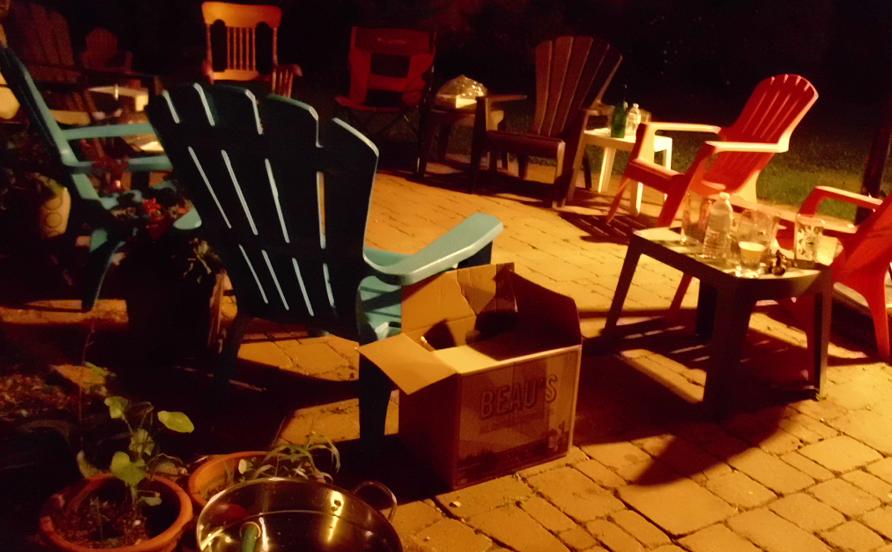
Beau’s Thursday Night Tasting In the Backyard

A fun way to spend the evening. Beau’s had their quarterly business meetings in town and they all came over for a few hours of opening bottles – including the father, son and a sizable host. We nine started well with two saisons and biere de garde: Hennepin, Jack D’or and 3 Monts. Batch 10 from Pretty Things was much better than the more recent bacth 13. Lesson: let it sit.

Things got a little wobbly with three Quebec takes on Belgian white beer. We thought RJ’s Coup de Grisou was fine and a good value beer. And Barbier from L’Ilse D’Orleans was not well understood given its level of rich maltiness. But Blanche from Charlevoix was a revelation in nasal interaction with beer. Freesia. Fabulous.

Three more bottles were opened. Trade Winds Tripel from the Bruery was a bit muddled with a nice aroma. Too much of the malt ball for the style or maybe just our level of interest given the other choices. Next, the Poperings Hommel Ale, as always, was amazing. The greatest pale ale in the history of the planet? Could be.

Then the taxi was called for the eight to be off. It was time. The mosquitoes had begun to bite. Just time to open a quart of Drie Fontienen’s Oude Gueze, one of the few beer that could follow a Poperings. Like any divider of people, some were not with it. They got the first taxi. The rest of use stood on the driveway, waiting on the warm quiet summer night sipping. Then the taxi and then they were off and away.

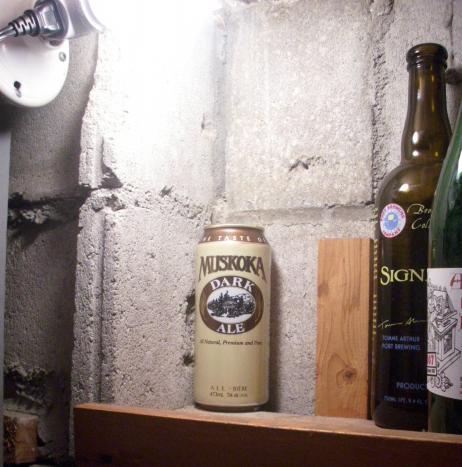
Ontario: Dark Ale, Muskoka Cottage Brewery, Bracebridge

1934Just learned that my camera died. Also just learned what a crappy camera I bought my kid last birthday. No focus. No warm tones. The corner of the cold room looks like the corner of a cold room. Sad.

Today for Ontario craft beer week, I went out to the LCBO and bought a few cans of beers that I hadn’t tried before. Muskoka Dark Ale is one of them. Dark ales were Ontario’s version of ambers in the States – an entry style that first generation craft brewers relied upon. Upper Canada Dark was a pitcher beer for me in the mid-90s pre-kid days in Ottawa Valley taverns. Easy and moreish. But, as Stan noted about ambers, they can suffer from sameness and the blahs. This one, however, is a great take on the idea. It’s like Theakston Peculier light. Molasses on the nose and in the mouth except a bit of Frye’s dry cocoa, too. HP sauce, even. Yogurty yeast but in a good way, more rich than sour. Nice dusty texture like the cocoa was sifted in at the end. Like it a lot. Some respect from the BAers.

Who Made Ontario’s First Lager And Where?

1932In the 1868-69 edition of Sutherland’s City of Hamilton and County of Wentworth Directory there is listed a little listing that says “Eckhardt, August, brewer, Hamilton Lager Beer Brewery…” This corresponds with Sneath‘s first listing for a lager brewery in 1868 which states:

Edward Eckhardt opens the Hamilton Lager Brewery in Hamilton and it closed three years later.

The name is right as Albert is confirmed as the brewer and Edward the proprietor in another section of the directory. So they must have started lager beer there. No one else is listed even if the Spring Brewery established in 1868, makers of “ale, porter, beer, etc., in great quantities, either in wood or bottle” are working on “an addition is now being made for an ice house.” Except for one thing. In the same directory there are at least six listings under “lager beer saloon” with proprietors with the names Goering, Grell, Kerner, Mansfeld, Schaupp and Winckler. Maybe more. How could all those businesses get up and running selling lager beer in time to get printed in the directory in the same year that the brewery opens? Could it be that the saloons pre-dated this brewery? Oh, for a copy of the 1866-67 edition of Sutherland’s City of Hamilton and County of Wentworth Directory!

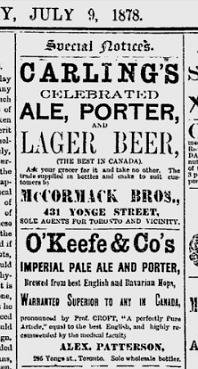
I dunno. I do know that the author of this travel piece about Kingston, Ontario published in The New York Times in 1890 states “in all my travels extending through hundreds of miles of Ontario, beginning at this place, [I] have seen the sign ‘lager beer’ displayed only once.” Ontarians were long time pale ale and stout hold outs when their southern mid-Atlantic and mid-western US neighbours were following their immigrant Teutonic ways and breaking out the lager, much to the chagrin of 90 year old Charles H. Haswell in 1899, as is discussed in Maureen Ogle’s book Ambitious Brew.

1931There was another issue, of course, in that the rush of German immigrants was more of a late 1800s rather than mid-1800s event here. There needed to be cold. And the first refrigeration system in Canada is only turned on, according to Sneath, in 1886 in Montreal. So… we had ice houses… and folks doing what they could… figuring out the large investments required compared to the smaller population centres and… well, when you figure all that out… wouldn’t you really like a nice old fashioned trusty Ontario stock ale?

The King Brewery Pilsner clocks in at a sessionable 4.8%. It pours an actively carbonated burnished gold that supports a rich white froth and foam. On the nose, there is plenty of pale malt and graininess with Saaz hopping. In the mouth a jag of steely mentholated spicy herbal weedy hops but plenty of rich maltiness to back it up, more bread crust and biscuit that malteser. A complex beer with waves of flavours. Plenty of BAer respect.

Ontario: Stock Ale, Mill Street Brewery, Toronto

mssa1Where was I? The 1830s and 40s? About there. Local breweries popping up as settlers move west, filling up southern Ontario right up to the Lake Huron coast. Familar names start popping up. In 1835, James Morton is operating out of the old Molson brewery on the Kingston waterfront. John Sleeman starts up in 1836. In 1843, Thomas Carling builds a brewery in London, Ontario. And in 1847 John Labatt enters into a partnership with an existing brewer also in London and Quebec brewers Molson have another go, this time further west along the Lake Ontario shore at Port Hope. It lasts until 1868. Facts stolen from Sneath.

A number of the brewers are also distillers, maltsters, flour millers and a bunch of other things. Which leads me to my first utterly unfounded theory of beer in Ontario. It is related to this beer. When I think of Canadian pale ale, this is the taste I associate with it. It’s ale-y. A musty quality that tastes like the Legion Hall dance or a curling tournaments in 1956. Or 1907. Or 1877. It’s heavy on the grain. Given the small scale farming economy of the first and second generations of most of southern Ontario to the west of Toronto through the mid-1800s, the same entrepreneurs were likely handling all sorts of grains and distilling some, brewing with others.

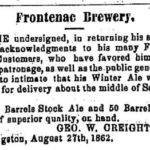
mssa2They had to make products that both reflected and appealed to their clients and the environment. The had to go with a shot of whisky – whether it was made with barley or rye. In 1862 here in Kingston, Mr. Creighton of the Frontenac Brewery was selling stock ale and porter with the promise of a winter beer in the fall. Farther to the west in 1872, Labatt is selling only pale ale and stout in its local paper.
The Mill Street Stock Ale pours the colour of a pine plank in a lumber yard and resolves to a thin rim and froth. But it’s that smell – like a bag of wet grain. In the mouth there is a round ball of pale malt sweetness and, then, a heck of a lot of drying grain huskiness. The huskiness is joined by a measured but roughish sort of hop in the finish – more weedy than twiggy. I don’t know how this compares to an 1862 Frontenac Stock but I can day dream about it. Worth more respect than the BAers give it.

More Thoughts On That Pesky Albany Ale Question

albale3a

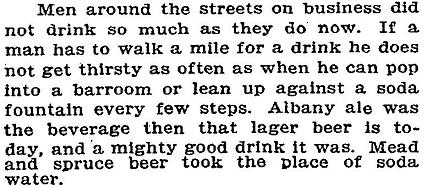
I have been thinking more about this pre-1850 invention called “Albany ale” and I am a bit surprised to find so many references to it of one sort and so few references of another. The stuff was made in volume, transported and traded over great distances but now seemingly forgotten to memory. As we will see [Ed.: building suspense!] when we discuss the quote above, it was the stuff of memory even at the end of the 1800s.

But what was it? As noted this morning by Robert in the comments, there is a brief description of Albany’s production of ale in the 1854 book The Progress of the United States of America by Richard Swainson Fisher at page 807:

The business of malting and brewing is carried on to a great extent In Albany; more than twenty of such establishments are now in operation, and Albany ale is found in every city of the Union, and not unfrequently in the cities of South America and the West Indies. The annual product is upward of 100,000 barrels of beer and ale.

Similar text was published in the Merchant’s Magazine in 1849 except it was 80,000 barrels. Interesting to see how far it traveled – California, West Indies and South American in addition to references to Newfoundland in yesterday’s post. There is also this passage in 1868’s A history of American manufactures from 1608 to 1860 Volume 1 by John Leander Bishop and a few others:

…Kuliu mentions, in his account of the Province in 1747, that he noticed large fields of barley near New York City, but that in the vicinity of Albany they did not think it a profitable crop, and were accustomed to make malt of wheat. One of the most prosperous brewers of Albany during the last century was Harman Gansevoort, who died in 1801, having acquired a large fortune in the business. His Brewery stood at the corner of Maiden Lane and Dean street, and was demolished in 1807. He found large profits in the manufacture of Beer, and as late as 1833, when the dome of Stanwix Hall was raised, the aged Dutchmen of the city compared it to the capacious brew kettle of old Harme Gansevoort, whose fume was fresh in their memories.’ [Note: Munsell’s Annals of Albany. Pleasentries at the expense of Albany Ale and its Brewers are not a recent thing. It was related by the old people sixty years ago of this wealthy Brewer, that when he wished to give a special flavor to a good brewing he would wash his old leathern breeches in it.]

Was Albany ale originally a wheat ale? It was obviously big stuff in the state’s capital for decades.

Reference to Albany ale also appears in an illustration of a principle in a book of proper English usage. In the 1886 edition of Every-day English: A Sequel to “Words and their Uses” by Richard Grant White where we read the following at page 490:

I cannot but regard a certain use of the plural, as “ales, wines, teas,” “woolens, silks, cottons,” as a sort of traders’ cant, and to many persons it is very offensive. What reason is there for a man who deals in malt liquor announcing that he has a fine stock of ales on hand, when what he has is a stock of ale of various kinds ? What he means is that he has Bass’s ale, and Burton ale, and Albany ale, and others; but these are only different kinds of one thing.

The fifth 1886 edition of Words and their Uses by the same Mr. White contains no reference to Albany ale but does indicate he was a prolific US author who lived from 1821-1885. Does the later use by White imply it was an easily understood example? Probably.

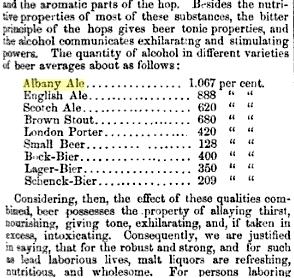
albale2In the New York journal The Medical Record of 1 March 1869, there is an article entitled “Malt Liquors and Their Theraputic Action” by Bradford S. Thompson, MD the table to the right is shown that clearly describes Albany ale as a sort of beer the equal to the readers understanding as London Porter or Lager-Bier. I am not sure what the table means from a medical point of view but it clearly suggest familiarity… at least amongst the medical set.

In 1875, it is described in a travel book called Our Next-door Neighbor: A Winter in Mexico by Gilbert Haven (who seems to not have been a lover of the drink himself) at page 81:

Here, too, we get not only our last look at Orizaba, but our first at a filthy habit of man. Old folks and children thrust into your noses, and would fain into your mouths, the villainous drink of the country – pulqui. It is the people’s chief beverage. It tastes like sour and bad-smelling buttermilk, is white like that, but thin. They crowd around the cars with it, selling a pint measure for three cents. I tasted it, and was satisfied. It is only not so villainous a drink as lager, and London porter, and Bavarian beer, and French vinegar-wine, and Albany ale. It is hard to tell which of these is “stinkingest of the stinking kind.” How abominable are the tastes which an appetite for strong drink creates! The nastiest things human beings take into their mouths are their favorite intoxicants.

So, along with grammarians and the drinking medical set, Albany ale was also a name known to the non-drinking traveling set in the post-Civil War United States. It was, as a result, something we might consider “popular” in its day.

Oddly, the story of Albany ale does not seem to make it deep into the 1900s. Without making an exhaustive study, I don’t see reference to “Albany ale” in Beer and brewing in America: an economic study” by Warren Milton Persons from 1940. It is not indexed in Beer in America: the early years, 1587-1840 by Gregg Smith. It does not seem to be in Ambitious Brew: The Story of American Beer by Maureen Ogle as it really starts with the the rise of lager is in the second half of the 1800s. Why did it fall so far so fast?

That quote way up there? The one at the top? It’s from an 1899 New York Times article entitled “Kicked 90 Years Ago Just the same as Now” in which a 96 year old New Yorker still employed as a municipal engineer who was interviewed about the City’s old days. Talking about his youth in the 1830s, he said “Albany ale was the beverage then that lager beer is today, and a mighty good drink it was.” So, lager likely killed it off but only after it had its day and was enjoyed widely in the days before rail transportation both within the United States and abroad.

2015 Update: came across book by Mr Haswell, the 96 year old New Yorker mentioned up there.

Trends 2010: Is There Really Simplicity In Beer?

I wrote this in the year end review but I am not sure I know what I mean or even if I mean it:

…bigger craft brewers and even some regionals are making interesting beers which are not bombs. Lew recently noted both Magic Hat Odd Notion Fall ’09 and Narragansett Porter both of which I also found to be stunning for their value as well as their elegance. Yesterday, Andy was thankful for well crafted simplicity. Expect 2009 to be remembered for how we learned that cacophony in glass is not a brewers or a drinker’s “go to” brew.

I think by I mean the opposite of a big bomb. When I used to home brew, I was well aware that it was far easier to make a bigger porter with about 6 sorts of dark malt and a few extra dark sugars than to make a good brew with only one or two pale malts. Bombastic was an entry level approach to tasty beer. Lots of interesting stuff going on. But simplicity should also not mean boring. It should mean balanced where are one or two showpiece ingredients. McAuslen’s smooth oatmeal stout. The bread crust graininess of a Hook Norton Haymaker. The white pepper in Fantome saison. I am having a Margriet by Het Anker right now and I’d call that simple – quenching, lemony, peppery, herbal and creamy but also simple without being basic. Maybe that is pushing it, however.

Simplicity should mean easier, too. You don’t need to pair even if you can eat and drink. You should also not be sent on a quest. An interesting discussion has broken out at Zak Avery’s place. In which I am supporting the validity of good beer at home. Beer should not only be simple but having beer should be simple. Is that too much to ask?

A Week With Softer Side Of German Brews

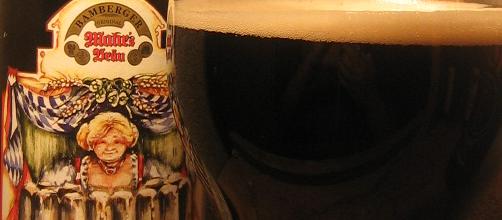
bambjube1

It was time to clear out a few obscure brews that have been hogging stash shelf space and I grabbed nothing but the Germans. I thought it was going to turn out to be about sharp hops of one sort or another, the sort of thing I ran into over two years ago. I was absolutely stunned when top after top was popped to expose another soft deep dark brown earthy complex beer of one sort or another. These beers were not particularly to a style or a region that I know of. I bought them at different times and different places without a plan and really without really looking. But it didn’t strike me as a fluke.

I’ve had simple German dunkels before and while I liked them I was not blown away. Too little a step up from black lagers. I was looking for more oomph. But I’ve had hints that the sorts of beers were within reach, liken when I had a Korbinian from Weihenstephaner. But this week was proof – everyone one a keeper. Here is, to quote Joe, my “vaguely pornographic list of bottles opened“:

  • Der Weisse Bock: by Mahr’s. Is this the greatest smelling beer of all time? Black cherry so thick it verges on licorice. All over a mat of pumpernickel. In the mouth, it is bright and sweet with the aroma flavours enhanced by a citric acidic zip as well as a decent level of grain texture. At 8.5%, heavy but not hot. The goat on the label is actually licking the foaming head off the glass. I would too if I had enough of these. So nice I don’t even feel shelted. Great BAer respect.
  • Moosbacher Kellerbier: By Private Landbrauerei Scheuerer. Appled barley candy, a little smokiness in the bitter. Not unlike low carbonation Scots ale like Caledonian 80/ but with a little zag of steel to the hops. Six months past the best before date. Bought at the Galeville Grocery some time ago for $3.69 a 5.2% half litre swing top. I am a big fan of the style this being my fourth. Solid BAer respect.
  • Bavarian Dunkler Weizenbock: by Brauere Michael Plank: Fabulous looking lively carbonated chestnut ale with a well hidden 7.5%. Very light on the usual weizen banana and clove but plenty of flavour date and thompson raisin under wheat grain and grass that adds up to a sort of black cherry effect when you look at it that way. Fresh and moreish even at this strength. Far less spicy than its style mate Adventus. BAers take this one another notch higher.
  • Schwelmer Alt: by Brauerei Schwelm. I got this for 1.90 USD somewhere. It pours a lovely bright chestnut under mocha froth and foam. On the nose, as big and malty rich as concentrated as opening a can of malt extract. Lighter in body that the nose would leave you expecting. A slight smoke note, a little metallic tinge, fresh water and tastes of dry fruit and apple butter. Massively moreish. Oodles of BAer respect.
  • Jubelfestbier: by Mahr’s. How many ways can I say deep chestnut ale with a mocha rim and foam. Another soft water malty gem. Scents of earthy dark dry fruit and cocoa. In the mouth, again, it is lighter than the smell might have suggested. Nutty brown malts, a nod to steel hops sitting very much below the profile. Chalky cream yeast. Again moreish. Extremely moreish. Just 4.9%. You could drink buckets of this beer. Huge BAer respect.

I had no idea. Easy drinking yet complex yet comforting beers. These are the sorts of beers you imagine good English milds and browns would turn out to be but those are really are lighter, more guzzlable. These beers are slower, reminding me of the Scots malty beers I got to try on the old tartaned family trips – though different again. Why aren’t these sorts of beers being made in North America? And if they are… where can I find them?