Author: Alan
The Politics Of Science
Let the re-engineering of knowledge begin!
The new Conservative government has decided to slash spending on Environment Canada programs designed to fight global warming by 80 per cent, and wants cuts of 40 per cent in the budgets devoted to climate change at other ministries, according to cabinet documents obtained by The Globe and Mail. The documents also say that the Conservatives’ campaign promise of tax breaks for transit passes would cost up to $2-billion over five years, but would result in an insignificant cut in greenhouse-gas emissions because the incentives are expected to spur only a small increase in the number of people willing to trade using cars for buses and subways.
Interesting to note that, like the baby bonus toddler luxury cash grab, the bus pass money will cost a lot and do little. This seems to be a theme with Harper: cut and spend in reaction to assumptions rather than statistical studies or actual science. Now don’t get me wrong – every program aimed at a goal does not necesarily represent the best or even a good means to achieve that goal.
But our new rural overlords do not seem to be operating on that basis either. It’s all coffee clatch science: “I’ve heard the Smiths believe in evolution…how could we come from monkeys?…that must be wrong ’cause monekys are smelly…evolution is a lie.” Try it with global warming, finance policy or anything else. It’s like putting on 3D glasses when no one told you the movie was in 3D, you just thought what you were watching was fuzzy for no apparent reason. The knee jerks instinctively.
Lisa Williams wants an assignment editor for citizen journalists.
Sign Up, Sign Up!
 Rumours that GX40 sports pool management practices have been cited in the new Federal Accountability Act have been vastly over-rated. All references to Byzantine complexity and subjective point calculations are to be removed at the committee level, as illustrated. I am assured on that point particularly by my new friends in
fat capital city.
Remember – this year I am promising fabulous prizes and this year I may actually follow through.
Ticks

Shaking hands open
A small letter from New York:
Reds, Pirates shall play.
Easter Week

An excellent picture from the BBC this morning, most excellent because of the trendy girls in to the back and right who are looking at the black wizardy lads.
Easter week has often meant in my adult life hitting the road as it will this year, seeking a little saltiness and a little spring. As those little blue spring flowers are popping up here now, who knows what there will be to see in the Mohawk Valley or around Worchester, MA as we travel through. God forbid a leaf on a tree but maybe a daffodil.
Once, I knew it was spring because I was reading The Master and The Margarita as a way to renew myself. Silly lad, as now or at least for four of the last six years, spring does not start unless I have been in the company of Mainers. Remember when I used to post short short movies? Well, it is three weeks early but one can only hope to see a spring day like this again.
Reality Of A Sort
It’s nice to see compromise and a move from election platforms two days into the new Parliament. Why, soon it will be as if what is actualy policy was what was promised all along. Most pleasing is reading that the child care plan wasn’t really te child care plan and that the new plan is actually going to be something in the nature of a plan for the care of children and not just a partisan money toss:
Opposition Leader Bill Graham challenged Harper yesterday to reinstate the five-year, $5 billion program, citing an interview Human Resources Minister Diane Finley gave to the Toronto Star. Finley acknowledged tax credits, such as those the Tories promised in the campaign, haven’t stimulated an expansion of daycare spaces in the past, and said the government is now looking at “other incentives” and alternatives to the tax system to do so. “The minister responsible admitted … such tax credits fail to create child-care spaces,” Graham said. “Will the Prime Minister now admit he is wrong, or does he plan to push ahead with a plan that his own minister admits will not work?” Harper said his government will be “flexible” on how it puts together its $10.7 billion program on child care but provided no more detail.
After the interesting and important debate on Afghanistan last night – in which all parties represented their positions forcefully but, yes, the debate one that the new Prime Minister was never going to allow – it will be good to watch where we are actually going on many matters now. Too early to talk of flip-floppery and, in any event, this is a weak situation which mainly allows for sensible compromises if you let it.
Book Review: Beer in the Middle Ages and the Renaissance
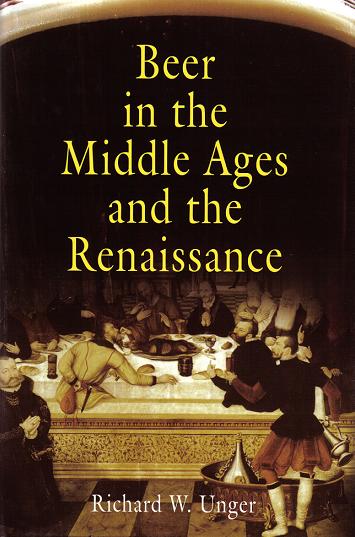 Finding this, for the beer nerd who also likes book with footnotes, is something of a moment, a wee glimpse of nirvana. The author, Richard W. Unger, is a professor of the history of the medieval period from the University of British Columbia who has also written texts about shipping and brewing from the perspective of pre-1800 Holland. Serious writing about a topic that deserves a serious approach.
What can I say about this? First, it cost me 75 bucks at the World’s Biggest Bookstore in Toronto. Like any academic text with a short run and a limited market, it is not a cheap book. And, if you do not think you are going to find something interesting in the discussion of the effects of 15th century taxation policy on North Sea coastal trade, well, maybe this is not going to be the book for you. But if the idea of a seventeen and a half page bibliography of source material on medieval brewing – not to mention thirty-nine pages of endnotes – is your type of reading, well this is the book for your next holiday weekend.
Really, Beer in the Middle Ages and the Renaissance is not so much about beer as the effect of the hop on trade in beer which caused the first industrial revolution in beer through the southern North Sea trade routes from roughly 1350 to 1550 – the second being triggered by the porter boom of roughly 1760 to 1840. The main concept is quite simple actually. Hops preserved beer. Once beer is preservable and can last more than a few days, long enough to be moved, then it will be moved and sold for a premium price as a luxury item. After it comes to be understood, it will then be copied as a local product which over time drives out the previous locally made unhopped ale. Later, it loses out to the next following luxury items as well as a general economic downturn both of which conspire to lowers its central role in the economy.
Unger traces the development of trade in beer largely with a focus on the Low Countries through analysis of tax records, municipal by-laws, guild creation, shipping records and other evidences of the huge role beer played in medieval society. He does so aware of the vastly different context in which beer is places in contemporary culture. This the first paragraph of the book’s preface illustrates that distinction neatly:
The mention of the history of beer always brings a laugh or at the very least a snicker. The histoty of beer for most people is not a serious topic of study. It seems to them frivolous and hardly worth more than a few diverting minutes of anyone’s time. Beer, after all, is a drink for leisure, for young people, generally men, and associated with sports and student life. That perception of beer is a case of historical myopia, of an inability of many people at the beginning of the twenty-first century to convince of a world different from their own. The prevailing presentism makes it difficult for many to comprehend a world where beer was a necessity, a part of everyday life, a drink for everyone of any age or status, a beverage for all times of the day from breakfast to dinner and into the evening.
Not to worry that you will not appreciate how this detailed focus on a relatively short period as Unger leads you into the medieval with a description of fermented drinks of preceeding periods and also carries on after the main discussion showing how innovations in the gin and wine trades as well as the tropical beverages of tea, coffee and cocoa replaced beer in may social settings and therefore in the economy.
I may add a bit to this later but suffice it to say if you enjoy a good read about the history of beer and have read more popular histories like Beer: The Story of the Pint or Man Walks into a Pub, I would say it is time to take on this more purely academic text.
Gen X Spring Sports Pool 2006
The tenth annual internet pool in a row. That is mind-numbing in the evident dedication to the pursuit of idleness and lack of productivity. Here are the rules in the most complex and utterly unwinnable pool yet:
1. NHL playoffs
Pick five scorers, one goon, one goalie, eight teams and a dark horse.
- A point for a goal by a scorer.
- A point for an assist by a scorer.
- A point for a penalty minute by a goon. If your goon is kicked out of the playoffs and thereby the pool, you double the penalty minutes he has achieved to that point. The logic here is that the goon is a nut-bar. The later that he freaks and gets tossed for the balance of the playoffs, the more nut-bar like he is, the more he is the essential goon.
- A point for each thousandth save percentage over .900 by your goalie
- 5 points for picking each of the teams in the second, third and fourth rounds.
- 25 bonus points for picking the dark horse – the team with the lowest regular season points to go the farthest in the playoffs. The dark horse must be seeded in the lower half of their conference.
2. Other Hockey
- Name the winner of the Memorial Cup, Canada’s Jr A Men’s hockey championship. 10 points.
- Pick four scorers in the Memorial Cup. One point for each goal or assist.
- Pick the winner of the AHL’s Calder Cup. Ten points.
3. World Cup Fitba
- Which team goes farther: Togo or Trinidad and Tobago? Ten points. Total goals breaks the tie.
- Who wins the World Cup? Ten points.
- Who wins the golden shoe for top scorer? Ten points.
4. Other Fitba
- Pick the two teams in the English FA Cup Final. Five points each.
- Pick the winner of the FA Cup. 10 points.
- Pick the winner of the Scottish Premier League – not a Cup, #1 in the league table. Ten points.
- Does Morton go up to the First Division of the SFA? Ten points if you are right.
5. Baseball
- Who wins when the Red Sox and Yankees play on 1 May 2006? Ten points.
- Who wins when the Red Sox and Yankees play on 2 May 2006? Ten points.
- Who starts as pitcher for each team when the Red Sox and Yankees play on 1 May 2006? Ten points for each correct pick.
- Which of thse two teams will be ahead of the other in the standings at 9 am 3 May and by how many games? Ten points for correct team and ten points for nearest to the lead in games.
6. Other Sports
- Who wins the One Day International Series on Saturday, 20 May 2006 between teh West Indies v India, held at Jamaica? Twenty points. Guess the final score and you get ten more points if you are within 25 wickets on the score differential. Ten more points if you can explain how you exactly you know the score is what it is.
- Who wins the World Snooker Championship at The Crucible Theatre, Sheffield, England held from 15 April – 1 May? Twenty points.
- Who wins the British and Commonwealth super middleweight title match to be held on May 26, York Hall, London between Carl Froch v Brian Magee. Ten points. Ten more points if you name the exact round that the fight ends.
- Who is the top scorer in the NBA playoffs. Twenty points.
I have to think of a few more questions on international sport. These will be posted in a bit. Get your picks in by 18 April 2006 at a reasonable hour.
Ah, My People
Things are a wee bit different in the old country:
…South Harris residents argue the Sabbath must be strictly observed as a day of rest. Some left marks of their disapproval at the quayside. Yellow tape bearing the words “Caution Keep Out” had been tied across the ferry slipway and several posters bearing the words “remember the Sabbath day” were posted on surrounding signs and buildings.
Just another reminder that I am going to aych-eee-double-hockey-sticks along with the rest of you lot fer dayin mony a wicked deed like taykin’ the ferrrrry ona Sundee. Badjuns alla ye.