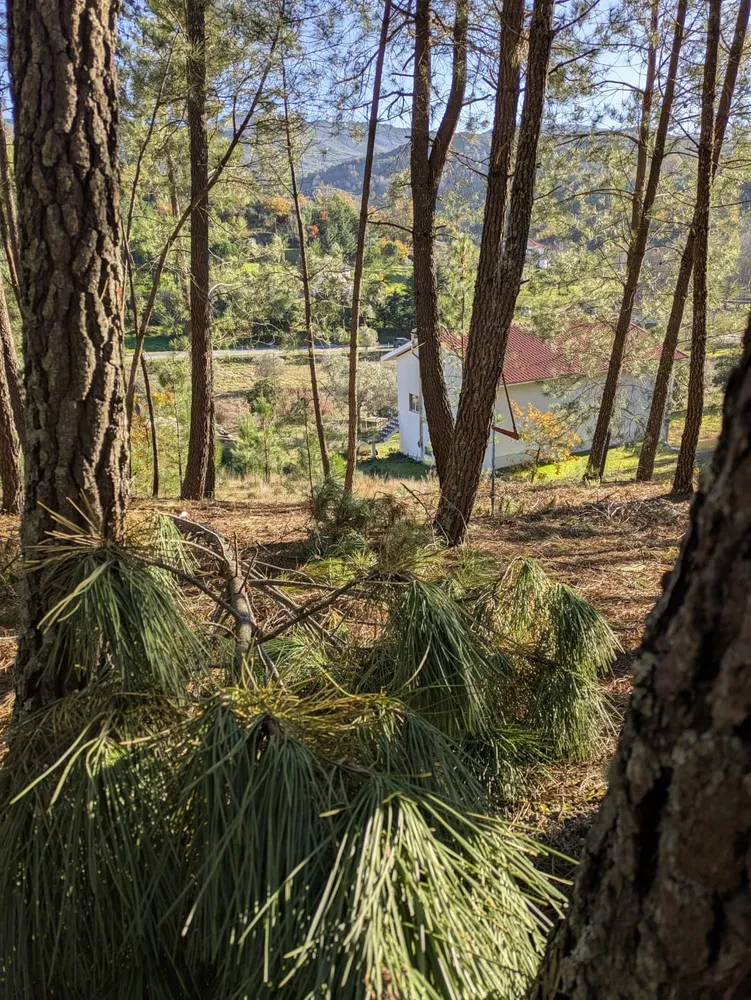
 A question: where do you pee after drinking beer? The sociological question came up in a conversation touching on the ethics in Ontario, Ireland, Germany and Portugal last weekend. And the associated question of “what and where are the woods?” was canvassed, too. That image to the right? It’s a Portuguese treed setting. Where peeing occurs. Seems a bit… open. Beer based peeing also occurs here in Germany. I think I can see a road in the background there… and maybe a shop. I have always wondered about where one may pee after drinking in the Netherlands in 1986 where guys just walked out of the door of the pub and peed on the front of the building. Seemed a bit too much overlap in the old Venn diagram. But I am Canadian. We do pee in the woods but what qualifies as the woods here is a bit more woodsy. Further field observations of the more tasteful sort will be received in the comments.
The other big topic in Canada is, of course, trade war v.3.1 which popped up again this week in fine style… which has led to more than a few becoming obsessed* with certain American products on the shelf. One branch of a grocery store chain in pretty small town eastern Ontario was spotted selling US wine:
A ban on the sale on all U.S. wine, beer, spirits and seltzers in Liquor Control Board of Ontario (LCBO) stores went into effect in March 2025 in response to American tariffs. LCBO is the sole wholesaler of alcohol for licensed restaurants, bars and grocery stores in Ontario. In a statement, Loblaw, the owner of Your Independent Grocer, says the bottles have been removed. “We recognize the importance of supporting Canadian businesses in this climate and understand why this incident raised concerns. The wine was put on the shelves without the approval of the store owner and once identified, it was removed immediately,” a spokesperson for Loblaw said in an email. It’s unclear how long the wine had been sold at the store. A viewer emailed CTV News saying they saw the wine in stock on Sunday.
The rules about these things are a bit unclear as the government run retailers and wholesalers have removed it from the shelves but it’s a bit unclear about what private licensees can do with earlier stock. It was older stock, right? I unkindly remembered the eastern Ontario phenomena of unilingual English labeled products from American sometimes seen on a quiet aisle of regional independent corner stores. Bootleg BBQ sauce is a favourite. Smuggled chocolate bars too. Yum.**
What else is going on? Well, Jordan finally lifted his head up for air and explained his silence for the last few months:
I was a Field Operations Supervisor for Statistics Canada for five and a half months and didn’t really have time for blogging. The nature of the gig economy means that you have to hang on to all the other jobs that will outlast a contract position, so there I was working what was ostensibly a nine to five position while teaching in the evenings and leading walking tours when they were booked conveniently. For the first couple months I continued to edit and co-write Ron’s new book, Brewed In The Family.
Busy busy busy. He also shared recollections of Texas Brown ales past, including Bellwood’s Grizzly Brown. I had a few of those with Jordan at the taproom with Ron P. back in 2014, detailed evidence of which evening can be found here. He did not mention at all where he may or may not have peed.
Elsewhere, it was Sausage Saturday when Martin and herself were in Newport the other day where the service was tiptop – as was his advice on etiquette:
Mrs RM called it before I did. “That’s off“. It was. If starting a conversation with strangers is difficult, taking your pint back undemonstratively without drawing attention to yourself as a CAMRA can be even more daunting. Quietly does it, use “end of barrel” instead of “off“, and offer the extra quid or so for the Thatchers. Which would have been the sensible choice to start with. Sausage and chips and peas for six quid fifty the only sensible choice, and frankly the onion gravy would cost you that in some pubs. Marvellous stuff. The landlord was briefed by the landlady and came over to apologise for the Butcombe, and the clip turned round. They’re advertising Thornbridge on the pump today; I’d give it a go.
Speaking of top pub food, Katie went once again to the Highland Laddie in Leeds and found her corner of heaven:
Ordering food at your leisure from a bar menu that reads like top restaurant business is exactly what I want. My tartare came with its egg yolk jam and tendon crisps and just as I hoped, I was transported to Flanders. The fire baked ham and house brioche dinner rolls was a beautiful pub dinner. I dipped my chippies in the egg yolk jam on my plate and found myself in the depths of comfort I get on my birthday when I take myself off on my own to a cafe for eggy chips and a pot of tea. The vindaloo devilled eggs reminded me of our family preference for using curry powder in our egg mayo butties. Again — deep comfort, delicious luxury.
And travelling a couple of steps further north, I like this review by Chitra Ramaswamy of a Scottish pub, The Keelson, and the wonderful chicken to be found there:
It’s official. Rotisserie chicken, a hipster craze that swept across London, has voyaged north of the border and landed in Leith… Through the buzzy boozer we go, with its many manly textures of wood, framed drawings of nautical knots, television screens (don’t approve) and SFA memorabilia (didn’t expect) to the back, where the small kitchen and restaurant section are housed. Nice, but we prefer the sunny, more pubby front. Can we move? Of course, says our friendly server. She doesn’t bat an eyelid when we ask to move again to a bigger table, to fit all the food we’ve ordered… my god, the succulence of the meat. Leg, wing, thigh, and breast have been expertly carved, the meat juicy and the skin crisp from incessant basting, smoky, perfumed with garlic, woody herbs, and vast amounts of butter.
A fabulous retort in relation to the “non-place” observation from last week. So, too, were ATJ’s comments on how pubs can be an antidote to rootlessness:
That got me thinking about belonging. I lived in Cambridge for six years but that was not long enough for me to feel as if I belonged to the place. Then I recalled meeting an old girlfriend in 2024 from my time in the city who had since emigrated to Australia. As we visited some of our of old Cambridge pub haunts, she mentioned a couple of times that she was a Fen girl, and I thought of how that despite her long sojourn in Australia she still felt an identity.
Probably due to the WCs. And there was news in The Guardian about the tough position CAMRA finds itself this year and fingers are pointed:
For centuries, the wooden real ale pump has been the hallmark of a good British boozer. But now problems are brewing for the proper pint, as the Campaign for Real Ale has seen its membership sink to an eight-year low and its accounts show it is firmly in the red, making an £800,000 loss last year… Outside the Devonshire pub in Soho, central London, there is an ever-present horde of drinkers downing pints of Guinness, a stout made by the multinational company Diageo. But the landlord and co-owner Oisín Rogers says: “Real ale is all I drink”… Camra is calling for the Competition and Markets Authority to investigate the big beer companies’ stranglehold on the market.
More now about me. I received an alert from Sayre Piotrkowski who wrotes about a post at his newsletter Beer & Soul responding to my own thoughts on the general shrinking interest in craft:
Broadly, he argues that craft beer has lost ground since our 2019 peak, fewer people care, and the industry shouldn’t comfort itself with optimistic narratives about a turnaround that may never come. While Alan is replying to a piece that calls for beer to be treated as a cultural beat rather than a business one, with exclusively market-driven reporting, he is not lying: craft beer production today is well below its 2019 peak. But the leap from that fact to “fewer people care” is much harder to defend. An industry’s production volume and a culture’s significance are not the same thing. In fact, I think the obsession with the former is one reason we have become so bad at talking about the latter.
I don’t agree with his disagreement with my comment but (i) that’s just me and (ii) taking on the question of meaning over measurement is an interesting approach. One problem I would note with his argument is he appears to seek to then measure meaning by first suggesting then counting up other categories beyond sales volume – other ways people experience and enjoy good beer, leading to this observation:
People love their local breweries for all sorts of reasons, but no one’s esteem changes with the number of barrels contributed to the national production total each year.
This would be nice if it were true – and perhaps it can become true – but the entire arc of US craft beer’s story has been embued by the trade with an obsession with first marking and then obfuscating the actual meaning of actual stats. Good for Sayre for seeking to move away from this failed construct.
Speaking of messaging, Eoghan shared this response to new health warnings proposed for booze labeling in Belgium:
Belgian brewers have launched a campaign against more forceful health label warnings – from “Alcohol misuse damages your health” to “alcohol damages your health”… Alcohol misuse does damage your health, but alcohol also does. There is no “safe” amount, similarly to cigarettes (a better comparison than the one they use – soft drinks). I’d question the fixation of brewers on this point – will the new label really make a difference?
And Boak and Bailey have been out on the road – the railroad – according to their Patreon update:
The following day we had a few hours in Brussels before catching a sleeper. We revisited L’Ultime Atome, which really doesn’t have much for beer geeks these days. The beer list is short and the food is pretty mediocre… We then got on a train for a long time. About 300 small naps later, via Amsterdam and Berlin, we arrived in Prague just in time for lunch. Our first beers were in an international brunch place, and we don’t even know which beers we had because they didn’t tell us which was which when they brought them to the table, but after 15 hours on a train they tasted damn good.
Good. No word on the facilities on the train. Here’s some notes:
Note #1: I thought Jake was being a bit rough until I realized he was talking about somthing else.
Note #2: “Brewers don’t have to have much skill anymore…”
Note #3: It’s the weirdly over the top statement that always kills my interests in what someone in the booze trade might be trying to say.
Note #4: “Not one knows” yet… available resources.
Note #5: is Stone now really really dead or just really dead?
A surprising bit of news in The Times this week about the date rape drug being used against men and in some unexpected contexts:
While spiking can lead to a further crime, such as rape, no additional offence is reported in 55 per cent of spiking cases, making it difficult to know what motivates perpetrators. Of incidents in which another crime did occur, men were more likely to experience theft or blackmail, while women were more likely to be sexually assaulted. Dr Amy Burrell, who researches crime and policing at the University of Birmingham, said: “I’ve seen all the combinations: females who have spiked males, males to females, females to females and males to males. Spiking is often a facilitator for other offences but it also happens in and of itself.” The majority of spiking takes place in environments associated with alcohol, like bars and nightclubs, however “mutual spiking” among friendship groups is also very common.
I found this report very disturbing and not something that would have occured to me as possible in the 1980s of my youth… then I remembered the chemistry major in my undergrad who spiked the orange juice dispenser at the residence cafeterian one weekend morning, apparently just to watch people get all sleepy over their French toast.
Finally, back to a more sensible topic, Andreas has shared some thoughts on the formation of esters and phenols in the brewing of hefeweizens, including this tidy summary on how esters are managed:
The main phenol is 4-vinyl guaiacol (4VG). It is formed mostly enzymatically from its precursor, ferulic acid, and to a small extent (10-15%), also thermally at temperatures greater than 80°C. This precursor is located in the malt (in barley malt more so than in wheat malt), and is brought into solution at an ideal temperature range between 40 and 45°C (104-114°F) and a pH range between 5.8 and 6.1. So to promote the formation of phenols, mash in low, do an extended rest between 40 and 45°C, and use at least 40% barley malt in your mash. If you want to minimise the formation of phenols, mash in high, and ideally use as little barley malt as possible. 100% wheat malt mashes are possible if you use rice hulls or straw as a lautering aid.
We are big fans of straw as a lautering aid in the eastern end of the Great Lakes… for over 200 years. And that is it for another week. We will have to see if there is a Boak and Bailey posting on Saturday along with the coincidenal and fabulously entertaining footnotes week after week at Patreon. And do look out for more of Stan’s “One Link, One Paragraph” format – this week there was talk of crumpled beer tanks! Then hunt out something in someone’s archives! Leave oblique comments on someone’s post from 2009!! Listen to a few of Lew’s podcasts and get your emailed issue of Episodes of my Pub Life by David Jesudason on certain Fridays. And Phil Mellows is at the BritishBeerBreaks. Once a month, Will Hawkes issues his London Beer City newsletter. Do sign up for Katie’s wonderful self-governing totes autonomous website featuring The Gulp, too. Ben’s Beer and Badword remains on pause but there is reading at The Glass which is going back to being a blog. Any more? We have Ontario’s own A Quick Beer and All About Beer is still offering a range of podcasts – and there’s also Mike Seay’s The Perfect Pour. Plus follow the venerable Full Pint podcast! And there’s the Craft Beer Channel on Youtube as well as the archives of the Beer Ladies Podcast.
*See these comments on Facebook: “So today YOUR independent put American booze back on their shelves. Unbelievable! They claim it was done without the Johnsons knowing. What a load of shit. Just another reason to not shop there” and “If I want American booze then I will buy it“! Lordy!!
**Apparently no one in the US administration checked to see how much of their buttwipe supply comes from Canada. A lot apparently.

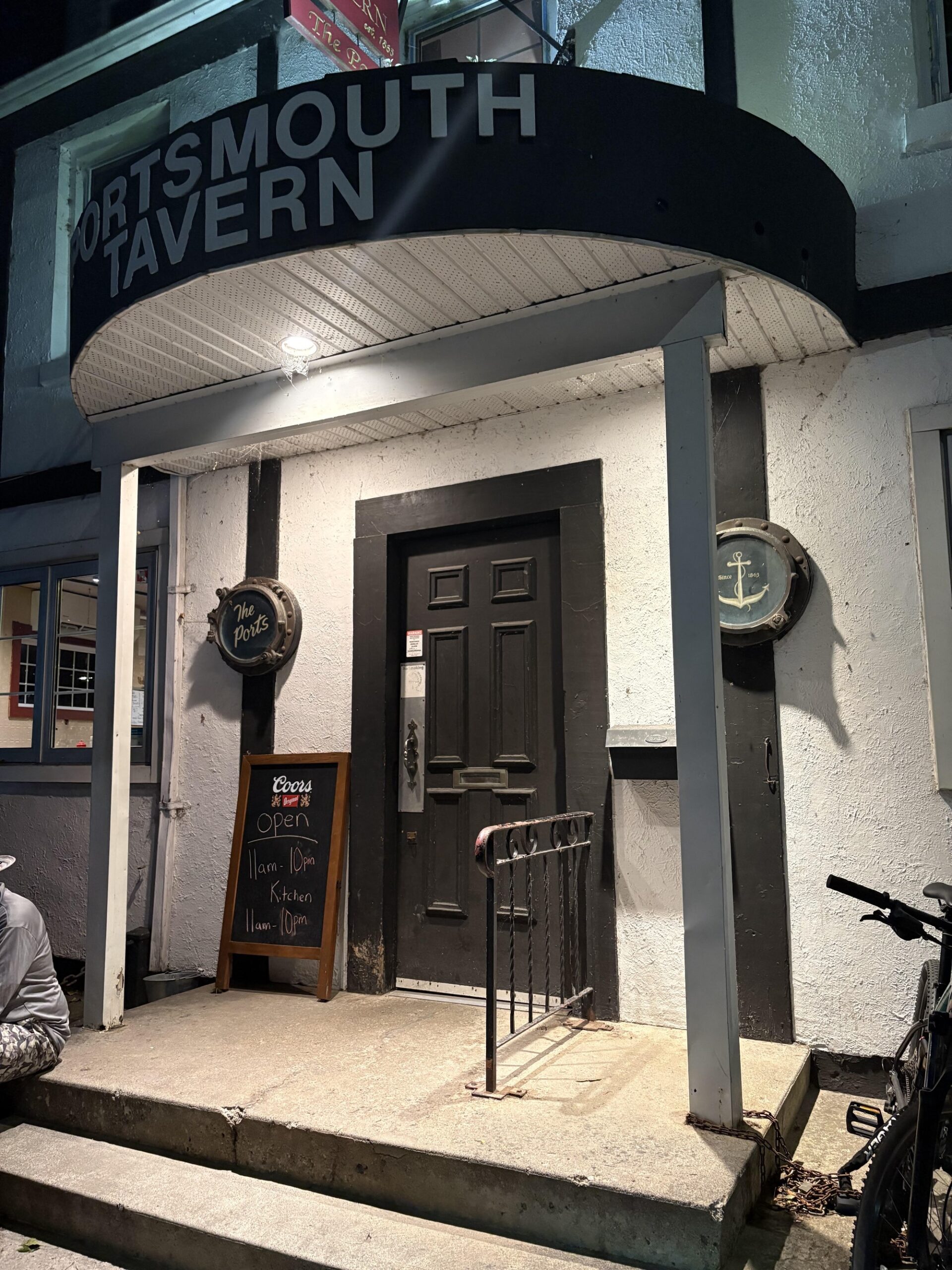 An old friend from work is joining me in the ranks of we, the gratefully unemployed and idle pensioners. To mark the event, I was invited on a small pubcrawl the other day playing my role as, I suppose, the ghost of retirement to come. A happy time out sat at long tables filled with glasses and pitchers of beer beside friends and former co-workers. We ended up at the Portsmouth Tavern, established circa 1863… which is pretty early for Ontario. Pre-Confederation. Once upon a time, I wrote about the drinking spots in my fair city including the older Queens Inn (est 1839) and Royal Tavern (est 1851) both of which have had breaks in operations in recent years. “The Ports” continues to serve beer after 163 years.