Returning Nazi stolen art is good.
Author: Alan
#11 – Not So Easy, Is It?
First full day out of power. No longer a minister of the Crown.
Feels strange… But there’s a certain feeling of freedom in it. It’s not my job any longer. The country can get by without me and my colleagues. The sun, unlike what our old chief said on the campaign trail, will still rise in the east and set in the west. It’s for us to hold the (temporary) victors to account, to act as the loyal and principled opposition.
I think they’ll find it’s harder sledding than they imagined. I see that the halo of our country’s saviour did not last a full day – not even two hours! After the battering they gave us, I can’t help but feel a little vindicated. It isn’t nearly as easy as it looks from the Speaker’s left-hand side, is it?
What to do, what to do… Well, there’s that bottle of vodka from my last trip to St. Petersburg. Or the flask of absinthe from that NATO summit in Prague.
There was no need to leave it for my successor…
Google Chat
Not being an instant messaging sort of guy, I wonder why Google would get into it now that it is so long established. Their last move into the specialties of others, Google Analytics, fell decidedly flat and is the most useless thing I have ever signed up for.
This is an interesting statement:
“We are breaking down some of the artificial barriers between e-mail and web browsing,” said Salar Kamangar, a Google vice-president. “We observed by talking with our users that there is no reason to think of IM [instant messaging] as different from an e-mail message.”
It is a good point that email and IM are the same thing with a slightly different appearance to the user giving a false sense of cool. But that is no different than any fashion or bauble. But why invest in those?
#10 – So Many Tories
[Sunporch. Morning. The first newspaper in the pile is unfurled majesteriously, the rest sitting on the ottoman under a pair slippered feet.]
Him: Well, look at that, would ya! [To the next room] Hey, honey! There are Reform Tories, Harris Tories, Mulroney Tories and even a couple dear old Joe Clark Red Tories in there! [Quieter] All squished in just 27 seats. How will they manage that? But nothing for Diane Ablonczy, the younger less…err…hearty…Deb Gray. Great gals and tough ones too. Too bad they never made it to the promised land. Room for a turncoat but not for Diane.
[Reaches for tea, then toast, then tea again, slurping.]
Him: Too bad about Diane. And, hey, they still have a Heritage Ministry. That was a great Ministry. [Louder again] Hey Honey! Remember when I had Heritage? [To self] That was great. One reception after another…
[She enters in dressing gown. Grabs a paper out from under his feet, shoving them aside. He makes a face and she makes one back smiling.]
Him: Watch your step! Remember when I had Heritage? I figured they’d have that one for the chop for sure. Too bad about Emerson, eh? Nice enough guy but a bit full of himself…Mr. Big Phd…Mr. businessman. Worked his way up through the public sector to mark his private sector mark. International Trade. No harm there. Not like you do much there. When did they split that from Foreign Affairs anyway? They same folk sitting in the same embassies putting up with two different Ministers. The boss would never have put up with that. Fat chance he’ll get voted in again.
[She gets up and walks out giving his shoulder a swat with her paper on the way by.]
Him: What! What did I do? [Quieter] Too bad about Ablonczy – what a sparkplug…
NuEthics for NuCons
The days events are best summed up by Bob at Let It Bleed:
IF …in May 2005 you were OPPOSED to Belinda Stronach crossing the floor to the Liberals
THEN …in February 2006 you should be OPPOSED to David Emerson crossing the floor to the Conservatives…
There is of course more so go read the whole post. How delicious to watch out new rural overlords ineptly and unnecessarily fall on their faces on day one and watching their bloggy pals split off the thinnest shavings of a hair you will ever see to distinguish the bad old Grits (quite evil actually) from the new ethical Tories. Thankfully, there are many blue bloggers and fellow libertarian travellers who are as disgusted as I am. Actually I am more amused than disgusted as I have every expectation the Tories will operate exactly like the Grits except for the sanctimonious grin on their mugs.
Now…to be fair…Don points out that PM Harper never said that this flipping of parties was wrong. He just never quite said it was #1 on his plan for governance.
Update: Steve the Angry Man twigs to what this new math means:
…There is also the independent. That means that a tie does not actually exist. Either the CPC+NDP or the Liberal+Bloc would have to entice Andre Arthur to their side…
So the Quebec City shock jock André Arthur now holds the balance of power in the Parliament of my country. Excellent. Thanks Prime Minister Steve.
#9 – Rewards For Treachery
So, it was Emerson, was it?
I didn’t see that coming. I thought it’d be Brison, myself. Or Holland. Or, now that I think about it, just about anyone else . . . except Stronach, of course. Even Harper couldn’t take Stronach back.
You can’t even blame him for that: who’d trust her on that side of the house? [Sotto voce] Or this one, either?
Other than David’s little plum, who else did he have to call upon? They’ve been out of government for long enough that they really are having to entrust rookies with big responsibilities. That Solberg kid, for example, is just bound to trip up. He may play well in the sticks, on that internet blog circuit, but he’ll soon find that running a ministry is much more difficult than just coining a few quips for his basement-dwelling blog readers.
Oh, and Jim “I’m a yes-man for Harris” Flaherty to Finance? We don’t even need to write the press releases for the Toronto Star . . . they’ll write ’em without prompting (or payment). Harper really handed us a good media hook there. Clement in Health is nearly as good — we can count the Toronto media as on our side again with those two in Cabinet.
And does Harper really think he can run a government with so few ministers? Please. The civil servants will keep them so busy that they’ll always look flustered and badly briefed in front of the cameras. It’s such a nice set-up for us, and they think they’re doing something clever.
The Red Ensign Standard #36 Flies
The Phantom Observer has done a masterful job with the latest issue of the Red Ensign Standard, a group of which I am proud to be a early adopting member though only an editor once. Go have a read of some interesting writers many of which are, admittedly, to the right of where I stand but who try to raise the discourse a wee bit more than is usually for we pajamistani.
Dang!
 I wasn’t paying attention and I’ve already missed the pre-pre-game show for Super Bowl Extra Large. I hope the pre-warm-up-show is still on the other channel.
Predictions? The team I pick will lose. That makes it Pittsburg. Jerome Bettis, however, will win MVP for guys with guts everywhere. My newly discovered but slowly loading pal Deadspin has a post on what you might watch on TV other than the Super Bowl this evening.
I now officially approve of Deadspin. Govern yourselves accordingly.
Germany: Aventinus, Schneider And Sohn, Kelheim, Bavaria
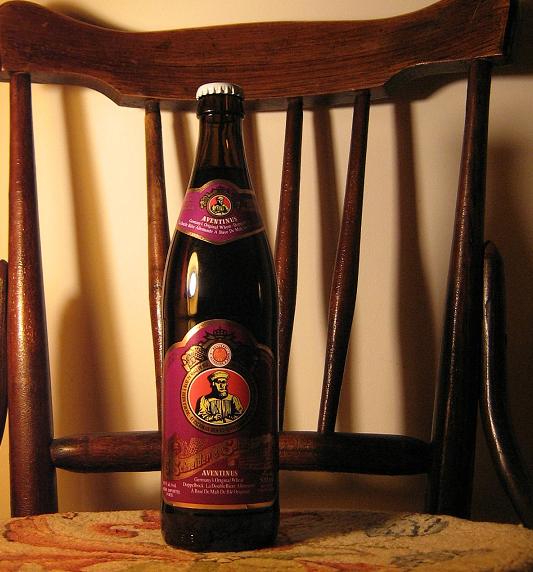
The classic wheat double bock or weizenbock from Munich – and not a dunkel weizen! The high test version of Schneider Weisse. The brewery’s bottling hall was on Aventine Street according to Michael Jackson’s Great Beer Guide.
This beer has all the moreishness supreme of the mere weisse but with even more zow-ka-pow and zam! It pours that funny grey tinged brown that reminds me of gravy with a tan head. In the mouth it is a cacophony of spices and creamy malts and yeasts: nutmeg, all spice, clove plus caramel from brown malts, raisin from crystal malt and a good bread crustiness from pale malts. There is a cutting hop as well that is below much of these flavours as well as a bright acidity that may have a lime tone. The water feels soft but there is so much going on it is a little hard to tell. In the cream yeast, banana and soft apple like Golden Delicious.
One of my favorite beers.