If You Want To Know What’s In Your Beer…

At Item H.1 of Table X of section B.16.100 of the Food and Drug Regulations at chapter 870 of the Consolidated Regulations of Canada it says that our brewers can use hydrochloric acid as a food additive in ale, beer, light beer, malt liquor, porter and stout. It may be used for the purpose of pH adjustment, acid reacting or water correcting. Erythorbic acid can be used as a preservative under Part 1 of the same regulation. Carrageenan is authorized as an emulsiphying agent,… or one for gelling, stabilizing or thickening your beer under Table IV. There are hundreds of things that can be added to your beer for this purpose or that. Methylcellulose, ficin and even calcium disodium ethylenediaminetetraacetate. Yum.

Much bother has been made this week of someone asking to have the ingredients of beer put on the labels. I don’t really care about that immediate request, the person or the purpose behind it because it is not important. It is the reaction by certain voices in the beer discourse that has been weirdly over wrought that should get the attention – reactions so inordinately strong that, in turn, they make one make one wonder about the nature of other advice or comment being given by those people. Many of whom are people I like and respect, by the way, even if I am going to question what is going on in this discussion. Mr. Beaumont calls it “bullshit” from a “presumed charlatan”. Jay Brooks goes on about the yellow journalism and prohibitionist forces behind it. Maureen Ogle cites, in the alternative, neo-prohibitionism and claims, horrors, that it is an example of “information and advice in our society is doled out by people who are only in it for the money.” When people use coarse language and ideas like these, you can bet there is a reason for their reliance on hyperbole and inexactitude. What could they be?

=> Money. There is so little money around beer writing that one always has to suspect this as a motive. I don’t in this case but one should always be prepared to see its shadow around the edges.

=> Protectionism. One thing that you notice about beer commentary is that it is very protectionist. People who write about beer name people who own brewers and, quite a separate group, some brewers as friends. These things are to be boosted. By boosters. For me, friends help you move furniture. All others are degrees of acquaintance – especially when business and the purpose of business, money, is involved. Because of this intersection between connection and accepted interpretation, beer writing and beer itself tends to be conservative and reactionary. This is the wisdom that gives us the utterly vacuous “hater gonna hate” pap.

=> Rank. It can appear that only a certain set is entitled to discuss beer. Just as it is easy to call someone a dumbass or charlatan it is also easy to compare someone to a book burning Nazi. This for me tends to be a strong indication that the person speaking has an agenda and likely an interest. Strategically perhaps, such grade school school yard debating patterns like this are far too common with good beer discourse and, like in grade school, appear to be based on reaction as opposed to presenting a well established foundation of understanding. It is not required to show what is the right thing when snapping that something over there is wrong or dumbass. If it is said by the accepted pre-approved voice, it is all that needs to be said. Fin.

=> Habit. Because of the three factors above, the discourse seems to perennially sit in a defensive rut that presents itself as assertion. Brewery owners are called “rock stars” precisely because they are not at all anything like rock stars but that it is so much more cool a phrase than “aggressively marketing business owner who provides the drinks often for free.” A superficial and self-serving lobbyist, as in this case, is called charlatan and dumbass not because they are so much as because it makes the rather limited actual response sound so much more important. We are in the habit of presenting and accepting arguments which are over-hyped and shallow because, hey, it’s just beer and beer can be a community and a source of income and the place where friends can be found. We like beer. So we can set aside focus, substance and reflection.

Why now? Why is this question the one that matters enough to pull out the BBQ lighter fluid and the matches. Media attention? Is that it? Do you really care that strongly whether the ingredients in beer are or are not on a label? Is that a hill for discussion to die on? Why don’t we as consumers care that breweries are not open enough about this when we pour gallons and gallons of their products down our throats over the course of a year? If not with your beer, why care about your food and tap water? Your air. Do you get concerned more when people advocate for more information or when others seek to deter you from having easy access to more information? I know what I prefer. Frankly, I do not trust the slagging of the topic as being one labeled as coming from “food reformers and neo-prohibitionists” who “don’t stop with one victory.” I deeply suspect any argument that includes ‘[i]t’s the equivalent of negotiating with terrorists, in this case the food terrorists…” I suspect there is another motive for making these sort of statements – for no other reason that they are just so stunned. We, the beer consumers, deserve better from those who would know and discuss the trade.

You know what? If you want to know what’s in your beer your should be told what is in your beer. Easy. It’s not about the brewer’s product. It’s about my body. No one loses an eye by listing ingredients and processes. Or almost no one. Maybe you will be surprise to learn about the chemical processes some “craft” brewers actually use. Maybe the vegetarian will find out that some animal-based substance is in the beer. Maybe – horrors! – drinkers will get to independently exercise greater choice based on information that is not doled out carefully by the marketing staff of breweries. Jeff is right: sunlight is good. For a trade that is so insular that can’t even get the definition of “small” right due to the twisted pack of interests at play, what on earth makes you think it is not only good but necessary?

Last Night I Heard The Jet Planes Land

ronto1Somehow, Toronto achieved a late spring evening without humidity or auto exhaust or heat or crowds or any of the other things that make me not love going to Toronto in the warm months. Maybe they were all at other events or at the cottage. Whatever it was, it was a great night for walking from bar to bar with good company. A good night for taxis, too, as the only hotel room I could get was out by the airport. The planes land every 45 seconds through the night. In case you were wondering.

ronto2

ronto3


ronto4

ronto5


We met in the mid-afternoon at Stout, a pub off Parliament on Carleton. Ron was drinking Nickle Brook’s imperial stout. He must have liked it because he had another. Jordan was drinking a sensible Muskoka Detour. We were joined by home brewer Peter Friesen who had arranged Ron’s presentation the next day at Toronto Brewing Co. Ron is on the Great Lakes portion of his global tour. We then drove about 25 miles to drop off my car and then taxi back into the Junction district via highways showing their age, past 1970s concrete office towers with neon signs proclaiming things like “Canada Bread” where, according to Jordan, Carol works in accounting. We stopped at Indie Ale House and 3030 in the Junction before finishing at Bellwoods.

ronto6

ronto7

ronto8


ronto9

ronto10

ronto11


I won’t play by play the consumption but a couple of things stuck with me. One thing was a lot of of the people out and about were loud mixed groups of friends with, especially at Bellwoods, almost half being young women. Sure people were on dates, too, but there was solid representation of the genderless interest in good beer and good food that gave me hope for my school-aged daughters’s future. Also, a difference between Indie Ale House and Bellwoods was primarily in their brewing choices. In many other ways, they were very similar. The food at both places was excellent and reasonably price… and both served their meals on those individual slabs of lumber which will one day keep cottagers toasty as these burn in their fireplaces after this trend passes.

What set them apart was how at the Indie the beers were decidedly leaning towards the added flavours school of craft brewing while at Bellwoods there was a bit more of a traditional approach. Both were largely excellent. The IPA at Indie was extremely fruity, even more fruit cocktail than, say, Kipling. But it was cut neatly by the arugula side salad next to my smokehouse burger. At Bellwoods, an undoctored guest cider from West Avenue went down exceptionally well with a rabbit on toast thingie. OK, it was rillettes de lapin which I have only bought in Quebec so I translate it as thingie so you will understand. The unadorned brown beer there was also really good. Jordan convinced me to eat a duck heart. You should eat a duck heart.

A good evening out. But for the lack of hearty north woods plaid chic, you might have even thought you were on Duluth in Montreal. Which is a very good thing.

Divisive “Local” Craft Culture Clash Marketing

My own favorite local.
 

Stan linked to this story a few days ago. It got me thinking… but not fast, “get me to the keyboard” thinking. It was this bit at the beginning that got me mulling:

I was watching a video online when it was interrupted by a commercial for Budweiser. The name of the spot was “Do You Know Where Your Beer Is Brewed?” Soft guitar music played while clips of idyllic landscapes and sunrises peaking over breweries slid across the screen. Nothing out of the ordinary there. The gentle voice of the narrator says, “With 12 breweries spread all across the United States, your next Budweiser is closer than you think.” Budweiser hangs its hat on the fact that it can produce the same beer at 12 facilities and it will always taste exactly the same no matter where you drink it. No small feat, to be sure. But then the voice adds, “You might even say we’re America’s largest local brewer.” My eyes narrowed and my brow furrowed. ‘What in the heck is this?” I exclaimed. “That is our word!”

Our word? There’s a lot of weird words in there. Not the least of which is “our” – whose the hecks is that referring to? Don’t get me wrong. I like the work of the author Jeff Baker just fine. He’s the manager of the Farmhouse Bar and Grill in Vermont. Nice place. Real nice. Just not my local. Because “local” can mean that, too. The distance of the drinker from the drink.

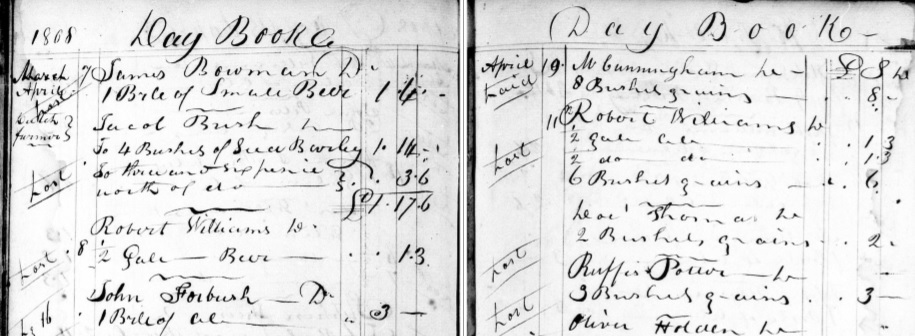
But that’s not his point. It sorta illustrates mine but that’s not really the goal of where I am going. He is asking about local ingredients. If you want that world, go back 200 years and have a look at the Vassar day book with local beer being made of local grain and hops being sold back in small batches to the farmers and tavern keepers of the central Hudson Valley just getting back to some sort of normal after the devastation cause by the Revolution. This is the mid-1830s book but in the 1808-11 book the economies of beer are clearly still defined by the cart horse. That is actual local brewing. Are we willing to go there? Doubt it. You don’t really want local. You want some local. Now and then. But you want the global economy beer made with the best ingredients brewed on the newest, bestest equipment. Right?

Craft beer and macro are not all that far apart in this respect. Brewed on computerized stainless steel to a scale and upon a recipe that meets the needs and budgets of their respective clients. The only actual local thing that is reliably present at the brewery is the staff. Hard to be a brewer who lives over 45 miles from the brewery. There’s a hint by the way. If the person discussing the beer in your glass doesn’t live about that close, not a brewer. Sales guy, likely… owner, sure… but that’s all. Both use good foreign malt and distant, shipped in hops. Both tweek their water and yeast to match those found elsewhere. Don’t get me wrong. I like “local” just fine. It just means, for me, the bok choi and beets I have growing out there in the yard. Not beer.

When anyone in beer – whether Bud or craft – claims a word like “local” or “small” or “real” there is marketing going on – even if only to a small circle. Even if only to the speaker. It’s all unnecessary. When I think of Bud, I think of the brewery at Baldwinsville, New York to my south where local people earn a decent wage. If I have a decent hoppy IPA, I think of the three nations and seven generations needed to make the beer exist. Beer is global and has been since at least the 1400s when the Hanseatic League was beginning to ship Baltic brewed hoppy beer to the Low Countries. Except for odd examples like postwar agricultural collapses like Vassar faced in 1808. Except for that, it’s been beer or large parts of it hauled out from the hold as often as not since the Dark Ages. Good non-local beer.

Another Candidate For First Beer Downed In North America

1578beer

Martin Frobisher. He was taking a group of miners to what later gets called Baffin Island¹ in the Canadian high Arctic to dig for ores. The image is from The Three Voyages of Martin Frobisher, a book from 1938 that reprints the 1576-78 journal of crew member George Best along with other records. It is very likely that this is not of the first beer in any respect. Almost certain. Because it is from the second of the expeditions. The 1576 expedition had five tons of “beare” listed amongst the “furniture” – as in things furnished – for the voyage. So it’s nearly the first… maybe.

The thing I thought I would find as I have seen elsewhere was barrels of malt and hops being shipped over. I’ve seen it on Newfoundland’s shores about twenty years later as well as in Hudson Bay a century later. But this was no crew of masterless West Country men salting west Atlantic cod or factors left to overwinter to trade in northern furs. Nope. Frobisher’s crew was funded by Earls, Countesses and Lords to the tune of 50 to 200 pounds each. The Queen’s Majesty herself threw in a rounded thousand. There was a surgeon on board as well as four tons of cheese. Almonds and raisins plus two firkins of prunes. Just in case. They are living in style. There is both Malmsey and sack, for heaven’s sake. That would now be described as Madeira and sherry respectively.

A gallon of beer for each man each day. Likely downed in wooden tankards like these. A gallon. That is the equivalent of twelve 12 oz or 350 ml bottles a day every day. In 1576, it was two pounds two shillings for a ton of beer but two pound five shillings in 1577. Seven percent inflation over one year is unlikely. Maybe a better grade of beer? Not a lot of detail of the life on shore in the accounts. Just interaction with the local Inuit as well as the work gathering of tons of ore. Each group seemed to appear pretty silly to the other.

¹… because our lad Billy Baffin isn’t even born until around 1584.

The Fourth Internet

It has been a long time since I have been interested in an idea about the internet but this article linked to by kottke

The fourth Internet is scary like Darwinism, brutal enough to remind me of high school… If the first Internet was “Getting information online,” the second was “Getting the information organized” and the third was “Getting everyone connected” the fourth is definitely “Get mine.” Which is a trap.

It sums it up neatly. The end of information. The prostitution of data space. I am not sure it has caused me to consciously draw away from writing on this blog but it may have contributed. “Getting mine” includes those paywall spaces, too. Fees are necessary, agreed, but what ever happened to micro payments? Surely PayPal could be harnessed to let me reach newspaper articles for four pennies a piece. Not that I had high hopes all these years ago. I compared blogging or Web 2.0(a) to CB radio when it was mainly a hobby. Over eleven years ago as it turns out.

Perhaps it is because I make a little money from writing now. I used to make money from blog ads and now make money from book contracts. I am regressing into old media. Because it is reliable. Should I add a question mark to that? Because it is reliable? If I titled this post “Twenty one ways the fourth internet will make you angry… and then leave you amazed!” I would fit in better these days.

May Two-Four And Our Well-Wishing To The Crown

bobdoug1Even though it is just the 17th of May, this weekend is nicknamed May Two-Four. It is Canada’s non-much-observed celebration of the lass who was Queen Victoria. Monday is still called Victoria Day. It also has a quiet subtext of somehow being the celebration of the present Queen’s birthday. If those are the dimming antecedents, the once glowing purposes of the day – they are doubly wrong. Our current absentee monarch was born on an April 21st. Vicky was born in May 24th but, as you may note, that is not today’s date.

And yet this is the weekend of May Two-Four. Not next weekend which contains the twenty-fourth day of May. This one. Why? Because a two-four is the name of a cardboard case of 24 bottles of beer. Twenty-four 12 ounce bottles is that unit that is beyond personal consumption. It implies either sharing or duration. A long warm weekend is apt for both. And gardening and fireworks. Because we have no real remaining cultural focus on this long weekend, unlike any other long Canadian weekend, we are now free to create our own. So we think about drink in itself. We just enjoy ourselves.

It was not always so. In the course of co-writing one book on the history of beer in Ontario and another on Albany, I have written about three drink laced celebrations of the Monarch’s birthday in 1755, 1776 and 1828. As I mentioned the other week, Sir William Johnson supplied the Royal loyal allies of the monarchy, the Mohawk nation of central New York, with beer during the Seven Years War – aka the French and Indian War. One of those deliveries, as noted at page 572, was on June 4, 1755 when he obtained two barrels of beer from Hendrik Fry for the Mohawk at Conajoharee to drink to toast the birthday of George III. As I wrote a year ago, Craig and I located the scene of the drunken tavern brawl 21 years later in Albany which finally ripped that city’s Tories and Patriots apart triggered by overly vigorous toasting to the King. Perhaps my favorite Royal birthday celebration in British North American happened about half a century later. As you will see in Ontario Beer, at a celebration of the King George IV’s birthday hosted by the Canada Company on 12 August 1828, 200 settlers gathered at what is now Guelph when it was at the point where the forest met the clearing of fields. A whole ox was roasted held over the fire with logging chains. As there were few utensils, most of it was eat off of wooden shingle plates with a stick for a fork. After the eating was done:

…toasts were drunk to everybody and every conceivable thing, the liquors of all imaginable descriptions being passed round in buckets from which each man helped himself by means of tin cups…

It is recorded that many were found the next morning reposing on the ground in the marketplace “in loving proximity to the liquor pails.”

Now, I am not suggesting we take our Canadian admiration of the Crown to that point. But… it is a proud tradition. It brought together peoples as loyal allies, insulted our treacherous enemies and celebrated the new frontier in our new homeland. If I had my druthers, that would be what we celebrate today. Not so much the Crown or a particular monarch but the loyal pioneers who defended the cause and created the nation. And drank like idiots as they did and because they did. Because we are like that.

Ontario: All Quiet About Beer On The Election Front

4515OK, so far the Ontario provincial election appears to be playing out as an effort to ensure the same outcome as last time. As a result, even though it is an excellent time to discuss beer buying policy in the province, no one is doing so… yet. Fervent please by bloggers, newspaper columnists, commercial interests which were winding the story up just a few weeks ago have also gone quite quiet. Odd. Can’t be the interim blackout on political advertising. It was not always so. If we consult the book we see that in 1924, when Ontario was fed up with the strictest form of dry law under provincial law beer sales became a widely fought public issue:

Support for temperance was weakening based on the public awareness of the failure of the law and corruption it brought. In October of 1924, when another plebiscite on temperance was held, the vote against repeal had fallen to only 51.5%. Major population centres like Toronto, Ottawa, Hamilton and Windsor all voted against keeping the law. In response, Premier Ferguson raised the strength of permitted light beer to 4.4 proof from 2.5 and also redistributed the seats in the legislature to remove wet seats and add dry ones. Reaction to the new beer was not rabid as one newspaper noted:

To the imbibers who thought that they were going to get some kick out of the potation, the ordination was as disappointing as a cancelled marriage license to an old maid. Many of them claimed, in fact, that the new beverage bore such a family likeness to the old 2 percent that it might be its twin brother. Unlike the stuff that made Milwaukee famous, there was no blinds staggers accumulated from the new suds. Temperance people who thought the wolf was here in sheep’s clothing will have to wait a while.

Not surprisingly, Ferguson won re-election in December, 1926 on the platform of repeal of the temperance law and replacement with a system of government controlled liquor sales.

So, beer retailing can become a winning story even if it does not seem to be doing so now. Either one of two things is happening. Folk are not as motivated in 2014 to pursue the political route to effect beer retailing change as they were ninety years ago in 1924… or politicians have not had the interests of the public effectively brought to their attention as a vote getter. I suspect it is the first possibility as there has been plenty in the news. It’s just that the story has not been made compelling enough yet to actual inspire real action, to move people to switch habits at the ballot box.

The strangest thing, however, is how like Premier Ferguson in the early 1920’s any of the three main political parties could themselves use it to justify getting votes if they just framed it as an illustration of their core values. Sure, the Tories under Tim Hudak have supported corner store sales but only tepidly so despite it being a tale of small business and personal freedoms. Beer as the drink of the working class sure could be again framed as a boon to the left, the union made drink of the little guy and the NDP – but so far the party is only “open to new ideas.” The Grits under Premier Wynne have sided with the no vote so deeply that it might be tough to now shift, preferring to take the “we control stuff so you don’t have to” route. Gridlock.

What is needed is a compelling new angle for one of these parties to latch on to as a way to present itself as mirroring a compelling positive public need back to the public. What is it and who gets to it first?

Albany Ale: Beer Rewarded Loyalty Against New France


A month or less to go for the delivery of the Albany and Upper Hudson Valley beer history and Craig and I are putting on the almost finishing touches. One difficult stretch was the first two-thirds of the 1700s as, basically, the same families kept brewing and – surprise – got richer generation by generation. Fortunately, a war broke out in the middle of the century to spice things up. I had presumed that the only news would be about the suspension of brewing as that is what war does… among other things. But then I came across this in his papers:

johnson1

johnson2

johnson3


johnson4

johnson5


These are accounts from William Johnson, the 1st Baronet of New York and a personal favorite of mine. Near my work there are two streets, “William” and “Johnson” which commemorate the guy whose son helped settle our fair city. But that was after the war after the one just begun when these accounts were noted in 1755. In 1755, the Mohawk, the British and the Dutch were all united against New France and its plans for invasion from the north. In the defense of the empire, Billy Johnson did everything he could think of including, apparently, shelling out beer.

I had known he was a beer buyer but not like this. Names like Hendrick Fry appear in these accounts, some the same as names that appear over a decade later in the lists of members in the Masonic Lodge at Albany. The accounts show how barrels of beer were used to retain and reward loyalty with the Mohawk allies in the summer leading up to a campaign at the south end of the Champlain valley when Johnson took on the French and kept them from marching farther on to Albany.

The last image on the right is interesting. It makes passing reference to one Barent Vrooman. Vroomans were a Dutch brewing dynasty who, like their fellows, expanded from the Hudson valley into Schenectady in the late 1600s and then into the western stretches of what was then called Albany County in the first half of the 1700s. Barent the brewer died in 1746 so this must be a nephew or a cousin. In any event, Johnson seems to have sent him something more useful than beer. He sent a Mohawk warrior to guard him.

Yeast News: Migrating Birds And Sheboygan

One of my slowest moving interests in beer comes in the form of a trickle of stories about the origins of lager yeast. In 2008, there was the tale of the two Bavarian caves. Then there was the dinosaur era yeast story. Then in 2011, the ur-yeast for lager was found in Argentina. Now, it turns out that little bit of goodness shows up elsewhere, too:

It is the first time the microbe has been found in nature in North America, or indeed outside of Patagonia. Found by UW-Madison undergraduate student Kayla Sylvester, a member of Hittinger’s group, the yeast occurs only at a very low frequency and was likely accidentally introduced, just as an ancestor found its way to Europe and kick-started the production of cold-brewed lager beer hundreds of years ago. “If I had to bet, I’d lay money on ski bums or migrating birds” as the agents responsible for transporting the microbe to Wisconsin, says Hittinger. “What we think is happening is that well-established, genetically diverse populations are sending migrants around the world. Generally, they’re not successful, but occasionally they are.”

I love this stuff. One of my proudest moments was when the yeasty eggheads jumped in the conversation and gave me more details in the comments. I even got corrected and edjificated that the proper written form is “egg head.” The goal of all this is “to tap into biodiversity and find the strains that ferment better” according to study lead UW-Madison Professor of Genetics Chris Hittinger. Which beats the hell out of making synthetic yeasts to get more of that candy store mango taste into out future beer.

As Boak and Bailey noted today, there is an end to the pursuit of the merely novel, the manufactured. The law of diminishing returns demands no less. But the exploration of the actual, the natural and traditional? I’ll buy that, too.

Ontario: It’s Beer Book Page Proof Reading Time

obbpage21Even though I have been writing about beer for over a decade, I have not had the pleasure of the page proof experience before. It balances between sheer terror and giddy delight as I see that so much of what I hoped for the book Jordan and I have been working on since last summer has come into being – while at the same time I am still correcting myself on a few last tiny things. Oh. Me. Nerves.

The best stuff frankly relates to things beyond my doing. That is the top of page 21 over there. Jordan selected the photo and wrote the caption. The good folk at History Press chose the font and prepared the layout. And, as noted, even a major concept at that point of the story was provided by sometimes comment maker around here Steve Gates. The bibliography sets out a selection of the sources relied upon but it still runs for three and a half pages. I just wrote the text at that bit. I wrote it before Christmas. Rereading your own work at page proof time confirms the adage that the past is a foreign land.

I like the cover, too. Didn’t know I would. Someone else took care of it. It’s odd. There are so many people involved. I had no idea. Blog writing is so private by comparison.