As The Madcap Slide Into Yuletide Speeds Up Here’s This Week’s Beery News

I am already late. I think that is what Yule really means: “you are late!”  I need to still get a few things together… very few… but I already feel rushed. Perhaps this is how “We Three Kings” felt galloping across the Middle East and it’s all part of the lessons of the season. Fretting. I dunno. I need a few of these Caribbean Christmas drinks. No wonder people take winter vacations. To make up for the Christmas vacation. Not as rushed as the holiday-time photo contest kept me a decade ago. That’s the winner from 2012 up there by Robert Gale, one of 36 photo entries I posted on just one day in that long contest period. That was a lot of fun – but nuts, too.

First up, Stan is back and posted his linkfest on Monday after a month on the hollyjollydays – and he noticed something:

Has it really been four weeks since I posted links here? Indeed, and it seems as if it would be easy to sort through the headlines since Nov. 6 and assemble a post of only stories about the craft beer apocalypse. I am left searching for a phrase that is the opposite of “a rising tide lifts all boats.”

Perhaps “Five Feet And Rising“? Just to, you know, keep up with an aquatic theme? Stan explores some of the reasons for the craft beer predicament so go have a look. Even though the exploration and examination of a downturn is valuable and in craft almost fully ignored… I know the feeling but have promised myself to be cheerier this week. I will. It is the holidays or perhaps just the pre-holidays after all. Let’s see if that’s possible.

But first… Jordan has been worked a few paper rolls through the adding machine and come up with for Ontario what can only be called findings:

Will update the map later, but it looks to me like we’re down from 413 physically operated brewery locations to 389 so far this year. There are some ownership situations I don’t know how to express simply in geographic format. Assume that number is high… If you condense ownership structures, we can reduce 67 locations to 27 companies. So… 349 companies total.  

Maybe related: low alcohol partying and no alcohol bars? Apparently Sam Smiths is also running no alcohol bars, given that “as many as 120 Smith’s pubs are currently closed“! That’s what’s said in that article in The Times about the Samuel Smith’s of Yorkshire. Not so much about the brewery as the man running the operation. This was a brutal passage:

Back in the 1990s Samuel Smith’s bought and began pouring millions of pounds into restoring the town’s derelict Old Vicarage, which dates back to the 14th century. Great care was taken to go above and beyond rules stipulated by English Heritage… When the eight-year project was complete, the vicar at the nearby St Mary’s Church was informed that her new house was ready. The offer came like a bolt from the heavens. St Mary’s vicar already had a home — one she liked and better suited the needs of her young family. After the invitation was politely declined, the lavishly restored building was locked up.

Enough. It’s the holidays. Here’s some good news. The BBC reports that Welsh brewery Brains has turned its fortunes around… literally… or is it figuratively…:

The company had debts of £76.4m, most of which had accumulated before the pandemic. Mr Bridge worked with a number of banks to restructure and agree repayment of all of the debt, with the chief executive finally feeling confident about the company’s financial health by the summer of 2023. “We’ve managed to navigate those challenging times. And it wasn’t just us, it was the whole drinks and hospitality industry that went through those challenges,” Mr Bridge said. Brains is more than beer in Wales. Having been brewing in Cardiff since 1882, the company is still owned by the descendants of Samuel Arthur Brain.

More with the cheery. What is cheery? History is cheery! And international. Heck, we received a comment in German this week, a footnote to my bit on the Lispenard clan, 1700s Loyalist beer barons in New York. Lord Goog provided the translation. Speaking of lore of yore, the Beer Ladies Podcast had a great interview this week with Dr Susan Flavin, a historian joined in a project recreating a 1500s brewery:

In this fascinating project – link below – the team used a recipe based on a beer once served in Dublin Castle, in order to not only taste it, but to learn more about the role beer played in the early modern period. This one will tickle the beer history nerds and casual beer fans alike!

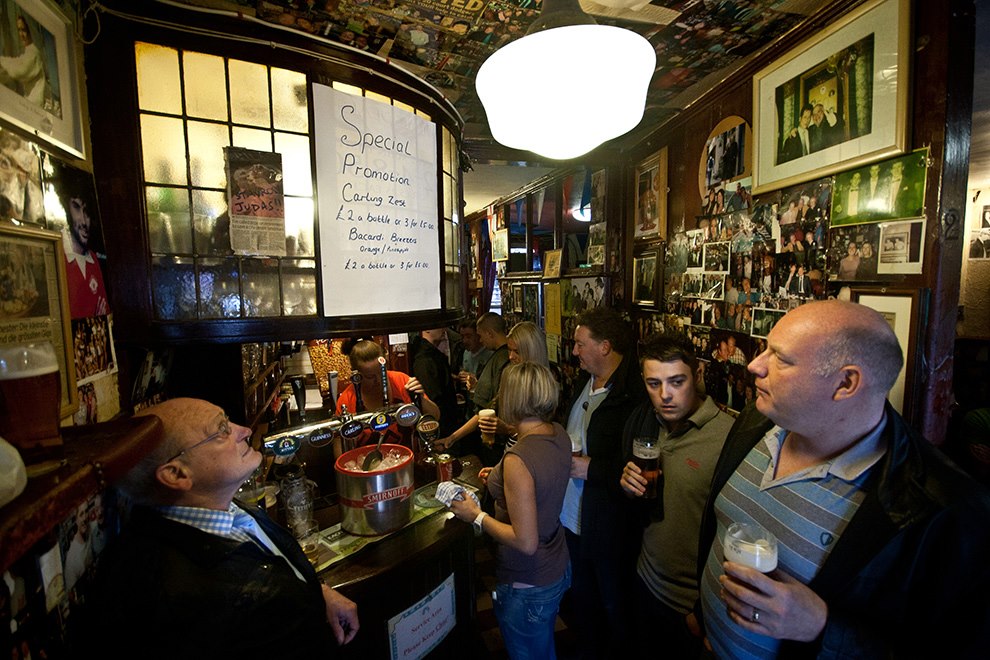
In more recent history, Boak and Bailey have a great explainer this week on the pub feature called a “snob screen” as helpfully illustrated in the 1963 comedy The Punch & Judy Man where they are used as part of a physical joke:

Hancock, who co-wrote the film as well as starring in it, uses these as the basis for a bit of ‘business’ which, handily, you can see some of in the trailer for the film. He pops in and out of the various windows, taunting and teasing the snobs behind the snob screen. In other words, he refuses to respect (literal) social barriers, and highlights their purely symbolic nature. After all, he and his pals can hear almost every word that is being said a few inches from them, on the other side of the screen. What is slightly odd is that most surviving examples of tilting or swivelling snob screens are there to separate customers from bar staff, rather than from each other.

Neato. And a couple of decades later, the BBC took us back to a Belfast board game of forty years ago and posed the question whther it was glorifying or just identifying actual pub culture:

1981: Scene Around Six explored a Belfast pub crawl board game, named Binge. Controversial enough that many shops refused to stock it, it did at least have the backing of a certain local mover and shaker, Mr Terri Hooley.

And another bit of history. In the same week that it is reported that Diageo is ditching most of its beer brands*, a landmark in craft brewing history is being lost with the closure of the Ringwood Brewery in Hampshire, England after fifteen years in someone else’s portfolio.

In 2007, Ringwood was purchased by Marston’s for £19.2 million. Marston’s disposed of its brewing operations in 2020, selling assets to a joint venture with the Carlsberg Group to create the Carlsberg Marston’s Brewing Company. Mr Davies mentioned that he is “incredibly proud” of the effort and dedication of staff at Ringwood Brewery, adding: “Our priority now is to support colleagues affected by the proposals through the consultation period, which has now begun.”

You know, the official hagiography of craft beer does not properly account for the importance of the Ringwood Brewery which came into being in 1978 led by Peter Austin. As Boak and Bailey discuss in Brew Britannia as well as in their thoughtful obituary for him of almost a decade ago, Austin was one of the few people who could legitimately be called a founder:

His first triumph was building and getting established the Penrhos Brewery on behalf of Martin Griffiths, Terry ‘Python’ Jones and writer Richard Boston. He then launched his own brewery, Ringwood, in 1978, and thereafter came to be the ‘go to’ guy for advice on setting up similar operations. When David Bruce was setting up his first Firkin brewpub in 1979, it was Austin who vetted his designs for a miniature basement brewkit. The two were both founder members of SIBA, which then stood for The Small Independent Brewers Association, and Austin was its first Chair.

Austin also consulted, with Alan Pugsley, brewing bringing his energy into the new brewing movement in North America. I’ve had beers in breweries in Nova Scotia, Maine, New York and Ontario directly carrying on that tradition. The shutting of the Ringwood is the end of an era.

The big news in the world of Pellicle is that I WON the November fitba pool (even though I am wallowing in the nether ranks.) It which was a great surprise that earned me a mug. Oh… yes, and Will Hawkes wrote something well worth reading for Pellicle about London’s pub group Grace Land and the co-owners Andreas Akerlund and Anselm Chatwin:

They met when Anselm took a job as a bar back at Two Floors, Barworks’ bar in Soho, whilst he was at St Martin’s College (now Central St Martins) in the early 2000s. Temperamentally similar and with a shared passion for music, they cooked up a vague plan to open a dive bar/gig venue—and when a site, formerly The Camden Tup, came on the market in 2009 they opened the first Grace Land venue, The Black Heart. It wasn’t an immediate success. “The Black Heart was a dismal failure for many years,” he says. “But it’s about working with the concept, sticking with it. People get it now.” That philosophy has served them well in the years since, during which they’ve slowly accrued a small family of high-quality pubs…

Note: The English are coming back down to pre-Covid levels of alcohol consumption. Is inflation healthy? Hmm… and while we are at it… next time someone suggests that terrior in wine isn’t real, mention this study as reported in The New York Times:

“It’s one of those terms that the wine industry likes to keep a bit mysterious, part of the magic of wine,” said Alex Pouget, a computational neuroscientist at the University of Geneva. Dr. Pouget is trying to apply chemical precision to this je ne sais quoi. In a study published Tuesday in the journal Communications Chemistry, he and his colleagues described a computer model that could pinpoint which Bordeaux estate produced a wine based only on its chemical makeup. The model also predicted the year in which the wine was made, known as its vintage, with about 50 percent accuracy.

That’s some science right there, that is. Continuing with questions of authenticity, again we go with The Times out of London which had an interesting article on tea and chai this week with some very interesting assertions about appropriation and the nature of foodways:

You can culturally appropriate badly, or you can culturally appropriate well, but almost all culture involves appropriation. While Indians have been adding spices to milky beverages for centuries, the spiced tea that is fashionable in American and British coffee shops, and is sometimes marketed as an exotic drink, is no more purely Indian than, say, chillis (which originally came from Central/South America). Indeed, chai is the result of the British imperial push to get Indians to consume tea.

Note: Lars wrote about complexes of closely located language families. Nicely done. Also nicely done, Geoff wrote about Ethiopian borde over on Mastodon, a very complex form of beer making.

I think I first had Jack’s Abbey lager with Ron and Craig in Albany New York back in March 2016. I recall hitting a store on the way back from Delmar. Ah, Delmar! Anyway, Jeff has done an admirable job remembering what he wrote down during his recent visit… before he lost his notes from that visit… including, to begin, its location:

The city proper is small and compact, but the metro area, or Greater Boston, includes around a hundred small towns clustered in the fan stretching out from Boston Harbor. Two radial freeways, I-95 and I-495, mark important distance metrics. Anything inside I-95 is pretty Boston-y, while anything within the larger I-495 ring is Greater Boston. Framingham, home to Jack’s Abby, is 20 miles due west of downtown Boston and about halfway between 95 and 495.

Note: Zak Rotello of the Olympic Tavern of Rockford, Illinois alerted us to this situation: 1, 2, 3, 4. Govern yourselves accordingly.

Nice piece in Cider Review this week on the state of the tiny German perry trade and its advocate in chief, Barry Masterson:

As anyone who follows Barry will know, there are a good number of pear trees in his home region around Schefflenz. He’s previously reported its former significance in Bavaria and until relatively recently it was a central cultural tenet of rural life in the Western Palatinate, a little way west of Barry, near the Rhine and around much of German wine country. But today there’s vanishingly little to be had commercially, and if I didn’t have a direct line to Barry, Lord alone knows how I’d have found anything out about it for the book.

And finally in one of the weirdest craft fibby claims yet, the fact checkers and desk editors of Forbes seems to have taken coffee break when this one crossed by their inboxes:

Recently the Cicerone Certification Program announced that six people had achieved the rank of Master Cicerone. There are now a total of 28 Master Cicerones worldwide. A Master Cicerone is similar to a Master Sommelier in the wine world but the focus is less on service/hospitality and more on general beer knowledge. The exam is frequently billed as one of the hardest tests not just in beer, but in the world. 

FFS. Is there any bloatification that craft can’t claim? Safe to say that gaining the certificate does not require passing one of the hardest tests in the world. There are, after all, brain surgeons not to mention standard shift drivers licenses. Not being a peer reviewed academic course, however, allows for this sort of thing to float around.

Fin. We are done. I know I’m done. Remember, ye who read this far down to see if I have edited these closing credits and endnotes (as I always do), you can check out the many ways to find good reading about beer and similar stuff via any number of social media and other forms of comms connections. This week’s update on my emotional rankings? Facebook still in first (given especially as it is focused on my 300 closest friends and family) then we have BlueSky (94) rising up to maybe pass Mastodon (907) in value… then the seemingly doomed trashy Twex (4,426) hovering somewhere above or around my largely ignored Instagram (162), with unexpectly crap Threads (43) and not at all unexpectedly bad Substack Notes (1) really dragging up the rear – and that deservedly dormant Patreon presence of mine just sitting there. All in all I still am rooting for the voices on the elephantine Mastodon (even if BlueSky is catching up in the race to replace.) And even though it is #Gardening Mastodon that still wins over there, here are a few of the folk there discussing or perhaps only waiting to discuss beer:

Alan McLeod | A Good Beer Blog (… me…)
Stan Hieronymus | The Man!
Boak & Bailey | The B² experience
Curmudgeon Ale Works | Jonathon is Brewing
Katie Mather | Shiny Biscuit and Corto
David Jesudason | “Desi Pubs” (2023) author
BeoirFest | They say “Let’s Talk Beer”
Ron Pattinson | The RonAlongAThon Himself
Al Reece AKA Velky Al | Fuggled
Jennifer Jordan | US hops historian
Andreas Krennmair | Vienna beer and lager historian
Beer Ladies Podcast | Lisa Grimm and colleagues
The Bar Towel | Toronto’s chat zone for beer lovers
Chicago Beer Society | Folk in Chicago getting social over beer
Jay Brooks | Brookston Beer Bulletin
Joe Stange | Belgian beer expert, beer magazine editor
Cider Bar | Barry makes Kertelreiter cider
Laura Hadland | CAMRA historian and beer writer
Brian Alberts | US beer historian
Jon Abernathy | The Beer Site
Maureen Ogle | US Beer Historian
Lars Garshol | Norwegian Beer Historian and Kveik Hunter
James Beeson | Beeson on Beer
Carla Jean | MAINER!!!
Thandi Guilherme | Beer Ladies Podcast Co-host
Lisa Grimm | Beer Ladies Podcast Co-host
Roy of Quare Swally | Beery ramblings from Northern Ireland
Rob Talksbeer | Podcaster and Youtuber
Anthony Gladman | UK Drinks Writer
Jeff Alworth | Manna Of Beervana
Northwest Beer Guide | Fairly self explanatory… but not NW Latvia…
Evan Rail | Prague based GBH editor, freelance writer, NYT etc.
Todd Alström | 50% of the Alströms
Jacob Berg | Beer talking librarian

Anyone else? Anywhere else? Yes, you also gotta check the blogs, podcasts (really? barely!) and even newsletters to stay on top of things including the proud and public and certainly more weekly recommendations from Boak and Bailey every Saturday and Stan at his spot on those Mondays when he is not SLACKING OFF! Look at me – I forgot to link to Lew’s podcast. Fixed. Get your emailed issue of Episodes of my Pub Life by this year’s model citizen David Jesudason on the odd Fridays. And Phil Mellows is at the BritishBeerBreaks. Once a month, Will Hawkes issues his London Beer City newsletter and do sign up for Katie’s now much less occassional but always wonderful newsletterThe Gulp, too. Ben’s Beer and Badword is back with all the sweary Mary he can think of! And check out the Atlantic Canada Beer Blog‘s weekly roundup. There is new reading at The Glass. Any more? Yes! Check to see the highly recommended Beer Ladies Podcast. That’s quite good. And the long standing Beervana podcast . There is the Boys Are From Märzen podcast too and Ontario’s own A Quick Beer. There is more from DaftAboutCraft‘s podcast, too.  All About Beer has introduced a podcast… but also seems to be losing steam. And there’s also The Perfect Pour. Plus follow the venerable Full Pint podcast. And the Craft Beer Channel on Youtube and remember BeerEdge, too, and The Moon Under Water… if you have $10 a month for this sort of thing… I don’t. Pete Brown’s costs a fifth of that. There was also the Beer O’clock Show but that was gone after a ten year run but returned renewed and here is the link!

*Or not… as a web-publication called Just Drinks has asserted that Diageo does not plan to offload beer assets – apparently based on this peak of investigative reporting: a “company spokesperson said: ‘We do not comment on market speculation.’

A Brief But Paradigm Busting Edition Of These Beery News Notes For Mid-November

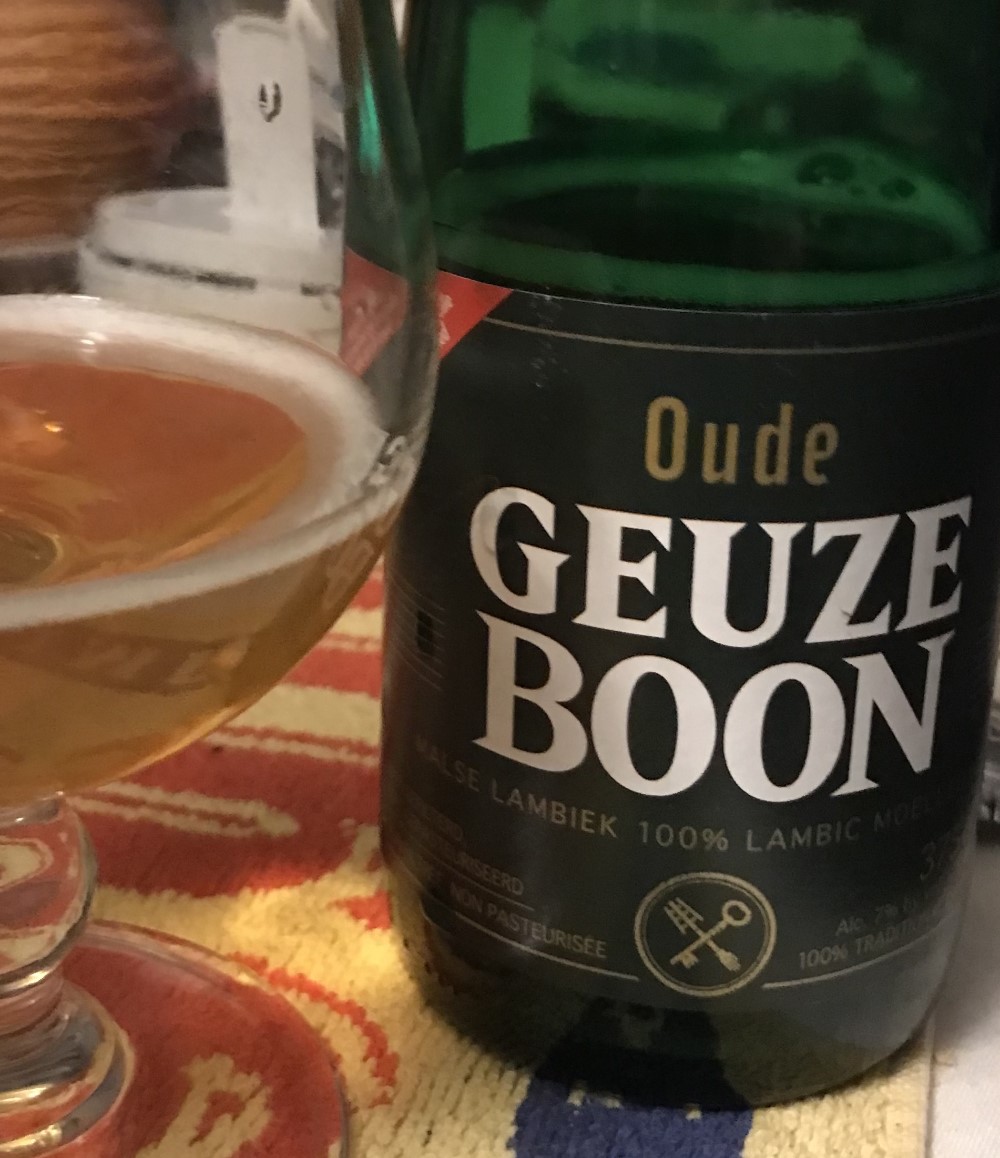
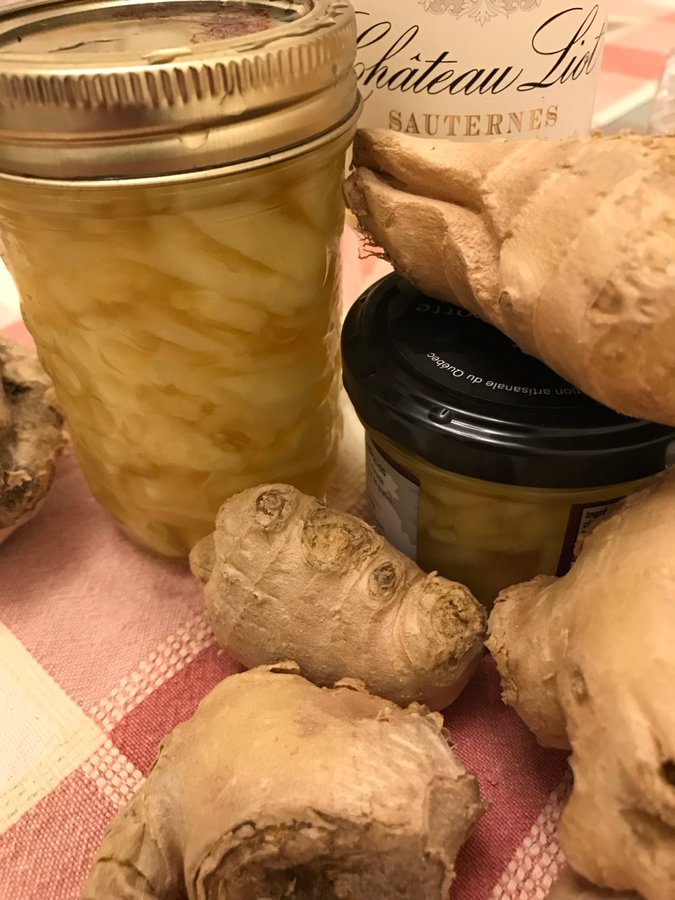
I’ve been mentioning that beer writing seems to have gone a bit quiet this autumn and – horrors – it’s gotten into such a state of the doldrums that Stan’s booked off until the first Monday in December. Lordy. What to do, what to do? Scour the globe? Look near and far. That’s what we always do. When we are not sifting clues we scour the globe. Beer helps. Had this one on Saturday, bought in Quebec as a standard shelf item with a reasonable price tag. Not sure why we can’t have the nice things they get at the SAQ…

UPDATE: Lew posted a new podcast. Normally I would not encourage podcasting… because… you know… but look at all of what he’s done on one short trip!

Hanover may have thought it was a frontier town, a market town, a transportation hub. But the peckish German-Americans who populated it in the late 1800s and early 1900s knew better. Their ovens and kettles, and a vague hunger between meals, were destined to make Hanover known as Snack Town!  My friend Dave Dreese and I hit town on our way to Baltimore, and wow. We visited two of the biggest snack food companies in America, two very old school hot dog joints, and a great butcher shop with their own smoked sausage and cheese. And of course, all those snacky eats need beer, so we hit the town’s six breweries. I interviewed the man who makes the last hand-rolled pretzels in Snack Town, Kevin Bidelspach of Revonah Pretzels.

Two hot dog joints… “two very old school hot dog joints”… Lordy…

Resuming normal service: I am starting off this week with a news item from Jessica Mason published at The Drinks Business at the end of last week. I like this because it acknowledges that values can clash in the world of craft – and not the ones you might think at first:

… even though the regulations and consumer pressures have led to sustainability fast-becoming a “licence to operate”, rather than a “nice-to-have” novelty, beer trends for variety were contrary to the guidance… Stronger consumer appetite for variety over volume has undoubtedly created commercial opportunities for breweries, but producing up to 100 different varieties of beer in a large-scale plant means that short production runs will require more energy and water.

I like that – push back on all thing to all paradigms. The bulk of beer brands are not only fleeting but gotten a bit lazy. Add a sauce or swap the hop so you can change the label.  Even the best brewers who attempt to make all things for all people are putting out too many clangers. Focus.

Factoid: One beer in Iceland costs the same as nine beers in Hungary.

In science news, a yeast strain has also pushed back… or perhaps been pushed back by the lab coat wearers at the University of Wisconsin:

A key trait of yeasts used in beer production is the ability to break down maltose, the most abundant sugar in the material used to brew beer. The team chose a yeast strain that had evolutionarily lost this ability despite possessing many of the genes required for maltose metabolism. After running evolution experiments growing the yeast on maltose and selecting decedents that thrived, the lab’s S. eubayanus yeast reacquired the ability to eat maltose. 

Hmm… I know that these things are important but wouldn’t starting with the strain that could do the thing you wanted it to do in the first place have been a faster way to get to your goal? Are they just jerking the poor things around?!?! [ED.: …Just a minute… let me check my high school science grades again… hmm… yes, you’re right. I don’t have a clue.] Perhaps similarly in terms of getting somewhere, Mudgie pitched something that, to be honest, I had never considered, probably because it has not yet come from the oracle Elon’s mouth:

…surely one of the main potential benefits of driverless cars is that they will extend mobility to people who are unable to drive themselves either through old age or medical conditions. It is also impossible to have driverless taxis – often suggested as one of the main applications – if there always needs to be a competent driver on board…  If an automated taxi can travel without a driver to its pick-up point, then surely it can carry a passenger who is incapable of driving, whether through age, infirmity or intoxication. And if a taxi can do it, why not your own driverless car?

I’m not sure I want to live in that world… but if you give it a quarter century that’s not likely going to be an issue. Question: who cleans up the vom? Conversely, certainly in quesions of personal control, my favourite character is all of beer writing is Delores, Ron’s wife, and this week we learned a bit more about her and her ways when travelling:

Luckily I have Dolores with me. Who, from years of travelling on overcrowded Deutsche Reichsbahn, is an expert in elbowing her way to grab seats. It’s not too difficult as the train isn’t totally packed… “Andrew would have loved it here as a kid. We could have just left him looking out of the window all day.” Dolores isn’t wrong. I’m tempted to do that myself…. Weighed down both by shopping and the kilo of pork in my belly. I sip on whiskey while Dolores flicks through the German channels. We only get five on the Amsterdam cable.

The next day, we read “Dolores has the morning all planned out” which is great news given I have been out and about with Ron and know what the possibilities really are and what needs to be done about it. I was not at all reminded of Ron when I saw this interesting comment on the reasons behind all the Bud Lite $105 million-a-year sponsorship deal with the UFC:

He said: ‘It’s like this whole Bud Light deal. People are talking s*** now. “Sell out” and all this s*** they f***ing say. Believe me, I’m the furthest f***ing thing from a sell out…’I look deeper than just f***ing “oh you know, they did this can with whoever”. I don’t give a s***. You guys think you’re all looking for an apology, they ain’t going to f***ing apologise to you.

My. A couple of bits of experimental hop news came out this week. Stan (because he was not totally slacking) issued another edition of Hop Queries including a few invitations to help with leading edge research like this:

Do not feel left out. The Hop Research Council currently has more than 2,500 pounds each of three varieties that have advanced to elite status available for brewers to use. They expect feedback. That will help determine which ones, if any, get named and become available to farmers. The hops cost $9.25 a pound in 11-pound and 44-pound packages and $10 a pound in one-pound packages. Each has two names: HRC-002 (2000010-008), HRC-003 (W1108-333) and HRC-004 (201008-008). HRC-003 has been top rated in early brewing trials, with intense ripe peach, mango and other tropical aromas. 

Here is the form to send in your request to participate in this program. The other hops story appeared in Pellicle where Adam Pierce wrote about a hop called Strangs #7:

The taste of Strang’s #7 is like no other British hop I have experienced before. It has a kaleidoscope of flavours from pithy orange marmalade, tangerine, a touch herbal; dill, lemongrass, a hint of pear drops, sweet bubblegum and finally the “controversial” coconut note, similar to the one found in the Japanese Sorachi Ace and North American American Sabro varieties.

Note: the role of beer league hockey’s most important team member explained.

And the latest edition of London Beer City was released by Will Hawkes last Friday and includes a short study of Eko Brewery at Unit 2A-2, Copeland Park, Peckham:

Eko bucks the trend by drawing on African drinking culture and brewing techniques and recipes, plus ingredients such as palm sugar, cassava, yam and hops grown in South Africa. “The main focus is to incorporate African ingredients in the beer,” says Anthony, “but the first beer we made [in 2018] didn’t have any African ingredients – but it was low bitterness, low carbonation, to ensure it went well with food, which is the way beer is enjoyed in Africa.” Anthony grew up in Peckham and his family comes from Nigeria (Eko is the Yoruba name for Lagos), while Helena’s are from Congo. That’s had a big impact on her approach to beer. “In Congo, women drink a lot of beer,” she says. “My mum, my aunties drank beer when I was growing up. A lot of the women in my family drank beer more than the men.”

I love auntie culture. I had aunties. And aunts too. Two separate categories.

Speaking of assigning categories, a court ruling about beer from Canada’s top court was published in the Ontario Gazette this week, months after its actual release by the Supremes. Facts are always fascinating:

A constable of the Ontario Provincial Police (“OPP”) formed the intention on a highway to randomly stop the respondent to ascertain his sobriety, and followed him onto a private driveway to do so. Once the constable approached the respondent, he observed obvious signs of intoxication and the respondent indicated that he might have had 10 beers. Two subsequent breathalyzer tests revealed that the respondent’s blood alcohol concentration was above the legal limit.

Why did this get to the highest court in the land? The random stop… tsk-tsk… nope… naughty naughty:

…the police officers did not have statutory authority under s. 48(1) of the HTA to follow the respondent onto the private driveway to conduct the random sobriety stop. Accordingly, the police officers breached the respondent’s rights under s. 9 of the Canadian Charter of Rights and Freedoms…

Also here in Ontario, @starbeer of the Toronto Star is speculating and rumour mongering again (based largely on things like “investigative journalism” and “fact gathering”!!!). As we’ve been monitoring for the best part of the decade, we the agreement governing our semi-monopolistic big brewery owned sales outlet is coming up and it appears that the government is not going to renew the deal with the imaginatively named The Beer Store (TBS). This effectively places all beer retailing policies on the table. I don’t have the text of the Star article (as it’s behind a pay wall and I save my pennies for other things like cheese) but BlogTO is providing a helpful summary of the issues including:

The agreement as it stands now expires in 2025, and this year is the cutoff for when the government must notify affected parties if it is not being renewed. And experts are noting that the Beer Store has been downsizing and selling off multiple properties in recent years, cutting four per cent of its footprint… While talk of the vendor potentially closing is nothing more than a rumour at this point, many citizens appear to feel strongly about the subject, with the vast majority celebrating the end of what they see as one of many problematic monopolies or oligopolies in the province. Then there are the thousands of jobs that will be lost if the Beer Store goes under, and the fears that beer prices could actually end up going up.  

Concidentally… as most things I report in a week are… big brewer Labatt is expanding its London Ontario plant with a 27 million investment:

The new machines will see beer packaged using paperboard — which is one layer of paper compared to recycled cardboard which is three layers of heavy paper. It will also use  less glue than older machines… “It allows us to get our products to market for consumers in the most sustainable way possible…” the new tanks will also expand the capability to ferment beer by over 59 million litres — the equivalent of 24 Olympic sized swimming pools… “Our London brewery is the largest in Labatt’s network, brewing over 40 per cent of the beer we brew for Canadians, and this significant investment boosts the facility’s production capacity and sustainability performance…”

Someone is optimistic. And look – there it is again: sustainablility. Greenwashing? Cost cutting? Or real?  Going back to the question of the TBS agreement, who will take on the bottle recycling the TBS does now if a deal doesn’t continue? Who knows. But the province is moving to a general scheme of producer paid recycling generally so maybe that’s at play. Another question: can price rises be stopped in at least one respect? See, the currents scheme has for almost a century levelled prices throughout the province. Meaning a beer bottled next to one TBS retail outlet costs the same as when sold that beer is sold at a remote TBS outlet. Effectively, southerners and urban folk subsidize transportation costs for more remote Ontarians. The roads are still poor and beer is heavy. Back in 2012, the CBC reported that as an odd consequence booze is relatively far cheaper in northern Ontario.

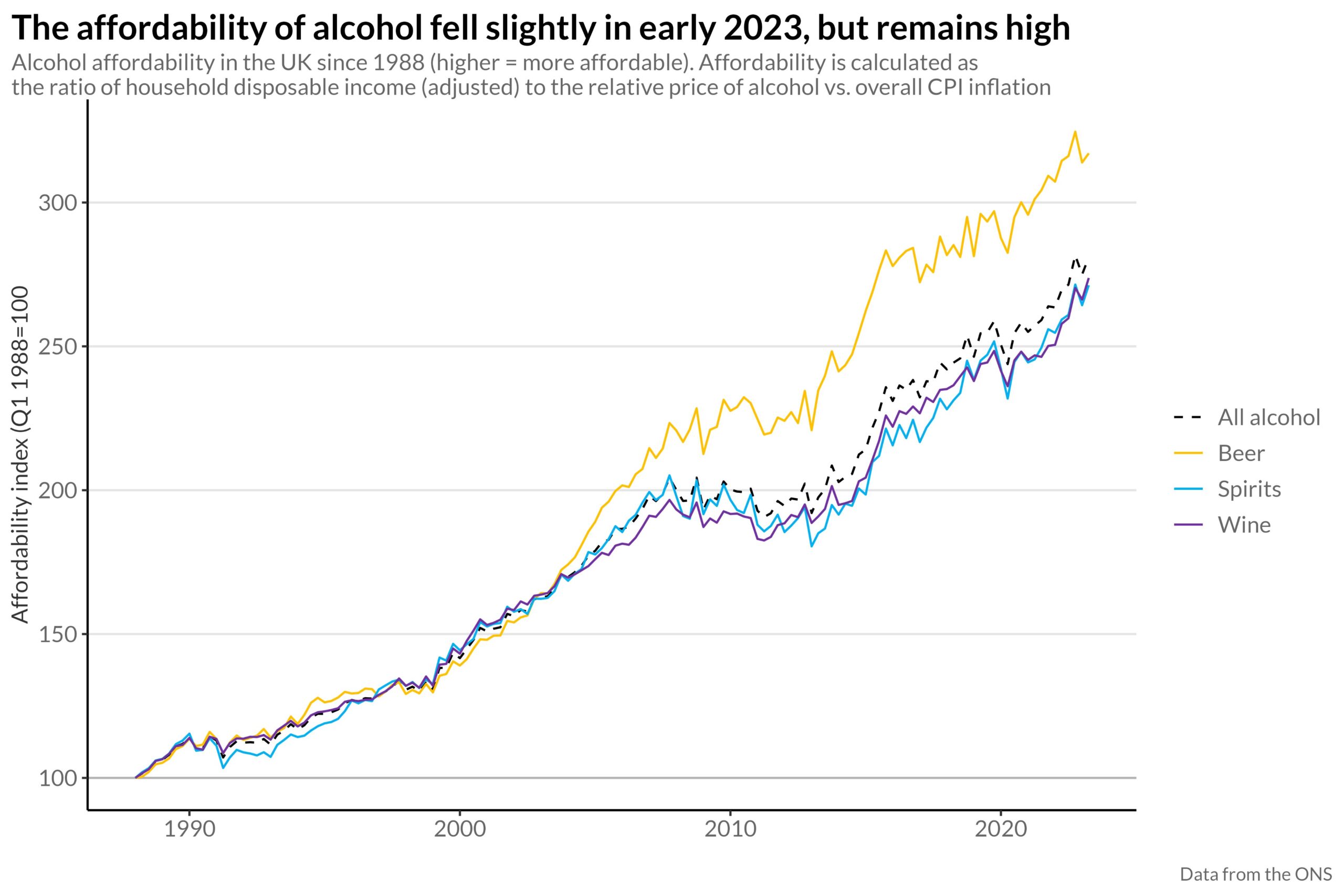
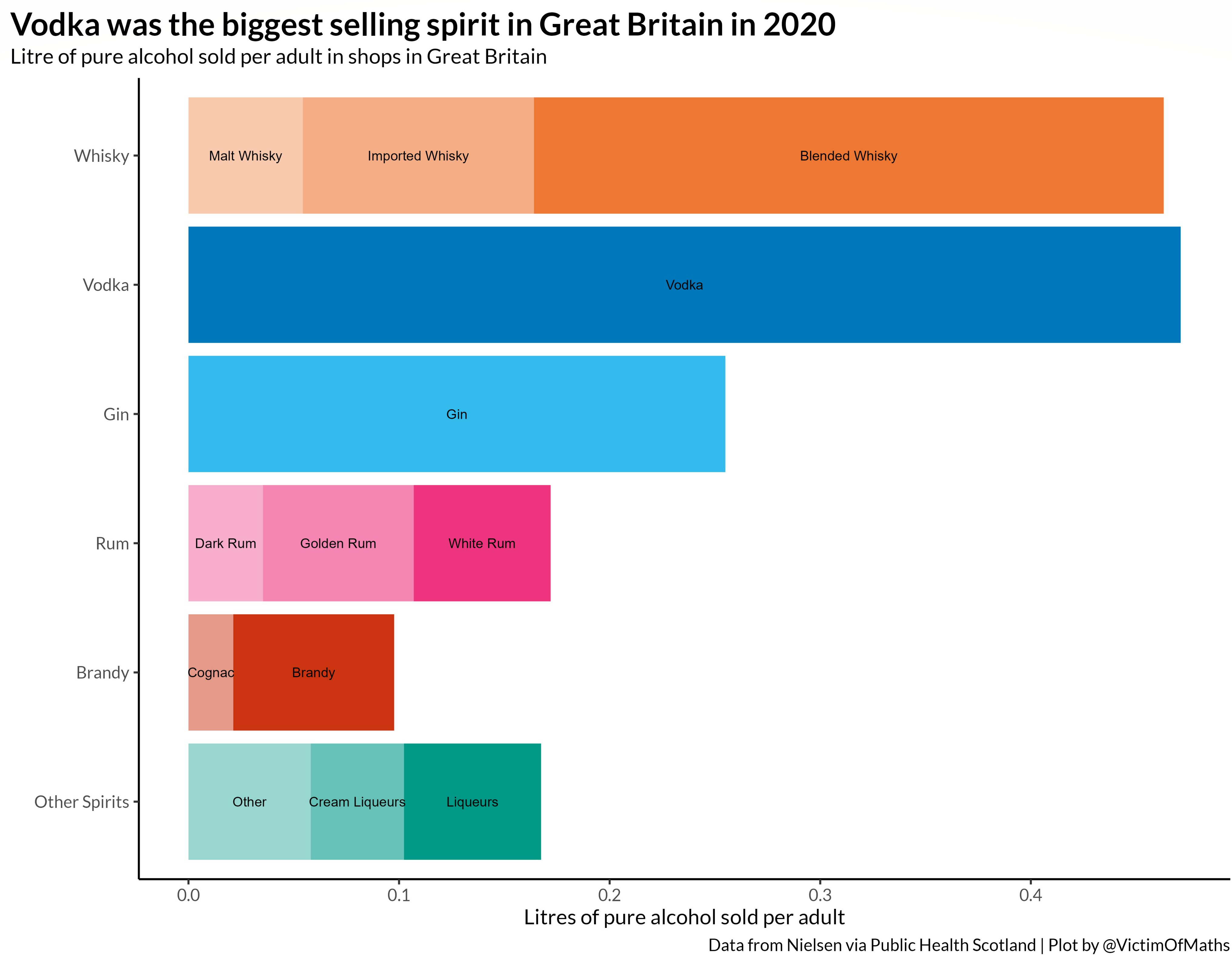
Relatedly, Victim of Maths has shown a similar phenomenon affecting “Today’s Britain Today”*:

Arguments about the affordability of alcohol during the cost-of-living crisis also don’t seem to hold much water. The fact that alcohol prices rose at lower than inflation levels means that even a stagnation in disposable incomes didn’t stop alcohol becoming *more* affordable.

As per usual, he provided a handy graph which I have included for your clicky pleasure. Note how beer in the UK becomes notably even more affordable compeared to wine and the hard stuff right around in the mid-2000s and becomes slowly more and more so. And concurrently climate change may be playing a role too – at least in terms of pure alcohol levels according to Jancis:

As the planet warms up and dries out, it is going to be increasingly difficult to make wines below 14% anyway. I recently attended a tasting of 32 red bordeaux from vintages 2011 to 2019 from the stocks of Justerini & Brooks, a traditional wine merchant not known for favouring flashy wines. Seven of these clarets had 14.5% on the label and two 15%. This would have been unimaginable in the last century.

And finally, just as the previous discussion was triggered by thoughts on the meaning of “full-bodied” in today’s market, Matthew Lawrence of Seeing the Lizards was posting at Twex and responded to the challenge to create a top ten list of beer euphemisms: 1. lively = overcarbonated; 2. easy drinking = flat; 3. juicy = sludge; 4. aged = musty; 5. light = tasteless; 6. fruity = syrup; 7. dank = weed soup; 8. imperial = loopy juice; 9. blonde = bland; 10. challenging = undrinkable. Like. Your list? You could even do one forensically in five year increments for craft beer. Talk among yourselves. I might add overly ripe exclamations as seen in reaction to beer news from “…utter joy to read…” to “…totally gutted by…” or even the “brewery is one of the most successful in the country…” Please.

Done. Remember, ye who read this far down to see if I have edited these closing credits and endnotes (as I always do), you can check out the many ways to find good reading about beer and similar stuff via any number of social media and other forms of comms connections. But beware! Mr. Protz lost his Twex account five weeks ago and still hasn’t recovered his 27,000 followers. Update on my emotional rankings? Now, for me Facebook remains clearly first (given especially as it is focused on my 300 closest friends and family) then we have BlueSky (80) rising up to maybe pass Mastodon (903) then the seemingly doomed trashy Twex (4,429) hovering somewhere above or around Instagram (161), with unexpectly crap Threads (42) and not at all unexpectedly bad Substack Notes (1) really dragging – and that deservedly dormant Patreon presence of mine just sitting there. Seven apps plus this my blog! That makes sense. I may be multi and legion and all that but I do have priorities and seem to be keeping them in a proper row. All in all I still am rooting for the voices on the elephantine Mastodon. And even though it is #Gardening Mastodon that still wins over there, here are a few of the folk there discussing beer:

Alan McLeod | A Good Beer Blog (… me…)
Stan Hieronymus | The Man!
Boak & Bailey | The B² experience
Curmudgeon Ale Works | Jonathon is Brewing
Katie Mather | Shiny Biscuit and Corto
David Jesudason | “Desi Pubs” (2023) author
BeoirFest | They say “Let’s Talk Beer”
Ron Pattinson | The RonAlongAThon Himself
Al Reece AKA Velky Al | Fuggled
Jennifer Jordan | US hops historian
Andreas Krennmair | Vienna beer and lager historian
Beer Ladies Podcast | Lisa Grimm and colleagues
The Bar Towel | Toronto’s chat zone for beer lovers
Chicago Beer Society | Folk in Chicago getting social over beer
Jay Brooks | Brookston Beer Bulletin
Joe Stange | Belgian beer expert, beer magazine editor
Cider Bar | Barry makes Kertelreiter cider
Laura Hadland | CAMRA historian and beer writer
Brian Alberts | US beer historian
Jon Abernathy | The Beer Site
Maureen Ogle | US Beer Historian
Lars Garshol | Norwegian Beer Historian and Kveik Hunter
James Beeson | Beeson on Beer
Carla Jean | MAINER!!!
Thandi Guilherme | Beer Ladies Podcast Co-host
Lisa Grimm | Beer Ladies Podcast Co-host
Roy of Quare Swally | Beery ramblings from Northern Ireland
Rob Talksbeer | Podcaster and Youtuber
Anthony Gladman | UK Drinks Writer
Jeff Alworth | Manna Of Beervana
Northwest Beer Guide | Fairly self explanatory… but not NW Latvia…
Evan Rail | Prague based GBH editor, freelance writer, NYT etc.
Todd Alström | 50% of the Alströms
Jacob Berg | Beer talking librarian

Anyone else? Anywhere else? Yes, you also gotta check the blogs, podcasts (barely!) and even newsletters to stay on top of things including the proud and public and certainly more weekly recommendations from Boak and Bailey every Saturday and Stan at his spot on those Mondays when he is not SLACKING OFF! Look – I forgot to link to Lew’s podcast. Fixed. Here’s a new newsletter recommendation: BeerCrunchers. And  get your emailed issue of Episodes of my Pub Life by David Jesudason on many Fridays. And Phil Mellows is at the BritishBeerBreaks. Once a month, Will Hawkes issues his London Beer City newsletter and do sign up for Katie’s now much more occassional but always wonderful newsletterThe Gulp, too. Ben’s Beer and Badword is back with all the sweary Mary he can think of! And check out the Atlantic Canada Beer Blog‘s weekly roundup. There is new reading at The Glass. Any more? Yes! Check to see the highly recommended Beer Ladies Podcast. That’s quite good. And the long standing Beervana podcast . There is the Boys Are From Märzen podcast too and Ontario’s own A Quick Beer. There is more from DaftAboutCraft‘s podcast, too.  All About Beer has introduced a podcast… but also seems to be losing steam. And there’s also The Perfect Pour. Plus follow the venerable Full Pint podcast. And the Craft Beer Channel on Youtube and remember BeerEdge, too, and The Moon Under Water… if you have $10 a month for this sort of thing… I don’t. Pete Brown’s costs a fifth of that. There was also the Beer O’clock Show but that was gone after a ten year run but returned renewed and here is the link!

*My dream of a name for a current affairs show.

The Final And Totally Mailed In Beery News Notes of August

I have a new hobby. Doin’ nuttin’. After last week’s chores, we took off and wandered a bit around Montreal on the weekend and said hello to Leonard. Crescent‘s bars were bustling last Saturday evening. And we hopped over to Syracuse NY last Wednesday for an afternoon AAA baseball game, a driveby glance into the Loop Grill and some serious American snacks shopping to bring back to Canada but otherwise this summer vacation has been mainly about nuttin’. There should be ads on the TV about staying home and doing nuttin’ like one of those for visiting the Gulf States or Arizona. Except it’s about the backyard. I could monetize that. Become a backyard doin’ nuttin’ influencer. Post TikToks about it. Have a Patreon site about it behind a subscribers only wall. Except that would be doing stuff. And not nuttin’. I am too into nuttin’ to be doin’ something about nuttin’.

What has been going on? First, Pellicle‘s Wednesday piece is about a fairly large diversified English farm operation that includes barley and brewing in its mix of production. It’s a farm with a focus on something more essential – thoughtful care of the soil:

There’s one question which is unanswered: what does this do to the flavour of the beer? Duncan takes a moment to answer, frowning as he thinks of the right word. “Nothing,” he says. He thinks some more, then shakes his head as if confirming the answer to himself. “Nothing. It’s not necessarily about that,” he says. “It’s the ethos that’s gone into building it so you can talk about having environmental benefit and food in the same sentence. That’s the point of it.”

Somewhat similarly in the sense of place, Jeff has written about a relatively secluded micro in eastern Oregon and draws a useful conclusion:

This is perhaps the greatest advantage of remote brewing. In cities, brewers are aware of what people are doing around them. It’s almost impossible not to be influenced, to borrow techniques or discover new ingredients. In Baker City, Tyler and his current head brewer Eli Dickenson can easily drop into their own groove. Their customers know what they do and expect them to do it—and they don’t spend a lot of time at other breweries getting distracted by the trend du jour.

On the opposite end of the reality v. non-reality scale, it was brought to my attention by @DrankyDranks that a fraud is about to be perpetrated on the drinks buying public:

Couple of new non-alc brands on the horizon. White Claw 0% “non-alcoholic premium seltzer,” comin’ in 4 “full-flavor” variants at 15 calories per can with “hydrating electrolytes”: black cherry cranberry, mango passion fruit, peach orange blossom and lime yuzu. Expected in Jan.

The double negative has been achieved! Speaking of the potentially unecessary, care of Beer Today we may have also reached peak data point – an observation I make given the uncertainty I have as to the necessity of this level of detail:

…trading improved in line with the temperatures last week. There was a particular surge in sales in midweek, with Tuesday (up 10%), Wednesday, which was boosted by England’s semi-final victory over Australia (up 17%), and Thursday (up 15%) all in double-digit growth. But trading was more modest on Friday (down 3%) and Saturday (up 4%) as rain moved back in.   Warmer weather lifted the beer category, where sales rose 10% year on year. Wine (up 9%) and cider (up 1%) were also positive, but soft drinks (down 2%) and spirits (down 4%) were both negative.

Does the well informed publican check the weather forecast before placing orders for cask deliveries or setting prices? “Hmmm… rain’s coming Friday, need me a happy hours special…” Maybe. Having once created a 15,000 cell Excel table to track (among many things) hot dog sales and visiting team placement in the league’s standings over six or eight years I am sensitive to the possibilities of such things.

Speaking of stats, France is paying winemaker to destroy some of their stock to cope with this drop in some markets – blamed by the BBC on an increase in craft beer sales:

European Commission data for the year to June shows that wine consumption has fallen 7% in Italy, 10% in Spain, 15% in France, 22% in Germany and 34% in Portugal, while wine production across the bloc – the world’s biggest wine-making area – rose 4%.

Lisa Grimm is posting at Weird Beer Girl HQ and this week comes to the defence of what she calls a trad bar in Dublin, Piper’s Corner:

I’m aware I’m on slightly dangerous ground here, as there’s absolutely a place for the shows aimed at tourists (if they are willing to pay for a specific kind of experience that’s keeping musicians working, why not?), and also because folk music is never static – it’s always evolving, so there’s no one ‘right’ way to play or enjoy trad tunes. Now, this doesn’t mean visitors are not welcome – not at all – just that it seems to be a more organic experience (for lack of a better word – and this is largely based on word of mouth, since you know I’m asleep by then most of the time).

Last Friday, Boak and Bailey posted a review of the new book Cask – the real story of Britains unique beer Culture by Des de Moor which by all accounts is a very good and comprehensive read – if for no other reason (though there seem to be many) than Moore’s willingness to share various points of view:

Though clearly a passionate fan of cask ale, he isn’t an unquestioning cheerleader and points out that it doesn’t work well for every style. American-style IPAs and sour beers, he argues, rarely benefit from cask dispense. He comes right off the fence when it comes to the price of cask ale: “[If] cask beer is to have a sustainably healthy future, its average price will have to rise in comparison to the pub prices of other drinks… One argument for cheap cask is that it helps drive sufficient turnover to keep the product fresh, but that effect has surely reached its limits when price becomes a barrier to maintaining quality.” For balance, he quotes others who disagree, and who worry about cask ale becoming an expensive, niche product, rather than an everyday pleasure.

And Martyn has embarked on a journey about journeying, writing a series of pieces on the value of giving oneself over to the pre-planned pre-paid beer bus tour, all under the umbrella heading “If it’s Tuesday, this must be Kölsch!” So far we have parts one, two and three with more promised. It’s a bit mind melting in the pace, one which may tax even Ron, but he shares a number of observations like this on why one might want to subject oneself to this sort of exercise:

…one big advantage of joining a largeish group of people on a European beer trip is that when you get to, say, a place like Cantillon in Brussels, where the brewery tasting room/bar has a large range of aged 75cl bottled beers costing up to 70 euros a (literal) pop, sharing those rare beers you may never get the chance to drink again among half a dozen or more drinkers cuts the cost per head dramatically.

Good point. And another sort of good reminder this week from The Beer Nut: “Slagging off hazy IPA is easy (and fun!) but well-made beers like this do make it a little bit harder to do.

Heavens, they do things on a certain scale in Kenya when it comes to allegedly skirting the licencing laws:

A Chuka court in Tharaka Nithi County has issued a warrant for the arrest of Simon Gitari for failure to honour court summons over the alleged operation of an unlicensed brewing industry. The millionaire brewer, popularly known as ‘Gitari Boss’, is the director of Hakim Commercial Agencies which owns the factory located in Ndiruni village in Chuka Sub-County. On Monday, a multi-agency team led by Tharaka Nithi County Police Commander Zacchaeus Ngeno raided the distillery and seized 250,000 litres of illegal liquor.

Also somewhat irregular in expectations, Gary wrote an interesting piece on the intersection between pubs and the pulpit in mid-1900s England this week including this example:

The padre Basil Jellicoe (1899-1935) descended from Anglo-Catholic churchment and naval figures, and was Oxford-educated. He had no apparent exposure to pubs as a youth, in fact was a teetotaller. His pub interest was of the old-school missionary-type, inspired by doctrine and the Bible. If church adherents were to be found he wanted to cultivate the ground, and would not let prevailing notions of propriety get in the way. He also wanted to improve social conditions in and related to the pub. He started to operate pubs so he could have full control to promote this goal – the Church was henceforth in the pub business.

Katie wrote about one way of responding to loss through ritual in her most recent edition of The Gulp, one of the few drinks “newsletters” still holding its own:

Despite the tragedies of the past months, spending time with friends is always a celebration, and I intend to treat it as such. My main contribution to the evening’s events will be the wine we drink during feasting and the extremely technical/spiritual practice of “burning shit”. I need to choose carefully. It should be wine that’s good enough to change our fortunes and lift us up. Wine good enough to offer to Hecate, wine good enough to stir our souls and clear our minds. It also needs to pair well with a vegan barbecue.

One of my favourite stunned concepts amongst right-wing US fear mongering is the use of “Canada-style” when used as the ultra “woke” by the “freedom” folk… as in this story’s headline:

President Joe Biden’s chief adviser on alcohol policy said his agency may issue new guidelines that limit Americans to just two drinks per week. Dr. George Koob, the director of the National Institute on Alcohol Abuse and Alcoholism (NIAAA), told the Daily Mail that he’s interested in tightening U.S. guidelines to match Canada’s alcohol recommendations, which say that both men and women should consider having only two drinks every week. Canada’s health department issued the recommendations this year under left-wing Prime Minister Justin Trudeau.

Note: while publicly funded, the Canadian two-drinks standard is a recommendation of a private entity which is one part of a bigger and heavily leaning academic discourse amongst many of a variety of points of view, much also fueled in whole or part directly and indirectly by public funds. We also do not follow the Canada Food Guide all that closely if grocery store shelves are anything to go by. Note also: we live much longer.

Vinepair published an almost self-defeating piece on the role of celebrity and beer replete with branding consulting jargon which then veers off into a reality-based (perhaps even inadvertenly honest) view near the end:

Celebrity involvement will entice journalists to write about a brand once. But star wattage eventually dims as a selling point. “Someday we will not be new news anymore,” says Eight’s Campbell. Any fermented liquid must stand on its own merits, hitting that sweet spot of price point and pleasure. Convincing customers that they should shoehorn another beer into their crowded drinking calendar takes effort, a long play in a world that celebrates the fast windfall. “Even though you have somebody with a big mouthpiece, you still have to build a brand,” Campbell says. “There’s got to be a meaningful connection.”

And finally for Stan (and apparently on brand pachyderm-wise) we have the story of an elephant which did not get into the beer but still sussed out something else:

Placidly and professionally, the mammal sweeps the ground with its trunk several times before tossing up a nondescript black rucksack, trumpeting as it announces its discovery. Border police were already on the scene. The officers had arrived to escort the elephants out of a nearby village, reported China National Radio (CNR). Mindful of their primary duty, police waited till the elephants had made their safe exit before inspecting the elephant’s “gift”, reported CNR. The elephant did not disappoint.

There. A shorter post perhaps but my world is whole even if the news is a bit quieter this week. And as per ever and always, you can check out the many ways to find good reading about beer and similar stuff via social media and other forms of comms to connect – even including at my somewhat quieter than expected Threads presence @agoodbeerblog. Got on BlueSky this week and added it to my IG, FB, X, Mastodon, Threads, Substack Notes and a deservedly dormant Patreaon presence. I am multi! I am legion!! Yet totally sub. All in all, I still am preferring the voices on Mastodon, like these ones discussing beer:

Alan McLeod | A Good Beer Blog (… me…)
Stan Hieronymus | The Man!
Boak & Bailey | The B² experience
Curmudgeon Ale Works | Jonathon is Brewing
Katie Mather | Shiny Biscuit and Corto
David Jesudason | “Desi Pubs” (2023) author
BeoirFest | They say “Let’s Talk Beer”
Ron Pattinson | The RonAlongAThon Himself
Al Reece AKA Velky Al | Fuggled
Jennifer Jordan | US hops historian
Andreas Krennmair | Vienna beer and lager historian
Beer Ladies Podcast | Lisa Grimm and colleagues
The Bar Towel | Toronto’s chat zone for beer lovers
Chicago Beer Society | Folk in Chicago getting social over beer
Jay Brooks | Brookston Beer Bulletin
Joe Stange | Belgian beer expert, beer magazine editor
Cider Bar | Barry makes Kertelreiter cider
Laura Hadland | CAMRA historian and beer writer
Brian Alberts | US beer historian
Jon Abernathy | The Beer Site
Maureen Ogle | US Beer Historian
Lars Garshol | Norwegian Beer Historian and Kveik Hunter
James Beeson | Beeson on Beer
Carla Jean | MAINER!!!
Thandi Guilherme | Beer Ladies Podcast Co-host
Lisa Grimm | Beer Ladies Podcast Co-host
Roy of Quare Swally | Beery ramblings from Northern Ireland
Rob Talksbeer | Podcaster and Youtuber
Anthony Gladman | UK Drinks Writer
Jeff Alworth | Manna Of Beervana
Northwest Beer Guide | Fairly self explanatory… but not NW Latvia…
Evan Rail | Prague based GBH editor, freelance writer, NYT etc.
Todd Alström | 50% of the Alströms
Jacob Berg | Beer talking librarian

Anyone else? And, yes, we also check the blogs, podcasts and newsletters to stay on top of things (though those things called “newsletters” where 1995 email lists meet the blogs of 2005 may be coming to an end of value if the trend with so many towards the dull dull dull means anything) including more weekly recommendations from Boak and Bailey every Saturday and Stan at his spot on those Mondays! Get your emailed issue of Episodes of my Pub Life by David Jesudason on many Fridays. And Phil Mellows is at the BritishBeerBreaks. Once a month, Will Hawkes issues his London Beer City newsletter and do sign up for Katie’s now much more occassional but always wonderful newsletterThe Gulp, too. Ben’s Beer and Badword is back! And check out the Atlantic Canada Beer Blog‘s weekly roundup. There is new reading at The Glass. Any more? Yes! Check to see the highly recommended Beer Ladies Podcast. And the long standing Beervana podcast . There is the Boys Are From Märzen podcast too and check out the travel vids at Ontario’s own A Quick Beer. There is more from DaftAboutCraft‘s podcast, too.  All About Beer has introduced a podcast.  There’s also The Perfect Pour. Plus follow the venerable Full Pint podcast. And the Craft Beer Channel on Youtube soon celebrating a decade of vids.   And remember BeerEdge, too, and The Moon Under Water… if you have $10 a month for this sort of thing… I don’t. Pete Brown’s costs a fifth of that. There was also the Beer O’clock Show but that was gone after a ten year run but returned renewed and here is the link!

This Week’s Beery News Notes Are Fraught With All That A Thursday Might Entail

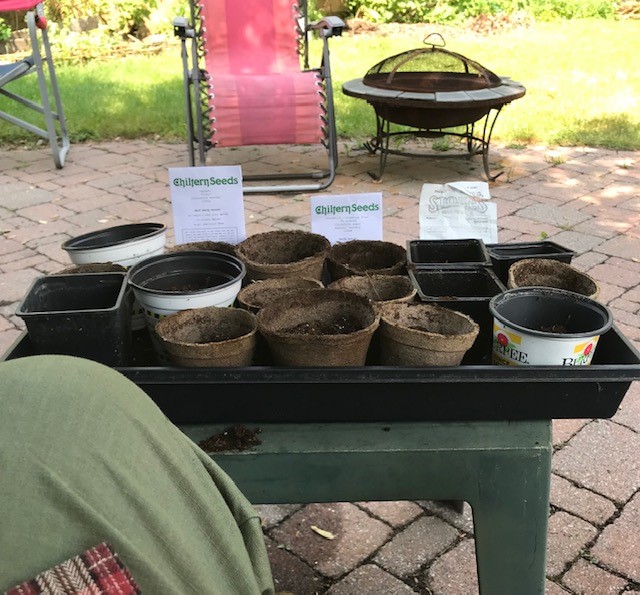
What a week. I spend the week’s few forecasted dry sunny hours on Tuesday evening hands on knees with this newly acquired handy friend indeed clearing out a patch invaded by raspberries and catnip about seven by ten foot to move some of the tomato plants into. I wanted to lay down and weep by the end me being an old guy and all but it’s got to be done. It’s really getting out of hand out there. I have a pot problem. Bought another six to fill Monday night just in case. “Just in case of what exactly?” I later thought. Seventeen zucchini seeds hit the soil on Saturday and pole beans were added on Sunday too, as illustrated. Who is going to eat all this other than the bugs and birds?

Where to begin this week? There’s a lot so perhaps at the outset just a summary of the endsy timesy news of the week. The spokesperson for the BA actually used the phrase “craft slowdown” this week. Mirrors perhaps the excellently honest new B+B tag for these times: “the age of divestment“! We learned this week, as Stan noted, “stunning is the news” that Anchor‘s beer will be far less common a sight. We also heard (as I dutifully discussed back in late April) that things are not going so well financially at BrewDog as the Morning Advertiser shared:

BrewDog has reported an operating loss of £24m in its latest trading update… which BrewDog founder James Watt attributes to the cost of investing in the brand, its people and its bars, alongside the “devistating” increase in input costs.

All of which unnervingly indicates that the losses were due to making less money than they spending on, you know, their core activities. All of which leads me to wonder if an ebbing tide lowers all boats. Not yet here in Canada where there was a very sensible bit of consolidation as reported by the clever folk behind the Canadian National Beer News Service, a branch of the Department of The North:

Corby Spirit and Wine Limited has announced that it is set to purchase Ace Beverage Group, parent company of Ace Hill Beer and several other beverage alcohol brands, including Cottage Springs and Cabana Coast ready-to-drink cocktails, Liberty Village cider, and Good Vines wine spritzers. The transaction will see Corby acquiring 90% of Ace’s shares for $148.5 million, with call options on the remaining shares that can be exercised in 2025 and 2028.

That’s real money but apparently the beer assets is one of the least attractive part of the deal. Despite its ongoing move to be about less beer hunting, there was an similar tale told about Ninkasi Brewing in GBH. More good beer settling in as just a part of a portfolio.

Settling. Phil of the excellently named Oh Good Ale in a post also excellently named as “Toil and Trouble“* wrote about a survey retaken after ten years, a repeated of a 2013 census of sorts studying pubs, breweries and cask ale in one part of Manchester England, Chorlton, and had surprising results:

What’s changed? Well, many things have changed – I’m comparing April with June, apart from anything else, so it may possibly be that some of those bars were running dry due to warm-weather demand. Other than that, I was expecting to see little change among the (seven) bars of 2013 – six of them still are bars, after all – and carnage among the (22) breweries, but if anything it was the other way round. As far as I can make out, only three of the 22 breweries have closed outright…

What he found had changed was in the pubs, that the range of service had retracted leading him to state that “the cask bubble in Chorlton and environs has pretty well burst” leading in turn the Tand himself to comment:

…leaving cask to those that handle it well is good policy and the points about addressing a mixture of beer expert and cheapskate are well made.

So perhaps not so much a burst bubble as enthusiasms becoming cammed doon. No, craft is not to blame as it is retracting too. It’s all just a bit of balancing out.

Lisa is not settling. She has scouted out another weird pub for her guide to Dublin starting with this appealing intro:

I must admit, the immediate vicinity of this week’s pub is something I typically speed through as quickly as possibly – the visual clutter from its side of Westmoreland Street is not the most inviting vista, featuring, as it does, the National Wax Museum (NATIONAL WAX MUSEUM), lots of plastic major-brand logos, and CCT Dublin’s building in that block must be one of the worst insults to architecture in any European capital (and I have a soft spot for a lot of ‘ugly’ kinda-Brutalist buildings, but this…is not that). 

Beet beer is in the news care of Pellicle (and it’s a favourite of mine given we have year round access to my nearby neighbours’ MacKinnon Bros Red Fox Ale which is made with good Ontario root veg):

Given all these strengths, I asked the brewers why they thought beets weren’t a more common beer addition, especially given the great diversity of fruits and other adjunct ingredients brewers are experimenting with these days. Part of it, of course, is that beets are just a contentious food. Todd, for his part, doesn’t find it terribly surprising that so few brewers have touched beetroot. “I recently saw a meme about fast food variety, and it just showed fried chicken sammies from every chain. That is basically craft beer right now, but sub in hazy IPA/kettle sour. Yes, there is a lot being added to beer these days but I would say that it isn’t really experimental, or very courageous,” Todd says. “For real, no shade over here, but the ingredients people are using could be mistaken for a candy shop or ice cream parlour.”

I like that… because if ye’ve no eaten your veg you cannie hae any puddin!

A fitting obituary for a great rugby player and beer man, Paul Rendall:

He would often proclaim Nunc est bibendum. For those old team-mates who had not studied Latin, he would explain, in the bar, of course, that now it is time to drink.

Drinks Business had a great piece this week unpacking more about that waste water beer building that I mentioned a month ago in San Fran:

In an experiment, Epic fed wastewater from a large San Francisco apartment block through “ultrafiltration membranes” 100 times thinner than a human air. They filter out impurities and the cleaned water is then disinfected by using ultra-violet light. Tartakovsky told CNBC this process is comparable with the biology that takes place in the human stomach. And seemingly it works. He claimed that independent testing of Epic’s cleaned water shows it meets US Federal standards for drinking water and often exceeds them. Cleaned water was passed to Devil’s Canyon Brewing Co in San Carlos California, which produced the Epic OneWater Brew.

What else is out there in the world? Well, The Beer Nut continued his wandering ways and has reported on a trip in May to Haarlem in The Netherlands and found a lack of wallop:

While I’m used to the Dutch people’s effortless fluency in English, I’m not sure that Black It Up! was a great name for the beer. Echoes of Zwarte Piet linger there. I liked the tarry bitterness in the aroma here, presented with a little black pepper spice. It was unfortunately rather more ordinary to taste: dry and roasty with only a token treacle effect to thicken and sweeten it, and no proper hop wallop. I feel that something of this nature should be delivering wallop aplenty; instead this is calm, restrained and frankly a bit boring. Oh well.

Sounds a bit like me. Anyway, speaking of The Netherlands, Ron has been in Vietnam revealing all on the breakfasts to be found near the lobby among other things. And, elsewhere, Stan is reporting from the hop fields again, with his jam packed June 2023 edition of Hop Queries now out. This month we learn that:

Friday the USDA forecast hop acreage strung for harvest in 2023 in the Northwest will be down 8%, or 5,067 acres, from 2023. That’s only about half of the reduction John I. Haas CEO Alex Barth told those attending the American Hop Convention is necessary to begin to get American hop supply and demand back in balance. More likely will be needed… Because general agreement is that the alpha market is in balance, that means the reduction must come from varieties valued first for their aroma and flavor. In fact, farmers added more than 2,500 alpha acres (primarily +1,960 CTZ and +555 Pahto), and aroma acreage was down more than 7,500.

The fabulousness that Stan brings is rooted in the shameless presentation of hop production as agriculture. Fact fact factity fact. You might as well be reading reports from an early US ag societies studying barley growth over 200 years ago. It is all a continuum of knowledge development that sits as a counterpoint to the sorts of approaches to appreciation that startle one with their admitted limitations:

…there’s nothing wrong with mystery, I try to use it when I can for if you stuck to the plain facts with beer you would have writing on a par with that covering the drainage industry or the world of pallets

Speaking of facts, we had a wonderful bit of pushback published this week by a very unhappy investor in the now restructuring Black Sheep Brewery, one of England’s longest serving micros. See, as noted in my May 4th editon of these my scribbles, when everyone cheered Hooray! at the idea it was not shutting so much as getting its affairs in better order we must remember that one of the realities when a firm goes into administration is that the necessary new money may well have to bump away a lot of the old. As we are told is happening in this case:

Long before Covid, when interest rates were at all-time lows and trading conditions were relatively benign, I clearly identified the coming apocalypse, and tried to spell out to those few of you who would listen that “The End was nigh”. Back then, there was still an opportunity to raise new equity, properly invest in our brand, arrange for regulatory accreditation of the packaging plant, smell the coffee, or rather understand where national beer consumption, and indeed alcohol, trends were heading, and to truly “Build a better Black Sheep”. My prescient web-site spelled it all out for you.

The piece goes on to name names and point pointed fingers. I expect the law will be applied appropriately.

Not dissimilarly in terms of a daring do done, I was surprised in a very familiar way by the wild eyed responses to the excellent opinion piece published by Pellicle this week. An editorial. Now, right up front we have to be clear – good beer is no place for forming and certainly no place for sharing opinions or editorials so it is fair that it created a sort of confusion in the hearts of many. Don’t worry. It’s just like that feeling you felt when you saw a small dog in bright yellow rain boots for the first time. Odd but it actually works.

And what was the problem? What upset the universe? Well, if you really want to know, this is the sort of vile sprew that society faced when it woke on Monday morning:

I respect the importance of linking beer back to its agriculture—in fact this is something I feel personally invested in—but this is not the same thing as terroir. Beer is not merely a representation of the land from where its ingredients came, and to advertise it as such underplays the significance inherent to the production of both beer itself, and its individual raw materials.

Good Lord! The gall of the man!! See… see… err… well, that actually all makes fairly perfect sense doesn’t it. Hardly an opinion at all. Most agreed. It’s practically cheery out there. Yet… we are faced with three sorts of minor rebuke (aside from the usual scoffy self-satisfied crab bucketeers in the corner): (i) “Wrong!” (ii) “Clickbait!!” and (iii) you have to appreciate that to be an expert you need to understand that nothing means anything so trying to explain stuff is pointless…  as well as combinations of that trio of top notch beer writing principles right there. We are, as always, formed and framed by our weaknesses more than our strengths.

Stan shared a well considerd counterpiece supporting the use of terrior in relation to beer. Read the whole thing but here is the nub:

I became more comfortable with the word as I researched “For the Love of Hops” and continued with “Brewing Local,” although I continue to prefer “taste of place.” Amy Trubek concludes “The Taste of Place: A Cultural Journey Into Terroir,” an absolutely terrific book, by writing “ . . . the taste of place exists, as long as it matters.” To repeat myself, I’m more inclined to use the words taste of place opposed to terroir, but I’m fine with “beer terroir exists, as long as it matters.” Both matter to me.

That works, too. For me? A bit of this has always been the way. There is a simmering desire in beer writing for the shortcutting convenience that making X mean Y brings. The extrapolation slipped in here or there. And there is no X that is more attractive to beer culture as a Y construct than a well grounded principle from the much more established world of wine. So, we have a slightly wonky beer styles construct because wine has naturally developed styles. And we have mildly informative beer atlases mainly because wine legend Hugh Johnson made an excellent one about wine that has been regularly updated.** Just recently  Garrett Oliver illustrated this tension (and perhaps even envy) recently when he wrote:

We sometimes forget that the projection of meaning is WORK. Hard work. The wine industry does that work. The beer industry, by and large, does not. This is one reason why wine and spirits are eating our lunch, especially in the US.

And the results and the dear are real. At least here in Canada, where we have moved from a marketplace where (i) in 2002, beer had a market share of 50 per cent by dollar value, while wine had 24 per cent to one (ii) to 2012, to one with a 44 per cent beer to 31 percent wine ratio and (iii) by 2022, we have a 34.9% beer to 31.3% wine. There is cause for concern.

Hmm.  What does it mean and where does it all take us? I like this take by T-Rex to my left, your right. And little while ago, Jeff wrote very sensibly how a technique is not a style. Similarly, things can only bend so far and we need to agree that terroir is not defined by a technique. Technique is not terroir. A yeast strain that’s been transported world wide as terroir? Nope. That’s all square-holery-round peggishness to me. Works for you? Fine… but it’s  utterly unnecessary and may undermine things. Don’t get me wrong. I have been into good wine for as long or longer than I have liked good beer. I have even tended to my own vineyards in two provinces, mainly to the delight of birds. For my money, the two trades deserve to return to their largely separate and well-defined lexicons if anything is to be understood in itself. Ditch the code and, as Matt wrote, all that it is covering up. Clarity avoids confusion. Get at that, please. Yes, you. The problem is… I am not sure how much of beer writing is meant to do that, if it is meant to make things clearer to the beer buying public.*** There is comfort in mystery apparently. And, in a world where some of the expertise is based on hanging out one’s own shingle or … where one has little else, well… one has to protect one’s reputation. Doesn’t one.

Finally and just perhaps unrelatedly, I have a hard time getting my head around the idea that the Nigerian non-alcoholic beer market is worth 6.2 billion USD when the same article states:

BusinessDay’s findings showed the firm incurred a loss of N10.72 billion in the first quarter of 2023 from N13.61 billion in the same period of 2022. The firm’s net revenue amounted to N123.31 billion in the first quarter of 2023, a 10.5 percent decline from N137.77 billion in the comparable period. “Despite challenges, the opportunities in the coming decades for non-alcoholic beers are quite as substantial. That is a prospect worth drinking to,” John said.

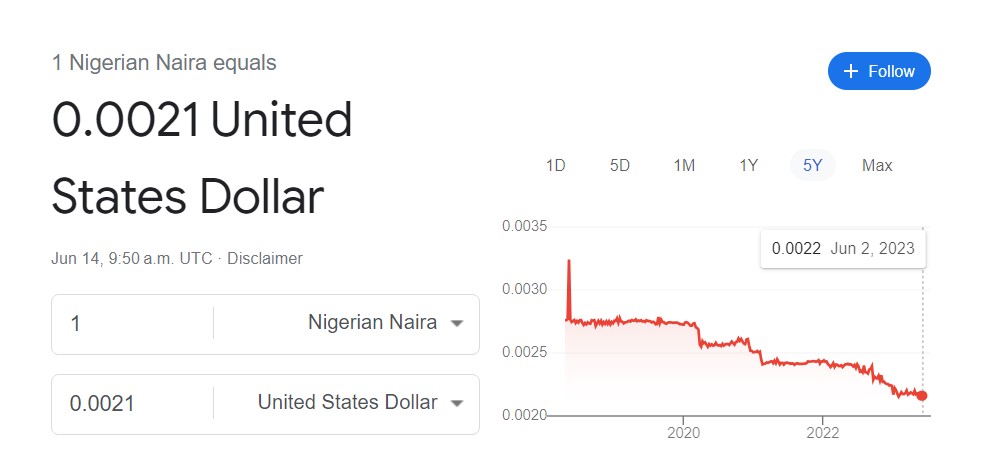
Worth nothing that the collapsing Nigerian Naira is currently worth 0.0021 USD and, as the same article states, roughly 50 percent of Nigeria’s brewing input costs is imported.

That’s it! That’s enough from me. I need to save my strength for the allotment my house now sits in. Back to you for now as always. And as per, you can check out the many ways to connect including these voices on Mastodon, the newer ones noted in bold:

Stan Hieronymus | The Man!
Boak & Bailey | The B² experience
Curmudgeon Ale Works | Jonathon is Brewing
Katie Mather | Shiny Biscuit and Corto
David Jesudason | “Desi Pubs” (2023) author
BeoirFest | They say “Let’s Talk Beer”
Ron Pattinson | The RonAlongAThon Himself
Al Reece AKA Velky Al | Fuggled
Jennifer Jordan | US hops historian
Alan McLeod | A Good Beer Blog (… me…)
Andreas Krennmair | Vienna beer and lager historian
Beer Ladies Podcast | Lisa Grimm and colleagues
The Bar Towel | Toronto’s chat zone for beer lovers
Chicago Beer Society | Folk in Chicago getting social over beer
Jay Brooks | Brookston Beer Bulletin
Joe Stange | Belgian beer expert, beer magazine editor
Cider Bar | Barry makes Kertelreiter cider
Laura Hadland | CAMRA historian and beer writer
Brian Alberts | US beer historian
Jon Abernathy | The Beer Site
Maureen Ogle | US Beer Historian
Lars Garshol | Norwegian Beer Historian and Kveik Hunter
James Beeson | Beeson on Beer
Carla Jean | MAINER!!!
Thandi Guilherme | Beer Ladies Podcast Co-host
Lisa Grimm | Beer Ladies Podcast Co-host
Roy of Quare Swally | Beery ramblings from Northern Ireland
Rob Talksbeer | Podcaster and Youtuber
Anthony Gladman | UK Drinks Writer
Jeff Alworth | Manna Of Beervana
Northwest Beer Guide | Fairly self explanatory… but not NW Latvia…
Evan Rail | Prague based GBH editor, freelance writer, NYT etc.
Todd Alström | 50% of the Alströms
Jacob Berg | Beer talking librarian

Anyone else? And, yes, we also check the blogs, podcasts and newsletters to stay on top of things – including more weekly recommendations from Boak and Bailey every Saturday and Stan at his spot on those  Mondays! Get your emailed issue of Episodes of my Pub Life by David Jesudason on many Fridays. Once a month, Will Hawkes issues his London Beer City newsletter and do sign up for Katie’s now more occassional but always wonderful newsletterThe Gulp, too. Ben’s Beer and Badword is back! And check out the Atlantic Canada Beer Blog‘s weekly roundup. There is new reading at The Glass. Any more? Yes! Check to see the highly recommended Beer Ladies Podcast. And the long standing Beervana podcast . There is the Boys Are From Märzen podcast too and check out the travel vids at Ontario’s own A Quick Beer. There is more from DaftAboutCraft‘s podcast, too.  All About Beer has introduced a podcast.  There’s also The Perfect Pour. Plus follow the venerable Full Pint podcast. And the Craft Beer Channel on Youtube soon celebrating a decade of vids.   And remember BeerEdge, too, and The Moon Under Water… if you have $10 a month for this sort of thing… I don’t. Pete Brown’s costs a fifth of that. There was also the Beer O’clock Show but that was gone after a ten year run but returned renewed and here is the link!****

*Here you go. Here’s the reference.
**When the fam says “What? Why?” when I pull out a bottle of something tasty, I pull out my atlas, point at a patch of a few hundred square metres and say “From that field right there!
***See, if you see nuance or complex or subtle being used to point at things that are merely specific or one part of a long list, just as with “mystery” as cited above, you might be in the doldrums of such conditions. Hanging out with engineers taught me this. Engineers are the heroes of the lengthy sensible to do list. Put things on it when you think of them and strike them off when they get done. Build a few bridges and you learn this sort of thing. 
****And finally the list of the departed newsletters and podcasts or those in purgatory. Looks like  both Brewsround and Cabin Fever died in 2020, . We appreciate that the OCBG Podcast is on a very quiet schedule these days – but it’s been there now and again.  The Fizz died in 2019.  Plus Fermentation Radio with Emma Inch seems done and the AfroBeerChick podcast is gone as well! The Fingers Podcast packed it in citing, umm, lack of success… as might have been anticipated, honestly. Did they suffer a common fate? Who knows?

The Tired Old Thursday Beery News Notes For The End of October

Tired and old? Not the notes! Just me. The municipal election was Tuesday and it was a long day at the coal face, pick and shovel in hand. My sixth election for work. I love it as I get to practice a very specific sort of thing that only applies one evening every four years. Like being good at Leap Year law. Well, at least good enough. I also crossed over to the nearby US of A this week for the first time in years. Didn’t buy any beer given how crummy the exchange rate is and how high the duties – but I did get a couple of boxes of Cracklin’ Oat Bran, one of the cereals our Canadian federal government denies us. The US port of entry at the bridge 35 miles or so from here has been rebuilt and looks like something out of Star Wars… or Red Dwarf maybe. It’s actually really an interesting bit of architectural design. Imposing. As it should be.

What else is going on?  Well, Jordan was in town last week – but I was tied to the desk and couldn’t make the twenty-three minute walk to Spearhead (led by Josh, himself a municipal candidate!) to watch the brewery’s rather ultra set up produce an ESB for an excellent charitable cause. The brewery is very good about offering support like that also producing a light lager for CJAI, the community radio station whose monthly minutes I take as secretary of the board.* Jordan shared a bit about the experience:

…we’ve got Maris Otter, a little Dark Crystal, and some Black Patent Malt for colour correction. We’ve got Challenger, Fuggles, and East Kent Goldings which should give it some verisimilitude… The brewing system at Spearhead is so advanced that there are not a huge number of pictures you can effectively take of the brew day. I have raked out enough mash tubs on camera over the years and I always feel I look a little silly doing it. I also felt silly posing next to the console with my finger over the transfer button so I made Jacob do it. I feel like I look a little silly most of the time.

For Punch, Courtney Iseman wrote an interesting piece on simmering backlash against the vague concept of IPA. I was particularly pleased to see it reached back and made the case for continuity even if it suffers from the amnesia that beer writer interviewing beer writer summations like this also offer:

IPA’s true history remains buried in England, and is all but unknown in the United States. From a 19th-century influx of German immigrants to post-Prohibition consolidation of American beer under just a few behemoth brands pumping out yellow, fizzy water, the United States was a longtime lager land. Peter Ballantine & Sons Brewing Co. made one of the country’s few IPAs from the late 1800s until 1971, which inspired Fritz Maytag to make, four years later, Anchor Brewing Co.’s Liberty Ale, a dry-hopped pale ale that motivated more U.S. brewers to follow suit.

Craig described the history of American IPA dating back to the early 1800s in 2013 – and at least 1852 in Canada – but at least that part of the chain from Ballantine to today has been acknowledged.
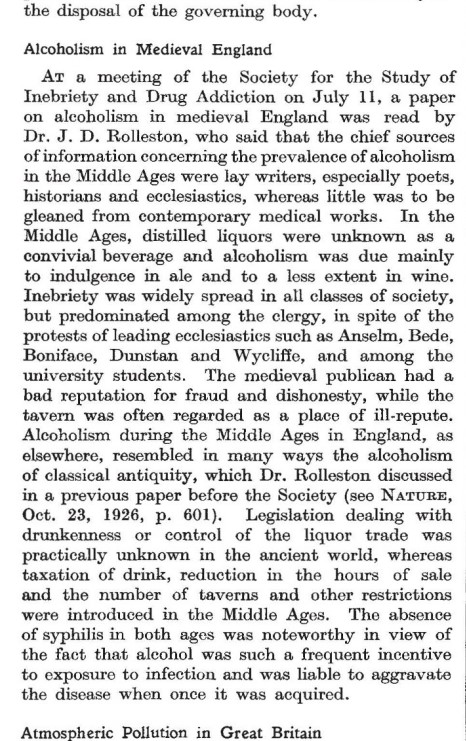
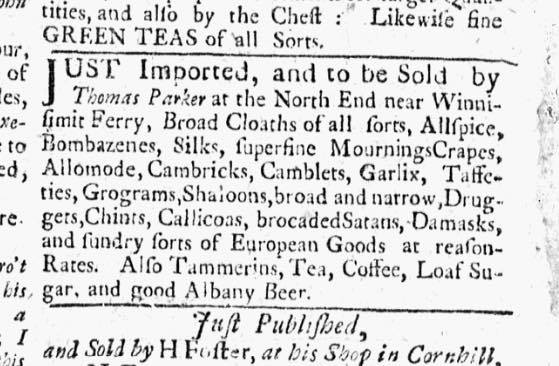
Speaking of improving the track of actual brewing history, the comments last week illustrated the need to be diligent. That responsibility led me to one particularly unique factor to include in considerations, suggested in 1933 by the British scientific journal Nature, a stick to medically measure how pervasive ale was in the medieval era:

The medieval publican had a bad reputation for fraud and dishonesty, while the tavern was often regarded as a place of ill-repute. Alcoholism during the Middle Ages in England, as elsewhere, resembled in many ways the alcoholism of classical antiquity…  Legislation dealing with drunkenness or control of the liquor trade was practically unknown in the ancient world, whereas taxation of drink, reduction in the hours of sale and the number of taverns and other restrictions were introduced in the Middle Ages. The absence of syphilis in both ages was noteworthy in view of the fact that alcohol was such a frequent incentive to exposure to infection and was liable to aggravate the disease when once it was acquired.

One more historical question – did this cleric actually first bottle a beer?

Pellicle sent out an update to subscribing supporters like me and the message is clear – the plan to have a self-sufficient quality beer writing without compromising dependence is possible:

…at the time of writing this we are at 296, which is the highest number of Patreon supporters we’ve ever had. We hope you feel your support is worthwhile, and if its not, please consider my inbox always open. We understand that circumstances change, and things aren’t simple for many of us at the moment, including ourselves. I want to ensure that the way we run Pellicle is transparent, and you can see where your donation goes… While we maintain our ethos is to celebrate the joy inherent within our favourite drinks cultures, we also believe that these spaces can only be truly joyful if they can be enjoyed by everyone. We’ll continue publishing articles in this vein in the future for this reason. 

The recent piece by Emmie Harrison-West on the failure of UK craft to support a call to end sexism is proof enough of that intention. Compare assurances elsewhere that a “critique on the beer industry itself” is best avoided. I also liked this week’s article on the folly of wine tourism and suggest they apply equally to beer tourism which, as one wag recently put it, is a euphemism for getting drunk in a city where no one knows you. If you think of it, that second Pellicle article as well as the one in Punch above also align a bit with the image to the right, a brewery advert aimed at a French colonial soldier in Algeria spotted on Twitter this week. Click for deets.

Stan in his newsletter Hopping MadThe Hoptician… err… Hop Queries included an extended bit on that thing I know nothing about called first wort hopping:

In 1995, the German brewing magazine Brauwelt reported on the “rediscovery of first wort hopping,” documenting that many German breweries implemented first wort hopping 100 years before. It is a technique where hops are added to the first runnings of wort from the lauter tun. This exposes hop material to wort at lower temperatures and an elevated pH for an extended period of time. Advocates for FWH claim it produces a beer with improved bitterness qualities that can be described as “smooth” and “harmonious.”

Sounds a bit like myself, smooth and harmonious.

Glynn Davis wrote about how interviewing one restauranteur who went alcohol free led to considerations of the overall value proposition:

Rather like Hussain has found at the Blue Naan, the adoption of non-alcoholic and low-alcoholic drinks is not going to help attract customers (quite the opposite could be the case, in fact), nor are they going to be some big money spinner for hospitality businesses. But that’s not to say they don’t have a place in helping companies achieve other aims that might be more focused on health, wellness and faith, rather than just being about hard cash.

One last thing? Was craft beer culture ever cool other than to the people with the buzz at the expensive beer bar? Or was the relatively dead air on social media after the results were released more the case?

Hmm… something to think about. As you do, please check out the updates from Boak and Bailey hopefully now again mostly every Saturday and also from Stan more now on a Monday than almost ever! Check out the weekly Beer Ladies Podcast. The  OCBG Podcast is on a quieter schedule these days – and also sometimes, on a Friday, posts at The Fizz as well (Ed.: we are told ‘tis gone to 404 bloggy podcast heaven… gone to the 404 bloggy podcast farm to play with other puppies.) And the long standing Beervana podcast (Ed.: which I have missed from this list for some unknown reason.) Check out the travel vids at Ontario’s own A Quick Beer. There is a monthly sort of round up at The Glass. (Ed.: that seems to be dead now… nope, there was a post on July 25th… in 2022 even.) There is more from DaftAboutCraft‘s podcast, too. And sign up for Katie’s (Ed.: now very) irregular newsletterThe Gulp, too. And check out the Atlantic Canada Beer Blog‘s weekly roundup. Still gearing  up, the recently revived All About Beer has introduced a podcast, too. (Ed.: give it a few weeks to settle in and not be as agreeable… not sure this went very far…) Plus follow the venerable Full Pint podcast. And Fermentation Radio with Emma Inch. The AfroBeerChick podcast as well! And also look at Brewsround and Cabin Fever. And Ben has his own podcast, Beer and Badword (Ed.: …notice of revival of which has been given… still not on the radio dial…)  And remember BeerEdge, too, and The Moon Under Water. There was also the Beer O’clock Show but that’s now gone after a ten year run… no, it is back and here is the link!

*I like to play both sides in radio land.

These Are The Brief But Tersely To The Point Beery News Notes For This Week

Mid-October. It is still pretty nice out there. Maples bursting with bright orange leaves around the neighbourhood. Still no frost in the forecast right up to the last days before November. It’s nutty. I have been more ant than grasshopper nonetheless and busily squirreling away preserved crops one way or another. Last night I was seen preserving ginger root in Sauternes. I have more to prepare and may do a batch soaked and submerged with bourbon. Not sure I would try this with beer… unless an imperial stout over 10% was nearby. That might be quite the tasty treat.

Back to the island, Boak and Bailey published a very impressionistic bit of writing about the experience of returning to hunting out beer in Germany after more than a decade. I say impressionistic primarily on the basis of the first word in the title of the bit is “impressions” so you can consider me a believer. And an exercise in an alternative approach it is very refreshing:*

A proper dodgy station, like all proper cities have, its plaza reeking of urine and scattered with beer bottles. Old hands rummaging in its bins, searching for treasure. Have fun in our city, the gateway says – have a drink or two, by all means – but don’t let it take you. Under the ring road, through the old city wall, and into a party on the move. Is it the last night of the year for a T-shirt, or the first for scarves and gloves? Wegbiers there and here. Döners here and there. Cream-coloured taxis nosing through crowds forced out into the street from hot bars with hot red lights.

Elsewhere, Jenny P posted some interesting images this week of South African Chibuku, a sorghum beer made by SABMiller and its competitors which are sold in cartons – some of which have rather direct if not graphic health warnings. We used to get A+W root beer in those containers. When I were a lad…

Lars posted a response to the thoughts of Martyn on the use of beer as the alternative to toxic water in the medieval period. As it is impossible to prove a negative, I lean away from arguments which include statements such as “I suggest that is impossible” and so I find Lars has the slightly more compelling argument:

Sweden and Denmark are further to the south, and a completely different story. In both countries the norm was to brew new beer every time the barrel was empty. Beer literally was the everyday drink against thirst to the point that in Denmark the most common name for the weaker beer was “dagligøl” (daily beer), while in Sweden beer was just known as “dricka” (drink) or “svagdricka” (weak drink). It’s difficult for people today to accept this as fact, but nevertheless people really did drink beer all day every day (where they could). Here’s a quote from a Danish farmer describing his own upbringing: “People drank a lot of beer, and only beer. Nobody would think of drinking water or milk.”

I would point out a couple of things that also guide me. Martyn bases his argument on reliable stats related to English grain production from 1275 to 1324 and holds that:

…to supply every adult in the country with three and a half  pints of ale a day, the minimum to keep hydrated if you are not drinking water, would have required 83 per cent of the country’s entire grain production to be used for brewing.

This is a rational observation. But it fails to take into account that the less noticed lives of poor and country folk would have found their alcohol through fermentables which were (i) not those recorded for national stats and (ii) likely included or even relied on plants other than wheat, rye, barley and oats. We see, for example, plenty of past references to pea and bean malt. Consider this from the very Martyn himself in 2012. Consider also a brewer in my fair city just 207 years ago seeking a supply of peas.  If these are added to the national supply, that 83 percent may drop, maybe even by double digits… say to 66% hypothetically. Also, he argues that “if the average is only one pint a day, that accounts for only 19% of total grain production.” But what else is it supposed grain production would go to in them there days other than bread and ale? Add to that Lars’ argument that we should not forget the poor simply died young as they were destitute. Perhaps destitute of ale. And perhaps exactly because they were destitute of ale. All in all, the jury should still be out on this one.

Back to the present, Jeff concludes his thoughts on a trip to Norway, so praised by clever people like me last week, with more excellent observations but perhaps a few affirmations which may be a wee but perhaps understandable mistake. See if you can see it… hint:

When I started learning about beer more than four decades ago, I made a common American mistake. I assumed brewing traditions and beer styles were permanent and fixed. Finding a small farmhouse brewery in the verdant fields of Wallonia was akin to discovering a new species of otter. You understood it could evolve and probably did, over the decades and centuries, but like otters this process was so slow you couldn’t observe it happening in real time. (This is why the early style descriptions were so rigidly prescriptive.) But once you actually met the brewers making traditional styles, you were reminded that they were people, creative and smart. The idea that they didn’t have the skill and curiosity to experiment was laughable. The preservation of tradition came from a deeper, spookier place.

News from Smithville:

A downtown property owner is taking issue with the City of Smithville’s Beer Ordinance. Todd Cantrell, who owns a building at 119 West Market Street, said the ordinance, as it stands does not permit him to be granted a city beer permit because the location is within 400 feet of a church. The problem, according to Cantrell, is that the city has granted beer permits to others in the past which are in violation of the existing beer ordinance including as it relates to places of public gatherings. City Attorney Vester Parsley said he is unaware of any illegally issued permits under the existing beer ordinance, which has been on the books since 2004.

And Finns are drinking less beer:

…sales of beer containing alcohol fell by 3.6 million litres, or 4 percent, compared to the same quarter last year… Cider sales also fell during the summer months, by 0.4 million litres or 7.4 percent, while sales of long drinks rose by 0.3 million litres or 1.6 percent. Federation CEO described the drop in beer sales as “dramatic,” noting that sales during July to September fell by 70 million litres compared to 10 years ago.

Finns just want to be healthier. Is that so wrong?

Bad idea. Don’t care. Don’t like it. Like calling seagulls an important part of the french fry industry.

Good idea. Pete asked on Twitter what people want from beer writing… which is sort of the question I answer here for myself (and perhaps some of you) every week. A wider range of answers, some of which are exactly the opposite of what I look for. Which is good as there is no one answer. I like Boak and Bailey’s list but even that one is partial – in that it is all positive. Me, I’m just happy reading something that doesn’t strike me as geared primarily towards pleasing the one who wrote the cheque… or perhaps not deterring the one who will write the next cheque.**

Finally and on a very different scale, the other week I mentioned generally speaking how “discussion of any troubles in beer culture or the trade never turn to considering how alcohol soaked the whole thing is” and received an odd snippy response that people were about people writing about craft beer and individual alcoholism,  including at GBH. I clarified the difference between that and this, in case it needed clarifying. Interesting then that there is now a podcast at GBH confirming both in the text and in the interview audio that these posts are not to be taken as “a critique on the beer industry itself“… which is also really odd. Is connecting reasonably common alcoholism to the craft industry’s troubles – like sexism and other bigotries as well as questionable HR standards – something of an untouchable subject?***

There. Not to much heavy this week.  Smithville? City Attorney Vester Parsley?? Really??? As I get a grip, please check out the updates from Boak and Bailey hopefully now again mostly every Saturday and also from Stan more now on a Monday than almost ever! Check out the weekly Beer Ladies Podcast. The  OCBG Podcast is on a quieter schedule these days – and also sometimes, on a Friday, posts at The Fizz as well (Ed.: we are told ‘tis gone to 404 bloggy podcast heaven… gone to the 404 bloggy podcast farm to play with other puppies.) And the long standing Beervana podcast (Ed.: which I have missed from this list for some unknown reason.) Check out the travel vids at Ontario’s own A Quick Beer. There is a monthly sort of round up at The Glass. (Ed.: that seems to be dead now… nope, there was a post on July 25th… in 2022 even.) There is more from DaftAboutCraft‘s podcast, too. And sign up for Katie’s (Ed.: now very) irregular newsletterThe Gulp, too. And check out the Atlantic Canada Beer Blog‘s weekly roundup. Still gearing  up, the recently revived All About Beer has introduced a podcast, too. (Ed.: give it a few weeks to settle in and not be as agreeable… not sure this went very far…) Plus follow the venerable Full Pint podcast. And Fermentation Radio with Emma Inch. The AfroBeerChick podcast as well! And also look at Brewsround and Cabin Fever. And Ben has his own podcast, Beer and Badword (Ed.: …notice of revival of which has been given… still not on the radio dial…)  And remember BeerEdge, too, and The Moon Under Water. There was also the Beer O’clock Show but that’s now gone after a ten year run… no, it is back and here is the link!

*The subtext of an obvious sort being what when it is too regularly done it is tedious. We all can name names.
**See for example the very next paragraph!
***But it may have been “don’t worry, be happy and drink up!” week at GBH, so there is that. One must after all have an understanding of the bread and the butter and which side is which.

Your Thursday Beery News Notes For The Wayward Wisdom Tooth

So, I have to have a very high wisdom tooth coming out Friday. No beer for a while for me.  Day surgery. Nothing too drastic. Thanks for asking. And have had my mind on that and other things most of the week. Evan has found himself very much closer that he in his thoughts had assumed.  Lars has offered his hopes for peace and I share those hopes. Ontario brewer, John Graham, has put hope in motion by going to Germany to provide transportation support.  It’s going to be sunny and +11C on Thursday afternoon. Spring is here. A good time to have hope… and green beer… and paddy wagons.

The tedious days of trial hearings of the “Slurs Against Keystone” have started. The most interesting testimony for me has been this – the CEO of Molson Coors couldn’t have cared less about Stone. He had real problems:

…recapturing economy beer drinkers who had moved on to its competitors in the beer industry was considered a “quick win” by a steering committee of MillerCoors executives and outside consultants and marketing professionals working to increase sales of Keystone Light. Demographic data of Keystone Light consumers was also top of mind for Hattersley when MillerCoors introduced the 15-pack of Keystone Light. Forty percent of Keystone Light consumers earn less than $30,000 a year and either work in a blue collar job or not in the workforce. “It means they are price conscious — don’t mess with the pricing button,” Hattersley said.

Sensible testimony. Conversely, the lead witness has come across as a bit of a fool. He doesn’t appear to understand what the pit of his stomach is and…

Stone founder Greg Koch took the stand in the Stone vs. MolsonCoors lawsuit. Described his reaction to images of stacks of Keystone Light cases oriented to show only the word STONE as “horror”

Dope. Just remember… as noted last week, Keystone called its brand “‘Stone” before Stone Brewing was known. We shall watch for further updates as the intravenous drips… drips… drips…

Elsewhere in the annals of Big Craft Courtroom*, BrewDog is fanning the flames of its own roasting. As The Guardian newspaper has reported most excellently:

The boss of BrewDog, James Watt, hired private investigators to obtain information about people he believed were taking part in a smear campaign against him and repeatedly accused one woman of being involved until she blocked him on social media. According to multiple sources and evidence seen by the Guardian, private investigators who said they were working for Watt approached people to gather evidence about those who he appeared to believe had maligned him. One subject of their inquiries, Rob MacKay, an ex-BrewDog employee, had appeared in a BBC documentary, The Truth About BrewDog, which made claims about the company’s workplace culture and Watt’s personal behaviour as an employer, including towards women.

To be honest, this is a common enough thing in law. Private investigators are a regulated profession. Here is Ontario’s Private Security and Investigative Services Act, 2005, S.O. 2005, c. 34. I’ve been on a legal team that included a private investigator and proved a key allegation was not only probably false but actually utterly impossible. That’s what a PI can do. Here, there is a suggestion that the use of PI’s is itself improper. Look here, on a consultancy firm’s website that has an oddly Angolan revolutionary flag colour scheme – yet the firm works with other alleged offenders.  Still confused by the use of the word “reconciliation” in this context. Best to get all this before the actual courts and tribunals.

One last legal note: “More than 25,000 litres of illicit beer seized at Dublin Port“!!

The most interesting image on the internets this week was this ad by Timothy Taylor praising the care they take protecting their own wee yeast strain. As published in the October 13th edition of The Observer newspaper. The cartoon’s throwback style is particularly swell.

The youngest off-licence holder in 1974’s Britain. Try to identify some of the bottles behind her on the shelf.

Also in The Guardian, a cleverly constructed discussion triggered by Heineken that “inflation was “off the charts” and its costs would increase by about 15% which could lead to lower beer consumption. Clever? This:

The latest warning on inflation comes as Heineken said the price of beer it sold rose an average 4.3% in Europe in 2021, partly because of a shift to more premium beers and the reopening of bars and pubs, as well as like-for-like price increases. In the UK, beer sales rose by about 5%, driven by the group’s premium Birra Moretti and Desperados brands. Low- and non-alcoholic drink sales increased by more than 30%, led by the continued success of Heineken 0.0.

What’s happening elsewhere in the world? South Africa’s top brewing news story off the week? Cow dung:

Beer maker South African Breweries (SAB) says it will soon be using the manure of over 7 000 cows to power its operations. The company on Thursday issued a statement indicating it signed a power-purchase agreement with black-women-owned Bio2Watt. The renewable energy will be produced from Bio2Watt’s Cape Dairy Biogas Plant, located on one of South Africa’s biggest dairy farms – Vyvlei Dairy Farm – in the Western Cape town of Malmesbury. 

New ventures are popping up elsewhere. Japan’s Kirin is taking its fermenting skills in a new direction:

The company now hopes to use the technology of the beer-making process in its new biotech ventures. “We want to turn Kirin into a fermentation biotechnology company. We need to grow a new business while the beer segment is still healthy,” Isozaki told the FT. Kirin unveiled a three-year business plan last month, in which ¥100 billion will be invested in research and development and to expand factories in the health science and pharmaceutical sectors. A further ¥80 billion will be spent on in its beer and beverage business. As part of the shift away from beer and into pharmaceuticals, Kirin will increase production of Citicoline, a memory improving supplement.

Memory supplement? Is that a little note of a little something slipped in there?

Southern hemispherically, “Ron of the Road” has done Brazil to the Netherlands to Columbia in under 48 hours. Nuts. His blog posts are two trips behind him. The details, still, compel:

Getting money from the cash machine turns out to be problematic. Until I use my visa card. That’s a relief, having some Brazilian dosh in my pocket. The taxis from Sao Paolo airport are pretty good. They’re run by a cooperative of drivers, which has a monopoly. There are set fares to various locations in the city. My new German friend will be dropped of first, for the set fare. Then the driver will continue on the meter to drop me off. A couple of minutes outside the airport, it starts pissing it down. Really pissing it down. Full-on tropical downpour. Soon the roads are transformed into rivers. It’s all a bit scary. Doesn’t seem to faze the driver. I guess he’s seen it all before.

There. Enough! For more check out the updates from Boak and Bailey mostly every Saturday and from Stan every Monday, plus more with the weekly Beer Ladies Podcast, and at the weekly OCBG Podcast on Tuesday and sometimes on a Friday posts at The Fizz as well. There is a monthly sort of round up at The Glass. (Ed.: that seems to be dead now.) There is more from the DaftAboutCraft podcast, too. And the Beervana podcast. And sign up for Katie’s irregular newsletterThe Gulp, too. And check out the Atlantic Canada Beer Blog‘s weekly roundup. Plus follow the venerable Full Pint podcast. And Fermentation Radio with Emma Inch. The AfroBeerChick podcast as well! And also look at Brewsround and Cabin Fever. And Ben has his own podcast, Beer and Badword (which I hope is  revived soon…)  And remember BeerEdge, too, and The Moon Under Water.

*Check out my new podcast, Big Craft Courtroom!

Here We Are! February!! A New Month Of Beery News Notes!!!

Last week I was doom scrolling about the Ukraine. Earlier this week, it was about Ottawa.* Now it’s just about the blizzard. Today? Well, if my last name was “Event” I could have named a kid “Snow” and enlisted them in the army to remind me of today: Major Snow Event. Nasty stuff all over eastern North America. Good thing I have my internets to keep me warm. Just look at that up there. Bet that didn’t spend useless days blaring its horn to protest nothing and everything. Sweet. From Brewing Heritage, it’s a…

…handsome steam lorry was built in 1916 by Alley & MacLellen Ltd. of Glasgow, and first registered in February 1917.

Neato. Well, what is going on? Dry January is over. That’s something. The Times of London reported (probs paywalled) that…

A record number of Britons have given up meat, dairy and alcohol for January, with demand for vegan foods and non-alcoholic drinks rocketing over the month, according to data from Britain’s biggest supermarket.

An interesting story, actually. Virtue is in… for a few weeks at least. And the British of Britain** are buying things like “Nozeco Spumante, alcohol-free fizzy wine” (sales up over 200%) and “Gordons 0.0%, a no-alcohol gin”! Yikes. Alcohol-free gin sounds like gin-free gin to me. But I own a juniper tree so I can just suck on a few berries for free if I am desperate. Why pay 20 pounds a litre for flavoured water? Holy moly! NA brewers are missing out on a good payday.

Very conversely, this is great news as we walk away from another lockdown. I can now relive the glory of my beery life fifteen years ago and head to a new beer store in Syracuse, NY just two hours to my south:

The store occupies 9,500 square feet, split primarily into two large rooms. On Monday, Singh’s inventory list showed more than 14,000 “items,” such as 4-packs, 6-packs or cases. And there’s still unused space to fill… “They’re definitely making an effort to provide a wide selection,” Hagner posted recently to the Syracuse Craft Beer Enthusiasts Facebook page. “There’s lots of local stuff, some timely national releases (my first sighting of Hopslam), the biggest SN (Sierra Nevada) assortment I’ve seen. … Personally I was pleased with the import/German section as well as traditional stuff that’s often hard to find.”

Elsewhere, the old is also new again in London where Guinness is creating a new destination brewery with some very good  timing:

Guinness sales in Great Britain have grown by over 30 per cent in the last six months and one in every 10 pints sold in London is now a Guinness. The new site, to be called Guinness at Old Brewer’s Yard, will include: A microbrewery producing limited edition beers and offering tours with Guinness beer specialists; event spaces and central covered courtyard; a Guinness store selling rare items, and a open-fire kitchen, restaurant and 360 degrees glass rooftop space.

I can’t link to every one of the excellent posts in Eoghan’s most excellent series A History of Brussels Beer in 50 Objects can I? I will, however, for this week’s story connecting Belgian colonial brewing in the Congo with the fight for freedom in the late 1950s:

Brasseries du Congo, or Bracongo, were known for the slender green bottles of their Polar brand. In September 1957 Bracongo hired a former postal worker recently-released from prison following an embezzlement conviction to help sell them. Patrice Lumumba not only grew Polar’s business in the capital, he also used his salesman skills and his client network to advocate for Congolese independence. 

Look at this. We all suffer from the unending spam from the glassmakers of each and every nation. Here, however, we see the reality of fancy glassware according to The Times Of New York:

Most wine drinkers, admittedly, will neither want nor need such rarefied glasses. Many casual drinkers are happy these days to use inexpensive goblets or even stemless glasses, which I would not seek out, though I am happy enough on occasion to drink wine from a tumbler.

Speaking of which, Jancis on Boris… who is clearly a tumbler man:

For months, while millions of ordinary people were deprived of a convivial after-work drink with friends, the staff at 10 Downing Street partied on. It could seem, not least because of the late-night dashes to the supermarket, that the aim was chiefly to drink as much as possible. Connoisseurship appears to have played little part. I feel thoroughly ashamed of how this must look to the rest of the world. Downing Street behaviour looks like binge drinking. 

Bingy Boris. A notch or two more sophisticated is Gary who noticed his modernist Montreal in 1950s promotional material created for the Dow brewery by Albert Edward Cloutier (1902-1965):

The use of pastels in commercial art was a trend internationally at the time, as, say, some European beer posters show, or those dreamy pink, blue and yellow posters advertising holidays on the Riviera. Cloutier rendered a Platonic picture of 1950s Montreal, one rather removed, as I suppose for any city, from the reality in street and district, whether rich, poor or otherwise for that matter. (We were entre les deux chaises). When I think back, it is his Montreal I will remember, family apart.

And Jim Koch thinks cider is a sort of beer. “Fluids I make profit from” appear to be beer to Jim Koch.

Finally, know your medieval English plowing practices. There’s a good explanation of how it worked – and still works in some localities in BBC’s 2010 series The Story of England. Also learn how Piers the Plowman was worth writing about in 1378 as he is the technical wiz of his day even if he shuns the “best brown ale” unlike those young whippersnappers.

That’s it for now. A quieter maybe saner week in beer land. For more check out the updates from Boak and Bailey mostly every Saturday and from Stan every Monday, plus more with the weekly Beer Ladies Podcast, and at the weekly OCBG Podcast on Tuesday and sometimes on a Friday posts at The Fizz as well. There is a monthly sort of round up at The Glass. (Or is that dead now?) There is more from the DaftAboutCraft podcast, too. And the Beervana podcast. And sign up for Katie’s irregular newsletterThe Gulp, too (… back this week!) And check out the Atlantic Canada Beer Blog‘s weekly roundup. Plus follow the venerable Full Pint podcast. And Fermentation Radio with Emma Inch. The AfroBeerChick podcast as well! And also look at Brewsround and Cabin Fever. And Ben has his own podcast, Beer and Badword (which I hope is  revived soon…)  And remember BeerEdge, too, and The Moon Under Water.

*Organizer“!!!
**Scottish“!!!

These Be The Beery News Notes For Mid-January 2022

We are already at a mid-point. But there are plenty of them to do around. Pick one point and then another? You’ve created a mid-point. I saw this image from a late 1960s airport or train station waiting area. I remember these at the Halifax airport, coin operated TV chairs. Some sort of mid-point going on. With ashtrays. We are at another now. Mid-January.

This bit of beer business news has every member of the semi-pro beer chattering class without experience in business* scratching their heads:

Molson Coors Beverage Company said today it will stop production of its Saint Archer brand and sell its San Diego-based brewery and taproom to Kings & Convicts Brewing Co., which owns the Ballast Point brand.  

As I reported… relayed… poached from Josh Noel in the Chicago Tribune, back in December 2019 Kings & Convicts, an apparently tiny craft brewery in Illinois bought one time mega-brand Ballast Point. The purchase was made with a bucket of moolah earned from a hospitality asset sale by K&C principal Brendan Watters in 2015  along with input from other friendly and wealthy investors including wine magnate Richard Mahoney. These brewery buys at pennies on the dollar are no doubt a doddle for folk at that level.

In another sector aimed at making the moolah, the sad news has been reported by Jaime Jurado that something called the Adult Non-Alcoholic Beverage Association has been created. A concept which seems to put the moron in oxymoron. As it is not about beer, it shall never be referenced again – except when someone mentions “neo-prohibitionists” again. Then I can say:

What? You mean the ANBA?

Best NA-NF quote of the week? This:

Price is an issue. Not sure how I’ll feel about that once work isn’t paying for the beers.

What? Govern the opening of your wallet accordingly, I suppose. Spare a measure of salt when reading review by those who get the freebies. Next fad to return? Temperance bars. As noted by Martin, the mastheadless blog Evo Boozy Scribbler discussed a variation on that theme:

I have nothing but disdain for booze free curry houses. Having a pint of Cobra is part of the experience. I don’t take my own roast potatoes to a carvery.

Well, it’s part of your experience. Why can’t people on the beer imagine that there is a world where being people on the beer is not considered the height of civilization’s progress? I rarely have been with my curry but, then again, I equate it with family meals, not piss ups.

Speaking of food and beer, this is an interesting argument from Zambia related to food security:

Well, if we are talking about food security, perhaps we could start by checking the quantity of maize going into beer before we think of suspending meagre exports of less than a million tonnes because if this info could be true, it could mean us who drink chibuku, ‘eat’ more mealie meal in three months than what the whole country uses in a year! Mwaimvela kanongobilitina skopodicious, ka? But not everything is bad about opaque beer, “…it gives you 13.1% of body energy when you drink,” my friend told me.

Changing course, a high honour and one I agree with entirely was bestowed by Garrett Oliver this week after listening to Matt Curtis interviewed by the two folk at BeerEdge recently:

I don’t really follow the beer press; as a producer it sometimes feels grubby and unseemly to do so. But I will say that this interview put a lump in my throat more than once and made me switch my mental hat to “writer/journo”. We do need actual journalists. Glad of these folks.

Through this troubled world of everything from PR puff to academic research, it is good to note how much quality there actually is – as I get to do each week. While a sort of drinks writing is a narrative with no greater arc, writing attracted to novelty (or even whatever it is that has briefly twitched… right over there, do you see it?) we see another relatively recent aspect of this is how good beer writing is developing and unfolding is the phenomenon of people writing about serious issues faced in life – from humanity’s injustices to the  deeply personal – seen through the lens of something somehow related to beer. On excellent example this week was provided by Jonathon Hamilton in Pellicle:

This time last year I wrote my first essay for Pellicle. It was, like this, a self-reflective piece about the beginnings of the magazine, alongside my own struggles with mental health, imposter syndrome and a sense of belonging. Putting myself out there in such a way was one of the most difficult things I’d ever had to do, and I would love to tell you all how it immediately changed me for the better. Unfortunately, it did not.

Similarly, note bene the bene noted:

It’s true that the total number of blogs has declined over the past decade, but the number of good blogs has never been higher. Moreover, they fill a role that would otherwise be left vacant. Beer is little-covered by newspapers and magazines, and often merely superficially. No one is going to print one of Ron Pattinson’s lists of 19th century grists in the Wall Street Journal. Social media is great for opinion and linking, but not much else. Imagine Lars trying to present one of his enthnographies on Twitter. Larger, more ambitious projects like Craft Beer & Brewing and Good Beer Hunting are doing fantastic work and I don’t want to diminish their effort. But blogs are still critical in the media ecosystem—and, given the anemic state of print journalism and the increasingly toxic nature of social media, more important than ever.

Hooray and happy sixteenth beer bloggaversary, Jeff!

There was a sad sighting of another of a bit of a failed PR initiatives this week: Tryannuary. How 2015. How could they have known that a global pandemic would raise general concerns about personal health?

In Scotland a wonderful protest was seen this week in Dundee, where the King of Islington, a Dundee pub was suddenly closed without warning and then suddenly reopened without warning:

Staff at a Dundee bar at the centre of Covid-19 cover-up claims have been told to return to work this week following a sudden closure. The King of Islington pub shut on Saturday with upper management blaming “massively reduced trade levels” due to the “promotion of unsubstantiated claims” in a union-backed grievance letter from staff. Kieron Kelleher, assistant manager at the Union Street venue, accused pub chain operators Macmerry300 of victimising staff who spoke out.

Protests had also been held at pubs owned by the same chain in Glasgow as events unfolded. As a child of a child of the Red Clyde, I got all verklempt.

This week’s Tufte Award for Best Visual Display of Quantitative Information goes to… a chart that explains what we know as “hard liquor” in Canada but described as spirits in the Old Country. It is from Colin Angus using data from Public Health Scotland who first ran a poll, most people guessing gin would be #1 rather than the bronze medal winner. Well down the list but still – who is drinking all that brandy?

The Canadian Beer Cup is off. Now… calm down. Breathe. I am sure it was a big deal in your household, too, but the reason  for the cancellation is… singular and real:

…guidelines announced last week by the Ontario Government in response to the rapid surge in cases of the Omicron variant limit indoor gatherings to a maximum of five people, making it impossible for in-person judging to take place at this time. “One of the goals of The Canada Beer Cup is to showcase the greatness of Canadian breweries to the world,” said Rick Dalmazzi, Executive Director of the Canadian Craft Brewing Association, in a statement. “With all due respect to the many fine Toronto and Southern Ontario judges who will be involved, we want to do everything in our power to also include the many international and cross-Canada judges who have committed to our event.”

In plain language, there was clearly a large aspect of this that was a Toronto tourism event bringing in judges who were also newspaper columnists and consultants to retailer, etc.** (One need not take that statement above in the cancellation notice to suggest that while Canadian beer may be underrated, well, our own Ontarian beer judges are somehow overrated.) Now… how to transition and stay within the overall goals. As happened in the World Beer Cup (whatever that is when it is not the World Beer Awards), beer submissions will be poured. What does a next step look like? Apparently the Greek Cup of Beer or the Greek Beer Cup or the Greek Beer Awards was not so needy of auslander praise as they also just mailed out the samples to the usuals. As did the World Beer Awards. Something will occur. I just hope that there are government grants that buffer all this, that cover the unexpected stranded costs that demobilization and remobilization incurs. Stranded costs are a killer.

Non-beer recommendation of the week:  follow AndyBTravels. He’s train fan who runs a Travel Architect Service. He also wanders around remote parts of places like rural Romania where this week he captured some desolate spots and also some gorgeous moments.

That’s it for now. For more check out the updates from Boak and Bailey mostly every Saturday and from Stan every Monday, plus more with the weekly Beer Ladies Podcast, and at the weekly OCBG Podcast on Tuesday and sometimes on a Friday posts at The Fizz as well. There is a monthly sort of round up at The Glass. (Or is that dead now?) There is more from the DaftAboutCraft podcast, too. And the Beervana podcast. And sign up for Katie’s irregular newsletterThe Gulp, too (… back this week!) And check out the Atlantic Canada Beer Blog‘s weekly roundup. Plus follow the venerable Full Pint podcast. And Fermentation Radio with Emma Inch. The AfroBeerChick podcast as well! And also look at Brewsround and Cabin Fever. And Ben has his own podcast, Beer and Badword (which I hope is  revived soon…)  And remember BeerEdge, too, and The Moon Under Water.

*pretty much all of them.
**we should be honest about how these things really work.

Your Thursday Beery News Notes For The End Of Q3 2021

Do you ever find yourself on a Wednesday evening and realizing you didn’t note a lot beery news in a week? No? Me neither. No way. What’s been going on? I can tell you for sure. Because I have been attentive. Saw stuff like this:  Curtis walked into a 2005/2010 central New York beer store cosplay event this week. That was something. And I cracked a new databased to dig through for new 1700s New York brewery information as part of the work on Empire Beer. Just typing “Lispenard” gave me, like you, a rush as well as a renewed sense of purpose. I found a reference that pushed the brewing career of Mr. Leadbetter back one whole year. And Craig found Albany beer for sale in Boston in the 1730s. Inter-colonial beer shipments almost 300 years ago. Neato. Oh – and I didn’t drink beer in a graveyard. So there.

First up, I had no idea about France… keeping in mind the first thing that comes to mind with much beer industry writing is the question “is that really true?”:

It may be famous for its wine, but France is also the country with the largest number of breweries in Europe. This is how French beer changed its image from a “man’s drink” to a refined beverage worthy of an apéro… The number of microbreweries here has exploded over the past decade. The country went from having 442 active breweries in 2011, to 2,300 today, meaning no country in Europe has more breweries than France, according to the trade union Brasseurs de France. 

Next, an update on the Umqombothi situation. You will recall that in June a man took the prize for making the best Umqombothi, right? Well, now the traditional South African beer faces regulation:

With the newly-amended Liquor Products Act that came into effect last Friday, there are now strict production requirements that traditional beer merchants will have to abide by in order to stay on the right side of the law. Thembisile Ndlovu has made a name for herself as the queen of brewing umqombothi the natural way it was done by grandmothers back in the villages. The 36-year-old from Zondi in Soweto, who is owner of All Rounder Theme events that organises themed parties and provides catering, said the new law regulating the making of umqombothi would not affect her business.

Odd seeing Pellicle win second place in a “best blog” award this week. From Beer 52 which fulls wells knows what Pellicle is. It’s not that it got an award or came second. It’s that it recognized that the drinks website was a blog. There is an interesting comment hidden in the explanation of the award:

…Pellicle has stuck to a founding principle that I recall finding quite radical at the time: kindness. Next to the toxic dumping ground of rivalry and acrimony that is Beer Twitter, Pellicle has been unremittingly positive in choosing what to cover and how to cover it.

I don’t disagree but I also find it weird that the fairly barren wasteland for any beer discussion on Twitter is set up as the comparator. Having made a hobby of reading this stuff every week, beer Twitter died off a long time ago. May still be general jerk Twitter, sure. And both GHB Sightlines and Dave Infante’s  Fingers have recently seen the need to put up a paywall to make ends meet. Is “beer blog” the last phrase standing? Maybe so – if that is what Pellicle is. Speaking of which, they published an excellent piece by Will Hawkes on  hops growing in England:

Crucially, the hop gardens sit on rich, fertile Brickearth soil, windblown loam and silt, deposited during the Ice Age. The Thames Estuary is just three miles away, and the hops, which grow on a gentle east-facing slope, are frequently buffeted by wind. This proximity to the sea is part of what makes East Kent Goldings what they are, although John regards it as a mixed blessing. “They can end up a bit bashed and brown,” he says. “The German hops are always pristine! They must get no wind there.”

Speaking of which, Stan’s Hop Queries blog by email showed up this week including observations on the Colorado hop market:

MillerCoors (now MolsonCoors) subsidized Colorado’s mini-hop boom in the teens, paying much more for Colorado grown hops than the brewery would have for the same varieties from the Northwest. They were, and are, used in the Colorado Native line of beers. That includes seven year-round brands and four seasonals that are brewed with 100% Colorado-grown ingredients. However, a few years ago MolsonCoors cut back its hop contracts to “right-size” inventory. Many farmers weren’t ready to compete.

Stan also noted that the Ales Through the Ages beer history conference has gone Zoomy and yet, even after scrapping the junket side, has also ditched all of the original speakers. Did ticket sales bomb for what many thought, as I observed last April, could have been called “Males on Ales Through the Ages”?

And Andy Crouch guided me to an article in Wine Enthusiast on the tepid performative solidarity craft beer is displaying in response to bigotries in the craft beer trade:

“… I keep getting messages and emails and calls, and people just stopping by the brewery, every day, just being like either this person apologized to me, or this person was fired, or the company just did this for everybody, and just letting me know all these really positive changes that people are actually sticking to and doing what they say. “It is heartwarming to know that it actually is helping people and creating lasting change.” To bring these issues to light in the customer sphere, in July, Allan announced a collaboration beer called Brave Noise. Its aim is to promote a safe and discrimination-free beer industry. At press time, fewer than 100 breweries had committed to the project.

Craft fibs category ticked. Back in England but still about forms of ticking, Mudgie guided me to the post at Real Ale, Real Music about an excellent pub crawl in Preston:

I retraced my route, passing dozens of takeways, a few restaurants, vape shops, beauty salons, and the odd pub as Saturday evening came to life. I had decided I would visit one more place before getting the train home. It was back across town, back to Fishergate, where down the side street by Barclays Bank was the Winckley Street Ale House, another recommendation from earlier in the day. There were tables outside, as there were at other spots on a pleasant side street, and as I walked in I joined a queue to the bar. It moved slowly, but finally it was my turn.

Reality. I believe what I read in that story more than I believe that France has more breweries than any other country in Europe. Or that much of craft cares. Facts! That’s what we need.

That’s it. For more check out the updates from Boak and Bailey mostly every Saturday and from Stan now apparently a regular again every Monday, plus more with the weekly Beer Ladies Podcast (this week… VIKINGS!!!), at the weekly OCBG Podcast on Tuesday and sometimes on a Friday posts at The Fizz as well. There is a monthly sort of round up at The Glass. There is more from the DaftAboutCraft podcast, too. And the Beervana podcast. And sign up for Katie’s weekly newsletterThe Gulp, too. And check out the Atlantic Canada Beer Blog‘s weekly roundup. Plus follow the venerable Full Pint podcast. And Fermentation Radio with Emma Inch. The AfroBeerChick podcast as well! And also look at Brewsround and Cabin Fever. And Ben has his own podcast, Beer and Badword – when he isn’t in hiatus as at the mo, more like timeout for rudeness! And remember BeerEdge, too, and The Moon Under Water.