The “Happy False Thanksgiving Week !” Edition Of The Thursday Beery News Notes

We started watching the Ken Burns documentary on The American Revolution – which is a bit of a weird experience for someone living in a city settled by Loyalists. To be fair, regular mention is made of the experience of people enslaved in the third quarter of the 1700s as well as the fact that Indigenous nations were facing further dislocation. But the usual balance of one-third Revolutionary/Patriot, one-third Loyalist/Tory and one third just wanting the whole thing to go away doesn’t yet seem to be the guiding principle.* We’ll wait for further review after the next few episodes but seeing as we are (i) seven weeks after True Thanksgiving and (ii) a week out from “The Day before Black Friday” – aka the true start of the holiday madness – we’ll still raise a glass and wish you readers to the south a happy turkey day next week. The results of my own micro-colonial style dried bean harvest picked this very week is offered in solidarity.

Plenty of good reading this week. Let’s start a bit further back in history. Merryn gave the heads up that there was report published on the making of malt in the Paleolithic including at archaeological sites in Greece and Iraq:

The authors concluded that there was diversity and complexity of plant preparation at both sites, based upon the condition of the plant macrofossils that they found. People were processing wild pulses, nuts, grasses and cereals using several techniques, including crushing, pounding and grinding as well as soaking, steeping and mashing. Although many were made from pulses and nuts, some of the carbonised food fragments resembled charred bread-like foods or finely ground cereal meals, similar to those found at Neolithic and later prehistoric sites.

More recently – though personally it feels about as long ago – once upon a time about twenty years ago, Rogue had good representation on the shelves of Ontario’s LCBO with their reviews** being a regular topic around here. From 2004 to 2012 or so it was personal favourite, then a nation and then it was, for folk like me and Ed, a bit of a disappointment that lost my patonage. And now it is gone, as Jeff records in yet another brewery obit.

The news that Rogue had suddenly slammed shut the doors on all their pubs and breweries is growing more shocking the longer we have to consider it. As recently as last year, Rogue was still one of the largest breweries in the US—50th, according to the Brewers Association’s most recent report. It had been declining a bit in relative numbers on that list, but apparently still selling quite a bit of beer. It wasn’t a new start-up managing risky gambles, either. Rogue has been around 37 years, over three decades of them in their large brewery in Newport… These kinds of breweries don’t just close up in the dark of night. And the way the announcement was handled, with nary a word to the press and crudely-scrawled “closed” signs on the doors of their properties made it all the more surreal.

Interesting. “Crudely Scrawled” was the name of my punk ban in high school back in ’79. Little known fact.*** Chronologically speaking, Ben wrotes about the next stage in Ontario’s beer retailing history tightly following the entry of Rogue into the market – the era of the chosen of Toronto:

We – and by we I mean the brewers, the sales reps, the owners and the collective, foaming-at-the-mouth weirdos on the fringes — we beer writers and nerdy zealots with ink-stained tasting note Moleskins and Untappd obsessions — were a tribe of rabid gatekeepers. We knew what craft beer meant and, brother, if you were trying to fake it, you’d get fucked six ways to the weekend.  Pretenders were roughly shown the door — given a tongue-lashing by a frothy-mouthed and petulant Jordan St John at a beer festival, thoroughly trounced in posts on that esteemed journal of record, blogTO, or – worse – eviscerated in the merciless hellscape that was bartowel. Authenticity was the only currency worth a damn, and it was guarded and fawned over like a dusty six-pack of Westvleteren purchased from Brock Shepherd when he closed Burger Bar. Many a contract brewer was sent packing, red ink on their balance sheet, a case of Hogtown Brewery glassware rattling under their arms and their tail between their legs. But every revolution devours its children. And the fever broke. 

Then came fruit flavouring, then kettle sours and then it all went to fruity IPA Hell. And then… we’re here! The end. And where is here now – and what level of Hell is this now? According to Mudge, it’s Malebolge Level 3.4:

…the latest domino to fall is Fosters Lager, whose makers Heineken have announced that its strength will be reduced from 3.7% ABV to 3.4% with effect from February next year. It’s perhaps surprising to remember that it was 4.0% as recently as early 2023. Heineken claim that this is due to the drinking public demanding lower-strength beers, but in reality that is totally disingenuous, and the underlying reason is obviously the immense saving in beer duty. The British beer market was once dominated by what were regarded as “ordinary strength” session beers in the 3.6-4.0% strength range. But, over the past couple of years, since the duty cut-off at 3.4% was introduced, this entire sector has been pretty much wiped out, at least as far as keg beers are concerned. Carlsberg, Fosters, John Smith’s, Worthington, Boddingtons and Tetley have all been cut, leaving Carling as the last mass-market beer standing at 4.0%.

And in addition to the increasing weakness of the stuff, Pete asked us to consider the increasing price:

By March 2020 the average price of a pint of lager in the UK, according to the Office for National Statistics, had hit £3.75. In January 2025 it reached £4.83 and soon breached £5. Maybe those men in Stockport aren’t going to the pub any more. But what about everyone else? How much is too much for a pint? “I think we’re already through the barrier,” says Kate Nicholls, who chairs the trade organisation UKHospitality. “The £5 pint was a watershed for a lot of people. It’s different around the country, of course — it’s already more than £10 a pint at some London venues — but people everywhere are staying at home and pubs are closing. Our main competition is the sofa.”

And he shared a follow up cartoon in The Guardian on the same theme. Being a great indoorsman myself, the sofa has been a big part of my life so, yes, a night it the pub has been a rarer sort of event even for me. Drinks on top of meals while looking across the table at kids who all are card carrying drinking adults does put a chill on the thrill of a night out. Special occasions only. Miself out and about, reporting from the entertainments, Ed says “Quarts are Back!”:

I have been delighted to see the return of beer served in quart measures, albeit in plastic skiffs at concert venues. But sadly the word quart has become archaic in British English, and there was some confusion when I asked for two pints at the bar. Did I want two separate pints or two pints in one container? If we bring back the work quart this wouldn’t be a problem.  The quarts were advertised by a sign behind the bar encouraging people to “Upgrade to a two pint cup”. My humble suggestion is that they could start the re-education by simply adding “(quart)” to the sign after “two pint”. I’m sure people would soon catch on, after all we’ve managed to get by a random mix of metric and imperial measurements for decades.

That’s the whole post! As he is named, so he writes. Briefly. And as with sofas, so too I am with quarts. Though it has been a few years since I pulled my 1850s pewter pot down from the shelf. In the upper Ottawa Valley of the 1990s, one could refer a night out in the pub (before there ever were any kids!) as “going pinting” which led to uproarious laughter one day when I said I was “going quarting” as a lot of plain old beers like 50 or Laurentide could be bought just over the river in Quebec at a dep by the box of six… or was it by twelves?

So quarts are back… but you know who isn’t coming back? “Billy No Mates” sure ain’t – if it’s later than 9 pm and he’s trying to get into the Alibi in the suburbs of Manchester:

In an Instagram post founder and owner Carl Peter said the policy is in place ‘for the safety of guests’ and to prevent groups being ‘mithered’ by solo drinkers and to protect them from a ‘nightmare’ should ‘something happen to them’. After then citing an example where a hopeful customer described the policy as ‘discrimination’ and a disagreement about ‘being woke’, Carl said: “Sorry mate, you’re very easily offended. Are you single? Do you mean it’s because you’re single? Is that what you think this is saying?” The clip also shows an image of the bar’s entrance policy sign, which reads: “No single entry. After 9pm, Alibi does not permit single entry. If you are with guests already inside the venue, please contact them in advance of entry. This is for the safety of all guests.”

Seems like a nice spot, a cocktails bar featuring karaoke. Sounds like a simple “no arseholes” policy to me. Conversely but also in Greater Manchester, look who they did let in… pub quiz cheats!!!

Huddled around their tables, locals poured into The Barking Dog each week to take on a pub quiz – but one thing was amiss. The same team kept winning the prize of a £30 bar tab, leaving regulars scratching their heads and some stopped turning up in protest. Then, a twist. Bosses at the pub in Urmston, Greater Manchester, said they received an anonymous tip-off and caught the team “cheating red-handed” when players were spotted whispering into their smartwatches to get answers.

Along with the barred cheats, the union sets of Marston are now wandering around and may have even gone into hiding, as Laura Hadland illustrates in her report from Glasgow:

The business experienced significant financial distress, despite its recent injection of crowdsourced funds. Gareth Young, the brewery’s founder, has confirmed that Epochal has ceased trading, as efforts over the last six months to find a brewery partner to help revive the brand, have been unsuccessful. The company from which Epochal rented their Payne Street location, Cairn Business Solutions, reclaimed the unit in April 2025, taking back the keys and claiming ownership of the goods and equipment inside – including the historic union – due to a significant accrual of unpaid rent. The union itself remains safe inside the warehouse. 

Safe inside. That’s me. Man of the sofa. Which reminds me – the bumper crop this week now means I have to offer a few quick notes:

Note #1: pro-level whisky tasting.
Note #2: pro-level tariff fighting.
Note #3: “The Generosity of Beer People at the Bar“.
Note #4: “Eating and drinking in South Tyrol“.

Pellicle‘s feature this week is also about one sort of pub, the much mentioned often at the receiving end of comment – but perhaps not so fully unpacked thing, the micropub… specifically The Dodo in London operated by Lucy Do all as portrayed by Joey Leskin:

What makes a micropub? Lucy defines it clearly: “Micropubs are fiercely independent, supporting not only breweries but producers from graphic designers to crisp makers.” They have limited capacity and typically reject TVs and loud music, prizing conversation as the main form of entertainment. The forming of community is inherent and inevitable, with patrons unlikely to sit in isolated silence because—simply put—everyone is physically close. Over time, a community of ambassadors for The Dodo has emerged, calling themselves (with some irony) The Hanwell Massive. They’re easy to spot: Donning Dodo T-shirts at every beer festival, they span age, race and gender, and represent an almost cult-like following. Lucy laughs at the cult comparison, but knows it’s not that inaccurate.

A pretty attractive concept. Totally foreign to these parts. As foreign as those backstreet Tokyo ramen dives on TikTok. As foreign… as a very foreign thing.

While I am a fully signed up member of the Flag Institute,**** Boak and Bailey’s observations at Patreon about the English flag as poltical symbol in pubs was a good reminder that some foreign things are not as charming but it may be something that is undergoing change:

One of our local establishments has been flying several such flags as long as we’ve known it. Then, in around September, the management chose to take them down. Whatever was going on nationally they wanted no part of. The George on the Isle of Dogs wasn’t flying its own flag either, and The Alex in Canning Town was also unadorned. In reality, we’ve seen very little flag flying anywhere, except in the occasional outlying Bristol suburb. Even on the Isle of Dogs it seemed to be emanating from a single house with the concentration of flags reaching a bizarre intensity in and around its back yard. Presumbaly just one slightly odd person who really ought to get out more.

You want to get out? You should – and when you do you should take the advice that was a starling revelation within seven seconds of me reading the following words of Courtney Iseman at Hugging the Bar after two seconds of an intial mindless “yeah right… pfft!” reaction:

Just this past month or so, I’ve been upstate New York; in New Hope, Pennsylvania and nearby areas in New Jersey; and around New England—western to eastern Massachusetts, New Hampshire, and Portland, Maine. At 90 percent of those bars, you’re much more likely to find vanilla appearing in more than one cocktail, and an overall menu so loaded with fruit that it’s clear the alcohol is supposed to be all but hidden. As a drinks writer, it’s an important reminder of how small our scopes can get when they should be sprawling—sure, savory cocktails are absolutely a trend, but it’s important to remember it’s not what the average Joe is sipping on. As a savory cocktail lover who involuntarily gags at the mere thought of a sweet drink, I wish this trend were indeed to grow further.

Why my strong reaction? My dream of a global savory porridge industry.**** Cheddar cheese with rosemary tips mixed in a steaming bowl of Quaker Oats. Bacony Red River cereal with brie and basil. Why not? Why is this not a thing? Something to have with a savory cocktail. Something… to pair…

That’s it. Another week goes by. As you contemplate my unfortunate sharing of thoughts on the Loyalists, sofa dwellers, flag collecting and savory oats,**** please also check out, Boak and Bailey on this and every Saturday and then sign up for their entertaining footnotes, too. Look out for Stan when he feels the urge now that he’s retired from Monday slot… maybe … maybe not. Then listen to a few of Lew’s podcasts and get your emailed issue of Episodes of my Pub Life by David Jesudason on certain Fridays. And Phil Mellows is at the BritishBeerBreaks. Once a month, as noted, Will Hawkes issues his London Beer City newsletter and do sign up for Katie’s wonderful self-governing totes autonomous website featuring The Gulp, too.  Ben’s Beer and Badword has returned from his break since April so you can embrace the sweary Mary! There is reading at The Glass which is going back to being a blog. Any more? We have Ontario’s own A Quick Beer and All About Beer is still offering a range of podcasts – and there’s also Mike Seay’s The Perfect Pour. Plus follow the venerable Full Pint podcast! And there’s the Craft Beer Channel on Youtube. Check out the archives of the Beer Ladies Podcast. That’s quite good and after a break they may well be are back every month!

*One of my American cousins is making fun of me for this position.
**Remember reviews?  Like “the ten imperial stouts I had this weekend“? Lordy!
***Because the logo was so hard to read! Total lie. Totes fibafibironies.
****Neeeeeeeeeeeeeeeeeeeeeeeeeeeeeerd!!!

The Very First And Initial And Even Inaugural Beery News Notes For Autumn 2025

Once again, take a moment to consider the words recommended this time every year, the words of Mr. J.Keats first posted to blog twenty-two years ago:

Season of mists and mellow fruitfulness,
Close bosom-friend of the maturing sun;
Conspiring with him how to load and bless
With fruit the vines that round the thatch-eves run…

Load and bless! I like that. People fret about autumn coming. As if, you know, it’s February. But you get both loaded and blessed these days. I have been blessed with a load of produce including the tomatoes discussed a few weeks ago. But there’s also the easiest and laziest crop of green onion to be brought in. All winter we save the bottoms of the onion bunches and keep the roots going in jars of water. Come spring, plunk them in a pot or in the ground and you have a perpetual green onion crop to be saved in the freezer. Free free free. Never abandon your roots.

Speaking of free, Dr Christina Wade is doing a free online talk about her book Filthy Queens and the history of Beer in Ireland for the Dublin Festival of History on Sept 30th from 5pm Irish time. Here is the link to sign up. Unrelated, I give you drinking with Brian Eno, circa 2015:

My best wine experiences have been with French wines, so I think the best French wines are the best wines. But there are also so many bad French wines – there’s such a range. A long time ago I wrote an essay called “Wines Classified According To Their Effects” because I was convinced there was a different type of drunkenness from each kind of wine. That was the reason I got into Burgundy, because I noticed Aloxe-Corton in particular made people laugh. Bordeaux is a bad drunk for me. I think Bordeaux wines are largely responsible for the decline in French philosophy in the last fifty years. I think the problem is that Bordeaux makes you think that everything you are saying is really quite important.

Is there an alcohol that doesn’t? Perhaps we should do a survey of our significant others. Speaking of studies, suddenly the stats on the lower levels of drinking by the kids in America* is to be relied upon after yoinks of denials. I dunno what happened – but Kate B reports on the numbers:

The kids are alright. New federal data shows young people ages 12-18 showed statistically significant decreases in alcohol use, cannabis use, major depressive episodes, and suicidality compared to four years ago. Why? Changes to the way kids socialize… It’s partially a COVID ripple effect: With kids more isolated, teens’ reported use of almost all measured substances decreased dramatically between 2020 and 2021. Notable: Teen drinking and drug use have remained low—or continued to decrease—since the pandemic, even as public spaces have reopened.

It’s all about the damn numbers, isn’t it. [See also Mr. Gladman on the grasphical representation of data as it relates to matcha: “The green bar makes it look like we’re gulping down matcha-flavoured fluids by the bucketful…“] And David J is also on the question of “youth ‘n’ booze” for CAMRA’s What’s Brewing with a focus on cask ale and who is interpreting the numbers:

I’m very sceptical when anyone speaks about Gen Z or any demographic cohort with seeming authority. Usually the characteristics of each generation seem very similar to the previous one and a lot of these supposed behaviour patterns could be just attributed to anyone who is lucky enough to be young… So when I read that Gen Z could save cask beer from extinction, I raised an eyebrow. I then raised the other eyebrow – a unique skill – when I read in the same article an industry grandee being quoted as saying Gen Z want variety when they drink, like they’re one homogeneous person tapping their beer order into the app on their phone to avoid the queue.

It would have been better if Mel in Braveheart had shouted “METHDOLOGY! METHODOLOGY!!!” wouldn’t it.

Changing topics with abandon, we see that Boak and Bailey posted their thoughts on holding Oktoberfests in England and added a few more in a footnote that was in addition to their weekly footnotes. Therein, they offered five observations but I was caught on the fourth:

Fourthly, we recall someone suggesting that Oktoberfest events in the UK were a form of cultural appropriation. This is a fair challenge although we tend to think that countries or cultures which had empires and colonies probably don’t get to complain about that.

I shared that I wondered where the limit of cultural appropriation should sit. Here in Canada, it’s mainly illustrated by people pretending to be Indigenous for advantage. So if Germans are selling a welcome product into Britain as they have been (as your excellent book proved) why not celebrate it? If you have seen 1983’s Strange Brew you will know that Ontario’s twin cities of Kitchener-Waterloo, the former once named Berlin, has the second biggest Oktoberfest in the world. Because we had many German-speaking immigrants in the 1800s. And as the Bs wrote about in their Gambrinus Waltz there was also heavy marketing of German lager into the UK at around the same time along with the rest of the globe. Cultural expansion can’t then be relabled as an appropriation. That’s a bit too colonial for me.

Merryn linked to another archaeological report that seems to be bending backwards to not find evidence of brewing in pre-historic Britain:

An early Neolithic settlement on the small island of Wyre, Orkney, where a huge amount of carbonised grain on a clay floor was discovered. Interpreted by the excavators as a granary. But I reckon it could’ve been a malting floor and a grain barn.

Here is the report on the study referred to. Note the passage: “But why would a drain begin under a hearth? We can find no logical explanation.” Because maybe it had a log gutter sat in the stone channel drawing off the wort? In my work I am aware that as late as the 1970s pipes made of wood were found in the oldest serviced areas of my fair City. So that could be it. Beats the heck out of “no logical explanation.”

Speaking of science and explanation, Lars took the “monkey fruit booze” story mentioned by me last week as a goof and disassembled the story to create some serious observations on the nature of the human beast itself… ourselves:

…about 10 million years ago, a mutation made that gene much more efficient at breaking down ethanol, the ordinary alcohol that makes us intoxicated. This suggests that we started consuming alcohol already then… the story that our relationship with alcohol began before we were human, at the time we came down from the trees, seems to hold up very well. We have other adaptations against alcohol as well, some of which seem to have appeared when agriculture began, but that’s another story.

As a practicing lawyer, one is never surprised by the news about what hasn’t been pulled off by other lawyers:

Cole Palmer rarely tastes defeat on-the-field, but the Chelsea and England star has lost a bizarre battle off-the-pitch with a French vineyard. The tussle in question has been over his attempts to trademark his ‘Cold Palmer’ nickname and using that to launch his own wine company under that moniker. Last year, Palmer made a move to trademark both his ‘ice cold’ celebration and the name ‘Cold Palmer’, in the hope of using it to sell a number of different products. These include clothes, food, toys, toiletries, razor blades, diet drinks and alcohol. However, the latter was opposed by a revered vineyard in the south west of France. Chateau Palmer, which is in the Margaux region in Bordeaux, believed a trademark of the name would be a threat to its own image.

Having distanced myself from Mr. Palmer in the Pellicle-run FPL league I can take issue with the first proposition set out above but, even having distanced myself from Ch. Palmer economically, I can’t disagree with the outcome. Palmer is to Bordeaux as Mcdonalds is to fast food in terms of notariety. What were they thinking?

Evan has suggested what might be the hot new thing is Czech beer service – řezané pivo:

Roughly translated as “cut beer,” řezané pivo includes both dark lager and pale lager, often (though not always) poured in two separate layers, giving each glass plenty of visual appeal, just like mlíko. (Starting with the famously difficult Ř sound, the full name sounds a lot like “rzhez-on-eh pee-voh,” depending on how many of them you’ve ordered.) As with the all-foam pour, řezané fits perfectly into the burgeoning craft lager movement. But unlike mlíko, řezané is more clearly rooted in Czech tradition, feeling less like a parlor trick, at least for some locals.

I no more have a stash of Chateau Palmer than I have what would be called a “parlor” but, really, wouldn’t that be the best place for a good trick? And a somewhat familiar one as I recall seeing – both in Scotland with a cousin as well as in my old hometown of Halifax, NS – bartenders who could float Guinness on a lighter ale. As Even notes, a half and half is a fun thing.

And on the theme of things formerly sipped gingerly, Alistair wrote about and old fabourite beer, Leffe Blonde. I won’t ruin his findings but his remembrance of the ale past starts out very specifically:

Back in the days when I was a college student in Birmingham, I got the train from New Street early one Saturday morning to go to Esher in Surrey. The main purpose for the trip was to spend the day at the Sandown races with my eldest brother, who lived down that way back then. Having spent the day frittering money away on thoroughbreds of varying uselessness, we headed into central London for dinner at a non-descript curry house, non-descript in the sense that I don’t have the foggiest as to what I ate, but weirdly 2 beers are lodged in my memory, the Żywiec I was drinking and the Leffe Blonde that was my brother’s choice that night.

I got a similar heads up about the state of Cantillon sales from Jeff who directed me to an article in VinePair by Aaron Goldfarb in which he speak of the blip in time when lambic was really cool:

…by 2013, everything had changed and the U.S. beer landscape was now ready for such challenging flavors. By then, Beer Advocate’s top 250 beers list included 11 Cantillon beers. highlighted by Fou’ Foune at #11, the brewery’s Lou Pepe – Kriek at #28, Saint Lamvinus at #36, and the European-only release Blåbær Lambik at #39. Today, it seems hard to imagine a time when Belgian lambic was possibly so hot. If you’re in your 20s or early 30s, it’s possible you’ve never even tasted one. And it wasn’t just Cantillon. Among a list then dominated, as it still is today, by IPAs and big, boozy stouts, a shocking number of sours beers — mostly Belgian lambic but also American wild ales — dot the top 250.

I was definitely into sours in the sense that I created a category for sour beer studies in around 2005 but I wasn’t always a big fan. From the archives, I see that I really liked Lindemans Gueuze in 2005, Kriek De Ranke in 2007 and loved Girardin Gueuze in 2008 but, man, I really really didn’t like Bruocsella 1900 Grand Cru by Cantillon in 2006:

Quite plainly watery at the outset then acid and more acid…then one note of poo. Not refreshing to slightly sub-Cromwellian stridency. Annoying. Then at the end a hint of apple cider. Foul. I wonder if this is an example of mass reputation piercing the veil of reality – mob craftism. I cannot hate it. Yet I am sure it hates me.

Check the comments to that post! By 2012, I had coined the phrase “to be Shelted” once my studies had gotten into the economics of what was going on.

Finally, Jeff also announced that he is taking a bit of a  well earned break. He explain a bit about the moment he finds himself as he does so in through this post:

Journalists cover a broad range of topics, and reporting about the actions of their elected leaders and government officials is an important load-bearing wall in any democracy. It’s why, during democratic backsliding, one of the first things the aspiring autocrat does is taking control of the media. I write about beer, and to a small, niche audience, so there’s little worry the government would come after me. (Trump, famously, is not a drinker, so my hot takes about icy beer is unlikely to draw his ire.) Yet as a citizen and as a freelancer, all of this feels very personal. Written speech is not just my livelihood, but it has been a central part of my life. I wasn’t surprised to see these developments, but they did cut me deeply.

Something to think on for all of us. And that’s it for now. A bit shorter this week but I have been hammered with a late winter cold for over a week now and I just want to go to bed. Can I please just go to bed ?!?!?  As you consider Jeff’s decision and my simple request over the next few days, please also check out the below mentioned Boak and Bailey every Saturday and sign up for their entertaining footnotes, too. Look out for Stan when he feels the urge now that he’s retired from Monday slot… maybe … maybe not. Then listen to a few of that now newly refreshed Lew’s podcasts and get your emailed issue of Episodes of my Pub Life by David Jesudason on certain Fridays. And Phil Mellows is at the BritishBeerBreaks. Once a month, as noted, Will Hawkes issues his London Beer City newsletter and do sign up for Katie’s wonderful self-governing totes autonomous website featuring The Gulp, too.  Ben’s Beer and Badword has been on hiatus since April but the archives are out there with the all the sweary Mary! There is new reading at The Glass which is going back to being a blog. Any more? We have Ontario’s own A Quick Beer and All About Beer is still offering a range of podcasts – and there’s also Mike Seay’s The Perfect Pour. Plus follow the venerable Full Pint podcast! And there’s the Craft Beer Channel on Youtube. Check out the archives of the Beer Ladies Podcast. That’s quite good and after a break they may well be are back every month! Such is life. Such is beer podcasting and newslettering… which, as Ray says, are blogs! And he’s right.

*Not these Kids in America… that was me and mine. It probably was suppose to be “We’re the Kids In North America” but, you know, the suits…

The “But… He’s Just Mailing It In From Vacation!!!” Edition Of The Thursday Beery News Notes

Yup. Big news this week? I am trying to nap in as many spots in the house or out in the yard as I can. I’ve yet to try that awkward chair in the back rec room but I still have my eye on it. It’s all so pleasant. The evening air is now cool enough that you can hear the crickets across the backyard fences over because no one is running an air conditioner anymore. Fact is I haven’t had a week off with nothing to do for quite a while and, I gotta say, I am liking it. Regular readers may tell you that I am good at doing nothing but I just don’t get to do it… or, rather, not do it… enough. So far I’ve dozed to baseball on half the waking hours, “worked” on cleaning up the garden and exhausting myself planting a few more seeds in a few more pots with something to eat before the frosts close in, gawked at a double rainbow – and even put on a belt to hit a BBQ place on a Monday night where I found a shot of Makers Mark to sit next to my pint.

Speaking of bourbon in Canada, Jeff did some solid inquiring into the effects of the chill in Canadian-US relations as it applies to booze. As I have mentioned a few times, up here our provincially run booze systems (other than the Randians in charge of Failberta and Assbackchawan) have taken all US booze off the shelves. Jeff shared what that looks likes from the south:

California Cabernets, Oregon IPAs, and Kentucky bourbons are all world-class beverages, but they’re not irreplaceable. Companies spend years or decades building the reputation for these categories and promoting their own brands. Trump’s tariffs have interrupted the work of these industries, and now Canadians are playing the field and experimenting with other products—ones they may enjoy as much or more than the American ones they’re replacing. That’s the first dynamic at play. The second is that now that those shelves are being filled by products elsewhere (whether domestic or imported), the U.S. companies will be forced to win them back should Canadians allow that, which as of this week they have agreed to do.

I am not sure that last comment is correct. This week our Prime Minister agreed to drop reciprocal tariffs on most goods covered by the existing pre-Orange free trade deal. But it’s the provincial premiers (other than those in Alber’duh and Sassblotchawhere) like Uncle Dougie who have taken all US booze off the shelves. And it matters. Ontario’s LCBO alone is the biggest booze buyer in the world. It’s also important to note that bourbon drinking up here is far behind our local rye – while much of the US wine (down 97.5% year over year) is bulk gak that’s been easily replaced by our own damn bulk gak sub-sector thanks very much. But the big point, as Jeff puts more nicely, is the Canadian “fuck ’em” factor. We don’t care to buy their booze (… or fresh veg… or BBQ sauce… or… anything) if we can find better friendlier sources. My Manhattan had Crown Royal in it. But, yes, I did have a Makers Mark on Monday after the staff checked that there still was some to be had. So there is that.

Next up… hey – did Stan just lay down another rule?

In my mind, more pounds of hops trumps more acres.

Because I am watching baseball all week, I am immersed in the stats and have to agree that units of production always is superior to quantity of resources. The Mets, for example, are up nere the top in terms of payroll in MLB but are fighting the Phillies this week just to make the playoffs. By contrast the Brewers – every one of youse’s favourite team, natch – have the most wins (as of last Sunday) but are #23 in the spending. This is why the stats over the last 20 years about brewery openings or other measurements* have never made much sense given they equate tiny taproom spots with production facilities. Not to mention how they were fueled by a certain level of fantasy.** Is more beer by volume being brewed and consumed? That’s the stat that matters.

And, putting together the right data as well, Merryn is “putting together papers for a bibliography on evidence for malt and ale” from early civilization – which is a great idea. But apparently an uphill battle:

I suppose, once you accept that spent grain aka draff aka brewer’s grains could have been fed to animals (eg cattle and pigs) in the Neolithic then it follows that you must accept that they were making malt and ale. And that is something that quite a few archaeologists do not want to accept

Merryn also gets the h/t to a story in The Scotsman about archaeological finds at a housing development in Fife which has revealed how far back housing developed at the site and perhaps what they were up to:

Co-author Thomas Muir added: “The archaeological evidence gathered at Guardbridge demonstrates that the site was occupied for almost all of the Bronze Age period, between 2200 and 800 BC. ‘The occupants crafted intricate metalwork and processed wool into yarn. From the porch of one of the roundhouses was found evidence that one of its occupants had once sat there knapping flint for tools.’ Earlier, Neolithic farmers of Fife left many pits across this site which contained burnt cereal grains, saddle querns and pottery sherds. No traces of their homes were found.

Burnt cereal grains in pits?!?! Par-tay over here… well, way back then. Also into the sciences, Ray performed an experiment on Jess and they published the results over at B+B, measuring the almost subjective “Punk IPA: piss not piss” consideration, utilising a methodology approximating objectivity based upon the excitement scale*** as applied upon locally available examples. Their thesis entering into their study was this:

“I never liked the beer anyway” or “It tastes like piss” are standard responses to stories about BrewDog, as if the company’s ethics or culture can be tasted in the product. We suppose that is a logical extension of the idea that the products of virtuous breweries – those that are small, independent, craft, or whatever words you choose to use – taste better. We’re not sure it’s very helpful to dismiss specific beers because of politics, though, even if you might decide for other reasons not to buy or drink them. The idea of objectivity in beer tasting is pretty much a myth unless you go to extreme lengths but we should at least try to be honest and get close to the truth.

Punk IPA showed up in my Ontario marketplace back in 2009 at a moderately modest $2.60 – but they were advertisers back then so I really can’t say how I felt about it then, looking back from so many years later.*****  I am pretty sure that I liked the early strong stouts that they sent, back when their location still had “unit” in the address. But one thing I know I can depend on is Jess’s scientific findings. Punk IPA does not taste like piss.

Note: Katie has found a way to consolidate her archives.

Climate change driven news from Bordeaux as reported by Decanter:

The seismic decision, communicated in a letter from the Guinaudeau family on 24 August, was described as a necessary response to accelerating climate change and the increasing restrictions posed by the appellation system. ‘The vintages 2015, 2019, and above all 2022, were all strong evidence of [climate change]. 2025 goes a step further. We must think, readapt, act,’ the family wrote… Lafleur is the first of Bordeaux’s top tier, with six highly sought-after wines, to break with the AOC system – a move that underscores both the estate’s singular vision and the mounting pressures of climate change on traditional models.

My notes tell me I had a bottle of their accessible Chateau Grand Village 2020 in November 2022 and am pretty sure I was pretty pleased. As with “style” in beer these things ultimately get you only so far.

Not speaking German very much at all and not being an amateur statistician methodology protester with aspirations of being the voice of the brewing… err… hard drinks… err… fluid beverage marketplace,***** I was struck by this bit of Cento-Euro news as reported in The Times worthy of an extended quotation :

…a generation of unprecedentedly abstemious young Germans is causing serious trouble for the nation’s breweries. The market has been shrinking for some time at a relatively sedate pace of between 2 and 3 per cent a year, dragging even venerable brands such as Erdinger and Paulaner into a cut-throat price war that has brought retail prices as low as €0.80 for a half-litre. This year, however, the decline has accelerated. In the first six months, the German beer industry’s sales slumped by 6.3 per cent compared with the same period last year, excluding non-alcoholic products. It was the first time brewers had sold less than four billion litres in any six-month period since 1993… Today only 38 per cent of men under the age of 25 drink at least once a week, compared with 55 per cent a generation earlier and 85 per cent of young men in the mid-1970s. 

That last bit is a bit of a stunner. 62% of German young men not having a drink at least once a week. I poured myself another double Manhattan to take in these and other broader implications.* Will the great-grandkids hear stories about how Grandpa drank stuff with this weird chemical solvent in it and then wrote about it publicly? As if it made me happy? Will it be like when our kids heard about how my father as a 1930s kid was sent to the pharmacist to fill the glass box with acid to bring home to make the radio run? Could be. Maybe. You know, it could be a bit comforting to be an evolutionary dead ender clinky-clink-wise.

Speaking of end times, the nueuws in gueuze is not going to ameuese:

AB InBev has announced that it will no longer brew Belle-Vue Gueuze because demand for the beer has dwindled. A company spokesperson confirmed the news on Monday following a report by De Tijd, adding that production of Belle-Vue Kriek at the Sint-Pieters-Leeuw brewery will continue. Belle-Vue Gueuze was originally created by Constant Vanden Stock, a brewer who later became chairman of football club RSC Anderlecht. After taking over his family’s brewery post-World War II, he introduced a sweeter gueuze to the market. Traditionally, gueuze beer was known for its sour taste and often served with sugar cubes. 

Me, I checked the archives and I don’t think I ever wrote about this beer – but the obit is not really the points. It’s that line “…often served with sugar cubes…” Does anyone ever do that? I mean in the drive for authenticity that has, you know, ushered good beer to an early retirement, has / does anyone drink traditional dry gueuzes and lambics like they were consumed… traditionally?

And, finally, the Pellicle feature comes from the Auld Country and is all about what was so well stated by author and fellow Strathclyde alumni Rob MacKay***** “…one of several national drinks…” Tennent’s:

“There’s an omnipresence to Tennent’s,” says David Freer, managing director of O Street, a Glasgow-based design agency. “People like it because it’s an institution; Tennent’s is always there,” David tells me. “I remember—and we’ve all done this in Scotland—driving into a weird town or village you’ve not been before, not knowing where to go, and seeing the glowing red T.” These illuminated signs can be found from the farthest reaches of the Highlands and Islands, all the way down to the borders, poking out above the door of hundreds of pubs along the way. They provide a comforting reassurance that even in an unfamiliar drinking spot, you’re going to know at least one thing on the menu.

You can get that at the LCBO, you know. Might have to find me some. And… that’s it for now. I am, after all, on vacation this last week of August. While you practice your Labour Day carols, please also check out Boak and Bailey every Saturday and sign up for their entertaining footnotes, too. Look out for Stan when he feels the urge now that he’s retired from Monday slot… maybe … maybe not. Then listen to a few of that now newly refreshed Lew’s podcasts and get your emailed issue of Episodes of my Pub Life by David Jesudason on certain Fridays. And Phil Mellows is at the BritishBeerBreaks. Once a month, Will Hawkes issues his London Beer City newsletter and do sign up for Katie’s wonderful self-governing totes autonomous website featuring The Gulp, too.  Ben’s Beer and Badword is out there with the all the sweary Mary! And check out the Atlantic Canada Beer Blog‘s weekly roundup. There is new reading at The Glass which is going back to being a blog. Any more? We have Ontario’s own A Quick Beer featuring visits to places like… MichiganAll About Beer offers a range of podcasts and there’s also The Perfect Pour. Plus follow the venerable Full Pint podcast! And there’s the Craft Beer Channel on Youtube. Check out the archives of the Beer Ladies Podcast. That’s quite good and after a break they may well be are back every month! Such is life. Such is beer podcasting and newslettering… which, as Ray says, are blogs! And he’s right.

*See BMI this week, for example: “…Craft $$ (excluding non-alc) declined 3.4% with volume down 5.8% for 4 wks compared to total beer $$ down just 1.6%, volume down 3.3%. So craft shed 0.17 share of beer $$ and 0.13 share of volume. But both FMBs and hard seltzer $$ sales were down at a steeper rate following FMB’s more recent twist of fate. FMB $$ dipped 3.6%, -0.21 share, while hard seltzer was down 3.7%, -0.15 pts. Craft continues to lose far less share at retail than (combined) FMB/seltzer category lately. Especially when factoring in craft NAs. Premium segment still lost biggest chunk of beer share, -0.8 pts, as $$ sales slipped 5% for 4 wks…” Share… jeesh. 
**Looking for reference to the late Dr Patrick McGovern, whose work I found a bit sus but classic for the times, I came across this glorius bit of 2012 era bullshit about not towing the line from a now long sold out brewery owner: “…The more often the Beer Advocate community becomes a soap box for outing breweries for daring to grow beyond its insider ranks the more it will be marginalized in the movement to support, promote, and protect independent American craft breweries…
***Utilizing an excite-o-meter… or is it an excitometer… the result was “quite pleasant without being earth-shattering” or a 63 out of 87 or, for those of you working with the old scale, a 1.43. 
****I also really can’t figure out, after all this time, why the heck people paid me to run ads on this blog!
*****Too many to mention – but extra points for shoehorning in phrases like “among other shortcomings” and “preposterous”. See also the “BREAKING!” news that the MAGA right includes a significant segment of tea totaler social engineers, not to mention is led by one. I recall a decade and a half ago suggesting to the nearby NPR station that I am involved with that we might sponsor a craft beer and bluegrass event. Blank stares and shaking heads were followed by “you really are from Canada, aren’t you!”
******Question: does that rhyme with “ye bastard, yev gone a pit yer thumb in ma eye!“?

These Are The Beery News Notes For The Dump Of Snow Finally Showed Up

Well, what can you say. Moscow and Washington making kissy face as planes literally roll off the runway. We had a nasty dump of snow locally, the first it feel like in years, but elsewhere in the province we hear that the school kids are basically back on remote learning this winter. The green onions readying for the garden in a few weeks look out the window in horror. I know the feeling.
For all the change going on, at least we can take comfort that The Session continues! The hosts for this February are Boak and Bailey who announced the topic:

What’s the best beer you can drink at home right now? Not necessarily right now. You can go to the shops if you like. But you shouldn’t have to get on a train or a flight. Or travel back in time. If you like, you can choose a top 3, or top 5, or top 10. What makes it a good beer to drink at home? Is it brewed to be packaged? Does it pair well with your home cooking? Does it pair well with drinking in your pyjamas?

Get writing!  Your submissions are due on Friday, February 28th.  Andreas Krennmair has been writing. And wrote this week about the brewing tradition in the German state of Württemberg and the distinction between the “gewerbsmäßig” and the “Privatbrauereien” in that region in the 1800s:

Normally, “private breweries” at the time referred simply to privately owned breweries, as opposed to publicly owned breweries (of which people own shares) or communal breweries (owned e.g. by the citizens of one particular town or city by virtue of their citizenship). But in this case, the private breweries were strangely juxtaposed with commercial ones… so, were private breweries non-commercial? Turns out, yes: in parliamentary records of the local parliament of Württemberg from 1853, I found a description of what constituted private brewing: it was the non-commercial brewing by Upper Swabian farmers, where it was customary for all farmers who owned larger farms to also own a brewing kettle in order to brew beer for their own use, which included the house drink for the farm workers…

Speaking of unpacking things found in central European digital records, I missed last week when Alistair of Fuggled fame wrote about Josef Groll, the first brewmaster at the brewing company that today is generally known by the brand Pilsner Urquell. What caught my eye was this:

Another fact about the actual beer being produced in Plzeň also caught my eye – that there were 2 types of beer being brewed at Pilsner Urquell, the famed 12° lager and an 11° schankbier, which may have at some point become a 10° version that was known within living memory. The schankbier, the German equivalent of “výčepní”, would be sent out to beer halls to be stored for 2 or 3 weeks before being ready to be drunk, while the lagerbier left the brewery ready to be tapped on arrival, and was mainly consumed during the summer months.

Question: is this schankbier in late 1800s Germany the same as this schenk beer in late 1800s German immigrant community in America? Have a look at footnote #1: “A kind of mild German beer; German draught or pot beer, designed for Immediate use.” Hmmm…

Speaking of ready to be drunk, Laura Hadland wrote an excellent piece for CAMRA on the nature of small beer in English history… and, more importantly, the experience of hunting down that bit of history:

It  occurred to me that we are applying our modern sensibilities to the past. We can just about bend our heads around the idea of a weak beer being consumed in quantity throughout the day. It’s harder to accept that drinking anything approaching a strong beer from dawn til dusk could be the norm. It just sounds mad. But we know that beer drinking was unproblematic and socially acceptable in the early 18th century – consider the gentle serenity of Hogarth’s portrayal of Beer Street next to the debauched depravity of Gin Lane in his famous prints. At the time of the Beer Act in 1830, beer is referred to in the House of Commons as “the second necessary of life.”

Remember: small beer has always sorta made itself due to the nature of mashing. You can chuck away the spent malt after first runnings or make small beer.

Ashleigh Arnott got the nod in Pellicle this week with her portrait of a rather unpolished place, The Rutland Arms in Sheffield, Engerland. I quite liked this aspect of the pub’s weirdness:

The jukebox policy at the Rutty is notorious. Insert your pound but choose wisely, abiding by the rules on the chalkboard above. The ‘permabanned’ list features local acts—Arctic Monkeys, Pulp, Richard Hawley—and the sort of bands that Guardian readers know they should never admit to liking: U2, Frank Turner, Foo Fighters, et al. And Taylor Swift, she’s also permabanned, though I suspect it didn’t need saying. Staff decide what’s in the ‘Recommended’ and ‘Forbidden’ columns according to whims, mainly, with a hint of current affairs-based silliness. Even co-owner Chris Bamford can’t overrule it.

The photos that accompany the pice are also excellent, though I fear that the one of the solo pubgoer on a phone brought the phrase “lost in someone else’s thoughts” to mind. Do pubs not still stock newspapers? Are there newpapsers to be stocked? Who has money for that? Speaking of which… where’s all the money in the brewing industry going these days what with threats of tariffs floating all around ? Well…

…the most important new investment made by Berkshire Hathaway (NYSE:BRKa) is Constellation Brands (NYSE:STZ). Buffett acquired 5,624,324 shares, making this position account for 0.5% of the portfolio, with a total value of $1.24 billion.

And, at a lower level of investment, in the latest monthly edition of London Beer City Will Hawkes shared interesting feature on the return of what are described as “traditional” pubs with a measure, as is often the case in such matters, of what looks like gentrification in this discussion with pub developer, Adrian Kinsella:

His aim was to turn the pub around, to attract a more varied clientele, to combine traditional levels of comfort with the quality now typical among Britain’s best small breweries… “[It’s about] taking the best of the old-school hospitality and putting it with the best of the new service standards around beer, and the best of the food, the amazing small street-food operators,” he says. “If you marry that together, that’s the sweet spot.” There won’t be tables laid up for food at the Coach and Horses, though. Kinsella says he’s not chasing numbers; if someone wants to sit over a pint for a few hours, that’s fine. His or her glass won’t be cleared. Beer will cost what it costs. “We’re not gouging, but when [beer is] too cheap, someone is getting the rail and it’s normally the staff,” Kinsella says. “All our staff are on London living wage.”

Speaking of noises made in pubs, “The Baby of the Pub” was the title of Katie M’s piece in the December 2024 edition of Ferment, a UK beer vendor’s inhouse magaine, and it was shared this week via her newsletter The Glug to share with us all the story of one wee pub goer… who is one:

The baby of the pub is growing up in a world where the pub is a normal part of his life. It’s teaching him to treat the pub as a natural meeting place, rather than a posh restaurant or an illicit drinking den. He’s being taught to enjoy hanging out here. And why shouldn’t he? This was our favourite place long before he was born, and now it is his. It’s a pleasure and an honour to teach him the ways of our local pub, and as he grows we’ll have new milestones to celebrate — his first packet of Scampi Fries, his first lime and soda, the first time he flips a beermat. One day he’ll be getting the rounds in and teaching his friends how to properly order at the bar—what a thought! 

Back in Germany, news is breaking that would shock any law abiding Canadian… voters are being bribed with beer:

The city of Duisburg in western Germany has come up with an unorthodox way to lure reluctant voters to the polling station. Voters who cast absentee ballots in the city center by 2 p.m. local time (1300 GMT) on Saturday were given a voucher for a drink to spend at a beer cart next to the polling station… In the 2021 federal election, for example, only 63.3% of voters in the Duisburg II constituency turned up to vote, compared to a national average of 76.6%. “With this unusual campaign, our carnivalists are ensuring that the federal election is once again in the spotlight. It also appeals to citizens who are not persuaded to vote by the usual election posters or information campaigns,” Murrack said, describing it as “a clear benefit for voter turnout and therefore for our democracy!”

Huzzah! Isn’t that what was said in the 1890s? Liam of IrishBeerHistory has announced that he is going to pause doing his series 100 Years of Irish Brewing in 50 Objects half way along “but not writing – to assess my options. Still he did share one more story, a story about a button:

This small button measuring 3cm (1 3⁄16 inches) in diameter is made of a copper alloy – possibly brass – and shows some green patination where the gilding has worn away to expose the base metal. It is probably from the livery uniform of one of the draymen who worked for the Anchor Brewery of John D’Arcy & Son on Usher Street, not far from where those aforementioned other-uniformed squads lined up. It features the words ‘J. D’Arcy & Son Ltd. Brewery’ and a nicely embossed anchor whose pronged ends appear to resemble demons’ tails. 

And I liked this story about one way drinkers got around the restrictions imposed during US Prohibition:

The unnamed ship turned out to be a glamorous offshore bar. To get aboard the reporter paid a $5 cover charge (about $90 today), with another $5 for a stateroom. Once settled, he was ushered into a festive room with “a jazz orchestra, staff of busy bartenders and a party of sixty revelers who danced the night away.” They were young and old, men and women, but all quite wealthy with “polished manners and a democratic demeanor.” The crew was well dressed and spoke with cockney accents; from them one could order a scotch for $1 or a mint julep for $2.50. 

In Ontario, we had a number approaches to the drinking tourism brining Americans north but, of course, we should be proud of the fact that brewing itself never ceased up here – even during Canadian Temperance – to the point that Labatt sent so much beer south that it expanded its work force by over fifty percent.*

Finally, I found this piece in VinePair on the current Guinness situation odd, mainly I suppose as it tried to apply and drawn lessons for brewers in the US. Consider this:

Not to put too fine a point on it, but Guinness is that story. Its current success is the result of the sort of patient, holistic investment across the on- and off-premises that used to be the beer industry’s block and tackle. “The way that I’ve described this to people is, [Guinness] is a political movement,” says Roth. “It includes not just changing minds, but changing actual behaviors.” Its dominance in bars and restaurants has helped to influence consumers beyond their confines, too. That’s only grown more obvious as the beer aisle has grown more overwhelming. 

Nowhere in the story do the words “Baltimore” or “closed” pop up. Nor is there a suggestion of manufactured scarcity. Or a lucid consideration of the success of Guinness goes well beyond the beer rep, well beyond beer itself to a cultural fascination that has been in place for decades if not centuries based on the broader love of all things Irish** actual and faux from St. Patricks Day to The Clancey Brothers, from River Dance and to the identikit pubs. And that the beer itself has had these sorts of peaks upon peaks thoughout that time. The widget over 35 years ago. The Quiet Man over 75 years ago. Imported barrels over 165 years ago. Yes, it is good for the brewery to have existed for all that time but the presumption to make an association with Anchor Brewing or Leinenkugel’s or that it serves as an example and not a sui generis phenomenon is a bit telling.

Well, that is it. Another exercise in distraction from the news, I suppose. For more of the same, please check out Boak and Bailey every Saturday and Stan going strong again each and every Monday. Then listen to Lew’s podcast and get your emailed issue of Episodes of my Pub Life by David Jesudason on the (sometimes even but never) odd Fridays. And maybe The British Food History Podcast. And Phil Mellows is at the BritishBeerBreaks. Once a month, Will Hawkes issues his London Beer City newsletter and do sign up for Katie’s wonderful newsletterThe Gulp, too. The Share looks to be back with a revival. Ben’s Beer and Badword is out there with the all the sweary Mary! And check out the Atlantic Canada Beer Blog‘s weekly roundup. There is new reading at The Glass which is going back to being a blog. Any more? Check out the Beer Ladies Podcast. That’s quite good and they are revving up for a new year. And the BOAS podcast for the bro-ly. And the long standing Beervana podcast …except they have now stood down.  Plus We Are Beer People. The Boys Are From Märzen podcast appears suspended as does BeerEdge, too. VinePair packed in Taplines as well. All gone. But not Ontario’s own A Quick Beer featuring… Michigan! There is more from the DaftAboutCraft podcast, too.  All About Beer has sponsored trade possy podcasts and there’s also The Perfect Pour. Plus follow the venerable Full Pint podcast. And the Craft Beer Channel on Youtube.  The Moon Under Water is gone which is not surprising as the ask was $10 a month. Pete Brown’s one cost a fifth of that – but only had the one post. Such is life.

*What?? $43.99??? At that price, no doubt the authority on the matter.
**My late father born of Greenock called the equivalent “professional Scots” and you can read Billy Connolly’s autobiography Windswept & Interesting for more detail on that point.

The “It’s Not Funny At All Out There” Edition Of The Beery News Notes…

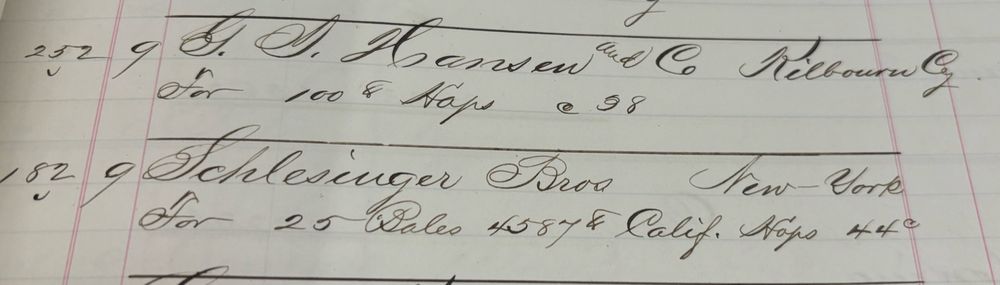
Wow. I am going to leave it at that. Because there ain’t much of the big issue sorta news I want to be reading, I suppose. Not now, not this week. Nope. I am definitely having 9/12 waves myself. Not good. But 150 years ago? Well, Jennifer Jordan on BlueSky has been discussing the 1874 business ledgers of Milwalkee Valentin Blatz and there is plenty of news. Price fluxtuations, losses at sea… but for me… just look at that penmanship!  That upper case K is out of this world! You can practically hear the pen tip scratching across the page. Whatever the coming years have in store for us – and it may not be pretty – we can at least look back at the hand of Blatz for a lesson in confidence and verve.

Where are we? Starting with some beery beer news, Andreas Krennmair shared a re-creation of a much forgotten German beer style, Adam:

Dortmunder Adambier, apparently often also just called “Adam”, was a very strong dark wheat beer, often aged for years, and thus very clear, with a dark-red-brown colour. The malt made to brew it was kilned to only a pale colour, and no additional dark malts were used, so any colour of the beer came from “browned proteins”, as the article says it, basically from the long, intense boil the wort undergoes. When Adambier was poured, it poured like oil, but without any foam, and had a sweet taste and vinous taste to it.

Sounds a bit like a beer Boak and Bailey wrote about this week after spending some time in Gdansk, Gdinya and Sopot Poland recently – Danziger Jopenbier:

It’s a historic style associated with the city, brewed to some kind of original recipe, and selling at 16 Polish złoty  (£3) for a 50ml shot. In presentation, it was treated much like a liqueur or a sherry and reminded us of both Riga Balsam and Pedro Ximinez fortified wine. It was extremely sweet and sticky, completely flat, with a funky, leathery, pipe tobacco stink. A curiosity, then, rather than something to session on.

This is just a bit of their an excellent and extended piece about their merry trip, there just a few kilometres across the waters from Putin’s own nuclear navy yards at Kaliningrad. I taught English along those same Baltic shores of Poland in 1991-92 so it’s interesting to read what’s new and what’s the same:

The city itself is a war memorial. At the end of World War II it was 90% destroyed, an apocalyptic rubblescape. The new Soviet-controlled authorities debated what to do and, at one point, someone suggested leaving the city centre as a vast ruin, to remind the Germans of what they’d done… Gdańsk was rebuilt not as it was in 1939, but instead to recall the days before 1793 when it was part of the Kingdom of Poland.

Yup. I remember being in a large church in Gdansk where a tank battle had happened in 1945… within the church.* I mentioned in the comments that that I recalled there being no pubby pubs back then either – except a rougher sort of stand up tavern for men just off work that the guide I bought suggested “are best avoided.” I mainly drank my Gdanskie at home.

David Jesudason published another pub profile last Friday and discussed a feature installed in the 1950s, a snob screen:

“They could have privacy not just from the other side of the pub,” says Ralph, “but from the bar staff as well. You open it to order your drink.” The pub had a revamp in 1956 when Young’s took it over, previously it was a cider house, and Ralph reckons the snob screens are from them and still have the original 70-plus-year glass.  Ralph finds it amusing that as a gay person he’s living and working among all this archaic segregationana.

I like that word. Perhaps we might also suggest “segregitus” Or is it “segregitis“? Or did the “segregitus” leave us with a case of “segregitis“? Such questions I have.

You know what is weird? Finding out that Canada exports the fifth most bulk wine of all the nations of the world. More than much larger producing countries like France or South Africa. And what’s weirder? Canada also exports by far the cheapest bulk wine of any nation in the world, at just 29 cents US a litre. What’s that about? What is bulk?** Where is all the dirt cheap wine being consumed?

You know what is also weird?  Chaos packaging. Like putting gravy in beer cans or, perhaps, as the ultimate end game for a certain sort of craft, the next step after NA hop water perhaps:

…the decision to market the cans of air came from marketing specialist Davide Abagnale, who initially saw an opportunity when he started with selling Lake Como posters online. Explaining more about the initiative to can the air from the area, a spokesperson for the business told CNN, that Abagnale wanted to offer “something original, fun and even provocative” as well as “create a souvenir that could be easily transported in a suitcase for tourists”. Abagnale explained how the cans, which rather than contain any liquid, subvert the norm and give people something closer to a “memory” rather than a “product”.

So, not so much about the experience but the illusion of experience. I’d gladly pay with a photograph of some money.

Have you ever wondered what something extreeeemely tannic tastes like but don’t want to taste it?  Wonder no more as, for free, Barry himself guides you through the physical convulsions that are part of the experience.

And Stan thanked me for a link to a story that I think is actually far more interesting that its initial interestingness might suggest. The initially interesting point is how pervasive alcohol is in nature and how common it is for animals, bird and bugs to consume it. I’m not surprised. In high school, we watched out the front window each autumn as tipsy starlings drunk on over ripe rowen berries flipped 360° loop-de-loops on the telephone wire – or just flopped to the ground unable to fly until they sobered up.  Interesting.  But check your mailboxes for your own copy of the latest edition of Trends in Ecology & Evolution wherein we can read the original study which also states:

…the ancestor of humans, chimpanzees, and gorillas possessed a single amino acid change (from alanine to valine at site 294, denoted ‘A294V’) that dramatically increased its catalytic efficiency for ethanol. This arose approximately 10 Mya, following the Mid-Miocene Climatic Transition when African forests were gradually replaced by savannah. Around this time, our ancestors adopted a more terrestrial lifestyle and were possibly more likely to encounter fermented fruits on the ground…

That means the question may not be when humans first had alcohol. It may be about when they first learned to make it or store it or otherwise control it enough to have it year round and not just when the fruit was juiced laying about their feet. When did it start? One Million Years BC?

Perhaps relatedly, one of the things that makes The Beer Nut the world’s top reviewer of beer (other than his incessant reviewings of beer) is his egalitarian approach to all venues and all beers, high and low. This is especially evident in his periodic coverage of Wetherspoon beer festivals – which I take to be a sort of in-pub promotion across the chain rather than a fest in the GBBF sense. He treats this event with both respect and reality as he dropped in at a number of outlets recently. I share the alpha and the omega of his most recent thoughts on the topic:

The JD Wetherspoon Autumn Beer Festival arrived in mid-October. I managed to spend some time at it, both in the central Dublin pubs, and abroad… Unsurprisingly, stout and porter were the standouts. The cask format shines brightest in the dark. Plodding through all the cheap, samey bitters to find them is worthwhile to find the good stuff.

And speaking of which, Pellicle‘s article this week is by Gabe Toth, a profile of the cask specialists at Hogshead Brewery in Denver, Colorado including this bold admission:

“Cask beer, at least in America, has that reputation of being an older person’s beer, like your grandfather’s beer, versus the hip young thing, seltzer or whatever. Beer in general is suffering a little bit of that—I feel like younger people in general are turning more toward other beverages and losing interest in craft beer.”

Jordan did some thinking about loss of interest, too, this week as he assessed the Ontario good beer scene and declared the beginning of a new era – based on the new retail modalities and associated realities:

Does the world really need Carling Light when Keystone Light exists? Does Old Vienna mean anything to people outside Chatham-Kent and Windsor? Does Labatt regret sending one REALLY EFFECTIVE sales rep to Thunder Bay in the 1990’s to sell Crystal? Whoever that was, they’re legend.  You’re going to get consolidation of products. You’re going to get less choice, at least initially. The convenience and grocery and big box retail situation has less patience for variety and more desire for expedience than The Beer Store did. The new paradigm is about choice, but it’s largely about choosing how much you’re going to pay for a single product.

Finally, before the regular list of more alt-news about alts and other beers, I would note the suspension of operations at The Share from Stephanie Grant. Looking forward to an energized return. Also, congratulations to those shortlisted with the BGBW Awards.

Otherwise, a shorter post this week. Such the way of this point in time. Other things on the mind. Still, with all that has happened and will happen… for more beery news check out Boak and Bailey every Saturday and Stan going strong again each and every Monday. Then listen to Lew’s podcast (maybe he’ll do one again) and get your emailed issue of Episodes of my Pub Life by David Jesudason on the (now hardly at all) odd Fridays. And Phil Mellows is at the BritishBeerBreaks. Once a month, Will Hawkes issues his London Beer City newsletter and do sign up for Katie’s wonderful newsletterThe Gulp, too.  Ben’s Beer and Badword is out there with the sweary Mary! And check out the Atlantic Canada Beer Blog‘s weekly roundup. There is new reading at The Glass which is going back to being a blog. Any more? Check out the Beer Ladies Podcast. That’s quite good and they are revving up for a new year. And the BOAS podcast for the bro-ly. And the long standing Beervana podcast …except they have now stood down.  Plus We Are Beer People. The Boys Are From Märzen podcast appears suspended as does BeerEdge, too. But not Ontario’s own A Quick Beer. There is more from DaftAboutCraft‘s podcast, too.  All About Beer has podcasts and there’s also The Perfect Pour. Plus follow the venerable Full Pint podcast. And the Craft Beer Channel on Youtube.  The Moon Under Water is gone which is not surprising as the ask was $10 a month. Pete Brown’s one cost a fifth of that but only had the one post.

**From this 2017 report on the British Columbian wine industry: “Nationally, it is important to note that Canadian exports totalled 72.9 million litres in 2015. Of this, only 1.8 million litres was premium wine (non-bulk), representing $32.8 million of the total $73.9 million of all Canadian wine exports. It is impressive that premium wine accounted for only 2.5 percent of wine exports, but represented 44 percent of the total value of all wine exports…” More here.
*Our beach side resort city, Kołobrzeg, on the other side of Kaszubia, was also destroyed and rebuilt as it was where the Nazis attempted a Dunkirk as the Soviets encircled them. They stuck around and the sounds of maching gun firing range welcomed one of my first late summer balcony beers when I got there.

The Beery News Notes For – What – Another “Red Sox Suck” Season?

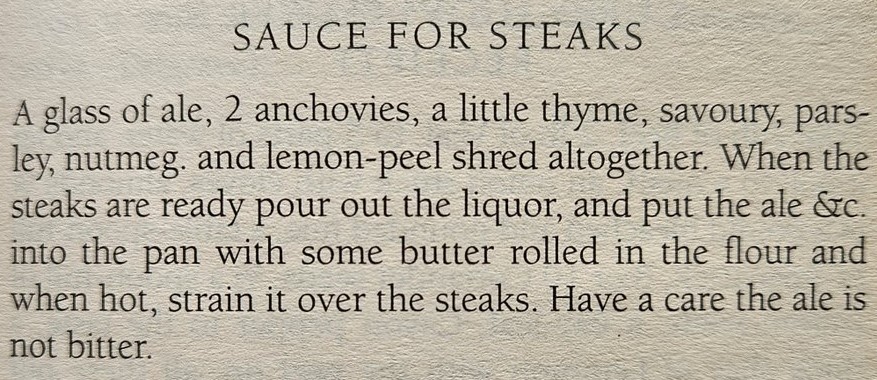
It’s hard being a fan. One of the reasons I am not a big booster for this or that drinks category is I have already invested heavily in terms of emotes in other areas of life. The Pellicle-run Fantasy Premier League surprised me with its grip last season. Plus, as you know, there’s all that gardening stuff that I tend to tend to. But those Red Sox. My team. Mine. They have won 4 World Series in the first quarter of this century but now are mid-pack grinders this decade. There’s little chance they get to the playoffs but they are irritatingly near the chance to… maybe to… couple possibly…  Oh well. But even before all of those obsessions, all those fanboy obsessions… there is good food. Making. Eating. So happy was I to read Liam‘s tweet about the sauce above:

An ale and anchovy sauce recipe for steak written by Thomas Gray in a copy of William Verrall’s Complete System of Cookery – via Penguin’s Recipes from the White Hart Inn.

That’s a book from 1759 as I understand it. Imagine living in a time when membership in a fan base of mid-pack grinders was not even possible. Except, you know maybe if you lived in one of the smaller player in the Seven Years War. Perhaps under the rule of Augustus III of Poland. Anyway, anchovies and ale… anchovies and ale.

Back to a semblance of a plot, there was a good story in Blog TO checking out the prices in Ontario’s newly licensed corner stores. It is a little spoken of aspect of the retail booze trade in Ontario that not only are prices stable because of the massive monolithic twins, the LCBO and TBS – but those prices are standard in every store province-wide,  no matter how distant and expensive the shipping costs. Not so in the 7 am to 11 pm new world order. Not that I would buy one – but a 12 pack of White Claw is 30% higher in corner stores compared to TBS retail. Sounds like that one mistake can easily turn into two for the unwary.

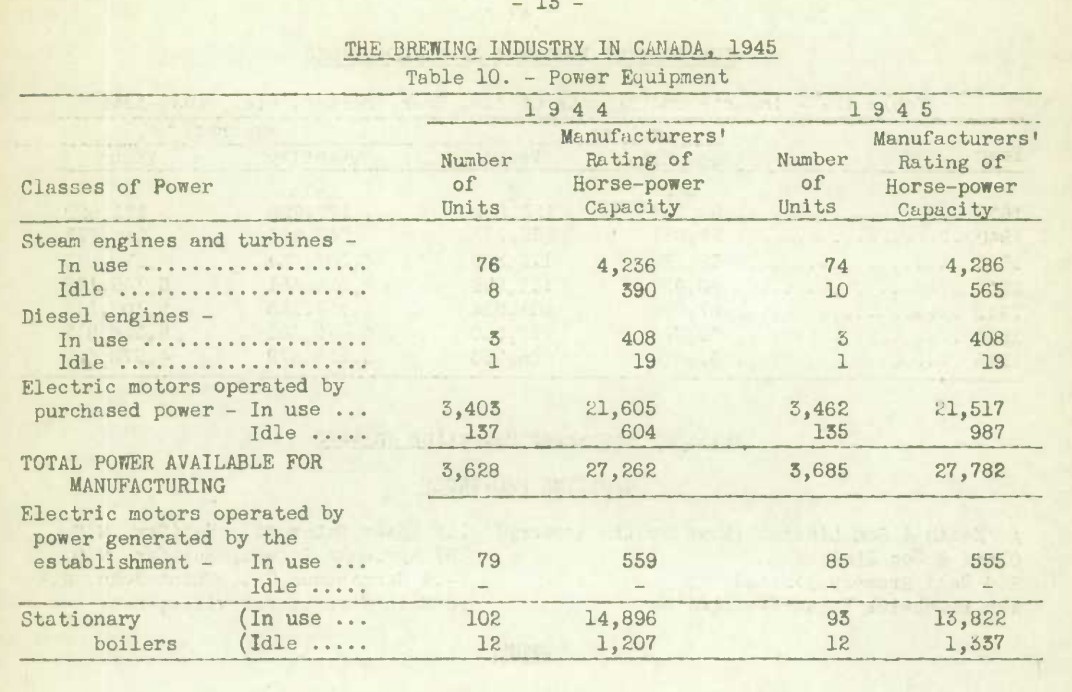
Speaking of prices and price inputs, Gary has a great series going on the Canadian brewing trade in WW2 and this week posted this great bit of tabular information detailing all materials used in brewing production in 1944 and 1945. By reverse engineering his Google image search, I found the same record at a Government of Canada site and saved it for perusal. Just look at page 13!

“Grandpa? What was the ratio of steam, diesel and electric power used in Canada’s wartime brewing as part of the war effort against the Nazis?” “Well, little Jimmy, let’s see…”

Excellent stuff. Speaking of which, Katie Mather has been out and about – especially on the Isle of Man – and has sent out a portrait of a favourite pub there, the The Woodbourne Hotel:

This snug in the centre of the building feels like an Edwardian train carriage, everyone packed in together amicably, its little booth seats overlooked by cartoons and paintings that know the secrets of this town, and well-used hand pulls that serve Woodbourne Street’s locals the beer they need to do some much-needed gossiping. We weren’t staying in the Gent’s Room though. It’s too small, and we were too noisy. I was led further down the corridor to the back bar, where somehow we’d multiplied into a rowdy bunch of 12. Basic white walls and a well-stocked bar on first glance became signed photographs of TT racers and etched glass windows. It took my eyes a little time to adjust from the burnished glory of the Gent’s Room, but once I could see it for the perfect little boozer that it was, I was at home.

By the way, Katie is offering self-editing lessons.  Yes, yes. I know. I know. I KNOW!!!

In a year where much of the beer trade news is not necessarily positive, we have also heard that a lot of men spend a lot of time thinking about the Roman Empire. Curiosity is good. Not my thing given all those other things – except, you know, all that Christ on the cross stuff – but Ray of B+B has admitted he has joined the legions and asked some questions this week:

After visiting Roman ruins in Colchester and the City of London in early August I found myself frustrated at my lack of solid knowledge about Rome. So, I decided to do my homework. Fortunately, Mary Beard’s 2015 book SPQR offers a relatively concise, extremely clearly-expressed history of Ancient Rome that even I could follow. The Kingdom, the Republic and the Empire made sense, and I understood for the first time which emperor followed which. With my beer blogging hat on, though, the section that really grabbed me was about the decor of a bar in the port of Ostia in the 2nd century CE (formerly AD)…

Back to the now, Eoghan shared some shocking news on the state of Belgian beer this week:

“…outside Europe the export [of Belgian beer] declined by as much as 22.2%” IN ONE YEAR A stat (from the Belgian Brewers Federation) to really set the alarm bells going about the future of Belgian beer. A fairly telling quote, in the same report: “In the past, Belgian brewers were able to compensate this decline largely through export, but last year, for the first time in history, export declined by nearly 7.5%.” Belgian beer’s safety net has some pretty large holes in it…”

Long suffering readers would recall that 15 to 20 years ago, driving distances to find Belgian beers in the northeastern part of the United States was a bit part of one’s stash maintenance. Seems like a third of a lifetime ago… oh… it was. To quote the lads back in Rome sic transit gloria cervisiārum… as Jeff discussed last week:

“Craft beer” is a conceptual cul de sac. We started using it with good intentions, but with a naïveté about how brewing works and how markets function. It now causes more trouble than it’s worth.

In VinePair, David Infante took it a step further and argued that just as craft it no longer relevant as a concept, it isn’t really relevant as a substance:

With the segment struggling to shore up slipping sales figures in the face of increased competition from other categories and shifting preferences from American drinkers, craft breweries have been uncoupling brands from the brewhouses with which they were once synonymous, shedding overhead costs and further muddying what makes a craft beer craft.

Jon Chesto of The Boston Globe wrote a fresh take on the craft shake out that is a bit more visceral in tone, sharing the excellent term “slusheteria” for the craft brewers who chase the tail of other targets. The quitters one might say reading between the lines. Or are they just practical realists racing away from the crushing alternative?  The Chesto story’s punchline, however, is saved for Sam Hendler of Jack’s Abby in Framingham who takes an optimistic approach to the reality of short term shakeouts:

Hendler said many brewers built larger operations than they needed with the anticipation that double-digit sales growth would continue well into the future. Now the industry has far more production capacity than it needs. “We are investing very heavily in craft beer and believe in its long-term future. This isn’t a ‘sky falling’ scenario,” Hendler said. “There might be a challenging period that we’re going to have to navigate through but we see a really bright future for those who figure out how to navigate that successfully.”

Stan also had his own thoughts about the idea that the small and local brewer is going to way of the dodo. But he was heading out the door and just said he’s “…not prepared to abandon the thought embracing efficiency means abandoning inefficiency altogether.” Just strikes me that this sort of trend is an economic reality – but one borne of the pretense that there was something once upon a time called craft that stood there separate and distinct, between microbrewing and today. I dunno. It’s been slipping away for a long long time for this to be news. The glitter. The kettle sours. The identi-haze. But does that necessarily lead inevitably to the horrors of the slusheteria? I am encouraged by Hendler that it does not.

Speaking of slipping further into the sub-standard, MolsonCoors is ditching inclusion in preference for old school capitalist exclusion according to TDB:

…the business would be ending its DEI-based training for its staff members, claiming that it has been “completed”. According to reports, future training initiatives at Molson Coors will now undergo an audit to ensure that they are all focused on the company’s “key business objectives.” In addition to this, Molson Coors is renaming its “employee resource groups” to call them “business resource groups” in a bid to illustrate how the company is focused on “business objectives, consumer dynamics and career development”. Molson Coors also highlighted how its future charitable endeavours will now solely support “hometown communities” aligning to its “core business goals”.

Interesting, too, is how a story can be written about celebrity sports guys building a beer brand by leveraging the excess capacity of Founders Brewing without mentioning the whole bigotty discriminatory scandals thing:

Garage Beer is a fun example of small brand, going big, and making moves quickly. Their connections to two of the NFL’s biggest personalities and even an indirect connection to Taylor Swift make it an extra fascinating story to follow. But beer isn’t sold on podcasts or YouTube, it’s sold in stores and needs to flow through the complex three tier system to reach a national audience. Aligning with Founders Brewing for production and potentially distribution alignment has the ability to execute the hurry-up offense that Garage Beer will need to march across the country.

What’s that? Is it white-white-washing? Dunno but apparently, the inclusion blip has blopped and some want to go back to the old ways. Remember the old ways? Last Friday, David Jesudason published another story of racism in the UK pub trade, this  that 1980s club entertainer Alex Samos faced and pushed back against:

…the club wanted Alex to leave the premises when he arrived and his agent George Fisher was told Alex needed to be replaced because of his colour. This time the club “won” and Alex was barred for not being white. He took legal action against the club and, in a case backed by the Commission for Racial Equality and Equity, won £500 (£1,500 in 2024) compensation for injured feelings and loss of earnings in August 1985.  I hope this would stamp out discrimination by clubs against coloured performers,” Alex told the press at the time. “I thought it was an affront to my dignity. I was outraged.” Club secretary Michael Riordan confirmed none of the 500 members were non-white but feebly retorted that “no coloured people had applied to join”.

Finally and to end on a happier note, Pellicle‘s feature this week was by Martin Flynn on the  Donzoko Brewing Company, a name which I think Augustus III himself might approve if only for having had also to deal with the Austrians but in a slightly different context:

Following calls in pidgin German and some online bids, not long after the search began Reece found himself in Vienna, where gleaming copper brewing vessels and 13 fermentation tanks awaited him. As things transpired, the whole ensemble would spend two days outside on a city centre street, but, somehow, it miraculously remained unharmed and still in one piece. Unfortunately, Reece’s finances were similarly static. A hurried call from the auction house revealed that, for reasons unknown, his funds had been blocked by the UK’s Financial Crimes Authority. “I put the phone down and had a panic attack,” he says. “The head of the auction house was literally walking after me in Vienna, shouting at me.

Heavens! Steer clear of Vienna, that’s what I say. Every. Time. (Did I mention I know a man in Vienna?) Well, we will leave it at that for now. Busy week. Had to retrieve a cat from Springfield… as one does. Until next week for more beery news, check out Boak and Bailey every Saturday and see if Stan cheats on his declared autumnal break on Mondays. Then listen to Lew’s podcast and get your emailed issue of Episodes of my Pub Life by David Jesudason on the odd Fridays. And Phil Mellows is at the BritishBeerBreaks. Once a month, Will Hawkes issues his London Beer City newsletter and do sign up for Katie’s wonderful newsletterThe Gulp, too. Ben’s Beer and Badword is thereback with the sweary Mary! And check out the Atlantic Canada Beer Blog‘s weekly roundup. There is new reading at The Glass which is going back to being a blog. Any more? Check out the Beer Ladies Podcast. That’s quite good. And the BOAS podcast for the bro-ly. And the long standing Beervana podcast …except they have now stood down.  Plus We Are Beer People. The Boys Are From Märzen podcast appears suspended as does BeerEdge, too. But not Ontario’s own A Quick Beer. There is more from DaftAboutCraft‘s podcast, too.  All About Beer has podcasts and there’s also The Perfect Pour. Plus follow the venerable Full Pint podcast. And the Craft Beer Channel on Youtube.  The Moon Under Water is gone which is not surprising as the ask was $10 a month. Pete Brown’s costs a fifth of that but is writing for 47 readers over there.

*Me, I’m all about the social medias. Facebook still in first (given especially as it is focused on my 300 closest friends and family) then we have BlueSky (174) rising up to maybe… probably… likely pass Mastodon (933) in value… then the seemingly doomed trashy Twex (4,460) hovering somewhere well above my largely ignored Instagram (160), crap Threads (52) with Substack Notes (1) really dragging up the rear.

The Mid-August 2024 “No, You’re The One Dreaming Of Sweater Weather” Beery News Notes

Great. Stan took this week off. And probably next week too. He may hover in my mind like the absentee desk editor like I mentioned a few weeks ago. But he also has a nickname, too: cheat sheet. Stan “The Cheat Sheet” Hieronymus. Yup. See, come Monday when I can’t think of anything to go look for in the world of beer to think about, I can go see what Stan has been thinking about first. He’s a bit like that nice smart left handed kid in grade 11 math class with really good posture that I sat one row back of and one seat over to the right. Gave me a good view. Made tests just a bit easier.

By the way, there is little beer related in that photo up there. Took the image Monday evening looking due south, down over central New York State. A pinhole sunset catching the anvil cloud from below. Right about in the middle of that horizon is Oswego, NY.  On still days in winter, you can see the plume rising from Nine Mile Point Nuclear. Also, home of Rudy’s. Where you can skip stones and drink Genny Cream Ale.

Did someone mention beer?  Starting hereabout, as we face almost 4,000 new beer retailers in these parts in a few weeks, Ontario’s public broadcaster TVO published a great piece by Matt Gurney about the shock of the new he has experienced in the last few years of deregulation of the provincial booze market, with a particular focus on that one odd rule that allows 7-Eleven to qualify as a restaurant:

Seeing someone drinking in a 7-Eleven or walking out of my local variety store with a bottle of wine will probably feel exactly the way seeing people openly smoking cannabis felt like for the first few years after legalization. I have a specific memory of standing at an intersection, waiting for a light so I could cross, and noticing two young men standing on the corner passing a joint back and forth. I thought to myself, huh, that’s unusually brazen. And then, seconds later, my brain caught up with reality: it would have been brazen a few years earlier, but that day, it was simply two law-abiding citizens engaging in a legal activity in public. 

On undoubtedly similar sorts of offerings, Doug Velky of Revolution Brewing in his newsletter Beer Crunchers, unpacks how craft has turned full circle with craft’s adoption of “cold” in the race to make light generic lagers:

…we also recognized that Cold Time, whose model focuses more on volume than margins, would require broader adoption than just our loyal Revolution customers to ever be considered a success. To achieve this greater scale, early investments would be crucial to get Cold Time into new places to find audiences who don’t currently think of themselves as craft beer fans, but are very open to a great, locally made lager.

Volume. Hmm. Disclosure. I’ve been buying Ice Cold Beer from Toronto’s Left Field Brewing for at least three years so there is no news here. But that branding had at least a level of self-parody in the mix along with the tasty within. Is that self-effacing sort of joke now all so… what… 2021? They may not be dipping as low as the macro-lags but aren’t they fighting for the Centro-Euro buyer‘s attention? Given how well “beer from anywhere you like” can sell, can we blame them?

Interesting bit of history over from Katy Prickett at Auntie Beeb this week on industrialization of England during the Roman Era, including brewing at scale:

“At Berryfields, we found evidence of malting and brewing and the tanks used to steep the grain before processing,” he said. “We tend to think of the Roman world as being very much a wine-loving place. “But actually a lot of the population in Roman Britain were drinking beer and we see that in the pottery they were using, large beakers in the same sort of sizes as modern pint glasses.”

Being someone who never gives a second thought for the Roman Empire, this was all news to me. I am told that Barryfield was located “at an intersection along a major routeway” and was “the location of multiple roadside industries, such as brewing, woodworking, and metalworking, aimed at supplying the travellers passing through.” Here, too, is an archaeological report on a neighbouring site complete with maltings and even malted spelt deposits along with some barley and even some apples and beets.*

In an exploration of more recent history and in light of far more recent racist events in the UK, David Jesudason published the story of a hopeful scene in late 1940s Wales as recoujnted by historian Kieran Connell, the story of an event that showed how working class people rejecting racist hostility are always as he says the vanguard of multiculturalism:

In 1948, the CIAC organised a black-tie event to celebrate Douglas’s success after he made 39 first-team appearances for the team, with the CIAC inviting white members of Cardiff Rugby Club. Announcements were placed in Tiger Bay shop windows and St Clair attended the night which was held ‘not at a dingy clubhouse’ but in the convention room of a city-centre hotel rented for the occasion. “He [St Clair] entered the hotel,” writes Kieran, “without any of the stares or comments that might ordinarily greet someone from an ethnic minority in central Cardiff. In the hotel lobby, he spotted five white girls and two black girls chatting with a group of four white boys. Further on, four or five boys of mixed ethnicity were trying to set up a large keg of beer.”

Table tennis? Bun fight? A bit of both? That’s the theme in an article by Ted Simmons in The Spirits Business about the dispute between the  American Craft Spirits Association (ACSA) on the one hand and, on the other, the Wine and Spirits Wholesalers of America (WSWA) over what is causing the great retraction. We join the debate half way in progress:

WSWA released a second statement [:]… “Blaming wholesalers for the industry’s challenges is shortsighted. The focus should instead be on how the entire supply chain, including wholesalers, can adapt to changing market conditions and support each other in navigating economic pressures,” it read…  ACSA cites a study that found that 87% of craft spirits drinkers want to legally purchase via DTC, and 82% of craft spirits drinkers support laws changing in order to expand DTC… The WSWA calls for an end to any finger pointing… 

Speaking of handbaggery, Ed had a posted about the redistribution of CAMRA branches which so far has not yet popped up into the general finger pointery zone but might be heading that way:

CAMRA currently has a plan to change its branch structure so no branch straddles CAMRA region or county boundaries. From what I can gather it’s a top down proposal from the National Executive… I’m a bottom up man so am dubious about the proposal. Though a devout member of our Mother Church I’m not very active in the branch, but it is the branch I’ve been in since I was a teenager so I would be sad to see it end. Our branch chairman has written a long reply detailing how the branch came to be and why its current structure works.

BREAKING: Ron + Uruguay: one, two, three, four plus one alarming admission: “I want a rest from being Mr. Beer“!!! Heavens. Jings even.

And Jessica Mason shared details on the losses left in the wake of the failure of one brewery, the unfortunately** named Anarchy Brew Co of Newcastle:

Following the pandemic, the business also reportedly fell into financial difficulties after being unable to pay back loans and financial obligations on top of rising supplier costs. Reports have outlined that the trouble began when directors of the company took out Covid support loans and used tax deferrals to manage finances. FRP Advisory has since put together estimates with a breakdown, showing the shortfall owed to creditors stands at approximately £492,413 and an additional £158,016 still being owed to HMRC. Many in the sector with debts currently unpaid by Anarchy are set to lose out with 22 businesses in the industry, including malt and hop suppliers, still being owed thousands of pounds. 

In the referenced reports, it is stated that unsecured creditors such as trade creditors, the landlord and loans and finance agreements are owed £261,468. Assets came in at about one-third of that fugure. What to take away from all that? Certainly the interconnectedness what with so many others dependent on the success of the brewery. Plus… would it have been a kindness had the pulg been pulled earlier?

Perhaps speaking of which but definitely for the double, makring the Molson Coors cutting of losses Doug Velky posted a neat and tidy summation of the recent string of ditchings of unwanted craft brands which has seen one firm… consortium (… collector… aggregator…) named Tilray picking up the pieces to perhaps slide up to fourth place in the contracting US craft brewer market:

For Molson Coors’ there’s no growth potential looking forward for these brands as each posted negative trends in 2023. The brands aren’t dead as nearly 200,000 BBLs across four regional breweries is nothing to sneeze at, but in order to reverse these trends it would take focus, vision, energy, and dollars. As a public company focused on growing shareholder value, cutting these brands and focusing on positive trending formulas is where they’ll head instead. We saw the same of Anheuser Busch who dumped more than half of their crafty brands to Tilray in 2023 and Constellation Brands who quickest to take their “L” in craft and move on when they cleaned house and sold off Ballast Point, Funky Buddah, and Four Corners.

Jeff asks some good questions and triggers good thoughts – but there seems to be an assumption that “local” and “regional” are similar constructs. I don’t think they are. By the way… does one now cheer in 2024 as much as one booed in 2016? Such a long time ago, isn’t it? Wasn’t it? My thought it that it all such a case of corporate deck chair shifting that it really no longer matters. Macro abandoning craft at the same time craft is seeking to mimic macro. Whoda thunk it? What an odd scene this is for so late in the play.

Headline for these times: “World Of Beer Has Filed For Bankruptcy, Here Are The Details.

Interestingly and conversely, the government of Western Australia has created a ten-year economic development plan to boost the state’s craft beer industry:

The plan was put together by the state’s Department of Primary Industries and Regional Development, the Independent Brewers Association (IBA), West Australia Brewers Association (WABA) and South West Brewers Association (SWBA). As part of the strategy, the four parties’ two main goals are increasing the volume and value of locally produced beer threefold by 2034 from a 2023 baseline and creating “greater vertical integration of the craft beer value chain” in the region. Over 120 craft breweries exist in Western Australia, representing 20% of total craft beer production in the country.

A ray of hope? A futile effort given the bigger picture? Who knows. Finally – and as a welcome night cap if you get my analogy – ever the optimist or at least open to the possibility, The Beer Nut gave credit where credit was due in his piece this week on a brewery that has turned its luck around:

There’s hope for us all, I like to think. Today’s beers aren’t the first to come from a brewery premises whose earliest wares I didn’t care for and thought poorly made, but under new management seem to have been turned around. Investment in better equipment? Less corner-cutting? Or just a more highly skilled brewer? I don’t know. I do know that the beers from the Hillstown brewery in Co. Antrim were usually a raft of off-flavours, of the homebrew rookie sort. It seems that there’s a new broom about the place now, going by the friendly and approachable name of Modest Beer.

PS: I like shameless. I can work with shameless.

Here are the credits, the stats the recommends and the footnotes and the many ways to find good reading about beer and similar stuff via any number of social media and other forms of comms connections.*** Want to keep up with the news before next Thursday? Check out Boak and Bailey every Saturday and Stan back each Monday… with a top drawer effort this week. Elsewhere go look at then listen to Lew’s podcast. And get your emailed issue of Episodes of my Pub Life by this year’s model citizen David Jesudason on the odd Fridays. And Phil Mellows is at the BritishBeerBreaks. Once a month, Will Hawkes issues his London Beer City newsletter and do sign up for Katie’s now revitalised and wonderful newsletterThe Gulp, too. Ben’s Beer and Badword is back with all the sweary Mary he can think of! And check out the Atlantic Canada Beer Blog‘s weekly roundup. There is new reading at The Glass which is going back to being a blog in this weeks best medium as message news. Any more? Yes! Check to see the highly recommended Beer Ladies Podcast. That’s quite good. And the BOAS podcast for the bro-ly. And the long standing Beervana podcast …except they have now stood down.  Plus We Are Beer People. The Boys Are From Märzen podcast appears suspended as does BeerEdge, too. But not Ontario’s own A Quick Beer. There is more from DaftAboutCraft‘s podcast, too.  All About Beer has introduced a few podcasts… but some may be losing steam… until… Lew’s interview! And there’s also The Perfect Pour. Plus follow the venerable Full Pint podcast. And the Craft Beer Channel on Youtube.  The Moon Under Water… is gone which is not surprising as the ask was $10 a month. Pete Brown’s costs a fifth of that but is writing for 47 readers over there. There was also the Beer O’clock Show but that was gone after a ten year run but returned renewed and here is the link! Errr… nope, it is gone again.

*How do you say “ooh, look, my pee’s gone all pink” in Latin?
**Although perhaps not as unfortunate as Jolly this week.
***This week’s update on my own emotional rankings? Facebook still in first (given especially as it is focused on my 300 closest friends and family) then we have BlueSky (+1=133) rising up to maybe… probably… likely pass Mastodon (-1=929) in value… then the seemingly doomed trashy Twex (plummeting a bunch to 4,466) hovering somewhere well above my largely ignored Instagram (160), crap Threads (52) with Substack Notes (1) really dragging up the rear.

The “Remember Before We Went Through The Looking Glass?” Edition Of Your Beery News Notes

Remember a month ago? Before “the” debate? Before France went right then went left faster than Gretzky ever could? Before Britain finally ditched the Tories? Before some dumb kid decided to murder Trump and just murdered someone’s Dad? Remember before everything went sideways? Well, except for England losing in fitba… again. Thank God somethings never change. Like bees. Bees don’t care. As I witnessed the other day in the zucchini patch. They just undertake some sort of death battle for pollen from time to time, mindlessly fighting and stinging each other for survival. Isn’t nature wonderful.

First up, Pete Brown was provided a number of bolts of broadcloth to set out his thoughts on the state of CAMRA this week in The Times. It is an excellent piece and even a bit of an artifact in terms of the rare access to the pulpit. I particularly like this paragraph that goes to the heart of the organization:

And Camra saved that culture in a uniquely British way. Whatever else cask ale is, to thousands of campaigners and volunteers it’s a hobby. And as George Orwell once observed, we are a nation of hobbyists — “of stamp-collectors, pigeon-fanciers, amateur carpenters, coupon-snippers, darts-players, crossword-puzzle fans”. Camra is an organisation of amateurs and enthusiasts. Some are eccentric, some are pub bores, some are cliquey. But they always turn up. Others are charismatic, engaging and keen to welcome anyone who might be persuaded to share their interests. Everyone I speak to inside the organisation describes Camra as a family. If they’re frustrated with it, for most, it’s the type of frustration you feel for an annoying sibling who you will defend to the death.

In North America someone might have chosen the phrase “grassroot” but remember those roots in that conception stay in the dark serving the showy fronds above. Not so in the image Pete paints. For him, it’s an organization for people. Not “The People” – just people. All sorts of people. Great point.

Speaking of a sort of people, The Beer Nut wrote about the gulf between hype and quality. Let me spoil his conclusion without revealing the subjects of his study:

If the road through hype leads to refined and high quality beers like (most of) this lot, then perhaps it’s tolerable. And I’m glad that both of these breweries are still turning out great stuff even when their praises are no longer being sung hourly on social media.

Speaking of praises not being sung, Jordan updated the news on Ontario’s LCBO workers strike on his periodically irregular update on the provincial scene adding an interesting observation to the news shared last week of grocers’ disinterest in the new deal:

This might not go quite as well as the premier seems to think. Under the new plan, grocery stores are staying away in droves because they don’t want to have to deal with returns of bottles and cans. The margin they make on beer and wine sales would be eaten away by it. Probably, the margin they make is eaten away by planogramming. Look at the picture above from a midtown Toronto Loblaws from day four of the strike. They’re using the beer fridge for margarine and the selection is down to about five items. It wouldn’t surprise me if the number of grocery retailers actually drops this year.

Butter and margarine in the beer aisle, folks. Butter and margarine. But little wine in some spots. And a rollout by the government that appears to be being rewritten day by day.

BREAKING NEWS FROM SCOTLAND: “WHIT? No Vitamin T???

Jeff had a portrait of Czech polotmavý published in Craft Beer & Brewing (a style of beer I have enjoyed after ordering a mixed two-four to be delivered from Godspeed) and pointed out a bit of a puzzle in the chronology:

… to connect the dots from märzen, granát, or Vienna lager—another style that some have cited as a precursor—to polotmavý, you have to skip decades in the historical record. When I ask Czech brewers and experts where (and when) polotmavý came from, I get something like a collective shrug. More than a century ago, Bohemians were making amber lagers—and a few decades ago, they were making polotmavý. In between, no one seems to know what happened.

I wish the crack team at CB+B avoided concepts like “mysteries” which is the neighbour of “magical” even if in this case it does not relate to that most tedious of applications – the brewing science mystery. Those claims put the “moron” back in “oyxmoron.” But here it is different. Here there is a gap in the records. A conundrum perhaps. Yes, a conumdrum mixed with an interlude of Soviet authoritarianism.  Which does have that hint of “The Third Man” so… fine. A mystery. Yet, as Evan noted in 2009, Ron had previously noted* that polotmavý were an amber lager “roughly in the Vienna style” and that:

Vienna lagers aren’t dead: they’ve just moved over the border. No country produces such a range of amber (polotmavé pivo) and dark lagers (tmavé pivo) as the Czech Republic. I can’t quite understand why no-one has twigged this yet.

Well, we’ve twigged now, Ron! I have it delivered. And… I might point out… they didn’t move over the border so much as the borders moved around them. Maps redrawn and all that. Did I ever mention that as a lad, when visting Grannie, I stayed in a small hotel run by friends of the family and had breakfast every morning with an older gent who, in the First World War, had fought the Austrio-Hungarian navy in the Adriatic? I have? Oh. Nevermind.

Pellicle‘s feature this week is by Fred Garratt-Stanley and is about the loss of pool tables in London’s pubs. I love me a pub game and have an entire category of posts dedicated to the concept… which I haven’t updated since 2011… no, 2017! Anyway, I’ve spent a pleasant afternoon playing pool in a London pub so anyone who is rooting for that has my vote. What is to blame for the loss? Money:

Costs vary depending on whether pubs opt for bog-standard tables or high-end ones more suited to league competitions. At Ivor Thomas, it’s £10 a week plus VAT for the former and £20 for the latter, but this is cheaper than most, with some pubs reportedly paying over £20 a week.  A week’s fee can be recouped in one busy evening, while plenty of extra cash is accumulated from drinks sales. But an increased emphasis on food in many pubs has changed the landscape. Writing for the Financial Times Jimmy McIntosh reports that, according to the British Beer & Pub Association (BBPA), “from March 2022 to March 2023, the number of wet-leds declined by 3.1 per cent, as opposed to food-focused taverns, whose number dwindled by 2.2 per cent.” 

Regular reader and archaeologist Merryn Dineley pointed us towards a very interesting news related to another sort of food stuff storage.  Based on the premise that “beer brewing is difficult to identify in the archaeological record” the authors explain how residues of beerstone as found in clay pot can be used. The study’s abstract as published in the Journal of Archaeological Science concludes:

In comparison to ungerminated and germinated barley grains, we find that beerstone preserves only a subset of the barley proteome, with the residue being more reflective of the final brewing product than of earlier brewing steps such as malting. Overall, we demonstrate that beerstone has potential to entrap and preserve proteins reflective of the beer-making process and identify proteins that we might anticipate in future archaeological analyses.

Got that? Good. Speaking of good, at the end of last week we heard from Will Hawks and his London Beer City project. Not a newsletter. A project. In this edition, he wondered which pub he should hit before an AC/DC concert and in doing so paints a picture of the jumbly sort of pub I’d much prefer over most of those pub-porny protraits all those other folk write about:

You go to De Hems, Soho’s Dutch-ish pub, because it’s recently been renovated and it’s really close to somewhere else you want to go (of which more later).  At 4pm on a Wednesday afternoon it’s busy-ish, mostly with men in pre-Covid business wear: ill-fitting suits, no ties, a smattering of skinny-fit v-neck jumpers. Most of them will not see 45 again. There’s a big TV on in the corner – it’s showing the Tour de France, where Mark Cavendish is about to win a record 35th stage – and there are high tables (boo hiss) around the front section of the bar… the floor is dark wood and the ceiling a sort of dried-blood colour that looks like it’s been there a while. There’s a lot of ageing beer memorabilia on the walls, and some Dutch stuff too, including a Holland football shirt in the corner.

Sweet! Finally, Boak and Bailey wrote in their monthly Substack newsletter about the state of beer writing. I won’t repeat what’s been said but I would point out one thing. “Beer writing” is a thing that only exists in a small fish bowl. ATJ rejects the term for himself. He is a writer (and on form this week, too). So (watch me taking perhaps a mid-sized logical leap) when B+B state “there are too many really good beer writers, and simply not enough outlets for their work” I don’t think I can agree. Or maybe I do. If they mean there are “too many really good writers writing about beer” I have to disagree. Show the me the novels, the essays in a range of periodicals, the CVs with a wide range of seriously and well received writing. not the filler. Some qualify. Others don’t. But if they mean “many really good beer writers” we have to ask ourselves this: what is this narrower thing, the “beer writer? The phrase has always reminded me of that chestnut “craft beer community” and the circle of affirmation that is so unlike the messy complicated and increasingly inclusive CAMRA Pete describes above. The question then moves to the even narrower phrase “professional beer writers” which they define as those trying to pay a mortgage from income. By that standard, all people who are paid are “professionals.” Which leads one to other words. One commentator responding to social media outreach wrote them about one particular word:

I was a freelance journalist for several years. I guess fundamentally I don’t really think of beer journalism as A Thing, as opposed to “that blogger I used to read, only now he’s got a byline, good luck to him I guess”.

“Top Ten Beers For Summer” journalism anyone? (“It goes with salad!” Amazeballs.) We also see “expert” a bit too generously applied in a similar fashion, too,** even though we know there are some actual experts each in their specific areas related to some corner of the wide world of brewing. What do we take from all this? It is possible that scribblers’ personal dreams of an achievable goal got ahead of actual capability and capacity? Does that cause unfair marketplace where those who are established and have an “in” are heard while others (the often more interesting) are left out? I wonder. There’s plenty of good and plenty of not good. I sift. See, me? I read about beer every week. For this here website. For you. Well, for Stan. You others, too, but between you and me I think of Stan as the managing editor who is oddly never seems to be there at the desk, still not back from lunch who, once in a while, still drops off a sticky note.***

There! Plenty to read and discuss. And with that… now we roll the credits… well, the credits, the stats the recommends and the footnotes and the many ways to find good reading about beer and similar stuff via any number of social media and other forms of comms connections.**** Want to keep up with the news before next Thursday? Check out Boak and Bailey every Saturday and Stan back each Monday… with a top drawer effort this week. Elsewhere go look at then listen to Lew’s podcast. And get your emailed issue of Episodes of my Pub Life by this year’s model citizen David Jesudason on the odd Fridays. And Phil Mellows is at the BritishBeerBreaks. Once a month, Will Hawkes issues his London Beer City newsletter and do sign up for Katie’s now revitalised and wonderful newsletterThe Gulp, too. Ben’s Beer and Badword is back with all the sweary Mary he can think of! And check out the Atlantic Canada Beer Blog‘s weekly roundup. There is new reading at The Glass which is going back to being a blog in this weeks best medium as message news. Any more? Yes! Check to see the highly recommended Beer Ladies Podcast. That’s quite good. And the BOAS podcast for the bro-ly. And the long standing Beervana podcast …except they have now stood down.  Plus We Are Beer People. The Boys Are From Märzen podcast appears suspended as does BeerEdge, too. But not Ontario’s own A Quick Beer. There is more from DaftAboutCraft‘s podcast, too.  All About Beer has introduced a few podcasts… but some may be losing steam… until… Lew’s interview! And there’s also The Perfect Pour. Plus follow the venerable Full Pint podcast. And the Craft Beer Channel on Youtube.  The Moon Under Water… is gone which is not surprising as the ask was $10 a month. Pete Brown’s costs a fifth of that but is writing for 47 readers over there. There was also the Beer O’clock Show but that was gone after a ten year run but returned renewed and here is the link! Errr… nope, it is gone again.

*Ron’s source code says the page was written 2004 to 2010.
**Is there a fine line? Consider this observation from  wine writer, Jason Wilson: “I remember arriving at the grand tasting in Montalcino for the release of the 2014 Brunellos. Early grumbling had already labeled 2014 as “challenging,” which is the wine world’s euphemism for “shitty.” We were to taste all day, through dozens of wines, at our own pace. I arrived at the event about an hour after the doors opened and sat down. Before I had even taken a sip, or written a note, an American wine writer I knew waved, came over and, by way of greeting, said, “Ah, I can’t believe you came all the way over here to taste the 2014s. They’re shit.” Apparently, he’d already tasted more than 100 wines in the previous hour, and already rendered his judgment. I don’t know what he did with the rest of his work day.
***Me – “a high-involvement reader“!?! Certainly gave me airs.
****This week’s update on my own emotional rankings? Facebook still in first (given especially as it is focused on my 300 closest friends and family) then we have BlueSky (132) rising up to maybe… probably… likely pass Mastodon (930) in value… then the seemingly doomed trashy Twex (4,483) hovering somewhere well above my largely ignored Instagram (160), crap Threads (52) with Substack Notes (1) really dragging up the rear. 

Summer’s Here… And Canada Day… And St. Jean Baptiste… And Another Thursday So Here’s The Beery News Notes

We went to Montreal earlier this week just for the one night. Supposedly to catch the tail end of their Saint Jean Baptiste / Fête nationale celebrations marking the founding of Quebec. It was a bit subdued in the area we were in, though the Old Port was hopping. We walked and snacked, walked and snacked. As we do. The lad and I each had a Joufflue which hit the spot on a hot day. Paired well with watching the wait staff panic over the play of Italy against Croatia. We could have easily left without paying. Definitely a pick me up after my personal all absorbing Euro 2024 situation. Little known fact: my fair city once had a seigneurial set up as part of New France, too, so I was representing. It led to thoughts, again, of retiring to La Belle Province. Or maybe just to 5 km west of LBP. Less of an administrative hassle that way. Bonus points for guessing my location in the picture. But – just to be clear – Gary can’t play. Insider knowledge. Gotta keep things on the level.

What is going on? There was a bit of a call for input at the end of their post in which Boak and Bailey traced another bit of English berwing history with their incomplete history of Smiles Brewery of Bristol, 1977-2005. You can read it yourself – but if you can provide any more information you can also help with the preparation of an update, as their epilogue invites:

We’re frustrated by the bittiness of the story we’ve been able to tell above. It feels unfinished – and we’re certain people are going to have additions and corrections. To which we say, bring it on! We’d love version two of this post to have more human voices, more pictures, and more detail from the frontline. If you worked at Smiles, or, indeed, founded it, we’re contact@boakandbailey, or @boakandbailey on Twitter, if you want to get in touch.

Delving further back in time, Ron published something pretty interesting this week, parts of newpaper report on the hearing that followed the 1814 catastrophe at London’s Meux brewery when a large vat burst and the ensuing flood caused multiple deaths. Here’s the scene as recounted by George Crick, the brewery’s store-house clerk:

“I can not account for the accident. The vat which gave way had been built about ten years, and it has been full of beer for two-thirds of the time, during which I have been on the premises. It was built on uprights or pillars of oak. The foundation did not give way. When the wreck is cleared, the bottom of the vat will be found perfectly level; neither did the vat touch the wall. It stood full eight inches from it. We can account for the accident in no other manner, but by the hoops giving way – by the rivets bursting. An hour before the accident a hoop was started; hoops frequently burst – two or three times a year – but such a circumstance does not produce any idea of danger.”

Was the Burton Union developed as a structural alternative to these massive vats? No idea. But another bit of that last union has been saved by Epochal Barrel Fermented Ales.

And ever further back, have we witnessed the birth of another Law of Lars: “Repeat after me: there are no ancient Egyptian recipes.Yet… OK… but it’s a recreation with what seems to be an aggregation from a few texts with very well intentioned careful ingredient sourcing. Not a recipe but still. Yet… how do you get to 5% and not 11%, 4% or 1.5%?

Back to today. Me, I subscribe to The Times legal briefs newsletter to keep up with my professional distant cousins and this well sourced item caught my eye which, initially, sets out as a description of how drinks centered social culture in law firms can hinder the careers of young observant Muslim lawyers:

According to the report’s authors, many candidates from those two backgrounds feel “underprepared compared to their peers due to limited access to professional networks and social capital”. They went on to target the “prevalent drinking culture in law firms” as a “significant challenge for Muslim candidates”, many of whom abstain from alcohol. “Social events centred around pubs and bars create an uncomfortable environment, forcing these candidates to navigate situations that conflict with their religious beliefs,” the report said.

But then the story goes on to additionally point out (i) “City law firms are significantly better than their peers in the financial markets”; (ii)  it is now more common “to head to the gym for spin classes… after work than it is to head to the pub“; and (iii) “most of the associates just aren’t interested in a late-night drinking bender”! I’ve worked with alcoholic lawyers so this rings entirely true. Still, pity the young unfit accountants of London.

This is a fun bit of Euro 2024 reality for English fans in Germany. In addititon to the shock of learning that the previous visitors from Scotland put a serious dent in Cologne’s beer supply, when they do find it it seems to be served in tiny glasses:

It may not have been a thriller, but with England through to the knock-out stages of the Euro 2024 championships, it was a good opportunity for fans to celebrate with a few glasses of locally brewed cold Kölsch beer. Kölsch, which is the traditional beer style of the city, is served in 200ml tall glasses. But, according to the Daily Telegraph and Daily Mail, this smaller serve have been criticised by fans for the paucity of liquid. The tall and thin glasses were described as like “Champagne flutes” and thirsty fans complained about having to get a large number of rounds in to match their drinking habits. One of the reasons for the bemusement could be that fans have been used to pictures of two pint steins in Germany, often showcased during Munich’s Oktoberfest…

And Pellicle published a piece about beer that tastes like beer. By Matty himself. Those pitch negotiations must have been difficult. Anyway, it’s about a favourite beer… sorta… well, it’s all a bit… artsy*:

We stood there, motionless, in the blinking room’s perpetual silence. Then, suddenly, one of the thin men stretched out an arm, opened its greasy, white palm, and spoke with what appeared to be its mouth. If I could describe to you what I heard, I would, but it was not a sound in a conventional sense, more like a feeling, similar to what I’d experienced when the shape approached me in the field. I remember hearing four distinct waves of a flat baritone that did not waver in pitch, but it felt like there were layers upon layers of complexity to whatever the thin man had uttered.

AJT, recently becalmed, is going to have to watch out for folk making moves on his impressionistic patch. Speaking of impressions, Stan asked me a question this week but I answered another one:

Hmm… do I understand that people prior to the 14th century apparently didn’t understand ice cellars… or storage of foods either, for that matter. Despite Central Europeans using and living in caves and around ice for many millennia.

Many, there is some astoundingly deep… errr… poorly thought out beer writing out there. Greater context? Why bother! [And it is not just the trade puff stuff either: “…highly prestigious World Beer Cup, often referred to as the Olympics of the beer world…“? Said no one ever who was not being rewarded one way or another ever.] Anyway, Stan wanted to like my comment and that is all that matters to me. I actually answered his question over at B+B at the P the day before:

That cream ale story’s history is pretty good fiction. There were two or three eras when “cream” was a flag adjective for premium. 1850s Hudson Valley cream ale was a big burly ale. What is mid-1900s western NY cream ale comes from the earlier forms like 1800s Kentucky Common which in turn came from pre-lager late 1790s German immigrants. It’s all clearly set out publicly if someone takes the time to use Google.

[See here, here, here, here and here for example. Not hard.]

Barley Cluster? I loved their second LP! What’s that? Not that sort of cluster? Hmm:

Agriculture and Agri-Food Canada (AAFC) announced a new Canadian National Barley Cluster, a significant initiative aimed at advancing barley production in Canada. With a value of $9.6 million over five years, this Cluster will drive research efforts to enhance the competitiveness and resilience of the Canadian barley industry. More than just a financial commitment, the Barley Cluster represents a united front in securing the future of the barley value chain. Administered by the Canadian Barley Research Coalition (CBRC), the new Barley Cluster will fund research projects that advance feed barley, barley genetics, agronomy, disease resistance and sustainability to make it a more resilient and profitable crop for Canadian farmers and end users.

In fact, we seem to be hubbing it up all over the place, grain-wise. You know what this means: “all your beer is us!!!

London’s TimeOut had quite a pop at “craft” beer this week framing it as so 2019:

Remember the glory days? When we all had skinny jeans and immaculate beards and wore beanie hats, even in summer? When going for a pint meant nine percent porters, pink rhubarb sours and whatever a ‘saison’ is. It meant tasting each and every beer on tap to make sure they weren’t ‘too hoppy’. It meant, perhaps more than anything, bright, graphic labels and deeply silly names.  Nowadays, trips to the pub look a little different. Rows of pastel-coloured IPAs have been swapped out for classic lagers and big boy beer brands, all seemingly owned by one omniscient beverage uber-corporation. Craft beer options are few and far between (often rotating on just one tap)…

Finally and not unrelated, I’ve noticed that some of the advice to craft brewers these days being written has a couple of odd aspects to it. Reiterating the sort of advice you would might have expected before the downturn is one thing. Buy board games. Hold quiz nights. Hire HR specialists. Not “make sure you diversify your revenue streams to hedge against further consumer disinterest!“** Salty snacks? Used cars! Mens wear!! Anything!!! Another is minimizing the retraction, denying youth’s reduced interest. We see the code word “mature” to describe the industry contraction. Good sign that the writer’s a team player, I suppose, but lacking a certain… certaintly. And Boak and Bailey pointed out last Saturday, the actual news continues to be otherwise in the UK:

There was apparently a sharp acceleration in the number of pubs closing in the first quarter of 2024, according to a report compiled by commercial property intelligence company Altus. Of the 472 pubs that closed between April 2023 and March 2024, a remarkable 236 closed in the first three months of this year – equivalent to around 80 per month.

There sure are loads of factors piling on good beer, not the least inflation. Putting a hurt on wine too. But that complexity just makes things harder to address. One quite singular story underlies the closing of Cascade Brewing of Portland, Oregon – a tale of succession plan gone awry as reported by Jeff:

It was a strange and developing story, but involved the death of Founder Art Larrance last month. That was odd, because he announced he’d sold the brewery four years ago. In the announcement’s fine print he described it was a “phased transition” sale, however, and it turned out that transition never quite happened. The details blur here, but Art’s daughter, who was unaware her father still owned the brewery, didn’t have the money to continue on.

That’s a tough one but a lesson – get to the accountants and lawyers and get things put properly in place. Costs way less than screwing up.

And with that… now we roll the credits… well, the credits, the stats the recommends and the footnotes and the many ways to find good reading about beer and similar stuff via any number of social media and other forms of comms connections.*** Want to keep up with the news before next Thursday? Check out Boak and Bailey every Saturday and Stan back each Monday. Elsewhere go look at then listen to Lew’s podcast. And get your emailed issue of Episodes of my Pub Life by this year’s model citizen David Jesudason on the odd Fridays. And Phil Mellows is at the BritishBeerBreaks. Once a month, Will Hawkes issues his London Beer City newsletter and do sign up for Katie’s now revitalised and wonderful newsletterThe Gulp, too. Ben’s Beer and Badword is back with all the sweary Mary he can think of! And check out the Atlantic Canada Beer Blog‘s weekly roundup. There is new reading at The Glass which is going back to being a blog in this weeks best medium as message news. Any more? Yes! Check to see the highly recommended Beer Ladies Podcast. That’s quite good. And the BOAS podcast for the bro-ly. And the long standing Beervana podcast …except they have now stood down.  Plus We Are Beer People. The Boys Are From Märzen podcast appears suspended as does BeerEdge, too. But not Ontario’s own A Quick Beer. There is more from DaftAboutCraft‘s podcast, too.  All About Beer has introduced a few podcasts… but some may be losing steam. And there’s also The Perfect Pour. Plus follow the venerable Full Pint podcast. And the Craft Beer Channel on Youtube.  The Moon Under Water… is gone which is not surprising as the ask was $10 a month. Pete Brown’s costs a fifth of that but is writing for 47 readers over there. There was also the Beer O’clock Show but that was gone after a ten year run but returned renewed and here is the link! Errr… nope, it is gone again.

*Not that there’s anything wrong with that!
**How long has Twisted Tea been around serving as the obvious example?
***This week’s update on my own emotional rankings? Facebook still in first (given especially as it is focused on my 300 closest friends and family) then we have BlueSky (down 1 to 132) rising up to maybe… probably… likely pass Mastodon (up to 928) in value… then the seemingly doomed trashy Twex (up 3 to 4,482) hovering somewhere well above my largely ignored Instagram (flopping 1 to 162), crap Threads (somehow up to 52 from 43) with Substack Notes (1) really dragging up the rear. 

The “Happy Birthday To Me!” Edition Of These Beery News Notes

Well, well, well. I entered the first day of my 62nd year today. No trauma. No big plans. Not like when you hit 25 or 40. Those were panicky birthdays. Feeling like middle age is coming too fast. Now that it is here… who cares? All one has to do is consider the alternative and sliding that bit closer to two-thirds of a century is mighty fine by me. Change is everything. Even the bird feeders are put away now. Winter is not coming. Not quite yet. So have one for me if you are having any at all. I’ll be the one gorging on cake.

First up, some very good news. In 2015, the world of good beer in California at least faced a stark reality – the water was running out. I noted that UC Davis had started a  California Drought Watch program which includes considerations for the brewing industry. So it was good this week to read this update on the situation:

California’s water storage is at its healthiest levels in over a decade. Virtually every major reservoir in the state has average to above-average storage, with a substantial 115% of average snowpack still to melt. The last two years have been an amazing reprieve from the multiple brutal, record-breaking droughts that have plagued the state in the last decade.

What else? Hmm… Jeff wrote this in his last emailed weekend update : “It was a quiet week and I can’t think of much to say up…” Double hmm… and Boak and Bailey in their Patreon footnotes: “We were quite thrown by the lack of a substantial news story this week.” I can’t believe it! There’s gotta be something to read!!

Sorta breaking all the rules*, I see that Ron wrote a wonderful piece about the serial relationship he’s had with his locals… plural. They come and go but something has to come along with each if it is going to qualify. He’s currently on the hunt:

Last Saturday was or third time there. Not really giving me a local vibe yet. But that takes time to build. Harder to bear is the lack of draught Mild and Stout. Especially Headroom. A beer that took me closer to the 19th century with every sip. Weihenstapher Dunkles Weissbier is OK. But three of four pints is enough. And Checkpoint Charlie does sell korenwijn. Drinablke jenever. Not like the industrial cleaner called jonge jenever. The presence of a pool table and pinball machine mean Alexei is much more likely to come along. And reminded me of a previous local.

Katie also wrote about pubs this week in her newsletter The Gulp sharing her thoughts on children in pubs… like Ron’s kids… who grew up in pubs… I suppose:

…in my experience, the people who claim to hate children, and make a big deal out of this fact about themselves, are younger. They are around 20-35 years old, and they invariably claim to like dogs better. Of course, personal choice is absolutely valid. It shows that they prefer unconditional love. Who doesn’t? What I find distasteful is the absolute disdain for children and their existence anywhere near their personal space. It’s brutally Victorian. It’s outmoded. It’s—I’m going to say it—it’s selfish. Selfish in the true sense of the word, of only thinking of one’s self. The problem is, pubs are not made just for one individual’s comfort. They are places of socialisation and congregation…

(You know, I am not sure that personal choice is always valid… but then again I used to practice divorce law and criminal law. Bad choices exist. Really really bad one.) But back to Katie’s point which is entirely valid – if you teach kids that pubs aren’t for them, well, you will graduate cohorts of young adults who have learned that pubs aren’t for them.

Speaking of choices, the stats released by the BA on US craft beer’s 2023 seem to have been worked pretty hard to find a positive glint to focus upon:

The top-five craft players included, D. G. Yuengling & Son, Boston Beer Co., Sierra Nevada Company, Duvel Moortgat and Gambrinus, while the leading brewing companies included Anheuser-Busch Inc, Molson Coors, Constellation, Heineken and Pabst Brewing Company. Despite craft production decline in the US, the number of operating breweries in the craft space hit “an all time high”, up 1.37% on 2022 to 9,683. These breweries were comprised of 3,900 taproom breweries, 3,467 brewpubs, 2,071 microbreweries, and 245 regional craft breweries. Craft-brewery closure rates however increased again in 2023 from 3% to “approximately 4%”. The US saw 495 openings in 2023, a 9.8% dip on 2022, while closures increased 31% with 418 breweries shutting up shop.

Add to that the conglomerates and businesses focused on drinks other than actual beer, there is a lot of shaping going on. Closures up, openings down but the number of operating breweries in the craft space hit “an all time high”! Lordy.

David Jesudason shared a tale in his newsletter that he foreshadowed this way: “…despite the subject matter it’s quite amusing.” It’s the story of a charmless man:

He barred people for a lot of class-based reasons which seem bizarre today. One of his biggest annoyances were people who wore braces – calling them “hideous apparel worn by grubby people and are offensive to me and other customers”. In fact, a lot of the reasons for barring people were ridiculous, like in 1973 he threw out a group of drinkers for wearing nuclear disarmament badges.  Tickell did, however, have no problem with rightwing political messaging and he proudly displayed two signs behind the bar – “Hands of Rhodesia” and “Keep the Falklands British”. He also gave speeches to local trade bodies – wearing a monocle around his neck and gold cufflinks – criticising customers who wanted chips with every meal and ate “deep freeze food and foreign-sounding fare”.

Braces!! The man knew nothing.** Then again, no one is useless – they can serve as a bad example.

And Jacob Smith wrote a bit of a semi-contrarian opinion piece for Pellicle this week suggesting that Britain’s community ownerd pubs are no answer in many cases:

In a 2022 report, the Plunkett Foundation, a charity which helps rural communities in Britain to create and run community-owned businesses, reported that only one in 12 rural community-owned pub projects reached trading status. That means 91.7% of all rural community ownership pub bids failed without ever pouring a pint. These failed bids are rarely, if ever, highlighted by mainstream media. And while it’s human nature to focus on the winners and allow the also-rans the dignity of anonymity, such blatant survivorship bias risks distorting our perception. If we’re not careful, soon everybody looks set to become the next Beyoncé.

I had questioned that this sort of use of “mainstream media”*** is a bit meaningless – and perhaps a manufactured strawman now that I think of it – given folk from Roger Protz to Boak and Bailey have also waived the “save the pub!” banner. Being involved with community organizations in a number of ways, it’s true many fail but we don’t need to look to big bad outside forces for why that occurs. As Jacob points out in parallel, locla factors like the involvement of difficult personalities can often but simply overwhelm the collective goal.

Sorta building on something I read about last year, I shared that story of how one building in San Francisco was capturing waste water which was passed to Devil’s Canyon Brewing Co in San Carlos California to brew a beer. In something of a closing of the bio-eco loop, this week we learned from Jessica Mason that researchers in Singapore have found a way to extract proteins from spent brewing mash for human consumption:

The researchers also said that the extraction method would also help mitigate a possible protein shortage due to a forecast 73% increase in meat consumption by the year 2050 which has been predicted by the Food and Agriculture Organisation of the UN to occur amidst the future rapid growth of the global population. The NTU researchers also revealed that the proteins extracted from the brewers’ spent grains were found to be rich in antioxidants, which could not only protect human skin from pollutants but could also potentially extend the shelf life of cosmetics and skincare products.

That is sorta cool. Stan may be on holiday this month, including a stop at the Craft Brewing Conference in Las Vegas, but I found his latest issue of Hop Queries waiting on the front stoop when I stepped outside with my cup of coffee last Saturday morning. It includes that chart to the right which is cunningly identified as “the second chart”:

The second chart (clicking on it should enlarge it a bit)**** provides another way to look at genetic distancing. In this one (a two-dimensional principal coordinate analysis), the country of cultivar origin is represented by: Germany green triangle, Czech green square, UK green square with x, France green circle, Poland green triangle outlined, Slovenia green circle with x, Australia blue circle, New Zealand blue square, USA red circle, South Africa black circle. The research establishes the value of utilizing molecular genetic methods for “reliable cultivar identification or the evaluation of genetic variability and similarity by hierarchical cluster analysis and principal coordinate analysis.” 

Do I understand every word? No. But one gets the point. There are, as Stan says, relationships that should be understood to be going back through cultivar to landrace to wild. Maybe.

Speaking of the CBC Vegas, Courtney Iseman in her latest Huggering the Bar shared some tips for attendees seeking a decent beer in a land known for other things:

If you can’t get off the Strip but want a craft beer, your best bet is honestly to grab a tall boy from a convenience store. You won’t find much selection at casinos and you’ll pay stadium prices, predictably. Not too far of a walk (more on this in a sec) is Ellis Island. This hotel + casino is one of the most depressing I’ve been to, but! Stay with me and persevere through the casino part to The Front Yard, a bar and restaurant nice enough to feel completely disjointed from the rest of the hotel. Ellis Island brews its own beer, and it’s pretty great, based on the lager and Berliner weisse (for which they have a few different syrups) we had. If you want lunch and good, affordable, local craft beer, you could do a lot worse.

I read a nice little vignette from Jason Wilson in Everyday Drinking, the story of a starting a small sleepy wine cellar to last until retirement from someone in South Jersey who is now 86:

Pierre acquired much of his collection at one liquor store in Cherry Hill, New Jersey, one that also sold cigarettes and lottery tickets. “I got lucky,” Pierre said. “ “When I first built my wine cellar, that’s when the 1982s were just coming out… you could still occasionally find a knowledgeable, passionate wine person in a standard-issue liquor store. “I was lucky that I had a guy,” Pierre said. “I used to subscribe to the Wine Spectator, and I had a wine encyclopedia. But the guy at my local store knew what was good.” The wines at this tasting had been cellared well. Pierre does not have a fancy, custom-made wine cellar. “It’s all natural, three sides dirt and one stone wall. When I built the house, it was going to be a crawl space, but I said, ‘No, no, let’s make it a wine cellar.’” He added: “I’ve never had a bad bottle that’s been stored there.”

Jeff wrote a bit of a tough personal piece on his family’s life with alcohol this week – which starts with a surprise:

“Let me see my little Susan!” Mom recalls saying. Before ultrasounds existed, predicting a baby’s sex was apparently a primitive exercise, and my mother’s doctor got it wrong. The nurse held me aloft, announcing instead the arrival of little “Johnny.” It hadn’t occurred to Mom to have a boy’s name at the ready, so for a week I was Baby Gorostiza. She has never been sure why she chose Jeff, and used to joke that with a bit more warning she’d have probably named me David.

One of my favorite stories in beer is the nice tale of an historic beer recreation that turns out to avoid the actual characteristics of the historic beer… like this:

Brewing beer from bread is not without its challenges. “Early beers probably were a little bit bitty and maybe like an alcoholic porridge,” Ziane says. The method took some adapting – including an industrial shredder to crumb the bread slices, and rice hulls to prevent the bread from becoming an impenetrable sponge in the tank. The recipe Toast settled on replaces 25% of the grain with bread. In doing so, it replaces 25% of the carbon, water and land needed to grow the grain.

Finally, in what is really a challenging footrace despite there being only one competitor there was news from ParksWatchScotland of one of the more pathetic results from a BrewDog self-promotion project… with the added twist of a waste of significant public funding:

In mid-February I described how many of the trees planted by BrewDog, as part of the Phase I creation of its Lost Forest, had died and how they appeared to be investing little, if any, of their own money in the whole disastrous project.  A week after the post I received a response from Scottish Forestry to an information request I had submitted in December about the number of trees that had died, any related correspondence with BrewDog or their agents and the amount of forestry grant they had disbursed to date. The response stated Scottish Forestry had paid BrewDog £690,986.90 to date and confirmed that a very high proportion of the planted trees had died…

The anti-Midas touch, as usual. With that, again we roll the credits… well, the credits, the stats the recommends and the footnotes and the many ways to find good reading about beer and similar stuff via any number of social media and other forms of comms connections. This week’s update on my own emotional rankings? Facebook still in first (given especially as it is focused on my 300 closest friends and family) then we have BlueSky (up one to 127) rising up to maybe… probably… likely pass Mastodon (down one to 916) in value… then the seemingly doomed trashy Twex (4,467) hovering somewhere above or around my largely ignored Instagram (161), with sorta unexpectly crap Threads (43) and not at all unexpectedly bad Substack Notes (1) really dragging up the rear – and that deservedly dormant Patreon presence of mine just sitting there. Fear not!

Want to keep up with the news before next Thursday? Check out Boak and Bailey every Saturday and Stan the very next Monday upon which he decides to show up at the office. Look at me – I forgot to link to Lew’s podcast. Fixed. Get your emailed issue of Episodes of my Pub Life by this year’s model citizen David Jesudason on the odd Fridays. And Phil Mellows is at the BritishBeerBreaks. Once a month, Will Hawkes issues his London Beer City newsletter and do sign up for Katie’s now revitalised and wonderful newsletterThe Gulp, too. Ben’s Beer and Badword is back with all the sweary Mary he can think of! And check out the Atlantic Canada Beer Blog‘s weekly roundup. There is new reading at The Glass which is going back to being a blog in this weeks best medium as message news. Any more? Yes! Check to see the highly recommended Beer Ladies Podcast. That’s quite good. And the BOAS podcast for the bro-ly. And the long standing Beervana podcast . Plus We Are Beer People. The Boys Are From Märzen podcast appears suspended as does BeerEdge, too. But not Ontario’s own A Quick Beer. There is more from DaftAboutCraft‘s podcast, too.  All About Beer has introduced a few podcasts… but some may be losing steam. And there’s also The Perfect Pour. Plus follow the venerable Full Pint podcast. And the Craft Beer Channel on Youtube.  The Moon Under Water… is gone which is not surprising as the ask was $10 a month. Pete Brown’s costs a fifth of that but is writing for 47 readers over there. There was also the Beer O’clock Show but that was gone after a ten year run but returned renewed and here is the link! Errr… nope, it is gone again.

*Boak and Bailey had already noted this one which leads to consideration of this from the B+B footnotes last week: “(…on one unlinked story in the main article…) …certainly worth a read, especially if you have an emotional connection to Rhode Island. And Alan had already flagged it anyway, which is sometimes a consideration….” (…on another unlinked story in the main article…) “…the rest of the piece felt a bit like a sales pitch, as brewery profiles with access to the subjects can tend to do. And Alan had already flagged it anyway. Again.” This has been a heretofor an undiscussed phenomenon. I actually do like to not link on Wednesday evening to something that Boak and Bailey will no doubt mention Saturday morning. Reminds me of how when playing soccer or road hockey and I pathetically missed a pass sent my way – and then a teammate made more of the opportunity I ever could have… pals praising sarcastically with a “Well Left!!!” cheer. 
**I unashamedly share my supplier, Albert Thurston. Seriously. Buy yourself a couple of sets along with a few buttons and you have enough for a lifetime. You spend more on a pair of boots. Maybe I’ll spend my birthday money and buy a fourth set… you are sending birthday money, right? Right?!?!??
***The word “media” appears eight times. Is no one else to blame? Is there even any need to blame?
****Sure did. Stan no lie.