The Charming Disarming And Slightly Alarming Beery News Notes For A Thursday In June

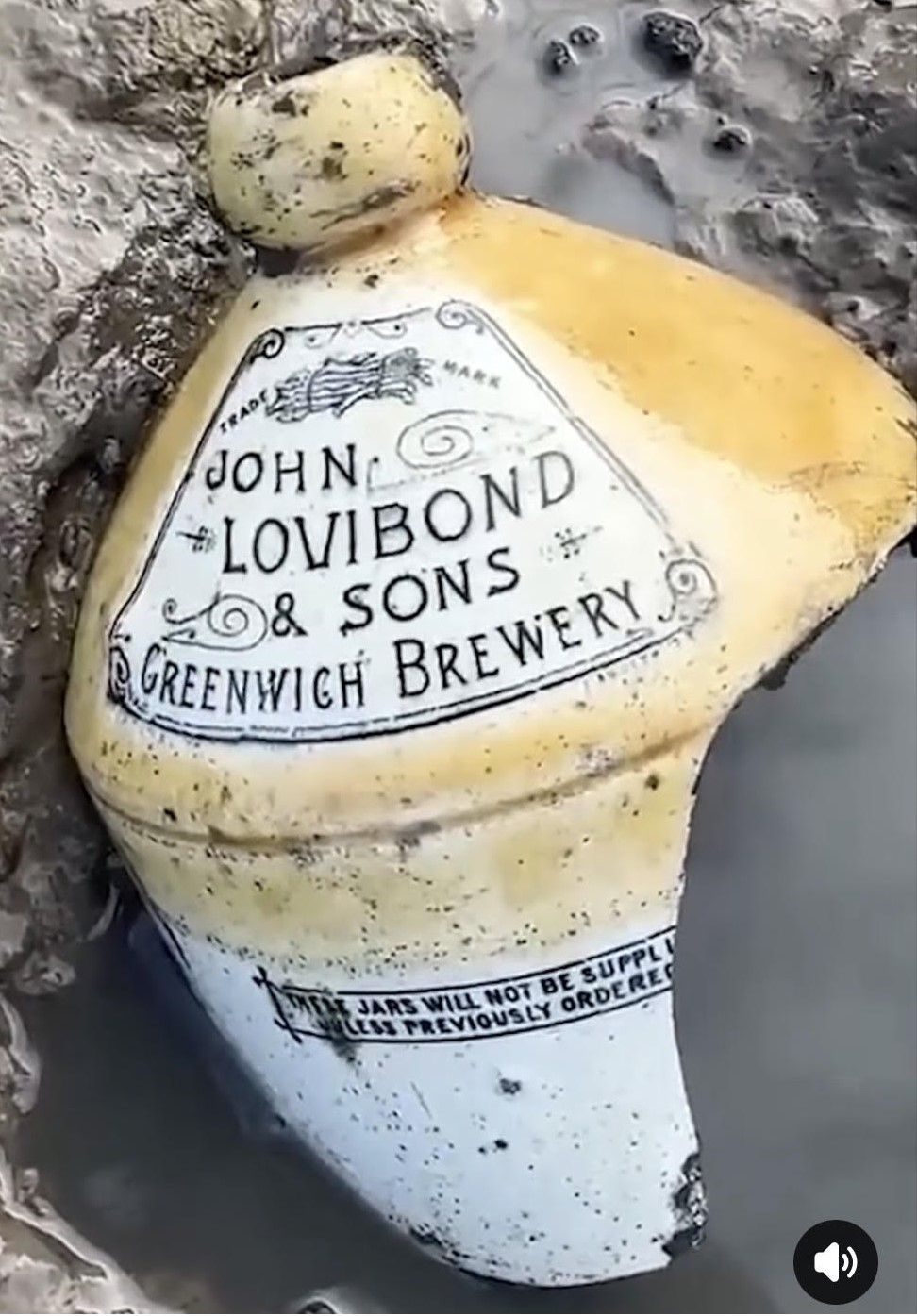
The nice thing about the youngest kid having a job with shifts that end at 11 pm is a fella like me can stay up late for the NBA Finals, listening to 660 AM every second evening when I am waiting out in the parking lot for the kid’s shift to end.*  I am not saying I am some sort of “Mr. Knicks” but this run has been fun. But that’s ending soon and it’s all going to be World Cup naptime late afternoons for the next few weeks. It’s exciting be this idle. And when I am not fixated on bandwagoning basketball or ignoring what FIFA actually stands for, I fill the empty hours with social media where this week I saw that shard up there, a bit of a jug pulled from the mud of the Thames by the ever excellent Nicola White on FB. Obvs I noticed what you notice. Mr Lovibond? Turns out John L. was (maybe*) the father of Joseph L. who was the inventor of the Lovibond scale used to describe the colour of beer. Neato. That jug is no more 150 years old given the trademark registration of 1876. I am but a pup.

What’s else up? Well, for starters, we are coming up is the 150th edition of The Session as Boak and Bailey explained:

On Sunday 28 June 2026 we’re going to post something inspired by the late Martyn Cornell’s final epic work of beer history Porter and Stout. We’d love you to join us. The first problem is that the book is quite expensive. The second is that it is large and intimidating. To make this easy for ourselves – and for everyone else – we’re suggesting that you can join in the Session even if you haven’t read the book. Your post just needs to be in some way a response to it, or to Martyn’s previous work on the subject of porter and stout. If you can read some of the book, though, even if it’s just a few pages or a chapter on some aspect of the history of porter and stout that particularly interests you, that would be great.

Excellent. Perhaps as an aid in your considerations, reflect on what Dr Christina Wade posted an excellent post this week on the need to be aware that choices are made when topics are chosen:

I love beer, in particular, and most especially, I love craft beer. And to add an additional layer to that, I love history. Adore it… So, to be able to combine those interests together into a research topic is a personal favourite of mine. I love both of these elements so much. History and beer. And I have decided, because I love them, that everyone else should as well and I am going to write about them in a way designed to convince you of that. This doesn’t sound particularly sinister, but it can be. Think of all the ways people write to try to convince you of a certain standpoint, or view, or historical ‘fact’. So when you are reading, and indeed, when you are writing yourself, keep this in mind. But even choosing the topic can be this way.

And, perhaps reflecting that, Jeff did just that when he applied a little mathematics to do a fact finding exploration of the obvious this week with his description of the state of big craft breweries since 2021:

Behold this table… The list excludes companies like Tilray, with many brands and breweries. The “Change” column on the right-hand side measures the breweries’ five-year performance. An asterisk indicates a brewery the BA does not designate as “craft.” As you can see, one-third of these larger breweries grew, while two thirds shrank. If you remove Athletic, which actually produces a different product, the overall performance of these big breweries worsens considerably. It’s a collective loss of around 2.2 million barrels, an overall decline of 16%.

You can follow that link to Beervana to check out that table but while Jeff says he didn’t provide any analysis in his post the fact is he didn’t need to. The math is the math. You know, it’s not fun to keep pointing it out but it is necessary given how many trade officials and some trade writers aren’t addressing, aren’t really admitting.  But “chef’s kiss” to that comment about the Athletic… that’s funny… and correct.

And over at the Cleveland Prost, Will Cleveland has provided us an extended explanation of the origin of Genessee Cream Ale, the best old school beer brewed on the south side of my very own lake:

In the late 1950s, Geminn was working with two offerings that each had a ceiling: Dickens Dry Ale, available between 1956 and 1958, which consumers found too spare, and 12 Horse Ale, popular but heavy in a way that limited how much you wanted to drink of it. He needed a middle ground. The influences pulling at him were multiple. Genesee had deep German roots, but brewery owner Louis Wehle had long been drawn to English ales and Burton-style brewing systems. “Clarence was looking for a lighter-drinking traditional ale,” says Tyler Muhs, Genesee’s brewing manager. “We had that German heritage, but Wehle was infatuated with those English ales, Burton systems. So I think that’s what they were looking for when they came up with it.”

And remembrances have been shared for Rob Jones of Dark Star Brewing, that started out at the Pitfield location that I visited back in 1986, hauling back polypins and two of Dave Line’s books on brewing across the ocean in my backpack. Phil Mellows shared his thoughts in the Morning Advertiser:

Rob Jones, the founder of Dark Star Brewery and landlord of the Duke of Wellington pub in Shoreham by Sea, Sussex, has died following illness. A quiet genius of modern brewing, Jones shot to fame when he became the first independent microbrewer to win the Supreme Champion title at Camra’s Champion Beer of Britain contest in 1987 with a hard-to-classify strong ale called Dark Star, created at his Pitfield Brewery in Hoxton, east London.\nHe had started that brewery in 1981 with his schoolfriend and fellow home brew enthusiast Martin Kemp.

Speaking of a classic brewery, Ed visited Sarah Hughes and shared his findings this week:

Having been a fan of Sarah Hughes Dark Ruby Mild since I was a teenager I was determined to visit the brewery when I heard that the Brewery History Society AGM was being hosted by Bathams. Sarah Hughes and Bathams are only six miles apart so it seemed like an ideal opportunity. It took a bit of organising, and I was so looking forward to it I was nervous something would go wrong. But the people at the brewery were very helpful and it all went fine on the day.  Is it’s a small brewery we were taken down in several groups and I wasn’t in the first group. This did make me a bit twitchy as I waited for my turn. But it wasn’t for long. 

Twitchy. Ed has been on a roll recently. I have often wonder what causes a revival of bloggy scribbly but brewing equipment that’s made of wood and copper is one good reason. That and the twitch.

Care of Laura H, we read that the fine municipal curatorial authorities in Wolverhampton have made an excellent decision:

The history of one of the West Midlands most important businesses is being preserved for future generations by Wolverhampton City Archives…  Beer was first brewed in Newbridge in 1874, before the Park Brewery was established in Wolverhampton the following year….  When Park Brewery closed last year, the importance of preserving its history was recognised, and a large and varied archive relating to the brewery and its associated companies has now been donated to Wolverhampton City Archives. The collection spans from the late 19th century through to the early 21st century and… includes a wide range of records, such as brewing and stock books, ledgers, minute books, maps and deeds, annual reports, photographs, packaging and publicity material. There are also employee records including wage books, pension scheme information, and a First World War roll of honour.

Good job. Back to the scene today, Coors Light has rarely been on my radar as a particularly clever culturally sensitive brand but this new use of Québecoise slang in their regional ads is just that:

The campaign, ‘T’en veux une frette?’ (Want a frette one?) leverages a local slang term for ‘colder than cold’ – frette – to remind Québeccers that they don’t just want a cold beer, they want a frette beer, through a series of humorous vignettes showcasing Québeccers’ strong preference of frette. The situations pay off with a twist to the brand’s current tagline, ‘Want a cold one?’ with ‘T’en veux une frette?’

See, me? I would order une frette but never a Coors Light. Sticking with me, once upon a time, I got to negotiate part of a verticle interior leafy greens farming deal. Faces challenges bit it can make a lot of sense in northern Canada where something like a railway container can pump out the stuff of salads when it’s below freezing outside. Interesting, then, to see the idea adapted to hops:

Ekonoke started life as a leafy greens operation, but shifted gears long before that part of indoor agriculture started its brutal and ongoing correction… As with outdoor production, hops inside Ekonoke’s farm grow vertically, wrapping around trellis-like structures that climb eight to 10 meters high. The process is significantly more complex than growing leafy greens indoors, says Sagrario. In addition to longer crop cycles, the process requires constant updates to the nutrient formula pumped to the plants, based on the stage of the crop. Humidification control is also a constant challenge…

All of which is to say that there will be fresh hop beer on Mars in 2063. Again with the me, Knut has written about a Norwegian brewery using Norwegian ingredients and somehow I show up:

There is a side story here. Back in 2007, we were a handful of beer bloggers scattered across the globe. I had the pleasure of having frequent contact with Alan McLeod, who continues his beer writing to this day. I’m thought his blog posts from that golden age were long gone – but look what I found.. He had a bit of advertising on his blog, and decided to spend some of the money to buy a few bottles of Westvleteren 12 from a Dutch web shop to send to a few of his contributors. I was one of them. 

Aaaahh for the days of paying ads on a beer blog. And for customs documents with Belgian ale, shipped from the Netherlands to Norway to pay for the price of an ad on a Canadian beer blog. As you wrap your mind about the way we were, here’s some notes:

Note #1: “Thanks. I hate it.
Note #2: Australian wine prices have collapsed in China.
Note #3: Is beer losing out to wine and spirits?
Note #4: Pellicle’s portrait of Purple Moose Brewery in Porthmadog.

Sausage meat!?!? Mr. Gladman says it is a you thing, not a gin thing:

Sweet summer child, do you know how many shit whiskies there are? Nor is it necessarily any less industrial than buying in and redistilling neutral spirit may sound. I mean good God, some Scotch giants pump the stuff out like so much sausage meat. So no, gin isn’t “just” flavoured vodka. Gin is gin. Like it or don’t like it, that’s up to you, but please don’t kid yourself it’s an inferior category just because it’s not for you. Maybe you just don’t have the palate for juniper.

What’s that? Where’s the World Cup beer news? I can’t find the link to the story that some educator posted “Ten Pastry Stouts to Pair With Haiti v Scotland!” but, yes, Voodoo Rangers is likely the proper order to make on Saturday. “No Scotland No Party” is the song that I have just learned my traveling first cousin (once removed) will be (drunkenly) singing:

 … they live by the motto: No Scotland, No Party. “In Munich (during those Euros two years ago), you saw the impact the fans had. People just seem to love Scotland,” says Duke… People seem to feel at home with us because we don’t take ourselves too seriously”… They thought the estimate of 100,000 travelling Scots was a joke until Munich, the beer capital of the world, was drunk dry before a ball had even been kicked. It was a similar story in Czech capital Prague for a European Championship qualifier in 1999. The Scotland fans had congregated in the old town square, so when the area’s bars ran out of alcohol, the riot police arrived expecting trouble. Instead, when the lorries arrived with more beer, the Scots hopped aboard and helped unload the kegs themselves.

For some of the Home Guard who can’t travel, Imran has shared the best pubs to watch in Edinburgh. Elsewhere, England’s Gus bought beer from every nation. Here in Ontario beer stores’ opening hours have been extended just as have restaurant hours in Boston. Expectations are high for mass consumption:

To reach its 1bn pint estimate, analysts from Jefferies extrapolated beer consumption data from previous World Cups. The extra sales equated to a 3 per cent uplift during the 39-day tournament, which Jefferies annualised to 0.3 per cent, equating to 5.9mn hectolitres, or an extra 1bn pints. Analysts expect the World Cup — which is being hosted across three major beer markets: the US, Canada and Mexico — to boost sales volumes by between 0.2 and 0.3 per cent for 2026. Jefferies analyst Ed Mundy said “match timing is the unsung hero of World Cup beer consumption”, pointing out that games featuring countries in Europe and the Americas had largely been scheduled to coincide with peak local drinking hours of between 5pm and 11pm.

Sadly, as CNN reports, Michelob Ultra will adorn an MVP trophy given to a player after every match. Hopefully that side of the trophy can be turned to the wall. Now, where is my tartan scarf and my copy of that 1978 Scotland World Cup LP?

That is it. A jam packed week of news and cogitations. As you soak it all in, don’t forget to check out Boak and Bailey posting on Saturday and adding to their fabulously entertaining footnotes week after week at Patreon. And do look out for more of Stan’s new “One Link, One Paragraph” format. Then hunt out something in someone’s archives! Leave oblique comments on someone’s post from 2009!! Listen to a few of Lew’s podcasts and get your emailed issue of Episodes of my Pub Life by David Jesudason on certain Fridays. And Phil Mellows is at the BritishBeerBreaks. Once a month, Will Hawkes issues his London Beer City newsletter and do sign up for Katie’s wonderful self-governing totes autonomous website featuring The Gulp, too.  Ben’s Beer and Badword remains on pause but there is reading at The Glass which is going back to being a blog. Any more? We have Ontario’s own A Quick Beer and All About Beer is still offering a range of podcasts – and there’s also Mike Seay’s The Perfect Pour. Plus follow the venerable Full Pint podcast! And there’s the Craft Beer Channel on Youtube as well as the archives of the Beer Ladies Podcast.

*Now, I hear what you are saying: “WTF? New York isn’t part of Canada, Al?!?” But for 23 years I could see the northern edge of the state out my office window. And I’ve listen to WFAN sports radio for decades and, yes, the game is on 880 AM but the freaking fan DJs are on 660 AM. Plus OG Anunoby was my favourite Raptor who went to the Knicks so…
**what about Henry?
The Session #149: Does Pub Food Exist For Me?

Don’t get me wrong. There are pubs in Canada. And there is food. But are the pubs and the food “pub food” in the same sense that David Jesudason has asked about for this month’s edition of The Session?

For the July edition of The Session I’m asking participants to write a blog, web post, newsletter (like this one) or even a SM thread on the subject of food in pubs. At the end of the month I’ll post a list of all the various links…. I encourage people to be critical, whimsical or celebratory. In fact, I hope they will be inspired by today’s format which will take one subject and then recommend a few good pub food options.

In Canada, you can find things called pubs but the function that pubs play in the UK is more often sucked up here by neighbourhood diners or a Tim Hortons, the coffee chain that sells hot brown liquid plus a sugary treat or quick sandwich. Despite their best efforts to redesign their spaces as grab and goes, Timmies and their competition are where people go to sit around and take a break. Without any booze.

What we do have are many sorts of places to write off an hour or an afternoon, place like bars that lean towards drinks other than beer, small town hotels and Legion branches with a few regulars, old school taverns that are focused on macro draft, craft brewery tap rooms and a version of a gastropub – which would never call itself that but which do have the telltale pricey menus and good beer. Sure, there are the rare places that are run by ex-pat Brits along with a few pre-packaged forumula pretendy pubs with a few Union Jacks and that one jar of Branston pickle that’s been in the fridge since 2012 but they aren’t really part of our actual culture.

Any one of these places just might have good food but, let’s be honest, that’s more the exception than the rule. You want good fish and chips? You go to a fish and chips place. You want a curry? You go to a restaurant run by newcomers who share the fabulous family food from their region back home. You may find a bottle Molson Canadian in the fridge or even one tap of a local small brewer’s most popular ale at any one of the sorts of spot but only if you are lucky. The best burger joint in my fair city doesn’t even have a liquor license.

My point? In large swaths of Canada there is still a distance between good beer and good food. Sure there are bright spots. The taverns of my Nova Scotian youth still seem to offer local offerings like steamed mussles or boiled dinner instead of french fries or a burger as a snack. And, pre-pandemic, some craft beer bars did move to adding a better sort of food service like a BBQ smoker, maybe on a trailer out in the parking lot. But these are not necessarily cheaper options. Not what I think of as pub food.

Which is the point for me. Pub food – food that hopefully isn’t microwaved gak that was a frozen brick seven minutes ago – should either be almost loss leader to keep the beers pouring or at least be priced below dining out. If you have one of those in your neighbourhood, lucky you. Otherwise, when you are out and about, your beer stops and you grub stops tend to be separate dots on the map.

Your Highly Organic Beery News Notes From The Backyard Raspberry Patch

Raspberries. I’ve let them run a bit wild but for about one week you get a pint or so every second day or so, coming in waves as long as the squirrels stay away… which they seem to be, thanks to the foxes. Speaking of pints, I bought beer last weekend. No, really. I haven’t really had much laying about time but I added to my tariff transition coping mechanism by buying a few cans of Miller High Life. Unlike Maker’s Mark and all the other bourbons*, you can actually buy Ontario-brewed Miller HIgh Life at the LCBO here without any accompanying pangs of disloyalty. An old pal, it was sorta not good on the first drink last Saturday afternoon but then – magically – it was quite quickly sorta not bad. I felt connected to something bigger.** Small pleasures.

Speaking of small pleasures, it’s also been a bit quiet on the beer writing scene. Very quiet. Is this what’s happening out there?

“Why are you banging your head against the wall?” asked Frog. “I hope that if I bang my head against the wall, it will help me to think of a story,” said Toad.

Never fear. It’s the end of the month this weekend so The Session is here. Hosted this month by David Jesudason who enticed and encouraged us all with his tale of an entirely foreign business model around my town:

I want to examine the growth of Yard Sale Pizza in London and what it says about the state of pubs in 2025. For those who have never experienced this recent phenomenon Yard Sale delivers to taprooms, pubs and bars around the capital in spaces that often don’t have a kitchen or can’t make selling food economical… The list of venues where you can use an app to get a pizza handed to your table is huge; I counted that Yard Sale is the only food option at a staggering 128 places. All of these 128 spaces tend to be indie and/or crafty…

Pubs with no kitchens meet a pizza chain with no retail face. Is that it? Me, I haven’t started writing but if I am honest I would likely fall into the equivalent of what looks like a gastropub as Laura discussed this week for What’s Brewing:

Since the term was coined in the mid-nineties, and popularised from the 2010s, I have sought to find the unicorn – a great pub with excellent beer and an uncommonly high level of food quality. There’s nothing wrong with standard pub grub, I enjoy it regularly, but sometimes I like a little bit of fancy. But finding a genuinely excellent example has been next to impossible, because I care about my beer. While there are many venues out there who offer an elevated menu, I have almost universally found their beer lists are distinctly lacking. You can have all of the locally foraged ingredients and nose-to-tail eating you want, but if you can’t choose a quality pint or bottle to pair with it, disappointment ensues. 

That is actually not a problem we face over here as what were once probably called craft beer bars have often had a side of good food to meet the exactly need that Laura has identified.

What else is going on? Sticking with that fair city, Will Hawkes shared the August edition of London Beer City and included the news about another angle on selling good beer that I really hadn’t considered:

Stephen O’Connor, co-owner of the Green Goddess beer cafe and microbrewery in Blackheath, chuckles down the line as he discusses the significant intersection of beer and bus enthusiasm. “There should be a Venn Diagram of people who are into buses, people who are into beer, and people who turn up to events like the one we’re running this Saturday…”  But isn’t it stressful driving a bus in London, anyway? “Well technically driving a bus is no harder than driving a car,” Stephen says, which may be true but I remain to be convinced. “The ones I drive are 30, 40, 50 years old, so they do tend to be a bit more challenging. But because you’re that bit higher, you can see what’s going on.”

I had never considered catering to bus enthusiasts. Mainly because I have never considered bus enthusiasm. We also learn from himself that the Dulwich Woodhouse has “unbelievably grumpy staff” and is expensive while The Alleyn’s Head is “a good-value option with a slightly oppressive atmosphere.

Possible related complaint driven note from 1898: “… he is not likely to waste his time mixing freak drinks with flashy names…” Zing!!

Esquire magazine published a history of events leading to the collapse of Schlitz, the brewer careful readers will recall, which was still the #1 US brewery with 6.92% of the national market in 1956 before much changed.***

The year is 1965. Thirty-four-year-old Bob Martin relaxes in his high-backed leather chair and exhales with satisfaction. His office, perched within the imposing headquarters of the Joseph Schlitz Brewing Company in downtown Milwaukee, hums with the quiet authority of power. As well it should for the guy who’s running the marketing department for “the Beer That Made Milwaukee Famous.” Schlitz is the second-largest beer empire in the world behind only Anheuser-Busch. And it is Martin’s playground, his kingdom to control. A secretary’s voice crackles through the intercom. “Mr. Martin, there’s an unidentified caller on the line. Won’t give a name. Says it’s urgent.” Martin frowns as he picks up the phone. A voice on the other end—flat, emotionless—says, “The baby has arrived and is doing nicely.”

The tale goes on to explain “It wouldn’t be the last time Martin used a fat stack of cash to cut a deal.” Hmm… in brewing? Whoever saw that coming?

Do you waste years of your life on social media reels watching people wander about Japan and finding cool places to eat? Me neither. But… I was moderately amused by this photo essay of the hunt for a beer garden on the roof of a multi-story car park in Tokyo:

He thought he might be imagining things, but once he got to the garage, there was indeed a giant banner advertising the “Tachikawa in the Sky Beer Garden.” He also spotted a few signs on the ground level doubly confirming the fact that beer and yummy things were just an elevator ride away… Next to the rooftop level button was a small visual for the beer garden. What exactly would be waiting for him when the door opened…? There was a particularly good-looking deal called the “Cheers! All-you-can-eat and all-you-can-drink course.” For 90 minutes, you can have unlimited alcoholic drinks, soft drinks, and five kinds of food, all for only 2,580 yen (US$17) per person.

WIse choice. Probably. Not utterly dissimilar, as part of the response to tariffs, Canada is taking on the task of reorganizing the economy with new vigour, including removing interprovincial obstacles to the beer trade. Careful readers will recall the Supreme Court upholding their legality in 2018 but, now, even if they pass muster they aren’t passing the smell test according to CTV News:

All but one province, Newfoundland and Labrador, as well as the Yukon are on board. Some brewers, however, say the trouble of moving beer across borders outweighs the benefits. “It’s probably not something that we would look to offer in the near future, based on the logistical challenges and the costs of shipping,” said Jared Murphy, co-owner of Lone Oak Brewing Co. in P.E.I. Beer is heavy, shipping in bulk is pricey and ideally it should be kept cold. For small producers, those are bigger problems, Murphy said. However, the plan could create opportunities for transport companies, said Christine Comeau, executive director of the Canadian Craft Brewers Association. She doubts it will move the needle if costs stay high. “I don’t think that it’s going to be a huge kind of market opportunity for us,” she added.

An in their footnotes to their Saturday news update – a feature to which you really need to subscribe – Boak and Bailey admitted a very clear admission:

Oh, good – Pellicle has an article about beer this week, rather than wine or cider or sausages or something. To be clear, we applaud the range of stuff they cover, but we’re really only interested in beer for the purposes of the weekly round up.****

What!!! Sausages or something?!? How focused. I have never been accused of being particularly focused myself. So happy am I to see that Pellicle is well into the something zone care of Anaïs Lecoq with something of an almost eponymous topic:

Daniel Price thought the same the first time he tried Brets in London, and ultimately decided to stock it when he opened Two Sevens Deli in the Suffolk market town of Sudbury. “We have chicken and beef crisps here [in the UK], of course we do,” he says. “But there is something about Brets poulet braisé that tastes just like the crispy chicken skin, and it’s amazing. Even the côte de bœuf has got a slight char to it, a sweetness and a savoury quality. It tastes like it should.” If the chicken flavour actually tastes like chicken, a simple look at the ingredient list will tell you why: potatoes, sunflower oil, flavoring, salt, chicken meat powder. 

Yum. I grew up in Nova Scotia where Roast Chicken chips which are forbidden to all other Canadians for some reason. If you are there and arriving here you will be packing Roast Chicken chips.

And there was some great reporting at the end of last week in the Financial Times on the financial mess that’s BrewDog which illustrates what I have long written about the idea of “independent” needs to dig into the debt obligations of breweries. Just look at the clarity concisely offered by the piece’s author, Dan McCrum, showing how BrewDog doesn’t really own BrewDog like you own that cat over there, given the 2017 deal with private equity outfit TSG Consumer Partners:

TSG ended up with 22.3 per cent of the company at an enterprise value of £895mn or, in dollar terms, a round unicorn billion… The change highlights the effect of the prefs’ entitlement to a compound annual return of 18 per cent at the moment of any sale, initial public offering, or liquidation, ahead of the other shareholders. BrewDog’s equity value had fallen to about £900mn, but TSG could then claim £520mn of that amount. The value of everyone else’s equity had fallen by three quarters. The theoretical value of the £213mn spent by TSG in 2017 has continued to grow at 18 per cent, passing the £800mn ($1.1bn) mark in April.

Eighteen Percent! Who borrows at eighteen percent??? I’ve had credit cards with lower rates of interest. Hmm… but in brewing? Whoever saw that coming? Relatedly perhaps… most likely I mean, Pub & Bar Magazine reports as follows:

Brewery and pub chain BrewDog has announced plans to close 10 of its bars as part of a strategic review of the business.  In a note sent to staff today (22 July), CEO James Taylor says the decision was made to outline a more focused strategy, including the rationalisation of its bar footprint to focus on “destination hubs” (large-format, high-impact immersive venues) and “community bars” to drive long-term, profitable growth.  “As part of this strategic review, we have made the decision to close 10 bars,” adds Taylor. “This includes some venues that are woven into our history, including Aberdeen, which was our first ever bar, and Camden, the first bar we opened in London….

And so it goes… while we wait on others to write more about the brewing trade, please check out Boak and Bailey every Saturday. Look out for Stan when he feels the urge now that he’s retired from Monday slot… maybe. Then listen to a few of the now rarely refreshed Lew’s podcasts and get your emailed issue of Episodes of my Pub Life by David Jesudason on the (sometimes even but never) odd Fridays. And Phil Mellows is at the BritishBeerBreaks. Once a month, Will Hawkes issues his London Beer City newsletter and do sign up for Katie’s wonderful newsletterThe Gulp, too.  Ben’s Beer and Badword is out there with the all the sweary Mary! And check out the Atlantic Canada Beer Blog‘s weekly roundup. There is new reading at The Glass which is going back to being a blog. Any more? We have Ontario’s own A Quick Beer featuring visits to places like… MichiganAll About Beer has given space to some trade possy podcasts and there’s also The Perfect Pour. Plus follow the venerable Full Pint podcast with an episode three weeks ago!. And there’s the Craft Beer Channel on Youtube. Check out the archives of the Beer Ladies Podcast. That’s quite good and after a break they are back every month! Such is life. Such is beer podcasting and newlettering… which, as Ray says, are blogs! And he’s right.

*From time to time I find myself being a little sad about the whole bourbon thing and then ask myself “who the hell gets sad about booze!?!
**… and got to once again laugh at the idea circa 2011 of “Toronto beer celebrities“!
***Tremblay and Tremblay, page 69, table 4.2.
****What’s that? You think I am stretching for content this week? Me? And adding unnecessary footnotes, too? How dare you!!! At least I did’nt mention this.

The Thursday Beery News Notes For That Lull Between Canada Day And The Fourth Of July

1780s Loyalist soldier reenactors at Bath Ontario Canada Day parade

Living on a border makes you aware of the similarities and differences. Even when the border gets more opaque than usual. As illustrated, we saw musketeers but in red and green not the more often seen blue. Most years, especially when the fourth of July falls on a Friday, I’d have gotten my butt down in a seat at the Syracuse Mets AAA stadium, eating a snappy griller white hot, watching the game then sticking around for the fireworks. Not this year. Due to… conditions. So maybe this Canada Day 2025 last Tuesday was a bit more noted and acted upon. We took in a parade even. One with reenactors with muskets. Then we made burgers.

Speaking of… conditions, I really like this bit of thought on meaning of the stubby and its effectiveness as an economic tool:

By 1962, the year after the stubby was introduced, Canada’s Big Three brewers controlled about 95 per cent of the Canadian beer market… When the stubby was made a packaging requirement for all beer sold at its stores in Ontario, Thompson argues, the Big Three effectively locked all foreign brewers out by creating an extra hurdle for entry into the market. “To bottle in the stubby, [American brewers] are going to have to make their own line at their plant to bottle specifically for Ontario,” she said, noting any cost savings for American brewers through the reusable stubby would be eaten up in transportation costs by first shipping the beer to Canada then shipping it back the U.S. for a refill. 

PS: a Caeser is better than a Bloody Mary. Fact.

image of text from Nov-Dec 1979 edition of the Beer Can Collectors New ReportGary shared a great record of the earliest days of US micro at the end of last week that he found in in the “Golden State Newsletter” column in the Nov-Dec 1979 edition of the Beer Can Collectors New Report found at the Internet Archive. That’s a snippet of the text to the right. I like the live action detail of the first encounter at New Albion:

Greg entered the barn and was surprisingly greeted by three bustling employees involved in 20th Century brewing efficiency: After labels were scraped off what appeared to be recycled Schlitz and Bud bottles, they were washed and singularly hand filled at one tap. The bottles were then hand capped and placed in cases. Boxes of Ale, Stout and Porter stood ready to be loaded onto a used Dodge pick-up truck and delivered world wide. Greg spoke to the Brewmaster (bottle filler). This informative fellow mumbled something about being retired from the Navy, liking to drink ale, and not having time to talk. Greg left.

Lovely vignette. And there’s an interesting note on the state of US drinking trends on the next page: “When color TV became a standard fixture in the home, beer drinking moved out of the bar and into the family room. Two-thirds of all beer is consumed at home—that’s 16 million six-packs a day.” This all speaks to the point made last week about the loss of reliable records – but also shows how there is still good stuff to be found.

What else is going on? Well, Laura published a great roundup from the June edition of The Session last weekend. Plenty of good reading there. David Jesudason is covering the editorial duties for July and Joey at Beer In The City is our host for August.

Line graph showing rise of wine consumption in China then a dramatic slumpYou think beer has it bad in terms of slumping sales? Look at this chart from the American Association of Wine Economists describing the rise and slump of wine consumption in China over the years 1994 to 2024. Consumption is now below 1995 levels. Mirrors the slump in new home sales there. Makes sense.  And that slump in beer has been described in a form worth sharing:

…the industry faces threats from ”sheep, parasites and wolves,” a reference to the way former Coca-Cola Co. Chief Executive Doug Ivester once described competition in the soft-drink industry in the early 1990s. “For the beer industry, spirits are wolves, winning share of throat and now pushing more directly into beer occasions with ready to drink,” the analysts said. “Energy drinks are parasites, successfully using beer distribution as a platform to sell to soft drink companies. Beer players are sheep, ceding customers and attention while beer consumption continues to decline.”

Note: lager larks. And another note about a visitor to a pub caught my eye this week, a visit in this case that took place in 1789* that still resonates today in a particular part of the world where my geneologicals place one quarter of my genomics:

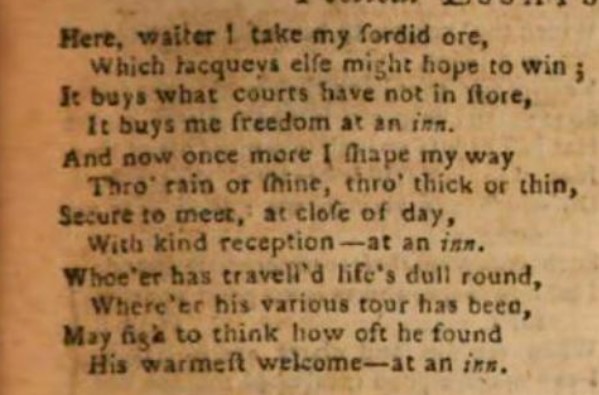
When Scotland’s national bard stopped off for a drink in Sanquhar, there was only one place he found acceptable. Robert Burns liked the inn run by Edward Whigham so much that he immortalised it in verse, with At Whigham’s Inn, Sanquhar. The prominent property in the heart of the south of Scotland town has become much less welcoming in recent years and has fallen on hard times. However, the local community has now stepped in with the hope of bringing the building back into use – with a nod to the poet who found it such a pleasant hostelry.

I found this bit of social science interesting but not, to be honest, convincing. If, as we saw above, the new fangled colour TV was another nail on the coffin of the US neighbourhood bar circa 1979, are pub crawls in the UK really going to rescue of the industry today? Here’s a clip from the study’s abstract itself:

Pub crawls are a phenomenon which are part of the hospitality sector and contribute to consumer experiences within the Night Time Economy. We show the current state of knowledge in this immature field via a Systematic Literature Review methodology. Building on this we provide a novel theoretical typology of pub crawl classification based on levels of organisation, supervision/accompaniment and geography. Highlighting the processional nature of pub crawls, where consumers move through multiple individual contexts and as a spatially embedded hospitality experience, we delineate the experience into antecedents, processes and outcomes. Our analyses lay foundations for further fine-grained theorisation. 

So… more of an invitation for further investigations. Less compelling was the survey discussed in Decanter, another effort to explain away the younger set not being the boozers their parents were:

Gen Z is known for turning up its nose at alcohol, but more young adults in this group may now be enjoying a drink, according to an international survey by drinks industry research group IWSR. In March 2025, 73% of Gen Z adults said they had consumed alcohol in the previous six months, found the IWSR Bevtrac survey.  That’s up from 66% when the same question was posed two years ago. IWSR said its Bevtrac survey included legal-drinking-age adults in 15 markets and defined Gen Z as up to 27 years of age. In the 2025 survey, 70% of Gen Z respondents in the US said they had drunk alcohol in the past six months, up from 46% in 2023.

It would be very helpful if the methodology for these sorts of stats wasn’t (i) a self-declaration about (ii) something you did once maybe in the last half year. A generation that has a drink a few times a year is not going to be the savior for anything more than pub crawls could be. Aside from the “rootin’ for booze” bias, isn’t the real story still that this story isn’t really a story?

Speaking of non-story, Alistair is in a rut but he is going to work himself out of it:

…here is my crazy idea, I am just going to write whatever random boozy thoughts pop into my head each and every day for the rest of July, including when I am in Florida on vacation. Maybe I will find something new in the Austrian newspaper archive that I love to trawl, maybe it will be a few lines of total tosh that just needs someone to comment that I am completely wrong, or right, or that you’ve been feeling the same but unable to say it. Maybe I won’t stress myself out…

The story about Justin Hawke semi-formerly from Moor is odd and, I’m going to admit, made up of threads some of which are outside of my regular reading. But nothing was missed about the “intent” that was meant.  Apparently things were known for years but now ties have severed and attendees cancelled and it all reminds me, also oddly, of Rod Stewart… who also was at Glastonbury. UPDATE: see Boak and Bailey’s on the ground reporting.

And over at Pellicle, Katie has published a story on the wines of Tenerife, the largest of the Canary Islands:

I head across town to Vinoteca Con Pasión, which has the largest selection of Canarian wine in the region. Thankfully, most are available by the glass from the shop, or from the restaurant next door. It’s from here that I buy a bottle of Listán Blanco pét-nat, made by La Orotava winemaker Dolores Cabrera… Her wines named La Araucaria are her most expressive—bottles made exclusively with indigenous Listán Negro or Listán Blanco grapes, from vines between 50 and 100 years old. Her vines are also trained in the cordón trenzado method, trailing long, woven tails across the breadth of her personal sections of paradise.

This is interesting for anyone who has spent a part of their life poring over newpaper notices and other documents from the 1600s and 1700s looking for beer references as “Canary wine” is another product you see regularly referenced. The wines of those times could well have borne a strong resemblance to what Katie experienced today. Though there are clear suggestions of the old stuff being heavy and sweet and boozy.

The New York Times in its Wirecutter column presented a set reasonable arguments from reasonably well informed people for the Teku beer glass… with an interestingly blunt conclusion:

All that said—and as we found in our own tests — most people probably won’t be able to detect significantly more flavors and aromas when they drink a beer out of a Teku compared with other glassware. It takes years of experience and training to develop that much nuance in your senses of smell and taste. But you might notice some subtle improvements while appreciating the other benefits of the glass, such as its versatility and good looks.

So my Mason jar habit remains a solid option. Speaking not of which, was it in a biography of Vita Sackville West that I read the comment from some member of the English aristocracy that he didn’t understand the Great War given all the customers from Germany who were being killed. Are the Trump immigration orders causing an analogous effect?

“A lot of Hispanic consumers are apprehensive to leave their house or … deviate from their routine or go out,” Dave Williams of Bump Williams Consulting told Yahoo Finance. “That results in fewer opportunities and occasions where beer would slot into the mix.” “The abruptness of this slowdown … makes me feel like there’s a lot more of it tied to the cyclical aspect of these consumer behaviors due to the recent ICE raids or deportation scares, whether you’re legal or not … that’s on top of the other structural aspects that beer brands in general,” Williams added.

Well, there you go. We started at the northern end of the current… conditions and ended up at the south. These are the times. As you contemplate that… again… please check out Boak and Bailey every Saturday. Look out for Stan when he feels the urge now that he’s retired from Monday slot. Then listen to a few of the now rarely refreshed Lew’s podcasts and get your emailed issue of Episodes of my Pub Life by David Jesudason on the (sometimes even but never) odd Fridays. And maybe The British Food History Podcast. Maybe? And Phil Mellows is at the BritishBeerBreaks. Once a month, Will Hawkes issues his London Beer City newsletter and do sign up for Katie’s wonderful newsletterThe Gulp, too.  Ben’s Beer and Badword is out there with the all the sweary Mary! And check out the Atlantic Canada Beer Blog‘s weekly roundup. There is new reading at The Glass which is going back to being a blog. Any more? We have Ontario’s own A Quick Beer featuring visits to places like… MichiganAll About Beer has given space to some trade possy podcasts and there’s also The Perfect Pour. Plus follow the venerable Full Pint podcast with an episode just last month!. And there’s the Craft Beer Channel on Youtube. Check out the archives of the Beer Ladies Podcast. That’s quite good but, hmm, they’ve also gone quiet this year. The rest of these are largely dead. And the long standing Beervana podcast …except they have now stood down.  As has We Are Beer People. The Share looked to be back with a revival but now its gone quiet. And the Boys Are From Märzen podcast appears suspended as does BeerEdge, too. VinePair packed in Taplines as well. All dead and gone.  There is more from the DaftAboutCraft podcast, too. Nope – that ended a year ago.   The Moon Under Water is gone – which is not surprising as the ask was $10 a month. Pete Brown’s one cost a fifth of that – but only had the one post. Such is life. Such is beer podcasting and newlettering!

*That’s a nice bit of verse: Envy, if thy jaundiced eye / Through this window chance to spy / To thy sorrow thou shalt find / All that’s generous, all that’s kind / Friendship, virtue, every grace / Dwelling in this happy place.

E

The Session #148: What Shall I Sing Thee?

It was a busy week. Youngest’s grad. Visitors with various ways. Kids setting out on adventures. Serious stuff at work. So Friday evening became a quite quiet and I found myself looking for some thing for something to do, dusting a little as I went along. I found a few things but not the thing I was looking for. Grandfather-in-law’s cufflink sets. An original 1977 Luke Skywalker Speeder toy. And I found a letter.

The letter was mailed by me in March 1986 from The Netherlands to a pal back home. Thirty-nine years ago. He gave it back to me at some point, we can’t remember when. And in the envelope, among other things, was a page written by a gang of us, starting out our backpacking trip together in the year after graduating undergrad. Before we split up and heading to our next stops, we passed the paper and pen around one Paris hotel room a few weeks before the letter was mailed. We wrote as we drank and told the friend back in Canada how he was missing out and how he was missed. Rude. Half-wasted. Stupid. Funny. Not funny. Juvenile. Here in my hand at 62, a window opened back to us all being in our early twenties. To be honest, I don’t miss being that young guy at loose ends even with all that freedom. But being with that gang of pals? It was great. Which brings me to my point.

We were a group of pub people in those years. Actually tavern people. A distinction. And we were a we. Seventeen years ago for the 15th edition of The Session I wrote a bit about it in response to the topic “How Did It All Start For You?“:

I was trying to think of auspicious moments on my early years with good beer. I am a lucky guy who, at 45, started in my university years interest in beer in early 80’s Halifax, a seaport town, that was interested in beer and drink and donairs and whether Keith’s or Moosehead was better house draught. A place where one could say “it’s a drinker” on a lovely day and know by midnight you’d be amongst 50 pals in the taverns, pubs and beverage rooms of our fair city’s waterfront.

And in those taverns… well, some of those taverns… there was singing. It’s one of the things I miss most about getting older and moving away. I have never encountered the same sort of tavern singing culture. I wrote about that in response to The Session #9. On a Saturday afternoon you could go to the Lower Deck or that other place nearby, Peddlers, where Kenny MacKay – whose Dad was a music teacher in my high school – led his band The All Stars. He led the crowd, too. A couple hundred people in a sing-a-long of folk songs and current pop hits. All while drinking pitchers.

And once in a while a sort of quiz broke out. Not the advertised organized thing that Laura may have had in mind when she posed the question for this month’s edition. But it was a quiz and it was a reasonably regular thing if you were at the right place at the right time: singing challenges. One challenge was to out sing Kenny. I was actually pretty good at this one, being a Minister’s kid who was in church and school choirs for, at that point, much of my life. It went like this. Kenny would be singing along and then he would stop and hold the note. And so would the whole room. Folk would drop away as they sputtered out their last breath. Once at the back of the Lower Deck I beat Kenny by a fair bit. I won. Hoorays and whoops before we sat and continued the serious business of draining our pitchers of draught.

So, yes, a challenge but not really a quiz. But there were quizzes even if those were rarer. Don’t get me wrong. We would regularly sit around and debate facts like “did that song come out before this song?” or “what exacly was the cubic centimeter size of that 1974 car your Dad owned?” The quiz master was always our brainy pal Jon as he sat (and still sits) somewhere affably on a spectrum or two. He could (and can) pull data out of the air better than anyone I have ever met. Pre-internet this was a vitally important presence in one’s life. Because it was always backed up with a “I remember how that particular song came out in June 1972 because we were in the station wagon going to Kitchener when I first heard it and Dad bought a new car in August.” He was our first computer.

Once on a rare night, the two tavern entertainments – singing and puzzling – came together. An example was the night the tavern became obsessed with TV show music and for half an hour or so it was a ping pong game of tables taking turns to sing and then counter-sing their best recollections of songs from The Flintstones. “There’s a place I know where the cool cats go call Bedrock.. twich twich.” Or The Wayouts song. We were getting near the end of the night when we realized the staff were all at the back watching us. We apologized for keeping them from closing but as it turned out they were having fun just listening. We tumbled out of the place, singing as we climbed the hill home.

So – singing trivia. That’s my perfect pub quiz. Could it be recreated? In the internet era? Maybe. If you put the phones away. And as long as you have your own Big Jonny in the room to pass judgement and point out the winners.

Your Sum-Sum-Summah-time Beery News Notes For The Last Thursday Of June 2025

Who knew? See, I now do all those NYT puzzles now, along with my 6:37 am big black coffee, as I try to wake up my brain cells first thing in the morning. This was never my thing. Ever. Until I joined the Wordle covid coping crew. Yet there it is – a clever observation in a Connections solution this week. Those who head out and those who stick around are both the left. Leavers v. leavings. I suppose you knew that one. I spot some sneaky things in this life but miss plenty of the obvious. We all do, I suppose. Just not the same things. We are all framed by our own individual gaps. Which I was thinking about this week when I noticed something this week, bits of writing about writing. Not meta blogging. Just a few little observations. Like Phil Cook who wrote this comment on Boak and Bailey’s on them not spilling all the beans:

I’ve been fascinated by that piece. I guess I still don’t understand why you’d keep those concerns as subtext — or cover them at all, if you didn’t feel you could be more plain about them. The rise and fall of Fox Friday in Australia (rapidly expanding, slickly designed, all that) when the law finally caught up with their shady financier haunts me as a comparison. Lots of people got burned in that collapse. In that case, there wasn’t a Wikipedia page full of priors to point to that might encourage people to be more on guard. But when there is, why not highlight it?

My two cents is that their habit of keeping a few things back helps make their writing so good. A polite but informed reticence. It’s part of their tone that, frankly, keeps you connected as a reader. Conversely, have you ever get a PR email like I did this week – and you know they’ve never read your beer related website?  One that says…

We thought a roundup story of Canadian long weekend brew pairings could be of interest to your audiences…

Lordy. I never though I would have multiple audences. Sweet! Identify yourselves!! Their client will go unnamed. It’s not their fault. (See I can do it, too. I can be restrained.) Somewhat similarly and adopting a stream of consciousness fantasy futurist approach, Dave Infante thinks someone somewhere is willing to pay for a generic PR media campaign for draft beer because it worked for milk a few decades back:

…a cold glass of beer? Normal. Better than normal: aspirational. Colorful in the glass; dynamic with an effervescent head. Emphatically not weirdo sh*t. “Got Milk?” was brilliant because the dairy industry — the f*cking dairy industry — was able to harness the power of marketing to convince the American drinking public that milk — f*cking milk — was glamorous. That was a very deep hole to climb out of! And “Got Milk?” did it. With such a built-in advantage, don’t you think a beer-industry analogue boosting draft beer, which people already like, might be able to generate sales in addition to goodwill?

Lordy Lordy. Who’s paying for that? Not quite as unrestrained this week – yet perhaps also a tad wild eyed – was one Mr. Beeson on the beery business story of the splitting of the UK’s Signature Brew, they now putting the debt in one half and the assets in another to see if some part of the overall thing survives. He posted his story in The Grocer with a 23 June dateline, as he announced on BlueSky as an exclusive, which included a quote from co-founder of said division in progress, Tom Bott, that the “restructure allows us to finally put the challenges of the past behind us and focus on building the future we know Signature Brew is capable of…” mentioning the need to address the “legacy debt” – aka debt. But then on the very same day, Jessica Mason had her story on the same subject published in The Drinks Business:

Speaking exclusively to db about the ordeal that the company has faced to stay afloat, Bott explained: “This restructure allows us to finally put the challenges of the past behind us and focus on building the future we know Signature Brew is capable of. We have built a business that is profitable, resilient and unique, blending great beer with incredible live music experiences. By addressing legacy debt in a controlled way, we are…

Much of the quoted wording attributed to the same Mr. Bott in each story is identical to the other.* Now, we can’t find fault that part of the team guiding Bott and Co. through insolvency restructuring includes a PR / comms specialist who handed out very firm speaking points – but why give both Beeson and Mason the expectation that these were exclusive interviews when they simply were not? No need to leave that hanging implication.

But there is more. The beating that truth and good sense get even worse in this brave new world – as Lars found out this week:

I’ve been preparing for our upcoming holiday in Georgia, and was looking for beer places in Kutaisi. Georgia still has farmhouse brewing, but it’s not 100% clear where, so I was really excited to read this on a site about tourism in Georgia. So excited, in fact, I emailed a woman in Kutaisi who… wrote a bar guide. She’d never heard of it, and suggested it might be AI hallucinations. The moment I read that my doubts about this photo (that’s not a traditional Georgian cauldron) came back with full force. Looking at the page again I see that the whole thing is AI garbage… It’s depressing really. It used to be that you could be fooled by people deliberately lying to you, but now you can even be fooled by a bunch of numbers employed by lazy assholes. They’re not even trying to fool you, just randomly bullshitting.

Wow. Yet, if we reflect upon this, it is even less than bullshitting, too, as there is no intention behind the formation of the falsehood. No thinking mind. It’s less than a lie, less than even the PR fluff stuff we choke upon every week. It all reminded me of something Jordan wrote me a few weeks back:

Do you realize how lucky we were to get into the sweet spot of the internet with Ontario Beer? You couldn’t research it now. The AI has gummed up the works.

Truuf. There was a golden era but this ain’t it. Speaking of modernity induced head scratchers, this set of 1967 interviews on the introduction of drunk driving laws in the UK includes a few suprememly nut-so arguments:

The pedestrian could have too much to drink. He could cause an accident. He doesn’t get tested. It’s the driver who gets tested, and I think that’s unfair… For many many years, I’ve drove with far more liquor in me than I have now…

Would one name and shame now? Or just fondly remember: “… and right there – that’s your great aunt Peggy right there, son, after she came back from Africa and before she went to jail.” Personally, I may not have driven in Kenya or Uganda but I remember working with a guy in 1982-ish Nova Scotia who had cut a hole in the floor of his truck’s cab just below his steering wheel that let him drop the beer cans down to the road at the end of the work day. The past is a foreign land. Or is it?

Moving to the same sort of themes today, Reuters reports that it’s going to be yesterday once more for the US when it comes to the government’s recommendations for healthy drinking:

The U.S. government is expected to eliminate from its dietary guidelines the long-standing recommendation that adults limit alcohol consumption to one or two drinks per day, according to three sources familiar with the matter, in what could be a major win for an industry threatened by heightened scrutiny of alcohol’s health effects. The updated Dietary Guidelines for Americans, which could be released as early as this month, are expected to include a brief statement encouraging Americans to drink in moderation or limit alcohol intake due to associated health risks…

Is that so wrong? We may not have to concern ourselves with the counting of fingers and who’s wiser than who if the focus moves to the results rather than how many got you there. After all, no one argued that this or than number of ciggies or cheese burgers shorten your life… it was just confirmed that they did.

Speaking of science, I really liked this post by Jeff and the woodland secrets of yeasty studies by two brewers in Oregon including Ferment Brewing’s Dan Peterson:

…he started tinkering. He started by putting the microbes he collected in an incubator, and then growing up little colonies.

“Then, some of them you could start identifying like, yep, these are bacterial colonies, these are yeast colonies. And then there’s always mold at that point, trying cover everything. So as they’re growing, it’s a a race to get colonies [established] before the mold takes over. But once those are split up and on their own petri plates, they’re free of mold and completely isolated from each other.”

Speaking of yeast coated containers, Chimay is selling cans of the good stuff:

The Chimay Dorée, Rouge and Triple – ranging in alcohol content from 4.8% to 8% – are now available in 33cl cans. The heavier Bleue and Verte varieties will remain bottled for the time being. “You don’t drink those in just a few gulps,” said CEO Pierre-Louis Dhaeyer. The abbey has been developing the canned versions for over three years, and has already conducted initial market trials in the United States and Japan, where canned craft beer is far more common.

Can o’ Triple? Mmmm… refreshing. That’s not going to lead to any problems, no sir-ee!

And speaking of the fine arts, this week’s feature in Pellicle has many good paragraphs but this one by Robin Vliebergen in her piece “The Apples of Limburg”  is among the finest paragraphs on the drink I have read this year:

The older they are, the higher these trees grow, and therefore it becomes more difficult to pick their fruit. As their owners also grow older, this creates a very practical problem: the trees become too difficult for them to harvest. They are left with a glut of high-quality local apples, in need of young fit people to pick them. Reinier mentioned this problem to Bonne and Job, and so the first vintage of Cidre Sauvage was born.

Fabulous. The only tweek I might have added would be somehow weaving in “high quality on high limbs” but, as you know, I am a bit of a wag. And finally remember – speaking of waggery – this very weekend is the exact time to post your thoughts in response to Laura Hadland‘s question for The Session this month:

It doesn’t matter whether you have hosted a pub quiz, or just attended one. Or maybe you’re vaguely aware that pub quizzes exist, but you’ve made it your mission to steer clear. What is the best, most entertaining set of questions or challenges that can be posed to the punter? What single topic has engaged you the most? What is it that makes a great pub quiz stand out head and shoulders above the rest? What might tempt you into attending if trivia night is something you usually swerve?

I know what I’m going to say… but I’m not saying it yet! And it isn’t “name that smell!”  You. You should submit something. Do it? Tell your grandchildren when you are old that you did, too. They will be both flatout amazed and rippling with pride.

That’s it. I am settled in for summer now. Canada’s next week. Brace yourselves. In the meantime, please check out Boak and Bailey every Saturday. Look out for Stan as he is posting irregularly now that he’s retired from Monday slot. Then listen to a few of the now rarely refreshed Lew’s podcasts and get your emailed issue of Episodes of my Pub Life by David Jesudason on the (sometimes even but never) odd Fridays with the new addition of his Desi Food Guide now on Tuesdays. And maybe The British Food History Podcast. Maybe? And Phil Mellows is at the BritishBeerBreaks. Once a month, Will Hawkes issues his London Beer City newsletter and do sign up for Katie’s wonderful newsletter, The Gulp, too, now relocated to her own website, Katie Mather Writes.  Ben’s monthly Beer and Badword is on its summer break but there’s plenty to catch up on! And check out the Atlantic Canada Beer Blog‘s weekly roundup. There is new reading at The Glass which is going back to being a blog. Any more? We have Ontario’s own A Quick Beer featuring visits to places like… MichiganAll About Beer has given space to some trade possy podcasts and there’s also The Perfect Pour. Plus follow the venerable Full Pint podcast with an episode just last month!. And there’s the Craft Beer Channel on Youtube. Check out the archives of the Beer Ladies Podcast. That’s quite good but, hmm, they’ve also gone a bit quiet this year. The rest of these are largely dead. And the long standing Beervana podcast …except they have now stood down.  As has We Are Beer People. The Share looked to be back with a revival but now its gone quiet. And the Boys Are From Märzen podcast appears suspended as does BeerEdge, too. VinePair packed in Taplines as well. All dead and gone.  There is more from the DaftAboutCraft podcast, too. Nope – that ended a year ago.   The Moon Under Water is gone – which is not surprising as the ask was $10 a month. Pete Brown’s one cost a fifth of that – but only had the one post. Such is life. Such is beer podcasting and newlettering!

*Far more obvious than the big news in rice v. the big news in rice, right?

Your Thursday Beery News Notes For The Best Week Of The Year

Yup. The weather this spring has been good so far, thanks for asking.  The air has stayed cool. And a wobbly fence has been replaced and a basement corner refit turned into the revelation that we owned a cast iron heritage sink needing keeping after all. The bugs have yet to hit and I bought that new lawn mower. One that isn’t powered by me. It still feels very twentieth century if I am honest. Power tools always do. This week, Barry has taken us in another direction, pulling some lovely old examples of scythes out of his barn:

I’ve been thinking about scythes again. I think it’s about time I got one, though we have a collection of old handles in the barn, and a fancy metal snath (that’s what the shaft is called, and I only know that because I just searched it). The stems (the bit that sticks out of the snath that the grip is attached to) on two of these are quite wobbly and worm-eaten. Actually, I guess these broke fairly often, as I found a little stack of them on top of a beam in the barn years ago. The third one is rather fancy looking.

I start with this for a few reasons. It illustrates that sort of curiosity about the knowledge that imbues the best sort of worthwhile yet somewhat idle writing. In troubled times access to good idle writing is vital. And focused knowledge drawn from idleness is usually more interesting that personal experience. Not unlike your photos of your meal or child, a lot of the personal is most often best kept personal as, believe it or not, we are all already persons. By contrast, the knowledge gained that leads to a “who knew?” needs sharing.

As a helpful illustration, David’s latest Desi Food Guide piece on Indian food in Britain as exemplifed by the beginnings of Jay Patel’s shop Budgens describes a key moment in any meeting of cultures:

…it’s this food that makes the shop so special in 2025. It’s cooked by Meghana, the wife of Jay’s eldest son, Pratik… “People were wondering ‘how do you eat Indian food?’,” says Pratik. The answer was to show them at a few tastings and this blossomed into holding stalls at local fetes. The clamour was huge but so was the generosity with the family (and its loyal workers) even dropping off free samosas at parents’ evenings and school quizzes. “It snowballed and because the public wanted it we did it more,” says Pratik. “Now people will go for a walk and have a samosa.”

Yes. Samosas came into my life at a very clear point in 1988 when I went back to university to study law. The Grad House at Dalhousie, a side benefit pub near the law school, got a fresh delivery every morning from a home kitchen. Even though my family had a particular connection to a sort of curry going back to the late 1800s, these samosas were the first things I had which were so laced with that much cumin. Who knew peas and potatoes with cumin were that good? There are lots of things I want to learn, a lot of them about what to eat and drink. But that’s about me, isn’t it. Or is that the knowledge. Hmm.

But did I really need to know that Rick Astley was in business with Mikkeller, now seemingly fully excused? Not sure. Did I need an impenetrably indulgent fog of words? Pretty sure on that one. Nope. Let’s face it: much of beer has lost that bit of thrill that can’t compare to a samosa in 1988 or a barn full of antique scythes today. Stan provided a particularly helpful if really sad example this week of how bad it’s gotten:

I did not receive the press release about how Sam Calagione (Dogfish Head), Bill Covaleski (Victory Brewing), and Greg Koch (Stone Brewing, now retired) are “bringing their legendary friendship, their boundary-busting brews, and a rock-and-roll spirit that can’t be tamed” to Manhattan later this month. But… I’m sorry, but although these are founders of breweries that make really good beer who have spent decades in the trenches (and, full disclosure, Sam Calagione wrote the foreword for “Brewing Local”) I won’t be booking a flight to be there June 26. For one thing, that poster is, well, I have no words …

That there’s a bit of a pathetic display – especially given that sort of “rock star” shit was, you know, shit back in the day, too. Fortunately, Stan also gave us a hopeful glimpse of the opposite that may soon be found at the Carnivale Brettanomyces fest coming up at Utrech in the Netherlands:

“Take a sip of beer and you will notice aromas and flavors that remind you of the world around you. Some of these play crucial roles in our physical environment by interacting with the atmosphere, oceans, and geology. We will explore some of the ways common compounds in beer reflect natural processes in our environment and climate, and how life could have evolved to use those compounds to regulate the environment to its benefit in Gaian ways.”

A bit freaky and maybe not entirely my thing but at least it’s actually promising to be about something interesting. Something you and/or I didn’t know much about yet. What else is there to learn about? BrewDog (ie “who cares”) is claiming its changing its brand and vision – as if Martin Dickie hasn’t been there all along:

“2025 marks a new era for BrewDog,” the site states. “A fresh look for our beers. Fresh faces at the heart of the company.” The erstwhile Caledonian revolutionaries are now the official beer suppliers to Lord’s, the home of English cricket, where blazers rather than baseball caps are de rigueur. Lauren Carrol, the newly-installed chief operating officer, confirmed that the UK’s most unruly company has been tamed. “When people hear the name BrewDog they expect us to shock, disrupt and, let’s be honest, probably offend,” she said. “But we wanted to do something even more radical.

Yawn. Didn’t need to know that. Much more interesting was watching the family of a contestant for Britain’s best pub pianist of over four decades ago, one Peggy Fullerton:

It was absolutely mind blowing. The family of Peggy Fullerton spoke to #BBCBreakfast after watching footage found by BBC Archive of her playing the piano and being interviewed by BBC Look North in 1981…

Watch the video under that link: “There’s Grannie Peg!” Fabulous. Speaking of fabulous, there has been actual jostling to get a place as the host for the June edititon The Session, thanks to the whipping up of frenzy by Boak and Bailey:

@morrighani.bsky.social has bagged this month but you should definitely get lined up for next month, or the month after. @beerinthecity.bsky.social is also interested in hosting a future session.

And I liked Jeff’s complaint about the cacophony of styles being pushed by the Brewers Association for the 2025 Great American Beer Festival:

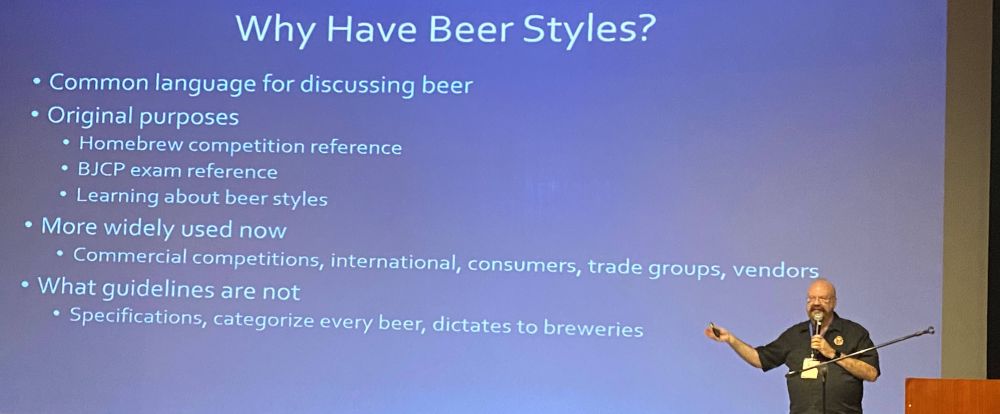
No one needs 108 categories! No one needs 108 categories that balloons to around 200 styles with sub categories! The ever-finer slicing and dicing does not result in clarity, it results in six (!) types of smoked beers… Style fragmentation also leads to an inevitable auroboros exemplified by a category like “international amber lagers” in which Mexican amber lagers will be judged with polotmavý and Franconian rotbier. What?

Remember, as Stan recently reminded us, when folk said styles were important to help consumers understand what they were buying? Not so much now. Elsewhere, someone wrap Jessica Mason in asbestos* as she has been on fire this week asking all sorts of clear questions. Like “why have Belgians stopped drinking as much beer?” and “why have the Irish stopped drinking as much beer?” and “why are UK drinks makers enjoying a rise in profits?“:

“Anecdotally, what we’re hearing from some of our customers is that Q1 brought welcome windfalls. Some tariff-affected international customers have turned to UK firms to do business, while others raced to order more before tariff pauses came off. That’s delivered a shot in the arm for some firms, but more importantly we’re hearing that steadily falling bank rates are starting to stimulate the economy, which obviously is very welcome to UK manufacturers who’ve posted a really strong start to the year.” The data has also highlighted how profitability is improving as manufacturers have held off from buying new stock, instead preferring to use up inventory reserves where possible.

That’s interesting. And David, also in TDB, has added his own question – “what’s wrong with cheap beer?“:

… with my honest hat on, most beer drinkers under retirement age know there’s better options at the bar. And I really wished that those who write about problematic drinking in the media showed the same discernment. Because it isn’t sessionable pints that are the issue here but how pub chains profit from alcoholism. That substance abuse might be from excess beer drinking but it’s also more likely from much higher ABV drinks. Especially because I see morning drinkers drinking their Bells but I rarely see them ‘enjoying’ it.

That’s also a bit of clear observation right there. I like how TDB has been exploring all angles of the trade – the good news and the not so good news – without necessarily making a lot of noise about how that they doing just that. What else is going on? I really liked this observation by Steve of Beer Nouveau in reponse to Katie on gastropubs:

It’s fair to say I don’t like them. But my 81 year old dad does. And his new 82 year old wife (yeah, they got married last year!) does… They know when they go in that there’ll be a menu with favourites like cod and chips, beef wellington, steak, roast chicken and maybe a sticky toffee pudding to follow. They know they won’t be confronted and bamboozled by “dirty fries” whatever the frag they are. They know they won’t need a spoon to help them eat a burger. And they know that they can order a pint of “bitter” and not be interrogated as to which variety of yeast they want that fermented with. Oh, and they’ll also sell Chardonnay as a standard. These are not places for us. These are places for them.

Yup. It’s OK that people don’t like the same things. I like how “it’s not for me” can mean a quick judgement or, more usefully, a realization. Knowing that makes life easier. For example, I had a bit of a moment realizing I wasn’t warming to the tale told by Will Hawkes this week in Pellicle about the brewery German Kraft at London’s  Elephant and Castle food hall called Mercato Metropolitano. Was it phrases like “a no-holds-barred business” and “this is our USP” that reminded me a bit of something I didn’t like? I really don’t think so. I think it’s just a good description of a place that’s probably just not for me. Which is fine.

Speaking of fine, there was some plain speaking over in one corner of the wine world that could equally apply to good beer:

There is no question that wine faces significant issues. I was talking to a leading port producer, who is in a state of near panic (not without good reason, I’d be panicking if I made port!). He was convinced that the anti-alcohol lobby would put him out of business. I suppose that’s easier than admitting you make something that nobody seems to wants to drink any more, but there is no question that the health lobby is reducing wine sales, especially with young professionals, where, if they don’t stay alcohol free they are often turning to cocktails.

And, finally, the details of memorial services for the late Martyn Cornell were posted at his website by his brother David:

For those that wish to attend his funeral it will be held at: Hanworth Crematorium (TW13 5JH) Monday 30th June 2025 @ 12.20 with a small wake at a local pub afterwards to celebrate Martyn’s life. For those that can’t make it we will be having a small wake at Poppyland Brewery, Cromer on Sunday 06 July between 13.30 – 16.30. The family request no flowers.

Still… being that I was raised by a florist and worked in the shop myself perhaps I will still plant something good looking out in the yard in remembrance, something nearby when I need to have a shady sitting spot to sip a beer this summer.

Next week I am on the road so who knows what will be please check out Boak and Bailey every Saturday. Look out for Stan when he feels the urge now that he’s retired from Monday slot. Then listen to a few of the now rarely refreshed Lew’s podcasts and get your emailed issue of Episodes of my Pub Life by David Jesudason on the (sometimes even but never) odd Fridays. And maybe The British Food History Podcast. Maybe? And Phil Mellows is at the BritishBeerBreaks. Once a month, Will Hawkes issues his London Beer City newsletter and do sign up for Katie’s wonderful newsletterThe Gulp, too.  Ben’s Beer and Badword is out there with the all the sweary Mary! And check out the Atlantic Canada Beer Blog‘s weekly roundup. There is new reading at The Glass which is going back to being a blog. Any more? We have Ontario’s own A Quick Beer featuring visits to places like… MichiganAll About Beer has given space to some trade possy podcasts and there’s also The Perfect Pour. Plus follow the venerable Full Pint podcast with an episode just last month!. And there’s the Craft Beer Channel on Youtube. Check out the archives of the Beer Ladies Podcast. That’s quite good but, hmm, they’ve also gone quiet this year. The rest of these are largely dead. And the long standing Beervana podcast …except they have now stood down.  As has We Are Beer People. The Share looked to be back with a revival but now its gone quiet. And the Boys Are From Märzen podcast appears suspended as does BeerEdge, too. VinePair packed in Taplines as well. All dead and gone.  There is more from the DaftAboutCraft podcast, too. Nope – that ended a year ago.   The Moon Under Water is gone – which is not surprising as the ask was $10 a month. Pete Brown’s one cost a fifth of that – but only had the one post. Such is life. Such is beer podcasting and newlettering!

*Please don’t. It’s actually not very good for you. Though, to be fair, neither is actually being on fire. So perhaps we can agree that you will deal with the situation as necessary should the occassion arise. 

Session #147: More Poems Please!

It’s the day for The Session again, the last Friday of the month. Our host this month is Phil Cook, a New Zealander in the beer trade who lives in Australia. He posed his question for this month’s consideration over at his blog and it’s all about art:

Feel free to interpret “art” and “fiction” as broadly as you like. Film, TV, music, games, poetry, prose, painting, a particularly pointed piece of graffiti; whatever. Don’t feel obliged to pick a single favourite. A random grab-bag of examples would be wonderful — though a carefully-selected set that illustrates a trend or theme is of course welcome, too. I’d even be curious to hear about a beer or pub that came to you in a dream, if it felt like it captured something about its subliminal force in culture or on your own specific consciousness.

Phil was good enough in his announcement of the topic to remind me that he was struck by Gord Downie’s rendition of the poem “At the Quinte Hotel” by Al Purdy, something I shared years ago. Here’s Al Purdy’s own rendition.  Around that time, I also received what was unquestionably the highest award a Canadian beer blog writer can receive for their sensitivity as my original post about Purdy’s poem received this comment from none other than the host of CBC TV’s Man Alive Roy Bonisteel back in 2007, offering a bit of background on the poet and the poet:

I like the beer blog….it’s very good. In interesting fact that a lot of people don’t know is that although Bellevillians are very proud of Al Purdy’s poem about the Quinte Hotel…it is not the Belleville Quinte. It is the Trenton Quinte…now called something else…where Purdy drank. At this same time I had a room at the Quinte when I was driving cab and working at the Courier. At that time we didn’t know each other…but year’s later over many a beer, talked about the fact that we had both been there at the same time. Tell your friend I’ll keep up with his blog.

We now understand that the Quinte of Trenton became known as The Sherwood Forest Inn, a peeler bar, before it burned in 2012. Such is the way of the world. There are somethings even poetry can’t save us from.

And as further proof (if it was needed… or even possible) of my status as a sensitive man, I posted a number of passages from poems about beer back in 2007.   It included this passage from a poem I have admired since I was in undergrad, William Shenstone‘s “Written At An Inn” from 1758:

Here, waiter! take my sordid ore,
Which lackeys else might hope to win;
It buys what courts have not in store,
It buys me Freedom, at an inn.

Freedom. Wonderful thought right there. Click on that image to see the whole thing as it appeared on page of Volume 27 of The London Magazine, Or, Gentleman’s Monthly Intelligencer at page 255. And you know it wasn’t just poems being read about drinking in inns back then. There were poems written that were meant to be sung in the taverns and inns of the eighteenth century.  I’ve posted a few over the years but I think my favourite, set to a very familiar tune, was “Nottingham Ale” because, as explained in the 2017 post under that link, I was familiar with the tune. But that was not the only one. In the very next year, I wrote about “Dorchester Beer” which includes this rueful geo-political verse offering an alt-history of the lead up to the American Revolution:

E’en our brethren across the Atlantick, could  they
But drink of this liquor, would soon be content:
And quicker by half, I will venture to say,
Our parliament might have fulfilled their intent.
If, instead of commissioners, tedious and dear.
They had sent out a cargo of Dorchester-beer.

I wonder if they’d be open to that trade these days. Hmm. And I would be failing in my sensitivity on this point if I didn’t finish with an acknowledgement to Beer Daily Haiku which ran from 2005 to 2013 during the Golden Age of Beer Writing. That was a great thing to read over the first coffee each morning. The Wordle of its day.

What happened to it all? Why has beer ceased to inspire the pen? Is it because we have traded haze where once was clarity? I don’t know. Have we lost our capacity for sensitivity? I wonder. One last bit of verse before you go about your weekend, this from Keats’s Ode to Autumn which I wrote about in 2003 again thinking back to undergrad days when I was struck by this poet’s thoughts on the plenty of harvest and, in the end, harvest’s rewards:

Who hath not seen thee oft amid thy store?
Sometimes whoever seeks abroad may find
Thee sitting careless on a granary floor,
Thy hair soft-lifted by the winnowing wind;
Or on a half-reap’d furrow sound asleep,
Drows’d with the fume of poppies, while thy hook
Spares the next swath and all its twined flowers:
And sometimes like a gleaner thou dost keep
Steady thy laden head across a brook;
Or by a cyder-press, with patient look,
Thou watchest the last oozings hours by hours.

Good work, Johnny K. Now I am off. Gotta go plant something. And then maybe have a drink.

The Goodbye May And Hello Temperatures Over 68F Edition Of The Beery News Notes

It’s always good to find a new extension to a hobby. I have kept a birding life list for decades but, you know, I’m am pretty lazy about adding to it in any organized way. Because you have to go out there and look. Out into the world. Into the woods and fields. Just look that that chaos! What a pain in the ass. So happy was I that I was advised by eldest to add the free Merlin app from Cornell University to my phone. Not only does it identify the birds you can hear around you but it records and archives the sounds with a handy graph that looks like a seismic chart. Did you know I had a Swainson’s Thrush in the tree by my house or Magnolia Warblers down the street? I didn’t. But now I do. All very exciting – especially as all that is required of me is to find a spot and stand still. The Kingbirds come to you. I can even doze off as the device gathers the data. Excellent. I bet it pairs well with the backyard and a beer.

Speaking of the high sciences, I always like to report on the Beeronomics Society news when I get an email update on their doings. Rather than the usual sort of beer experts, they are a group of global academics with (get this) credentials from peer reviewed institutions!  They don’t get together all that often but they have announced a meeting in Bordeaux, France tentatively set for June 24 to 27, 2026. Please support my funding drive to send me to that event – with, yes, a two week lead up climatization prep there ahead of time and, yes a two week cool down afterwards… also there. Ahhhh… Bordeaux. Their website may be tremendously out of date in terms of form and content, but their newsletter I got by email this week did mention a new book to find out there on your travels, The Brew Deal: How Beer Helped Battle the Great Depression by Jason Taylor of Cntreal Michgan University who discussed it on YouTube:

During the final stages of Prohibition, the US government allowed the consumption and sale of “non-intoxicating” beer, which was at or below 3.2% alcohol-by-weight. Beer’s return—permitted with an eye toward job creation during the Great Depression—was one of President Franklin D. Roosevelt’s earliest New Deal policies. In this book, economic historian Jason E. Taylor takes readers through the rapid resurgence of American breweries and shows how beer helped spark a sharp recovery in the spring of 1933.

And continuing with their sociological studies, Boak and Bailey wrote this week about finding themselves in a culture over twenty years behind in terms of the interior public smoking scene:

We’d assumed that smoking bans had come into place in most countries in the orbit of the EU, or that are tentatively working their way towards membership. In Serbia, though, it turns out that the smoking ban introduced in 2010 exempted bars, cafes and restaurants. Small establishments can choose to ban smoking if they want to. But based on our observations in the past week, very few opt for anything but ashtrays on every table… If you’re someone who spends a bit too much time hanging around outside taprooms and craft beer bars, puffing away in the cold and the drizzle, you might want to consider Belgrade for your next holiday.

I grew up with smoking in bars until my early 40s but have absolutely no interest in going back. Elsewhere, Katie has been in Spain and I am, you know, really frikkin’ jealous:

I love Spain. Every region is so different but so familiar, the same searing hot sun shining down in golden waves, touching everything with a little magic. I particularly love Spanish ham, and last night at a bar in a tiny alleyway I was served some of the most delicious acorn-fed lomo I’ve ever had in my life. Salty, melting, rich, served on paper.

Ahhh… Spain. Very very jealous. OK, back to the eggheads in lab coats, in this week’s “Hey That Sucks” news in the medical sciences, the New York Post has reported on a study published in “Environmental Science & Technology” found that 95% of 23 tested beers across the US contain cancer causing forever chemicals – and there are more in someplaces than others:

The study found a strong correlation between PFAS concentrations in municipal drinking water and levels in locally brewed beer — a phenomenon that has not previously been researched. While the study did not disclose specific beer brands, it identified that beers brewed near the Cape Fear River Basin in North Carolina exhibited the highest levels and most diverse mix of PFAS. Beers from St. Louis County, Missouri, also showed significant PFAS presence. The findings suggest that standard water filtration systems used in breweries may not effectively remove forever chemicals, highlighting the need for improved water treatment strategies at both brewing facilities and municipal treatment plants.

And it was the week for Stan’s monthly Hop Queries report and of note this time was the agri-science horticultural news of great crops from Australia and New Zealand. He also shared a secret about the frankly anti-terrioristic efforts behind one old pal of mine, Bell’s Two Hearted Ale:

…for Bell’s, the quality of the Centennial is quite important. But a few years ago, I learned that when you drink a Two Hearted you can’t say, “Yes, that’s Centennial from Crosby Hops.” Or from Segal Ranch, or CLS Farms. Or other farms that supply Centennial to Bell’s. The team at Creature Comforts Brewing in Georgia was excited in 2022 when they were brewing a collaboration beer with Bell’s, because that beer was to include “Centennial from Bell’s selected hops” along with five other varieties. Bell’s vice president in charge of operations John Mallett, since retired, explained what that means. After carefully selecting 500,000 pounds of Centennial each year from multiple farms, Bell’s creates a master blend that does not smell or taste of a single farm.

There. Now… let’s take a pause here so we don’t forget to consider the arts, too. And don’t forget that at the end of the month for now and forever, we have The Session. Phil Cook is hosting this week who explains the topic:

I’d like to take us out of the ‘real world’ for a moment to share the beers and pubs in art and fiction that have grabbed our attention, whether they were sublime, surprising, moving, amusing, somehow significant, or symbolic of something — or awkward and out of place, if you like. Gather your thoughts, or keep an eye out over the next few weeks, and let’s enjoy them together at the end of the month.

Fine. Art. Got it? Done with that? Now… back to the grim reality of today. Remember those tariffs? We’ve heard about their effect on aluminum cans and glass bottles, but Utah’s KUER radio reported on the effect of tariffs on brewers who rely on rare ingredients like Kiitos Brewing which relies on fonio*:

“It’s the most expensive grain we’ve ever purchased, because it is coming from West Africa,” Dasenbrock said. “They’ve already kind of signaled that the price that we had been quoted will not likely be the price when it arrives.” That price swing is because of the Trump administration’s tariffs. In April, the president slapped tariffs on about 90 countries. Since then, some products have been exempted while other tariffs have been postponed…  For Dasenbrock, the rapidly changing landscape makes it difficult to pinpoint what his expenses will be. “Day by day, it’s 10%, it’s 50%, it’s 1,000%. Oh, no, wait, just kidding, it’s 10%,” he said. “It’s virtually impossible to predict what your costs are going to be in an environment like that.”

Ahhh… Utah. [Nope. That just doesn’t work in the same way.] And where the tariffs aren’t hitting hard, breweries continue to close and, in Germany, brewers are even – sounds a bit exotic in these times – going on strike as Jessica Mason reports:

…the growing concern among beer fans is that, without resolution, beer production at Krombacher could also be cut during the summer months… Isabell Mura, deputy NRW regional chair of the NGG and managing director of the NGG South Westphalia explained that the strike falls just before the beer-hungry holidays of Ascension Day and Pentecost and warned that summer thirst could also suffer since reduced beer production would then also make barbecues and summer festivals drier.

And speaking of both the moo as well as the lah, Jeff wrote about how one economic development agency – a concept rife with chin rubbing questions – in his home state of Oregon helps and perhaps fails to help industries, like brewing, there:

It’s possible Travel Oregon is killing it with other industries; the state is also famous for its wine, coffee, cuisine, and agricultural and natural resource plenty, not to mention its non-industrial and amazing outdoor activities. Neff quoted folks who said it was great, and I have no reason to argue with them. In terms of making the case that Oregon is a unique and special place for beer in the US, with a deeper culture and history than you’ll find anywhere else, not so much. Travel Oregon’s brewery information is out of date and sparse, and the map is even more out of date and inaccurate. Those deficits are a big part of the reason I wanted to create Celebrate Oregon Beer. Since I was really the main critic, I just wanted to heavily caveat my comments to say they only applied to beer.

And David J himself has a new project on the go, the Desi Food Guide that builds upon his work to date inclusing hs book Desi Pubs and his newsletter Episodes of My Pub Life:

Although the question of where serves the best mixed grill is very important, explaining the reasons why desi pubs were set up in the face of racism, segregation and hostility seemed far more pressing. The book resonated with readers because it wasn’t a shallow interaction with desi culture but a deep dive into modern British-Asian history. Desi Food Guide will continue where the book left off and delve into the stories behind dishes made by those often overlooked or superficially covered by online influencers. I will use my many decades as a journalist to tell their stories and interview those who may be shy but have a special tale to tell. I will visit restaurants, cafes, food trucks and, of course, pubs to detail one dish a week that you have to experience.

That sounds very interesting. You can sign up here. Finally, Pellicle took us to Pigalle Beer Bar in Tokyo where the selection is the owners’ personal collection more than the result of curation. The work this week is provided care of author Reece Hugill, where he found an old friend on offer :

I, too, was a bit taken aback by this. Memories of warm bottles drunk in my youth, often a misguided Christmas present, are not positive. Forced-down, tepid pints in suburban chain pubs with dirty lines are even worse. It took me two visits to Pigalle before I overcame this, and plucked up the courage to join the locals in their favourite beverage… the Old Speckled Hen is their “toriaezu biru” which means that it’s the initial beer you order to start yourself off, without thinking, or looking at the menu, before diving into whatever you fancy next. Something to shrug off the world with. 

What a great idea. Baselining as opposed to mainlining. Well, that is it for now. A bit of a quiet week. The King visited. I didn’t drive to Ottawa to see him. Next time maybe. And until you and I meet again, please check out Boak and Bailey every Saturday (…as long as all their holiday fun doesn’t get in the way…) and Stan (….back again this  Monday and very nice of him to notice what I wrote). Then listen to a few of the now rarely refreshed Lew’s podcasts and get your emailed issue of Episodes of my Pub Life by David Jesudason on the (sometimes even but never) odd Fridays. And maybe The British Food History Podcast. Maybe? And Phil Mellows is at the BritishBeerBreaks. Once a month, Will Hawkes issues his London Beer City newsletter and do sign up for Katie’s wonderful newsletterThe Gulp, too.  Ben’s Beer and Badword is out there with the all the sweary Mary! And check out the Atlantic Canada Beer Blog‘s weekly roundup. There is new reading at The Glass which is going back to being a blog. Any more? We have Ontario’s own A Quick Beer featuring visits to places like… MichiganAll About Beer has given space to some trade possy podcasts and there’s also The Perfect Pour. Plus follow the venerable Full Pint podcast with an episode just last month!. And there’s the Craft Beer Channel on Youtube. Check out the archives of the Beer Ladies Podcast. That’s quite good but, hmm, they’ve also gone quiet this year. The rest of these are largely dead. And the long standing Beervana podcast …except they have now stood down.  As has We Are Beer People. The Share looked to be back with a revival but now its gone quiet. And the Boys Are From Märzen podcast appears suspended as does BeerEdge, too. VinePair packed in Taplines as well. All dead and gone.  There is more from the DaftAboutCraft podcast, too. Nope – that ended a year ago.   The Moon Under Water is gone – which is not surprising as the ask was $10 a month. Pete Brown’s one cost a fifth of that – but only had the one post. Such is life. Such is beer podcasting and newlettering!

*Fonio.

Session #146: On Value

I used to go on and on about many things but one of my biggest beefs in years past was the broader beer discussion not only ignoring but rejecting much of the normal considerations of value. Especially relative value. You look at any critical discussion in wine, info tech, cars, pop music, clothes, food… anything… and there is someone telling you X is pretty much the same as Y but it only costs 78% as much. That’s the entire basis of consumer focused writing. Except with beer.

So it was with a large helping of interest that I read that our host Ding’s subject for this month’s edititon of The Session was value:

On the whole, I have found value in most of my purchases. That isn’t to say that all of the purchases have represented value for money, they haven’t, but I can still find tremendous value in what many people would categorize as ‘ridiculously expensive beer’. Value most certainly does not necessarily correlate with cheap either (although it could), rather it means when I part with the cash, no matter how large or small the amount, does what I receive in return meet or exceed the value of said cash? Subjective? Sure, but we all have our own sense of value.

Eighteen years ago, when this blog was a bit of a thingier thing, I wrote a piece with the title “Are Craft Beer Prices Too Low? No, They Are Not Too Low” which got a lot of attention in the comments from a lot of interesting people. It is an artifact of the era. The era of “Hooray!!!” As with the best of public and, like the psalms, responsive readings of that time I learned a lot from what was shared in the comments.  Unfortunately, I lost the ability to link to specific comments from way back when the platform for this here blog got shifted but suffice it to say that there was a range of ideas from:

Do I ask my Quebecois cheesemaker to justify the price of his or her cheese? No.

and on to:

…distillers do get asked to justify the high prices on whiskies (and even whiskeys) these days. They have a simple answer: it’s really good, it’s really rare, and we had to keep it a long time before we made any money on it.

plus:

It would be great to see more actual brewers chime in on this forum, because I think some of this talk is just absolutely ridiculous.

It all looks a bit charming from almost two decades on. I think if we consider (i) what has happened in recent years to the previously irrationally exuberant fine wine market as well as, obviously, to the whole  craft beer industry and (ii) the greater acceptance about the role of manufactured scarcity and, in a few cases, straight up avarice from those plumping the brewery for resale along with (iii) (as also seen in the comments) the genuinely held dreams of brewers fully convinced that they were making art not beer then, well, we can agree that a great rebalancing shift has occurred in the market. And it is one which allows drinks consumers to assert a greater and saner role in determining the relative value of what they buy. We are in a new era, one that pre-Obama era drinks trade might never have imagined.

So where are we now in terms of appreciating value in 2025? First, there is actual consumer generated response which creates downward pressure on price points for beer at home and in the taverns. I look to no higher authority* than The Tand on this point who wrote this very week:

If you charge an outrageous £7 a pint for @TimothyTaylors Landlord, it should be toppest of notches, not poor. (Hoop and Grapes, Aldgate.) You really shouldn’t be doing this. Get a cellar services team in to check procedures and temperature. Shocking. Started off peeved about this is. Now as I struggle through this pint, I’m hopping mad about it. And no, the beer isn’t off, just totally badly presented and the price – words fail me.

The tone! None of the “let’s get out there and raise all boats, lads!” talk circa 2009 in those fighting words. That’s raw reporting, that is.  And it didn’t stop there. The Mudge ripped back:

The average British adult only drinks about 1¼ pints of beer in a pub each week, which really isn’t very much. Drinking a lot of beer in pubs, such that it has a significant impact on your personal budget, is very much a minority pursuit. Many pubgoers are there primarily to have a meal, and if you’re happily spending £17.95 on a braised lamb shank, whether your pint of Landlord is £4.75 or £5.50 is neither here nor there. 

What the hell has he got against lamb shanks?!?  Whatever it is, I think we can agree that lamb shanks merely stand in for the consumption of all other forms of entertainment. Clearly. Which leads us to the observation that the recognition of relative value’s role goes beyond whether this beer is as good as that beer but can be had for half the price and lands squarely on the reality that the question of whether this night on the beer is as good as going to that concert or that game – or to that park or for that nap for that matter.

We still need to beware. There are still forces of anti-valutarianism about trying to grab every penny from us that they can. Just this very week, Jeff** witnessed two flailing attempts to pump desperate transfusions into the bloated corpse of IPA:

Northern IPA, an idea apparently concocted by the Lallemand Marketing Department to sell a new yeast strain, “incorporates the clean drinkability of the modern West Coast IPA with a more prominent yeast aroma profile.” Meanwhile, Matthew Curtis forwards Savo(u)ry IPA to describe a single beer from Norfolk—that’s in East Anglia—using MSG for the purpose of “stimulating your umami receptors.” All right, then!

Chemistry. BAH!! Nothing thoughtlessly opens the badly battered wallet like claims to better chemistry. Consumers take heed!  This is the sort of thing you are up against in your quest for a decent drink at a decent price. We must protect the innocence of our precious umami receptors while we can.

What is value? Freedom. That’s what.***

*I can’t apologize to The Beer Nut on this hierarchical point, given he too wears the “the” of authority, but certainly note that he wrote this very week “It’s not unpleasant, but it is extremely basic. Is it an effective substitute for the price-conscious Madrí drinker? Sure, why not?” by which we can infer his sensitivity to the combined effect climatic, inflationary and authoritarian imposition of tariffs all weighing down upon the lowly consumers’ shoulders,  pushing the mind towards critical marketplace analysis and away from happy lappy advocacy. 
**Not “The Jeff” I would note. Not yet. Oh, and here‘s what The Mattyman wrote.
***Finis. Amplifer fluens. (Applause!) Te relinquo.