The British Ale Brewery, A Joint Stock Company In 1807

bab1807In 1807, a correspondent who went by the name “The Plain Dealer” wrote a letter to the editor of The Morning Chronicle on the topic of joint stock companies:

SINCE my last letter a number of new projects have been announced to the public, and some of them of great magnitude…. Let us begin with the Breweries. No fewer than five companies have been established, to rescue the public from bad beer at an increased price. This was a most tempting proposal. There was, after the series of unfavourable harvests, which we suffered at the beginning of the new century, an universal complaint against the beer. It was not merely lowered in quality, but composed of substitutes for hops and malt, which were thought to be pernicious; and to add to the evil, it was said to be the practice of all the great brewers, both in town and country, to buy up the leases of ale-houses, so as to deprive the publican of the freedom of going to the best brewery for his liquor. If this statement be true, it was a crying evil; but it was, and is, capable of an easy remedy. It depends entirely on the Magistrates; for if, instead of the reluctance which they now feel at the licensing of new houses, they would make it a rule, whenever a public tap was known to be the property of a brewer, and that bad beer was the consequence, to license a free house, in the immediate neighbourhood; the competition would be renewed, and the people would be served with a wholesome, palatable, and strengthening beverage. We know that the worthy Chief Magistrate of a city in the county of Kent has announced this to be his determination, and the inhabitants have already reason to be grateful to him for his device.

Competition. That was the promise of the joint stock companies. Too much wealth had gravitated into too few hands through the reactionary period after the loss of thirteen of the fifteen American colonies and then the French Revolution. The quality of beer crashed as prices climbed. But this new cure by joint stock companies was not trusted. In the string of letters to the editor in which this one is found, complaints about “sleeping partners” and “middle men” are set out. The sorts of things that people who distrust big faceless corporations floating mid-air in the stock markets still raise today. Yet there was an argument that these were tools to break the monopolies of the fantastically well connected and landed, the means to introduce competition into a status based economy. Competition was a new idea. Distrust hovered.

There is another reason folk were concerned other than the shock of the new. 1720. Ever since 1720, the joint stock idea was cursed. See, from the mid-1500s to 1720 there was a system of chartered companies approved and given blessing by the Crown. The most famous in Canada is the Hudson Bay Company that continues today. In our book Ontario Beer, Jordan and I describe how in the 1670s beer was being brewed in Ontario’s Arctic north by staff of the HBC over-wintering in trading posts set up to supply the firm with furs and other goods from the exotic north. A number of these were set up to encourage trade with lands as far away as Russia and Turkey… and then in the first quarter of the 1700s the South Seas. Careful readers will recall a few days ago when in the 1760 case Hunter v. Sheppard the Court described the hop buying fraudulent scheme in this way: “…trade was at that time very particularly circumstanced, hops being in 1764, like South Sea stock in 1720, or India stock in 1767…” Frauds. Bubbles. Money going in but never a hope of return coming out. The disastrous South Sea Company was the last of these companies to be chartered. And for a hundred years they remained highly suspect.

By the new century, new problems with the economy demanded a return to the concept.Unincorporated and unlisted subscription joint stock companies were forming when large groups of people subscribed into what essentially was a extremely large partnership. Described as “associations of gentlemen” they formed to break the grip of the established and wealthy in the context of the new commercial liberties and the new industrial era. One of these new enterprises was the British Ale Brewery. In an 1809 edition of The Monthly Magazine in the listings of commodity prices, one aspect of the British Ale Brewery is described: you can purchase a share in the firm for a 4 pound premium. Trading in company shares was an innovation and one that caused distrust.

But what was the British Ale Brewery? Apparently, it operated. The formation of the company was described in the 1815 court case Davies v. Hawkins:

…in 1807 a number of persons, about 600, associated together as a company, and made subscriptions, which subscriptions were divided into shares of 50 pounds each, for the purpose of establishing a brewery for ale, &c. under the name of the British Brewery. The subscribers entered into a deed which contained, among others, these provisions: that the shares should be transferable, &c. the purchaser executing the deed, and binding himself to observe the regulations, etc. contained therein; that a committee to be appointed should have power to make rules, orders, and bye-laws, subject to confirmation by a majority of the proprietors at a general meeting; that the conduct of the business of the brewery should be confided to two persons who should be styled brewers, and the trade should be carried on in their names…

The two assigned to act as brewers 1807 were Begbie and Murray. Their British Ale Brewery along with the Golden Lane Brewery were the only two breweries to complete their share subscriptions and enter trading in Britain’s early 1800s stock markets. How did it fair? In the 1808 ruling in Buck v. Buck, counsel for the firm pleaded that the intentions of the brewing enterprise were the purest:

The object of The British Ale Brewery was to carry on a lawful trade in a lawful manner, and to furnish to the public at a cheap rate, and of a good quality, an article of the first necessity It was a public benefit, therefore, instead of a nuisance, and was no more illegal than any other partnership comprehending a great many members.

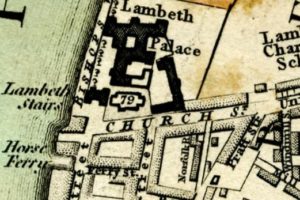
The court was not moved. It held the business to be outside the law. The brewery was supposedly located in 1810 on Church Street just south of Lambeth Palace in London between Pratt Street and Norfolk Row as shown in that 1818 map up there. Bits of those streets by those names still seem to exist near the Thames. Its twin, the Golden Lane, died off as a joint stock company in 1826. Hmm. In 1808, the same Begbie and Murray appear to take out an insurance policy for the Caledonian Brewery on Church Street in Lambeth. The equipment and the lease for the Caledonian Brewery of Lambeth are auctioned in 1824 and in 1831, one Thomas Begbie testifies before a committee on the state of the brewing trade. By 1844, the law of Britain required all joint stock companies to be incorporated and listed. Whatever happened, the brewery and the era appear to have been wound up by then.

Unlike Most Gimmicks Fog-Based Beer Is Real

I like the gimmick that are also based on something actual, a rare sight in the craft beer scene these days. Stuff like when thirty years ago I had a beer from the Falklands. And it really was. Fog based beer is apparently real as well:

Since a particularly bad drought in the 1950s, now-retired physics professor Carlos Espinosa Arancibia has been testing nets that could help capture water in Chile’s driest regions, the BBC reports. This current iteration of the net has openings less than one millimeter across around which water droplets condense out of the fog. The drops accumulate and grow until they drip into a pipe at the base of the net, from which it flows into a container, so clean that it’s immediately ready for human use. One of Espinosa’s test centers is near the town of Pena Blanca, home of the Atrapaneblina (fog catcher) brewery. The beer–a golden-amber Scottish ale with brown foam–is made only with the water collected from the fog nets. The brewery produces a meager 6,300 gallons of beer per year, but its owner says the water gives the beer a unique taste and quality.

OK… a golden-amber Scottish ale with brown foam? What the hell is that supposed to be? The brewery’s website only has images of the beer in bottles. Images online show a rather more comforting off-white head. There is just one lonely BAer review.

But what about the science? The Daily Mail published some respectable images of the fog nets of Chile a couple of years ago. The eggheads over at MIT are apparently involved with Chilean fog harvesting and have promised a five-fold increase in production. Their studies of the carapace of the Namib beetle, native to the Namib desert of southern Africa have led them to that conclusion. [Ed.: how many times have I heard that!?!?] Apparently, at certain times of the year a square meter of the better mesh might yield up to 12 liters per day or more. Which means only a ten by ten meter net might be needed to get you that litre of beer a day.

Given the Californian drought, a net of 41,650,000,000 m² is all they need to support current craft beer statewide production. That’s 41,650 km² of netting or about 10% of the state’s total land mass. So… it’s possible.

“Grain Suffisamment Pour Faire De La Biere”

hebertThe footnote quoting a text from 10 August 1620 actually reads in full:

Nous avon du grain suffisamment pour faire du pain and de la bière

That statement was written by Denis Jamet, Récollet missionary at Quebec in New France. When I wrote the bit about New France in Ontario Beer a year ago, I only thought to state that beer “came to New France at the latest in the 1630’s with Jesuit priests who brewed as part of their daily duties.” Hadn’t thought of the Récollets. The Jesuits come along a little later and, by 1634, they have a full brewery was being planned but in Quebec the Récollets were here first. I’ve been reading about their entry into the extremely sparce European population along the St. Lawrence Valley in the early seventeenth century in Champlain’s Dream by D.H. Fischer. In 1617 when there were 50 or 60 male residents of New France, there were four Récollets, three at Quebec and one further west at Huronia in what is now central Ontario. Denis Jamet was one of them. He came to New France for a second stint on board Champlain’s spring 1617 sailing from France to the new world.

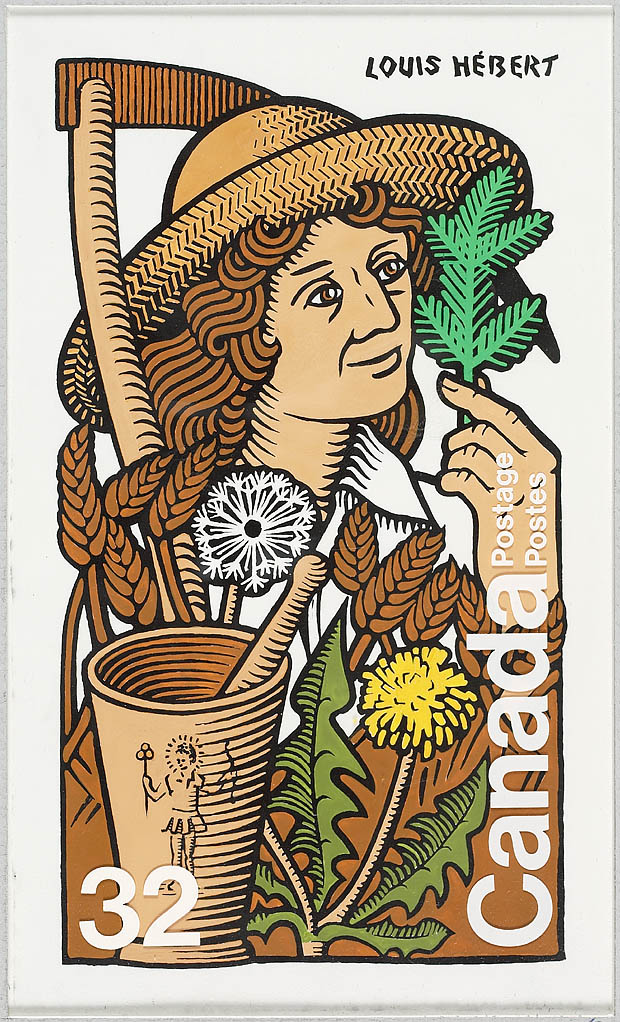
Early New France did not do without strong drink. As part of their provisions, every year “they imported generous quantities of eau-de-vie, wine and cider.” People were arriving, too. Along with Denis Jamet, in 1617 the first permanent colonial family arrived in New France: Louis Hébert and Marie Rollet along with their three children. Hébert takes up planting, serving as apothecary to the settlement and starts over the next few years to create some economic stability and wealth for his small clan. He dreams of being on a stamp one day. He dies in January 1627 but not before he he becomes, as noted, also associated with “une chaudière à brasserie” – a brewing kettle. This document mentions it arriving in 1622. Which means, if Jamet is to be trusted in that first bit I quoted up there, the first colonists were making beer at least two years before the kettle arrive. Makes sense. Raw ale was a thing. And these technologies like kettles took time to all get in place. Apparently the plough Hébert requested showed up a year after he died.

Which leads to a bit of a puzzle for me. When Jamet made that statement, who is the “nous” – the Récollets only or the population of New France as a whole. Perhaps just the priests yet this brewing history of Quebec seems to indicate that both Hébert and the Récollets were brewing in or before 1620. None of this will win the prize as to the first beer brewed in what is now Canada as that was clearly going on in Newfoundland at Cupids in the early 1610s and was likely also being done for a few decades before that by summering West Country English fishermen on the Newfoundland shores who brought along barrels of malt. I do think, however, that Hébert and/or the Récollets may be the first to grow their own grain for beer making, to take control of the whole process. Hébert is understood to be the first wheat farmer in New France.

He was also the apothecary. You will recall that I posted a while back about Richard Whitbourne, who was in Newfoundland around the same time and described how “many of our Nation finding themselues ill, haue brused some of the herbes and strained the iuyce into Beere.” One of the things folk were struggling with was how to survive in North America. Baffin and his crew get hammered by scurvy in the Arctic 1616 and in the years before that Champlain loses many early overwintering explorers to the disease. He thought that it had to do with having access to fresh meat. They are working out new Baroque era medical science on the edge of known world. And likely experimented with the properties of their beer as part of that process.

What is not to like? Exploring farmer scientist educated devout brewing adventurers. What did you do today?

Another Canadian Barley Farm Brewery

This is maybe my hobby interest in this hobby of mine – brewers growing their own barley. This time its in Saskatchewan:

They wanted to go back to farming, too, and were able to buy back the original farm. Lawrence and his family live there today. Most farmers sell their grain wholesale, but the Warwaruks have figured out a smart, sustainable way to add value to the barley they grow. They do this on a much smaller acreage than the typical large-scale farming operation, where 3,000 acres is usually the minimum to make a profit on the wholesale grain market. The Warwaruks’ farm is just over 160 acres. All the barley grown on the farm is used for Farmery products. “If I was to take that barley to an elevator, I’m getting less than $3 a bushel, which is crazy,” says Lawrence.

What is the big deal? New York has farmhouse breweries all over the place. And I suppose that is right. And Lars is studying the farmhouse brewing traditions of Europe and particularly Scandinavia. It’s everywhere already, right? But in New York, a percentage of the hops and other ingredients must be grown or produced in New York State. Not all. And not all on that given farm. It’s a great program but it’s not all from one farm. And what Lars is exploring are really town and country brewing traditions – which is great. But it’s not what I am thinking about.

What I think the Warwaruks and my nearby neighbours the MacKinnons may have in common is that they are involved with (i) family grain operations, (ii) the are using brewing to create a premium value revenue stream to secure the farm from risk and (iii) they are not making overly wrought beers. This model may not scale. It may not ever extend beyond the local market. But it is intensely local. It is malt barley focused. It is also not the result of a funding or a research program. It’s utterly normal.

Any other examples out there? Girardin I suppose.

Divisive “Local” Craft Culture Clash Marketing

My own favorite local.
 

Stan linked to this story a few days ago. It got me thinking… but not fast, “get me to the keyboard” thinking. It was this bit at the beginning that got me mulling:

I was watching a video online when it was interrupted by a commercial for Budweiser. The name of the spot was “Do You Know Where Your Beer Is Brewed?” Soft guitar music played while clips of idyllic landscapes and sunrises peaking over breweries slid across the screen. Nothing out of the ordinary there. The gentle voice of the narrator says, “With 12 breweries spread all across the United States, your next Budweiser is closer than you think.” Budweiser hangs its hat on the fact that it can produce the same beer at 12 facilities and it will always taste exactly the same no matter where you drink it. No small feat, to be sure. But then the voice adds, “You might even say we’re America’s largest local brewer.” My eyes narrowed and my brow furrowed. ‘What in the heck is this?” I exclaimed. “That is our word!”

Our word? There’s a lot of weird words in there. Not the least of which is “our” – whose the hecks is that referring to? Don’t get me wrong. I like the work of the author Jeff Baker just fine. He’s the manager of the Farmhouse Bar and Grill in Vermont. Nice place. Real nice. Just not my local. Because “local” can mean that, too. The distance of the drinker from the drink.

But that’s not his point. It sorta illustrates mine but that’s not really the goal of where I am going. He is asking about local ingredients. If you want that world, go back 200 years and have a look at the Vassar day book with local beer being made of local grain and hops being sold back in small batches to the farmers and tavern keepers of the central Hudson Valley just getting back to some sort of normal after the devastation cause by the Revolution. This is the mid-1830s book but in the 1808-11 book the economies of beer are clearly still defined by the cart horse. That is actual local brewing. Are we willing to go there? Doubt it. You don’t really want local. You want some local. Now and then. But you want the global economy beer made with the best ingredients brewed on the newest, bestest equipment. Right?

Craft beer and macro are not all that far apart in this respect. Brewed on computerized stainless steel to a scale and upon a recipe that meets the needs and budgets of their respective clients. The only actual local thing that is reliably present at the brewery is the staff. Hard to be a brewer who lives over 45 miles from the brewery. There’s a hint by the way. If the person discussing the beer in your glass doesn’t live about that close, not a brewer. Sales guy, likely… owner, sure… but that’s all. Both use good foreign malt and distant, shipped in hops. Both tweek their water and yeast to match those found elsewhere. Don’t get me wrong. I like “local” just fine. It just means, for me, the bok choi and beets I have growing out there in the yard. Not beer.

When anyone in beer – whether Bud or craft – claims a word like “local” or “small” or “real” there is marketing going on – even if only to a small circle. Even if only to the speaker. It’s all unnecessary. When I think of Bud, I think of the brewery at Baldwinsville, New York to my south where local people earn a decent wage. If I have a decent hoppy IPA, I think of the three nations and seven generations needed to make the beer exist. Beer is global and has been since at least the 1400s when the Hanseatic League was beginning to ship Baltic brewed hoppy beer to the Low Countries. Except for odd examples like postwar agricultural collapses like Vassar faced in 1808. Except for that, it’s been beer or large parts of it hauled out from the hold as often as not since the Dark Ages. Good non-local beer.

Ontario: A New Craft Brewery Is Not Quite Born

lfb11

Good news to the west end of the lake as Left Field Brewery moves from “brewing” to “brewery” by opening up an actual plant soon to get me that oatmeal brown of theirs on a more regular basis. There is an open house this Saturday at the nearly open site which I can’t attend but I was really pleased to see this part of the notice under the plain and simple heading “Don’t Drive”:

Since you’re presumably coming to drink beer, please walk, take the TTC or grab a cab. If you or someone in your group must drive, you should know these three things; 1) Limited parking can be found along Greenwood Ave. and some other neighbouring residential streets, 2) We are the new kids on the block and would hate to peeve off our new neighbours by having guests parked in or blocking their driveways. Please only park in designated areas. And by far the most important, 3) Please do not drink and drive.

It has been some time since I launched Beer Bloggers Against Drunk Driving to a decidedly chilly response that included an email suggesting one should not discuss things that do not “promote craft beer.” A recent thread over at the BAers place took a more honest position, offering a range of views but largely admitting that good beer is not always a positive in every context. So, good to see that Left Field is starting out in its own bricks and mortar stage of life on the right foot and telling people to leave the car elsewhere as part of their prime marketing message. Stuff like that gives one reason to pay attention in a more and more crowded market.

Ontario: 1600’s Hudson Bay Company Arctic Ale

image_thumb83So, we are working through the final draft of the history of beer in Ontario and I realize something has been staring me right in the face for quite a while now. Here is the passage in question:

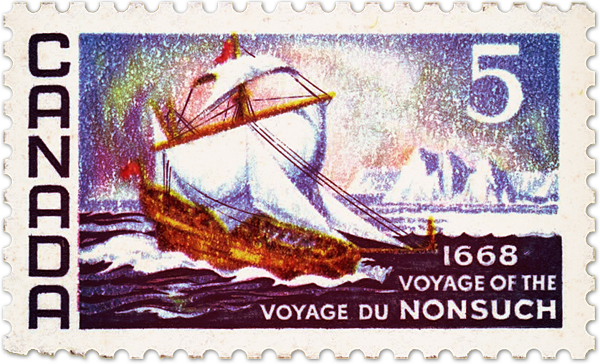
The early ships’ crews considered its beer of great importance and even survival. In 1668-69, the crew of the Nonsuch over wintered on the James Bay coast and reported upon their return:

…they were environed with ice about 6 monethes first halting theire ketch on shore, and building them a house. They carried provisions on shore and brewd Ale and beere and provided against the cold which was their work…

See what I missed that was sitting right before my eyeballs? They brewed ale and beer. The news was reported in issue 408 of The London Gazette, too. Not that they made both ale and beer but that they survived a winter in the Canadian Arctic. The Nonesuch was small and tough, custom picked to both survive the trip to the edge of the known world and be hauled out of the water to avoid the crush of ice. Only 53 feet long, a replica can be found in a museum in Manitoba. Manitoba? Yes, well, after the British Parliament’s Canada (Ontario Boundary) Act of 1889 introduced a boundary that divided the former Rupert’s Land that included the watershed of the big bay, including much of what became Ontario’s north.

Got it? Wonderful. But let’s get back to the point. They made two things to drink. Two fermented beverages. Why? You are stuck in a situation that may as well be the dark side of the moon, you have cleverly brought a survival space pod as well as sufficient supplies (think food in tubes) to make it though the six months of frozen horror… and you make two types of booze? Why the heck do you do that? Well, just a century and a generation before the voyage, the benefits of ale was described in 1542 by the physician Andrew Boorde in his book A Dyetary of Helth. The key was conveniently referenced by Martyn this week: “Ale for an Englysshman is a naturall drynke.” Yet he is also the man who wrote:

If it do come by an hurt in the head, there is no remedy but pacience of all partes. If it do come by debilite of the brayne & head, drynke in the mornynge a dyshe of mylke, vse a Sirupe named Sh’upus acetosus de prunis, and vse laxatiue meates, and purgacions, if nede do requyre, and beware of superuflous drynkynge, specially of wyne and stronge ale and beere, and if anye man do perceuye that he is dronke, let hym take a vomite with water and oyle, or with a fether…

….so it is hard to know what to believe. Especially if you remember what Pepys said folk on ships got up to when they were on the ale on April 30th, 1660:

After that on board the Nazeby, where we found my Lord at supper, so I sat down and very pleasant my Lord was with Mr. Creed and Sheply, who he puzzled about finding out the meaning of the three notes which my Lord had cut over the chrystal of his watch. After supper some musique. Then Mr. Sheply, W. Howe and I up to the Lieutenant’s cabin, where we drank, and I and W. Howe were very merry, and among other frolics he pulls out the spigot of the little vessel of ale that was there in the cabin and drew some into his mounteere, and after he had drank, I endeavouring to dash it in his face, he got my velvet studying cap and drew some into mine too, that we made ourselves a great deal of mirth, but spoiled my clothes with the ale that we dashed up and down. After that to bed very late with drink enough in my head.

Is that what they were doing with that ale up there in the Arctic in 1668? My heavens.

1825 Saw Many Forms Of Upper Canadian Beer

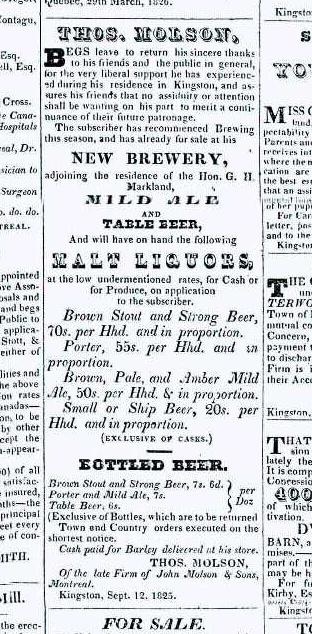
tmols1825aClick on that image to the right to revel in its full glory. That is an ad for the new brewery opened in my town in 1825 by Thomas Molson seeking to break out of the decades old family business down the river in Montreal. A neat if short lived enterprise. But I speak not so much of Tom or his ambitions today as the evidence in that ad of the marketplace of ideas into which he was speaking. It ran in the Kingston Chronically for for many months so it was speaking to somebody.

Notice all the sorts of beer. As this is 30 years after the earliest reference to porter being downed in Upper Canada, I am not surprised to see it on offer. On my reading of the ad, however, I see the brewery knocking out eight sorts of beer. There are five price ranges. There are wholesale and retail sales. At the bottom you can see they are buying barley which means they are, as would be expected for the times, malting their own malt. So it is likely the amber beer is made of amber malt and the brown stout is a whopping big beer made of brown malt. Now, that’s a beer to recreate.

Notice also that he will take produce or cash. Somewhere I came across an article from a few years earlier about another Kingston brewer agitating for the buying of local beer over the New York stuff. I need to dig that out. Albany made beer showed up not long after the War of 1812 ended. But by 1825, Upper Canada is well into its anti-American most conservative phase under the grip of what was known as the Family Compact. The first wave of leadership from the American Loyalist refugee group that showed up in the 1780’s after the American Revolution was lost is dying off and is passing control to British born Tories who came of age in the glory of the defeat of Napoleon. They are seeking to make Upper Canada a model colonial example to the Georgian Empire under, of course, their guiding hand.

What is really most interesting to me, that all being said, is that there were other brewers in town. With their own brands of beer. Could it be that the beer fan of 188 years ago had his or her choice of over twenty beers? Did they buy based on preferences within a wide selection? That for me would be quite, as they say, a something.

What’s With The Boxes For Cutting Straw?

Again with Lord Selkirk’s diary of 1803-04, I noticed one thing on page 114 that sorta suck out. In his description of the set up of the kiln, there is a particular notation: “…small portable boxes for cutting straw are made for $9…” What the heck is that about? What is the function of the box? Why do you need a number of them? And what is the function of the straw?

Here is a very detailed discussion of the straw or chaff cutter. In that discussion, the tool is shown as going back centuries. The function of the cutter was to make the straw digestible by cutting it into small enough lengths to be mixed with the feed of a horse. And in this case, Selkirk’s note follows a reference to a horse run mill to grind the malt. So it could be just that.

But there are two other uses for straw in this brewery. One was expressly mentioned the other day. Mr Grieve the brewer mixed straw into his mash to keep the wheat from gumming things up. Torrified or popped wheat can be used for that today. Cutting the straw would make sense to ensure it was evenly distributed through out the mash. Straw can be a multi-purpose resource in what I am starting to call if only to myself “vernacular” brewing. Brewing with the locally available resources. If, out of that, you make a unique beer maybe that is an “indigenous” form of beer.

But there is another possibility. Or is it an additional one? Maybe he was kilning with the straw. Attentive readers will recall the fern ale post of the fall of 2011. In that discussion, we see that in the 1600s and 1700s, while coke was growing as a kilning fuel for large operations, straw was still a reliable fuel to make the palest and least smokey malt. Good wheat straw, when used with skill, made the sweetest pale malt. Notice, too, that Grieve is kilning his malt in a place and at a scale where other desirable fuels are unlikely to be as readily and cheaply available. Wheat was the monoculture crop, the gold standard for sale and even export. There may have been plenty of wheat straw sitting around as the district filled with settling farmers. If so and as the beer had a high proportion of wheat, these strong ales of his my well have been quite pale despite their frontier origin.

Just a thought. Could be tasty stuff.

Encouraging Good Beer North And South

A couple items in the news caught my eye this week, one from here in Ontario and one from New York to our south. Up here the news is this:

The LCBO’s redesigned and relocated Laird and Eglington location in Toronto will showcase a new 1625 sq-ft cold room boasting a prominent craft beer section spanning up to 160 linear feet of shelf space. Craft beers will be arranged by beer styles (ie. IPA, Stout, Lager, etc.).

That’s a relief. I was worried it would be arranged alphabetically or by the primary colour on the cap. Basically, the provincial monopoly on better drink is opening up one new store and it will have a bit more space for good local beer. Fabulous. 13 million Ontarians. 160 feet of shelf space. It’s the subject of government press releases. By way of contrast, the law down south in the State of New York is aiming to spread the goodness of good beer a bit more broadly according to this news item:

Gov. Andrew Cuomo says 14 local farm breweries have opened statewide as a result of legislation that took effect in January. The law created a farm brewery license for those who rely heavily on locally grown farm products for their beer. Under the farm brewery license, brewers do not need an additional permit to serve beer by the glass.

While there is still concern that not all the breweries that open do not actually hire that many staff, it is clear that this great law is opening up new meanings for real and local when it comes to NY beer. And creating rural employment and wealth. Heck, they are even letting farm stands sell nearby wine as a means to boost jobs in small communities. I suspect a lot of this is due to the guidance of departing Ag Commissioner Darrel Aubertine, my near neighbour over the lake, a guy with whom I did once sit and have a beer. Practical laws to use good beer to generate wealth.

Do the changes to our south make the news up here worthless? Not exactly, but it sure puts things in perspective. Notice how lobby groups need to be involved, masses spent up here on updated retail space. Swankification. In New York, farmers are freed up to seek a share of the market, to expand it. Which makes better economic sense? Which speaks better of the government’s attitude to its own citizens?