Again with Lord Selkirk’s diary of 1803-04, I noticed one thing on page 114 that sorta suck out. In his description of the set up of the kiln, there is a particular notation: “…small portable boxes for cutting straw are made for $9…” What the heck is that about? What is the function of the box? Why do you need a number of them? And what is the function of the straw?
Here is a very detailed discussion of the straw or chaff cutter. In that discussion, the tool is shown as going back centuries. The function of the cutter was to make the straw digestible by cutting it into small enough lengths to be mixed with the feed of a horse. And in this case, Selkirk’s note follows a reference to a horse run mill to grind the malt. So it could be just that.
But there are two other uses for straw in this brewery. One was expressly mentioned the other day. Mr Grieve the brewer mixed straw into his mash to keep the wheat from gumming things up. Torrified or popped wheat can be used for that today. Cutting the straw would make sense to ensure it was evenly distributed through out the mash. Straw can be a multi-purpose resource in what I am starting to call if only to myself “vernacular” brewing. Brewing with the locally available resources. If, out of that, you make a unique beer maybe that is an “indigenous” form of beer.
But there is another possibility. Or is it an additional one? Maybe he was kilning with the straw. Attentive readers will recall the fern ale post of the fall of 2011. In that discussion, we see that in the 1600s and 1700s, while coke was growing as a kilning fuel for large operations, straw was still a reliable fuel to make the palest and least smokey malt. Good wheat straw, when used with skill, made the sweetest pale malt. Notice, too, that Grieve is kilning his malt in a place and at a scale where other desirable fuels are unlikely to be as readily and cheaply available. Wheat was the monoculture crop, the gold standard for sale and even export. There may have been plenty of wheat straw sitting around as the district filled with settling farmers. If so and as the beer had a high proportion of wheat, these strong ales of his my well have been quite pale despite their frontier origin.
Just a thought. Could be tasty stuff.

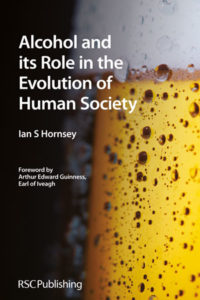 That is Alcohol and its Role in the Evolution of Human Society by Ian S. Hornsey. I had no idea. In a work of beer writing that is still trying to find its way, seeking to evolve from fanboy gushing or trade focused boosterism or underdeveloped efforts at business journalism, Hornsey’s 2004 book
