The Pensive Beery News Notes For That Dull Gap Between US Thanksgiving And Christmas

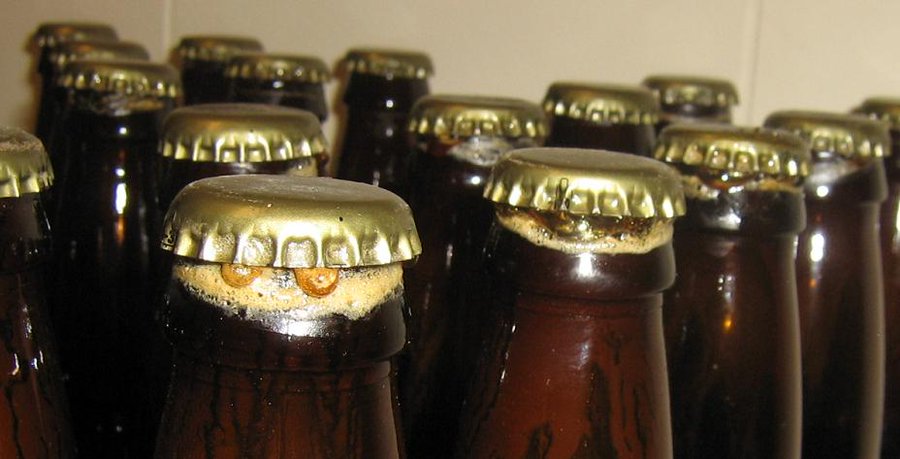
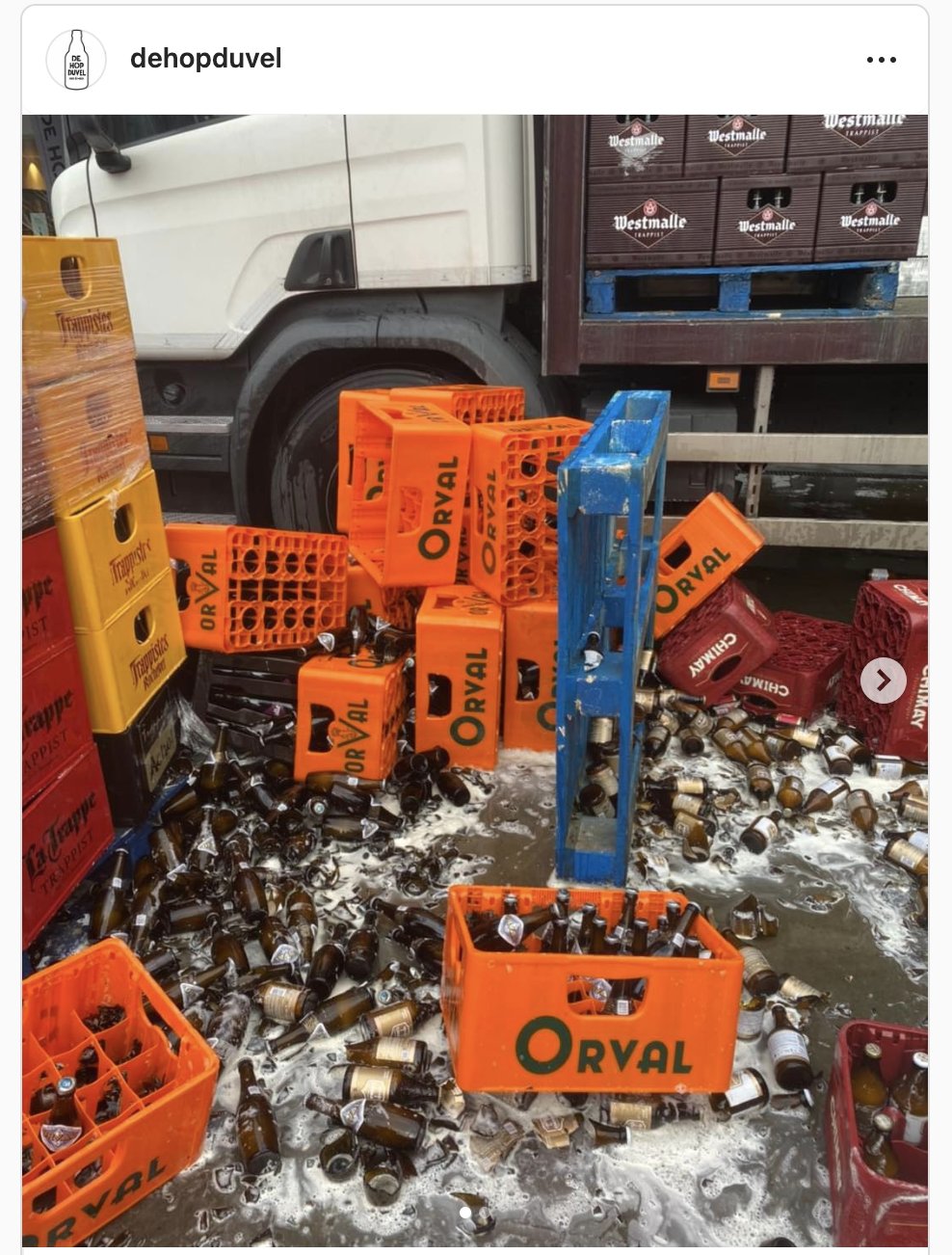
Are US holidays the most liquor laced of all? Not sure. But they sure are the most extended. I get the sense that nowadays* they just go on and on, one meeting the next at some sort of transition overlap. We seem to have all been in the  HallowThanksChristEve zone for a while now and there are still weeks to go. Good thing I’m Canadian as we up here track time by following the sports calendar and the grain growing season cycles. Speaking of holidays, someone is not getting a bonus. Joe Stange shared an image of the aftermath of a disaster in Belgium. Look at that Westmalle, laughing at the Orval.

So what is going on out there? I liked this observation from The Beer Nut which could be applied to any number of things:

The best feature is the booze, delivering as it does a pleasant warming fuzziness, perfect for a miserable evening in mid-November. Overall, it’s fine, but not exactly high end, to my palate anyway.

And I came across a new mag worth checking out, Beer & Weed, out of area code 207 – aka the Great State of Maine aka the Canada of the USA. My favourite American second cousin in law Mike has an article in the December issue as does Carla Jean who offers some ideas for giving which go beyond the usual. Like taking a pal on a beer tour – or making an apple pie after soaking the apples in beer. I like that, a twist on mulled ale… or pastry stout. Think about that. Mmm…

Next – aside from my secret wondering whether it’s all an elaborate façade broadcast from a hidden Nordic mountain lair based on fantastic IT resources, access to private wealth and wicked sense of disruptive if extremely niche humour – Lars has once again produced an excellent thought provoking and well researched essay, this time pushing the history of hops back in northern Europe by more than a century or two, relying in large part on the unreliability of records:**

This, however, is the history you get from written documents, but hop usage began at a time when brewing was mostly something people did at home, for their own household, and almost none of what they did was ever recorded in writing. So we must expect that nearly all of the early history of hops has gone undocumented, and therefore we must turn to other sources of information to cast light on the early history of hops.

Personal note: this is exactly what my first beer experience in the late 70s were like. I’m a bit verklempt.***

I liked this very narrow study of Gary’s this week, a three piece article on something called Tipper Ale, a beer that relied on salt just as 1830s Albany Ale did. Except it wasn’t chucked into the barrel:

The key to the palate was use in brewing, or some use, of “brackish” water.  The brewery was at a crossing, originally a drawbridge, over River Ouse near its mouth with the English Channel. Hence the seawater story is plausible, given location and typography. I cited various sources to this effect and there were others I didn’t, as all concur in result. One of the last sources, in 1941, was the most interesting I thought as it stated both regular and sea water was used.

One of my favourite discussions in the comments has to be the time back in 2008 when yeast scientists including a Dr Dunn and a Dr Sherlock took offense at being called “eggheads” and then embraced it. Well, the eggheads of yeast science were at it again this week with release of the news building on their work to explain… something:

It has been known for some time that S. pastorianus is a hybrid of two parents, one of which is S. cerevisiae (de Barros Lopes et al. 2002, Dunn and Sherlock 2008). However, the second parent, Saccharomyces eubayanus, was not isolated until 2011, from the Patagonian Andes in South America (Libkind et al. 2011)….  Regardless of when the hybridization(s) between S. cerevisiae and S. eubayanus occurred, they are likely to have occurred in Europe, and possibly in Bavaria. It is, therefore, surprising that no European isolates of S. eubayanus have been described… Here, we describe the discovery of the first European isolates of S. eubayanus. They were isolated from a university campus in Dublin, Ireland.

Excellent. And hardly any Irish inside jokes followed at all.

Andy Crouch marked the passing in early December of a New England brewing original, his pal Ray McNeill of Brattleboro, Vermont whose cantankerous nature was summed up neatly:

Ray was also legendary for his dislike of homebrewers. During one extended rant, he told me, “I don’t care what anybody says, there’s a big difference between making beer a few times a year in your garage and reading thousands of pages of technical literature and then making thousands of beers. Beer is a weird thing. It doesn’t come with a scorecard. If you’re a golfer and you shoot 112, you know that you suck. But if you’re a homebrewer and you make a third-rate beer, you probably think it’s great. A lot of homebrewers think they’re a lot better than they really are.” With Ray, you just never knew what you were going to get. And the same could always be said for his beer. The beer at McNeill’s was legendary: it would either be among the best you’d ever tasted or the worst. Consistency was not something anyone expected from McNeill’s and that was oddly part of the place’s charm.

Beth Demmons issued another great edition of Prohibitchin’ with the focus on Amie Ward and her project to make drinking establishment safer places:

“We [employees behind the bar] are in a very unique position because we are everywhere all at the same time. We hear everything, we see everything, we’re touching tables… we are in a perfect position to become those bystanders that really help change that landscape.” With this eye-opening knowledge and experience, Amie realized many other people weren’t able to manage health, stress, or sharing the responsibility of community safety in the same ways she had been able to hone over the years. “I saw my peers not taking care of themselves [and] really developing poor habits that were not going to suit them for the long haul,” she says. “That’s how I came up with the idea for The Healthtender: melding those two worlds together of wellness and hospitality.”

Turning to the end times, I used to post various noodly noddlings under the heading “This Is How Craft Will Kill Itself” from time to time and, in these fading days, it’s interesting to see how some predictions came to pass and how other factors I couldn’t have imagined contributed to the fall. For example, lack of differentiation posing as critical differentiation is a fatal flaw, as illustrated by this article:

“It’s a pretty neat thing when you go to a place that has a lot of beer selection. You’ll notice a huge variety of beer labels, and it is something that craft beer people look to,” said Scot Yarnell, brewer and owner of the downtown Earnest Brew Works location at 25 S. St. Clair St., Toledo. “They want a unique beer, flavor wise, and they also want a beer that has a unique look to it.”

There’s of course nothing unique about the look of what’s on the beer shelves these days any more than the identi-craft beer in the cans. Fadism gave birth to herd mentality homogeneity. Like gaudy late 1990s web design, there is a certain sort of vomiting bubble gum machine tone to the confusingly cartoony look that signals the trade friendly “blinders on” approach is engaged. But how does this help encourage the consumer – especially when mixed in with the continuing trade narrative’s reliance on tales based on amnesia, flat out untruths and revisionist bullshit mixed with earnest finger wagging over supposed myths that serves the residual wisdom of haut craft culture?**** Even those seeking the solace of knowledge in an honest off-flavour course offers an affirmation in the negative, as Jordan was good enough to admit:

Framed the off flavour training for next week’s class as “Well, you’re never going to be able to turn that switch off, so next week I’m going to ruin fully a quarter of the beer you’ll ever drink….”

Downer. No wonder the value proposition has gone all a’wobbly now in the face of these broader harder times. And no wonder things are as down, as Pete Brown shared in The Times. It’s a good read… but I am not sure I can agree with the proposed treatment as it looks like more of the same:

Refocusing on the aspects of “craft” that big corporations will always struggle to replicate could be key. “Local, independent craft breweries do far more than just make great beer,” said Richard Naisby, acting chairman of the Society of Independent Brewers. “They embed themselves in local communities, create jobs, and add value to the local economies they call home.”

Maybe. Could be. If you get rid of the phony and the baloney – and the kiddie cartoon profiteering prophets – and I also suppose if these fine locals have each  paid their suppliers and the folk losing their jobs. Might be nice if enough of them just found a way to make great beer at a good price, frankly. Time to start talking about recession proofing, brewers. That might take a bit of change.

Speaking of which, an interesting and somewhat related call to arms crossed my eye in the course of me legal readings this week:

The Cannabis Council of Canada (C3) has called on the federal government to provide “immediate financial relief” for the legal cannabis industry and end the “stigmatization” of legal cannabis that allegedly limits progress on the key public health aims of legalization… According to C3, while the current framework has been “a financial success” for governments and provincial monopoly distributors who apply mark-ups, it has also been “a bloodbath” for investors of all sizes within Health Canada’s licensed producers and processors framework.

Hmm… dunno. Pretty sure I don’t want my tax dollars saving the less than half decade bubble economy of the Canadian grass trade. Think about it. Could it maybe just be that both craft and dope have to face the fact that there is no market for every investor who believed in a dream of easy cash from selling swanky new forms of intoxicants in each and every neighourhood? Is that what they mean by they “add value to the local economies they call home“?

I leave you there. That enough for now… you’ve had enough… take a break… when you’ve done that, please check out the updates from Boak and Bailey hopefully now again mostly every Saturday and also from Stan more now on a Monday than almost ever! Check out the weekly and highly recommented Beer Ladies Podcast. The OCBG Podcast is on a very quiet schedule these days – but it’s coming back soon.  See also sometimes, on a Friday, posts at The Fizz as well (Ed.: we are told ‘tis gone to 404 bloggy podcast heaven… gone to the 404 bloggy podcast farm to play with other puppies.) And the long standing Beervana podcast (Ed.: which I have missed from this list for some unknown reason.) There is the Boys Are From Märzen podcast too and check out the travel vids at Ontario’s own A Quick Beer. There is a monthly sort of round up at The Glass. (Ed.: that seems to be dead now… nope, there was a post on July 25th… in 2022 even.) There is more from DaftAboutCraft‘s podcast, too. And sign up for Katie’s (Ed.: now very) irregular newsletterThe Gulp, too. And check out the Atlantic Canada Beer Blog‘s weekly roundup. Still gearing  up, the recently revived All About Beer has introduced a podcast, too. (Ed.: give it a few weeks to settle in and not be as agreeable… not sure this went very far…) Plus follow the venerable Full Pint podcast. And the Craft Beer Channel this week on Youtube. Plus Fermentation Radio with Emma Inch. The AfroBeerChick podcast as well! And also look at Brewsround and Cabin Fever. And Ben has his own podcast, Beer and Badword (Ed.: …notice of revival of which has been given… still not on the radio dial…)  And remember BeerEdge, too, and The Moon Under Water. There was also the Beer O’clock Show but that’s now gone after a ten year run… no, it is back and here is the link!

*Excellent usage, no?
**See from the archives “One Brewery and the Problem with Records” from 2015. 
***h/t Cookie.
****Oxymoron.

The Last Lingering Beery News Notes For July 2022

What is up?!? Happy end of July! No one ever says that. I saw back to school ads this week. That sucked. Except the kid will be going back to school. And we had some wicked storms come through this week – a tornado even hit north of here – and now it’s almost sweater weather. Nice. Portents of autumn. Already. That sorta sucks. Like the Red Sox collapsing back to .500 after being ten games up. Also sucks. Thank God for my surrogate Expos, the Mets. And they showed good taste this week by having everyone’s favourite milliners’ client, ex cool band roadie and friend of this blog, Garrett Oliver, through out a first pitch! What a great thing to have experienced.

First news this week? Just a couple of weeks ago I mentioned the archeological digs at Sedgeford, England where medieval maltings are being uncovered. This week, beer person extraordinaire Nigel Sadler took his interest to the next level and has been participating in the dig, presumably as a volunteer. His Tweet-fest has been fabulous, including these two with their detailed observations:

The kilns are wattle and daub construction across the site. There is only evidence of one steep shown here. Likely this was used almost permanently despite the various kilns burning and being destroyed. I’m getting steep measurements later. Bags of grain were lowered in to soak…  A post hole has been discovered under the germination floor sited between Kiln 1 and the steep which raises questions as to whether an earlier kiln structure was here.

Locally, one of the best small breweries in Ontario, Stone City right here in my home town, is up for sale very much as a going proposition.*  Oh, to be 25 year younger and a bit wealthier.

Perhaps 25 younger and indubitably a bit wealthier in the ways of the world, The Beer Nut shared a “return to fests” story this week and included a few interesting observations about the format:

Three years after the inaugural event, Fidelity was back in the Round Room of the Mansion House a couple of weeks ago. It’s the only festival of its kind in Ireland, where punters pay up front and have free run of forty producers’ stands, each pouring two beers (with a handful of ciders and meads) per session. In a change to the previous iteration it was split across two days rather than having a daytime and evening session — I guess they get more people going to both that way. One for me was plenty and I rocked up on the Friday.

My experience of these beer buffets is that they are a bit of a disaster, encouraging bulk bevvying akin to the 1870s and 1960s here in Ontario. He also shared a follow up post on the same event and shared the best sort of takeaway anyone could hope for: “I’m sure a lot of effort goes into making sure it looks so effortless.

Oh, and about that bulk bevvying… I wrote another post this week myself, on Ontario’s mid-1900s attempt to provide a reasonably safe environment for beer drinkers of both genders:

Those of you alive to the information era we live in will know that a year or so ago I reposted a bit of research I did for our book Ontario Beer on licensing in this here province after temperance and the phenomenon of the ladies only license that was introduced in 1934 as part of that.  But I had not really considered the other side of the coin, the men’s only license.

I popped into work on Wednesday, too, and got the image up there of goold old Forms 8, 9 and 10 attached to Ont. Reg. 407 as set out in the R.R.O. 1960 which illustrates the gender based licenses. Click and gawk to your heart’s delight. I would love to find a description of a women’s only public house.

Why is the same beer book being published over and over?

Harvest time. Excellent! And another Goldthorpe sighting and at possible brewing scale. So exciting. I had thought that the grain would have migrated east. I had heard it might be around in central Asia but are there patches still in Ireland as there were in the late 1800s as this report at the time mentioned?

The next broad-eared variety is Goldthorpe, which was found in a field of Chevallier so recently as 1889. How it arose, or whether it has any connection with the Continental broad-eared forms, I cannot say.  Goldthorpe has a high grain-yielding potentiality, but it is characterized by a long ” neck.” and the ears are extremely liable to become detached from the straw, especially when the crop is allowed to become fully ripe, as it should be, to obtain the highest quality. The unfortunate bearing of this characteristic on the fortune of the variety will be appreciate; when I add that Goldthorpe was, and still is, one of the best quality barleys in existence.

Broad-eared certainly sounds like Battledore.

Someone who used to post a news update every Monday sent me the link to this post about the problems – for some – associated with IPA domination… not to mention hegemony illustrated succinctly thusly:

…think back to recent years, and the kinds of beers you may have sampled from Sierra Nevada in that time. Perhaps you loved the Nooner pilsner, or the seasonal Summerfest lager. Maybe you were a devotee of the annual Oktoberfest lager, even after the COVID-19 pandemic prevented it from being a yearly collaboration with a German brewery. Maybe your jam was the Otra Vez gose, or Ruthless Rye, or fall seasonal brown ale Tumbler, or Sierraveza Mexican lager. Maybe your first exposure to classic Belgian ales was Sierra’s Ovila series of abbey ales? Not a single one of those brands is referenced anywhere on the Sierra Nevada website today. Zero of them, in any capacity, are implied to still exist.

That’s not good. And it’s boring. Keep good beer boring, IPA. Way to go. Alistair is fighting the good fight against IPA tedium with his tenth(!) annual best beers of Virginia. Recommendations include an alt, a stout, a Rauch Märzen plus a few pils/pilsens.

Perhaps conversely, the Pubmeister wrote about Margate, a favourite of mine 350 years or so ago, and covered the face paced romance of a pub game I had not heard of before – carrom:

It’s like a table top type of pool, played with fingers, our new friend demonstrating a drag that would have had him drummed out of the German Subbuteo Championships before his bare feet could touch the ground. At Xylo we met two guys out celebrating a birthday who joined the carrom enthusiasts, and Vieve and Jess, two impressive young women who reappeared a little later in the Little Swift and joined us in the sort of free-ranging conversation that you only get in pubs.

Top headline news of the week: “Beer-drinking pony who lives in pub is made mayor“!  Tweet of the week? Photos and descriptions from Kitsault, a ghost town in British Columbia… but a ghost town not from the 1890s but from the 1980s that has been perfectly maintained:

In Kitsault’s community centre sits the Maple Leaf Pub. Lined with the crests of every province, it could be the pub of any small town in Canada. On the last night of the town’s existence, the remaining residents had a drink and signed a poster.

And finally… a couple of dishonourable mentions to finish up. First, I think this is one of the unkindest stunts I have ever seen – one’ arsehole’s attempt to trigger complaints about a Sam Smith’s pub. Don’t be like this:

As I went over to the bar, I pretended to search my pockets, and said “s***, I haven’t got any cash”. I asked if they took card or if a PayPal payment would be acceptable. The barmaid, who looked like a teenager, wrinkled her brow as she noticed the workspace I had created behind me. She said: “You can’t use those in here. If the owner Humphrey [Smith] were to come in and saw that, he’d tell us to shut and ask everyone to leave.” The barmaid did actually look genuinely worried. It felt as if she was being sincere. I asked her if I had to leave with my items, she said yes, that I had to go. As I was packing up, I decided to take one more selfie, to see what would happen.

Perhaps speaking of which, there is another class of arsehole that is unbearable – the “craft insider”** – the interview of one of whom, in a late sighting, illustrated the condition:

The people who care will be in the liminal space of barely knowing much about craft beer but who are usually very vocal about it.

Nice to know how folk think of others. And the superfluous abuse of “liminal” is also one of those benchmark for this sort of thing. Don’t be like that either.

That’s it for now. Long weekend coming up starting with my fourth Covid-19 shot at 4 pm Friday.  Pray to the gods of your choice on my behalf. See you next week when I will complain complain complain about whatever happens. In the meantime, for more, check out the updates from Boak and Bailey mostly every Saturday but not from Stan every Monday as he is on his summer holiday. Check out the weekly Beer Ladies Podcast, and the mostly weekly OCBG Podcast on Tuesday (Ed.: some crackle this week at about 20 mins.) and sometimes on a Friday posts at The Fizz as well. There is a monthly sort of round up at The Glass (Ed.: that seems to be dead now.) There is more from DaftAboutCraft‘s podcast, too. And the Beervana podcast. And sign up for Katie’s (Ed.: now very) irregular newsletterThe Gulp, too. And check out the Atlantic Canada Beer Blog‘s weekly roundup. Plus follow the venerable Full Pint podcast. And Fermentation Radio with Emma Inch. The AfroBeerChick podcast as well! And also look at Brewsround and Cabin Fever. And Ben has his own podcast, Beer and Badword (Ed.: …notice of revival of which has been given… still not on the radio dial…)  And remember BeerEdge, too, and The Moon Under Water. There has also been the Beer O’clock Show but that’s wound up now after ten years.

*Had to be told of this opportunity by the folks to the west end of the lake. Jeesh.
**Sometimes related to the “little did I know that Icelanders are mad for hotdogs” sort of expert… though, to be fair, this is an excellent confessional of a number of sins of omission. The “orange slice in wit” thing is old enough now that it is pretty hitting its own drinking age.

Yet Another Week’s Worth Of Beery News Notes On A Thursday

Here we are. Again. Growing in wisdom. Me, I’ve been reading more books this year and keeping track. Keeping track of a lot of things. Self-improvement? Do more of this cut down on a bit of that. Twenty-seven books so far this year, not one of them about beer. Currently (after reading the highly recommended book The Shipping News,* ultimately a comedy set in a fictional version of small town Newfoundland in which beer – and screech – make appearances) I am on a third by Questlove, this one Creative Quest, an encouraging book about the creative process. I usually avoid self-help books… but then again I avoided books, too… too many law books can do that. You can help decide if it has any positive effect.**

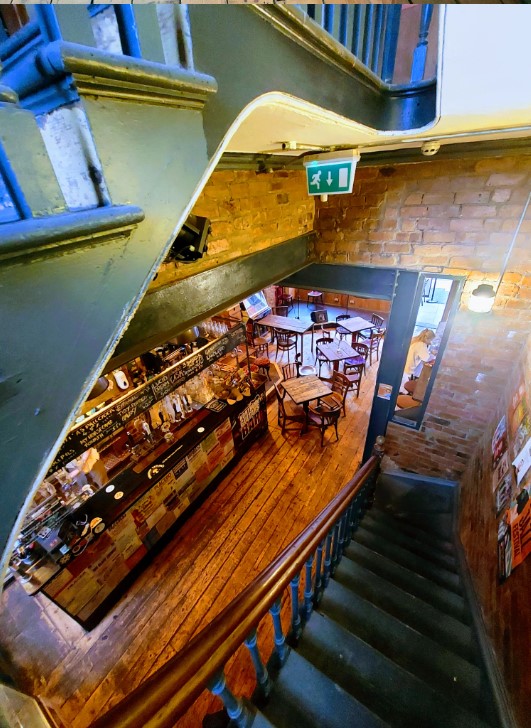
Martin was particularly creative in his photo work, the image right there from his post about a guitar themed pub, Northern Guitars in Leeds. Love the angle.

Just to prove I do occasionally (mostly by accident) take advice, I did take a pub tip from Chris Dyson for my second pre-gig pint in Leeds. Perhaps the pace of change has slowed a little in the east of Leeds, but the Calls District was busy enough, though Northern Guitars was only ticking over. I guess their trade comes from music nights.

For the Jubilee, the ever excellent A London  Inheritance posted photos of processions, streets crowded with people and/or bunting from past royal celebrations – including a few pubs covered in banners including The George in the Strand.  Some not pleased with last weekend’s events – which is fine. Here is a live action photo of the madcap goings on. We are advised by The Daily Star that the event was pretty boozy as to be expected:

The streets of Soho, in the heart of London, were lined with drinkers and Ripe in East Sussex was just one of hundreds of villages that celebrated with an open-air party. Everywhere you looked, it seemed, someone was enjoying the day. James Heale tweeted: “Horse Guards Parade. Man singing lustily in an England ‘96 shirt, six pack in one hand, fag in another. Union Jack billowing behind him, Tesco crown on his head. The lion roars”. In fact, some people appeared to be enjoying themselves a little too much.

Rooting for an Oaken Joob myself, now. That would be fun. And a bit of a surprise for those most involved. Oh, one last but not least thing – Maureen won the prize so a parcel of goodness shall be sent her way…

Now that the bunting is folded up and put away, reality strikes. First up, why is lager more expensive in London and Northern Ireland compared to other parts of Britain? Less of a puzzle, sanctions against Russia appear to be effectively stopping beer imports:

That has pressured the economy and affected the habits of Russians used to a lavish selection of foreign-made alcohol. “The beer situation is very cheerless,” said Anton, a 36-year-old IT expert who works for a state financial organisation in Moscow. “Not to mention Paulaner, Pilsner Urquell and other tasty stuff, I’m not at all confident if Russian beer is here to stay. There are problems not only with beer imports but even with imports of hops,” he added. Russian breweries depend heavily on imports of raw materials, such as hops.

Another sort of shortage is also at play as the North America is undertaking the rare step of importing malting barley to make up for a poor 2021 crop. Keep an eye on that.

In another sort of dreary news, the iconic Buffalo Bill‘s brewpub of the San Francisco Bay area is shutting – after inflicting the dubious upon us all!

Buffalo Bill’s is best known for putting pumpkin ale on the map in 1986 when Owens was inspired by the beer first enjoyed during colonial America. Owens became obsessed with crafting a modern take on pumpkin ale after learning that even President George Washington once brewed the orange-hued beer during a time when pumpkins often substituted malt. Not long after Buffalo Bill’s resurrected the polarizing beer, other brewpubs around the country began to follow suit and devised their own renditions of pumpkin ale.  

Jay wrote about the original owner, Bill Owens, and the place calling it “one of California (and America’s) earliest brewpubs.” Pretty sure I had their Orange Blossom Pale Ale once, found in a NY state beer store over a decade ago. But do you think I can find the review? Who runs this place? What a mess!

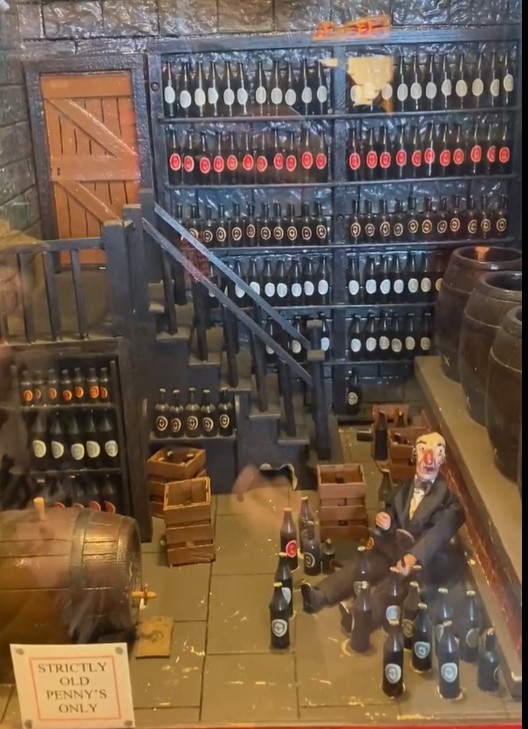
Enough! Something fun. The screenshot to the right [Ed.: my left] was grabbed from this short vid of an old pre-decimalization penny auto bot thingie – which still works.  Called The Drunkards Dream. More info here, here and here.

And something uplifting. Beth Demmon has published another interesting bio of someone in beer, this time April Dove who balances her interest as a roaming brewer with her professional life as a nurse:

For now, that life means remaining a nurse. It “pays the bills,” April says, although moving into beer full-time remains the dream. The first years of working through COVID-19 left April with nightmares and PTSD. “I did things I hope I never have to do again,” she says. “I saw things I never want to see again.” But she’ll continue to invest in a future in beer, setting goals for herself like pouring one of her beers at a beer festival in the next year. Despite the challenges she’s faced, April hopes that by sharing her experiences with others who have been systemically excluded from craft beer, she’ll be able to introduce her passion to many more.

Ron‘s been on a bit of a roll in terms of writing about his experience of beer, he kissed a squirrel… errr… had a Newkie Broon this week and also featured a trip to Folkestone with Mikey:

It was at least three years since I’d last been. The longest gap, probably, ever. Well, since we started going there. Mikey went twice every year. I’d accompany him on at least one of those trips. I became weirdly fond of the place. Perhaps because of its ordinariness. And the really good chippy. Andrew asked on my return: “What did you do other than hang around in pubs and cafes?” “Nothing, really. Other than a little light shopping.” It genuinely was all breakfasts and beer. And the odd whisky.

The story goes on to end up being a neat and tidy description of two classes of pub, the pricy mini and the cheap maxi. Which makes one wonder if the lounge and the public bar have really just relocated. Boak and Bailey and their wise comment makers wrote about the gradations of such spaces exactly one yoink ago.

And there was an excellent example of Twitter as helpful tool in the form of a description – from the hand behind the Glasgow brewery Epochal – of drinking a 126 year old bottle of McEwan’s Pale Ale which was recovered from The Wallachia which sank in 1895 in the Firth of Clyde:

This one still had a good amount of carbonation. It smelled old but in a peculiarly musky, libraryish way rather than an excess of oxidation. It had a pronounced Brettanomyces character with subtle aromatic acids and miraculously retained a clear hop character, clear enough that I could have a guess that they used Fuggles and Goldings. On the palate it was very dry and still had a powerful, clear bitterness.

Connectedly, Gareth Young of Epocal was also featured in Jeff’s well researched article “Lost, Stock & Barrel: The Forgotten Funk of Old Ales” published by CB&B with this wise observation:

The flavors that marked stock ales of past centuries lacked many of the problems that can trouble mixed-culture brewing: excessive acetic acid, intense funkiness, chemical off-flavors. Instead, using what we would now call “heritage” barleys, techniques like long boils, cleansing tanks, and dry-hopping, brewers are edging back toward the refinement for which old stock ales were renowned.

You know… there is a school of beer history writing, now largely retreating in the rear view mirror fortunately, one based too heavily on supposition and assumption. We heard too often that old brewers made smoky even though there is plenty of evidence against it. Competent brewing starts in the 1800s we are told even though there is plenty of evidence against it. What really needs doing is reading some good history books.

Speaking of being in the good books, The Beer Nut is on the job this week examining if one brand extension has succeeded… and was not impressed:

The aroma is sweet and fruity: lots of very obvious hard caramel, sitting next to softer plum and raisin. The flavour is rather less complex. I was hoping that Landlord + caramel would unlock some new dimension of taste, but I could not perceive anything other than a quite hop forward English bitter — meadow blossoms and earthy minerality — spiked with thick and gloopy treacle. It’s sticky, not wholesome, and the two aspects don’t meld well together. The label promised chocolate and roasted malt, like a proper dark ale, but the flavour doesn’t deliver that.

Question: why a lottery?  Why not just promote a program you create, find sponsorship for and provide for free with next level resources identified? We have so much green-washing, #MeToo and #BLM cap waving but never quite cheque sending, Ukrainian net profits only giving corporate PR under the guise of charity. The price of the Sam Adams Pride packaging alone would likely pay for the program’s costs.

Apparently, in a case of un-red-tape, the Province of Saskatchewan’s Auditor has noticed that craft brewing is not getting noticed:

…according to the provincial auditor, the province is struggling to keep pace when it comes to meeting its regulatory oversight targets. The auditor’s latest report notes that of 83 approved craft alcohol product lines, over half (43) did not have valid lab test report certificates. These certificates prove products are untainted and that their alcohol content matches the label. Saskatchewan Provincial Auditor Tara Clemett says the SLGA [Ed.: the Saskatchewan Liquor and Gaming Authority] is failing to follow up when producers fail to submit a new certificate, which is required every two years. One producer, she noted, had not provided an updated certificate more than nine months after its two-year deadline.

Craft brewers are not concerned. The best way to not be spoken about.

Finally: are we tired of discussing mild yet? No! Are we tied of The Tand winning awards? No!! Are we tired of NA bevvie trade associations? Probably.

There… a middly sort of week I’d say overall. For more, check out the updates from Boak and Bailey mostly every Saturday but not from Stan every Monday as he is on his summer holiday. Check out the weekly Beer Ladies Podcast, and at the weekly OCBG Podcast on Tuesday (Ed.: back again this week) and sometimes on a Friday posts at The Fizz as well. There is a monthly sort of round up at The Glass. (Ed.: that seems to be dead now.) There is more from DaftAboutCraft‘s podcast, too. And the Beervana podcast. And sign up for Katie’s irregular newsletterThe Gulp, too. And check out the Atlantic Canada Beer Blog‘s weekly roundup. Plus follow the venerable Full Pint podcast. And Fermentation Radio with Emma Inch. The AfroBeerChick podcast as well! And also look at Brewsround and Cabin Fever. And Ben has his own podcast, Beer and Badword (Ed.: …notice of revival of which has been given… still not on the radio dial…)  And remember BeerEdge, too, and The Moon Under Water. There has also been the Beer O’clock Show but that’s now winding up after ten years.

*No, never saw the movie with Mr. Creepy in the main role. The book is excellent even if it can’t really be taken as a documentation of Newfoundland life. [It caused me to buy The Ashley Book of Knots, too, and doubt every half-hitch I make out in the garden.] Yet as in the book Newfoundlanders do, however, shoot off shotguns in their front yards in enthusiastic celebration still in some out ports. My pal, married on Fogo Island, was under attack as they were driven, post vows, about the place, from village to village. BLAM BLAM BLAM!!! Over and over. Were they in a convertible or standing in the back of a pickup? Can’t remember that bit of the story. BLAM BLAM BLAM!!!
**as Martyn helpfully did in last week’s comments.

The Beery News Notes For The Last Of May 2022

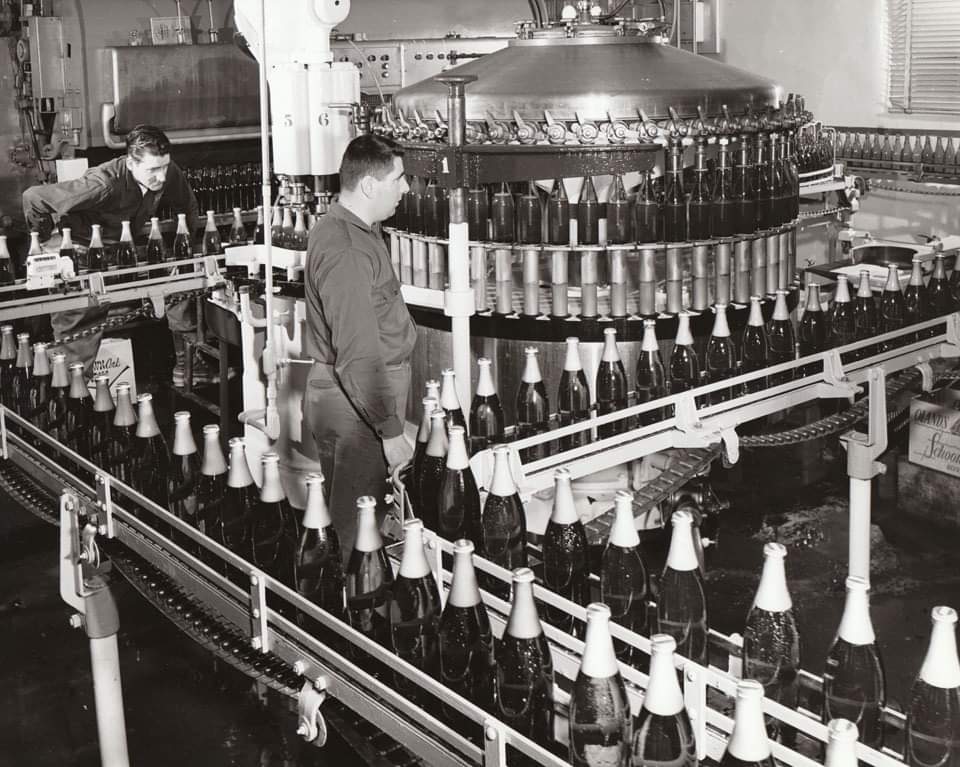
This is the time of year when it all becomes a blur. Weekend plans for the next three months need to be scheduled because, before you know it, time times out and things gotta get done before the snow flies. Snow will fly. We know that. So I spent the past long weekend recreating my turf-bound ancestors life circa 1450. Fires and dirt and nothing much around to make a meal out of. Completely unlike the very modern lads of Halifax, Nova Scotia’s Oland brewery shown above circa 1950…or ’60… They are modernists. No safety glasses, no screens or other barriers as the clinky clacky glass flew by. “Lean in to check, Jerry!” the boss shouted. That being said I did, no doubt like the lads above, have a beer or two after my efforts were done.

Now, let’s see what’s gone on the world of brewing. I hope not as much as last week, given the news ran to almost 3000 words. First up, even though he is taking a break from his weekly round up, Stan is still producing his Hop Queries newsletter, now up to Vol. 6, No. 1., which included this passage on a product I have no personal interest in trying whatsoever – no alcohol, no calorie hop tea… or perhaps something even less:

I confess the word gimmick came to mind last month when the company announced the launch of Hoplark 0.0, Really Really Hoppy and invited me to see the plant. They are making the point that their drinks contain no alcohol and no calories. Because I’ve been buying their HopTea at my local grocery store, because hop water seems to have become a thing (there are other non-beer companies producing hop-flavored drinks, Lagunitas and Sierra Nevada have both launched national brands, and many smaller breweries have started to produce their own), and because Hoplark is being made only about a 30-minute drive from home I decided to visit.

Moving to matters of actual beery things, I liked this post at The Regency Town House website, an examination of urban planning circa 1825. It’s a discussion of the planning of Brunswick Street West  in Brighton and Hove, England and the street is still there as is at least one of the pubs:

Busby’s scheme for Brunswick Town shows the east side of Brunswick Street West was planned to be individual stables and coach houses for the houses on the west side of Brunswick Square and the south spur of the road for stables at the rear of Brunswick Terrace West. The plan also shows the Star of Brunswick public house with a cottage opposite at the northern end of more stabling at the rear of the garden where Lansdowne Mansions would be built by the 1850s. There were two modest buildings just to the west of the pub which would be used as Green Grocers and Bootmakers.

The core of our fair city was build on Georgian plans and at work I regularly bump into stables and lanes for horses as part of the untangling of property interests.  The air would be full of the scent of poo.

Knowing my family’s industrial Scottish reality, this discussion from the BBC is a very light touch on the devastating reality that organized intoxication was for most. Events from the 1890s still echoed into at least the 1960s as family members sought to escape their past and present.

Sticking with the 1800s, Edd Mather posted about brewings from August to December 1849 according to the Alexander Berwick & Co  Brewhouse Book 1849 – 1852 which I understand was an Edinburgh outfit. Hefty brews from 6.3% to 8.7%. He then converted the first of the beers listed for home brewing set, in case you are interested in a pint of P3 come sometime in June.

Jubilee update. Coronation beers found in Stroud. Relatedly, someone felt “mildly patriotic” elsewhere.

Evan has a project on the go which all beer writers should be excited about, a survey of success and failures in book publishing. I added two sad tales but really need to balance off with the happier tales with Craig of Albany Ale… as well as Al and Max Theatre! Go make your confessions so that others may not suffer!

Eoghan wrote a strikingly sensible statement: “I will avoid subjecting you to my trite observations on my first experience of America…

States in India have started rationing beer:

West Bengal recently began rationing beer to retail outlets with demand doubling over summer last year. Most states have witnessed volume recovery and are looking to surpass pre-pandemic levels, said Rishi Pardal, managing director of United Breweries, India’s largest beer maker. “Owing to peak summer demand, few states have also introduced local regulations have also introduced local regulations on movement of goods inter-state which may impact fulfilment of demand in certain markets,” Pardal said. “We are well-prepared to serve the market.”

On to the local election where all is quiet beer wise – odd given Canadian politicians tend to kiss more beer taps than babies during elections. One thing did happen. I was sent a copy of a lobbying document issued by the Ontario Craft Brewers but sent apparently by someone unhappy with the message. Here is the memo and here is a bit of the anonymous message in the covering email:

The attached may or may not come as news to you – but it would appear to be against your interests as contract brewing facilities, as well as anti-competitive and short sighted. The OCB appears to be focused on targeting and scapegoating smaller businesses, many of whom are diverse, incubators of new products, and if successful will eventually graduate to brick and mortar operations, while seemingly ignoring the much larger collective threat to Ontario Craft Beer from larger international brewers or the rapid growth of cocktails and ready to drink alcoholic beverages. 

Heavens!  Now, to be fair, the OCB memo does state that contract brewers do not contribute to local economies and take up valuable shelf space from those brewers who do. My immediate reaction was thinking of how these production breweries are often not “either or” businesses, how I knew of someone who worked a brewery’s canning machine who was packaging cases for plenty of other small breweries in Ontario, some bricks and mortar as well as some contractors. These smaller breweries and contracting firms would not otherwise would not have access to retail outlets or other expanded sales routes. And they, along with the production brewery itself, might not survive without this sort of work as part of the provincial supply chain. Many OCB members operate like this. Odd. The focus is needed elsewhere.

The gall is what gets you, as Afro.Beer.Chick flagged. So if someone wants to reference Juneteenth on a the label of some hazy IPA gak with fruit flavours added, does Mr. Driven Snow now get a chunk of change?

Bad behaviour claims against BrewDog continue – and I wonder if perhaps developing in a way that avoids the risk of examining similar acts closer to home. Are they the worst actor? Certainly not the sole bad actor. But the loss of reputation spreads. The situation is now tense. Evidence is undeniable. Individuals rightly utterly violated and repulsed. Me, I don’t drink the stuff myself. Good to see that the actual authorities with adjudicative powers are now becoming involved. Things need sorting.

And finally… Ron posted an excellent set of observations on another thing I avoid – beer fests – and how many are serving such small measures that they deserfve to be called “Thimble Fests“:

I used to go to many more. The main Belgian one, whatever that’s called now. The Borefts Festival. Others in Stockholm and Copenhagen. But that’s all a few years back. Now, I just can’t be bothered with most festivals. Why is that? Well, I’ve already told you, really. Lack of seating, long queues for beer. But the biggest reason of all is small measures. If you’re lucky, you might get a 15 cl serving. But it might well be just 10 cl or even a piddling 5 cl. I’ve got two glasses sometimes to take the edge off my frustration. Or taken along my own Imperial pint glass. A combination of small measures and long queues wring all the pleasure out of a festival for me. Getting in line for your next beer as soon as you’ve been served your last makes for a queueing festival rather than a beer festival.

Me, I don’t go as I don’t like being shedded with hundreds of drunk strangers. But I like that – “a queuing festival” pretty much sums that up.

There. Half the length and no doubt twice the value. For more, check out the updates from Boak and Bailey mostly every Saturday but not from Stan every Monday as he is on his summer holiday. Check out the weekly Beer Ladies Podcast, and at the weekly OCBG Podcast on Tuesday (Ed.: but not this week) and sometimes on a Friday posts at The Fizz as well. There is a monthly sort of round up at The Glass. (Ed.: that seems to be dead now.) There is more from DaftAboutCraft‘s podcast, too. And the Beervana podcast. And sign up for Katie’s irregular newsletterThe Gulp, too. And check out the Atlantic Canada Beer Blog‘s weekly roundup. Plus follow the venerable Full Pint podcast. And Fermentation Radio with Emma Inch. The AfroBeerChick podcast as well! And also look at Brewsround and Cabin Fever. And Ben has his own podcast, Beer and Badword (Ed.: …notice of revival of which has been given)  And remember BeerEdge, too, and The Moon Under Water. Things come. Things go.

With The End Of February Comes These Beery New Notes

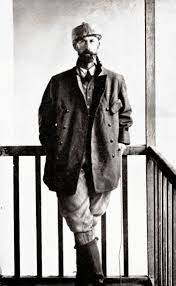
That was a bit much last week. All that talk of rice and here’s me trying to be more keto. I’ll try to be more sensible this week. It was, after all, a long weekend last weekend which kept me from reading all that much about beer. Read a book about third-wave ska instead. Now I’m halfway through another, Exploration Fawcett, by British military surveyor Percy Fawcett pre-WWI (aka the quasi-nutso as illustrated) in the jungles of South America. What a horrendous place. Murderous concentration camp slave-based rubber plantations along the Bolivian Brazilian border, a recent war zone, set in the murderous Amazonian jungle populated by murderous Indigenous people defending themselves against murderous imperialist Euro-losers at the end of the world. There are beer references like this one, when an actual ocean-going steamer appears entirely unexpectedly deep up a tributary:

As we glided past we saw the name Antonina in faded letters on her bow. A steward came out on the deck under the bridge, emptied a bucket of slops overboard, to watch us and straightened, his half-naked figure a small man with a mop of tow-coloured hair and narrow pinched shoulders. No one else appeared, and there was no activity ashore, but it was the hour when Europeans would be lunching. Stained canvas wind-catchers were stretched over the high boiler-room ventilators and from open scuttles air scoops protruded. On her counter appeared her name again, Antonina Hamburg, and a blade of her single screw showed beneath. “Hey!” ejaculated Dan. “What about going aboard her and having a beer? I bet they have real German beer fresh from the cask!” It was too late. Already the current had carried us past, and to drive back alongside would be difficult. We should have thought of that before instead of standing like fools and looking at her “Wonder what she’s doing here?” murmured Chalmers. “Rubber,” Dan said. “She’s come to load rubber.*

Cheery.** Like something you might read in Pellicle. Just like it. Fawcett passed thought Santa Cruz de la Sierra, Bolivia at one point. It now has a brewpub. Speaking all of which – and nothing really like it except it’s another form of exploration – Stephanie Shuttleworth revisits her old home town:

Ducking down so her dad, who played the piano for the crowd inside, wouldn’t spot her. If he did, someone would be sent to collar her and bring her in, to sing for the room. Now, my grandma could sink a rum and pep (that’s dark rum and peppermint cordial mixed together with a few ice cubes, if they have any) with the best of them. But sing, she could not. I can no longer sit down for a meal with my sadly missed grandma in that pub. Just as much as I couldn’t literally see her running under the giant sandstone window. I am thankful, however, that I can still look at the building (now a shop), step inside, and remember. 

Meanwhile, Alistair wrote this week about something that I had no idea was a thing – communal brewing in Bohemia:

The word that leapt from the page as I was reading something completely unrelated in Der Böhmische Bierbrauer was “braucommune”, which translates as “brewing commune”. Naturally, given Czechia’s proximity to Zoigl country over the border in the Oberpfalz, I wondered if what I was seeing here was the remnants of a Zoiglesque communal brewing setup in Bohemia?  Digging further, I discovered that in 1895 there were just 4 “braucommune” breweries operating in Bohemia that produced more than 10,000hl…***

Speaking about none of which in no way no how… don’t you love it when real medial people bait craft beer weirdos – chef’s kiss headline! It’s a BA Bart PR puff piece but still…

New research tool opportunity! Hunting through British Library Sounds audio archive reference to pub, beer, ale, “headbutting…” “all those wasted years…”!!

Real news time:

“This month posters will be displayed in all of our members pubs informing people to how seriously we take this matter. It has been agreed between all members that an automatic one-month ban will be issued to anyone caught urinating in public. “North Wales Police are backing Ruthin & District Pub Watch’s campaign and will be given permission to issue the one-month ban to any offender caught at the incident as well as any other penalties NWP have in their power to issue.” Mr Vaughan added: “This subject might generate a snigger from some and possible outrage from others who feel it is too much, but we agree that behaviour like this is just Taking The Pi**(****) when all of our establishments have toilet facilities, there is no excuse.

Unrelated – a new beer blog: Beer Nerdery. Speaking of British beer blogs, RARM went down to Liverpool to relive a moment and caught one, too:

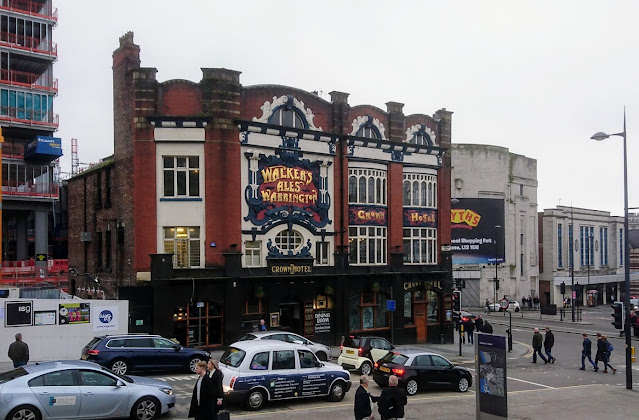
The last time I had visited Liverpool was back in 2017 when a group of us stopped in the city for an hour or two on our way to see Halifax Town get hammered at Tranmere Rovers across the Mersey in Birkenhead. We had called in a few pubs, one of them being the Crown, whose gloriously-decorated exterior beckons you as you emerge from Lime Street Station.

I mention this mainly to share a thought. One of the problems with beer and pub and brewery porn is it is decontextualized. See that image of the Crown? Ugly street scape. I like that. An actual view… except not to scale… it’s just a photo.

Q: if the Royals are just normal folk why have so many Royals?

In their downtime in Norfolk the family are known to have enjoyed family pub lunches (a clandestine photograph showed them eating burgers in a pub beer garden) and trips to build sandcastles on Holkham beach.

And in the second of a two part series, Jordan shared more information on Toronto’s 1904 brewery strike presented with a key dates sticker tape news headline approach:

At issue here is the demand of a union wage across all breweries in the city for approximately 700 brewery workers. We have, for background, figures related from the Brewers Association to the Toronto Star on May 6th. At this point, 105 workers for Reinhardt and O’Keefe (including drivers, helpers, stablement, labourers, bottlers, wash-house, cellar, and kettle men and coolers) have walked out after finally receiving confirmation from the head office in Cincinnati.

Finally, yet another reasons to be disgusted with fearful wee Mr. Putin:

Analysts have warned that since Ukraine, which is among the top five global producers of barley, is in the middle of a major geopolitical crisis, international supplies of raw materials would inevitably be affected. The period between March and July accounts for 40-45% of annual beer sales, and barley is the mainstay ingredient used in beer. According to reports, even for brewers who source barley locally, prices could go up with rise in global prices and supply disruptions.  

There. Done. Once again… nice. Really good job on my part. Really. And no rice talk. None. For more check out the updates from Boak and Bailey mostly every Saturday and from Stan every Monday, plus more with the weekly Beer Ladies Podcast, and at the weekly OCBG Podcast on Tuesday and sometimes on a Friday posts at The Fizz as well. There is a monthly sort of round up at The Glass. (Or is that dead now?) There is more from the DaftAboutCraft podcast, too. And the Beervana podcast. And sign up for Katie’s irregular newsletterThe Gulp, too (… back this week!) And check out the Atlantic Canada Beer Blog‘s weekly roundup. Plus follow the venerable Full Pint podcast. And Fermentation Radio with Emma Inch. The AfroBeerChick podcast as well! And also look at Brewsround and Cabin Fever. And Ben has his own podcast, Beer and Badword (which I hope is  revived soon…)  And remember BeerEdge, too, and The Moon Under Water.

*Long quotations… that’s the trick this week. None of that guff about rice… or research. Padding.
**I’m still passing on a trip to Ribeirãozinho during this lifetime. Note: Edwardian Brazilian trade journals have a lot in common with craft beer trade journalists. No talk of the glaringly obvious downsides.
***That’s a lot of Zs.
***Note: two non-footnoting indicating asterisks, can be confusing.

Your Mid-February 2022 Edition Of The Beery News Notes And That Odd Problem With Rice

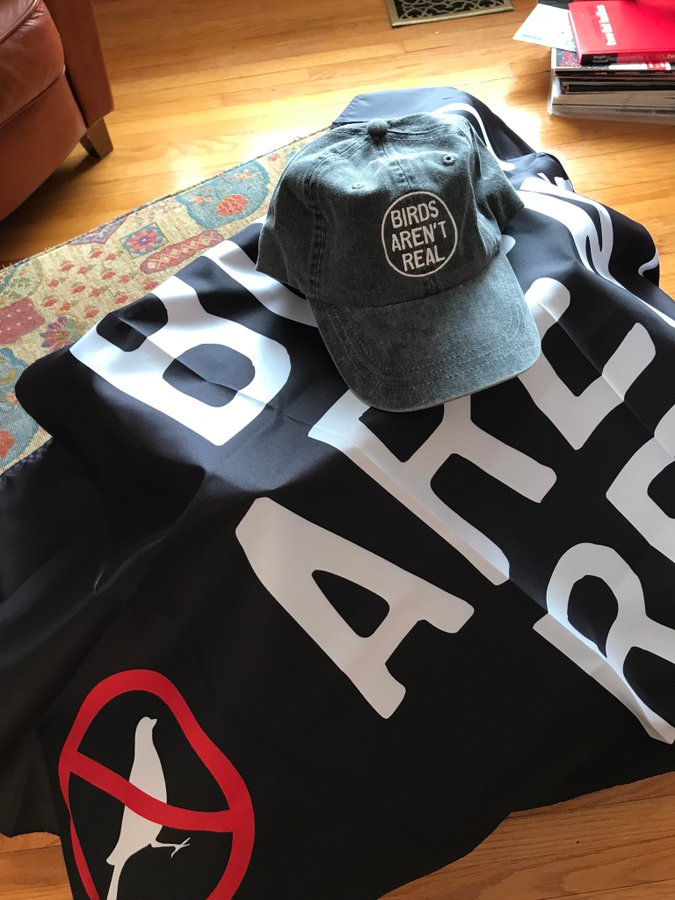
What a week! A trip to the dentist and the Federal imposition of the Emergency Measures Act!! It could drive one to drink. Except I haven’t. Had a couple of really good beers on Saturday, though. Stone City’s Ships In The Night. Oatmeal stout is rarely not a good call. But I have acquired my protest gear as illustrated, should any protests come my way. One must be prepared.

What else? Super Bowl. Stupor Bowl. Superb Owl. It also happened this week. Unlike much of the continent, me I had not one beer. I paid little attention to the game itself on TV which ended up as a bit of a yawner even with the close final score. But would it be better live? Well. it’s not exactly for the snack bracket me and my peeps, is it?

…a double measure of Don Julio, Ciroc or Tanqueray 10 would set punters back US$25. Meanwhile, the craft beer selections clocked in at $19, which would get drinkers a serve of Kona, Golden Road Mango Cart or Elysian Space Dust. The premium beer serve was Michelob Ultra, which was priced at $17. And it’s fair to say that fans were taken aback by the prices.

More breweries closed this week. As Jeff reported, Hair of the Dog and Modern Times -both of the US West Coast wound down in whole or in part. The latter announced it this way:

Today is the most difficult day we’ve ever had at Modern Times. Over the last two unimaginably challenging pandemic years, we’ve done everything we could to keep all of our newly-opened locations afloat in a landscape we never could have imagined when we began building them. As new leadership has stepped up and taken the helm over the last few weeks, it became clear that the financial state of the company that we are now tasked with directing is not just unsustainable, but in immediate and unavoidable peril

Hair of the Dog is/was one of the greats that never had dreams of delivery fleets and HR departments. Retirement is well earned. I put the last cardboard box from the fabulous HOTD misadventure of 2006 out with the recycling just last Sunday.

Elsewhere, building on the momentum to challenge the ethics within Ontario’s brewing industry led by Erin Broadfoot,  Mallory Jones the brewer and co-owner of my beloved Matron Fine Beer in nearby Prince Edward County on behalf of herself and fellow brewer and co-owner Jessica Nettleton, shared experiences of their lives in beer, starting with this remarkably concise statement:

Behind the ‘good times and camaraderie’ there is a dark underbelly, a booze-fuelled side, a sexist and skewed patriarchal side, a side that desperately needs to change.

Note in particular this statement: “…beer events often (read: all of them) result in over consumption which always equals disgusting behaviour from a wide variety of individuals on both sides of the bar…” It boggles the mind how it took so long for such obvious and open behaviours to be simply and plainly stated after years of the trade and trade writers telling us how it’s all one community and craft beer people are good people. I am very careful who I buy from now as well as whose word I take.

There was a great short video of a Polish railway standup tavern car on Twitter this week. One of my favourite memories of working in Northern Poland thirty years ago was the the Polish railway standup tavern car from Kołobrzeg to Gdansk. The good old PKP (“puh-ka-puh”). There is even “fruit syrup for beer” now.

Over in India, the government has taken a very sensible approach to the healthier regulation of the beer market that would be a great first step towards the listing of ingredients:

The Food Safety and Standards Authority of India (FSSAI) will soon come out with fresh regulations for two important everyday consumption items – bread and beer. Beer brands will have to disclose the calorie count per bottle or can while bread makers will be allowed to label products as ‘multigrain’, ‘whole wheat’, and ‘brown’ bread only if the items have specified amount of multigrain or whole wheat in them, FSSAI CEO Arun Singhal said.

There will be boo-hooing from the please-do-nothing crowd but calculation of beer calories is a reasonably straight forward matter. The only problem is how surprised the beer buying public might be.

Everyone one loves a story about a truck load of beer crashing across the roadway. I think only a load of fish thrown upon the hot asphalt is considered more remarkable but that’s because of the gross immediate squishy slippy driving conditions.

Martin wrote this week about the experience at a little investigate site of beer imbibations – a fitba corporate hospitality suite  – and found it… a bit sad:

£6.50 your pie and mash and peas from memory, and beer not much above Northern Quarter prices (double Kelham prices, of course). This is the cheaper end of the hospitality market, giving you a nice seat with your pre-match pie and pint, and seems to be a treat for the old fellas and the well-off bloke dragging his girlfriend to the match. And then you walk from the social club style bar to your padded seat and get distracted by Caitlin Jenner and goal flashes from Blackburn.

He then had a bit cheerier but also reflective experience with his Pa, down at the Plough & Fleece:

Across the road, we could see the nondescript cafe at Scotsdale Garden Centre busy as usual. The coffee and cake at the garden centre has long replace fish and chips and a pint at the pub, even though the pub is often cheaper and always the more homely option.

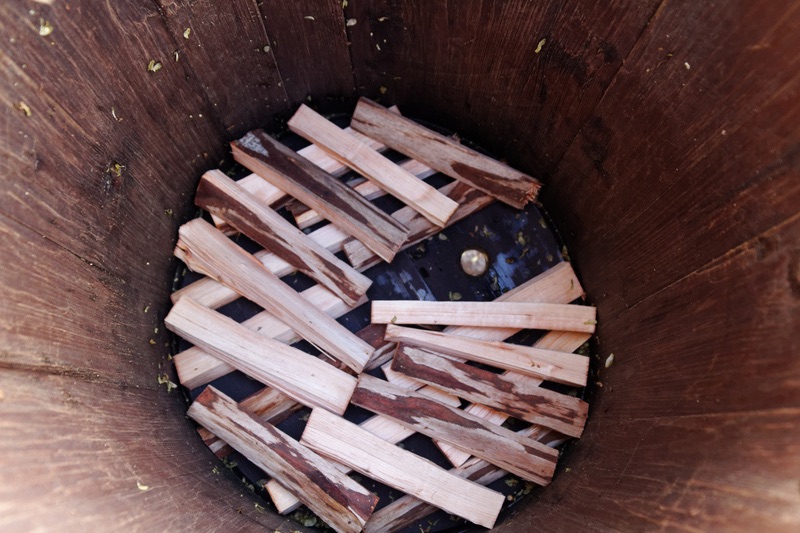
Lars as usual used social media to the fullest this week to discuss the role of alder wood as a filtering tool in Norwegian farmhouse brewing undertaking both hallmark mapping excellence and scientific journal review enroute:

I found a modern scientific paper which extracted substances from alder bark that they found to be antibacterial. Unfortunately, they were also antifungal and very effective against yeast, so clearly the concentration in beer isn’t enough to have an effect.

Q: has beer historian Amy Mittelman returned to beer blogging?

And just before the long last topic,  this week we received the sad news of the death of one of the leaders in the early years of the UK’s craft beer movement of 12-15 years ago. Dave Bailey was the owner of the Hardknott Brewery which was founded in 2006 and closed in 2018. He was sought out and sought out others who were thinking about beer, like we see in 2009. Alistair at Fuggled interviewed him in 2010. Dave’s brewery was as well known and certain as central to the scene as BrewDog in those years. He was only in his mid-50s when he passed. Dave was a great friend to those interested in discussing good beer and was a regular chatting in social media. My earliest Twitter chats go back to 2009. He kept an excellent beer blog that gave the straight story about life as a small scale brewer like when in 2017 he shared painful business realities connected to the question of how far to capitalize his venture. He had announced in 2020 that he was living with cancer. Very sad news of the loss of a pioneer. Thoughts are with his partner in life and business, Ann.

Finally, there was a bit of faff over the weekend about something claimed to be “Japanese Pilsner” which was neatly summed up by Jenny Pfäfflin this way:

Anyway, brewers using rice in their beer =\= a “Japanese Lager”—it’s a made-up style in that sense—but I don’t think you can write off the possibility there are distinct ingredients and processes that make Japanese-made rice lagers a style of its own…

I called it a fiction and some poor widdle cwafters went a bit boo-hoo. But were they right? It is always important to understand you may be 100% wrong 100% of the time. So let’s see.

First, the thing is even with that narrowing of focus that Ms. Pfäfflin recommends, we have to consider how late brewing beer came to Japan as well as how rice came to be in beer. Until around the time of the US Civil War in the mid-1860s, Japan was governed under a feudal system which had a strict cultural and economic isolationist policy that the western powers were actively seeking to break down. Breweries founded in the ensuing Meiji period were European and even American affairs. As I mentioned last November, the Spring Valley Brewery, founded in Yokohama in 1869 by Norwegian-American brewer, William Copeland. That brewery later becomes the Japan Beer Brewery Company and then Kirin. In line with the new general national policy of opening up to industrialization, what is now Sapporo was founded by what looks like a government agency, the Hokkaido Development Commission which hired Seibei Nakagawa, a Germany-trained brewer, as its first brewmaster in June 1876. Sapporo still brews Yebisu a Dortmunder/export lager, and Yebisu Black, a dark lager which were  first brewed in Tokyo in 1890 by the Japan Beer Brewery Company. These breweries were brewing German beers. As the CEO of Kirin Brewery, Kato Kazuyasu, in 2011 stated:

The Japan Brewery Company shared its primary objective of brewing authentic German beer. Veteran German brewmasters were recruited and the most advanced equipment and steaming systems of the time were acquired, all under the mantra of providing Japanese consumers with the most authentic quality and satisfying taste possible…

Now… consider Japan’s next few decades. Expansionist military imperial government leading through the Russo-Japanese War of 1904-05 through to the end of WWII. European influence continued in partnership with government industrialization policy as described in the 2014 article “Structural Advantage and the Origins of the Japanese Beer Industry, 1869-1918” by Jeffery W. Alexander*:

Like Kirin Beer, the firm that we know today as Sapporo Breweries Ltd. underwent a rather complex evolution – one that would take twice as long to unfold and would involve four unique phases through 1949. The first three of those phases are of interest to us here, for between its founding as a government-directed and development project in 1876, its reestablishment by private investors as a limited company in 1888, and its merger with two major rival brewers in 1906, the brewery received extensive technical assistance from a variety of foreign experts.

Through this merger, the Dai Nippon (Greater Japan) Beer Company, Inc. was created on 26 March 1906. It was only broken up in 1949 as the Allied Occupation forces sought to reverse the imperial policy of concentrated economic power. And, as Alexander states, beer in Japan “was brewed, advertised, and sold in Japan as a proudly German-styled commodity into the late 1930s.

After WW2, the United States occupied Japan from 1945 to 1952. There was an economic boom starting in 1950 due to the UN using Japan as it base for the Korean War. Starting at this time, breweries like the smaller Orion shifted from German style brewing to beers which more reflected American tastes. Not much of a vernacular brewing tradition to this point. For the next few decades that consolidated industrial approach continued as a handful of macro industrial brewing supplied the market (as Alexander states elsewhere**) “until Japan’s government decided in 1994 to again permit small-scale brewing.” Kirin held over 60% of the market during those years and competition was primarily related to draft innovations, packaging design and the dry beer market. Japan’s generic international-style macro adjunct lagers which required a minimum of 67% barley malt*** were joined by sub-standard happoshu starting in 1994 and in 2004 sub-sub-standard zero-malt dai-san biiru, a third-category beer all to feeding, one supposes, the salaryman market.

As Lisa Grimm explained in her 2018 Serious Eats article, early Japanese small breweries replicated the adjunct lagers:

The first craft brewery to open in Japan was Echigo Beer, and they struck something of a balance between the entrenched ‘dry’ beer trend and German- and American-influenced craft brewing techniques. In addition to pale ales and stouts, they also made (and continue to make) a rice-based lager that competes with the bigger players in the market—something of a gateway beer.

By twenty years ago, the Japanese branch of the globalist craft beer movement was moving at pace. Created in 1996 as the brewing division of an establish sake maker, Kiuchi, Hitachino Nest is one of Japan’s best known craft brewers. Its Red Rice Ale is first logged by a reviewer at the BeerAdvocate in 2002. So it’s done… even if only as a recent thing. But whatever is done, like German lager brewing in the later 1800s as well as US macro brewing in the mid-1900s, it is being done on the crest of another wave of globalist economic and technological innovation – craft.

So when you read about an American-made Japanese pilsnerbrewed with rice in the Japanese tradition” you have to understand this is really a sort of untruth. And a bit of cultural appropriation, I suppose. Rice in beer is an American innovation. American restructuring of the economy of Japan in the mid-1900s introduced rice into beer brewing because that is how Americans brewed. But that may make it actually a sort of truth as long as we set aside the fibs of craft and look at the situation with a more open mind. Let’s continue to look around a bit more.

When does rice get into beer? In Ambitious Brew, Maureen Ogle tells us in detail how Adophus Busch in the 1870s experimented with a form of what looks like a decoction brewing method which had eight pounds of rice to every five bushels of high quality barley.**** Light and bubbly beer. Tremblay and Tremblay explain how rice is used in the best US adjunct beers still to produce the effect they call “crisp” with again a fairly limited amount being all that is required. Budweiser, Coors and Miller Genuine Draft all having just under 5% rice in the mash which include +/-20% other adjuncts.***** They also explain how around 1950 US national advertising of beer hits its stride with Anheuser-Busch, Pabst and Schlitz being the premium brands.****** What America wanted. Home or away. It is so popular that the brewers of Canada in the mid-1920s******* during US Prohibition started brewing rice beer to serve the huge and very lucrative bootleg market. Including in Japan where they were the occupying government restructuring the economy including a oligarchical macro brewing industry that stayed in that form of few players, big players for the next 45 years. Which makes Japanese premium rice lager US premium rice lager.

Not only does rice make beer crisp, it makes production cheap. Barley malt is the best barley, the rest going to cattle feed and Scottish soups. Rice for brewing, however, is broken rice:

As brewing adjunct, rice has a very neutral flavor and aroma, and when properly converted in the brewhouse it yields to a light clean-tasting beer. Rice for brewing is a by-product of the edible rice milling industry, any kernels that may get fractured during the milling process (~30%) are considered undesirable are therefore sold to the brewing industry at a cheaper price. ********

The adoption of rice in brewing was part of a general move over decades to move away from heavier foods and drink, what Tremblay and Tremblay call “the growing mass appeal of lighter beer which drove most of the domestic brewers of dark beer out of business.“********* Short-grained or japonica rice is preferred in brewing.+ Japan’s brewer ride that wave, too, as part of the globalization of US macro industrial adjunct lagers that made Carling out of a Canadian beer, gave Kenya Tusker, gave Australia Fosters, etc. etc.

One more thing. How does rice get to the US to get later into the beer? In The Cooking Gene Michael W. Twitty explains how the Asian strain of rice came to colonial America in 1685  care of a very lost ship from Madagascar. Captured and enslaved people from Africa who knew how to grow rice were used forced agricultural labour and by 1770 150,000 acres of the US eastern shoreline were slave labour concentration camp rice plantations with 66 million pounds produced annually.+* After the US Civil War, about when Japanese isolationism policy weakens, rice production drops with emancipation but then shifts inland and become mechanized in Louisiana and Texas which, by the 1890s, are producing 75% of the US rice crop.+** Which creates a lot of broken rice for brewers, notably quite distinct from the top quality rice used in sake.+***

So if, starting in 1685, short grain japonica rice comes to the US, becomes a massively valuable cash crop with a very useful by-product of broken rice that is found to have a role in US macro brewing and then is taken to Japan as part of the post-war era of US Occupation… hasn’t that strain of rice circled the globe over about 260 years? And hasn’t the history of Japan been so affected by these global influences… even if they are arguably economic colonial or even technological hegemonistic influences… that their culture legitimately has a tradition of international rice adjunct premium lager that could be called “Japanese rice pilsner”? Hasn’t Japan’s brewing history been almost entirely based on international influence from the 1860s to now? But can you have a national tradition which is not… vernacular? I will leave that question with you as you next look at a bottle of craft beer labelled Japanese traditional rice pilsner which says “made in the USA” on the back. +****

Nice. There. Done. For more check out the updates from Boak and Bailey mostly every Saturday and from Stan every Monday, plus more with the weekly Beer Ladies Podcast, and at the weekly OCBG Podcast on Tuesday and sometimes on a Friday posts at The Fizz as well. There is a monthly sort of round up at The Glass. (Or is that dead now?) There is more from the DaftAboutCraft podcast, too. And the Beervana podcast. And sign up for Katie’s irregular newsletterThe Gulp, too (… back this week!) And check out the Atlantic Canada Beer Blog‘s weekly roundup. Plus follow the venerable Full Pint podcast. And Fermentation Radio with Emma Inch. The AfroBeerChick podcast as well! And also look at Brewsround and Cabin Fever. And Ben has his own podcast, Beer and Badword (which I hope is  revived soon…)  And remember BeerEdge, too, and The Moon Under Water.

*Brewery History (2014) 158, 19-37.
**Brewed in Japan – The Evolution of Japanese Beer Industry” (UBC, 2013) sample introduction at page 5.
***Not the main ingredient as some claim.
****Ambitious Brew (Harcourt, 2006) at pages 76-77.
*****The US Brewing Industry (MIT, 2005) at page 7.
******Ibid., page 52-53.
*******The King v. Carling Export Brewing & Malting Co. Ltd., 1930 CanLII 46 (SCC), [1930] SCR 361 at page 373.
********The Use of Rice in Brewing” in Advances in International Rice Research (InTech, 2017) by O. Marconi et al. at page 57 as well as this at page 51: “Usually, brewer’s rice is a byproduct of the edible rice milling industry. Hulls are removed from paddy rice, and this hulled rice is then dry milled to remove the bran, aleurone layers and germ. The objective of rice milling is to completely remove these fractions with a minimal amount of damage to the starchy endosperm, resulting in whole kernels for domestic consumption. The broken pieces are considered esthetically undesirable for domestic use and sold to brewers at a low price. Rice is preferred by some brewers as adjuncts because of its lower oil content compared to corn grits. It has a very neutral aroma and flavor, and when properly converted in the brewhouse it results in a light, dry, clean-tasting and drinkable beer.”
*********Tremblay and Tremblay, supra, at page 107.
+O. Marconi et al., supra, at page 50.
+*The Cooking Gene by Michael W. Twitty (Amistad HarperCollins, 2017) at page 243.
+**See Wikipedia article “Rice production in the United States” at section on 19th century.
+***See MTC Sake and Home Brew Sake websites.
+****Heck, name a brand “1685+1876+1945+1994=???” if you like.

Addendum: Cream Beer Was Once Cream Beer

Over five years ago now I wrote the last of a few posts on the question of cream beer.  It co-existed with cream ale and Imperial Cream Ales and all the other creamy drinks. I traced it from Ohio in the 1840s back to NYC and Pennsylvania in the 1820s. It has been referenced as a predecessor to Kentucky Common. It was a thing until it wasn’t:
‘The scent of roses clings round it still.’ Cream beer, which was brewed by our best brewers, is, like the ale-sangaree, is a thing of the past. The rich cool beverage has gone out of use…*

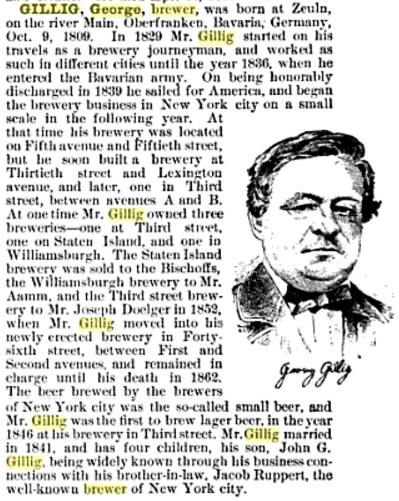
Note: cream ale as not “a thing of the past” when that was written. One of the puzzles was whether it was something from Germany. One of the records I came across referenced “…cream beer, or Lauderschaum…” My problem was I thought there were two waves of German immigration to the USA which did not line up with this timing: the Pennsylvania Dutch from before the American Revolution in the mid-1700s and then the Germans of the 1840s escaping the backlash against other revolutions like George Gillig, bringer of lager.

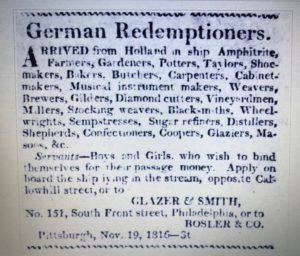
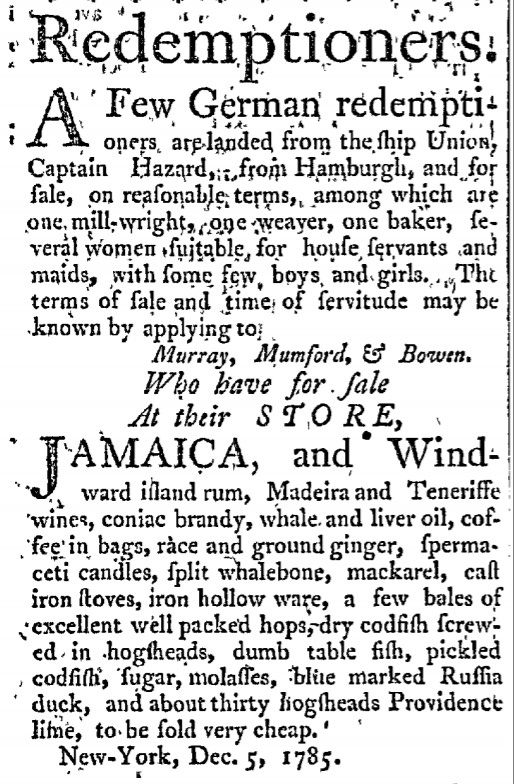
So much pleased was I to come across that notice up at the top from the Pittsburgh Weekly Gazette of 19 Nov 1816. A notice for the sale of indentured servants, or German Redemptioners. To the right is another notice for Redemptioners from New York City in 1785. No brewers were mentioned in this group unlike the notice from thirty one years later. According to Wikipedia, redemptioners were continental European immigrants in the 18th or early 19th century who sailed most often to  Pennsylvania by selling themselves into indentured servitude to pay back the shipping company for the cost of the ticket. Including brewers.

Which means there was a third sort of immigration, one with a supply of brewers with contemporary brewing skills within the right time frame who would be able to make “…cream beer, or Lauderschaum…” just like Gillig was able to bring his lager brewing skills a few decades later.

Update: I should also link to this 2018 post about schenk and Bavarian beer.

*What the hell is ale-sangaree?

The Beery News Notes For The End Of 2021’s 10/12ths

Here we are. November looms. I’ve never thought Halloween was all that scary given November is right there behind it.  The dreariest month. If it snows, winter will be too long. If it rains, the rain is bone achingly cold. Dreich. But a big month for beer. Big beers, in fact. I’ve been laying off but maybe it’s time to lay on again. Treat yourselves nice in November. It’s like it needs its own month to celebrate itself. Like gag-tastic #RauchBeerMonth but with, you know, the prospect of someone actually being made happier. And that’s what we want. To be happy. Despite the dreich.

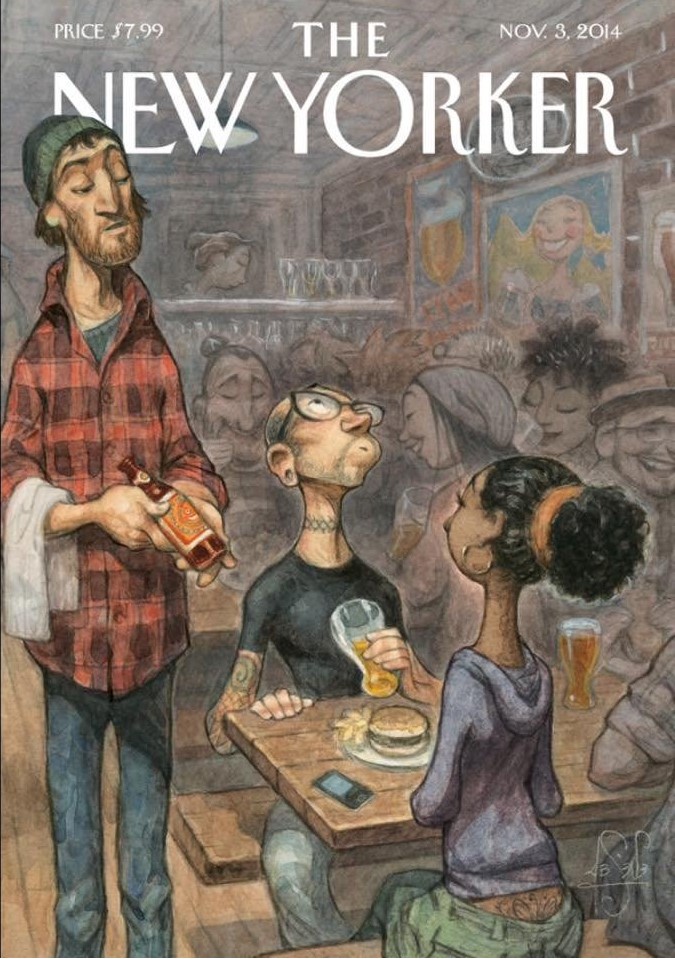
This November marks the seventh anniversary of perhaps the high point in the craft phase of good beer, circa 2003 to about 2016. The cover of The New Yorker from November 3, 2014. Mere months after the publication of the cult classic The Unbearable Nonsense of Craft Beer. Josh Noel‘s comment was spot on – a moment in time before hard seltzer. And perhaps a moment that had some aspects we are well rid of – if this article on Colorado’s New Image brewery is anything to go by:

The idea that brewery employees should expect less money because they are “doing what they love” is a cliché that needs to go away, he adds. “We are trying to take that out of craft-beer culture. It’s about damn time we have good benefits and good pay for people making beer.” Having a second taproom with higher margins on sales will help that effort as well, Capps says. And New Image is now “aggressively” seeking out locations that it can buy to add a third or even a fourth taproom.

The past is a foreign land. Conversely, there are a lot of words that come to mind in this story of today. Gall. Cheek. Privilege. Arseholes probably the correct term as the Manchester Evening News reports:

The Pack Horse, which is in the Peak District village of Hayfield, was visited by a group who didn’t flag any problems with their food when staff checked in with them, but chose to complain when they’d already eaten most of the meal, staff said. They allegedly tried to demand a new dish – which was refused – and eventually left without paying their bill. Owner and chef Luke Payne said that one member of the group then had the nerve to wink at him as they left.

The article goes on to suggest that manners have dropped in these later pandemic months. Arseholes, I say. Matt C. explored other forms of late pandemic angst in an article in Pellicle this week:

Before the pandemic, one place in particular I would find both solace and kinship was at a beer festival. In my search for remembering what it was like to feel more normal, I fondly recalled the deep-seated warmth I felt from head to toe as I travelled home from Cloudwater Brew Co.’s Friends & Family & Beer in February 2020. While there I had a wonderful time enjoying many delicious beverages, and spending quality time with friends old and new—some who had travelled half-way across the world to attend. The festival took place in Manchester, too: a city my partner and I had decided we would soon make our home. I felt ready for the next chapter. Then the wheels came off, the world grinding to a halt at the mercy of the bastard virus. 

I’ve never liked beer fests myself. Don’t miss them.  Too many drunks. Perhaps I differ in this regard from The Beer Nut who celebrated 30 years of the European Beer Consumers Union, the sort of institution North American beer culture lacks. No fest to back up the celebration, however. Just Zoom.

Another venue for drinking that’s much more to my liking is also disappearing as The New York Times reports:

Several decades ago, the beer bar, with its dozens of draft options and deep bottle lists, delivered a liquid education in bitter I.P.A.s and monk-brewed Belgian ales alike. They were places “where customers discovered craft,” and helped the genre grow, said Bart Watson, chief economist for the Brewers Association trade group. But with growth of the taprooms, craft-bar release parties for special beers dried up. What was once “a prime way of bringing people into bars was gradually taken away by the breweries themselves,” Mr. Black said.

No, beer bars were not where folk discovered craft. They predate craft. (You’d think people would get it. Obey the chronology.)  In their finest form they are a dive with very good stock. Like Max’s in Baltimore. Conversely, craft is the taproom. But it is true. Craft killed the beer bar. Including by aggressively opening new taprooms, as we read above. (I know… I’ve been quoted as an expert in the subject. Sorta.) But I was quoted by Stan who posted a follow-up post (a post that poses possibilities predicated on the prior post) on the question “wuzza beer bar?“:

Two names I heard more than others were Rino Beer Garden and Finn’s Manor. Finn’s has a shorter tap list — curated, as the kids say — and a cocktail menu. Rino has more than 60-plus taps. Would both be classified as beer bars? Pat Baker provided a definition in his “Beer & Bar Atlas” in 1988. His classifications included classic bar, neighborhood bar, beer bar, Irish bar, German bar, English Pub and fern bar. (Yes, neither wine bar nor sports bar.)

At this point, I pause to consider this week’s candidate for the wonderful graph award. Gaze upon this for a moment:

Look at that graph. I have stripped a few identifiers from it to get to the nub of the matter but it is from Colin Angus as posted under his handle @VictimOfMaths and came with this message:

The UK’s approach to taxing alcohol is stupid. In the budget next week there is a strong possibility the chancellor will overhaul it. Before we find out what he has planned, here’s a thread on what is the current system and what exactly is wrong with it? 

Thread. And it does all look stupid when put that way. Why is beer taxed at a higher rate as it strengthens while wine moves in the opposite direction? The actual changes to taxation were announced Wednesday. CAMRA wrote of games being changed. Matt had a summary as well as  particular view as to the taxed event within the supply chain which is useful:

…the consumer doesn’t pay that duty, nor does the pub. The producer does. So on a 9 gallon cask of 72 pints, that’s £2.16 off costs. Maybe a bigger saving if its below 3.5%…

Speaking of the graphical representations of data, Lars has updated his yeast family tree based on a number of recent studies and included lots of wonderful graphs as well as new info:

They also found a separate subgroup of African beer yeasts, which is very interesting. Africa has an enormous variety of traditional farmhouse brewing going on in many different countries over much of the continent, and many of those brewers still maintain their own yeasts. (Martin Thibault spoke about Ethiopian brewers and their yeast at Norsk Kornølfestival in 2020.) Now it looks like they, too, have their own genetic subgroup of yeasts.

Note: be flexible.

Finally, Boak and Bailey’s post this week on the Stokes Croft Brewery, Bristol, 1890-1911 contains this fabulous image which goes a long way to explain the gradation of late Victorian stouts and ales. I got all excited when I saw it. Lovely. Place a laminated copy in your wallet for handy reference.

There you go. A bumper crop this week. For more, check out the updates from that same Boak and Bailey mostly every Saturday and from Stan now on a regular basis again every Monday, plus more with the weekly Beer Ladies Podcast, and at the weekly OCBG Podcast on Tuesday and sometimes on a Friday posts at The Fizz as well. There is a monthly sort of round up at The Glass. There is more from the DaftAboutCraft podcast, too. And the Beervana podcast. And sign up for Katie’s weekly newsletterThe Gulp, too. And check out the Atlantic Canada Beer Blog‘s weekly roundup. Plus follow the venerable Full Pint podcast. And Fermentation Radio with Emma Inch. The AfroBeerChick podcast as well! And also look at Brewsround and Cabin Fever. And Ben has his own podcast, Beer and Badword which may revive some day.  And remember BeerEdge, too, and The Moon Under Water.

The Last Of August’s Thursday Beery News Notes

What was that? Summer 2021? Done? It’s still going on here as I am on an actual holiday and doing fun stuff like getting new spectacles for my face and a new electrical panel for the basement. Wooot! This is the dream and I am livin’ it. I even had 330 ml of a 3.8% beer yesterday and watched a Netflix show about the Korean buckwheat noodle dish naengmyeon, as recommended by DSL.* Both a drinking and then hangover dish apparently. Now I know why my buckwheat noodles suck. I didn’t immediately rinse and rub them in ice water. And, yes, a hundred other reasons. Never again. Probably. Maybe.

First off, it was good to read “The Ancient Magic of Malt: Making Malt Sugars and Ale from Grain Using Traditional Techniques” by sometimes reader Merryn Dineley in the journal EXARC.net,* 2021 (vol 2) who set the record straight:

This paper is presented as a historical narrative as well as being an explanation of basic ‘mashing in’ techniques. I aim to tell the story of the development of my understanding of how to make malt and malt sugars from the grain. I have learned from other experimental archaeologists, from ancient technologists and brewing scientists as well as from ethnographic research and the study of traditional style malting, mashing and fermentation techniques. One of the common myths about the origins of beer thousands of years ago is that grain was perhaps left in a container, it got wet and, somehow, turned into beer. This is impossible. The conditions for making malt and malt sugars do not exist in this situation. 

A bit later in time but still in the past, Rob Sterowski at “I Might Have a Glass of Beer” wrote about Epochal Barrel Fermented Ales, a brewery intent of brewing the old fashioned way:

Possibly the most erudite of Scottish brewers, Young deserted the world of academic philosophy to devote himself to a study of eighteenth- and nineteenth-century brewing literature instead, and Epochal Barrel Fermented Ales is the result. A skilled home brewer, he has set up his small brewery in Port Dundas to make beers influenced by the way it was done two hundred years ago. His beer is fermented with a multi-strain yeast, cleansed to rid them of excess yeast and then allowed to mature to completion in oak barrels with a handful of whole-cone hops. The finished product is naturally carbonated in the bottle.

As Boak and Bailey noted, suggestions that the #MeToo and #BLM movements’ efforts to expose craft beer’s ugly side have faded were found wanting with the news of an open letter to England’s West Berkshire Brewery. You can click on the image to the right to read the complaints yourself. It is certainly one of the long failings of the drinking entertainment pleasure trade to address the piggish attitudes that go along with booze. So it is good to read that folk won’t be bullied to keep quiet when it comes to bigotry and harassment even if a lot of the privileged voices have wandered away.

I wasn’t familiar with English comedian Sean Lock. He passed away this past week but I am glad to know he had a hobby.

Update: I failed in not mentioning “Empire State of Mind” by David Jesudason published in GBH (thereby upping their average significantly) who looks at IPA from the point of view of the “I” as in India:

My father’s love of empire, and his belief that Britain was a civilizing force, was mirrored in the drink he called his own: the India Pale Ale. Of all of his beliefs, this one was particularly confused. His friends were Lager drinkers, and his adoption of IPA was a way of pretending to be refined in the days before the craft revolution had taken hold. But where he saw a drink that was emblematic of genteel, colonial India, I see something very different: Owing to the beer style’s association with the East India Company and its brutality, I can’t help but think of bloodshed, oppression, and enslavement.

I noted that it was an parallel to “Britain’s Idyllic Country Houses Reveal a Darker History“, the recent NYer piece on England’s National Trust but also cause for reflection on my own family’s path. One side included servants at big houses like that of the Collins publishing family as well as a great-grandfather who was a Sgt Mjr British army out in the empire while the other side, displaced highlanders in Greenock, built the ships that shifted the sugar that came out of the colonial system. Many died young, many had lives of if not poverty then at best modesty – with much drink caused troubles in industrial towns before many emigrated the hell out of there. If you have any doubt as to the way that IPA is code for empire consider this from that NYer article:

“At the end of the day, we went to a very, very, very rich country and transferred a lot of its wealth to this country, by trade, entrepreneurship, and looting,” Dalrymple said. In 2003, Angus Maddison, a British economist, calculated that India’s share of the global G.D.P. went from 24.4 per cent to 4.2 per cent during two and a half centuries of colonial rule. In 1884, the British state had a total income of two hundred and three million pounds, of which more than half came from its overseas territories, including seventy-four million pounds from India. Taxes were levied across the world and sent to burnish the metropole.

Good for someone to finally point out in depth the obvious issue with IPA as a placeholder for good beer.  Might as well brand US craft lager Berghof.

Note: craft.

One of Canada’s few pre-Confederations tavern/inns/hotels, the Queen’s Inn, is up for sale in my fair town. I wrote about it in 2004 when it was just 165 years old and I was only 41: and is ripe with history and charm:

…he remembers one particular customer who continued coming in until he was in his 80s. The gentleman, Mitchell recalled, was blind and had a booming voice. “Give him two drafts,” the bartender told the younger Mitchell. “We just put the price up to 50 cents. Have fun.” “I didn’t know what he meant. I put the two beers down and said, ‘That’ll be 50 cents.’” “Forty-five is all you’re getting,” the man bellowed back.

Another pandemic affected business. And, on that theme, Josh Noel pointed me in the direction of the tale of overzealous expansion which ended in the collapse  of Ale Asylum of Madison, Wisconsin:

Dilba said the pandemic “didn’t help” the business but added, “there were other extraneous factors, which I won’t get into, but the pressure applied by the pandemic was significant. And we’re not alone in that. Everybody in this world is in this fight together that really made moving forward very difficult.”

Factors cited elsewhere in the article include too many local beers, too many out of state beers in local bars and rent increases. Maybe also it’s because Americans are just drinking less, according to VinePair or, rather, the authors of the polling study they echo:***

Sixty percent is down nearly five percent from 2019. It’s down even more compared to 2010, when 67 percent of U.S. adults replied “yes” to the survey. There seemed to be a shift in drinking habits from 2019 until now. The average number of drinks per week (3.6) dropped to its lowest since 2001. Additionally, men (63 percent) reported drinking at a higher rate than women (57 percent).

Good reason to find another career than drinks writing! One person who does not care is likely Sister Doris Engelhard, the brewing nun in Germany whose story as told by NPR was the retweeted topic of the week:

“I only brew beer that I drink myself, so if the other sisters want to drink a wheat beer, they’ll have to buy it themselves,” she says. She also waves away any question about the intersection of her faith and her beer. “Beer is part of the Bavarian soul. If you’re not happy with yourself, you won’t be happy in a cloister,” she says. “And eating and drinking are part of that life. It’s not about being pious. All I need to do is believe in a higher power that accepts me as I am.”

Speaking of good stories about good outcomes, the BBC reported this week on the life of Cesar Kimbirima, a child soldier in Angola who found himself left for dead, now running a Wetherspoons pub:

…as the sky started spinning, and his consciousness faded to black, he thought it was over. His life would end in the long grass, while his blood poured into the dry Angolan earth. More than 20 years later, that dying soldier pours pints at the pub he manages in south London. As he chats to punters, and waves to babies in prams, there is no hint of Cesar Kimbirima’s former life.

There. That is it for now. Not sure if there will be an edition next week as I am driving to the sea. We will see. During these last lazy days, for more check out the updates from Boak and Bailey mostly every Saturday and (if I dare say) from Stan mostly every Monday, plus more with the weekly Beer Ladies Podcast, at the weekly OCBG Podcast on Tuesday and sometimes on a Friday posts at The Fizz as well. There is a monthly sort of round up at The Glass. There is more from the DaftAboutCraft podcast, too. And the Beervana podcast. And sign up for Katie’s weekly newsletterThe Gulp, too. And check out the Atlantic Canada Beer Blog‘s weekly roundup. Plus follow the venerable Full Pint podcast. And Fermentation Radio with Emma Inch. The AfroBeerChick podcast as well! And also look at Brewsround and Cabin Fever. And Ben has his own podcast, Beer and Badword – when he isn’t in hiatus as at the mo, more like timeout for rudeness! And remember BeerEdge, too, and The Moon Under Water.

*who once posed as me just to be nearer Lars.
**an archaeological foundation of some sort out of The Netherland with an address on the fabulous street, Frambozenweg!
***Hah! I’m one to talk.

Your Thursday Beery News Notes For Mid-July

Beer season. This right here. This week. This is the week in all the beer ads. Mid-July. No “Back to School” sale ads on the TV yet and no freak snow storm hits Manitoba” news items of the Weather Network. Right here. Right now. The moment of beer. Perfect. I spent a similar perfect summer night, the night before last, stuck at the site of that weird weekend seven years ago with Ron Pattinson and hairy Jordan, when I stayed at an airport hotel full of wedding parties to save a buck. Well, I had to see my middle kid off on a plane so it only made sense to stay at the same place, right? No. Odd seeing the formerly jammed hotel essentially devoid of people. And devoid of services like food. I also had a work meeting from 5:30 to 10:45 in the evening by Zoom which was also odd to do in a hotel room. I don’t know how any of that relates to my new favourite web thing, pictures of dogs people have rescued that are really coyotes but there you go.

OK. Enough! Let’s get right to the good beer reading. There was a most thoughtful article on saison published by Joe Stange in Beer and Brewing. It provides great insight as to the methodology he recommends for formulating a beer.  Like this passage about grain options:

Chucking in different grains is fully in the spirit of saison. Keep it intentional: Know what malted or unmalted grains are going to do to your flavor and body, and choose them based on the profile you want. Wheat and spelt can bring softness and nutty, lemony notes, for example. Rye tends to bring peppery notes along with a certain smoothness. Or keep it clean and bright—Saison Dupont, after all, is brewed with 100 percent pilsner malt. 

Know. Great word choice. Best line: “I’ve never had a saison that was more drinkable because of spices, but I’ve had many that would’ve been more drinkable without them.”

Top tier side interest from Katie MatherSpeedway!

I was delighted to find Shove it, Chuck it, Toss it… a blog about English pub games, a topic near to my heart and largely distant from my experience. Consider this detailed description of The Princess Royal in Taunton, Somerset including facts facts facts like this:

With social distancing rules in place for another couple of weeks at least, pubs of all sizes are having to be very careful and creative around the potential for crowding, particularly during large sporting events like the EUROs. Some of the more traditional West Country pubs are better equipped than most to deal with these issues thanks to their (currently mothballed) Skittle Alleys. The Princess Royal is one such pub, with a substantial Twin Skittle Alley/Function Room that’s currently being put to good use as an overspill to the main bar when things get a bit too busy.

Staying in Britain* I spotted this excellent observation on the state of cask ale from El Mudgeo:

You might well think that, if cask beer is struggling, there is already an organisation ideally placed to champion and promote it, and indeed incorporates it in its name. However, over the years, CAMRA’s objectives have multiplied and become more diffuse, and cask beer itself doesn’t seem to feature very high on its list of priorities. No doubt many members will say that Marston’s beers wouldn’t be much loss anyway, while happily sipping on a keg mango sour in the craft bar. It is a touch hypocritical to claim that you are campaigning for real ale while at the same time dismissing most of it as not really worth drinking.

Excellent continuation of the story of a walk from Max:

The place I wanted to go to was about 7 km away, but the walk promised to be mostly under the sun and I just couldn’t be arsed. Fortunately, there’ s a train leaving regularly from the town’s main station that would take me (almost) there in a few minutes – it was a no-brainer. But what to do with the time I would save? Pivoing, of course; I remembered Minipivovar Labuť still had a few beers I wanted to try.

Excellent continuation of the story of Charleston:

Mr. Sammy Backman has been a family friend since I was three years old. A significant part of my upbringing took place on James Island at Backman’s Seafood, a family-owned dock and seafood market that’s been around since the late 1950s. In my life, I’ve never referred to him as anything other than “Mr. Sammy.” “Back then, Black folks didn’t own any boats. It was hard for us to get loans,” Mr. Sammy says. “My mother once paid off a $100,000 loan, only to have the bank ask for collateral when she later asked for a $10,000 loan.”

Excellent story elaboration via Twitter from Dr. Christina Wade:

We also have an Old Babylonian text from Ur, which is basically one giant insult, which among phrases like ‘’You are the one who disappears from work” and ‘you raise an afflicted hand in order to eat food’.

The Tand wrote of “the Beer Police” which is nice if only because it reminds us that folk are getting back to normal and fretting over nothings:

It is funny how tables have turned, but didn’t CAMRA with its erstwhile disapproval of keg beer, used to get the same Beer Police allegations thrown at them? For the record CAMRA is all about choice with an emphasis on cask ale. In line with that, my drinking last Thursday, with its overwhelming predominance of cask, fully complied with this. “Take that Beer Police.” The Beer Police have also been having a pop at us Bass drinkers. Liking Bass is harmless, doesn’t mean approval of Molson Coors and there are bigger beery fish to fry, so lay off.

Speaking of Ron, he discovered that Canada was in fact part of the British Empire in both the spirit and letter of the law this week:

Have you spotted my current theme yet? Obviously, it’s Canada. Only joking. IPA…  Away from the topic of this post: Canadian IPA in the late 19th century. I’d forgotten that I had these. It was only when I started going through my analyses of IPAs that I spotted them. That’s the problem with having so much information. You can’t remember all of it. What strikes me is the similarity to domestic UK IPA. (Only because I was looking at those yesterday could I remember.). The Canadian versions average out a little stronger, by 3º in gravity and 0.34% ABV. While the rate of attenuation was a little lower, but still very high.  Still, a striking similarity between the two sets, despite being brewed 50 years apart.

And finally, more “BrewDog sucks” news at VinePair which is really getting so common is it even really news anymore?

Posts on the shareholders-only, company-run BrewDog EFP forum, reviewed by VinePair, suggest that the brewer has at times struggled to deliver on the perks it has promised its punks. A November 2020 thread has become a 2,000-posts-and-counting clearinghouse for equity punks’ grievances, ranging from long-delayed deliveries and reduced “lifetime” discounts, to poor communication from the company in which they’ve invested. “By the way still no EFP beer after waiting nearly 2 years,” posted a frustrated punk. “For a beer company that makes beer, wastes beer, pours away beer, makes more beer … is it really too much to send said beer to it’s [sic] shareholders as promised?”

Yes, it is too much. Because that was not the point of giving them money.

Contrary-wise to all the foregoing, have you noticed the over use and misuse of “nuance” in beer chit-chattery? It seems to be getting worse.  Tends to ultimately mean “my point is not being well made” as far as I can tell. In this moment, the second and third level writers** (none of which are mentioned above) seem to be jockeying*** a bit like the first level ones did not long after Michael Jackson died. That was more subtle. Folk suddenly added “top beer writer” to their web bios. Within days. “Top not dead beer writer” was more like it. Anyway – and as with “leading” – I think “nuance” is a marker of some sort. But what? Jockeying for the small cheques docile compliance offers? And how does it relate to finding yourself washing a coyote in your bathtub?**** I only mention it as I have to wade through the stuff each week.

That’s all for this week. For more, don’t forget to check out those weekly updates from Boak and Bailey mostly every Saturday, plus more with the weekly Beer Ladies Podcast, at the weekly OCBG Podcast on Tuesday and sometimes on a Friday posts at The Fizz as well. There is a monthly sort of round up at The Glass. There is more from the DaftAboutCraft podcast, too. And the Beervana podcast. And sign up for Katie’s weekly newsletterThe Gulp, too. And check out the Atlantic Canada Beer Blog‘s weekly roundup. Plus follow the venerable Full Pint podcast. And Fermentation Radio with Emma Inch. There’s the AfroBeerChick podcast as well! And also look at Brewsround and Cabin Fever. And Ben has his own podcast, Beer and Badword – when he isn’t in hiatus as at the mo, more like timeout for rudeness! And remember BeerEdge, too, and The Moon Under Water.

*Unlike that trophy…
**The finest of the regularly wrong, much more so than that boogieman “the media“!
***It’s all a bit of a status v. merit struggle, like the 1790s tensions between the Washingtonians and the Jeffersonians. Whiggery depended on the mutual acceptance of status regardless of merit whereas libertarian might is right principle was all about the cacophony of the aggregate ends justifying the means. Whigs give us the small intense circle of praise seal mitten cartoons from Ackbar planet and the textual equivalent. Whigs praise each other as important. That makes them important, too. See? But who can really be trusted? None. Who is an expert? Nobody. In a small pond with too many fish for the available oxygen, things get rough. These aren’t those early days by that small lake at William’s Coopers Town.
****Other than, you know, the seeming requirement to be fundamentally wrong about obvious things.