Now That I Have My Back To School Corduroys Here’s The Thursday Beery News Notes

With the onset of September comes the offset of the the garden. I am still planting things that have a hope to give us a bit of return before the frosts – basil, peas, leaf lettuces – but the fact is it’s now about starting the long process of taking down the pole beans, filling up the composters and putting away pots for next year. I saw this image on the Brewery History Society’s FB page and immediately liked the scene. The sweater vest and long trousers in particlar are a good and fashionable reminder that there’s still lots needing done as autumn advances.

Speaking of the change of seasons, The Beer Nut is looking forward to summer being behind him if his reviews of warm weather drinks including something called Fruit Sundae Gelato Sour is anything to go by:

It’s lactose rather than Lactobacillus that drives the flavour, and indeed the smooth and heavy texture. Vanilla forms the base of the profile, to which is added a mish-mash of fruit concentrates (four are named on the ingredients) with strawberry and blackberry being the most apparent. And that’s it. While the mouthfeel reflects the high ABV, the flavour complexity doesn’t. The weight also means it doesn’t work as a summer refresher, and is more of a pudding substitute. This is simple and inoffensive stuff, so long as oodles of lactose and rivers of fruit gunk don’t bother you.

And Boak and Bailey were also feeling the last of the summer and looking forward to the coming change if we can judge by their last “beers of the week” note at Patreon:

This piece would be a lot longer if we listed all the duds we had. Hot weather and a quiet city make for some rough pints: cloudy, warm, chewy, as exhausted as the sweaty August insomniacs drinking them. But we always wanted this little write up to be more positive in tone. We don’t chicken out of giving negative reviews on the main blog – we’d have a lot more friends in the industry if we did! – but we don’t want this other thing to consist of us bitching behind closed doors. Anyway, it’s cooling now. The Swan With Two Necks will be resuming its usual opening hours and cask ale across the city will be dropping down from its rolling boil.

Perhaps they needed to add a little something to their ales? Should you? Would you? Could you? The Guardian has many questions along these lines:

The true number of icy beer fanatics is probably much higher. Why is that? Because another 10% said embarrassment was holding them back from requesting ice in their beer, and another 20% said that they had previously been told off by friends, family and bar staff for requesting it. Seriously, though, why is putting ice cubes in beer a bad thing? Because beer is already delicately flavoured enough as it is, so diluting it with melted ice risks rendering it tasteless. Plus, a lot of work went into crafting that flavour profile. Don’t just mess it all up because you like your glass to clink when you swirl it.*

Why not!?! As Gary pointed out this week, some have jumped through hoops to cool their beer. Back to question of the heat, reaching west we have one last “what I did on summer vacation” report from Glenn Hendry on a trip to grasslands of the Canadian Prairies where he found himself on a brewery tour:

The scenery was outstanding – if you’re into grasslands and rolling hills, which I am – but eventually I made the long drive in the rental car back to Regina for the rest of the Tuesday-to-Saturday trip. With my beer consumption in Toronto reduced to the odd social outing back in Oshawa and maybe a beer a week at home, a pub crawl in Regina, Saskatchewan was an unexpected addition to the itinerary, but when my server at Pile O’ Bones Brewery told me if I visited all six breweries on the city’s ‘Hop Circuit’ and had a pint at each I would score a beer glass, well, despite the ‘self-guided’ disclaimer/warning, the challenge is on, innit? To be entirely truthful, I hadn’t planned on hitting up all six – maybe three or four – on this steaming hot Thursday in the prairie city, but when the old legs get moving and the old mind stops making sound decisions, challenges are simply met.

Speaking of the Prairies, I am a bit more swayed by this comment from Suzanne Sexton on the closure of an Ontario Crown Royal whisky bottling plant than I am by Premier Ford pouring a bottle out over the loss of 200 jobs:

This is the Crown Royal production facility in Gimli, Manitoba. This is where Crown Royal is actually made on the shore of Lake Winnipeg. It runs 24 hrs a day, 365 days a year. It houses millions of barrels of Canadian Crown Royal, made and moved by Canadians. There are more barrels of Crown on-site than there are people in this province. The high quality barley, corn, and rye are grown by Canadian farmers. Please don’t follow people who don’t know these facts when they ask you to boycott Crown Royal because they moved one Ontario bottling plant to US to survive US tariffs. Buying Crown Royal still puts dinner on the table in hardworking Canadian households across the country.

It is the reality we live in that bulk booze is trafficked across the border. I seem to recall that Canadian good beers have been shipped south to the US for bottling and labeling there as grocery house brands in a way that avoids certain tax treatments in both countries. Nothing wrong with that.

Speaking of booze as business, Pellicle‘s feature this week is Phil Mellows’ portrait of David Bruce, owner of the Frikin pub chaing from 1979 to 1988, who explained the 1988 sale when he was bored, tired and facing debt:

The numbers were stacking up against him, too. “We still owned 90% of the business but that meant we had a massive level of debt, £3 million. I could see the Monopolies & Mergers report that led to the Beer Orders would mean more freehouses on the market and more competition. The banks were getting nervous. It was a matter of flog it or float it. We couldn’t carry on.” Finally free of money worries once the Firkins were sold, Bruce launched the charity providing barge holidays for disabled people that earned him his OBE, but it wasn’t long before he was back in beer and making an impact, this time on a global scale.

It’s interesting to see how Bruce also rolled his profits into the churn of further beer business projects including many US micro breweries which themselves were sold off in the great buyout era of a decade ago.

And studies were among things discussed these last seven days. Last Friday, Ed himself expressed himself on the topic of beer foam based on a study written by non-brewers:

The authors of the beer foam paper appear to be competent scientists, even if they are ignorant when it comes to brewing. They certainly seem to know a lot about the science of bubbles (Marangoni stresses is a new one to me!). And they correctly discuss Lipid Transfer Protein 1 as playing a key role in stabilising foam, though this nothing new to brewers. In fact last year I went to a talk by “The pope of foam” Charlie Bamforth where he discussed the role of Lipid Transfer Protein and Protein Z (40 kDa) in foam stability. He said research had shown this was not due to any particular property of the proteins, but rather that the partial denaturing of them during the boil (not during secondary fermentation!) exposed their hydrophobic interior which helps stabilise bubbles.

Didn’t know about Marangoni stresses?!? Reeeeallly? Hmm. Lordy. Err… umm… where were we… oh yes – and Lars commented on another study that sought to link the development of beer brewing with the onset of organzied societies:

Many researchers have suggested that alcohol may have been an important factor in developing early states. Basically, it’s supposed to have helped social cohesion, improved cooperation, and reduced friction among people living cramped together…. What they found was that in all models there was a positive correlation between alcohol and political complexity. It was 0.77 when the only factor was alcohol, and 0.19 in the weakest (model 4). Average 0.27 across all five models. In other words, the result appears pretty robust.

“Au contraire dit…” Jeff who pointed out that some of the assumptions were not well founded:

I’m not an archaeologist (though neither are the authors), but the data here seems abundant and clear. On the first highlighted quote, people made beer *millennia* before agriculture. On the second one, man, what a sweeping judgment. Let’s take the NW Coastal natives, where I live… They had incredibly complex societies. They had social stratification, organization, and hierarchy. Some of the peoples managed harvests, but whether you could call it agriculture is a very sticky question. They had such abundance they didn’t need agriculture. Cultures are very hard to characterize.

My thoughts are these: (i) the general “cradle of civilization” concept seems pretty middle eastern focused as there are many models of society, many without alcohol, (ii) the studies also rarely seem to compare the multiple other factors like seed storage techniques that would run parallel to booze production** and (iii) there often seems to be an inordinate wish to make booze the winner when, as in this case, it is also reasonable to assume that these early societies were slave based coercive hell holes.

Stan issued his latest edition of his Hop Queries newsletter (v.9.04) and shared how poor the crop was looking in England (“…shrunk to a level that this news won’t affect the world hop market…“) as well as in Germany:

Farmers are expected to produce 41,235 metric tons (about 90.7 million pounds and likely more than the U.S. crop), 11 percent fewer than 2024. Growers cut acreage by 6.5 percent and yields were adversely affected by a lack of rain until mid-July and further reduced by disease and pest pressure. A press release indicates that 44 farms ceased operations, meaning the number of growers has slipped below 1,000. It concludes: “Hop growers are reacting to poor prices and limited marketing opportunities by reducing acreage. The short-term outlook is not rosy: Given declining beer consumption, a further decline in hop demand is to be expected. The result will be continued pressure on prices and a further reduction in hop acreage until supply and demand are restored.”

Until demand is restored? Does anyone think that is happening? Not the stock market if this report in Beer Marketers’ Insights is to be trusted:

Bank of America analyst Peter Galbo downgraded Constellation [NYSE: STZ] to “Underperform” last Tue, reducing his price target from $182 to $150. “We see further downside potential as beer industry consumption remains soft creating risk to sales, margin and multiple,” Peter wrote. And there are “added risks” such as “core Hispanic demographic remains pressured” and “longer term alcohol consumption trends” remain soft. He now expects a -1.8% decline for Constellation in fiscal 26 (thru next Feb) compared to his previous estimate of -0.5%. CITI also put out tuff report noting “continued softness in both STZ’s beer trends and the broader beer category.”

The company itself seems to agree in their own disclosures issued Tuesday. To be fair, there are still believers and even at least one corner of Canada running out of beer:

“We saw it right from the beginning of June — it hit hard and fast,” Clark said. “Every day we talked to different tourists. It was a wide demographic this year … American, Canadians, from all over, young and old.”  Some days, he said the brewery was so busy it had to turn people away. “We have not been great at keeping up with demand this summer,” he said. “You always assume you might grow with a good summer, but we would have never expected this.”  Evermoore Brewing Co. was not the only local producer scrambling to meet a higher-than-normal demand. According to Jared Murphy, president of the P.E.I. Craft Brewers’ Alliance, some craft breweries had sales show a double-digit increase this summer.

There. We can end on an upbeat note this week.*** Somewhere there was an increased demand for beer. While you consider that before we meet next time, please also check out Boak and Bailey every Saturday and sign up for their entertaining footnotes, too. Look out for Stan when he feels the urge now that he’s retired from Monday slot… maybe … maybe not. Then listen to a few of that now newly refreshed Lew’s podcasts and get your emailed issue of Episodes of my Pub Life by David Jesudason on certain Fridays. And Phil Mellows is at the BritishBeerBreaks. Once a month, Will Hawkes issues his London Beer City newsletter and do sign up for Katie’s wonderful self-governing totes autonomous website featuring The Gulp, too.  Ben’s Beer and Badword is out there with the all the sweary Mary! And check out the Atlantic Canada Beer Blog‘s weekly roundup. There is new reading at The Glass which is going back to being a blog. Any more? We have Ontario’s own A Quick Beer featuring visits to places like… MichiganAll About Beer offers a range of podcasts and there’s also The Perfect Pour. Plus follow the venerable Full Pint podcast! And there’s the Craft Beer Channel on Youtube. Check out the archives of the Beer Ladies Podcast. That’s quite good and after a break they may well be are back every month! Such is life. Such is beer podcasting and newslettering… which, as Ray says, are blogs! And he’s right.

*That comment about “delicately flavoured” sound like it was provided by the wizard who told you that you can’t spit beer at a tasting!
**Consider how the introduction of the Swede Turnip in 1700s England led to year round beef production which in turn arguably led to the second British Empire. Just consider that, wouldja?
***[Ed.: “Really? Are you sure we can’t add just one more collapsing beer market story? No? Fine. Whatever.”]

Your Beery News Notes For A Thursday When The Deep Dark Recesses Get Examined

What does that headline mean? More BrewDog financial disclosures? Another exposé of some distasteful behavious be a well known brewer. Nope. Not this week. No, the real news is it’s my regular quinquennial colonoscopy day! Today!! When I got the call I laughed “YES!” into the phone much to the clinics receptionist’s surprise. This’ll be my fifth. Or maybe sixth. Lost count. It’s good to have your innards examined, folks. And trimmed by the little clippers that show up on screen once in a while. Like a good dental cleaning… just at the other end. I wish you all your own happy colonoscopy days.

Note: up there in other health news, in 1936, tonic wines work for smokers too! I’ll take the c-scope, thanks.

Not at all related, Barry filed an article for Cider Review with himself on the Kemker Kultuur ciders of Münsterland:

Rather than emulating mass-produced, filtered and sweetened ciders that would probably sell more easily in northern Germany, the Kemkers draw inspiration from the rustic ciders of northern and central Europe: dry, unfiltered, with a sense of place in every bottle. Each batch is a reflection of that year’s harvest, the varieties of apples available, and the unpredictable beauty of wild yeast. And it is this that is perhaps the most defining aspect of Brauerei Kemker’s cider, their commitment to spontaneous fermentation. This wild process takes time, and the results are never entirely predictable, which is exactly as intended. Wild fermentation can yield ciders that are complex, dry, sometimes funky, with layers of flavour that reveal themselves gradually, though it is not without risk.

This is no puff piece. Barry’s ensuing notes include “…luscious yet arrestingly bitter…” and “…Like engine oil, so, so dark, like undiluted Ribena…” and “…an astringent, tannic grip hits the throat on the swallow, and does not release easily…” not to mention “…ciders that are reminders of what is possible when nature is allowed to lead…” And ATJ also shared a nice bit of honest observation this week:

On another table I spotted a man in a suit who still had his bicycle clips on. He was humming and then stopped to talk to a woman sitting on a stool at the bar. A man at the fruit machine next to the bar joined in. By the time I left, the man at the fruit machine was standing at the bar next to the woman on the stool and had swapped his half-pint for a pint. Walking back up the hill I wonder how their evening progressed. I never saw them again. A pub is nothing without people

In other international news, Auntie Beeb has reported on the collapse of the bourbon market which warmed my heart – almost as neatly as a glass of Makers Mark:

…most provinces in Canada have stopped importing American alcoholic beverages in retaliation. The country accounts for about 10% of Kentucky’s $9bn (£6.7bn) whiskey and bourbon business. “That’s worse than a tariff, because it’s literally taking your sales away, completely removing our products from the shelves … that’s a very disproportionate response,” Lawson Whiting, the CEO of Brown-Forman… said back in March when Canadian provinces announced their plan to stop buying US booze… In Canada, where bourbon imports have slowed to a trickle, local distilleries have started experimenting with bourbon-making methods to give Canadian whiskey a similar taste. “The tariff war has really done a positive for the Canadian spirits business…”

And, perhaps relatedly, from the ever reliable Beer Marketer’s Insight weekly newsletter, there was this interesting info during the time of tariffs:

Leading aluminum packaging supplier Ball Corp posted one of its strongest qtrs in yrs with high rev growth and solid volume growth vs yr ago across all regions in Q2 2025. Global net revs jumped nearly 13% to $3.3 bil for the qtr off of 4.1% volume increase in aluminum packaging shipments, benefitting from a sizable price increase. North & Central America region revs rose 9.5% to $1.61 bil in Q2 and volume up “mid-single digit percent” vs yr ago. Tho oper margin in the region slipped 140 bps as oper profit dipped to $208 mil vs $210 mil yr ago, “primarily” due to price/mix and higher costs.

One thing we have learned in 2025 is that Canada supplies most of North America’s aluminum much of which is shipped south to be turned in to cans to be sent back to Canada to be filled with beer. Which makes me wonder if the unexpected bump in revenue described above which was twinned with a drop in operating margin is a sign of the two sides of an increased tariff regime. We are now buiding the tin can factories of liberty.

Speaking of freedom, over at Pellicle, Eoghan Walsh has given us a bit of treat just as the European fitba seasons take off with a story of good local beer at good local matches in Ireland:

Dublin’s breweries and its football clubs would have been successful without their respective collaborations, but that they’ve experienced their twin revivals in parallel but interconnected journeys like a double helix speaks to a more fundamental change in Irish attitudes, a renewed self-confidence and a reaction to the flattening impulses of globalisation, that encompassed not just sport but also the creative arts and the wider culture.  “I wouldn’t call it a cultural reawakening,” says Barry Crossan, friend of Donnchadh, fellow ‘Riversider,’ and editor of club fanzine Red Inc. “But there is a bit of a feeling of, ‘These are our bands, these are our clubs.’ It’s phenomenal.”

Sports can define identity. Which sorta reminds me of Big Pappy.  And along the lines of language usage, Mikey Seay asks us all the question “Are you a Private Brewer?” and in doing so coins a handy phrase:

Home Brewer sounds too much like just a hobby – a goof in a garage. PRIVATE Brewer sounds more legit. It puts you, the home brewer, and the person who drinks beer from home brewers, in a more sophisticated space. Same as Private Chefs. Home Chef doesn’t sound all that cool. But PRIVATE Chef does. I want to commission a Private Brewer. A Home Brewer? Not so much. Do Home Brewers sell their beer under the table? I am sure they must, I have just never heard of it. Home Brewers are always too eager to have you try their beer and end up giving it to you.

And, speaking of laying down the law, Phil Mellows brought a recent ruling by the shadowy Portman Group on, of all things, Radler can branding:

The Panel assessed the front label of the drink which included the word ‘Radler’ in a prominent large font. The Panel discussed that while the term ‘Radler’ may be recognised by some consumers as a citrus-based beer, this was not a universally recognised term to denote alcohol in the UK.  The Panel acknowledged that the term was better known with a younger drinking demographic but noted that it had not been understood by the underage person who had accidentally consumed the drink. Therefore, the Panel considered that ‘Radler’ on its own did not sufficiently communicate the product’s alcoholic nature.

As usual, the ruling is weird. The complainant is identified as “underaged” but no actual age is provided. It is a very diferent thing if the person was nine years old and drank a radler as opposed to someone who is seventeen. The label clearly indicated the alcoholic strenth of 3.4% and also had the words “beer” as well as “brewing” – but the shadowy panel found the label “was predominantly focused on fruit-flavours and bore resemblance to a soft drink.” Most oddly, the panel did not consider the absence of indicia that the drink was a soft drink as they claimed. The ruling lacks obvious evidentiary foundations. The British Soft Drinks Association, for example, has a code related to labeling of their products. Food Standards Scotland also offers guidance. The SPG’s failure to consider these obvious sorts of rules for what they consider the packaging looked like leaves one scratching the old hockey helmet holder. But, you know, I’m just a lawyer so…

And, finally, there was a lot of response to a greasy pervy tone found at the Great British Beer Festival this year, including from Kimberley in her piece “It’s a nice day for a beer festival (if you’re a man)“:

As soon as I got my festival glass I made a beeline for a bar that didn’t look crowded, so I could get my back against a nearby table/bar so I didn’t feel so vulnerable. The vast open space and the weird “welcome” got me off to a ropey start. I didn’t even feel comfortable making the long walk to the bathroom in that wide open space.  I knew I needed a gameplan to get through the trade session and because I was late, I wanted to stay a few more hours after because there were breweries I wanted to connect with and support. I’ll provide more context on why I was late to GBBF later – it’s relevant to give a whole picture of the day.  In the first hour of being there I had several interactions that made me feel uncomfortable. I nearly left after just one hour – a friend reassured me I’d be ok staying.

Fests. David J. also says he avoids them for similar reasons. I do not go to beer fests. I’ve hit a few where the transportation failed the amount of drinking by shitfaced strangers. Rachel H. is really ticked that there was no outreach to people who actually know how to plan for bad behaviours and role out anti-sexist strategies. Hopefully more useful than the admittedly successful “designated boyfriend” role I sometimes happily played in bars in the 1980s. Boak and Bailey asked “what can be done?” given “the easy fixes have been tried.” Lillput at What’ll You Have might be on to something as explained in her piece “Don’t Be A Dick” at :

I work with young people – mostly young men, most of whom are socially somewhat awkward and at risk of missing social cues.  We have an extensive “Code of Conduct” which everyone has to read and understand.  “So what you’re saying is – don’t be a dick – in essence”?  Said one lad.  Yeah, that’s it – and everyone knows really what it means – they don’t really need a list.  I don’t believe any poor behaviour is because they don’t understand the rules.  They understand, but they choose – for whatever reason – to ignore or flout them.

Lordy. Which is one reason why I avoid fests. The arseholes.

Well, I am going to leave it there this week. Alpha-ed and Omega-ed, I did. Being Wednesday as this is writ, I now need a drink. No, not that sort of drink, this sort of drink.  Friday? Friday I may drink. As you ponder these inevitables, please also check out Boak and Bailey every Saturday and sign up for their entertaining footnotes, too. Look out for Stan when he feels the urge now that he’s retired from Monday slot… maybe … maybe not. Then listen to a few of the now rarely refreshed Lew’s podcasts and get your emailed issue of Episodes of my Pub Life by David Jesudason on the (sometimes even but never) odd Fridays. And Phil Mellows is at the BritishBeerBreaks. Once a month, Will Hawkes issues his London Beer City newsletter and do sign up for Katie’s wonderful self-governing totes autonomous website featuring The Gulp, too.  Ben’s Beer and Badword is out there with the all the sweary Mary! And check out the Atlantic Canada Beer Blog‘s weekly roundup. There is new reading at The Glass which is going back to being a blog. Any more? We have Ontario’s own A Quick Beer featuring visits to places like… MichiganAll About Beer has given space to some trade possy podcasts and there’s also The Perfect Pour. Plus follow the venerable Full Pint podcast with an episode three weeks ago!. And there’s the Craft Beer Channel on Youtube. Check out the archives of the Beer Ladies Podcast. That’s quite good and after a break they are back every month! Such is life. Such is beer podcasting and newlettering… which, as Ray says, are blogs! And he’s right.

Your Beery News Notes For The Start Of The Last Month Of Spring

Here we are. Growing season. Well, it’s been hovering between 11C and 14C in these parts mid-day so perhaps not very much growing but at least there is no frost. That’s my Pinot Noir there. I hacked out most of the Concord this year to let the swankier sibling get more sunlight. That pink edging fades soon enough but it’s a great guide to assist with what lives and dies. Is that why I garden? To judge? To dispense edict? That and salads, sure why not?

First, and sticking with the theme vinous, Katie Mather has been reporting from the front lines of the wine trade and has a discovery to share – well, two after her thoughts on what was once all in black is now very much back:

Ice in wine is becoming a *thing*. Don’t believe me? Do a couple of shifts in your local pub. Over the past year I’ve noticed more and more women (it has been primarily women) ordering white or rose wine and insisting on having ice in their glass. Perhaps it’s because they don’t really like the flavour, and the ice dulls it down. Perhaps pub fridges aren’t cold enough. Perhaps — and this is what I think — it reminds us of being on holiday. Oh god, I am doing everything I can at the moment to pretend I’m not really here. Aren’t you? The world is a nightmare, a giant morality eclipse, and if a little clinky-clinky in my glass helps lift me out of it even for a second, I am going to do it. Black Tower is an ideal icy wine, because it’s heavy in syrupy flavours. And also because you don’t really want to taste it.

Viva cheap sweet wine on ice! Our government is also all about the viva! This week as there was good news for good beer this week was in Ontario’s provincial budget:

The beer, cider, and premixed cocktails you buy at the LCBO could be a lot cheaper as of August 1, with the government cutting the markup rates the LCBO charges for those products. So long as manufacturers don’t increase their prices, the cost of beer, cider and ready-to-drink beverages could drop between 21 per cent to 50 per cent. For example, the government is slashing the markup on Ontario craft beer by 50 per cent. It’s a move that is going to further impact already falling revenues. LCBO revenues are down sharply since the Ford government started allowing the sale of alcohol in convenience stores. 

Really? Booze prices could drop 50%? Really?? Jordan ran the numbers and noticed that is not quite correct:

…for every six pack sold, the LCBO gets $1.836…  That’s not really helpful math since most breweries sell 473 ml cans. Translated, that’s $0.0939 cents per can. Going by the earlier example of 2,000 hL of cans sold, you’re actually doing better by about $39,700. If you were a larger regional like a GLB or Nickel Brook doing 10,000 hL in cans, you’re looking at a couple hundred grand. The government gets a nice win, because they can say they cut a tax by 50%. No one really wants to understand what I just explained, so there won’t be any probing questions about tax vs. retail markup.

Interestingly, the budget also weakened the regulations around what arrangements qualify as craft beer, as changes “would permit microbrewers to enter into a contract with another brewer that is not a microbrewer” while retaining its status.  Don’t know who in particular will benefit from that change…

There was also not so great beer related news from Ontario. Unlike those high hopes I mentioned a couple of weeks ago, on Monday morning I found my Leafs jersey on the basement floor. Inside out. In a bundle. In the corner. You know, it’s reasonable – mathematically speaking – to say that the only team that loses in the seventh game of the quarter finals is the fifth best team in the playoffs. Didn’t feel that way. They certainly did better than I’ve done in the Pellicle FPL pool where me, I sit by myself at 36th out of 55 in the table – but at least I didn’t do what people at the game did:

On Sunday, the Florida Panthers ran the Maple Leafs out of their own building to the tune of a 6-1 blowout. It’s the second 6-1 loss in a row the Maple Leafs have sustained on home ice in this series and Toronto’s 2025 Stanley Cup hopes have officially ended thanks to this defeat… It’s safe to say that Maple Leafs fans have had enough of the disappointment. In the middle of Sunday night’s Game 7, multiple jerseys were thrown onto the ice and beer was reportedly thrown at Toronto’s bench as well.

I’ve seen baseball fans throw beer onto the field in Toronto but never hockey fans. At the prices they charge, it means they have to have been seriously pissed off.*

Could be worse, of course. You could be a US craft beer exporter who had to listen to this sort of weirdly denialist argument from a rep of the US Brewer’s Association as reported in VinePair:

the in-person attendance of Chinese and Canadian buyers in last month’s 2025 Craft Brewers Conference as proof of the “lasting reputation of U.S. craft beer for quality and innovation — even amid ongoing trade uncertainty for markets,” while conceding that importers from those two countries in particular have scaled back or stopped down on ordering in the opening months of Trump’s trade war. This, after craft exports saw a 15 percent decline in 2024, outpacing the category. Still, Parr argues, “for breweries with a long-term, quality-driven approach, global markets continue to offer meaningful opportunities.”

That’s a funny thing to say. Seeing as the largest importer in the world is our very own LCBO and (i) that 15% drop was pre-Trump and (ii) for the last ten weeks with no sign of a pending policy reversal, the LCBO has entirely cut off your all your exports (in coordination with other Canadian booze commissions), well, I am not quite sure where the “meaningful opportunity” is to be found in Canada. But, you know, it’s the BA! Beer Market’s Insights continues to tell a different story for US trade:

For 4 weeks, beer biz looks a little better. Down 2.9% for 4 weeks thru 5/4, -4.6% for 12 weeks. Wine down just 2% for 4 weeks (including Easter this yr), spirits up 5.6%.

By “a little better” read “not as bad” perhaps. Note the reverse is happening in the UK with the news this week of a UK-EU trade deal as noted in TDB:

Miles Beale, chief executive of the Wine and Spirit Trade Association welcomed the reset, noted that anything that improves the relationships and practical arrangements with the EU is “great news”. However he warned that “as ever the devil is in the detail” and he looked forward to seeing the legal texts over the coming weeks. “For the UK wine sector, where imports account for 99% the wine enjoyed by UK consumers, we want to ensure that any new rules and obligations work for the UK market,” he said.

Well, that’s looking like actual opportunity. Viva! Speaking of which in only the most oblique sense which I will let you figure out on your own, this week’s feature in Pellicle is a postcard from local author, Ewen Friers, who introduces us at a pace to the pubs about the town, as illustrated by some lovely photos from MC Himself:

Quite rightly, Kelly’s and The Crown have changed little over the years, but that’s not to say Belfast and its beer is an entirely fixed concept. The place brims with lively modern bars like any small touristic city in Europe, and new takes on age-old traditions have been popping up more and more. This is true for smaller breweries too. The now sadly defunct ABV Festival and the aforementioned more recent Belfast Beer Festival have been crucial in pulling the beer environment forward. Whilst some small breweries have come and gone in recent years, like the much missed Farmageddon, the scene has continued to grow.  

Entirely contrary to that sort of familiar stability and reassuring comfort, Evan Rail followed up on that weird SNPA as ESB story for VinePair this week, sensibly seeking some common sense:

For Chris Williams, competition director at World Beer Cup, SNPA’s win as an ESB shows how well Sierra Nevada Brewing Co. understood the character of its beer, as well as the changes in the pale ale category over the years. For about a decade, the competition’s otherwise English-focused ESB category has included an additional set of style guidelines for an “American-style ESB” subcategory, into which Sierra Nevada Pale Ale fits perfectly. “They looked at the specs, they looked at how their beer stacks up, and they were like, ‘That American-style ESB category is a match for our beer…

I’ll ruin Evan’s punch line: “…fans didn’t seem to notice.” Which is definately fair comment… even maybe when taken out of context. For me the whole thing is a bit of a mini-mummer of a muddle that mainly points out that it’s hard to have 1257 styles (or so) and sub-styles (or whatever) then have them shift around over time and space, then expect a clear outcome… or even a useful one! Once again, it’s good to remember this sort of judging is a nice hobby interest for all the participants. Jeff added his thoughts but, I have to say and with respect, the entire discussion has only convinced me again that the main goal of this sort of approach to style is the perpetuation of this approach to style.  Does that qualify as what the kids these days are calling propaganda? Me, if I have a SNPA in front of me, I am really only concerned with the taste of the thing in front of me, not whether it has hit the bullseye on the shifting dart board of style. Still, it’s quite a nice hobby for all involved. Nothing wrong with that.

Speaking of what is in the glass itself, still on the run… err… on vacation, Boak and Bailey have been drinking a lot of lager and have come to some conclusions as discussed at and within their monthly newsletter:

When we’re drinking these half-arsed efforts we find ourselves thinking: “Why didn’t they just give that tap over to a lager from another craft brewery that knows what it’s doing? Or to the best of the local mainstream products?” This would, at least, demonstrate good taste. It’s an opportunity to ‘curate’ and to guide. And, yes, some of the national brands in Romania and Bulgaria struck us as pretty decent beers – as if they’ve been overlooked for so long that someone forgot to make them bad. We’d be happy to see them in offer in craft beer bars. If your £6-a-pint in-house lager isn’t better than something we can buy at a normal pub for half the price, or pick up from a cornershop in a scuffed brown bottle for a quid or two, what’s the point?

And The Beer Nut has been considering what to have in his glass (though not yet pouring a cheap sweet wine on ice) as he finds himself right here at the very toe tippy verge of another hot summer, and also drew conclusions:

Probably to be expected given the lactose, it tastes mostly like lemon curd, and can only make the woolliest of claims to being sour. It’s barely even bitter. Half way down I decided to add ice, and honestly I think it improved it. The flavour became less blurry, more spritzy, although less beery as well. I suppose that with “limoncello sour” it’s unsurprising that it would taste quite like an alcopop. As such, it’s a nice and undemanding summer drink, but it doesn’t press the beer buttons. And doesn’t even know where the sour buttons are. I’m unimpressed but I see what they were trying to do.

Is that so very far from Black Tower on ice?  Hmm? Well, except for the price I suppose.

Finally, a fond farewell to actor George Wendt who played TV’s favourite guy at the end of the bar, Norm. His obit in The Hollywood Reporter including this explanation of how he managed the role:

The portly, curly-haired Wendt was self-deprecating about his well-honed delivery, contending that the toughest part of his job was drinking the “beer,” a warm, flat, non-alcoholic concoction that was layered with a pinch of salt in every mug to create a TV head. “There I was slamming those down for a whole day. It not only tastes disgusting, I was afraid of keeling over from high blood pressure,” he told The Washington Post in 1985. “Then I got the knack. I didn’t have to put all those brews away. It only mattered when the camera was pointing my way. It took a couple of years, but now I watch the camera. That’s how I make my money. That’s acting.”

Well, there you go. See you, Norm!  And until we (not George and me… you and me!) meet again, please check out Boak and Bailey every Saturday (…as long as all their holiday fun doesn’t get in the way…) and Stan (….not quite every week but yes, he was there this time…) each and every Monday. Then listen to a few of the now rarely refreshed Lew’s podcasts and get your emailed issue of Episodes of my Pub Life by David Jesudason on the (sometimes even but never) odd Fridays. And maybe The British Food History Podcast. Maybe? And Phil Mellows is at the BritishBeerBreaks. Once a month, Will Hawkes issues his London Beer City newsletter and do sign up for Katie’s wonderful newsletterThe Gulp, too.  Ben’s Beer and Badword is out there with the all the sweary Mary! And check out the Atlantic Canada Beer Blog‘s weekly roundup. There is new reading at The Glass which is going back to being a blog. Any more? We have Ontario’s own A Quick Beer featuring visits to places like… MichiganAll About Beer has given space to some trade possy podcasts and there’s also The Perfect Pour. Plus follow the venerable Full Pint podcast with an episode just last month!. And there’s the Craft Beer Channel on Youtube. Check out the archives of the Beer Ladies Podcast. That’s quite good but, hmm, they’ve also gone quiet this year. The rest of these are largely dead. And the long standing Beervana podcast …except they have now stood down.  As has We Are Beer People. The Share looked to be back with a revival but now its gone quiet. And the Boys Are From Märzen podcast appears suspended as does BeerEdge, too. VinePair packed in Taplines as well. All dead and gone.  There is more from the DaftAboutCraft podcast, too. Nope – that ended a year ago.   The Moon Under Water is gone – which is not surprising as the ask was $10 a month. Pete Brown’s one cost a fifth of that – but only had the one post. Such is life. Such is beer podcasting and newlettering!

*Superior reportage from The New York Post: “The Maple Leafs’ alternate captain, Marner, is set to hit free agency this offseason and is expected to depart. After the Maple Leafs allowed three unanswered goals in Game 7, completely taking the air out of their raucous building, Marner yelled at his team on the bench, screaming “wake the f–k up.””

The Uplifting And Inspiring Candidate For First Beery News Notes For Q2 of 2025

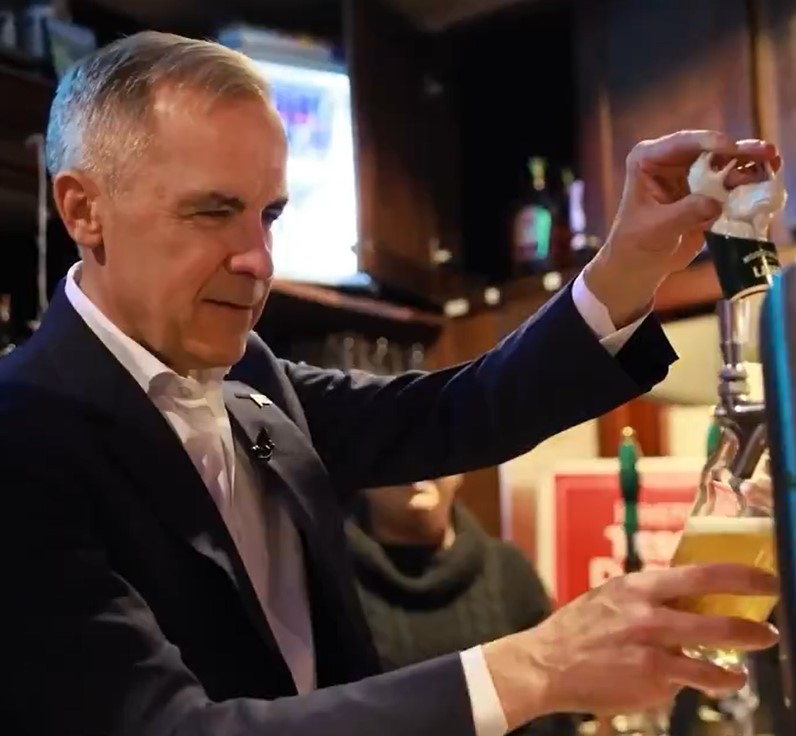
It’s April. Finally. Did you realize that today we are exactly the same length of time from this time last year as we are to this time next year? No? I was really hoping to start out with something profound this week… but that’s all I could come up with.* It’s got to be the election. I’m all a buzz about the election. And, as predicted last week, there has been an election beer pouring sighting this week as PM Carney took his Liberal party campaign bus to a bar in Georgetown, Ontario. He seems to have a pretty steady hand. Here’s a bit of a vid. More beer pouring please, candidates…

First up, Matthew shared the round up from the March edition of The Session with lots of good stuff. My submission was not as interesting as those of other folk* so go check out all the other entries – but also read Matthews own thoughts on why writing in this “sketching not sketchy” manner is important:

I’ve returned to blogging this year because I think getting the multitude of ideas I’ve been sitting on for months out in a way that is not bound to this process, or to the whims of a particular editor is really valuable. Writing is important, and it doesn’t matter if you’re an experienced journalist or you’re writing your first ever piece, the most important thing is that you get it done, and then move on to the next one. As I enter my 10th year as a full-time professional writer, I consider this blog to be the best place to try out ideas, and figure out what does and doesn’t work.

Next time, the host is Ding and the question is about value. Yes, there are plenty of venues and levels for we scribblers. For example, Rachel Hendry wrote a inner voice piece for the first issue of a new web mag – a wag? – called chlorophyll about a night out with the Gamay:

Tasting Beaujolais is where I learnt the term confected, a harsh word rhyming with infected and inferring the pick-and-mix stalls of the cinema complex and theatre foyer. Parma violets and foam bananas and sweet jellied cherries all manifesting in a glass that people infantilise and dismiss. Yet here, in my glass, a dismissal of an assumption takes place. A Gamay peppery and perfumed and proud. Spicy. Intoxicating. The presence of this spice allows the Gamay to take on a new meaning. A hierarchy rejected.

I like it. You can too. Just remember the scale: Beaujolais Nouveau, Beaujolais, Beaujolais Village and then the best stuff from any of the individual ten villages like Fleurie or St-Amore. From pretty silly fruit juice to age worthy complexity. Yet relatively cheap and cheery at each point up the ladder. Gamay is also pretty commonly grown for wine here in Ontario, too.

Also cheap and cheery seems to be traveling in eastern Europe but, with concerns for their safety, does one really go to Transnistra given it’s largely occupied by the post-Soviet / not-so-post-Soviets. Well, Mr. and Mrs. Retired Martin did:

…our guide Lily wasn’t much interested in facts and figures either. She showed us supermarkets, sturgeon, fridge magnet stores and the Sheriff Tiraspol ground, while changing the tour to squeeze in an unscheduled wine tasting that meant she wouldn’t get back in Chisinau in time to see Haaland and Ødegaard dismantle the Moldovan national team. What a trooper. It’s just as well Transnistrian is so quiet, hardly any traffic in the towns or on the highway, and we were able to stop at Bender’s Tighina Fortress on a promise that we “wouldn’t dawdle or attempt to read the descriptions in the torture museum” or something.

Another town with another fort is Rye in England where Pellicle took us this week where Fred Garratt-Stanley traced the history of some of the oldest pubs if you know where to look – including the chimney at The Mermaid :

Dr. Chris Moore’s research often centres around uncovering these stories by digging into architectural quirks. For example, when he learned that The Mermaid’s central chimney is made from Caen stone (a type of limestone quarried in northern France and usually shipped to England to construct religiously symbolic buildings like Canterbury Cathedral,) he was immediately intrigued. “Caen stone is basically a religious stone used to construct most of our big cathedrals, it would not have been used on a pub,” he explains. “So that’s probably Reformation stone from a dissolved monastery close to Rye that’s been reused. There’s symbolism to that; did the landlord make a conscious decision to go ‘It’s a shame that monastery’s been destroyed, let’s keep a bit of it in the pub’?”

Also keeping up with the past, Liam provided us with another slice of Irish beer history, an inquiry by the magistrates into the problem of the overpour:

…the publicans were summoned to appear in front of the local magistrates and as examples, a pair of half-gallon measures were produced belonging to two publicans, a Mr. McDonnell and a Mrs. Wafer. Both measures had been found to be correct six months previous but now held a naggin more than they previously did according to the inspector. This would equate to over 4% extra liquid per measure, which would amount to a moderate but notable loss to the publican over time. The magistrates were at a loss as to how this could happen, but the puzzle was solved when a tinman called Mr. Waters took to the stand and gave the following explanation…

There… you’re hooked! Go read the rest for yourself under that link. Not dissimilarly, Eoghan Walsh wrote a list of everything he ate outside of the home last month including but not limited to:

Half a packet of Yolloh strawberry marshmallow sweets I found hidden behind my phone at my desk. Four fruit Mentos I found in my dressing gown. A full pack of Yolloh strawberry marshmallow sweets I bought in a moment of weakness. A basket of fries at Brasserie de la Senne, shared. A portion of Boon Mariage Parfait cheese squares, with mustard, shared. Duyvis Crac-A-Nut Paprika nuts, three or four packets, the small ones from the vending machine.

And Laura Hadland wrote an excellent extended post script to a recent What’s Brewing article on sexism at British beerfests to explain the why calling out such bigotries  matter:

Why do something that you know might upset a few people when you can take a different route and try not to actively offend anyone? We all know that you can’t please all the people all of the time and no doubt whatever theme or image the St Albans committee chose, they would end up with detractors saying they didn’t like the decision. But not liking something for reasons of personal taste or preference is different from choosing to use an illustration that has sexist overtones. 

Gary has announced that he is done with X. (Me, I linger there still only for the inflamatory entertainment of the national election here, making any manner of political obsessive lose their marbles.) Speaking of smartening up, The Polk from The Hammer has been near dry for months now and is finding the loss of venue a continuing challenge:

I love a solid beer run and this last weekend was perhaps the worst, most depressing one I’ve ever taken and it illustrates a real problem the sober or non-alcoholic beer world has when it comes to helping folks crossover or drink a little less if that’s what they’re after… I must admit to longing for that jump in the car and head off down the road moment we used to have when it came to grabbing some new beers… There aren’t many options for a sober third space and while some breweries have NA offerings, good ones that aren’t more than a cheap knock-off of something they toss on the menu for the DD are not as easy to find. The culture of raising a glass with your friends is missing, the fluid conversation and excitement of new and returning beers, old favourites and solid stand-bys doesn’t exist…

Also over is April Fools Day. The best beer related prank was this announcement from Bill of It’s Pub Night:

I was surprised to see a local brewery — you can figure out which one — announce on Facebook that they will no longer be brewing their love-it-or-hate-it Donnie the Elder double gose flavored with muskmelon. Muskmelon — another word for cantaloupe — gave the beer its distinctive orange color, but the taste wasn’t for everyone.  The double gose (sometimes abbreviated “doge” on the blackboard) had a small but vocal minority who liked it, but wasn’t popular enough to keep in the rotation.  The brewers had briefly experimented with a lighter-bodied version that wasn’t as sharp, and not as pungent or orange-colored, that was called Donnie the Younger.  But it turned out no one liked that one, not even fans of Donnie the Elder.

Quote to the contrary, Jordan is seeking the real truthy truth and continuing his list of new beer rules and got so excited about #6 that he skipped past #4 and #5 to get at it – it being the lack of succession as he considers the end** of Mill Street:

We’ve had a lot of breweries open and close within a couple of years in Ontario. Sometimes their annual production wouldn’t fill a large Jacuzzi. Discounting those, let’s say you have shelf SKUs and you’re up around 2,000 hl a year. What’s your plan? Are you going to get big enough to sell to a large corporation? In this economy? Is your brand important enough to be consolidated? Will anyone miss it when it’s gone? According to my spreadsheet, which requires some updating, 119 physical brewing locations have closed in Ontario since 2017, just after Mill Street was purchased. Not many of them were purchased by larger companies.

Sticking with the Canadian scene, Mélissa Gélinas in the Aylmer Bulletin out of Quebec considers what the tariffs we face in Canada will mean for her local breweries:

Sébastien Gandy, head of sales, communications, and cultural affairs at La Dérive Brasserie Artisanale in Gatineau [notes, a]ccording to reports, the cost of a can could potentially increase by 10 to 30 cents. “If it were as simple as raising the price of a can and passing it on to customers, it wouldn’t be so complicated,” said Sébastien. “The real issue is that we’re already in a price war since there’s competition between microbreweries and macrobreweries, which always have the upper hand… Ultimately, we’re caught in a political war that makes no sense, where we don’t have the tools to achieve our goals,” he said. “I think we still feel a desire among the population to encourage smaller local players.

And elsewhere in the land, we see that desire play out with perhaps surprisingly patriotic themes:

In response to repeated threats to Canada’s sovereignty and a trade war, Newfoundland and Labrador breweries want you to grab a cold one in solidarity. On Wednesday Landwash Brewery in Mount Pearl unveiled On Guard, a Canadian pale ale made with only Canadian ingredients, like Quebec hops… In downtown St. John’s, Yellowbelly Brewery co-owner and publican Craig Flynn is individually rolling each label on to individual cans for a new brew called Elbows Up. “Sovereignty is a very big belief in Canada,” said Flynn. “If you want to come after us and try to bring us into the corner, we’re going to come back with our elbows up.”

We’re apparently so proud that we just might fight a bit dirty. Blame Gordie. We’re also just a bit weird. Well, it is a global economic crisis and election time so why not be weird? Speaking of the crisis, on Wednesday the US Department issued an addendum to the Trump Administration’s aluminum tariff that will cause some concern in the world of beer:

BIS in this notice revises Annex 1 to add the following two additional aluminum derivative products in Annex 1:

(1) beer; and
(2) empty aluminum cans.

There you have it. As of 12:01 am Eastern Time on Friday 4 April 2025 all canned beer imports will cost 25% more wholesale in the USA. So… that is it for this week. A reasonable set of reads. Nothing too exotic. But some looming panic. Still, remember that there wil be a special prize for pictures of politicians at the taproom. Was Poilievre pouring in Freddie’s Beach on Monday? I need to check that out.

Until next week, please check out Boak and Bailey every Saturday (WHILE YOU CAN!!! They are saying they are holidaying in April and May) and Stan going strong again each and every Monday. Then listen to Lew’s podcast and get your emailed issue of Episodes of my Pub Life by David Jesudason on the (sometimes even but never) odd Fridays. And maybe The British Food History Podcast. And Phil Mellows is at the BritishBeerBreaks. Once a month, Will Hawkes issues his London Beer City newsletter and do sign up for Katie’s wonderful newsletterThe Gulp, too. The Share looks to be back with a revival. Ben’s Beer and Badword is out there with the all the sweary Mary! And check out the Atlantic Canada Beer Blog‘s weekly roundup. There is new reading at The Glass which is going back to being a blog. Any more? Check out the Beer Ladies Podcast. That’s quite good and they are revving up for a new year. And the BOAS podcast for the bro-ly. And the long standing Beervana podcast …except they have now stood down.  Plus We Are Beer People. The Boys Are From Märzen podcast appears suspended as does BeerEdge, too. VinePair packed in Taplines as well. All gone. But not Ontario’s own A Quick Beer featuring… Michigan! There is more from the DaftAboutCraft podcast, too.  All About Beer has sponsored trade possy podcasts and there’s also The Perfect Pour. Plus follow the venerable Full Pint podcast. And the Craft Beer Channel on Youtube.  The Moon Under Water is gone which is not surprising as the ask was $10 a month. Pete Brown’s one cost a fifth of that – but only had the one post. Such is life.

*I like to place the blame on someone other than myself for things like this but, if I am honest, it’s been a bit of a blur recently with two of us covering the work of eight for a few days, three for a bit more than that and four for longer. We hope to be up to five in a few weeks so, with any luck, I can get back to really goofing off now and then.
**Under that link, there’s an interesting comment from an officer of a megabrewer: “…but it’s not an insubstantial amount of liquid…

The Super Secret Thursday Beery News Notes That Even Hegseth Couldn’t Leak

What a week. A Canadian Federal election was called. The US government proved once again it is led by numpties. And the opening day for Major League Baseball is here. And… The Session. Who was the numbskull who decided that the return of The Session would also have a regular dedicated Friday deadline right after his beery news notes deadline? Me. Yup. That’s who. I know how Maureen feels. “What a moron you are Al,” she says. Maureen, by the way, was not only recreating the first moment she ever read my writing. She was out there fighting against the forces of darkness and her feelings were excellently captured by USA Today in her “holy fucking moley” mode at a townhall event with Senator Chuck Grassley.*  Anyway, Matthew is hosting this month’s edition and your are encouraged to get your fingertips a’tappin’** on the question of…

For the March 2025 edition of The Session I’m asking participants to produce a piece of critical writing about beer or pubs… The aim is not to be judgemental, subjective or to showcase any particular bias; this is not some finger-wagging exercise. Whereas criticism involves building an argument about why you think something is simply good or bad, critique involves taking a more holistic approach, using carefully researched and considered analysis to build a reasoned, objective, and possibly even entertaining take that benefits readers by giving them good quality information to consider.

Get at it!! What else is going on? No, not this… that’s got nothing to do with beer. Ah, yes… this! Ed has reported on a long awaited innovation in hoppetry:

…even more exciting than that is the news that a hop breeding mission going back at least 70 years has finally reached a successful conclusion: a wilt-tolerant Fuggle has been developed. Verticillium wilt is a fungal disease that can devastate hop crops and is difficult to treat… The need for a wilt-tolerant Fuggle is mentioned in a paper back in 1955 and in 2013 I heard the long quest might be only three years away from a successful conclusion. It’s taken considerably longer  that that but craft beer geeks everywhere will be delighted to learn that variety 15/10/23 has now completed its trials and it beer made with it no noticeable change of taste was detected compared to true Fuggle. The hop was released in late 2024 as Wye Fuggle.

Nice. Staying with hops, Stan released the new edition of Hop Queries at the end of last week and shared this tidbit:

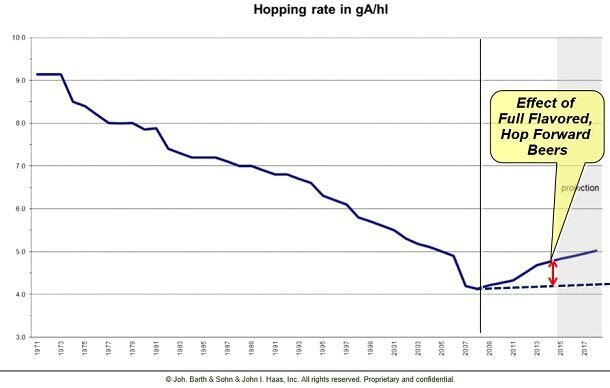
Alex Barth, then president of John I. Haas, showed this chart at the 2015 American Hop Convention. It tracks hop usage since 1971. One hundred years ago brewers used the equivalent of 12.6 grams of alpha acids per hectoliter (26.4 gallons, or 85% of a 31-gallon barrel). That had fallen to 9.1 grams in 1971 and continued to drop regularly until it was just over 4 grams in 2011. It ticked up to 4.5 grams in 2011, climbed in the years that followed, and will be about 4.7 grams this year.

Which, once again, makes me want a recreated version of something like Dominion White Label to show what big ales from the early 1900s were really like. Similarly perhaps, The Beer Nut offered an explanation of “spice bag” to my eternal gratitude in case I want to undertake a recreation.

Stan also gave me plenty to poach… err… to consider in his weekly update on Monday, including this from Phil Cook on the appearance of beer related clues in The New York Times crossword puzzles:

Since noticing a reference to modern hazy IPA in the New York Times crossword and wondering what that “meant” in terms of beer’s currency in the popular culture, I’ve been keeping a tally of what else comes up. I recently realised I had a full calendar year worth of such records, and the urge to make a spreadsheet and go looking for patterns came on predictably strongly (for me) after that. The result: ninety-nine appearances, clumped around a few themes, with “ale” and “ipa” done to death, a few favoured brand names, some real clangers, and the occasional delight. I think I got all the beer-related clues and answers.

Speaking of games, did you hear Laura Hadland on BBC 4’s You and Yours talking about pub games this week?

Question: am I horrible for hating branded glassware? I mean I like a nice glass and even have a significant degree of sympathy for an anatomically correct drinking vessel for any certain sort of drink. But, as I consider these sensible thoughts from Boak and Bailey

This brings us to another problem: a glass of Budvar is much less enjoyable when it’s served in a bog standard British pint glass, with no foam, rather than in a branded mug with a good head. We don’t demand perfect Czech-style ‘pours’ and utter reverence – only an acknowledgement that it’s a bit more than a pint of lager. When that rep visited The Old Stillage, and The Swan, they apparently left behind boxes and boxes of pretty convincing Czech-style mugs. Round, ribbed, slightly squat. The beer looked and tasted great.

…I am all “yup… yup… sure… definitely…” as it all makes sense and then a whisper of a “nope” when there’s mention of a glass with a logo on it. No go the logo. See, I don’t like clothes with the manufacutures’ ads on them. I remember picking the embroidered polo player off the chest of a very nice shirt I once found in a vintage place. Too Heathers. Also – and probably more importantly – it buggers up the look of the beer. Does an apple need a wrapper? Nope. It’s an awkward imposition. Plus it’s a bit “oooh, look at me buying the good stuff” frankly. Branded glasses are the Tesla trucks of beer. There. I said it. Speaking of logos, here’s a question: can it ever be OK to have a representation of a young woman in a UK beerfest advertising:

Emily Ryans, sponsorship manager at St Albans Beer & Cider Festival, explained the reasoning behind the design in a statement: “Rather than adopting soulless corporate branding, we instead choose to highlight a different piece of local history each year, and on this occasion are marking the centenary of Ballito Hosiery Mill. In doing so, we’ve been inspired by Ballito’s 1950s advertising, exhibited by St Albans Museum”… “The character in our logo is a confident, empowering woman, designed to both celebrate the important history of a factory that employed hundreds of local women, as well as make the point that beer festivals – which have suffered from a traditionally male image – are open to all,” Ryans continued. 

Of course it is and this seems reasonable. Also being reasonable, here’s an interesting twist on the US tariffs and Canadian provinces’ booze ban response is how it has led to questions like when is a beer is a Canadian beer… even if the brand is American:

In wake of U.S. tariffs, the Saskatchewan Liquor and Gaming Authority (SLGA) said it notified beverage alcohol retailers, distributors and producers that American-branded products wouldn’t be sold or distributed in the province. The SLGA originally released a list of 54 American alcohol brands, including Bud Light, Blue Moon, Busch, Kirkland Wine and others… Labatt Breweries of Canada says it employs about 3,500 people in the country and brews brands like Bud Light, Busch and Budweiser in Canada… On Monday, the government walked back its decision. It said in a statement that the move aligned with other provinces and that it would focus on alcohol produced in the U.S.

Speaking of remote wastelands, if you ever need to get from Luton to Moldova, Martin has led the way – and done so in daring fashion seeing as the place is in the Kremlin‘s crosshairs.

Digging further into that map you’ll see not only how close Iaşi is to the Moldovan border, but how close you are to place names like Kherson and Zernov’s Phyllophora Field. 20 minutes after walking through the Arrivals door at Iaşi, we’re at central Piata Independentei and it’s all looking very Communist era. And a bit eerily quiet. “LOOK ! There’s a place saying BEER !” says Mrs RM, urgently.

Thrilling tales of discount holidays replicating The Third Man or what! Martin: “any chance of a slice of lime for the lager?” Bartender: “lime, sir? Harry Lime?

ADMISSION: here’s that surprise I mentioned above… I forgot to finished this week’s update. Wednesday got away from me. Work stuff. Home stuff. Dinner out. I woke up at 3:25 am and it was like being in a movie – snapping upright, close up on my horrified face, shouting “NNNNNOOOOoooooo!!!” Not really. So maybe I’ll fill in a few more items over the day in this penultimate space I leave for a few last stories.

Update at my 10:40 am ciggie break:*** I had actually bookmarked this piece from Mudgie-man on one retro pub move he liked:

… hang on a minute, isn’t this “unique concept” simply reverting back to how pubs used to be a couple of generations ago? Back in the 1960s, most pubs had, at the very least , two separate bars, a public bar with plainer furnishings and a more down-to-earth atmosphere, where drinkers in working clothes would be served, and a more comfortable, sedate and genteel lounge. Back in those days, the beer was usually a bit cheaper in the public bar as well. However, over the years, brewers steadily knocked their pubs through into a single room. This was in tune with the spirit of the age, being seen as more modern, inclusive and egalitarian. It also made supervision of the pub easier and, at a time when public bar prices were regulated by law, allowed the pub to charge the higher lounge prices throughout. It’s now relatively uncommon to find a pub with completely separate “sides” and, even where they do, the old price differential has disappeared.

And I had noticed one odd thing about this article in the NYT about rich brats and their spring break trips to the Bahamas – the price:

One student at each school is informally appointed a representative for GradCity, rounding up peers to book the trip and serving as a liaison with the company. At some schools, the position is handed down as an honor. The trips cost about $2,700 a person for five nights with four students sharing a room. An additional $250 “platinum pass” provides access to sunset cruises and other amenities. Longer stays and rooms with fewer students cost more. In exchange for their work, student representatives can qualify for a discounted or free trip. Sometimes, students raise funds or pool money to pay for peers who cannot afford the trips on their own.

That is pretty much the same price as a normal (if not taken by my kids) school grad trips. I understand teen participants from my part of the world go to Japan or Ireland, say, for around $5,000 a pop. Maybe more. Is the NTY concern the access to alcohol in nations where there isn’t a nutso ban on drinking under 21 years of age?

[Update over…]

One last thing. With the Federal election on up here, I need to get photos of the leaders of each party pouring a draft beer. They always have to pour a draft beer in at least one photo op during the campaign. Trudeau Jr. in 2021. Jack Layton in 2011. And, from the same year, even an unlikely backhander from Stephen Harper. It’s the law. I picked that fact up when I used to be a pundit. Send them in if you see ‘em.

Meanwhile, check out The Session and also please check out Boak and Bailey every Saturday (WHILE YOU CAN!!! They are saying they are holidaying in April and May) and Stan going strong again each and every Monday. Then listen to Lew’s podcast and get your emailed issue of Episodes of my Pub Life by David Jesudason on the (sometimes even but never) odd Fridays. And maybe The British Food History Podcast. And Phil Mellows is at the BritishBeerBreaks. Once a month, Will Hawkes issues his London Beer City newsletter and do sign up for Katie’s wonderful newsletterThe Gulp, too. The Share looks to be back with a revival. Ben’s Beer and Badword is out there with the all the sweary Mary! And check out the Atlantic Canada Beer Blog‘s weekly roundup. There is new reading at The Glass which is going back to being a blog. Any more? Check out the Beer Ladies Podcast. That’s quite good and they are revving up for a new year. And the BOAS podcast for the bro-ly. And the long standing Beervana podcast …except they have now stood down.  Plus We Are Beer People. The Boys Are From Märzen podcast appears suspended as does BeerEdge, too. VinePair packed in Taplines as well. All gone. But not Ontario’s own A Quick Beer featuring… Michigan! There is more from the DaftAboutCraft podcast, too.  All About Beer has sponsored trade possy podcasts and there’s also The Perfect Pour. Plus follow the venerable Full Pint podcast. And the Craft Beer Channel on Youtube.  The Moon Under Water is gone which is not surprising as the ask was $10 a month. Pete Brown’s one cost a fifth of that – but only had the one post. Such is life.

*Fight!!!
**Write!!!
***One need not smoke to have a ciggie break.

Now That We’ve Cleared Up The “St. Paddy’s / St. Patty’s” Day Confusion, Here’s The Beery News Notes

I like a good breakfast sandwich as much as the next guy but I have to say I have never elevated a disk shaped sausage to sainthood. For me, Peanuts sort of established who Patty is before she grew up to be the bassist of The Bangles under an alias. So the whole “Patty v. Paddy” thing flies by me and, anyway, I tend to use the long form.  Which is fine because, you know, we ourselves are Scottish. Which is what we told pals who invited us out to drink on a Monday night when we took a pass. Our new PM probably better knew what to do when celebrating that I did. But I think Liam, however, he of Ireland, has established an alternative answer to the puzzle of how to deal with the day. That’s a hop shoot omlette right there:

I’ve experimented with cooking hop shoots before, but this is my first time to force them in the dark. Blanched and lightly fried, and served on an omelette with pecorino and black pepper. Great texture, like asparagus but more of a delicate mangetout or green bean flavour. I’m impressed …

For a more traditional tribute to Patrick, check out The Loop for a true Americana dive bar version. I wonder what the equivalent elsewhere could be? I know who we could ask. Perhaps Retired Martin who advised on the question of what one can do when there’s a spare 25 minutes to be spent at the train station in Doncaster, all by way of very tightly focused photo essay:

I would buy a book called “What Would Paul Mudge Do ?”. He certainly wouldn’t get his beer in a takeaway milk bottle to drink on the 18:22, oh no. He’d have a pint from one of Sheffield’s cask champions. But a man doesn’t travel from South Yorkshire to South Yorkshire to drink South Yorkshire beers, so I had a pint from Tallinn. And admired the seating in what is a lovely, but slightly too small, station pub.

Admittedly, you need to go back to link each sentence to an image but it’s a nice tidy narrative if you ask me. Speaking of tidy narratives, Pete Brown‘s latest column for The Times has taken a step up, using the space so far dedicated to a newbie guide to share, instead, a vignette on a player in the trade – the beer buyer:

The Waitrose beer buyer Jourdan Gabbini, 31, from Wokingham in Berkshire, genuinely loves beer and obviously enjoys his job. His ambition is to create “a bottle shop within a shop” that doesn’t just stack up the beer but helps people engage with and explore it, in part by highlighting brewers that are local to each store. This can be frustrating when a beer you like isn’t available in your manor. But that means another local brewer is getting the benefit. Gabbini has the freedom to develop real relationships with brewers. Last year he even co-created a new beer with the Lost and Grounded brewery in Bristol and Caravan Coffee Roasters — a coffee pale ale that was exclusive to Waitrose.

Speaking of booze sales, Lew dipped his toe into the tariff dispute and examined the Canadian response when it comes to the policies implimented up here by our government run liquor trade:

The most common reaction has been pure Canada: a non-smiling “Elbows up!”, echoing Mr. Hockey, Saskatchewan-born Gordie Howe, a player who took no shit off anyone. Anyone who tried to slash Howe was getting a fast elbow to the head. Canada’s ready for this, and they’re not kidding. The angry Americans are right about one thing. The Canadian response of taking everything off the shelves, leaving only blank space behind, is disproportionate and goes further than the American tariffs. This doesn’t just affect day-to-day, month-on-month sales. This kind of action also attacks something much more valuable: the brand. Raise the price while leaving the bottles on the shelf, and you paradoxically make people think about the brand more, maybe even realize how much they ARE willing to spend to get it. But take the bottles away, leaving an empty shelf with a “BUY CANADIAN INSTEAD” sign, and the American product becomes invisible.

Lew says, quite reasonably, that this degree of response is because Canada is facing an existential crisis. I don’t actually think that’s the full story. I have loads of pals and more blood family in the USA than here in Canada but, you know, gotta tell you… we’re not going anywhere. And we’re not some sort of jilted pal. Trump just fucking pissed us off. When I played soccer in university, my Scottish father (a much better player in his own youth) would say “don’t wake the sleeping dog.” Well, we’re up now.  And we are drinking our own damn rye. Even the cheap stuff that tastes like gasoline.

Speaking of these the finer things, Nigel Sadler pointed me to an interesting 1991 Belgian beer rating guide posted by the beer importers James Clay and Sons on Bluesky:

This clever guide evaluated beers based on ABV, Sourness, Sweetness, Bitterness, and predominant flavour, which then generated a five digit code that could easily give a picture of the key characteristics.

Here are the five images (1,2,3,4,5) in case your are not part of the Bluesky way of life. I add them not just to scrape the data but to illustrate a couple of points. First, I have long thought the overbearing BJCP system was clumsy and created poorly transferrable information in a simple but meaningful way. This does that. Second, being a real nerd, I immediately recognized that this five digit system mirrors the SINPO code used by long distance radio listener nerds. The SINPO code not only succinctly frames the transient quality of a radio transmission heard well beyond the intended broadcast range but it is also understood across cultural and language gaps. Simple, neutral and still data rich. So it’s gold when you are sending your QSL reception report looking for a postcard, right? What? No! No, it’s really cool. It really is. No, you’re the big fat loser.

Getting back to where we started, Ron has been to Brazil again and, much to my delight, has posted a photo essay – a montage if you will – of many of his breakfasts as well as what it is like to be an Englishman in Rio for Carnaval:

Many not so much lightly-dressed as slightly-dressed partygoers walk by. I’ve never seen so many men in fishnet tights and tutus. It has a bit of a Gay Pride air about it. Some of the party people pause to pick up Pils. Always the Pils. There’s a merry buzz. Everyone is going to a party. I can feel their crackling anticipation as they laugh and drink their way down the road. Anticipation of a good time. A really good time. I’m starting to quite like this Carnaval thing. Everyone is in a really good mood. Even a miserable old git like me.

Over at VinePair, Joshua M. Bernstein told the tale of the rise and fall of Magic Hat #9, a once hudely popular beer out of Vermont:

Johnson built a moderate-strength pale ale infused with apricot essence, and the mysteriously named #9 hit Burlington taps in summer 1995. The beer was designed to disappear come fall, but calls from angry bar owners threatening to stop carrying Magic Hat beers led Newman to turn #9 into a year-round release. “It was never intended to do anything,” Newman says. “We were just trying to find a way to sell beer.” The beer thrived on neglect and even disdain. “Beer geeks at the time f(u)cking hated it, but the more they hated it, the better the sales were,” Newman says, adding that #9 was nobody’s favorite beer at the brewery. Magic Hat initially spent scant dollars to support #9. “I could argue that we spent the first two years doing absolutely nothing to help it grow, almost working to kill it,” Newman says. “And then one day we went, ‘What the f(u)ck are we thinking here?’ And so we got on the bandwagon and it just kept growing.”

There was a time when Magic Hat was way ahead of its time and attracted the dollars of border crossing beer nerds like me over a decade and a half ago, looking for their latest Odd Notion seasonals. I seem to have had some on New Years Eve 2004. In October 2005, I review another mixed case of their and… I mentioned that I didn’t exactly love the #9. I thought it was supposed to be peach but Oskar in the comments said “No. 9 used to be much higher quality, with a REAL apricot taste” so I wasn’t wrong wrong. Just wrong.

Speaking of travel, Katie spent a week on the Isle of Man. She didn’t mention seeing Kelly… but she did write a lovely piece at her space The Glug about solo dining at The Boat Yard in the town of Peel:

The menu is as fishy as I dreamed it would be, and while I’d normally order something picky or snacky or fried for a starter, I couldn’t think of anything nicer on such a cold night than a bowl of chowder. It came hot and creamy, filled with Manx kipper and mussels, and a healthy incorporation of curly parsley. Slurping it felt like warmth and health and happiness. To drink, I had a glass of champagne. And then another. How incredibly off-putting of me, to ignore wine tasting regulations and all common decency, but I wanted some Champagne, so I had some. End of story. If you want to fight me about it, I‘ll meet you outside. Doing champagne by the glass is not ideal for any hospitality venue, and I apologised for being so awkward. Then I apologised for apologising. My lovely host was gregarious: “You deserve to have what you like,” she said. I wondered if had I been with other people she might not have added life coaching to my menu free of charge, but I appreciated it nonetheless. And anyway, I did like it very much, because it was rich and biscuity, with a squeeze of lemon sherbet.

Smoky kipper chowder and glasses of champagne. That’s it right there. Yup.

Note: Martyn captured on the audio talking about the porter. And the book. The book that launches very soon.

And David Jesudason has managed to make me homesick for a place I have never been.  Much of my family lives along the 128 bus route east of Edinburgh and I worked in Poland for a while when I was in my twenties. So this portrait of the The Persevere in Edinburgh’s historic port of Leith has me longing… and (again) hungry:

…it retains those born and bred in Edinburgh’s historically working class Leith district, especially sports lovers who might glance at the horse racing before a match. While it also serves as a home away from home for many of the Polish diaspora who have been linked to the port since 1939. This is seen in the pub’s owners, Lublin-born Dorota Czerniec-Radowska and her husband Konrad Rochowski, and the kitchen they have run since 2015 which pumps out delicacies, such as plate-sized schnitzels and comforting white sausage (Żurek) soup. You can eat these in the pub or the restaurant-style section, known as the Percy (also the affectionate nickname given to the pub by its regulars,) where paintings of Dorota and Konrad’s hometown are displayed.

One of the pleasures of Poland was learning how useful my childhood training in the rolling of an “r” and the roughening of a “ch” were.* And, as with the Korean food, the reassembling of similar ingredients was also a welcome surprise. Next time I am there, I should make of point of being here… there… at this pub.

Note: a reminder for next week. It’s another end of the month edition of The Session… and Gary jumped the gun but gives us a good example as we prepare. Matty C is hosting:

For the March 2025 edition of The Session I’m asking participants to produce a piece of critical writing about beer or pubs. This could be a review of a beer you’ve enjoyed, or perhaps one you haven’t. A pub you’re fond of, or maybe one that has room for improvement. You could write about a beer experience (or lack of) in a setting such as a restaurant, or even produce a critique that focuses on a particular aspect of beer or pub culture. The aim is not to be judgemental, subjective or to showcase any particular bias; this is not some finger-wagging exercise. Whereas criticism involves building an argument about why you think something is simply good or bad, critique involves taking a more holistic approach, using carefully researched and considered analysis to build a reasoned, objective, and possibly even entertaining take that benefits readers by giving them good quality information to consider.

I am still working out how this isn’t a distinction without a difference as building a good argument always requires considered analysis. But I look forward to the submissions.

Did you now that some common foods do not qualify as no-alc? Well you will now thanks to the exceedingly tenuous argument placed into the discourse by the lobbyists of the The British Beer and Pub Association:

Advocates argue that the current limit not only confuses consumers but also restricts the development of innovative alcohol-free products. According to the BBPA, raising the threshold would help the UK’s brewing sector thrive in the rapidly growing no and low alcohol market, while providing consumers with more clarity and choice. The BBPA’s findings highlight that burger rolls can contain up to 1.2% ABV, while malt loaf can reach 0.7%, and ripe bananas can hit 0.5%. These levels are considered negligible and occur naturally due to fermentation, yet remain higher than the current 0.05% threshold for alcohol-free beer. The government’s consultation is set to conclude later this year, with the industry eagerly awaiting the outcome.

Eagerly. Not “patiently” or even simply “awaiting” but eagerly.

That’s it. Lots of interesting stuff to read as it turned out. While you await eagerly for more next week, please check out Boak and Bailey every Saturday (WHILE YOU CAN!!! They are holidaying in April and May) and Stan going strong again each and every Monday. Then listen to Lew’s podcast and get your emailed issue of Episodes of my Pub Life by David Jesudason on the (sometimes even but never) odd Fridays. And maybe The British Food History Podcast. And Phil Mellows is at the BritishBeerBreaks. Once a month, Will Hawkes issues his London Beer City newsletter and do sign up for Katie’s wonderful newsletterThe Gulp, too. The Share looks to be back with a revival. Ben’s Beer and Badword is out there with the all the sweary Mary! And check out the Atlantic Canada Beer Blog‘s weekly roundup. There is new reading at The Glass which is going back to being a blog. Any more? Check out the Beer Ladies Podcast. That’s quite good and they are revving up for a new year. And the BOAS podcast for the bro-ly. And the long standing Beervana podcast …except they have now stood down.  Plus We Are Beer People. The Boys Are From Märzen podcast appears suspended as does BeerEdge, too. VinePair packed in Taplines as well. All gone. But not Ontario’s own A Quick Beer featuring… Michigan! There is more from the DaftAboutCraft podcast, too.  All About Beer has sponsored trade possy podcasts and there’s also The Perfect Pour. Plus follow the venerable Full Pint podcast. And the Craft Beer Channel on Youtube.  The Moon Under Water is gone which is not surprising as the ask was $10 a month. Pete Brown’s one cost a fifth of that – but only had the one post. Such is life.

*My late toddler trauma includes being told “Whales and Wales are not homonyms!!!” as a parent’s hand was placed before my mouth to catch the whisp of an “h” that was so critical to the continuation of the culture. 

These Are The Beery News Notes For The Dump Of Snow Finally Showed Up

Well, what can you say. Moscow and Washington making kissy face as planes literally roll off the runway. We had a nasty dump of snow locally, the first it feel like in years, but elsewhere in the province we hear that the school kids are basically back on remote learning this winter. The green onions readying for the garden in a few weeks look out the window in horror. I know the feeling.

For all the change going on, at least we can take comfort that The Session continues! The hosts for this February are Boak and Bailey who announced the topic:

What’s the best beer you can drink at home right now? Not necessarily right now. You can go to the shops if you like. But you shouldn’t have to get on a train or a flight. Or travel back in time. If you like, you can choose a top 3, or top 5, or top 10. What makes it a good beer to drink at home? Is it brewed to be packaged? Does it pair well with your home cooking? Does it pair well with drinking in your pyjamas?

Get writing!  Your submissions are due on Friday, February 28th.  Andreas Krennmair has been writing. And wrote this week about the brewing tradition in the German state of Württemberg and the distinction between the “gewerbsmäßig” and the “Privatbrauereien” in that region in the 1800s:

Normally, “private breweries” at the time referred simply to privately owned breweries, as opposed to publicly owned breweries (of which people own shares) or communal breweries (owned e.g. by the citizens of one particular town or city by virtue of their citizenship). But in this case, the private breweries were strangely juxtaposed with commercial ones… so, were private breweries non-commercial? Turns out, yes: in parliamentary records of the local parliament of Württemberg from 1853, I found a description of what constituted private brewing: it was the non-commercial brewing by Upper Swabian farmers, where it was customary for all farmers who owned larger farms to also own a brewing kettle in order to brew beer for their own use, which included the house drink for the farm workers…

Speaking of unpacking things found in central European digital records, I missed last week when Alistair of Fuggled fame wrote about Josef Groll, the first brewmaster at the brewing company that today is generally known by the brand Pilsner Urquell. What caught my eye was this:

Another fact about the actual beer being produced in Plzeň also caught my eye – that there were 2 types of beer being brewed at Pilsner Urquell, the famed 12° lager and an 11° schankbier, which may have at some point become a 10° version that was known within living memory. The schankbier, the German equivalent of “výčepní”, would be sent out to beer halls to be stored for 2 or 3 weeks before being ready to be drunk, while the lagerbier left the brewery ready to be tapped on arrival, and was mainly consumed during the summer months.

Question: is this schankbier in late 1800s Germany the same as this schenk beer in late 1800s German immigrant community in America? Have a look at footnote #1: “A kind of mild German beer; German draught or pot beer, designed for Immediate use.” Hmmm…

Speaking of ready to be drunk, Laura Hadland wrote an excellent piece for CAMRA on the nature of small beer in English history… and, more importantly, the experience of hunting down that bit of history:

It  occurred to me that we are applying our modern sensibilities to the past. We can just about bend our heads around the idea of a weak beer being consumed in quantity throughout the day. It’s harder to accept that drinking anything approaching a strong beer from dawn til dusk could be the norm. It just sounds mad. But we know that beer drinking was unproblematic and socially acceptable in the early 18th century – consider the gentle serenity of Hogarth’s portrayal of Beer Street next to the debauched depravity of Gin Lane in his famous prints. At the time of the Beer Act in 1830, beer is referred to in the House of Commons as “the second necessary of life.”

Remember: small beer has always sorta made itself due to the nature of mashing. You can chuck away the spent malt after first runnings or make small beer.

Ashleigh Arnott got the nod in Pellicle this week with her portrait of a rather unpolished place, The Rutland Arms in Sheffield, Engerland. I quite liked this aspect of the pub’s weirdness:

The jukebox policy at the Rutty is notorious. Insert your pound but choose wisely, abiding by the rules on the chalkboard above. The ‘permabanned’ list features local acts—Arctic Monkeys, Pulp, Richard Hawley—and the sort of bands that Guardian readers know they should never admit to liking: U2, Frank Turner, Foo Fighters, et al. And Taylor Swift, she’s also permabanned, though I suspect it didn’t need saying. Staff decide what’s in the ‘Recommended’ and ‘Forbidden’ columns according to whims, mainly, with a hint of current affairs-based silliness. Even co-owner Chris Bamford can’t overrule it.

The photos that accompany the pice are also excellent, though I fear that the one of the solo pubgoer on a phone brought the phrase “lost in someone else’s thoughts” to mind. Do pubs not still stock newspapers? Are there newpapsers to be stocked? Who has money for that? Speaking of which… where’s all the money in the brewing industry going these days what with threats of tariffs floating all around ? Well…

…the most important new investment made by Berkshire Hathaway (NYSE:BRKa) is Constellation Brands (NYSE:STZ). Buffett acquired 5,624,324 shares, making this position account for 0.5% of the portfolio, with a total value of $1.24 billion.

And, at a lower level of investment, in the latest monthly edition of London Beer City Will Hawkes shared interesting feature on the return of what are described as “traditional” pubs with a measure, as is often the case in such matters, of what looks like gentrification in this discussion with pub developer, Adrian Kinsella:

His aim was to turn the pub around, to attract a more varied clientele, to combine traditional levels of comfort with the quality now typical among Britain’s best small breweries… “[It’s about] taking the best of the old-school hospitality and putting it with the best of the new service standards around beer, and the best of the food, the amazing small street-food operators,” he says. “If you marry that together, that’s the sweet spot.” There won’t be tables laid up for food at the Coach and Horses, though. Kinsella says he’s not chasing numbers; if someone wants to sit over a pint for a few hours, that’s fine. His or her glass won’t be cleared. Beer will cost what it costs. “We’re not gouging, but when [beer is] too cheap, someone is getting the rail and it’s normally the staff,” Kinsella says. “All our staff are on London living wage.”

Speaking of noises made in pubs, “The Baby of the Pub” was the title of Katie M’s piece in the December 2024 edition of Ferment, a UK beer vendor’s inhouse magaine, and it was shared this week via her newsletter The Glug to share with us all the story of one wee pub goer… who is one:

The baby of the pub is growing up in a world where the pub is a normal part of his life. It’s teaching him to treat the pub as a natural meeting place, rather than a posh restaurant or an illicit drinking den. He’s being taught to enjoy hanging out here. And why shouldn’t he? This was our favourite place long before he was born, and now it is his. It’s a pleasure and an honour to teach him the ways of our local pub, and as he grows we’ll have new milestones to celebrate — his first packet of Scampi Fries, his first lime and soda, the first time he flips a beermat. One day he’ll be getting the rounds in and teaching his friends how to properly order at the bar—what a thought! 

Back in Germany, news is breaking that would shock any law abiding Canadian… voters are being bribed with beer:

The city of Duisburg in western Germany has come up with an unorthodox way to lure reluctant voters to the polling station. Voters who cast absentee ballots in the city center by 2 p.m. local time (1300 GMT) on Saturday were given a voucher for a drink to spend at a beer cart next to the polling station… In the 2021 federal election, for example, only 63.3% of voters in the Duisburg II constituency turned up to vote, compared to a national average of 76.6%. “With this unusual campaign, our carnivalists are ensuring that the federal election is once again in the spotlight. It also appeals to citizens who are not persuaded to vote by the usual election posters or information campaigns,” Murrack said, describing it as “a clear benefit for voter turnout and therefore for our democracy!”

Huzzah! Isn’t that what was said in the 1890s? Liam of IrishBeerHistory has announced that he is going to pause doing his series 100 Years of Irish Brewing in 50 Objects half way along “but not writing – to assess my options. Still he did share one more story, a story about a button:

This small button measuring 3cm (1 3⁄16 inches) in diameter is made of a copper alloy – possibly brass – and shows some green patination where the gilding has worn away to expose the base metal. It is probably from the livery uniform of one of the draymen who worked for the Anchor Brewery of John D’Arcy & Son on Usher Street, not far from where those aforementioned other-uniformed squads lined up. It features the words ‘J. D’Arcy & Son Ltd. Brewery’ and a nicely embossed anchor whose pronged ends appear to resemble demons’ tails. 

And I liked this story about one way drinkers got around the restrictions imposed during US Prohibition:

The unnamed ship turned out to be a glamorous offshore bar. To get aboard the reporter paid a $5 cover charge (about $90 today), with another $5 for a stateroom. Once settled, he was ushered into a festive room with “a jazz orchestra, staff of busy bartenders and a party of sixty revelers who danced the night away.” They were young and old, men and women, but all quite wealthy with “polished manners and a democratic demeanor.” The crew was well dressed and spoke with cockney accents; from them one could order a scotch for $1 or a mint julep for $2.50. 

In Ontario, we had a number approaches to the drinking tourism brining Americans north but, of course, we should be proud of the fact that brewing itself never ceased up here – even during Canadian Temperance – to the point that Labatt sent so much beer south that it expanded its work force by over fifty percent.*

Finally, I found this piece in VinePair on the current Guinness situation odd, mainly I suppose as it tried to apply and drawn lessons for brewers in the US. Consider this:

Not to put too fine a point on it, but Guinness is that story. Its current success is the result of the sort of patient, holistic investment across the on- and off-premises that used to be the beer industry’s block and tackle. “The way that I’ve described this to people is, [Guinness] is a political movement,” says Roth. “It includes not just changing minds, but changing actual behaviors.” Its dominance in bars and restaurants has helped to influence consumers beyond their confines, too. That’s only grown more obvious as the beer aisle has grown more overwhelming. 

Nowhere in the story do the words “Baltimore” or “closed” pop up. Nor is there a suggestion of manufactured scarcity. Or a lucid consideration of the success of Guinness goes well beyond the beer rep, well beyond beer itself to a cultural fascination that has been in place for decades if not centuries based on the broader love of all things Irish** actual and faux from St. Patricks Day to The Clancey Brothers, from River Dance and to the identikit pubs. And that the beer itself has had these sorts of peaks upon peaks thoughout that time. The widget over 35 years ago. The Quiet Man over 75 years ago. Imported barrels over 165 years ago. Yes, it is good for the brewery to have existed for all that time but the presumption to make an association with Anchor Brewing or Leinenkugel’s or that it serves as an example and not a sui generis phenomenon is a bit telling.

Well, that is it. Another exercise in distraction from the news, I suppose. For more of the same, please check out Boak and Bailey every Saturday and Stan going strong again each and every Monday. Then listen to Lew’s podcast and get your emailed issue of Episodes of my Pub Life by David Jesudason on the (sometimes even but never) odd Fridays. And maybe The British Food History Podcast. And Phil Mellows is at the BritishBeerBreaks. Once a month, Will Hawkes issues his London Beer City newsletter and do sign up for Katie’s wonderful newsletterThe Gulp, too. The Share looks to be back with a revival. Ben’s Beer and Badword is out there with the all the sweary Mary! And check out the Atlantic Canada Beer Blog‘s weekly roundup. There is new reading at The Glass which is going back to being a blog. Any more? Check out the Beer Ladies Podcast. That’s quite good and they are revving up for a new year. And the BOAS podcast for the bro-ly. And the long standing Beervana podcast …except they have now stood down.  Plus We Are Beer People. The Boys Are From Märzen podcast appears suspended as does BeerEdge, too. VinePair packed in Taplines as well. All gone. But not Ontario’s own A Quick Beer featuring… Michigan! There is more from the DaftAboutCraft podcast, too.  All About Beer has sponsored trade possy podcasts and there’s also The Perfect Pour. Plus follow the venerable Full Pint podcast. And the Craft Beer Channel on Youtube.  The Moon Under Water is gone which is not surprising as the ask was $10 a month. Pete Brown’s one cost a fifth of that – but only had the one post. Such is life.

*What?? $43.99??? At that price, no doubt the authority on the matter.
**My late father born of Greenock called the equivalent “professional Scots” and you can read Billy Connolly’s autobiography Windswept & Interesting for more detail on that point.

Your Beery News Notes For Finally… Finally… Settling Into 2025

Lordy. Is all the holiday cheese finally gone? Is 2024 gone? Really? Check the back of the bottom shelf. Me, I finished off the holidays with a Covid needle in my left arm and a flu shot in my right. I’d rather have had the cheese. So perhaps a short post today, given me with the low grade fever and insomnia and all you all getting over eating the Yuletide cheeses. We should declare this International Solid Dairy Hangover Week. Whatever it is, it’s all going to be OK as it’s just twenty-five days to Truck Day! Yup. Gonna be OK.

So… The Session. The toe in the water revival edition of The Session. Hmm… there has been a  wave of tremendous excitement over the experimental revival of The Session, as announced last week, after a seven year break. Stan, Maureen and Matthew are among the tremendously excited. What does it mean to you? Well, it is actually all about you – as you do all the work, you scribblers. You write, I list. That’s it! To aid you  in your thoughts, I offer this simple graph from 2021, an example of my excellent in thought organization. It was last featured in late 2021 and is an update of one from 2016 but, still, it is very much in the now. Clarity. That’s what it sets out. Clarity. Hopefully this will give you that extra push to set out your thoughts on 31 January on the question of the month: “What is the best thing to happen in good beer since 2018?“* Most any medium accepted. Subject to arbitrarty post-facto interventions, of course.

What else is going on? Just after the deadline last week, Jordan shared his thoughts on the brewing of beers under license and just how much, at least in Ontario, the beer that is licensed is the beer that is brewed:

It happened gradually. I can’t tell you the date, but I know that it was Jamie Drummond that brought it to my attention. He had been a lifelong Lowenbrau drinker, and a dedicated one at that. He got in touch one day to point out that it didn’t taste right. Of course it didn’t. It was being brewed in London, Ontario at Labatt.  Now, this was nothing new. They’d been brewing Stella Artois in London, Ontario for a while… Over time, I began to get the sense that the walls were pushing in on the import section. One year, maybe 2019, I added Spaten to the beer styles course at George Brown as the ur-example of Munich Helles, but as soon as I opened the can it was wrong. I hadn’t noticed that it was 473 ml, but I surely noticed the difference in aroma within seconds. You guessed it: London, Ontario.

Speaking of things not being what they were… is Facebook going the way of Twitter. I caught this mention of the uselessness of FB ads now for local audiences:

At least in the US, ads used to be excellent for small, local bars/restaurants. Affordable and very effective. I actually liked a lot of the ads I saw. Then they raised the prices and showed them to people from thousands of miles away. So now only shady crap merchants see any value in using them.

No shady crap in The Guardian‘s a great piece this week on getting snowed in, storm stayed, at Britian’s highest pub in most northern Yorkshire:

…the team are well prepared. Their electric power comes from a generator and there is enough food for about a month, “but hopefully it won’t come to that” says Nicole Hayes, one of the bar staff, who has done a number of phone interviews with local and national media in the run-up to the weather warning, such is the reputation of the pub… Word came through that the snow gates on the nearby A66 were being closed at 10.30pm, which meant anyone hoping to leave needed to make their attempt very soon or they were likely to be here for a couple of days, as the snow was forecast to only get worse.

Less placid is the battle being wage for the beer buck of America. Kathleen Willcox wrote these words that really one couldn’t imaging being puslished not that long ago:

…  lagers and traditional styles are often priced a dollar or two cheaper than competing styles,” Varda notes. “In a world of inflation and particularly among younger consumers who may have less financial stability, those dollars make a real difference.” Amid rising inflation, craft beer just doesn’t seem like a priority. Especially as brewers themselves grapple with ever-increasing prices for goods like packaging and transportation, and are forced to pass the increases on to customers….  Some brewers even wonder if craft beer is settling into a new, more permanent rut.

Permanent Rut!! Jings. But at least things are reasonably civil, right? What’s that?  How about the beer trade dispute, discussed in TDB, occurring in one of the new year’s potential hot spots:

Lawmakers have accused Chinese brewers exporting their products to Taiwan of engaging in unfair trade practices by receiving subsidies from the Chinese government, according to the Taipei Times. The Taiwan Brewers Association, made up of the country’s six biggest brewers, called on the government to launch an investigation into cheap beer imports from Mainland China. Finance Minister Chuang announced this week that the government is set to launch a probe into low-priced Chinese beer. The proportion of the Taiwanese beer market made up of Chinese beer brands has increased from just 8% in 2015 to a current market share of 34%.

Ron had an interesting post at the end of last week on the role of used beer in the 1970s. Used beer?

…pretty much everyone was up to blending in various types of rubbish. Even when brewing the beers I loved, like Tetley’s Mild. Which, according to the brewery’s Specifications Manual, could be up to 12.5% “stabilised beer”. Let’s not kid ourselves. There was a lot of recycled beer in the pints we so happily slurped back in the 1970s. Whether it happened at the pub or in the brewery, you were lucky if it was the first time around for all of the beer in your glass. In a Tetley’s pub with handpumps, it might be as little as 80%. And still I loved it.

Note #1: on the US Surgeon General’s advice, actually you can be advised to eat ice cream by medical specialists as one family member was so… not the same… at all. I mean I get that it’s those in the drinks trade posing as medical experts who doth protest but, let’s be honest, if you are going to mention alcohol’s positives of social interaction and relaxation and not weigh that against the negative like the social ills of drunk driving, violence and squandered family budgets you’re not really doing actual analysis. What is that sort of writing called?** Less suspect is this piece called “Why Drink?” by Matt Gross:

It’s not, of course, that alcohol has suddenly become dangerous. The scientific consensus, however, has evolved over the last several years, away from the idea that moderate drinking is harmless or can even have some health benefits, and toward the understanding that no amount of alcohol is helpful. This, too, is not necessarily new. As far back as I can remember, I’ve known alcohol was a poison: After all, that’s how it was described in 1980s X-Men comics by Wolverine, who drank copiously to almost no effect. And poison, as we all know, is bad for you.

Note #2: Matt still drinks regardless. And Kate Bernot forecasts much of the same sort of  non-decision decision making: “I don’t think we’re going to see population-level dramatic shifts in alcohol consumption.” But we read beer is on the decline in the US, even turning unpopular… though not in France. Still, CNN is projecting major alcohol firms will be betting otherwise, taking evasive action:

A December report from IWSR, a leading drinks analysis firm, said that the non-alcoholic drinks global market is “experiencing a transformative period of growth, driven by evolving consumer behaviors and the momentum of no-alcohol.” The trend, to be led by the United States, is expected to grow by $4 billion by 2028 in the firm’s forecast. Non-alcoholic drinks are even “skewing younger than the core buyer demographic across markets, and demonstrate higher frequency and intensity of consumption,” signaling that there’s a sustained thirst for booze-less beverages.

So how do we unpack all that up there. We enter 2025 to a cacophany of contrasting complaint. How does one sort through it all? I came across an interesting concept this week: “the asymmetry of journalism.” It was in an article in The Times about columnist Fraser Nelson in his early days as a business reporter:

Every day, companies release financial results and reporters write a report, perhaps interview them. Smaller firms are lucky to be sent anyone at all, so even a 22-year-old dogsbody is treated like a VIP. The CEO meets you; it’s his job to sell his story, yours to be sceptical.*** Yes, he runs a £100 million company and you’re a chancer with no expertise, but that’s the asymmetry of journalism.

So we need to rely on those voices who provide informed skepticism. Chancer or otherwise. Ms. Mather recommended a new writer to me, something I am also always going to follow up upon and take the chance. In Drinking in Strange Places at the and of last week,  Charlotte Cook wrote about Zoigling including this fundamental fact:

In these Zoigl towns, however, you can still turn up to a strangers house, sit in his living room, and for the very reasonable price of €2,40 per beer, have as many pints as you care to imbibe, often with the whole family chipping in to serve beer and small snacks

Never the chancer, Martin posted an interesting and rather old school set of thoughts on his blog’s stats:

844 posts last year, just a series of diary entries with a pub visit and a rummage around an unsung UK town, with the odd bit of tourism and weird stuff during lockdown. Despite COVID, the conclusion to the quest to complete the Beer Guide that dominated the diary, and a general sense that blogging is past its peak, visitor numbers have been oddly consistent.

Which means this. Blogging? Not in a permanent rut. Unless A.I. takes over. Maybe it has already. How can you be sure I am actual me? Is this “Al” or “A.I.”? The Beer Nut, still calling in from Brazil, can always tell:

I’ll spare you my usual rant about the bad AI-generated artwork on Third Barrel’s cans. Suffice it to say, they’re still at it, and it still looks cheap and terrible. I had built up quite a collection of their beers late last year, through no particular reason, and got to work on them last month.

And in Pellicle, we read that there is more stout going on in Ireland than we are reading about in the medias. In fact, there is cult stout as  Eoghan Walsh explains:

With less than 100 independent breweries now active in Ireland, it’s easy to forget the significance of this achievement, and just how different the beer scene was that leann Folláin debuted into in the late 2000s. John and Liam remember. They remember when spotting the bright green glow of an O’Hara’s tap badge through the window of a pub was like a lighthouse beacon in a storm. It’s too easy to underestimate the impact of that kind of durability in an industry where attention spans are increasingly short, and business plans not much longer. To paraphrase Stalin, sometimes longevity has a quality of its own.

Finally, in 2050 I will be 83… err… 87 years old so I do not give one shit as to what the beer trade will look like then.  I’ll just want to know that there will be Red Sox game on my screen and plenty of oxygen in the tank I wheel around behind me. Jeff, however, took up the challenge and postulated… sorta:

The title of this post is slightly misleading, I confess, because in thinking 25 years ahead, I immediately had to consider 25 years ago. What has changed? Depending on how you look at it, twenty-five years is both a huge amount of time and not much at all. We went from fighting wars with horses to dropping nuclear bombs in 25 years (more or less). On the other hand, Snoop Dogg released an album 25 years ago, and he’s still on 73% of the ads I see during football games. In other words, some things change a lot more than we think, and others far less.

I am not going to say that is a tremendouly robust analysis… but I am sitting in a chair next to a stack of my CDs and LPs so maybe there’s a point to where he’s going.

That big picture or the long game, for me, sums up the opportunity of any writer whether news, history or even poetry. But the key word up there is still “skeptical” as the quality of the good writing will be defined by something like Keats’ negative capability. Be neither booster or bland. That’s it. Maybe. Let’s see you roll some of that out for The Session, wudja?

There. Done. Now, please check out Boak and Bailey every Saturday and Stan going strong again each and every Monday. Then listen to Lew’s podcast and get your emailed issue of Episodes of my Pub Life by David Jesudason on the (sometimes even but never) odd Fridays. And Phil Mellows is at the BritishBeerBreaks. Once a month, Will Hawkes issues his London Beer City newsletter and do sign up for Katie’s wonderful newsletterThe Gulp, too. The Share looks to be back with a revival. Ben’s Beer and Badword is out there with the all the sweary Mary! And check out the Atlantic Canada Beer Blog‘s weekly roundup. There is new reading at The Glass which is going back to being a blog. Any more? Check out the Beer Ladies Podcast. That’s quite good and they are revving up for a new year. And the BOAS podcast for the bro-ly. And the long standing Beervana podcast …except they have now stood down.  Plus We Are Beer People. The Boys Are From Märzen podcast appears suspended as does BeerEdge, too. VinePair packed in Taplines as well. All gone. But not Ontario’s own A Quick Beer. There is more from the DaftAboutCraft podcast, too.  All About Beer has sponsored trade possy podcasts and there’s also The Perfect Pour. Plus follow the venerable Full Pint podcast. And the Craft Beer Channel on Youtube.  The Moon Under Water is gone which is not surprising as the ask was $10 a month. Pete Brown’s one cost a fifth of that but only had the one post. Such is life.

*Find a sunny happy tale even if, as Beer Marketers’s Insights noted, 2024 was unkind to craft: “Volume declined for the 3d year in a row and 4th year outta 5, CBN estimates, on track to finish ~4 mil bbls below its peak in 2019. This also marks the 6th straight year of share loss in off-premise scans. Craft beer held nearly 12 share of $$ in 2018 Circana multi-outlet + convenience channels. This year it’s down to just 10 share of $$ YTD thru Dec 1. The category’s taking hits from every angle. Distribs continue to shift attention toward other categories. Craft bottle sales remain one of the biggest drags on segment sales, down double digits again in 2024. Craft can growth slowed tho continues to gobble up share. Keg volume is declining again this year, disproportionately impacting craft. Taproom volume is on track to decline for the 2d year in a row, TTB data suggests. More breweries closed than opened this yr, Brewers Assn estimates.” Yikes.
**Up there with the scoffing while basically affirming sort of response.
***As opposed to kissing up to your commissioning editor… again!

Your Weekly Beery News Updates For This Mid-November Of 2024

What a boring heading. “Couldn’t you come up with anything clever?” I hear you. Nope. All my wit, such as it is, has drained away with the recent tide of events* and I am still waiting for a top up. Retired Martin, as he often does, gave us some relief this week with a lovely photo essay of countryside walk to a village pub:

In truth, I’d no idea where Great Cransley was, only 45 minutes walk from Kettering station and Wickstead Park, a walk that rewards you with the golden stone of east Northants. A smart looking village of 305 souls whose nearest What Pub entry while the Three Cranes was closed was the (keg) Broughton WMC… and you get 4pm opening here, though as is always the way the door was actually open while I stood patiently waiting for the clock to tick.

Good news, too, for the beer book buyer as Dr Christina Wade has announced the publication of her latest:

I’m delighted to announce after seven years of research and writing FILTHY QUEENS: A HISTORY OF BEER IN IRELAND is here! Published with Nine Bean Rows, it is available for preorder now… we look at the history of beer alongside some of the biggest events in the story of Ireland. You’ll find an 18th-century courtesan who had a wicked streak of beer snobbery and early medieval monks who wrote beer reviews so terrible, any Untappd fan would feel right at home.

Yikes! A bit of harshing on the craft nerdiratti. Get your copy here. And Jeff posted an interesting essay on the effect of history’s tide on the distinction between Bavarian and Czech lager:

In a remarkable article in the New York Times immediately following the fall of Communism, reporter Steven Greenhouse identified 2,000 workers at Pilsner Urquell, a brewery roughly the size that Sierra Nevada is today. Among this giant workforce, “the advent of capitalism” will, he wrote, “probably mean tougher management, less slacking off and perhaps some layoffs, especially among the 400 administrative workers who spend much of their time doing paperwork for Prague’s central planners.” It’s hard to fathom what four hundred administrative workers would spend their days doing, though “slacking off” would seem to have been a central activity if for no other reason than there was no work to do.

I worked in Poland as an ESL teacher not long after the fall of Communism there and the drunk principal in the nearby elementary school was certainly proof enough to convince me of Jeff’s main argument – that there was little initiative or innovation under the Soviet system. Yet… I wonder if that is the whole story. Are there cultural differences beyond that between the German and Czech experience?  Does the Austrio-Hungarian empire have any lingering effects?** And if there had been no Soviet era locking time in amber… would there still be any Pilsner Urquell as we know it?

Stan shared the news of the closure of the Chippewa Falls brewing facilities of Jacob Leinenkugel Brewing Co., one of America’s oldest breweries founded in 1867, and the consolidation of operations at another nearby plant owned by parent company Molson Coors with some hard news for those employed there:

The closings will result in the loss of a total of 90 jobs – 34 in Milwaukee atnd 56 in Chippewa Falls – according to notices filed by Molson Coors on Thursday with the Wisconsin Department of Workforce Development. The layoffs at both facilities are expected to begin on Jan. 17. The Milwaukee brewery layoffs include 33 hourly employees and one salaried employee. The Chippewa Falls plant layoffs include 54 hourly employees and two salaried employees. Hourly workers at both plants are represented by local Teamsters chapters.

So… which brewery at this point is more authentic to its own roots? Pilsner Urquell or Leinenkugel? And, to ask Marx’s question, which system alienated the workers from its product, capitalism or collectivity?

Speaking of capitalism, in his most recent edition of London Beer City, Will Hawkes shared a conversation with Sam McMeekin of craft brewers Gipsy Hill on their decision to be acquired:

With the London brewing scene getting progressively smaller, it makes sense to be as big as possible, even for a company that, as Sam puts it, is “essentially debt-free.” “In theory, we could have refinanced all of our equipment, taken on a load of debt and struggled on,” he adds. “But I don’t have [enough] faith in the market [that that would be] a success.” Hence the deal with Sunrise Alliance Beverages, a group which grew out of St Peter’s Brewery in Suffolk and which now takes in Wild Beer, Curious Brewing and Portobello, the latter of which was added last month. It’s more complex than a simple takeover, Sam says: he describes it as a “partial MBO” (Management Buyout), in which Sunrise has bought all the shares but Sam still retains his chunk, “rolled into” the new company.

There is a lot of heavy lifting (parenthetically or not) in that sentence “I don’t have [enough] faith in the market [that that would be] a success.” Picking up that story and hot on the heels of recent reports of SIBA moving to adopt “independent” and ditch “craft” in the ongoing saga of the key adjective tussle (KAT), Glynn Davis applies the new approved verbage to report… things are not going well:

My own involvement with Bohem Brewery has shown that independent breweries without a decent pub estate to sell their beer through will face ongoing pressures, and sadly, there will be more failures. It’s why I sold out at a painful 80% loss. Along with many other craft breweries, Bohem has produced some excellent beer, but as an investment, these businesses can leave a sour taste in the mouth.

And building a pub estate may well require that “faith in the market” that might not necessarily be reasonable. Hmm. Not unrelatedly, Liam guided me to a news item on another approach being taken in Ireland where a number of pub owners showed some faith combined with another now familiar zing:

It is thought to be the first time that a group of Irish publicans have come together to launch their own brewing operation… The new brewery launches into a challenging market, dominated by a small number of large established brewers and brands. It also does so at a time when the cost of living remains a difficulty for many potential customers and when more drinkers are moving away from alcohol to zero-alcohol products. “I think it is a very good idea. It is probably very timely because the craft beer phase has kind of come and gone and the bottle beer and so on,” said Damian O’Reilly, lecturer in retail and services management in TU Dublin.

Phase. You were just going through a phase. You know that, right? Speaking of phase, you don’t have to get past the first paragraph to see something that takes little analysis:

An ongoing point of frustration within the contemporary American brewing industry is the vast chasm between what drinkers say they want, and what they actually buy. For example: sessionable alcohol-by-volume beers. Even though stroller dads get their Vuoris in a bunch lamenting the lack of broad availability of full-flavored, mid-ABV craft beers, the sales data suggest that they simply don’t buy those beers in meaningful volumes.

What frustration? It seems pretty obvious that if you want low alc beer you are also going to be buying less beer*** but, hey… similarly, Katie Mather may have identified the reason for all this change, may have sussed out what is really going on:

In my banking app, it tells me what I could afford to spend less on in future, and this is always a list of pubs I’ve bought pints in. It’s never told me to cut down my spending on bills, by far my largest outgoings. Quite frankly this is bullshit… pubs are still shutting down because people can’t afford to leave their homes to enjoy a little bit of leisure and all-important social time, and the official reaction is, “oh well.” 

Oh well” was also my response to the fair bit of anti- neo- prohibioscience– mumbo- jumbolian back and forth this week, both sides not making any new convincing arguments… until I read this in that august medical journal SurreyLive:

…alcohol indiscriminately impairs brain function as it is a “very weak neurotoxin” that disrupts neuron communication. Restak emphasises the importance of abstaining from alcohol past the age of 65, a time when the body naturally loses neurons more rapidly, potentially exacerbating mental decline: “It is essential to abstain from alcohol at a stage in life where preserving neurons is crucial.”

Drag. But as a bit of relief to all that… we have a wonderful and particularly deftly written**** portrait of Timothy Taylor’s Landlord by Rachel Hendry in Pellicle. Structured in parts that focus on different elements of the brewing and experience, it is both a bit impressionistic as well as, well, expository:

Once I am sat, I slowly rotate the glass clockwise, and then anticlockwise. The colours change with the movement—chestnut glints into amber, glints into cinnamon. I take a sip and I am greeted with thick slices of toast generously spread with a whisky marmalade, the sweet squidge of malt loaf, the reassurance of blood oranges in the depths of winter. The tension in my shoulders begins to dissolve. I can see why so many view this pint as a friend. I have taken it in my hand and it has placed an arm around me in return.

Lovely. I particularly like the concise treatments of various sorts of men. And another warming photo essay, too. This should fall in the beer flavoured beer filing cabinet folder neatly so you can bring it out and point at it when someone says beer flavoured beer is a meaningless concept.

And finally, before the links, we note the passing of Beth Demmons’ Prohibitchin’ which regularly was referenced around these parts. She explained why:

I feel like it worked, for a while. But over time, things have changed. DEI initiatives are getting slashed across the country, from academia to private business. Promises of change are quietly fading into distant memory. People—mostly women and non-binary folks, some even featured on these pages—have faced burnout, changed careers, or just moved on to different things. People kept reading Prohibitchin’, but over the past four years, fewer people have engaged, or even really seemed to care. I’ve felt like I was shouting into the void, or perhaps just preaching to the choir.

Sad stuff, especially coming so soon after the suspension of The Share as noted last week.

For more beery news check out Boak and Bailey every Saturday and Stan going strong again each and every Monday. Then listen to Lew’s podcast (maybe he’ll do one again) and get your emailed issue of Episodes of my Pub Life by David Jesudason on the (now hardly at all) odd Fridays. And Phil Mellows is at the BritishBeerBreaks. Once a month, Will Hawkes issues his London Beer City newsletter and do sign up for Katie’s wonderful newsletterThe Gulp, too.  Ben’s Beer and Badword is out there with the sweary Mary! And check out the Atlantic Canada Beer Blog‘s weekly roundup. There is new reading at The Glass which is going back to being a blog. Any more? Check out the Beer Ladies Podcast. That’s quite good and they are revving up for a new year. And the BOAS podcast for the bro-ly. And the long standing Beervana podcast …except they have now stood down.  Plus We Are Beer People. The Boys Are From Märzen podcast appears suspended as does BeerEdge, too. But not Ontario’s own A Quick Beer. There is more from DaftAboutCraft‘s podcast, too.  All About Beer has podcasts and there’s also The Perfect Pour. Plus follow the venerable Full Pint podcast. And the Craft Beer Channel on Youtube.  The Moon Under Water is gone which is not surprising as the ask was $10 a month. Pete Brown’s one cost a fifth of that but only had the one post.

*As per usual, B+B have something welcome and wise to say about where we are at, from last Saturday’s footnotes on Patreon: “The elephant in the room is the US election which is definitely big news. Our general approach to unsettling events (the pandemic, war in Ukraine, and so on) has been to keep on posting through them more or less as usual. As a wise person once observed: “You don’t need to publicly condemn or condone every event, every announcement, every story. You’re not an embassy.” Don’t think we’re not following the news, though, or that we not concerned about what’s going on. It’s just that a beer blog, and our various silly social media accounts, don’t seem like particularly useful tools for addressing any of it. The best thing we can do is provide an opportunity to think about something else for a few minutes every now and then.
**A question I ask myself at least once a day in relation to something or other.
***‘Cause who doesn’t love to drain a 12 pack of thick soda pop? See also the shocking concept that high alc low price sells. “Breaking!
****And a particularly good example of how this publication has succeeded while GBH and others have packed it in.

Beer. News. Notes. Phrases. Words. Selections. Pretentious. Minimalist. Heading. Formats.

What a week! I had no idea that I’d make it to this Wednesday evening when upon I do scribble out these notes. And it’s not even sun up before I’m out the door, although the moon apparently has a decent view up there looking east.  And the reading takes a bit more digging. But as B+B wrote:

…we embraced that: let’s focus on some smaller, more unusual pieces from old skool blogs and old-fashioned Web 1.0 hobby sites. That’s good stuff, too.*****

Agreed. Enough complaining. Let’s get at it. I do like this entry in Every Pub in Dublin if only for its lack of information:

I just walked in and looked for it. And found it relatively easily, as its basically just straight back from the front door, albeit well into the hotel. It’s quite a fancy hotel bar, but nothing incredibly special. I doubt many people ever go here just to drink, what with the Baggot Street and Haddington Road pubs nearby, but you *could*.

Even more of a deterrant to drinking in Dublin is this explanation by Lisa Grimm of the environs of her pub of the week, The Circular:

…the first stone bridge was built here over the Grand Canal in 1795, replacing an earlier wooden structure, and its resemblance to Venice’s Ponte Di Rialto gave the bridge, as well as the surrounding area, its better-known name. There are stories of a Black Shuck-type dog stalking the underside of the bridge, with some tales more specifically citing the devil himself appearing as a black dog in the area. Indeed, devilish attachments (literally) continued with a stone ‘devil’ head formerly being affixed to the bridge – though whether the stories or the sculpture came first is open to investigation. 

Satan himself! Yikes. [You know, I just thought it was a song by The Darkness.] On a more positive or at least not as terrifying note, there was a good bit of writing from Jessica Mason this week on a fairly singular business decision seeing one craft brewer and wine cidery to join up on distribution:

On-trade customers can now buy Red Fin cider products directly from Siren, packed in the brewery’s 30l stainless steel kegs. Two Red Fin ciders are available alongside Siren’s beers to help publicans consolidate their beer and cider deliveries. Further benefits include the option for pubs to take advantage of collaborative brand activations and events as well as custom installations. According to the business owners the new partnership isn’t financial and neither company has a stake in the other. However, the independent businesses describe it as “strategic”.

Sensible. E.P. Taylor would be pleased by the effort to cut what he would have called waste – the failure to find harmoneous deals on the non-profit making expenses. Seeing what is around you with fresh eyes was also the subject of a great interview early one morning this past weekend on CBC Ontario’s Fresh Air on a South African brewery working to support local traditional brewing:

Reitumetse Kholumo is the founder of Kwela Brews in South Africa. She recently won a pitch competition at Queen’s University for her venture.She told us how she is using the prize money to empower women and protect the Indigenous tradition of sorghum beer.

More here on Kwela Brews in this Forbes Africa article from last year. There were two other articles that caught my eye this week which touched on beer and colonialism. First, in New Zealand recently there has been controversy about the naming of a beer after a Māori navigator:

Te Aro Brewing named its Kupe New Zealand IPA after the Polynesian navigator as part of its Age of Discovery series – a limited range of beers showcasing historical explorers including Christopher Columbus and Ferdinand Magellan…  Both complaints argued the association of Kupe exploited, degraded, denigrated, and demeaned his mana and, therefore, that of his descendants and the people and places associated with him….”I’m really upset about it because our tupuna is being used as a platform for promoting alcohol, and his name being used on the [packaging] says we agree to this, and we don’t,” she said. “Culture should not be used in that form; whether it be Māori, whether it be other indigenous peoples, or whether it be our community – our babies are having to walk past that every single day… that advertising, that promotion… Peka said she wanted to acknowledge the people that had used their voice to make a difference for the whānau, community and cultures within Aotearoa.”  

I will leave it to you to look up the meaning of manu, tupuna and whānau like I did. The other story is the article this week in Pellicle by David Nilsen on the colonial and Indigenous legacies of brewing in Quito, Ecuador – that capital of a nation facing many serious issues. Elsewhere** we have seen how the perspectives from beer writers on a visit have posed, shall we say, challenges but this artlcle manages this well, if a bit obliquely:

…that rural connection has, sadly, not always helped chicha’s image in Quito as the city tries uncomfortably to balance its Indigenous heritage with its cosmopolitan aspirations. “A lot of people here grew up knowing about chicha, with their aunt or grandmother making it,” he says. “For many years, it had a stigma as a drink that was only for the lower classes living in the country. In Quito, as craft brewers became more knowledgeable about fermentation, they became more interested in reclaiming and revitalising this from their heritage.”

David sets it out for your consideration. We see the colonial hand moving in many ways in the article. The taprooms with the IPA.  The central presence of the monestary and the museum. The application of science upon an Indigenous practice without space for a voice speaking for the pre-contact and continuing original culture as we heard the Māori perspective above. There is much packed into this piece.

Building on the least serious or perhaps most recent form of those intrustions from abroad, in Britian apparently SIBA is sick of “craft beer”…  if only as a term:

Small breweries in the UK are ditching the term “craft beer” in favour of “indie beer”, warning that global corporations have bamboozled many drinkers into believing that formerly independent brands are still artisanal hidden gems. In a survey by YouGov that marks a new phase of the bitter war over what constitutes “craft beer”, consumers were asked to say whether 10 beer brands were made by “independent craft breweries”… More than three-quarters of those surveyed said they felt consumers were being “misled”…

CAMRA is in on the campaign as well. So is “craft” now a dirty word in Britain? Is it dead… again? Hmm… and there was also an interesting choice of words in an interesting paid advertorial this week in Politico, “sponsor generated content” it says. By Julia Leferman of the Brewers of Europe. Why is this bit of lobbyist comms interesting? Because of this passage:

Brewers are empowering consumers with the tools to take responsible decisions. This is about choice: if people don’t wish to, or simply shouldn’t, consume alcohol, they can still participate in the social experience of sharing a beer with friends and family. At the same time, brewers have pioneered initiatives in education and community engagement to encourage a better drinking culture and help reduce alcohol-related harm.

Could you imagine a North American trade organization place “alcohol” and “harm” that closely? Speaking of choice of words, Stan stood up for flavoured beer this week, building on the use of “beer flavoured beer” and admitting at least one of his sins:

I was wrong to use the term. It can be used to exclude, wielded as a weapon by drinkers who imply they know something others do not. “I can appreciate beer-flavored beer, the complex flavors that result from the interaction of malt and yeast in a simple helles. You are not worthy.” More obviously, it also excludes many, many, many flavors. In fact, some drinkers do not like the flavors in what they’ve come to know as beer-flavored beer. A survey of consumers in non-alcoholic beers in Northern California found they did not care for the “beer like” aroma, taste or mouthfeel they associate with non-alcoholic beers that were intended to mimic alcohol-containing lagers.

Let us be honest. Flavours that come from adjuncts are just not that interesting.  The infinity that four ingredients can provide is enough for me. That’s brewing skill enough to draw me in. To be fair,² Stan did mention that he “would not drink a peanut butter chocolate merlot, but I would like to try the peanut butter chocolate porter from Schell’s.” I wonder what it would taste like? Oh, I know. Peanut butter and chocolate! Brilliant. I am not going to judge – but masking the taste of beer by adding other things to it is in the fine tradition of alco-pops. Fine. I judged. But has any industry succeeded long term by focusing on newbie marketing? One – candy. And I get that it’s a business decision to chase that market but it does seem interesting to me how that trend has tracked in parallel in recent years with the stalling and contraction of interest in good beer. A curse. A pox. Jeff has more, much of what I don’t buy given the tone of sheer presentist congratulationism.**** Still, it’s not that far off my favourite version of the phrase is 1998’s “beer-flavoured water” to describe PBR.

Consider this as something of a contrapunct to all that, entirely thoughtful words from Rachel Hendry (h/t to KM) within her thoughts this week on “Wine and Cider”:

When trees are knocked down, when orchards are treated poorly in the name of higher yields, when cider is infantilised and drinks are manipulated and artificially mimicked in order to make more money for big brands, very few of us win. Where lack of care destroys, care itself transforms. Those who take the more romantic approach, who approach the trees and their fruit and the ecosystems around it with care, who make their drinks to showcase the amazing things that apples have to say once fermented, who pick and press and pour and produce with such ferocity of respect and reverence, well our lands and our lives are better for it. We owe them so much.

I like that. A lot. Romance as integrity. As opposed to infantilism. See above. Maybe. Perhaps quite conversely but still about the language, when they are not bored (at least according to a poll run by the imported and apparently not boring brand Kingfisher) British lager drinkers appear to be really angry with brewers:

One person described a 3.4 percent strength beer as a ‘f**king shandy’, while another lamented Grolsch as a ‘once decent’ tipple, and said he’d been a fan of the old five percent mix. He wondered who the 3.4 percent beer was aimed at, while a third declared: “Grolsch, now alternatively known as p**s.” Someone else said the downgrade made Grolsch into a ‘run of the mill session lager’ that was ‘certainly no longer premium’.

Another sort of infantilisation, I suppose. Potty mouth. Still… journalism FTW. Note: Britons are also livid over noisy upgraded beer gardens and ugly view blocking teepees in upgraded beer gardens.

Finally, Stan** went someway to answer my question when he indicated that the NAGBW attracted 269 submissions from 96 entrants this year. I wonder if that is an increase or decrease? As the scope of the focus narrowed to those who “cover” the beer industry, one can’t help make comparisons*** with the often seemingly more vibrant and ecclectic awards from the British Guild of Beer Writers. Where is the Hawkes? Where is the Jesudason? Yet… I was really pleased to see the first place wine for the fabulous Courtney Iseman for her “Secondary Fermentation — New York City’s Strong Rope Brewery and the East Coast Cask Revival” in Pellicle last December. A writer of fine strong words like “craft beer cringe” and “toxic fandom“, I remember when I saw the title of her winning piece I thoughtplease reference Gotham Imbiber… please oh please” and yup there is was. Proper job. Proper recognition.

That’s enough. How many links do you need? Until the boo-tastic edition next Thursday, for more beery news check out Boak and Bailey every Saturday and Stan going strong again each and every Monday. Then listen to Lew’s podcast (if he ever does one) and get your emailed issue of Episodes of my Pub Life by David Jesudason on the (now very) odd Fridays. And Phil Mellows is at the BritishBeerBreaks. Once a month, Will Hawkes issues his London Beer City newsletter and do sign up for Katie’s wonderful newsletterThe Gulp, too. Ben’s Beer and Badword is out there with the sweary Mary! And check out the Atlantic Canada Beer Blog‘s weekly roundup. There is new reading at The Glass which is going back to being a blog. Any more? Check out the Beer Ladies Podcast. That’s quite good and they are revving up for a new year. And the BOAS podcast for the bro-ly. And the long standing Beervana podcast …except they have now stood down.  Plus We Are Beer People. The Boys Are From Märzen podcast appears suspended as does BeerEdge, too. But not Ontario’s own A Quick Beer. There is more from DaftAboutCraft‘s podcast, too.  All About Beer has podcasts and there’s also The Perfect Pour. Plus follow the venerable Full Pint podcast. And the Craft Beer Channel on Youtube.  The Moon Under Water is gone which is not surprising as the ask was $10 a month. Pete Brown’s one cost a fifth of that but only had the one post.

*For example, the stunning white-washing of German atrocities in Brazil or the naive deflection of the genocide by American Revolutionaries against the Haudenosaunee in New York.
**For the double!
***Hmm… maybe “best in the world, if it is focused on the trade side, written in English, relevant to an American perspective and, yes, written by one who submitted“… perhaps?
****That’s a new one… I like it… BUT THESE FOOTNOTES AREN’T EVEN IN ORDER!!!!
*****Evanescent“!?!? Really???? At least it isn’t “quotidian”… if there were every a inflationary ten dollar word that is never needed and rarely used correctly it’s friggin’ “quotidian”… sheesh… yet also**. See also this sort of devaluation of a concept… no one at all is shocked by a beer trade fact… no one cares…
²Am I ever not?