Your First Beery News Notes For A Thursday In 2022

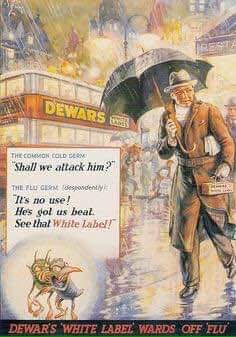
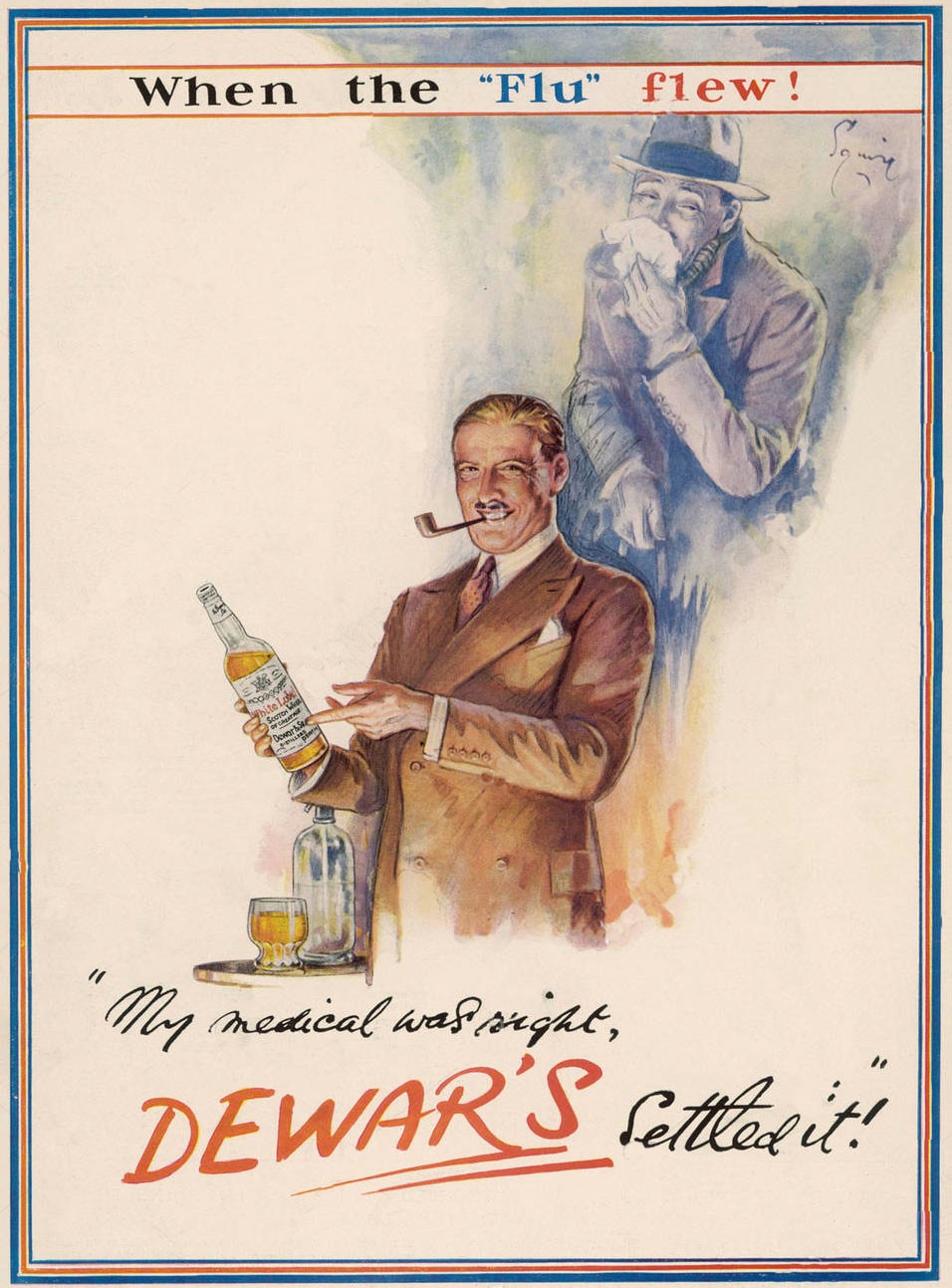
Well, that was a good holiday season, wasn’t it. It wound up with Ontario heading into another semi-demi-lockdown as of Monday so I can’t say that it is all fine and dandy. I still have my stash. And I can settle down into my culturally appropriate assumptions that the stash somehow helps defend against viruses. This is the second in my collection of my “Dewar’s Defeats The Flu!” imagery in addition to this beauty.*  Now you have a collection, too.

What is going on in the beer world? Well, there was a ripple of unhappiness about the term “pub ale” which I have no issue with as it fits a certain spot that I recognize as something once called “Canadian export ale” except it isn’t really exported – a sweeter sort of pale ale.  Like Left Field brews and calls Outstanding which it is. “Bitter” isn’t an old term.  Gary mentioned the question this week dismissing the idea it was novel:

Certainly in export markets, British brewers were alert early on to attune names to market expectations. Boddington’s Pub Ale, a good seller in many markets is a stronger version of Boddington’s Bitter marketed for export since 1993. Back in the 1980s the now defunct regional brewer Greenall Whitley sold a Cheshire English Pub Beer in the U.S. I recall it especially in the Northeastern market.

I am with Mike. Bringing out a craft beer brand called “Leff” without a last letter “E” is just inviting a trade name or copyright law suit. Big faceless industrial gak maker hegemonist ABInBevOfBevAllBev has my sympathies:

“Leffe has an earlier right. Moreover, in both cases it concerns beer. Then there is a risk of confusion. There would be less risk of confusion, for example, if the Leff brand is applied for by a bed manufacturer. Although the protection of well-known brands can sometimes extend to other products.” Moreover, the label of a bottle of the Brasserie Artisanal du Leff also resembles that of the famous Leffe. “The same Gothic letters, for example, and the word ‘Leff’ is very emphatically highlighted. Those logos and fonts are also registered by AB InBev with the trademark register,” says Chalmers. In a French press release, AB InBev says that even in French pronunciation, there is no difference between “Leff” and “Leffe.” Reason enough to send Le Saux a letter.
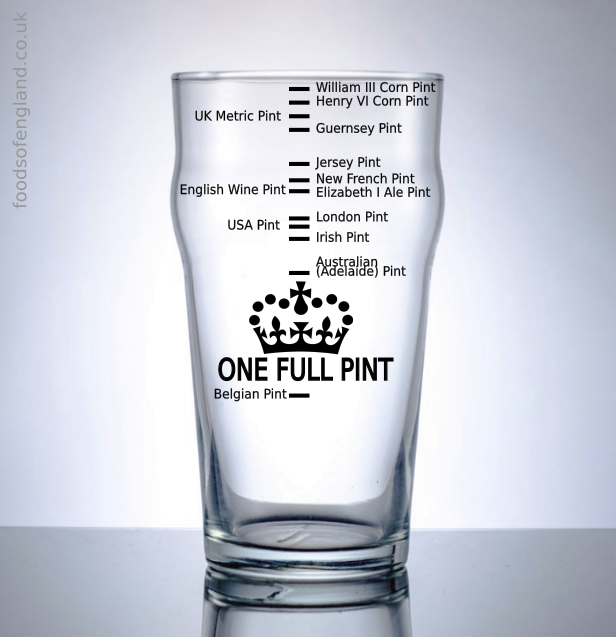
I love this image to the right of all the various sorts of pints illustrated on a pint glass. Published by Foods of England this week. Pity the Belgian pint.

Joan Birraire in Barcelona, Spain has fired up his coal fed servers and revived the beer blog, no doubt due to everyone saying how beer blogging is dead. He returns with his Golden Pints 2021:

To avoid settling into perpetual criticism and start leading by example, I hope to resume blog activity a bit this year, also as part of a return to good habits that I have definitely lost due to the pandemic and excess work, the combination of which has led me to a terribly monotonous kind-of-monastic life. To begin with, I would like to recover a decade-long initiative that started in the international blogosphere: the Golden Pints awards, which every blogger assigns to beers, establishments or projects that they feel deserve to be praised.

Note: there is no such thing as “too many beer bloggers.” Speaking of which, Lucy Corne of South Africa, not dead, celebrated ten years of beer blogging this week as did Matt Curtis, also not dead. Speaking of whom latterly but not late-rly, Pellicle has published an excellent business plan for 2022 explaining the financials of its operations. Were all the others so transparent:

We run Pellicle on a cash basis. We have no debt, and our plan is, and always will be, to keep commissioning content until the money’s all gone. Thanks to our Patreon supporters, plus our sponsors Hop Burns & Black and Hand and Heart, we’re presently able to publish roughly one or two features per week, plus a podcast every three to four weeks, and both are pretty much self-sustaining as is. 

Full marks. This is why I trust Pellicle and I support them at a very modest level. Speaking of excellent, this piece by Kate Bernot captures exactly what we have not seen much of in craft beer business journalism: digging into the business end. And it was accomplished by reading Danish corporate filings for Mikkeller:

According to a company audit, Mikkeller had a total income loss of about $4 million between 2019 and 2020. The report says that last year’s losses were “primarily a result of COVID-19 related restrictions, lockdown and general uncertainty across the globe heavily impacting our retail sales as well as wholesale to on-premise bars, restaurants.” Borsen reported that Mikkeller founder Mikkel Borg Bjergsø has relinquished some ownership in the company to Orkila as a result of the most recent transaction.

Fabulous levels of detail to dig up and dig through. Now, let’s have the same approach to other breweries. In 2016 there was some unhappiness that I just mentioned Jim Koch selling off shares, pro-am beer writers telling me I “…didn’t understand, so mean…” despite practicing business law for about two decades at that point. More of the digging please.
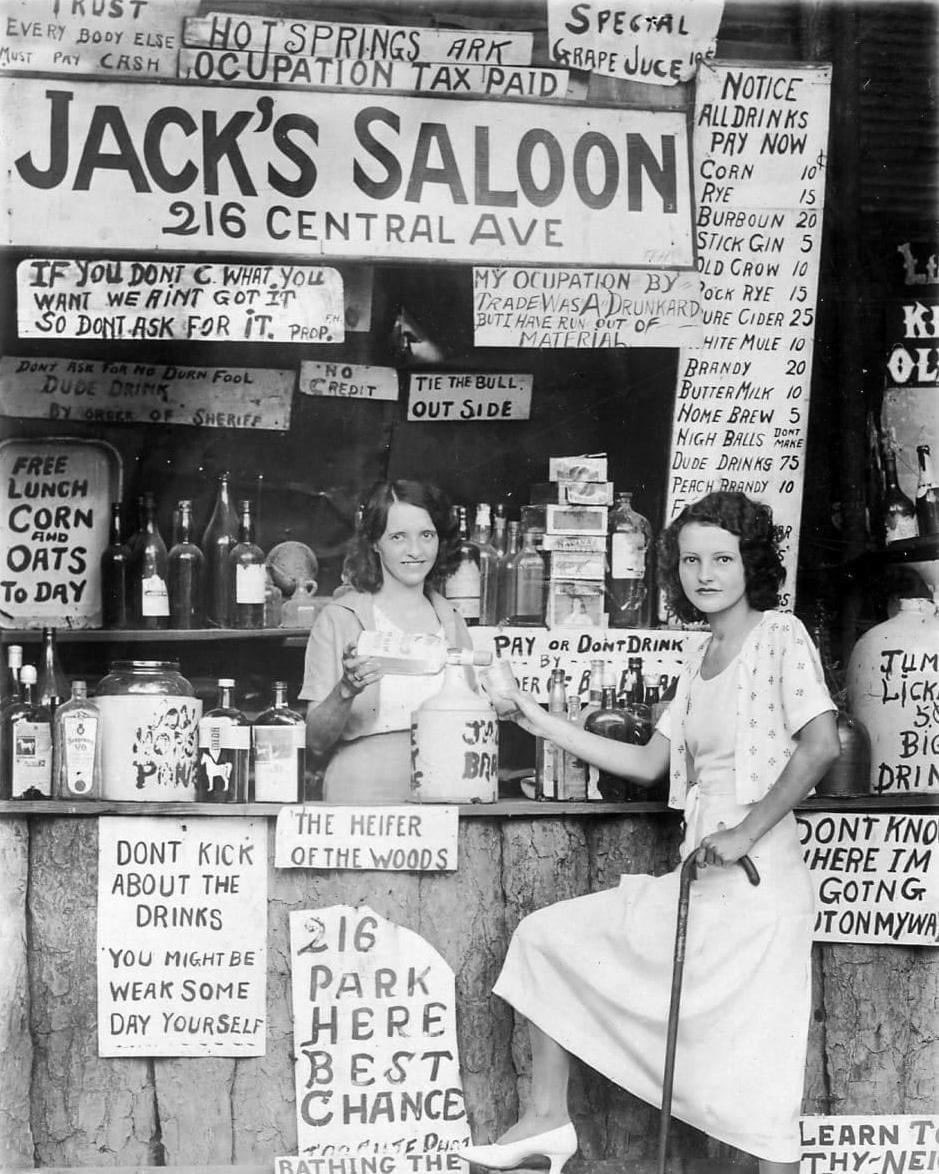
Maureen retweeted this image of Jack’s Saloon at Camp Claiborne, L.A., 1940s and it is worth poring over for the details. If you click there is far bigger version. What the heck is a “dude drink” and why were these two fine ladies and their wonderful establishment so against them? I mean you could have one but it cost fifteen times the cost of a home brew. Are they brewing out back?  The font of all knowledge explains that “Camp Claiborne was a U.S. Army military camp in the 1930s continuing through World War II located in Rapides Parish in central Louisiana.”

Retired Martyn crossed the northern border thanks in large part to someone else:

A flat tyre from nowhere, but thankfully I have a skilled team to deal with life’s little crises. And no, that’s not the main reason I married her (though her 1991 “Motoring Madams” certification was high on the list).

I was guided to the blog “Paul’s Beer & Travel Blog” which is a fairly plain name if we think about it but no doubt entirely accurate. Paul Bailey is the name (no relation) and what it is really about is Paul’s travels to beer. So there is pleasant train discussion, pleasant pub discussion and pleasant beer discussion as this one paragraph illustrates:

Unfortunately, the trains didn’t connect very well, and as the service from Dorking pulled into Redhill station, I witnessed the one to Tonbridge, pulling away from the opposite platform. The next train to Tonbridge wasn’t due for another hour, which provided the perfect opportunity for a quick, “in-between trains” pint. The question was, with a number of pubs to go for, which one should I choose?’

Remember this next time you read someone saying how negative discussion is on Twitter during the pandemic – it’s much the same in the pub. Current complaints? Dry January…** New York State Governor Hochul? Not so fast:

New York Gov. Kathy Hochul announced Wednesday that she will permanently legalize the sale of “to-go” alcoholic drinks in the state, adding that the practice was a “critical revenue stream” during the pandemic.

Oh – and Stan mentioned the Patreon thing. Let me play with it a while before I figure out if there is any point to it.

There – a modest offering for this more modest first week of the new year. For more check out the updates from Boak and Bailey mostly every Saturday and from Stan every Monday, plus more with the weekly Beer Ladies Podcast, and at the weekly OCBG Podcast on Tuesday and sometimes on a Friday posts at The Fizz as well. There is a monthly sort of round up at The Glass. (Or is that dead now?) There is more from the DaftAboutCraft podcast, too. And the Beervana podcast. And sign up for Katie’s irregular newsletterThe Gulp, too. (That’s a bit now and then now.) And check out the Atlantic Canada Beer Blog‘s weekly roundup. Plus follow the venerable Full Pint podcast. And Fermentation Radio with Emma Inch. The AfroBeerChick podcast as well! And also look at Brewsround and Cabin Fever. And Ben has his own podcast, Beer and Badword (which he may revive some day…)  And remember BeerEdge, too, and The Moon Under Water.

*This blog is not sponsored by Dewar’s. This blog is entirely open to being sponsored by Dewar’s.
**For the double!
Your Mid-December 2021 Edition Of The Thursday Beery News Notes

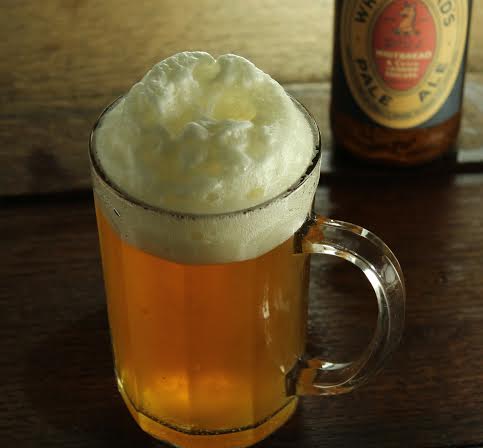
Just two weeks and a bit to go. Remember how 2020 dragged on and on? 2021 seems like it was less than a month long. Got my third jab. Thanks for asking, the only side effect has been just a bit of a lingering cold. Are you Christmassy? Me, not like in 2015 when Boak and Bailey won the last Christmas Yuletide Hogmanay Kwanza Beery Photo Contest with the entry above. Why? Just nine days to go but we are having a big big wave* of da-‘Vid around here so joining last minute shopping crowds might not be wise. Good to substitute:

Look, kid – mustard is a perfectly good stocking stuffer. Stop crying… please… have a Brazil nut… no, that’s all there was left at the gas station… check at the bottom of that stocking… yup… handkerchiefs… what, again with the crying?

Ho ho… ho. First up, if you yourself in need a bit of a Christmas gift, The Lars himself is speaking on line next Tuesday at 3 pm Eastern (my time zone is the best!) as he is set to speak at the Chicago Brewseum’s latest event:

Yule, the multi day festival celebrated by pre-Christian Germanic peoples, begins every December 21st. The modern Christmas celebration is very different from the old celebration of Yule as Norwegian farmers knew it, yet at the heart of both sits the feast with the Christmas beer. On this Winter Solstice, Lars Marius Garshol joins us from Norway to take a long look back to the origins of the Christmas feast, and why beer was so central to it. At the center of the mystery we find not Santa Claus, but his forgotten cousin.

Also, just in time for the holiday joy, Dr. Wade at braciatrix reached back 400 years or so to the early 1600s offered some top advice on how to get through this challenging holiday season – butter beer!

Butter beer, or buttered beer, has a long and storied history. There are many recipes all containing at least the butter, sugar, beer and eggs, though the variety of spices seems to vary greatly with some including nutmeg, cloves and ginger, whilst others opt for aniseed and licorice.

That might be worth a try. My go to mulled ale is usually just Chimay Red in a pot warmed with a cinnamon stick. Speaking of fun, there was lots of follow up from last week’s post on the problem of style. I understand it is referred to in Finland as se in certain circles. And this week, we learned that there is another convoluted BJCP style update coming and I also read the words “spicy-guava Lithuanian-influenced Meadow Land IPA” written by Ruvani de Silva.  I am inclined to consider that hard to the one end of the newly christened “style<->fun” continuum. Ron also contributed to the question when he questioned the relevance of the construct when considering Edwardian ales:

Whitbread’s Edwardian beers are bound to get a style Nazi in tizzy. Because they certainly don’t fit with the modern hierarchy of Pale Ales.  With their IPA being significantly weaker than their Pale Ale. Whitbread IPA was a latecomer to the party, first brewed in October 1899. They’d been in the Pale Ale game since the 1860s and already brewed three different ones – PA, 2PA and FA, in descending order of strength. With IPA slotting in just above FA. So, what made this beer an IPA? The fact that the brewery called it that. I can’t work on any other basis. Were British breweries consistent in their use of the term IPA? Like hell they were. And particularly liable to use PA and IPA pretty much randomly. There’s no point searching for a pattern, because there isn’t one.

Noticing things as they were and are can get a bit sticky. The Tand himself captured this idea in a post yesterday about stout:

It isn’t that I’m against such stuff, and I agree and recognize that there are plenty out there that like these additions, but what I do dislike is that a bit too often, there isn’t just a straightforward stout that tastes of, well, stout.  There are exceptions of course, and maybe too many brewers feel that a “normal” stout doesn’t get them sales in a crowded market. Well that’s fine, but let’s at least have an unmucked about version as the default, with the additions as specials.

Where does that sit on the “style<->fun” continuum? Interesting and perhaps somewhat related observations from Boak and Bailey on the role craft beer can play as harbinger of change in gentrification of neighbourhoods, whether those living there like it or not:

Bedminster is made up of multiple neighbourhoods, from the theatre and coffee shop gentrification of Southville to the betting shops and greasy spoon caffs of East Street. The pubs there tend to be either (a) busy and down-to-earth, with stern warnings to shoplifters in the windows; or (b) shut. The borders, though, have fuzzy edges and are porous and, as you might expect, the gentrification is leaking. There are now vegan delicatessens and houseplant emporiums alongside branches of Gregg’s and Poundland. Alpha occupies a retail unit in a 1980s red-brick shopping arcade, across from a kebab house and next door to a charity shop. It feels out of place, for now – but probably won’t in five years’ time.

Change is odd. You can spot it in liminal spaces. Or does it sometimes create the liminal space, the bit that gets abandoned to become a space between before it gets repurposed? Craft beer is probably a follower as often as not in  these things even if it sounds like may receive undo attention compared to the fifth column of big houseplant in these matters. Fern pushers. No good comes of ferns.

Elsewhere… good news in another remote pub story from Britain!

A community on the Isle of Bute has raised more than £92,000 to put towards the purchase and refurbishment of their 200-year-old pub. The Anchor Tavern in Port Bannatyne was put up for sale after it was shut due to a downturn in business caused by the Covid-19 pandemic. It was the last pub in the village following the closures of other licenced premises.

Among the things I wrote these last few days that caused upset for some poorly enunciated reason or another** was the idea that best of lists sorta suck. While Robyn and Jordan make good case for properly run awards in this week’s podcast (while rejecting guava – are they really that fun?)… like the minor league golf tour of weekly sponsored events that beer awards have become (no doubt to give all those vitally important awarding people enough opportunity to prove their really important judging powers by awarding awards) I’ve long wondered whether there any other part of pop culture where the “best of” lists are filled with generally inaccessible items like we see with beer? Eric Asimov in the NYTs shared his best of 2021 wines and I was immediately struck by this first item in his list:

This bottle is a thirst quencher, an uncomplicated $19 liter of red from the Bío Bío region of Chile. So what’s memorable about it? For me, it epitomized how wine is evolving.

Modest price, an over-sized bottle and contextualized to make a greater point. Beer reviews rarely even mention price let alone distribution. We deserve better. Now consider NPR’s Sound Opinion‘s best albums of 2021. In their newsletter they asked “What We Mean By Best Albums”:

…let’s call our Sound Opinions best-of lists what they really are: idiosyncratic, no-two-exactly-alike rankings of personal favorites. We’re not looking for consensus, we’re aiming for let-it-all-hang out personality as reflected by the music each of us love the most. That’s why we devote an entire show to this imperfect exercise every year. It’s fun to reflect on the recordings that sustained or inspired us when we were running errands, washing dishes, hosting a party, recovering from a long work day or just getting lost between the headphones on the couch.

Self-deprecating, accurate and personal. An imperfect exercise. Look for these sorts of qualities in any recommendations before you fall in behind the fog offered otherwise.*** Look for price, actual personal comment and not just the PR notes – plus whether there was actually any sort of possibility anyone (aka you) beyond the sample receiving set was ever going to have a taste.

Very related, sometimes you read things that make you think “hmmm, interesting” and sometimes you read things that make you think “is anything in this actually true?” Oh dear. “Style”? Not in 1977. “Juicy”? More like 2007. Still, expect a NAGBW award for that one. For sure. Meets the club house requirements.

Conversely, speaking of context and reality, I heard a great show on one of CBC Radio’s schedule challenged broadcasts, Now or Never, Saturday aft. It was all about the relationship people have with alcohol. The episode has not popped up on the podcast page yet but keep an eye out for it. There’s a great interview with one Winnipeg craft brewer on the conflict of producing something that harms some while is fun for most. [Update: here it is!]

Want a bit more reality, I hope you are taking a moment to see the green dot in the sky these days. Not a lot of green dots in the sky. Green dot? Yup:

Your once-in-a-lifetime chance to see a green comet named C/2021 A1 — a.k.a. Leonard — is here. Astronomy experts, including the comet’s discoverer, offer tips on when and how to see the comet. Like other comets, Leonard is a ball of frozen gas, rocks and dust. When its orbit brings it close to the sun, the heat causes some of that material to vapourize, which makes it glow and sprout a tail of gas and dust.

Leonard? Hallelujah! Because when the world is a bit too grim and people are just too much face, why no climb way up to the top of the stairs where your cares might just drift right into space. Because you are gawking at a green dot. And you can take a drink up there with you. Something festive.

There. I tried to keep it short. Can you believe it? No? Well, the holidays are here. Be happy – and while you are being happy please also check out the updates from Boak and Bailey mostly every Saturday and from Stan every Monday, plus more with the weekly Beer Ladies Podcast, and at the weekly OCBG Podcast on Tuesday and sometimes on a Friday posts at The Fizz as well. There is a monthly sort of round up at The Glass. (Or is that dead now?) There is more from the DaftAboutCraft podcast, too. And the Beervana podcast. And sign up for Katie’s weekly newsletterThe Gulp, too. (That’s a bit now and then now.) And check out the Atlantic Canada Beer Blog‘s weekly roundup. Plus follow the venerable Full Pint podcast. And Fermentation Radio with Emma Inch. The AfroBeerChick podcast as well! And also look at Brewsround and Cabin Fever. And Ben has his own podcast, Beer and Badword (which he may revive some day…)  And remember BeerEdge, too, and The Moon Under Water.

*Sadly, the recent events in Kingston around anti-vaxx also caught up a neighbouring craft brewery, Signal. The owner died of Covid-19 Wednesday. It might have triggered further outbreaks.
**Huh?
***Co-opting a crisis is one of the more distasteful things you can do so it was sad to see one of the worst examples of appropriating aggrandizement in a headline I read this week: “Kentucky Breweries Lead Relief Efforts Following Deadly Storms.” What they meant to say, as the story does, is some brewery owners are pitching in as they would and should but pretty sure the normal authorities and charities are leading relief efforts.


Your Thursday Beery News Notes For The Coming of Yule and Omicron

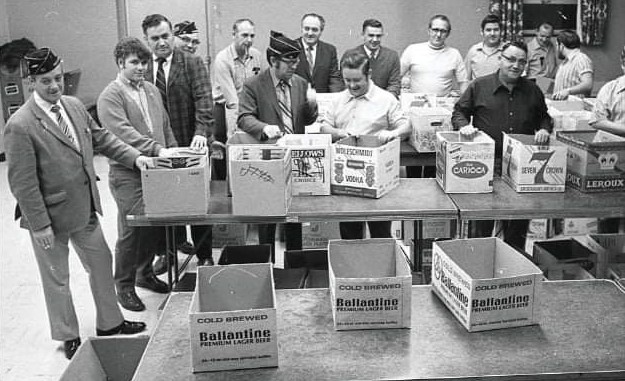
It’s beginning to look a lot like… Yuletide fifty years ago right about now when they were packing the Christmas parcels for families in need down at the American Legion post in Watertown, NY in 1971 – back during the Vietnam War era. The lads. WW2 vets I imagine. I noticed those front three boxes just waiting to be filled – Ballantine. The brewery’s share of national brewing sales had tumbled through the 1960s from over 5% of the market to just 1.75% by the time the photo was taken.*

First up, here is some fabulously interesting news about successfully managing a pub during crisis times from Stonch:

I open my pub Thurs-Sun only so that it’s a joy rather than a burden… it means i usually go down to one [cask] ale by late afternoon on Sunday. anything left at closing time we drink, give away in takeaway containers or as a last resort pour down the drain. wastage is low though. remember my london pub was a 5 day a week place so i have experience…

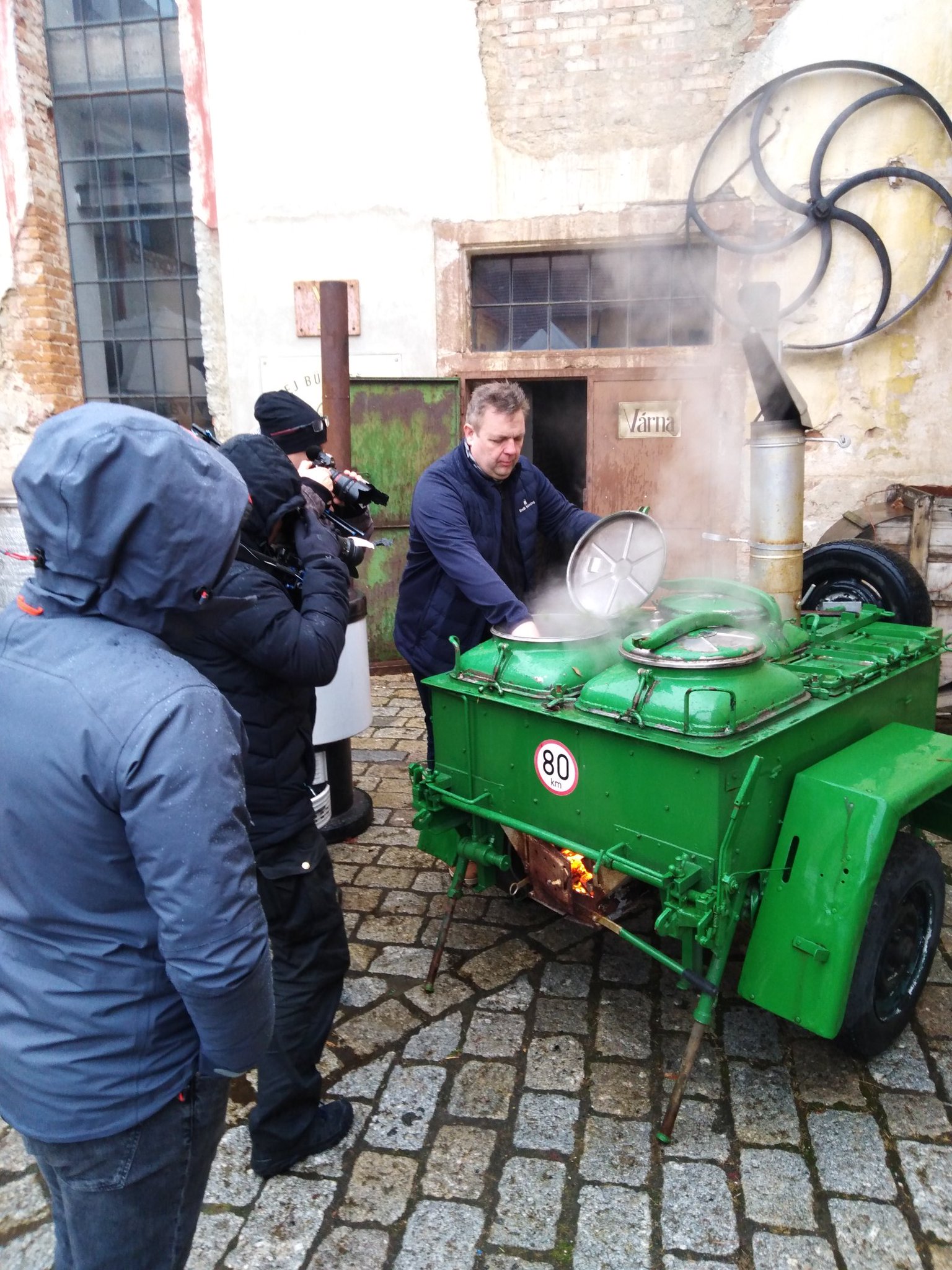
Equally fabulous is this image to the right from Max on a brewing day in Czechia. Click on it to get the full view but from what I understand he was withwith my man Sigurd we are brewing Kveik raw ale for Česká Televize at Cernokostelecky pivovar” where the green trailer was being used “for the juniper liquor used for the brew.” Neato.

Breaking: Newfs lack gas.

Sad to see Shmaltz Brewing bowing out after 25 years:

The biggest, the smallest, most award-winning, and still the only Jewish beer company in America, Shmaltz Brewing Company announces its farewell season after 25 years in the beer business with the first and final release of Bittersweet Lenny’s RIPA in 16oz cans, vintage gems from the Shmaltz beer vault, and a fitting tribute, Exodus 2021 Barleywine Ale (8.8% ABV) brewed with Date, Fig, Pomegranate, and Grape. Shmaltz goes out with a bang with a nationwide “Farewell to Shmaltz Tour” a.k.a. the Class of ’96 Celebration a.k.a. Let My People Brew a.k.a. The No Shmucks Tour…

Long time readers will recall my regular reviews of Shmaltz beers when I used to drive over to northern NY regularly on beer shopping runs. One of the rare breweries which knew how to add fruit to beer while leaving it tasking like beer. Not like the gakky end of the market today.

And in continuing coverage of craft’s retraction, Jordan has his red marker out, deleting the dearly departed contract brewers of Ontario from his list. And Toronto’s Thirsty and Miserable will be gone soon. Sadness. Further news to their south across the big waters,  The Tap and Mallet of Rochester, NY has announced its closing.

It is with a heavy heart that we have decided to call time on what has been a truly amazing 14 years… When the pandemic hit it came at a tough time as the pub was already feeling the effects of changes in the craft beer industry that we all continue to enjoy. We all soldiered on but have reached the tough decision that it’s time to call last orders. Our last day will be December 31st…. 

Fans are sad. There was another sort of lock down and a surprise for other pub goers at the rather elevated Tan Hill Inn seeking an evening with an Oasis cover band this week in England’s Yorkshire Dales:

People travelled to the remote pub, which is 1,732ft above sea level, on Friday to enjoy a performance by the Oasis tribute band “Noasis”. But it soon became clear that they would not be leaving that night due to a Storm Arwen snow blizzard. Makeshift beds had to be laid on the floor of the bar. When guests woke up, most cars outside – and parts of the pub itself – were buried in snow.

They spent three nights there. Were these fans also sad by the end? Dunno.

The Admiral Benbow. And the Admiral Benbow.

Garrett Oliver led a fabulous tweetfest over the weekend on the role of, what, branding versus clarity? IPA v. reality? Authority v. assertion? It all starts here with Joe Stange but goes all off in wonderful directions with loads of viewpoints and counterpoints, entirely rich.  I liked this:

I don’t “know” a lot about jazz, but I still enjoy jazz. And I really don’t care what a jazz critic thinks I need to know – I’m having my own good time and I will not be fenced in by anyone. I’ve worked to demystify beer for more than 30 years. It’s supposed to be fun. And it is…

These are the sorts of back and forth self-anointed beer experts either scream in or now totally avoid, the latter given far more wonderful information than these beer experts themselves know, I presume. Not similarly, Oliver Grey had a piece published on the basics of saison this week:

The story of Saison—and its journey from seasonal brewing in Wallonia, Belgium, to year-round availability in taprooms all over the U.S.—is arguably not one of evolution but, rather, mutation. The style, at its core, thrives off the randomized power of genetics. It generally eludes consistent definition and tasting notes, as explained by Phil Markowski in his book, Farmhouse Ales, “expecting Belgian and French beers to follow [a] pattern can lead to disappointment and frustration.”

I wish one point had been added. What we know as Saison and Biere de Garde, as Markowski explains,** was largely made up in the 1970s to meet student and other trendy drinking demands in the 1970s.  Makes for a great foundation of the various US craft creative takes, both disconnected from the 1800s.

Seems like a rather generalist approach to the subject.

Me, I am with Delores. Always. He’s crazy. Who? Ron – who is swanning about a tropical  beer junket in Brazil where which he will nod and scribble while day dreaming about getting to the buffet and then back to the beach.*** I must stay, the terms and conditions of his compensation package are pretty meagre as he reports:

The organisers of the Brasil Beer Cup paid for my accommodation and food during the period of judging (four nights and three days) Beer, too, which was provided by one of the sponsors. I had to pay for my own cocktails. And all other expenses, such as flights and extra hotel nights.

Cheapskates!! Who are the organizers? Seems to be run by something called the Science of Beer Institute, a joint project of  Instituto Cervezas de America (Chile), Berlin Beer Academy (Germany) and Beer Matters (Belgium), Science of Beer and Bier Akademie (Germany). Seems to me they would have the ability to cover a plane ticket for poor Ron, knowing what money sponges these junkets are.

Finally and fairly similarly, the inaugural Canada Cup of Beer… no, Canada Beer Cup ran discount pricing in November but that is over. Not entirely sure it is a good look. The echoing of Brazil’s Beer Cup in the name is odd, too. Won’t match the weather!  I’m not yet sure who is running this one as everyone involved seems to describe the event’s organizers as “they.” This sorts of vague thing doesn’t help either. I expect no one wants to take credit for the Toronto Tourism grant (or however it was structured) providing the generous funds which should be involved (if they know what buttons to push) given (reliable sources say) this is really about marketing the town and attracting folk who will write praising articles about “Toronto the Good” during the dark winter days of icy pandemic (“judging is sort of an excuse” sources share) – including a particular wish for (again I am told) Kate B of GBH to show.  Hope they don’t sell hats.

There. Your beer nerd cred is topped up for another week. Meantime, check out the updates from Boak and Bailey mostly every Saturday and from Stan every Monday, plus more with the weekly Beer Ladies Podcast, and at the weekly OCBG Podcast on Tuesday and sometimes on a Friday posts at The Fizz as well. There is a monthly sort of round up at The Glass. (Or is that dead now?) There is more from the DaftAboutCraft podcast, too. And the Beervana podcast. And sign up for Katie’s weekly newsletterThe Gulp, too. (That’s a bit now and then now.) And check out the Atlantic Canada Beer Blog‘s weekly roundup. Plus follow the venerable Full Pint podcast. And Fermentation Radio with Emma Inch. The AfroBeerChick podcast as well! And also look at Brewsround and Cabin Fever. And Ben has his own podcast, Beer and Badword (which he may revive some day…)  And remember BeerEdge, too, and The Moon Under Water.

*See Tremblay and Tremblay, The U.S. Brewing Industry, tables 4.3 and 8.2.
**I looked for my copy of the book to quote the passage but the effort got too great about 45 seconds. Found it. Look at page 36-38.
***From an alternate universe, another way forward: “I was hired by Robert Parker in 2008, and I will always be grateful for the opportunity he gave me and all that he taught me. In 1978, Parker created a groundbreaking wine publication that was free from financial ties to wineries and merchants, a guide that produced wholly unbiased views on wine, and reviews that served only the interests of wine consumers. It was a magazine funded purely by subscribers—the people that bought, read, and drank by it. Parker’s ethics, as much as his incredible talent, inspired me. I am honored to have worked with him up until the day of his retirement.

The December Is Almost Here Edition Of The Beery News Notes

And… that was November. or it will be soon. From mowing the lawn to frozen ground in a mere 30 days. World Series to free agency. Stout sales go from “?” to “!” It’s good like that, November. Knows it’s place. The saddest month. Not cold enough to be bracing and clear like January. Look, I’ve already started to move on. Christmas pressies have been bought. Just have to see if they arrive before January. What else might arrive by then? A Christmas photo contest entry pro photographer Peter B. Collins in 2011 might give you some idea.

Now then… first up, a nice bit of work from Retired Martin this week, a photo essay on Whitelock’s in Leeds interspersed with witty tidbits:

All tables taken, but obviously I’d brought the fine weather with me oop north and you don’t get much better outside seating than this, watching life amble by and end up in the loos for the Turks Head, wondering where you are.

Note: I am pro-deposit for reservations.

Not to overload you with pub observations, Life After Football shared some thoughts on one funny gaffer in “Pickled in Branston“:

The Gaffer had a glint in his eye and when I said, “Can I have a pint of Bass?” He replied with “No you can’t – it’s all mine!” Clearly, a man after my own heart and with four other people in there at about 12.05 he has a base of local punters happy to roll in on a Monday. “I’ll get you that pint young man,” he said and when I said I’d not been called that very often, quick as a flash he replied “I’ve been known to lie!”

Har-har… har… And Boak and Bailey asked a couple of good questions this week, one in their newsletter but first, in a variation on the theme, this about memories of past pubs perfect:

We’ve been struck down by nostalgia lately and find ourselves yearning for a particular experience of the pub. Maybe it’s birthdays. Maybe it’s the emotional impact of the two weirdest years we’ve ever lived through. Or perhaps it was just that excellent pint of Young’s Special at The Railway in Fishponds in Bristol.

They were again a bit nostalgic in the monthly newsletter, this time for beer blogging days.

…in the UK at least, the growth in professional (ish) outlets has sucked up a lot of content that would previously have been on blogs. That’s great news for writers – they get paid! They get proper photography and illustrations to accompany their piece! And it gets promoted properly, too. A few years ago, everyone was fretting about the death of beer media, meaning print magazines. But we wanted that and blogs, not one or the other, right?

Well, no. Print writing can be narrow and often by commission. My take? It may not be so much about the death of blogs as the ascent of a duller sort of paid writing. Don’t get me wrong. Some is great but commissioning editors with creditors set parameters.* People with just an interest have gotten to project themselves as people with authority without the decades of Stan‘s experience or the miles Jeff puts in. Others writers – sometimes the better ones – got jobs, moved on or just ran out of imaginative takes on a limited niche topic.  

Yes, that is where we are. It happens. And when things are slow like they have been in 2021, we tend to move backwards hoping we are staying in place.  This year of almost entirely updated next editions is almost over but not until we have, tah-da, the personalized beer flavour wheel. Beer flavour wheels have been around for decades. I am not sure why I need someone else’s different beer flavour wheel. Never bothered with one yet. But beer flavour wheels have been around for decades so someone must have. Schmelzle‘s dates from 2009. Dr. Morten Meilgaard seems to invented them in the 1970s. I asked a related question a decade ago and still have no idea what the answer is.

Speaking of flogging, this year’s version of the GIBC advertorial in the Chicago Tribune has led to some astounding information, not least of which is this:

The “reserve” package is the one the beer nerds want — 9 Bourbon County beers, including the most limited brands aged in the fancy barrels, for $259.99.

Bizarre. Takes some convincing folk that these prices (and I suppose the advice itself) aren’t suspect – if not grand larceny.

And speaking of the more than a bit weird, the US magazine Esquire published a short opinion piece that led to a long list of complaints:

The first half of a beer is why we drink beer. The second half is an afterthought at best, backwash at worst. If you were to watch all the beer commercials from the beginning of time, you’d hear the words cold and refreshing over and over and over. That’s because marketing people aren’t that creative, and also because that’s what sells beer. No one drinks beer for the tepid second half….

Comments included: (i) No one in their right mind would say this about another foodstuff. “Feel free to toss that second half of cold pizza in the garbage…”; (ii) “You know you can order smaller pours if you want beer to stay cold the whole time?”; and (iii) “Like she had to meet a word count quota before she left for Holiday break.” Esquire has apparently claimed that this is a stab at satire which, if it is true, suggests that it is not actual good satire.

PS: never heard of him either. But it appears the status you are desperately wanting to achieve is so incoherent that it requires outside intervention. And tricks.**

That’s a bit of negativity right there. For a bit right up there. What caused that? Nostalgia? Getting away from the pubs? We need to get grounded. Beth Demmon takes us to the hear and now with the first in a series on the state of the water supply in Southern California where the ground is dry and how the San Diego brewing scene may be facing change:

In such a water-thirsty region, it’s imperative for beverage companies like AleSmith to maximize their materials through sustainability initiatives. Cronin says AleSmith is on a two-year track to become Pure Water compliant through the city of San Diego, which aims to provide one-third of the city’s water supply locally by 2035 by purifying recycled water. Considering that Cronin estimates AleSmith rinses 7,000 – 10,000 gallons of wastewater into the municipal system every day, that’s millions of gallons available for reuse.

I brushed against this topic in 2015 in my superficial way but this is seven levels better. Excellent described detailed research. Additionally and also in the present and the positive, Jordan wrote about himself and what he is doing in beer these days – and this time it all makes utter sense:

I would guess that I probably try somewhere between 500-1000 beers every year, not counting repetition. Beyond a certain point, professionally speaking, beer is content. It’s informational. My fridge is more than half full of obligational beverages that people have sent for review and which might end up on instagram or in an article. I probably won’t finish more than about half of any of them, because the point isn’t drinking them; the point is knowing about them. Beer contains calories, as the new pair of jeans remind me.

Good advice. And look! More good advice. Three ingredient cocktails. Sensible simple tasty booze. That’s positive.

What next? History? History is good. Edd the BHB on 1910 Nottinghamshire ales, the Warwicks & Richardsons range. Did they still sing the song 120 years later? More history? Graham Dineley posed the question of beer stone and prehistoric pottery and found fatal flaws in the research to date:

Many scholarly academic beer “experts” have never actually made beer, and so have no experience or expertise. Brewing beer is a particularly experiential process, where the subtleties and nuances are necessary and essential for the full understanding. Many of these “experts” confuse beerstone with calcium oxalate. 

Finally but not happily, this tweet got my attention from Ren:

The irony of being written out of beer history by women hoping to change beer history…

Reality again. I do wish folk would get out of the way. I was also disheartened this week to see another part of Black experience filtered (again) by GBH through the inclusion of the hand of someone from outside. This is a bit of the opposite of my recent experience with the Beer Culture Summit 2021 produced by the Chicago Brewseum. Hand over the keyboard and get out of the way. No amount of time or miles can replace the unfiltered voice of one who has been there and has something to say.

That’s it. A tough one for good pics this week. A bit of a hard row to hoe if we are looking for the captivating in beer writing. Every week can’t be thrilling. I suppose, that’s the way it goes. Still, check out the updates from Boak and Bailey mostly every Saturday and from Stan every Monday, plus more with the weekly Beer Ladies Podcast, and at the weekly OCBG Podcast on Tuesday and sometimes on a Friday posts at The Fizz as well. There is a monthly sort of round up at The Glass. (Or is that dead now?) There is more from the DaftAboutCraft podcast, too. And the Beervana podcast. And sign up for Katie’s weekly newsletterThe Gulp, too. (That’s a bit now and then now.) And check out the Atlantic Canada Beer Blog‘s weekly roundup. Plus follow the venerable Full Pint podcast. And Fermentation Radio with Emma Inch. The AfroBeerChick podcast as well! And also look at Brewsround and Cabin Fever. And Ben has his own podcast, Beer and Badword (which he may revive some day…)  And remember BeerEdge, too, and The Moon Under Water.

*Very tempted to go all Ogden Nash and spell it “paramitors.”!
**If your studies include flash cards and tricks… maybe you are not actually studying something at all.

The Thursday Beery News Notes For Remembrance Day 2021

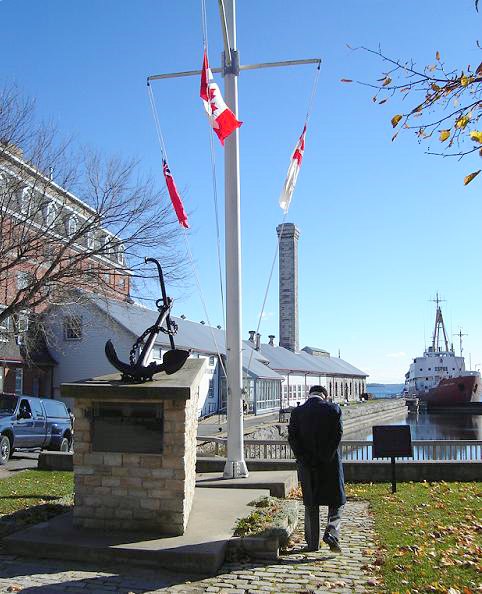
Today is Remembrance Day, a fairly significant thing here in Canada which is largely apolitical even now well past a century after the end of WW1. The image to the right is a photo I took in 2005 at the naval memorial downtown. We’ve had a naval presence here in town since 1673.  And here’s a bit of what I wrote in 2014 about the day on Facebook:

…There are no politics with our vets. More than hockey and donuts, we all actually love our square do-gooder Dudley Do-right military and RCMP. I am lucky to be in a congregation at 51 years of age with a man* who commanded CFB Greenwood near Kingston in NS where I lived when I was 9 years old – and who attended the church where Dad was a minister. We remembered today that when I was a kid and he was in his 40s that all the vets were WW1 and there was even likely a Boer War soldier in the pews…

We government workers in Ontario have the day off but it isn’t a general holiday like it was when I grew up in Nova Scotia. Schools and shops are open. Feels weird.  Vets will be at Legions again this year after being shut in 2020. Drinking beer. I’ll donate a few coins into the little cardboard box and, once again, buy maybe the 7th poppy of 2021 – they seem to disappear within four hours after putting one on.

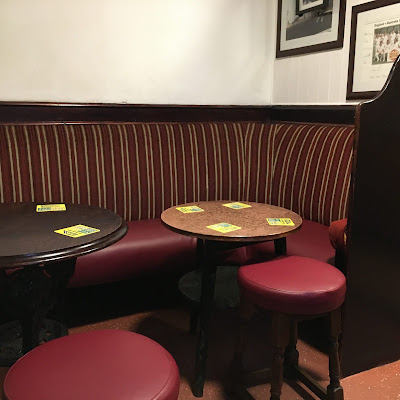
Elsewhere, Mudgie took a trip into the city centre of Manchester and posted a bit of a travel piece on a certain sort of pub. I was taken by this photo to the right, the absolute dream seat, right there in a wee nook in the tiny Circus Tavern. Fabulous:

It has two small cosy rooms with bench seating. The one at the front always seems to have a vault character and is frequented by the regulars, while the one to the rear is more of a snug. I managed to take a snap of the seating opposite in the brief interlude between it being occupied by groups of customers. Understandably, the Circus didn’t reopen until social distancing restrictions were lifted in July, and anyone concerned about getting too close to others would do well to avoid it. 

Note: another photo of the Circus Tavern with people added won the top prize in our 2012 Yuletide Beery Photo contest.

The other week I was correctly corrected about the lack of a certain beer fest holding a meeting in person – so giddy was I to realize that an update on another and rather gentle in person event was posted by The Beer Nut this week. The live action photo at the end is helpful for scale:

From Zwolle, we set off further westwards on Saturday morning for Gramsbergen, a small town about 3km from the border with Germany. G-berg, as nobody calls it, is home to the Mommeriete brewery, set in a rustic canalside inn, all oak beams and porcelain fireplaces. We missed getting to see it as its normal cosy self since they were gearing up for a beer festival: one organised to celebrate 20 years of the Dutch beer consumers’ organisation PINT, onto which was tacked the official 30th birthday bash for EBCU. It was a modest affair, beginning in the the afternoon and finishing at 7pm, and only three guest breweries were in attendance.

Note: cheese cutting diagrams.

Beer experts don’t really exist like wine experts do. Well, a very few of the former might while a few more of the latter do. If you don’t believe me and still think your website generated certification means anything like expert, consider the career path of Kevin Zraly including this:

That any American restaurant would have a cellarmaster or a sommelier was a rare thing in those days. In 1978, Frank J. Prial, the wine columnist for The Times, wrote an article about the virtual disappearance of the sommelier in restaurants, citing Mr. Zraly as one of a very few good young ones in New York, “the knowledgeable type, not the wine hustler…”

I followed this link to his courses at Wine.com. Look! No phony academic rhetoric, no layers of prerequisite that would shame a Scientologist. Just accessible authoritative information at a plain price and presented directly and on the level. Why can’t beer do that?** We need to consider the relationship between access to information along with inclusion and levelling and the commonality of those who opposed them.

Resulting question: why do wine educators start with the premise that wine is not as complex as we consumers have been told while beer educators seem to start with the premise that beer is more complex than we have been told?**

Much to the contrary, I spent bits of last Sunday watching presentations from the Beer Culture Summit 2021 produced by the Chicago Brewseum. I found the structure refreshing as there was none of the Masonic mystery gatekeeping guild approach to information that is a hallmark of what passes for too many claims expertise in good beer culture. The difference? The focus on professional and personal experience as a pathway to leveling and inclusion. Call it cred. The presenters had cred. I particularly liked “Under-Attenuated: Women, Beer History Studies and Representation” session: Dr. Christina Wade, Tiah Edmunson-Morton, and Atinuke “Tinu” Akintola Diver on their careers researching brewing history. And not only because of Dr. Wade’s defense of the value of blogging brewing history – depth, accessibility, primary citations and immediacy both in terms of time and audience** even if Stan is still standing there at the graveside.  In a time when we see bland generalities devoid of citation but plenty of errors*** win awards for best beer history, it was a call for quality within a call for, you got it, levelling.

Best tweet with beer and meat.

Crop-wise, we saw the 150th anniversary of the first sale of Fuggles this week, as Martyn reminded us:

Today, November 8, marks 150 years  since the Fuggle hop first went on sale, in a field in Paddock Wood, Kent, after Richard Fuggle and his brothers Jack and Harry had spent ten years propagating the variety until they had enough, 100,000 sets, to sell commercially.

Wonderful. And we are also seeing a second crop of the heritage barley variety bere in Scotland this year. Isn’t nature wonderful! More on bere here and here.

Taking a break on his book tour, Jeff wrote excellently about what he has seen in America’s downtowns in late 2021:

Most of my adult lifetime downtowns have been shiny, clean, and fun. They’ve always been a bit artificial, but we social beings flowed into these hubs to see shows, get a meal, buy something nice, and mostly, to feel the exciting hum of other people doing the same thing. Now downtowns are listless and depressing, and many of the businesses are boarded up or on long-term hiatus. There’s less and less reason to visit them.. When cities become nothing more than storefronts for the rich, they teeter on a narrow balance point. Did Covid just disrupt that balance?

Possibly the winner for Generic Praise-Laced Brewery Owner Bio Template of 2021.  B.O.B.s are the best. But this one has the header “A World-Class Pairing” which really takes it over the top.

More B.O.B. as a Euro male led publication hires Euro male writer to speak to a Euro male bar owner about diversity in the beer scene in BC’s Okanagan. I’d have more trust in the editorial call if the statement “…only a couple of people in the BIPOC community that even lived here when I was growing up…” was fact checked. While there is a reference to a Indigenous family business, here’s the map of Indigenous communities (aka the “i” in BIPOC) for BC. The communities of the Syilx Okanagan Nation are right there in the south centre. The Central Okanagan Local Immigration Partnership Council formed in 1983 seems pretty active, too. Question: why do writers of B.O.B.s never check in with customers or staff to find out if the claims are correct? The subject in this case could be fabulous… but we don’t know.

Beer prices are going up. Beer prices are going down.

Finally, I was sad to see a dismissive response to my comments about Pellicle’s decision to run and highlight a childish cartoon image about an actual ambush of soldiers where many died. Part of a story that is still recalled hurtfully in my region which touches on both my actual job and my brewing history research. It’s also an entirely unnecessary image and adds nothing to the story. At best, it is just a failed analogy. In an era when we are trying to drive out misrepresentation, appropriation and negativity from the good beer discussion, this sort of hyperbolic grasping for aggrandizing analogies is more than unfortunate. Do better.

Oh… and somebody sold their brewery.  Good beer. Nothing much will change.

There’s plenty to chew on. To complain about. For more, check out the updates from that same Boak and Bailey mostly every Saturday and from Stan now on a regular basis again every Monday, plus more with the weekly Beer Ladies Podcast, and at the weekly OCBG Podcast on Tuesday and sometimes on a Friday posts at The Fizz as well. There is a monthly sort of round up at The Glass. There is more from the DaftAboutCraft podcast, too. And the Beervana podcast. And sign up for Katie’s weekly newsletterThe Gulp, too. And check out the Atlantic Canada Beer Blog‘s weekly roundup. Plus follow the venerable Full Pint podcast. And Fermentation Radio with Emma Inch. The AfroBeerChick podcast as well! And also look at Brewsround and Cabin Fever. And Ben has his own podcast, Beer and Badword which may revive some day.  And remember BeerEdge, too, and The Moon Under Water.

*This is he
**We appreciate that folk have ambitions but actual earned and experienced knowledge is always more helpful than insta-recognition by those editors with creditors. BTW, EWCs are not levellers. BTWx2: what even is a “certified pro“?
***1500s Flemish farmers? 

The Beery News Notes For The End Of 2021’s 10/12ths

Here we are. November looms. I’ve never thought Halloween was all that scary given November is right there behind it.  The dreariest month. If it snows, winter will be too long. If it rains, the rain is bone achingly cold. Dreich. But a big month for beer. Big beers, in fact. I’ve been laying off but maybe it’s time to lay on again. Treat yourselves nice in November. It’s like it needs its own month to celebrate itself. Like gag-tastic #RauchBeerMonth but with, you know, the prospect of someone actually being made happier. And that’s what we want. To be happy. Despite the dreich.

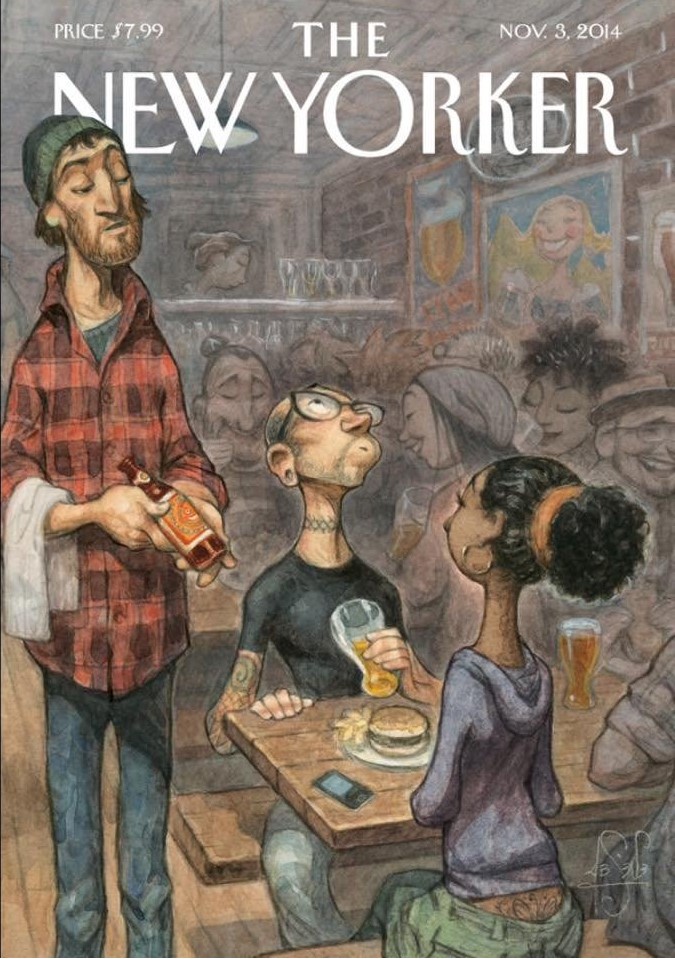
This November marks the seventh anniversary of perhaps the high point in the craft phase of good beer, circa 2003 to about 2016. The cover of The New Yorker from November 3, 2014. Mere months after the publication of the cult classic The Unbearable Nonsense of Craft Beer. Josh Noel‘s comment was spot on – a moment in time before hard seltzer. And perhaps a moment that had some aspects we are well rid of – if this article on Colorado’s New Image brewery is anything to go by:

The idea that brewery employees should expect less money because they are “doing what they love” is a cliché that needs to go away, he adds. “We are trying to take that out of craft-beer culture. It’s about damn time we have good benefits and good pay for people making beer.” Having a second taproom with higher margins on sales will help that effort as well, Capps says. And New Image is now “aggressively” seeking out locations that it can buy to add a third or even a fourth taproom.

The past is a foreign land. Conversely, there are a lot of words that come to mind in this story of today. Gall. Cheek. Privilege. Arseholes probably the correct term as the Manchester Evening News reports:

The Pack Horse, which is in the Peak District village of Hayfield, was visited by a group who didn’t flag any problems with their food when staff checked in with them, but chose to complain when they’d already eaten most of the meal, staff said. They allegedly tried to demand a new dish – which was refused – and eventually left without paying their bill. Owner and chef Luke Payne said that one member of the group then had the nerve to wink at him as they left.

The article goes on to suggest that manners have dropped in these later pandemic months. Arseholes, I say. Matt C. explored other forms of late pandemic angst in an article in Pellicle this week:

Before the pandemic, one place in particular I would find both solace and kinship was at a beer festival. In my search for remembering what it was like to feel more normal, I fondly recalled the deep-seated warmth I felt from head to toe as I travelled home from Cloudwater Brew Co.’s Friends & Family & Beer in February 2020. While there I had a wonderful time enjoying many delicious beverages, and spending quality time with friends old and new—some who had travelled half-way across the world to attend. The festival took place in Manchester, too: a city my partner and I had decided we would soon make our home. I felt ready for the next chapter. Then the wheels came off, the world grinding to a halt at the mercy of the bastard virus. 

I’ve never liked beer fests myself. Don’t miss them.  Too many drunks. Perhaps I differ in this regard from The Beer Nut who celebrated 30 years of the European Beer Consumers Union, the sort of institution North American beer culture lacks. No fest to back up the celebration, however. Just Zoom.

Another venue for drinking that’s much more to my liking is also disappearing as The New York Times reports:

Several decades ago, the beer bar, with its dozens of draft options and deep bottle lists, delivered a liquid education in bitter I.P.A.s and monk-brewed Belgian ales alike. They were places “where customers discovered craft,” and helped the genre grow, said Bart Watson, chief economist for the Brewers Association trade group. But with growth of the taprooms, craft-bar release parties for special beers dried up. What was once “a prime way of bringing people into bars was gradually taken away by the breweries themselves,” Mr. Black said.

No, beer bars were not where folk discovered craft. They predate craft. (You’d think people would get it. Obey the chronology.)  In their finest form they are a dive with very good stock. Like Max’s in Baltimore. Conversely, craft is the taproom. But it is true. Craft killed the beer bar. Including by aggressively opening new taprooms, as we read above. (I know… I’ve been quoted as an expert in the subject. Sorta.) But I was quoted by Stan who posted a follow-up post (a post that poses possibilities predicated on the prior post) on the question “wuzza beer bar?“:

Two names I heard more than others were Rino Beer Garden and Finn’s Manor. Finn’s has a shorter tap list — curated, as the kids say — and a cocktail menu. Rino has more than 60-plus taps. Would both be classified as beer bars? Pat Baker provided a definition in his “Beer & Bar Atlas” in 1988. His classifications included classic bar, neighborhood bar, beer bar, Irish bar, German bar, English Pub and fern bar. (Yes, neither wine bar nor sports bar.)

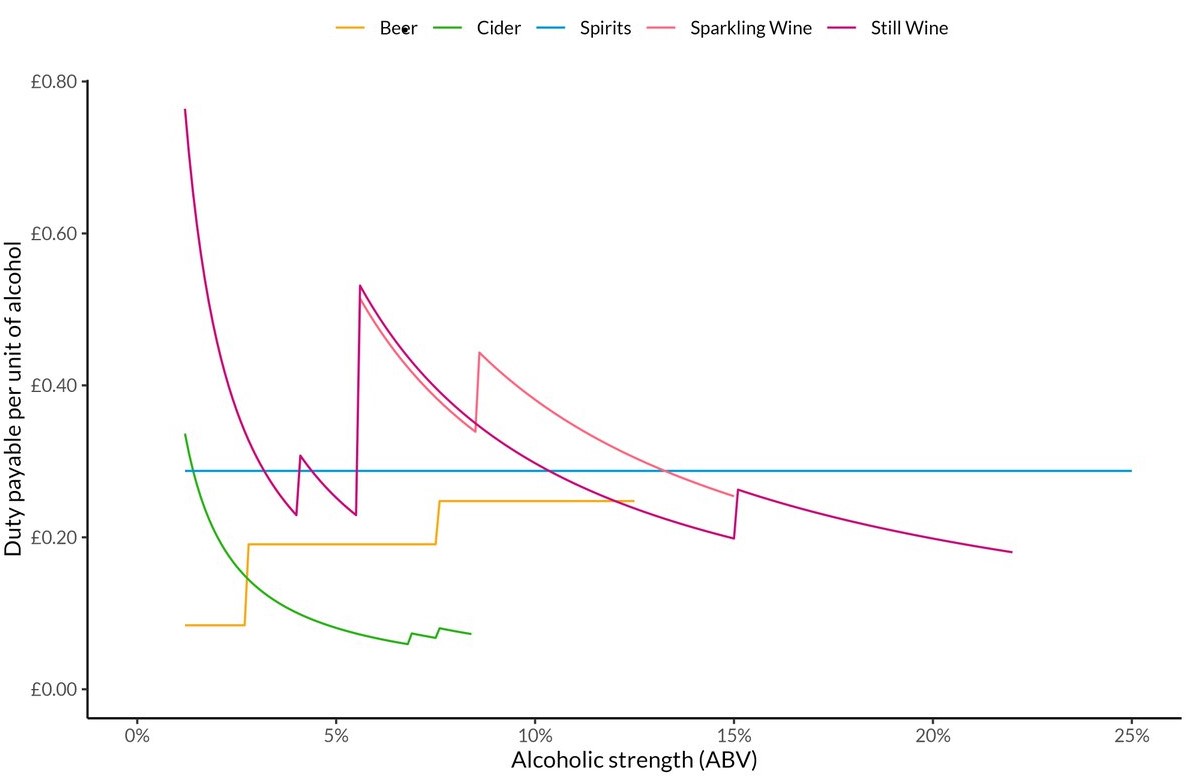
At this point, I pause to consider this week’s candidate for the wonderful graph award. Gaze upon this for a moment:

Look at that graph. I have stripped a few identifiers from it to get to the nub of the matter but it is from Colin Angus as posted under his handle @VictimOfMaths and came with this message:

The UK’s approach to taxing alcohol is stupid. In the budget next week there is a strong possibility the chancellor will overhaul it. Before we find out what he has planned, here’s a thread on what is the current system and what exactly is wrong with it? 

Thread. And it does all look stupid when put that way. Why is beer taxed at a higher rate as it strengthens while wine moves in the opposite direction? The actual changes to taxation were announced Wednesday. CAMRA wrote of games being changed. Matt had a summary as well as  particular view as to the taxed event within the supply chain which is useful:

…the consumer doesn’t pay that duty, nor does the pub. The producer does. So on a 9 gallon cask of 72 pints, that’s £2.16 off costs. Maybe a bigger saving if its below 3.5%…

Speaking of the graphical representations of data, Lars has updated his yeast family tree based on a number of recent studies and included lots of wonderful graphs as well as new info:

They also found a separate subgroup of African beer yeasts, which is very interesting. Africa has an enormous variety of traditional farmhouse brewing going on in many different countries over much of the continent, and many of those brewers still maintain their own yeasts. (Martin Thibault spoke about Ethiopian brewers and their yeast at Norsk Kornølfestival in 2020.) Now it looks like they, too, have their own genetic subgroup of yeasts.

Note: be flexible.

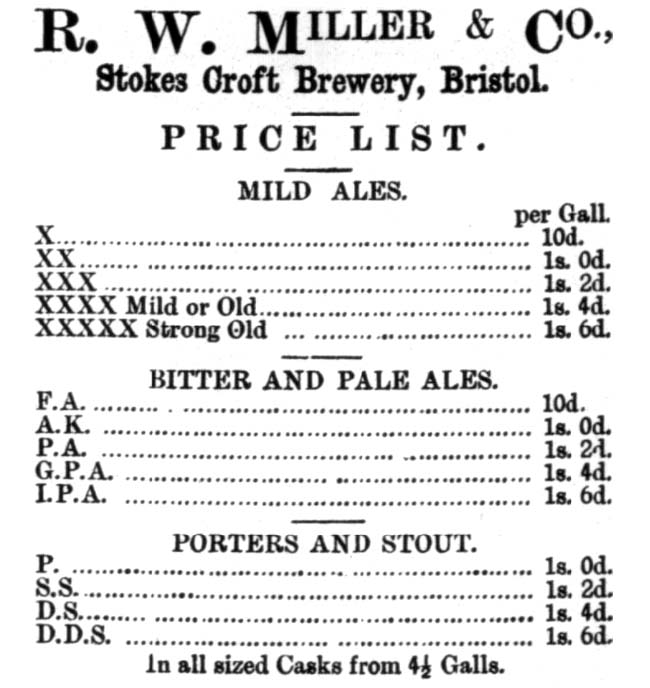
Finally, Boak and Bailey’s post this week on the Stokes Croft Brewery, Bristol, 1890-1911 contains this fabulous image which goes a long way to explain the gradation of late Victorian stouts and ales. I got all excited when I saw it. Lovely. Place a laminated copy in your wallet for handy reference.

There you go. A bumper crop this week. For more, check out the updates from that same Boak and Bailey mostly every Saturday and from Stan now on a regular basis again every Monday, plus more with the weekly Beer Ladies Podcast, and at the weekly OCBG Podcast on Tuesday and sometimes on a Friday posts at The Fizz as well. There is a monthly sort of round up at The Glass. There is more from the DaftAboutCraft podcast, too. And the Beervana podcast. And sign up for Katie’s weekly newsletterThe Gulp, too. And check out the Atlantic Canada Beer Blog‘s weekly roundup. Plus follow the venerable Full Pint podcast. And Fermentation Radio with Emma Inch. The AfroBeerChick podcast as well! And also look at Brewsround and Cabin Fever. And Ben has his own podcast, Beer and Badword which may revive some day.  And remember BeerEdge, too, and The Moon Under Water.

Your Thursday Beery News Notes For A… For A… I Dunno…

You can get in a rut about things can’t you. These headers for example. It’s just a thing. But a thing almost in a rut. Is craft beer in a rut? I dunno. It didn’t do anything new and stupid this week, did it? It is, however, like a thing that could find itself in a rut, isn’t it.  Makes people say odd things… like: “…not me, not my part of the thing… my thing is really a separate thing…” When things are actually fairly bad, people still take time to say that sort of thing. Because this thing is not like that thing. Not my thing. Can’t be. Never.

First up, the views shared by Alistair at Fuggles on home brewing around little kids ring true for me as I packed in my questionable home brewing hobby completely once we were well and truly surrounded by rut rats :

This weekend was the twins 4th birthday and with time speeding by at a fair old clip, it feels difficult to justify taking 8 hours, give or take, to brew an all grain batch of homebrew. While there is no shortage of decent beer to be had in the central Virginia region, either locally produced or from further afield, there are still times when I just want to drink something I have brewed myself. Enter pre-prepared malt extract.

Speaking perhaps of my home brewing, I found this piece on on imposter syndrome as suffered by women in the drinks trade interesting but I was particularly interested as I have known many men who admit to suffering from the experience as well, especially in law:

Imposter syndrome, according to the American Psychological Association, is a psychological phenomenon wherein you doubt your own skills, abilities, and inherent worth, no matter how much you achieve or accomplish. For many, it’s an inner voice that whispers, “you’re not good enough, you don’t know anything, and one day, everyone is going to find out… storytelling has the power to combat imposter syndrome; however, it will take a proactive effort to tell stories that go beyond the bylines, brewers, and old-boy’s networks that have dominated both breweries and beer journalism.”

Come to think of it, a lot of what sucks about craft beer sucks about law. Stress. Alcohol. Irrational expectations. But not the 50 kg sacks of grain. Even in my early 40s when folks wanted me in on a brewery I knew there was no way I could hack hauling around 50 kg sacks of grain. I wasn’t ever going to go there once I grew used to the seeming reassurance of the hard tight black shoes.

Next up? Just last week I wrote:

Thing never said in beer: “…and certainly thanks to all those who nominated the winners…” Oh… 

And this very week I am pleased to read:

Oh wow, this is huge. A massive thank you to whoever nominated me and a huge congratulations to all the other incredibly talented people on this list!

Which is great. More of this, please. And congratulations Charlotte Cook aka @ilikeotters along this the others who were nominated by even further others who, as nominees in the Best Brewer of Britain category, likely can in fact haul around 50 kg sacks of malt, nae doddle.

How to quit in style. Fabulous.

Careful readers out there will recall that I have a particular thing for the role of alcohol in early victualing of ships‘ holds. This week VinePair shared what dear old Ferdie Magellan was packing:

Documents from Magellan’s expedition cite a hefty 203 butts (barrels) and 417 wineskins — from the Jerez wineries in southwest Spain’s Andalusia region — made it onboard. Today, this amounts to nearly 243,000 liters of booze. Magellan and his crew must have really needed the extra liquid luck on the expedition, seeing as the cost of wine and other provisions amounted to 1,585,551 maravedis. Taking inflation and conversions into account, Magellan brought about $475,665 worth of booze on board. Researcher and crew member Navarrete noted in Document No. XVII that this number accounted for 20 percent of all costs on board.

Speaking of the ancient of days, Garrett Oliver himself guided me to this story in The Harvard Gazette about the scale of brewing in ancient Egypt:

Thanks to his recent excavation of a brewery in the ancient Egyptian city of Abydos, the senior research scholar at New York University’s Institute of Fine Arts may get his wish, and soon. But the excavation revealed far more than a way to reconstruct an ancient recipe for suds. The industrial-scale production — on par with today’s best microbreweries — offers direct evidence of the kind of power wielded by Egyptian kings.

I would have thought sustaining an empire for thousands of years might have been evidence enough of the power of Egypt but… you know… I am not a guy who went to Haaaa-vaaaard. Where they call beer suds!*

Evan Rail on hard seltzers: “I thought most of them were gross. A few were harmless but boring. Several were close to nauseating.” Exactly.

Gary Gillman (aka Gee-Gee… OK, not) went off on an interesting wander around what is/was and what is/was not the North American hop known as Neomexicanus care of a part called part one (including below) and part (…wait for it…) two:

…the sources mentioned seem to reserve “neomexicanus” for the Rocky Mountain, American-origin hop while “Manitoba” or “Canadian” describes another hop from North America. While classification as such for regional examples of North American wild hops is beyond my scope here, it might be noted that location – terroir, if you will – plays an important role for all hop attributes, even relatively locally as Stephens explains in her article.

I just don’t believe in #RauchBeerMonth.

Throughout the Commonwealth we hear comments about the news that Vanity Fair has reported: HRH The Sovereign Herself has got to cut back:

According to two sources close to the monarch, doctors have advised the Queen to forgo alcohol except for special occasions to ensure she is as healthy as possible for her busy autumn schedule and ahead of her Platinum Jubilee celebrations next June. “The Queen has been told to give up her evening drink which is usually a martini,” says a family friend. “It’s not really a big deal for her, she is not a big drinker but it seems a trifle unfair that at this stage in her life she’s having to give up one of very few pleasures.”

I dunno. Ninety-five? That’s when I start smoking menthol ciggies regularly. I’ve beaten the odds by then. No filters either. Something else is killing me by then.

Daniel Craig‘s choice of bars makes perfect sense:

“I’ve been going to gay bars for as long as I can remember,” the 53-year-old actor told Bruce Bozzi on the “Lunch with Bruce” podcast. “One of the reasons (is) because I don’t get into fights in gay bars that often. … The aggressive dick swinging in hetero bars, I just got very sick of it as a kid because it’s like I don’t want to end up being in a punch-up. And I did. That would happen quite a lot.”

Nice. Still, can’t go a week without reminding you all of how craft has failed once again, with some pointing out how BrewDog seeking to redefine arsehole ridden work environment with the phrase “high-performance culture” which guides one’s mind to the article on imposter syndrome up there… and perhaps thoughts on who exactly is the imposter in these cases?  The burdened worker or the poser jet set whiner?

I can’t even imagine how horrible having a fruit lambic with eggs benedict might be.**

In the category of “discussions of places I will never go” I came across this fantastic example of a buried lede in this quotey piece on a Cornish rarity, Spingo,  in Pellicle by Lily Waite:

“Spingo is the definition of a cult beer. It stands outside the ‘scene’ and, like [local annual festival] Flora Day, is about Helston doing its own thing,” says Jessica. “They bring out a new beer every twenty years or so and that’s it. The locals seem happy with Middle and, from our observations, seem to regard Flora Daze as a dangerous innovation. You haven’t really experienced Spingo until you’ve had a pint at 8am on Flora Day, dispensed from a hosepipe into a plastic glass. Magic.”

Speaking of Jessica, she and Ray visited Kirkstall Brewery in Leeds and provided a first hand report. The story illustrates how superior the web based beer writing can be if only that it is current.  Like radio reporting on a sports event, it’s fresh and immediate even if a snapshot of a weekend trip I wasn’t on and can’t realistically replicate. By contrast, the piece on Stingo above refers to a visit in June. Why the backlog? Why wait for Waite? Worse, of course, is when you have to read through something that comes out of a physical printing press.  Stale and via mail. Viva hands on laptops! Vivi!!

Viva indeed. For more check out the updates from that same Boak and Bailey mostly every Saturday and from Stan now on a regular basis again every Monday, plus more with the weekly Beer Ladies Podcast, and at the weekly OCBG Podcast on Tuesday and sometimes on a Friday posts at The Fizz as well. There is a monthly sort of round up at The Glass. There is more from the DaftAboutCraft podcast, too. And the Beervana podcast. And sign up for Katie’s weekly newsletterThe Gulp, too. And check out the Atlantic Canada Beer Blog‘s weekly roundup. Plus follow the venerable Full Pint podcast. And Fermentation Radio with Emma Inch. The AfroBeerChick podcast as well! And also look at Brewsround and Cabin Fever. And Ben has his own podcast, Beer and Badword – when he isn’t in hiatus as at the mo, more like timeout for rudeness! And remember BeerEdge, too, and The Moon Under Water.

*I love knowing that someone’s ass is burning by someone else calling beer “suds” because it totally disrespects their mild addiction cloaked as a hobby.
**Not to mention which fruit was lambicized before the eggs benedict was held hostage.

The Last Of August’s Thursday Beery News Notes

What was that? Summer 2021? Done? It’s still going on here as I am on an actual holiday and doing fun stuff like getting new spectacles for my face and a new electrical panel for the basement. Wooot! This is the dream and I am livin’ it. I even had 330 ml of a 3.8% beer yesterday and watched a Netflix show about the Korean buckwheat noodle dish naengmyeon, as recommended by DSL.* Both a drinking and then hangover dish apparently. Now I know why my buckwheat noodles suck. I didn’t immediately rinse and rub them in ice water. And, yes, a hundred other reasons. Never again. Probably. Maybe.

First off, it was good to read “The Ancient Magic of Malt: Making Malt Sugars and Ale from Grain Using Traditional Techniques” by sometimes reader Merryn Dineley in the journal EXARC.net,* 2021 (vol 2) who set the record straight:

This paper is presented as a historical narrative as well as being an explanation of basic ‘mashing in’ techniques. I aim to tell the story of the development of my understanding of how to make malt and malt sugars from the grain. I have learned from other experimental archaeologists, from ancient technologists and brewing scientists as well as from ethnographic research and the study of traditional style malting, mashing and fermentation techniques. One of the common myths about the origins of beer thousands of years ago is that grain was perhaps left in a container, it got wet and, somehow, turned into beer. This is impossible. The conditions for making malt and malt sugars do not exist in this situation. 

A bit later in time but still in the past, Rob Sterowski at “I Might Have a Glass of Beer” wrote about Epochal Barrel Fermented Ales, a brewery intent of brewing the old fashioned way:

Possibly the most erudite of Scottish brewers, Young deserted the world of academic philosophy to devote himself to a study of eighteenth- and nineteenth-century brewing literature instead, and Epochal Barrel Fermented Ales is the result. A skilled home brewer, he has set up his small brewery in Port Dundas to make beers influenced by the way it was done two hundred years ago. His beer is fermented with a multi-strain yeast, cleansed to rid them of excess yeast and then allowed to mature to completion in oak barrels with a handful of whole-cone hops. The finished product is naturally carbonated in the bottle.

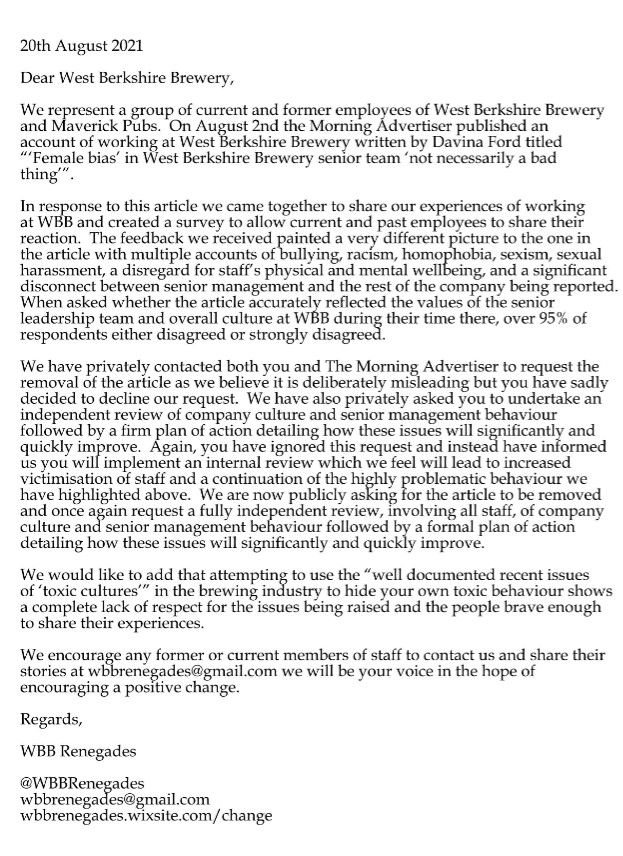
As Boak and Bailey noted, suggestions that the #MeToo and #BLM movements’ efforts to expose craft beer’s ugly side have faded were found wanting with the news of an open letter to England’s West Berkshire Brewery. You can click on the image to the right to read the complaints yourself. It is certainly one of the long failings of the drinking entertainment pleasure trade to address the piggish attitudes that go along with booze. So it is good to read that folk won’t be bullied to keep quiet when it comes to bigotry and harassment even if a lot of the privileged voices have wandered away.

I wasn’t familiar with English comedian Sean Lock. He passed away this past week but I am glad to know he had a hobby.

Update: I failed in not mentioning “Empire State of Mind” by David Jesudason published in GBH (thereby upping their average significantly) who looks at IPA from the point of view of the “I” as in India:

My father’s love of empire, and his belief that Britain was a civilizing force, was mirrored in the drink he called his own: the India Pale Ale. Of all of his beliefs, this one was particularly confused. His friends were Lager drinkers, and his adoption of IPA was a way of pretending to be refined in the days before the craft revolution had taken hold. But where he saw a drink that was emblematic of genteel, colonial India, I see something very different: Owing to the beer style’s association with the East India Company and its brutality, I can’t help but think of bloodshed, oppression, and enslavement.

I noted that it was an parallel to “Britain’s Idyllic Country Houses Reveal a Darker History“, the recent NYer piece on England’s National Trust but also cause for reflection on my own family’s path. One side included servants at big houses like that of the Collins publishing family as well as a great-grandfather who was a Sgt Mjr British army out in the empire while the other side, displaced highlanders in Greenock, built the ships that shifted the sugar that came out of the colonial system. Many died young, many had lives of if not poverty then at best modesty – with much drink caused troubles in industrial towns before many emigrated the hell out of there. If you have any doubt as to the way that IPA is code for empire consider this from that NYer article:

“At the end of the day, we went to a very, very, very rich country and transferred a lot of its wealth to this country, by trade, entrepreneurship, and looting,” Dalrymple said. In 2003, Angus Maddison, a British economist, calculated that India’s share of the global G.D.P. went from 24.4 per cent to 4.2 per cent during two and a half centuries of colonial rule. In 1884, the British state had a total income of two hundred and three million pounds, of which more than half came from its overseas territories, including seventy-four million pounds from India. Taxes were levied across the world and sent to burnish the metropole.

Good for someone to finally point out in depth the obvious issue with IPA as a placeholder for good beer.  Might as well brand US craft lager Berghof.

Note: craft.

One of Canada’s few pre-Confederations tavern/inns/hotels, the Queen’s Inn, is up for sale in my fair town. I wrote about it in 2004 when it was just 165 years old and I was only 41: and is ripe with history and charm:

…he remembers one particular customer who continued coming in until he was in his 80s. The gentleman, Mitchell recalled, was blind and had a booming voice. “Give him two drafts,” the bartender told the younger Mitchell. “We just put the price up to 50 cents. Have fun.” “I didn’t know what he meant. I put the two beers down and said, ‘That’ll be 50 cents.’” “Forty-five is all you’re getting,” the man bellowed back.

Another pandemic affected business. And, on that theme, Josh Noel pointed me in the direction of the tale of overzealous expansion which ended in the collapse  of Ale Asylum of Madison, Wisconsin:

Dilba said the pandemic “didn’t help” the business but added, “there were other extraneous factors, which I won’t get into, but the pressure applied by the pandemic was significant. And we’re not alone in that. Everybody in this world is in this fight together that really made moving forward very difficult.”

Factors cited elsewhere in the article include too many local beers, too many out of state beers in local bars and rent increases. Maybe also it’s because Americans are just drinking less, according to VinePair or, rather, the authors of the polling study they echo:***

Sixty percent is down nearly five percent from 2019. It’s down even more compared to 2010, when 67 percent of U.S. adults replied “yes” to the survey. There seemed to be a shift in drinking habits from 2019 until now. The average number of drinks per week (3.6) dropped to its lowest since 2001. Additionally, men (63 percent) reported drinking at a higher rate than women (57 percent).

Good reason to find another career than drinks writing! One person who does not care is likely Sister Doris Engelhard, the brewing nun in Germany whose story as told by NPR was the retweeted topic of the week:

“I only brew beer that I drink myself, so if the other sisters want to drink a wheat beer, they’ll have to buy it themselves,” she says. She also waves away any question about the intersection of her faith and her beer. “Beer is part of the Bavarian soul. If you’re not happy with yourself, you won’t be happy in a cloister,” she says. “And eating and drinking are part of that life. It’s not about being pious. All I need to do is believe in a higher power that accepts me as I am.”

Speaking of good stories about good outcomes, the BBC reported this week on the life of Cesar Kimbirima, a child soldier in Angola who found himself left for dead, now running a Wetherspoons pub:

…as the sky started spinning, and his consciousness faded to black, he thought it was over. His life would end in the long grass, while his blood poured into the dry Angolan earth. More than 20 years later, that dying soldier pours pints at the pub he manages in south London. As he chats to punters, and waves to babies in prams, there is no hint of Cesar Kimbirima’s former life.

There. That is it for now. Not sure if there will be an edition next week as I am driving to the sea. We will see. During these last lazy days, for more check out the updates from Boak and Bailey mostly every Saturday and (if I dare say) from Stan mostly every Monday, plus more with the weekly Beer Ladies Podcast, at the weekly OCBG Podcast on Tuesday and sometimes on a Friday posts at The Fizz as well. There is a monthly sort of round up at The Glass. There is more from the DaftAboutCraft podcast, too. And the Beervana podcast. And sign up for Katie’s weekly newsletterThe Gulp, too. And check out the Atlantic Canada Beer Blog‘s weekly roundup. Plus follow the venerable Full Pint podcast. And Fermentation Radio with Emma Inch. The AfroBeerChick podcast as well! And also look at Brewsround and Cabin Fever. And Ben has his own podcast, Beer and Badword – when he isn’t in hiatus as at the mo, more like timeout for rudeness! And remember BeerEdge, too, and The Moon Under Water.

*who once posed as me just to be nearer Lars.
**an archaeological foundation of some sort out of The Netherland with an address on the fabulous street, Frambozenweg!
***Hah! I’m one to talk.

Your Thursday Beery News Notes For The Quietest Week of Summer

Crickety chirp chirp. Not necessarily in the beer world but certainly in this part of Canada. Holiday long weekend leading into the first week of a summer month? Everyone is gone. I am even holding the fort solo as others jump in a lake at a family cottage. O sole mio. Naps followed by long sleeps abound. Fortunately, the amusements never end in boozeland as the exchange above best illustrated this week.

First, take a moment this week to remember Florencio Gueta Vargas who died on July 29th in a hops field in Yakima County, WA. He worked for decades in the fields but was overcome by temperatures in excess of 100F that day. He leaves behind a wife and 6 children. Workers like Vargas endure conditions most of you would never accept.

Archivally, interesting news out of North Carolina:

We’re in the process of picking up a HUGE donor collection of national importance. A research collection and personal archive going back at least until the late 1970s. Historians of modern US craft beer history and brewers are going to drop their jaws as much as we have.

I know of one other particular private collection which would be likely mind boggling if released but these are the realities of this sort of hoardy hobby world.  The recipient of the donation of 20 boxes describes itself this way: “Well Crafted NC documents beer and brewing history in North Carolina from the breweries of the 1700s to the craft breweries today.” They are also colleagues in the same publication series that includes my two histories.  Likely need more of those sorts of landing pads created in more jurisdictions as a form of careful succession planning.

Not unrelatedly, Gary has written another fabulous post on aspects of eastern European brewing in the lead up and during WWII. This time it’s an interesting bit of research related to the hops trade up to early 1941:

…American cotton might be paying for hops ending in American hands… Such cooperation between Russia and Nazi Germany was not inconceivable. The 1939 Molotov-Ribbentrop Pact, a non-aggression treaty, was still in force between the two countries. It only terminated when Germany invaded Russia in June 1941… It does seem clear America imported no, or very few hops from Germany after the European war started on September 1, 1939. The Royal Navy imposed a blockade of Germany that was generally highly effective, for one thing.

Stan popped in this week for a few Monday musings on three topics. “Why We Drink” caught my attention:

A bit of context for the “hard seltzer is dead, no it’s not” flap. “How Big Beverage poured empty promises down our throats” (from The Goods at by Vox) barely mentions beer, but you can connect the dots.

The two points he highlights from the article (and you will have to go to Stan’s to find the link… bloggy etiquette must be observed) are (i) “we’ve created an entire category of ‘functional’ beverages that claim to have the ability to make us better in every single way, from our brains to our beauty” and (ii) “Instead of collectively admitting that we love drinks… we would rather fool ourselves into believing that drinks can fix us.” It’s interesting as the entire ethos of craft has been build upon personal improvement, a step up. But this is intentional as before craft was created as we know it today, micro-brewing was being led down the pervy and wastrel path. It needed cleaning up… but has it gone too far with, for example, the nutso health claims?

Beer law news? Bloomberg Law reports that Bell’s Brewery has settled a law suit in another copyright infringement situation:

Michigan’s Bell’s Brewery Inc. reached a confidential settlement of a suit alleging its “Deer Camp” beer infringes a “Deer Camp” coffee trademark held by hunting goods company Buck Baits LLC.

Note that the wording used is identical and the offended party may have deeper pockets, h/t MK.

Sir Geoff Palmer has been appointed Chancellor at Heriot-Watt University, home of Scotland’s great brewing college. I came to his writing through the human rights side first and, in particular, have enjoyed his use of social media to argue for a new interpretation of many historical Scots matters including many of the same figures whose names pop up in Canada, like Dundas and Picton. But, yes, he knows more about beer than any of you, too.

What else is going on in the world? I like these cardboard six-pack holder thingies from Norway, especially given the way the plastic ones are killing the planet:

The WaveGrip carrier has been developed in line with Berry Global’s Impact 2025 sustainability strategy, which aims to work with customers to help meet and exceed their sustainability goals. Each carrier weighs just 7.95g for a standard six-pack and is recyclable in most paper and board waste collection streams. Despite its light weight, it is strong and easy to use, while delivering excellent pack retention.

Note: “Excellent Pack Retention” was the name of my folk-punk band in the 1990s.

Not speaking of which, interesting to read that Anheuser-Busch InBev revenues are up even if profits are not matching the full trend. So much for (again) craft the destroyer. That being said, likely they are selling seltzers and auto parts somewhere out in the world, making up for the general disinterest in beer.

From France, two views of the new vaccination passes to get into shops and bars:

“Long live the health pass!” said Chastelloux, who, like the others interviewed for this story, spoke in French. “You have the right not to get vaccinated but not to stop other people [from] getting on with their lives. Shopkeepers need to work, and we need to be able to treat other medical conditions than COVID.”

…and…

“Show a pass in order to drink a beer with your friends? In France? The so-called country of liberty, equality, fraternity? I’m giving up going to restaurants. I’ll boycott cafés. We can eat with friends around each others’ houses. And shop in small stores, not supermarkets,” he said.

Retailers line up on both sides, fearing lost sales in either case. Were this to come to pass here in Canada – with our local double jab rate approaching 75% – there might be less disagreement.

Finally, here is a bit of a bizarre take from Alaska on the problems facing brewing and other hospitality trades in terms of get employee levels up:

Virtually every brewery in the state is looking for help. Like in all industries, it seems like Americans aren’t returning to work post-pandemic like labor and economic forecasters thought they would. There are a lot of reasons for this, and I’m not about to go into the political side of the issue – that doesn’t fit my singular writing objective of “making people thirsty for good beer” – but the bottom line is that, if you want in, now’s the time. Servers, publicans and tap room attendants seem to be in high demand, but there’s room in the brewery, too, if you want to get your boots wet and stir the mash with the big boys and girls in the industry. 

By “not getting into the political side” I assume the author means the low wages, health and safety questions and non-unionized environments. Claptrap from a trade shill it seems.

As you nap away the hours, too, don’t forget to check out those weekly updates from Boak and Bailey mostly every Saturday, plus more with the weekly Beer Ladies Podcast, at the weekly OCBG Podcast on Tuesday and sometimes on a Friday posts at The Fizz as well. There is a monthly sort of round up at The Glass. There is more from the DaftAboutCraft podcast, too. And the Beervana podcast. And sign up for Katie’s weekly newsletterThe Gulp, too. And check out the Atlantic Canada Beer Blog‘s weekly roundup. Plus follow the venerable Full Pint podcast. And Fermentation Radio with Emma Inch. There’s the AfroBeerChick podcast as well! And also look at Brewsround and Cabin Fever. And Ben has his own podcast, Beer and Badword – when he isn’t in hiatus as at the mo, more like timeout for rudeness! And remember BeerEdge, too, and The Moon Under Water.

Your Thursday Beery News Notes For Mid-July

Beer season. This right here. This week. This is the week in all the beer ads. Mid-July. No “Back to School” sale ads on the TV yet and no freak snow storm hits Manitoba” news items of the Weather Network. Right here. Right now. The moment of beer. Perfect. I spent a similar perfect summer night, the night before last, stuck at the site of that weird weekend seven years ago with Ron Pattinson and hairy Jordan, when I stayed at an airport hotel full of wedding parties to save a buck. Well, I had to see my middle kid off on a plane so it only made sense to stay at the same place, right? No. Odd seeing the formerly jammed hotel essentially devoid of people. And devoid of services like food. I also had a work meeting from 5:30 to 10:45 in the evening by Zoom which was also odd to do in a hotel room. I don’t know how any of that relates to my new favourite web thing, pictures of dogs people have rescued that are really coyotes but there you go.

OK. Enough! Let’s get right to the good beer reading. There was a most thoughtful article on saison published by Joe Stange in Beer and Brewing. It provides great insight as to the methodology he recommends for formulating a beer.  Like this passage about grain options:

Chucking in different grains is fully in the spirit of saison. Keep it intentional: Know what malted or unmalted grains are going to do to your flavor and body, and choose them based on the profile you want. Wheat and spelt can bring softness and nutty, lemony notes, for example. Rye tends to bring peppery notes along with a certain smoothness. Or keep it clean and bright—Saison Dupont, after all, is brewed with 100 percent pilsner malt. 

Know. Great word choice. Best line: “I’ve never had a saison that was more drinkable because of spices, but I’ve had many that would’ve been more drinkable without them.”

Top tier side interest from Katie MatherSpeedway!

I was delighted to find Shove it, Chuck it, Toss it… a blog about English pub games, a topic near to my heart and largely distant from my experience. Consider this detailed description of The Princess Royal in Taunton, Somerset including facts facts facts like this:

With social distancing rules in place for another couple of weeks at least, pubs of all sizes are having to be very careful and creative around the potential for crowding, particularly during large sporting events like the EUROs. Some of the more traditional West Country pubs are better equipped than most to deal with these issues thanks to their (currently mothballed) Skittle Alleys. The Princess Royal is one such pub, with a substantial Twin Skittle Alley/Function Room that’s currently being put to good use as an overspill to the main bar when things get a bit too busy.

Staying in Britain* I spotted this excellent observation on the state of cask ale from El Mudgeo:

You might well think that, if cask beer is struggling, there is already an organisation ideally placed to champion and promote it, and indeed incorporates it in its name. However, over the years, CAMRA’s objectives have multiplied and become more diffuse, and cask beer itself doesn’t seem to feature very high on its list of priorities. No doubt many members will say that Marston’s beers wouldn’t be much loss anyway, while happily sipping on a keg mango sour in the craft bar. It is a touch hypocritical to claim that you are campaigning for real ale while at the same time dismissing most of it as not really worth drinking.

Excellent continuation of the story of a walk from Max:

The place I wanted to go to was about 7 km away, but the walk promised to be mostly under the sun and I just couldn’t be arsed. Fortunately, there’ s a train leaving regularly from the town’s main station that would take me (almost) there in a few minutes – it was a no-brainer. But what to do with the time I would save? Pivoing, of course; I remembered Minipivovar Labuť still had a few beers I wanted to try.

Excellent continuation of the story of Charleston:

Mr. Sammy Backman has been a family friend since I was three years old. A significant part of my upbringing took place on James Island at Backman’s Seafood, a family-owned dock and seafood market that’s been around since the late 1950s. In my life, I’ve never referred to him as anything other than “Mr. Sammy.” “Back then, Black folks didn’t own any boats. It was hard for us to get loans,” Mr. Sammy says. “My mother once paid off a $100,000 loan, only to have the bank ask for collateral when she later asked for a $10,000 loan.”

Excellent story elaboration via Twitter from Dr. Christina Wade:

We also have an Old Babylonian text from Ur, which is basically one giant insult, which among phrases like ‘’You are the one who disappears from work” and ‘you raise an afflicted hand in order to eat food’.

The Tand wrote of “the Beer Police” which is nice if only because it reminds us that folk are getting back to normal and fretting over nothings:

It is funny how tables have turned, but didn’t CAMRA with its erstwhile disapproval of keg beer, used to get the same Beer Police allegations thrown at them? For the record CAMRA is all about choice with an emphasis on cask ale. In line with that, my drinking last Thursday, with its overwhelming predominance of cask, fully complied with this. “Take that Beer Police.” The Beer Police have also been having a pop at us Bass drinkers. Liking Bass is harmless, doesn’t mean approval of Molson Coors and there are bigger beery fish to fry, so lay off.

Speaking of Ron, he discovered that Canada was in fact part of the British Empire in both the spirit and letter of the law this week:

Have you spotted my current theme yet? Obviously, it’s Canada. Only joking. IPA…  Away from the topic of this post: Canadian IPA in the late 19th century. I’d forgotten that I had these. It was only when I started going through my analyses of IPAs that I spotted them. That’s the problem with having so much information. You can’t remember all of it. What strikes me is the similarity to domestic UK IPA. (Only because I was looking at those yesterday could I remember.). The Canadian versions average out a little stronger, by 3º in gravity and 0.34% ABV. While the rate of attenuation was a little lower, but still very high.  Still, a striking similarity between the two sets, despite being brewed 50 years apart.

And finally, more “BrewDog sucks” news at VinePair which is really getting so common is it even really news anymore?

Posts on the shareholders-only, company-run BrewDog EFP forum, reviewed by VinePair, suggest that the brewer has at times struggled to deliver on the perks it has promised its punks. A November 2020 thread has become a 2,000-posts-and-counting clearinghouse for equity punks’ grievances, ranging from long-delayed deliveries and reduced “lifetime” discounts, to poor communication from the company in which they’ve invested. “By the way still no EFP beer after waiting nearly 2 years,” posted a frustrated punk. “For a beer company that makes beer, wastes beer, pours away beer, makes more beer … is it really too much to send said beer to it’s [sic] shareholders as promised?”

Yes, it is too much. Because that was not the point of giving them money.

Contrary-wise to all the foregoing, have you noticed the over use and misuse of “nuance” in beer chit-chattery? It seems to be getting worse.  Tends to ultimately mean “my point is not being well made” as far as I can tell. In this moment, the second and third level writers** (none of which are mentioned above) seem to be jockeying*** a bit like the first level ones did not long after Michael Jackson died. That was more subtle. Folk suddenly added “top beer writer” to their web bios. Within days. “Top not dead beer writer” was more like it. Anyway – and as with “leading” – I think “nuance” is a marker of some sort. But what? Jockeying for the small cheques docile compliance offers? And how does it relate to finding yourself washing a coyote in your bathtub?**** I only mention it as I have to wade through the stuff each week.

That’s all for this week. For more, don’t forget to check out those weekly updates from Boak and Bailey mostly every Saturday, plus more with the weekly Beer Ladies Podcast, at the weekly OCBG Podcast on Tuesday and sometimes on a Friday posts at The Fizz as well. There is a monthly sort of round up at The Glass. There is more from the DaftAboutCraft podcast, too. And the Beervana podcast. And sign up for Katie’s weekly newsletterThe Gulp, too. And check out the Atlantic Canada Beer Blog‘s weekly roundup. Plus follow the venerable Full Pint podcast. And Fermentation Radio with Emma Inch. There’s the AfroBeerChick podcast as well! And also look at Brewsround and Cabin Fever. And Ben has his own podcast, Beer and Badword – when he isn’t in hiatus as at the mo, more like timeout for rudeness! And remember BeerEdge, too, and The Moon Under Water.

*Unlike that trophy…
**The finest of the regularly wrong, much more so than that boogieman “the media“!
***It’s all a bit of a status v. merit struggle, like the 1790s tensions between the Washingtonians and the Jeffersonians. Whiggery depended on the mutual acceptance of status regardless of merit whereas libertarian might is right principle was all about the cacophony of the aggregate ends justifying the means. Whigs give us the small intense circle of praise seal mitten cartoons from Ackbar planet and the textual equivalent. Whigs praise each other as important. That makes them important, too. See? But who can really be trusted? None. Who is an expert? Nobody. In a small pond with too many fish for the available oxygen, things get rough. These aren’t those early days by that small lake at William’s Coopers Town.
****Other than, you know, the seeming requirement to be fundamentally wrong about obvious things.