Last of the Speakeasies?

Big news from a little place. One of the last vestiges of the prohibition-era speakeasies of the first half of the last century has left the scene in Canada’s smallest province. 
CBC PEI reports
:

In 1900 Prince Edward Island became the first province to ban alcohol. It was the last to end prohibition almost 50 years later. However, there continued to be dozens of bootleggers around the province…

It seems Charlottetown’s bootleggers have raised the white flag, choosing to close their illegal establishments in the face of tough new legislation passed by the Binns government. The bootleggers run illegal bars in homes. The houses are gutted, a bar is put in, and the people who run them resell liquor and beer. They don’t have liquor licences, and don’t conform to any provincial or municipal laws. They’ve been raided, railed against and reviled. But mostly, they’ve been tolerated, selling booze for much cheaper prices than legal lounges and nightclubs. That’s until this past weekend, when the doors of the known bootlegging establishments in Charlottetown were suddenly locked.

The writing has been on the wall for these illegal bars – one of which is illustrated as shown on the CBC PEI website – for a few years since a man died at a table and was not detected as being dead for some time. It is interesting to note, however, that on the main street of Ogdensburg, NY, one of the last holdouts of British North America in what is now the eastern USA, these sorts of small home-sized bars do operate under license as one might also see in St. John’s Newfoundland. With any luck they will become similarly licensed in PEI but that may destroy some of the attraction to their customers who took advantage of after-hours drinking and unregulated low pricing.

Of somewhat finer interest is the use of “bootlegger” in PEI for an illegal bar. Growing up in Nova Scotia it meant an illegal retailer only.

An Ordinary Bar in Bayonne, France

[This post was authored by Bruno Bord.]

Cold November late afternoon. I’m entering an ordinary bar in Bayonne, in front of the market. There are half a dozen of customers, drinking coffee, tea, milk with chocolate. The bartender says a loud “hello” as I sit at the bar. I often sit on bar chair, lean on the counter.

Bartender: What will you?…
Me: Well… What kind of beer on draught do you have?
Bartender: Well…Kronenbourg.

Only Kronenbourg. All right. It’s not the best beer, but if there’s no choice…in France, when you order beer, the usual glass is the demi. France invented metric system, but some remains of the old days are still alive. A demi is in fact about half a pint, rounded to be 250ml. While a pint is being named distingué, and a liter of beer is a formidable (which I think means “smashing” – who knows why?)
Me: How much?
Bartender: Two euros.

France had changed its currency in the beginning of the century, as millions of people in Europe. Now, everyone counts in Euros, which are about a USD worth. Prices on everyday products are rising at a dangerous rate, not only because of the economic crisis. The government raises heavy taxes on alcohol (and tobacco) to struggle against alcohol and tobacco-addiction.Kronenbourg. The ordinary beer. Low price. Low quality. Better draught than from a bottle, though. As I am sipping my glass, I’m looking in front of me. There are shelves, with bottles on them. A lot of them are not beer, in fact. Strong alcohols, mainly. Four bottles of beer on the shelf. Adelscott (a smoked malt beer, with a sweet sugar-like taste), Leffe Blonde (a Belgian you may have already read about), Blanche de Bruges (a Belgian wheat beer), and Pelforth Brune (a French brown beer, very good in fact). Well… That’s not large as a choice as the newly born beer writer might want.

A man enters the bar. He says something I don’t get to the bartender. It’s obviously Basque (or Euskara), one of the oldest languages in the world, and maybe the oldest tongue in Europe. This language comes from “nowhere”. Well… not really from nowhere, but actually no one knows exactly where and when it comes from. The Basque culture is really alive and strong in the Basque Country population, and its unique language is one of the most important part of it. I often see the colorful sticker “Euskara badakigu” on the door of some shops, or bars, it means “Here, we speak Basque”.

I assume that the bartender and the customer are talking about the latest rugby results. Rugby is the most important sport in the south-west France, way more than football (yeah, it’s not soccer here – it’s football). And Bayonne has a long rivalry with Biarritz. The two cities are five miles away and the two rubgy teams are deadly enemies. It’s the fight against the rich-and-smart city (Biarritz), with a bunch of highly-paid stars playing in the team, against the popular and young student populated one (Bayonne). The discussion between the bartender and the customer is now part French, part Euskara.

My glass is empty now. I’ve got to leave. The sun is low on the horizon. Usually, November is a rainy month on the coast. By the way… every month is rainy, here. There are many bars in Bayonne, maybe too many. All kinds of bars. From the Irish-ish pub to the Cuban bar, from the upper-class café to the drunken factoryman’s hangout. But I really need to find a good bar specializing in good beers.

Irene’s, Bank St., Ottawa, Canada

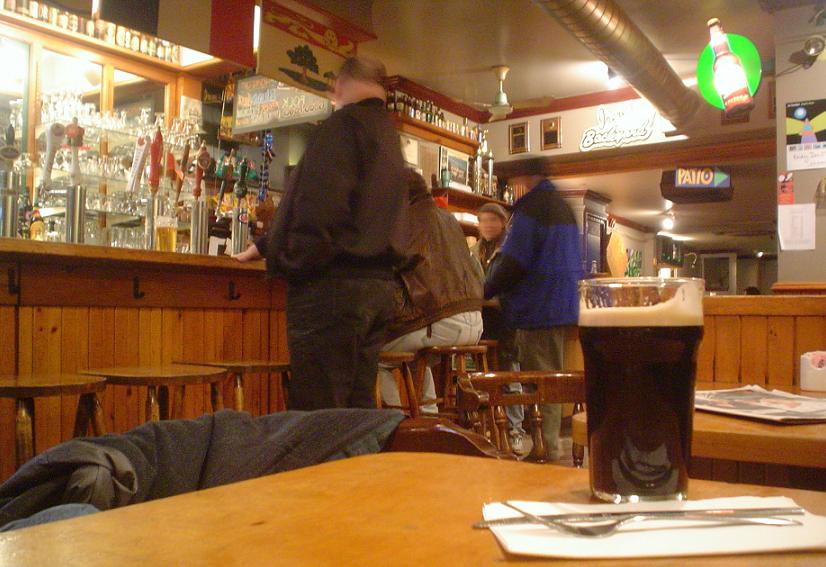
Last night before going to see the Pixies, the siblings and I took advantage of the moment to visit an old friend, Irene’s pub in Ottawa’s Glebe district. Irene’s is a neighbourhood bar which means it is not necessarily the place to take someone on a first date unless you are on a serious testing night-out. If she agrees to go to Irene’s again, she wins. If she suggests going to Irene’s again, you win.

Opened in 1985 as a sort of Maritime Canadian bar in Upper Canada, its almost 20 years of experience shows in the honeying pine of the wainscoting and the furniture, the colour of good real pale ale. I have seen bands play there, ended work weeks there with pals, had dinner parties collapse into it and wished often I lived nearer to it. People there can be loud. They can also be worse for wear for the night – or even for the decade. A little harder than the Pilot House in Kingston but the same idea. The beer selection is pretty good but not great. The Guinness moves well, however, meaning it is always fresh. Upper Canada Dark on tap is also a good choice. I was driving so those were the brother’s choices.

The Queen’s Inn, Kingston, Ontario

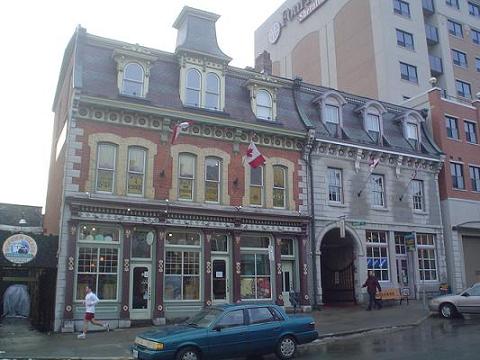
When I was going up to find the back view of the Royal Tavern the other day, I passed this pub and realized that it said established 1839 on the awning. For those of you in outside of North America, this may not be extraordinary but for Canada – especially west of Quebec – operating establishments of any kind older than, say, 1900 are rare. Far rarer are bevvy related things of that age as we had prohibition for a good chunk of the period before WWII. In PEI this lasted decades, from before WWI to after WWII. As a result, few aspects of the inn and pub life of the place remain. Ontario’s prohibition lasted only from 1919 to 1927 but as this article points out the rippling effects of misguided do-goodery were felt for decades.

I had suspected the Queen’s Inn in large part due to the brick wall seen in the alley and the somewhat phoney limestone rebuild out front but when you get back behind the place you see the real history. The brick wall in the alley must have been pit in when a neighbouring building was removed and you can clearly see from the rear views to the left and below that the limestone walls are indeed of the early or mid-1800s, rough and irregular. Similarly to the Royal Tavern, to the post on which I have added two exterior rear shots, there is the monarchist aspect to the name, too, that requires a certain age for the use of reference to the Crown to be grandfathered.

Also like the Royal Tavern, I have yet to make a stop at this pub but will do some interior reconnaissance soon.

Pilot House, Kingston, Ontario

Another in my occasional series on the pubs of Kingston. This is at the corner of King Street and Johnson. Half a fish and chip shop, half pub. This is our version of Chess’s of St. John’s, Murphy’s of Truro except it has Guinness on tap. Your choice of fish and chips includes smoked cod. Seats about 30. The outside patio along the right side of the building in the picture was getting put up yesterday. Summer is a comin’ in.

Later: Here is a November morning shot of the Pilot House.

The Royal Tavern, Kingston, Ontario

My days of bar hopping are long past. The five and a half years of rural life which wrapped up a year ago did its best to kill the habit geographically as did the advent of kids. There are, however, things that are habits and things that are personality traits and I think that the architecture of bars will always interest me. One class could be called the hard little place, that is not a sports bar, not a pub, not a road house. It might be a neighbourhood bar if you didn’t like the neighbours. The old Victory Lounge, formerly in the Lord Nelson Hotel in Halifax, Nova Scotia, or The Green Dory in the Halifax Shopping Centre come to mind as examples as does The Hillsborough Hotel (aka “the hug and slug”) in Pembroke, Ontario. I may, with such an introduction, be slandering the Royal Tavern on Princess street on one particularly non-gentrified block but the place simply does not invite. I would be interested in being proven wrong.


I thought that the adjective “Royal” was not permitted except with government permission. Indeed, as no doubt you all shouted as one at the screen ust now, look up section 10(1)(a) of Ont. Reg 122/91 which makes implying a connection to the Crown a dodgy matter. Did the Queen Mum put in a good word? Maybe she stopped there once in 1937. Most likely the name is saved by section 12(1) and the grandfathering clause for pre 1991 uses. Glad we cleared that up. The phoney Dickensian touches on the exterior, like the Ye Oldie font illuminated “Tap Room” sign over the door, are intriguing but you can bet the inside will disappoint, that the only thing on tap might be Labatt Blue. Actually it kind of looks like a location for a meeting of toughs on Canada’s first coroner TV drama from the late 60’s, Wojeck. The mock ecclesiastical glass and angled door, detailed below, are interesting but somewhat weird touches. I will have to look again but it appears that to the left of the building there is a filled in carriage arch which would have led to a back stable. There are still a number of these arches around the town. There is one great one in Charlottetown, PEI in a wooden house on one of the streets behind the former The Harp and Thistle.


Later: The carriage way is confirmed and even advertised. Apparently the place is very old on the inside even having cobbled or stone floors.

The other day I went back to get the exterior of the rear and was glad to see that the old limestone and double dormers are still there. At City Hall, there is a framed 1875 business directory map of the downtown which shows the building as having the twin dormers and an enclosed walled space out back. From the view below of the inelegant car park you can see reminants of the old walls to both sides of the property with the capping of the wall to the left apparently still intact. Likely it was for horse barns and other out buildings, it is kind of nice to imagine a walled ale garden circa 1840. Come to think of it, though, it is three dormers I am looking at with the one to the right being over the carriageway. The carriageway now feeds into the lean-to like addition to the right of the picture.