The Delightful Yet Pensively Penultimate Beery News Notes On A Summer’s Thursday For 2025

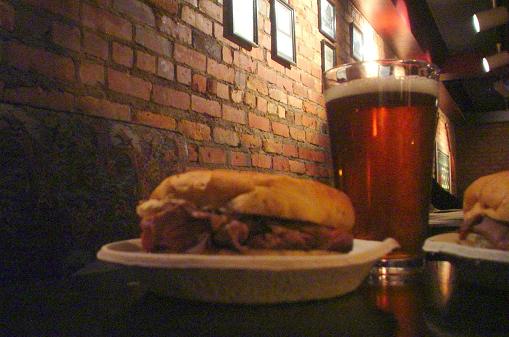
It’s been a busy week but not really in the beery sense. Guests and heirs have come and gone – and even bought a $14.99 beer on the way out via an airport bar at Montreal, as illustrated sub-wonderfully perhaps. A last bit of summer visting and the shedding of the last loonies and twoonies. Which means the home is quieter here at this end of the week compated to the other. Which is good. But quieter. At least I have my tomatoes. Did I mention my tomatoes? Definitely illustrated sub-wonderfully, that yellow one in the upper left weighed in a 1.7 pounds. And I did nothing to make it happen. Which is my favourite and most common form of success. Six varieties left to right ish clockwise: Chiltern’s Blue Bayou, Baker Creek’s True Black Brandywine, Chiltern’s Golden Sunshine, Baker Creek’s Kentucky Beefsteak, Chiltern’s Beefsteak and Baker Creek’s Orange Icicle. Picked from the catelog based on the “pin tail on donkey” method. All started from seed last winter and soon getting turned into sauce. That True Black Barleywine is the best tasting tomato ever – like it has built in balsamic vinegar. Thanks for tuning in to Tomato News Today!

First up in the world of beer, the Tand himself has also been out and about on travels and has reported back on the scene in Munich – and found out that certain things were not to be found:

Sadly, you can’t find Pils on draught anywhere, and for reasons best known only to themselves, Spaten insist on offering the dreadful Beck’s as their bottled pils in their most prestigious outlets. It appears Spaten Pils, which I recall was a lovely beer, is no longer brewed. A real shame.  In fact, Spaten it seems, only brew Helles in both normal and alcohol-free forms and, of course, an Oktoberfest. It gets worse. The whole shooting match of Spaten-Franziskaner-Löwenbräu-Gruppe is owned by AB InBev, who presumably have streamlined the brands available, though under the Franziskaner brand you’ll also find weissbier and a kellerbier.  Like Spaten, the rather delightful Löwenbräu  Pils has been dropped. It is a pretty grim picture as the odd hoppy pils provided an alternative to Helles, which in its Munich iteration, can be a little sweet, and dare I say, bland? (The locals call it “süffig”, meaning “easy to drink”. And, in fairness, it is.

And over at Pellicle, Matthew assumed the role of player / manager and reported on his travels to the French & Jupps Maltings in Hertfordshire where he found a hidden truth:

Its long history stretches back to 1689, and for more than a century the maltster has been based in the twin Hertfordshire towns of Stanstead St. Margarets and Stanstead Abbots, bisected by the aforementioned Lea, some 30 miles north of London as the crow flies. There are a few reasons for its relative anonymity—I myself hadn’t heard of them until I was invited for a visit in February 2024. One is due to the fact its malt was (and often still is) bought in bulk and rebagged by various distributors before being shipped out to breweries. And so, it might bear the name of a competitor—although in this context it’s perhaps more accurate to refer to them as partners—in the US, for example, the malt is typically sold under the William Crisp banner.

Sneaky sneaksters! Did you know? (Did I? Never mind that… let’s make this about you.) Did you??? Speaking of hidden truths, Pete Brown had a has retrospective on BrewDog, now well in to the post-Watt era and even into the post-Dickie, published in The Morning Advertiser that he unpacked into something of an obit:

To me, they always felt more like a band than a brand – not least because they wanted to be seen as punks. Bands are different. When none of the original members remain, many former fans insist that it’s simply not the same band any more, and that the newcomers who have taken over, singing songs they never wrote or had hits with, are no better than a covers band. The departure of Martin Dickie feels like the last member of the original line-up has left the building. The entity that remains may own the rights and assets of BrewDog, but it has lost the spirit and soul that once defined it… Dickie remained silent throughout. The initial allegations referred to a “cult of personality” built around both men, but specific personal allegations were focused on Watt’s behaviour. After Dickie’s departure, some former employees took to social media to say that he was “part of the problem.” 

Wonderful. I have never understood how Dickie, co-exec past and board member still, has had the teflon wrapper that he has enjoyed through downturn after downturn on what must be one of the most note worthy financial flops in recent brewing history. But perhaps it’s been a case of not noticing that scratch on your hand due to the nail in your foot.

Speaking of endings, Ed the Beer Father has shared his thoughts on the closing of Banks of Wolverhampton, mapping a fairly complex set of international bobs and weave that led to the end:

Eleven years ago the two companies with rights to San Miguel beer, San Miguel Brewery (Philippines) and Mahou San Miguel (Spain) signed a cooperation agreement to promote their international businesses and position San Miguel as a global brand. To further its growth they had already partnered with Carlsberg to contract brew it in Britain, and it was a large part of the output of the Northampton brewery. But for a brand with global ambitions partnering with the world’s biggest brewery seems like an obvious match… So, as what I believe is part of a global realignment, last year San Miguel moved its contract brewing in the UK from Carlsberg to ABInBev. Losing the San Miguel contract left Carlsberg in the UK, which owned one giant factory and two large regional breweries, with a lot of surplus capacity. The giant factory wasn’t going to go and Marston’s has the small pack facilities, which left Banks’s. So a contract change for a Spain and Philippines based international lager brand closed a 150 year old brewery in Wolverhampton that didn’t even brew it. 

Lordy. Speaking of things making one’s head spin, I totally missed Stan‘s post before the Labour Day weekend on the nature of beer bubbles so I will correct that error now:

There is more to monitoring beer foam than counting bubbles, although they are the foundation. They result from nucleation, and as those bubbles climb to first form or then replenish the foam head, proteins and bitter substances are carried into the bubble wall, forming a matrix that holds the skeleton together. In his doctoral thesis, “Beer Foam Physics,” A. D. Ronteltap calculated that a foam 3 centimeters high (a bit less than 2 fingers) in a glass 6 centimeters wide (a bit less than a Willi Becher) made up of bubbles with an initial radius of .2 mm (twice the width of a human hair) would contain 1.5 million bubbles distributed over about 100 layers.

Over a million bubbles! Not quite millions and millions but more than one million. And, while the numbers aren’t quite confimed yet, Jessica Mason pulled out the stats as she reported on the question “Can Gen Z save cask ale from extinction?” for Drinks Business:

Statistics from YouGov for the Society of Independent Brewers and Associates (SIBA) have shown 25% of 18 – 24-year-old beer drinkers regularly order cask ale. The figures mark an increase of more than 50% on the previous year… Digging deeper into the SIBA figures, there are also statistics that support the opportunity that women present in the future of cask ale’s revival. For instance, the data revealed how 22% of female beer drinkers regularly order cask ale, compared to 43% of men. But, as Corbett-Collins noted: “It would be great to see even higher numbers, but the glass half full fact is that men and women of all ages are enjoying cask beer.

Out and About Update: Max mapped a 29 km(!) pub crawl he took through the Czech countryside to plant himself in front of a beer at Únětický pivovar, Zdibský pivovar and Polepšovna ducha as well as a few other spots. I marched about a tenth of that the other weekend and my left knee let me know about it for more than one day. Good thing Max kept up a good pace because apparently, according to the white coated eggheads in the Netherlands, beer drinkers are a prime target for mosquitos:

To find out why the blood-sucking critters prefer some people over others, a research team led by Felix Hol of Radboud University Nijmegen took thousands of female Anopheles mosquitoes to Lowlands, an annual music festival held in the Netherlands… Participants who drank beer were 1.35 times more attractive to mosquitoes than those who didn’t. The tiny vampires were also more likely to target people who had slept with someone the previous night. The study also revealed that recent showering and sunscreen make people less attractive to the buzzing menace. “We found that mosquitoes are drawn to those who avoid sunscreen, drink beer, and share their bed…”

Speaking of getting bled, I received the alert from Will Hawkes: “Sorry to be right about this. No GBBF next year as it made ‘a substantial loss’, according to CAMRA.” As per usual and FOR THE DOUBLE!!!… Jessica Mason has more detail:

CAMRA chairman Ash Corbett-Collins explained how “at Members’ Weekend earlier this year, the national executive presented finances that painted a stark picture. As your chairman I was open with you; we were facing significant challenges… Corbett-Collins lamented: “Sadly, this means I must tell you that: The Great British Beer Festival and its Winter counterpart did not attract enough visitors to cover the cost of holding them, resulting in a substantial loss.” Added to this, he revealed that CAMRA’s membership figures “are simply not growing” and confessed that “the hard truth is we are unlikely to return to pre-2020 levels”… and noted how “the cost of running a membership organisation and business is also increasing”.

This is a pretty serious situation as it really looks like a broader issue than just the fests. The organization itself seems to be at risk. I expect more information to be flowing in the coming days.

In the “WAR ON SCIENCE” folder, we read the news out of The New York Times that everyone’s favourite slowly exploding head in charge of the Department of Health and Human Services has pulled the US government’s pending report on alcohol as part of a healthy diet:

Mike Marshall, chief executive of the U.S. Alcohol Policy Alliance, a nonprofit that aims to reduce the harms of alcohol, said H.H.S. was “doing the work of the alcohol industry.” “They’re burying the report so the information about the health consequences is not widely known,” Mr. Marshall said. Health Secretary Robert F. Kennedy Jr. has decried a “chronic disease epidemic” sweeping the country. But he has said little about alcohol’s impact on American health since taking office. Consumption of both alcohol and tobacco was absent from the first Make America Healthy Again report released in May. Mr. Kennedy (like his boss, President Trump) has said he does not drink.

It’s important to note that Mr. Kennedy, unlike his boss,  does not wear makeup preferring to gain his particular rusty orange hue through a natural process.

Finally, just before this organ went to press, the dynamic duo B+B posted a piece under the fabulous title “Customers Have Always Been a Problem for Pubs” which illustrates the truth based on a sppech given in 1933 by one Lieutenant Colonel E.N. Buxton, director of the East London brewery Truman, Hanbury & Buxton:

The talk finishes with a few more rebukes for the drinkers. First, the reason pubs often look so ugly, and are so sturdily built, is because “you do not treat them so kindly”. “Walls and furniture are roughly treated”, he says. “As for the outside of public-houses, I agree that some of the houses in London look perfectly ghastly. Hard wear, however, had to be the first consideration.” This was addressed, remember, to a room full of people from Bethnal Green. We’re picturing the crowd when Bertie Wooster sings ‘Sonny Boy’.

Fabulous. There. That’s a lot for a busy week but probably less than all the stuff our there to read so please also check out the afore mentioned Boak and Bailey every Saturday and sign up for their entertaining footnotes, too. Look out for Stan when he feels the urge now that he’s retired from Monday slot… maybe … maybe not. Then listen to a few of that now newly refreshed Lew’s podcasts and get your emailed issue of Episodes of my Pub Life by David Jesudason on certain Fridays. And Phil Mellows is at the BritishBeerBreaks. Once a month, Will Hawkes issues his London Beer City newsletter and do sign up for Katie’s wonderful self-governing totes autonomous website featuring The Gulp, too.  Ben’s Beer and Badword is out there with the all the sweary Mary! And check out the Atlantic Canada Beer Blog‘s weekly roundup. There is new reading at The Glass which is going back to being a blog. Any more? We have Ontario’s own A Quick Beer featuring visits to places like… MichiganAll About Beer offers a range of podcasts and there’s also The Perfect Pour. Plus follow the venerable Full Pint podcast! And there’s the Craft Beer Channel on Youtube. Check out the archives of the Beer Ladies Podcast. That’s quite good and after a break they may well be are back every month! Such is life. Such is beer podcasting and newslettering… which, as Ray says, are blogs! And he’s right.

The “But… He’s Just Mailing It In From Vacation!!!” Edition Of The Thursday Beery News Notes

Yup. Big news this week? I am trying to nap in as many spots in the house or out in the yard as I can. I’ve yet to try that awkward chair in the back rec room but I still have my eye on it. It’s all so pleasant. The evening air is now cool enough that you can hear the crickets across the backyard fences over because no one is running an air conditioner anymore. Fact is I haven’t had a week off with nothing to do for quite a while and, I gotta say, I am liking it. Regular readers may tell you that I am good at doing nothing but I just don’t get to do it… or, rather, not do it… enough. So far I’ve dozed to baseball on half the waking hours, “worked” on cleaning up the garden and exhausting myself planting a few more seeds in a few more pots with something to eat before the frosts close in, gawked at a double rainbow – and even put on a belt to hit a BBQ place on a Monday night where I found a shot of Makers Mark to sit next to my pint.

Speaking of bourbon in Canada, Jeff did some solid inquiring into the effects of the chill in Canadian-US relations as it applies to booze. As I have mentioned a few times, up here our provincially run booze systems (other than the Randians in charge of Failberta and Assbackchawan) have taken all US booze off the shelves. Jeff shared what that looks likes from the south:

California Cabernets, Oregon IPAs, and Kentucky bourbons are all world-class beverages, but they’re not irreplaceable. Companies spend years or decades building the reputation for these categories and promoting their own brands. Trump’s tariffs have interrupted the work of these industries, and now Canadians are playing the field and experimenting with other products—ones they may enjoy as much or more than the American ones they’re replacing. That’s the first dynamic at play. The second is that now that those shelves are being filled by products elsewhere (whether domestic or imported), the U.S. companies will be forced to win them back should Canadians allow that, which as of this week they have agreed to do.

I am not sure that last comment is correct. This week our Prime Minister agreed to drop reciprocal tariffs on most goods covered by the existing pre-Orange free trade deal. But it’s the provincial premiers (other than those in Alber’duh and Sassblotchawhere) like Uncle Dougie who have taken all US booze off the shelves. And it matters. Ontario’s LCBO alone is the biggest booze buyer in the world. It’s also important to note that bourbon drinking up here is far behind our local rye – while much of the US wine (down 97.5% year over year) is bulk gak that’s been easily replaced by our own damn bulk gak sub-sector thanks very much. But the big point, as Jeff puts more nicely, is the Canadian “fuck ’em” factor. We don’t care to buy their booze (… or fresh veg… or BBQ sauce… or… anything) if we can find better friendlier sources. My Manhattan had Crown Royal in it. But, yes, I did have a Makers Mark on Monday after the staff checked that there still was some to be had. So there is that.

Next up… hey – did Stan just lay down another rule?

In my mind, more pounds of hops trumps more acres.

Because I am watching baseball all week, I am immersed in the stats and have to agree that units of production always is superior to quantity of resources. The Mets, for example, are up nere the top in terms of payroll in MLB but are fighting the Phillies this week just to make the playoffs. By contrast the Brewers – every one of youse’s favourite team, natch – have the most wins (as of last Sunday) but are #23 in the spending. This is why the stats over the last 20 years about brewery openings or other measurements* have never made much sense given they equate tiny taproom spots with production facilities. Not to mention how they were fueled by a certain level of fantasy.** Is more beer by volume being brewed and consumed? That’s the stat that matters.

And, putting together the right data as well, Merryn is “putting together papers for a bibliography on evidence for malt and ale” from early civilization – which is a great idea. But apparently an uphill battle:

I suppose, once you accept that spent grain aka draff aka brewer’s grains could have been fed to animals (eg cattle and pigs) in the Neolithic then it follows that you must accept that they were making malt and ale. And that is something that quite a few archaeologists do not want to accept

Merryn also gets the h/t to a story in The Scotsman about archaeological finds at a housing development in Fife which has revealed how far back housing developed at the site and perhaps what they were up to:

Co-author Thomas Muir added: “The archaeological evidence gathered at Guardbridge demonstrates that the site was occupied for almost all of the Bronze Age period, between 2200 and 800 BC. ‘The occupants crafted intricate metalwork and processed wool into yarn. From the porch of one of the roundhouses was found evidence that one of its occupants had once sat there knapping flint for tools.’ Earlier, Neolithic farmers of Fife left many pits across this site which contained burnt cereal grains, saddle querns and pottery sherds. No traces of their homes were found.

Burnt cereal grains in pits?!?! Par-tay over here… well, way back then. Also into the sciences, Ray performed an experiment on Jess and they published the results over at B+B, measuring the almost subjective “Punk IPA: piss not piss” consideration, utilising a methodology approximating objectivity based upon the excitement scale*** as applied upon locally available examples. Their thesis entering into their study was this:

“I never liked the beer anyway” or “It tastes like piss” are standard responses to stories about BrewDog, as if the company’s ethics or culture can be tasted in the product. We suppose that is a logical extension of the idea that the products of virtuous breweries – those that are small, independent, craft, or whatever words you choose to use – taste better. We’re not sure it’s very helpful to dismiss specific beers because of politics, though, even if you might decide for other reasons not to buy or drink them. The idea of objectivity in beer tasting is pretty much a myth unless you go to extreme lengths but we should at least try to be honest and get close to the truth.

Punk IPA showed up in my Ontario marketplace back in 2009 at a moderately modest $2.60 – but they were advertisers back then so I really can’t say how I felt about it then, looking back from so many years later.*****  I am pretty sure that I liked the early strong stouts that they sent, back when their location still had “unit” in the address. But one thing I know I can depend on is Jess’s scientific findings. Punk IPA does not taste like piss.

Note: Katie has found a way to consolidate her archives.

Climate change driven news from Bordeaux as reported by Decanter:

The seismic decision, communicated in a letter from the Guinaudeau family on 24 August, was described as a necessary response to accelerating climate change and the increasing restrictions posed by the appellation system. ‘The vintages 2015, 2019, and above all 2022, were all strong evidence of [climate change]. 2025 goes a step further. We must think, readapt, act,’ the family wrote… Lafleur is the first of Bordeaux’s top tier, with six highly sought-after wines, to break with the AOC system – a move that underscores both the estate’s singular vision and the mounting pressures of climate change on traditional models.

My notes tell me I had a bottle of their accessible Chateau Grand Village 2020 in November 2022 and am pretty sure I was pretty pleased. As with “style” in beer these things ultimately get you only so far.

Not speaking German very much at all and not being an amateur statistician methodology protester with aspirations of being the voice of the brewing… err… hard drinks… err… fluid beverage marketplace,***** I was struck by this bit of Cento-Euro news as reported in The Times worthy of an extended quotation :

…a generation of unprecedentedly abstemious young Germans is causing serious trouble for the nation’s breweries. The market has been shrinking for some time at a relatively sedate pace of between 2 and 3 per cent a year, dragging even venerable brands such as Erdinger and Paulaner into a cut-throat price war that has brought retail prices as low as €0.80 for a half-litre. This year, however, the decline has accelerated. In the first six months, the German beer industry’s sales slumped by 6.3 per cent compared with the same period last year, excluding non-alcoholic products. It was the first time brewers had sold less than four billion litres in any six-month period since 1993… Today only 38 per cent of men under the age of 25 drink at least once a week, compared with 55 per cent a generation earlier and 85 per cent of young men in the mid-1970s. 

That last bit is a bit of a stunner. 62% of German young men not having a drink at least once a week. I poured myself another double Manhattan to take in these and other broader implications.* Will the great-grandkids hear stories about how Grandpa drank stuff with this weird chemical solvent in it and then wrote about it publicly? As if it made me happy? Will it be like when our kids heard about how my father as a 1930s kid was sent to the pharmacist to fill the glass box with acid to bring home to make the radio run? Could be. Maybe. You know, it could be a bit comforting to be an evolutionary dead ender clinky-clink-wise.

Speaking of end times, the nueuws in gueuze is not going to ameuese:

AB InBev has announced that it will no longer brew Belle-Vue Gueuze because demand for the beer has dwindled. A company spokesperson confirmed the news on Monday following a report by De Tijd, adding that production of Belle-Vue Kriek at the Sint-Pieters-Leeuw brewery will continue. Belle-Vue Gueuze was originally created by Constant Vanden Stock, a brewer who later became chairman of football club RSC Anderlecht. After taking over his family’s brewery post-World War II, he introduced a sweeter gueuze to the market. Traditionally, gueuze beer was known for its sour taste and often served with sugar cubes. 

Me, I checked the archives and I don’t think I ever wrote about this beer – but the obit is not really the points. It’s that line “…often served with sugar cubes…” Does anyone ever do that? I mean in the drive for authenticity that has, you know, ushered good beer to an early retirement, has / does anyone drink traditional dry gueuzes and lambics like they were consumed… traditionally?

And, finally, the Pellicle feature comes from the Auld Country and is all about what was so well stated by author and fellow Strathclyde alumni Rob MacKay***** “…one of several national drinks…” Tennent’s:

“There’s an omnipresence to Tennent’s,” says David Freer, managing director of O Street, a Glasgow-based design agency. “People like it because it’s an institution; Tennent’s is always there,” David tells me. “I remember—and we’ve all done this in Scotland—driving into a weird town or village you’ve not been before, not knowing where to go, and seeing the glowing red T.” These illuminated signs can be found from the farthest reaches of the Highlands and Islands, all the way down to the borders, poking out above the door of hundreds of pubs along the way. They provide a comforting reassurance that even in an unfamiliar drinking spot, you’re going to know at least one thing on the menu.

You can get that at the LCBO, you know. Might have to find me some. And… that’s it for now. I am, after all, on vacation this last week of August. While you practice your Labour Day carols, please also check out Boak and Bailey every Saturday and sign up for their entertaining footnotes, too. Look out for Stan when he feels the urge now that he’s retired from Monday slot… maybe … maybe not. Then listen to a few of that now newly refreshed Lew’s podcasts and get your emailed issue of Episodes of my Pub Life by David Jesudason on certain Fridays. And Phil Mellows is at the BritishBeerBreaks. Once a month, Will Hawkes issues his London Beer City newsletter and do sign up for Katie’s wonderful self-governing totes autonomous website featuring The Gulp, too.  Ben’s Beer and Badword is out there with the all the sweary Mary! And check out the Atlantic Canada Beer Blog‘s weekly roundup. There is new reading at The Glass which is going back to being a blog. Any more? We have Ontario’s own A Quick Beer featuring visits to places like… MichiganAll About Beer offers a range of podcasts and there’s also The Perfect Pour. Plus follow the venerable Full Pint podcast! And there’s the Craft Beer Channel on Youtube. Check out the archives of the Beer Ladies Podcast. That’s quite good and after a break they may well be are back every month! Such is life. Such is beer podcasting and newslettering… which, as Ray says, are blogs! And he’s right.

*See BMI this week, for example: “…Craft $$ (excluding non-alc) declined 3.4% with volume down 5.8% for 4 wks compared to total beer $$ down just 1.6%, volume down 3.3%. So craft shed 0.17 share of beer $$ and 0.13 share of volume. But both FMBs and hard seltzer $$ sales were down at a steeper rate following FMB’s more recent twist of fate. FMB $$ dipped 3.6%, -0.21 share, while hard seltzer was down 3.7%, -0.15 pts. Craft continues to lose far less share at retail than (combined) FMB/seltzer category lately. Especially when factoring in craft NAs. Premium segment still lost biggest chunk of beer share, -0.8 pts, as $$ sales slipped 5% for 4 wks…” Share… jeesh. 
**Looking for reference to the late Dr Patrick McGovern, whose work I found a bit sus but classic for the times, I came across this glorius bit of 2012 era bullshit about not towing the line from a now long sold out brewery owner: “…The more often the Beer Advocate community becomes a soap box for outing breweries for daring to grow beyond its insider ranks the more it will be marginalized in the movement to support, promote, and protect independent American craft breweries…
***Utilizing an excite-o-meter… or is it an excitometer… the result was “quite pleasant without being earth-shattering” or a 63 out of 87 or, for those of you working with the old scale, a 1.43. 
****I also really can’t figure out, after all this time, why the heck people paid me to run ads on this blog!
*****Too many to mention – but extra points for shoehorning in phrases like “among other shortcomings” and “preposterous”. See also the “BREAKING!” news that the MAGA right includes a significant segment of tea totaler social engineers, not to mention is led by one. I recall a decade and a half ago suggesting to the nearby NPR station that I am involved with that we might sponsor a craft beer and bluegrass event. Blank stares and shaking heads were followed by “you really are from Canada, aren’t you!”
******Question: does that rhyme with “ye bastard, yev gone a pit yer thumb in ma eye!“?

Your Fascinating But Still A Bit Sticky And Humid Mid-July Beery News Notes

Summer. Heat waves. Heat warnings. Smoke warnings. Drought. We got it all. Including sugar snap peas. I’ve adoped the Canadian old fart posture this week, when facing a comment on the blistering sun, as I just reply “at least I ain’t shoveling it!” Which is, of course, hilarious. Roar! Tape me ribs! No wonder all of comedy in Hollywood is run by Canucks! The heat in England heat has even driven Boak and Bailey off the beer, according to themselves in their monthly supplement:

…we had some beer at home, so it wouldn’t be too bad, right? Except however much we chilled it, it never quite seemed to refresh us. After a couple of lagers we gave up and switched to iced water. Apparently our bodies were telling us to hydrate and beer, unfortunately, has very much the opposite effect. When we have made it to the pub during heatwaves, we’ve often found cask ale to be a write off. Partly because not all pub cellars are capable of withstanding extreme heat, and partly because people switch to lager leaving ale to lose its sparkle.

Reporting from a land more used to the stinking heat, Pellicle‘s feature this week is a feature by Ruvani de Silva on the Green Bench Brewery in St. Petersburg, Florida. Which is, of course, another part of American utterly infested with we Canadians including, twenty years ago, by my late parents who would occassionally lunch at the welcoming Don CeSar with other welcomed snowbirds from all over. Wasn’t always like that:

Rewind seventy years or so, however, and our experience of St Pete’s would have been very different. The Sunshine City might have been a holidaymakers’ paradise, but only if you were the right kind of visitor. The city’s unwritten law that people of colour were not permitted to sit on its famous green benches evidenced how St Pete’s did not escape Florida’s vicious segregationist policies of the time. This unofficial ordinance was more than simply a physical imposition—it was a restriction that entrenched systemic racism for generations of Black Floridians. It’s for the memory of this injustice that Khris Johnson, founding brewer and co-owner of Green Bench Brewing and Florida’s first Black brewery owner, chose to name his business.

Speaking of establishments, one of the swellest images that passed before my eyeballs this week was this one to the right. At first I thought it was a fire insurance map but there isn’t enough detail.  It’s was posted at a local history group over on FB, Woodlesford and Oulton History, and seems to be a diagram that accompaned a 1933 planning application to update the New Masons in Oulton:

In October 1933 Fred applied to the Hunslet Rural District Council to make major alterations to the layout of the pub and add a new frontage and windows. The work involved knocking down part of the old front wall and fitting a rolled steel joist to support the upper floor. The new layout was then much the same as it remains today.

And here is the pub, still there. The photos help explain the map including the location of the fireplaces, the scale of the room. But the one thing I don’t understand is why the bar is in the passageway. Did you go there from one of the three rooms, get your pint and go back in to find your chair or was the passageway itself a drinking area? These are the things that haunt me.

In more somber news, we have received the sad news the passing of Jack McAuliffe. In remembrance, John Holl has republished a tribute from All About Beer from 2017 to the founder of the New Albion Brewery Company in California which opened in 1977.  And Maureen‘s comment on BlueSky is a wonderful tribute that tells a lot about the man:

Ah. This saddens me. Not unexpected, but I’m sad i won’t see him again. He was hilarious, among other things. I was humbled by the fact that I was one of the very few people Jack likes and respected. That meant a lot to me. Godspeed, Jack. 

Just two weeks ago, Gary shared an anecdote from the earliest days of Jack’s brewery which is worth revisiting to get a sense of how this brewer helped start the change that led on to micro and craft brewing working with very basic resources.

Stan has shared the latest edition of his Hop Queries and explained the dire situation facing hop growers in the Tasman region of New Zealand, including Brent McGlashen of Mac Hops:

“Statistically and visually, we hit above the 1 in 100-year flood level, with also highest ever recorded river flows in a number of parts in the Motueka river… Both our farms have water everywhere, fences with damage and some debris scattered around, but we are fortunate compared to others who have had significant damage and loss due to the flooding. Was this predicted, well yes it was. Forecasters said over 200mm and we sure got that. We have had a wet winter and the ground can’t absorb more so it has to go somewhere.” One hop farmer died as a result of the storm. Peter Lines was clearing flood damage from his property in Wai-iti, southwest of Nelson, when he was hit by a tree.

Rain came again the next week “leaving fields under water and dumping mud, gravel and sand on facilities that had just been cleaned up…” 

Writing about disasters of the unnatural sort, The Beer Nut brought his lucidity to a review of an unknown Dutch brewery, to which he added a key question on BlueSky: “how long can a brewery keep up a sequence of nautical-themed beers flavoured with fruit syrup?” The answer is apparently “too long“:

My report card for Stadshaven says “must try harder”. A sampler pack of fruit syrup does not make for a vibrant range of modern beers, for one thing. I sense an ability to do plain-spoken beers quite well, testified by the red and blonde in particular. Whether the decision not to steer that course is a creative one or a management one, I cannot say. The low price point is very much in these beers’ favour, though I’m still not sure I got my money’s worth from them. 

Speaking of the low, Matty C wrote for What’s Brewing on the most obnoxious retort around: “stick to…” with the line filled in by the obnoxious. In this case, it was about the position being taken him and by many other drinkers in the UK on the Palestinian-Israel war – and in doing so makes this very lucid argument:

In modern political discourse it’s perhaps the first approach to go out the window when things get a little spicy. But it is because of compassion, not malice or spite, that the volunteers of Trafford and Hulme CAMRA opted to have the donation box in the first place, and it is compassion that motivated attendees to make a donation as they leave. It is compassion that triggered the response from customers when they found out beer from breweries they admired were selling beer into a market they didn’t. And it is because of compassion that you’ll struggle to find Moor Beer on tap in Bristol at this very moment. It would be far easier, surely, to stick to beer, and leave the politics to the politicians. But in fact, sometimes the most compassionate thing you can do is stick your head above the parapet and say, “I don’t think this is okay.”

Politics is for the people. All the people. No matter what the cause or the position, being active and acting on compassion is a good thing.

You know what also gets people losing their composure, their perspective? Beer glassware. Do you have a go to glass for beer? I do… well, one for inside and one for the yard. Kevin at Casket Beer advocated in favour of simplicity and recommended a basic four:

…while the shaker isn’t as bad as many make it out to be, it really shouldn’t be a major player either at a beer bar or your home bar. But having a respectable selection of glassware doesn’t need to break the bank or become unmanageable. There are four widely available glass styles that are affordable, cover a wide array of styles, and will satisfy the most discerning beer drinker. Here they are.

You can go see which four they were. Jeff then picked up the theme and advocated for one fewer: “Give me a mug, a goblet, and either a snifter or tulip—both is overly fussy…  I like a handle, and I find a beer looks great when it’s in a wide vessel—the clarity and color is easier to see. Facets bedazzle and please me (recall, I am one of the few fans of glitter beer).” Wow. I was with him there until those two last words. Just… wow.

And staying with the wow,* Alistair has been staying (practically) true to his promise to bust his writer’s block by writing every day (almost) over at Fuggled. Wednesday’s story this week was about the Austrio-Hungarian schnitt of 1900:

The writer continues to berate their fellow German Austrians that a single “schnitt” fewer every day wouldn’t be so bad and that the savings would build up to a sizeable fund for civic associations tied to the ethnically German population of the Empire. And here we have again an example of the cross pollination of cultures that was Bohemia and Moravia in the 19th century, evidenced today through the use of a transliteration of “schnitt” into Czech, “šnyt” as the name for effectively a half pour of beer and lots of foam. “Schnitt”, if you know your German means “cut”, because it is a cut down pour of beer, that is “better than nothing”, at least according to Bohumil Hrabal, or was it Karel Čapek, when he wasn’t inventing the word “robot”?

And the colonial history of the beer gardens of Bulawayo, Zimbabwe was the subject of research for Prof Maurice Hutton of the Global Development Institute, University of Manchester who shared some findings for The Conversation:

The more picturesque beer gardens began to emerge in the 1950s, reflecting the developmental idealism of Hugh Ashton. The Lesotho-born anthropologist was educated at the Universities of Oxford, London and Cape Town, and took up the new directorship of African administration in Bulawayo in 1949. He was tuned into new anthropological ideas about social change, as well as developmental ideas spreading through postwar colonial administrations – about “stabilising” and “detribalising” African workers to create a more passive and productive urban working class. He saw a reformed municipal beer system as a key tool for achieving these goals. Ashton wanted to make the beer system more legitimate and the venues more community-building. He proposed constructing beer garden complexes with trees, rocks, games facilities, food stalls and events like “traditional dancing”. So the atmosphere would be convivial and respectable, but also controllable, enticing all classes and boosting profits to fund better social services. As we shall see, this strategy was full of contradictions…

Finally, like you, I am a regular reader of the Greenock Telegraph the newspaper of record of my paternal peeps. This week they publised an editorial from by the local member of the Scottish Parliament Stuart McMillan on alcohol in the workplace:

Too often there is a conception that people living with drink dependency can’t hold down a job – but when one in four people in the UK worry about their drinking, it’s clear this is a myth. I’m not suggesting 25 per cent of the adult population in the UK have an alcohol addiction. However, these figures indicate that increasing numbers of people are concerned about the impact alcohol has in their lives… For most of us, though, we don’t need specialist support. But we do need to be more open about how alcohol impacts us, and try to foster healthier habits. The popularity of alcohol-free products shows that many people are looking for alternatives – whether that’s alcohol-free beer, wine, spirits or mocktails. Locally, one idea that has been suggested to me is a ‘sober bar’ – which would give people a place to go that feels like a pub, but without the presence of alcohol.

I decided to include this piece not because I agree or disagree. Not even because health and booze is always a worthwhile conversation. But… I can’t imaging a Canadian politician writing this. Because I can think of many other alternatives to alcohol which include, say, playing a banjo or reading a book or going for a walk or staring at a bird in a tree or making a pot of tea – none of which need to simulate the drink or the pub. Which is one of my things about pricy NA not-booze. Just go for a soda. We even have a song about it.

So there you are. Staring at the little screen in your hand as the A/C hums. Until the weather breaks, please check out Boak and Bailey every Saturday. Look out for Stan when he feels the urge now that he’s retired from Monday slot… maybe. Then listen to a few of the now rarely refreshed Lew’s podcasts and get your emailed issue of Episodes of my Pub Life by David Jesudason on the (sometimes even but never) odd Fridays. And maybe The British Food History Podcast. Maybe? And Phil Mellows is at the BritishBeerBreaks. Once a month, Will Hawkes issues his London Beer City newsletter and do sign up for Katie’s wonderful newsletterThe Gulp, too.  Ben’s Beer and Badword is out there with the all the sweary Mary! And check out the Atlantic Canada Beer Blog‘s weekly roundup. There is new reading at The Glass which is going back to being a blog. Any more? We have Ontario’s own A Quick Beer featuring visits to places like… MichiganAll About Beer has given space to some trade possy podcasts and there’s also The Perfect Pour. Plus follow the venerable Full Pint podcast with an episode just last month!. And there’s the Craft Beer Channel on Youtube. Check out the archives of the Beer Ladies Podcast. That’s quite good and after a break they are back every month! The rest of these are largely dead. And the long standing Beervana podcast …except they have now stood down.  As has We Are Beer People. The Share looked to be back with a revival but now its gone quiet. And the Boys Are From Märzen podcast appears suspended as does BeerEdge, too. VinePair packed in Taplines as well. All dead and gone.  There is more from the DaftAboutCraft podcast, too. Nope – that ended a year ago.   The Moon Under Water is gone – which is not surprising as the ask was $10 a month. Pete Brown’s one cost a fifth of that – but only had the one post. Such is life. Such is beer podcasting and newlettering… which, as Ray says, are blogs!

*Forced, I know. I’ll try to do better. My footnote game isn’t the best either. It’s the heat. Well known fact. Asides suffer in the summer. Researchers are on it.

The Thursday Beery News Notes For That Lull Between Canada Day And The Fourth Of July

1780s Loyalist soldier reenactors at Bath Ontario Canada Day parade

Living on a border makes you aware of the similarities and differences. Even when the border gets more opaque than usual. As illustrated, we saw musketeers but in red and green not the more often seen blue. Most years, especially when the fourth of July falls on a Friday, I’d have gotten my butt down in a seat at the Syracuse Mets AAA stadium, eating a snappy griller white hot, watching the game then sticking around for the fireworks. Not this year. Due to… conditions. So maybe this Canada Day 2025 last Tuesday was a bit more noted and acted upon. We took in a parade even. One with reenactors with muskets. Then we made burgers.

Speaking of… conditions, I really like this bit of thought on meaning of the stubby and its effectiveness as an economic tool:

By 1962, the year after the stubby was introduced, Canada’s Big Three brewers controlled about 95 per cent of the Canadian beer market… When the stubby was made a packaging requirement for all beer sold at its stores in Ontario, Thompson argues, the Big Three effectively locked all foreign brewers out by creating an extra hurdle for entry into the market. “To bottle in the stubby, [American brewers] are going to have to make their own line at their plant to bottle specifically for Ontario,” she said, noting any cost savings for American brewers through the reusable stubby would be eaten up in transportation costs by first shipping the beer to Canada then shipping it back the U.S. for a refill. 

PS: a Caeser is better than a Bloody Mary. Fact.

image of text from Nov-Dec 1979 edition of the Beer Can Collectors New ReportGary shared a great record of the earliest days of US micro at the end of last week that he found in in the “Golden State Newsletter” column in the Nov-Dec 1979 edition of the Beer Can Collectors New Report found at the Internet Archive. That’s a snippet of the text to the right. I like the live action detail of the first encounter at New Albion:

Greg entered the barn and was surprisingly greeted by three bustling employees involved in 20th Century brewing efficiency: After labels were scraped off what appeared to be recycled Schlitz and Bud bottles, they were washed and singularly hand filled at one tap. The bottles were then hand capped and placed in cases. Boxes of Ale, Stout and Porter stood ready to be loaded onto a used Dodge pick-up truck and delivered world wide. Greg spoke to the Brewmaster (bottle filler). This informative fellow mumbled something about being retired from the Navy, liking to drink ale, and not having time to talk. Greg left.

Lovely vignette. And there’s an interesting note on the state of US drinking trends on the next page: “When color TV became a standard fixture in the home, beer drinking moved out of the bar and into the family room. Two-thirds of all beer is consumed at home—that’s 16 million six-packs a day.” This all speaks to the point made last week about the loss of reliable records – but also shows how there is still good stuff to be found.

What else is going on? Well, Laura published a great roundup from the June edition of The Session last weekend. Plenty of good reading there. David Jesudason is covering the editorial duties for July and Joey at Beer In The City is our host for August.

Line graph showing rise of wine consumption in China then a dramatic slumpYou think beer has it bad in terms of slumping sales? Look at this chart from the American Association of Wine Economists describing the rise and slump of wine consumption in China over the years 1994 to 2024. Consumption is now below 1995 levels. Mirrors the slump in new home sales there. Makes sense.  And that slump in beer has been described in a form worth sharing:

…the industry faces threats from ”sheep, parasites and wolves,” a reference to the way former Coca-Cola Co. Chief Executive Doug Ivester once described competition in the soft-drink industry in the early 1990s. “For the beer industry, spirits are wolves, winning share of throat and now pushing more directly into beer occasions with ready to drink,” the analysts said. “Energy drinks are parasites, successfully using beer distribution as a platform to sell to soft drink companies. Beer players are sheep, ceding customers and attention while beer consumption continues to decline.”

Note: lager larks. And another note about a visitor to a pub caught my eye this week, a visit in this case that took place in 1789* that still resonates today in a particular part of the world where my geneologicals place one quarter of my genomics:

When Scotland’s national bard stopped off for a drink in Sanquhar, there was only one place he found acceptable. Robert Burns liked the inn run by Edward Whigham so much that he immortalised it in verse, with At Whigham’s Inn, Sanquhar. The prominent property in the heart of the south of Scotland town has become much less welcoming in recent years and has fallen on hard times. However, the local community has now stepped in with the hope of bringing the building back into use – with a nod to the poet who found it such a pleasant hostelry.

I found this bit of social science interesting but not, to be honest, convincing. If, as we saw above, the new fangled colour TV was another nail on the coffin of the US neighbourhood bar circa 1979, are pub crawls in the UK really going to rescue of the industry today? Here’s a clip from the study’s abstract itself:

Pub crawls are a phenomenon which are part of the hospitality sector and contribute to consumer experiences within the Night Time Economy. We show the current state of knowledge in this immature field via a Systematic Literature Review methodology. Building on this we provide a novel theoretical typology of pub crawl classification based on levels of organisation, supervision/accompaniment and geography. Highlighting the processional nature of pub crawls, where consumers move through multiple individual contexts and as a spatially embedded hospitality experience, we delineate the experience into antecedents, processes and outcomes. Our analyses lay foundations for further fine-grained theorisation. 

So… more of an invitation for further investigations. Less compelling was the survey discussed in Decanter, another effort to explain away the younger set not being the boozers their parents were:

Gen Z is known for turning up its nose at alcohol, but more young adults in this group may now be enjoying a drink, according to an international survey by drinks industry research group IWSR. In March 2025, 73% of Gen Z adults said they had consumed alcohol in the previous six months, found the IWSR Bevtrac survey.  That’s up from 66% when the same question was posed two years ago. IWSR said its Bevtrac survey included legal-drinking-age adults in 15 markets and defined Gen Z as up to 27 years of age. In the 2025 survey, 70% of Gen Z respondents in the US said they had drunk alcohol in the past six months, up from 46% in 2023.

It would be very helpful if the methodology for these sorts of stats wasn’t (i) a self-declaration about (ii) something you did once maybe in the last half year. A generation that has a drink a few times a year is not going to be the savior for anything more than pub crawls could be. Aside from the “rootin’ for booze” bias, isn’t the real story still that this story isn’t really a story?

Speaking of non-story, Alistair is in a rut but he is going to work himself out of it:

…here is my crazy idea, I am just going to write whatever random boozy thoughts pop into my head each and every day for the rest of July, including when I am in Florida on vacation. Maybe I will find something new in the Austrian newspaper archive that I love to trawl, maybe it will be a few lines of total tosh that just needs someone to comment that I am completely wrong, or right, or that you’ve been feeling the same but unable to say it. Maybe I won’t stress myself out…

The story about Justin Hawke semi-formerly from Moor is odd and, I’m going to admit, made up of threads some of which are outside of my regular reading. But nothing was missed about the “intent” that was meant.  Apparently things were known for years but now ties have severed and attendees cancelled and it all reminds me, also oddly, of Rod Stewart… who also was at Glastonbury. UPDATE: see Boak and Bailey’s on the ground reporting.

And over at Pellicle, Katie has published a story on the wines of Tenerife, the largest of the Canary Islands:

I head across town to Vinoteca Con Pasión, which has the largest selection of Canarian wine in the region. Thankfully, most are available by the glass from the shop, or from the restaurant next door. It’s from here that I buy a bottle of Listán Blanco pét-nat, made by La Orotava winemaker Dolores Cabrera… Her wines named La Araucaria are her most expressive—bottles made exclusively with indigenous Listán Negro or Listán Blanco grapes, from vines between 50 and 100 years old. Her vines are also trained in the cordón trenzado method, trailing long, woven tails across the breadth of her personal sections of paradise.

This is interesting for anyone who has spent a part of their life poring over newpaper notices and other documents from the 1600s and 1700s looking for beer references as “Canary wine” is another product you see regularly referenced. The wines of those times could well have borne a strong resemblance to what Katie experienced today. Though there are clear suggestions of the old stuff being heavy and sweet and boozy.

The New York Times in its Wirecutter column presented a set reasonable arguments from reasonably well informed people for the Teku beer glass… with an interestingly blunt conclusion:

All that said—and as we found in our own tests — most people probably won’t be able to detect significantly more flavors and aromas when they drink a beer out of a Teku compared with other glassware. It takes years of experience and training to develop that much nuance in your senses of smell and taste. But you might notice some subtle improvements while appreciating the other benefits of the glass, such as its versatility and good looks.

So my Mason jar habit remains a solid option. Speaking not of which, was it in a biography of Vita Sackville West that I read the comment from some member of the English aristocracy that he didn’t understand the Great War given all the customers from Germany who were being killed. Are the Trump immigration orders causing an analogous effect?

“A lot of Hispanic consumers are apprehensive to leave their house or … deviate from their routine or go out,” Dave Williams of Bump Williams Consulting told Yahoo Finance. “That results in fewer opportunities and occasions where beer would slot into the mix.” “The abruptness of this slowdown … makes me feel like there’s a lot more of it tied to the cyclical aspect of these consumer behaviors due to the recent ICE raids or deportation scares, whether you’re legal or not … that’s on top of the other structural aspects that beer brands in general,” Williams added.

Well, there you go. We started at the northern end of the current… conditions and ended up at the south. These are the times. As you contemplate that… again… please check out Boak and Bailey every Saturday. Look out for Stan when he feels the urge now that he’s retired from Monday slot. Then listen to a few of the now rarely refreshed Lew’s podcasts and get your emailed issue of Episodes of my Pub Life by David Jesudason on the (sometimes even but never) odd Fridays. And maybe The British Food History Podcast. Maybe? And Phil Mellows is at the BritishBeerBreaks. Once a month, Will Hawkes issues his London Beer City newsletter and do sign up for Katie’s wonderful newsletterThe Gulp, too.  Ben’s Beer and Badword is out there with the all the sweary Mary! And check out the Atlantic Canada Beer Blog‘s weekly roundup. There is new reading at The Glass which is going back to being a blog. Any more? We have Ontario’s own A Quick Beer featuring visits to places like… MichiganAll About Beer has given space to some trade possy podcasts and there’s also The Perfect Pour. Plus follow the venerable Full Pint podcast with an episode just last month!. And there’s the Craft Beer Channel on Youtube. Check out the archives of the Beer Ladies Podcast. That’s quite good but, hmm, they’ve also gone quiet this year. The rest of these are largely dead. And the long standing Beervana podcast …except they have now stood down.  As has We Are Beer People. The Share looked to be back with a revival but now its gone quiet. And the Boys Are From Märzen podcast appears suspended as does BeerEdge, too. VinePair packed in Taplines as well. All dead and gone.  There is more from the DaftAboutCraft podcast, too. Nope – that ended a year ago.   The Moon Under Water is gone – which is not surprising as the ask was $10 a month. Pete Brown’s one cost a fifth of that – but only had the one post. Such is life. Such is beer podcasting and newlettering!

*That’s a nice bit of verse: Envy, if thy jaundiced eye / Through this window chance to spy / To thy sorrow thou shalt find / All that’s generous, all that’s kind / Friendship, virtue, every grace / Dwelling in this happy place.

E

Some Brief Beery News Notes For A Thursday From The Road

As you know, in Canada we like a politician who drinks a beer. It’s practically mandatory of you are going to win an election to show that you know how to pour, how to drink and how to sit in a tavern as time trips along. So it was good this week to see recently elected Canadian PM Carney put less recently elected British PM Starmer to the test in an Ottawa tavern:

Keir Starmer has delivered a veiled swipe at Donald Trump by hailing ‘independent, sovereign’ Canada. The PM gave his strongest response yet to the president’s push to turn Canada into a US state as he met counterpart Mark Carney in Ottawa. Sir Keir and the former Bank of England governor enjoyed a beer in a bar and also talked up the prospect of reviving a stalled trade deal. 

Good to see. A little less rarified but, still, exceedingly pleasant by all account was the weekend enjoyed by Chris at Real Ale, Real Music who took us along on a trip to Manchester where he went to undergrad and later worked, a city that serves as the exotic elsewhere of his youth. It’s an extended piece of memory work with a gentle pace:

…my Grandad would take me there sometimes as a young lad in the 1960’s. He was the head of the local Co-op and sometimes he had to visit the head office in the city for important business, the details of which we were never to know, but it never took him long. We would catch the train from Sowerby Bridge station on a Wednesday afternoon which was early-closing day for the Co-op and most of the shops in town back when that was a part of the weekly routine. In those days, the station had the presence of somewhere important, a grand facade with a booking office within, waiting rooms, and the like, now long gone of course. When we arrived in this distant land at the other side of the Pennines, it was a short walk from Victoria Station, across Corporation Street with its huge and daunting buildings and we were there, then left abandoned for a short time in an imposing wood-panelled reception with a noisily ticking clock and a sharp-featured, unsmiling receptionist keeping a stern watch over me and my younger brother as Grandad disappeared into the mysterious world beyond the door.

As a person who walks through many doors into mysterious worlds, Martin on his never ending travels has shared his thoughts on what I would take to be a pretty noxious brew:

2 weeks ago, in Derby, I’d been dissuaded from the Caramel Custard Doughnut Milk Stout by a rascal from Worcester, and regretted my hesitancy ever since. I’d offered Stafford Paul a pint if he could correctly guess what I had in the Alex, but sadly (?) for him he got it wrong, so I’m having to drink the Pentrich Soul Doughnut myself. The Broadfield is a decent bet for your non-threatening craft picks, a Brunning and Price for the under-50s (though the soundtrack is relentlessly late ’70s AOR). The dregs of the Sunday lunch trade are yet to clear, sticky tables a bit of a downer though the Soul Doughnut itself is rather gorgeous, a cool and rich NBSS 3.5. Not as weird as feared, and scarily drinkable…

And ATJ shared an experience that is common in a pub – overhearing. Not prying. In fact, trying not to overhear even though what you hear is worth remembering… and sharing:

The couple’s voices were not foghorn-like in their loudness, but they still carried over to me whether I liked it or not. I switched off, but it was hard not to continue hearing their conversation. ‘I have been happy at times in my life,’ said the man, who I also learned lived locally but that the two of them would be moving back to Essex the following year. ‘The day of my marriage for instance,’ though given the lack of a remark from his companion, I guessed it wasn’t to her. ‘The births of my three kids, and I tell you that you can buy anything you want in the world — cars, houses, travel — but you cannot buy back the times you lost being with your kids when they were growing up.’

Boak and Bailey were also in the pub in their monthly newsletter opened up the question of what beer is the beer you see on offer that makes you want to stick around:

We recently turned up at The King’s Head in Bristol intending to have one last beer on the way home but the range of breweries on the bar made us say, “Ooh!” and stay a bit longer than planned. We have experiences like this from time to time – not as often as we’d like! – and it struck us as an interesting way of gauging the reputation of breweries. It’s not that they’re necessarily ‘the best’, whatever that means. Only that we’ve had enough good beer from them over the years, and especially in recent years, that we’re excited to drink whatever happens to be on offer.

They provided their ten suggestions. For me… here in Canada? Has to be St-Ambroise Oatmeal Stout from Montreal. Seeing as I am there… err, here… maybe I will find me some.

From the “things ain’t what they used to be” file, Henry Jeffreys at Drinking Culture wrote about the now frowned upon mid-1900s English taste in wines and how those tastes were achieved:

The Victorian wine expert Cyrus Redding wrote: “it has been thought necessary to give pure Bordeaux growths a resemblance to the wines of Portugal… Bordeaux wine in England and in Bordeaux scarcely resemble each other.” If you were lucky, your Château Palmer might contain a good dose of Hermitage from the Rhône and if not, brandy and elderberries. You can actually buy a wine today from Château Palmer called “Historical XIXth Century” which contains 10% Hermitage. It turns out that Australian cabernet-shiraz has a noble parentage. When we laugh at how Australians or Americans used to call their robust grenache and other Southern grape-dominated wines Burgundy, we are missing the point—this is the sort of Burgundy they were used to.

And The Beer Nut decided to find out more directly what things tasted like in the past… as long as you wait long enough he leared when he popped the cork of a bottle of HORAL Megablend 2015:

It’s old enough to still bear the name of 3 Fonteinen on the label’s list of nine producers who created it, a lambic house which left the HORAL group not long after. It finished up at 7% ABV and was a deep amber colour in the glass, suggesting that oxidation may have taken place. The aroma has a mineral sharpness mixed with a heavier, richer, cereal side. To taste, it’s not very sour but does have acres of gunpowder and Szechuan pepper spice, which I adore. Usually, you get your spice with a sterner sour acidity and sometimes a rub of waxy green bitterness (if you’re lucky), but here that seems to have mellowed away, leaving a smooth and friendly fellow. Oxidation? Yes, a touch, but it’s more pale sherry than wet cardboard, and confines itself to the finish, so that’s OK.

Speaking of hints from the past, Lars shared this saying this week:

One Norwegian way of saying “he’s a bit slow in the head” used to be “he comes after, like the oat malts.” Back then, everyone knew that oats take longer to germinate when malting than barley does, so at the time it was an apt expression.

Will Hawkes circulated this month’s edition of his newsletter London Beer City and I particularly like this passage about possible trend he may have spotted in pub naming:

The Craft Beer Co, one of the key drivers of London’s craft beer culture a decade back, had decided to rename its E14 pub the Clement Attlee, celebrating the Labour Prime Minister who was Limehouse MP between 1922 and 1950 (when the constituency was abolished)… If you, like me, detect a subtle shift towards a more traditional pub naming model, you might be right, although Hayes rejects the notion that his pubs are following a trend towards “geezer-core” (“I am not sure I buy into all that jazz”). The group’s last opening, The Bear in Paddington, was also more traditionally named – but Craft Beer Co pubs have always looked fairly traditional, with brewery mirrors, handpumps, and comfortable bench seating.

Note #1: not really.

Note #2: could have told you.

Once again, the news from Beer Marketer’s Insights is not great but at least they had the decency to blame the weather:

It’s still cool and rainy in the Northeast and many other parts of US. Natl beer sales reflect that and several other persistent challenges. Volume continued down 5.3% for 4 weeks thru 5/31 in NIQ data, including Memorial Day and the week just after (slightly worse than 4 week trend thru 5/24). So peak selling season began with a whimper. Premium lights (-10%) and beer-centric seltzers (-12.7%) down double digits for 4 weeks. Craft down 8.8%.

There should be a beer consumption forecast opportunity if it’s that tied to the climatic conditions! A great pal who’s long gone would call out on a sunny summer day “it’s a drinker!” And so it was. Things, however, have reached a higher level of weather induced concern, at least in one part of India:

Liquor warehouse owners in Kaushambi, Uttar Pradesh, are requesting police protection due to retailers causing disturbances. Retailers are aggressively demanding specific beer brands amidst rising summer consumption, exacerbating existing supply chain issues. Warehouse owners like Jagjeet Singh report licensees creating undue pressure and refusing to acknowledge distribution challenges, leading to potential shortages.

Far less argumentative is the piece in Pellicle this week, one that warms the heart of any solution oriented lawyer, as Gavin Cleaver tells the story of the Peticolas Brewing Company of Dallas Texas:

…I had to educate them about what it was that we were doing, what we were manufacturing. Took a bit of time ’cause they didn’t fully grasp it. In fact, they had initially said ‘Yeah, you need to do it in this zone’. Every area around town is zoned different, in a different manner. So I found a place in a light industrial zone. And then just before I signed a lease,” he continues, “I found a provision in the Dallas Property Code that made it clear to me I couldn’t manufacture alcohol in that kind of zone.” City Hall were unaware of any of these laws. Eventually, Michael’s work resulted in the statute book being updated—just for him—and a deluge of breweries sprung up in Dallas in his wake.

And finally, another sad loss for the beer world with the passing of Sir Geoff Palmer, Professor Emeritus and OBE. His career was sumarized in the Jamaican Gleaner:

Palmer was born in the parish of St Elizabeth, but raised in Kingston. At 14 years old, he moved to London with his mother. Scotland would become the stomping ground for the Jamaican during much of his adult life. He initially moved to Edinburgh in 1964, to complete a Doctor of Philosophy (PhD) in grain science and technology. By 1969 Palmer had developed the barley abrasion process, an innovation that enhanced the efficiency, sustainability, and cost-effectiveness of malting across the global industry. In 1989 the Jamaican became Scotland’s first black professor, as he began a teaching role at Heriot-Watt University, which continued until 2005. The academic returned to the institution as a professor emeritus and later as chancellor in 2021.

He was also a dedicated advocate who, as reported in The Scotsman:

…articulately, eloquently, and inspiringly reminded us over and over again that we must remember the lived experience of individuals whose courage and perseverance have greatly contributed to our society…

We chatted a little over the years but more about the legacy of slavery in Scotland than the brewing trade. His work on Dundas got me thinking about more local place names – like Picton. Yikes!

A shorter grouping this week. I am on the road …please check out Boak and Bailey every Saturday. Look out for Stan as he is posting more now that he’s retired from Monday slot. Then listen to a few of the now rarely refreshed Lew’s podcasts and get your emailed issue of Episodes of my Pub Life by David Jesudason on the (sometimes even but never) odd Fridays with the new addition of his Desi Food Guide now on Tuesdays. And maybe The British Food History Podcast. Maybe? And Phil Mellows is at the BritishBeerBreaks. Once a month, Will Hawkes issues his London Beer City newsletter and do sign up for Katie’s wonderful newsletter, The Gulp, too, now relocated to her own website, Katie Mather Writes.  Ben’s monthly Beer and Badword is on its summer break but there’s plenty to catch up on! And check out the Atlantic Canada Beer Blog‘s weekly roundup. There is new reading at The Glass which is going back to being a blog. Any more? We have Ontario’s own A Quick Beer featuring visits to places like… MichiganAll About Beer has given space to some trade possy podcasts and there’s also The Perfect Pour. Plus follow the venerable Full Pint podcast with an episode just last month!. And there’s the Craft Beer Channel on Youtube. Check out the archives of the Beer Ladies Podcast. That’s quite good but, hmm, they’ve also gone a bit quiet this year. The rest of these are largely dead. And the long standing Beervana podcast …except they have now stood down.  As has We Are Beer People. The Share looked to be back with a revival but now its gone quiet. And the Boys Are From Märzen podcast appears suspended as does BeerEdge, too. VinePair packed in Taplines as well. All dead and gone.  There is more from the DaftAboutCraft podcast, too. Nope – that ended a year ago.   The Moon Under Water is gone – which is not surprising as the ask was $10 a month. Pete Brown’s one cost a fifth of that – but only had the one post. Such is life. Such is beer podcasting and newlettering!

Your Thursday Beery News Notes For The Best Week Of The Year

Yup. The weather this spring has been good so far, thanks for asking.  The air has stayed cool. And a wobbly fence has been replaced and a basement corner refit turned into the revelation that we owned a cast iron heritage sink needing keeping after all. The bugs have yet to hit and I bought that new lawn mower. One that isn’t powered by me. It still feels very twentieth century if I am honest. Power tools always do. This week, Barry has taken us in another direction, pulling some lovely old examples of scythes out of his barn:

I’ve been thinking about scythes again. I think it’s about time I got one, though we have a collection of old handles in the barn, and a fancy metal snath (that’s what the shaft is called, and I only know that because I just searched it). The stems (the bit that sticks out of the snath that the grip is attached to) on two of these are quite wobbly and worm-eaten. Actually, I guess these broke fairly often, as I found a little stack of them on top of a beam in the barn years ago. The third one is rather fancy looking.

I start with this for a few reasons. It illustrates that sort of curiosity about the knowledge that imbues the best sort of worthwhile yet somewhat idle writing. In troubled times access to good idle writing is vital. And focused knowledge drawn from idleness is usually more interesting that personal experience. Not unlike your photos of your meal or child, a lot of the personal is most often best kept personal as, believe it or not, we are all already persons. By contrast, the knowledge gained that leads to a “who knew?” needs sharing.

As a helpful illustration, David’s latest Desi Food Guide piece on Indian food in Britain as exemplifed by the beginnings of Jay Patel’s shop Budgens describes a key moment in any meeting of cultures:

…it’s this food that makes the shop so special in 2025. It’s cooked by Meghana, the wife of Jay’s eldest son, Pratik… “People were wondering ‘how do you eat Indian food?’,” says Pratik. The answer was to show them at a few tastings and this blossomed into holding stalls at local fetes. The clamour was huge but so was the generosity with the family (and its loyal workers) even dropping off free samosas at parents’ evenings and school quizzes. “It snowballed and because the public wanted it we did it more,” says Pratik. “Now people will go for a walk and have a samosa.”

Yes. Samosas came into my life at a very clear point in 1988 when I went back to university to study law. The Grad House at Dalhousie, a side benefit pub near the law school, got a fresh delivery every morning from a home kitchen. Even though my family had a particular connection to a sort of curry going back to the late 1800s, these samosas were the first things I had which were so laced with that much cumin. Who knew peas and potatoes with cumin were that good? There are lots of things I want to learn, a lot of them about what to eat and drink. But that’s about me, isn’t it. Or is that the knowledge. Hmm.

But did I really need to know that Rick Astley was in business with Mikkeller, now seemingly fully excused? Not sure. Did I need an impenetrably indulgent fog of words? Pretty sure on that one. Nope. Let’s face it: much of beer has lost that bit of thrill that can’t compare to a samosa in 1988 or a barn full of antique scythes today. Stan provided a particularly helpful if really sad example this week of how bad it’s gotten:

I did not receive the press release about how Sam Calagione (Dogfish Head), Bill Covaleski (Victory Brewing), and Greg Koch (Stone Brewing, now retired) are “bringing their legendary friendship, their boundary-busting brews, and a rock-and-roll spirit that can’t be tamed” to Manhattan later this month. But… I’m sorry, but although these are founders of breweries that make really good beer who have spent decades in the trenches (and, full disclosure, Sam Calagione wrote the foreword for “Brewing Local”) I won’t be booking a flight to be there June 26. For one thing, that poster is, well, I have no words …

That there’s a bit of a pathetic display – especially given that sort of “rock star” shit was, you know, shit back in the day, too. Fortunately, Stan also gave us a hopeful glimpse of the opposite that may soon be found at the Carnivale Brettanomyces fest coming up at Utrech in the Netherlands:

“Take a sip of beer and you will notice aromas and flavors that remind you of the world around you. Some of these play crucial roles in our physical environment by interacting with the atmosphere, oceans, and geology. We will explore some of the ways common compounds in beer reflect natural processes in our environment and climate, and how life could have evolved to use those compounds to regulate the environment to its benefit in Gaian ways.”

A bit freaky and maybe not entirely my thing but at least it’s actually promising to be about something interesting. Something you and/or I didn’t know much about yet. What else is there to learn about? BrewDog (ie “who cares”) is claiming its changing its brand and vision – as if Martin Dickie hasn’t been there all along:

“2025 marks a new era for BrewDog,” the site states. “A fresh look for our beers. Fresh faces at the heart of the company.” The erstwhile Caledonian revolutionaries are now the official beer suppliers to Lord’s, the home of English cricket, where blazers rather than baseball caps are de rigueur. Lauren Carrol, the newly-installed chief operating officer, confirmed that the UK’s most unruly company has been tamed. “When people hear the name BrewDog they expect us to shock, disrupt and, let’s be honest, probably offend,” she said. “But we wanted to do something even more radical.

Yawn. Didn’t need to know that. Much more interesting was watching the family of a contestant for Britain’s best pub pianist of over four decades ago, one Peggy Fullerton:

It was absolutely mind blowing. The family of Peggy Fullerton spoke to #BBCBreakfast after watching footage found by BBC Archive of her playing the piano and being interviewed by BBC Look North in 1981…

Watch the video under that link: “There’s Grannie Peg!” Fabulous. Speaking of fabulous, there has been actual jostling to get a place as the host for the June edititon The Session, thanks to the whipping up of frenzy by Boak and Bailey:

@morrighani.bsky.social has bagged this month but you should definitely get lined up for next month, or the month after. @beerinthecity.bsky.social is also interested in hosting a future session.

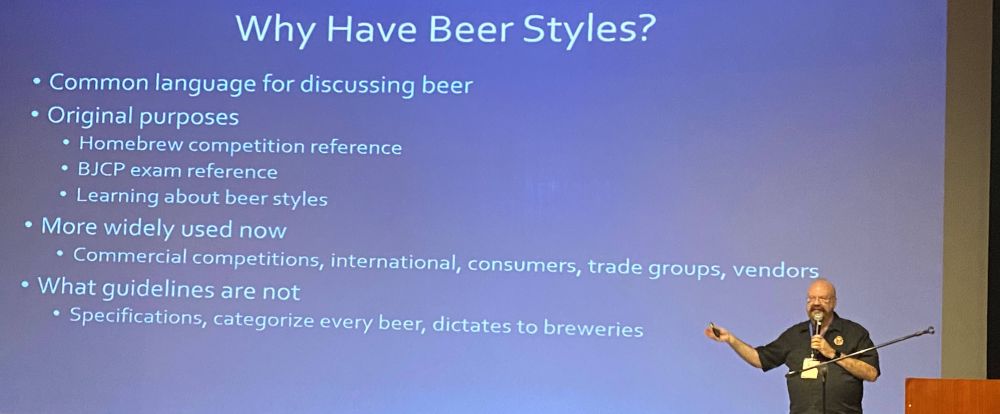
And I liked Jeff’s complaint about the cacophony of styles being pushed by the Brewers Association for the 2025 Great American Beer Festival:

No one needs 108 categories! No one needs 108 categories that balloons to around 200 styles with sub categories! The ever-finer slicing and dicing does not result in clarity, it results in six (!) types of smoked beers… Style fragmentation also leads to an inevitable auroboros exemplified by a category like “international amber lagers” in which Mexican amber lagers will be judged with polotmavý and Franconian rotbier. What?

Remember, as Stan recently reminded us, when folk said styles were important to help consumers understand what they were buying? Not so much now. Elsewhere, someone wrap Jessica Mason in asbestos* as she has been on fire this week asking all sorts of clear questions. Like “why have Belgians stopped drinking as much beer?” and “why have the Irish stopped drinking as much beer?” and “why are UK drinks makers enjoying a rise in profits?“:

“Anecdotally, what we’re hearing from some of our customers is that Q1 brought welcome windfalls. Some tariff-affected international customers have turned to UK firms to do business, while others raced to order more before tariff pauses came off. That’s delivered a shot in the arm for some firms, but more importantly we’re hearing that steadily falling bank rates are starting to stimulate the economy, which obviously is very welcome to UK manufacturers who’ve posted a really strong start to the year.” The data has also highlighted how profitability is improving as manufacturers have held off from buying new stock, instead preferring to use up inventory reserves where possible.

That’s interesting. And David, also in TDB, has added his own question – “what’s wrong with cheap beer?“:

… with my honest hat on, most beer drinkers under retirement age know there’s better options at the bar. And I really wished that those who write about problematic drinking in the media showed the same discernment. Because it isn’t sessionable pints that are the issue here but how pub chains profit from alcoholism. That substance abuse might be from excess beer drinking but it’s also more likely from much higher ABV drinks. Especially because I see morning drinkers drinking their Bells but I rarely see them ‘enjoying’ it.

That’s also a bit of clear observation right there. I like how TDB has been exploring all angles of the trade – the good news and the not so good news – without necessarily making a lot of noise about how that they doing just that. What else is going on? I really liked this observation by Steve of Beer Nouveau in reponse to Katie on gastropubs:

It’s fair to say I don’t like them. But my 81 year old dad does. And his new 82 year old wife (yeah, they got married last year!) does… They know when they go in that there’ll be a menu with favourites like cod and chips, beef wellington, steak, roast chicken and maybe a sticky toffee pudding to follow. They know they won’t be confronted and bamboozled by “dirty fries” whatever the frag they are. They know they won’t need a spoon to help them eat a burger. And they know that they can order a pint of “bitter” and not be interrogated as to which variety of yeast they want that fermented with. Oh, and they’ll also sell Chardonnay as a standard. These are not places for us. These are places for them.

Yup. It’s OK that people don’t like the same things. I like how “it’s not for me” can mean a quick judgement or, more usefully, a realization. Knowing that makes life easier. For example, I had a bit of a moment realizing I wasn’t warming to the tale told by Will Hawkes this week in Pellicle about the brewery German Kraft at London’s  Elephant and Castle food hall called Mercato Metropolitano. Was it phrases like “a no-holds-barred business” and “this is our USP” that reminded me a bit of something I didn’t like? I really don’t think so. I think it’s just a good description of a place that’s probably just not for me. Which is fine.

Speaking of fine, there was some plain speaking over in one corner of the wine world that could equally apply to good beer:

There is no question that wine faces significant issues. I was talking to a leading port producer, who is in a state of near panic (not without good reason, I’d be panicking if I made port!). He was convinced that the anti-alcohol lobby would put him out of business. I suppose that’s easier than admitting you make something that nobody seems to wants to drink any more, but there is no question that the health lobby is reducing wine sales, especially with young professionals, where, if they don’t stay alcohol free they are often turning to cocktails.

And, finally, the details of memorial services for the late Martyn Cornell were posted at his website by his brother David:

For those that wish to attend his funeral it will be held at: Hanworth Crematorium (TW13 5JH) Monday 30th June 2025 @ 12.20 with a small wake at a local pub afterwards to celebrate Martyn’s life. For those that can’t make it we will be having a small wake at Poppyland Brewery, Cromer on Sunday 06 July between 13.30 – 16.30. The family request no flowers.

Still… being that I was raised by a florist and worked in the shop myself perhaps I will still plant something good looking out in the yard in remembrance, something nearby when I need to have a shady sitting spot to sip a beer this summer.

Next week I am on the road so who knows what will be please check out Boak and Bailey every Saturday. Look out for Stan when he feels the urge now that he’s retired from Monday slot. Then listen to a few of the now rarely refreshed Lew’s podcasts and get your emailed issue of Episodes of my Pub Life by David Jesudason on the (sometimes even but never) odd Fridays. And maybe The British Food History Podcast. Maybe? And Phil Mellows is at the BritishBeerBreaks. Once a month, Will Hawkes issues his London Beer City newsletter and do sign up for Katie’s wonderful newsletterThe Gulp, too.  Ben’s Beer and Badword is out there with the all the sweary Mary! And check out the Atlantic Canada Beer Blog‘s weekly roundup. There is new reading at The Glass which is going back to being a blog. Any more? We have Ontario’s own A Quick Beer featuring visits to places like… MichiganAll About Beer has given space to some trade possy podcasts and there’s also The Perfect Pour. Plus follow the venerable Full Pint podcast with an episode just last month!. And there’s the Craft Beer Channel on Youtube. Check out the archives of the Beer Ladies Podcast. That’s quite good but, hmm, they’ve also gone quiet this year. The rest of these are largely dead. And the long standing Beervana podcast …except they have now stood down.  As has We Are Beer People. The Share looked to be back with a revival but now its gone quiet. And the Boys Are From Märzen podcast appears suspended as does BeerEdge, too. VinePair packed in Taplines as well. All dead and gone.  There is more from the DaftAboutCraft podcast, too. Nope – that ended a year ago.   The Moon Under Water is gone – which is not surprising as the ask was $10 a month. Pete Brown’s one cost a fifth of that – but only had the one post. Such is life. Such is beer podcasting and newlettering!

*Please don’t. It’s actually not very good for you. Though, to be fair, neither is actually being on fire. So perhaps we can agree that you will deal with the situation as necessary should the occassion arise. 

Your Beery News Notes For The Week That I Start To Watch The Maple Leafs Again

I have a little rule. I have been a Toronto Maple Leafs fan since the 1960s. I know that because I still have most of my 1969-70 O-Pee-Chee hockey cards. I also know that they have sucked for most of the 55 years since I bought them. Oh, there was Darryl and there was Wendle but in the last decade they’ve only won one playoff series – until this season. So my rule is obvious. I won’t watch them unless they win a series. Which they now have. And they won the next series’s game one too. Update: and game two.

Speaking of victory, I noticed an interesting sidenote to the Australian election last weekend with the after party for the winner Anthony Albanese being fueled by Albo Pale Ale. Albo? Albo:

…you might have heard of Albo. When this beer was brewed, he was simply the brewery’s local Member of Parliament who was known for his support of the craft beer industry, trains and the ocassional spot of DJing. He went on to be the 31st Prime Minister of Australia and his younger self will forever be immortalised in this beer, which sure beats a toilet.

BTW – that toilet. Speaking of objects holding liquids, Kevin K commented an interesting comment this week: “always seems there’s a strong lack of editing for glassware articles.” Is that a lack of strong editing? And is “strong lack” related to Strong Bad? Whatever it is… I fully agree. What was the object of his disappointment?

Cusack gave a thumbs-down to two common beer glasses. “Pints and mugs are fine for a quick pour, but they do nothing to highlight what makes an IPA good. Too open, too wide, they lose aroma fast,” Cusack told The Takeout. “Steins are worse — thick glass insulates the beer too much and dulls your senses.” Pints and mugs don’t actually do much to enhance any beer’s flavor (not just IPAs), but mugs and glass steins, with their thick walls and side handle, will do the job well when keeping your beer cold is a priority.

Me, I drink pretty much everything from the same hefeweizen glass if I am wanting to pay attention. Lots of schozz space to get right in there for a sniff. And it holds the temperature well. And it allows me to compare one experience with another a neutral yet effective context. Otherwise, anything will do. What’s up with a glass per beer anyway? It’s like audiophiles who have different stereo speakers for different sorts of music.* Who can afford that? Do you really want to be like audiophiles? It all sounds connected to hyperflavor related status anxiety.

On a similar theme, I was really impressed with one aspect of the announcement from the World Beer Cup.** Transparency. For such an overblown title,*** it was interesting to see that the relatively low number of entries competing in most categories. An average of 73 entries per category. No doubt most were perfectly swell but doesn’t that mean it’s pretty likely that any winner is actually not going to be the best out there? And, with only 53 entries, they found a way to discover that SNPA is an ESB! Mucho guffaw resulted.

Mike Seay may have caught the moment both neatly and tidily with this comment this week:

I need to start asking for tasters before ordering an IPA or even a Pale. You see, sometimes they end up being hazy when there was no indication of it on the menu description. And I am over hazzies…for now. Yes I could always ask for a taster before, but I like to just go for it. Give me a pint and I’ll drink it, even if it ends up sucking. But I am getting too many New Englands when I was wanting a West Coast, so I gotta start asking, I guess.

Hazzies? Is that what we call a grouping of badly thought out hazies now? Maybe huzzies or hizzies even? And exactly how many beer educators did it take to get us to the place where you can’t order a beer and have a clue what you’re about to drink? And is that part of what Jeff meant by the wallpaper phase? Or perhaps what led us to this point:

Craft beer isn’t new and exciting anymore, and almost everyone has heard of it, and the vast majority of potential future customers have experimented with it. What breweries have to do now is sell their product to people who are already familiar with it—but also blasé about it. Craft beer is part of the wallpaper of alcoholic beverages now—present, but in the background, familiar and easy to ignore. Selling a product like that is very different than selling beer in 2000.

And Matthew C perhaps spoke to a similar idea with another sector of the beer trade in his note on Bluesky introducting this week’s feature at Pellicle:

Top stuff from Emmie Harrison-West on the site today about a really interesting no and low alcohol brewery near Edinburgh. It might be our last no and low piece, at least for now, as despite lots of (apparent) interest in what is often cited as the fastest growing sector in beer, the pieces we’ve published to date have struggled to gain traction with our audience.

What to make of all that? Perhaps conversely but definitely offering a ray of hope in this, Jamie Goode wrote an interesting article on standardization and balance (for the lyrically named WineMag.Co.Za) which easily applies to a lot of good beer:

This is the problem with the concept of balance. It can lead to a certain stylistic homogeneity; to boring wines that tick all the boxes, but which fail to thrill. Alongside this concept of balance, we have the problematic notion that we always want to drink the same sort of wine. There are even people who peddle protocols for matching consumers with the right wine for them. The truth is that we want to drink different wines on different occasions. I have lots of wines at home, but it’s not easy finding the right wine for the right moment, even though I have only wines that I like to hand. I think the concept of balance in wine is next to useless. It should be about whether or not a wine has personality, and whether or not that wine, with its personality, is the right wine for this particular drinking occasion. I want my wines to be interesting…

Me too. And my beers. But what is it to be interesting… and what makes it so? (And, he thought to himself, if we just left these clinky drinky things to individuals and their own interests, well, what would we do with all the experts and, horrors, the editors?) Hmm…  Drew Starr has an idea that perhaps may help frame the concept:

I think we discussed my theory of cognition for quirky regional food I conjured after Nick Tahou’s. Anyone can appreciate it, but you have to try it before your brain matures at 26 to have a love that defies objectivity. You always love it more when older, because the memory of youth is delicious… Ask me or anyone who grew up in Western MA who makes the world’s best burger, we’ll say White Hut, an objectively incorrect answer that we are incapable of being made to believe otherwise.

So… the things that are interesting are things that relate to the person by whom… in which… that interesting thing is / was experienced. Radical.  Matty himself, for the double, had a similar sort of tingly sensation this week, not from a recollection of youth but from being in the audience for a performance of Hamlet:

Such was the intensity and physicality of the performance as a whole that I can’t stop thinking about it. Samuel Blenkin, playing the titular role, was gripping. The way music and dance was weaved throughout meant I couldn’t look away for the whole 90 minutes. It was dark and visceral and unrelenting and sad and funny. Of course, I had to go for a pint and sit down afterwards, to help myself come down. But as I did so I realised in witnessing such a brilliant act of creativity my very soul itself felt nourished. I was full to the brim. There are moments in life, sometimes major, sometimes fleeting, but they leave a permanent mark on you. My first sip of IPA at Odell Brewery, devilled kidneys on toast at St. John, Mills Foxbic at Hereford Beer House, the reuben on rye at Choice City Deli. These are experiences that helped shape my worldview.

Is that what Goode meant by interesting? Probs. As one who is perpetually in that condition, when they prepare the syllabus for the Master degree seminar on The Beer Nut this will be one of the key passages the class will have to study:

…I didn’t think it worked very well, but I’m told by Kev the brewer and owner that I’m wrong, which is fair enough…

Returning to that piece in Pellicle, the not wrong and definitely interesting Emmie Harrison-West offered up a portrait of Jump Ship Brewing, low-no alcohol brewers near Edinburgh, and unpacked the background:

Like many of us as we age, Sonja found that her tolerance for booze had dropped. She was becoming irritable after drinking and dreaded the day after. “I was drinking less, but it was that Tuesday night beer that I was really craving. You know, when you’re finally sitting down, the kids are in bed, you’re tired and up early for work,” she says. Sonja discovered that an NA beer really scratched that itch, but she still felt like something was missing: choice. Sure, she was making better choices for herself, but found her options in terms of the variety of NA beers available were woefully limited. “That’s when I thought, ‘why don’t I just do it?’,” she tells me.

Swtiching a bit abruptly to the Health News Desk: the recent flurry of discussion about Savory IPA got me thinking again about the need to label the ingredients on beer. See, like a lot of people I am allergic to MSG – the key additive apparent miracle that transforms a humdrum beer into an amazing new style! It’d be nice to have informed decision making so I can know if my respiratory equiment is going to seize up or not.

And, perhaps taking a breather from all that above, I really liked David Jesudason‘s piece**** on the Alehouse in Reading where he found people ready to just have a chat:

It never was my plan to travel 50-odd miles in a four-hour round trip for this specific chat but that’s where my day took me. I had a vague idea to visit the Alehouse for the second time because, inspired by The Shiralee, I wanted somewhere a bit rough and ready where I knew there would be people drinking in the day despite the broad sunshine outside. The pub is covered head to toe in pump clips, has a queue of pickled egg jars at the bar and various hair rock songs being played through the speakers – the only tune I could place was Queen’s Fat Bottomed Girls, and it’s been a long time since these women made the rocking world go round.

All of which, coming full circle, brings me to the thought that Boak and Bailey shared on their Patreon back channel last weekend and gave us all the “oomph” of the year in beer, YTD-wise:

Jeff Alworth’s wallpaper post got us thinking about lots of things, but mostly that time passes quickly before you notice it. It’s easy to feel as if craft beer is a thing that just landed, beloved of fresh-faced hipsters. But even in its most recent form – IPAs and punks and skulls – it’s been around for several decades. Thornbridge Jaipur, an especially significant beer in British craft beer, turns 20 this year. There are people at university now who have never lived in a Jaipurless world – who don’t remember a time before BrewDog, or Beavertown.

Me: “I’m not 62! That old guy over there is!!!” What is it we want from all this anyway? Being part of Club Craft? Nope. A nice chat sound perfectly nice, if I am being honest. And a nice beer in any frikkin’ glass I feel like using. See, the failings of craft now so evident in 2025 – especially the failure to reign victorious as was clearly promised a decade or more ago – reminds me of what I recently read in that grab bag of convenient quips for we the aged alumni with the BAs, The New Yorker, on the translation of Catullus:

Precisely what makes much of Catullus’ work so appealing and “relatable” to modern audiences—the offhand charm, the impish vulgarity, the jazzy colloquialisms—makes him that much more difficult to bring into modern English. Ordinary language, after all, has a far shorter shelf life than does the elevated language of high literature; translations of Catullus that are barely twenty years old already feel dated. Peter Green’s “Wretched Catullus, stop this stupid tomfool stuff” sounds positively Victorian next to Mitchell’s “Wretched Catullus, stop this crazy longing.”

It lives in the past tense, does craft. It is, to my adult chidren, exactly that: stupid tomfool stuff.  Not beer, mind you, which is good. Beer remains interesting.

That’s it for this week. I am on a train later today so may be delayed in responding to all your emails and DMs and stuff. Bear with me. Until we meet again, please check out Boak and Bailey every Saturday (…as long as all their holiday fun doesn’t get in the way…) and Stan (….not quite…) each and every Monday. Then listen to a few of the now rarely refreshed Lew’s podcasts and get your emailed issue of Episodes of my Pub Life by David Jesudason on the (sometimes even but never) odd Fridays. And maybe The British Food History Podcast. Maybe? And Phil Mellows is at the BritishBeerBreaks. Once a month, Will Hawkes issues his London Beer City newsletter and do sign up for Katie’s wonderful newsletterThe Gulp, too.  Ben’s Beer and Badword is out there with the all the sweary Mary! And check out the Atlantic Canada Beer Blog‘s weekly roundup. There is new reading at The Glass which is going back to being a blog. Any more? We have Ontario’s own A Quick Beer featuring visits to places like… MichiganAll About Beer has given space to some trade possy podcasts and there’s also The Perfect Pour. Plus follow the venerable Full Pint podcast with an episode just last month!. And there’s the Craft Beer Channel on Youtube. Check out the archives of the Beer Ladies Podcast. That’s quite good but, hmm, they’ve also gone quiet this year. The rest of these are largely dead. And the long standing Beervana podcast …except they have now stood down.  As has We Are Beer People. The Share looked to be back with a revival but now its gone quiet. And the Boys Are From Märzen podcast appears suspended as does BeerEdge, too. VinePair packed in Taplines as well. All dead and gone.  There is more from the DaftAboutCraft podcast, too. Nope – that ended a year ago.   The Moon Under Water is gone – which is not surprising as the ask was $10 a month. Pete Brown’s one cost a fifth of that – but only had the one post. Such is life. Such is beer podcasting and newlettering!

*“Disco Woofer” would be a great name for an DIPA. Or a speaker.
**No doubt intended to be confused with the equally grandiosely World Beer Awards. Not to mention the World Awards of Beer.
***Olympics? That all? Surely it’s the Mount Olympus of Beer! Even as the BA continues its logical retraction, the fawning seems to be enhanced.
****His writing in which reminded me of another passage from another article in that same issue of The New Yorker from March 30 2025: “Much of the art of “Encounters with the Archdruid” lies in the way that McPhee manages to be both there and not there. He bathes his aching feet in the water. He recalls other trips he has taken with Brower and, separately, with Park. He searches for copper-bearing rocks, and, when he finds them, gets excited. But he never reveals whose side he is on. When it comes to the great question of the piece—to mine or not to mine—he gets out of the way.

These Be Your Mid-April Mid-Life And Perhaps Even Fairly Mid Beery News Notes

Easter week! You’d be right in thinking it was a month ago with all the talk this week of of green beer here and green beer there. But no, it is the time of the bunny who lays eggs which happen to be made of chocolate. Christ! And each Easter is also reason to revisit this 2008 post of mine on the lack of Easter beers – which included, as illustrated, perhaps the oddest thing I have ever published on this here blog of mine. But, of course, the main event of the long weekend is the old man’s birthday, me being the old man in question. Thank you for all the cards! Sixty-two. Whaaaaa Hoooooo! Said no one never. This very evening I am celebrating by going to a ukelele orchestra concert. I have authorized myself to slip out early just in case. Still, I do hope it is silly enough to justify the price of admission.

Enough about me! First off this week, have I mentioned the global economic mood?  The CEO of Mexico’s Constellation Brands Bill Newlands has:

About half of Constellation’s beer sales are from Hispanic consumers… with the demographic accounting for 78% of its total revenue last quarter. The Wall Street Journal report noted that many immigrants in Southern California and Texas have begun avoiding liquor stores, where they are often forced to show identification. Many people have stopped shopping at supermarkets after 6 p.m., hoping to avoid immigration raids… While Modelo, Corona and Pacifico are exempt from the Trump administration’s 25% tariff on Mexican imports, the company is not able to dodge the 25% tariff on aluminum when it comes to their canned beer imports.

Being from somewhere matters apparently. And speaking of tariffs,* James Beeson posed an interesting question in The Grocer: is local a liability in these trade war times? And then he helpfully explored the implications:

These liquids command a hefty price premium thanks to protected geographical indicators (PGIs) which guard the product’s name from misuse or imitation… PGI status offers “clear authenticity and product differentiation in consumers’ eyes”, and plays “a crucial role in premiumisation”… Tariffs certainly look like bad news for Rémy, which generated 38% of its sales in FY24 from the Americas. Thanks to its overexposure to cognac, it also sells 62% of its PGI spirits outside the market in which they enjoy this status.

So being from somewhere can be quite damaging. Plus… never thought over exposure to cognac could be a good thing but there you are.  But then in TDB, David Jesudason was arguing that things should be more clearly from somewhere:

It’s especially concerning because most drinkers cringe at the thought of Madri – the supposed soul of Madrid – being brewed in the UK by Coors – while this unnamed beer is actually being brewed at a renowned British craft brewery. The type of brewery that brews a lot of award-winning tipples that define modern British beer for discerning drinkers prepared to pay premium prices. And this beer is no exception. Which shows there’s no need to lie. But here’s the payoff: by claiming a beer is brewed in Germany not Great Britain what exactly is a British beer company saying? Bavaria has better water than Burton? Hamburg has better brewing techniques than London? Perhaps all British brands will proudly say where their beer is brewed if cask were to become UNESCO recognised and we took our heritage seriously.

THEN… Will Hawkes considered in his latest London Beer City monthly how beer from somewhere might not really be about that somewhere at all and this might not be very good in these times:

American influence – and, more specifically, American hop flavour – has fuelled London’s brewing renaissance over the past few decades. From Neck Oil to Pale Fire, London brewers have paraded their passion for (and understanding of) Obama-era American craft brewing. American Pale Ales on London bars have become legion. Wham bam thank you Uncle Sam. The world, though, has changed. To paraphrase Oscar Wilde, to elect Donald Trump once might be regarded as misfortune; to do it twice is just fucking stupid. Trump’s introduction of tariffs, the bovine threats to Canada and Denmark, the increasingly aggressive way in which visitors to the USA are being treated: this points in one direction and one direction only. America acknowledges and wants no allies, and that includes Britain. MAGA is unleashed and obnoxious.

Interesting. Will the world reject US craft just as it’s rejecting the Tesla? It is also interesting that making booze under licence was one of the solutions mentioned by Mr. Beeson while is the problem for Mr. Jesudason. Hmm… Speaking of critical thinking, Katie M. took immediate and visceral objection to this article in The Guardian:

Is the editorial team all on holiday leave or something? There are SO many talented writers out there looking for an opportunity like this, and so many editors who do their jobs with skill. How can a national paper be so careless as to publish something so unpolished. The writer isn’t even to blame here, the whole process is, from commission to upload.

There was a lot of unhappiness in the susequent BluesGuy comments all of which confused me a bit until I got to this one that shared a correction to the online edition: “This article was amended on 13 April 2025 to replace some words that were omitted during the editing process.” Yikes!  The post repair job was still a bit much. As ripe with superlatives as the worst of beer writing. Very much overly rouged, as the kids might say. So much unhappiness. Good thing, then, that Gary shared the good news – the Clark’sroast beef sandwich is back in Syracuse NY!

For longtime locals, the main event is the return of a Syracuse bar legend: the Clark’s Ale House roast beef sandwich. Clark’s Ale House, which operated in two locations from 1992 to 2016, was famous for its roast beef sandwich. It was simple — just medium-rare top round, thinly-sliced red onions, cold cheddar cheese between an onion roll from Di Lauro’s Bakery — but it was legendary. And when Clark’s closed for good, its devoted fans were left craving. “We’ve missed this sandwich so much,” Beach said, standing in the Crooked Cattle’s kitchen earlier this week. ”But now it’s back.”

That artisic rendering up there is the sandwich I ate at Clark’s over twenty years ago. Now… if they can just bring back the house ale and the pub’s layout.

Note #1: Katie Mather has returned to owner operated blogging.

Note #2: do you like salt in beer. People have. Since at least 1835.

Stan also spoke of an ingredient this week – specifically the hop – in his Hop Queries edition 8.12 and shared this about the return to work of two US government employees:

Two USDA-ARS employees involved with public hop research were among thousands of probationary employees who went back at work after the Merit Systems Protection Board (MSPB) issued a 45-day stay on their termination (see Hop Queries Vol. 8, No. 10). Francisco Gonzalez, a hop horticulturist, is one of four scientists central to the public hop research program. Brandon Sandoval is a technician assisting Gonzalez… That’s not to say that things are “back to normal” at research facilities in Oregon and Washington. Not all support staff has returned to work and what happens after a hiring freeze lifted is not clear. Also, the USDA has warned employees that a significant reduction in force is likely.

Some chat this week about what was micro then craft now independent. As exhibit A we have Pete of The Times* who gave a quite reasonable explanation how craft was lost to bigger interests… just as, I suppose, micro fell to the avarice of big craft:

To my palate, Beavertown’s Neck Oil and Gamma Ray, and Camden Hells — now owned by corporations that brew as cost-effectively as they can — don’t taste as good as they did. Quality hops are costly. And proper lagering means storing beers in chilled vats for weeks. So what are drinkers to do if they want beer that’s well made by small players? Trade bodies such as Siba, which once promoted craft beer, now champion “indie” beer instead. Siba defines an indie brewer as one that’s UK-based, has less than 1 per cent of the UK beer market and is not connected with any other business bigger than that size. It issued a logo for breweries such as Fyne Ales, Vocation and Five Points to use on packaging and pump clips.

Then, as exhibit B, consider Phil Cook who gave what can only be described as commentary from a view from (Ed.: *…checks map…*) well below my feet:

‘Independent’ remains the adjective of choice in promoting and organising the many Australian breweries that might otherwise be grouped under ‘craft’ or (in earlier times) ‘micro’. But companies who persist in waving it around as they take part in the recent string of mergers, consolidations, and various other entanglements are straining the word to breaking point. It’s too much like someone insisting “being single is really important to me, that’s why I married another bachelor!”

Does it matter? Well, “it” isn’t any one thing. First, locally the word “independent” never really took off in Canada. Even well past “craft” we are… still craft. And if we look at the UK standard of 1% of the market that has little use for the US trade where the small guys got co-opted long ago to falling into line helpfully to support the aspirations of the large ones. These things, too, will not save craft beer. And does any of this matter so much as we continue on the human race’s continued shift away from the bottle? Consider this startling news from The Guardian on the state of the global wine trade:

The OIV said the consumer was now paying about 30% more for a bottle now than in 2019-20 and overall consumption had fallen by 12% since then. In the United States, the world’s top wine market, consumption fell 5.8% to 33.3m hectolitres. Delgrosso said tariffs ordered by the US president, Donald Trump could become “another bomb” for the wine industry. Sales in China remain below pre-Covid levels. In Europe, which accounts for nearly half of worldwide sales, consumption fell 2.8% last year. In France, one of the key global producers, 3.6% less wine was consumed last year. Spain and Portugal were among the rare markets where consumption increased.

Still on the holiday in Romania and pushing back against that trend by all accounts, Boak and Bailey took time to send out their monthly newsletter in which they shared thoughts on one way the pub trade can respond – reduce the congnitive load:

In the context of a holiday, a slight increase in cognitive load can be pleasurable, and part of the fun. It’s about the line between stress and stimulus… How can pubs and breweries reduce cognitive load? The experience of a Wetherspoon will rarely be thrilling but at least (kliche Klaxon) “You know where you are with a ‘Spoons”. All sorts of venues could, and can do, do some of the same things… the single greatest way to reduce the cognitive load of any experience is to keep doing it. However weird and complicated your local pub might be, by the time it is your local, you’ll know how it works and won’t find it weird at all.***

Does a gay bar at a zoo convey significant cognitive load? David Jesudason explains how you might have found that out if you visited the Hotham Park Zoo in Bognor Regis, West Sussex in the 1980s:

…this magical and enchanting period spawned the Safari Bar, a gay bar playing high NRG music, hosting drag queens and causing merriment that could be heard from considerable distances. The night was the idea of DJs Barrie Appleyard and Ian Harding, who had met at a club in Littlehampton. Ian knew the manager of the zoo and Ian phoned Barrie saying “shall we try something with the zoo, you know, gay nights or something?” They found a cafeteria (originally built as a small mammal house) that was tucked away in the back of the zoo and transformed this functional space into a jungle-themed gay bar on Wednesday, Friday and Saturday nights.

What went on each Thursday? Hmm. Speaking more or less on whether less is maybe more or maybe not, at the beginning of the month Retired Martin shared his thoughts on coming changes to the Good Beer Guide based on this motion that was before the gathering last weekend:

“MOTION 7 : This Conference instructs the National Executive to reduce the number of pubs in the Good Beer Guide from the 2027 edition onwards, to ensure only quality pubs are featured.“

Have the results been published beyond the shadowy membership cabal? I don’t see any reference on the so-me’s.  What the heck could “quality” mean in such a context? By total contrast, I give you the best line written about beer of the week – if not to this point in the month – must be this one:

The best location for a beer, by far, was at the sausage stand near the city incinerator plant.

And, perhaps relatedly, Tom Morton, who I met through his former BBC Scotland radio show, shared a story of a dubious newpaper restaurant reviews which is… detailed:

The worst meal I’ve ever had was at a café I’ll call Les Vomiteurs in the then seriously untrendy, ungentrified, occasionally unsafe area of Glasgow called Finnieston. This was 1979 and the late Jack House was still writing restaurant reviews in the Evening Times. He’d recommended the tripe at Les Vom and as I’d never tried this intestinal delight, and fancied myself an adventurous junior gourmand, I thought I’d have a go… The formica tables of Les Vomiteurs matched the unwelcoming hardness off the proprietor, who served me up a bowl of white gunge. Boiled tatties and slimy tendrils of cow gut in milk. It was unchewable, the bits of stomach slipping about my mouth like frisky tapeworms. I swallowed, inhaled the potatoes and just made it out of the door in time to throw up the entirety of my lunch in the Argyle Street gutter. So much for acting on restaurant reviews.

I don’t know what to say about that… other than my folks grew up on the Clyde and that is the sort of keen tales of humanity that I grew up with.  And speaking of the unexpected, Jeff wrote an intersting exposé of a bootleg beer he injested in Oregon named Corona Mega – and also provided some details on a resulting lawsuit:

The mystery deepened the more I dug into it. Whatever I bought that night was definitely not regular Corona. For one thing, it was a vastly superior beer. It was a tenth of a point weaker in strength at 4.5%…  The label listed Oz Trading Group of Hidalgo, Texas as the importer, which was an oddly bold move for, to quote the economist Stringer Bell, “a criminal [expletive] enterprise.” (As a spicy aside, the apparent owner of Oz Trading is Oziel Treviño, a Hidalgo city councilperson who was found to have committed voter fraud in 2016.) Curiouser and curiouser, in other words.

And, finally, Pellicle published a piece by David Nilsen on depression and loss,  a tough read that carries the disclaimer that “this article makes frequent and detailed references to suicide and severe depression, therefore reader discretion is advised.” The essay is primarily about the life and the passing of a brewer, Brad Etheridge, at age 43 based on conversations with his wife, Julie Etheridge but it also speaks to the broader context. It also contains this passage:

Cindy Parsons is a psychiatric nurse practitioner and an associate professor of nursing at the University of Tampa in Florida. In 2019, she and colleague Jacqueline Warner Garman (who co-owns Hidden Springs Ale Works in Tampa and is a psychotherapist) gave a presentation at the Craft Brewers Conference, held that year in Denver, on addressing mental health issues in the craft beer industry. She thinks the image of craft beer can make its workers and supporters reluctant to acknowledge the complications of mixing mental health issues and alcohol. “We’re supposed to be the happy people,” she tells me. “Do we really want to address this in our industry?”

My profession, lawyering, also has a significant mix of mental health issues and alcohol and much of what’s written by David rings true. Only by way of one example among many I’ve met, the family friend who was my first articling principal now thirty-three years ago quickly upon my arrival revealed themselves to be drinking a quart of rum to get them through each day. Drank to the death. Grim.

There you have it. A huge range of reading this week. Take your time and until next time when I will be, I promise, older and wise… please check out Boak and Bailey every Saturday (…as long as all their holiday fun doesn’t get in the way…) and Stan going strong again each and every Monday. Then listen to a few of the now rarely refreshed Lew’s podcasts and get your emailed issue of Episodes of my Pub Life by David Jesudason on the (sometimes even but never) odd Fridays. And maybe The British Food History Podcast. Maybe? And Phil Mellows is at the BritishBeerBreaks. Once a month, Will Hawkes issues his London Beer City newsletter and do sign up for Katie’s wonderful newsletterThe Gulp, too.  Ben’s Beer and Badword is out there with the all the sweary Mary! And check out the Atlantic Canada Beer Blog‘s weekly roundup. There is new reading at The Glass which is going back to being a blog. Any more? We have Ontario’s own A Quick Beer featuring visits to places like… MichiganAll About Beer has given space to some trade possy podcasts and there’s also The Perfect Pour. Plus follow the venerable Full Pint podcast with an episode just last month!. And there’s the Craft Beer Channel on Youtube. Check out the archives of the Beer Ladies Podcast. That’s quite good but hmm they’ve also gone quiet this year. The rest of these are largely dead. And the long standing Beervana podcast …except they have now stood down.  As has We Are Beer People. The Share looked to be back with a revival but now its gone quiet. And the Boys Are From Märzen podcast appears suspended as does BeerEdge, too. VinePair packed in Taplines as well. All dead and gone.  There is more from the DaftAboutCraft podcast, too. Nope – that ended a year ago.   The Moon Under Water is gone – which is not surprising as the ask was $10 a month. Pete Brown’s one cost a fifth of that – but only had the one post. Such is life. Such is beer podcasting and newlettering!

*Did I? Was I?
**I forgot this: I knew him and apparently drew him way back when.
***Pardon all the ellipsises… ellipsi… but the point was worth making.

Now That We’ve Cleared Up The “St. Paddy’s / St. Patty’s” Day Confusion, Here’s The Beery News Notes

I like a good breakfast sandwich as much as the next guy but I have to say I have never elevated a disk shaped sausage to sainthood. For me, Peanuts sort of established who Patty is before she grew up to be the bassist of The Bangles under an alias. So the whole “Patty v. Paddy” thing flies by me and, anyway, I tend to use the long form.  Which is fine because, you know, we ourselves are Scottish. Which is what we told pals who invited us out to drink on a Monday night when we took a pass. Our new PM probably better knew what to do when celebrating that I did. But I think Liam, however, he of Ireland, has established an alternative answer to the puzzle of how to deal with the day. That’s a hop shoot omlette right there:

I’ve experimented with cooking hop shoots before, but this is my first time to force them in the dark. Blanched and lightly fried, and served on an omelette with pecorino and black pepper. Great texture, like asparagus but more of a delicate mangetout or green bean flavour. I’m impressed …

For a more traditional tribute to Patrick, check out The Loop for a true Americana dive bar version. I wonder what the equivalent elsewhere could be? I know who we could ask. Perhaps Retired Martin who advised on the question of what one can do when there’s a spare 25 minutes to be spent at the train station in Doncaster, all by way of very tightly focused photo essay:

I would buy a book called “What Would Paul Mudge Do ?”. He certainly wouldn’t get his beer in a takeaway milk bottle to drink on the 18:22, oh no. He’d have a pint from one of Sheffield’s cask champions. But a man doesn’t travel from South Yorkshire to South Yorkshire to drink South Yorkshire beers, so I had a pint from Tallinn. And admired the seating in what is a lovely, but slightly too small, station pub.

Admittedly, you need to go back to link each sentence to an image but it’s a nice tidy narrative if you ask me. Speaking of tidy narratives, Pete Brown‘s latest column for The Times has taken a step up, using the space so far dedicated to a newbie guide to share, instead, a vignette on a player in the trade – the beer buyer:

The Waitrose beer buyer Jourdan Gabbini, 31, from Wokingham in Berkshire, genuinely loves beer and obviously enjoys his job. His ambition is to create “a bottle shop within a shop” that doesn’t just stack up the beer but helps people engage with and explore it, in part by highlighting brewers that are local to each store. This can be frustrating when a beer you like isn’t available in your manor. But that means another local brewer is getting the benefit. Gabbini has the freedom to develop real relationships with brewers. Last year he even co-created a new beer with the Lost and Grounded brewery in Bristol and Caravan Coffee Roasters — a coffee pale ale that was exclusive to Waitrose.

Speaking of booze sales, Lew dipped his toe into the tariff dispute and examined the Canadian response when it comes to the policies implimented up here by our government run liquor trade:

The most common reaction has been pure Canada: a non-smiling “Elbows up!”, echoing Mr. Hockey, Saskatchewan-born Gordie Howe, a player who took no shit off anyone. Anyone who tried to slash Howe was getting a fast elbow to the head. Canada’s ready for this, and they’re not kidding. The angry Americans are right about one thing. The Canadian response of taking everything off the shelves, leaving only blank space behind, is disproportionate and goes further than the American tariffs. This doesn’t just affect day-to-day, month-on-month sales. This kind of action also attacks something much more valuable: the brand. Raise the price while leaving the bottles on the shelf, and you paradoxically make people think about the brand more, maybe even realize how much they ARE willing to spend to get it. But take the bottles away, leaving an empty shelf with a “BUY CANADIAN INSTEAD” sign, and the American product becomes invisible.

Lew says, quite reasonably, that this degree of response is because Canada is facing an existential crisis. I don’t actually think that’s the full story. I have loads of pals and more blood family in the USA than here in Canada but, you know, gotta tell you… we’re not going anywhere. And we’re not some sort of jilted pal. Trump just fucking pissed us off. When I played soccer in university, my Scottish father (a much better player in his own youth) would say “don’t wake the sleeping dog.” Well, we’re up now.  And we are drinking our own damn rye. Even the cheap stuff that tastes like gasoline.

Speaking of these the finer things, Nigel Sadler pointed me to an interesting 1991 Belgian beer rating guide posted by the beer importers James Clay and Sons on Bluesky:

This clever guide evaluated beers based on ABV, Sourness, Sweetness, Bitterness, and predominant flavour, which then generated a five digit code that could easily give a picture of the key characteristics.

Here are the five images (1,2,3,4,5) in case your are not part of the Bluesky way of life. I add them not just to scrape the data but to illustrate a couple of points. First, I have long thought the overbearing BJCP system was clumsy and created poorly transferrable information in a simple but meaningful way. This does that. Second, being a real nerd, I immediately recognized that this five digit system mirrors the SINPO code used by long distance radio listener nerds. The SINPO code not only succinctly frames the transient quality of a radio transmission heard well beyond the intended broadcast range but it is also understood across cultural and language gaps. Simple, neutral and still data rich. So it’s gold when you are sending your QSL reception report looking for a postcard, right? What? No! No, it’s really cool. It really is. No, you’re the big fat loser.

Getting back to where we started, Ron has been to Brazil again and, much to my delight, has posted a photo essay – a montage if you will – of many of his breakfasts as well as what it is like to be an Englishman in Rio for Carnaval:

Many not so much lightly-dressed as slightly-dressed partygoers walk by. I’ve never seen so many men in fishnet tights and tutus. It has a bit of a Gay Pride air about it. Some of the party people pause to pick up Pils. Always the Pils. There’s a merry buzz. Everyone is going to a party. I can feel their crackling anticipation as they laugh and drink their way down the road. Anticipation of a good time. A really good time. I’m starting to quite like this Carnaval thing. Everyone is in a really good mood. Even a miserable old git like me.

Over at VinePair, Joshua M. Bernstein told the tale of the rise and fall of Magic Hat #9, a once hudely popular beer out of Vermont:

Johnson built a moderate-strength pale ale infused with apricot essence, and the mysteriously named #9 hit Burlington taps in summer 1995. The beer was designed to disappear come fall, but calls from angry bar owners threatening to stop carrying Magic Hat beers led Newman to turn #9 into a year-round release. “It was never intended to do anything,” Newman says. “We were just trying to find a way to sell beer.” The beer thrived on neglect and even disdain. “Beer geeks at the time f(u)cking hated it, but the more they hated it, the better the sales were,” Newman says, adding that #9 was nobody’s favorite beer at the brewery. Magic Hat initially spent scant dollars to support #9. “I could argue that we spent the first two years doing absolutely nothing to help it grow, almost working to kill it,” Newman says. “And then one day we went, ‘What the f(u)ck are we thinking here?’ And so we got on the bandwagon and it just kept growing.”

There was a time when Magic Hat was way ahead of its time and attracted the dollars of border crossing beer nerds like me over a decade and a half ago, looking for their latest Odd Notion seasonals. I seem to have had some on New Years Eve 2004. In October 2005, I review another mixed case of their and… I mentioned that I didn’t exactly love the #9. I thought it was supposed to be peach but Oskar in the comments said “No. 9 used to be much higher quality, with a REAL apricot taste” so I wasn’t wrong wrong. Just wrong.

Speaking of travel, Katie spent a week on the Isle of Man. She didn’t mention seeing Kelly… but she did write a lovely piece at her space The Glug about solo dining at The Boat Yard in the town of Peel:

The menu is as fishy as I dreamed it would be, and while I’d normally order something picky or snacky or fried for a starter, I couldn’t think of anything nicer on such a cold night than a bowl of chowder. It came hot and creamy, filled with Manx kipper and mussels, and a healthy incorporation of curly parsley. Slurping it felt like warmth and health and happiness. To drink, I had a glass of champagne. And then another. How incredibly off-putting of me, to ignore wine tasting regulations and all common decency, but I wanted some Champagne, so I had some. End of story. If you want to fight me about it, I‘ll meet you outside. Doing champagne by the glass is not ideal for any hospitality venue, and I apologised for being so awkward. Then I apologised for apologising. My lovely host was gregarious: “You deserve to have what you like,” she said. I wondered if had I been with other people she might not have added life coaching to my menu free of charge, but I appreciated it nonetheless. And anyway, I did like it very much, because it was rich and biscuity, with a squeeze of lemon sherbet.

Smoky kipper chowder and glasses of champagne. That’s it right there. Yup.

Note: Martyn captured on the audio talking about the porter. And the book. The book that launches very soon.

And David Jesudason has managed to make me homesick for a place I have never been.  Much of my family lives along the 128 bus route east of Edinburgh and I worked in Poland for a while when I was in my twenties. So this portrait of the The Persevere in Edinburgh’s historic port of Leith has me longing… and (again) hungry:

…it retains those born and bred in Edinburgh’s historically working class Leith district, especially sports lovers who might glance at the horse racing before a match. While it also serves as a home away from home for many of the Polish diaspora who have been linked to the port since 1939. This is seen in the pub’s owners, Lublin-born Dorota Czerniec-Radowska and her husband Konrad Rochowski, and the kitchen they have run since 2015 which pumps out delicacies, such as plate-sized schnitzels and comforting white sausage (Żurek) soup. You can eat these in the pub or the restaurant-style section, known as the Percy (also the affectionate nickname given to the pub by its regulars,) where paintings of Dorota and Konrad’s hometown are displayed.

One of the pleasures of Poland was learning how useful my childhood training in the rolling of an “r” and the roughening of a “ch” were.* And, as with the Korean food, the reassembling of similar ingredients was also a welcome surprise. Next time I am there, I should make of point of being here… there… at this pub.

Note: a reminder for next week. It’s another end of the month edition of The Session… and Gary jumped the gun but gives us a good example as we prepare. Matty C is hosting:

For the March 2025 edition of The Session I’m asking participants to produce a piece of critical writing about beer or pubs. This could be a review of a beer you’ve enjoyed, or perhaps one you haven’t. A pub you’re fond of, or maybe one that has room for improvement. You could write about a beer experience (or lack of) in a setting such as a restaurant, or even produce a critique that focuses on a particular aspect of beer or pub culture. The aim is not to be judgemental, subjective or to showcase any particular bias; this is not some finger-wagging exercise. Whereas criticism involves building an argument about why you think something is simply good or bad, critique involves taking a more holistic approach, using carefully researched and considered analysis to build a reasoned, objective, and possibly even entertaining take that benefits readers by giving them good quality information to consider.

I am still working out how this isn’t a distinction without a difference as building a good argument always requires considered analysis. But I look forward to the submissions.

Did you now that some common foods do not qualify as no-alc? Well you will now thanks to the exceedingly tenuous argument placed into the discourse by the lobbyists of the The British Beer and Pub Association:

Advocates argue that the current limit not only confuses consumers but also restricts the development of innovative alcohol-free products. According to the BBPA, raising the threshold would help the UK’s brewing sector thrive in the rapidly growing no and low alcohol market, while providing consumers with more clarity and choice. The BBPA’s findings highlight that burger rolls can contain up to 1.2% ABV, while malt loaf can reach 0.7%, and ripe bananas can hit 0.5%. These levels are considered negligible and occur naturally due to fermentation, yet remain higher than the current 0.05% threshold for alcohol-free beer. The government’s consultation is set to conclude later this year, with the industry eagerly awaiting the outcome.

Eagerly. Not “patiently” or even simply “awaiting” but eagerly.

That’s it. Lots of interesting stuff to read as it turned out. While you await eagerly for more next week, please check out Boak and Bailey every Saturday (WHILE YOU CAN!!! They are holidaying in April and May) and Stan going strong again each and every Monday. Then listen to Lew’s podcast and get your emailed issue of Episodes of my Pub Life by David Jesudason on the (sometimes even but never) odd Fridays. And maybe The British Food History Podcast. And Phil Mellows is at the BritishBeerBreaks. Once a month, Will Hawkes issues his London Beer City newsletter and do sign up for Katie’s wonderful newsletterThe Gulp, too. The Share looks to be back with a revival. Ben’s Beer and Badword is out there with the all the sweary Mary! And check out the Atlantic Canada Beer Blog‘s weekly roundup. There is new reading at The Glass which is going back to being a blog. Any more? Check out the Beer Ladies Podcast. That’s quite good and they are revving up for a new year. And the BOAS podcast for the bro-ly. And the long standing Beervana podcast …except they have now stood down.  Plus We Are Beer People. The Boys Are From Märzen podcast appears suspended as does BeerEdge, too. VinePair packed in Taplines as well. All gone. But not Ontario’s own A Quick Beer featuring… Michigan! There is more from the DaftAboutCraft podcast, too.  All About Beer has sponsored trade possy podcasts and there’s also The Perfect Pour. Plus follow the venerable Full Pint podcast. And the Craft Beer Channel on Youtube.  The Moon Under Water is gone which is not surprising as the ask was $10 a month. Pete Brown’s one cost a fifth of that – but only had the one post. Such is life.

*My late toddler trauma includes being told “Whales and Wales are not homonyms!!!” as a parent’s hand was placed before my mouth to catch the whisp of an “h” that was so critical to the continuation of the culture. 

The First Beery News Notes For March 2025

It’s been a busy week, hasn’t it. A freaky week. I think I’ll try to avoid much thought of the endtimes in this week’s update but, if you need more existential dread, I recommend what Jeff has shared. Good to be reminded by The Onion that mockery is a valid response. But I would say that in all the new battles of the tariffs, this fact was a bit surprising:

Canada’s retaliatory tariffs will hit the US wine industry harder than beer & spirits. Not only is the value of US wine exports to Canada higher than that of beer & spirits combined, wine industry exports are also more dependent on Canada: 34% of U.S wine exports go to Canada (beer 11%, spirits 10%)

Wow. Other than a few from Ridge stuck away for retirement and maybe a few Oregon Pinot, I never touch the stuff. And I won’t be touching any soon in my local LCBO:

March 4, 2025 – TORONTO – As part of Ontario’s response strategy to U.S. tariffs, the government of Ontario has directed LCBO to take operational steps to implement restrictions on all U.S. beverage alcohol sales and related imports into Ontario, effective immediately. LCBO has ceased the purchase of all U.S. products, retail customers are no longer able to purchase U.S. products on lcbo.com and the LCBO app, and wholesale customers, including grocery and convenience stores, bars, restaurants, and other retailers, are no longer able to place orders of U.S. products online. Furthermore, spirits, wine, cider, beer, ready-to-drink coolers/cocktails, and non-alcoholic products produced in the U.S. will no longer be available in our retail stores or LCBO Convenience Outlets.

Yup. Some places are clearing the shelves while others are selling off stock, like the funny folk at the Inuvik Liquor Store in the NWT.

What else is going on? Well, I love this image shared on the FB page for the Brewery History Society submitted by one Paul Sutherland: highways, railways and seven breweries in:

…aerial pictures of the Craigmillar area of Edinburgh taken I’m guessing in the 1930s. I got the originals when I worked at Tyne Brewery in the late 70s. In 2013 I submitted them to a website, now defunct owing to the death of its founder and administrator but still viewable, called Edinphoto. On September 21st of that year a member of the site called Andy Arthur, of Meadowbank, Edinburgh, annotated the pictures with the names of the breweries…

If you zoom in under this link, you will see how all that brewing and transportation infrastructure is pretty impressive… but is any of that still there almost a century later?  Looks like it’s all part of the Innocent Railway Walking Path now.  Speaking of all gone, here’s a life lesson: don’t leave two stories worth of heavy snow on the top level of the parkade. Bad move. No real beer connection other that I once parked in that very spot and went for a beer.

As we Canucks gird our loins and get all buy inter-provincial, Canada’s national broadcaster has revived the story of Gerald Comeau‘s beer run that ended up in the before the top appeal court panel in the land:

He certainly didn’t expect a police sting, a five-year legal battle and a Supreme Court of Canada decision saying he didn’t have the right to purchase that beer without impediment.  “I can go buy any material anywhere in Canada. You can go buy 20 shirts in Quebec, no problem. Why wouldn’t you be able to buy beer,” said Comeau, over a decade after that fateful beer run. But Comeau’s quest to “free the beer” is once again in the spotlight as U.S. President Donald Trump threatens Canada with tariffs and interprovincial trade gets another look. 

Yes, yes… I said I wouldn’t get into this but dropping inter-provincial trade barriers is one way we expect to be changing to fight the tariffs. Careful readers will recall our discussion (you and me, by the way, not the collective individual that marks some beer writing) of the Comeau case back in 2018 when the Supreme Court of Canada ruling came out defending a province’s autonomous right to stop you from buying beer in the next province. Will the Orange Blob’s tantrum change this?

Stan is fighting back, too. He is down by the Gulf of Mexico (Ed.: Mexico? Really?? Keep up with the lingo, Stan!) and he is actually saying so. Speaking of Stan, his latest edition of Hop Queries came out just after last week’s deadline and he shared the implications of the scything of the US federal government’s staff and their devestating effects on the US hops trade:

They include Francisco Gonzalez, a hop horticulturist who was 42 days from finishing his three-year probation period, and Brandon Sandoval, a biological science technician who worked for Gonzalez. Gonzalez had one measuring tape in any empty lab when he started, and now it is fully stocked. He spent two years building a six-acre experimental hop yard customized for irrigation studies, which was to operate at its full capabilities for the first time 2025. It appears both the lab and yard will be idle this year. Just as important going forward is the loss of support staff offering administrative, IT, and facility support services. 

Yowza.  Speaking of changes to the workplace, some spicy stuff in and about the normally mild mannered UK publication The Grocer on the appointment of a certain someone in what looks like a great leap sideways:

Steve Cox, the CEO behind failed beer business In Good Company (IGC), is to join Keystone Brewing Group a little over a month after its two major brands were swallowed up by the Breal-backed group. Cox moves to Keystone having failed to turn around the fortunes of Fourpure and Magic Rock Brewing, both of which were acquired by IGC from Australasian brewer Lion in 2022, but sold to Keystone in distressed circumstances at the end of January.

Staying over there, I like this story about a collective community hop garden developing in Thanet:

Hop Along Thanet, a non-profit making organisation which launched in 2020, encourages its members to grow the crop in their back gardens and allotment plots. The University of Kent at Canterbury has just joined the project and is set to grow 20 plants on its campus. Chris Morrissey, founding member, said: “Its more than a hobby, it’s an involvement with a historic Kent tradition”. Hop Along Thanet is one of a number of community hop growing groups across Kent. It has more than 50 members who have planted 150 hop bines in their gardens and allotments across Thanet.

Thanet was one of the great English brewing centers of the 1600s. Do they even know?

What else? Well, probably best to not write and opinion column in you’re not interested in opinions. It can’t all be about hiding out, being the shadowy figure. Being negative can always be a positive. Like in this startling review of southwest Scotland as a travel destination:

You feel it’s hard to run a business here. It trickles through the scenery, undoing the beauty of the sky and the sea. The peeling paint and the rundown stores with their mossy window ledges add a tinge of gloom. On a mid-February weekend there weren’t many spots to spend money. You can’t get complacent about people coming for the beaches. You need to build around them to get cash flowing all year round. It isn’t enough to call southern Scotland “overlooked” or “forgotten” — two words beloved by travel writers and the tourist board. I am not certain it is our best kept secret.

Wow. And Wee Beefy is back with his first blog post of 2025 and it does somewhat countervale against the pub as convivial community centre line:

It was late on a midweek night in a popular Sheffield pub and probably about 30 minutes prior to closing. Two men I didn’t know came in and sat down and started chatting but quickly one expressed his extreme irritation at them playing rap music, a phrase he couldnt accurately pronounce. After a couple of minutes he shouted “why dont you play some proper music instead of this rap shit” His friend told him to stop shouting which riled him further so he decided to storm over to the counter and shout the same accusation directly at the barman – who said, politely and calmly, that what they were playing was all music, and may even have suggested that some people liked the music they had chosen. Cue embolism number 2.

Katie got the nod in Pellicle for her piece on something she has been writing about for years in social media and in her newsletter The Gulp – her obsession with wheeled sport! This time the focus is on “Beer and Cyclocross in Belgium and The Netherlands”:

Near the startline of Namur’s citadel cyclocross course in Wallonian Belgium, two women with dark-dyed 80s bouffant mullets wander towards me, a beer apiece. It’s 10.30am. I take this as confirmation I really should be moving on from coffee by now. At a cyclocross race it’s not just Belgian culture and a sense of civic duty that keeps the pints coming. Beer has been essential to the sport since its inception thanks to local brewery sponsorship deals. Even now, podium finishers often receive beer-related prizes, whether that’s an oversized glass of locally-brewed blond, or a keg to take home. As a spectator, beer serves another important purpose.

Speaking of purpose – or perhaps lack thereof – I find this program allegedly aimed at deterring wrongdoing in the pubs of Wales a bit confusing:

The group – supported by North Wales Police and local publicans – work together to help tackle issues like anti-social behaviour to help keep workers and other guests safe. This week saw two people put forward for banning orders. It saw them both given five year banning notices from the pubs in the group. There are no details on the individuals or what they are alleged to have done.

I mean I think it’s a good idea but if you don’t know what earned these guys a five year ban… how are you going to avoid doing it yourself?  Speaking of the unexciting… yawn – but it’s still “craft”, right?

“We are entering 2025 as a stronger company focused on end-to-end execution which is showing progress in a dynamic operating environment…”

Perhaps conversely – and more realistically – Jessica Mason reported this week on a forecasted further downturn for the US beer market:

…the BPI is a net-rising index and a leading indicator of industry performance based on survey responses from participating beer purchasers.” Jones explained that “the index surveys beer distributors’ purchases across different segments and compares them to that of previous years’ purchases”. According to Jones: “A reading greater than 50 indicates the segment is expanding, while a reading below 50 indicates the segment is contracting.” Jones revealed that “overall BPI fell to 35 (a 14-point year-over-year shift) while the at-risk inventory measure rose to 53”… “The index for imports continues to point to expanding volumes with a February 2025 reading of 55; however, that is 13-points lower than the February 2024 reading of 68,” he warned.

Finally – and not buying into that trend at all – Boak and Bailey were out on another rip this past weekend and in the update at Patreon page identified another way of managing low alc beer:

We also took the opportunity to try Proper Job 0.5 for the first time. It’s clean and has an appealing hop profile, as you’d expect, but it’s not quite enough to conceal that it’s a low alcohol beer. For us, Clear Head from Bristol Beer Factory probably still has the edge as it manages somehow to have a fuller mouthfeel. However, as we suspected, interesting things start happening when you mix the 0.5 with, er, proper Proper Job. A 50/50 blend is pretty satisfying; lighter and more gulpable than the full-on PJ, but with enough Proper Job character to convince. Petit Proper Job, if you will.

Interesting – and it’s always good to give that “but… the brewer’s intentions?!?!” stuff a good kick down the stairs and try out your own ideas.

Fine. I did have plenty of stories about the crisis… but as promised I didn’t put much thought into it! Aaaannnnd… that is it for this week. Remember – however bad it was this week it will be worst next week. In the interim, please check out Boak and Bailey every Saturday and Stan going strong again each and every Monday. Then listen to Lew’s podcast and get your emailed issue of Episodes of my Pub Life by David Jesudason on the (sometimes even but never) odd Fridays. And maybe The British Food History Podcast. And Phil Mellows is at the BritishBeerBreaks. Once a month, Will Hawkes issues his London Beer City newsletter and do sign up for Katie’s wonderful newsletterThe Gulp, too. The Share looks to be back with a revival. Ben’s Beer and Badword is out there with the all the sweary Mary! And check out the Atlantic Canada Beer Blog‘s weekly roundup. There is new reading at The Glass which is going back to being a blog. Any more? Check out the Beer Ladies Podcast. That’s quite good and they are revving up for a new year. And the BOAS podcast for the bro-ly. And the long standing Beervana podcast …except they have now stood down.  Plus We Are Beer People. The Boys Are From Märzen podcast appears suspended as does BeerEdge, too. VinePair packed in Taplines as well. All gone. But not Ontario’s own A Quick Beer featuring… Michigan! There is more from the DaftAboutCraft podcast, too.  All About Beer has sponsored trade possy podcasts and there’s also The Perfect Pour. Plus follow the venerable Full Pint podcast. And the Craft Beer Channel on Youtube.  The Moon Under Water is gone which is not surprising as the ask was $10 a month. Pete Brown’s one cost a fifth of that – but only had the one post. Such is life.